Super Luigi Bros

Super Smash Bros. (Nintendo 64)

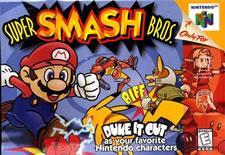
Super Smash Bros. N64 box art
Nintendo 641999Platform Fighter1-4 Players

Super Smash Bros.

The original Nintendo all-star brawler. Twelve iconic characters from across the Nintendo universe duke it out on stages drawn from their home games — knock your rivals off the screen using fireballs, fists, baseball bats and Poké Balls. The game that started one of Nintendo’s biggest franchises.
Developer:HAL Laboratory
Publisher:Nintendo
Director:Masahiro Sakurai
Players:1-4
Japan:21 Jan 1999
N. America:26 April 1999
Europe:19 Nov 1999
Australia:5 Jan 2000
Genre:Platform Fighter
Sales:5.55 million

Overview

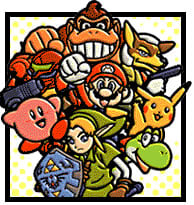
The default cast of Super Smash Bros.

Plunge headlong into battle with your favourite Nintendo characters. Super Smash Bros. on the Nintendo 64 pits the stars of all Nintendo’s biggest franchises against each other in the ultimate showdown. It’s a bumpin’, bruisin’, brawlin’ bash — the many worlds of Nintendo collide in the ultimate test of strength and skill.

Up to 4 players can choose their favourite characters — complete with signature attacks — and go at it in team battles and free-for-alls. Or venture out on your own to conquer the 14 stages of single-player mode. Either way, Super Smash Bros. is a no-holds-barred action-fest that’ll keep you coming back for more.

The game began life as a side project. HAL Laboratory’s Masahiro Sakurai and Satoru Iwata built a prototype called Kakuto-Gēmu Ryūō (“Dragon King: The Fighting Game”) which featured no Nintendo characters at all. Iwata pitched the idea of casting Nintendo’s mascots in the brawler, and the rest is history — the game launched a franchise that has run for over twenty-five years.

“Duke it out as your favorite Nintendo characters.”

Gameplay

Unlike traditional fighting games, Super Smash Bros. doesn’t involve depleting an opponent’s health bar. Players start each match at 0% damage, and the percentage rises as they take hits. The more damaged a player is, the further they get launched — and the aim is to knock your opponents clean off the screen, beyond what’s called the blast line. If you survive being launched, you return on a respawn platform that vanishes after a few seconds (or when you step off it). You’re invincible briefly after stepping off.
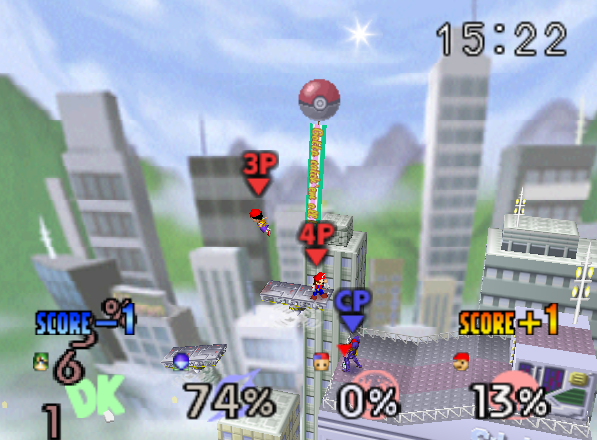
Donkey Kong loses stock to Mario in a Saffron City match

Time mode ends battles after a set timer. KOs count as points; getting KO’d subtracts a point. Highest score wins. If two or more players tie, the match goes to Sudden Death — tied players start at 300% damage, leaving them vulnerable to a one-hit KO. Bob-ombs start raining onto the stage if Sudden Death drags on too long.

Stock mode gives each player a fixed number of lives; lose your stock, lose the match. Sudden Death rules also apply on ties. Team Battles split players into red, green and blue teams who share stock — an eliminated team member can borrow a life from an ally by pressing Start, if the ally has at least two stock remaining. Team Attack is optional.

Game Modes

1P Game
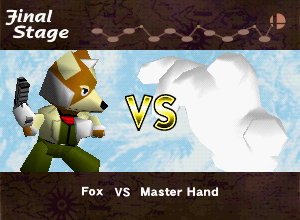
Stage progression screen for the Final Stage

The single-player journey. Pick a fighter, choose difficulty (Very Easy, Easy, Normal, Hard, Very Hard) and stock (1-5). Each stage has a 5-minute time limit by default. Beat each stage to earn bonuses for high-score purposes, and unlock characters along the way.

Stage Description
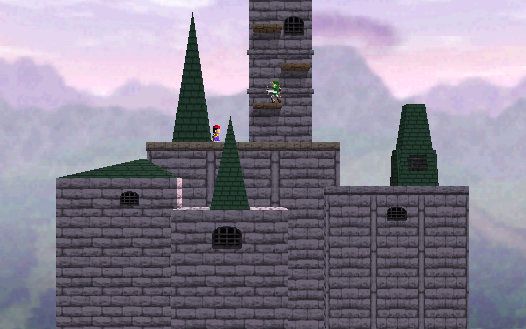
Stage 1 Link is fought at Hyrule Castle.
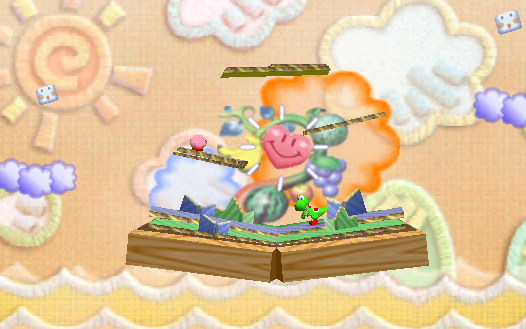
Stage 2 18 Yoshis are fought at Yoshi’s Island, three at a time.
Stage 3 Fox is fought in Sector Z.
Bonus 1 Break the Targets! Smash all 10 within two minutes.
Stage 4 Mario and Luigi are fought on Peach’s Castle. A random ally is assigned to the player.
Stage 5 Pikachu is fought at Saffron City.
Stage 6 Giant Donkey Kong is fought at Congo Jungle. Two random allies are assigned.
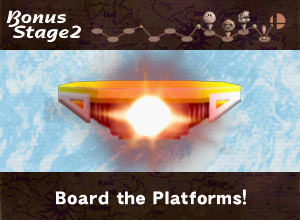
Bonus 2 Board the Platforms! Touch all 10 platforms within two minutes.
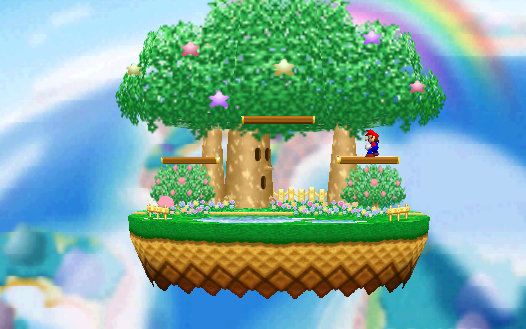
Stage 7 Eight Kirbies are fought in Dream Land — each with an ability copied from another fighter.
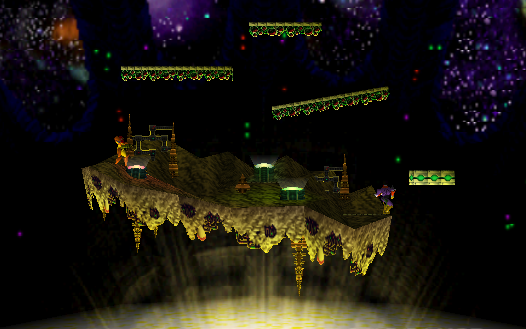
Stage 8 Samus is fought on Planet Zebes.
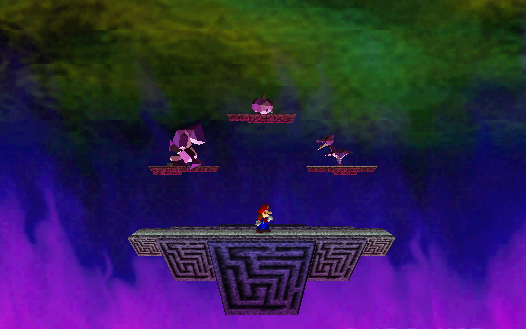
Stage 9 Metal Mario is fought on Meta Crystal.
Bonus 3 Race to the Finish! Reach the white door in 60 seconds.
Stage 10 30 Fighting Polygons are fought on the Duel Zone, three at a time.
Final Master Hand is fought at Final Destination.
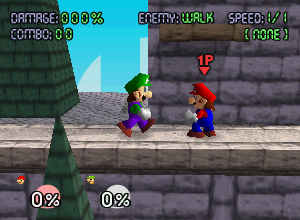
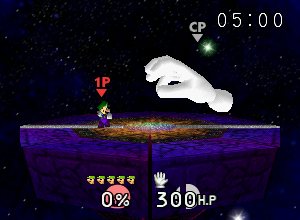
Mario vs Luigi in Training Mode

Training Mode

Practice mode with no time limit or stocks. Set the CPU behaviour (Stand, Walk, Evade, Jump or Attack). Spawn up to four items at once from the pause menu, and slow the game down to 2/3, 1/2 or 1/4 speed.

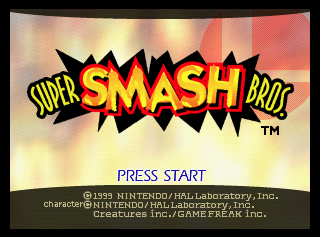
Super Smash Bros. title screen

Versus Mode

The main multiplayer arena. Up to four players (any mix of CPUs and humans), pick fighters, costumes, time or stock format, item spawn rate, handicap, damage ratio. Team Battles colour-code allies red/green/blue with shared stock.

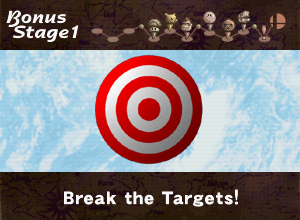
Break the Targets intro screen

Break the Targets!

Each fighter has their own unique target-smash stage. Hit all ten targets within two minutes — lose a stock and you fail. Used as Bonus Stage 1 in 1P, but also available standalone.

Board the Platforms intro screen

Board the Platforms!

Touch all ten platforms within two minutes. Each fighter has their own arrangement — Mario and DK’s resembles a construction site, Yoshi’s a grassy land. Falling off the blast line ends the run.

Options & Data: Toggle sound between mono and stereo, adjust the screen display, and wipe save data. European releases let you switch the language between English, French and German. Data shows VS records (KOs, TKOs, Self-Destructs) and damage stats per fighter, plus an unlockable Sound Test (clear Break the Targets AND Board the Platforms with every fighter).

Playable Characters

Super Smash Bros. launched with 12 playable characters drawn from across the Nintendo universe — eight default and four hidden. Four of them hail from the Super Mario franchise (Mario, Luigi, Donkey Kong and Yoshi), though DK and Yoshi each have their own series logo since they headline their own franchises. Every character has three special moves (Standard B, Up B, Down B), unique weight and speed, and a roster of basic attacks built around their game of origin.

Default Roster
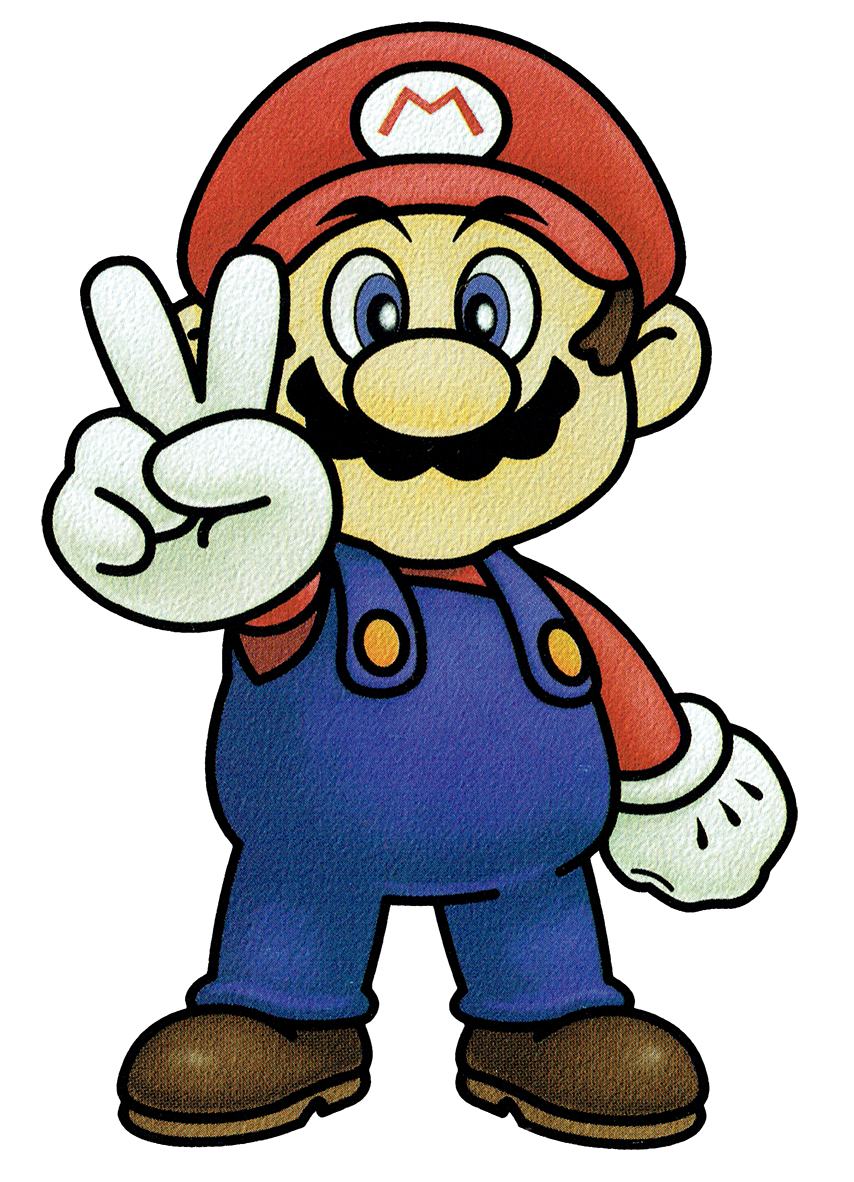
Mario artwork from Super Smash Bros.
Mario

Franchise: Super Mario · Weight: Medium · Speed: Medium

The all-rounder. Average speed and weight, but skilled at jumping and combo-attacking. His fireballs bounce along the ground, making them excellent for stage control. The yardstick by which every other fighter is measured — his moveset is what later games copied.

Standard B: Fireball · Up B: Super Jump Punch · Down B: Mario Tornado

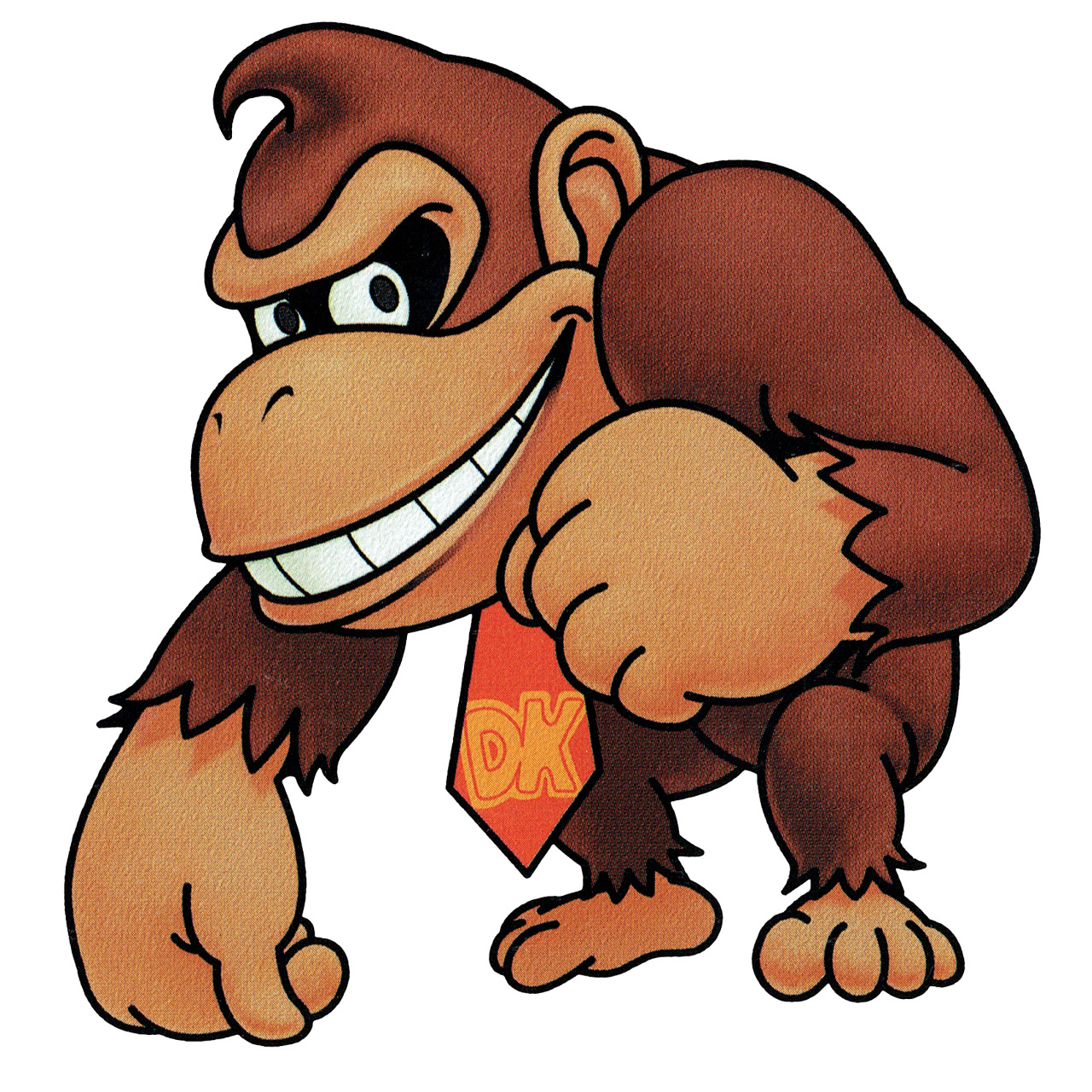
Donkey Kong artwork from Super Smash Bros.

Donkey Kong

Franchise: Donkey Kong · Weight: Heavyweight · Speed: Slow

One of the strongest and heaviest fighters in the game. His Giant Punch can be charged for a one-hit KO, and his cargo throw lets him pick up an opponent and physically carry them off the stage edge. Massive reach and devastating up-tilts.

Standard B: Giant Punch · Up B: Spinning Kong · Down B: Hand Slap

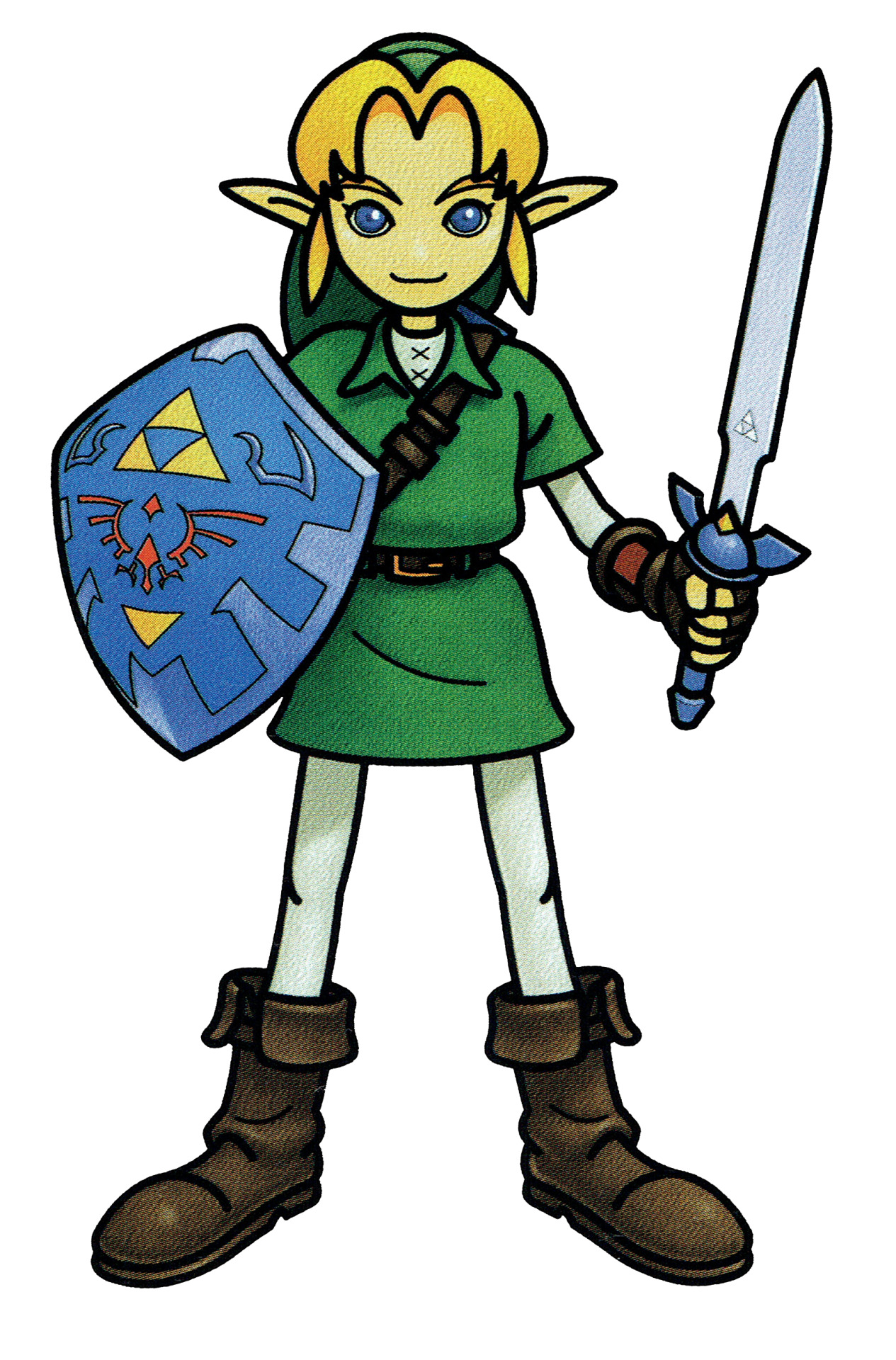
Link artwork from Super Smash Bros.

Link

Franchise: Legend of Zelda · Weight: Medium-heavy · Speed: Medium

An all-round fighter like Mario, but most of his attacks involve his sword — giving him reach the brawlers lack. Throws Bombs (which he can also catch and throw back), the Boomerang for ranged disruption, and uses the Spin Attack for vertical recovery and hits all around.

Standard B: Boomerang · Up B: Spin Attack · Down B: Bomb

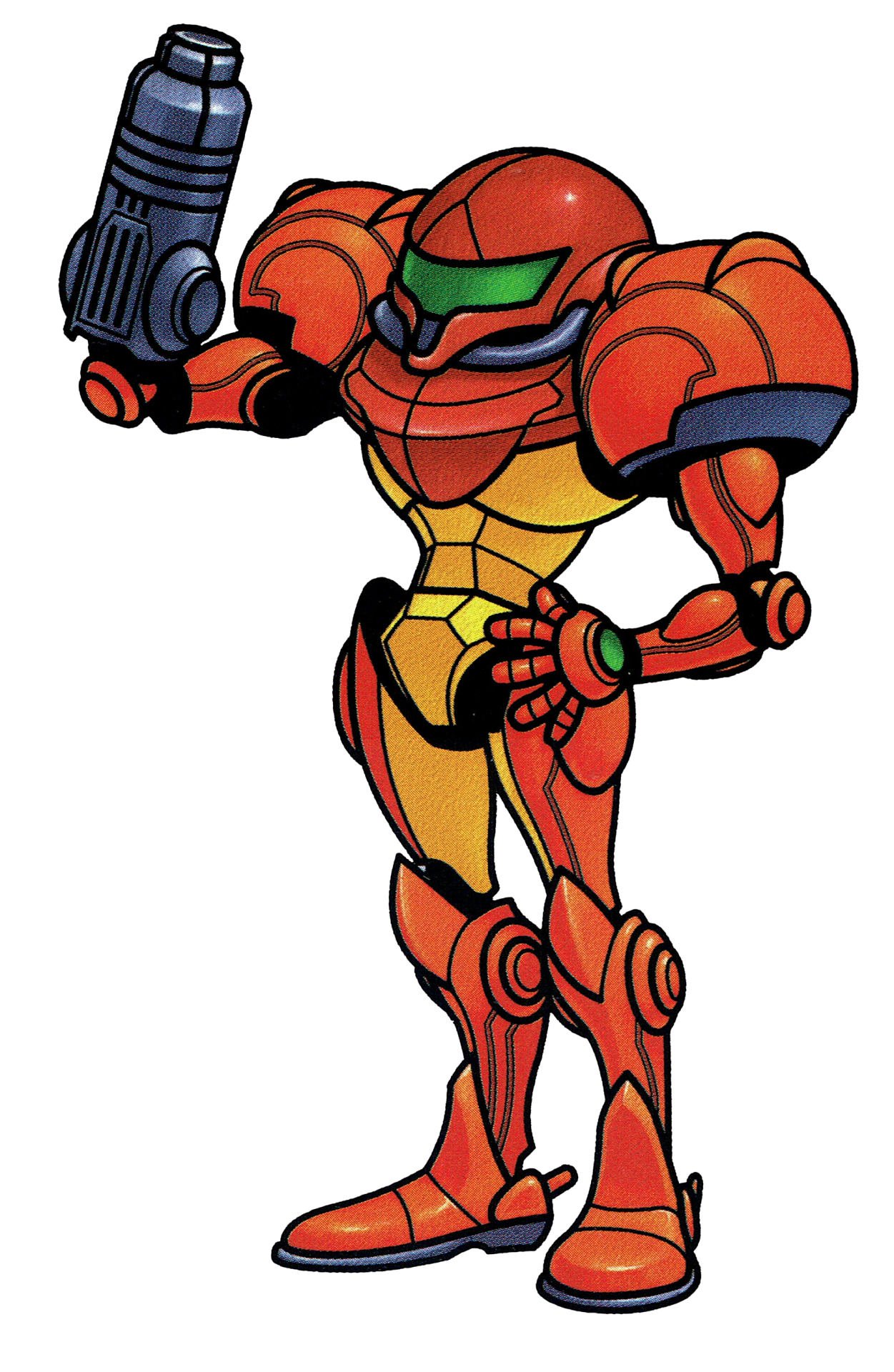
Samus artwork from Super Smash Bros.

Samus

Franchise: Metroid · Weight: Heavyweight · Speed: Slow

Slow but powerful, with the best zoning game in the roster. Her Charge Shot can be charged across multiple matches and unleashed for huge knockback. Uses the Grapple Beam as a tether grab. Her bombs lay traps on the ground.

Standard B: Charge Shot · Up B: Screw Attack · Down B: Bomb

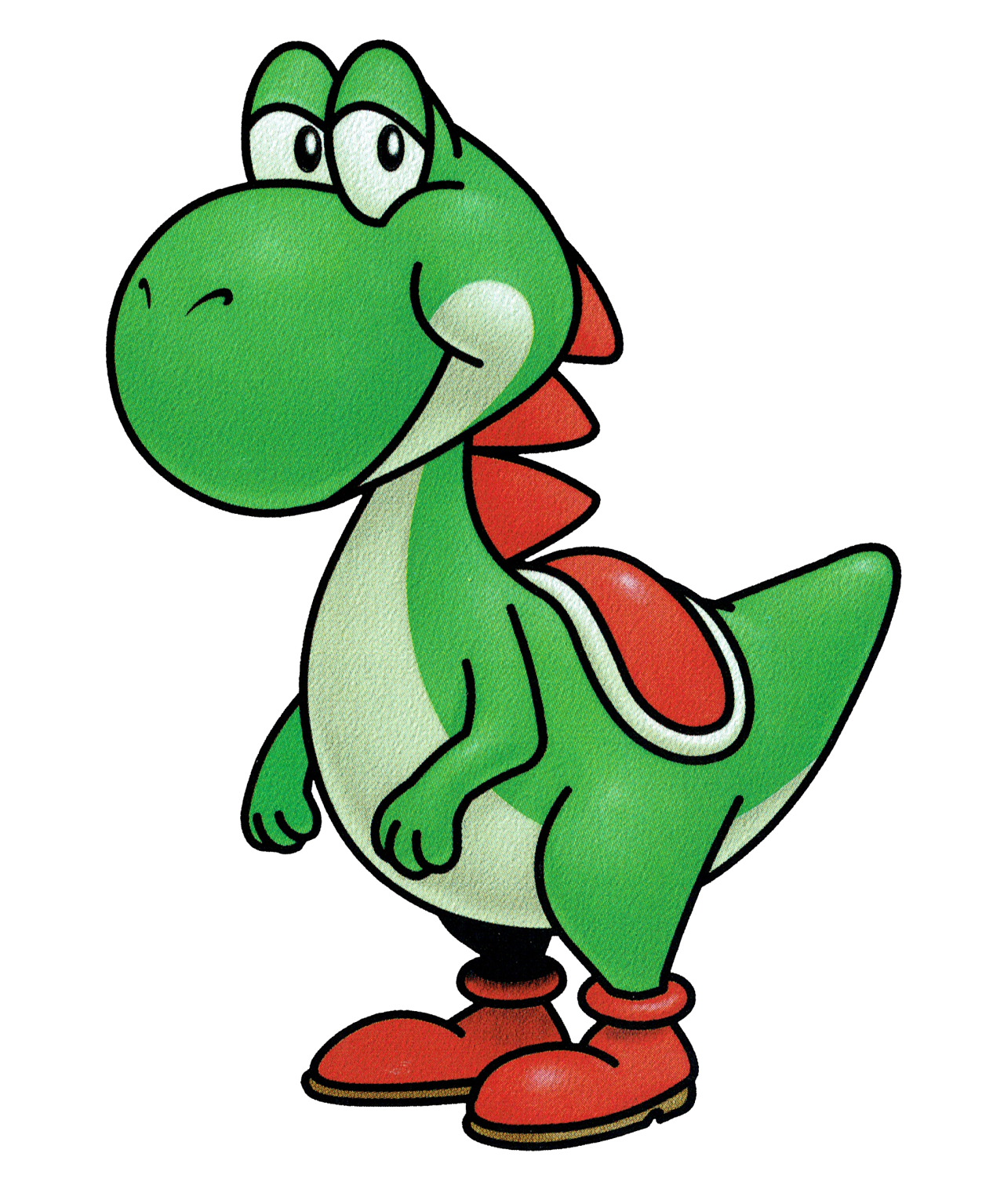
Yoshi artwork from Super Smash Bros.

Yoshi

Franchise: Yoshi · Weight: Middleweight · Speed: Fast

A fast middleweight with an unusual move kit. Uses a Yoshi Egg for shielding (it actually rolls when hit). Lacks a third jump — but his double jump grants full knockback immunity, a unique trait that lets him survive launches that would KO anyone else. Egg Lay swallows opponents and spits them out as eggs.

Standard B: Egg Lay · Up B: Egg Throw · Down B: Yoshi Bomb

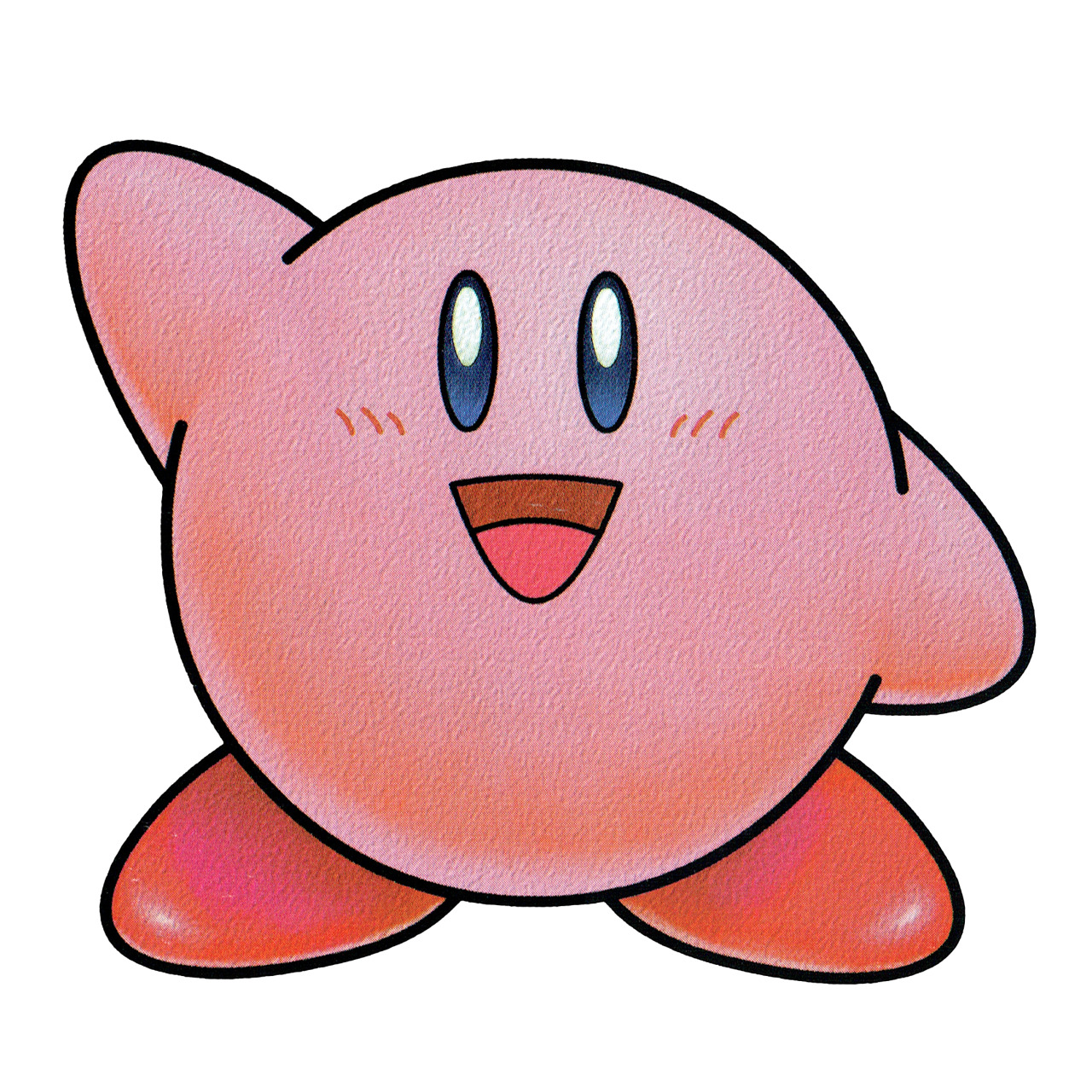
Kirby artwork from Super Smash Bros.

Kirby

Franchise: Kirby · Weight: Featherweight · Speed: Fast

Light and fast, with five air jumps making his recovery the best in the game. His Swallow lets him eat opponents and steal their B special move — copying Mario gives him Fireball, copying Samus gives him a charged shot, and so on. Stone drops as a heavy invincible boulder.

Standard B: Inhale · Up B: Final Cutter · Down B: Stone

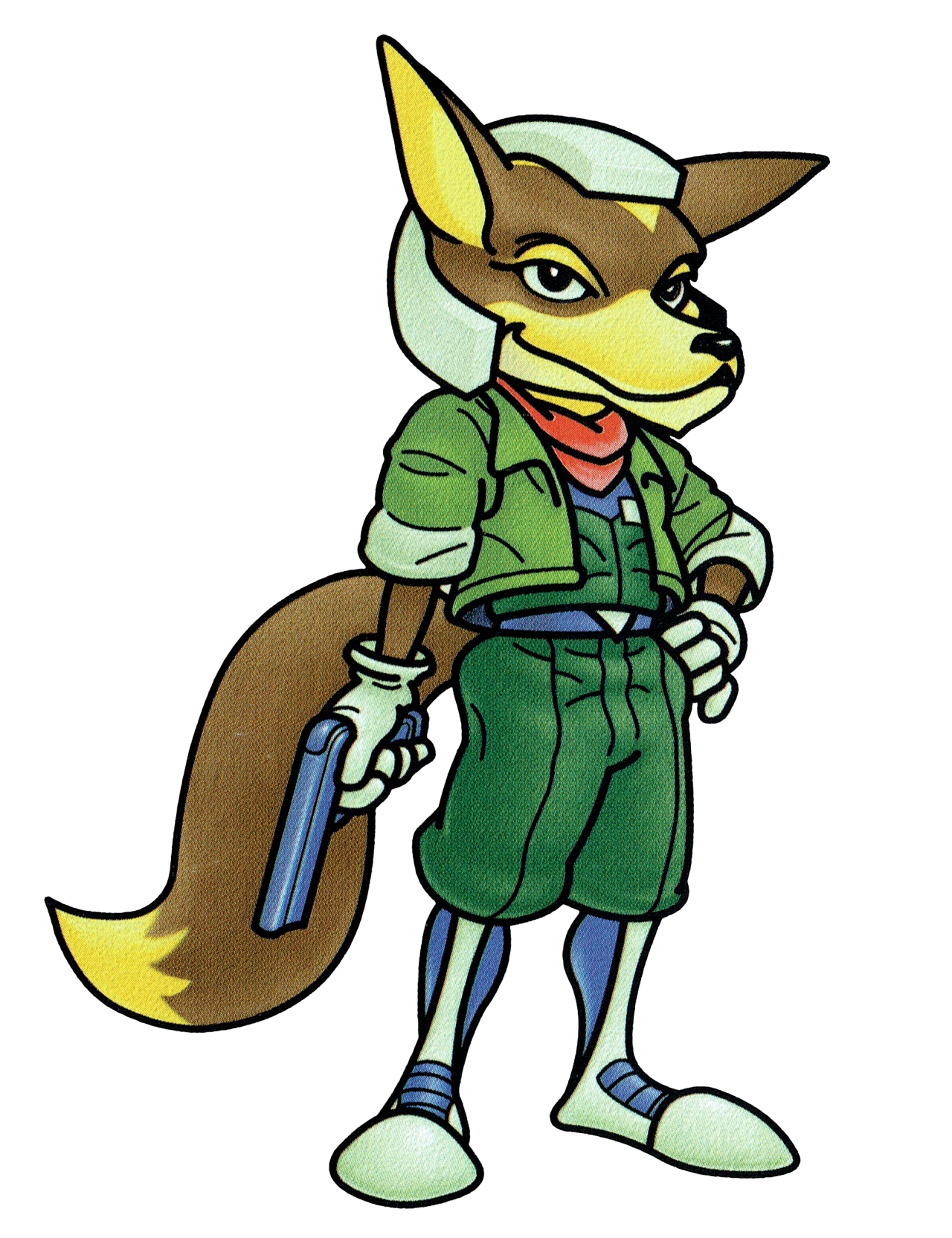
Fox artwork from Super Smash Bros.

Fox

Franchise: Star Fox · Weight: Medium-heavy · Speed: Very fast

Fast and surprisingly heavy, with average raw strength but excellent combo potential. His Blaster stuns opponents (it doesn’t flinch them, but adds damage), and his Reflector deflects projectiles back at the sender — making him a counter-pick against Samus or Link.

Standard B: Blaster Shot · Up B: Fire Fox · Down B: Reflector

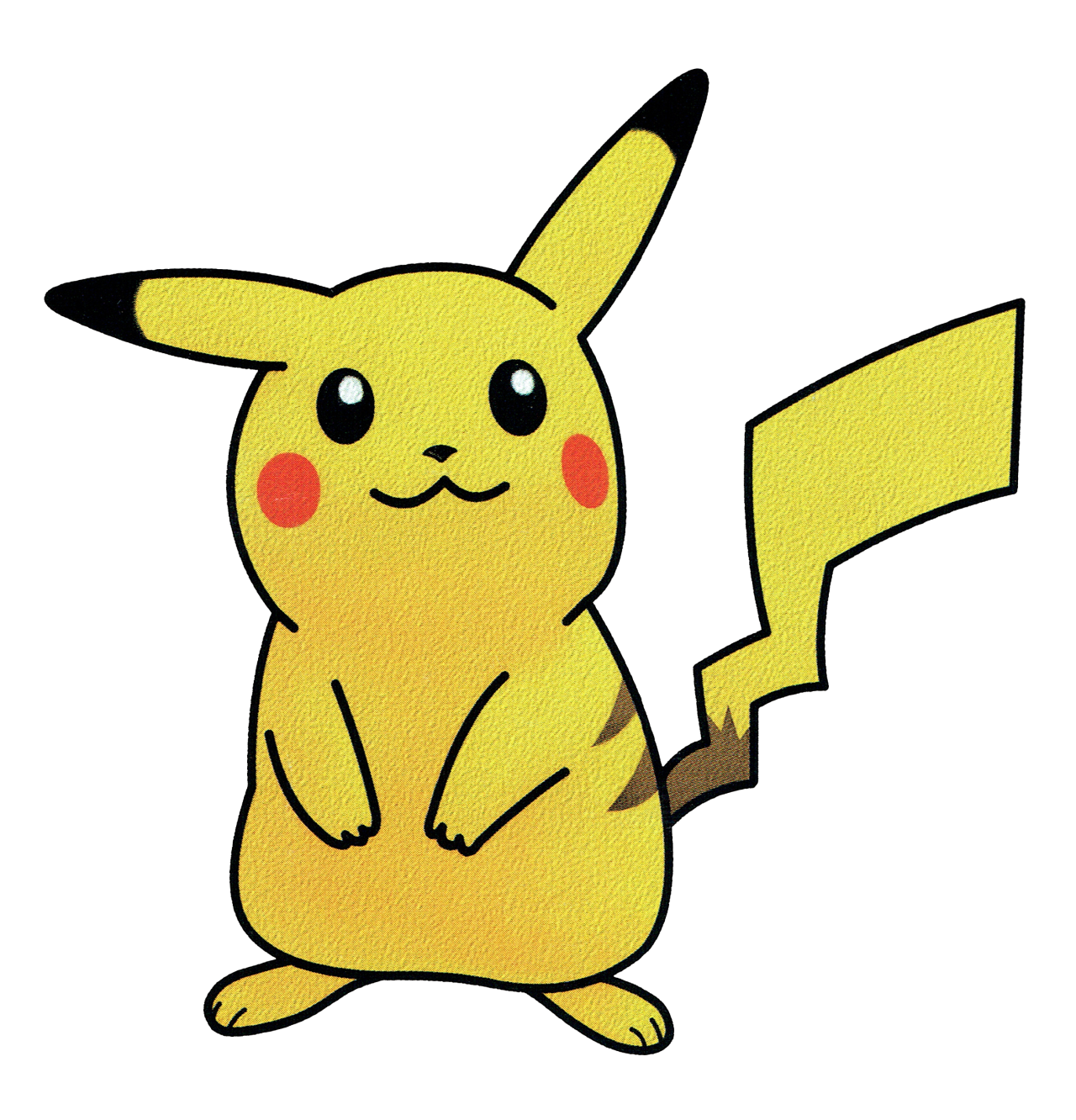
Pikachu artwork from Super Smash Bros.

Pikachu

Franchise: Pokémon · Weight: Featherweight · Speed: Very fast

Fast, light and electric. Damage is mostly weak per hit but stacks fast via combo strings. Thunder Jolt traces the ground as a horizontal projectile, Thunder drops a lightning bolt vertically that hits Pikachu itself for a devastating attack at point-blank range. Quick Attack lets him recover at any angle.

Standard B: Thunder Jolt · Up B: Quick Attack · Down B: Thunder

Unlockable Characters

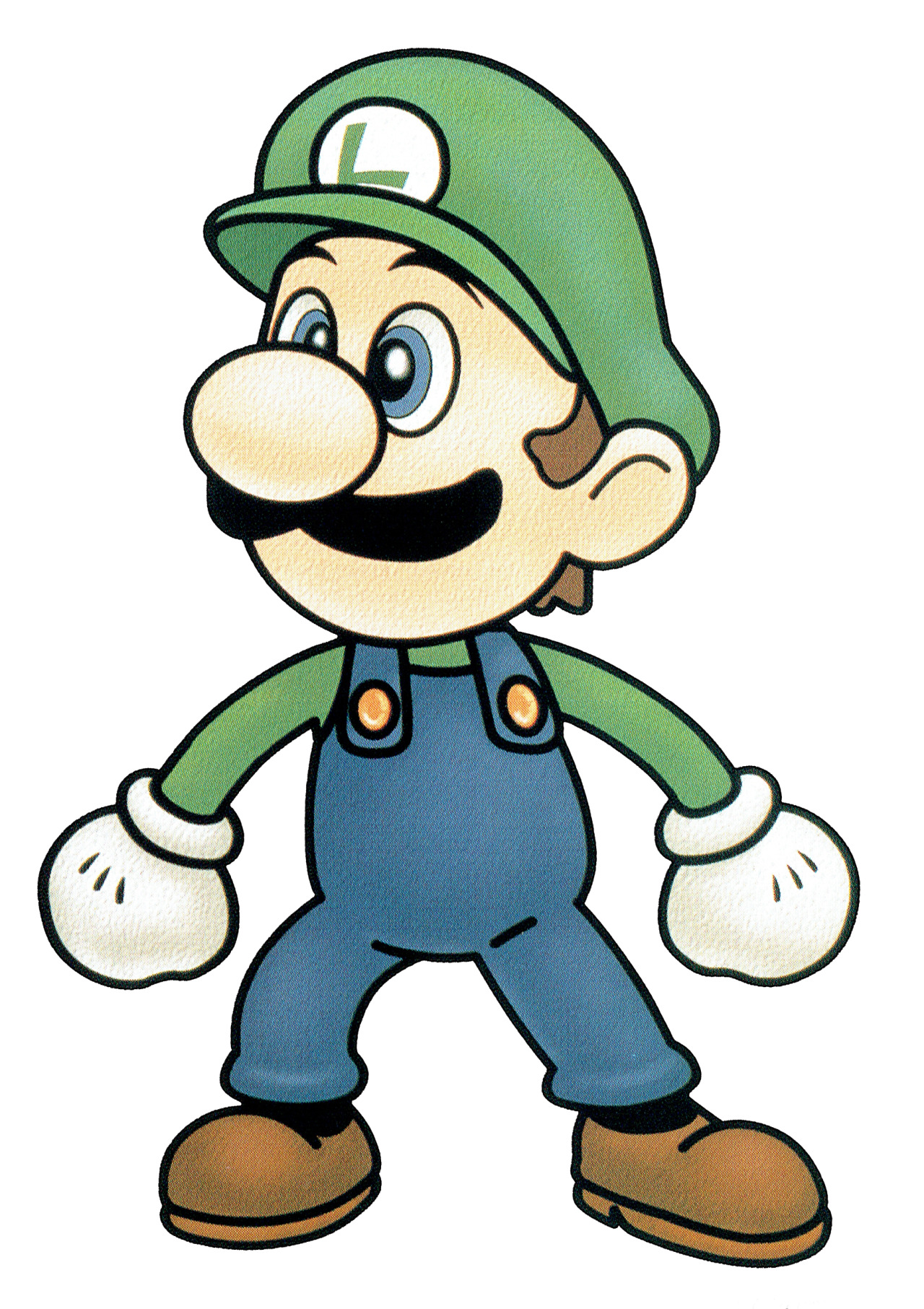
Luigi artwork from Super Smash Bros.

Luigi

Franchise: Super Mario · Weight: Medium-light · Speed: Medium-slow

A Mario clone, but a distinct one. Luigi’s moves hit harder than Mario’s — including a famously powerful Super Jump Punch when it lands — but he’s slower and lighter. His Green Fireballs travel straight rather than bouncing, going through enemies for ranged poking.

Standard B: Green Fireball · Up B: Super Jump Punch · Down B: Luigi Cyclone

Unlock: Clear Break the Targets! with all eight default fighters.

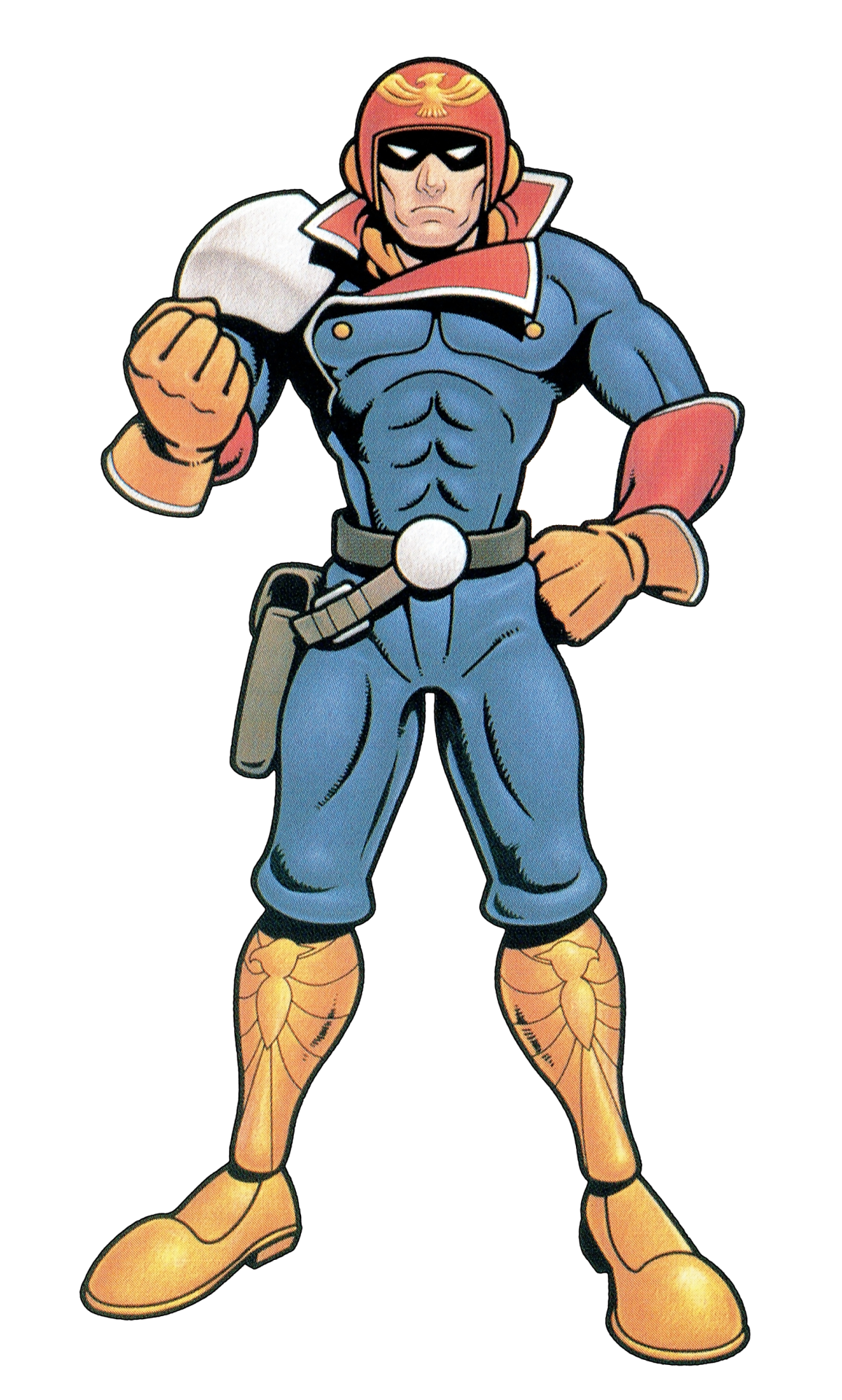
Captain Falcon artwork from Super Smash Bros.

Captain Falcon

Franchise: F-Zero · Weight: Heavyweight · Speed: Fastest in game

The fastest fighter in the game despite being a heavyweight. Every special move has a flame property, meaning enemies get launched even harder. His Falcon Punch is the iconic move — massive wind-up, but if it connects, you’re dead. Falcon Kick clears a path through anyone in front of him.

Standard B: Falcon Punch · Up B: Falcon Dive · Down B: Falcon Kick

Unlock: Clear 1P Game in under 20 minutes on any difficulty.

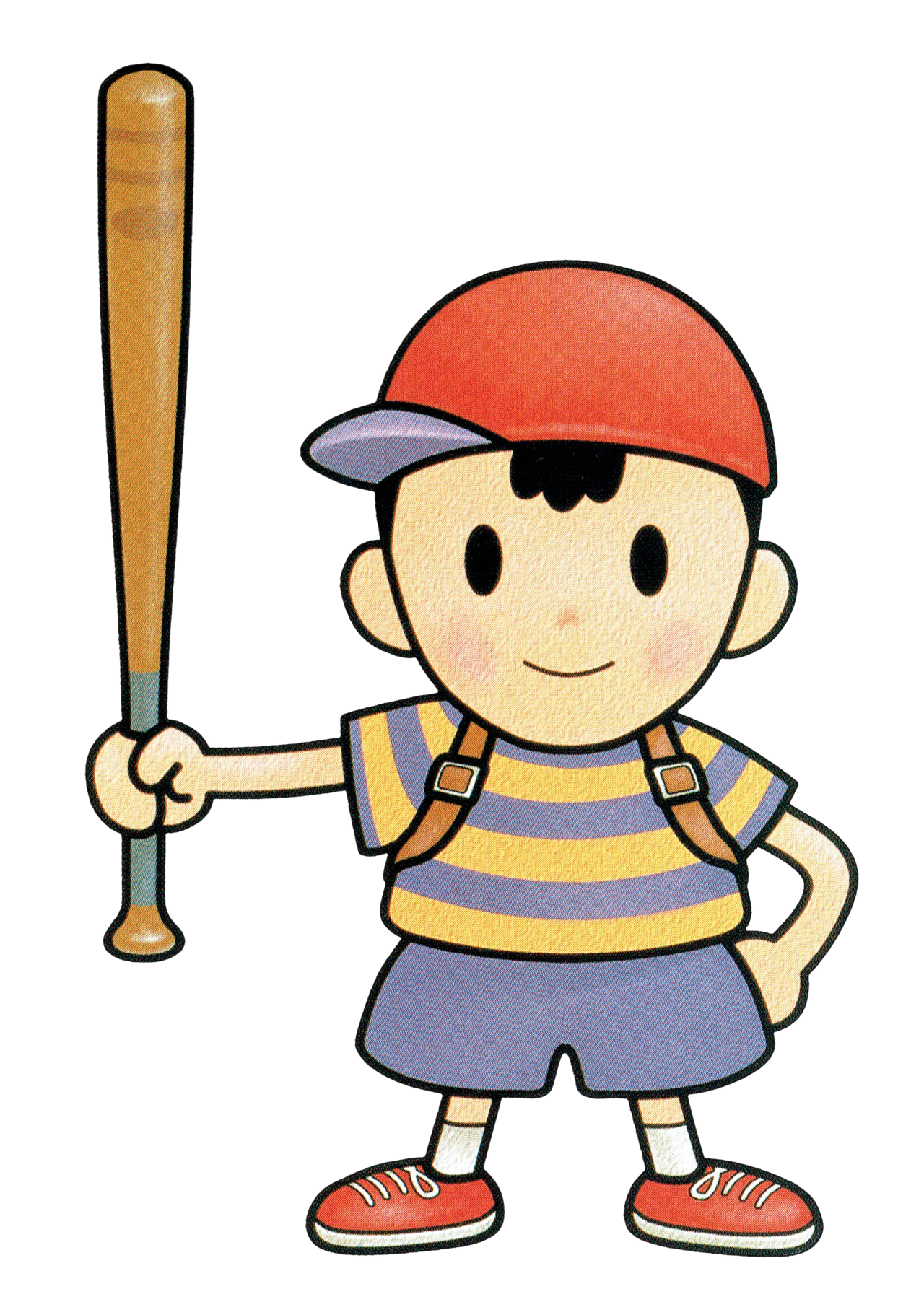
Ness artwork from Super Smash Bros.

Ness

Franchise: EarthBound · Weight: Featherweight · Speed: Fast

A fast lightweight whose entire kit is built around PSI (psychic powers). Uses a yo-yo and a baseball bat for basic attacks — the baseball bat is one of the most powerful smash attacks in the game. PK Thunder can be steered with the control stick into Ness himself to launch him as a powerful flying tackle (and recover).

Standard B: PK Fire · Up B: PK Thunder · Down B: Psychic-Magnet

Unlock: Clear 1P Game on Normal difficulty with 3 stock.

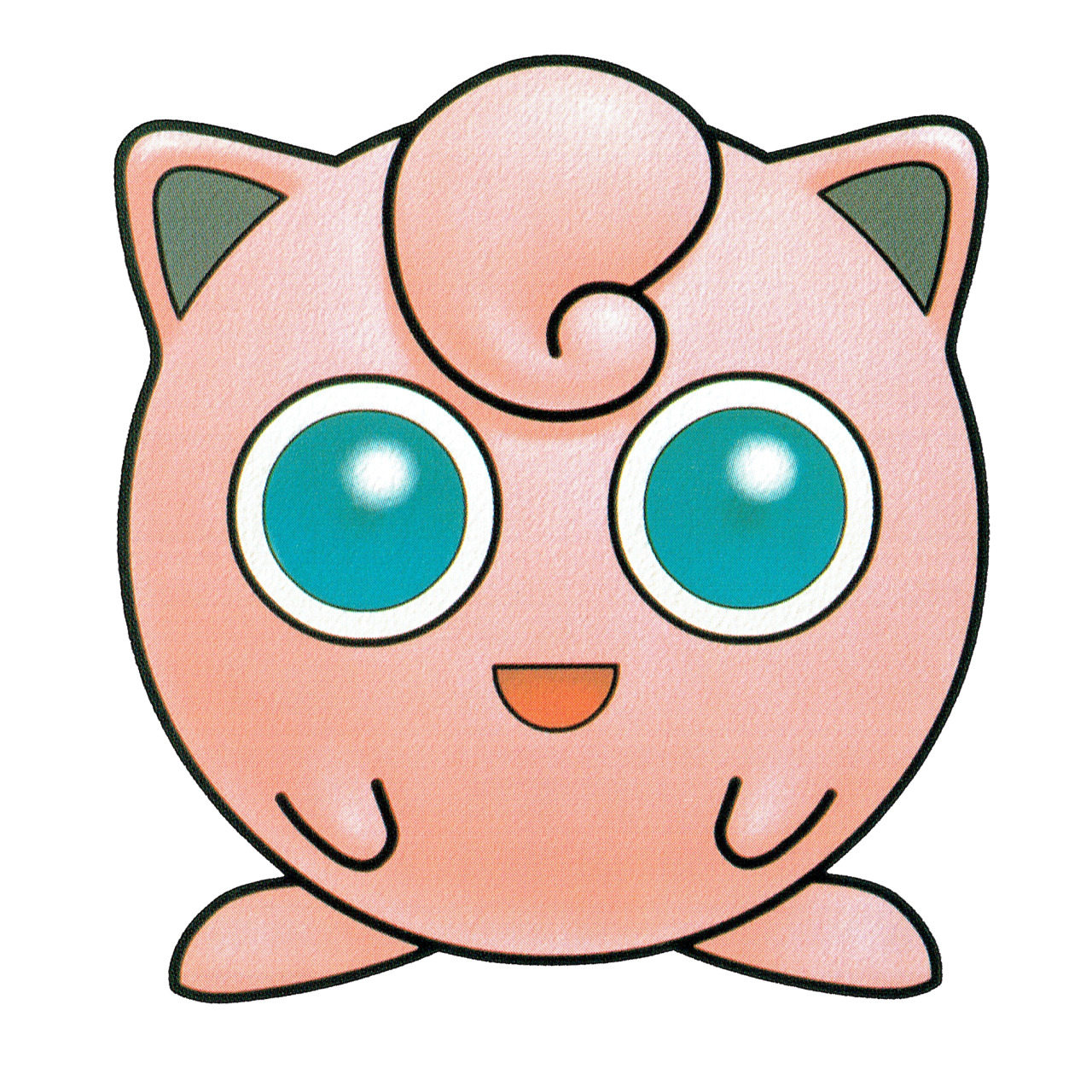
Jigglypuff artwork from Super Smash Bros.

Jigglypuff

Franchise: Pokémon · Weight: Featherweight · Speed: Slow

Light and weak in raw damage output, but with five air jumps and excellent air control. Its standout move is Rest — Jigglypuff falls asleep for a moment, and anyone touching it at the instant it triggers takes massive damage and is launched. If Jigglypuff’s shield breaks, it launches upward and usually gets KO’d.

Standard B: Pound · Up B: Sing · Down B: Rest

Unlock: Clear 1P Game on any difficulty.

Opponents (1P Mode)

1P Game throws three categories of enemies at you that you can’t pick yourself — mass enemies that show up in numbers, and three named bosses.

Enemies

Fighting Polygons

Faceless polygonal placeholder fighters fought in groups of three on the Duel Zone (Stage 10). Each Polygon corresponds to a roster fighter and uses similar moves, but with no AI personality — just relentless aggression. 30 of them in total.

Kirbys

Stage 7 in Dream Land throws eight Kirbies at you. The first seven each have a Copy Ability borrowed from another fighter; the eighth is either a normal Kirby or one with an unlockable character’s ability copied.

Yoshis

Stage 2 on Yoshi’s Island. 18 Yoshis fought three at a time — a sea of overlapping double-jumps and Egg Lays. Cyan, pink and yellow variants appear alongside the green default.

Bosses

Giant Donkey Kong

A scaled-up DK fought at the end of Stage 6 on Congo Jungle. Same moveset as the playable DK but with multiplied damage, range and knockback. You get two random ally fighters to help even the odds.

Metal Mario

Stage 9 takes you to Meta Crystal — a stage drawn directly from Super Mario 64’s metal cap segments — to fight a metallic, super-heavy version of Mario. Knockback resistance is brutal; you’ll need 200%+ damage to launch him.

Master Hand

The final boss. A giant disembodied white-gloved right hand floating in front of Final Destination. Attacks by punching, flicking, slapping, drilling and shooting Bullet Bills at you. The grand finale of 1P Game.

Stages

Eight default stages, one hidden, and three single-player-only arenas — each pulled from the home franchise of a different fighter.

Default Stages
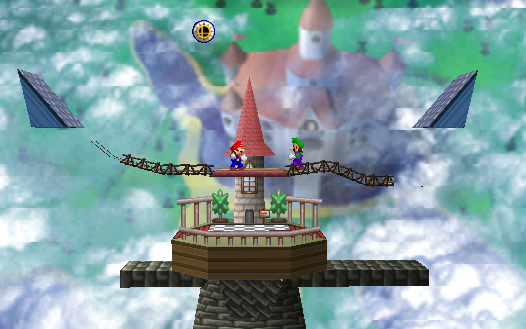
Peach's Castle stage from Super Smash Bros.

Peach’s Castle

Basis: Super Mario 64 · Home fighter: Mario & Luigi

A large flat platform with two sloped midair platforms, a moving platform at the bottom, and two Bumpers hovering above. Luigi’s unlock match takes place here.

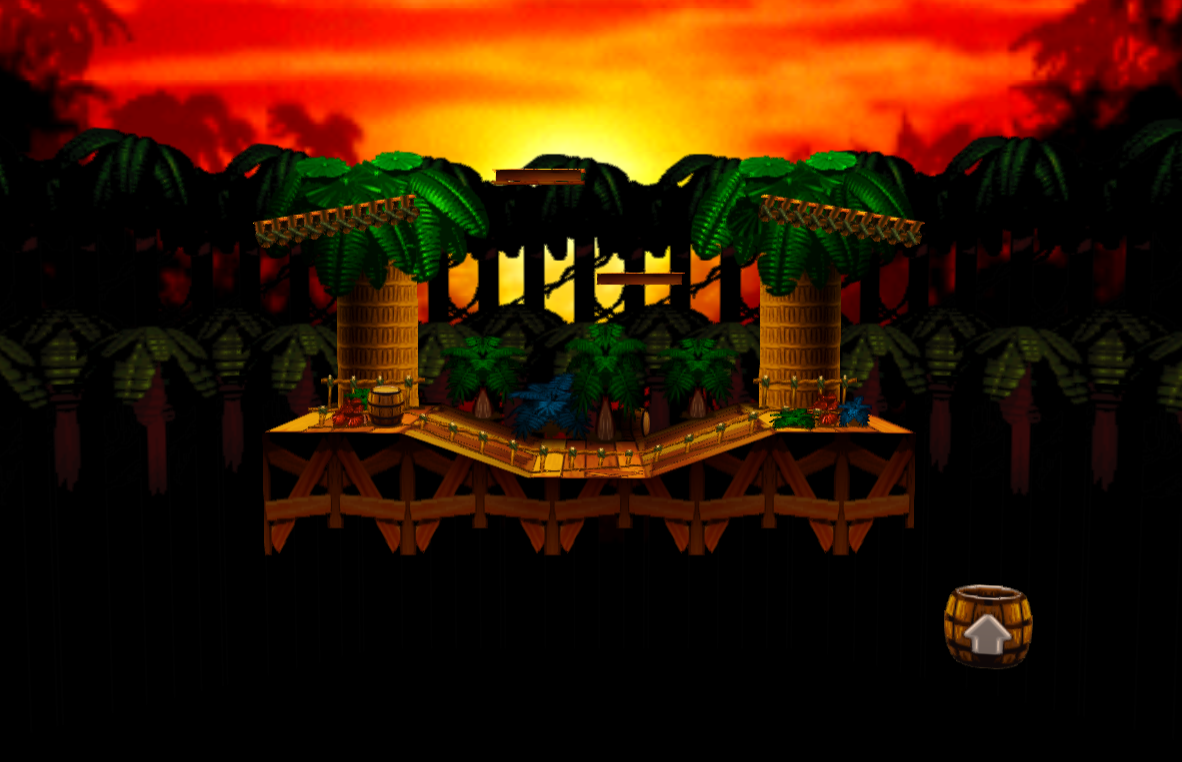
Congo Jungle stage from Super Smash Bros.

Congo Jungle

Basis: Donkey Kong Country · Home fighter: Donkey Kong

A sloped centre stage with a Barrel Cannon swinging back and forth beneath it. Step into the barrel and you can fire yourself out at an angle. Neckies appear in the background occasionally.

Hyrule Castle stage from Super Smash Bros.

Hyrule Castle

Basis: The Legend of Zelda: Ocarina of Time · Home fighter: Link

A long flat stage with whirlwinds spawning in one of four spots every 30 seconds — perfect for vertical launches. The biggest stage in the game.

Planet Zebes stage from Super Smash Bros.

Planet Zebes

Basis: Super Metroid · Home fighter: Samus

A small stage with damaging Acid rising every 30 seconds, often covering platforms. Captain Falcon’s unlock match takes place here — F-Zero had no representative stage.

Yoshi's Island stage from Super Smash Bros.

Yoshi’s Island

Basis: Yoshi’s Story · Home fighter: Yoshi

Sloped on either side in the storybook style of Yoshi’s Story. Three midair platforms above, two of them slanted. Clouds on the sides fade away if stood on too long. Goonies and Flying Shy Guys drift in the background.

Dream Land stage from Super Smash Bros.

Dream Land

Basis: Kirby’s Dream Land 3 · Home fighter: Kirby

A flat stage where Whispy Woods stands at the centre, occasionally blowing powerful wind gusts to one side. Ness’s unlock match takes place here — EarthBound also had no rep stage.

Sector Z stage from Super Smash Bros.

Sector Z

Basis: Star Fox 64 · Home fighter: Fox

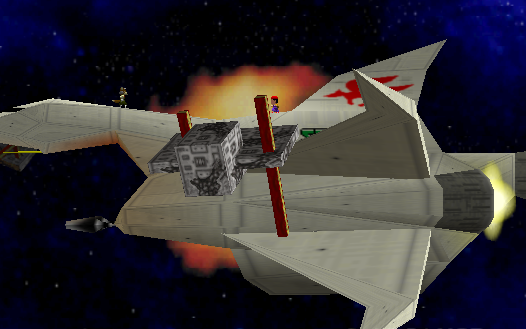
Battle on top of the Great Fox battleship as it drifts through space. An Arwing swoops in periodically and shoots laser blasts at the players. Largest of the default stages.

Saffron City stage from Super Smash Bros.

Saffron City

Basis: Pokémon Red/Green/Blue/Yellow · Home fighter: Pikachu & Jigglypuff

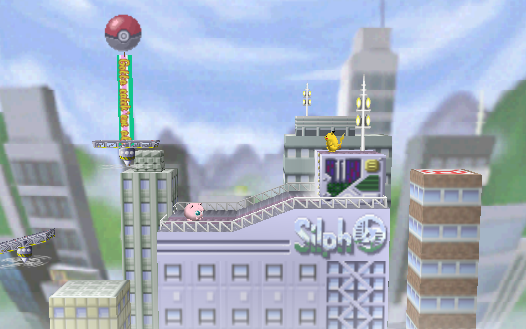
Set on rooftops of Silph Co. tower in Saffron. Pokémon emerge from a Poké Ball-shaped chimney in the middle — Chansey, Charmander, Electrode, Porygon or Venusaur — each with their own effect. Butterfree, Moltres, Pidgey and Fearow drift through the background.

Unlockable Stage

Mushroom Kingdom stage from Super Smash Bros.

Mushroom Kingdom

Basis: Super Mario Bros. · Home fighter: All

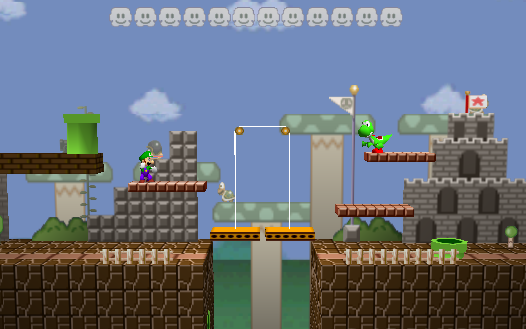
A large nostalgic stage with classic SMB1 gimmicks — Warp Pipes with Piranha Plants that emerge, POW Blocks, Scale Lifts (the pulley platforms), Brick Blocks, and moving platforms. Unlock: Clear 1P Game with all 8 default characters AND play each VS stage at least once.

1P-Only Stages

Meta Crystal stage from Super Smash Bros.

Meta Crystal

Basis: Super Mario 64 · Home fighter:

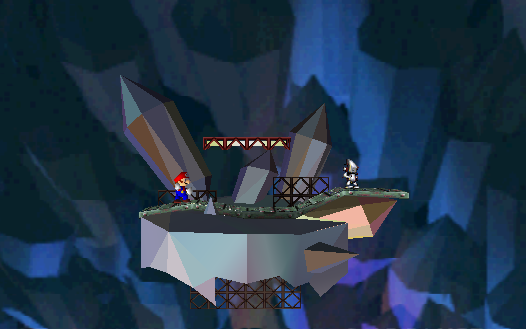
Where Metal Mario is fought (Stage 9). Mostly a basic plane with two bumps and one small platform above. Crystalline walls and floors create a metallic-cap aesthetic pulled straight from SM64.

Duel Zone stage from Super Smash Bros.

Duel Zone

Basis: Original · Home fighter:

Where the Fighting Polygon Team is fought (Stage 10). Short, flat stone with three small platforms in a triangle. No hazards — just polygons swarming you.

Final Destination stage from Super Smash Bros.

Final Destination

Basis: Original · Home fighter:

The final stage. Master Hand is fought here. Floats in an empty starfield. A basic flat platform — it’s all about you versus the Hand. The simple plane became iconic and is now a staple of every Smash game since.

Items

Items spawn at random — some are weapons, some are recovery, some are projectiles to throw. Frequency and type can be adjusted before each match.
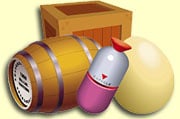
Containers item from Super Smash Bros.
Containers

Series: Super Smash Bros.

Crates, Capsules, Eggs and Barrels — all carry random items inside. Crates can be broken open or thrown. Barrels roll if they hit the ground. Capsules and Eggs are the lightest.

Bob-omb item from Super Smash Bros.

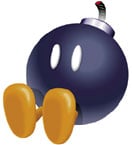
Bob-omb

Series: Super Mario

Pick it up and throw it — it explodes on contact. Left alone, it eventually starts walking and detonates on its own.

Fire Flower item from Super Smash Bros.

Fire Flower

Series: Super Mario

Unleashes a stream of fire that does flame damage to anyone caught in front of the user. Limited fuel.

Green Shell item from Super Smash Bros.

Green Shell

Series: Super Mario

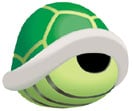
Thrown along the ground to slide and damage on contact. Disappears after several uses.

Red Shell item from Super Smash Bros.

Red Shell

Series: Super Mario

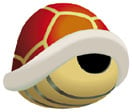
Like the Green Shell but homes in on players. Lower damage but harder to avoid.

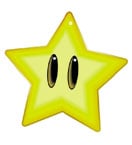
Star item from Super Smash Bros.

Star

Series: Super Mario

The classic Super Mario Star — invincibility for several seconds. You can still get launched off the blast line though.

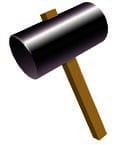
Hammer item from Super Smash Bros.

Hammer

Series: Donkey Kong

The original Donkey Kong arcade hammer. Slams up and down as the user moves — massive damage.

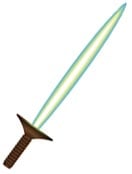
Beam Sword item from Super Smash Bros.

Beam Sword

Series: Super Smash Bros.

A glowing sword that can be swung for high damage and reach.

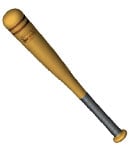
Home Run Bat item from Super Smash Bros.

Home Run Bat

Series: Super Smash Bros.

Charge a smash attack with the bat and you’ll one-shot just about anything you hit. The signature one-hit-KO item.

Motion Sensor Bomb item from Super Smash Bros.

Motion Sensor Bomb

Series: GoldenEye 007

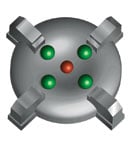
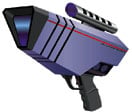
A surprise crossover from Rare’s GoldenEye 007. Place on the ground; the first opponent to walk near it takes the explosion.

Bumper item from Super Smash Bros.

Bumper

Series: Super Smash Bros.

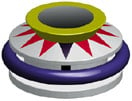
Floats in place and launches anyone touching it in one direction with high knockback.

Fan item from Super Smash Bros.

Fan

Series: Super Smash Bros.

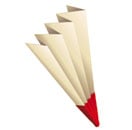
A paper fan that does negligible damage per hit but allows for rapid-fire combos.

Poké Ball item from Super Smash Bros.

Poké Ball

Series: Pokémon

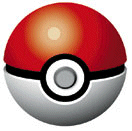
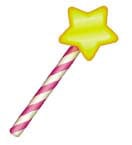
Throw it to release a random first-generation Pokémon that uses its signature move. See the Poké Ball Pokémon section below.

Star Rod item from Super Smash Bros.

Star Rod

Series: Kirby

Swing for a melee hit; charge a smash to shoot a star projectile. Limited number of stars per Rod.

Maxim Tomato item from Super Smash Bros.

Maxim Tomato

Series: Kirby

Restores up to 100% damage when picked up.

Heart Container item from Super Smash Bros.

Heart Container

Series: Legend of Zelda

Reduces damage all the way to 0%.

Ray Gun item from Super Smash Bros.

Ray Gun

Series: Super Smash Bros.

A sci-fi laser pistol — fires straight-line beam projectiles. Limited ammo.

Poké Ball Pokémon

When a Poké Ball is thrown, one of 13 first-generation Pokémon pops out and uses a signature move before disappearing. Some are battle-changing — others are basically useless gags. Catching Mew is worth a huge point bonus.

Beedrill from Super Smash Bros.

Beedrill

Poison Bee Pokémon · Take Down

Summons a whole swarm of Beedrills that rush across the stage in formation, damaging anyone in their path.

Blastoise from Super Smash Bros.

Blastoise

Shellfish Pokémon · Hydro Pump

Fires gushes of water that push opponents back. It also slowly slides itself backwards from the recoil.

Chansey from Super Smash Bros.

Chansey

Egg Pokémon · Soft-Boiled

Lays a scattering of eggs across the stage. Some can be eaten to reduce damage; others contain items or explosions.

Charizard from Super Smash Bros.

Charizard

Flame Pokémon · Flamethrower

Spits short-range plumes of fire from either side, sweeping back and forth.

Clefairy from Super Smash Bros.

Clefairy

Fairy Pokémon · Metronome

Imitates any other available Poké Ball Pokémon’s ability at random. Could be anything from Hitmonlee’s Jump Kick to Snorlax’s body slam.

Goldeen from Super Smash Bros.

Goldeen

Goldfish Pokémon · Splash

Flops around uselessly. Zero damage, zero point bonus — the comedy of opening a Poké Ball and getting Goldeen.

Hitmonlee from Super Smash Bros.

Hitmonlee

Kicking Pokémon · Jump Kick

Launches in a single arcing kick at the nearest opponent. High damage if it connects.

Koffing from Super Smash Bros.

Koffing

Poison Gas Pokémon · Poison Gas

Surrounds itself with poison smog. Anyone trapped inside takes continuous damage for several seconds.

Meowth from Super Smash Bros.

Meowth

Scratch Cat Pokémon · Pay Day

Rapid-fires coins in four directions at once around itself. Coins damage anyone caught nearby.

Mew from Super Smash Bros.

Mew

Mythical New Species Pokémon · —

Doesn’t attack at all — just floats up and out of the stage. Catching one nets a huge point bonus called Mew Catch.

Onix from Super Smash Bros.

Onix

Rock Snake Pokémon · Rock Throw

Showers the stage with boulders dropped from above. Heavy damage and stage control.

Snorlax from Super Smash Bros.

Snorlax

Sleeping Pokémon · Body Slam

Grows enormous and falls down through the stage from where it was summoned. Anyone underneath takes massive damage.

Starmie from Super Smash Bros.

Starmie

Mysterious Pokémon · Swift

Lines up horizontally with the nearest opponent and fires a barrage of star projectiles from a fixed position.

Stage Gimmicks & Hazards

Beyond the static stage layouts, most arenas have dynamic hazards — environmental threats that can decide the match.
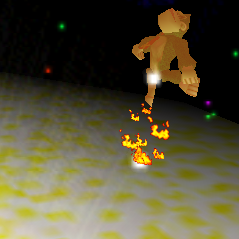
Acid
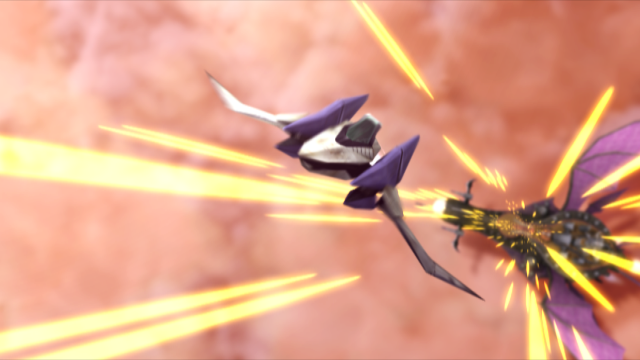
Acid

Stage: Planet Zebes

Highly caustic liquid that rises from the pit every 30 seconds, often covering platforms. Damages and launches anyone touching it.

Arwing model from Super Smash Bros.

Arwing

Stage: Sector Z

The Star Fox team’s signature ship makes regular fly-bys, firing its lasers at the stage. Predictable timing but high damage.

Barrel Cannon

Barrel Cannon

Stage: Congo Jungle

A floating barrel beneath the stage that swings back and forth. Enter it, hit A, and you launch in whatever direction it’s pointing.

Bomb hazard sprite

Bomb

Stage: Mushroom Kingdom / Race to the Finish

Large rolling explosives that appear in the bonus stage Race to the Finish. Single hit but punishing.

Brick Block sprite from Super Mario Bros.

Brick Block

Stage: Mushroom Kingdom

Floating cubes of bricks, just like the originals. Hit them to break them.

Bullet Bill

Bullet Bill

Stage: Final Destination

Quick-moving rounds fired by Master Hand as one of his finale attacks.

Bumper

Bumper

Stage: Peach’s Castle

Automatic versions of the Bumper item drift above the stage and bounce anyone touching them.

Chansey

Chansey

Stage: Saffron City

Pops out of the Silph Co. chimney and uses Soft-Boiled — dispenses eggs across the stage containing items or explosions.

Charmander

Charmander

Stage: Saffron City

Emerges from the Saffron City chimney and uses Flamethrower, spitting fiery streams from its position.

Cloud platform from Yoshi's Story

Cloud

Stage: Yoshi’s Island

Soft white clouds on either side of the stage. Fade away if stood on too long.

Cyclone

Cyclone

Stage: Hyrule Castle

A small but powerful whirlwind that appears in one of four positions every 30 seconds. Launches anyone caught upward.

Electrode

Electrode

Stage: Saffron City

Emerges from the chimney, blinks for a moment, then Explodes. Big radius, huge damage — usually the most punishing chimney Pokémon.

Warp Pipe from Super Smash Bros.

Pipe

Stage: Mushroom Kingdom

A trio of green Warp Pipes between which fighters can travel. Also where the Piranha Plant lives.

Piranha Plant

Piranha Plant

Stage: Mushroom Kingdom

Sprouts unpredictably from one of the Warp Pipes, snapping at anyone standing on it.

Porygon

Porygon

Stage: Saffron City

Emerges from the chimney and uses Tackle — rushes out at high speed to launch anyone in its path.

POW Block from Super Smash Bros.

POW Block

Stage: Mushroom Kingdom

A blue POW block from Mario Bros. Hit it from below and every grounded opponent gets launched.

Scale Lift sprite from Super Mario Bros.

Scale Lift

Stage: Mushroom Kingdom

Two lift platforms tied together by a rope and pulley — if either one is pulled high enough to hit the pulley, both crash down.

Venusaur

Venusaur

Stage: Saffron City

Emerges from the chimney and uses Razor Leaf — shooting a horizontal line of damaging leaves in front of it.

Whispy Woods

Whispy Woods

Stage: Dream Land

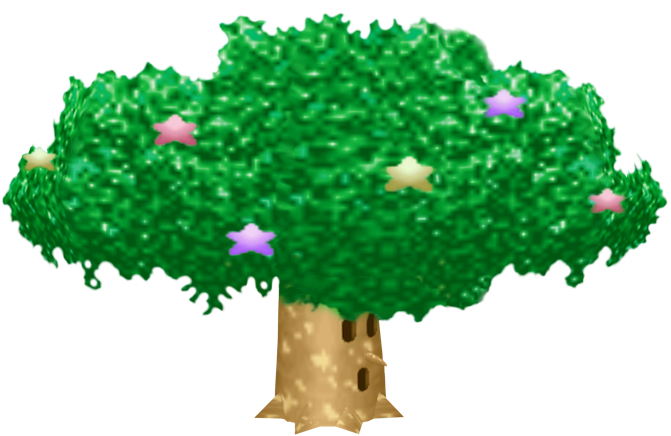
A surly old tree at the centre of Dream Land. Periodically blows powerful gusts of wind to one side, shoving fighters along the stage.

Stage Cameos

One of the joys of Super Smash Bros. is spotting the dozens of background cameos drawn from the home franchise of each stage. None of these affect gameplay — they’re pure fan-service, included to make each arena feel inhabited. Here’s the complete catalogue.

Bronto Burt background cameo from Super Smash Bros.

Bronto Burt

Appears in: Dream Land

Common flying creatures and enemies from the Kirby series. They drift in and out of view in Dream Land.

Butterfree background cameo from Super Smash Bros.

Butterfree

Appears in: Saffron City

A Butterfly Pokémon. Flutters through the Saffron City background occasionally.

Buzzy Beetle background cameo from Super Smash Bros.

Buzzy Beetle

Appears in: Mushroom Kingdom

The squat fireproof turtle from Super Mario Bros. One can be spotted bouncing on a spring in the Mushroom Kingdom stage.

Fearow background cameo from Super Smash Bros.

Fearow

Appears in: Saffron City

A Beak Pokémon. Soars through the Saffron City sky in the background.

Flying Shy Guy background cameo from Super Smash Bros.

Flying Shy Guy

Appears in: Yoshi’s Island

Shy Guys with propeller helmets, occasionally carrying a melon. Pulled straight from Yoshi’s Story.

Goonie background cameo from Super Smash Bros.

Goonie

Appears in: Yoshi’s Island

Large white albatrosses that drift across the Yoshi’s Island background.

King Dedede background cameo from Super Smash Bros.

King Dedede

Appears in: Dream Land

Kirby’s greedy, hammer-swinging rival makes a background cameo in Dream Land. Fun fact: he was actually planned as a playable fighter but cut before release.

Koopa Troopa background cameo from Super Smash Bros.

Koopa Troopa

Appears in: Mushroom Kingdom

A simple green-shelled turtle appears in Mushroom Kingdom — another classic SMB1 enemy.

Lakitu Bro background cameo from Super Smash Bros.

Lakitu Bro

Appears in: Peach’s Castle

A cloud-riding cameraman Lakitu floats around the Peach’s Castle stage — the in-universe explanation for the stage’s camera angle, just like in Mario Kart.

Message Block sprite from Yoshi's Story

Message Block

Appears in: Yoshi’s Island

The classic Yoshi-series faced blocks that appear floating around Yoshi’s Island.

Moltres background cameo from Super Smash Bros.

Moltres

Appears in: Saffron City

A Legendary Flame Pokémon. Occasionally streaks across the Saffron City sky in the background.

Necky background cameo from Super Smash Bros.

Necky

Appears in: Congo Jungle

Large vultures pulled from Donkey Kong Country. Visible in the Congo Jungle background.

Pidgey background cameo from Super Smash Bros.

Pidgey

Appears in: Saffron City

A Tiny Bird Pokémon. Flits in and out of the Saffron City background.

Ridley background cameo from Super Smash Bros.

Ridley

Appears in: Planet Zebes

Samus’s gruesome space-pirate nemesis. Appears in the background of Planet Zebes — a chilling glimpse for any Metroid fan, well before he became playable in Brawl.

Space junk sprite from Sector Z

Space junk

Appears in: Sector Z

Pieces of derelict machines making up obstacles in the space-graveyard backdrop of Sector Z.

The Super Happy Tree from Yoshi's Story

Super Happy Tree

Appears in: Yoshi’s Island

The symbol of the Yoshis’ happiness and the centrepiece of Yoshi’s Island. The stage is literally named after the tree on the wiki.

References to Other Games

Super Smash Bros. is built from the ground up on cross-franchise fan service. Almost every alternate costume, every animation, every taunt is a callback to a specific Nintendo game. Here’s the complete list.

Donkey Kong (arcade, 1981)

  • One of Mario’s alternate costumes is based on his original red-shirt/blue-overalls outfit from the arcade.
  • One of Donkey Kong’s alt costumes uses the colour scheme of his arcade sprite.
  • The Nintendo Power ad for SSB alludes to Mario and DK’s arcade rivalry, mentioning they hadn’t “duked it out” for over a decade.

Mario Bros. (1983)

  • One of Mario’s alt costumes uses the colour scheme of Luigi’s artwork from this game.

Wrecking Crew (1985)

  • One of Mario’s alts is based on Foreman Spike’s colour scheme.
  • Another Mario alt is based on his outfit in the Wrecking Crew key artwork.
  • One of Luigi’s alt costumes uses the colour scheme of his Wrecking Crew sprite.

Super Mario Bros. (1985)

  • The Mushroom Kingdom stage features a flagpole and castle directly referencing the original SMB1 endings.
  • One of Luigi’s alt costumes uses the colour scheme of his SMB1 sprite.
  • Mario’s taunt is based on his SMB1 idle animation when transforming into Super Mario.
  • The power-up and damage sound effects from SMB1 play during Mario’s taunt.

Super Mario Bros.: The Lost Levels (1986)

  • The red Piranha Plants in the Mushroom Kingdom stage use their appearance from this game.

Super Mario World (1990)

  • Luigi’s default costume is based on the colour scheme of his SMW sprite.
  • Three of Yoshi’s alt costumes are based on the Red, Blue and Yellow Yoshis from this game.

Super Mario Land 2: 6 Golden Coins (1992)

  • One of Mario’s alt costumes is based on the colour scheme of Wario from his Land 2 debut.

Mario Kart series

  • The Nintendo Power ad alludes to both Super Mario Kart and Mario Kart 64 when noting that Nintendo’s cast had previously “raced go-karts”.

Donkey Kong (Game Boy, 1994)

  • Two of Donkey Kong’s alt costumes are based on his Game Boy and Game Boy Color sprite colours.

Donkey Kong Country (1994)

  • The Congo Jungle stage is based directly on Donkey Kong Country.
  • Donkey Kong’s 1P Mode ending uses artwork from Donkey Kong Country.
  • The Hand Slap move returns from DKC.

Super Mario World 2: Yoshi’s Island (1995)

  • Two of Yoshi’s alt costumes are based on the Cyan and Pink Yoshis from Yoshi’s Island.

Super Mario 64 (1996)

  • Mario and Yoshi’s default costumes are based on their in-game 3D models from SM64.
  • Some of Mario’s moves are taken directly from SM64.
  • Mario’s character portrait on the character select screen is based on his official SM64 smiling artwork.
  • The Peach’s Castle stage is based on SM64.
  • The Meta Crystal stage references the Metal Cap segments of SM64.

Yoshi’s Story (1997)

  • The Yoshi’s Island stage is based on Yoshi’s Story (with the storybook-edge stage shape and pastel colours).
  • Yoshi’s 1P Mode ending — where Yoshi gets trapped in a picture frame — references the plot of Yoshi’s Story, in which Baby Bowser curses Yoshi’s Island into a storybook.

Mario Party (1998)

  • The Nintendo Power ad alludes to Mario Party when noting that Nintendo’s cast had previously “partied heartily”.

References in Later Games

Super Smash Bros. went on to influence its own sequels in turn — and beyond.

Paper Mario (2000)

  • In both games, Fire Flowers emit fire instead of transforming Mario.

Super Smash Bros. Melee (2001)

  • Yoshi’s Island, Congo Jungle (renamed Kongo Jungle), and Dream Land all return as stages — near-identical to their N64 originals.
  • Metal Mario returns as an opponent in Classic Mode (Melee’s equivalent to 1P Game).

Super Smash Bros. for 3DS / Wii U (2014)

  • Peach’s Castle, Hyrule Castle, and Dream Land all return in both versions.
  • Kongo Jungle returns — Wii U version only.
  • Two in-game conquests reference the original SSB roster: the “Spoilers!” conquest pits the original unlockables (Luigi, Jigglypuff, Ness, Captain Falcon) as a team, and “Smashing Since Before It Was Cool” features all 12 SSB64 fighters.

Super Smash Bros. Ultimate (2018)

  • Peach’s Castle, Kongo Jungle, Hyrule Castle, Yoshi’s Island (under the wiki name “Super Happy Tree”), Dream Land, and Saffron City all return — all near-identical to their N64 originals.
  • Mushroom Kingdom also returns, but redesigned to look closer to the actual Super Mario Bros. aesthetic.
  • The starting roster of Ultimate consists of the same eight default fighters from the original Super Smash Bros. on N64.

Regional Differences

How to Play tutorial

The Japanese version’s “How to Play” tutorial video has Mario and Luigi’s on-screen movements slightly out of sync with the controls being shown. International versions tidied this up so the demonstration matches the control prompts — e.g. Luigi fast-falls correctly in international versions, the Fire Flower doesn’t fall off, and the brothers face each other when demonstrating jumps.

Saffron City

The Japanese version has a banner that reads “Got a Catch ’em All!” — missing the second T (with a space instead). International versions fixed this to “Gotta Catch ’em All!”. The font also appears to have been redrawn to accommodate the fix. Additionally, the main building reads “Silf” in Japan and was changed to “Silph” internationally — both nods to Silph Co. from Pokémon Red/Blue.

Character Sizes

Mario and Luigi were made slightly bigger in international versions (though Metal Mario stayed the same height). Kirby was made slightly smaller internationally.

1P Game balance

In the Japanese version of 1P Stage 1, on any difficulty except Hard, Link would stand still and not attack if his damage was below 21%. International versions removed this, making Link move and attack immediately. The Japanese version also has no congratulatory screens after completing the mode — international versions added them.

Point Yield

Almost every bonus award value was rebalanced between Japan and international. Most notable changes: Yoshi Rainbow jumped from 15,000 to 50,000 points; Pacifist doubled from 30,000 to 60,000; Heavy Damage nearly tripled from 10,000 to 28,000. Most completion bonuses scaled up roughly 75% — international Hard Clear awards 280,000 vs Japan’s 160,000.

Pre-Release & Unused Content

Bowser, Mewtwo and King Dedede were all planned as playable characters early in development but were cut from the final game. Bowser and Mewtwo would eventually make it in for Melee; Dedede had to wait until Brawl. The early version of Peach’s Castle also lacked the sign, bridge and sliding stone block that appear in the final stage.

Glitches

3D Wall-Roll Glitch

Pick Mario or Luigi, head to Hyrule Castle (or any stage with a straight wall), and keep rolling into the wall. Done correctly, Mario or Luigi will start moving towards the screen or away from it — producing a brief, broken 3D effect on what’s otherwise a 2D side-on stage.

Black Hole

All four players must be Link. At Hyrule Castle or any stage with a straight wall, all four Links walk to the right, fall into the canopy section, and run left against the wall until they’re inside each other. Let the game push them apart, then have all four throw bombs upwards weakly and rapidly. After just a few throws, the bombs collide with each other in mid-air and remain stuck — trapping all four Links in an infinite explosion.

PK Thunder Freeze

Requires two players — one Ness, one Fox. On Hyrule Castle or Sector Z (or any stage with a direct line between players), Ness fires PK Thunder at Fox’s Reflector. The Thunder bounces back at Ness, and Ness quickly bats it away again. If the PK Thunder grows two tails and reaches the edge of the screen, the N64 hardware can’t handle it and the game freezes.

Reception

Super Smash Bros. received broadly positive reviews, with the multiplayer praised universally and the single-player mode getting most of the criticism. Despite the early skepticism (a Nintendo crossover brawler was an unproven concept), the game’s success on the N64 launched one of Nintendo’s most successful franchises.

Publication Score Quote
Nintendo Power 7.7/10 “SSB excels as a multiplayer game, offering endless rematches and shouting matches.” — Levi
IGN (Peer Schneider) 8.5/10 “I’ve been playing Smash Bros. since its Japanese release — and I still love the game. As it stands, Smash Bros. is an excellent choice for gamers looking for a worthy multiplayer smash ’em-up.” — Editors’ Choice
GameSpot (Jeff Gerstmann) 7.5/10 “The game is extremely simple to learn and reasonably easy to master. If you’ve got a crew of friends ready to pick a Nintendo character and throw down, then Super Smash Bros. is definitely worth a purchase.”
Metacritic 79 Aggregator score
GameRankings 78.81% Aggregator score

Sales

Super Smash Bros. became a commercial smash hit and quickly earned Player’s Choice status (Nintendo’s budget reissue line). It’s the fifth best-selling Nintendo 64 game of all time, with 5.55 million copies sold worldwide as of December 31, 2009: 1.97 million in Japan, 2.93 million in North America, and 650,000 elsewhere.

Promotion

Slamfest ’99

A promotional event held at the MGM Grand Adventures Theme Park on April 24th, 1999, organised by Nintendo of America and Golin/Harris International. It featured a staged wrestling match between costumed mascots of Mario, Yoshi, Donkey Kong and Pikachu — the same costumes that appeared in the famous North American TV commercial. It was broadcast live on the event website and was rewatchable for several months via RealPlayer G2.

The “Happy Together” commercial

The North American commercial was produced by Leo Burnett Worldwide, directed by Mark Story (previously known for SNL’s “Ad Council” segments), and filmed at Golden Oak Ranch in California. It was the first commercial featuring mascot costumes by KCL Productions. The spot opens with Pikachu, Yoshi, Mario and Donkey Kong skipping through a sunflower field while “Happy Together” by The Turtles plays — then Mario kicks Yoshi in the leg, and all four explode into a brawl. The commercial was later reused in France and Germany.

Trivia & Easter Eggs

  • The game started life as a side project by HAL Laboratory’s Masahiro Sakurai and Satoru Iwata, prototyped in their spare time. The original title was Kakuto-Gēmu Ryūō (“Dragon King: The Fighting Game”) and featured no Nintendo characters at all — it was just a generic fighting prototype.
  • It was Iwata who pitched the idea of casting Nintendo characters to give the game “atmosphere”. Without that pitch, there might never have been a Smash Bros. franchise at all.
  • The game had a tiny budget and almost no promotion. It was originally intended as a Japan-only release.
  • Director Masahiro Sakurai has gone on to direct every Smash Bros. game since — through Melee, Brawl, 3DS/Wii U, and Ultimate.
  • Super Smash Bros. is the fifth best-selling Nintendo 64 game of all time, behind only Mario Kart 64, Super Mario 64, GoldenEye 007, and Zelda: Ocarina of Time.
  • The eight default characters from this game became the starting roster of Super Smash Bros. Ultimate — a deliberate callback to the original.
  • In the Japanese version, the Saffron City background banner reads “Got a Catch ’em All!” — missing the second T. International versions fixed it to “Gotta Catch ’em All!”.
  • Silph Co.’s building was labelled “Silf” in Japan and corrected to “Silph” internationally.
  • Bowser, Mewtwo, and King Dedede were all planned as playable characters but cut from the final roster. Bowser and Mewtwo eventually made it into Melee; Dedede waited until Brawl.
  • There are 12 final playable characters in the game — 8 default and 4 unlockable.
  • Super Smash Bros. invented the now-iconic fighting-game mechanic of KO-by-damage-% instead of HP bars — you don’t die from damage, you die from being launched off the screen.
  • It was erroneously listed as a Super Mario game by GameTrailers when they did their ten best Super Mario games rundown.
  • IGN reviewer Peer Schneider, in his 8.5/10 review, made a wishlist of characters he hoped to see in a sequel: “Ganondorf, Wario, Toad, Meowth, Pit from Kid Icarus, Banjo-Kazooie — the list is endless.” Almost every one of those characters has since appeared as either a playable fighter or assist.
  • GameSpot’s Jeff Gerstmann praised the music as “amazing”.
  • There are 16+ background cameos hidden across the stages — Ridley on Planet Zebes, King Dedede in Dream Land, Lakitu Bro at Peach’s Castle, Necky in Congo Jungle, and many more. Almost every Pokémon background bird is a different species.
  • Yoshi has a unique trait no other fighter has: his double jump grants full knockback immunity, letting him survive launches that would KO anyone else.
  • Kirby can steal another fighter’s B special move by swallowing them — swallow Samus and Kirby gets a charged shot, swallow Mario and he gets fireballs.
  • Captain Falcon was the only fighter without his own home stage — his unlock match takes place on Planet Zebes, since F-Zero had no representative stage. Ness has the same issue (EarthBound) and unlocks at Dream Land.
  • The North American commercial uses “Happy Together” by The Turtles — an upbeat 1967 pop song that became indelibly linked to Smash Bros. in the minds of a generation of kids.
  • A Slamfest ’99 promotional wrestling event was held in Las Vegas before launch, with costumed Mario, Yoshi, DK and Pikachu mascots fighting in the ring.
  • The North American commercial was directed by Mark Story, who previously directed SNL’s “Ad Council” segments.
  • The roster of 13 first-generation Poké Ball Pokémon includes the trash-tier joke pick: Goldeen, which does nothing but Splash uselessly. Catching Mew, by contrast, is worth a huge bonus.
  • A Sound Test is unlockable — but requires you to clear Break the Targets! AND Board the Platforms! with every single fighter, including all four unlockables.
  • The game’s Japanese title is Nintendō Ōru Sutā! Dairantō Sumasshu Burazāzu — literally “Nintendo All-Star! Great Fray Smash Brothers”.
  • The Motion Sensor Bomb item is a crossover reference to Rare’s GoldenEye 007, also released on N64.

Videos

The full collection of Super Smash Bros. N64 TV commercials, including the iconic “Happy Together” sunflower-field spot.

Gameplay footage from Super Smash Bros. on the Nintendo 64.