
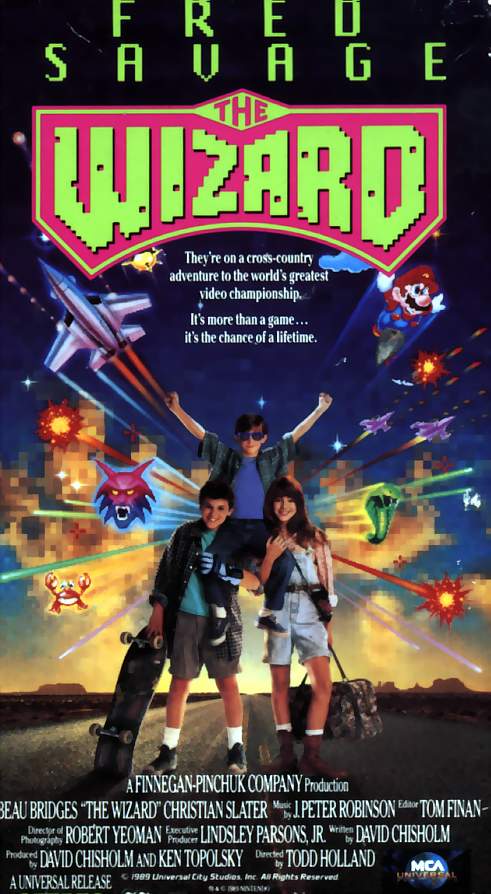
The Wizard (1989)
Overview
A cross-country adventure to the world’s greatest videogame championship. It’s more than a game… it’s the chance of a lifetime… (and the chance for 50,000 USD)
The film’s tagline, plus our own addition
OK so I had heard of this film about 10 years ago; and even that was many years after this was initially released in America in 1989. Maybe it wasn’t big in the UK, or maybe I just wasn’t too hot on new film releases when I was four years old, but I didn’t get to see it when it was new. Last night I watched this movie for the first time.
Story
The story begins showing the two different households of two brothers who were separated when their parents divorced. Corey Woods living with his dad and older brother at one house and Jimmy Woods living with his mother and stepfather at the other.
Something is up with the younger brother Jimmy who doesn’t talk much and is always picking up his little yellow box and walking off in no particular direction. Keeping the pressure on the local police who are always having to bring him home. Eventually Jimmy’s mother and stepfather opt to send Jimmy to a care home (aka mental hospital) for “treatment” for his condition.
It turns out later in the movie that Jimmy is the way he is since his twin sister Jennifer who he used to always spend his time with drowned in front of him near the river.
Hearing the news that his little brother has been sent to this hospital, his older brother Corey comes to bust him out of the hospital and the pair begin their adventure. The pair stop at an arcade and Corey notices that Jimmy gets a crazy high score on Double Dragon, he gets Jimmy to play some more video games and realises that the guy is a Wizard (hence the title).
On the way they bump into a girl called Haley at the bus station who also recognises Jimmy’s talents and because she missed her bus she had no choice but to accompany the two on their adventure – Haley was key to the idea to enter Jimmy into the videogame competition where they could win $50,000 on the condition she could take a cut.
As the trio are en-route to Los Angeles, CA to enter the videogame competition however they are being pursued by two parties
- A guy called Putnam, he’s a bit of a creep and was hired by Jimmy’s mother and stepfather to bring Jimmy back and get him back to the hospital for the “treatment he needs” for his condition.
- In the other car we’ve got Sam and Nick Woods (father and eldest brother) who are also trying to retrieve the two brothers.
Along the way Putnam has numerous run ins with the Woods pair, they smash up his car, he deflates their tires and gets his truck towed etc.
Meanwhile on their journey they encounter one character called Lucas who is renowned by all the local kids at the arcade as nothing short of “awesome” for his gaming abilities. So the three challenge Lucas to a game, Lucas pulls out the POWER GLOVE and shows his madskillz, Jimmy gets a bit nervous and leaves – the confidence is knocked.
After this Corey and Haley spend time studying every possible videogame secret and tip (a lot of which they got from Nintendo game advisers) so that the Wizard is the best he can be in the videogame comp.
Eventually after a long string of events and one hell of an epic journey the two chasing parties, Jimmy and Haley all end up in Los Angeles just in time for the videogame competition.

As expected one of the first people they see there is Lucas. Jimmy makes it to the final (despite being chased around by Putnam) along with Lucas (who didn’t see that coming) and another girl.
Then the Videogame masters throw something into the mix that no one expected – a new game. Super Mario Bros 3 and whoever of the three finalists has the highest score at the end of the 10 minutes is crowned the winner and awarded the cash. After a tense 10 minutes with Jimmy trailing behind after losing two lives, he finds a secret warp whistle and wins at the last second. (in front of his mother, elder brother, father, stepfather and the bounty hunter).
Everyone is then on the way home after the competition. Jimmy, his mother and stepfather in one car, Haley and the rest of the Woods family in the other car.
On the way back Jimmy sees some tall statues of dinosaurs on the side of a California road and makes them pull over; Corey notices this and tells his dad to pull over also. I had actually written a bit more on what happens after that but don’t want to really ruin the entire film for someone who hasn’t seen it.
Cast & Characters
Fred Savage leads as Corey Woods, the older half-brother who breaks young Jimmy out before their mother and stepfather can place him in an institution. Luke Edwards, nine years old at the time, plays Jimmy, a silent, traumatised boy who clutches a lunchbox, keeps repeating the word “California” and turns out to have a remarkable talent for video games.
Jenny Lewis, who later found fame as the lead singer of the indie band Rilo Kiley, plays Haley Brooks, the streetwise girl the brothers meet at a bus station and who tells them about the Video Armageddon tournament. Beau Bridges and Christian Slater play father Sam and eldest brother Nick, who set off after the boys while a greedy bounty hunter, Mr Putnam (Will Seltzer), is hired to bring Jimmy back.
Gamers tend to remember Jackey Vinson best: he plays Lucas Barton, the smug rival who shows off his Power Glove. Look closely at the tournament and you can also spot a young Tobey Maguire in an uncredited first film role as one of Lucas’s sidekicks.
| Actor | Role |
|---|---|
| Fred Savage | Corey Woods |
| Luke Edwards | Jimmy Woods |
| Jenny Lewis | Haley Brooks |
| Beau Bridges | Sam Woods |
| Christian Slater | Nick Woods |
| Will Seltzer | Mr Putnam |
| Wendy Phillips | Christine Bateman |
| Sam McMurray | Mr Bateman |
| Frank McRae | Spanky |
| Jackey Vinson | Lucas Barton |
| Beth Grant | Diner Manager |
| Tobey Maguire (uncredited) | Lucas’s Goon |
Production
The film began at Universal, where Tom Pollock imagined a video-game take on the rock opera Tommy and pitched it to Nintendo of America’s marketing department. Timing worked in his favour: a 1988 ROM chip shortage, plus work on a Western Super Mario Bros. 2, had pushed back several Nintendo releases, among them Super Mario Bros. 3. Nintendo licensed its products and kept approval over the script and the portrayal of its games, although Holland later said the company never actually asked for changes.
Written by David Chisholm, The Wizard was Todd Holland’s feature directing debut. Principal photography ran from 5 June to 25 July 1989. Fallon, Nevada, stood in for the Woods family’s home town and Reno supplied the casino scenes, which proved awkward to shoot because minors were not allowed on casino floors. A desert airport was filmed in Acton, California, the Video Armageddon interiors were staged in a CalArts auditorium, and the chase finale used the tram tour and King Kong attraction at Universal Studios.
Holland reworked the climactic tournament from a hotel meeting room in the script into a large spectator event, styled on Aliens on a small budget. He also argued that Universal was making him shoot far too much material: his first assembly ran about two and a half hours, and nearly an hour was removed, mostly from the opening act.
Release & Box Office
Universal released The Wizard in North America on 15 December 1989. It opened at number five with $2,142,525 and finished its run with $14,278,900 domestically, a respectable return on an estimated $6 million budget even though it never climbed higher than fifth in the weekly charts. Cinemas handed out a special Pocket Power issue of Nintendo Power magazine over the opening weekend.
Outside North America the film was handled by Carolco, with Guild Film Distribution named as a UK distributor. It reached Australia on 5 July 1990, played in Japan under the title Sweet Road, and went straight to video in Germany in 1994 as Joy Stick Heroes. Its video afterlife was healthy: by 1993 it had earned around $6 million in rentals.
For its director the release was painful. Holland later called it a flop for his career and recalled that he could not find work for seven months afterwards, only realising years later, as DVD sales and fan interest grew, that the film had found its audience.
Reception
Critics were largely hostile. The most common complaint was that the film played like a feature-length advertisement for both Nintendo and the Universal Studios Hollywood tour, and many reviewers also noted how heavily it borrowed from Rain Man. Roger Ebert called it a cynical exploitation picture, found the children’s unsupervised journey through bars and casinos impossible to believe, and later named it among the worst films of 1989. Janet Maslin of The New York Times saw it as a giant promotion for Nintendo, while Rita Kempley of The Washington Post dismissed it as “tacky and moribund”.
The aggregate scores remain low: 29% on Rotten Tomatoes from 24 reviews and 23 out of 100 on Metacritic. Writers on games history have been just as blunt; David Sheff’s 1993 book Game Over framed it as a hundred-minute Nintendo advert, and IGN’s Levi Buchanan later described it as a 90-minute commercial for Super Mario Bros. 3.
Audiences who were children in 1989 remember it more fondly. Its earnest road-trip story, its glimpse of late-1980s gaming culture and Jimmy’s drawn-out cry of “California” have given it a lasting cult following.
Mario Connections
The film’s big selling point was Super Mario Bros. 3. The game had been out in Japan since 23 October 1988 but did not reach North American shops until 12 February 1990, so The Wizard landed in between. It serves as the secret final event of Video Armageddon, and for most American viewers this was their first look at it in action, even if US magazines had already covered the Japanese version. In the final round Jimmy finds a Warp Whistle in the World 1 fortress and jumps ahead to Giant Land. The hype paid off: about 250,000 copies were sold in the first two days of the North American launch.
Nintendo hardware is everywhere else too. Bus stations and diners are filled with PlayChoice-10 cabinets running Double Dragon and Teenage Mutant Ninja Turtles, Jimmy qualifies for the final by playing Ninja Gaiden, Super Mario Bros. 2 also appears, and he prepares for the final with help from the Nintendo Power Line hotline.
Then there is the Power Glove, the Mattel-made controller launched in North America in October 1989. Lucas uses it to play Rad Racer and delivers the famous line about how “bad” it is. Holland said Nintendo never asked for the scene; he simply wanted to make Lucas more intimidating. Real life followed the script a year later, when the Nintendo World Championships toured 29 US cities and held their World Finals on 7–9 December 1990 at Universal Studios Hollywood, the same venue as the film’s fictional tournament.
Super Mario Bros. 3 on the Big Screen: Our Take

So why is that important? why have I posted this on superluigibros.com? Well as we are aware as Mario/Nintendo fans Super Mario Bros 3 is argued by many to be the Jewel in the Mario crown, the greatest example of Mario ever – whether or not that’s actually true it’s undeniable that it’s certainly up there with the best of them.
Super Mario Bros was extremely popular because it was groundbreaking, it did things which other games hadn’t done before and it made it wildly successful. A relating question, in 1989 how many brand new (and in this case already very anticipated after the success of its predecessors) videogames had been shown on the big screen prior to the games release? I can think of no examples personally.
It’s my belief that The Wizard did play a hand in making Super Mario Bros. 3 EVEN more popular than it would’ve been for simply that reason – a new videogame had never been unveiled in such a way on the big screen before – if that didn’t significantly increase the hype surrounding the release of the newest Mario title of the time & boost sales in quite an impressive manner, I’ll buy a hat, and then I’ll eat it.
This is not to take away from the fact that Super Mario Bros. 3 was in itself a groundbreaking monument of platform gaming and a legend completely in its own right – but something to think about.
If you haven’t seen this movie, I’d strongly recommend checking it out. I only really watched it from a research point of view after hearing it mentioned on various Mario forums/communities occasionally over time and I always wondered what it was, but The Wizard is in its own right actually quite a good watch… did I cry? errr no… of course not.
Trivia
- Tobey Maguire, the future Spider-Man, makes his first film appearance as one of Lucas’s uncredited goons; Holland did not realise he was in the film until years later.
- Jenny Lewis, who plays Haley, went on to front the indie rock band Rilo Kiley.
- The real Power Glove was brought to set in a locked briefcase by a security guard, which inspired the case Lucas carries it in.
- Lucas only ever uses the Power Glove for Rad Racer; just two games, Super Glove Ball and Bad Street Brawler, were ever made specifically for the peripheral.
- Lucas brags about owning 97 Nintendo games.
- Luke Edwards was promised a copy of Super Mario Bros. 3 by the producers, but it never arrived.
- In the final round the commentator calls some levels by the wrong names, and the Warp Whistle and the card Jimmy grabs to win would not score any points in the real game.
- The film’s original assembly ran about two and a half hours; nearly an hour of footage, cut for a family audience, finally surfaced on the 2020 Shout! Factory Blu-ray.
- The film is known as Joy Stick Heroes in Germany and Sweet Road in Japan.
- Ain’t It Cool News hosted a reunion screening at the Alamo Drafthouse Ritz in Austin, Texas, on 8 February 2008, with Holland, Savage and Edwards in attendance.
- PAX West 2016 ended with a live recreation of the film’s Super Mario Bros. 3 tournament.
Legacy & Home Media
Despite its reviews, The Wizard has become a cult favourite and a nostalgic time capsule of the NES era. Fans have kept it alive with reunion screenings, such as the 2008 event in Austin, and with PAX West’s 2016 recreation of Video Armageddon, while Jimmy’s drawn-out “Califoooornia” lives on as a popular GIF.
The film was released on VHS and LaserDisc in 1990, with further editions in 1992 and 1997. A Region 2 DVD followed on 2 February 2001 and a Region 1 DVD on 22 August 2006. Holland has said that Universal put the DVD out without telling him. A standard Blu-ray arrived on 15 May 2018.
The definitive release is Shout! Factory’s two-disc Collector’s Edition Blu-ray of 24 March 2020, which uses a 4K transfer. It adds an audio commentary by Todd Holland, almost 38 minutes of deleted scenes from his longer cut, the retrospective documentary The Road to Cali-forn-ia with Holland, Chisholm, Topolsky, Edwards and Savage, an interview with former Nintendo game play counsellor Greg Lowder, and panel and Q&A recordings with Edwards and the producers. The deleted material fills out Corey’s home life, Nick’s drinking, the road trip and more of the tournament.
Video: NES Mistakes in The Wizard
More Mario on Screen
- All Mario cartoons & movieshub
- Super Mario Bros.: The Great Mission to Rescue Princess Peach!1986 anime
- The Super Mario Bros. Super Show!1989 TV
- The Adventures of Super Mario Bros. 31990 TV
- Super Mario World1991 TV
- Super Mario Bros.1993 film
- Living Legend2013 fan film
- Mario TV Commercialsadverts
- The Super Mario Bros. Movie2023 film
- The Super Mario Galaxy Movie2026 film