

New Super Mario Bros. U
The biggest 2D Mario ever made at launch — 9 worlds, 5-player co-op, Flying Squirrel suits, Baby Yoshis and the full HD debut of the New Super Mario Bros. series.
New Super Mario Bros. U was a Wii U launch title in November 2012 and represented the biggest, most ambitious 2D Mario game Nintendo had made to that point. For the first time the New Super Mario Bros. series arrived in HD — and the visual upgrade was dramatic. The lush, detailed worlds, the crisp character animations, the way light plays across Sparkling Waters at sunset — it looks right in a way the DS and Wii entries never quite managed.
The game takes heavy design inspiration from Super Mario World — overworld maps with multiple routes, connected worlds, secret exits leading to bonus areas — while keeping the New Super Mario Bros. formula of tight, responsive platforming intact. The result is a game that feels both nostalgic and fresh, with 9 worlds of content including the secret Superstar Road world that only the truly skilled will unlock.

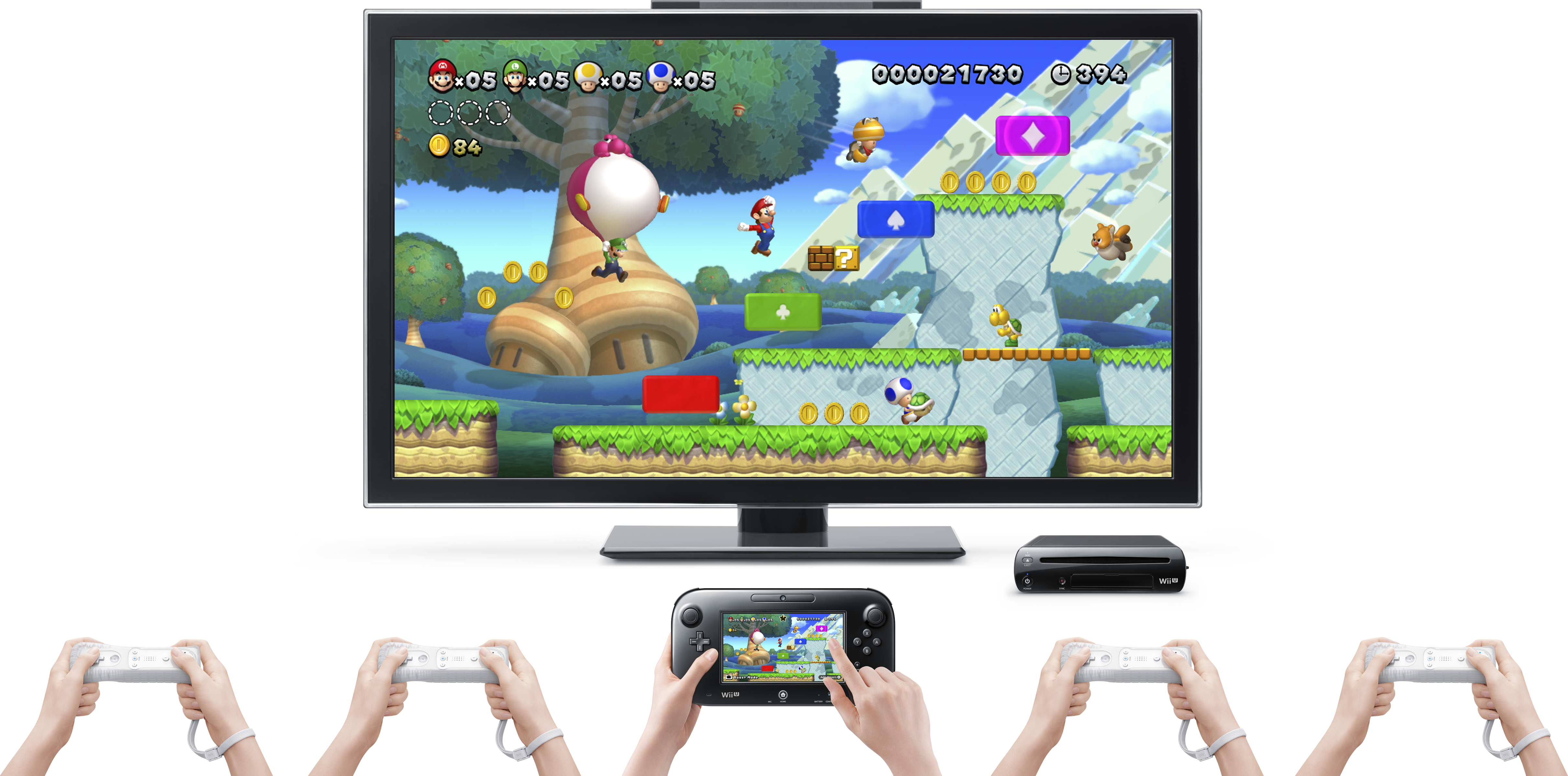
The 5-player multiplayer is one of the game’s defining features. Four players use Wii Remotes to play as Mario, Luigi, Yellow Toad and Blue Toad, while a fifth player on the GamePad plays in Boost Mode — placing temporary platforms, bopping enemies and generally either helping or (inevitably) trolling everyone else. It’s the best Mario couch co-op experience since New Super Mario Bros. Wii, and on a bigger, more complex set of levels.
Five playable characters spread across multiplayer — each with slightly different jump heights and physics, and one with a completely different mode of play. The Toads are the nimble speed runners, Luigi floats a fraction longer, and Mii players bring the GamePad Boost Mode into the action.




Baby Yoshis are a new addition — found in certain stages and carrying unique abilities. The Balloon Baby Yoshi inflates and lets you float upward; the Bubble Baby Yoshi spits bubbles that trap enemies into collectible items; the Glowing Baby Yoshi lights up dark stages. All three are optional companions you can carry through levels, and they add a lovely layer of exploration incentive.


NSMBU brings back almost every power-up from New Super Mario Bros. Wii and adds one major new addition — the Super Acorn. The full suite gives each player genuine strategic options: offensive (Fire/Ice), utility (Propeller/Flying Squirrel), stealth (Mini Mushroom) and defensive (Penguin Suit).


The Super Acorn is the Flying Squirrel suit’s source item — it works similarly to a Super Leaf from Super Mario Bros. 3, but instead of a full Tanooki-style flight it gives you a glide and a wall-grab that’s better suited to the tight, precision-platforming levels in NSMBU. It’s well-judged for the game’s design.

Nine worlds spread across a connected overworld map — inspired directly by Super Mario World’s interconnected layout. The 8 main worlds each have a tower mid-boss, a castle boss (all Koopalings), and multiple secret exits leading to alternate routes. Superstar Road unlocks only after clearing all 8 worlds and is the hardest content in the game.


Beyond the main worlds, Coin Courses provide short timed challenges focused entirely on coin collection, and Secret Island between Worlds 1 and 3 houses a Toad House for tracking records. There are over 180 courses total across all modes.

New Super Mario Bros. Wii (2009) is the game NSMBU most directly builds on — same 4-player co-op, same core mechanics, similar power-ups. So how does the Wii U version measure up? Here’s the honest comparison:
| Feature | NSMB Wii (2009) | NSMBU (2012) |
|---|---|---|
| Graphics | Standard definition, Wii visual quality | Full HD 1080p — dramatically sharper, richer environments |
| World design | 8 linear worlds, limited branching | 9 worlds with Super Mario World-style interconnected routes and alternate exits |
| Players | Up to 4 (Wii Remote only) | Up to 5 — adds GamePad Boost Mode player |
| New power-up | Propeller Mushroom, Penguin Suit | Super Acorn / Flying Squirrel suit — glide + wall-grab |
| Baby Yoshis | Not present | Balloon, Bubble and Glowing Baby Yoshis as rideable companions |
| Boost Mode | Not present | GamePad player places platforms in real time — unique to Wii U hardware |
| Challenge Mode | Not present | Hundreds of structured challenges with leaderboards |
| Inventory system | Not present | Store power-ups between levels and deploy before stages |
| Course variety | 80+ courses | 180+ courses across all modes |
| Off-TV play | Not possible | Full game playable on GamePad screen |
| Miiverse | Not present | Share times, post comments, see other players’ tips |
| Metacritic | 87 (slightly higher) | 84 — both excellent, Wii edges it critically |
| Sales | ~30 million (massively wider install base) | 5.82 million (limited by Wii U install base) |
The verdict: NSMBU is the better-made game by almost every measurable standard — more content, better graphics, more modes, smarter design. But NSMB Wii reached more people and has slightly higher critical scores. If you have a Wii U, NSMBU is the definitive New Super Mario Bros. experience. NSMB Wii wins purely because of the Wii’s enormous install base.
New Super Mario Bros. U received strong reviews, landing at 84 on Metacritic. Critics praised the HD visuals, the wealth of content, the strong course design and the expanded multiplayer modes. The main criticism — echoing the broader New Super Mario Bros. franchise — was that the game felt iterative rather than revolutionary, building on NSMB Wii without taking bold creative leaps. Fair, but perhaps slightly harsh for a game that added so much genuinely new content.
Sales of 5.82 million were strong in context — it was the third best-selling Wii U game for much of the console’s life, and was a significant Wii U launch driver. The game’s DLC expansion, New Super Luigi U, launched in July 2013 as a standalone download and later as a physical release — a complete alternative campaign with 82 shorter, harder Luigi-centric levels.
- NSMBU was a Wii U launch title on 18 November 2012 — it was one of just two first-party Nintendo games available at the Wii U’s North American launch, alongside Nintendo Land.
- The game’s world design takes direct inspiration from Super Mario World — particularly the connected overworld map, secret exits leading to alternate routes, and the overall sense of exploration across a contiguous world.
- All seven Koopalings appear as world bosses, each with a unique attack pattern. This was only the second Mario platformer to feature all seven (after New Super Mario Bros. Wii).
- The Flying Squirrel suit was designed around the Wii U’s capabilities — the wall-grab mechanic was specifically designed to work well with the tighter, more vertical level design that HD made possible.
- New Super Luigi U, the DLC expansion, launched initially as a digital-only eShop release in June 2013 as part of the Year of Luigi. It was later released physically bundled with NSMBU in August 2013.
- Nabbit — a purple rabbit thief introduced in NSMBU — is immune to enemy damage, making him ideal for players who want to participate in multiplayer without the difficulty spike. He reappears in New Super Mario Bros. U Deluxe as a fully playable character.
- The Baby Yoshis (Balloon, Bubble and Glowing) were designed as a tribute to the coloured Yoshis from Super Mario World — each having a unique ability tied to its colour theme.
- NSMBU Deluxe, the Nintendo Switch port released in January 2019, added Toadette and Nabbit as new base characters and included New Super Luigi U in the package. It became one of the best-selling Switch games.
- The inventory system — letting you store and use power-ups from the overworld map before entering a level — was a first for the New Super Mario Bros. series, borrowed from Super Mario Bros. 3.
- The Superstar Road world, unlocked only by completing all 8 main worlds, contains some of the hardest 2D Mario levels Nintendo has ever made — particularly the final stage, which many series veterans consider brutally challenging.
Four videos from our channel covering New Super Mario Bros. U: