
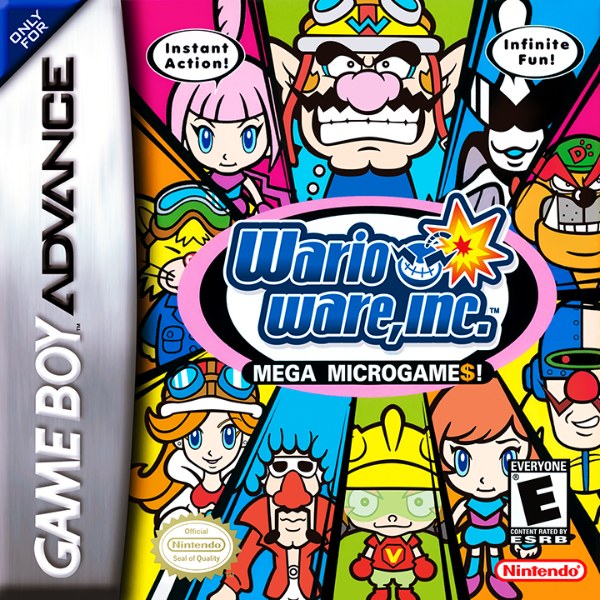

WarioWare, Inc.: Mega Microgame$!
Overview
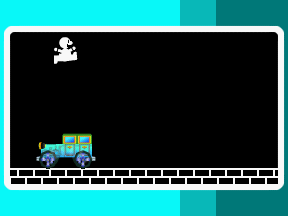
WarioWare, Inc.: Mega Microgame$! is the game that launched the WarioWare series. Instead of long levels it is built from microgames: tiny challenges that last around four seconds and are announced with a single word such as Dodge!, Pick! or Catch!. You have to work out what to do, and do it, before the timer runs out, using nothing more than the Control Pad and the A button.
The story is pure Wario. Seeing how much money video games make, he decides to set up his own development company in Diamond City and gets his friends to make the games for him. Each friend hosts a stage of their own microgames, framed by short comic intros, and Wario collects the profits at the end.
It was released in Japan as Made in Wario in March 2003 and reached Europe, North America and Australia in May and June of the same year. In Europe it carried the subtitle Minigame Mania.
Gameplay
A stage strings microgames together in a mostly random order. You start with four lives and lose one for every microgame you fail; lose them all and it is game over. After a set number of games the tempo rises, and every so often the difficulty steps up too, so the same microgame can look quite different the second or third time round.
Each stage ends with a boss stage: a longer microgame with no time limit. Winning it clears the stage and gives you back a lost life. Keep playing after a boss and the loop carries on at a higher level, which is where high scores are made.
- Three difficulty levels per microgame, from a gentle first version to a frantic third.
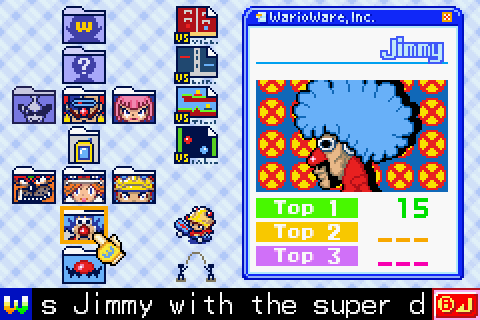
- Grid mode lets you replay any microgame you have already seen until you lose four times, with a target score that earns a flower on the grid.
- Remix stages mix microgames from several hosts, and four extra challenges unlock after the credits.

Stages and Characters
Every stage is run by one member of Wario’s new company, and each has its own theme. The cast introduced here went on to appear throughout the series:
- Wario opens the game with a set of introductory microgames and closes it with an anything-goes final stage.
- Jimmy T., the disco-dancing regular at Club Sugar, hosts sports-themed games.
- Mona, who has a different part-time job every time you see her, leads a police chase with her animal helpers.
- 9-Volt, the young Nintendo fan, hosts microgames made from classic Nintendo games and toys.
- Dribble & Spitz, the taxi-driving duo, bring science-fiction microgames.
- Dr. Crygor hosts games made from real-life photographs.
- Orbulon, the alien, sets brain teasers that last twice as long as normal microgames.
- Kat & Ana, the ninja twins, cover nature and animals.

Unlockables and Two-Player Games
Beating stages and setting scores unlocks a set of longer bonus games for high-score chasing. They include a jump-rope challenge, a paper aeroplane game, Wario-fied versions of the NES Dr. Mario and the Game & Watch-style Sheriff, and Pyoro, a bird-and-beans game seen on Wario’s television in the story. Pyoro and the paper aeroplane game were later expanded into the DSiWare titles Bird & Beans and Paper Airplane Chase.
There are also four two-player games designed for a single Game Boy Advance: one player uses the L button and the other the R button, so two people can share one handheld.
Development
The idea came from Sound Bomber, a mode in the Nintendo 64DD title Mario Artist: Polygon Studio that threw a handful of rapid-fire games at the player one after another. Hirofumi Matsuoka, who directed Polygon Studio, went on to direct WarioWare.
According to the developers, a small group at Nintendo R&D1 started the project without telling their manager. Staff pinned microgame ideas to the director’s table, and each programmer built their own games, which is why the art styles change so much from one microgame to the next. Some ideas were dropped for being too rude or too Japanese for an international audience. Wario was chosen as the star because nobody could think of a better fit, and the team reused music and sound effects, including Wario’s voice clips, from Wario Land 4.
Shigeru Miyamoto pushed the pick-up-and-play angle in the marketing. The Japanese box carried the slogan More! Shorter! Faster! in larger type than the logo.
Reception and Legacy
Critics loved it. The game holds a Metacritic score of 89, with 9.1 from GameSpot, 9 from IGN and Eurogamer, and 95 from GameSpy. It won the Edge Award at the 2004 Edinburgh International Games Festival, was a GameSpot Editor’s Choice, and later appeared in Edge’s list of the best games to play today. Nintendo had modest hopes for it internally, but it sold over a million copies worldwide.
A multiplayer remake for the GameCube, WarioWare, Inc.: Mega Party Game$!, followed, and the series continued with Twisted!, Touched!, Smooth Moves and many more. 64 of the original microgames returned in WarioWare Gold on the 3DS in 2018. The GBA original has been re-released for 3DS Ambassador Program owners (2011), on the Wii U Virtual Console (2014) and on Nintendo Switch Online (2023).
Trivia
- The game’s Japanese title, Made in Wario, is still the series’ name in Japan.
- Most microgames last about four seconds at the starting speed.
- Nose-picking is a running gag in the series; Mona’s microgame Gold Digger is an early example.
- Grid mode’s layout comes from Sound Bomber, which itself only had eight microgames.
- Pyoro, the bird from Wario’s television, became a recurring WarioWare bonus game and got its own DSiWare release as Bird & Beans.
- Wario’s voice clips were taken straight from Wario Land 4.