
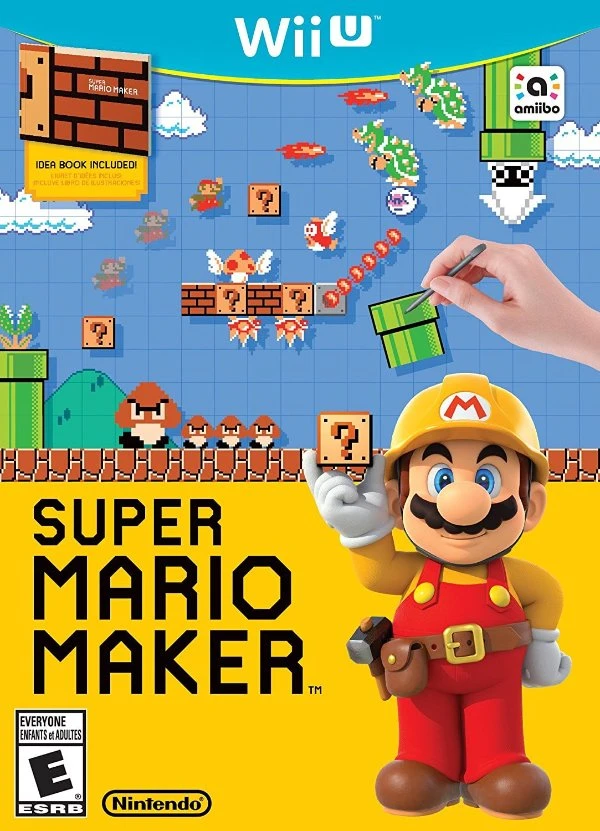
Super Mario Maker
Overview

Super Mario Maker (tentatively titled Mario Maker when revealed at E3 2014) is a 2D platform and level-creation game for the Wii U, released on 11 September 2015 to coincide with the 30th anniversary of Super Mario Bros. It is the eighteenth entry in the Super Mario series.
The concept flips the series on its head: rather than play levels designed by Nintendo, you design them yourself. Using the GamePad’s touchscreen, players drag and drop blocks, enemies, items, pipes, and contraptions onto a grid, then test, refine, and share their creations. Courses can be built in any of four classic Mario game styles, each faithfully recreating the look, sound, and physics of its source game.
At launch, players could upload their courses to Course World and play an endless stream of levels made by people around the globe — from gentle traditional stages to fiendish “Kaizo” precision gauntlets and ingenious automatic music levels. Online sharing continued until the Wii U’s Nintendo Network services were discontinued on 8 April 2024, though local course creation and play remain fully functional.
Gameplay
Super Mario Maker has two halves: making courses and playing courses. In the Course Maker, the top screen shows the level as it plays while the GamePad touchscreen is the editing canvas. Players paint terrain, drop in enemies and items, and can immediately flip between Edit and Play modes to test their ideas.
Making a Course
- Drag and drop objects from the top toolbar onto the grid with the stylus
- Shake or drag many objects to transform them — a Goomba shaken becomes a Galoomba, a mushroom dragged onto an enemy makes it giant, wings can be added to almost anything
- Set a course theme (Ground, Underground, Underwater, Ghost House, Airship, Castle) which changes assets, music, and hazards
- Choose a game style to instantly reskin the entire course in SMB, SMB3, SMW, or NSMBU
- Beat your own course before you’re allowed to upload it — Nintendo’s clever guard against impossible levels
Unlocking the Full Toolset
At launch, not all tools were available immediately — the full palette unlocked over several days of use (later patched so everything unlocks after roughly 15 minutes of placing objects). This gentle onboarding eased newcomers into the deep toolset rather than overwhelming them.


The Four Game Styles

The heart of Super Mario Maker is its four selectable game styles. Switching style instantly reskins the entire course — graphics, music, sound effects, and crucially the physics and mechanics — to match the chosen era of Mario. The same course can feel completely different depending on the style applied.
Super Mario Bros.
1985 · NES
The original 8-bit look. Mario can’t carry items or wall-jump. Big Mushroom (an SMM exclusive) and the Goomba’s Shoe replace Yoshi. The purest, most nostalgic style.
Super Mario Bros. 3
1988 · NES
Adds the SMB3 aesthetic and the iconic Super Leaf (Raccoon Mario). Like SMB, Yoshi is replaced by the Goomba’s Shoe, and items can’t be carried.
Super Mario World
1990 · SNES
The 16-bit SNES style. Introduces Yoshi, the Cape Feather, the Spin Jump, and the ability to pick up and throw Koopa shells upward — a SMW exclusive.
New Super Mario Bros. U
2012 · Wii U
The modern HD style. Mario can triple-jump and wall-jump, ride Yoshi, and use the Super Acorn (Flying Squirrel). The most mobility-rich style.
Course Themes
Independent of game style, each course can use one of six course themes, which change the backdrop, music, hazards, and certain object behaviours. A course can even shift between day and night or land and water as the player progresses.
| Theme | Character |
|---|---|
| Ground | The classic grassy overworld — the default starting theme |
| Underground | Enclosed caverns with tighter spaces and the underground music |
| Underwater | Swimming physics; Mario floats and must manage buoyancy |
| Ghost House | Spooky mazes with Boos and limited visibility |
| Airship | Moving platforms, cannons, and aerial hazards in the Bowser fleet style |
| Castle | Lava, Thwomps, and fortress hazards — the classic end-of-world theme |
Combined with the four game styles, the six themes give 24 distinct visual/audio combinations before a single object is placed — an enormous canvas for creativity.
Course Tools
Super Mario Maker’s toolbox is deep. Beyond basic terrain, enemies, and items, the editor includes contraption pieces that enable elaborate machines and even music levels.


Creative Combinations
- Stacking & combining — place enemies inside Lakitu clouds, on Junior Clown Cars, inside pipes, or on tracks
- Wings — add wings to almost any enemy or object to make it fly or bounce
- Giant objects — feed a mushroom to an enemy to supersize it
- Tracks & conveyor belts — attach objects to rails for moving platforms and contraptions
- Music levels — creators discovered that precisely placed note blocks and auto-scrolling produce playable songs, spawning an entire genre of automatic “Mario music” courses
Game Modes
Beyond the Course Maker, Super Mario Maker offers two ways to play — a single-player challenge mode and the global sharing hub.
10 Mario Challenge
An offline mode where you clear eight randomly selected sample courses (built by Nintendo) on a budget of ten lives. Completing it unlocks the courses in the Coursebot. A self-contained way to enjoy the game without an internet connection, and a showcase of what well-designed courses look like.
Course World & 100 Mario Challenge
Course World was the online hub where players uploaded and downloaded courses, browsed rankings, and earned medals. Its 100 Mario Challenge tasked you with clearing a set number of randomly chosen player-made courses (8 on Easy, 16 on Normal/Expert) on 100 lives — the main way to discover community levels and unlock Mystery Mushroom costumes. Online features ended with the Nintendo Network shutdown in April 2024.


Costume Mario

One of Super Mario Maker’s most beloved features is Costume Mario. In the Super Mario Bros. game style only, a special power-up called the Mystery Mushroom transforms Mario into one of over 150 different characters — each with its own 8-bit sprite, sound effects, and victory jingle pulled from across Nintendo history.
The costumes span the entire Nintendo universe: Mario characters, other franchise stars (Link, Samus, Kirby, Pikachu), retro deep cuts, third-party guests, and even real-world tie-ins. Collecting them all became a mini-game in itself.


amiibo & Mystery Mushroom

Costumes are unlocked in two ways: by completing the 100 Mario Challenge (which awards a random costume each time) or by tapping a compatible amiibo figure to the GamePad. With Super Mario Maker supporting a huge range of amiibo across the entire Nintendo line, scanning a figure instantly unlocked its matching Costume Mario.
- Mystery Mushroom — the power-up that activates a costume, exclusive to the Super Mario Bros. game style
- amiibo unlocks — tap nearly any amiibo to unlock its costume; the dedicated 8-Bit Mario amiibo (Classic & Modern Colors) launched alongside the game
- Big Mushroom — a separate SMM-exclusive power-up (added by update) that makes Mario giant, also unlockable via amiibo
Development
Super Mario Maker was developed by Nintendo EAD (Entertainment Analysis & Development), the studio behind the mainline Mario games, with Takashi Tezuka — a veteran of the original Super Mario Bros. — as producer.
- Origin as a dev tool. The concept grew out of an internal level-editing tool Nintendo used to prototype 2D Mario stages. The team realised players would love the same power.
- Revealed at E3 2014 as “Mario Maker,” then expanded and renamed “Super Mario Maker” for its 2015 launch.
- 30th anniversary timing. Released deliberately on the anniversary window of Super Mario Bros. (which debuted in Japan in September 1985).


Videos & Trailers
Nintendo’s official Wii U trailers and gameplay overviews for Super Mario Maker.
Reception
Super Mario Maker was a critical and commercial smash, widely regarded as one of the best games on the Wii U and a high point of the console’s library.
Critical Praise
- Near-universal acclaim — the game holds a Metacritic score in the late 80s/low 90s, with reviewers praising its accessibility, depth, and the joy of both creating and playing
- The toolset was lauded as intuitive yet deep — easy to start with, near-limitless for experts
- The four game styles and the faithful recreation of each era’s feel were highlighted as a triumph of preservation and fan service
- Costume Mario was singled out as a delightful celebration of Nintendo history
Sales & Community
- Over 4 million copies sold on Wii U — a strong figure for the underperforming console
- Players uploaded millions of courses; Nintendo tracked billions of total plays and clears worldwide
- It spawned an entire creative community — speedrun “Kaizo” levels, automatic music courses, puzzle boxes, and elaborate contraption levels became a genre unto themselves
Legacy & Sequels
Super Mario Maker proved so popular that it launched a sub-series of its own.
- Super Mario Maker for Nintendo 3DS (2016) — a portable version with most of the creation tools, though with reduced online sharing
- Super Mario Maker 2 (Nintendo Switch, 2019) — the full sequel, adding the Super Mario 3D World style, slopes, a story mode, vertical levels, and online multiplayer
- The original Wii U game’s online services ended on 8 April 2024, retiring Course World — but the local creation and play experience endures
Trivia & Facts
- Released for Mario’s 30th anniversary — timed to the September anniversary window of the 1985 original Super Mario Bros.
- Four game styles span 27 years of Mario: Super Mario Bros. (1985), SMB3 (1988), Super Mario World (1990), and New Super Mario Bros. U (2012).
- The 18th entry in the Super Mario series.
- Over 150 Costume Mario characters via the Mystery Mushroom — including Link, Samus, Kirby, Pikachu, Mega Man, Sonic, Pac-Man and many more.
- The Big Mushroom is an SMM-exclusive power-up that supersizes Mario — it never appeared in a mainline game.
- You must beat your own course before you can upload it — Nintendo’s guard against literally impossible levels.
- Grew from an internal dev tool that Nintendo used to prototype 2D Mario stages.
- Music levels — creators used note blocks and auto-scroll to make courses that play recognisable songs, an emergent genre Nintendo never explicitly designed for.
- The full toolset originally unlocked over nine days; a patch later reduced this to about 15 minutes of editing.
- Launched with two special 8-Bit Mario amiibo (Classic Colors and Modern Colors).
- Online Course World shut down on 8 April 2024 with the end of Wii U / 3DS online services.
- Followed by Super Mario Maker for 3DS (2016) and the much-expanded Super Mario Maker 2 on Switch (2019).
Reference / Information
External reference for Super Mario Maker.
Media / Downloads
Galleries and screenshots.