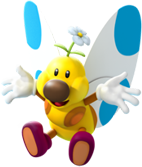
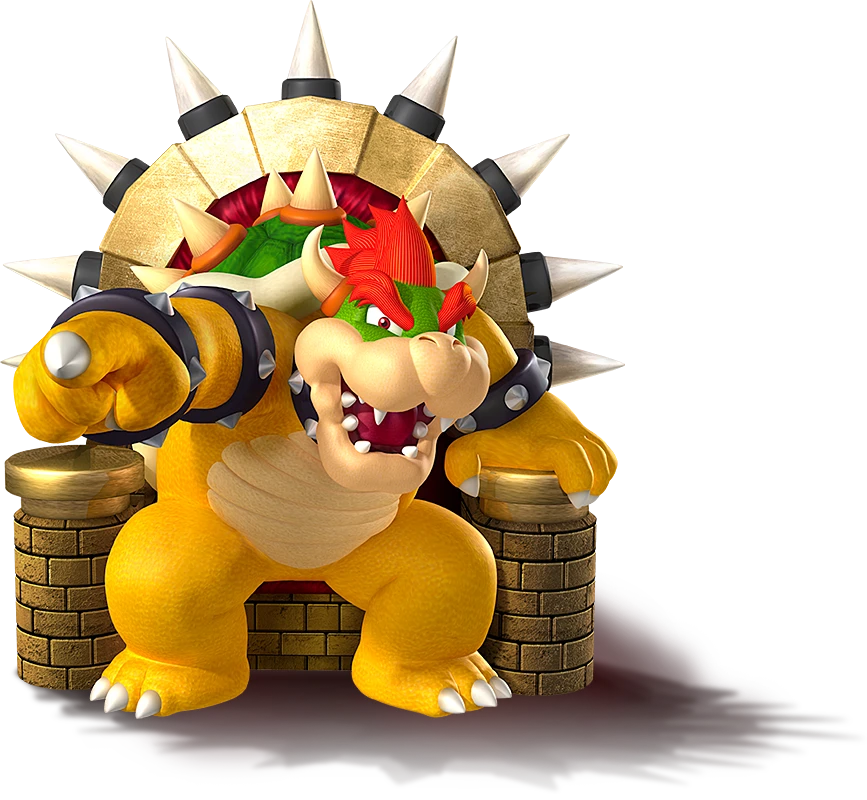
Nintendo 3DS2013PartyNDcubeFirst Mario Party on 3DSSeven boards, seven rule sets81 minigamesBowser Jr. playableFour players from one Game Card
Mario Party: Island Tour
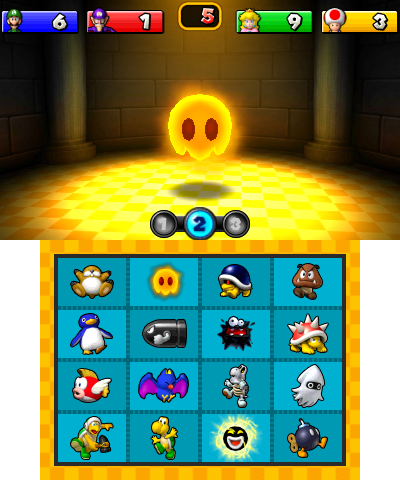
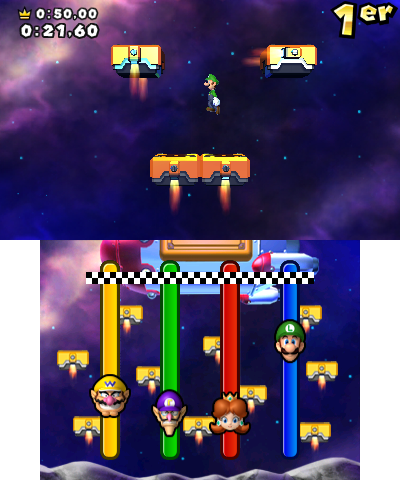
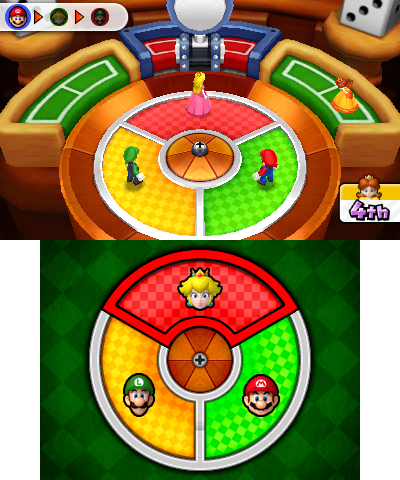
The first Mario Party on Nintendo 3DS, and the one where every board is a different game. Mario Party: Island Tour came out in North America on 22 November 2013, in Europe on 17 January 2014 and in Japan on 20 March 2014. Made by NDcube, it drops Stars and coins altogether: most of its seven boards are short one-way races, from the item-slinging Perilous Palace Path to Rocket Road, which can be over in ten minutes, and the odd ones out are odder still. Star-Crossed Skyway is won on Mini Stars, Shy Guy’s Shuffle City is a card game about getting rid of the Bowser Card, and on Bowser’s Peculiar Peak the first player to the finish loses. There are 81 minigames, all of them free-for-alls, many built round the stylus, the gyroscope or the microphone; a 30-floor solo climb called Bowser’s Tower; StreetPass challenges; and Download Play for four people from a single Game Card. Bowser Jr. is playable for the first time in the series.
Developer:NDcube (Super Mario Wiki also lists Nintendo SPD Group No. 4)
Publisher:Nintendo
Platform:Nintendo 3DS
Genre:Party / board game
N. America:22 November 2013
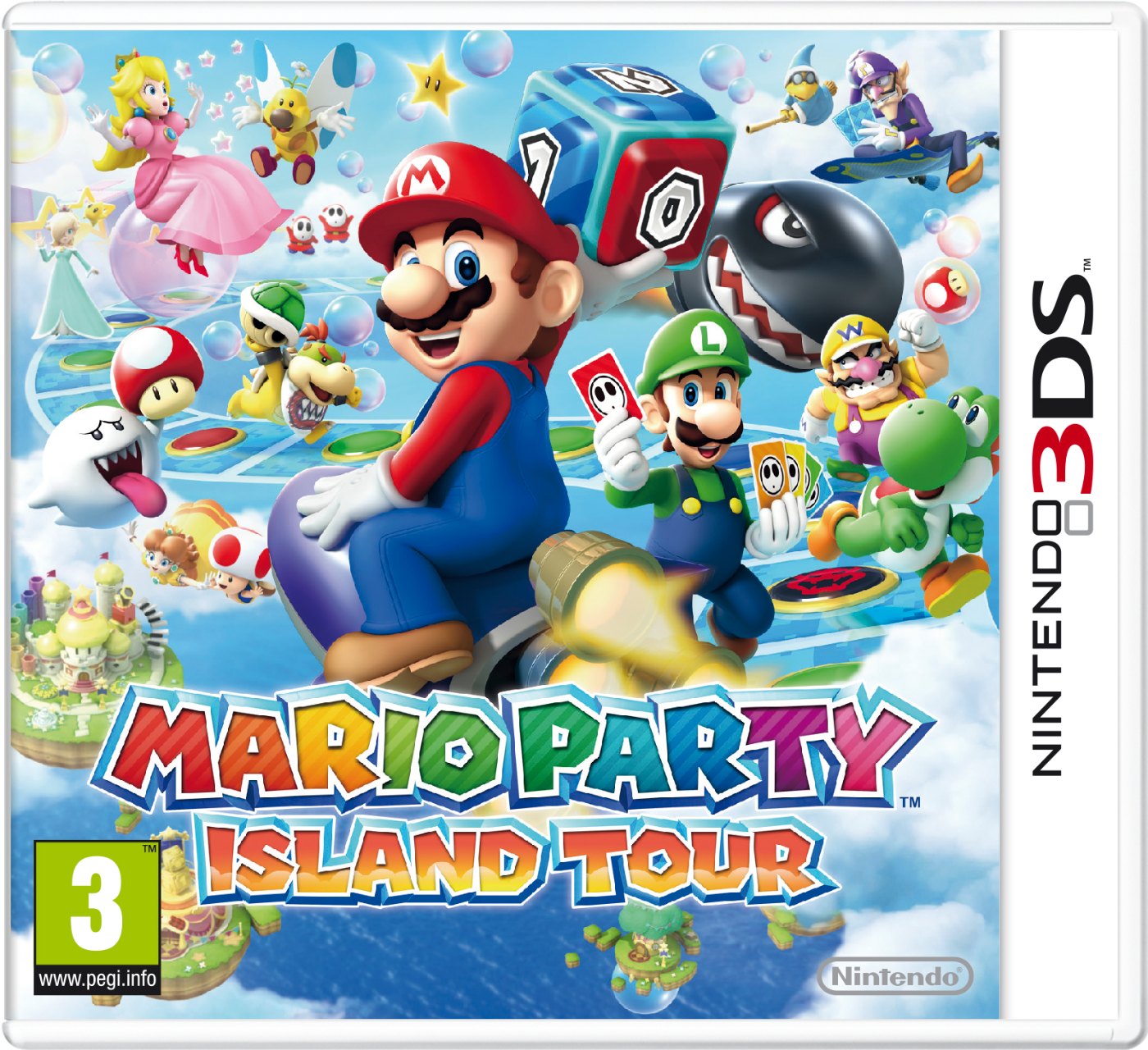
Europe:17 January 2014
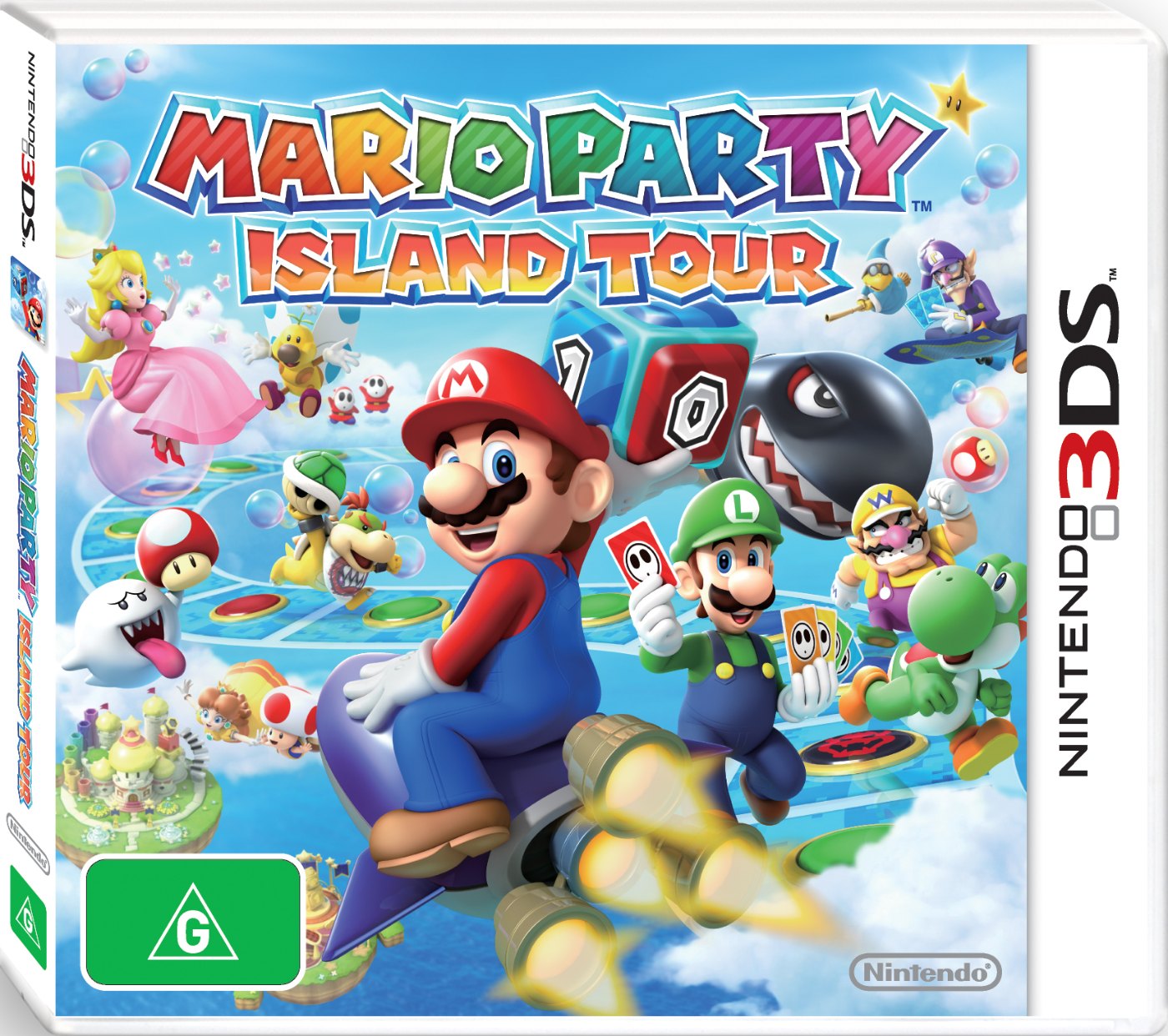
Australia:18 January 2014
Japan:20 March 2014
South Korea:20 March 2014
Players:1–4 (local wireless or Download Play; no online play)
Director:Yukio Umematsu
Producers:Miyuki Hirose, Atsushi Ikeda
Music:Rei Kondoh, Sara Sakurai, Satoshi Okubo
Playable characters:10, with Bowser Jr. to unlock
Boards:7 (Bowser’s Peculiar Peak to unlock)
Minigames:81 on Super Mario Wiki’s list; Nintendo’s page says 80
Sales:1.14 million by 31 March 2014 (Nintendo); 2.95 million by the end of 2021 (CESA, via Wikipedia)
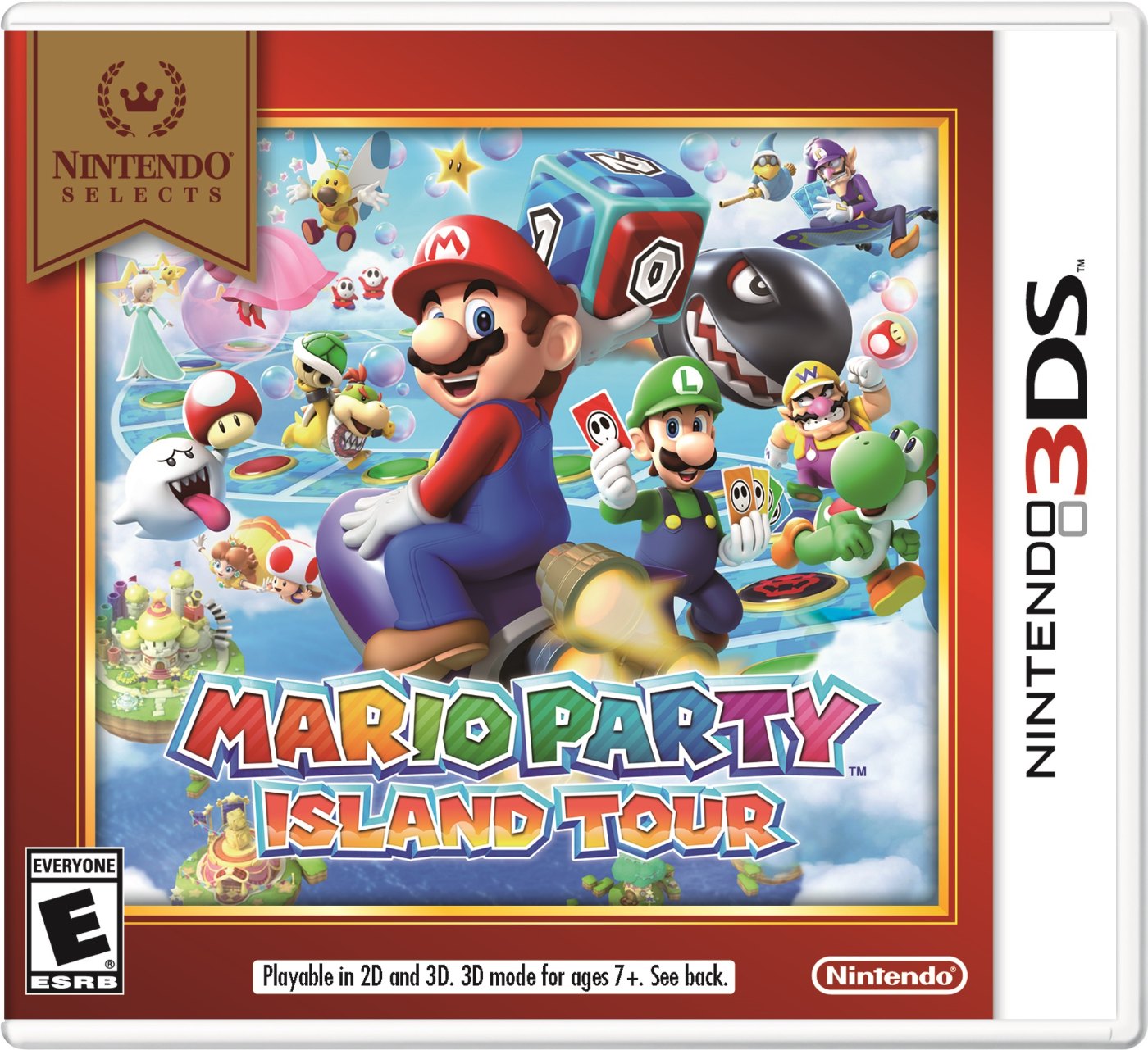
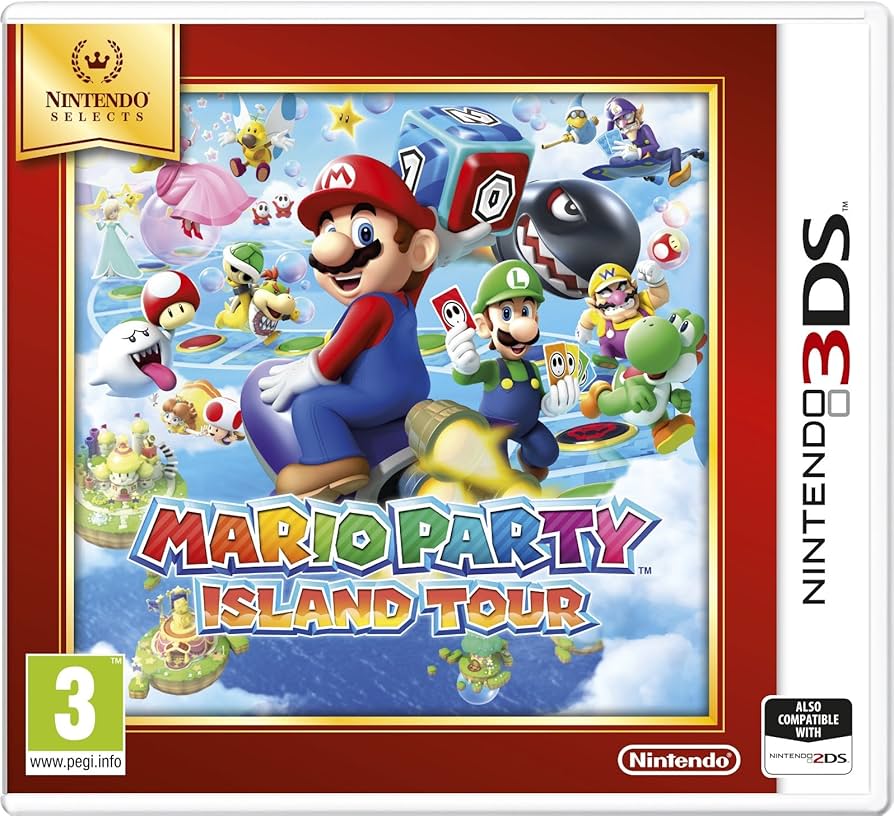
Re-release:Nintendo Selects: Europe 16 October 2015, North America 11 March 2016, Australia 26 May 2016
Advertisement
Overview
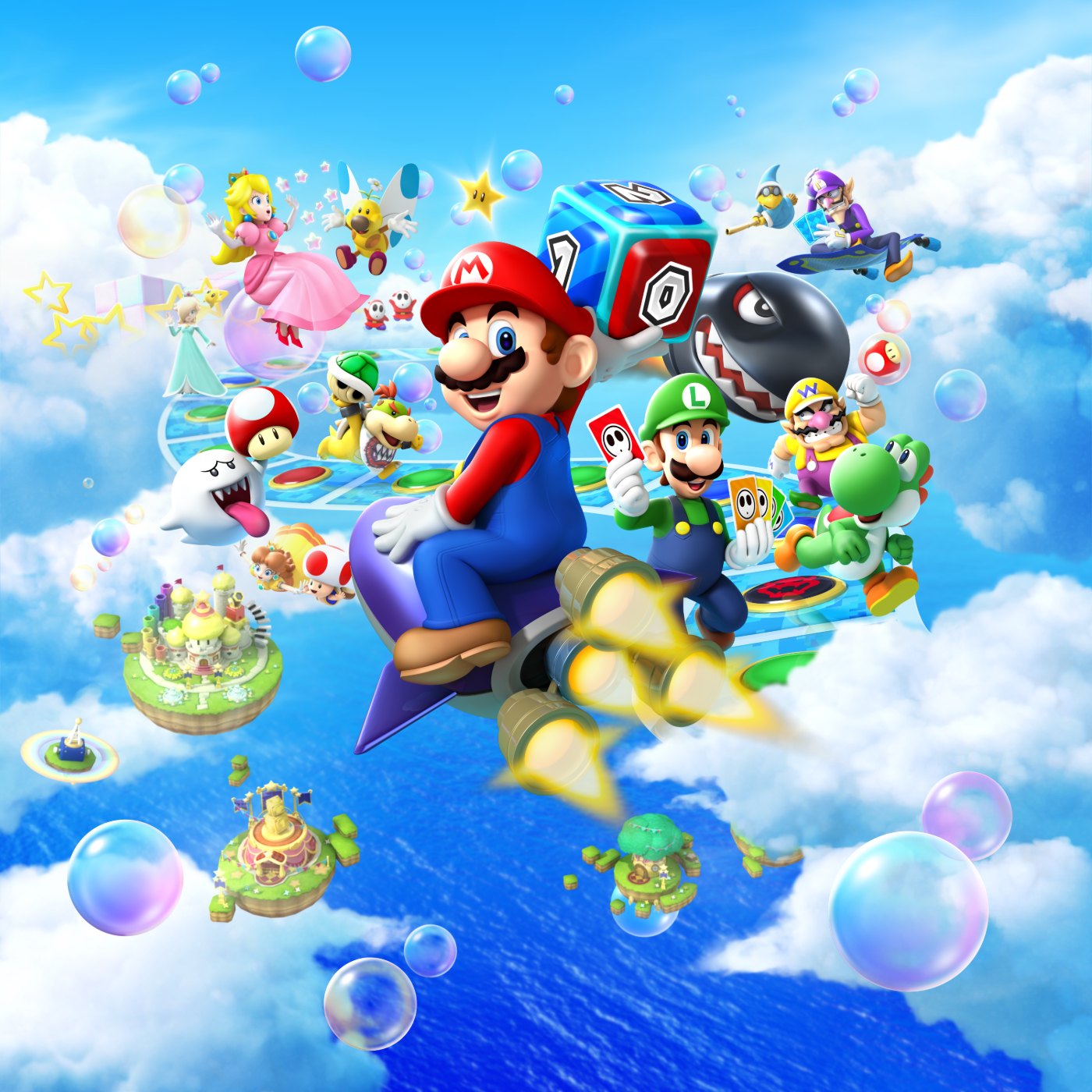
The official group artwork.
After Mario Party 9 put everybody in one car, NDcube’s second Mario Party went the other way. In Island Tour each player has a piece of their own again and rolls their own Dice Block. What has gone is nearly everything else that used to define the series. There are no Stars to buy and no coins to buy them with, no fixed number of turns, and no map to wander round. A board is a line from a start to a finish, and the game ends when someone gets there.
What makes it interesting is that no two boards agree on what the line is for. On Perilous Palace Path it is a straight race with items to throw at each other. On Banzai Bill’s Mad Mountain one face of the dice fires a Banzai Bill down the slope, and the question is whether to run or hide. Rocket Road multiplies your roll by the Boosters you hold. Kamek’s Carpet Ride swaps the dice for numbered cards and demands an exact landing. Star-Crossed Skyway brings back the Mini Stars of Mario Party 9. Shy Guy’s Shuffle City, for three or four human players only, is closer to Old Maid than to Mario Party. And Bowser’s Peculiar Peak is a race nobody wants to win. Each board’s menu card rates it for skill, luck and minigames and gives a playing time, from 10 to 20 minutes up to an hour.
The minigames are all new and all four-player free-for-alls: there are no team games, no one-against-three and no duels. Super Mario Wiki lists 81, of which 69 are the general pool, six are boss fights, three are puzzle games and three are extras. Away from the boards they fill a Time Attack, a first-to-seven balloon race called Hot-Air Hijinks, and Bowser’s Tower, the single-player mode, in which you climb 30 floors beating bubble copies of the cast.
It was built for a handheld and it shows in the best way: with Download Play, one Game Card is enough for four people to play the boards and the minigames, and StreetPass turns passers-by into opponents. It shows in a worse way too. There is no online play, and reviewers who liked the minigames often found the boards slight and the dice in charge. The reviews were mixed, with Metacritic at 57, but the game sold steadily for years and earned a Nintendo Selects reissue.
The team was a familiar one. The chief planning director, Shinichi Nakata, had directed Mario Party Advance, the series’ earlier handheld experiment, and the sound chief, Ichiro Shimakura, had co-written its music. Mario Party 10 followed on Wii U in 2015.
Get ready for a portable party in the palm of your hand – the ultimate minigame experience has arrived with Mario Party: Island Tour, only on Nintendo 3DS family systems!
Step into a board game with a twist and face off against your opponents in madcap minigames! Whether you’re playing solo or with friends, seven new game boards, 80 new minigames and a host of unique modes make the first Mario Party game on Nintendo 3DS the most exciting yet! Combining easy-to-grasp gameplay with Download Play that allows four players to party together using just one Game Card, Mario Party: Island Tour really is a game that absolutely anyone can play!
— Official description (Nintendo UK, 2014)
Why Island Tour matters to Mario fans
It is the first Mario Party on Nintendo 3DS and the first in which Bowser Jr. is playable; it brought Boo back to the roster, the first time since Mario Party 8; and it is the series’ boldest attempt to make every board play by different rules. Rocket Road is a love letter to Super Mario Galaxy, with Rosalina waiting at the finish, and Dry Bowser and King Bob-omb turn up as bosses. Two of its tunes, the title theme and Rocket Road, were later picked for Super Smash Bros. Ultimate.
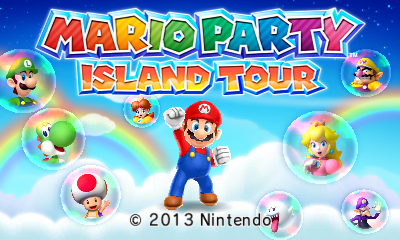
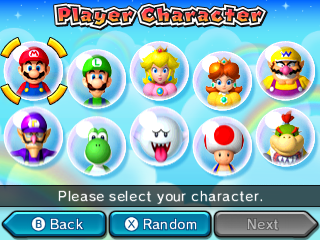
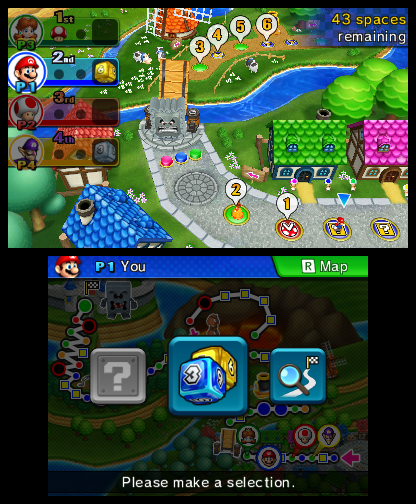
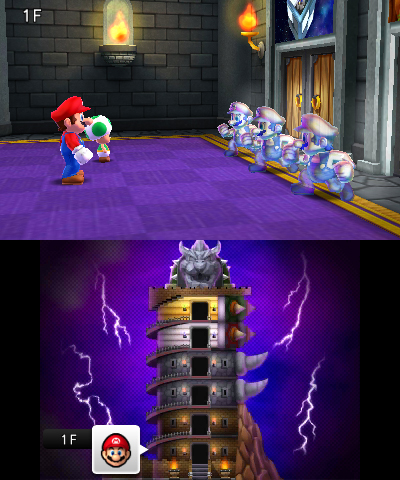
The title screen.The character select screen.Perilous Palace Path, in one of Nintendo of America’s press screenshots.Three bubble copies of the player’s character on a floor of Bowser’s Tower.
“Should you go for the glory or hide out?”
In-game description of Banzai Bill’s Mad Mountain (American English version), as transcribed by Super Mario Wiki
Quick Answers
The questions people ask most about Mario Party: Island Tour, answered briefly here and in depth further down the page.
When did Mario Party: Island Tour come out?
North America: 22 November 2013. Europe: 17 January 2014. Australia: 18 January 2014. Japan and South Korea: 20 March 2014. Super Mario Wiki also gives 10 January 2014 for Hong Kong. More →
Who made it?
NDcube, in its second Mario Party after Mario Party 9, for Nintendo. The game director is Yukio Umematsu and the producers are Miyuki Hirose and Atsushi Ikeda. More →
What are the seven boards?
Perilous Palace Path, Banzai Bill’s Mad Mountain, Star-Crossed Skyway, Rocket Road, Kamek’s Carpet Ride, Shy Guy’s Shuffle City and Bowser’s Peculiar Peak. Each has its own rules and its own way of winning. More →
How do you unlock Bowser’s Peculiar Peak?
Play each of the other boards once. Shy Guy’s Shuffle City, which needs three human players, does not count towards it. More →
Who is playable, and how do you unlock Bowser Jr.?
Mario, Luigi, Peach, Daisy, Wario, Waluigi, Yoshi, Boo and Toad from the start. Bowser Jr. is unlocked by clearing Bowser’s Tower for the first time. More →
How many minigames are there?
Super Mario Wiki lists 81: 69 general minigames, 6 boss minigames, 3 puzzle minigames and 3 extras. Nintendo’s own page says 80. All are free-for-alls. More →
What is Bowser’s Tower?
The single-player mode: 30 floors, each a minigame against three bubble copies of a character, with a boss on every fifth floor and Bowser at the top. More →
Can four people play with one copy?
Yes. Through Download Play one Game Card serves up to four Nintendo 3DS systems, in both Party mode and the minigames. There is no online play. More →
Are there Stars and coins?
No. Most boards are races to a finish line. Mini Stars appear on one board only, Star-Crossed Skyway, where the player holding the most at the end wins. More →
How many copies did it sell?
Nintendo’s results briefing of 8 May 2014 lists 1.14 million worldwide to 31 March 2014. Wikipedia cites the CESA Games White Paper for 2.95 million by 31 December 2021. More →
Boards & Modes
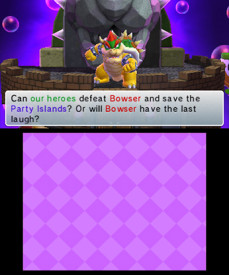
The introduction to Bowser’s Tower.
A letter arrives in the Mushroom Kingdom sealed inside a bubble. It is an invitation to the Party Islands, and no sooner have Mario and his friends read it than more bubbles scoop them up and carry them off into the clouds. That is all the excuse Party mode needs.
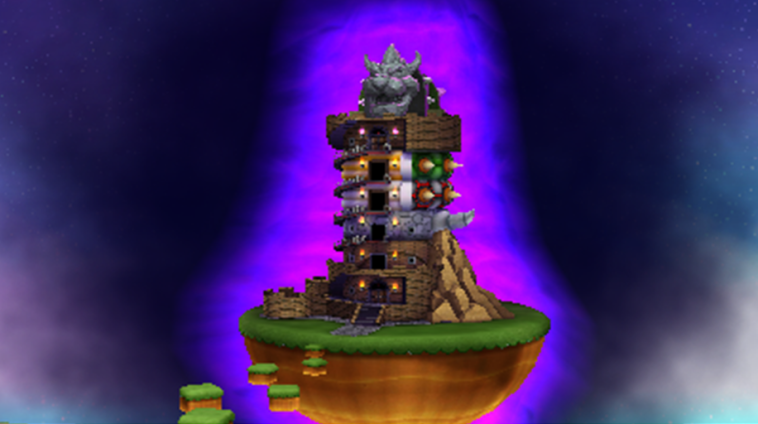
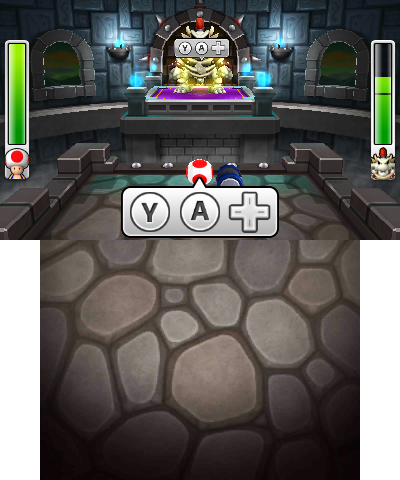
Bowser was not invited. Furious, he raises a tower in his own image, fits it with a bubble machine and uses it to seal away the fun, filling each floor with bubble copies of the party-goers to keep intruders out. Getting to the top with the help of a green Toad is the single-player mode, Bowser’s Tower. The seven boards come first.
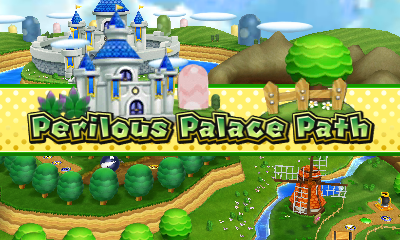
Perilous Palace Path
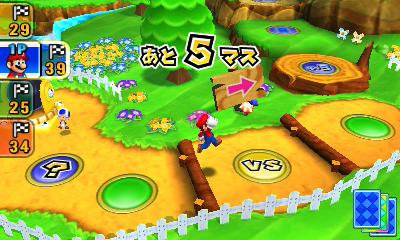
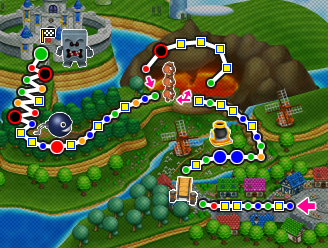
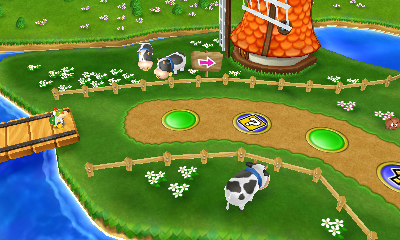
The longest board, at 45 to 60 minutes, and the nearest thing here to a traditional Mario Party. It is a race along a country road towards a castle: past grazing cows, over a river and its bridges, and, if things go badly, through a patch of lava called the Bowser Zone. Super Mario Wiki counts 56 spaces, seven of them in the Bowser Zone, and nearly a third are Item Spaces. A minigame follows every round and pays out bonus Dice Blocks: gold for first, silver for second, bronze for third.
The items are what the board is about. Dash Mushrooms and a Super Star speed you up; Setback Shells, the Backwards Bill, the Blooper Chopper and the Lightning Score Striker slow somebody else down; the Lakitu Leech steals; and the two Kamek items swap players’ positions, which near the finish can undo twenty minutes of work.
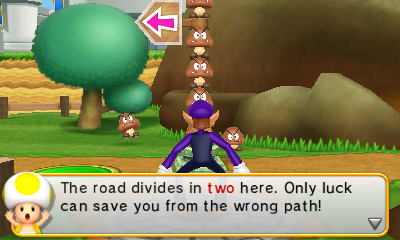
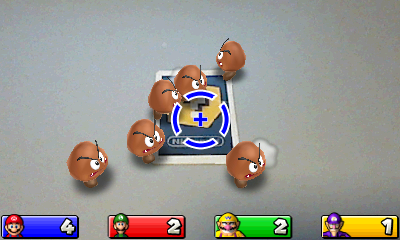
Three obstacles stand in the road. At a drawbridge a Thwomp waits while you choose one of three switches: the right one lowers the bridge and lets you carry on, the wrong ones bring the Thwomp down on you. About half way a Goomba Tower spins a signpost, and if it points right a Monty Mole flings you into the Bowser Zone. At the very end a Whomp blocks the castle gate with six points of health. A roll of six flattens it; anything less chips away that much and gets you squashed, leaving the next arrival an easier job. The first player past the Whomp wins.
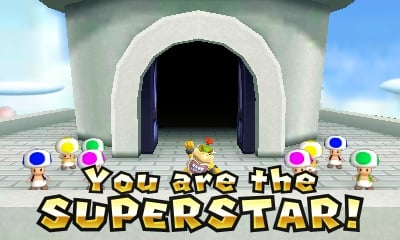
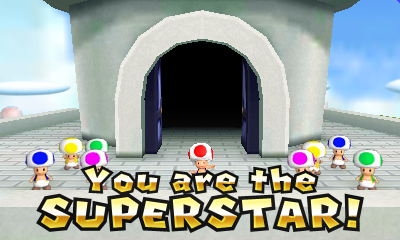
The map of Perilous Palace Path.The Goomba Tower and its signpost.Cows beside the path.The end of the board, with Bowser Jr. and a crowd of Toads.
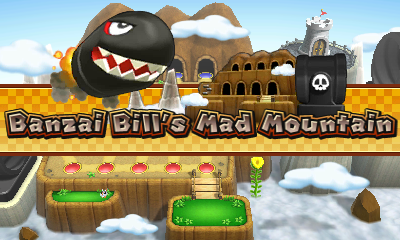
Banzai Bill’s Mad Mountain
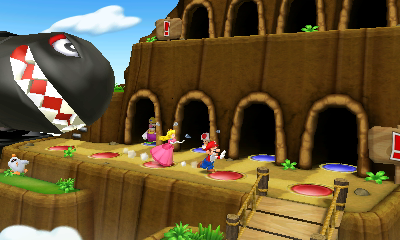
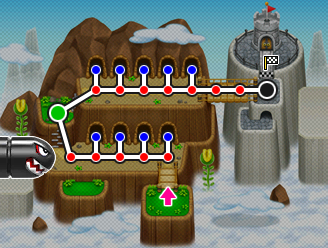
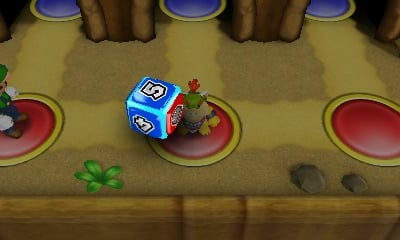
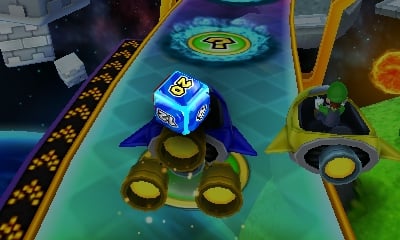
A climb of just 23 spaces that the game rates five out of five for luck and one for skill. The Dice Block here has no 6. In its place is a red Banzai Bill face, and when anyone rolls it a cannon fires. Every player standing on a Danger Space in its path is blown back: to the start from the lower slope, or to the half-way point from the upper one. Players tucked into the caves of the Safe Spaces are untouched, but each cave holds only one.
So every turn is a choice between pressing on across open ground and stopping short where there is shelter, which is why the wiki compares the board to a game of chicken. A Switch Space changes which cannon fires, and the last space of all is a Banzai Bill Space: stand on it and you set the thing off yourself. Every third turn there is a minigame for a bonus to your movement. First to the top wins, usually inside half an hour.
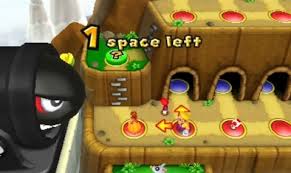
The map of Banzai Bill’s Mad Mountain.Banzai Bill on his way down.The board’s Dice Block, with a Banzai Bill where the 6 should be.Bowser Jr. reaches the goal.
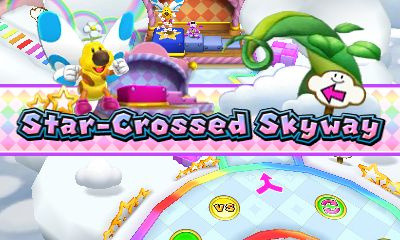
Star-Crossed Skyway
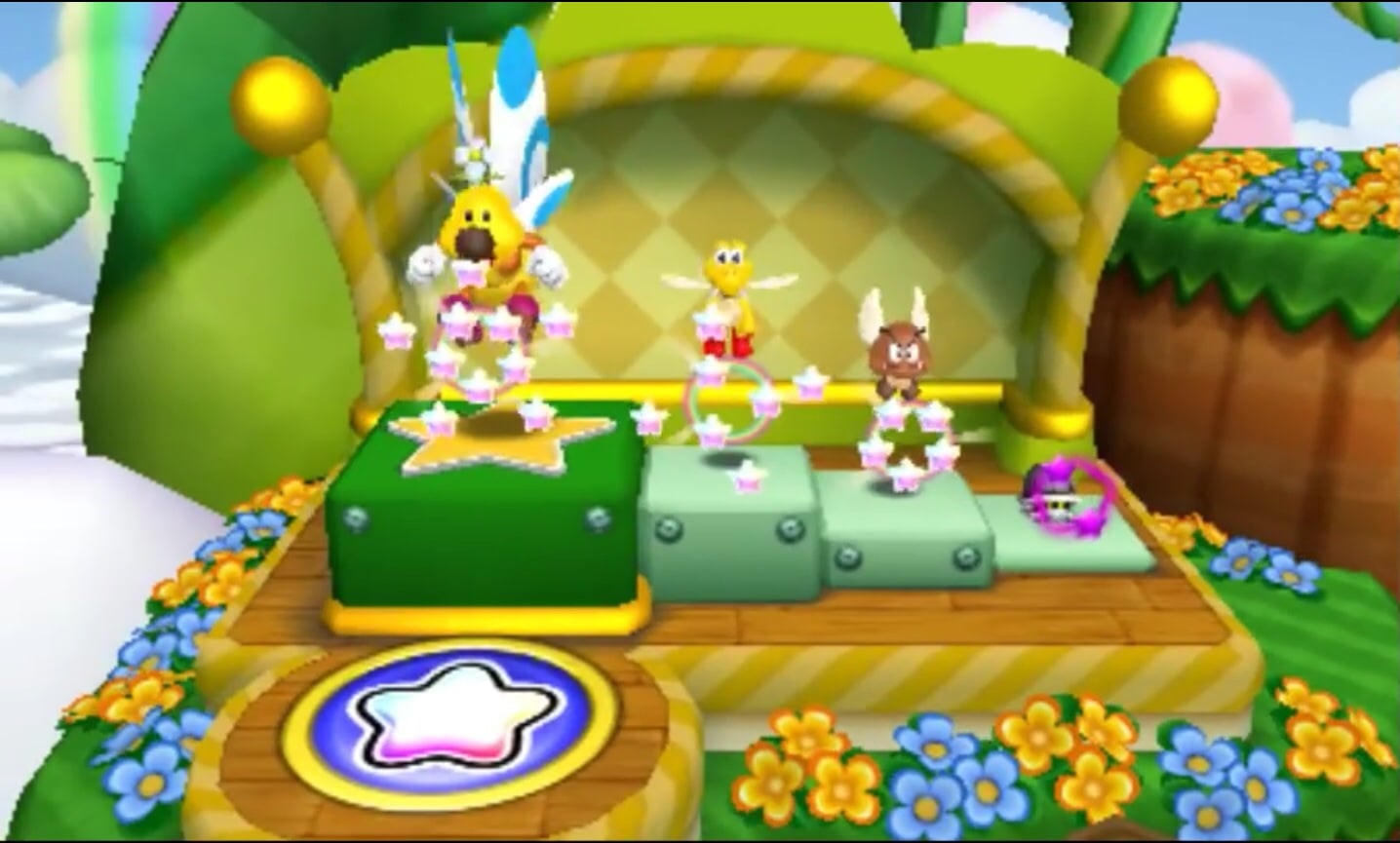
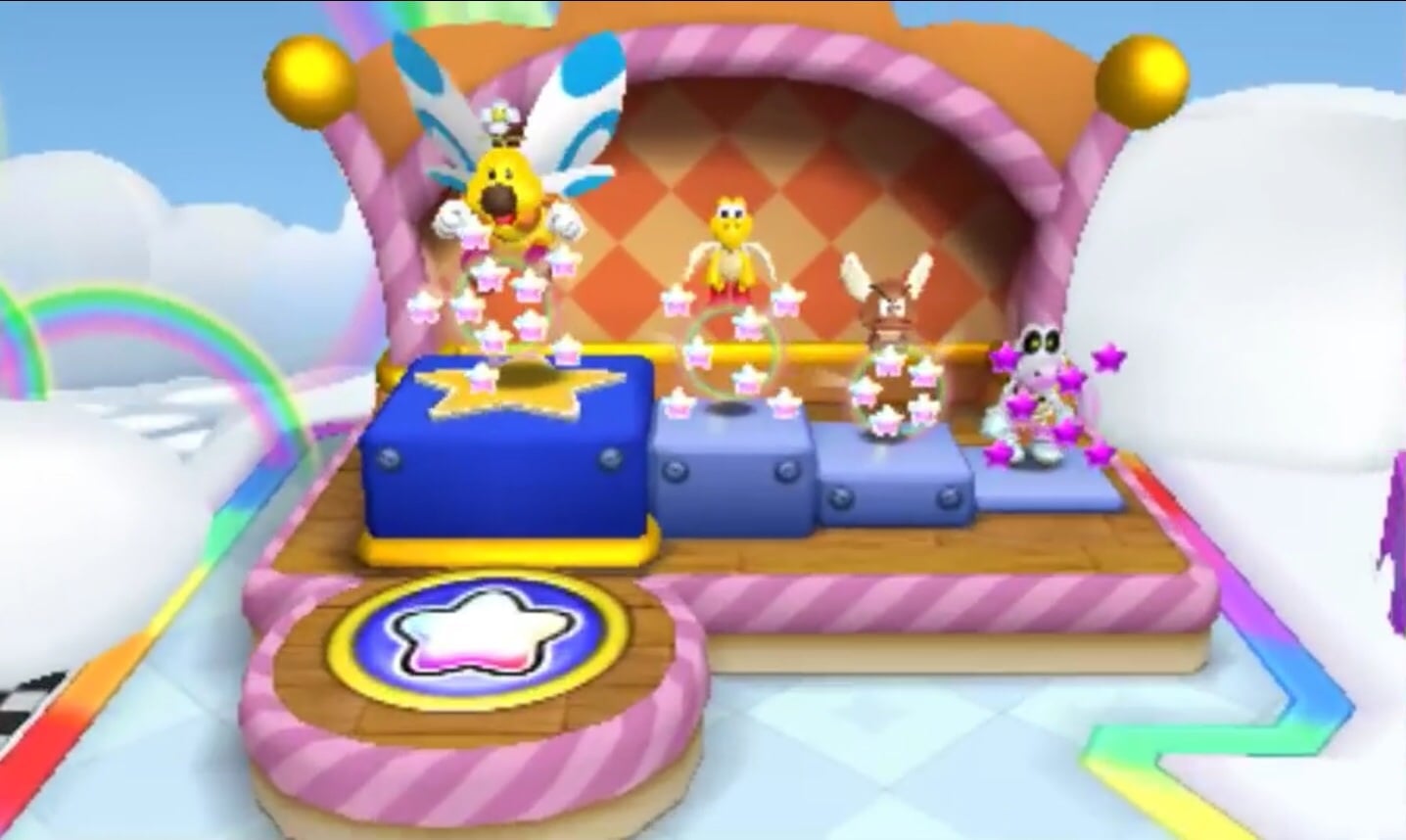
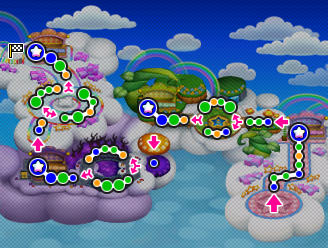
The one board that is not a race, although it looks like one. It runs for 51 spaces above the clouds, and the winner is whoever holds the most Mini Stars once everybody has finished. Mini Stars come from minigames and, above all, from the four Star Stages along the way. At each stage four prizes are waiting, carried by flying creatures, and players take them in the order they arrive.
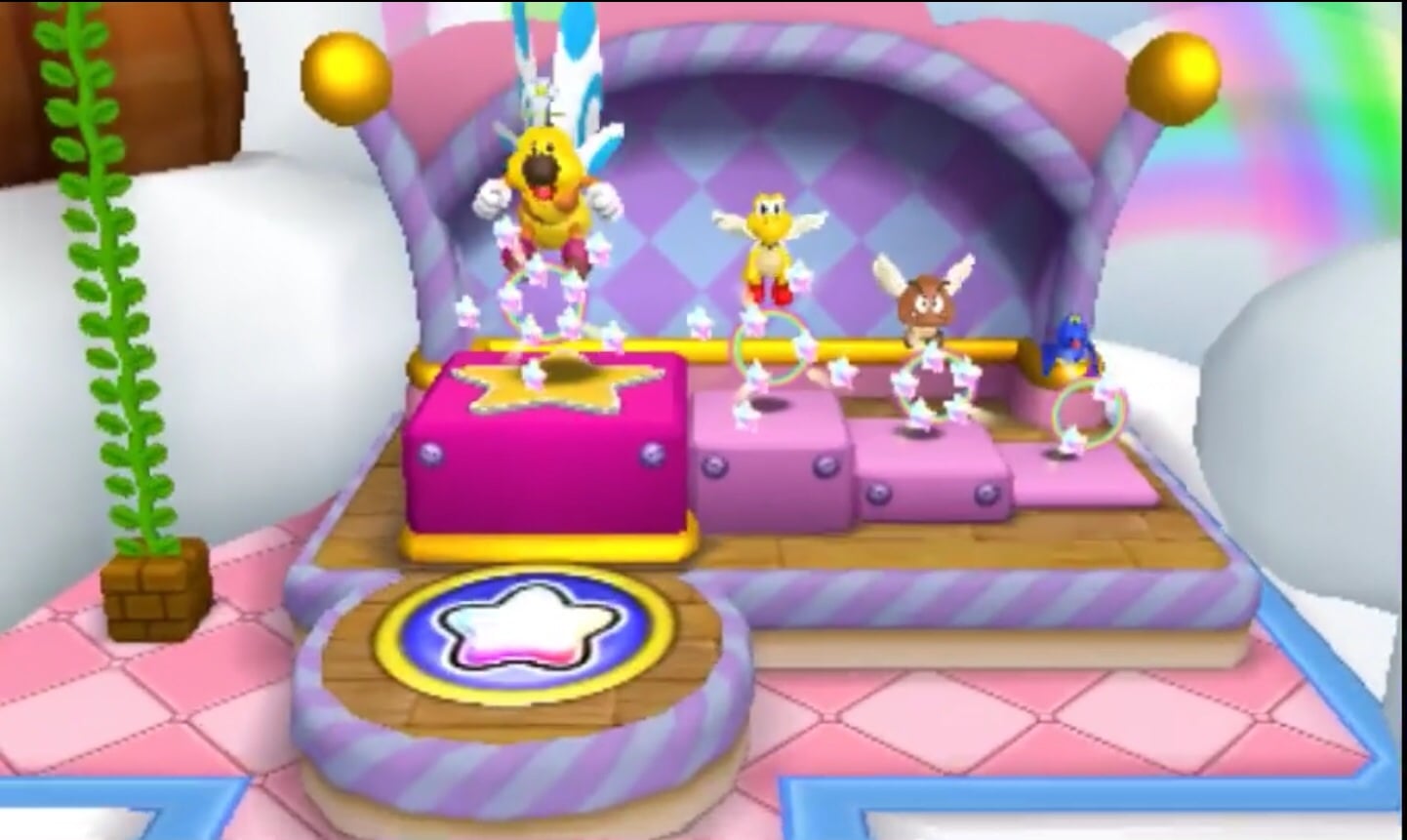
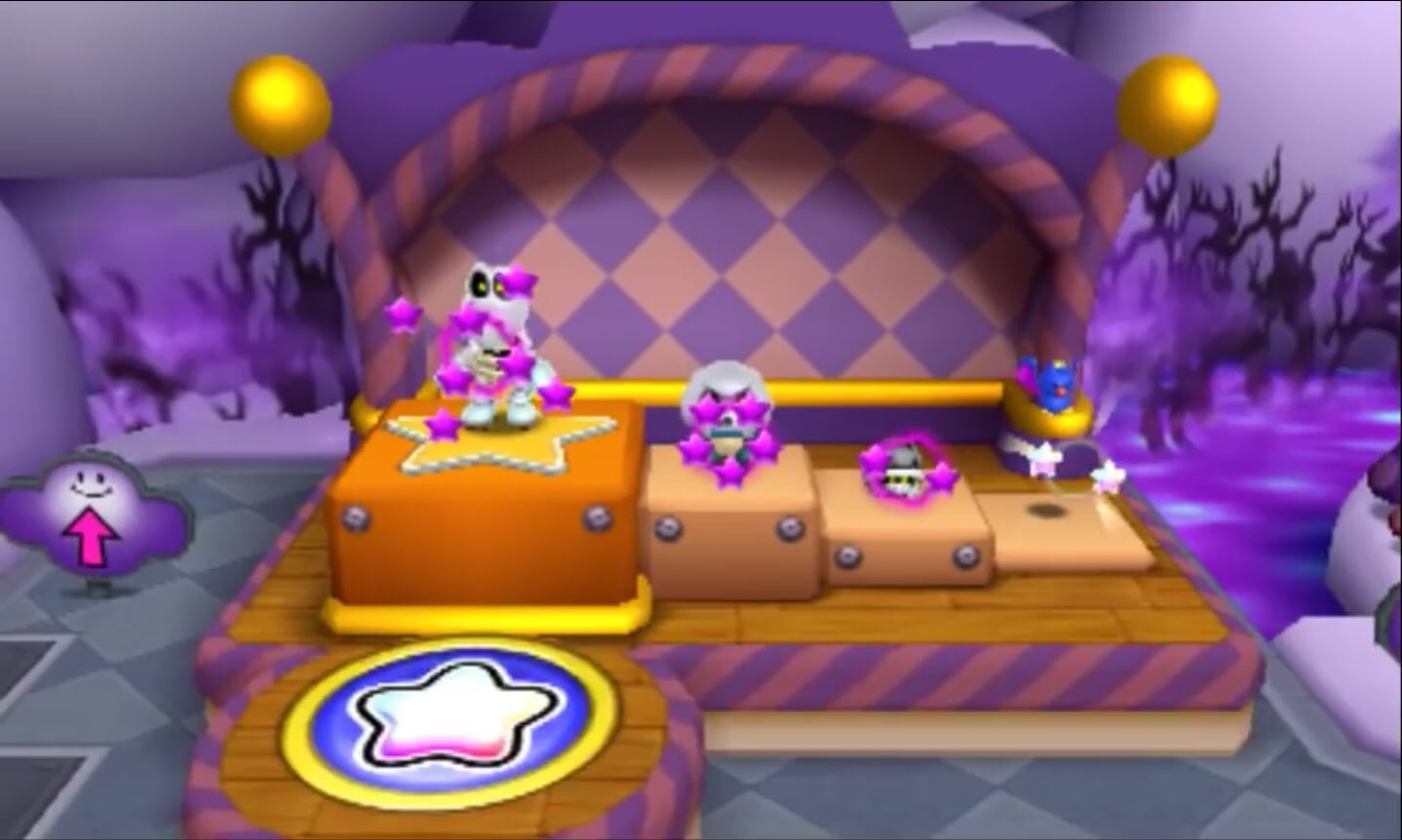
The catch is that the prizes are not all good. At the first stage all four are Mini Stars, the best of them ten from Flutter. At the second and fourth, one of the four is a bundle of Mini Ztars. At the third it is the other way round: three lots of Mini Ztars, the worst of them seven from Big Dry Bones, and a single pair of Mini Stars, so the clever thing is to get there last. Switch-Place Spaces send the prize at the front of the queue to the back, and Scramble Spaces let you rearrange the queue as you please.
Nobody is left behind: when all but one player have reached a stage, Lakitu fetches the straggler. A total can finish below zero. The board takes 30 to 50 minutes by the game’s own estimate.
The map of Star-Crossed Skyway.The first Star Stage: four lots of Mini Stars.The third Star Stage, where three of the four prizes are Mini Ztars.Mario wins the board.
Rocket Road
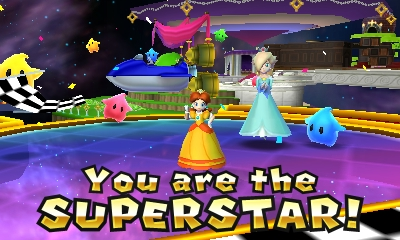
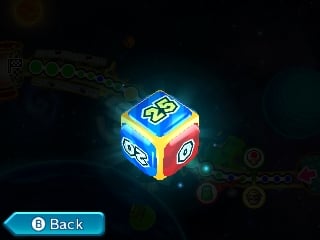
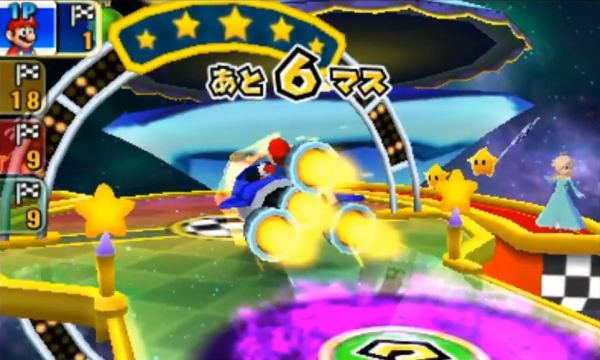
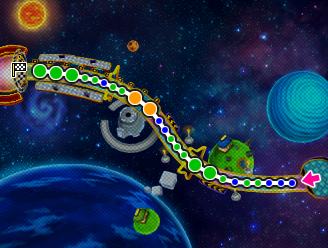
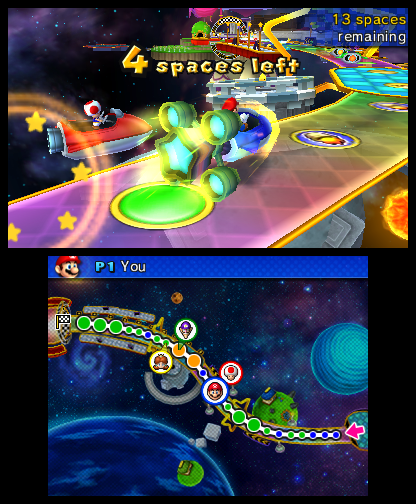
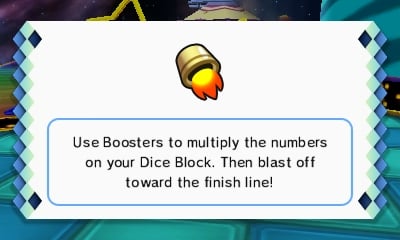
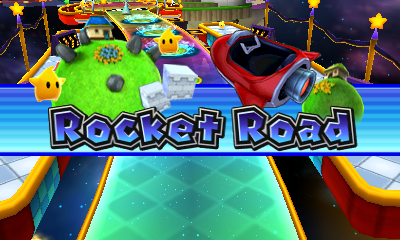
The shortest board, ten to twenty minutes on a track of about 25 spaces through outer space, and a tribute to Super Mario Galaxy and to Mario Kart’s Rainbow Road. Everything turns on Boosters. Fire one before rolling and your roll is doubled, two and it is trebled, and so on, so that three Boosters and a five carry you twenty spaces. The risk is on the dice itself: the 6 has been replaced by a red 0, and a zero times anything is nothing.
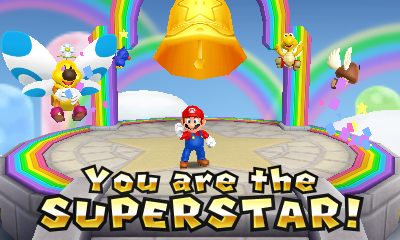
Boosters come from the minigame played every third turn, from Booster Spaces and from one generous rule: roll a 0 while still on the starting space and you are given one free, every time. A player holding four can gamble on finishing in a single turn, since a five would then be worth 25. Warp Spaces add surprises along the way. Rosalina and a crowd of Lumas are waiting at the finish to congratulate the winner.
The map of Rocket Road.Mario moves four spaces.The game explains Boosters.A roll of 20, after three Boosters.
Kamek’s Carpet Ride
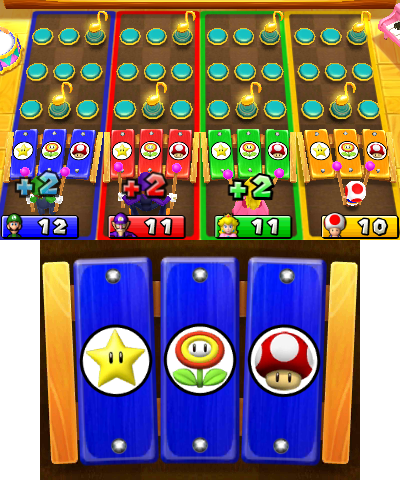
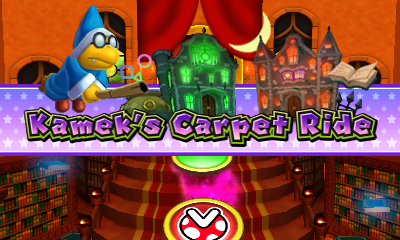
The game rates this one four for skill and one for luck, and it has no dice at all. You fly a carpet by playing cards from your hand: Precision Cards move you exactly 1 to 6 spaces, Random Cards somewhere within a range, and the rare Power Precision Cards move you forward one or two while shoving everyone else back as far. New cards are won in minigames, where four are laid out and players choose in the order they finished.
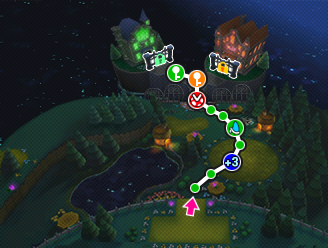
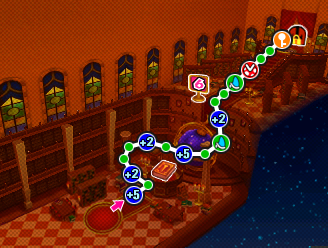
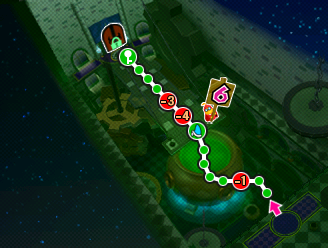
The 42 spaces are in three parts. The first is a garden at night with two Just-Right Spaces, each before a gate. Land on one exactly and you ground-pound a switch that opens it, pocket a Power Precision Card for your trouble, and everybody is taken into the mansion behind: an orange one with a library, or a green one full of giant cogs. The mansion ends on another Just-Right Space, and that is the goal. It has to be hit exactly; play too high a card and you bounce back by the difference. Kamek Spaces, where he shuffles the players about, and Piranha Plant Spaces keep spoiling the arithmetic.
The first part of Kamek’s Carpet Ride.The orange mansion.The green mansion.Official artwork of the cards.
Shy Guy’s Shuffle City
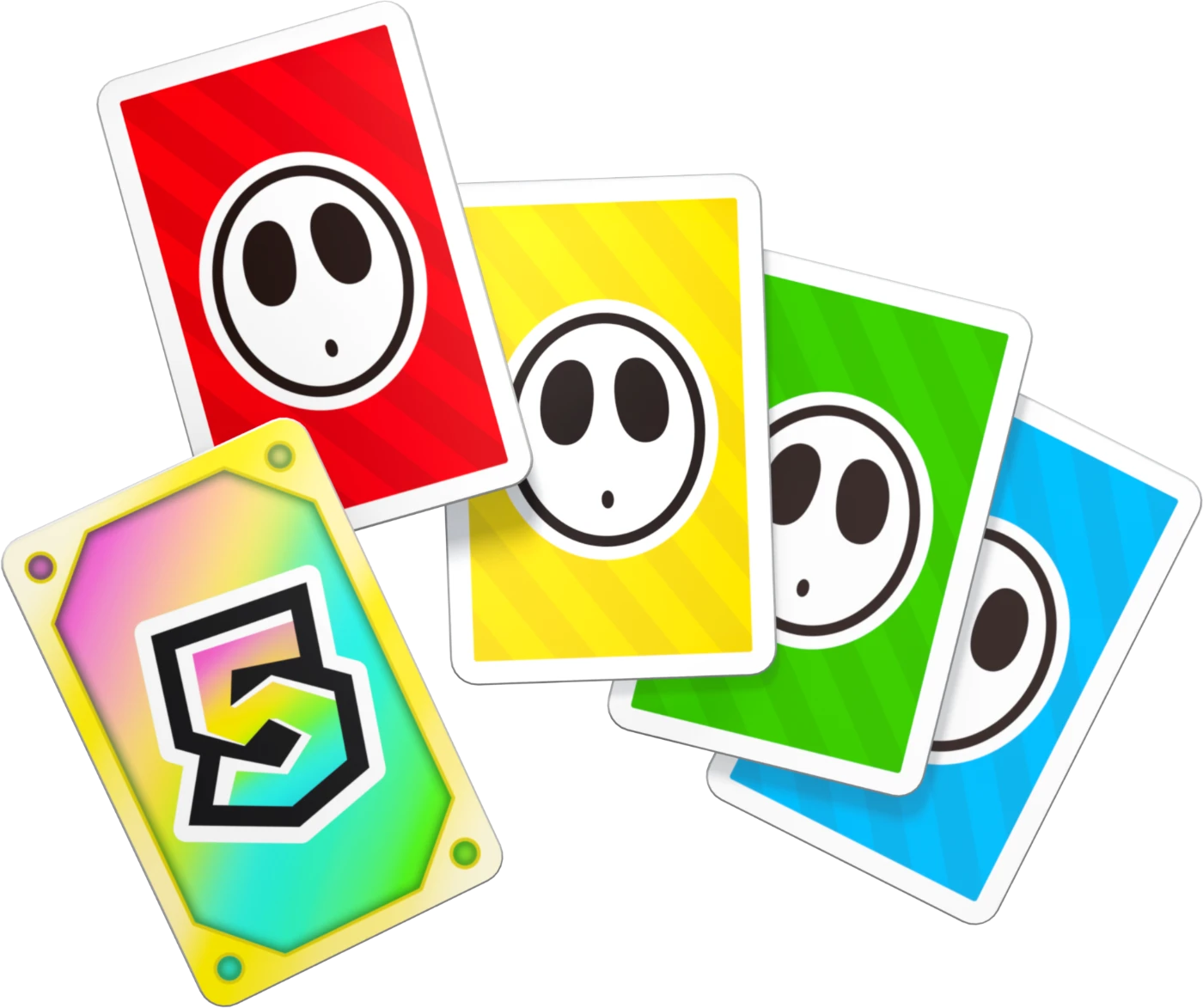
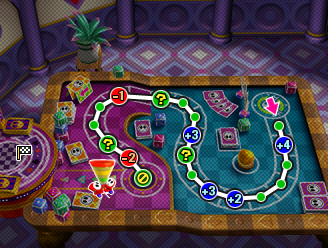
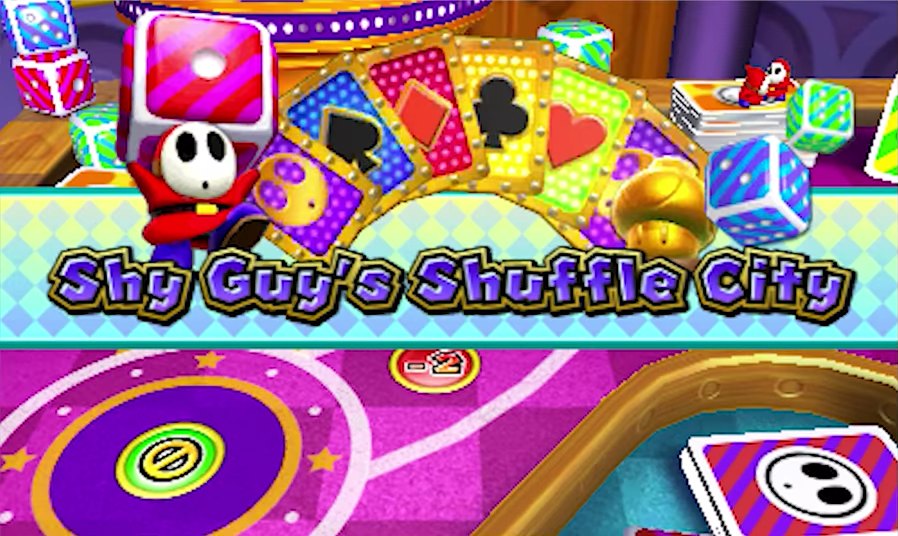
A card game with a board attached, and the only part of Island Tour that insists on three or four human beings. With 19 spaces it is, by Super Mario Wiki’s reckoning, the smallest board in the series outside the solo modes. Every three rounds a hand is dealt: movement cards numbered 1 to 4 and, somewhere among them, the Bowser Card. From the second round on, before you move you must take a card from another player’s hand. That is how the Bowser Card travels, and passing it on is the whole game. Whoever is holding it when the three rounds are up suffers a Bowser Penalty. Cards worth 0, 5 and 6 can only be won in minigames.
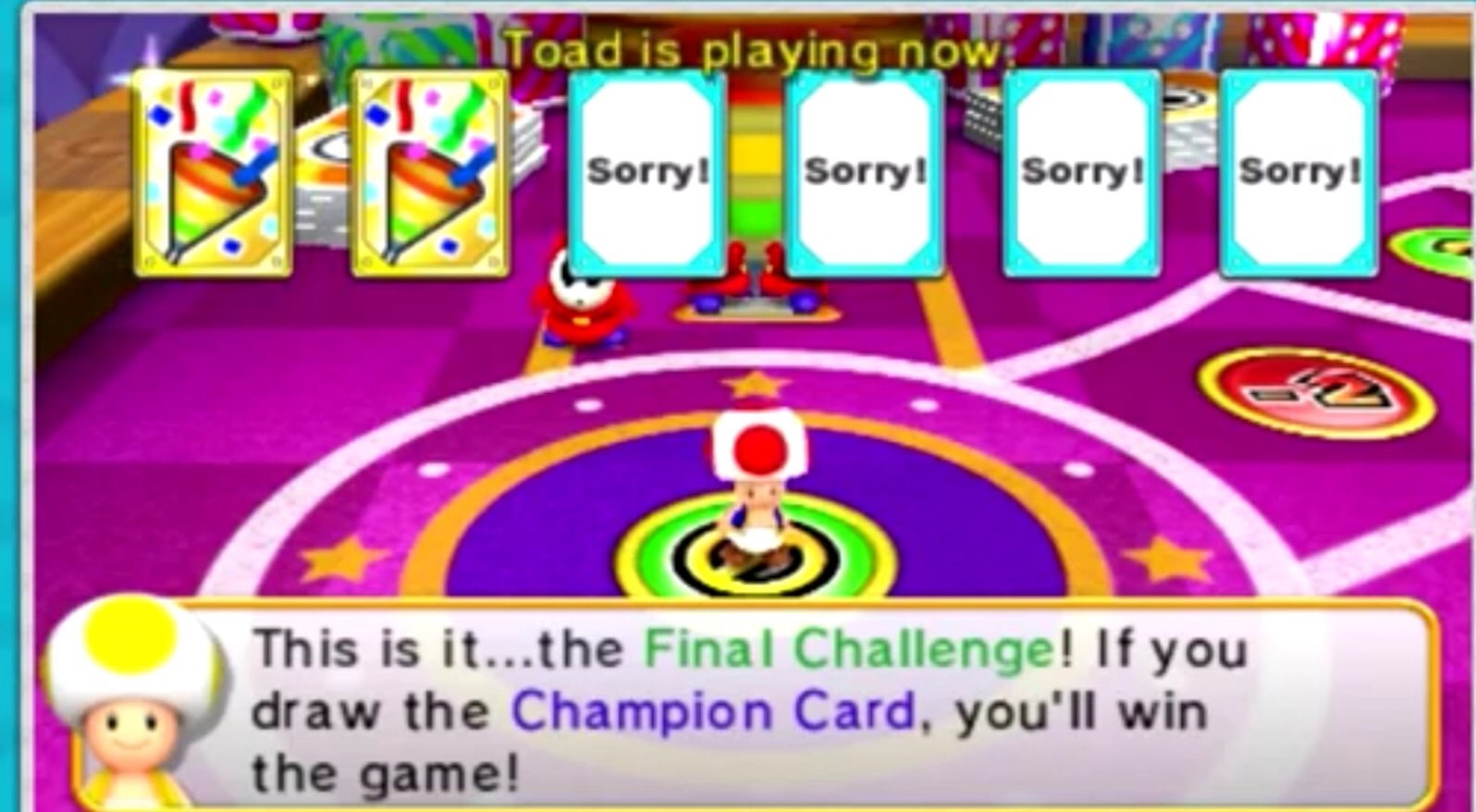
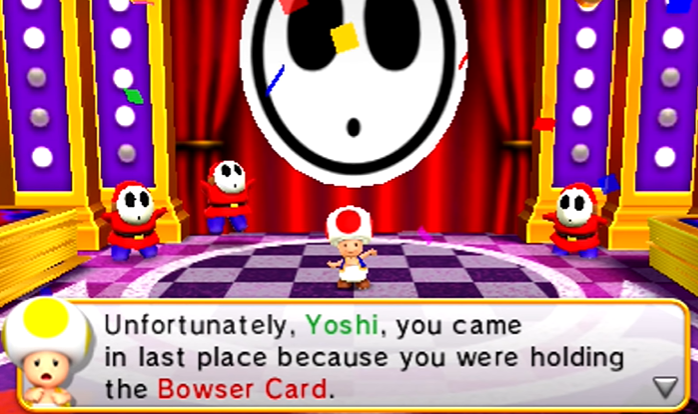
Reaching the end is not enough. At the Dead-End Space you face the final challenge, a draw from six cards, two of them Champion Cards and four marked “Sorry!”. Draw a Champion and you have won. Draw a Sorry and you go back three spaces, but that card is thrown away, so the odds improve for whoever comes next. The holder of the Bowser Card is not allowed to try, and finishes last.
The map of Shy Guy’s Shuffle City.Toad about to attempt the final challenge.Toad wins, and Yoshi is left in last place.
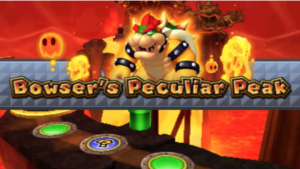
Bowser’s Peculiar Peak
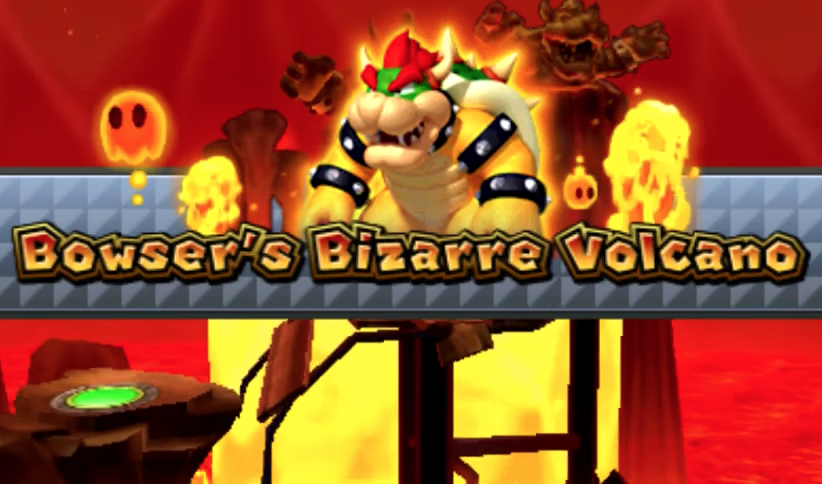
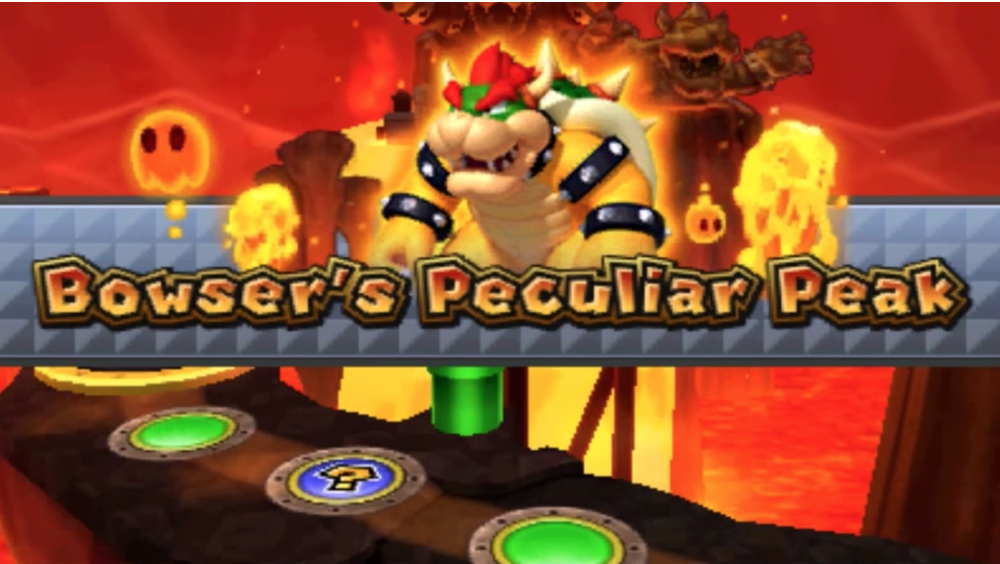
The unlockable board, opened by playing each of the others once (Shuffle City excepted), is hosted by Bowser himself in place of the yellow Toad, to an arrangement of his road music from Super Mario 64. In the British version it is called Bowser’s Bizarre Volcano. It is a race in reverse: the first player to reach Bowser at the top loses, and everybody else wins.
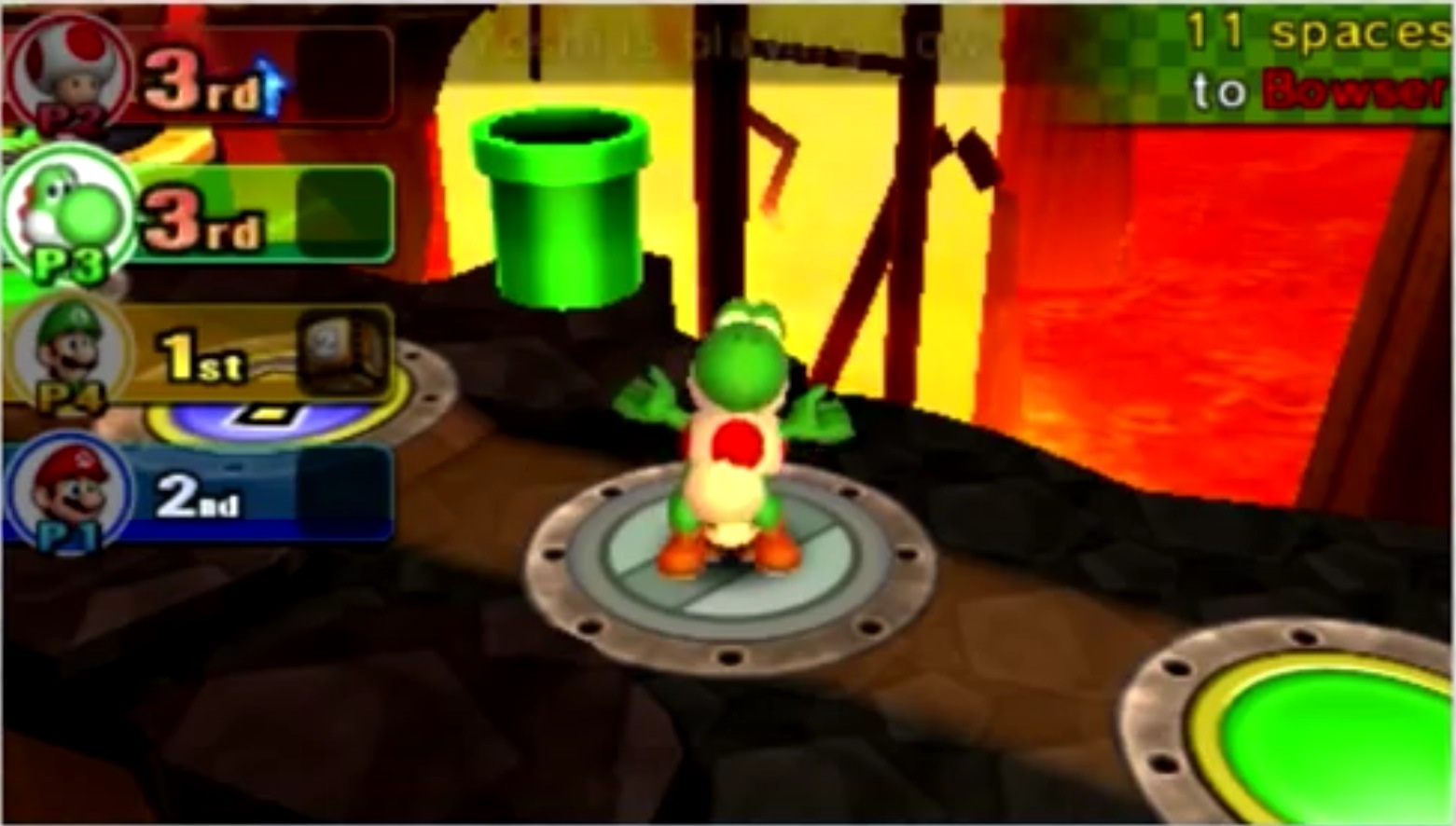
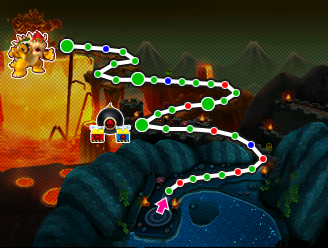
So everything works backwards. Doing well in a minigame earns you the smallest bonus Bowser Dice Block and doing badly the largest, the worst finisher moves first, and the player nearest the summit chooses the next minigame. A double on your dice is a blessing, because it means you do not move. Once somebody is within 16 spaces of the top Bowser scatters seven Bowser Spaces across the 35-space track. Lower down he blocks the road with a bomb and two detonators: pick the dud and your turn ends there, set the bomb off and the way is open.
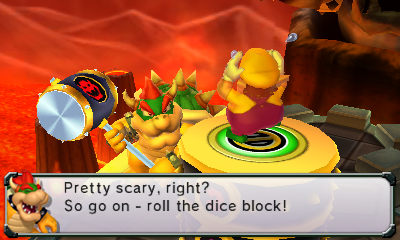
At the summit comes the Bowser Challenge. Roll a 1, 2 or 3, or a double, and you cling on for another turn, to his visible irritation. Roll four or more and he hurls you off the mountain; you finish last and the game is over. Lakitu is on hand to hold up the loser for the results.
The map of Bowser’s Peculiar Peak.Wario takes on the Bowser Challenge.The title card of the British version, Bowser’s Bizarre Volcano.
Bowser’s Tower
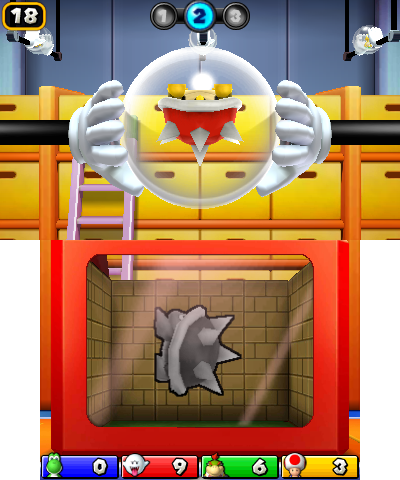
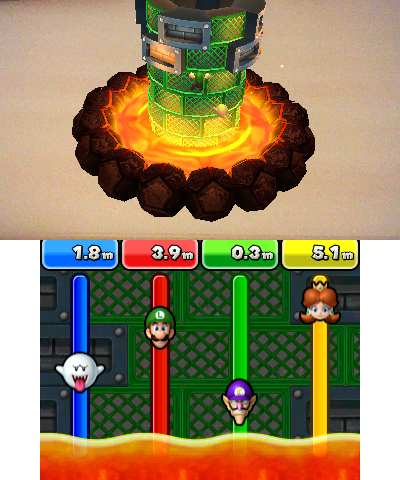
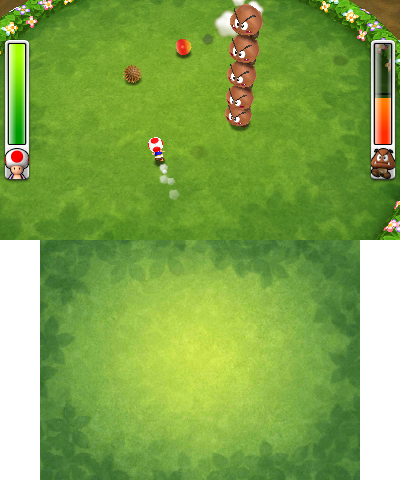
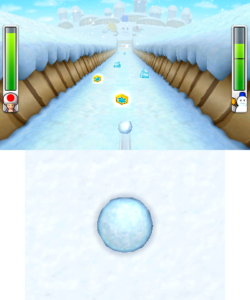
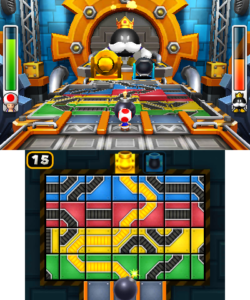
The solo mode is a climb of 30 floors. On each you choose one of two minigames and play it against three bubble copies of a character, silver and silent; win or draw and you go up. Every fifth floor is a boss: the Goomba Tower on 5, Chain Chomp on 10, Mr. Blizzard on 15, King Bob-omb on 20, Dry Bowser on 25 and Bowser on 30, each in a minigame of its own.
Two roulettes break up the ascent. Before floors 3, 7, 17 and 27 Bowser spins a wheel of punishments. Most of its threats, such as losing every point you own or starting again from the bottom, are bluff and do nothing, but it really can drop you a floor or make the copies tougher. In your favour, on floors 13 and 23, and whenever you lose three times running on one floor, the green Toad hits a Mini Star block that removes that many copies from the next game, and a three skips the floor.
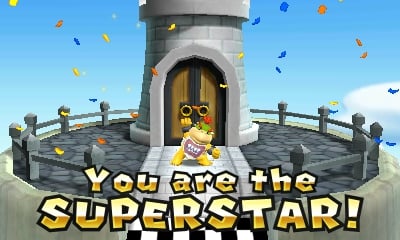
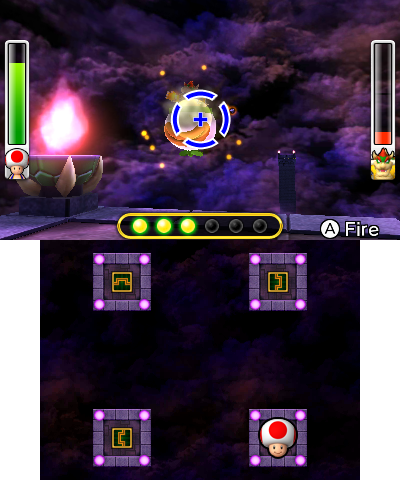
Beat Bowser’s Sky Scuffle on the top floor, see off the last copies, of Mario, and you ground-pound the bubble machine to pieces. Then Bowser strolls back in. The one you beat was a decoy, he says, and he knocks you and the green Toad off the tower with an invitation to come back any time. Super Mario Wiki notes that it is the only solo mode in the series without a proper ending. Clearing it for the first time unlocks Bowser Jr., and each further clear makes the opposition harder. Progress is kept in a suspend save, updated after every win.
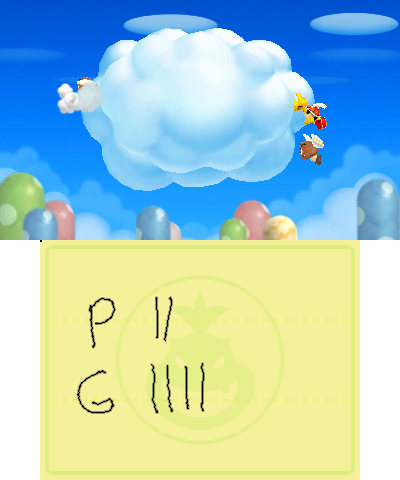
A blue Toad hosts the minigames away from the boards, and all of them are available from the first day. Free Play is exactly that, for up to four. Time Attack is a solo run through ten set games against the clock, each with an optional objective that takes time off: Magmathon, No-Traction Action, Slow G, Tile Savvy, Gyro for the Gold, Quickest Cricket, Color Me Fast, Blown Hover, Mad Ladders and Sub Trouble. Hot-Air Hijinks is a balloon race for up to four in which a roulette chooses the games and the first to three, five or seven wins takes it; players who fall behind are allowed to stop the roulette themselves.
The same menu holds the three puzzle games, Three House, Emergency Hexit and Star Turn, and the three extras: The Choicest Voice, a microphone game of impressions; Ka-Goomba!, a shooting gallery aimed by moving the system about; and Sinking Feeling, a climbing game that needs the AR Card packed with the system.
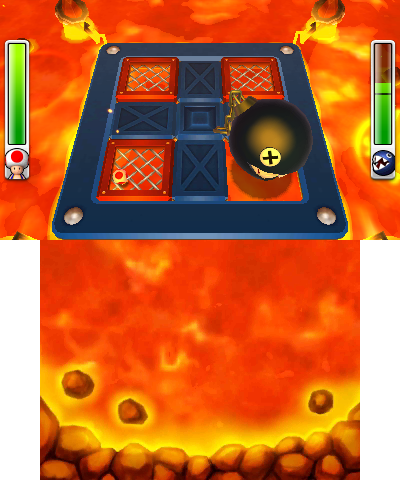
Magmathon, the first game of Time Attack.Star Turn, one of the three puzzle games.Ka-Goomba!
Every board in Mario Party: Island Tour
The seven boards with the game’s own ratings out of five for skill, luck and minigames, its estimate of playing time and how each is won. All but the last are open from the start.
Perilous Palace Path45–60 minutes · Skill 4 · Luck 3 · Minigames 5 · first to the castle winsThe long one: a race with ten kinds of item, a Thwomp, a Goomba Tower and a Whomp at the gate.
Banzai Bill’s Mad Mountain15–30 minutes · Skill 1 · Luck 5 · Minigames 4 · first to the summit winsRoll the Banzai Bill face and everyone caught in the open is blown back down the mountain.
Star-Crossed Skyway30–50 minutes · Skill 4 · Luck 4 · Minigames 3 · most Mini Stars winsFour Star Stages hand out Mini Stars and Mini Ztars in order of arrival, so being first is not always wise.
Rocket Road10–20 minutes · Skill 2 · Luck 5 · Minigames 4 · first to the goal winsBoosters multiply your roll through space, unless you roll the 0.
Kamek’s Carpet Ride20–40 minutes · Skill 4 · Luck 1 · Minigames 3 · first to land exactly on the goal winsNumbered cards replace the dice, and only an exact landing on a Just-Right Space will do.
Shy Guy’s Shuffle City20–40 minutes · Skill 5 · Luck 3 · Minigames 2 · draw a Champion Card at the end; three or four human players onlyA card game of bluff in which the Bowser Card is passed from hand to hand.
Bowser’s Peculiar Peak20–40 minutes · Skill 2 · Luck 3 · Minigames 4 · first to the top loses · unlocked by playing the other boardsA reverse race up Bowser’s volcano, known in Britain as Bowser’s Bizarre Volcano.
Bowser’s Tower, the solo mode, is not a board: it is a 30-floor ladder of minigames with a boss on every fifth floor.
Advertisement
Gameplay & Controls
Party mode is for two to four players, with computer characters filling any empty seats at a difficulty you choose for each. You pick a board, then a character, then which minigames to allow. Here is what all seven boards have in common, before the differences begin.
A race, not a Star hunt
Every player moves separately, which after the shared vehicle of Mario Party 9 counted as news. A yellow Toad explains the board’s rules, everyone rolls to settle the turn order, highest first, and a round is over when each player has rolled and moved. The ordinary Dice Block runs from 1 to 6, though several boards tamper with it.
There is no turn limit. A board ends when somebody reaches the goal, or on Star-Crossed Skyway when everybody has. Wikipedia sums up the break with tradition neatly: no board uses Stars or coins to decide the winner. Ties are settled with a roll of the dice, and the results screen charts each player’s progress as a line graph and counts the spaces they landed on.
Items exist only on certain boards. Where they do, you may hold two at a time and use one in a round.
The ordinary Dice Block.Yellow Toad, host of Party mode.Dice Block artwork.
Minigames and prizes
How often you play a minigame depends on the board. On Perilous Palace Path there is one after every round; on Banzai Bill’s Mad Mountain and Rocket Road one every third turn; elsewhere they come from landing on the right space, or decide who gets which cards or dice. All are for every player at once, and what they pay is position: the higher you finish, the better the prize or the earlier your pick of what is on offer, and last place gets the worst of it or nothing. On Bowser’s Peculiar Peak, naturally, that logic is turned upside down.
Before a game you can limit the selection to the easy minigames and switch off the ones that need the microphone. Many use the hardware: the stylus for drawing and tapping, the gyroscope for aiming and steering, the microphone for the two voice games, and the AR Card packed with the system for the extra game Sinking Feeling.
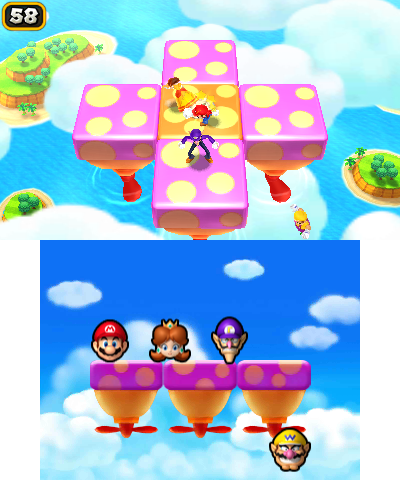
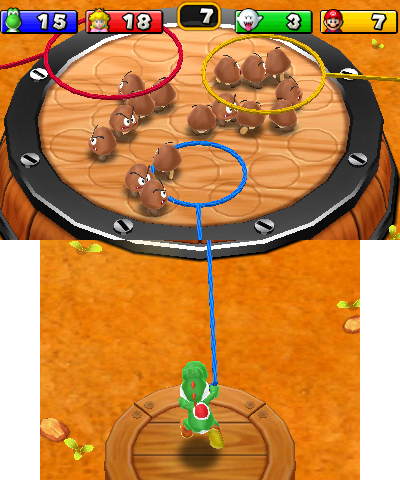
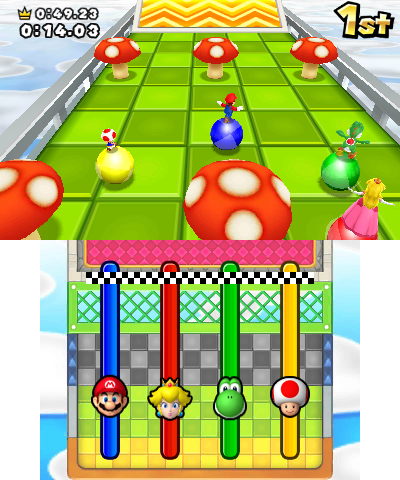
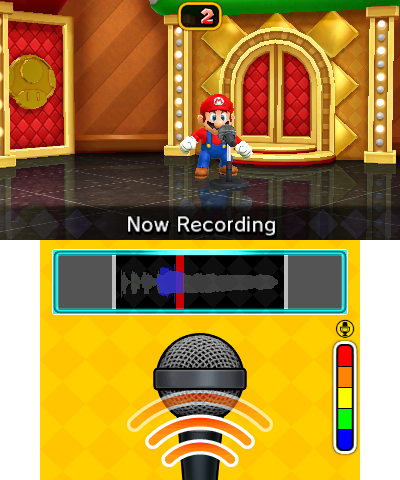
Git Along, Goomba: lassoing with the stylus.Gyro for the Gold: steering by tilting the system.The Choicest Voice, played with the microphone.
The spaces
The plain Green Space, where nothing happens, is the only one found on all seven boards. Dash Spaces push you on by the number printed on them and Back Spaces send you the other way; a Piranha Plant Space throws you back too. Lucky and Unlucky Spaces bring something good or bad, an Event Space sets off the board’s own business, and a Bowser Space means trouble. You cannot pass a Dead-End Space or a Challenge Area without stopping to deal with what is there. An Item Space hands over an item and a Free-for-All Space starts a minigame with an item as the prize.
The rest belong to single boards. Banzai Bill’s Mad Mountain has Danger Spaces in the line of fire, Safe Spaces out of it, a Switch Space that changes which cannon fires and a Banzai Bill Space that fires it. Star-Crossed Skyway has Star Stage, Scramble and Switch-Place Spaces, all of which interfere with the Mini Stars waiting ahead. Rocket Road has Booster and Warp Spaces, and Kamek’s Carpet Ride has Kamek Spaces, where he rearranges everybody by magic, and the Just-Right Spaces that give the board its point.
Green Space.Dash Space.Back Space.Item Space.Free-for-All Space.Lucky Space.Bowser Space.Piranha Plant Space.Dead-End Space.Danger Space.Safe Space.Banzai Bill Space.Star Stage Space.Booster Space.Kamek Space.Just-Right Space.
Download Play and local play
This is the game’s best argument for itself. If everyone owns a copy, up to four systems can play over local wireless. If only one person does, Download Play sends the game to the other three, and according to Nintendo’s manual both Party mode and the Minigames mode are available that way. The host chooses Party on the title screen and waits; the guests pick Download Play from their HOME Menu.
One board draws a line. Shy Guy’s Shuffle City needs three or more people and cannot be played with computer characters at all. There is no online mode, a gap that reviewers also complained about in Mario Party DS, and the manual warns that Sleep Mode is not supported during Download Play.
StreetPass Minigames
Switch on StreetPass, choose a favourite character, and the 3DS will collect other Island Tour players as you pass them: the notification light turns green and a green dot appears on the main menu. Each visitor arrives as their chosen character with a skill level, which sets how hard the computer plays on their behalf, and each can be challenged once, unless you pass the same person again another day. The manual says up to ten opponents are kept at a time, and that winning earns Mario Party Points and sometimes a bubble.
Points, bubbles and memories
Everything you do pays Mario Party Points: finishing a board, climbing the tower, playing minigames, winning StreetPass battles. They are spent in the Collectables menu (Collectibles, in the European manual) on bubbles, each holding a 3D figure with its sounds, and on memories, which are voice clips and pieces of music. The shop’s stock grows as you meet things in play, and the same menu keeps your minigame records.
Bubbles, the game’s running motif and its collectable.
Dice Blocks, cards and items
Every special Dice Block, card and item in the game. Bonus Dice Blocks are won in minigames on Perilous Palace Path and Bowser’s Peculiar Peak; cards are how you move on Kamek’s Carpet Ride and Shy Guy’s Shuffle City; the ten items belong to Perilous Palace Path.
Dice BlockThe standard block, numbered 1 to 6.
Dice Block (Banzai Bill’s Mad Mountain)On this board the 6 is replaced by a red Banzai Bill face, which fires the cannon.
Gold Dice BlockA bonus block that adds 1 to 6 to your roll. The prize for first place in a minigame.
Silver Dice BlockAdds 1 to 3. The prize for second place; not awarded in a two-player game.
Bronze Dice BlockAdds 1 or 2. The prize for third place, or for second when only two are playing.
Custom Dice BlockLets you choose the number you roll.
Bowser Dice BlockThe block used on Bowser’s Peculiar Peak. It behaves like a normal one, except that a double rolled with a bonus Bowser block leaves you where you are.
1-6 Bowser Dice BlockAdds 1 to 6 on Bowser’s Peculiar Peak, where moving fast is a punishment: it goes to whoever comes last in the minigame.
1-3 Bowser Dice BlockAdds 1 to 3. Given for third place in a four-player game.
1-2 Bowser Dice BlockAdds 1 or 2. Given for second place, or to the winner when there are only two or three players.
Random CardMoves you a random distance: 1 to 6, 1 to 3 or 4 to 6, depending on the card.
Precision CardMoves you exactly the number shown, from 1 to 6.
Power Precision CardMoves you forward by 1 or 2 and pushes every other player back by the same amount.
Bowser CardThe card nobody wants in Shy Guy’s Shuffle City. Whoever holds it when three rounds are up takes a Bowser Penalty, and cannot win.
Setback ShellKnocks an opponent back two spaces.
Backwards BillKnocks an opponent back five spaces.
Blooper ChopperHalves an opponent’s next roll.
Lightning Score StrikerTakes 3 off an opponent’s roll.
Lakitu LeechSteals one item, chosen at random, from an opponent.
Dash MushroomAdds 3 to your roll.
Golden Dash MushroomAdds 5 to your roll.
Super StarDoubles your roll, to the Super Star theme from Super Mario Bros.
Crazy KamekSwaps your place with an opponent’s.
Chaos KamekSwaps everybody’s places.
Mini StarThe score on Star-Crossed Skyway. Most at the end wins.
Mini ZtarThe opposite: each one lowers your Mini Star total.
BoosterRocket Road’s fuel. Each one used multiplies the number you roll.
Cartoons, Comics & Other Media
Island Tour is stitched together from a decade of other Mario games, and a few pieces of it have travelled on.
Super Mario GalaxyWii · 2007Rocket Road is modelled on the Galaxy games: Rosalina, the Lumas and the Comet Observatory all appear, and part of its music is a new arrangement of Good Egg Galaxy. Mattermouths and Flomps, from Super Mario Galaxy 2, turn up in Tragic Carpet Ride and Flip Out.
Mario Party 9Wii · 2012NDcube’s previous game supplied the Mini Stars and Mini Ztars of Star-Crossed Skyway, the music of the minigame rules and results screens in new arrangements, and the voice clips of the announcer and every returning character.
Super Mario 3D LandNintendo 3DS · 2011Blown Hover is built from the Flip Panels and square mountains of World 4-5, the backdrop of Fuel Me Once closely resembles World 1-1, and Para-Biddybuds make cameo appearances.
The New Super Mario Bros. gamesDS, Wii, 3DS and Wii UDry Bowser returns from New Super Mario Bros. with his bone-throwing; Banzai Bill’s Mad Mountain is based on World 6 of New Super Mario Bros. Wii; Bone Goombas and Bone Piranha Plants come from New Super Mario Bros. 2 and Waddlewings from New Super Mario Bros. U.
Super Mario 64Nintendo 64 · 1996Bowser’s Peculiar Peak plays an arrangement of Bowser’s Road, and King Bob-omb is a boss. In the American script Bowser boasts that his next guard has a moustache even grander than Mario’s.
Super Mario Bros.NES · 1985The main theme is rearranged for Xylophone Home and Goomba Tower Takedown, the underground theme for Amp My Style and the castle theme for the Bowser Zone of Perilous Palace Path, where the Super Star item plays its original jingle.
Recycled artworkMario Party, Mario Party 6 and 7, Mario Party DSSeveral of the character illustrations used for the game are older than it is. Super Mario Wiki traces Daisy and Waluigi to Mario Party 6, Luigi and Boo to Mario Party 7, Wario to Mario Party DS, Peach to New Super Mario Bros. Wii and Toad and Bowser Jr. to Super Mario Galaxy.
Super Mario PartyNintendo Switch · 2018The victory animations of Bowser Jr. and Boo in that game are reused from this one.
Super Smash Bros. UltimateNintendo Switch · 2018Two pieces of the soundtrack are included: the Title Theme and Rocket Road.
Mario Party: The Top 100Nintendo 3DS · 2017NDcube’s anniversary compilation was drawn from the home console games, so none of Island Tour’s 81 minigames is in it.
Characters
Ten playable characters, nine from the start and one to earn. All ten play alike. The hosts, the bosses of Bowser’s Tower and the characters who run the boards follow. Voice credits are from the staff roll.
Character
Who they are
In this game
Abilities & notes
MarioPlayable
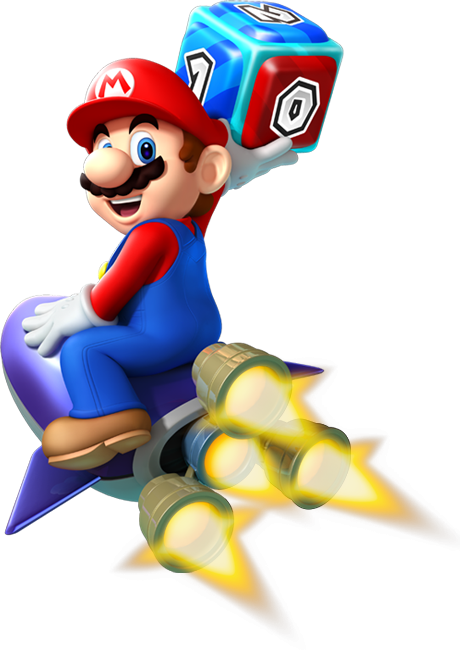
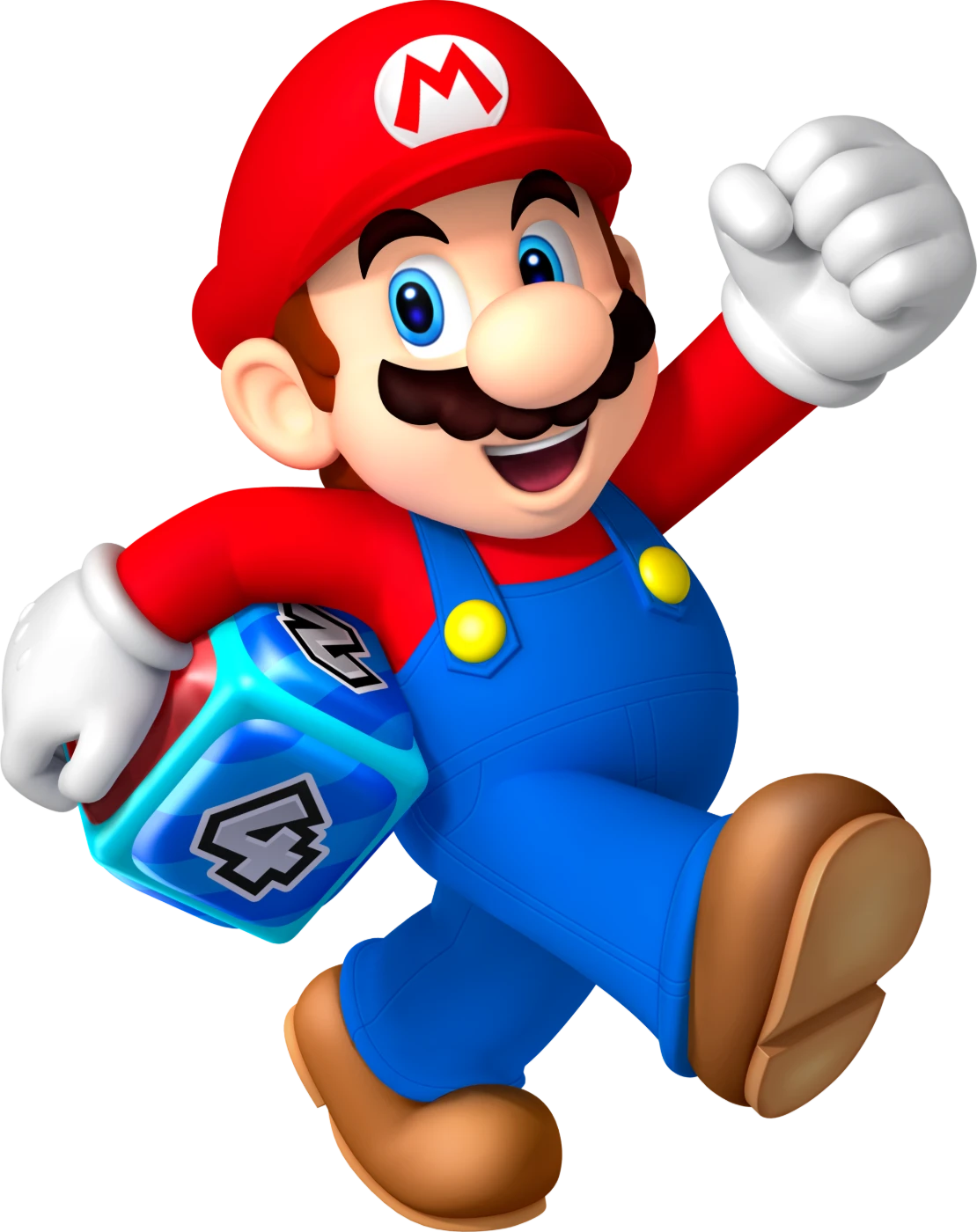
Drawn for this game with a Dice Block in his hand.
Available from the start. Bubble copies of Mario are the last guards of the bubble machine at the top of Bowser’s Tower.
Voice: Charles Martinet.
LuigiPlayable
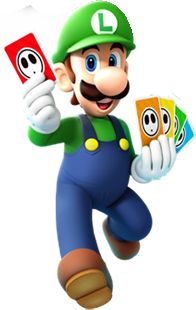
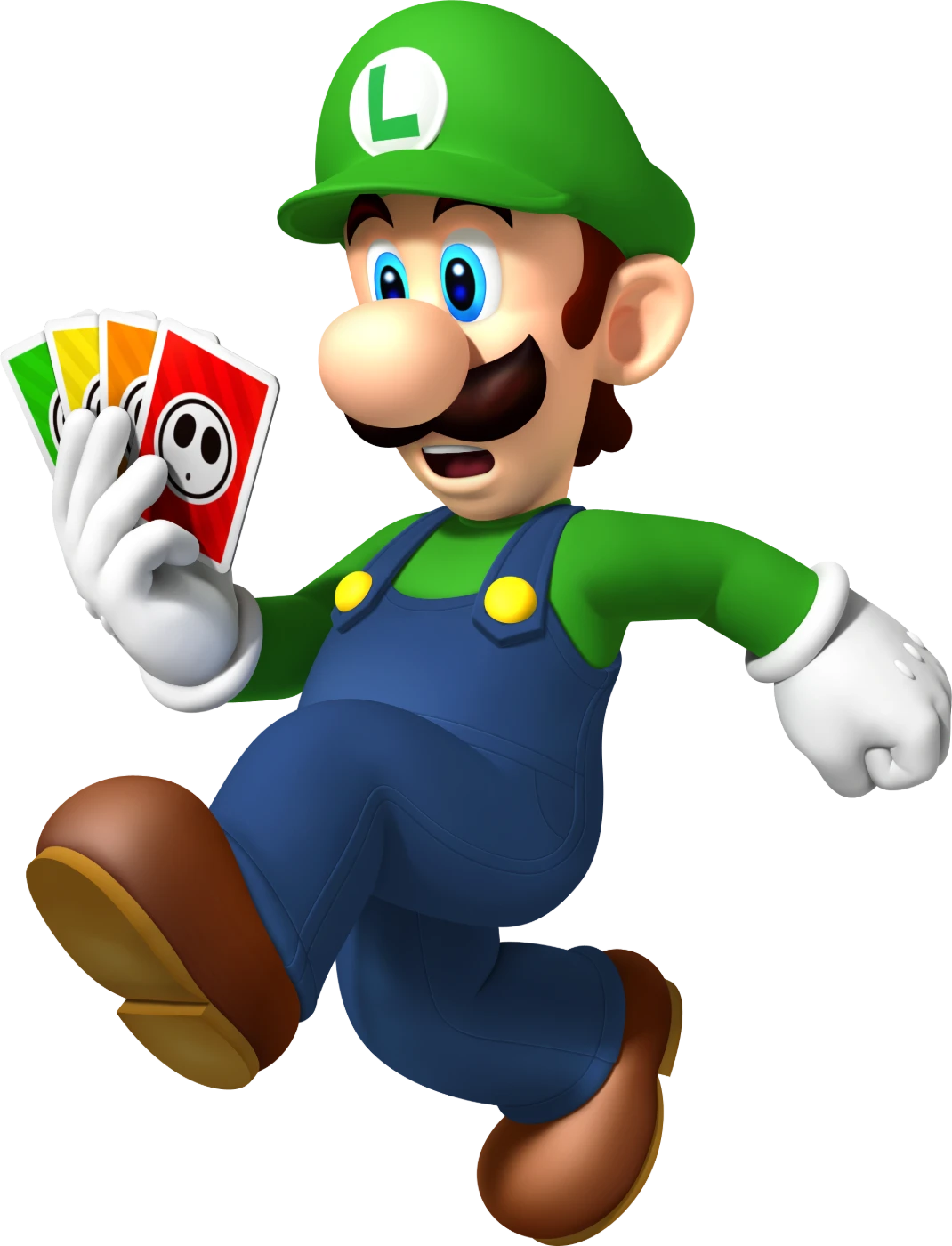
Drawn holding a hand of cards. The game was announced during the Year of Luigi, and Nintendo said at the time that he would have an important part in it.
Available from the start.
Voice: Charles Martinet.
Princess PeachPlayable
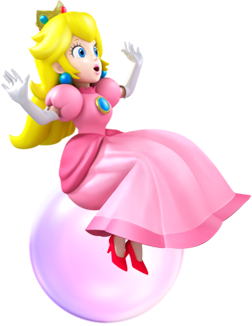
Drawn floating on the bubbles that carry the cast to the Party Islands.
Available from the start.
Voice: Samantha Kelly.
Princess DaisyPlayable
Peach’s fellow princess.
Available from the start. The wiki’s shot of Rocket Road’s ending shows her winning it.
Voice: Deanna Mustard.
WarioPlayable
Mario’s greedy rival.
Available from the start. Pictured on the wiki facing the Bowser Challenge at the top of Bowser’s Peculiar Peak.
Voice: Charles Martinet.
WaluigiPlayable
Wario’s partner, who shares one piece of official art with Kamek.
Available from the start.
Voice: Charles Martinet.
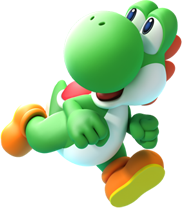
YoshiPlayable
The party’s dinosaur.
Available from the start.
Voice: Kazumi Totaka.
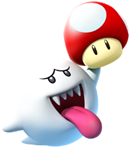
BooPlayable · returning
Drawn here clutching a Super Mushroom.
Available from the start. Playable again, the first time since Mario Party 8, and for the first time in a handheld Mario Party.
His victory animation was reused in Super Mario Party.
ToadPlayable
The red-spotted original, while yellow, blue and green Toads host the modes.
Available from the start.
Voice: Samantha Kelly.
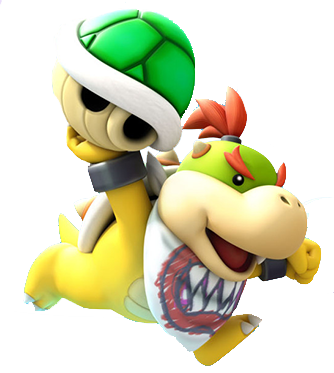
Bowser Jr.Playable · new · unlockable
Bowser’s son, drawn carrying a Green Shell.
New to the series as a playable character, and unlocked by clearing Bowser’s Tower once. Climb the tower again as Bowser Jr. and the script changes: the green Toad wonders why he is fighting his own father, and Bowser, amused, promises not to go easy on him.
Yellow Toad runs Party mode and explains each board; Blue Toad runs the Minigames mode and demonstrates the games; Green Toad climbs Bowser’s Tower beside you and hits the Mini Star roulette block.
Voice: Samantha Kelly.
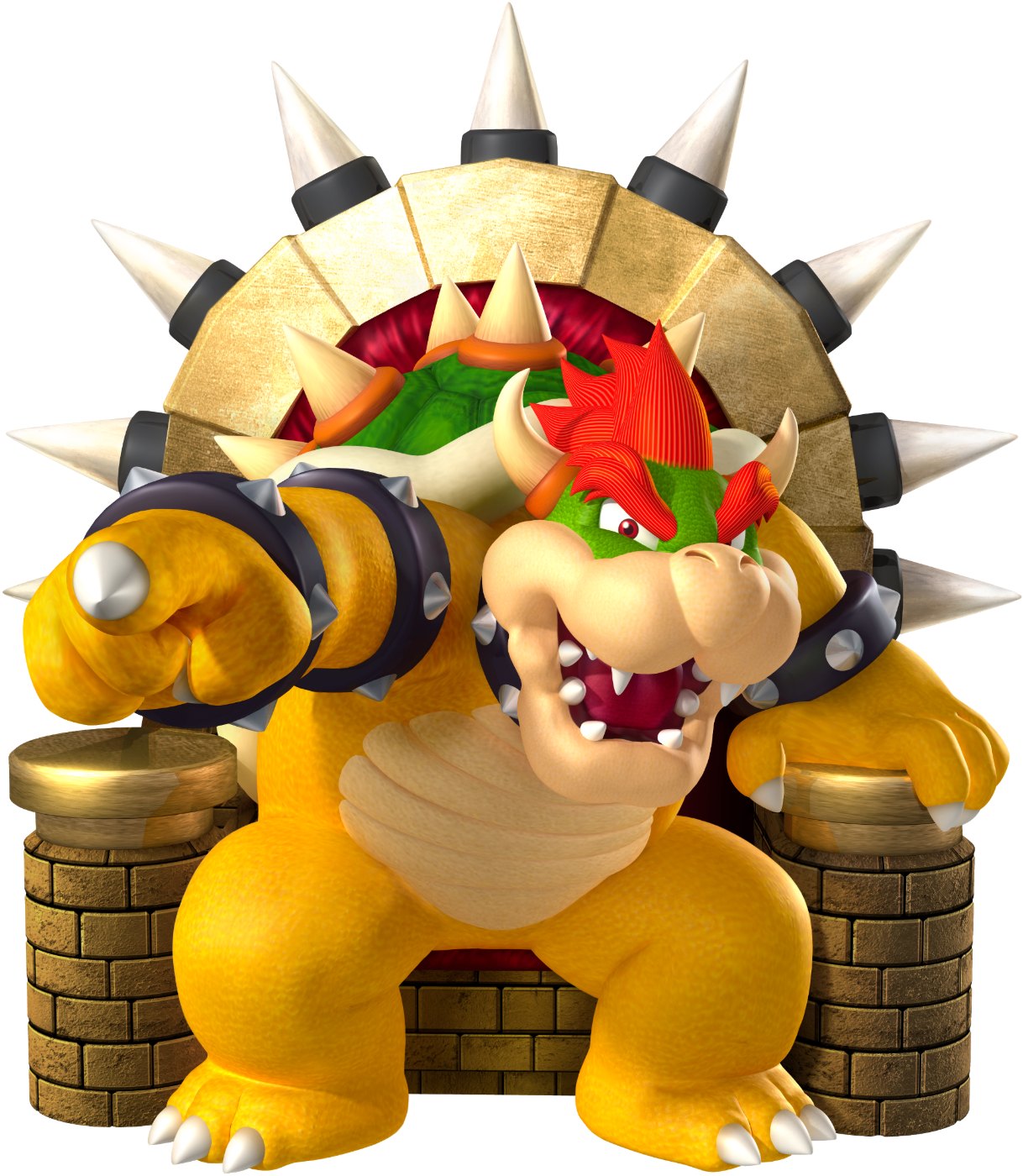
BowserVillain · final boss · board host
Not invited to the Party Islands, and not taking it well.
Builds the tower and the bubble machine, spins a roulette of punishments on the way up, fights in Bowser’s Sky Scuffle on floor 30 and then reveals that he was a decoy. He hosts Bowser’s Peculiar Peak in person.
Voice: Kenny James.
Goomba TowerBoss · floor 5
Five Goombas standing on one another.
Fought in Goomba Tower Takedown. Another stack spins the signpost on Perilous Palace Path.
Minigame: Goomba Tower Takedown.
Chain ChompBoss · floor 10
A Chain Chomp loose over a pool of lava.
Beaten by letting it lunge on to the hot grates. One also features on Perilous Palace Path.
Minigame: Chain Chomp’s Lava Lunge.
Mr. BlizzardBoss · floor 15
The snowman from Super Mario 64.
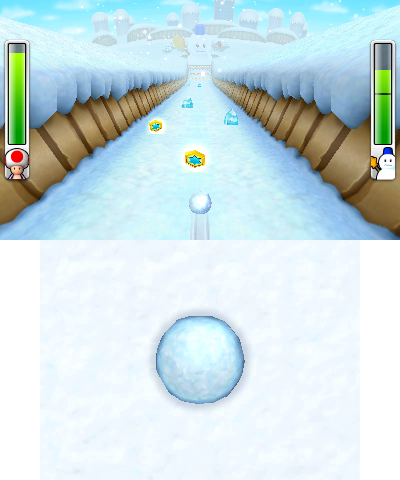
Knocked down with a snowball you roll up yourself.
Minigame: Mr. Blizzard’s Snow Slalom.
King Bob-ombBoss · floor 20
The moustached monarch, a boss here as he was in the DS remake of Super Mario 64.
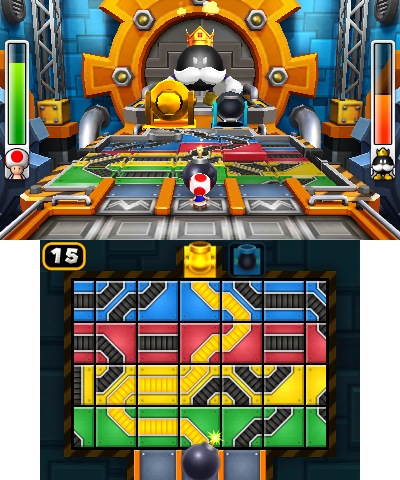
Has his own bombs sent back to him along conveyor tiles until he explodes.
Minigame: King Bob-omb’s Court of Chaos.
Dry BowserBoss · floor 25
Bowser’s skeleton, back from New Super Mario Bros. and still throwing bones.
The last guard before Bowser, fought in a memory game.
Silver copies of the playable characters, blown by Bowser’s bubble machine. They have no voices.
Three of the same character wait on each ordinary floor of the tower.
They grow tougher each time the tower is cleared.
KamekBoard character
Bowser’s Magikoopa.
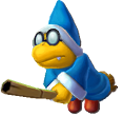
Master of Kamek’s Carpet Ride, where his spaces shuffle the players, and the face on the Crazy Kamek and Chaos Kamek items. Toadies attend him.
Board: Kamek’s Carpet Ride.
Shy GuyBoard character
The masked regular, with Fly Guys for company.
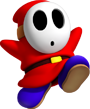
Lends his name and his crowd to Shy Guy’s Shuffle City, and appears in The Choicest Voice, Spin and Bear It and Point ’n’ Shoot.
Voice: Nate Bihldorff.
Banzai BillBoard hazard
The giant Bullet Bill.
Fired down Banzai Bill’s Mad Mountain whenever his face is rolled. Before release several could be launched at once.
Board: Banzai Bill’s Mad Mountain.
Rosalina and the LumasCameo
Appears with her Lumas and the Comet Observatory, straight from Super Mario Galaxy.
Waits at the end of Rocket Road to greet the winner. She is not playable.
Voice of the Lumas: Yuya Takezawa.
LakituHelper
The cloud-riding Koopa with a fishing rod.
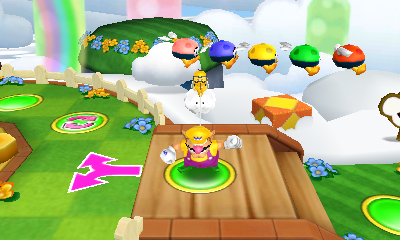
Carries stragglers to the Star Stages of Star-Crossed Skyway, holds up the loser on Bowser’s Peculiar Peak and steals items as the Lakitu Leech.
Voice: Dex Manley.
Every minigame in Mario Party: Island Tour
All 81 on Super Mario Wiki’s list: 69 general minigames, 6 boss minigames from Bowser’s Tower, 3 puzzle minigames and 3 extras. Every one is new, and every general minigame is a free-for-all for up to four. British names are given where the wiki records a difference.
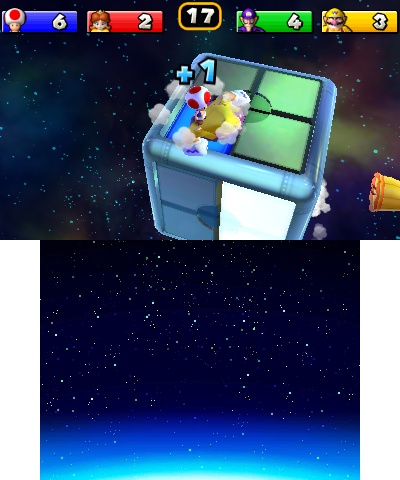
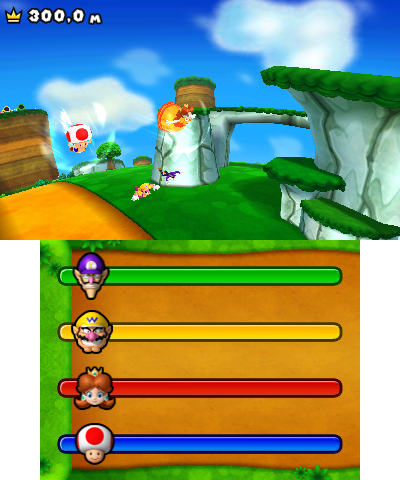
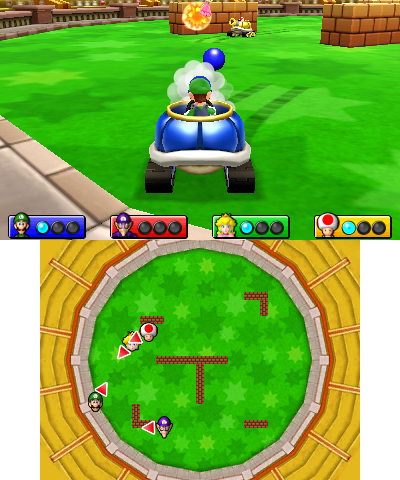
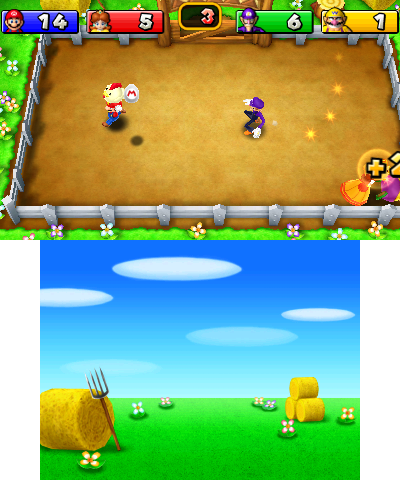
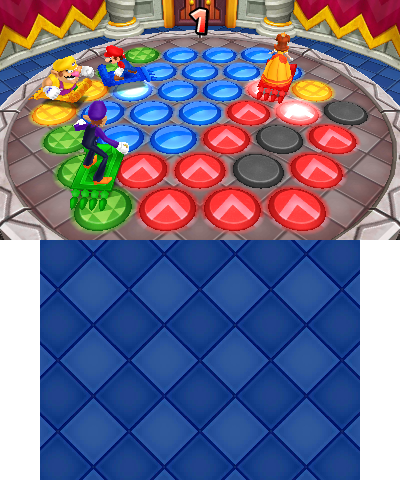
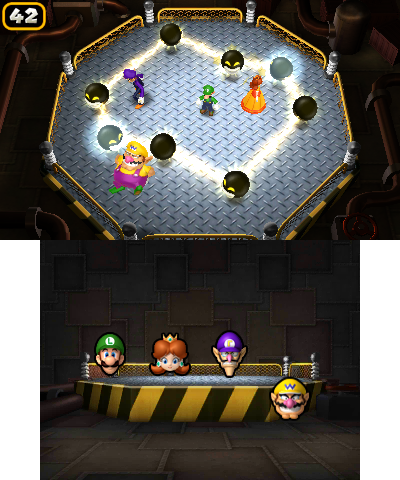
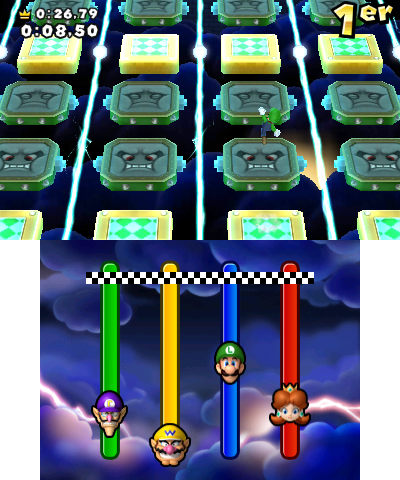
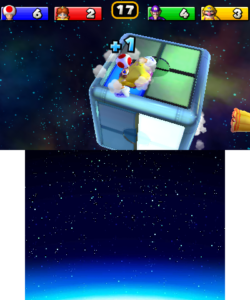
Claiming the CubeGeneralJump on the white panels of a cube and ground-pound them to make them yours. Most panels after 30 seconds wins.
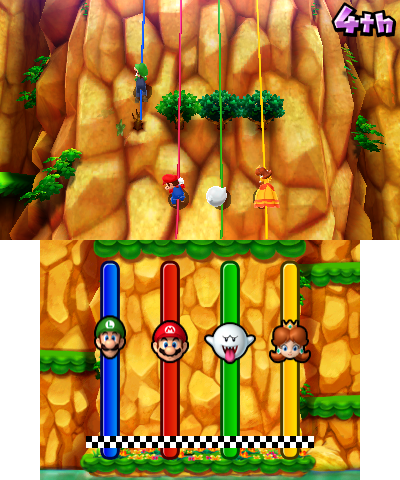
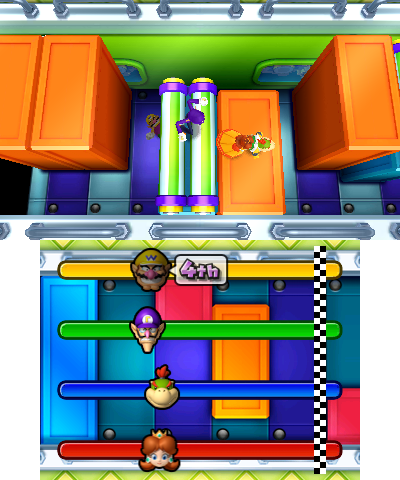
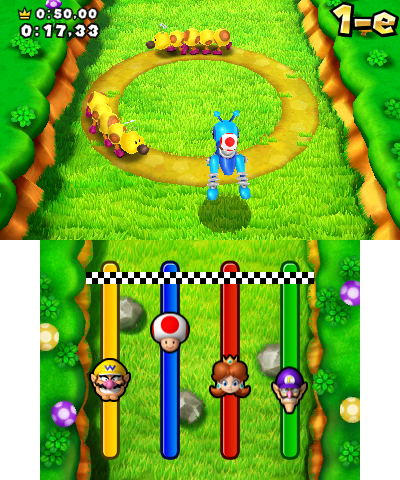
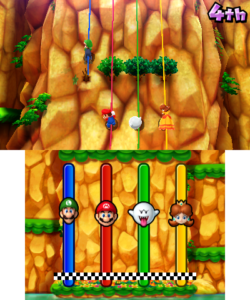
Rope a SlopeGeneralRace down a cliff face, jumping the obstacles. Clip one and you lose time.
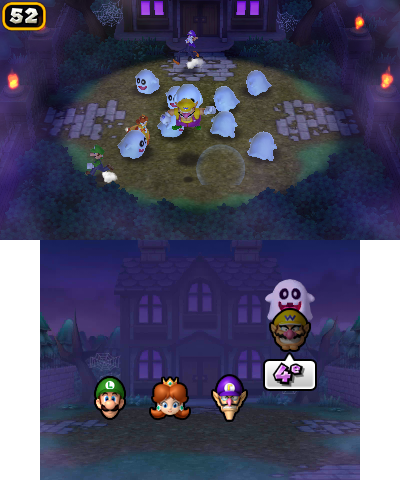
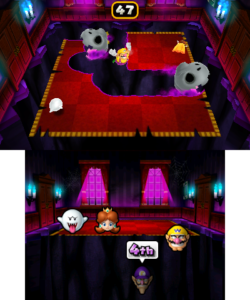
Tragic Carpet RideGeneralKeep clear of the Mattermouths and the holes they leave. Last player standing wins.
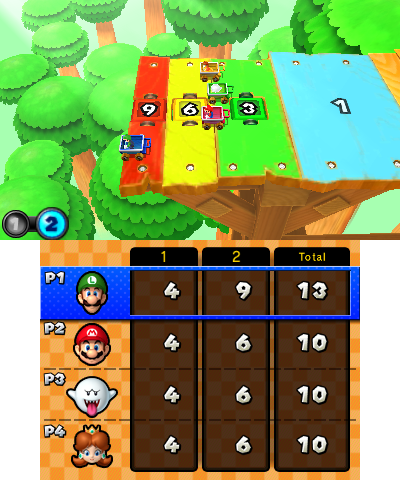
Stretch RunGeneralJudge how hard to launch your cart so that it stops on the high numbers of a bridge without rolling off the end. Two rounds.
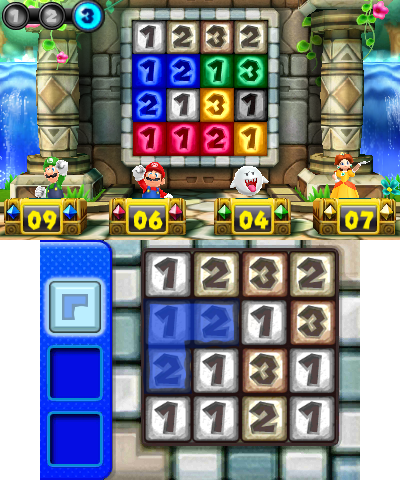
Grid is GoodGeneralLay a three-square piece on a numbered grid in ten seconds. Squares only you claimed score; contested ones do not.
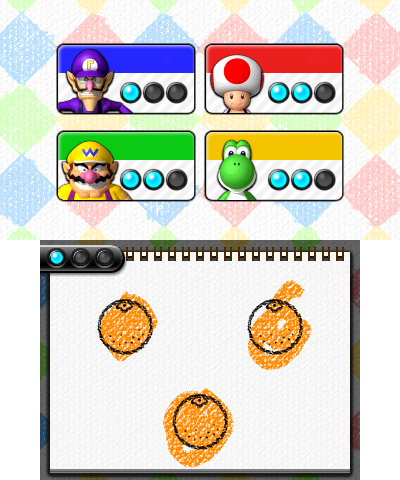
Color Me FastGeneralScribble with the stylus to colour in three pictures of fruit before anyone else.
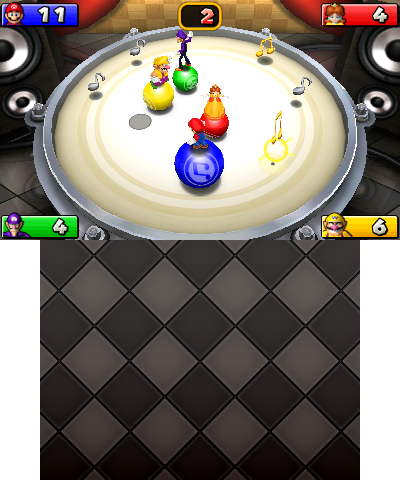
Musical SnaresGeneralTilt the system to roll about on a ball, collecting notes on a drum. Gold notes count double.
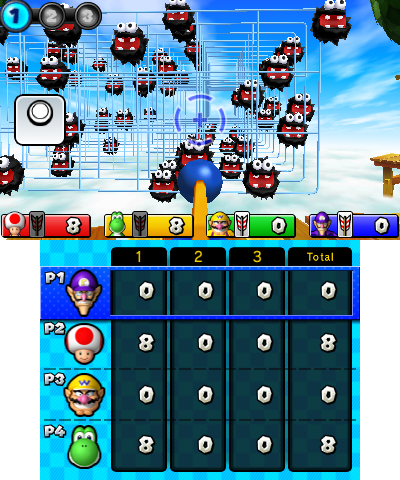
Buzz a FuzzyGeneralAim by moving the 3DS and shoot arrows at Fuzzies running along rails. Three rounds.
Cannonball!GeneralWind your cannon’s handle as fast as you can for four seconds, then see who is fired furthest.
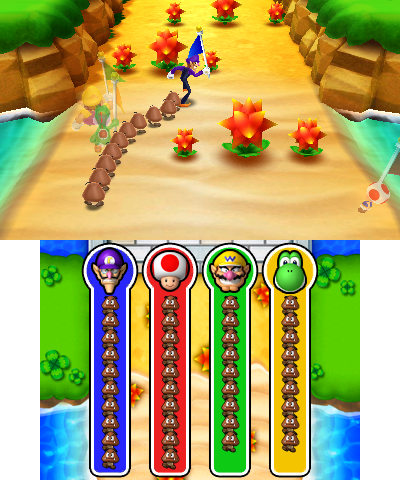
Goomba to ManeuverGeneralShepherd ten Goombas past thorny flowers to the finish. Most Goombas delivered wins.
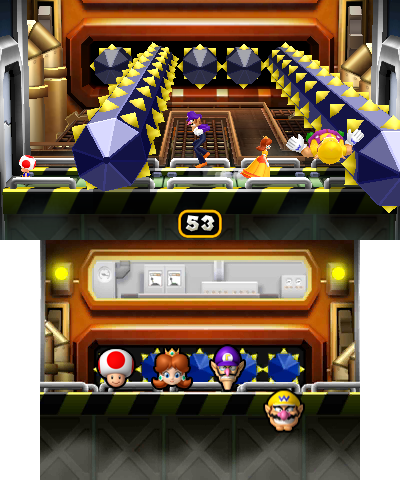
Kabob and WeaveGeneralRun and jump to stay clear of the Skewers until time runs out.
Tap DashGeneralSixteen panels, one enemy shown above: tap the match with the stylus before anyone else. Three rounds.
Tanks a LotGeneralA tank battle. Every hit is a point, and three points win.
Xylophone HomeGeneralA rhythm game: tap the key beneath each note in time with the Super Mario Bros. theme.
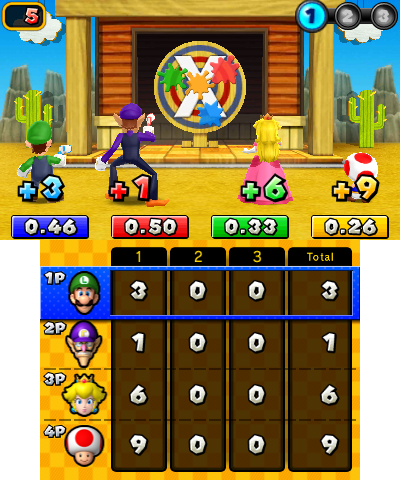
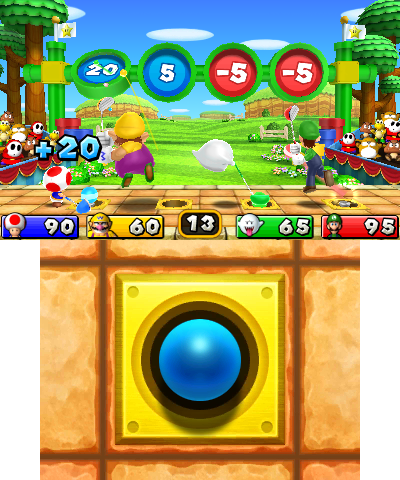
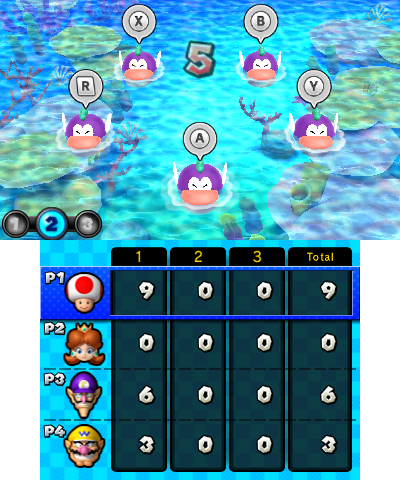
Mild GunmanGeneralPress the button shown on the target to fire a paintball. Faster is worth more, and the wrong button scores nothing.
Spin the BubbleGeneralTilt the system to turn a capsule until the figure inside fits its silhouette.
Rat-a-tat FlatGeneralGround-pound Scaredy Rats as they pop out of their holes. Gold ones are worth three.
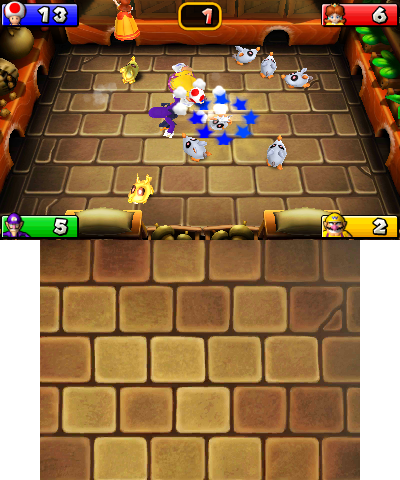
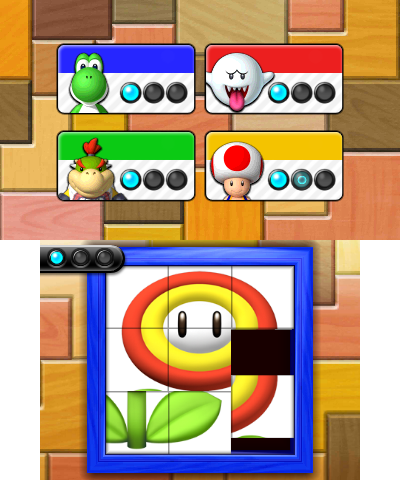
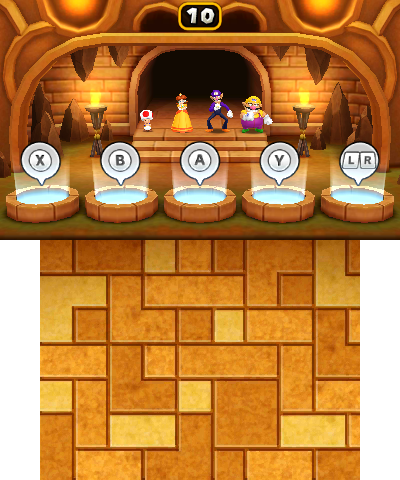
Tile SavvyGeneralSliding-tile puzzles on the Touch Screen. First to restore three pictures.
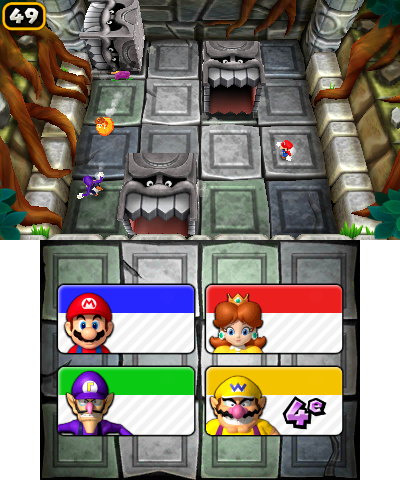
Hide ’n’ SplatGeneralKeep out from under the Tox Boxes as they tumble round the arena.
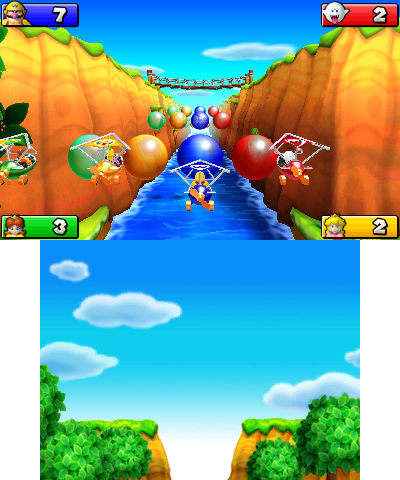
Slow GlideGeneralTilt to steer a glider and pop the balloons of your own colour. Yellow ones are worth three.
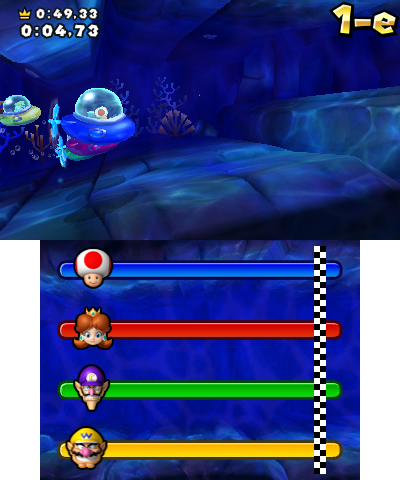
Sub TroubleGeneralPilot a submarine up and down past the obstacles to the finish line.
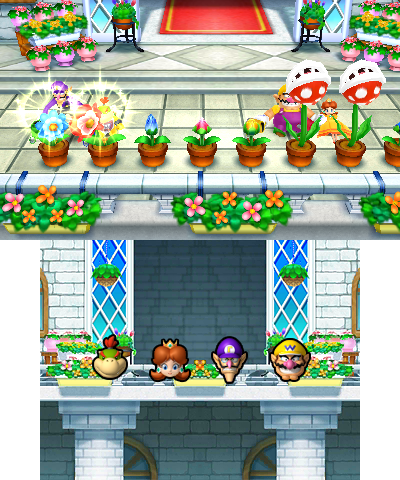
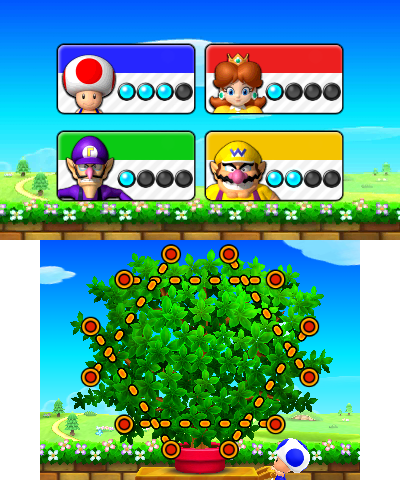
Garden of Eatin’GeneralPick a plant to water. A flower keeps you in; a Piranha Plant bites you out. Blooming Nuisance in Britain.
Peep a PeepaGeneralTilt to point a torch at Peepas. The longer you hold one in the beam, the more you score.
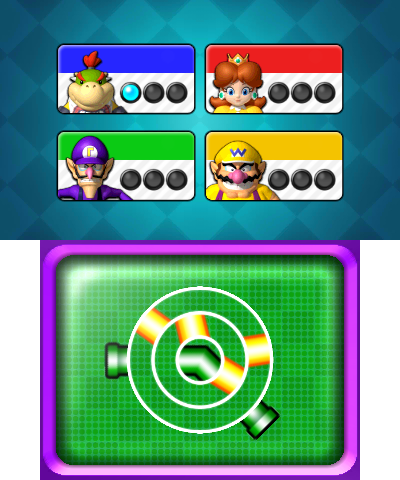
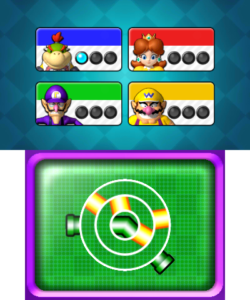
Puzzle ProntoGeneralThree rounds of a quick Touch Screen puzzle, such as tapping mushrooms or lining up pipes.
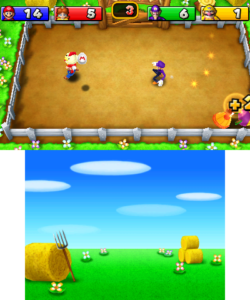
Truckin’ and Cluckin’GeneralHold a chicken so that it lays eggs for points, two for a golden one, while the others tackle you to steal it.
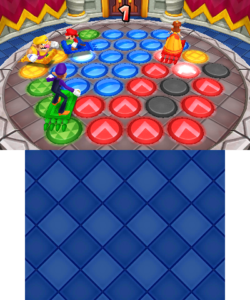
Color CorrectionGeneralFly a carpet over round tiles to turn them your colour. Most tiles when time is up wins.
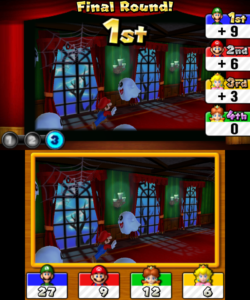
Get ReelGeneralWind a film reel to and fro to find the frame shown, then confirm it. A wrong pick stuns you.
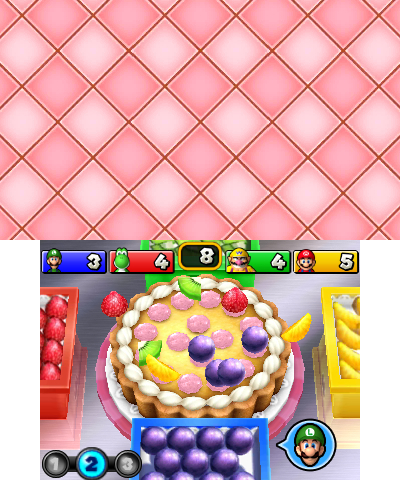
Top ThisGeneralDrop fruit on to the marked spots of a spinning cake with the stylus, over three ten-second rounds.
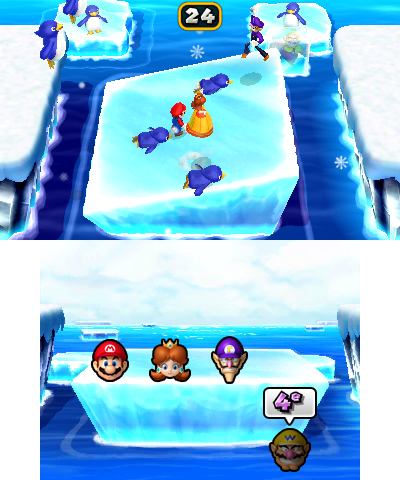
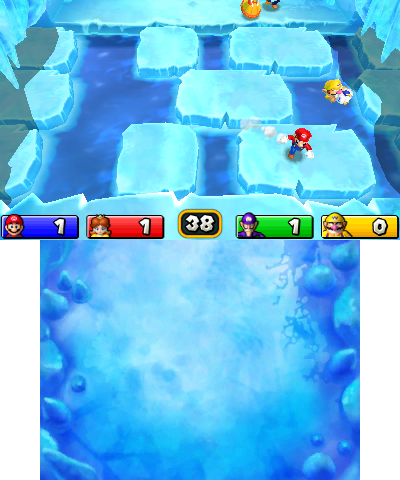
Slip ’n’ SlipGeneralStay on a tilting sheet of ice for 45 seconds without sliding into the sea.
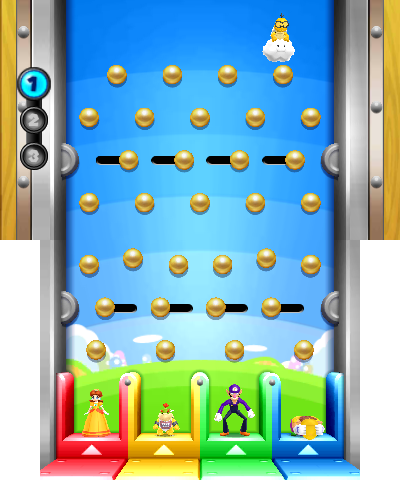
Pachinko WizardGeneralChoose a slot under a pachinko board and hope Lakitu’s Spiny Egg drops into somebody else’s.
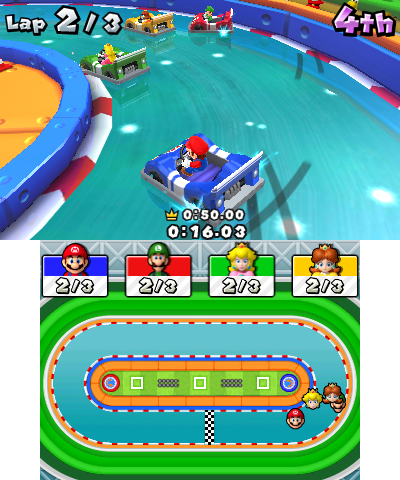
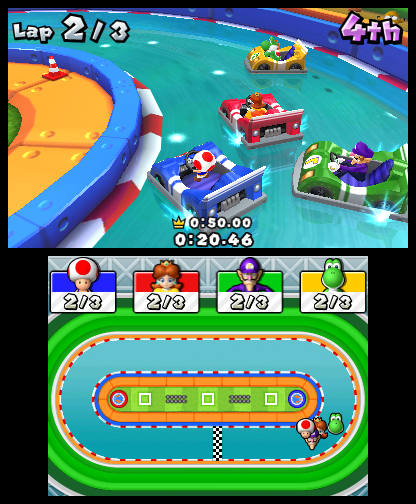
No-Traction ActionGeneralThree laps of an oval track in a kart with almost no grip.
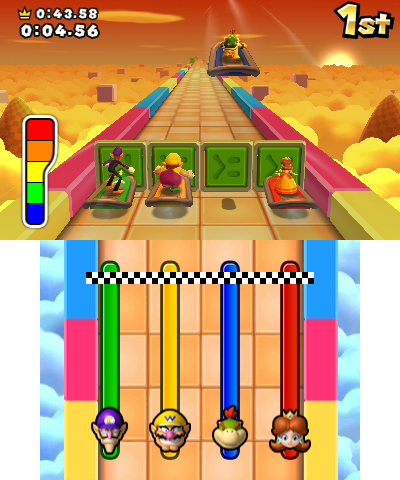
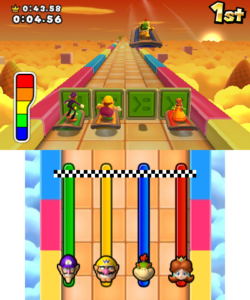
Blown HoverGeneralA hoverboard race down a long road of Flip Panels borrowed from Super Mario 3D Land.
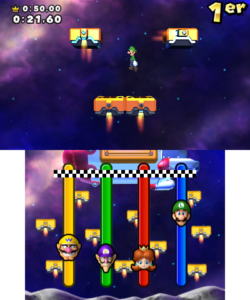
Slow GGeneralHop from platform to platform in low gravity, up to a goal above the moon.
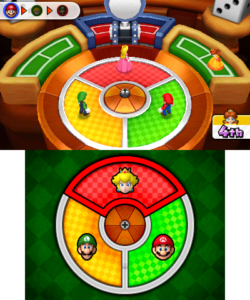
Spin and Bear ItGeneralChoose a place on a wheel, then take turns spinning it with the stylus. The hammer flattens whoever stops beneath it.
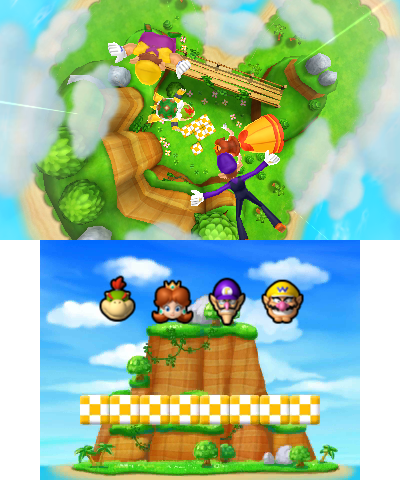
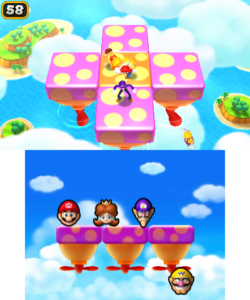
FisticloudsGeneralPunch, kick and jump to knock the others off platforms in the sky.
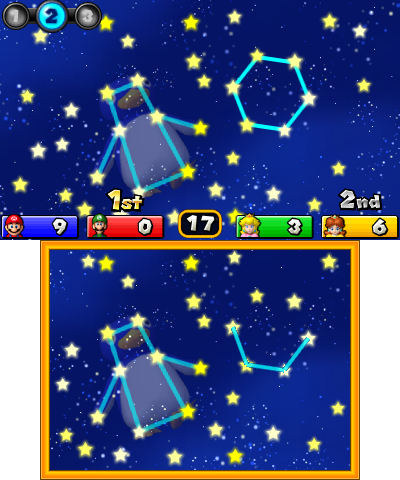
Starring ArtistGeneralCopy constellations of Mario characters from the top screen to the bottom with the stylus. Three rounds.
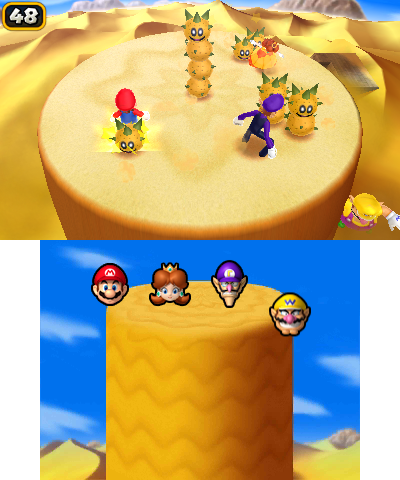
Pokey CorralGeneralShove rivals off the arena while Pokeys burst up out of the ground.
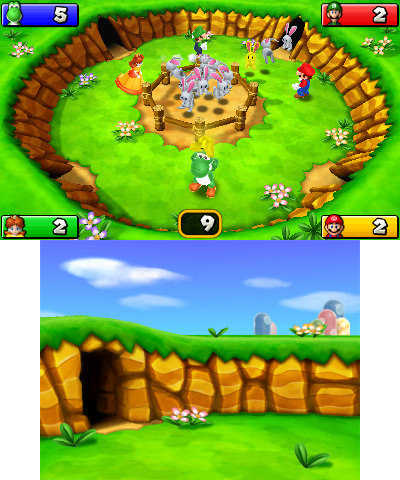
Hare TodayGeneralCatch rabbits as they come out of holes in a crater wall and drop them in the pen. Golden rabbits are worth three.
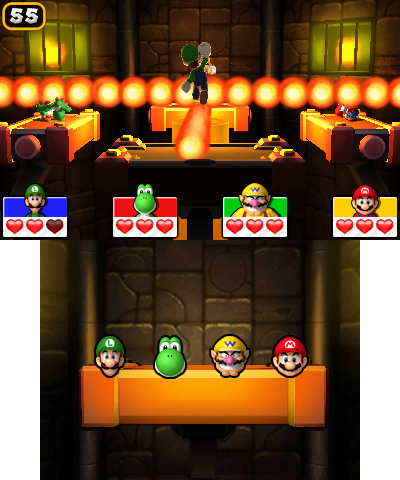
Great Bars of FireGeneralDuck the high Fire Bar and jump the low one. Three hits and you are out.
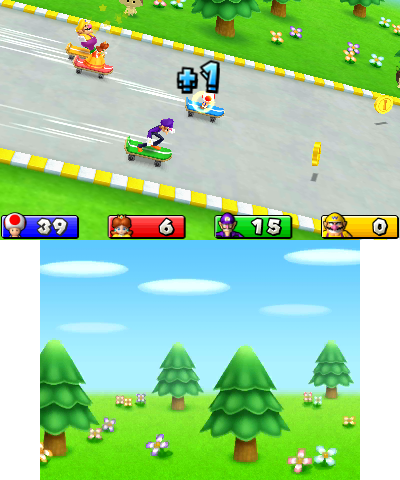
Deck HuntGeneralSkateboard down a slope collecting coins. Each Spiny Egg you hit costs three.
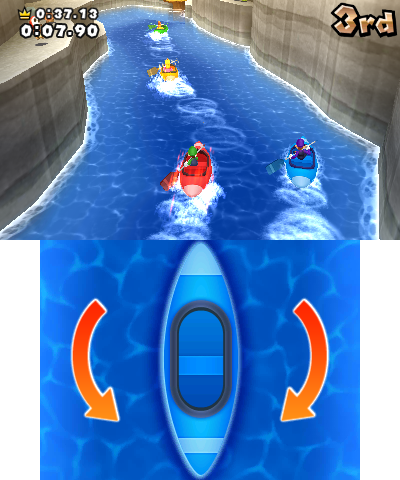
Paddle SkedaddleGeneralPaddle a canoe down a winding creek with strokes of the stylus.
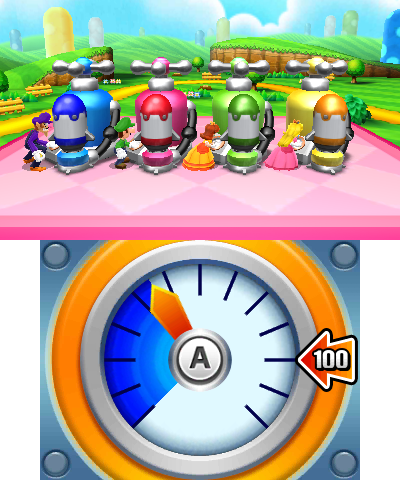
Fuel Me OnceGeneralStop a fuel gauge, hidden part of the way, as near to 100 as you can. Your jet pack then carries you towards a mark over a lake.
Git Along, GoombaGeneralDraw circles with the stylus to spin a lasso, then flick it to rope Goombas.
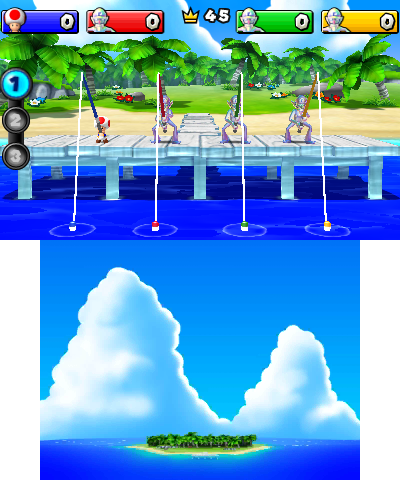
Cheepers KeepersGeneralHammer the buttons shown to reel in Cheep Cheeps. Three rounds. Hook, Line and Cheep Cheep in Britain.
Drive for ShowGeneralFlick golf balls at point targets with the stylus for 30 seconds.
Hop Till You DropGeneralHop along moving platforms, avoiding the gaps and the rollers, to the last one.
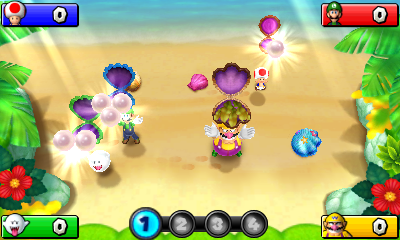
Helter ShellterGeneralChoose shells over four rounds. Pearls are worth one to three points; seaweed is worth nothing.
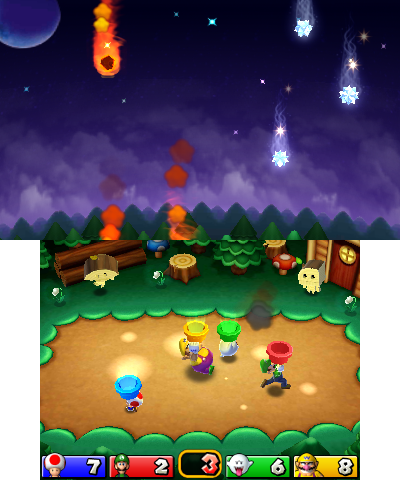
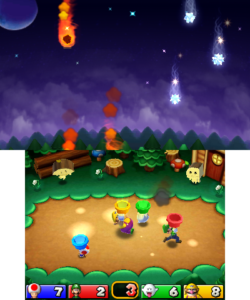
Meteor MeleeGeneralCatch falling stars in a bucket for 30 seconds, and avoid the meteors.
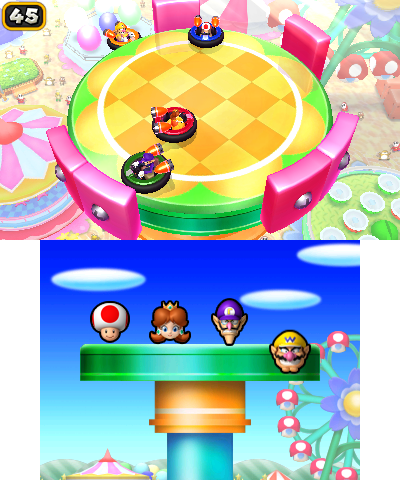
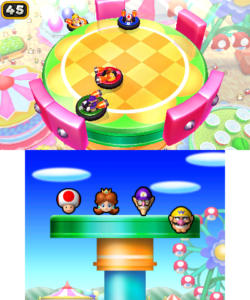
Bumper ThumperGeneralHovercraft sumo on top of a tower whose walls shrink, then vanish, as they are hit.
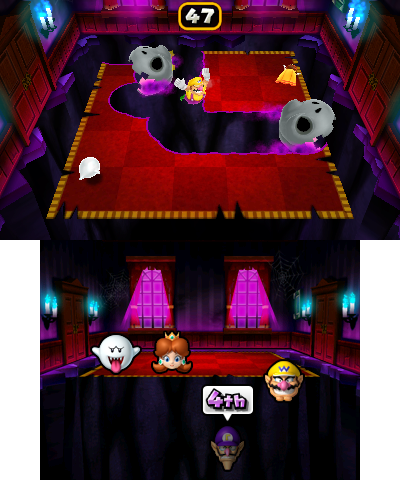
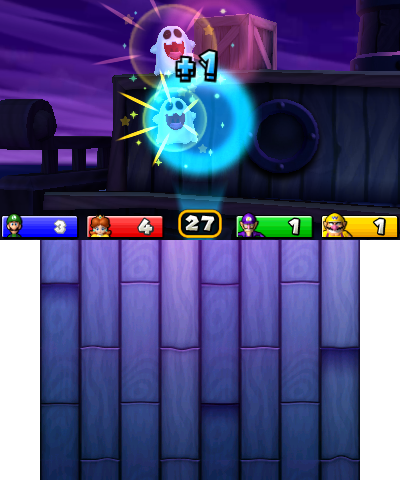
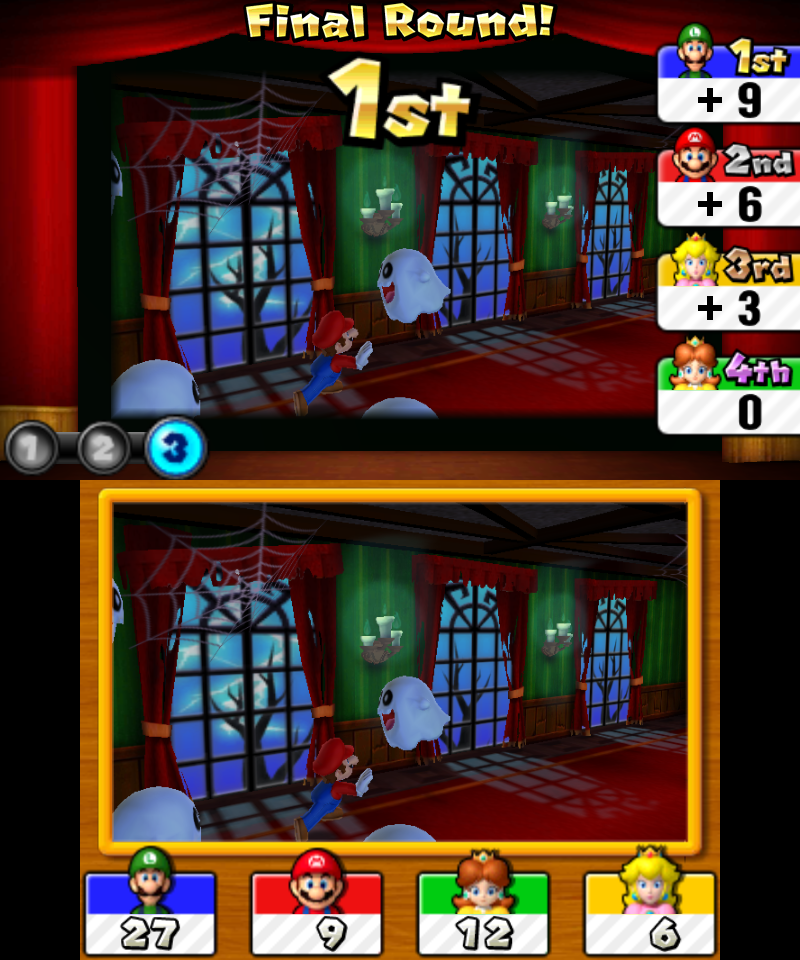
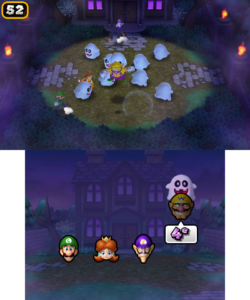
Horror HarriersGeneralKeep away from the Peepas circling the room. One touch and you are out.
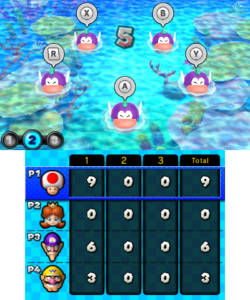
Cheep DiamondsGeneralGuess which Cheep Chomp has the most diamonds in its mouth and claim them. Three rounds. Confusingly, this is the one called Cheepers Keepers in Britain.
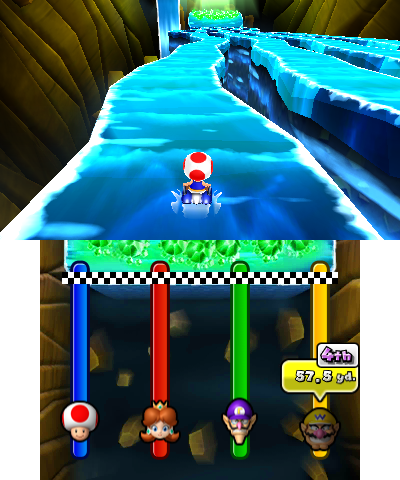
Slip NotGeneralTilt to steer down a narrowing cascade of ice towards the crystals without sliding off.
Trounce ’n’ BounceGeneralKeep landing on Jump Blocks, shoving rivals aside. Touch the ground and you are out.
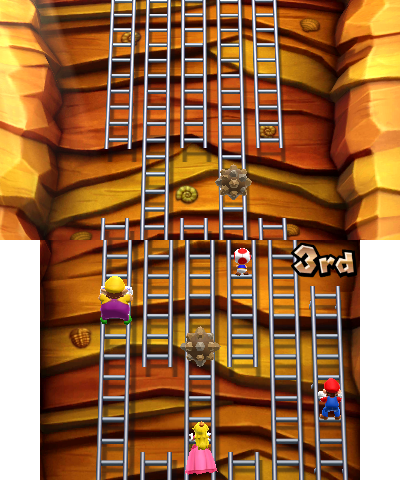
Mad LaddersGeneralClimb a wall of ladders, switching between them to dodge the boulders Stone Spikes throw down.
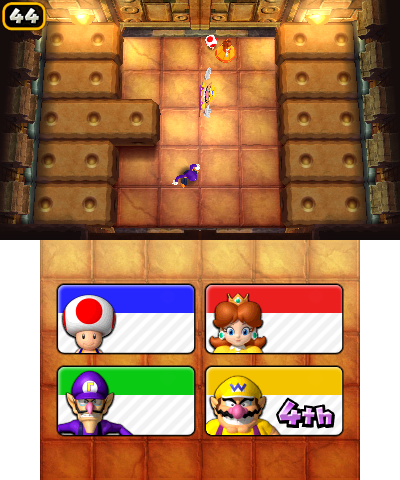
Squish You Were HereGeneralStand in the gaps as the walls close in. Survive for a minute.
Go with the FloeGeneralCarry baby penguins over slippery ice floes to their mother, a point for each.
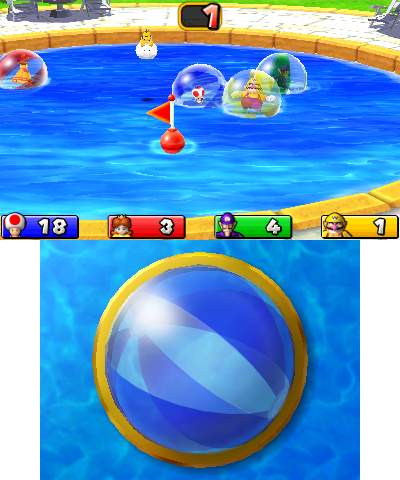
Pool BuoyGeneralRoll a beach ball round a pool with the stylus to gather the buoys Lakitu throws in: red for one point, gold for three.
Amp My StyleGeneralAvoid eight Amps as they form up into changing patterns inside a pen.
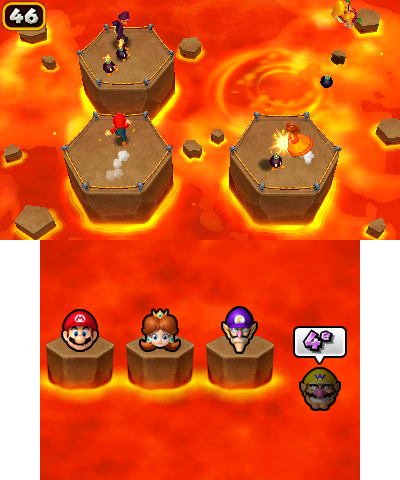
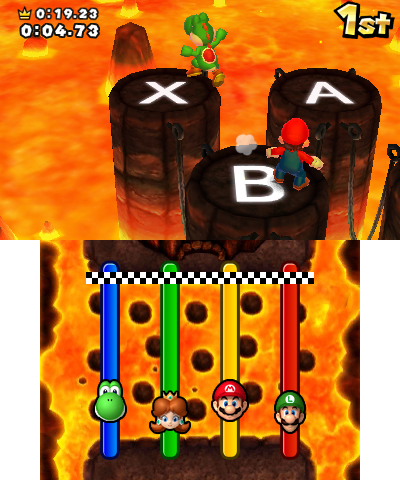
MagmathonGeneralPress the letter shown on each rock to hop across a lake of lava.
Shrub HubbubGeneralTrim bushes to the shapes shown with the stylus, over four rounds.
Quickest CricketGeneralRace a mechanical cricket past rocks, Piranha Plants and Wigglers.
Diamond a DozenGeneralWatch which tunnel takes the most diamonds, then be quick to press its button.
Flip OutGeneralCross platforms and Flomps to the goal. Step on a Flomp as it flips and you are sent back.
Bob-omb AplombGeneralKick Bob-ombs off your rock, into the lava or on to someone else’s, before they go off.
Gyro for the GoldGeneralTilt the system to roll a ball through an obstacle course as fast as you can.
Point ’n’ ShootGeneralTilt to aim a camera round a town and photograph the characters you are asked for. Three rounds.
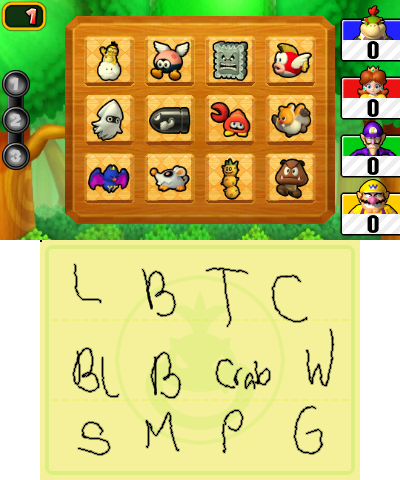
Match FakerGeneralMemorise where twelve enemies are hidden, making notes with the stylus, then find the three you are asked for.
Sky’d and SeekGeneralKeep count of the Koopa Paratroopas and Paragoombas flying in and out of a cloud, then say how many are left inside.
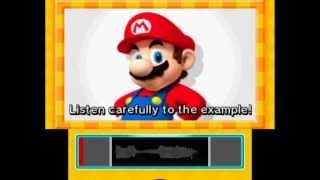
Utter NonsenseGeneralImitate a character’s voice into the microphone and be marked out of 100.
Goomba Tower TakedownBoss · floor 5Throw fallen fruit at a stack of five Goombas to topple it, then hit them as they scatter.
Chain Chomp’s Lava LungeBoss · floor 10Dodge its lunges so that it lands on a metal grate over the lava and burns.
Mr. Blizzard’s Snow SlalomBoss · floor 15Steer a snowball with the stylus, growing it on snow and dodging icicles, and ram him with it.
King Bob-omb’s Court of ChaosBoss · floor 20Slide conveyor tiles so that the bombs he throws are carried back to him. The golden cannon hurts most.
Dry Bowser’s Brain BonkBoss · floor 25Memorise a three-button sequence, then enter it to hammer his bone straight back at him.
Bowser’s Sky ScuffleBoss · floor 30Fire cannonballs at his Clown Car, collecting more from floating blocks, until it explodes.
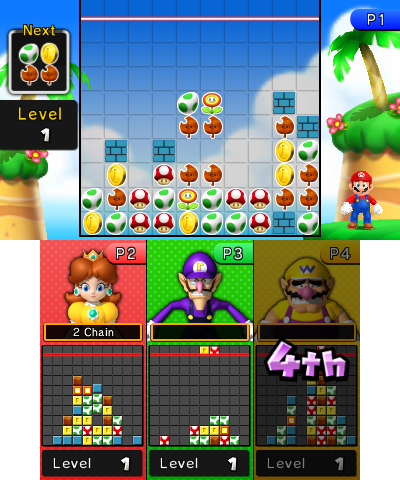
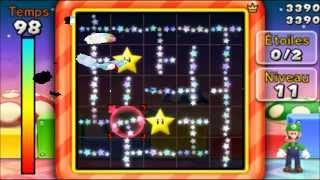
Three HousePuzzleLine up three or more matching Mario items in any direction to clear them.
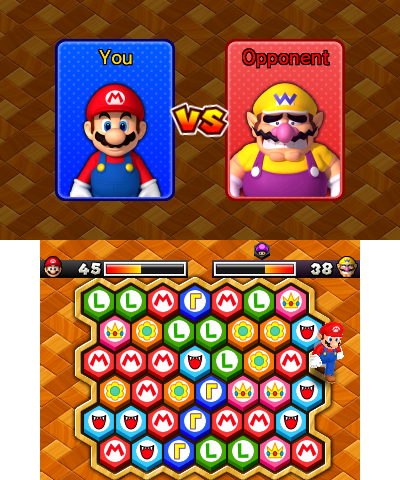
Emergency HexitPuzzleSlide hexagonal tiles to group matching character emblems before time runs out.
Star TurnPuzzleRotate tiles to join up paths that fence in every Super Star.
The Choicest VoiceExtraImpressions into the microphone, ten points for each judge who approves. Alone, you need 90 points over three rounds.
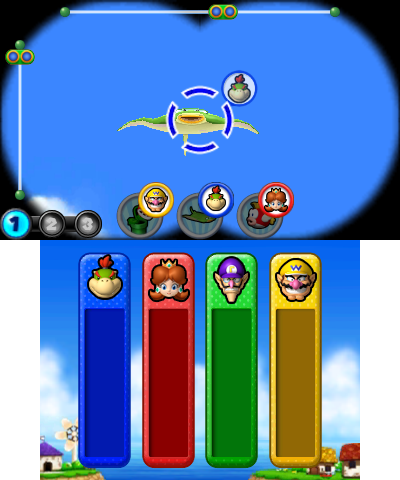
Ka-Goomba!ExtraMove the system to aim and shoot Goombas: one point each, three for a Gold Goomba. Hit the Whomp’s back and it is over. Goombas Galore in Britain.
Sinking FeelingExtraClimb a sinking tower, dodging metal blocks; played alone, it ends when you touch the lava. It needs an AR Card. Towers and Infernos in Britain.
The people who made it
Names and roles from the staff roll, as transcribed by Super Mario Wiki.
Yukio UmematsuGame directorHe went on to work on the planning of Mario Party 10.
Miyuki Hirose and Atsushi IkedaProducersWith Yoshinori Tsuchiyama, Jumpei Horita and Toshiaki Suzuki as associate producers.
Shinya TakahashiGeneral producerListed after the producers in the roll.
Satoru Iwata, Hidetoshi Endo and Shinji HatanoExecutive producersIwata also announced the game, in a Nintendo Direct.
Kenji KikuchiSenior directorThe same credit he holds on Mario Party Advance.
Shinichi NakataChief planning directorThe director of Mario Party Advance. Six planning directors and a planning team of fifteen worked under him.
Michihito IshizukaChief programming directorLed six programming directors and twenty-four programmers.
Yuji AsanoChief design directorWith Hiroshi Hayashi and Masayuki Tsuboi as design directors and forty-four graphic designers.
Keisuke OkuboLogo design and artworkCredited for the logo and the illustrations.
Ichiro ShimakuraChief sound directorOne of the two composers of Mario Party Advance. Kotaro Baba is sound director.
Rei Kondoh, Sara Sakurai and Satoshi OkuboMusicKondoh is also music director, and later wrote music for Mario Party 10. Koji Kondo is sound supervisor.
Shigeru Miyamoto, Takashi Tezuka and Hiroshi SatoSupervisorsThe three credited as supervisors.
Charles MartinetVoice of Mario, Luigi, Wario and WaluigiSamantha Kelly voices Peach and the Toads, Deanna Mustard voices Daisy and Kazumi Totaka voices Yoshi.
Kenny James and Caety SagoianVoices of Bowser and Bowser Jr.James also voices Dry Bowser.
Jeff MinnerlyAnnouncer (English)One of nine announcers. Gigi Wong (Dutch), Victoria Becker (Russian) and Rute Correia (European Portuguese) speak for the three languages new to the series.
Advertisement
How It Was Made
Nintendo published no Iwata Asks interview for Island Tour that we could find. This account is drawn from the announcement trail recorded by Wikipedia, the credits and the pre-release material kept by Super Mario Wiki.
Announced as plain “Mario Party”
The tentative logo, before the subtitle.
Satoru Iwata announced the game in a Nintendo Direct on 17 April 2013, under the working title Mario Party, and Nintendo let it be known that Luigi would have an important part to play, in keeping with what it was calling the Year of Luigi. The logo shown then had no subtitle; Island Tour was added later, along with a pattern of diagonal stripes.
It reached North America first, on 22 November 2013. Europe had been promised it that winter too, but on 1 October 2013 Nintendo of Europe put its release back to early 2014, and it arrived on 17 January. Japan and South Korea waited until 20 March 2014.
NDcube’s second Mario Party
Island Tour is the second Mario Party developed by NDcube, after Mario Party 9, and Super Mario Wiki counts it as the third handheld entry. The game director is Yukio Umematsu, with Miyuki Hirose and Atsushi Ikeda producing and Kenji Kikuchi as senior director.
There is a thread back to the Game Boy Advance. Shinichi Nakata, the chief planning director, is credited as director of Mario Party Advance, and Ichiro Shimakura, chief sound director here, as one of that game’s two composers. Both games, eight years apart, set the usual Mario Party board aside. The score is by Rei Kondoh, Sara Sakurai and Satoshi Okubo.
What changed before release
Banzai Bill’s Mad Mountain in an early version.
The pre-release box art carried a Nintendo Network icon, which Super Mario Wiki takes as a sign that online features were planned; the finished game has none. Early footage shows other second thoughts. Perilous Palace Path had no cows and no Whomp at the gate, and its players used cards where the final board has items. Banzai Bill’s Mad Mountain could fire several Banzai Bills at once. And Rocket Road had only yellow Lumas, where the finished board has several kinds.
New languages, different names
This was the first Mario Party to be translated into Dutch, European Portuguese and Russian, and the announcers for those three languages are women where all the others are men. Spanish has two announcers, one for Spain and one for Latin America.
British and American English differ as well. Bowser’s Peculiar Peak is Bowser’s Bizarre Volcano in Britain, the board descriptions are worded differently, and several minigames are renamed: Garden of Eatin’ becomes Blooming Nuisance, Ka-Goomba! becomes Goombas Galore and Sinking Feeling becomes Towers and Infernos. One pair is a trap. The American Cheepers Keepers, the fishing game, is Hook, Line and Cheep Cheep in Britain, where the name Cheepers Keepers belongs to the game Americans know as Cheep Diamonds.
Series Firsts
What Island Tour did first, each checked against Super Mario Wiki.
1Mario Party on Nintendo 3DSThe first Mario Party made for the 3DS, and by the wiki’s count the twelfth main entry and nineteenth overall.
2Bowser Jr., playableThe wiki marks Bowser Jr. as new to the series here. In Mario Party 9 he had been an opponent with minigames of his own, not a choice on the character screen.
3Boo in a handheld Mario PartyBoo’s first playable appearance in a handheld entry, and his first anywhere since Mario Party 8.
4Dutch, Portuguese and RussianThe first game in the series localised into Dutch, European Portuguese and Russian.
5Boards without Stars or coinsMario Party 9 had already replaced Stars with Mini Stars. Island Tour goes further: as Wikipedia notes, no board here is decided by Stars or coins, and only one uses Mini Stars at all.
Cheats & Secrets
There are no codes. What Island Tour has is two unlocks, a tower with rules worth knowing and seven boards that each reward a different trick.
Unlocking Bowser Jr.
Clear all 30 floors of Bowser’s Tower once. Play the tower again as Bowser Jr. for dialogue you will not hear with anyone else.
Unlocking Bowser’s Peculiar Peak
Play every other board at least once. Shy Guy’s Shuffle City is exempt, so the board can be opened by one player with computer opponents.
Climbing Bowser’s Tower
You only need to win or draw each minigame, and you choose between two. Lose three times on the same floor and the green Toad brings out a Mini Star roulette block that removes one, two or all three bubble copies from your next attempt; the same block appears on floors 13 and 23. Of the punishments Bowser spins before floors 3, 7, 17 and 27, only two kinds are real: dropping a floor, and raising the copies’ difficulty by one or two levels. Each time you clear the tower the opposition gets harder, and by the fifth run it is set to normal on floors 1 to 10, hard on 11 to 25 and super hard on 26 to 30. According to the wiki, clears after the third are worth 30,000 Mario Party Points each.
Rocket Road in one turn
Each Booster adds one to your multiplier, so four Boosters make a roll of 5 worth 25 spaces, the length of the board. Rolling the 0 on the starting space is not a disaster: it earns a free Booster every time it happens.
Beating the Whomp
The Whomp at the end of Perilous Palace Path has six health, and every roll made against it wears it down, so the player who arrives second often has the easier job. Bonus Dice Blocks and items count, so keep a Dash Mushroom or a Gold Dice Block for the gate.
Arriving last on purpose
On Star-Crossed Skyway the third Star Stage offers three lots of Mini Ztars and only one of Mini Stars, and prizes are taken in order of arrival. Hang back there. At the other three stages it pays to be early.
Surviving the Bowser Challenge
At the top of Bowser’s Peculiar Peak you stay on with a total of 3 or less, or with a double. The wiki works out the odds: an even chance with the plain Bowser Dice Block, about one in three with a 1-2 block added, 27.8% with a 1-3 block and 22.2% with a 1-6 block. Win the minigames lower down and you will be carrying the small ones.
The Time Attack ten
Time Attack always uses the same ten minigames: Magmathon, No-Traction Action, Slow G, Tile Savvy, Gyro for the Gold, Quickest Cricket, Color Me Fast, Blown Hover, Mad Ladders and Sub Trouble. Each has an optional objective that knocks time off, and your record is saved once all ten are done.
Glitches & Oddities
Super Mario Wiki documents a single glitch in Island Tour.
Invisible Player Lucky Space Glitch
Toad and Yoshi occupying the same space.
On Bowser’s Peculiar Peak, a Lucky Space can blast a player to a space that somebody else is already standing on. When that happens the two characters are drawn in the same spot and clip through each other.
Videos
Two official trailers, from Nintendo’s British and Australian YouTube channels.
The trailer for the European release, as uploaded to Nintendo UK’s official channel.
The trailer from Nintendo Australia’s official channel.
Trivia & Interesting Facts
With 19 spaces, Shy Guy’s Shuffle City is the smallest board in the Mario Party series outside the solo and story modes, according to Super Mario Wiki.
The wiki also calls Bowser’s Tower the only solo mode in the series without a definitive ending: Bowser simply throws you off and invites you back.
Four of the outcomes on Bowser’s roulette in the tower do nothing at all: a gift of a million Mario Party Points, the loss of every point you have, a return to the first floor and a lift straight to the top.
It is theoretically possible to finish Banzai Bill’s Mad Mountain without playing a single minigame, the wiki notes, by rolling a 5 three times running.
A Scaredy Rat can be seen wandering about a patch of grass on Banzai Bill’s Mad Mountain.
Bowser’s Peculiar Peak has more losing animations than any other board, including ones for landing on a Green Space. A player who comes second in a minigame there is shown the third-place animation.
In Japan Perilous Palace Path is called Item Castle Land, Banzai Bill’s Mad Mountain is Bullet Bill Mountain Survival, Kamek’s Carpet Ride is Kamek’s Just-Right Gate and Bowser’s Peculiar Peak is Opposite! Bowser Volcano. The German name of Shy Guy’s Shuffle City translates as All Except Bowser!
The name Cheepers Keepers refers to two different minigames, depending on whether you are playing the American or the British version.
Rosalina’s in-game model.Rocket Road draws on Super Mario Galaxy, Super Mario Galaxy 2 and the Rainbow Road courses of Mario Kart. Rosalina and the Comet Observatory are there, but she is only a spectator.
The music of the minigame rules and results screens is rearranged from Mario Party 9, whose announcer and voice clips are reused.
Nintendo’s European page advertises 80 minigames; Super Mario Wiki lists 81.
Mario Party Points are spent on bubbles. Nintendo’s manual spells the menu Collectibles; the wiki, following the American game, has Collectables.
StreetPass keeps up to ten opponents at a time, by the manual’s account, and each can be played once.
The wiki points out a coincidence: Shy Guy in Mario Kart DS and Shy Guy’s board here are both things you cannot play with a single console.
Two tunes from the game, the Title Theme and Rocket Road, are in Super Smash Bros. Ultimate.
Regional Box Art
Regional covers and reissues kept by Super Mario Wiki.
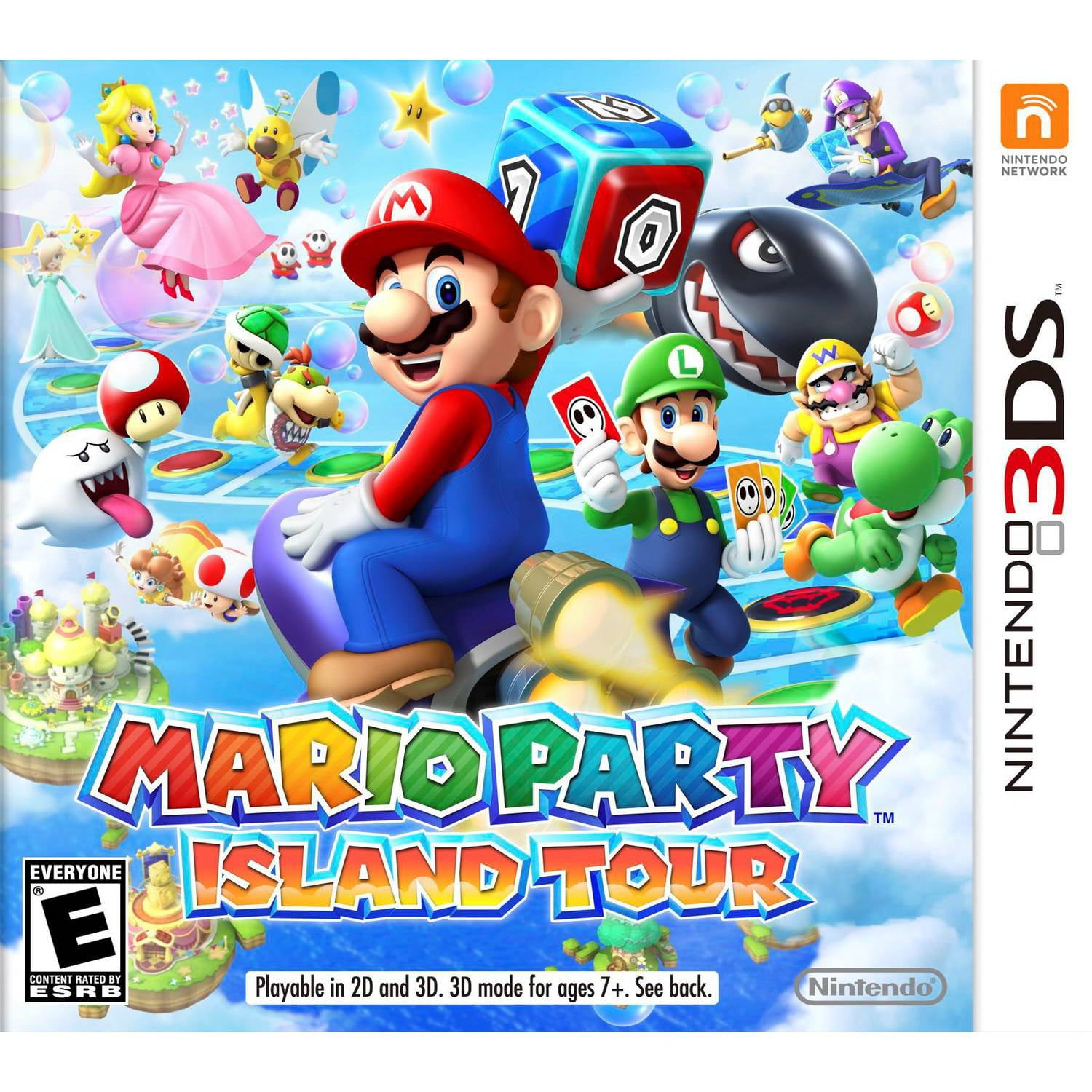
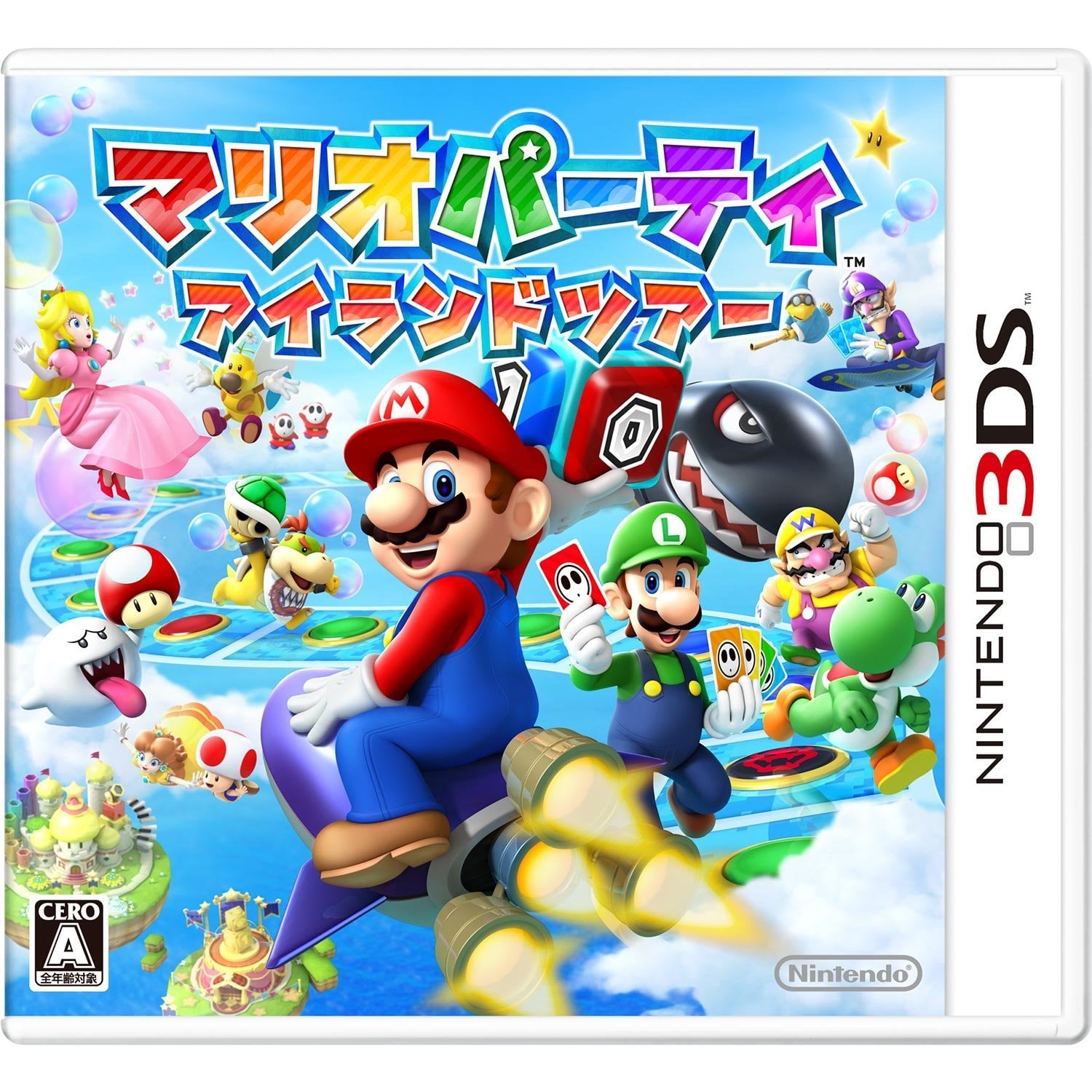
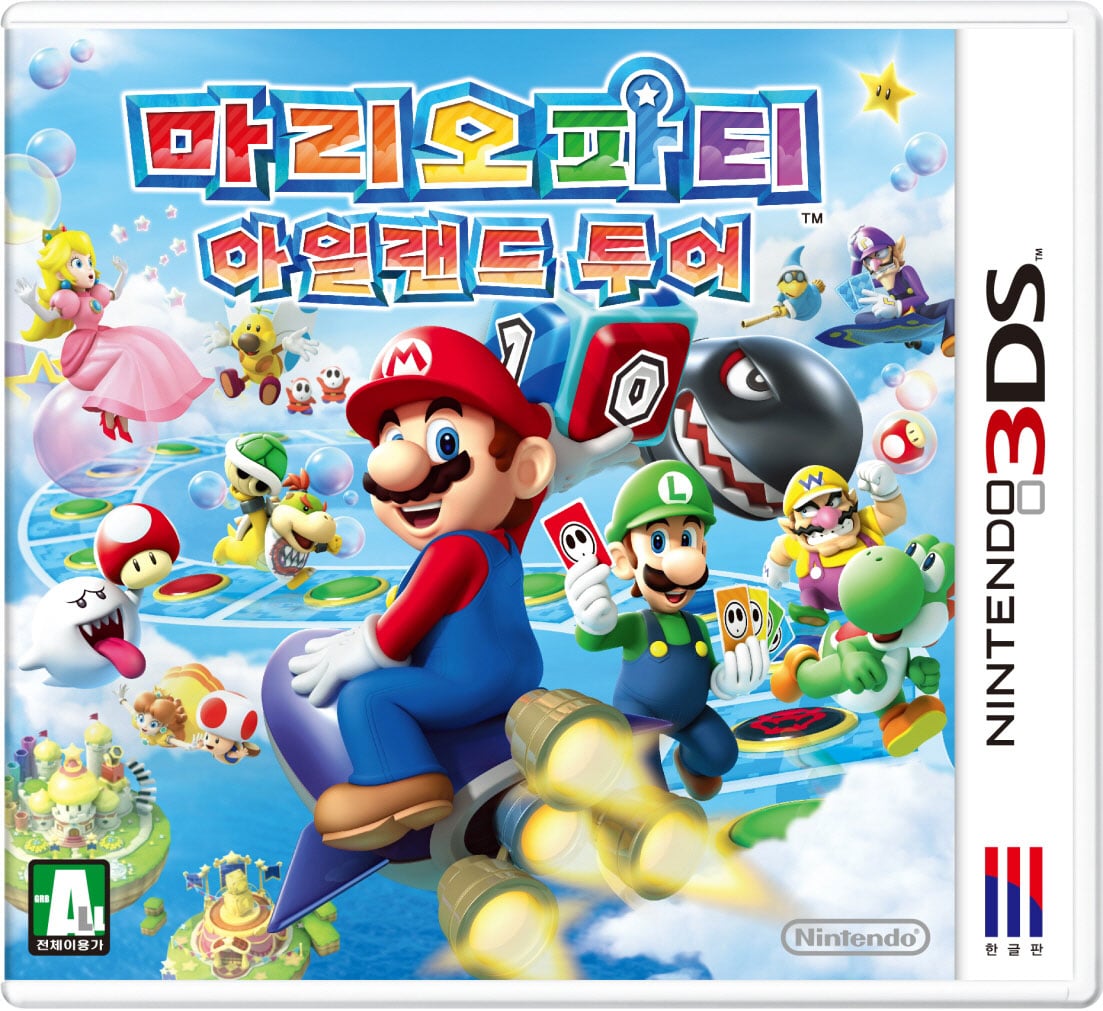
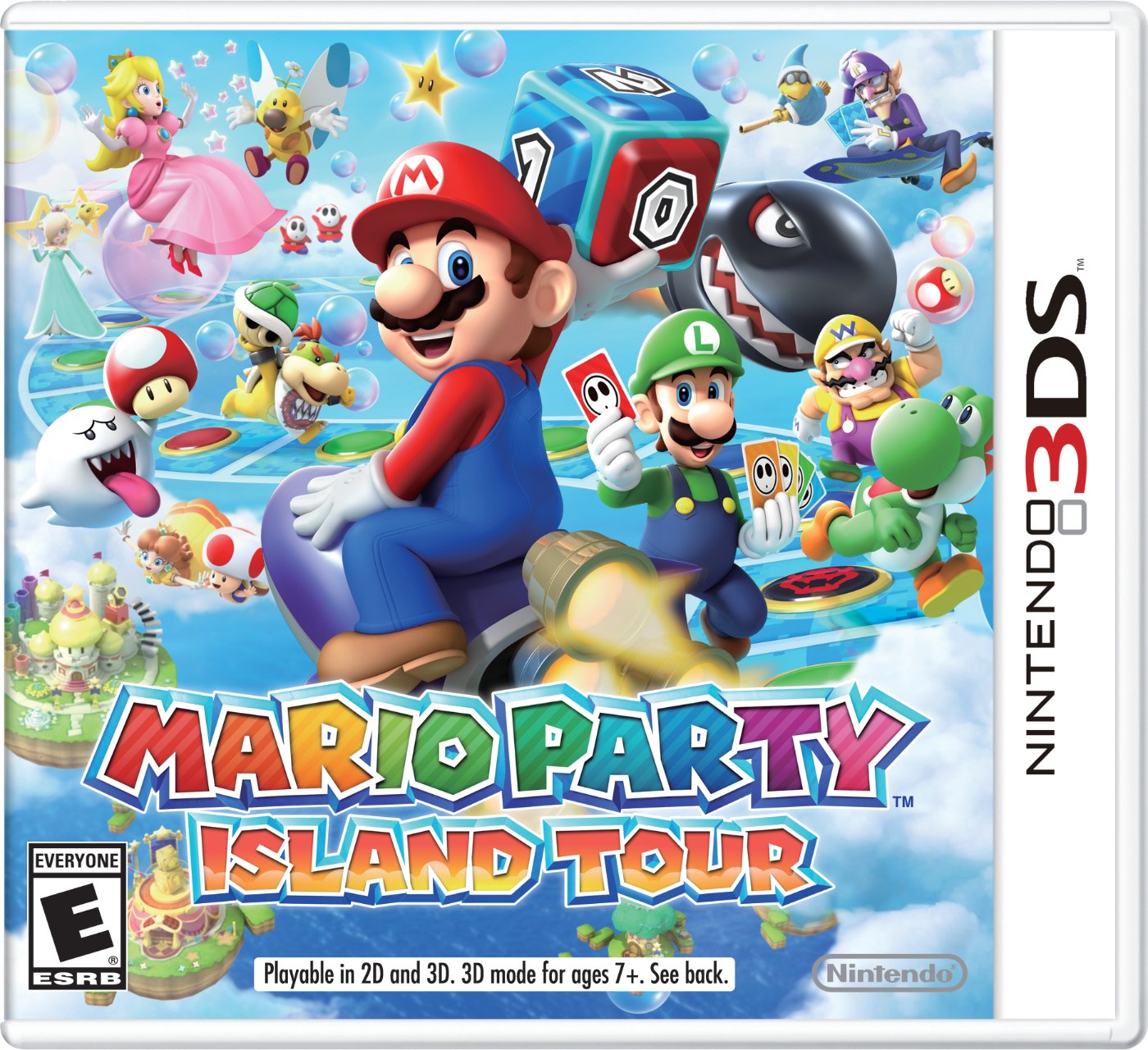
North America22 November 2013North America (pre-release)An earlier version of the coverNorth America (Nintendo Selects)11 March 2016Europe17 January 2014Europe (Nintendo Selects)16 October 2015Australia18 January 2014Japan20 March 2014South Korea20 March 2014
Screenshots
More from the boards, including Nintendo’s own press screenshots.
Waluigi on Star-Crossed Skyway.The second Star Stage.The fourth and final Star Stage.Daisy wins Rocket Road.A Dice Block with a five-times multiplier on Rocket Road, ready to roll.Rosalina and Mario.No-Traction Action, in a press screenshot.Perilous Palace Path in an early version, with Mario.
Artwork & Media Gallery
Logos and official artwork.
The international logo.The Japanese logo.The tentative logo.Mario on a rocket.Luigi holding some cards.Princess Peach floating on a bubble.Daisy and Toad flying.Waluigi and Kamek.Flutter, who carries the biggest prize on Star-Crossed Skyway.Bowser.A Luma.Several cards.Bubbles.A Dice Block.
Legacy & Re-releases
Island Tour had a long life on the shelves and a quiet afterlife: it was reissued at a budget price but never ported, and its minigames have not been revived.
Every release
Nintendo 3DS (North America)22 November 2013The first release anywhere, as a Game Card and as a download.
Nintendo 3DS (Hong Kong)10 January 2014The date given by Super Mario Wiki, which lists Taiwan separately on 3 June 2014.
Nintendo 3DS (Europe)17 January 2014Delayed from the winter of 2013. The first Mario Party in Dutch, European Portuguese and Russian.
Nintendo 3DS (Australia)18 January 2014A day after Europe.
Nintendo 3DS (Japan and South Korea)20 March 2014Number one in Japan in its first week.
Nintendo Selects (Europe)16 October 2015Budget reissue.
Nintendo Selects (North America)11 March 2016Budget reissue.
Nintendo Selects (Australia)26 May 2016Budget reissue. Nintendo’s page notes that the Nintendo 3DS eShop stopped selling games on 27 March 2023.
What came next
Mario Party 10 followed on Wii U in 2015, with Island Tour’s director, Yukio Umematsu, on its planning staff and Rei Kondoh among its composers. Super Mario Wiki notes that the later Nintendo 3DS entries kept the arrangement that makes this one work, four players from a single Game Card through Download Play, which had begun with Mario Party DS.
What lasted
Not the minigames: Mario Party: The Top 100 drew only on the home console games. What travelled was smaller. Super Mario Party reuses the victory animations of Bowser Jr. and Boo, and Super Smash Bros. Ultimate carries the Title Theme and Rocket Road.
Reviews & Sales
Sales
Nintendo’s Financial Results Briefing for the year to March 2014, dated 8 May 2014, lists Island Tour among its million-sellers with 1.14 million copies sold worldwide by 31 March 2014: 0.32 million in Japan, where it had been on sale for eleven days, and 0.82 million elsewhere. In Japan it opened at number one. Wikipedia cites GamesIndustry.biz for more than 132,000 copies in the first week, and Nintendo Life for the game holding the top spot afterwards.
It kept selling. Wikipedia cites the CESA Games White Paper for 2.95 million copies worldwide as of 31 December 2021, which it ranks as the twenty-fourth best-selling Nintendo 3DS game. The game joined the budget Nintendo Selects range in Europe in October 2015 and in North America and Australia in 2016.
1.14mworldwide to 31 March 2014 (Nintendo results briefing, 8 May 2014)
2.95mworldwide to 31 December 2021 (CESA, via Wikipedia)
132,000+first week in Japan (GamesIndustry.biz, via Wikipedia)
57Metacritic score (47 reviews)
Reviews
Scores as listed by Wikipedia and Super Mario Wiki from the original reviews, best to worst, with the two aggregates last.
Nintendo World ReportKimberly Keller · 22 November 2013
8.5/10
FamitsuJapan · four reviewers
32/40
GameSpotHeidi Kemps
7/10
VG247UK
3.5/5
Nintendo LifeDave Letcavage
6/10
Official Nintendo MagazineUK
60%
GamesRadar+Hollander Cooper
3/5
GameRevolutionKevin Schaller
3/5
Pocket GamerUK
3/5
IGNScott Thompson · 22 November 2013
5.5/10
PolygonDanielle Riendeau
5/10
DestructoidCaitlin Cooke · 27 November 2013
4/10
Game InformerUS
4/10
Digital SpyLiam Martin
2/5
MetacriticAggregate of 47 reviews
57/100
GameRankingsAggregate of 28 reviews
59%
Opinion split along a clear line: the minigames were liked, the boards much less so. Nintendo World Report’s Kimberly Keller, the warmest of the critics, admired the way each board played differently and the use the minigames made of the hardware, and called Bowser’s Tower the best of the solo modes while wishing it had a difficulty setting. GameSpot’s Heidi Kemps found the game imperfect but well designed and varied. Polygon’s Danielle Riendeau thought the minigame selection its greatest asset, and Digital Spy’s Liam Martin, who scored it low, still rated the minigames among the best he had played.
Against that, IGN’s Scott Thompson found the motion controls awkward, missed any kind of minigame other than the four-player free-for-all and thought Bowser’s Tower a slow and repetitive grind. Destructoid’s Caitlin Cooke and GamesRadar’s Hollander Cooper both missed Stars and coins. Nintendo Life’s Dave Letcavage felt the single-player modes lacked the depth to last. The common complaints, in Wikipedia’s summary, were luck-heavy design, short boards, slow pacing and the absence of online play; the common praise was for the variety of the boards and for Download Play.
Wikipedia also lists three and two stars out of five from The Guardian and The Observer.
SLB User Reviews
Mario Party: Island Tour has yet to receive a community review on Super Luigi Bros.
If you’ve played Mario Party: Island Tour and would like to submit a review, please get in touch.
To provide the best experiences, we use technologies like cookies to store and/or access device information. Consenting to these technologies will allow us to process data such as browsing behavior or unique IDs on this site. Not consenting or withdrawing consent, may adversely affect certain features and functions.
Functional
Always active
The technical storage or access is strictly necessary for the legitimate purpose of enabling the use of a specific service explicitly requested by the subscriber or user, or for the sole purpose of carrying out the transmission of a communication over an electronic communications network.
Preferences
The technical storage or access is necessary for the legitimate purpose of storing preferences that are not requested by the subscriber or user.
Statistics
The technical storage or access that is used exclusively for statistical purposes.The technical storage or access that is used exclusively for anonymous statistical purposes. Without a subpoena, voluntary compliance on the part of your Internet Service Provider, or additional records from a third party, information stored or retrieved for this purpose alone cannot usually be used to identify you.
Marketing
The technical storage or access is required to create user profiles to send advertising, or to track the user on a website or across several websites for similar marketing purposes.

 Perilous Palace Path45–60 minutes · Skill 4 · Luck 3 · Minigames 5 · first to the castle winsThe long one: a race with ten kinds of item, a Thwomp, a Goomba Tower and a Whomp at the gate.
 Banzai Bill’s Mad Mountain15–30 minutes · Skill 1 · Luck 5 · Minigames 4 · first to the summit winsRoll the Banzai Bill face and everyone caught in the open is blown back down the mountain.
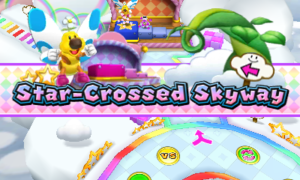 Star-Crossed Skyway30–50 minutes · Skill 4 · Luck 4 · Minigames 3 · most Mini Stars winsFour Star Stages hand out Mini Stars and Mini Ztars in order of arrival, so being first is not always wise.
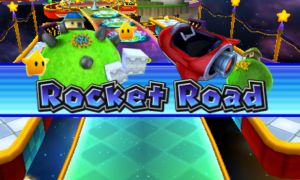 Rocket Road10–20 minutes · Skill 2 · Luck 5 · Minigames 4 · first to the goal winsBoosters multiply your roll through space, unless you roll the 0.
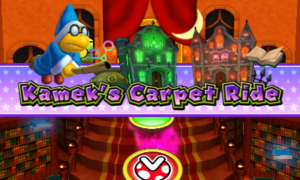 Kamek’s Carpet Ride20–40 minutes · Skill 4 · Luck 1 · Minigames 3 · first to land exactly on the goal winsNumbered cards replace the dice, and only an exact landing on a Just-Right Space will do.
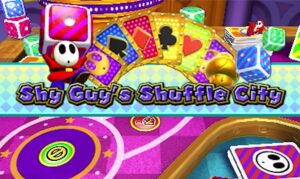 Shy Guy’s Shuffle City20–40 minutes · Skill 5 · Luck 3 · Minigames 2 · draw a Champion Card at the end; three or four human players onlyA card game of bluff in which the Bowser Card is passed from hand to hand.
 Bowser’s Peculiar Peak20–40 minutes · Skill 2 · Luck 3 · Minigames 4 · first to the top loses · unlocked by playing the other boardsA reverse race up Bowser’s volcano, known in Britain as Bowser’s Bizarre Volcano.


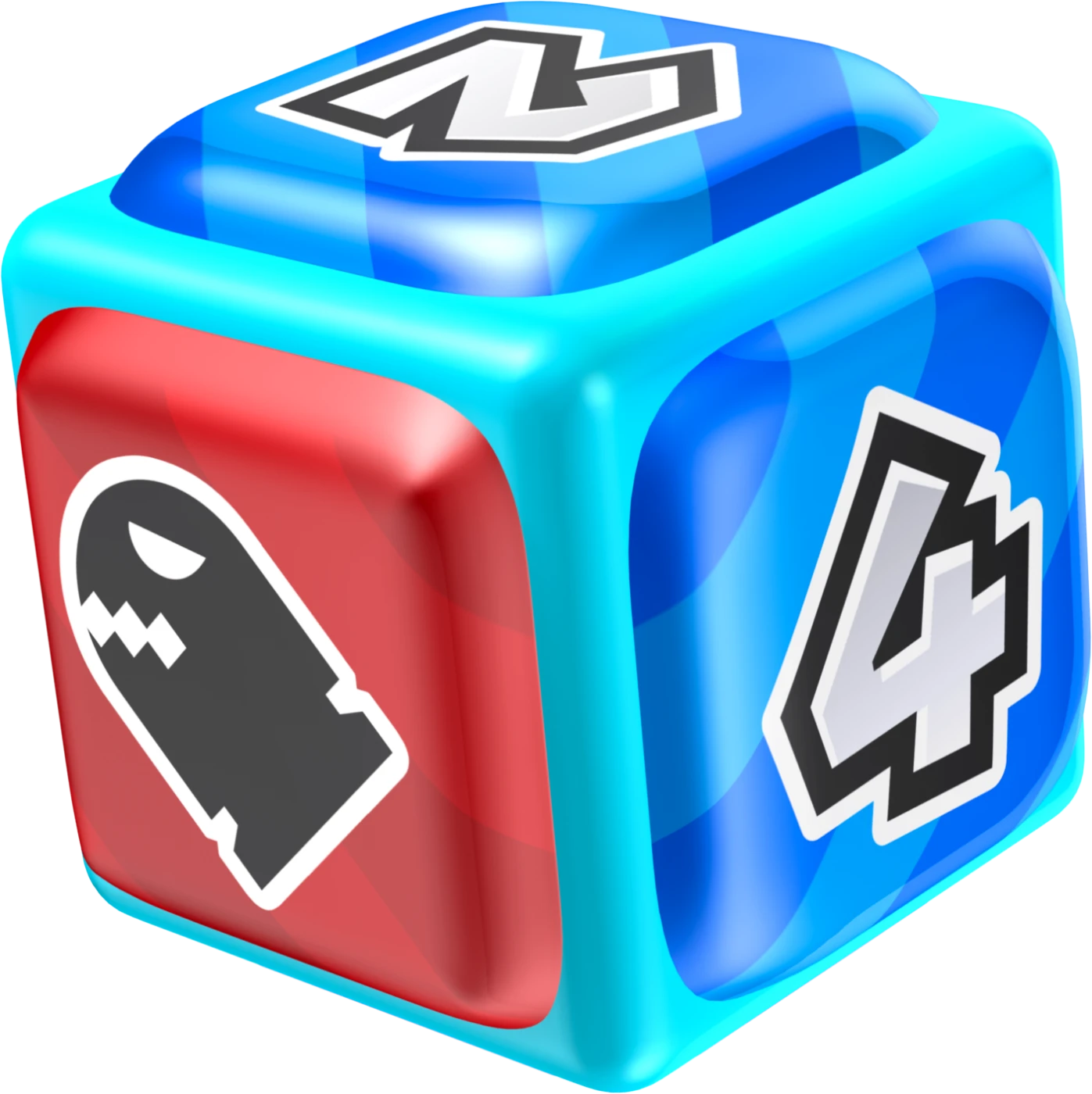















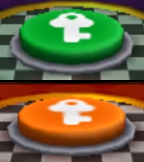

 Dice Block (Banzai Bill’s Mad Mountain)On this board the 6 is replaced by a red Banzai Bill face, which fires the cannon.
 Gold Dice BlockA bonus block that adds 1 to 6 to your roll. The prize for first place in a minigame.
 Silver Dice BlockAdds 1 to 3. The prize for second place; not awarded in a two-player game.
 Bronze Dice BlockAdds 1 or 2. The prize for third place, or for second when only two are playing.
 Custom Dice BlockLets you choose the number you roll.
 Bowser Dice BlockThe block used on Bowser’s Peculiar Peak. It behaves like a normal one, except that a double rolled with a bonus Bowser block leaves you where you are.
 1-6 Bowser Dice BlockAdds 1 to 6 on Bowser’s Peculiar Peak, where moving fast is a punishment: it goes to whoever comes last in the minigame.
 1-3 Bowser Dice BlockAdds 1 to 3. Given for third place in a four-player game.
 1-2 Bowser Dice BlockAdds 1 or 2. Given for second place, or to the winner when there are only two or three players.
 Random CardMoves you a random distance: 1 to 6, 1 to 3 or 4 to 6, depending on the card.
 Precision CardMoves you exactly the number shown, from 1 to 6.
 Power Precision CardMoves you forward by 1 or 2 and pushes every other player back by the same amount.
 Bowser CardThe card nobody wants in Shy Guy’s Shuffle City. Whoever holds it when three rounds are up takes a Bowser Penalty, and cannot win.
 Setback ShellKnocks an opponent back two spaces.
 Backwards BillKnocks an opponent back five spaces.
 Blooper ChopperHalves an opponent’s next roll.
 Lightning Score StrikerTakes 3 off an opponent’s roll.
 Lakitu LeechSteals one item, chosen at random, from an opponent.
 Dash MushroomAdds 3 to your roll.
 Golden Dash MushroomAdds 5 to your roll.
 Super StarDoubles your roll, to the Super Star theme from Super Mario Bros.
 Crazy KamekSwaps your place with an opponent’s.
 Chaos KamekSwaps everybody’s places.
 Mini StarThe score on Star-Crossed Skyway. Most at the end wins.
 Mini ZtarThe opposite: each one lowers your Mini Star total.
 BoosterRocket Road’s fuel. Each one used multiplies the number you roll.

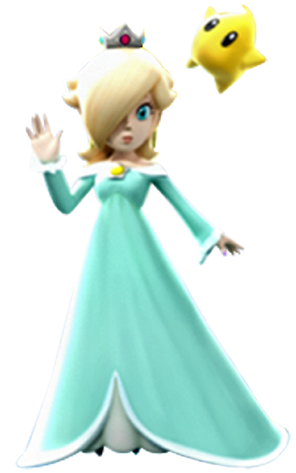 Super Mario GalaxyWii · 2007Rocket Road is modelled on the Galaxy games: Rosalina, the Lumas and the Comet Observatory all appear, and part of its music is a new arrangement of Good Egg Galaxy. Mattermouths and Flomps, from Super Mario Galaxy 2, turn up in Tragic Carpet Ride and Flip Out.
 MarioPlayable
 LuigiPlayable
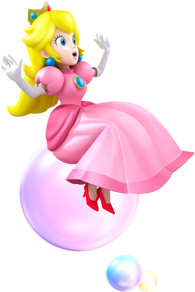 Princess PeachPlayable
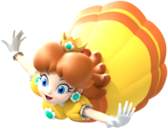 Princess DaisyPlayable
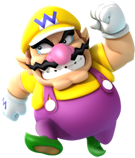 WarioPlayable
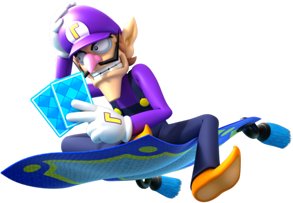 WaluigiPlayable
 YoshiPlayable
 BooPlayable · returning
 ToadPlayable
 Bowser Jr.Playable · new · unlockable
 Yellow Toad, Blue Toad and Green ToadHosts
 BowserVillain · final boss · board host
 Goomba TowerBoss · floor 5
 Chain ChompBoss · floor 10
 Mr. BlizzardBoss · floor 15
 King Bob-ombBoss · floor 20
 KamekBoard character
 Shy GuyBoard character
 Banzai BillBoard hazard
 LakituHelper
 Claiming the CubeGeneralJump on the white panels of a cube and ground-pound them to make them yours. Most panels after 30 seconds wins.
 Rope a SlopeGeneralRace down a cliff face, jumping the obstacles. Clip one and you lose time.
 Tragic Carpet RideGeneralKeep clear of the Mattermouths and the holes they leave. Last player standing wins.
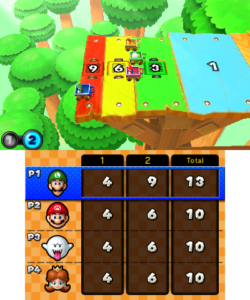 Stretch RunGeneralJudge how hard to launch your cart so that it stops on the high numbers of a bridge without rolling off the end. Two rounds.
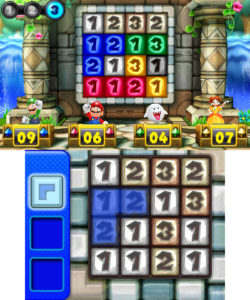 Grid is GoodGeneralLay a three-square piece on a numbered grid in ten seconds. Squares only you claimed score; contested ones do not.
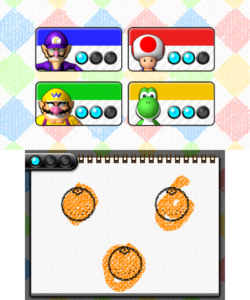 Color Me FastGeneralScribble with the stylus to colour in three pictures of fruit before anyone else.
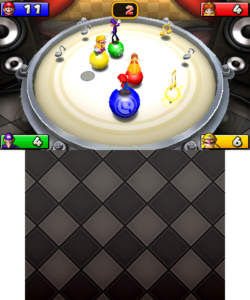 Musical SnaresGeneralTilt the system to roll about on a ball, collecting notes on a drum. Gold notes count double.
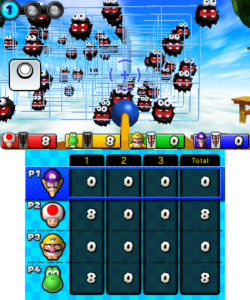 Buzz a FuzzyGeneralAim by moving the 3DS and shoot arrows at Fuzzies running along rails. Three rounds.
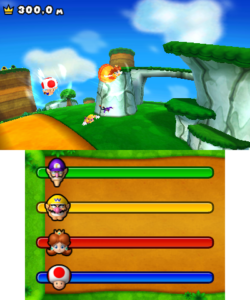 Cannonball!GeneralWind your cannon’s handle as fast as you can for four seconds, then see who is fired furthest.
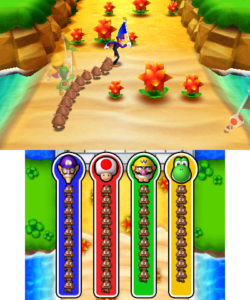 Goomba to ManeuverGeneralShepherd ten Goombas past thorny flowers to the finish. Most Goombas delivered wins.
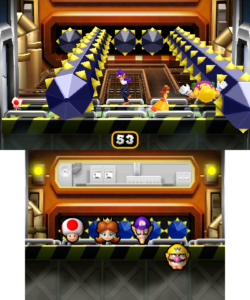 Kabob and WeaveGeneralRun and jump to stay clear of the Skewers until time runs out.
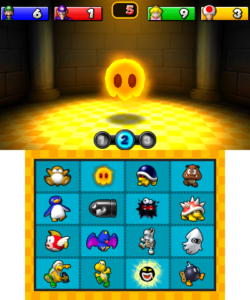 Tap DashGeneralSixteen panels, one enemy shown above: tap the match with the stylus before anyone else. Three rounds.
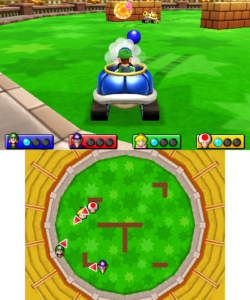 Tanks a LotGeneralA tank battle. Every hit is a point, and three points win.
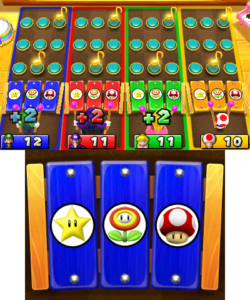 Xylophone HomeGeneralA rhythm game: tap the key beneath each note in time with the Super Mario Bros. theme.
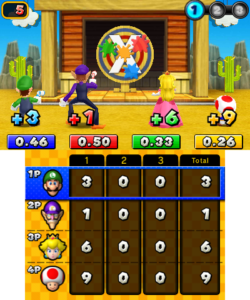 Mild GunmanGeneralPress the button shown on the target to fire a paintball. Faster is worth more, and the wrong button scores nothing.
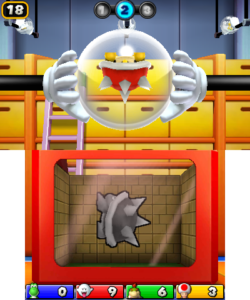 Spin the BubbleGeneralTilt the system to turn a capsule until the figure inside fits its silhouette.
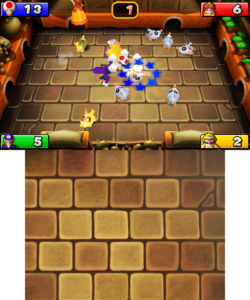 Rat-a-tat FlatGeneralGround-pound Scaredy Rats as they pop out of their holes. Gold ones are worth three.
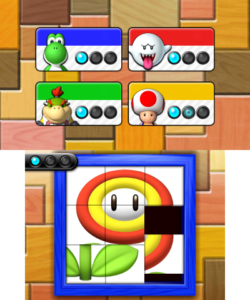 Tile SavvyGeneralSliding-tile puzzles on the Touch Screen. First to restore three pictures.
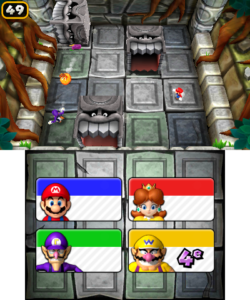 Hide ’n’ SplatGeneralKeep out from under the Tox Boxes as they tumble round the arena.
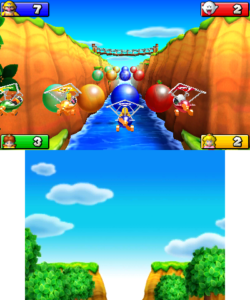 Slow GlideGeneralTilt to steer a glider and pop the balloons of your own colour. Yellow ones are worth three.
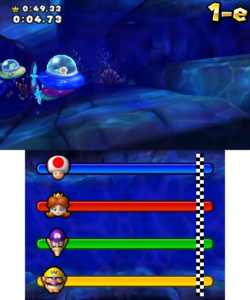 Sub TroubleGeneralPilot a submarine up and down past the obstacles to the finish line.
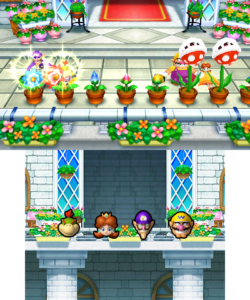 Garden of Eatin’GeneralPick a plant to water. A flower keeps you in; a Piranha Plant bites you out. Blooming Nuisance in Britain.
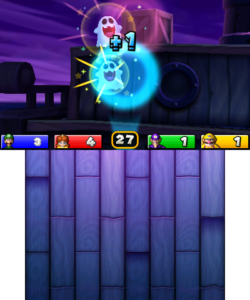 Peep a PeepaGeneralTilt to point a torch at Peepas. The longer you hold one in the beam, the more you score.
 Puzzle ProntoGeneralThree rounds of a quick Touch Screen puzzle, such as tapping mushrooms or lining up pipes.
 Truckin’ and Cluckin’GeneralHold a chicken so that it lays eggs for points, two for a golden one, while the others tackle you to steal it.
 Color CorrectionGeneralFly a carpet over round tiles to turn them your colour. Most tiles when time is up wins.
 Get ReelGeneralWind a film reel to and fro to find the frame shown, then confirm it. A wrong pick stuns you.
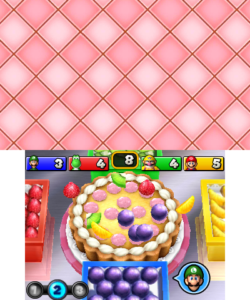 Top ThisGeneralDrop fruit on to the marked spots of a spinning cake with the stylus, over three ten-second rounds.
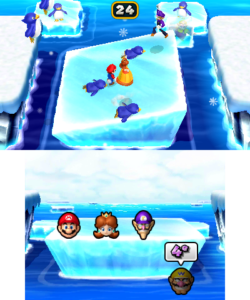 Slip ’n’ SlipGeneralStay on a tilting sheet of ice for 45 seconds without sliding into the sea.
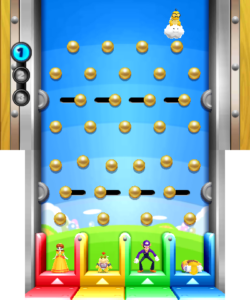 Pachinko WizardGeneralChoose a slot under a pachinko board and hope Lakitu’s Spiny Egg drops into somebody else’s.
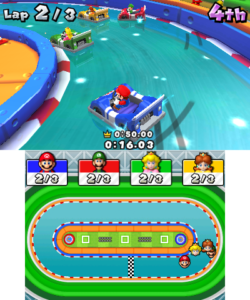 No-Traction ActionGeneralThree laps of an oval track in a kart with almost no grip.
 Blown HoverGeneralA hoverboard race down a long road of Flip Panels borrowed from Super Mario 3D Land.
 Slow GGeneralHop from platform to platform in low gravity, up to a goal above the moon.
 Spin and Bear ItGeneralChoose a place on a wheel, then take turns spinning it with the stylus. The hammer flattens whoever stops beneath it.
 FisticloudsGeneralPunch, kick and jump to knock the others off platforms in the sky.
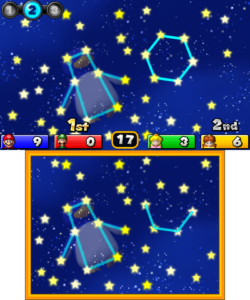 Starring ArtistGeneralCopy constellations of Mario characters from the top screen to the bottom with the stylus. Three rounds.
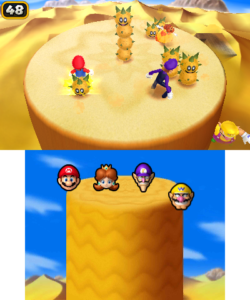 Pokey CorralGeneralShove rivals off the arena while Pokeys burst up out of the ground.
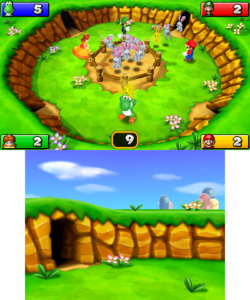 Hare TodayGeneralCatch rabbits as they come out of holes in a crater wall and drop them in the pen. Golden rabbits are worth three.
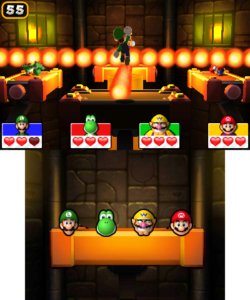 Great Bars of FireGeneralDuck the high Fire Bar and jump the low one. Three hits and you are out.
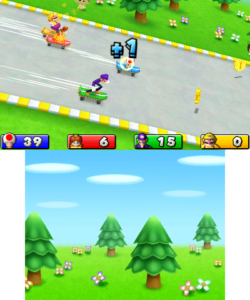 Deck HuntGeneralSkateboard down a slope collecting coins. Each Spiny Egg you hit costs three.
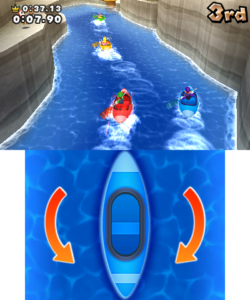 Paddle SkedaddleGeneralPaddle a canoe down a winding creek with strokes of the stylus.
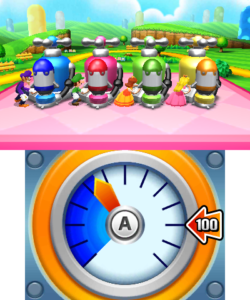 Fuel Me OnceGeneralStop a fuel gauge, hidden part of the way, as near to 100 as you can. Your jet pack then carries you towards a mark over a lake.
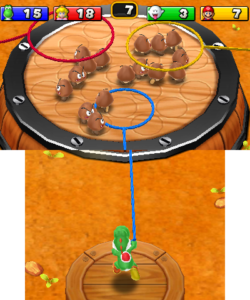 Git Along, GoombaGeneralDraw circles with the stylus to spin a lasso, then flick it to rope Goombas.
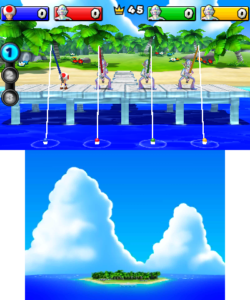 Cheepers KeepersGeneralHammer the buttons shown to reel in Cheep Cheeps. Three rounds. Hook, Line and Cheep Cheep in Britain.
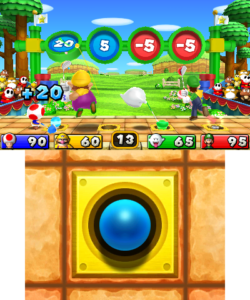 Drive for ShowGeneralFlick golf balls at point targets with the stylus for 30 seconds.
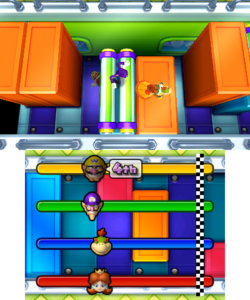 Hop Till You DropGeneralHop along moving platforms, avoiding the gaps and the rollers, to the last one.
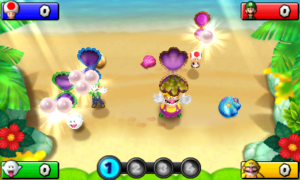 Helter ShellterGeneralChoose shells over four rounds. Pearls are worth one to three points; seaweed is worth nothing.
 Meteor MeleeGeneralCatch falling stars in a bucket for 30 seconds, and avoid the meteors.
 Bumper ThumperGeneralHovercraft sumo on top of a tower whose walls shrink, then vanish, as they are hit.
 Horror HarriersGeneralKeep away from the Peepas circling the room. One touch and you are out.
 Cheep DiamondsGeneralGuess which Cheep Chomp has the most diamonds in its mouth and claim them. Three rounds. Confusingly, this is the one called Cheepers Keepers in Britain.
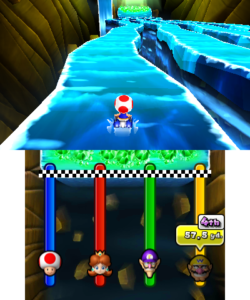 Slip NotGeneralTilt to steer down a narrowing cascade of ice towards the crystals without sliding off.
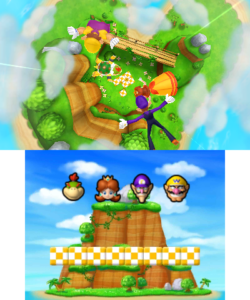 Trounce ’n’ BounceGeneralKeep landing on Jump Blocks, shoving rivals aside. Touch the ground and you are out.
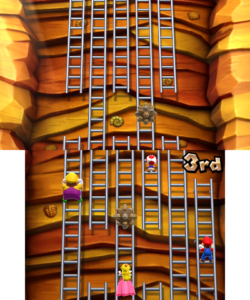 Mad LaddersGeneralClimb a wall of ladders, switching between them to dodge the boulders Stone Spikes throw down.
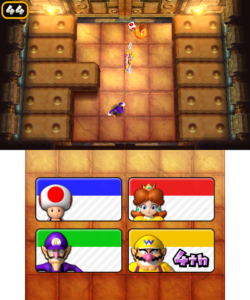 Squish You Were HereGeneralStand in the gaps as the walls close in. Survive for a minute.
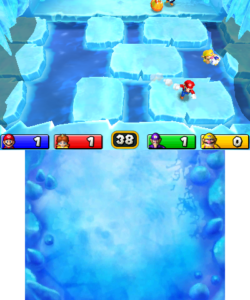 Go with the FloeGeneralCarry baby penguins over slippery ice floes to their mother, a point for each.
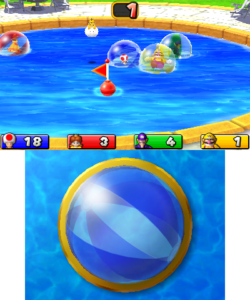 Pool BuoyGeneralRoll a beach ball round a pool with the stylus to gather the buoys Lakitu throws in: red for one point, gold for three.
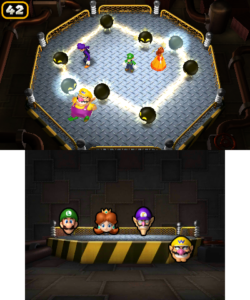 Amp My StyleGeneralAvoid eight Amps as they form up into changing patterns inside a pen.
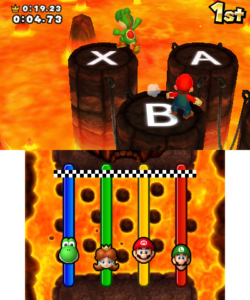 MagmathonGeneralPress the letter shown on each rock to hop across a lake of lava.
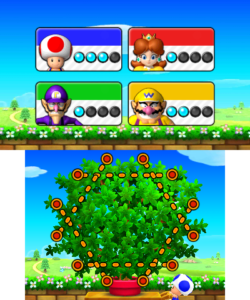 Shrub HubbubGeneralTrim bushes to the shapes shown with the stylus, over four rounds.
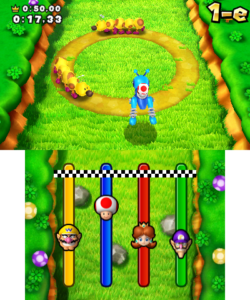 Quickest CricketGeneralRace a mechanical cricket past rocks, Piranha Plants and Wigglers.
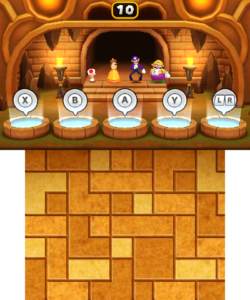 Diamond a DozenGeneralWatch which tunnel takes the most diamonds, then be quick to press its button.
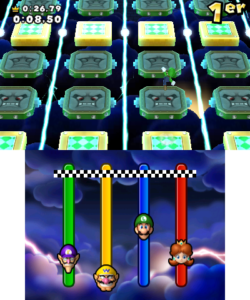 Flip OutGeneralCross platforms and Flomps to the goal. Step on a Flomp as it flips and you are sent back.
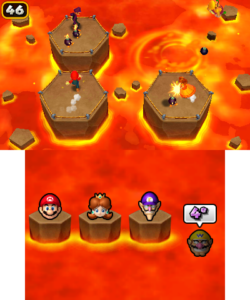 Bob-omb AplombGeneralKick Bob-ombs off your rock, into the lava or on to someone else’s, before they go off.
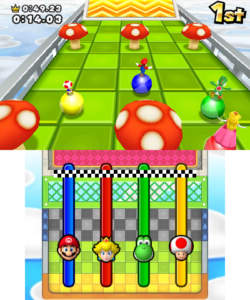 Gyro for the GoldGeneralTilt the system to roll a ball through an obstacle course as fast as you can.
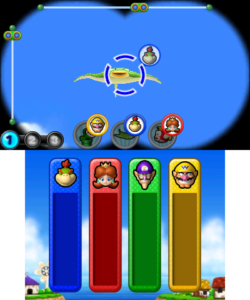 Point ’n’ ShootGeneralTilt to aim a camera round a town and photograph the characters you are asked for. Three rounds.
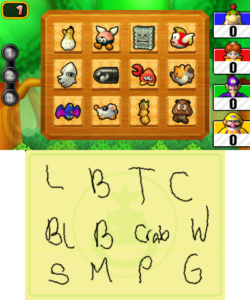 Match FakerGeneralMemorise where twelve enemies are hidden, making notes with the stylus, then find the three you are asked for.
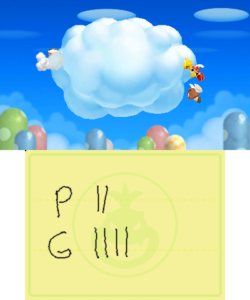 Sky’d and SeekGeneralKeep count of the Koopa Paratroopas and Paragoombas flying in and out of a cloud, then say how many are left inside.
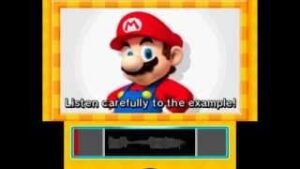 Utter NonsenseGeneralImitate a character’s voice into the microphone and be marked out of 100.
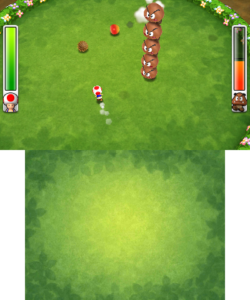 Goomba Tower TakedownBoss · floor 5Throw fallen fruit at a stack of five Goombas to topple it, then hit them as they scatter.
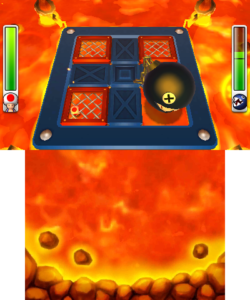 Chain Chomp’s Lava LungeBoss · floor 10Dodge its lunges so that it lands on a metal grate over the lava and burns.
 Mr. Blizzard’s Snow SlalomBoss · floor 15Steer a snowball with the stylus, growing it on snow and dodging icicles, and ram him with it.
 King Bob-omb’s Court of ChaosBoss · floor 20Slide conveyor tiles so that the bombs he throws are carried back to him. The golden cannon hurts most.
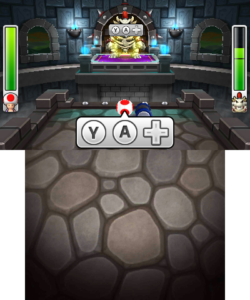 Dry Bowser’s Brain BonkBoss · floor 25Memorise a three-button sequence, then enter it to hammer his bone straight back at him.
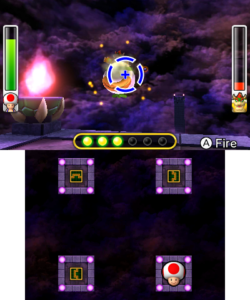 Bowser’s Sky ScuffleBoss · floor 30Fire cannonballs at his Clown Car, collecting more from floating blocks, until it explodes.
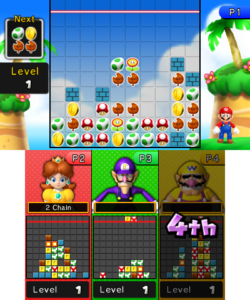 Three HousePuzzleLine up three or more matching Mario items in any direction to clear them.
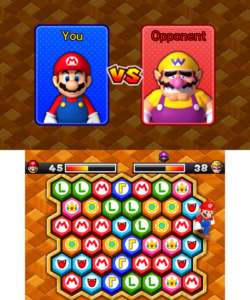 Emergency HexitPuzzleSlide hexagonal tiles to group matching character emblems before time runs out.
 Star TurnPuzzleRotate tiles to join up paths that fence in every Super Star.
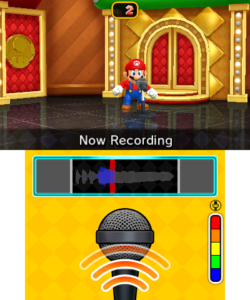 The Choicest VoiceExtraImpressions into the microphone, ten points for each judge who approves. Alone, you need 90 points over three rounds.
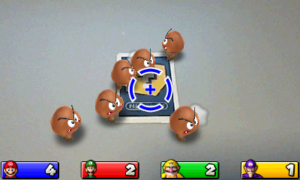 Ka-Goomba!ExtraMove the system to aim and shoot Goombas: one point each, three for a Gold Goomba. Hit the Whomp’s back and it is over. Goombas Galore in Britain.
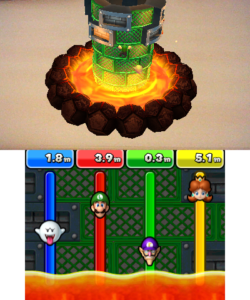 Sinking FeelingExtraClimb a sinking tower, dodging metal blocks; played alone, it ends when you touch the lava. It needs an AR Card. Towers and Infernos in Britain.