
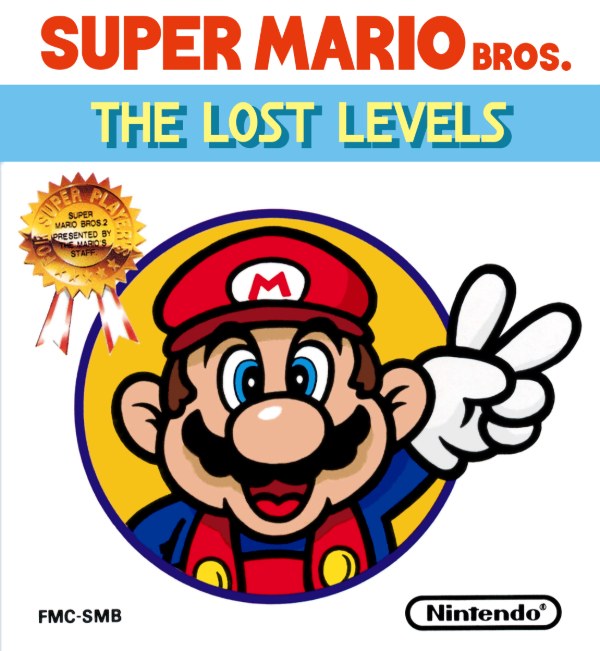

Super Mario Bros.: The Lost Levels
Overview
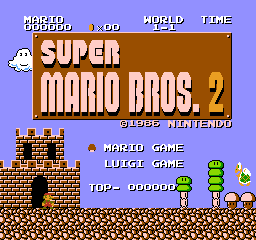
In Japan, the sequel to Super Mario Bros. was released on the Famicom Disk System on 3 June 1986 as Super Mario Bros. 2. It looks almost identical to the first game, but it was made for players who had already mastered it, and its packaging said it was for “super players”.
Shigeru Miyamoto produced it and handed direction to his assistant Takashi Tezuka, in his first role as director; development took about four months from January 1986. Some of its levels began life in the arcade game Vs. Super Mario Bros.
Why the West Missed Out
Nintendo of America judged the game too difficult and frustrating for an American market that was only just recovering from the video game crash. Howard Phillips, who assessed games for NOA president Minoru Arakawa, thought it was unfairly hard and would not sell. Instead, Nintendo reworked Fuji TV’s Yume Kōjō: Doki Doki Panic into the game the West knows as Super Mario Bros. 2, released in October 1988.
Western players finally got the Japanese sequel in 1993, remade with 16-bit graphics as Super Mario Bros.: The Lost Levels in Super Mario All-Stars. The unaltered original reached Europe and North America on the Wii Virtual Console in 2007.
What Changed from Super Mario Bros.
There is no two-player mode. Instead you choose Mario or Luigi on the title screen, and for the first time the brothers play differently: Luigi jumps higher but takes longer to speed up and stop, while Mario is quicker on his feet with a lower jump.
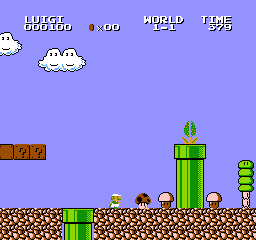
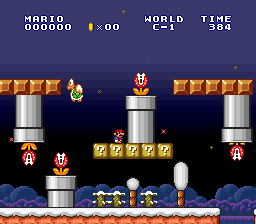
- Poison Mushrooms look like Super Mushrooms but act like an enemy, shrinking or defeating you.
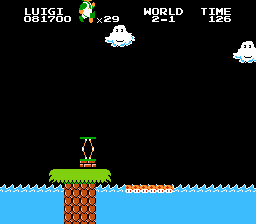
- Wind blows through parts of some levels, pushing you mid-jump.
- Warp Zones: there are eleven, and two are traps that send you back to an earlier world.
- Harder hazards: more aggressive red Piranha Plants, upside-down pipes, Hammer Bros. that charge at you, springs that launch you off the screen and invisible blocks placed exactly where you would jump.
- Stomping on enemies bounces you higher than before, a hint of the bigger jumps to come in Super Mario Bros. 3.
Worlds and Secrets
The main game has eight worlds of four levels. Beating them without using a single Warp Zone opens the secret World 9, which you play on one life. Four more bonus worlds, A to D, are hidden behind a bigger challenge: the title screen gains a star each time you clear World 8-4, and eight stars unlock them. That brings the total to 52 levels.
Super Mario All-Stars makes the bonus worlds much easier to reach: they start straight after the main game and you keep your remaining lives. Checkpoints are more frequent, the Poison Mushroom is easier to tell apart, and the fake Bowser at the end of Worlds A–D becomes the real one.
Reception and Legacy
The Lost Levels was the best-selling game on the Famicom Disk System, with around 2.5 million copies, and topped Famicom Tsūshin’s charts. Retrospective opinion is split. Some critics praise its fiendish design and call it a better game than the Western Super Mario Bros. 2, while others find it a cruel retread of the original. Its precise, punishing level design is often seen as a forerunner of the Kaizo hacks and speedruns it later inspired.
The Poison Mushroom became a recurring Mario item, and the game has been re-released many times: in Super Mario Bros. Deluxe on the Game Boy Color, as a Famicom Mini on the Game Boy Advance in Japan, on the Wii, 3DS and Wii U Virtual Console, and on Nintendo Switch Online.
Trivia
- Japanese TV adverts showed players screaming at their televisions.
- It was only the ninth game released for the Famicom Disk System.
- Mushrooms have eyes in this game, a feature the series kept.
- In Super Mario Bros. Deluxe it appears as an unlockable called Super Mario Bros. for Super Players, without the wind and the bonus worlds.
- Some of its levels first appeared in a 1986 promotional release, All Night Nippon Super Mario Bros.