Game Boy Color1999Nintendo R&D22D platformerThe Lost Levels unlockableGame Boy Printer supportLink-cable VS racesIGN 10/103DS Virtual Console 2014
Super Mario Bros. Deluxe
In May 1999 the most famous game of all fitted in a pocket. Super Mario Bros. Deluxe squeezes all 32 courses of the 1985 Super Mario Bros. onto the Game Boy Color, keeps the original graphics, and adds so much around them that it reads like a celebration. There is a Challenge mode that hides five red coins and a Yoshi Egg in every course and sets a score to beat, a You VS. Boo race across eight new courses, a two-player VS Game over the Game Link Cable, a Toy Box with a fortune teller and a calendar, and a photo album whose pictures print out on the Game Boy Printer. Score 300,000 points and a reworked The Lost Levels unlocks as Super Mario Bros. for Super Players. The catch is the smaller screen, which shows less of each course than the NES did. Made by Nintendo R&D2 under director Toshiaki Suzuki, it scored 10/10 from IGN and returned on the Nintendo 3DS Virtual Console in 2014.
Developer:Nintendo R&D2
Publisher:Nintendo
Platform:Game Boy Color (colour-only Game Pak); Nintendo 3DS Virtual Console
Genre:2D platformer
N. America:10 May 1999
Europe:1 July 1999 (some sources)
Japan:1 March 2000, as a Nintendo Power download-cartridge game
Original game design:Shigeru Miyamoto, Takashi Tezuka
Music:Yuichi Ozaki, Masami Yone (Wikipedia)
Courses:32 (Original 1985) + 32 (For Super Players) + 8 (You VS. Boo / VS Game)
Extras:Challenge, You VS. Boo, VS Game, Toy Box, Album, Game Boy Printer, infrared high-score swap
Re-releases:3DS Virtual Console: Europe 27 February 2014, North America 25 December 2014
Review aggregate:GameRankings 92%
Ratings:ESRB E, PEGI 3, CERO A, USK 0, ACB G
Advertisement
Overview
Super Mario Bros. Deluxe is a port, but a generous one. At its centre is “Original 1985”, a faithful conversion of the NES game with the original sprites and course layouts, now with a world map, a save at any time, five lives to start with and animated water and lava. Nintendo R&D2 then wrapped it in modes that rewarded the replaying the original always invited: Challenge, You VS. Boo, the link-up VS Game, high-score tables, a Toy Box and an Album of unlockable pictures.
The biggest bonus is hidden. Rack up 300,000 points and Super Mario Bros. for Super Players appears, a version of the Japanese sequel known in the West as Super Mario Bros.: The Lost Levels, with its first eight worlds rebuilt for the handheld.
Everything had to fit on the Game Boy Color’s smaller screen, and that is the one big compromise. You see less of each course than on a television, so the game lets you nudge the view up and down and shift Mario’s position on screen with Select. Critics in 1999 mostly forgave it; when the game came back on the 3DS in 2014, Nintendo Life found the cramped view much harder to ignore.
For the story and the full course-by-course guide, see our Super Mario Bros. page. This page is about what the Game Boy Color version adds, changes and leaves out.
This souped-up version of the all-time classic was originally released on Game Boy Color. Super Mario Bros. Deluxe features all 32 original levels from the 1985 classic, plus a whole lot more!
In Challenge mode, revisit classic levels and collect special red coins and Yoshi eggs to beat the high score. Or race against a familiar foe through eight special courses in You Vs Boo mode! There are even challenging secret levels to be discovered, for a true test of your Super Mario Bros. skills!
— Official description (Nintendo UK, 2014)
Why it matters to Mario fansIt put the NES Super Mario Bros. in your pocket with its original look, hid The Lost Levels inside as a reward, and turned a game everyone knew by heart into something new with red coins, Yoshi Egg hunts and races against Boo.
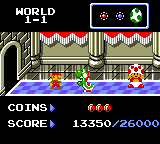
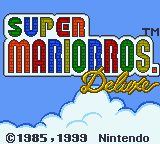
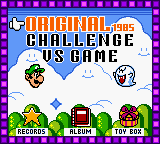
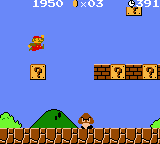
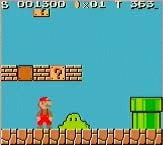
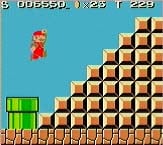
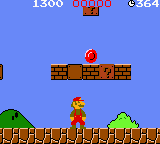
The title screen.The main menu, with every mode on one screen.World 1-1 on the Game Boy Color.
Quick Answers
Quick answers about the Game Boy Color version.
When did Super Mario Bros. Deluxe come out?
On 10 May 1999 in North America and later in 1999 in Europe (1 July according to some sources; Wikipedia gives December 1999 for the UK). In Japan it was sold from 1 March 2000 only through the Nintendo Power service, which wrote games on to rewritable cartridges. More →
How is it different from the NES game?
It adds a world map, saving at any time, five starting lives, animated water and lava, a Luigi you swap to with Select, new sound effects and a kiss from Peach at the end; most of the old glitches, including the Minus World, are fixed. The screen is smaller, so you see less of each course. More →
How do you unlock The Lost Levels?
Super Mario Bros. for Super Players appears once your Original 1985 scores add up to 300,000. In English versions you also need a Game Over before it unlocks. More →
Is all of The Lost Levels included?
No. Only Worlds 1 to 8 can be played; Worlds 9 and A to D sit unfinished in the cartridge. The wind and Luigi’s different jumping were removed and some courses changed to suit. More →
How do you unlock You VS. Boo?
Score 100,000 points in Original 1985 mode (and, in English versions, see a Game Over). It is a race against Boo across eight courses. More →
What is Challenge mode?
Replay any of the 32 courses to find its five red coins and its hidden Yoshi Egg, and try to beat the course’s target score. Each earns a medal. More →
Can I still buy it?
It was on the Nintendo 3DS Virtual Console from 2014, but purchases on the 3DS eShop ended on 27 March 2023. It is not in the Nintendo Switch Online Game Boy library. More →
Who made it?
Nintendo R&D2, directed by Toshiaki Suzuki and produced by Masayuki Uemura and Kazuhiko Taniguchi, with Shigeru Miyamoto, Takashi Tezuka and Toshihiko Nakago as supervisors. More →
Story
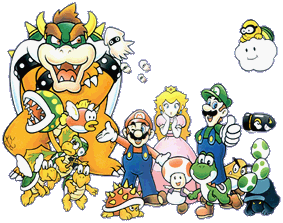
The cast of Super Mario Bros. Deluxe.
The plot is the 1985 one, retold in the booklet: the Koopa, a tribe of turtles skilled in dark magic, have invaded the Mushroom Kingdom and turned its people into stones, bricks and other objects; only Princess Toadstool can undo the spell, and King Koopa has carried her off. Our Super Mario Bros. page tells it course by course. Here we follow what Deluxe does with it, mode by mode.
Original 1985: eight worlds in your pocket
Eight worlds, four courses each, the fourth always a castle. The booklet’s rules are the old ones: 100 coins for a life, a timer whose leftover seconds become points, a restart point about halfway through most courses, and a flagpole that pays more the higher you grab it.
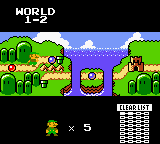
What is new is the frame around it. A world map shows where you are, a save is never more than a pause away, and once a castle is cleared Mario stamps on it until it collapses.
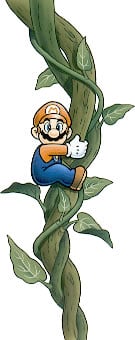
Pre-release shot: Mario setting off in World 1-1.Mario climbing a beanstalk.
Fake Bowsers, rescued Toads and the kiss
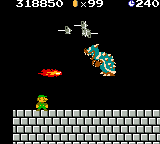
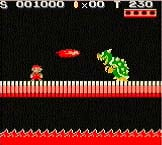
The castle bosses are still impostors until World 8-4, and fireballs still reveal what they really are. In the English versions, beating them with fireballs also fills in two album pictures, a quarter at a time. Every rescued Mushroom Retainer now unlocks something in the Toy Box’s Mystery Room.
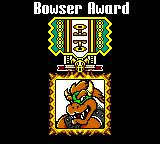
Rescue the real princess and she thanks you with a kiss, which earns the Mario Award and the Kiss picture. Finishing the second quest earns the Bowser Award.
A fake Bowser in a castle.The fake Bowser of World 1-4 (pre-release).Peach kisses Mario.
Challenge mode
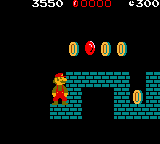
Challenge mode opens once you have cleared a course in Original 1985, and each of the 32 courses hides three medals. Five red coins are scattered through it, some in place of ordinary coins and some in new spots. A Yoshi Egg sits in an invisible block. And each course has a Challenge Score; beat it for the High Score Medal. Medals count only if you reach the flagpole.
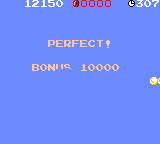
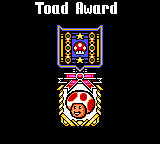
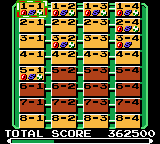
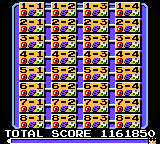
Scoring is tweaked to make the targets interesting: 1-Up Mushrooms are worth 2,000 points, extra lives from chains of stomps or kicks become 10,000 points, and grabbing every coin in a bonus area earns a “Perfect Bonus” of 10,000. The course-select screen adds up all your best scores; fill its bar at 1,160,000 points for the Toad Award, and collect every medal for the Peach Award.
A red coin in Challenge mode.A found Yoshi Egg hatches.The Challenge mode menu.Every medal collected.
You VS. Boo
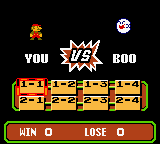
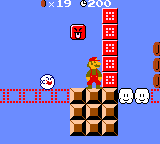
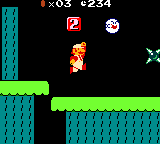
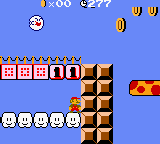
Score 100,000 points and Boo wants a race. You VS. Boo is a one-player time trial over eight new courses, numbered 1-1 to 2-4 and remixed from the original’s layouts with Face Blocks, trampoline floors and spiked blocks. Boo floats straight through walls. Finish fast enough and the white Boo is replaced by a quicker green one, then a red one, then a Black Boo whose pace is tied to your own best time. Press Select before a race to start as Super or Fire Mario.
The You VS. Boo title screen.Course 1-1, built around Face Blocks.Course 2-3, full of spiked blocks.
The VS Game
Link two Game Boy Colors with a Game Link Cable and Mario races Luigi over the same eight courses. First to the flagpole wins; if both lose a life at once, the one with more coins takes it. The VS courses add 3-2-1 Blocks that count down and flip, and players can toggle Face Blocks to shut each other in, throw fireballs at each other, or grab a Star to dash ahead. The mode is missing from the 3DS Virtual Console release, which has no link-up.
A 3-2-1 Block.The goal of course 2-2.
Super Mario Bros. for Super Players
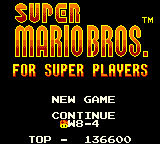
Reach 300,000 points in Original 1985 and a second game unlocks. For Super Players is a remake of The Lost Levels, but a cut-down one: only Worlds 1 to 8 are playable, the wind and Luigi’s floatier jump were removed, and some courses were changed so their gaps can be crossed without them. It has a single save slot, and the flagpole 1-Up trick in Worlds 7-1 and 8-1 no longer works. Clearing its World 8-4 earns the Yoshi Award.
The For Super Players title screen.
Toy Box and Album
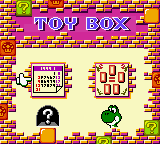
The Toy Box opens with two toys: a Fortune Teller, where you pick one of five cards (an Extremely Lucky draw at the start of a new file gives you ten lives instead of five), and a Calendar that holds up to twelve dates and comes with three days already marked: when Super Mario Bros., the Family Computer and the Game Boy launched in Japan. Find a Yoshi Egg and Yoshi Is Here! appears, a roulette that shows where an egg is hidden.
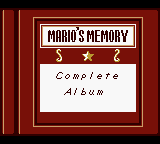
Each rescued captive unlocks one of eight Mystery Room options: printer banners (Worlds 1, 3 and 7), animations (Worlds 2 and 4), printable graphics (World 5), a story-making mode (World 6) and, for Princess Peach, an editor for the title screen’s pictures, text and music. The Album, “Mario’s Memory”, collects 56 items: five Awards, eight printable icons, twenty pictures, nine pieces of story artwork and fourteen banners.
Mario’s Memory, the photo album.The Peach Award.The Yoshi Award.
Every world and VS course in Super Mario Bros. Deluxe
The eight worlds of Original 1985, with what each castle rescue unlocks in the Mystery Room, then the eight courses of You VS. Boo and the VS Game.
World 1Original 1985 · courses 1-1 to 1-4Rescuing the Retainer in 1-4 unlocks five Game Boy Printer banners.
World 2Original 1985 · courses 2-1 to 2-4The 2-4 rescue unlocks animations.
World 3Original 1985 · courses 3-1 to 3-4The 3-4 rescue unlocks five more banners.
World 4Original 1985 · courses 4-1 to 4-4The 4-4 rescue unlocks more animations; 4-4 has a new chime for the right path.
World 5Original 1985 · courses 5-1 to 5-4The 5-4 rescue unlocks printable graphics, including the eight printable icons.
World 6Original 1985 · courses 6-1 to 6-4The 6-4 rescue unlocks the story-making mode and nine pieces of story artwork.
World 7Original 1985 · courses 7-1 to 7-4The 7-4 rescue unlocks the last four banners; 7-4 also has the right-path chime.
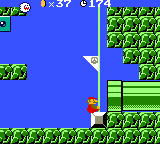
World 8Original 1985 · courses 8-1 to 8-4Beat the real Bowser for the Mario Award; Peach unlocks the title-screen editor.
VS course 1-1OvergroundBig sections of Face Blocks.
VS course 1-2UndergroundEchoes World 1-2, down to a fake Warp Zone.
VS course 1-3OvergroundBorrows from Worlds 2-3 and 4-3.
VS course 1-4CastleBuilt from 1-4 and 3-4, without Fire-Bars or Podoboos.
VS course 2-1OvergroundRegular running plus trampoline floors.
VS course 2-2UnderwaterA swim much like World 2-2.
VS course 2-3Based on World 3-3Lined with spiked blocks.
VS course 2-4CastleClusters of spiked blocks and a middle section of blocks.
Advertisement
Gameplay & Controls
Mario still runs with B, jumps with A and gets bigger, fierier and invincible exactly as he did in 1985. The changes are all around the edges, and the extra modes are where Deluxe earns its name.
What changed in Original 1985
The instruction booklet calls the main game “Original 1985”, and it is close to the NES game. The differences are these: you start with five lives rather than three; you can save at any moment from the new pause screen, which remembers the course you were on; each world has a map showing your progress; the castle collapses after you clear it; water and lava are animated; and Peach and the Mushroom Retainers have talking animations.
There is no alternating two-player game, so Luigi is a choice: press Select on the world map to swap brothers. He is now coloured like Mario with green where Mario has red. Sound is new in places (the Jumping Board, Spiny Eggs, skids, Cheep-cheeps and a chime when you take the right path in the 4-4 and 7-4 mazes), and at the end Peach kisses whichever brother rescued her, on tiptoe or kneeling depending on his size.
Most of the famous glitches are gone, the Minus World included. The physics are a touch tighter (the widest gap in World 8-1 can be cleared without grabbing the coins above it), the staircase at the end of each course is a block shorter, and the flagpole stands a block closer to it.
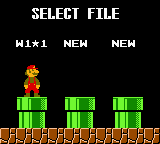
Luigi on the world map.Three save files for Original 1985.
The small-screen compromise
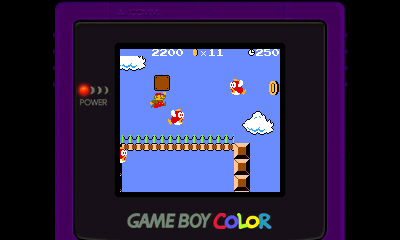
The Game Boy Color’s screen is smaller than the NES picture, so Deluxe shows a cropped window on each course; Nintendo Life’s 2014 review measured the view at about a third smaller in both directions. To help, holding up or down on the +Control Pad looks above or below Mario, and Select shifts Mario’s position on screen to show more of what is ahead. The status line is trimmed to score, coins and time, with lives and course moved to the pause screen.
It is the drawback reviews keep coming back to: enemies and pits arrive with less warning than they did on the NES.
A pre-release shot of the World 1-1 staircase.World 2-3 in the 3DS Virtual Console release.
Scores, rankings and infrared
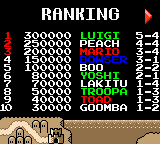
The top ten scores are kept in a Rankings table; you enter your name after a Game Over and can choose a colour for the letters. Two players can swap their records through the Game Boy Color’s infrared port and decide whether to merge the tables. Continuing after a Game Over restarts you at the course where you lost.
The Rankings table with its default names.Infrared mode for swapping records.
Game Boy Printer support
Deluxe is built for the Game Boy Printer. Album pictures can be printed, the Toy Box can turn screens into stickers, and the Mystery Room unlocks printable banners, icons and story artwork as you rescue the Mushroom Retainers. Even a fortune from the Fortune Teller can be printed. Printing is disabled in the 3DS Virtual Console release.
The Toy Box menu.
A Game Boy Color exclusive
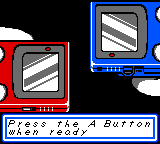
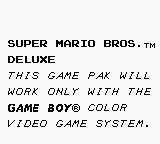
The Game Pak works only in a Game Boy Color. Put it in an original Game Boy and you get a notice telling you so instead of a game.
The notice shown on an original Game Boy.
Power-ups and objects
The items you meet across the modes, with the Game Boy Color sprites.
Super MushroomMakes Mario or Luigi Super.
Fire FlowerFireballs; in the VS Game they can hit your rival.
StarmanBrief invincibility; in the VS Game it lets you dash.
1-Up MushroomAn extra life; in Challenge mode, 2,000 points instead.
Poison MushroomFound in For Super Players; it hurts.
Red CoinChallenge mode: five per course.
Yoshi EggChallenge mode: one per course, in an invisible block.
Jumping BoardThe red springboard, with its own new sound.
Super SpringThe green springboard.
SpringboardBounces Mario upwards.
Spike TrapHurts on contact; the VS courses use plenty (the booklet calls them Spiked Blocks).
Face BlockFlips between solid and empty; in the VS Game players toggle them to trap each other.
Characters
The 1985 cast, with Yoshi and Boo joining for the new modes.
Character
Who they are
In this game
Abilities & notes
MarioHero
The plumber hero of the original.
Playable in every mode; Player 1 in the VS Game.
Small, Super and Fire forms; earns the Mario Award for beating World 8-4.
LuigiSwap with Select
Mario’s brother.
Chosen on the world map in Original 1985, and Player 2 in the VS Game.
Recoloured to match Mario’s sprite with green in place of red; Fire Luigi is a darker green.
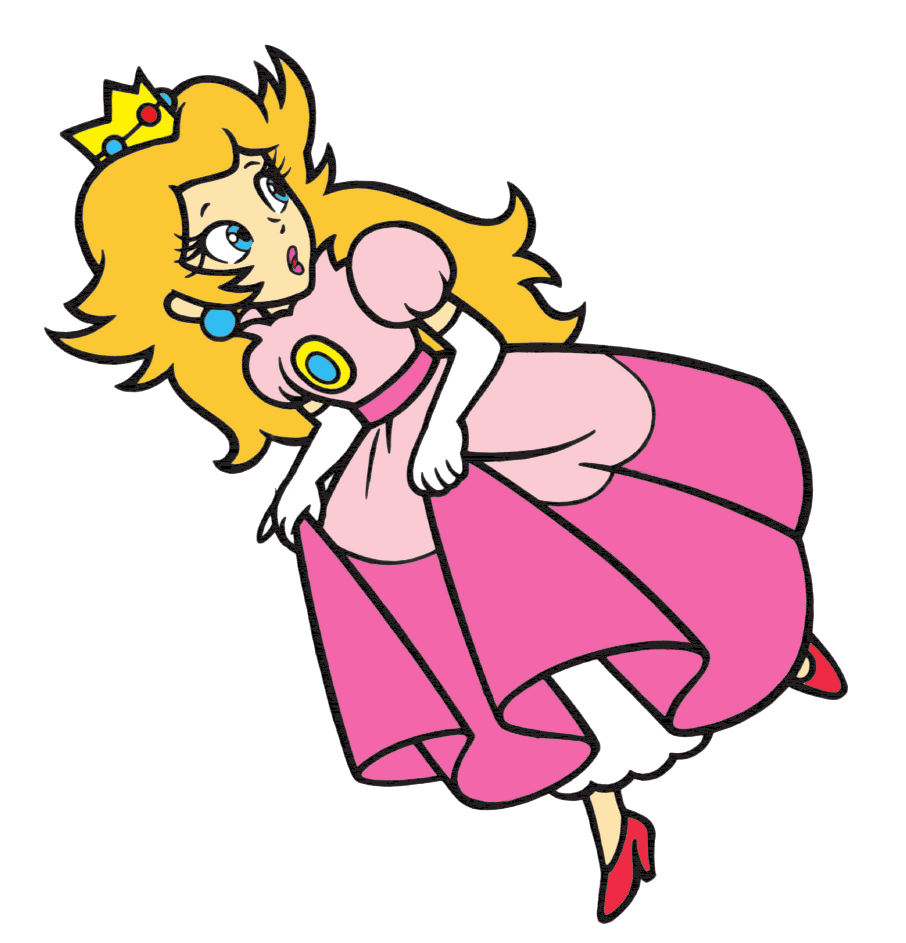
Princess ToadstoolPrincess Peach
The princess whose magic can break the Koopa spell.
Waits in the castle of World 8-4; rescuing her unlocks the title-screen editor.
New talking animation and an ending kiss.
Mushroom RetainerToad
The princess’s attendants, held in the first seven castles.
Each one rescued unlocks a Mystery Room option.
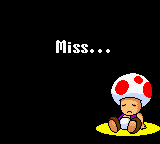
Their message gained a comma; a sad Toad appears when you fail a challenge.
BowserKing Koopa
The Koopa king who kidnapped the princess.
Fought in World 8-4; seven impostors guard the earlier castles.
Beating fake Bowsers with fireballs fills in album pictures (English versions).
YoshiNew to the game
The dinosaur from Super Mario World.
Hidden as a Yoshi Egg in every Challenge course, and the host of Yoshi Is Here!
The Yoshi Award goes to anyone who clears World 8-4 of For Super Players.
BooRacing rival
The shy ghost, here as a speed demon.
Your opponent in You VS. Boo; moves through walls.
White, then green, red and black as you beat its times. Called “Ghost” in the Japanese version.
Enemies & bosses
The original line-up, as Game Boy Color sprites and new artwork, plus the four Boos of You VS. Boo.
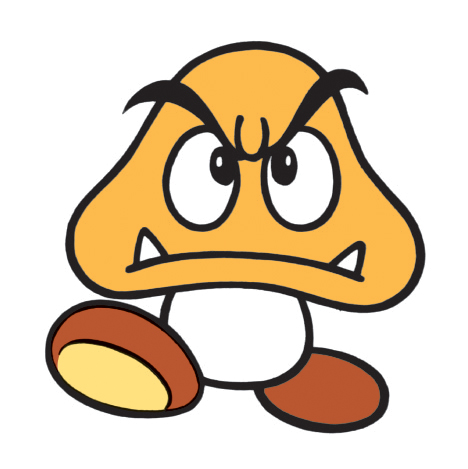
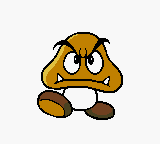
GoombaOriginal 1985Little Goomba, the first enemy you meet.
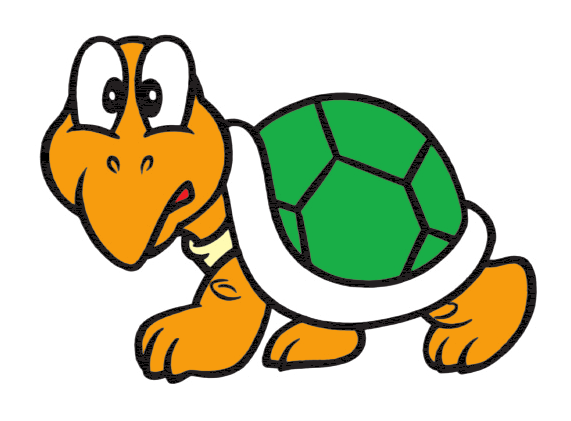
Koopa TroopaOriginal 1985Green or red; kick its shell.
Koopa ParatroopaOriginal 1985Winged Koopa.
Buzzy BeetleOriginal 1985Fireproof shell.
Piranha PlantOriginal 1985Rises from pipes.
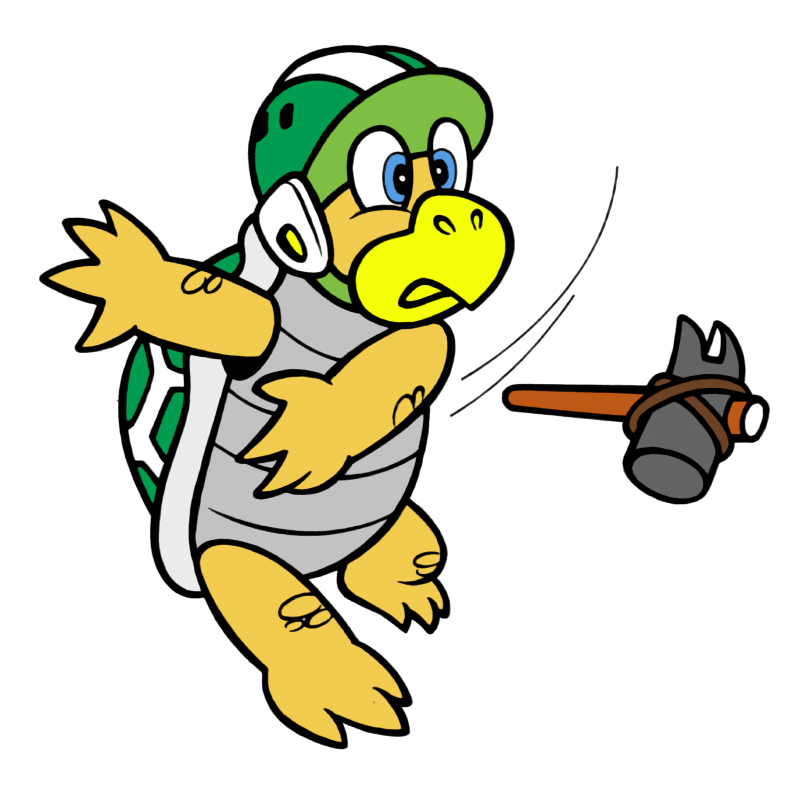
Hammer BroOriginal 1985Throws hammers in pairs.
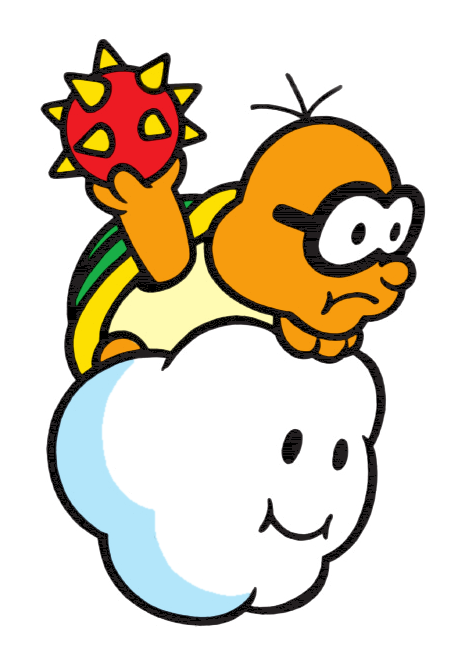
LakituOriginal 1985Drops Spiny eggs from his cloud.
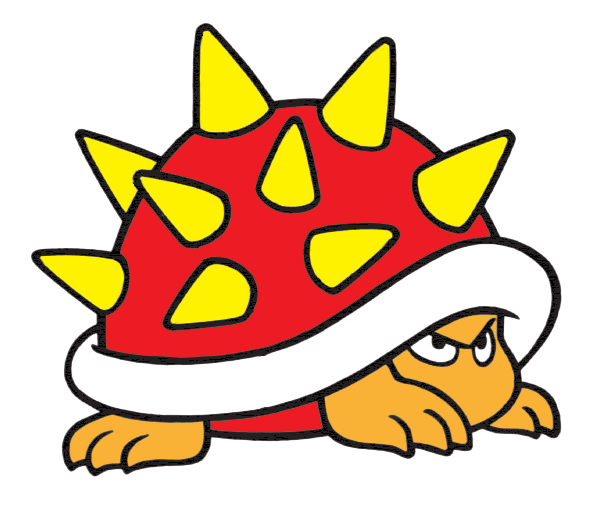
SpinyOriginal 1985Can’t be stomped; its egg has a new sound.
Cheep-cheepOriginal 1985Swims and leaps; also has a new sound.
BlooberOriginal 1985Squid of the underwater courses.
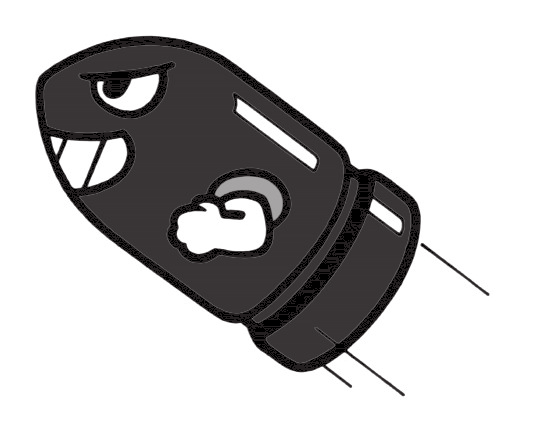
Bullet BillOriginal 1985Fired from cannons.
PodobooCastlesLeaps from the lava.
Bowser (boss)World 8-4The real King Koopa; seven fake Bowsers guard the earlier castles.
Green BooYou VS. BooFaster than the white Boo.
Red BooYou VS. BooFaster again.
Black BooYou VS. BooPaced by your own best time.
Key staff
From Wikipedia.
Toshiaki SuzukiDirectorHis first game as director (Wikipedia).
Masayuki UemuraProducer
Kazuhiko TaniguchiProducer
Shigeru Miyamoto, Takashi TezukaOriginal game design; supervisorsThe designers of the 1985 game.
Toshihiko NakagoSupervisorThe original game’s programmer.
Yuichi Ozaki, Masami YoneMusicCredited as composers by Wikipedia.
How It Was Made
A small hardware team brings the NES classic to the new colour handheld.
R&D2 takes on Mario
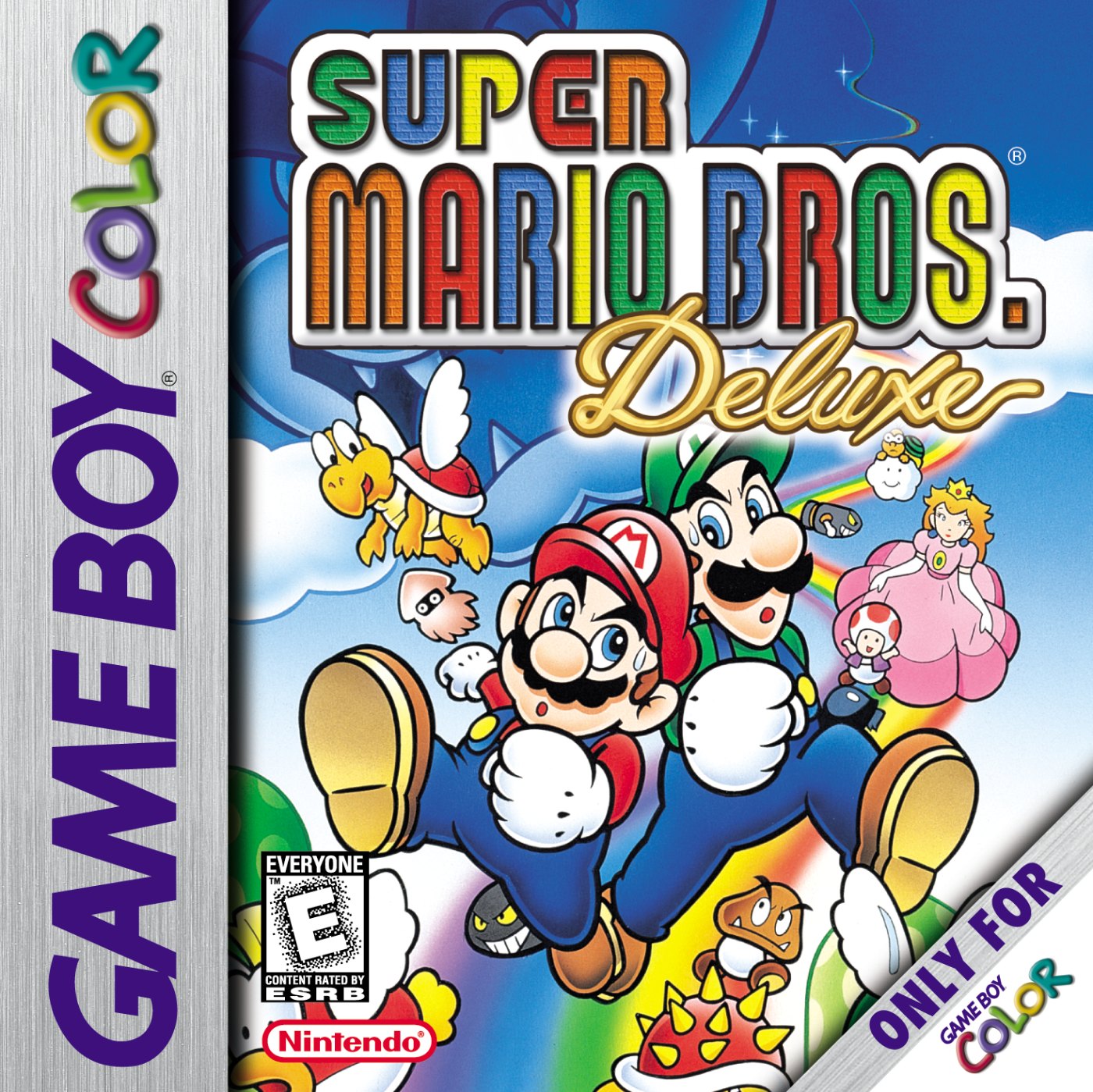
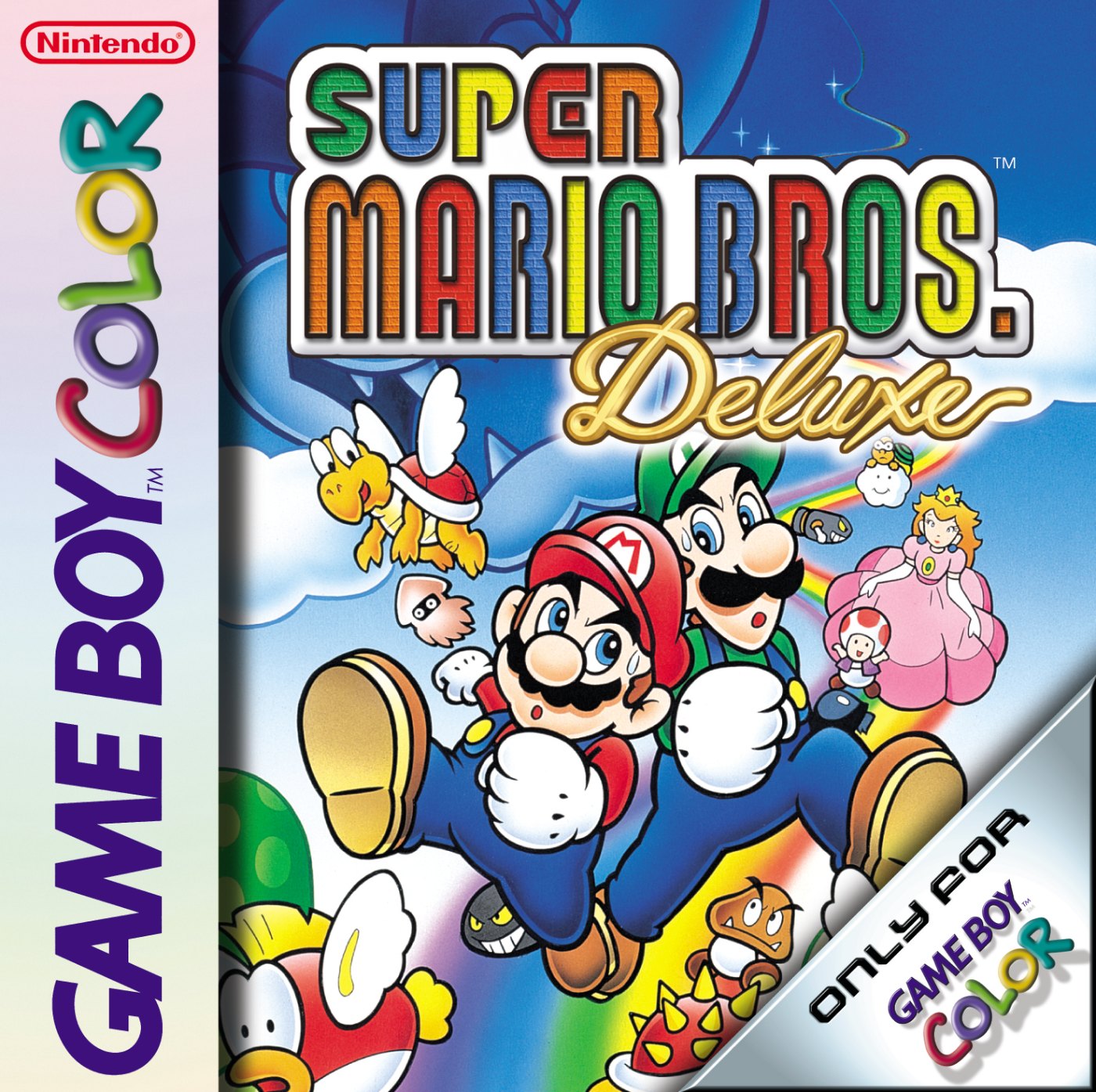
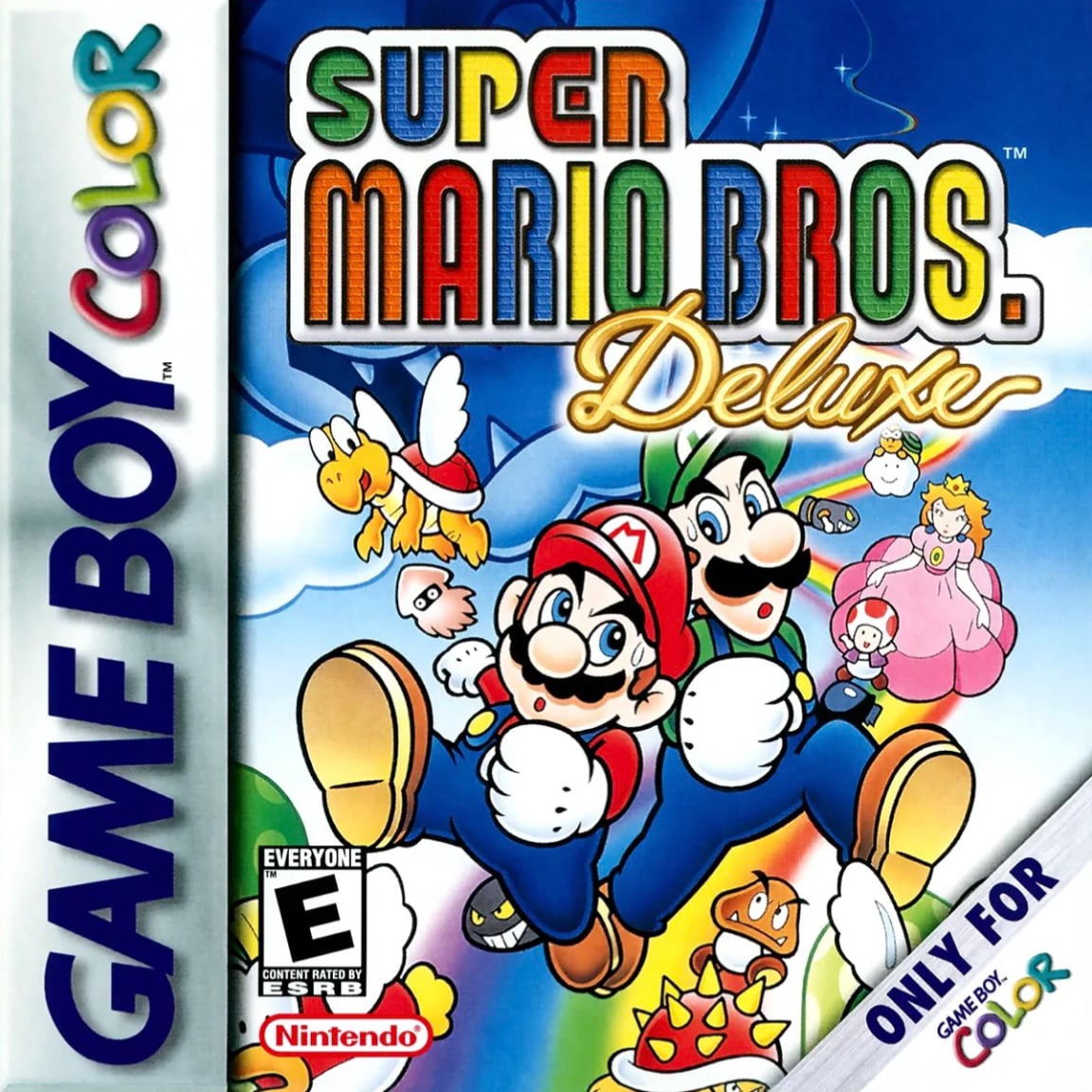
The full cover artwork.
Deluxe was made by Nintendo R&D2, which Wikipedia describes as a small team better known for hardware peripherals. It was Toshiaki Suzuki’s debut as a director. According to Wikipedia’s summary of his interviews with N-Sider and Kyoto Report, the team collaborated closely with Shigeru Miyamoto and Toshihiko Nakago, who had programmed the 1985 original, and felt little pressure because they were sure the game would be fun and would sell.
Miyamoto, Takashi Tezuka and Nakago are credited as supervisors, and the first two for the original game design.
From a one-course demo to the shelves
The North American box art shown at E3 1999.
IGN reported in 2000, as cited by Wikipedia, that a one-course prototype had been shown before the Game Boy Color itself was released. Pre-release screenshots show World 1-1 and the first fake Bowser, and a version of the North American box art shown at E3 1999 survives. The game launched in North America on 10 May 1999 and in Europe later that year.
Japan: Nintendo Power cartridges only
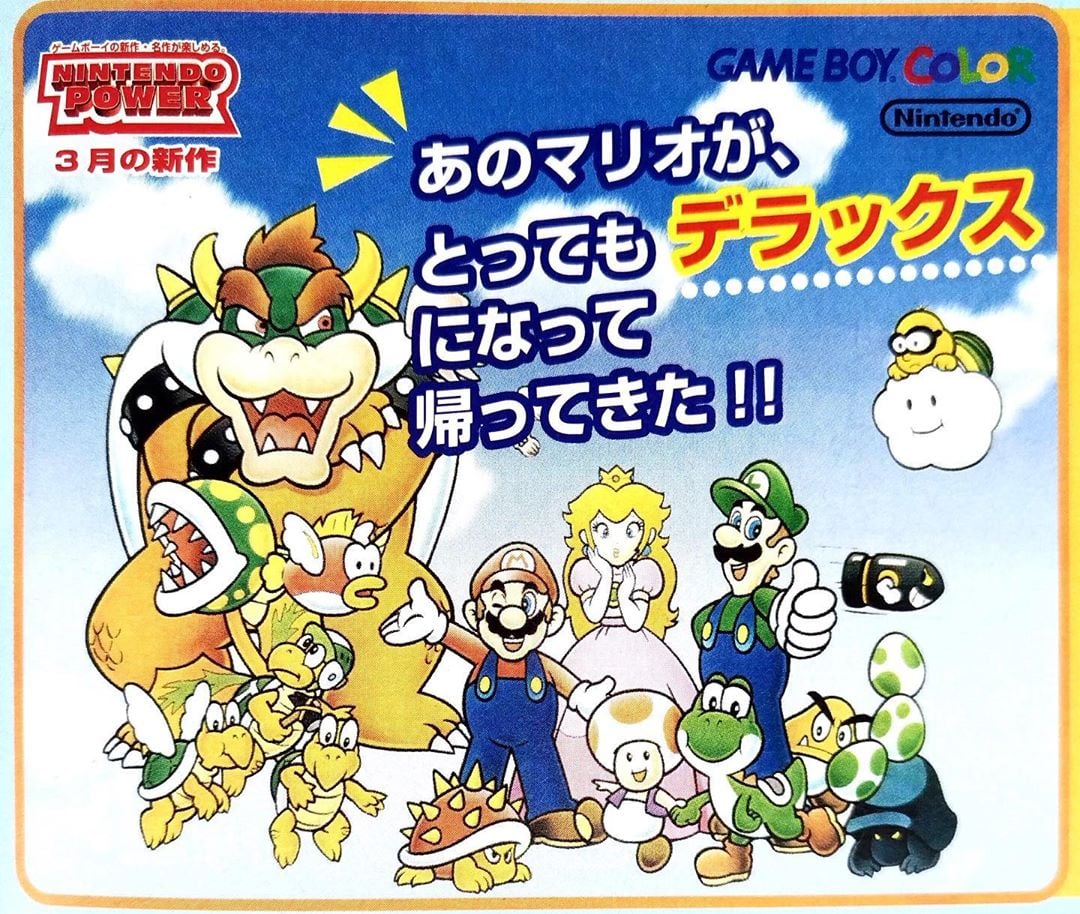
A Japanese advertisement.
Japan never got a boxed release. Instead, from 1 March 2000, players could have it written on to a rewritable Nintendo Power cartridge at a kiosk (Wikipedia names the Lawson convenience stores). The Japanese version is a revised one: some Challenge targets are lower, saves keep your score and power-up, You VS. Boo and For Super Players unlock as soon as you reach the score, and Boo is renamed Ghost.
Selling it
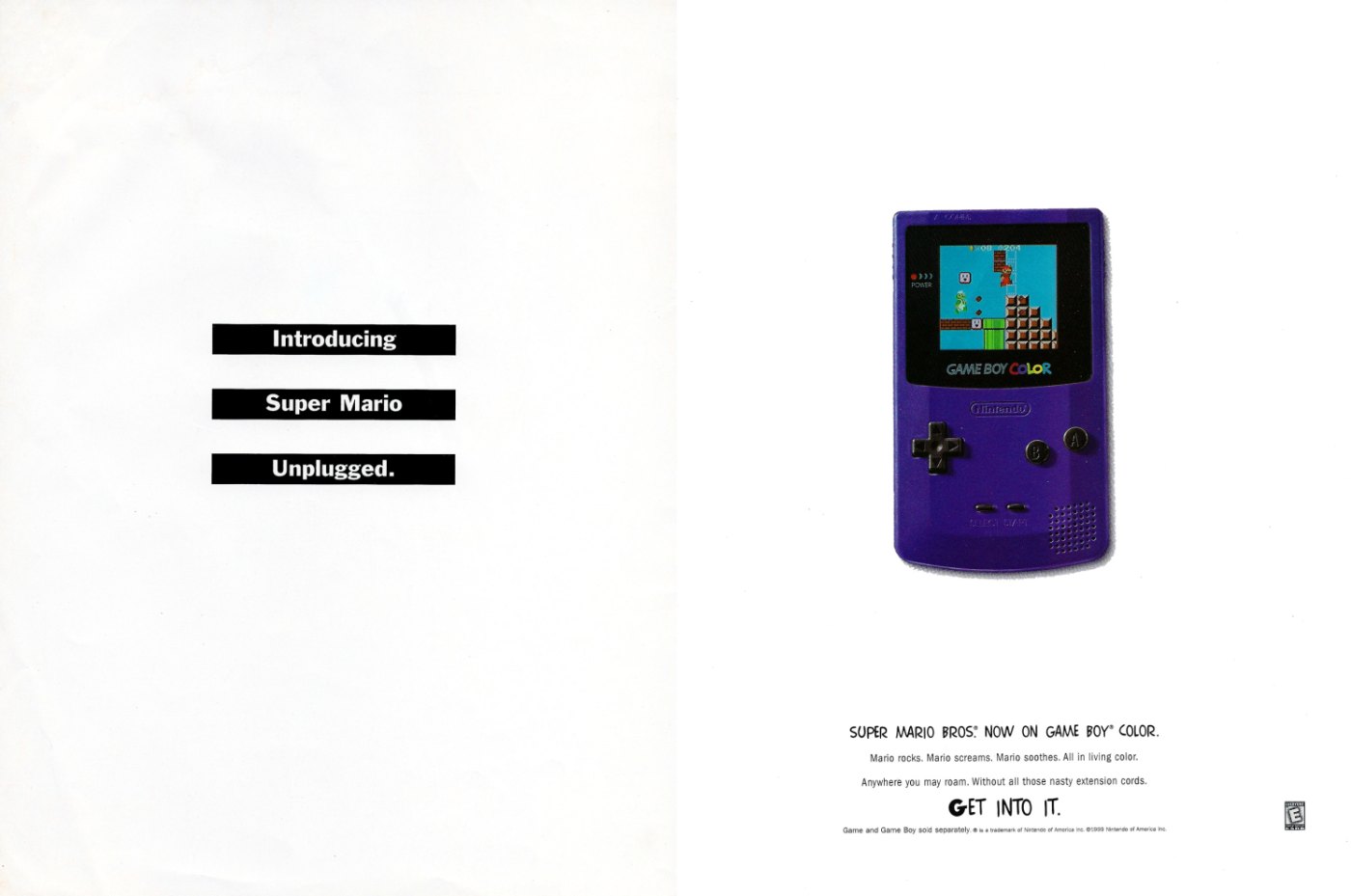
The North American print advert.
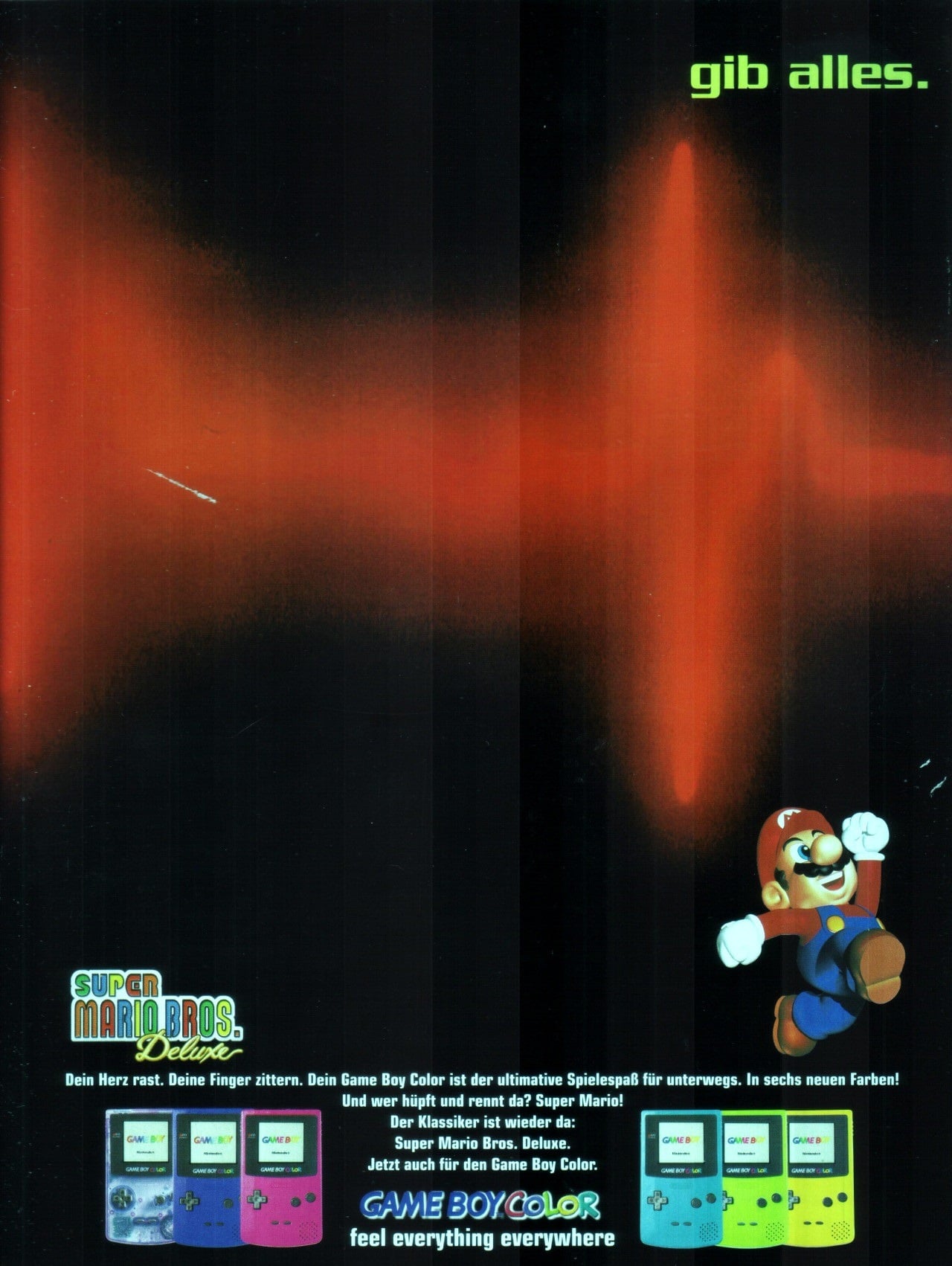
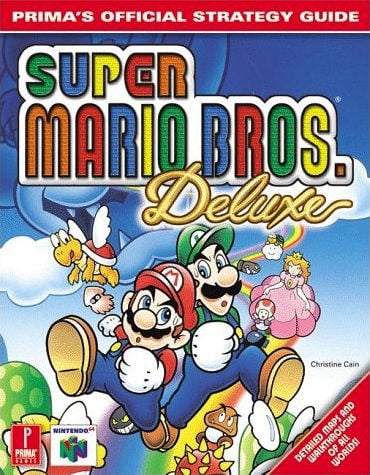
Nintendo ran print adverts in North America and Germany, and Prima Games published the official strategy guide.
Advertisement
Cheats & Secrets
How to open everything, plus a couple of codes from The Cutting Room Floor. For more, see our cheats page linked below.
Unlock You VS. Boo
Reach 100,000 points in total across Original 1985 games. In the English versions the mode appears after you next see a Game Over.
Unlock Super Mario Bros. for Super Players
Reach 300,000 points in total across Original 1985 games (again, English versions need a Game Over first).
Unlock Challenge mode
Clear a course in Original 1985 (instruction booklet).
Ten lives from the Fortune Teller
Draw Extremely Lucky in the Toy Box before starting a new file and you begin with ten lives instead of five.
Finding Yoshi Eggs
Once you have found one egg, Yoshi Is Here! appears in the Toy Box; stop its roulette with A to see a snapshot of where a course’s egg is hidden.
The five Awards
Mario Award: beat World 8-4. Bowser Award: finish the second quest. Peach Award: every red coin, Yoshi Egg and High Score Medal in Challenge mode. Toad Award: fill the Challenge score bar (1,160,000). Yoshi Award: beat World 8-4 of For Super Players.
Erase everything
Hold Select while pressing A on the file screen to delete all saved data.
GameShark: hidden level select
The Cutting Room Floor documents an unused level select that can load every course, including unused ones, with the code 0131B5FF; you start with no lives.
Some unlocks differ in the Japanese version, which needs no Game Over.
Glitches & Oddities
Deluxe fixed most of the NES game’s bugs, but not all of them.
No more Minus World
The Minus World glitch was fixed, along with many other original glitches.
Wall clipping still works
The trick of clipping into the wall at a course’s scroll-stop point survived the port.
Small Fire Mario, Japanese edition
The Small Fire Mario glitch was fixed in the English versions but returns in the Japanese version by a different route, through saving and loading.
Unobtainable pictures on 3DS
On the 3DS Virtual Console, which has no link-up, two album pictures cannot be earned without hacking.
Videos
Two trailers for the 2014 Nintendo 3DS Virtual Console release.
Official upload by Nintendo UK
Nintendo’s North American trailer, uploaded by NintendoEverything (third-party upload)
Trivia & Interesting Facts
Three dates are pre-set on the Calendar: the days Super Mario Bros., the Family Computer and the Game Boy launched in Japan.
In the Japanese version the default Rankings names use the Japanese enemy names: KOOPA, TERESA, JUGEMU, NOKO2, PAKKUN and KURIBO instead of BOWSER, BOO, LAKITU, TROOPA, TOAD and GOOMBA.
Mario’s Memory.The Album is called “Mario’s Memory”.
The life counter tops out at 127, one fewer than in Super Mario All-Stars.
The Mushroom Retainers’ famous message gained a comma after “you”.
Worlds 9 and A to D of For Super Players are in the cartridge in various unfinished states, and an unused test course sits between World 8-4 and the 1-2 bonus area, with a red coin that cannot be collected normally (The Cutting Room Floor).
The first ground tile in the graphics data is the Lost Levels version, and an early design of the “Extremely Lucky” card still shows up if you print that fortune (The Cutting Room Floor).
A release on LodgeNet is also listed, alongside the Game Boy Color and 3DS versions.
Japanese 3DS owners got the Virtual Console release first, as a free download promotion from 27 January 2014; Europe followed with its own promotion before it went on sale.
A sad Mushroom Retainer.The Fortune Teller has five fortunes, from Extremely Lucky to Extremely Unlucky, but only one of them does anything.
The VS Game is the one mode missing from the 3DS release, which removes the Fortune Teller’s link-up text and disables printing as well.
The Japanese version’s jumps are slightly higher (The Cutting Room Floor).
Regional Box Art
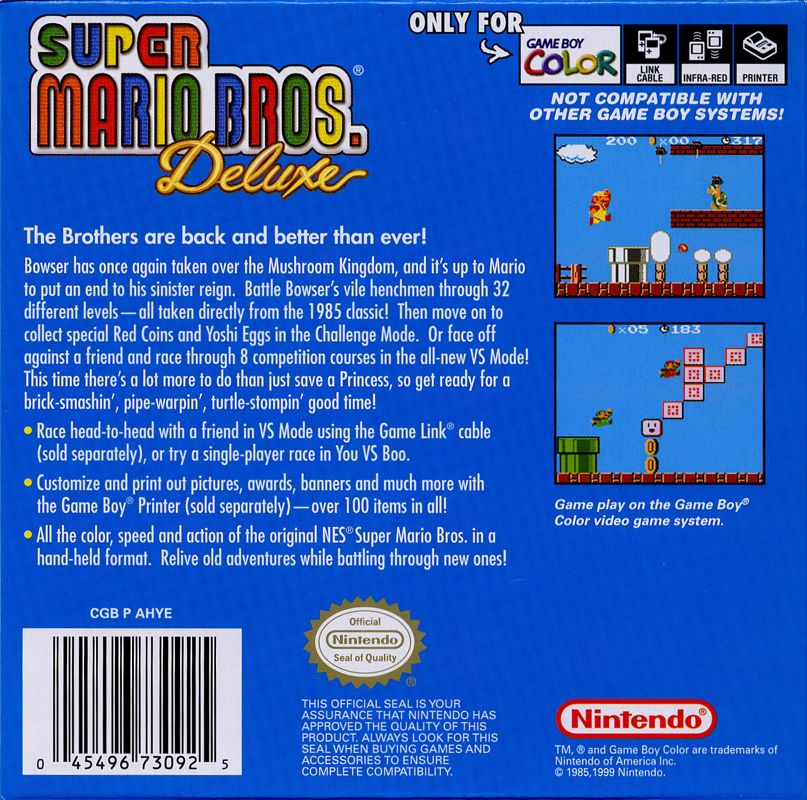
Box art from each region, plus the cartridge.
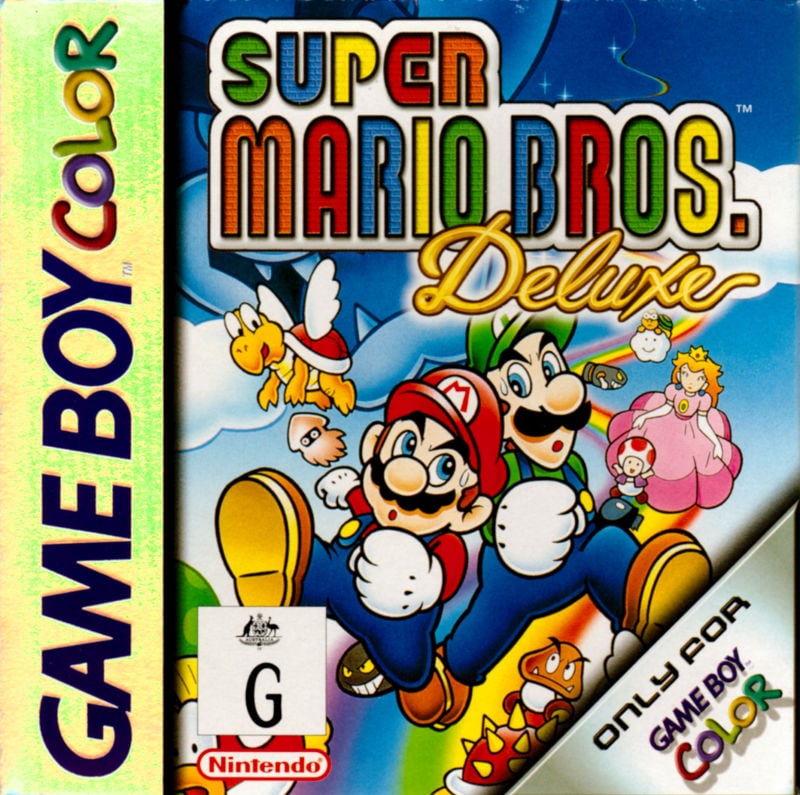
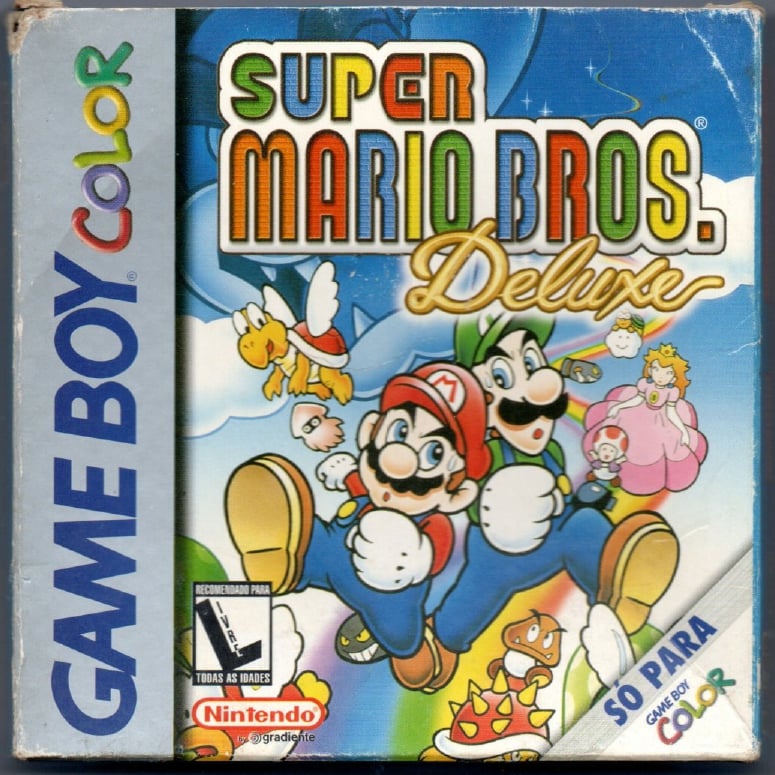
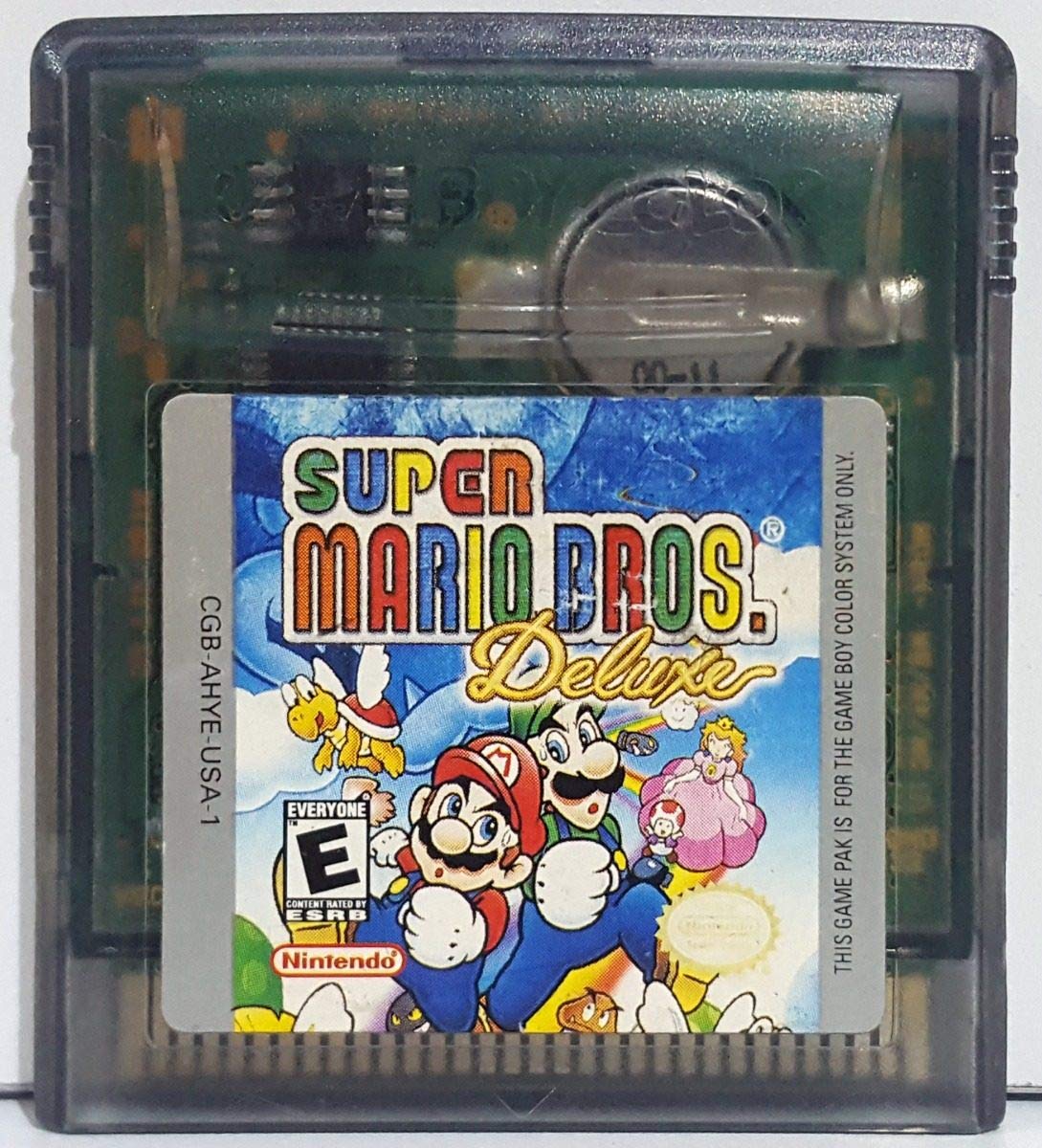
North AmericaNorth America (back)North America (E3 1999 version)EuropeAustralasiaBrazilNorth American Game Pak
Screenshots
More from the Game Boy Color version.
A bonus-point reward in Challenge mode.Toad on the Challenge failure screen.A rescued Yoshi in the Japanese version.The Mario Award.The Bowser Award.The Toad Award.
Artwork & Media Gallery
Official artwork drawn for the Game Boy Color release.
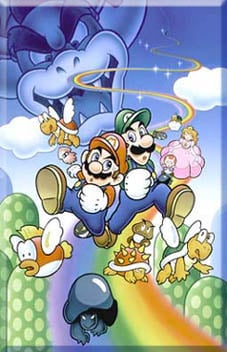
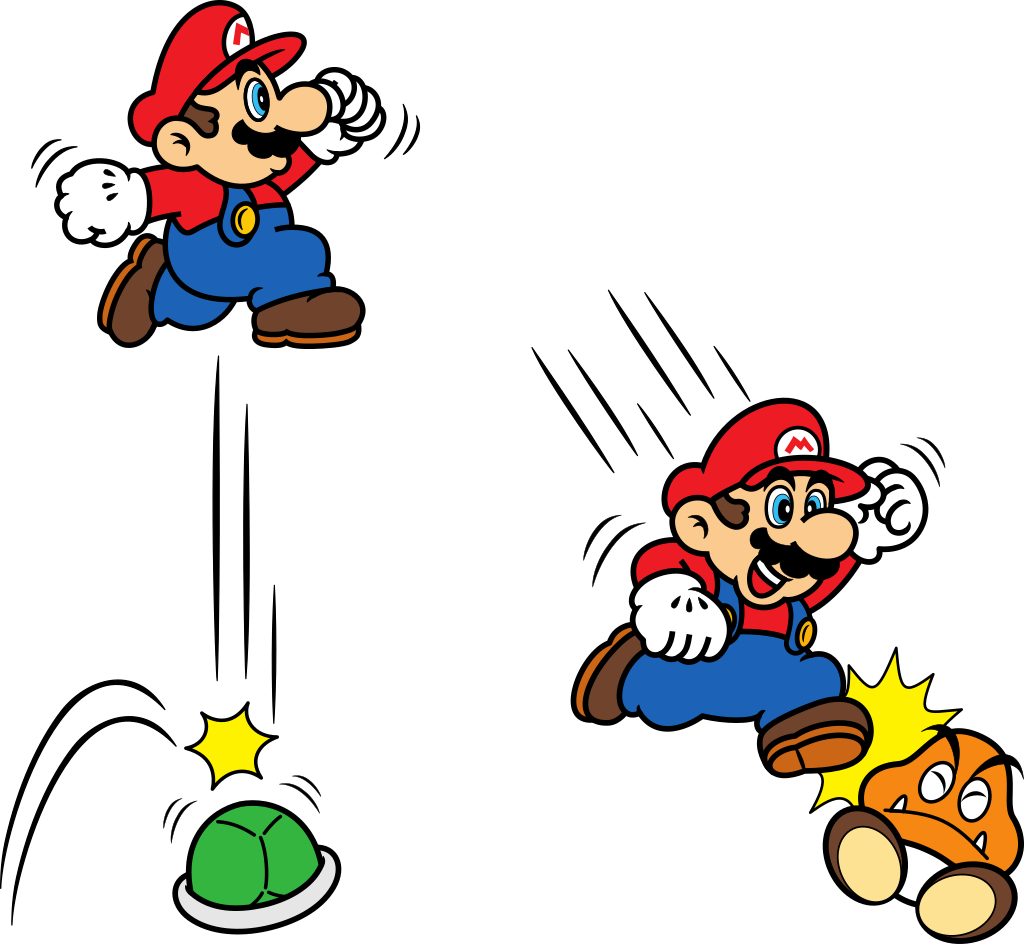
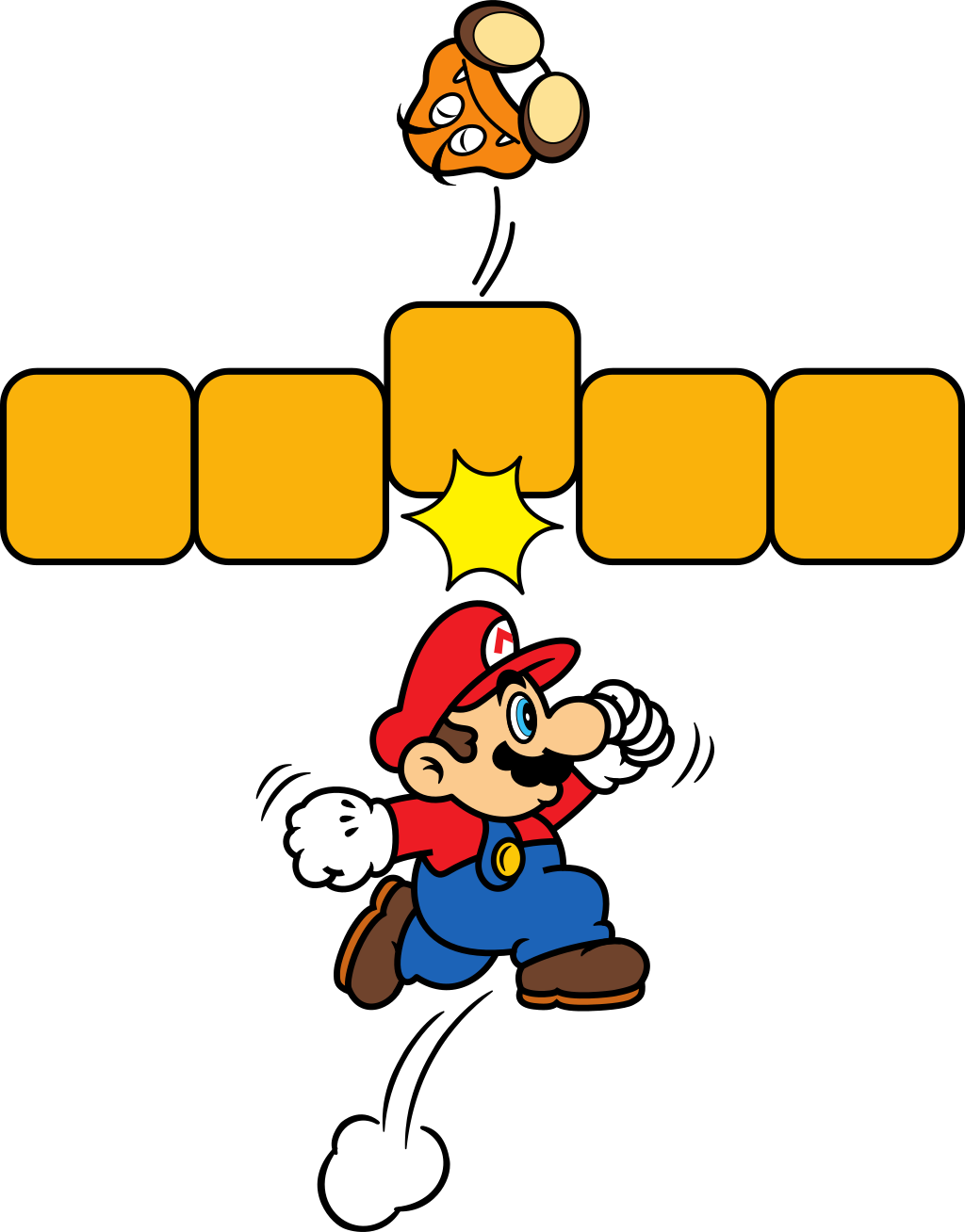
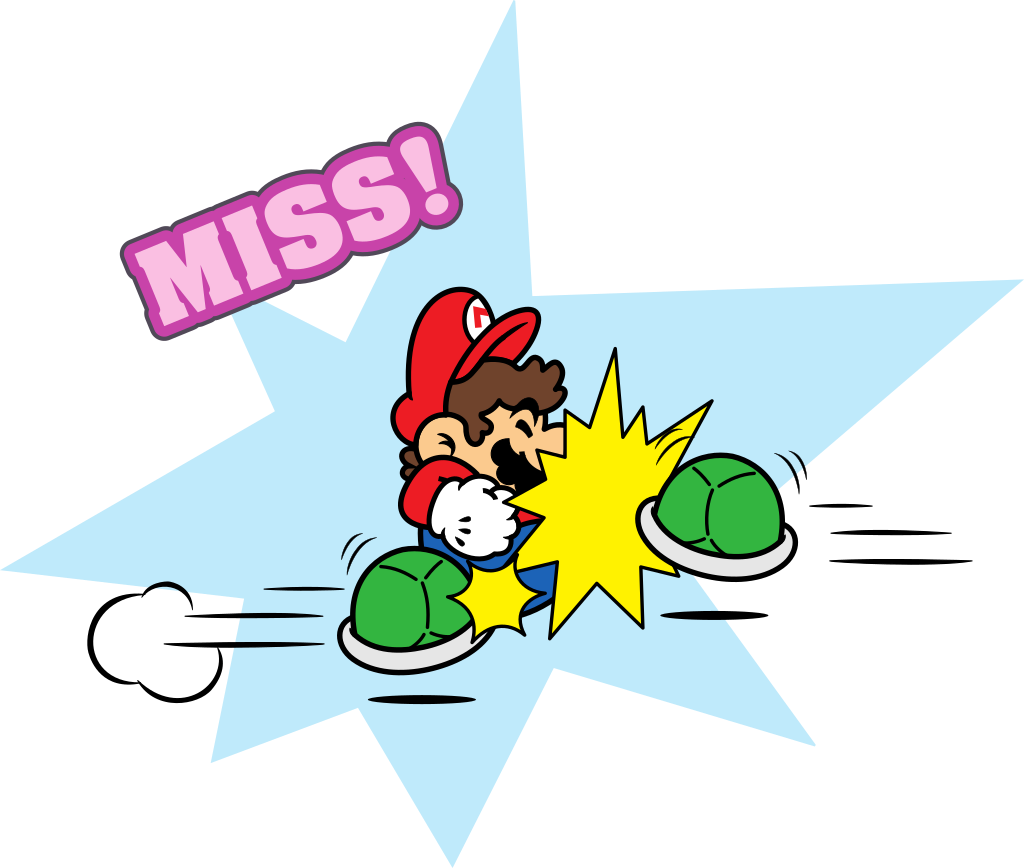
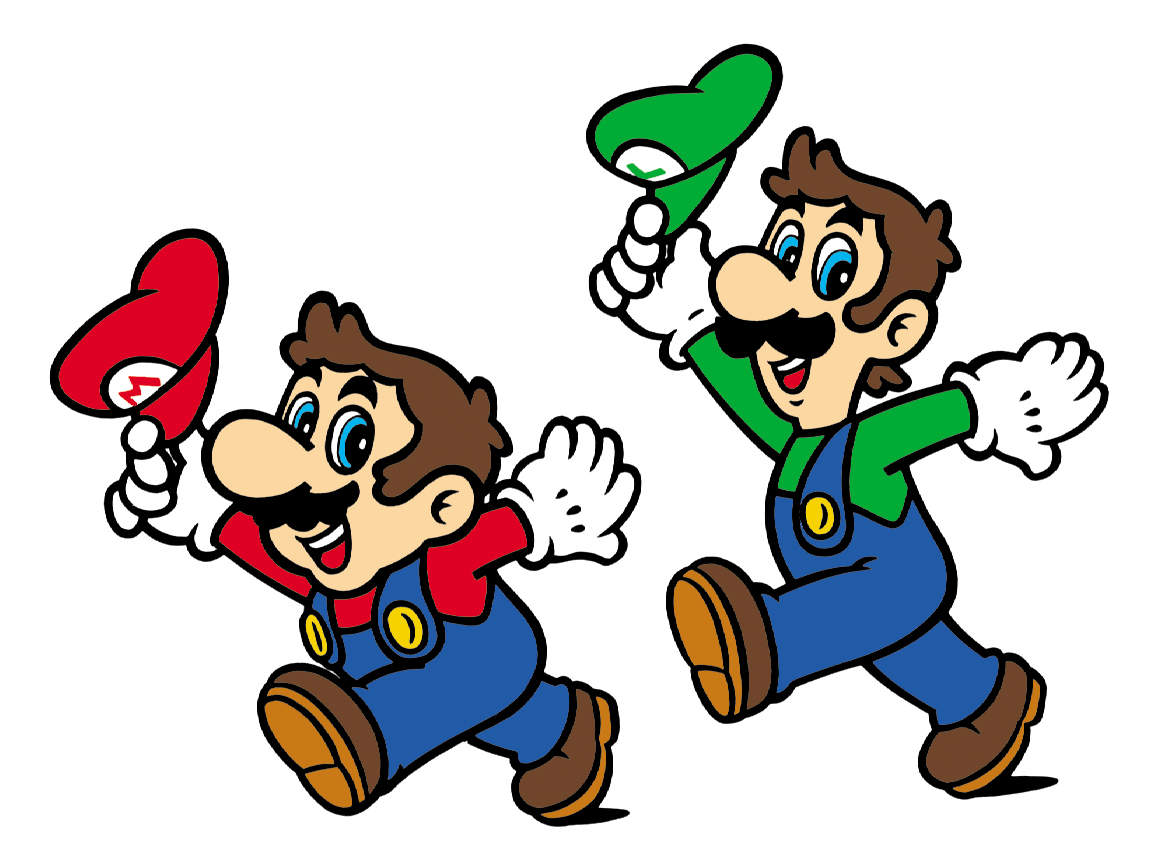
Super Mario.Fiery Mario.Invincible Mario.Mario stomping enemies.Mario punching a block.Mario kicking a shell.Mario knocked out by shells.Mario and Luigi.Mario, Luigi and a Koopa Paratroopa.The German print advert.Prima’s official guide.Album: the Fireworks picture.Album: the Vine picture.Album: the Goomba picture.Album: the Bowser picture.Small Mario sprite.Fire Luigi sprite.Princess Peach sprite.Toad sprite.Yoshi sprite.
Legacy & Re-releases
From the Game Boy Color to the 3DS, and why it is hard to buy today.
Releases and re-releases
Game Boy Color10 May 1999North America.
Game Boy Color1 July 1999Europe (according to some sources; Wikipedia gives December 1999 for the UK).
Nintendo Power (Japan)1 March 2000Written to rewritable cartridges at kiosks; no boxed release.
3DS Virtual Console27 January 2014Japan, as a free promotional download.
3DS Virtual Console27 February 2014Europe, on sale (Nintendo UK).
3DS Virtual Console25 December 2014North America.
3DS eShop closes27 March 2023No more purchases on Nintendo 3DS.
Where to play it now
With the 3DS eShop closed, the cartridge and existing 3DS downloads are the ways to play. It has not joined the Game Boy library of Nintendo Switch Online. The original Super Mario Bros. and The Lost Levels are both much easier to find.
Its place in the series
It sits between the 16-bit Super Mario All-Stars remake of 1993 and the Classic NES Series release on Game Boy Advance. More Mario games are on our games list.
Reviews & Sales
Sales
Nintendo has not published a sales figure for Deluxe. Wikipedia, citing NPD, lists it as the 12th-best-selling American game of 1999 on any platform and 14th in 2000, and cites IGN for its peak of third on the weekly handheld chart in June 1999.
Two often-quoted totals come from unofficial compilations, not from Nintendo: about 2.8 million in the United States (The Magic Box’s US Platinum Chart, archived 2004) and about 5.07 million worldwide as of December 2014 (an Install Base forum compilation, 2021).
12thbest-selling US game of 1999 (NPD, via Wikipedia)
14thbest-selling US game of 2000 (NPD, via Wikipedia)
2.8mUS, unofficial (The Magic Box)
5.07mworldwide to Dec 2014, unofficial (Install Base)
Reviews
Game Boy Color scores from Wikipedia’s review table; the last two are reviews of the 2014 3DS release.
IGNCraig Harris, 1999
10/10
GameSpotCameron Davis
9.9/10
Electronic Gaming MonthlyFour reviewers
9.5, 8.5, 8.5, 8.5
Game InformerGBC
9.25/10
AllGameGBC
4.5/5
Computer and Video GamesGBC
4/5
GameRankingsGBC aggregate
92%
Nintendo World Report3DS Virtual Console
9/10
Nintendo LifeMarcel van Duyn, 3DS VC, 7 March 2014
6/10
In 1999 the reviews were close to unanimous. IGN’s Craig Harris gave it a perfect score and called it the Game Boy Color game to own; GameSpot’s Cameron Davis named it the machine’s killer app. The extras were what lifted it above a straight port, and the smaller view was the usual reservation.
Fifteen years later the view looked worse. Reviewing the 3DS release, Nintendo Life’s Marcel van Duyn praised the bug fixes, the map and the bonus modes but found the cropped screen made pits and enemies hard to react to and missed Worlds 9 to D of The Lost Levels; his advice to newcomers was that “the already available original NES version is probably the smarter option.” Retrospectives have been kinder, with Retro Gamer, Nintendo Life and Digital Trends all placing it high among the best Game Boy Color games (as listed by Wikipedia).
SLB User Reviews
Super Mario Bros. Deluxe has yet to receive a community review on Super Luigi Bros.
If you’ve played Super Mario Bros. Deluxe and would like to submit a review, please get in touch.
More from the Super Luigi Bros Guide
These picture lists come from the earlier Super Luigi Bros guide to Super Mario Bros. Deluxe and are kept here in full.
Game Modes
Original 1985
This game mode will be the first you will play, and is almost exactly like the original 1985 version of Super Mario Bros. The play through still has the same four levels for each world, and there are still eight worlds in the game. One convenient feature in this version is you can save your progress or quit the game by pressing the start button.
Differences Between Super Mario Bros. and the Port
Peach kissing Mario
A lot of the fun glitches like World -1 and Small Fire Mario have been removed from the game.
You can save the game whenever you please.
The Lava and Water are now animated.
You can now switch between Mario and Luigi whenever you want by pressing select on the overworld.
There is now a world map that you can view for each world to show your progress.
Players start the game with five lives at their disposal, instead of three lives. You can also start with ten lives instead of five with the Fortune Teller.
You have a smaller screen, which doesn’t show all of the level. They did allow you to move the camera back a little by pressing up and down on the control pad.
Toad’s dialogue has been corrected to “Thank you, Mario!” (adding the comma after “you”).
Toad and Princess Toadstool now have animations showing them “talking”.
When you save Peach in the last castle levels, she thanks her hero and gives him a kiss.
Luigi’s sprites have been remastered. In the NES version, Luigi was wearing white overalls and a green shirt, but the Fire Luigi looked exactly like the Fire Mario sprite. To remedy this Luigi’s sprites were changed. In Super Mario Bros. Deluxe, Luigi wears green overalls with a brown shirt, and Fire Luigi wears the normal green shirt and white overalls.
A lot of new sound effects were added to the game that were not in the NES version. The most noticeable one is on the castle levels, a specific sound effect will be played depending on if you take the right or wrong path.
Challenge mode, finding the hidden Yoshi egg
Challenge
This game type that allows you to go back to all 32 levels of the game, but this time special items called “Yoshi Eggs” and “Red Coins” were added to each level that must be collected. Scores in this game mode greatly differ based on how well you perform in the challenges. Each stage contains one Yoshi Egg and Five Red Coins.
Super Mario Bros. For Super Players
Super Mario Bros. For Super Players, is a port of Super Mario Bros.: The Lost Levels, and is unlocked after you collect a total of 300,000 points in Original 1985 mode. The port is not exactly like the original game, and some noticeable changes have been made. The wind was removed from the game, which made some of those crazy impossible jumps actually doable. Strangely enough, they also left Worlds eight through D unused.
Versus Mode
This game mode is very similar to You vs. Boo. In order to play you have to have two Game Boy colors linked together. You both will then face off in an epic head to head race on a particular level. The levels you will face off on are exactly like the levels you play in You vs. Boo mode. There are only two differences you will notice between You vs. Boo and Versus game modes.
Highscores “mode” screenshot
Obviously, Boo is not in any of the levels.
You can mess with the other player by rearranging blocks, adding to the fun.
High Scores
Honestly, this is not so much of a game mode as it is bragging rights. You can hook up your Game Boy Color to another and view each other’s high scores on specific game modes and levels.
You vs. Boo
Once you have collected a total of 100,000 points in Original 1985 mode, you will automatically unlock You vs. Boo mode. The gameplay is extremely similar to Versus mode, but this time you have to race off against a Boo. At the start of the race, you get the choice to play as Fire Mario or Super Mario by pressing select. In this game mode, Boo is a little bit of a cheat, he can pass through all obstacles without slowing down at all.
Toy Box
The Toy Box mode has a lot of fun features containing different toys for the player to use. Most of the Toy Box features must be unlocked through gameplay.
Fortune Teller screenshot
Fortune Teller
You can visit the Fortune Teller mode without having to unlock it, and is available at the start of the game. Players can choose a random card that will reveal your fortune. There are five different fortunes you can get from the Fortune Teller: Extremely Unlucky, Unlucky, Lucky, Very Lucky, and the best of the bunch Extremely Lucky. The Extremely Lucky fortune is the only one that actually does anything to you, and it gives you 10 lives to start the game instead of five.
Mystery Room
The Mystery Room (or better known as the “? Room”) rewards you with unlockables when you rescue the captive friends at the end of each world in Original 1985 mode. These include :-
World 1-4 Toad: Allows you to print certain banners on the Game Boy Printer.
World 2-4 Toad: Plays some animations.
World 3-4 Toad: Allows you to print certain banners on the Game Boy Printer.
World 4-4 Toad: Plays some animations.
World 5-4 Toad: Allows you to print various graphics on the Game Boy Printer
World 6-4 Toad: Players are shown a game mode that allows them to create a sort of story.
World 7-4 Toad: Allows you to print certain banners on the Game Boy Printer.
Princess Peach: This unlocks a cool feature that allows you to edit the image, text shown and the music played on the title screen.
Some of the printables you could unlock included things like the reward medals that you can see below but there was also a selection of printable banners, icons and other art. Check them all out in the Gallery.
Mario reward medalBowser reward medalYoshi reward medalPrincess Peach reward medalToad reward medal
To provide the best experiences, we use technologies like cookies to store and/or access device information. Consenting to these technologies will allow us to process data such as browsing behavior or unique IDs on this site. Not consenting or withdrawing consent, may adversely affect certain features and functions.
Functional
Always active
The technical storage or access is strictly necessary for the legitimate purpose of enabling the use of a specific service explicitly requested by the subscriber or user, or for the sole purpose of carrying out the transmission of a communication over an electronic communications network.
Preferences
The technical storage or access is necessary for the legitimate purpose of storing preferences that are not requested by the subscriber or user.
Statistics
The technical storage or access that is used exclusively for statistical purposes.The technical storage or access that is used exclusively for anonymous statistical purposes. Without a subpoena, voluntary compliance on the part of your Internet Service Provider, or additional records from a third party, information stored or retrieved for this purpose alone cannot usually be used to identify you.
Marketing
The technical storage or access is required to create user profiles to send advertising, or to track the user on a website or across several websites for similar marketing purposes.






 World 2Original 1985 · courses 2-1 to 2-4The 2-4 rescue unlocks animations.
 World 8Original 1985 · courses 8-1 to 8-4Beat the real Bowser for the Mario Award; Peach unlocks the title-screen editor.
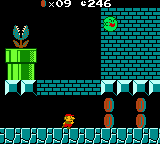 VS course 1-2UndergroundEchoes World 1-2, down to a fake Warp Zone.
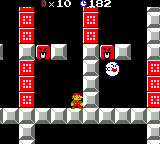 VS course 1-4CastleBuilt from 1-4 and 3-4, without Fire-Bars or Podoboos.
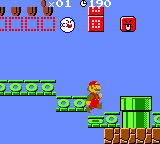 VS course 2-1OvergroundRegular running plus trampoline floors.
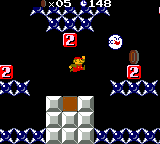 VS course 2-4CastleClusters of spiked blocks and a middle section of blocks.
 Super MushroomMakes Mario or Luigi Super.
 Fire FlowerFireballs; in the VS Game they can hit your rival.
 1-Up MushroomAn extra life; in Challenge mode, 2,000 points instead.
 Poison MushroomFound in For Super Players; it hurts.
 Red CoinChallenge mode: five per course.
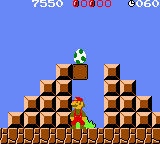 Yoshi EggChallenge mode: one per course, in an invisible block.
 Jumping BoardThe red springboard, with its own new sound.
 Super SpringThe green springboard.
 SpringboardBounces Mario upwards.
 Spike TrapHurts on contact; the VS courses use plenty (the booklet calls them Spiked Blocks).
 Face BlockFlips between solid and empty; in the VS Game players toggle them to trap each other.
 MarioHero
 LuigiSwap with Select
 Princess ToadstoolPrincess Peach
 Mushroom RetainerToad
 BowserKing Koopa
 YoshiNew to the game
 BooRacing rival
 GoombaOriginal 1985Little Goomba, the first enemy you meet.
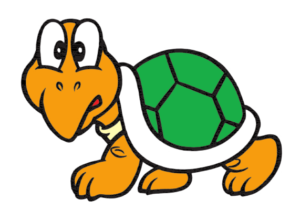 Koopa TroopaOriginal 1985Green or red; kick its shell.
 Koopa ParatroopaOriginal 1985Winged Koopa.
 Buzzy BeetleOriginal 1985Fireproof shell.
 Piranha PlantOriginal 1985Rises from pipes.
 Hammer BroOriginal 1985Throws hammers in pairs.
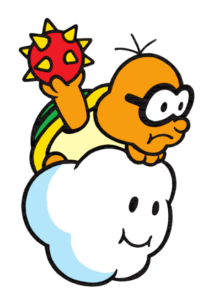 LakituOriginal 1985Drops Spiny eggs from his cloud.
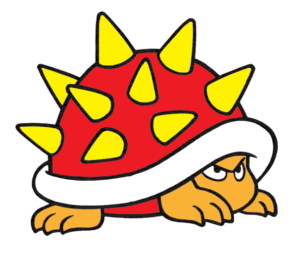 SpinyOriginal 1985Can’t be stomped; its egg has a new sound.
 Cheep-cheepOriginal 1985Swims and leaps; also has a new sound.
 BlooberOriginal 1985Squid of the underwater courses.
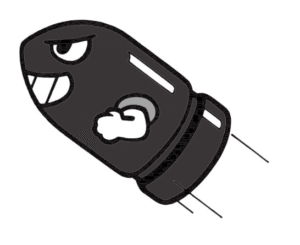 Bullet BillOriginal 1985Fired from cannons.
 PodobooCastlesLeaps from the lava.
 Bowser (boss)World 8-4The real King Koopa; seven fake Bowsers guard the earlier castles.
 Green BooYou VS. BooFaster than the white Boo.
 Red BooYou VS. BooFaster again.
 Black BooYou VS. BooPaced by your own best time.