
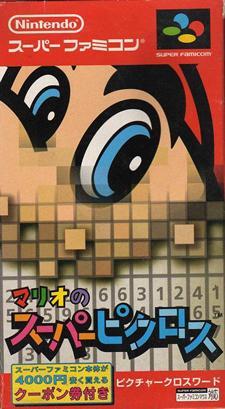

Mario’s Super Picross
Mario no Super Picross — the ultimate nonogram puzzler
Overview
Mario’s Super Picross (マリオのスーパーピクロス) is a logic puzzle game for the Super Nintendo, developed by Jupiter and published by Nintendo. It is the sequel to Mario’s Picross on the Game Boy, and the second game in the Picross series. Released in Japan on 14 September 1995, it was never officially released outside Japan — making it one of Nintendo’s more elusive SNES titles for Western fans.
The game is compatible with the SNES Mouse, allowing players to solve puzzles by clicking rather than using the d-pad. After the poor commercial performance of Mario’s Picross internationally, Nintendo kept this sequel as a Japan-exclusive — but its quality and depth have made it a cult classic among puzzle game enthusiasts worldwide.

Official artwork — Mario and Wario both feature as playable puzzle hosts
The game features two distinct puzzle hosts with different rulesets — Mario hosts the standard mode with a time limit and error indicators, while Wario hosts an advanced mode with no time limit and no error feedback whatsoever. Wario’s mode is considered the purer Picross experience and is where expert players spend most of their time.
Unusually for the era, the game was later brought to Western audiences digitally — first on the Wii Virtual Console in Europe (2007) and North America (2012), and later as part of Nintendo Switch Online’s Super Nintendo library.
What is Picross?
Picross (short for “Picture Crossword”) is a logic puzzle format — also known internationally as nonograms or griddlers. The goal is to reveal a hidden pixel picture by filling in the correct squares on a grid, using number clues along each row and column as your only guide.
Each number in a clue tells you how many consecutive filled squares appear in that row or column. If a row has “5”, there are five filled squares together somewhere in that row. If it shows “2 3”, there’s a group of 2 and then a group of 3 — with at least one blank gap between them — somewhere along the row. The trick is working out exactly where each group sits using logic and deduction.
Example: reading a clue
Row clue: 3 1 2
This means: somewhere in this row there are three filled squares, then a gap, then one filled square, then a gap, then two filled squares — in exactly that order.
You use the other rows’ and columns’ clues to narrow down exactly where each group sits.
You can also mark squares with an X to note that you’re sure they should be empty — this helps track your deductions. In Mario’s Super Picross, marking squares correctly as done is a new feature introduced in this sequel, helping manage larger and more complex puzzles.

Solving a 10×10 puzzle — number clues line the top and left edges
Gameplay
Mario’s Super Picross contains 300 puzzles across two game modes. Puzzles vary in grid size — from compact 5×5 starters through to challenging 15×15 and 20×20 grids. Each completed puzzle reveals a pixel-art picture, with the image’s subject identified by name once solved.
The game introduces a new mechanic versus the original Mario’s Picross: players can mark a clue number as “done” once they’ve fully placed that group, helping track progress across complex larger grids. You can also use the SNES Mouse to click squares rather than navigating the grid with the d-pad — a natural fit for a puzzle game of this type.
All 300 puzzle solutions — complete video walkthrough
The video below is a complete playthrough of all 300 puzzles in Mario’s Super Picross — an invaluable reference if you’re stuck on a specific puzzle or want to see the full picture revealed for any stage:
Mario mode vs Wario mode
The two game modes offer fundamentally different puzzle-solving experiences — choose based on your skill level and preferred style:


Wario hosts his own unique puzzle mode — harder, purer, no hand-holding
High-res mode: The game also features a high-resolution display mode for sharper puzzle grids on compatible SNES setups.

High-resolution display mode
Puzzle list — Mario’s mode
Mario’s mode contains 120 standard puzzles across 10 levels (with Level 1 including 8 Japanese kana character puzzles as an intro), plus bonus puzzles. Completed puzzles reveal pixel-art pictures named after their subject:
| Level | Puzzles |
|---|---|
| Level 1 | マ(ma) リ(ri) オ(o) の(no) ピ(pi) ク(ku) ロ(ro) ス(su) · Big Dipper · Sail Boat · Penguin · Mermaid |
| Level 2 | Glasses · Dolphin · Angel Fish · Northern Fox · Post Box · Floppy Disk · Great South Gate · Key · Rocket · Clock · American Football Helmet · Slot Machine |
| Level 3 | Magnet · Satellite Dish · Ruler · Electrical Outlet · Onigiri · Kokeshi Dolls · Bottle Opener · Australia · Sewing Machine · Flask · Medal · Ambulance |
| Level 4 | Golf Green · Festival Float · Tortoise · Panda · Telephone · Candle · Nesting Doll · Koala · Cactus · Tulip · Crane · Space Shuttle |
| Level 5 | Billiards · Anchor · Baby · Tennis Racket · Pagoda · Bat · Piggy Bank · Guitar · Elephant · Mushroom · Snail · Lion |
| Level 6 | Pigeon · Piano · Helicopter · Caterpillar · Fire Engine · Lighthouse · Palm Tree · Motorbike · Mole · Hammer · Arrow · Drum |
| Level 7 | Witch · Stamp · Dog · Bowtie · Crab · Deer · Baseball Bat · Camera · Horse · Axe · Scorpion · Submarine |
| Level 8 | Crown · Tank · Manta Ray · Swan · Scissors · Kettle · Dragon · Saxophone · Shooting Star · Heart · Gloves · Hawk |
| Level 9 | Rabbit · Mitten · Japanese Fortress · Rattle · Bear · Goat · Sushi · Snowman · Soccer Ball · Ladybird · Wrench · Teapot |
| Level 10 | Mario · Luigi · Peach · Yoshi · Koopa Troopa · Goomba · Chain Chomp · Boo · Bullet Bill · Piranha Plant · Lakitu · Bowser |
Puzzle list — Wario’s mode
Wario’s mode contains 150 puzzles across 10 levels, with grids scaling up to 15×15 and 20×20 in the later levels. The puzzles are distinct from Mario’s mode — different subjects, larger canvases, more complex deductions:
| Level | Puzzles |
|---|---|
| Level 1 | Crab · Bat · Snail · Lotus · Pencil · Mitten · Tennis · Chair |
| Level 2 | Shoe · Cat · House · Mushroom · Candle · Owl · Shield · Sword |
| Level 3 | Kettle · Lamp · Anchor · Horse · Guitar · Train · Fish · Sailboat |
| Level 4 | Shrimp · Palm Tree · Penguin · Scorpion · Whale · Eagle · Cactus · Butterfly |
| Level 5 | Sphinx · Rhinoceros · King · Bear · Dragon · Robot · Elephant · Camel |
| Level 6 | Globe · Chandelier · Toilet · TV · Gramophone · Microscope · Computer · Typewriter |
| Level 7 | Airplane · Tank · Fire Engine · Space Shuttle · Motorcycle · Submarine · Race Car · Helicopter |
| Level 8 | Wario · Waluigi · Birdo · Toad · Koopa · Bob-omb · Thwomp · Boo |
| Level 9 | Crane · Stork · Peacock · Flamingo · Rooster · Parrot · Toucan · Pelican |
| Level 10 | (15×15 and 20×20 puzzles — the largest in the game, depicting complex scenes) |
Regional releases
Mario’s Super Picross launched exclusively in Japan in September 1995. The poor commercial reception of the original Mario’s Picross in the West led Nintendo to skip an international release entirely for this sequel. That said, the game has gradually found Western audiences through digital re-releases:
Japan (SNES)14 September 1995
Original Super Famicom release. Japan-only for over a decade.
Europe (Wii VC)2 November 2007
First Western release — Wii Virtual Console. Europe received it years before North America.
N. America (Wii VC)16 August 2012
North American Virtual Console release — nearly 17 years after the original Japanese launch.
Nintendo Switch Online2021
Added to the Super Nintendo library on Nintendo Switch Online, making it accessible to a much wider audience.
Puzzle changes in PAL & NSO releases
Several puzzles were changed for the PAL Virtual Console and Nintendo Switch Online releases, likely for legal reasons (certain puzzles depicting real-world logos or branded objects). The game’s ROM serial code and revision number were not updated for these changes, so affected puzzles are identified only by comparison with the original Japanese release.

Original Japanese version puzzle

PAL Virtual Console — puzzle changed
Reception
“Mario’s Super Picross is more of the same, but that’s not bad at all, since, well, it’s Picross! Whether you’ve played Picross before or not, Super Picross must be played — it’s arguably the best in the series. Unlike the unforgiving first games, it’s great whether you’re a beginner or an expert, its difficulty starting off on the gentle side before ramping up as more puzzles are completed.” — Marcel van Duyn, Nintendo Life (9/10)
Mario’s Super Picross is widely regarded as one of the best entries in the long-running Picross series — praised for the clever dual-mode structure that caters to both beginners and purists simultaneously. The Mario mode’s error feedback provides an accessible on-ramp, while Wario’s unforgiving no-feedback mode gives experienced solvers a properly challenging pure logic experience.
The game’s Japan-only status for over a decade gave it near-mythical status among SNES puzzle fans in the West — it was frequently cited as one of the best Japan-exclusive SNES titles that deserved a wider release. Its eventual Wii Virtual Console and Nintendo Switch Online appearances have introduced it to new generations of players.
Trivia & interesting facts
- Mario’s Super Picross was never officially released in the West until the Wii Virtual Console — 12 years after its Japanese launch
- The game was developed by Jupiter Corporation, who would go on to develop the long-running Picross DS, Picross 3D and many other entries in the series
- The poor commercial performance of Mario’s Picross on Game Boy in Western markets was the reason Nintendo withheld this SNES sequel from international release
- The game is SNES Mouse compatible — you can click squares with the mouse peripheral instead of navigating with the d-pad
- Wario makes his debut as a puzzle game host in this title, presenting his own harder mode with completely different rules
- Wario’s mode has no error indicator — if you mark a wrong square, nothing happens. You must find your own mistakes through logic alone
- The game contains exactly 300 puzzles — 150 in Mario’s mode and 150 in Wario’s mode
- Several puzzles were silently changed for the PAL Virtual Console and Nintendo Switch Online versions — likely due to legal concerns about real-world branded images in certain puzzle solutions
- Europe received the Wii Virtual Console version in November 2007 — over four years before North America got it in August 2012
- The Picross series that began here now spans dozens of entries and is one of Nintendo’s most consistently-released puzzle franchises, with new Picross e and Picross S titles releasing regularly