
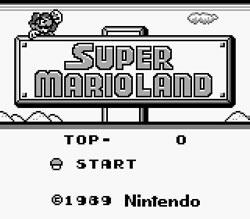

Super Mario Land
Overview

Super Mario Land brought the classic Mario platform games that we loved on our NES home console to a portable system for the first time, acting as the launch title for the Game Boy. This game saw not only the introduction of Princess Daisy into the Mario series for the first time, but also introduced us to the Kingdom of Sarasaland.
This was the first Super Mario game not to be produced by Shigeru Miyamoto or his counterparts in Nintendo EAD, and was instead produced by a Nintendo R&D1 team headed up by Gunpei Yokoi (producer) with Satoru Okada as director. The result is a Mario adventure that feels both familiar and delightfully strange — with quirky new enemies, exotic locations, and two vehicle sections found nowhere else in the mainline series.
As the first mainline Mario adventure on a portable console, Super Mario Land was a phenomenon, going on to sell over 18 million copies worldwide. It is one of the most important games in Nintendo’s history — the title that proved the Game Boy could deliver a genuine Mario experience in the palm of your hand.
Story

The story of Super Mario Land, taken directly from the original instruction booklet:
Once upon a time, there was a peaceful world called Sarasaland. In this world there were 4 kingdoms named Birabuto, Muda, Easton and Chai. One day, the skies of Sarasaland were suddenly covered by a huge black cloud. From a crack in this cloud, the unknown space monster Tatanga emerged to try to conquer Sarasaland. Tatanga hypnotized the people of all the kingdoms so that he could control them in any way he liked. In this way he took over Sarasaland. Now, he wants to marry Princess Daisy of Sarasaland and make her his queen. Mario came to know of these events, and he has started on a journey to the Chai Kingdom where Princess Daisy is held captive, in order to restore peace to Sarasaland. Can Mario defeat Tatanga, release people from his interstellar hypnosis, and rescue Princess Daisy? It’s all up to you and Mario’s skill. Go for it Mario!
The Twist Ending
At the end of each of the first three kingdoms, Mario defeats a boss only to find that the “Daisy” he rescued is actually an enemy in disguise, who sprouts wings and flies away. Only in the final Chai Kingdom — after defeating Tatanga in an aerial Sky Pop dogfight — does Mario rescue the real Princess Daisy. The two then fly off together in the Sky Pop, a charming and unexpectedly tender finale for an 8-bit handheld game.
Gameplay

Super Mario Land is very similar to previous Super Mario platformer games. The player runs and jumps through side-scrolling levels, defeats enemies by jumping on them, collects coins, and reaches the goal at the end of each level. But its compact Game Boy scope and quirky R&D1 design give it a unique character.
Core Mechanics
- Jump to clear gaps and bounce on enemies — jumping on most enemies defeats them and earns points
- Run by holding the dash button to move faster and clear longer jumps
- Collect 100 coins to earn an extra life
- Earn 100,000 points to gain an extra continue (used if all lives are lost)
- Defeat bosses either by physical attack (Superballs/torpedoes/missiles) or by reaching the switch behind them
- Two vehicle stages — the Sky Pop aeroplane (World 2-3 finale region) and Marine Pop submarine transform the gameplay into a shoot-’em-up
Key Differences from NES Mario
- Defeated enemies leave coins. Unlike NES Mario, stomping certain enemies in SML can produce coins
- The Superball Flower replaces the Fire Flower — it shoots a single bouncing ball that ricochets off walls and floors at 45-degree angles, collecting coins and defeating enemies
- No save feature on the original Game Boy cartridge — a full playthrough must be done in one sitting (the 3DS Virtual Console re-release later added save support)
- Different physics. The controls and physics don’t have quite the same precision as the NES/SNES platformers — the most common point of criticism
Controls
Super Mario Land’s controls are simple and classic, mapping cleanly to the Game Boy’s limited button set.
| Input | Action |
|---|---|
| D-Pad ← / → | Walk / run left or right |
| D-Pad ↓ | Crouch (Super Mario only) |
| A Button | Jump |
| B Button | Run faster (hold); fire Superballs as Superball Mario; fire projectiles in Sky Pop / Marine Pop |
| START | Pause / unpause |
| SELECT | (Unused in standard play) |
When Mario is Superball Mario, or when driving the Marine Pop submarine or Sky Pop aeroplane, the B button fires projectiles at enemies — a single mechanic that elegantly carries across both the platforming and the shoot-’em-up vehicle sections.
Power-Ups
Super Mario Land features a streamlined power-up progression — with one signature new item unique to this game.

Small Mario
The starting form. Vulnerable — one hit costs a life. Can run across narrow single-tile passages without crouching.
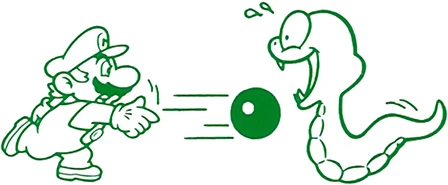
Super Mario
From a Super Mushroom. Bigger, can break bricks, and survives one hit (reverting to Small Mario).
Superball Mario
From the Superball Flower. Fires a bouncing Superball that ricochets at 45° off surfaces, defeating enemies and collecting coins.
Sky Pop & Marine Pop Vehicles
Super Mario Land’s most distinctive feature is its two vehicle sections — transforming the platformer into a side-scrolling shoot-’em-up. These appear at the climax of the Muda Kingdom and the Chai Kingdom, and are found nowhere else in the mainline Mario series.
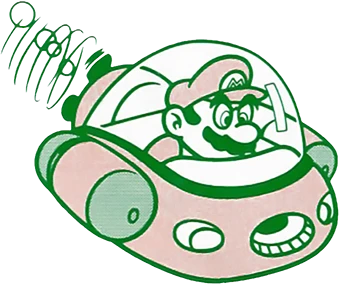
Marine Pop (Submarine)
In the Muda Kingdom (World 2-3), Mario pilots the Marine Pop, a small submarine, through an underwater shoot-’em-up stage. The B button fires torpedoes forward to destroy aquatic enemies like Honen (fish skeletons), Gunion (octopi), and Yurarin Boo. The stage ends with the boss Dragonzamasu, defeated by twenty torpedoes or by hitting the switch behind it.

Sky Pop (Aeroplane)
In the Chai Kingdom (World 4-3), Mario flies the Sky Pop aeroplane through an aerial shoot-’em-up climax. The B button fires missiles at flying foes. This stage culminates in the final showdown against Tatanga in his spaceship Pagosu — a genuine boss dogfight. After the battle, Mario rescues the real Princess Daisy and the two fly off together in the Sky Pop.
Sarasaland’s Four Worlds
Super Mario Land is set in Sarasaland, divided into four kingdoms that serve as the game’s four worlds. Each world consists of three levels with music, backgrounds, and enemies themed to the kingdom. The final level of each world ends in a boss fight against an enemy disguised as Daisy — except the Chai Kingdom, which has two bosses including Tatanga.
Birabuto Kingdom
Egyptian / Desert


An ancient Egyptian-themed desert with pyramids, sphinxes, and ruins. The opening world introduces the basics. Enemies include Goombo (the SML Goomba) and Bombshell Koopa. The world ends with a fight against King Totomesu, a fire-breathing sphinx-lion, in World 1-3.
Muda Kingdom
Aquatic / Ocean

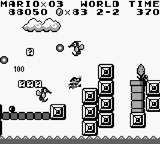

A watery ocean kingdom featuring the first Marine Pop submarine shoot-’em-up section. Underwater enemies include Honen, Gunion (octopi), and Yurarin Boo. The world climaxes with a Marine Pop battle against the seahorse-dragon boss Dragonzamasu in World 2-3.
Easton Kingdom
Easter Island / Stone


A stone-and-moai themed kingdom inspired by Easter Island. Home to the flying stone head Batadon and the rolling boulder Ganchan. The world ends with a fight against Hiyoihoi, a giant moai boss who throws Ganchan boulders at Mario, in World 3-3.
Chai Kingdom
Asian / Sky


The final kingdom, with an East-Asian aesthetic where Princess Daisy is held captive. Features the hopping vampire Pionpi. The world has two bosses: first Biokinton (a cloud boss), then the Sky Pop aerial showdown against Tatanga himself in World 4-3 — the game’s climactic finale.
Bosses
Each kingdom ends with a boss fight. All bosses reward Mario with 5,000 points when defeated, and most can be beaten either by attack or by hitting the switch behind them. In the first three kingdoms, the rescued “Daisy” turns out to be the boss in disguise, who flies away — only the final Chai Kingdom holds the real princess.
King Totomesu
World 1-3 · Birabuto Kingdom
A fire-breathing sphinx-lion (a giant Gao) who breathes fireballs horizontally and periodically jumps. Defeated by five Superballs or by striking the switch behind him. The game’s first boss — a clear homage to the Bowser-bridge fights of Super Mario Bros.
Dragonzamasu
World 2-3 · Muda Kingdom
A giant Yurarin Boo seahorse-dragon that swims up and down, shooting fireballs, surrounded by Tamao. Fought from the Marine Pop submarine. Defeated by twenty torpedoes or by hitting the switch behind it.

Hiyoihoi
World 3-3 · Easton Kingdom
A giant moai statue boss who throws Ganchan boulders at Mario. Defeated by ten Superballs, or by leaping over it while riding a Ganchan to reach the switch. (Image: Batadon, the Easton Kingdom’s flying stone head enemy.)
Biokinton & Tatanga
World 4-3 · Chai Kingdom
The Chai Kingdom has two bosses. First Biokinton, a cloud boss that bounces around releasing Chickens — defeated by twenty missiles. Then the final boss: Tatanga, the alien who kidnapped Daisy, fought in an aerial Sky Pop dogfight. Tatanga hovers in his spaceship Pagosu, firing splitting projectiles. Defeating him rescues the real Princess Daisy. (Image: the Sky Pop aeroplane used in the final battle.)
Enemies
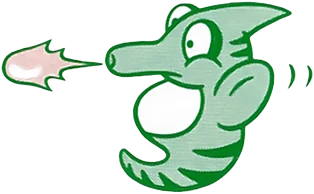
Super Mario Land features an almost entirely original enemy roster — quirky creatures designed by Nintendo R&D1 that appear nowhere else in the mainline series. Most enemies are indigenous to a single kingdom, themed to its setting. The classic Goomba and Koopa are reimagined as Goombo and Bombshell Koopa.



Characters
Super Mario Land’s small cast is notable for who is present (a brand new princess) and who is absent (almost everyone else).
Mario
The hero, journeying solo through Sarasaland to rescue Daisy. His first portable adventure.

Princess Daisy
Debut character. Princess of Sarasaland, kidnapped by Tatanga. Would later become a Mario series regular.
Tatanga
Debut antagonist. A malevolent alien with hypnotic powers who invades Sarasaland in his spaceship Pagosu.
Development
Super Mario Land has a fascinating development history, tied closely to the launch of the Game Boy itself.
- Developed by Nintendo R&D1, not Nintendo EAD — making it the first Super Mario platformer not developed by Miyamoto’s team
- Gunpei Yokoi — the legendary creator of the Game Boy itself — served as producer
- Satoru Okada (future R&D manager) was the director
- Hirokazu Tanaka handled the sound effects and the memorable soundtrack
Hirokazu Tanaka’s Soundtrack
The Super Mario Land soundtrack by Hirokazu Tanaka is widely beloved — particularly the bouncy main theme (the Birabuto Kingdom music) and the catchy Muda Kingdom underwater theme. The main overworld theme became so iconic that it has been remixed and referenced in numerous later Mario titles and Nintendo medleys.
eShop Release
When Super Mario Land was re-released on the Nintendo 3DS Virtual Console (and as part of the Nintendo eShop), it came with official store descriptions. Here are the original eShop blurbs:
Videos & Commercials
The original 1989 US television commercial and a full playthrough showing the ending and credits.
Reception
Super Mario Land received mostly positive reviews and was a monumental commercial success.
Commercial Performance
Super Mario Land racked up over 18 million sales. Statistically this places it as one of the most popular Mario titles of all time — at the time of the original SLB writeup, only two other portable Mario titles had ever outsold it (Mario Kart DS and New Super Mario Bros. for the Nintendo DS), and that was not until many years later. Six years after its initial release, Super Mario Land was re-released as part of the Player’s Choice budget series.
Critical Reception
- IGN — average score of 8.4 / 10. Lucas M. Thomas later called it a “small, singular oddball,” giving it a 7.5/10 and noting it was worth the small purchase
- GameSpot — a respectable 7.3 / 10
- Nintendo Life (Corbie Dillard) — praised the sequel Super Mario Land 2 as the better game, but recommended playing the original in commemoration of Mario’s first portable experience
- Cubed3 (Adam Riley) — scored it well, recommending it as a “short and sweet adventure”
- Aggregate: around 78% based on contemporary reviews
Main Criticism
The most common point of criticism was that the controls and physics didn’t have the same precision and feel as their NES and SNES counterpart platformers. Mario’s momentum and jump arc feel slightly different — a consequence of the R&D1 team building their own Mario engine from scratch rather than using EAD’s established physics.
SLB User Reviews
Super Mario Land has yet to receive a community review on Super Luigi Bros.
If you’ve played Super Mario Land and would like to submit a review, please get in touch.
Box Art, Logos & Key Art
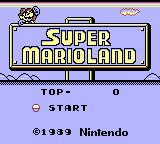
As a globally successful launch title, Super Mario Land shipped with an exceptional number of regional box art variants.


Logos & Key Art


Trivia & Facts
- This was the first time a Super Mario platformer was made by Nintendo’s R&D1 team instead of the usual Nintendo EAD. The project was headed up by Gunpei Yokoi (producer) and Satoru Okada (director).
- As a result of being the first mainline Mario adventure game released on a portable console, Super Mario Land racked up over 18 million sales. Only two other portable Mario titles ever outsold it (Mario Kart DS and New Super Mario Bros. for the Nintendo DS) — but this was not until many years later.
- The original Game Boy version of Super Mario Land has no save feature, which was rather annoying. In the Nintendo 3DS re-release available on Nintendo’s eShop, a save feature was added.
- This is the first Super Mario title to be based outside of Shigeru Miyamoto’s Mario realm (the Mushroom Kingdom & Mushroom World). The setting for this game is Sarasaland.
- Another point of note is that Bowser, Luigi, Princess Peach and Toad were ALL absent from this game.
- Princess Daisy debuted in this game as the ruler of Sarasaland and the damsel-in-distress. She would go on to become a Mario series regular.
- Tatanga the alien also debuted here, later returning as a boss in Super Mario Land 2: 6 Golden Coins.
- The Superball Flower is unique to this game in the mainline series — it fires a single ball that bounces at 45° angles. It was later revived in Super Mario Maker 2.
- Super Mario Land was almost the Game Boy pack-in title, but Tetris was chosen instead after Henk Rogers convinced Nintendo of America that it would have wider appeal.
- The game features two vehicle shoot-’em-up sections — the Marine Pop submarine and Sky Pop aeroplane — found nowhere else in the mainline Mario series.
- In the first three kingdoms, the rescued “Daisy” is actually an enemy in disguise who sprouts wings and flies away. Only the Chai Kingdom holds the real Princess Daisy.
- The soundtrack was composed by Hirokazu Tanaka; the bouncy main overworld theme has been remixed in numerous later Mario games.
- It is the shortest of the three Super Mario Land games at just 12 levels. Its sequels were Super Mario Land 2: 6 Golden Coins (introducing Wario) and Wario Land: Super Mario Land 3.
- Most of Super Mario Land’s enemies are entirely original and never appeared again — Batadon, Gunion, Pionpi, Tokotoko, and many more. Batadon returned decades later as a cameo in Mario Kart World.
- Pionpi, the hopping enemy in the Chai Kingdom, is based on the jiangshi (Chinese hopping vampire) of Chinese folklore.
- Re-released on the Nintendo 3DS Virtual Console in 2011, and the 3DS version added the save feature the original lacked.
Reference / Information
Sub-pages and guides for Super Mario Land.
Media / Downloads
Galleries and screenshots.