
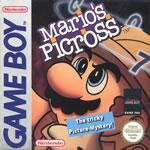

Mario’s Picross
Overview

Mario’s Picross is a logic puzzle game for the Game Boy, released by Nintendo in 1995. Developed by Jupiter (a Japanese studio that would go on to make most subsequent Picross games), it is the very first entry in the Picross franchise — a series that continues to release new puzzle compilations 30 years later.
Mario the Archaeologist
Mario’s Picross stars Mario in a thematic role unique to the series: he is an archaeologist, equipped with a chisel and hammer, methodically excavating the hidden pictures buried within each grid. This archaeology metaphor neatly fits the gameplay verb — the player chips away, chisels out, or scrapes squares to slowly reveal what’s underneath. The game’s artwork consistently depicts Mario in this archaeologist outfit, complete with pith helmet variants on some box art.
Nonograms 101
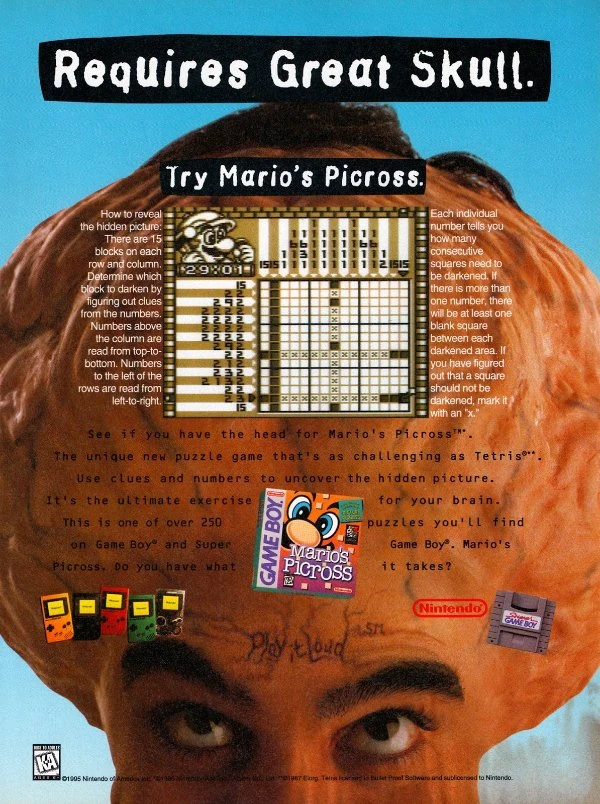
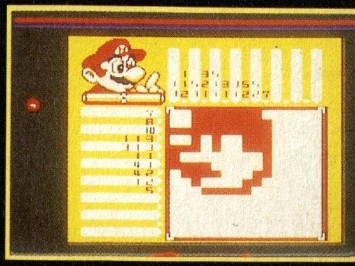
The puzzles are nonograms, also known as paint-by-numbers, griddlers, or hanjie. Each puzzle starts with an empty grid (usually 15×15, sometimes 5×5 or 10×10 in Easy mode). At the side of each row and at the top of each column are number clues that tell the player exactly how many consecutive squares must be scraped in that line. The challenge: figure out which squares to scrape using pure logical deduction.
Gameplay

Each Picross puzzle is a self-contained logic challenge with a 30-minute time limit. The objective is simple: reveal the hidden picture by scraping (filling in) the correct squares. The challenge comes from deducing which squares to scrape using only the row and column number clues.
The Core Loop
- Start with an empty grid — 15×15, 10×10, or 5×5 squares
- Read the number clues on the side of each row and at the top of each column
- Deduce which squares must be scraped using pure logic
- Scrape squares (turn them dark) by pressing the chisel button on the correct ones
- Mark squares (with an “X”) as a memory aid for ones you’ve deduced must NOT be scraped — no penalty for X marks
- Avoid scraping the wrong squares — each mistake adds a time penalty (see Hints & Penalties)
- Complete the picture within 30 minutes to win and reveal the hidden image
What Makes Picross Click
Picross is one of the cleanest examples of a pure logic puzzle game. Every puzzle has exactly one solution, and that solution can be reached through deduction alone — no guessing required. Skilled players develop pattern-recognition techniques (sum-line analysis, overlap deduction, dead-line elimination) that make the puzzles feel like meditative problem-solving rather than trial-and-error guessing.
How Puzzles Work
The number clues are the key to everything in Picross. Understanding how to read them is the entire game.
Reading a Single Clue
- “5” means: scrape 5 consecutive squares in that row or column
- “3” means: scrape 3 consecutive squares in that row or column
- “1” means: scrape exactly 1 square in that row or column
Reading Multiple Clues
If a row has multiple numbers (like “4 6 2”), here’s how to interpret them:
- First number (4): 4 consecutive squares scraped, starting from the left/top of the row/column
- Gap: At least 1 blank square must separate the 4-block and the next group
- Second number (6): 6 consecutive squares scraped, after the gap
- Gap: At least 1 blank square must separate the 6-block and the next group
- Third number (2): 2 consecutive squares scraped, after the gap
- Total minimum row length: 4 + 1 + 6 + 1 + 2 = 14 squares minimum
Tools
- Chisel (scrape) — fills a square dark. The action of “revealing” part of the hidden picture
- Mark with X — places an “X” mark on a square you’ve deduced must NOT be scraped. Useful as a memory aid. No time penalty for X marks
- Erase — remove a scrape or X mark to correct yourself
The 4 Game Modes
Mario’s Picross has 256 puzzles total, split equally across four game modes of 64 puzzles each. The first two modes can be tackled in any order; the third and fourth modes unlock after completing earlier modes.

Mode 1 — Easy Picross
Always available · 64 puzzles · 5×5 and 10×10 squares
The beginner mode, designed to teach the puzzle mechanics. Puzzles are smaller — either 5×5 or 10×10 rather than the standard 15×15 — making them quicker to solve and forgiving for newcomers. The 8×8 puzzle grid (8 rows A–H, 8 columns 1–8 = 64 puzzles total) includes the letter sequence “L E T S W O R K” as Level 1’s rewards, plus mundane items (cards, food, household objects) and a few Mario cameos including Mario himself at Level 6H and Boo Diddly at Level 6C.

Mode 2 — Kinoko Course
Always available · 64 puzzles · 15×15 squares
The first main course. Kinoko is Japanese for “mushroom” — a nod to the Super Mario series. 64 puzzles at full 15×15 size. Mario cameos here include Game Boy (Level 1A), Star (Level 1B), Bullet Bill (Level 3D), and Grand Goombas (Level 3G). Completing this course unlocks the Star Course.

Mode 3 — Star Course
Unlocks after Kinoko Course · 64 puzzles · 15×15 squares
The second main course, harder than Kinoko. Mario cameos in Star Course include Mini Yoshi (2E), Sun-Flower (4C), Spiny (4G), and Mushroom (5F). Completing this course unlocks Time Trial mode.
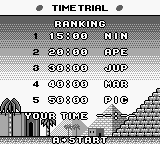
Mode 4 — Time Trial
Unlocks after Star Course · 64 puzzles · 15×15 squares
The endgame challenge. Time Trial removes the safety nets — no hints are available, the puzzle scoring is stricter, and the difficulty is highest. Time Trial cameos include Cheep-Cheep, Buzzy Beetle, Koopa Troopa, and Blooper — four classic Mario enemies for the dedicated puzzle solver to discover.
Hints & Penalties
Mario’s Picross has a clever hint system and a punishing penalty system for wrong scrapes — the carrot-and-stick that defines the difficulty curve.
The Hint Roulette
Before starting any non-Time-Trial puzzle, the player can choose to use a hint. If chosen, a roulette spins to determine which row and column will be revealed:
- The player stops the roulette with a button press, selecting which lines get the hint
- The selected row and column are pre-scraped correctly at the start — the player can see exactly which squares should be filled in those lines
- This gives the player a foothold for deduction — the cross-pattern of revealed squares offers logical anchors for the rest of the puzzle
- Many puzzles can be solved without using hints — dedicated players see this as the proper way to play
Time Penalties for Wrong Scrapes
The penalty system is what gives Mario’s Picross its tension:
| Mistake | Time Penalty |
|---|---|
| 1st wrong scrape | + 2 minutes |
| 2nd wrong scrape | + 4 minutes |
| 3rd+ wrong scrape | + 8 minutes (each) |
| Marking with X (any number) | No penalty |
Game Over Conditions
- Time runs out — if penalties + actual play time exceed 30 minutes, the puzzle is failed and Mario looks discouraged
- Puzzle solved — the picture is fully revealed, a “Congratulations” screen plays, and Mario celebrates
- Time Trial special rules — in Time Trial mode, wrong scrapes have different rules (typically harsher) and there are no hints available
Mario Character Cameos
While most of Mario’s Picross’s 256 puzzles depict everyday items (food, household objects, animals, letters), a notable subset reveal Super Mario characters and franchise icons when solved. These cameo puzzles are visually distinguished by their UPPERCASE captions — normal puzzle names appear in lowercase, but the Mario-themed ones appear in full uppercase, signaling their special status.
Easy Picross Cameos
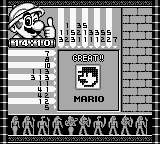
Mario
Easy Picross · Level 6H
The man himself appears in classic plumber form. A welcoming pat-on-the-back for Easy mode players just learning the puzzle mechanics — your first Mario cameo arrives early.

Boo Diddly
Easy Picross · Level 6C
Boo Diddly — an early Western romanization of the ghost enemy now known as Boo. The shy, sheepish ghost silhouette emerging in nonogram form is one of the cuter early cameos.
Kinoko Course Cameos

Game Boy
Kinoko Course · Level 1A
A puzzle that reveals a Game Boy handheld itself — a meta-reference to the very platform the game runs on. Recognizable D-Pad, A/B buttons, and START/SELECT layout emerge from the grid.

Bullet Bill
Kinoko Course · Level 3D
The classic Bullet Bill silhouette — bullet-shaped body with arms outstretched. Bullet Bills had been a Mario series staple since Super Mario Bros. (1985), and seeing one emerge from a nonogram is a satisfying connection to the broader Mario universe.

Grand Goombas
Kinoko Course · Level 3G
Grand Goombas — the larger Goomba variants from Super Mario Bros. 3. A nice deep-cut cameo — not the basic Goomba, but the chunkier Grand Goomba subspecies.
Star Course Cameos

Sun-Flower
Star Course · Level 4C
Sun-Flower — a smiling sun character that has appeared throughout Mario series art. The cheerful sun silhouette is one of the more visually striking nonograms in the Star Course set.

Mini Yoshi
Star Course · Level 2E
Mini Yoshi — a baby/small Yoshi. (Note: image shows another Star Course puzzle as a representative example.) Star Course also features Spiny at 4G and Mushroom at 5F.
Time Trial Cameos
The endgame Time Trial mode features four classic Mario enemy cameos for dedicated puzzle-solvers who’ve completed the Star Course:
- Cheep-Cheep — the underwater fish enemy from Super Mario Bros.
- Buzzy Beetle — the indestructible-from-above turtle, also from Super Mario Bros.
- Koopa Troopa — the classic Mario foot-soldier turtle
- Blooper — the squid-like aquatic enemy (called “Bloober” in some Mario titles)
These four Time Trial cameos serve as a final “Greatest Hits” tour of Mario’s enemy roster for completionists.
Super Game Boy Borders
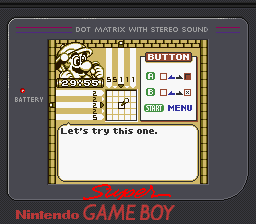
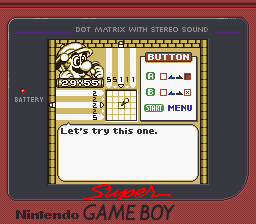
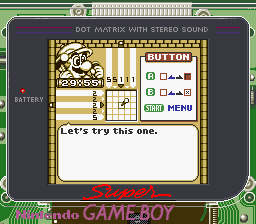
Mario’s Picross is enhanced when played on the Super Game Boy peripheral for the Super Famicom/SNES. The game gets colored graphics and a choice of six border styles to surround the gameplay area.



Japanese Version Differences
Mario’s Picross was released in Japan first (March 1995), and the international release made several puzzle substitutions to remove references to alcohol, tobacco, and other content deemed less appropriate for Western markets.
Puzzles Changed in the International Release
| Mode & Position | Japanese Version | International Version |
|---|---|---|
| Easy 6C | Cocktail | Boo Diddly |
| Easy 7B | Wine Glass | (replaced) |
| Kinoko 2A | Shogi Piece | (replaced) |
| Kinoko 2F | Shrine Bell | (replaced) |
| Kinoko 2H | Rice Pot | (replaced) |
| Kinoko 4D | Tsukimi Dango | (replaced) |
| Kinoko 6H | Beer Mug | (replaced) |
| Kinoko 7F | Folding Fan | (replaced) |
| Star 6H | Niō’s Face | (replaced) |
| Time Trial 1H | Pellet Drum | (replaced) |
| Time Trial 3D | Shuriken | (replaced) |
| Time Trial 3F | Tobacco | (replaced) |
| Time Trial 4D | Kasa-obake | (replaced) |
Looking at One Specific Change

Title Screen and Border Differences
The Japanese and international versions also have slightly different title screens and SGB border designs. The Japanese title screen uses Katakana for “Picross” (ピクロス), while the international version uses Latin script. SGB borders share the same six color themes but with minor visual differences between regions.
Videos & Commercials
Three archived video clips showcase Mario’s Picross’s 1995 launch — the US TV commercial, gameplay footage, and the Japanese commercial (where it was bundled in advertising alongside Kirby’s Dream Land 2).
Development Staff
Mario’s Picross was developed by Jupiter — a Japanese studio that would become Nintendo’s long-term puzzle partner, developing nearly every subsequent Picross title.
- Developer: Jupiter
- Publisher: Nintendo
- Platform: Game Boy (Super Game Boy enhanced)
- Genre: Nonogram puzzle / Logic puzzle
- Series Position: 1st game in the Picross franchise
- Inspiration: Nonogram / Paint-by-numbers puzzle format (originated in 1987 in Japan by Non Ishida and Tetsuya Nishio)
Reception
Mario’s Picross received mixed-to-positive reviews on release but had divergent commercial performance: modest sales in the West, strong sales in Japan. This contrast would shape the entire Picross franchise’s release strategy for the next decade.
What Critics Praised
- Pure logic gameplay. The deductive puzzle format was widely praised as a thinking-person’s alternative to action-heavy Game Boy titles
- Massive value. 256 puzzles is enormous content for a Game Boy game — longevity comparable to mainline RPG releases
- Mario branding adds personality. Mario as archaeologist with chisel-and-hammer animations was praised as charming
- Super Game Boy support. Colored borders and enhanced presentation were highlighted as showcase features
- Mario character cameos. The hidden Mario-themed puzzles (Bullet Bill, Grand Goombas, Mario himself) gave Mario fans extra reasons to engage
Common Criticisms
- Game Boy screen size. The 15×15 grid is dense on the small Game Boy display, making it harder to read clues clearly. Reviewers noted this as a significant practical drawback
- Niche appeal. Pure logic puzzles were less mainstream than action/platformer titles in 1995. Players seeking Mario platforming were sometimes disappointed
- Slow learning curve. Nonograms have an initial conceptual hurdle — understanding how to read the clue notation — that put off some impulse buyers
Commercial Performance
- Japan: Strong success. The Picross format resonated with Japanese audiences (where nonograms had already been popular as newspaper puzzles since 1987) and the game spawned numerous sequels
- North America & Europe: Disappointing sales. The unfamiliar puzzle format — combined with the perceived “puzzle game in a platformer-friendly Mario series” pitch mismatch — led to lukewarm reception
- Cult hit status. Despite modest sales, Mario’s Picross developed a cult following in the West among dedicated puzzle fans
Picross Series Legacy

Mario’s Picross launched what has become one of Nintendo’s longest-running puzzle franchises — spanning 30 years, 7 platforms, and dozens of releases.
The Direct Sequels
- Mario’s Super Picross (Super Famicom, 1995) — The Super Famicom follow-up. Japan-only for over a decade, but eventually released on European/Australian Wii Virtual Console in September 2007, then Wii U VC in April 2013
- Picross 2 (Game Boy, 1996) — The direct Game Boy sequel. Japan-only
- Picross NP Vol. 1–8 (Super Famicom Nintendo Power, 1999–2000) — Eight downloadable Picross titles via the Japan-only Nintendo Power cartridge service. Four of the eight feature Super Mario franchise puzzles
- Picross DS (Nintendo DS, 2007) — The Western Picross revival. Released worldwide and re-introduced Western audiences to the franchise after a 12-year gap
- Picross 3D (DS, 2009) — Three-dimensional Picross expansion
- Club Nintendo Picross (3DS, 2012, Japan-exclusive)
- Picross e series (3DS eShop, 2012–2017) — 9 entries
- Picross 3D Round 2 (3DS, 2015–2016)
- Club Nintendo Picross+ (3DS, 2014, Japan-exclusive)
- Picross S series (Switch, 2017–present) — Multiple entries on Nintendo Switch
Modern Re-releases
- Nintendo 3DS Virtual Console — December 2011 (as a free Nintendo Ambassador title), then publicly available from September 2012
- The original Mario’s Picross has not been added to the Nintendo Switch Online Game Boy classics service as of late 2024 — making the 3DS VC the most recent re-release
SLB User Reviews
Mario’s Picross has yet to receive a community review on Super Luigi Bros.
If you’ve played Mario’s Picross and would like to submit a review, please get in touch.
Box Art & Promotion
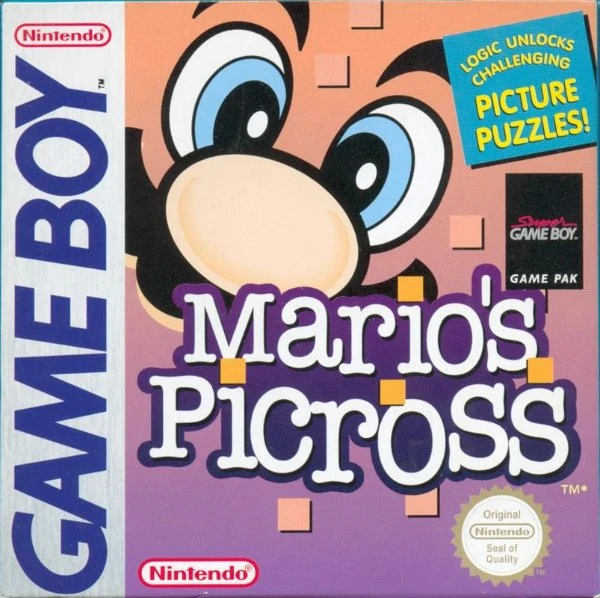
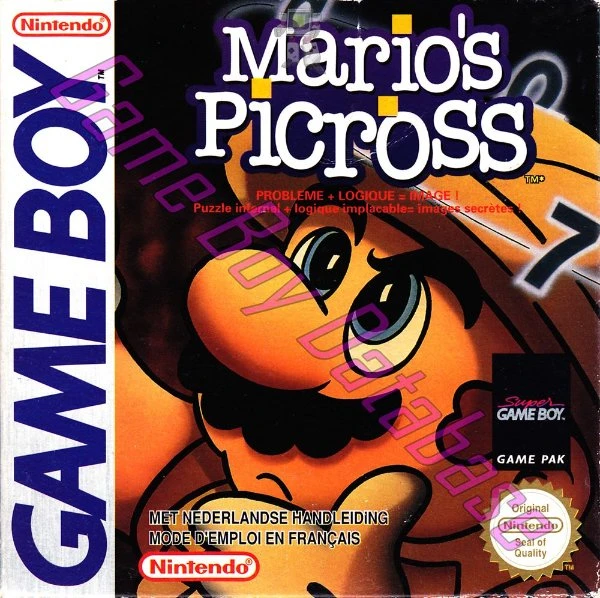
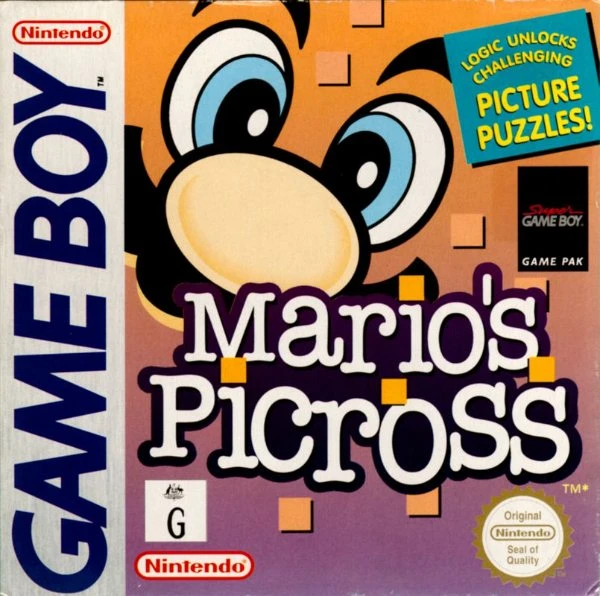
Mario’s Picross shipped with regional box art variants reflecting Mario’s archaeologist role and the puzzle theme.
Box Art




Title Screens & Menus




Promotional Materials


Trivia & Facts
- First game in the Picross franchise. Launched what has become a 30-year-old Nintendo puzzle series with dozens of entries across multiple platforms
- Developed by Jupiter. A Japanese studio founded in 1992 that has developed nearly every Picross title since this 1995 original — effectively making them the dedicated Picross studio
- Mario as archaeologist. Mario’s in-game role is an archaeologist with chisel and hammer, fitting the “chip away to reveal” gameplay metaphor
- 256 total puzzles. 64 puzzles each across 4 modes (Easy, Kinoko, Star, Time Trial)
- 15×15 standard grid. Easy mode includes smaller 5×5 and 10×10 grids for beginners
- 30 minute time limit per puzzle. Wrong scrapes add 2, 4, 8 minutes (each successive mistake). X marks have no penalty
- Hint roulette system. Before non-Time-Trial puzzles, players can spin a roulette to reveal one row + one column as scaffolding
- Super Game Boy support. Six selectable border colors (Green, Black, White, Yellow, Red, Clear) and enhanced graphics when played on the SGB peripheral
- Mario cameos use UPPERCASE captions. Mario-themed puzzles have their names in full uppercase, while regular puzzles use lowercase — a subtle visual cue
- Easy Picross 1A-H spells out “LETSWORK”. The first row of Easy mode puzzles depict the letters L, E, T, S, W, O, R, K — a hidden message: “Let’s work”
- Kinoko Course 1A is a Game Boy. The Kinoko Course opens with a meta-puzzle that reveals the Game Boy handheld itself when solved
- Boo Diddly. Easy Picross 6C is “Boo Diddly” — an early Western romanization of the Boo ghost enemy. Internationally only — the Japanese version had “Cocktail” at this position instead
- Japan got more puzzles censored out for the West. 13 puzzles featuring alcohol (cocktails, wine glass, beer mug), tobacco, shogi/cultural references, or shuriken were replaced for the international release — mostly with Mario-friendly alternatives
- Western players got more Mario cameos. The substitutions favored Mario series characters, meaning the international version has a denser concentration of Mario cameos than the Japanese release
- Japan got many sequels; the West didn’t. Mario’s Super Picross (1995), Picross 2 (1996), and 8 Picross NP titles (1999–2000) were Japan-only. The West didn’t get another Nintendo Picross game until Picross DS in 2007 — a 12-year gap
- Mario’s Super Picross got an eventual Western release. Through Wii Virtual Console in September 2007 (EU/AU only) and Wii U VC in April 2013
- 3DS Ambassador title. Mario’s Picross was given for free to Nintendo 3DS Ambassador Program members in December 2011, then made available to the wider public on the 3DS Virtual Console in 2012
- Cult hit in the West. Despite modest commercial performance, Mario’s Picross developed a cult following among Western puzzle enthusiasts — keeping the franchise’s flame alive until Picross DS in 2007
- Game Boy screen size criticism. Reviewers noted the 15×15 grid was dense on the small Game Boy display — a practical drawback that Picross DS’s dual-screen layout would later solve
- Nonograms are also called paint-by-numbers, griddlers, or hanjie. The format originated in Japan in 1987, designed by Non Ishida and Tetsuya Nishio independently. Nintendo licensed the format for the Picross name
- Time Trial unlocks last. Players must complete both the Kinoko Course and Star Course to access Time Trial — the endgame mode
- Cheep-Cheep, Buzzy Beetle, Koopa Troopa, and Blooper in Time Trial. The hardest mode rewards completionists with four classic Super Mario Bros. enemy cameos
Reference / Information
Sub-pages and guides for Mario’s Picross.
Media / Downloads
Galleries and screenshots.