
Pinball (NES, Cameo)
Overview
Pinball is, as the name suggests, a pinball video game (or a simulation of a pinball machine, if you prefer), developed by Nintendo for the NES. It was released in 1984 (in Japan), just before the actual console made its rushing breakthrough on the market. After the original release, the game reached North America in 1985, as well as Europe in 1986.
The game is based on a 1983 Game & Watch unit of the same name. Its original version was made exclusively for the arcade machines (and it became one of the biggest arcade classics, along with the original Donkey Kong), but as soon as Nintendo launched their new console, it was just a logical move that this arcade gem will also be one of those games that will be ported to the new system. The NES version of the game added an alternating two-player mode, and this version was also later re-released as an e-Reader card game. It is also an unlockable mini-game in Animal Crossing (a title developed exclusively for the Nintendo GameCube).

You may be asking yourself – “What the hell does Mario have to do with this?” And if we tell you that he has a cameo appearance in this game as well (though, in a different image then the one we got used to….but hey, this was the period before he actually “became” Mario), along with the damsel-in-distress from Donkey Kong – Pauline…would you continue reading this article and would you play the game as well? You would, admit it……….we know you would.
Gameplay & Controls
We believe that a vast majority of you already know what pinball is, and how the pinball machine functions, but we are going to make a short recap in this section anyway, and describe what is different in this exact version of Pinball.
This game is, basically, a simulation of the pinball board. The objective is to score as many points as possible, by not letting the pinball to fall under the paddles and by hitting various spots on the board. All that brings extra points to you. You control those two paddles, and they are placed at the bottom of the pinball machine. There are 2 sections of the board, in total, so above the mentioned pair of the paddles, there is another pair that functions the same way. Above the paddles on the first screen, there are 2 bumpers and 3 circles that, when hit, give 100 points each time when this happens. Just beneath the orange circle there are 3 eggs. When one of them is hit, a baby chick will pop-out, and as soon as it is hit again, it will disappear. In case all 3 eggs are hit at once, the 2 stoppers will show up at the sides of the board. To the left of the mentioned 3 circles, there are 7 numbered targets. If all of them are hit, the 6 pink lines to the right will disappear, and it will allow the pinball to go back to the top. Above the 3 circles, there are 5 cards with the letter “N” on them, and in case that all of them are turned over, you will get a stopper, and the color of the board will be turned to yellow. To the right side of the cards, there is a brown hole that leads to the bonus area.


The bonus mini-game is a secondary Breakout-like mode game of the game. Over here you control Mario who is holding a platform that looks like a grid, and your objective is to rescue Pauline (a girl that was previously seen in the legendary Donkey Kong game) by bouncing the ball off the platform, hitting various targets on this part of the course. The destruction of those targets brings extra points. When the blocks on which Pauline is standing are removed, she will drop down, and you must carry her safely to one of the either exits, to get extra points. By not managing to achieve this, you automatically lose this mini-game.
The controls in the game are very basic. You can see them right here:
-
Up/Down/Left/Right – Moves the D-pad in any direction, in order to activate the left paddle. In the bonus mini-game, “Left” and “Right” buttons are used to navigate Mario on the board
-
A/B – Activates the right paddle. By holding either of the two buttons, you will pull down the plunger, and once you release it, it will launch the pinball onto the board
-
Start – Pause the game.
Re-releases
A total of four different versions of this game have been released since the NES version spotted the light of the day. A complete, playable version of “Pinball” was a part of the Nintendo 64 title called “Doubutsu no Mori” , as well as the remake of the game on the Nintendo GameCube “Animal Crossing”. In 2002, the game was re-released as one of the several e-Reader games under the name Pinball-e. Just before the official release of the Nintendo Wii console (in 2006) it became available as a part of the Virtual Console for that system.
In Family BASIC (a software made for the Japanese Famicom), the penguin that appears in this game makes a short appearance in Game 1, as well as the sidesteppers from the well-known arcade classic Mario Bros.
In the Game Boy Advance release WarioWare Twisted!, this game appears as a microgame. It is very similar to the Breakout-styled mini-game that is present in the NES version of the game. There is a change in the surface, though, as it is circular and not flat like in the NES release. Also, in order to control Mario, you must twist your Game Boy Advance or the Nintendo DS. There are 3 stages in total, and each of them lasts a couple of seconds only. Also, they become progressively harder, as the speed is increasing and, on the other hand, the size of the paddles becomes smaller in size.
The game was also included in the NES Remix compilation.

Mario in Pinball
Like we said already, this isn’t just an ordinary pinball game, it is a pinball game that has Mario in it! Before his well-known cameo appearance in the cult title “Punch Out!!” and even before he actually got recognized as Mario that we know today, he made his first cameo appearance in this game. Pauline, the girl you were saving from Donkey Kong in the arcade classic that carries the same name, returned in this game as well.
So, just like in Donkey Kong, in this mini-game Mario has to save Pauline as well. But things are slightly different this time around. In order for you to actually get the chance to play as Mario, you need to make the ball enter the hole on the right side of the table, on the bottom screen. As soon as you manage to do this, you will take control of Mario who is holding a grid above his head. You can see Pauline above, as she is trapped in a cage by 3 blue barriers. Your goal is to release her by bouncing the ball to remove those barriers. You must catch her after that, as she falls, and move her towards either of the two exists for bonus points (this is only a bonus game).
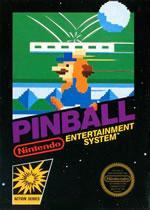
We must add that Mario also appears on the official cover-art of the game. He is also carrying the grid above his head, just like in the bonus mini-game, but he has a different appearance here (he is wearing a combination of blue and orange, instead of the standard red-and-blue combination).

Videos — Gameplay, Trailers & Commercials
A video showing the gameplay in Pinball
Trivia & Facts
-
This was the first game where Mario made a cameo appearance
-
It is also the last game where we get to see Pauline as Mario’s love interest (before she was replaced with Princess Peach). It is not her last appearance in the franchise, however
-
Even though the game was (and still is) very popular among the players, it received mixed opinions from the gaming critics, and its rankings are very variable
-
The game was one of the 18 launch titles, and an official launch title for the NES in North America
-
This game was one of the first ones that were ported to the e-Reader (it was released in 2002 along with the following games: Baloon Fight-e, Donkey Kong Jr.-e, Excitebike-e and Tennis-e).

Reception
Since pinball was widely popular in the 80s, the game had a huge success when it was released and, being one of the first games of the genre, it is still dear to many NES players, as well as pinball-lovers and gamers, in general.
But, it must be noted that it didn’t manage to get a cult status like most of the other games where our favorite plumber appeared in, both as the lead character or as a cameo. Gaming critics also had different opinions about it. While some of them praised it for being a great simulation of pinball and for being a very fun experience, others criticized it because it was too basic and ordinary, stating that the game doesn’t have much to offer to the players.
Retro Nintendo Reviews rated the game with 3/10, concluding the following: “Feel free to pass this one up, unless you are a die hard trying every NES game. The gameplay is decent for what it is, but very little variety means boredom sets in quickly. I’ve heard there are better Pinball games out there (Pin*Bot, Pinball Quest), so give something else a try if you are looking to satisfy your pinball itch”. IGN ranked the Virtual Console version of the game with 5/10, stating that “Pinball only has one table and one bonus stage, and that’s not a lot of depth for your dollars. Fans of inclined tables may be better served putting their money toward more robust or unique pinball experiences, like the playable-on-the-Wii-through-backwards-compatibility GameCube title Odama.”. On the other hand, reviewers from Classic Game Room praised the game, nothing that it “plays extremely well for an old school, 8-bit pinball game and provides hours of good fun”.
The Iwata Connection
Here's the most extraordinary credit on a humble NES pinball cartridge: the lead programmer is Satoru Iwata. Yes, that Satoru Iwata — future president of Nintendo (2002-2015), the man responsible for the Wii, the DS, the Nintendo Direct format, and arguably the most beloved CEO in video game history.
In 1984 when this game was being made, Iwata was a young programmer at HAL Laboratory — Nintendo's long-time second-party partner. HAL co-developed Pinball with Nintendo R&D1, with Iwata himself handling much of the actual game-logic programming. He was 24 years old.
Pinball is therefore one of the earliest games with Iwata's programming fingerprints — he would go on to program Balloon Fight, Kirby's Dream Land, and famously rescue both EarthBound and Pokémon Gold/Silver from production death-spirals.
Development Staff
The full credited development team for the NES Pinball is a who's who of Nintendo and HAL Laboratory talent that would shape the company for decades:
- Programmer: Satoru Iwata (HAL Laboratory) — future Nintendo president
- Programmer: Satoshi Matsuoka
- Composer: Yukio Kaneoka — one of the very first Nintendo-employed composers
- Music Programmer: Hirokazu Tanaka — later composed the soundtracks for Metroid, Mother / EarthBound Beginnings, Dr. Mario, and Tetris for Game Boy
- Studios: Nintendo R&D1 and HAL Laboratory
The HAL/Nintendo collaboration here is one of the very first examples of the partnership that would later produce the entire Kirby franchise, Mother / EarthBound, and Super Smash Bros.
Pauline's Cameo
The damsel-in-distress in Pinball's Bonus Stage isn't just any anonymous lady — she's Pauline, the original Mario heroine from Donkey Kong (1981). At the time of Pinball's release she was simply called “Lady” (her in-game name was not yet standardised), but Nintendo has since retroactively confirmed her identity, most explicitly in the Nintendo Switch Online description of the game which states: “Your goal is to save Pauline.”
This makes Pinball one of Pauline's very earliest post-Donkey Kong appearances — chronologically only DK Jr. (where she was held captive) and a small handful of other titles came before it. Her next major appearance would be Super Mario Odyssey (2017) where she was reintroduced as the mayor of New Donk City.
Pauline's role in Pinball is to fall through the bingo-lamp floor after Mario clears it of obstacles. Mario must then position himself with his platform-paddle to catch her safely on the way down. If she hits the ground, you lose a ball.
References to Pinball in Later Mario Games
Pinball is more deeply woven into Mario canon than you might expect. Here are the references to it in subsequent Nintendo titles:
- Family BASIC (Famicom accessory) — includes sprites of Lady (Pauline) and a penguin almost identical to the ones in Pinball.
- Super Mario Kart Prólogo — the seal character from Pinball appears in the audience alongside other Nintendo characters in a comic published in the Japanese Nintendo Kōshiki Guidebook Super Mario Kart.
- WarioWare: Twisted! — features a microgame called “Pinball” based on the Bonus Stage, in 9-Volt's stage.
- Super Smash Bros. Brawl / 3DS-Wii U / Ultimate — Mario's outfit on Pinball's American boxart is used as one of Luigi's alternate costumes.
- NES Remix / NES Remix Pack — several challenges in the NES Remix mash-up game are based on Pinball.
- WarioWare Gold — a different microgame named “Pinball”, this time based on scene A rather than the Bonus Stage, appears in 5-Volt's stage.
- Super Mario Party Jamboree — the Koopathlon minigame “Brick Breaker” sees the player character holding a paddle above their head and using it to bounce a ball to break bricks — an obvious homage to the Pinball Bonus Stage.
Official Nintendo Descriptions Through the Years
Nintendo's own descriptions of the game across the decades make the Mario connection more or less explicit. Here is how the game has been described in two official Nintendo channels:
Original 1985 NES instruction booklet
Be a Pinball Wizard! Bank off bumpers, flip double flippers, even win a bonus round. Play on three different game screens and be challenged at two different levels of difficulty. Rack up points to beat your opponent and progress to the bonus round where you'll save the fallen maiden and win the game.
Note that the 1985 manual calls her the “fallen maiden” — not yet officially Pauline.
Nintendo Switch Online (2018-present)
Hit targets and rack up points in this classic pinball game! Featuring a bonus mode starring Nintendo's legendary character, Mario, you control our hero as he holds a platform and uses it to keep the ball in the air. Your goal is to save Pauline. If she falls and hits the ground, you lose a ball — but if you save her and lead her to the exit, you'll get a nice surprise!
By the Switch Online era, Nintendo has fully canonised her as Pauline. The Mario connection — called a “legendary character” in this same description — is now the headline.
Names in Other Languages
The Japanese and Western titles for Pinball are virtually identical:
- Japanese: «ピンボール» (Pinbōru) — direct katakana transliteration of “Pinball”
- Chinese (Simplified): «弹球台» (Dànqiútái) — literally “Bullet Ball Table”
- Korean: «핀별» (Pinbol)
Note: in Japan the game is sometimes disambiguated as Pinball (1984) to distinguish it from the original 1973 Color TV-Game Pinball (a Nintendo home pinball console).
Reference / Information
Sub-pages, cheats and external reviews of Pinball on the NES.
Media / Downloads
Box art galleries and screenshots for Pinball on the NES.