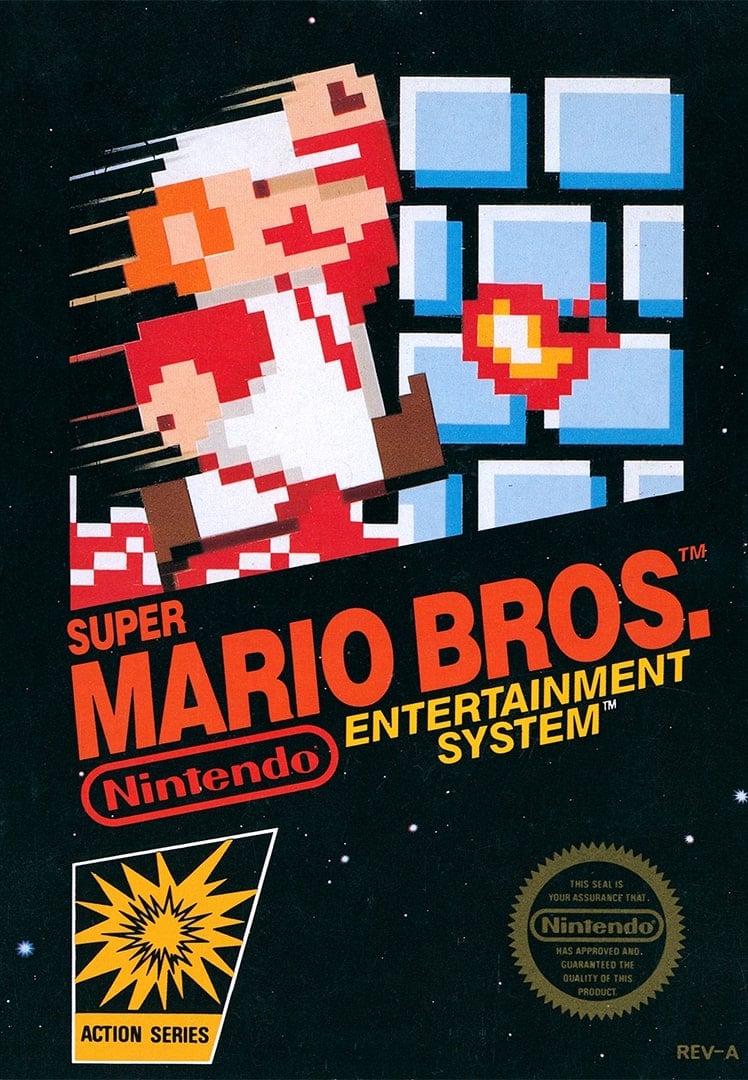
32 level maps11 bonus areas2 extra screens8 worlds × 4 coursesNES, 1985Maps by Ian Albert
Super Mario Bros. Level Maps
Every course of the 1985 original laid out end to end: all 32 levels from World 1-1 to 8-4, the 11 bonus areas hidden down pipes and up beanstalks, and the pipe screens in between, from Ian Albert’s stitched-together maps.
Underneath the maps, the story of how Super Mario Bros. is put together: eight worlds, eight castles, three Warp Zones and one world that should not exist.
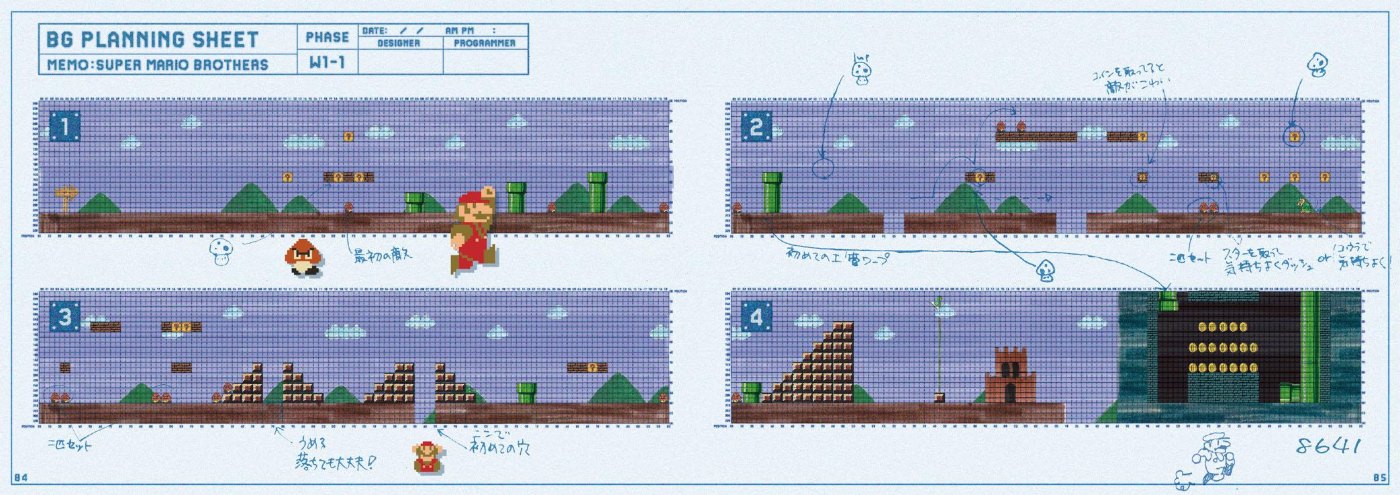
A planning sheet for World 1-1, drawn square by square for the programmers to build.
The complete maps for Super Mario Bros (NES) are below. We have maps of each part of every level as well as bonus stages and extras. Credit for the production of these maps goes to Ian Albert who has done a thoroughly excellent job of creating these image based maps.
Played on a television, Super Mario Bros. is a window that slides to the right. Laid out flat, it becomes something else: a set of drawings you can read from left to right like a comic strip, with every hidden block, pipe room and Fire-Bar in plain view. That is close to how the game began. Shigeru Miyamoto and Takashi Tezuka designed the courses on squared paper, and Miyamoto asked for each one to last roughly a minute; the programmers had guessed that might need 60 screens, but the finished courses average about 12, and the longest runs to 32.
The archive follows the game’s own order: four maps per world, from the green hills of 1-1 to Bowser’s last castle in 8-4, followed by the bonus areas, which Ian Albert lettered A to K, and two small connecting screens. Each link opens one map image. If you only look at a handful, make it the ceiling run over World 1-2 to the first Warp Zone, the hidden beanstalk of World 4-2 and the looping castle of World 7-4, which gives no clue at all about the right path.
Maps to open first
Level 1-1: the wordless tutorial, with its coin room and hidden 1-Up.
Level 1-2: run along the ceiling for the first Warp Zone (and the Minus World).
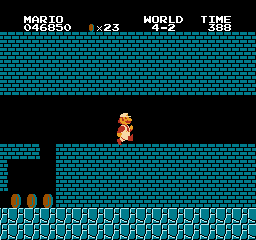
Level 4-2: two Warp Zones, one of them up a hidden beanstalk.
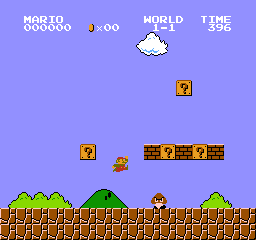
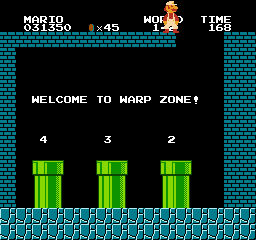
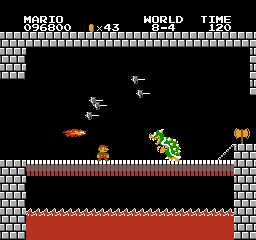
World 1-1: perhaps the most studied course in video games.Welcome to Warp Zone! The pipe room at the end of World 1-2.The bridge, the axe and Bowser in World 8-4.
Quick Answers
The layout of Super Mario Bros. in brief: the things readers most often want to know.
How many levels are in Super Mario Bros.?
32 courses in eight worlds of four. Thirteen are ground courses, two are underground, two underwater, seven athletic (treetops, bridges and lifts) and eight are castles, one at the end of every world. More →
Where are the Warp Zones?
There are three. At the end of World 1-2, run along the top of the ceiling to a room of pipes to Worlds 2, 3 and 4. World 4-2 has two: a hidden beanstalk early on leads up to a cloud room whose pipes go to Worlds 6, 7 and 8, and a room at the end of the course has a single pipe to World 5. More →
What is the Minus World?
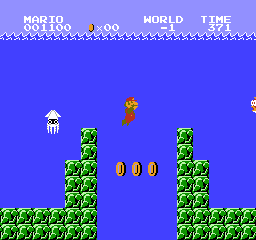
A glitched course reached by squeezing Mario through the wall beside World 1-2’s exit pipe, so that he reaches the Warp Zone before its pipes have numbers. It is really World 36, shown as “ -1”, a water course modelled on 7-2 that loops back to its own beginning, endlessly. More →
What are the bonus areas on these maps?
The rooms you visit and leave within a course: underground coin rooms reached by pressing Down on certain pipes, cloud-top coin runs reached by climbing beanstalks, two underwater areas and the Warp Zone room up the beanstalk in World 4-2. Ian Albert lettered them A to K. More →
How do you get through the castle mazes?
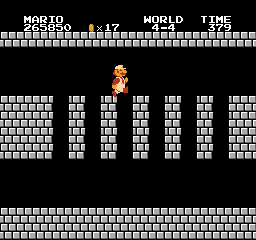
The three maze castles, 4-4, 7-4 and 8-4, keep sending you back until you pick the correct path. In 4-4 a Fire-Bar disappears when you have gone wrong, 8-4 empties the wrong pipe routes of enemies, and 7-4 gives no clue, so the map is the best way to learn it. More →
Is Bowser in every castle?
Only in World 8-4. The castle bosses of Worlds 1 to 7 are ordinary enemies in disguise; burn one with fireballs and it turns back into a Goomba, Koopa Troopa, Buzzy Beetle, Spiny, Lakitu, Bloober or Hammer Brother, in that order. More →
What changes in the second quest?
After you rescue the princess you can play again with every Goomba swapped for a Buzzy Beetle, faster ground enemies, shorter moving lifts and trimmed cloud bonus areas. You can also pick your starting world on the title screen. More →
Who made these maps?
Ian Albert, credited by Luke above. He captured the screens from the combined Super Mario Bros. / Duck Hunt game in the FCEU emulator and pieced them together in Photoshop, using Game Genie codes for high jumps, a longer timer and invincibility to get everywhere. More →
Super Mario Bros. squeezed a whole kingdom into 40 KB. Here is how that kingdom is laid out, and why the maps look the way they do.
Eight worlds, four courses, one castle each
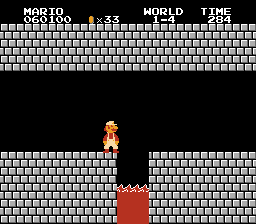
World 1-4, the first of eight castles.
The game is a straight line of 32 courses, numbered world-dash-course from 1-1 to 8-4. The first three courses of each world mix ground, underground, underwater and athletic stages, and the fourth is always a castle. Thirteen courses are on open ground, two underground, two underwater and seven athletic, built from treetops, bridges, mushroom platforms and lifts. Two worlds, 3 and 6, take place after dark, and three (3, 5 and 7) swap the greenery for white, wintry trees.
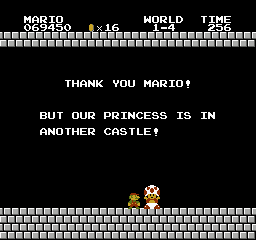
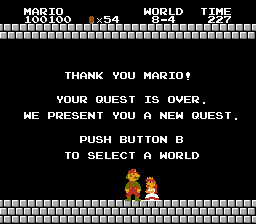
Ordinary courses end at a flagpole and a small castle; castles end at a bridge over lava with an axe behind the boss. The clock starts at 400 or 300 units, which tick faster than seconds; even World 8-1, the longest course, gets just 300. Cut the bridge in the first seven castles and a Mushroom retainer thanks you before breaking the news that the princess is elsewhere; the boss you dropped into the lava was a lesser enemy dressed as Bowser. The real King of the Koopa is waiting in 8-4, with Princess Toadstool behind him.
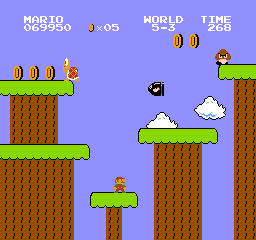
Look at the maps side by side and the economy shows. Clouds and bushes are one shape in two colours, castles bookend the courses, and later stages reuse earlier ones with harder enemies: World 5-3 is 1-3 with Bullet Bills, and 7-3 is a longer, nastier 2-3.
The Mushroom retainer who greets you in the first seven castles.World 8-4: the princess at last.
Drawn on squared paper
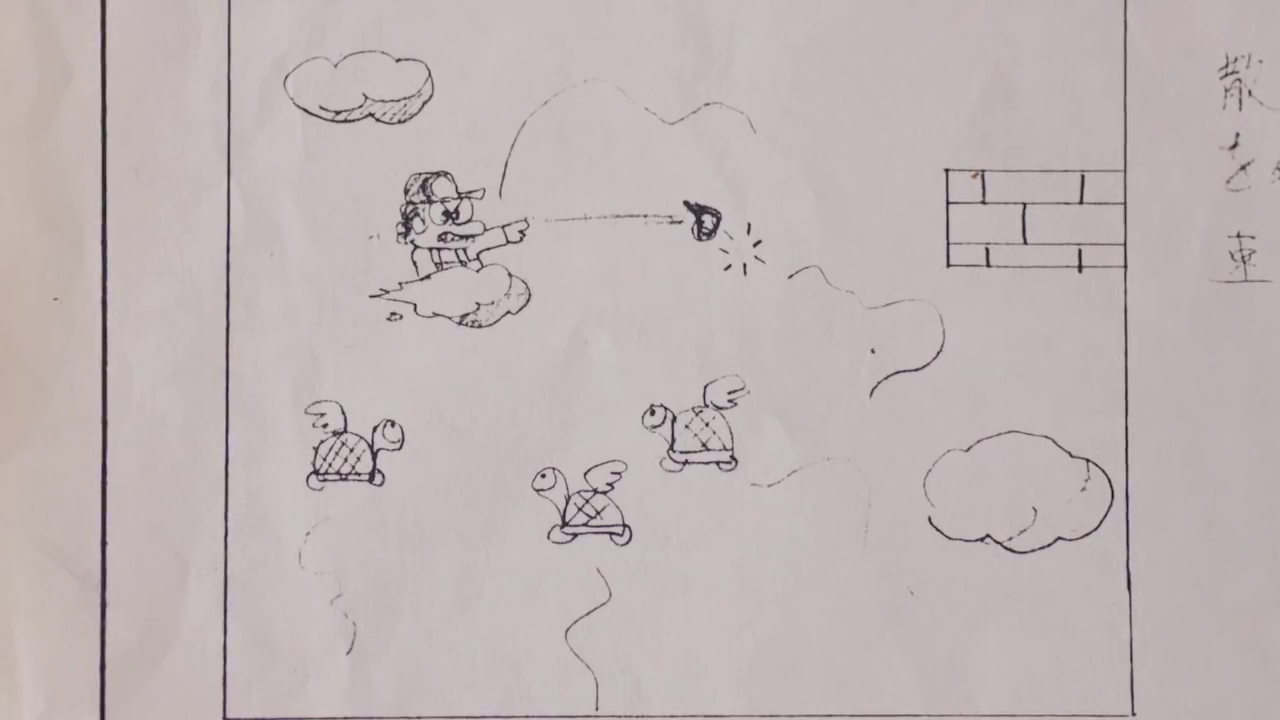
Concept art of Mario riding a cloud, an idea cut before release.
There was no level editor in 1985. Miyamoto and Tezuka drew each course on graph paper and passed the sheets to Toshihiko Nakago’s SRD team, who turned them into code; the next morning the designers played the result, sketched their changes on sheets of tracing paper over the originals, and round it went again. The earliest finished stages came from the middle of the game, Worlds 3 and 5 among them, and while they were enjoyable they were much too hard to start a newcomer on. World 1-1 came near the end, once the team knew what a newcomer needed to learn and in what order, and was finished around July 1985.
Miyamoto’s handwritten specification of 20 February 1985 had Mario riding a cloud through the sky and firing a gun. The flying was cut, but it left a trace in the maps: the cloud-top bonus areas reached by beanstalk, where Mario rides a moving cloud to collect coins.
World 1-1, built near the end so that it could teach everything.World 5-3 reuses the layout of 1-3 and adds Bullet Bills.
Pipes, beanstalks and bonus rooms
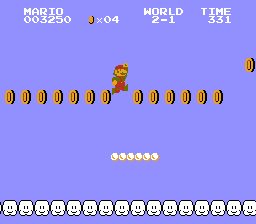
A cloud-top bonus area above World 2-1.
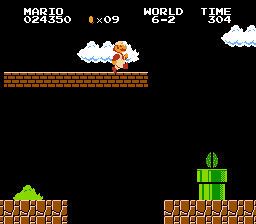
Most of what you cannot see on the television is off the main path. Press Down on certain pipes and Mario drops into an underground coin room, then pops out of another pipe further along the course; break the right brick and a beanstalk grows into the sky, where a moving cloud carries him past rows of coins before dropping him back to the ground. The Starman music plays while you are up there. A few pipes lead somewhere wetter, such as the watery shortcut in World 5-2 and the underwater passage in 6-2.
Ian Albert mapped these side rooms separately and lettered them A to K: five underground coin rooms, two underwater areas, three cloud areas and the cloud room above World 4-2 that holds the big Warp Zone. Two of them are near-copies of others with smaller platforms. Hidden extras are worth hunting too: each world’s opening course hides a 1-Up Mushroom that only shows up if you grabbed enough coins in the third course of the world before.
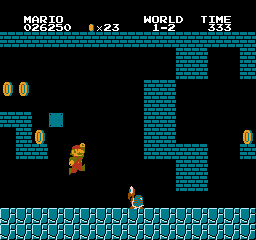
World 1-2, the first underground course.The beanstalk, Mario’s way up to the cloud bonus areas.
Three Warp Zones and a four-minute game
The World 1-2 Warp Zone, with pipes to Worlds 2, 3 and 4.
Two underground courses hold the game’s shortcuts. At the end of World 1-2, jump onto the ceiling bricks instead of taking the exit pipe and keep running right to a room with three pipes numbered 2, 3 and 4. World 4-2 has two more: a beanstalk hidden in a high brick near the start climbs to a cloud area with pipes to Worlds 6, 7 and 8, and a second room, beyond the exit pipe, has a single pipe to World 5.
Chain the right warps and the 32-course adventure shrinks to eight courses, which is why speedrunners finish it in under five minutes. The maps make the trick easy to see: the route over the ceiling of 1-2 is drawn right there above the exit pipe.
World 4-2, home to two Warp Zones.
The Minus World
World -1, the Minus World: a course that never ends.
One course is not on the list. Take Super Mario to World 1-2’s exit pipe, smash all but the last of the ceiling bricks over it, then duck, leap back into the gap and hold right so that Mario squeezes into the wall and out the other side. He reaches the Warp Zone before it has scrolled into view, before the pipes have been labelled, and the left and right pipes now lead to World 36. The game has no number tile for 36, so the screen shows a blank and a 1: World -1. The course is a watery clone of 7-2, and its exit pipe takes you back to the beginning, so it never ends unless Mario loses a life. The middle pipe goes to World 5.
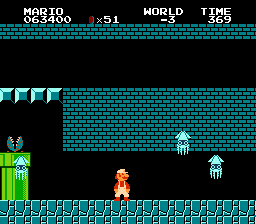
Nintendo Power described it in Volume 3 in 1988. The glitch survives in the emulated re-releases, Switch Online and the 2020 Game & Watch among them, but was fixed in All-Stars and Deluxe. On the Famicom Disk System the same trick leads to three stranger courses, -1 to -3, with floating Bloobers and copies of the princess, and finishing them sends you to the second quest.
Nintendo Power Volume 3 on the Minus World, from SLB’s scan archive.The Disk System’s World -3, with flying Bloobers.
Ian Albert’s maps
The maps in this archive are Ian Albert’s, as Luke says in his introduction. Albert captured them in FCEU, a free Nintendo emulator for Windows, running the combined Super Mario Bros. / Duck Hunt game, and assembled the screens in Photoshop, with lettering in codeman38’s Press Start font. To reach every corner he used Game Genie codes for higher jumps, a 900-unit timer and invincibility. His set also came as desktop wallpapers in sizes from 640×480 to 1600×1200, and his own page now says the maps are no longer maintained.
The labels on our bonus areas, A to K, and the two extra screens follow his: the short non-playable scene in which Mario walks into a pipe before an underground or underwater course, and the room that ends every one of those courses. For more of the game itself, see SLB’s full Super Mario Bros. guide, its screenshots and sprites.
Advertisement
World by World
What each world holds, with the boss hiding under the castle mask. Every course has its own map in the archive above.
The eight worlds at a glance
World 11-1 to 1-4 · boss: a GoombaGreen hills and the wordless tutorial (a coin room down a pipe, a hidden 1-Up, a Starman in a brick), the first underground course with its ceiling Warp Zone, treetops with red Paratroopas, and a castle of Fire-Bars.
World 22-1 to 2-4 · boss: a Koopa TroopaBouncing green Paratroopas and a beanstalk to the clouds, the first underwater course, a long bridge under a rain of leaping Cheep-cheeps, and the first Podoboos jumping from the castle lava.
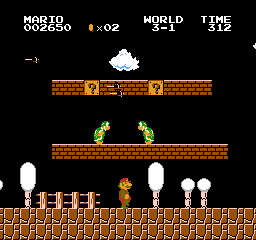
World 33-1 to 3-4 · boss: a Buzzy BeetleNight falls and the scenery turns white. Hammer Brothers make their debut in 3-1, home of the famous Koopa staircase trick; 3-2 is a Koopa parade, 3-3 has seesaw lifts and 3-4 doubles up the Fire-Bars.
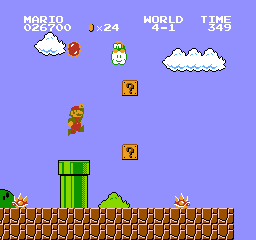
World 44-1 to 4-4 · boss: a SpinyLakitu arrives and follows you all the way through 4-1. Underground 4-2 hides two Warp Zones, 4-3 balances on giant mushrooms, and 4-4 is the first castle that loops until you find the right path.
World 55-1 to 5-4 · boss: a LakituSnowy again. Bullet Bills debut in 5-1, 5-2 has Hammer Brothers, a beanstalk and a watery shortcut, 5-3 replays 1-3 under cannon fire, and 5-4 adds a short, quick Fire-Bar.
World 66-1 to 6-4 · boss: a BlooberAnother night world: Lakitu in the dark, a forest of pipes with secret rooms, grey platforms over wide gaps, and the first castle boss that throws hammers.
World 77-1 to 7-4 · boss: a Hammer BrotherStacks of Turtle Cannons, the second swim (the course the Minus World copies), a longer and meaner bridge, and a maze castle with no clues at all.
World 88-1 to 8-4 · boss: BowserThe longest course in the game on a 300-unit clock, everything thrown at you at once in 8-2, Hammer Brothers on castle walls in 8-3, and a final maze of pipes, a swim and the real Bowser.
World -1the Minus WorldNot a real world: a glitch from World 1-2 that loads an endless underwater course.
The second questafter 8-4The same 32 courses again, with Buzzy Beetles in place of Goombas, faster enemies and shorter lifts; press B on the title screen to choose your starting world.
Trivia & Interesting Facts
Miyamoto wanted each course to last about a minute. Toshihiko Nakago, whose SRD team wrote the code, assumed that meant around 60 screens; the real courses average roughly 12, with 32 the most.
World 1-1 was one of the last courses designed, built only once the team knew what a beginner had to learn first.
Bushes and clouds share one shape, coloured differently. Every saved byte could become another block in a course.
Grab the flagpole when the last digit of the timer is 1, 3 or 6 and that many fireworks go off, worth 500 points each.
The cloud bonus areas play the Starman music in the original game; Super Mario All-Stars gave them a new tune, shared with the underground coin rooms.
The Minus World is World 36 in the game’s memory. Its number tile is blank, so the screen reads “ -1”.
In the European version the two Paratroopas of World 8-2 sit one block over, and every pipe out of the water has a block placed over it to stop a big Mario getting wedged.
It is possible to jump over the flagpole in 1-1 and 3-3, but beyond it there is only flat ground and no way to finish. The Lost Levels later hid Warp Zones behind its flagpoles instead.
In Super Mario Bros. Deluxe’s Challenge mode, collecting every coin in a cloud bonus area earns a 10,000-point Perfect Bonus.
Ian Albert made his maps with an emulator and Game Genie codes, including one that gave Mario a 900-unit timer so he could explore without dying.
The axe at the end of every castle bridge.Burn a castle boss with five fireballs and it is worth 5,000 points; cutting the bridge with the axe instead earns nothing.
Screenshots from the Maps
A screen from each stretch of the game, to go with the full maps above.
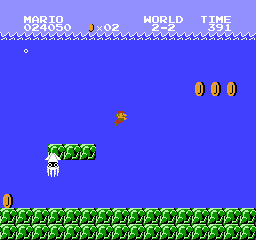
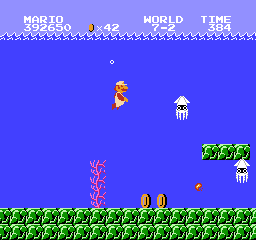
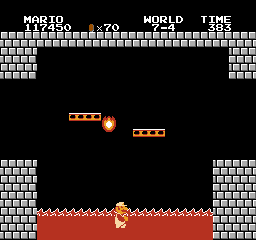
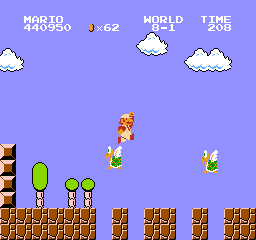
World 2-2, the first underwater course.World 3-1 by night, with Hammer Brothers.World 4-1: Lakitu and a Spiny egg.World 4-4, the first maze castle.World 6-2’s forest of pipes.World 7-2, the course the Minus World copies.World 7-4, the castle with no clues.World 8-1, the longest course in the game.
Sources
Every fact on this page was checked against the 12 sources listed here.
To provide the best experiences, we use technologies like cookies to store and/or access device information. Consenting to these technologies will allow us to process data such as browsing behavior or unique IDs on this site. Not consenting or withdrawing consent, may adversely affect certain features and functions.
Functional
Always active
The technical storage or access is strictly necessary for the legitimate purpose of enabling the use of a specific service explicitly requested by the subscriber or user, or for the sole purpose of carrying out the transmission of a communication over an electronic communications network.
Preferences
The technical storage or access is necessary for the legitimate purpose of storing preferences that are not requested by the subscriber or user.
Statistics
The technical storage or access that is used exclusively for statistical purposes.The technical storage or access that is used exclusively for anonymous statistical purposes. Without a subpoena, voluntary compliance on the part of your Internet Service Provider, or additional records from a third party, information stored or retrieved for this purpose alone cannot usually be used to identify you.
Marketing
The technical storage or access is required to create user profiles to send advertising, or to track the user on a website or across several websites for similar marketing purposes.