
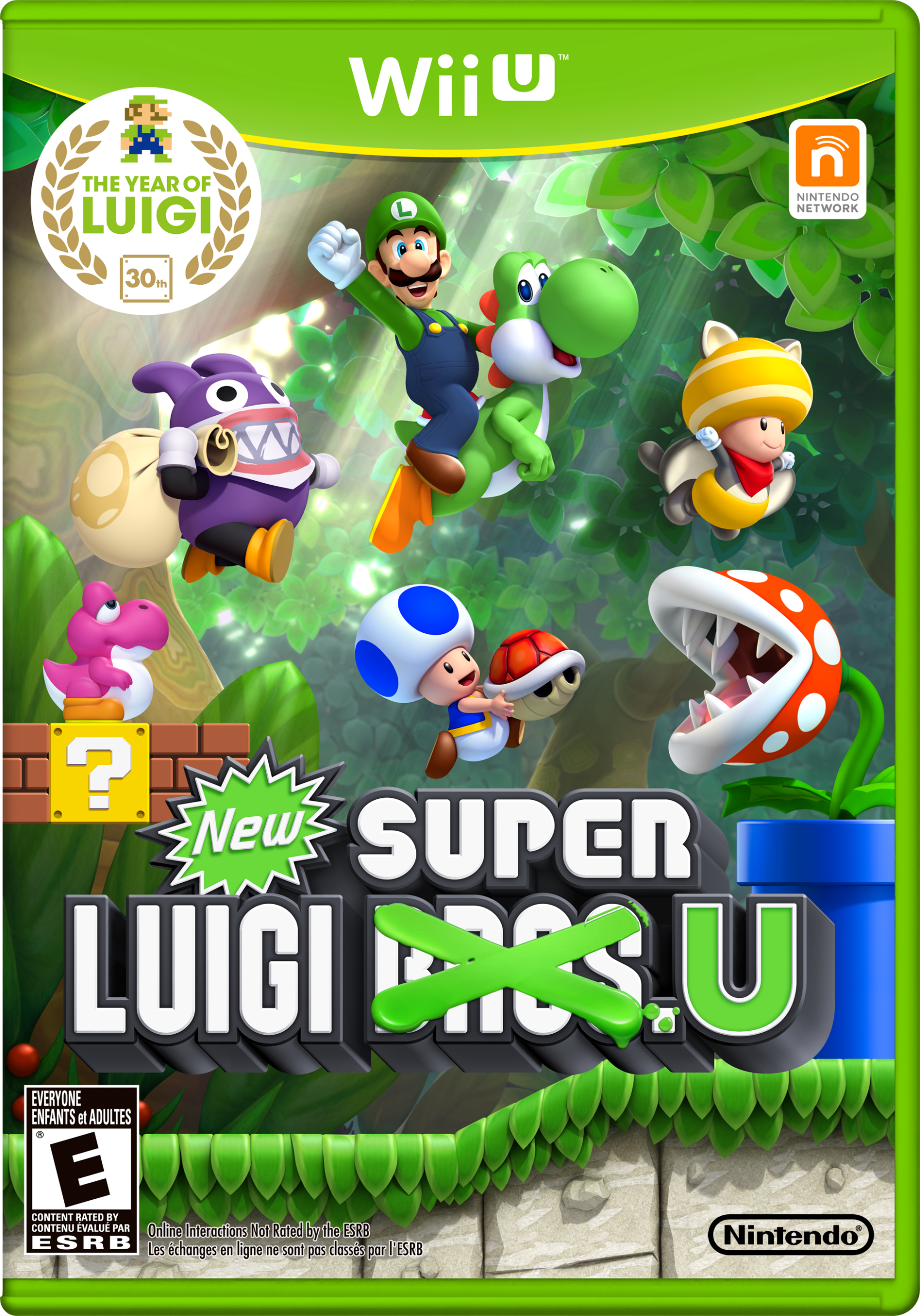
New Super Luigi Bros. U
Mario’s out. Luigi’s in charge. 82 brand-new courses, 100-second timer, Luigi’s floatier physics and Nabbit — this is the Year of Luigi’s crown jewel.
New Super Luigi U is officially stylised as New Super Luigi Bros. U — the “Bros.” is literally crossed out on the box art, because this time it’s all about Luigi. Released in June 2013 as part of the Year of Luigi (celebrating the Big L’s 30th anniversary), it started as a DLC expansion for New Super Mario Bros. U before getting a standalone retail release a few months later.
The pitch is deceptively simple: every single one of NSMBU’s 82 courses has been replaced with a brand-new level. Same world map, same world names, completely different courses — shorter, denser, harder. Mario is nowhere to be seen (though eagle-eyed players will notice his cap sitting on a table in Peach’s castle at the start). Nabbit fills Mario’s multiplayer slot, and Luigi gets his distinctive Lost Levels-style physics: higher jump, leg-scuttle animation and that wonderful/infuriating loose traction.

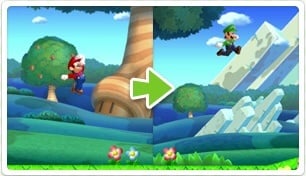
The 100-second time limit per stage is the design decision that defines everything. With under two minutes per level, every course has to be built differently — no slow atmospheric build-ups, no leisurely exploration. NSLU courses are punchy, enemy-packed gauntlets designed to be run fast. They’re often much harder than their NSMBU counterparts as a result, even though they’re technically shorter.
What’s changed

Four playable characters, but a very different lineup from NSMBU. Mario is gone — the only game in the New Super Mario Bros. series without him as a playable character. Luigi leads, the Toads support, and Nabbit is the wildcard newcomer for multiplayer.


“Nabbit is a surprisingly smart design decision — he lets younger or less experienced players participate in multiplayer without being blocked by the increased difficulty. He can’t use power-ups, but he also can’t get taken out by the Hammer Bros you didn’t see coming.”
There’s also a secret fifth option: if you hold ZL/ZR while selecting Flying Squirrel Ovation (the final Superstar Road level) as Nabbit, you’ll play as your Mii in a green Flying Squirrel suit instead. This is the only level in the game where Nabbit is replaced because Flying Squirrel form is required to complete it — and Nabbit can’t use power-ups.
Baby Yoshis
The three Baby Yoshis from NSMBU return. Found on the world map or in specific levels, they each have a unique ability and can be carried (not ridden) through most stages.


Same nine world names as NSMBU, completely different courses. All 82 are new designs — shorter, harder and more densely packed than their NSMBU counterparts. The world map itself is identical; the levels inside are where everything changes.


This is one of NSLU’s most charming little touches. If you finish a level with the last two digits of your timer showing a matching pair, a Toad at the goal post gives you a bonus power-up. The matchup table:
Worth noting: :00 doesn’t count — that’s just barely making it without a bonus. The rarest catch is :88, which requires finishing a stage with precisely 88 seconds on the clock — tricky when most stages start at only 100.
They share a world map and a visual engine, but play very differently. Here’s the honest head-to-head:
| Feature | New Super Mario Bros. U | New Super Luigi U |
|---|---|---|
| Protagonist | Mario (all-round, reliable physics) | Luigi (higher jump, floaty, loose traction — more skill expression) |
| Time limit per stage | 400+ seconds — leisurely exploration possible | 100 seconds — sprint from start to finish, every level |
| Courses | 82 original courses | 82 completely new courses — effectively a full new game |
| Difficulty | Moderate — accessible to most players | Harder — shorter courses packed with enemies, no checkpoints |
| Checkpoint flags | Yes — midpoint checkpoints in most levels | None. Zero. In any level. |
| 4th multiplayer character | Mario, Luigi, Yellow Toad, Blue Toad | Luigi, Yellow Toad, Blue Toad, Nabbit (immune to enemies — great for newcomers) |
| Game modes | Story, Boost Rush, Challenge Mode, Coin Battle, Boost Mode, Off-TV | Story mode and multiplayer only |
| Hidden secrets | Star Coin collecting, secret exits | All of the above + hidden Luigi sprite in every single level |
| Post-game unlock | Superstar Road (9 hard levels) | Superstar Road (9 hard levels) + Luigi Block to swap physics in any level |
| Timer bonus system | Not present | Matching timer digits earn power-ups from Toad at the goal post |
| Price / value | Full retail game (~£49.99) | DLC (~£17.99) or cheaper standalone disc — exceptional value |
| Best for | Families, new players, complete Mario package | Mario fans wanting a real challenge and something genuinely new |
Bottom line: NSMBU is the bigger, more complete package. NSLU is the better game if you already love 2D Mario and want to be properly tested. They’re companion pieces rather than competitors — and if you’re on the fence, the DLC price makes NSLU a very easy recommendation for anyone who already owns NSMBU.
New Super Luigi U was very well received — critics praised it as a genuinely substantial add-on with real creative ambition rather than a lazy reskin. The 100-second timer and Luigi’s physics were singled out as smart design decisions that created a completely different game feel. At the DLC price point it was considered outstanding value.
The standalone retail version scored slightly higher — reviewers felt it held up better as a complete product than as a DLC add-on, partly because it stood alone rather than requiring ownership of the base game. Either way it sold well and is now included in New Super Mario Bros. U Deluxe on Nintendo Switch, making it accessible to a whole new generation of players.
- The game’s official title crosses out “Bros.” on the box art and logo — stylised as New Super Luigi
Bros.U. It’s the only mainline Mario title to remove the “Bros.” designation. - Mario is completely absent from gameplay — no cameo, no playable role, nothing. His cap is visible on a table in Peach’s castle during the opening, but that’s it. Luigi’s game, full stop.
- It was announced by Satoru Iwata during a Nintendo Direct on 14 February 2013, just a few months after NSMBU launched. Rapid development was possible because the engine and world structure were already built.
- The Luigi Block that appears post-game (letting you switch to Mario’s physics) is a genuinely clever meta-design touch — it lets you feel exactly how different the two games are in real time, mid-level.
- Every single one of the 82 levels contains a hidden 8-bit Luigi sprite somewhere in the environment — embedded in a wall, a platform, a background element. Flying Squirrel Ovation has two. Finding them all is a completionist goal in its own right.
- The 100-second timer was a deliberate design constraint, not a difficulty setting — Nintendo wanted shorter, denser stages built around Luigi’s floaty jump. The timer shaped every level’s design from the ground up.
- Nabbit, the purple rabbit thief introduced in NSMBU, was promoted to a fully playable character in this game. He later became a regular multiplayer option in New Super Mario Bros. U Deluxe on Switch.
- The game was later included in New Super Mario Bros. U Deluxe for Nintendo Switch (January 2019), which added Toadette as a new character with a Super Crown that transforms her into Peachette. NSLU is part of the package with no extra charge.
- The Year of Luigi ran from E3 2013 to March 2014. NSLU was its most prominent game — but Luigi also featured in Luigi’s Mansion: Dark Moon, Mario & Luigi: Dream Team, and Dr. Luigi during the same period.
- Flying Squirrel Ovation — the final Superstar Road level — is considered one of the hardest levels in any New Super Mario Bros. game. It requires Flying Squirrel wall-grabs and precise timing throughout, with no checkpoints and the 100-second clock ticking.