
Dance Dance Revolution: Mario Mix
Overview
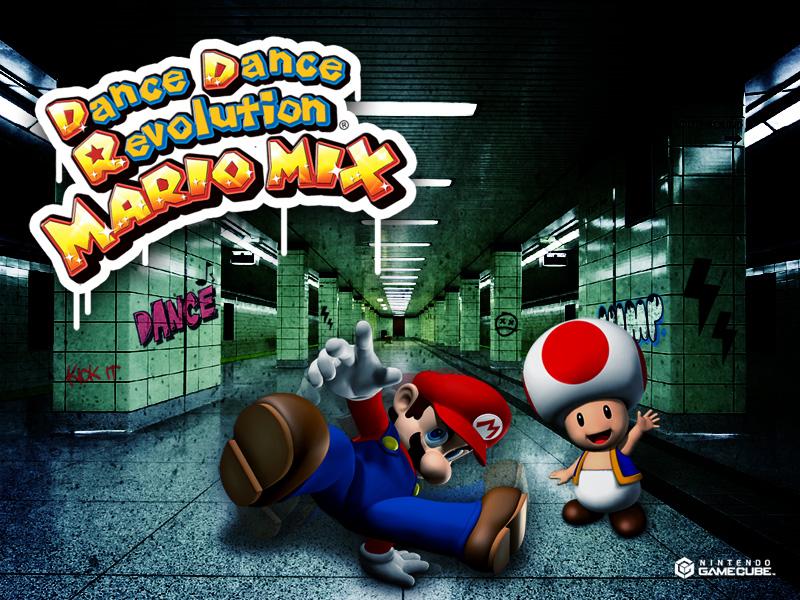
Dance Dance Revolution: Mario Mix — sold as Dancing Stage: Mario Mix in PAL territories — is a 2005 GameCube rhythm game that drops Mario, Luigi and a cast of Mushroom Kingdom regulars onto the dance floor. It is a rare cross-studio collaboration between three legendary developers: Konami (creators of the DDR series), Hudson Soft (then a close Konami affiliate, soon to be absorbed), and Nintendo SPD Group No.2.
The game ships with a chunky Action Pad floor mat that plugs into a controller socket on the GameCube. Players stand on the mat and step on directional arrows in time with the music as they scroll up the screen. The game features around 30 songs across five difficulty levels — from Easy through to Super Hard — with the tracklist drawing heavily on remixed classical pieces (Mozart, Bizet, Elgar, Brahms) alongside Mario-series staples like the Super Mario Bros. Ground BGM and the Super Mario World overworld theme.
For a Konami-developed Mario game it's surprisingly thoughtful: a full Story Mode with worlds and bosses, a Mush Mode power-up system that swaps the arrow patterns mid-song, dance-off battles against Bowser's minions, and a workout feature that tracks calories burned. It's not a major canonical Mario title, but it's a charming and underrated GameCube curio.
Story Mode
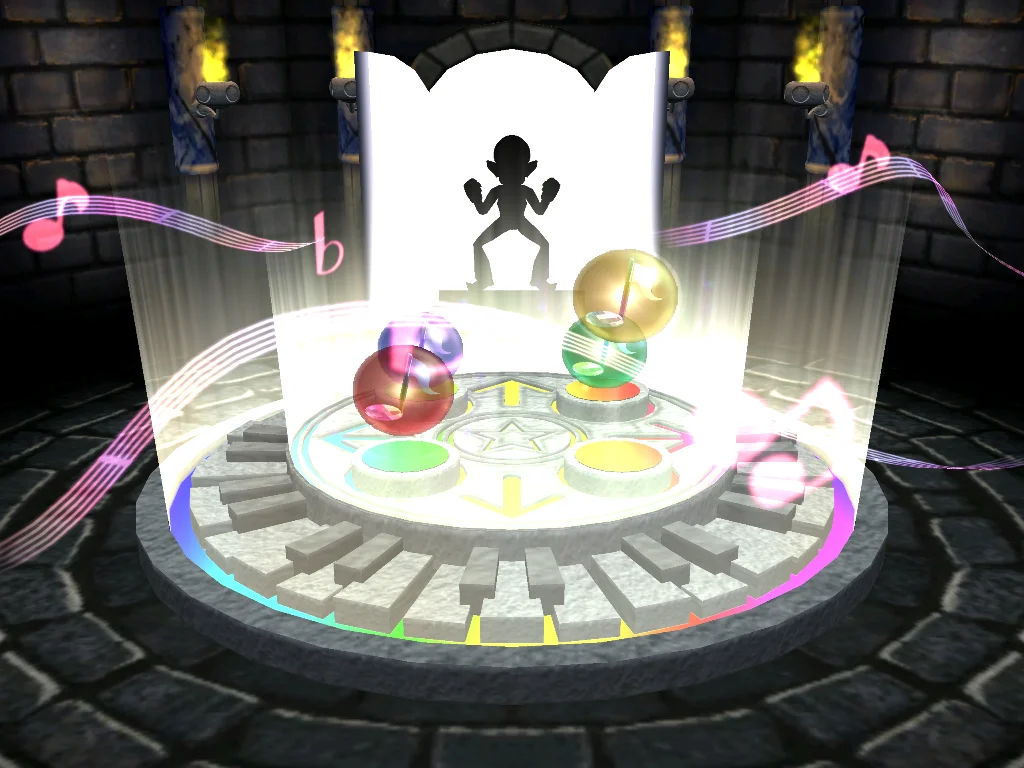
The game opens with Waluigi breaking into Truffle Towers — a fortress safeguarding the four magical Music Keys, which can grant any wish. When Waluigi opens the vault, three of the keys scatter across the Mushroom Kingdom and Waluigi makes off with the fourth. The unleashed chaotic power of music causes floods, whirlpools and disasters across the land.
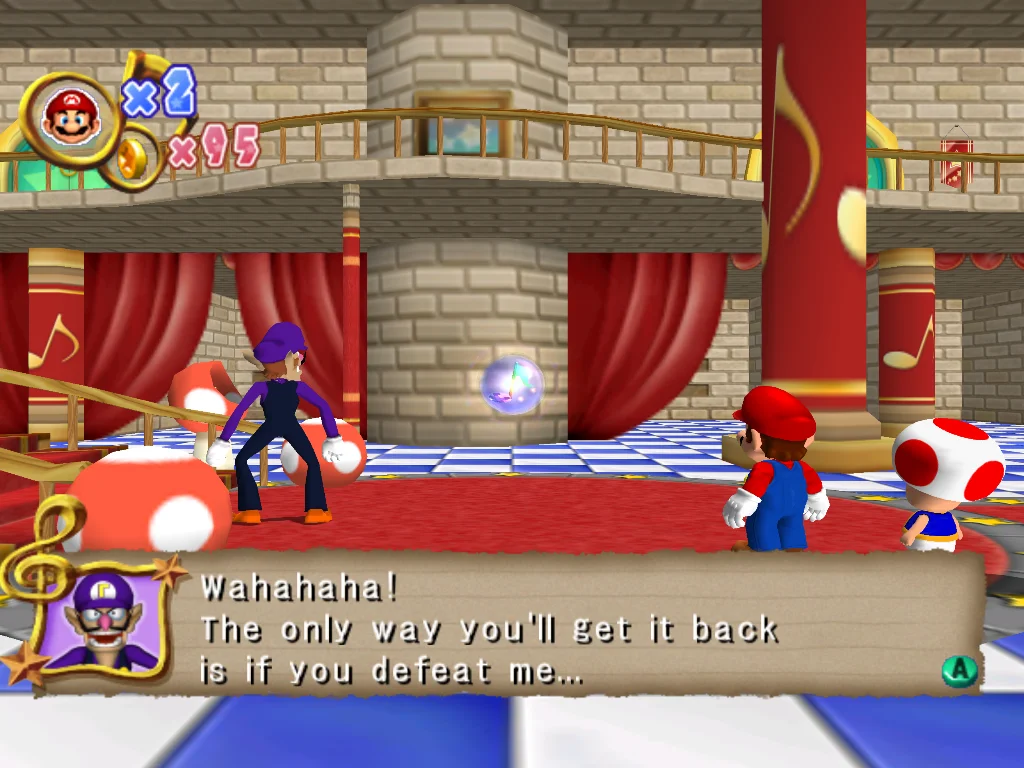
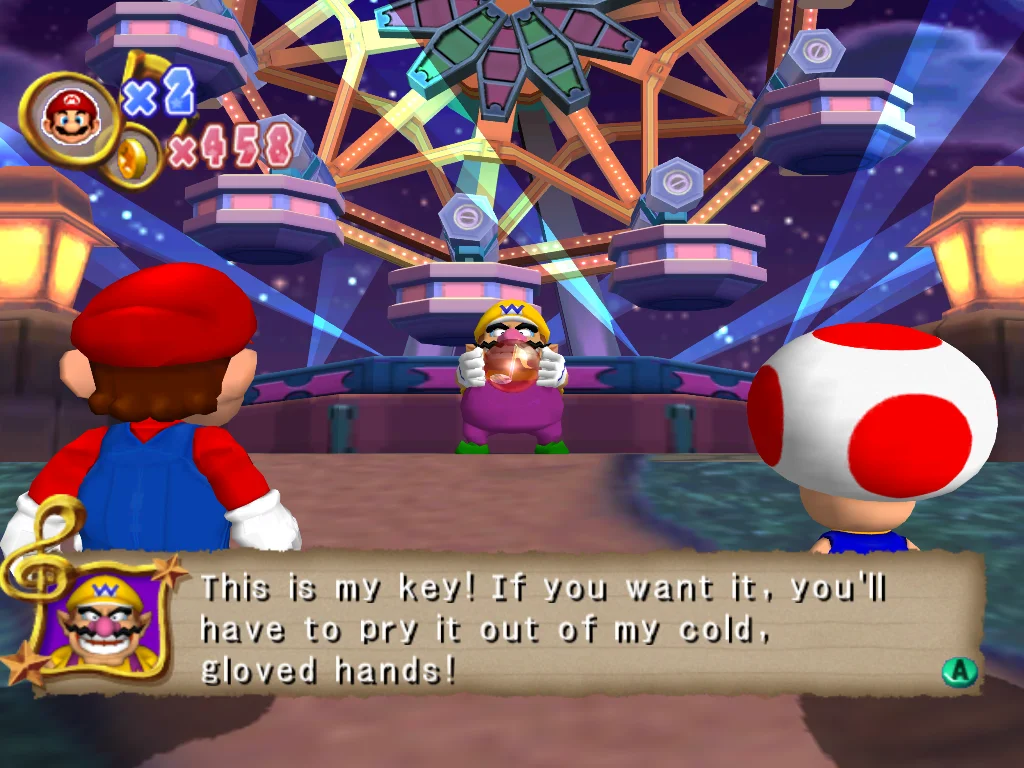
Toad witnesses the break-in and rushes to fetch Mario. Together they set out to recover the Music Keys — this time in their dancing shoes. Toad narrates the journey and provides commentary throughout but is unable to dance himself; he relies on Mario's footwork to progress. The adventure travels from Mario's home through Wario's sleazy carnival, up the treacherous Freeze Mountain, and ends with a confrontation with Bowser, who steals the recovered keys for himself in the climactic final act.
The entire story is framed as dance-offs — even the final Bowser battle is settled by stepping on arrows. This is one of the very few Mario games in which Bowser is canonically defeated by being out-danced.



Characters
In-game mugshots of the supporting cast:


Playable
- Mario — the default Story Mode dancer and Player 1 in Versus Play.
- Luigi — Player 2 in Versus Play, plays identically to Mario.
Non-playable
- Toad — Mario and Luigi's loyal companion. Provides Story Mode narration but cannot dance.
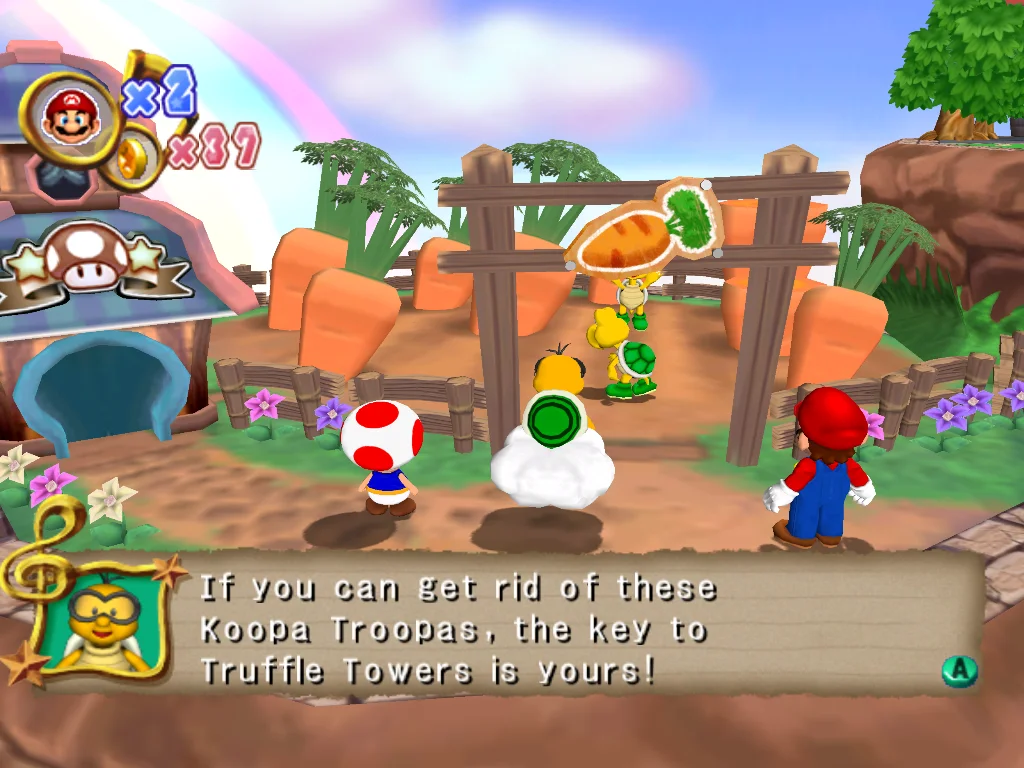
- Lakitu — the game's shopkeeper. Gives Mario the Truffle Towers key in World 1 (after a Koopa Troopa garden-clearance dance-off).
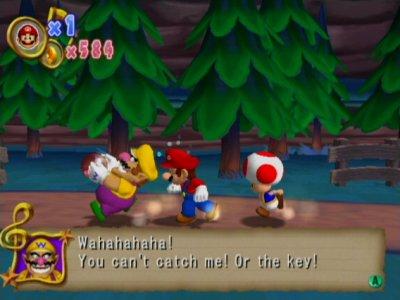
- Waluigi — the initial antagonist. Steals the Music Keys, runs his own dance attraction (“DDR: Wario Mix” in the US version, “Dancing Stage: Wario Mix” in PAL) and serves as the boss of an early world.
- Wario — runs a sleazy carnival in World 2.
- Toadette — supporting character. Refers to the Music Keys as “shiny globes” in American English and “shiny keys” in British English (one of the regional difference quirks).
- Bowser — the final boss. Appears late in Story Mode to steal the recovered keys and forces the final dance-off.
Background characters
Mushroom Kingdom regulars populate the stages as crowd-fillers and dance partners: Goomba, Piranha Plant, Shy Guy, Koopa Troopa, Bob-omb, Ukiki, Cheep-Cheep, Big Blooper, Boo, Chain-Chomp, Mr. Blizzard, Penguin and Banzai Bill all make appearances.
Worlds & Bosses
Story Mode is split into five worlds, each with its own theme and boss. Each world contains multiple dance tracks (some with EX variants for harder difficulties) plus a boss dance-off at the end.
| World | Theme | Boss | Notable Tracks |
|---|---|---|---|
| World 1 | The Mushroom Kingdom — Lakitu's garden, Truffle Towers | Waluigi | Here We Go!, Underground Mozart, Garden Boogie |
| World 2 | Wario's Carnival — bright lights, big stink | Wario | Jump! Jump! Jump!, Fishing Frenzy, Pirate Dance |
| World 3 | Freeze Mountain — icy peaks and underground tunnels | Mountain boss encounter | Hammer Dance, mountain-themed tracks |
| World 4 | The Summit — reaches the top of the mountain | Mid-tier showdown | Higher difficulty tracks |
| World 5 | The final showdown — Bowser steals the recovered keys | Bowser | The endgame boss tracks |
The progression through worlds also unlocks EX-difficulty variants of earlier tracks — harder remixes of songs you've already beaten, providing replay value beyond the main campaign.



Gameplay & Difficulty
At its core, DDR: Mario Mix is the same arrow-stepping rhythm gameplay Konami pioneered in the late 1990s: directional arrows scroll upward on the screen, and the player must hit the matching arrow on the Action Pad (or D-pad) at the exact moment it reaches the step zone at the top.
Five difficulty levels are available for each song: Easy, Normal, Hard, Very Hard and Super Hard. As difficulty rises, you face more arrows per second, longer combos, and crucially the introduction of simultaneous double-arrow steps (jumps where you must press two directions at once). Super Hard is genuinely demanding even by DDR-veteran standards on some tracks.
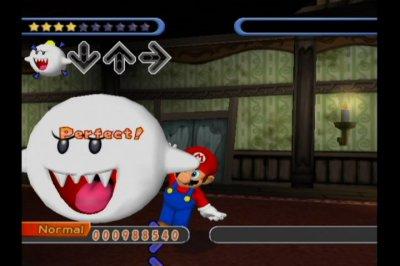
Each successful step earns a grade — Marvelous, Perfect, Great, Almost, Boo — and your overall song performance receives a star rating. A dance meter at the top of the screen tracks your performance: missed steps drain it, hits fill it. If it empties completely, you fail the song.
The game also tracks calories burned as you play, framing the dance pad as a casual workout tool — a marketing angle Nintendo leaned into heavily for the title.

The Action Pad
The game ships with a custom Action Pad — a soft floor mat with five raised arrow pads (up, down, left, right, plus a centre standing zone) that plugs into a GameCube controller port. There are two physical versions: a v1 and a slightly redesigned v2, both functionally identical.
The mat is a bespoke Konami design built specifically for this game — not compatible with mainline DDR cabinets or PlayStation 2 DDR releases. The Action Pad is the headline accessory, but the game can also be played using a regular GameCube controller: the D-pad or face buttons substitute for the arrows. This makes the game viable for travel and for players who don't want to set up a floor pad.
The bundled Action Pad version is what most retailers stocked — the standalone game-only release was rarer. Today a sealed Action Pad bundle is a moderate collector's item.

Mush Mode
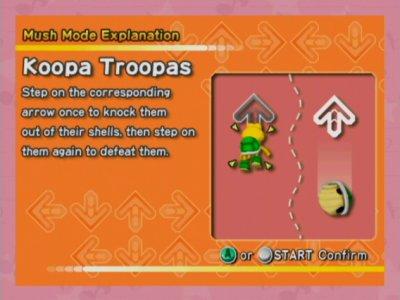
One of the most innovative twists Mario Mix adds to the DDR formula is Mush Mode — a mid-song state change triggered by hitting a special Super Mushroom arrow pattern. When activated, the entire arrow scheme transforms for a limited period.
During Mush Mode, the arrows can become larger and slower (making them easier to hit but scoring lower), or in some tracks they become smaller and faster (harder but higher scoring). Other Mush Mode variants include arrow-mirroring, hidden arrows that fade in late, and inverted-direction effects.
The system gives even high-level players reasons to replay easier tracks — you can chase Mush Mode high scores rather than just clearing the song. It's a Mario-flavoured layer that mainline DDR titles never adopted.

Modes & Minigames
Single Player Modes
- Story Mode — the main campaign across the five worlds, the heart of the game. Approximately 6-8 hours to clear on Normal difficulty.
- Free Mode — play any unlocked song at any difficulty without story progression.
- Endless Mode — one song after another until you fail.
- Workout Mode — an organised exercise sequence tracking calorie burn over a set duration. Marketing angle, but mechanically real.
Versus Play
Two-player simultaneous mode with Mario (P1) and Luigi (P2). Requires two Action Pads (or one Pad + one controller). The game splits the screen vertically and both players step in parallel.
Minigames
Scattered throughout Story Mode are short dance-themed minigames built around specific gimmicks: timing-based ones, memory-based pattern-recall ones, and reaction-test challenges. Some unlock customisation rewards.

Music Tracks
The soundtrack is the standout feature of the game — a clever blend of classical compositions and Mario-series themes re-arranged into DDR-friendly rhythmic remixes. The full tracklist mixes Koji Kondo Mario compositions with public-domain classical music from Mozart, Bizet, Elgar, Brahms, Strauss and others.
| Track | Stage | Original Source | Composer |
|---|---|---|---|
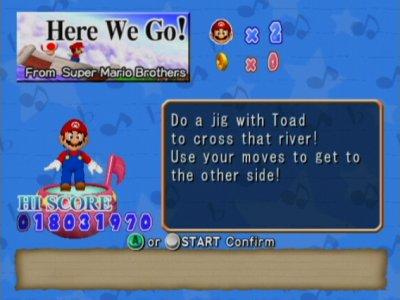
| Here We Go! | 1-1 | Super Mario Bros. Ground BGM | Koji Kondo |
| Underground Mozart | 1-2 | Eine Kleine Nachtmusik | Wolfgang Amadeus Mozart |
| Pipe Pop | 1-2EX | Turkish March | Mozart |
| Garden Boogie | 1-3 | Carmen | Georges Bizet |
| Destruction Dance | 1-4 | Wrecking Crew Bonus Phase | Hirokazu Tanaka |
| Jump! Jump! Jump! | 2-1 | Super Mario Bros. 3 Athletic BGM | Koji Kondo |
| Fishing Frenzy | 2-2 | Csikos Post (via Yoshi's Cookie) | Hermann Necke |
| Pirate Dance | 2-2EX | Super Mario World Ground BGM | Koji Kondo |
| In the Whirlpool | 2-3 | Pomp and Circumstance | Edward Elgar |
| Step by Step | 2-3EX | Super Mario World Bonus Game BGM | Koji Kondo |
| Blooper Bop | 2-4 | Super Mario Bros. Underwater BGM | Koji Kondo |
| Hammer Dance | 3-1 | Super Mario Bros. series | Koji Kondo |
Plus around 15 more tracks across Worlds 3-5 and the bonus EX/unlockable list. The mix of Mozart, Bizet and Elgar with Koji Kondo gives the soundtrack a unique cross-cultural feel that no other Mario game has attempted.
Regional Differences

The Japanese and international versions have a handful of subtle differences. The most notable are linguistic:
- Title sting voice line: when the player presses Start on the title screen, the Japanese narrator says “Let's DDR”; the international narrator says “Let's Dance”.
- Cabin Fever song: the intro and ending of this track differ between the Japanese and international versions.
- Waluigi's attraction name: in American English Wario calls his attraction “DDR: Wario Mix”; in European languages he calls it “Dancing Stage: Wario Mix” — matching the PAL retail name of the whole game.
- Music Key terminology: Toadette calls the Music Keys “shiny globes” in American English and “shiny keys” in British English.
- Box art: the PAL box says “Dancing Stage: Mario Mix” with adjusted PEGI age ratings; the Japanese and US versions both use the “DDR: Mario Mix” branding.
Development Staff — A Three-Studio Project
The cross-studio nature of Mario Mix means the credits include people from three separate companies — a genuinely unusual arrangement for a Nintendo first-party release.
- Konami — provided the core DDR engine, arrow-pattern design, and decades of expertise in the genre. Konami remains the only company to ever co-develop a mainline-style Mario game.
- Hudson Soft — longtime Konami affiliate at the time (Hudson would be fully absorbed into Konami in 2012). Hudson handled significant programming and asset work.
- Nintendo SPD Group No.2 — oversight, Mario-character implementation, and overall quality control to keep the game on-brand.
- Music arrangements — the Mario themes are credited to Koji Kondo (composer of the originals); the classical re-arrangements were handled by Konami's in-house composers and arrangers.
Names & Regional Titles
The game shipped under different titles in different regions, reflecting the regional naming conventions of the DDR franchise itself:
- Japan: «ダンスダンスレボリューション プリント マリオミックス» (Dansu Dansu Reboryusyon: Purinto Mario Mikkusu) — uses the “Dance Dance Revolution” branding
- North America: Dance Dance Revolution: Mario Mix
- Europe / Australia (PAL): Dancing Stage: Mario Mix — the European DDR franchise is rebranded as “Dancing Stage” for licensing reasons, so the Mario crossover follows the same convention
- Serial codes: DOL-GWZJ-JPN (Japan), DOL-GWZE-USA (N.America), DOL-GWZP-EUR (Europe)
Videos
The North American TV commercial for Dance Dance Revolution: Mario Mix on the Nintendo GameCube — capturing the early-2000s family-living-room marketing spirit of the era.
Reference / Information
Sub-pages and cheats for Dance Dance Revolution: Mario Mix.
Media / Downloads
Box art, desktop wallpaper and screenshots for Dance Dance Revolution: Mario Mix.