
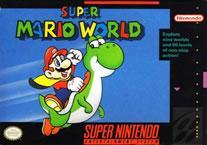

Super Mario World
Super Mario Bros. 4 — the SNES launch masterpiece
Overview
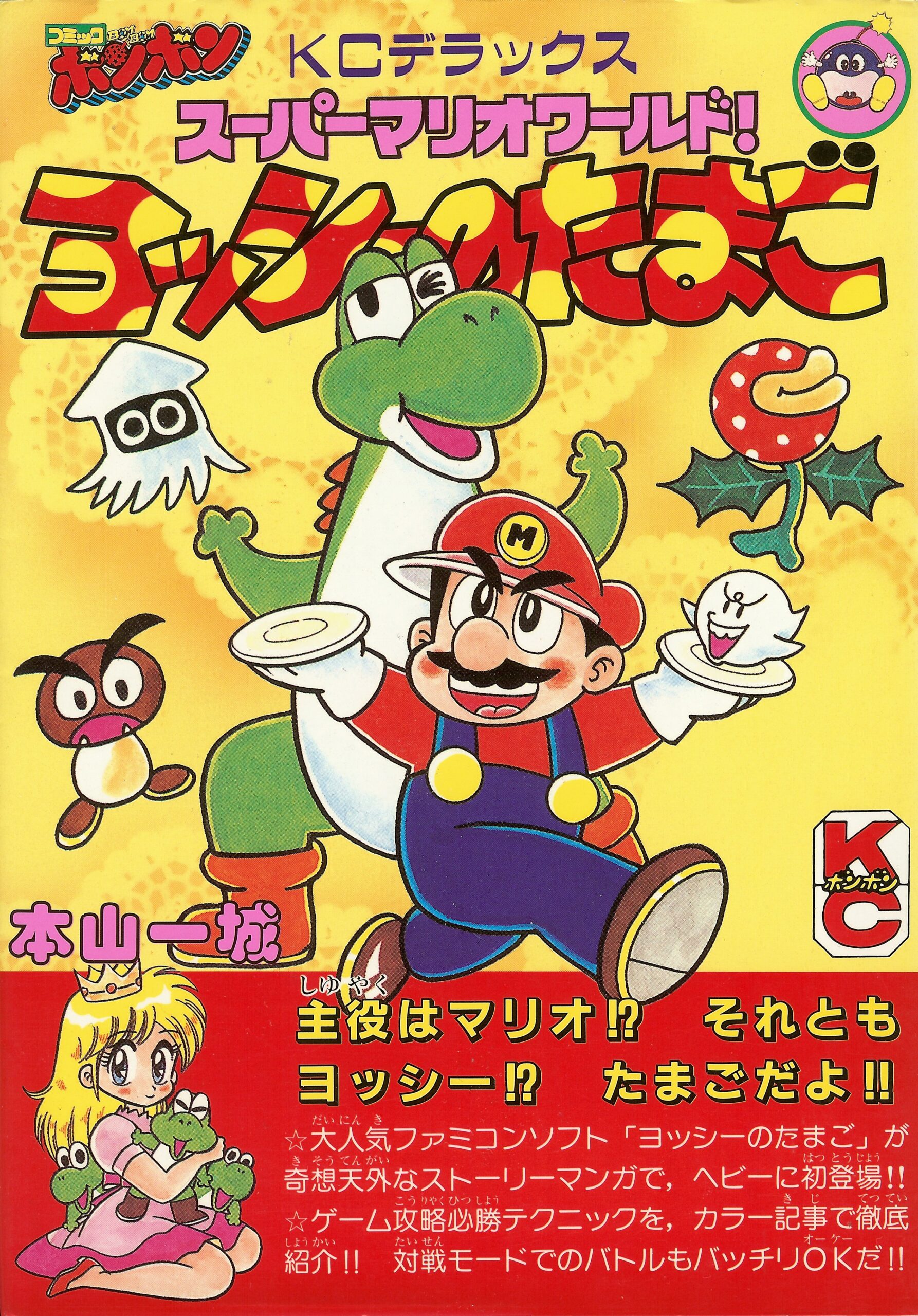
Super Mario World is the game that launched the Super Nintendo Entertainment System, and it remains one of Nintendo’s finest achievements. Known in Japan as Super Mario Bros. 4, it was developed by Nintendo EAD under Shigeru Miyamoto and Takashi Tezuka, who also created Super Mario Bros. 3. The game introduced Yoshi — Mario’s green dinosaur companion — who would become one of Nintendo’s most beloved characters and a franchise of his own.
The game shipped bundled with the SNES, meaning virtually every SNES owner owned a copy. It went on to sell over 20 million copies, making it the best-selling game in SNES history. GameRankings gave it a cumulative score of 94.44% from reviews across its lifetime, and it regularly appears in discussions of the greatest video games ever made.
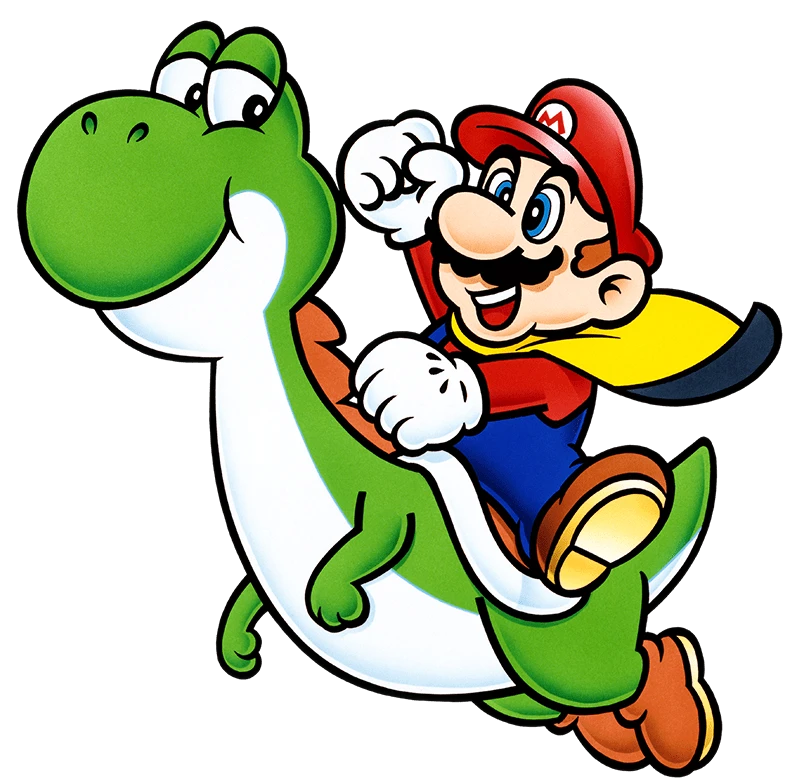
The iconic image that defined a generation — Mario on Yoshi, with the Cape Feather power-up.
Super Mario World brought a remarkable level of depth and replayability to the SNES launch lineup. Its 96 exits (across 72 levels) reward thorough exploration; completing the entire game, including all secret exits, Star Road and the Special Zone, takes far longer than casual play suggests. The game also introduced the iconic spin jump, the cape, Star Road and the concept of secret exits — ideas that would influence platform games for decades.
Story
“Mario and Luigi needs to recuperate from their adventures after saving the Mushroom Kingdom from Bowser and the rest of the Koopas in Super Mario 3. Brothers both agreed that Dinosaur Land, a magical place, is the best place for some vacation. But as Mario and Luigi reclined on the beach taking a relaxing nap, they heard that Princess Toadstool disappeared being seized by some evil forces. After Mario and Luigi searching for hours for their missing friend, they came upon an enormous egg in the forest. Yoshi, a young dinosaur had been popped out as soon as the egg hatched, proceeded to tell Mario and Luigi a sad tale about on how his dinosaur pals were sealed in a similar eggs by a group of monstrous turtles.
“Monstrous turtles!” Luigi asserted. “Bowser returned with his bunch have returned!” Mario nodded his head slowly as he agreed. Along with Luigi and Yoshi, they set off across Dinosaur Land to find and rescue the Princess and to free Yoshi’s friends. As they started their voyage, a beautiful cape was handed by Yoshi to Mario and told him that the cape might be helpful in their adventure because some says it has some magical powers.”
With a little luck and help from a magic cape, our brave crew can now defeat the seven worlds of Bowser’s Krazy Koopa Kritters. Lots of locations are well-hidden, so you must explore everywhere and try everything. But not all locations have to be explored in order to rescue the dinosaurs and save Princess Toadstool. There are lots of starry treasures that can be found in far-reaching places. In Super Mario World, you will need to search all the areas and excitingly find out what kinds of treasure are in there.
— Source: Nintendo, from the official game manual.
Gameplay
Super Mario World is a 2D side-scrolling platformer in which Mario (or Luigi in two-player mode) must reach the Giant Gate at the end of each level before the timer expires. The game is navigated through a world map, and levels are represented as button-like spots on the landscape — a more organic system than Super Mario Bros. 3’s separate map panels.
The spin jump is a key new mechanic — it can destroy certain blocks and enemies the regular jump cannot, and it allows Mario to bounce off enemies he would normally be damaged by. The Cape Feather gives Mario a flowing cape; he can use it to run, take off and fly, perform an attack spin, and float down slowly. Mastering the cape’s flying mechanics — including the tricky ascending run-up — is one of the game’s great skill curves.
Yoshi can be ridden in most levels. He can eat most enemies with his tongue, swallow or spit them, and stomping on Koopa shells while riding Yoshi gives the shell to Yoshi who can hold it in his mouth for a power-up effect. Yoshi can jump off of and be remounted from below. Baby Yoshis, found in bubbles in some levels, grow into full Yoshis when fed five enemies.
The world map branches at several points, allowing players to choose their route. Many levels have two exits — a normal exit and a secret exit (usually via a keyhole). Secret exits unlock hidden paths on the map, including routes to Star Road and its shortcut network across the game. Completing all 96 exits is the true completion condition.
Characters
Super Mario World features a small but iconic cast:

The primary protagonist and always player one. Balanced all-rounder who can jump, spin jump, use the cape and ride Yoshi. Cannot be removed from the party.

Player two in alternating two-player mode. Identical mechanics to Mario — spin jump, regular jump, cape use and Yoshi riding — with a distinctive green palette.

The princess of the Mushroom Kingdom, kidnapped by Bowser during the Dinosaur Land vacation. Held in Bowser’s castle throughout the game — rescuing her is the main objective.

Friendly non-enemy NPCs in select water sections (Vanilla Secret 3 and Chocolate Island 1). They carry Mario across water in jumping arcs. In the Japanese version they can be eaten by Yoshi — removed internationally.

Baby Yoshis in coloured bubbles appear throughout. Feed one five enemies to grow it into a full adult Yoshi. Each colour grows into its respective Red, Blue, Yellow or Green adult Yoshi.
Yoshis
Yoshi is Super Mario World’s greatest new addition. The green Yoshi is the primary mount and appears in the most levels. When Mario finds a Yoshi Egg, the hatching dinosaur can be ridden immediately. Yoshi eats most enemies with his long tongue, can hold shells in his mouth for bonus effects, and can perform a flutter kick for extra air time.
Four Yoshi colours appear, each with a different shell ability when holding a Koopa shell in its mouth:

The most common. Can eat enemies, swallow blue shells for flight, or spit shells as projectiles.

Spits three fireballs when it swallows any shell colour. Found in Star Road and special levels.

Gains wings and can fly when it swallows any shell. Found in Star Road. The rarest and most powerful.

Creates a dust cloud stomp when it swallows any shell, defeating nearby enemies. Found in Star Road.
All four adult Yoshis can be found in dedicated levels in Star Road. The Cape Feather + Blue Yoshi combination is particularly powerful — Yoshi flies continuously while Mario wields the cape.
Worlds & levels

The complete Dinosaur Land world map showing all 8 worlds and the secret Star Road network.
Dinosaur Land is divided into eight worlds, navigated through a scrolling overworld map. Each world has a distinct visual theme, enemy roster and difficulty curve. The worlds do not have to be completed strictly in order — secret exits create shortcuts between them, and Star Road allows crossing the entire map in a handful of levels.
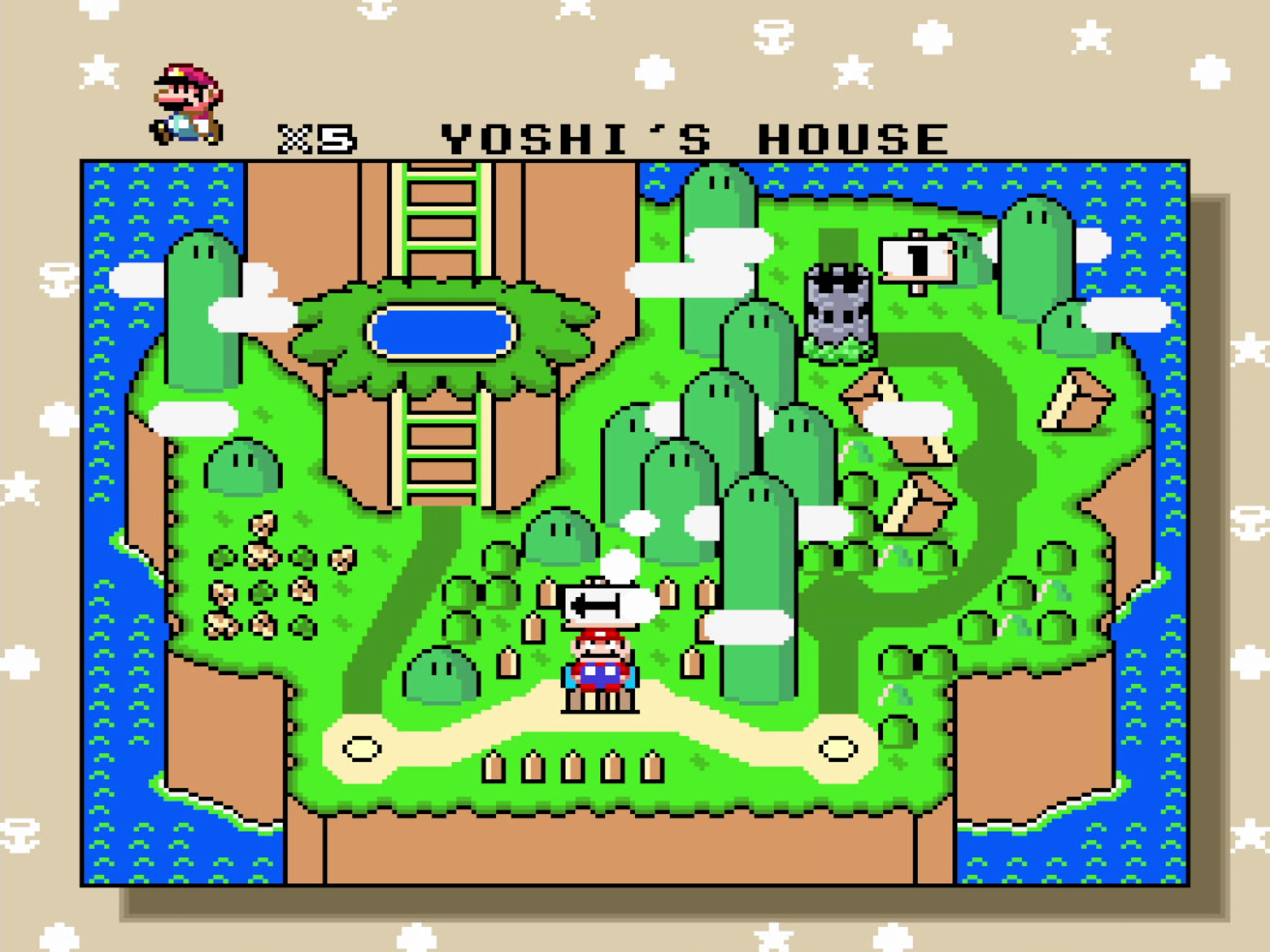


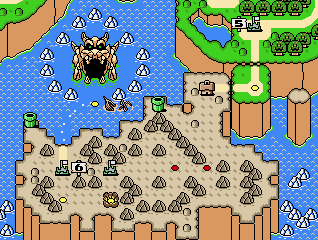
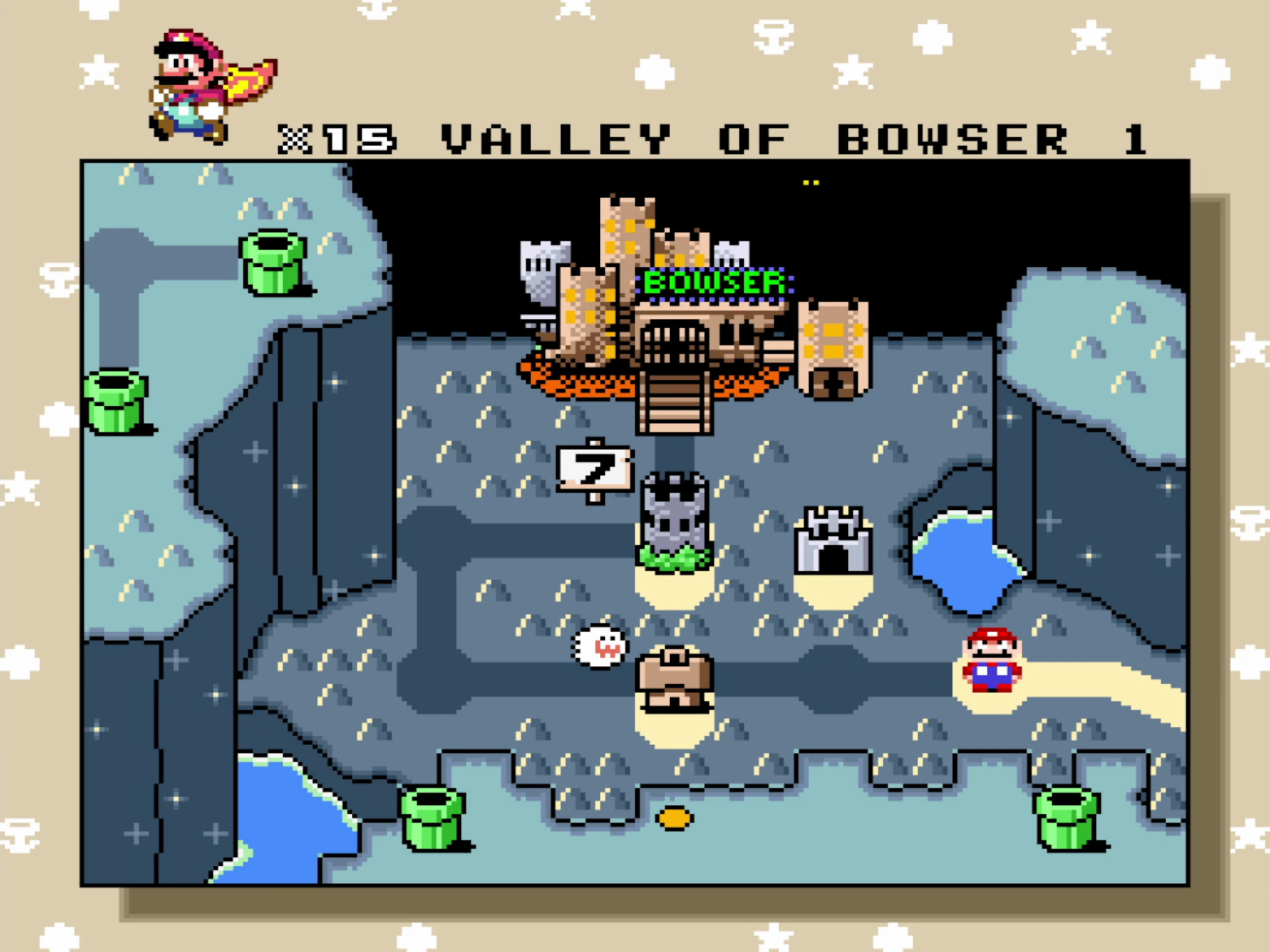

Star Road — a hidden network of five levels accessed via secret exits — connects all worlds and allows rapid traversal of the game. Each Star Road level unlocks a coloured Yoshi (Red, Blue or Yellow) when completed. Completing all five Star Road levels unlocks the Special Zone.
Level features & secret areas
Super Mario World introduced several landmark level design concepts that have defined platform games ever since:
- Secret exits — Most levels have a standard exit (Giant Gate) and a hidden secret exit. Secret exits are reached via a Key and Keyhole, usually hidden behind walls or requiring a specific action to reach. Finding all secret exits is required for 100% completion.
- Ghost Houses — Haunted mansion levels populated by Boos and other ghost enemies. Ghost Houses always contain at least one secret exit that unlocks a hidden path on the world map — the only way to progress to certain areas.
- Fortresses — Mid-world castles guarded by Reznor (a quartet of fire-breathing dinosaurs on a rotating platform) rather than a Koopaling. Clearing a Fortress unlocks the path to the next section of the world.
- Switch Palaces — Four coloured palaces (Yellow, Green, Red, Blue) containing a ! Switch. Pressing it permanently fills in dotted outline blocks of that colour across the entire game, creating platforms, item blocks and walkways that did not exist before.
- The Top Secret Area — A hidden level in Donut Plains containing unlimited Super Mushrooms, Fire Flowers, Cape Feathers and Yoshi Eggs. Found via the secret exit of Donut Secret House. One of the most useful hidden rooms in any Mario game.
- Star Road — The hidden overworld shortcut network. Five levels accessible only via secret exits in each of the five main worlds. Completing them unlocks Yoshis and ultimately the Special Zone.
- The Special Zone — Eight expert levels accessible only after completing all five Star Road levels. Completing the Special Zone changes the game’s seasonal palette to Autumn and gives some enemies Halloween-themed graphics.
- Keyholes and Key Gates — A key carried to a keyhole triggers the secret exit of a level. Keys can also be carried between rooms and even to different pipes within a level.
The Top Secret Area — unlimited power-ups hidden in Donut Plains, accessible only via the secret exit of Donut Secret House.
Enemies & bosses
Super Mario World features one of the most varied enemy rosters in the series — familiar faces return alongside many new species that have since become series regulars.
Goomba family
 GaloombaRenamed Goomba
 Para-GoombaWinged Galoomba
 Flying GoombaPropeller cap variant
Koopa family
 Koopa (Green)Slides in shell
 Koopa (Red)Turns at ledge edges
 Paratroopa (Green)Loses wings when stomped
 Paratroopa (Red)Flies back and forth
 Climbing KoopaScales mesh netting
 Super KoopaCaped; can dive-bomb
 SpinyCannot be stomped
 Spiny EggThrown by Lakitu
 MuncherStationary; eats everything
Bob-omb family
 Bob-ombWalks and explodes on contact
 Para-bombFloats down; explodes on landing
Dinosaur & large enemies
 Dino-RhinoStomped once becomes Dino-Torch
 Dino-TorchBreathes fire when stomped
 RexFlattens when stomped once
 Mega MoleLarger version of Monty Mole
 Monty MolePops from the ground
 FuzzyBounces along rails
Plant enemies
 Jumping PiranhaLeaps out of pipes
 Piranha PlantBites from inside pipes
 Volcano LotusSpits fireballs upward
 WigglerRages red when stomped
Flying & airborne enemies
 Bullet BillLaunched from Blasters
 Banzai BillEnormous Bullet Bill variant
 LakituDrops Spiny Eggs from cloud
 Fishin’ LakituDangles 1-Up Mushroom as lure
 MagikoopaTransforms blocks into enemies
 SwooperCave bat; swoops at Mario
 Hammer Bro (Flying)Throws hammers from platform
 GrinderCircular saw on rail track
 Sumo BrotherStomps lightning bolts
 NinjiJumps erratically; hard to dodge
Ghost House enemies
 BooFreezes when Mario faces it
 Big BooLarge Boo variant
 Fishin’ BooDangles 1-Up as lure
 Dry BonesReassembles after being stomped
 Bony BeetleSpiked Dry Bones Buzzy Beetle
 EerieFloats in a fixed circular path
Underwater & water enemies
 Cheep CheepCommon underwater fish
 BlurpCharges directly at Mario
 Porcu-PufferSpiky; cannot be stomped
 UrchinSpiky stationary sea urchin
 Rip Van FishSleeps; chases when woken
 Torpedo TedHoming underwater missile
 FishboneSkeletal fish; chases Mario
 BlarggLava creature that lunges upward
Castle & fortress enemies
 ThwompDrops from ceiling to crush
 ThwimpSmall Thwomp; bounces diagonally
 Spike TopWalks on all surfaces including ceilings
 Buzzy BeetleFire-resistant hard shell
 Chargin’ ChuckFootball-armoured; many varieties
 PokeyTall cactus stack; segment by segment
 SpikeThrows spiked balls downward
 MechakoopaRobotic Koopa; walks and explodes
 HotheadFiery ball that grows when hit
 Lil’ SparkySmall electric enemy on ledges
 Lava BubbleBounces from lava pools
 Ball ‘N’ ChainSwings on chain; hard to pass
Koopalings
Each Koopaling guards a castle. Hit them three times with spin jumps after breaking their shell:


Reznor

Four fire-breathing dinosaurs on a rotating wheel over lava, guarding each mid-world Fortress. Destroy the platform beneath each one.
Bowser

Pilots his Koopa Clown Car in the final battle — raining Mecha-Koopas and bouncing balls at Mario. Bounce the Mecha-Koopas back nine times across three phases to win.
Items
Collectibles and pickups found throughout Dinosaur Land:
| Item | Description | |
|---|---|---|
 |
Coins | Collect 100 for a 1-Up. Control Coins spin from Prize Blocks and can be directed with the joystick. |
 |
Gray Coins | Created when a Gray P-Switch is pressed — certain enemies turn into Gray Coins temporarily. Collect enough for extra lives. |
 |
Dragon Coins | Five hidden in each stage. Collect all five in one run for a 1-Up. Points double for each consecutive coin. |
 |
1-Up Mushroom | Grants one extra life. May emerge from Yoshi Eggs if Mario passes them while already riding Yoshi. |
 |
3-Up Moon | Extremely rare — grants three extra lives. Hidden in only a handful of locations. |
 |
Key | Carried to a Keyhole to trigger a level’s secret exit and unlock hidden world map paths. |
 |
Yoshi Egg | Hatches into a Yoshi when hit from below. The colour determines which Yoshi emerges. |
 |
Red Berry | Found on bushes. Feed five to Yoshi for a 1-Up Mushroom. |
 |
Pink Berry | Found on bushes. Feed five to Yoshi for an extra life. |
 |
Green Berry | Found on bushes. Feed to Yoshi for a speed boost. |
 |
Magic Ball | Striking one changes the level — enemy types, items or layout depending on context. |
 |
P-Switch (Blue) | Temporarily turns coins into solid blocks and vice versa. Useful for bridging gaps. |
 |
P-Switch (Gray) | Turns certain enemies into Gray Coins temporarily. |
 |
Bonus Star | Earned at the Giant Gate. The higher Mario crosses the tape, the more stars — fill the bar for a 1-Up. |
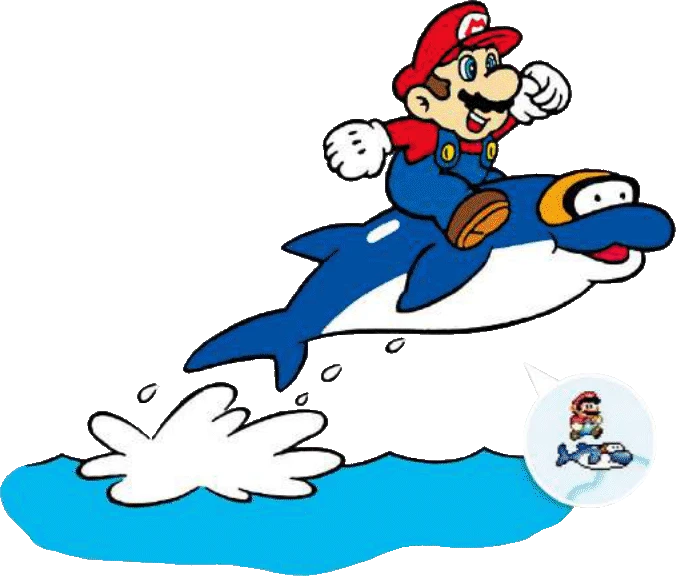
Dolphins appear in select water sections (Vanilla Secret 3 and Chocolate Island 1), carrying Mario across in jumping arcs. This official artwork shows their friendly non-enemy nature.
Power-ups
Five power-up states are available. The chart shows all state transitions when items are collected or damage is taken:
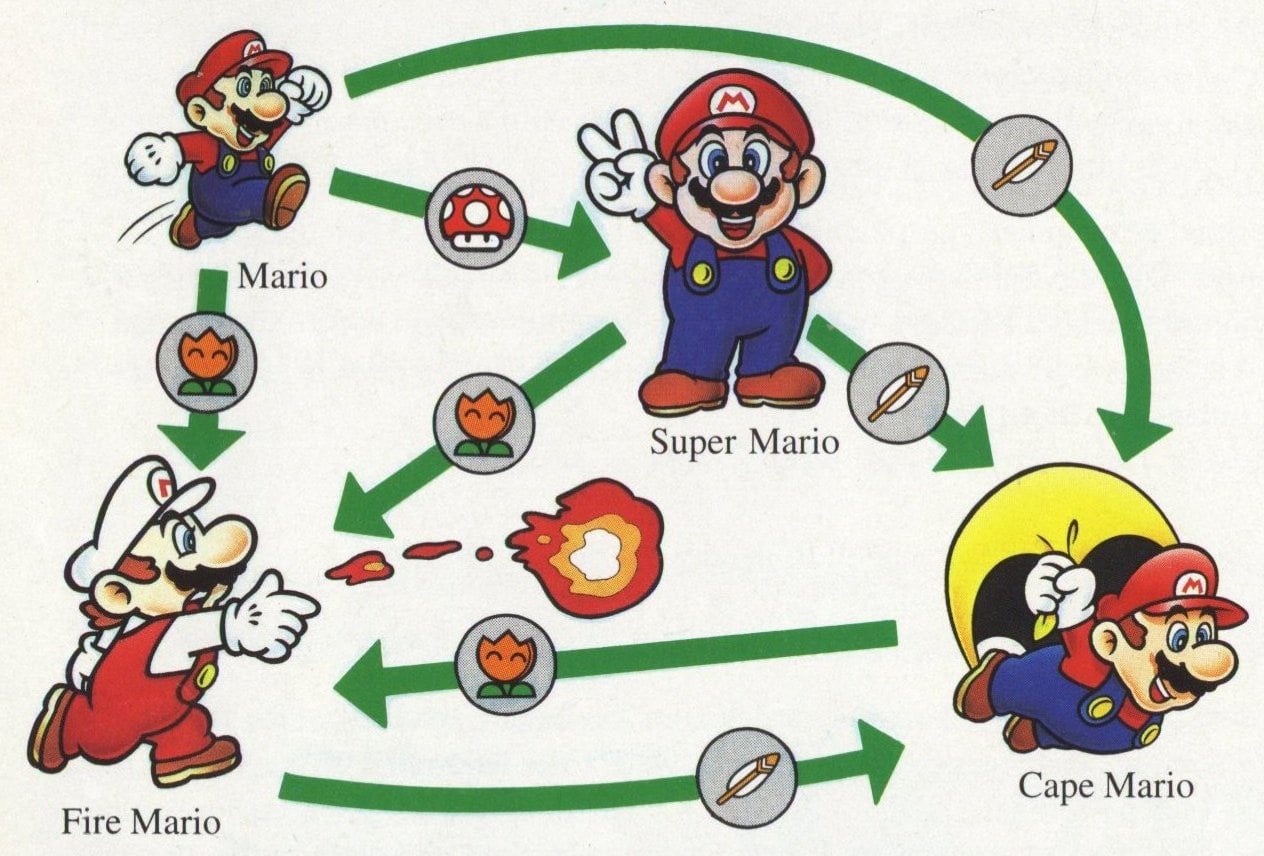
Official power-up chart showing all state transitions.
| Item | Description | |
|---|---|---|
 |
Super Mushroom | Grows Mario to full size. Can break brick blocks. One hit reverts to Small Mario rather than instant death. |
 |
Cape Feather | Gives Mario a flowing cape. Can attack with a swing, run and fly, float down slowly and perform a spin glide. Mastering cape flight — the ascending dive-bomb — is one of the game’s deepest skill curves. |
 |
Fire Flower | Throws bouncing fireballs that defeat most enemies. Fire Luigi uses a unique white-and-green palette from the NES Mario Bros. |
 |
Yoshi (from egg) | A Yoshi Egg hatches a rideable Yoshi. Yoshi can eat enemies, hold Koopa shells for special abilities and flutter-jump for extra air time. |
Objects
Interactive environmental objects and structural elements found across Dinosaur Land:
| Object | Description | |
|---|---|---|
 |
! Blocks | Dotted outline blocks that become solid platforms when the matching Switch Palace colour is activated. Four colours: Yellow, Red, Green, Blue. |
 |
! Switches | Found in Switch Palaces. Pressing one permanently solidifies all blocks of that colour across the entire game. |
|
P-Switch (Blue) | Temporarily turns coins into solid blocks — useful for bridging gaps, creating platforms and revealing hidden passages. |
 |
P-Switch (Gray) | Turns certain enemies into Gray Coins temporarily. Collecting enough creates extra lives. |
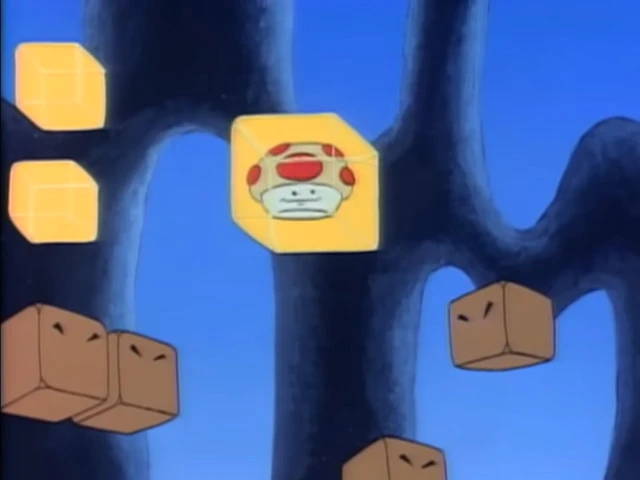 |
Rotating Block (Roulette) | Spins through different power-ups and items. Hit it at the right moment to grab the item you want. |
 |
Moving Platforms | Platforms that travel fixed paths. Directional Lifts move in the direction of their arrow and can be reversed by jumping on them. |
 |
Grab Block | A dark blue block Mario can pick up and throw — useful for defeating enemies and hitting switches. |
|
Magic Ball | Striking one changes something in the level — enemy types, item availability or layout, depending on context. |
|
Keyhole | The secret exit destination. Carry a Key to the Keyhole to unlock hidden map paths and Star Road routes. |
 |
Giant Gate | The end-of-level target. The higher Mario passes through the tape, the more Bonus Stars are awarded. |
References to other games
Super Mario World contains numerous deliberate references and homages to earlier Nintendo titles — a reflection of its creators’ awareness of the franchise’s history:
- Donkey Kong — In the castle destruction cutscenes after each Koopaling is defeated, Mario destroys the castle by swinging a Hammer in the same manner as he does in the original Donkey Kong arcade game.
- Mario Bros. — Fire Luigi’s colour scheme (white overalls, green hat and shirt) is taken from Luigi’s colouration in the NES version of Mario Bros.
- Devil World — The egg-hatching sound effect that plays when Yoshi hatches originated from this Famicom-exclusive game.
- Super Mario Bros. — Waiting on the Special Zone map for exactly 1 minute and 57 seconds triggers a cover version of the classic Ground BGM. The underwater theme also restores the 3/4 waltz time signature dropped in SMB3. The block formation in Yoshi’s Island 1 near the end mirrors a similar formation in World 1-1.
- Super Mario Bros. 2 — Unaltered Ninjis reappear. Bullet Bills resembling Pidgits appear in the Fall (Special Zone). Certain POW-style effects echo SMB2 mechanics.
- Super Mario Bros. 3 — The spin jump is reminiscent of the Tanooki suit’s spin. The Koopalings return as bosses. Many level design concepts (world maps, themed worlds) evolve directly from SMB3. Bowser’s Battle is structurally similar to the SMB3 final battle.
- F-Zero — The name “Mute City” appears in the Special Zone level list — a direct reference to the F-Zero circuit of the same name, released alongside SMW at the SNES launch.
- Pilotwings — “Donut Plains” shares naming conventions with Pilotwings’ practice areas, another SNES launch title.
Reception & legacy
Super Mario World received immediate universal critical acclaim. Reviewers praised its technical presentation — the Mode 7 overworld, the smooth animation, the richly detailed sprites — as well as its depth, level design and the introduction of Yoshi. GameRankings gives it a cumulative score of 94.44% based on reviews spanning its lifetime.
“The game’s general praise is directed to its visuals, gameplay, level design, secrets, and music, while retrospective reviews often opine that the game is still very playable today.”
Bundled with the SNES at launch, Super Mario World became the best-selling SNES game of all time with over 20.61 million copies sold. It set the benchmark against which all 2D platformers of the 16-bit era were judged. Many design concepts it pioneered — secret exits, the world map with branching paths, coloured Yoshis, the spin jump — became standard in the genre.
The game’s legacy is enormous. Yoshi’s debut led to a full franchise (Yoshi’s Island, Yoshi’s Story, Yoshi’s Crafted World). The SNES version is available on Nintendo Switch Online, and the game received a full GBA remake (Super Mario World: Super Mario Advance 2, 2002) and was included in the Super NES Classic Edition (2017).
Development
Super Mario World was directed by Shigeru Miyamoto and produced alongside the SNES hardware itself — Miyamoto and his team were developing the game in parallel with Nintendo’s hardware engineers, using prototype SNES systems. The challenge was to make a launch title that demonstrated the full capabilities of the new hardware.
Yoshi had been conceived as a character since the original Super Mario Bros. development in 1985, but the NES hardware was not powerful enough to realise him. The SNES gave the team the graphical capability to create a fully animated dinosaur mount. Early prototypes had Mario riding a horse-like creature; Yoshi’s distinctive look evolved from that starting point.
The Mode 7 overworld — which creates the appearance of a 3D tilted map — was an early demonstration of the SNES’s signature graphical mode. The game’s pre-release title was simply Super Mario Bros. 4, which remains its Japanese subtitle to this day. The “World” designation was added for Western markets.
On Super Luigi Bros.
Super Mario World has extensive coverage across the site:
Nintendo Power coverage
Nintendo Adventure Books
Cartoons & media
Trivia & interesting facts
- Known in Japan as Super Mario Bros. 4 — the “World” name was created for Western markets
- Developed simultaneously with the SNES hardware itself — Miyamoto’s team used prototype consoles during development
- Yoshi was conceived in 1985 during the original Super Mario Bros. development but had to wait for more powerful hardware
- The game has 96 exits across 72 levels — far more than any previous Mario game
- Completing the Special Zone changes the overworld to an Autumn palette and gives some enemies Halloween-themed graphics (e.g. Koopa Troopas get masks)
- Waiting on the Special Zone map for 1 minute 57 seconds triggers a hidden cover of the Super Mario Bros. Ground BGM
- The name “Mute City” in the Special Zone is a direct reference to the F-Zero racing circuit — both were SNES launch titles
- Luigi’s Fire form uses the colour scheme from Mario Bros. (NES)
- The egg-hatching sound when Yoshi appears came from Devil World, a Famicom game never released in North America
- The Top Secret Area contains unlimited power-ups and is accessed via the secret exit of Donut Secret House
- The game was bundled with the SNES, making it the system’s best-selling game with 20.61 million copies sold
- Cape flying is one of the most skill-dependent power-up mechanics in any Mario game — mastering the ascending dive-bomb technique can maintain infinite flight
- Dolphins in the Japanese version can be eaten by Yoshi; this was patched out for international releases
- Star Road acts as a skip system — completing it allows jumping straight to Bowser’s Valley, bypassing most of the game
- The GBA remake (Super Mario Advance 2, 2002) added Luigi as a separately playable character with different physics
- Super Mario World was included in the Super NES Classic Edition (2017) and is available on Nintendo Switch Online
Reference & downloads
Related content