
Mario’s Early Years! Fun with Numbers
Counting, shapes and maths for the very youngest Mario fans
Overview
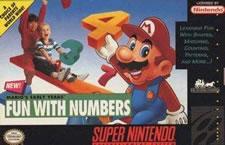
Mario’s Early Years! Fun with Numbers is an educational game for young children focusing on basic maths and numeracy — counting, comparing, shapes, patterns and sorting. Developed and published by The Software Toolworks under licence from Nintendo, it was released for MS-DOS in 1993 and SNES in September 1994. It was preceded by Fun with Letters and followed by Preschool Fun, completing the trilogy of Mario Early Years games.
In the UK, the PC version was sold as Mario Teaches Sums — presumably to sit alongside the existing Mario Teaches Typing brand. All three games share the same engine and structure, just covering different subjects. Fun with Numbers is the maths one, designed for children up to six years old. Mario himself will illustrate the maths concepts when you point to objects, and parents are actively invited to join in.
“Designed for children up to six years old — Mario invites parents to join in the fun.” — original Joomla site description
How it works
Like Fun with Letters, the whole game is driven by a mouse — the SNES Mouse on SNES, or a regular PC mouse. The main screen shows an ocean with a cluster of islands, each representing a different maths world. Mario and Princess Peach are on a raft below, and you click an island to sail over to it. There’s no set order — worlds can be tackled in any sequence.
Each world is split into different rooms, connected via warp pipes. Each room presents a task: maybe clicking numbers in order, counting objects in a scene, or identifying which item doesn’t belong in a group. You usually pick from a few options. Get enough right and you progress to the next room, eventually clearing the world.
One consistent feature across all worlds: Luigi is asleep somewhere in each room. Clicking him wakes him up, and he’ll watch your answers and cheer when you get things right. It’s a nice little motivational touch for small kids — nobody wants to let Luigi down.
The worlds
The SNES version has seven worlds (the PC version has nine — see SNES vs PC below). From the original game and confirmed by the Mario Wiki, here’s what each one covers:
- Number World — Find and click numbers to progress. Pure number recognition for beginners, getting kids comfortable identifying digits in a Mario-themed environment.
- Counting World — Counting through interaction with scenes set in Mario’s Kitchen and Mario’s Bedroom. Click the objects as you count them — a hands-on way to practise one-to-one counting.
- Comparing World — Find and compare objects. Teaches the concepts of more/less, bigger/smaller, and other comparisons that form the foundation of mathematical thinking.
- How Many World — Similar to Counting World, but here the player counts the objects themselves rather than clicking through a guided sequence. A step up in independence.
- Shape World — All about shapes. The game shows shapes and instructs the player which one to identify and click. Circles, squares, triangles — the classics.
- Same and Different World — Comparison and categorisation: the player has to click the item that doesn’t belong in a group. Teaching logical thinking through spotting the odd one out.
- Sorting World — Grouping similar objects together. An introduction to classification and early set theory, done in a way a toddler can actually grasp.
Two additional worlds exist on the PC version only — Sing Song World (nursery rhymes performed by the Mario cast) and Pattern World (sequences and patterns). Both were cut from the SNES version, most likely to fit within cartridge space limits.
Characters
You pick between Mario or Princess Peach at the start — it’s purely cosmetic, no gameplay difference. On SNES, Yoshi was added as a third option, giving kids one more friendly face to choose. Whichever character you pick walks around the worlds and interacts with objects on your behalf when you click.
Luigi is the ever-present sleeping helper — found in every room, woken by a click, and ready to cheer your correct answers. Various other Mario universe characters and enemies appear as part of the world scenery and activities, including Bowser, the Koopalings, Goombas and Piranha Plants.
SNES vs PC — what’s different?
The two versions are very similar but the SNES version made several adjustments, mostly due to the constraints of cartridge format:
- Yoshi was added as a third playable character on SNES — absent from the PC original
- Sing Song World and Pattern World were removed from the SNES version (PC exclusive)
- The audio mute options, question randomiser and text display toggle were removed on SNES
- The help screen with tips on continuing learning outside the game was cut
- Level completion animations differ: PC uses an iris-out on the character while they stand still; SNES has the character walk into a Warp Pipe on the right side of the screen before the iris-out
- A Warp Pipe at the top of the screen in the PC version (used to exit a world early) was removed on SNES
- Loading transitions differ: PC shows Mario looking at a watch; SNES just shows a black screen
- Some background graphics are different between the two versions
Regional differences
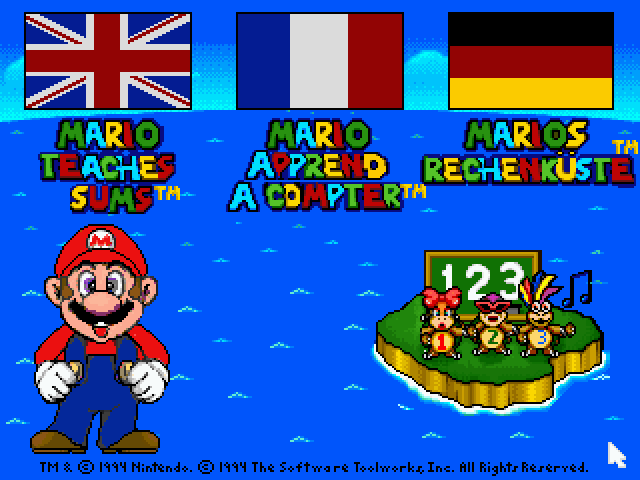
Beyond the SNES/PC split, the European PC CD-ROM version has one additional difference: at startup, the player can choose a language from English, French or German. The French and German versions contain one exclusive song each — Sur le Pont d’Avignon in French, and Hänschen klein in German.
The French version of the game also greets the player with a welcome message on starting, which the other language versions don’t include.
In the UK, the PC version was released as Mario Teaches Sums rather than Fun with Numbers — and was bundled with Dr. Health’nstein’s Body Fun and The Berenstain Bears Get in a Fight in a compilation called the Dr. Health’nstein’s Body Fun Bundle. Quite the package.
Gallery
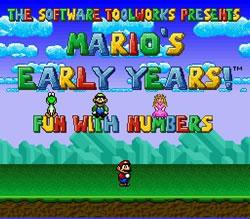
Screenshots from both the MS-DOS PC and SNES versions, plus the language select screen from the European PC release:


Release information
All three Early Years games were later collected into the Mario’s Early Years! CD-ROM Collection for MS-DOS in 1995.

Dr. Health’nstein’s Body Fun Bundle — a 1994 MS-DOS educational compilation that included Mario’s Early Years! Fun with Numbers alongside body and health-themed content. Notable for featuring Dr. Health’nstein rather than Mario on the box art.
Trivia & interesting facts
- Part of the Mario Discovery Series alongside Mario is Missing! and Mario’s Time Machine
- In the UK, the PC version was called Mario Teaches Sums — to tie in with Mario Teaches Typing
- Released on PC in 1993, with the SNES version following in September 1994
- Designed for children up to six years old — parents are actively encouraged to join in
- Yoshi is a SNES-exclusive playable character — not present in the original PC version
- Luigi is present in every room as a sleeping assistant — click him to wake him up and he’ll cheer your answers
- Two PC worlds (Sing Song World and Pattern World) were cut from the SNES version
- The European CD-ROM version supports English, French and German — each with a unique exclusive song in their respective language
- The UK PC version was bundled with Dr. Health’nstein’s Body Fun and The Berenstain Bears in a compilation package
- Level-complete animations differ between PC and SNES — the SNES version has your character walk into a Warp Pipe
- Never released in Japan
- All three Early Years games were bundled as the Mario’s Early Years! CD-ROM Collection in 1995
- The French title is Mario Apprend à Compter (Mario Learns to Count) and the German title is Marios Rechenkünste (Mario’s Calculation Skills)