MS-DOS · Super NES1993EducationalThe Software ToolworksTen worlds on PC, seven on Super NESYoshi playable on Super NESSuper NES Mouse compatibleUK title: Mario Teaches Words
Mario’s Early Years! Fun with Letters
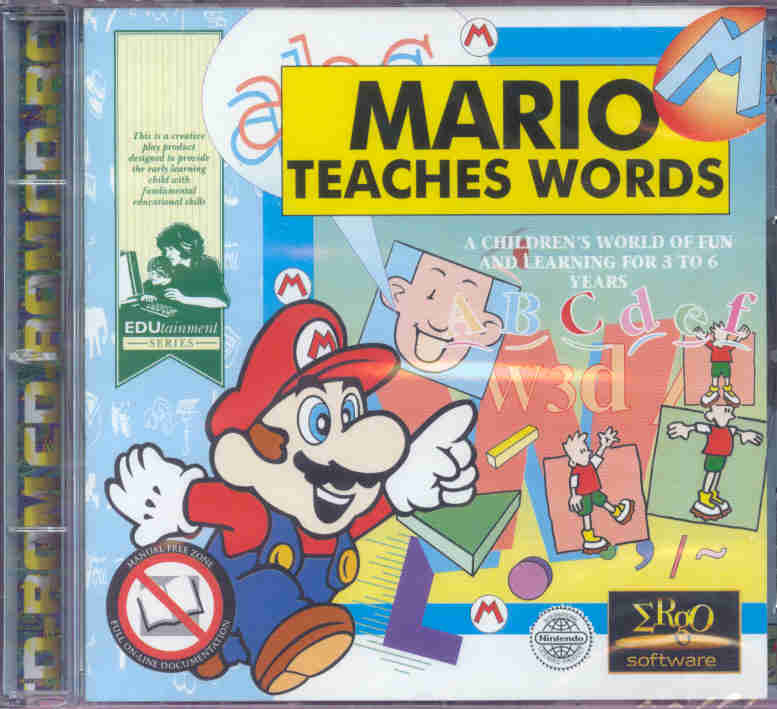
Before Mario had anyone drilling the home keys, he was helping them sound out their first words. Mario’s Early Years! Fun with Letters is a point-and-click phonics game for children of about three to six, made under licence by The Software Toolworks rather than by Nintendo itself. You pick Mario or Princess Toadstool, choose an island and work through rooms of letter puzzles joined by Warp Pipes, while a child narrator reads every word aloud and a snoozing Luigi can be woken up to cheer you along. The MS-DOS original of 1993 has ten worlds, including sing-along nursery rhymes, two read-aloud stories and a game of baseball; the Super NES cartridge of October 1994 trims that to seven, adds Yoshi as a third hero and works with the Super NES Mouse. In Britain the PC game went out as Mario Teaches Words.
Developer:The Software Toolworks, under licence from Nintendo
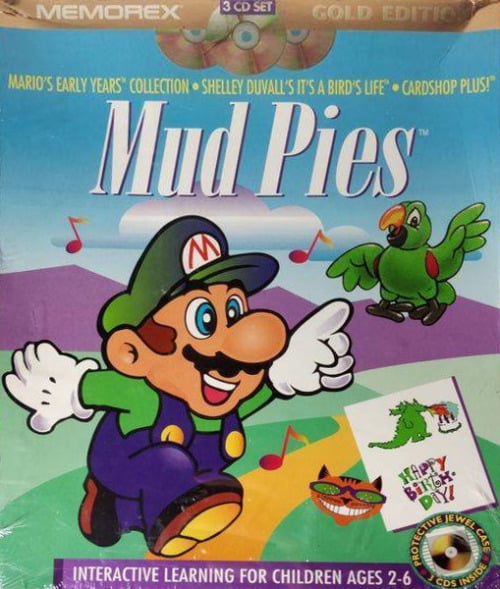
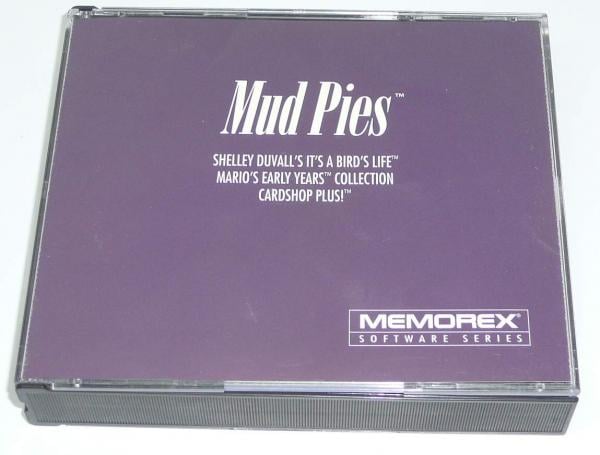
Re-releases:Mario’s Early Years! CD-ROM Collection (MS-DOS, 1994); the Mud Pies software bundle
Advertisement
Overview
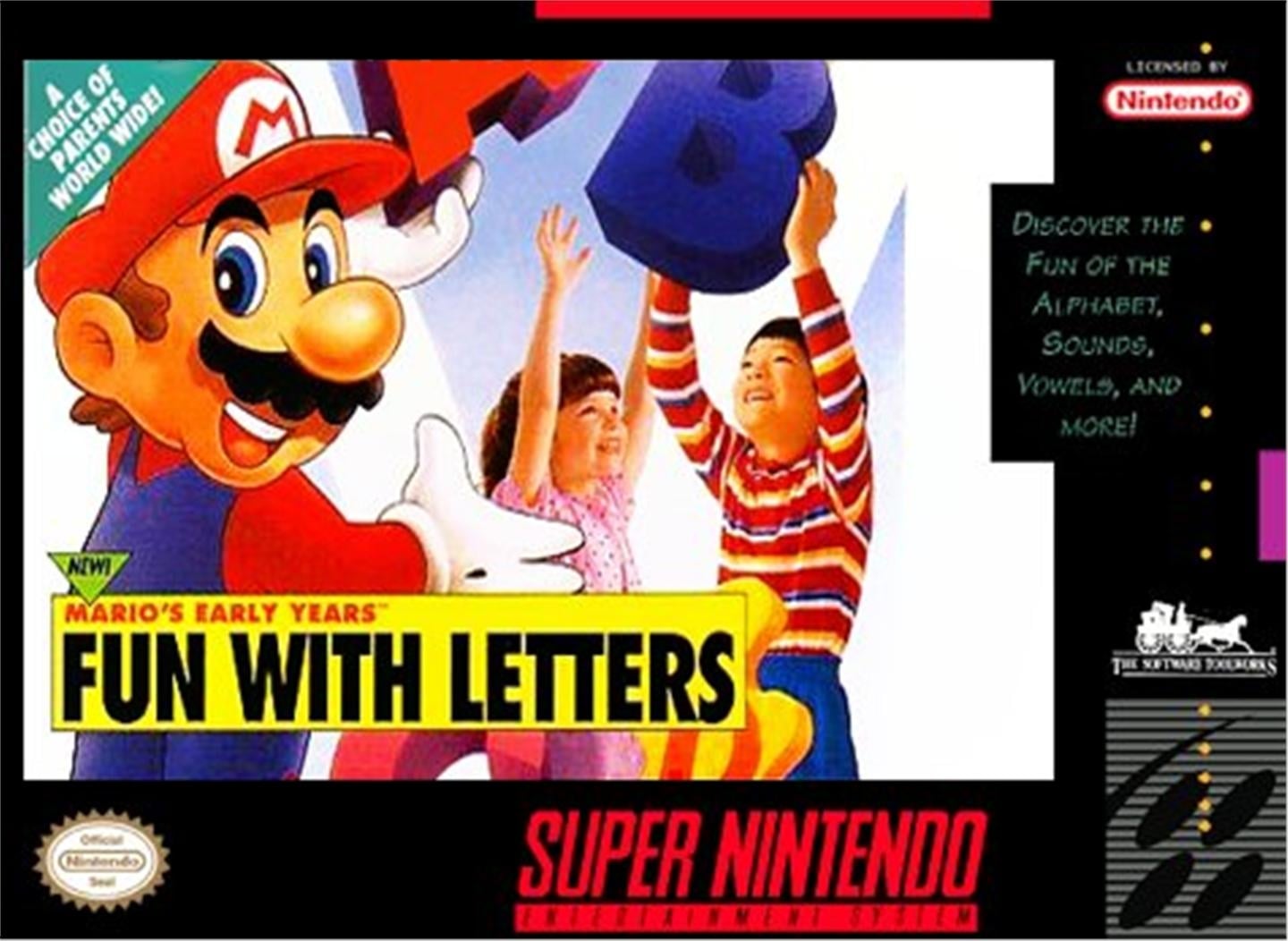
The Super NES box, released by Mindscape in October 1994.
In the early 1990s Nintendo let The Software Toolworks put its mascot into a whole shelf of learning software. The older children got Mario is Missing! and Mario’s Time Machine, geography and history lessons in disguise; the youngest got Mario’s Early Years!, a trio of gentle mouse-driven games covering letters, numbers and general pre-school skills. Toolworks designed, built and published the lot; Nintendo’s part was the licence.
Fun with Letters is the reading one. It never asks a child to read anything on their own: a young narrator says every letter, word and instruction out loud, and the job is simply to listen, look and click. Choose your hero, pick an island, and your character strolls wherever you point, picking out the word that starts with a given letter, the picture that finishes a sentence or the block that holds the right sound. Get enough right and a Warp Pipe carries you to the next room.
The islands each wrap one skill in a theme: a cinema for first letters, an undersea world for vowels, a library for letter sounds, a brick-built factory for word endings and a parade of alliterative pictures, from Crazy Cat to Zipping Zipper, for the whole alphabet. The PC version adds three more: a sing-along of nursery rhymes, a story corner with two illustrated tales starring Mario, Luigi, Bowser and Iggy, and a baseball game for blending sounds into words.
A year later Mindscape brought it to the Super NES. The cartridge drops the three extra islands and most of the parent options, but redraws the cast closer to their Super Mario World look and lets Yoshi join Mario and the Princess on the raft.
Why Fun with Letters matters to Mario fans
It belongs to the strangest corner of Mario history: the licensed PC learning games made outside Nintendo, where Bowser takes a mud bath, Iggy Koopa becomes “Icky Iggy” and Princess Toadstool dries off a pet pig. On Super NES it also makes Yoshi a playable hero, and its soundtrack and sound effects borrow from Super Mario World.
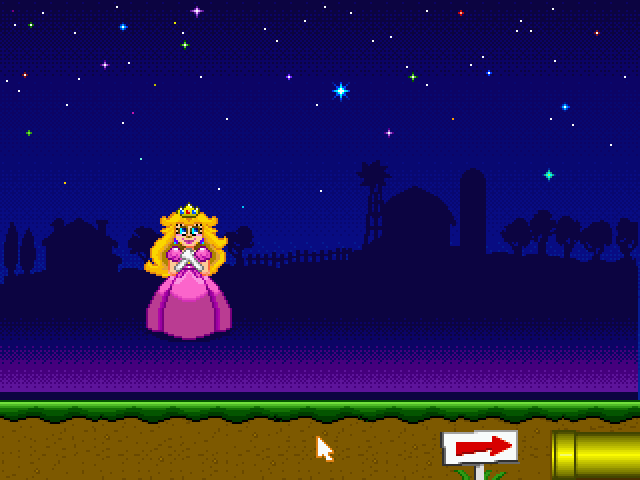
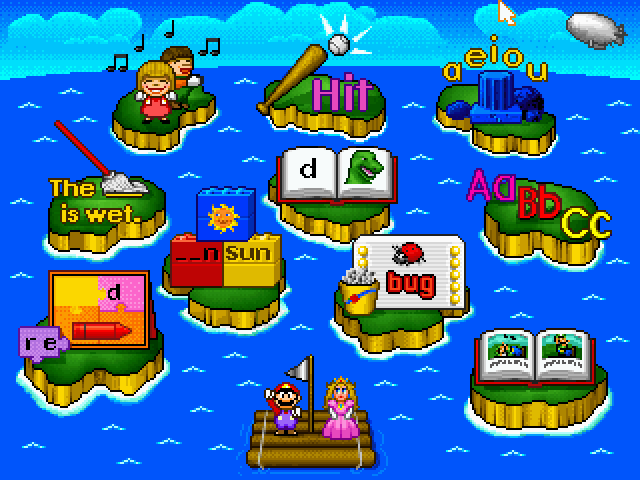
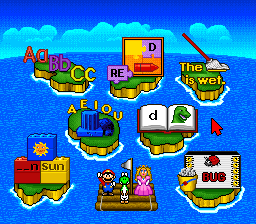
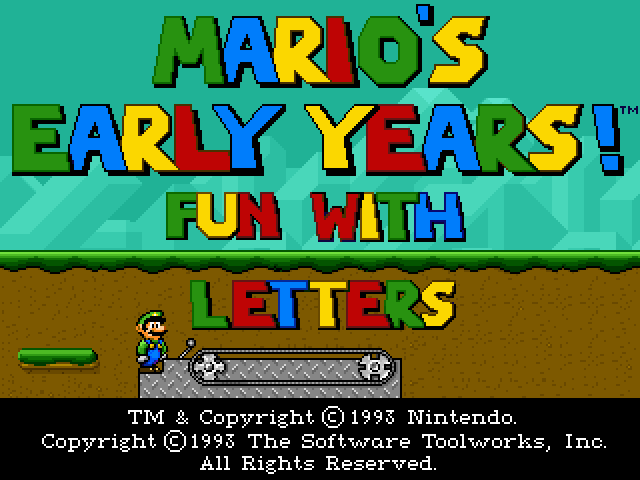
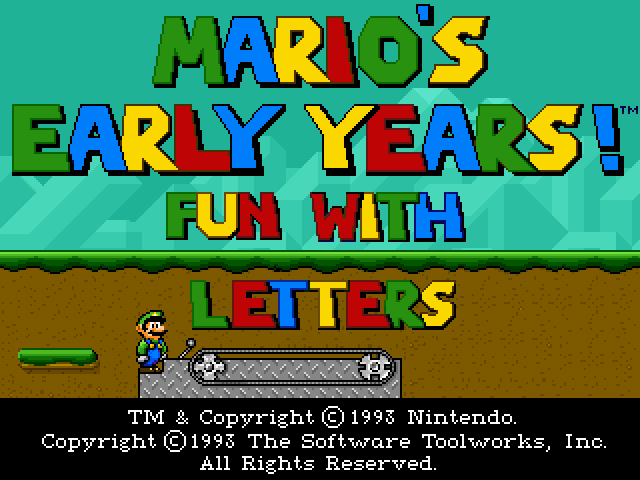
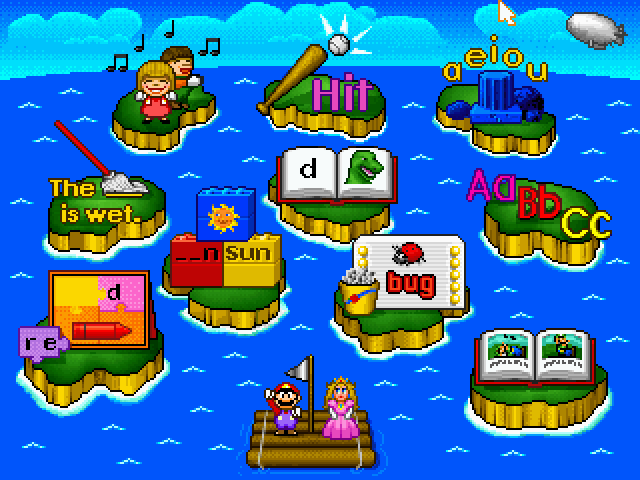
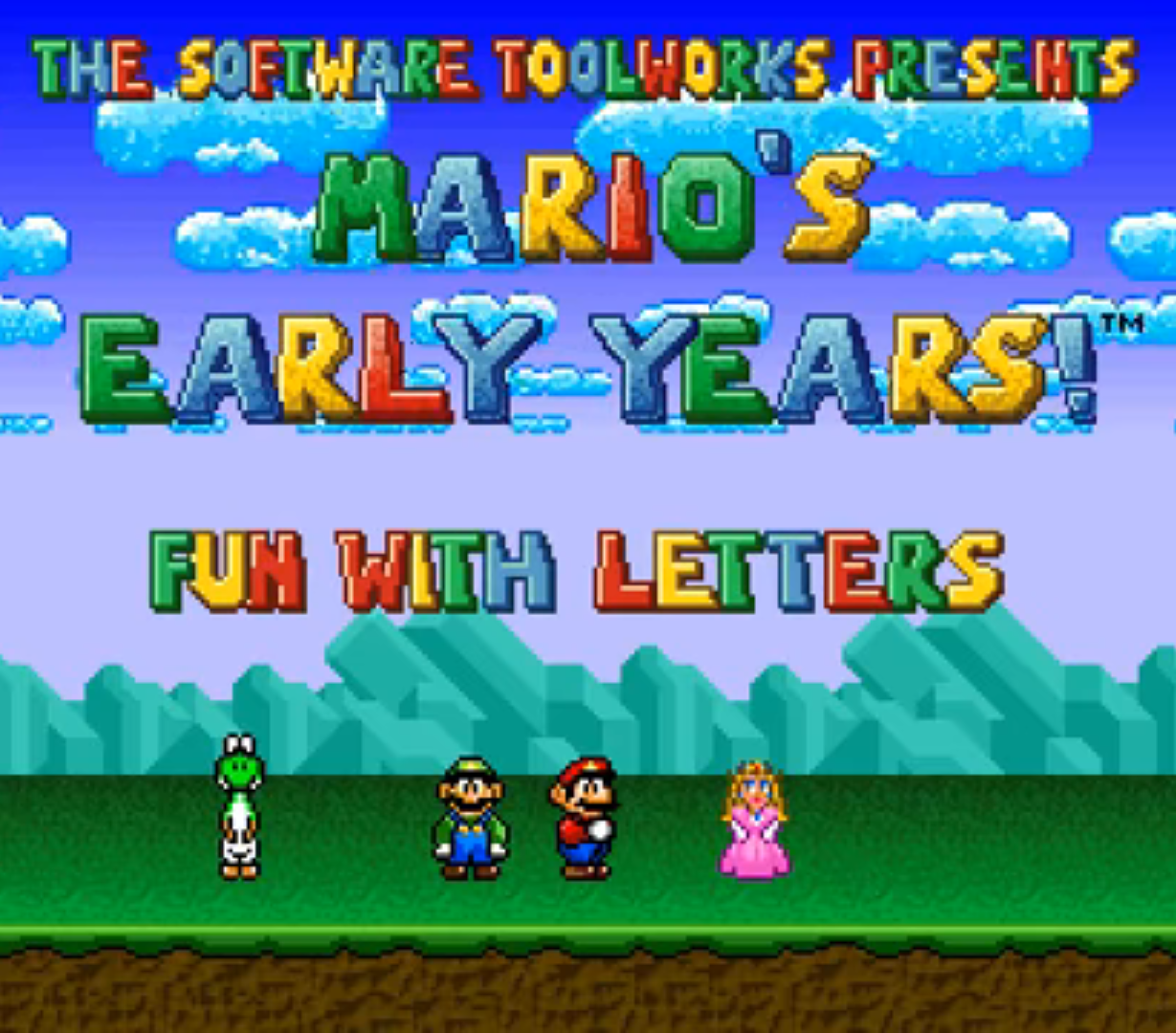
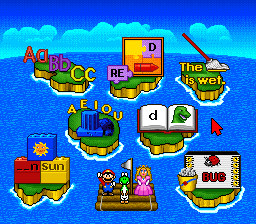
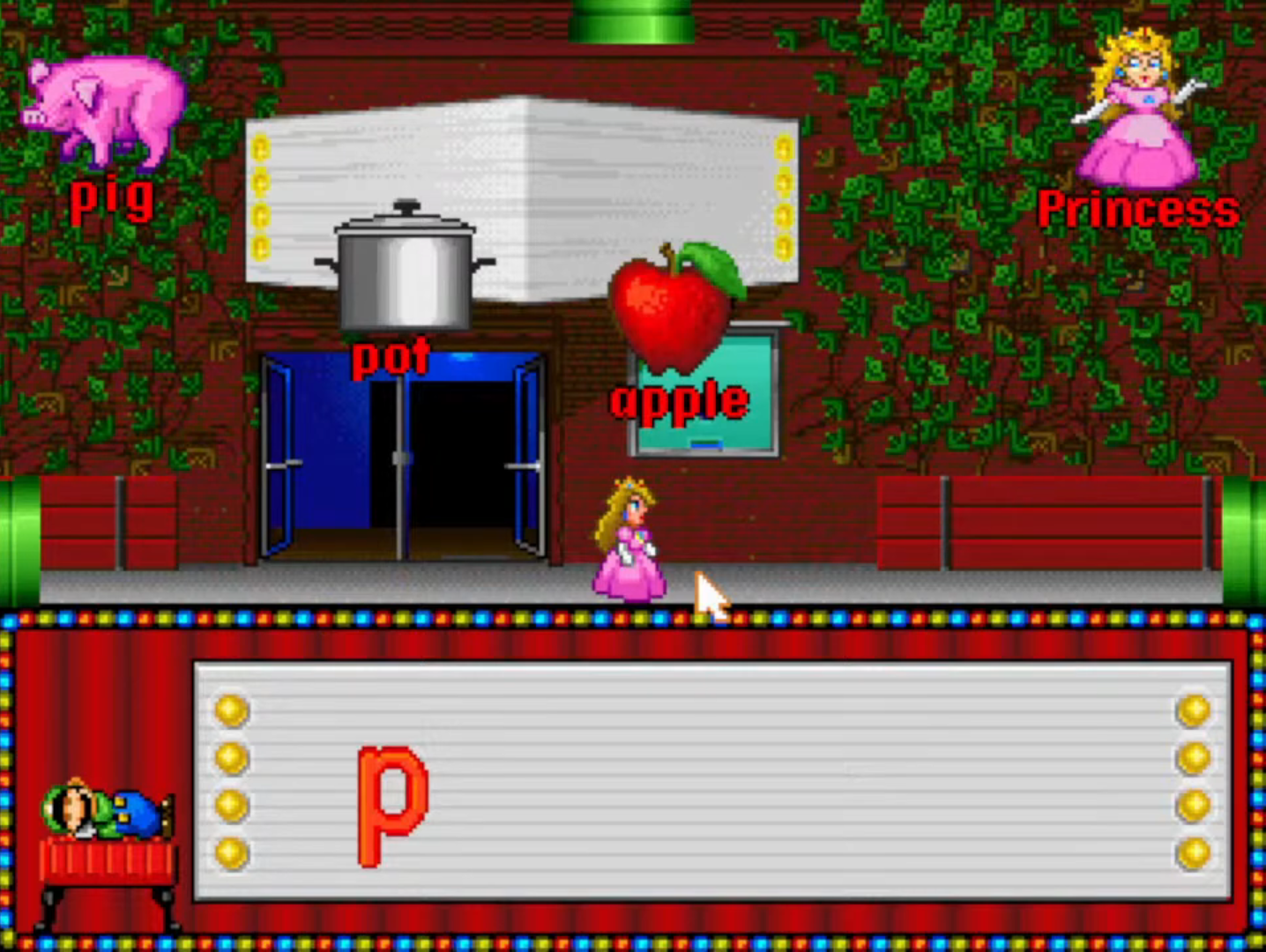
The MS-DOS title card.The PC main menu, with ten islands to choose from.The Super NES title card.The Super NES world map: seven islands and a raft for the three heroes.
Quick Answers
The questions parents, collectors and curious Mario fans ask most about this one.
Who made Mario’s Early Years! Fun with Letters?
The Software Toolworks, an American software house, developed it under licence from Nintendo and published the MS-DOS version. The Super NES cartridge came out under the Mindscape name. Nintendo did not develop it. More →
What systems is it on?
MS-DOS PCs (on floppy disk, and later on the Mario’s Early Years! CD-ROM Collection) and the Super NES. It never came out in Japan. More →
When was it released?
The PC version arrived in 1993; the Super NES version followed in North America in October 1994. More →
What age is it for?
Roughly three to six: pre-school and the first years of primary school. No reading is needed, because every word is spoken aloud. More →
How many worlds are there?
Ten on PC and seven on Super NES. The cartridge leaves out Sing Song World, Story World and the PC’s baseball-themed Building World. More →
Does Mario talk? Is it Charles Martinet?
Not really. A child narrator voices all the instructions, building sentences out of recorded words, and Luigi has a handful of lines of his own. The credits we found name no voice actors at all, so nothing links the game to Charles Martinet. More →
Is Yoshi playable?
On Super NES, yes: he joins Mario and Princess Toadstool as a third choice. The choice is purely cosmetic. The PC version offers only Mario and the Princess. More →
Do you need the Super NES Mouse?
No. The mouse makes it feel like the PC original, but the cartridge also plays with a normal joypad. More →
What is Mario Teaches Words?
The British name for the PC version. The UK editions of the series dropped the Early Years branding and swapped the child narrators for women’s voices. More →
Lessons & Activities
There is no plot to follow: Fun with Letters is a map of islands, and you visit them in any order you like. The PC version scatters ten of them across its menu; the Super NES world map shows seven, set in a blue sea. Each island has a picture on it hinting at its theme, and each one hides a handful of rooms joined by pipes.
Below is every activity, with the three PC-only islands gathered together at the end.
First Letter World: a trip to the pictures
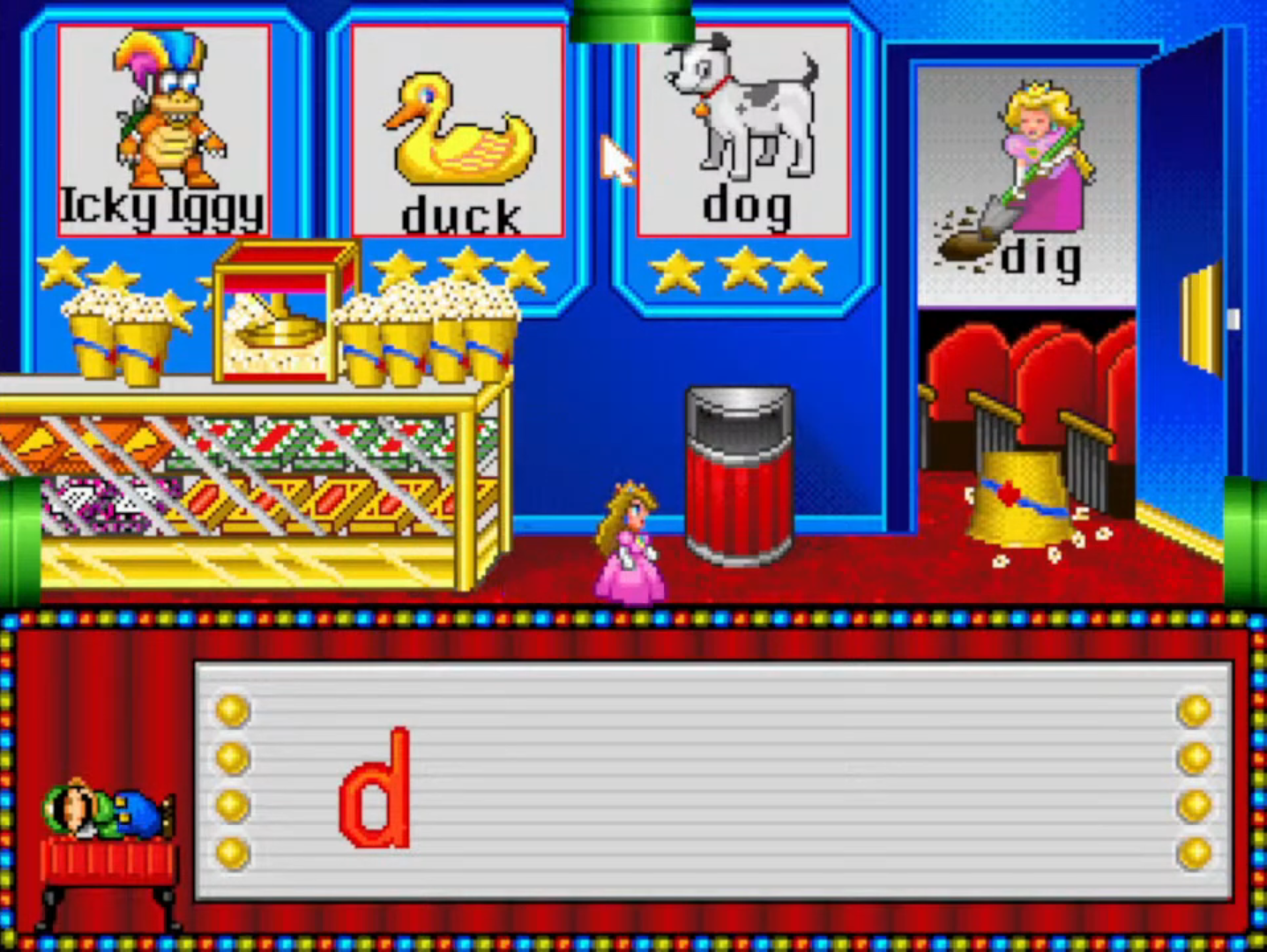
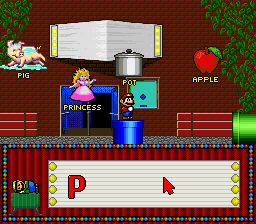
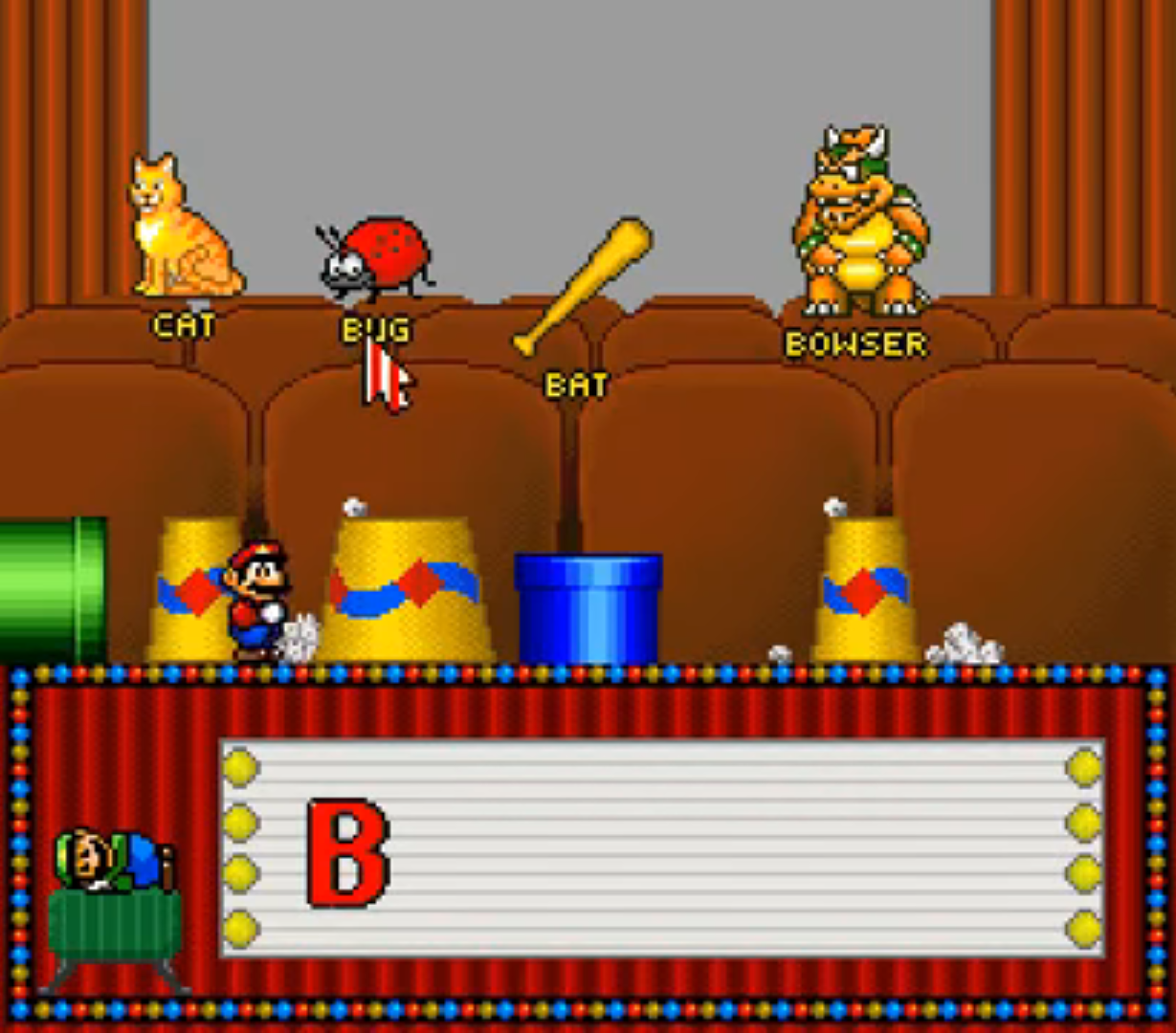
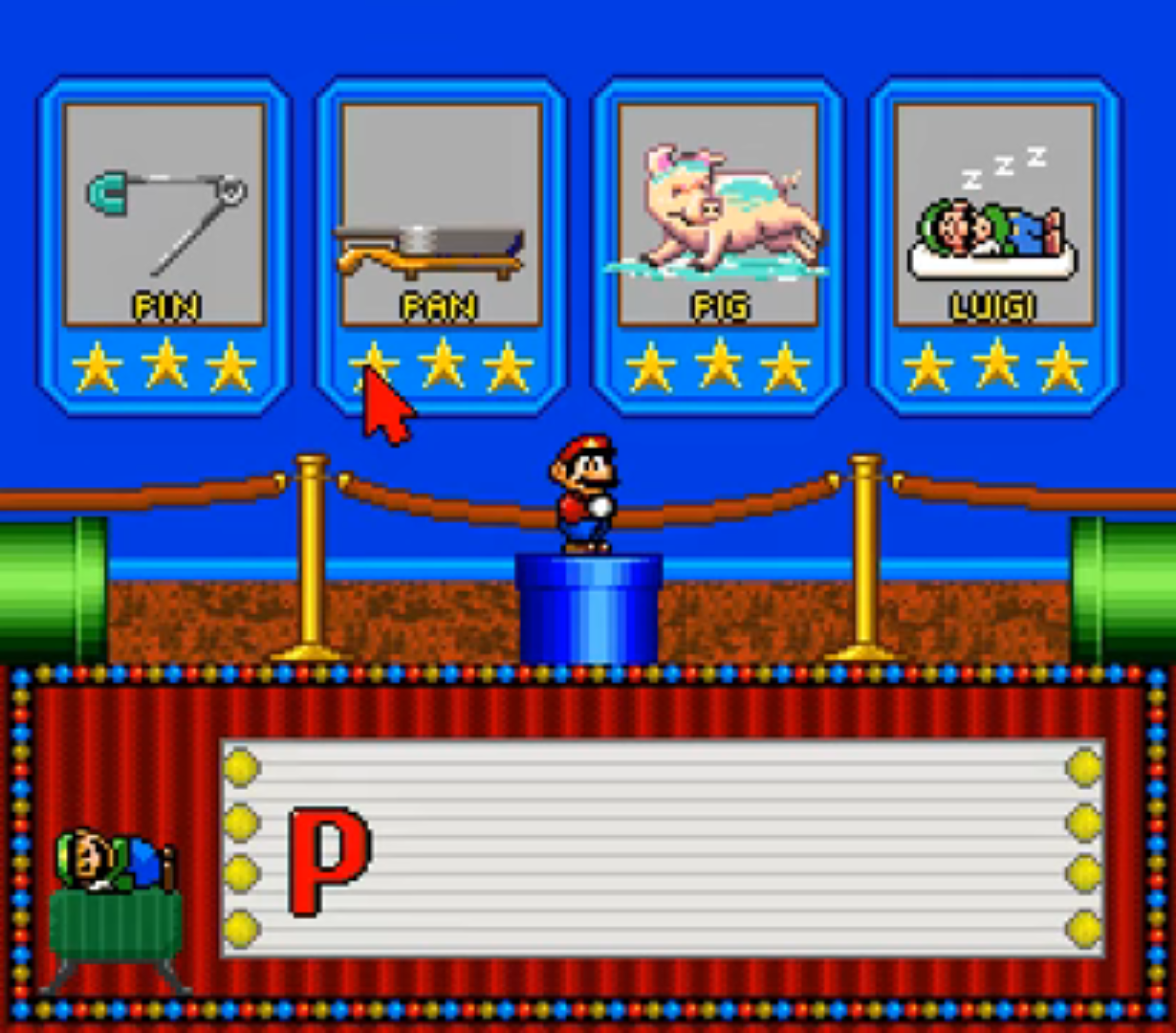
The first lesson is set at a cinema. A letter appears, four film posters line up as possible answers, and three of them begin with that letter: click all three and the odd one out is left behind. The rooms take you from the street outside the marquee, through the queue and into the auditorium, where a blue pipe leads out past the bins.
Outside the cinema (Super NES).The auditorium, the last room (Super NES).The first room on PC.
Vowel World: under the sea
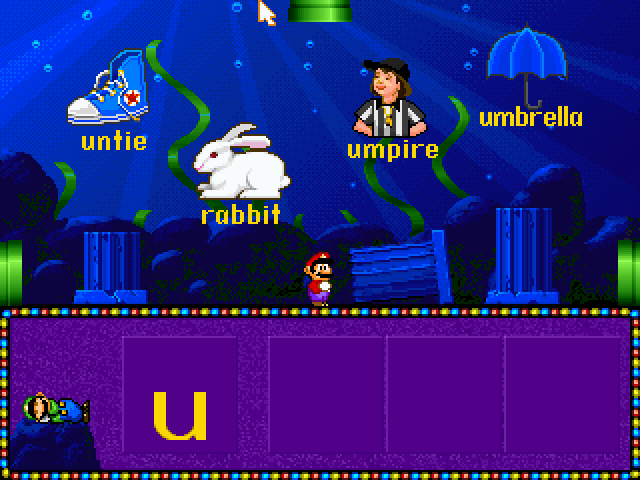
A, E, I, O and U float above this island, and the lessons take place among seaweed and coral on the sea bed. The rule is the same as at the cinema, picking the three words that start with the vowel on screen, but each of the five vowels gets five rooms of its own, making this the longest island in the game.
Vowel World on Super NES.Vowel World on PC.
Alphabet World: the A to Z show
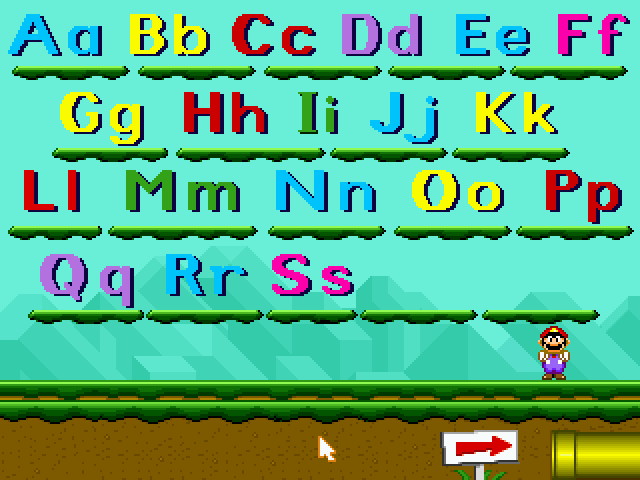
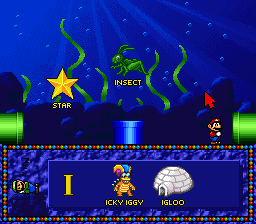
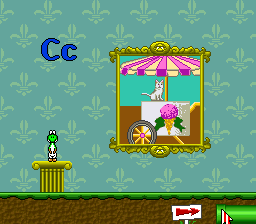
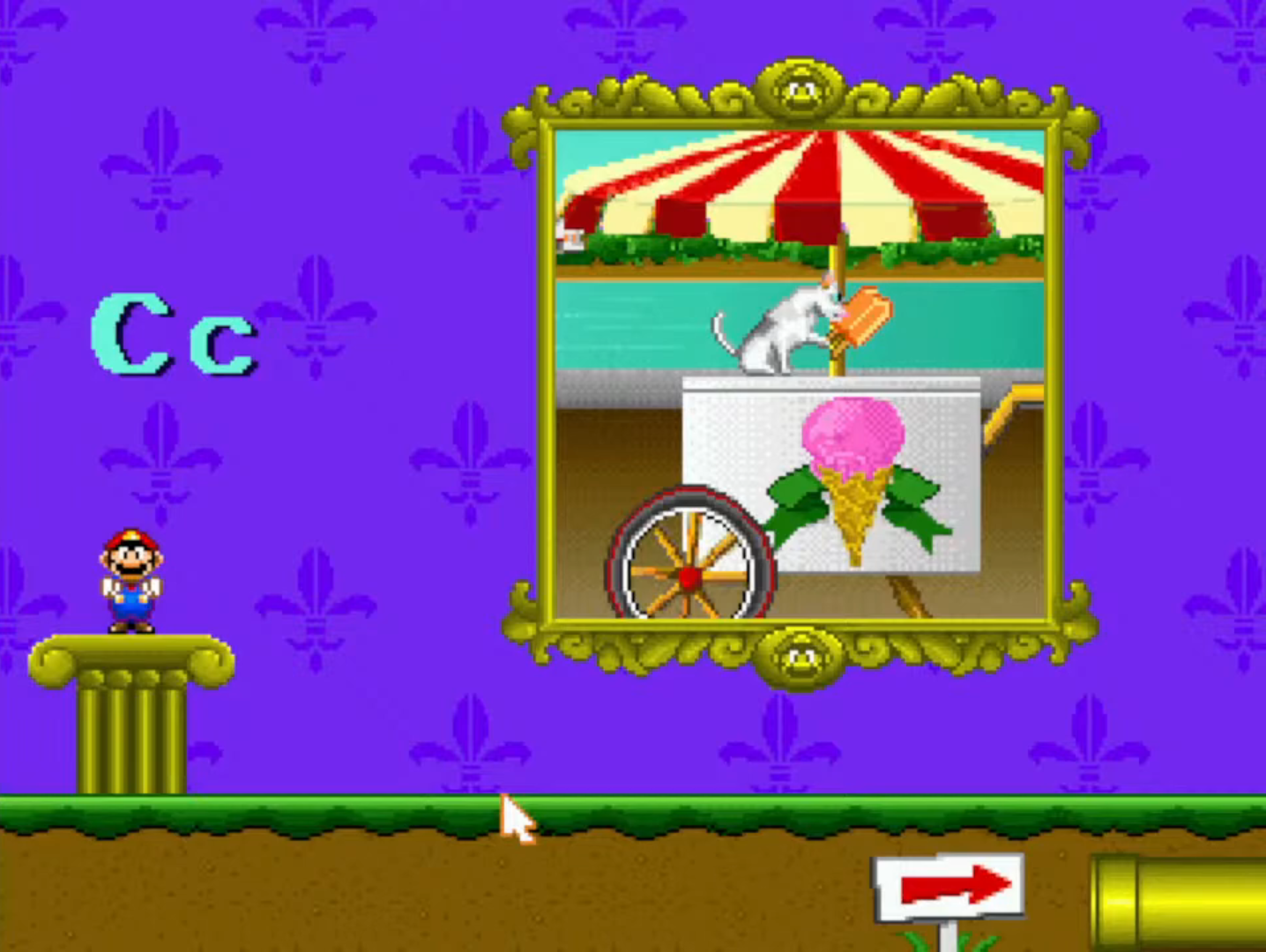
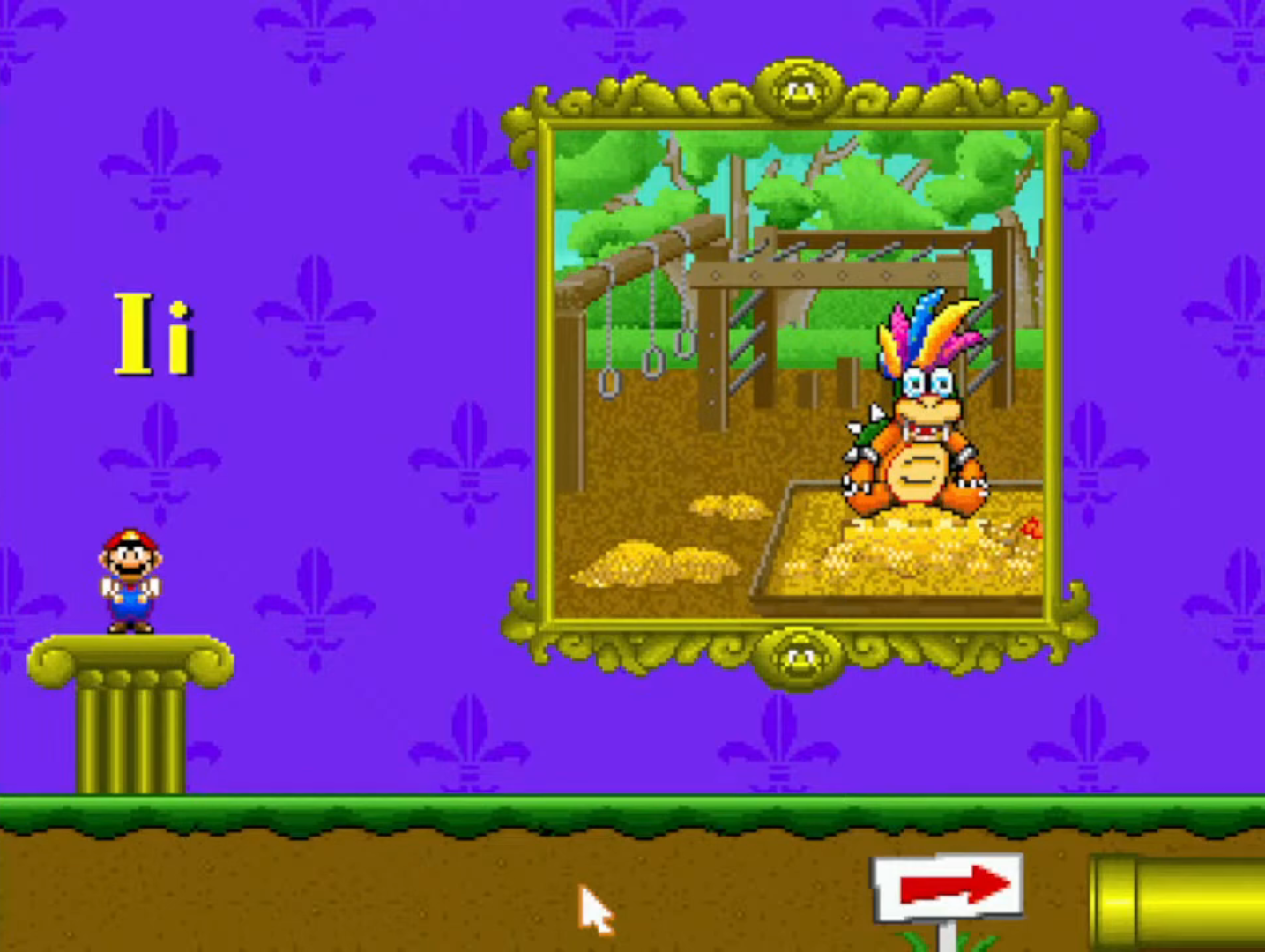
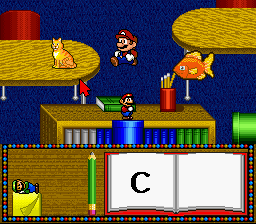
This one is to watch rather than play. Letters spell out “AaBbCc” on the wall, your hero settles on a golden pillar, and the narrator goes through the alphabet in order. For each letter a golden frame shows a picture, and the narrator gives the letter, its sound and a name for the picture, mostly in jolly alliterative pairs: Crazy Cat, Dancing Dinosaur, Hitting Hammer, Jiggling Jellyfish, Violent Volcano. Mario, Luigi, Yoshi, Bowser and the Princess all take a letter, and I is for Icky Iggy.
You can leave at any moment through the green pipe at the bottom. The PC version has a second mode here for practising letter sounds, which the Super NES version leaves out.
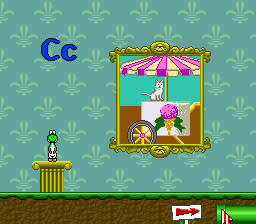
C is for Crazy Cat (Super NES).The PC version of the same frame.I is for Icky Iggy (PC).
Sentence World: fill the gap
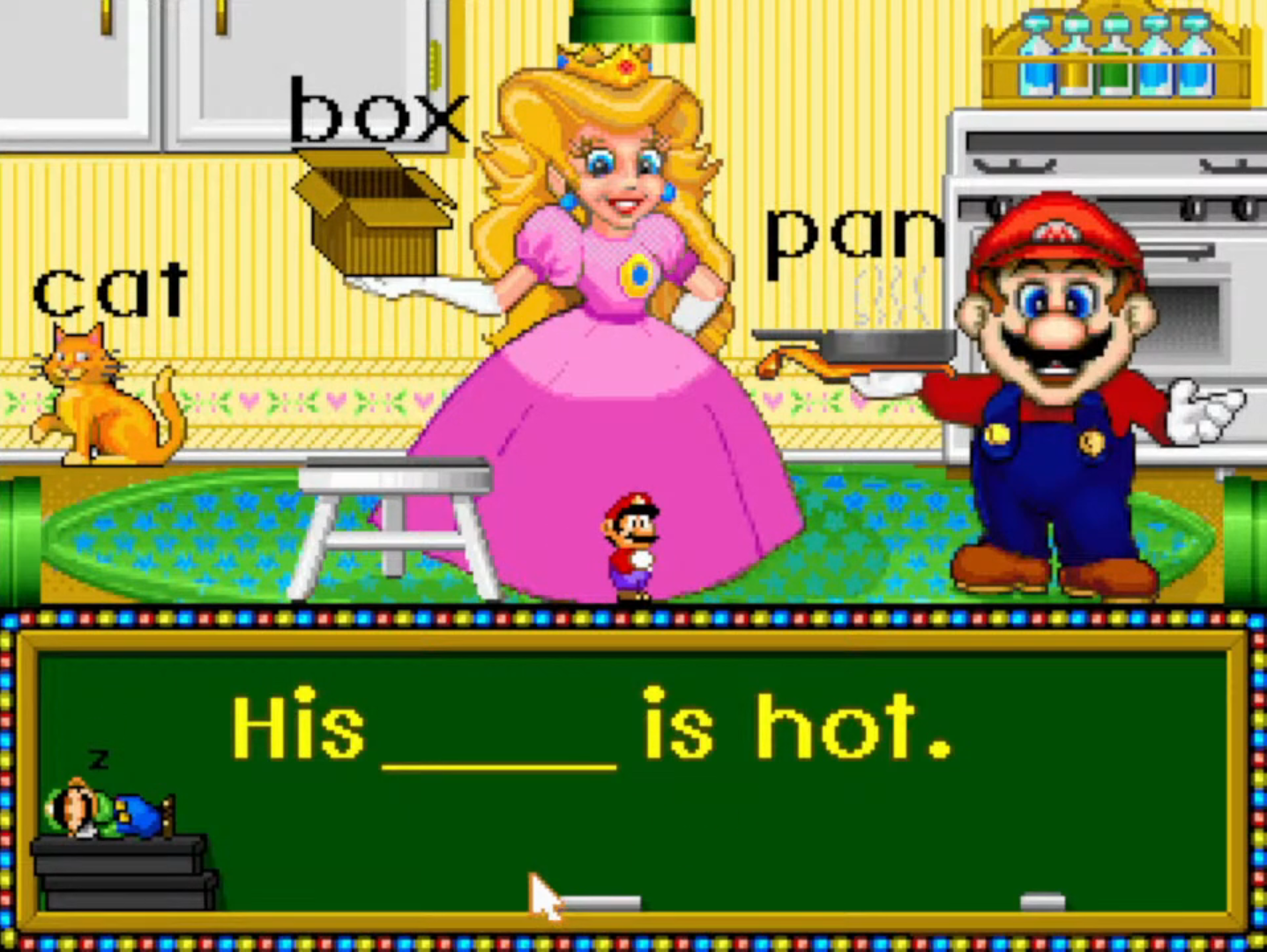
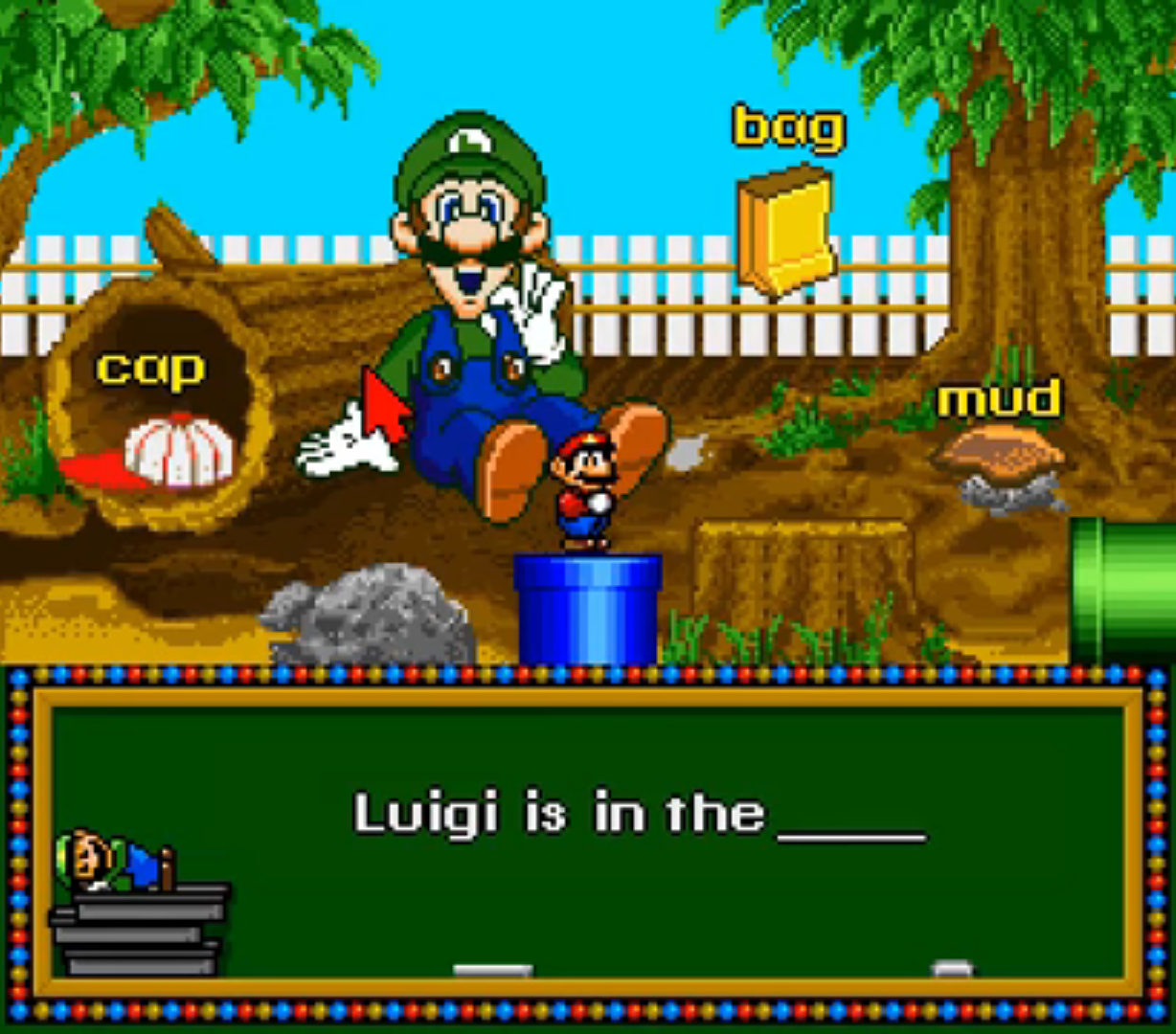
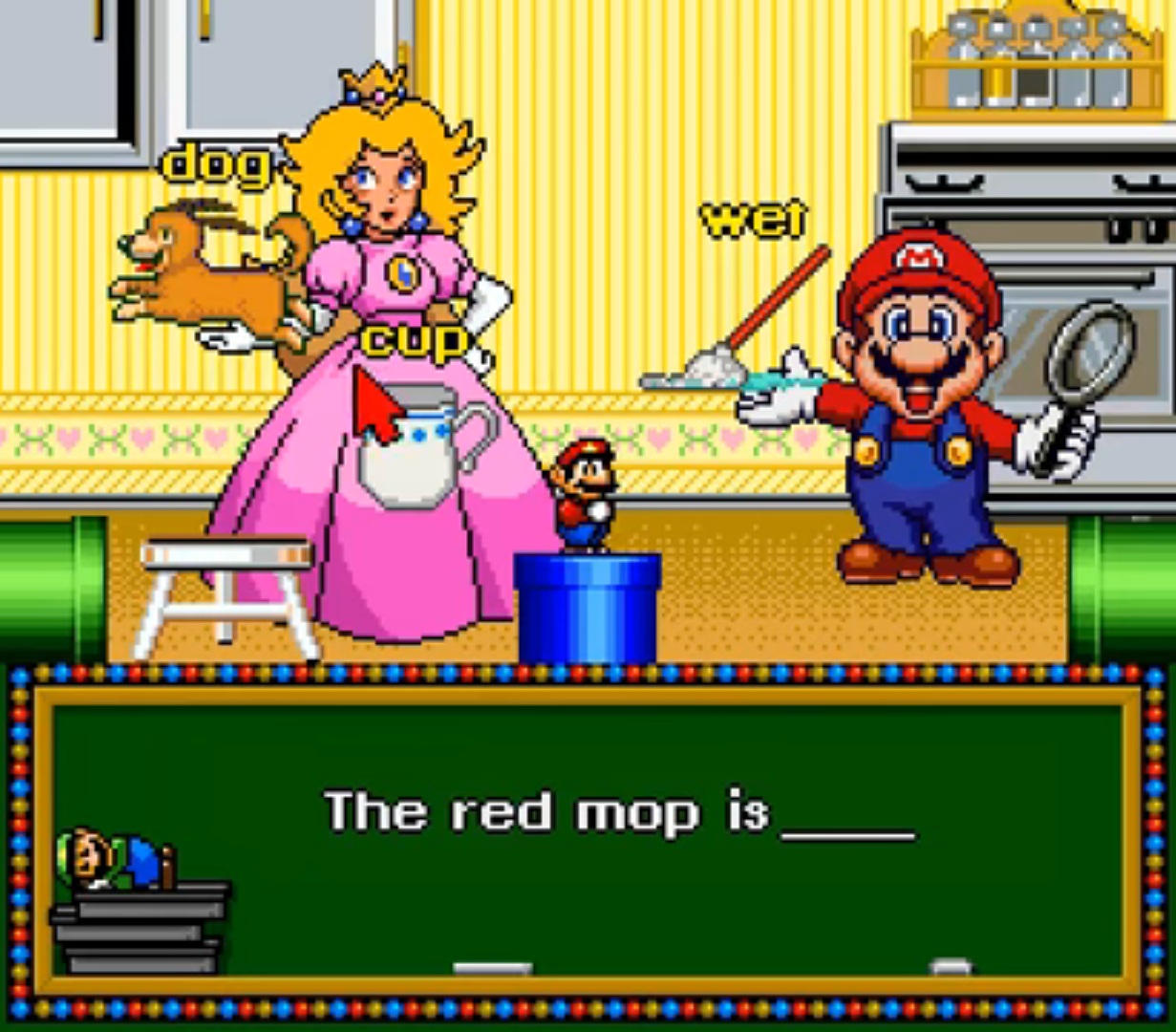
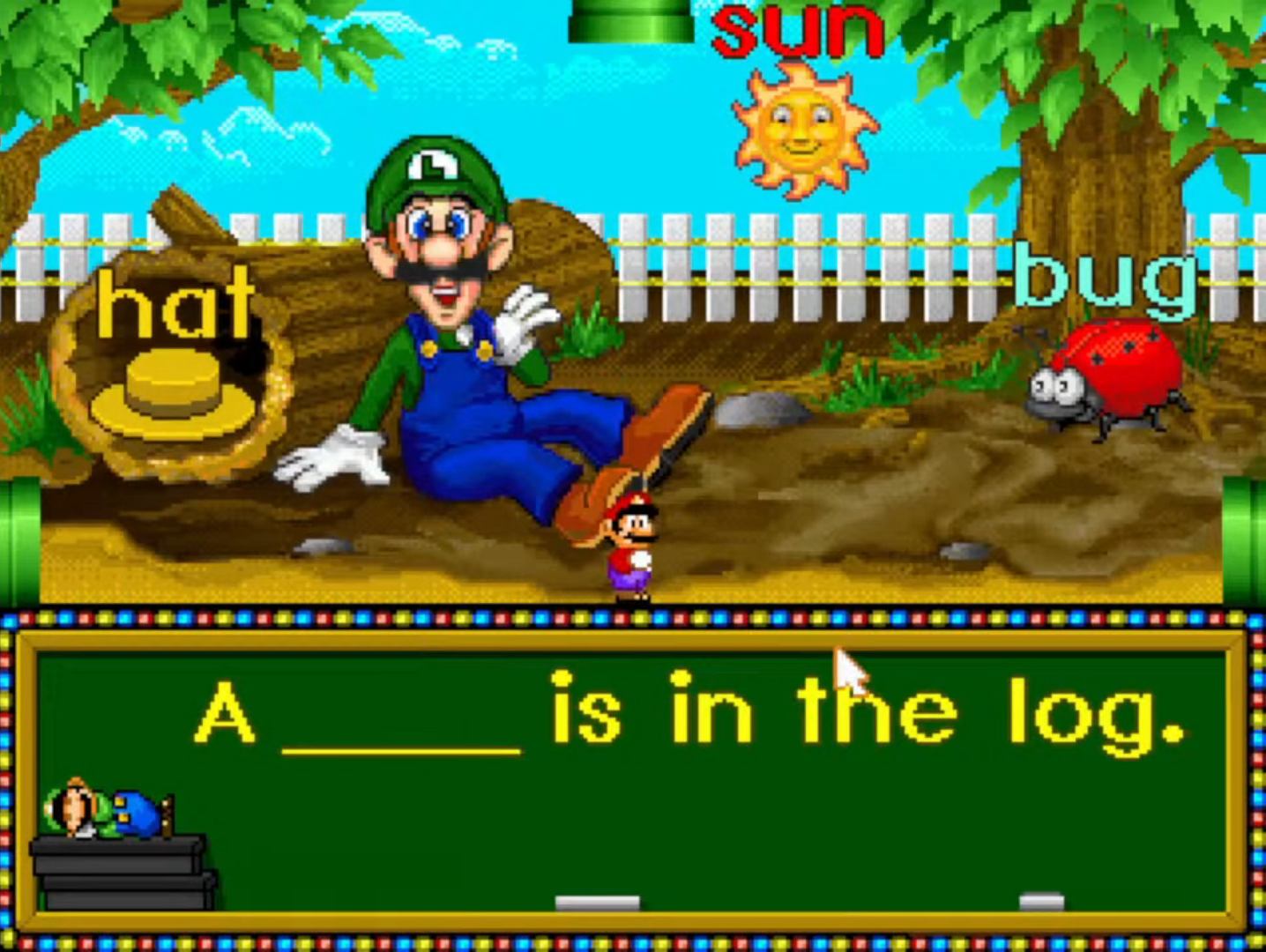
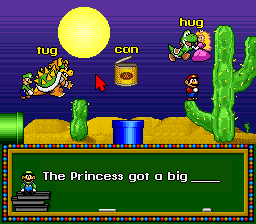
The narrator reads a sentence with a word missing, and three pictures offer the answer. Pick the one that makes sense and something leaps out of the scenery to applaud. The rooms are a garden, where Luigi lounges in the mud beside a log, a kitchen where Mario and the Princess pose, and a desert at night with nothing but a pair of cacti for company.
The garden, with Luigi in the mud (Super NES).The kitchen (Super NES).The garden on PC.
Blending World (Building World on Super NES)
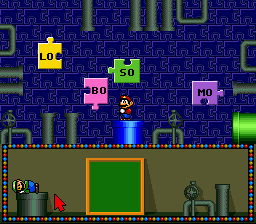
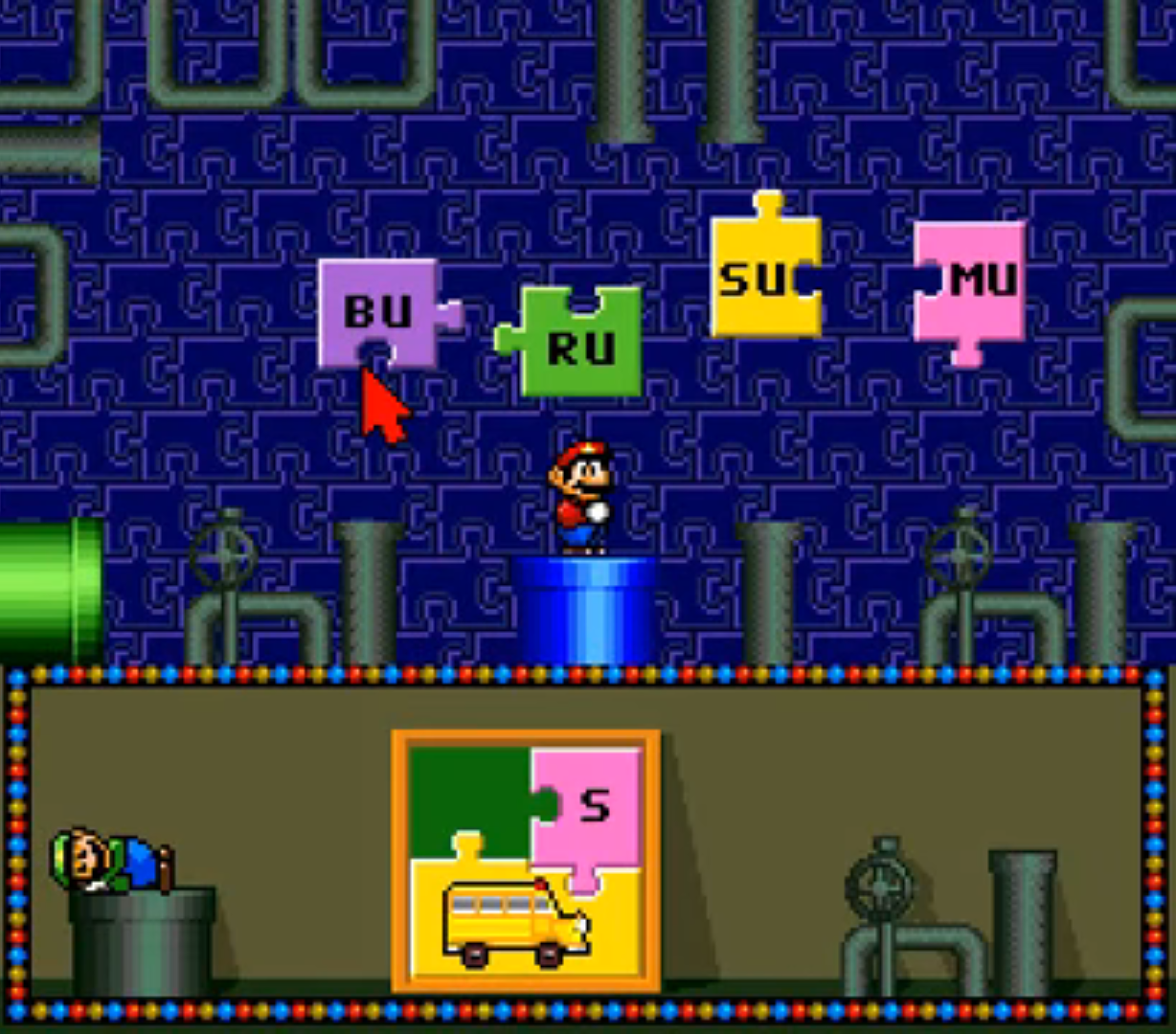
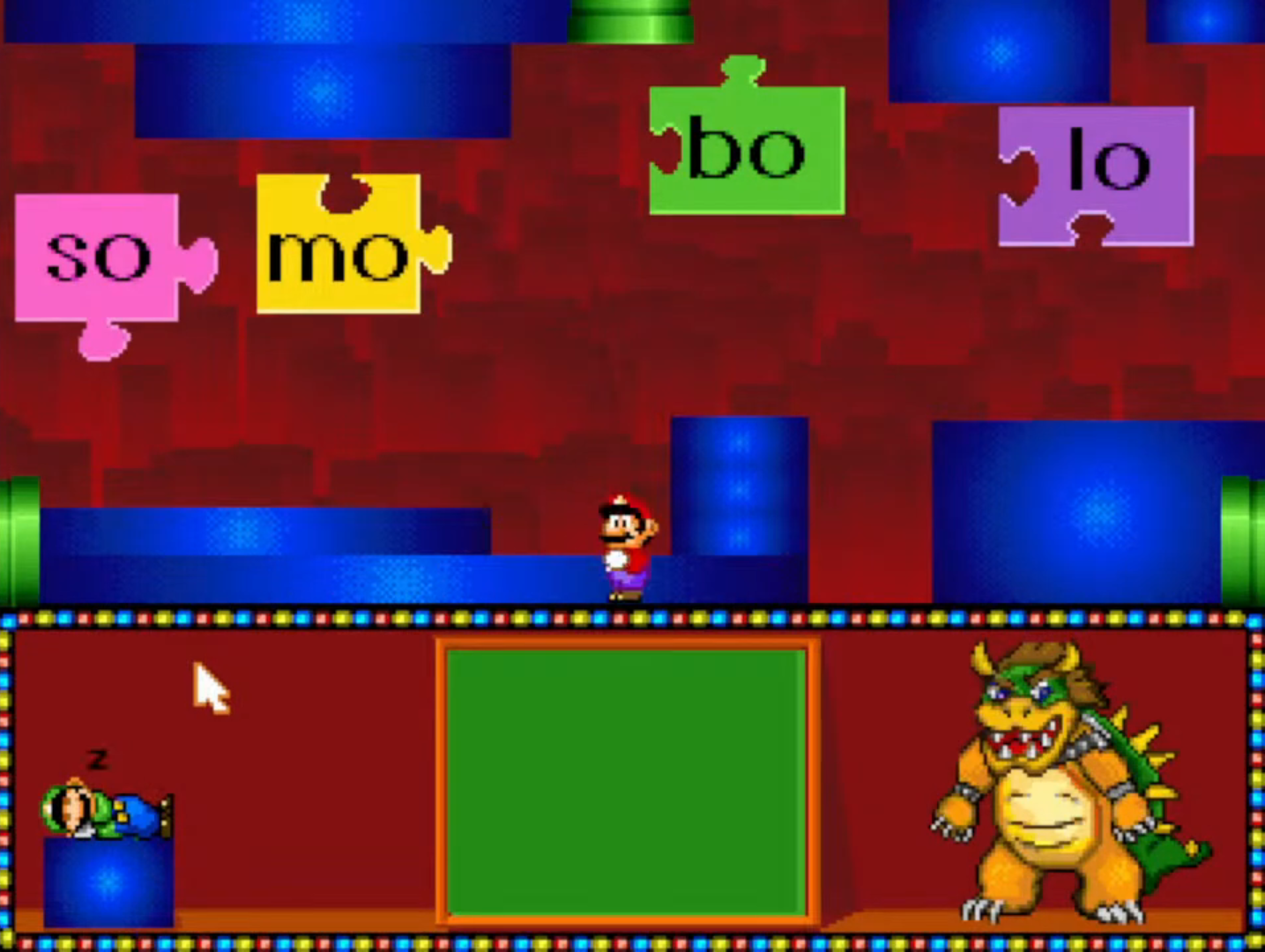
Here children start putting sounds together. In the first room you hunt for the blocks that carry a given sound, and the right ones slot together into a two-by-two jigsaw; finishing the puzzle opens the next room, and in the last one you complete a word that is shown on screen. The PC version calls this island Blending World and sets it against blue gradient blocks on a red backdrop; the Super NES version renames it Building World and decorates it with pipes and a blue jigsaw-piece pattern.
Building World on Super NES.Completing a word in the last room (Super NES).Blending World, its PC original.
Sound World: quiet in the library
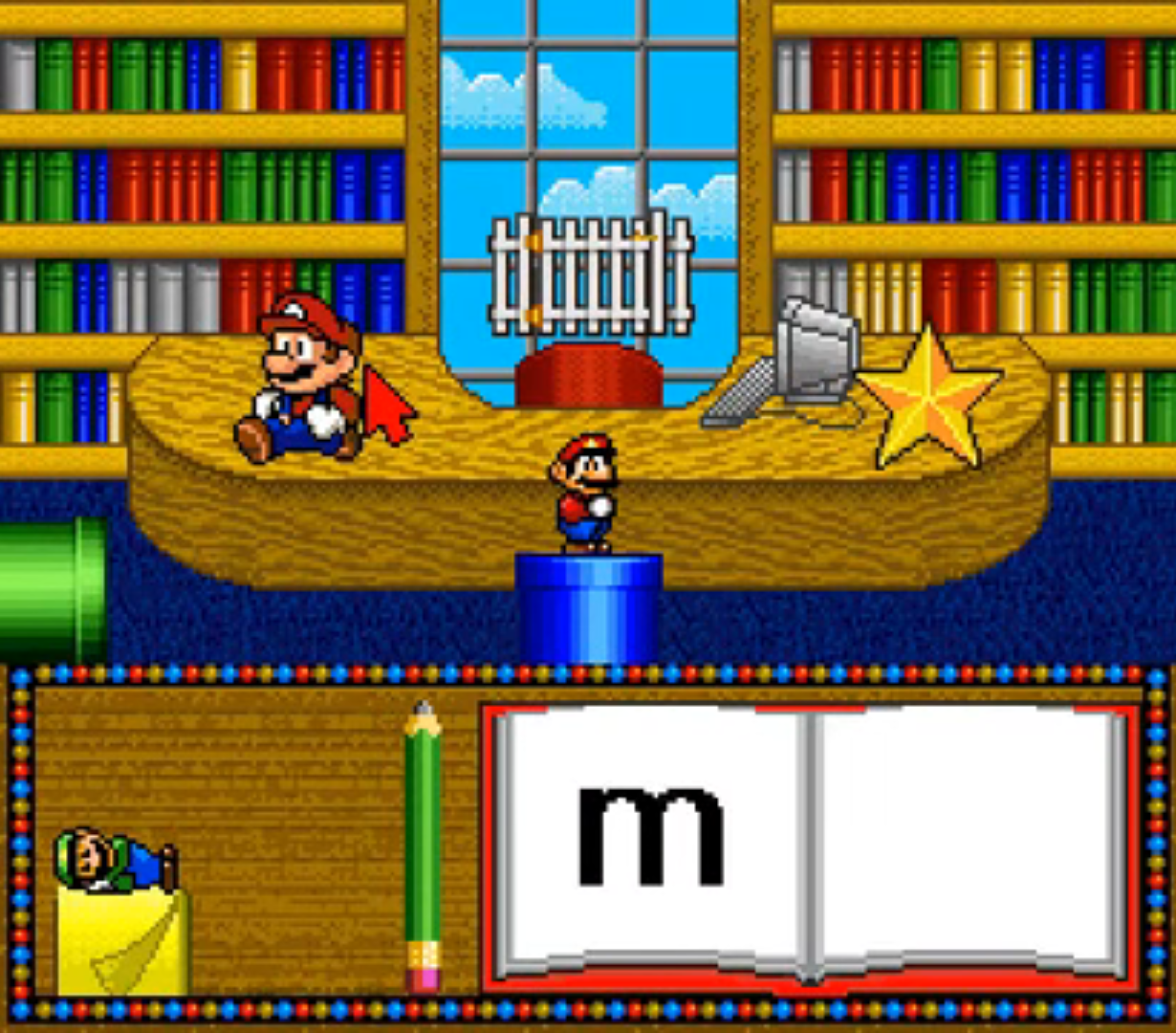
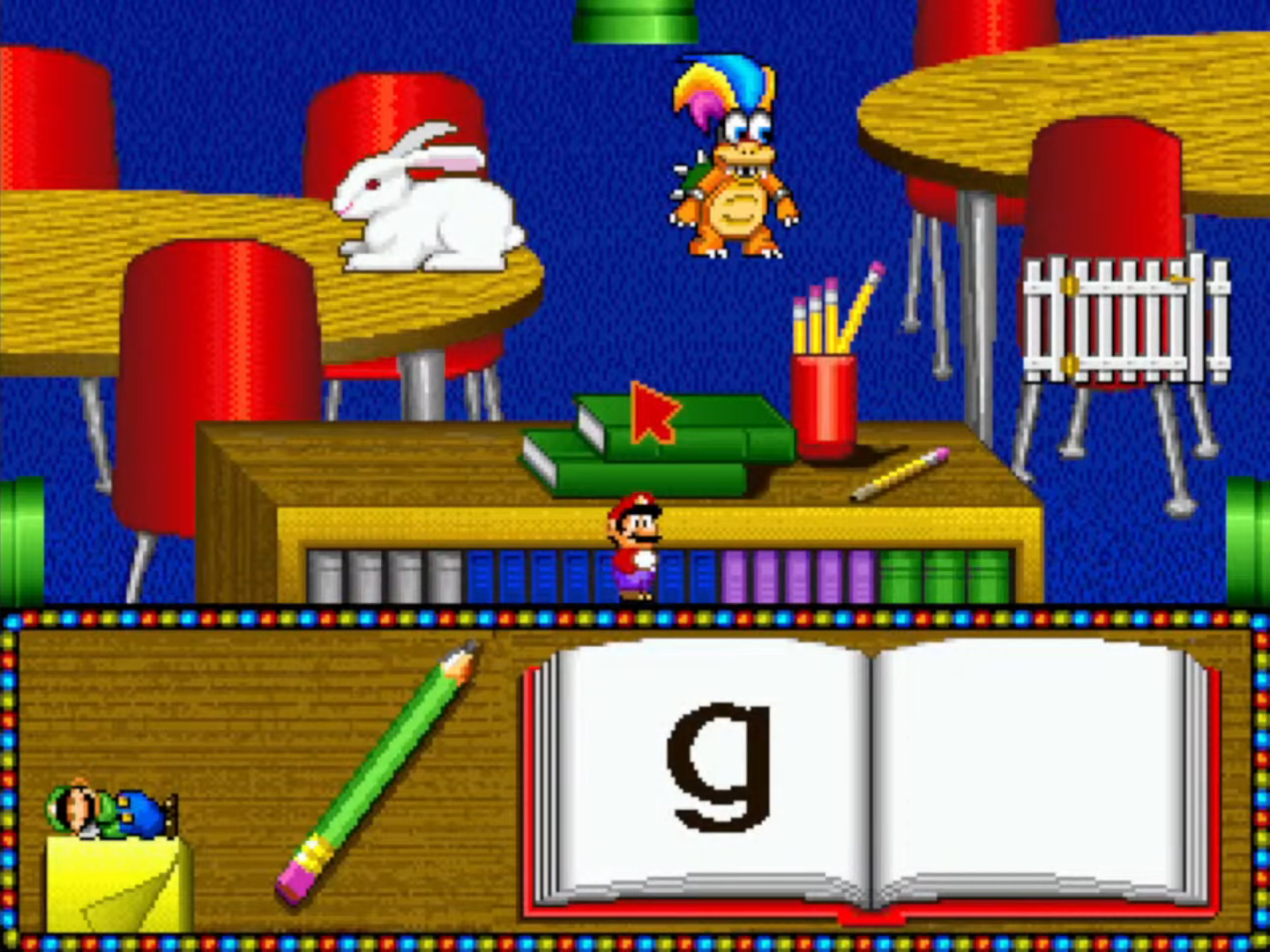
A library is the setting for letter sounds. Three words appear and you click the one that begins with the sound on screen; a cheerful character pops up after each right answer. There are three rooms, the last of them at the reception desk.
The library (Super NES).At the reception desk (Super NES).The first room on PC.
Last Letter World: the brick factory
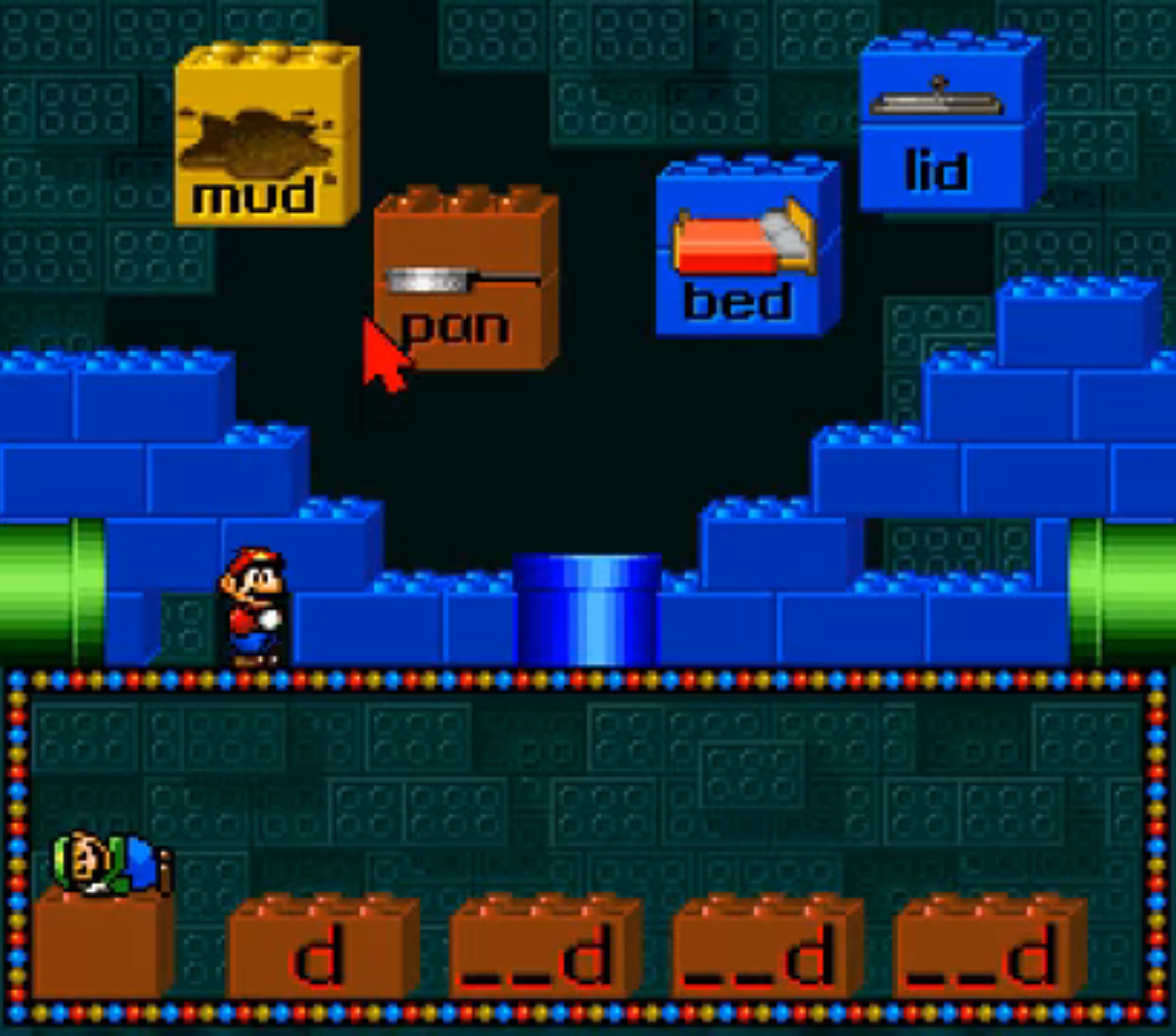
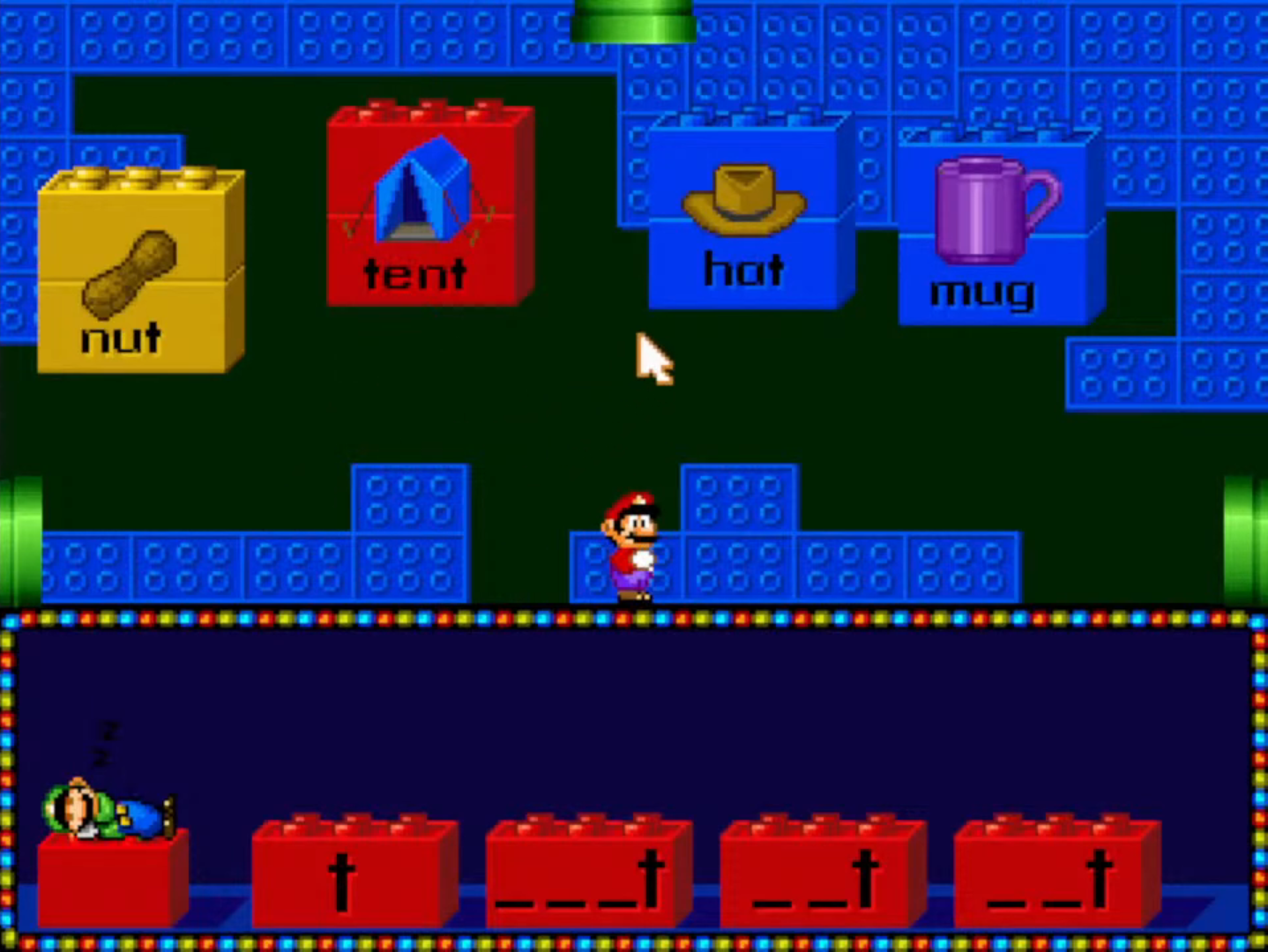
The final skill turns the first-letter game around: now you are listening for how words end. The island is a factory built from toy construction bricks, shown on the map as three coloured studded blocks, and Luigi naps beside the spot where your answers go. Choose the three words that finish with the given letter and a pipe takes you onward.
The brick factory (Super NES).The second room (Super NES).The first room on PC.
The three PC-only islands
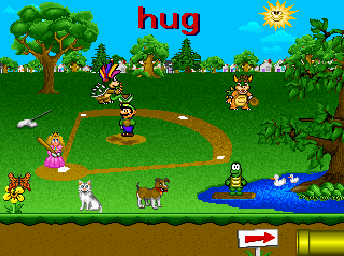
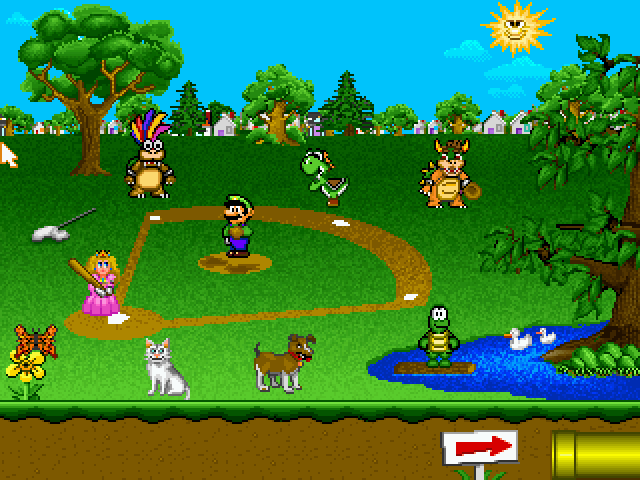
Building World on PC is a different place from the Super NES island of the same name: a baseball game, marked on the map by a bat and the word “Hit”, where you sound out three- and four-letter words and can click the players to set off little animations, including Iggy giving Yoshi a hug.
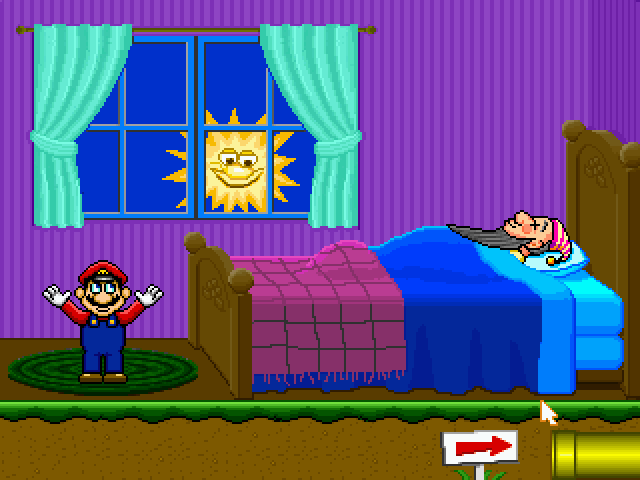
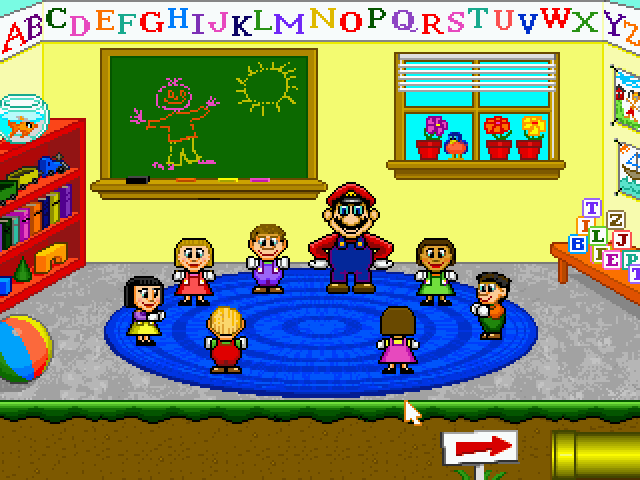
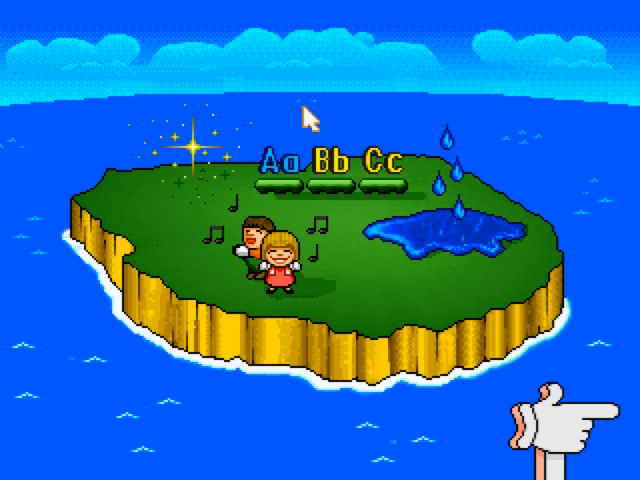
Sing Song World, shown by two singing children, plays four nursery songs with a scene for each: Mario hopping across platforms as the letters appear in The Alphabet Song, Mario clapping and stamping with seven children in a classroom in If You’re Happy and You Know It, an old man in bed while a storm rages outside for It’s Raining, It’s Pouring, and the Princess under the stars for Twinkle, Twinkle, Little Star.
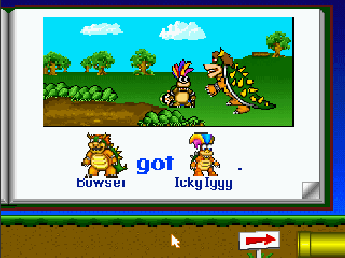
Story World reads one of two illustrated tales aloud with the words on screen. In Mud Fun, Icky Iggy sits on a sleeping Luigi after a mud bath, Bowser carries Iggy off, gets wedged in a log, and has to be pulled free by Mario, Luigi and the Princess before he tumbles into the mud and the brothers jump in after him. In Pig Out, the brothers borrow the Princess’s pet pig while it dries on a log, Luigi hides it under his cap when she comes back, and the chase ends with all three hugging on the log.
The baseball game in the PC version’s Building World.If You’re Happy and You Know It in Sing Song World.Bowser grabs Icky Iggy in the story Mud Fun.
Every world in Fun with Letters
Ten islands on PC, seven on Super NES.
First Letter WorldPC and Super NES · 3 roomsA cinema where three film posters out of four start with the letter shown.
Vowel WorldPC and Super NES · 5 rooms per vowelSea-bed lessons on words starting with A, E, I, O and U.
Alphabet WorldPC and Super NES · watch-alongAn A-to-Z picture show, from Apple to Zipping Zipper; the PC adds a letter-sounds mode.
Sentence WorldPC and Super NES · 3 roomsPick the picture that fills the gap, in a garden, a kitchen and a night-time desert.
Blending World / Building WorldPC name / Super NES name · 3 roomsSound blocks that click into a jigsaw, then a word to finish.
Sound WorldPC and Super NES · 3 roomsA library where you match words to the sound they begin with.
Last Letter WorldPC and Super NES · 3 roomsA toy-brick factory for listening to the ends of words.
Building World (PC)PC onlySounding out short words at a baseball game.
Sing Song WorldPC only · 4 songsFour nursery songs, each acted out by the cast.
Story WorldPC only · 2 storiesMud Fun and Pig Out, read aloud with pictures.
Advertisement
Gameplay & Controls
There are no lives, no timers and no game over here. Everything is done with the pointer: click a spot and your hero walks to it, click an object or a picture and they interact with it. Each island teaches one skill, and each is split into a few rooms joined by pipes.
Mario, the Princess … or Yoshi
Before you start you choose who walks about on screen: Mario or Princess Toadstool on PC, with Yoshi added on Super NES. It makes no difference to the questions; it is simply a way for a child to pick a favourite. On the Super NES world map the three of them ride a raft at the bottom of the screen, and you swap heroes there.
Choosing a hero on the raft (Super NES).
Listen, look and click
Every instruction is spoken. The narrator is a child, and the program pieces each sentence together from separately recorded words, which gives it a charmingly stilted rhythm. Most tasks offer three or four pictures to choose from, each named aloud when you point at it, so even a non-reader can play alone.
Right answers are rewarded with a little show: a character or creature pops out of the scenery to congratulate you. Collect enough correct answers and a pipe opens to the next room; clear enough rooms and the island is done. The game keeps no record of what you have finished, so there is nothing to save and nothing to lose.
Wake up, Luigi!
Luigi is asleep in every room. Leave him be and you can play quietly on your own; click him and he wakes up, watches what you do and praises good choices in his own recorded voice. The MobyGames listing describes the two styles as a free-play Discovery mode and a Learning mode guided by Luigi.
Options for grown-ups
The PC version has a set of switches for parents: music, sound effects and voice clips can each be turned off, questions can be shuffled into a random order and on-screen text can be shown in the worlds that have it. There is also a help screen of ideas for carrying the lessons on away from the computer. All of these were cut from the Super NES cartridge to save space.
What changed on Super NES
The cartridge plays the same way but is a lighter package. Three worlds are gone, Alphabet World loses its letter-sounds mode, many backgrounds are redrawn, and the old PC-style sprites of Mario, Luigi and the Princess are replaced with versions that match their official look, down to giving them five fingers instead of four. In return you get Yoshi, and the option of playing with the Super NES Mouse or an ordinary joypad. The cartridge is 8 megabits and has no save feature.
First Letter World on Super NES.The same room on PC, with the older character sprites.
Cast & Credits
The cast is small and friendly: three heroes to choose from, Luigi as the resident cheerleader, and Bowser and Iggy as comic turns rather than villains.
Character
Who they are
In this game
Abilities & notes
MarioPlayable
The star of the licence and the default hero.
Walks from room to room at your command; also M for Mario in Alphabet World, the leading man in Sing Song World and one half of the pig-borrowing double act in Story World (PC).
PC and Super NES
Princess ToadstoolPlayable
The Mushroom Kingdom’s princess, under her Western name of the time.
The second hero to choose. She poses in Sentence World’s kitchen, sings Twinkle, Twinkle, Little Star and owns the pig in the story Pig Out.
PC and Super NES
YoshiPlayable on Super NES
Mario’s dinosaur friend from Super Mario World.
Added to the Super NES version as a third hero. On PC he is Y in Alphabet World and gets a hug from Iggy at the baseball game.
Super NES (playable); PC (cameo)
LuigiHelper
Mario’s brother, napping in every room.
Click him to wake him and he praises right answers in his own voice. He also wallows in the garden mud in Sentence World and naps in Last Letter World.
Voiced lines
BowserCameo
The Koopa King, here more grumpy uncle than menace.
B in Alphabet World, and in the PC story Mud Fun he snatches Iggy, jams himself in a log and ends up in the mud.
PC and Super NES
Icky IggyCameo
Iggy Koopa, one of Bowser’s Koopalings, renamed for the letter I.
Stands for I in Alphabet World, sits on the sleeping Luigi in Mud Fun and hugs Yoshi in the PC Building World.
PC and Super NES
The narratorVoice
An uncredited child’s voice.
Reads out every instruction, letter and word, stitching sentences together from single recorded words. In the British and French editions women’s voices replaced the children.
No voice actor credited
The Alphabet World picture parade
Every picture in Alphabet World, as named by the narrator (Super NES frames).
AppleAThe traditional opener.
BowserBThe Koopa King himself.
Crazy CatCThe best-remembered frame in the game.
Dancing DinosaurDA dinosaur with moves.
ElephantEA plain elephant, no adjective needed.
Funny FishFA fish with a sense of humour.
Garden GateGA gate into the garden.
Hitting HammerHA hammer at work.
Icky IggyIIggy Koopa, given an unflattering nickname.
Jiggling JellyfishJA wobbly jellyfish.
Kicking KangarooKA kangaroo mid-kick.
LuigiLMario’s brother takes L.
MarioMThe star takes M.
Noisy NestNA nest full of chirping.
OctopusOAn octopus, the second vowel picture.
Princess ToadstoolPThe Princess takes P.
Quiet QueenQA queen keeping her voice down.
RabbitRA rabbit.
Sparkling StarsSA sky of twinkling stars.
Talky TVTA chatty television set.
UmbrellaUAn umbrella for the U sound.
Violent VolcanoVA volcano blowing its top.
Wiggling WebWA spider’s web on the move.
XylophoneXThe usual answer to the hardest letter.
YoshiYMario’s dinosaur pal.
Zipping ZipperZA zip on the move to finish the show.
Credits
From the in-game credits. No voice actors, producer or Nintendo staff are named.
Andy IversonDirectorCo-directed the game.
Henrik MarkarianDirector, programmerCo-directed and helped program it.
Brian GreenstoneProgrammerOne of three programmers.
Jeff DaviesProgrammerOne of three programmers.
Duncan Knarr, John Root, Jan SleeperArtCredited for the art.
Erica BensonOriginal artCredited for the original art.
Paul Melmed, Ph.D.; Gaye Slocum, M.S., CCC, SLP; Marc Roegiers; Cassandra NordstrandOriginal program designThe educational design team, credited with their academic and clinical letters.
Rob Wallace, Sam PowellOriginal music and soundThe original themes and the arrangements of Super Mario World tunes.
Buck Irving, Craig M. Brisgel, Scott van Schoik, Rod VanceQuality assuranceTesting.
Advertisement
How It Was Made
Little has been written about how the game was made, but period magazines, the credits and the two versions themselves tell a fair amount.
Mario goes to school
The Software Toolworks had already put Mario into Mario is Missing! and Mario’s Time Machine, and those two and the three Early Years titles are sometimes grouped together as the Mario Discovery Series, drawn mostly from Super Mario World and made with little input from Nintendo. In October 1993 the magazine Electronic Games ran the news under the headline “Mario Turns Schoolmaster”, with all three Early Years games due in the last quarter of that year.
Designed with specialists
Toolworks brought in child-development specialists, education researchers and speech and language teachers to shape the content. The credits bear that out: the original program design is credited to Paul Melmed, Ph.D., and Gaye Slocum, M.S., CCC, SLP, alongside Marc Roegiers and Cassandra Nordstrand. That focus shows in the design, which leans on listening and sound recognition rather than reading.
Voices and music
Everything is spoken. A child narrates, with sentences assembled from individually recorded words, while Luigi’s few lines are recorded whole. Rob Wallace and Sam Powell wrote new themes and rearranged music from Super Mario World, and the soundtrack also uses Twinkle, Twinkle, Little Star and Itsy Bitsy Spider; the sound effects are lifted from Super Mario World too.
Mario Teaches Words
For Europe the series was rebranded. The German magazine PC Player, reporting from the autumn 1993 European Computer Trade Show, listed Mario Teaches Words, Mario Teaches Sums and Mario’s Playschool for a November release alongside Mario’s Time Machine. The British and French editions drop the Early Years name, and The Cutting Room Floor notes that their narration is by women rather than children.
Onto a cartridge
The Super NES version arrived in October 1994 under the Mindscape label, on an 8-megabit cartridge. Squeezing a disk-based talking game onto it meant sacrifices: three islands, Alphabet World’s letter-sounds mode, the parents’ options and the help screen all went. The artists used the opportunity to redraw the heroes to match Nintendo’s own artwork more closely.
Videos
No trailer or advert for the game has surfaced online, so here are two fan uploads of the Super NES version.
Third-party upload: a complete run through the Super NES version.
Third-party upload: the Super NES cartridge booting up, with the opening screens.
Trivia & Interesting Facts
In the UK the PC game was called Mario Teaches Words, and its sister titles became Mario Teaches Sums and Mario’s Playschool. The trivia blog Supper Mario Broth suggests the names were chosen to match Mario Teaches Typing.
The British and French versions swap the child narrators for women’s voices.
Icky Iggy in Alphabet World (Super NES).Iggy Koopa appears as “Icky Iggy”, the picture for the letter I.
The name Building World means different things on the two systems: on PC it is a baseball island that the Super NES leaves out, while the Super NES gives the name to the island the PC calls Blending World.
Mario, Luigi and the Princess have four fingers on each hand in the PC version; the Super NES redraws them with five, matching Nintendo’s artwork.
The story Pig Out contains a grammatical slip: one line says Mario and Luigi cannot let “the Princess Toadstool” get the pig.
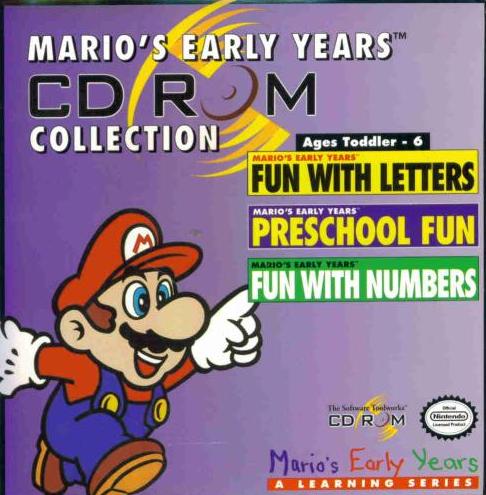
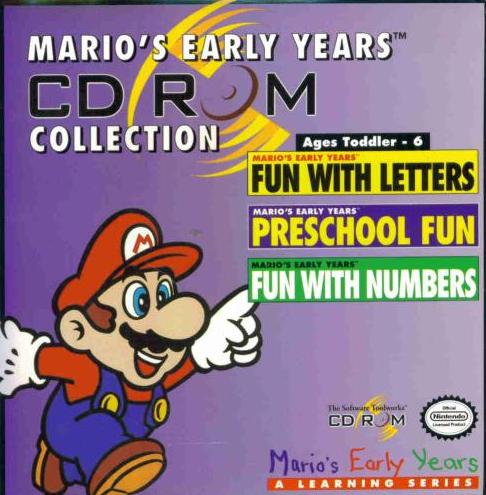
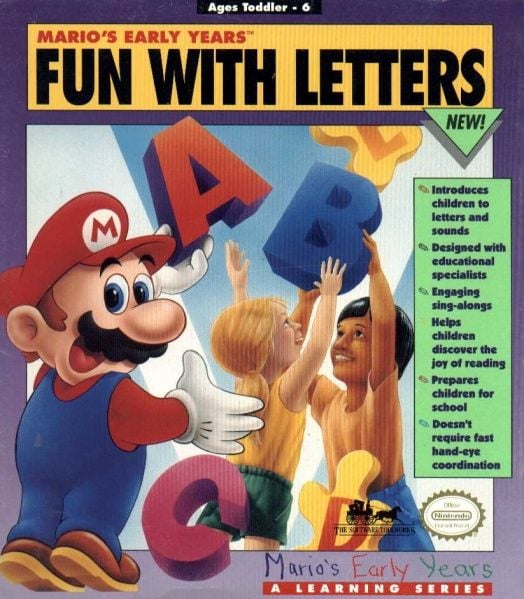
The CD-ROM Collection cover, with a green-clad Mario.The cover of the Mario’s Early Years! CD-ROM Collection dresses Mario in a green cap and shirt rather than his familiar red.
The game does not track what you have completed, and the Super NES cartridge has no way to save.
Besides original music, the soundtrack includes arrangements of Super Mario World tunes and the nursery rhymes Twinkle, Twinkle, Little Star and Itsy Bitsy Spider; the sound effects also come from Super Mario World.
Vowel World is the biggest island: five rooms for each of the five vowels.
Nintendo does not treat the Discovery Series games as an official part of the Mario series.
Regional Box Art
The American PC and Super NES boxes, the British Mario Teaches Words and the later CD-ROM and bundle covers.
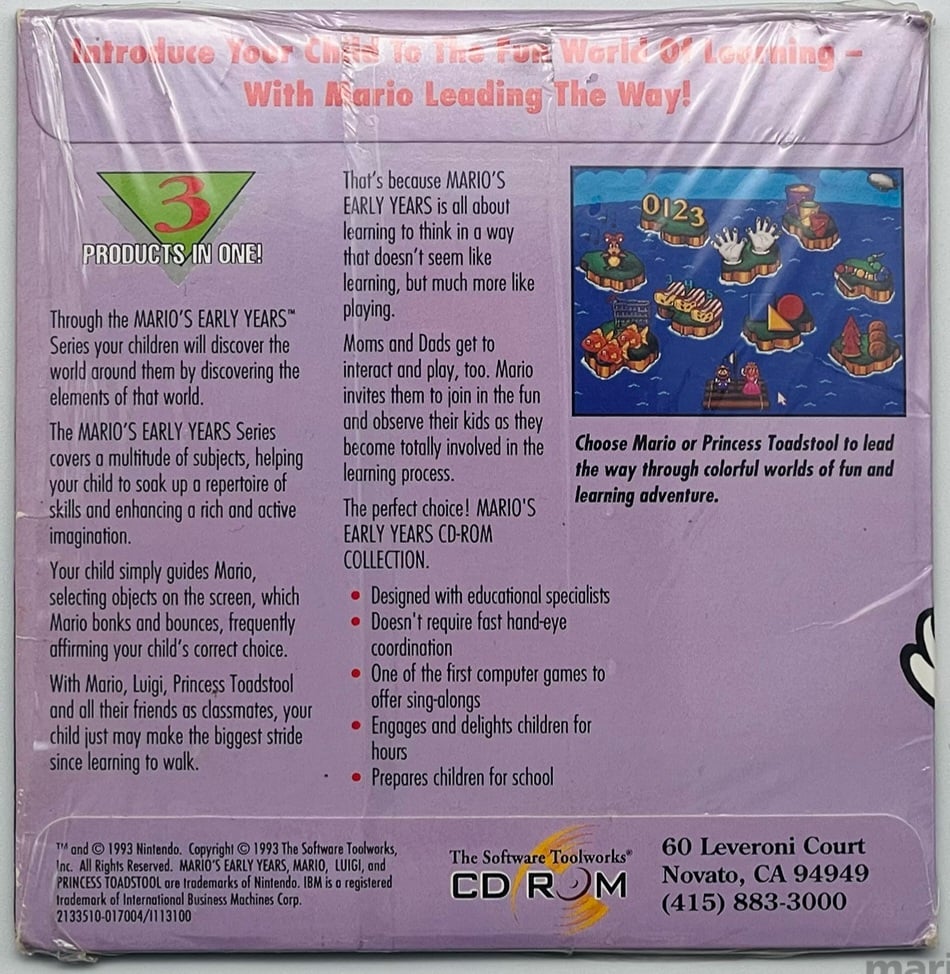
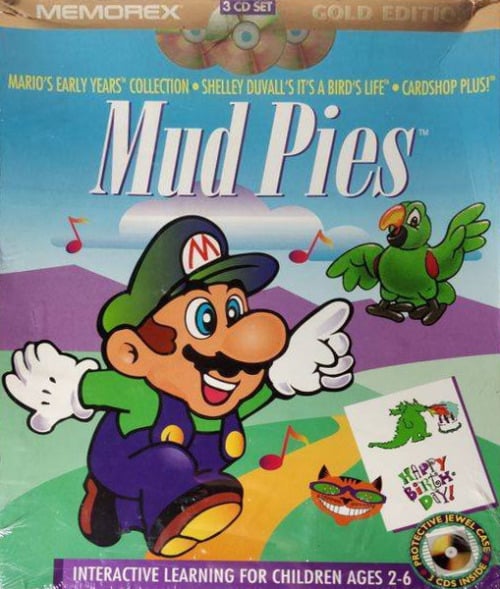
North America · MS-DOSThe Software Toolworks, 1993North America · Super NESMindscape, October 1994UK · MS-DOSReleased as Mario Teaches WordsNorth America · CD-ROM CollectionAll three Early Years games on one disc; Mario wears green on the coverCD-ROM Collection, backMud Pies bundleWith Shelley Duvall’s It’s a Bird’s Life and CardShop Plus!
Screenshots
More rooms from both versions.
The cinema queue in First Letter World (PC).Sentence World’s kitchen on PC.Mario hops through The Alphabet Song.It’s Raining, It’s Pouring.The Princess under the stars for Twinkle, Twinkle, Little Star.Iggy hugs Yoshi at the PC baseball game.
Artwork & Media Gallery
The series logos and two of the PC Alphabet World pictures.
The Mario’s Early Years! logo.The Mario Discovery Series logo.C is for Crazy Cat (PC).I is for Icky Iggy (PC).
Legacy & Re-releases
The game was sold on floppy disk, on cartridge and on CD-ROM in 1993 and 1994; the sources record nothing after the CD-ROM Collection and the Mud Pies bundle.
Release history
MS-DOS1993North American release by The Software Toolworks; one of the three Early Years games announced for the last quarter of 1993.
MS-DOS (UK)1993Released as Mario Teaches Words; a French edition also followed.
Super NESOctober 1994North American cartridge from Mindscape, with seven worlds and Yoshi.
MS-DOS CD-ROM1994Mario’s Early Years! CD-ROM Collection puts all three games on one disc; Fun with Letters is unchanged.
Mud PiesUndatedThe collection, as Mario’s Early Years Collection, bundled with two other children’s programs.
The rest of the family
Fun with Letters was always meant as one of a set. Fun with Numbers covers counting and sets in the same island-hopping style, and Preschool Fun mixes both subjects for the youngest players. For older children, the same publisher’s Mario is Missing! and Mario’s Time Machine covered geography and history, while Interplay’s Mario Teaches Typing took the keyboard.
A collector’s curiosity
Nintendo does not count the Discovery Series games as part of the official Mario canon, so the Early Years trio lives on mainly as a curio for collectors of the licensed Mario games, remembered for Icky Iggy, the Crazy Cat and that piecemeal child’s voice.
Reviews & Sales
Reviews
Educational software got little attention from the games press, and the Early Years games were mostly covered in computer magazines and parenting titles. No sales figures have been published.
CD-ROM TodayUS · MS-DOS · review of the Mario’s Early Years! series, June 1994
3/5
In its Kids & Computers column for March 1994, Computer Gaming World reviewed Fun with Letters on its own, and its reviewer Felicia Donovan liked the way the game mixes things to do with things to watch, judging that the balance would hold young players’ attention for a long time.
The parenting magazine Working Mother also featured the series in December 1993. On the Super NES, Nintendo Power reviewed its stablemate Preschool Fun in December 1994 and praised the rewards on offer but found the digitised voice annoying; that game is built the same way as this one.
SLB User Reviews
Mario’s Early Years! Fun with Letters has yet to receive a community review on Super Luigi Bros.
If you’ve played Mario’s Early Years! Fun with Letters and would like to submit a review, please get in touch.
More from the Super Luigi Bros Guide
These picture lists come from the earlier Super Luigi Bros guide to Mario’s Early Years! Fun with Letters and are kept here in full.
Gallery
Screenshots from both the MS-DOS PC and SNES versions:
Main menu (MS-DOS PC version)
World selection screen (SNES version)
Title card (MS-DOS PC version)
Title card (SNES version)
One of the game’s memorable characters: the Crazy Cat.
CD-ROM Collection & Mud Pies
The MS-DOS versions of all three Mario’s Early Years titles were released together as the Mario’s Early Years! CD-ROM Collection — a single compilation disc containing Fun with Letters, Fun with Numbers, and Preschool Fun. Notably, the CD-ROM Collection version of Preschool Fun includes a brand-new world, Time World, not found in the standalone version.
Mario’s Early Years! CD-ROM Collection front cover. Note Mario wearing a green cap instead of his usual red.
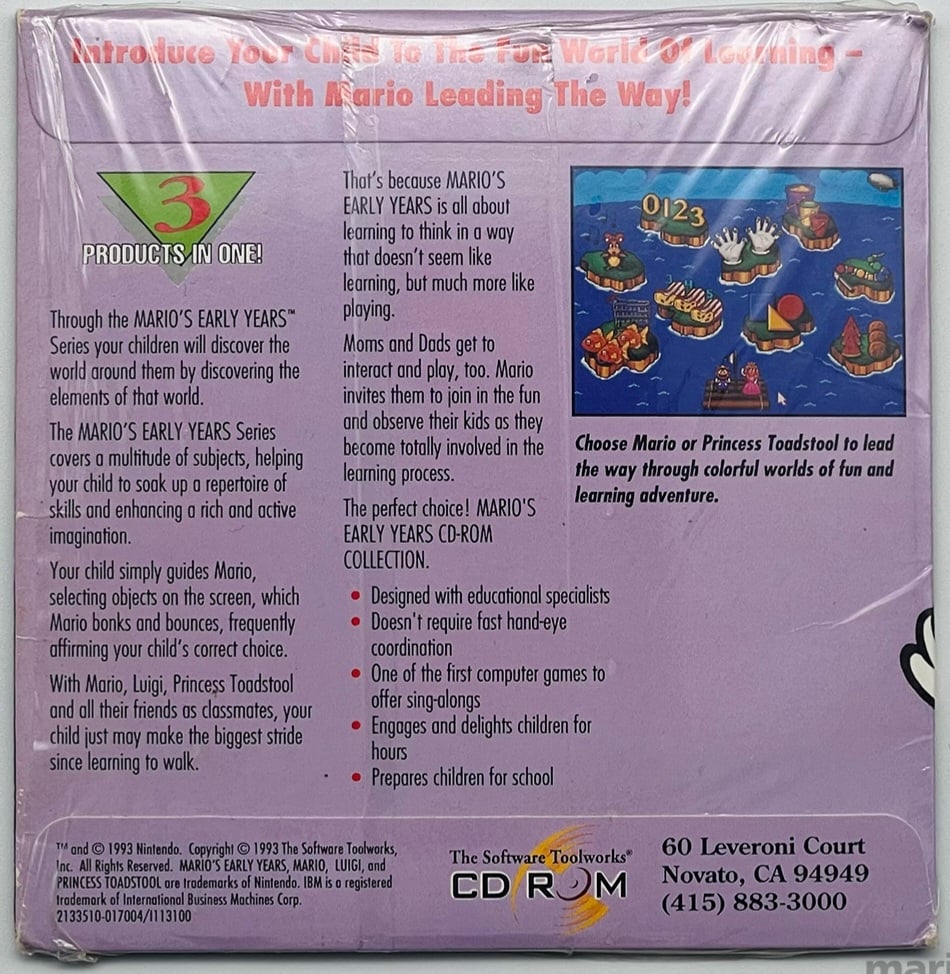
Back cover of the CD-ROM Collection.
Mud Pies was a further compilation set that included the entire Mario’s Early Years Collection alongside two other products: Shelley Duvall’s It’s A Bird’s Life and CardShop Plus! — making it a multi-software family bundle released for the PC.
The Mud Pies compilation, which included all three Mario’s Early Years titles, Shelley Duvall’s It’s A Bird’s Life, and CardShop Plus!
Alternate cover artwork for the Mud Pies compilation set.
To provide the best experiences, we use technologies like cookies to store and/or access device information. Consenting to these technologies will allow us to process data such as browsing behavior or unique IDs on this site. Not consenting or withdrawing consent, may adversely affect certain features and functions.
Functional
Always active
The technical storage or access is strictly necessary for the legitimate purpose of enabling the use of a specific service explicitly requested by the subscriber or user, or for the sole purpose of carrying out the transmission of a communication over an electronic communications network.
Preferences
The technical storage or access is necessary for the legitimate purpose of storing preferences that are not requested by the subscriber or user.
Statistics
The technical storage or access that is used exclusively for statistical purposes.The technical storage or access that is used exclusively for anonymous statistical purposes. Without a subpoena, voluntary compliance on the part of your Internet Service Provider, or additional records from a third party, information stored or retrieved for this purpose alone cannot usually be used to identify you.
Marketing
The technical storage or access is required to create user profiles to send advertising, or to track the user on a website or across several websites for similar marketing purposes.

 First Letter WorldPC and Super NES · 3 roomsA cinema where three film posters out of four start with the letter shown.
 Sentence WorldPC and Super NES · 3 roomsPick the picture that fills the gap, in a garden, a kitchen and a night-time desert.
 Sing Song WorldPC only · 4 songsFour nursery songs, each acted out by the cast.
 MarioPlayable
 Princess ToadstoolPlayable
 YoshiPlayable on Super NES
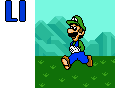 LuigiHelper
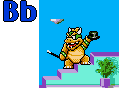 BowserCameo
 Icky IggyCameo
 AppleAThe traditional opener.
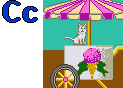 Crazy CatCThe best-remembered frame in the game.
 Dancing DinosaurDA dinosaur with moves.
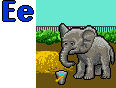 ElephantEA plain elephant, no adjective needed.
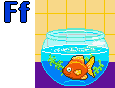 Funny FishFA fish with a sense of humour.
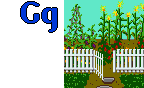 Garden GateGA gate into the garden.
 Hitting HammerHA hammer at work.
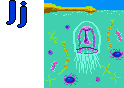 Jiggling JellyfishJA wobbly jellyfish.
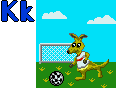 Kicking KangarooKA kangaroo mid-kick.
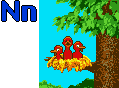 Noisy NestNA nest full of chirping.
 OctopusOAn octopus, the second vowel picture.
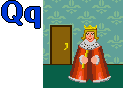 Quiet QueenQA queen keeping her voice down.
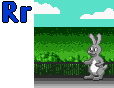 RabbitRA rabbit.
 Sparkling StarsSA sky of twinkling stars.
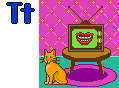 Talky TVTA chatty television set.
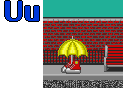 UmbrellaUAn umbrella for the U sound.
 Violent VolcanoVA volcano blowing its top.
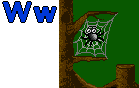 Wiggling WebWA spider’s web on the move.
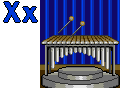 XylophoneXThe usual answer to the hardest letter.
 Zipping ZipperZA zip on the move to finish the show.