MS-DOS · Super NES · NES · Mac1993EducationalThe Software ToolworksLuigi’s first starring roleMade outside Nintendo under licence25 cities on PCBirthplace of “Weegee”
Mario is Missing!
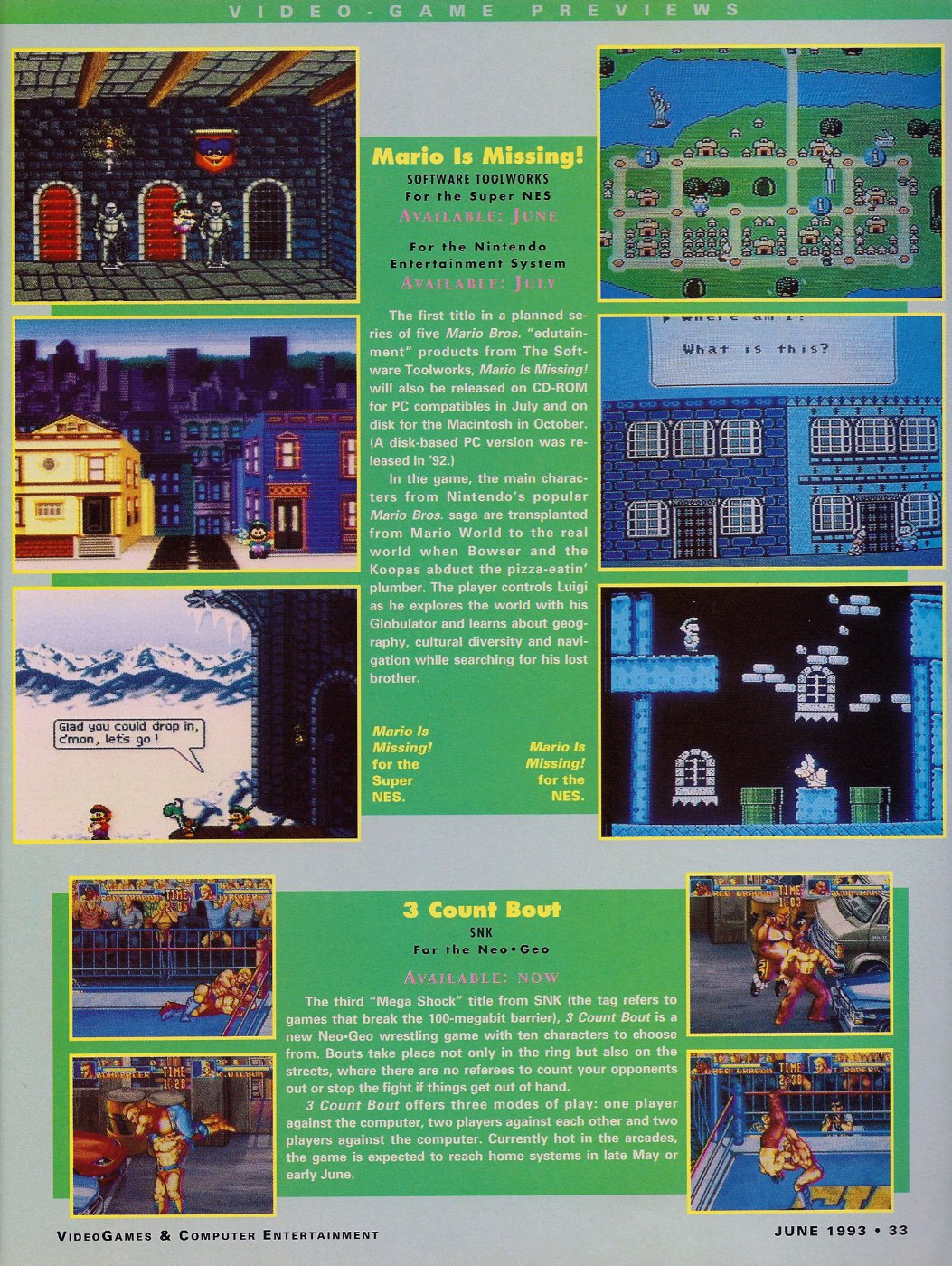
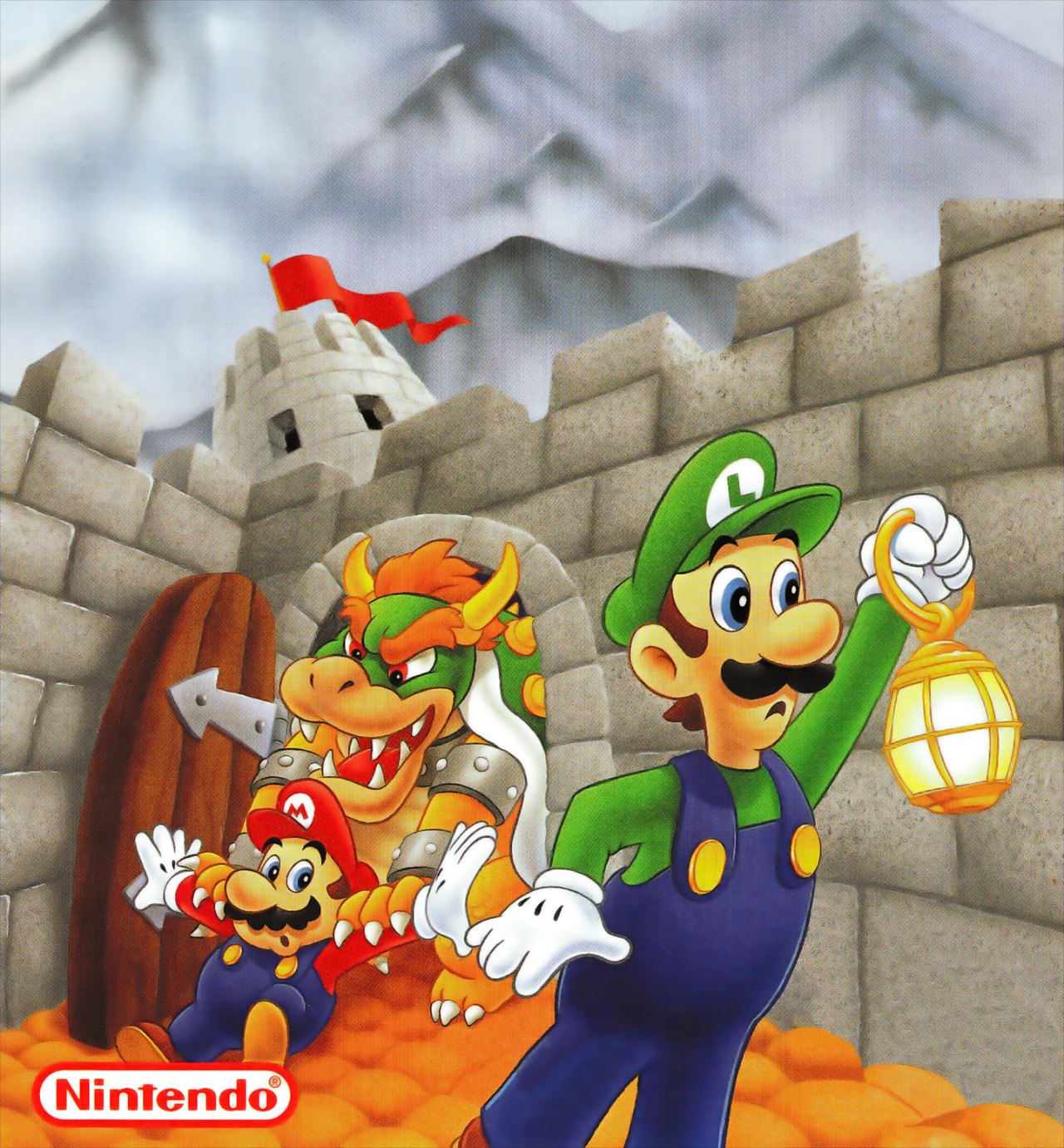
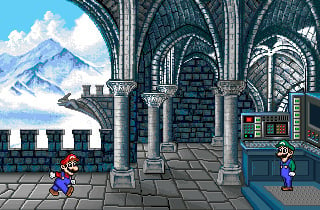
For once it is the elder brother who needs rescuing. Bowser plans to melt the ice of Antarctica with a mountain of hair dryers and flood the world, and he is paying for them by having his Koopas pinch priceless pieces of the planet’s most famous landmarks. Mario walks into the castle first and does not come out, so it falls to Luigi, in his first starring role, to step through portals into real cities from Rome to Rio, stomp the thieves, hand each artefact back after answering a curator’s questions, and call Yoshi on the Globulator once he has worked out where he is. Made by The Software Toolworks to take on Carmen Sandiego, it arrived on MS-DOS in January 1993 with 25 cities, then on Super NES (15 cities) and NES (14 cities, ported by Radical Entertainment) that June, and later as a voiced CD-ROM Deluxe edition. Gentle, odd and much mocked, it is still one of the most fascinating footnotes in Mario history.
Developer:The Software Toolworks (MS-DOS, Mac, Super NES); Radical Entertainment (NES port)
Publisher:The Software Toolworks (North America); Mindscape (Europe); Metro Games (Super NES, Australia)
Platforms:MS-DOS, Super NES, NES, Macintosh
Genre:Educational (geography)
MS-DOS:January 1993 (North America); 1993 (Europe)
Super NES & NES:June 1993 (North America); October 1993 (Europe)
Macintosh:June 1994 (North America), as Mario is Missing! CD-ROM Deluxe
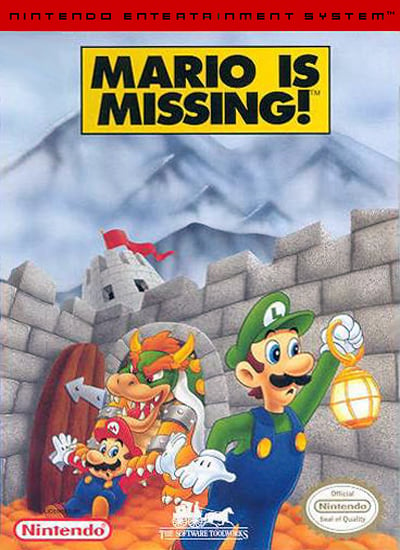
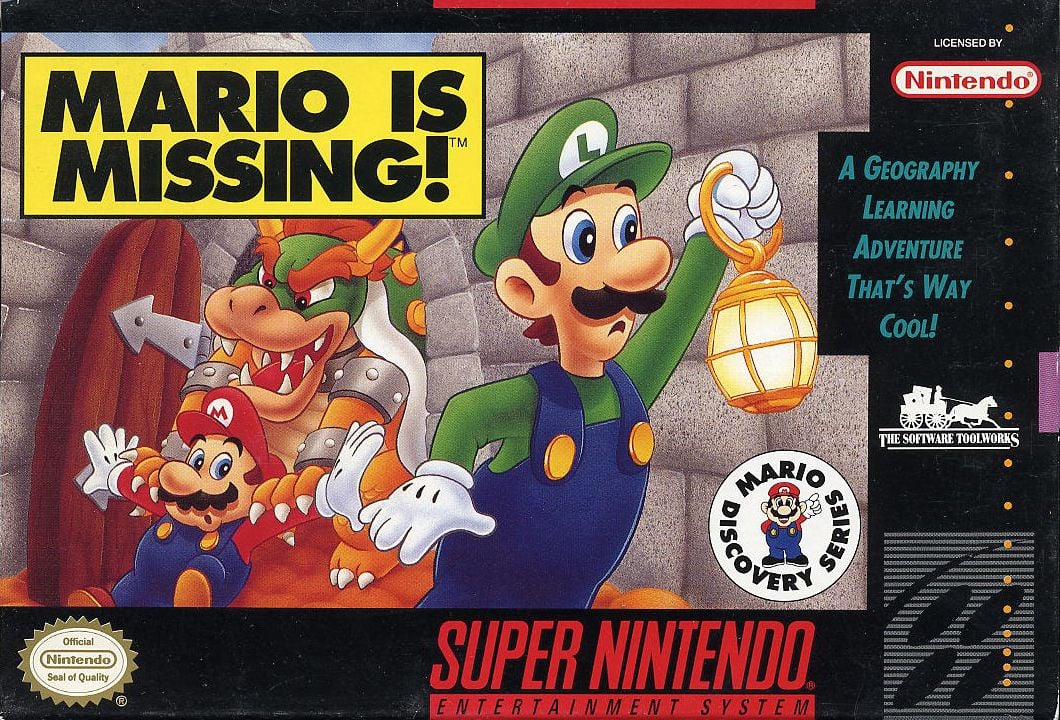
The cover artwork: Luigi and Yoshi set off around the world.
Every Mario fan has a story about the first time they slid Mario is Missing! into a console expecting a sequel to Super Mario World. What they found instead was a geography lesson. There are no pits to fall in and no flagpoles to reach: Luigi strolls along the streets of a real city, flattening Koopa Troopas who are running off with stolen treasures, then reads up on the local sights so he can pass a short quiz and put each treasure back where it belongs.
The game came from The Software Toolworks, a Californian publisher best known for educational software, which wanted a hit to rival Broderbund’s Where in the World Is Carmen Sandiego? and saw Nintendo’s plumber as the way to get one. Nintendo licensed the characters and approved how they looked, but otherwise left the design to Toolworks.
There are really three games under one name. The MS-DOS original, released first, is the biggest: 25 cities over five floors of Bowser’s castle, each floor guarded by a Koopaling, with a videophone, taxis, a talking mayor and a cash reward. The Super NES version trims it to 15 cities and borrows its sprites and music from Super Mario World; the NES version, handed to Radical Entertainment, has 14. A Macintosh release and a CD-ROM Deluxe edition with voice acting and live-action footage of the landmarks followed.
Reviewers in 1993 were split, mostly along the line between adults and children. Today it is remembered for its strangeness, for being Luigi’s first headline act a full eight years before Luigi’s Mansion, and, thanks to one wonky PC sprite, for giving the internet “Weegee”. It also started something: a run of Mario learning games that included Mario’s Time Machine and Mario’s Early Years.
Why Mario is Missing! matters to Mario fansIt is the first game built around Luigi, one of the first Mario games made outside Nintendo, and the first of the Toolworks learning games that SLB covers alongside Interplay’s earlier Mario Teaches Typing. Its Super NES version is also a curiosity for Super Mario World fans: the same sprites, a Globulator map drawn like Dinosaur Land and remixes of familiar tunes.
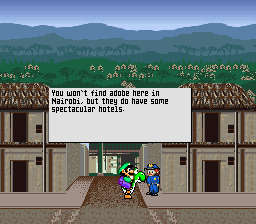
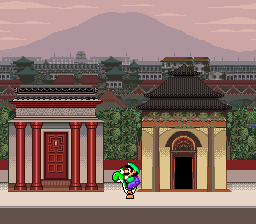
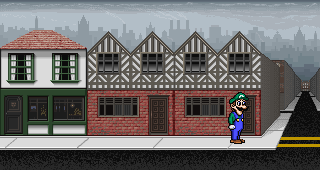
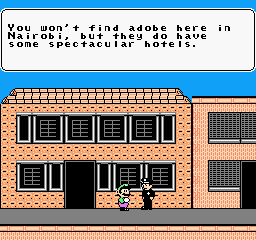
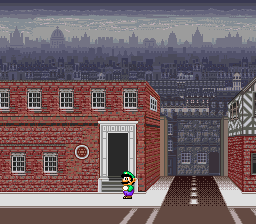
Beijing on the Super NES, one of fifteen cities in that version.London in the MS-DOS original.Nairobi in the NES version by Radical Entertainment.
“It was thought that a licensed character like Mario would carry a lot of weight.”
Donald W. Laabs, lead designer, interviewed by Time Extension (2023)
On why Toolworks wanted Mario for its answer to Carmen Sandiego.
Quick Answers
The questions people ask most about Mario is Missing!, answered briefly here and in depth below.
Who made Mario is Missing!?
The Software Toolworks, under licence from Nintendo. Toolworks made the MS-DOS, Macintosh and Super NES versions; the NES port was handled by Radical Entertainment. Nintendo asked for an educational game and approved how its characters looked, but did not design it. More →
When did it come out?
MS-DOS in January 1993, Super NES and NES in North America in June 1993 and in Europe that October, and Macintosh (as the CD-ROM Deluxe) in June 1994. It was never released in Japan. More →
Is Luigi the main character?
Yes. It is Luigi’s first game as the hero: Mario is Bowser’s prisoner for almost the whole adventure. More →
What is Bowser’s plan?
To melt the Antarctic ice with hair dryers and flood the Earth, paying for them by selling artefacts his Koopas have stolen from landmarks around the world. More →
How many cities are there?
Twenty-five on MS-DOS and Mac, fifteen on Super NES and fourteen on NES, with some cities (Montreal) found in only one version. More →
What is the Globulator?
Luigi’s map-and-communicator gadget. Once you have worked out which city you are in, you use it to call Yoshi, who is needed to clear the Pokey blocking the way out. More →
Which version is best?
The MS-DOS version has the most content; Kotaku’s Luke Plunkett called it the star of the three. The Super NES version looks and sounds most like a Mario game. More →
Was it a success?
A Software Toolworks press release in August 1993 said the console versions had brought in over $7 million in a single quarter. No unit sales were ever published by Nintendo. More →
What is “Weegee”?
An internet meme built on Luigi’s staring front-facing sprite from the MS-DOS version. More →
Story & Cities
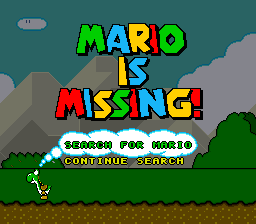
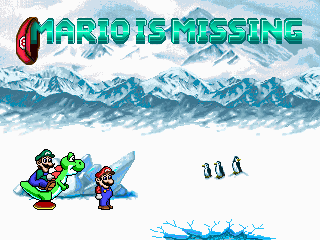
The Super NES title screen.
Bowser has a new scheme, and it is his most ambitious yet: buy an enormous number of hair dryers, point them at Antarctica and melt the ice until the world floods. Hair dryers cost money, so his Koopas have been sent out to strip the great landmarks of the world of their treasures, which he plans to sell.
Mario, Luigi and Yoshi follow the trail to Bowser’s castle at the South Pole. Mario goes in first and is captured; Luigi, leaving Yoshi outside, follows him in and discovers that the castle’s doors open onto cities all over the world. To reach his brother he will have to give every stolen artefact back.
How Mario goes missing
Each version kidnaps him differently. On the PC Luigi is too scared to go inside, so Mario heads in alone and is greeted by a butler with a dish of sweets; the butler is Bowser in disguise, and Mario is netted the moment he takes one. On the Super NES he drops through a hole and ends up trapped in a pit. On the NES Bowser simply pops a sack over him.
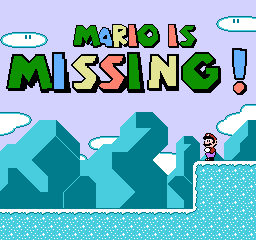
Mario, Luigi and Yoshi together again at the end of the Super NES version.The NES title screen.
A tour of the world
From there the game is Luigi’s world tour. Each door leads to a city where three treasures have gone walkabout in the claws of Koopa Troopas: the Statue of Liberty’s torch in New York, Big Ben’s minute hand in London, the top brick of the Great Pyramid in Cairo. Luigi recovers them, learns enough about each landmark to satisfy its curator, works out which city he is in and calls Yoshi to help him past the Pokey at the exit.
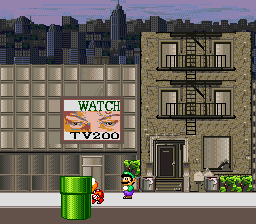
New York City on the Super NES.London on the Super NES.
Floor by floor
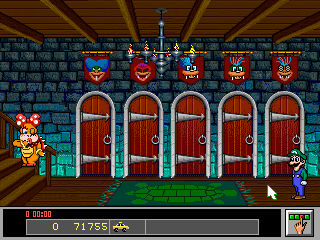
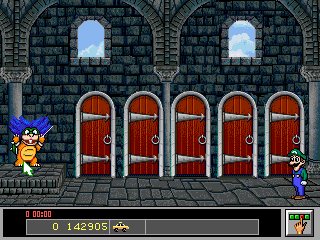
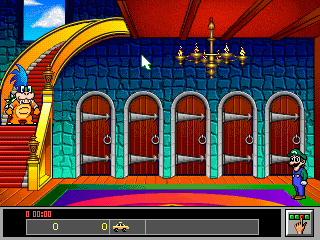
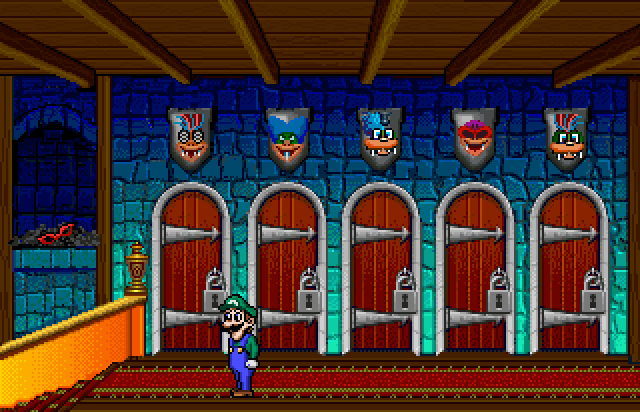
When every city behind a set of doors is safe, a boss stands between Luigi and the next floor. The PC gives each Koopaling a floor of five cities, from Larry at the bottom to Ludwig at the top, and they go down to Fire Flower fireballs. Morton and Lemmy are absent; unused dialogue for both is still in the PC files, and Lemmy even appears on the CD-ROM cover.
Wendy’s floor.Ludwig guards the top floor on the PC.
Three endings
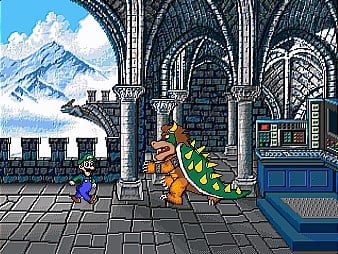
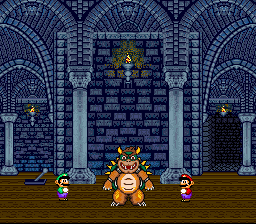
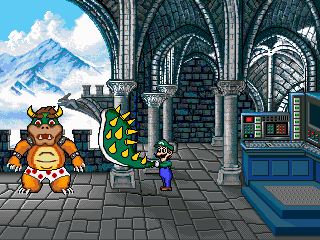
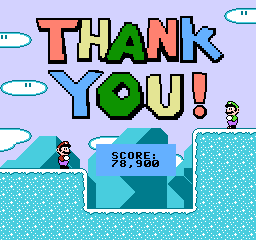
The PC finale is pure slapstick. Luigi pulls off Bowser’s shell to reveal a pair of polka-dot boxer shorts, takes the key to Mario’s cell out of the shell, and sends the mortified king over the railing into the snow. The brothers shake Yoshi’s hand and wander off together, while Bowser pokes his head out of a snowdrift, shell back on. The Macintosh version changes the punchline: Bowser stands his ground and Luigi knocks him off the balcony with his own shell.
On the Super NES a lever reveals Mario; Bowser jumps down from a ledge, Luigi pulls the lever again and the king drops into a cannon that fires him out into the snow, where he freezes solid and shatters. The NES has the strangest twist of all: the “Bowser” Luigi defeats turns out to be an ordinary Koopa in a costume, who turns the key and frees Mario himself.
Luigi takes off Bowser’s shell in the MS-DOS ending.Mario and Luigi reunited in the PC ending (scene by Dan Guerra).Mario freed at the end of the NES version.
Every city on the Super NES
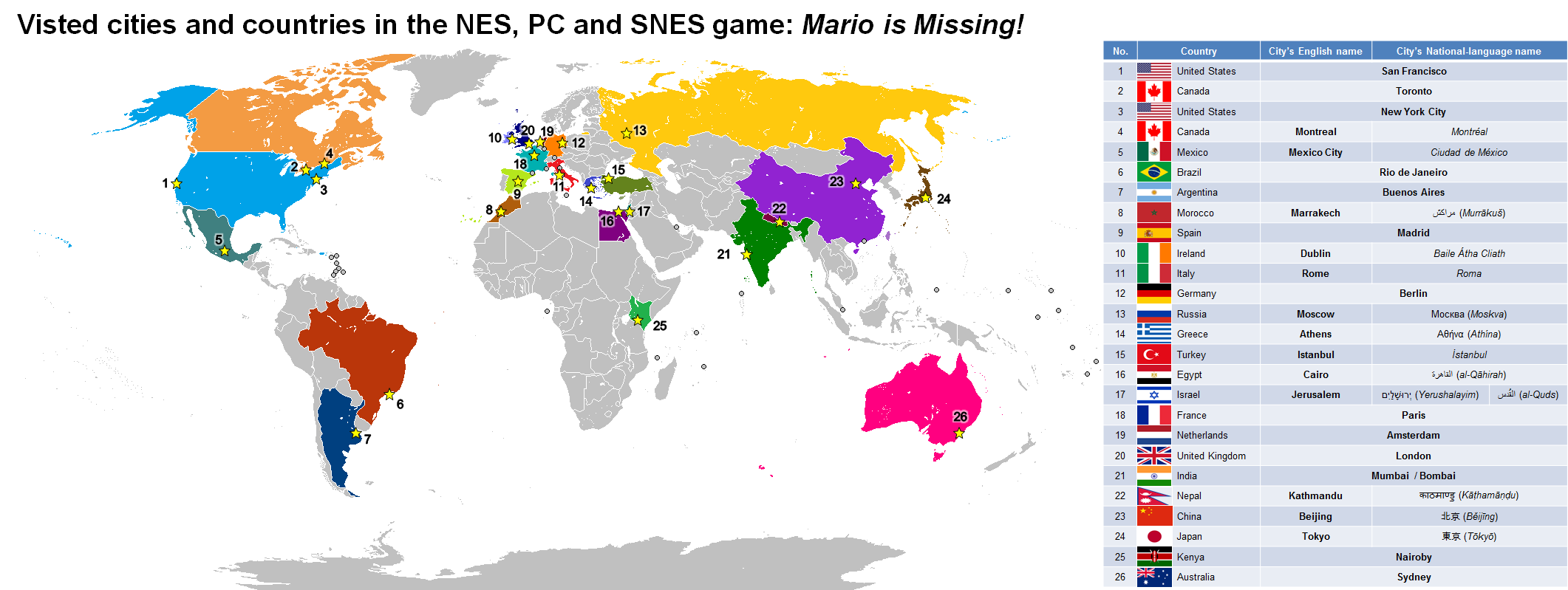
The fifteen Super NES cities in castle order, with the three artefacts stolen from each. The PC and NES lists follow.
San FranciscoUSA · floor 1Golden Gate Bridge fog horn, top of the Transamerica Pyramid, a window from Coit Tower.
MoscowRussia · floor 1A cathedral dome, a Bolshoi Ballet slipper and a cannonball from the Emperor’s Cannon.
NairobiKenya · floor 1A human skull, a baby elephant and a Maasai headdress.
BeijingChina · floor 1A stone from the Great Wall, the Gate of Heavenly Peace and the Hall of Good Harvest.
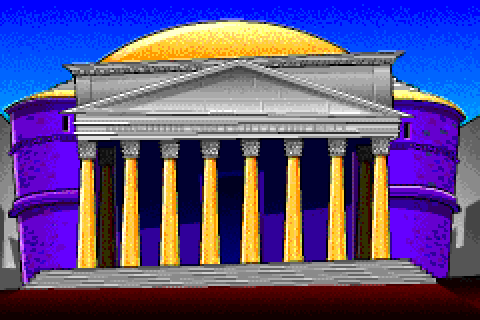
RomeItaly · floor 1A gladiator’s spear, the Sistine Chapel ceiling and the coins from the Trevi Fountain.
ParisFrance · floor 2The Tricolor, the Eternal Flame and the bell of Notre Dame.
Mexico CityMexico · floor 2A Diego Rivera mural, the Angel of Independence and a Fine Arts catalogue.
SydneyAustralia · floor 2Sheet music from the Opera House, a Taronga Zoo koala and a Bondi Beach surfboard.
Buenos AiresArgentina · floor 2A flute from the Teatro Colón, a stone from the Obelisk and a set of boleadoras.
AthensGreece · floor 2A Parthenon column, a Caryatid and a brass plaque.
LondonUK · floor 3The Crown Jewels, Big Ben’s minute hand and a bust of Shakespeare.
CairoEgypt · floor 3The Sphinx’s klaft, the Gingerbread Clock and the top brick of the Great Pyramid.
TokyoJapan · floor 3A Sensō-ji lantern, a sumo apron and the Great Buddha’s orange.
Rio de JaneiroBrazil · floor 3The spotlight from Christ the Redeemer, a Sugar Loaf cable car and a Copacabana seashell.
New York CityUSA · floor 3The Statue of Liberty’s torch, the statue of Prometheus and, improbably, King Kong.
MS-DOS and Mac (25 cities, five floors): Larry’s floor – Rome, Nairobi, Beijing, Moscow, San Francisco; Roy’s – Athens, Madrid, Marrakech, Mexico City, Paris; Wendy’s – Berlin, Buenos Aires, Dublin, Kathmandu, Sydney; Iggy’s – Amsterdam, Bombay, Cairo, Tokyo, Toronto; Ludwig’s – Istanbul, Jerusalem, London, New York City, Rio de Janeiro.
NES (14 cities, seven rooms of two): New York City and Rome; Sydney and San Francisco; Tokyo and Paris; Montreal and Moscow; London and Buenos Aires; Mexico City and Cairo; Nairobi and Beijing. Montreal, with its Olympic stadium and Dome, appears in no other version.
Advertisement
Gameplay & Controls
Every version follows the same loop: enter a city, recover three stolen artefacts, prove you know where they came from, find out where you are, then whistle up Yoshi and leave. How you do each part differs from machine to machine.
Stomp, study, return
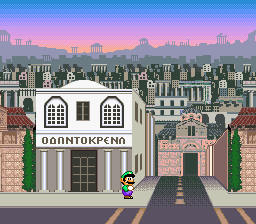
Koopa Troopas wander the streets carrying the loot. Jump on one and it drops its prize; on the consoles a stomped Koopa is destroyed outright, shell and all, while the PC Koopas are knocked aside. Luigi then carries the artefact to its landmark, where a curator will only take it back once he has answered a question about the place. The answers come from the city itself: tourist kiosks, information signs and the locals who stop to chat, from a tour guide and a professor to a policewoman, a tourist and a small boy.
There is no ticking platform timer to dread, but the PC version does keep a clock that falls whenever Luigi moves to a new location, takes a taxi or answers the phone, and whatever is left is added to the score.
Athens on the Super NES.The Pantheon in Rome, MS-DOS version.
Where am I? The Globulator and Yoshi
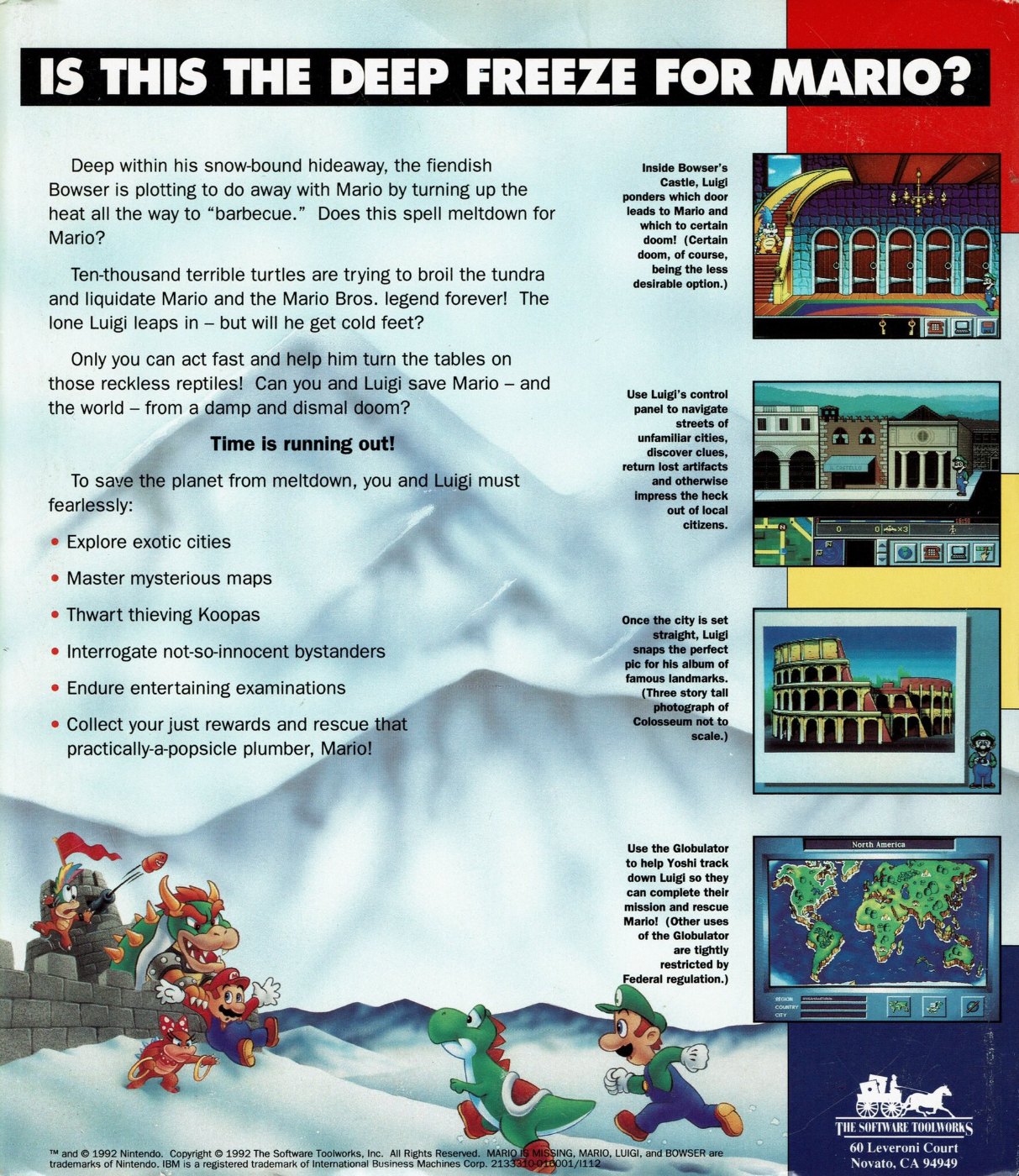
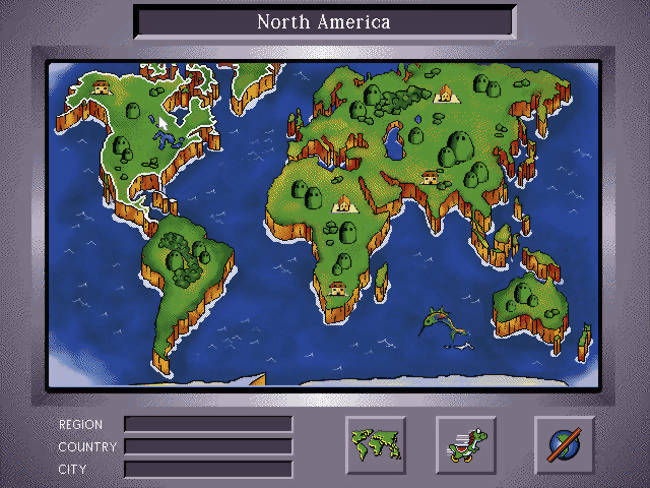
Luigi is never told which city he is in. Once the clues add up he opens the Globulator, a world map that on the Super NES is drawn like the map of Dinosaur Land, and picks the right spot to call Yoshi. Yoshi matters: a Pokey stands guard over the exit pipe and will not budge without him. On the PC Yoshi simply eats it; on the consoles he scares it off. On the Super NES riding Yoshi also doubles Luigi’s walking and running speed.
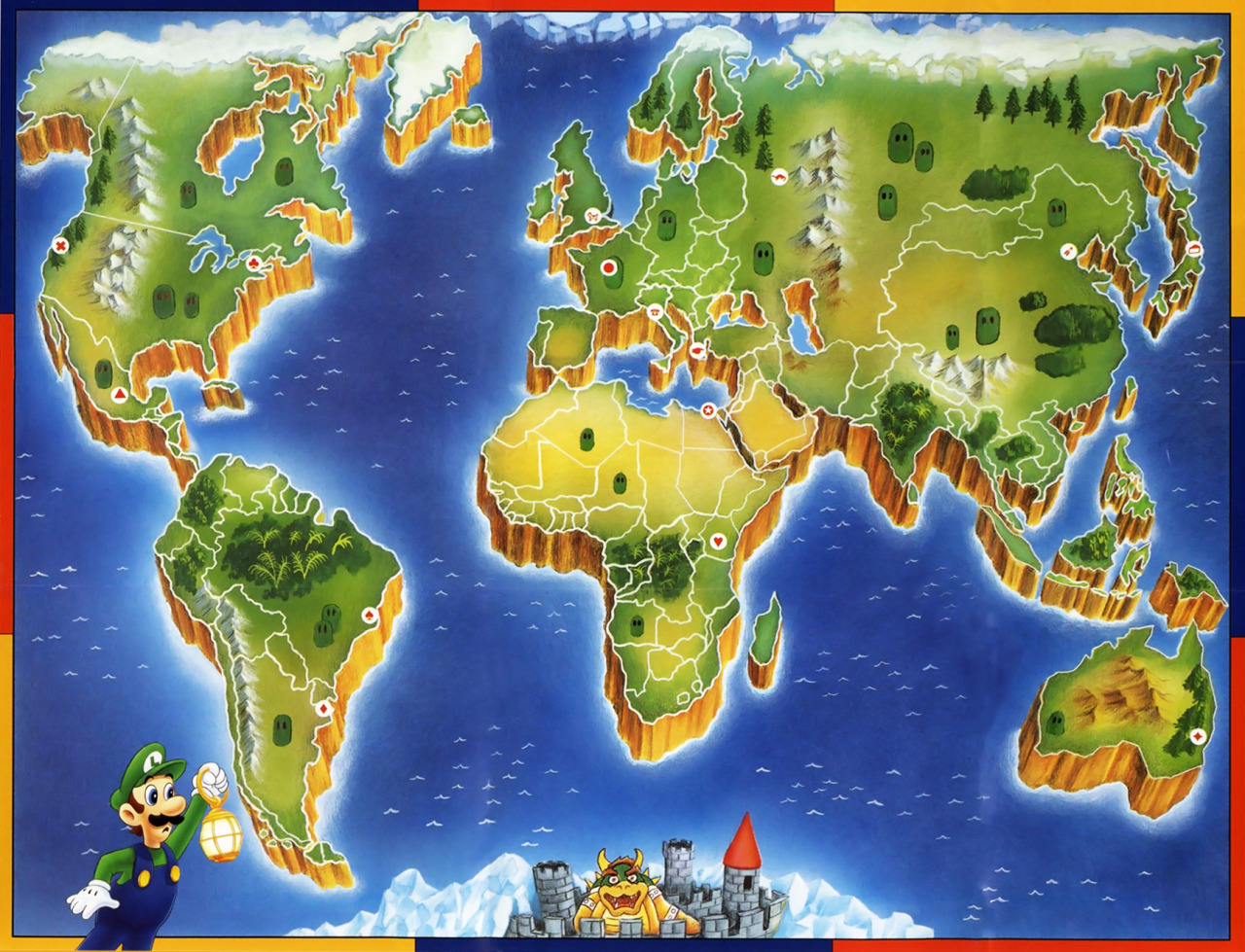
Every city Luigi visits across the three versions, marked on a world map.The MS-DOS map screen.
The PC extras: videophone, taxis and the mayor
The MS-DOS game is the richest. Each city has phone numbers to ring on Luigi’s videophone, putting him through to friends who help, to quiz questions and to the curators; the mayor calls when he arrives and again when the city is safe, and there is money as a reward. Taxi tokens picked up along the way buy rides to anywhere on the map. Mario even rings his brother with advice.
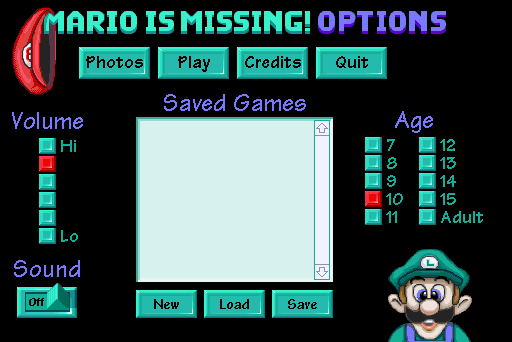
The MS-DOS title screen.The menu screen of the Macintosh version.
The castle and its bosses
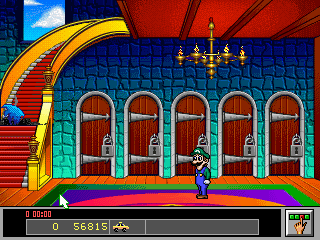
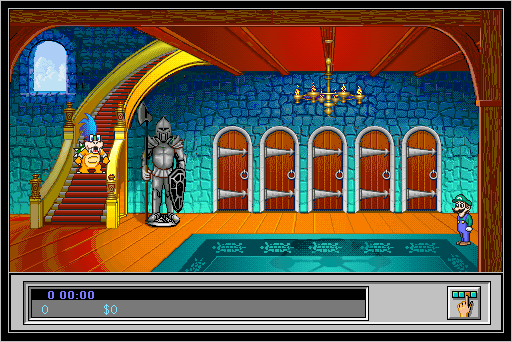
The cities are reached through doors in Bowser’s castle. On the PC each of the five floors holds five doors and a Koopaling, and once a floor’s cities are safe Luigi uses a Fire Flower to roast its guardian: Larry, Roy, Wendy, Iggy and Ludwig in turn. The Super NES has three floors of five and stompable Koopaling bosses (Roy, Iggy and Ludwig); the NES has seven rooms of two cities and a single fight with “Bowser”. None of the bosses can hurt Luigi: they simply have to be jumped on a set number of times.
Larry guards the first floor on the PC.Roy after a Fire Flower fireball, MS-DOS.
The CD-ROM Deluxe edition
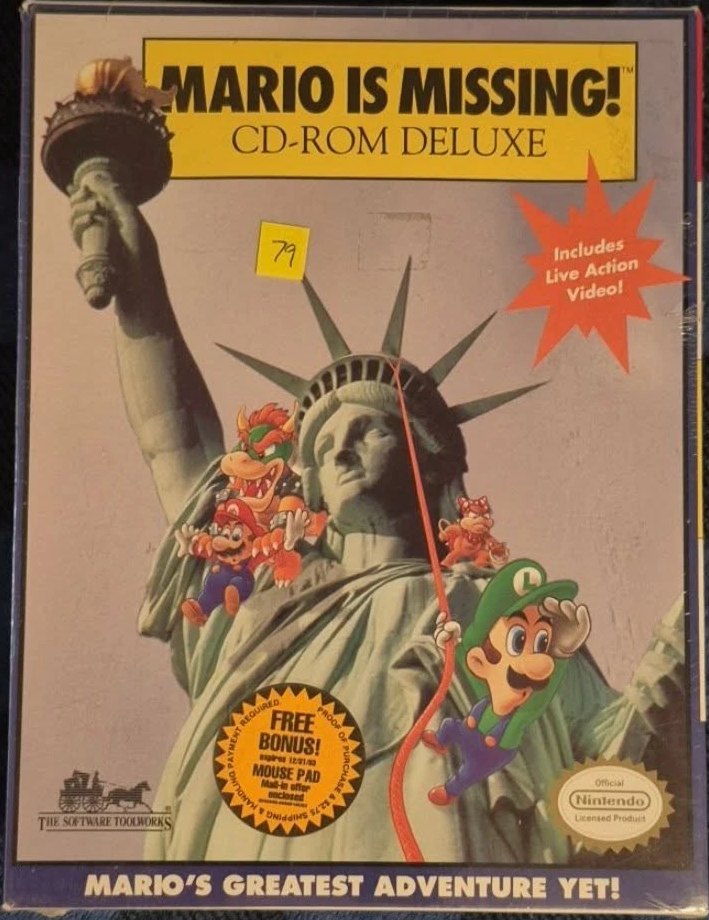
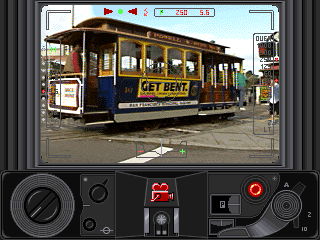
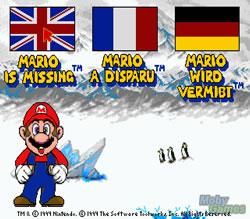
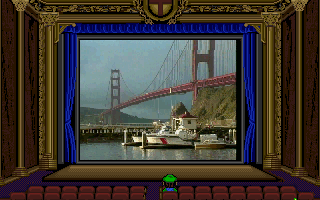
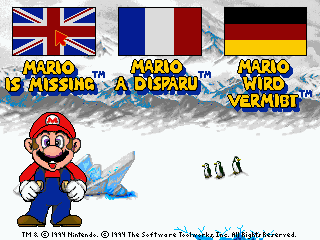
The CD-ROM Deluxe version is the PC game with sound and vision added. Every character speaks, although the on-screen text does not always match what is said, and most landmark pictures are replaced by photographs and live-action video: Toolworks’ June 1994 announcement of the Macintosh edition counted 127 QuickTime clips covering 99 landmarks. Princess Toadstool, Toad, Donkey Kong, Monty Mole and a Dino-Rhino turn up as icons on the videophone. The European CD offers English, French or German when it starts.
Luigi watches footage of the Golden Gate Bridge in the CD-ROM Deluxe.The language selection screen of the European CD-ROM.
Cartoons, Comics & Other Media
A licensed oddity with a surprisingly long afterlife.
Nintendo PowerVolume 50 · July 1993Nintendo’s own magazine reviewed the game in its July 1993 issue (Volume 50), scoring it 10.6 out of 20. SLB has the article on a sub-page linked below.
Mario’s Time MachineSoftware Toolworks · 1993The follow-up swapped geography for history: Mario travels through time returning artefacts Bowser has stolen from the past. See Mario’s Time Machine.
WeegeeInternet meme · from 2009The MS-DOS version’s front-facing Luigi, with his blank stare, became the “Weegee” meme; Mario (“Malleo”) and Yoshi (“Yushee”) were roped in too.
Nintendo World Championships: NES EditionNintendo Switch · 2024When you set up a profile, Mario is Missing! is one of the NES games you can pick as your favourite.
Characters
Luigi in the lead, Mario off stage, Yoshi on call, and a castle full of Koopas. Sprites are from the Super NES version unless noted.
Character
Who they are
In this game
Abilities & notes
LuigiThe hero
Mario’s younger brother, here in his first starring role.
The only playable character in every version. Scared to enter Bowser’s castle on the PC, he still ends up doing all the work: recovering artefacts, quizzing locals and taking on the Koopalings.
Stomps Koopas; uses Fire Flowers on PC bosses; travels by taxi (PC) or Warp Pipe (consoles).
MarioThe missing man
The usual hero, sidelined for the whole game.
Captured at the start (netted, dropped into a pit or bagged, depending on version) and freed at the end. On the PC he phones Luigi with advice.
Not playable.
YoshiThe ride
Mario and Luigi’s dinosaur friend from Super Mario World.
Waits outside the castle and comes when Luigi correctly places the city on the Globulator. Needed to get past the Pokey at each exit, which he eats on PC and frightens away on the consoles.
Doubles Luigi’s speed on the Super NES.
BowserThe villain
King of the Koopas.
Plans to flood the world by melting Antarctica with hair dryers bought with stolen treasure. Poses as a butler on the PC and loses his shell (and his dignity) in the ending.
NES final boss (an impostor); his NES sprite is pieced together from Koopaling sprites, which is why he looks so small.
Koopa TroopasThe thieves
Bowser’s foot soldiers.
Roam each city carrying the stolen artefacts. Destroyed by a stomp on the consoles; the CD-ROM Deluxe has them on skateboards.
Each carries one artefact.
PokeyThe doorman
The stacked cactus enemy.
Blocks the exit pipe of every city until Yoshi arrives.
Eaten (PC) or scared off (consoles).
Larry KoopaFloor 1 boss (PC)
The youngest-looking Koopaling.
Guards the first floor and its five cities in the MS-DOS and Mac versions.
Defeated with a Fire Flower. Sprite from MS-DOS.
Roy KoopaBoss (PC and Super NES)
The tough Koopaling with sunglasses.
Second-floor guardian on the PC and one of the three Super NES bosses.
Fire Flower on PC; stomps on Super NES.
Wendy O. KoopaFloor 3 boss (PC)
The only female Koopaling.
Guards the third floor on the PC.
Defeated with a Fire Flower. Sprite from MS-DOS.
Iggy KoopaBoss (PC and Super NES)
The bespectacled Koopaling.
Fourth-floor guardian on the PC and a Super NES boss.
Fire Flower on PC; stomps on Super NES.
Ludwig von KoopaBoss (PC and Super NES)
The wild-haired eldest-looking Koopaling.
Guards the top floor of the PC castle and appears as a Super NES boss.
Fire Flower on PC; stomps on Super NES.
The people of the cities
Not enemies at all: the locals Luigi questions for clues. The same five types appear in every version.
Tour GuideEvery cityKnows the landmarks and their history.
ProfessorEvery cityFull of facts, not always correct ones.
TouristEvery cityAnother visitor with tips to share.
PolicewomanEvery cityGives directions about the streets.
KidEvery cityA local boy with his own bits of knowledge.
The people who made it
Names confirmed in interviews and the sources below; the full credits are on SLB’s PC credits sub-page.
Donald W. LaabsLead designerLed the design and oversaw every version, with each platform team reporting to him.
Jeff ChasenProgrammer (MS-DOS)A Mario fan who kept going back to Nintendo’s own games for reference.
Radical EntertainmentNES portThe Vancouver studio that converted the game for the NES.
Henrik MarkarianDirector of Software DevelopmentLater claimed the game sold more than a million units.
Dan GuerraArtistReportedly responsible for the PC reunion scene.
Kathy Fitzgerald, Rob Wallace, Bob Sorenson, Nicholas Glaeser, David GillVoice cast (CD-ROM Deluxe)The game does not say who voiced whom.
Advertisement
How It Was Made
The fullest account of how the game was made is Damien McFerran’s 2023 interviews with lead designer Donald W. Laabs and programmer Jeff Chasen for Time Extension.
A Mario answer to Carmen Sandiego
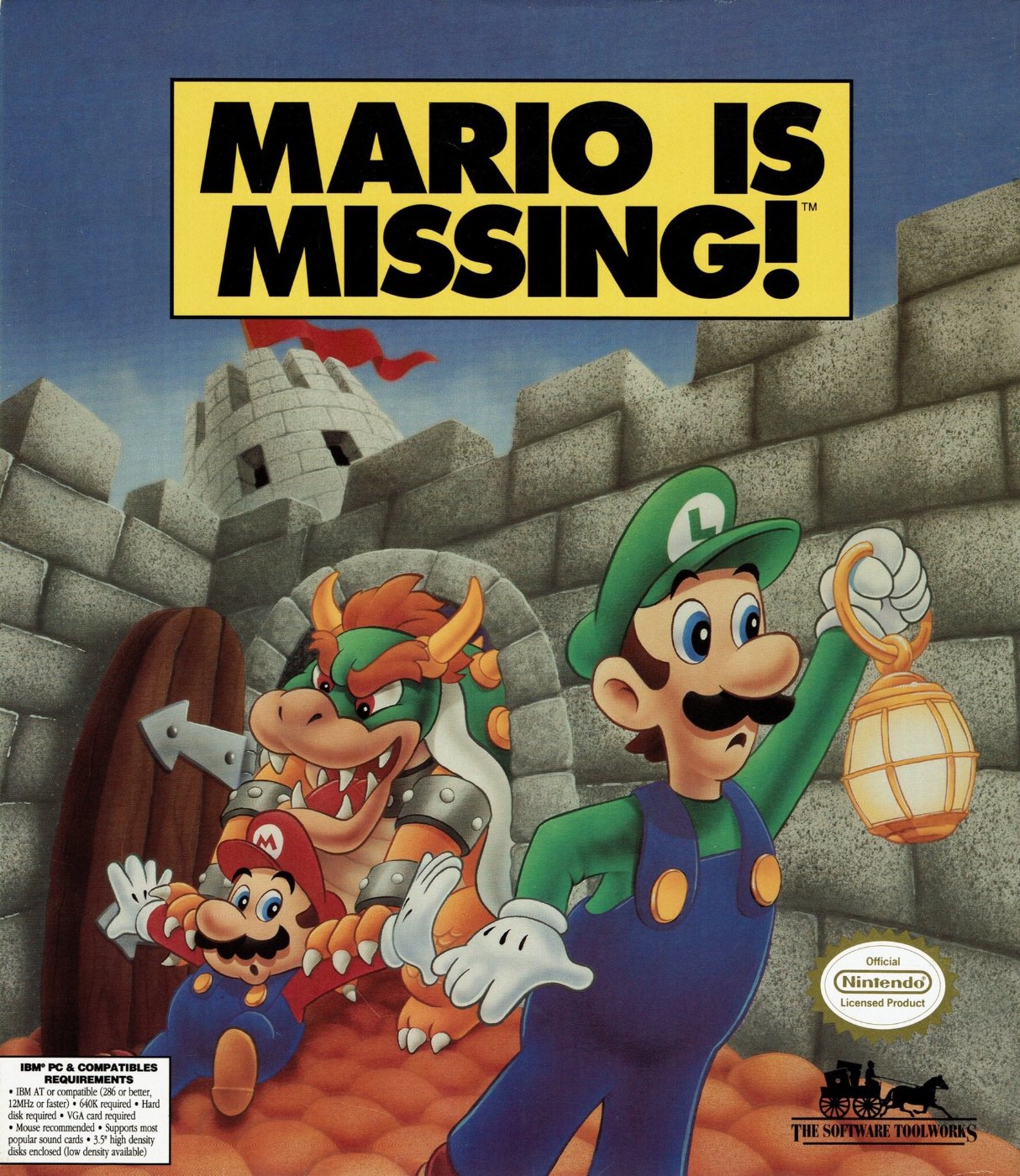
The original MS-DOS box.
The Software Toolworks already did business with Nintendo (its Miracle Piano Teaching System was on the NES) and one of its executives was close to Nintendo of America. That relationship landed the licence at a moment when Nintendo itself was keen on educational Mario games. Laabs’s aim was to compete with Broderbund’s Carmen Sandiego, and Toolworks hired designers who had worked on that series. Not everyone in the company agreed on the direction: Chasen remembered factions pulling between a Carmen-style learning game and something closer to a Mario action game.
What Nintendo wanted
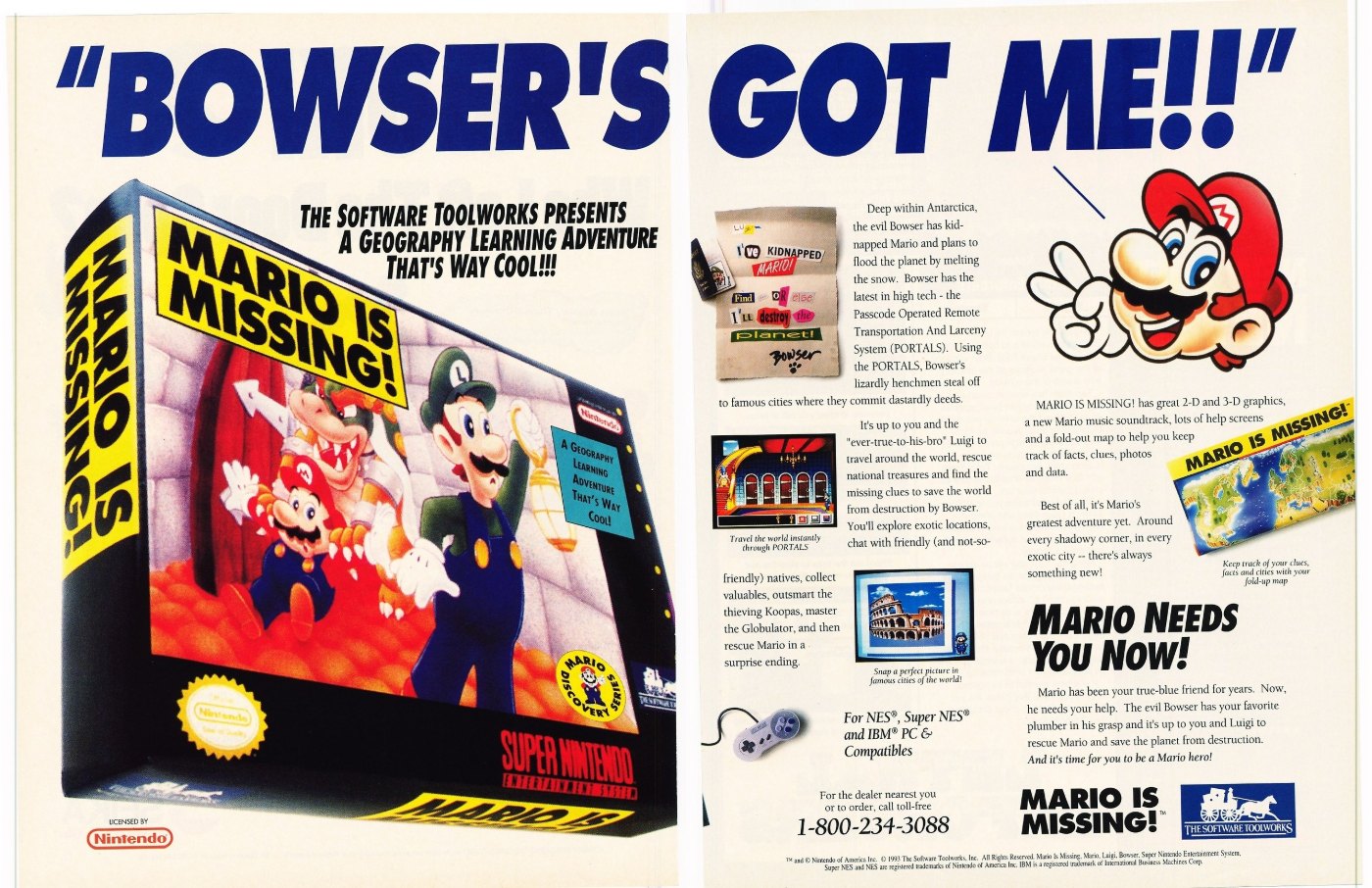
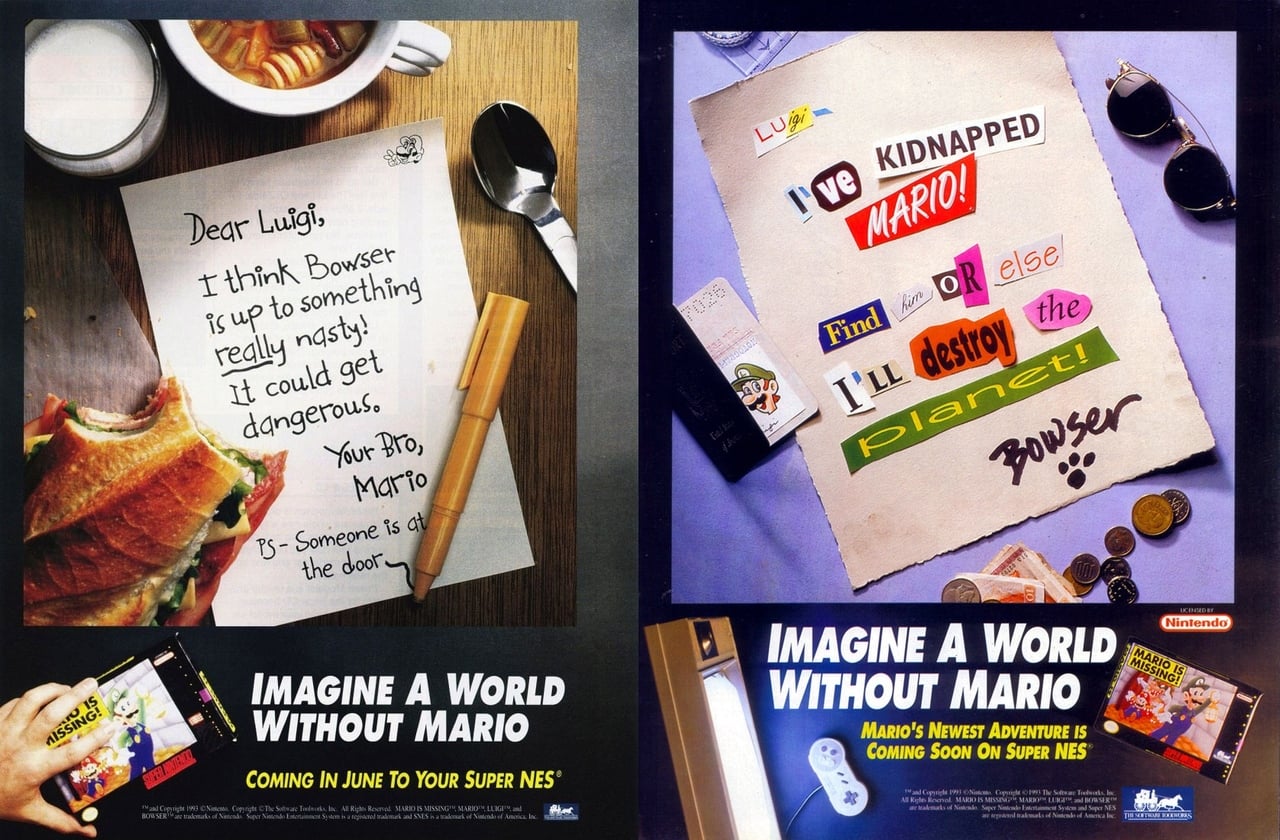
An advert covering several versions.
Nintendo cared above all about how its characters looked: the lead artist was sent to learn how to draw them properly, at what Laabs called “Mario art school”. According to Laabs, Nintendo of Japan did not want anything that could be mistaken for a traditional Mario game, and he suspects it never quite understood what the American deal had committed it to. The team knew it could not match the hand-in-glove hardware and design of Nintendo’s own platformers, so it aimed the game squarely at young children.
Three teams, three versions
An advert for the Super NES and NES versions.
The MS-DOS game came first, mouse-driven and the most complete. The Super NES version was made in-house at Toolworks and reused sprites and music from Super Mario World, while the PC game had its own stretched-out character animation. The NES conversion went to Radical Entertainment and loosely follows the Super NES look. A pre-release name, Mario in the Seven Portals of Peril, survives in the PC version’s history, and the CD-ROM files contain footage for ten cities that never made the game, among them Bangkok, Budapest, Helsinki and Washington, D.C.
Series Firsts
Only firsts stated in a source are listed.
1Luigi’s first starring roleThe first game in which Luigi is the lead and Mario the one in trouble, years before Luigi’s Mansion.
2“The first non-Nintendo studio”, by its own accountLead designer Donald W. Laabs told Time Extension that Toolworks was the first non-Nintendo studio granted permission to make a Mario title for a console, although Atari had already made its own Mario Bros. for the Atari 2600 in 1983.
There is no official Nintendo video for this one, so here are two well-known third-party looks at it.
Third-party comedy review: episode 73 of the Angry Video Game Nerd, first released on 1 July 2009.
Third-party Let’s Play of the Super NES version, starting in Rome.
Trivia & Interesting Facts
Luigi as he appears in the MS-DOS version.Luigi’s front-facing PC sprite is the source of the “Weegee” meme.
King Kong is one of the artefacts stolen from New York City, which makes him the only fictional character among the treasures.
The game repeats the old myth that the Great Wall of China is the one human-made structure you can see from space.
The Moscow locals talk as if the Soviet Union still exists, although it had been dissolved before the game came out.
One Sydney local tells Luigi that the city is Australia’s capital. It is Canberra.
The game calls Rome “Latin Manhattan”, which is the name of a cocktail rather than a nickname for the city.
Phone numbers in the PC version are far shorter than real ones: Moscow’s have just two digits.
The Globulator misspells several places, including “Bogata”, “Caracus” and “Stolkolm”.
The Super NES curators are drawn from Princess Toadstool’s sprite, which is why some fans took the kiosk lady for Princess Daisy.
The NES Bowser is assembled from sprites of Morton, Ludwig, Roy and Lemmy, which makes him unusually short.
Morton and Lemmy are the only Koopalings who appear in no version, although the PC files hold unused dialogue for both.
In the European CD-ROM and the French floppy release, the city mayors change appearance each time you start or resume a game.
The DOS version has Mario admit that he is afraid of the dark.
The CD-ROM Deluxe adds Toad, Princess Toadstool, Donkey Kong, Monty Mole and a Dino-Rhino as videophone icons.
Regional Box Art
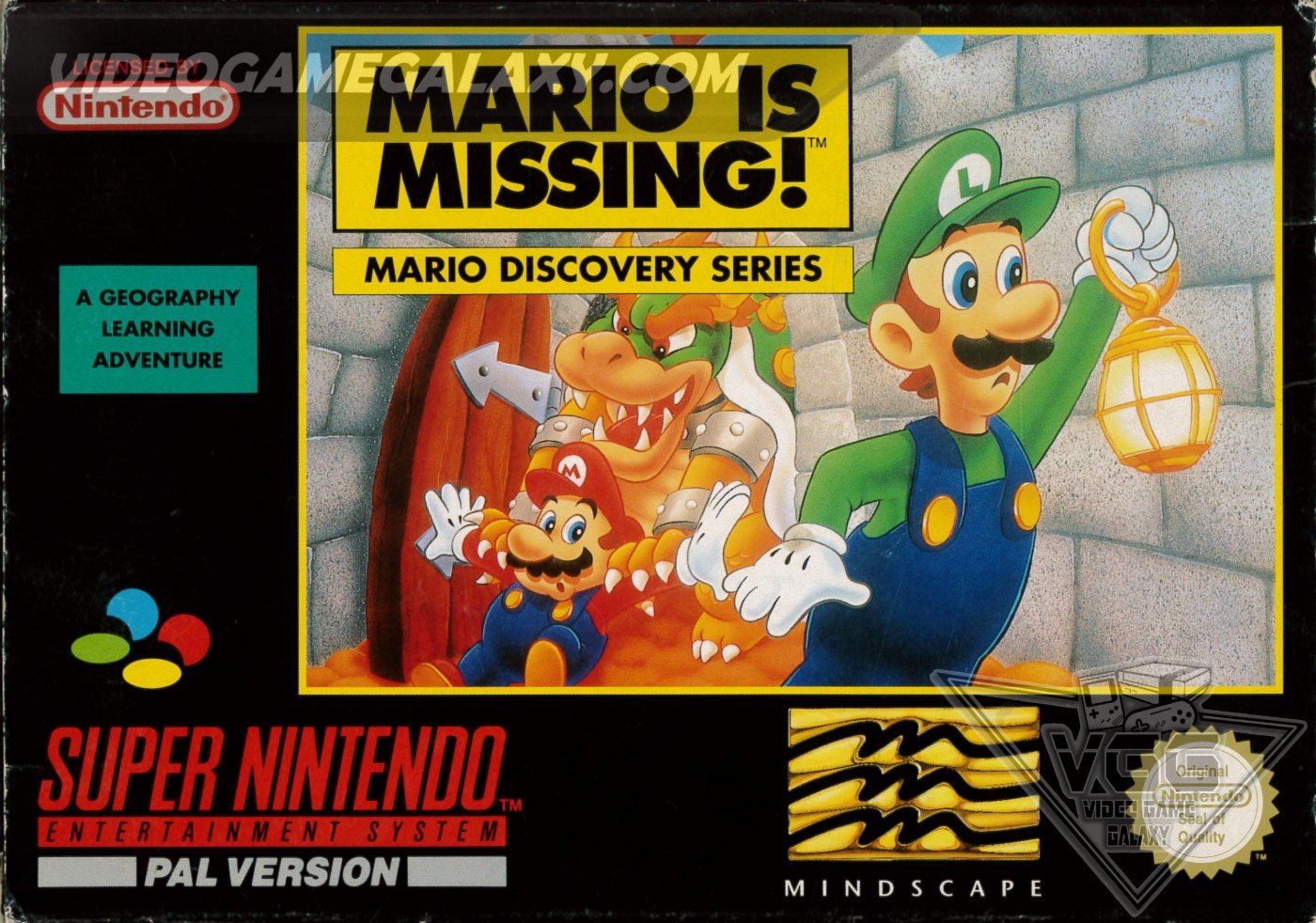
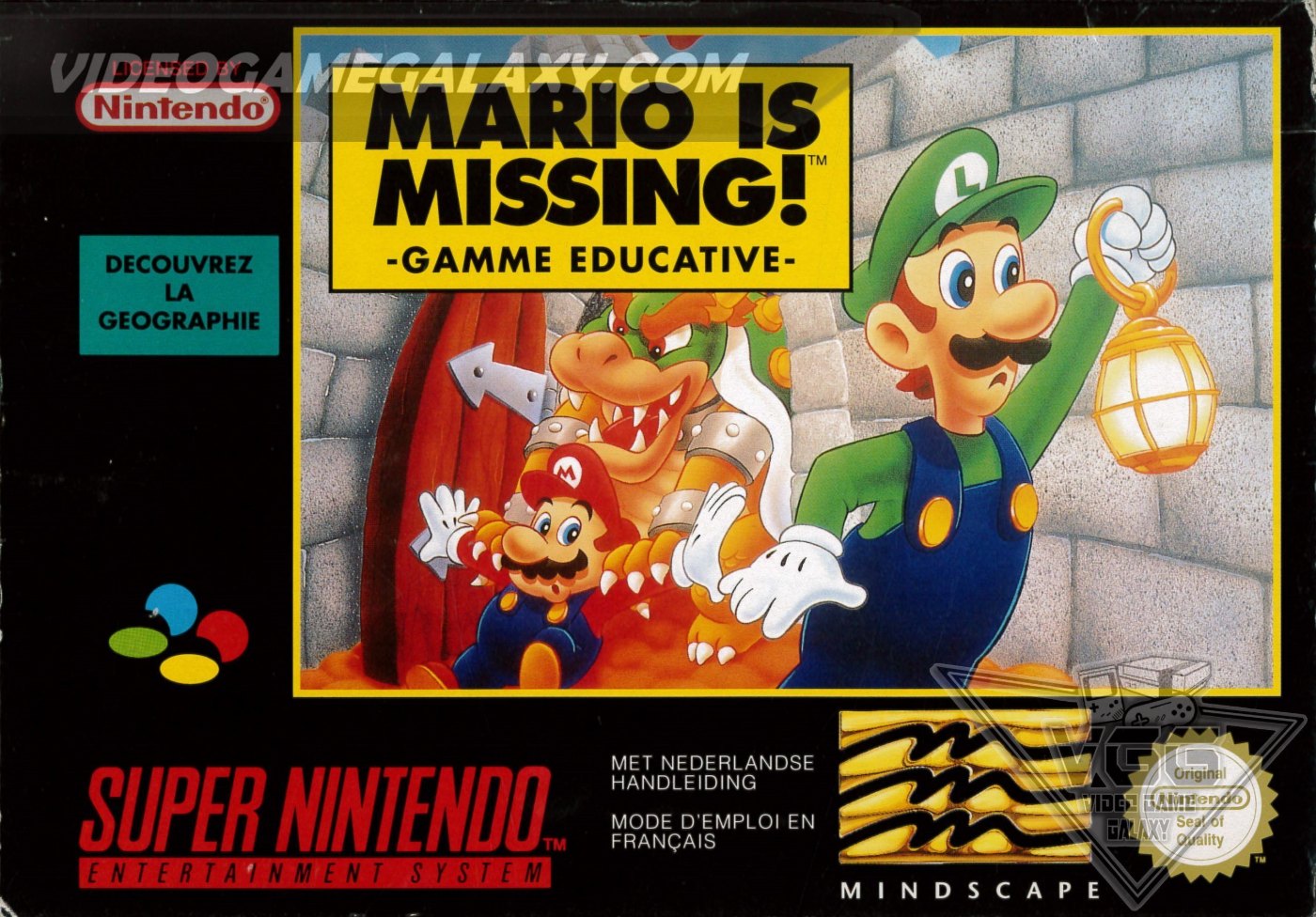
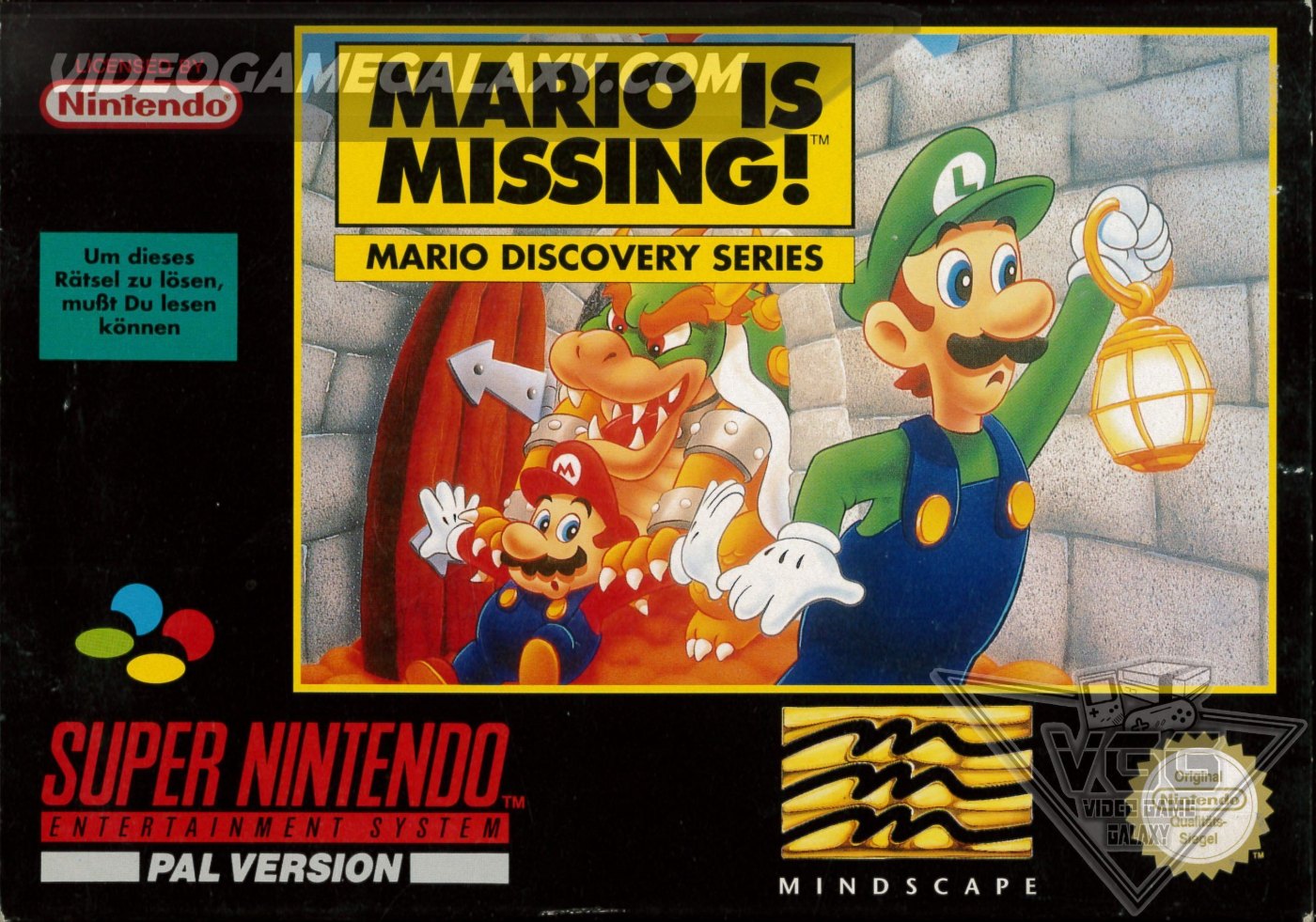
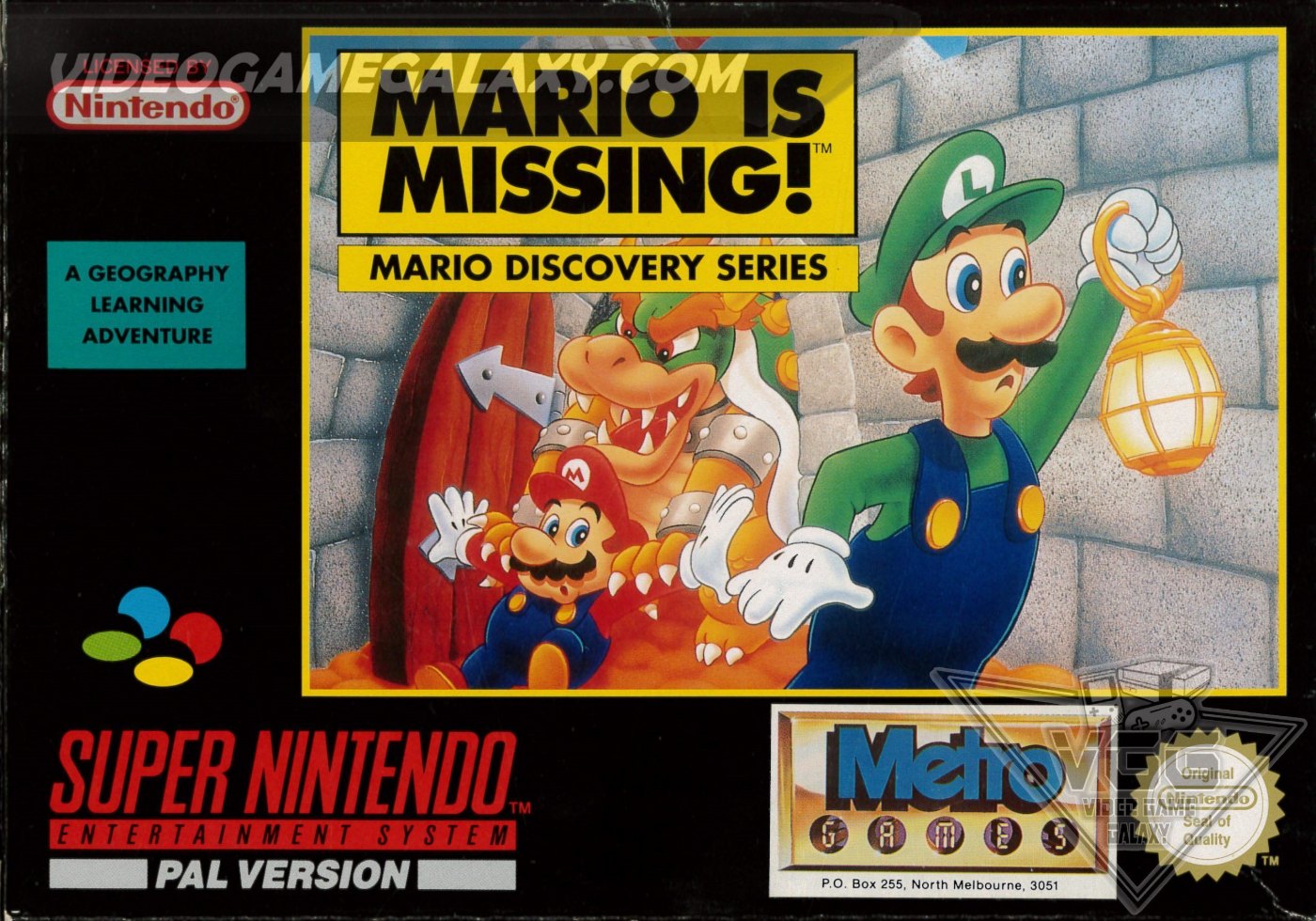
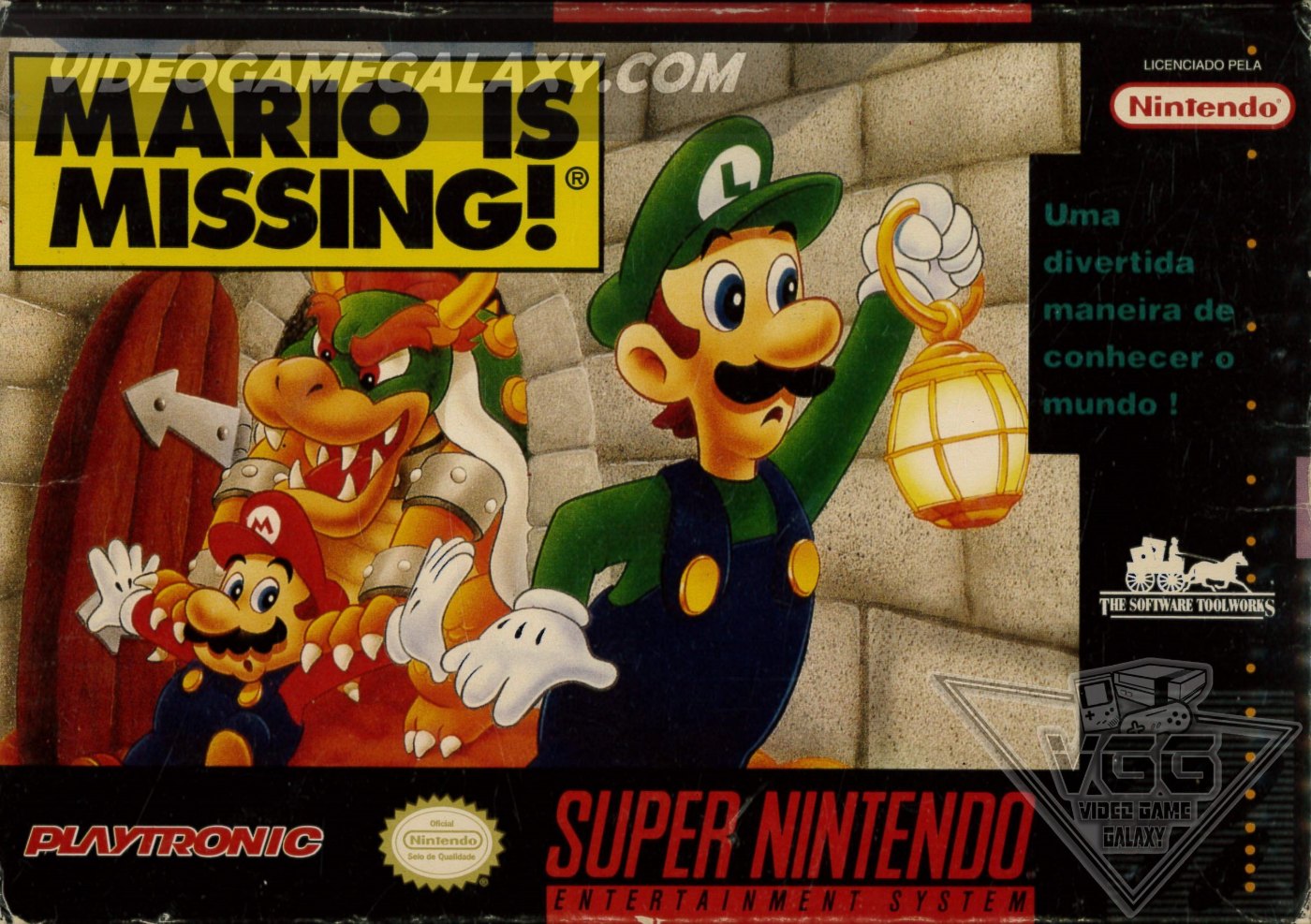
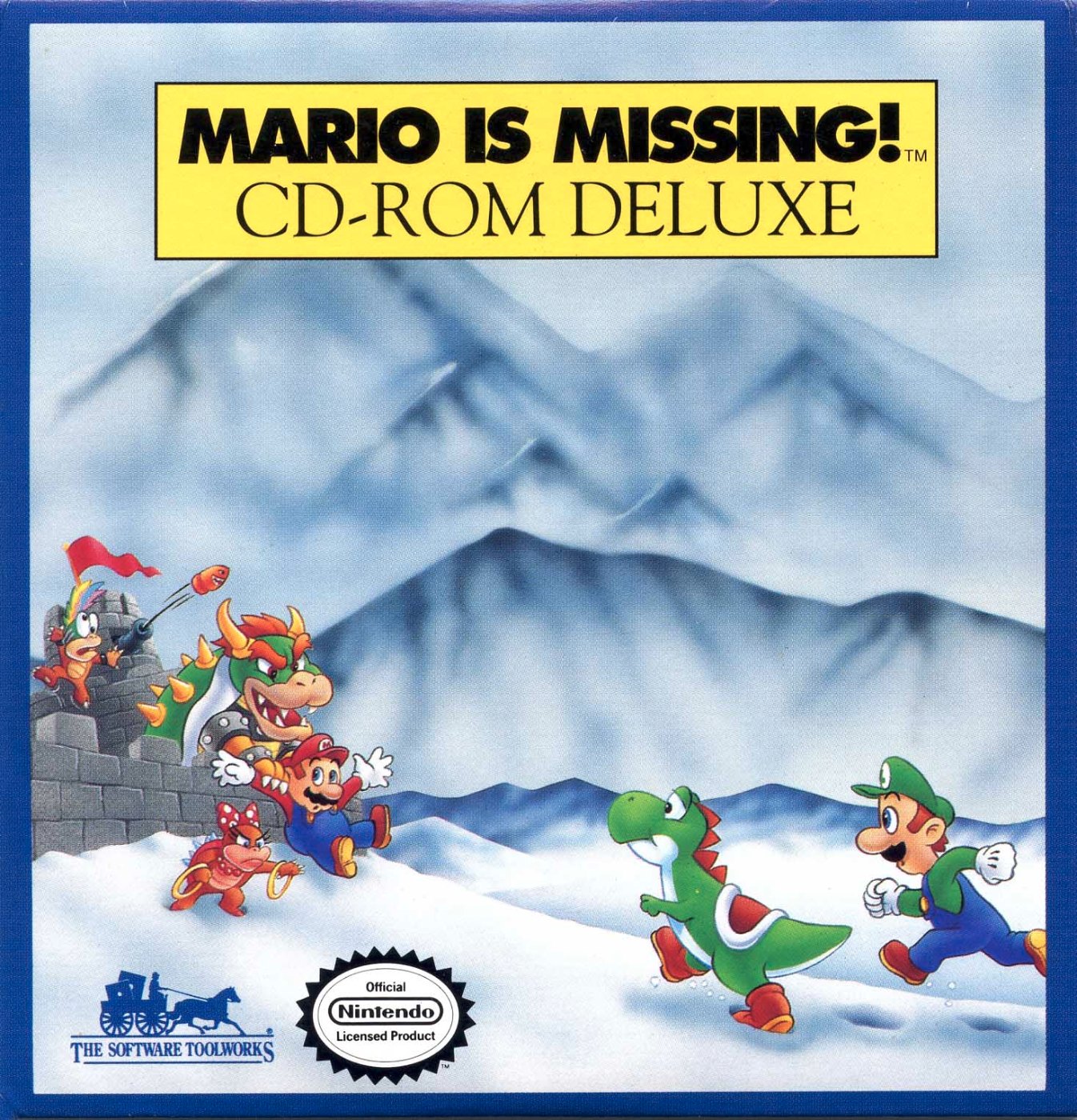
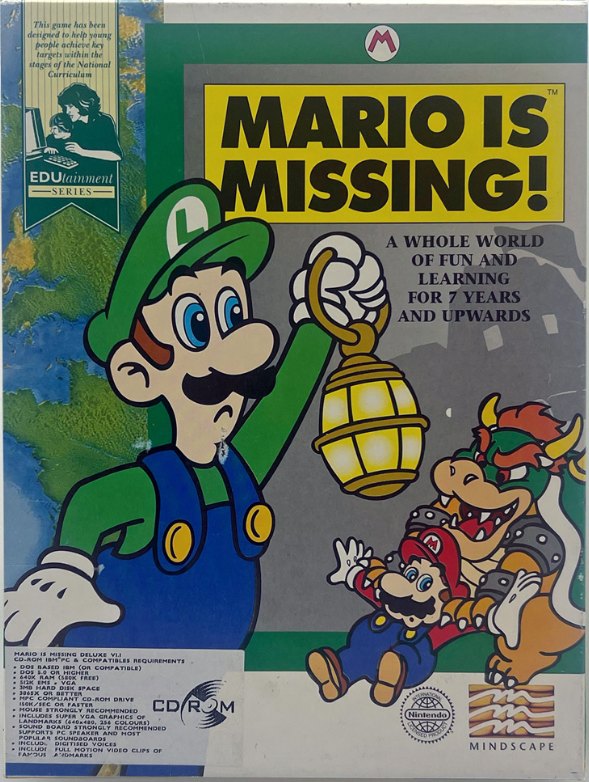
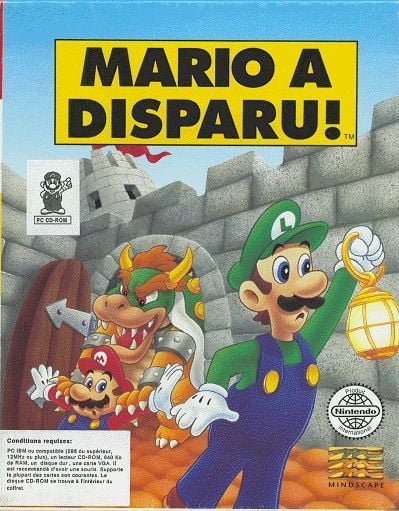
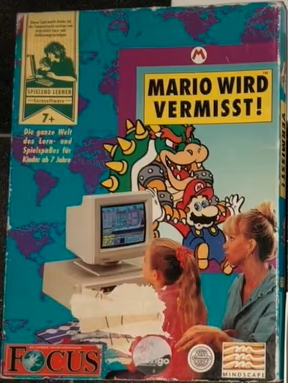
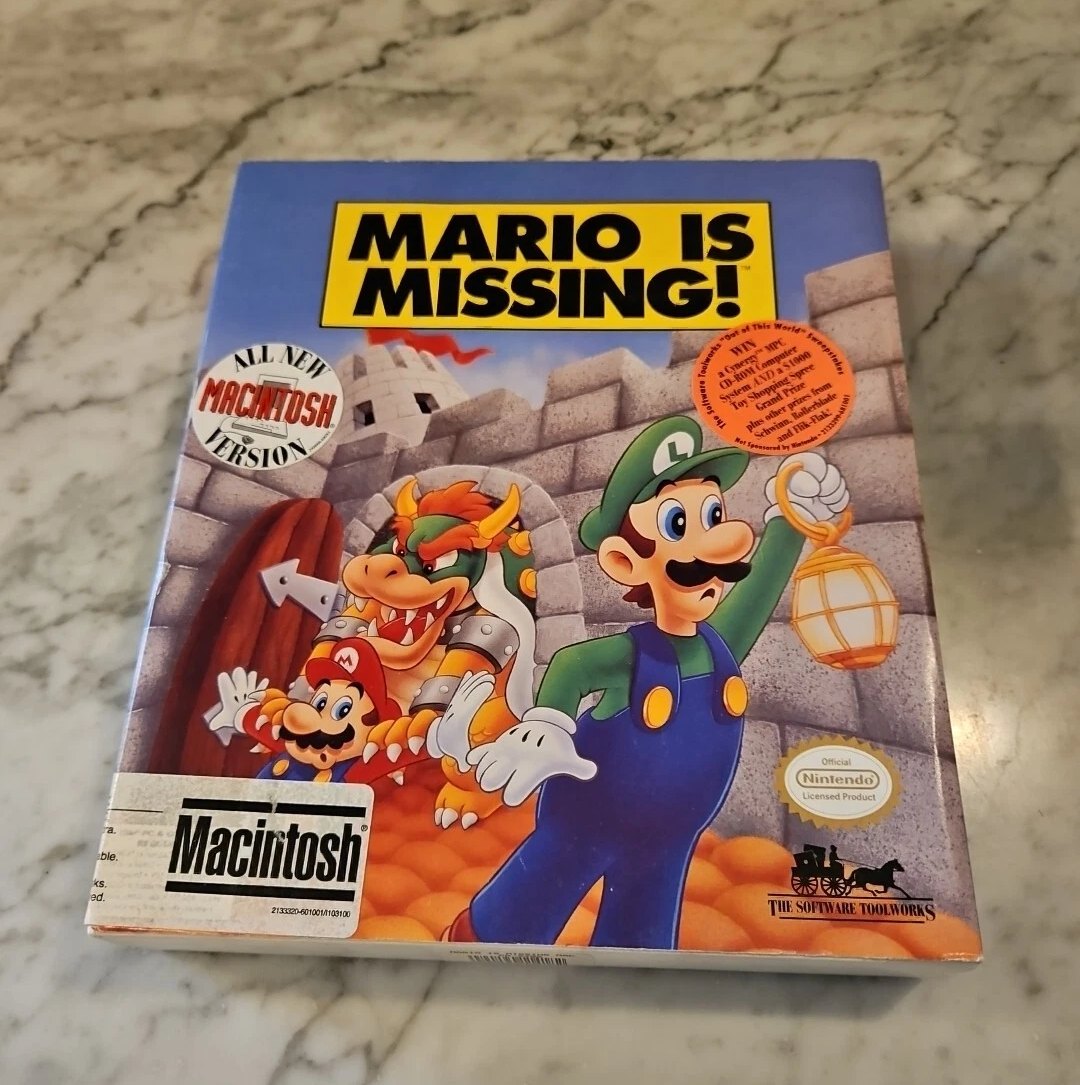
A busy shelf: floppy and CD-ROM boxes for the PC, the Mac edition, and regional covers for the Super NES. The NES game had a single North American box.
Super NES · North AmericaSuper NES · EuropeSuper NES · FranceSuper NES · GermanySuper NES · AustralasiaSuper NES · BrazilNES · North AmericaMS-DOS · North America (back)CD-ROM · North AmericaCD-ROM Deluxe · North America (disc case)CD-ROM · UKCD-ROM · FranceCD-ROM · GermanyMacintosh · North America
Screenshots
More from the PC and console versions.
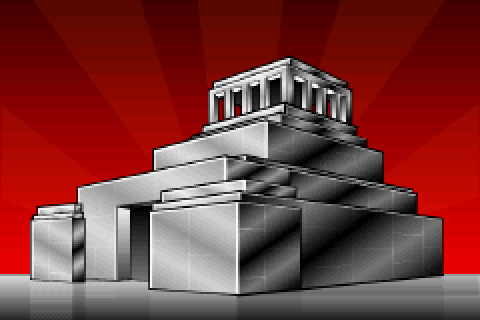
Tian’anmen Square, MS-DOS.Lenin’s Tomb in Moscow, MS-DOS.Larry after a fireball, MS-DOS.The MS-DOS ending.The camera view in the CD-ROM Deluxe.Larry guarding the first floor on the Mac.Nairobi on the Super NES.The Dome in Montreal, a city found only on the NES.
Artwork & Media Gallery
Artwork, logos, sprites and adverts for Mario is Missing!. Select any image to enlarge it.
The game’s logo.The Super NES in-game logo.Bowser, embarrassed, in the MS-DOS ending.The NES Bowser, as fought in battle.A skateboarding Koopa from the CD-ROM Deluxe.
Legacy & Re-releases
Released on four formats in eighteen months, then never reissued by Nintendo.
Release history
MS-DOSJanuary 1993The original, published in North America by The Software Toolworks; Mindscape handled Europe.
Super NES and NESJune 1993Both console versions released in North America.
Super NES and NES (Europe)October 1993Published by Mindscape, with separate French and German Super NES cartridges.
MacintoshJune 1994Mario is Missing! CD-ROM Deluxe, on CD-ROM and floppy disk.
Mario’s Time Machine1993The sequel, also from The Software Toolworks.
Luigi’s first headline act
Entertainment Weekly joked in 2011 that Luigi had once spent a game learning about globalisation before graduating to ghost-busting in Luigi’s Mansion. Laabs has since owned the game’s reputation with good humour, and Time Extension credits it with opening the door to the Mario learning games that followed.
Reviews & Sales
Sales
Nintendo has never published figures for the game. In an August 1993 press release The Software Toolworks said the Super NES and NES versions had brought in more than $7 million in a single quarter, and Henrik Markarian, its former director of software development, later claimed sales of over one million units; neither figure has been independently confirmed.
$7m+console takings in one quarter (Toolworks, August 1993)
1m+units claimed by Henrik Markarian (unconfirmed)
Reviews and scores
Critics in 1993 judged it as a learning game for children and were mostly kind; players expecting a Mario platformer were not.
Total!UK · NES · October 1993
83/100
Nintendo Magazine SystemAustralia · issue 8, November 1993
83/100
GameFanUS · Super NES · June 1993 (80, 75, 87, 79)
80/75/87/79
GameProUS · NES · January 1994
4/5
Boston HeraldUS · MS-DOS · 3 January 1993
4/5
Computer and Video GamesUK · Super NES · issue 142, September 1993
70/100
AllGameNES and Super NES · retrospective
3/5
Electronic Gaming MonthlyUS · Super NES · issue 47, June 1993 (6, 8, 6, 3)
5.75/10
Nintendo PowerUS · Volume 50, July 1993
10.6/20
AllGameMacintosh · retrospective
2.5/5
SNES ForceUK · Super NES · September 1993
42/100
Electronic Gaming Monthly’s Review Crew captured the split neatly: three of the four thought it slow and easy for seasoned players but worthwhile for youngsters, while Sushi-X gave it 3 out of 10 as a sluggish Mario game without enough life in its graphics. GameFan compared it favourably with Carmen Sandiego, GamePro thought it a good way to learn geography as long as you did not want thrills, and Nintendo Magazine System recommended it to under-elevens and geography fans despite repetitive play. SNES Force was the harshest, finding it too easy for older players and too hard for younger ones. Total! felt the NES version lost some of the visual humour but kept nearly all of the play and the learning.
Later writers have been less forgiving. GameRankings averaged the Super NES version at 43.5%. Kotaku’s Luke Plunkett (2012) thought the PC version the best of the three but the game itself awful; PC Gamer’s Samuel Roberts (2016) found identical streets and identical people everywhere. Kevin Wong offered the defence in Kotaku in 2015, praising the animation, the music and the relaxed pace, and putting the backlash down to expectations. Laabs himself accepts the main criticism as fair: the game was packaged and marketed as a traditional Mario game, and it was not.
SLB User Reviews
Super Luigi Bros readers have reviewed Mario is Missing! over the years. Their write-ups are kept exactly as they were sent in:
Played it? If you’d like to add your own review, please get in touch.
Reference / Information
Super Mario Bros. — Koopa Troopas in the PC version closely resemble those from the original game, but move differently — using skateboards and parachutes rather than simply walking back and forth.
Super Mario Bros. 3 — Similar sprites from this game appear in Mario is Missing.
Super Mario World — Almost identical sprites appear in this release, and several musical themes are shared between both games.
To provide the best experiences, we use technologies like cookies to store and/or access device information. Consenting to these technologies will allow us to process data such as browsing behavior or unique IDs on this site. Not consenting or withdrawing consent, may adversely affect certain features and functions.
Functional
Always active
The technical storage or access is strictly necessary for the legitimate purpose of enabling the use of a specific service explicitly requested by the subscriber or user, or for the sole purpose of carrying out the transmission of a communication over an electronic communications network.
Preferences
The technical storage or access is necessary for the legitimate purpose of storing preferences that are not requested by the subscriber or user.
Statistics
The technical storage or access that is used exclusively for statistical purposes.The technical storage or access that is used exclusively for anonymous statistical purposes. Without a subpoena, voluntary compliance on the part of your Internet Service Provider, or additional records from a third party, information stored or retrieved for this purpose alone cannot usually be used to identify you.
Marketing
The technical storage or access is required to create user profiles to send advertising, or to track the user on a website or across several websites for similar marketing purposes.

 San FranciscoUSA · floor 1Golden Gate Bridge fog horn, top of the Transamerica Pyramid, a window from Coit Tower.
 MoscowRussia · floor 1A cathedral dome, a Bolshoi Ballet slipper and a cannonball from the Emperor’s Cannon.
 NairobiKenya · floor 1A human skull, a baby elephant and a Maasai headdress.
 BeijingChina · floor 1A stone from the Great Wall, the Gate of Heavenly Peace and the Hall of Good Harvest.
 RomeItaly · floor 1A gladiator’s spear, the Sistine Chapel ceiling and the coins from the Trevi Fountain.
 ParisFrance · floor 2The Tricolor, the Eternal Flame and the bell of Notre Dame.
 Mexico CityMexico · floor 2A Diego Rivera mural, the Angel of Independence and a Fine Arts catalogue.
 SydneyAustralia · floor 2Sheet music from the Opera House, a Taronga Zoo koala and a Bondi Beach surfboard.
 Buenos AiresArgentina · floor 2A flute from the Teatro Colón, a stone from the Obelisk and a set of boleadoras.
 AthensGreece · floor 2A Parthenon column, a Caryatid and a brass plaque.
 LondonUK · floor 3The Crown Jewels, Big Ben’s minute hand and a bust of Shakespeare.
 CairoEgypt · floor 3The Sphinx’s klaft, the Gingerbread Clock and the top brick of the Great Pyramid.
 TokyoJapan · floor 3A Sensō-ji lantern, a sumo apron and the Great Buddha’s orange.
 Rio de JaneiroBrazil · floor 3The spotlight from Christ the Redeemer, a Sugar Loaf cable car and a Copacabana seashell.
 New York CityUSA · floor 3The Statue of Liberty’s torch, the statue of Prometheus and, improbably, King Kong.
 Nintendo PowerVolume 50 · July 1993Nintendo’s own magazine reviewed the game in its July 1993 issue (Volume 50), scoring it 10.6 out of 20. SLB has the article on a sub-page linked below.
 Mario’s Time MachineSoftware Toolworks · 1993The follow-up swapped geography for history: Mario travels through time returning artefacts Bowser has stolen from the past. See Mario’s Time Machine.
 WeegeeInternet meme · from 2009The MS-DOS version’s front-facing Luigi, with his blank stare, became the “Weegee” meme; Mario (“Malleo”) and Yoshi (“Yushee”) were roped in too.
 LuigiThe hero
 MarioThe missing man
 YoshiThe ride
 BowserThe villain
 Koopa TroopasThe thieves
 PokeyThe doorman
 Larry KoopaFloor 1 boss (PC)
 Roy KoopaBoss (PC and Super NES)
 Wendy O. KoopaFloor 3 boss (PC)
 Iggy KoopaBoss (PC and Super NES)
 Ludwig von KoopaBoss (PC and Super NES)
 Tour GuideEvery cityKnows the landmarks and their history.
 ProfessorEvery cityFull of facts, not always correct ones.
 TouristEvery cityAnother visitor with tips to share.
 PolicewomanEvery cityGives directions about the streets.
 KidEvery cityA local boy with his own bits of knowledge.