
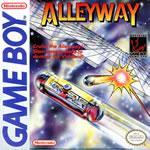

Alleyway
Overview

Alleyway is a block-breaker / Breakout-style video game for the Game Boy. Developed by Intelligent Systems (the same studio that would later make Fire Emblem, Paper Mario, and Wars) and published by Nintendo, it released in Japan on 21 April 1989 — the same launch day as the Game Boy itself — making it one of the system’s earliest titles. North America followed in August 1989; Europe got the game on 28 September 1990. Australia did not receive an original release.
The premise is simple: control the paddle, deflect the ball, break all the blocks. But Alleyway distinguishes itself from countless other Breakout clones with one unique twist — Mario himself is piloting the paddle. Both the Western box art and the in-game intro show Mario jumping into the cockpit of a small spaceship before the action begins. The paddle is, in-fiction, Mario’s ship — a delightful Mushroom Kingdom reframe of the classic Breakout formula.
The game was later re-released on the Nintendo 3DS Virtual Console in 2011, and on the Nintendo Switch Online Game Boy service in 2024 to celebrate the Game Boy’s 35th anniversary — ensuring this early Mario-cameo curiosity remains playable on modern Nintendo hardware.
Gameplay
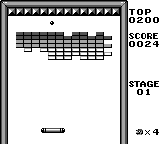
The objective is to clear out all the breakable blocks above without allowing the ball to fall below the paddle. Each stage has the same fundamental loop: bounce the ball off Mario’s paddle-ship, break the block formation, advance to the next stage.
The Core Loop
- Move left or right with the D-Pad to position the paddle
- Bounce the ball off the paddle to deflect it back up at the blocks
- Break every breakable block on screen to clear the stage
- Avoid letting the ball drop below the paddle — if it falls past, you lose a life
- Don’t let the ball touch the top of the playfield too often — if it does, your paddle shrinks to half its original size, making the game significantly harder
32 Stages Total
The game features 32 challenging stages, starting simple and ramping up with new mechanics like blocks that scroll horizontally, advance downward toward the paddle, and indestructible steel blocks. The same block layouts are reused across multiple stages, but the screen-type variations (Normal, Scrolling, Advancing) create entirely different challenges.
Bonus Stages
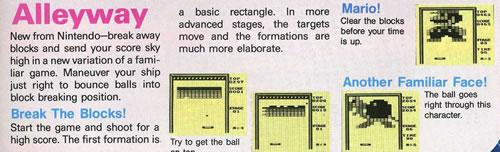
Every 3rd stage (Stages 3, 6, 9, 12, 15…) is a bonus stage with a time limit instead of a lives system. The objective in bonus stages is to break as many blocks as possible before time runs out — with the block formations forming Mario-series character silhouettes.
How the Ball Acts
Alleyway’s ball physics follow rigid mathematical rules — mastering them is the key to high scores.
Ball Angles
The ball can only travel at three angles:
- 15° — nearly horizontal; slow vertical travel
- 30° — balanced angle; the default after a clean paddle hit
- 45° — steepest angle; fastest vertical travel
The angle depends on where the ball hits the paddle — the further from the paddle’s center, the steeper the angle. This is the core skill in Alleyway: aim the ball by positioning the paddle to make contact at the correct point.
Ball Speed
The ball’s speed changes depending on which type of brick it strikes:
- Grey or black brick — ball speeds up
- White brick — no speed change
- Indestructible brick (steel) — no speed change; brick doesn’t break
Once the ball comes into contact with a brick, it bounces back at the same angle it made contact with — simple law-of-reflection physics that nonetheless takes practice to anticipate.
Screen Types
Alleyway’s 32 stages use the same block formations but layer in three screen-type behaviors that completely change how each stage plays.
Normal Block Screen
The blocks stay in place. Nothing moves. This is the straightforward Breakout experience — just aim and break. Most early stages use this type.
Scrolling Block Screen
The rows of blocks move horizontally (left or right depending on the stage). The player must lead their shots, predicting where each block will be by the time the ball arrives. Significantly harder than Normal screens.
Advancing Block Screen
The rows of blocks push downward toward the paddle after a few are destroyed. The closer the blocks get, the less reaction time the player has. Additionally, the top of the screen will sometimes reveal more blocks for the player to destroy — either matching the current pattern or revealing steel (indestructible) blocks that complicate the layout.
Mario Character Cameos
The most distinctive Mario-fan feature of Alleyway: every third stage is a bonus stage where the breakable blocks are arranged into the silhouette of a classic Super Mario series character. As the player breaks the blocks, they’re effectively dismantling that character’s portrait. The pattern cycles through five characters, then repeats across the remaining bonus stages.

Mario
Bonus Stage — Stage 3 · The first cameo
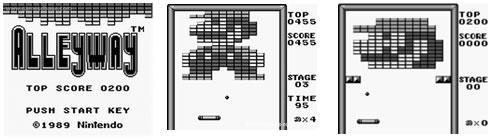
Mario himself appears as the very first bonus-stage cameo. The blocks are arranged in the unmistakable silhouette of Mario in his classic NES sprite stance — cap, mustache, overalls, and stout proportions all rendered in the limited block format. A fitting first appearance, since Mario is also the paddle’s pilot. Players are essentially breaking up an image of Mario himself in this bonus round.

Koopa Troopa
Bonus Stage — Stage 6 · The classic foot-soldier
The Koopa Troopa — the most iconic Mario enemy after the Goomba — gets the second bonus stage. The shell-and-feet silhouette is recognizable to anyone who’s ever played Super Mario Bros. (1985). Breaking this stage feels like systematically defeating a long line of Koopas.

Bloober
Bonus Stage — Stage 9 · The aquatic enemy
Bloober (the squid-like underwater enemy from Super Mario Bros. — sometimes spelled “Blooper”) gets the third cameo. The distinctive tentacle-skirt silhouette is preserved in block form. An unusual choice from the deeper Mario enemy roster — this is the first cameo that signals Alleyway’s designers were tapping into the broader Mario universe, not just the Goomba/Koopa front-line.

Piranha Plant
Bonus Stage — Stage 12 · The deadly flora
The Piranha Plant emerges in the fourth bonus stage — the toothy flower-head silhouette intact in block form. Piranha Plants had been a Mario staple since the original Super Mario Bros., emerging from green Warp Pipes. Their appearance here cements Alleyway’s status as a tour through the Mario enemy roster.

Bullet Bill
Bonus Stage — Stage 15 · The final cameo before the cycle restarts
Bullet Bill rounds out the cycle as the fifth cameo. The unmistakable bullet-shaped, arms-out silhouette is preserved in block form. Bullet Bills were introduced in Super Mario Bros. (1985) as the speedy projectile fired from Bill Blasters. Their inclusion here completes a satisfying Greatest-Hits roster of early-Mario enemies.
The 32 Stages
Alleyway’s 32 stages cycle through the three screen-type variations (Normal, Scrolling, Advancing) with bonus stages interspersed every third level.
Stage Structure Pattern
- Stages 1–2: Normal block screens — introduction
- Stage 3: Bonus stage — Mario silhouette
- Stages 4–5: Increasingly difficult Normal or Scrolling screens
- Stage 6: Bonus stage — Koopa Troopa silhouette
- Stages 7–8: Scrolling screens introduce
- Stage 9: Bonus stage — Bloober silhouette
- Stages 10–11: Advancing screens introduce
- Stage 12: Bonus stage — Piranha Plant silhouette
- Stages 13–14: Mixed difficulty with steel-block obstacles
- Stage 15: Bonus stage — Bullet Bill silhouette
- Stages 16–32: The cycle repeats with progressively harder remixes; the Mario character cameo cycle restarts and runs through again
Difficulty Curve
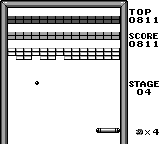
Scoring System
Alleyway’s scoring system rewards careful play and risk-taking. Points add up across stages, and the high score persists across plays in the same session.
Points Per Action
- Breaking blocks earns points (variable by block type and stage)
- Bonus stages award time-based bonus points for blocks broken before the timer expires
- Completing a stage with all lives intact awards a small completion bonus
- The classic Breakout high-score chase pattern: death cycles your score back to ramp-up, but until then, points accumulate
Lives System
- Start with a fixed number of lives
- Lose a life each time the ball falls below the paddle
- Game over when all lives are exhausted
- No continues in the original release
Development
Alleyway was developed by Intelligent Systems — Nintendo’s in-house subsidiary that would later become responsible for some of Nintendo’s most beloved RPG and strategy franchises.
- Developer: Intelligent Systems
- Publisher: Nintendo
- Platform: Game Boy
- Genre: Block Breaker / Breakout-style
- Inspiration: Atari’s Breakout (1976) and Taito’s Arkanoid (1986)
Game Boy Launch Timing
The Game Boy launched in Japan on 21 April 1989, with Alleyway available as one of the launch-window titles. The Game Boy itself debuted with Tetris (in some regions), Super Mario Land, Baseball, and Alleyway — a small but eclectic launch lineup that established the new handheld’s identity. Alleyway was the launch-window’s entry in the casual / puzzle category, complementing the platformer (Super Mario Land), the sports title (Baseball), and the addictive puzzler (Tetris in regions where it shipped at launch).
Gameplay Video
An archived gameplay showcase of Alleyway on the original Game Boy.
Reception & Legacy
Alleyway received mixed-to-negative reviews at the time of release — the consensus being that as a Breakout clone with no power-ups, it lacked the depth of Taito’s Arkanoid (1986) or other contemporary block-breakers. However, the game was a strong seller, helped along by its Game Boy launch-window positioning.
Critical Scores
- Mean Machines: 33/100 — criticized the game’s repetitiveness and stated “this variant doesn’t have much more to offer than the original Breakout.” They added “once you’ve finished a couple of screens, you’ll be bored stiff,” and noted a lack of power-ups
- Electronic Gaming Monthly (4 reviewers): 6/10, 6/10, 5/10, 3/10 — all compared the game to Arkanoid and complained about the lack of enhancements over the basic Breakout format. Two reviewers (the 6/10s) noted it was “perfectly designed for the Game Boy,” with one adding it was “a very good game that combines some new features… with the original Break-Out theme” — albeit overly long
What Critics Praised
- Game Boy fit. Several reviewers noted Alleyway felt well-designed for the handheld format — short play sessions, simple controls, and the monochrome graphics suited the platform
- Mario character cameos. The bonus stages with Mario, Koopa Troopa, Bloober, Piranha Plant, and Bullet Bill silhouettes were universally noted as charming touches
- Screen-type variations. Normal/Scrolling/Advancing modes added more variety than vanilla Breakout
- Mario-piloted paddle. The framing of the paddle as Mario’s spaceship was praised as a delightful piece of Mario branding
Common Criticisms
- No power-ups. Compared to Arkanoid (1986), Alleyway feels stripped-down. No multi-ball, no laser paddle, no expand-paddle items — just pure block-breaking
- Repetitiveness. The same block layouts repeat across stages with only the screen-type variations to keep things fresh
- Limited variety. Reviewers felt 32 stages with three behaviors was thinner than other GBA-era puzzle games offered
Commercial Performance
Despite the mixed reviews, Alleyway sold well on the back of its Game Boy launch-window position. It was, however, never released as a Player’s Choice budget re-issue — suggesting Nintendo did not consider it a long-tail commercial success.
Legacy
- Nintendo 3DS Virtual Console re-release in 2011 made the game accessible on modern hardware
- Nintendo Switch Online — Game Boy re-release in 2024 to mark the Game Boy’s 35th anniversary celebration. Alleyway joined a curated set of classic Game Boy titles on the subscription service
- Remembered as an early Mario-cameo curiosity — niche compared to mainline Mario titles, but historically significant for being one of the first non-platformer games to feature multiple Mario enemy character silhouettes
SLB User Reviews
Alleyway has yet to receive a community review on Super Luigi Bros.
If you’ve played Alleyway and would like to submit a review, please get in touch.
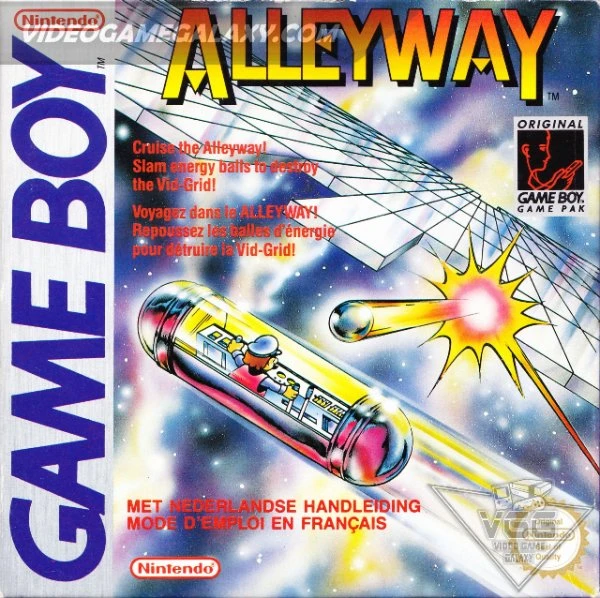
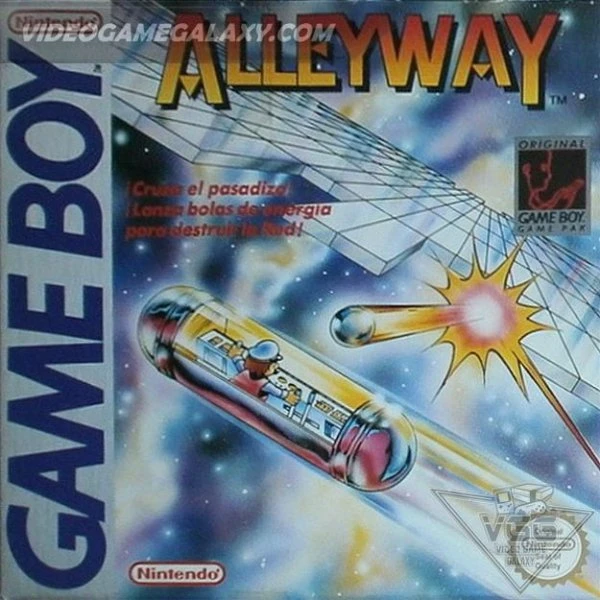
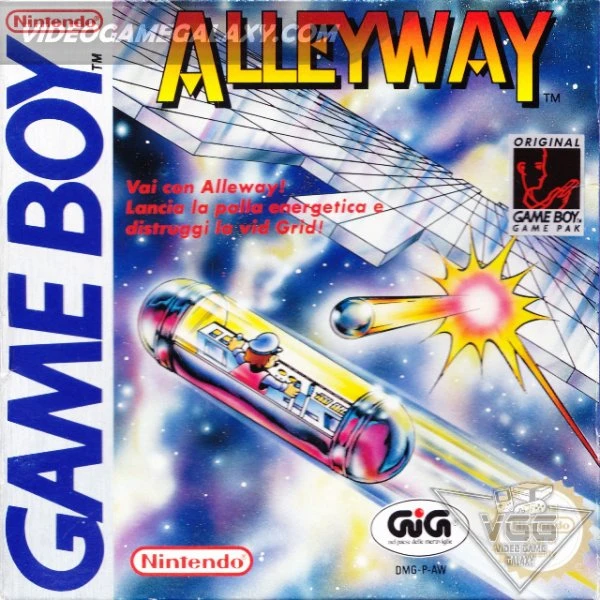
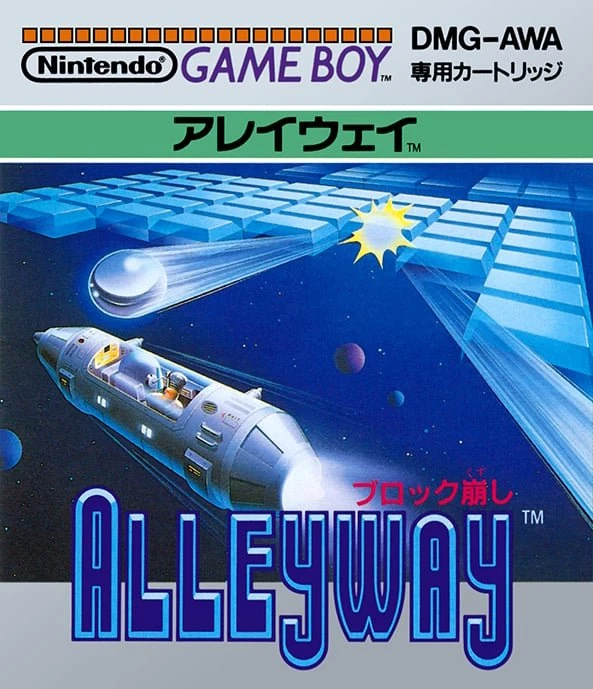
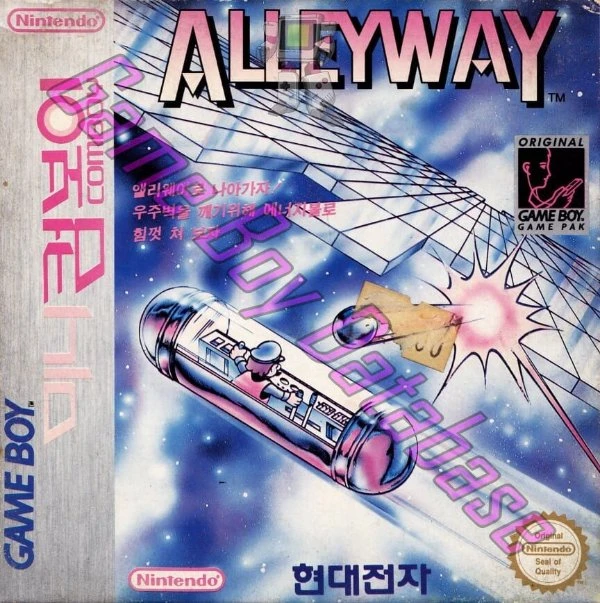
Regional Box Art
Alleyway shipped with a surprising number of regional box art variants for a 1989–1990 title — reflecting Nintendo’s aggressive global rollout of the Game Boy.




Screenshots
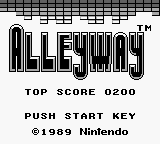
In-game screenshots showcasing Alleyway’s minimalist Game Boy presentation.

Legacy Screenshots from the Super Luigi Bros Archive


Trivia & Facts
- Game Boy launch-day title in Japan. Released on 21 April 1989 — the same day the Game Boy itself debuted in Japan. One of the first software titles ever released for the system
- Mario pilots the paddle. Both the Western box art and the in-game intro show Mario jumping into the paddle as his spaceship. The paddle is canonically Mario’s ship
- Five Mario character cameos. Mario, Koopa Troopa, Bloober, Piranha Plant, and Bullet Bill all appear as bonus-stage block silhouettes. The cycle repeats across the 32 stages
- Developed by Intelligent Systems. The same studio that would go on to create Fire Emblem, Advance Wars, Paper Mario, and WarioWare. Alleyway was one of their earliest projects
- Inspired by Breakout and Arkanoid. Atari’s Breakout (1976) is the direct lineage; Taito’s Arkanoid (1986) was the contemporary competitor. Critics frequently noted Alleyway lacked Arkanoid’s power-ups
- 32 stages with looping difficulty. After Stage 32, the game can continue with increased difficulty for endless high-score play
- Three screen types: Normal, Scrolling, Advancing. The same block layouts get reused across multiple stages with these behavioral variations, effectively tripling the content
- The paddle shrinks if the ball hits the top. A punishing mechanic that halves the paddle size permanently for that life
- Ball travels only at 15°, 30°, or 45°. Three fixed angles, no smooth analog ball-direction — a very 1980s arcade-physics design
- Grey/black bricks speed up the ball. White bricks have no speed effect. Steel (indestructible) bricks block the ball without breaking
- No power-ups. Unlike Arkanoid, Alleyway has no laser paddle, multi-ball, or expand items. Pure Breakout-style gameplay
- Never released as a Player’s Choice budget title. Despite selling well at launch, Nintendo didn’t re-issue it on the Player’s Choice budget line — indicating moderate long-tail commercial performance
- Mean Machines gave it 33%. One of the harshest contemporary reviews — the magazine compared it unfavorably to vanilla Breakout
- EGM’s 4 reviewers averaged 5/10. Mixed verdict from Electronic Gaming Monthly, with two 6/10 ratings and a particularly harsh 3/10
- 3DS Virtual Console re-release in 2011. Made the game available on modern Nintendo hardware for the first time since the original 1989–1990 retail run
- Switch Online Game Boy re-release in 2024. Added to the Nintendo Switch Online — Game Boy classics library to celebrate the Game Boy’s 35th anniversary
- One of the earliest non-platformer Mario games. Alongside Mario Bros. (NES, 1983) and Mario’s Cement Factory (Game & Watch, 1983), Alleyway is one of the earliest games to put Mario in a non-platformer context. This trend would balloon into Dr. Mario (1990), Mario Paint (1992), and dozens of spin-offs
- 12+ regional box art variants. Released across NA, Canada, UK, France, Netherlands, Spain, Italy (two distributors: GiG and Mattel), Germany (two variants), Australia, Japan, and Korea — reflecting Nintendo’s aggressive global Game Boy rollout
- Australia got it late or not at all. No original Australian retail release is documented — the Australian box art exists but the release timing is unclear. Australia may have received it via UK/European import only
- Mario’s third Game Boy appearance. Mario had appeared on Game Boy in Super Mario Land (1989, launch title) and as a paddle pilot in Alleyway (1989) — making Alleyway one of his earliest Game Boy starring roles after his platformer debut
Reference / Information
Sub-pages and guides for Alleyway.
Media / Downloads
Galleries, screenshots, and gameplay video.