
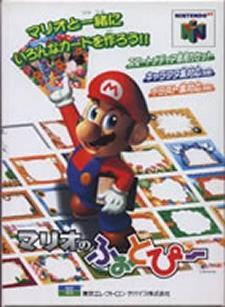
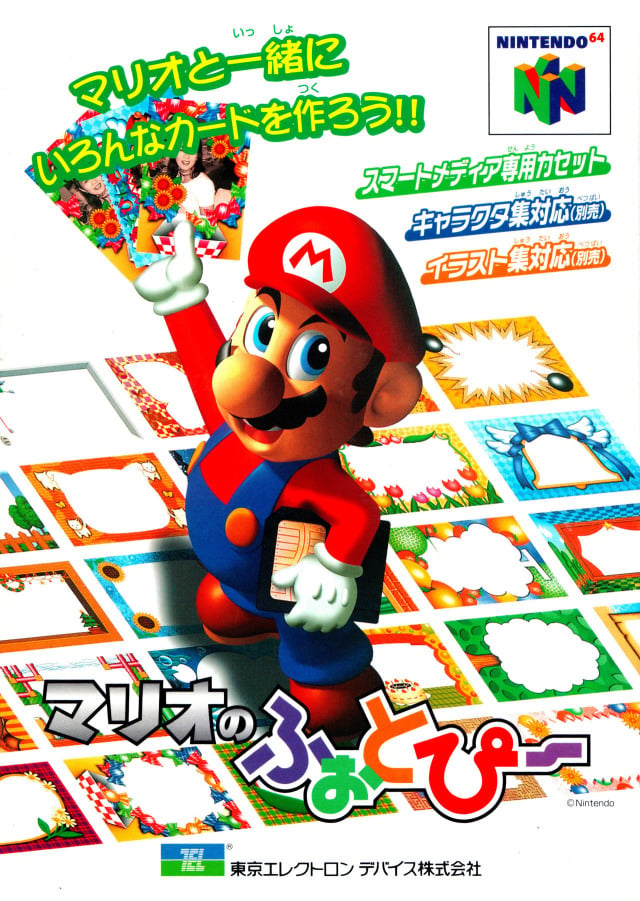
Mario no Photopi
Overview
Mario no Photopi (マリオのふょとぴー, Mario no Fotopī, “Mario's Photopi”) is a Japan-only creativity game for the Nintendo 64, released on 2 December 1998. The name «ふょとぴー» combines “photo” with the diminutive Japanese suffix «ぴー» (-pī) — an affectionate construction that translates roughly as “little photo”.
It is one of the most unusual entries in the entire Mario catalogue for two reasons. First, it was not made by Nintendo: developer and publisher are both credited as Tokyo Electron, a Japanese semiconductor and electronics company best known for chip-fabrication equipment — not games. Second, it does something no other Mario game ever attempted: it puts two physical SmartMedia card slots on the top of the cartridge, allowing the player to import digital photos from a camera or PC, edit them on screen, and print them out via PC.

The Cartridge — A Hardware Oddity
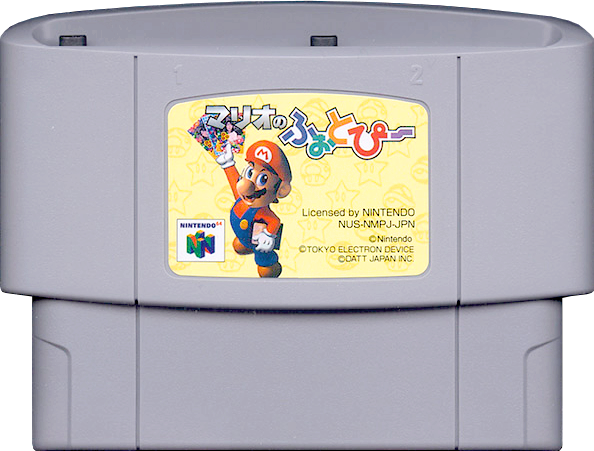
The Mario no Photopi cart is unlike any other N64 cartridge. The top edge houses two SmartMedia card slots — the now-obsolete flash memory standard popularised by late-90s digital cameras and PDAs (and the format the Game Boy Camera didn't use, for those keeping score).
The dual-slot design is functional: one slot reads photos from a SmartMedia card pulled from a digital camera, the other writes edited images out to a second card for transfer to a PC or printer. The game effectively turns the N64 into a card-to-card photo bridge.
Why Tokyo Electron?
Tokyo Electron Ltd. (東京エレクトロン) is one of Japan's largest manufacturers of semiconductor production equipment — the kind of company that builds the machines that build the chips. They are not a games developer. Mario no Photopi is the only Mario game they ever made. The likely explanation: Tokyo Electron had the hardware expertise to design the unusual SmartMedia-cartridge connector, while Nintendo licensed out the Mario brand and assets. It is one of the only N64 cartridges sold under the “Super Mario” franchise umbrella where Nintendo is neither developer nor publisher.
Gameplay
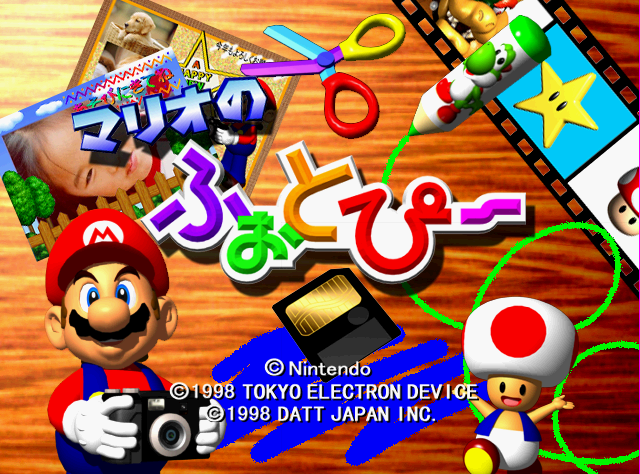
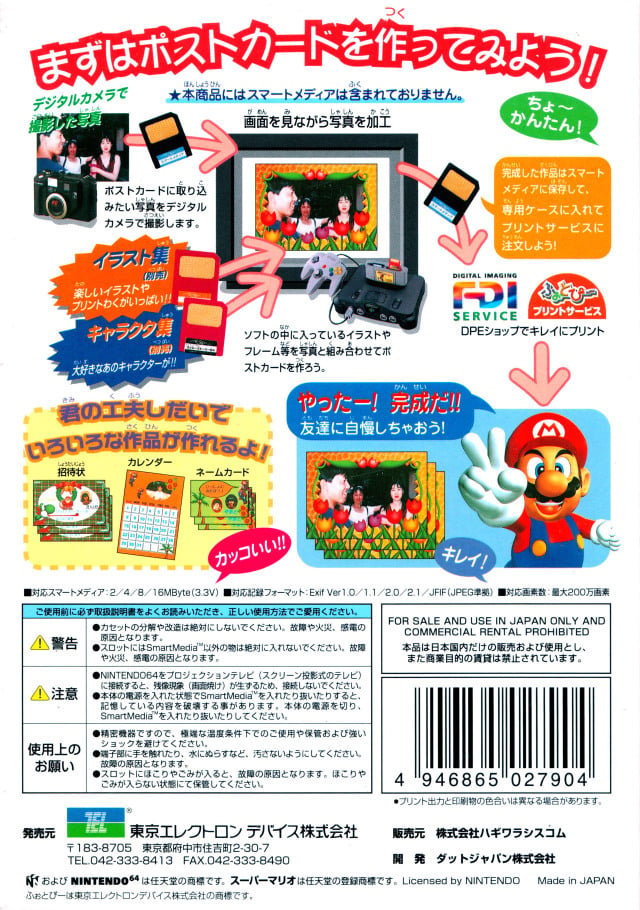
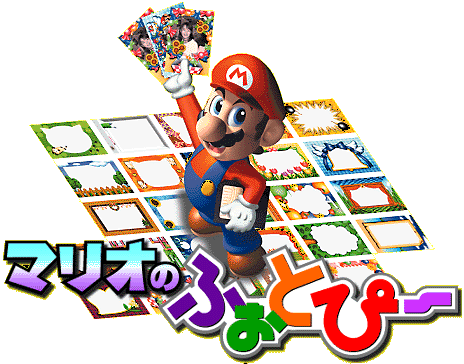
Mario no Photopi is best understood as a spiritual successor to Mario Paint, repositioned around photographs rather than from-scratch drawing. The player loads a photo from one of the SmartMedia cards, then decorates and recomposes it using a suite of Mario-themed tools: artwork stamps, borders, fonts, and other graphical assets drawn from the wider Super Mario franchise.
Output formats go beyond simple landscape images. The game supports postcards, posters, and slideshows — layouts that imply the intended use case was sending personalised printouts to friends and family, much like the floppy-based I am a teacher: Super Mario Sweater or Super Mario Bros. Print World before it.
Built-in Minigames
The game includes minigames built around player-imported photos. The most documented is a sliding tile puzzle — the photo is divided into squares, scrambled, and the player rearranges tiles to reconstruct the original image. It is a clever twist: the difficulty depends on the photo you imported.

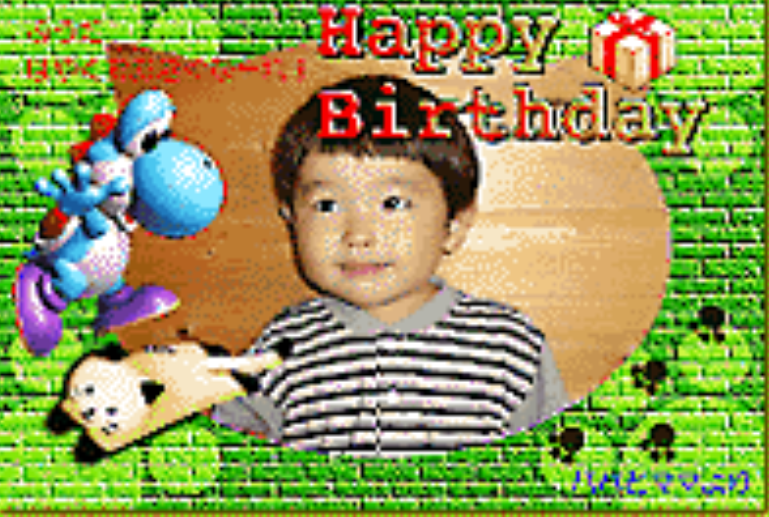
A sample photo from the original Photopi website, showing the kind of personalised montage the game was designed to produce — a mix of digital photographs, Mario-themed borders, and overlay artwork composited into a single shareable image.
The Nine Themed SmartMedia Cards
Nine optional SmartMedia cards were sold separately for use with the game, each containing pre-drawn artwork and assets themed around a Nintendo (or third-party-licensed) franchise. They functioned as expansion packs for the cartridge's sticker, border, and stamp library — load a card, get a whole new visual theme to decorate photos with. Documented franchises include:
The Legend of Zelda
Zelda-themed borders, stamps, and decorative motifs.
Yoshi
Themed assets from the Yoshi franchise — eggs, fruit, and Yoshi character art.
Bomberman
Hudson Soft's Bomberman series — an unusual third-party crossover.
(The article notes nine total cards; only three franchises are publicly confirmed by name. The remaining six are believed to cover other Nintendo IP and licensed Japanese mascot brands, but no comprehensive list survives online.)
The Mario Paint Legacy
Mario no Photopi sits squarely in the lineage of Nintendo's Art Utility game category — a series of mostly Japanese releases that began with I am a teacher: Super Mario Sweater (FDS, 1986), peaked commercially with Mario Paint (SNES, 1992), and continued through:
- Mario Paint (SNES, 1992) — the iconic mouse-driven drawing and music app, the only one of the series released worldwide.
- Super Mario Bros. Print World (MS-DOS, 1991) — PC-based sticker and card creator.
- Super Mario Collection Screen Saver (PC, 1997) — collection of Mario-themed screensavers.
- Mario no Photopi (N64, 1998) — the photo-editing entry, this game.
- Mario Artist series (64DD, 1999–2000) — Paint Studio, Talent Studio, Communication Kit, Polygon Studio.
- Mario Family (GBC, 2001) — sewing-machine compatible cross-stitch designer.
Photopi is the bridge between the SNES-era simplicity of Mario Paint and the deep cross-disk integration of the Mario Artist suite. Its photo-import workflow predicts what the 64DD's Capture Cassette would do a year later for Paint Studio and Talent Studio.
Gallery & Promotional Material
Title Screen & Artwork
Title Screen

Toad on Title Screen
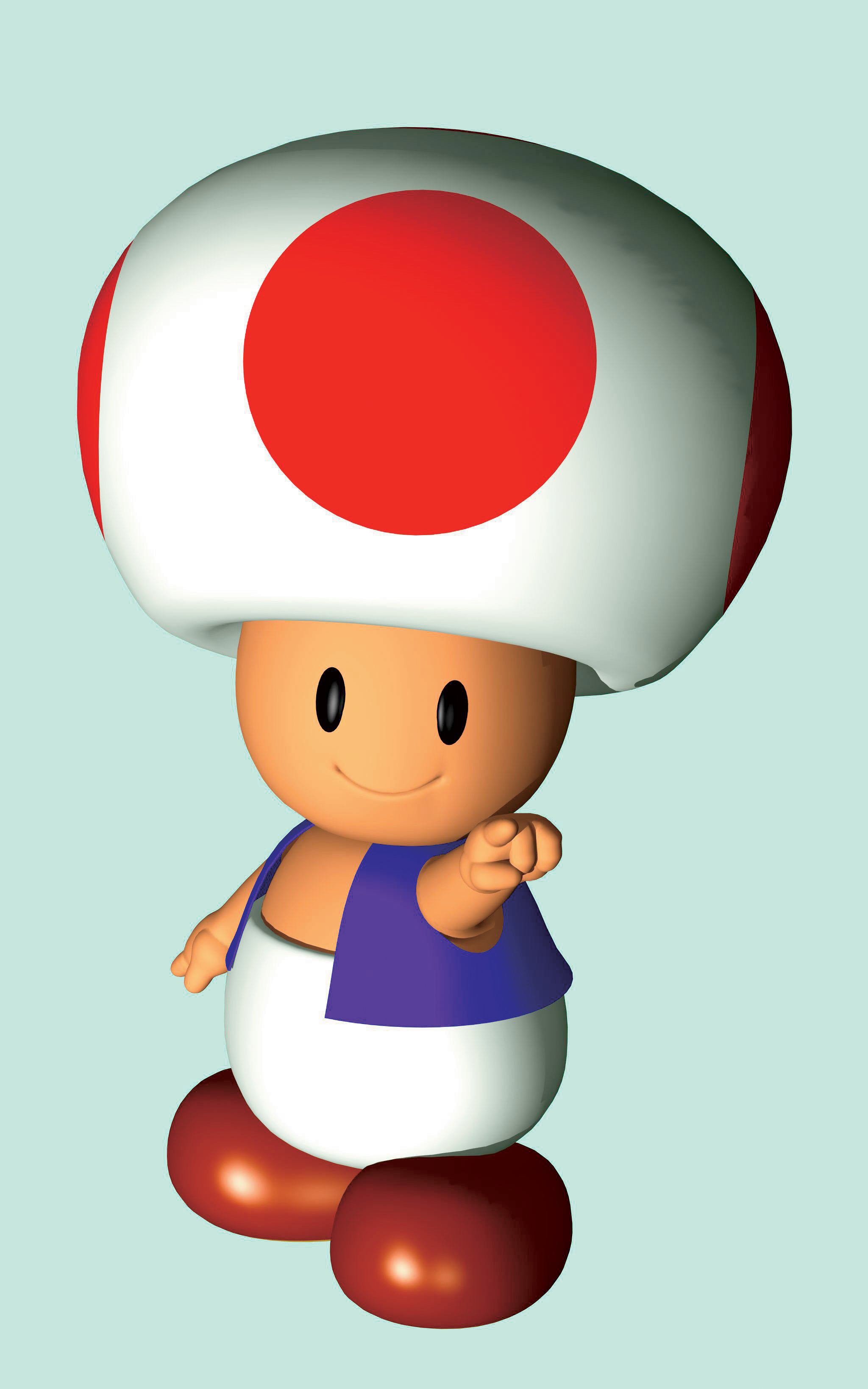
Toad Artwork
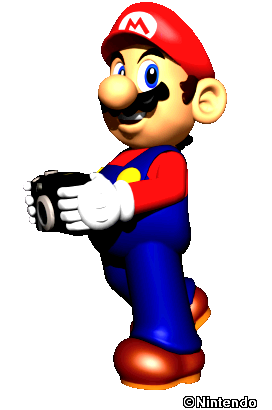
Promotional Mario
Booth, Demos & Trade Shows
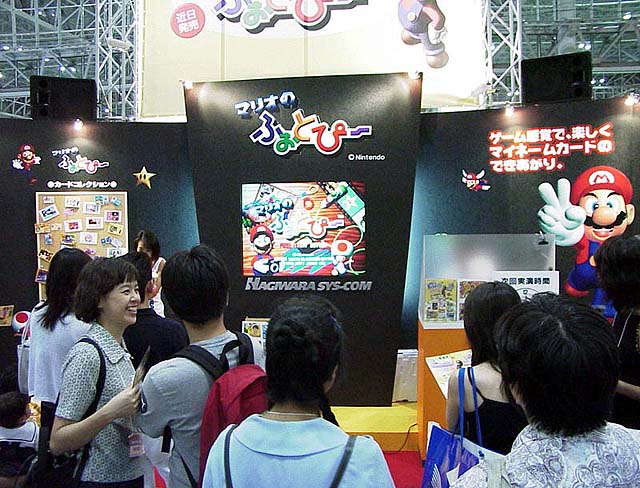
PC World Expo '98 Booth
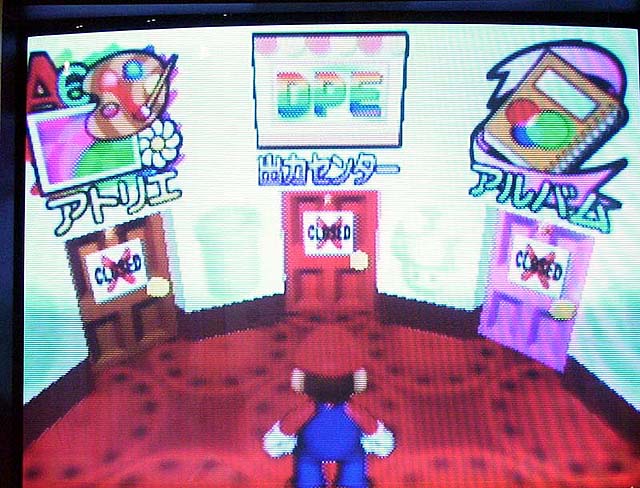
Demo Station
Trivia
- Mario no Photopi is the only N64 cartridge with two SmartMedia card slots — and one of very few N64 games with any kind of external storage interface beyond the Controller Pak / Rumble Pak / Memory Pak family.
- It is the only Mario game ever published by Tokyo Electron. Their core business is semiconductor manufacturing equipment, not video games — making this a uniquely unusual Nintendo licensing deal.
- The game shipped on a regular N64 Game Pak (not the 64DD), making it fully region-compatible with worldwide N64 consoles — though the Japanese-language interface limited its reach outside Japan.
- It launched before the 64DD itself, despite covering similar creative-tool territory. In effect, Photopi was Nintendo's “photo expansion” for the standard N64 install base while the 64DD platform was still in development.
- SmartMedia was a flash memory standard developed by Toshiba — not the same as CompactFlash or the later SD card. The format peaked in late-90s digital cameras and PDAs, and had largely disappeared by the mid-2000s.
- The Japanese title «マリオのふょとぴー» uses hiragana for the word “Photopi” rather than katakana — an unusual stylistic choice that emphasises the cute, casual tone over the technical product name.
- Public debut: the PC World Expo '98 — a computing trade show, not a Nintendo event. The marketing audience was as much PC enthusiasts and digital-camera owners as it was the Mario fanbase.
- The nine themed SmartMedia cards sold separately effectively functioned as a DLC system more than a decade before that term entered console gaming vocabulary.
- Mario no Photopi is one of only four N64 cartridges that fall under the “Super Mario franchise” Art Utility umbrella (the rest being the four 64DD-based Mario Artist titles).
- The cartridge has a soundtrack (audio samples on MarioWiki exist for the Title Screen and Photo Studio tracks) — light, jazzy instrumentals that fit the late-90s “digital camera marketing” aesthetic.
- This title is the only Mario game on the standard Nintendo 64 (non-64DD) released for a year in 1998 alongside Mario Party — though its retail visibility was far lower.