
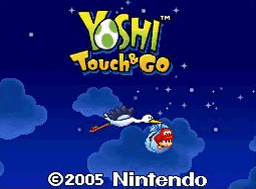

Yoshi: Touch & Go
One of the DS launch window’s most inventive games — use your stylus to draw clouds, create bubbles and guide Baby Mario safely to Yoshi below. A unique touch-screen platformer that turns your handwriting into gameplay, with surprising depth through four distinct modes and a competitive score-attack loop.
Overview
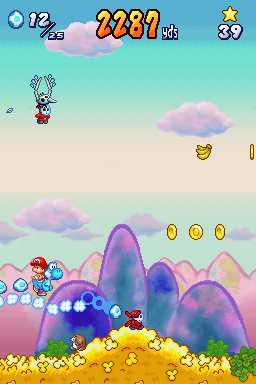 The classic setup — Baby Mario falls from the sky while the player draws clouds and bubbles with the stylus to protect him (click for full size)
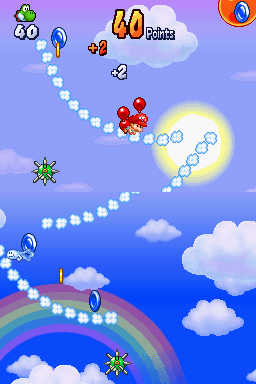 The Sky Phase — guide Baby Mario’s descent by drawing cloud platforms and encircling enemies in bubbles with the touch screen (click for full size)
Yoshi: Touch & Go (known as Yoshi’s Universal Gravitation in Japan, or Yoshi Touch & Go in North America) is a Nintendo DS launch-window platformer developed and published by Nintendo. It was one of the first games to truly make the DS touch screen and microphone central to its design rather than optional extras.
The game is divided into two distinct phases: the Sky Phase, where Baby Mario falls from the sky and players use the stylus to draw clouds guiding him and draw circles to trap enemies in bubbles; and the Ground Phase, where Yoshi runs horizontally through side-scrolling terrain carrying Baby Mario, with players drawing eggs to throw and scribbling platforms to help Yoshi navigate. The Yoshi’s colour — determined by how well you perform in the sky phase — affects his speed and egg capacity on the ground.
While short in terms of world variety, the game’s real hook is its four score-attack modes and competitive two-player wireless play. It rewards mastery and replay in the style of an arcade high-score game rather than a traditional Mario platformer.
Story
 The Stork — carrying the newborn twins on their delivery route before Kamek’s devastating ambush
 Baby Mario falling through the sky — the player’s job is to guide him safely to Yoshi waiting below
From the instruction booklet:
“A lone stork flies hastily through the darkened pre-dawn skies. Held firmly in its beak is a very special package: a pair of newborn twins, which the stork is hurrying to deliver to their parents! Just as the stork races through the skies over Yoshi’s Island, something terrible happens! A dark shadow rushes toward the stork with tremendous speed and crashes into it! The startled stork drops the twin babies…”
The dark shadow is Kamek — Bowser’s scheming magikoopa advisor — who deliberately crashes into the Stork to separate the twins. Baby Luigi is swept away and taken captive, while Baby Mario tumbles down through the sky toward Yoshi’s Island below. Every mode in the game begins with this same moment — Kamek’s attack causing Baby Mario to fall as the player takes control.
The goal is to guide Baby Mario safely to the Green Yoshi waiting below, then help Yoshi carry Baby Mario across Vibe Island, ultimately rescuing Baby Luigi and reuniting the twins with the Stork. Unusually for a Nintendo game, there is no overarching narrative beyond this single framing — the game focuses entirely on the moment-to-moment challenge of each run.
Gameplay
The Ground Phase — Yoshi runs automatically while the player draws eggs and scribbles platforms to help him navigate (click for full size)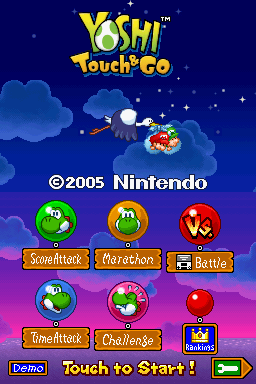 Action on both screens — top screen shows the game world while the bottom touch screen is the player’s canvas (click for full size)
Every game in Yoshi: Touch & Go follows the same two-phase structure:
Phase 1 — Sky (Top Screen / Touch Screen)
Baby Mario falls from the top of the screen. Using the stylus on the touch screen, players:
- Draw clouds — creates solid platforms that guide Baby Mario’s fall and block enemies
- Draw circles around enemies — traps them in bubbles; tap the bubble to pop it and send it flying toward Baby Mario for bonus coins
- Touch leaf formations — hidden in tree tops, tapping them reveals bonus Yellow Coins and Blue Coins
- Blow into the microphone — destroys drawn clouds instantly when you need to clear them quickly
Baby Mario has three balloons acting as his HP. Each hit from an enemy pops one. If all three pop, he falls to the ground and is captured by Kamek — game over. The Yoshi colour you receive at the end of the sky phase depends on your performance: the more points scored, the rarer (and better) the Yoshi.
Phase 2 — Ground (Side-Scrolling)
Yoshi runs automatically from left to right. Players use the stylus to:
- Tap enemies — turns them into eggs for Yoshi to collect and throw
- Draw arrows — directs Yoshi’s egg throws toward specific targets
- Scribble terrain — draws cloud platforms to help Yoshi cross gaps or reach higher ground
- Tap Yoshi — makes him jump over obstacles
Fruit collected by Yoshi contributes to the score. Baby Luigi is held somewhere in the ground section — reaching him counts as completing a course. Yoshi’s egg supply, speed and overall power depend entirely on which colour Yoshi was earned in the sky phase.
Game Modes
Yoshi: Touch & Go has no traditional world map or level select — instead it offers four distinct modes, each testing a different aspect of the core mechanics:
Challenge
The full experience — sky phase followed by ground phase. Find Baby Luigi to complete each run. Your score depends on performance in both phases. This is the closest to a traditional game mode.
Score Attack
Ground phase only — Yoshi starts as a random colour and runs as far as possible. No endpoint; the goal is to rack up the highest score before Yoshi falls or time runs out. The purest score-chasing mode.
Time Attack
Sky phase only — Super Stars appear in the air to speed Baby Mario’s descent, and a timer counts down. Bumpers appear to obstruct his fall. Get Baby Mario to the ground as fast as possible.
Vs. Mode (2 Player)
Two players compete wirelessly — one controls Baby Mario in the sky while both compete on the ground. First to reach Baby Luigi wins. Only one game card is needed (single-card download play).
Characters
Baby Mario — the hero of the sky phase, guided by the player’s stylus drawings Baby Luigi — captured by Kamek’s Toadies and held somewhere in the ground section of each run
| Character | Role | Description |
|---|---|---|
| Baby Mario | Player Character (Sky) | The newborn dropped by the Stork when Kamek attacks. Falls through the sky in Phase 1 — the player guides him using cloud drawings. Has 3 balloon HP. Lands on Yoshi for Phase 2. |
| Baby Luigi | Rescue Target | Mario’s twin, captured by Kamek’s Toadies during the attack. Held somewhere in the ground section — reaching him completes the run in Challenge mode. |
| The Stork | Supporting | Delivering the twins when attacked by Kamek. Appears at the start and end of successful runs, waiting to receive the rescued babies. |
 Kamek Kamek | Villain | The magikoopa who orchestrates the entire game’s setup by attacking the Stork. Appears at the start of every mode and again if Baby Mario loses all his balloons — whisking him away in defeat. |
 Baby Bowser Baby Bowser | Recurring Enemy | Bowser as an infant — appears as an enemy in the ground sections, throwing projectiles at Yoshi. A nod to his appearance in Yoshi’s Island. |
The Yoshis
The colour of Yoshi you receive for the ground phase depends entirely on your score in the sky phase — the better you guide Baby Mario, the rarer and more powerful the Yoshi. Each colour affects Yoshi’s running speed and the number of eggs he can carry. Green is the weakest, Black is the strongest.
 Green
Green Lt. Blue
 Yellow
 Pink
Pink Red
Red Blue
Blue Orange
 Purple
 White
White Black
Black| Colour | Speed | Eggs | Score Needed |
|---|---|---|---|
| 🟢 Green | Slowest | 6 | 0–499 pts |
| 🔵 Light Blue | Slow | 7 | 500–999 pts |
| 🟡 Yellow | Slow-Medium | 8 | 1,000–1,499 pts |
| 🌸 Pink | Medium | 9 | 1,500–1,999 pts |
| 🔴 Red | Medium | 10 | 2,000–2,499 pts |
| 💙 Blue | Medium-Fast | 11 | 2,500–2,999 pts |
| 🟠 Orange | Fast | 12 | 3,000–3,499 pts |
| 💜 Purple | Very Fast | 13 | 3,500–3,999 pts |
| ⚪ White | Very Fast | 14 | 4,000–4,499 pts |
| ⚫ Black | Fastest | 15 | 4,500+ pts |
Enemies
Yoshi’s Island is full of Kamek’s forces — both in the sky and on the ground. Many sky enemies can be trapped in bubbles with a circular stylus stroke, turning them into a bonus for Baby Mario. Ground enemies can be tapped to transform them into Yoshi eggs.
 Cheep CheepSky & water
 GoonieSky flyer
 Skeleton GoonieCannot be bubbled
 GustyGhost wind
 BrierThorny hazard
 Red BrierFaster variant
 FangBat creature
 Piranha PlantGround lurker
 LakituDrops spinies
 Wall LakituHides in walls
 ToadyHolds Baby Luigi
 UkikiCheeky monkey
 Monty MolePops from ground
 Spiny CheepArmoured fishBaby BowserBoss character
| Enemy | Phase | Behaviour |
|---|---|---|
| Cheep Cheep | Sky & Ground | Swims in water sections underground; also leaps in sky phase. Can be bubbled in sky. |
| Goonie | Sky | Flies in formation — draw a circle around a group to bubble them all at once for a point bonus. |
| Skeleton Goonie | Sky | A bone Goonie that cannot be trapped in bubbles — must be blocked with cloud drawings instead. |
| Gusty | Sky | A ghostly enemy that blows Baby Mario off course. Cannot be bubbled; use clouds to block. |
| Brier / Red Brier | Sky & Ground | Thorny plants that deal damage on contact. Draw clouds above them to prevent Baby Mario landing on them. |
| Fang | Sky | Bat-like creature that swoops toward Baby Mario. Circle it quickly to bubble before it hits. |
| Piranha Plant | Ground | Snaps from pipes — time Yoshi’s path to avoid or tap the plant to turn it into an egg. |
| Lakitu / Wall Lakitu | Sky & Ground | Floats above dropping Spinies. Wall Lakitu hides in walls and throws. Both can be bubbled. |
| Toady | Ground | Kamek’s minions holding Baby Luigi. A group of Toadies must be defeated to rescue him at the end of the ground section. |
| Ukiki | Ground | Mischievous monkey that steals Baby Mario off Yoshi’s back — tap Ukiki quickly to recover Baby Mario. |
| Monty Mole | Ground | Burrows up from the ground suddenly — tap to defeat before it hits Yoshi. |
| Tap-Tap | Ground | A spiky enemy that cannot be swallowed or turned into eggs — must be avoided entirely. |
| Baby Bowser | Ground | Throws spiked balls and charges at Yoshi — requires multiple egg hits to defeat. |
| Banzai Bill | Sky & Ground | A giant bullet that crosses the entire screen — draw a cloud wall or dodge with stylus quickly. |
Items & Objects
Both phases are packed with collectibles and interactive objects — mastering what to grab and when is key to building a top score.
Fruit
Yoshi collects fruit in the ground phase to boost his score. Different fruits are worth different point values:
 Apple10 pts
 Banana10 pts
 Watermelon30 pts
Coins
Coins come in three colours, each worth a different score value. Blue Coins are the rarest and most valuable:
 Yellow Coin1 pt each
 Blue Coin10 pts each
 Red Coin2 pts each
Other Items & Objects
 BalloonRestores 1 HP
 BubbleTraps enemies
 Arrow CloudDirects fall
| Item | Phase | Effect |
|---|---|---|
| Balloon (White) | Both | Restores one of Baby Mario’s three balloon HP. Critical to collect in sky phase whenever possible. |
| Bubble | Sky | Created by drawing a circle around an enemy. Pop it onto Baby Mario for coin bonuses — chain multiple bubbles for combo scoring. |
| Arrow Clouds | Sky | Pre-placed coloured clouds that direct Baby Mario’s fall in a set direction — green points left or right, red sends him straight down faster. |
| Yoshi Egg | Ground | Yoshi’s main weapon — tap enemies to create eggs, then draw arrows to aim throws. The number carried depends on Yoshi’s colour. |
| Super Star | Time Attack | Appears only in Time Attack mode — touching one makes Baby Mario temporarily invincible and speeds his descent dramatically. |
| Bumper | Time Attack | Appears only in Time Attack mode — a bouncing obstacle that knocks Baby Mario off course; avoid with cloud drawings. |
Reception
Yoshi: Touch & Go was met with generally positive reviews — critics praised its creative use of the DS hardware and fresh take on stylus mechanics, while some noted its brevity and lack of traditional level content.
| Publication | Score | Notes |
|---|---|---|
| IGN | 7.5 / 10 | Praised the innovative touch mechanics and addictive score-attack loop; criticised the short lifespan for solo players. |
| GameSpot | 7.4 / 10 | Called it a solid showcase for the DS hardware, though noted it felt more like a tech demo than a full game. |
| Nintendo Life | 7 / 10 | Appreciated the clever dual-screen design but acknowledged it was better suited to quick sessions than extended play. |
| Famitsu | 32 / 40 | Strong Japanese reception at launch — praised for its novelty as a DS early adopter title. |
The game was originally developed as a tech demo for the Nintendo DS, intended to showcase the touch screen and microphone to developers and press. Nintendo decided to polish and release it as a retail title, which partly explains its shorter runtime compared to a full Mario game.
References to Other Games
Yoshi: Touch & Go is deeply rooted in the Yoshi’s Island tradition, carrying across many elements from that game and other series titles:
| Game | Reference |
|---|---|
| Super Mario World 2: Yoshi’s Island (SNES) | The entire premise — Baby Mario falling from the sky, Kamek’s attack on the Stork, the Toadies holding Baby Luigi, and the general art style and enemies — is lifted directly from Yoshi’s Island. Many enemy sprites are visually based on that game’s designs. |
| Yoshi’s Island (SNES) | The scoring system, Yoshi colour variations affecting gameplay, and the concept of drawing platforms all call back to Yoshi’s Island’s egg-throwing and world traversal mechanics. |
| Super Mario Bros. | Piranha Plants, Cheep Cheeps and Banzai Bills appear with behaviour closely matching their Super Mario Bros. origins. |
| Super Mario World | Baby Bowser appears as a recurring enemy, referencing his role as the final boss of Yoshi’s Island and his general design from the Mario World era. |
| Donkey Kong Jr. | Ukiki the monkey is a nod to this era of Nintendo games — mischievous primates have been a recurring theme since the Donkey Kong arcade days. |
References in Later Games
| Game / Media | Reference |
|---|---|
| Yoshi’s Island DS (2006) | Several elements from Touch & Go carried over — particularly Baby Mario, Baby Luigi, the Stork delivery framing, and Kamek as the primary villain. The stylus-drawing mechanics influenced how Nintendo thought about Yoshi in the DS era. |
| Super Smash Bros. Brawl (2008) | The Touch & Go version of Baby Mario (falling with balloons) appears as a trophy and in sticker form. The game’s art style is referenced in Brawl’s Yoshi’s Island stage elements. |
| Super Smash Bros. for Wii U / 3DS (2014) | The baby balloon mechanic and Kamek’s ambush are referenced in trophy descriptions for Baby Mario and the Stork. |
| Mario Kart series | Baby Mario’s design popularised in Touch & Go influences his appearance as a kart racer in Mario Kart Wii and onwards. |
Trivia
- The game was originally created as a tech demo for the Nintendo DS to showcase the touch screen and microphone to developers at trade shows. Nintendo later decided to polish it into a full retail release.
- It was known as Yoshi no Banyuu Inryoku (Yoshi’s Universal Gravitation) in Japan, referencing gravity as a core game mechanic.
- Yoshi: Touch & Go was one of the few DS games to use the microphone as a core mechanic — blowing into it destroys drawn clouds.
- The game’s score-attack structure was unusual for a Nintendo release at the time, more closely resembling an arcade game than a traditional platformer.
- All ten Yoshi colour variants in this game later appeared in Yoshi’s Island DS, cementing them as a series staple.
- The game uses single-card download play for its two-player mode — only one copy of the game is needed for two players to compete wirelessly.
- Despite its short runtime, the Score Attack mode has no defined endpoint — skilled players can keep Yoshi running indefinitely, making it one of the more replayable early DS titles.
- Yoshi: Touch & Go was one of just 13 DS launch titles in North America when the system released on March 14, 2005.