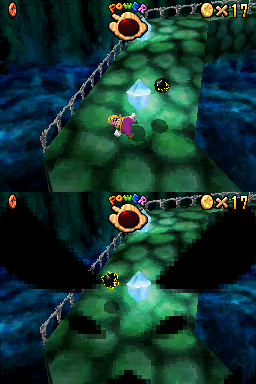
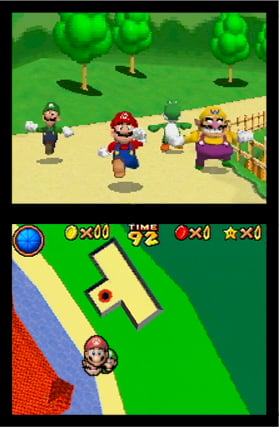
Nintendo DS2004Nintendo EAD3D platformerDS launch titleFour playable heroes150 Power Stars36 touch minigames11.06 million sold
Super Mario 64 DS
The game that launched the Nintendo DS. Super Mario 64 DS reached North America on 21 November 2004, the day the console did, as a rebuilt and expanded version of Super Mario 64, and the first 3D Mario on a handheld. This time Mario is not the star at the start: he, Luigi and Wario walk into Peach’s castle and vanish, and it is Yoshi, asleep on the roof, who has to go in after them. Each hero has his own moves and his own Power Flower transformation, and each has to be freed from a new boss: Goomboss, King Boo and Chief Chilly. There are 150 Power Stars instead of 120, new secret courses, 36 touch-screen minigames won from rabbits, a four-player wireless VS mode from a single game card, and three ways to cope without an analogue stick, one of them a thumb strap. Directed by Shinichi Ikematsu and produced by Shigeru Miyamoto, it has sold 11.06 million copies.
Developer:Nintendo EAD
Publisher:Nintendo
Platform:Nintendo DS; Wii U Virtual Console (2015–2016)
Genre:3D platformer
N. America:21 November 2004 (DS launch day)
Japan:2 December 2004 (DS launch day)
Australia:24 February 2005
Europe:11 March 2005
China / South Korea:21 June 2007 (iQue) / 26 July 2007
Players:1; 2–4 in wireless VS mode from one game card
Every Nintendo console needs a Mario, and in 2004 the Nintendo DS got one by an unusual route. Rather than build something new for launch, Nintendo EAD took its 1996 landmark, Super Mario 64, and rebuilt it for two small screens: new character models, redrawn textures, a map on the Touch Screen, and a great deal of added material. This page is about what the DS version is and what it changes. For the making of the original and the full tour of the castle, see our Super Mario 64 page.
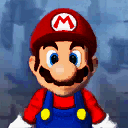
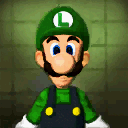
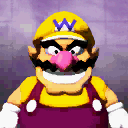
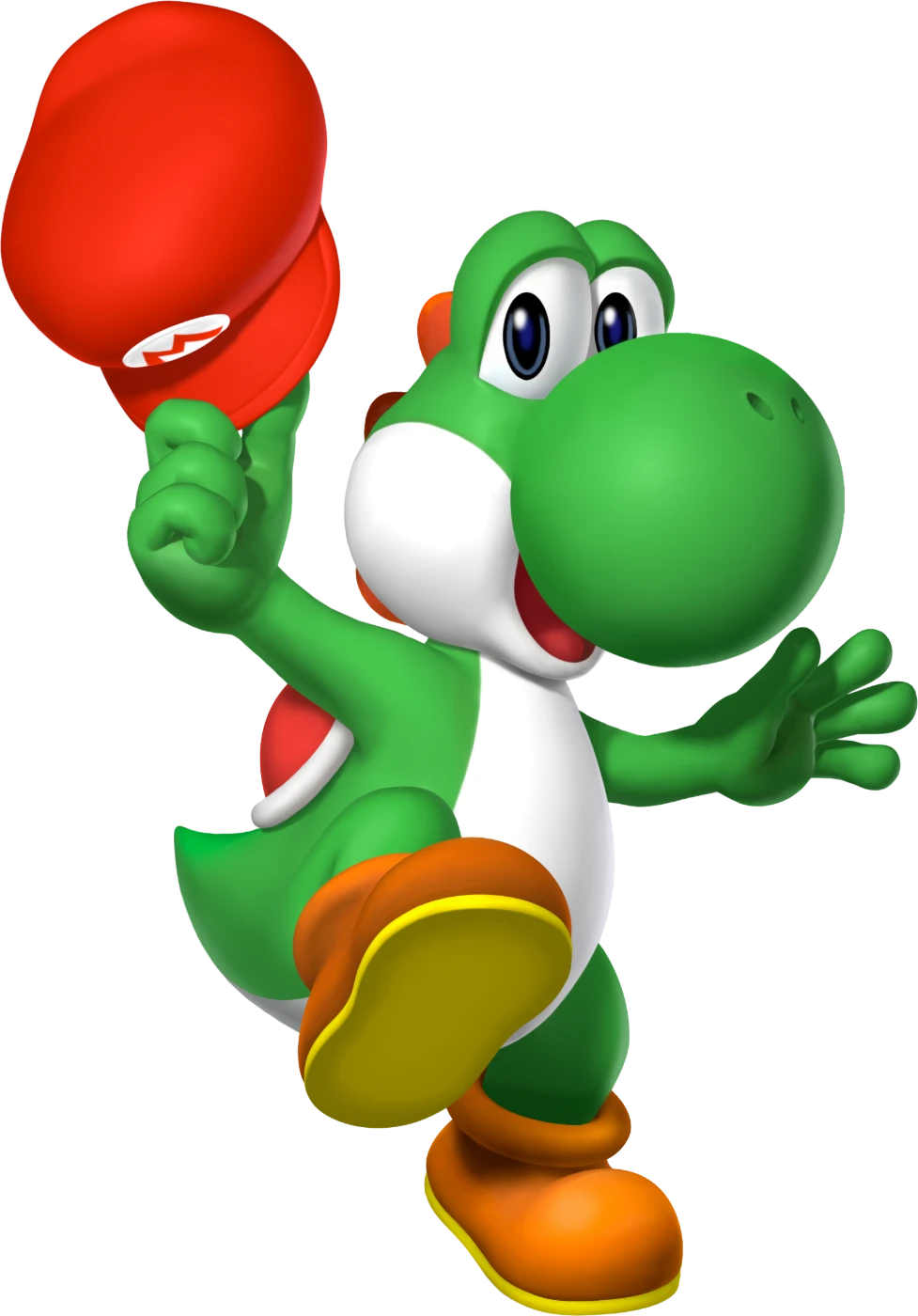
The biggest change is who you play. The adventure begins with Yoshi, alone, and Mario, Luigi and Wario each have to be found and released before they can be used. They are not interchangeable. Yoshi swallows enemies and flutters; Mario is the all-rounder and the only one who can wall-kick and fly; Luigi jumps as high as Mario, scuttles through the air and can turn invisible; Wario is slow, strong and can turn to metal. Many of the stars are built around one hero’s talents, and caps hidden in the courses let you borrow another character’s body without going back to the castle.
There is more of everything else too. Each of the fifteen painting worlds has an eighth star, new secret courses such as Sunshine Isles and Battle Fort are tucked into the castle, and three new boss stages guard the missing heroes. Rabbits hopping around the grounds give up keys to a Rec Room of 36 stylus minigames, and a VS mode lets four people fight over stars with only one copy of the game between them.
The catch was the controls. The DS had no analogue stick, so a game designed around one had to be played with a D-pad and a run button, or by sliding a thumb across the Touch Screen. Reviewers in 2004 mostly forgave it, called it the best thing in the launch line-up and gave it an average of 85 on Metacritic. Players bought more than eleven million copies. It has been reissued only once, on Wii U Virtual Console; every other re-release of Super Mario 64 has gone back to the N64 original.
Why Super Mario 64 DS matters to Mario fans
It is the only game in which Yoshi, Luigi and Wario can run around Peach’s castle and its paintings, and the first 3D Mario platformer in which Luigi is playable at all, eight years after the original famously left him out. It moved King Boo into Big Boo’s Haunt, brought Paper Mario’s Goomba King back as Goomboss, and its minigames went on to New Super Mario Bros. And because Nintendo has never reissued it beyond the Wii U, its extra thirty stars remain a DS exclusive.
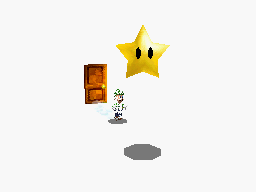
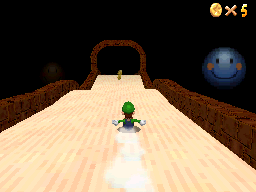
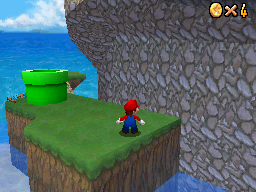
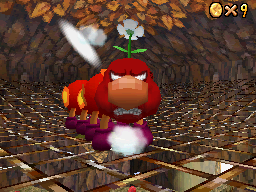
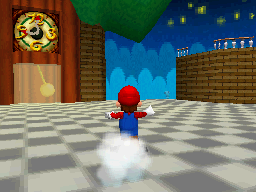
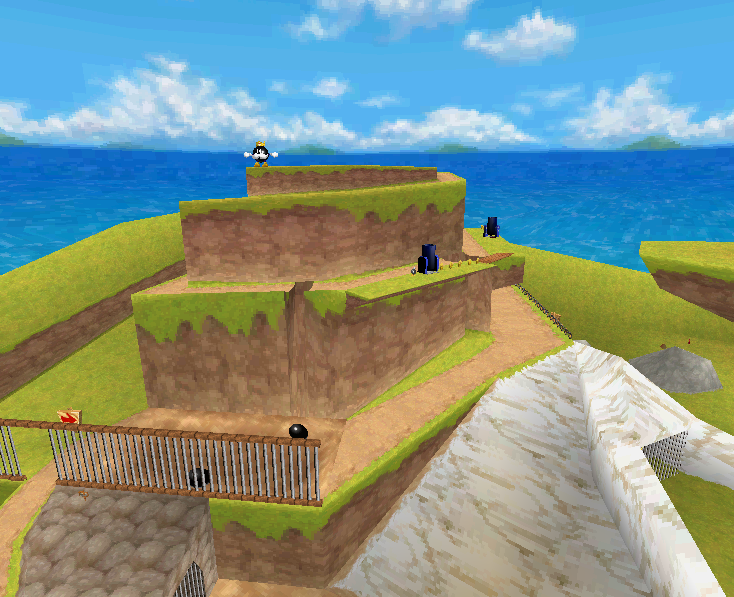
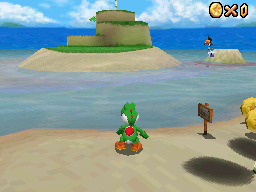
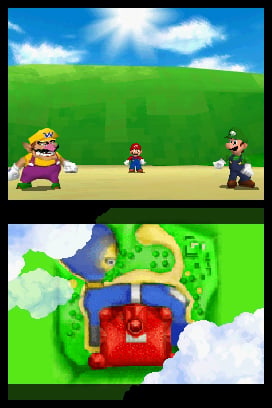
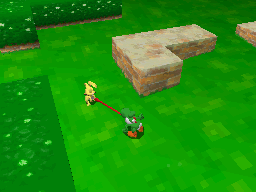
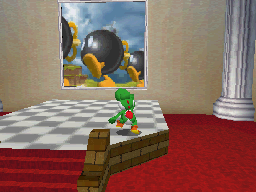
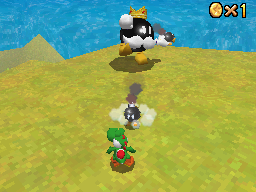
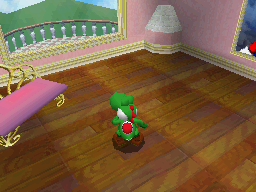
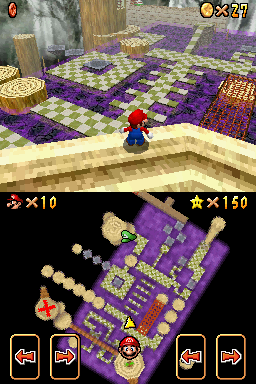
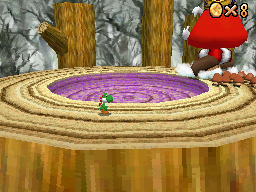
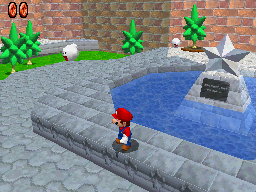
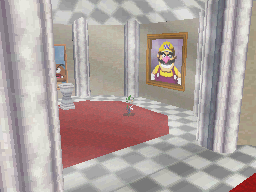
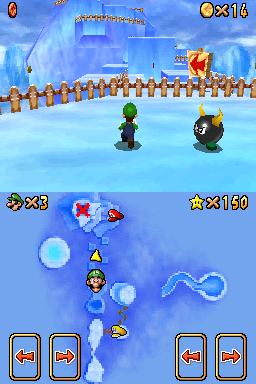
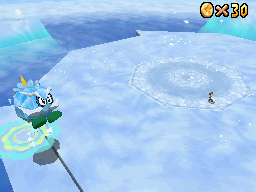
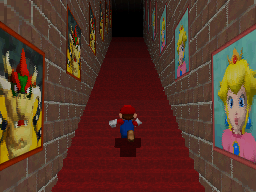
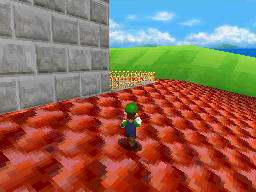
A Lakitu Bro wakes Yoshi with the bad news.The castle foyer, with the map on the lower screen.Bob-omb Battlefield, rebuilt for DS.Sunshine Isles, one of the new secret courses.
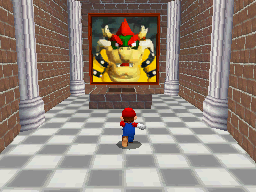
“Welcome. No one’s home! Now scram–and don’t come back! Gwa ha ha!”
Bowser, in the castle foyer of Super Mario 64 DS (Nintendo, 2004), as transcribed by Super Mario Wiki.
Bowser’s greeting is the first thing Yoshi hears when he gets the castle doors open. It is the same taunt that met Mario in 1996, but this time it is aimed at the wrong hero, because the right one is already locked in a cupboard.
Quick Answers
The questions people ask most about Super Mario 64 DS, answered briefly here and in depth further down the page.
When did Super Mario 64 DS come out?
On 21 November 2004 in North America and 2 December 2004 in Japan, both alongside the Nintendo DS itself, then 24 February 2005 in Australia and 11 March 2005 in Europe. It came to Wii U Virtual Console in 2015 and 2016. More →
How is it different from Super Mario 64?
Four playable characters instead of one, 150 stars instead of 120, three new bosses, new secret courses, Power Flowers in place of the three caps, 36 minigames, a wireless VS mode, redone graphics and a camera you can turn through 360 degrees. Control is by D-pad or Touch Screen, not an analogue stick. More →
How do you unlock Mario?
Collect eight stars as Yoshi and go through the 8-star door in the room behind the Rec Room. Jump into Mario’s painting, beat Goomboss at the end of the course and use the key he drops on the door marked M. More →
How do you unlock Luigi?
As Mario, with 15 stars, get into Big Boo’s Haunt and climb to the Luigi portrait on the top floor. It leads to Big Boo Battle, a maze of rooms ending in a fight with King Boo, who drops the Luigi Key. More →
How do you unlock Wario?
As Luigi, go to the mirror room on the second floor, take a Power Flower to turn invisible and walk through the mirror to the Wario painting behind it. Beat Chief Chilly for the Wario Key. You must first have beaten King Boo and Bowser in the Fire Sea and pressed the ? Switch. More →
How many stars are there, and how many do you need?
150 in all: 120 in the fifteen main courses (eight each) and 30 in the castle, the Bowser stages and the secret courses. The door to Bowser in the Sky opens at 80 stars, ten more than on N64, and only Mario can go through it. More →
What do the Power Flowers do?
It depends who picks one up. Mario inflates like a balloon and floats, Luigi turns invisible and can walk through grates, Wario turns to metal and sinks, and Yoshi breathes fire. Wings are separate: a feather that only Mario can use. More →
How do you unlock the minigames?
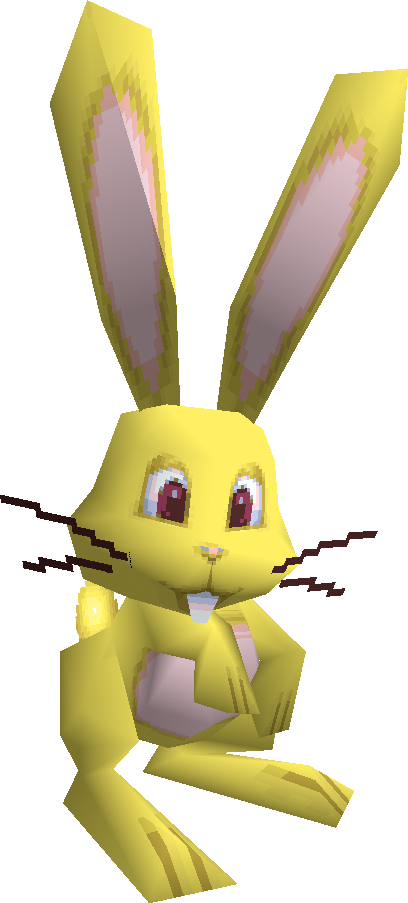
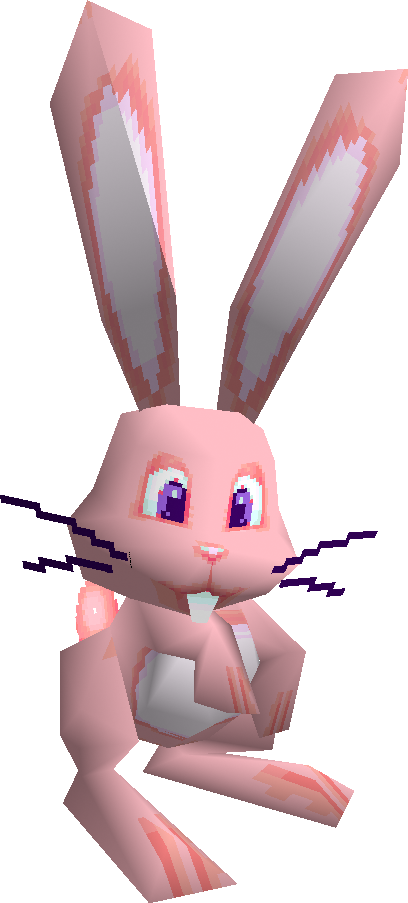
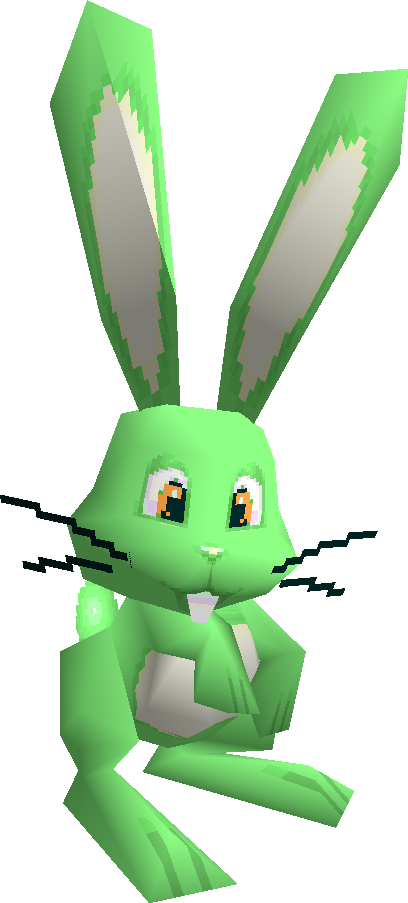
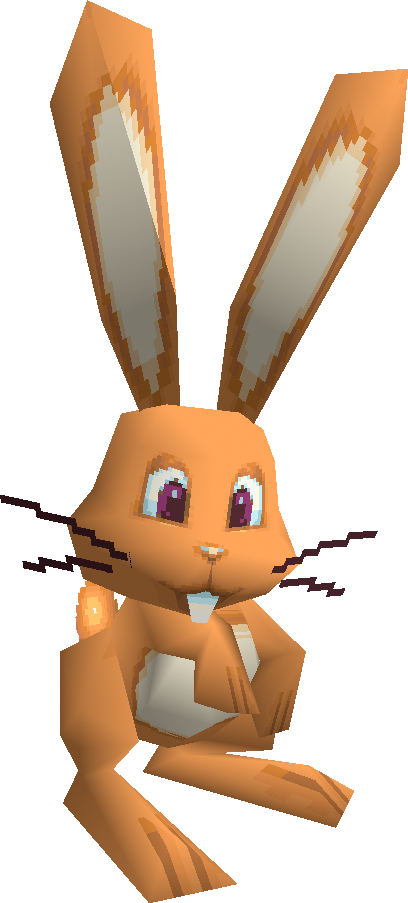
Each character starts with two. The other seven come from catching that character’s rabbits around the castle (yellow for Yoshi, pink for Mario, green for Luigi, orange for Wario); each rabbit hands over a key to a drawer in the Rec Room. More →
Does it have multiplayer?
Yes, but not co-op. VS mode is a wireless battle for up to four players on four small arenas, in which everyone starts as a Yoshi and grabs stars against a clock. Only one game card is needed; the others join through DS Download Play. More →
Where can I play it today?
On an original DS card, which also plays on a 3DS, or as the Wii U Virtual Console download released in Europe and Australia on 24 December 2015, Japan on 6 January 2016 and North America on 25 August 2016. The Wii U version has no multiplayer. More →
Story
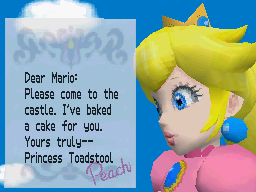
The letter that starts it all, as it did in 1996.
The outline is the one everybody knows: an invitation to cake, an empty castle, Bowser in the walls. The remake changes the cast and adds a first act in which the hero is not available. What follows concentrates on what is new; the course-by-course story of the castle is told on the Super Mario 64 page.
Three guests for tea
Princess Peach writes to Mario: she has baked a cake, and would he please come to the castle. He pops out of a Warp Pipe on the lawn as before, but this time he is followed by Luigi and then by Wario, who has presumably heard the word cake. The three of them stroll inside. None of them comes out.
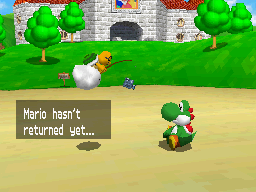
Yoshi has slept through all this on the castle roof. One of the Lakitu Bros., the cameramen, flies up to wake him and report that his friends have been gone a long while. Super Mario Wiki reads the letter as a trap: Bowser expected rescuers and had his minions ready for them.
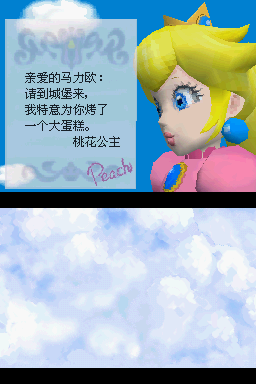
Peach’s letter in the Chinese iQue edition.The Lakitu Bro breaks the news.The opening scene in a pre-release build.
A rabbit with a key
The front doors are locked. The Lakitu has seen a rabbit carrying a key in its mouth, and Yoshi’s first job is to corner it by the new hedge maze in the garden. Inside, the castle is silent apart from Bowser’s voice telling him to scram. A Toad fills in the rest: Bowser and his army have seized the Power Stars and shut the princess away, and the last anyone saw of the three heroes, they were jumping into the Bob-omb painting.
So Yoshi goes in after them, into Bob-omb Battlefield and Whomp’s Fortress, eating Goombas and laying eggs where Mario would have thrown punches. The first stars open the first doors. Behind one of them is a playroom, and behind that a bedroom with an 8-star door and a painting of Mario on the wall.
The hedge maze added to the castle grounds.The Bob-omb Battlefield painting.Yoshi’s first boss, the Big Bob-omb.
Goomboss and the M door
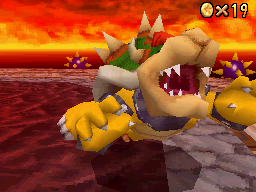
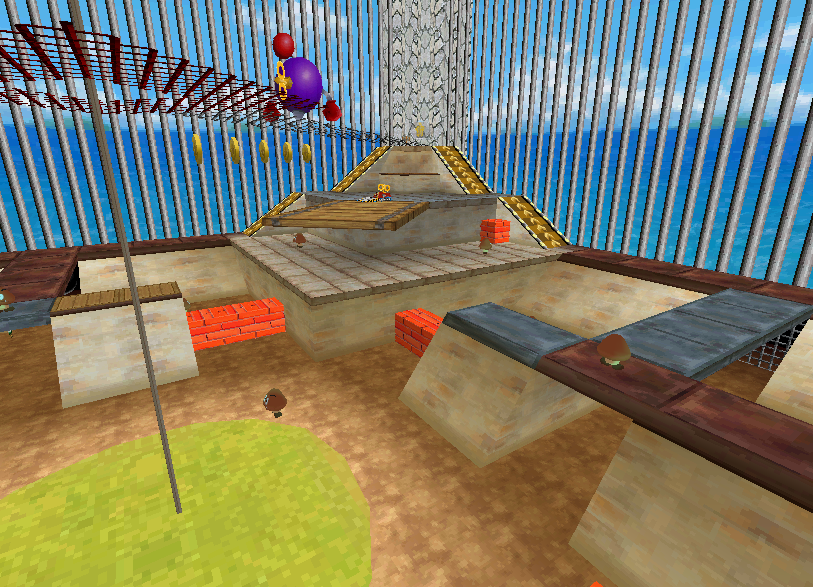
The painting leads to Goomboss Battle, a string of platforms hung over a poisonous fog, patrolled by Goombas and dozing Piranha Plants. At the top of a pole a bridge runs to a hollow tree stump, and the stump drops into a round arena. Waiting there is Goomboss, the outsized Goomba king from Paper Mario, who complains that Mario is forever stomping on his people and announces that he has locked him in a room.
Yoshi cannot stomp something that size. He swallows the little Goombas trotting along behind the boss, turns them into eggs and throws them. Each hit makes Goomboss bigger, faster and angrier, and the third one finishes him. He leaves Mario’s Key, the door marked M opens, and Mario is back, with his punch, his wall kick and the ability to grab Bowser by the tail.
The room behind the 8-star door.Goomboss Battle.Goomboss in his arena.
Luigi in the attic
Twelve stars and the Goomboss win open the first Bowser stage, and Mario, not Yoshi, swings the Koopa King into a bomb for the key to the basement. At 15 stars the Boos appear in the courtyard, and the Big Boo among them guards the way into Big Boo’s Haunt. Yoshi cannot beat him, so the haunted house is a job for Mario.
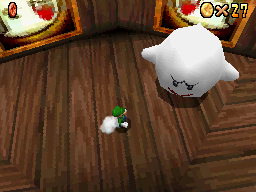
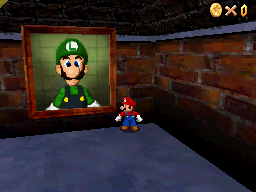
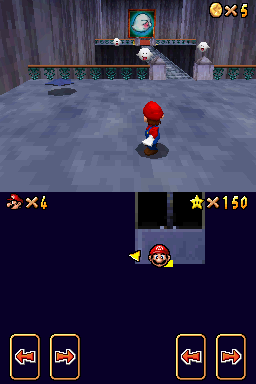
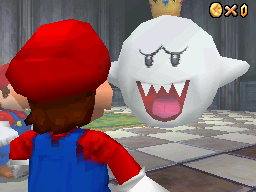
On its top floor hangs a portrait of Luigi. Behind it is Big Boo Battle, which is less a course than a trick: a maze of rooms in which the wrong door, or a fall through the floor, puts you back at the start. The way through is by ear. King Boo’s laughter echoes through the house, and the right door is the one where it is loudest. At the end is a hall with a great mirror. King Boo can only be seen in the reflection, though his shadow gives him away on your side of the glass, and like any Boo he fades when looked at. Three blows and he drops the Luigi Key. The game’s English text calls him Big Boo, a name that already belongs to somebody else in the same house; Super Mario Wiki files it under mistakes.
The courtyard, once the Boos move in.The Luigi portrait on the top floor of Big Boo’s Haunt.Big Boo Battle.King Boo, seen in the mirror.
Through the looking glass
The basement falls to the heroes as it did to Mario alone: Hazy Maze Cave, Lethal Lava Land, Shifting Sand Land, then 30 stars for Dire, Dire Docks, Bowser’s submarine and the Fire Sea beyond it. The second key opens the upper floors, and with them the room that holds the Snowman’s Land painting, one wall of which is a mirror.
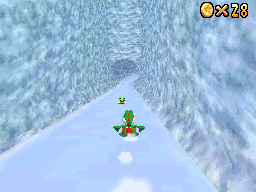
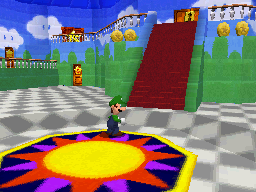
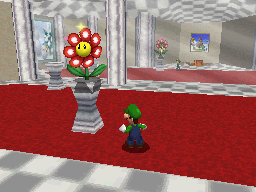
When Luigi walks in, Power Flowers appear on the pedestals. (They need the ? Switch to have been pressed, which is a job only Mario can do.) Luigi takes one, vanishes and steps straight through the glass into the reflected room, where a painting of Wario hangs. It leads to Chief Chilly Challenge: a long slide, a gust of wind across a gap, tilting platforms crowded with Bullies and a pond of freezing water. At the summit is an eight-sided platform ringed by icy water and, on it, Chief Chilly, the king of the Chill Bullies. The rule is the usual one for Bullies, shove or be shoved, except that each time he climbs out of the water he stamps round the rim and breaks pieces off the arena. The third ducking yields the Wario Key.
The mirror room.The Wario painting behind the mirror.Chief Chilly Challenge.Chief Chilly on his shrinking platform.
Eighty stars and one plumber
With all four heroes loose the castle opens up quickly. Wario breaks the Black Bricks, Luigi slips through the cages, Yoshi melts the ice, and the count climbs: 50 for the third floor, 80 for the endless staircase. Only Mario can climb it. The others are turned back, and the fix for the backwards long jump that once let N64 players skip the stairs means there is no way round.
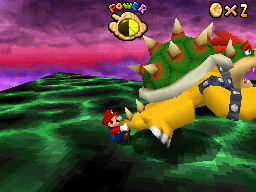
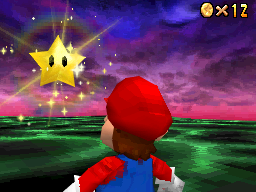
Bowser in the Sky and the last fight play out as they always have. Three throws into the spiked bombs on the rim of the arena, and Bowser gives up the Jumbo Star.
The endless stairs.Mario drops in on Bowser in the Sky.The final battle.Mario and the Jumbo Star.
Cake for four
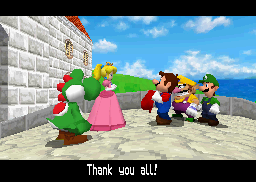
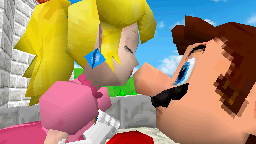
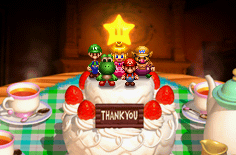
Peach is free, and thanks her heroes, plural. Her speech was rewritten and re-recorded for the remake, and the people standing on the lawn to hear it depend on what you did: Mario and Yoshi are always there, Luigi and Wario only if they were rescued. Mario gets his kiss. Then everyone goes inside for the cake, which is topped with little figures of whoever made it to the party.
The ending notices other things too. If you never drained the moat it is still full, and if you never reunited the snowman of Cool, Cool Mountain with his head he looks suitably glum. There is one more surprise for anyone who finds all 150 stars. The cannon in the castle grounds opens and fires you onto the roof, where the original kept Yoshi. He is otherwise engaged this time, so the roof holds three 1-Up Mushrooms, a red ? Block and the last of Luigi’s rabbits.
Peach thanks Yoshi, Mario, Luigi and Wario.A kiss for Mario.The cake.The roof, reached by cannon with 150 stars.
The courses of Super Mario 64 DS
All fifteen painting worlds return with eight stars each, and the list below says what the remake adds to each one. After them come the Bowser stages and the secret courses, five of which are new. Star counts in the headings are what the castle demands before you can get in; the initials show which hero a star needs.
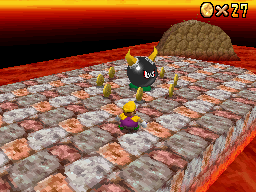
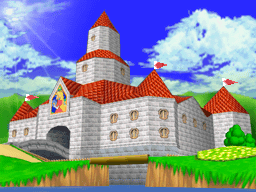
1. Bob-omb BattlefieldGround floor · open once Yoshi has the door key · boss Big Bob-omb, twiceNew: 5 Silver Stars!, which replaces Shoot to the Island in the Sky, and Big Bob-omb’s Revenge, a rematch for anyone wearing a cap. The race with Koopa the Quick is for Mario only.
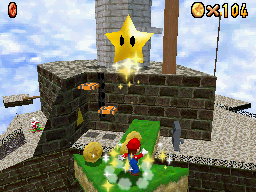
2. Whomp’s FortressGround floor · 1 star · boss Whomp KingNew: Switch Star of the Fortress, on an enlarged lower level with extra enemies. Being fired into the breakable wall no longer hurts.
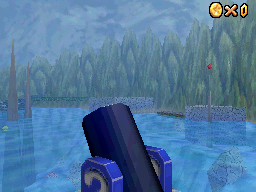
3. Jolly Roger BayGround floor · 3 starsNew: Switch Star of the Bay, for Luigi. Through the Jet Stream is now a job for Metal Wario.
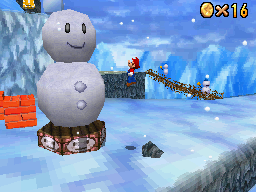
4. Cool, Cool MountainGround floor · 3 starsNew: Switch Star of Cool, Cool Mountain. The pond has frozen over and Wario must ground pound through the ice to the star beneath.
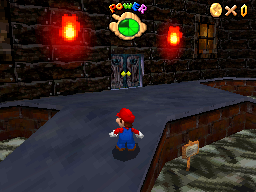
5. Big Boo’s HauntCourtyard · 15 stars and Goomboss beaten · bosses Big Boo and Big Mr. IClosed to Yoshi. New: Switch Star in the Basement, for Wario. Eye to Eye in the Secret Room needs Luigi, and the top floor hides the way to Big Boo Battle.
6. Hazy Maze CaveBasement · first Big KeyNew: Underground Switch Star. The old Metal Cap star is now Metal-Head Wario Can Move, and the poison in the maze knocks characters back.
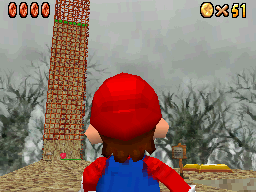
7. Lethal Lava LandBasement · first Big Key · boss Big BullyNew: Flaming Silver Stars.
8. Shifting Sand LandBasement · first Big Key · boss EyerokNew: Tox Box Switch Star, for Wario. Pyramid Puzzle asks for Silver Stars instead of coins, and Wario needs only two punches for each of Eyerok’s hands.
9. Dire, Dire DocksBasement · 30 starsNew: Koopa Surfin’ Switch Star, for Wario. Inside the Cage is Luigi’s, by way of his vanishing act.
10. Snowman’s LandSecond floor · second Big Key · boss Chill BullyNew: Yoshi’s Ice Sculpture, which replaces In the Deep Freeze, and Snowman’s Silver Star. The igloo has been rebuilt and Into the Igloo needs Luigi; a Mr. Blizzard will make off with a dropped cap.
11. Wet-Dry WorldSecond floor · second Big KeyNew: Soaked Silver Stars. Quick Race Through Downtown! is for Luigi.
12. Tall, Tall MountainSecond floor · second Big KeyNew: 5 Secrets of the Mountain. Breathtaking View from the Bridge needs Wario.
13. Tiny-Huge IslandSecond floor · second Big Key · bosses Piranha Flowers and WigglerNew: Switch Star on the Island, and Klepto the Condor, who flies in to replace Five Itty Bitty Secrets. The rematch with Koopa the Quick is Mario’s.
14. Tick Tock ClockThird floor · 50 starsNew: Tick Tock Silver Stars. Roll into the Cage has become Luigi in the Cage.
15. Rainbow RideThird floor · 50 starsNew: Switch Star of the Manor.
Bowser in the Dark WorldGround floor · 12 stars and Goomboss beaten · 2 stars + Big KeyUp from 8 stars on N64. A Switch Star joins the red-coin star. Yoshi cannot fight Bowser.
Bowser in the Fire SeaBasement · after Board Bowser’s Sub · 2 stars + Big KeyRed coins and a new Switch Star.
Bowser in the SkyEndless stairs · 80 stars · Mario only · 2 stars + Jumbo StarUp from 70 stars on N64. Red coins and a new Switch Star.
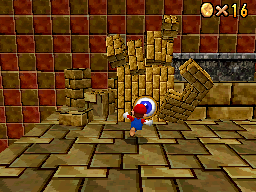
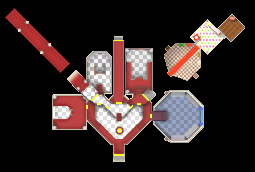
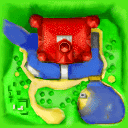
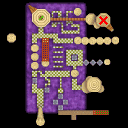
Goomboss Battle (new)Behind the Rec Room · 8 stars · boss Goomboss · 2 starsMario’s prison. Its red coins need Mario’s and Luigi’s Power Flowers (one coin is behind a Black Brick that Wario or a Super Mushroom can break), and its Switch Star needs Mario’s wall kick.
Big Boo Battle (new)Inside Big Boo’s Haunt · Mario or later · boss King Boo · 2 starsLuigi’s prison, a maze navigated by sound. Stars for red coins (Wario) and for jumping through the Boo portrait while invisible (Luigi).
Chief Chilly Challenge (new)Behind the mirror · Luigi only · boss Chief Chilly · 2 starsWario’s prison. Stars for red coins and for a Black Brick that only Metal Wario can reach.
Sunshine Isles (new)Small painting in the Rec Room · 1 star to enter · 1 starA sunny cluster of islands with five Silver Stars, one of them in Klepto’s claws.
Battle Fort (new)Under three bricks in the courtyard · Goomboss beaten · 1 starA small fortress course with five Silver Stars. Not for Yoshi.
The Princess’s Secret SlideStained-glass window in the character room · 1 star to enter · 2 starsAs before, with a second star for finishing in 21 seconds or less.
The Secret AquariumJolly Roger Bay room · 3 stars · 1 starEight red coins under water.
? SwitchThe old Tower of the Wing Cap · 14 stars · Mario only · 1 starPress the switch to bring the red ? Blocks to life.
Behind the WaterfallThrough Hazy Maze Cave · 2 starsThe old Cavern of the Metal Cap, without its switch. Red coins, and a new star for Balloon Mario.
The Secret Under the MoatCastle grounds · Wario only · 2 starsThe old Vanish Cap course. Drain the moat, then have Wario break the Black Brick over the entrance.
Over the RainbowsThird floor · 50 stars · 2 starsFormerly Wing Mario Over the Rainbow. Mario hops the clouds for the coins; Wario breaks a Black Brick for the new star.
Mushroom CastleThe hub · 6 starsThree gifts from Toads, as before, plus three new stars: eight red coins around the castle, Through the Looking Glass for Luigi in the mirror room, and the one behind the white door for catching eight glowing rabbits.
The arithmetic: fifteen courses of eight stars make 120, the three Bowser stages add six, the eleven secret courses add 18 and the castle itself six, for 150. On N64 the same castle held 120.
Advertisement
Gameplay & Controls
Underneath, this is still Super Mario 64: a castle full of paintings, a set of missions behind each one and a Power Star for every mission cleared. The moves are the same too, from the triple jump to the ground pound. What follows is what the DS adds and alters.
Three ways to steer
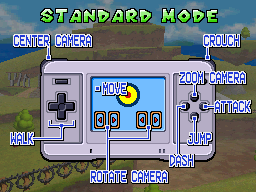
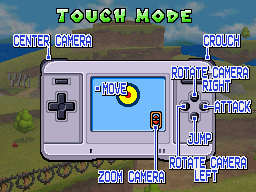
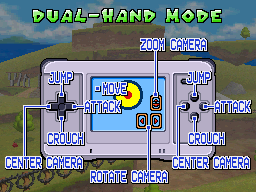
With no stick to tilt, the game offers three control modes, switchable at any time with Select. Standard Mode puts movement on the +Control Pad with B to jump, A to attack and Y held down to run; without Y the characters only amble, where a gentle push of the N64 stick used to do. Touch Mode turns the Touch Screen into a virtual stick: slide a thumb, the stylus or the thumb strap that came with the first DS, and the distance from the centre sets the speed. Dual-Hand Mode is for stylus players and moves the action buttons so that either hand can hold the pen.
The camera is freer than it was. It can be swung all the way round in every course except the Bowser stages, which keep eight fixed angles. The Touch Screen doubles as a map that shows where the level’s caps are lying. Played on a 3DS, the Circle Pad feels closer to the original, though the game still reads only eight directions and still wants Y held to run.
Standard Mode.Touch Mode.Dual-Hand Mode.
Four heroes
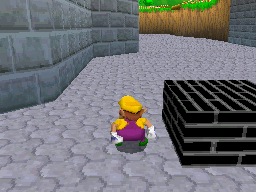
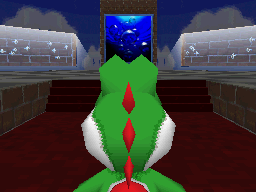
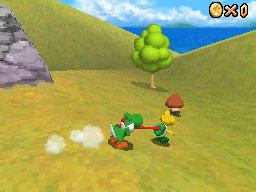
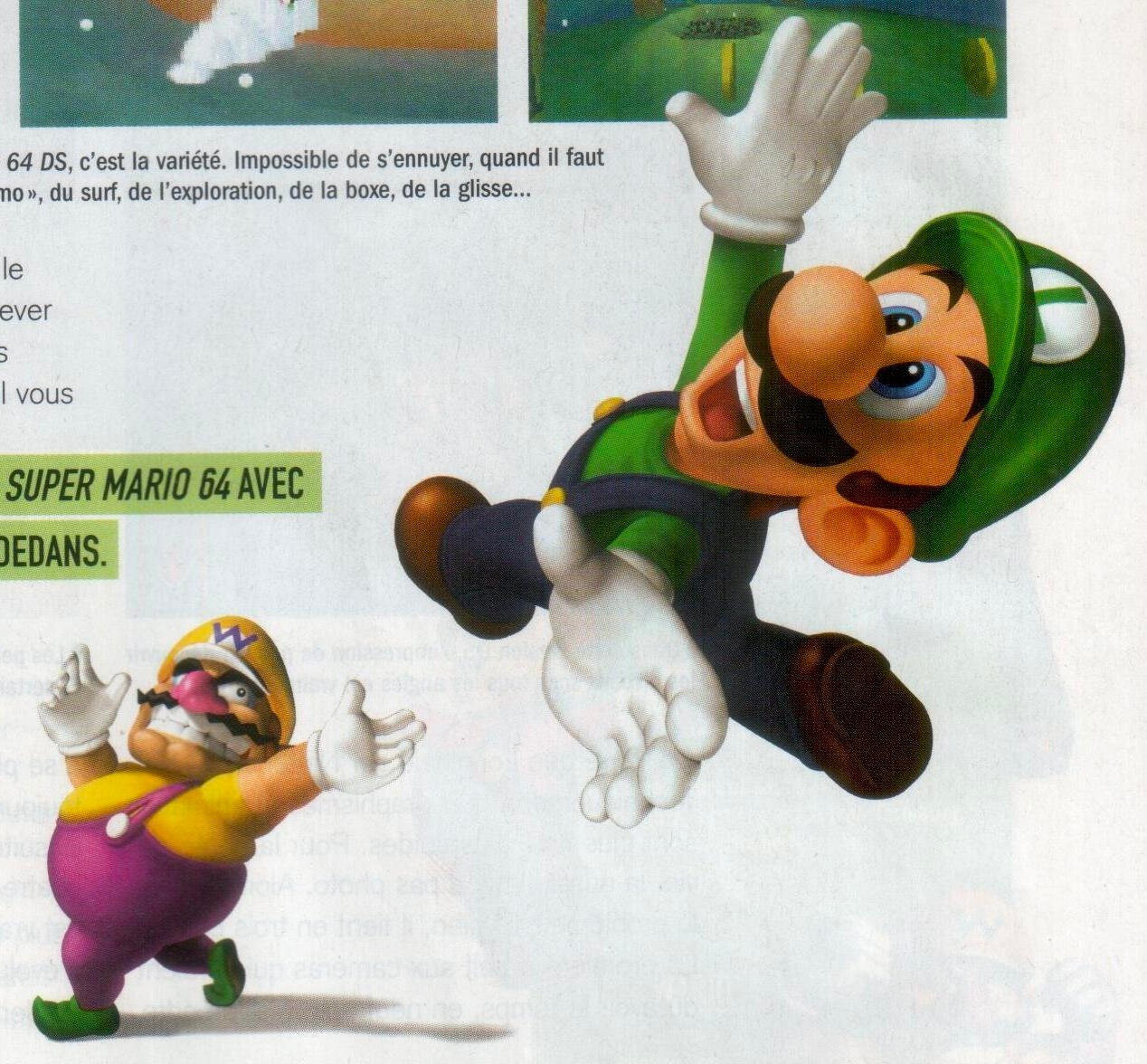
Yoshi is the one you start with and the oddest to play. He cannot punch, kick or carry anything heavy, and his ground pound will not break bricks. Instead he swallows enemies and either spits them out or lays them as an egg to throw, and he can flutter his legs at the top of a jump to stretch it. Mario is the baseline and the quickest runner, with the series’ classic wall kick all to himself. Luigi matches Mario’s jump height and beats everyone in the water, can scuttle to slow his fall, floats down from a backflip in a helicopter spin and can dash across the surface of water for a moment. Wario is the slowest and the worst jumper, but his ground pound has twice the force, he smashes the Black Bricks nobody else can and he needs fewer punches to see off a boss such as Eyerok.
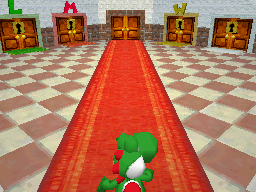
The instruction booklet rates them with stars for power, speed and jump, not entirely reliably: it gives Yoshi a better jump than Mario and rates Mario, Luigi and Yoshi as equally quick, when in play Mario is the fastest on foot and Luigi the fastest swimmer. Characters are changed in the princess’s room on the ground floor, through doors marked M, L and W, once each has been rescued.
The character doors. Each needs a key from a boss.Yoshi eats a Koopa Troopa.Wario demonstrates his throwing arm on Luigi.
Caps
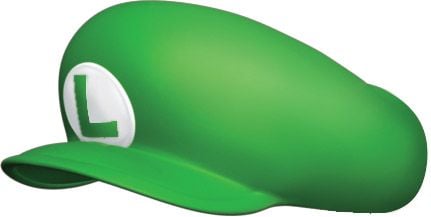
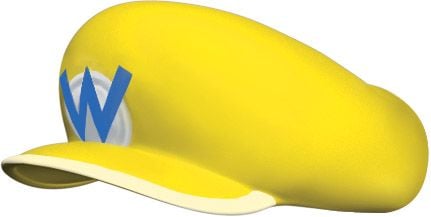
Mario’s red cap, Luigi’s green one and Wario’s yellow one turn up inside the courses, lying on the ground, sitting underwater or being worn by a Goomba or a Boo. Put one on and your character becomes its owner, moves, Power Flower and all, but keeps his own voice. Yoshi can even choose a cap on the star-select screen before a course starts. It means a star that needs Wario does not always mean a trip back to the castle.
Take a hit and the cap flies off. You have a few moments to grab it before it vanishes and reappears elsewhere in the course. A hero who has lost his own cap takes double damage and cannot use Power Flowers or other caps until he gets it back, and if he hits a red ? Block bare-headed a Bob-omb comes out.
Yoshi in Mario’s cap.A Goomba wearing Luigi’s cap.A Toad who has found Mario’s cap.
Power Flowers, wings and mushrooms
The Wing Cap, Metal Cap and Vanish Cap of the original are gone. In their place is a single item, the Power Flower, which comes out of red ? Blocks and does something different for each hero. Mario swells up into Balloon Mario and drifts upwards. Luigi becomes Vanish Luigi, invisible, untouchable by enemies and able to pass through grates. Wario becomes Metal Wario, invulnerable and heavy enough to walk on the sea bed. Yoshi gets a mouthful of fire. Flight still exists, as a white feather that also comes from ? Blocks, but only Mario can use it, for sixty seconds.
The red blocks only work once the ? Switch has been pressed in the old Tower of the Wing Cap, which only Mario can reach. New to the remake is the Super Mushroom, which turns any character into a giant for a short time; trample seven enemies and every one after that is worth an extra life.
Every main course now holds eight stars: seven missions and one for collecting 100 coins. Two new kinds of mission account for most of the additions. In a Silver Star mission, five Silver Stars are scattered about and a Power Star appears when you hold them all; get hit and you drop one. A Star Switch makes a star appear inside a glass Star Sphere somewhere awkward for a short time, and you have to reach it before it fades.
Smaller rules changed as well. Collecting a 100-coin star now refills your health, the coin counter stops at 255, and every 50 coins in hand when a mission ends is worth an extra life. There are three save files where the N64 had four.
Mario collects a Power Star.The Star Switch in Goomboss Battle.
Rabbits and keys
MIPS, the single rabbit in the basement of the original, has been replaced by a whole warren. The first, a yellow one by the hedge maze, holds the key to the castle’s front door. After that, speak to the Toad in the Rec Room and seven rabbits appear for each character, in that character’s colour and only while he is the one being played: 28 in all, scattered from the moat to the third floor, each needing a certain number of stars before it shows up. Catch one and it gives you the key to a minigame.
Late in the game there is a second hunt. Once you have 50 stars, any rabbit you have already caught has a one-in-32 chance of reappearing as a glowing rabbit whenever you enter its area, rising to one in 16 at 80 stars. Eight glowing rabbits earn the key to the white door in the character room, and a Power Star behind it.
Yoshi’s rabbits are yellow.Mario’s are pink.Luigi’s are green.Wario’s are orange.
The Rec Room
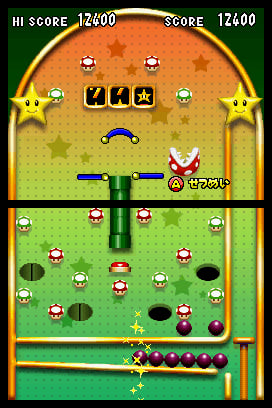
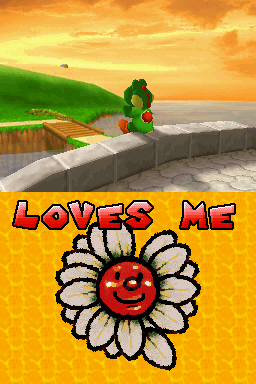
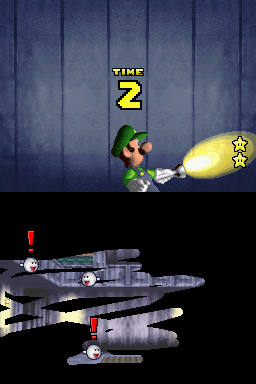
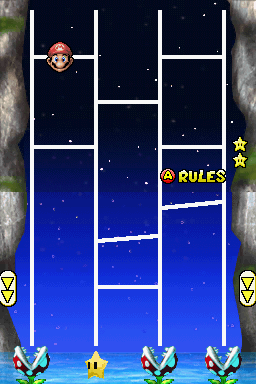
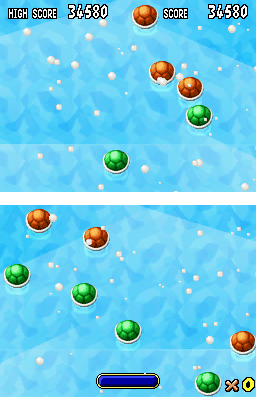
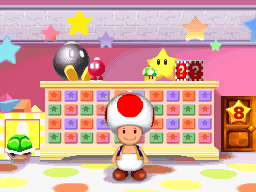
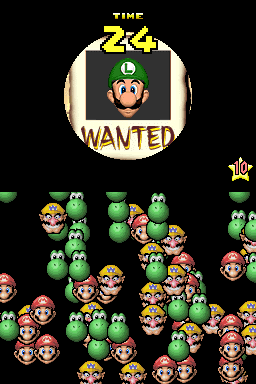
On the ground floor is a playroom with a chest of drawers, and in the drawers are 36 minigames played entirely with the stylus. Each hero has nine, two of them open from the start, and each set has a flavour. Yoshi’s are puzzles and observation tests: Wanted!, Loves Me…?, Hide and Boo Seek, Puzzle Panel, Boom Box, Tox Box Shuffle, Which Wiggler?, Mix-a-Mug and Puzzle Panic. Mario’s are action games: Mario’s Slides, Bounce and Pounce, Sort or ’Splode, Trampoline Time, Shuffle Shell, Bounce and Trounce, Connect the Characters, Shell Smash and Trampoline Terror.
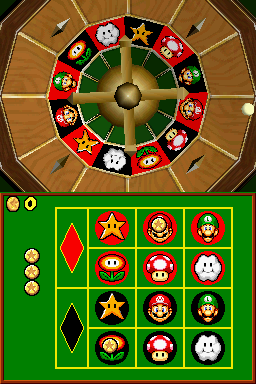
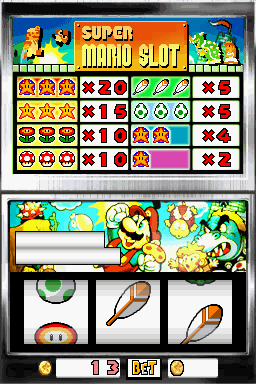
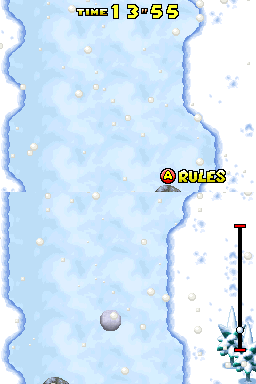
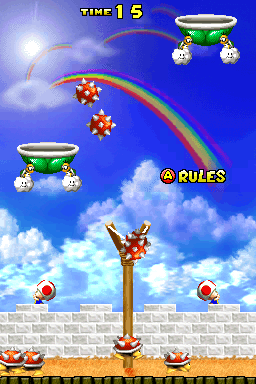
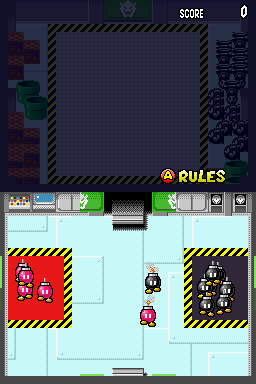
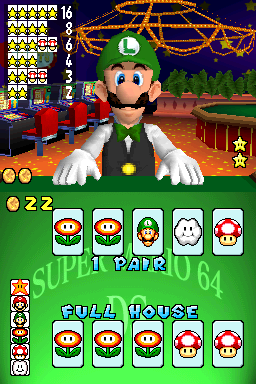
Luigi runs a casino: Memory Match, Pair-a-Gone, Picture Poker, Mushroom Roulette, Mario Slot, Lucky Stars, Pair-a-Gone and On, Memory Master and Super Mario Slot, the last of which needs all 150 stars. Wario gets the miscellany: Bob-omb Squad, Snowball Slalom, Bingo Ball, Coincentration, Psyche Out!, Slots Shot, Lakitu Launch, Intense Coincentration and Giant Snowball Slalom. They can be played straight from the title screen, and most of them were reused, with multiplayer added, in New Super Mario Bros.
The Rec Room and its Toad.Wanted!Sort or ’Splode.Picture Poker.Bob-omb Squad.
VS mode
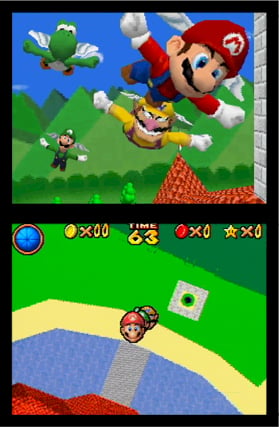
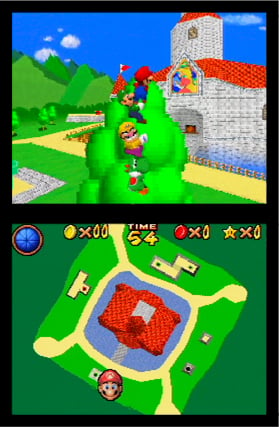
The orange VS button on the title screen starts a wireless battle for two to four players, and only the host needs the game: everyone else downloads it through DS Download Play. All four begin as Yoshis, green, red, blue and yellow, and have 30 seconds on the clock to gather Power Stars from one of four arenas, the castle grounds, Sunshine Isles, the Princess’s Secret Slide and Battle Fort. Nobody can hold more than five. Get hit and you drop a star, which bounces away for anyone to take; caps lying around the arena turn a Yoshi into Mario, Luigi or Wario, and a Yoshi can swallow any rival who is not wearing one.
Wario has a move found nowhere else in the game: stun an opponent and he can pick them up, whirl them round and hurl them. Most stars wins, with coins as the tie-break. The mode can be tried solo for practice, and that is all that survives of it on Wii U.
Green, red and blue Yoshis in the castle grounds arena.Choosing a VS stage.
Power-ups and items
The remake swaps the original’s three caps for one flower and adds a mushroom, Silver Stars and a set of keys.
Power Flower (new)From red ? Blocks. Balloon Mario, Vanish Luigi, Metal Wario or fire-breathing Yoshi, for a limited time.
WingsA white feather from a ? Block makes Wing Mario for 60 seconds. Mario only, and it no longer saves him from fall damage.
Super Mushroom (new)A few seconds as a giant who flattens most enemies. From the eighth victim onwards each one is a 1-Up.
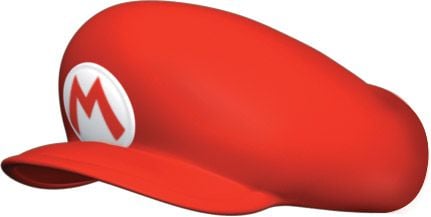
Mario’s capRed. Turns Yoshi, Luigi or Wario into Mario until it is knocked off.
Luigi’s capGreen. Borrow Luigi’s jump, scuttle and invisibility.
Wario’s capYellow. Borrow Wario’s strength and his metal form.
Power Star150 to find. Eighty open the way to the last Bowser.
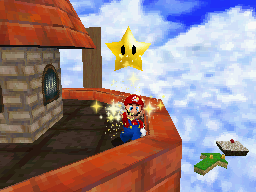
Silver Star (new)Collect five to make a Power Star appear. A hit knocks one loose.
Star Switch (new)Step on it and a star appears in a Star Sphere for a short time.
Star Sphere (new)The glass ball that shows where a star will be.
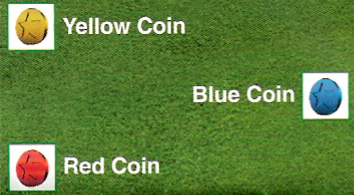
CoinsYellow (1), red (2, eight per course for a star) and blue (5). Each coin restores a wedge of health.
1-Up MushroomAn extra life, now announced with orange 1UP text.
Spinning HeartRun through it to refill the Power Meter.
? BlockRed ones hold Power Flowers and feathers once the ? Switch is pressed.
? SwitchIn the old Tower of the Wing Cap. One switch now does the job of the original’s three.
Mario’s KeyDropped by Goomboss. Opens the M door.
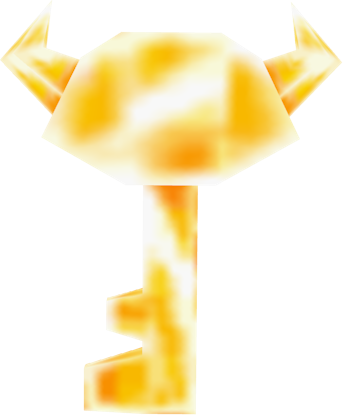
Luigi KeyDropped by King Boo. Opens the L door.
Wario KeyDropped by Chief Chilly. Opens the W door.
Big KeyWon from Bowser in the Dark World and the Fire Sea, for the basement and the upper floors.
Yoshi EggMade from a swallowed enemy. It homes in on targets and can hit several in a row.
Ice BlockMelted by Yoshi’s fire.
CannonOpened by Bob-omb Buddies as before. The one in the castle grounds opens at 150 stars.
Cartoons, Comics & Other Media
A remake has a short reading list of its own, but Super Mario 64 DS fed straight into the DS games that followed it and had one of the more memorable advertising campaigns of its day.
Super Mario 64Nintendo · Nintendo 64 · 1996The original, and the place to go for the story of how the castle, the camera and the courses were made. Its cartoons, comics and magazine coverage are covered there too.
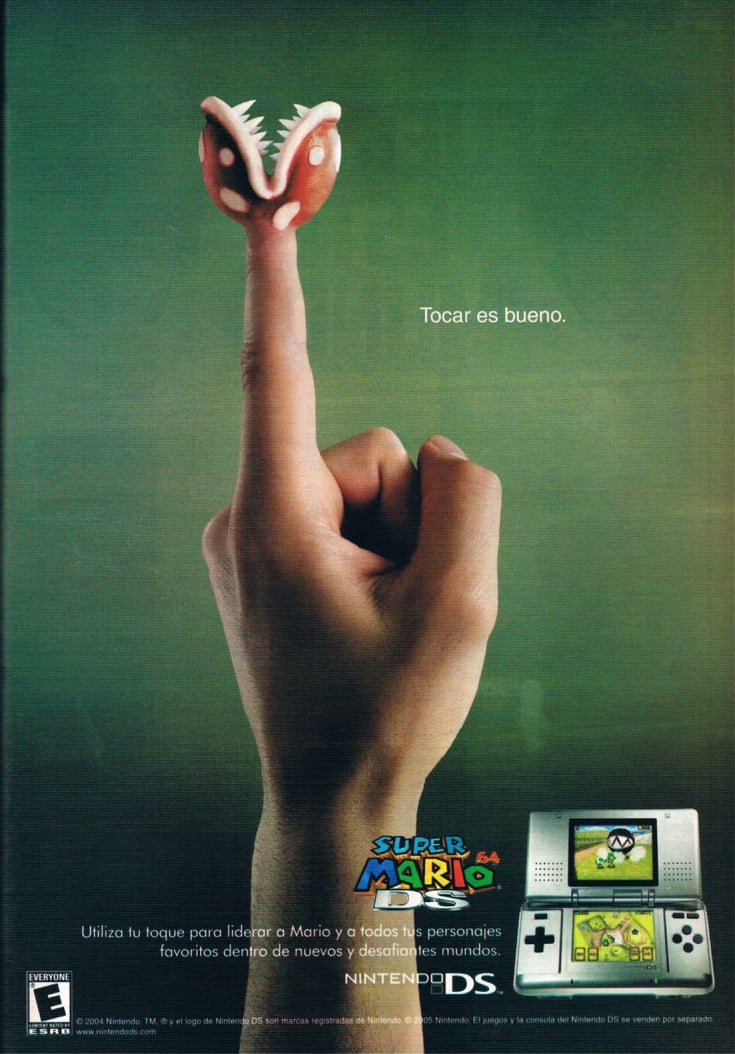
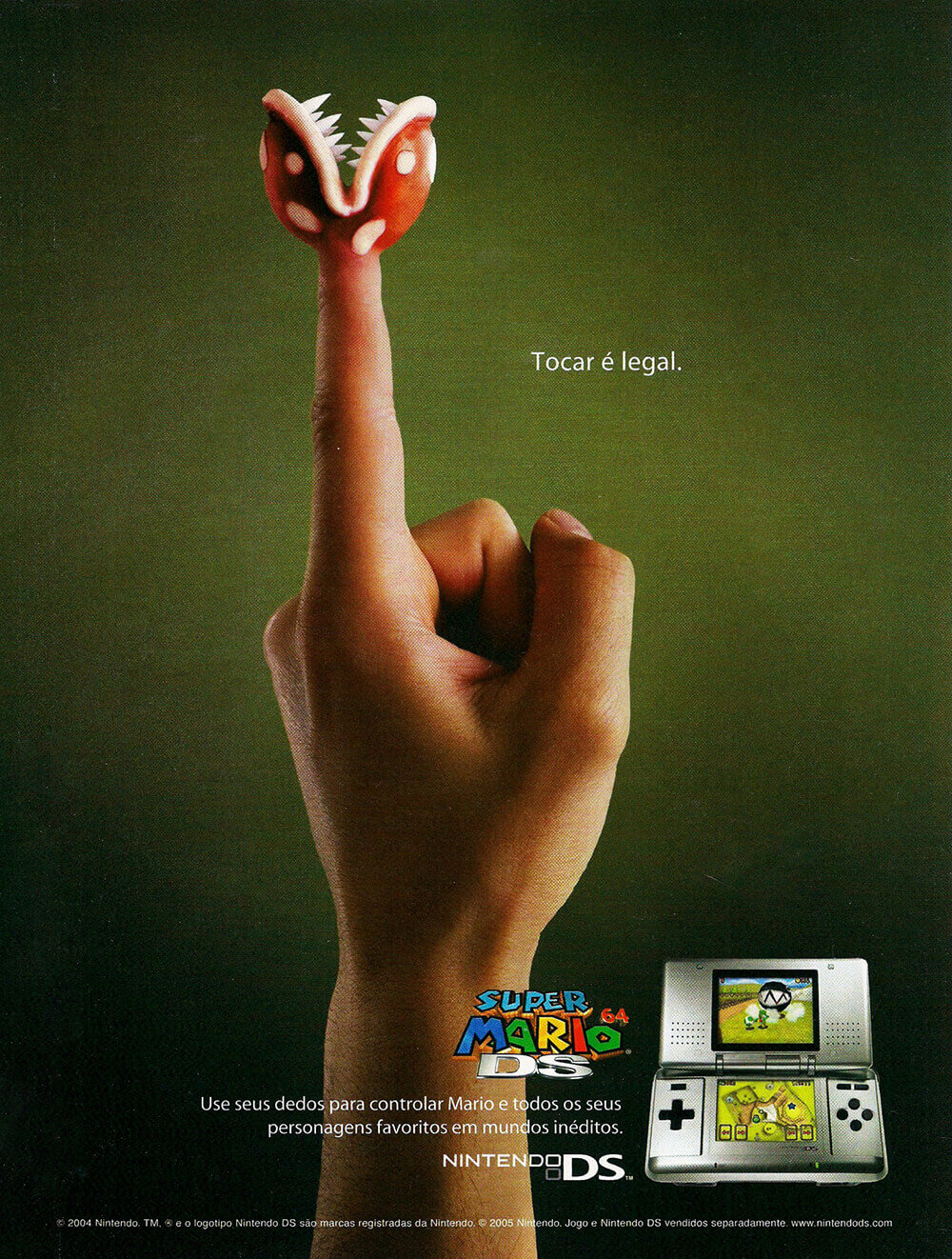
“Touching is good”Nintendo DS launch campaign · 2004The DS was sold in North America with the slogan “Touching is good”, a campaign by the agency Leo Burnett Worldwide that ran as 30-second television spots, magazine pages and online adverts, and this game was part of it. Print adverts for the game also ran in Mexico and Brazil.
Nintendo World Touch! DSNintendo · Japan · November 2004Before the Japanese launch Nintendo took the DS on tour, with hands-on events in five cities where the public could try the game. The event’s website had its own version of the logo.
New Super Mario Bros.Nintendo · Nintendo DS · 2006Most of the Rec Room minigames were carried over to the next DS Mario, which added multiplayer versions and a few new ones.
Wii Play: Find MiiNintendo · Wii · 2006Motoi Okamoto, who directed the minigames, reworked the idea behind Wanted! (pick one face out of a crowd) into Find Mii for Wii Play.
Mario Kart DSNintendo · Nintendo DS · 2005Goomboss made the jump to the next big DS game, which Super Mario Wiki lists as his most recent appearance.
Daigasso! Band BrothersNintendo · Nintendo DS · 2005A piece of music from the game was added to Nintendo’s Japanese band game in 2005.
Console bundles and the red caseNintendo of America · 2005 and 2011Nintendo announced a DS bundle with the game for the United States in June 2005; British shops HMV and Game put together their own when no official one appeared. In 2011 the game was reissued in the US in a red case to go with the DS’s price drop to $99.
The Waluigi hoaxApril Fools’ DayWith Mario, Luigi and Wario all playable, rumours of a hidden Waluigi were inevitable. Wikipedia records that the best-known one began as a fan’s April Fools’ joke, built on doctored screenshots posted soon after the game came out in Australia.
Wii U Virtual ConsoleNintendo · 2015–2016The only re-release to date: Europe and Australia on 24 December 2015, Japan on 6 January 2016 and North America on 25 August 2016.
Super Mario 3D LandNintendo · Nintendo 3DS · 2011The next 3D Mario on a handheld, and the first designed for one from scratch, on a console that finally had a Circle Pad.
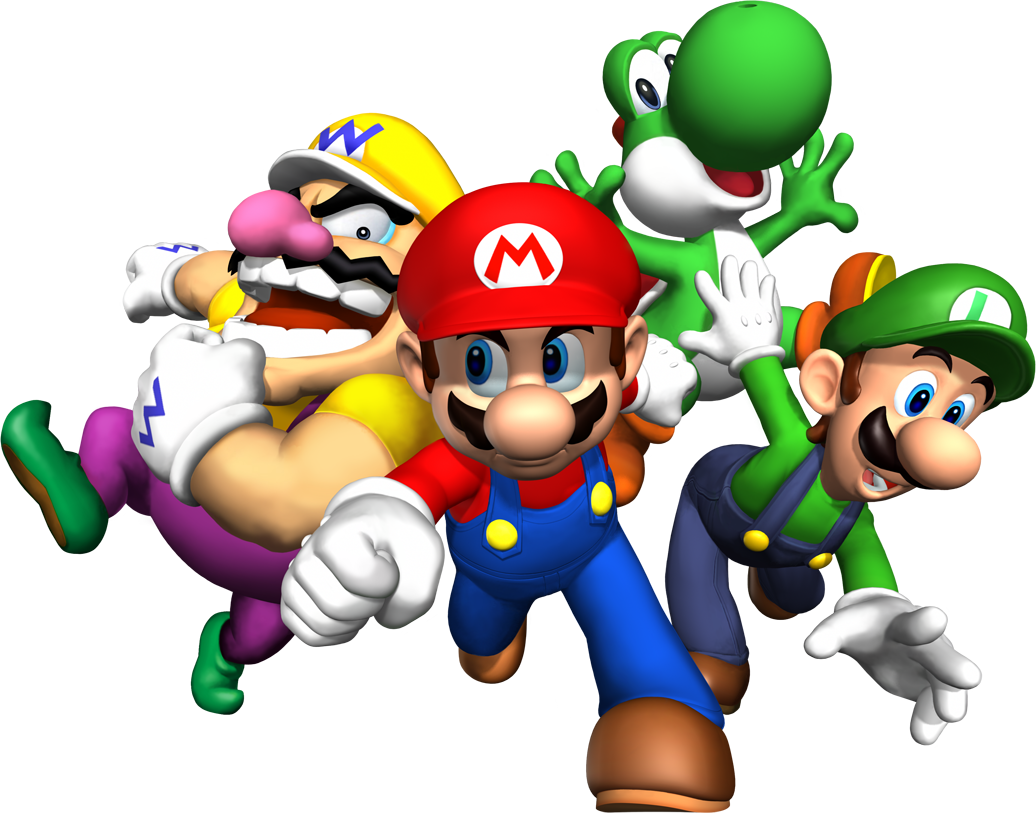
Wallpapers and web extrasmario.nintendo.comNintendo’s Mario website offered desktop wallpaper of the four heroes.
Characters
Four heroes instead of one, three new jailers, and a supporting cast that has been shuffled to make room.
Character
Who they are
In this game
Abilities & notes
YoshiThe unexpected hero
Mario’s dinosaur friend, voiced by Kazumi Totaka. In the original he was a cameo on the roof for players with 120 stars.
Wakes up to find everyone missing and starts the rescue alone. Available from the first minute and the default body in VS mode.
Swallows enemies; spits them or lays an egg to throw
Flutter jump
Cannot punch, kick, carry heavy things or break bricks
Power Flower: fire breath
MarioThe all-rounder
The hero of the original, voiced by Charles Martinet, reduced to a rescue target for the first eight stars.
Held by Goomboss behind the M door. Needed to finish the game: only he can fight his way up the endless stairs to Bowser in the Sky.
Fastest runner
The only wall kick
The only one who can use wings
Power Flower: Balloon Mario
LuigiThe high flyer
Mario’s brother, playable in a 3D Mario for the first time. Charles Martinet again.
Held by King Boo in the attic of Big Boo’s Haunt. Optional, but several stars and the route to Wario depend on him.
Jumps as high as Mario and steers best in the air
Scuttle, and a slow spinning descent from a backflip
Fastest swimmer; can run briefly on water
Power Flower: Vanish Luigi
WarioThe heavyweight
Mario’s greedy rival, on his best behaviour and also voiced by Charles Martinet.
Held by Chief Chilly behind the mirror. Optional, but the only one who can break Black Bricks.
Slowest runner, lowest jump
Double-strength ground pound
Quick on his feet when carrying things
Power Flower: Metal Wario
Princess PeachThe host
Ruler of the Mushroom Kingdom, voiced by Leslie Swan, with a new model that gives her a ponytail.
Sends the invitation, is shut away by Bowser and thanks all her rescuers at the end with new dialogue. The game’s files hold running and jumping animations for her that are never used.
Not playable.
BowserKing of the Koopas
The villain, remodelled to match his look in Luigi’s Mansion.
Fought three times as before, but his doors now ask for 12 and 80 stars, and Yoshi cannot fight him at all.
Thrown into one spiked bomb in each of the first two fights and three in the last.
The ToadsCastle staff
Peach’s retainers, scattered round the castle.
One explains the plot in the foyer, three hand over Power Stars and one runs the Rec Room and sets the rabbits loose.
Not playable. Jen Taylor voices the Toads in the Bob-omb Squad minigame.
The Lakitu Bros.Camera crew
The cloud-riding cameramen from the original.
One of them wakes Yoshi and tips him off about the rabbit with the key. Another can be glimpsed in the mirror during the King Boo fight.
Not playable.
The rabbitsMIPS’s replacements
Yellow, pink, green and orange rabbits that have overrun the castle and grounds.
One holds the front-door key. Twenty-eight more hold keys to minigames, and eight glowing ones lead to a secret star.
Seven per character, each tied to a star total.
GoombossMario’s jailer
The Goomba King of Paper Mario, under a new name.
Boss of Goomboss Battle, behind the 8-star door. He resents the way Mario treats Goombas and has locked him up for it.
Three hits: with eggs as Yoshi, or by punching Goombas into him as anyone else. He grows and speeds up each time.
King BooLuigi’s jailer
The king of the Boos, called “Big Boo” by the English text.
Boss of Big Boo Battle, in a mirrored hall at the end of a maze inside Big Boo’s Haunt.
Visible only in the mirror; rams and spits blue fire. Three hits, with anything but a jump.
Chief ChillyWario’s jailer
A new boss, a giant Bully of the icy kind.
Boss of Chief Chilly Challenge, which only Luigi can enter.
Push him into the freezing water three times. The platform shrinks after each.
Big Bob-ombKing of the summit
The moustachioed boss of Bob-omb Battlefield, now a good deal more vain about the moustache.
Fought twice. Yoshi cannot lift him, so the first fight is about throwing his own Bob-ombs back; the rematch is the old pick-up-and-throw.
Three hits each time. The rematch needs a character in a cap.
Whomp KingTop of the fortress
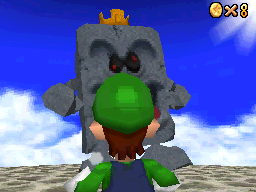
The slab-shaped ruler of Whomp’s Fortress, redrawn with a crown.
As in the original.
Dodge the fall and ground pound his back three times.
KleptoThe condor
The cap-stealing bird of Shifting Sand Land.
Promoted: he now also patrols Tiny-Huge Island, where he has a star mission of his own, and Sunshine Isles, where he carries a Silver Star.
Carries a Power Star on Tiny-Huge Island and a Silver Star on Sunshine Isles.
HootThe owl
The owl who gives lifts in Whomp’s Fortress and elsewhere.
As before, with a new jingle for his flights; he now flaps his wings while he talks.
Carries a hero for a short flight.
Enemies and bosses
The original bestiary returns with new models. These are the ones the remake changes or leans on, followed by all thirteen bosses in Super Mario Wiki’s table.
GoombaMost coursesYoshi’s staple diet and Goomboss’s ammunition. Some wear a hero’s cap.
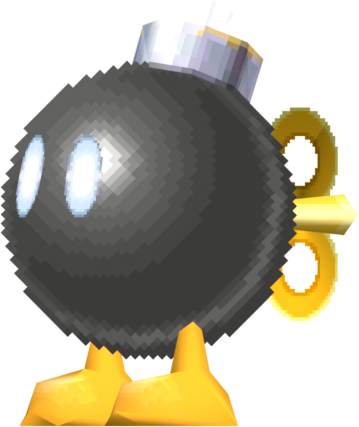
Bob-ombBob-omb Battlefield and elsewhereAlso pops out of a red ? Block if a capless hero hits it.
Koopa TroopaBob-omb Battlefield, Tiny-Huge IslandRemodelled. A fully working red Koopa was left unused in the game’s code.
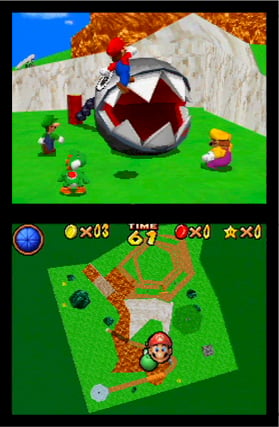
Chain ChompBob-omb BattlefieldRedrawn, and added to the castle grounds arena in VS mode with a star at the end of its chain.
BooCourtyard, Big Boo’s Haunt, Big Boo BattleRounder, with black eyes. Some carry caps. Yoshi’s ground pound will not hurt them.
Mr. IBig Boo’s Haunt, Big Boo BattleThe giant eyeball. Run rings round it.
BullyLethal Lava Land, Chief Chilly ChallengeShove it off the edge. Yoshi cannot swallow one.
Mr. BlizzardSnow courses, Chief Chilly ChallengeNew zigzag mouth and bucket hat. In Snowman’s Land one will steal a dropped cap.
Fly GuyVarious coursesSwallow one as Yoshi and he can spit fire.
SnufitHazy Maze CaveA floating Snifit that spits bullets.
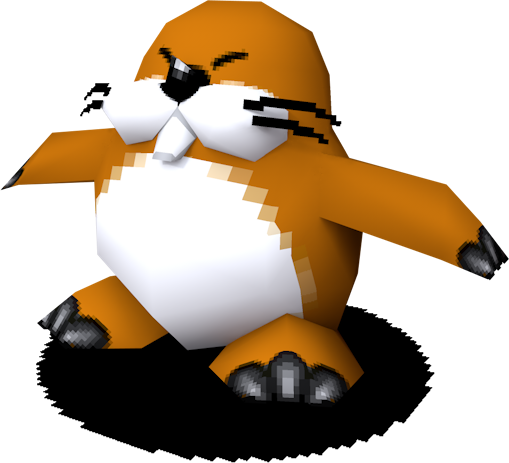
Monty MoleHazy Maze Cave, Tall, Tall MountainPops out of holes to throw rocks.
UkkikiTall, Tall MountainThe monkey who makes off with caps.
LakituGoomboss Battle and elsewhereCircles the pole in Goomboss Battle dropping Spiny Eggs.
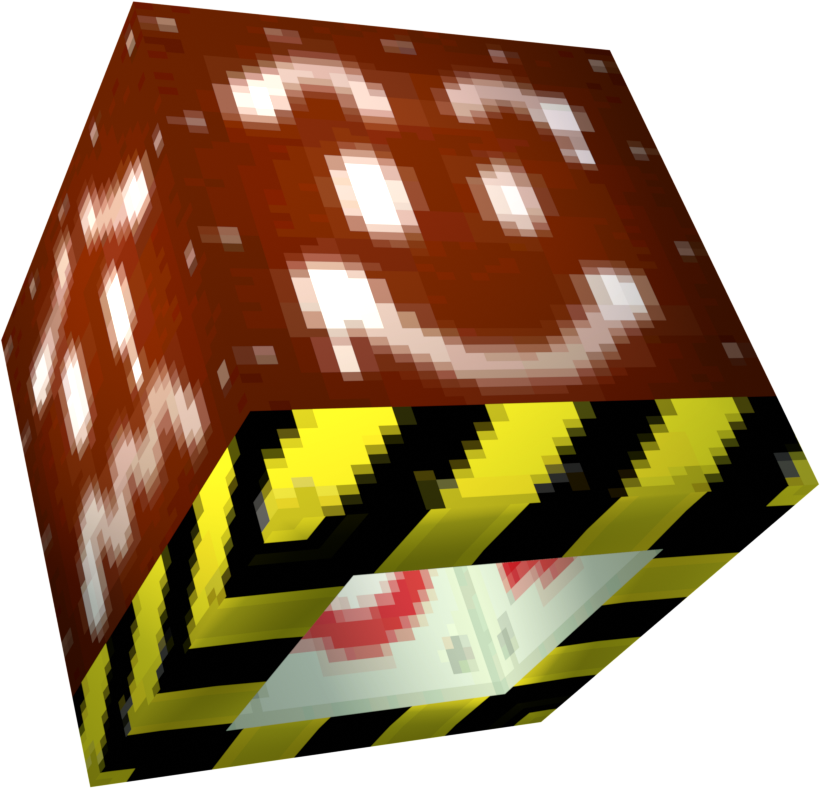
Tox BoxShifting Sand LandThe rolling cube with one hollow side. It has a Switch Star and a minigame named after it.
AmpWet-Dry World, Tick Tock Clock, the pyramidElectric orbs. The homing pair in the original’s pyramid now just circle.
Heave-HoWet-Dry World, Tick Tock ClockA wind-up robot that flips heroes into the air.
ChuckyaSeveral coursesGrabs and throws. Grab it first.
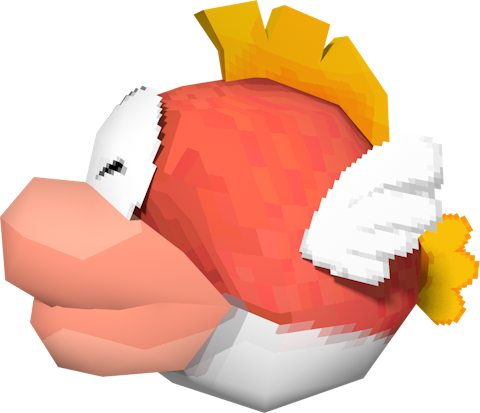
Bub and BubbaWater coursesFish in two sizes, both redesigned for the remake.
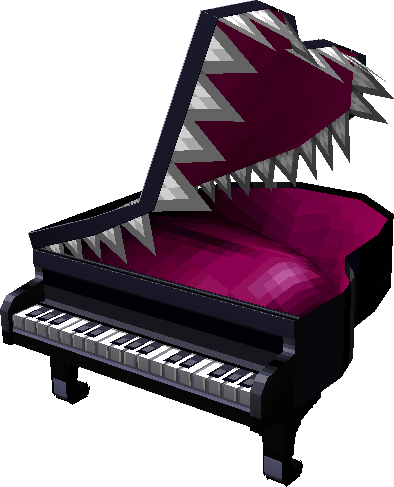
Mad PianoBig Boo’s HauntStill a piano. Still bites.
Big Bob-omb (boss)Bob-omb BattlefieldThrow his Bob-ombs back three times; in the rematch, throw him three times.
Whomp King (boss)Whomp’s FortressThree ground pounds on the back.
Goomboss (boss, new)Goomboss BattleThree Goombas to the face, by egg or by fist.
Big Boo (boss)Courtyard and Big Boo’s HauntFought three times. Hit him from behind, three times each.
Big Mr. I (boss)Big Boo’s Haunt, secret roomShoots blue flames. Circle him until he is dizzy.
King Boo (boss, new)Big Boo BattleWatch the mirror and the shadow.
Big Bully (boss)Lethal Lava LandFought twice. Into the lava with him.
Eyerok (boss)Shifting Sand Land pyramidPunch the eye in each hand three times, or twice as Wario. Yoshi must ground pound, slide-kick or use fire.
Chill Bully (boss)Snowman’s LandOne push into the freezing water.
Chief Chilly (boss, new)Chief Chilly ChallengeThree duckings on a shrinking platform.
Piranha Flowers (boss)Tiny-Huge IslandFive fire-breathing plants that rise as you approach. Punch each while it is up.
Wiggler (boss)Tiny-Huge IslandThree jumps on the head; he gets faster and redder after each.
Bowser (boss)Dark World, Fire Sea, SkyBy the tail, into the spiked bombs: once, once, then three times.
The people who made it
Nintendo EAD, the division that made the original, with Shigeru Miyamoto supervising and a new director. The credits thank the “Nintendo 64 Super Mario 64 Original Staff”.
Shigeru MiyamotoProducer and supervising directorDirector of the 1996 game. He oversaw the remake in meetings held late in the evening, after his management duties were done.
Shinichi IkematsuDirectorLed the DS project.
Makoto MiyanagaMap and level design directorHeaded the course design team.
Hiroshi MatsunagaPlayer directorCredited as director for the playable characters.
Motoi OkamotoScript and minigame directorWrote the new story text and designed the Rec Room games, after studying Flash games for ideas that suited a touch screen.
Daisuke KageyamaEnemy and minigame design directorOversaw enemy and minigame art.
Michiho Hayashi and Kenji ShinmotoCharacter and enemy designRedesigned the cast for the DS.
Kenta NagataMusicCredited with the music, which adapts the original score and adds new pieces such as the Silver Star and Hoot jingles.
Toshihiko NakagoProgramming directorNintendo’s veteran programmer, heading a team that included Toshio Iwawaki on the main system, Hiroki Sotoike on the 3D engine and Takuhiro Dohta on “touch draw” programming.
Charles Martinet, Kazumi Totaka, Leslie Swan, Jen TaylorVoicesMartinet plays Mario, Luigi, Wario and Bowser (and the Boos’ laugh); Totaka is Yoshi; Swan is Peach; Taylor is the Toads in Bob-omb Squad.
Satoru IwataExecutive producerNintendo’s president.
Advertisement
How It Was Made
How the 1996 game was made is told on the Super Mario 64 page. This is the story of the eight months in 2004 in which it became a DS launch game.
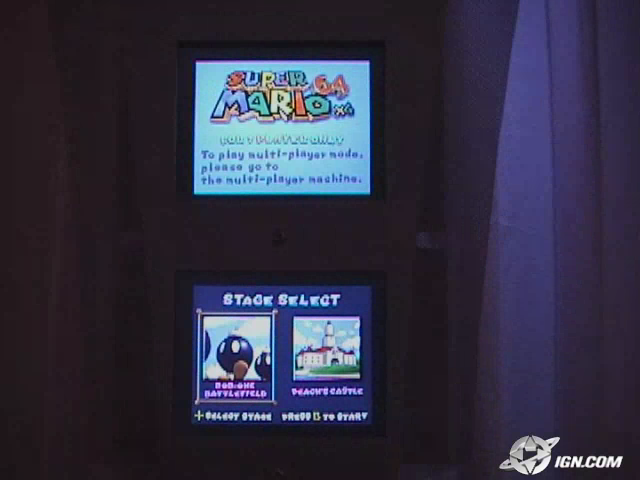
Super Mario 64 ×4
The title screen of the E3 2004 demo. Screenshot: Nintendo, via Super Mario Wiki
Nintendo unveiled the DS at its E3 press conference on 11 May 2004, and the next day visitors could play a multiplayer demo with an unfamiliar title: Super Mario 64 ×4. Four people, as Mario, Luigi, Wario and Yoshi, ran around pieces of the old game competing for Power Stars, and courses were picked from a menu of paintings on the Touch Screen that does not exist in the finished game.
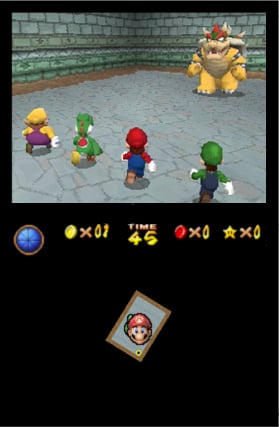
Screenshots from that period show things that never happened: all four heroes fighting Bowser together, all four flying round the castle at once, a castle with a moat on every side. The Cutting Room Floor notes that most courses in the final game still have three spare entrance points, which suggests a four-player co-operative mode was planned and then replaced by the competitive VS mode on four small arenas. The room in which VS players wait is stored in a file named after the E3 demo. Wario, in the early pictures, wears long sleeves.
Improving on a classic
An early screenshot of all four heroes facing Bowser at once. Screenshot: Nintendo, via Super Mario Wiki
According to Wikipedia’s account of the development, Shigeru Miyamoto felt that a version without an analogue stick had to offer something more than the original to make up for it. That was the reasoning behind the extra characters and stages, and Yoshi’s flutter was put in to make 3D jumps more forgiving. Miyamoto met the team in the evenings once his administrative work was finished, and the designers wrote up each meeting as a design document for the artists and programmers straight afterwards.
In early previews the four characters could be swapped at any moment with a tap on the Touch Screen. The final game is stricter: you choose a hero in the castle, and inside a course you can only become someone else by finding their cap.
Rebuilding the castle
Bob-omb Battlefield in the early build, still using textures from the N64 game. Screenshot: Nintendo, via Super Mario Wiki
Nothing was simply ported. Every texture was redrawn, the DS does without the N64’s texture filtering, and the characters were rebuilt with more polygons: Mario and Bowser now match their appearances in Luigi’s Mansion, Peach has a ponytail, Boos are round with black eyes and coins are solid octagons where the original used flat pictures. Even Bowser’s painted likeness on the platforms of Lethal Lava Land and on his submarine was replaced with new renders.
The sound was squeezed to fit a DS card, with shorter and lower-quality instrument samples, but there are new voice clips and new jingles. The castle itself was rearranged: hedges and a ramp into the moat outside, five new doors on the ground floor, a locked front door. And some of the original’s famous loopholes were closed. The backwards long jump, which let N64 players build up enough speed to slip past the endless stairs, no longer works.
Thirty-six small games
Slots Shot before release, with flat barriers that became 3D. Screenshot: Nintendo, via Super Mario Wiki
The minigames were Motoi Okamoto’s. Looking for things that would suit a stylus, he studied Flash games on the web and noticed how well a crowd of near-identical objects tests the eye. Out of that came Wanted!, Which Wiggler?, Boom Box and Intense Coincentration. He then balanced the set between casino games, action games, puzzles and tests of perception, which is roughly how the four characters’ drawers divide.
Not everything in them is new. The Cutting Room Floor reports that Coincentration is stored under the internal name “wrecking_crew” and that its files contain unused sprites from Super Mario Advance 4.
October to launch day
A pre-release title screen, with a slightly different logo. Screenshot: Nintendo, via Super Mario Wiki
At a DS conference on 7 October 2004 the game reappeared under its final name, about 90 per cent complete, with all four characters confirmed for the single-player adventure and the minigames on show. The North American build is dated 15 October and the Japanese one 25 October, with a revised version of each following in early November. In Japan Nintendo ran hands-on events in five cities under the banner Nintendo World Touch! DS.
The DS went on sale in North America on 21 November 2004 with Super Mario 64 DS as its flagship, and in Japan on 2 December. Australia followed on 24 February 2005 and Europe on 11 March.
Revisions and regions
The Korean title screen, with no Rec Room option. Screenshot: Nintendo, via Super Mario Wiki
There are more versions of this game than most people realise. The first American revision fixed a batch of bugs, among them a freeze involving Klepto, a way of earning unlimited lives from a plank in Whomp’s Fortress and some oddities in Yoshi’s eating. It also changed how characters bounce off enemies, and the European and Korean versions differ again in which bugs they fix.
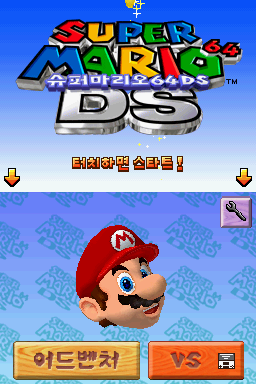
The Chinese version came out through iQue on 21 June 2007 and the Korean one on 26 July 2007. Korea’s is the odd one out: the Rec Room, its Toad and the minigame rabbits were removed altogether, most likely because Luigi’s games involve gambling, and a yellow ! Block that hands out extra lives was added to the castle roof. The same concern caught up with Europe later. The DS card was rated PEGI 3, but when the game reached the Wii U in 2015 it was re-rated PEGI 12.
Left in the files
The unused red Koopa Troopa. Image: Nintendo, via Super Mario Wiki
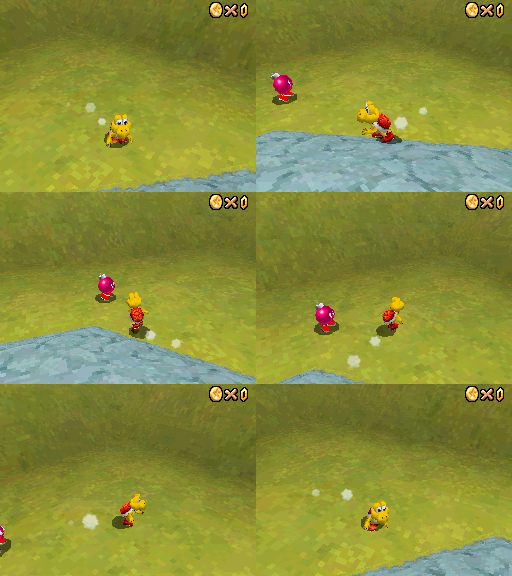
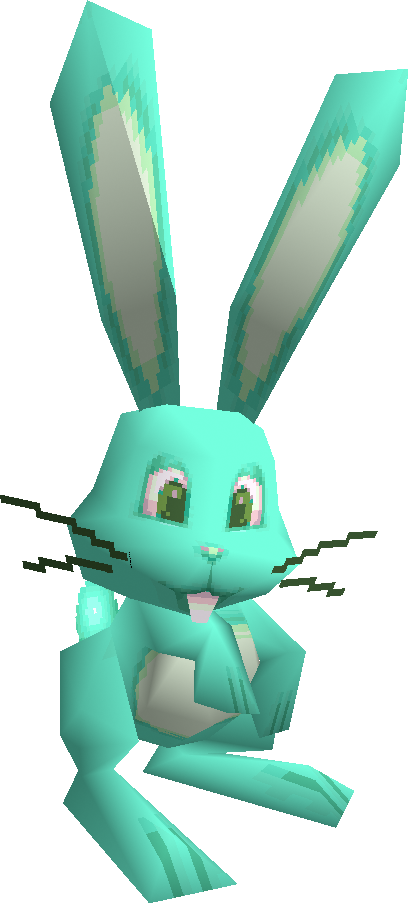
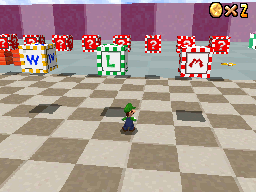
The data holds several things that were finished and never used. A red Koopa Troopa charges at the player like a Bully, walks slowly back to its shell when knocked out of it, and lets Yoshi breathe fire if he eats one, as in Super Mario World. There are blocks marked M, L and W that dispense caps, a cyan rabbit, a test map with Japanese labels for every kind of ground, and messages written for Yoshi meeting Chief Chilly, which cannot happen without cheating. The original princess’s room is still inside the castle model too, without collision, glimpsed for a moment each time its door opens.
Series Firsts
A remake does not have many firsts, but this one has a few firsts and distinctions that the sources support.
13D Mario in your pocketSuper Mario Wiki describes it as the first 3D Super Mario game for a handheld console.
2Luigi, Yoshi and Wario in a 3D MarioThe first 3D Mario platformer with playable characters other than Mario. Luigi had been absent from both Super Mario 64 and Super Mario Sunshine.
3A 3D Mario on launch dayIt was on sale with the Nintendo DS from the first day in North America and Japan, the first time a 3D Mario had launched a handheld.
4Power Flowers and Silver StarsBoth were introduced to the Super Mario 64 rulebook here, along with Star Switches, Star Spheres and the giant-making Super Mushroom.
5Wireless Game of the YearIt won the Wireless Game of the Year award at the 8th Interactive Achievement Awards, for its single-card four-player mode.
Cheats & Secrets
Most of the original’s secrets still work, and are on the Super Mario 64 page. These are the ones that belong to the DS version. SLB’s own cheats page for the game has a few more.
The unlock chain
Mario: 8 stars, then the Mario painting behind the Rec Room and Goomboss. Luigi: as Mario, 15 stars for Big Boo’s Haunt, then the Luigi portrait on the top floor and King Boo. Wario: beat Bowser in the Fire Sea for the upper floors, press the ? Switch as Mario (14 stars), then take Luigi through the mirror in the Snowman’s Land room and beat Chief Chilly. Each boss drops a key for the matching door in the character room.
Finding King Boo
In Big Boo Battle, a wrong door sends you back to the first room. Listen to the laughter and take the door where it is loudest. In the fight itself, watch his shadow on your side of the mirror and hit him from behind; looking straight at him makes him vanish.
The white door
Once you have 50 stars, rabbits you have already caught can come back glowing: a 1-in-32 chance each time you enter the area, improving to 1 in 16 at 80 stars. Each one tells you how many are left. The eighth gives the key to the white-bordered door in the character room, and the star inside.
All 150 stars
The cannon in the castle grounds opens. Fire yourself onto the roof for three 1-Up Mushrooms, a red ? Block and Luigi’s last rabbit, which unlocks Super Mario Slot. Yoshi, who lived up here on N64, has other things to do.
The 21-second slide
The Princess’s Secret Slide is entered through the right-hand stained-glass window in the character room. Reach the bottom in 21 seconds or less for its second star.
Giant lives
Under a Super Mushroom, the first seven enemies you flatten are just flattened. Every one after that is an extra life.
Fifty coins, one life
When you collect a star, the game pays out one extra life for every 50 coins you are holding. It does not pay if you leave the course from the pause menu. The counter stops at 255.
Endless coins in Big Boo Battle
The three Boos in the last room before King Boo come back, coins included, every time you go round the maze again.
Character shortcuts
Wario needs only two punches for each of Eyerok’s hands, not three. Luigi can cross short stretches of water on foot after a charged dash and float down from a backflip. Yoshi can swallow a flame, or a Fly Guy, and spit fire without a Power Flower; there are bonfires for the purpose in Cool, Cool Mountain and Snowman’s Land.
Choose a cap before you start
Playing as Yoshi, you can pick a cap on the star-select screen straight after jumping into a painting, and start the course already wearing it.
Title screen toys
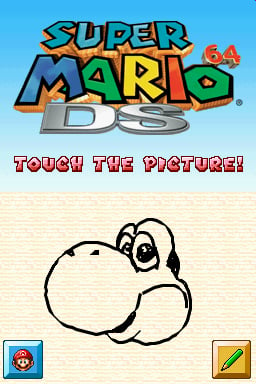
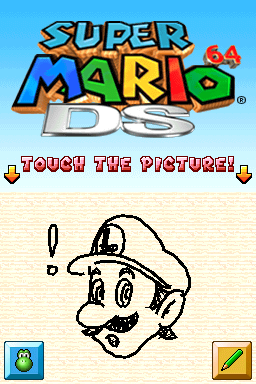
Drag Mario’s or Yoshi’s face about with the stylus and it stretches and turns to wireframe. Tap the screen for different drawings; the third tap on Mario brings up Luigi. You can also sketch a picture of your own and pull that around instead.
VS mode: Swing and Fling
In VS mode a hit from Wario stuns a rival for longer than anyone else’s, long enough for him to pick them up, spin and throw them. Some arenas also have a winged yellow block that lets Yoshi, Luigi and Wario fly, which they never can in the main game.
Korea’s life block
In the Korean version only, a yellow ! Block sits beside the red ? Block on the castle roof. It gives extra lives and never runs out.
SLB’s Super Mario 64 DS cheats page adds a coin trick on the Cool, Cool Mountain slide and the old tip of circling wooden posts for five coins.
Glitches & Oddities
Super Mario Wiki lists dozens of glitches for the game. Several depend on which revision of the card you own. These are the most useful and the strangest.
Fence flying
In Bob-omb Battlefield, certain cannon shots send the character into the boundary fence. Super Mario Wiki lists three cannons, among them the tall one near the Koopa Troopa, aimed at the bottom of the floating island, and the one by the tree and red brick, which only works on the first version of the card. Hold Up and the character is pushed through the fence and high into the air, far enough to leave the level altogether. Variations exist in Cool, Cool Mountain and Shifting Sand Land.
Wings out of his head
The hatless Power Flower trick. On Tall, Tall Mountain, put on another hero’s cap, take the Power Flower at the summit and let Ukkiki steal the cap while the power is running. Get into the water as it wears off, climb back by the waterfall to dodge the monkey’s speech, and take the flower again. With Luigi’s cap the body turns invisible and the head does not; with Mario’s, wings sprout from the head; with Wario’s the game freezes.
The vanishing act
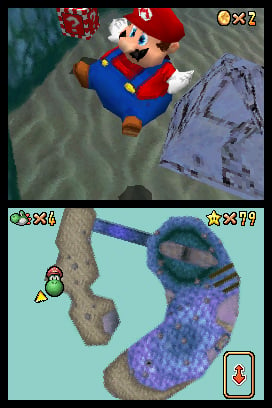
The Amp glitch in progress.
With a single wedge of health left, touch an Amp and fall. A third of the character sinks into the floor, and when Bowser’s face fills the screen there is nobody there.
Lives from a plank
In the first version of the game only, touching a particular plank in Whomp’s Fortress over and over awards lives. It was fixed in the first revision.
The Jolly Roger Bay pillar
In the second version only, a long jump under one of the falling pillars in Jolly Roger Bay destroys the pillar and takes six wedges of health, sometimes the lot.
Klepto and the crate
In the first version, pick up a crate as Yoshi in Shifting Sand Land and wait for Klepto to snatch your cap. The game freezes. Throwing a crate at the snowman in Snowman’s Land to collect caps, meanwhile, doubles the number of caps each time until the first version crashes; the second resets the count after 64.
To the roof without 150 stars
Luigi’s backflip glide and some jumps up the slippery slopes of the castle can get him onto the roof long before the cannon opens. In VS mode the same trick works with a Luigi cap.
Through the stairs
Sliding into a certain corner near the Tick Tock Clock entrance pushes a character through the wall. Usually that costs a life. Very occasionally it drops them on the endless stairs, past the 80-star door.
King Bob-omb throws himself out
The Big Bob-omb can be led into walking off his own summit. He then accuses you of having thrown him out of the ring.
Two stars for the price of one
In Big Boo Battle, pick up the first Red Coin last and two Power Stars appear. Only one of them counts.
Wario in the mirror
Get Wario into the first King Boo fight by glitching and once the boss is beaten the Luigi shown in the mirror has arms longer than they should be.
Videos
Nintendo’s trailer for the Wii U Virtual Console release, as carried by IGN, and Nintendo Life’s side-by-side look at the DS game and the N64 original running on the same console.
Nintendo’s Japanese trailer for the Virtual Console version, uploaded by IGN.
Nintendo Life compares the remake with the original, both on Wii U Virtual Console.
Trivia & Interesting Facts
The boss who holds Luigi is King Boo, but the English version calls him Big Boo, a name already taken by the boss of Big Boo’s Haunt. Super Mario Wiki notes that he has messages for Yoshi only in the Japanese version.
The first time anyone puts on Mario’s cap the game tells you to press A to wall-kick. The button is B.
The UK instruction booklet thanks you for selecting “the SUPER MARIO Game Card for Nintendo DS systems”, forgetting most of the title.
The booklet awards Yoshi three stars for jumping and Mario two, although Yoshi’s long jump and triple jump both fall short of Mario’s.
The four heroes in the early build. Note Wario’s sleeves.The game began as Super Mario 64 ×4, and in its first screenshots Wario has long sleeves.
Goomboss is the Goomba King from Paper Mario. He says he locked Mario up because Mario is always stomping on Goombas.
The Big Bob-omb has become vain about his moustache, and for the rematch he will only fight someone wearing a cap, which rules out a bare-headed Yoshi.
Mario’s and Bowser’s new models follow their designs in Luigi’s Mansion, and Peach has acquired a ponytail.
Mario no longer talks in his sleep. Over the Rainbows no longer counts as a cold course, so characters left idle there doze off instead of shivering.
When the DS is closed and reopened, Mario says “Buh-bye!” He says the same thing, instead of “So long-a, Bowser!”, when he throws the Koopa King.
The unused cyan rabbit.A cyan rabbit exists in the files, with no character to belong to.
The unused cap blocks.A test level in the data contains blocks marked M, L and W that hand out the three caps.
There are three save files where the Nintendo 64 game had four.
Charles Martinet voices four of the cast: Mario, Luigi, Wario and Bowser. Yoshi is Kazumi Totaka, and Jen Taylor supplies the Toads in Bob-omb Squad.
During the King Boo fight a Lakitu Bro can be seen in the mirror, filming.
The idea behind the Wanted! minigame was reused by its designer for Find Mii in Wii Play.
The Korean version has no minigames at all, which leaves the Rec Room without its Toad and the castle without its coloured rabbits. Glowing rabbits still appear.
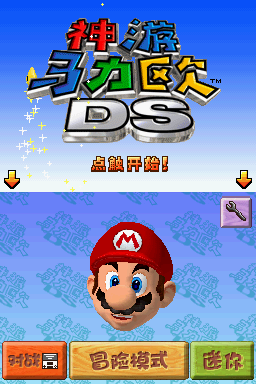
In Japan and Korea the word “Super” in the logo is multicoloured, as it was on the N64 title screen. Elsewhere it is one colour.
The ending keeps track: the moat stays drained if you drained it, and the Cool, Cool Mountain snowman only has his body back if you did that mission.
Played on a Nintendo 3DS, the Circle Pad can be used for movement, but the game still only understands eight directions.
In VS mode, three Yoshis in caps and a fourth player can all take to the air at once if everyone grabs wings, which is how an early publicity shot of four flying heroes can still be recreated.
The Chief Chilly Challenge is one of only three courses that a single character can enter. The others are Bowser in the Sky (Mario) and The Secret Under the Moat (Wario).
Regional Box Art
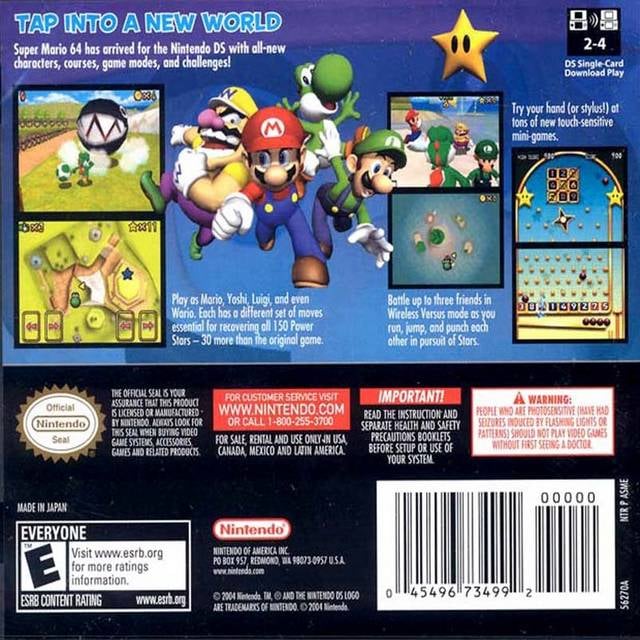
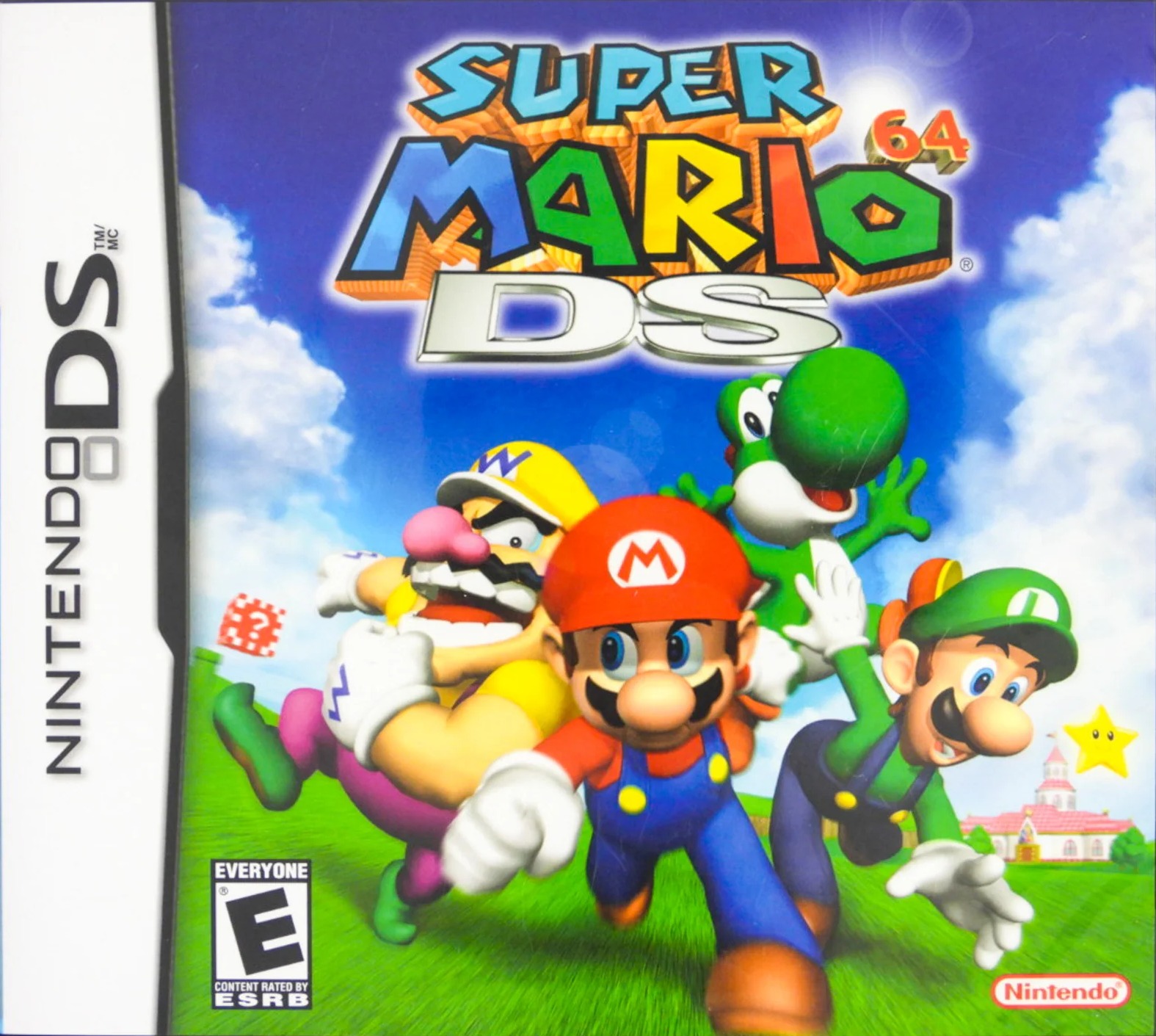
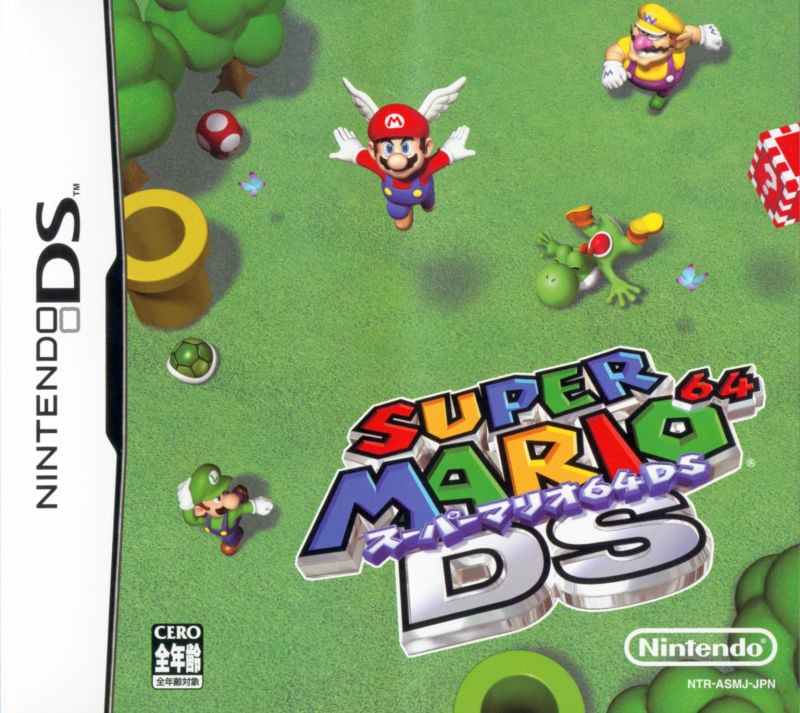
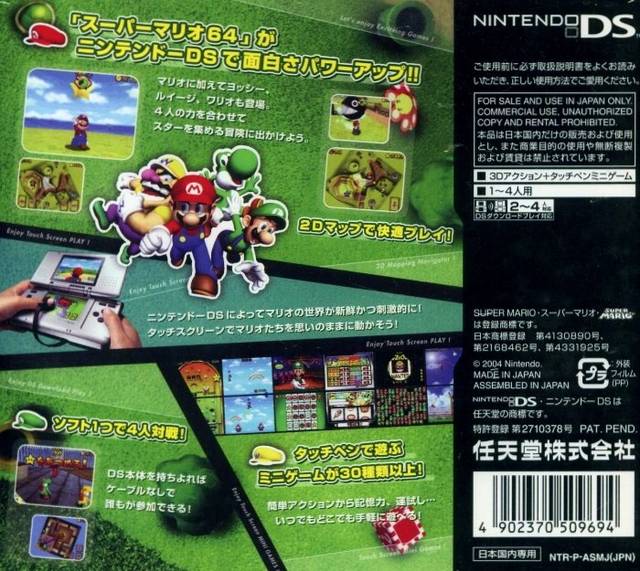
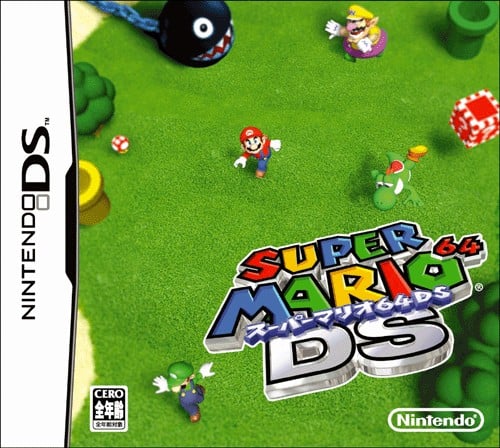
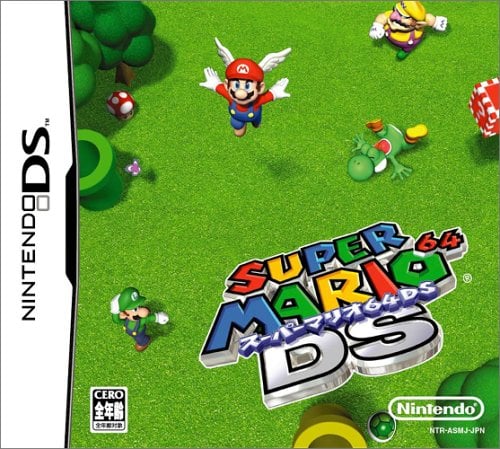
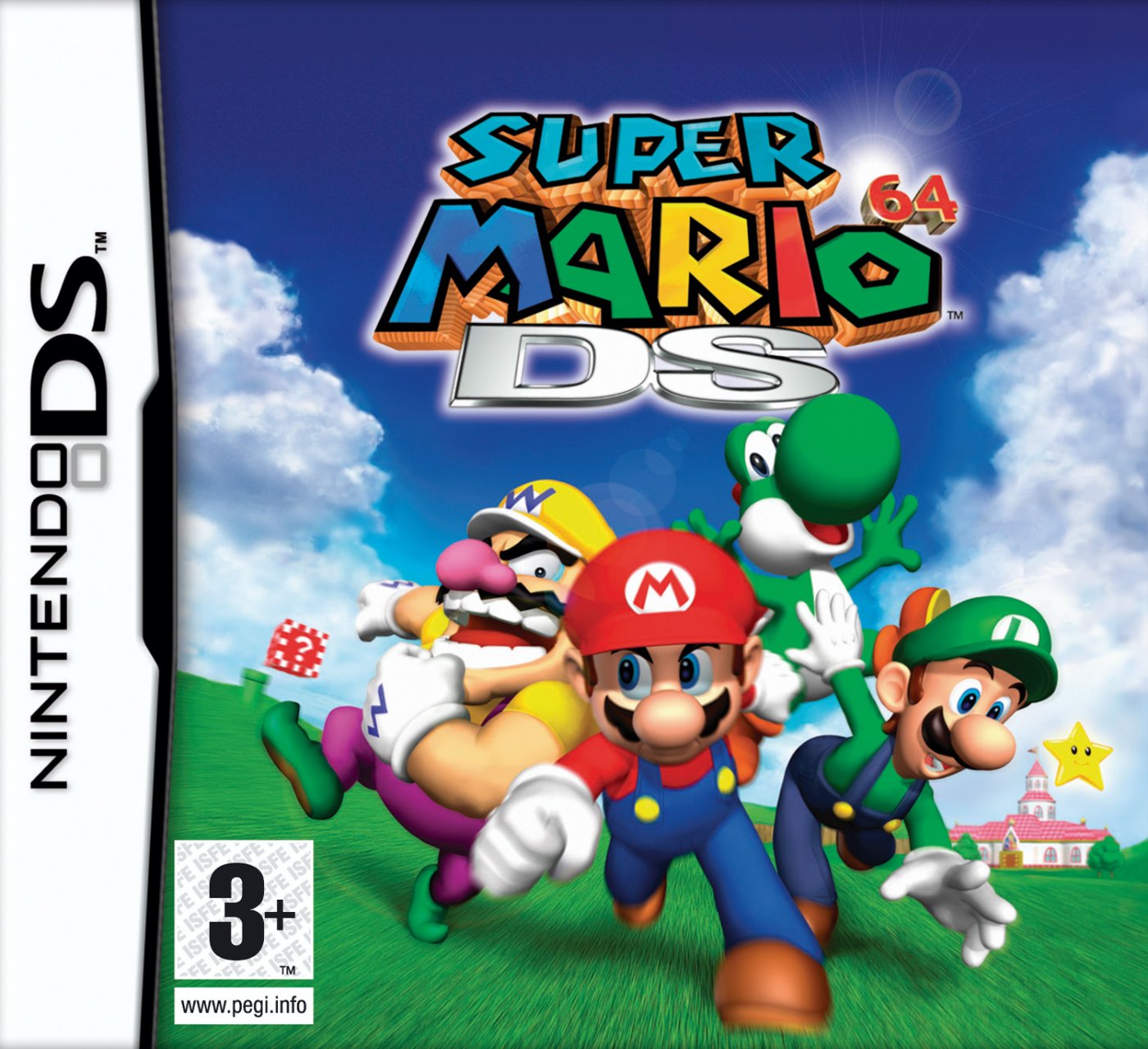
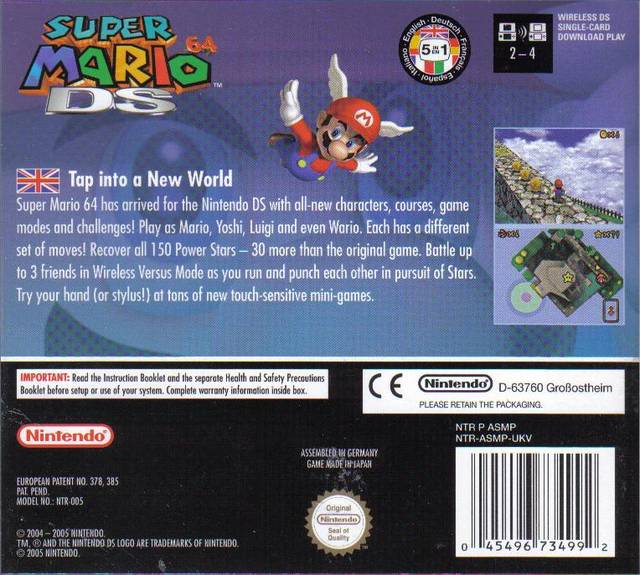
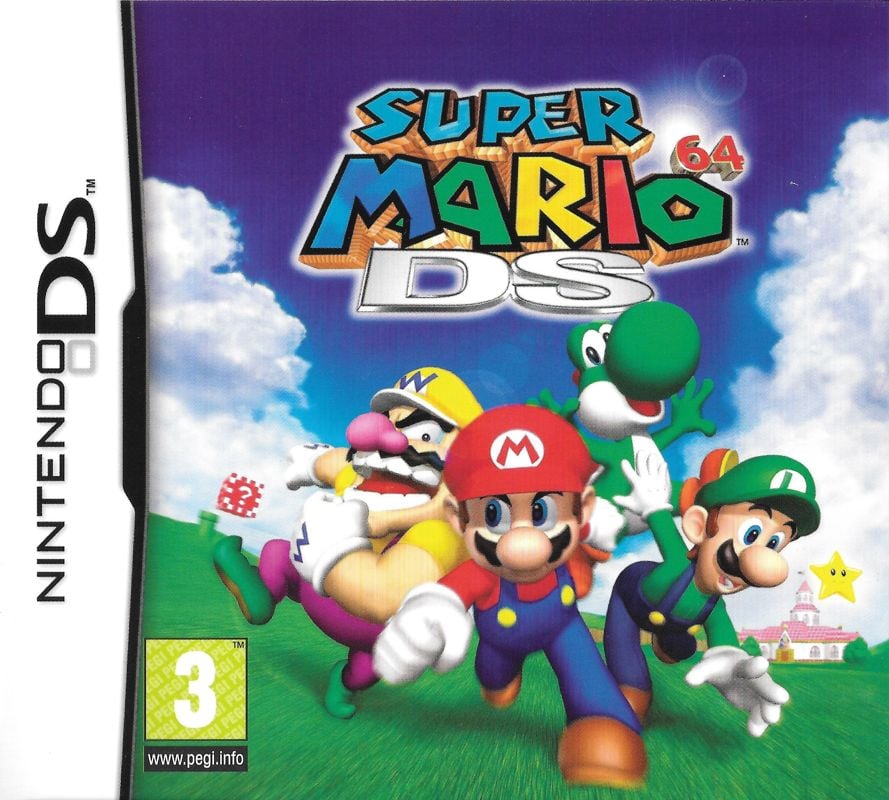
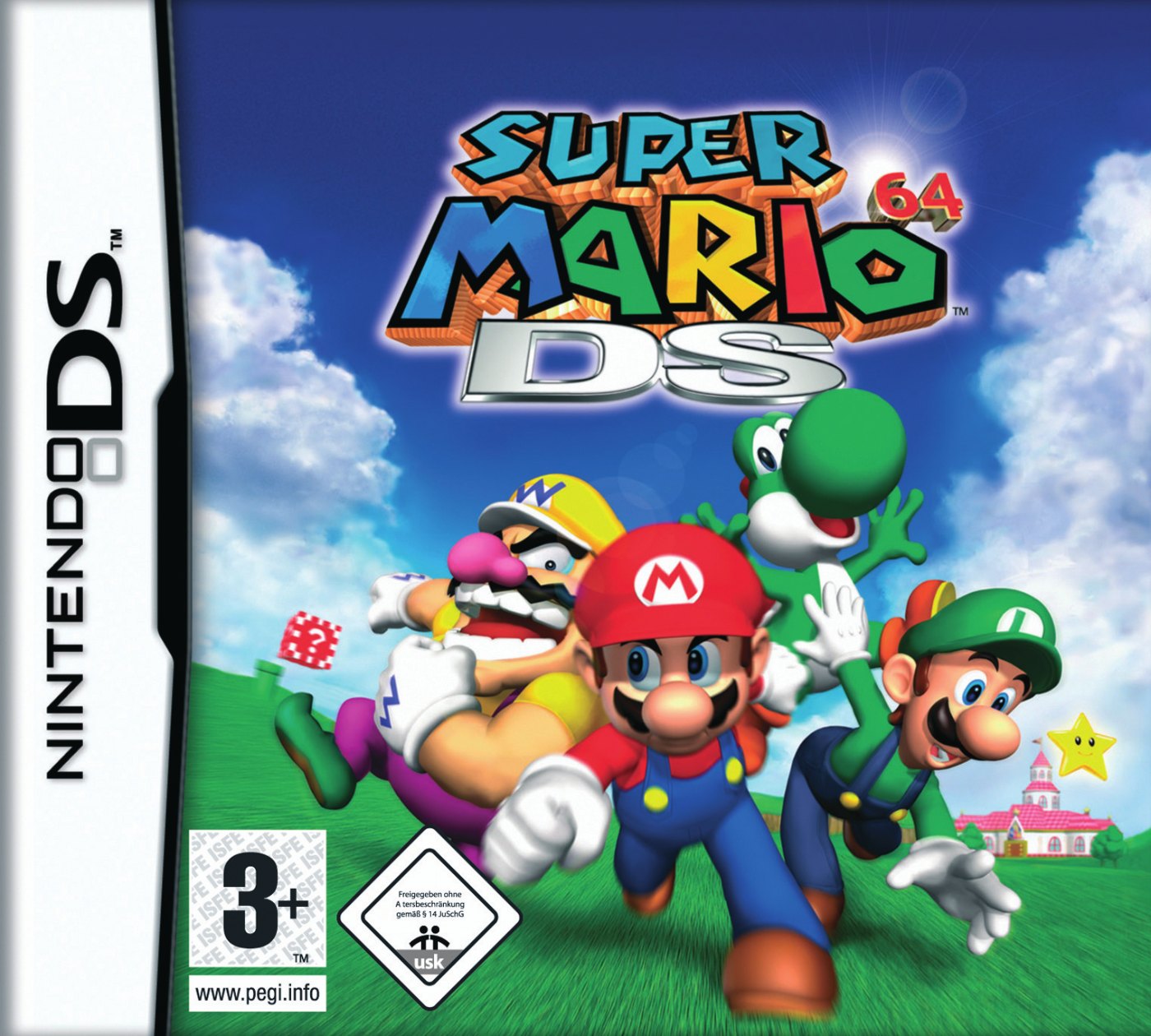
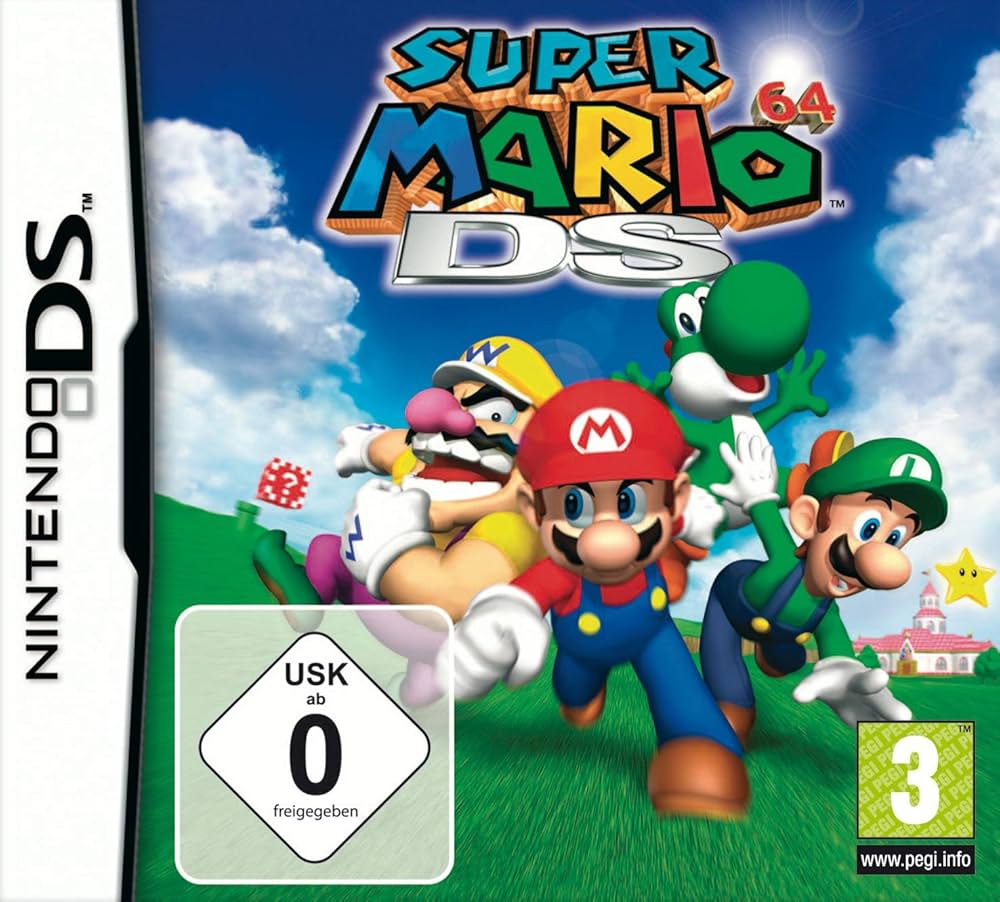
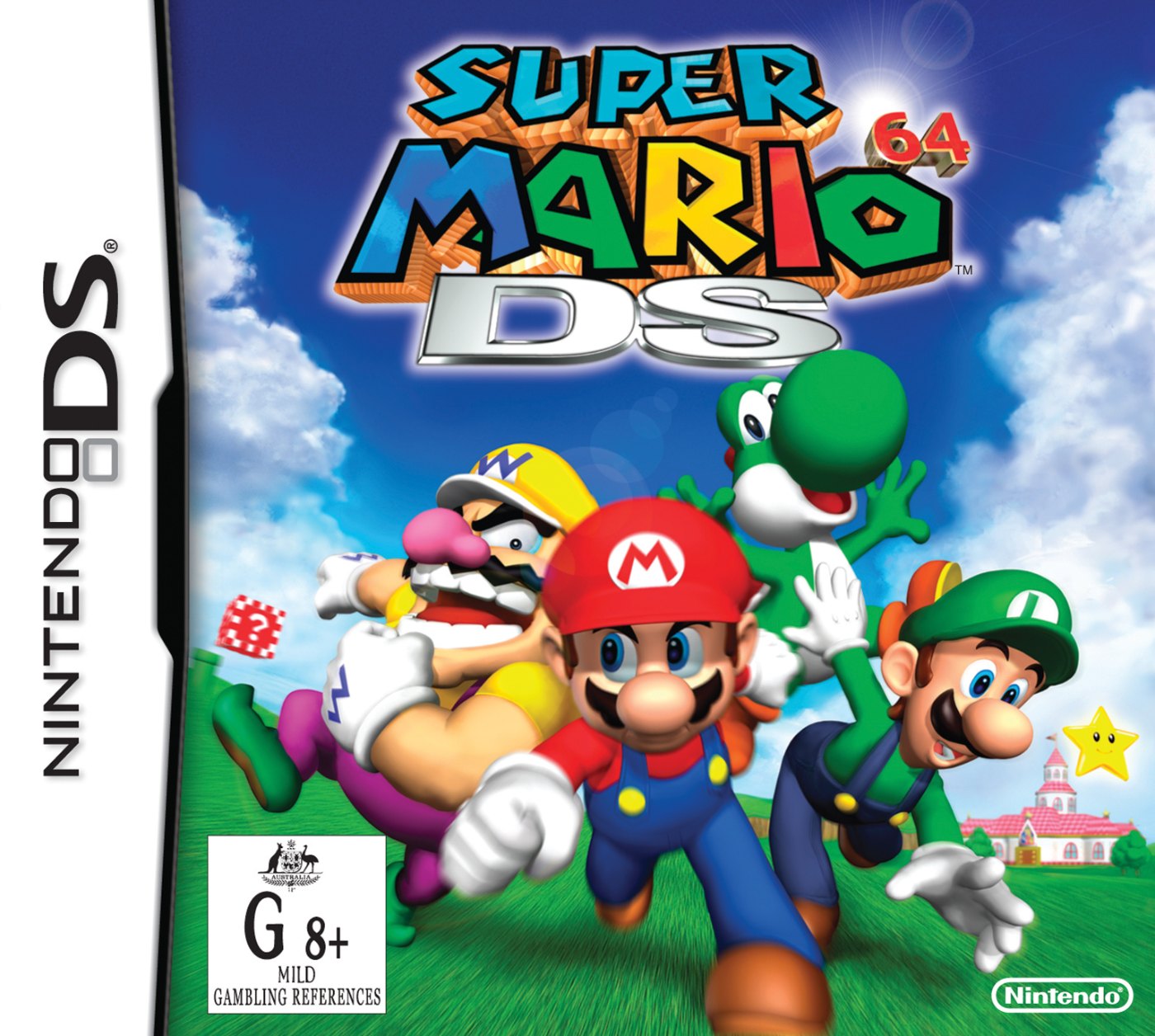
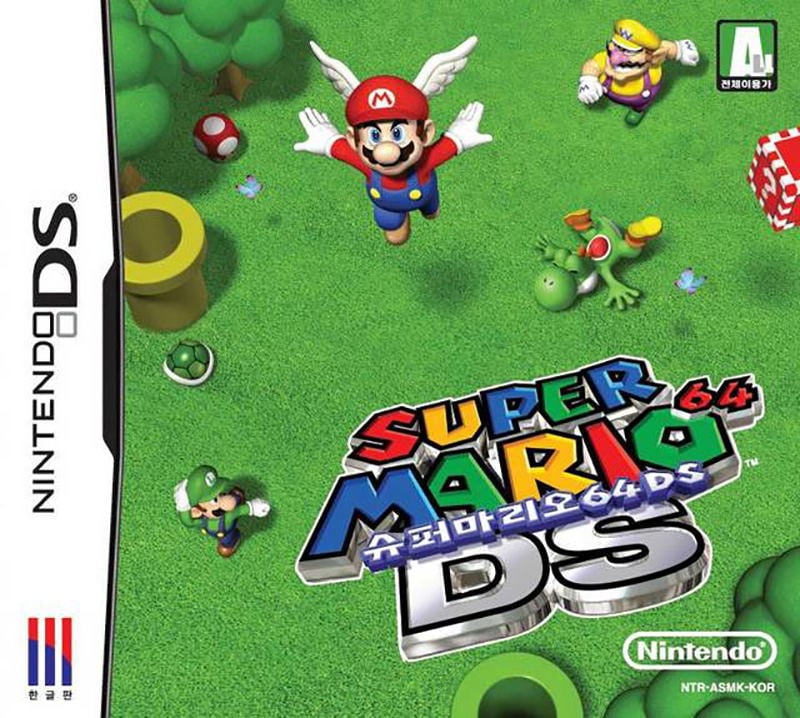
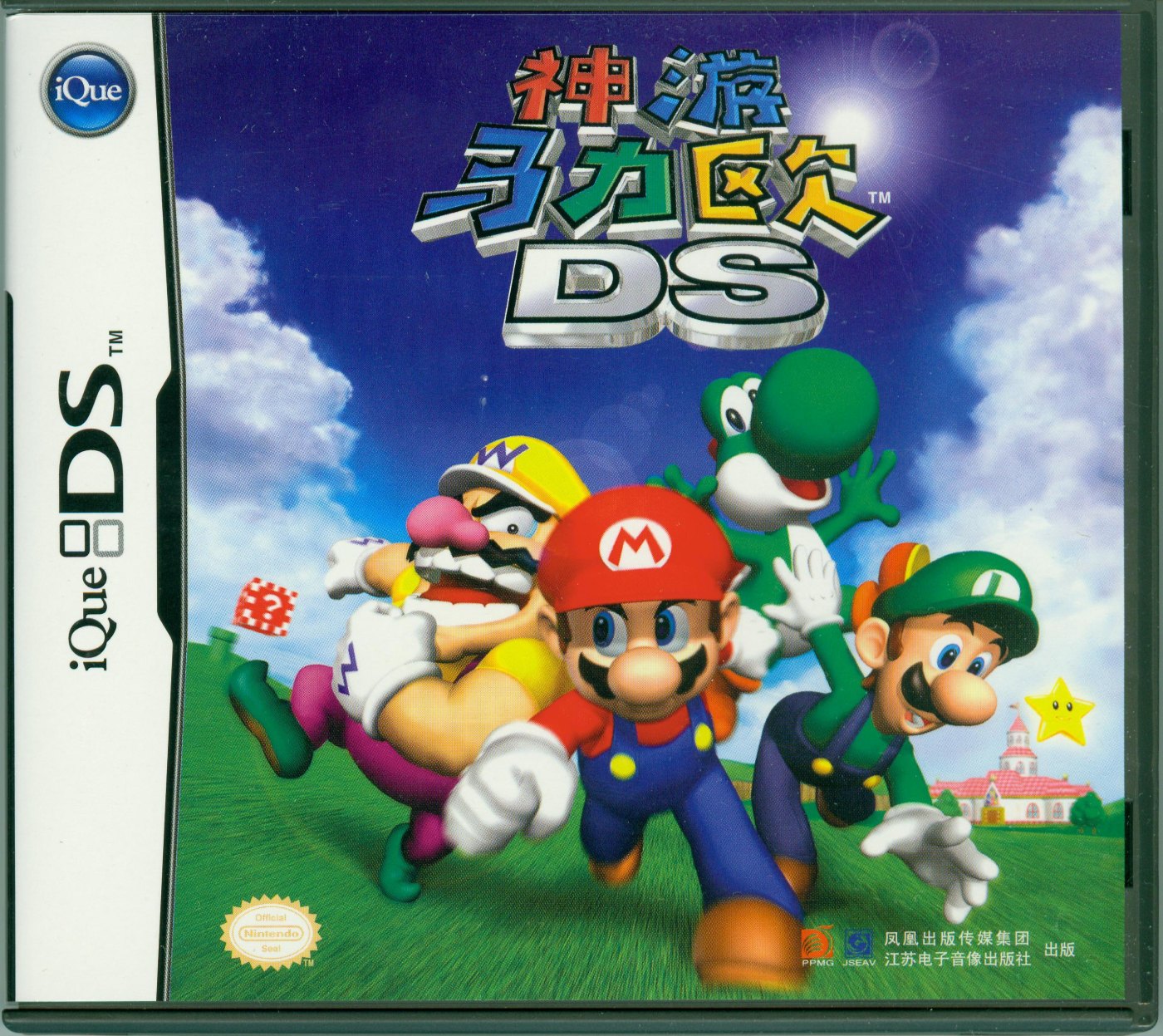
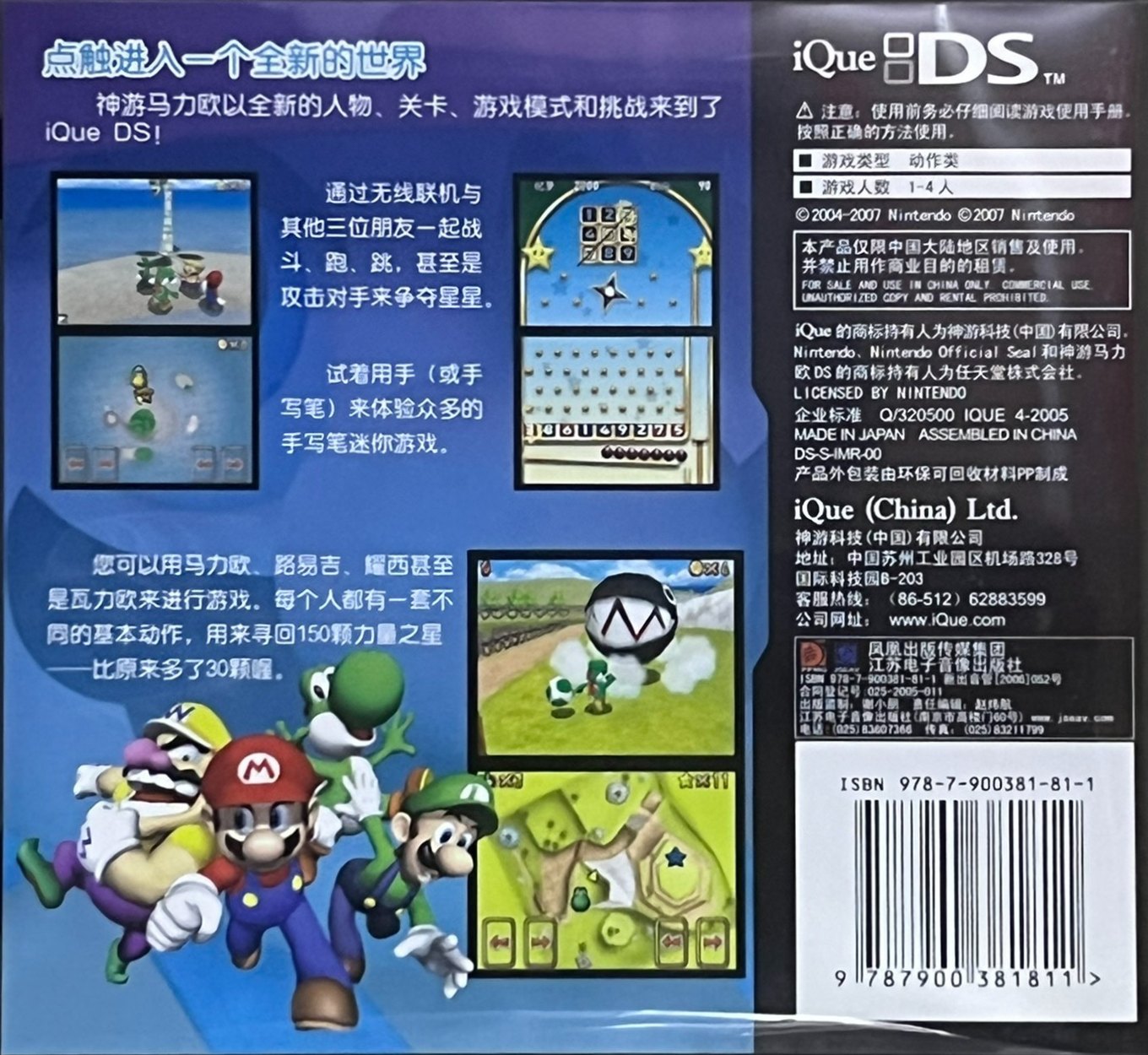
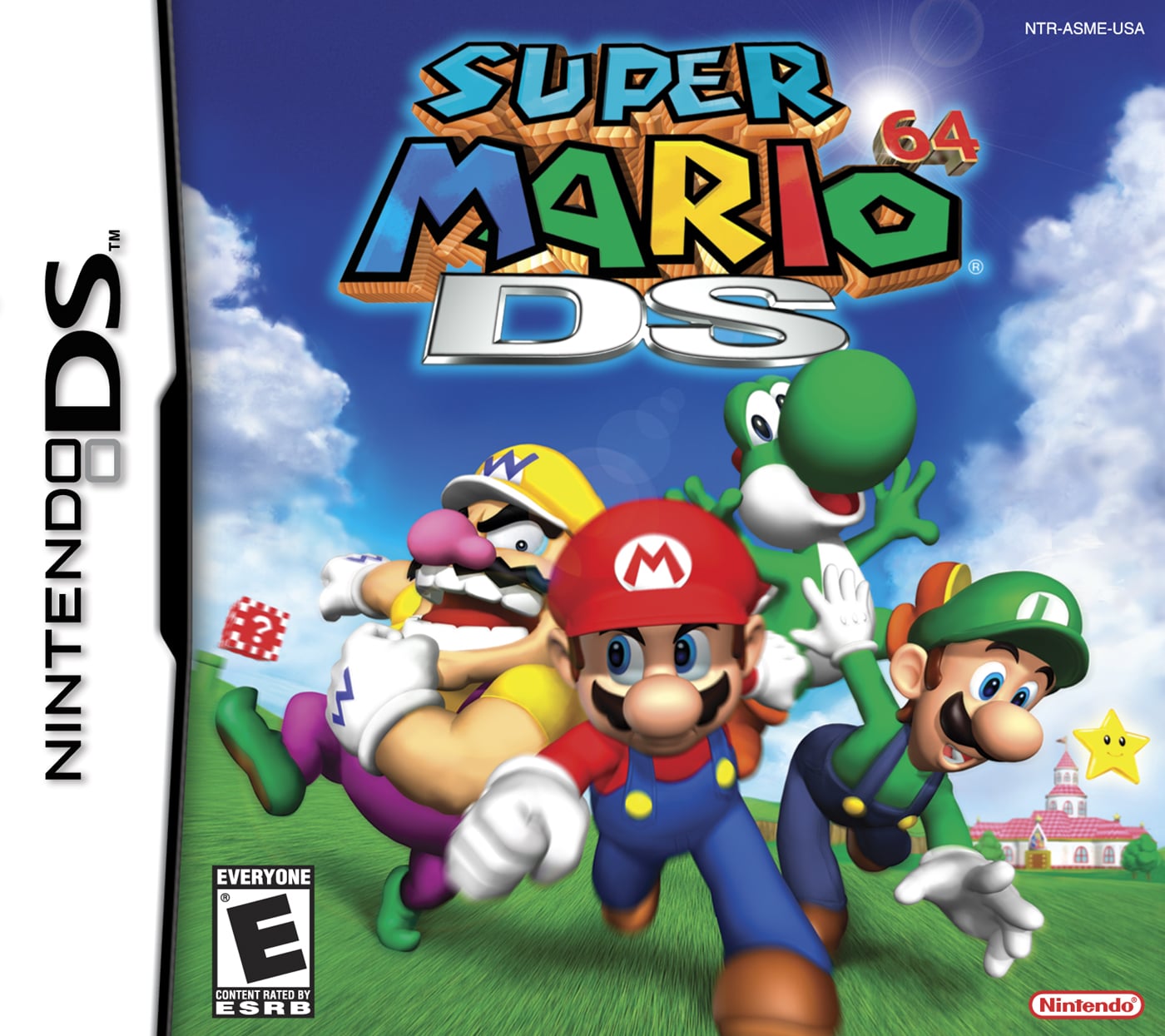
Wario, Mario, Yoshi and Luigi share the cover. Japan’s went through two earlier designs, Europe’s was reprinted with new rating marks in 2009, and China and South Korea got their own editions in 2007.
North America21 November 2004.North America (back)The reverse of the US case.North America (early)An unused early design.CanadaThe Canadian cover.Japan2 December 2004.Japan (back)The Japanese reverse.Japan (early)The first provisional Japanese cover.Japan (second early design)Closer to the final layout.Europe11 March 2005.Europe (back, English)The reverse of the UK case.Europe (2009 reprint)With the newer PEGI mark.GermanyThe original German cover.Germany (later reprint)With post-2009 USK and PEGI marks.Australia and New Zealand24 February 2005.South Korea26 July 2007.China (iQue)21 June 2007.China (back)The reverse of the iQue box.
Screenshots
Around the castle and its paintings on a 256 by 192 screen.
Luigi turns up on the title screen if you keep tapping.The moat, drained.The aquarium room outside Jolly Roger Bay.The Whomp King, crown and all.The Cool, Cool Mountain slide.A Big Boo in the haunted house.The Big Bully of Lethal Lava Land.Eyerok, inside the pyramid.The Power Star beyond the mirror.The hidden slide in Tall, Tall Mountain.Tiny-Huge Island, the tiny side.Wiggler.The clock room at the foot of the endless stairs.Mario swings Bowser by the tail.
Artwork & Media Gallery
Logos, artwork, minigames, maps and pre-release material from Super Mario 64 DS. Select any image to view it larger.
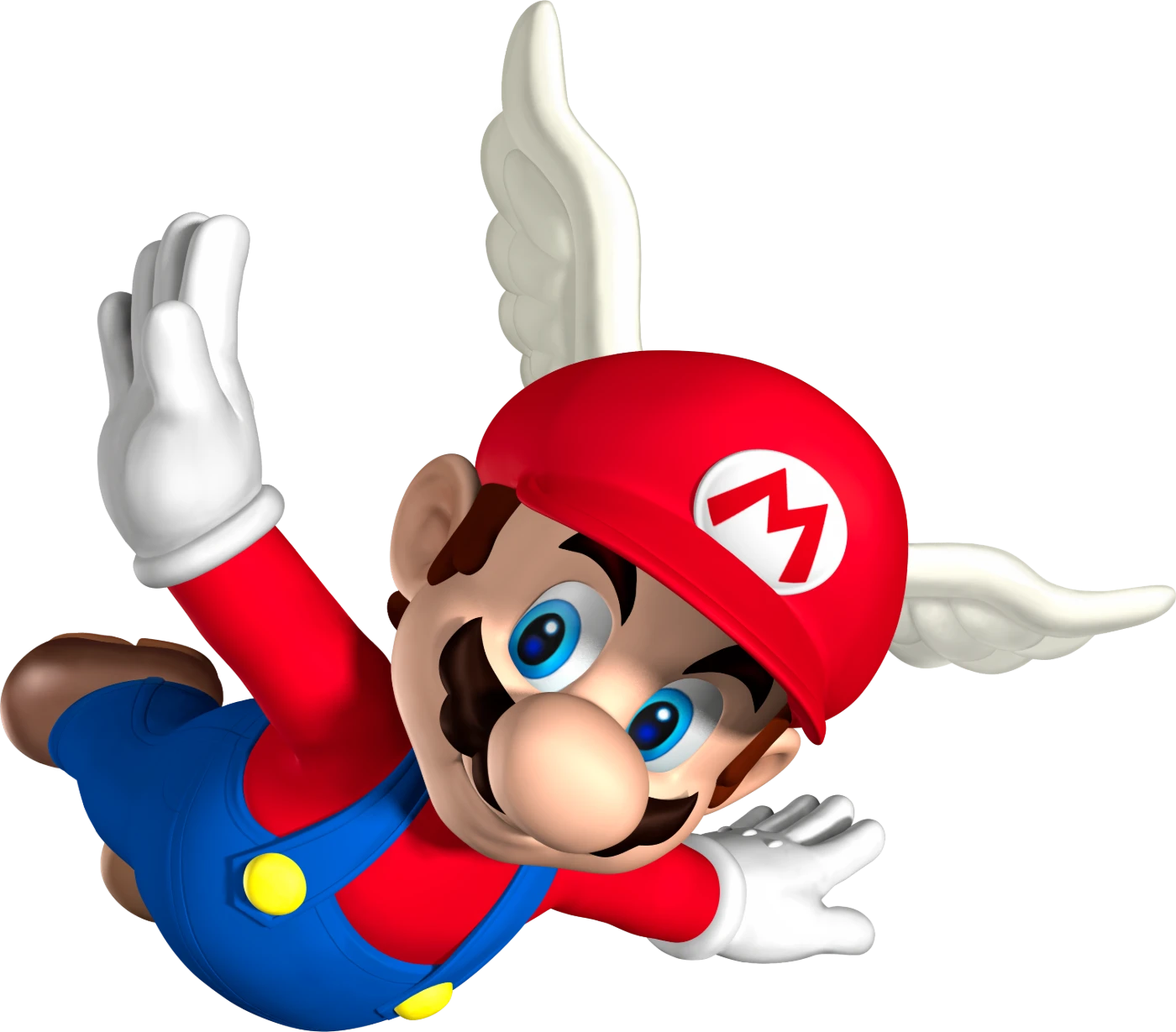
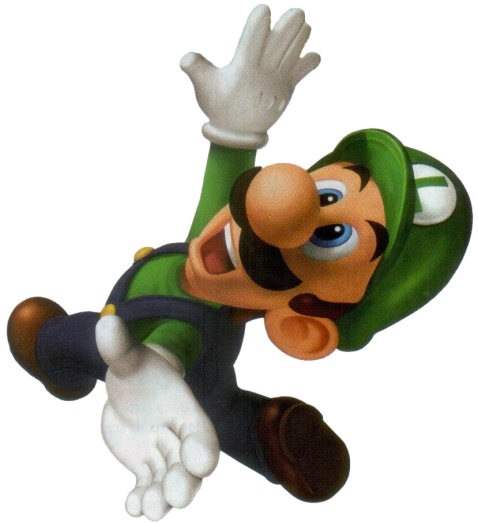
The international logo.The Japanese logo, with its multicoloured “Super”.The Korean logo.The Chinese logo.Wing Mario.Luigi.The Mario painting that leads to Goomboss Battle.The Luigi painting.The Wario painting.Touch Screen map: the castle’s first floor.Touch Screen map: the castle grounds.Touch Screen map: Goomboss Battle.Luigi’s Wanted! poster.Wario’s Wanted! poster.Loves Me…?Hide and Boo Seek.Mario’s Slides.Shell Smash.Mushroom Roulette.Mario Slot.Snowball Slalom.Lakitu Launch.Early publicity shot: all four heroes in flight.Early build: the map shows a moat on all four sides of the castle.Yoshi in a pre-release Jolly Roger Bay, with different Touch Screen icons.Mexican print advert.Brazilian print advert.The title screen of the Chinese version.The game’s icon on the DS menu.
Legacy & Re-releases
Super Mario 64 DS sold almost as many copies as the game it remade, and then Nintendo more or less left it where it was.
Releases and re-releases
Nintendo DS2004–2005North America 21 November 2004 and Japan 2 December 2004, both on the console’s launch day; Australia 24 February 2005; Europe 11 March 2005.
Revised versionsNovember 2004A first revision in North America (built 5 November 2004) and Japan (9 November) fixed several freezes and exploits.
United States bundleJune 2005Nintendo announced a DS hardware bundle with the game for the US market.
iQue (China)21 June 2007A Simplified Chinese edition from Nintendo’s Chinese partner.
South Korea26 July 2007A Korean edition with the Rec Room and its minigames removed.
Red-case reissue2011Repackaged in the United States alongside the DS’s price drop to $99.
Wii U Virtual Console2015–2016Europe and Australia 24 December 2015, Japan 6 January 2016, North America 25 August 2016. Rated PEGI 12 in Europe. VS mode can only be played alone, as there is no Download Play.
The other Super Mario 64
For a few years this was the version of Super Mario 64 on shop shelves, and plenty of players met the castle for the first time as Yoshi. But when Nintendo has gone back to the game since, it has gone back to the original. The Wii and Wii U Virtual Console, Super Mario 3D All-Stars on Switch in 2020 and the Nintendo Switch Online library in 2021 all carry the N64 code, with its single hero and 120 stars. The remake’s extra characters, courses and thirty stars have never left the DS and its one Wii U reissue.
Opinion on it has settled into two camps. One holds that the additions make it the fuller game; the other that Super Mario 64 was built around an analogue stick and a D-pad was never going to do. Nintendo Life’s retrospective in 2015 managed both: wonderful to be able to play Super Mario 64 on the go, it said, but “no substitute for the sublime analogue controls on the N64 version”. Fans have since produced a modification that adds true analogue control when the game is played through an emulator.
What it started
The Rec Room outlived the game it was built for: its minigames reappeared in New Super Mario Bros. in 2006, and one of them grew into a mode of Wii Play. Goomboss went on to Mario Kart DS. And the question the remake raised, of how to play a 3D Mario on a handheld with no stick, was eventually answered by hardware: the 3DS arrived with a Circle Pad, and Super Mario 3D Land was designed around it.
Reviews & Sales
Sales figures
As the game to buy with a new DS, it sold steadily for years. In Japan it had reached 241,000 copies by 19 December 2004, a little over a fortnight after launch, and 639,000 by 20 February 2005. In the United States it entered the NPD chart at number ten for November 2004, had sold 1.4 million by August 2006, over two million by the end of 2007 and 4.34 million by the end of May 2011. European sales passed a million in November 2006, and in the UK it was the best-selling DS game of June 2005.
Nintendo’s final published figure, as of 31 March 2018, is 11.06 million copies worldwide, which makes it the tenth best-selling Nintendo DS game. For comparison, the Nintendo 64 original sold 11.91 million.
11.06mworldwide (Nintendo, March 2018)
10thbest-selling Nintendo DS game
4.34mUnited States, to May 2011
639kJapan, to 20 February 2005
1m+Europe, by November 2006
85Metacritic, 54 reviews
Reception and review scores
Metacritic’s average is 85 from 54 reviews, the highest of any DS game released in 2004, and GameRankings closed on 86.31 per cent. Scores below are from the review tables on Wikipedia and Super Mario Wiki.
The verdict in 2004 was that a great game had survived the move and gained from it. IGN’s Craig Harris thought the feel of the original was intact and the new material gave it legs; GameSpot’s Jeff Gerstmann called it “a great update of a classic game” and admired the graphics and frame rate; GameSpy’s Phil Theobald found that the design held up nearly a decade on and praised the minigames and the extra stars. Eurogamer’s Kristan Reed found that “the DS more than lives up to expectations”, and Edge judged the changes to run “from harmless bonuses to genuine improvements”.
The reservations were nearly all about control. Theobald called it tricky without an analogue stick, Harris missed the physical feedback when using the Touch Screen, and Retro Gamer later wrote that the controls kept the remake from the heights of the original. The VS mode was thought slight: “uneventful” to Gerstmann, a diversion to Theobald. Play’s Michael Hobbs enjoyed it and wondered aloud why the DS had not been given a new Mario. The harshest notice came from 1UP’s Jeremy Parish, who called it “a poorly-conceived port of an otherwise good game”, and Edge, looking back in 2006, felt it had been a poor demonstration of what the DS could do.
Honours
Interactive Achievement Awards · 8th annualWireless Game of the YearWinner, and a nominee for Handheld Game of the Year.
Golden Joystick Awards · 2005Best Handheld GameWinner.
GameSpy · 2004Best of Nintendo DSIn its end-of-year awards.
IGN · November 2004Game of the MonthWith an Editors’ Choice award.
SLB User Reviews
Super Mario 64 DS has yet to receive a community review on Super Luigi Bros.
If you’ve played Super Mario 64 DS and would like to submit a review, please get in touch.
To provide the best experiences, we use technologies like cookies to store and/or access device information. Consenting to these technologies will allow us to process data such as browsing behavior or unique IDs on this site. Not consenting or withdrawing consent, may adversely affect certain features and functions.
Functional
Always active
The technical storage or access is strictly necessary for the legitimate purpose of enabling the use of a specific service explicitly requested by the subscriber or user, or for the sole purpose of carrying out the transmission of a communication over an electronic communications network.
Preferences
The technical storage or access is necessary for the legitimate purpose of storing preferences that are not requested by the subscriber or user.
Statistics
The technical storage or access that is used exclusively for statistical purposes.The technical storage or access that is used exclusively for anonymous statistical purposes. Without a subpoena, voluntary compliance on the part of your Internet Service Provider, or additional records from a third party, information stored or retrieved for this purpose alone cannot usually be used to identify you.
Marketing
The technical storage or access is required to create user profiles to send advertising, or to track the user on a website or across several websites for similar marketing purposes.

 1. Bob-omb BattlefieldGround floor · open once Yoshi has the door key · boss Big Bob-omb, twiceNew: 5 Silver Stars!, which replaces Shoot to the Island in the Sky, and Big Bob-omb’s Revenge, a rematch for anyone wearing a cap. The race with Koopa the Quick is for Mario only.
 2. Whomp’s FortressGround floor · 1 star · boss Whomp KingNew: Switch Star of the Fortress, on an enlarged lower level with extra enemies. Being fired into the breakable wall no longer hurts.
 3. Jolly Roger BayGround floor · 3 starsNew: Switch Star of the Bay, for Luigi. Through the Jet Stream is now a job for Metal Wario.
 4. Cool, Cool MountainGround floor · 3 starsNew: Switch Star of Cool, Cool Mountain. The pond has frozen over and Wario must ground pound through the ice to the star beneath.
 5. Big Boo’s HauntCourtyard · 15 stars and Goomboss beaten · bosses Big Boo and Big Mr. IClosed to Yoshi. New: Switch Star in the Basement, for Wario. Eye to Eye in the Secret Room needs Luigi, and the top floor hides the way to Big Boo Battle.
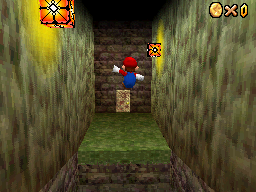 6. Hazy Maze CaveBasement · first Big KeyNew: Underground Switch Star. The old Metal Cap star is now Metal-Head Wario Can Move, and the poison in the maze knocks characters back.
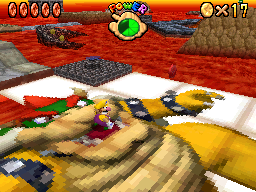 7. Lethal Lava LandBasement · first Big Key · boss Big BullyNew: Flaming Silver Stars.
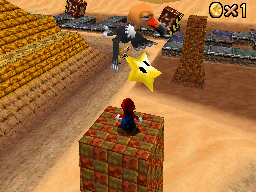 8. Shifting Sand LandBasement · first Big Key · boss EyerokNew: Tox Box Switch Star, for Wario. Pyramid Puzzle asks for Silver Stars instead of coins, and Wario needs only two punches for each of Eyerok’s hands.
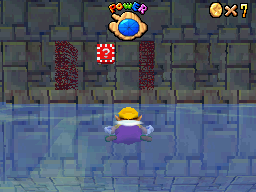 9. Dire, Dire DocksBasement · 30 starsNew: Koopa Surfin’ Switch Star, for Wario. Inside the Cage is Luigi’s, by way of his vanishing act.
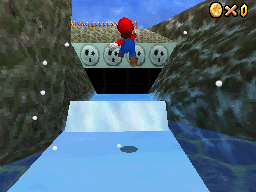 10. Snowman’s LandSecond floor · second Big Key · boss Chill BullyNew: Yoshi’s Ice Sculpture, which replaces In the Deep Freeze, and Snowman’s Silver Star. The igloo has been rebuilt and Into the Igloo needs Luigi; a Mr. Blizzard will make off with a dropped cap.
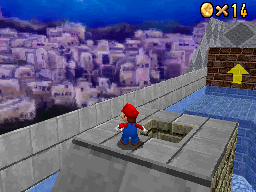 11. Wet-Dry WorldSecond floor · second Big KeyNew: Soaked Silver Stars. Quick Race Through Downtown! is for Luigi.
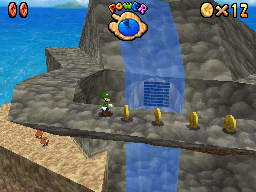 12. Tall, Tall MountainSecond floor · second Big KeyNew: 5 Secrets of the Mountain. Breathtaking View from the Bridge needs Wario.
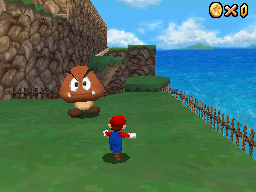 13. Tiny-Huge IslandSecond floor · second Big Key · bosses Piranha Flowers and WigglerNew: Switch Star on the Island, and Klepto the Condor, who flies in to replace Five Itty Bitty Secrets. The rematch with Koopa the Quick is Mario’s.
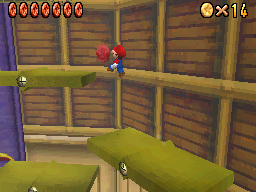 14. Tick Tock ClockThird floor · 50 starsNew: Tick Tock Silver Stars. Roll into the Cage has become Luigi in the Cage.
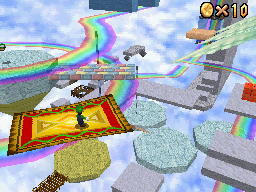 15. Rainbow RideThird floor · 50 starsNew: Switch Star of the Manor.
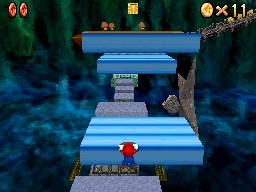 Bowser in the Dark WorldGround floor · 12 stars and Goomboss beaten · 2 stars + Big KeyUp from 8 stars on N64. A Switch Star joins the red-coin star. Yoshi cannot fight Bowser.
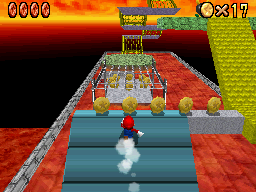 Bowser in the Fire SeaBasement · after Board Bowser’s Sub · 2 stars + Big KeyRed coins and a new Switch Star.
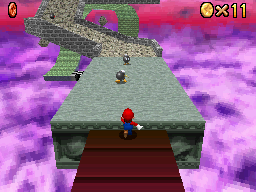 Bowser in the SkyEndless stairs · 80 stars · Mario only · 2 stars + Jumbo StarUp from 70 stars on N64. Red coins and a new Switch Star.
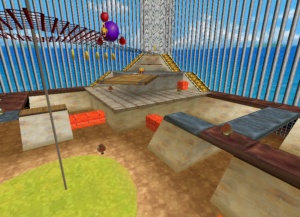 Battle Fort (new)Under three bricks in the courtyard · Goomboss beaten · 1 starA small fortress course with five Silver Stars. Not for Yoshi.
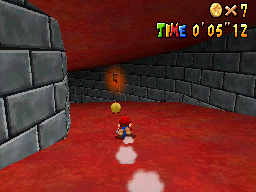 The Princess’s Secret SlideStained-glass window in the character room · 1 star to enter · 2 starsAs before, with a second star for finishing in 21 seconds or less.
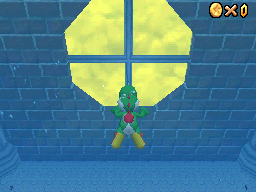 The Secret AquariumJolly Roger Bay room · 3 stars · 1 starEight red coins under water.
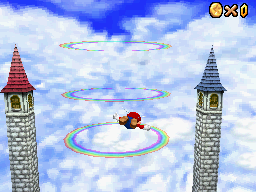 ? SwitchThe old Tower of the Wing Cap · 14 stars · Mario only · 1 starPress the switch to bring the red ? Blocks to life.
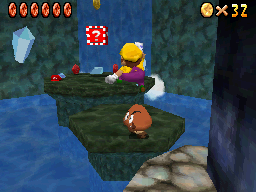 Behind the WaterfallThrough Hazy Maze Cave · 2 starsThe old Cavern of the Metal Cap, without its switch. Red coins, and a new star for Balloon Mario.
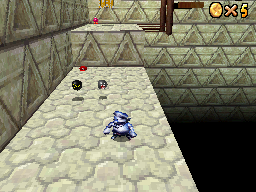 The Secret Under the MoatCastle grounds · Wario only · 2 starsThe old Vanish Cap course. Drain the moat, then have Wario break the Black Brick over the entrance.
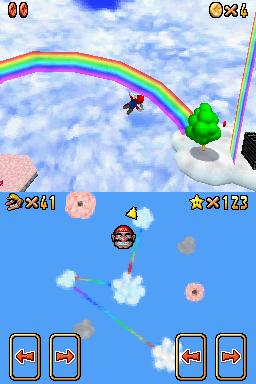 Over the RainbowsThird floor · 50 stars · 2 starsFormerly Wing Mario Over the Rainbow. Mario hops the clouds for the coins; Wario breaks a Black Brick for the new star.
 Mushroom CastleThe hub · 6 starsThree gifts from Toads, as before, plus three new stars: eight red coins around the castle, Through the Looking Glass for Luigi in the mirror room, and the one behind the white door for catching eight glowing rabbits.





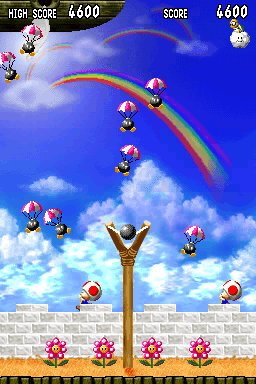
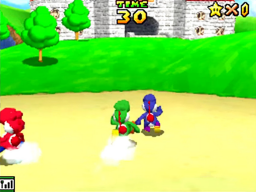
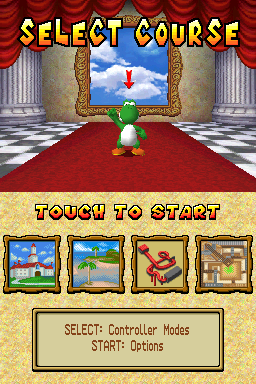
 Power Flower (new)From red ? Blocks. Balloon Mario, Vanish Luigi, Metal Wario or fire-breathing Yoshi, for a limited time.
 WingsA white feather from a ? Block makes Wing Mario for 60 seconds. Mario only, and it no longer saves him from fall damage.
 Super Mushroom (new)A few seconds as a giant who flattens most enemies. From the eighth victim onwards each one is a 1-Up.
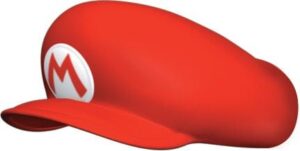 Mario’s capRed. Turns Yoshi, Luigi or Wario into Mario until it is knocked off.
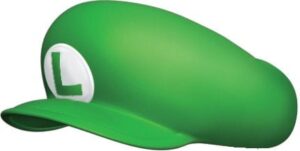 Luigi’s capGreen. Borrow Luigi’s jump, scuttle and invisibility.
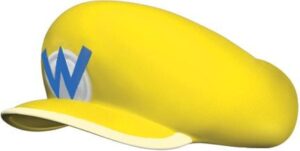 Wario’s capYellow. Borrow Wario’s strength and his metal form.
 Power Star150 to find. Eighty open the way to the last Bowser.
 Silver Star (new)Collect five to make a Power Star appear. A hit knocks one loose.
 Star Switch (new)Step on it and a star appears in a Star Sphere for a short time.
 Star Sphere (new)The glass ball that shows where a star will be.
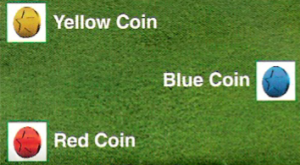 CoinsYellow (1), red (2, eight per course for a star) and blue (5). Each coin restores a wedge of health.
 1-Up MushroomAn extra life, now announced with orange 1UP text.
 Spinning HeartRun through it to refill the Power Meter.
 ? BlockRed ones hold Power Flowers and feathers once the ? Switch is pressed.
 ? SwitchIn the old Tower of the Wing Cap. One switch now does the job of the original’s three.
 Mario’s KeyDropped by Goomboss. Opens the M door.
 Luigi KeyDropped by King Boo. Opens the L door.
 Wario KeyDropped by Chief Chilly. Opens the W door.
 Big KeyWon from Bowser in the Dark World and the Fire Sea, for the basement and the upper floors.
 Yoshi EggMade from a swallowed enemy. It homes in on targets and can hit several in a row.
 Ice BlockMelted by Yoshi’s fire.
 CannonOpened by Bob-omb Buddies as before. The one in the castle grounds opens at 150 stars.

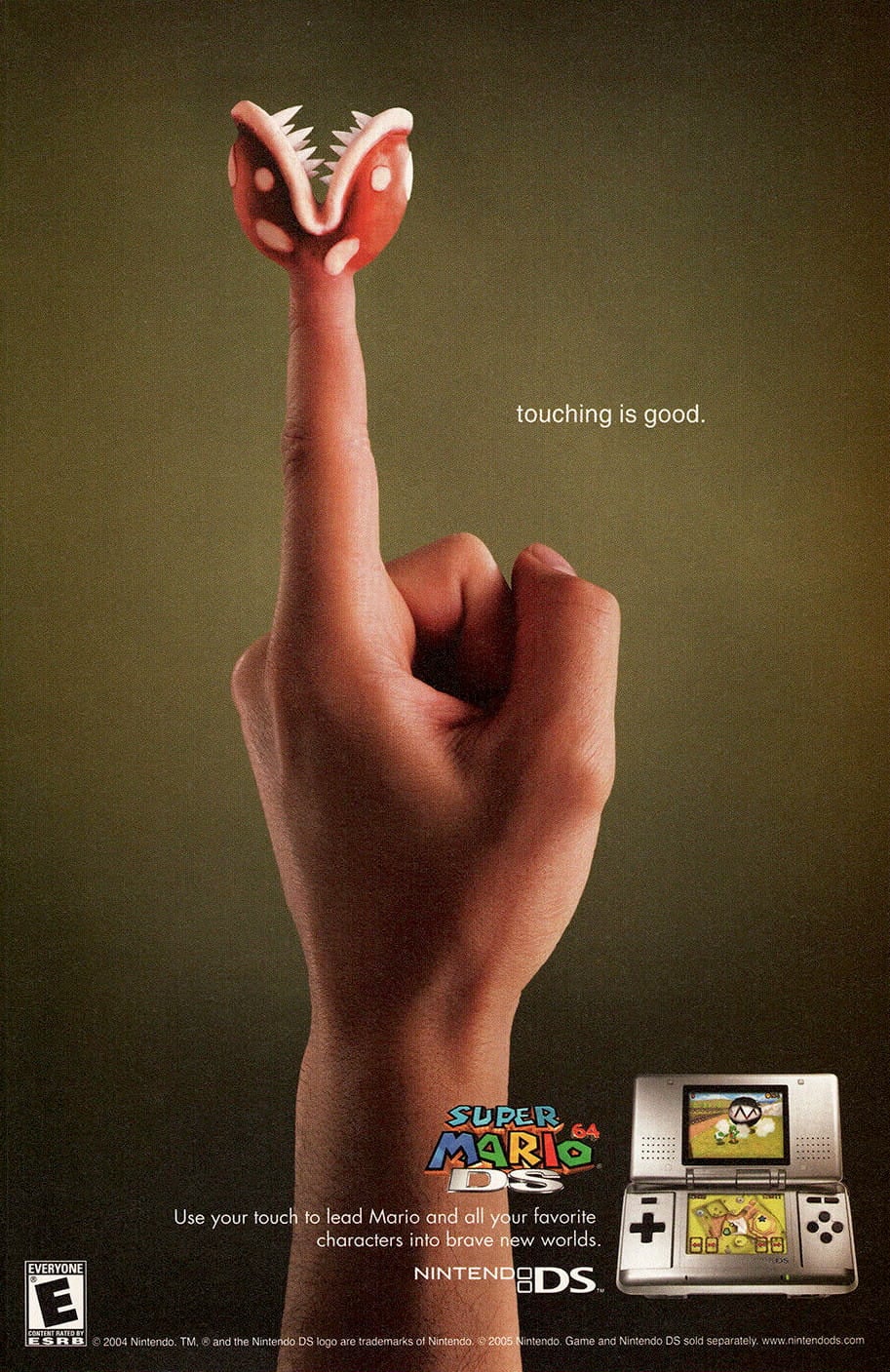 “Touching is good”Nintendo DS launch campaign · 2004The DS was sold in North America with the slogan “Touching is good”, a campaign by the agency Leo Burnett Worldwide that ran as 30-second television spots, magazine pages and online adverts, and this game was part of it. Print adverts for the game also ran in Mexico and Brazil.
 Nintendo World Touch! DSNintendo · Japan · November 2004Before the Japanese launch Nintendo took the DS on tour, with hands-on events in five cities where the public could try the game. The event’s website had its own version of the logo.
 Wii U Virtual ConsoleNintendo · 2015–2016The only re-release to date: Europe and Australia on 24 December 2015, Japan on 6 January 2016 and North America on 25 August 2016.
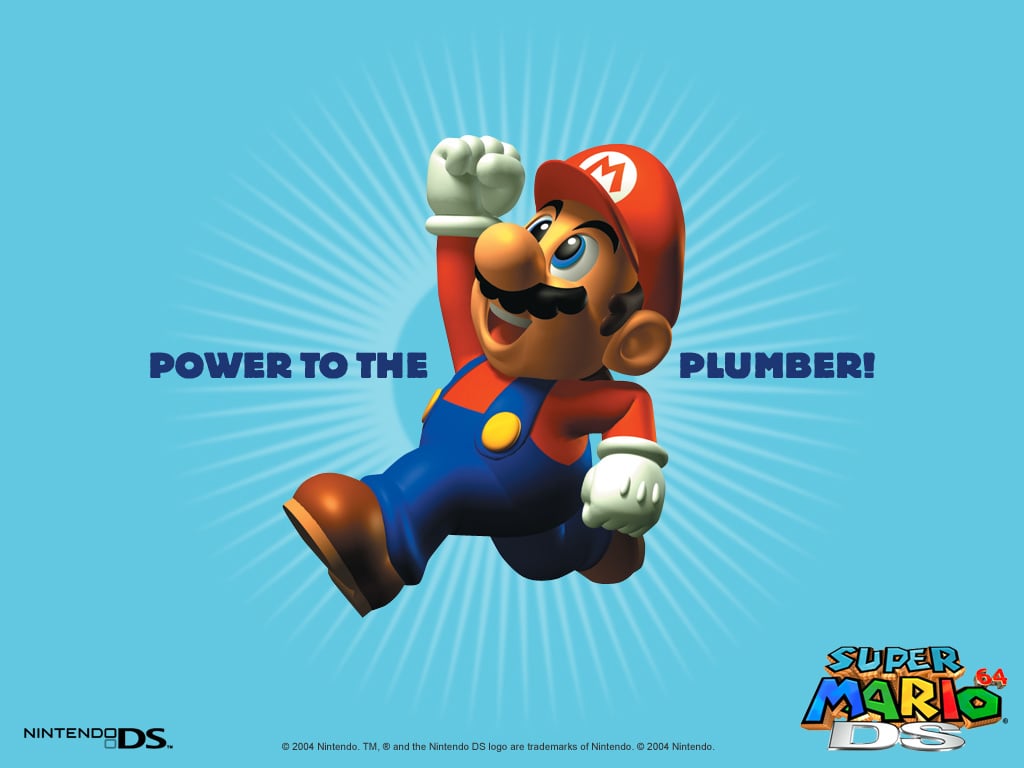 Wallpapers and web extrasmario.nintendo.comNintendo’s Mario website offered desktop wallpaper of the four heroes.
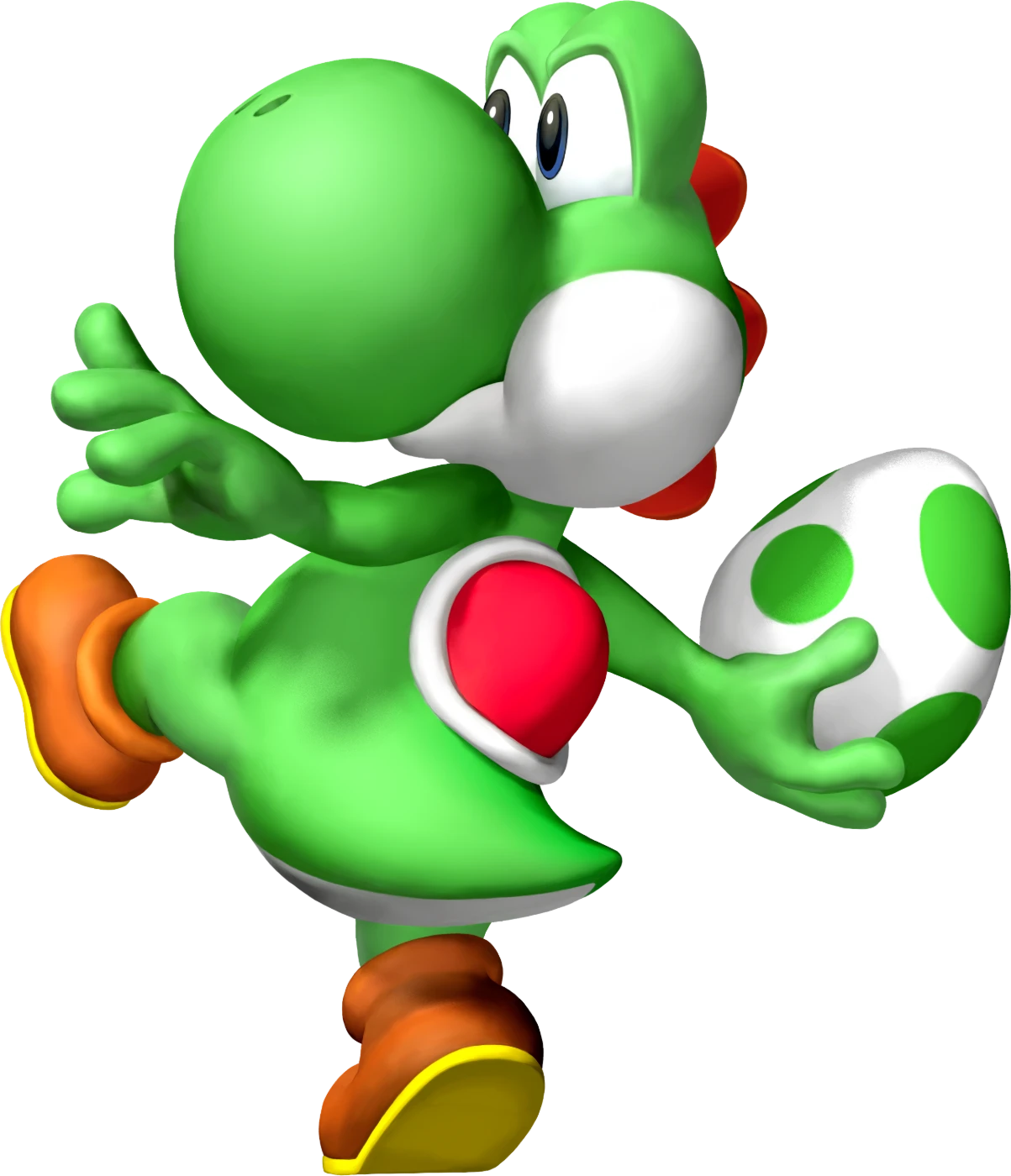 YoshiThe unexpected hero
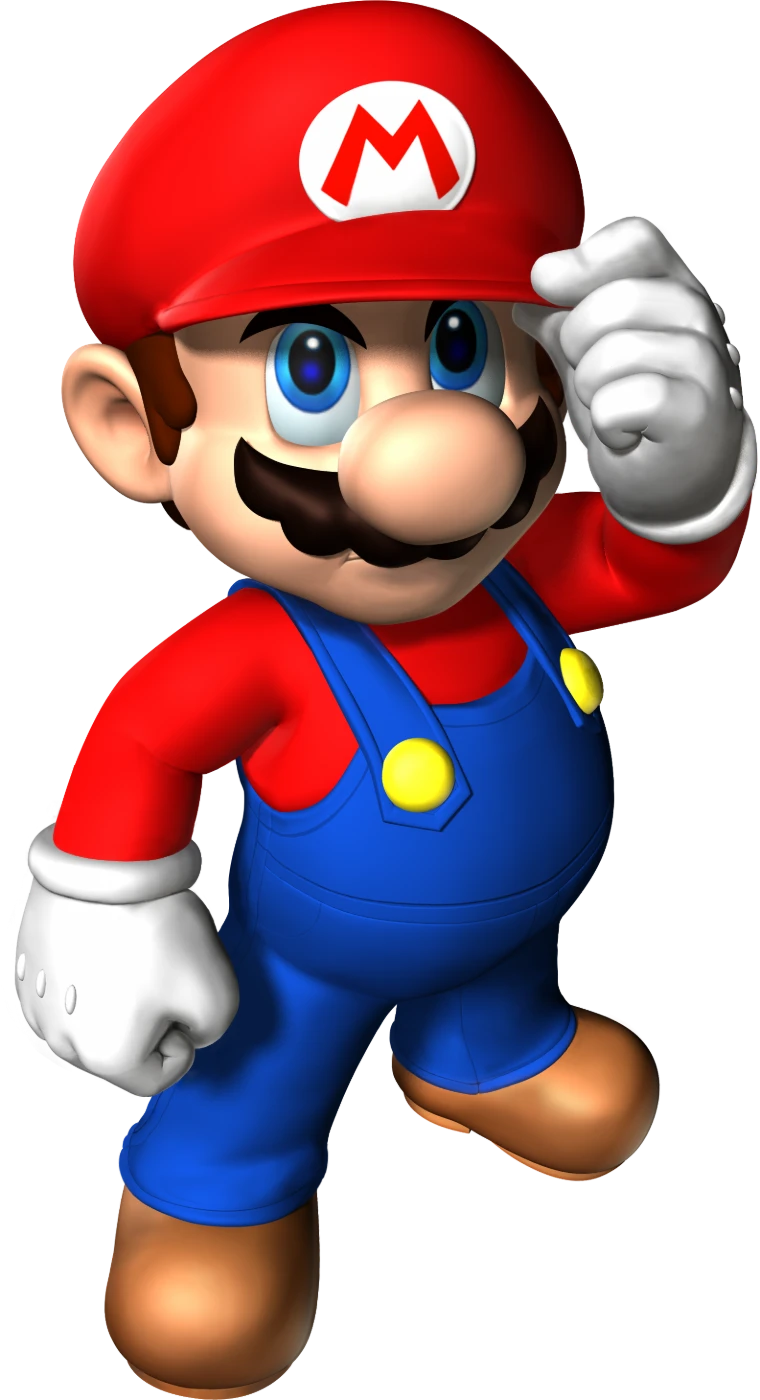 MarioThe all-rounder
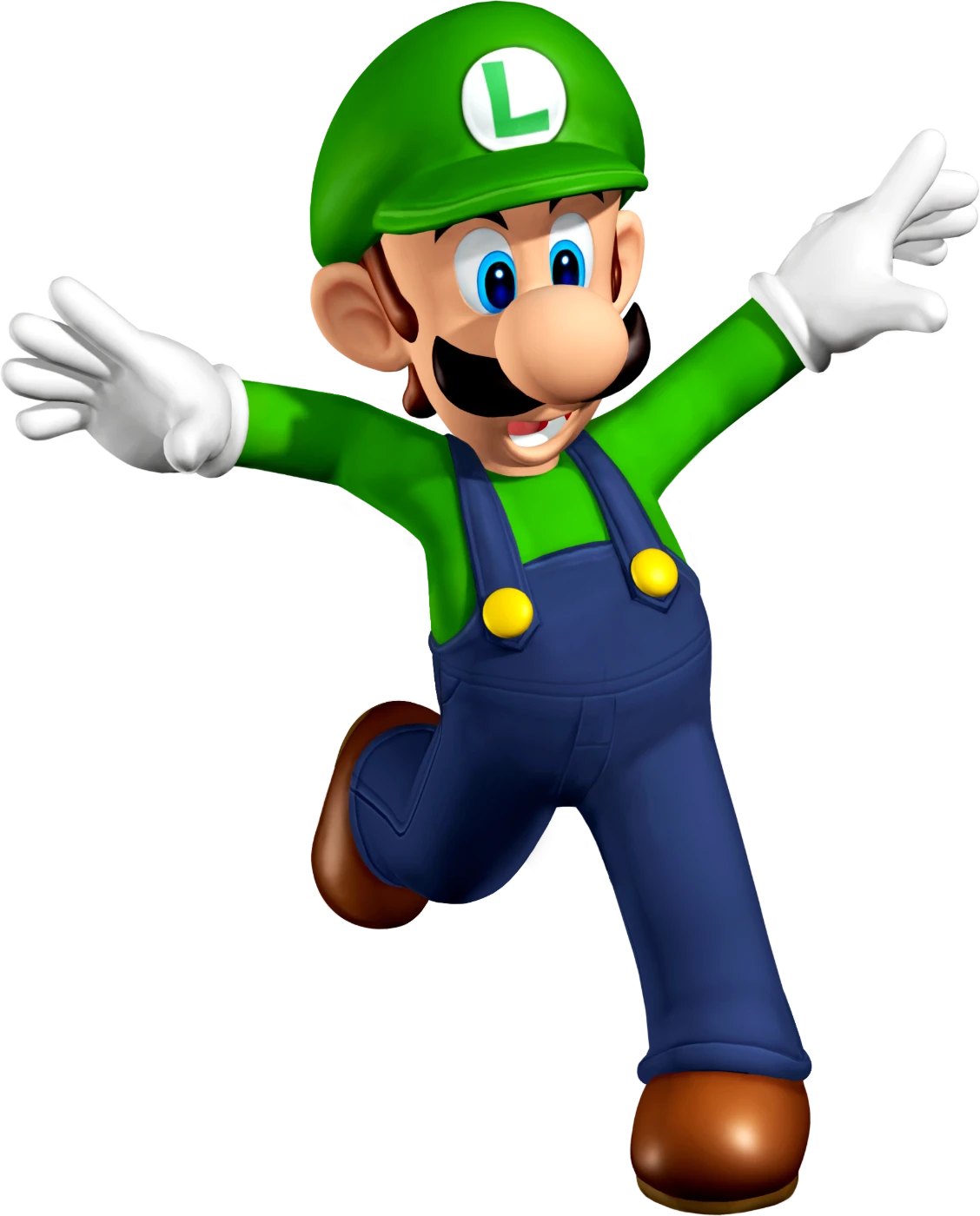 LuigiThe high flyer
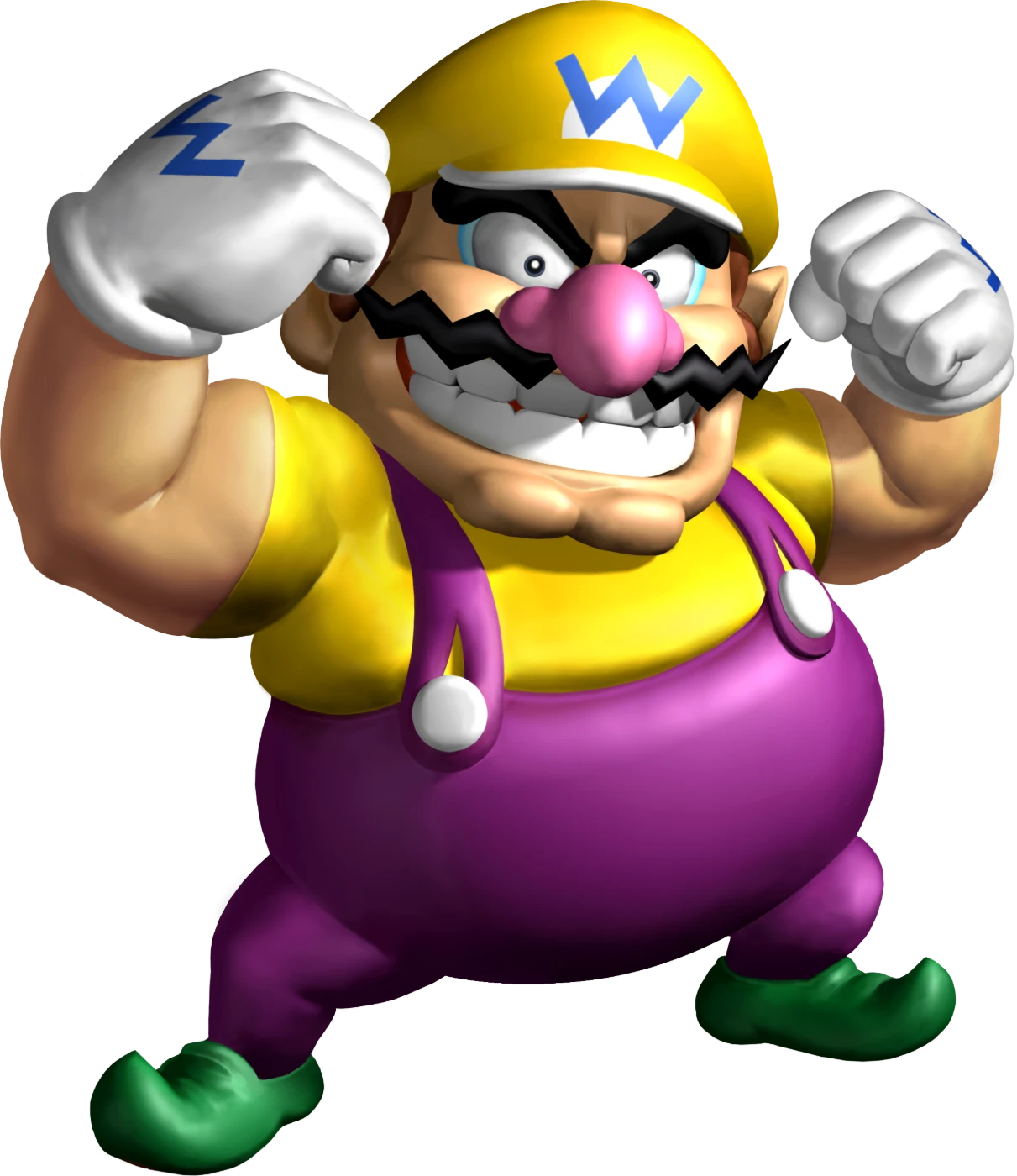 WarioThe heavyweight
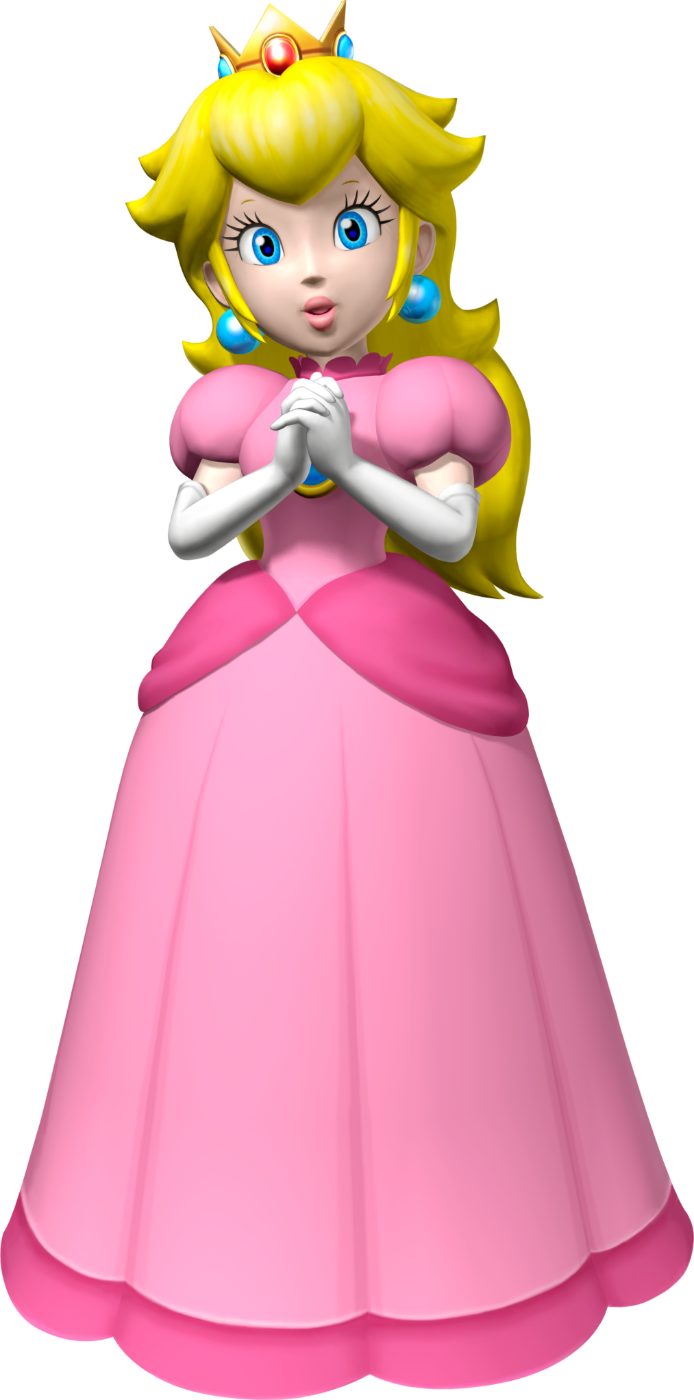 Princess PeachThe host
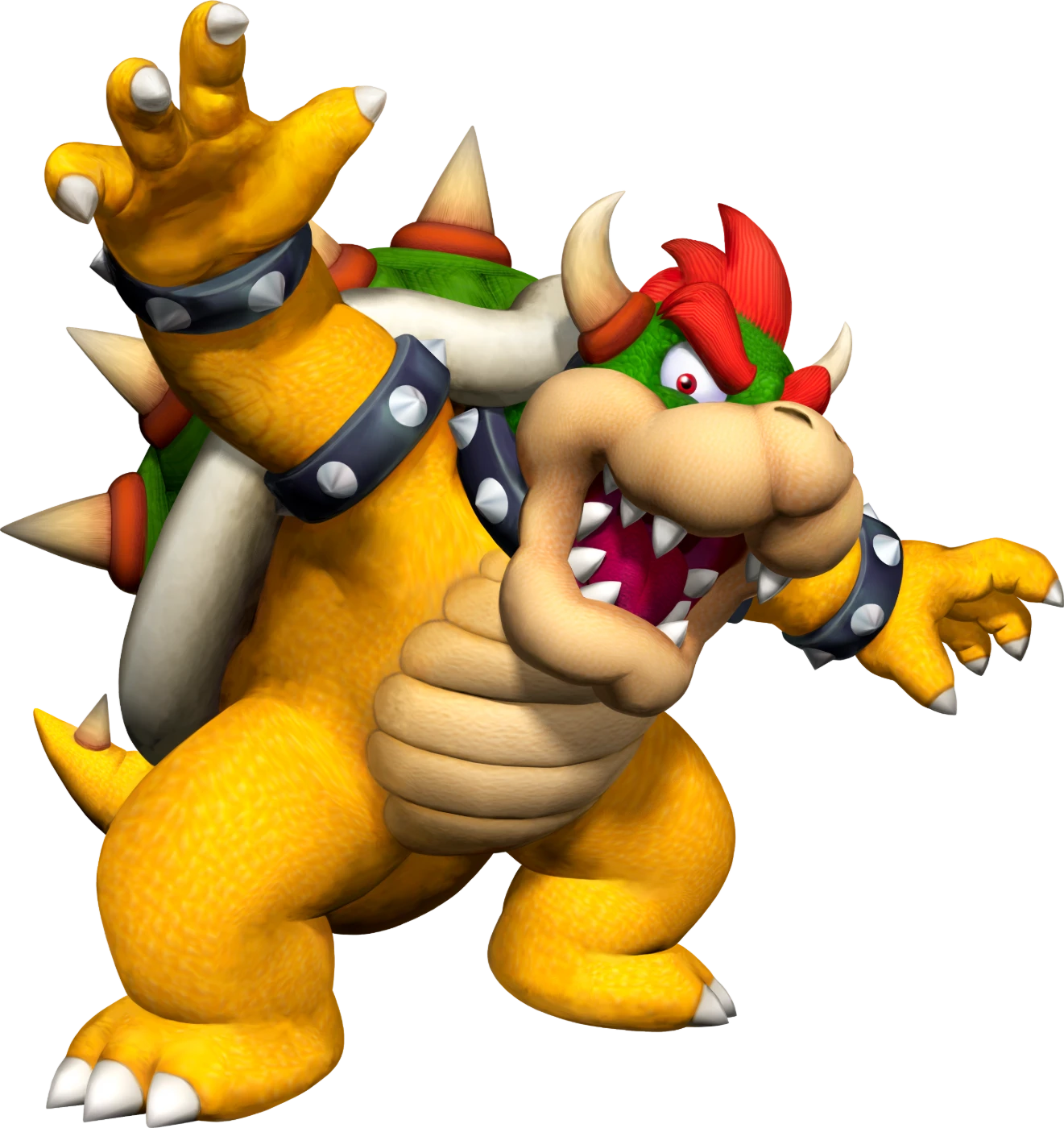 BowserKing of the Koopas
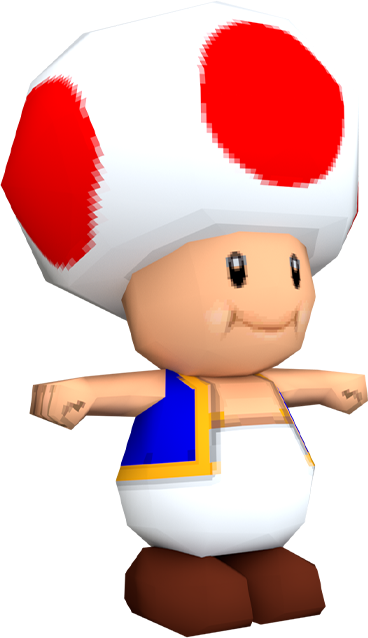 The ToadsCastle staff
 The Lakitu Bros.Camera crew
 The rabbitsMIPS’s replacements
 GoombossMario’s jailer
 King BooLuigi’s jailer
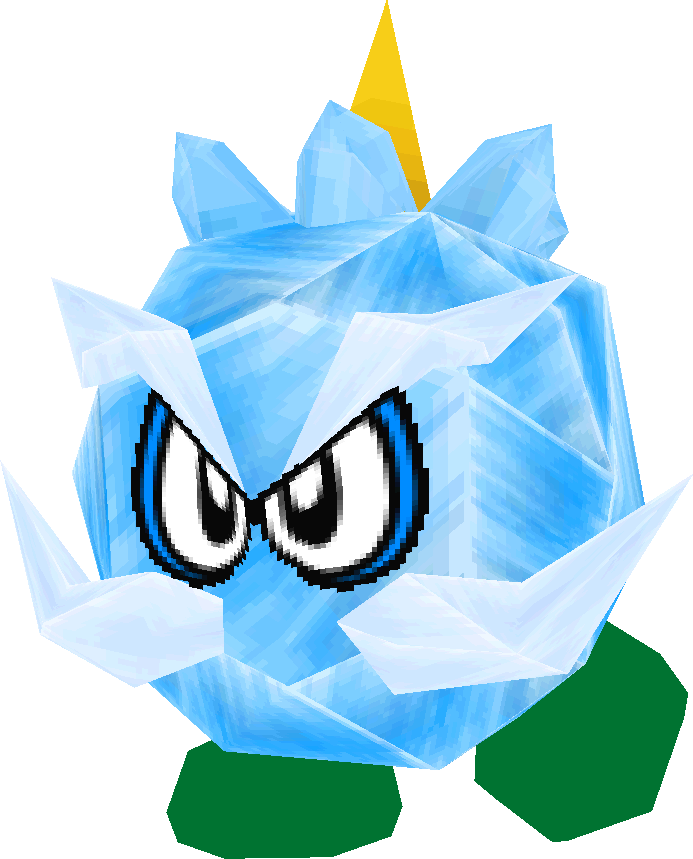 Chief ChillyWario’s jailer
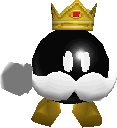 Big Bob-ombKing of the summit
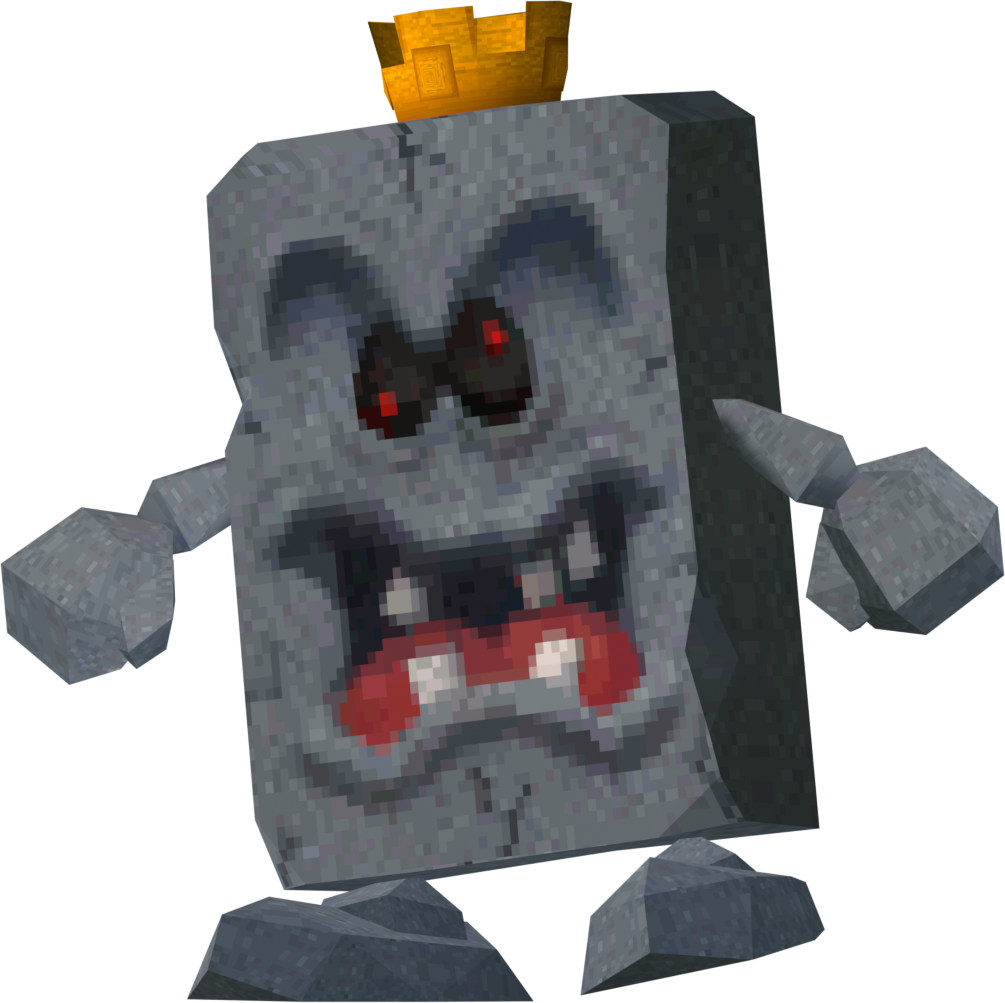 Whomp KingTop of the fortress
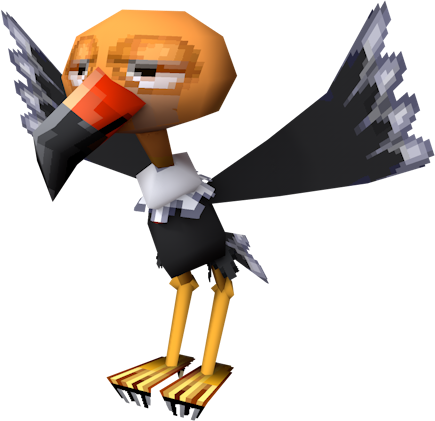 KleptoThe condor
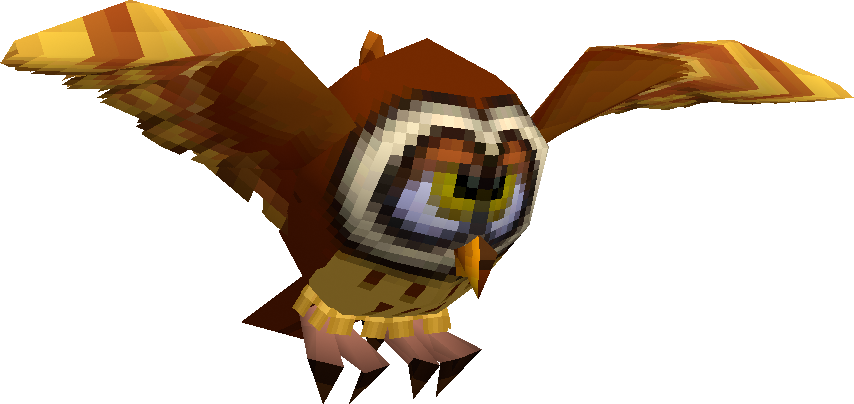 HootThe owl
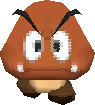 GoombaMost coursesYoshi’s staple diet and Goomboss’s ammunition. Some wear a hero’s cap.
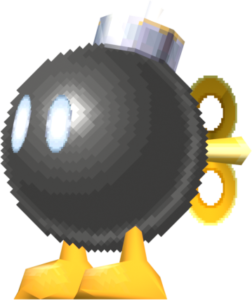 Bob-ombBob-omb Battlefield and elsewhereAlso pops out of a red ? Block if a capless hero hits it.
 Koopa TroopaBob-omb Battlefield, Tiny-Huge IslandRemodelled. A fully working red Koopa was left unused in the game’s code.
 Chain ChompBob-omb BattlefieldRedrawn, and added to the castle grounds arena in VS mode with a star at the end of its chain.
 BooCourtyard, Big Boo’s Haunt, Big Boo BattleRounder, with black eyes. Some carry caps. Yoshi’s ground pound will not hurt them.
 Mr. IBig Boo’s Haunt, Big Boo BattleThe giant eyeball. Run rings round it.
 BullyLethal Lava Land, Chief Chilly ChallengeShove it off the edge. Yoshi cannot swallow one.
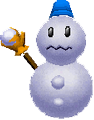 Mr. BlizzardSnow courses, Chief Chilly ChallengeNew zigzag mouth and bucket hat. In Snowman’s Land one will steal a dropped cap.
 Fly GuyVarious coursesSwallow one as Yoshi and he can spit fire.
 SnufitHazy Maze CaveA floating Snifit that spits bullets.
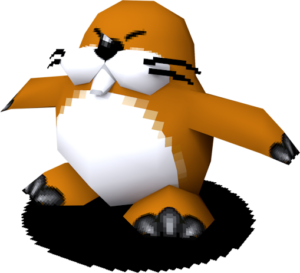 Monty MoleHazy Maze Cave, Tall, Tall MountainPops out of holes to throw rocks.
 UkkikiTall, Tall MountainThe monkey who makes off with caps.
 LakituGoomboss Battle and elsewhereCircles the pole in Goomboss Battle dropping Spiny Eggs.
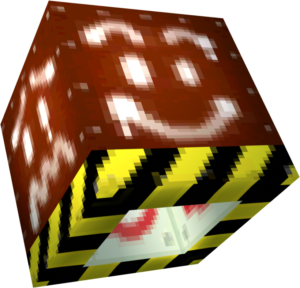 Tox BoxShifting Sand LandThe rolling cube with one hollow side. It has a Switch Star and a minigame named after it.
 AmpWet-Dry World, Tick Tock Clock, the pyramidElectric orbs. The homing pair in the original’s pyramid now just circle.
 Heave-HoWet-Dry World, Tick Tock ClockA wind-up robot that flips heroes into the air.
 ChuckyaSeveral coursesGrabs and throws. Grab it first.
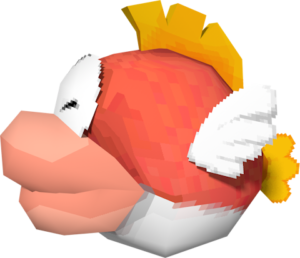 Bub and BubbaWater coursesFish in two sizes, both redesigned for the remake.
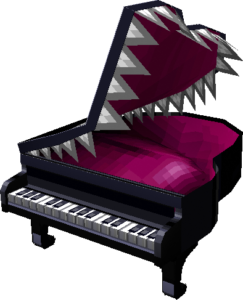 Mad PianoBig Boo’s HauntStill a piano. Still bites.
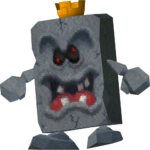 Whomp King (boss)Whomp’s FortressThree ground pounds on the back.
 Big Boo (boss)Courtyard and Big Boo’s HauntFought three times. Hit him from behind, three times each.
 Big Mr. I (boss)Big Boo’s Haunt, secret roomShoots blue flames. Circle him until he is dizzy.
 Big Bully (boss)Lethal Lava LandFought twice. Into the lava with him.
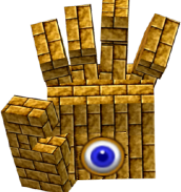 Eyerok (boss)Shifting Sand Land pyramidPunch the eye in each hand three times, or twice as Wario. Yoshi must ground pound, slide-kick or use fire.
 Chill Bully (boss)Snowman’s LandOne push into the freezing water.
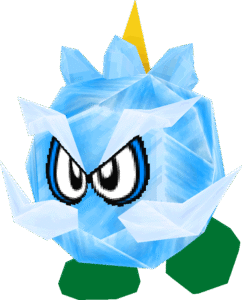 Chief Chilly (boss, new)Chief Chilly ChallengeThree duckings on a shrinking platform.
 Piranha Flowers (boss)Tiny-Huge IslandFive fire-breathing plants that rise as you approach. Punch each while it is up.
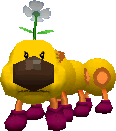 Wiggler (boss)Tiny-Huge IslandThree jumps on the head; he gets faster and redder after each.
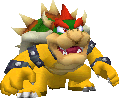 Bowser (boss)Dark World, Fire Sea, SkyBy the tail, into the spiked bombs: once, once, then three times.