Famicom · NES1983EducationalNintendo R&D2NES Educational SeriesNorth American NES launch gameBuilt from the Donkey Kong Jr. ROM1–2 players
Donkey Kong Jr. Math
Junior goes back to school. Donkey Kong Jr. Math takes the vines, chains and sprites of Donkey Kong Jr. and turns them into an arithmetic game: Donkey Kong holds up a sign with a number on it, and Junior has to climb about collecting digits and maths signs to make a sum that equals it. There are three modes, Calculate A, Calculate B and the +-×÷ Exercise, and the first two can be played as a race between two players, the second one controlling a pink Junior. Made by Nintendo R&D2, with Toshihiko Nakago among its makers, it came out on the Famicom in Japan on 12 December 1983 and was one of the games in the North American launch line-up of the NES on 18 October 1985, as the only release in Nintendo’s Educational Series. It is not fondly remembered: critics have queued up to call it one of the weakest games of the NES era. Yet Nintendo has kept it in circulation, on the Wii and Wii U Virtual Consoles and, since July 2024, in Nintendo Switch Online.
Developer:Nintendo R&D2
Publisher:Nintendo
Platforms:Famicom; NES; Virtual Console (Wii, Wii U); Nintendo Switch Online
Genre:Educational (arithmetic)
Japan:12 December 1983 (Famicom, as Donkey Kong Jr. no Sansū Asobi)
N. America:18 October 1985 (NES launch line-up)
Europe:1 September 1986
Players:1–2 (two at once in the Calculate modes)
Modes:Calculate A, Calculate B, +-×÷ Exercise
Designer:Toshihiko Nakago (Wikipedia)
Music:Yukio Kaneoka (Wikipedia); title tune shared with Popeye no Eigo Asobi
Series label:Educational Series (North America): its only game
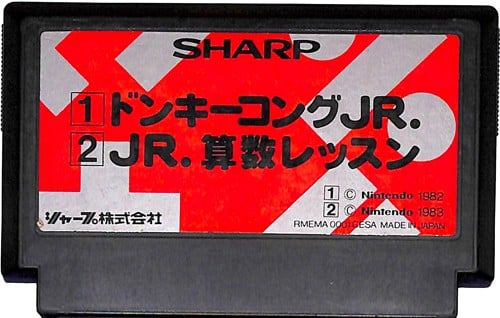
Preview release:Donkey Kong Jr. + Jr. Sansū Lesson, October 1983, packed with Sharp’s My Computer TV C1
Ratings:ESRB E · PEGI 3 · CERO A · ACB G · USK 0 (re-releases)
Re-releases:Wii Virtual Console (2007), Wii U Virtual Console (2014–15), Nintendo Switch Online (July 2024)
Advertisement
Overview
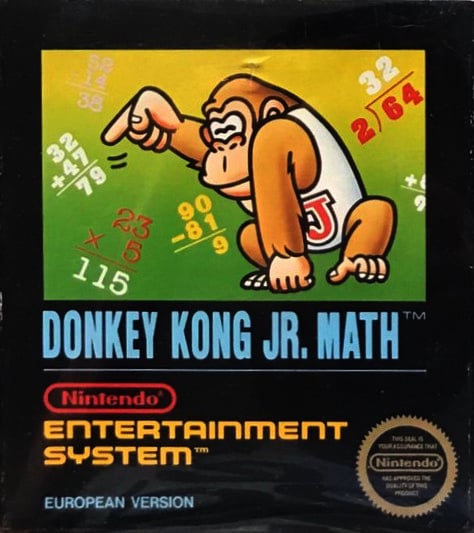
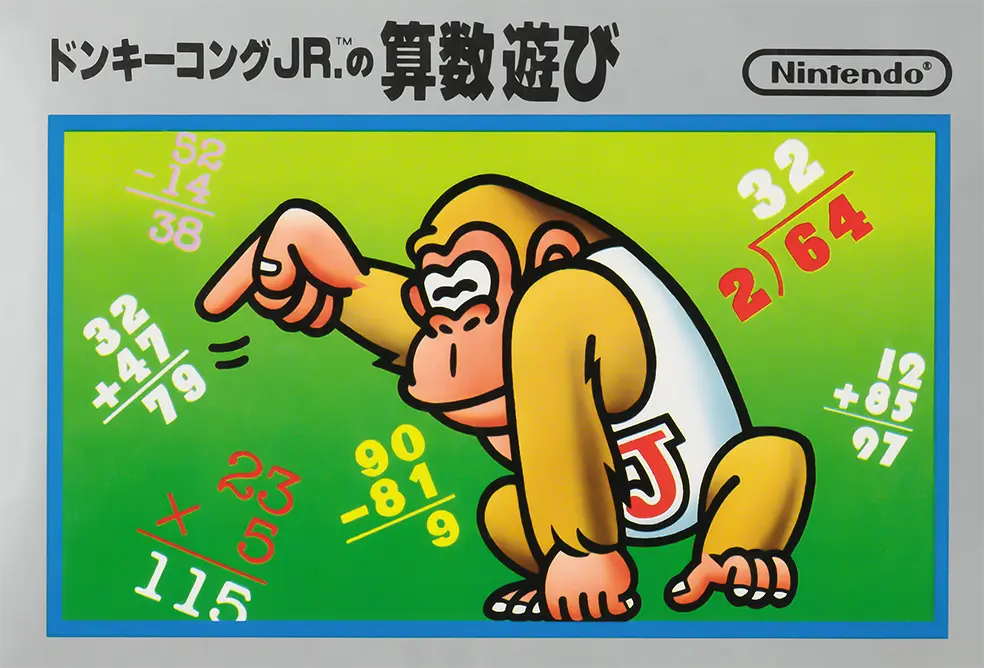
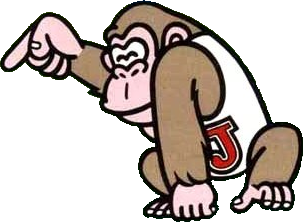
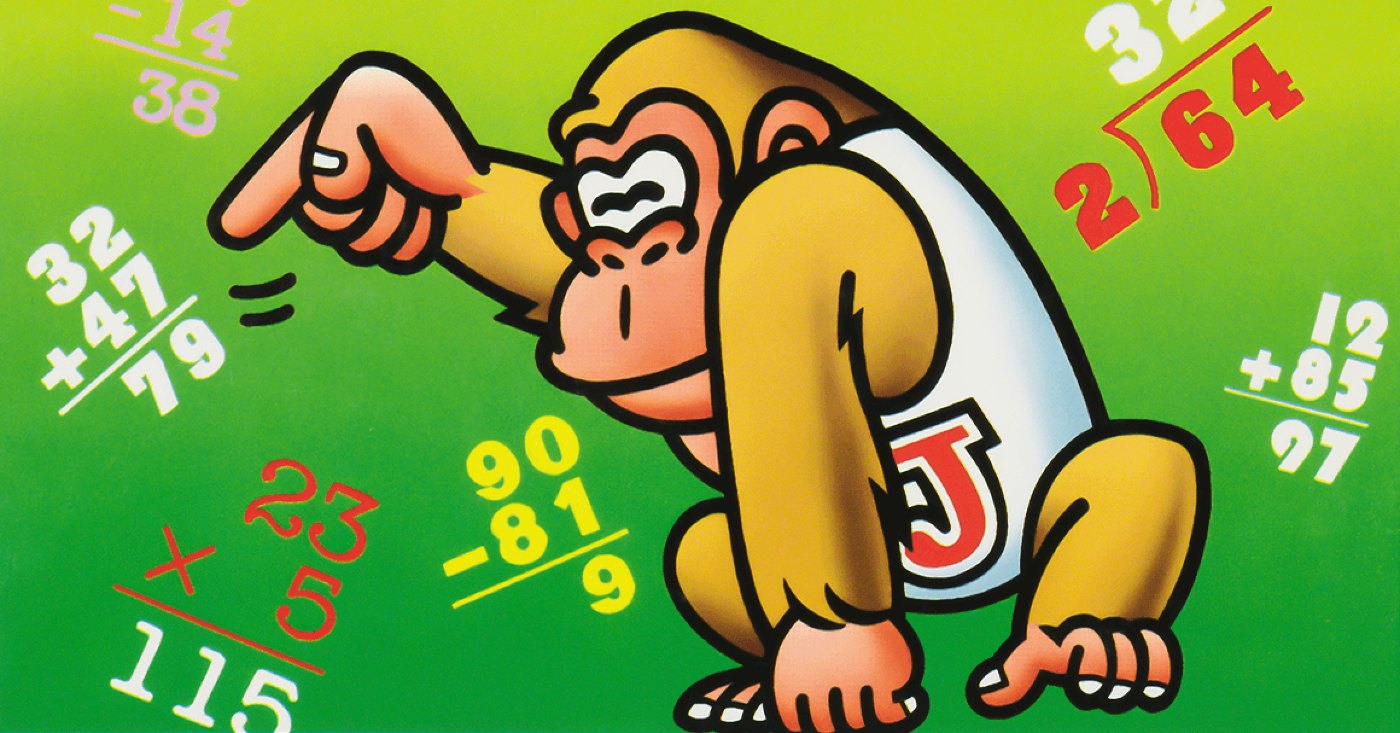
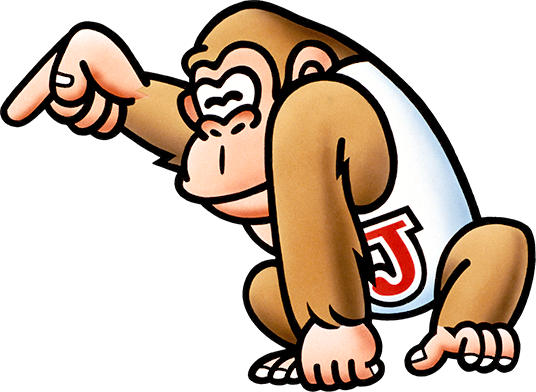
Junior with his sums: the artwork used on the international box.
In 1983 the Famicom was new, and Nintendo gave it learning games as well as arcade conversions: an English game starring Popeye, and this arithmetic game starring Junior. Donkey Kong Jr. Math, called Donkey Kong Jr. no Sansū Asobi (“Donkey Kong Jr.’s Math Play”) in Japan, was its arithmetic lesson. There is no story at all, Super Mario Wiki notes, not even in the manual: just Donkey Kong holding up a number, and his son scrambling round a jungle of chains and platforms to build a sum that makes it.
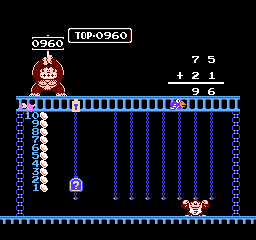
It is very obviously a Donkey Kong Jr. spin-off, and more literally than most. Super Mario Wiki says the cartridge was made by copying the Famicom Donkey Kong Jr. ROM and reworking it, and The Cutting Room Floor found that most of the graphics data came straight across, which is why it is still full of things the game never shows: Mario, Snapjaws, Sparks, the springboard and the fruit. The Calculate stage looks like the Jump Board Scene, and the Exercise stage like the Chain Scene. Nakago, recalling his early work at Nintendo’s R&D2 for Iwata Asks, lists it alongside his Famicom conversions of Donkey Kong and Donkey Kong Jr.
Japan got a preview first. In October 1983 Sharp’s My Computer TV C1, a television with a Famicom built into it, came with a cartridge holding half of Donkey Kong Jr. and an early version of the maths game’s exercise mode. The finished game followed on 12 December 1983.
Two years later it crossed the Pacific with the NES, released in North America on 18 October 1985 as the one and only title in an “Educational Series”. It sold poorly, and reviewers have been unkind ever since: Wikipedia collects verdicts naming it the worst game of the NES launch window, the worst Donkey Kong game and one of the worst Virtual Console downloads. Even so, it is a real oddity worth knowing about, and it has never quite gone away: Nintendo has reissued it on the Wii and Wii U and, in July 2024, added it to Nintendo Switch Online.
Join Donkey Kong Jr. for a maths lesson with a difference! In this educational NES game, swing and jump around the stage, collecting numbers and symbols to calculate the correct figure displayed by Donkey Kong.
Put your mathematical skills to the test in single-player mode or challenge a friend to a two-player maths race. You can even pester your opponent by grabbing numbers before they do!
— Official description (Nintendo UK, 2007)
Why Donkey Kong Jr. Math matters to Mario fans
It is one of the very few games to star Donkey Kong Jr., the only game Nintendo of America ever released under its NES “Educational Series” label, and a rare look at the Famicom’s early life as a family learning machine. It also shows how Nintendo’s early home teams worked: the same small R&D2 group converted Donkey Kong and Donkey Kong Jr. for the Famicom and then rebuilt the second into this. And it has left small marks on later games, from a Super Smash Bros. Melee trophy to a pink Donkey Kong.
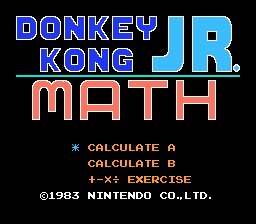
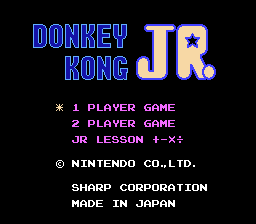
The title screen.Calculate A, two players at once.The +-×÷ Exercise.
Quick Answers
Quick answers about Junior’s maths lesson.
When did Donkey Kong Jr. Math come out?
On the Famicom in Japan on 12 December 1983, on the NES in North America on 18 October 1985, as part of the console’s launch line-up, and in Europe on 1 September 1986. More →
How do you play Donkey Kong Jr. Math?
Donkey Kong holds up a target number. Junior climbs chains to pick up digits and walks over platforms to pick up +, −, × or ÷, building a sum that equals the target. In the Exercise mode he climbs chains to dial in the answers to set problems. More →
What are the modes?
Calculate A, Calculate B (which starts with a number already in the sum and can ask for negative targets) and the +-×÷ Exercise, a set of ten problems scored out of 1,000. Both Calculate modes can be played by two at once. More →
Who made it?
Nintendo R&D2. Wikipedia names Toshihiko Nakago as designer, and Nakago himself lists the game among his early R&D2 work in Iwata Asks. More →
What was the NES Educational Series?
The label Nintendo of America put on the box. Donkey Kong Jr. Math turned out to be the range’s sole release; as IGN’s Lucas M. Thomas put it, the game by itself made up the whole series. More →
Who is the pink Donkey Kong Jr.?
Player 2. Super Mario Wiki calls him Junior (II). Super Smash Bros. for Nintendo 3DS / Wii U later gave Donkey Kong a pink alternate costume that resembles him. More →
Why is Donkey Kong Jr. Math considered so bad?
Reviewers have found the maths too easy for older players and the game too dull for younger ones, the controls stiff and the presentation recycled. It was a commercial flop in North America, and Wikipedia records a Nintendo spokesperson saying in 1990 that its reception was why Nintendo made no more educational games. More →
Can I play Donkey Kong Jr. Math on Nintendo Switch?
Yes. It joined the NES library of Nintendo Switch Online on 3 July 2024 in North America and 4 July elsewhere. It was earlier sold on the Wii (2007) and Wii U (2014–15) Virtual Consoles. More →
The Modes
There is no plot: Super Mario Wiki notes that neither the manuals nor the box offer one. Donkey Kong sets the problems from his perch, holding up a sign, and Junior does the work. The game has three modes, chosen from the title screen.
Calculate A
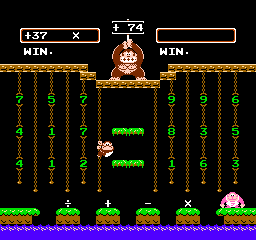
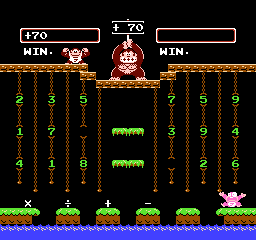
The main game, for one or two players, on a stage that echoes the Jump Board Scene of Donkey Kong Jr. Donkey Kong shows a target and Junior builds a sum to reach it, collecting single digits and signs, with each answer carried into the next sum. Five matches wins.
Calculate A with both Juniors on the stage.The biggest total the game allows in Calculate A and B.
Calculate B
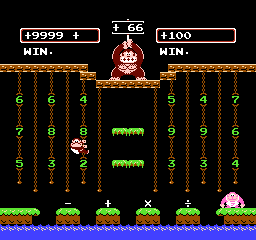
The harder version. Each round starts with a number already in the sum, which Junior has to work from, and Donkey Kong’s sign can show negative numbers, so subtraction comes into play. One or two players, five matches to win, as in A.
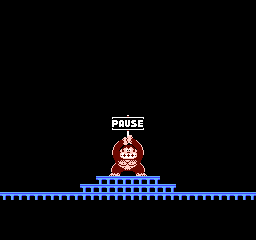
Junior reaches the target.The pause screen.
The +-×÷ Exercise
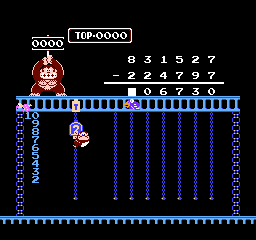
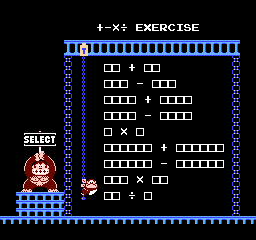
A one-player drill on a stage modelled on the Chain Scene. Choose the kind of problem from the select screen, then answer ten in a row by climbing chains to set each digit. Scores are out of 1,000, and the clock counts against you.
Choosing a type of problem.An Exercise problem in progress.
The preview: Jr. Sansū Lesson
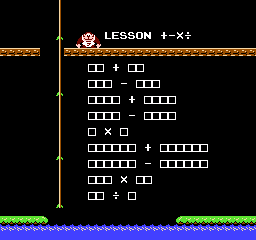
Before the full game came out, Japanese buyers of Sharp’s My Computer TV C1 found a cut-down version of the Exercise on the cartridge packed with the set, alongside a shortened Donkey Kong Jr. It goes under the title Math Lesson (Sansū Lesson), its select screen is different, Donkey Kong stays in his cage throughout, apples fall when a problem is solved instead of a Nitpicker appearing, and the time remaining is turned into the score.
The Jr. Sansū Lesson select screen.Donkey Kong Jr. + Jr. Sansū Lesson.
Every mode in Donkey Kong Jr. Math
Three modes in the finished game, plus the preview that came first.
Calculate A1–2 players · first to 5Build sums from single digits to match Donkey Kong’s sign; each answer carries into the next sum.
Calculate B1–2 players · first to 5 · harderStarts from a number already in the sum, and the target can be negative.
+-×÷ Exercise1 player · 10 problems · 1,000 pointsSet problems in nine types, answered digit by digit on the chains.
Jr. Sansū LessonJapan · October 1983 · My Computer TV C1 pack-inAn early form of the Exercise, sharing a cartridge with half of Donkey Kong Jr.
Advertisement
Gameplay & Controls
Every mode uses the same idea: numbers and signs are scattered about a stage, and Junior climbs and walks to collect them in order, building a sum one piece at a time. He moves exactly as he did in Donkey Kong Jr., climbing chains and hopping between platforms, and there are no enemies to dodge, so the only pressure is the other player or the clock.
Building a sum
Junior completes a sum.
In the Calculate modes the digits hang on chains and the four operation signs sit on platforms. Touch a number, then a sign, then another number, and the running total appears; carry on until it matches Donkey Kong’s sign. The result of each finished sum becomes the first number of the next one, and apart from that carried total only the single digits 0 to 9 are available, so reaching a big target means chaining several steps together.
Each correct match earns a point, and the first to five wins. There is also a ceiling on how big the running total can grow: Super Mario Wiki’s gallery shows the largest value the game allows.
The Exercise: dialling in answers
An exercise completed.
The +-×÷ Exercise works differently. A problem is shown, and Junior enters the answer one digit at a time by climbing up or down a chain until the digit he wants appears. The B button wipes the entry, and pushing a question-mark key into its lock shows the correct answer, though that problem then scores nothing.
There are ten problems in a set, each worth up to 100 points, with points taken off for wrong answers and slow ones, so a perfect run scores 1,000. Super Mario Wiki lists nine types of problem, from adding two-digit numbers up to six-digit addition and subtraction, three-digit by two-digit multiplication and dividing a two-digit number by a single digit.
Two players
Junior (II), the second player.
Calculate A and B can be played by two at once. Player 2 controls a pink Junior, called Junior (II) by Super Mario Wiki, and both race round the same stage for the same pieces. The rules are otherwise the same, and whoever matches Donkey Kong’s number five times first is the winner. Nintendo Life’s 2014 review, otherwise unimpressed, picked this out as the part of the game that is genuinely fun.
What Junior collects
There are no power-ups; these are the pieces of every sum.
Digits 0–9Hung on the chains in the Calculate modes; dialled up and down a chain in the Exercise.
Signs: + − × ÷Standing on the platforms in the Calculate modes. Pick one between two numbers to set the operation.
Question-mark keyIn the Exercise, pushing it into its keyhole reveals the answer, for no points.
ApplesThe Cutting Room Floor found a spare copy of the apple graphic used to count wins in the Calculate modes.
Cartoons, Comics & Other Media
A small game with a surprisingly long tail.
Donkey Kong Jr.Arcade 1982 · Famicom 1983Where everything here comes from: the cast, the stages and the program itself. See Donkey Kong Jr.
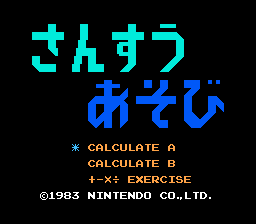
Popeye no Eigo AsobiFamicom · JapanNintendo’s Popeye English-learning game. Its title music is reused for the same job here, and The Cutting Room Floor notes that the Japanese title logo is drawn in the same style and, like Popeye’s, reads simply “Sansuu Asobi”.
Animal CrossingGameCubeThe game is one of the NES titles that can be collected as a playable item in the GameCube Animal Crossing.
Super Smash Bros. MeleeGameCubeDonkey Kong Jr.’s trophy remarks on his talent for mathematics.
Super Smash Bros. for Nintendo 3DS / Wii UNintendo 3DS · Wii UOne of Donkey Kong’s alternate colours is a pink that resembles Junior (II), the second player here.
Super Smash Bros. UltimateNintendo SwitchDonkey Kong Jr. appears as a spirit.
Donkey Kong Country ReturnsWiiDonkey Kong’s sign-holding sprite from this game turns up in the background of the Wonky Waterway level.
Characters
A small cast, all borrowed from Donkey Kong Jr., and no Mario.
Character
Who they are
In this game
Abilities & notes
Donkey Kong Jr.Player 1
Donkey Kong’s son, the hero of Donkey Kong Jr., in one of his few starring roles.
Climbs the chains and crosses the platforms to collect digits and signs, or dials in answers in the Exercise.
Moves exactly as in Donkey Kong Jr.; there are no enemies to avoid.
Junior (II)Player 2
A pink palette swap of Junior, so named by Super Mario Wiki.
The second player in Calculate A and B, racing Junior for the same numbers.
Identical to Junior apart from his colour.
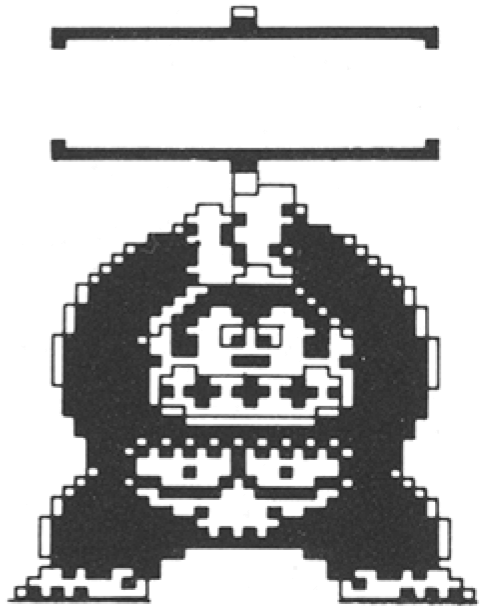
Donkey KongThe teacher
Junior’s father, the ape of Donkey Kong and Donkey Kong Jr.
Sits at the top of the screen holding up the sign with the target number.
Not playable. In the Jr. Sansū Lesson preview he stays in his cage even when the exercise is finished.
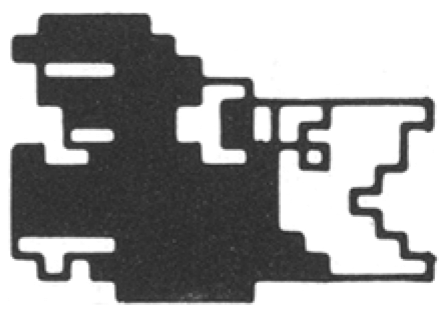
NitpickerLarge and small
The birds of Donkey Kong Jr., in large and small sizes.
Non-playable. Super Mario Wiki’s comparison with the preview version says that in the finished game a Nitpicker appears for correct answers (the preview drops apples instead).
Harmless here.
Key people
The game has no credits; these are the names the sources give.
Toshihiko NakagoDesignerNamed as designer by Wikipedia. In Iwata Asks he lists the game among his R&D2 projects, after his Famicom conversions of Donkey Kong and Donkey Kong Jr.; in the same interview he recalls coming to Nintendo’s Famicom programming from SRD, where his first job had nothing to do with games.
Nintendo R&D2DeveloperThe team that also converted the Donkey Kong arcade games to the Famicom.
Yukio KaneokaMusic (Wikipedia)Credited in Wikipedia’s infobox. The title tune is shared with Popeye no Eigo Asobi.
SharpPartner on Jr. Sansū LessonCo-publisher of the preview cartridge packed with its My Computer TV C1.
Advertisement
How It Was Made
Nintendo has said little about this game, but the cartridge and the people who made it tell the story.
Built from Donkey Kong Jr.
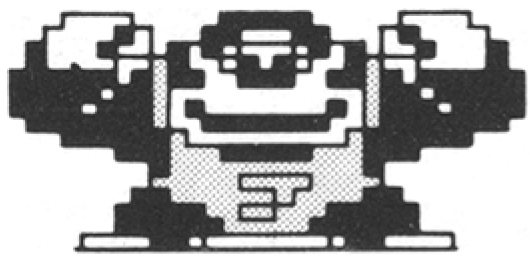
Donkey Kong with his sign, the one new pose the game needed.
Nintendo R&D2 handled the Famicom versions of the arcade games, and Toshihiko Nakago, who worked there, recalls in Iwata Asks a run of early titles that includes Donkey Kong, Donkey Kong Jr. and Donkey Kong Jr. Math. Wikipedia credits him as the maths game’s designer.
The Cutting Room Floor shows how directly one game became the other. Most of the graphics data was copied straight from Donkey Kong Jr., so the cartridge still carries sprites of Mario (including some that were cut from the Famicom Donkey Kong Jr.), Junior with his arms raised to catch his father, Snapjaws, Sparks, the fruit, the springboard, a vine, the old score numbers and most of the original title screen. The international title logo was drawn over some of those leftovers; the Japanese one, plainer, was not.
Learning games for the Famicom
The Japanese title screen, which reads only Sansuu Asobi.
In Japan the game was Sansū Asobi, “math play”, and it belongs with Nintendo’s English-learning Popeye no Eigo Asobi: the two share a title tune and a style of title logo. Super Mario Wiki notes that a music game, Donkey Kong no Ongaku Asobi, was planned around the same time and cancelled.
The Famicom version went on sale on 12 December 1983, a couple of months after the preview on Sharp’s television. Wikipedia adds that Sharp re-released the combined cartridge on its own in August 1995.
The Educational Series
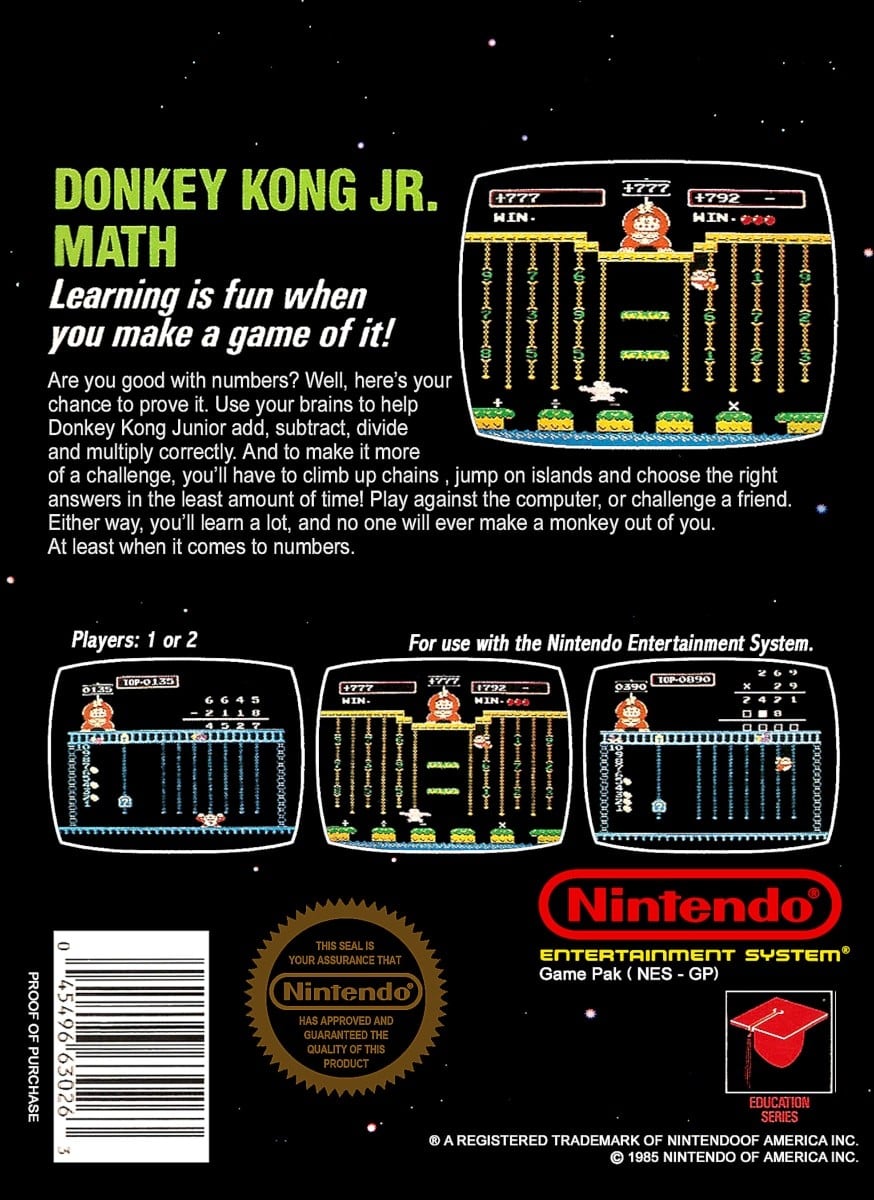
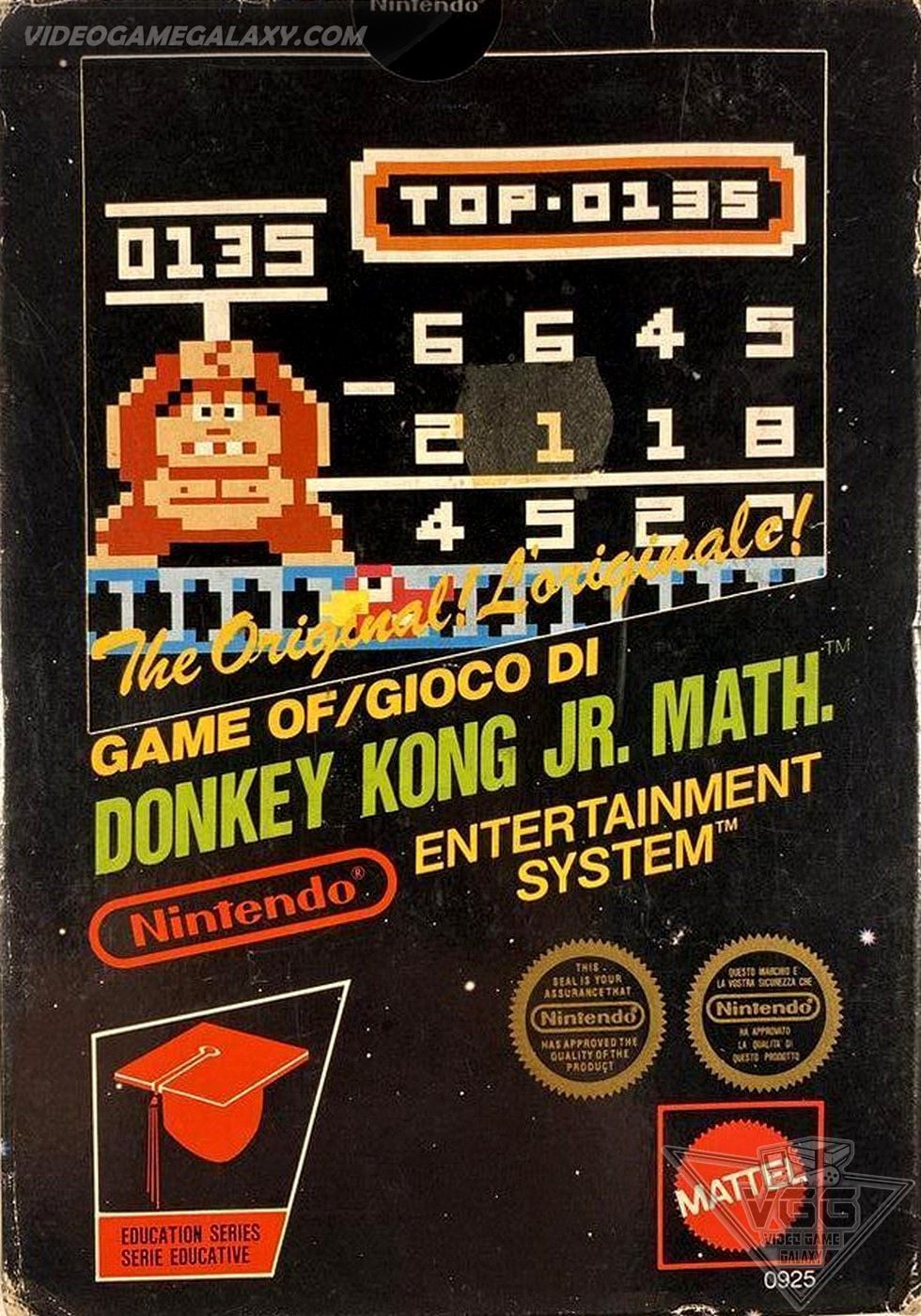
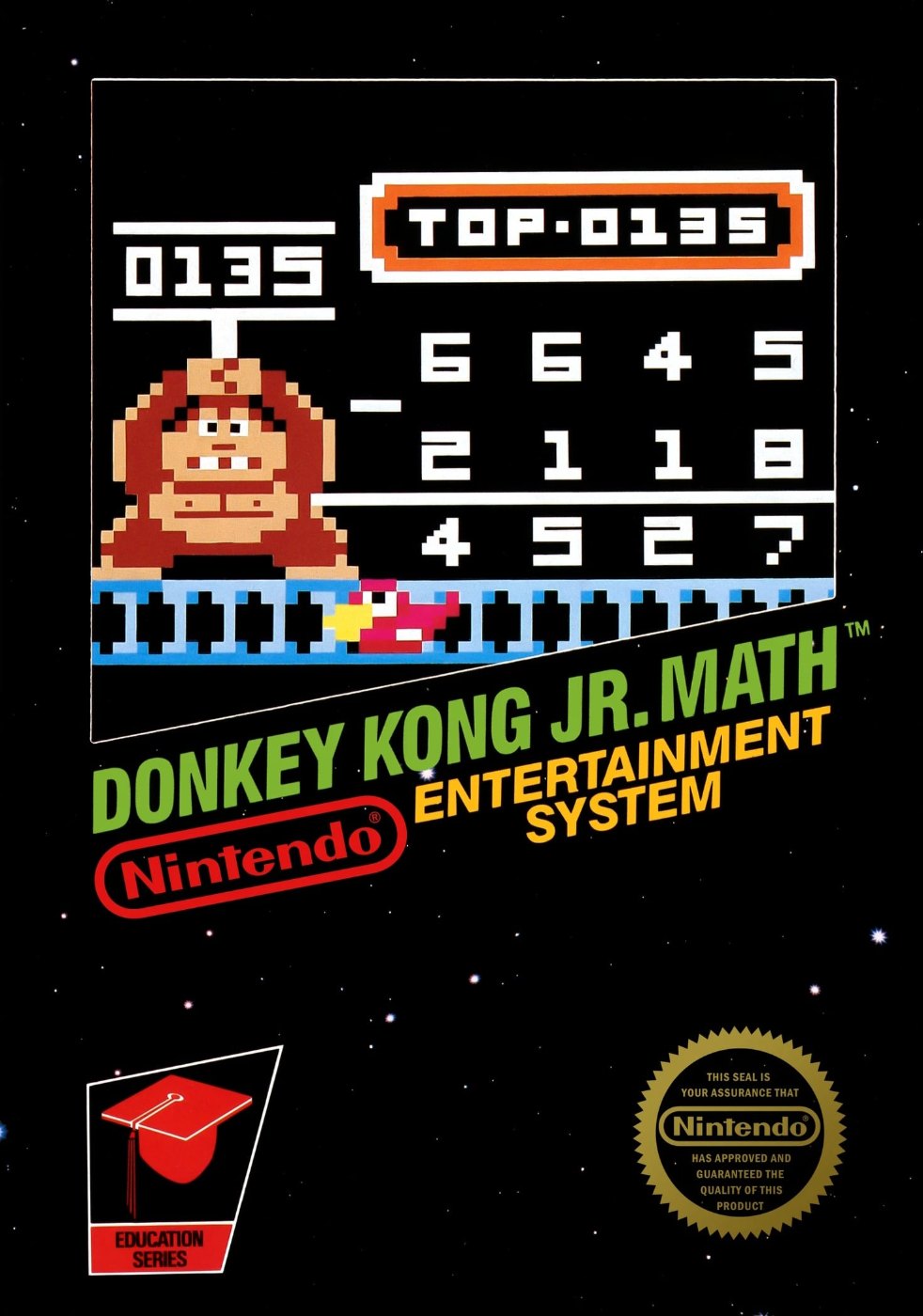
The back of the North American box.
For North America the game went out with the NES itself, on 18 October 1985, in a box branded as part of an Educational Series. No second game ever joined it, which IGN’s Lucas M. Thomas made the joke of his 2007 review. Wikipedia says the line had been planned to include the music game as well.
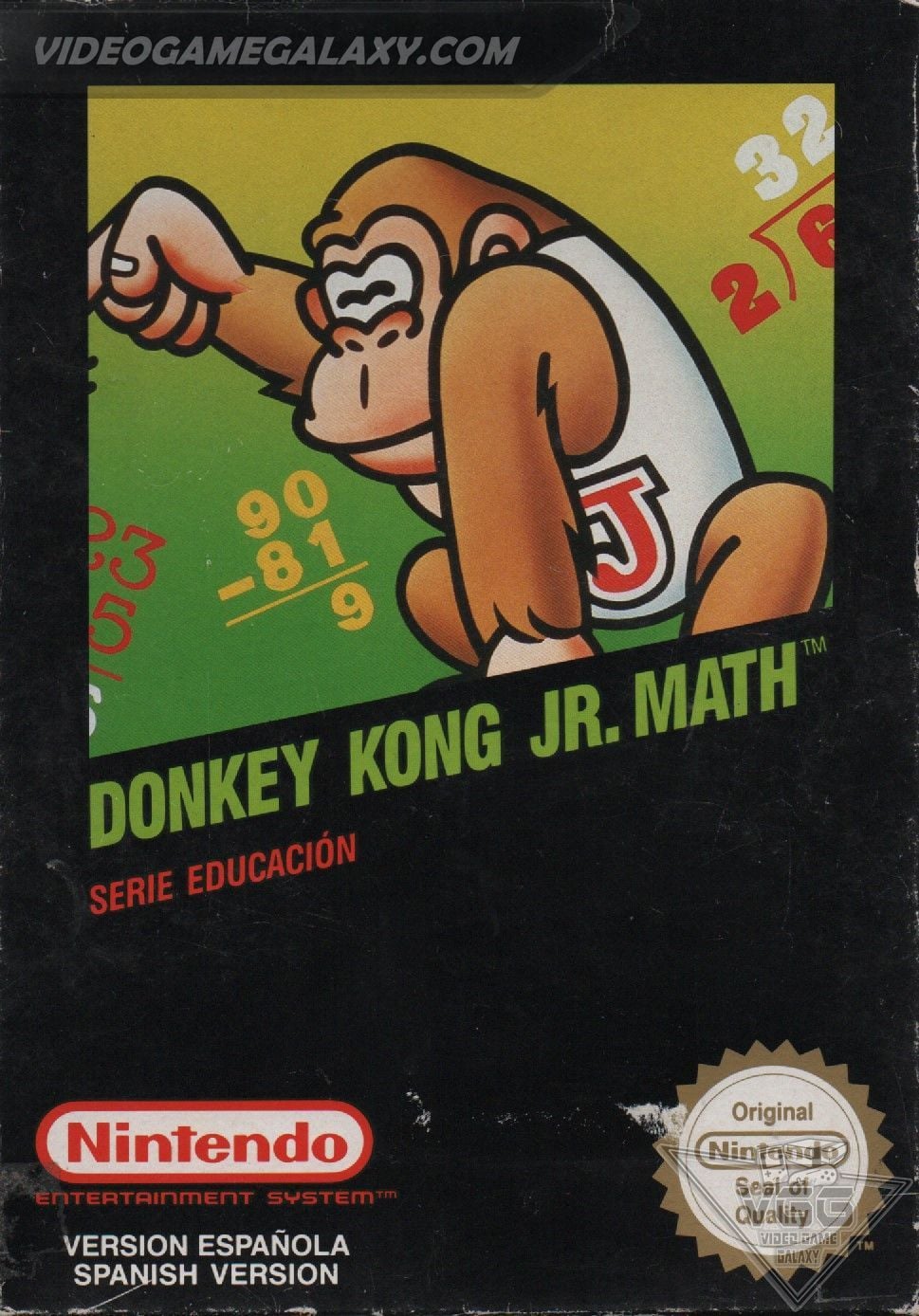
It did not sell. Super Mario Wiki calls it the worst-selling of the North American launch games, Wikipedia relays Nintendo of America sales chief Bruce Lowry’s verdict that it was the worst game the company ever sold, and, again according to Wikipedia, a Nintendo spokesperson told the Los Angeles Times in 1990 that its poor reception was why Nintendo had made no more educational titles. Europe got the game on 1 September 1986, with boxes in several languages.
Cheats & Secrets
No codes, but a few things worth knowing.
Plan the chain
In Calculate A and B every answer carries into the next sum, so think one target ahead: finishing a sum on a convenient number makes the next one far shorter.
Steal the number
In a two-player race both Juniors chase the same pieces. Grabbing the digit your opponent is heading for can cost them the round.
Stuck? Use the key
In the Exercise, pushing the question-mark key into its lock shows the answer. It scores nothing for that problem, but it keeps the set moving.
Clear and retry
Press B in the Exercise to wipe the digits entered so far, rather than submitting a wrong answer and losing points.
Videos
Two official Nintendo trailers for the July 2024 Nintendo Switch Online update that added the game: the American one and the Japanese one.
Official Nintendo of America trailer for the July 2024 NES update, the source Super Mario Wiki cites for the game’s arrival on the service.
Official Nintendo Japan trailer for the Famicom, Super Famicom and Game Boy titles added on 4 July 2024.
Trivia & Interesting Facts
The North American box sells it with the line “Learning is fun when you make a game of it!”
IGN’s review summed up the Educational Series in one sentence: the game, by itself, made up the entire line.
Junior (II).Junior (II), the pink second player, has had an afterlife: Super Smash Bros. for Nintendo 3DS / Wii U gave Donkey Kong a pink alternate colour that resembles him.
The Cutting Room Floor found unused Japanese text, three coloured placeholder squares, spare font characters and a duplicate of the apple used to count wins.
Donkey Kong, from his in-game sprite.Still in the cartridge: Mario sprites that never appear, including some that were cut from the Famicom Donkey Kong Jr. itself.
The Japanese title screen does not mention Donkey Kong at all: it reads only “Sansuu Asobi”, in the same style as Popeye no Eigo Asobi.
Super Mario Wiki notes that a sister title, Donkey Kong no Ongaku Asobi, was planned and cancelled.
The Calculate stage is laid out like the Jump Board Scene of Donkey Kong Jr., and the Exercise stage like its Chain Scene.
It has never been released for Nintendo 3DS, unlike Donkey Kong Jr.
Nintendo of America’s eShop copy pitched it at younger players after an easy, enjoyable way to sharpen their sums, and mentions only Game A and Game B.
Wikipedia notes that a Harvey Mudd College professor, Elizabeth Sweedyk, cited it in 2005 as an educational game too close to real schoolwork to be fun.
Jeff Ryan’s book Super Mario: How Nintendo Conquered America (2011) calls it a dud, though a fun and challenging way to practise the basics, according to Wikipedia.
Regional Box Art
The Famicom and NES boxes from every region, the cartridges, and the Wii U icon.
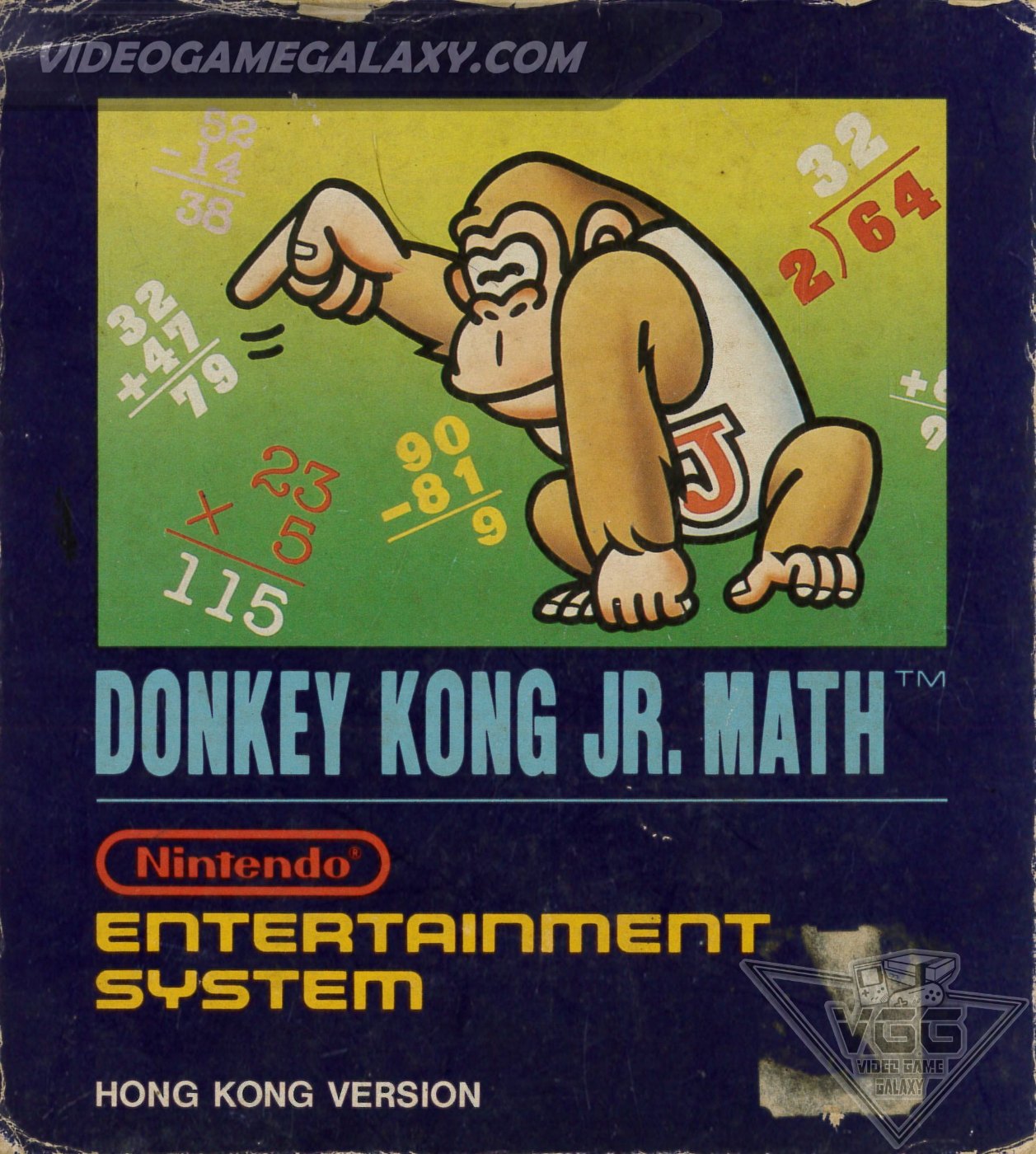
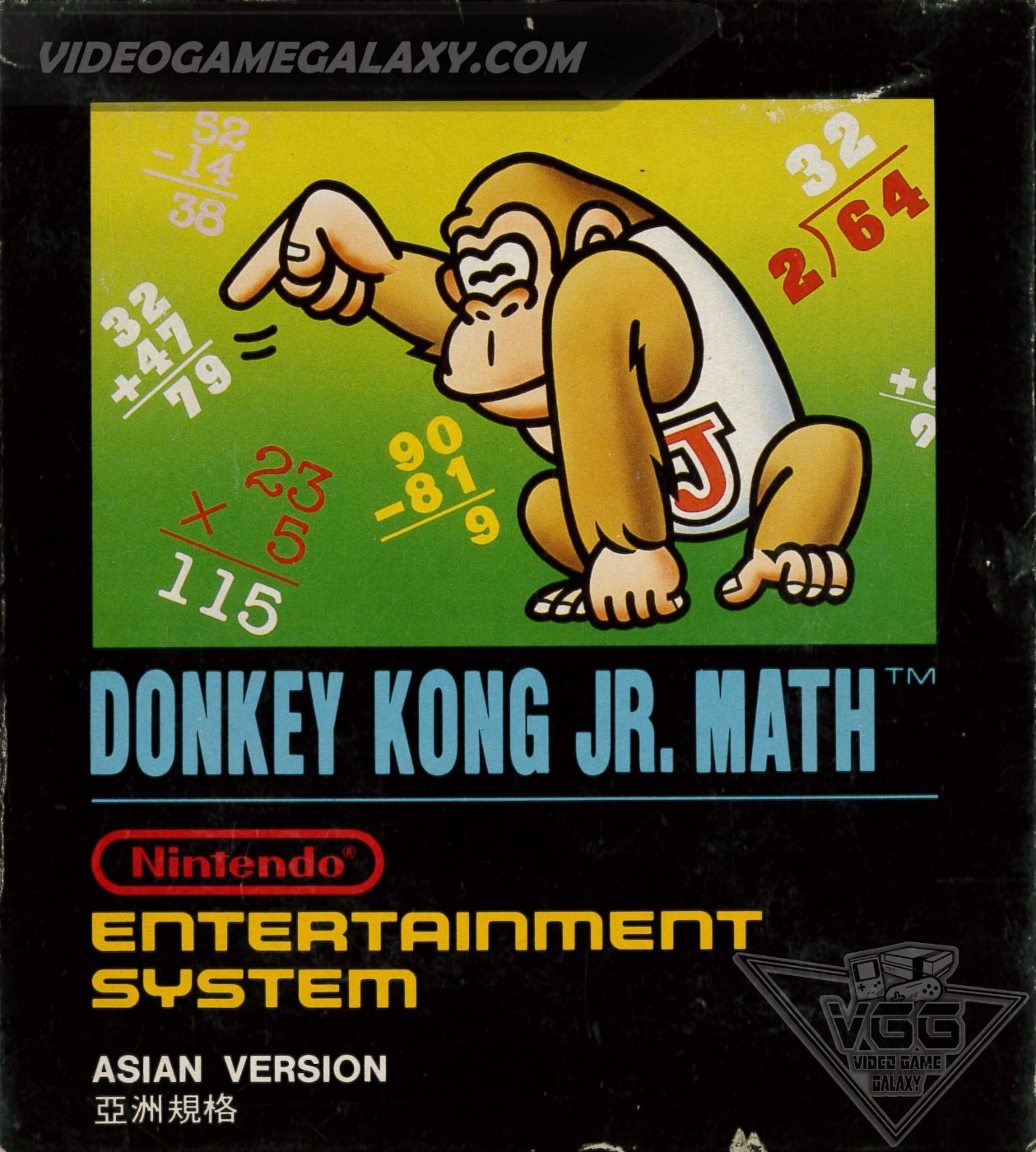
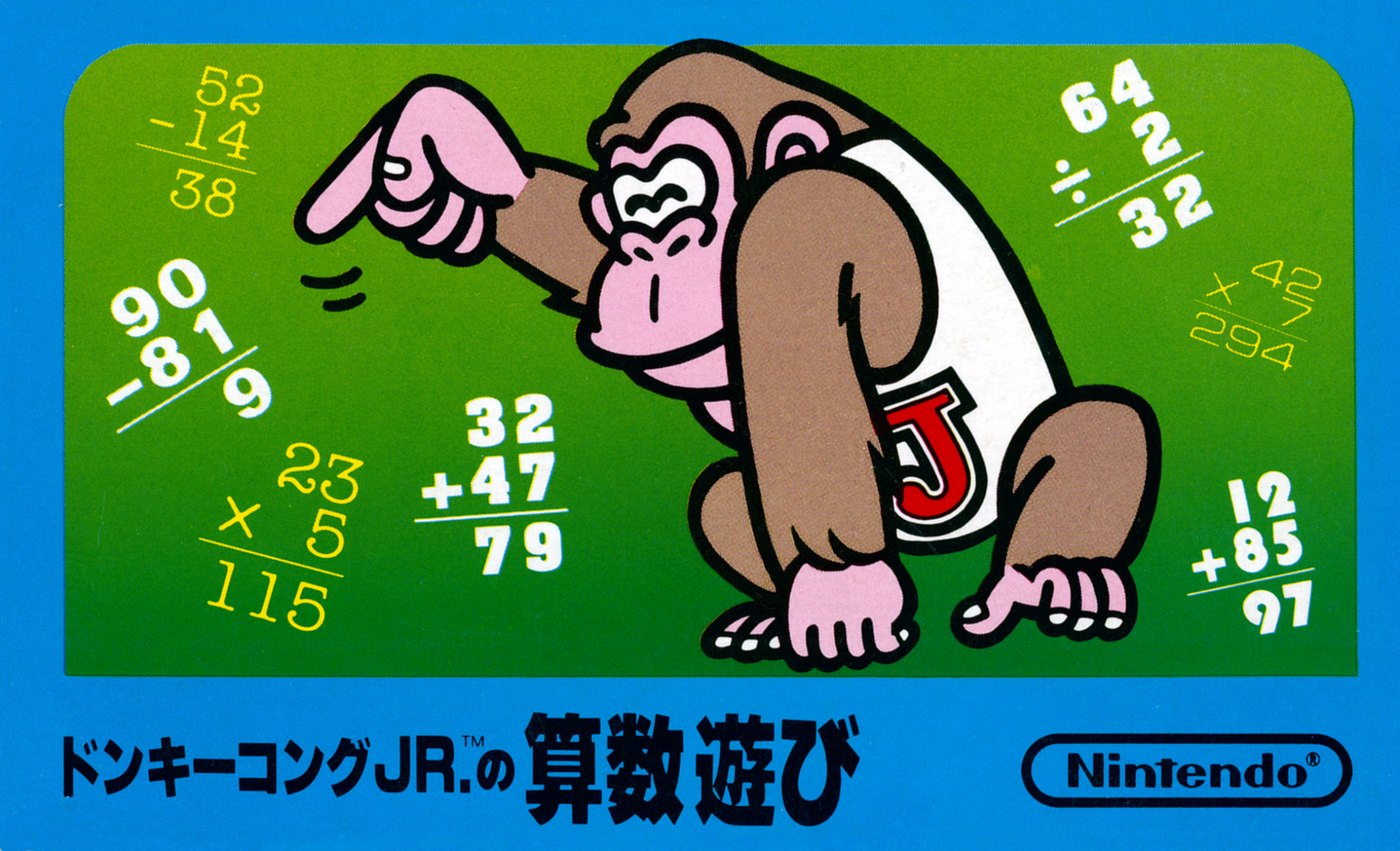
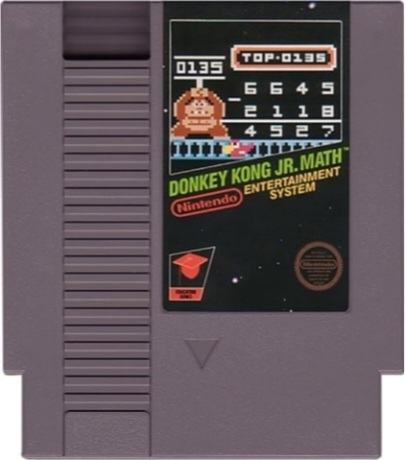
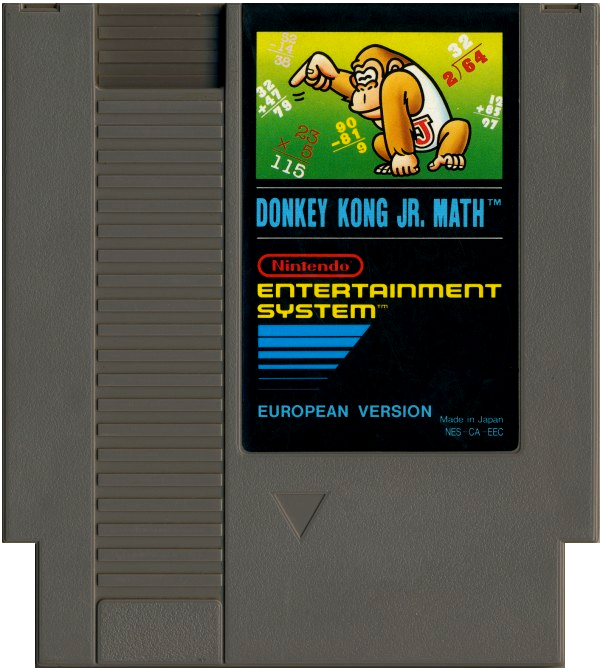
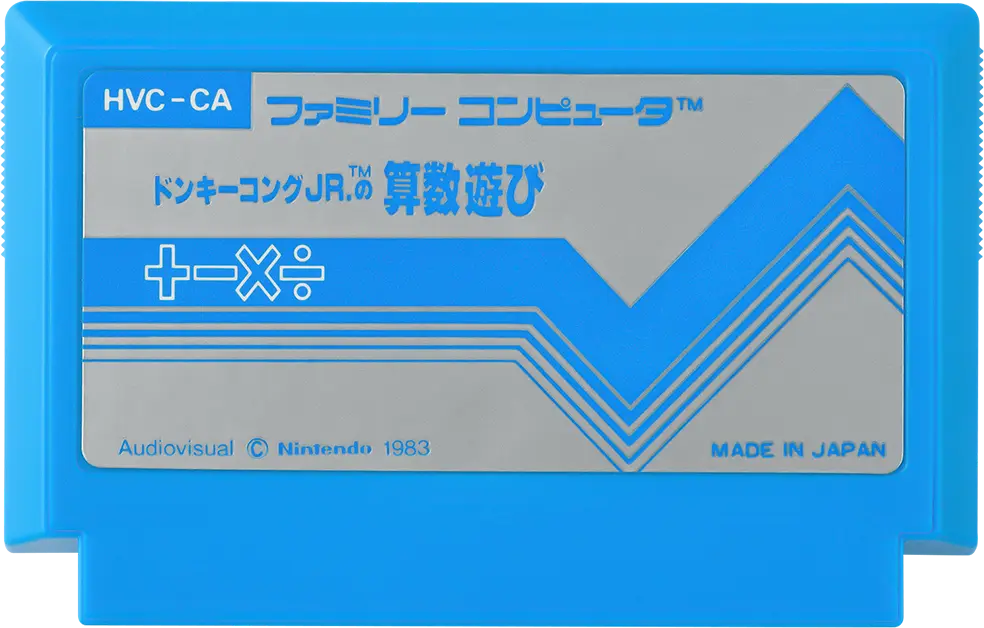
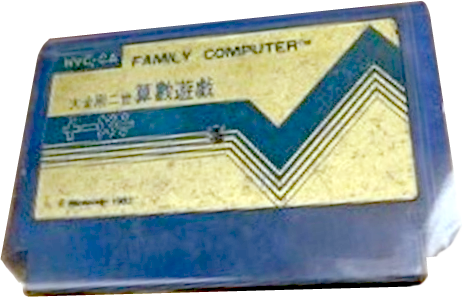
NES, North America (1985)Educational Series packaging. The box line reads: Learning is fun when you make a game of it!NES, North America (back)NES, Europe (1986)NES, SpainNES, ItalyHong KongAsiaFamicom, Japan (1983)Famicom, Japan (alternate box)NES cartridge, North AmericaNES cartridge, EuropeFamicom cartridge, JapanFamicom cartridge, TaiwanDonkey Kong Jr. + Jr. Sansū Lesson cartridge (Japan, 1983)Wii U Virtual Console icon
Screenshots
More from the game, and the Donkey Kong of the preview cartridge.
The +-×÷ Exercise select screen.Junior completes an exercise.Paused.The Japanese title screen.Donkey Kong in Jr. Sansū Lesson.The Jr. Sansū Lesson select screen.
Artwork & Media Gallery
Artwork, including the reissue cover art and the renders made from the in-game sprites, plus the NES sprites and the logo-less covers.
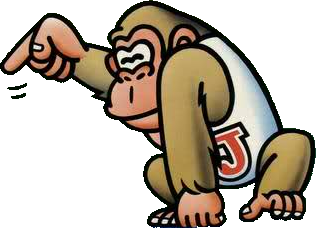
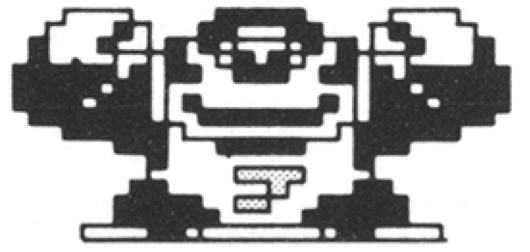
Junior, from the reissue cover.Junior artwork.Junior, rendered from his sprite.Donkey Kong, rendered from his sprite.A Nitpicker.Junior, NES sprite.Junior (II), NES sprite.Donkey Kong, NES sprite.A large Nitpicker.A small Nitpicker.Donkey Kong Jr.’s spirit in Super Smash Bros. Ultimate.
Legacy & Re-releases
Every release of the game, and what it left behind.
Releases and re-releases
Jr. Sansū LessonOctober 1983Japan: an early form of the Exercise mode on a cartridge with half of Donkey Kong Jr., packed with Sharp’s My Computer TV C1.
Famicom12 December 1983Japan, as Donkey Kong Jr. no Sansū Asobi. Also sold in Taiwan and Hong Kong.
NES18 October 1985North America, in the launch line-up, as the only Educational Series game.
NES1 September 1986Europe.
Animal CrossingGameCubePlayable as one of the collectable NES items.
Wii Virtual Console2007Japan 27 March, Europe and Australia 20 April, North America 3 September 2007, at 500 Wii Points.
Wii U Virtual Console2014–2015North America 28 August 2014 ($4.99), Europe 22 January 2015, Australia 23 January and Japan 15 April 2015.
Nintendo Switch OnlineJuly 2024Added to the NES library on 3 July in North America and 4 July 2024 in Japan, Europe and Australia.
An unlikely survivor
For a game so widely panned, it has done well out of Nintendo’s re-release machine: two Virtual Consoles and a place in Nintendo Switch Online, alongside its parent Donkey Kong Jr. and Donkey Kong. It was never included on Donkey Kong Classics, which paired the two arcade conversions.
Its lasting legacy is a handful of in-jokes: Junior’s head for figures in a Melee trophy, a pink Donkey Kong costume and a sign-holding sprite hidden in Donkey Kong Country Returns. And according to the account Wikipedia relays from the Los Angeles Times, it is the reason Nintendo stopped making educational games for the NES.
Reviews & Sales
Sales
No sales figures have been published. Super Mario Wiki calls it the worst-selling North American NES launch game; Wikipedia, citing a 1994 issue of Video Games, says it did better in Japan but was soon forgotten in America; it adds, citing Polygon, that poor sales have made the NES cartridge a rare and expensive collector’s item.
18 Oct 1985North American release, with the NES
1game in the Educational Series
32%GameRankings average (Wikipedia)
Reception and review scores
Most of the reviews come from its Virtual Console releases, and they are harsh.
AllGameSkyler Miller
3/5
Nintendo LifeWii U Virtual Console · Morgan Sleeper · 2 September 2014
IGNWii Virtual Console · Lucas M. Thomas · September 2007
3/10
GameSpotWii Virtual Console · Frank Provo · 3 September 2007
3/10
EurogamerWii Virtual Console · Dan Whitehead · 2 June 2007
3/10
Nintendo LifeWii Virtual Console · Damien McFerran · 20 April 2007
1/10
The complaints are consistent. GameSpot’s Frank Provo thought it had been “a terrible game and a poor educational tool in 1985”, the problems too easy for older children and the game too dull for younger ones. Nintendo Life’s Damien McFerran disliked the way the learning was forced into a platform game and the stiff controls. IGN’s Lucas M. Thomas gave it 3 out of 10.
Its reputation as one of the weakest NES-era games comes from lists as much as reviews. According to Wikipedia, Bob Mackey of 1UP.com named it the worst game of the NES launch window, IGN’s Cam Shea put it among the worst Virtual Console games in 2008, and Polygon’s Jeremy Parish ranked it last of all the Donkey Kong games in 2018. A few voices were kinder. The magazine Joystick gave Nintendo credit for trying in 1989, AllGame’s Skyler Miller liked the reuse of Donkey Kong Jr., and Nintendo Life’s Morgan Sleeper, reviewing the Wii U release in 2014, called it a curio that is surprisingly good fun with a second player.
SLB User Reviews
Donkey Kong Jr. Math has yet to receive a community review on Super Luigi Bros.
If you’ve played Donkey Kong Jr. Math and would like to submit a review, please get in touch.
To provide the best experiences, we use technologies like cookies to store and/or access device information. Consenting to these technologies will allow us to process data such as browsing behavior or unique IDs on this site. Not consenting or withdrawing consent, may adversely affect certain features and functions.
Functional
Always active
The technical storage or access is strictly necessary for the legitimate purpose of enabling the use of a specific service explicitly requested by the subscriber or user, or for the sole purpose of carrying out the transmission of a communication over an electronic communications network.
Preferences
The technical storage or access is necessary for the legitimate purpose of storing preferences that are not requested by the subscriber or user.
Statistics
The technical storage or access that is used exclusively for statistical purposes.The technical storage or access that is used exclusively for anonymous statistical purposes. Without a subpoena, voluntary compliance on the part of your Internet Service Provider, or additional records from a third party, information stored or retrieved for this purpose alone cannot usually be used to identify you.
Marketing
The technical storage or access is required to create user profiles to send advertising, or to track the user on a website or across several websites for similar marketing purposes.



 Donkey Kong Jr.Arcade 1982 · Famicom 1983Where everything here comes from: the cast, the stages and the program itself. See Donkey Kong Jr.
 Super Smash Bros. for Nintendo 3DS / Wii UNintendo 3DS · Wii UOne of Donkey Kong’s alternate colours is a pink that resembles Junior (II), the second player here.
 Super Smash Bros. UltimateNintendo SwitchDonkey Kong Jr. appears as a spirit.
 Donkey Kong Country ReturnsWiiDonkey Kong’s sign-holding sprite from this game turns up in the background of the Wonky Waterway level.
 Donkey Kong Jr.Player 1
 Donkey KongThe teacher
 NitpickerLarge and small