Arcade · NES1982PlatformerNintendo R&D1 · Iwasaki EngineeringMario’s first turn as the villainDonkey Kong Jr.’s debut4 stagesKill screen at level 22Famicom launch game
Donkey Kong Jr.
A year after Donkey Kong, Nintendo turned its own hit inside out. In Donkey Kong Jr. the carpenter has caught the ape, locked him in a cage and carted him off through the jungle to his hideout in the city, and you play the gorilla’s little son, Donkey Kong Jr., out to snatch the keys and set his papa free. It is Mario’s first turn as a villain, and he plays it with relish, letting loose snapping traps, diving birds and crackling sparks while Junior climbs vines and chains (faster with a hand on each of two) and drops fruit on whatever lurks below. There are four stages, the Vine Scene, the Jump Board Scene, Mario’s Hideout and the Chain Scene, and the same timer bug as the first game ends play at level 22. Produced by Gunpei Yokoi, designed by Shigeru Miyamoto and programmed with help from Iwasaki Engineering, it reached arcades in August 1982, was one of the Famicom’s launch games in 1983 and can still be played today through Arcade Archives and Nintendo Switch Online.
Developer:Nintendo R&D1 with Iwasaki Engineering (arcade); Nintendo (Famicom/NES conversion; sources credit it to R&D2 or R&D1)
Publisher:Nintendo; Coleco, Atari, Inc., Atari Corporation and HAMSTER for other versions
Platforms:Arcade; Famicom, NES and Famicom Disk System; ColecoVision, Atari 2600, Intellivision, Atari 8-bit, Coleco Adam and Atari 7800; e-Reader; Virtual Console (Wii, Nintendo 3DS, Wii U); Nintendo Switch
Genre:Platformer
Japan (arcade):August 1982, after a private showing on 28 July
N. America (arcade):September 1982
Famicom:15 July 1983 (a launch title)
NES:North America June 1986; Europe 15 June 1987
Players:1–2, taking turns
Designer:Shigeru Miyamoto
Producer:Gunpei Yokoi
Music:Yukio Kaneoka
Cabinets:Upright and cocktail
Stages:4: Vine Scene, Jump Board Scene, Mario’s Hideout, Chain Scene
Arcade sales:About 30,000 machines in North America (Steven Kent)
Ratings:ESRB E · PEGI 3 · CERO A · ACB G · USK 0 (re-releases)
On Nintendo Switch:Arcade Archives Donkey Kong Jr. (21 December 2018) and the NES version in Nintendo Switch Online (15 May 2019)
Advertisement
Overview
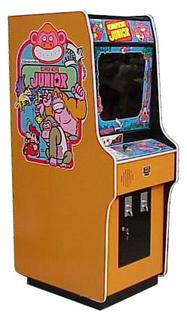
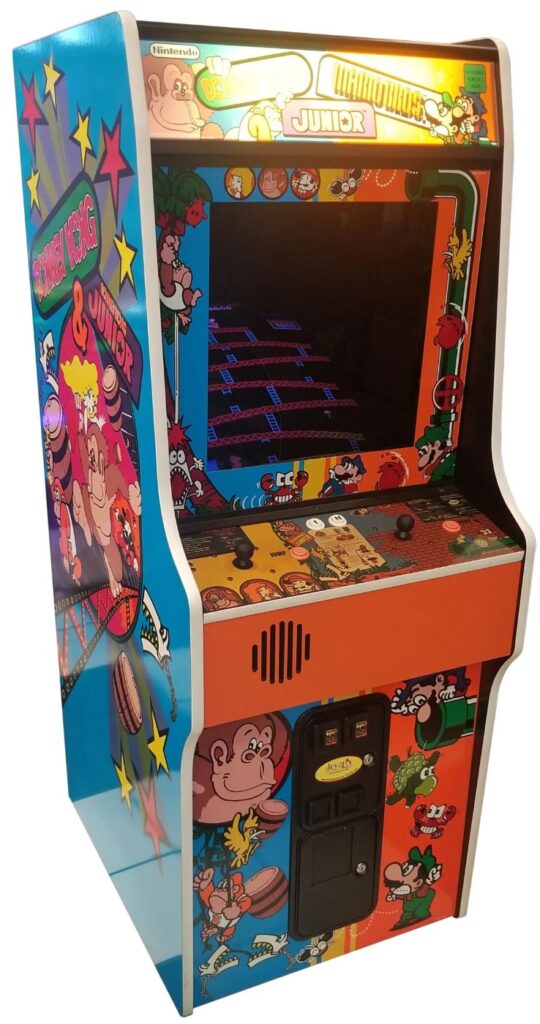
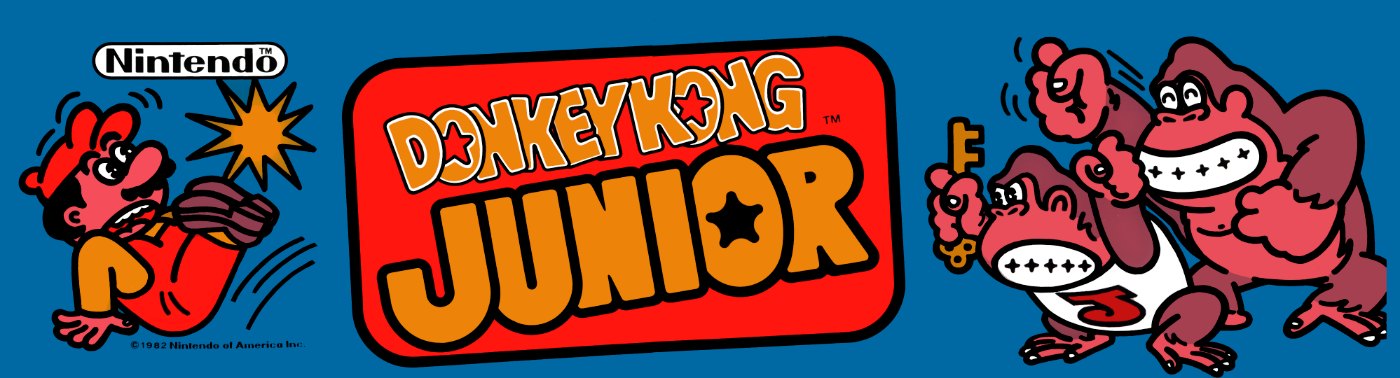
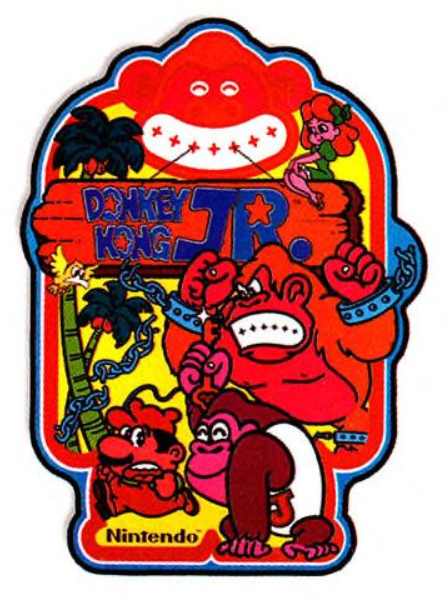
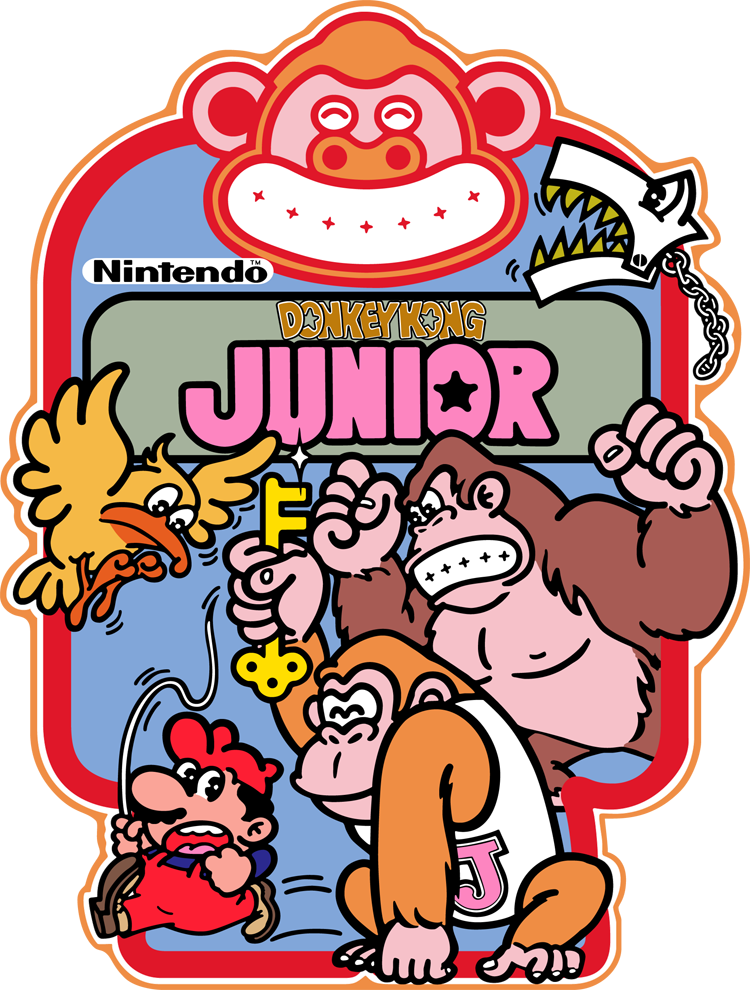
The side art of the arcade cabinet.
Donkey Kong Jr. follows straight on from Donkey Kong, picking up where the first game left off, with the roles reversed. Mario has won, and to pay the ape back for carrying off his girlfriend he has shut Donkey Kong in a cage. The hero this time is Kong’s son. By most counts there are only three games in the whole series in which Mario is the antagonist: this one and two Game & Watch handhelds, Donkey Kong II (March 1983) and Donkey Kong Circus (September 1984). This arcade game came first, in the summer of 1982.
It feels very different from its parent. The building site has become a jungle and then a city hideout; ladders have given way to vines, chains and poles; and Junior, being an ape, climbs better than he walks. Grab one vine and he slides down quickly; grab two side by side and he goes up faster. There is no hammer. Instead fruit hangs from the vines, and touching it sends it plummeting onto any enemy underneath. At the top of each of the first three stages sits Mario beside the cage, and a key that Junior has to reach; in the fourth he must push six keys up their chains into the locks.
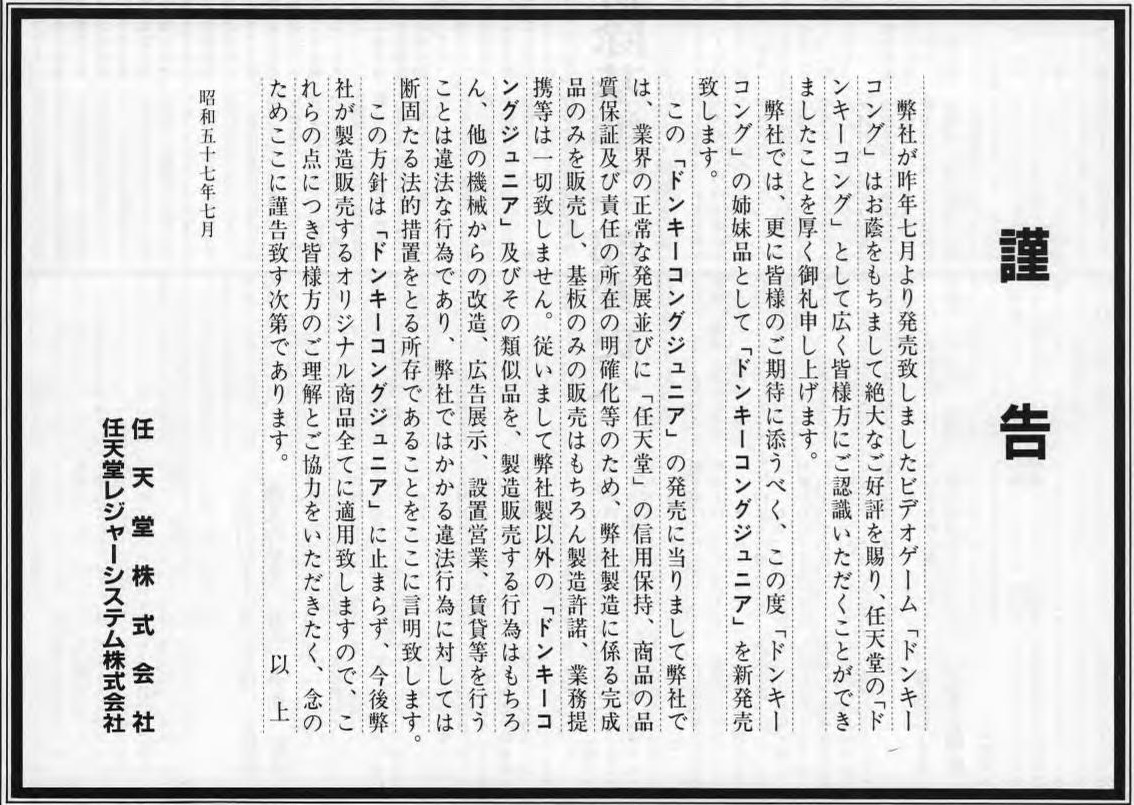
Nintendo kept firmer hold of this one. After an unhappy experience licensing the first game to Falcon, whose Crazy Kong boards leaked out of Japan, it decided not to license production of the sequel or sell loose circuit boards, only complete machines. The game was shown privately on 28 July 1982, according to the trade paper Game Machine, and went on sale in Japan in August and North America in September. It was never the phenomenon its father was: Steven Kent puts North American sales at about 30,000 machines, roughly half the original’s, though Game Machine still ranked it the eighth highest-earning arcade game of 1982 in Japan.
At home it went everywhere. Coleco held the home console rights and Atari the home computer rights, so there were versions for ColecoVision, Atari 2600, Intellivision, the Atari 8-bit computers and the Coleco Adam, and later the Atari 7800. Nintendo’s own conversion was one of the first games for the Famicom on 15 July 1983, and the NES version that followed in 1986 has since been re-released on e-Reader cards, three Virtual Consoles, the NES Classic Edition and Nintendo Switch Online. The arcade original finally came home in December 2018, when HAMSTER added it to the Arcade Archives series on Nintendo Switch.
Donkey Kong has finally been captured by Mario! In this unique role-reversal platformer, you play as DK’s son, Junior, and must save your dad from Mario’s clutches.
Swing and climb your way across vines and chains to grab the keys that unlock Donkey Kong’s cage, avoiding nasty critters like Snapjaws and Nitpickers.
It’s a game all about speed and high scores, so get swinging and rack up those points… but don’t forget to rescue DK!
— Official description (Nintendo UK, 2012)
Why Donkey Kong Jr. matters to Mario fans
This is the first game to make Mario the bad guy, and only two others are usually counted, both of them later Game & Watch handhelds. It introduces Donkey Kong Jr., who would star again in the educational Donkey Kong Jr. Math, race in Super Mario Kart and play in Mario’s Tennis and Mario Tennis. Its two-vine climbing lives on in Diddy and Dixie Kong’s rope climbing, and its Chain Scene was rebuilt, with the roles reversed again, as Stage 9-4 of the 1994 Donkey Kong for Game Boy.
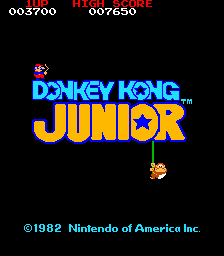
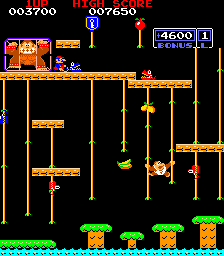
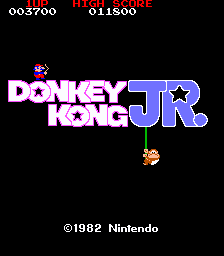
The arcade title screen.The Vine Scene: Mario guards the cage at the top.Mario’s Hideout, where the Sparks live.
“In the game Donkey Kong Jr., we did a complete one-eighty from the first title and made Mario the villain.”
Shigeru Miyamoto, interviewed in Nintendo Online Magazine No. 18, February 2000 (English translation by TheMushroomKingdom.net)
Miyamoto was looking back over the Donkey Kong series for Nintendo’s Japanese web magazine.
Quick Answers
The questions people ask most about Donkey Kong Jr., answered briefly here and in depth further down.
When did Donkey Kong Jr. come out?
The arcade game went on sale in Japan in August 1982 and in North America in September 1982. The Famicom version followed on 15 July 1983, the NES version in North America in June 1986 and in Europe on 15 June 1987. More →
Is Mario the villain in Donkey Kong Jr.?
Yes. Mario has caged Donkey Kong in revenge for the first game, and you play as Kong’s son trying to free him. It is Mario’s first turn as an antagonist; only two other games are usually counted as casting him that way, the later Game & Watch handhelds Donkey Kong II and Donkey Kong Circus, though Mario also holds Donkey Kong captive in Junior’s own Game & Watch of October 1982. More →
How many stages are there?
Four: the Vine Scene, the Jump Board Scene, Mario’s Hideout and the Chain Scene. Japanese machines play them in order every time; American machines start with just the first and last and add the middle two over the first few loops. More →
Who made Donkey Kong Jr.?
Nintendo R&D1, with Gunpei Yokoi producing and Shigeru Miyamoto designing, and with programming help from the contractor Iwasaki Engineering. Yukio Kaneoka wrote the music. More →
Is Donkey Kong Jr. the same as today’s Donkey Kong?
Nintendo has never settled it. A 1995 Japanese book and a 2002 Italian Nintendo magazine reportedly describe the modern Donkey Kong as the grown-up Junior, while others make Junior the son of Cranky Kong. In the games themselves Junior still turns up as his own character. More →
What are the differences between the arcade and NES versions?
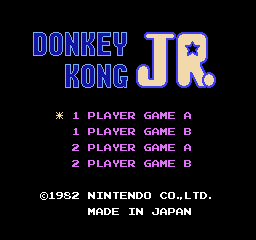
The Famicom/NES game keeps all four stages but drops the helicopter cut-scene, changes the ending so that Mario falls to the ground, adds Game A and Game B difficulty settings and pushes the kill screen back to level 135. More →
Does Donkey Kong Jr. have a kill screen?
Yes, at level 22, caused by the same overflow in the bonus timer as in Donkey Kong. The Famicom/NES version runs until level 135, where the game crashes. More →
Can I play Donkey Kong Jr. on Nintendo Switch?
Yes, two ways. Arcade Archives Donkey Kong Jr. (HAMSTER, 21 December 2018) has the arcade game in its Japanese and English versions. The NES version joined Nintendo Switch Online on 15 May 2019. More →
What is the Donkey Kong Jr. world record?
Wikipedia lists Justin Elliott’s 1,584,400 points, set live on stream on 3 July 2023 and verified by the Donkey Kong Forum and Twin Galaxies. Scores move on, so check those boards for anything newer. More →
Is Donkey Kong Jr. in Mario Kart?
He was one of the eight drivers in Super Mario Kart and has not raced since, though he cheers from the crowd at Waluigi Stadium in Mario Kart: Double Dash!!, and the Vine Scene music is still arranged for DK courses today. More →
Story
The arcade story is told in pictures, a couple of in-game captions and the flyer. Mario rescued the girl at the end of Donkey Kong; now he has taken his revenge on the ape and is hauling him off in a cage, and Junior follows him from the jungle to the top of a city tower. The Nintendo 3DS Virtual Console manual tells it in a few lines and leaves the outcome up to you.
The tables are turned
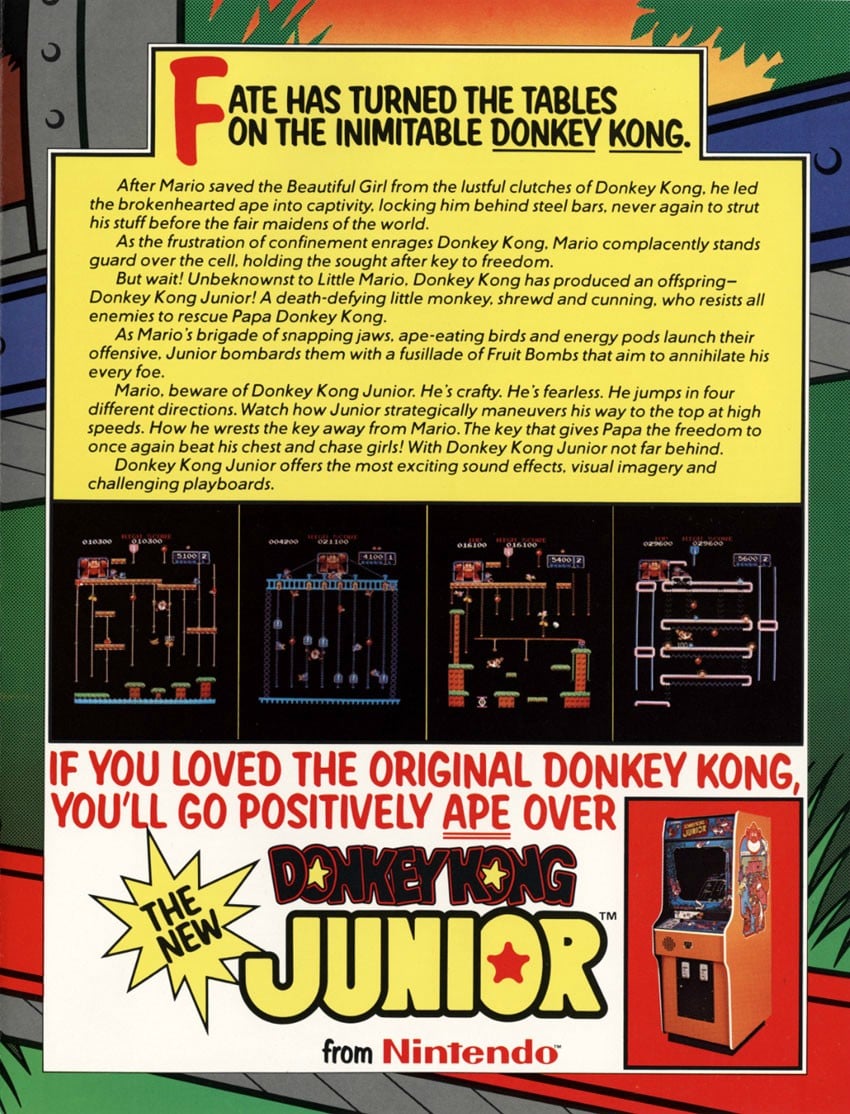
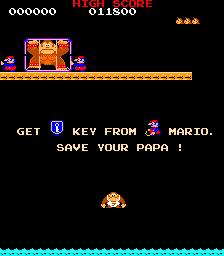
In the arcade opening two Marios, one at each end, carry the caged Donkey Kong away, and the order is spelt out on screen: “Get key from Mario. Save your papa !” Nintendo of America’s flyer put it more dramatically: fate, it said, had turned the tables on the great ape.
Two Marios carry the cage away in the opening scene.The title screen of the later Japanese version.
Round 1: the Vine Scene
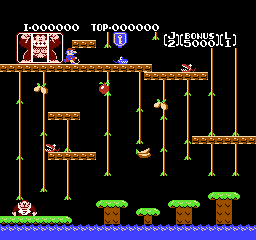
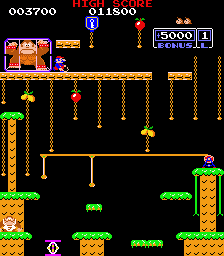
The jungle. Junior starts at the bottom left and has to climb to the top right, where Mario stands next to the cage. Vines hang between small islands of ground, there is water at the bottom that is instantly fatal, and Mario sends Snapjaws down the vines after him: red ones that patrol and turn back to chase, blue ones that head straight down and drop off the screen.
Junior grabs the key, and Mario pushes the cage away to the next stage. It is the stage that teaches everything: one-vine and two-vine climbing, dropping fruit and timing jumps.
The Vine Scene in the arcade.The same stage on the NES.
Round 2: the Jump Board Scene
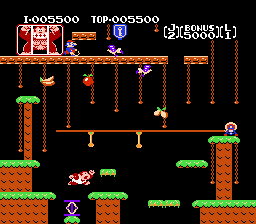
Still in the jungle, but a tidier one, with chains in place of most of the vines and moving platforms over the water. Junior starts beside the Jump Board, a springboard that bounces him onto the first platform. This time Mario releases Nitpickers, small birds that fly across at set heights and sometimes drop eggs.
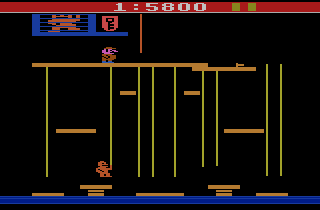
The Atari 2600 version leaves this stage out entirely.
Junior at the start of the Jump Board Scene.The NES version.
Keep going to Mario’s Hideout
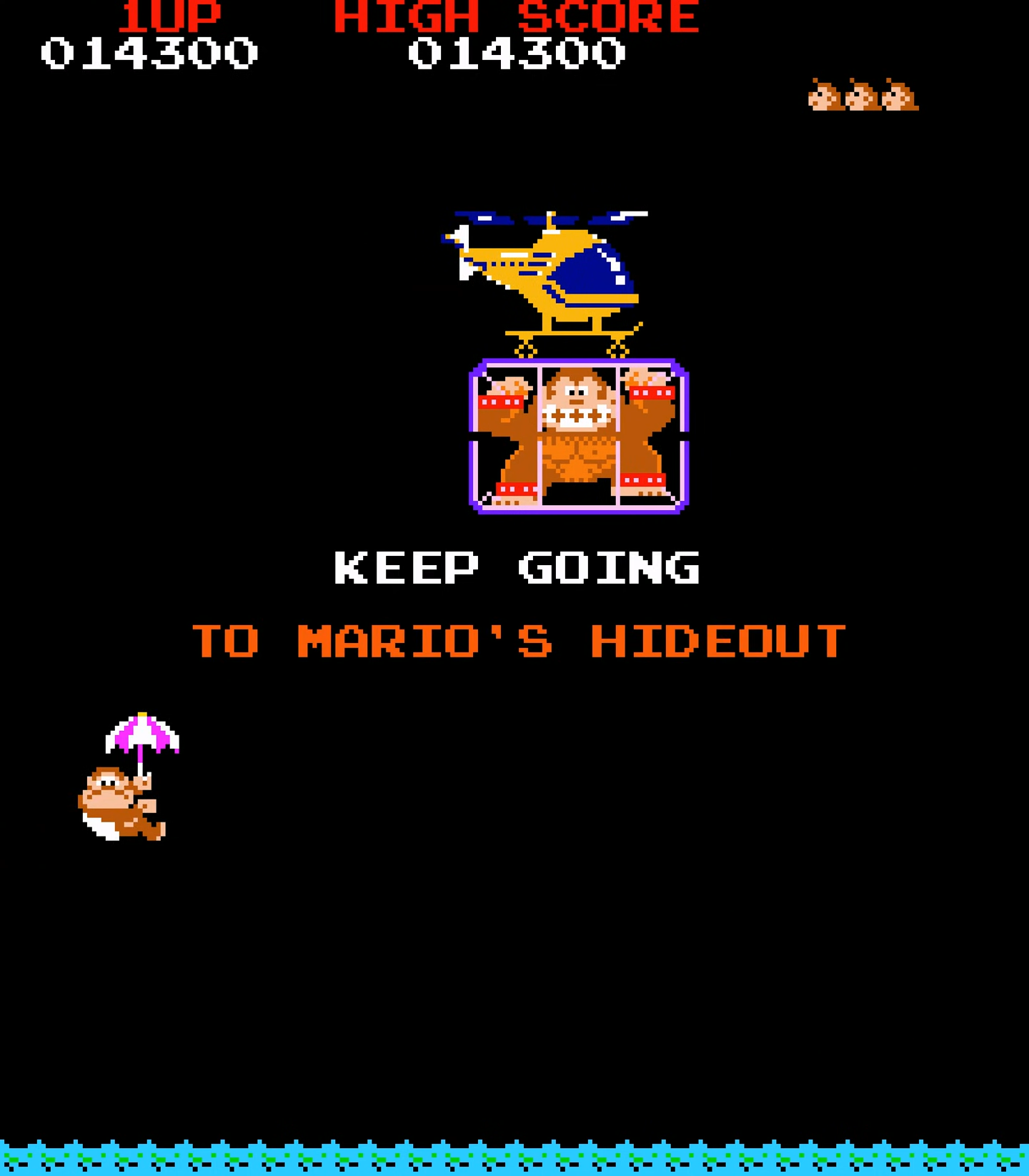
Between the second and third stages comes the game’s best cut-scene. Mario lifts the cage away by helicopter, and Junior follows him through the sky hanging from a parasol: the same parasol that the girl lost in Donkey Kong. The caption reads “Keep going to Mario’s Hideout. Be careful !”
Most home versions, the NES one included, cut this scene for space. The Coleco Adam version keeps a version of it, but without the helicopter.
The cut-scene before Mario’s Hideout.Mario’s helicopter carrying the cage.
Round 3: Mario’s Hideout
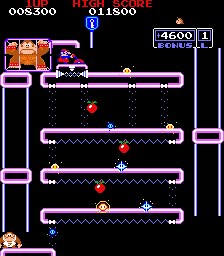
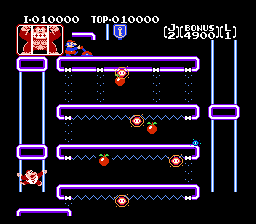
The first stage away from the jungle, built of girders, poles and electric wiring. Junior climbs poles instead of vines and zigzags up the platforms to the key. The danger here is electricity: red Sparks run round fixed loops of the wiring, and Mario sends blue Sparks dropping down the vertical conduits beneath his platform, picking one of four routes at random.
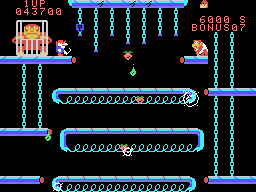
The Coleco Adam version rebuilds this stage with a different layout and adds dripping green water drops. The ColecoVision and Intellivision versions do not have it at all.
Mario’s Hideout in the arcade.The NES version.
Round 4: the Chain Scene and the rescue
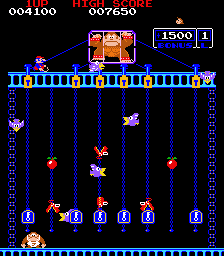
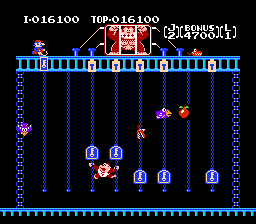
The top of Mario’s building, which recalls the 100 m rivets stage in the first game. Six keys hang on six chains below the platform where Mario stands guard with the cage, and Junior has to climb each chain and push its key up into the lock. Snapjaws prowl the chains and large black birds swoop across in wide zigzags, though unlike the Nitpickers they drop no eggs. Pushing two keys at once saves time, but it also means climbing twice as close to danger.
When the sixth key goes in, the platform vanishes. Mario and Donkey Kong both fall; Junior catches his father and Mario hits the ground. In the arcade Mario gets up and gives chase, but is booted back out of the picture and sent fleeing. On the NES he just falls. Then it all starts again from the Vine Scene, a little harder.
The Chain Scene: six keys, six locks.The Chain Scene on the NES.
The four stages of Donkey Kong Jr.
The Atari manuals call them Rounds 1 to 4; the names below are the ones in common use.
Vine SceneRound 1 · jungle · Red and Blue SnapjawsVines, islands and deadly water: the stage that teaches two-vine climbing and fruit drops.
Jump Board SceneRound 2 · jungle · Nitpickers and eggsA springboard start, moving platforms and chains. Missing from the Atari 2600 version.
Mario’s HideoutRound 3 · the city · Red and Blue SparksPoles and live wiring; preceded in the arcade by the helicopter cut-scene. Missing on ColecoVision and Intellivision.
Chain SceneRound 4 · rooftop · Snapjaws and birds · Donkey Kong freedSix keys to push into six locks beneath Mario’s platform; finish it and the cage falls.
Japanese order is 1-2-3-4 every loop. The American release plays 1-4, then 1-2-4, then 1-3-4, then 1-2-3-4 from the fourth loop on. The Atari 2600 version puts Mario’s Hideout after the Chain Scene in every loop.
Advertisement
Gameplay & Controls
The rules are simple and the timing is not. Junior has a joystick and one button, a bonus timer ticking down from the moment a stage begins, and a stage full of things that want to bump into him. Reach the key at the top (or, in the final stage, push all six keys home) and the stage is cleared, with whatever is left on the timer added to your score. Touch an enemy or anything it drops, fall too far, land in the water or run out of time, and Junior loses a life.
Controls: one joystick, one button
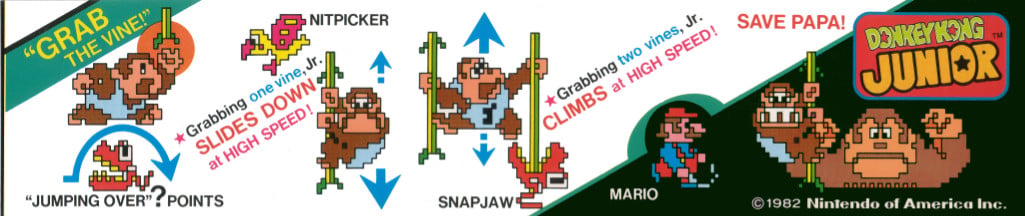
The instruction card on the arcade cabinet.
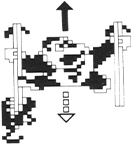
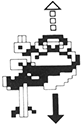
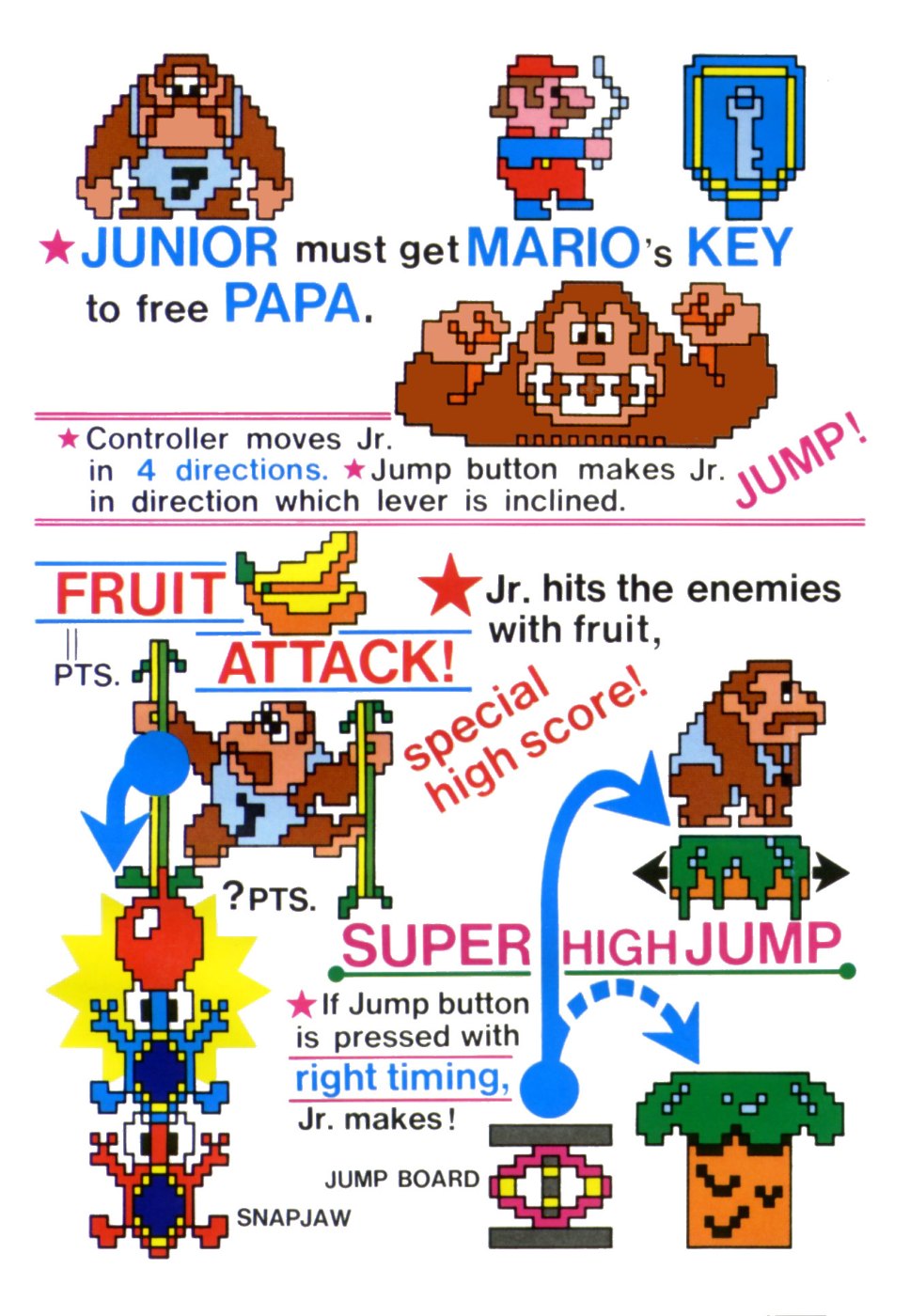
The joystick runs Junior left and right and, when he is on a vine or chain, climbs him up and down. The single button jumps: straight up on its own, or forward in a running leap with the stick held to one side. Junior can only fall a short distance safely, so most of the skill is in judging leaps from one vine to the next.
Climbing is where he differs from Mario. Hold a single vine and Junior climbs slowly and slides down fast; stretch across to grab two vines at once and he climbs quickly but descends slowly. Good players switch between the two constantly, dropping on one vine to escape a Snapjaw and climbing on two to beat the clock.
Fruit, points and extra lives
Junior climbing, arcade sprite.
Bananas, apples and other fruit hang on the vines. Touch one and it drops, flattening every enemy it hits on the way down, which is far more satisfying than jumping over them. The game-guide notes collected by Arcade-History give 100 points for jumping over one enemy, 300 for two or more, 400 for picking a fruit and climbing bonuses for each extra enemy a falling fruit knocks out, and 200 for each key pushed into a lock in the Chain Scene. Guides disagree on the exact fruit values, so treat them as a rough scale.
The bonus timer counts down in steps throughout each stage and is paid into your score when the stage is cleared, so speed matters as much as safety. Operators could set the bonus life at 10,000, 15,000, 20,000 or 25,000 points with a switch on the board; the factory setting was 10,000.
Loops, levels and the American running order
After the Chain Scene the game starts again at the Vine Scene, faster and busier, and each pass is counted as a level. Japanese boards always play the four stages in order. The American release, which was the earlier version of the game, eases you in: level 1 is just the Vine Scene and the Chain Scene, level 2 adds the Jump Board Scene, level 3 swaps it for Mario’s Hideout, and only from level 4 do all four stages appear every time. Because the “Keep going to Mario’s Hideout” cut-scene only plays before the third stage, American players do not see it until their third loop.
Enemies multiply as the levels rise. From level 5, Arcade-History’s notes warn, defeated Red Snapjaws are replaced at Mario’s feet instead of staying gone. The level counter shows digits up to 9, nothing at all for 10 to 16 and the hex letters A–F for 17 to 22, which is where the game breaks.
The Famicom and NES version
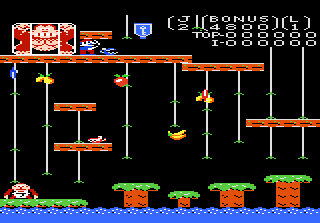
The Vine Scene on the NES.
Nintendo’s home conversion keeps all four stages, which the first Donkey Kong on Famicom did not manage. The cost was the cut-scenes: the helicopter sequence before Mario’s Hideout is gone, as it is from most home versions. The ending changes too, so that Mario simply falls to the ground. Players choose 1 or 2 players and Game A or Game B, B being the harder setting.
The cartridge’s own timer overflow does not arrive until level 133, where the low-time alarm sounds non-stop although the timer is actually higher than usual, and level 135, where the game crashes. Nintendo quietly revised the cartridge: the later version lets Junior move with the D-pad held at a diagonal, fixes a ledge in the Jump Board Scene that could be reached from the wrong side and keeps the falling fruit its proper colours.
Fruit and objects
Everything Junior can use. There is no power-up: the fruit is his only weapon.
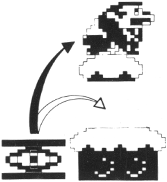
BananaHangs from a vine. Touch it and it falls straight down, taking out every enemy in its path.
AppleWorks the same way. Fruit which hits nothing still pays a small bonus.
Jump BoardThe springboard at the start of the second stage. Arcade-History’s tip: hit it at the right moment and it throws Junior straight up to a small ledge, saving a long detour.
KeyThe goal of every stage. In the first three, reaching it sends Mario off with the cage; in the Chain Scene Junior pushes six keys up their chains into the locks beneath Donkey Kong.
Cartoons, Comics & Other Media
Junior had a busy 1983: a cereal, a cartoon, a maths game and a pocket-sized version of his own. He has turned up in odd corners of Nintendo’s games ever since.
Donkey Kong Jr. (Game & Watch)Nintendo · 26 October 1982 · DJ-101A New Wide Screen handheld in which Junior climbs vines and leaps for swinging keys; four keys free his father. It returned in the Mini Classics range in 1998 and on DSiWare.
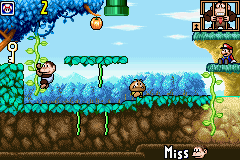
Game & Watch Gallery 3 and 4Game Boy Color and Game Boy AdvanceBoth collections pair the handheld with a Modern remake that swaps the jungle creatures for Goombas, Nipper Plants, Bullet Bills and Spinies, and adds a cloudy night-time third area.
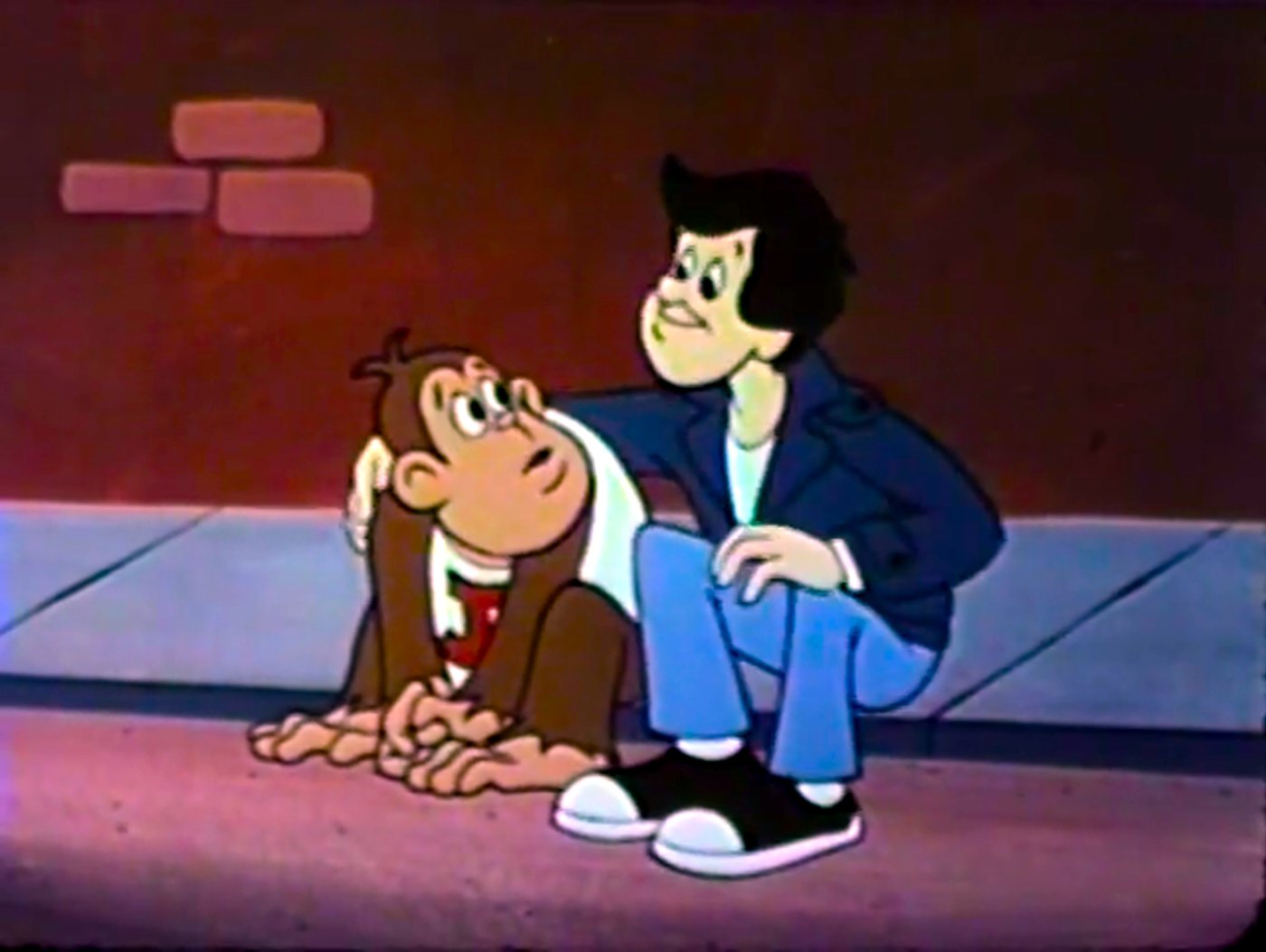
Saturday SupercadeRuby-Spears / CBS · 1983Thirteen Donkey Kong Jr. segments ran in the show’s first season, from September 1983. Donkey Kong has escaped from Mario’s circus, and Junior (voiced by Frank Welker) roars off after him on a motorbike with his friend Bones Bailey in the sidecar.
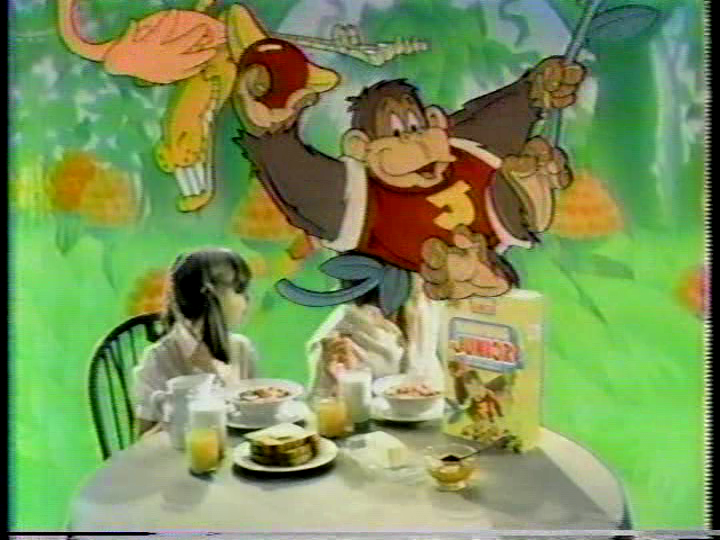
Donkey Kong Junior cerealRalston Purina · October 1983Fruit-flavoured apple and banana shapes, sold with the slogan “WILD with fruit flavor!” Some boxes came with Pez sweets, baseball cards or activity booklets, and a mail-in offer brought a Donkey Kong Junior Pez dispenser.
Donkey Kong Jr. MathFamicom 1983 · NES 1986Another starring role for Junior: an arithmetic game built from this one’s program and graphics. An early version of it was first released in Japan on a combined cartridge with this game, bundled with Sharp’s My Computer TV C1.
Donkey Kong (Game Boy)Nintendo · 1994Junior, Snapjaws, birds and a Spark all return, and Stage 9-4 rebuilds the Chain Scene, except that this time Mario is using the keys to lock Junior up.
Super Mario Kart and the tennis gamesSuper NES · Virtual Boy · Nintendo 64Junior is one of the eight drivers in Super Mario Kart, playable in Mario’s Tennis on Virtual Boy and an unlockable player in Mario Tennis on N64.
Donkey Kong CountrySuper NES onwardsDiddy and Dixie Kong’s trick of climbing two ropes at once is usually traced back to Junior, and the plot of Donkey Kong Country 2, in which Diddy sets off to rescue a kidnapped Donkey Kong, follows the same pattern. Donkey Kong Country Returns and Tropical Freeze arrange its music.
Mario Kart music and cameosDouble Dash!! onwardsThe DK Mountain and Dino Dino Jungle theme in Mario Kart: Double Dash!! arranges the Vine Scene music, and the arrangement has returned in Mario Kart Wii, Mario Kart 7, the Mario Kart 8 Deluxe Booster Course Pass and Mario Kart World. Junior himself watches from the stands at Waluigi Stadium in Double Dash!!.
Super Smash Bros.Melee, Brawl and UltimateJunior is a trophy in Melee, whose description mentions his feud with Mario, and a spirit in Ultimate, which also has a Donkey Kong / Donkey Kong Jr. medley. In Brawl’s story mode, the captured Donkey Kong’s trophy is shown chained by its arms and legs, a nod to the Chain Scene.
NES Remix and Super Mario MakerWii USeveral NES Remix challenges are built on this game, and the first section of the “3 GAMES IN 1” course in Super Mario Maker is based on it.
Characters
Three characters, and a small zoo of things that bite, peck and fizz.
Character
Who they are
In this game
Abilities & notes
Donkey Kong Jr.The hero
Donkey Kong’s son, making his first appearance. The American arcade title spells his name out as Donkey Kong Junior; in Japan the arcade game is called ドンキーコング ジュニア (Donkī Kongu Junia). Nintendo has never fixed his family tree: some publications treat today’s Donkey Kong as Junior grown up, others make Junior the son of Cranky Kong.
The playable character. He runs, jumps, climbs vines, chains and poles (two at once for speed), knocks down fruit and pushes keys into locks.
Dies on touching an enemy or anything it drops, after a long fall, in water or when the timer runs out. Bonus life at 10,000 points on the factory setting.
Donkey KongPapa, in a cage
The ape from the first game, defeated at the end of it and now Mario’s prisoner.
Locked in a cage at the top of every stage, airlifted by helicopter between the second and third, and freed when the sixth key goes into its lock. In the arcade ending he is caught by his son as he falls.
Not playable. Mario moves his cage on each time Junior reaches a key.
MarioThe villain
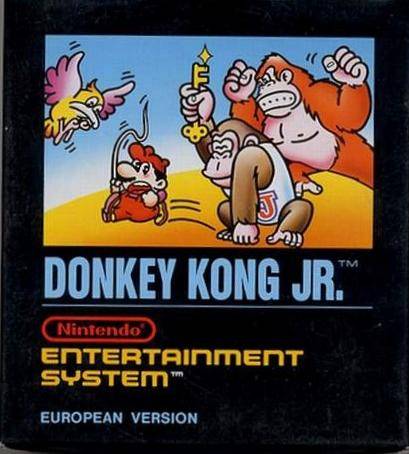
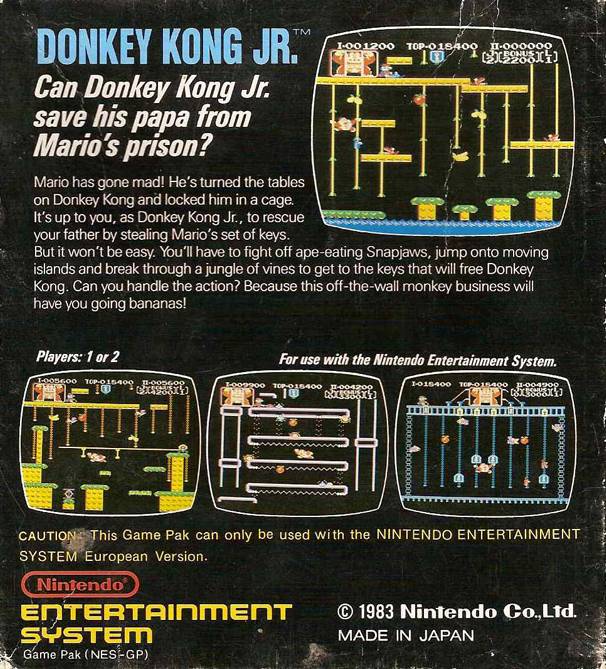
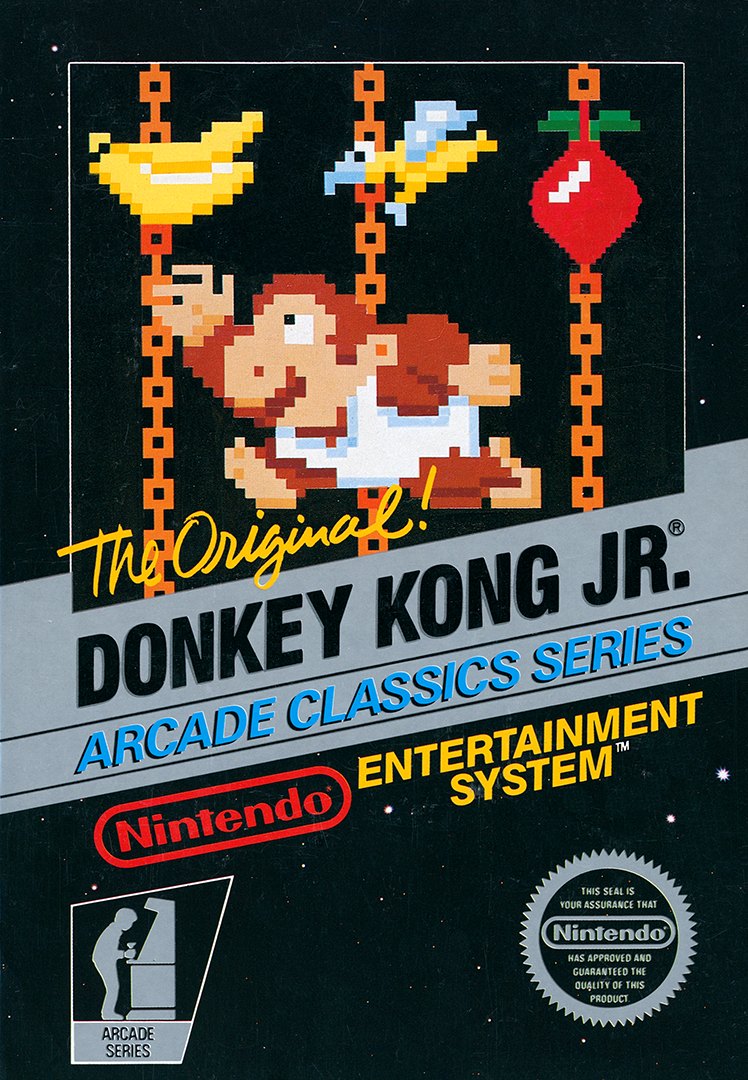
The carpenter who rescued the girl in Donkey Kong and has now taken his revenge on the ape. The NES box puts it bluntly: “Mario has gone mad!”
The antagonist. He waits beside the cage at the end of each stage, sends out Blue Snapjaws, Nitpickers and Blue Sparks, and drags the cage onwards whenever Junior delivers a key. A second Mario helps carry the cage in the arcade opening, and he flies the helicopter before Mario’s Hideout.
Never attacks Junior directly. Falls to the ground at the end; in the arcade he gets up and gives chase.
Enemies
Every enemy in the arcade game, plus the one hazard added in a home version. Contact with any of them costs a life.
Red SnapjawVine Scene, Chain SceneA toothy jaw-trap with eyes that patrols its own patch of vines and turns back to follow Junior. Slower than the blue kind, but it does not leave.
Blue SnapjawVine SceneReleased by Mario. Wanders until it finds a vine, then heads down it and drops off the bottom of the screen.
NitpickerJump Board SceneA small bird that flies across at one of three set heights. Some drop eggs on the platforms below.
Bird (large Nitpicker)Chain SceneBigger, dark birds that swoop across in wide arcs, dropping a level each time they turn. No eggs.
Red SparkMario’s HideoutA ball of electricity running round a fixed loop of wiring. Deadly from above or below.
Blue SparkMario’s HideoutSent by Mario. Picks one of the four conduits under his platform and runs straight down it.
DropMario’s Hideout, Coleco Adam onlyDangerous green water drops added to the Adam version’s redesigned hideout.
Key people
The arcade game has no credit screen; these names come from Wikipedia and other references.
Gunpei YokoiProducerHe had produced the first game too.
Shigeru MiyamotoDesignerCredited by some sources as designer and by Wikipedia as director. He also drew the graphics, with Yoshio Sakamoto.
Yoshio SakamotoGraphics (logo)Credited with the logo graphic; Wikipedia says he drew the game’s graphics together with Miyamoto.
Yukio KaneokaMusicComposed the original music, as he did for Donkey Kong.
H. Hoshino and Kenji NishizawaProgrammingListed among the programming staff.
Iwasaki EngineeringCo-developerThe outside firm Nintendo hired to work on the program; The Cutting Room Floor says its job was to reverse-engineer Ikegami Tsushinki’s code for the first game.
Advertisement
How It Was Made
Less is on record about this game than about its parent, but the outline is clear: a quick sequel built from spare ideas, programmed with outside help and sold only in Nintendo’s own cabinets.
A sequel from spare parts
Junior on the vines, arcade-era artwork.
Wikipedia’s account says the game grew out of ideas, and whole levels, that had been worked up for Donkey Kong and did not fit, and out of Nintendo’s wish for another coin-op in the series. Miyamoto first thought of making Donkey Kong himself the hero, but the big ape was awkward to move around a screen, so the team gave him a small son and kept the large Kong at the top of the stage by having Mario capture him.
Gunpei Yokoi produced and Miyamoto designed, drawing the graphics with Yoshio Sakamoto, while Yukio Kaneoka returned to write the music. Looking back in 2000, Miyamoto summed the idea up as a complete reversal of the first game, a story about humans taking Donkey Kong away and his son going to get him back, and an action game about climbing up and down vines.
Iwasaki Engineering and the Ikegami code
The arcade title graphic.
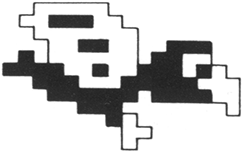
The first Donkey Kong had been programmed under contract by Ikegami Tsushinki. For the sequel Nintendo turned to another firm, Iwasaki Engineering, which The Cutting Room Floor says was hired to reverse-engineer Ikegami’s program. The new game runs on the same Donkey Kong hardware, and some of the old graphics came along for the ride: tucked in the character data is Ikegami’s hidden logo, although Ikegami had nothing to do with this game.
That reuse had consequences. In 1983 Ikegami sued Nintendo, claiming among other things that its code had been copied to make the sequel. The case ran in the Tokyo courts for seven years before it was settled privately on 26 March 1990.
Built in Nintendo’s own factory
Game Machine announces the game, July 1982.
Nintendo had licensed the first game to Falcon for the Japanese market, and Falcon’s Crazy Kong boards had found their way abroad. So this time, by most accounts, Nintendo licensed nobody and sold no loose circuit boards, only complete machines: the Crazy Kong episode is usually given as the reason Nintendo built every Donkey Kong Jr. machine itself.
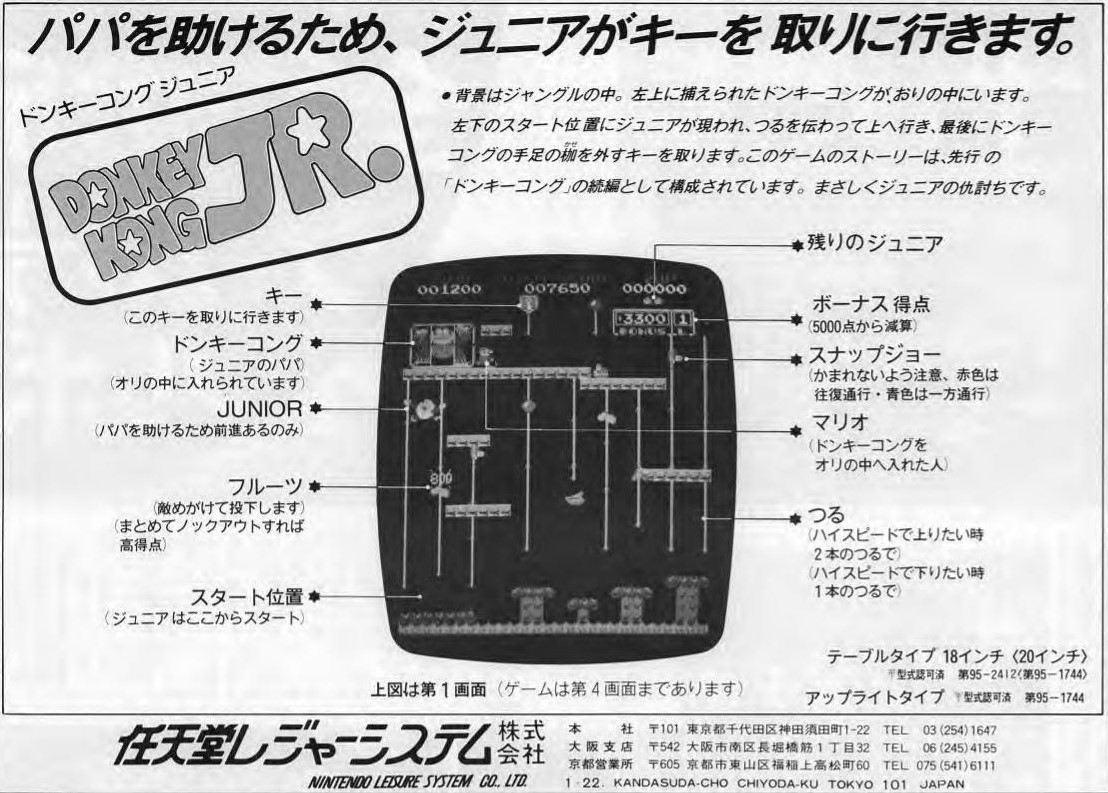
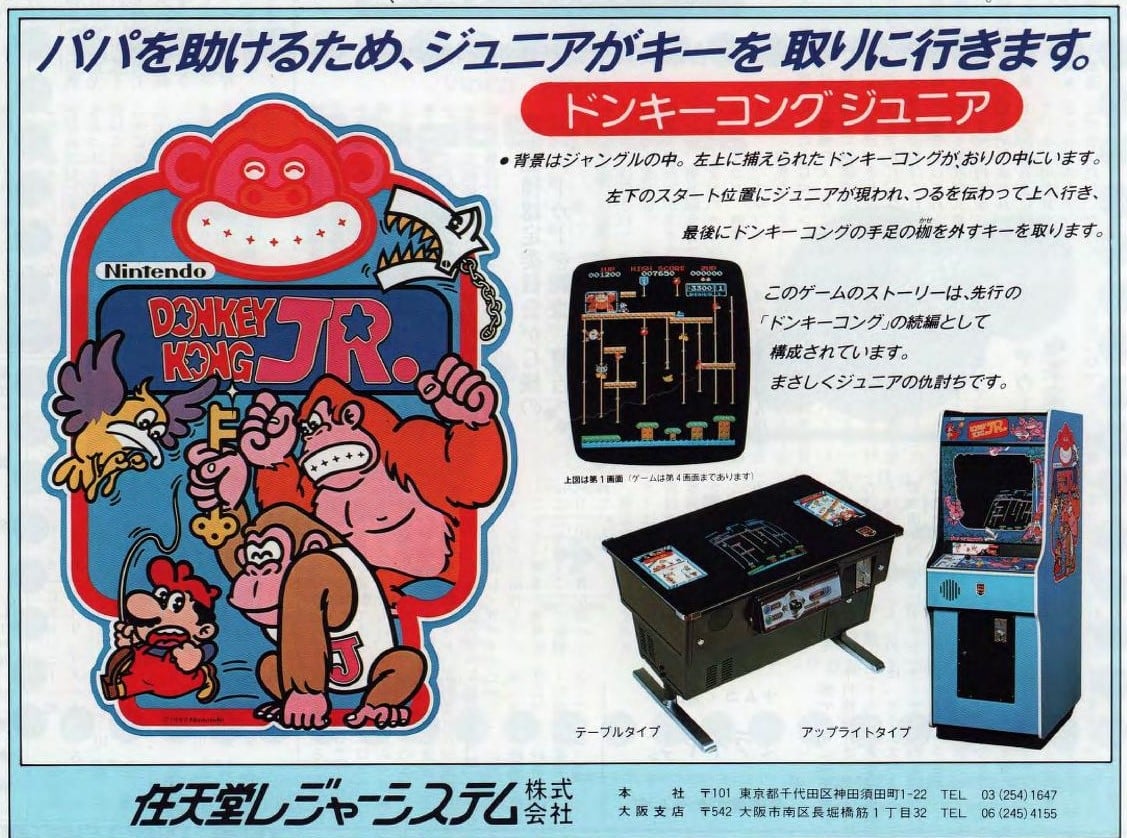
Game Machine magazine trailed the game in its July 1982 issue and ran adverts in August and October. Operators saw it at a private showing on 28 July 1982, and it went on sale in Japan the following month; The Cutting Room Floor dates the Japanese release to 13 August, other sources to 2 August. America followed in September.
Cabinets, flyers and titles
An upright Donkey Kong Junior cabinet.
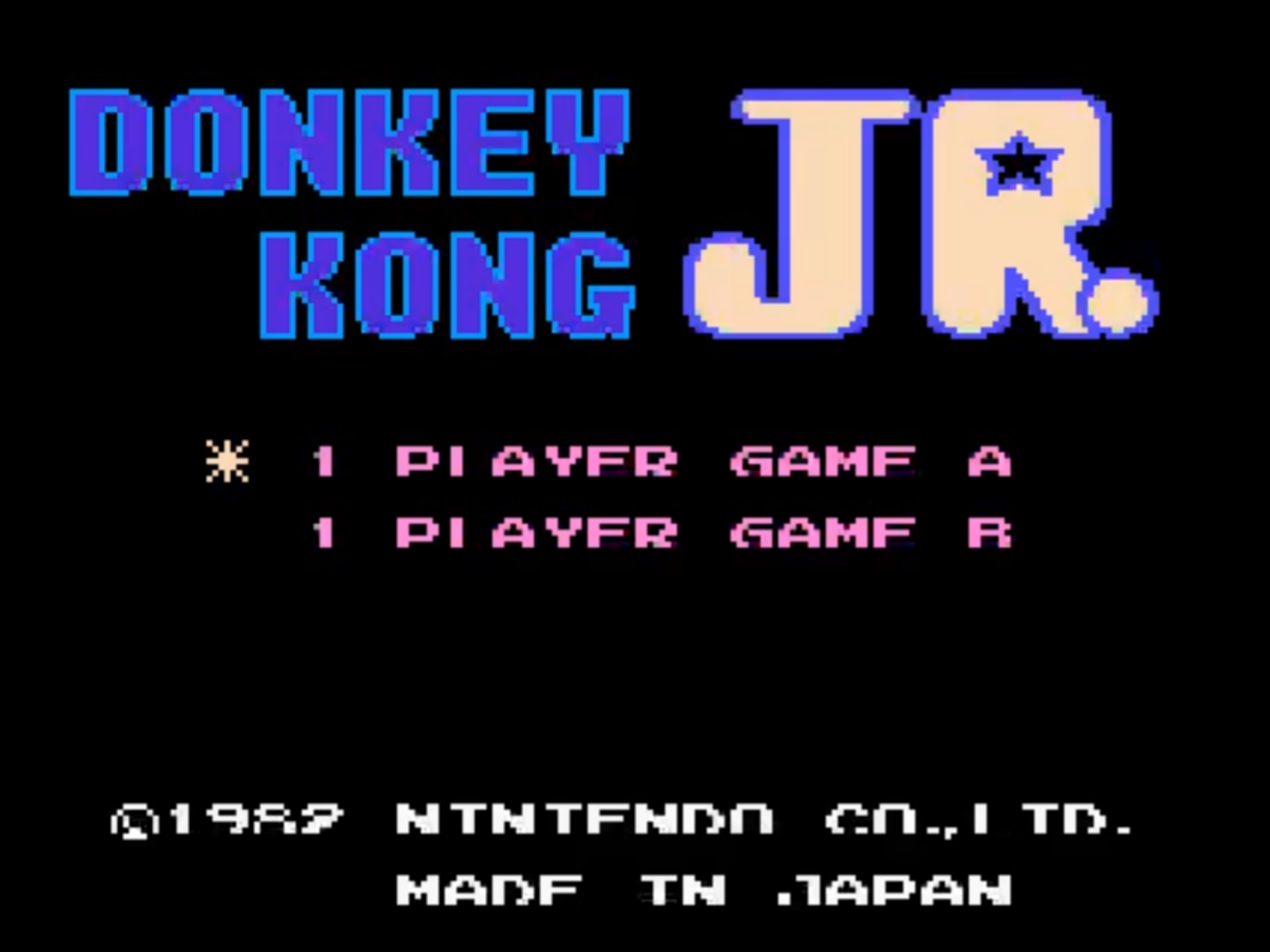
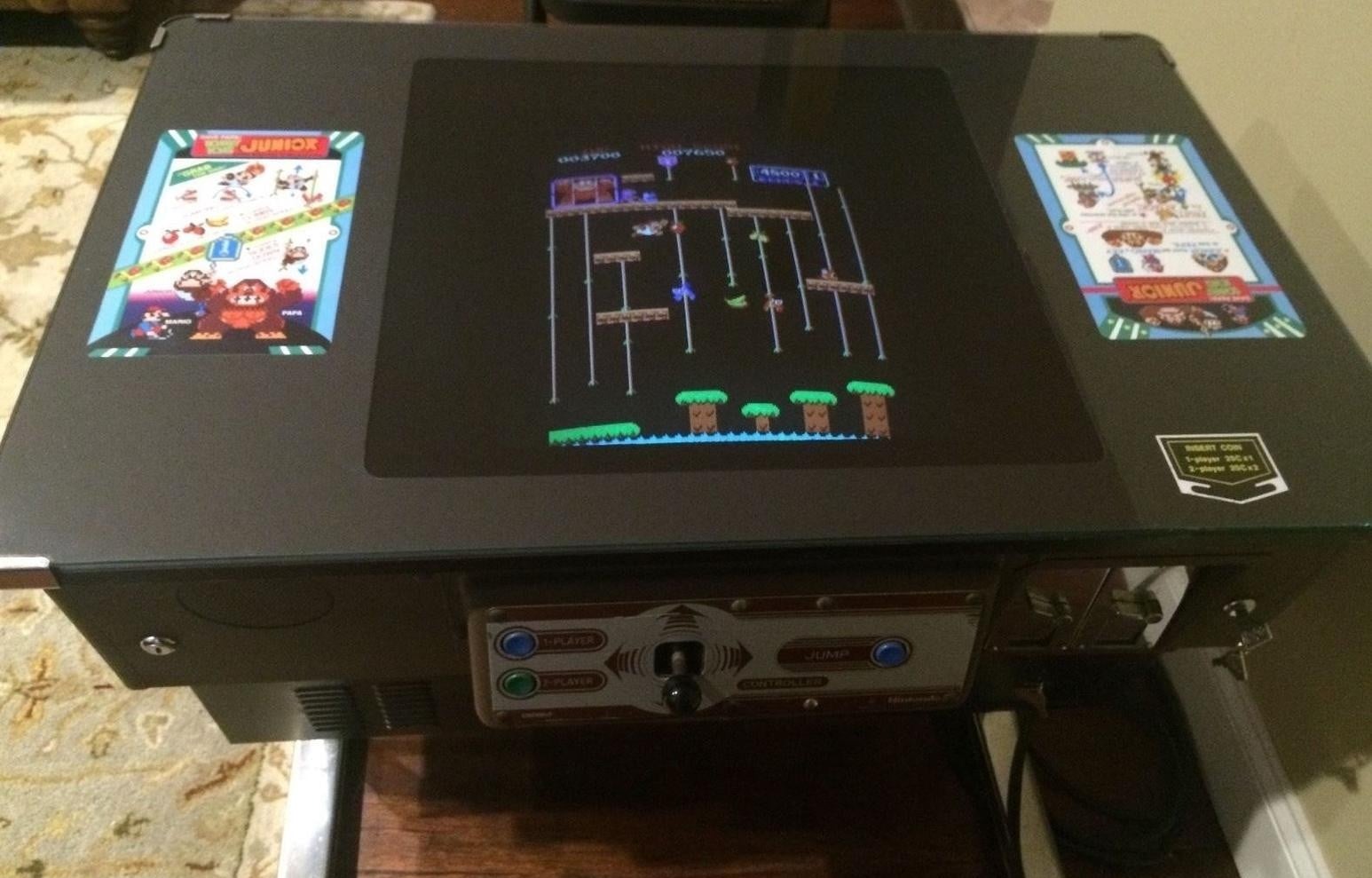
The game came in an upright cabinet and a sit-down cocktail table. The earliest version, the only one sold in America, spells out “Donkey Kong Junior” with a trademark sign; later Japanese boards shorten it to “Donkey Kong Jr.” and change the title colours. The high-score table also grew up: players could now enter twelve characters instead of three.
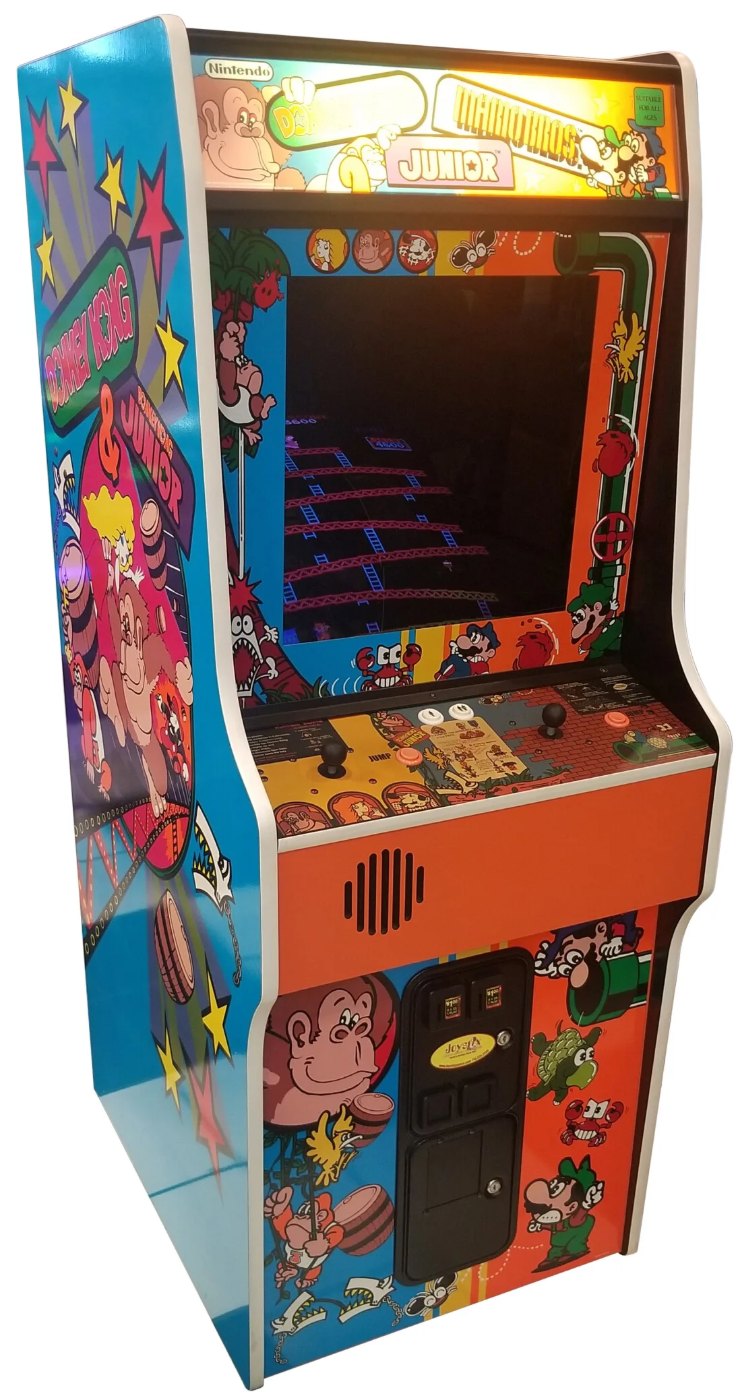
Twenty-two years later, in 2004, Namco built a combined Donkey Kong / Donkey Kong Junior / Mario Bros. machine for North America that included the international version of this game.
Bringing Junior home
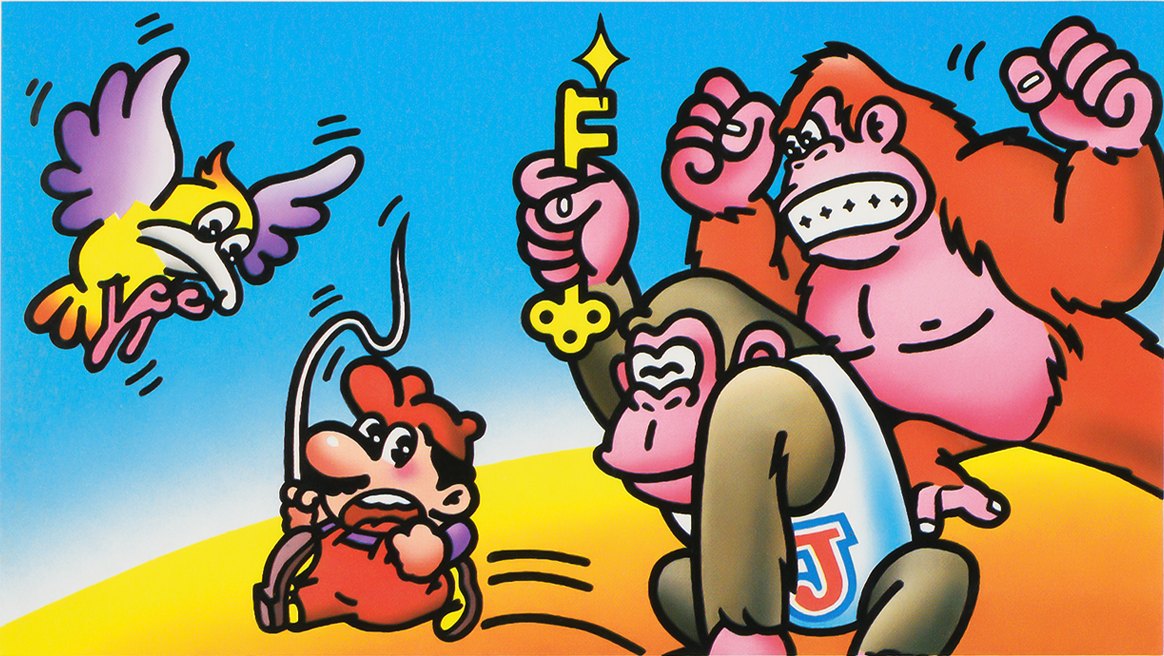
Key art for the Famicom version.
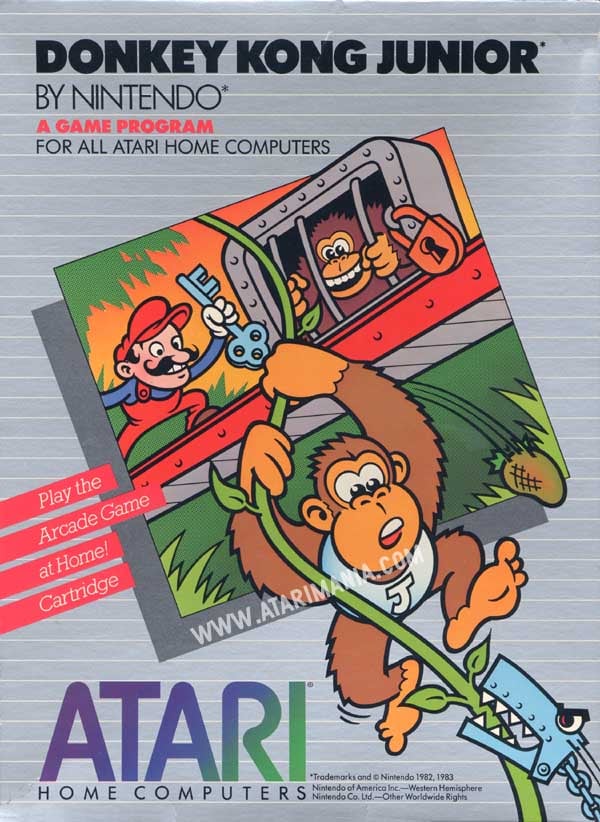
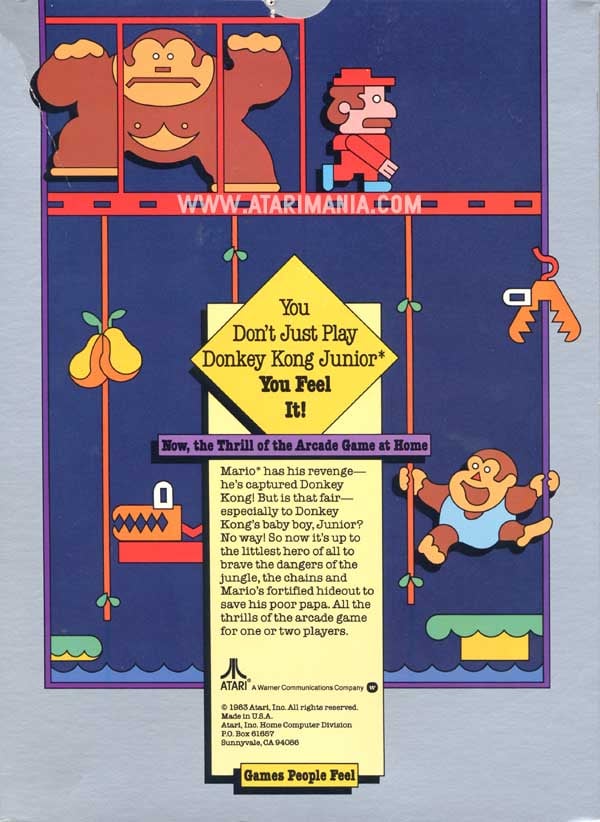
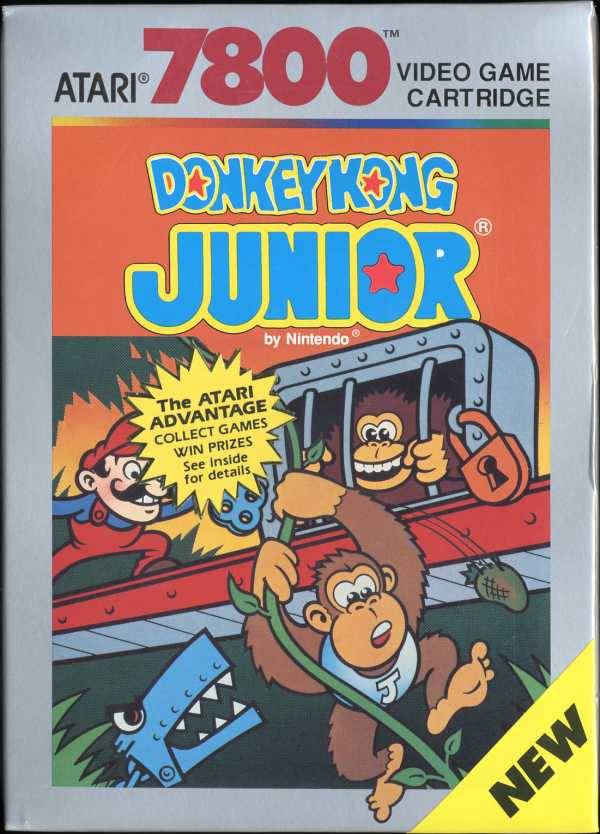
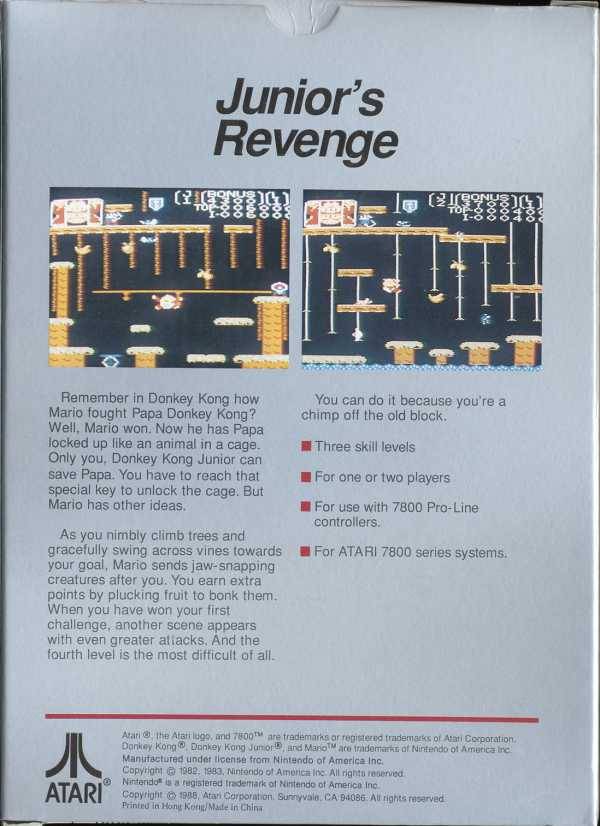
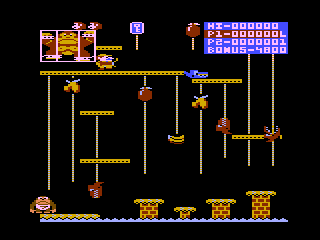
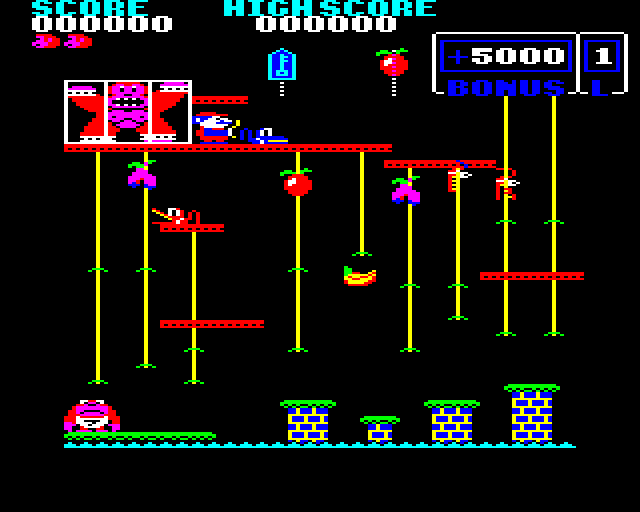
Home rights were split as they had been for the first game: Coleco for home consoles, Atari for home computers. Coleco’s ColecoVision version came first, in February 1983, with Atari 2600 and Intellivision versions about six months behind; the Atari 2600 one drops the Jump Board Scene, and the ColecoVision and Intellivision ones drop Mario’s Hideout. Atarisoft planned versions for the Apple II, MS-DOS, Commodore 64, VIC-20, ZX Spectrum and BBC Micro, but only the Atari 8-bit game was released; the BBC Micro version has since leaked online. Coleco’s Adam computer got its own version in 1984, and Atari Corporation published one for the Atari 7800 in 1988.
Nintendo’s own conversion was one of the launch games for the Family Computer on 15 July 1983. It reached the NES in North America in June 1986, in the Arcade Classics Series, and Europe on 15 June 1987, and was reissued on the Famicom Disk System on 19 July 1988.
Series Firsts
What this game did first, checked against the series before it.
1Donkey Kong Jr.’s debutJunior’s first appearance anywhere, two months before his own Game & Watch handheld of October 1982.
2Mario’s first turn as a villainThe first of the three games usually listed with Mario as the antagonist, ahead of the Game & Watch Donkey Kong II (March 1983) and Donkey Kong Circus (September 1984).
3Two-handed climbingHolding two vines to climb faster started here; Diddy and Dixie Kong’s two-rope climbing in the Donkey Kong Country games is usually traced back to it, and Mario borrows it in Mario vs. Donkey Kong.
4On prime-time televisionOne of five games played at the first official video game world championship, filmed at Twin Galaxies in Ottumwa, Iowa, on 8 and 9 January 1983 for ABC’s That’s Incredible!, according to Wikipedia.
Cheats & Secrets
The arcade game has no codes, just technique. These are the tips the guides agree on, and the one genuine cheat hidden in a home version.
One vine down, two vines up
To escape a Snapjaw, let go with one hand: Junior drops much faster on a single vine. To beat the clock on the way up, stretch across a pair of vines and climb with both.
The springboard shortcut
In the Jump Board Scene, landing on the board at the right moment launches Junior straight up to a small ledge, cutting out a slow climb.
Make the fruit count
Wait until two or three enemies are lined up under a piece of fruit before touching it: the bonus rises with every enemy it hits, and it clears the way at the same time.
Red Snapjaws from level 5
Early on, a Red Snapjaw squashed by fruit stays gone. From level 5 Mario sends new ones out from beside his feet, so clear the area below him with care.
Watch the conduits
In Mario’s Hideout each Blue Spark picks one of four routes down from Mario’s platform as it sets off. Pass underneath his platform only when you know which route it has taken.
Two keys at a time
In the Chain Scene you can push two neighbouring keys together, which saves time but leaves Junior longer in reach of the Red Snapjaws.
Atari 8-bit: BOOGA
On the Atari 400 and 800, hold Shift and type BOOGA. After that, K makes Junior invincible and S skips the current stage.
Animal Crossing
The NES version is one of the NES games playable in the GameCube Animal Crossing, but only by entering a password Nintendo gave out on a website that has since closed.
Glitches & Oddities
The famous one is the same bug that ends Donkey Kong; the home cartridge has a few smaller ones of its own.
The kill screen at level 22
The bonus timer is worked out by multiplying a number held in a single byte. At level 22, which is screen 89 on Japanese boards and screen 82 on American ones, the result overflows. Wikipedia says the stage then begins with a bonus of just 700 points, which runs out almost immediately, killing Junior again and again until the lives are gone. The level indicator has given warning: it shows the letters A to F for levels 17 to 22.
Level 135 on the NES
The Famicom and NES versions survive much longer. At levels 133 and 134 (screens 529 to 536) the timer overflows the other way, so high that the low-time alarm plays continuously, and on level 135, screen 537, the game crashes.
The anti-piracy check
Before every stage the arcade program checks the bytes that hold “NINTENDO” in the copyright line. A board with that text altered plays horribly wrong: a Snapjaw turns orange, Blue Snapjaws fall through floors and, worst of all, Junior cannot climb vines.
The wrong-side ledge (NES)
On the first NES revision the last platform in the Jump Board Scene has a collision box two pixels too wide, so grabbing the final vine from the left can drop Junior down it and onto the platform from an impossible angle. The later revision fixes it.
Diagonals (NES)
The first NES revision, like that of Donkey Kong, freezes Junior when the D-pad is held diagonally. The second gives priority to whichever direction was pressed first.
Videos
Nintendo’s trailer for the Nintendo Switch Online update that added the NES version in May 2019, and Shacknews on the arcade original.
Official Nintendo of America trailer for the May 2019 update, which added Donkey Kong Jr., Clu Clu Land and VS. Excitebike to the NES library.
Third-party video by Shacknews, published 2 November 2016, playing and discussing the arcade game.
Trivia & Interesting Facts
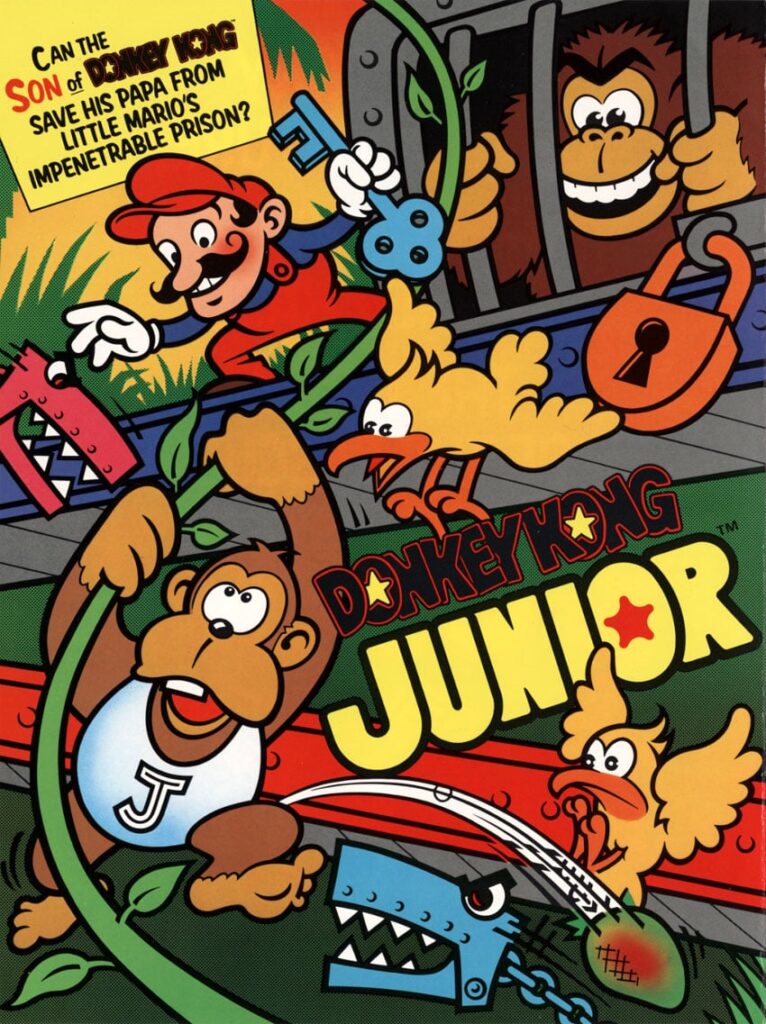
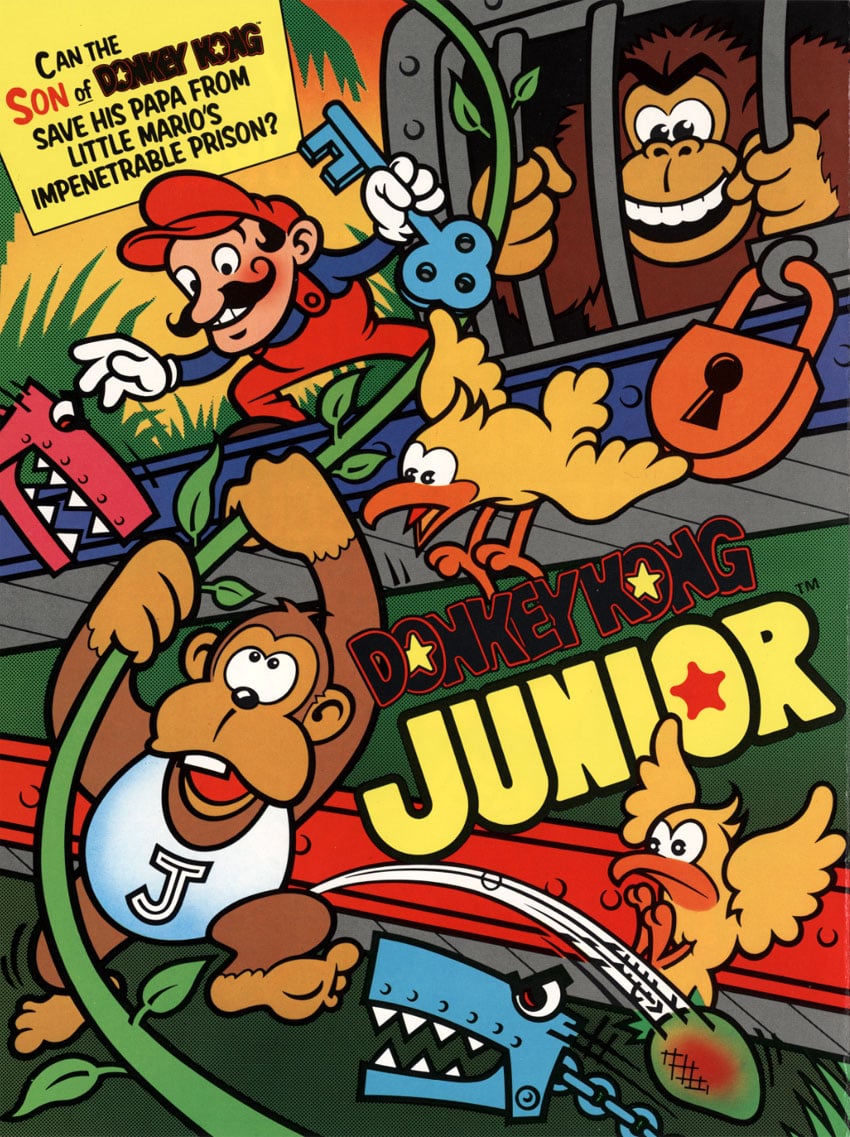
The American arcade flyer.Nintendo of America’s flyer opens with the line “Fate has turned the tables on the inimitable Donkey Kong.” The Atari 2600 and 7800 boxes went with “Junior’s Revenge…”
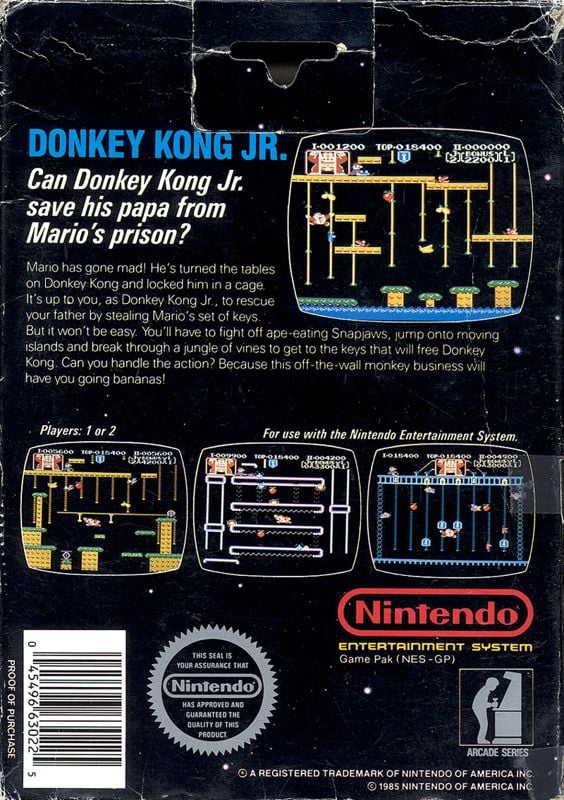
The NES box asks “Can Donkey Kong Jr. save his papa from Mario’s prison?” before announcing that “Mario has gone mad!”
In a TV commercial for the game Mario taunts the viewer: “Save your papa? Ha! Save yourself first!”
The parasol Junior floats on in the helicopter scene is the one the girl dropped in Donkey Kong.
An unused Mario sprite left in the arcade graphics.The arcade graphics still contain a few Donkey Kong leftovers, among them an unused Mario sprite and the hidden Ikegami Tsushinki logo, plus an unused light bulb drawn among the fruit graphics, probably meant to be dropped in Mario’s Hideout in place of fruit.
According to Arcade-History, the opening tune quotes the start of Bach’s Toccata and Fugue in D minor, and the cut-scene before Mario’s Hideout borrows the can-can.
The tune that plays after your second full loop of the game reworks the stage-clear jingle from Sky Skipper, another Nintendo arcade game.
The Coleco Adam version once had an unlockable extra stage, removed at Nintendo’s request.
Bootleg boards circulated under names such as Donkey King Jr. and Junior King, and one ran on Moon Cresta hardware.
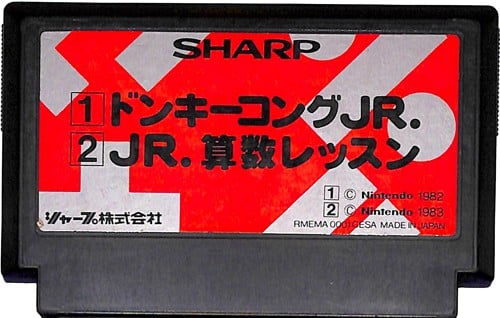
The game’s first Japanese home release came in two forms in 1983: the Famicom cartridge, and a combined Donkey Kong Jr. + Jr. Sansū Lesson cartridge packed with Sharp’s My Computer TV C1, a television with a Famicom built in. That version keeps only the first and last stages.
The e-Reader release, Donkey Kong Jr.-e (September 2002), is single-player only.
Wikipedia says Geoff Edwards, host of the TV game show Starcade, kept one of the machines in his dressing room and found it fiendishly hard.
The 2004 Donkey Kong / Donkey Kong Junior / Mario Bros. upright.Namco’s 2004 three-in-one machine put the game alongside Donkey Kong and Mario Bros. in North American arcades, twenty-two years after it first appeared.
On the Chinese-language Nintendo Classics service the game is called 咚奇刚JR. (Simplified) and 咚奇剛JR. (Traditional).
The Wii U Virtual Console version sold in Europe is the American release of the NES game, as Nintendo UK’s product page points out.
Regional Box Art
Nintendo’s own Famicom and NES boxes, then the covers of the Coleco and Atari versions, and the icons used for the Virtual Console downloads.
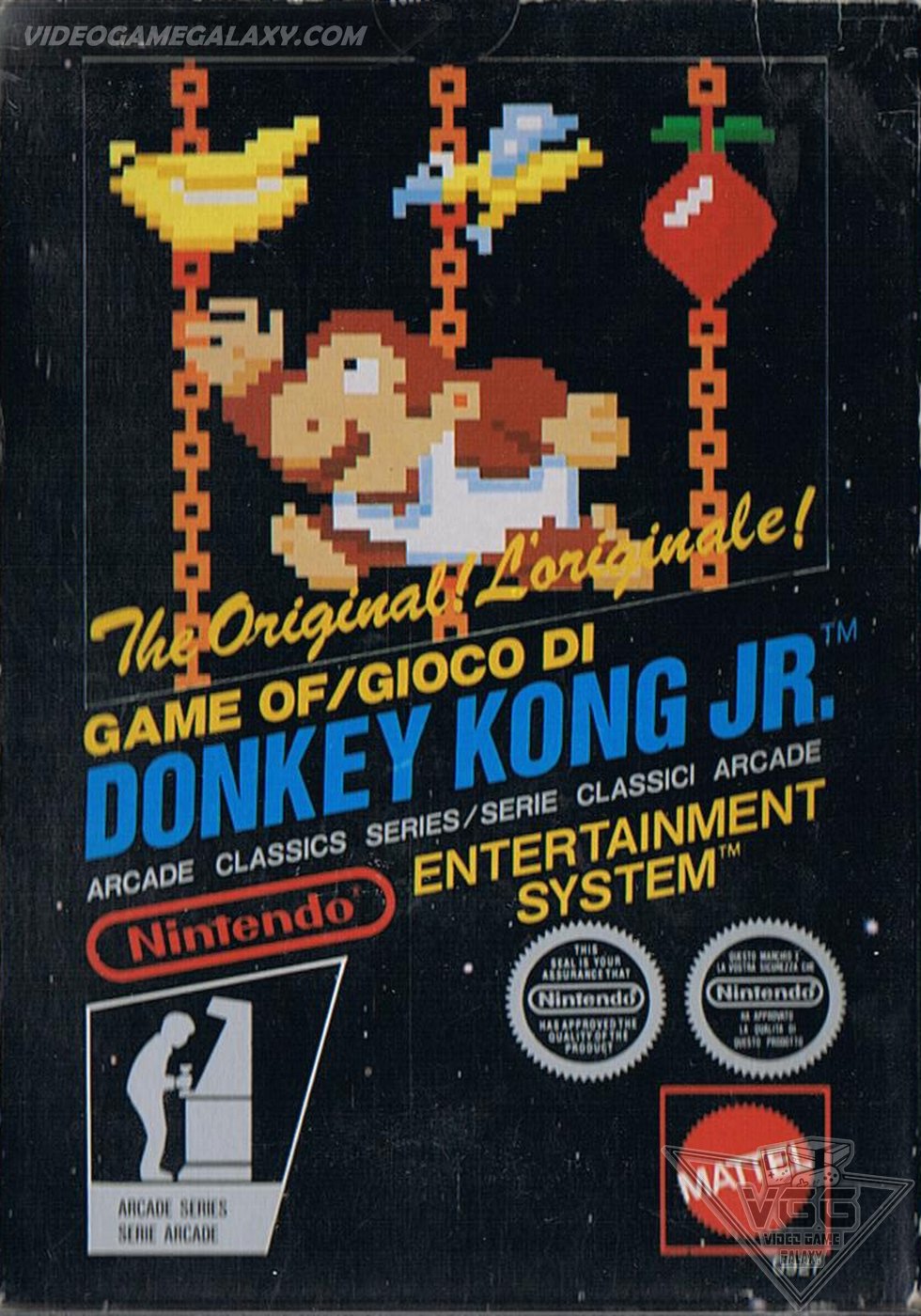
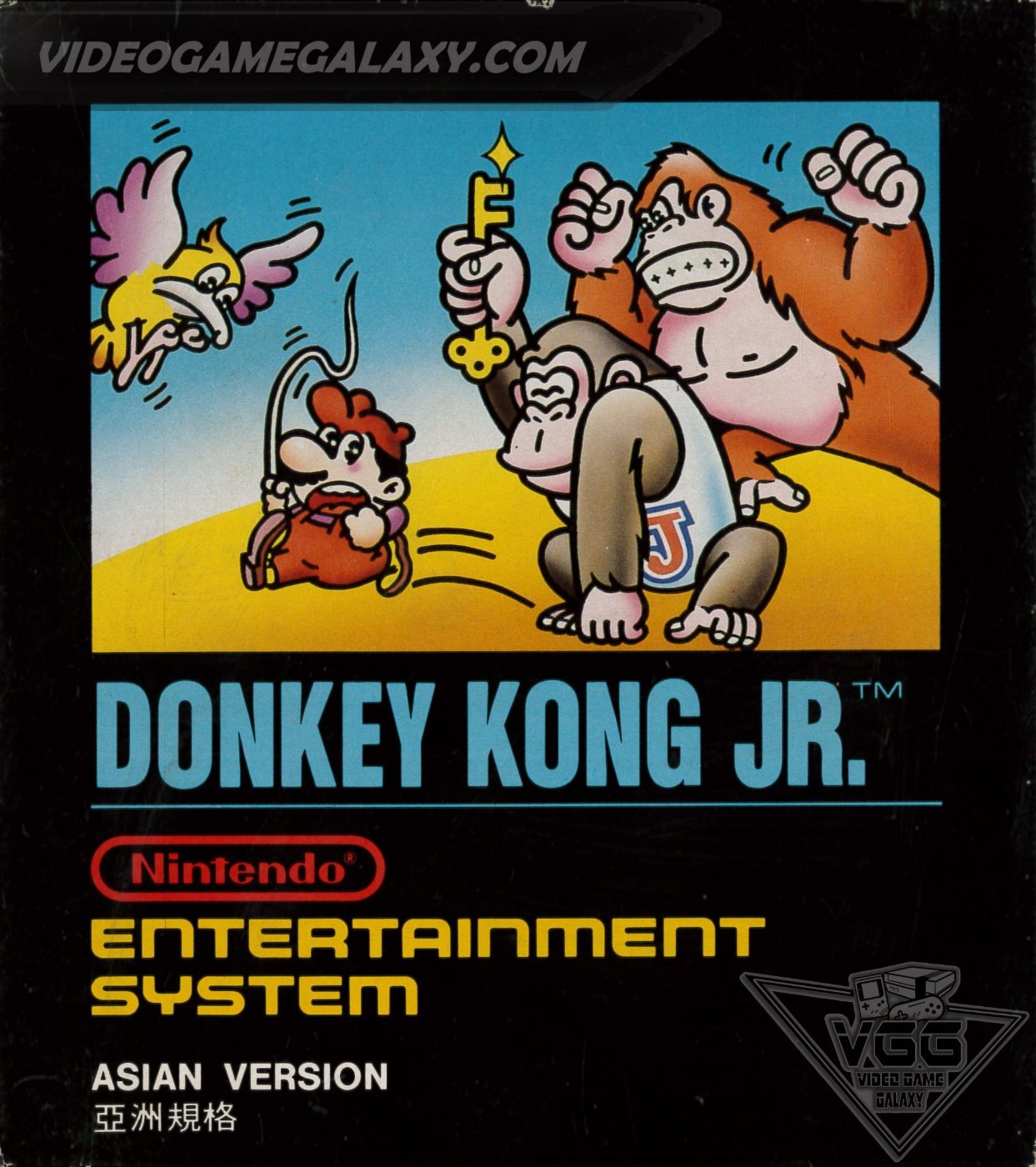
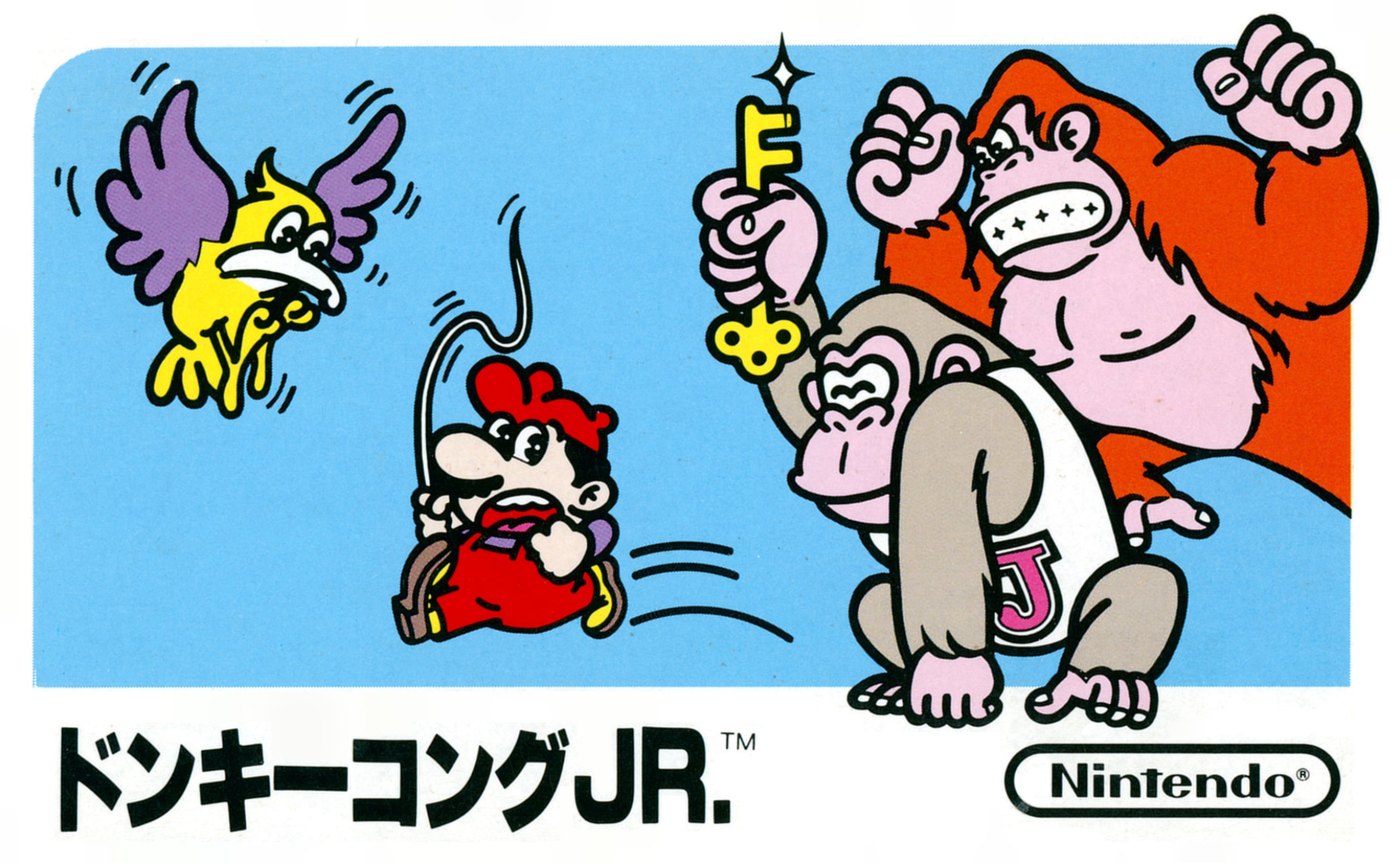
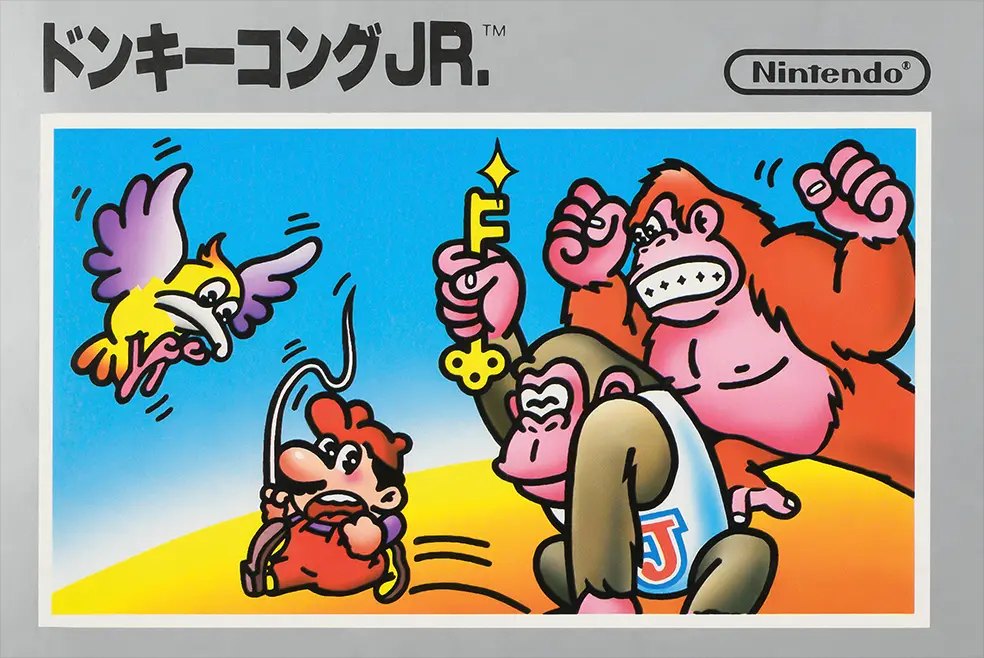
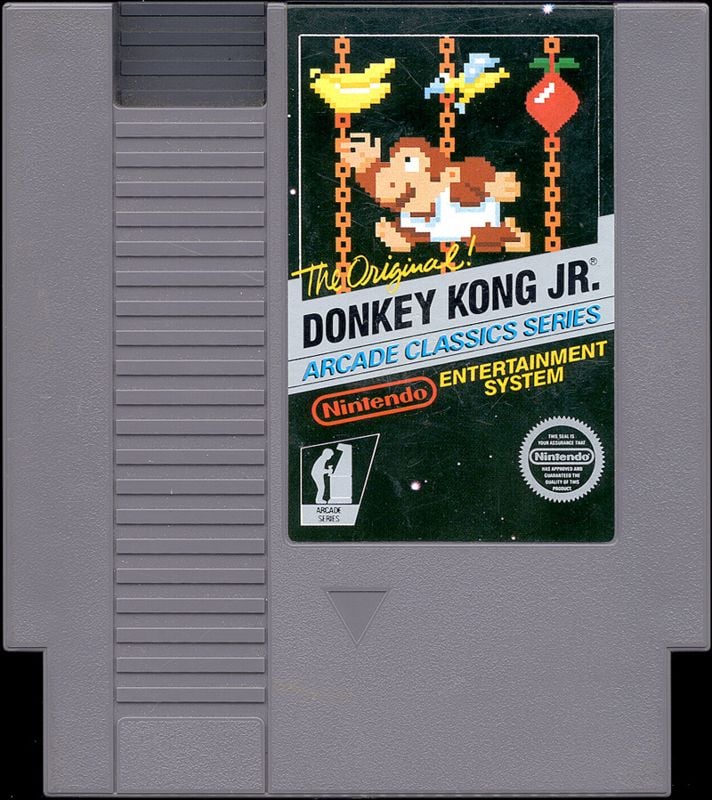
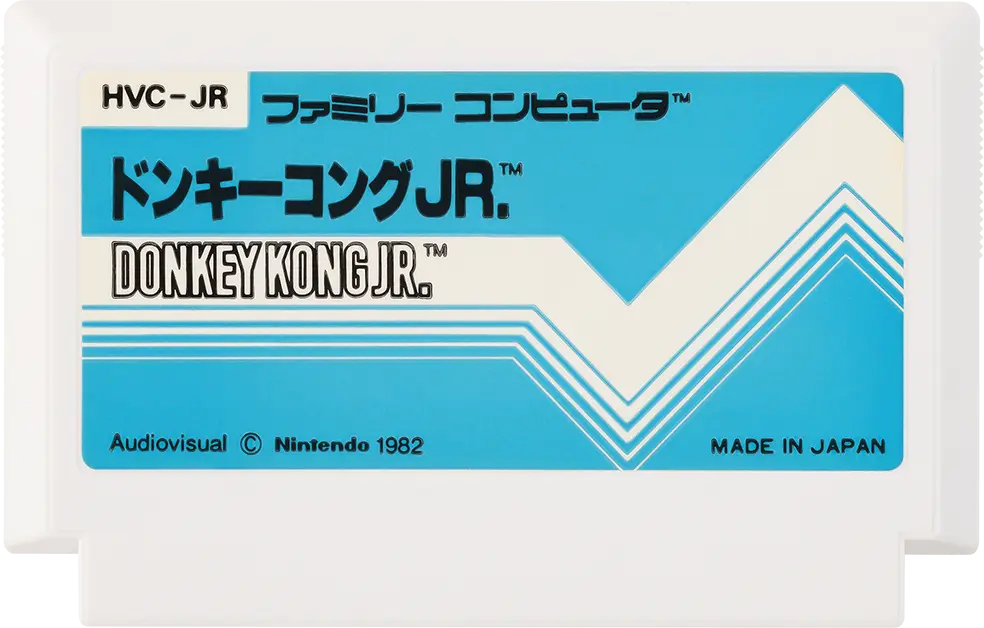
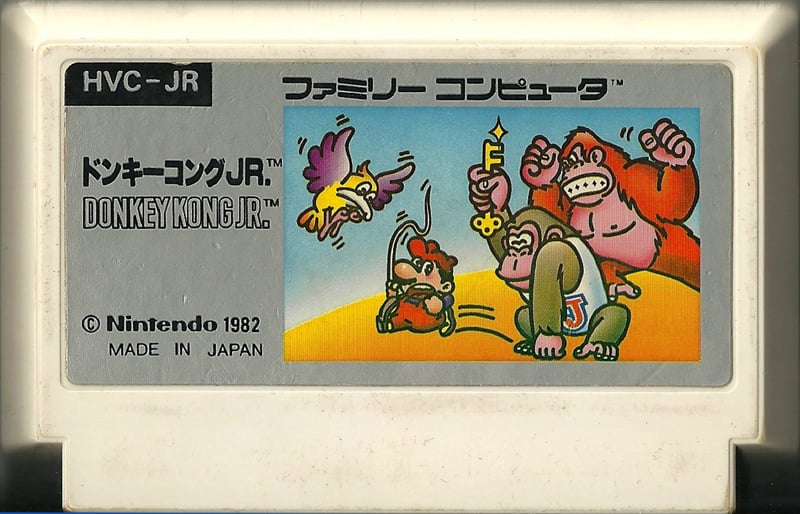
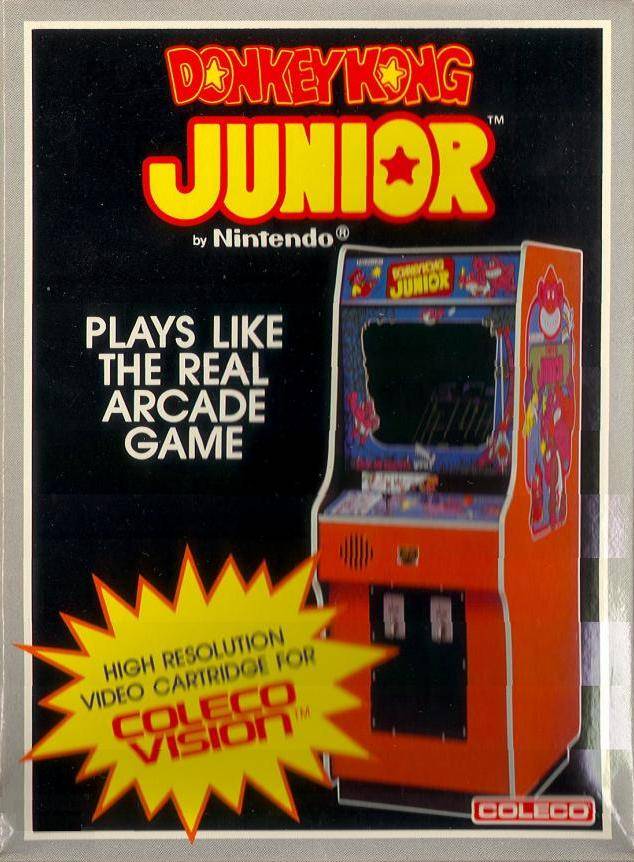
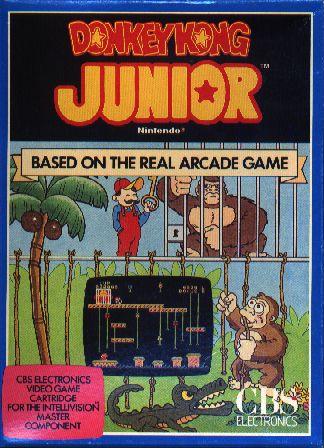
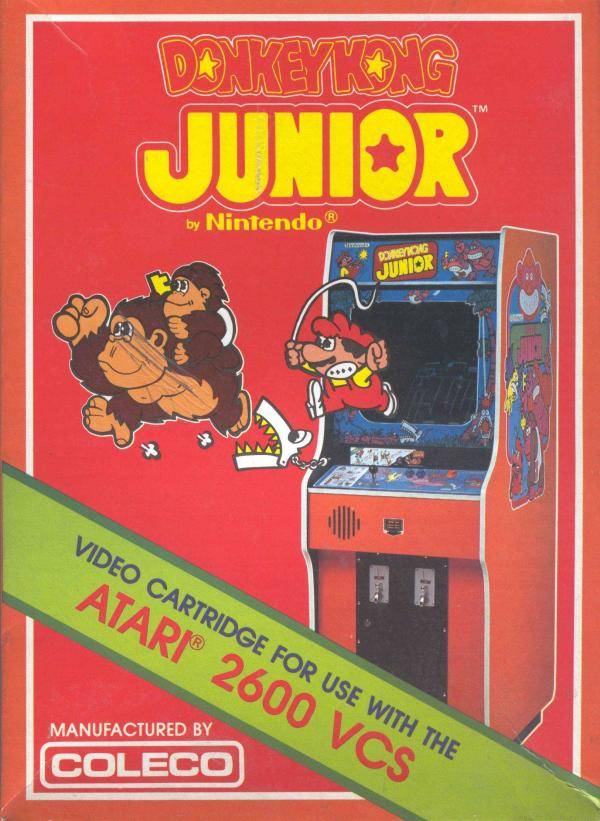
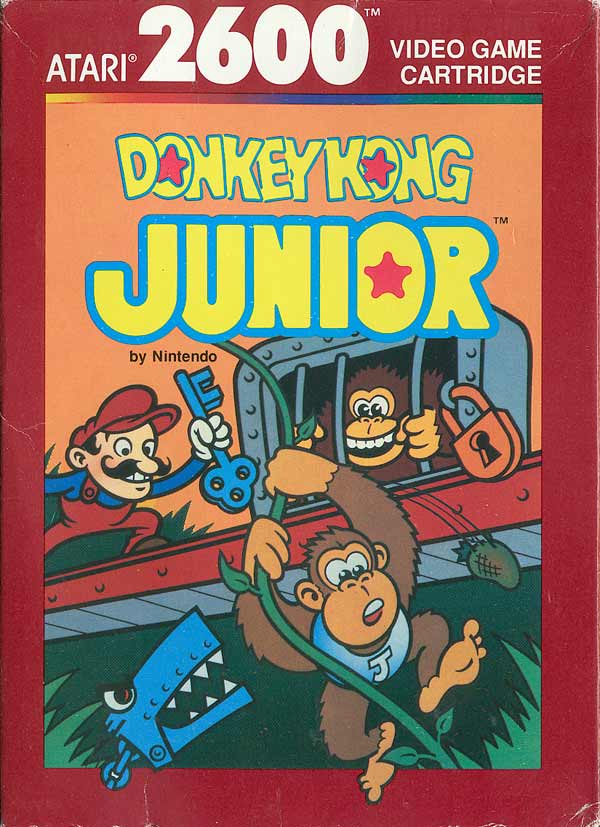
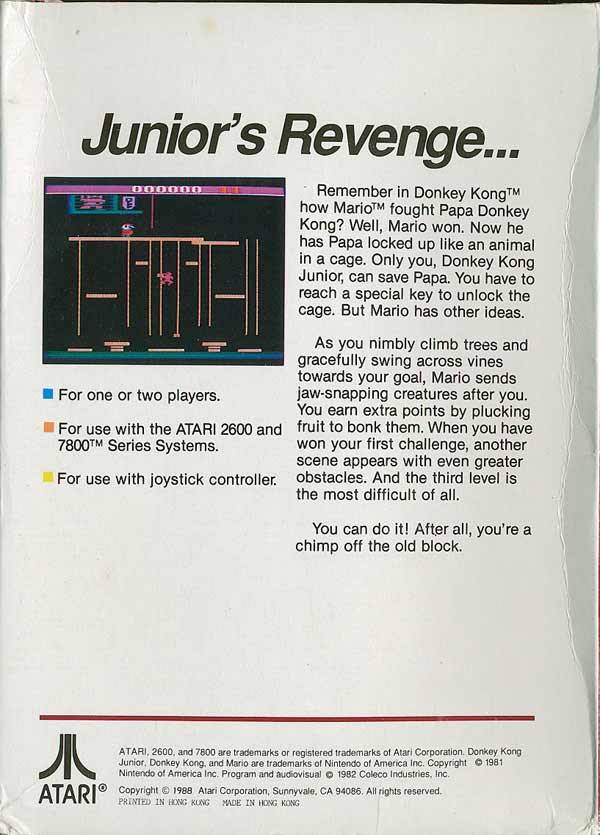
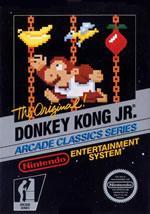
NES, North America (1986)Arcade Classics Series packaging.NES, North America (back)NES, Europe (1987)NES, Europe (back)NES, ItalyNES, AsiaFamicom, Japan (1983)Famicom, Japan (back)Famicom, Japan (alternate box)NES cartridge, North AmericaFamicom cartridgeFamicom cartridge (alternate)Donkey Kong Jr. + Jr. Sansū Lesson cartridge (Japan, 1983)Bundled with Sharp’s My Computer TV C1.ColecoVision (1983)Intellivision (1983)Atari 2600, North America (1983)Atari 2600, EuropeAtari 2600 (back)Atari 8-bit (1984)Atari 8-bit (back)Atari 7800 (1988)Atari 7800 (back)Nintendo 3DS Virtual Console iconWii U Virtual Console icon
Screenshots
The other versions: Nintendo’s own, then the ports, from Coleco’s best effort to the BBC Micro version that never came out.
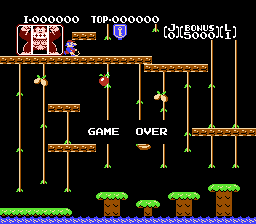
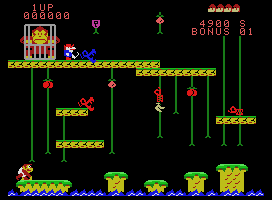
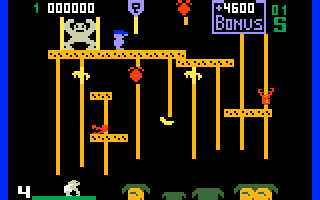
The Famicom title screen.Game over on the NES.Donkey Kong Jr. + Jr. Sansū Lesson on Famicom.ColecoVision.Intellivision.Atari 2600.Atari 8-bit computers.Coleco Adam, with its rebuilt hideout.Atari 7800.The e-Reader version on Game Boy Advance.The unreleased BBC Micro version.
Artwork & Media Gallery
Logos, the 1982 arcade artwork and flyers, the Famicom artwork (including the 2023 anniversary pieces), sprites and the odd advert.
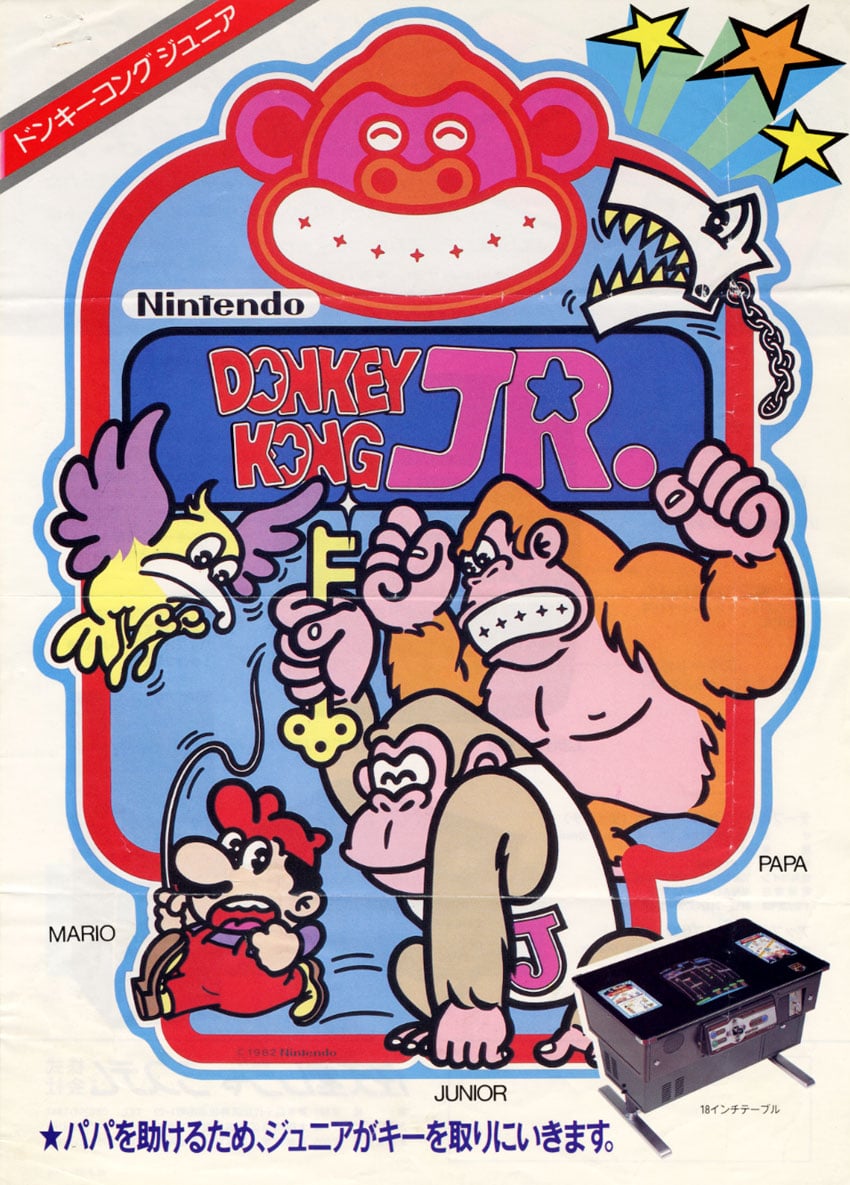
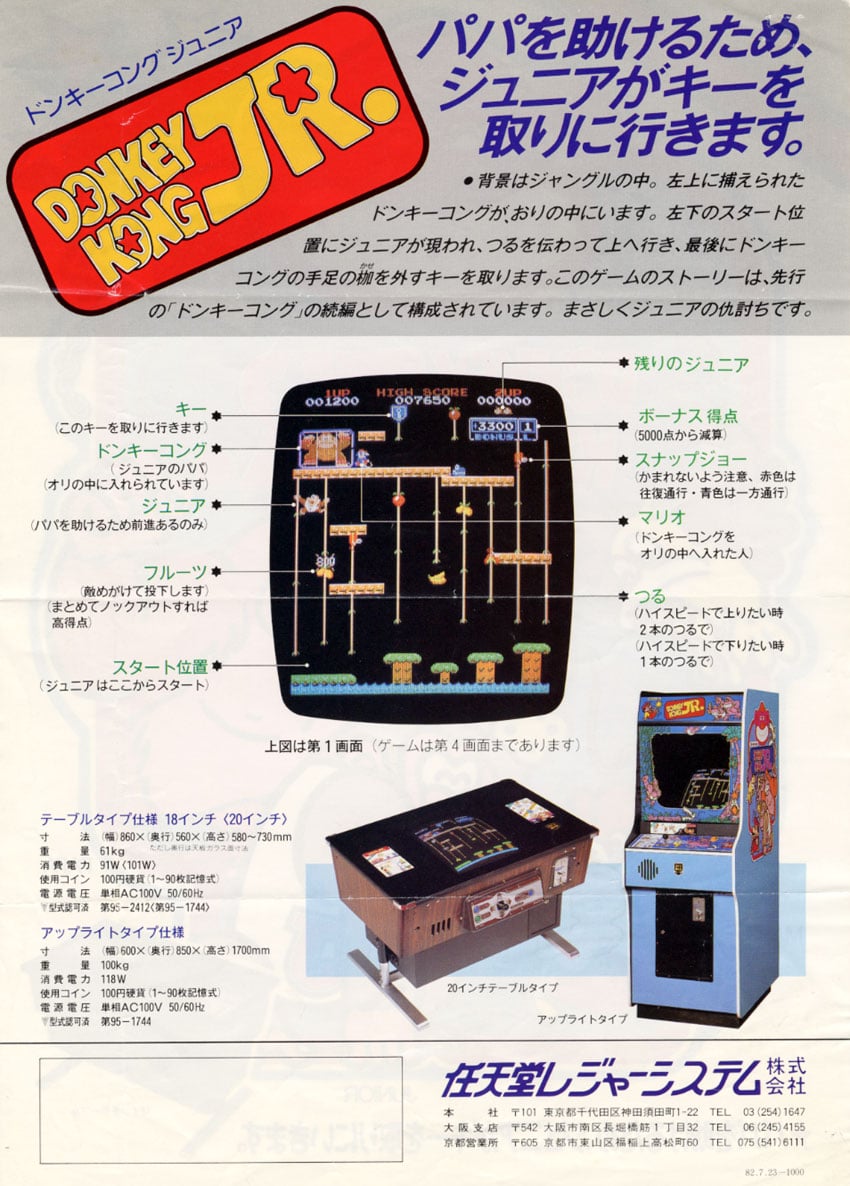
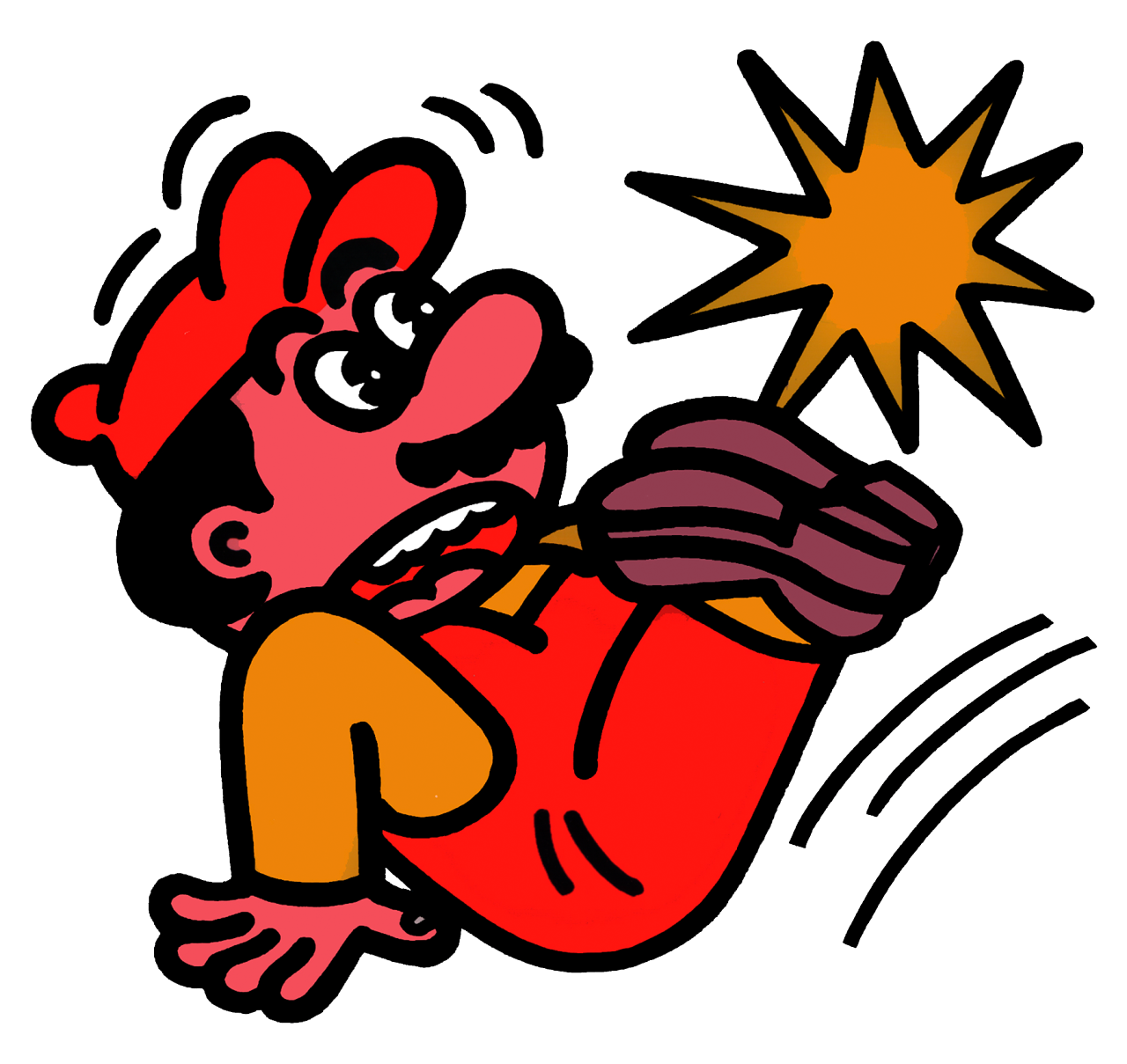
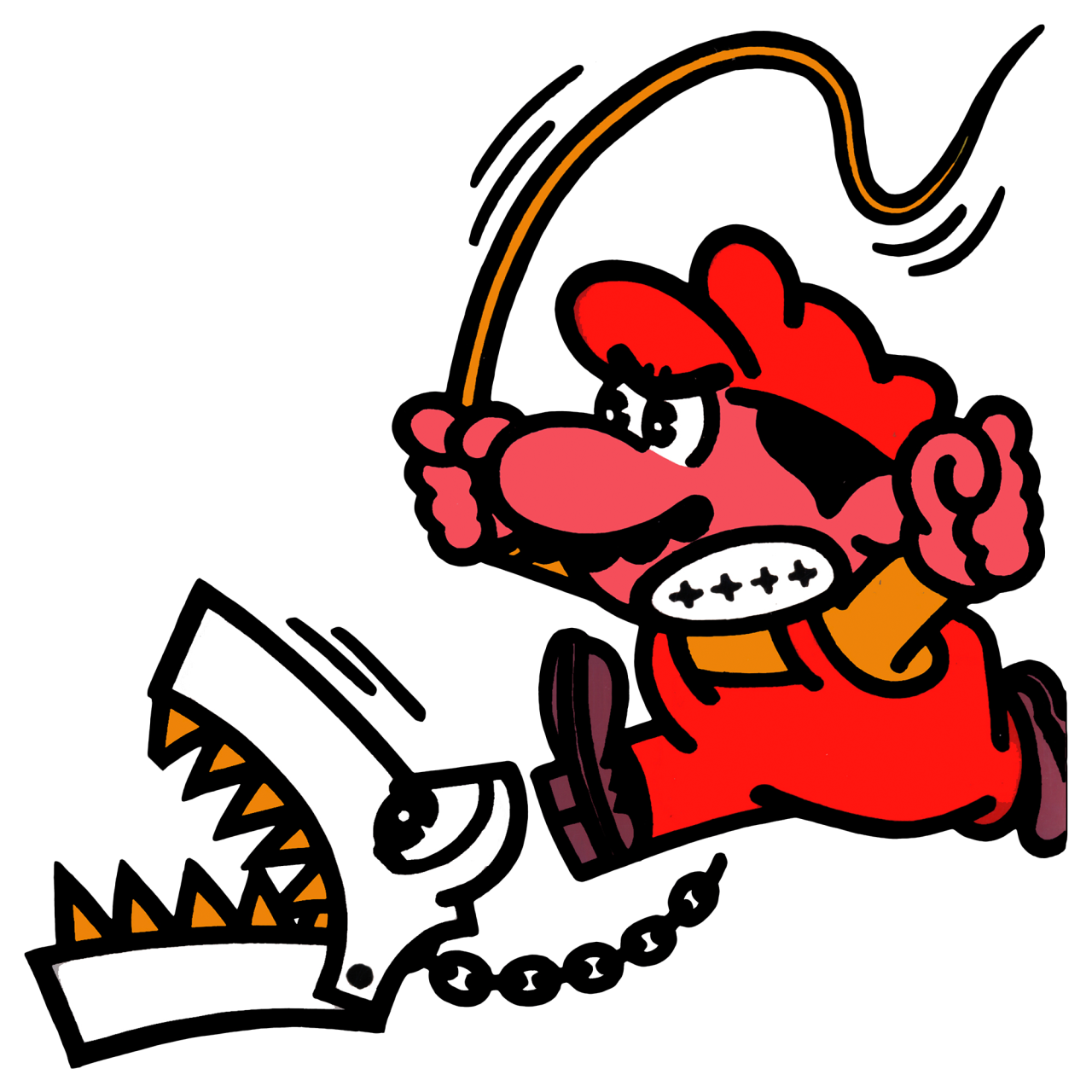
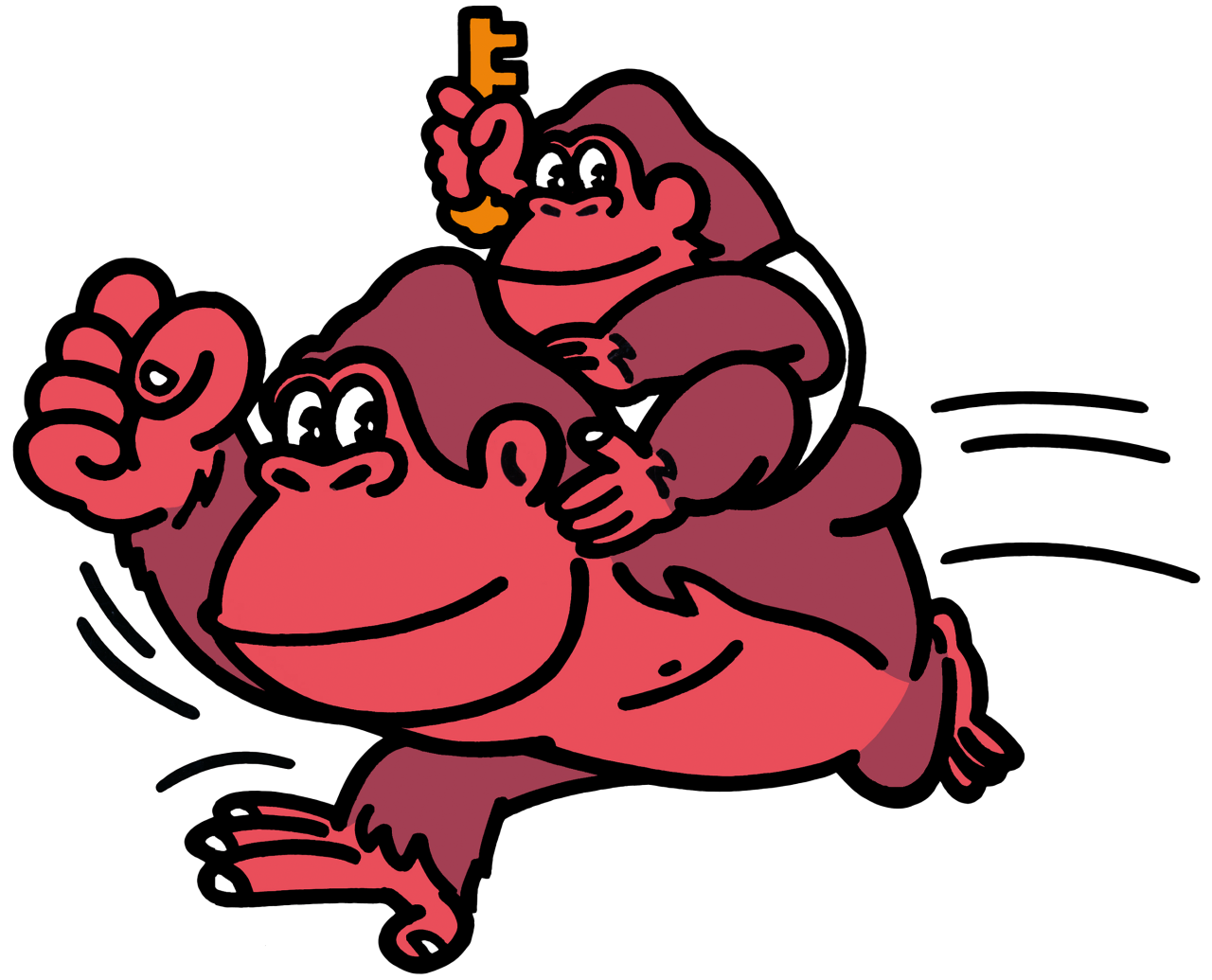
The North American logo.The Japanese in-game title.The Famicom and NES title.The arcade marquee.An alternative side art.The instruction banner.The Japanese flyer.The reverse of the Japanese flyer.The reverse of the American flyer.Mario trips.Mario and a Snapjaw.Donkey Kong runs off carrying his son.A Snapjaw.A Nitpicker.Another Nitpicker.Famicom-era artwork of Junior.Junior climbing.Junior again.And again.A Nitpicker, Famicom-era artwork.Junior, drawn for the Famicom’s 40th anniversary.Junior and Donkey Kong for the Famicom’s 40th anniversary.Junior, arcade sprite.Mario, arcade sprite.Donkey Kong in his cage, arcade sprite.Fruit, arcade sprite.A pink key.A brown key.Junior, NES sprite.Mario, NES sprite.Donkey Kong, NES sprite.A Red Snapjaw, NES sprite.The Jump Board, NES sprite.Junior on the e-Reader.A cocktail table cabinet.Game Machine advert, August 1982.Colour advert, Game Machine, October 1982.The Modern version in Game & Watch Gallery 4.Junior and Bones Bailey in Saturday Supercade.The cereal’s TV commercial.
Legacy & Re-releases
Junior has hardly been out of print. Here is everywhere the game has been, from 1982 cabinets to Nintendo Switch.
Releases and re-releases
Arcade1982Japan in August after a private showing on 28 July; North America in September; Europe later in 1982. Upright and cocktail cabinets.
Game & Watch26 October 1982A New Wide Screen handheld of its own design, model DJ-101; later a tabletop and Panorama colour version, and remade for Game & Watch Gallery 3 and 4.
ColecoVisionFebruary 1983Coleco’s first version, without Mario’s Hideout. Europe later in 1983.
Famicom15 July 1983A launch title in Japan, with all four stages.
Atari 2600September 1983By Coleco, without the Jump Board Scene.
IntellivisionOctober 1983By Coleco, without Mario’s Hideout.
Donkey Kong Jr. + Jr. Sansū LessonOctober 1983Japan only: half of this game plus an early form of Donkey Kong Jr. Math, packed with Sharp’s My Computer TV C1.
Atari 8-bitMarch 1984The only one of Atarisoft’s planned computer versions to be released.
Coleco AdamApril 1984With a redesigned hideout and green water drops.
NES1986–87North America in June 1986 in the Arcade Classics Series; Europe on 15 June 1987. Paired with Donkey Kong on Donkey Kong Classics in 1988.
Famicom Disk System19 July 1988A disk reissue in Japan.
Atari 7800November 1988Published by Atari Corporation after Coleco left the video game business. Europe in 1989.
Animal CrossingGameCubeThe NES version, unlocked with a password from a long-gone website.
e-Reader16 September 2002Donkey Kong Jr.-e on cards for the Game Boy Advance, one player only. Australia on 31 October 2003.
Namco arcade cabinet2004Donkey Kong / Donkey Kong Junior / Mario Bros. for North America, with the international version.
Wii Virtual ConsoleDecember 2006NES version: Japan 2 December, North America 4 December and Europe 22 December 2006.
Nintendo 3DS2011–2016Free to 3DS Ambassador Programme members from 31 August 2011 (Japan) and 1 September 2011 (elsewhere); on sale from 18 April 2012 in Japan, 14 June in North America and 23 August 2012 in Europe and Australia; South Korea 6 April 2016.
Wii U Virtual Console2013North America 26 April, Europe 27 April, Australia 28 April and Japan 15 July 2013.
NES Classic EditionNovember 2016One of the 30 games built into the miniature NES (10 November in Australia, 11 November in North America and Europe).
Arcade Archives21 December 2018HAMSTER’s Nintendo Switch release, worldwide on the same day, at $7.99: the first time the arcade original had been released on a home console, with Japanese and English versions, Hi Score and Caravan modes and online rankings.
Nintendo Switch Online15 May 2019The NES version joined the service’s NES library alongside Clu Clu Land and VS. Excitebike.
The high score
Donkey Kong Jr. has a smaller competitive scene than its father but a fierce one. It was one of the five games at the televised Twin Galaxies championship in January 1983, and the records Wikipedia lists from 2008 onwards show a run of duels: Icarus Hall’s 1,033,000 in August 2008, Steve Wiebe’s 1,139,800 in spring 2009, Mark Kiehl’s reply, Wiebe’s 1,190,400 on a home machine in February 2010, and Kiehl past 1.4 million by November 2016.
The current mark, as Wikipedia records it, is Justin Elliott’s 1,584,400, played live on Twitch in the early hours of 3 July 2023 and verified by the Donkey Kong Forum and Twin Galaxies. In an interview with the Perfect Pac-Man site later that month Elliott said it passed Phil Tudose’s 1,555,500, which had been set on the MAME emulator. Scores change; check the Twin Galaxies and Donkey Kong Forum boards for anything newer.
What came next
Nintendo finished the arcade trilogy in 1983 with Donkey Kong 3, and the same year gave Junior a second starring role in Donkey Kong Jr. Math. By then Mario had a game of his own, Mario Bros., and was the hero again, on his way to Super Mario Bros..
The Chain Scene came back as Stage 9-4 of the 1994 Donkey Kong for Game Boy, and Junior has made occasional returns since, most memorably as a kart driver and tennis player. The NES game itself was paired with its predecessor on Donkey Kong Classics in 1988 and has been on nearly every Nintendo download service since.
Reviews & Sales
Sales figures
Arcade games were sold to operators, so the numbers are machines. Steven Kent’s The Ultimate History of Video Games puts Donkey Kong Jr. at about 30,000 cabinets in North America, half what its predecessor managed there. In Japan, Wikipedia records that Game Machine ranked it the eighth highest-earning arcade game of 1982.
No reliable sales figures were found for the Famicom, NES or Coleco and Atari versions, so none are given here.
c. 30,000arcade machines in North America (Kent)
8thhighest-earning arcade game of 1982 in Japan (Game Machine, via Wikipedia)
1,584,400record score, Justin Elliott, 3 July 2023 (Wikipedia)
Reception and review scores
Period reviews covered the home versions; modern ones mostly judge the NES game as a Virtual Console download, and the arcade original on Switch.
AllgameRetrospective · Brett Alan Weiss
4/5
Nintendo World ReportArcade Archives (Switch) · Justin Berube · 7 January 2019
IGNWii Virtual Console · Lucas M. Thomas · 7 December 2006
5/10
GameSpotWii Virtual Console · Alex Navarro
4.9/10
Nintendo LifeWii Virtual Console · Damien McFerran
4/10
In 1983 and 1984 the home versions did well. Video Games Player reviewed the ColecoVision cartridge favourably in September 1983, and Computer Games in December 1984 called the Coleco Adam version the best conversion of the game. At the fifth Arkie Awards in 1984 it took the prize for best audio-visual effects among videogames of 16K or more, the judges praising a sequel with a quite different style of play. Wikipedia also notes its place on the Killer List of Videogames’ top 100.
The Virtual Console reviews were cooler. IGN’s Lucas M. Thomas thought it was “nice to see Junior, but not enough to warrant a purchase on his own”; GameSpot’s Alex Navarro found it “a very fun game for its time” that had not aged well; and Nintendo Life’s Damien McFerran judged it too basic to recommend wholeheartedly. When the arcade version reached Switch, Nintendo World Report’s Justin Berube preferred the first game but liked how differently the sequel plays, praising its interactive stages and the Arcade Archives options while grumbling that Junior moves slowly and that grabbing fruit can be fiddly.
Honours
Arkie Awards · 1984Best Videogame Audio-Visual Effects (16K or more ROM)Fifth annual Arkie Awards, as recorded by Wikipedia.
Game Machine (Japan) · 19828th highest-earning arcade game of the yearFrom the magazine’s chart of 1 March 1983, via Wikipedia.
That’s Incredible! · January 1983World championship gameOne of five games in the first official video game world championship, filmed at Twin Galaxies.
Killer List of VideogamesTop 100Listed among the site’s top hundred arcade games.
SLB User Reviews
Donkey Kong Jr. has yet to receive a community review on Super Luigi Bros.
If you’ve played Donkey Kong Jr. and would like to submit a review, please get in touch.
More from the Super Luigi Bros Guide
These picture lists come from the earlier Super Luigi Bros guide to Donkey Kong Jr. and are kept here in full.
Saturday Supercade
On the Saturday Supercade television bloc that aired in the mid-eighties, Donkey Kong Jr. had a short television show as well. The show was based on Donkey Kong being on the run from Mario, and his son trying to catch up with him. Although this was a sad premise, Donkey Kong Jr. still met with many different friends that helped him get by on the way to find Donkey Kong Sr.
Saturday Supercade cartoon title screenDonkey Kong Jr cartoon title screenMario and Pauline in Donkey Kong Jr cartoonDonkey Kong Jr and two other guys in Donkey Kong Jr cartoon
To provide the best experiences, we use technologies like cookies to store and/or access device information. Consenting to these technologies will allow us to process data such as browsing behavior or unique IDs on this site. Not consenting or withdrawing consent, may adversely affect certain features and functions.
Functional
Always active
The technical storage or access is strictly necessary for the legitimate purpose of enabling the use of a specific service explicitly requested by the subscriber or user, or for the sole purpose of carrying out the transmission of a communication over an electronic communications network.
Preferences
The technical storage or access is necessary for the legitimate purpose of storing preferences that are not requested by the subscriber or user.
Statistics
The technical storage or access that is used exclusively for statistical purposes.The technical storage or access that is used exclusively for anonymous statistical purposes. Without a subpoena, voluntary compliance on the part of your Internet Service Provider, or additional records from a third party, information stored or retrieved for this purpose alone cannot usually be used to identify you.
Marketing
The technical storage or access is required to create user profiles to send advertising, or to track the user on a website or across several websites for similar marketing purposes.



 BananaHangs from a vine. Touch it and it falls straight down, taking out every enemy in its path.
 AppleWorks the same way. Fruit which hits nothing still pays a small bonus.
 Jump BoardThe springboard at the start of the second stage. Arcade-History’s tip: hit it at the right moment and it throws Junior straight up to a small ledge, saving a long detour.
 KeyThe goal of every stage. In the first three, reaching it sends Mario off with the cage; in the Chain Scene Junior pushes six keys up their chains into the locks beneath Donkey Kong.
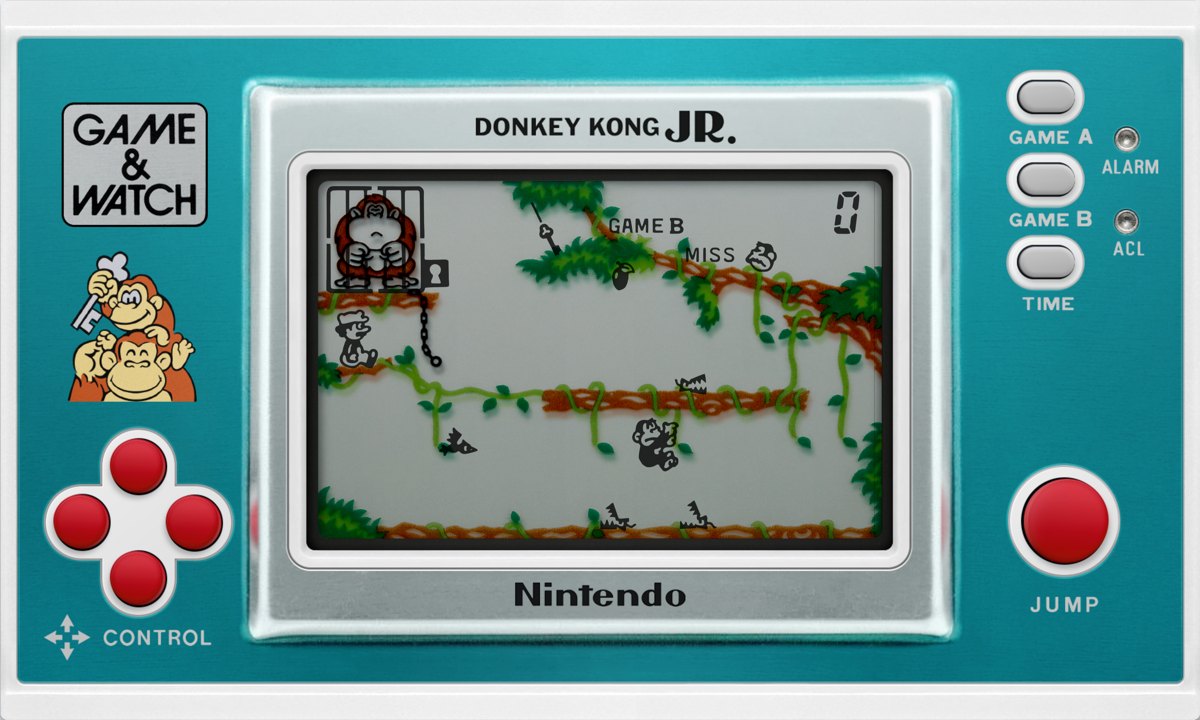 Donkey Kong Jr. (Game & Watch)Nintendo · 26 October 1982 · DJ-101A New Wide Screen handheld in which Junior climbs vines and leaps for swinging keys; four keys free his father. It returned in the Mini Classics range in 1998 and on DSiWare.
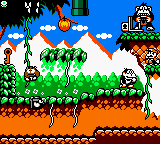 Game & Watch Gallery 3 and 4Game Boy Color and Game Boy AdvanceBoth collections pair the handheld with a Modern remake that swaps the jungle creatures for Goombas, Nipper Plants, Bullet Bills and Spinies, and adds a cloudy night-time third area.
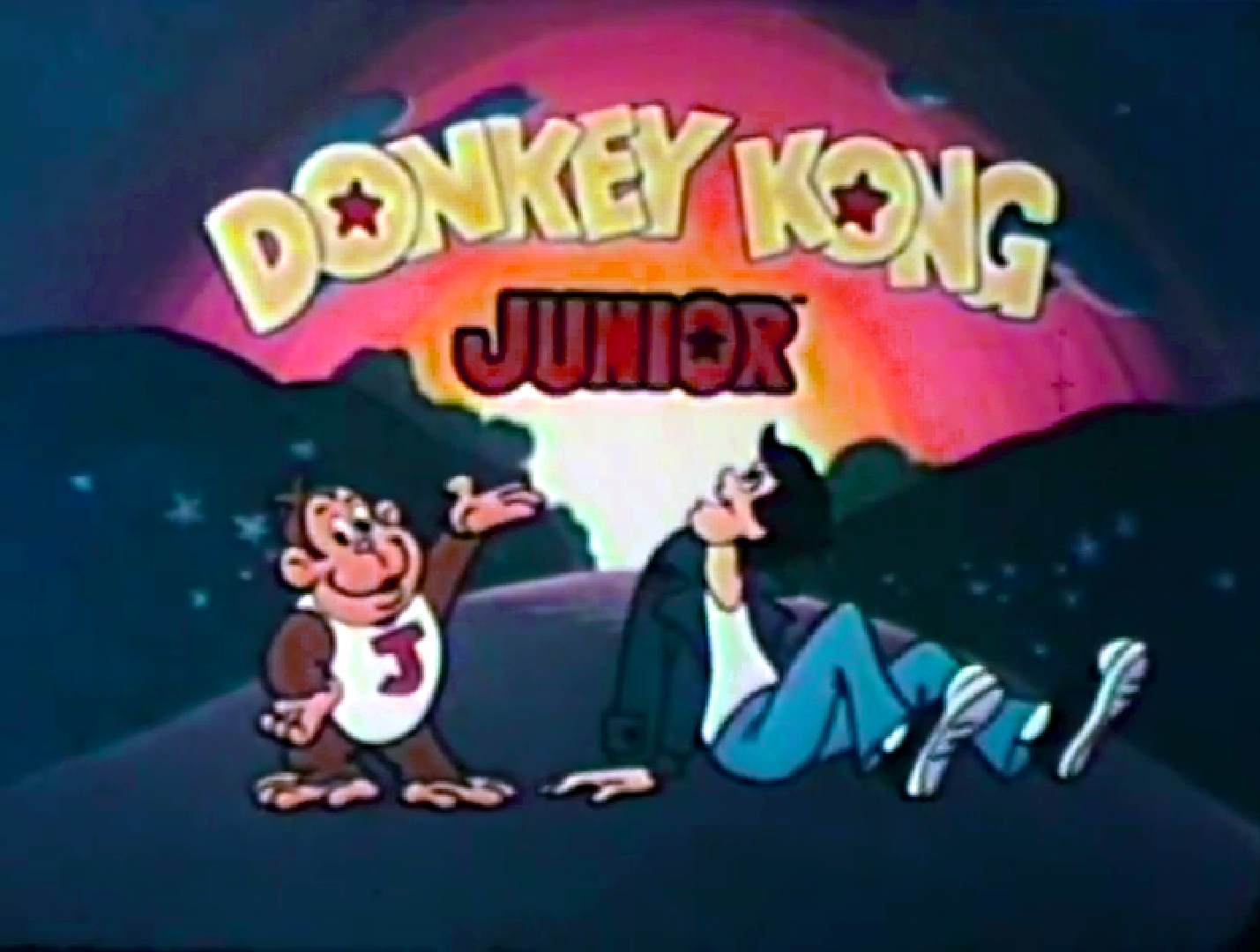 Saturday SupercadeRuby-Spears / CBS · 1983Thirteen Donkey Kong Jr. segments ran in the show’s first season, from September 1983. Donkey Kong has escaped from Mario’s circus, and Junior (voiced by Frank Welker) roars off after him on a motorbike with his friend Bones Bailey in the sidecar.
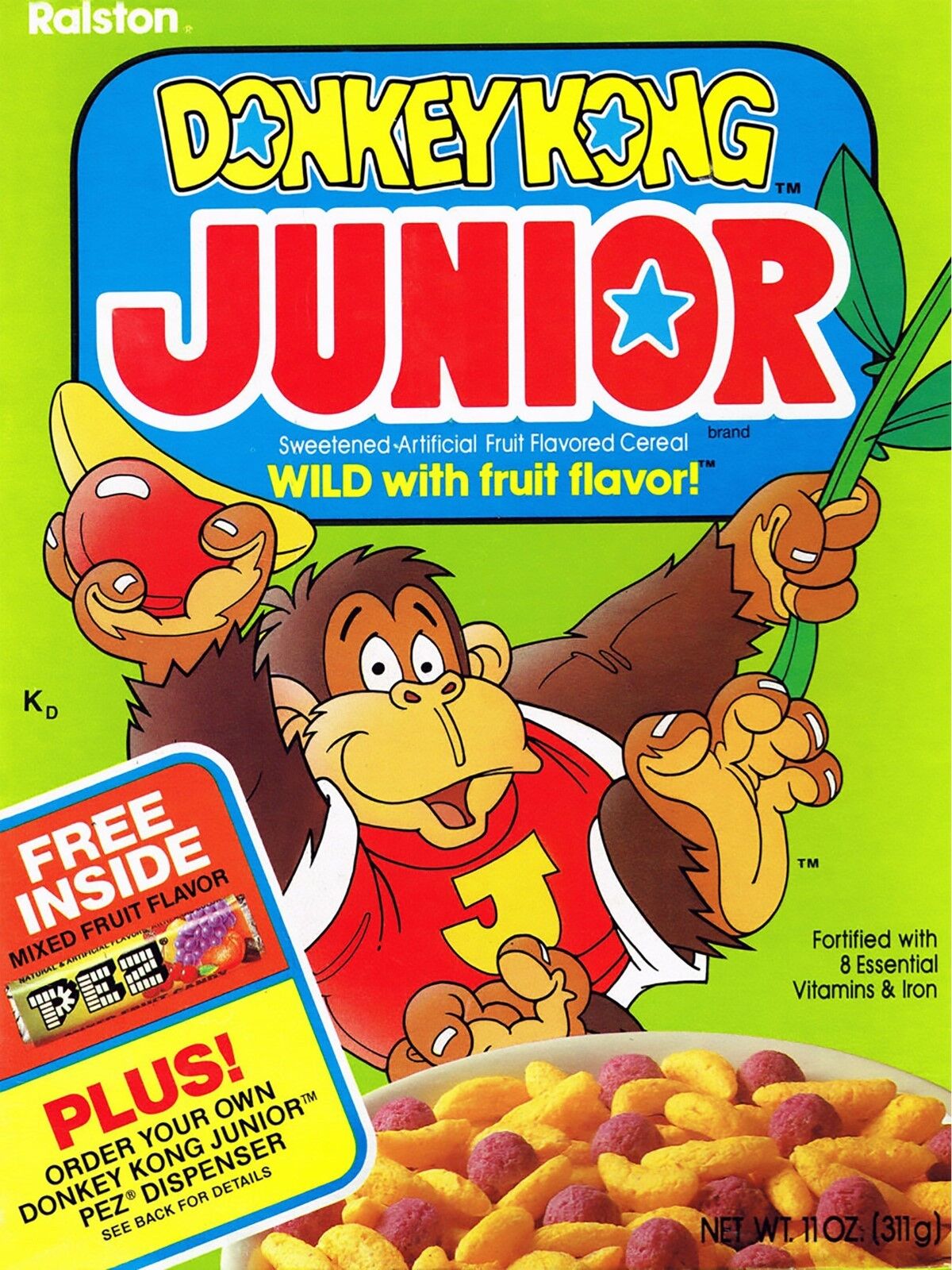 Donkey Kong Junior cerealRalston Purina · October 1983Fruit-flavoured apple and banana shapes, sold with the slogan “WILD with fruit flavor!” Some boxes came with Pez sweets, baseball cards or activity booklets, and a mail-in offer brought a Donkey Kong Junior Pez dispenser.
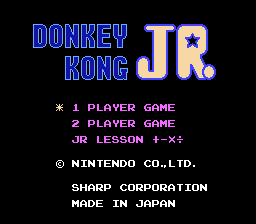 Donkey Kong Jr. MathFamicom 1983 · NES 1986Another starring role for Junior: an arithmetic game built from this one’s program and graphics. An early version of it was first released in Japan on a combined cartridge with this game, bundled with Sharp’s My Computer TV C1.
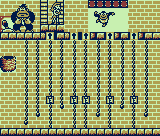 Donkey Kong (Game Boy)Nintendo · 1994Junior, Snapjaws, birds and a Spark all return, and Stage 9-4 rebuilds the Chain Scene, except that this time Mario is using the keys to lock Junior up.
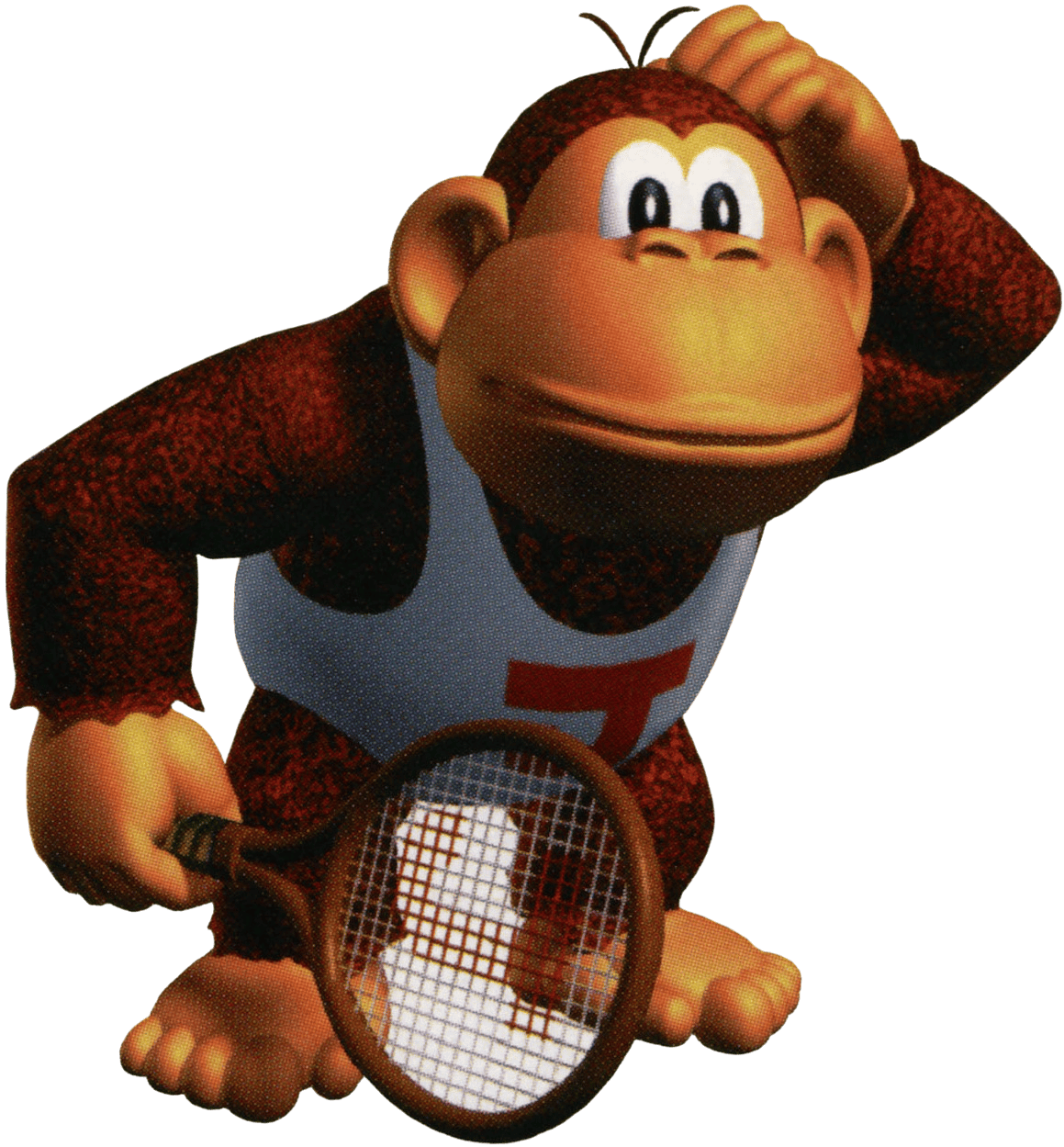 Super Mario Kart and the tennis gamesSuper NES · Virtual Boy · Nintendo 64Junior is one of the eight drivers in Super Mario Kart, playable in Mario’s Tennis on Virtual Boy and an unlockable player in Mario Tennis on N64.
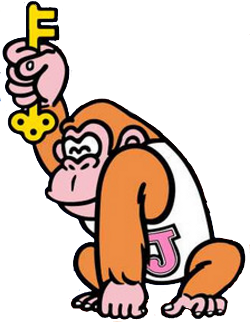 Donkey Kong Jr.The hero
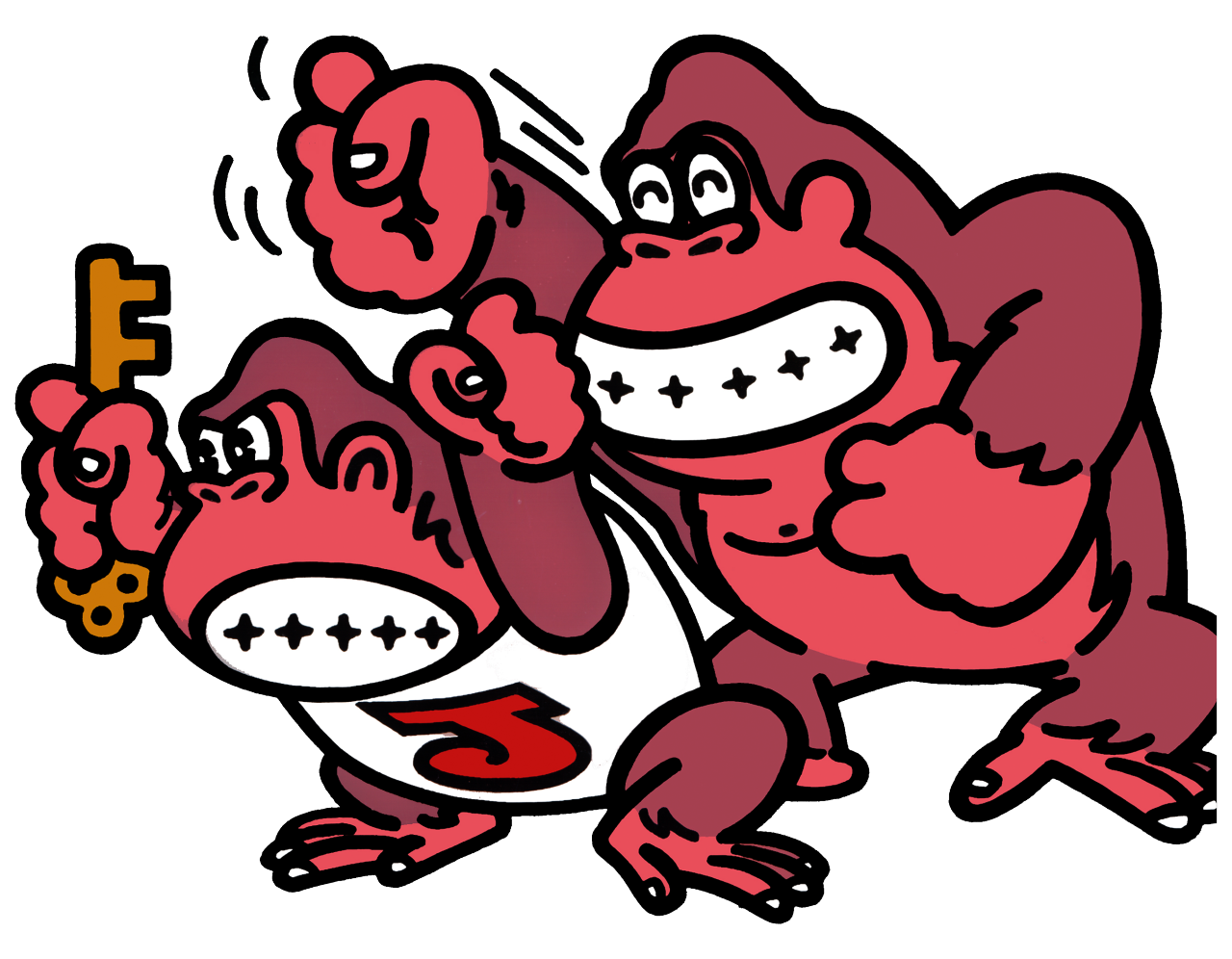 Donkey KongPapa, in a cage
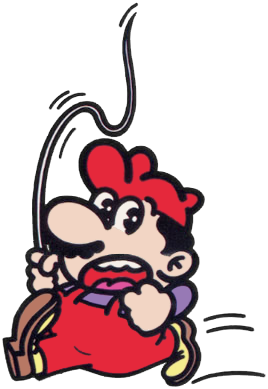 MarioThe villain
 Red SnapjawVine Scene, Chain SceneA toothy jaw-trap with eyes that patrols its own patch of vines and turns back to follow Junior. Slower than the blue kind, but it does not leave.
 Blue SnapjawVine SceneReleased by Mario. Wanders until it finds a vine, then heads down it and drops off the bottom of the screen.
 NitpickerJump Board SceneA small bird that flies across at one of three set heights. Some drop eggs on the platforms below.
 Bird (large Nitpicker)Chain SceneBigger, dark birds that swoop across in wide arcs, dropping a level each time they turn. No eggs.
 Red SparkMario’s HideoutA ball of electricity running round a fixed loop of wiring. Deadly from above or below.
 Blue SparkMario’s HideoutSent by Mario. Picks one of the four conduits under his platform and runs straight down it.
 DropMario’s Hideout, Coleco Adam onlyDangerous green water drops added to the Adam version’s redesigned hideout.