
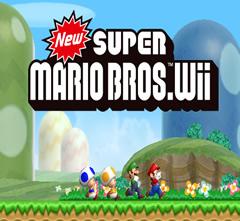

New Super Mario Bros. Wii
Four players, simultaneous co-op, one of the fastest-selling games in history
Overview
New Super Mario Bros. Wii is the twelfth game in the Super Mario series and one of the most significant releases in Nintendo’s history. While the rest of the gaming world in 2009 was chasing high-definition graphics and online multiplayer, Nintendo quietly released a 2.5D side-scrolling platformer that became one of the fastest-selling games ever recorded — shifting millions of copies in its first weeks. It proved definitively that pure gameplay and accessibility could beat raw technical power.
The headline feature is simultaneous four-player co-op — a first for a mainline Super Mario platformer, something Shigeru Miyamoto had been trying to achieve since the early days of the franchise. Up to four players control Mario, Luigi, Yellow Toad and Blue Toad through all nine worlds at the same time, on the same screen. The results are gloriously chaotic, hilarious and surprisingly deep.

All four players on screen at once — glorious chaos

Drop-in/drop-out — players can join or leave between levels
The game is a direct follow-up to New Super Mario Bros. on Nintendo DS (2006) and was released before the Japan launch — notably making it the first main-series Super Mario game to launch first in Oceania and North America rather than Japan. It went on to sell over 30 million copies worldwide, becoming one of the best-selling Wii games ever made.
Story
It is Princess Peach’s birthday. Her castle is festive, full of presents, and Mario, Luigi and the Toads are all celebrating with her when a massive birthday cake arrives. Nobody is sure who sent it. Everyone gathers around expectantly.
The cake bursts open. Bowser Jr. and his minions explode out from inside — they snatch Princess Peach and fly off in a giant Airship as the chaos unfolds. Mario, Luigi and two Toads give chase immediately.

The prologue — Bowser Jr. bursts from Peach’s birthday cake
Along their journey the heroes discover that all seven Koopalings — Bowser’s children — have been scattered across the worlds to stop them, each commanding a fortress and a castle. Bowser Jr. himself flies ahead in his airship, recurring throughout the adventure. The chase ends at Bowser’s Castle, where the plumbers finally confront the Koopa King himself.
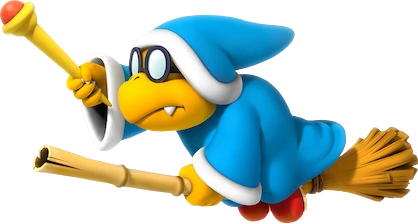
But there’s a twist. After they appear to defeat Bowser, it’s revealed that Kamek has been impersonating Princess Peach. The real Peach is being held above Bowser’s castle — prompting a dramatic final boss sequence where Kamek transforms Bowser into a towering Giant Bowser for one last climactic showdown.

The dramatic climax — Bowser’s Castle comes crashing down
“Today is Princess Peach’s birthday, so her castle is full of presents. Mario and Luigi are there, and they’re celebrating with the Toads and Princess Peach when a huge birthday cake arrives. Who in the world could it be from?” — Official instruction booklet
Gameplay & controls
The gameplay inherits the overworld-and-levels structure of Super Mario Bros. 3 and the DS game — start on a world map, traverse a fixed path, complete levels to open new routes. But New Super Mario Bros. Wii refines and expands this formula in several important ways.
Core mechanics
The primary control scheme — held horizontally like a classic controller. D-pad to move, 2 to jump, 1 to run/use powerup, shake to spin-jump.
Shake the Wii Remote mid-jump for a spinning move that defeats certain enemies and interacts with specific platforms — a versatile new tool.
Shake the remote while wearing the Propeller Suit to launch straight upward, reaching normally inaccessible areas.
Three hidden Star Coins in every level. Collecting them all unlocks hint movies in Peach’s Castle and World 9 stages.
In multiplayer, any player can press A to enclose themselves in a protective bubble — floating safely until another player pops them. Prevents runaway deaths.
Fail a level 8 times in single player and a green box appears. Hit it to watch Luigi automatically complete the level — you can take back control at any point.
Multiplayer — cooperative chaos

New Super Mario Bros. Wii is the first main series Super Mario game to feature simultaneous multiplayer. Up to four players share a single screen — the camera zooms out as players spread apart and zooms in as they converge, up to a fixed limit. Stray too far behind and you lose a life.
Players can interact with each other: pick each other up and throw them across gaps or into enemies, bounce off each other’s heads, and cooperate on platforms. The bubble system means struggling players can opt out of tricky sections without dying. Players can freely join or leave between levels on the world map.
In Free-for-All / Coin Battle mode, players compete to collect the most coins across levels — a lighter competitive alternative to the cooperative story mode.
Super Guide

Debuting in this game, the Super Guide is an optional assistance feature. After failing the same level 8 times, a luminous green box appears. Activating it hands control to a computer-controlled Luigi who plays through the level automatically. The player can take control back at any moment. The Super Guide doesn’t unlock if the player has previously passed the level, and using it doesn’t give Star Coins.
Characters


Princess Peach — the one being rescued this time
The nine worlds
New Super Mario Bros. Wii features nine worlds — each with a distinct theme, its own boss, and its own enemy encounter type on the overworld. Every world contains multiple normal levels, a fortress (with a mini-boss) and a castle (with the main boss). World 9 is a secret world unlocked only by finishing the main game:


Additionally, World Coin is a multiplayer-only world of five coin-collection levels, accessed from the level-select menu. These appear in the Recommended Courses tab and are designed around accumulating coins at high speed.
Power-ups
New Super Mario Bros. Wii retains all the classic Mario powerups and introduces two brand new ones — the Propeller Mushroom and the Penguin Suit — which immediately became fan favourites:


The Propeller Mushroom and Penguin Suit represent two completely different design philosophies: the Propeller Suit is about vertical mobility and speed, while the Penguin Suit is about versatility — ice attacks, precision sliding and underwater mastery. Both reward player experimentation and are integral to many hidden Star Coin locations.

Propeller Mario — shake the remote to blast upward
Items & objects
Beyond powerups, the game is full of interactive objects and collectibles that reward exploration and skill:





Bosses & enemies
New Super Mario Bros. Wii marks the return of the seven Koopalings to the mainline series — their first appearance in a home console Mario game since Super Mario World in 1990. Each Koopaling guards a tower and a castle in their world, meaning you fight them twice, with the second encounter being significantly harder:
The seven Koopalings


Other bosses


Reception
New Super Mario Bros. Wii received widespread critical acclaim and was a commercial phenomenon. Gamespy gave it 4.5/5, calling it “a damn fine Mario game” and praising its multiplayer depth. Destructoid awarded 9/10, noting it was “exactly what Nintendo fans have been waiting for.”
The game became one of the fastest-selling video games ever recorded at the time of release — selling millions of copies in its opening weeks globally. It went on to sell over 30 million copies worldwide, making it one of the best-selling Wii games and one of the best-selling games on any Nintendo platform.
Criticisms
Not everything was universally praised. The most common gripes:
- No online multiplayer — Mario Kart Wii had launched with online play that same year, so the absence of online co-op or even online scoreboards felt like a missed opportunity, particularly for players without local friends to play with
- Generic Toad characters for players 3 and 4 — many felt Wario, Waluigi or other established Mario characters would have been more satisfying picks than anonymous Blue and Yellow Toads
- Camera limitations in multiplayer — if players spread too far apart, the trailing player loses a life, which can feel unfair in sessions with very different skill levels
- Best-in-class level design
- Simultaneous 4-player co-op
- Two genuinely new powerups
- Koopalings return after 19 years
- Star Coin collectibles add depth
- Super Guide assists beginners
- No online multiplayer
- P3/P4 are generic Toads
- Trailing players lose lives
- Graphically similar to DS version
Trivia & facts
- New Super Mario Bros. Wii was the fastest-selling game in gaming history at the time of its release, breaking records in multiple countries within its first week on sale
- The game marks the first time the Koopalings appeared in a home console Mario game since Super Mario World on the SNES in 1990 — a 19-year gap
- The Propeller Suit and Penguin Suit are entirely new to the series — making their debut here and never appearing in the same form in another mainline game
- First previews of the game were shown at E3 2009, where the simultaneous four-player co-op demo caused an immediate sensation on the show floor
- If the last two digits of the timer when you complete a level are the same (e.g. 22, 33, 44), the game plays the original Super Mario Bros. level clear music — a wonderful Easter egg
- Dorrie and Sushi — water creatures last seen in Super Mario 64 and its DS remake — make a cameo appearance, delighting fans of that game
- When the credits roll, pressing buttons corresponding to letters in the names triggers different sound effects — making the credits interactive
- Enemies and powerups in certain levels move in time with the soundtrack — a subtle but impressive audio-visual detail
- World 9 is a direct reference to Super Mario World’s Star Road and Special World — a secret end-game area of ultra-hard levels with a space/star theme
- Midway checkpoints function like Super Mario World’s checkpoint gates — if a small Mario touches one, he grows to Super size, carrying over a mechanic from that game
- When all Star Coins are collected from every world and the game is completed, the word “New” disappears from the title screen and end credits — a subtle reward for 100% completion
- This was the first main series Super Mario game to launch first in Oceania and North America rather than Japan — unique in the franchise’s history
References to earlier games
New Super Mario Bros. Wii is packed with nods to Mario’s history — many deliberate, some subtle enough to reward veteran players:
The fireworks at level end mirror those in the original 1985 game. A secret tune plays the original level clear music when the timer ends on a matching double digit. Warp Cannons recall the warp pipes from World 1-2.
The overworld map format — moving along a fixed path through worlds — is directly inherited from SMB3. The Airships also return as a key level type and visual motif.
The checkpoint flag system is directly borrowed from SMW (touching a checkpoint as small Mario grants Super Mario status). World 9’s space theme echoes SMW’s Star Road and Special World.
The final boss sequence — where Kamek uses magic to transform Bowser into a giant — mirrors Kamek’s role in transforming Baby Bowser in Yoshi’s Island’s finale.
Dorrie the water dinosaur and Sushi the shark, both from SM64, make cameo appearances in NSMBW water levels — a gift for fans of that game.
The POW Block returns from the original Mario Bros. arcade game, functioning almost identically — carried, slammed and bounced off walls for repeated use.
Videos
Four videos from our collection covering New Super Mario Bros. Wii:
Official trailer
Commercial
Gameplay footage
More gameplay