Nintendo DS20062D platformerNintendo EAD30.80 million soldBest-selling DS gameMega MushroomFirst new 2D Mario since 1992240 Star Coins
New Super Mario Bros.
Nearly fourteen years after Super Mario Land 2, Mario finally went sideways again. New Super Mario Bros. arrived on the Nintendo DS in May 2006, America first and Japan ten days later, and put the 1985 formula back on the shelves with polygon characters, a wall jump and a ground pound borrowed from Super Mario 64, and a Mega Mushroom that turns Mario into a screen-filling wrecking ball. Bowser Jr. snatches Peach, Bowser falls into lava in the very first castle and comes back as a skeleton, and eight worlds, 80 courses and 240 Star Coins stand between the brothers and the rescue.
Directed by Shigeyuki Asuke under Takashi Tezuka, with Koji Kondo writing the main theme and Charles Martinet voicing both brothers, it added a two-player Mario vs. Luigi mode and a stack of touch-screen minigames, scored 89 on Metacritic and went on to sell 30.80 million copies, more than any other DS game. Every “New” Mario since, and arguably Super Mario Bros. Wonder, starts here.
Developer:Nintendo EAD
Publisher:Nintendo
Platform:Nintendo DS (later Wii U Virtual Console)
Genre:2D side-scrolling platformer with 3D models
N. America:15 May 2006
Japan:25 May 2006
Australia:8 June 2006
Europe:30 June 2006
South Korea / China:8 March 2007 · 6 July 2009 (iQue)
Players:1 (story) · 2 (Mario vs. Luigi) · 1–4 (minigames)
Music:Asuka Ohta, Hajime Wakai; sound director Koji Kondo
Voices:Charles Martinet (Mario, Luigi, Wario)
Worlds:8 worlds, 80 courses, 240 Star Coins
Sales:30.80 million (Nintendo’s published lifetime figure)
Re-releases:Wii U Virtual Console (2015) · soundtrack on Nintendo Music (October 2025)
Advertisement
Overview
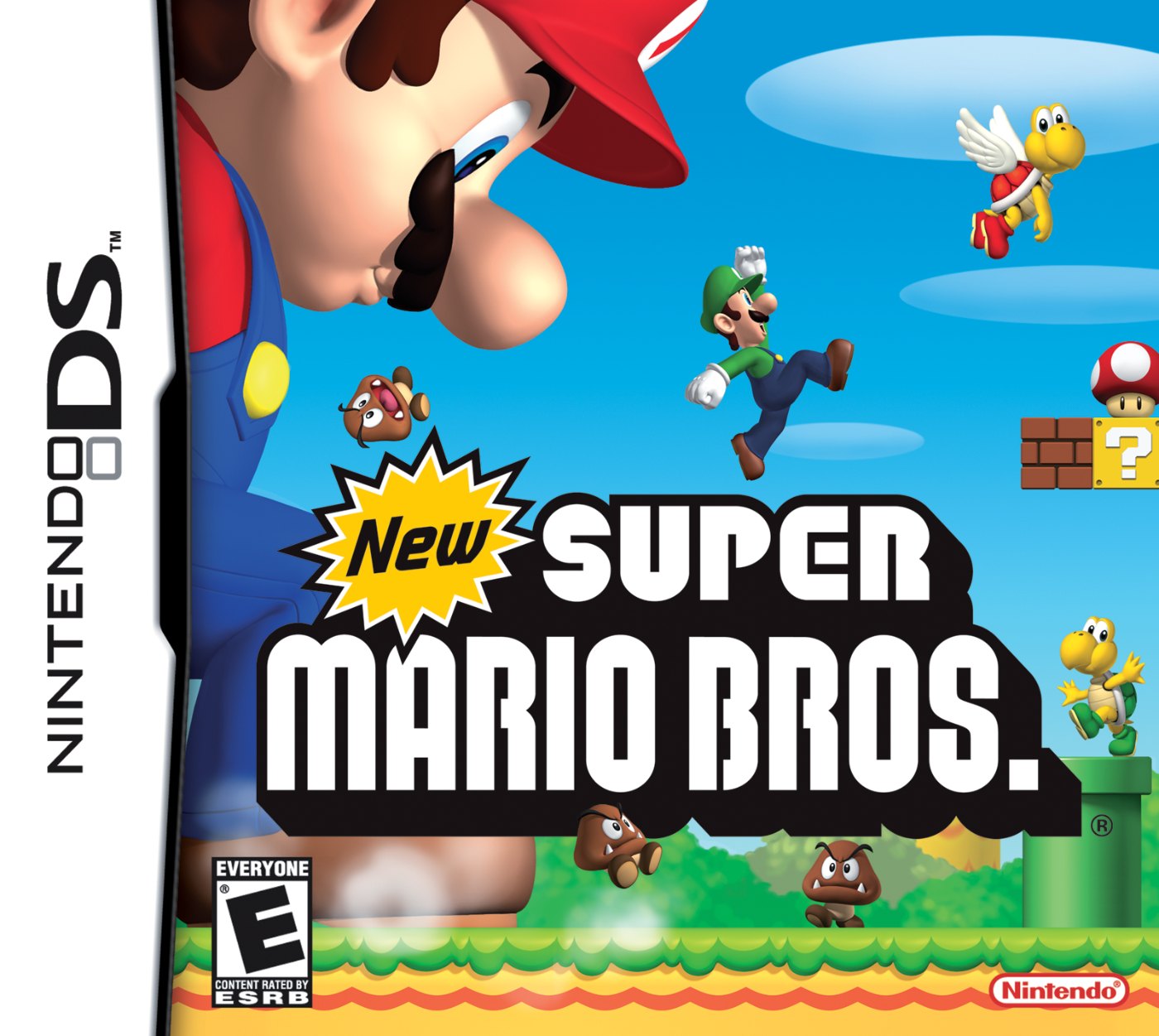
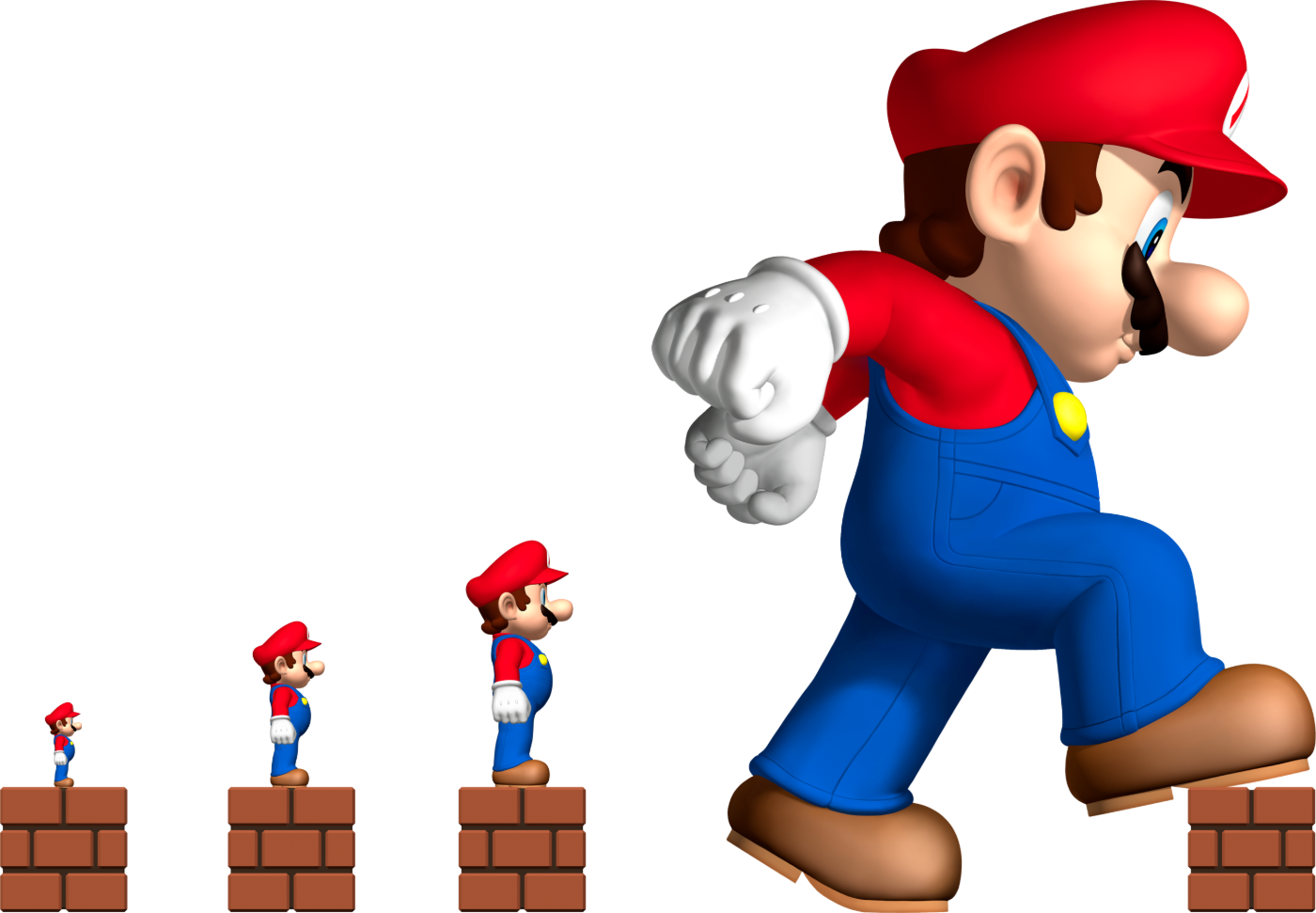
Nintendo’s key artwork, with Mega Mario looming over the cast.
By 2003, 2D Mario had become a heritage act. The Game Boy Advance had four Super Mario Advance remakes but nothing new, and the last original side-scrolling Mario was Super Mario Land 2 on the original Game Boy. When Nintendo began planning software for the DS, Takashi Tezuka suggested that if they were going to make another Mario it should be a side-scroller, and Shigeru Miyamoto agreed. The word “New” went into the title to make the point that this was a fresh start and not another port.
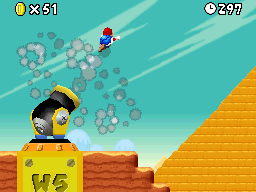
The game that emerged is a greatest-hits record with fresh tracks. Eight worlds run from grassland to a volcano via desert, beach, forest, ice, mountains and sky; a tower and a castle punctuate each one; Goombas, Koopas, Hammer Bros and Lakitu are all back, drawn now as 3D models moving across 2D courses. Mario himself has learnt things in the intervening years: he wall jumps, triple jumps, ground pounds and swings on ropes, and three Star Coins hide in every course for the completionist.
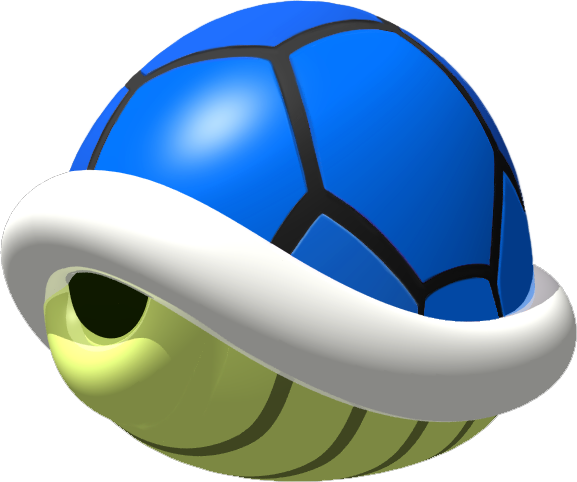
The new ideas were sized to the DS’s two screens. The Mega Mushroom turns Mario into a giant who flattens everything in his path and earns extra lives for the destruction; the Mini Mushroom shrinks him to a size that can run across water and slip through tiny pipes, and is the key to the two hidden worlds; the Blue Shell turns him into a Koopa. The touch screen holds a stored item, Super Mario World style, and a second DS owner can be beaten senseless in Mario vs. Luigi or in a stack of minigames inherited from Super Mario 64 DS.
It sold like nothing Mario had sold since the NES: around 900,000 in four days in Japan, a million in twelve weeks in America and, by Nintendo’s count, 30.80 million in all, the best-selling game on the DS by almost seven million. Critics scored it 89 on Metacritic, praised it as a near-perfect return and gently wondered whether it was too easy; Miyamoto later admitted the difficulty was his one regret. Its success produced a sub-series across Wii, 3DS and Wii U, and a 2D revival that stretches to Wonder.
Why New Super Mario Bros. Matters to Mario Fans
This is the game that proved 2D Mario still sold, and sold enormously, to people who had not touched a Nintendo since the Super NES. Without it there is no New Super Mario Bros. Wii, no New Super Mario Bros. 2 or U, and the makers of Wonder have said they wanted their game to be the same kind of foundation for the future that this one was. It also gave the series Star Coins, Dry Bowser and the wall jump in two dimensions, and set the visual and musical language (the “paah” chant, the polygon Goombas hopping in time, the tower-and-castle rhythm) that defined Mario for a decade, for better and, some would say, for worse.
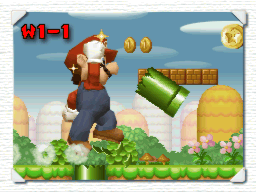
World 1-1: the most familiar opening in gaming, redrawn in polygons.World 1-2 goes underground, with a secret over the ceiling just as in 1985.The world map, with its towers, castles, Toad Houses and cannons.Mario vs. Luigi on the Grass stage: two DS owners fighting over Big Stars.
“Nostalgic and new in equal doses, New Super Mario Bros. brings classic gameplay bang up to date with sumptuous visuals, toe-tapping tunes, and tons of secrets and surprises.”
Official description: Nintendo of Europe, New Super Mario Bros. product page. One sentence quoted; the rest summarised.
Nintendo of Europe’s own pitch for the game, which goes on to call it Mario’s first 2D platformer since Super Mario World (quietly skipping the Game Boy) and to promise eight worlds, 240 Star Coins and power-ups such as the Mega Mushroom, Blue Koopa Shell and Mini Mushroom.
Quick Answers
Quick answers to the questions people ask most about New Super Mario Bros. on DS.
When did New Super Mario Bros. come out?
On 15 May 2006 in North America, 25 May 2006 in Japan, 8 June 2006 in Australia and 30 June 2006 in Europe, for the Nintendo DS. South Korea followed on 8 March 2007 and China, through iQue, on 6 July 2009. More →
How do you play as Luigi?
On the file select screen, hold L and R while you pick a save file. The game tells you the trick after you beat Bowser’s Castle, but it works from the start. Luigi plays identically to Mario. More →
How do you unlock Worlds 4 and 7?
Beat the World 2 castle boss, Mummipokey, as Mini Mario to open World 4, and beat the World 5 castle boss, Petey Piranha, as Mini Mario to open World 7. World 7 can also be reached with the Warp Cannon hidden behind the World 4 Ghost House. More →
How many Star Coins are there?
240: three in each of the 80 courses. Five open each of the 32 Star Coin Signs on the world maps, and once Bowser is beaten 20 at a time buy new touch-screen wallpapers from the Blue Toad House in World 1. More →
What does the Mega Mushroom do?
It makes Mario enormous for a short time. He ploughs through enemies, blocks and pipes, and a five-segment meter fills as he wrecks things; each filled segment pays out a 1-Up Mushroom when he shrinks back. More →
Why is Bowser a skeleton?
Because you beat him in World 1. He falls into lava at the end of the very first castle, the heat strips him to the bone and he returns in World 8 as Dry Bowser, before Bowser Jr. revives him for the final fight. More →
How many minigames are there?
The single-player menu has 18 and the Vs. Battle menu, for up to four players, has 26, across Action, Puzzle, Table, Variety and 1-on-1 categories. Most are upgraded versions of minigames from Super Mario 64 DS, and only one person needs a Game Card. More →
Who made it?
Nintendo EAD, with Shigeyuki Asuke directing, Hiroyuki Kimura producing and Takashi Tezuka as general producer; Toshihiko Nakago was programming director and Shigeru Miyamoto supervised. Asuka Ohta and Hajime Wakai wrote the music under Koji Kondo, who composed the main Ground Theme himself. More →
How well did it sell?
Nintendo’s own count is 30.80 million copies, which makes it the best-selling DS game, ahead of nintendogs on 23.96 million and Mario Kart DS on 23.60 million, and the third best-selling Super Mario platformer, behind the NES original and Super Mario Odyssey (31.06 million by 30 September 2026). More →
Where can I play it today?
On the original DS Game Card, or through the Wii U Virtual Console version released in 2015 (single-player only, as the wireless modes were not carried over). Its 60-track soundtrack joined the Nintendo Music app in October 2025. More →
Story
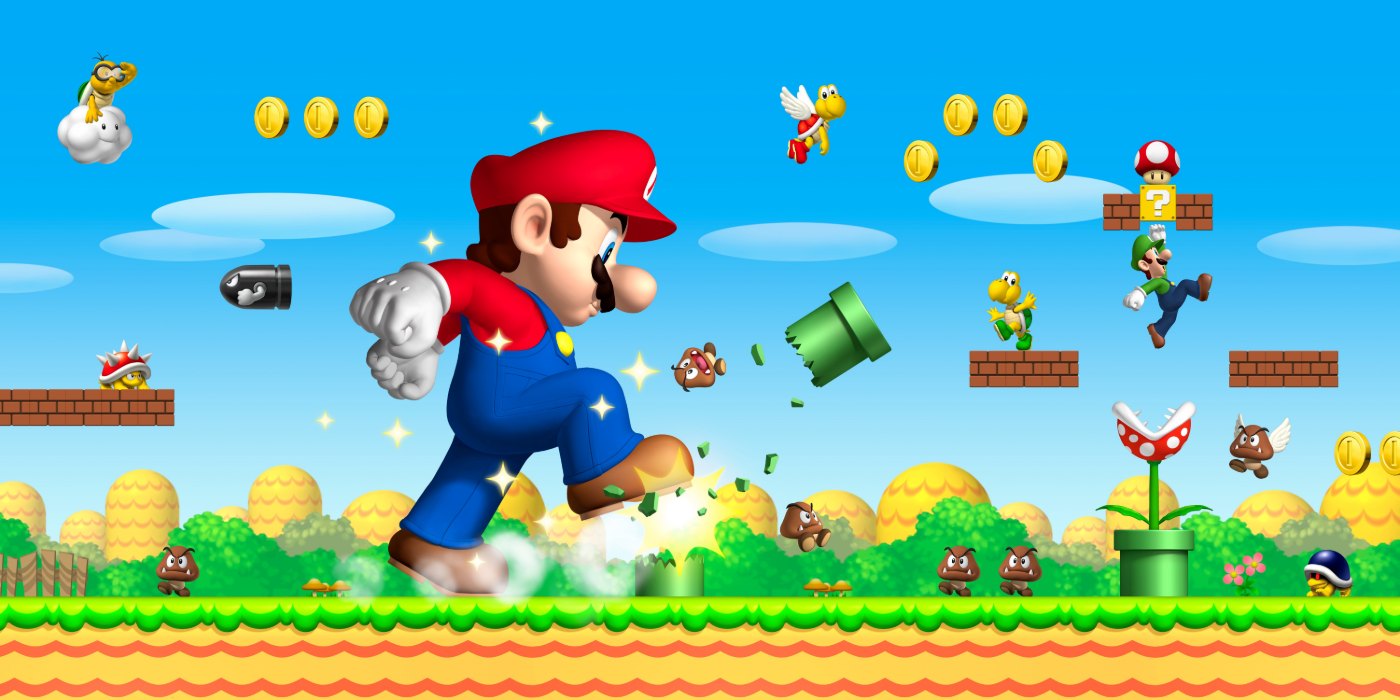
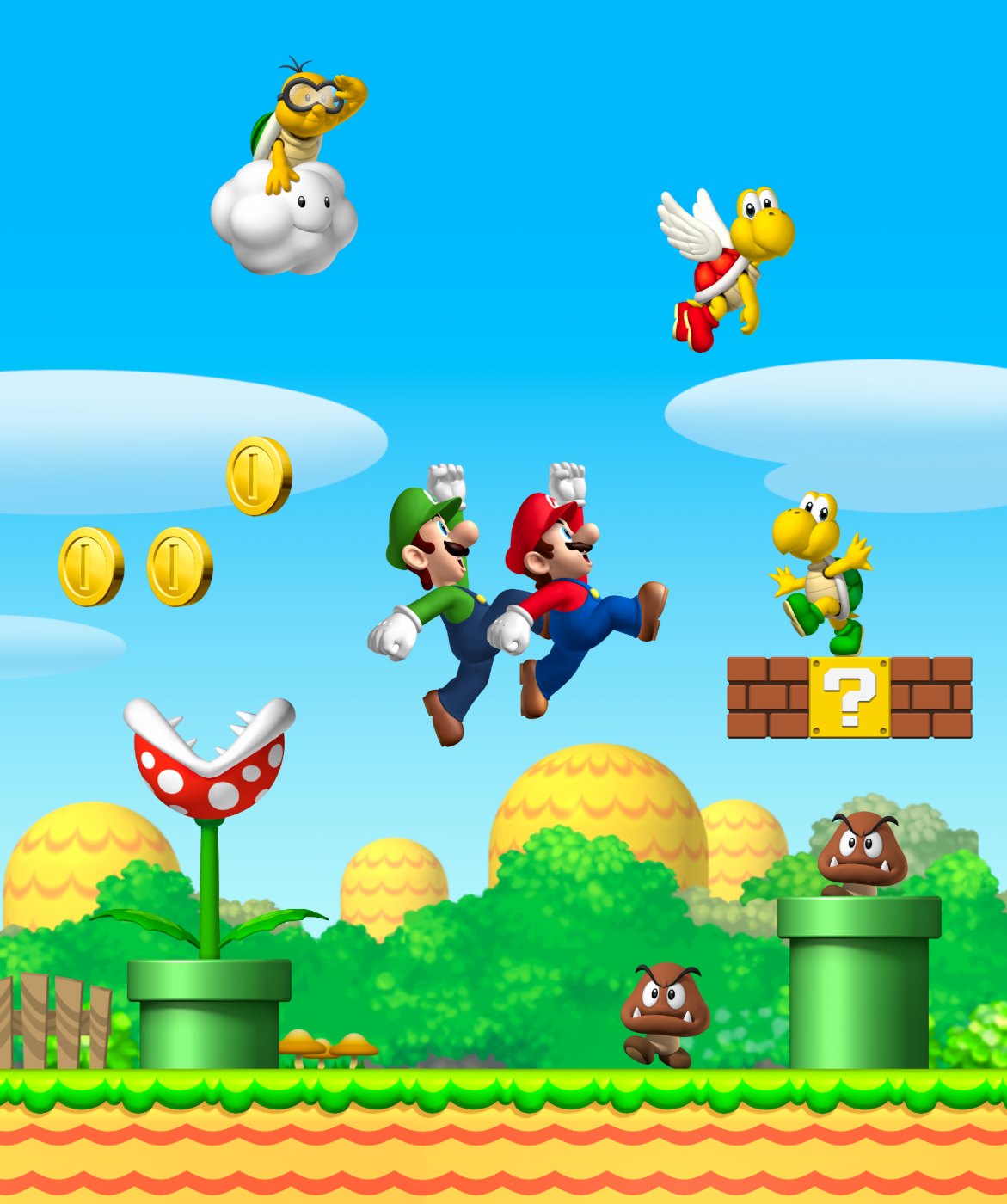
Mario, Luigi and the cast in Nintendo’s promotional artwork.
There is not much plot, and the game knows it: the manual delivers the whole thing as an “Emergency News Flash!” and ends by asking whether Bowser Jr. did not once think Peach was his mother. But the few scenes it has are staged with real charm, and one of them changes Bowser for good.
A walk, a storm and a kidnapping
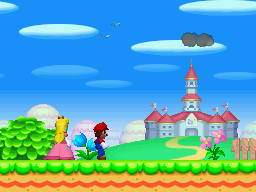
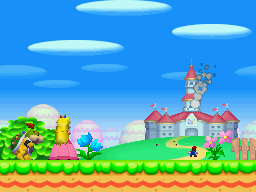
Mario and Princess Peach are out for a stroll near her castle when a thundercloud rolls in and lightning strikes the building. Toads pour out of the doors in a panic. Mario, naturally, runs off to investigate, and the moment his back is turned Bowser Jr. slips out from behind a bush and makes off with the princess. Mario gives chase, takes a hit off-screen and shrinks to Small Mario, and the game begins in World 1-1 with Peach already disappearing over the horizon.
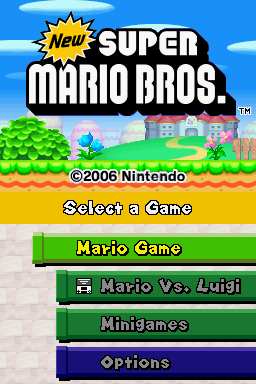
Leave the title screen alone and two alternative versions of the scene play out. In one, Mario comes running back with a green Koopa shell at his heels, takes a knock off-screen and has to jump up to nudge the game’s logo back into place; in the other Luigi wanders in, both brothers flee the shell, and Luigi trails after Mario in the pursuit, a nod to the brother the game otherwise keeps hidden behind a button code.
The opening: lightning strikes Peach’s Castle.Bowser Jr. creeps up on Peach.The title screen, where the alternative intros play.
Chasing Junior through the towers
Bowser Jr. is the game’s recurring nuisance. He waits at the top of every tower with Peach in tow, and every time Mario gets the better of him he scarpers to the next world, dragging her along. In the simpler fights, which run as late as World 6, he charges and hops and can simply be stomped; in the tougher ones, which begin in World 4, he pulls his bandana up over his snout, ducks into his shell whenever Mario comes near and throws Koopa shells, which have to be knocked back at him to bowl him over. Worlds 6 and 8 have two towers each.
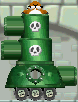
The castles belong to a gallery of bigger beasts: a bandaged Pokey that burrows through the desert sand, a fat Cheep-Cheep that leaps out of the sea, a Goomba that swells to fill the room in the forest, Petey Piranha skidding about on the ice, a Monty Mole in a tank in the mountains and a Lakitu on a thundercloud in the sky. Beat each one and a key drops to open the next world.
Bowser Jr. at the top of a tower.Mummipokey in the World 2 castle.Monty Tank in World 6.
Bowser falls in World 1
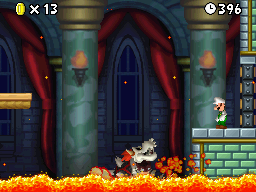
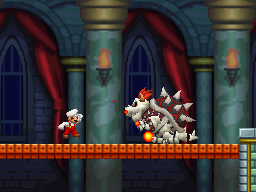
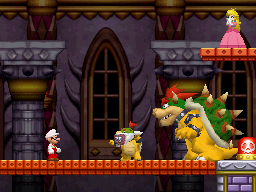
The game’s best joke is structural. The World 1 castle ends, exactly like the NES original, with Bowser on a bridge over lava and a switch behind him. He cannot be stomped; Mario slips past and hits the switch (a skull now), the bridge drops and the Koopa King plunges into the fire. Then the scene lingers while the lava burns him down to a skeleton. Bowser is out of the picture for six worlds, and the player knows something is coming.
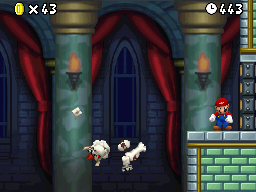
It is. In the World 8 castle, the skeleton lumbers onto another bridge as Dry Bowser, throwing bones and shrugging off fireballs, and has to be dropped into a pit a second time.
Bowser on the bridge in World 1-Castle.Bowser sinks into the lava and comes out as bones.Dry Bowser in World 8-Castle.The bridge goes again.
The cauldron and the final battle
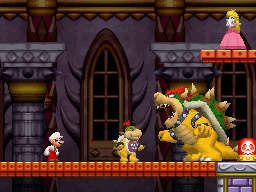
Bowser’s Castle, the last stop in the volcanic second half of World 8, is a maze of rooms that flip upside down at the touch of a ? Switch. At the end of it Bowser Jr. tips his father’s bones into a bubbling cauldron. What bursts out is Bowser, restored and bigger than before, and Mario has to fight both of them at once while Peach watches from a platform above: Junior scampering about and hurling shells, Bowser spitting blue fireballs that home in, and a skull switch on the far side as the only way to end it.
Hit it and both Koopas fall. Peach’s platform melts away and she floats down to plant a kiss on Mario, who manages a nervous chuckle; the credits roll, with letters that make noises when tapped; and after they finish Bowser Jr. is seen dragging his unconscious father across the castle floor, turning to growl at the player before carrying on. Nobody learns anything, which is as it should be.
World 8-Bowser’s Castle, the final course.Bowser and Bowser Jr. together on the final bridge.Blue fireballs fly in the last fight.The credits: tap a letter and it answers back.
The eight worlds
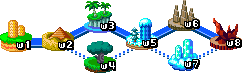
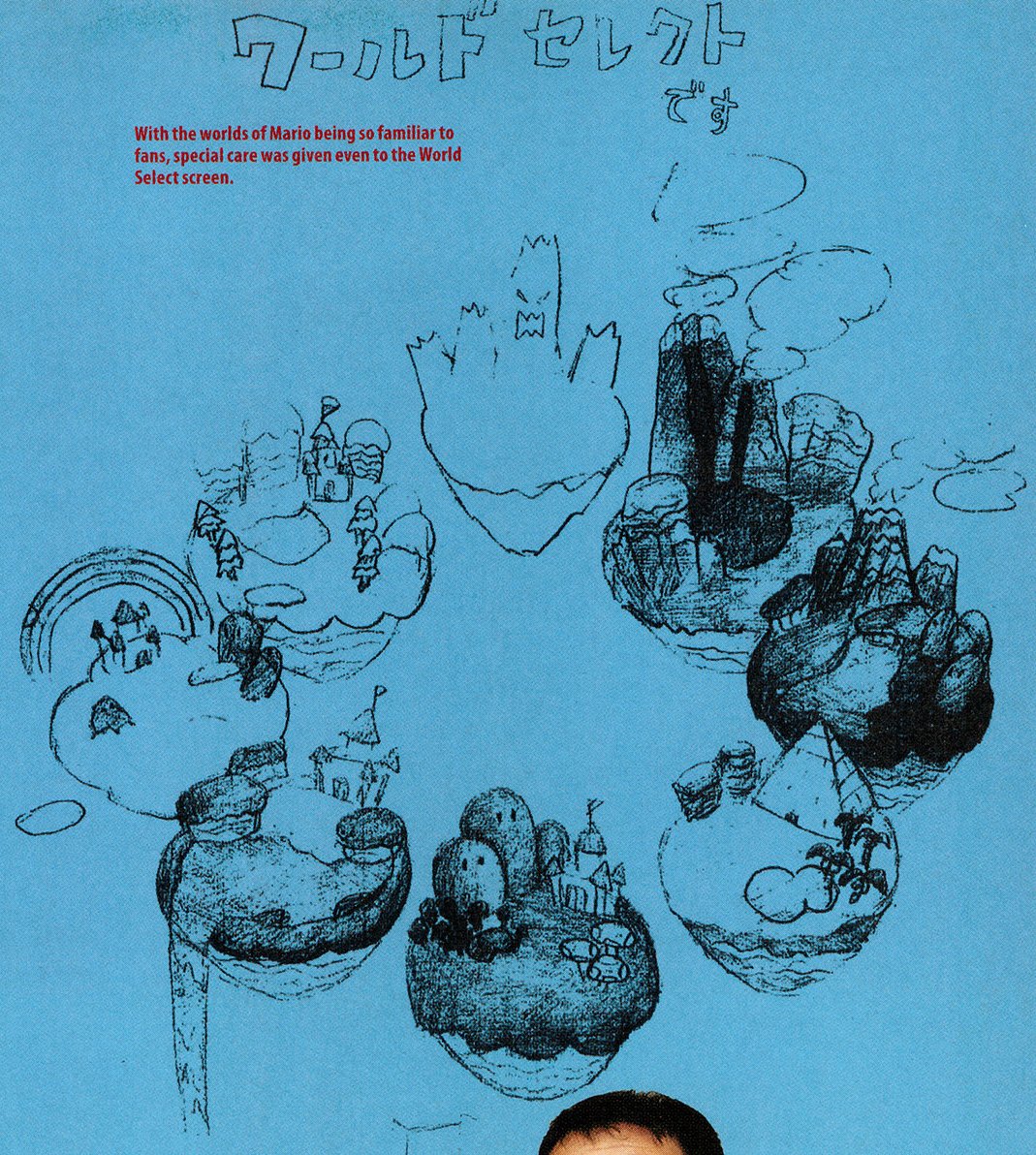
Eighty courses in all, counting towers, Ghost Houses and castles. Worlds 4 and 7 are optional and hidden; the rest must be crossed, or skipped by cannon.
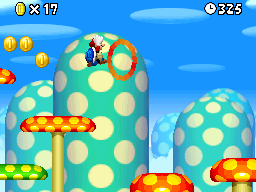
World 1Grassland · 8 courses · Tower: Bowser Jr. · Castle: BowserHills with Peach’s Castle on the horizon, a first underground course, tilting mushrooms, a first swim (1-A, the only course with Sushi the shark) and the game’s most famous surprise, Bowser himself in the first castle. The tower’s secret exit hides a cannon to World 5.
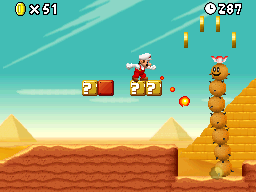
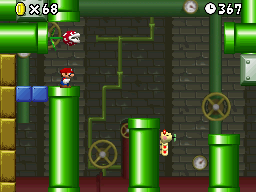
World 2Desert · 9 courses · Tower: Bowser Jr. · Castle: MummipokeySand, quicksand, Pokeys, the game’s only sewer course and Lakitu’s first Spinies. Beat Mummipokey as Mini Mario to open World 4; 2-A’s secret exit leads to a cannon to World 5.
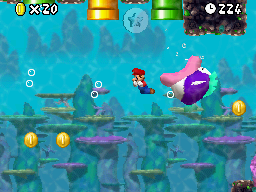
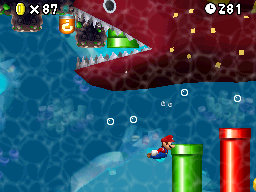
World 3Beach and ocean · 9 courses · Tower: Bowser Jr. · Castle: CheepskipperBeaches and deep water full of Cheep-Cheeps, Bloopers and the lunging Cheep-Chomp, a castle patrolled by Whomps, and the first Ghost House, whose secret exit leads to a cannon to World 6.
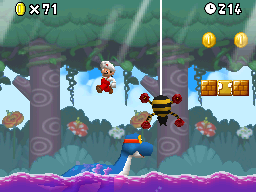
World 4Forest · 10 courses · hidden · Tower: Bowser Jr. · Castle: Mega GoombaA hidden world of giant plants, Wigglers, Scuttlebugs and purple poison that costs a life at a touch, where Dorrie ferries Mario across the swamp in 4-1 and 4-6. The Ghost House, home of the Balloon Boos, hides a cannon to World 7.
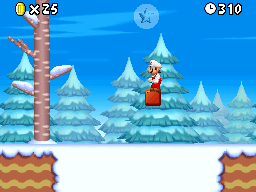
World 5Snow and ice · 10 courses · Tower: Bowser Jr. · Castle: Petey PiranhaFrozen lakes, snow-laden trees, Snow Spikes, Snailicorns and plenty of bottomless pits. Beat Petey as Mini Mario to open World 7; the Ghost House, where Broozers punch through the walls, hides the last cannon, straight to World 8.
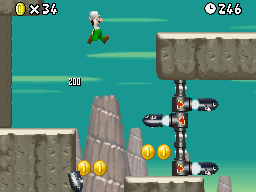
World 6Mountains · 11 courses · Two towers: Bowser Jr. · Castle: Monty TankRocky cliffs, Bullet Bills by the dozen, the game’s only Chain Chomps (6-6), its only tornadoes (6-A) and its only whirlpools (6-5). The first world with two towers before the castle.
World 7Sky · 11 courses · hidden · Tower: Bowser Jr. · Castle: LakithunderThe second hidden world: clouds, beanstalks, a pipe maze modelled on Super Mario Bros. 3 (7-A) and a ride on an enormous Wiggler in 7-3. With fifteen exits it has more ways out than any other world.
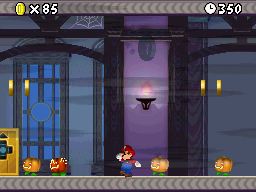
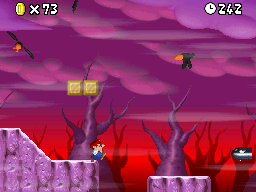
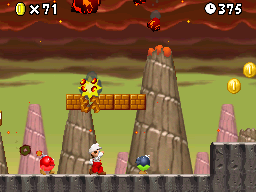
World 8Haunted woods and volcano · 12 courses · Towers: Bowser Jr. (twice) · Castle: Dry Bowser · Bowser’s Castle: Bowser and Bowser Jr.The longest world, split between a gloomy forest of Splunkins and Crowbers and a volcano that rains burning rock, with the second half hidden until the first castle falls. Mega Unagi chases Mario through 8-3, and there are no secret exits to save you.
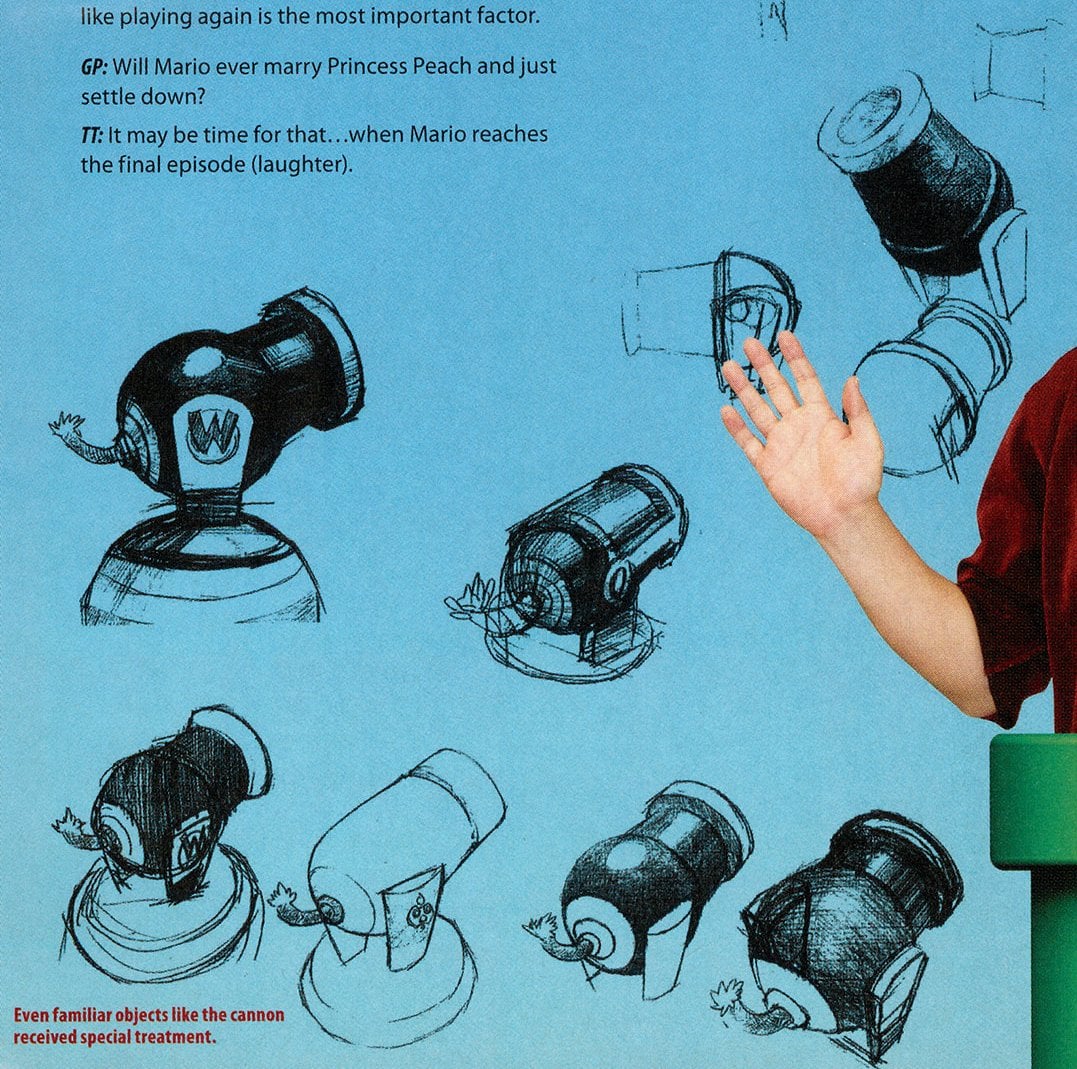
Five Warp Cannons shortcut the journey: World 1-Tower and 2-A to World 5, the Ghost Houses of Worlds 3 and 4 to Worlds 6 and 7, and the World 5 Ghost House to World 8. Ghost Houses appear in Worlds 3, 4, 5 and 7, and the first half of World 8 borrows their music.
Advertisement
Gameplay & Controls
New Super Mario Bros. plays like Super Mario Bros. remembered through Super Mario Bros. 3, Super Mario World and Super Mario 64. Run right, stomp, hit blocks, grab the flagpole; but also wall jump up a shaft, ground pound a brick, triple jump across a gap and spin out of a Spin Block, with the action on the top screen and a stored item waiting on the bottom one.
Each world is a string of numbered courses with a tower partway through and a castle at the end, both guarded by bosses, plus a Ghost House in four of the eight worlds, Toad Houses, warp pipes and, in the first five worlds, a Warp Cannon. Secret exits branch the maps, lettered courses hide behind them, and some paths only open for five Star Coins.
Mario’s moves
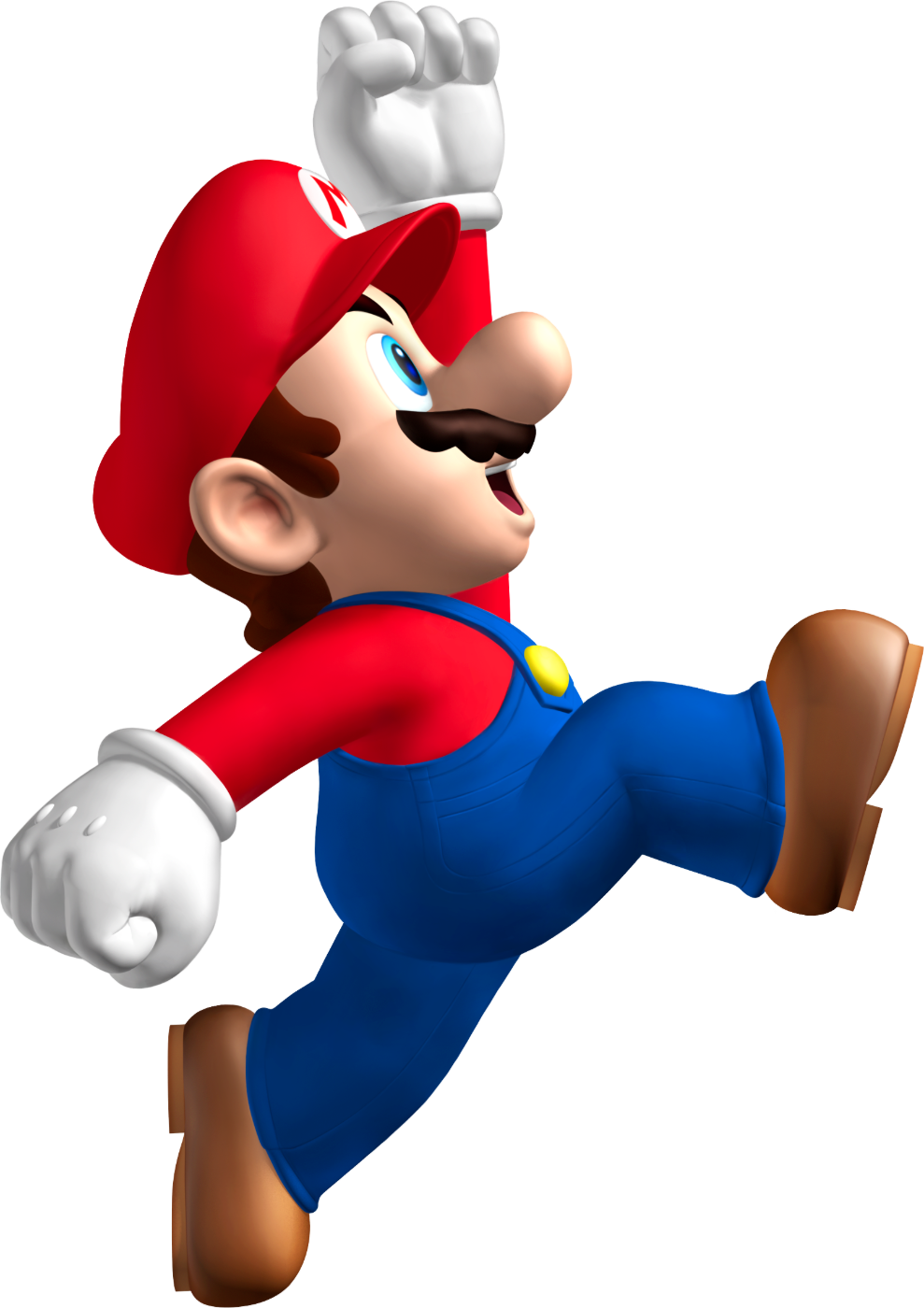
Mario in his official artwork for the game, jumping as ever.
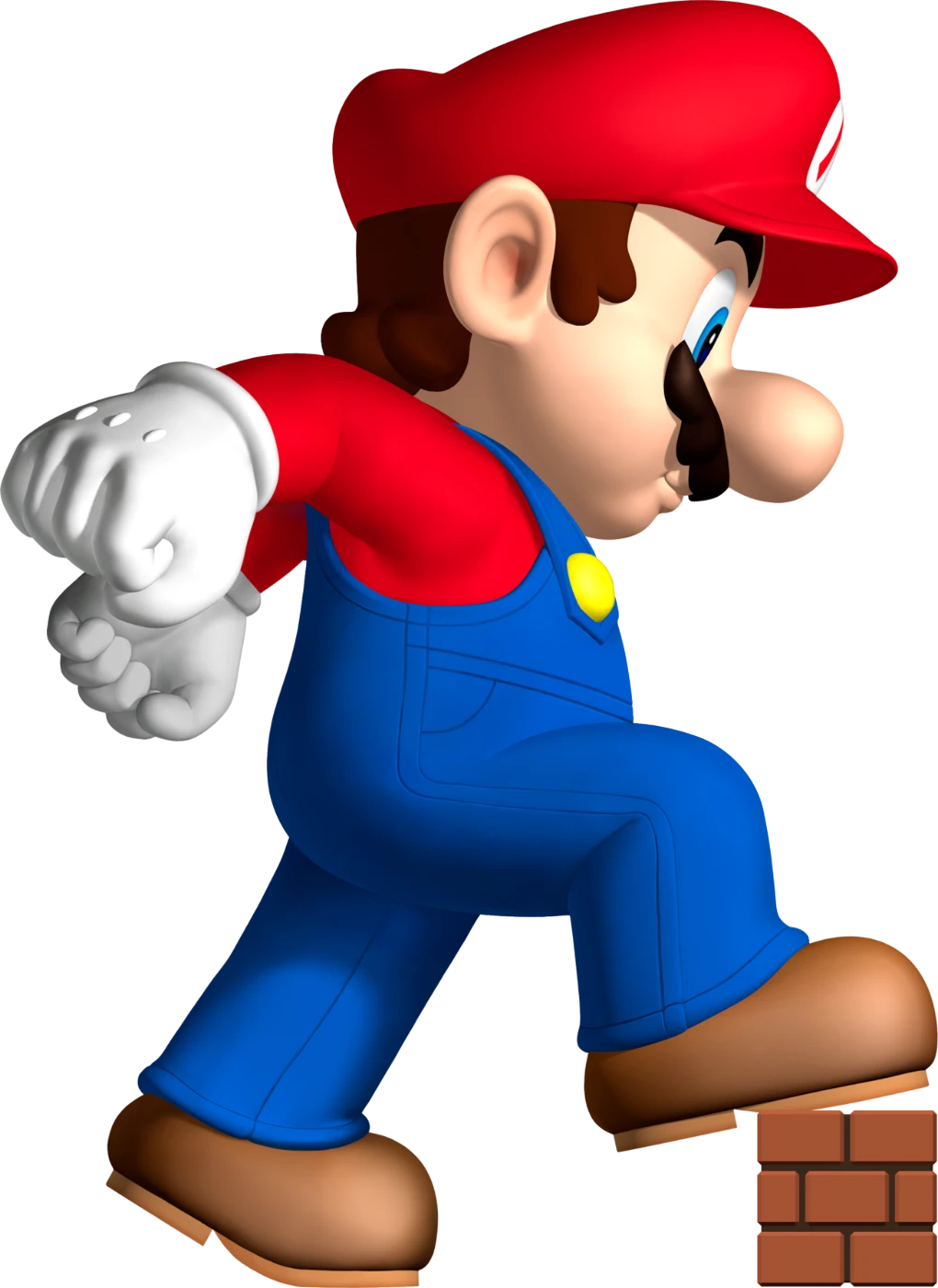
The D-pad moves, A or B jumps and X or Y dashes and grabs shells (a second control mode swaps the buttons around). Mario’s 3D repertoire comes to a 2D Mario for the first time: three jumps in a row build into a triple jump, pressing down in mid-air is a ground pound that smashes bricks, and sliding down a wall and jumping off it is the wall jump, which turns every vertical shaft into a climb and every pit into a second chance. Spin Blocks fling him into a twirl that glides slowly back down or, with a press of down, becomes a fast drill stomp through several bricks at once.
He also climbs chain-link fences and punches whatever is on the other side, swings on ropes and vines, tiptoes along wires that sag under his weight, sidles along cliff ledges and bounces off Mushroom Trampolines. The camera zooms in and out to follow the action, which is where the 3D models earn their keep: a Mega Mushroom or a Mini Mushroom changes Mario’s size without anyone having to redraw him.
Six power-ups, three of them new to the platformers
Mega Mario, the DS game’s showpiece.
The Super Mushroom, Fire Flower and Starman work as they always have, with two kindnesses: losing a Fire Flower or Blue Shell drops Mario to Super Mario, not to Small Mario, and the Starman now makes him faster as well as invincible, a trick borrowed from Mario Kart. The Mega Mushroom is the showpiece, swelling Mario until he fills most of the screen and ploughs through pipes, blocks, Bill Blasters and enemies alike, with a five-segment meter at the top of the screen that pays out a 1-Up Mushroom for every segment filled by the time the effect wears off.
The Mini Mushroom does the opposite. Mini Mario is smaller than Small Mario, floats in long drifting jumps, skims across the surface of water and fits through tiny pipes, but a single hit finishes him and only a ground pound lets him hurt most enemies; he is the key to several secret exits and to the two hidden worlds. The Blue Shell turns Mario into Shell Mario, who tucks in and skids along the ground once he builds up speed, bouncing off walls and bowling over enemies, and ducks inside it for protection. The Mega and Mini Mushrooms were borrowed from Mario Party 4 and redesigned; the shell suit was brand new.
One spare power-up sits in the item box on the touch screen, ready to be tapped into play, exactly as in Super Mario World. Enter a pipe to a secret area and the two screens swap, with the action dropping to the touch screen until Mario comes back out.
Star Coins, Toad Houses and the maps
A Red Toad House, with Toadsworth and his Roulette Block.
Every course hides three Star Coins, often behind a wall jump you have to spot, inside a secret pipe or at the end of a Mini Mario tunnel, making 240 in all. They are spent on the maps: 32 Star Coin Signs block side paths and open for five coins each, and once Bowser’s Castle has fallen a Blue Toad House appears next to World 1-1 selling touch-screen wallpapers for 20 Star Coins a time, with a fifth design for anyone who has cleared every sign.
Toadsworth, not Toad, minds the Toad Houses. Red ones hold a giant Roulette Block that cycles through a Super Mushroom, Fire Flower, Blue Shell and Mini Mushroom; green ones hide 1-Ups, multipliers and a game-ending Bowser card in six ? Blocks, for up to twelve extra lives; orange ones, shaped like a Mega Mushroom, hand over a Mega Mushroom for the item box. A house closes once used until all 80 courses are cleared. Hammer Bros and winged red ? Blocks wander the maps and give up an item at the start of the course they land on, and a save file earns up to three stars: one for beating the final boss, two for clearing every course, three for finding every secret exit and spending every Star Coin.
Secret exits, cannons and the short route
The World 2 Warp Cannon, which fires Mario straight to World 5.
Some courses have a second flagpole with a red flag, usually reached by a hidden pipe, a Mini Mushroom gap or a Blue Shell dash, and finding it opens a new path on the map. Five of those paths end at Warp Cannons: the World 1 tower and World 2-A fire you to World 5, the World 3 and World 4 Ghost Houses to Worlds 6 and 7, and the World 5 Ghost House to World 8. A player who knows the route can see the credits having cleared only 1-1, 1-2, the first tower, 5-1, 5-2, 5-3, the World 5 Ghost House and World 8.
Worlds 4 and 7 are hidden in a different way. Finish the World 2 castle with the Mini Mushroom still active and Mummipokey’s defeat opens the forest of World 4 instead of the beach of World 3; do the same to Petey Piranha in World 5 and the clouds of World 7 open instead of the mountains of World 6. Beating a boss while one touch from death is the price of admission.
Mario vs. Luigi
The Mario vs. Luigi results screen.
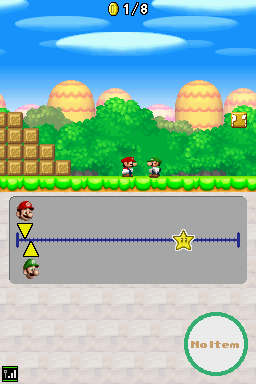
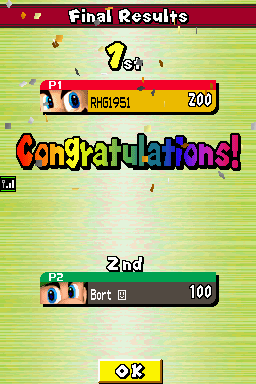
Two players, two DS systems and one Game Card is all the head-to-head mode needs. Mario and Luigi share one of five looping stages (Grass, Bricks, Ice, Pipes and Fortress) and race for Big Stars that appear at random; the first to the agreed total wins the round. Stomping or fireballing your brother knocks a star loose and a ground pound knocks out three, collecting eight coins drops a random power-up, and a Mega Mushroom only ever turns up for whoever is losing. The arcade Mario Bros. respawn jingle plays when a fallen player returns, and ties, pleasingly, go to Luigi.
Minigames
The 1 Player minigames menu.
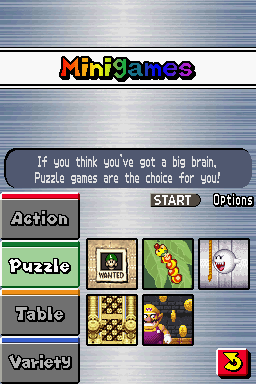
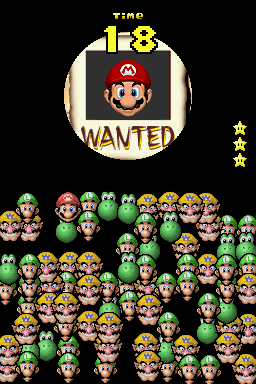
The touch-screen minigames from Super Mario 64 DS return, this time open from the start instead of being won from rabbits, with new graphics and many rebuilt for up to four players over DS Download Play. The single-player menu has 18 of them across Action, Puzzle, Table and Variety; the Vs. Battle menu has 26, including eight 1-on-1 games. Highlights include Wanted!, Puzzle Panel, Whack-a-Monty, Snowball Slalom, Bob-omb Squad and the card tables run by Luigi. Wario and Yoshi, who have no part in the adventure, are still heard here, a holdover from their starring roles on the earlier Game Card.
Power-ups and pickups
Everything Mario can grab, in the order you are likely to meet it.
Super MushroomSmall Mario becomes Super Mario.
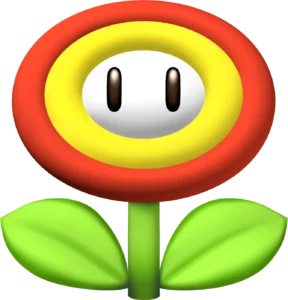
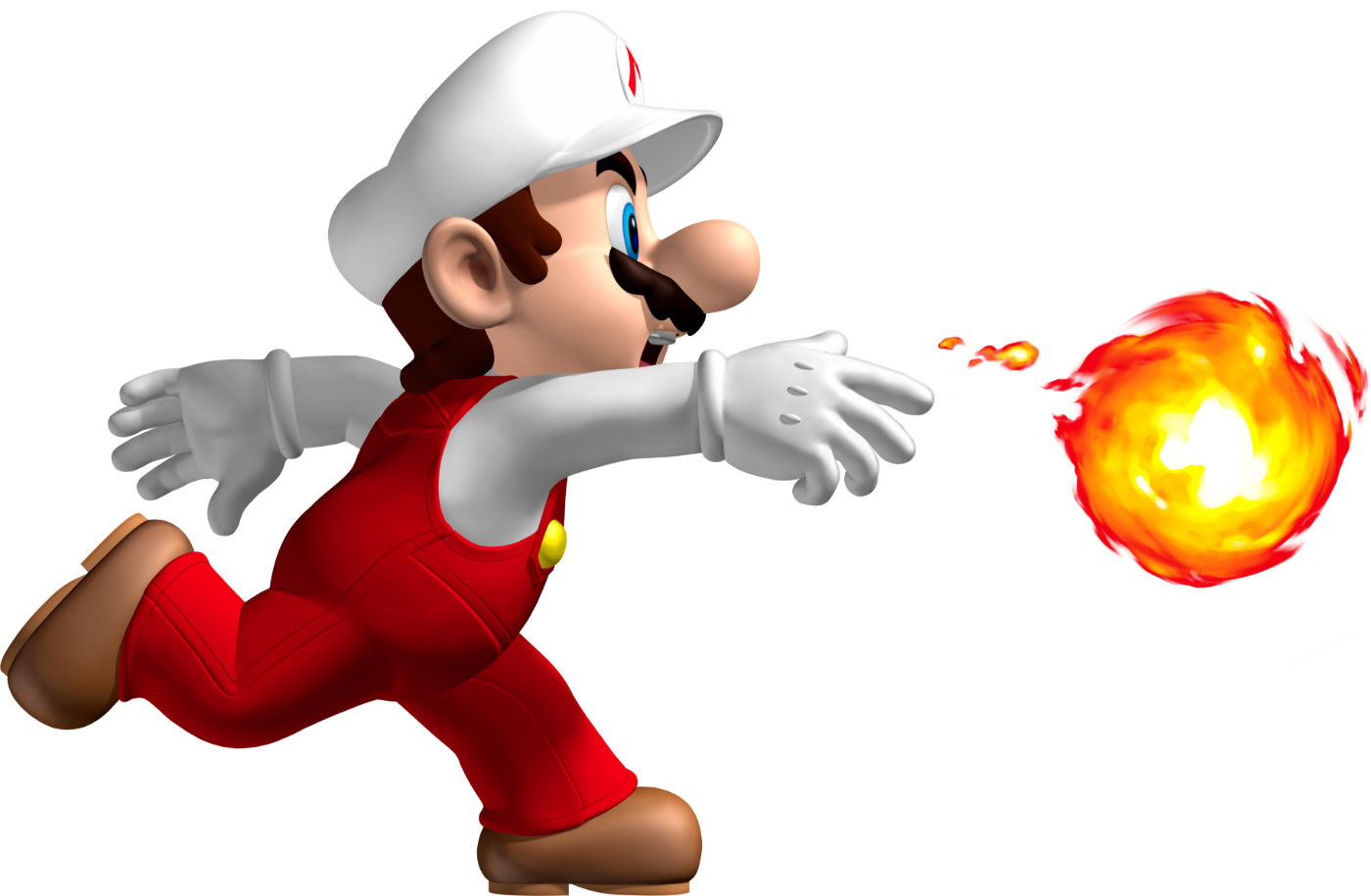
Fire FlowerFire Mario throws bouncing fireballs; losing it drops you to Super, not Small.
StarmanBrief invincibility, extra speed and a change of tune.
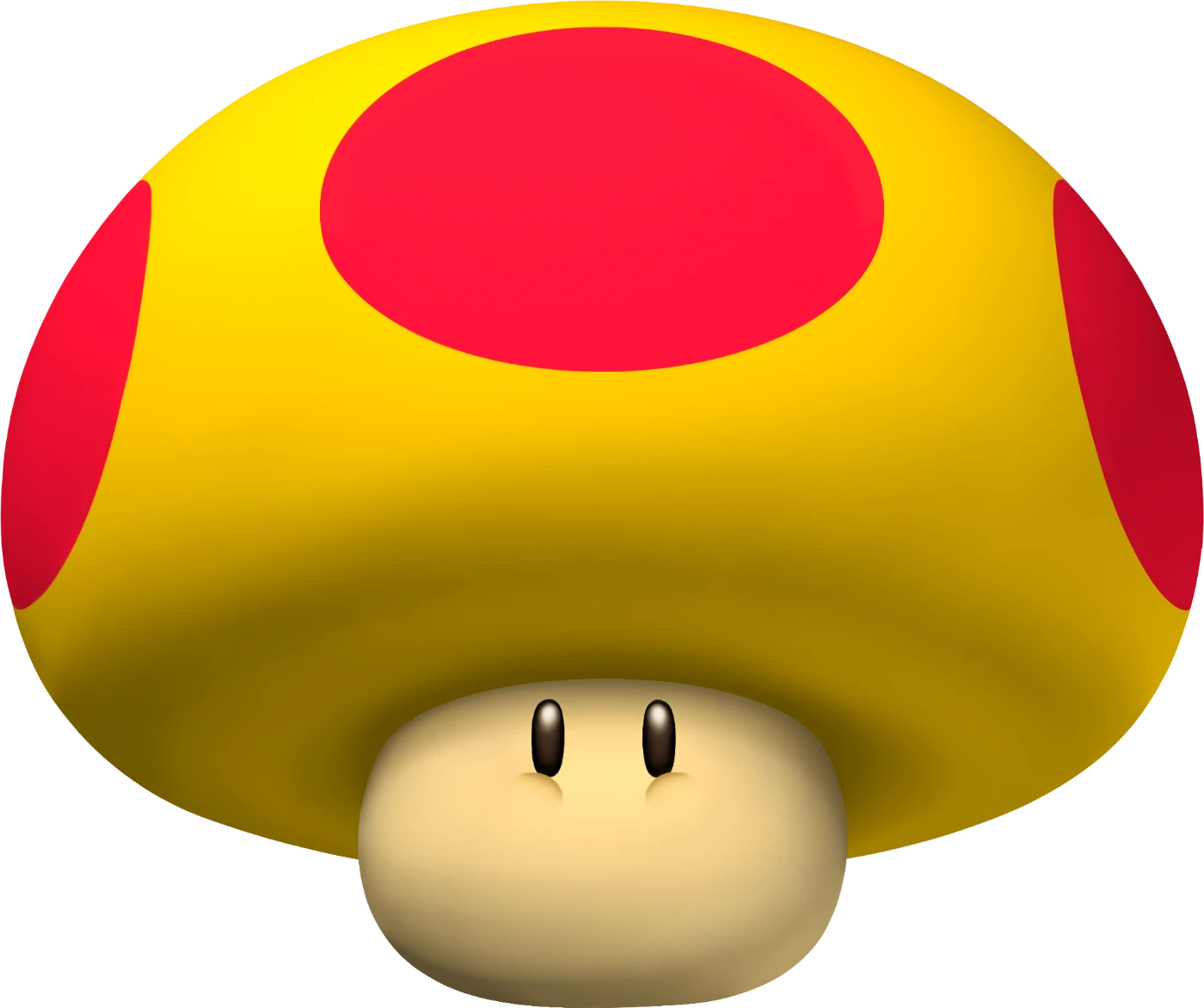
Mega MushroomGiant Mario for a few seconds; wreck enough and the meter pays out up to five 1-Ups. Found loose in 1-1, 1-2, 4-4 and 7-5.
Mini MushroomTiny, floaty, water-walking Mario; one hit and he is gone. The key to Worlds 4 and 7.
Blue ShellShell Mario skids along as a spinning shell and shelters inside it when crouching.
1-Up MushroomAn extra life; 100 coins do the same.
Star CoinThree per course, 240 in all; spend them on map signs and wallpapers.
CoinA hundred for a life; eight in Mario vs. Luigi for a power-up.
Red CoinsPass through a Red Ring and grab all eight in time for a power-up or 1-Up.
Big StarThe prize in Mario vs. Luigi.
Koopa shellsKick them or carry them with the dash button. Buzzy Beetle shells are fireproof.
KeyDropped by every castle boss; it unlocks the next world.
Spin BlockLaunches Mario into a high, gliding spin jump.
Roulette BlockCycles through items; you get whatever is showing when you hit it.
P SwitchSwaps coins and bricks and conjures Blue Coins for a few seconds.
Cartoons, Comics & Other Media
New Super Mario Bros. arrived long after the Mario cartoons had ended, but it has a manga adaptation, an official guide and a long tail of musical and visual callbacks in later Nintendo games, right up to the 2023 film.
Nintendo Power Player’s GuideNintendo of America · 2006The official guide, written by Casey Loe, mapped every course and Star Coin. It is also the source of the name “Mega Goomba” for the World 4 boss, which Nintendo’s Japanese Mario Portal calls Boss Goomba.
Super Mario-kunManga · one volumeThe long-running gag manga devoted one volume to the game, following the story loosely and adding its own jokes: when Mario beats Luigi in a Mario vs. Luigi bout he dashes to pull his brother back from a cliff edge, and promptly gets distracted.
Itadaki Street DS and Fortune StreetSquare Enix · DS and WiiThe Bowser’s Castle board in Itadaki Street DS is modelled on World 8-Castle, complete with Bowser Jr. standing beside the cauldron, and plays an arrangement of the Castle Theme; several Chance Cards use screenshots from the game. The board returned in Fortune Street on Wii.
Super Smash Bros. BrawlNintendo · Wii · 2008A tropical arrangement of the Ground Theme is one of the tracks for the Delfino Plaza stage, and it has stayed in the series since.
Mario & Sonic at the Olympic Winter GamesSega/Nintendo · 2009The Mario World routine in Dream Figure Skating skates past World 1, Peach’s Castle and Bowser’s Castle as they look in this game, and the DS version’s Mario Medley includes the Athletic Theme.
New Super Mario Bros. WiiNintendo · Wii · 2009The Wii follow-up reuses the engine’s ideas, the music’s vocal “paah” and even passages of the DS manual, such as its “Blunders and Game Over” page.
Captain Toad: Treasure TrackerNintendo · Wii U · 2014Part of the Volcano Theme from World 8 is arranged in Captain Toad’s adventure.
The Super Mario Bros. MovieIllumination/Nintendo · 2023The logo of the brothers’ plumbing business uses the “Super Mario Bros.” lettering from this game’s logo, and the track “Welcome to the Mushroom Kingdom” works in the series’ trademark “paah” and the “Switch On!” jingle.
Super Mario Bros. WonderNintendo · Switch · 2023The successor to the New series keeps the same logo lettering, red-flagged secret poles and three big collectable coins per course, its Baboooms behave like this game’s Kab-ombs, and Bowser Jr. fights much as he did in 2006.
Mario Kart World and Nintendo MusicNintendo · 2025Mario Kart World includes a samba-funk arrangement labelled “Ground BGM (New Super Mario Bros.)”, and the complete 60-track DS soundtrack, an hour and twenty minutes of it, was added to the Nintendo Music app in October 2025.
Characters
A small cast by Mario standards: two heroes, one princess, one elderly Toad, a father-and-son villain act and six castle bosses, most of them ordinary enemies grown monstrous. No Koopalings, no Yoshi to ride, and no Toad to play as; those came later.
Character
Who they are
In this game
Abilities & notes
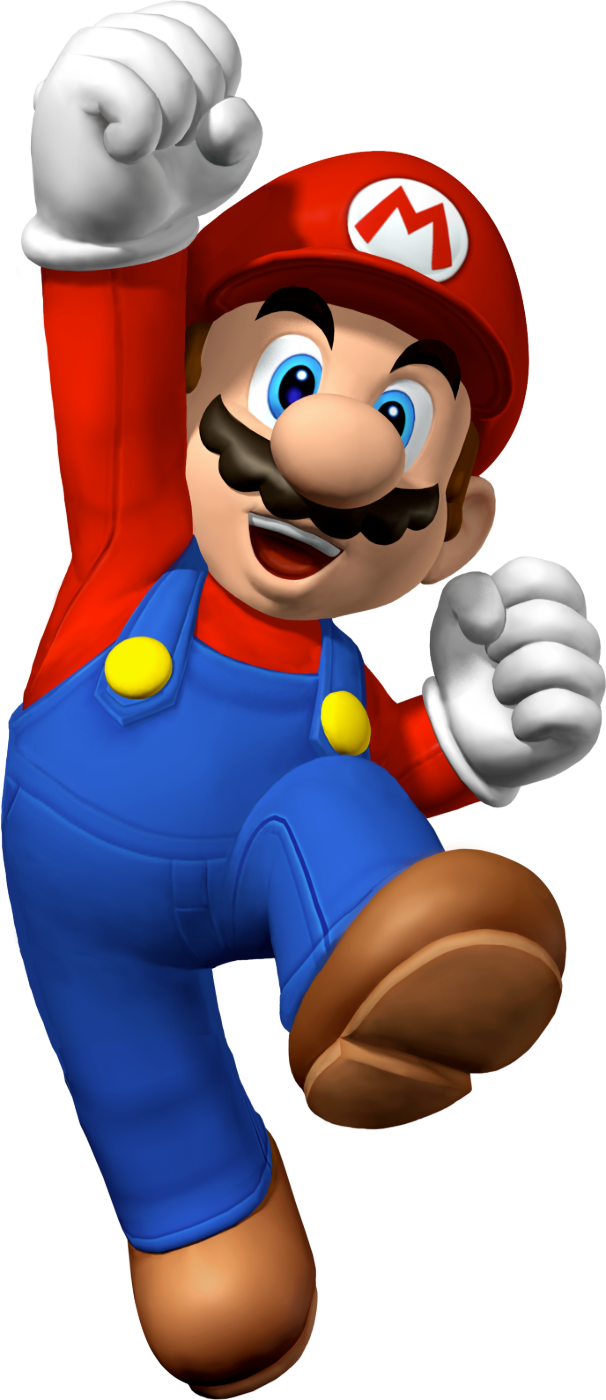
MarioThe hero
The star of the series, voiced by Charles Martinet, who has plenty to say here: this is the first original 2D Mario with voice acting, something the team at first planned to leave out in the spirit of the 1985 game.
Out walking with Peach when the castle is struck by lightning; turns his back for a moment and spends eight worlds making up for it.
Forms: Small, Super, Fire, Mega, Mini, Shell and invincible
One stored item on the touch screen
Says “It’s-a me, Mario!” when you open the DS
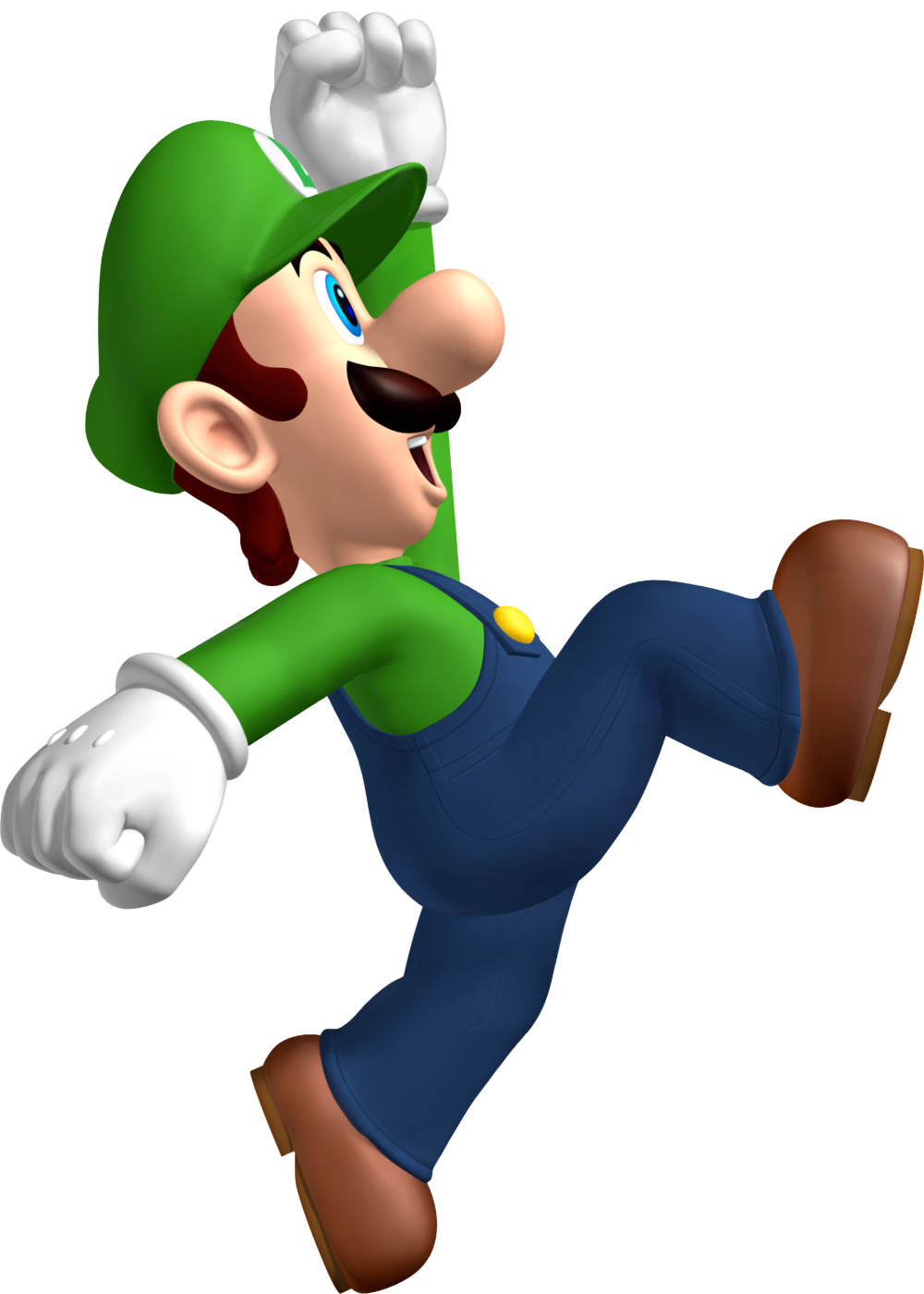
LuigiHidden second hero
Mario’s twin, Player 2 in Mario vs. Luigi and the host of several card minigames.
Playable in the main adventure by holding L and R while choosing a file. He handles exactly like Mario, has his own voice clips in the ending and credits, and wins every tied versus match.
Identical moves and forms to Mario. The choice is not locked in: you can pick either brother each time you load the file.
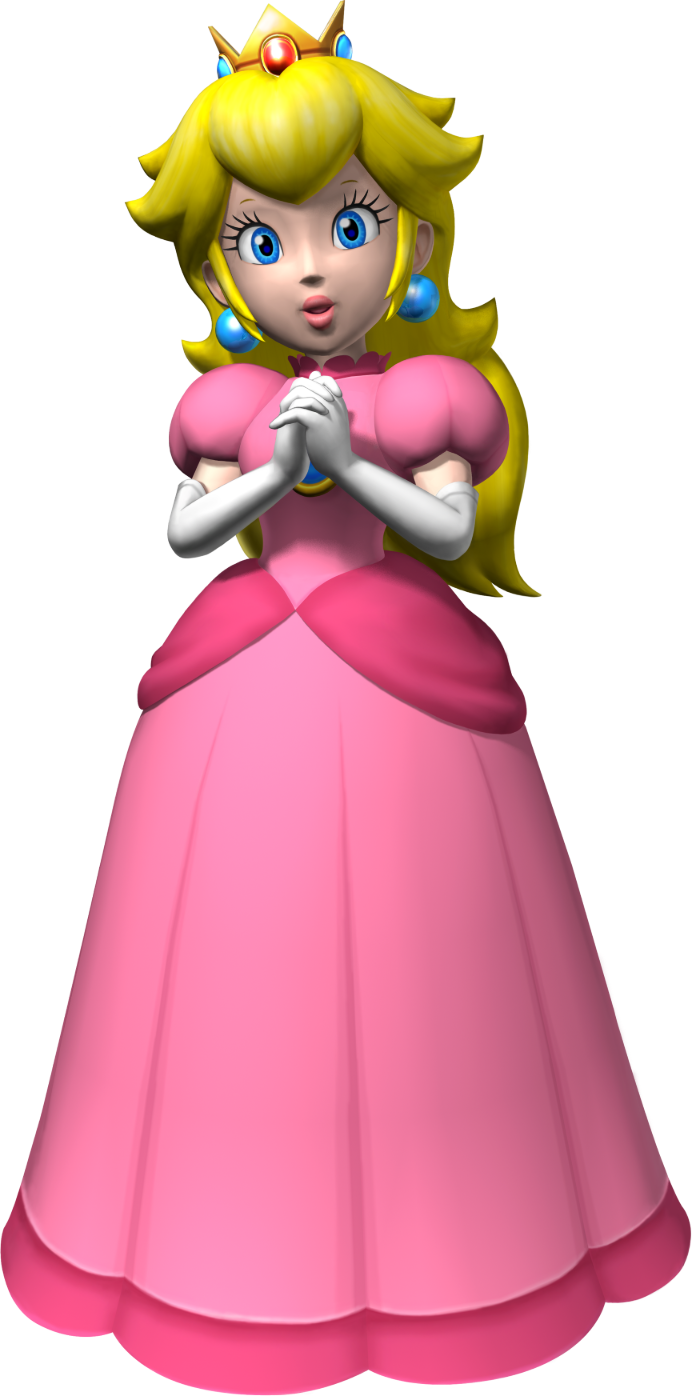
Princess PeachKidnapped, again
Ruler of the Mushroom Kingdom, drawn here with artwork reused from Mario Party 6.
Snatched by Bowser Jr. in the opening and hauled from tower to tower, always just out of reach, until she is freed above the final bridge and thanks Mario with a kiss.
Not playable. Voiced by archive recordings of Jen Taylor (uncredited).
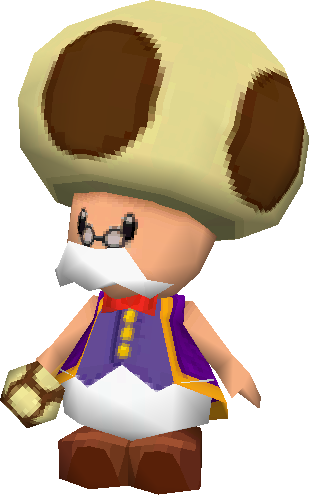
ToadsworthKeeper of the Toad Houses
Peach’s elderly steward, who takes over the job the ordinary Toads did in Super Mario Bros. 3.
Runs every Toad House: he conjures the Roulette Block, the 1-Up blocks and the Mega ? Block, and sells wallpapers in the blue house. Look closely at the intro and every Toad fleeing the castle is drawn as Toadsworth.
Red house: one random item. Green house: up to twelve 1-Ups. Orange house: a Mega Mushroom. Blue house: wallpapers at 20 Star Coins each.
Bowser Jr.The kidnapper
Bowser’s son, introduced in Super Mario Sunshine and here taking the lead villain’s role in a side-scroller for the first time.
Grabs Peach, guards all ten towers, revives his father in a cauldron and fights beside him at the end. In the last scene he is dragging the unconscious Bowser home.
Bandana down (Worlds 1–6): charges and hops, hides in his shell after each hit
Bandana up (from World 4): shelters in his shell and throws Koopa shells that must be knocked back at him
Three stomps settle the early fights
BowserKing of the Koopas
The series’ arch-villain, who for once is not behind the kidnapping at all.
Guards the World 1 castle, of all places, and is dropped into lava by a skull switch. Returns as Dry Bowser in World 8 and is then restored, bigger than before, for a two-against-one final battle.
Immune to stomps. Slow fireballs and jumps in World 1; homing blue fireballs, then blue and orange ones in quicker succession, in the finale. Only the skull switch beats him.
Dry BowserBowser, minus the skin
The skeletal Bowser left behind by the World 1 lava, making his series debut. He has since appeared in Super Mario 3D Land, New Super Mario Bros. 2 and a long list of spin-offs.
Boss of World 8-Castle, fought on a bridge over a bottomless pit.
Throws bones and is immune to fireballs. Beaten the same way as his living self: get behind him and hit the skull switch.
MummipokeyWorld 2 castle boss
A giant Pokey wrapped in bandages, new to this game.
Burrows through the sand of the World 2 castle and pops up to spit projectiles. Beating him as Mini Mario opens World 4.
Stomp his head when he surfaces.
CheepskipperWorld 3 castle boss
An oversized Cheep-Cheep, also new.
Leaps out of the water and flops across the platform Mario is standing on.
Stomp him while he is out of the water.
Mega GoombaWorld 4 castle boss
An ordinary Goomba that walks into the room and swells to enormous size with the sound of a Mega Mushroom. Nintendo’s Japanese site calls him Boss Goomba.
Marches back and forth across the World 4 castle, getting faster each time he is hurt.
Hit the ? Switch to raise the green platforms (or wall jump) and ground pound his head: three times, or nine as Mini Mario.
Petey PiranhaWorld 5 castle boss
The pot-bellied Piranha Plant from Super Mario Sunshine, found asleep in the same pose he struck there.
Flies around the frozen World 5 castle and dives at Mario, then skids on the ice and lands on his back. Beating him as Mini Mario opens World 7.
Stomp his belly while he is down.
Monty TankWorld 6 castle boss
A Monty Mole at the controls of a cannon-studded tank, an echo of the cannon-firing moles of Sunshine.
Trundles across the World 6 castle firing Bullet Bills while the mole lobs Bob-ombs from the turret.
Stomp the mole three times; the tank’s three cannon segments show how much fight he has left.
LakithunderWorld 7 castle boss
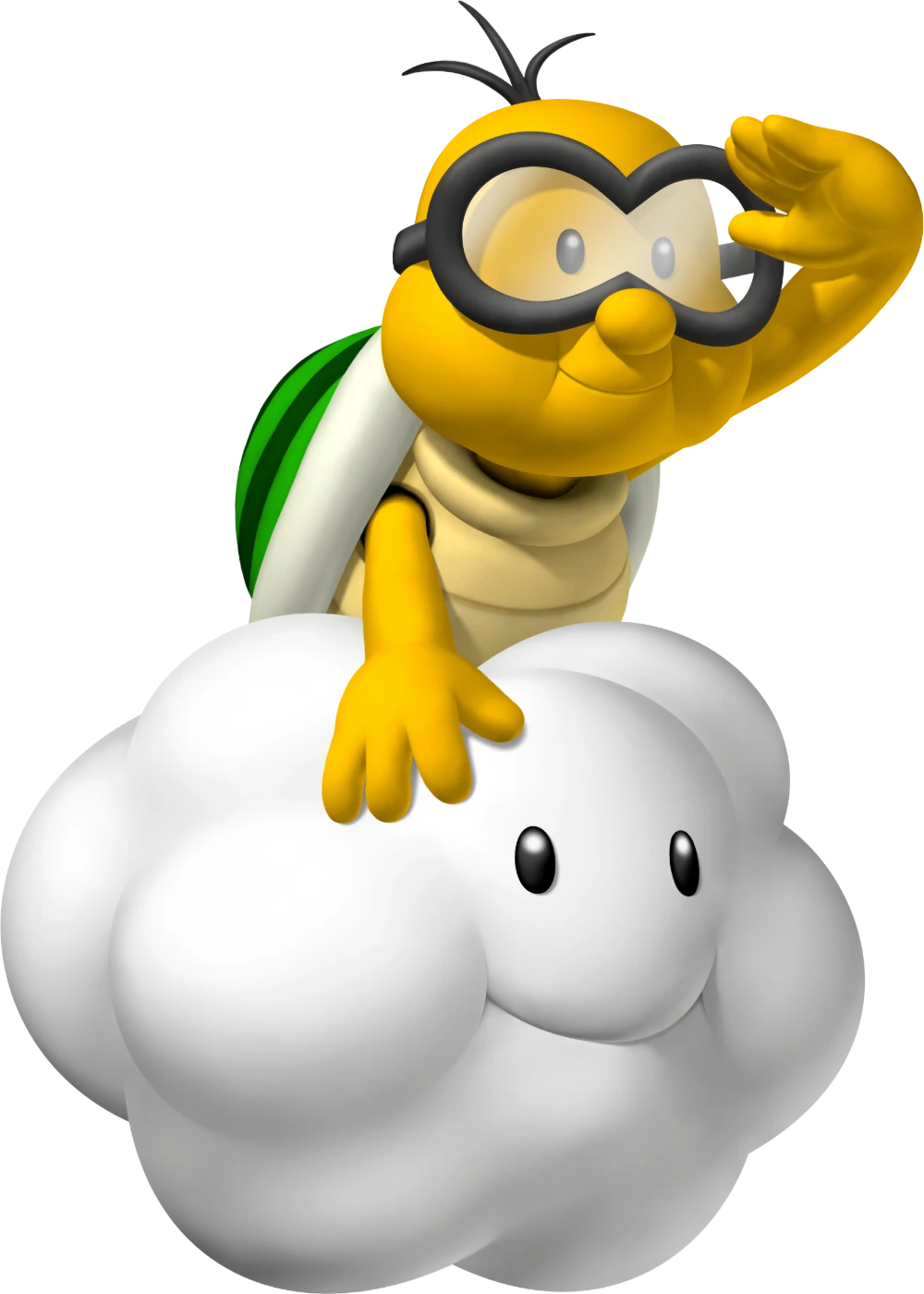
A Lakitu riding a black thundercloud, new to this game.
Hurls bouncing Spiny Eggs and fires bolts of lightning from above the World 7 castle.
Stomp him when he swoops down low.
DorrieFriendly ferry
The gentle sea dragon from Super Mario 64, one of several characters carried over from that game.
Swims through the poison swamps of World 4-1 and 4-6 with Mario on his back.
Not an enemy. Stay aboard while dodging everything else.
Giant WigglerLiving platform
An enormous, many-segmented Wiggler.
Carries Mario across World 7-3, a course with no ground at all.
Not an enemy. Appears in this one course only.
Enemies and obstacles
More than sixty kinds of enemy, sixteen of them new, with the Mushroom Kingdom regulars joined by half the cast of Super Mario 64 DS. Where an enemy lives in a single course, that course is named.
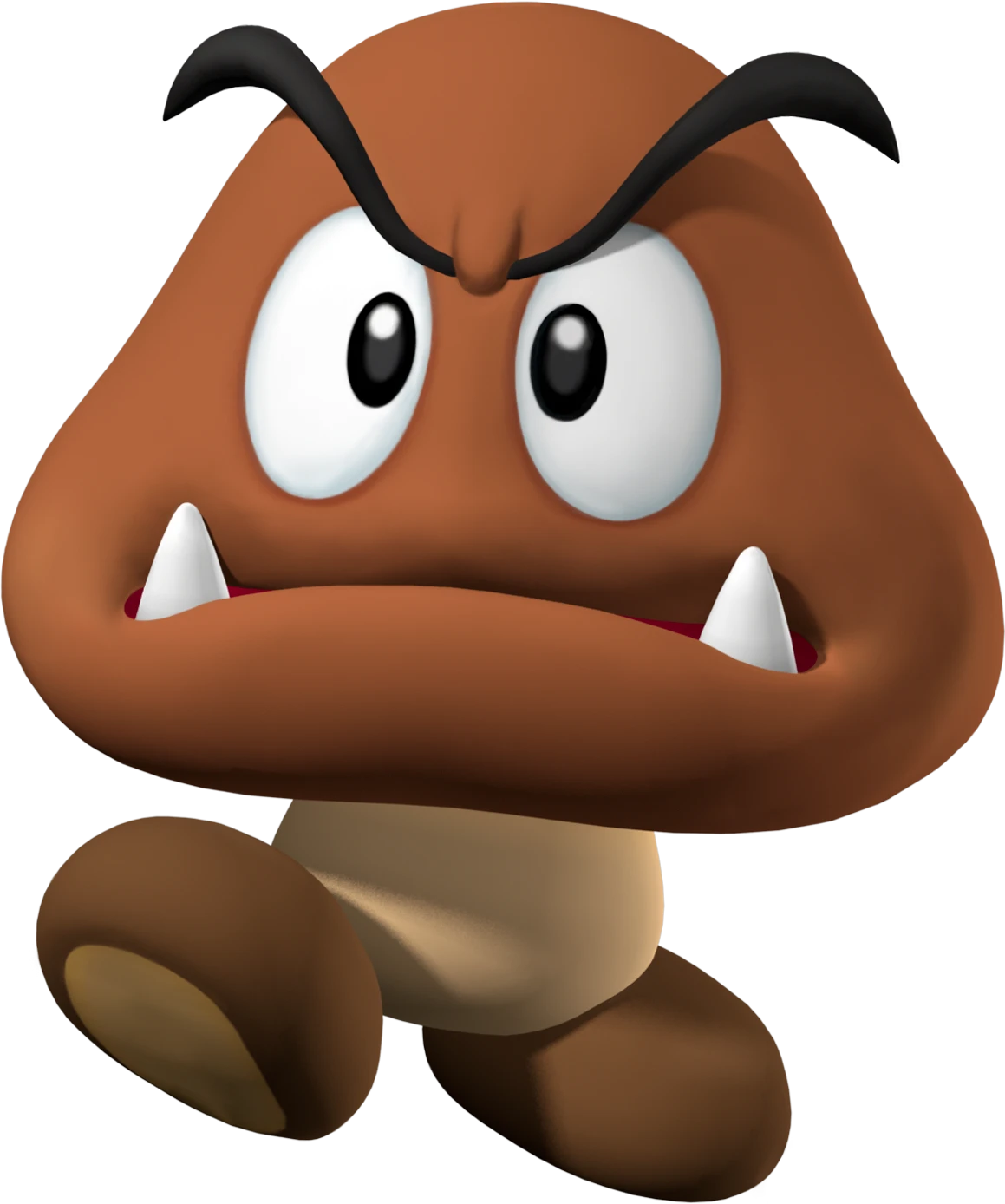
Goomba1-1 to 8-6Now a polygon model that hops in time with the music.
Paragoomba2-4Winged; one stomp clips the wings.
Mini Goomba3-A to 8-4Lives in the tiny pipes; the one enemy Mini Mario can stomp.
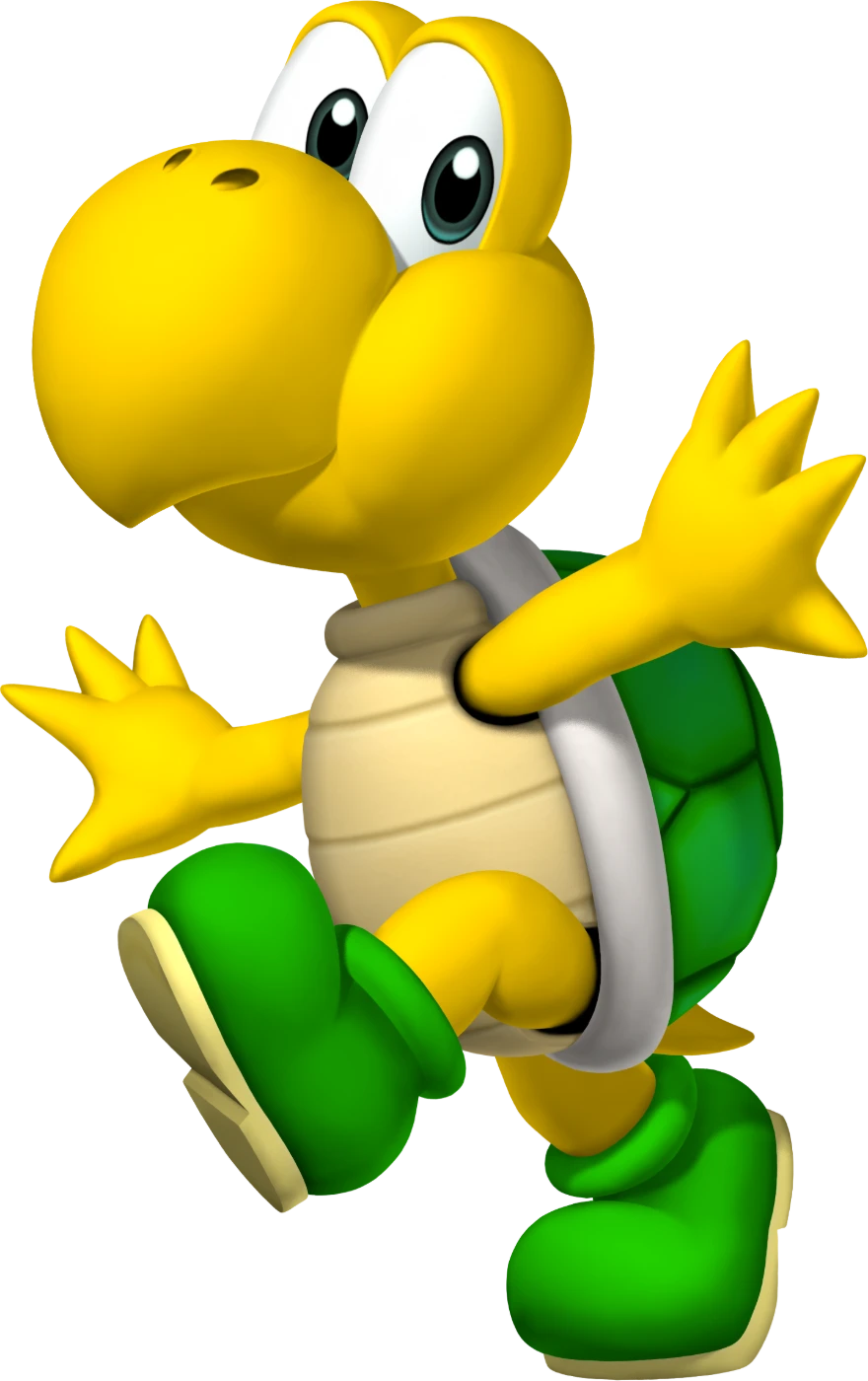
Koopa Troopa1-1 to 8-7Green ones walk off ledges, red ones turn back. A blue one in Mario vs. Luigi gives up a Blue Shell.
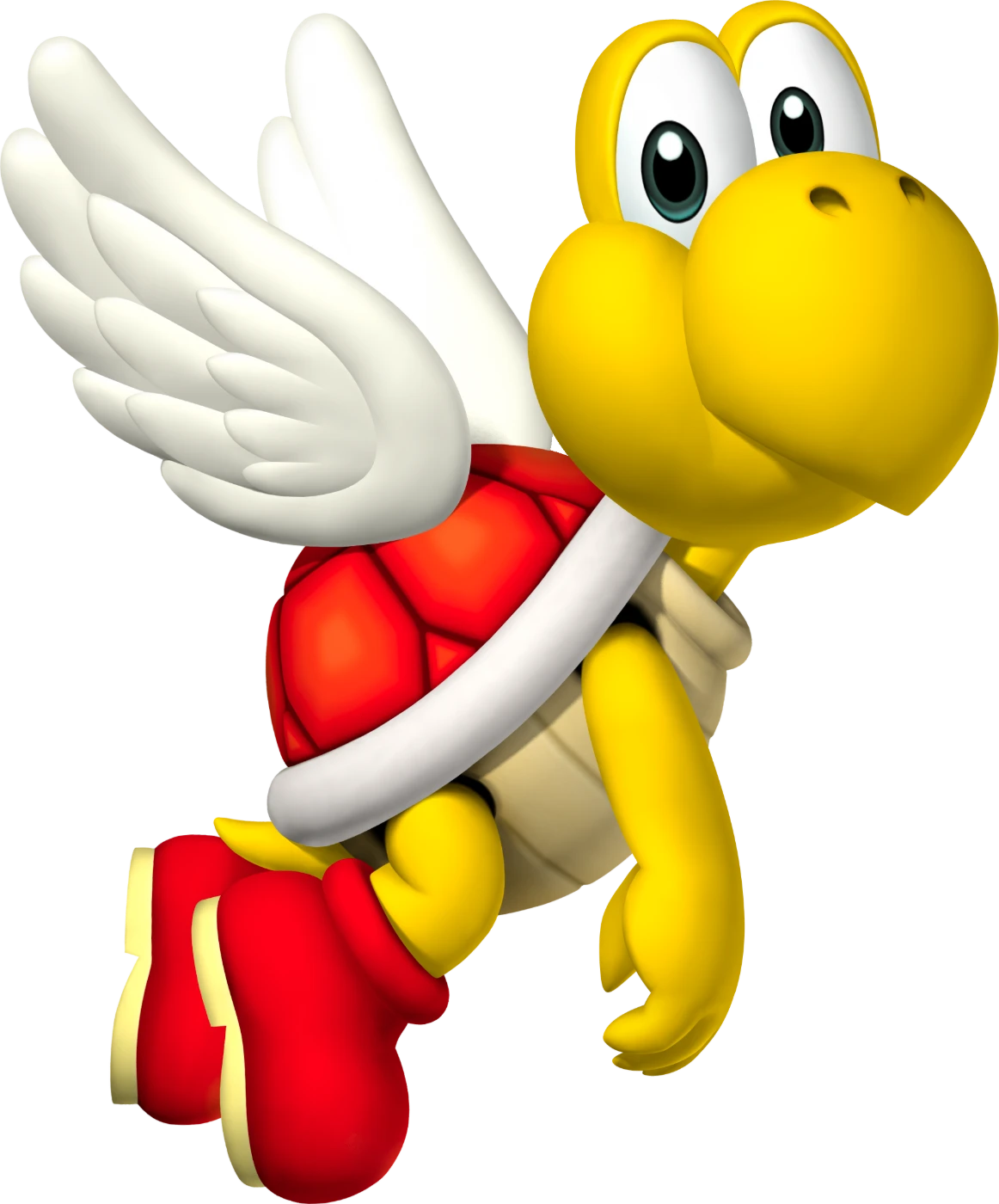
Koopa Paratroopa1-4 to 8-7Green ones bound along in arcs, red ones patrol the air.
Climbing Koopa3-TowerOn the chain-link fences; punch them from the other side.
Dry Bones and Super Dry Bones1-Tower to Bowser’s CastleCollapse and reassemble. The big new one needs a ground pound.
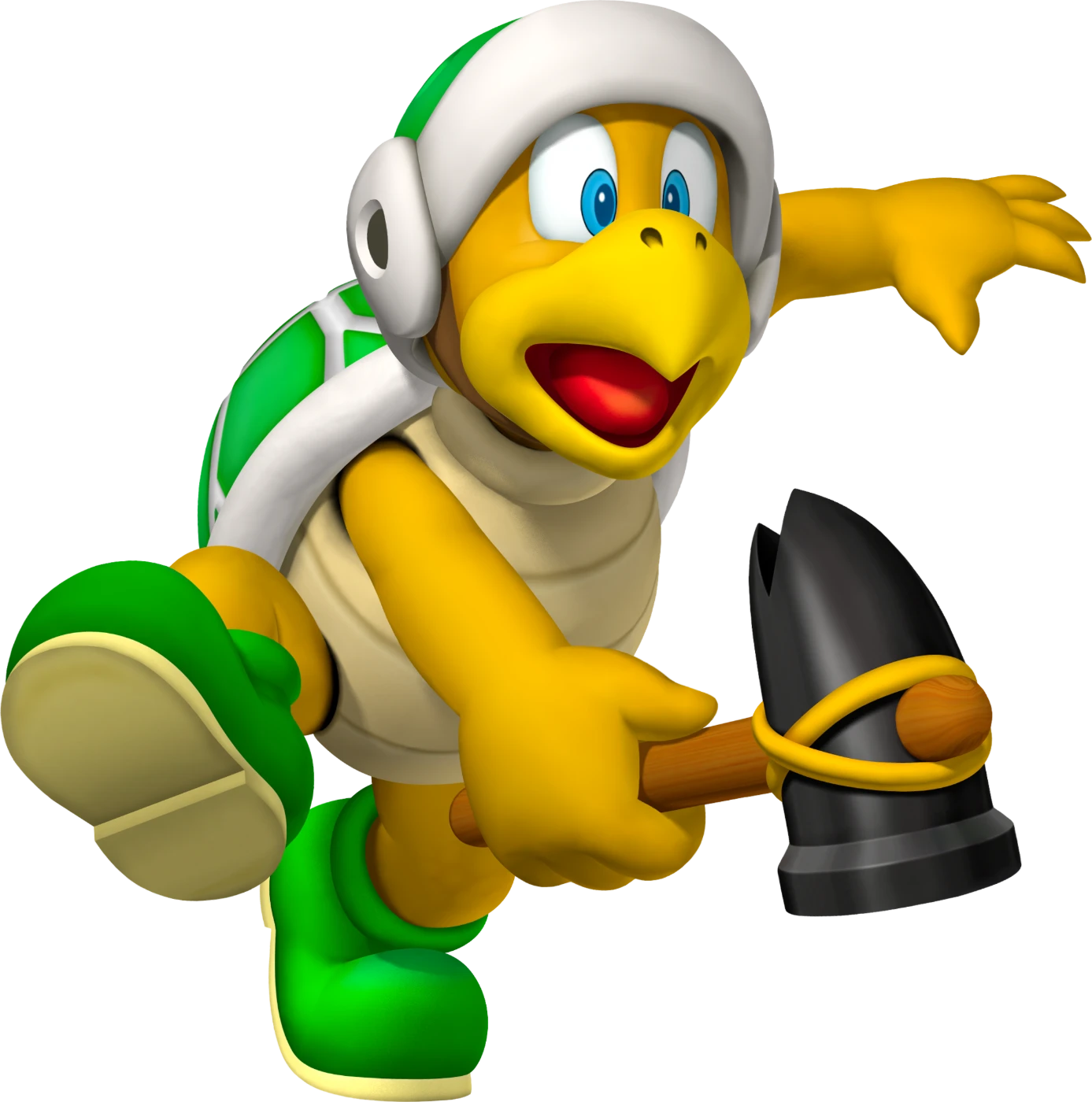
Hammer Bro2-4 to World 8Also roams the maps with an item to give up.
Boomerang Bro, Fire Bro and Sledge Bro2-5; 8-7The whole family gathers for the gauntlet of 8-7.
Lakitu and Spiny2-1 to 8-6Knock him out with a shell or fireball and his cloud stays behind.
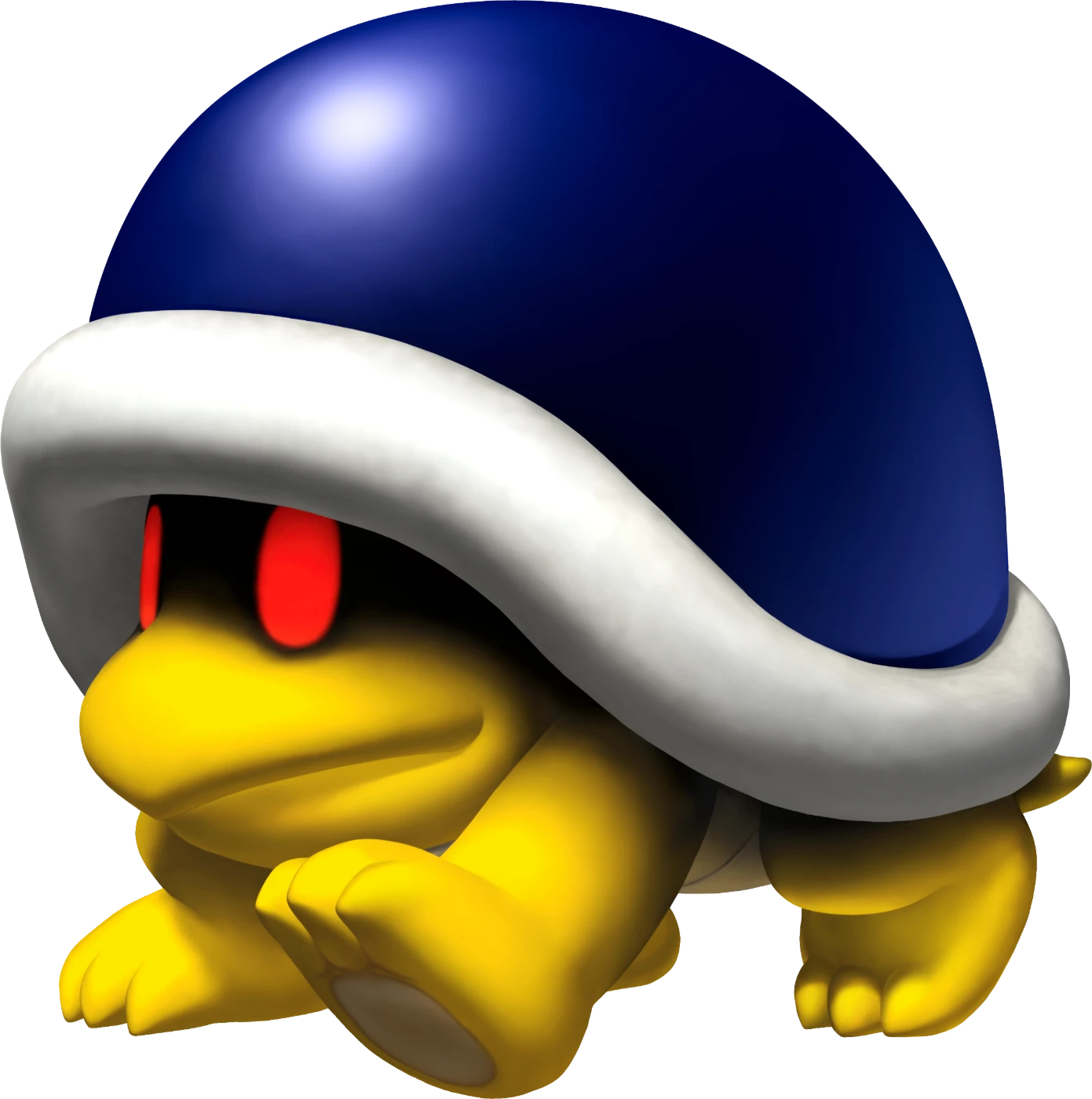
Buzzy Beetle5-C to 6-Tower 2Fireproof.
Spike Top5-2 to 8-TowerWalks up walls and across ceilings.
Snow Spike (new)5-1Rolls snowballs at you.
Pokey2-1Burn off the segments or hit the head.
Piranha Plant family1-2 to 7-APipe-dwellers, Super Piranha Plants that take three fireballs and fire-spitting Venus Fire Traps.
Blockhopper (new)2-5A stack of blocks that hops at you; pound it down to the ? Block.
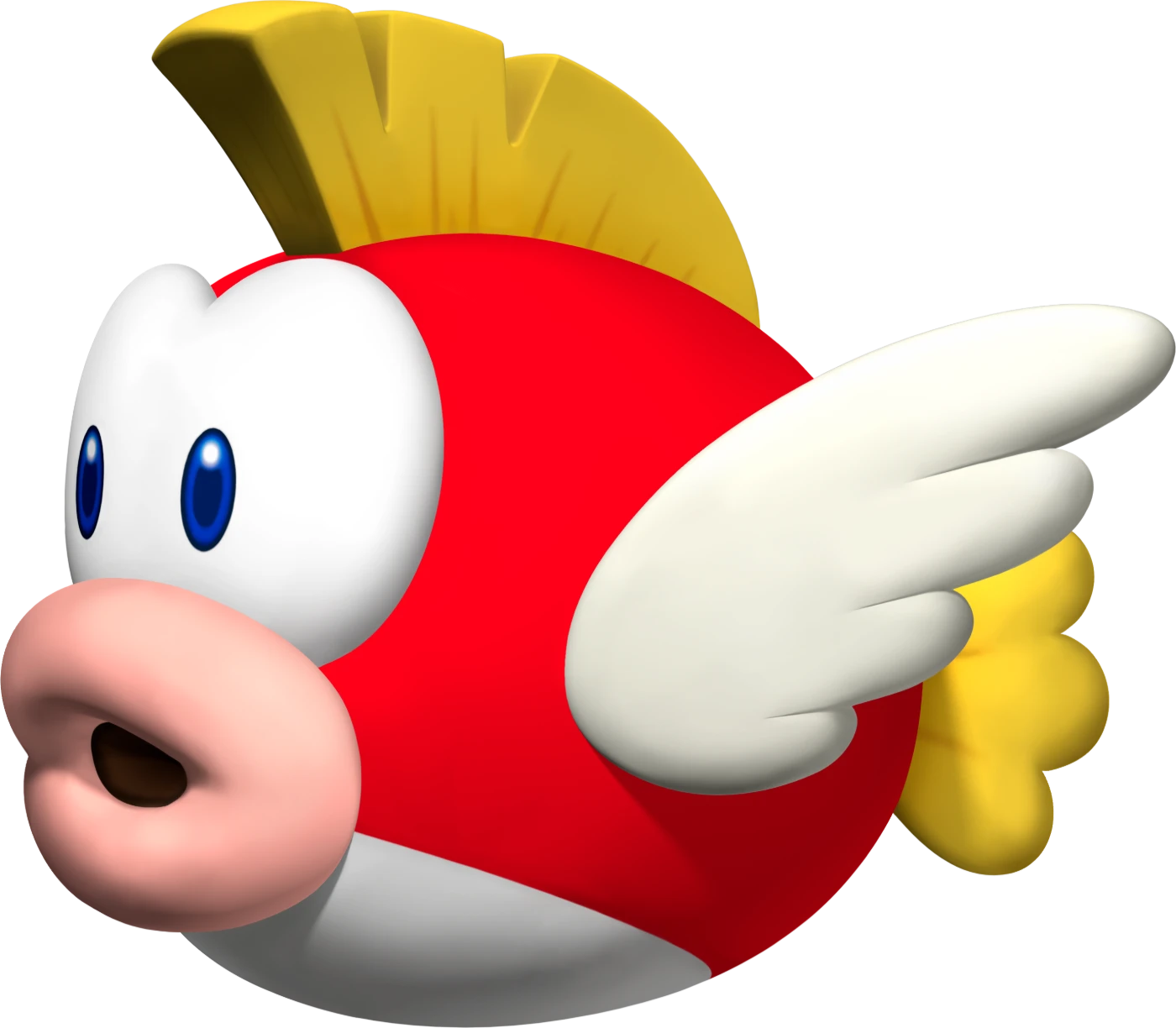
Cheep-Cheep family1-A to 8-3Cheep-Cheeps and Mega Cheep-Cheeps, plus the new green Deep-Cheeps of 6-5, which chase you.
Cheep-Chomp3-1The big purple fish that lunges to swallow Mario.
Spike Bass (new)2-A to 3-CA giant spiny fish that leaps from the water and keeps coming back.
Skeeter3-A to 8-2Skates on the water and drops bombs.
Sushi1-AThe shark from Super Mario 64, in one course only.
Blooper and Blooper Nanny3-3The nanny trails a string of babies.
Unagi and Mega Unagi4-3 to 8-3Eels in the rock. The new giant one cannot be beaten, only outswum.
Whomp and Big Whomp3-CastleGround pound them when they fall flat. The walking Big Whomp is new.
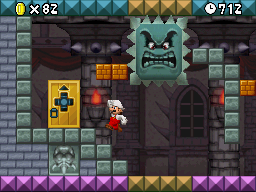
Thwomp and Super Thwomp4-Castle to Bowser’s CastleThe big ones smash through bricks.
Boo3-Ghost House to 8-1Shy when watched. 8-1 is their only outing beyond a Ghost House.
Balloon Boo (new)4-Ghost HouseSwells while you look at it and deflates towards you when you turn away.
Broozer (new)5-Ghost House, 5-CA boxing ghost that punches through otherwise unbreakable blocks.
Splunkin (new)3-Ghost House to 8-1A walking jack-o’-lantern; two stomps.
Swoop2-3 to 5-2Bats that drop from the ceiling.
Moneybags5-2 to 6-3Hops away spilling coins, then a 1-Up.
Crowber (new)8-1A diving crow.
Bob-omb and Kab-omb4-5 to 7-5; 8-8Kab-ombs are new: falling volcanic rock sets them off.
Scuttlebug4-1 to 8-4Spiders on threads, in their first 2D Mario.
Wiggler and Squiggler4-4 to 7-3; 7-AStomp a Wiggler and it turns red and angry. The tiny new Squiggler crawls out of pipes.
Amp3-Tower to 7-CastleElectric; only a Starman or Mega Mushroom removes it.
Chain Chomp6-6Ground pound its post three times to set it free.
Bullet Bill and Banzai Bill2-Castle to 8-1From Bill Blasters, rotating turrets and giant cannons.
Snailicorn (new)5-3 to 5-BCannot be stomped, but can be shoved off the ice.
Flame Chomp, Fire Snake and Podoboo7-1; 2-5; castlesThe fiery contingent.
HazardsThroughoutLava, poison, quicksand, Skewers, Fire Bars, Burners, Giant Spiked Balls, whirlpools and, in 8-8, a rain of volcanic debris.
The people who made it
The credits read like a reunion of Nintendo’s 2D Mario veterans, with a new generation learning the trade beside them.
Shigeyuki AsukeDirectorWas map director on Super Mario Advance 4 and an assistant director on Super Mario Sunshine, and went on to direct New Super Mario Bros. Wii.
Takashi TezukaGeneral producerOn the series since the original Super Mario Bros. and director of Super Mario World; it was his suggestion that the next Mario should be a side-scroller.
Hiroyuki KimuraProducer (and producer of the minigames)A designer on Super Mario Bros. 3 and director of the Super Mario Advance series.
Shigeru Miyamoto and Satoru IwataSupervisor; executive producerMiyamoto oversaw the project and pushed for one flashy idea, the giant Mario, to carry an otherwise traditional game.
Masataka Takemoto and Yasuhisa YamamuraMap and level designTakemoto heads the level design credits and later directed New Super Mario Bros. U; Yamamura has designed 2D Mario courses since Super Mario Bros. 2. Kosono Okina, Haruka Kakinuma and Shinya Hiratake completed the team.
Masanao ArimotoDesign directorLed the art team that turned the cast into DS-friendly 3D models.
Toshihiko NakagoProgramming directorWith Nobuhiko Sadamoto and Eiji Noto as main programmers. SRD is thanked in the credits.
Koji Kondo, Asuka Ohta and Hajime WakaiSound director; musicKondo wrote the main Ground Theme and supervised the rest; Ohta (credited under her later name, Hayazaki, in some listings) and Wakai composed the remainder, with Wakai also scoring the minigames.
Motoi Okamoto and Shigefumi HinoMinigames director; demo scene directorOkamoto ran the minigame team, working from the Super Mario 64 DS originals; Hino directed the cutscenes.
Charles MartinetVoicesMario, Luigi and Wario. Peach and the Toads (Jen Taylor), Bowser Jr. (Dolores Rogers) and Yoshi (Kazumi Totaka) are uncredited archive recordings.
Advertisement
How It Was Made
Nintendo never gave the DS game its own Iwata Asks, but Miyamoto talked about it at length when the Wii sequel came round, Tezuka discussed it in Famitsu, and the E3 demos of 2004 and 2005 left a trail of cut ideas that dataminers have been following ever since.
“If we make another one, it should be a side-scroller”
An early logo for the game. Logo: Nintendo, via Super Mario Wiki
The idea took shape in late 2003, just after Super Mario Advance 4 had wrapped up the Game Boy Advance remakes. Takashi Tezuka and Hiroyuki Kimura, the latter the director of that series, decided to make what Wikipedia’s account calls “a completely new Super Mario title” for the handheld Nintendo was then designing. Miyamoto later recalled the conversation to Satoru Iwata: when the team was working out what to make for the DS, Tezuka said, “if we make another one, it should be a side-scrolling Mario.”
The title was a statement of intent. “We decided to make a Mario that made a fresh start by returning to its core principles,” Miyamoto said, and the design brief was just as plain: the player should get a clear sense of becoming more skilled every time they replayed a course. Kimura took the producer’s chair, Tezuka became general producer and Shigeyuki Asuke, another Advance veteran, directed.
One flashy idea
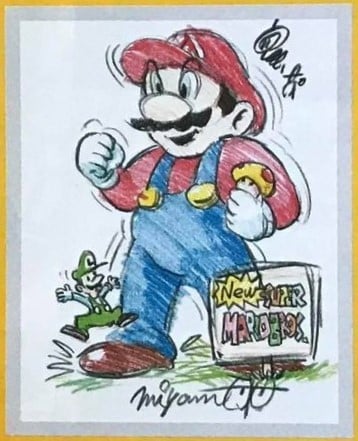
A drawing of the game’s Mario by Shigeru Miyamoto. Drawing: Shigeru Miyamoto/Nintendo, via Super Mario Wiki
A faithful 2D Mario on brand-new hardware risked looking, in Miyamoto’s words, “too understated”, so the team went looking for “a very flashy element”. They found it in the Mega Mushroom. “If you include that enormous Mario, the rest of the game can be as old-fashioned as you like,” he told Iwata.
The giant was only possible because the characters were no longer sprites. This was the first 2D Super Mario built from 3D models, which meant Mario could grow, shrink and be animated in far more detail without an artist redrawing every frame, and the camera could pull back or push in to suit the action. Freed from rigid tiles, the designers added ropes to swing on, wires that sag, terrain that deforms and scenery that rotates. The developers of Super Mario Bros. Wonder looked back on that leap in 2023 as the kind of evolution they wanted to match.
From tech demo to E3 2005
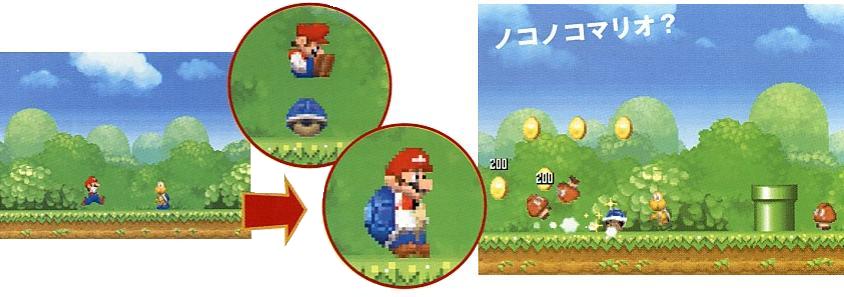
An early concept for obtaining the Blue Shell. Screenshot: Nintendo, via Super Mario Wiki
The game was first shown alongside the DS itself at E3 2004, as non-playable footage of gameplay ideas with a fact sheet for the press. A year later it was playable, and noticeably different from what shipped. The E3 2005 trailer showed Mario and Luigi running courses together, including a desert and an underwater stage that are not in the finished game (some of their data is still on the Game Card). The item box held three spare power-ups instead of one, Super and Fire Mario could punch and kick, the Mega Mushroom was red and white, and Mega Goombas were roaming enemies as well as a boss.
Tezuka told Weekly Famitsu in November 2005 that multiplayer would include co-operative elements but was chiefly a contest, with rounds decided by things like who reached the flagpole first; a Mario and Luigi race mode was tried along the way. In the end co-op was dropped and the versus idea became the Big Star battles of Mario vs. Luigi. Even the Lightning from Mario Kart was once considered as a weapon there. Spindrift, the spinning flower enemy of Super Mario 64, was built and then replaced by the Spin Block, and the final manual still printed a screenshot with early map icons.
Music the enemies dance to
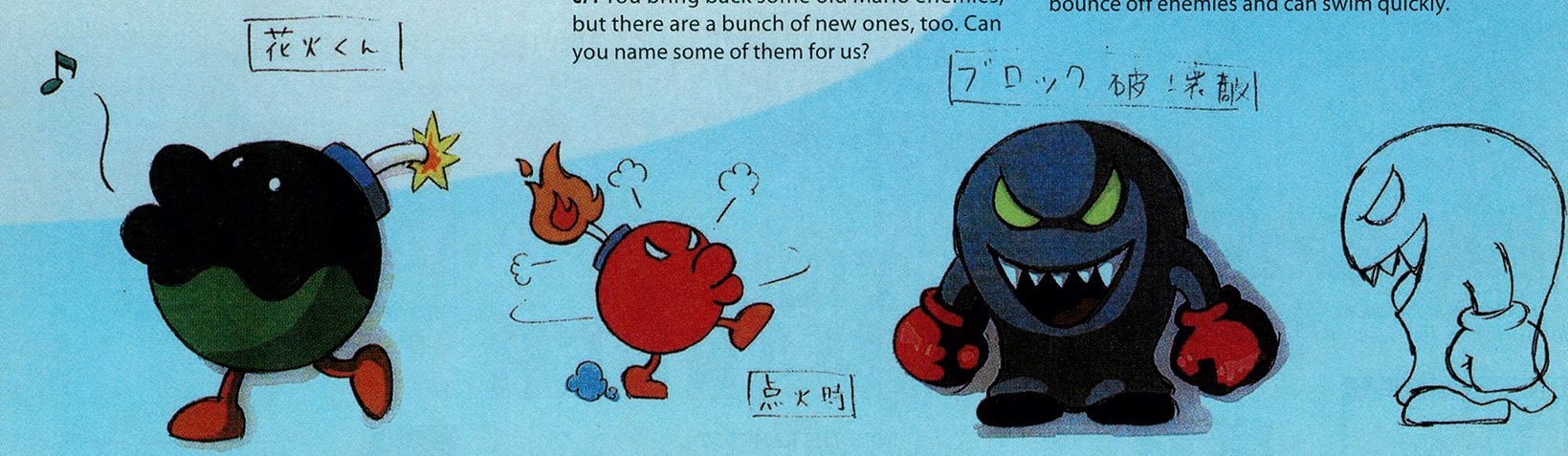
Concept art for two of the new enemies, Kab-omb and Broozer. Concept art: Nintendo, via Super Mario Wiki
Koji Kondo served as sound director and wrote the Ground Theme himself, leaving the rest of the score to Asuka Ohta and Hajime Wakai. Its vocal “paah” stabs, first sampled in a Super Mario 64 jingle, were given a job to do: enemies hop and dance on the beat, so a player with a good ear can predict their movements and time a jump by the soundtrack. The 2005 kiosk demos did not have them yet; its ground theme had no vocals and the desert used an orchestra hit instead. The trick became a hallmark of the whole New Super Mario Bros. series.
Voices were a late decision too. The team originally meant to do without voice acting, in keeping with the 1985 game, and then concluded it would serve the game well, so Charles Martinet recorded Mario and Luigi. The sound design is otherwise a museum: the coin, stomp, fireball and pipe effects are the NES originals almost untouched, the Star Coin chime derives from Super Mario World’s Dragon Coins and several effects come from Yoshi’s Island.
A release date that kept moving
Concept art for the world select screen. Concept art: Nintendo, via Super Mario Wiki
On 21 January 2006 Nintendo announced the new power-ups and a North American date of 7 May. That slipped to 21 May and was then pulled forward to 15 May, with Japan following on the 25th; Nintendo wanted the game on shelves around the launch of the DS Lite. The build stamps on the Game Cards show how tight it was: the American version was finalised on 29 March 2006, the Japanese one on 4 April and the European one on 26 April. Korean and Chinese versions were built in December 2006 and April 2009, the first Super Mario game to be officially localised into Korean.
The one regret
Concept art for the Warp Cannon. Concept art: Nintendo, via Super Mario Wiki
Asked by Iwata in 2009 whether anything about the DS game still bothered him, Miyamoto pointed at the difficulty, and Iwata finished the thought for him: it may have been “a touch too easy”. Miyamoto’s view was that no setting can satisfy beginners and experts together: “You have to focus it on either one or the other.” The DS game chose newcomers. The Wii sequel was pitched at players who wanted a stiffer challenge, with the Super Guide added so that novices could still reach the ending.
Series Firsts
What New Super Mario Bros. brought to the series. Only firsts we could confirm against Nintendo or Super Mario Wiki are listed.
13D models in a 2D MarioThe first side-scrolling Super Mario to build its characters from polygons instead of sprites, as Nintendo’s own developers noted when discussing Wonder.
2Wall jump, triple jump and ground pound in 2DMario’s Super Mario 64 moves appear in a side-scroller for the first time and have stayed in every 2D Mario since.
3Star CoinsThe three-per-course collectables, modelled on Super Mario World’s Dragon Coins, debut here and run through the whole New series.
4Dry BowserBowser’s skeletal form is created on screen in World 1 and has been a regular in platformers, karts and sports games ever since.
5Mega Mario, Mini Mario and Shell MarioThe Mega and Mini Mushrooms come from Mario Party 4, but this is the first platformer to use them; the Blue Shell suit is entirely new.
6Voices in an original 2D MarioEarlier remakes had added speech, but this is the first brand-new side-scrolling Mario with voice acting.
7Music that changes the gameplayThe first Mario theme whose vocal “paah” makes the enemies react, a mechanic repeated across the series.
8Sixteen new enemiesIncluding Super Dry Bones, Snow Spike, Blockhopper, Deep-Cheep, Spike Bass, Mega Unagi, Big Whomp, Balloon Boo, Broozer, Splunkin, Crowber, Kab-omb, Squiggler and Snailicorn, plus bosses Mummipokey, Cheepskipper, Monty Tank and Lakithunder.
9A Super Mario game in KoreanThe March 2007 release was the first Super Mario game officially localised for South Korea.
Cheats & Secrets
The DS game has one genuine button code, one hidden character and a map full of shortcuts. Everything here is in the retail game; no cheat device required.
Play as Luigi
On the file select screen hold L + R and choose a file with A. The game only tells you this after the credits, but it works on a brand-new save. Luigi handles exactly like Mario, and you can switch back simply by loading the file without the buttons held.
Secret Challenge mode
Finish the game, then on any world map press Start and enter L, R, L, R, X, X, Y, Y. A message welcomes you to Challenge mode and an arrow appears on the maps. From then on the screen will not scroll backwards (or downwards), just as in the original Super Mario Bros., which makes some Star Coins a one-chance affair.
Opening Worlds 4 and 7
Beat Mummipokey (World 2-Castle) as Mini Mario for World 4, and Petey Piranha (World 5-Castle) as Mini Mario for World 7. Carry a Mini Mushroom in the item box and tap it at the boss door. A ground pound is Mini Mario’s only real attack, so each hit takes patience.
The five Warp Cannons
Secret exits in World 1-Tower and World 2-A open cannons to World 5; the World 3 and World 4 Ghost Houses lead to cannons for Worlds 6 and 7; and the World 5 Ghost House hides one to World 8. World 2-A itself is unlocked by the red-flag exit in 2-3.
The shortest route to the credits
Clear 1-1 and 1-2, take the red-flag exit in 1-2 that leads straight to the tower, find the tower’s own secret exit and fire the cannon to World 5. Clear 5-1, take the red-flag exit in 5-2 (its pipe leads to 5-3 and bypasses the tower), clear 5-3, take the Ghost House’s secret exit to the cannon, and you are in World 8 having beaten a single boss.
World 1-2’s ceiling
Just as in 1985, the end of World 1-2 hides a route over the top of the ceiling, past the final pipe, to a secret pipe and a red flagpole.
Fireworks and bonus Toad Houses
Touch the flagpole with the last two digits of the timer matching and the original Super Mario Bros. fanfare plays, fireworks go off (one for 11, up to nine for 99, at 4,000 points apiece) and a Toad House appears at the start of the world: red for 11, 22 or 33, green for 44, 55 or 66 and a Mega Mushroom house for 77, 88 or 99.
A mushroom from a coin block
A multi-coin block gives up to ten coins if you hit it quickly. Ground pound one from above and it hands over a Super Mushroom as well.
Wallpapers and the three stars
After beating Bowser, the Blue Toad House by World 1-1 sells three touch-screen wallpapers at 20 Star Coins each, two of them built from Super Mario Bros. sprites. A fifth design appears once every Star Coin Sign in the game is gone. Clearing every course gives your file a second star, and finding every secret exit and spending all 240 Star Coins gives it a third.
The credits sound board
Tap the letters in the staff roll and each plays a sound from the game: A is Bowser Jr. yelping, L is Peach crying for help, Z is her “Thank you!”. D and E share a sound, and there is no Q anywhere in the credits. Finish as Luigi and the voice clips are his.
Luke’s original cheats page for the game is linked under Reference / Information below.
Glitches & Oddities
A solid game, but speedrunners and the curious have found plenty of ways to make it wobble. These are the best documented.
Storing a Mega Mushroom
Normally a Mega Mushroom is only stored if Mario grabs it under a low ceiling. Hit a block and touch one of the loose Mega Mushrooms (in 1-1, 1-2, 4-4 or 7-5) at the same moment, though, and the bouncing block counts as that ceiling. Mario stays normal size and the Mega Mushroom drops into the item box instead, ready to be carried into a boss room. Toad House ones do not need the trick, of course.
Above the ceiling
In most of the tower fights, a well-timed jump off Bowser Jr. carries Mario above the ceiling of the arena and out of sight, and the closing screen wipe then homes in on a point off-screen.
Junior takes a dive
In World 5-Tower, stand on the very edge of the boss platform as Bowser Jr. charges. He runs straight off it, the camera zooms out on an empty room, and the only way to carry on is to lose a life, which shakes the screen and drops you back on the map.
Through the wall in World 5-B
As Super Mario, duck and jump at the start of 5-B, then jump again among the Ice Blocks, and Mario slips through the wall. It lets you reach the secret exit without the Blue Shell the designers intended.
Frozen Lakithunder
Bring a Blue Shell to World 7-Castle and shell-dash into Lakithunder twice during his first phase. He locks in place for the rest of the fight, though touching him still hurts.
Mega Mario to the rescue
Mega Mario celebrates Peach’s rescue.
Use a stored Mega Mushroom at the moment you hit the final skull switch in Bowser’s Castle and Mario swells up during the victory fanfare, greeting Peach at several times her height.
The corrupted pipe
The exit pipe of World 8-5 after the glitch.
In World 8-5, push the exit pipe flush against the wall as Mega Mario and scroll the camera right at the flagpole: the pipe turns yellow and points at the floor.
The floating P Switch
A P Switch with nothing underneath it.
Above the second Star Coin in World 4-A, break the brick holding up a P Switch and the switch simply hangs there in mid-air.
Videos
Nintendo of Europe’s trailer for the 2015 Wii U Virtual Console release, and a complete run with every Star Coin and secret exit. We could not find the original 2006 trailer on an official Nintendo channel, so the first clip is Nintendo Everything’s upload of the Virtual Console one.
Nintendo of Europe’s trailer for the Wii U Virtual Console release, uploaded by Nintendo Everything.
A complete playthrough of all 80 courses with every Star Coin and secret exit, by YTSunny.
Trivia & Interesting Facts
In Mario vs. Luigi, a tied match is always awarded to Luigi.
The Download Play screen, built from Super Mario Bros. sprites.While a second player downloads the game over DS Download Play, the screen shows 8-bit Mario or Luigi standing opposite Princess Peach, who keeps feeding them Super Mushrooms and Goombas.
This is the only New Super Mario Bros. game without the Koopalings, and the only one in which Bowser does not grow to giant size for the final battle.
The goal flag here carries a skull. From New Super Mario Bros. Wii onwards it shows Bowser’s emblem.
It is the last 2D Super Mario to use the original NES coin sound; later games switched to one based on Super Mario World. It is also the last in which the pipe sound doubles as the noise of Mario taking damage.
The manual’s news bulletin ends with a question for long-time fans: “Didn’t Bowser Jr. once think that Princess Peach might be his mother?” He did, in Super Mario Sunshine.
Open the DS lid mid-game and Mario greets you with “It’s-a me, Mario!”; close it and he says “Buh-bye!”. The habit carried over from Super Mario 64 DS.
The promotional artwork of Mario, Luigi and Peach was not new: it was reused from Mario Party 6. The Blue Shell artwork, meanwhile, was edited from a shell drawn for Mario Kart 64.
The opening four courses mirror World 1 of the 1985 game: a grassy field, an underground course, a course high among mushrooms and a fortress with a boss.
World 8-1 is modelled on World 8-1 of Super Mario Bros. 3, and World 7-A on that game’s pipe-maze World 7-1. The castle boss music is an arrangement of SMB3’s fortress boss theme.
The card minigames play the Casino Delfino music from Super Mario Sunshine, minus the saxophones and whistling, and the invincibility tune is the one from Yoshi’s Island.
The manual screenshot with its early map icons.One of the screenshots printed on page twelve of the American manual shows map icons from an earlier build of the game.
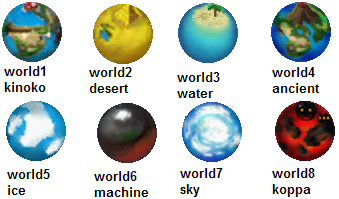
Textures for the unused world models, labelled with their internal names.The Game Card still holds eight unused flat world-map models, whose file names suggest different plans: World 4’s is called “ancient” and World 6’s “machine”.
The game’s internal project name, found twice in its code, is simply “Mario2d”.
World 7 is the only world that cannot be finished without finding at least one secret exit.
Chain Chomps appear in a single course, 6-6, and can be set free by ground-pounding their posts three times, as in Super Mario 64.
Collect your hundredth coin and the coin chime and 1-Up jingle now play together; in earlier games the 1-Up sound cut the coin off.
The Wii U Virtual Console version is strictly for one player: Nintendo’s own listing notes that Multi-Card Play and DS Download Play are not supported, which rules out Mario vs. Luigi and the Vs. minigames.
In the American version the tall room with the boss door in World 6-Castle is stored inside the main level file; the Japanese, European and Korean versions keep it in a file of its own.
Regional Box Art
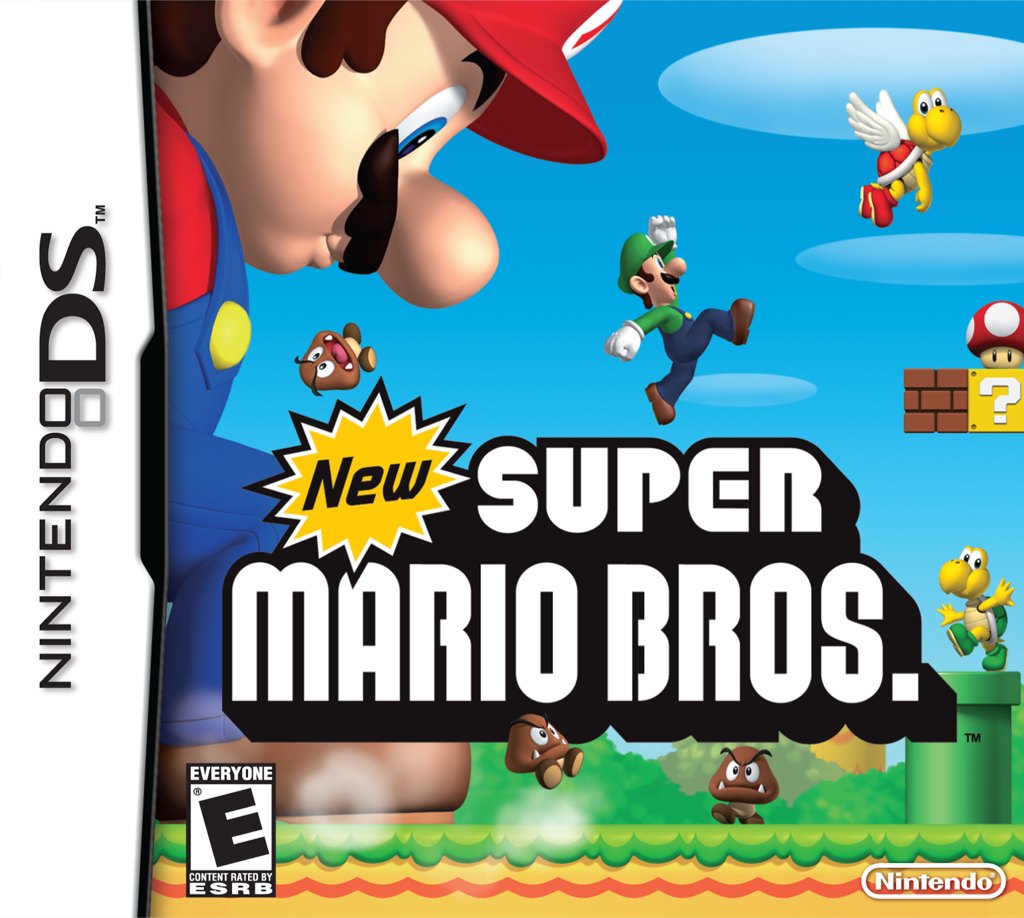
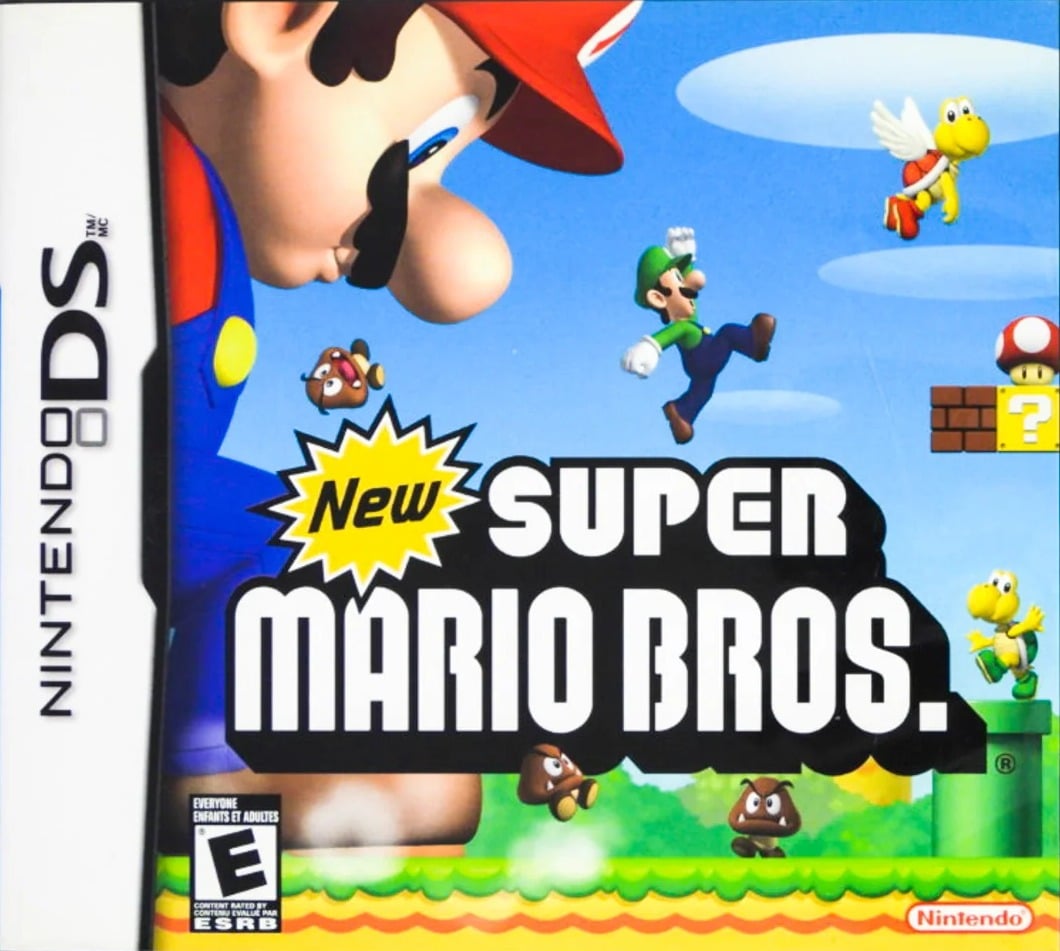
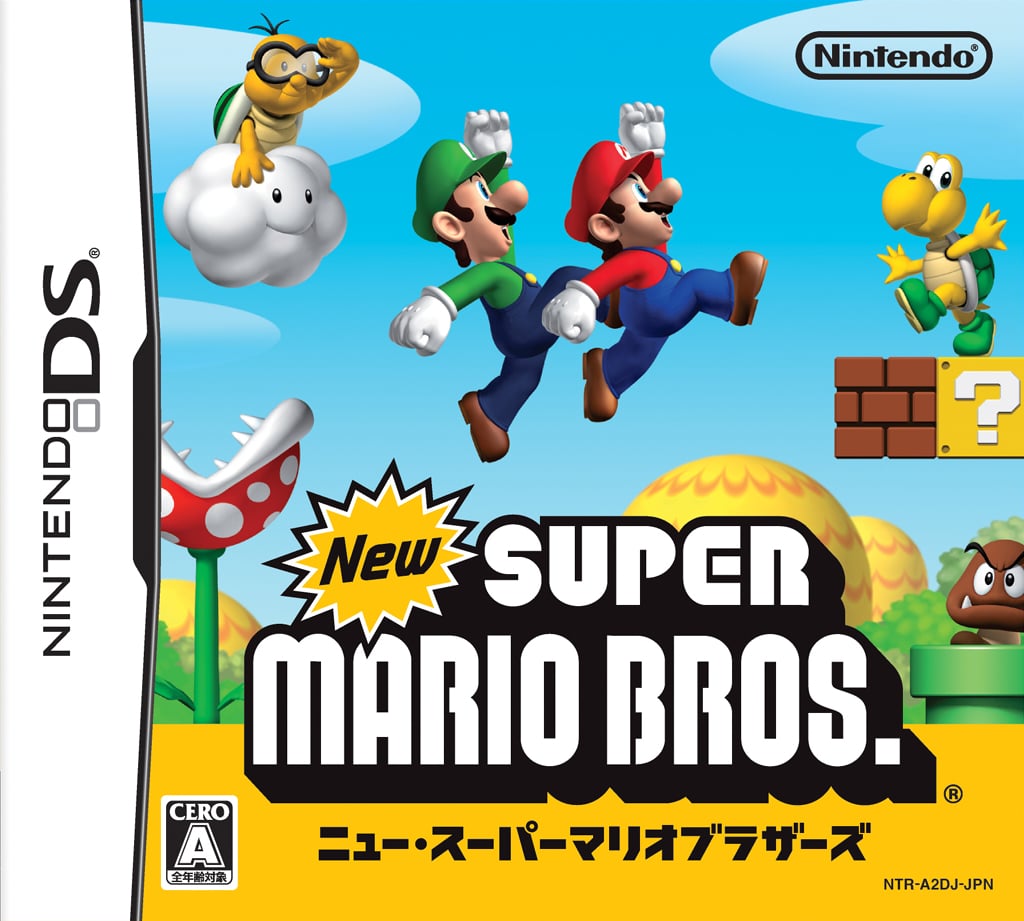
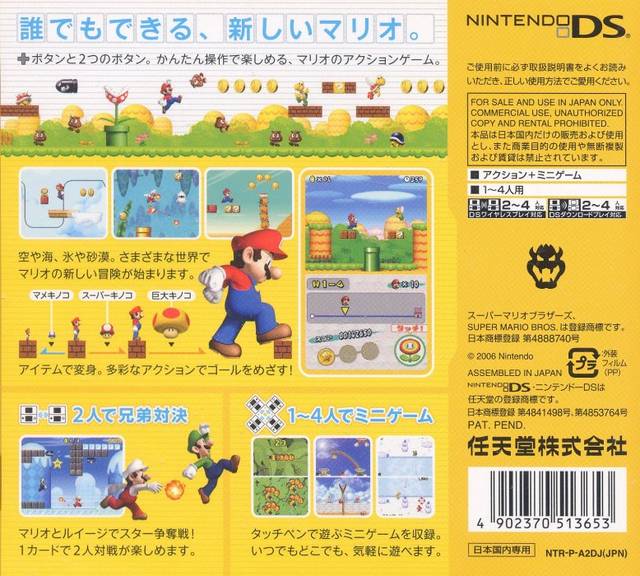
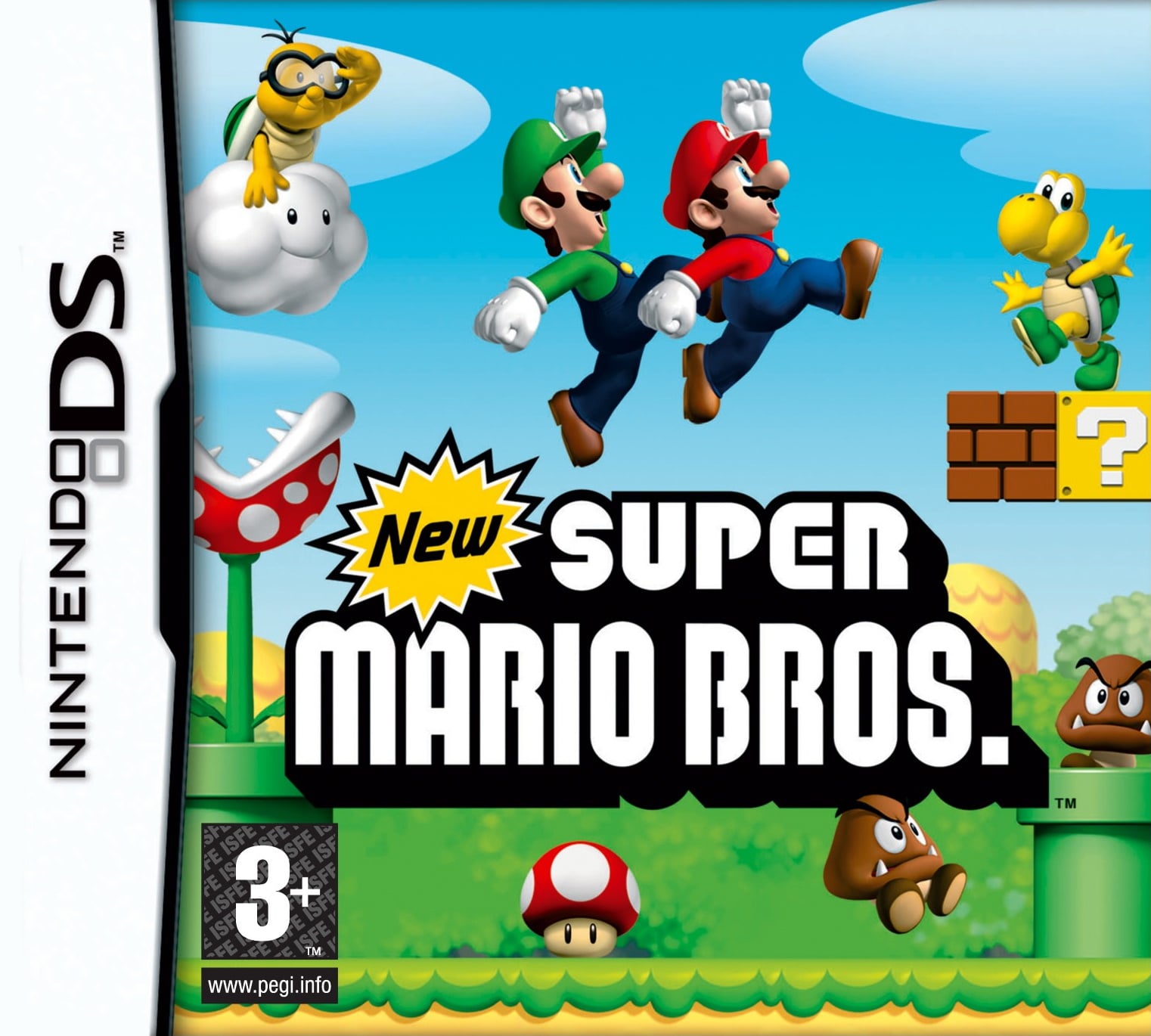
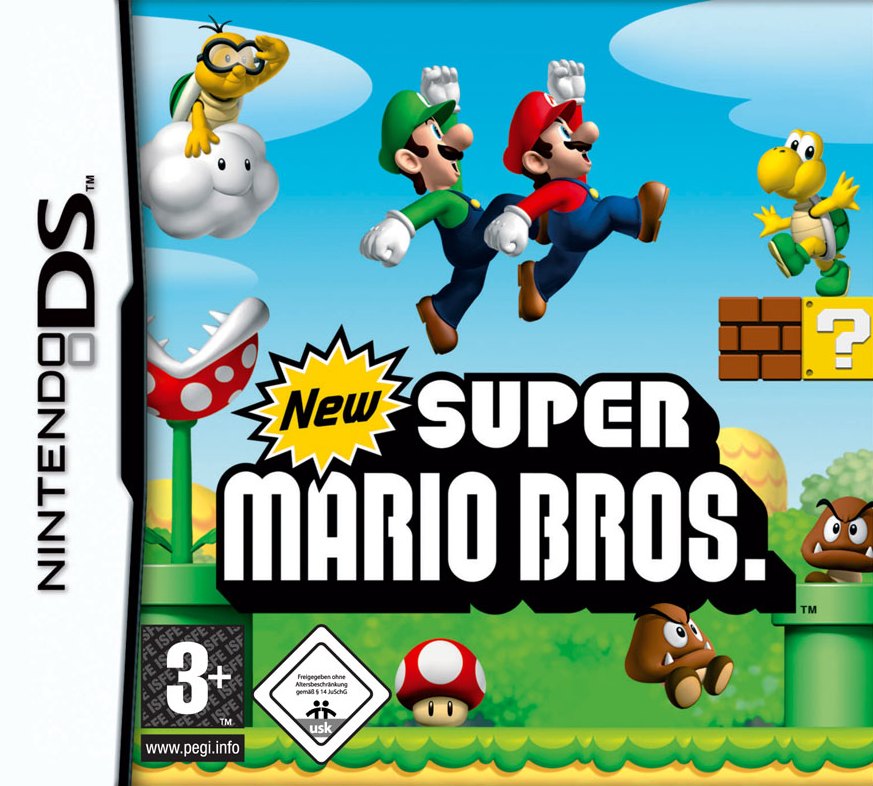
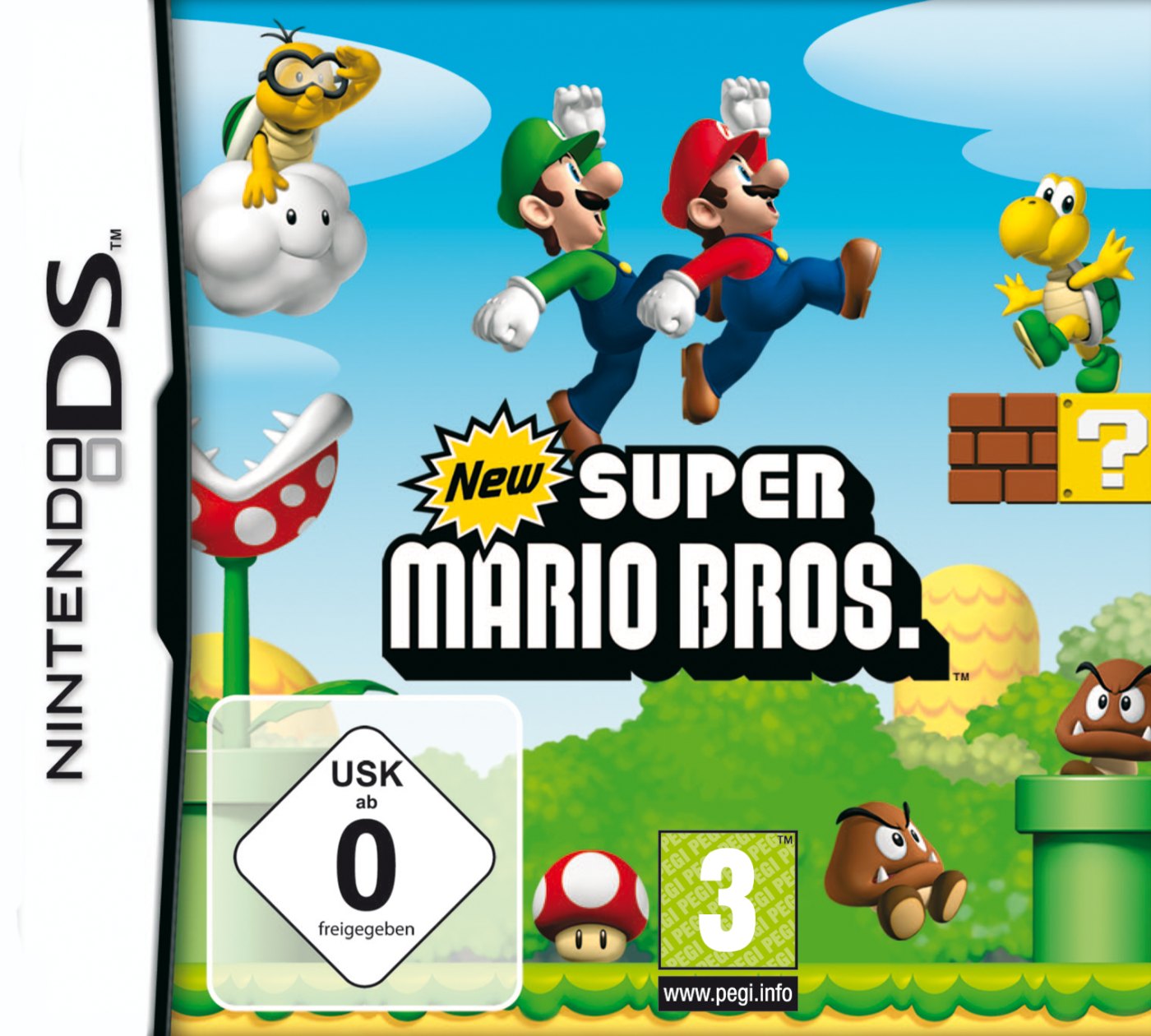
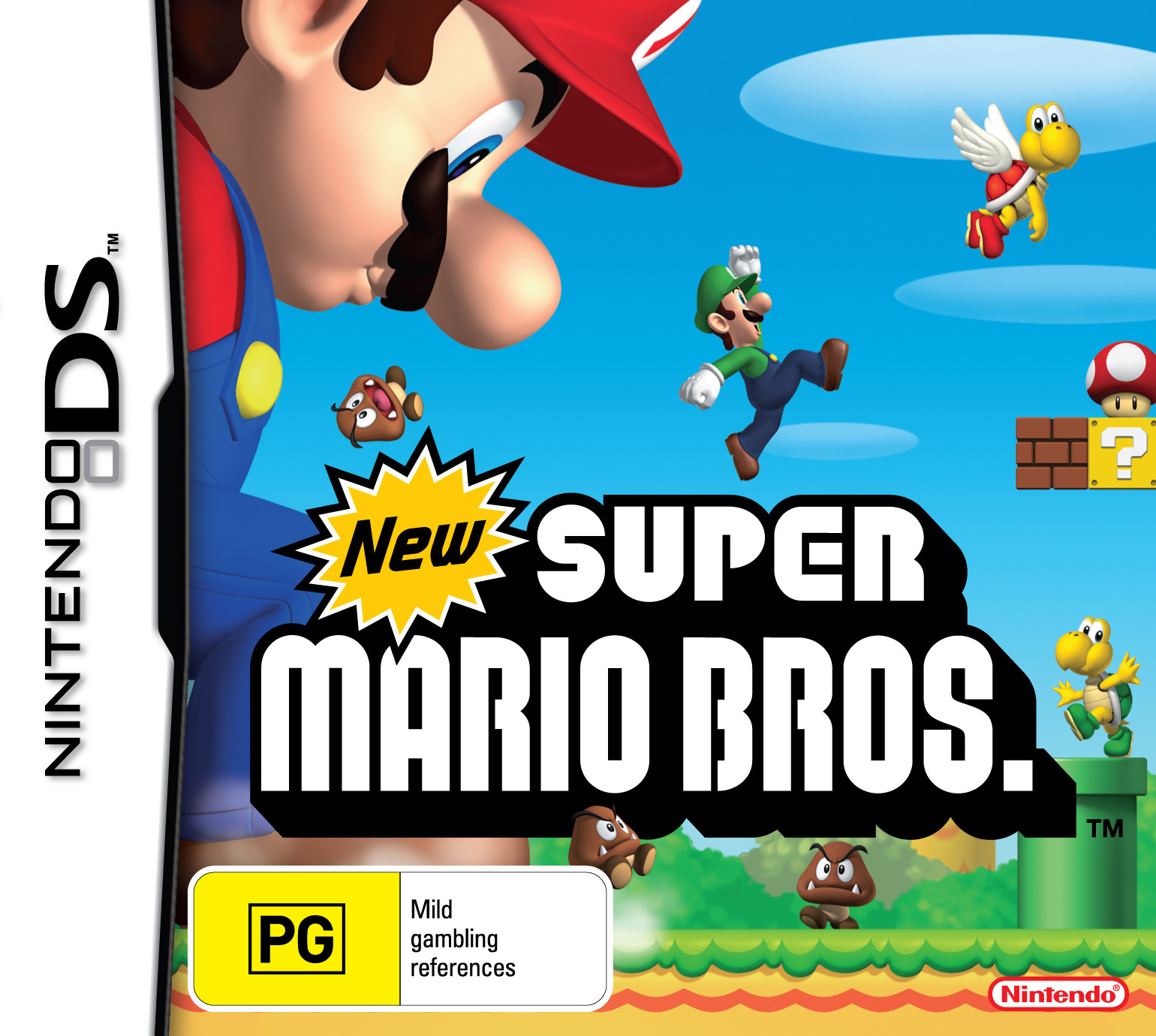
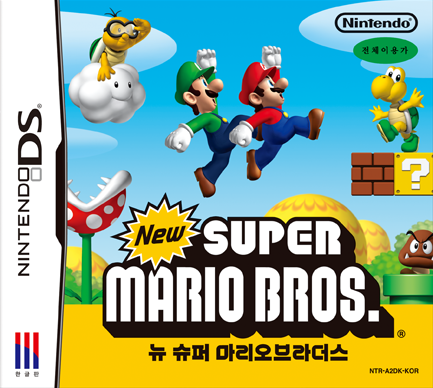
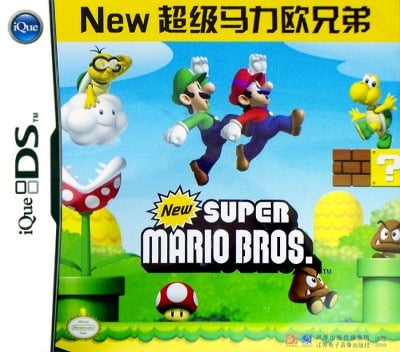
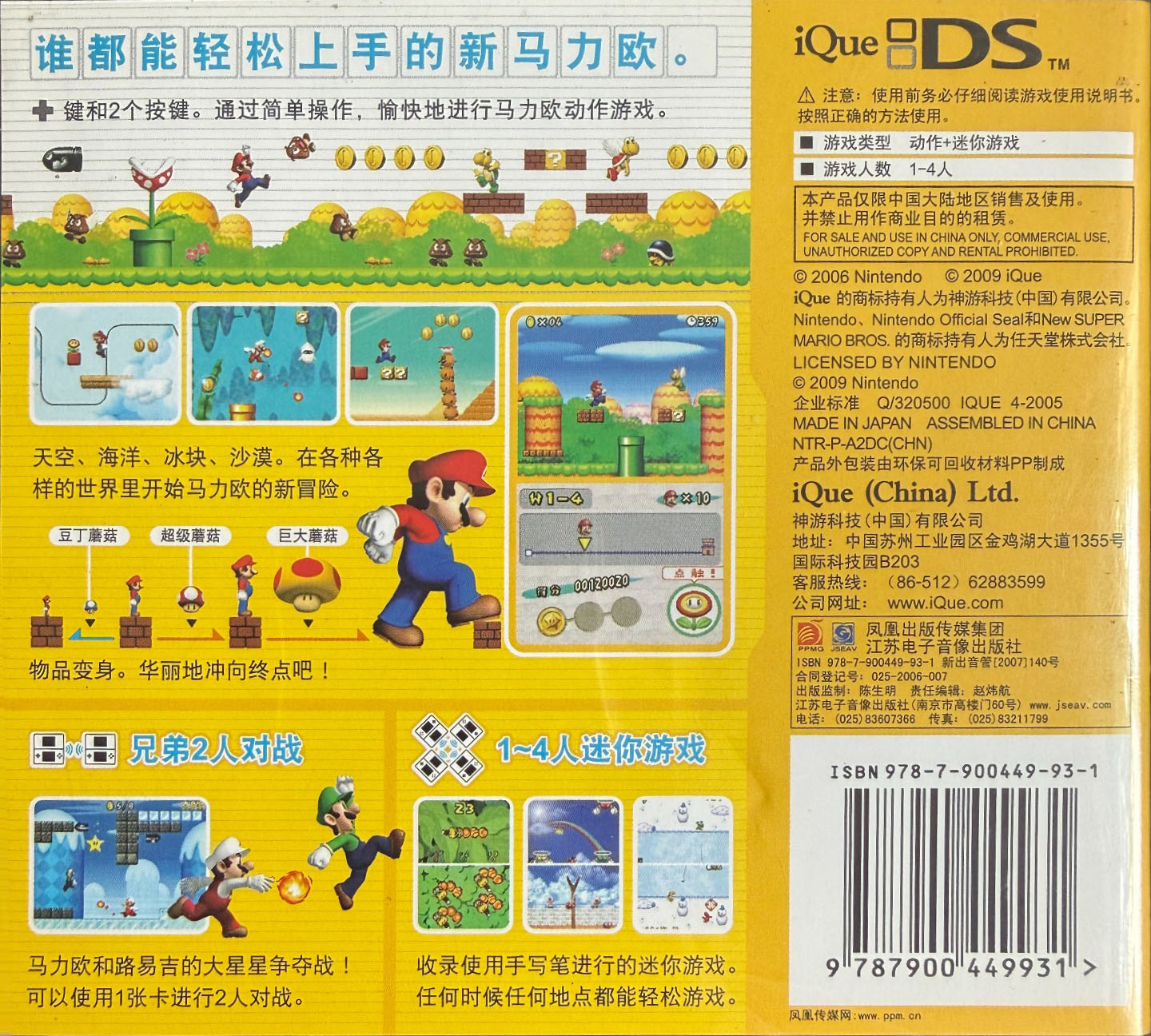
The same yellow cover everywhere, with Mario leaping out of the logo and Mega Mario stomping in behind, but each region arranged it slightly differently, and later print runs changed the trim.
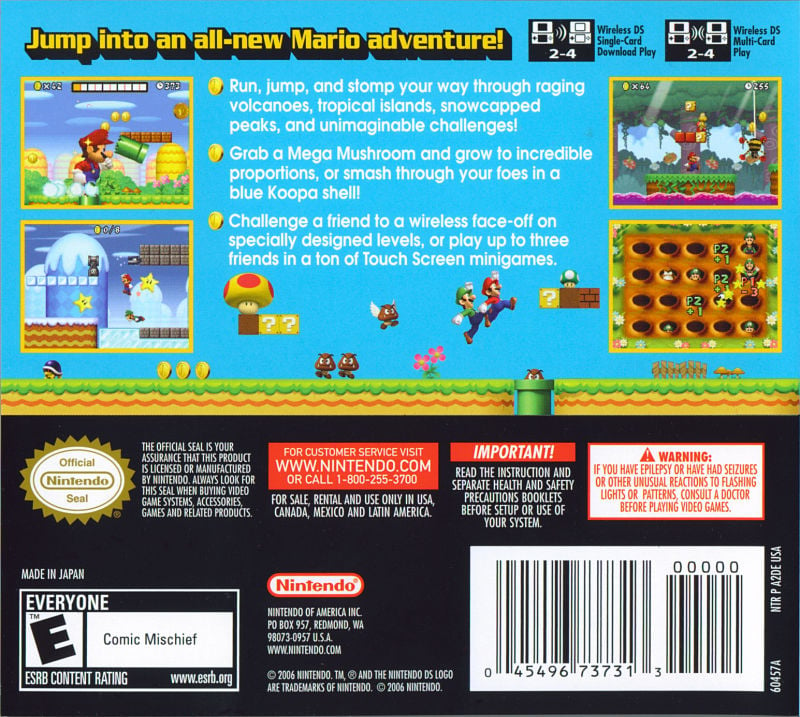
North AmericaMay 2006.North America (back)Eight worlds, Mario vs. Luigi and the minigames.North America (later print)CanadaBilingual cover; released 17 May 2006.Japan25 May 2006.Japan (back)Europe30 June 2006.GermanyGermany (later print)Australia8 June 2006.South Korea8 March 2007.China (iQue)6 July 2009.China (later print)Wii U Virtual ConsoleThe menu icon for the 2015 download.
Screenshots
A tour of the eight worlds, one stop at a time.
World 1-3: tilting mushrooms above the treetops.World 2-1: the desert, and the game’s only Pokeys.World 3-1: under the sea with the Cheep-Cheeps.The first Ghost House, in World 3.World 4-1: crossing the poison swamp on Dorrie.World 4-3: a Mega Unagi fills the tunnel.World 5-1: snow-laden trees and Snow Spikes.World 6-1: the mountains and their Bullet Bills.World 7-A: a climb through a maze of pipes.World 8-1: the haunted forest, a nod to Super Mario Bros. 3’s World 8-1.World 8-8: the volcano rains fire on the last ordinary course.Wanted!, the pick of the minigames.
Artwork & Media Gallery
Official artwork, logos, adverts and concept pieces from New Super Mario Bros. Select any image to view it larger.
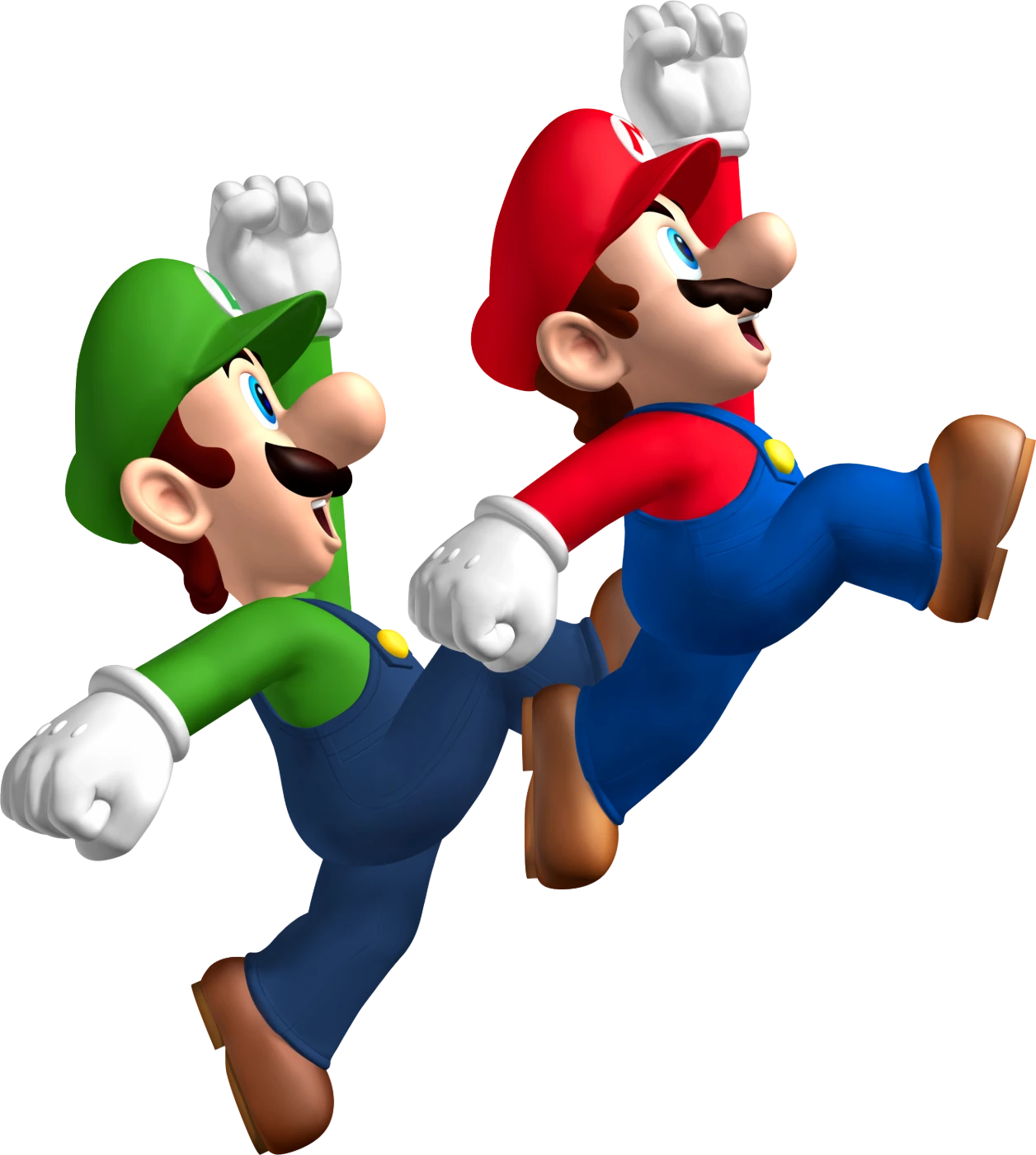
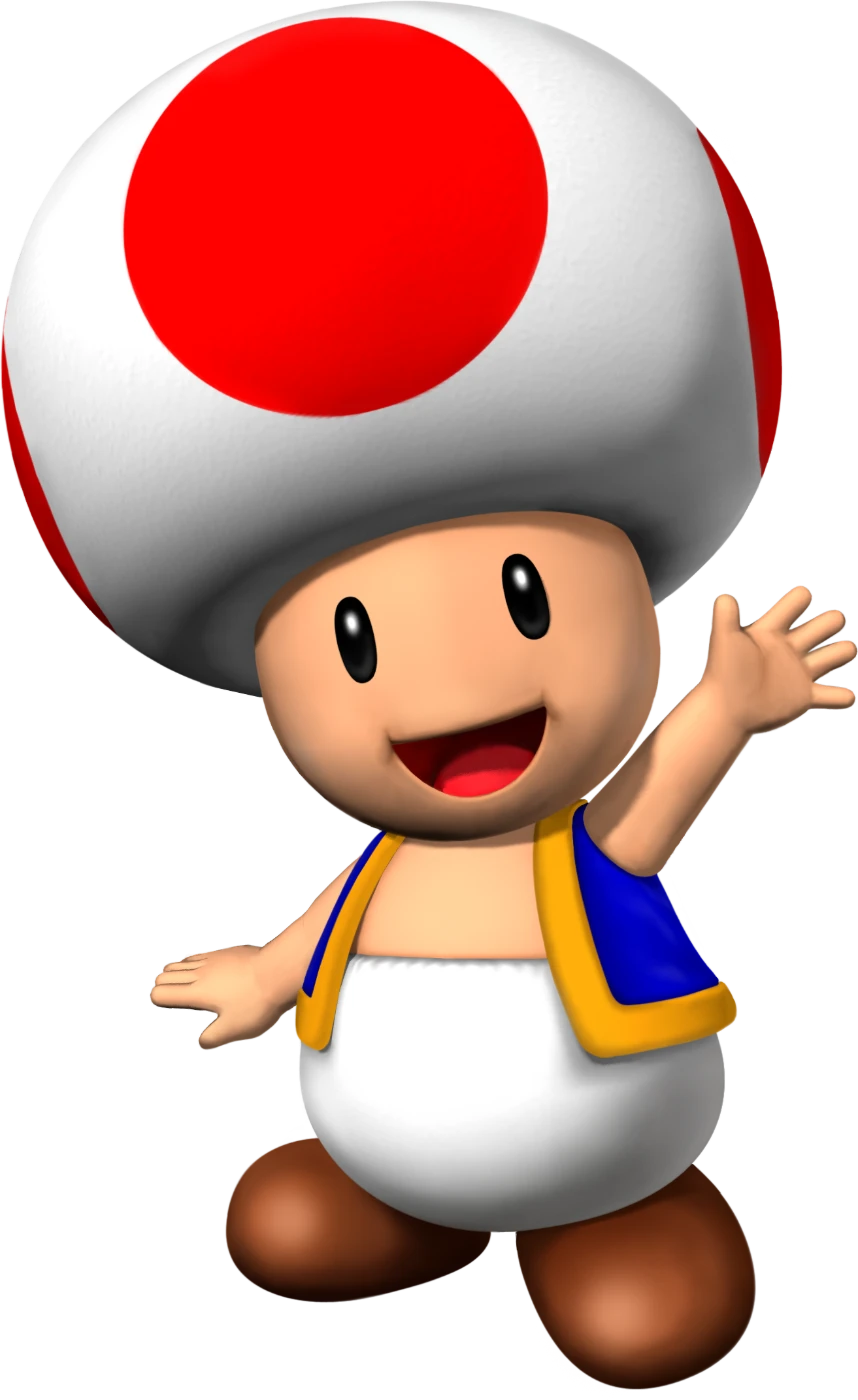
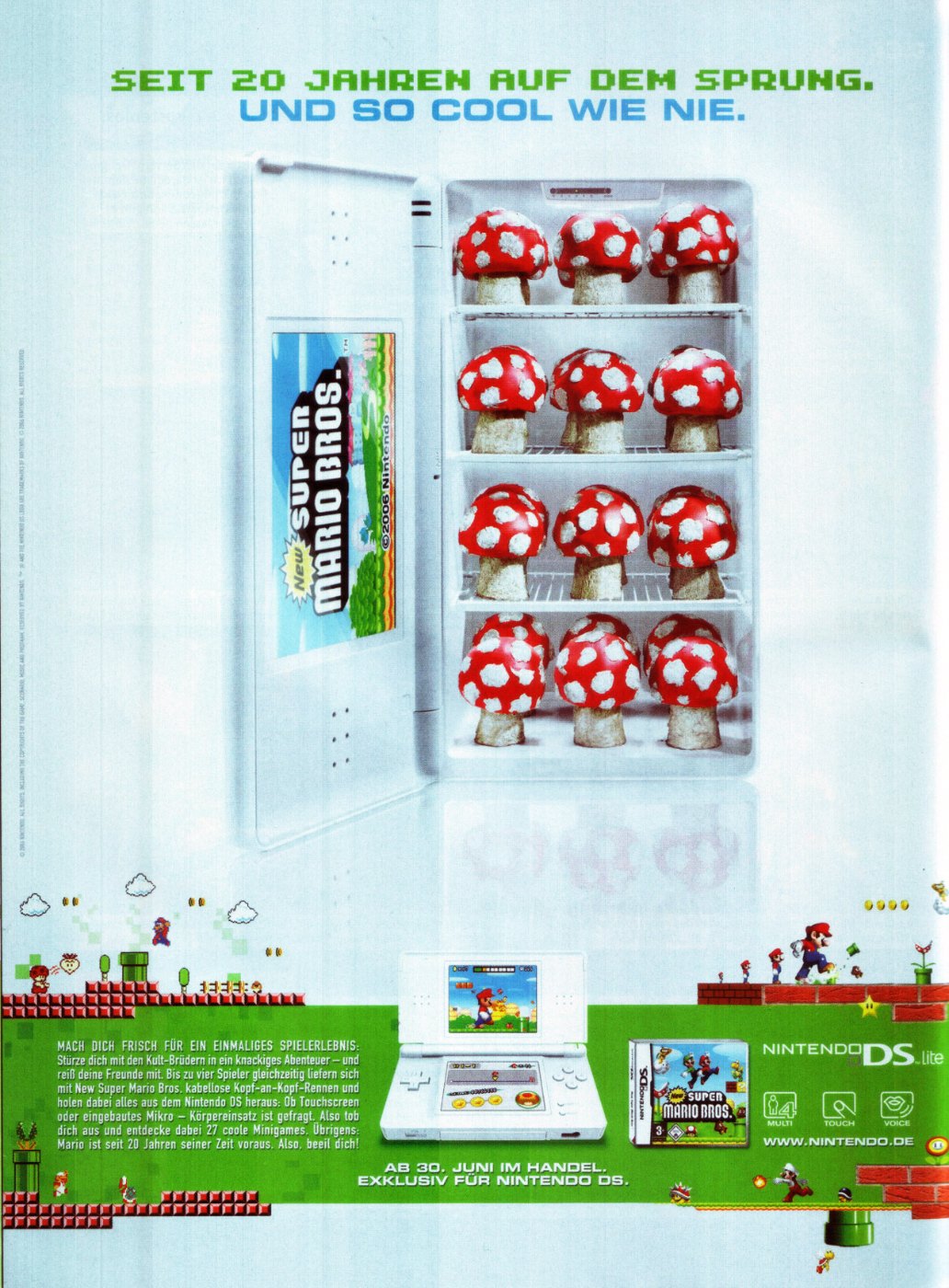
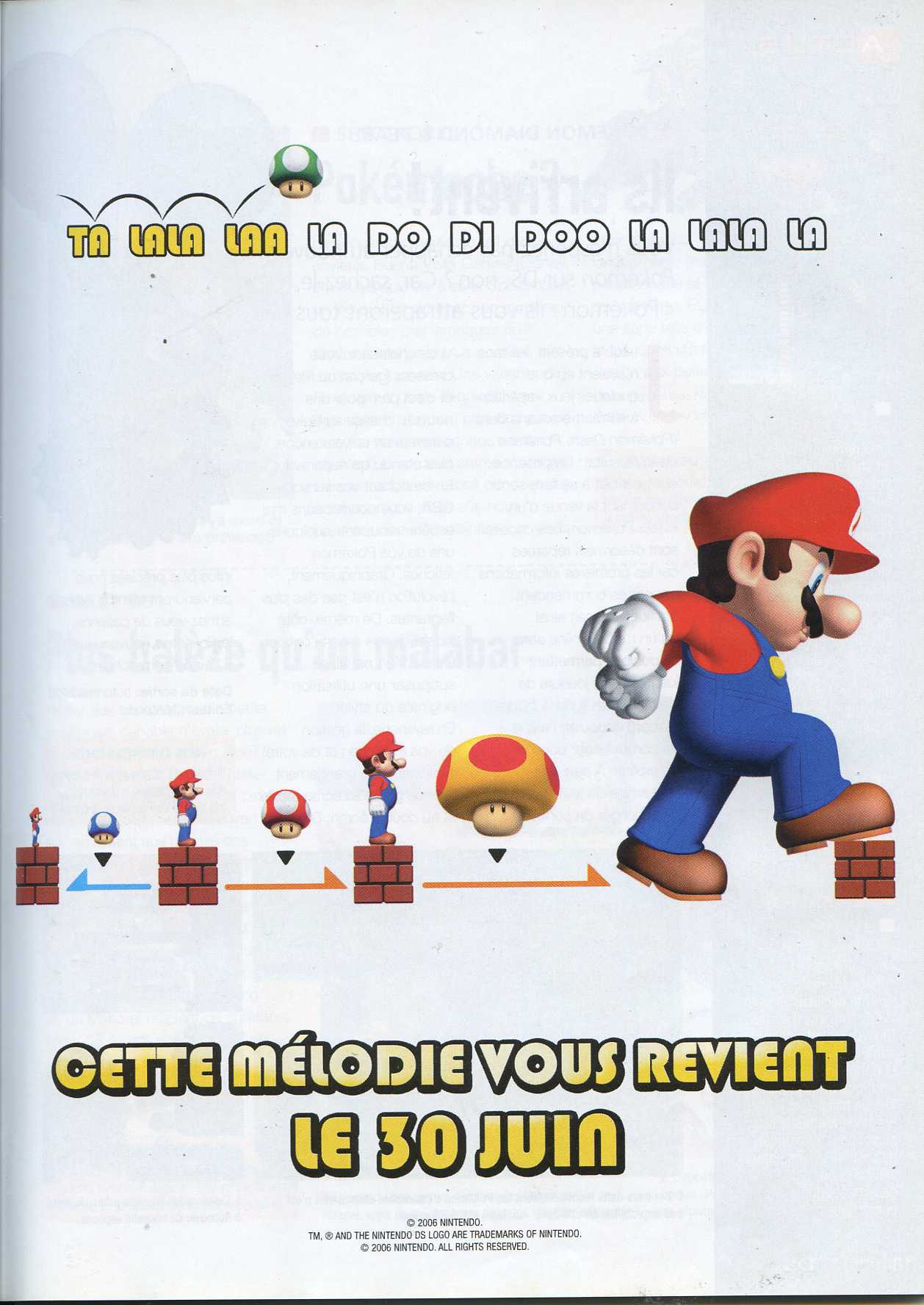
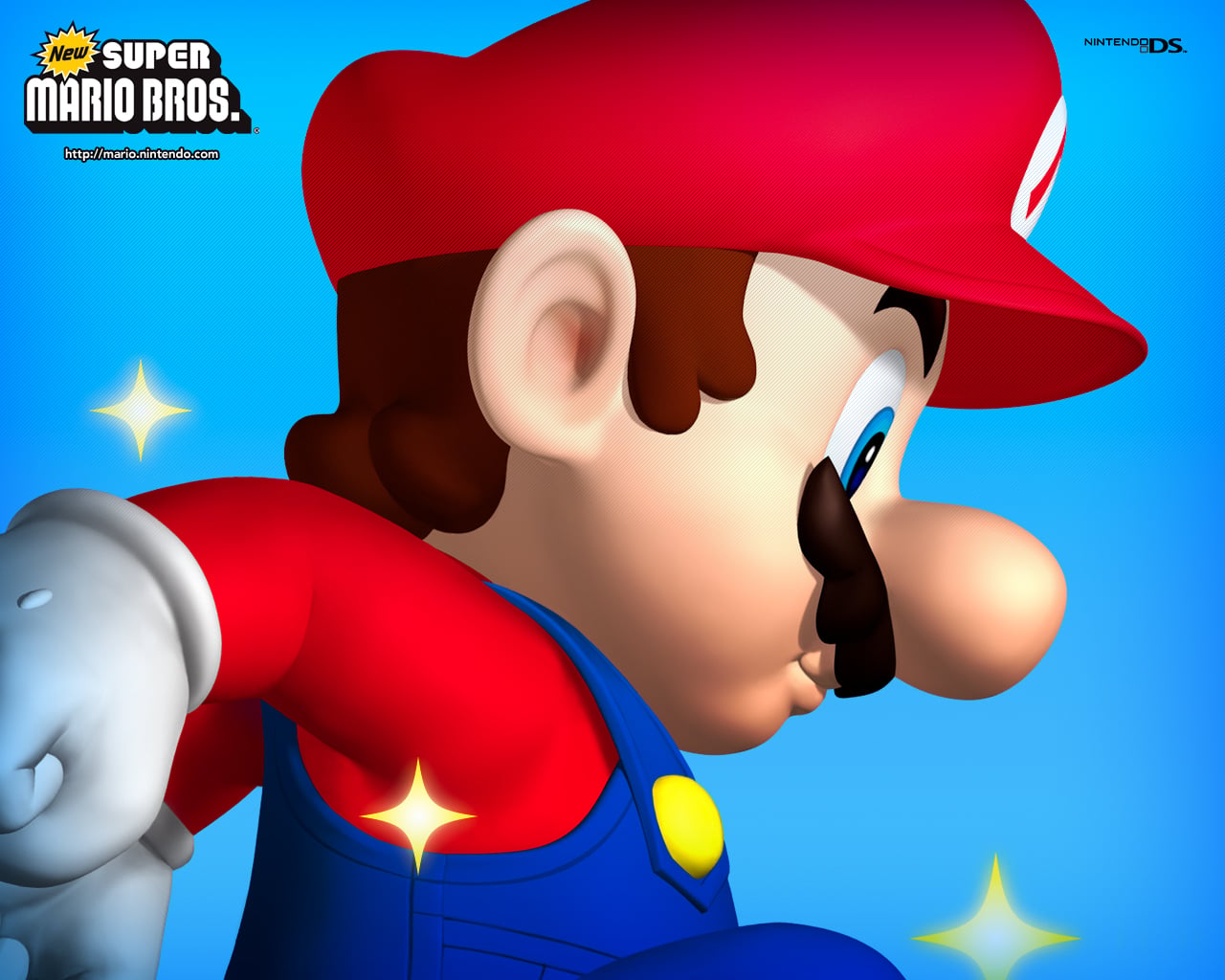
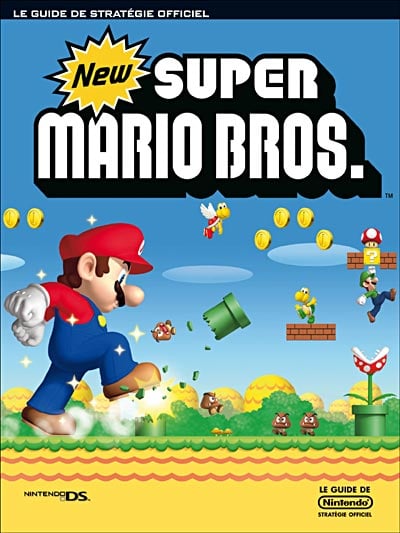
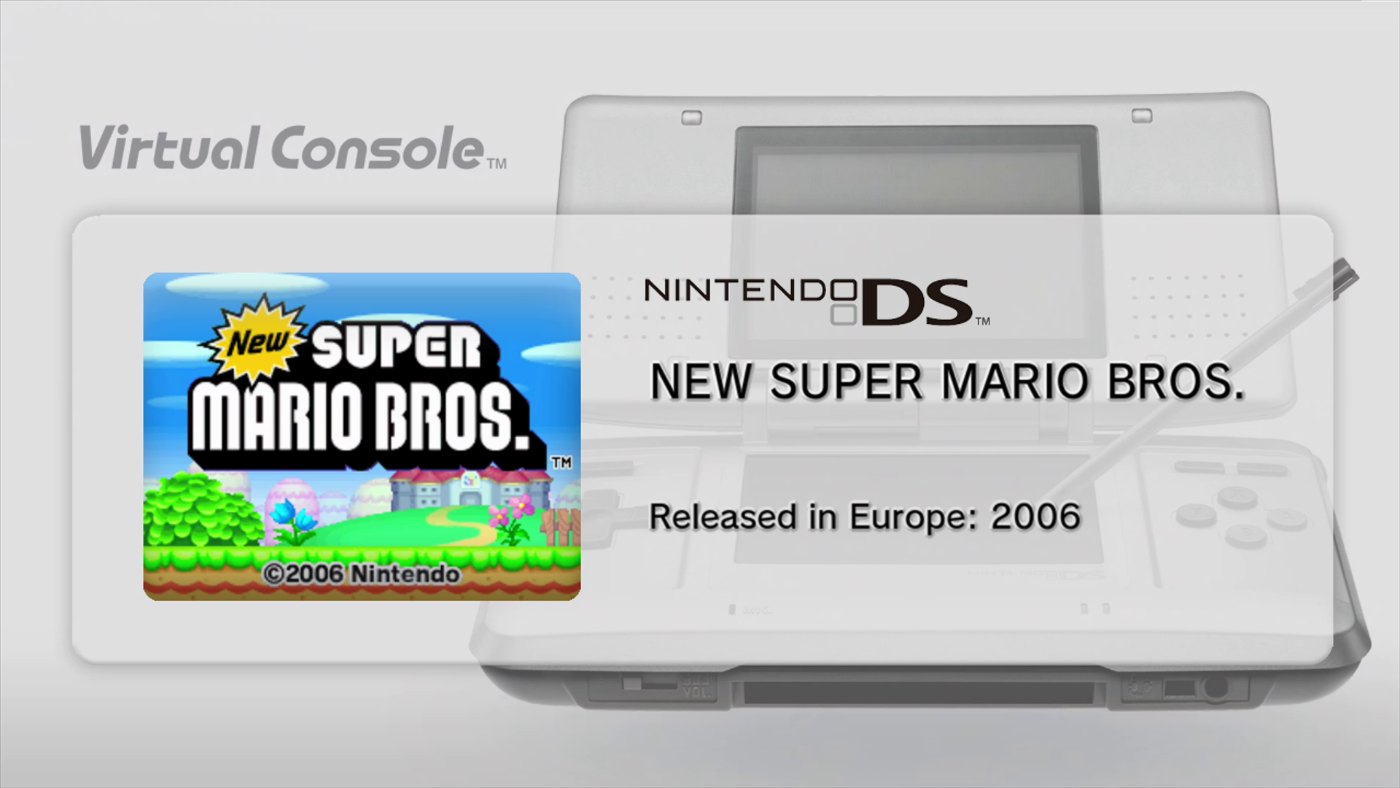
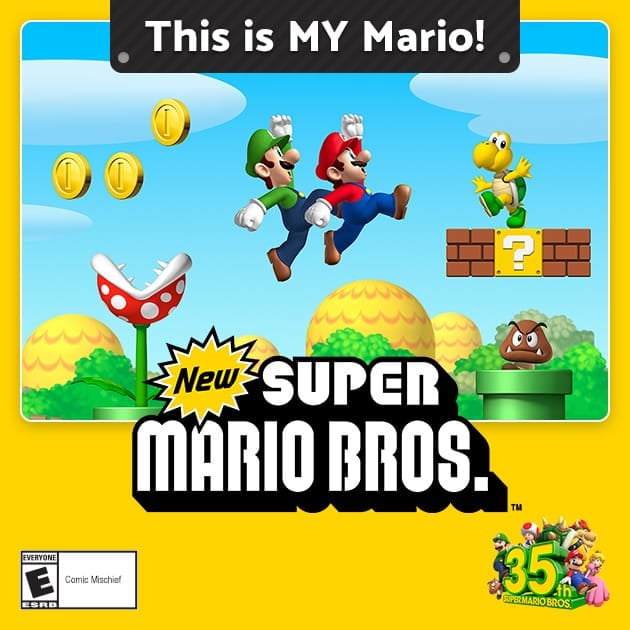
Mario and Luigi jumping.Small Mario.Fire Mario.Mini Mario.Mario growing into Mega Mario.Toad, in artwork carried over from Mario Party 6.A German print advert.A French print advert.One of the wallpapers from Nintendo’s official website.The official French strategy guide.The European Wii U Virtual Console loading screen.Nintendo’s “This is MY Mario!” asset for the 35th anniversary in 2020.
Legacy & Re-releases
New Super Mario Bros. did not need remaking; it stayed in print for the whole life of the DS and then stepped sideways onto Wii U. Its real legacy is what it started.
Releases and re-releases
Nintendo DSMay–June 2006North America 15 May (Canada 17 May), Japan, Hong Kong and Taiwan 25 May, Australia 8 June, Europe 30 June.
South Korea8 March 2007The first Super Mario game officially translated into Korean, built in December 2006.
China (iQue DS)6 July 2009Published by iQue with a Simplified Chinese translation, three years after the original.
Wii U Virtual Console2015Japan on 2 April, North America on 14 May, Europe and Australia on 17 December 2015. Single-player only: the wireless modes were not carried over.
Nintendo MusicOctober 2025The full 60-track soundtrack, about 80 minutes, was added to Nintendo’s music app.
The New Super Mario Bros. family
Three sequels followed. New Super Mario Bros. Wii (2009) added four-player co-op, the Koopalings and the Super Guide, and sold 30 million itself; New Super Mario Bros. 2 (3DS, July 2012) is the direct sequel, with two secret worlds that are skipped automatically just as Worlds 4 and 7 are here; and New Super Mario Bros. U launched the Wii U in November 2012, was extended by New Super Luigi U in 2013 and moved to Switch as New Super Mario Bros. U Deluxe in 2019. Its finale borrows this game’s closing idea of fighting Bowser and Bowser Jr. together.
The 2D revival
By 2006 the side-scrolling platformer had been written off as yesterday’s genre, kept alive by a handful of series and by reissues. Thirty million sales changed the arithmetic, and the game is widely credited with reviving the form: the 2026 anniversary retrospectives argued that it showed the genre could still be refined with modern touches and that it set the stage for the wave of 2D platformers that followed. Its template of Super Mario Bros. structure, Super Mario Bros. 3 maps and Super Mario World secrets became the basis of every 2D Mario that followed.
Familiarity eventually became the complaint, as four games shared one look and one soundtrack. When Nintendo finally moved on with Super Mario Bros. Wonder in 2023, its developers described their goal in terms of this game: a significant evolution, and a new foundation for the 2D Marios to come. Wonder still collects three big coins a course and still hides red-flagged secret exits. Some habits are worth keeping.
Reviews & Sales
Sales figures
Japan bought it on sight. Gamasutra’s report of 2 June 2006, cited by Wikipedia, put first-day sales above 480,000 and the first four days at 900,000, the best opening any DS game had managed there until Pokémon Diamond and Pearl that autumn. In the United States it sold half a million in its first 35 days and passed a million twelve weeks after launch. It kept selling for the life of the system: Nintendo’s financial results had it at 18 million worldwide by March 2009, and it was still in Japan’s year-end top thirty in 2008.
Nintendo’s lifetime figure is 30.80 million, comfortably the best on the DS, ahead of nintendogs (23.96 million), Mario Kart DS (23.60 million) and Brain Age (19.01 million); Super Mario 64 DS is tenth with 11.06 million. Among Super Mario platformers only the NES original, on 40.24 million, and Super Mario Odyssey, on 31.06 million by September 2026, have sold more.
30.80mworldwide, Nintendo’s lifetime figure
900,000Japan, first four days
1mUSA, in twelve weeks
18mworldwide by March 2009
89Metacritic
Reception and review scores
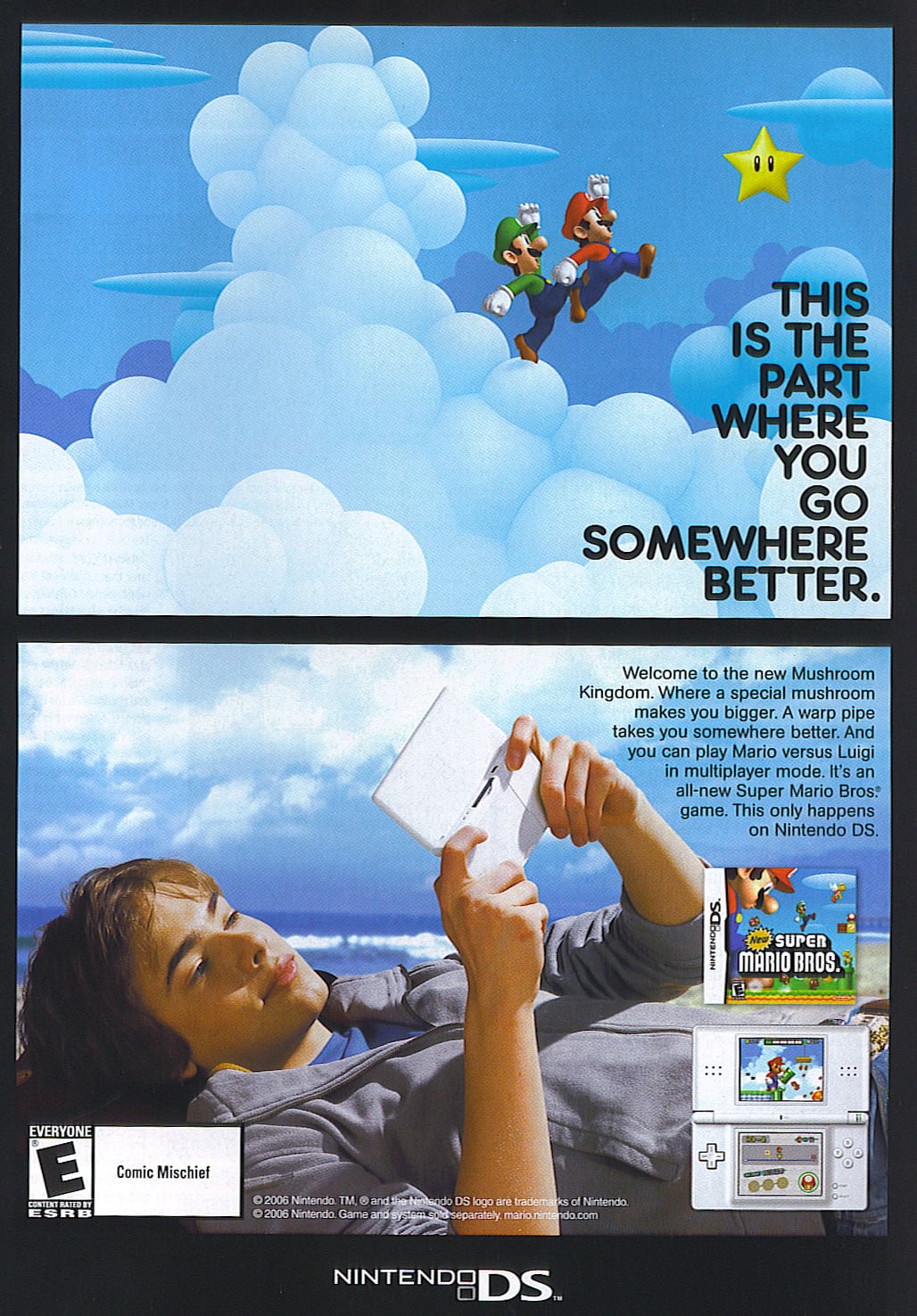
Nintendo of America’s print advert for the game.
Reviewers greeted it as a homecoming. Metacritic’s average is 89 and GameRankings’ was 89.07 per cent. Scores below are as listed in Wikipedia’s review table and by the outlets quoted on Super Mario Wiki.
GameSpyUS
5/5
IGNCraig Harris · 6 May 2006
9.5/10
GameZoneUS
9.3/10
Game InformerUS · Game of the Month
9.25/10
The A.V. ClubUS
A−
GameSpotJeff Gerstmann · 16 May 2006
9/10
EurogamerTom Bramwell
9/10
Computer and Video GamesUK
9/10
Nintendo LifeCorbie Dillard
9/10
GameProUS
4.5/5
GamesRadarUS
4.5/5
1UP.comUS
B+
GameRevolutionJoe Dodson
B+
EdgeUK
8/10
X-PlayGreg Sewart
4/5
IGN’s Craig Harris called it “a brilliant return to Mario’s side-scrolling environments” and went further: he had long held Yoshi’s Island to be the greatest platformer ever made and thought the title might now have to change hands. GameSpot’s Jeff Gerstmann summed it up as “an essential new classic”, Eurogamer’s Tom Bramwell praised its “faultless controls” and effortless variety, and Nintendo Life’s Corbie Dillard judged the long wait for a new 2D Mario well worth it.
The reservations were consistent. Almost everyone noted that it was easier than the 8- and 16-bit games and that seasoned players would see the credits quickly, with the Star Coins left to supply the challenge; X-Play felt it fell short of its ancestors while still calling it the best side-scroller on the DS, and GameRevolution wondered aloud whether Mario could ever feel new again. Twenty years on, Nintendo Life’s anniversary piece made the opposite point: the sequels grew so alike that it is easy to forget how fresh the first one felt.
Honours
Spike Video Game Awards · 2006Best Handheld GameSpike TV’s annual awards show.
GameSpot · 2006Best Nintendo DS GameGameSpot also gave it an Editors’ Choice award, as did IGN.
Golden Joystick Awards · 2006Nintendo Game of the YearAt the long-running British awards.
Nintendo Power Awards · 2006Best PlatformerAnnounced in the magazine in 2007.
X-Play (G4) · 2006Best PlatformerDespite the show’s 4/5 review.
Teen Choice Awards · 2006Choice Video GameThe 2006 Teen Choice Awards.
Game Informer and EGM · 2006Game of the MonthBoth magazines gave it their monthly award.
Interactive Achievement Awards · 2007Nominated: Handheld Game of the YearAt the 10th annual AIAS awards.
Official Nintendo Magazine · 200930th greatest Nintendo gameIn the UK magazine’s all-time list.
SLB User Reviews
New Super Mario Bros. has yet to receive a community review on Super Luigi Bros.
If you’ve played New Super Mario Bros. and would like to submit a review, please get in touch.
More from the Super Luigi Bros Guide
These picture lists come from the earlier Super Luigi Bros guide to New Super Mario Bros. and are kept here in full.
Worlds
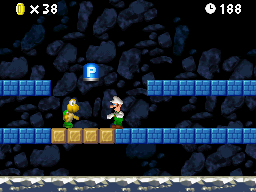
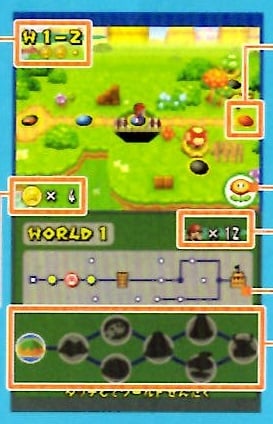
The world map — featuring alternate paths, Warp Cannons and Toad Houses that can be unlocked with Star Coins
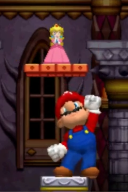
Mario vs. Luigi mode — two-player local wireless battle for stars on specially designed levels
The game features 8 worlds on an overworld map, with secret and alternate paths like Super Mario World. Only 3 worlds are required — the rest can be bypassed via Warp Cannons found by discovering secret exits. Each world has a tower (Bowser Jr. boss), a castle (world boss) and multiple levels with 3 Star Coins each.
World 1Grassland
The opening world — sunny and accessible. Introduces underground, underwater, tower, sky and castle level types. Boss: Bowser Jr. (Tower), Petey Piranha (Castle).
World 2Desert
Sandy levels with oasis sections, the game’s only sewer level, and Spinies/Lakitus. Contains an alternate castle level. Boss: Bowser Jr. (Tower), Mummipokey (Castle).
World 3Island & Ocean
Beach and water world introducing ocean-floor levels and plenty of swimming. Boss: Bowser Jr. (Tower), Cheepskipper (Castle).
World 4Forest
Dense jungle with plant-based obstacles. Unlocked by defeating the World 2 Castle boss as Mini Mario. Boss: Bowser Jr. (Tower), Goomboss (Castle).
World 5Sky
Elevated platforms in the clouds with strong winds. Boss: Bowser Jr. (Tower), King Boo (Castle).
World 6Cliff & Ice
Rocky clifftop levels with icy patches and powerful enemies. Reached by beating the World 5 Castle boss in any form but Mini Mario, or via the World 3 Warp Cannon. Boss: Bowser Jr. (Tower), Monty Tank (Castle).
World 7Sky Clouds
High-altitude stormy sky with airships and tricky platforming. Reached by beating the World 5 Castle boss as Mini Mario, or via the World 4 Warp Cannon. Boss: Bowser Jr. (Tower), Lakithunder (Castle).
World 8Lava & Volcano
The brutal final world — lava pits, fire enemies and relentless difficulty. Ends with the final castle where Bowser and Giant Bowser are fought. Boss: Bowser Jr. (Tower), Bowser → Giant Bowser (Castle).
Star Coins: 3 hidden per level. Used to open sign-blocked paths on the world map. Collecting all 32 sets of coins from blocked signs unlocks the final blue wallpaper in the Blue Toad House above World 1. After finishing the game, the Blue Toad House sells background wallpapers for 20 Star Coins each.
To provide the best experiences, we use technologies like cookies to store and/or access device information. Consenting to these technologies will allow us to process data such as browsing behavior or unique IDs on this site. Not consenting or withdrawing consent, may adversely affect certain features and functions.
Functional
Always active
The technical storage or access is strictly necessary for the legitimate purpose of enabling the use of a specific service explicitly requested by the subscriber or user, or for the sole purpose of carrying out the transmission of a communication over an electronic communications network.
Preferences
The technical storage or access is necessary for the legitimate purpose of storing preferences that are not requested by the subscriber or user.
Statistics
The technical storage or access that is used exclusively for statistical purposes.The technical storage or access that is used exclusively for anonymous statistical purposes. Without a subpoena, voluntary compliance on the part of your Internet Service Provider, or additional records from a third party, information stored or retrieved for this purpose alone cannot usually be used to identify you.
Marketing
The technical storage or access is required to create user profiles to send advertising, or to track the user on a website or across several websites for similar marketing purposes.




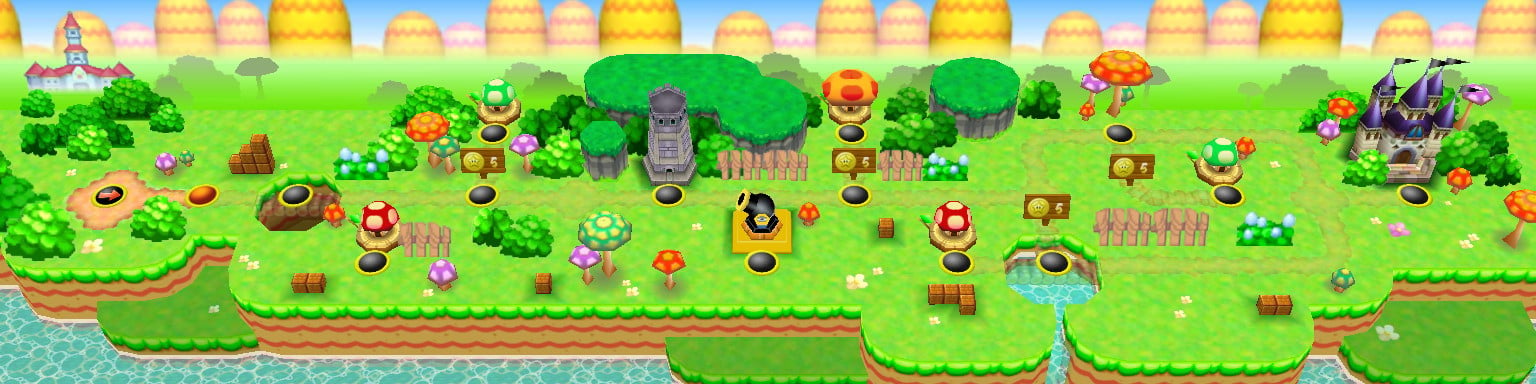 World 1Grassland · 8 courses · Tower: Bowser Jr. · Castle: BowserHills with Peach’s Castle on the horizon, a first underground course, tilting mushrooms, a first swim (1-A, the only course with Sushi the shark) and the game’s most famous surprise, Bowser himself in the first castle. The tower’s secret exit hides a cannon to World 5.
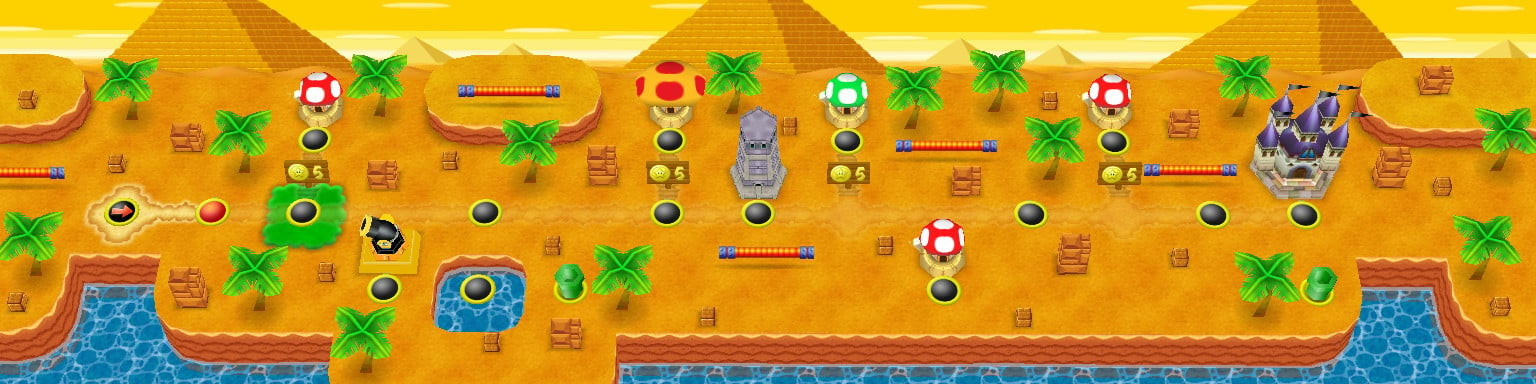 World 2Desert · 9 courses · Tower: Bowser Jr. · Castle: MummipokeySand, quicksand, Pokeys, the game’s only sewer course and Lakitu’s first Spinies. Beat Mummipokey as Mini Mario to open World 4; 2-A’s secret exit leads to a cannon to World 5.
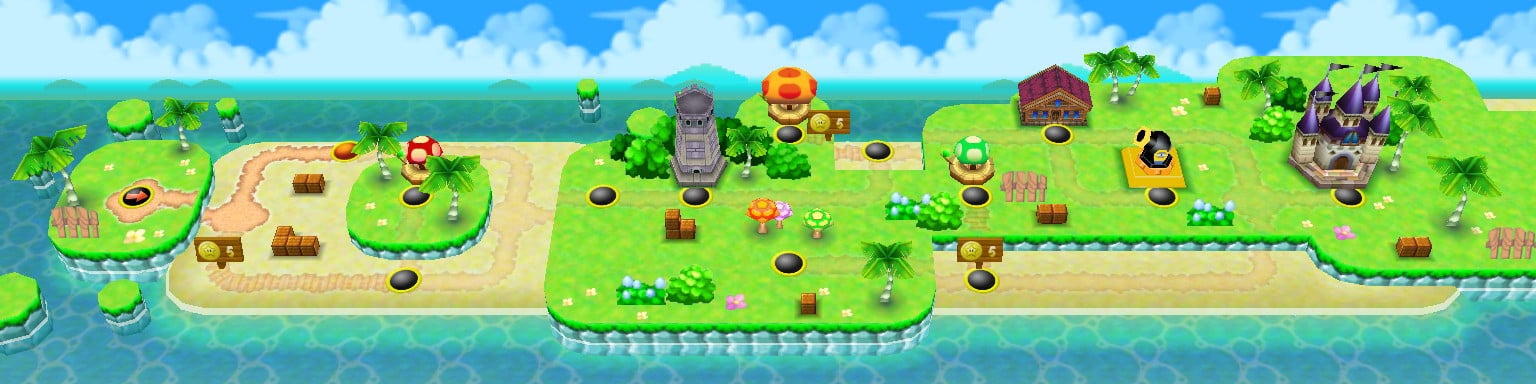 World 3Beach and ocean · 9 courses · Tower: Bowser Jr. · Castle: CheepskipperBeaches and deep water full of Cheep-Cheeps, Bloopers and the lunging Cheep-Chomp, a castle patrolled by Whomps, and the first Ghost House, whose secret exit leads to a cannon to World 6.
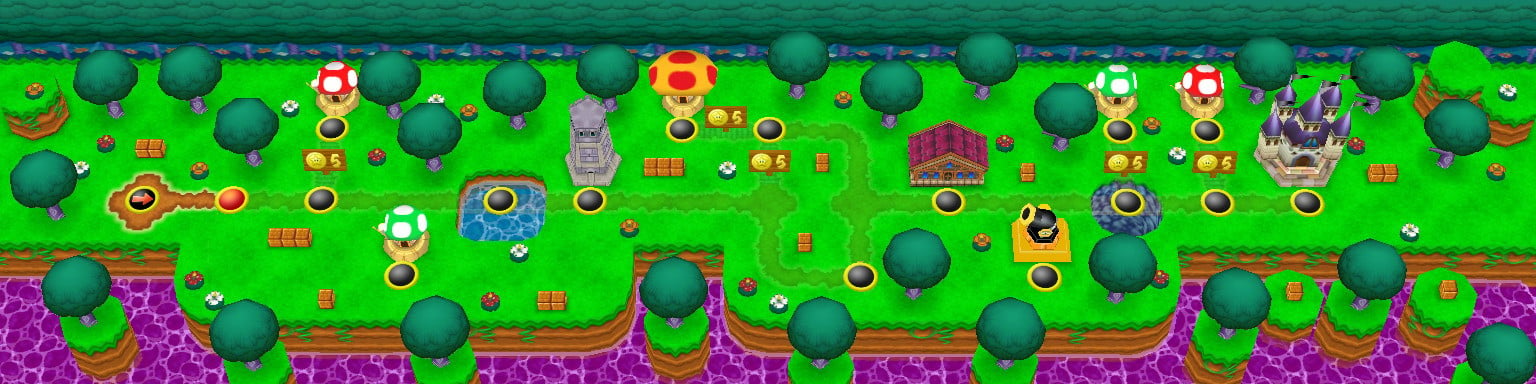 World 4Forest · 10 courses · hidden · Tower: Bowser Jr. · Castle: Mega GoombaA hidden world of giant plants, Wigglers, Scuttlebugs and purple poison that costs a life at a touch, where Dorrie ferries Mario across the swamp in 4-1 and 4-6. The Ghost House, home of the Balloon Boos, hides a cannon to World 7.
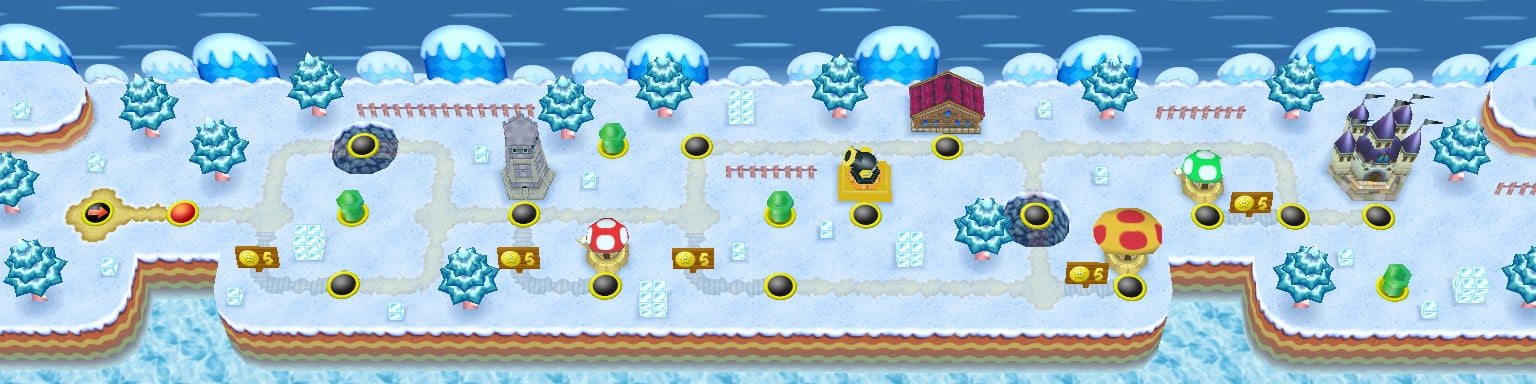 World 5Snow and ice · 10 courses · Tower: Bowser Jr. · Castle: Petey PiranhaFrozen lakes, snow-laden trees, Snow Spikes, Snailicorns and plenty of bottomless pits. Beat Petey as Mini Mario to open World 7; the Ghost House, where Broozers punch through the walls, hides the last cannon, straight to World 8.
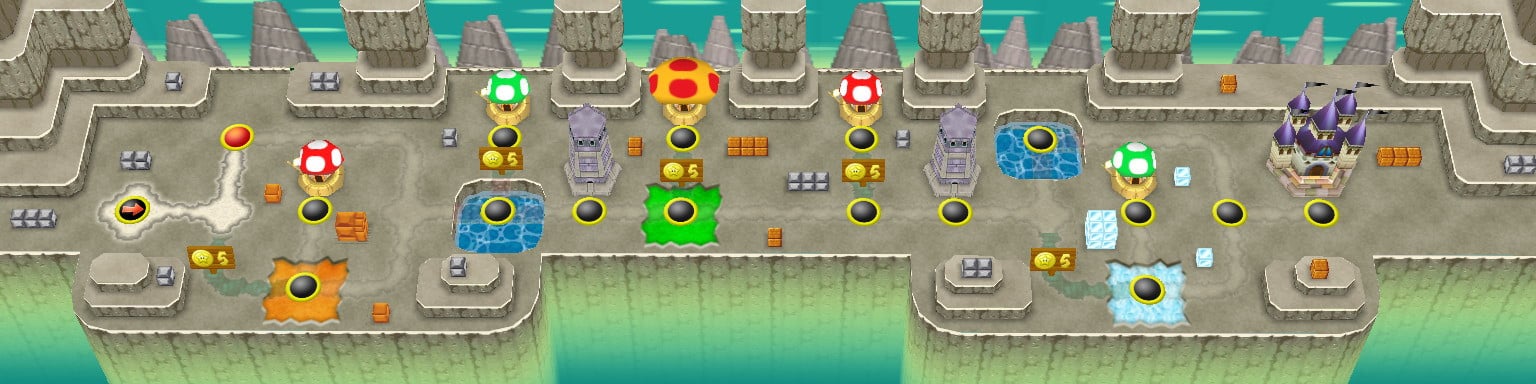 World 6Mountains · 11 courses · Two towers: Bowser Jr. · Castle: Monty TankRocky cliffs, Bullet Bills by the dozen, the game’s only Chain Chomps (6-6), its only tornadoes (6-A) and its only whirlpools (6-5). The first world with two towers before the castle.
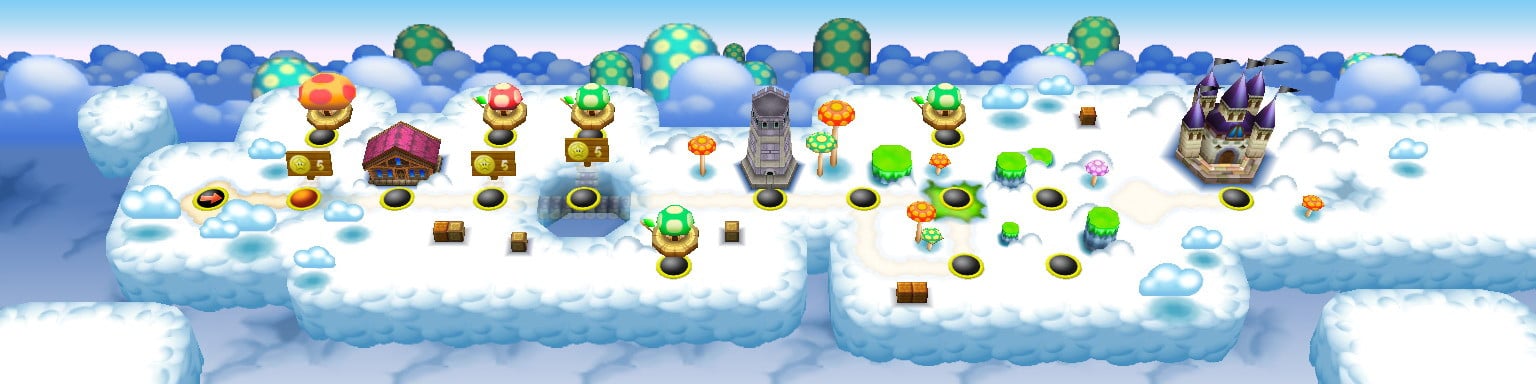 World 7Sky · 11 courses · hidden · Tower: Bowser Jr. · Castle: LakithunderThe second hidden world: clouds, beanstalks, a pipe maze modelled on Super Mario Bros. 3 (7-A) and a ride on an enormous Wiggler in 7-3. With fifteen exits it has more ways out than any other world.
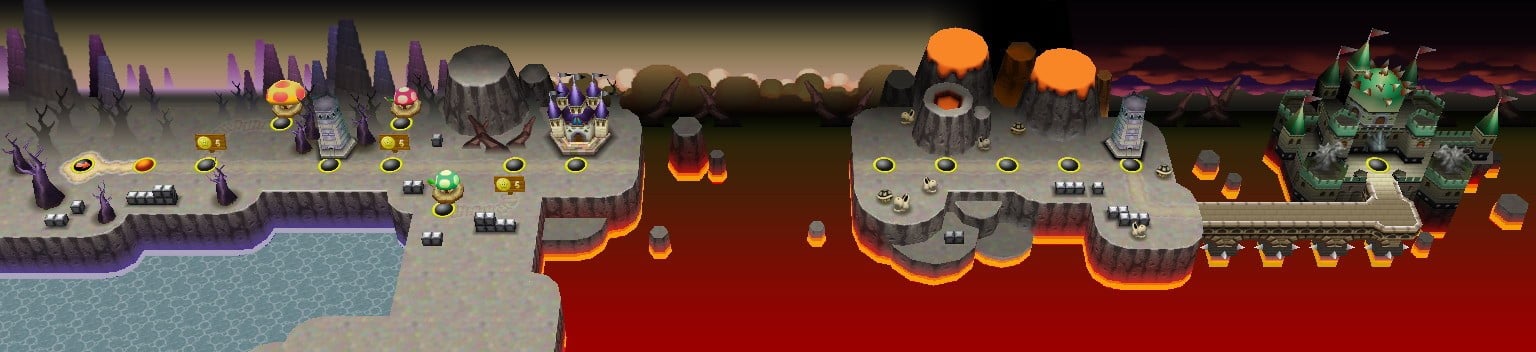 World 8Haunted woods and volcano · 12 courses · Towers: Bowser Jr. (twice) · Castle: Dry Bowser · Bowser’s Castle: Bowser and Bowser Jr.The longest world, split between a gloomy forest of Splunkins and Crowbers and a volcano that rains burning rock, with the second half hidden until the first castle falls. Mega Unagi chases Mario through 8-3, and there are no secret exits to save you.

 Super MushroomSmall Mario becomes Super Mario.
 Fire FlowerFire Mario throws bouncing fireballs; losing it drops you to Super, not Small.
 StarmanBrief invincibility, extra speed and a change of tune.
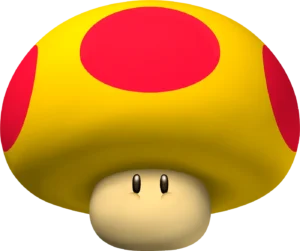 Mega MushroomGiant Mario for a few seconds; wreck enough and the meter pays out up to five 1-Ups. Found loose in 1-1, 1-2, 4-4 and 7-5.
 Mini MushroomTiny, floaty, water-walking Mario; one hit and he is gone. The key to Worlds 4 and 7.
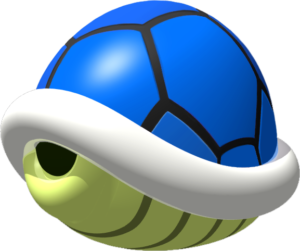 Blue ShellShell Mario skids along as a spinning shell and shelters inside it when crouching.
 1-Up MushroomAn extra life; 100 coins do the same.
 Star CoinThree per course, 240 in all; spend them on map signs and wallpapers.
 CoinA hundred for a life; eight in Mario vs. Luigi for a power-up.
 Red CoinsPass through a Red Ring and grab all eight in time for a power-up or 1-Up.
 Big StarThe prize in Mario vs. Luigi.
 Koopa shellsKick them or carry them with the dash button. Buzzy Beetle shells are fireproof.
 KeyDropped by every castle boss; it unlocks the next world.
 Spin BlockLaunches Mario into a high, gliding spin jump.
 Roulette BlockCycles through items; you get whatever is showing when you hit it.
 P SwitchSwaps coins and bricks and conjures Blue Coins for a few seconds.



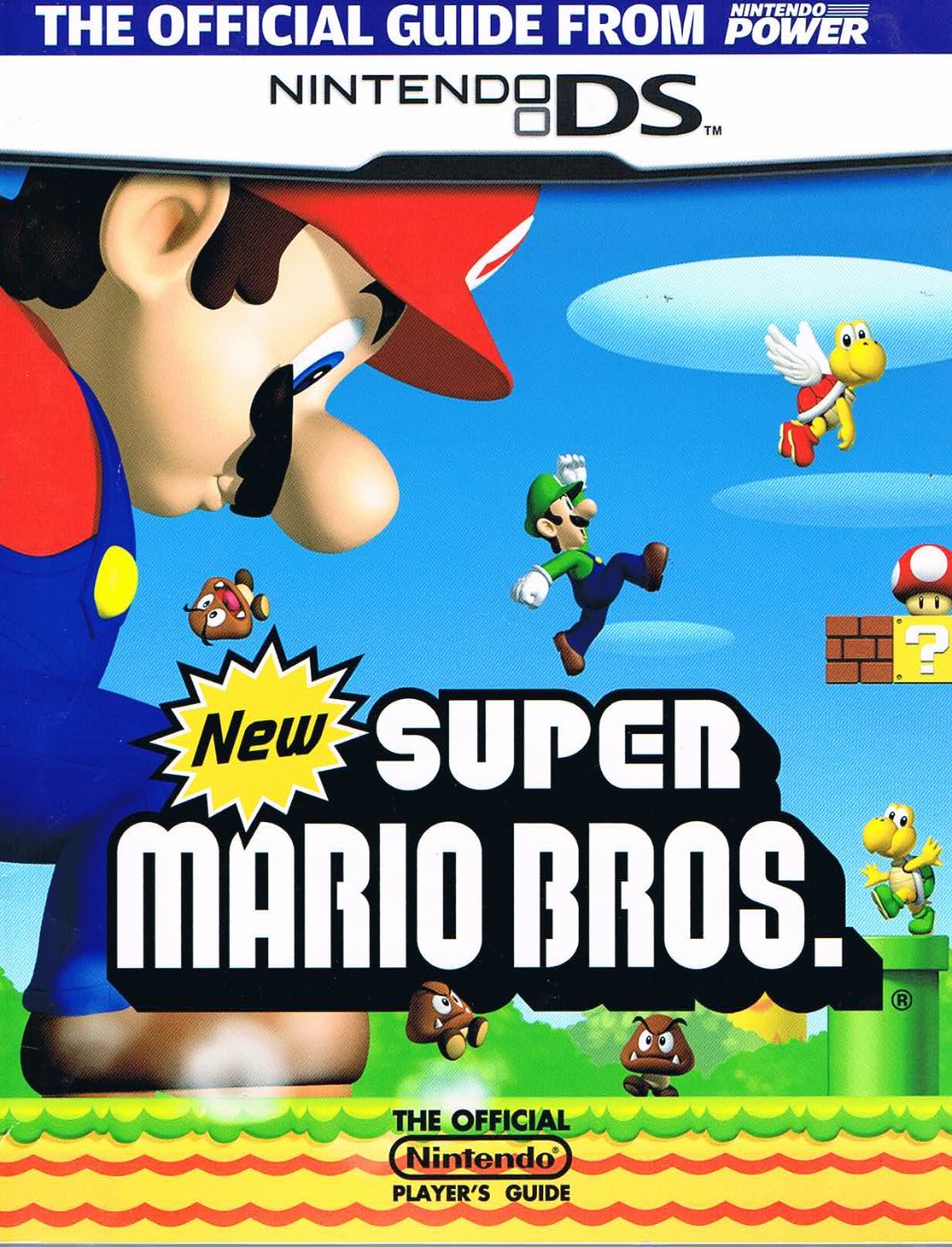 Nintendo Power Player’s GuideNintendo of America · 2006The official guide, written by Casey Loe, mapped every course and Star Coin. It is also the source of the name “Mega Goomba” for the World 4 boss, which Nintendo’s Japanese Mario Portal calls Boss Goomba.
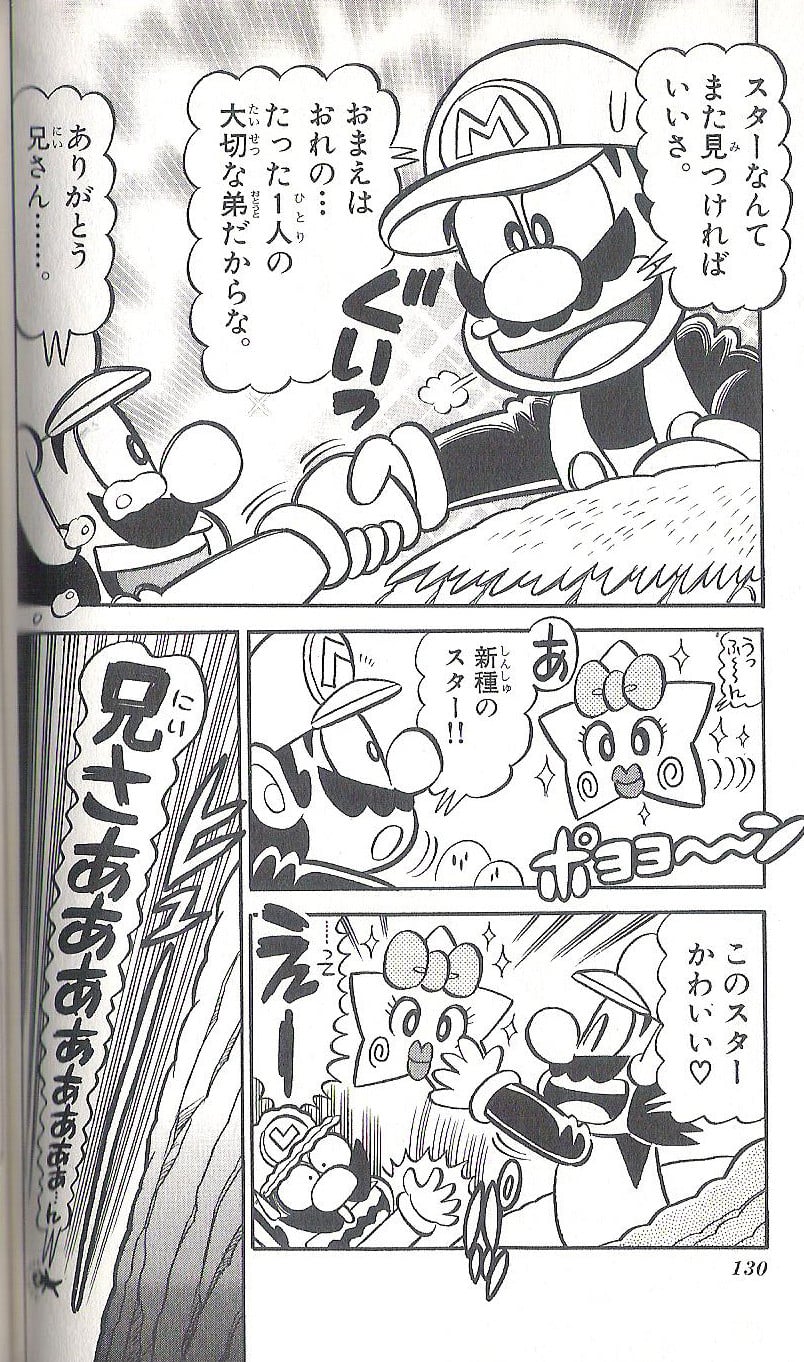 Super Mario-kunManga · one volumeThe long-running gag manga devoted one volume to the game, following the story loosely and adding its own jokes: when Mario beats Luigi in a Mario vs. Luigi bout he dashes to pull his brother back from a cliff edge, and promptly gets distracted.
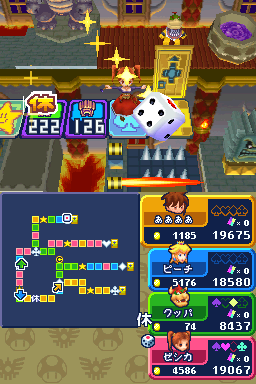 Itadaki Street DS and Fortune StreetSquare Enix · DS and WiiThe Bowser’s Castle board in Itadaki Street DS is modelled on World 8-Castle, complete with Bowser Jr. standing beside the cauldron, and plays an arrangement of the Castle Theme; several Chance Cards use screenshots from the game. The board returned in Fortune Street on Wii.
 MarioThe hero
 LuigiHidden second hero
 Princess PeachKidnapped, again
 ToadsworthKeeper of the Toad Houses
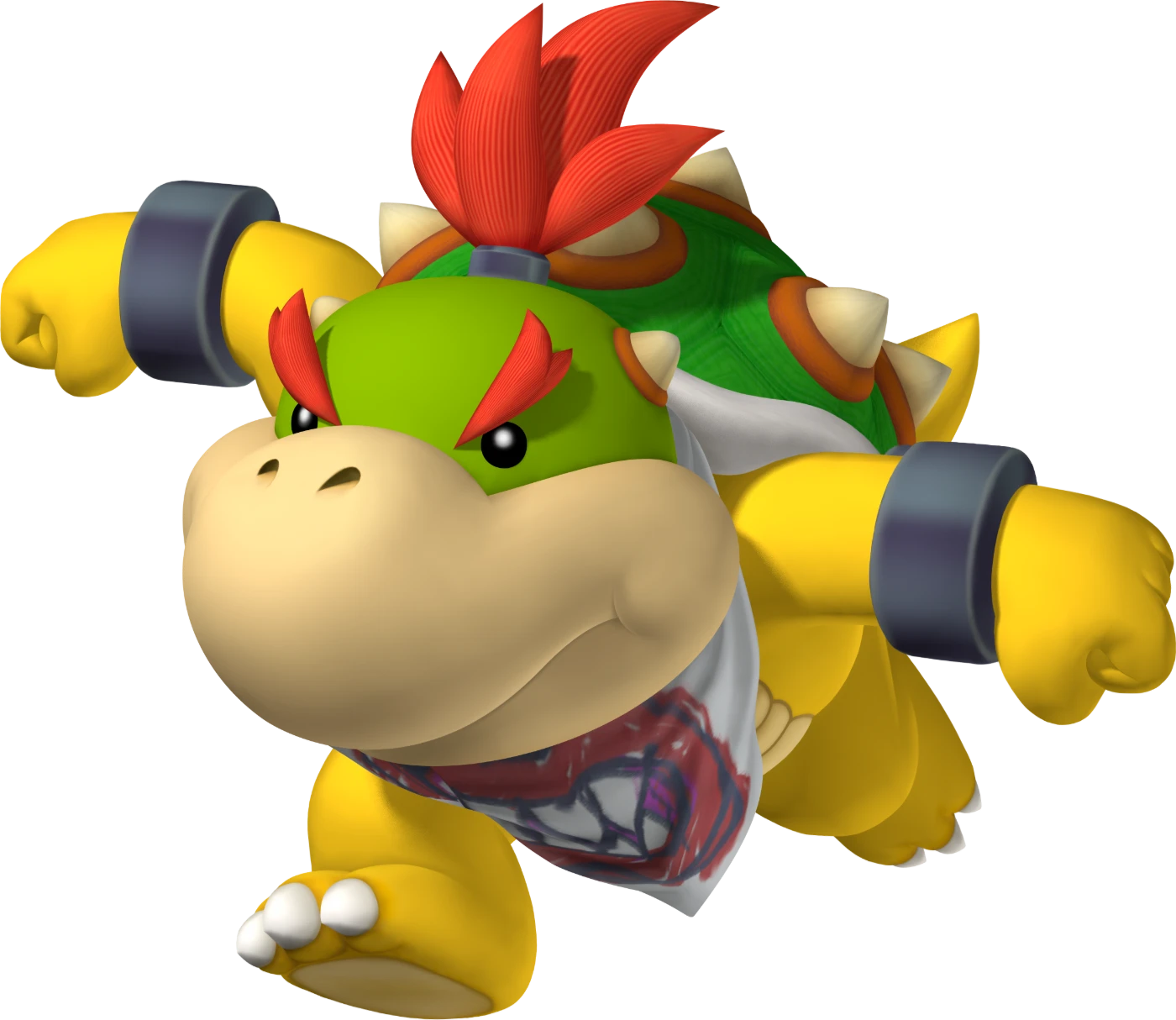 Bowser Jr.The kidnapper
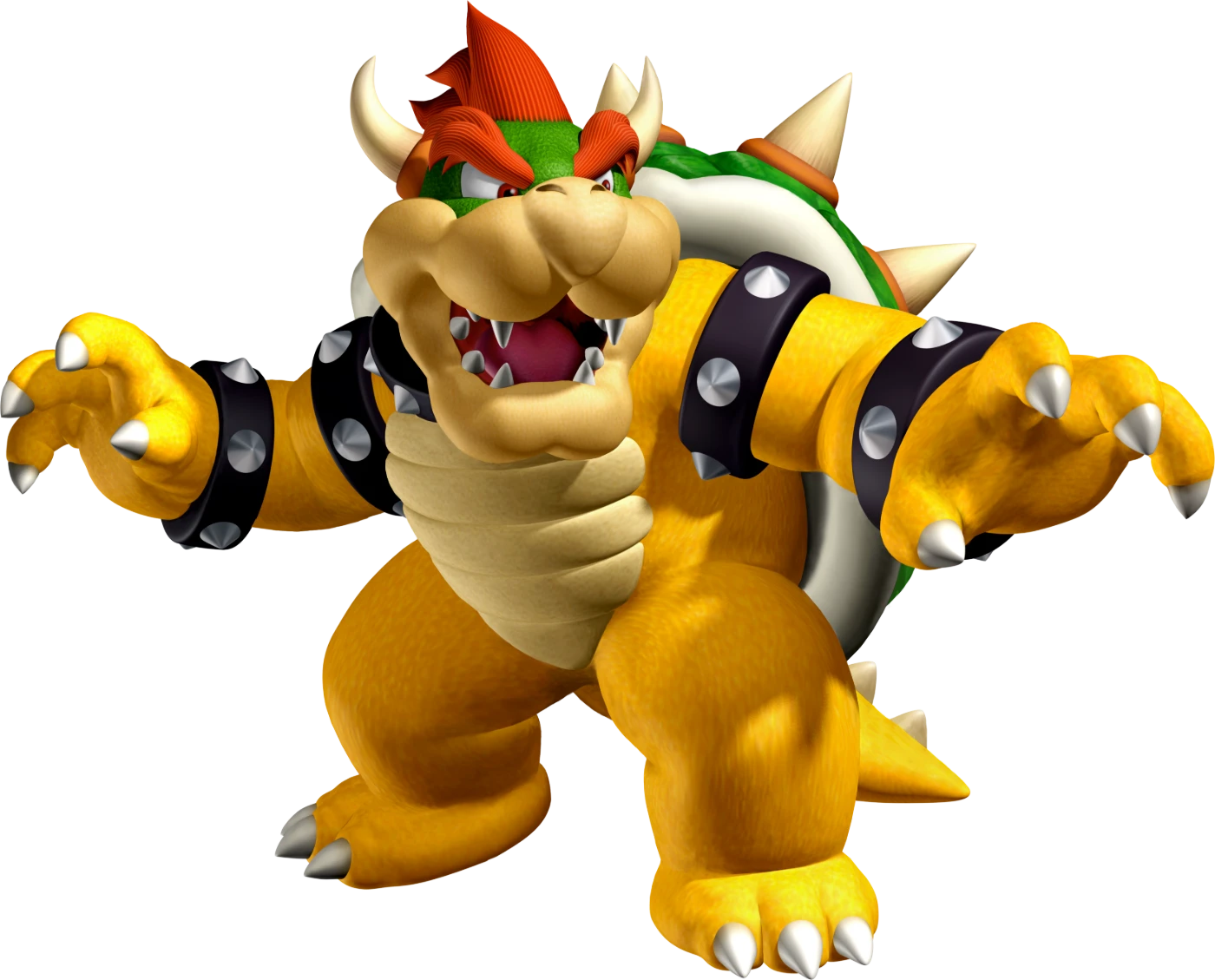 BowserKing of the Koopas
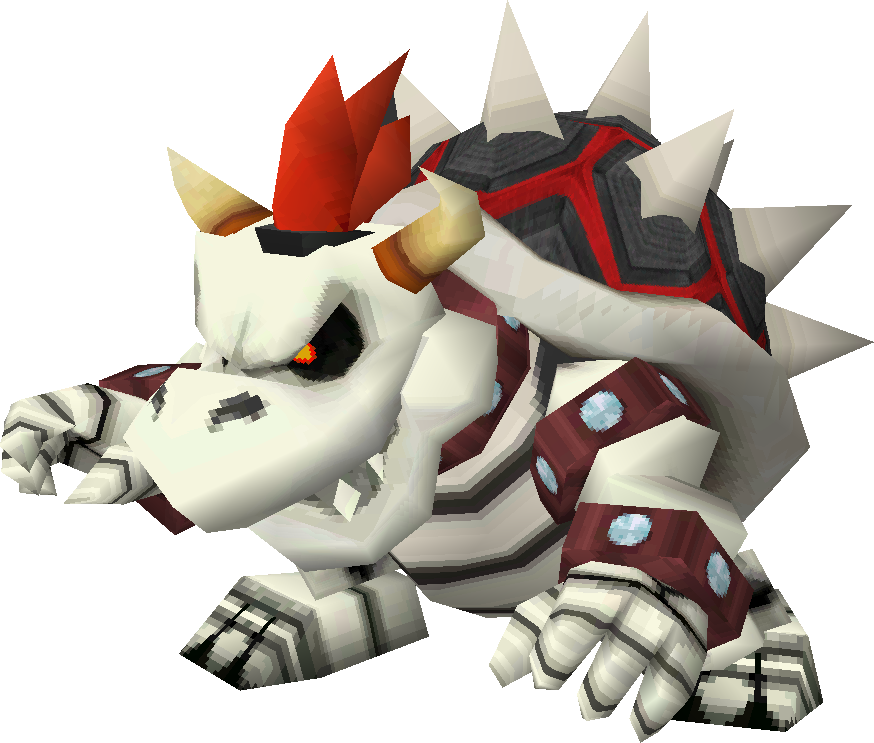 Dry BowserBowser, minus the skin
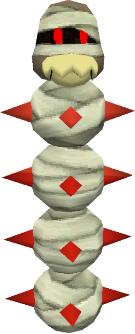 MummipokeyWorld 2 castle boss
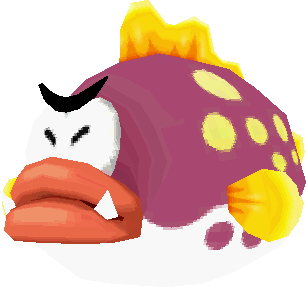 CheepskipperWorld 3 castle boss
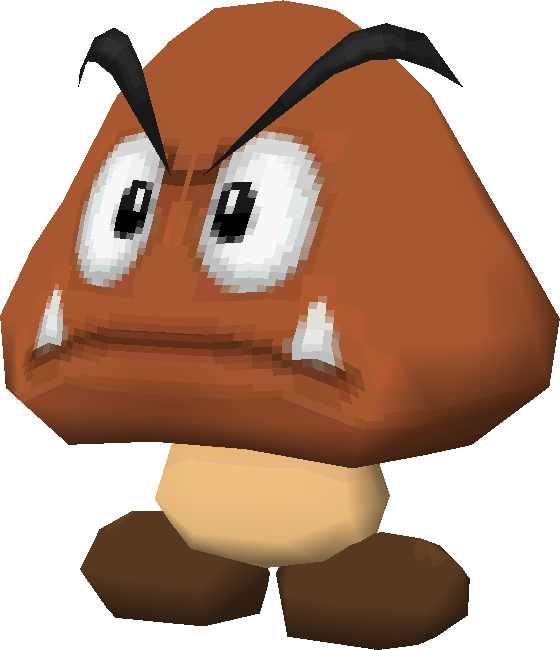 Mega GoombaWorld 4 castle boss
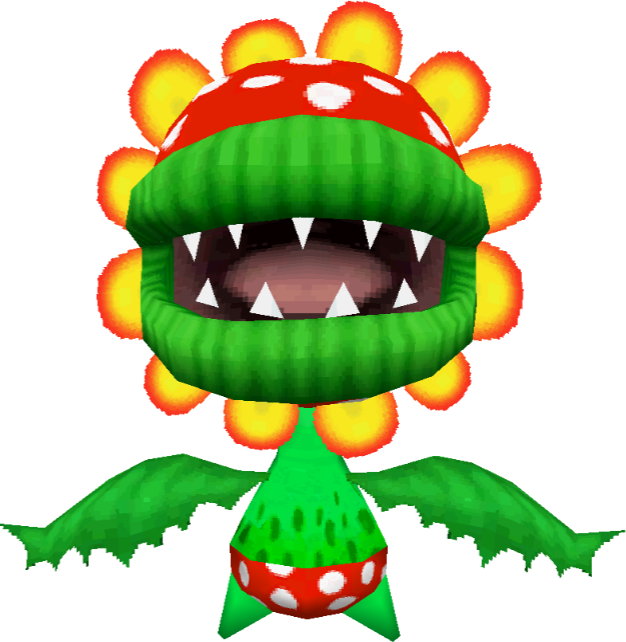 Petey PiranhaWorld 5 castle boss
 Monty TankWorld 6 castle boss
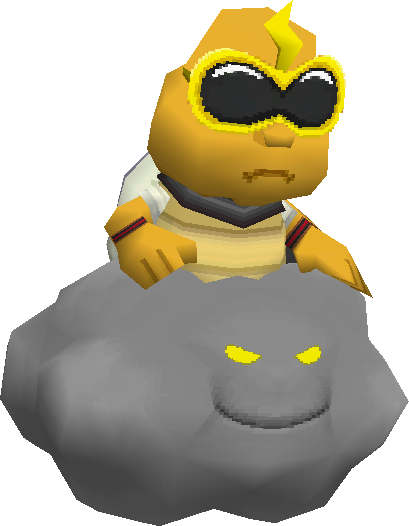 LakithunderWorld 7 castle boss
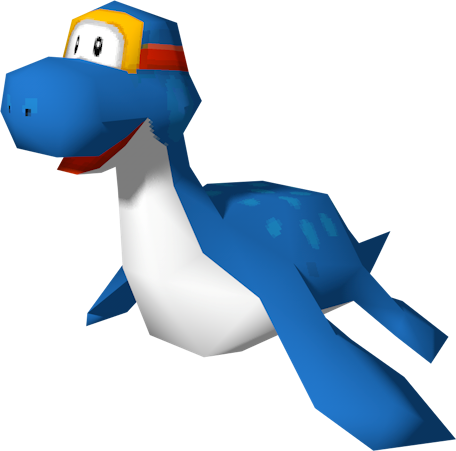 DorrieFriendly ferry
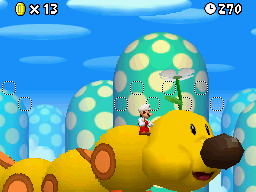 Giant WigglerLiving platform
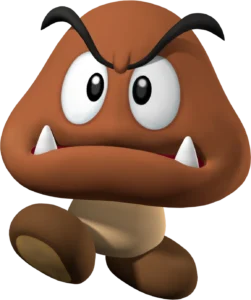 Goomba1-1 to 8-6Now a polygon model that hops in time with the music.
 Paragoomba2-4Winged; one stomp clips the wings.
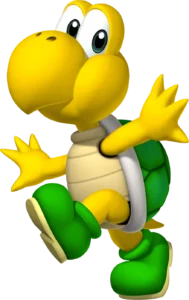 Koopa Troopa1-1 to 8-7Green ones walk off ledges, red ones turn back. A blue one in Mario vs. Luigi gives up a Blue Shell.
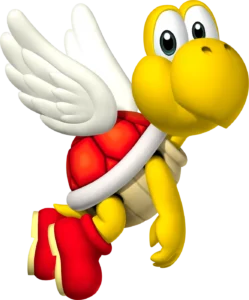 Koopa Paratroopa1-4 to 8-7Green ones bound along in arcs, red ones patrol the air.
 Dry Bones and Super Dry Bones1-Tower to Bowser’s CastleCollapse and reassemble. The big new one needs a ground pound.
 Hammer Bro2-4 to World 8Also roams the maps with an item to give up.
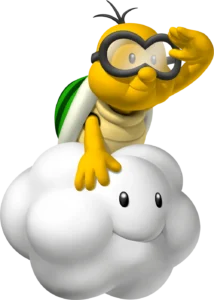 Lakitu and Spiny2-1 to 8-6Knock him out with a shell or fireball and his cloud stays behind.
 Buzzy Beetle5-C to 6-Tower 2Fireproof.
 Spike Top5-2 to 8-TowerWalks up walls and across ceilings.
 Snow Spike (new)5-1Rolls snowballs at you.
 Pokey2-1Burn off the segments or hit the head.
 Piranha Plant family1-2 to 7-APipe-dwellers, Super Piranha Plants that take three fireballs and fire-spitting Venus Fire Traps.
 Blockhopper (new)2-5A stack of blocks that hops at you; pound it down to the ? Block.
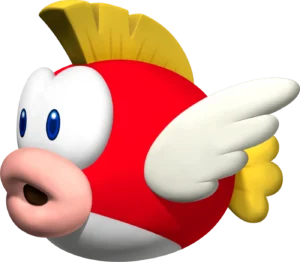 Cheep-Cheep family1-A to 8-3Cheep-Cheeps and Mega Cheep-Cheeps, plus the new green Deep-Cheeps of 6-5, which chase you.
 Cheep-Chomp3-1The big purple fish that lunges to swallow Mario.
 Spike Bass (new)2-A to 3-CA giant spiny fish that leaps from the water and keeps coming back.
 Skeeter3-A to 8-2Skates on the water and drops bombs.
 Blooper and Blooper Nanny3-3The nanny trails a string of babies.
 Unagi and Mega Unagi4-3 to 8-3Eels in the rock. The new giant one cannot be beaten, only outswum.
 Whomp and Big Whomp3-CastleGround pound them when they fall flat. The walking Big Whomp is new.
 Thwomp and Super Thwomp4-Castle to Bowser’s CastleThe big ones smash through bricks.
 Boo3-Ghost House to 8-1Shy when watched. 8-1 is their only outing beyond a Ghost House.
 Balloon Boo (new)4-Ghost HouseSwells while you look at it and deflates towards you when you turn away.
 Broozer (new)5-Ghost House, 5-CA boxing ghost that punches through otherwise unbreakable blocks.
 Splunkin (new)3-Ghost House to 8-1A walking jack-o’-lantern; two stomps.
 Moneybags5-2 to 6-3Hops away spilling coins, then a 1-Up.
 Crowber (new)8-1A diving crow.
 Bob-omb and Kab-omb4-5 to 7-5; 8-8Kab-ombs are new: falling volcanic rock sets them off.
 Scuttlebug4-1 to 8-4Spiders on threads, in their first 2D Mario.
 Wiggler and Squiggler4-4 to 7-3; 7-AStomp a Wiggler and it turns red and angry. The tiny new Squiggler crawls out of pipes.
 Chain Chomp6-6Ground pound its post three times to set it free.
 Bullet Bill and Banzai Bill2-Castle to 8-1From Bill Blasters, rotating turrets and giant cannons.
 Snailicorn (new)5-3 to 5-BCannot be stomped, but can be shoved off the ice.


 The world map — featuring alternate paths, Warp Cannons and Toad Houses that can be unlocked with Star Coins
 Mario vs. Luigi mode — two-player local wireless battle for stars on specially designed levels
 World 1Grassland
 World 2Desert
 World 3Island & Ocean
 World 4Forest
 World 5Sky
 World 6Cliff & Ice
 World 7Sky Clouds
 World 8Lava & Volcano