Japanese home computers1984Hudson SoftAction / platformerJapan onlyMario throws a ballNine computer versionsTwo versions lost
Punch Ball Mario Bros.
The Mario Bros. where Mario cannot bump the floor. Punch Ball Mario Bros. was released in Japan on 5 October 1984 by Hudson Soft, under licence from Nintendo, for a whole shelf of Japanese home computers: the NEC PC-8801, PC-8001, PC-6001 and PC-6601, the Fujitsu FM-7, the Sharp X1 and MZ-1500, the Hitachi S1 and the IBM JX. It keeps the sewer, the pipes, the POW Block and the Shellcreepers, Sidesteppers and Fighterflies of the 1983 arcade game, but turns the floors upside down and makes them too solid to thump. The only way to knock an enemy over is to throw a Punch Ball, a stone sphere that rolls a short way and must be picked up again every time. The instruction booklet explains why: Mario and Luigi are stone-age men who have never got past rocks. It is one of three Hudson computer Mario games, alongside Mario Bros. Special and Super Mario Bros. Special, and it never left Japan.
Developer:Hudson Soft
Publisher:Hudson Soft
Platforms:NEC PC-6001 and PC-6601, PC-8001, PC-8801; Fujitsu FM-7; Sharp X1 and MZ-1500; Hitachi S1; IBM JX
Released:5 October 1984 (Japan)
Genre:Single-screen action platformer
Players:1–2, simultaneous
Main programmer:Masaaki Kikuta (“Kiku”)
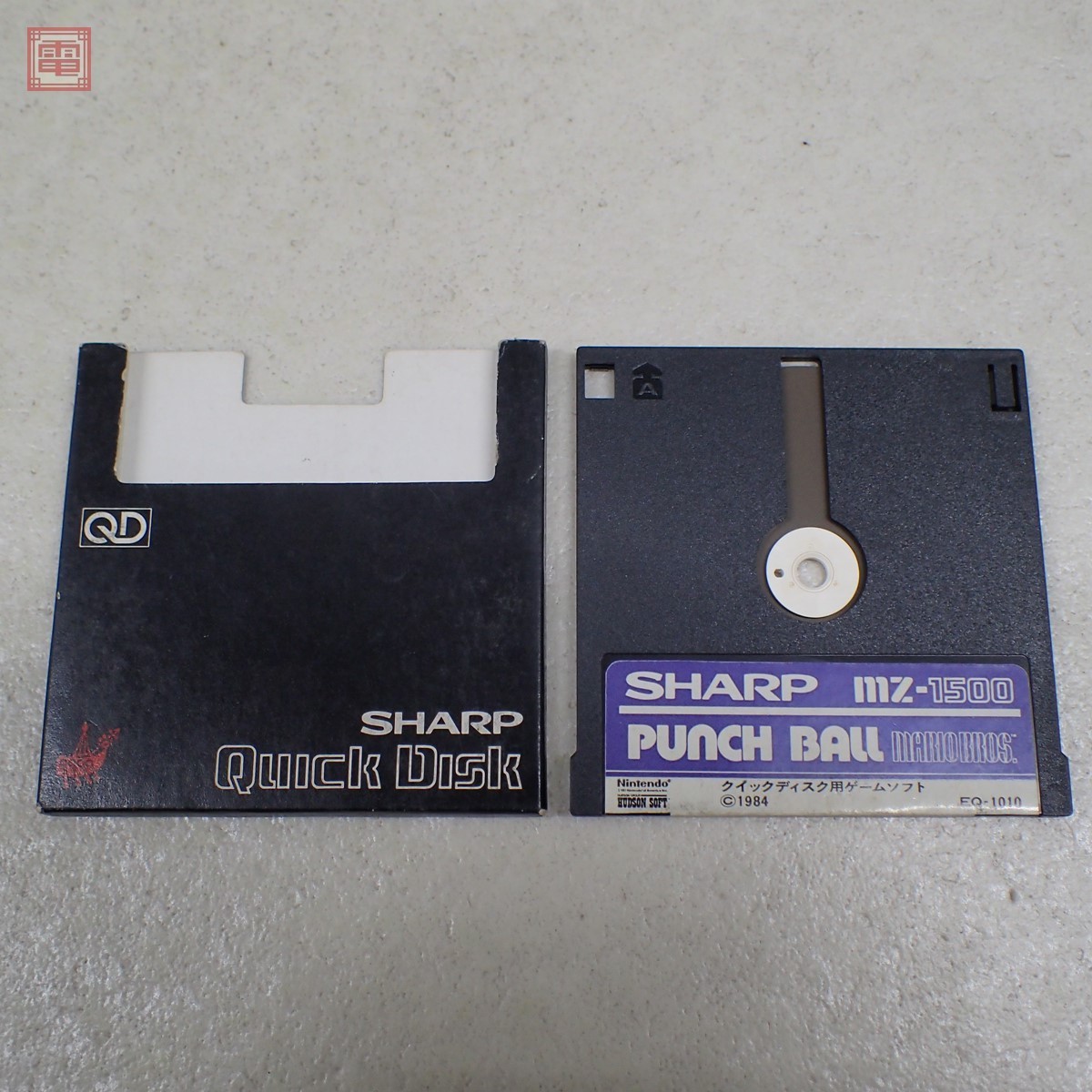
Media:Floppy disk and cassette tape (Quick Disk on the MZ-1500, according to PC Gamer)
Controls:One button for both jumping and throwing (the space bar on a keyboard)
Difficulty:Game A and Game B
Japanese title:パンチボールマリオブラザーズ (Panchibōru Mario Burāzāzu)
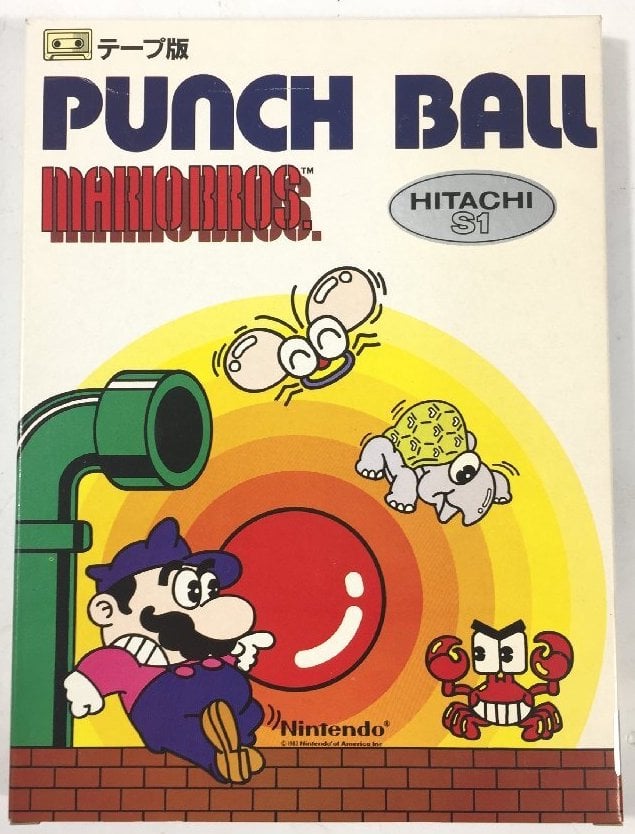
Lost versions:Hitachi S1 (known only from photos of its box, inserts and tape) and IBM JX (unaccounted for)
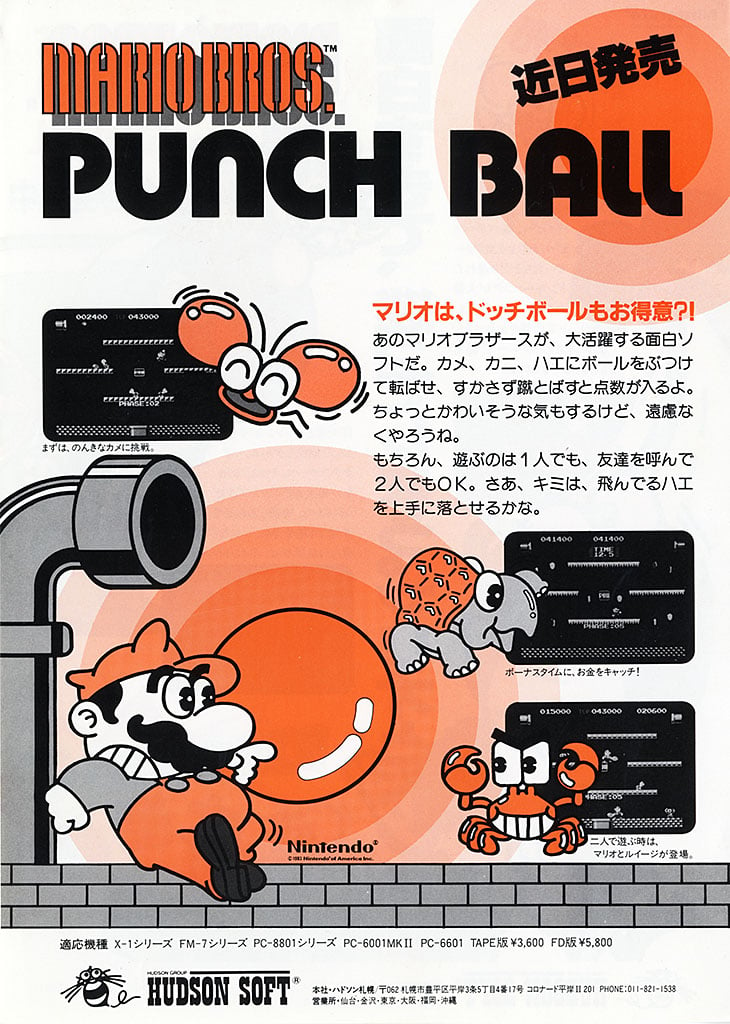
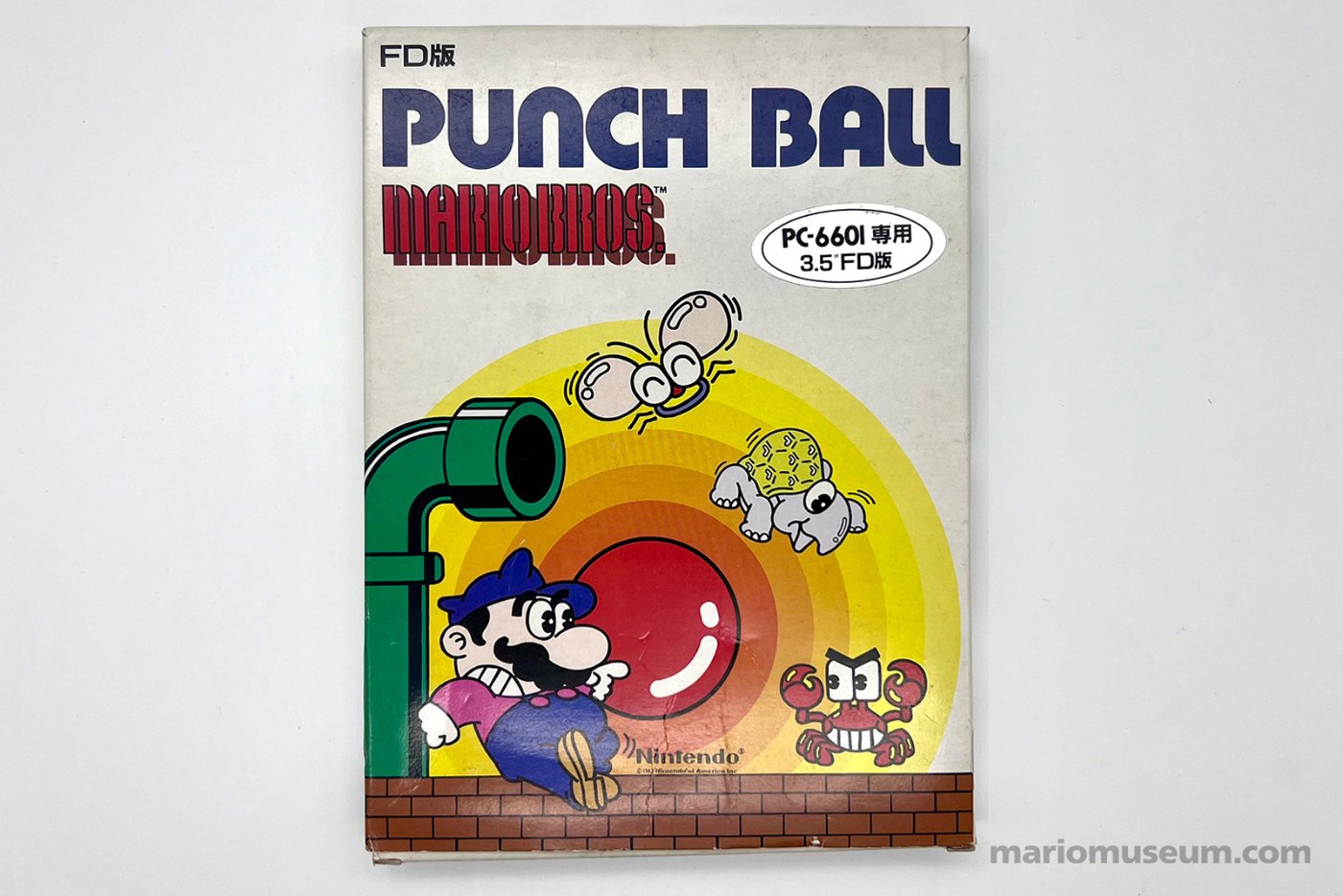
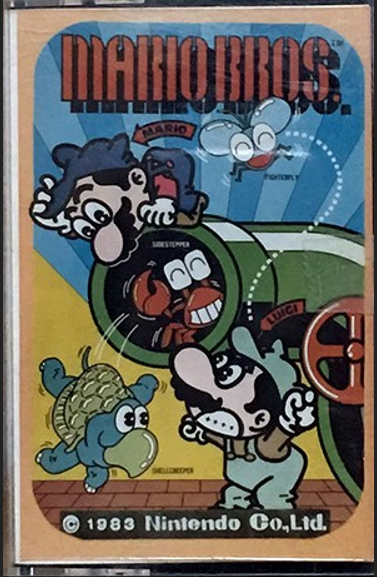
The promotional flyer. On every version’s box, Mario is holding a Punch Ball.
In 1984 Nintendo let Hudson Soft bring Mario to Japan’s home computers, and instead of copying the arcade game, Hudson changed it. AKIBA PC Hotline’s retro column, looking back in 2020, made the point in its headline: Mario is the star, but what is inside is Hudson’s own. Punch Ball Mario Bros. has the look and the cast of Mario Bros., but almost every rule has been turned round.
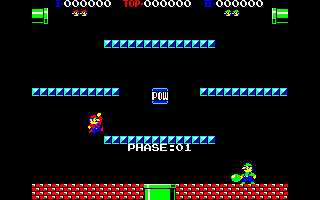
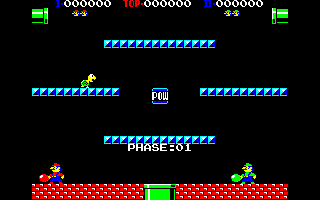
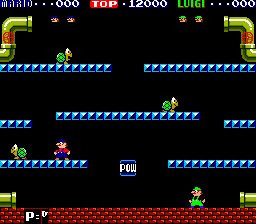
The floors are the obvious change. In the arcade game they are open in the middle; here the middle is solid, with the gaps at the sides, and the pipe at the bottom has become a pit that costs a life. The floors are also too sturdy to bump enemies through, so Mario and Luigi each carry a Punch Ball, throw it to flip an enemy over and then kick the enemy away as usual. The ball does not fly far, and it stays where it stops until its owner goes to fetch it.
It was made for nine different machines, which differ in colours, sound and the flow of the game, and two of those versions, for the Hitachi S1 and the IBM JX, have effectively vanished. Hudson also made Mario Bros. Special the same year and Super Mario Bros. Special in 1986.
Why it matters to Mario fansIt is one of the oddest Mario games ever sold, and one of the earliest made outside Nintendo. The Punch Ball is usually counted as the first projectile weapon Mario and Luigi ever carried, the year before the Fire Flower, and the stone-age story in the booklet is unlike anything else in the series. It is also a reminder of how freely Hudson treated Mario before Super Mario Bros. Special.
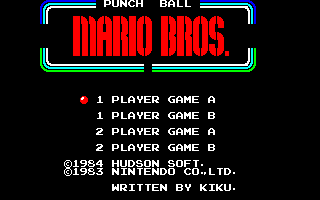
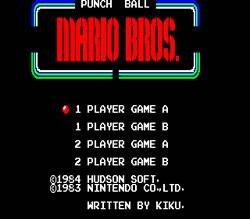
The title screen, with a Punch Ball for a cursor.A typical stage: solid floors in the middle, gaps at the sides.Mario and Luigi together.
Quick Answers
Short answers about Hudson’s stone-ball Mario game.
What is Punch Ball Mario Bros.?
A 1984 version of Mario Bros. made by Hudson Soft, under licence, for Japanese home computers, in which the brothers stun enemies by throwing a ball instead of bumping the floor. More →
Who made it?
Hudson Soft, with Masaaki Kikuta (Kiku) usually credited as main programmer. More →
The NEC PC-6001, PC-6601, PC-8001 and PC-8801, the Fujitsu FM-7, the Sharp X1 and MZ-1500, the Hitachi S1 and the IBM JX. More →
How does the Punch Ball work?
Stand still and press the button to throw it. It rolls a short way with one small bounce and flips the first enemy it hits; then you must walk over and pick it up before you can throw again. More →
Can you play it today?
We found no official re-release; it survives on original disks and tapes. More →
Why is it called Punch Ball?
After the stone balls Mario and Luigi throw. The booklet calls them stone spheres, in red and green, one for each brother. More →
Story & Phases
The instruction booklet tells a story found in no other Mario game. People, it says, started with tools of bone and broken stone and went on to master fire, wind and finally atomic energy. But some people never moved on from stone, and they get by on their strong legs and their stone balls alone. Two of them, it says, seem to be called Mario and Luigi, and it wonders whether they will ever catch up with the rest of civilisation.
There are no princesses, no Bowser and no Mushroom Kingdom: just the brothers, their rocks and a screen full of familiar pests.
The first phases
The game opens with Shellcreepers, which behave just as they do in the arcade game, except that they now have to be flipped with a ball. Each enemy has two forms: when it rights itself, or when it is the last one left on the screen, it changes colour and speeds up. A Shellcreeper’s fast form is red.
A Shellcreeper.Both brothers at work, each with his own ball.
Crabs and fire
Phase 4 brings in Sidesteppers and the fireball. Here the Sidesteppers behave like the Shellcreepers, turning green with an angry face in their fast form. The fireball is red but moves more like the green fireballs of the arcade game, and it cannot be beaten at all.
A Sidestepper.
Flies, moving floors and ice
Fighterflies join in Phase 6, hopping about and proving hard to hit with a ball that only rolls along the floor; their fast form is green. Later phases set the floors moving, freeze them, and eventually do both at once.
A Fighterfly.
How the phases unfold
The milestones AKIBA PC Hotline describes.
Phase 1ShellcreepersTurtles only, to learn the ball.
Phase 3First bonus phase (AKIBA PC Hotline)Ten coins against the clock, then another bonus every fifth phase.
Phase 4Sidesteppers and the fireballCrabs, and an enemy that cannot be defeated.
Phase 6FighterfliesHopping flies that are hard to catch with a rolling ball.
Later phasesMoving and frozen floorsThe floors start to slide, freeze, and then slide while frozen.
Advertisement
Gameplay & Controls
As in the arcade game, each phase is a single screen and ends when every enemy has been flipped and kicked away. Two players can play at once, Mario on the left and Luigi on the right.
One button for everything
Jumping and throwing share a single button, the space bar on a computer keyboard. Press it while moving and Mario jumps; press it while standing still and he throws. That means you cannot throw on the run, and AKIBA PC Hotline’s reviewer regretted the shared key and thought separate keys would have made the game less stressful.
The Punch Ball
Each brother has one ball, in his own colour, and can only use his own. Thrown, it travels a short distance, bounces once and stops, flipping the first enemy it touches. Then it just sits there until its owner picks it up again, even after he has lost a life, so a lot of the game is spent walking back for it. If it drops into the bottom pipe it reappears on top of the POW Block, or on the lowest floating platform once the POW Block has gone. Hit the POW while a ball is lying on a floor and the ball bounces twice.
The Punch Ball.Mario, ball in hand.
Upside-down floors
The layout is almost the reverse of Mario Bros.: the floors are solid in the middle and break off at the edges, and the bottom pipe is effectively a hole. The floors are also sturdier than the arcade ones, so hitting them from underneath does nothing to the enemies above. Later phases bring moving floors, frozen floors and frozen floors that move.
POW, coins and lives
The POW Block can be used three times a phase, and each hit makes the screen flash in inverted colours for a moment. Kicking an enemy away produces a coin on the top floor, worth 1,600 points according to AKIBA PC Hotline, but only one coin can be on screen at a time. A brother who loses a life comes back on a temporary ledge above the POW Block, with Mario slightly left of it and Luigi to its right.
Hitting the POW turns the colours inside out for a moment.
Bonus phases
Some phases have no enemies, just coins: collect ten before the time runs out. With two players, it becomes a race to grab the most. AKIBA PC Hotline counts the bonus phases as Phase 3 and then every fifth phase after it, Phases 8, 13, 18 and so on, and calls them the only relaxing moments in the game.
A bonus phase.
Game A and Game B
There are two difficulty settings. Game B is said to be only slightly harder; AKIBA PC Hotline says it shortens the distance the ball rolls and makes the fireball appear sooner, and recommends Game A to anyone but very skilled players.
Items and objects
Three things to throw, hit or collect.
Punch BallA stone sphere, red for Mario and green for Luigi. Thrown to flip enemies; must be fetched after every throw.
POW BlockThree uses a phase. Flips the enemies and flashes the screen in inverted colours.
CoinAppears on the top floor when an enemy is kicked away, one at a time; ten to collect in a bonus phase.
Characters
The cast is the arcade game’s, recast as cave-dwellers.
Character
Who they are
In this game
Abilities & notes
MarioPlayer one
In the booklet’s story, one of the last people still living by stone tools.
Player one. Jumps, throws his red Punch Ball and kicks flipped enemies away. Respawns slightly to the left above the POW Block.
One ball, his own colour only.
LuigiPlayer two
Mario’s fellow stone-ager.
Player two, on screen at the same time. Throws the green ball and respawns slightly to the right.
Identical to Mario apart from his colours.
Enemies
Four enemies, all from the arcade game. Each has a normal form and a faster form it switches to when it rights itself or is the last one left.
ShellcreeperFrom Phase 1Behaves as in Mario Bros.; red in its fast form.
SidestepperFrom Phase 4Behaves like a Shellcreeper here; green with an angry face when fast.
FighterflyFrom Phase 6Hops along and is hard to stun; green when fast.
FireballFrom Phase 4Red, but moves like the arcade game’s green fireballs. Cannot be defeated; Game B brings it out sooner.
Key people
One member of staff is known by name.
Masaaki Kikuta (Kiku)Main programmerUsually credited as the game’s main programmer.
Hudson SoftDeveloper and publisherMade all the computer versions and the two other Hudson Mario games, Mario Bros. Special and Super Mario Bros. Special.
Advertisement
How It Was Made
Very little has been written about how Punch Ball Mario Bros. was made. This is what the sources say.
Hudson’s computer Mario games
Mario Bros. Special, Hudson’s other 1984 Mario game.
While Nintendo sold its own Famicom version of Mario Bros., Japanese computer owners got several takes on the game in 1984. Westside Soft House published a PC-8001 conversion in February; Hudson Soft followed with Mario Bros. Special in August and Punch Ball Mario Bros. in October, and came back in 1986 with Super Mario Bros. Special. AKIBA PC Hotline points out that none of the computer versions was a straight port of the arcade game: each was a modified Mario Bros. of its own.
Hudson advertised the games with the slogan “面白すぎて、ボク、恐い。” (roughly, “It’s so much fun, I’m scared”), which AKIBA PC Hotline reproduces with an advert for three of its titles.
Nine machines, one game
Versions are usually listed for the PC-6001, PC-6601, PC-8001, PC-8801, FM-7, Sharp X1, Sharp MZ-1500, Hitachi S1 and IBM JX, which differ in colours, sound and pacing. AKIBA PC Hotline names the PC-6001mkII and PC-6601, PC-8801, FM-7 and X1 as the launch machines, on tape and disk. On the PC-8001mkII there is only a beeper, so the music is a string of beeps; with a GSX-8800 sound board fitted, the game plays proper PSG music instead. PC Gamer notes that the MZ-1500 version came on Quick Disk, a small disk format related to the Famicom Disk System’s.
Two versions are effectively lost. The Hitachi S1 release is known only from photographs of its box, inserts and tape, and the IBM JX version has not been found at all.
Why a ball?
Nobody involved has explained it. Speaking to PC Gamer in 2019, the historian Joseph Redon, founder of the Game Preservation Society in Japan, described the game as essentially the original with a ball added, and wondered whether Nintendo had begun such a project for the Famicom and scrapped it before Hudson released the game on computers. The title screen music, at least, has a clear source: it is the opening of the 19th-century American song “Dixie”.
Series Firsts
One first, by most counts.
1Mario’s first projectileThe Punch Balls are usually called the first projectile weapons Mario and Luigi ever used. The hammer of Donkey Kong was swung, not thrown, and the arcade Mario Bros. has nothing to throw.
2The only Punch Ball gameThe Punch Ball has never appeared in another game.
Tips
There are no known codes. These tips follow from the rules as AKIBA PC Hotline describes them.
Stop before you throw
The jump button only throws when Mario is standing still. Get into position first, stop, then throw, or you will jump instead.
Always fetch your ball
Without the ball you have no way to flip anything. Pick it up straight after every throw, and remember that it does not come back to you when you lose a life: it stays where it fell.
Keep the POW for emergencies
Three uses a phase, and after that a lost ball goes to the lowest floating platform rather than the POW Block.
Start with Game A
Game B rolls the ball a shorter distance and sends the unbeatable fireball out sooner. AKIBA PC Hotline recommends Game A for anyone who is not already an expert.
Videos
Both are third-party videos: a comparison of the computer versions, and a run on the PC-8801.
Third-party video by retrosutra comparing the computer versions side by side.
Third-party gameplay video of the PC-8801 version by NintendoComplete.
Trivia & Interesting Facts
The title screen tune is the opening of “Dixie”, a 19th-century American song.
A Punch Ball takes the place of the cursor on the title screen.
Each brother can only throw the ball in his own colour: red for Mario, green for Luigi.
The POW flash.Hitting the POW Block inverts the colours of the whole screen for a moment.
The booklet’s stone-age story never mentions plumbing, sewers or the Mushroom Kingdom.
Only one coin can be on the screen at a time, on the top floor.
In Punch Ball Mario Bros. the fireball cannot be defeated, unlike the arcade fireballs, which a well-timed bump or the POW Block will knock out.
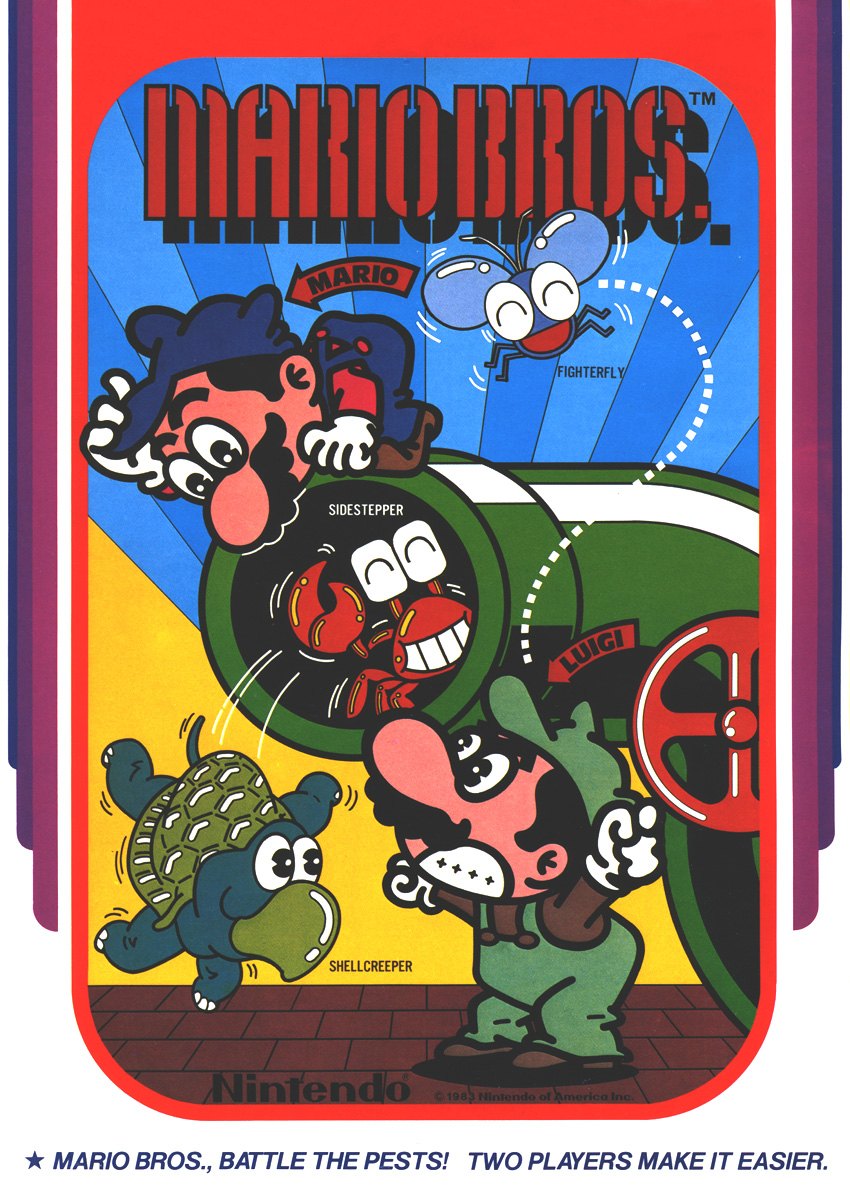
The arcade Mario Bros., for comparison.Compare the screens: the arcade game’s floors are open in the middle, Punch Ball’s are open at the sides.
Hudson’s three computer Mario games came out within two years: Mario Bros. Special (August 1984), Punch Ball Mario Bros. (October 1984) and Super Mario Bros. Special (1986).
Regional Box Art
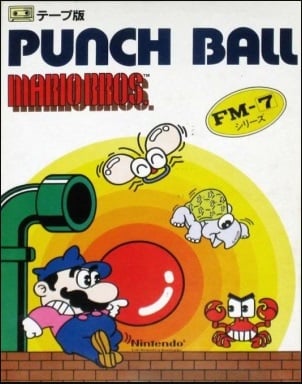
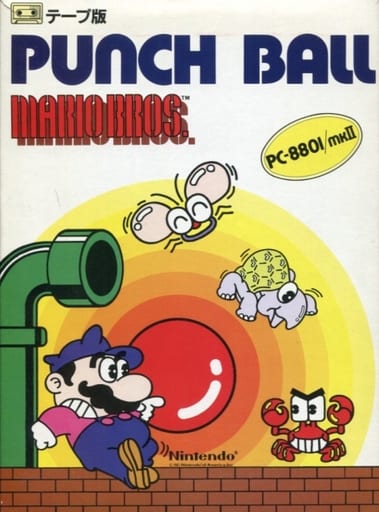
Every surviving box shows Mario holding his Punch Ball.
Fujitsu FM-7Sharp X1NEC PC-8801/mkIINEC PC-8001mkIINEC PC-6601 (3.5-inch disk)Sharp MZ-1500 (disk)Hitachi S1One of the two lost versions, known from photographs.
Artwork & Media Gallery
Sprites, the flyer and the boxes of the other Japanese computer Mario games.
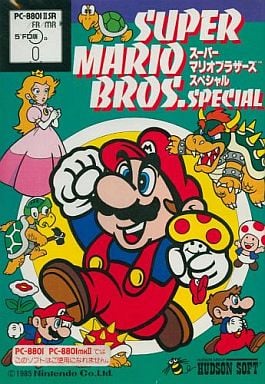
The promotional flyer.Mario.Luigi.Shellcreeper.Sidestepper.Fighterfly.The Punch Ball.Hudson’s Mario Bros. Special.Hudson’s Super Mario Bros. Special (PC-8801).Westside Soft House’s PC-8001 Mario Bros. (February 1984).The 1983 arcade flyer for Mario Bros.
Legacy & Re-releases
Punch Ball Mario Bros. had no sequel and has never been re-released.
Mario on Japanese computers
ArcadeJune 1983Mario Bros., the game it is built on.
NEC PC-8001February 1984Mario Bros., published by Westside Soft House.
Hudson computersAugust 1984Mario Bros. Special.
Hudson computers5 October 1984Punch Ball Mario Bros.
Nintendo has never re-released any of Hudson’s computer Mario games, so Punch Ball Mario Bros. survives on its original disks and tapes, and the Hitachi S1 and IBM JX versions may be gone for good. The videos above are the easiest way to see it.
Where it fits
It sits between the arcade Mario Bros. and the more ambitious Super Mario Bros. Special, as one of a handful of Mario games made by another company in the 1980s. Its stone ball was never used again, though Mario has had plenty to throw since.
Reviews & Sales
Reviews
We found no contemporary review scores or sales figures. Modern write-ups are curious rather than kind.
AKIBA PC Hotline’s Jun Sasaki, playing the PC-8001mkII version in 2020, found it hard: Game A is for beginners and Game B only for the very skilled. He wished jumping and throwing had separate keys, enjoyed the bonus phases as the only moments of calm, and joked that a sound board makes it about thirty per cent more fun.
Wes Fenlon of PC Gamer, writing in 2019, thought the movement and jumping a little too fast, noticed that Mario seems to drop the ball rather than throw it, and that the enemies move faster than it does, and was baffled that the game exists at all, given how well the jumping in the original already worked.
SLB User Reviews
Punch Ball Mario Bros. has yet to receive a community review on Super Luigi Bros.
If you’ve played Punch Ball Mario Bros. and would like to submit a review, please get in touch.
More from the Super Luigi Bros Guide
These picture lists come from the earlier Super Luigi Bros guide to Punch Ball Mario Bros. and are kept here in full.
Platform Versions
Punch Ball Mario Bros. was released across nine different Japanese home computer platforms — an impressive spread for any game of this era, let alone a Mario title. Each version has minor differences in palette, sound, and gameplay flow, with the most capable hardware showing the game at its best.
FM-7Sharp X1PC-8801/mkIIPC-8001mkIIPC-6601MZ-1500
The Hitachi S1 version survives only as photos of the box, inserts, and tape. The IBM JX version is entirely unaccounted for. Both are considered lost media.
To provide the best experiences, we use technologies like cookies to store and/or access device information. Consenting to these technologies will allow us to process data such as browsing behavior or unique IDs on this site. Not consenting or withdrawing consent, may adversely affect certain features and functions.
Functional
Always active
The technical storage or access is strictly necessary for the legitimate purpose of enabling the use of a specific service explicitly requested by the subscriber or user, or for the sole purpose of carrying out the transmission of a communication over an electronic communications network.
Preferences
The technical storage or access is necessary for the legitimate purpose of storing preferences that are not requested by the subscriber or user.
Statistics
The technical storage or access that is used exclusively for statistical purposes.The technical storage or access that is used exclusively for anonymous statistical purposes. Without a subpoena, voluntary compliance on the part of your Internet Service Provider, or additional records from a third party, information stored or retrieved for this purpose alone cannot usually be used to identify you.
Marketing
The technical storage or access is required to create user profiles to send advertising, or to track the user on a website or across several websites for similar marketing purposes.



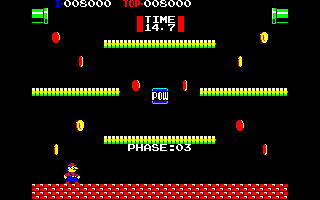 Phase 3First bonus phase (AKIBA PC Hotline)Ten coins against the clock, then another bonus every fifth phase.


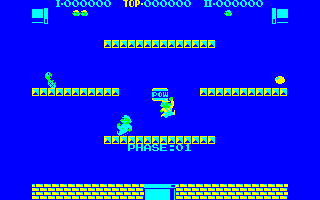
 POW BlockThree uses a phase. Flips the enemies and flashes the screen in inverted colours.
 CoinAppears on the top floor when an enemy is kicked away, one at a time; ten to collect in a bonus phase.
 LuigiPlayer two
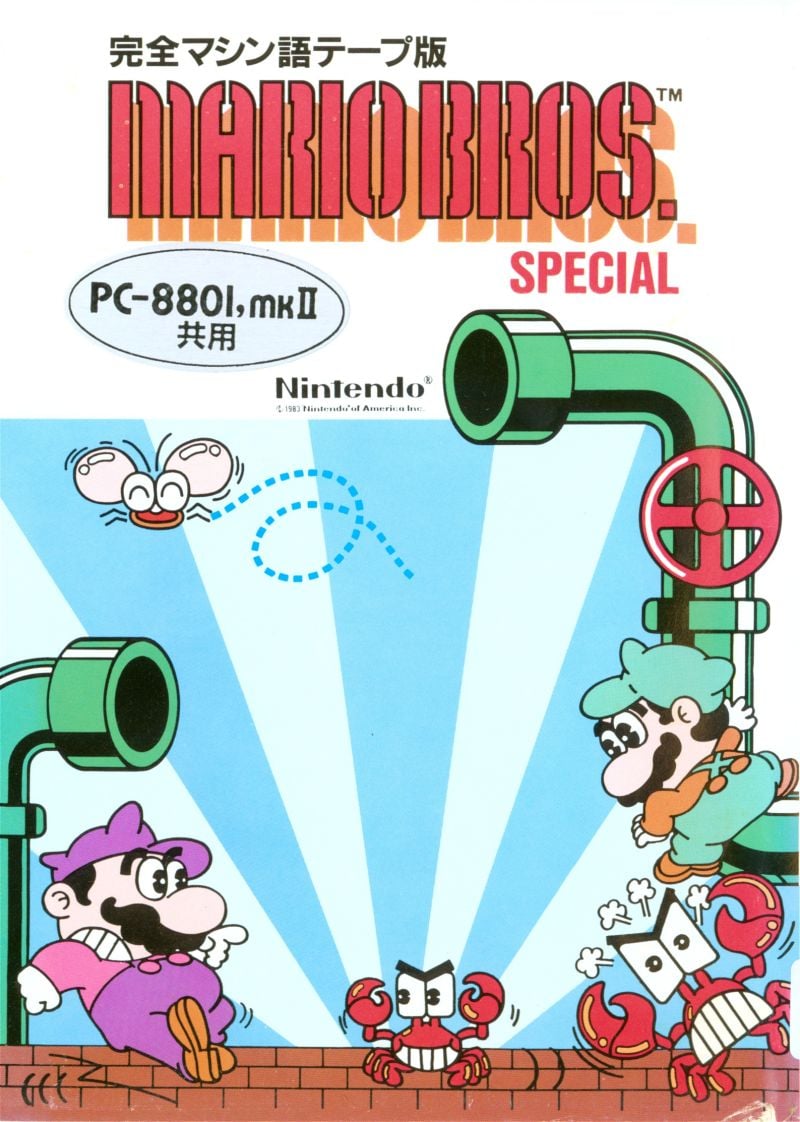
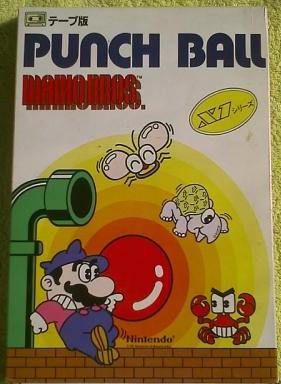
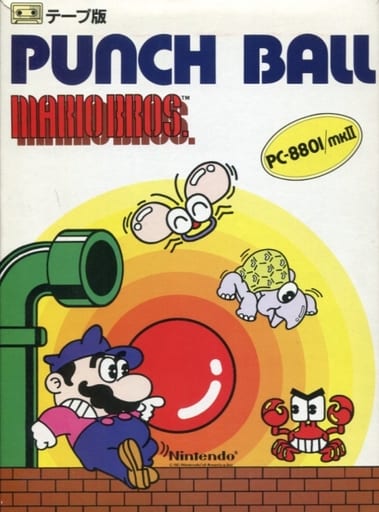
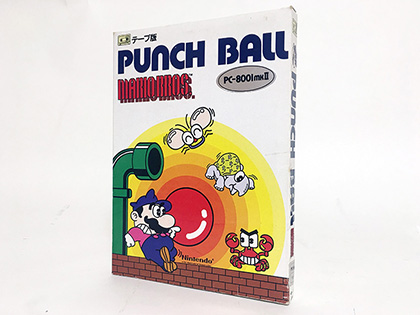



 Original promotional flyer — Mario is shown holding the Punch Ball on all box art versions