
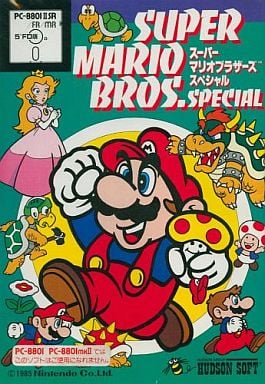
Super Mario Bros. Special (PC-88 / Sharp X1)
The first licensed sequel to Super Mario Bros. — a Japan-only computer port by Hudson Soft that added new items, cross-game enemies, and a unique segmented scrolling system. Released three months after The Lost Levels, it became the true “lost” Mario title.
Overview
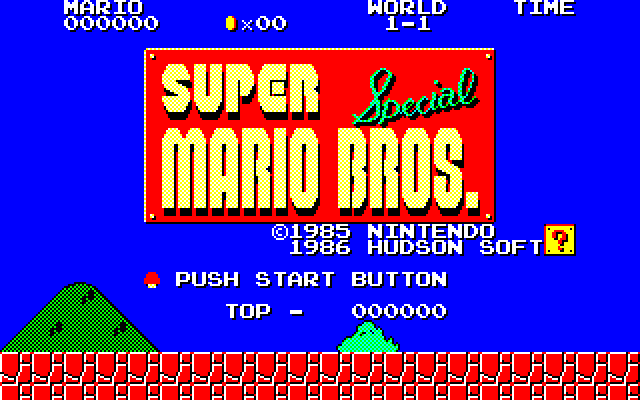
Super Mario Bros. Special was developed by Hudson Soft and released in September 1986 for the NEC PC-8801 and Sharp X1 — two popular Japanese home computers of the era. It was the second Nintendo-licensed follow-up to Super Mario Bros., arriving roughly three months after Super Mario Bros.: The Lost Levels. Despite sharing a release window with that game, it never received anything like the same recognition, and remained almost entirely unknown outside of Japan.
The game started life as an adaptation of the original Super Mario Bros., but Hudson’s team took creative liberties throughout. They introduced entirely new items unique to this game, brought in enemies from Mario Bros. and Donkey Kong, removed two-player mode entirely (no Luigi at all), and built the game around a completely different scrolling engine that divided levels into discrete screens rather than scrolling fluidly.
The result is a genuinely distinct Mario experience — slower, chunkier, and visually cruder than the Famicom original, but with its own strange charm. The Hudson bee logo appears as a collectible item worth 8,000 points. Hammers from Donkey Kong are power-ups. Icicles from Mario Bros. fall from castle ceilings. It’s a game built by people who loved Mario and wanted to add everything they could.
It is considered the first licensed sequel to Super Mario Bros. by a third-party developer, predating the western release of The Lost Levels by years. Today it’s regarded as a genuine curiosity — one of the most obscure entries in the entire franchise.
Story
The game’s manual lacks a dedicated story section. The character descriptions for Princess Toadstool, the mushroom retainers, and Bowser are drawn directly from the Japanese manual of the original Super Mario Bros., essentially describing the same events: Bowser has kidnapped Princess Toadstool and her seven mushroom retainer servants, and placed a magic spell over the Mushroom Kingdom. Mario must rescue the Princess so she can undo Bowser’s spell.
From the live site overview: “This was the first licensed sequel to Super Mario Brothers and was released shortly before the LOST LEVELS, though fate would have it that Super Mario Bros. Special would end up being the true lost Mario title.”
Gameplay
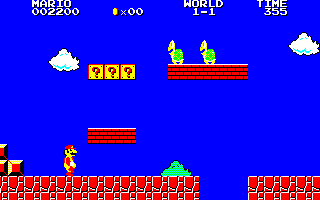 World 1-1 — Sharp X1 version
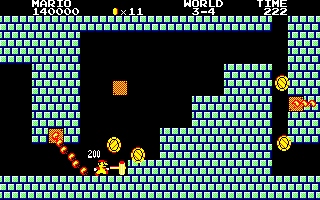 Hammer power-up + Donkey Kong barrels
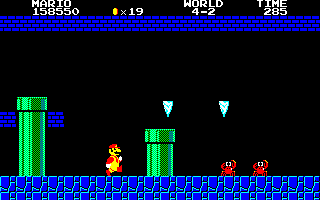 Icicles + Sidesteppers (from Mario Bros.)
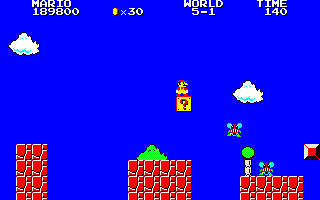 Fighterflies (from Mario Bros.)
The structure of Super Mario Bros. Special closely follows the original Super Mario Bros. — 8 worlds, 4 levels each, 32 levels total. Mario’s goal is to reach either a flagpole or an axe at the end of each stage. Along the way he encounters enemies, collects coins (100 for an extra life), grabs power-ups, and works through the same castle levels to face Bowser.
The physics, however, feel noticeably different. All actions — jumping, dashing, stopping — happen more slowly and last longer than in the original. The stage timer also ticks faster than in the Famicom version, adding pressure. Experienced Super Mario Bros. players will find the momentum and timing genuinely disorienting at first.
One significant change: there are no fake Bowsers in this game. In the original, the “Bowser” in Worlds 1–7 was an imposter that would reveal its true form when hit with fireballs. In Super Mario Bros. Special, every castle’s Bowser is the real one — they simply disappear when defeated with fireballs rather than transforming. Only World 8-4 features the true final Bowser fight.
Another change: the gray Cheep-cheeps from the original are replaced with green ones (or yellow in the PC-88 version), which behave identically.
The Segmented Scrolling System
Super Mario Bros. Special’s most distinctive technical feature is how it handles scrolling. Rather than smooth side-scrolling like the Famicom original, the game divides each level into discrete screen segments and transitions between them — similar to the overworld screen transitions in The Legend of Zelda. When Mario reaches the edge of one screen segment, the game loads the next one.
The two versions handle this differently. The PC-8801 version briefly turns the display black while loading the next screen — a noticeable flash that interrupts the action. The Sharp X1 version handles it more gracefully, visually sliding to the next screen, which feels considerably smoother. This is one of the primary gameplay differences between the two releases.
There is some overlap between screen segments — the edges of adjacent screens share a small amount of visual content — but the overall effect is still quite different from the fluid scrolling of the NES version, and contributes significantly to the game’s different feel.
PC-88 vs Sharp X1 — Two Different Experiences
Sharp X1
The superior version. Partial screen scrolling makes transitions smoother. More colourful graphics using all 8 possible RGB combinations including cyan, magenta and white. X1-compatible joypad required — no keyboard control. Generally considered the definitive way to play.
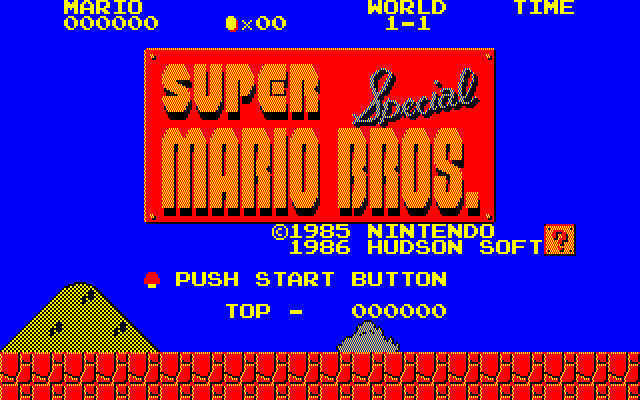
PC-8801
Uses only black, red, yellow and blue (with dithering). Screen transitions flash black briefly. Sprites drop the blue channel entirely, using yellow as a stand-in for white, causing visual quirks like “green” enemies with red eyes. Can be controlled with keyboard or joypad. Some ROM dumps are corrupted — World 8-4 in particular.
The Samsung SPC-1500 version (South Korea, 1989) was a port of the Sharp X1 release and was a Top 20 seller for South Korean home computers in July and August 1989.
New Items — Hudson’s Additions
Hudson Soft added several items not found in any other Mario game. These are unique to Super Mario Bros. Special:
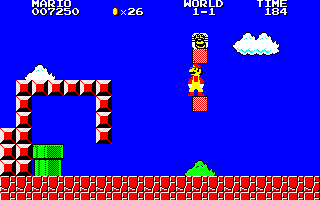 Hachisuke — Hudson’s bee logo (8,000 pts, World 1-1)
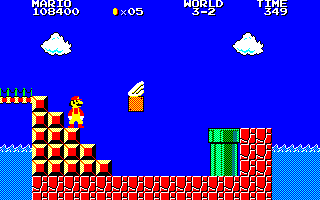 Wing — allows temporary flight via swimming controls
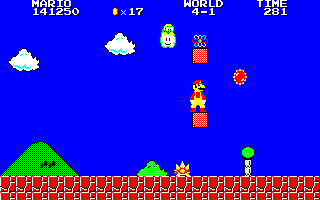 Lucky Star — instantly defeats all on-screen enemies
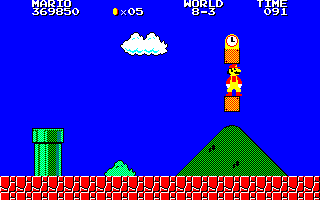 Clock — adds 100 seconds to the stage timer (World 8-3)
- Hachisuke — The bee from Hudson Soft’s company logo. Finding it awards 8,000 points. Located in World 1-1. A confident piece of self-promotion hidden in someone else’s franchise.
- Wing — Allows Mario to fly temporarily by using the swimming controls in the air. Found in hidden blocks in Worlds 3-2 and 4-1. Does not change Mario’s form.
- Clock — Adds 100 seconds to the stage timer when collected. Useful given the game’s faster-ticking clock. Found only in World 8-3.
- Lucky Star — Resembles an atom. Instantly defeats every enemy currently on-screen, awarding their normal point values as if hit by a Starman. Unlike a POW Block, it also affects airborne enemies. Found in World 4-1.
- Hammer (from Donkey Kong) — Found in hidden blocks in Worlds 3-4 and 5-1. Mario swings it rapidly just like in Donkey Kong. Temporary, does not change Mario’s form.
Cross-Game Enemies — The Franchise Mash-Up
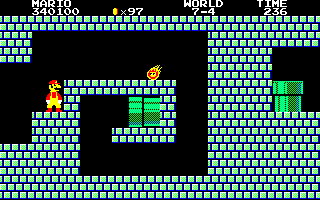 Fireball — rolls like in Donkey Kong (Worlds 7-4, 8-2)
Hudson brought in enemies from earlier Nintendo games alongside the full roster from the original Super Mario Bros.:
From Donkey Kong: Barrels roll down ledges and can only be destroyed with a hammer or a bump (fireballs don’t work). Fireballs tumble horizontally down ledges in the same way. Both are resistant to Fiery Mario’s projectiles, requiring the hammer to defeat.
From Mario Bros.: Sidesteppers (the crabs) walk in straight lines and can be defeated with a fireball, invincibility, or a bump from below. Fighterflies take small hops and change direction on the ground — they’re tricky to deal with. Icicles fall from ceilings in castle levels and can be destroyed with a fireball.
Worlds & Levels
The game follows the same 8-world, 4-level-per-world structure as the original. Each world ends in a castle, and each castle ends with a Bowser fight — a real one every time, not an imposter.
| World | Notable Features | New Enemies |
|---|---|---|
| World 1 | Hammer and Hachisuke hidden in 1-1 | — |
| World 2 | First underwater stages; Sidesteppers debut | Sidestepper (Mario Bros.) |
| World 3 | Wing item available in 3-2; barrels debut in 3-4 | Barrel (Donkey Kong) |
| World 4 | Lucky Star in 4-1; icicles debut in 4-2; Wing in 4-1 | Icicle (Mario Bros.), Sidestepper |
| World 5 | Fighterflies debut in 5-1; Clock only in 8-3 | Fighterfly (Mario Bros.) |
| World 6 | Lakitu-heavy; more barrels | — |
| World 7 | Donkey Kong Fireballs debut in 7-4 | Fireball (Donkey Kong) |
| World 8 | Clock in 8-3; final Bowser in 8-4 (some ROM dumps corrupted) | All enemy types present |
Characters
- Mario — The sole playable character. Luigi is completely absent from the game.
- Princess Toadstool — Kidnapped by Bowser, held in his final castle. When rescued, she compliments Mario and can undo Bowser’s spell on the Mushroom Kingdom.
- Mushroom Retainers — The seven servants of Princess Toadstool held in each of the first seven castles. When rescued, they deliver the classic “Thank you Mario! But our Princess is in another castle!”
- Bowser — Appears in every castle level. In Worlds 1–5 he only breathes fire; in Worlds 6–7 he throws hammers; in World 8 he does both. Crucially, every Bowser in this game is the real one — there are no fake Bowsers.
Development
Super Mario Bros. Special was developed by a team of just nine people at Hudson Soft, with the same team building both the Sharp X1 and PC-8801 versions. The game was produced by Takashi Takebe and programmed by Yukio Takeoka, with levels designed by Ichirou Sakurada.
Sound designer Fumihiko Itagaki would later go on to serve as Technical Support for the Mario Party games on the Nintendo 64 — one of the more surprising career trajectories in Mario history.
Pre-release advertisements in Mycom BASIC Magazine showed screenshots depicting level segments that didn’t appear in the final game, including a version of World 1-1 with additional coins and a brick wall, an underwater stage where Mario can jump, and an underground stage with staircase-style Hard Block formations. The flagpole in one screenshot sits next to a hill rather than open air. None of these configurations made it to release.
Notable Typos — “CONGRATURATIONS”
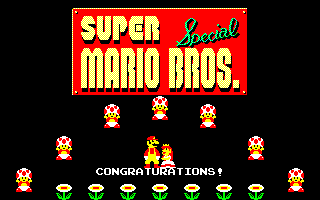 Ending screen — Sharp X1
 “New Charcters!” — the typo screen
Super Mario Bros. Special’s ending sequence contains several memorable typos, present in both the X1 and PC-88 versions:
- “CONGRATURATIONS” — “congratulations” misspelled on the ending screen, likely because the Japanese “l” and “r” sounds are indistinguishable in romanization.
- “New Charcters!” — the “New Characters!” screen after the credits drops the second ‘a’, becoming “Charcters”.
- “Enemy Dispoed” — the credits list the enemy placement role as “Enemy Dispoed” rather than “Enemy Disposed” (or more likely “Enemy Placed”).
- “Hummer Bros” — Hammer Brothers are listed as “Hummer Bros” in the cast list, matching the item name “Hummer” used elsewhere in the game for the hammer power-up.
Reception & Legacy
Contemporary reviews of Super Mario Bros. Special are scarce — the game was released only in Japan on relatively niche computer hardware, and received minimal press coverage outside the domestic market. The Samsung SPC-1500 version was a Top 20 seller for South Korean home computers in July and August 1989, suggesting it found an audience there.
Retrospective reviews lean mixed-to-negative, primarily citing the poor visuals — especially the PC-8801 version’s limited 4-colour palette. Bad Game Hall of Fame awarded it 2 stars, praising it as technologically impressive for the hardware and interesting as an alternative take on Super Mario Bros., while criticising the sluggish physics and weak graphics.
The game’s legacy rests largely on its status as a historical footnote: the first third-party licensed Mario sequel, released in a window where Nintendo itself was simultaneously publishing The Lost Levels. Two major Mario games released within months of each other in 1986, and almost nobody outside Japan knew either of them existed for years. Super Mario Bros. Special is today regarded as one of the most genuinely obscure entries in the entire franchise — a game that even dedicated Mario fans have often never encountered.
Trivia & Facts
- Super Mario Bros. Special was the first licensed third-party sequel to Super Mario Bros., predating the western release of The Lost Levels by many years.
- The game was developed by a 9-person team at Hudson Soft. The same team built both the Sharp X1 and PC-8801 versions.
- Hudson Soft hid their own bee company mascot — “Hachisuke” — in World 1-1 as a collectible worth 8,000 points.
- Jumping was always planned for this game (unlike Hotel Mario). The physics are deliberately slower to accommodate the hardware limitations.
- There are no fake Bowsers. In Worlds 1–7, the Bowser at the end of each castle is real — he simply vanishes when hit with five fireballs rather than revealing his true form.
- Luigi is completely absent. The game has no two-player mode. A colour scheme similar to Luigi’s is used for Fiery Mario and Invincible Mario instead.
- The SPC-1500 version (Samsung, South Korea, 1989) is now largely lost — it has not resurfaced in the modern day and is considered among gaming’s more obscure lost media.
- Some PC-8801 ROM dumps are corrupted. The most common example has World 8-4 fail to load entirely, replacing it with a Disk Error screen.
- Sound designer Fumihiko Itagaki later served as Technical Support for the Mario Party series on Nintendo 64.
- Pre-release advertisements showed level layouts that never appeared in the final game, suggesting significant changes during development.
- The ending screen misspells “congratulations” as “CONGRATURATIONS” — a well-documented issue with romanizing Japanese, where ‘l’ and ‘r’ are the same phoneme.
Video — Full Playthrough
Box Art