
Mario’s Game Gallery
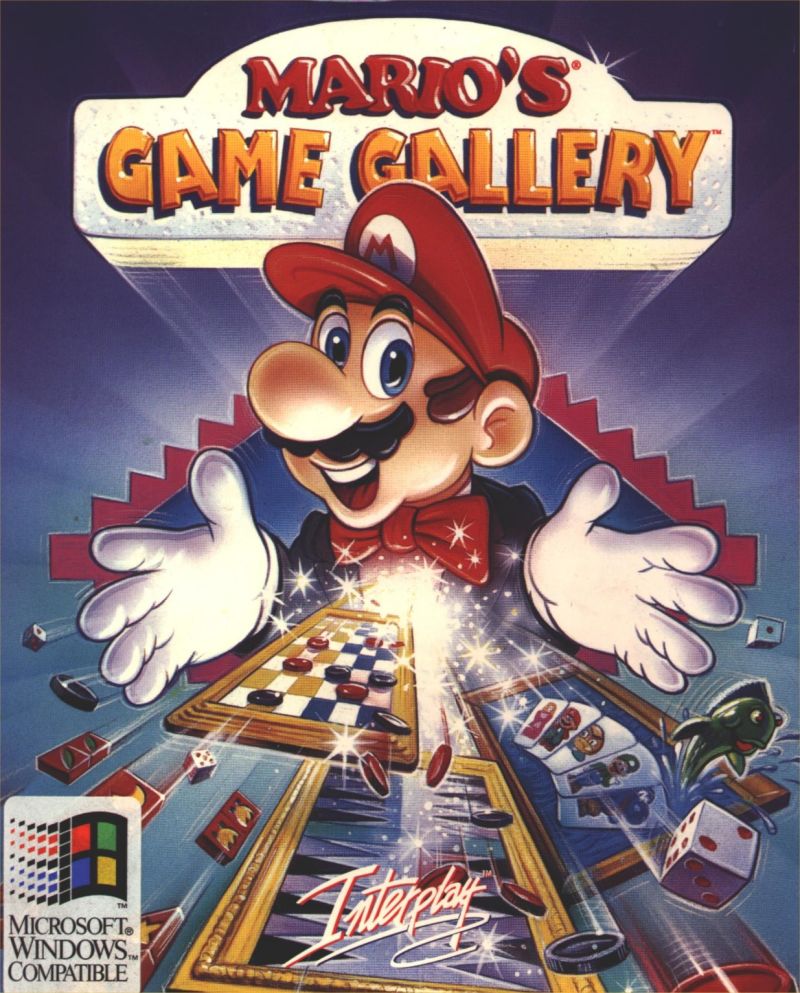
Pull up a chair: Mario wants a game. Mario’s Game Gallery is a box of five family classics – checkers, Go Fish, dominoes, backgammon and Yacht – played on screen against Mario himself, who chats, jokes, tells knock-knock jokes and grumbles when you take too long. The pieces and cards are all from the Mushroom Kingdom: Yoshis against Koopas on the checkerboard, Goombas and Rexes in the Go Fish deck, Fire Flowers and Cape Feathers on the dominoes. Developed by Presage Software and published by Interplay in the United States on 23 February 1995, it is one of the earliest games in which Mario speaks with the voice of Charles Martinet, more than a year before Super Mario 64 made that voice world-famous. It was later reissued as Mario’s FUNdamentals.
Overview
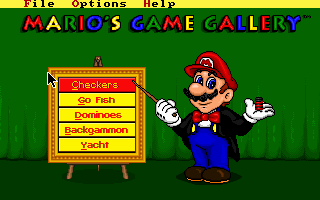
In the mid-1990s Nintendo let several PC publishers put Mario into educational and family software, and Interplay, which already had Mario Teaches Typing, came back with something gentler still. There is nothing to jump on here. Mario’s Game Gallery is a games cabinet: pick one of five board and card games from the menu and Mario sits down opposite you.
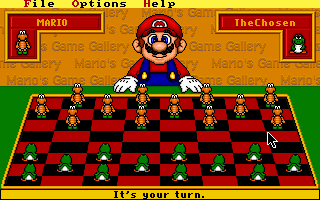
The rules are the real-world ones, explained in on-screen help, but everything has been dressed in Mushroom Kingdom clothes. Checkers pieces are Yoshis and Koopas, crowned as Big Yoshi or Bowser; the Go Fish deck is a parade of Super Mario World characters; the dominoes carry power-ups instead of spots. The draw pile in Go Fish is a pool with a dolphin in it.
The star, though, is Mario’s voice. He talks constantly, in the warm, excitable Italian accent that Charles Martinet had been developing since 1990 at Nintendo trade shows, cajoling you to hurry up, cheering his own good moves and trotting out terrible puns. For many Mario fans this is the first chance to hear that voice in a full game, so it has a small but loyal following, and plays happily on modern PCs through emulators.
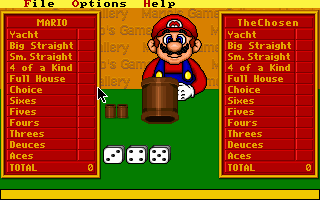
“Ooo! You’ve got Mario thinking now!”
Mario, in Mario’s Game Gallery
Quick Answers
Short answers to common questions about Mario’s Game Gallery.
What games are in Mario’s Game Gallery?
Five: checkers, Go Fish, dominoes, backgammon and Yacht (the dice game from which Yahtzee descends), all played against Mario. More →
Who voices Mario?
Charles Martinet, credited as the Voice of Mario. More →
Was it Charles Martinet’s first game as Mario?
Disputed. Official Nintendo Magazine (2009) and Destructoid (2013) said so, but VGFacts and other references name the CD-ROM version of Mario Teaches Typing, which they date to 1994 (Wikipedia: late 1993), as his first. Game Gallery followed in February 1995. More →
When was it released?
On 23 February 1995 in the United States for MS-DOS, followed by a Mac edition from MacPlay; it was never released elsewhere. More →
What is Mario’s FUNdamentals?
The same game reissued under a new name, by Mindscape on Windows and Stepping Stone on Mac. More →
Who made it?
Presage Software developed it and Interplay published it, under licence from Nintendo. More →
Can two people play?
Yes: each game can be played against Mario or by two players. More →
The Five Games
There is no story: just Mario, a table and five games. Here is each one, with its Mario twist.
Checkers
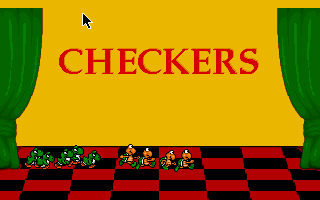
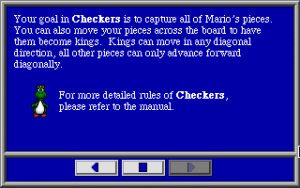
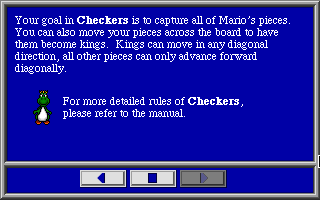
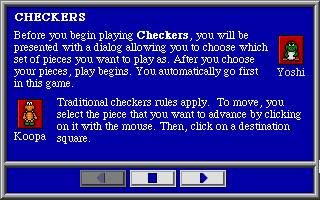
Standard draughts on an 8×8 board, twelve pieces each on the dark squares. You choose Yoshis or Koopas; captures are made by jumping and are compulsory when available. A piece reaching the far side is crowned, becoming Big Yoshi or Bowser in a crown, and can then move and capture backwards. The game ends when the player to move cannot.
Go Fish
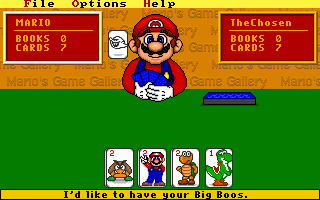
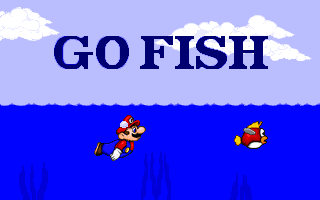
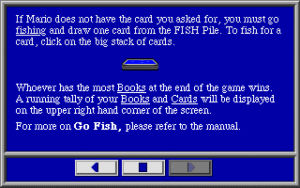
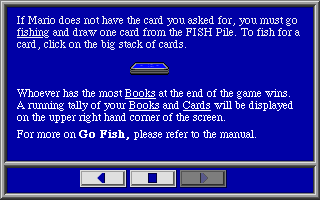
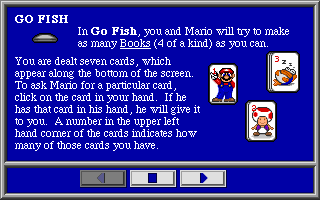
Each player starts with seven cards and asks for cards to complete “books” of four. With no cards left, you must fish. The deck has thirteen kinds of Mario character card, and the draw pile is a pool where a dolphin leaps out each time someone fishes.
Dominoes
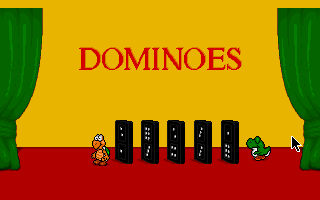
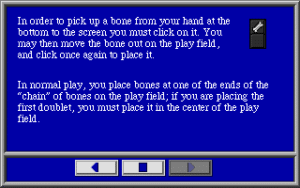
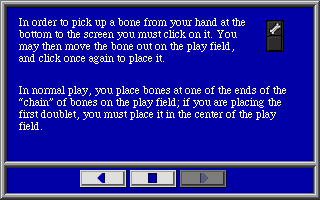
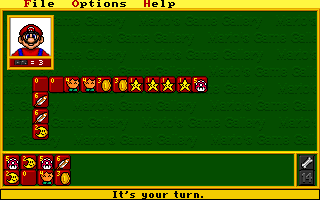
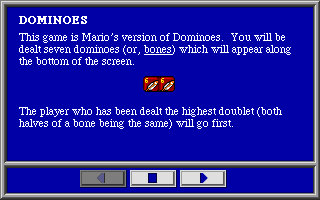
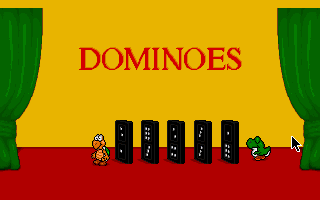
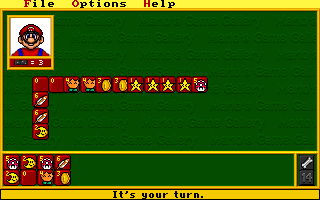
A double-six set of 28 tiles, seven to each player and fourteen in the boneyard; the highest double leads. Instead of spots the ends show pictures: blank for zero, then Super Star (1), 3-Up Moon (2), coin (3), Fire Flower (4), Super Mushroom (5) and Cape Feather (6). Empty your hand first to win, or if both players are blocked, hold the lowest total.
Backgammon
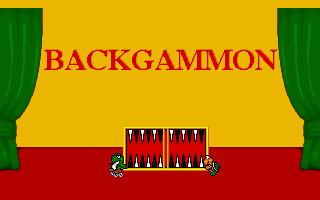
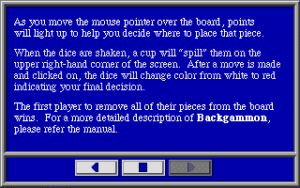
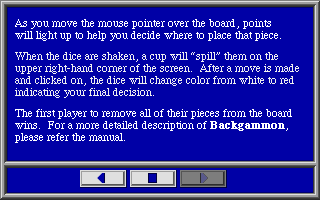
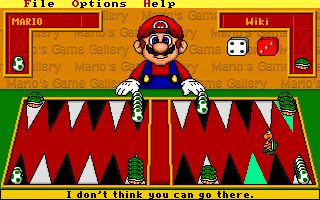
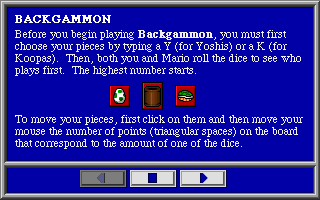
The full game on 24 points with fifteen pieces a side, Yoshis against Koopas. A single die decides who starts, then each turn uses two. Pieces knocked to the bar must come back in before anything else moves, and the first to bear off all fifteen wins. There is no betting and no doubling cube.
Yacht
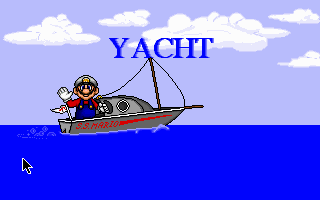
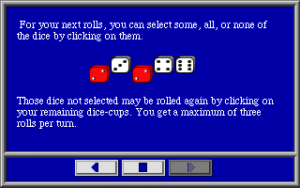
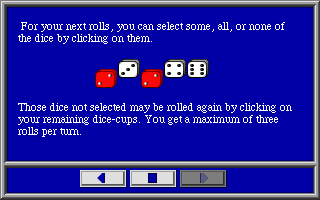
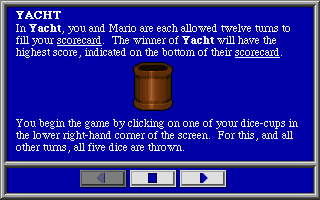
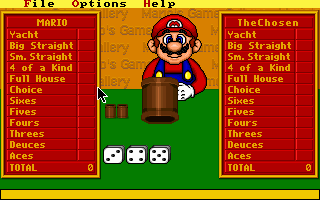
The dice game: five dice, up to three rolls a turn, holding whichever dice you like, then scoring the result on one of twelve lines, each used once. Yacht (all five the same) is worth 50, a Big Straight 30 and a Small Straight 25, alongside Four of a Kind, Full House, Choice and the number lines from Aces to Sixes. The highest total wins.
The five games at a glance
Every game in the gallery, with its Mario theme.
 CheckersBoard · 1–2 playersYoshis versus Koopas; kings are Big Yoshi and a crowned Bowser.
 Go FishCards · 1–2 playersThirteen character cards and a dolphin in the pool.
 DominoesTiles · 1–2 playersPower-ups for pips, from Super Star to Cape Feather.
 BackgammonBoard · 1–2 playersYoshi’s Eggs and green shells; no doubling cube.
 YachtDice · 1–2 playersTwelve scoring lines; a Yacht scores 50.
Gameplay & Controls
Choose a game from the gallery, read the instructions if you need them, then play Mario or a friend.
Playing against Mario
Mario is both opponent and host. He welcomes you (“Let’s play!”), asks whether you would rather be a Yoshi or a Koopa, rolls to see who starts, comments on every move and needles you if you dither (“Hey, what’s taking so long?”). In Go Fish he calls to the fish, and between rounds he tells knock-knock jokes built on dreadful Italian puns. Everything is controlled with the mouse, and each game has two pages of illustrated instructions.
Mushroom Kingdom pieces
The fun is in the dressing. In checkers a Koopa captures a Yoshi by trapping it in a bubble, while a Yoshi simply swallows a Koopa. In backgammon the pieces duck into Yoshi’s Eggs and green shells when they are not moving. The dominoes and Go Fish cards use the cast and items of Super Mario World, right down to that game’s Fire Flower.
The Go Fish deck
Thirteen kinds of card, four of each and no suits:
- GoombasThe commonest foot soldiers.
- KoopasKoopa Troopas.
- Rip Van FishThe sleepy fish of Super Mario World.
- Little ToadiesToad, under the nickname from Nintendo’s 1993 character guide.
- Bob-ombsWalking bombs.
- RexesSuper Mario World’s dinosaurs.
- Piranha PlantsPipe-dwelling plants.
- Big BoosThe giant ghosts.
- YoshisMario’s dinosaur friend.
- MariosThe host himself.
- LuigisHis brother.
- PrincessesPrincess Toadstool.
- BowzersBowser, misspelt on the card.
Characters
One host, many pieces.
| Character | Who they are | In this game | Abilities & notes |
|---|---|---|---|
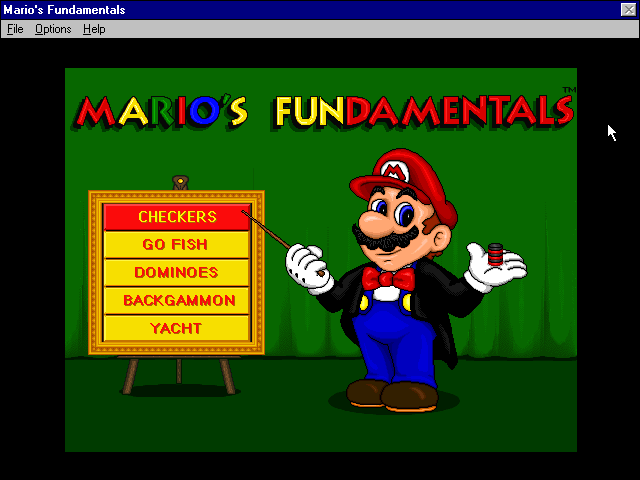 MarioHost and opponent | Voiced by Charles Martinet. | Plays every game against you, talks you through it and tells jokes. Lines include “Come here, fishy-fishy!”, “Mamma mia…” and “Your roll.” | Appears on screen throughout; also the subject of one card type. |
The people who made it
From the game’s credits:
How It Was Made
No making-of interviews have surfaced; the credits and press coverage tell the story.
Presage and Interplay

Presage Software built the game for Interplay, which supplied the producers and the Mario licence; the credits list Interplay’s founder Brian Fargo as executive producer. MacPlay, Interplay’s Macintosh label, announced the Mac edition in a press release dated 13 April 1995.
Was this Martinet’s first Mario game?
Charles Martinet won the part of Mario in 1990 by talking his way into an audition, and his tapes were the ones sent to Nintendo. For several years his Mario was a live act: a computer-generated head at trade shows, driven by sensors on his face. Official Nintendo Magazine (2009) and Destructoid (2013) both presented Mario’s Game Gallery as the first game to use his voice. VGFacts and other references disagree: they credit the CD-ROM edition of Mario Teaches Typing as his first game, dating it to 1994 (Wikipedia puts the MS-DOS CD-ROM in late 1993, and says Martinet took over Mario’s voice for it). Destructoid later added a note saying it was not sure which came first, though it dated that CD-ROM to 1995. Either way, Game Gallery was among his very first, well ahead of Super Mario 64.
Trivia & Interesting Facts
- Mario calls Toad “Little Toadie”, a nickname taken from the 1993 Nintendo character guide given to licensees.
- The Go Fish deck spells Bowser’s name “Bowzers”.
- The Fire Flower on the dominoes is the Super Mario World version.
- Yacht, the last game on the menu, is the older dice game that Yahtzee grew out of.
- One of Mario’s knock-knock jokes ends “Jamaica me cuckoo crazy!”
- The game was sold only in the United States.
- Credits for the Interplay team include a QA department led by Kirk Tome, with Ryan “Smack” Rucinski as lead tester.
Regional Box Art
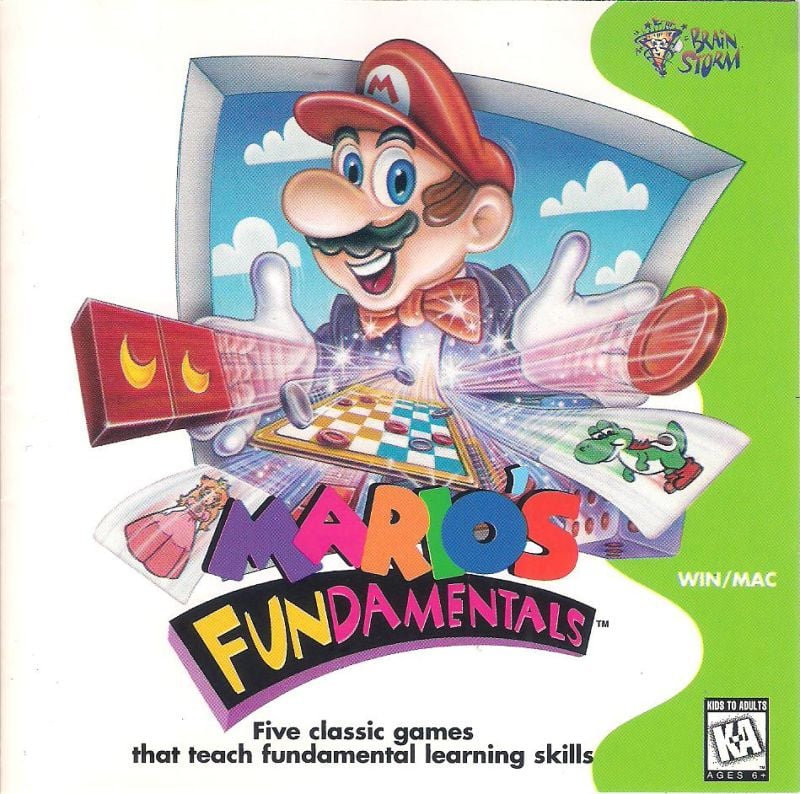
The original box and the FUNdamentals reissue.
Screenshots
More from the gallery.
Legacy & Re-releases
One game, two names.
Release history
- MS-DOS 23 February 1995Mario’s Game Gallery, published by Interplay in the United States.
- Macintosh 1995MacPlay’s Mac edition, announced on 13 April 1995.
- Windows and Mac 1996–1998Reissued as Mario’s FUNdamentals (Mindscape on Windows, Stepping Stone on Mac). Some sources date it 3 March 1998; Wikipedia gives 1996 for the Mac and January 1997 for Windows.
Mario’s FUNdamentals
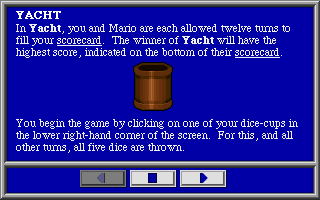
The reissue kept the five games and Mario’s commentary and changed the name to suit its new publishers. It is the title under which the game is sometimes catalogued. Neither version has ever been re-released by Nintendo.
Reviews & Sales
Reviews
No numerical review scores have been found; newspaper reviewers of 1995 were warm, and later writers were not.
Roy Bassave reviewed it for The Miami Herald and The State in May and June 1995, praising sharp graphics, lively animation and Mario-flavoured music, calling it fun for the whole family and recommending it to new CD-ROM owners, though he warned that it could be hard at times. The Advocate in Louisiana singled out Martinet’s Mario, predicting that small children would giggle with delight, and the Los Angeles Times included it in a December 1997 round-up of educational software.
Retrospectives were harsher. ScrewAttack put it sixth in its 2007 Top Ten Worst Mario Games, and David Wesley and Gloria Barczak’s 2010 business book Innovation and Marketing in the Video Game Industry listed it among the ill-conceived Mario spin-offs that, in their view, nearly damaged the brand. Official Nintendo Magazine included it in a 2009 feature on rare Mario games.
SLB User Reviews
Mario’s Game Gallery has yet to receive a community review on Super Luigi Bros.
If you’ve played Mario’s Game Gallery and would like to submit a review, please get in touch.
More from the Super Luigi Bros Guide
These picture lists come from the earlier Super Luigi Bros guide to Mario’s Game Gallery and are kept here in full.
The Five Games
All five games follow their real-world counterparts faithfully, with Mario-themed pieces and a fully voiced Mario as your only opponent. There is no difficulty setting — Mario plays at a fixed level, and by general consensus he plays rather well. Player reviews from the era and beyond frequently describe him as “rigged” or “a cheating bastard”, particularly in Go Fish, where Mario demonstrably knows what you just drew from the deck.
 Intro screen
 Gameplay
 Intro screen
 Gameplay
 Intro screen
 Gameplay
 Intro screen
 Gameplay
 Yacht scoresheet
Screenshots Gallery
 Main Menu (MS-DOS)Checkers — introCheckers — gameplayGo Fish — introGo Fish — gameplay
 Go Fish — Rex card animationDominoes — introDominoes — gameplayBackgammon — introBackgammon — gameplayYacht — scoresheet
 Checkers — instructions
 Go Fish — instructions
 FUNdamentals — Windows title screen
Reference / Information
Media / Downloads
Mario’s Game Gallery is considered abandonware and is freely available to play online or download.
Sources
Every fact on this page was checked against the 7 sources listed here.
Show sources
Wikipedia, “Mario’s Game Gallery” · VGFacts, “Mario’s Game Gallery” trivia · Destructoid, “Behold, the first Mario game voiced by Charles Martinet”, Tony Ponce, 20 April 2013 · Super Mario Wiki (4 articles)
Images: Mario and all related characters, artwork and screenshots are © Nintendo; other artwork, covers and scans are © their respective owners. Images are used here for commentary and reference.