Nintendo 3DS2012TennisCamelot Software PlanningFirst online Mario Tennis25 charactersGyro-aimed Direct Mode1.11 million sold (Nintendo, 2013)
Mario Tennis Open
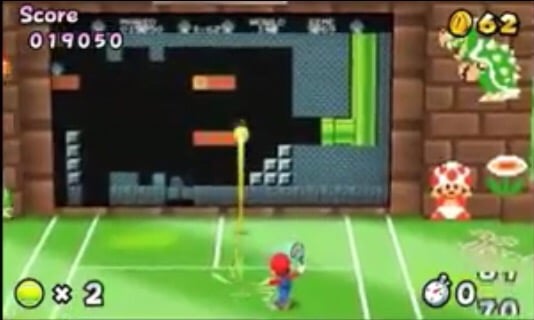
Seven years after Power Tour, Mario took his racket back to a handheld. Mario Tennis Open, made by Camelot Software Planning, arrived on the Nintendo 3DS on 20 May 2012 in North America and a few days later in Japan, Europe and Australia. It swapped the Power Shots of the GameCube era for Chance Shots: coloured zones that light up on your side of the court, rewarding the player who reaches them and plays the matching shot. Hold the console upright and the gyro sensor puts you behind your player in Direct Mode, aiming by tilting the system. It was also the first Mario Tennis with online play, let you dress your Mii in 194 pieces of gear and character costumes, and hid Metal Mario and seven coloured Yoshis behind QR codes. Its best-loved extra was Super Mario Tennis, a Special Game in which you rally against a wall showing scrolling Super Mario Bros. stages. Nintendo counted 1.11 million copies sold worldwide by 31 March 2013.
Developer:Camelot Software Planning (with Nintendo SPD Group No. 4)
Publisher:Nintendo
Platform:Nintendo 3DS
Genre:Tennis
N. America:20 May 2012
Japan:24 May 2012
Europe:25 May 2012
Australia:24 May 2012
Hong Kong, Taiwan, Korea:12 April 2013 (Hong Kong, Taiwan); 18 April 2013 (South Korea)
Mario Tennis Open is the series’ first game on the Nintendo 3DS and its first on a handheld since Mario Tennis: Power Tour on the Game Boy Advance. Super Mario Wiki counts it as the sixth main Mario Tennis game. Unlike the earlier handheld games it has no story or role-playing side: this is tennis first, with singles and doubles Tournaments, Exhibition matches and four Special Games.
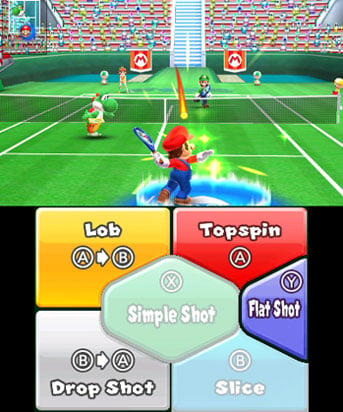
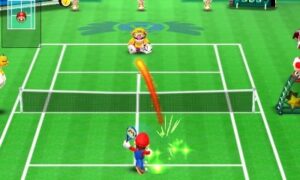
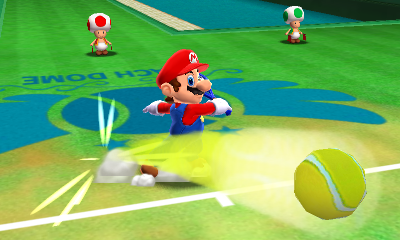
Its big idea is the Chance Shot. When your opponent sends back a weak return, a coloured area marked with a Mario symbol appears on your side of the court. Get into it and hit the shot of the same colour (a fiery topspin on red, a curling slice on blue, a smash on purple, a towering lob on yellow, a dead drop shot on white) and the shot becomes far stronger. The player on the receiving end can blunt it with the right counter shot, which the touch screen helpfully lights up.
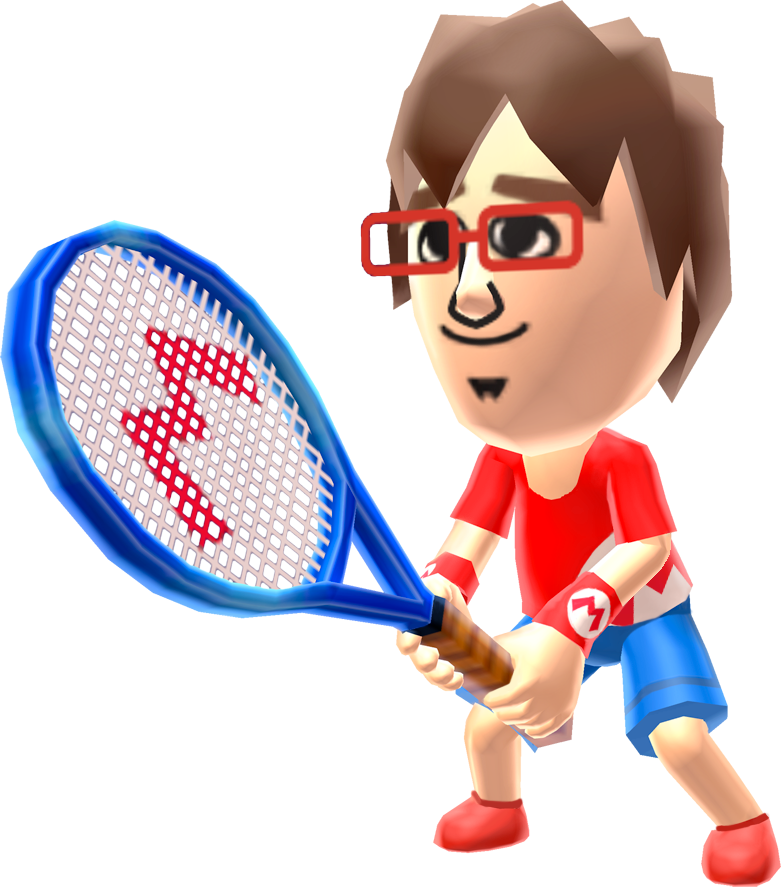
Controls come three ways: the classic buttons, panels on the touch screen, or the gyro sensor. Turn the 3DS upright and the game switches to Direct Mode, a view from behind your player in which they run to the ball for you and you aim by turning the console. Your Mii can join the cast, dressed in rackets, uniforms, wristbands, shoes and costumes bought with coins or earned by meeting challenges, and every item changes its stats.
Online play arrived in the series here, over Nintendo Network: friendly rooms for up to four players and rated Open Matches against strangers in your own region. StreetPass let you play against the Miis of people you had passed. Critics found the tennis solid but very like earlier games; they enjoyed the Special Games, especially Super Mario Tennis, and grumbled about online lag. It sold 1.11 million copies worldwide by March 2013, according to Nintendo.
In Mario Tennis Open on Nintendo 3DS, you can use basic button controls like previous titles in the series, but with the addition of gyro sensor and Touch Screen controls – made possible thanks to Nintendo 3DS – you can enjoy tactical tennis with greater depth than ever before.
Play singles or go multiplayer with up to four people in a range of different modes. You can play with friends both locally and online, or search for other players online in your region to take to the court against. Serve, volley and smash your way up the leaderboard and see if you have what it takes to reach the top of the circuit. If you have friends nearby, you can even play a multiplayer match with just one copy of the game through Nintendo 3DS Download Play!
Choose from a variety of your favourite Nintendo characters or use your Mii character for a personalised tennis experience like none before. You can also customise your player of choice by winning coins and unlocking items from the in-game shop.
— Official description (Nintendo UK, 2012)
Why Mario Tennis Open matters to Mario fans
It is the Mario Tennis that leans hardest on Mario history. One Special Game turns the opening stages of Super Mario Bros. into a tennis wall, another borrows the black holes and Lumas of Super Mario Galaxy, the courts sit in Mushroom Gorge and beside the Comet Observatory, and the costume rack runs from Tanooki Mario to Petey Piranha. It also gave Luma, Baby Peach, Dry Bowser and Metal Mario their first Mario Tennis outings.
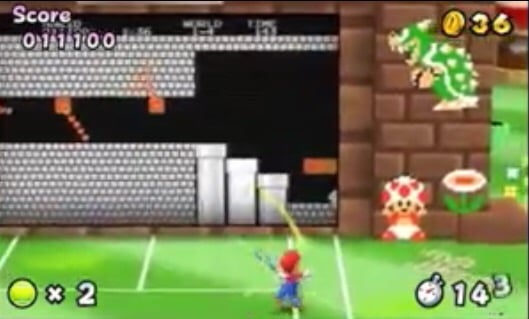
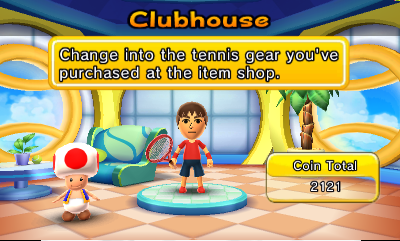
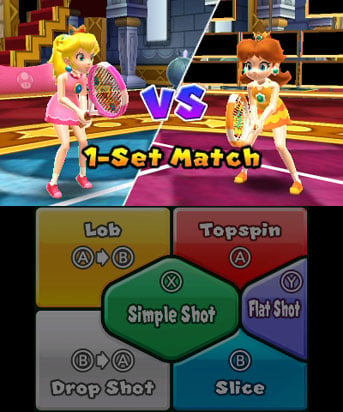
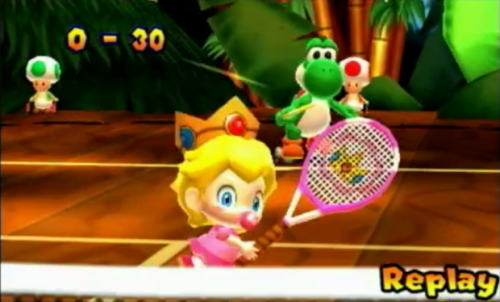
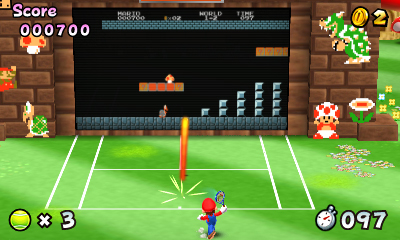
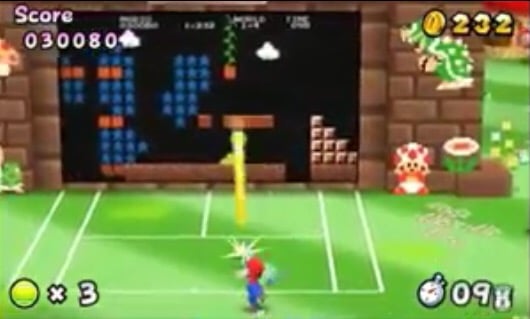
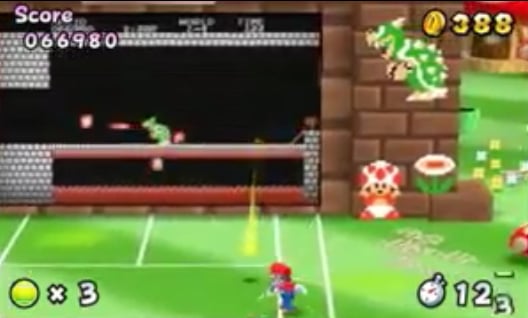
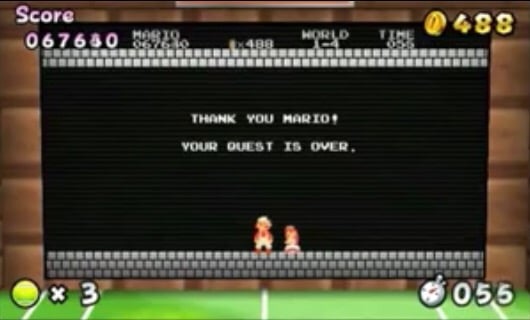
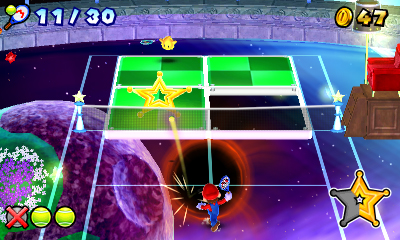
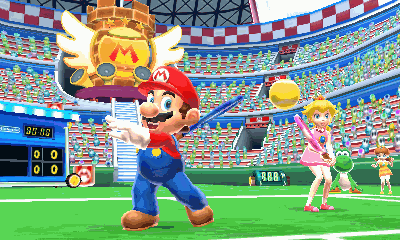
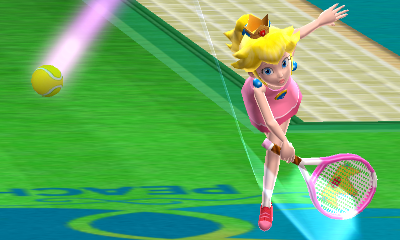
Mario lines up a slice from a blue Chance Shot area at Mario Stadium.Super Mario Tennis: rallying against a wall showing World 1-4.Toad and a Mii in the Clubhouse, where gear is bought.Princess Peach against Princess Daisy.
Quick Answers
The questions people ask most about Mario Tennis Open, answered briefly here and in depth further down the page.
When did Mario Tennis Open come out?
On 20 May 2012 in North America, 24 May in Japan and Australia and 25 May in Europe. Hong Kong and Taiwan followed on 12 April 2013 and South Korea on 18 April 2013. More →
How many characters are in Mario Tennis Open?
Twenty-five, counting your Mii. Thirteen are available at the start, four (Luma, Baby Mario, Baby Peach and Dry Bowser) are unlocked by clearing the third level of a Special Game, and eight (Metal Mario and seven coloured Yoshis) by scanning QR codes. More →
How do you unlock Metal Mario and the coloured Yoshis?
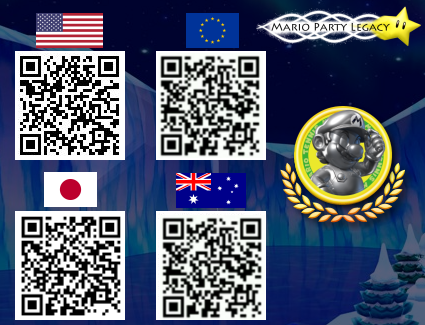
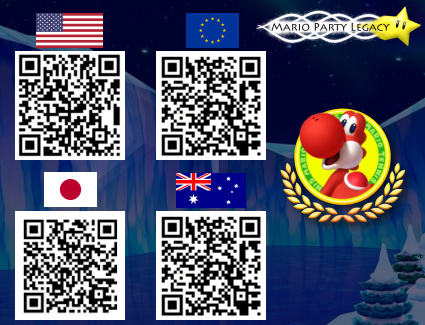
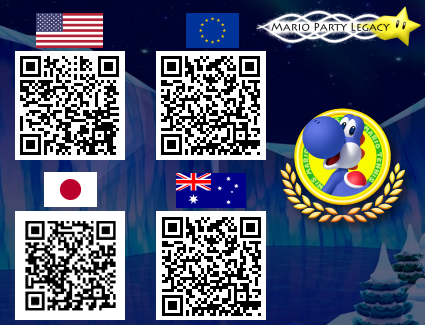
Scan their QR codes. Create a save file, then on the file select screen press Up on the +Control Pad and Start together to open the camera. Nintendo published the codes, and in Europe and Australia shops ran a Yoshi Hunt with them. More →
What is a Chance Shot?
A coloured area that appears on your side of the court after your opponent’s weak return. Stand in it and hit the matching shot for a much stronger version: red topspin, blue slice, purple smash, yellow lob or white drop shot. More →
What is Super Mario Tennis?
A Special Game in which you hit the ball against a wall showing scrolling Super Mario Bros. levels, knocking out enemies and collecting coins and power-ups until the ball reaches the flagpole. Clearing its third level unlocks Baby Mario. More →
Can you still play Mario Tennis Open online?
No. Online play ran on Nintendo Network, which closed for 3DS and Wii U games on 8 April 2024. Local wireless play and Download Play still work, and the eShop version stopped being sold on 27 March 2023. More →
How many courts are there?
Eleven at eight venues: three Mario Stadium surfaces, Mushroom Valley, Wario Dunes, DK Jungle, Peach’s Palace, Penguin Iceberg, Bowser’s Castle and the Galaxy Arena’s Crystal and Morph Courts. More →
How many copies did Mario Tennis Open sell?
Nintendo reported 1.11 million worldwide by 31 March 2013. In Japan, Famitsu counted about 280,000 by mid-August 2012. More →
Who made Mario Tennis Open?
Camelot Software Planning, with Nintendo’s SPD Group No. 4. Shugo Takahashi directed, he and his brother Hiroyuki produced and led the game design, and Motoi Sakuraba wrote the music. More →
Modes & Courts
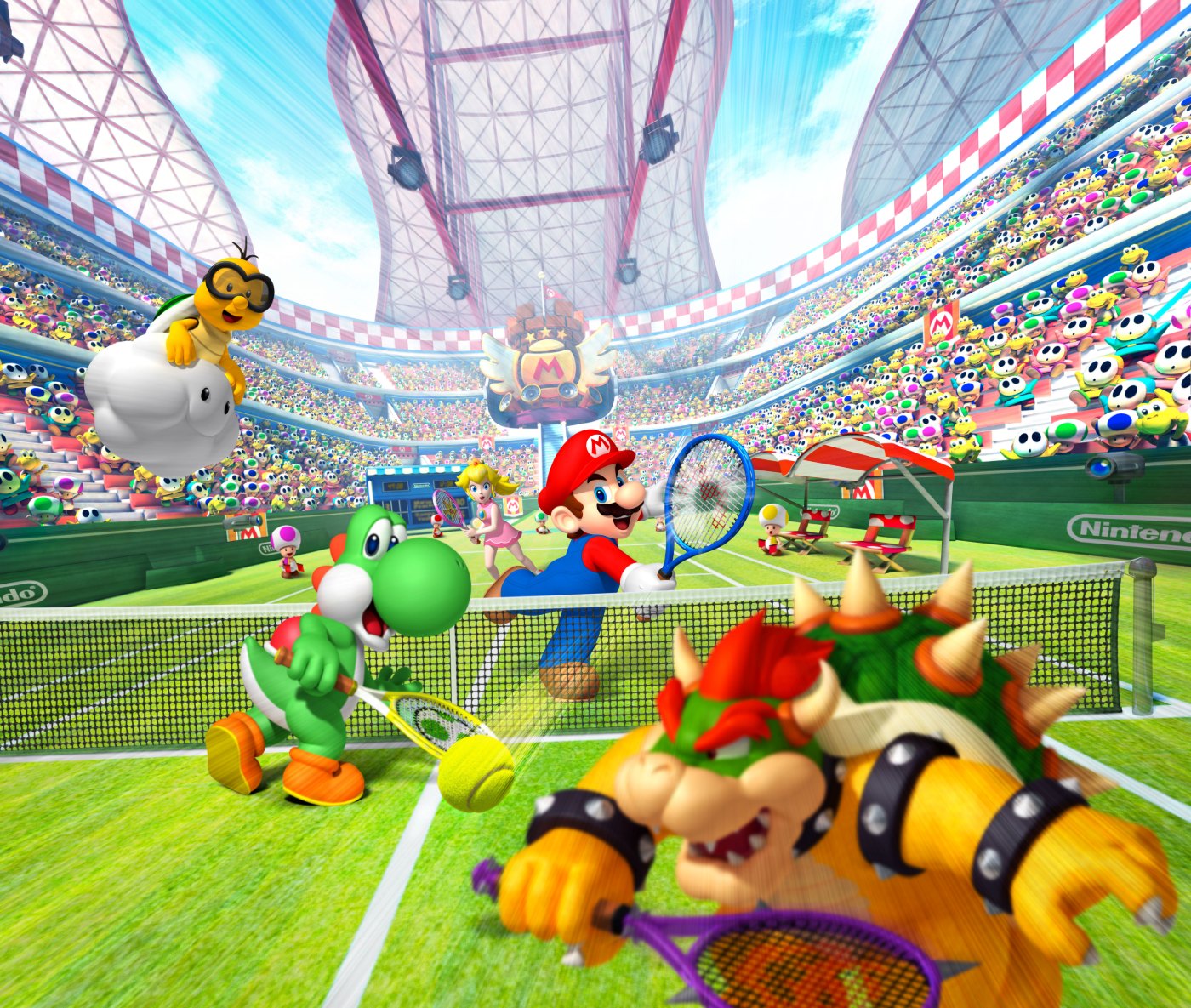
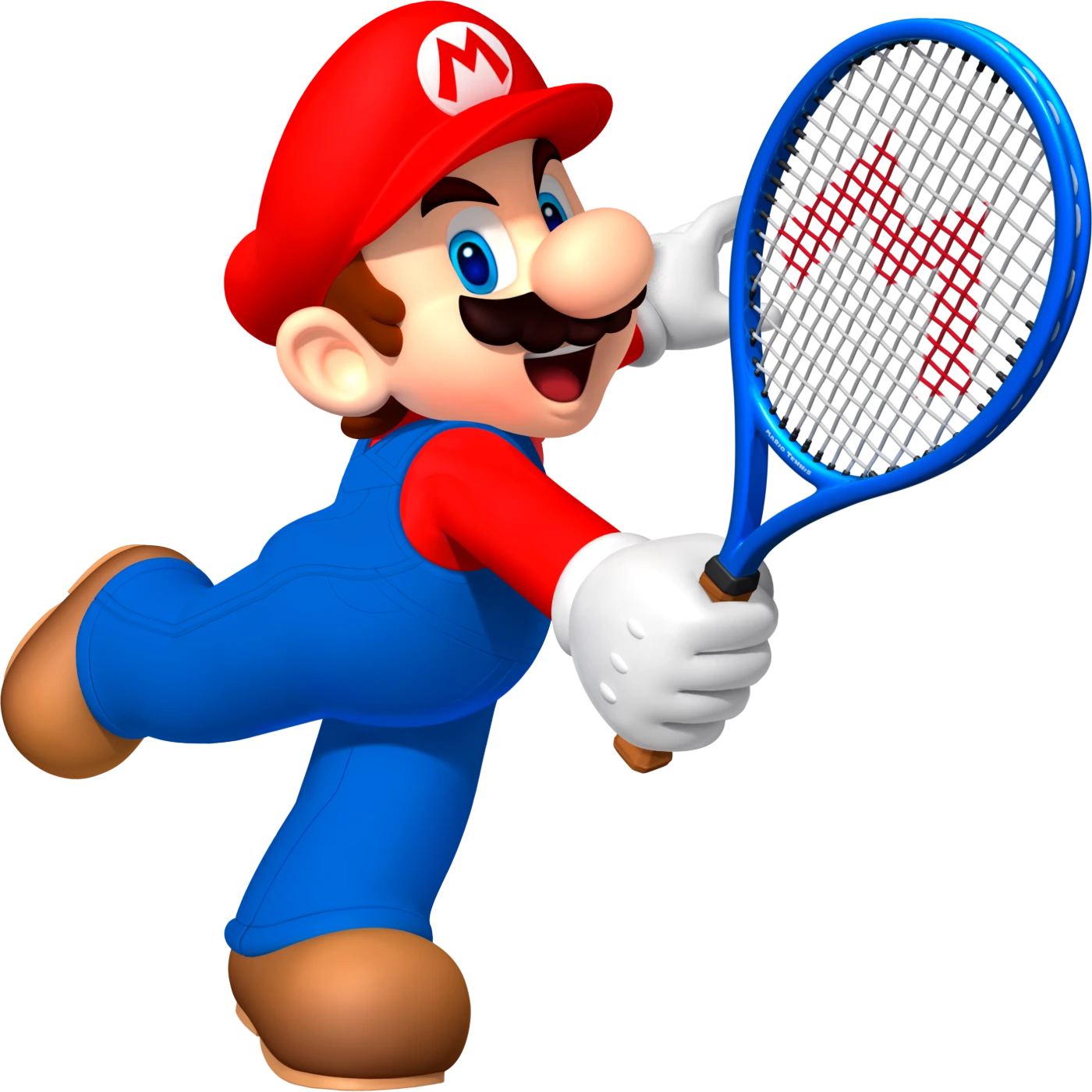
Mario’s official artwork for the game.
Mario Tennis Open has no story mode. The main menu offers Tournament, Exhibition and four Special Games for one player, the same with friends over local wireless or online, StreetPass matches, and the Clubhouse, where you dress your Mii, check your records and change options.
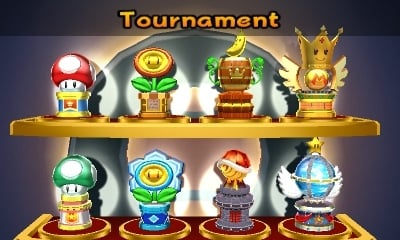
Progress is about winning cups and clearing Special Games. The first four cups form the World Open; win its Champions Cup and your character earns a star rank, which opens the four cups of the Star Open. Each cup is played on its own court, and once a cup is open you can play it with any character in any order. The Special Games give up the four unlockable characters at their third level and costumes at their fourth.
Tournament: the World Open
Each cup is a three-round knockout: an opening match, a semi-final and a final, played in singles or doubles. The Mushroom Cup on the bouncy Mushroom Valley court is the gentle start, with one-set early rounds and a three-set final. The Flower Cup moves to the sand of Wario Dunes and lengthens the semi-final to three sets; the Banana Cup at DK Jungle asks for a five-set final. The Champions Cup, played on the Mario Stadium courts, has the same format and is the one that matters: win it and you unlock Pro difficulty and a star rank for your character. Unlike older Mario Tennis games, you do not have to win the first three cups to enter it.
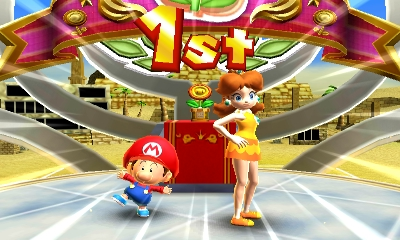
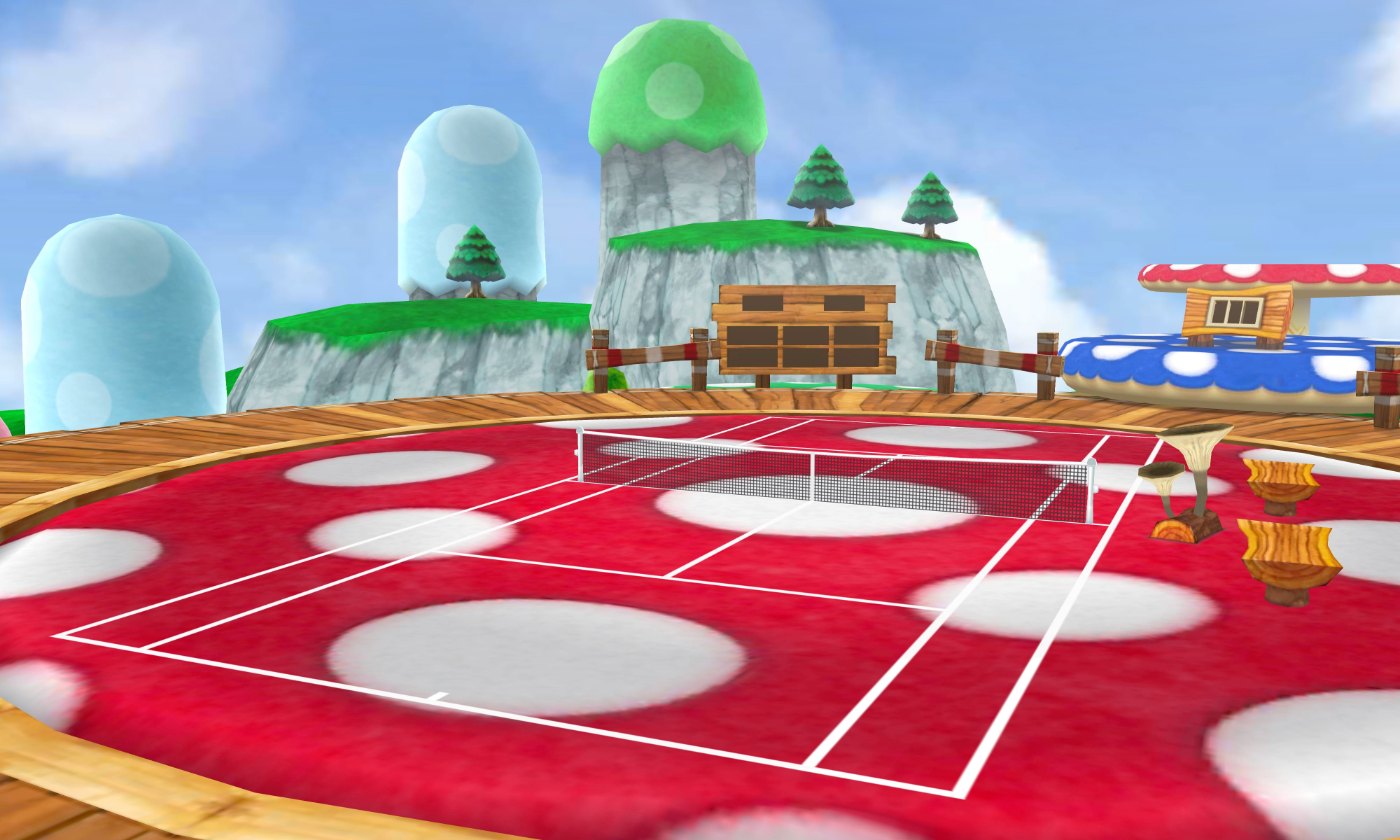
Mushroom Valley, home of the Mushroom Cup.Wario Dunes, used for the Flower Cup.DK Jungle, home of the Banana Cup.Flower Cup champions: Baby Mario and Daisy.
Tournament: the Star Open
Starred characters only. The 1-Up Mushroom Cup at Peach’s Palace is the warm-up; the Ice Flower Cup at Penguin Iceberg adds a five-set final; the Shell Cup at Bowser’s Castle makes every round longer, with three-set opening matches; and the Final Cup is played on the shape-shifting Morph Court of the Galaxy Arena, with a new set of surfaces in each round. Winning the Final Cup unlocks Ace difficulty and the Galaxy Arena, and the Mario and Luigi costumes go to the winners of its singles and doubles draws.
Peach’s Palace, home of the 1-Up Mushroom Cup.Penguin Iceberg, used for the Ice Flower Cup.Bowser’s Castle, home of the Shell Cup.The Galaxy Arena, scene of the Final Cup.
Exhibition
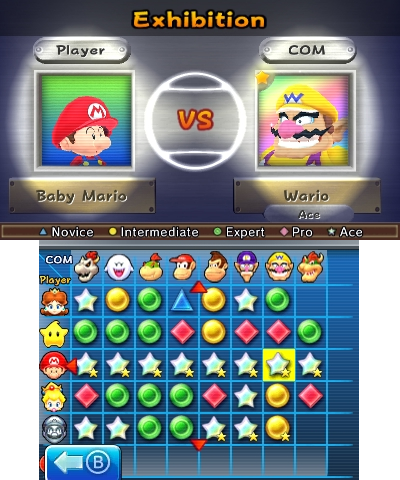
The match you build yourself: singles or doubles, any unlocked characters (with L for a left-hander and R for a star rank), opponents at any unlocked level, any court and your own choice of games and sets. Results are kept on a records screen.
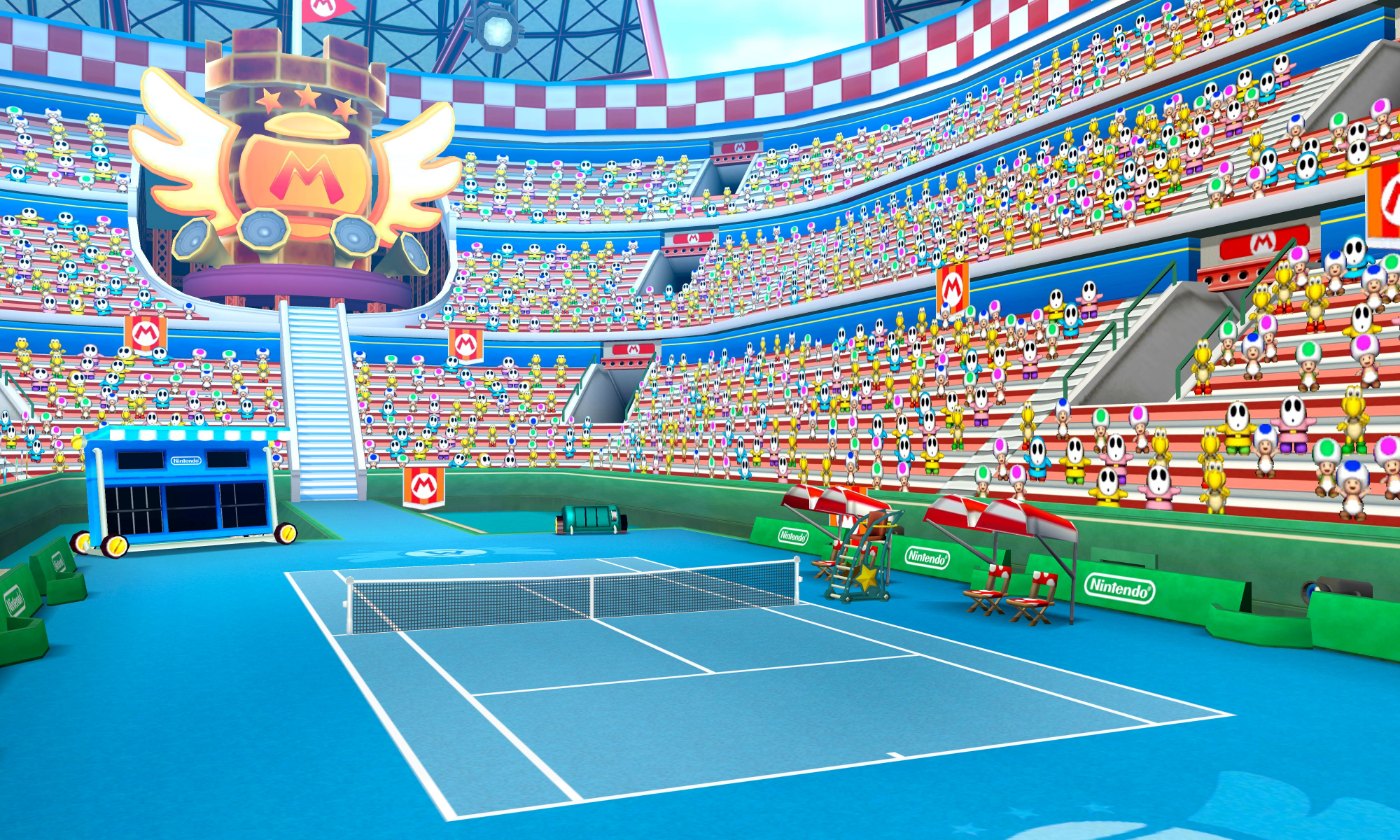
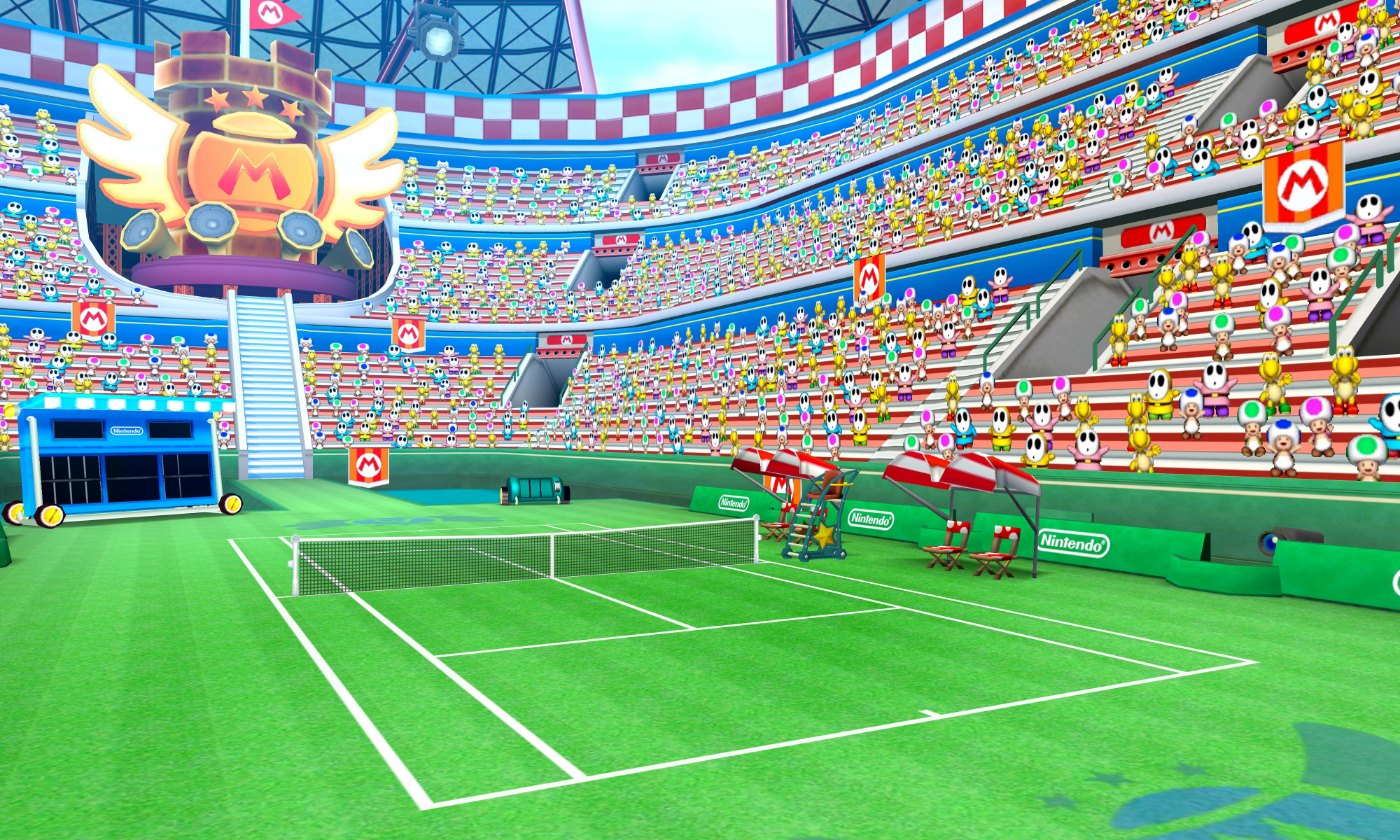
Mario Stadium’s grass court.Mario Stadium’s hard court.
Special Game: Ring Shot
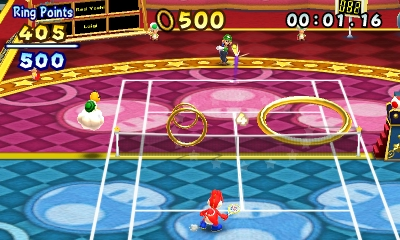
Ring Shot moves into the Special Games after being a play mode in the N64 game and an Exhibition option in Mario Power Tennis. Rings float over the net and you keep a rally going while threading the ball through them; the bigger the ring, the fewer points it is worth, so small rings are the prize. Like the other Special Games it has four levels named after the game, and clearing the third unlocks Baby Peach. The fourth, the Ring Shot Challenge, pays out the Peach costume for 800 ring points, and two players together can win Daisy’s costume by reaching 700.
Ring Shot.Baby Peach, Ring Shot’s prize, returns a ball.
Special Game: Super Mario Tennis
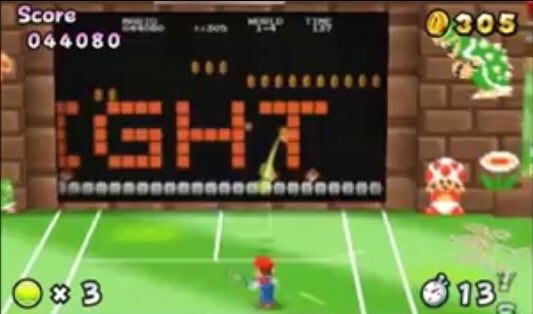
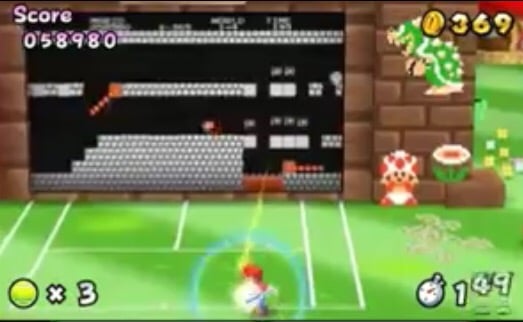
The one everybody remembers. You stand facing a giant screen on which a Super Mario Bros. level scrolls along by itself, and you play the ball against it. Hit Goombas and Koopas, coins, Brick Blocks and power-ups to earn points, coins and extra seconds on the clock; get the ball to the flagpole to clear the level. A Super Mushroom lets the ball smash bricks, a Fire Flower makes it throw fireballs, a Super Star turns every spot it hits into coins and a 1-Up Mushroom gives an extra life. Run out of time and you lose a life; lose them all and the game is over.
One player tackles four levels based on Worlds 1-1 to 1-4, the castle ending in a fight with Bowser and the rescue of Princess Peach; two players over local wireless get four more based on Worlds 2-1 to 2-4. Hitting certain pipes warps the ball into a bonus area. Clearing 1-3 unlocks Baby Mario, and finishing 1-4 with 800 coins earns the Wario costume (2-4 with 800 coins earns Waluigi’s).
Super Mario Tennis.The third area of World 1-4.The Bowser fight at the end of World 1-4.Mario reaches Princess Peach.
Special Game: Galaxy Rally
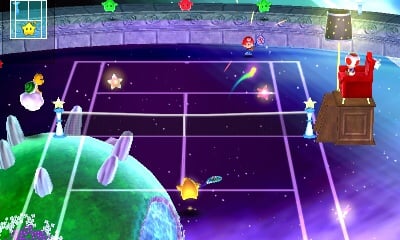
A cooperative rally with a Luma across a court of four floating platforms on the Galaxy Arena. Each time the ball bounces on a platform that platform vanishes, and if the ball falls through the gap into the black hole below you lose one of your three tries. The goals climb from 30 returns to 50 and then 100, and later in a rally more platforms go missing at once. Touch Star Chips for coins; collect five and a Launch Star forms, worth more coins each time you hit it. Clearing the third level unlocks Luma, and the Galaxy Rally Challenge pays out the Luma costume for 1,500 coins.
Galaxy Rally.Luma, Galaxy Rally’s prize, returns a ball at Peach’s Palace.
Special Game: Ink Showdown
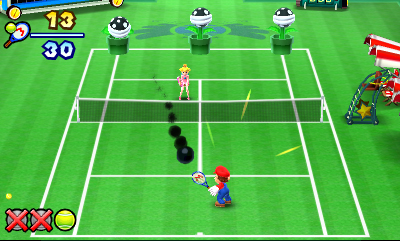
A descendant of the original Mario Tennis’s Piranha Challenge. Three Inky Piranha Plants spit balls at you, and you score by hitting each one past a computer opponent (or by hitting the opponent). Every so often a plant spits ink instead: hit the ink ball to clear it, or it splatters across your view. Each failed return costs one of three tries. The first three levels, played on the three Mario Stadium surfaces against Peach, Yoshi and then Wario, need 30 points each, and clearing the third unlocks Dry Bowser. The Ink Showdown Challenge at Bowser’s Castle gives you 50 balls against Bowser, and 50 returns earn the Petey Piranha costume.
Ink Showdown.Dry Bowser, Ink Showdown’s prize, plays a flat shot.
Every court in Mario Tennis Open
Eleven courts at eight venues. Each surface has its own ball speed and bounce, shown in the game; the one-line descriptions paraphrase the game’s own court notes.
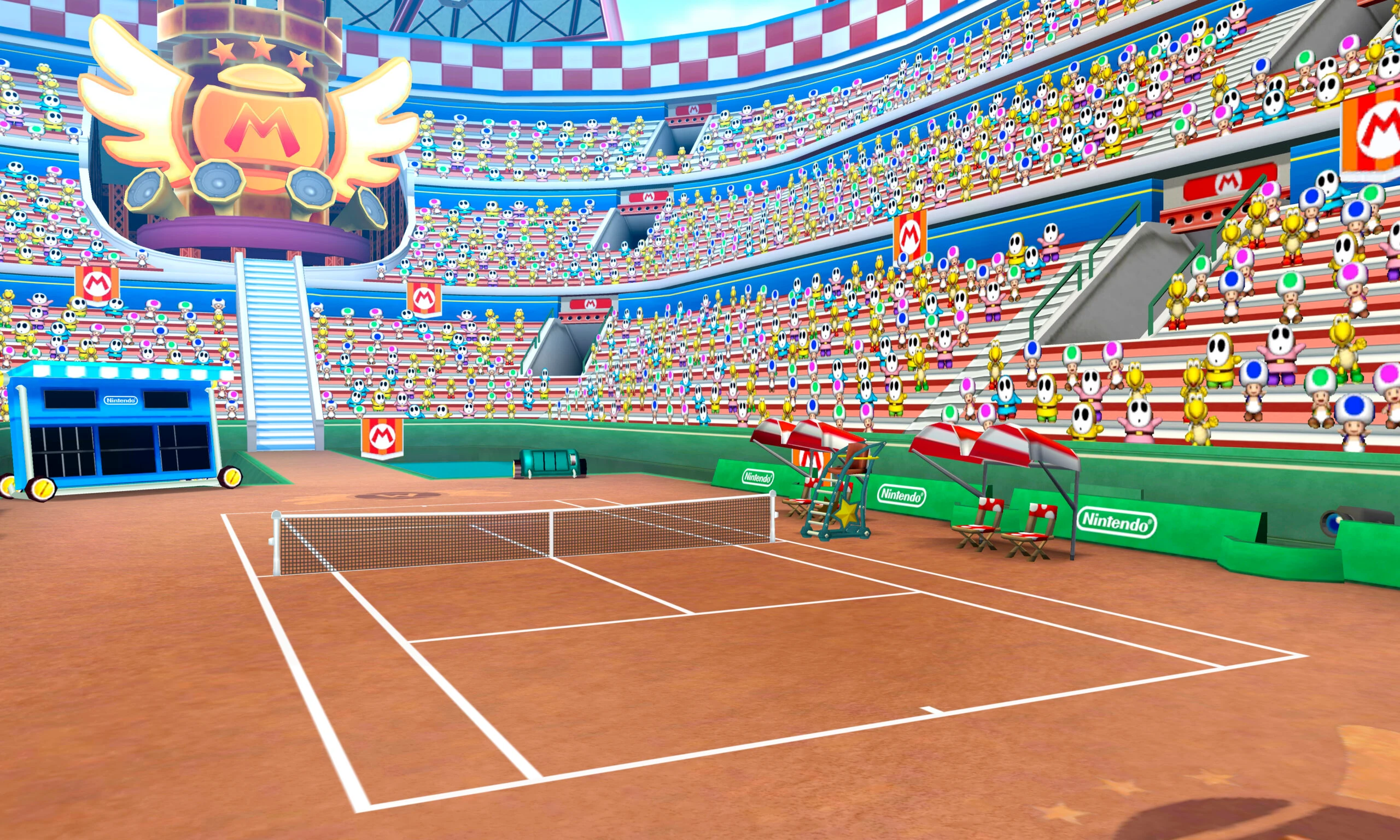
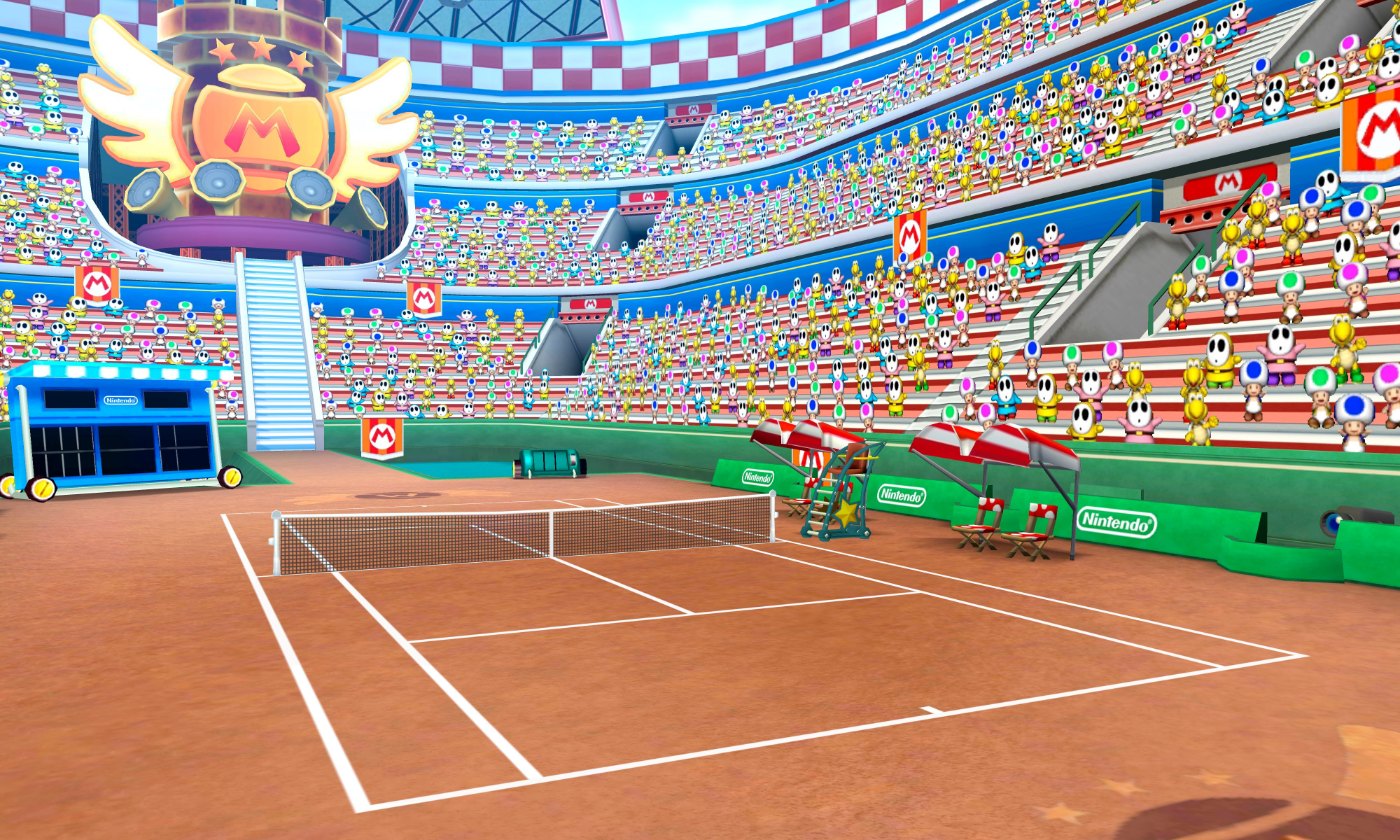
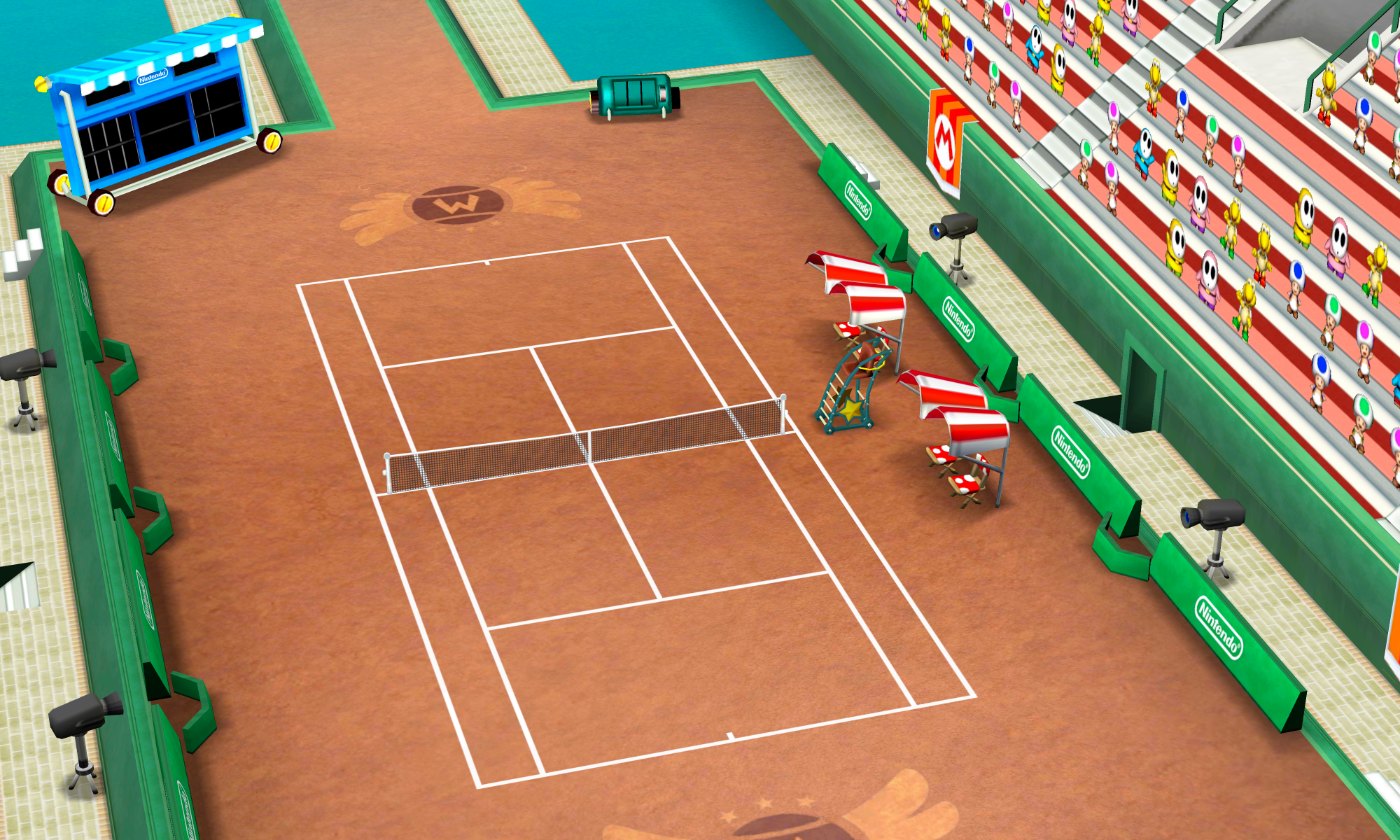
Mario Stadium – Clay CourtClay · slow ball, weak bounce · Champions CupThe stadium’s slowest surface and the place for patient baseline rallies.
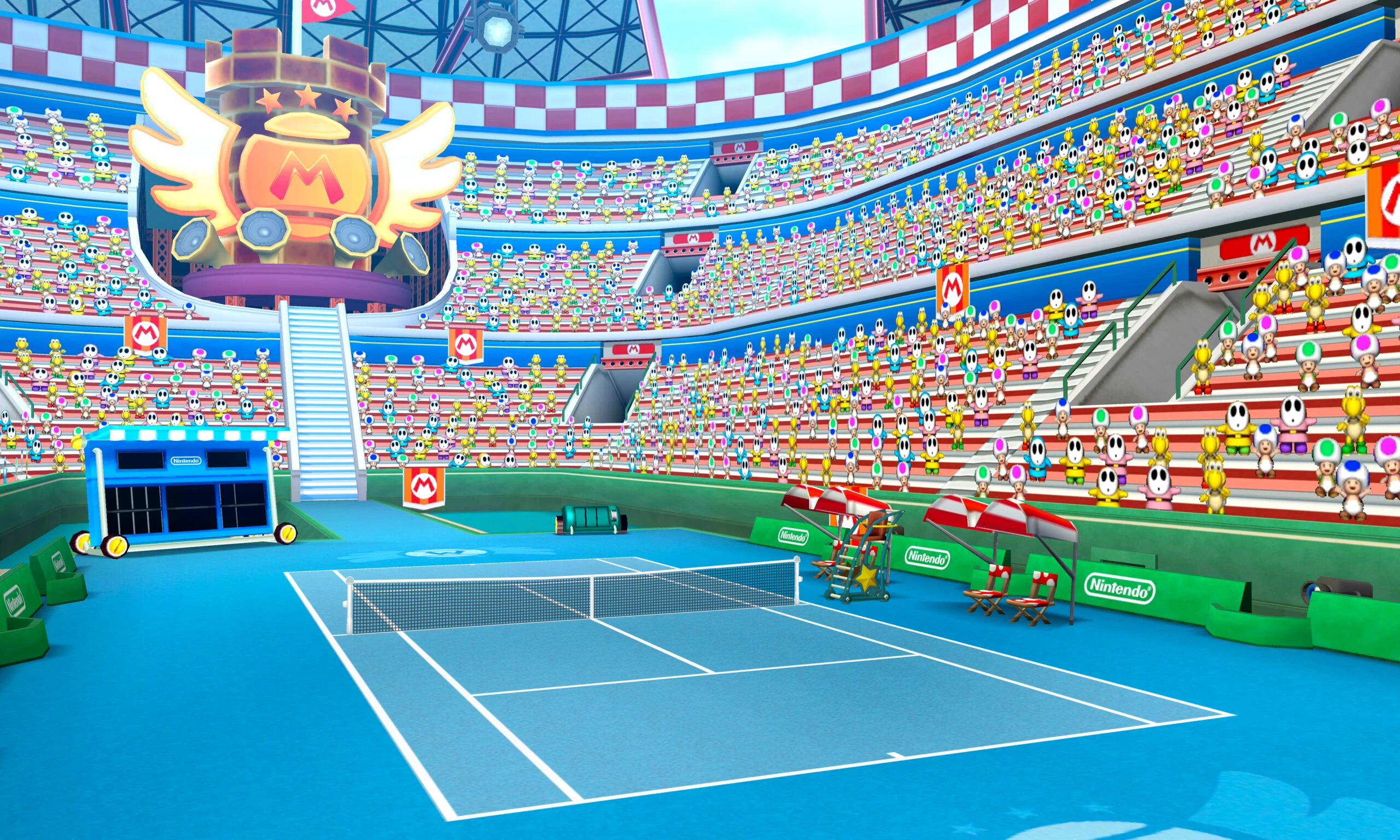
Mario Stadium – Hard CourtHard · normal speed, strong bounce · Champions CupThe all-round surface that the series’ top players treat as home.
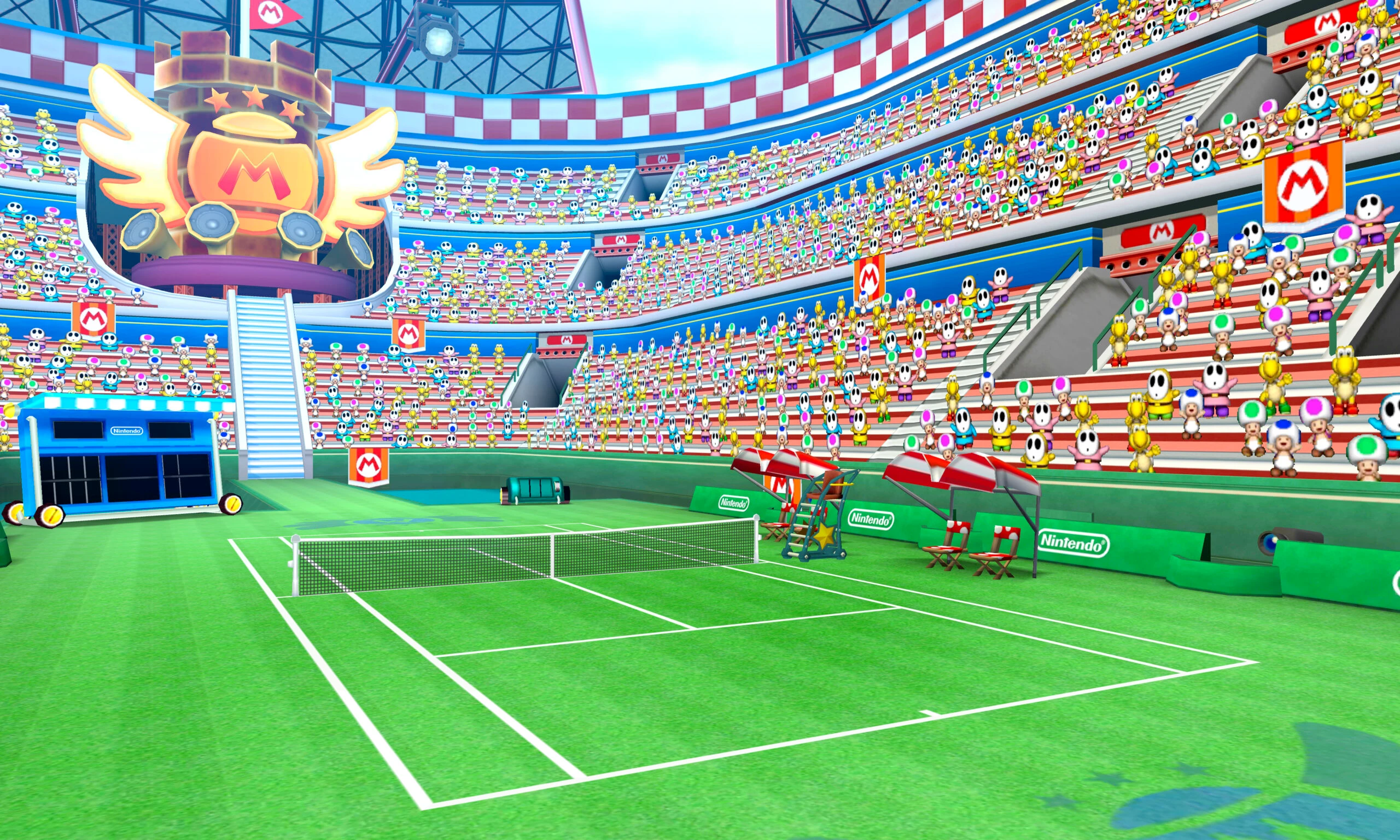
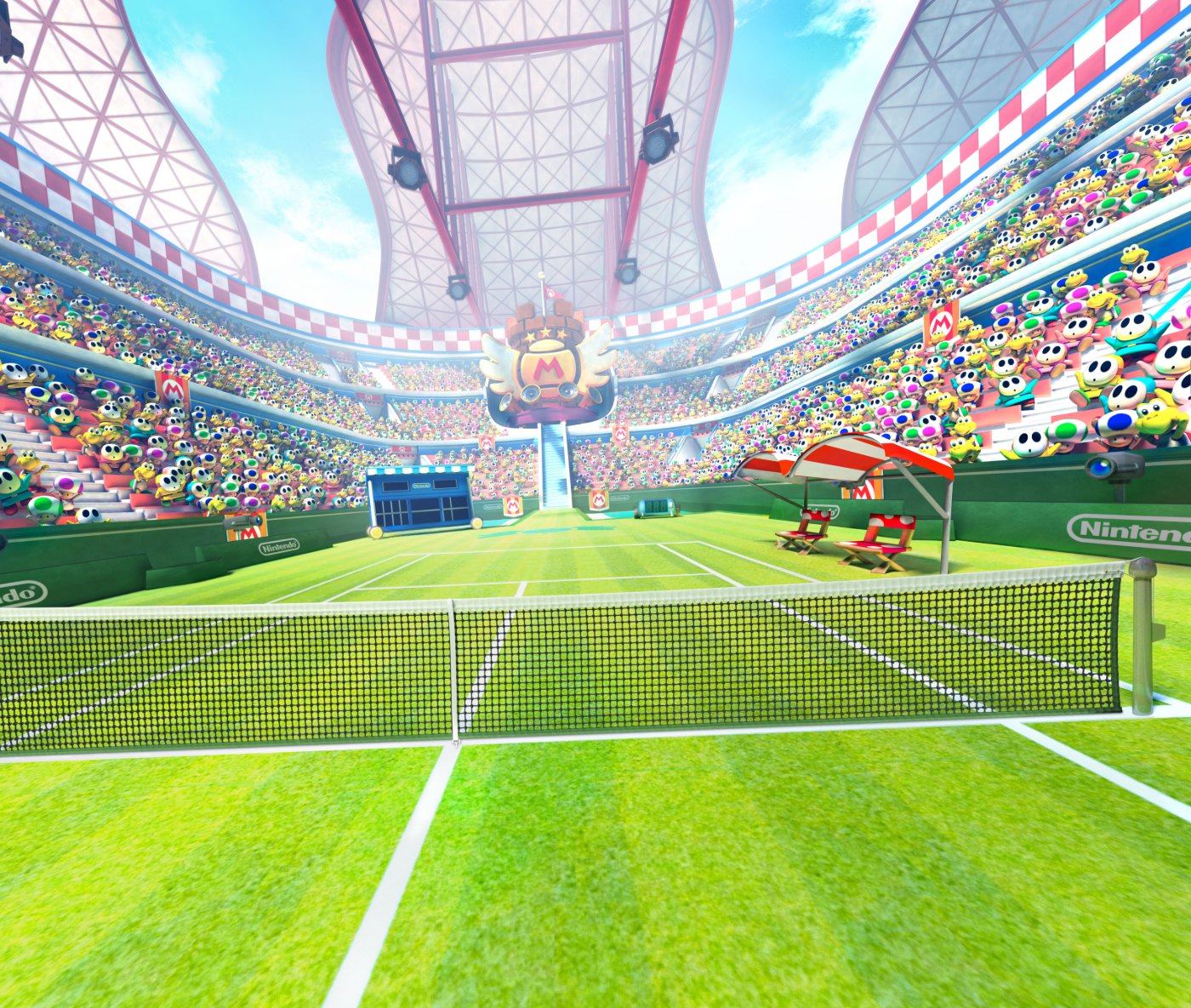
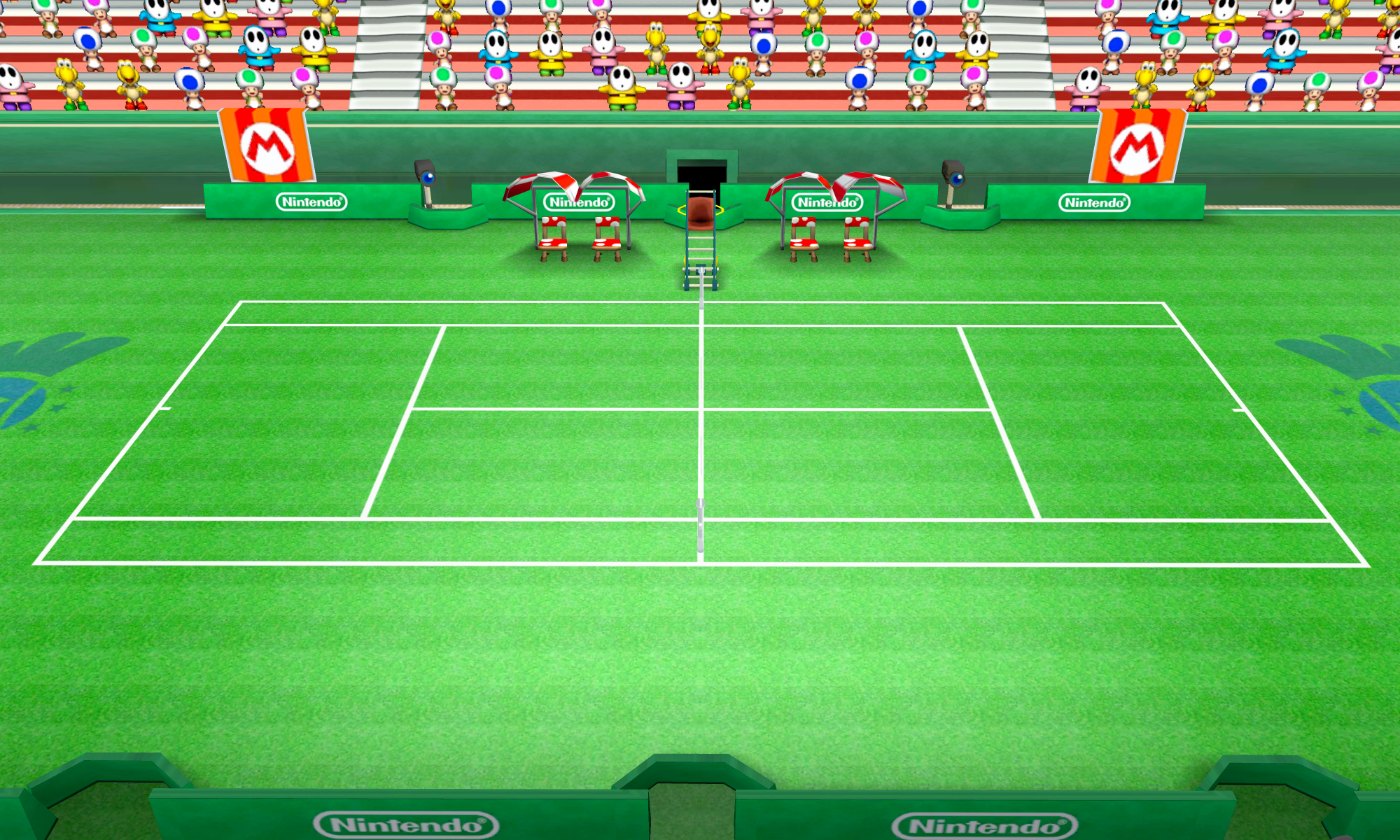
Mario Stadium – Grass CourtGrass · fast ball, weak bounce · Champions CupQuick and low: big servers and flat hitters love it.
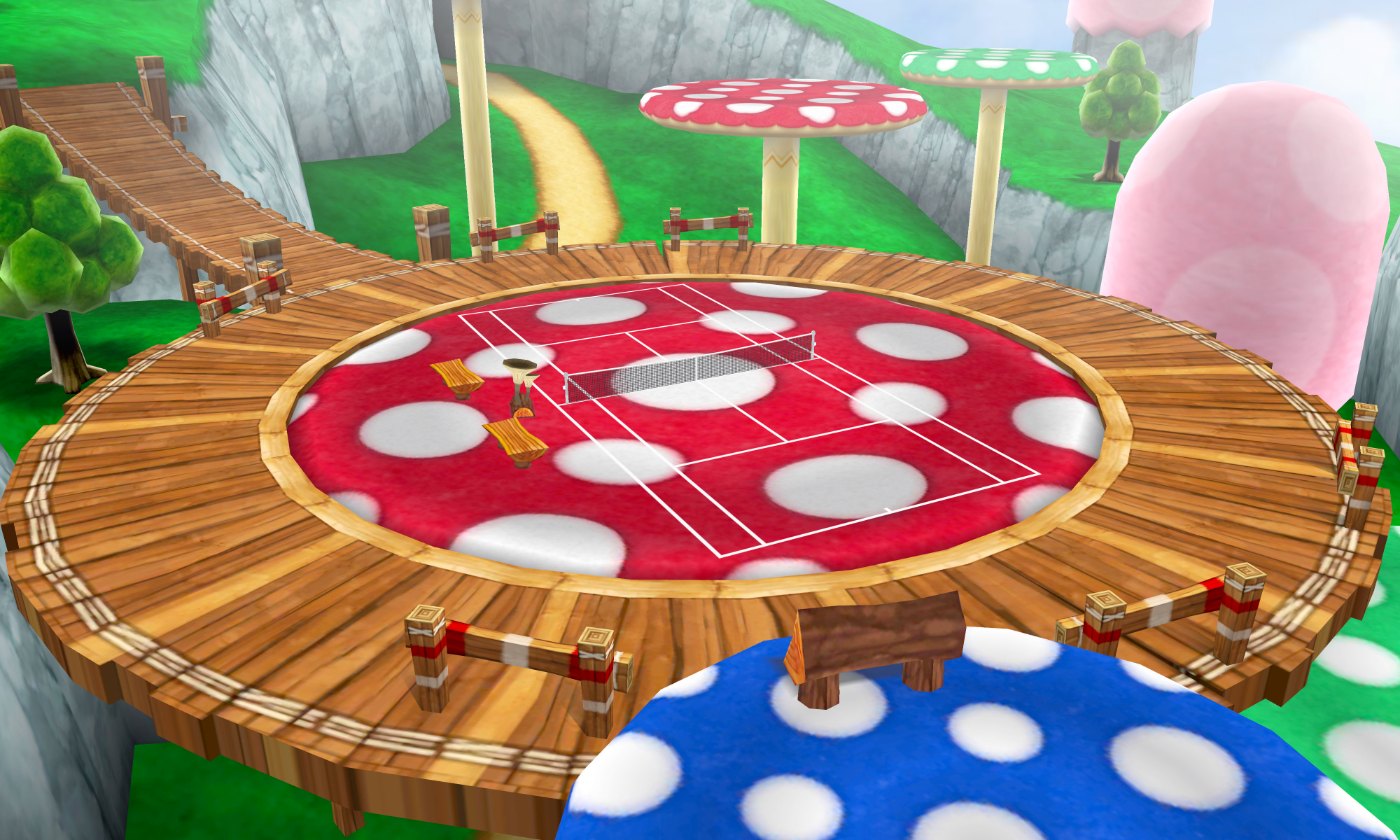
Mushroom ValleyMushroom · slow, strong bounce · Mushroom CupA court on top of a giant mushroom above Mushroom Gorge from Mario Kart Wii, whose track can be seen below.
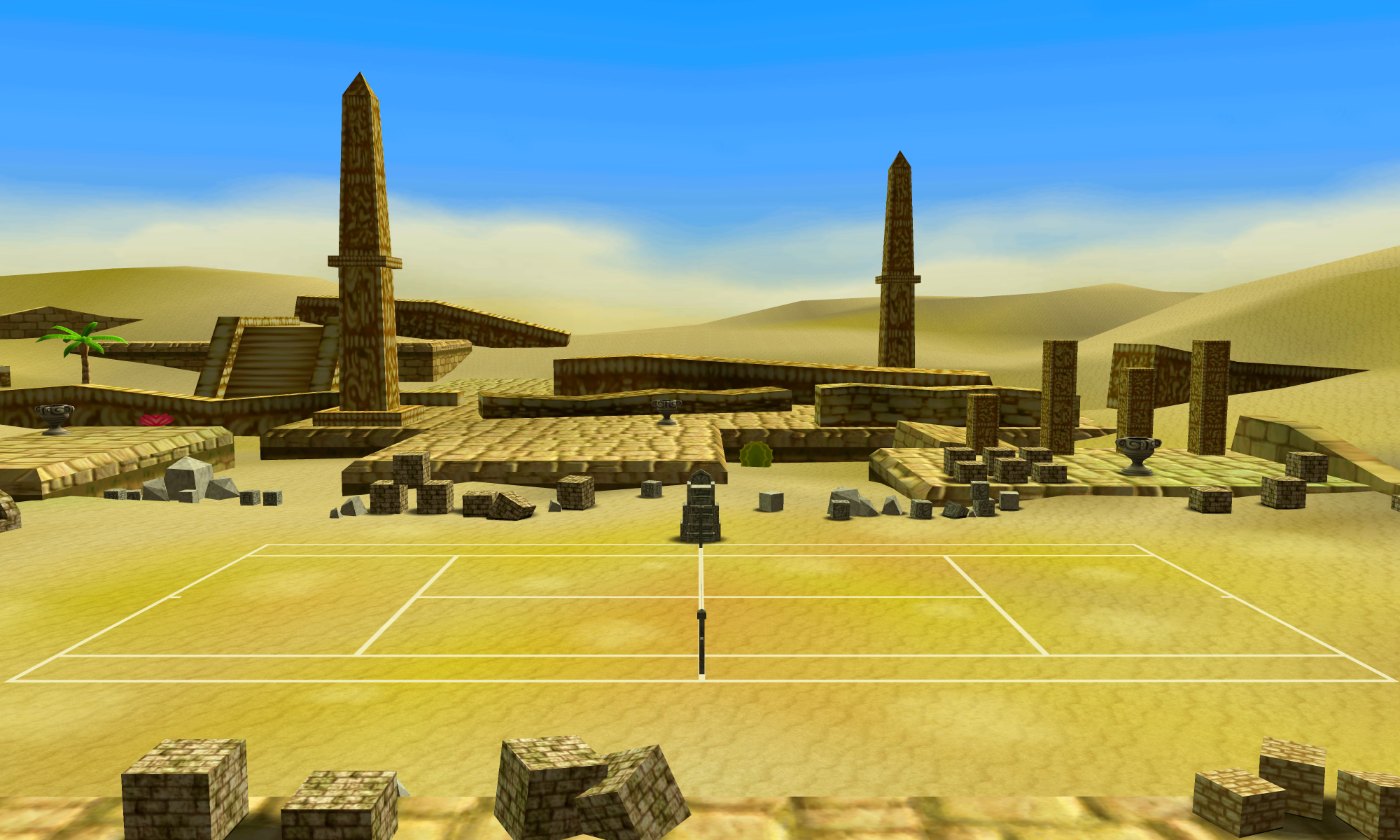
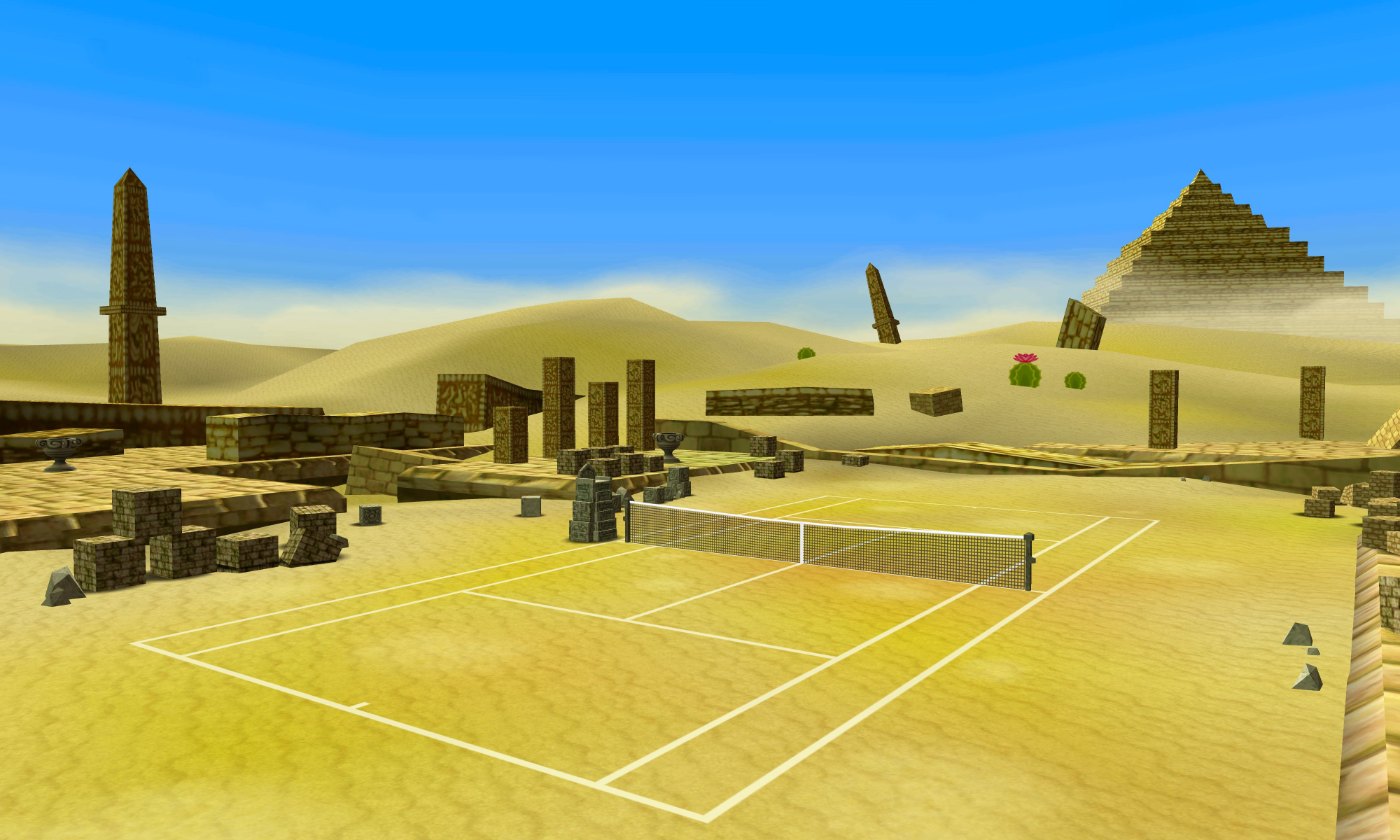
Wario DunesSand · slow, weak bounce · Flower CupA desert court ringed by ruins, played to music from Wario Land 3.
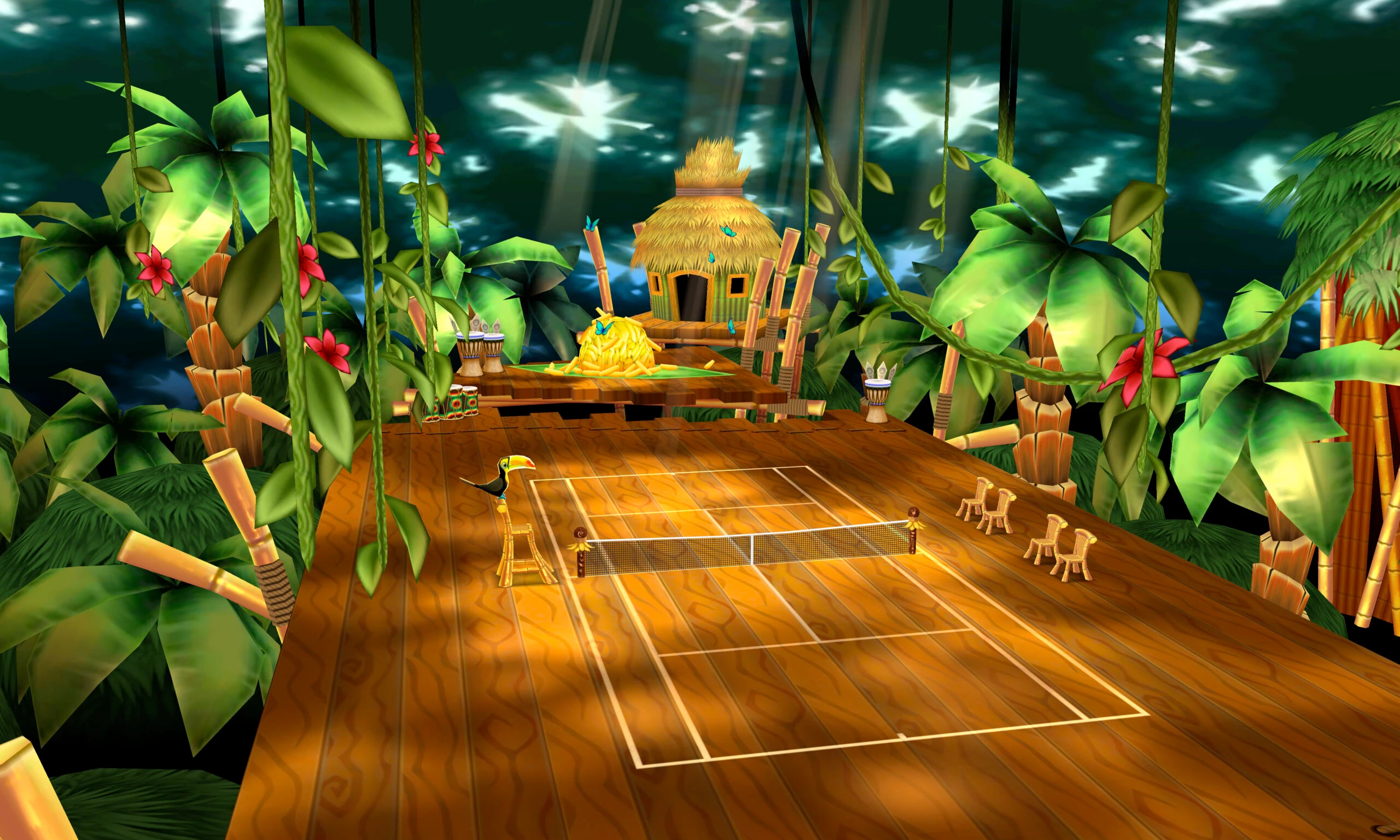
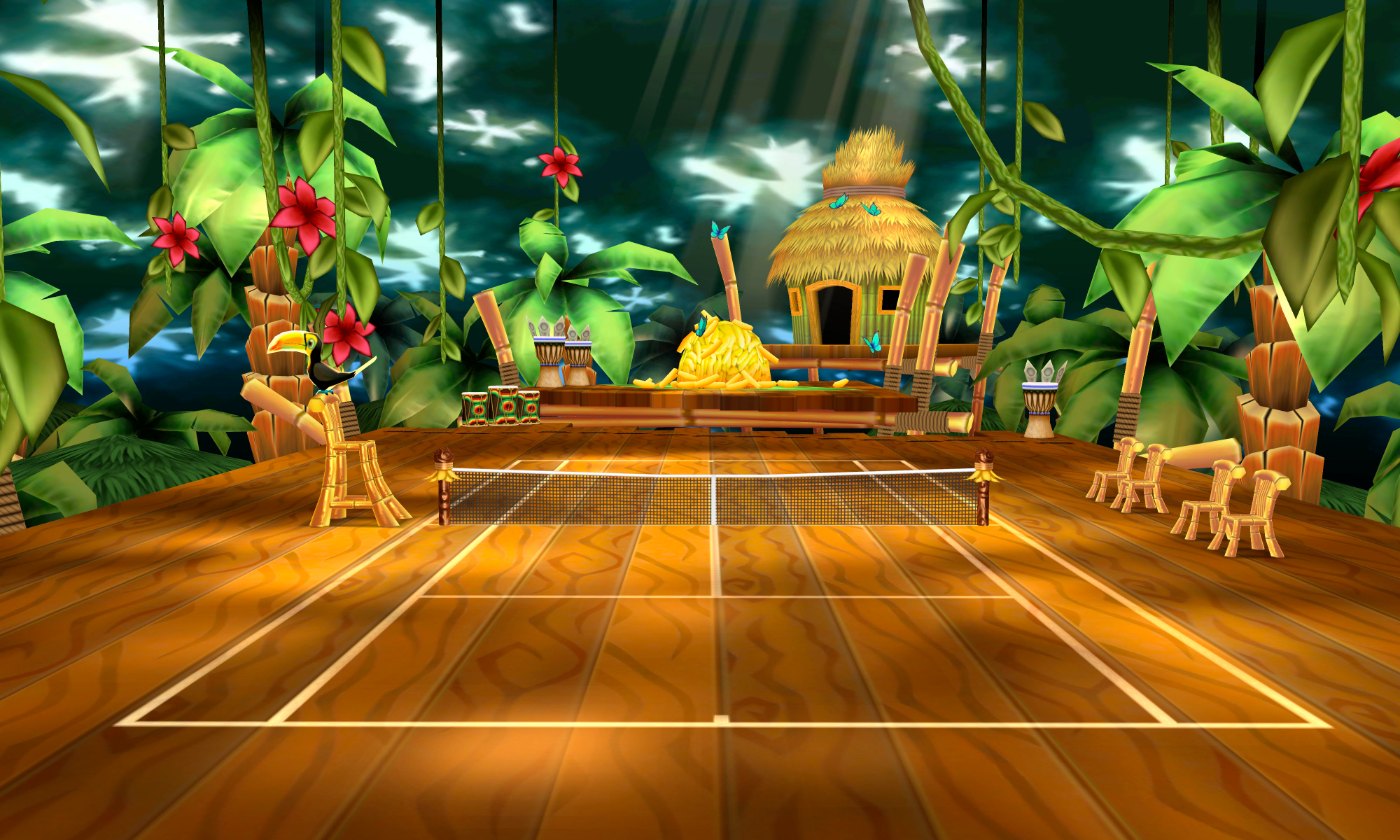
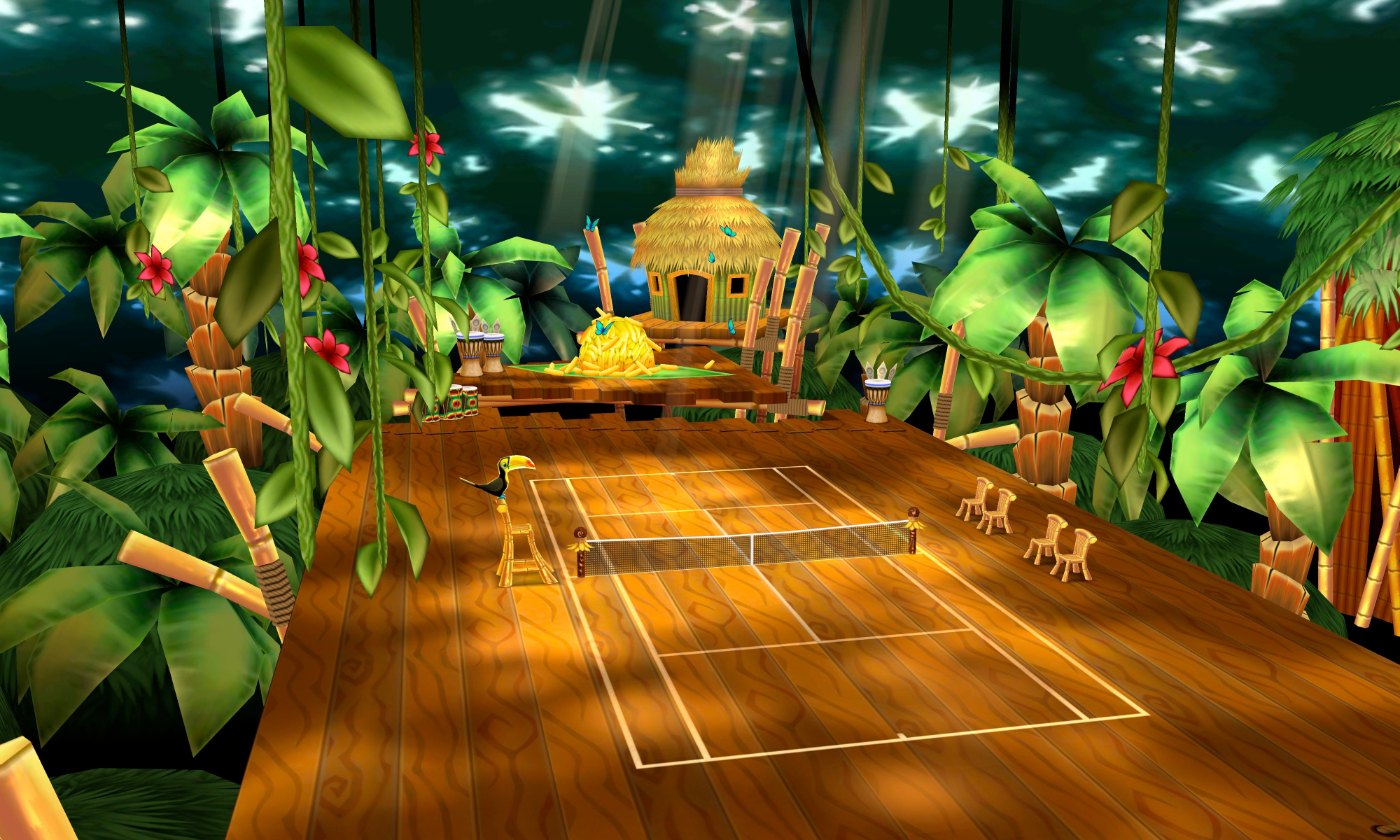
DK JungleWood · normal speed and bounce · Banana CupA rough wooden court in the jungle, with DK Island Swing on the soundtrack.
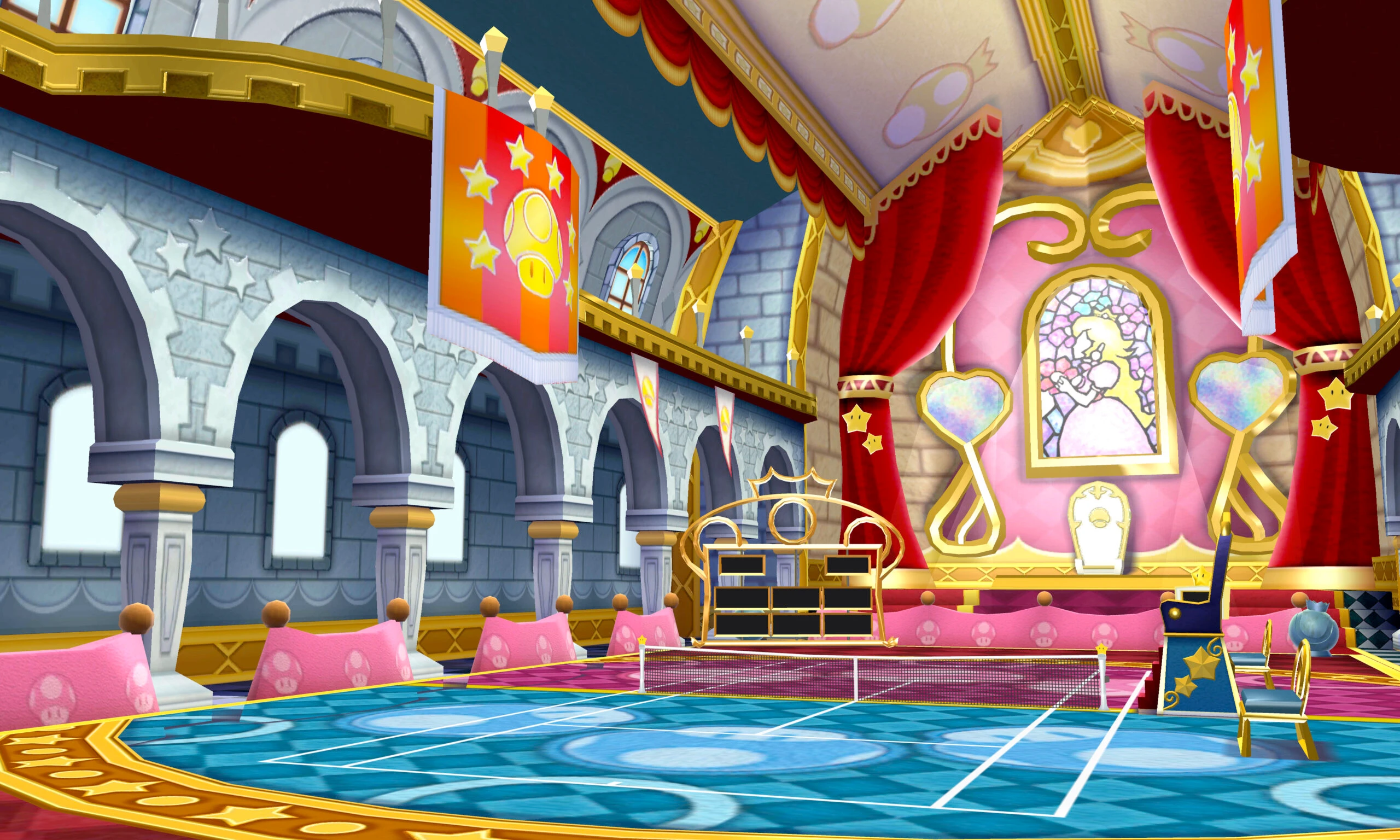
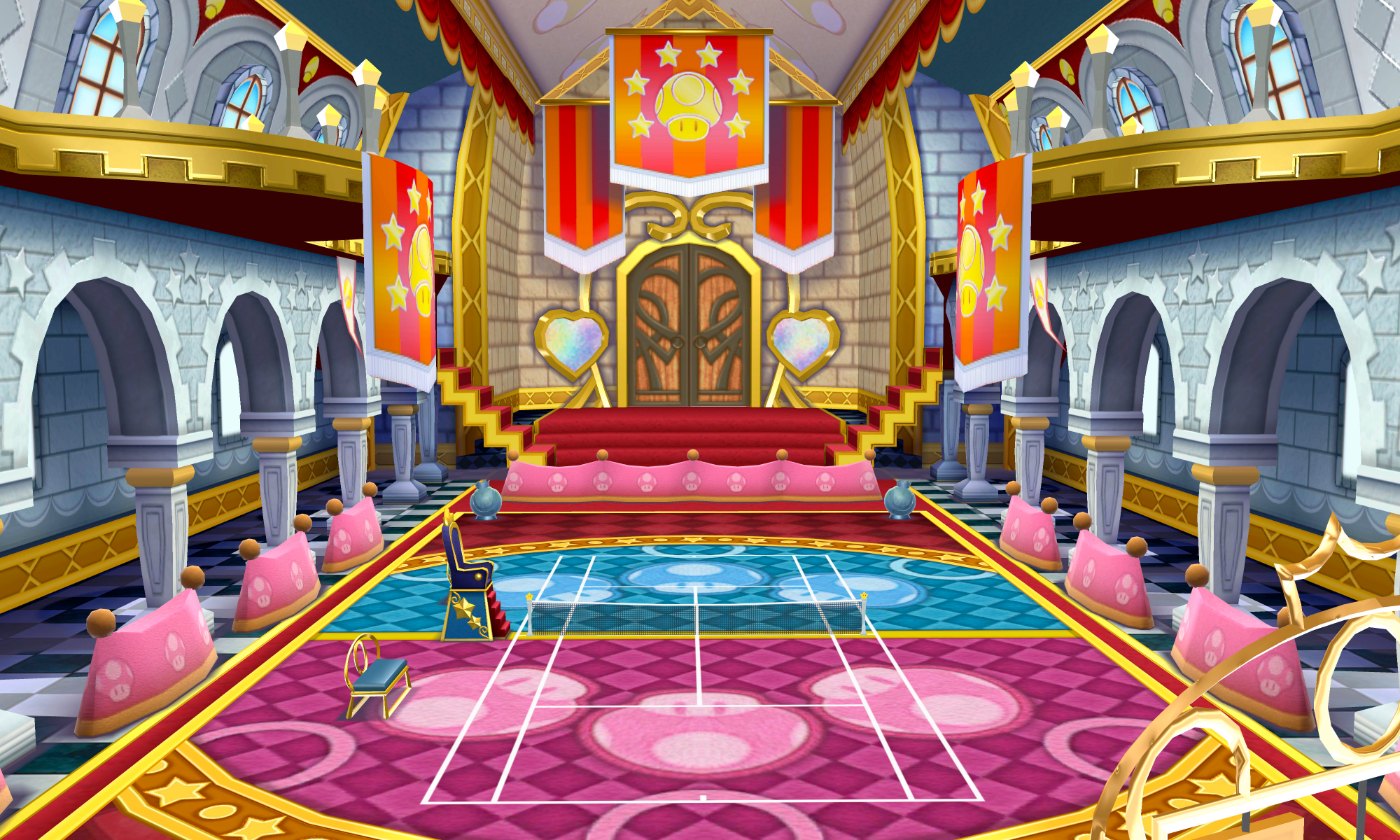
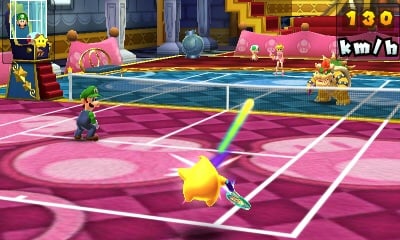
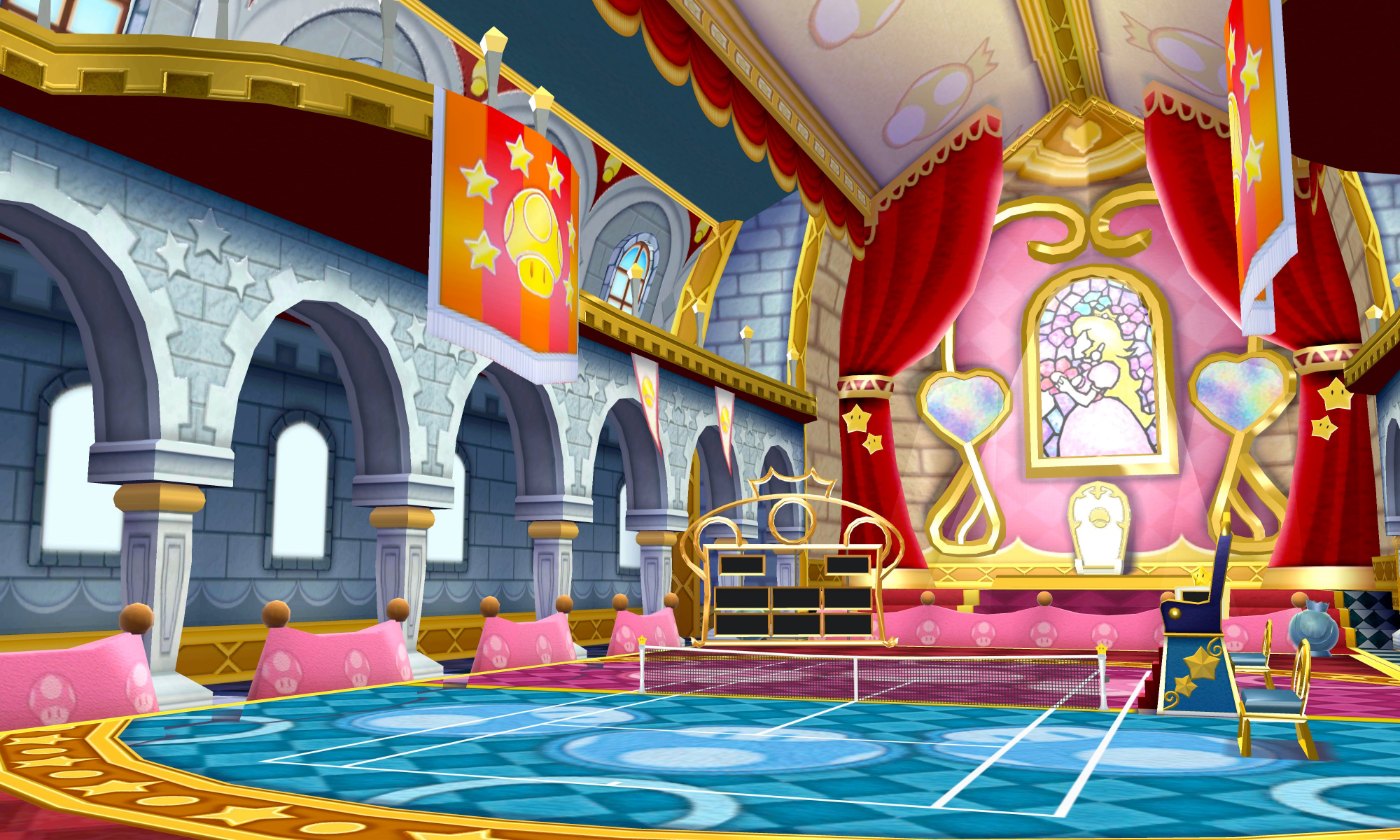
Peach’s PalaceCarpet · fastest, normal bounce · 1-Up Mushroom CupTennis on the carpet of a palace hall, to an arrangement of Super Mario 64’s castle theme.
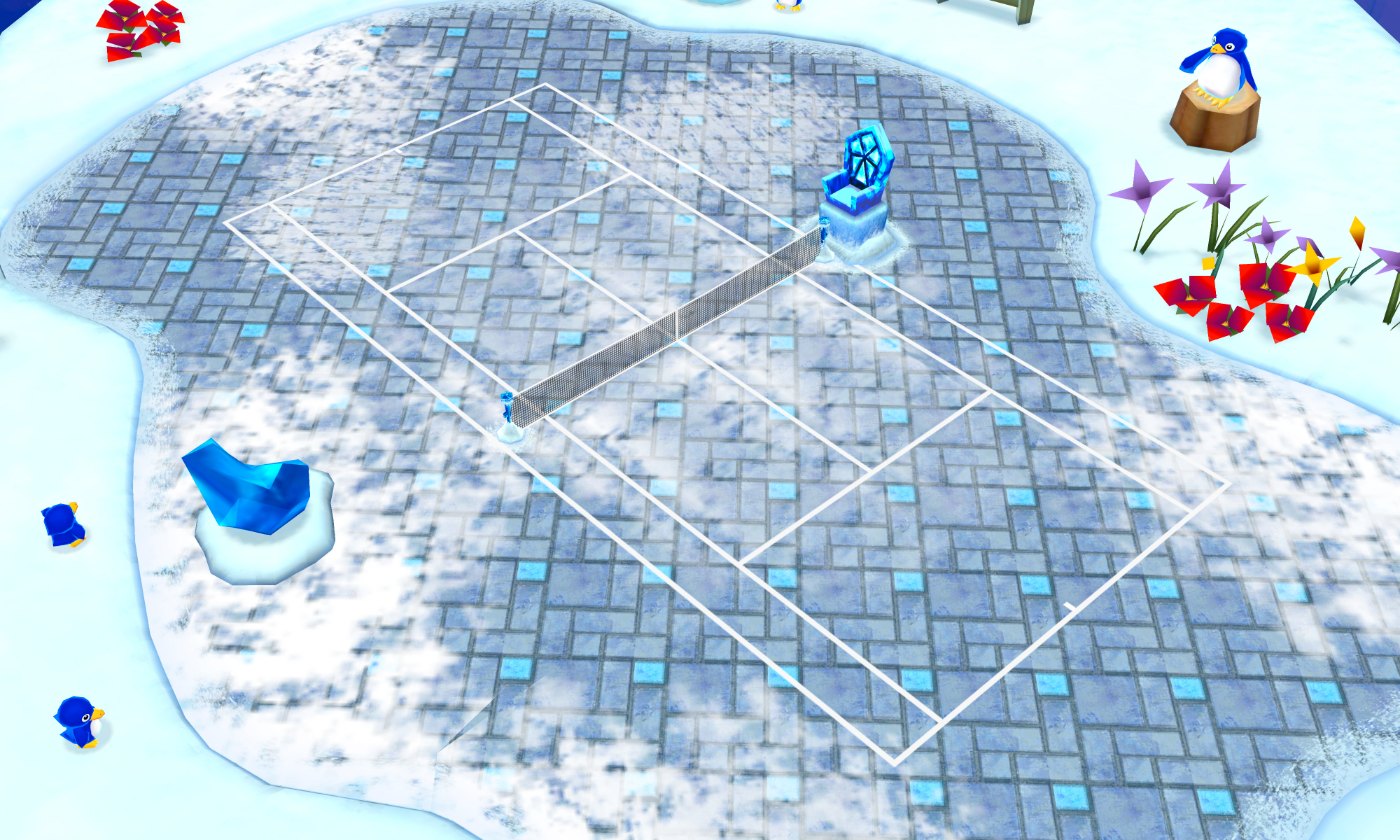
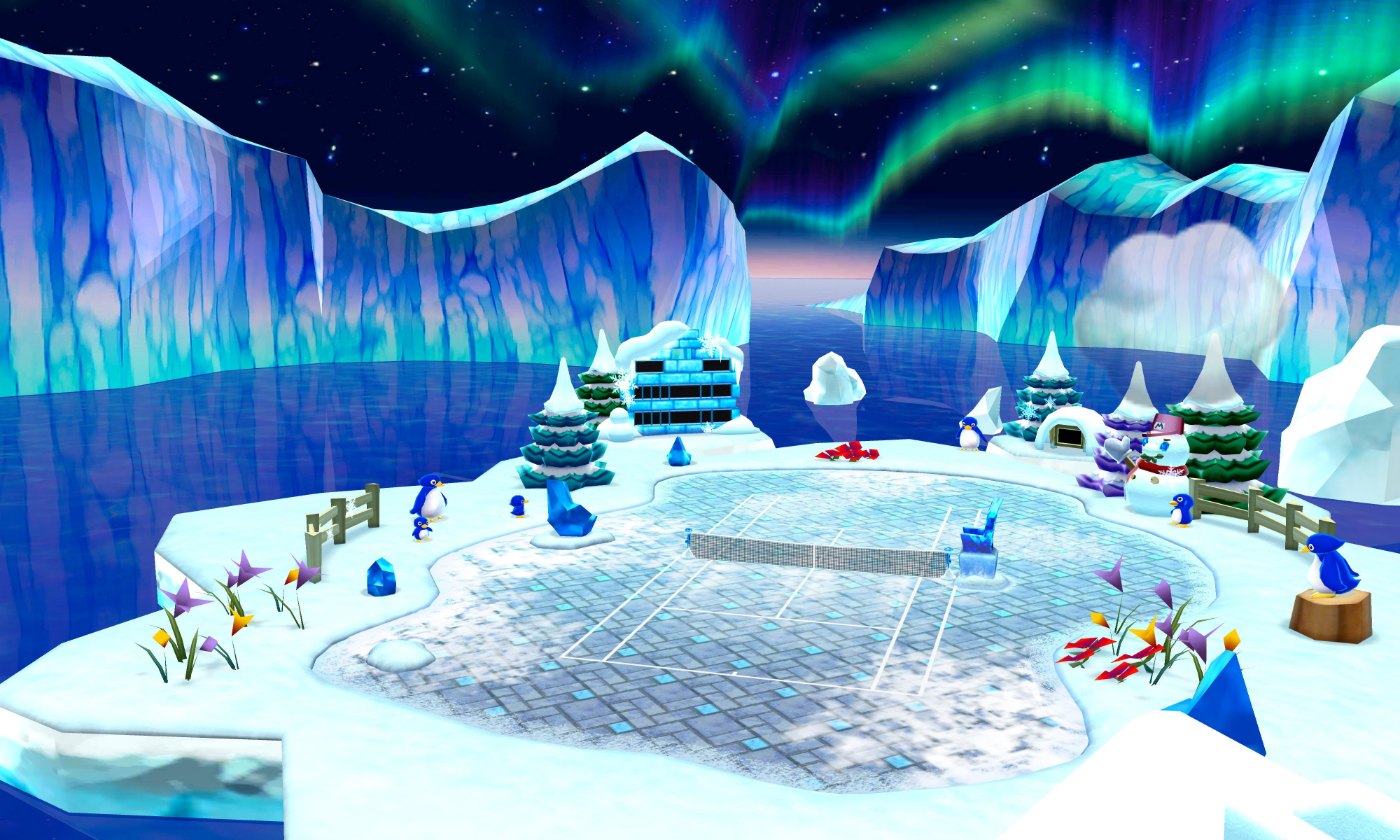
Penguin IcebergSnow · normal speed, strongest bounce · Ice Flower CupAn iceberg under the northern lights, watched by penguins and a Mario snowman.
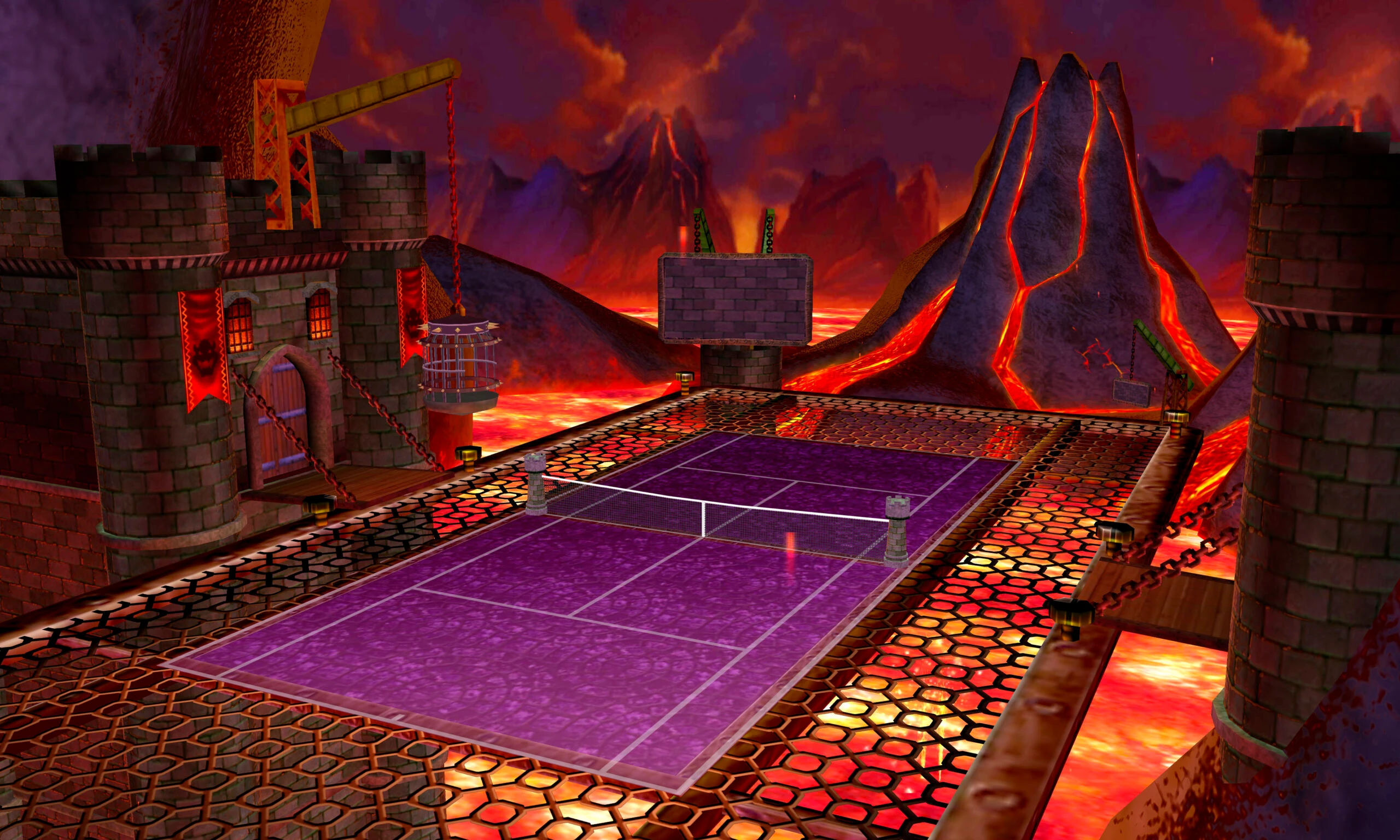
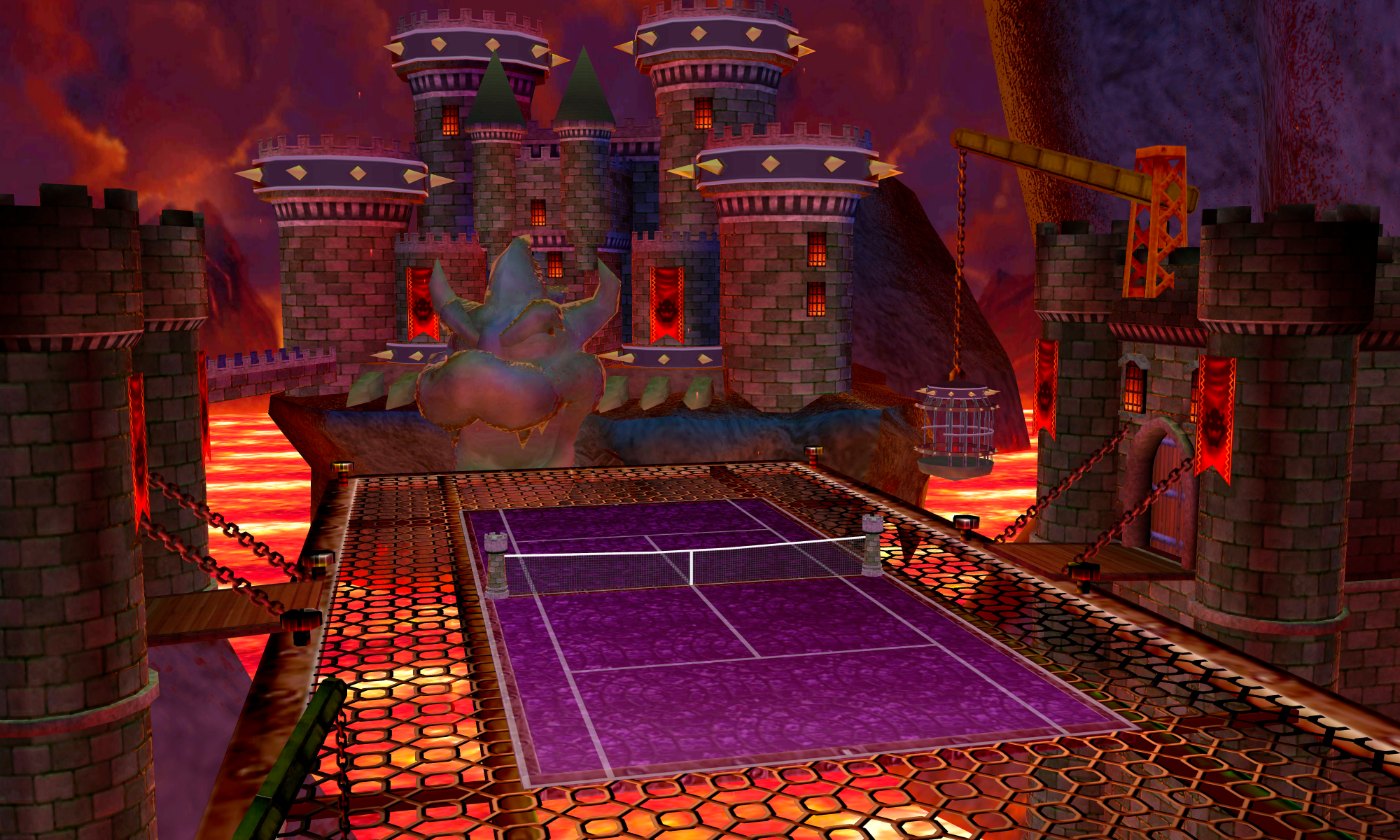
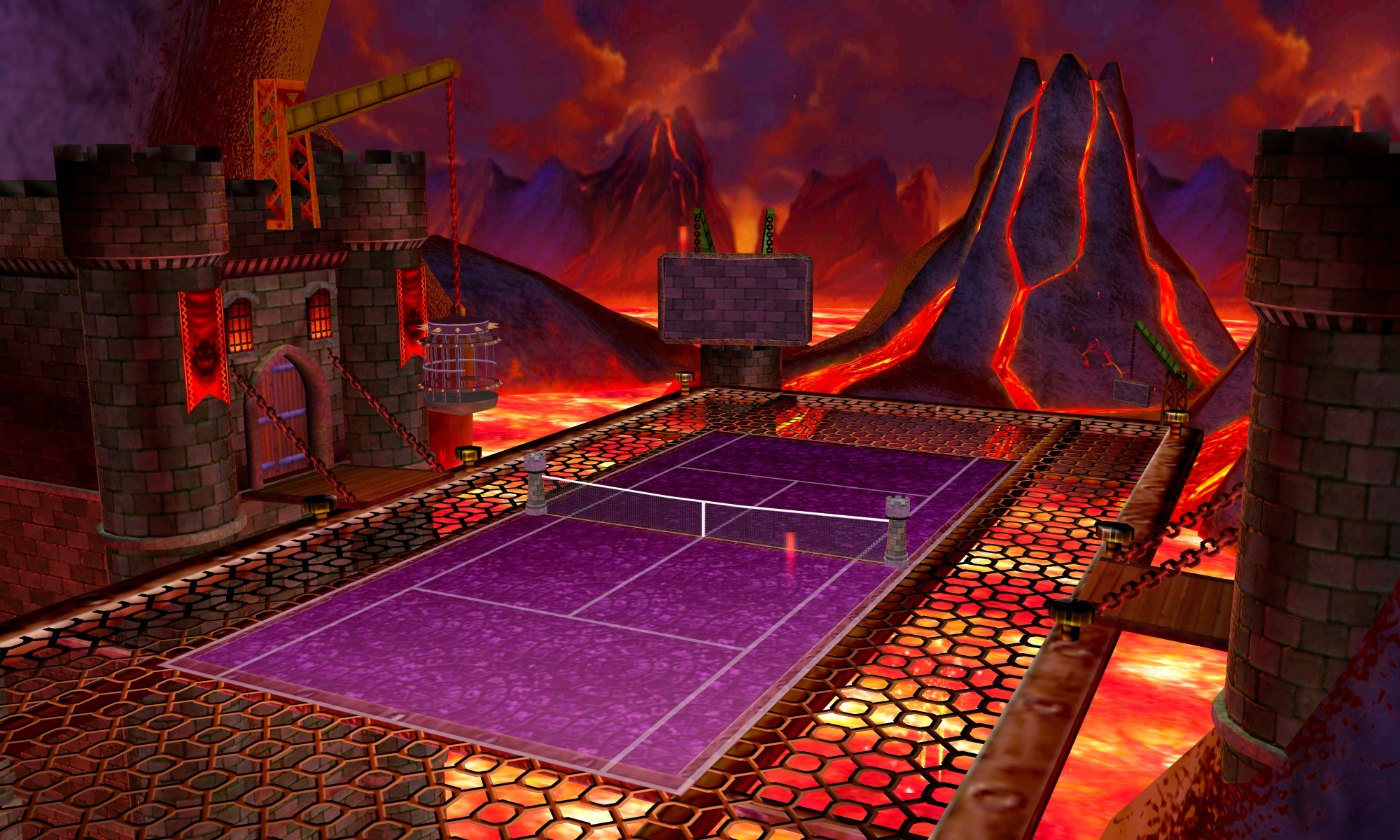
Bowser’s CastleStone · fast, strong bounce · Shell CupBowser’s court above a sea of magma, with his Super Mario 64 and Super Mario Sunshine themes rearranged.
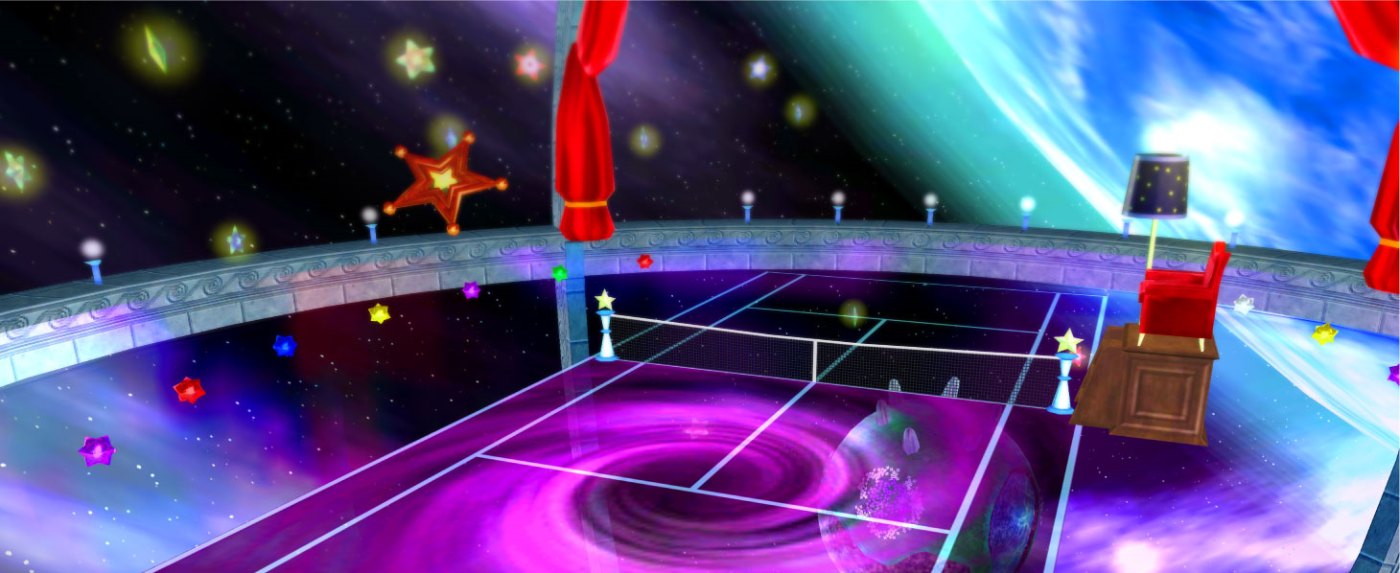
Galaxy Arena – Crystal CourtCrystal · fastest, strongest bounce · unlocked by winning the Final CupFloating in space near the Comet Observatory: the quickest, bounciest court in the game.
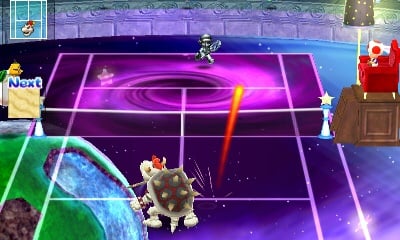
Galaxy Arena – Morph CourtChanging surfaces · Final CupLand a Chance Shot on your opponent’s side and their half turns into another surface; a black hole surface sends the ball flying.
The Morph Court uses three borrowed surfaces per round of the Final Cup: hard, mushroom and stone in the first round; clay, ice and wood in the semi-final; grass, carpet and sand in the final. Early footage from September 2011 showed a Peach Dome court, which was replaced by Mario Stadium before release.
Advertisement
Gameplay & Controls
Matches follow real tennis scoring: 15, 30, 40 and game, deuce and advantage, sets of six games with a seven-point tiebreak at six all. In Tournament the match lengths are fixed; in Exhibition you choose the number of games and sets. What changes from earlier Mario Tennis games is how you choose your shots and the Chance Shot system, which cannot be switched off.
Controls and shots
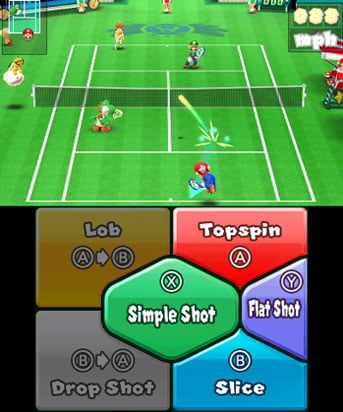
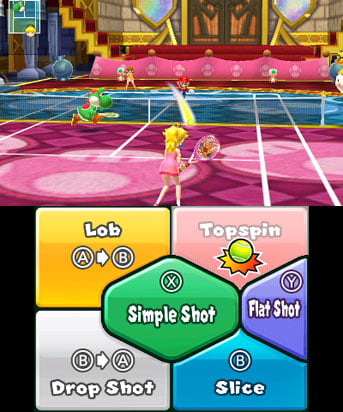
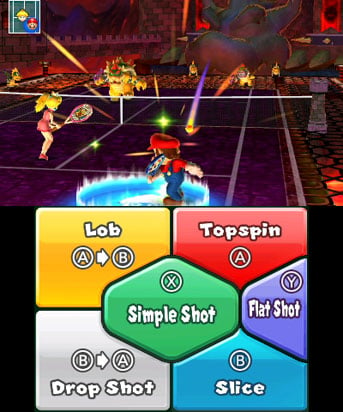
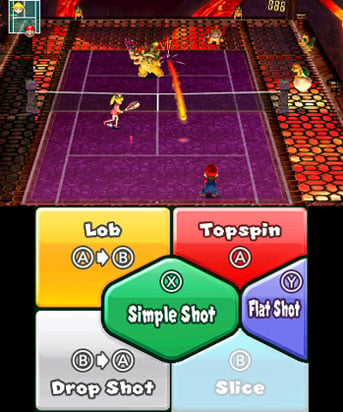
With the buttons, A plays topspin (fast, high, with a lively bounce), B a slice (slow, low and skidding) and Y a flat shot, the fastest of all and the one used for smashes. A then B is a lob, B then A a drop shot. X is the Simple Shot: the game picks the right shot for you, at the cost of a little power. Pressing early charges the shot while your player waits for the ball, L cancels a charge (and calls “Got it!” to a doubles partner), and R is a diving shot for balls out of reach.
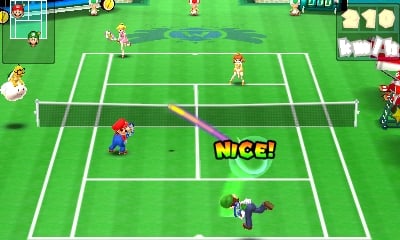
Every shot is also on the touch screen, which shows three or six coloured panels (each layout also comes mirrored), switched with R before a serve. The panel for the best shot in each situation lights up. Serving is a toss and a hit; hit the ball at the top of the toss for a faster “Nice” serve. While the other player serves you can taunt, and holding the taunt until your character glows red strengthens the next shot slightly.
Mario serving.Luigi hits a “Nice” serve.Peach gets ready to return a shot.
Chance Shots
A weak return creates a Chance Area on your side of the net: a coloured zone with a symbol in it. Reach it and hit the shot of matching colour, by button or touch panel, and you play a Chance Shot. Use the Simple Shot instead and you still get the Chance Shot, slightly weaker. The receiver is not helpless: each Chance Shot has a counter shot that reduces its effect, and the touch screen lights up the right one. The five kinds are listed below.
Critics were split. Polygon thought the game leaned on Chance Shots too much and disliked how randomly the areas appear; the old Power Shots of Mario Power Tennis, by contrast, could at least be turned off.
Mario about to play a Chance Shot slice at Bowser’s Castle.
Direct Mode and the gyro sensor
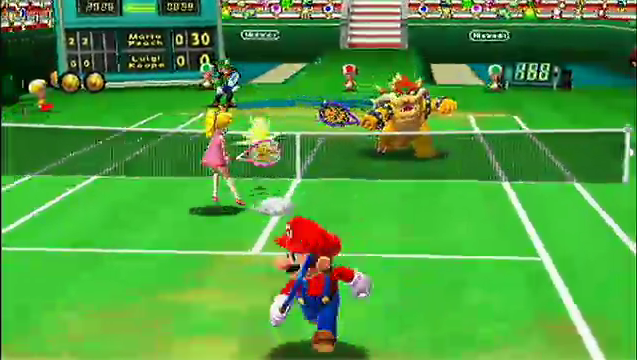
Lift the 3DS upright and the camera swings round behind your character. This is Direct Mode: your player runs to the ball automatically, shots go in the direction they face, and you aim by turning the console left or right. The 3D effect switches off while you play this way. Hold the system flat again to return to the normal view, or turn the gyro sensor off in Options if you want it never to happen.
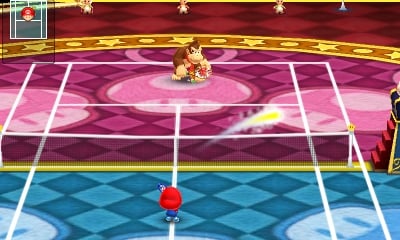
Mario running for the ball in an early screenshot.
Your Mii, the Clubhouse and gear
A Mii has no fixed type: its strengths come entirely from what it wears. The Clubhouse holds 194 items in five groups: 48 rackets and 40 wristbands (which affect power and spin), 40 uniforms (power and speed), 40 pairs of shoes (mostly speed) and 26 costumes. New stock appears in the Item Shop as you play, and you pay in coins, mostly won in the Special Games and StreetPass: from 100 coins for the cheapest wristband to 4,200 for the dearest racket.
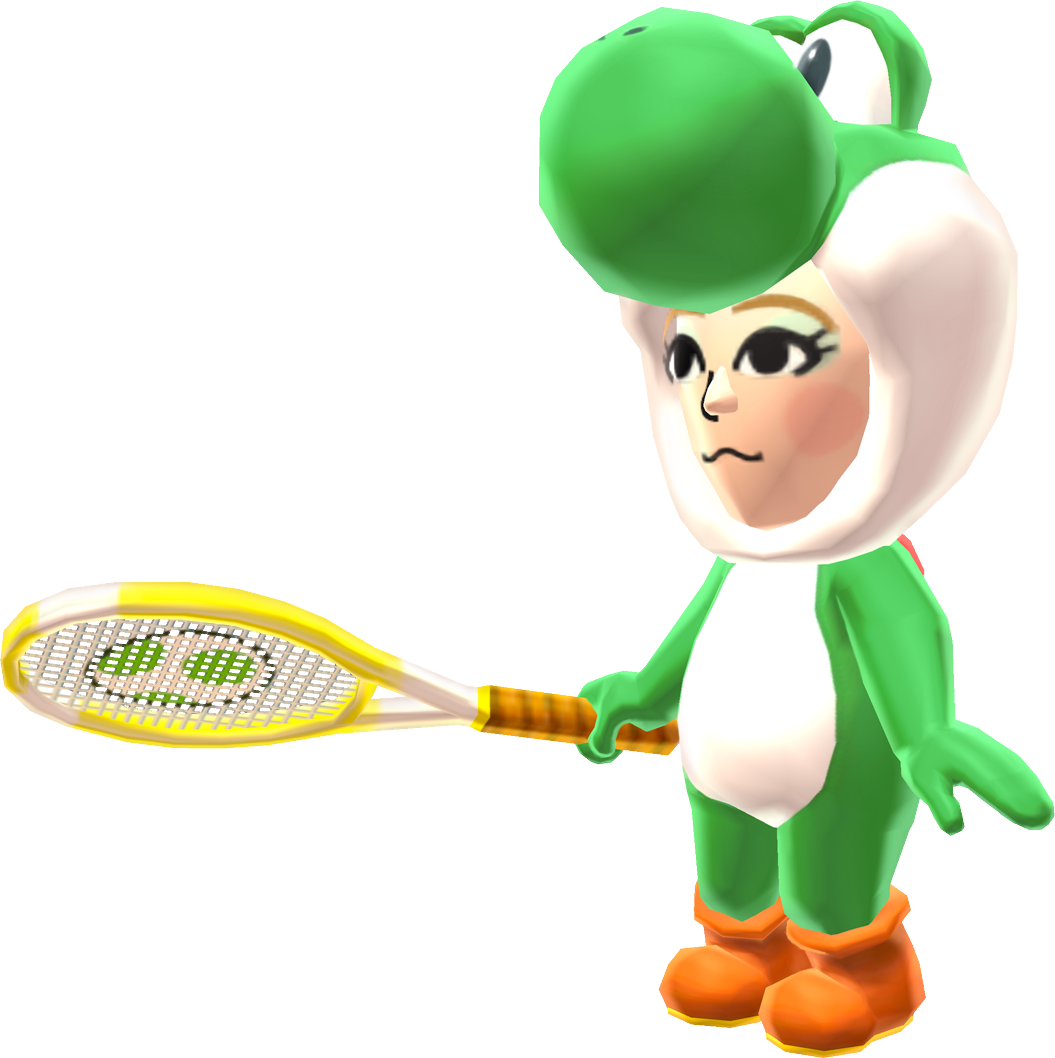
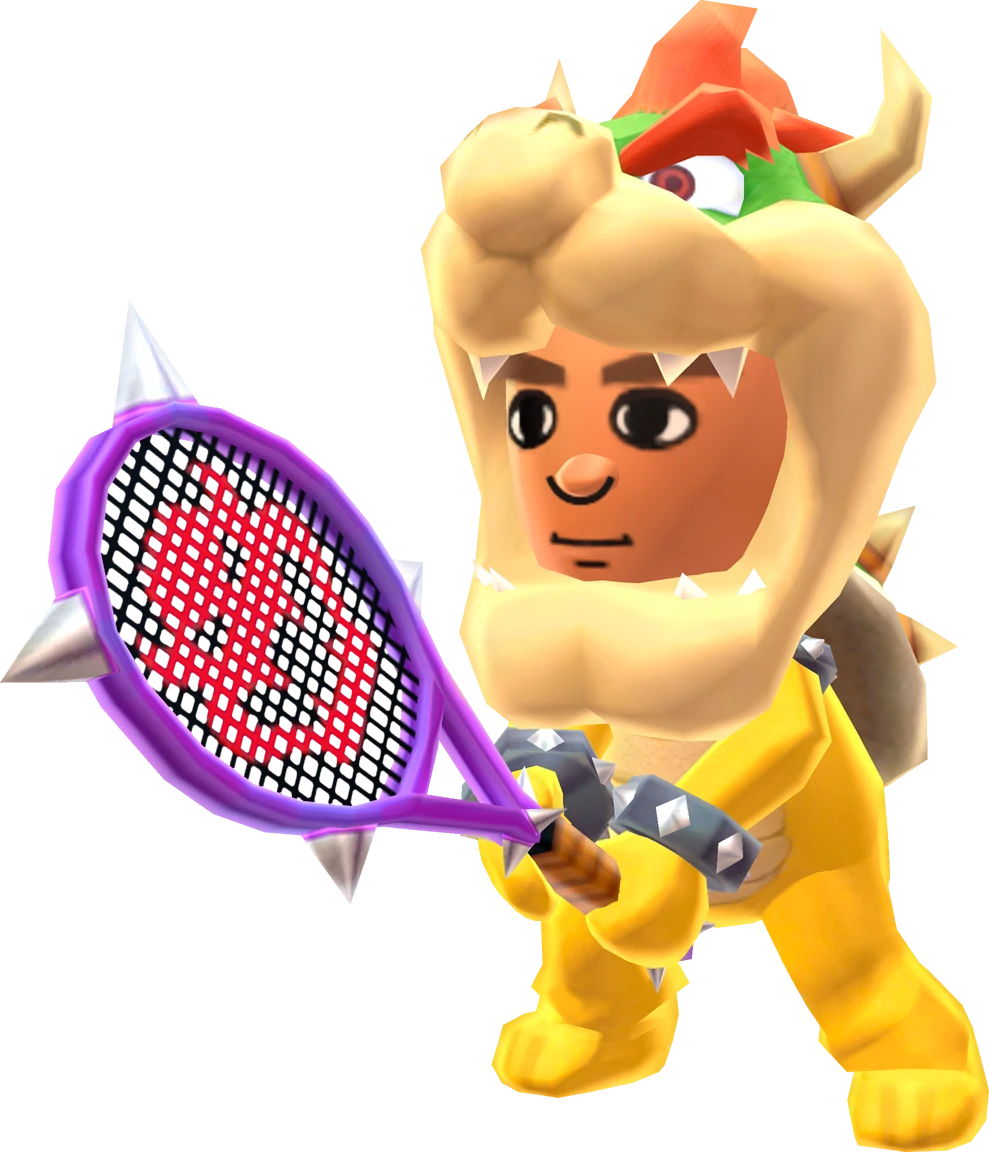
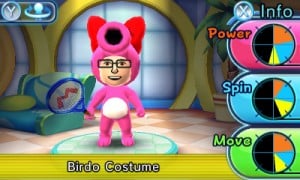
Stats are shown on a pie chart of nine values in three groups: Power (serve, stroke and volley), Spin (side spin, topspin and slice) and Speed (top speed, acceleration and mobility). Wearing a complete themed set gives a bonus. The costumes cannot be bought: each one is a reward for a particular feat, from scanning the Yoshi suit’s QR code to starring fifteen characters for Tanooki Mario (the full list is under Cheats & Secrets).
A Mii in Mario’s clothes.A Mii in the Yoshi suit, unlocked by QR code.A Mii in the Bowser suit.The Birdo costume.
Multiplayer, online and StreetPass
Up to four players can join locally, one 3DS each. Only one game card is needed: friends without one join through Download Play with a smaller choice of characters and courts. Online there were two ways to play over Nintendo Network: Friends rooms for up to four, and Open Match, singles against strangers in your own region, matched by rating. Every save file started on a rating of 2,000; points you won raised it and points you lost lowered it, and a monthly leaderboard ranked players over the previous thirty days. Players who did not serve within thirty seconds were disconnected.
StreetPass carried your Mii and its greeting to other players. Back home you could play a StreetPass Match against a Mii you had met, played by a computer opponent modelled on that player, earning coins for each win and more for winning streaks, or take them on at Ring Shot. Online play ended when Nintendo Network closed for the 3DS on 8 April 2024.
Mario and Peach against Bowser and Bowser Jr. at Bowser’s Castle.The Exhibition records screen.
Difficulty, star ranks and left-handers
Computer players come in five levels: Novice, Intermediate, Expert, Pro and Ace, the last two unlocked by winning the Champions Cup and the Final Cup. Win the Champions Cup with a character and they earn a star rank, a stronger version you choose with R on the character select screen; starred characters are what you need for the second tournament, the Star Open. In multiplayer, star ranks come from the room creator’s save. L on the same screen makes your character left-handed.
Every cup trophy on the records screen.
The five Chance Shots
Each Chance Area is a colour with a Mario symbol in it. The counter is the shot the receiver should play to soften it.
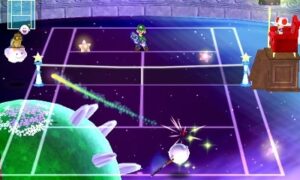
Red (Fire Flower)A blazing topspin that can drive the receiver right back. Counter: slice.
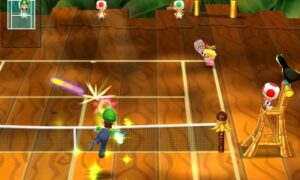
Blue (Blooper)A sharply curving slice with a sparkling trail that sends the receiver into a brief spin. Counter: topspin.
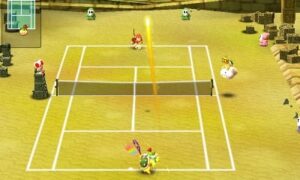
Purple (Super Star)A smash, much stronger than a normal one, played with the flat shot. Counter: flat.
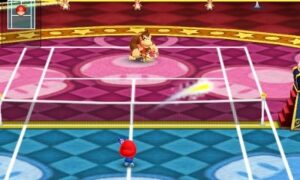
Yellow (Cheep Cheep)An extreme, curling lob that drops right on the back edge of the court. Counter: slice.
White (Bob-omb)A drop shot that bounces even lower than usual. Counter: topspin.
Cartoons, Comics & Other Media
Mario Tennis Open was promoted with its own video series and in-store events, and it reached other parts of the 3DS too.
Mario Tennis Open ReportNintendo of America · YouTube · 23 May 2012A three-part video series hosted by talking tennis balls. Lob Shot and Slice Shot introduce the Special Games in the first episode; Simple Shot and Topspin Shot cover multiplayer in the second. Both episodes are embedded under Videos.
The Yoshi HuntEurope, Australia and New Zealand · 2012An in-store QR code event: shoppers scanned codes at thirty participating ASDA stores in Europe, and at EB Games and JB Hi-Fi in Australia and New Zealand, to unlock coloured Yoshis.
Swapnote stationeryNintendo 3DS · SwapnoteA Mario Tennis Open design was one of the stationery sheets for Nintendo’s 3DS messaging app.
Puzzle Swap panelNintendo 3DS · StreetPass Mii PlazaStreetPass Mii Plaza’s Puzzle Swap had a Mario Tennis Open picture to piece together.
Mario Tennis: Ultra SmashWii U · 2015The next game in the series. Rosalina, planned for Open and replaced by Luma, finally became playable there.
The Roster
Twenty-five players in six types: All-Around, Technique, Speed, Power, Defense and Tricky, plus the Mii, whose stats depend on its gear. The main cast each have their own racket design. Types and unlock conditions are from the game; voices from the staff credits.
Character
Who they are
In this game
Abilities & notes
MarioAll-Around · from the start
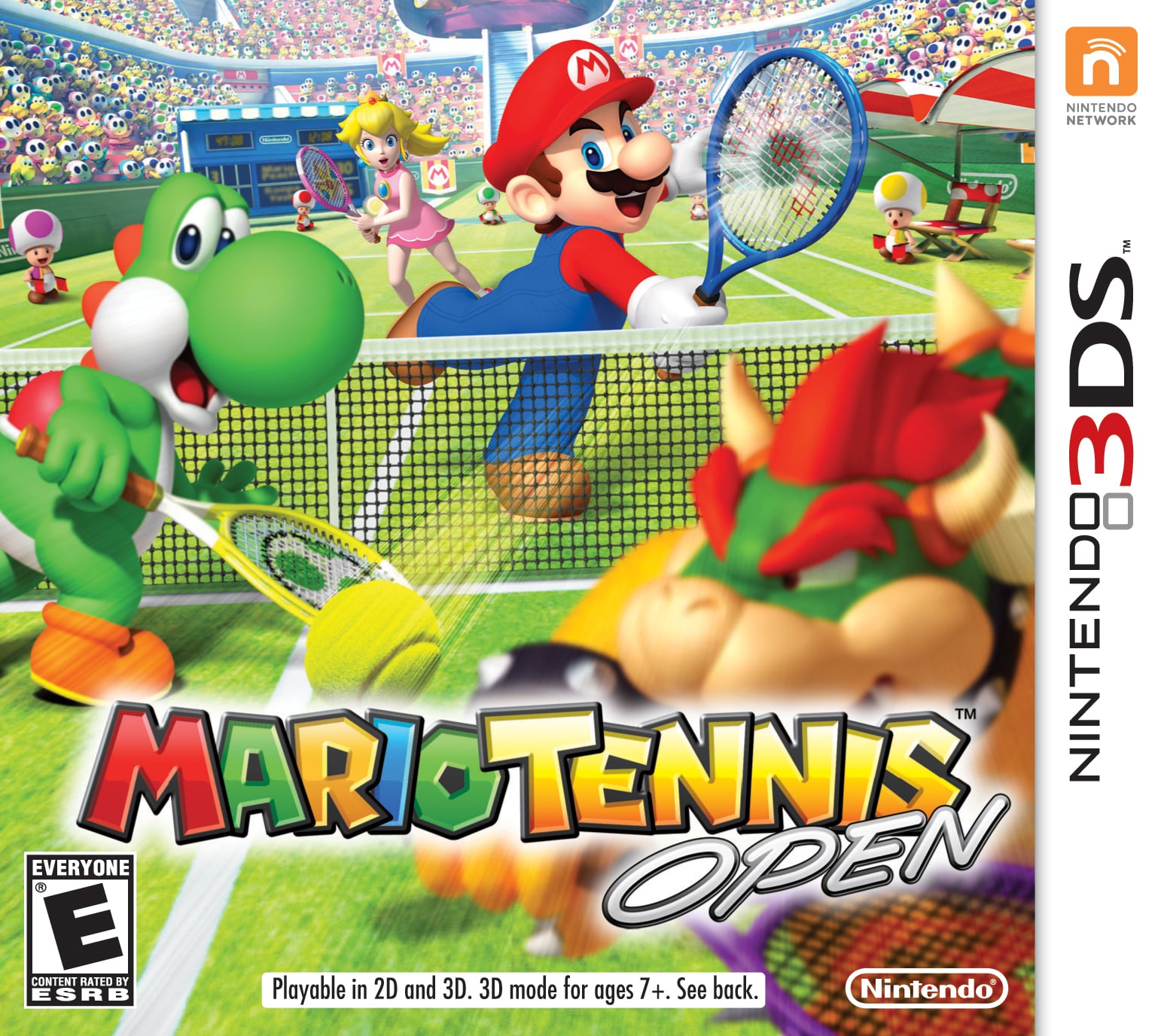
The face of the series and its cover star once again.
A balanced player with no weak spot. Winning the Final Cup singles with any character earns the Mii a Mario costume.
Type: All-Around
Voice: Charles Martinet
LuigiAll-Around · from the start
Mario’s younger brother and regular doubles partner.
All-round like his brother. The Luigi costume is the prize for the Final Cup doubles.
Type: All-Around
Voice: Charles Martinet
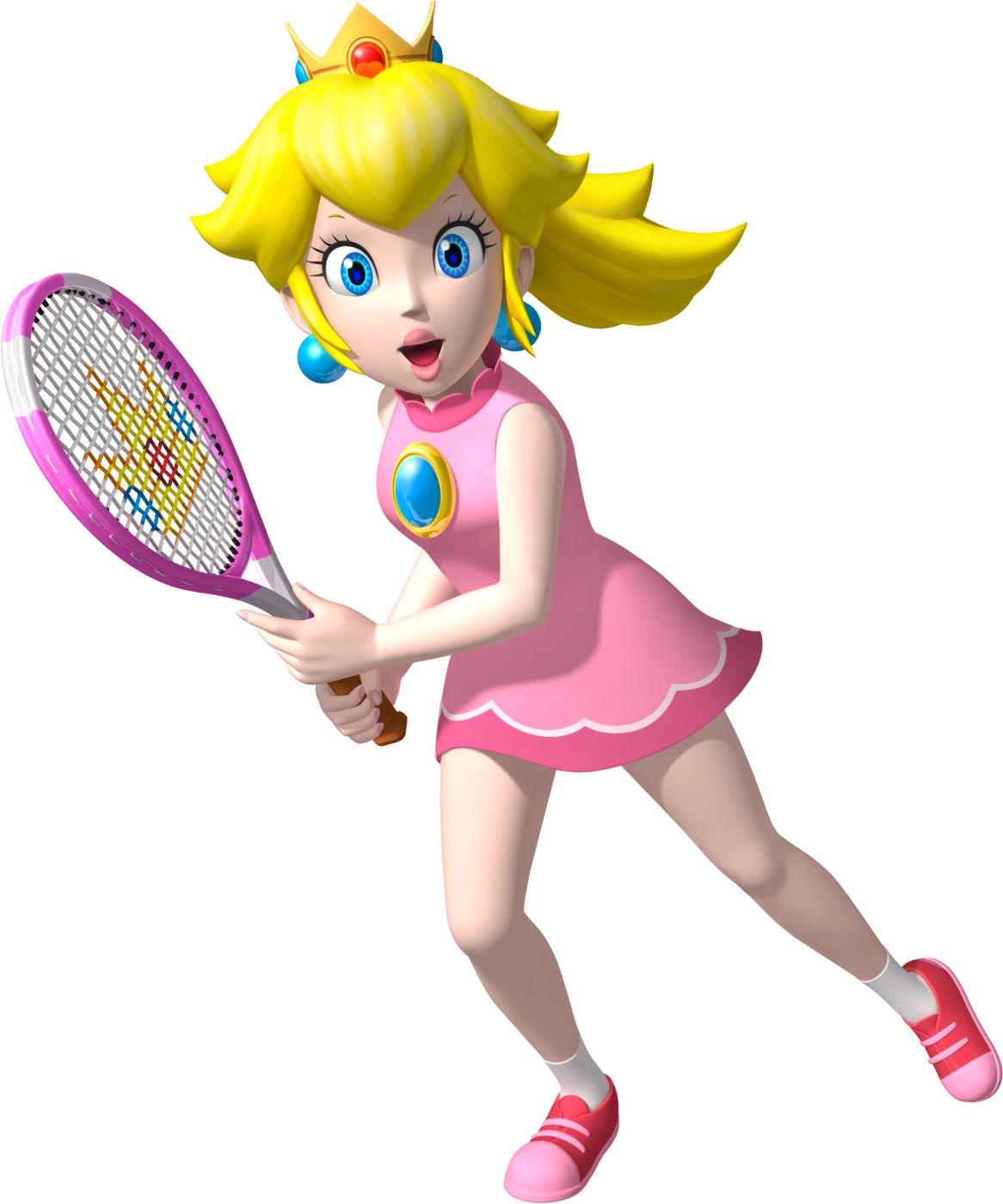
Princess PeachTechnique · from the start
Princess of the Mushroom Kingdom, and the first opponent in Ink Showdown.
A Technique player: accurate placement over raw power.
Type: Technique
Voice: Jen Taylor (uncredited)
Princess DaisyTechnique · from the start
Princess of Sarasaland, a Mario Tennis regular since the N64.
Another Technique player; her costume is won by two players together in Ring Shot.
Type: Technique
Voice: Deanna Mustard
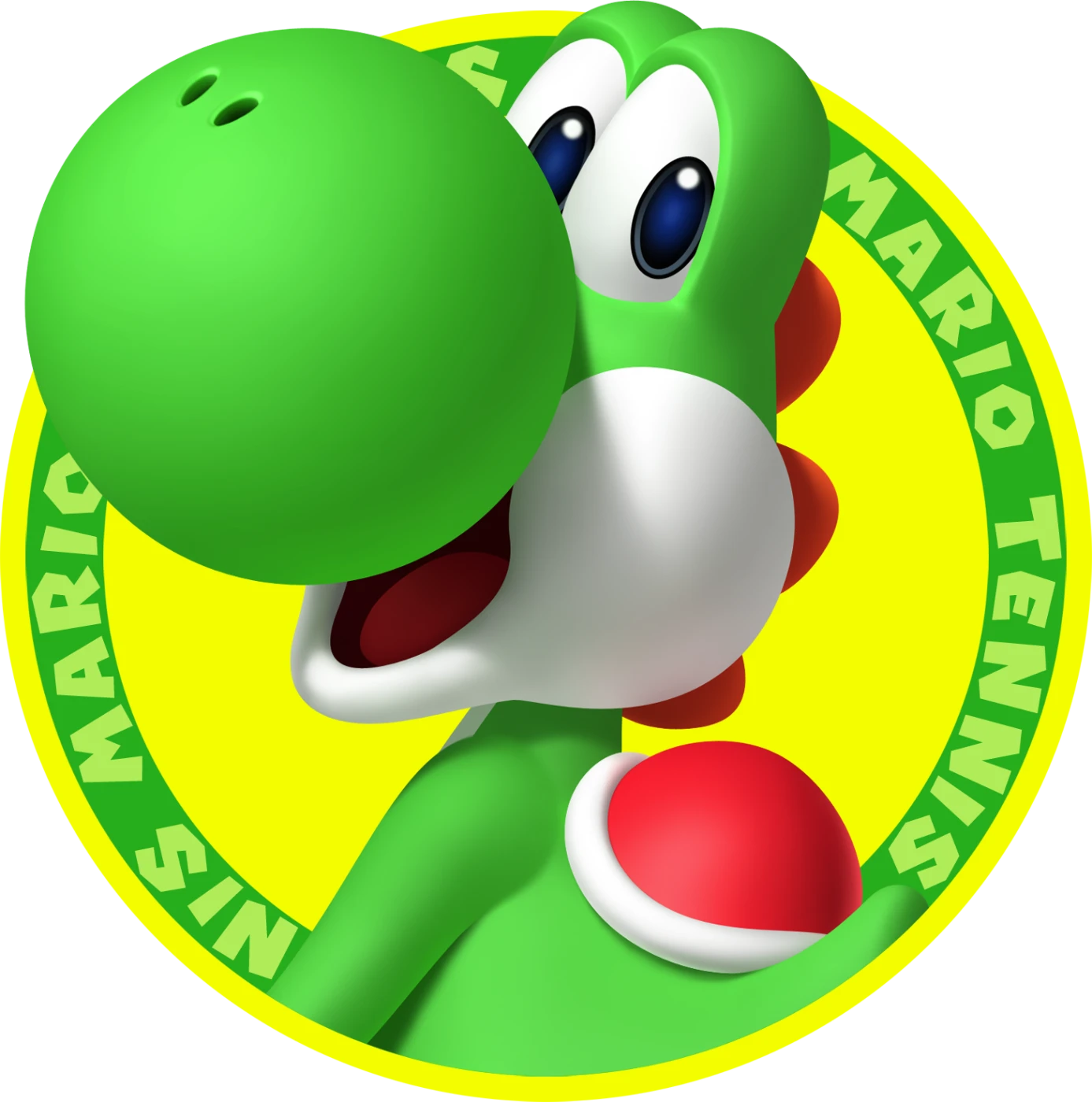
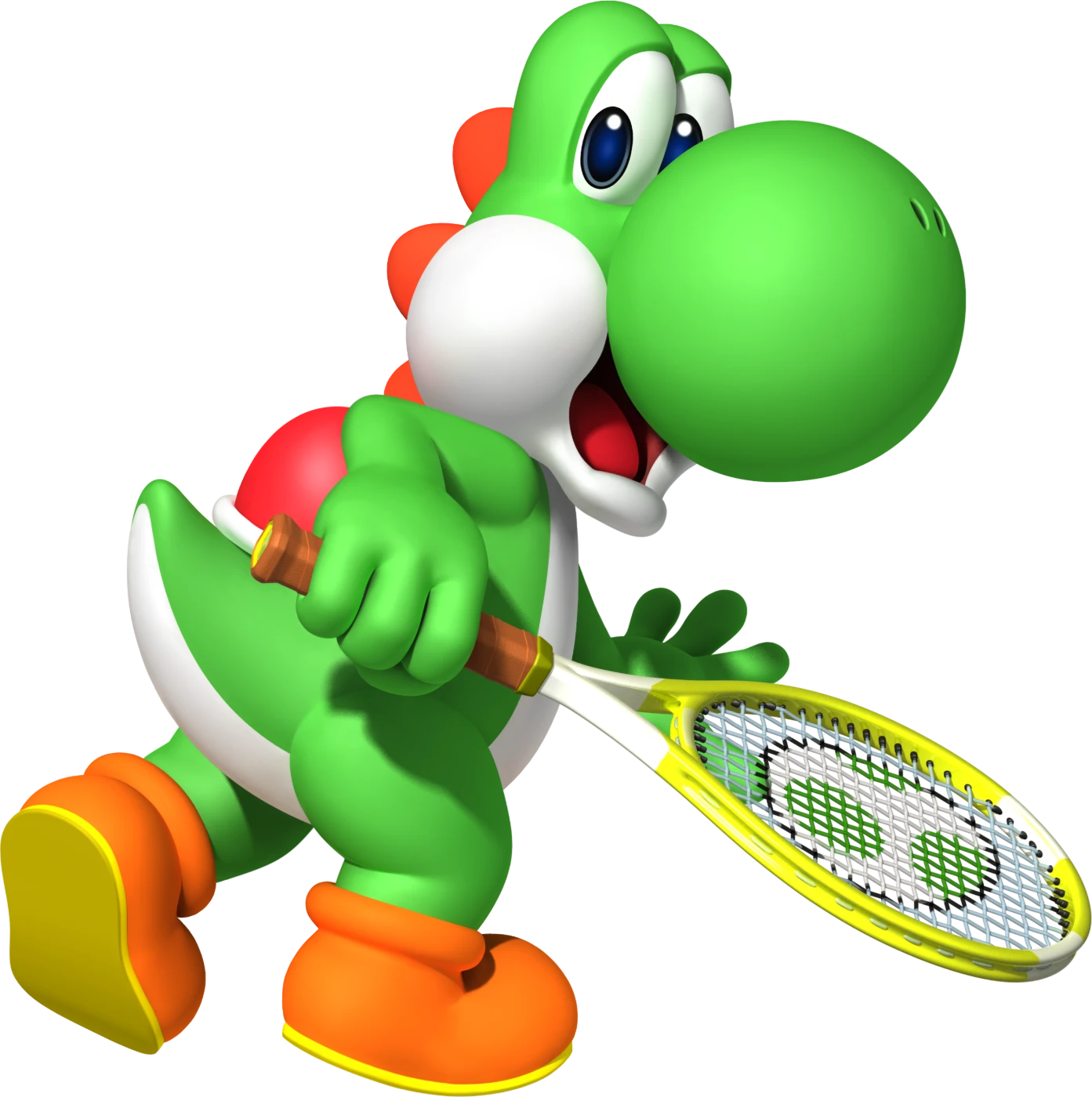
YoshiSpeed · from the start
Mario’s dinosaur friend, here joined by seven recoloured relatives.
Quick around the court. His Yoshi suit for the Mii comes from a QR code.
Type: Speed
Voice: Kazumi Totaka
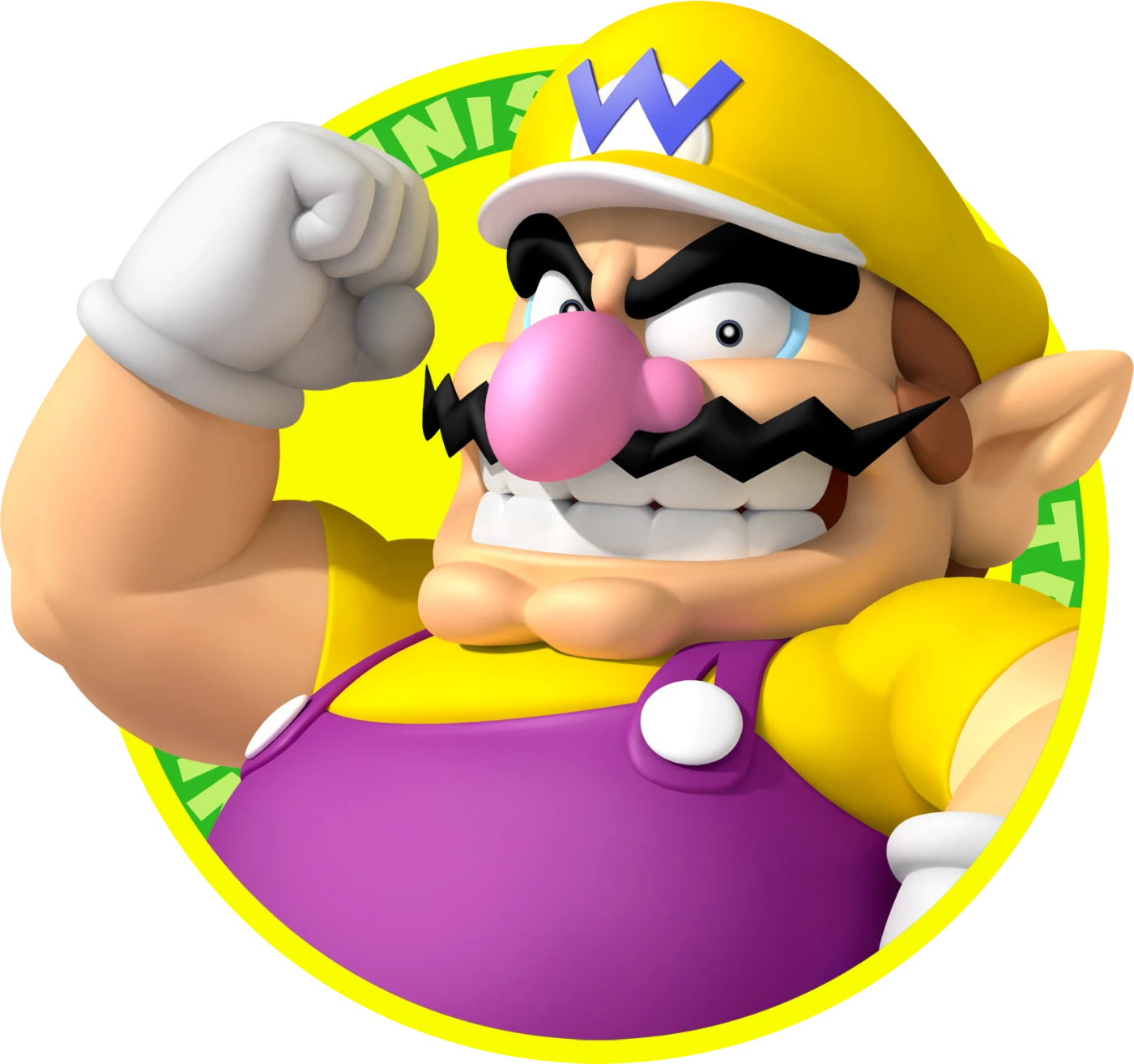
WarioPower · from the start
Mario’s greedy rival, the third Ink Showdown opponent.
Heavy hitter. His costume is for collecting 800 coins in Super Mario Tennis World 1-4.
Type: Power
Voice: Charles Martinet
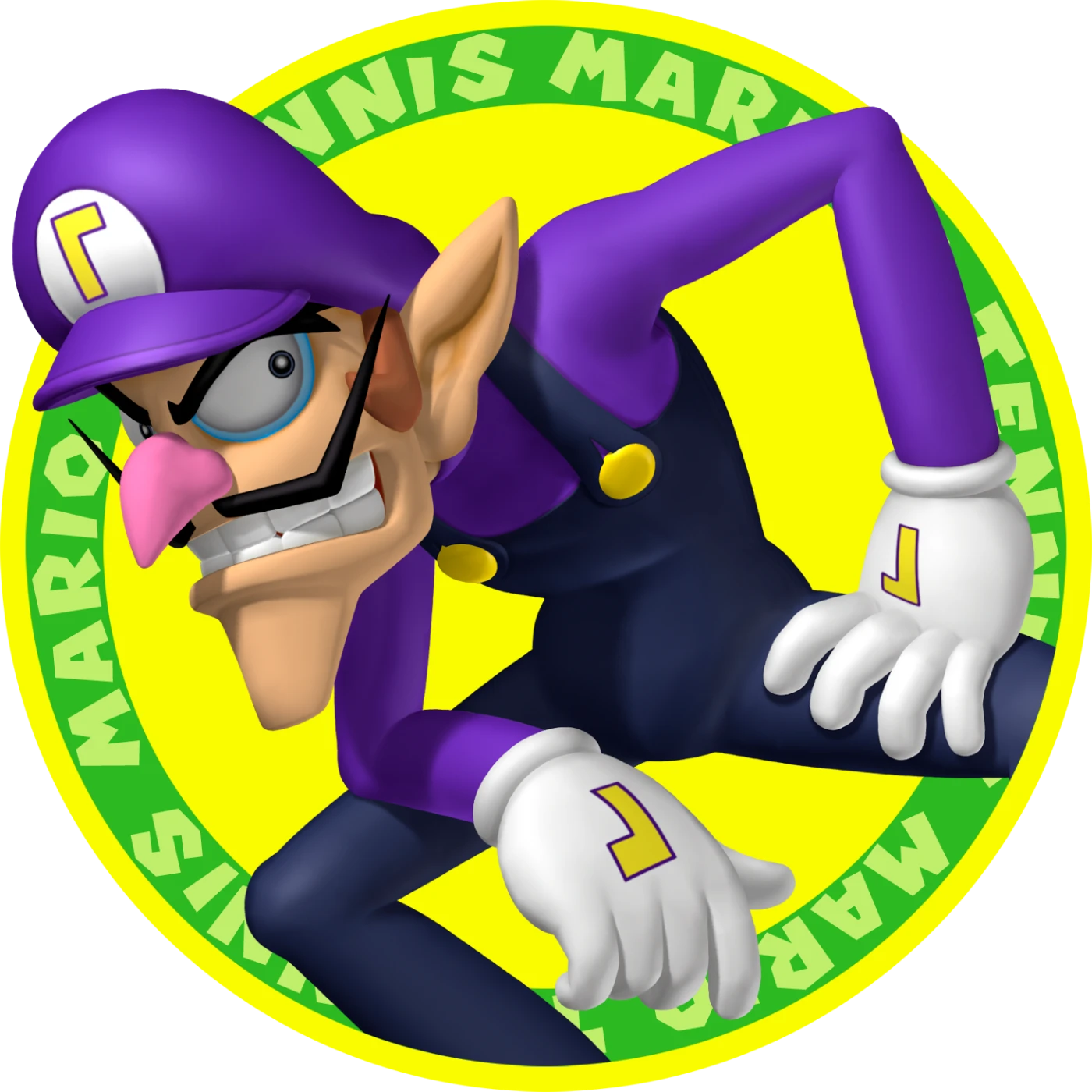
WaluigiDefense · from the start
Wario’s lanky partner, created for the N64 Mario Tennis.
A Defense player whose reach covers the court; in his victory animation his eyes glow, as in his N64 scoring pose.
Type: Defense
Voice: Charles Martinet
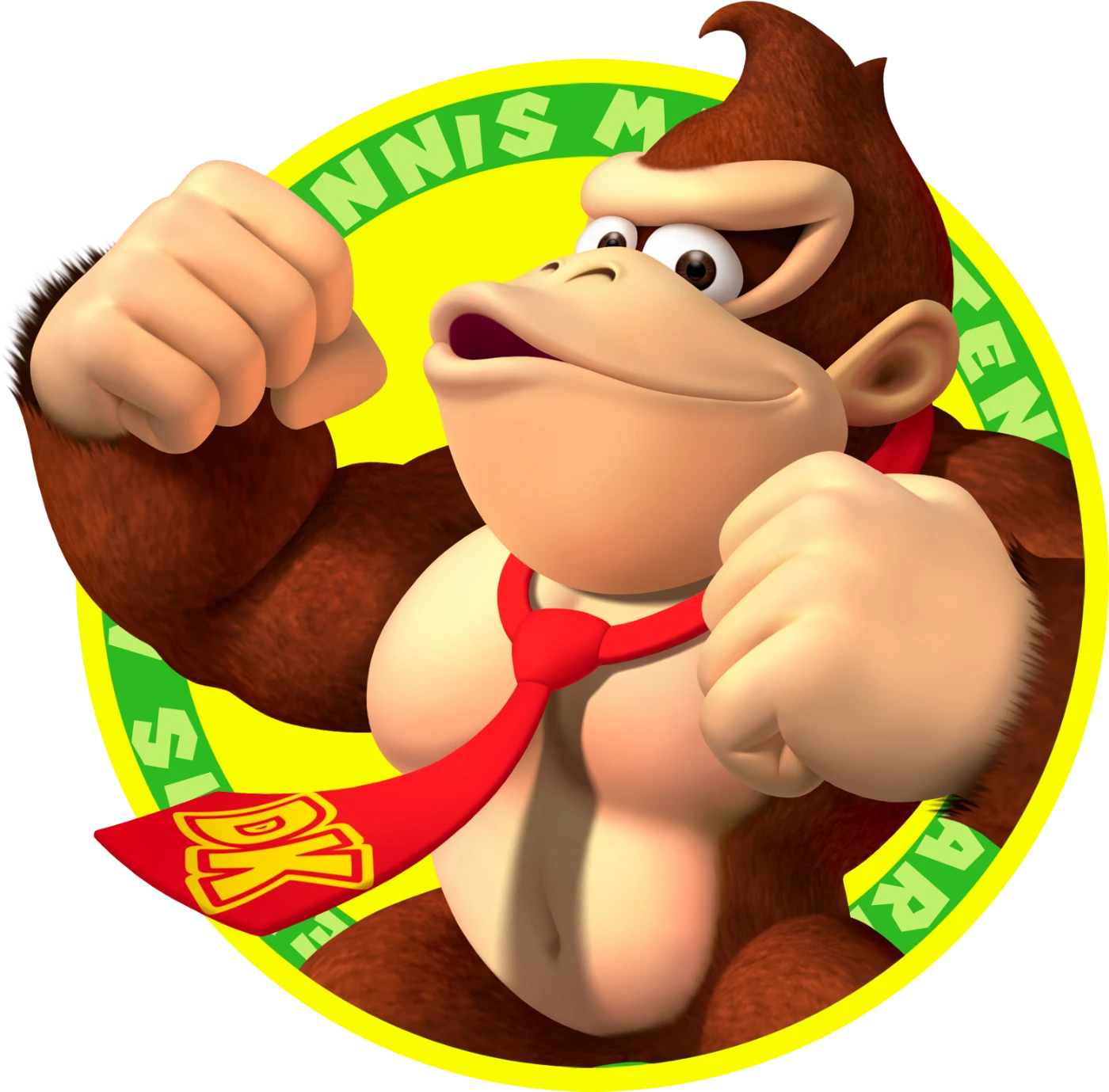
Donkey KongPower · from the start
The king of DK Jungle, whose court hosts the Banana Cup.
Power player. The DK costume is for meeting 50 Miis by StreetPass.
Type: Power
Voice: Takashi Nagasako
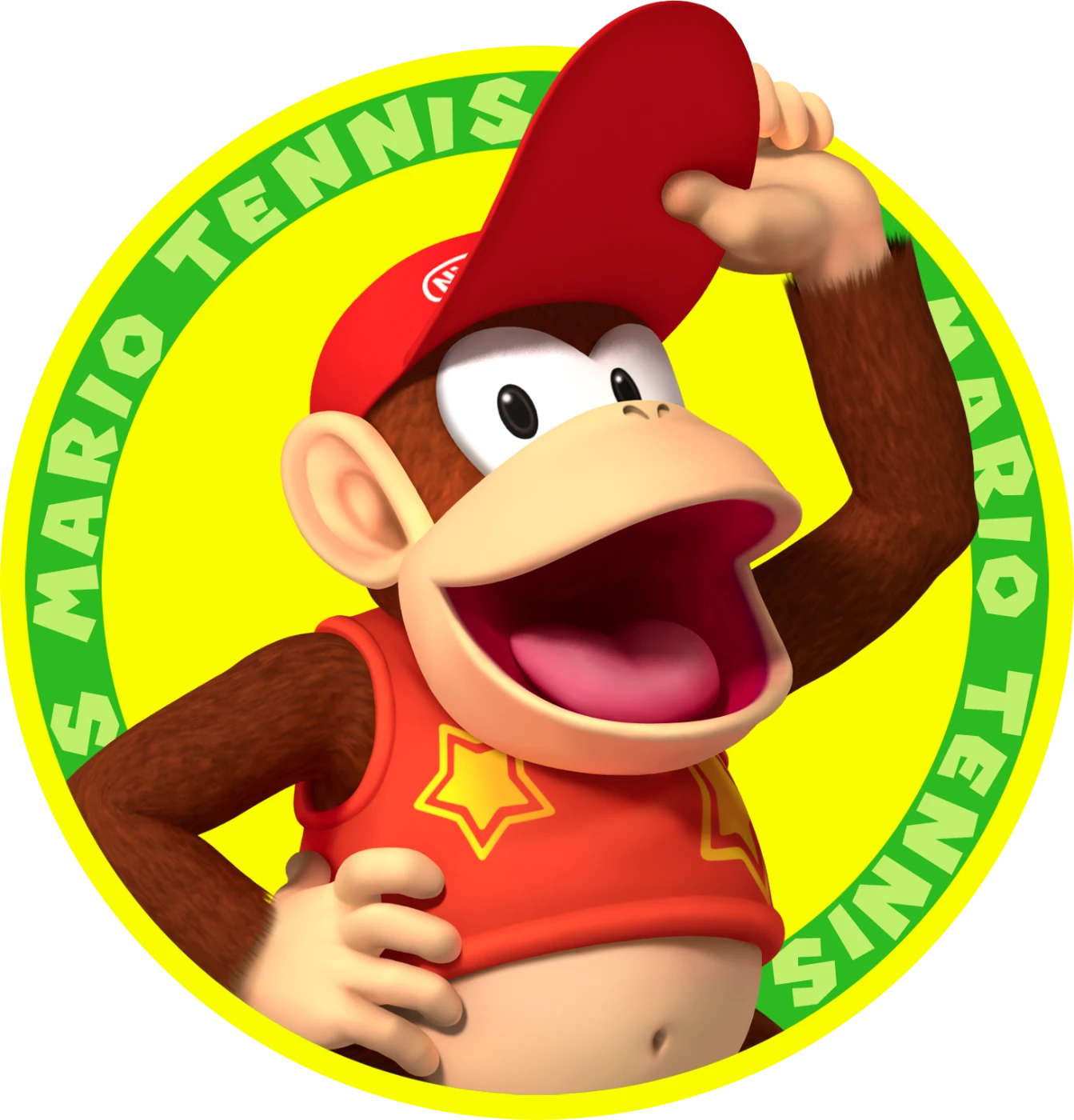
Diddy KongSpeed · from the start
Donkey Kong’s little buddy.
A Speed player; his costume is for meeting 20 Miis by StreetPass.
Type: Speed
Voice: Katsumi Suzuki
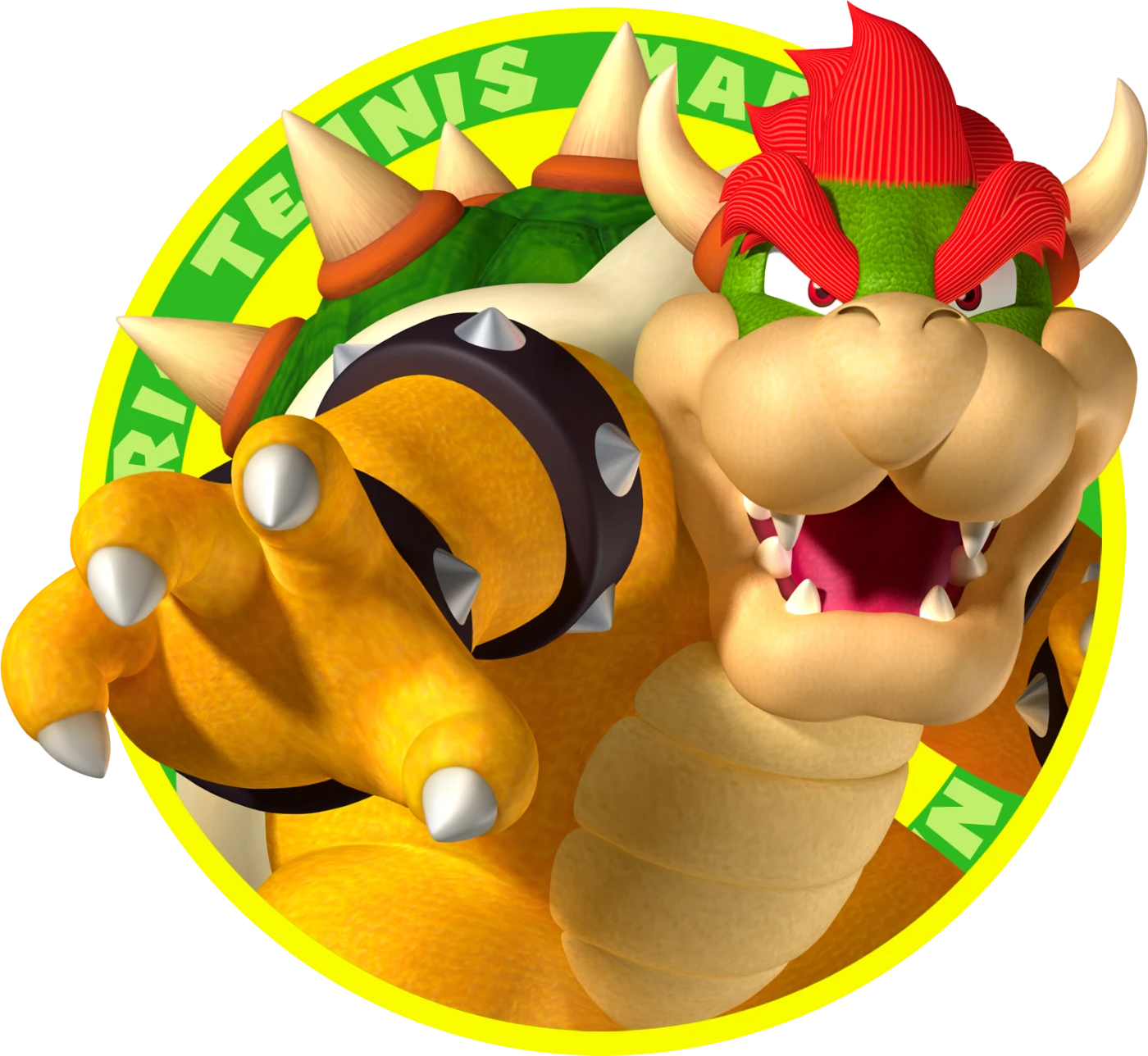
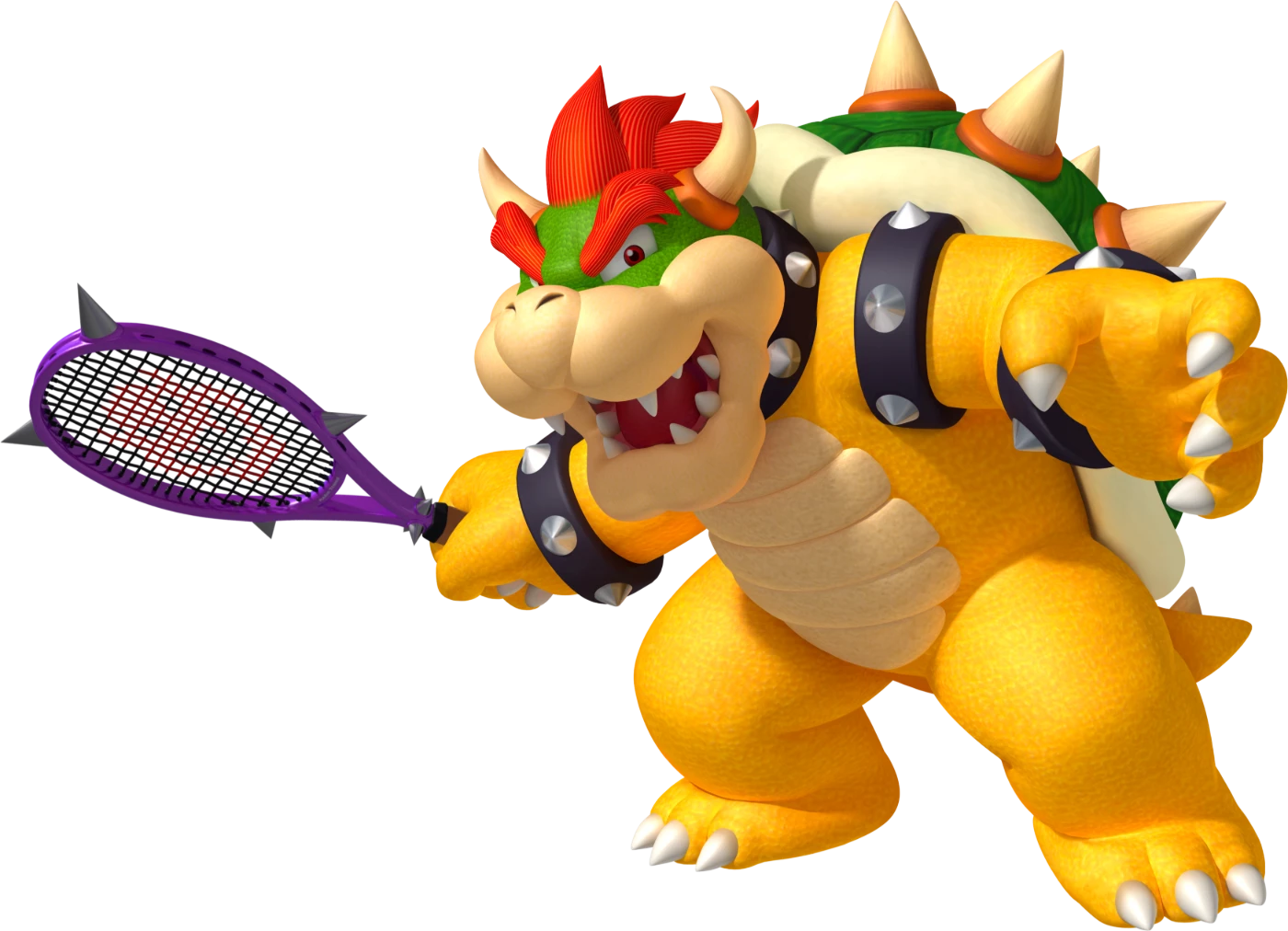
BowserPower · from the start
The Koopa King, owner of the castle court and final opponent of the Ink Showdown Challenge.
Power player; the Bowser costume takes 50 Victory Medals.
Type: Power
Voice: Scott Burns (uncredited)
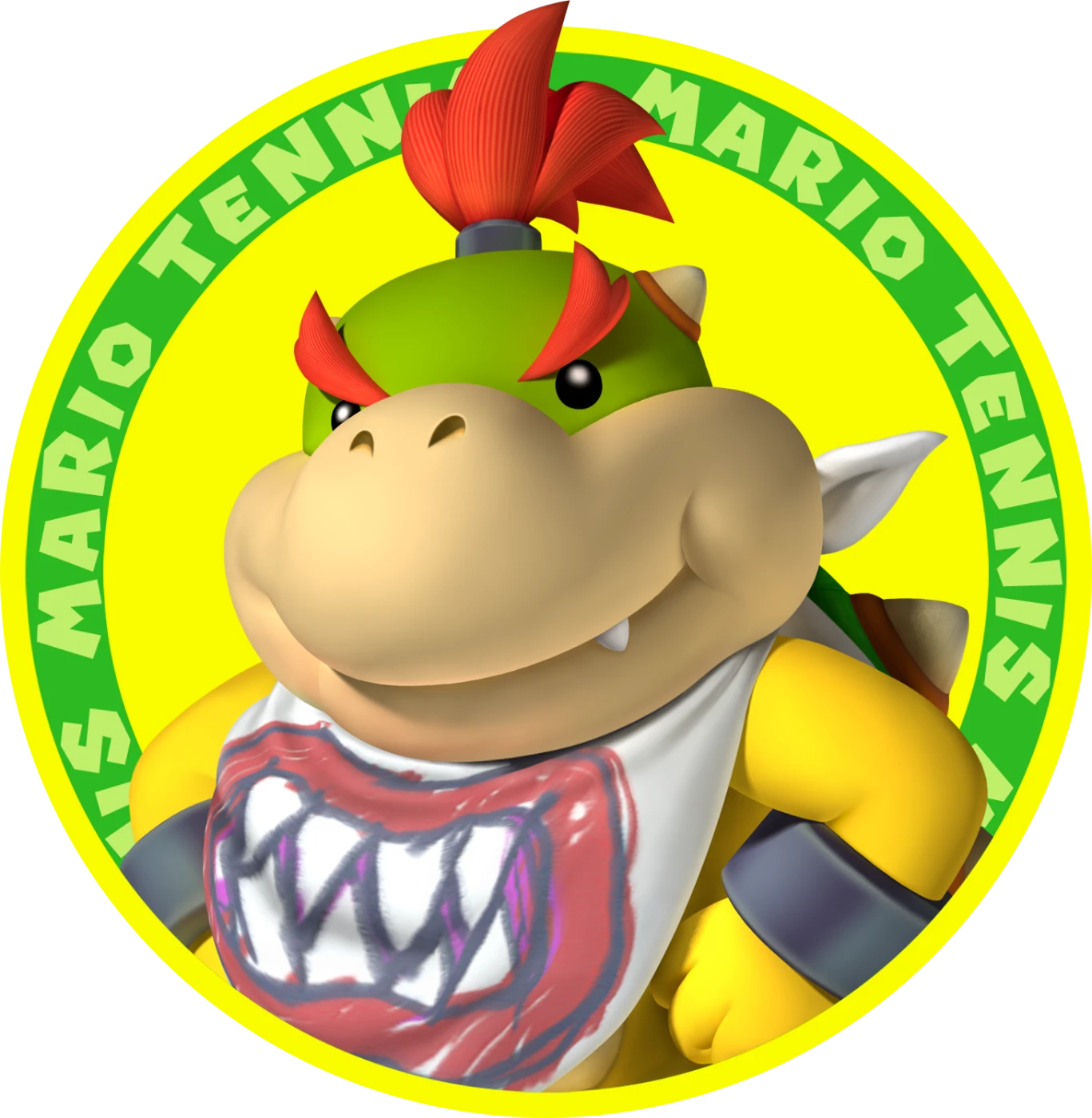
Bowser Jr.Tricky · from the start
Bowser’s son, partnering his father at Bowser’s Castle in the screenshots.
A Tricky player whose shots curve unpredictably.
Type: Tricky
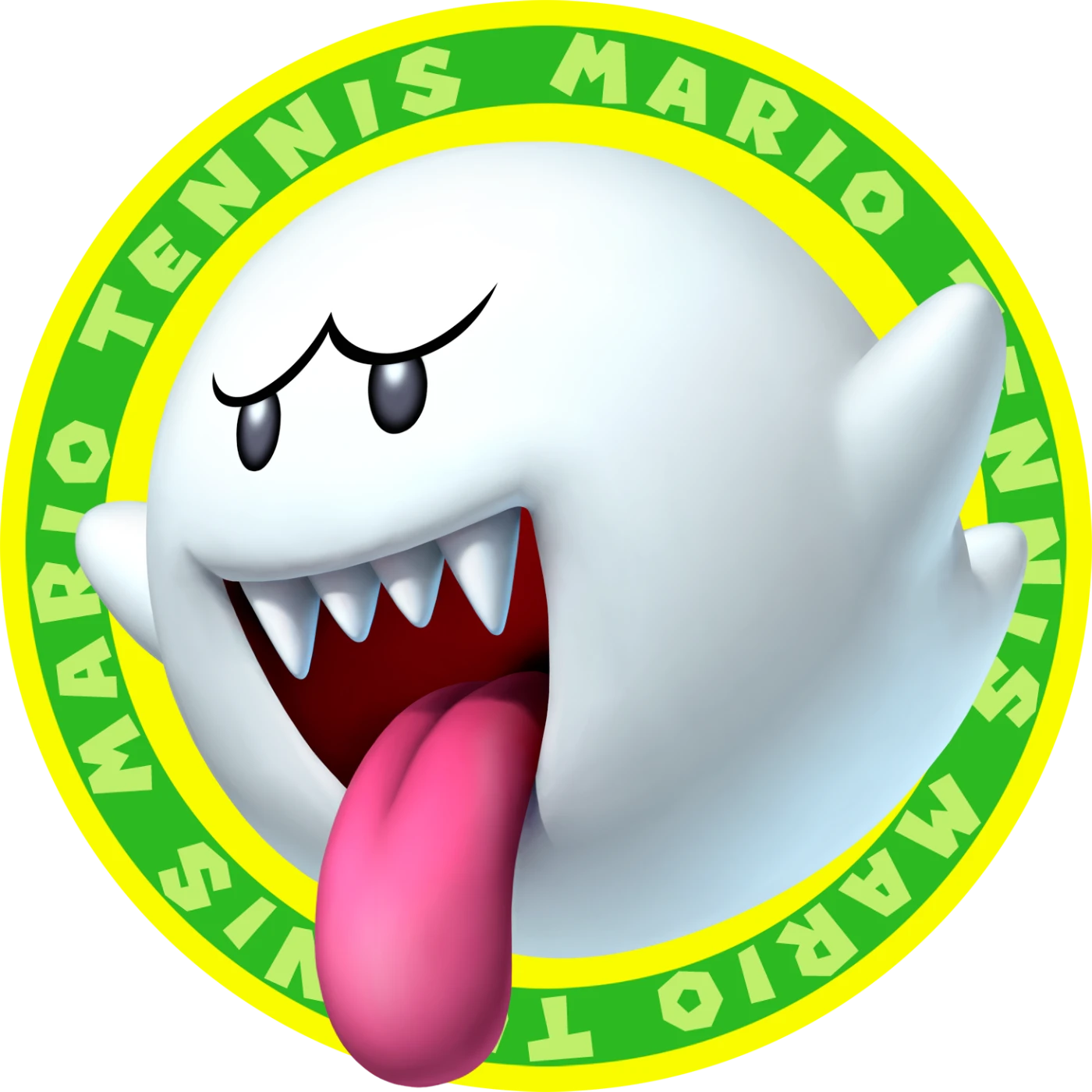
BooTricky · from the start
The shy ghost, back on court.
Tricky. The Boo costume is the reward for buying 100 different Item Shop items.
Type: Tricky
MiiNo type · from the start
Your own Mii, from the 3DS Mii Maker.
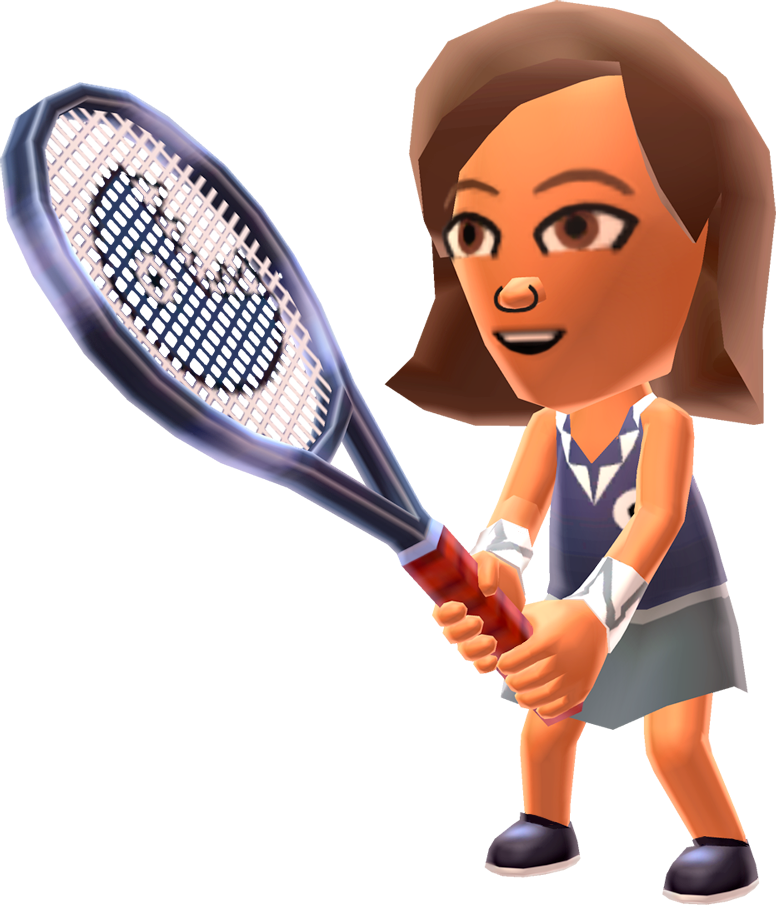
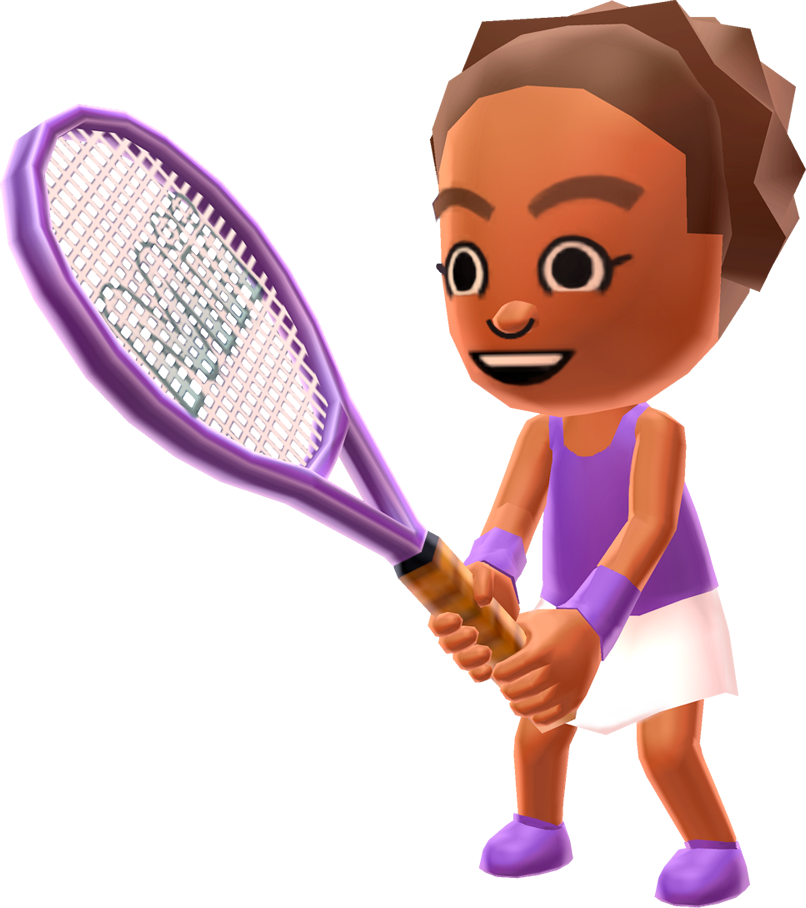
Stats come from its racket, uniform, wristbands and shoes, shown on a nine-stat pie chart; 26 costumes dress it as Mario characters.
Type: set by gear
Three save files, each with its own Mii and rating
LumaTechnique · unlock · series debut
The star-shaped companion from Super Mario Galaxy.
Unlocked by clearing level 3 of Galaxy Rally. Super Mario Wiki notes that Rosalina was planned instead and replaced by Luma.
Type: Technique
Unlock: Galaxy Rally level 3
Baby MarioSpeed · unlock
Mario as a baby, back with the Speed type he had in the N64 game.
Unlocked by clearing level 3 of Super Mario Tennis.
Type: Speed
Unlock: Super Mario Tennis level 3
Voice: Charles Martinet
Baby PeachTricky · unlock · series debut
Princess Peach as a baby, new to Mario Tennis.
Unlocked by clearing level 3 of Ring Shot.
Type: Tricky
Unlock: Ring Shot level 3
Voice: Sam Kelly
Dry BowserDefense · unlock · series debut
Bowser’s skeleton, here in his first Mario Tennis.
Unlocked by clearing level 3 of Ink Showdown.
Type: Defense
Unlock: Ink Showdown level 3
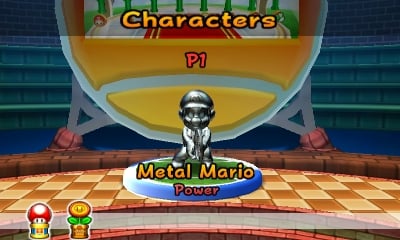
Metal MarioPower · QR code · series debut
Mario turned to metal, his look borrowed from Mario Kart 7 (the game reuses that artwork).
Only available by scanning his QR code.
Type: Power
Unlock: QR code
Voice: Charles Martinet
The rest of the roster, and who else is on court
The seven coloured Yoshis are unlocked only by QR code, each with a type of its own. After them, the non-playable characters you meet in the Special Games and the Clubhouse.
Red YoshiQR codeTechnique.
Blue YoshiQR codeSpeed.
Light-Blue YoshiQR codeSpeed.
Yellow YoshiQR codePower.
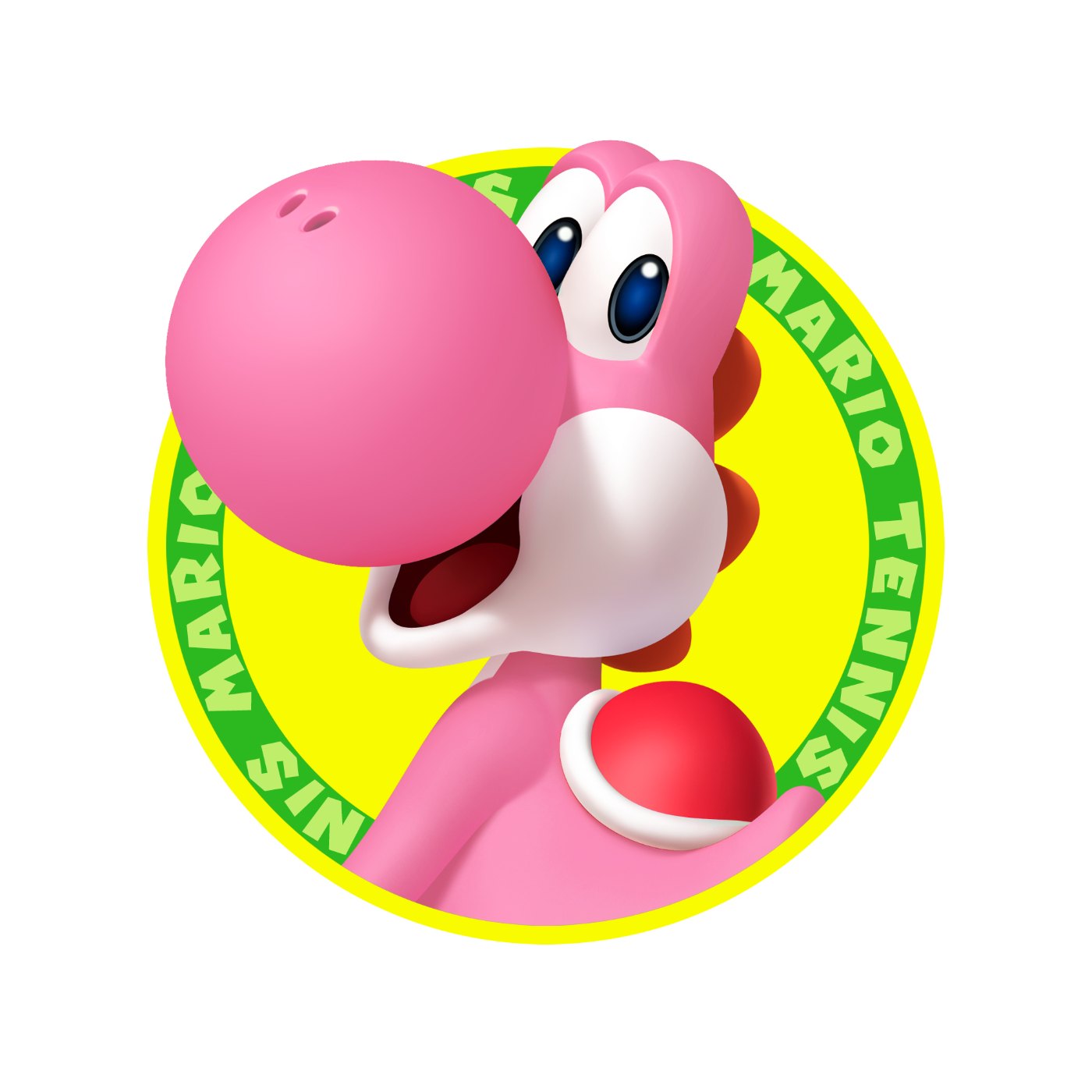
Pink YoshiQR codeTechnique.
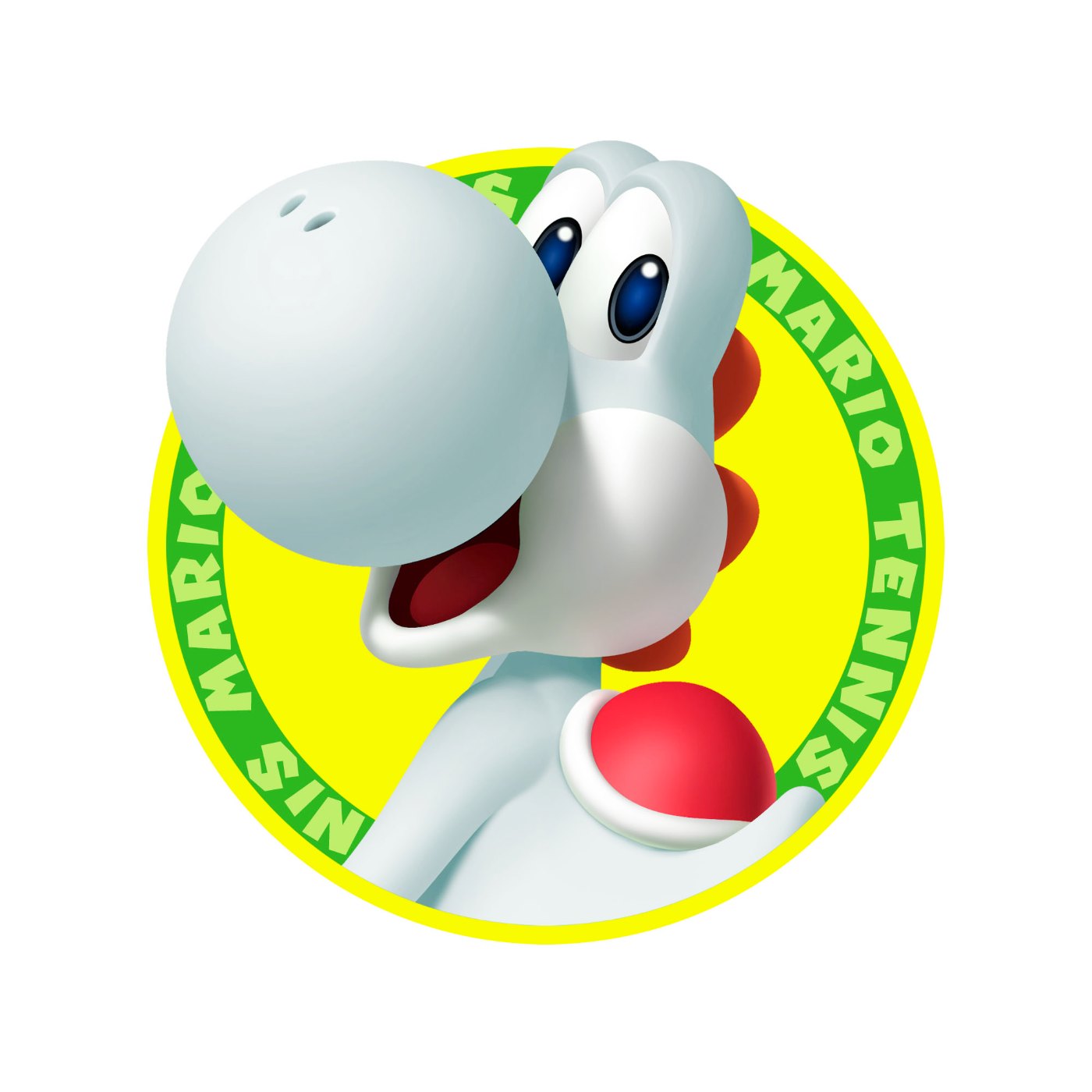
White YoshiQR codeTricky.
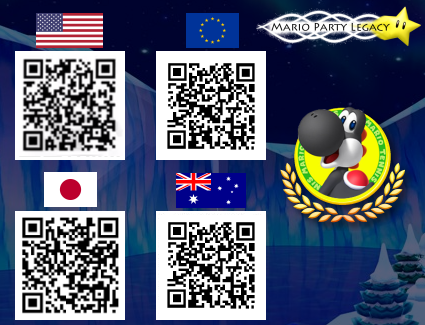
Black YoshiQR codeAll-Around.
Inky Piranha PlantInk ShowdownThree of them spit balls and ink at you; they come from Super Mario 3D Land, splatter and all.
LumasGalaxy Rally, Galaxy ArenaYour rally partner in Galaxy Rally, and spectators in blue, red, green and turquoise.
ToadClubhouseAppears with your Mii in the Clubhouse, where gear is chosen and bought.
Goombas, Koopa Troopas, Buzzy Beetles, Koopa ParatroopasSuper Mario TennisTargets scrolling past on the Super Mario Bros. wall.
Penguins, Shy Guys, Mechakoopas, LakituCourtsAmong the other non-playable characters Super Mario Wiki lists for the game.
Key staff
Names and roles as listed in the game’s staff credits.
Shugo TakahashiDirector; producer; lead game designDirected the game and shared production and lead design with his brother.
Hiroyuki TakahashiProducer; lead game designCo-producer and co-lead game designer with his brother Shugo.
Fumihide AokiArt director; character designCredited with art direction and character design.
Haruki Kodera, Yutaka YamamotoLead programmingThe lead programmers.
Motoi SakurabaMusicComposed the score, including arrangements of classic Mario, Donkey Kong and Wario themes.
Masaaki UnoSound director; sound effectsDirected the sound and handled effects and coordination.
Toshiharu IzunoCo-producerNintendo’s co-producer.
Shinya TakahashiGeneral producerCredited as general producer for Nintendo.
Satoru IwataExecutive producerCredited as executive producer.
Charles MartinetVoice of Mario, Luigi, Wario, Waluigi, Baby Mario, Metal MarioSix of the cast in one voice actor.
Advertisement
How It Was Made
Camelot on 3DS
The international logo.
Mario Tennis Open was developed by Camelot Software Planning with Nintendo’s SPD Group No. 4. Shugo Takahashi directed and, with his brother Hiroyuki, produced the game and led its design; Fumihide Aoki directed the art and designed the characters, and Motoi Sakuraba composed the music.
Where the Game Boy Color Mario Tennis and Power Tour had been tennis RPGs, Open has no story mode at all, and Camelot’s choice to keep the handheld game purely about tennis was asked about in pre-release interviews. In its place came features the 3DS made possible: the gyro sensor, the touch screen panels, StreetPass, QR codes and, for the first time in the series, online matches.
From reveal to release
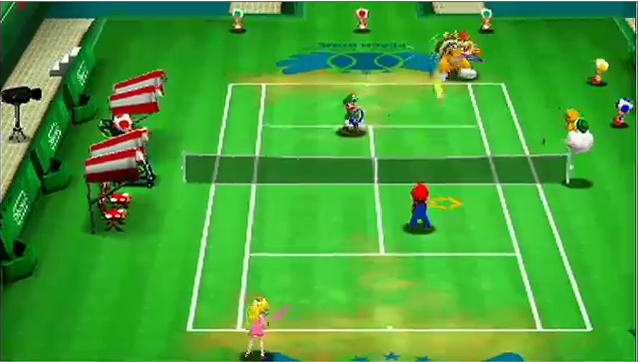
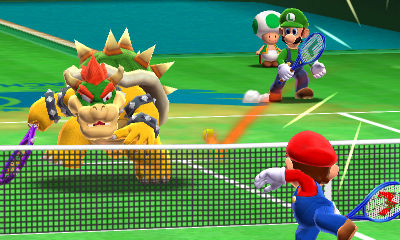
Mario and Peach against Luigi and Bowser in a pre-release screenshot.
The game was first shown in Japan in September 2011, with a trailer at Nintendo’s 3DS conference and footage published from the Tokyo Game Show, in which Mario and Peach played Bowser and Luigi on a Peach Dome court; the finished game replaced it with Mario Stadium. Super Mario Wiki notes that Rosalina was meant to be playable until Luma took her slot, and that she later made her playable Mario Tennis debut in Ultra Smash.
Release dates for all three regions were announced on 22 February 2012, and the game was shown at the Game Developers Conference in March. It went on sale in North America on 20 May, in Japan and Australia on 24 May and in Europe on 25 May 2012, with a download version on the Nintendo eShop from October 2012 in Europe and Australia, November in Japan and December in North America.
The music
The Japanese pre-release logo.
Motoi Sakuraba’s soundtrack is full of quotations. The Super Mario Bros. ground theme turns up on the title screen, at Mario Stadium and in the credits; DK Jungle plays DK Island Swing; Wario Dunes uses daytime music from Wario Land 3’s Out of the Woods; Peach’s Palace and Bowser’s Castle borrow from Super Mario 64 (and Bowser’s Castle from Super Mario Sunshine’s final battle), and Exhibition matches use an arrangement of Rosalina in the Observatory. The game point and match point jingles are covers of the N64 Mario Tennis themes.
Series Firsts
What Mario Tennis Open brought to the series, checked against the games before it.
1Online playThe first Mario Tennis with online matches, through Nintendo Network: friend rooms for four and rated Open Matches within each region.
2Gyro aimingDirect Mode, which uses the 3DS gyro sensor to aim from behind your player, was new to the series.
3Chance ShotsSuper Mario Wiki records Mario Tennis Open as the game that introduced Chance Shots; they returned in Mario Tennis: Ultra Smash and the tennis mode of Mario Sports Superstars.
4Four Mario Tennis debutsLuma, Baby Peach, Dry Bowser and Metal Mario played Mario Tennis for the first time here.
Cheats & Secrets
Everything in Mario Tennis Open is earned in play, apart from the eight QR code characters and the Yoshi suit, which need a code scanned with the 3DS camera.
Scanning QR codes
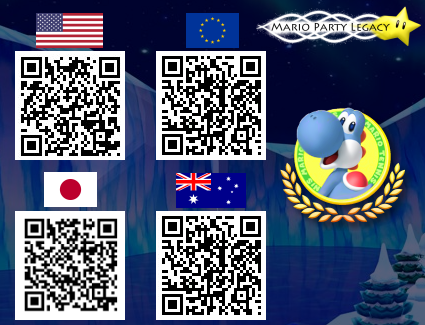
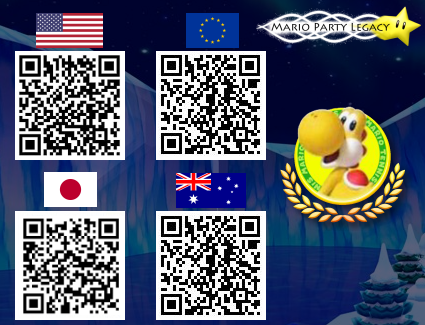
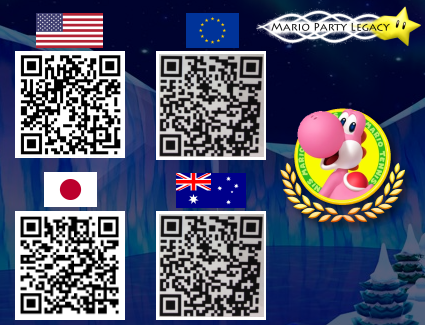
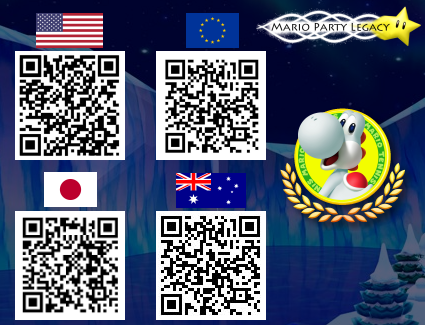
Create a save file first. On the file select screen, press Up on the +Control Pad and Start at the same time and the camera opens. Codes unlock Metal Mario, Red, Blue, Light-Blue, Yellow, Pink, White and Black Yoshi, and the Yoshi costume for your Mii. The codes themselves are shown under Gallery below.
Unlockable characters
Baby Peach: clear Ring Shot level 3. Baby Mario: clear Super Mario Tennis level 3 (World 1-3). Luma: clear Galaxy Rally level 3. Dry Bowser: clear Ink Showdown level 3.
Difficulty, star ranks and the Star Open
Win the Champions Cup to give that character a star rank, open the Star Open and unlock Pro computer players. Win the Final Cup for Ace difficulty and the Galaxy Arena. In doubles only the character you control earns the star.
Every costume and how to get it
Mario: win the Final Cup singles. Luigi: win the Final Cup doubles. Peach: 800 ring points in the Ring Shot Challenge. Daisy: 700 ring points in the Ring Shot Challenge with another player. Yoshi: QR code. Wario: 800 coins in Super Mario Tennis 1-4. Waluigi: 800 coins in Super Mario Tennis 2-4. Luma: 1,500 coins in the Galaxy Rally Challenge. Petey Piranha: 50 returns in the Ink Showdown Challenge. Bowser Jr., Bowser, Dry Bowser: 20, 50 and 100 Victory Medals. Diddy Kong, Donkey Kong: meet 20 and 50 Miis by StreetPass. Koopa Troopa, Shy Guy: win 10 and 20 StreetPass matches in a row. Fire, Propeller, Bee, Cloud and Tanooki Mario: give star ranks to 2, 5, 8, 10 and 15 characters. Boo: buy 100 different items. Goomba: add 100 items to the shop’s shelves. Toad: 50,000 coins in total. Wiggler: 5,000 points in Open Matches. Birdo: win a singles Exhibition against an Ace-level opponent.
Coins fast
The Special Games are the main source of coins. In Galaxy Rally, consecutive Star Chips and Launch Star hits pay more each time (2 coins rising by 2 for chips, 5 rising by 5 for the Launch Star), and StreetPass Match wins pay more the longer your winning streak.
Unlock conditions from Super Mario Wiki’s articles on the game, its Mii gear and its Special Games. The SLB cheats page for this game is linked below the article.
Videos
Two episodes of Nintendo of America’s Mario Tennis Open Report, uploaded on 23 May 2012.
Official Nintendo of America upload: two talking tennis balls introduce Super Mario Tennis, Galaxy Rally and Ring Shot.
Official Nintendo of America upload: doubles footage, a Mii Chance Shot and a match at DK Jungle.
Trivia & Interesting Facts
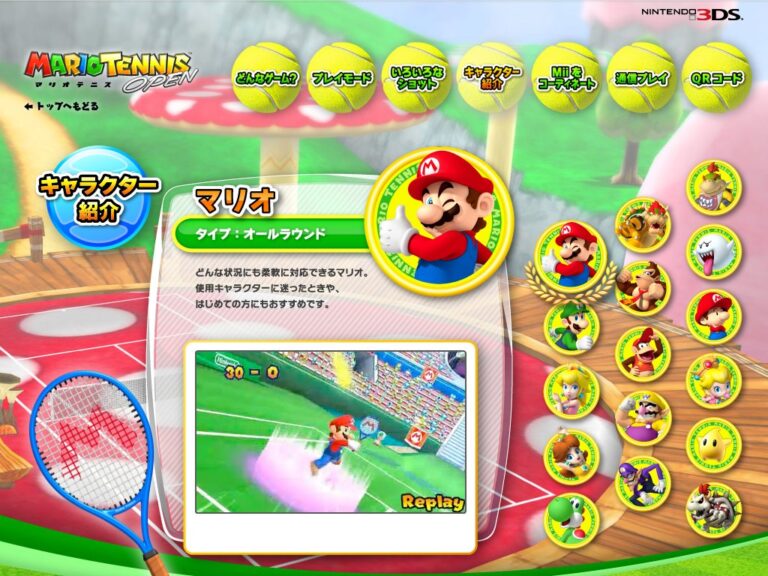
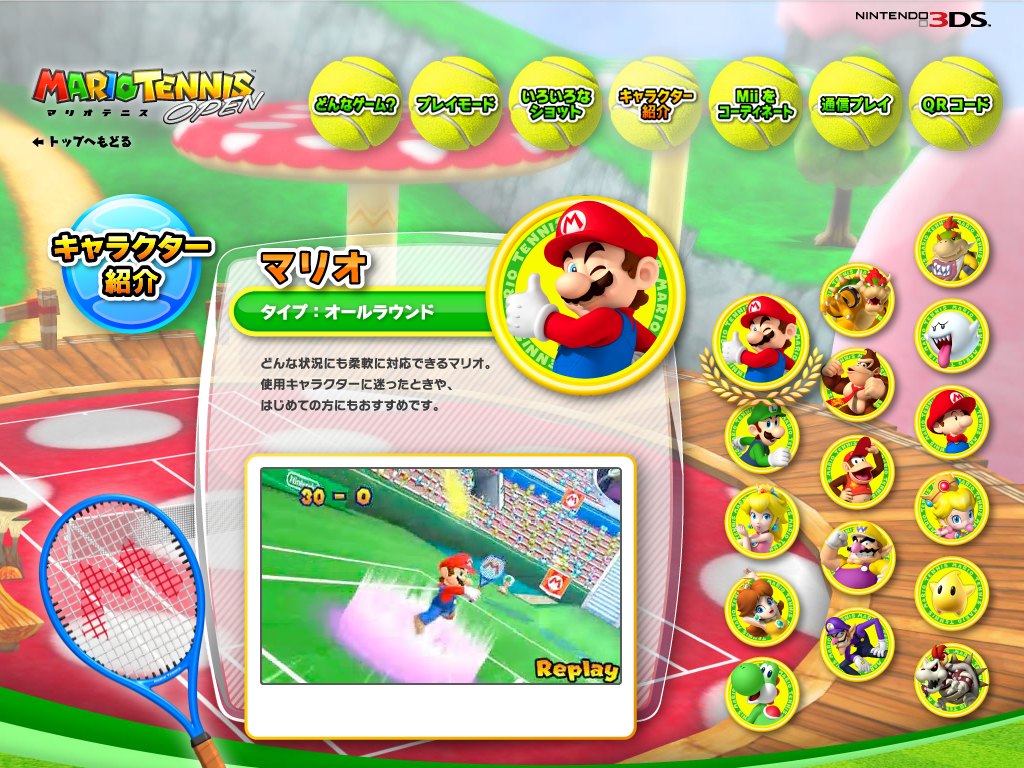
The roster on the official website.The roster image on Nintendo’s official website showed the seventeen characters you can earn in play and left out the eight QR code characters.
Super Mario Wiki notes that Rosalina was planned as a playable character and replaced by Luma. She finally played Mario Tennis in Ultra Smash.
The September 2011 footage was played on a Peach Dome court; the finished game has Mario Stadium in its place.
Super Mario Tennis uses reworked versions of Worlds 1-1, 1-2 and 1-4 of Super Mario Bros., and the classic tracks it borrows (ground, underground, castle, Starman and more) are played with added reverb.
Mushroom Valley is built on a mushroom at Mushroom Gorge from Mario Kart Wii, and the race track can be seen below the court.
Peach’s Palace closely resembles the first room of Peach’s Castle in Mario & Luigi: Bowser’s Inside Story.
Ink Showdown’s Inky Piranha Plants come from Super Mario 3D Land, and the ink splatter on screen uses the same design.
Several costumes honour former Mario Tennis players: Toad, Birdo and Shy Guy from the N64 game, and Koopa Troopa, Petey Piranha and Wiggler from Mario Power Tennis.
The Mario power-up costumes, Fire, Propeller, Bee, Cloud and Tanooki Mario, come from as far apart as Super Mario Bros. and Super Mario Galaxy 2, and are earned by giving star ranks to more and more characters.
Holding the 3DS upright for Direct Mode turns off the 3D effect.
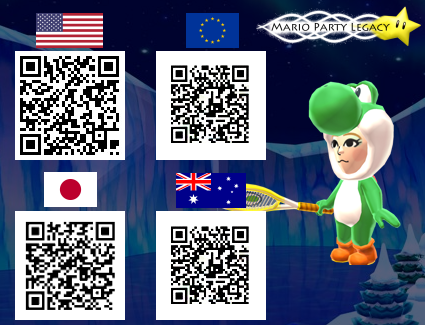
The QR code for the Mii Yoshi costume.In Europe, Australia and New Zealand the game had a Yoshi Hunt: shoppers scanned QR codes for the coloured Yoshis at thirty participating ASDA stores, and at EB Games and JB Hi-Fi stores.
The Mario Tennis Open Report videos are presented by talking tennis balls named after shots: Lob Shot, Slice Shot, Simple Shot and Topspin Shot.
The Japanese title is マリオテニス オープン (Mario Tenisu Ōpun); the Chinese and Korean names also mean Mario Tennis Open.
Online play was limited to players in the same region, one of the online mode’s most criticised features.
Nintendo UK lists the download version at 2,065 blocks, and it disappeared from sale when the 3DS eShop closed on 27 March 2023.
Regional Box Art
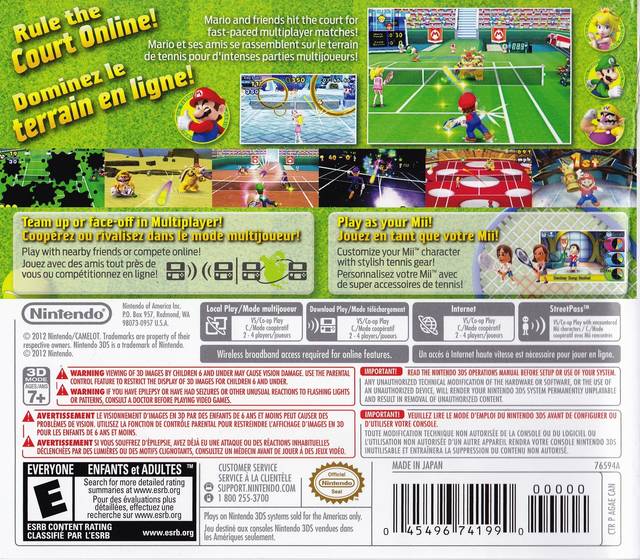
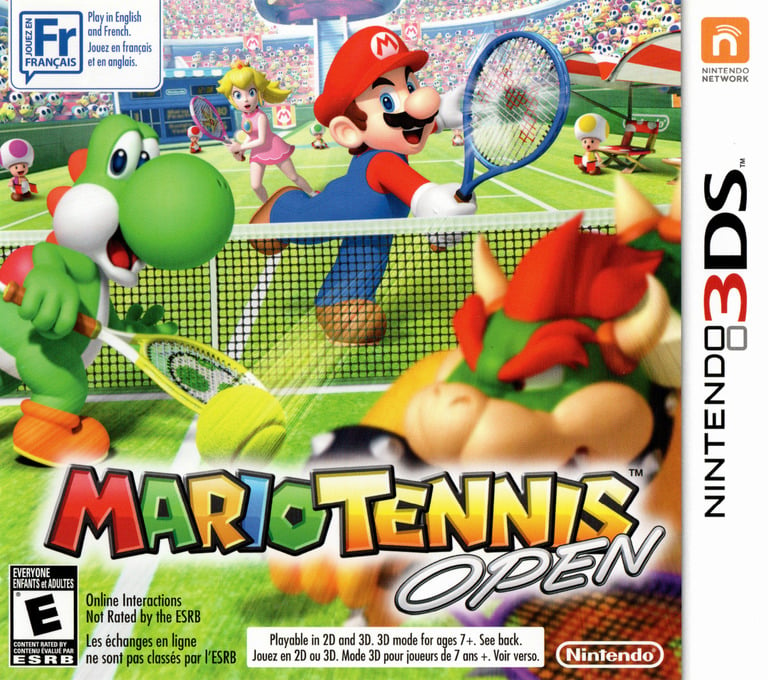
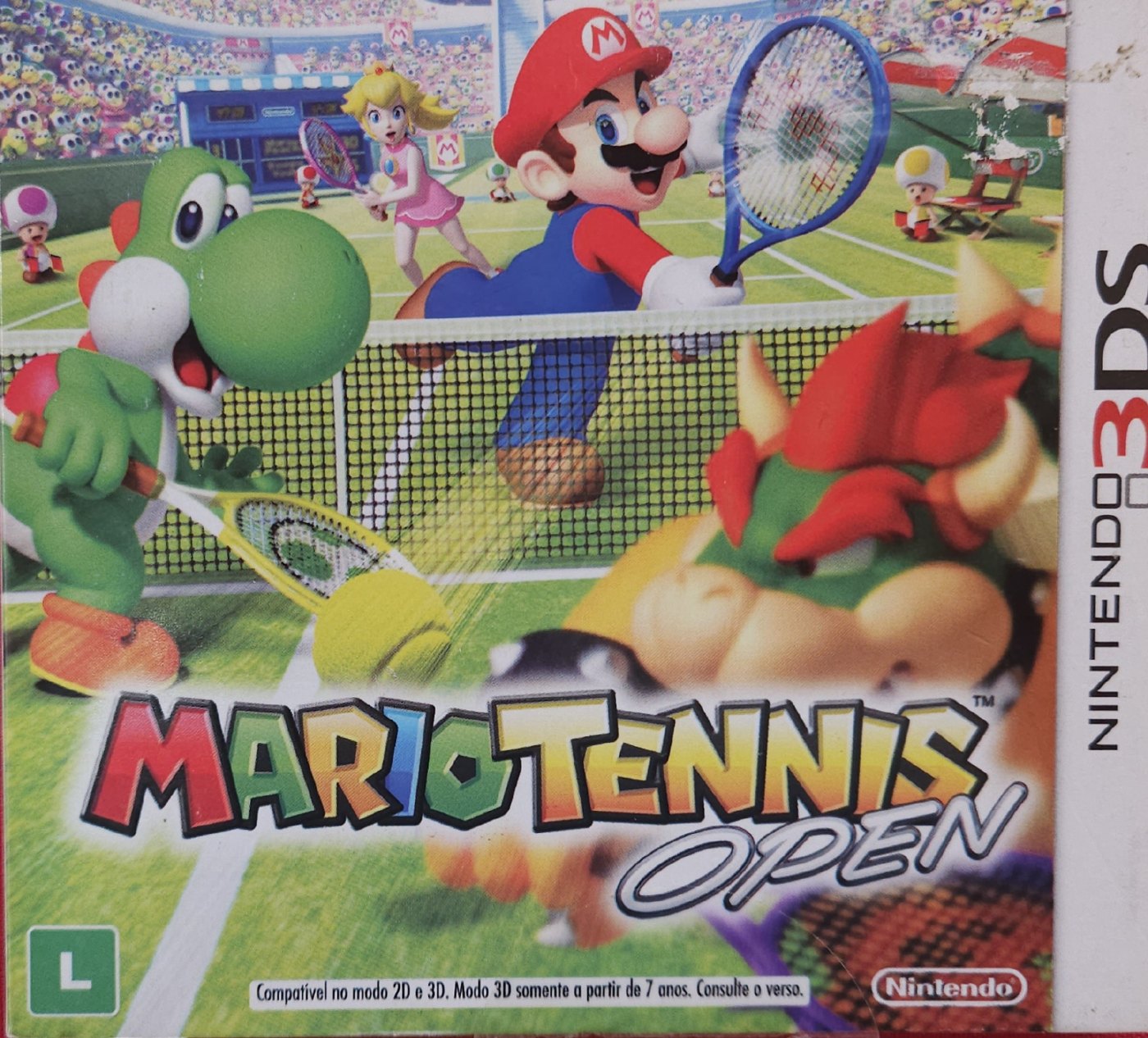
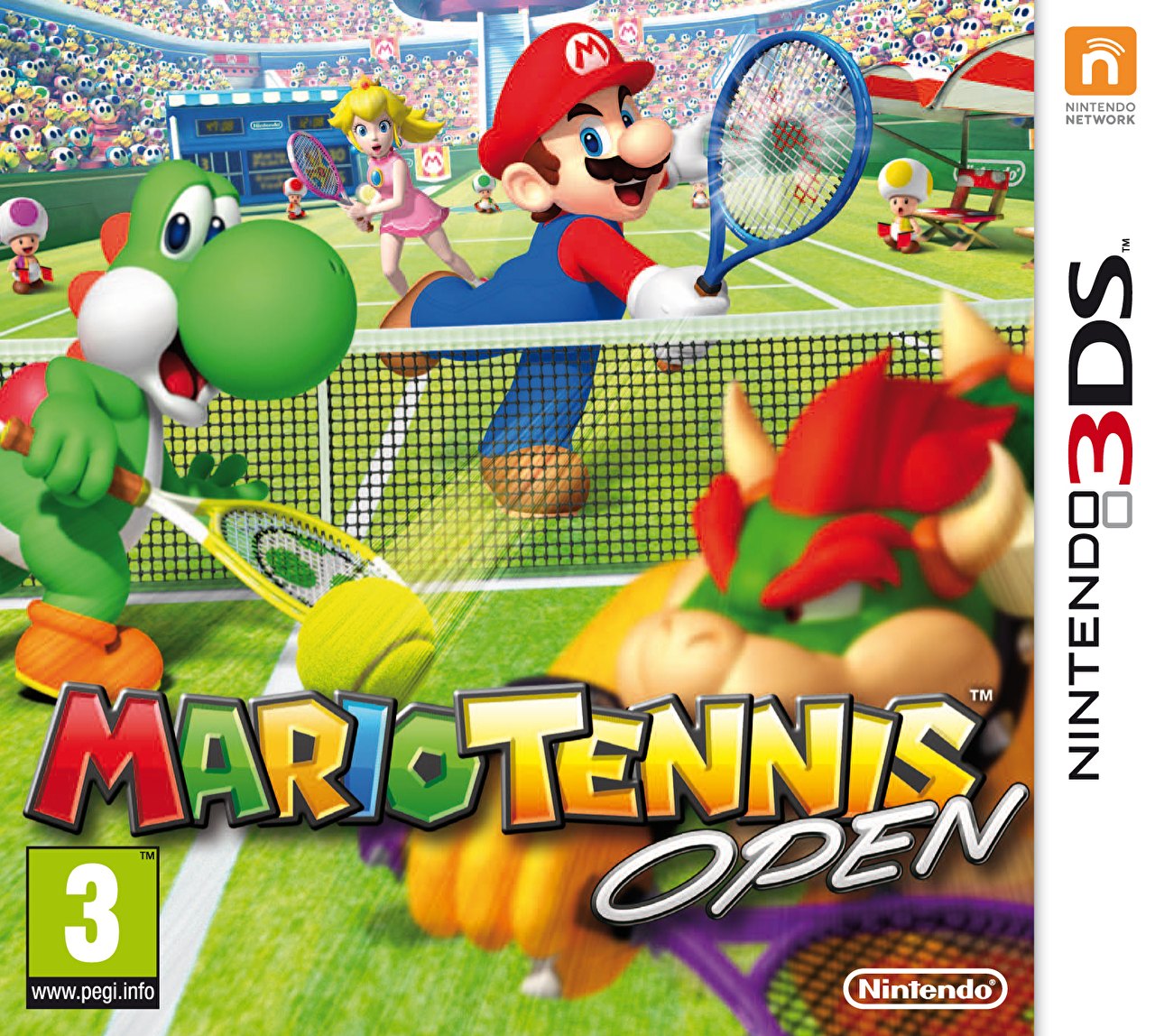
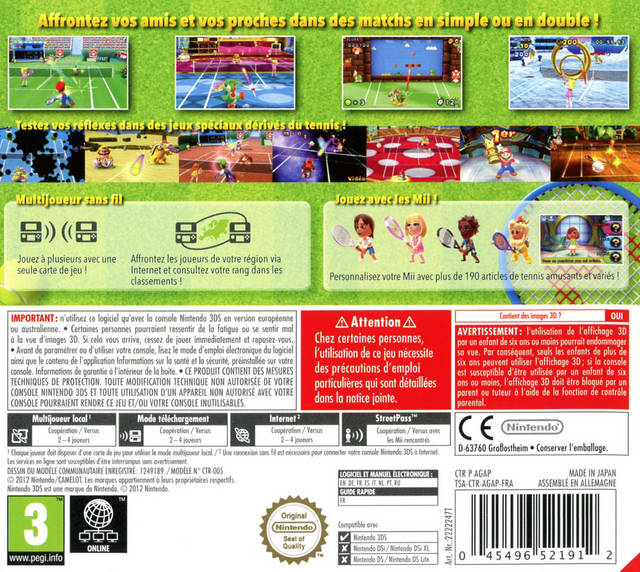
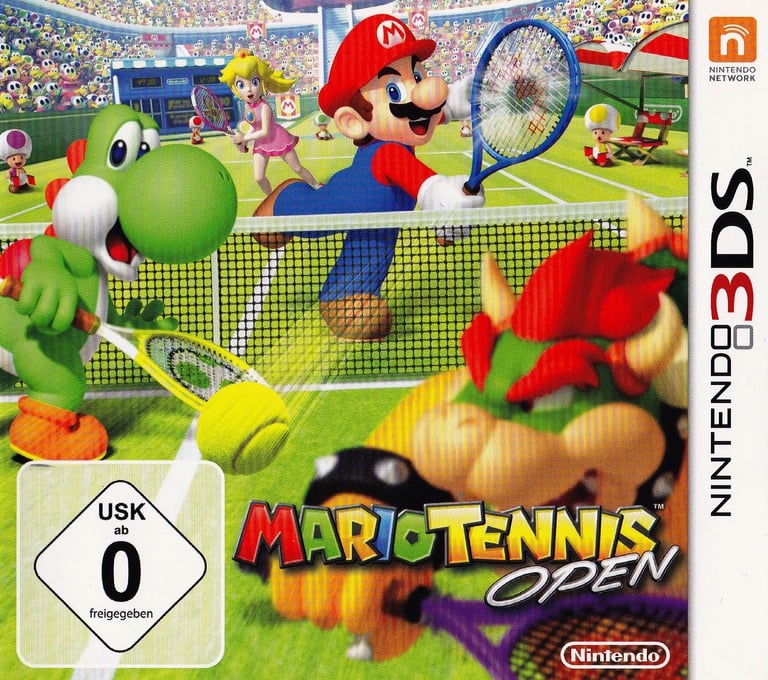
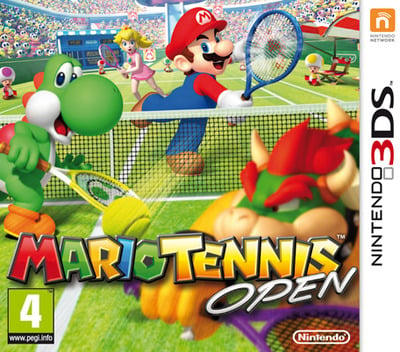
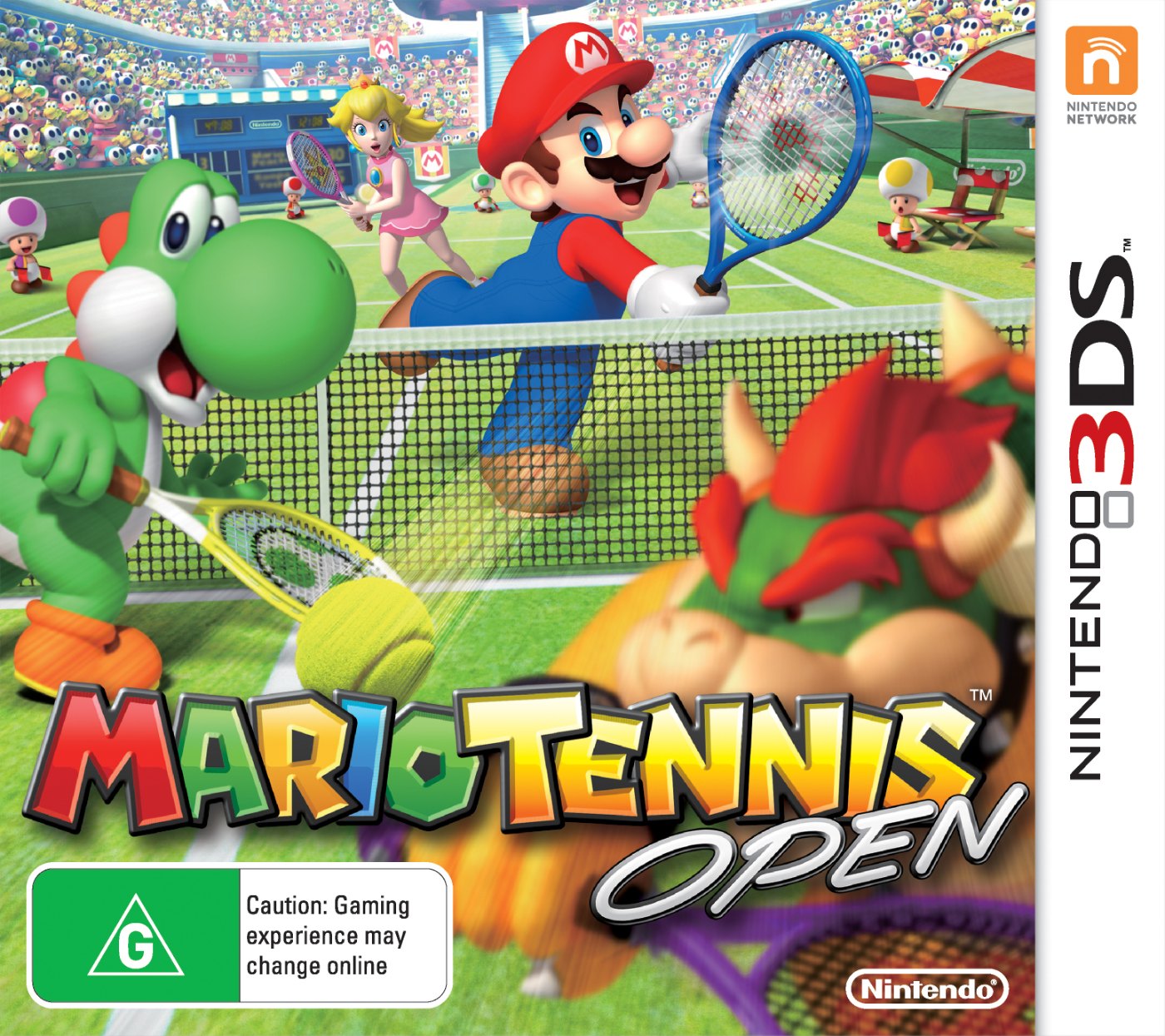
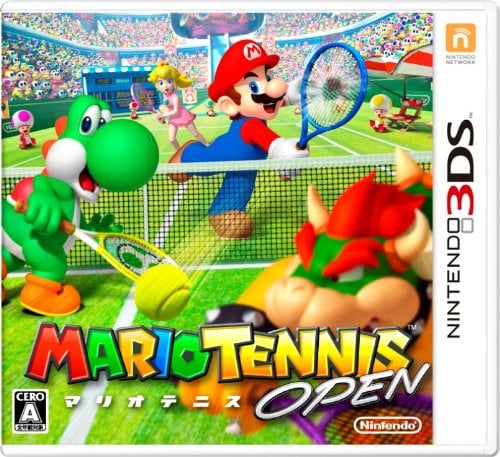
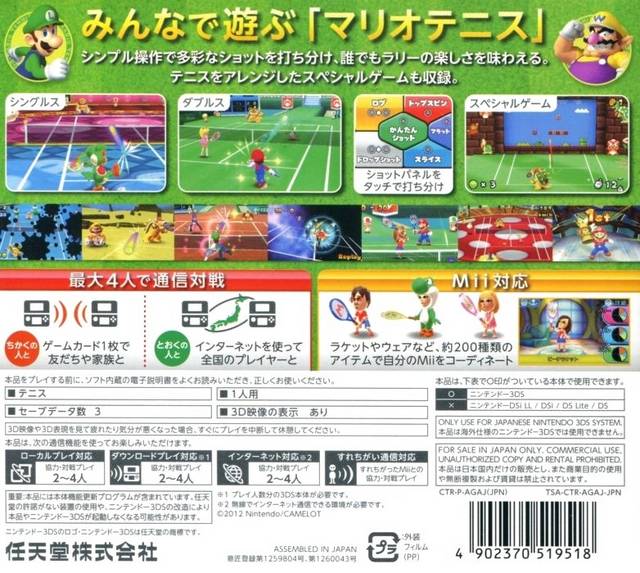
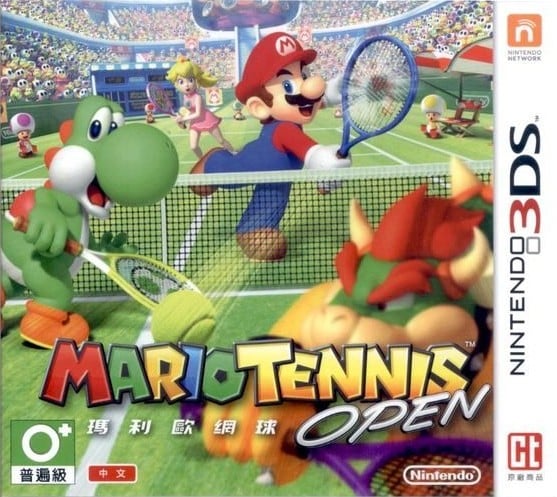
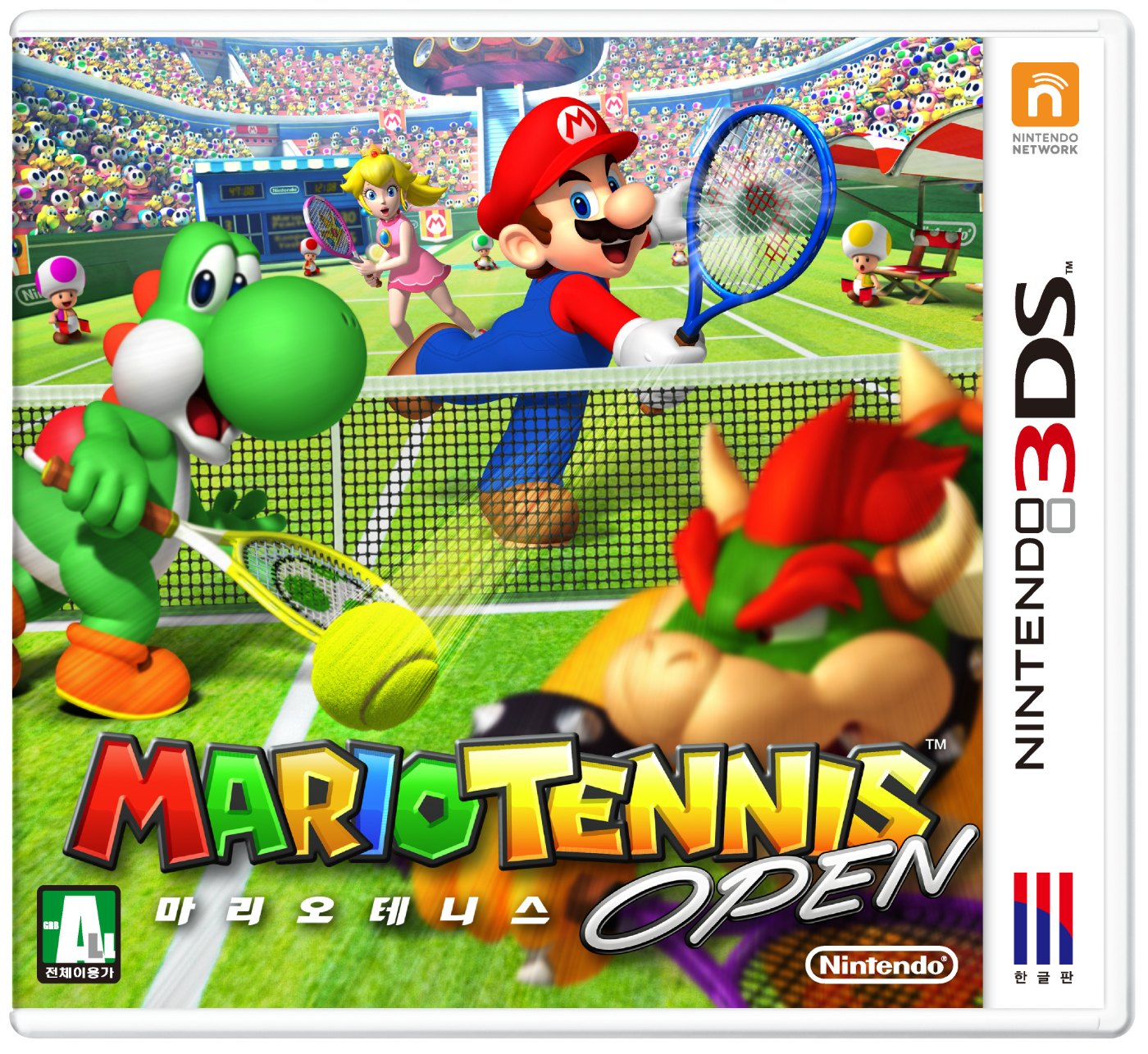
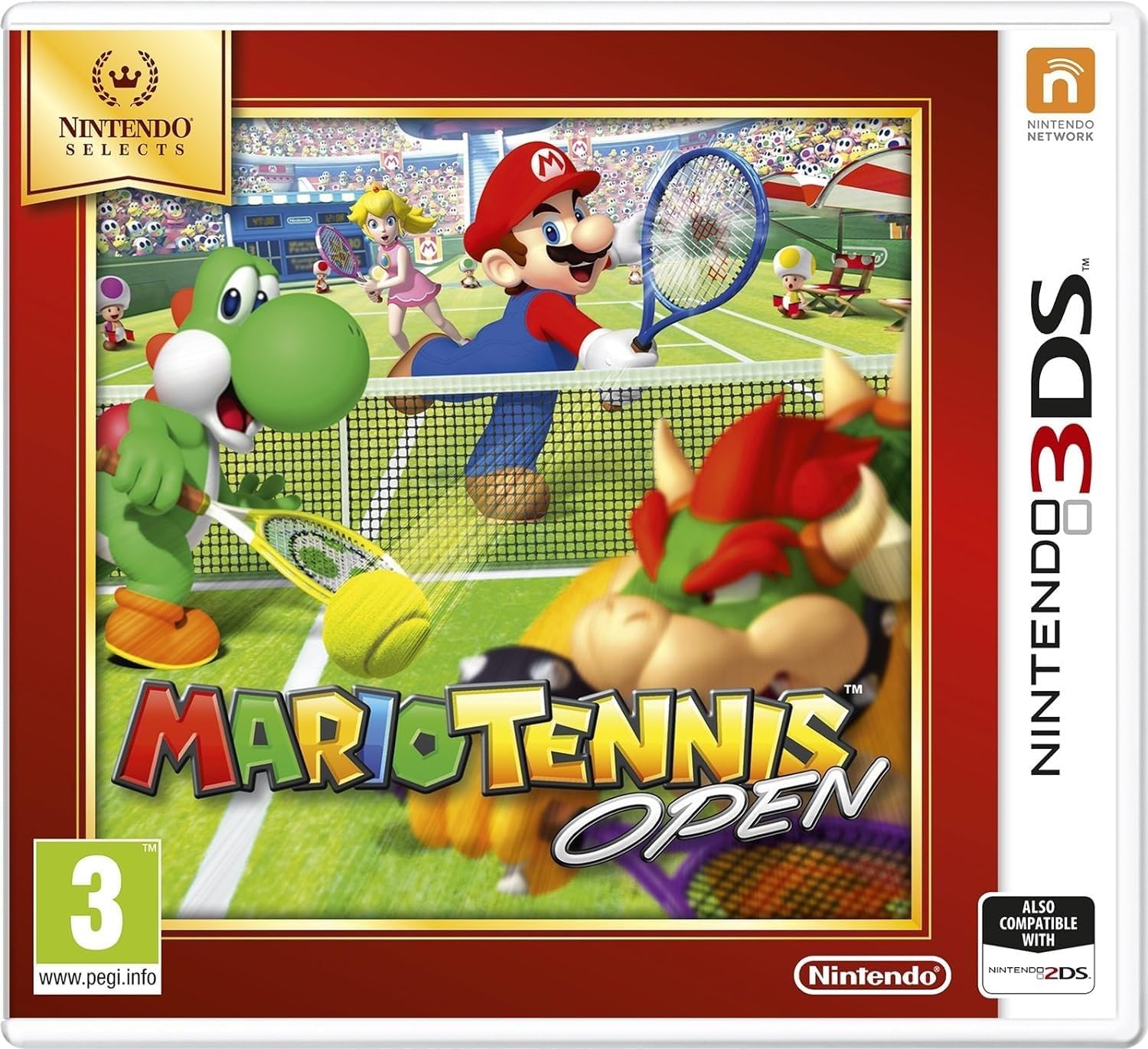
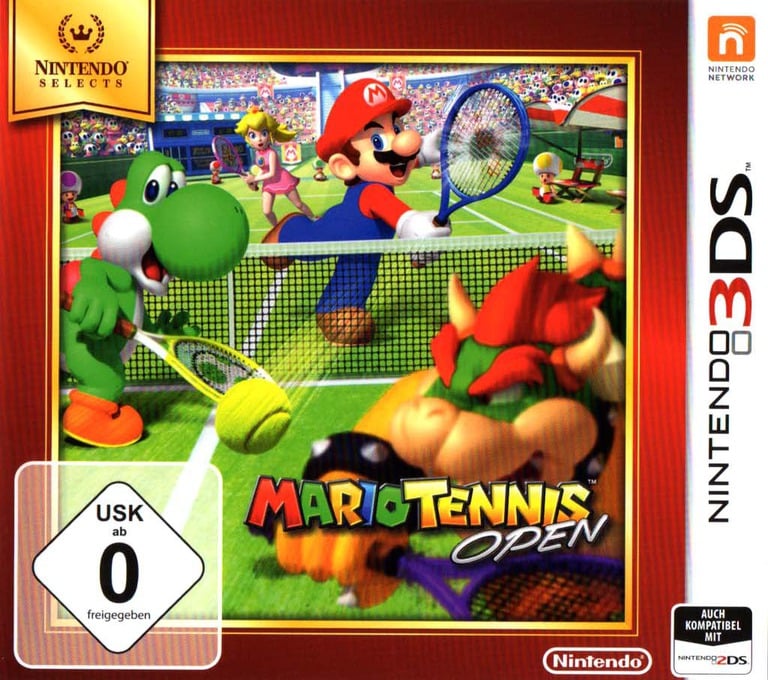
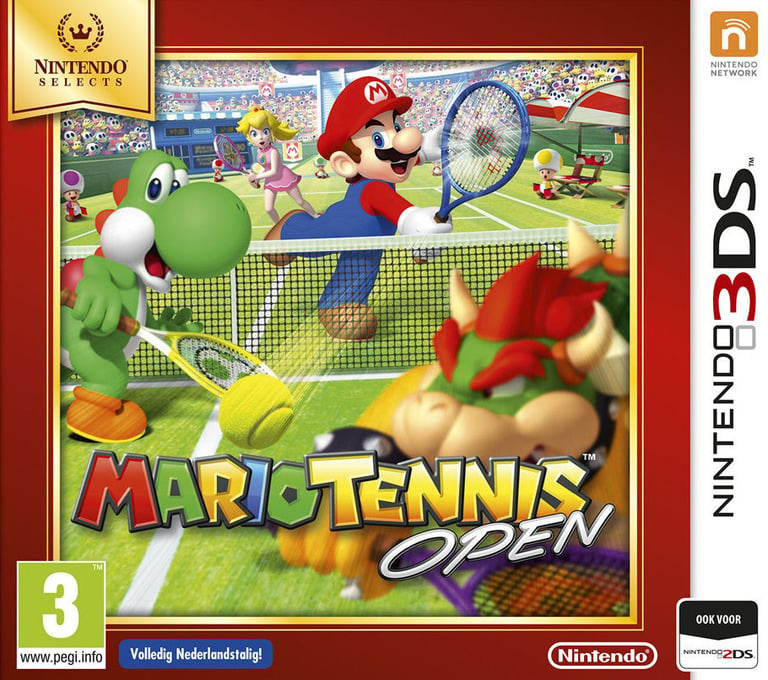
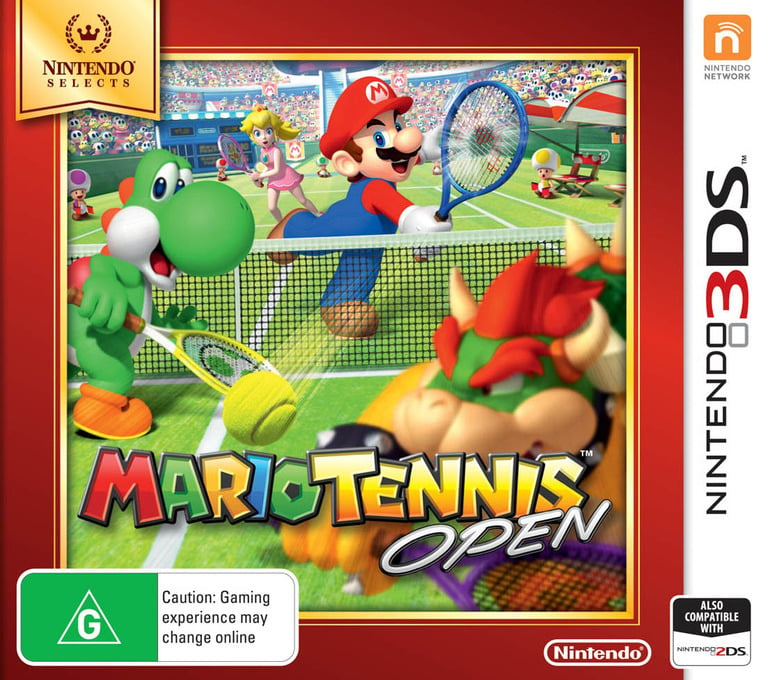
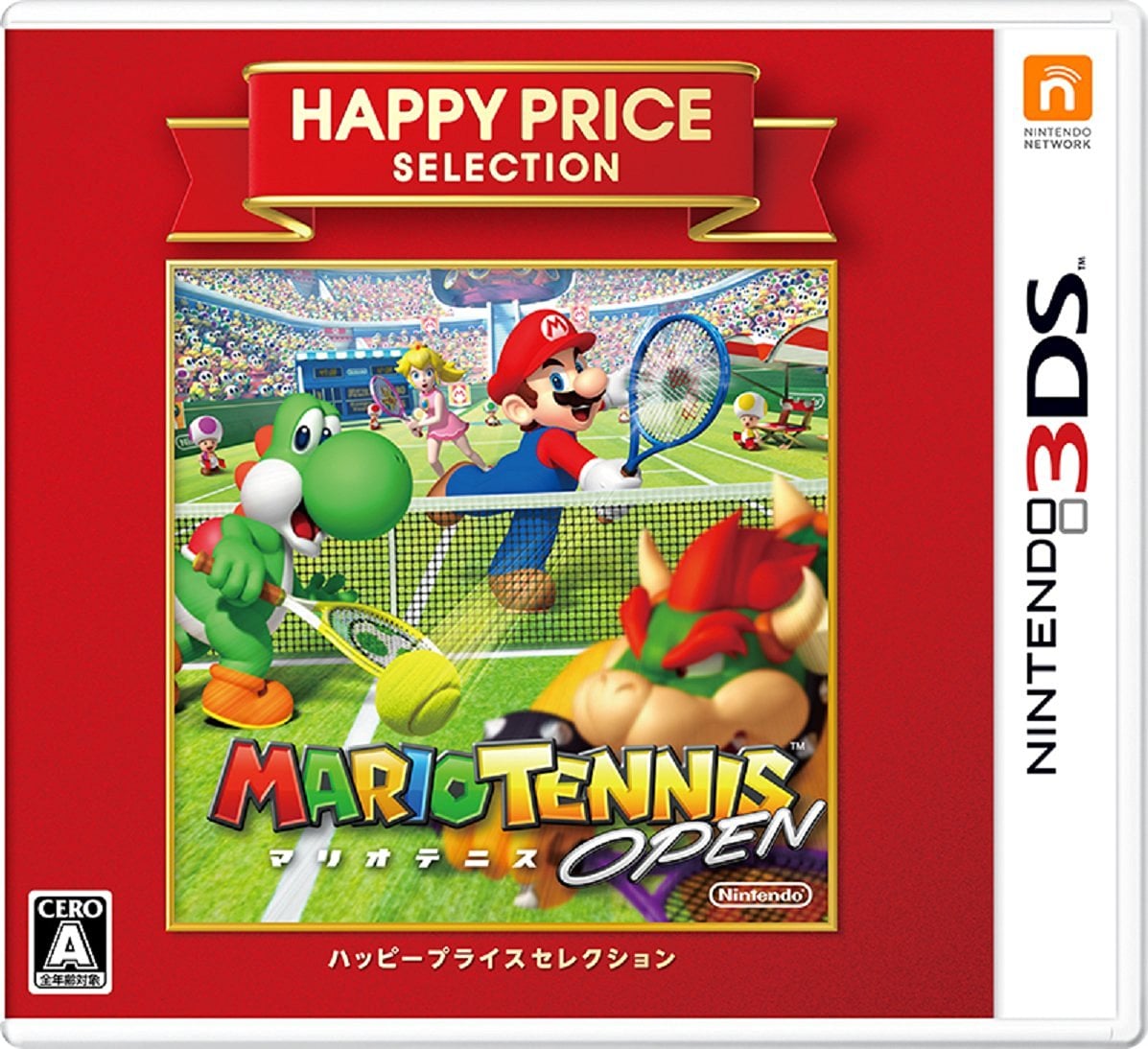
Every region’s cover is built around the same group artwork of the cast. Later budget printings were released under the Nintendo Selects label in Europe and Australia and as a Happy Price Selection in Japan.
North America (2012)Front.North America (2012)Back.CanadaBrazilEurope (2012)Pan-European cover.FranceBack.GermanyPortugalAustralia (2012)Japan (2012)Front.Japan (2012)Back.Hong Kong and Taiwan (2013)South Korea (2013)Europe, Nintendo Selects (2015)Germany, Nintendo SelectsNetherlands, Nintendo SelectsAustralia, Nintendo Selects (2016)Japan, Happy Price Selection (2016)3DS HOME Menu icon
Screenshots
More from the finished game and the September 2011 pre-release build.
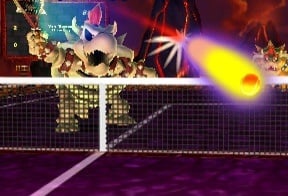
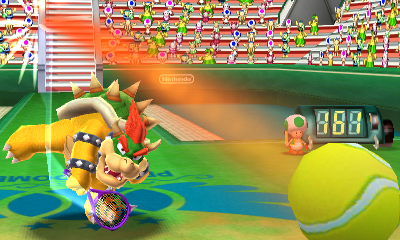
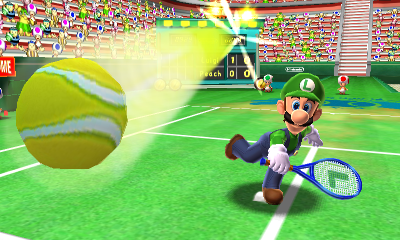
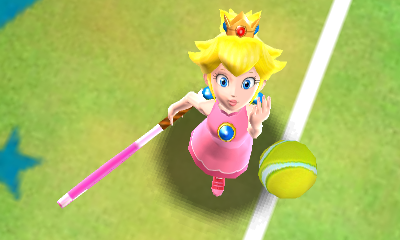
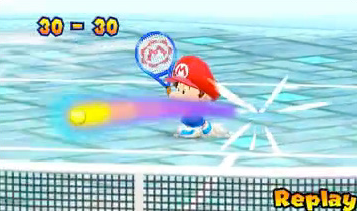
Bowser hits a topspin shot in a pre-release build.Mario, Bowser and Luigi in an early screenshot.Luigi hits the ball in the Tokyo Game Show 2011 footage.Peach in the same footage.A close-up of Peach serving, pre-release.Baby Mario returns a ball.Super Mario Tennis: World 1-4, second section.The fourth area of World 1-4.The fifth area of World 1-4, just before Bowser.Mario Stadium’s clay court.The grass court from the stands.Metal Mario on the character select screen.
Artwork & Media Gallery
Official artwork, logos, Mii outfits, rackets, models and the QR codes Nintendo released.
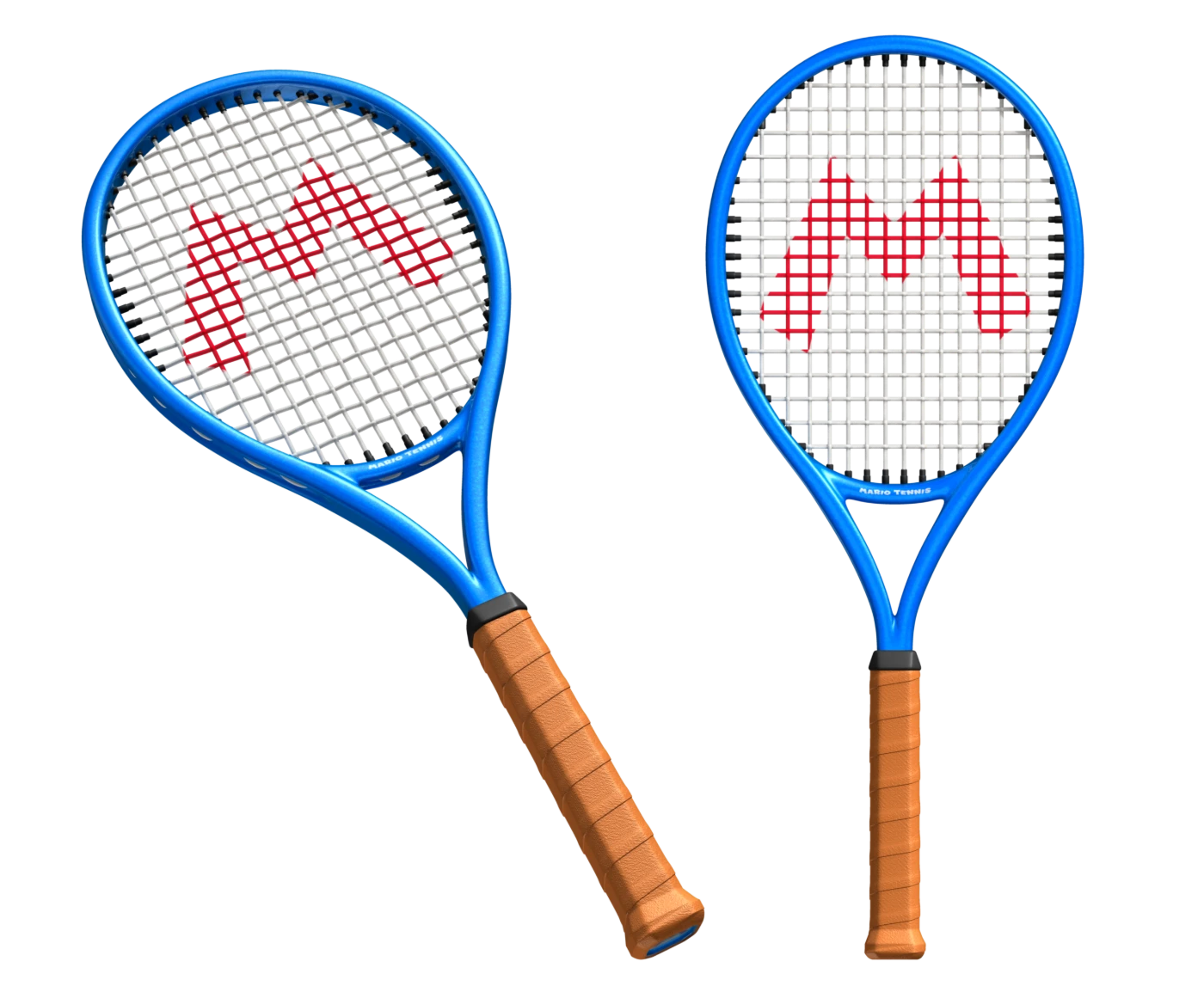
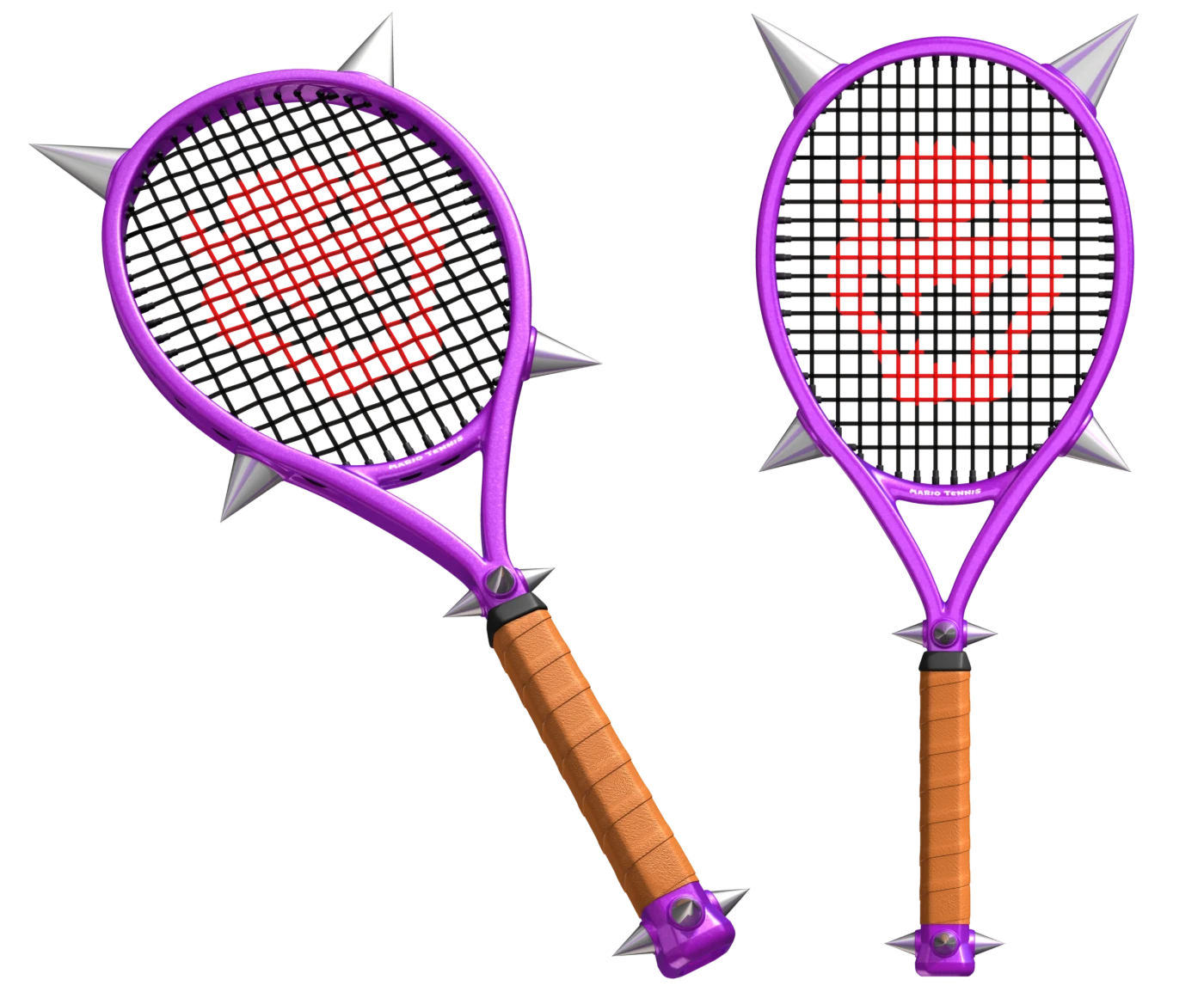
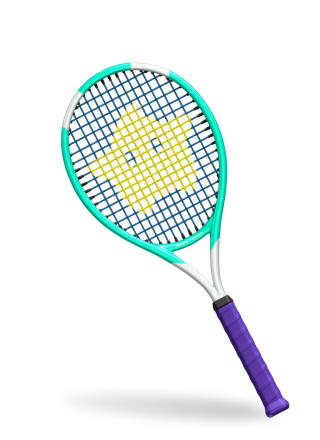
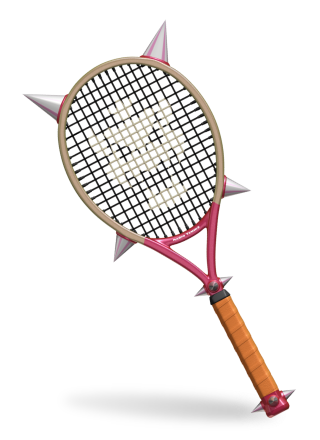
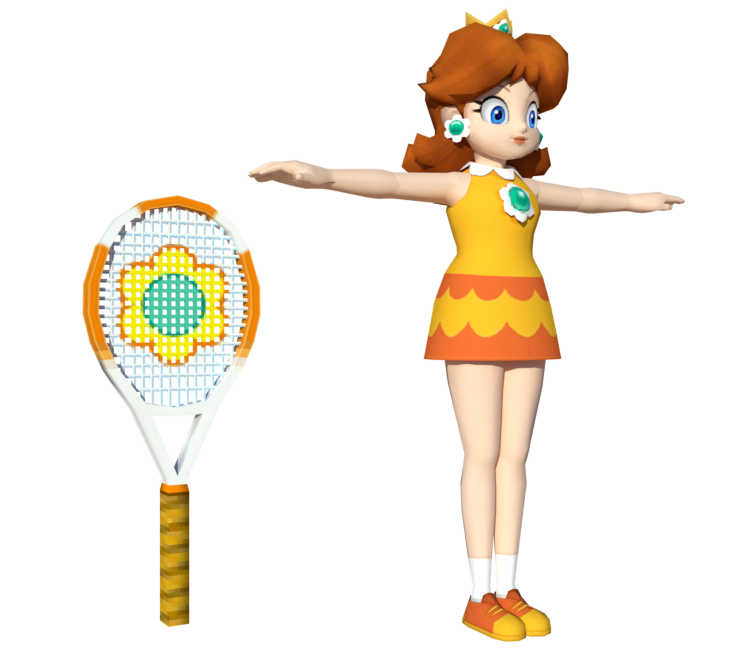
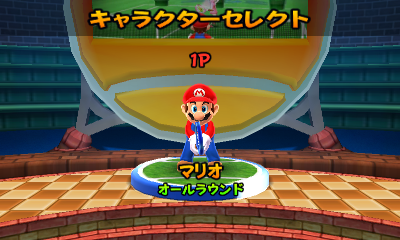
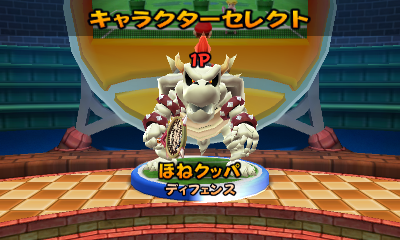
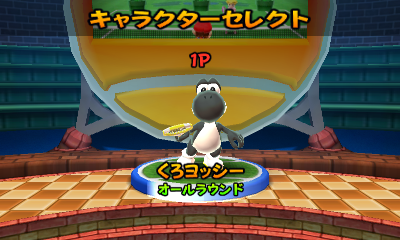
Princess Peach.Yoshi.Bowser.Three Miis in tennis gear.A Mii in Bullet Bill clothes.A Mii in Princess Peach clothes.A Mii in Princess Daisy clothes.A Mii in Chain Chomp clothes.A Mii in standard tennis gear.The tennis ball.The Japanese logo.The Traditional Chinese logo.Mario’s racket.Bowser’s racket.Luma’s racket.Dry Bowser’s racket.Daisy’s model.Metal Mario’s model.Mario on the character select screen.Dry Bowser on the character select screen.Black Yoshi on the character select screen.Mario hits the ball in the Tokyo Game Show 2011 footage.QR code: Metal Mario.QR code: Red Yoshi.QR code: Blue Yoshi.QR code: Light-Blue Yoshi.QR code: Yellow Yoshi.QR code: Pink Yoshi.QR code: White Yoshi.QR code: Black Yoshi.
Legacy & Re-releases
Mario Tennis Open stayed on sale for a decade, in budget editions and on the eShop, until the 3DS online services were wound down.
Every release
Nintendo 3DS (North America)20 May 2012The first release.
Nintendo 3DS (Japan, Australia)24 May 2012Europe followed on 25 May; Brazil also in 2012.
Nintendo eShop download18 October 2012Europe and Australia; Japan 1 November, North America 20 December 2012.
Hong Kong, Taiwan, South Korea12 April 2013Hong Kong and Taiwan; South Korea on 18 April 2013.
Nintendo Selects (Europe)16 October 2015Budget re-release; Australia 26 May 2016.
Happy Price Selection (Japan)15 September 2016Japan’s budget edition.
eShop closure27 March 2023The download version could no longer be bought.
Online service ends8 April 2024Nintendo Network shut down for 3DS and Wii U, ending Friends and Open Match play.
Where the series went next
Open sits between the GameCube and Game Boy Advance games and the Wii U. Camelot’s next Mario Tennis was Mario Tennis: Ultra Smash (2015), which brought Rosalina to court at last; then came Mario Tennis Aces on Switch (2018) and Mario Tennis Fever on Switch 2 (2026).
Nintendo’s own “Top Selling Software Units” page for the 3DS listed Mario Tennis Open at 1.11 million copies worldwide as of 31 March 2013 (as cited by Wikipedia and Super Mario Wiki). The current version of that page, as of 31 March 2026, shows only the top ten 3DS games and no longer includes it.
In Japan, Famitsu’s chart counted about 280,000 copies by 12 August 2012, less than three months after launch (Famitsu, 15 August 2012, cited by Wikipedia).
1.11mworldwide by 31 March 2013 (Nintendo)
280,000Japan by 12 August 2012 (Famitsu)
69Metacritic, 58 reviews
34/40Famitsu
Reviews
Scores as listed in Wikipedia’s review table and Super Mario Wiki, with reviewers and dates where those sources give them.
MetacriticAggregate · 58 reviews
69/100
GameRankingsAggregate · 38 reviews
69.26%
FamitsuJapan · May 2012
34/40
Game InformerUS · Matt Helgeson, 16 May 2012
8/10
GameTrailersUS
8.1/10
Official Nintendo MagazineUK · John Dean, 17 May 2012
80%
Nintendo World ReportUS · Neal Ronaghan, 10 May 2012
7.5/10
Electronic Gaming MonthlyUS · Eric L. Patterson, 16 May 2012
7/10
EurogamerUK · Johnny Minkley, 17 May 2012
7/10
Nintendo LifeUK · Jon Wahlgren, 18 May 2012
7/10
Nintendo PowerUS · May 2012, p. 84
7/10
IGNUS · Richard George, 15 May 2012
6.5/10
GamesRadarUS · Hollander Cooper, 10 May 2012
6/10
PolygonUS · Griffin McElroy
6/10
Cubed3UK · Adam Riley
6/10
GameSpotUS · Ashton Raze, 17 May 2012
5.5/10
Reviewers mostly liked the tennis and found the game solid, but many felt it played too much like earlier Mario Tennis games and that Chance Shots did little to change that. The presentation and the Special Games were praised, with Super Mario Tennis singled out, while the online mode was criticised for lag, region locking and a lack of features. Some critics thought the Miis got more attention than the Mario cast, and some missed the story modes of the earlier handheld games.
At the top end, Game Informer’s Matt Helgeson enjoyed the return to basics and welcomed online play to the series. EGM’s Eric L. Patterson thought it would satisfy anyone after a well-made, enjoyable tennis game, IGN’s Richard George rated it okay, good on court and weaker elsewhere, and Polygon’s Griffin McElroy disliked how much it relied on randomly placed Chance Shots.
SLB User Reviews
Super Luigi Bros readers have reviewed Mario Tennis Open over the years. Their write-ups are kept exactly as they were sent in:
Played it? If you’d like to add your own review, please get in touch.
More from the Super Luigi Bros Guide
These picture lists come from the earlier Super Luigi Bros guide to Mario Tennis Open and are kept here in full.
Game Modes
Mode
Description
Tournament
Single-player progression through two sets of four cups: the World Open (Mushroom, Flower, Banana and Champions Cups) and, once you earn a star rank, the Star Open (1-Up Mushroom, Ice Flower, Shell and Final Cups). Beating the Champions and Final Cups unlocks the Pro and Ace difficulties. Singles and doubles supported.
Exhibition
Custom matches vs CPU or friend — choose any characters, court, and set length.
Special Games
Four unique challenge modes. Level 3 clears unlock characters; Level 4 unlocks Mii outfits.
Online Play
Friend matches and open ranked matches over Nintendo Network with leaderboards.
Local Wireless
Up to 4 players — Download Play supported so friends can join without the game card.
StreetPass
Exchange player profiles and records with other owners you pass in the real world.
Eight tournament cups across the World Open and the Star Open
Special Games
Ring ShotRally while hitting through rings on court — more rings, more points. Unlocks Baby Peach at Level 3.
Super Mario TennisA fully playable Super Mario Bros. level controlled entirely with your tennis racket. Hit enemies, collect coins, reach the flag. Unlocks Baby Mario at Level 3.
Galaxy RallyRally with a Luma without letting the ball fall into the black hole, as the platforms vanish beneath it. Unlocks Luma at Level 3.
Ink ShowdownReturn shots while dodging Petey Piranha’s ink. Unlocks Dry Bowser at Level 3.
Characters
25 playable characters across six play styles, plus customisable Miis. 13 are available from the start, 4 unlock via Special Games and 8 via QR codes (Metal Mario and seven coloured Yoshis). New to the series: Metal Mario, Baby Peach, Dry Bowser, Luma.
The full 25-character roster — six play styles plus Miis
All-Around
MarioAll-Around
LuigiAll-Around
Technique
PeachTechnique
DaisyTechnique
LumaTechnique ★
Speed
YoshiSpeed
Baby MarioSpeed
Diddy KongSpeed
Power
Donkey KongPower
WarioPower
BowserPower
Metal MarioPower ★ QR
Defense
WaluigiDefense
Dry BowserDefense ★
Tricky
BooTricky
Bowser Jr.Tricky
Baby PeachTricky ★
Mii
Mii (Male)Customisable
Mii (Female)Customisable
★ New to Mario Tennis · QR = requires QR code · 7 alternate Yoshi colours also unlockable via QR. Mii stats shaped entirely by equipped tennis gear.
Play Style
Characters
Strengths
All-Around
Mario, Luigi, Black Yoshi
No major strengths or weaknesses.
Technique
Peach, Daisy, Luma, Red Yoshi, Pink Yoshi
Better ball control, often at the expense of power.
Speed
Yoshi, Baby Mario, Diddy Kong, Blue Yoshi, Light-Blue Yoshi
Move quickly around the court, often at the expense of power.
Power
Donkey Kong, Wario, Bowser, Metal Mario, Yellow Yoshi
Faster, stronger strokes and serves, but less agile.
Defense
Waluigi, Dry Bowser
Large or long characters with better reach, but not very agile.
Tricky
Boo, Bowser Jr., Baby Peach, White Yoshi
Highly curving, hard-to-predict shots, but not very powerful.
Mii
Mii
No type — stats shaped by equipped gear.
Courts
Eleven courts across eight Mushroom Kingdom venues — each with different surface properties. Strategy on Peach’s Palace (Carpet, fastest) differs completely from Mushroom Valley (Mushroom, slow and high). Courts unlock through Tournament progress.
Mario Stadium (Clay)Clay · Slow speed · Weak bounce
Mario Stadium (Hard)Hard · Normal speed · Strong bounce
Mario Stadium (Grass)Grass · Fast speed · Weak bounce
To provide the best experiences, we use technologies like cookies to store and/or access device information. Consenting to these technologies will allow us to process data such as browsing behavior or unique IDs on this site. Not consenting or withdrawing consent, may adversely affect certain features and functions.
Functional
Always active
The technical storage or access is strictly necessary for the legitimate purpose of enabling the use of a specific service explicitly requested by the subscriber or user, or for the sole purpose of carrying out the transmission of a communication over an electronic communications network.
Preferences
The technical storage or access is necessary for the legitimate purpose of storing preferences that are not requested by the subscriber or user.
Statistics
The technical storage or access that is used exclusively for statistical purposes.The technical storage or access that is used exclusively for anonymous statistical purposes. Without a subpoena, voluntary compliance on the part of your Internet Service Provider, or additional records from a third party, information stored or retrieved for this purpose alone cannot usually be used to identify you.
Marketing
The technical storage or access is required to create user profiles to send advertising, or to track the user on a website or across several websites for similar marketing purposes.

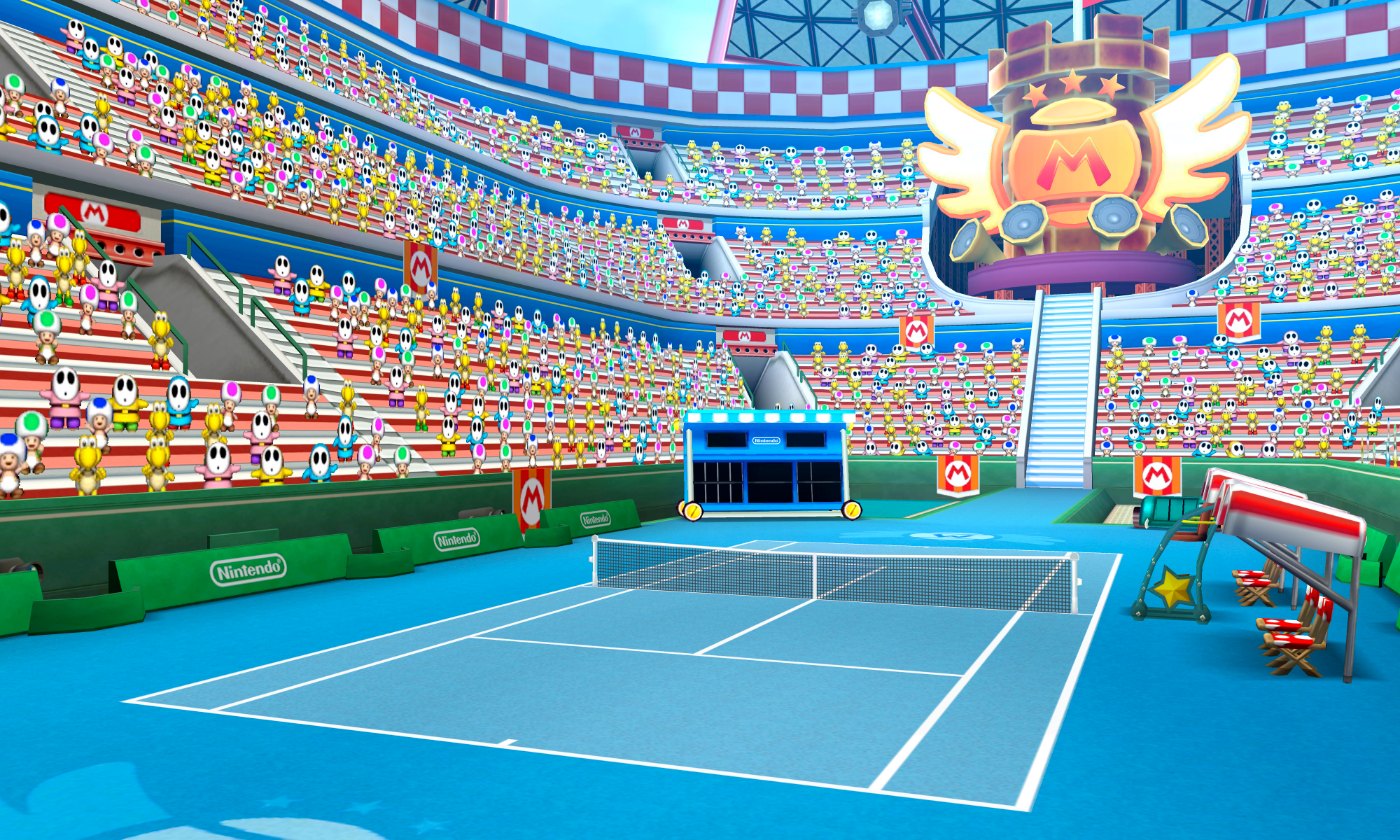
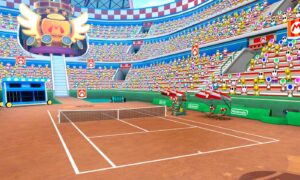 Mario Stadium – Clay CourtClay · slow ball, weak bounce · Champions CupThe stadium’s slowest surface and the place for patient baseline rallies.
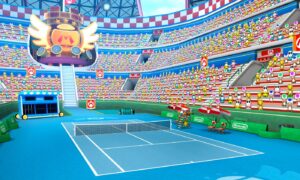 Mario Stadium – Hard CourtHard · normal speed, strong bounce · Champions CupThe all-round surface that the series’ top players treat as home.
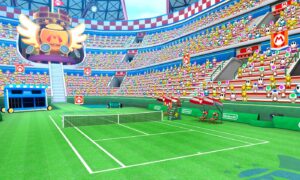 Mario Stadium – Grass CourtGrass · fast ball, weak bounce · Champions CupQuick and low: big servers and flat hitters love it.
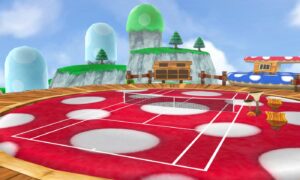 Mushroom ValleyMushroom · slow, strong bounce · Mushroom CupA court on top of a giant mushroom above Mushroom Gorge from Mario Kart Wii, whose track can be seen below.
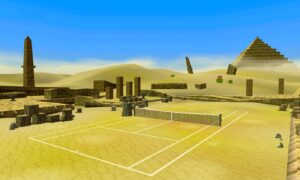 Wario DunesSand · slow, weak bounce · Flower CupA desert court ringed by ruins, played to music from Wario Land 3.
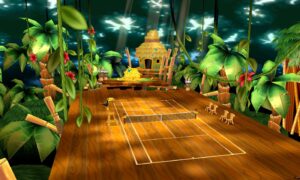 DK JungleWood · normal speed and bounce · Banana CupA rough wooden court in the jungle, with DK Island Swing on the soundtrack.
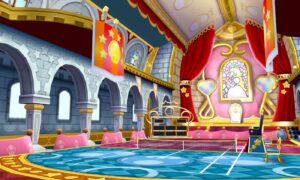 Peach’s PalaceCarpet · fastest, normal bounce · 1-Up Mushroom CupTennis on the carpet of a palace hall, to an arrangement of Super Mario 64’s castle theme.
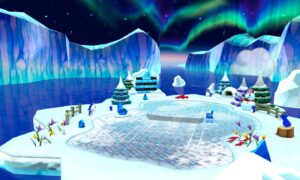 Penguin IcebergSnow · normal speed, strongest bounce · Ice Flower CupAn iceberg under the northern lights, watched by penguins and a Mario snowman.
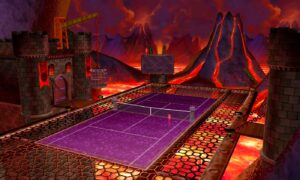 Bowser’s CastleStone · fast, strong bounce · Shell CupBowser’s court above a sea of magma, with his Super Mario 64 and Super Mario Sunshine themes rearranged.
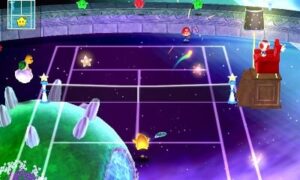 Galaxy Arena – Crystal CourtCrystal · fastest, strongest bounce · unlocked by winning the Final CupFloating in space near the Comet Observatory: the quickest, bounciest court in the game.
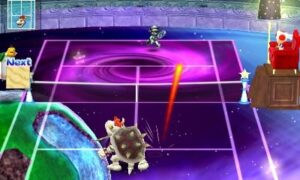 Galaxy Arena – Morph CourtChanging surfaces · Final CupLand a Chance Shot on your opponent’s side and their half turns into another surface; a black hole surface sends the ball flying.
 Red (Fire Flower)A blazing topspin that can drive the receiver right back. Counter: slice.
 Blue (Blooper)A sharply curving slice with a sparkling trail that sends the receiver into a brief spin. Counter: topspin.
 Purple (Super Star)A smash, much stronger than a normal one, played with the flat shot. Counter: flat.
 Yellow (Cheep Cheep)An extreme, curling lob that drops right on the back edge of the court. Counter: slice.
 White (Bob-omb)A drop shot that bounces even lower than usual. Counter: topspin.
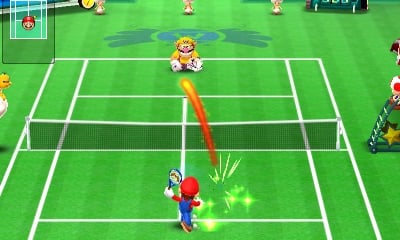
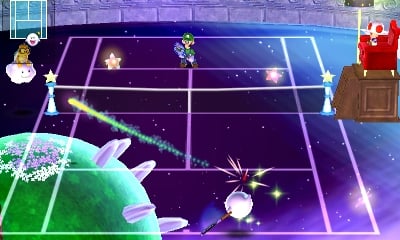
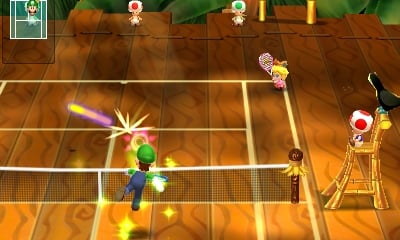
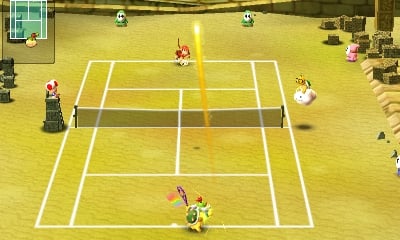
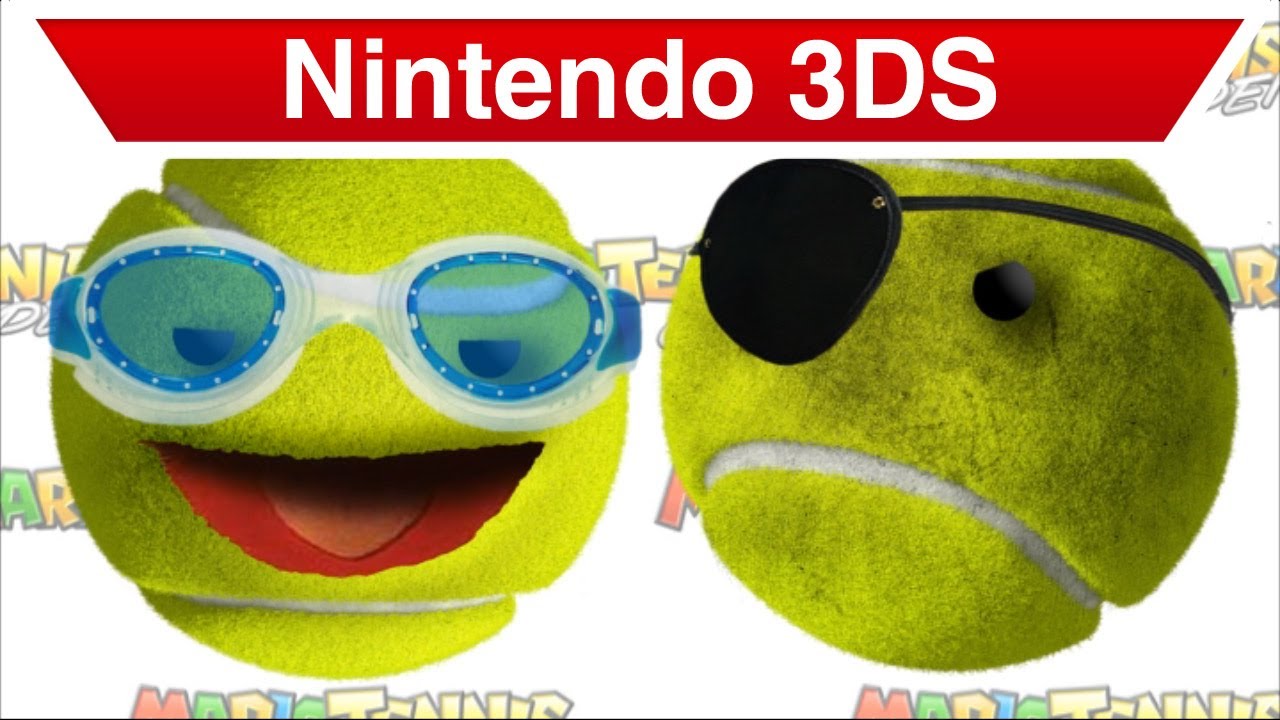 Mario Tennis Open ReportNintendo of America · YouTube · 23 May 2012A three-part video series hosted by talking tennis balls. Lob Shot and Slice Shot introduce the Special Games in the first episode; Simple Shot and Topspin Shot cover multiplayer in the second. Both episodes are embedded under Videos.
 Swapnote stationeryNintendo 3DS · SwapnoteA Mario Tennis Open design was one of the stationery sheets for Nintendo’s 3DS messaging app.
 Puzzle Swap panelNintendo 3DS · StreetPass Mii PlazaStreetPass Mii Plaza’s Puzzle Swap had a Mario Tennis Open picture to piece together.
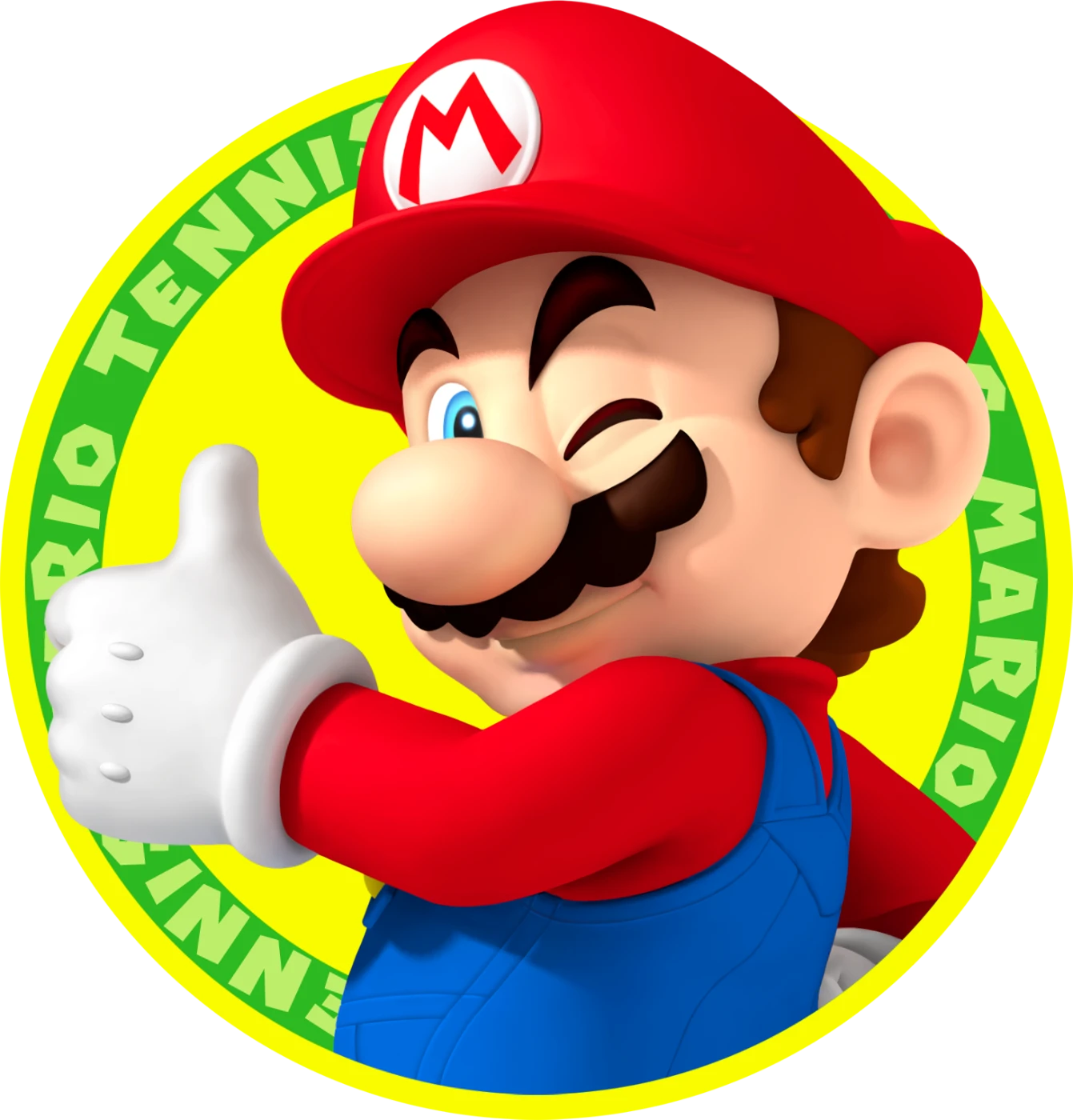 MarioAll-Around · from the start
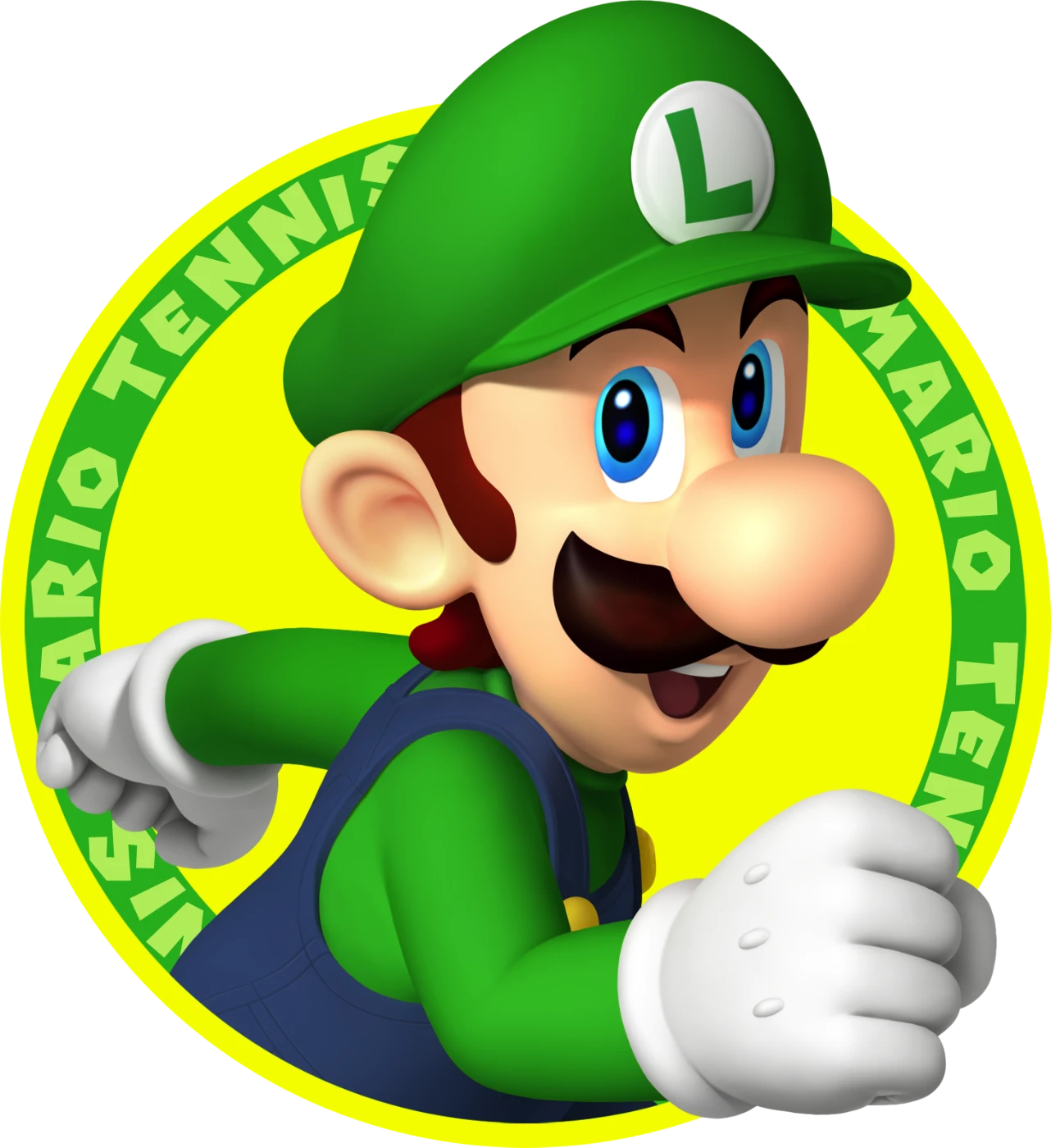 LuigiAll-Around · from the start
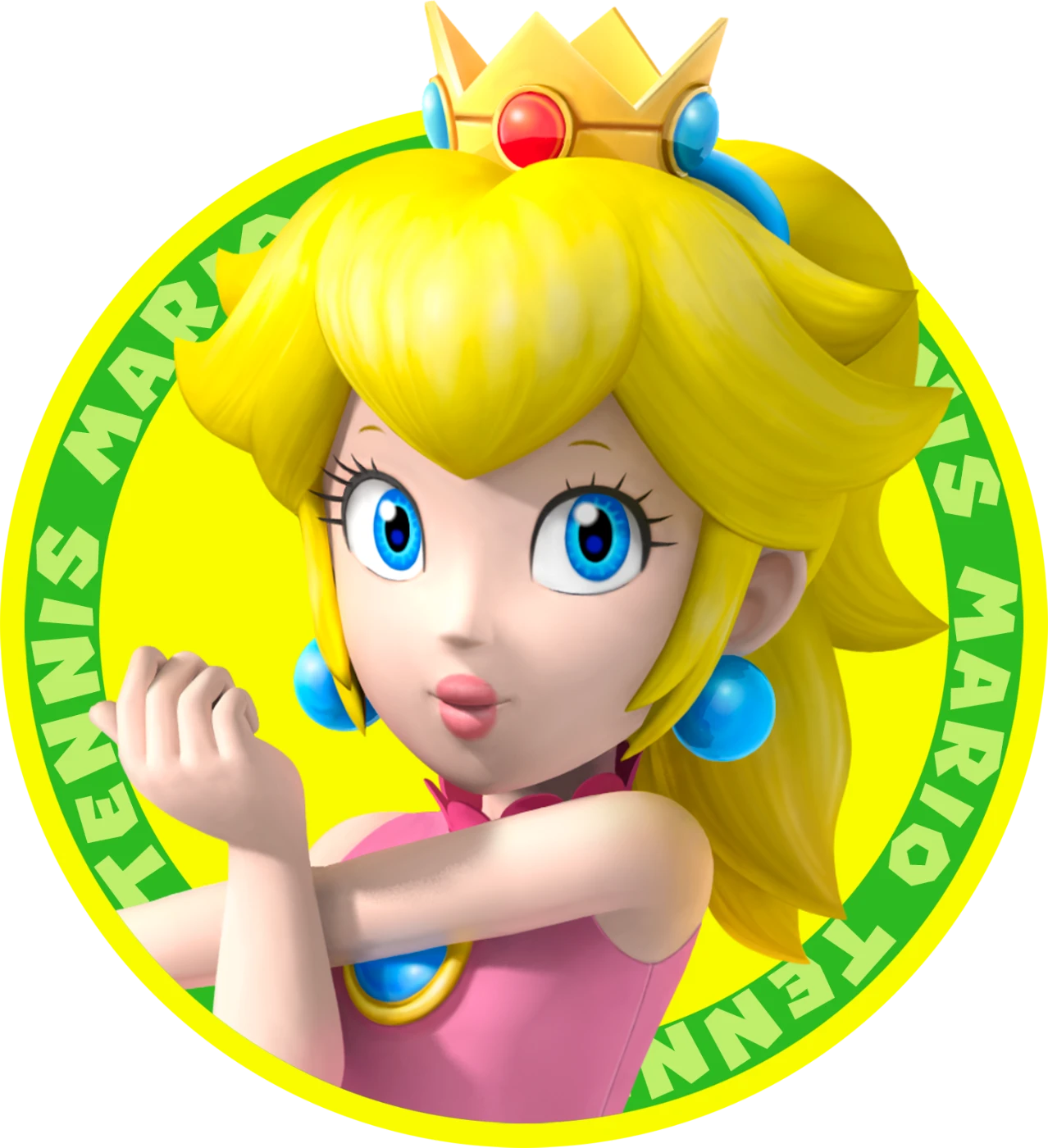 Princess PeachTechnique · from the start
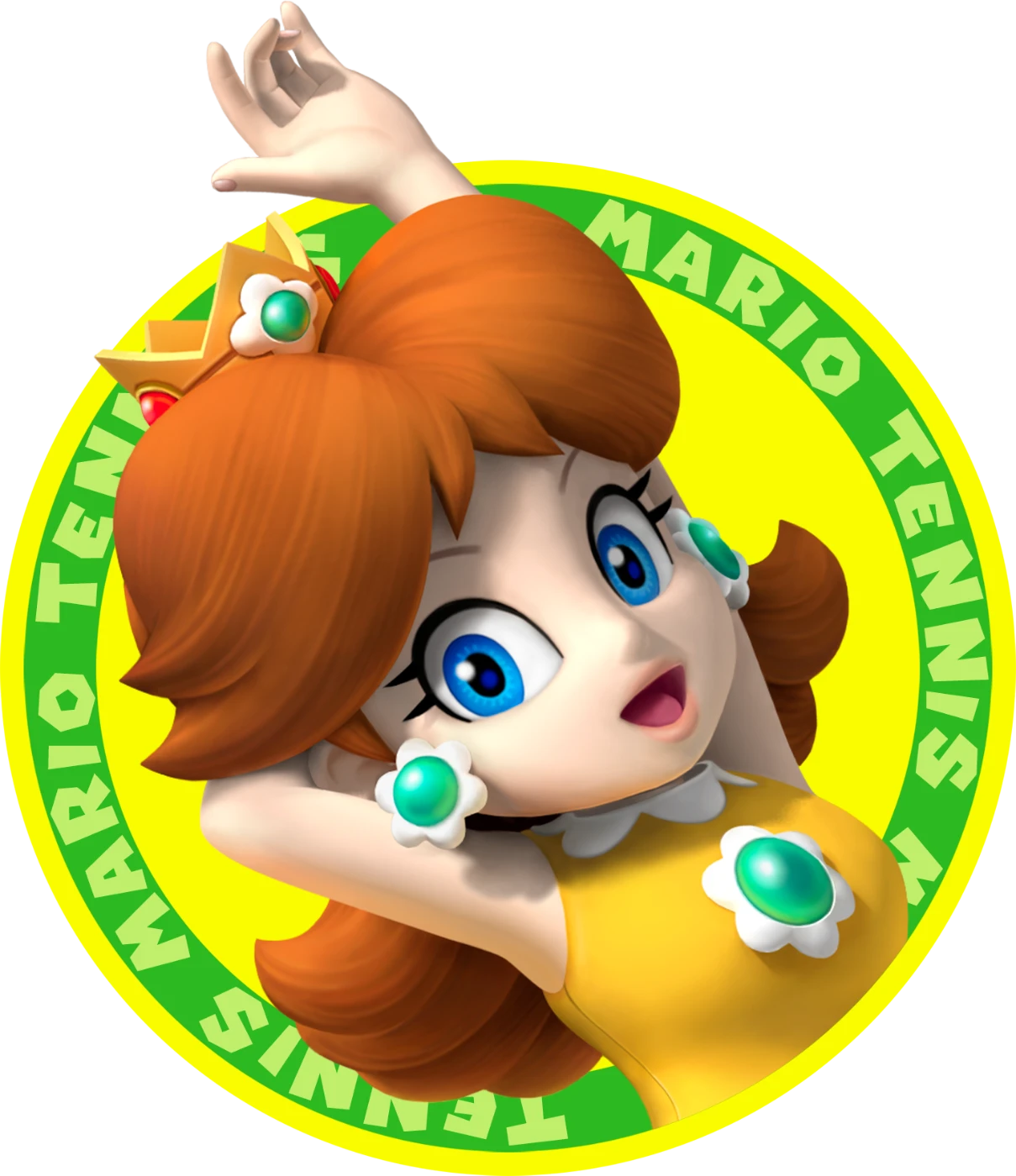 Princess DaisyTechnique · from the start
 YoshiSpeed · from the start
 WarioPower · from the start
 WaluigiDefense · from the start
 Donkey KongPower · from the start
 Diddy KongSpeed · from the start
 BowserPower · from the start
 Bowser Jr.Tricky · from the start
 BooTricky · from the start
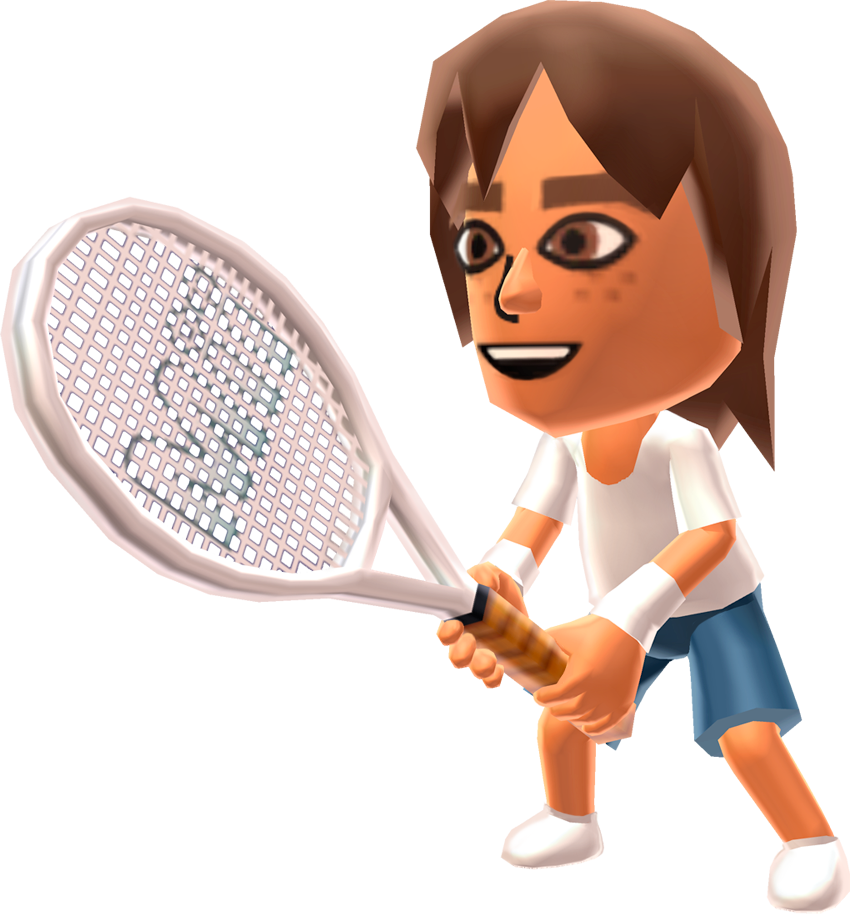 MiiNo type · from the start
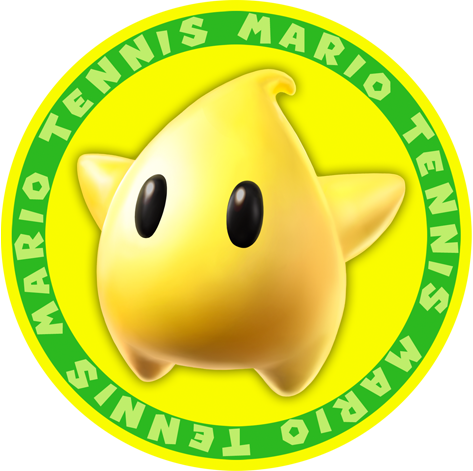 LumaTechnique · unlock · series debut
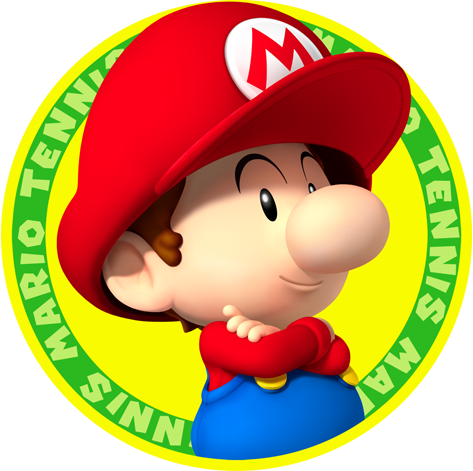 Baby MarioSpeed · unlock
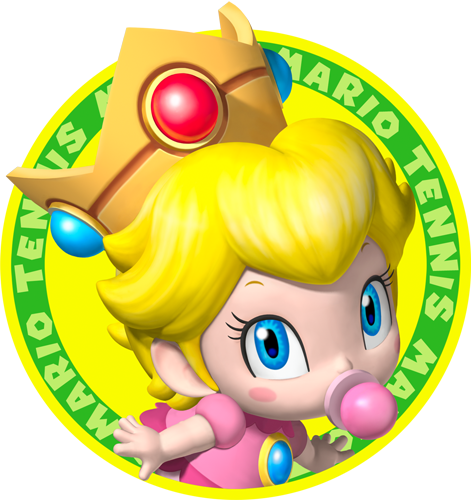 Baby PeachTricky · unlock · series debut
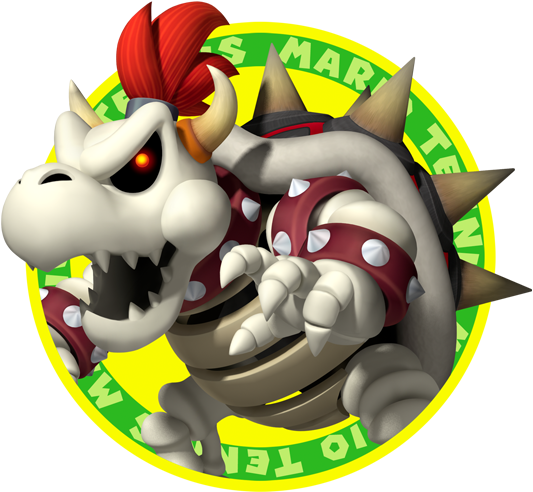 Dry BowserDefense · unlock · series debut
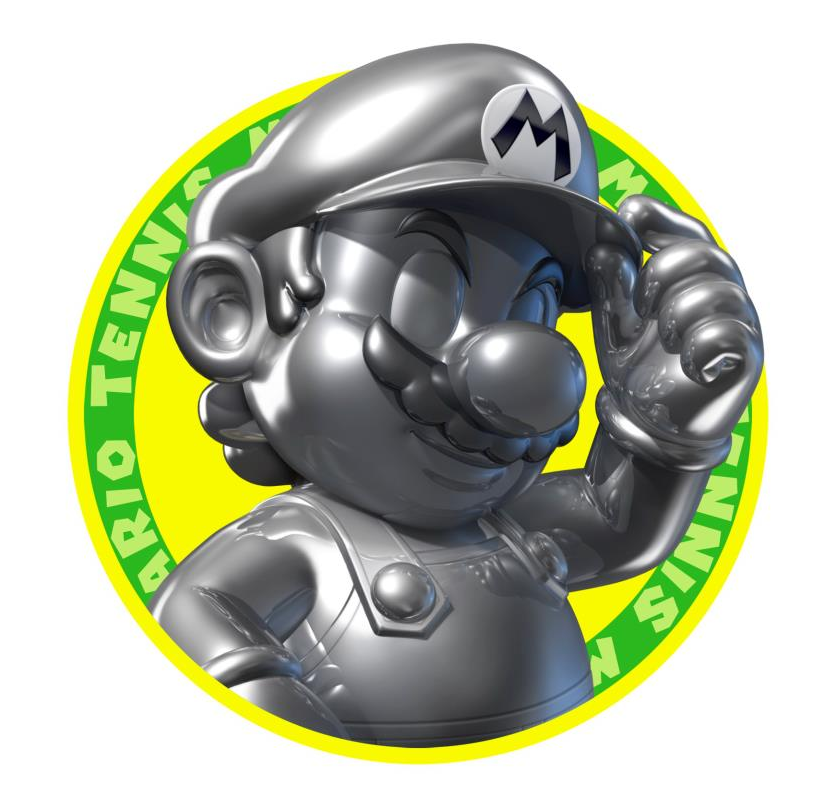 Metal MarioPower · QR code · series debut
 Red YoshiQR codeTechnique.
 Blue YoshiQR codeSpeed.
 Light-Blue YoshiQR codeSpeed.
 Yellow YoshiQR codePower.
 Pink YoshiQR codeTechnique.
 White YoshiQR codeTricky.
 Black YoshiQR codeAll-Around.
 Inky Piranha PlantInk ShowdownThree of them spit balls and ink at you; they come from Super Mario 3D Land, splatter and all.
 LumasGalaxy Rally, Galaxy ArenaYour rally partner in Galaxy Rally, and spectators in blue, red, green and turquoise.
 ToadClubhouseAppears with your Mii in the Clubhouse, where gear is chosen and bought.
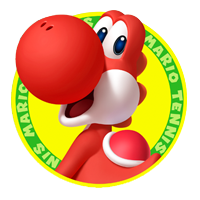
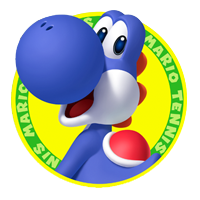
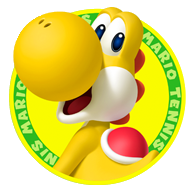


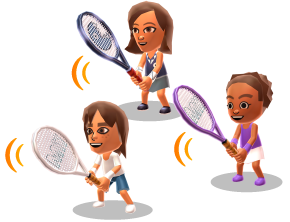
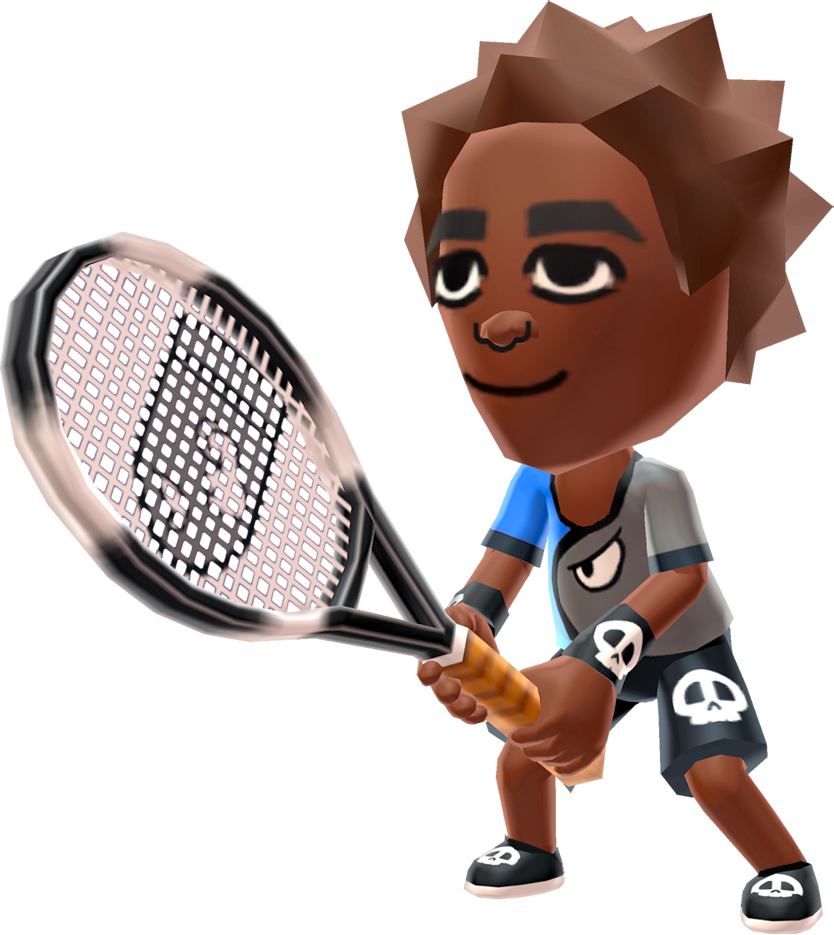
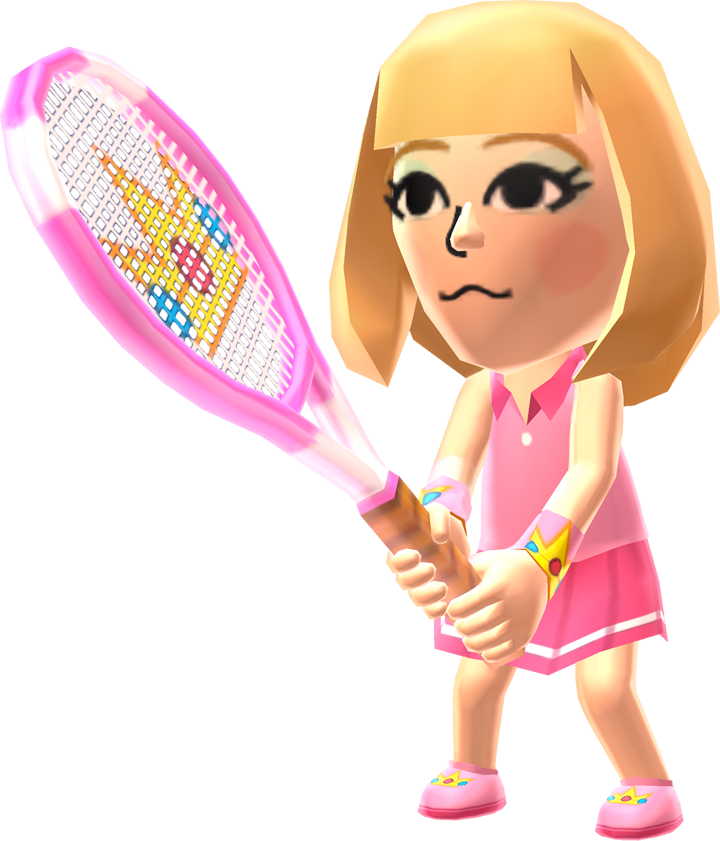
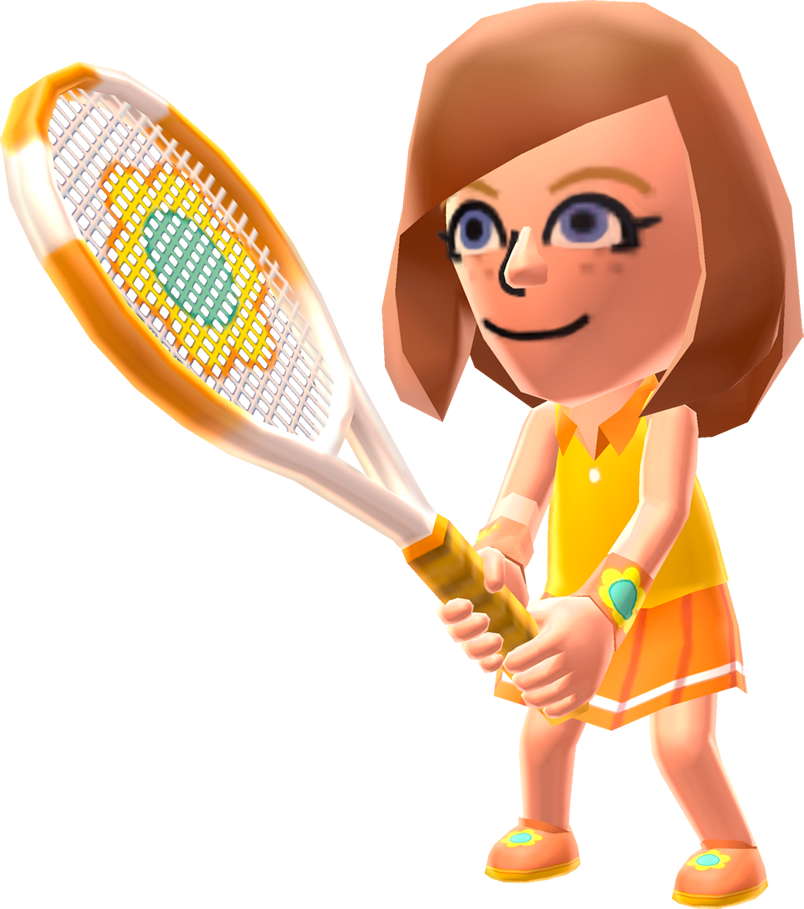


 Eight tournament cups across the World Open and the Star Open


 The full 25-character roster — six play styles plus Miis
 MarioAll-Around
 LuigiAll-Around
 PeachTechnique
 DaisyTechnique
 LumaTechnique ★
 YoshiSpeed
 Baby MarioSpeed
 Diddy KongSpeed
 Donkey KongPower
 WarioPower
 BowserPower
 Metal MarioPower ★ QR
 WaluigiDefense
 Dry BowserDefense ★
 BooTricky
 Bowser Jr.Tricky
 Baby PeachTricky ★
 Mii (Male)Customisable
 Mii (Female)Customisable