Game Boy1994Nintendo EAD / Pax SoftnicaPuzzle platformer101 stagesMade for Super Game Boy3.07 million soldEGM Game Boy Game of the YearNine worlds
Donkey Kong (Game Boy)
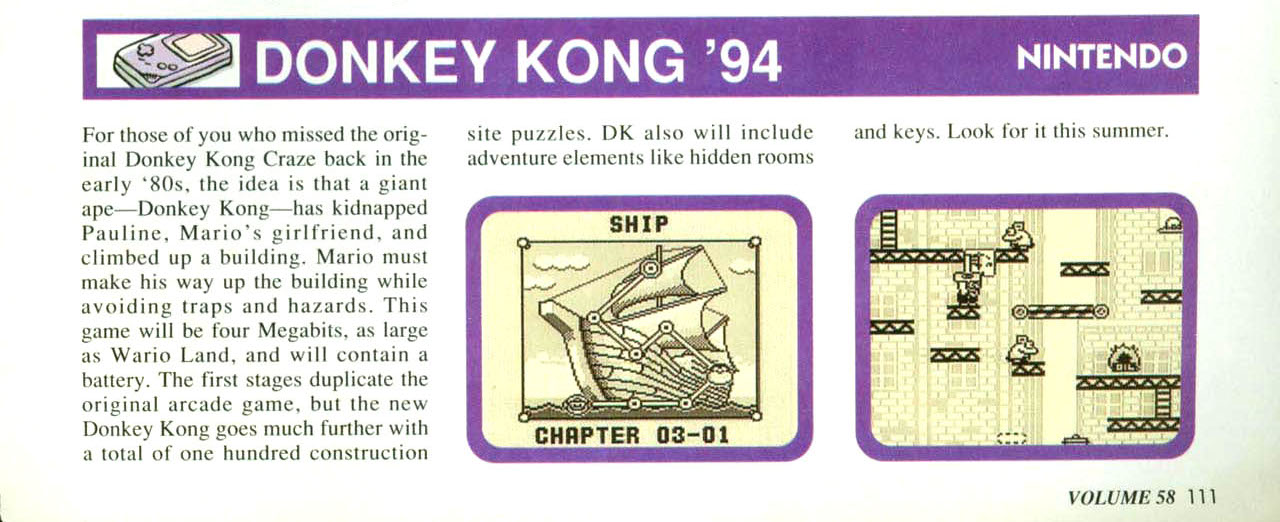
It starts as a remake and then pulls the rug away. Donkey Kong for Game Boy, released in June 1994 and known to everyone as Donkey Kong ’94, opens with the four screens of the 1981 arcade game. Mario pulls the last rivet, the ape falls, the couple embrace… and Donkey Kong gets up, grabs Pauline and runs. What follows is 97 more stages across nine worlds, from the Big-City to a Tower in Rocky-Valley, each one a single-screen puzzle in which Mario has to carry a key to a locked door. To do it he has the most acrobatic move set he had ever been given: a handstand, a backflip, a spin on a high wire. Produced by Shigeru Miyamoto and built by Nintendo with Pax Softnica, it was, by its developers’ account, the first game developed for the Super Game Boy, sold 3.07 million copies, and ten years later turned into Mario vs. Donkey Kong.
Developer:Nintendo EAD and Pax Softnica
Publisher:Nintendo
Platform:Game Boy (Super Game Boy enhanced); Nintendo 3DS Virtual Console (2011); Nintendo Switch Online (2025)
Ratings:ESRB K-A · PEGI 3 · CERO A · ACB G · USK 0
Sales:3.07 million worldwide (CESA Games White Paper, via Wikipedia)
Re-releases:Player’s Choice (1996); Nintendo 3DS Virtual Console (June 2011); Game Boy – Nintendo Classics on Switch (March 2025)
Advertisement
Overview
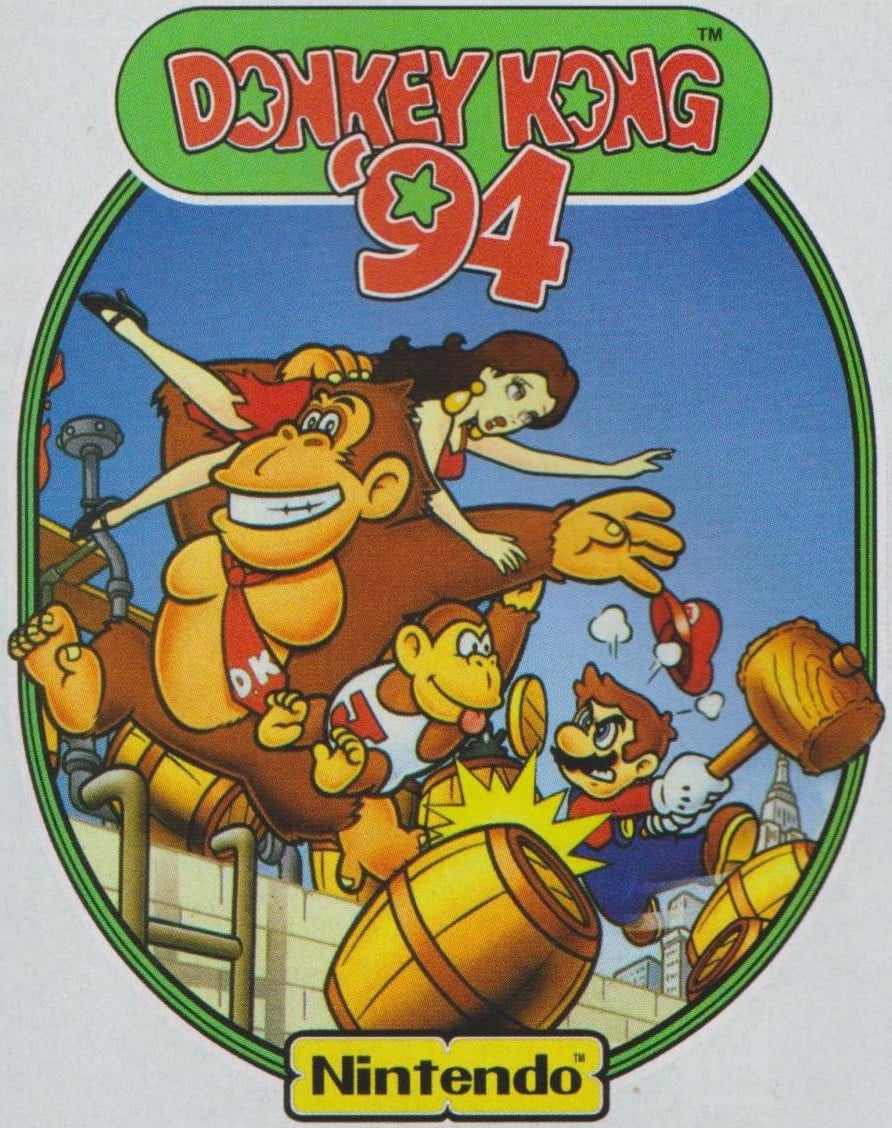
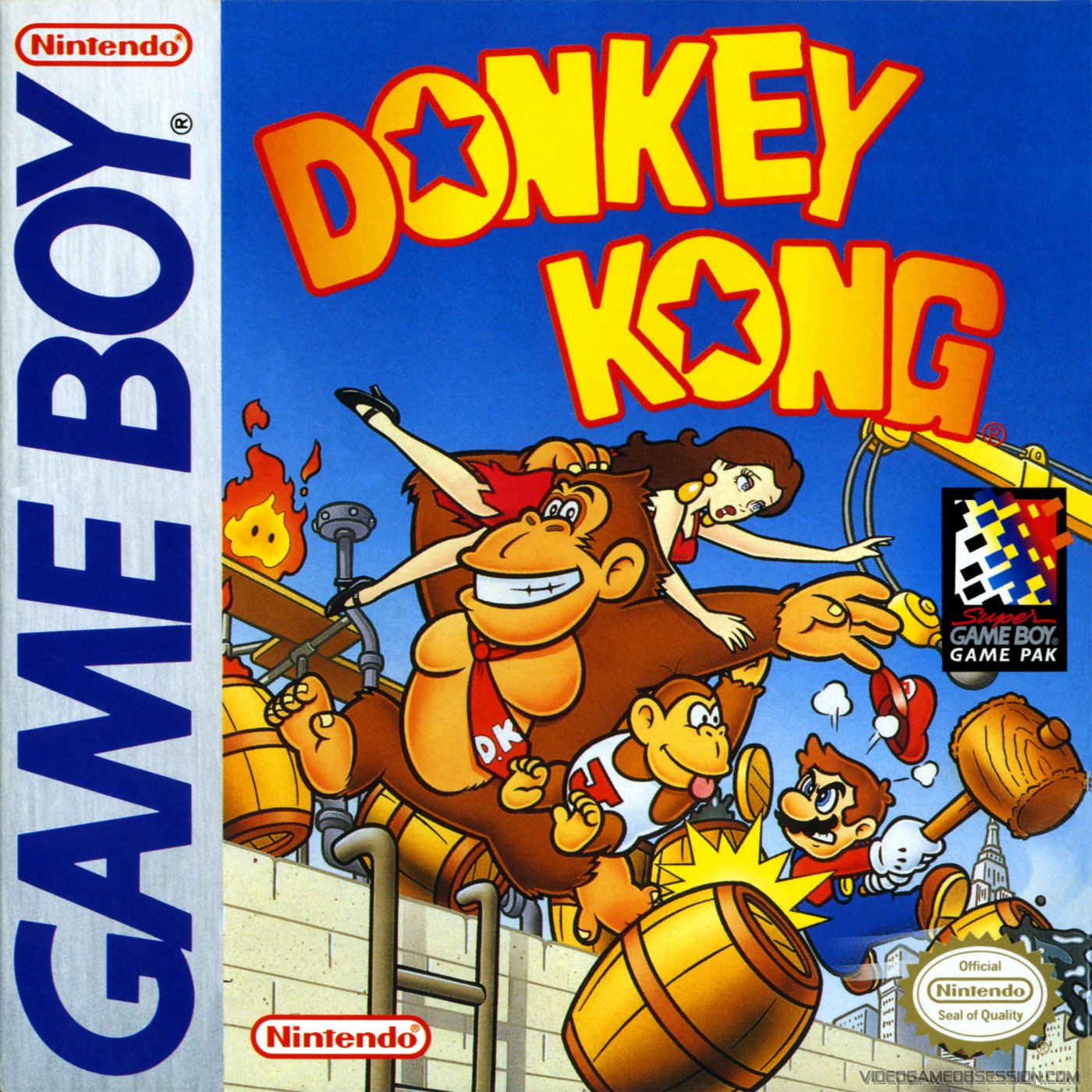
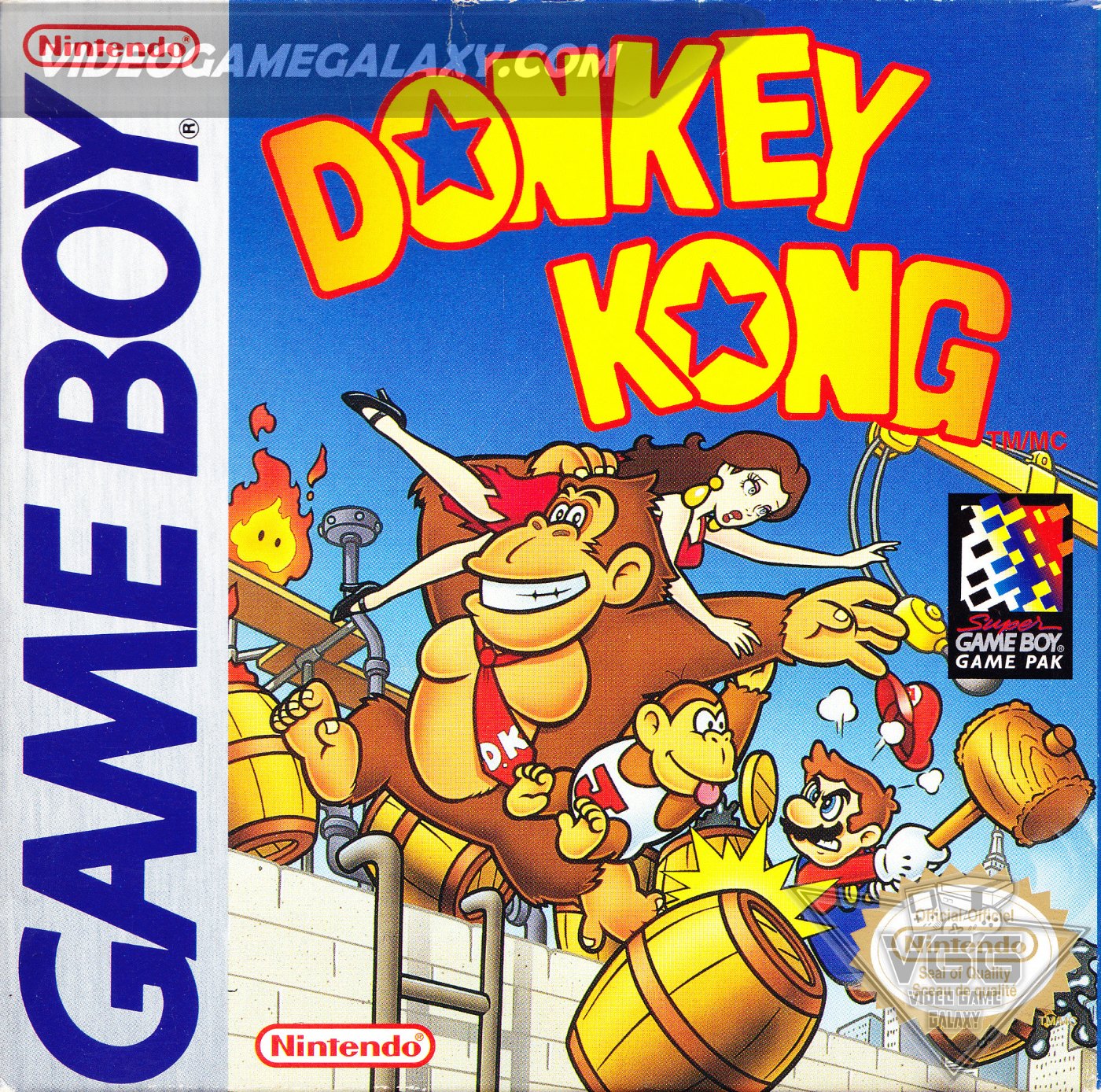
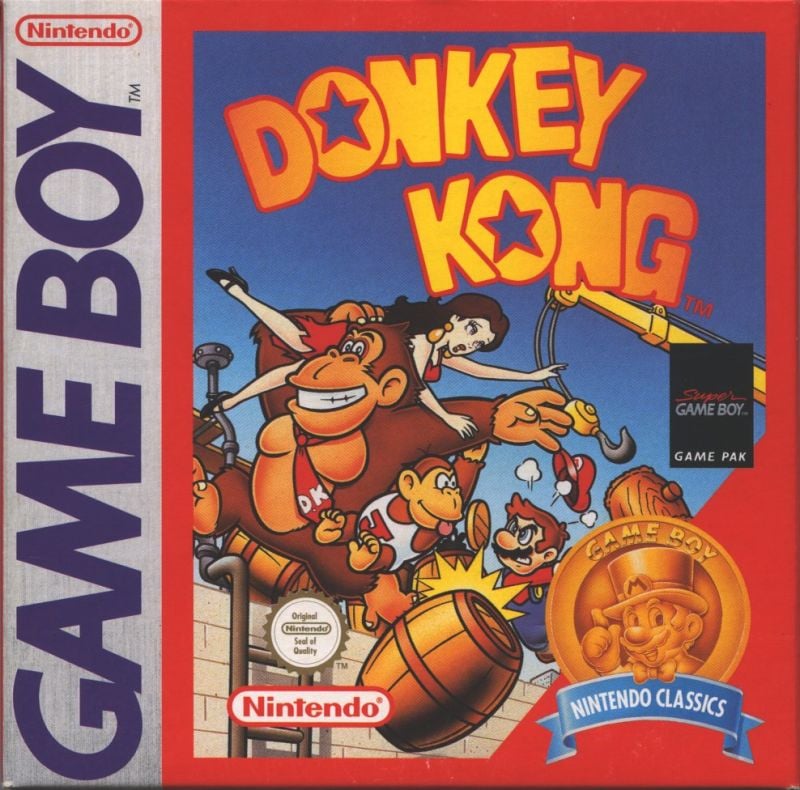
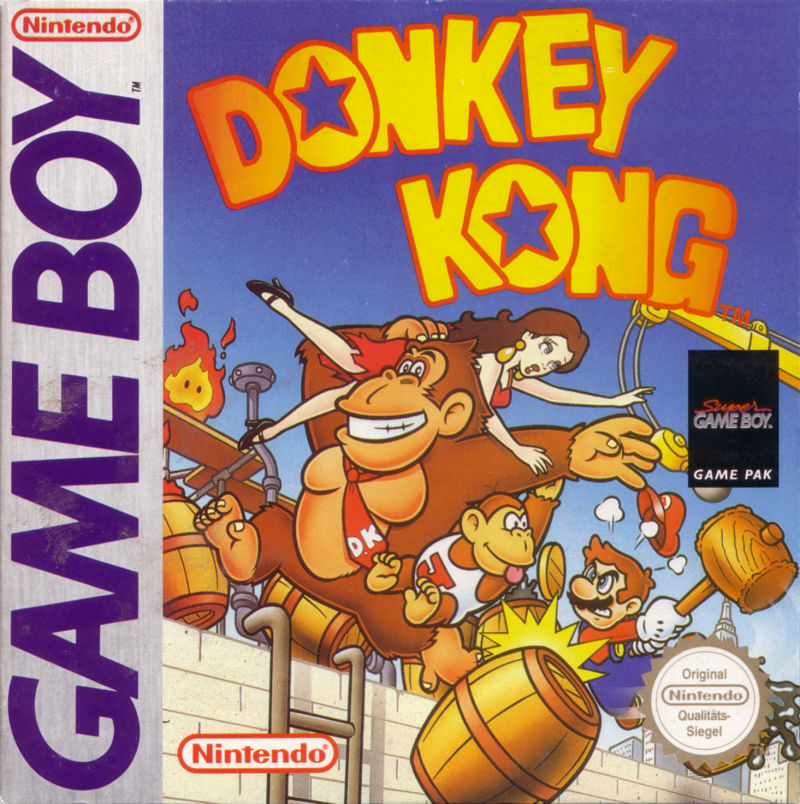
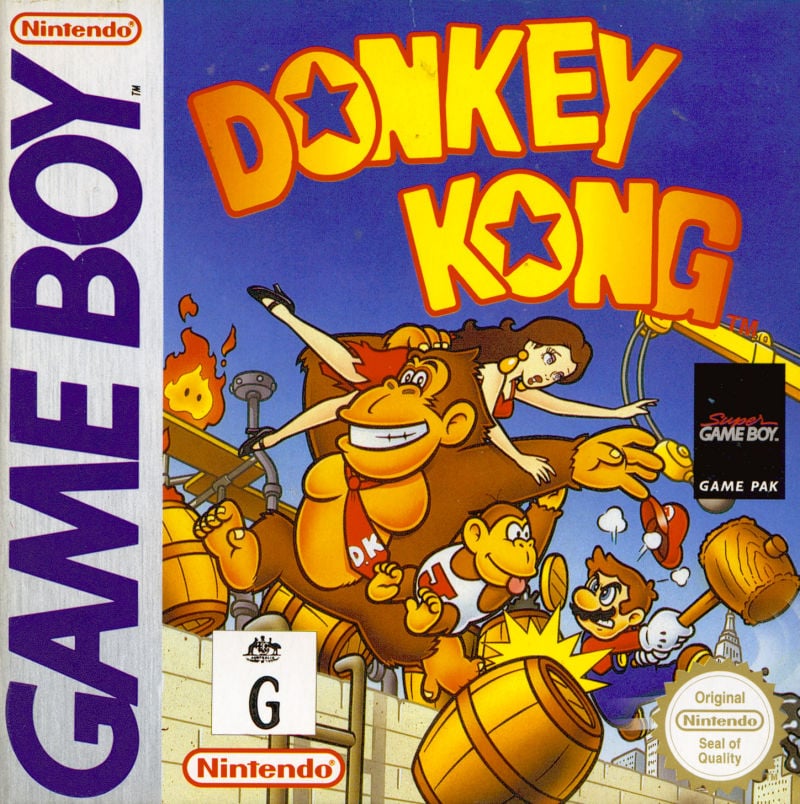
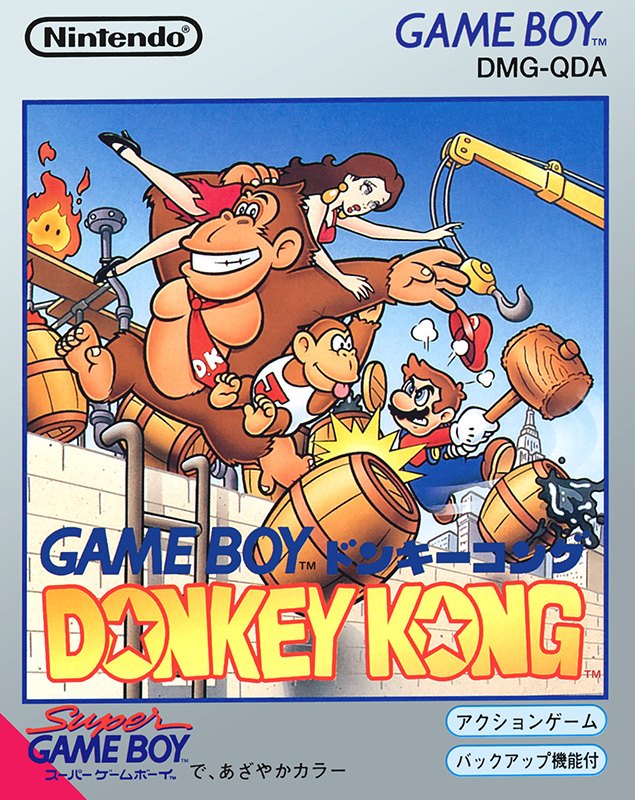
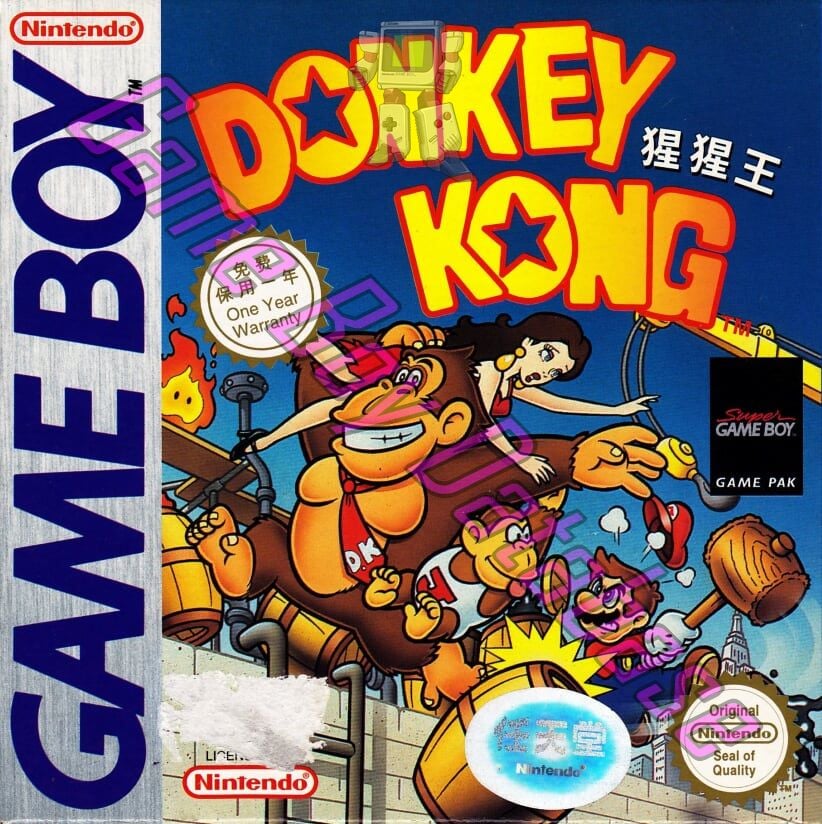
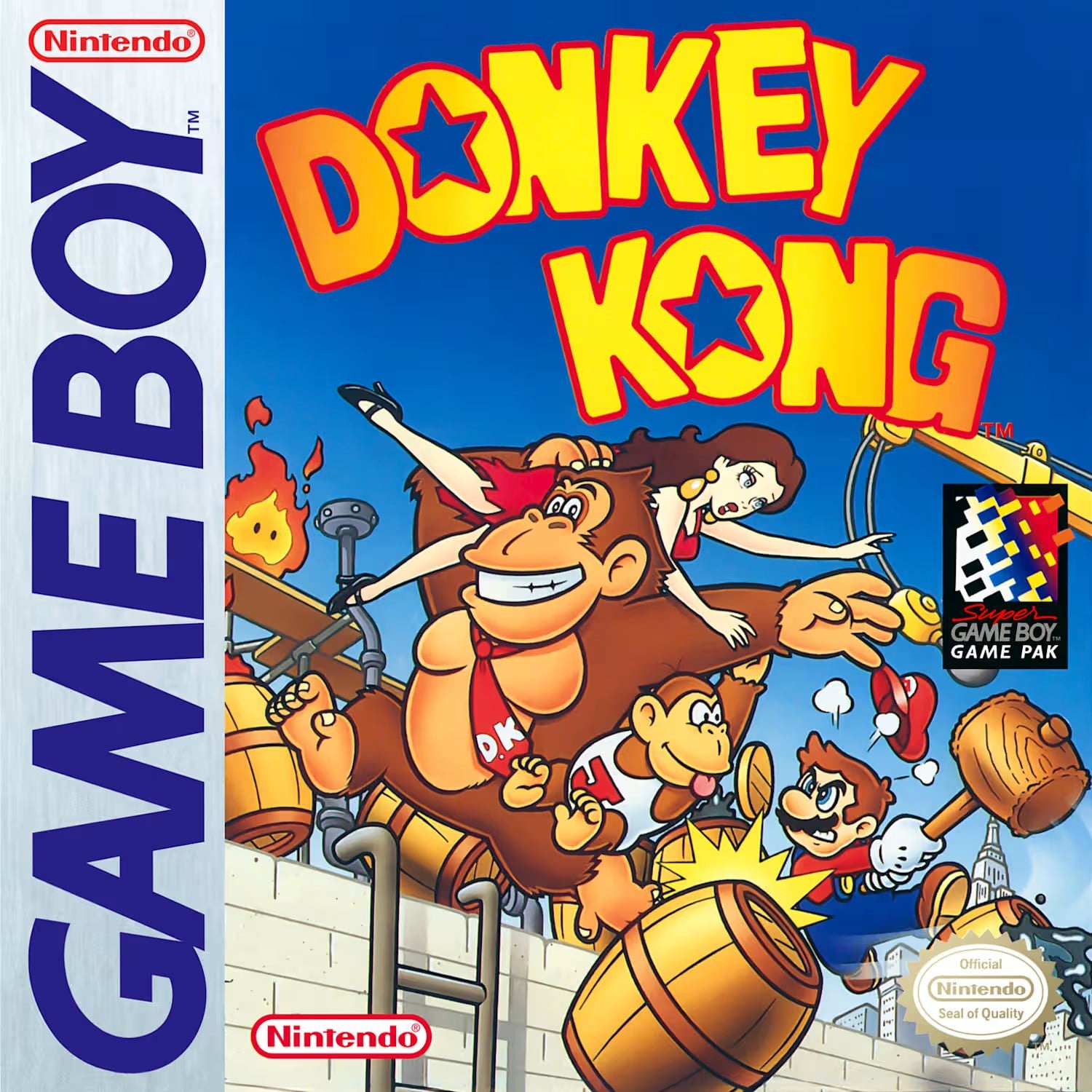
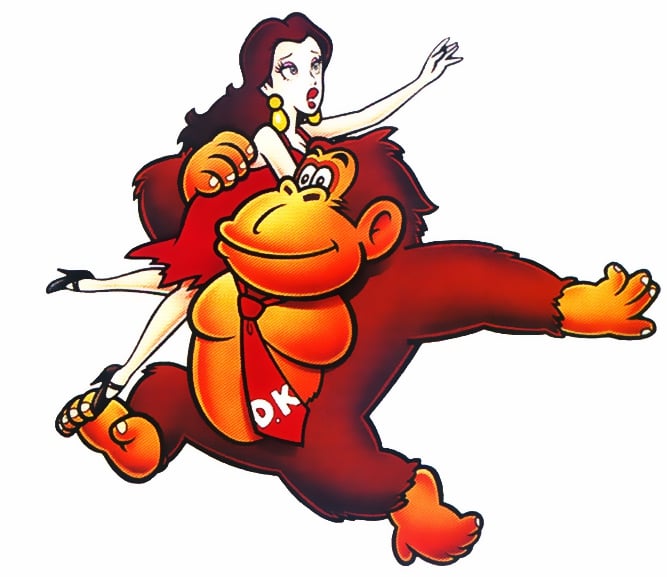
The cover artwork: an old rivalry renewed.
By 1994 it was a long time since Donkey Kong had starred in anything. The arcade games were a memory, Mario had moved on to bigger things, and Rare’s Donkey Kong Country was still months away. Then, in June, a Game Boy cartridge appeared with the plainest of titles and a picture of the old ape on the box, and anybody who assumed it was a straight conversion of the 1981 original got the surprise of their handheld lives.
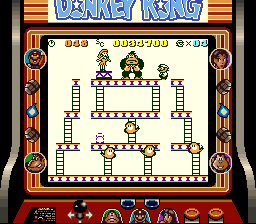
The first four stages are indeed the arcade game, squeezed to fit the Game Boy screen: girders, cement factory, elevators, rivets. Finish them and, instead of looping, the game opens out into something new. Donkey Kong carries Pauline into a city, and then through a forest, on to a ship, into a jungle and a desert, aboard an aeroplane, across an iceberg and up a tower in a rocky valley. Every stage is a compact puzzle box with a key somewhere in it and a locked door somewhere else, and every fourth stage is a meeting with the ape himself.
What turns it from a puzzle game into a great Mario game is the way he moves. He can flip into a handstand and spring off his hands, backflip out of a run, swing round a wire and launch himself off it, pick up enemies and barrels and hurl them, and survive falls that would have killed the arcade Mario outright. Many of these moves went straight into Super Mario 64 two years later.
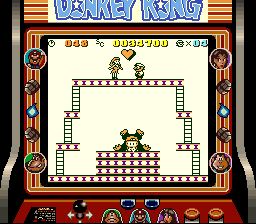
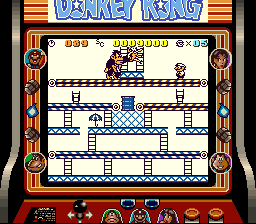
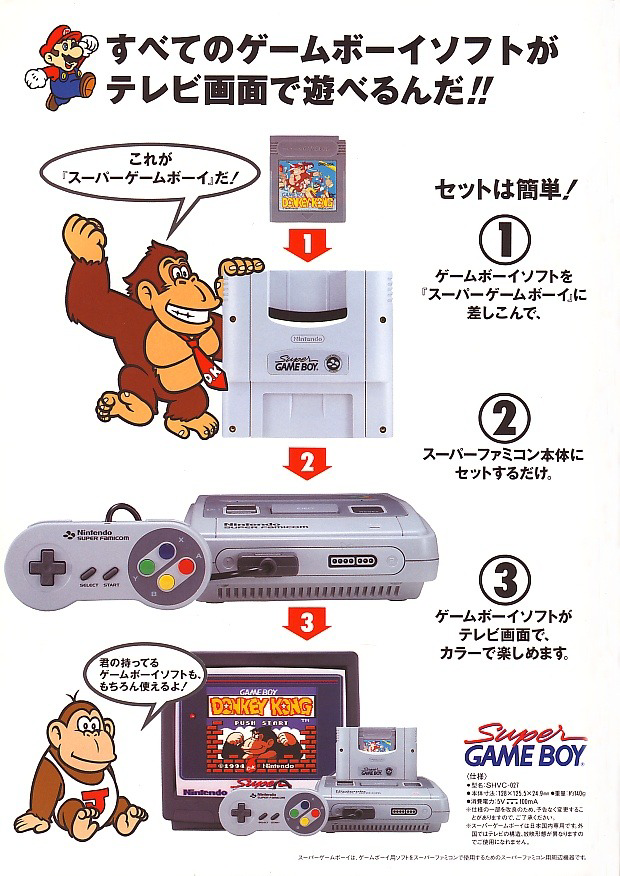
It was also the showpiece for the Super Game Boy, the adaptor that played Game Boy cartridges through a Super NES: plugged into one, the game gains hand-picked colours for every stage, a border drawn to look like the 1981 cabinet and a sampled cry for help from Pauline. Critics adored it. Electronic Gaming Monthly named it Game Boy Game of the Year, and it sold 3.07 million copies according to the Japanese industry body CESA. It has since returned on Nintendo 3DS and, in March 2025, on Nintendo Switch.
The arcade classic is even bigger and better on the small screen!
Think you know Donkey Kong? Think again! This Game Boy version takes the arcade classic to a new level, with 101 unique stages of platforming perfection.
Like the original, Mario must rescue Pauline from DK’s clutches; but beyond the initial arcade-style stages lies a whole new experience. In each new action-puzzle themed level, Mario must dodge traps, avoid enemies and hit switches, to bring the key to the exit.
— Official description (Nintendo UK, 2011)
Why Donkey Kong ’94 matters to Mario fans
This is the missing link between the Mario of the arcades and the Mario of Super Mario 64. The backflip makes its debut here, as do the handstand and the idea of a Mario who tumbles, rolls and recovers. Pauline gets the look she has kept ever since. And the whole design was reborn in 2004 as Mario vs. Donkey Kong, which began life as a Game Boy Advance remake of this very game and was itself remade for Switch in 2024 as Mario vs. Donkey Kong.
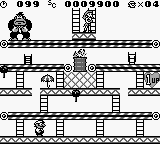
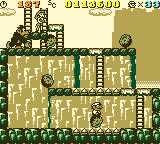
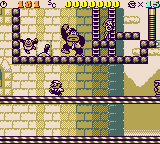
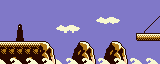
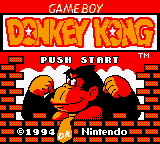
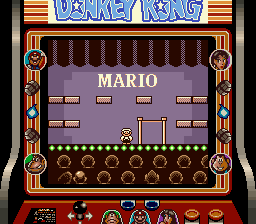
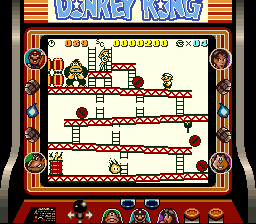
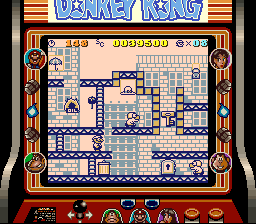
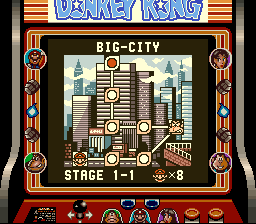
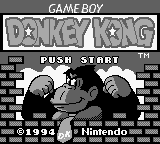
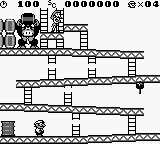
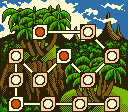
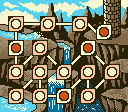
It begins where it began in 1981, here in Super Game Boy colours.Stage 1-1: find the key, carry it to the door.The Big-City map, first of nine worlds.The title screen on an original Game Boy.
Quick Answers
The questions people ask most about Donkey Kong on Game Boy, answered briefly here and in depth further down the page.
How many levels are in Donkey Kong for Game Boy?
101. The game opens with four stages based on the arcade original and continues with 97 new ones spread over nine worlds. More →
What are the worlds in Donkey Kong (Game Boy)?
After the Construction Site prologue come Big-City (8 stages), Forest (12), Ship (8), Jungle (12), Desert (12), Airplane (8), Iceberg (12), Rocky-Valley (16) and Tower (9). More →
Why is it called Donkey Kong ’94?
The cartridge is simply titled Donkey Kong. It was reportedly known as Donkey Kong ’94 in early development, and the nickname has stuck as a way of telling it apart from the 1981 game. More →
When was it released?
In Japan on 14 June 1994, in North America later that month and in Europe on 29 September 1994. More →
What new moves does Mario have?
A crouch, a handstand that shields him from falling objects, a Handstand Jump and higher Handstand Double Jump, a backflip, a Wire Spin on ropes, and the ability to pick up and throw keys, barrels and some enemies. More →
What does the Super Game Boy add?
Colour palettes chosen for each stage, a border styled on the 1981 arcade cabinet, a sampled voice for Pauline’s cry and richer music over the credits. None of this is present in the 3DS or Switch versions. More →
Who is the final boss?
Donkey Kong, twice. Mario beats him at the top of the Tower in Stage 9-8; he then eats Super Mushrooms and returns as Giant Donkey Kong for Stage 9-9. More →
Is Donkey Kong Jr. in the game?
Yes, as his father’s accomplice. He pulls switches, throws Poison Mushrooms that shrink Mario, and joins the fights in the Tower until Mario locks him in a cage. More →
Can I play it on Nintendo Switch?
Yes. It joined the Game Boy library of Nintendo Switch Online on 6 March 2025 in North America and 7 March elsewhere, alongside Mario’s Picross. It was also sold on the Nintendo 3DS Virtual Console from June 2011, but the 3DS eShop closed to new purchases in March 2023. More →
Is Mario vs. Donkey Kong a sequel to this game?
In effect. Nintendo announced a Game Boy Advance remake called Donkey Kong Plus in 2002; by 2003 it had become Mario vs. Donkey Kong, which keeps the keys, doors and acrobatics but tells a new story. More →
Story
Donkey Kong makes off with Pauline, again.
The story is one long chase, and that was the plan. Miyamoto, quoted in the Shogakukan guide, described it as the same scene playing out over and over: the ape runs, Mario follows. What changes is the scenery, and the tricks Donkey Kong and his son use to slow him down.
Stage 0: the Construction Site
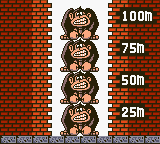
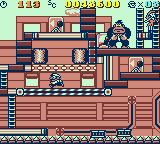
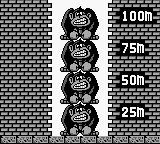
Donkey Kong has kidnapped Pauline and carried her up a building site, exactly as he did in 1981. The four arcade screens follow in order, trimmed to fit: 25 m loses two layers of girders, 50 m has its conveyor belts and cement, 75 m its lifts and jacks (thrown by Kong himself now), and 100 m has six rivets to pull where the arcade had eight.
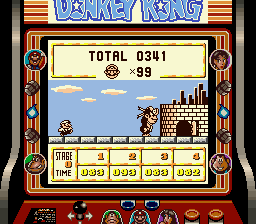
Out comes the last rivet and down comes the ape. Mario and Pauline are reunited… and Donkey Kong picks himself up. The ground shakes, the girders give way, and as Mario and Pauline fall he catches her and makes off through a door into the city, locking it behind him. Mario runs straight into it. A key drops from the sky, and the real game begins.
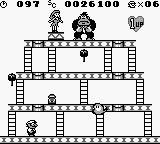
Stage 0-1, the Game Boy’s 25 m.Stage 0-4: six rivets this time.Donkey Kong falls. It will not last.Mario follows the ape towards the Big-City.
Stage 1: Big-City
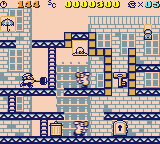
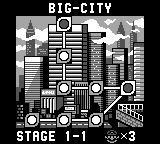
Eight stages among skyscrapers, office blocks and power lines teach the basics. Stage 1-1 introduces the key and the door; Bowbows, small dogs that can be stood on and thrown, patrol the girders; trash cans turn out to be Dust Men with feet; Sparks crawl along the wires. Stage 1-4 is the first meeting with Donkey Kong, and from Stage 1-5 the Road and Ladder icons appear.
Stage 1-8 is the first proper fight: barrels come down, Mario catches them and sends them back, and the ape retreats towards the trees.
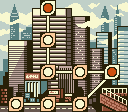
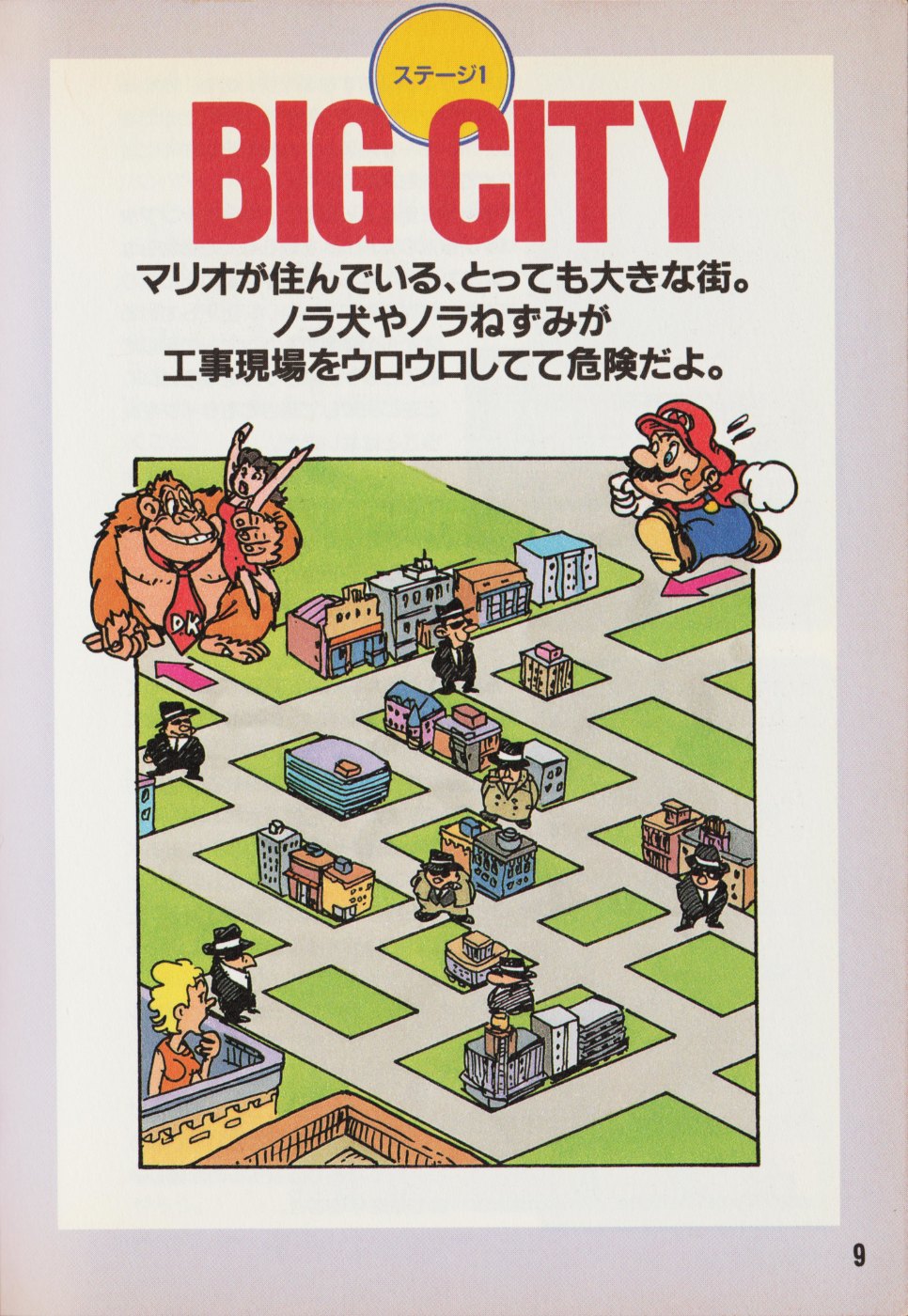
The Big-City map.Stage 1-1.Big-City as painted for the Shogakukan guide.
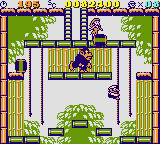
Stage 2: Forest
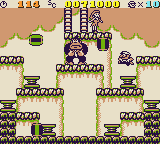
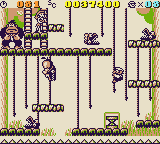
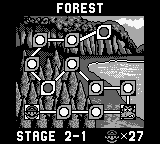
Twelve stages, and a tribute to Donkey Kong Junior. Vertical ropes hang from the canopy, Snapjaws climb them and can only be removed by dropping fruit on their heads, and Junior himself appears, lobbing Snapjaws and pulling switches. Mario learns to swim here, among Bukubuku piranhas that charge on sight, and meets the Thwomp Platform, a stone block that tries to flatten him and makes a handy lift once it has missed.
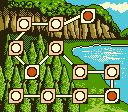
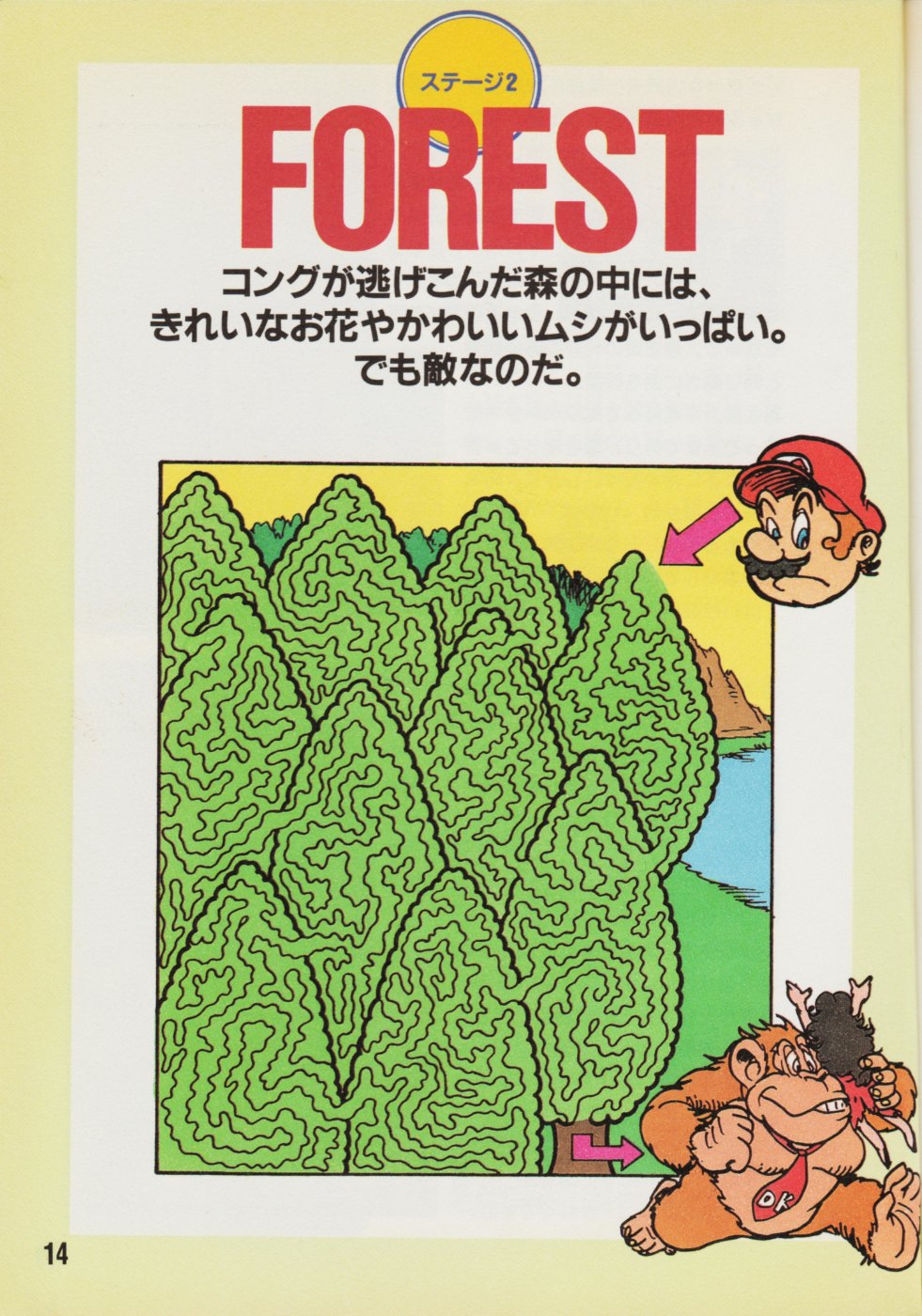
The Forest map.Stage 2-4.The Forest in the Shogakukan guide.
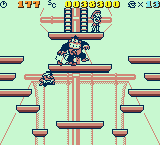
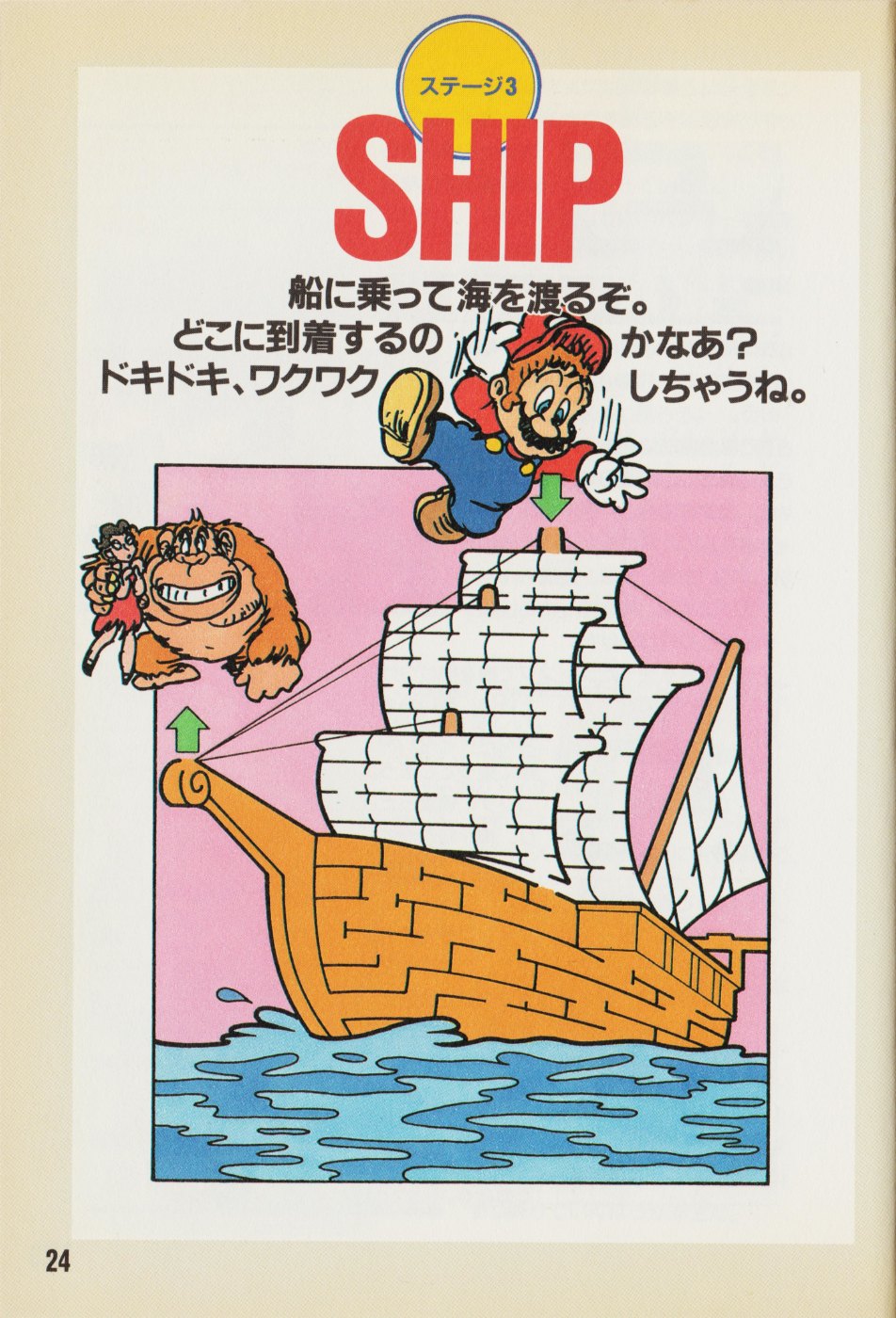
Stage 3: Ship
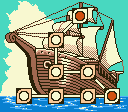
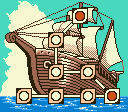
Eight stages at sea, which bring in the Handstand Double Jump and the Wire Spin and promptly insist on them. Walking Blocks trudge across beds of spikes and can be ridden; Sir Shovalot, a robot knight, does no damage but will shove Mario off a ledge or into a wall; Kānyī crabs snap at ankles; and Gessori squid patrol the water.
The Ship map.Stage 3-8.The Ship in the Shogakukan guide.
Stage 4: Jungle
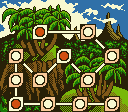
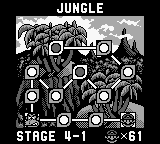
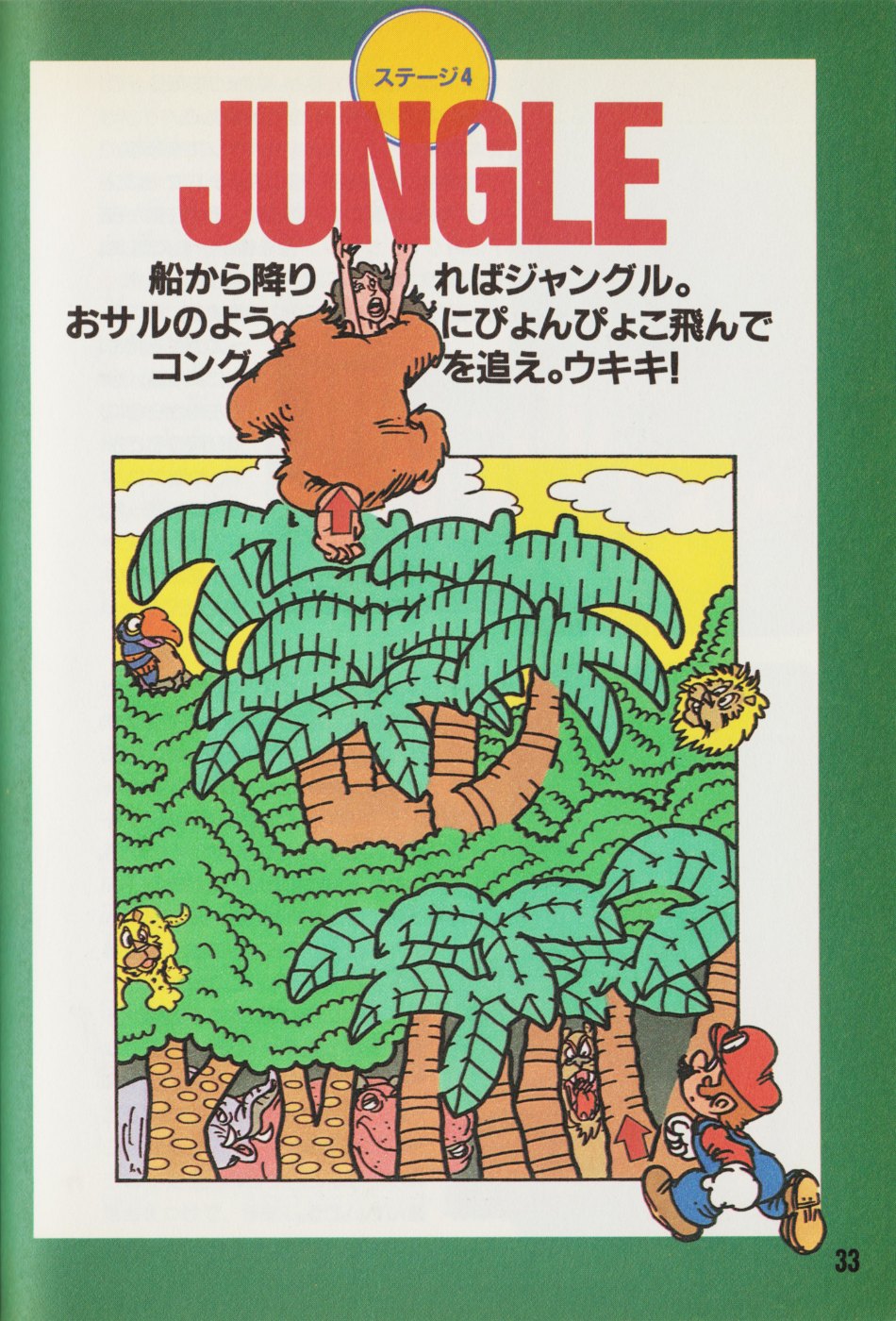
Twelve stages that take the Forest’s ropes and tangle them. The Jungle is also where Mario finds friends: Monchees, monkeys whose long tails can be climbed like ropes, and Jumpers, frogs that bound into the air with Mario on their backs, key and all. Against that, Kaibādo birds drop eggs from their nests and Dorakyū bats cling to Mario until he loses his grip.
The Jungle map.Stage 4-12.The Jungle in the Shogakukan guide.
Stage 5: Desert
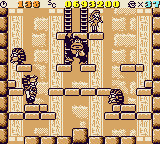
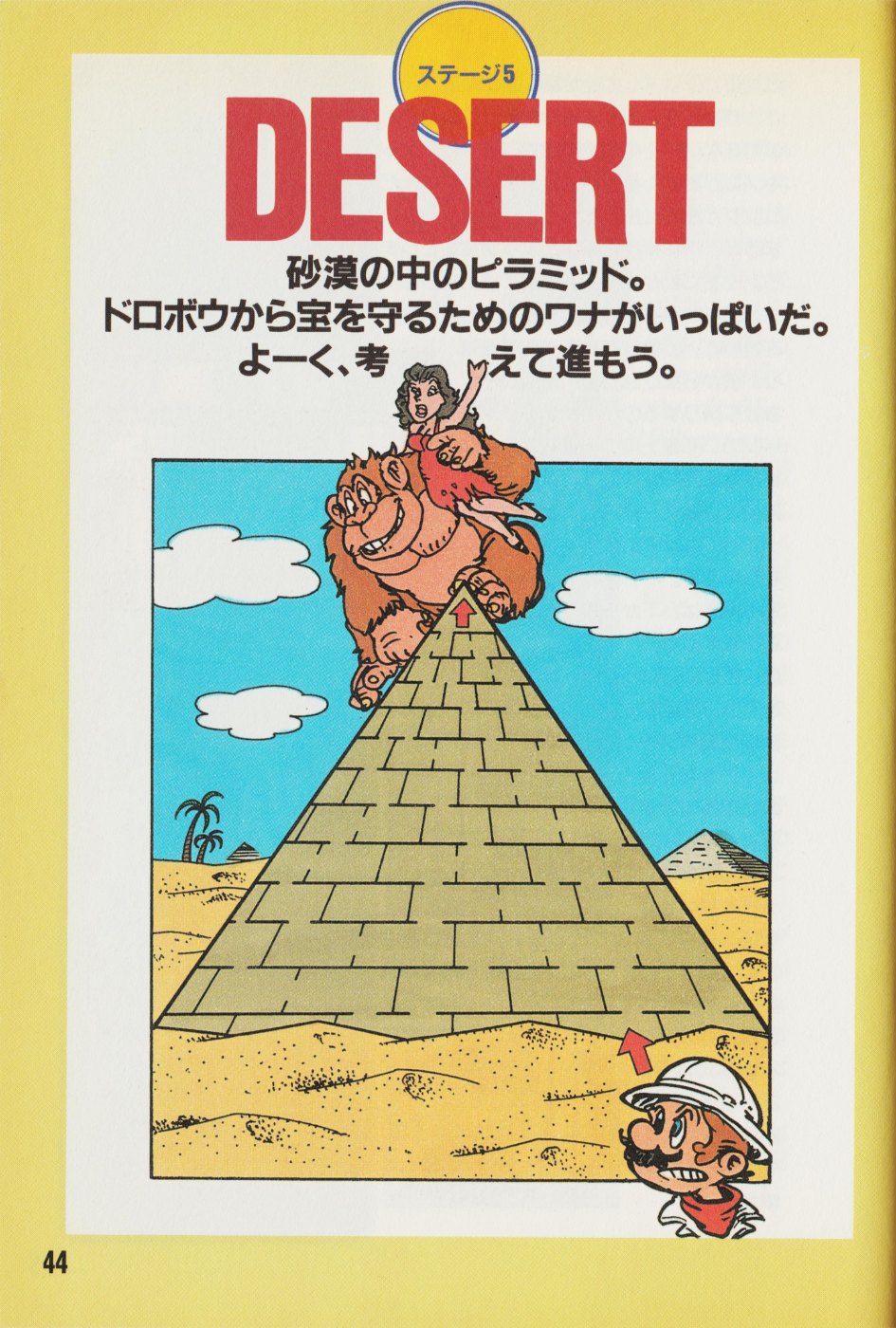
Twelve stages of sand, and the point at which the game turns puzzle-heavy. The Super Hammer breaks through brick; the Jump Stand joins the Road and the Ladder. Miira mummies and bone-throwing Skeletons walk the tombs, Furafurawā flowers burst out of the sand, and in Stage 5-12 Donkey Kong throws Tsutan’ōmen, walking pharaoh heads, which must be caught and returned like barrels.
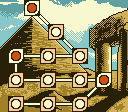
The Desert map.Stage 5-12: pharaoh heads instead of barrels.The Desert in the Shogakukan guide.
Stage 6: Airplane
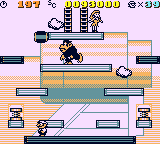
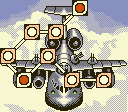
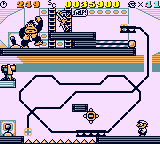
Eight stages aboard an aircraft. It is the only world with none of the ordinary enemies: the opposition is the wind, the cannons, the moving platforms and the Sparks. Some stages here have more than one locked door.
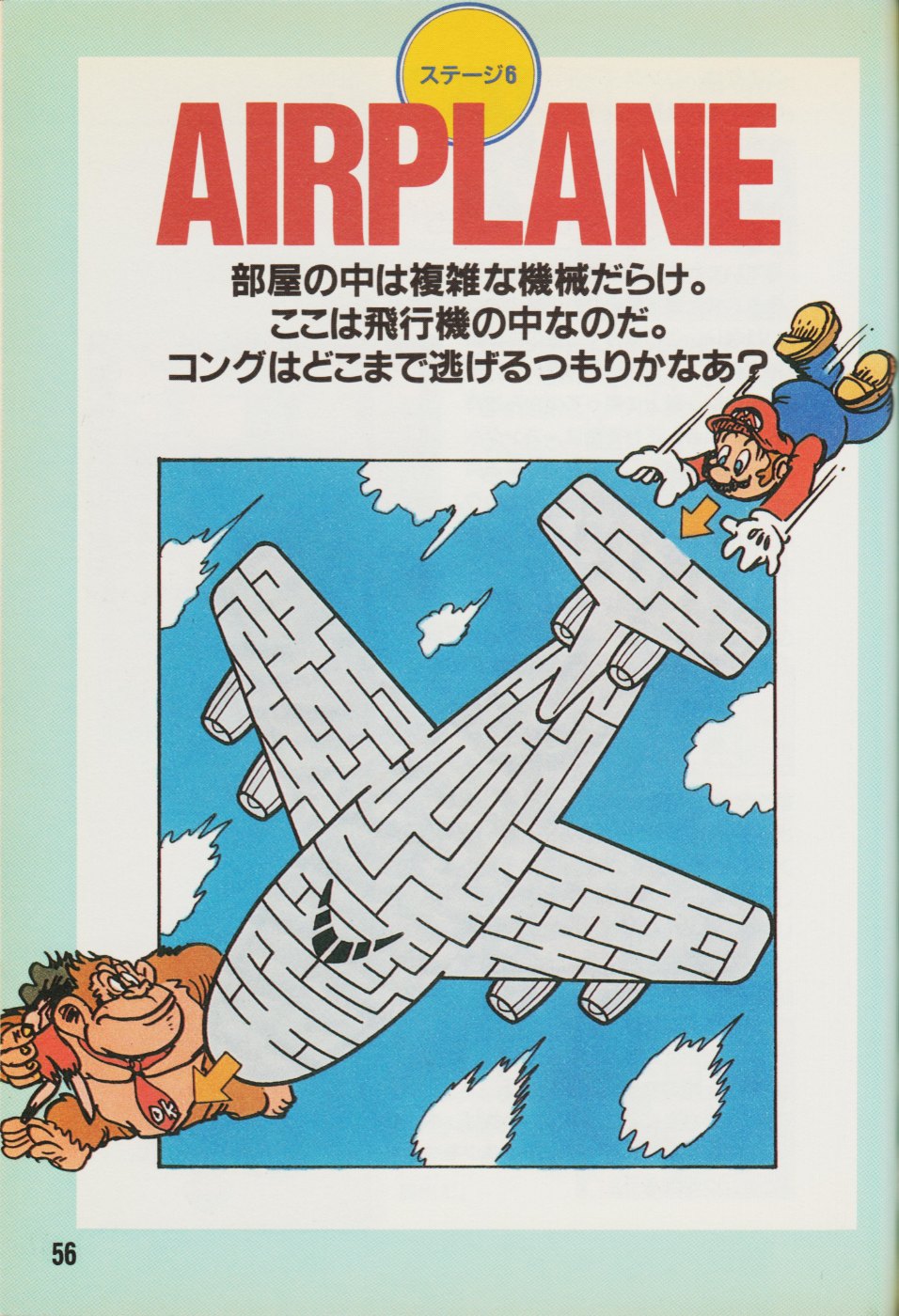
The Airplane map.Stage 6-4.The Airplane in the Shogakukan guide.
Stage 7: Iceberg
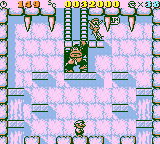
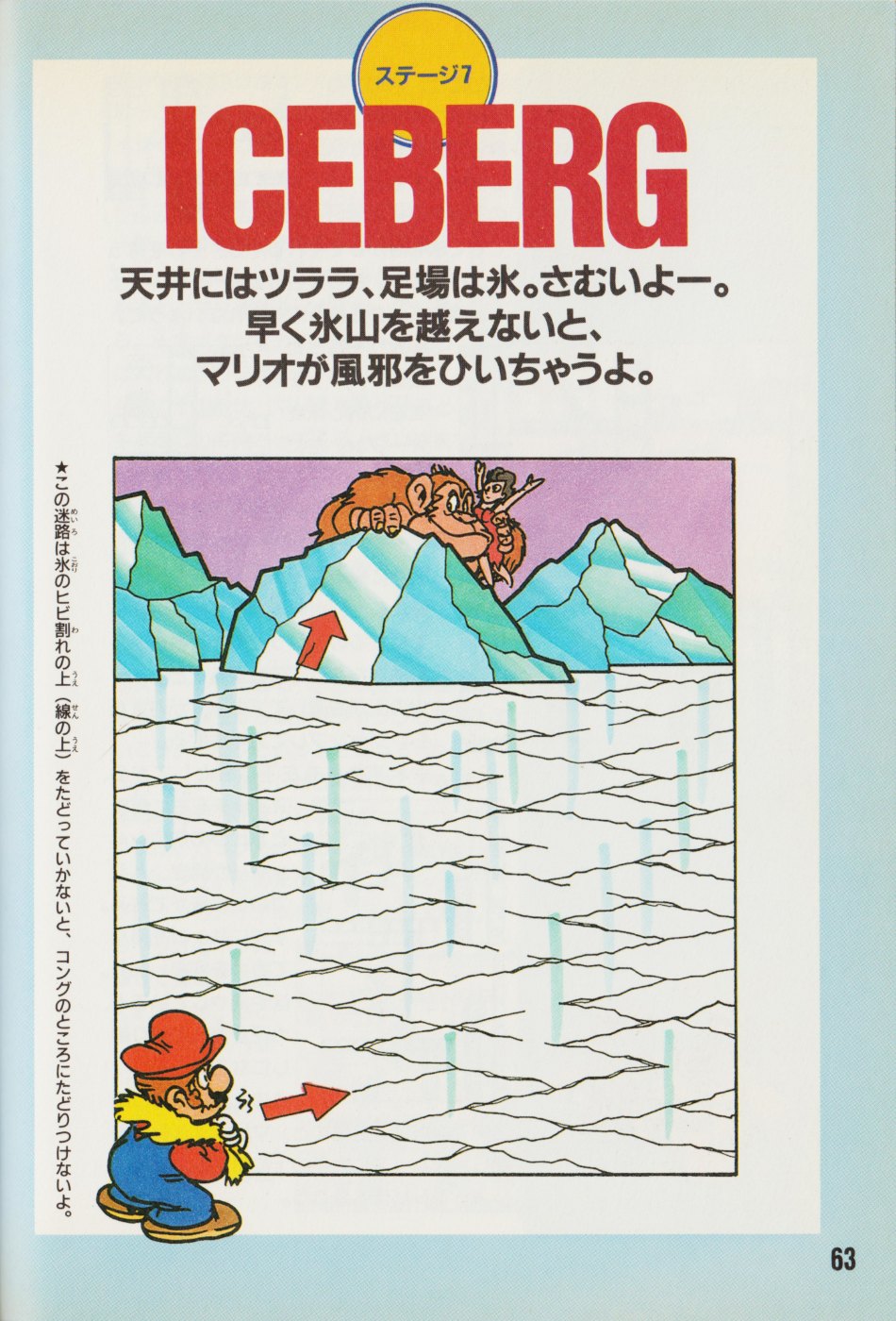
Twelve stages of ice. Floors are slippery, rocks sink when stood on, icicles hang overhead and Ice Blocks melt when a Faiachū walks across them. Penpen penguins can be picked up and thrown; Tododesu walruses guard the key and charge if they catch Mario’s eye; and the Ottō, an octopus, does no harm at all but wraps itself round him so that he cannot walk or pull a switch. The staff interview records that there were once more of them, until testers complained.
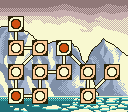
The Iceberg map.Stage 7-12.The Iceberg in the Shogakukan guide.
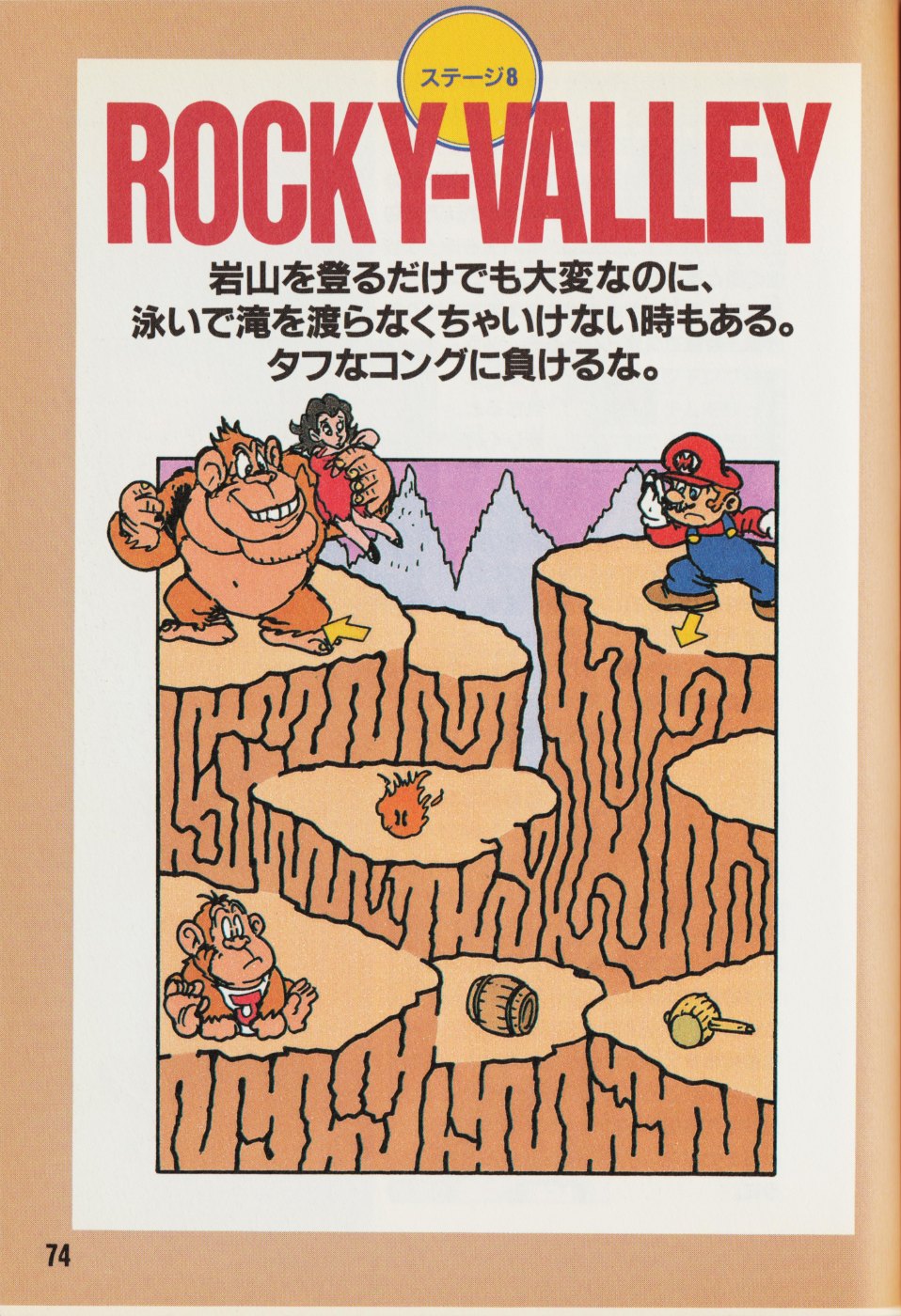
Stage 8: Rocky-Valley
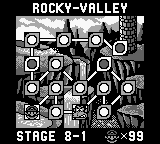
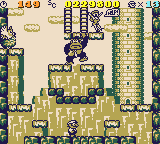
Sixteen stages, the longest world and the hardest. Nothing new is introduced; instead the stages ask for everything Mario has learned, along with an exact feel for the game’s physics. Donkey Kong is met four times, in 8-4, 8-8, 8-12 and 8-16, the last with wind blowing, Hawks overhead and Rokkun, walking rocks, as ammunition. Beaten again, he retreats to the Tower that stands in the valley.
The Rocky-Valley map.Stage 8-16.Rocky-Valley in the Shogakukan guide.
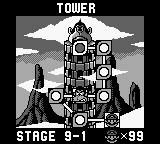
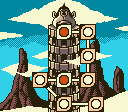
Stage 9: the Tower
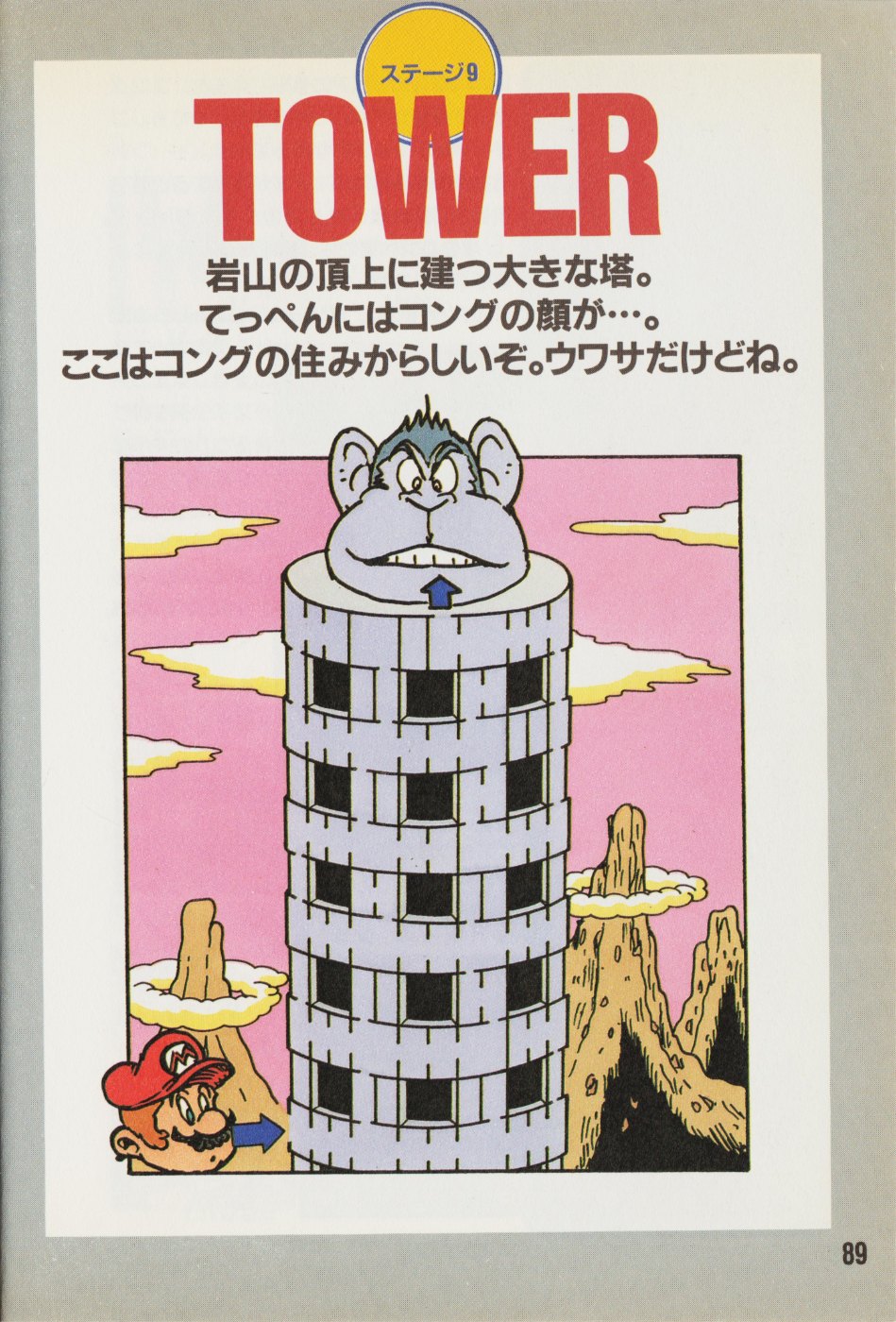
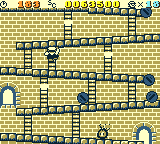
The last nine stages are a single running fight up the Tower, every one of them against the Kongs. In the first four Junior is at his father’s side, with Golems, jacks, spiked Gyātoru and birds in the way and Poison Mushrooms raining down to shrink Mario, until he manages to shut Junior in a cage. Stage 9-5 is a surprise for anyone with a long memory: its layout is the arcade game’s 25 m, complete this time, with the oil drum and Fireballs.
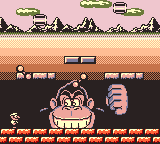
Stage 9-8 is the showdown at the top, in a gale, with barrels. Donkey Kong loses and tumbles from the Tower, and for a moment that seems to be that. Then he eats several Super Mushrooms and grows to giant size. Stage 9-9 is fought against Giant Donkey Kong, and barrels are the only weapons to hand.
The Tower map.Stage 9-5, a rebuilt 25 m.Stage 9-9: Giant Donkey Kong.Giant Donkey Kong, as seen on Super Game Boy.
The ending
The giant falls. Mario and Pauline are reunited once more, this time with the Mushroom Kingdom in view; there is a Warp Pipe, three ? Blocks, and a Super Mushroom that Pauline hands to Mario. He grows into Super Mario just in time, because Donkey Kong, back to his normal size, lands on top of him. Mario holds him overhead, and it is the ape’s turn to shout for help.
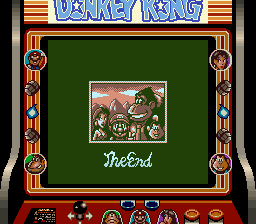
Junior jumps into the frame, a camera clicks, and the credits roll over the photograph: Mario, Pauline, Donkey Kong and Donkey Kong Jr. posing together in front of Rocky-Valley, friends for now.
The souvenir photograph that closes the game.The end portrait.
Every world in Donkey Kong (Game Boy)
Ten “stages” in the game’s own language, each divided into numbered levels. Donkey Kong is met in every fourth level; in the Tower he is met in all of them.
Stage 0: Construction Site4 levels · boss: Donkey Kong at 100 m (0-4)The arcade game in miniature: 25 m, 50 m, 75 m and 100 m.
Stage 1: Big-City8 levels · Donkey Kong in 1-4 and 1-8Keys, doors, Roads and Ladders are introduced among the skyscrapers.
Stage 2: Forest12 levels · Donkey Kong in 2-4, 2-8 and 2-12Ropes, water, switches and Snapjaws, with Junior making his entrance.
Stage 3: Ship8 levels · Donkey Kong in 3-4 and 3-8Handstand Double Jumps, Wire Spins and Walking Blocks over spikes.
Stage 4: Jungle12 levels · Donkey Kong in 4-4, 4-8 and 4-12Tangled ropes, helpful Monchees and Jumpers, and bats that pull Mario off.
Stage 5: Desert12 levels · Donkey Kong in 5-4, 5-8 and 5-12The Super Hammer and Jump Stand arrive, and the puzzles get serious.
Stage 6: Airplane8 levels · Donkey Kong in 6-4 and 6-8Wind, cannons and several doors per stage, with no ordinary enemies at all.
Stage 7: Iceberg12 levels · Donkey Kong in 7-4, 7-8 and 7-12Slippery floors, sinking rocks, icicles and an octopus that will not let go.
Stage 8: Rocky-Valley16 levels · Donkey Kong in 8-4, 8-8, 8-12 and 8-16The longest and hardest world, and the backdrop to the ending.
Stage 9: Tower9 levels, all boss fights · Donkey Kong (9-8), Giant Donkey Kong (9-9)A climb against both Kongs, a rebuilt 25 m and a final battle with a giant.
That makes 4 + 8 + 12 + 8 + 12 + 12 + 8 + 12 + 16 + 9 = 101 levels. Nintendo’s own blurb rounds it to “10 stages and 100 tricky levels”.
Advertisement
Gameplay & Controls
Each stage fits on one or two screens and has one rule: reach Pauline, or, far more often, get the key to the door. Everything else is in the way.
Keys, doors and the clock
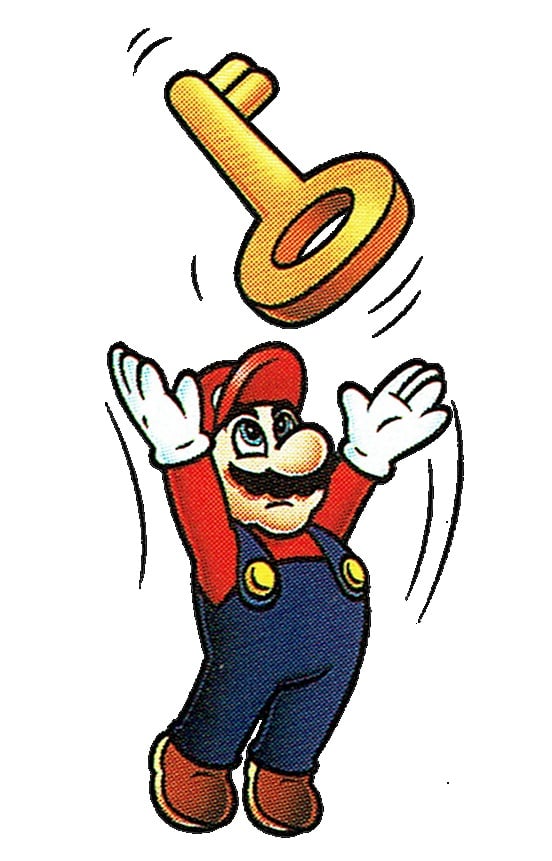
After the four arcade stages, almost every level is a puzzle with a key and a locked door. Mario must find the key, pick it up with B and carry it to the door before the timer runs out. He cannot climb a ladder with anything in his hands, so the key has to be thrown ahead of him, upwards if need be; and if it is left lying for more than a few seconds it vanishes and reappears where it started. Around that simple idea the designers pile switches that redirect platforms, conveyor belts, moving lifts, ropes, wind, ice and, in one world, cannons.
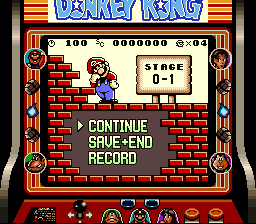
Time matters twice over. Run out and Mario loses a life; finish quickly and the seconds are banked. After each encounter with Donkey Kong the game adds up the time left on the previous four stages and awards an extra life for every 100 seconds, rounded up. Best times and scores are recorded for every stage and can be called up from the pause screens.
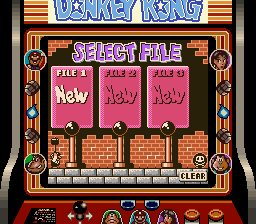
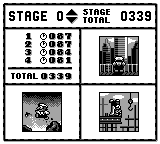
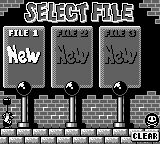
The pause screen.Records are kept for every set of stages.The file select screen: progress is saved to the cartridge.
Mario the acrobat
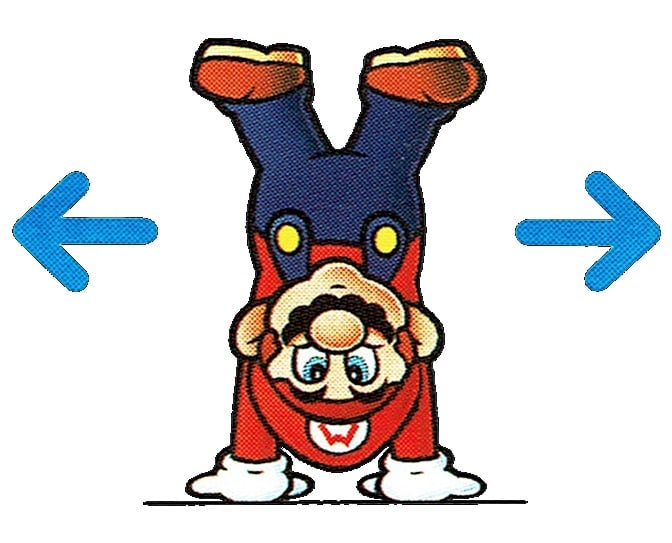
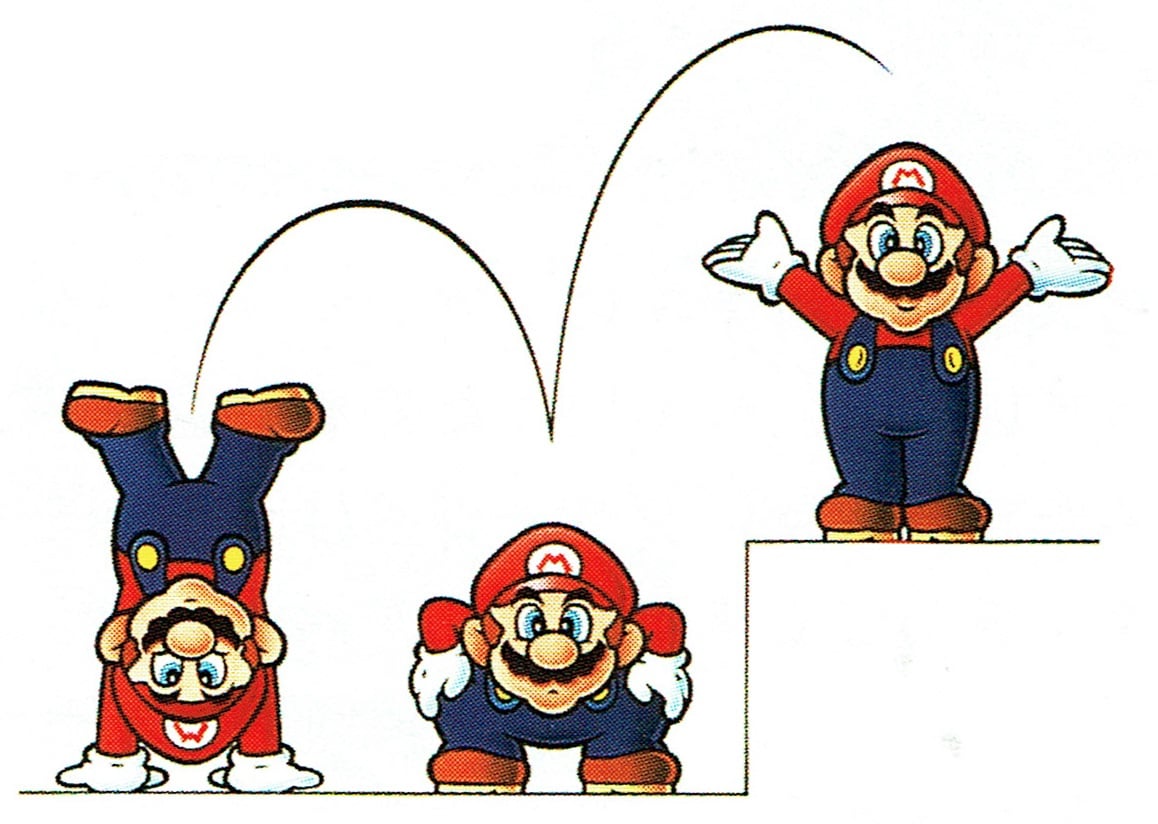
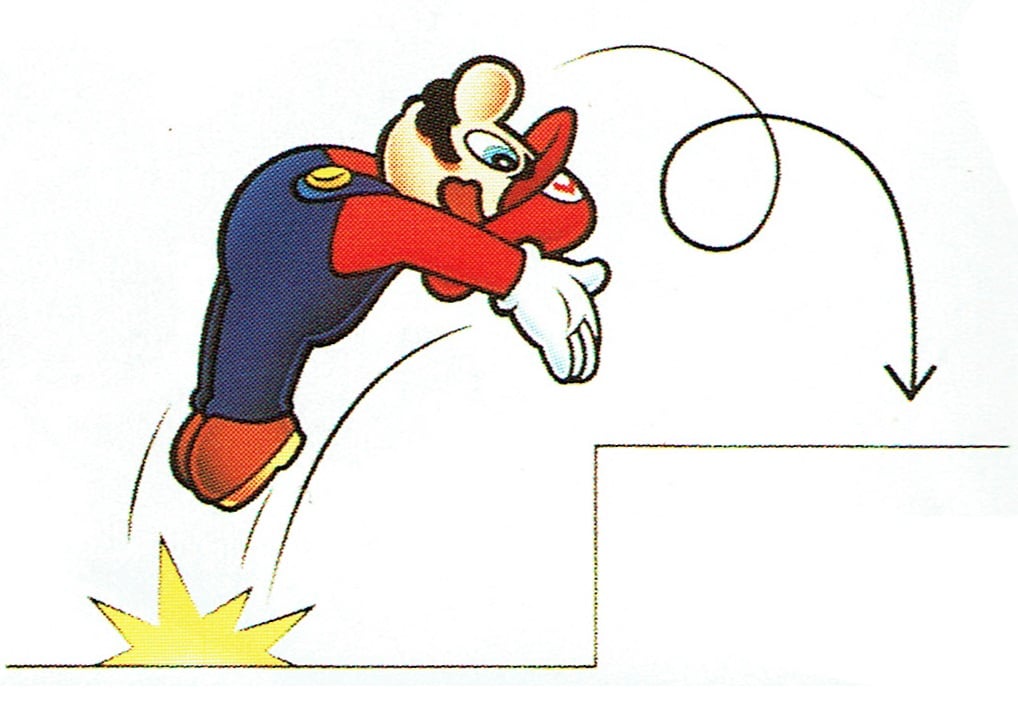
Mario’s ordinary jump is low, nothing like the leaps of Super Mario Land 2, so height comes from technique. Hold Down and press A and he flips on to his hands. In a handstand he walks slowly but his boots fend off most things that fall from above. Press A again and he springs off his hands in a Handstand Jump; press it once more at the moment he lands and he goes higher still, the Handstand Double Jump. The backflip, done by reversing direction and jumping in the same instant, is higher than either but needs room for a run-up.
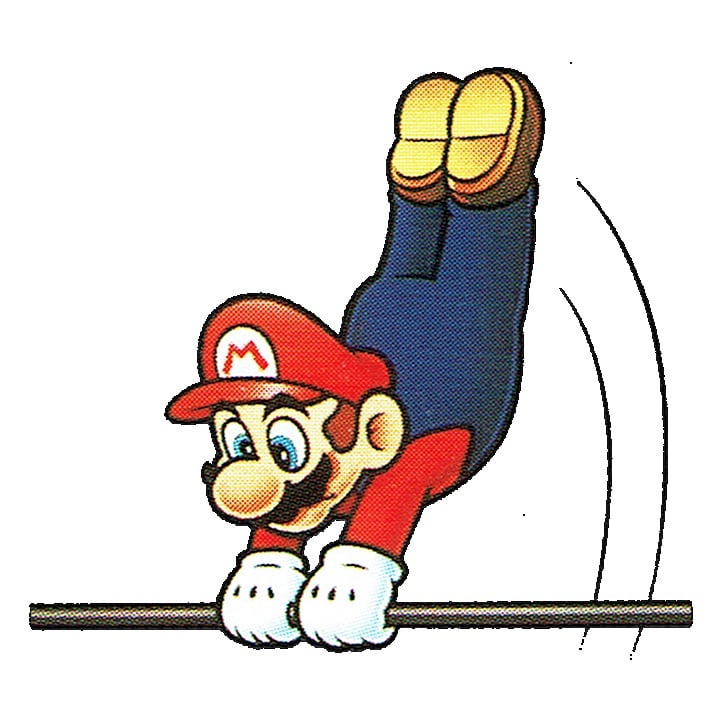
Ropes and wires add another set of tricks. Mario can hang from a horizontal wire, wind himself round it with a Wire Spin and let go to fly upwards or sideways, depending on which way the wire runs. Vertical ropes are climbed much as Junior climbed his vines in Donkey Kong Junior. He can swim. And he can stand on many enemies, lift them with B and throw them, exactly as in Super Mario Bros. 2.
Falling is handled more kindly than in 1981. A short drop does nothing; a longer one makes Mario roll as he lands, which can carry him off a narrow ledge; longer still and he lies dazed and helpless for a few seconds; only a very long fall, on to his head, is fatal. He still has just one hit point, but anything he is carrying acts as a shield: he drops it, is briefly invulnerable and carries on.
The handstand: slow, but safe from above.The Handstand Jump.The backflip, making its first appearance in a Mario game.The Wire Spin.
Roads, ladders and Jump Stands
From the second half of Big-City onwards, stages contain icons that let Mario do a little construction of his own. Pick up a Road icon and you choose where to lay a temporary bridge; a Ladder icon does the same for a ladder, and the Desert adds the Jump Stand, a springboard. Each piece lasts only a short while, with a warning tone borrowed from Super Mario World as it runs out, so the puzzle is as much about when as where.
These pieces are what remains of something more ambitious. In the Shogakukan guide’s staff interview, summarised by Wikipedia, programmer Masayuki Hirashima describes building a full level editor for the game; it was left out as too hard for children, and its ideas were folded into the items instead.
A Road icon.A Ladder icon.The Jump Stand.
Facing Donkey Kong
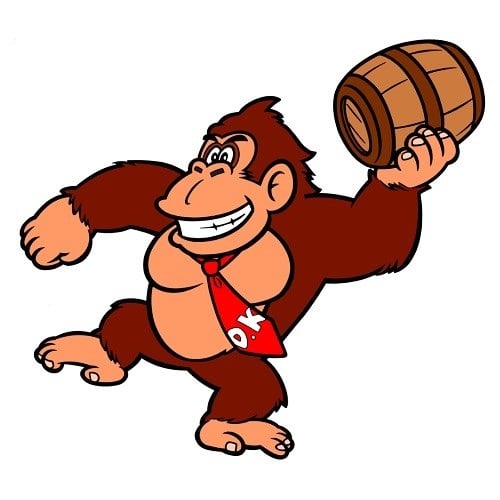
Every fourth stage brings the ape back. Midway through a world the task is to reach Pauline, as in the arcade game, while Donkey Kong pounds the ground and shakes debris loose from above. At the end of a world it becomes a duel: he throws barrels, or whatever the local equivalent is, and Mario must dodge one, hop on it, pick it up and throw it back. From the Forest onwards, Junior lends a hand.
Win, and a short scene plays in which Mario chases the Kongs towards the next location. These scenes are the game’s tutorial in disguise: each shows off a move, such as the handstand or the Wire Spin, shortly before the stages begin to demand it. Miyamoto has explained that the team first meant to hand out new abilities as rewards for beating bosses, and that he argued against it as unfair on anyone who could not get that far.
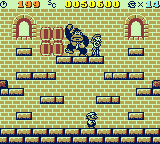
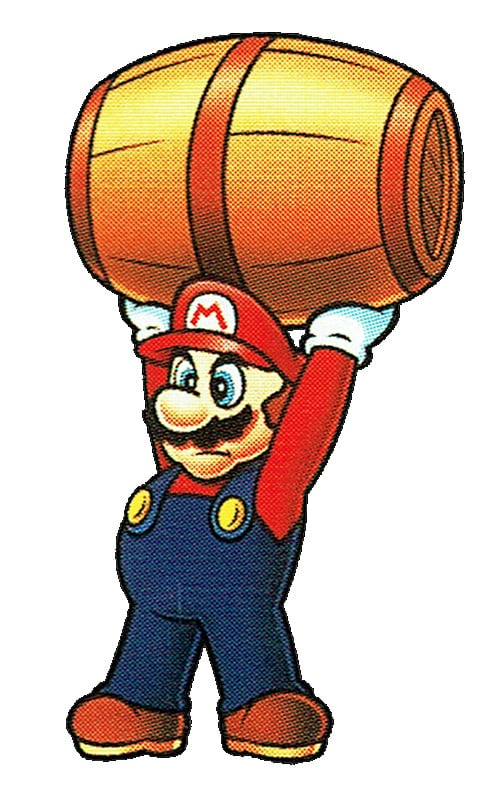
Stage 1-4, the first meeting in the Big-City.Stage 1-8: catch the barrels and throw them back.Mario with a barrel, ready to return it.
Bonus games and extra lives
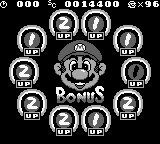
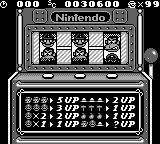
Pauline’s parasol, hat and bag are scattered through each puzzle stage. Collect all three before unlocking the door and a bonus game follows. In the Wheel of Fortune you press A to stop a spinning wheel and win one, two or three lives; you cannot lose. The Slot Machine has three reels showing Mario, Donkey Kong, a hat, a hammer and a Fireball: three Kongs pay five lives, three Marios three, and even a single Mario is worth one.
1 UP Hearts are also hidden in the stages themselves. Between those, the bonus games and the time bonus, lives pile up quickly, which is just as well by the time Rocky-Valley arrives.
The Wheel of Fortune.The Slot Machine.
On the Super Game Boy
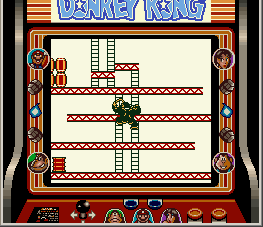
This was the game built to show off the Super Game Boy. The Shogakukan guide, as cited by Wikipedia, calls it the first game made with the adaptor in mind; other sources word it more narrowly, as the first game in the Mario franchise with dedicated Super Game Boy colour support. Where an ordinary Game Boy shows four shades, the adaptor let the artists use up to 13 colours on screen, and Takaya Imamura chose a separate palette for each stage and drew the border, which is based on the 1981 arcade cabinet.
There are audio extras as well. Using the Super NES sound hardware, Pauline’s cry for help becomes a sampled voice, and the credits music gains instruments the Game Boy cannot produce. The extras are tied to the hardware: the Nintendo 3DS and Nintendo Switch versions are the plain Game Boy game.
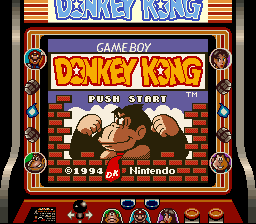
The title screen on Super Game Boy, with its arcade cabinet border.50 m in colour.The pause screen on Super Game Boy.A Japanese Super Game Boy flyer featuring the game.
Items and objects
Things Mario can use, and the furniture of the stages. Sprites are from the Game Boy version.
KeyOpens the door that ends the stage. Can be thrown to knock out enemies. Vanishes if left alone for a few seconds and returns to its starting point.
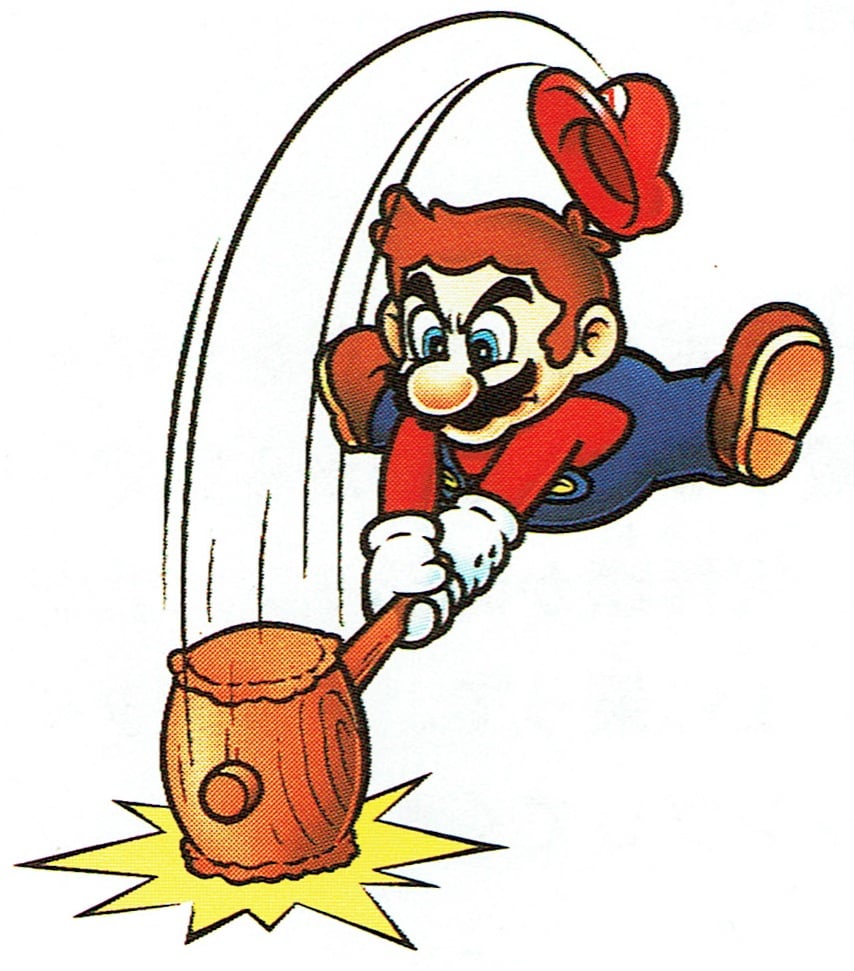
HammerSwings automatically and beats every enemy. New trick: throw it upwards, climb a ladder and catch it again. Reappears where it started once it wears off.
Super HammerA hammer that also smashes brick walls and floors. First found in the Desert.
Parasol, hat and bagPauline’s lost belongings. Collect all three in a stage for a bonus game.
1 UP HeartAn extra life.
Trash CanStand on it for height or throw it at an enemy such as a Bowbow. It breaks on impact.
RoadLays a temporary platform wherever you choose.
LadderPlaces a temporary ladder.
Jump StandA temporary springboard that launches Mario upwards.
BarrelThrown by Donkey Kong. Land on one, pick it up and throw it back.
SwitchFlip one and part of the stage changes. Junior likes to pull them at the wrong moment.
Locked doorThe exit. The Airplane has stages with more than one.
RopeVertical ropes are climbed; horizontal wires are for hanging and spinning.
Conveyor beltCarries Mario along, even while he is crouching.
ElevatorThe lifts from the arcade game’s 75 m.
CannonA fixture of the Airplane world.
Ice BlockSlippery footing on the Iceberg; a passing Faiachū will melt it.
IcicleHangs from Iceberg ceilings.
Oil drumBack from 1981, and still producing Fireballs.
Cement tubThe conveyor-belt hazard of 50 m.
JackThe bouncing spring of 75 m. Donkey Kong throws them by hand this time.
Cartoons, Comics & Other Media
A handheld game with a long reach: two manga, a wristwatch, a cameo-filled ending and a design that Nintendo has returned to again and again.
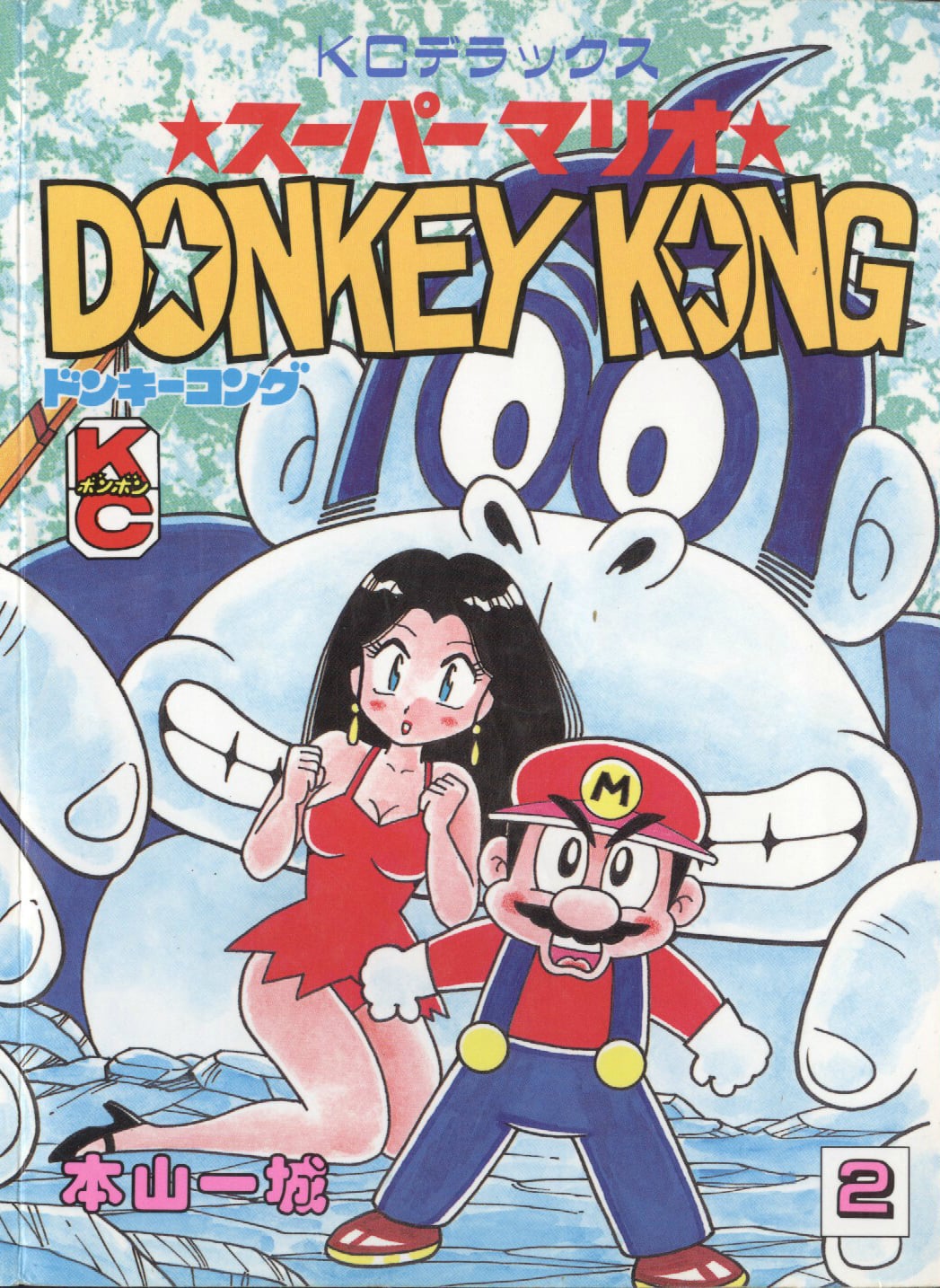
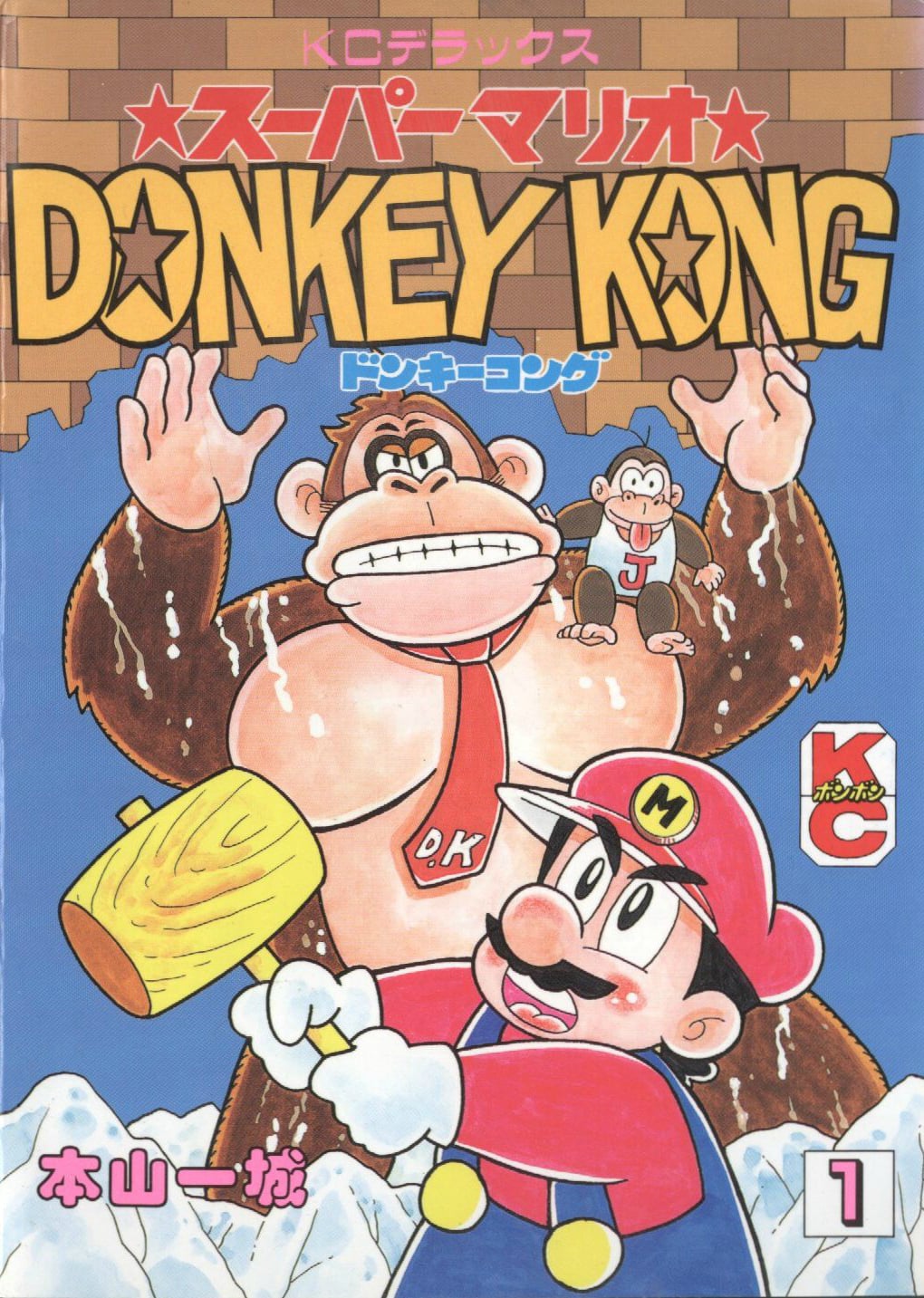
Super Mario: Donkey Kong (Kodansha manga)KC Deluxe · two volumesA two-volume retelling in which Pauline belongs to a circus run by Princess Peach and is carried off to Donkey Kong Island to be a mother to Junior. Mario and Luigi come to the rescue. The last chapter jumps ahead twelve years and ties the story to Donkey Kong Country.
Super Mario-kunVolume 11, stage 10One chapter of the long-running comedy manga borrows the game: Mario and Yoshi are visiting Pauline’s clothes shop when Donkey Kong snatches her and heads for a building site.
Donkey Kong Jungle Action SpecialComicIts story “A Blast From The Past” is a loose adaptation of the game.
Donkey Kong (Nelsonic Game Watch)LCD wristwatchAn LCD watch game based on Stage 1-7.
Donkey Kong LandRare · Game Boy · 1995Its city world, Big Ape City, is a nod to Big-City. In Europe the two games were later sold together in a Big Value Twin Pack.
Super Mario 64Nintendo 64 · 1996Many of the moves Mario learned here return in three dimensions, the backflip among them. See Super Mario 64.
Mario vs. Donkey KongGame Boy Advance, 2004 · Switch, 2024Planned as a remake of this game, released as a successor with the same keys, doors and handstands. Its sequels kept the upward hammer throw and Pauline’s design. See the GBA original and the Switch remake.
Super Mario 64 DSNintendo DSThe Slot Machine bonus game reappears as a minigame.
Super Mario RunMobileMario’s landing roll and backflip return.
The Super Mario Bros. MovieIllumination / Nintendo · 2023Donkey Kong’s film design is closest to how he looks here, his last appearance in the classic style before Donkey Kong Country redrew him.
Characters
Four leads, two helpers and a giant. Yōichi Kotabe is credited as the game’s illustrator.
Character
Who they are
In this game
Abilities & notes
MarioThe hero, with new tricks
No longer the stiff little carpenter of 1981. This Mario is a gymnast.
Chases Donkey Kong through nine worlds, carrying keys to doors and returning barrels to sender. In the ending he becomes Super Mario for the first and only time in the game.
One hit point; anything carried acts as a shield. Moves: crouch, handstand, Handstand Jump and Double Jump, backflip, Wire Spin, lift and throw.
PaulineKidnapped, again
Mario’s lady friend in the story. This is the game that gave her the design she has had ever since.
Carried from world to world, crying for help, and dropping her parasol, hat and bag in every stage. In the ending it is she who hands Mario the Super Mushroom.
Collect her three items in a stage for a bonus game.
Donkey KongThe ape who would not stay down
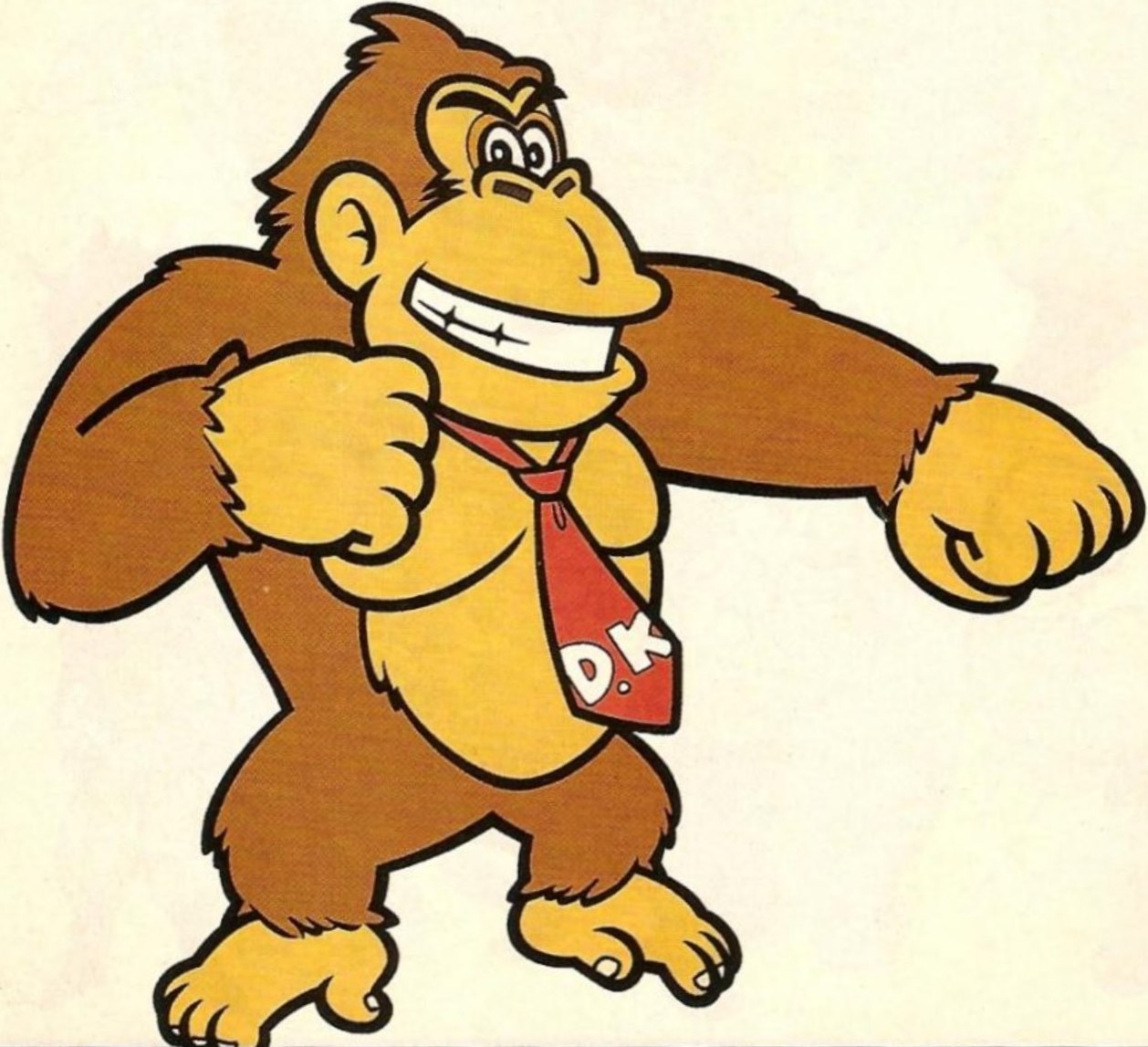
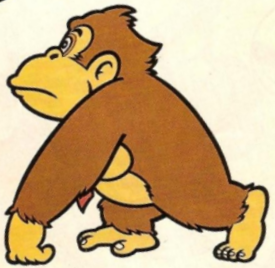
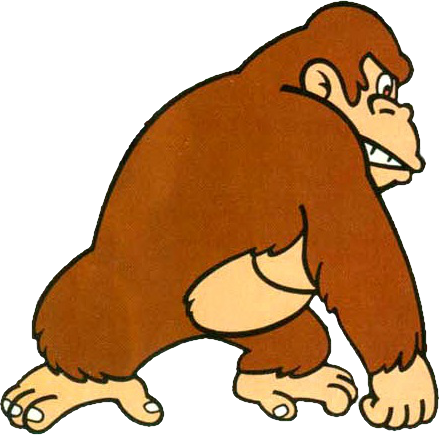
The original Donkey Kong in his last outing before Donkey Kong Country, and, The Cutting Room Floor points out, the first in which he wears a tie.
Faced in every fourth stage: sometimes pounding the ground to shake down debris while Mario climbs to Pauline, sometimes hurling barrels, pharaoh heads or rocks that have to be thrown back.
Final fights: Stage 9-8 (barrels in a high wind) and, as a giant, Stage 9-9.
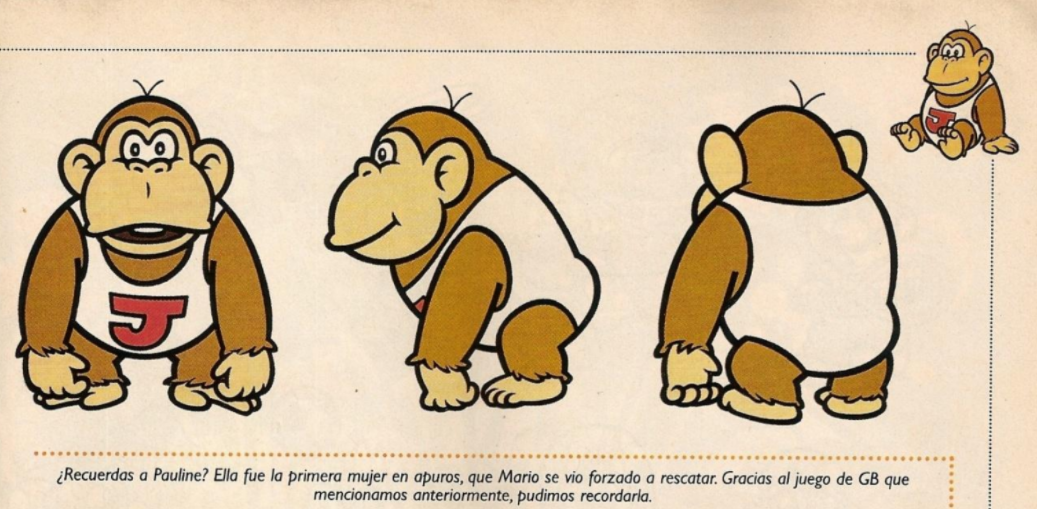
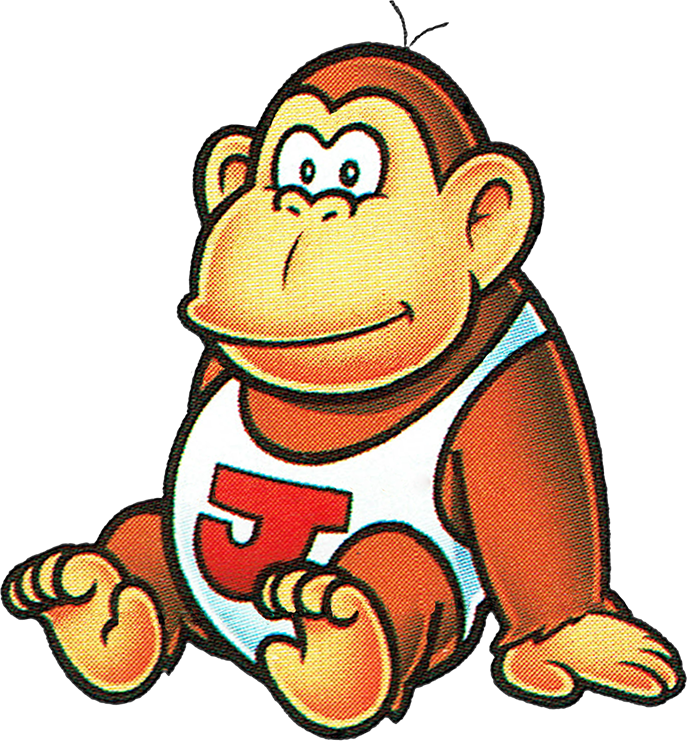
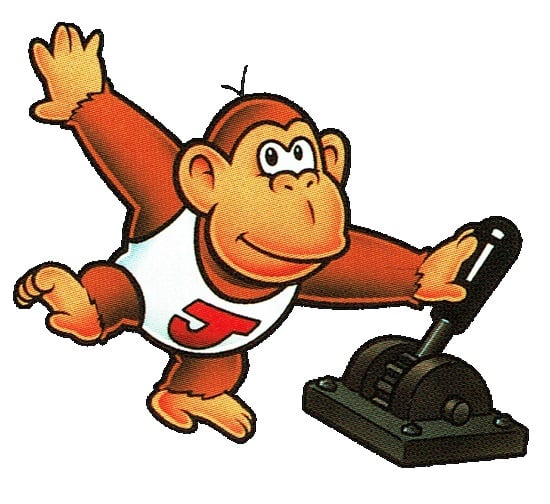
Turns up from the Forest onwards to pull switches at awkward moments, throw Snapjaws and drop Poison Mushrooms. Fights alongside his father in the first Tower stages until Mario traps him in a cage.
Poison Mushrooms shrink Mario.
Giant Donkey KongThe final boss
Donkey Kong after a meal of Super Mushrooms, a trick borrowed from Super Mario Bros.
The opponent in Stage 9-9, the 101st and last level.
Stage 9-9. Barrels are the only objects in the arena.
MoncheeAlly · Jungle
A friendly monkey, first met in Stage 4-3.
Its long tail can be climbed like a rope and used to cross gaps. Touching it is harmless.
First appears: Stage 4-3.
JumperAlly · Jungle
A frog, first met in Stage 4-10.
Leaps high when Mario stands on it, carrying him and the key to ledges he could not otherwise reach.
First appears: Stage 4-10. Can be knocked out with a thrown object.
Enemies
All 41 enemies as usually counted, in order of first appearance. Most have only Japanese names, taken from the Shogakukan guide. Several are the same creature in different clothes: one family circles platforms harmlessly, another does the same with spikes, a third simply walks.
FireballConstruction Site, 25 mA small flame from the oil drum that chases Mario. The hammer puts it out.
FireConstruction Site, 100 mThe larger flame of the rivet stage, arriving from the sides of the screen.
OilBig-City, Stage 1-1A flame in a can that bobs on the spot. Deadly to touch; the hammer deals with it.
BowbowBig-City, Stage 1-1A dog that paces the platforms. Fatal from front or back, but it can be stood on, picked up and thrown. Flees from the hammer.
RappyBig-City, Stage 1-2Circles a floating platform, underside included. Cannot hurt Mario but will push him off; can be ridden, not lifted.
Dust ManBig-City, Stage 1-3A trash can that sprouts feet and eyes when Mario comes near and can knock him out. Can be stood on but not lifted.
SparkBig-City, Stage 1-3Runs along wires, flickering in and out. Cannot be harmed. The one enemy shared with Super Mario Bros. 2.
FaiachūBig-City, Stage 1-5A walking flame that follows walls and ceilings. Trash cans do not stop it, and on the Iceberg it melts Ice Blocks.
DottyForest, Stage 2-1The Forest’s version of Rappy.
SniperForest, Stage 2-1A spiked creature that circles platforms or the edge of the stage. Harmful to touch.
DōryīForest, Stage 2-3A plant that spits seeds sideways at intervals. The seeds hurt; the plant itself is safe to stand on.
SnapjawForest, Stage 2-4The rope-climbing crocodile from Donkey Kong Junior. Only dropped fruit will remove it. Junior throws them.
BukubukuForest, Stage 2-5A piranha that swims back and forth and charges when it sees Mario.
Thwomp PlatformForest, Stage 2-8A stone block that drops when Mario comes close. Ride it as a lift, but mind the ceiling.
HawksForest, Stage 2-9Flies across the screen dropping eggs. Bird and eggs are both deadly.
SairesuForest, Stage 2-10Sleeps until it hears Mario, then charges. The fastest enemy in the game; it dozes off again if he gets away.
Walking BlockShip, Stage 3-1A block with legs that plods across spikes. Harmless, and a useful ferry.
Sir ShovalotShip, Stage 3-2A robot knight that charges behind its shield. It cannot hurt Mario directly, only shove him off ledges or squash him against walls.
KānyīShip, Stage 3-2A slow crab with extending claws. Safe to stand on, fatal from the side.
Aqua ManShip, Stage 3-3A walking diver. Can be stood on, lifted, thrown or hammered.
GessoriShip, Stage 3-7A squid that swims from side to side.
KaibādoJungle, Stage 4-1A bird that leaves its nest to cross the screen, pausing to drop eggs.
DorakyūJungle, Stage 4-5A bat that latches on to Mario and makes him fall from his rope.
MiiraDesert, Stage 5-2A mummy; the Desert’s walking enemy. Can be stood on, lifted, thrown or hammered.
SkeletonDesert, Stage 5-2A skull that slides along the ground throwing bones. The hammer breaks both.
Furafurawā (Desert)Desert, Stage 5-2Hides in the sand and pops up when Mario approaches. A hammered one grows back at once.
ArumajironDesert, Stage 5-7The Desert’s version of Rappy.
SukōpīDesert, Stage 5-11A scorpion that behaves like Sniper.
Tsutan’ōmenDesert, Stage 5-12A walking head thrown by Donkey Kong. Jump on it, pick it up and throw it back.
Spark (globe)Airplane, Stage 6-4A Spark that circles platforms instead of riding wires.
PenpenIceberg, Stage 7-2A penguin; the Iceberg’s walking enemy.
OttōIceberg, Stage 7-2An octopus that does not attack but jumps on Mario and stops him walking or pulling switches for a while.
TododesuIceberg, Stage 7-2A walrus that guards the key and charges on eye contact. Can be stood on, not lifted.
PurupuruIceberg, Stage 7-3A seal; the Iceberg’s version of Rappy.
ChikuchikuRocky-Valley, Stage 8-2A hedgehog that behaves like Sniper.
Furafurawā (Rocky-Valley)Rocky-ValleyHere it walks slowly and fires four seeds that the hammer can destroy. It does not grow back.
RokkunRocky-Valley, Stage 8-16A walking rock thrown by Donkey Kong, to be caught and returned.
GolemTower, Stage 9-1The Tower’s walking enemy.
GyātoruTower, Stage 9-3A spiked mask that behaves like Sniper.
BirdTower, Stage 9-4Another egg-dropper, in the manner of Hawks.
Robo NO.1Tower, Stage 9-6A walking suit of armour; can be stood on, lifted, thrown or hammered.
Key staff
From the game’s credits, with roles filled in from the Shogakukan guide interview as summarised by Wikipedia.
Shigeru MiyamotoProducerCreator of the 1981 original. Wikipedia describes this as the last Donkey Kong game he worked on directly.
Hiroshi YamauchiExecutive producerPresident of Nintendo.
Masayuki KameyamaDirector, course designerManaged the collaboration between Nintendo and Pax Softnica.
Takao ShimizuDirector, course designerCo-directed with Kameyama.
Yoshiaki HoshinoMain programmerProgrammed Mario’s movement and the enemies.
Masayuki HirashimaMain programmerBuilt the level editor that was cut from the finished game.
Motoo YasumaCo-programmer
Hideo KonC.G. designer, course designerAnimation and character sprites.
Kenta UsuiC.G. designer, course designerStarted on the graphics, then switched to level design in the second half of development.
Takaya ImamuraC.G. designerChose the Super Game Boy palettes and drew the border.
Taisuke ArakiSound composerWrote more than 40 pieces for the game.
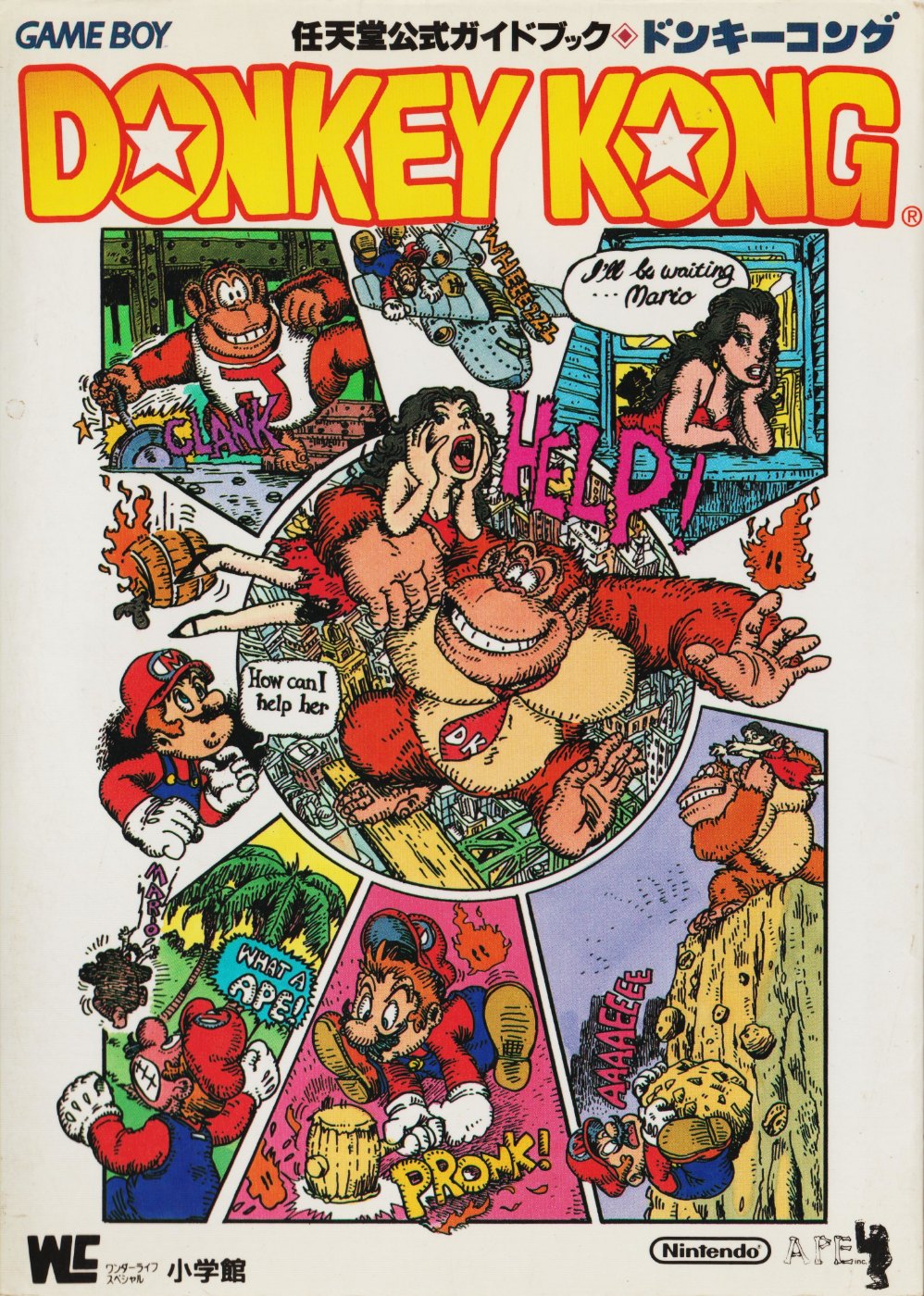
Most of what is known about the making of the game comes from a staff interview in Shogakukan’s official Japanese guide of 1994, summarised with page references on Wikipedia, and from pre-release material.
A new game in an old costume
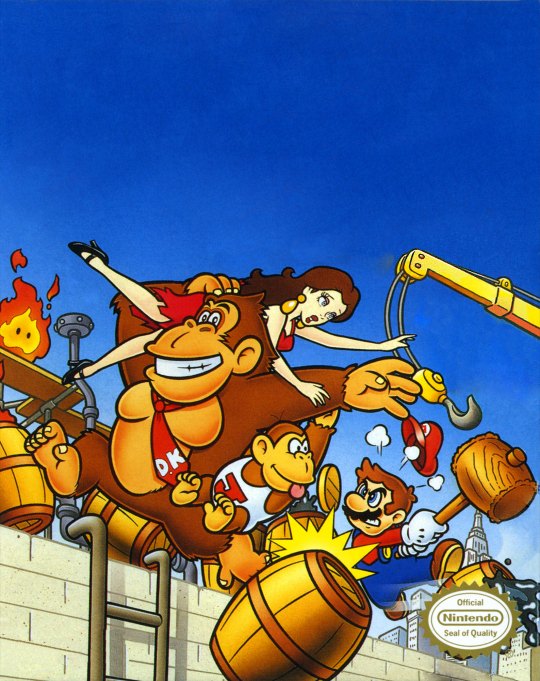
The main promotional artwork.
Nintendo had been talking about bringing Donkey Kong back since before the series’ tenth anniversary in 1991. According to Miyamoto the idea was never to remake the arcade game but to build a new one that reimagined it. The project slipped (Junior turned up as a driver in Super Mario Kart in 1992 in the meantime) and was eventually developed by Nintendo together with the studio Pax Softnica, with Masayuki Kameyama handling the liaison between the two.
Opening with the four arcade stages was a deliberate piece of bait. The team expected many people to buy the cartridge out of nostalgia and wanted to meet them at the door. Some staff worried the game would be mistaken for a straight port, and for a time the old stages were going to be a bonus for finishing the game instead.
Small stages, packed tight
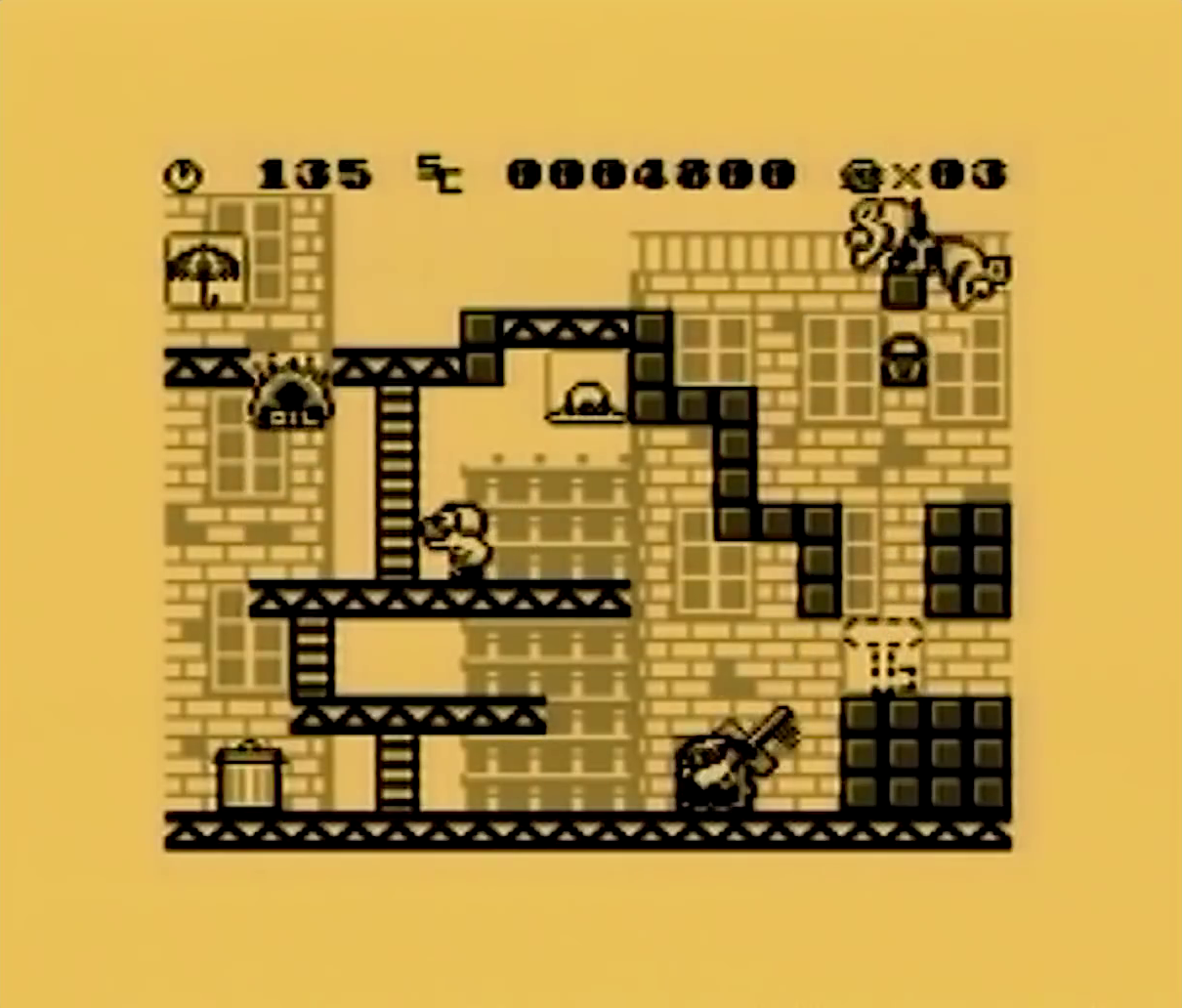
A pre-release version of Stage 1-1.
With a screen that small, Miyamoto said, the answer was density: stages compact enough to take in at a glance and intricate enough that the player has to learn every detail. The time limit, a formality in most platformers, was made part of the challenge, giving every stage a time-attack flavour.
He wanted Mario’s new moves to be simple to pull off and fun in themselves. The first plan was to award them one at a time for beating bosses. Miyamoto objected that this punished players who never reached the later bosses, so the full move set is available from the start and the between-world scenes merely point it out.
What was left out
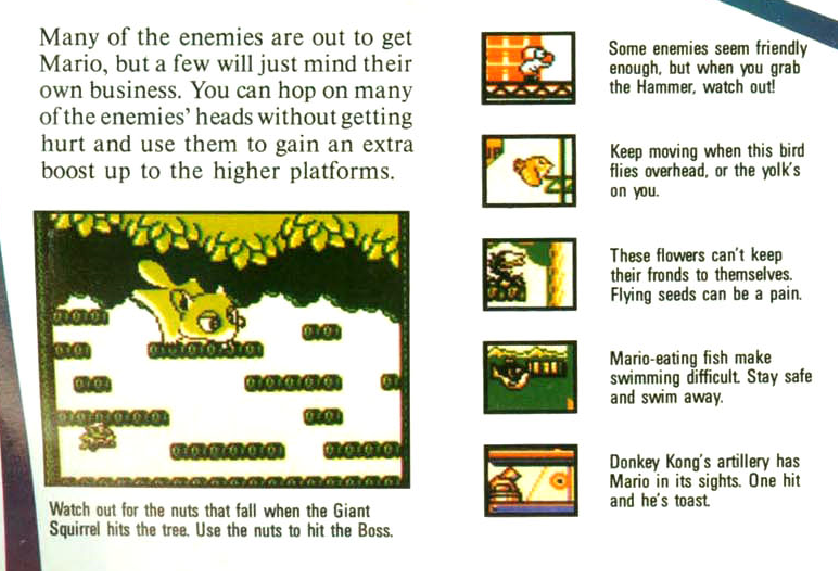
The unused Giant Squirrel boss, from Nintendo Power volume 61.
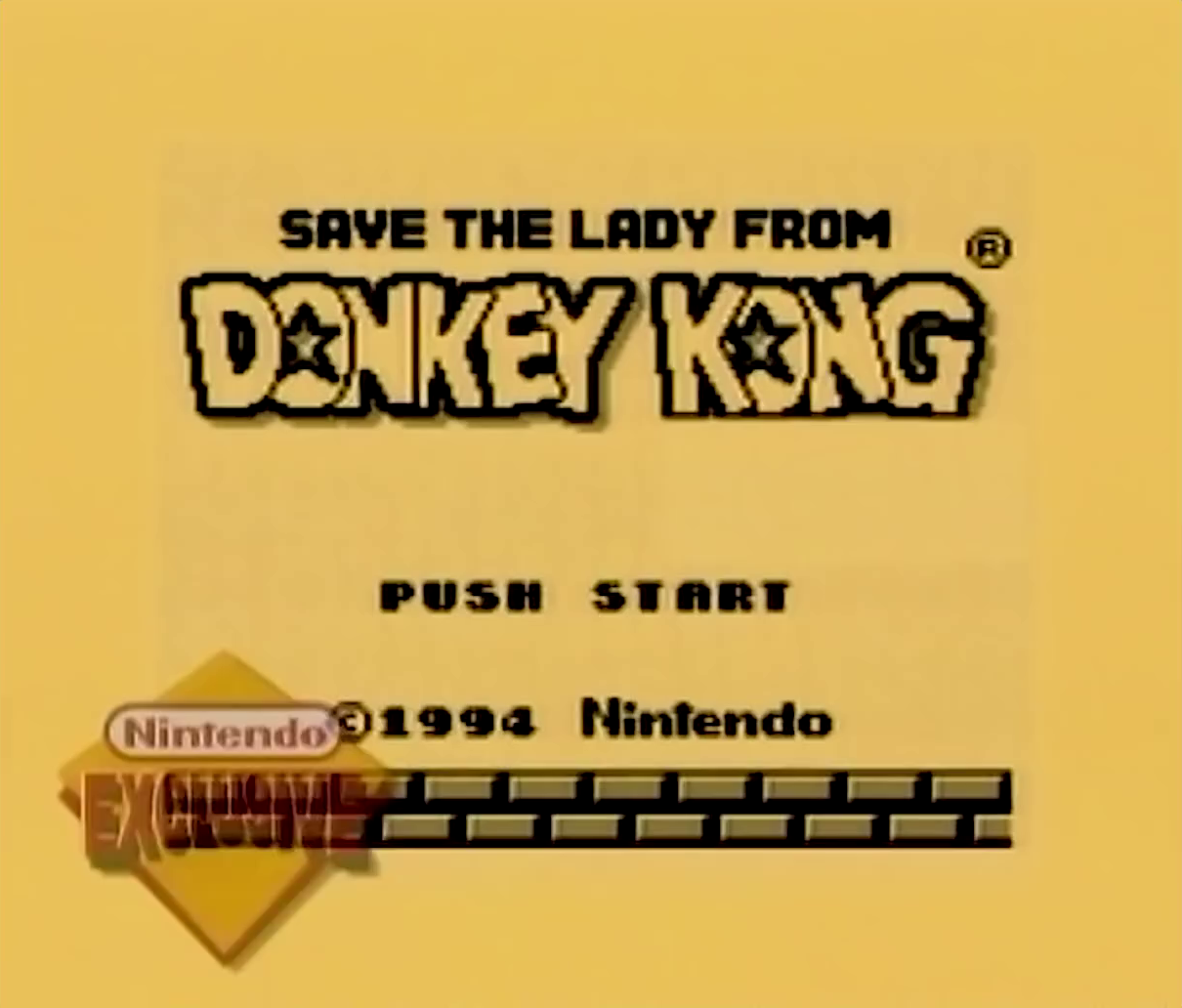
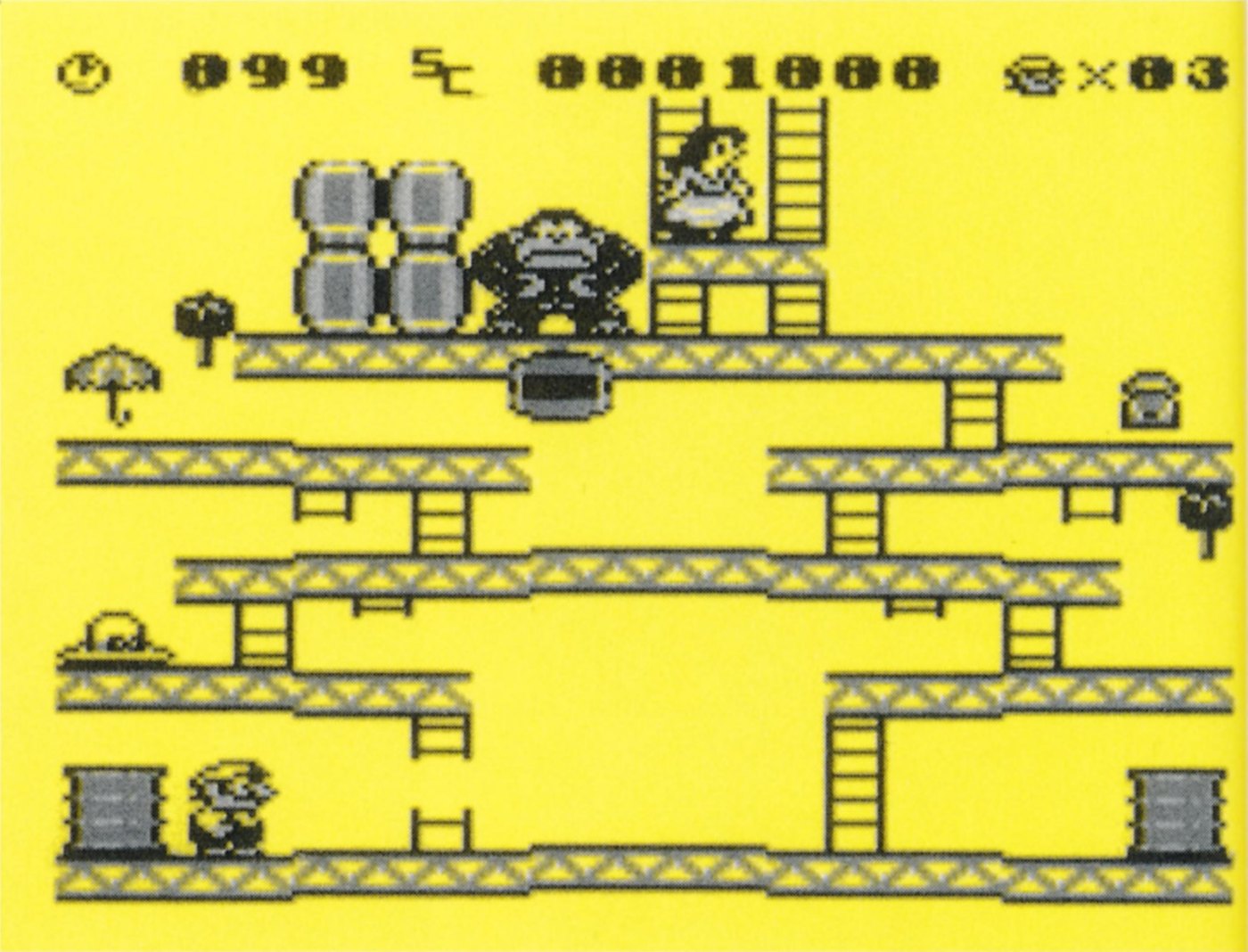
Early footage, from a tape sent to Nintendo retailers around the turn of 1994, shows a game still finding its feet: sprites much closer to the 1981 originals, a timer that starts at 999 instead of 100, and a title screen reading Save the Lady from Donkey Kong. A later build, shown on a Nintendo Power preview disc for shop kiosks, has Donkey Kong in his tie and Pauline in her final form.
The team also tried giving each world its own boss. One survives in a Nintendo Power screenshot: Momogā, a giant squirrel, waiting at the end of a very plain stage. They were dropped because, in the staff’s words, other bosses would “diminish” Donkey Kong’s presence. Masayuki Hirashima’s level editor was cut as too difficult for children, and the clinging octopus was thinned out after testers found it made the game too hard.
Drawing for two screens
The pre-release title screen: Save the Lady from Donkey Kong.
Because the game had to look right both on a Game Boy and, through the Super Game Boy, on a television, the artists had two audiences to please. Hideo Kon animated the characters, Kenta Usui began on the graphics and moved over to level design in the second half of the project, and Takaya Imamura picked a palette for every stage and designed the cabinet border. Choosing those palettes, the staff said, took a great deal of time. Taisuke Araki wrote more than 40 pieces of music, and Yōichi Kotabe supplied the illustrations.
In the shadow of Donkey Kong Country
A Nintendo Power Pak Watch preview, under the name Donkey Kong ’94.
The game was made at the same time as Rare’s Donkey Kong Country, which arrived on the Super NES later in 1994 and changed what the name meant. Wikipedia describes the Game Boy game as the last Donkey Kong that Miyamoto worked on directly, and the last developed inside Nintendo until Donkey Kong Jungle Beat in 2004. Writing in 2014, the critic Jeremy Parish judged that it had been left to languish on a fading handheld; its reputation has grown steadily since.
Series Firsts
Verified firsts, with the wording of each claim kept as tight as the sources allow.
1The first game made for Super Game BoyWikipedia, citing the developers in the Shogakukan guide, calls it the earliest game made specifically for the Super Game Boy. Other sources word it more cautiously, as the first game in the Mario franchise with dedicated Super Game Boy colour support.
2Mario’s first backflipThis game is usually credited with introducing the backflip, a move he was still using in Super Mario 64 and Super Mario Run.
3Pauline’s modern lookHer current design begins here, replacing the Lady of the 1981 artwork.
4Donkey Kong’s tieThe Cutting Room Floor notes that this is the game that first puts Donkey Kong in a necktie, the accessory Rare’s redesign kept.
5The last of the classic KongIt is also the final appearance of Donkey Kong’s original design before Donkey Kong Country.
Cheats & Secrets
The game has no button codes; its secrets are techniques. These are the ones worth knowing before Rocky-Valley.
Bank your seconds
After every Donkey Kong stage the time left on the previous four stages is added together and converted to lives: one for every 100 seconds, rounded up. Finishing quickly is the most reliable source of extra lives in the game.
Always take the parasol, hat and bag
All three in one stage earns a bonus game. The Wheel of Fortune cannot be lost (one to three lives). On the Slot Machine, three Donkey Kongs pay five lives, three Marios three, two Marios two and one Mario one; three hats pay two; three hammers or three Fireballs pay one.
Throw the hammer upstairs
Mario cannot climb with a hammer, but he can throw it straight up (Up and B), climb the ladder and catch it again on the next floor. The same goes for the key.
Carry something
If Mario is hit while holding a key, a barrel or an enemy, he drops it and is briefly invulnerable instead of losing a life. This even works on spikes.
Handstand under falling things
In a handstand Mario’s feet block most objects dropping from above, which makes the ground-pound stages against Donkey Kong far safer.
Pick the right jump
The Handstand Jump goes straight up from a standing start, and higher again if you press A the instant Mario lands (the Double Jump). The backflip is higher than a Handstand Jump but needs a run. On a wire, spin first, then jump.
Do not abandon the key
Left on the ground for a few seconds it vanishes and returns to where it began. Throw it ahead only when you can follow straight away.
Know your lifts
Rappy, Dotty, Arumajiron and Purupuru cannot hurt Mario and make good moving platforms. Walking Blocks carry him over spikes. A Thwomp Platform that has dropped can be ridden back up.
Fruit for Snapjaws
Snapjaws shrug off everything except an object dropped on them from above, as in Donkey Kong Junior.
SLB’s own cheats and tips page for the game is linked under Reference below.
Glitches & Oddities
A tidy game with little to exploit. What there is has been dug out of the cartridge by The Cutting Room Floor.
The stage that should not be there
The stage list contains an extra, unnamed entry directly after Stage 9-5. Choosing it freezes the game.
Unused stages 65 to 68
Stage 9-5 as finished. An earlier version survives as unused stage 68.
Game Genie codes can redirect Stage 1-1 to stage numbers the game never uses. Stage 65 is the final battle again, with a Rappy circling the middle platform and a counter that tallies hits taken while in a handstand; 66 and 67 add a second, faster Rappy. Stage 68 has the layout of Stage 0-1 with the graphics of Stage 9-5, which suggests an earlier idea for the Tower’s arcade tribute. Everything from 69 upwards is nearly empty.
An explosion nobody hears
The sound data includes a medium-sized explosion that is never played. The Cutting Room Floor suggests it was meant for Donkey Kong’s ground pounds or for the giant’s fists in the final battle.
Videos
Nintendo’s trailer for the game’s arrival on Nintendo Switch Online in March 2025, and a fan-made retrospective on why it deserves to be better known.
Official Nintendo of America trailer announcing Donkey Kong and Mario’s Picross for the Game Boy library.
Third-party video essay by hotcyder.
Trivia & Interesting Facts
Stage 9-5, halfway up the Tower, has exactly the layout of the arcade game’s 25 m, unlike the cut-down version in Stage 0-1.
The preliminary logo.The pre-release title screen read Save the Lady from Donkey Kong, the slogan printed on the 1981 cabinet’s instruction card.
In early footage the stage timer started at 999 rather than 100.
A giant squirrel called Momogā was built as a boss and then removed, along with every other boss that was not a Kong.
The ending borrows from Super Mario Bros.: a Warp Pipe, three ? Blocks, a Super Mushroom, and the 1-Up jingle is in there too.
Poison Mushrooms, first seen in the Japanese Super Mario Bros. 2 (The Lost Levels), make a return in the Tower, thrown by Junior.
The warning tone that a temporary Road or Ladder is about to vanish is the sound Super Mario World uses when a P Switch or Star is running out.
Both manga adaptations treat the Lady of the arcade game and Pauline as two different women, a mistake usually traced to a misreading of a Japanese character encyclopaedia.
The Airplane is the only world without a single ordinary walking enemy.
Sairesu, the sleeping creature of Stage 2-10, is the fastest enemy in the game once woken.
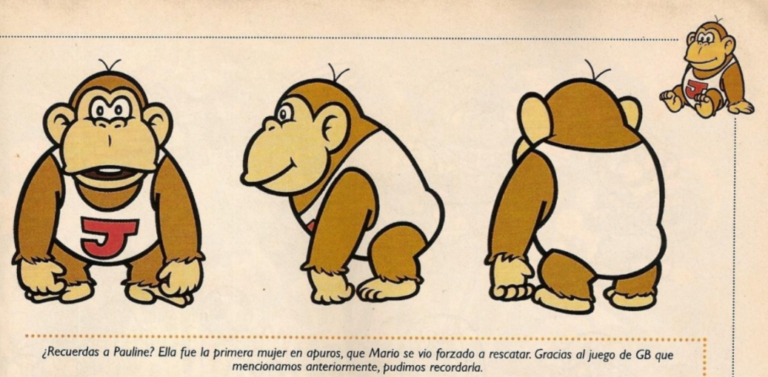
Concept art of Donkey Kong Jr.Junior got concept art of his own.
According to the staff interview the ending is set in Donkey Kong’s homeland, with the Mushroom Kingdom visible in the distance.
In Europe the game was later sold in a twin pack with Rare’s Donkey Kong Land, whose Big Ape City is named after Big-City.
Neither the Nintendo 3DS nor the Nintendo Switch release includes the Super Game Boy colours, border or sounds.
The Switch release on 6 and 7 March 2025 was timed for MAR10 Day, alongside Mario’s Picross.
A Game Boy Advance remake, Donkey Kong Plus, was announced at E3 2002 with GameCube connectivity. A year later it re-emerged as Mario vs. Donkey Kong, without the link-up.
Nintendo’s eShop blurb counts “10 stages and 100 tricky levels”; the real total is 101 levels.
Regional Box Art
One illustration served the whole world. The differences are in the frames, the language strips and the later budget labels.
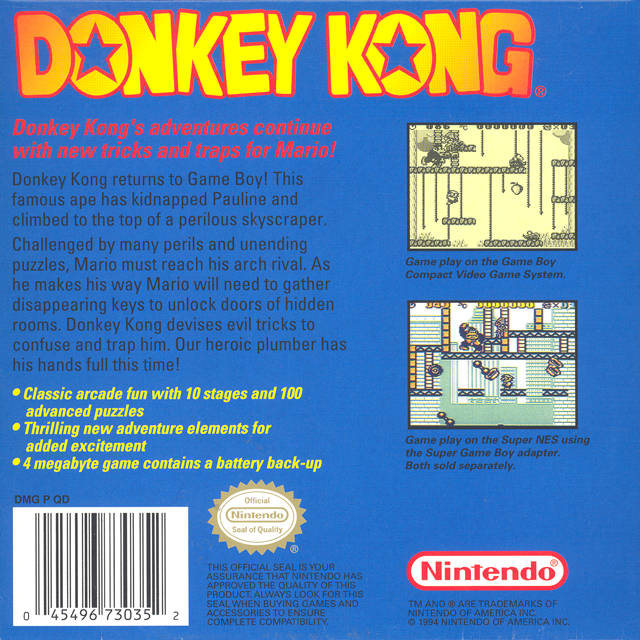
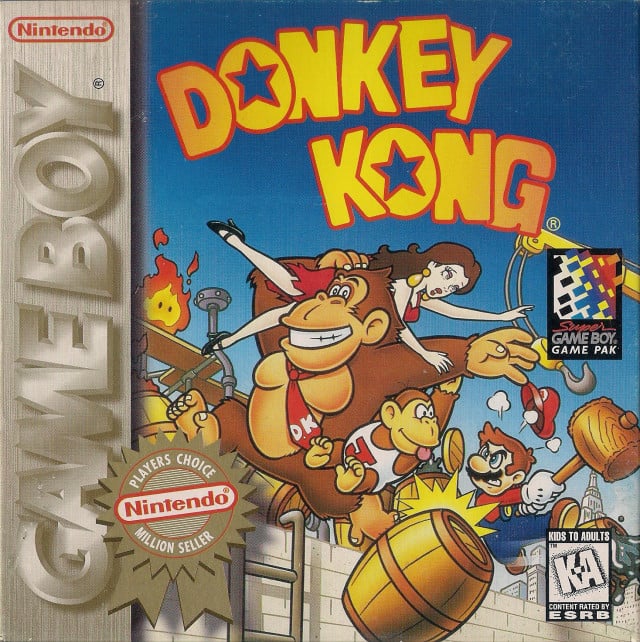
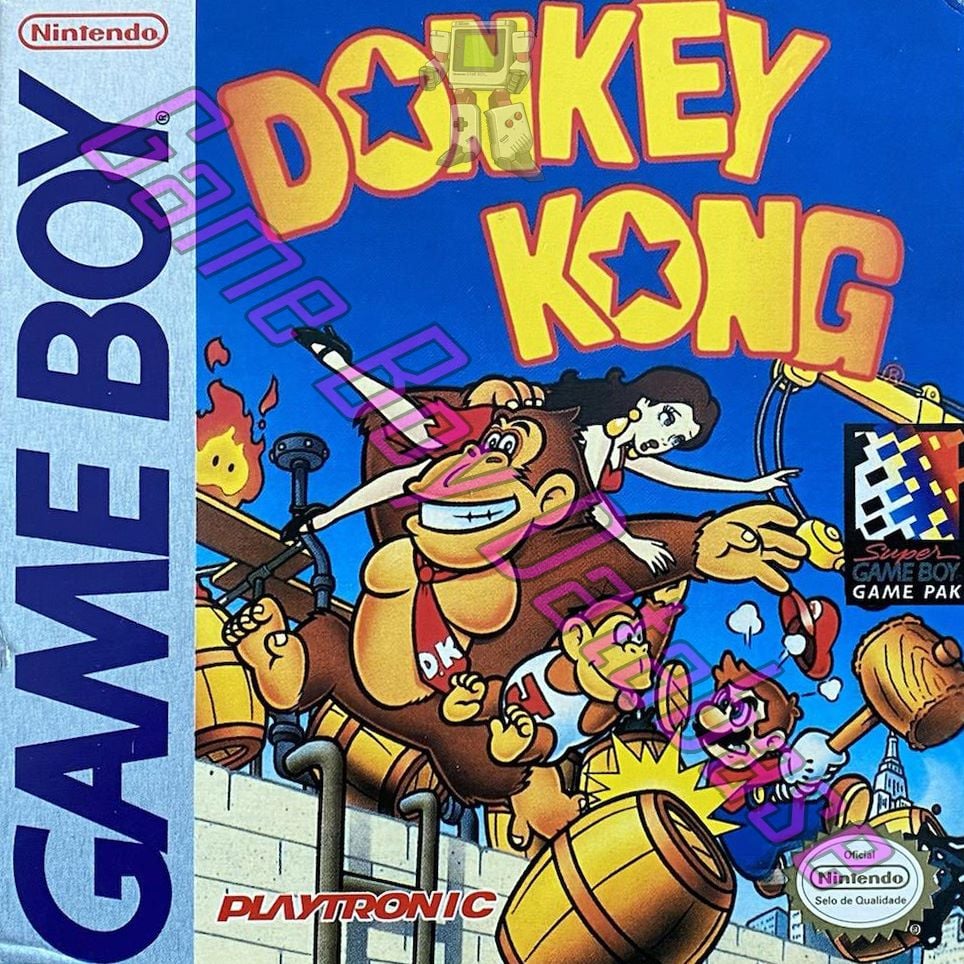
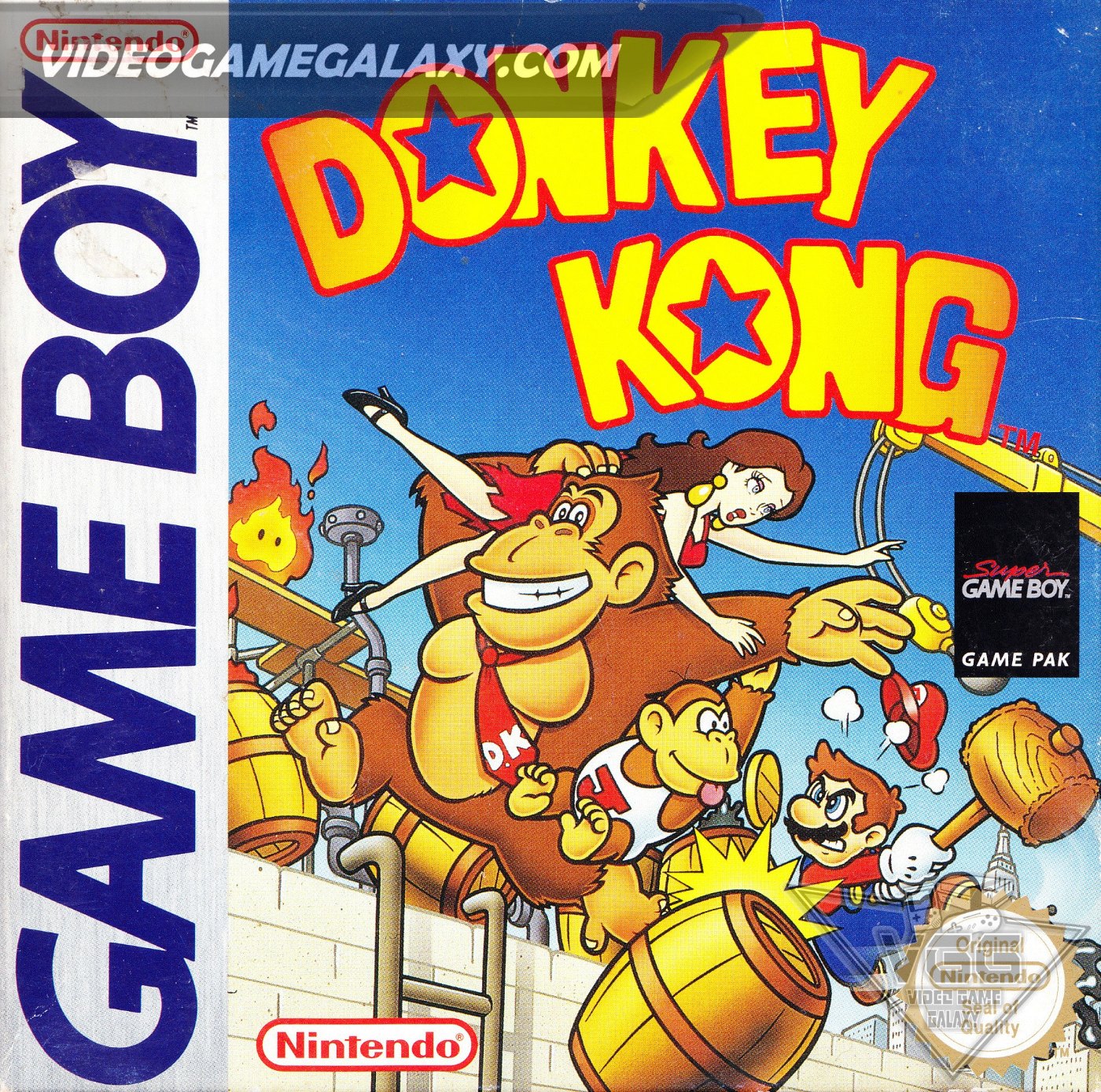
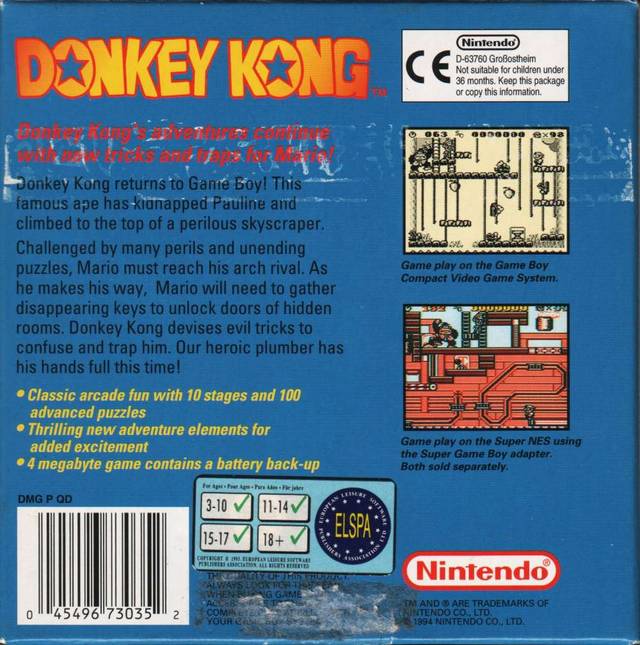
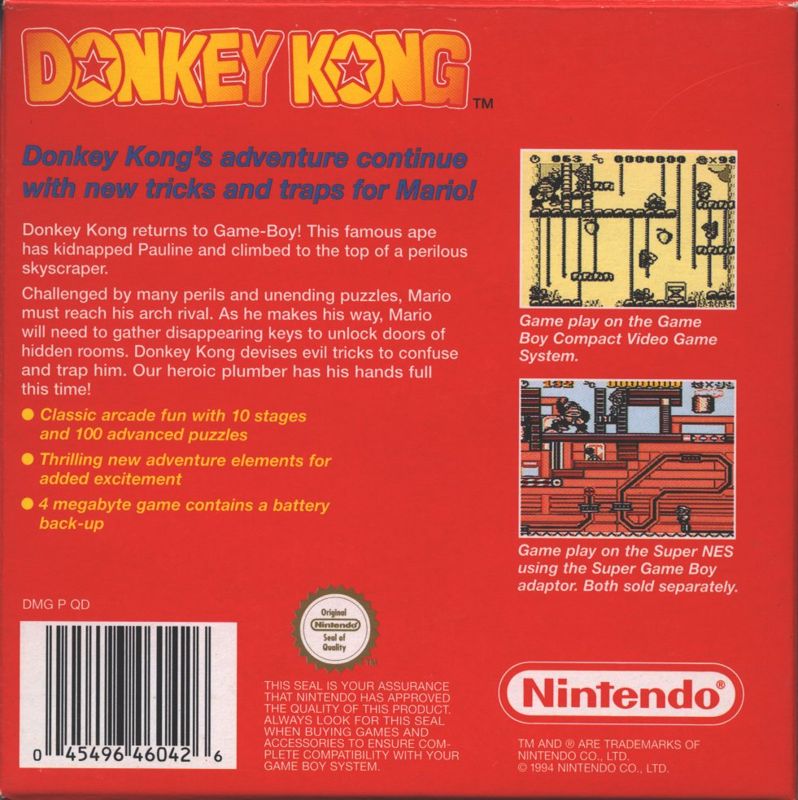
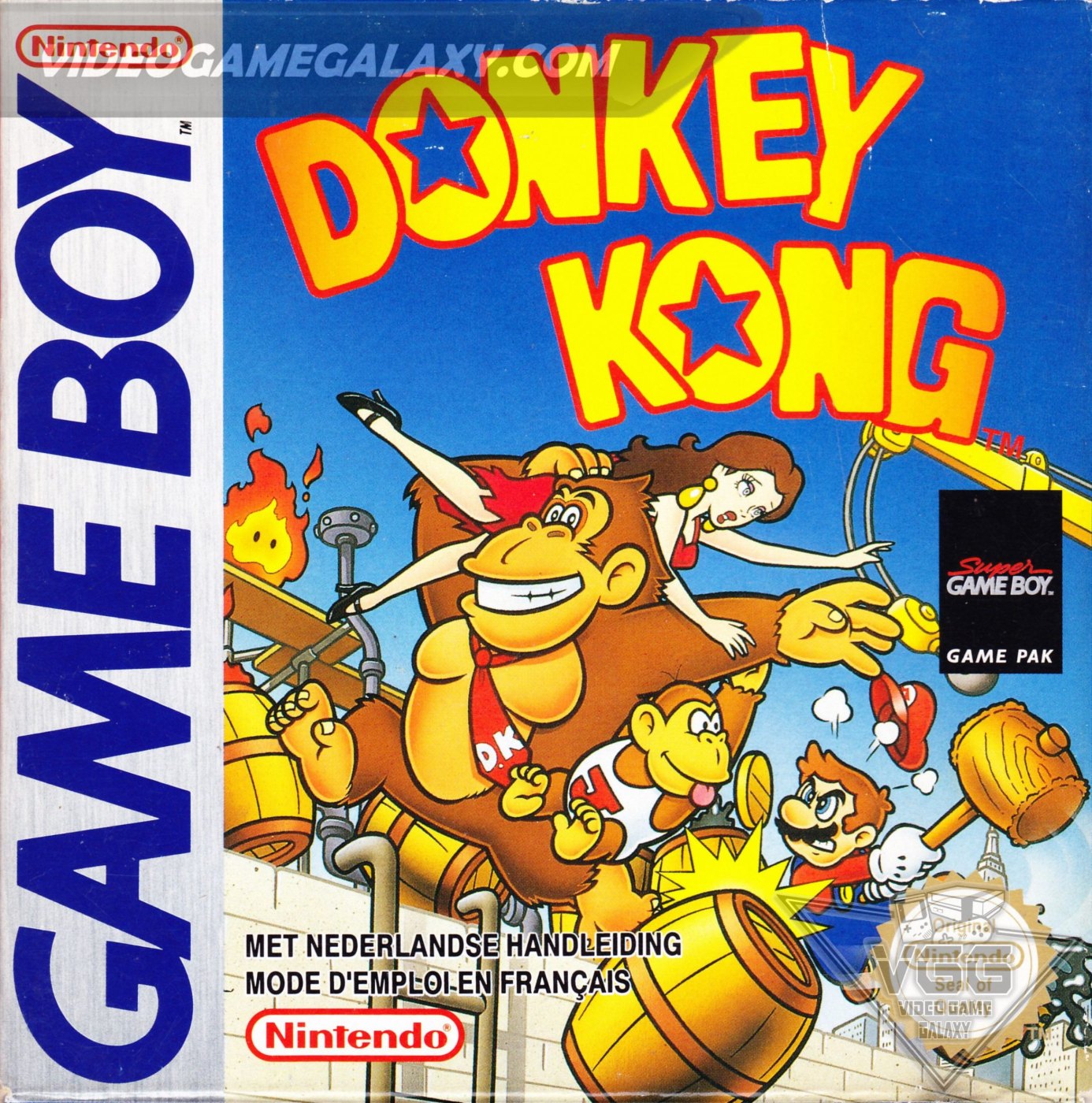
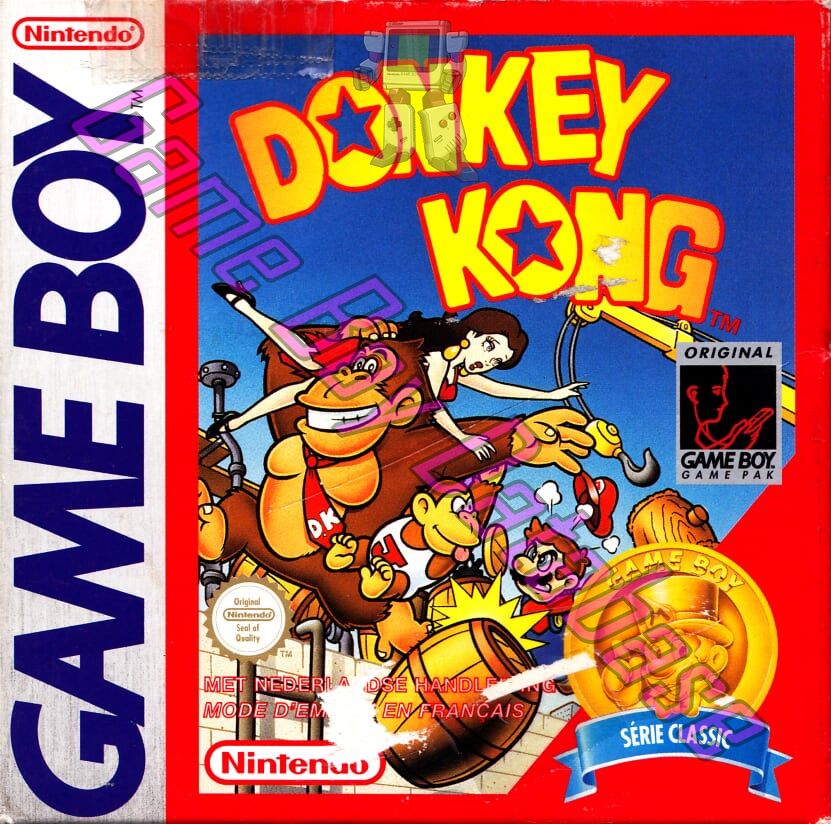
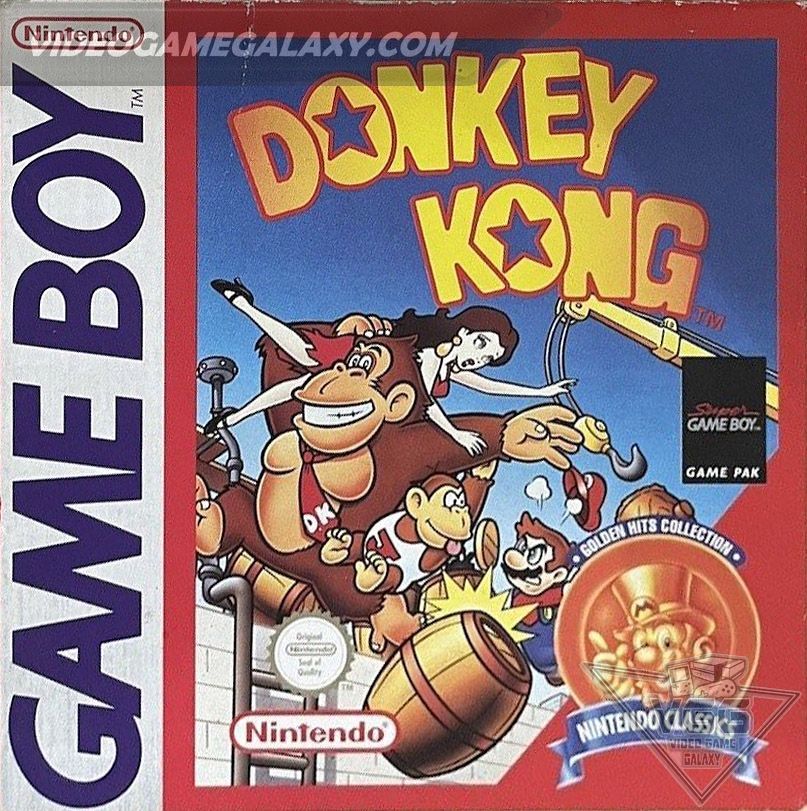
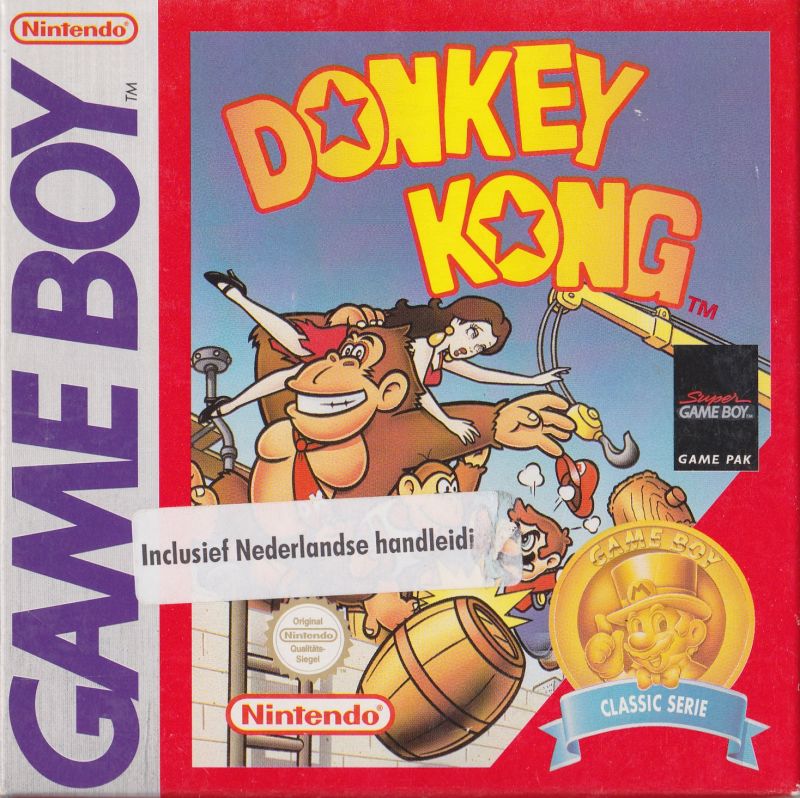
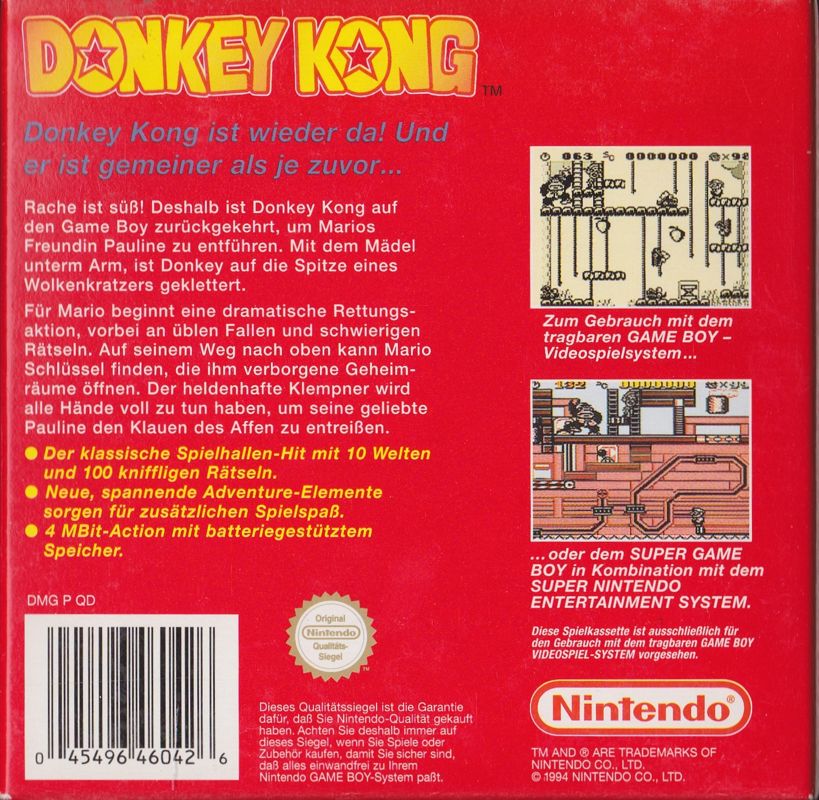
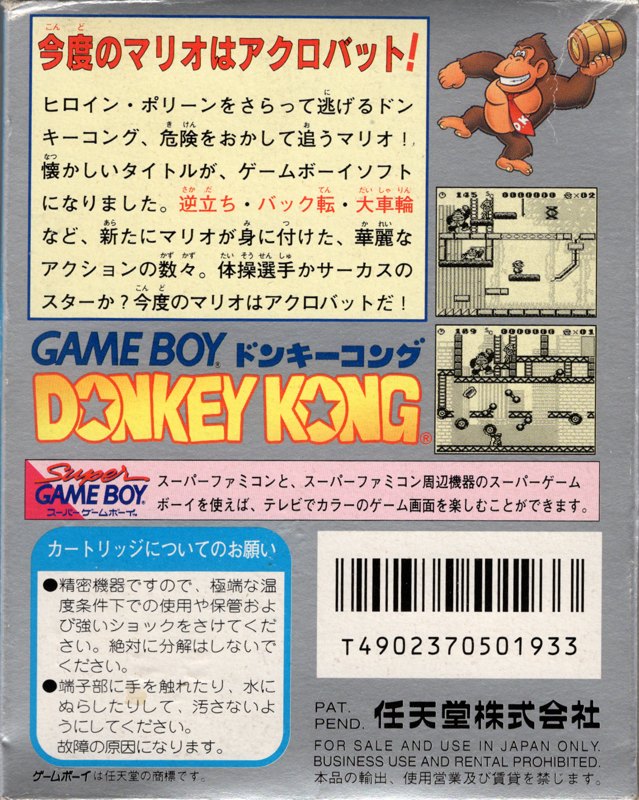
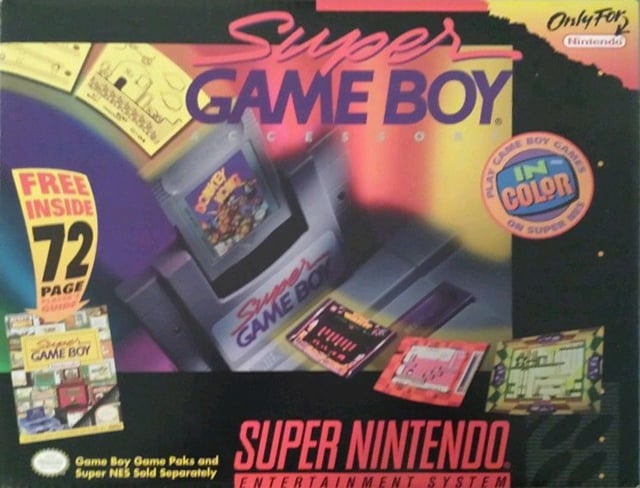
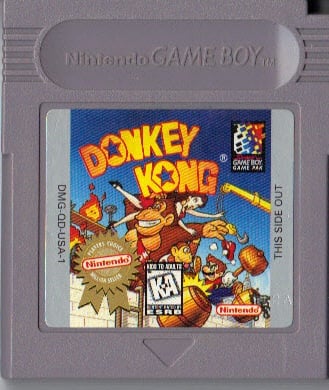
North AmericaThe original 1994 box.North America (back)North America (alternate)North America (Player’s Choice)The 1996 budget reissue.CanadaBrazilEuropeEurope (back)Europe (Nintendo Classics)The later European reissue.Europe (Nintendo Classics, back)France and the NetherlandsFrance and the Netherlands (Nintendo Classics)ItalySpain and Italy (Nintendo Classics)GermanyGermany (Nintendo Classics)Germany (Nintendo Classics, back)Australia and New ZealandJapanJapan (back)ChinaEurope: Donkey Kong and Donkey Kong Land Big Value Twin PackSuper Game Boy promotional box, North AmericaA Super Game Boy box advertising the game.The cartridgeNintendo 3DS Virtual Console icon
Screenshots
More from the Game Boy original, a pair as tinted by a Game Boy Color, and the Super Game Boy version in its arcade cabinet frame.
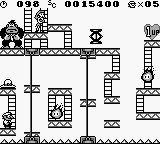
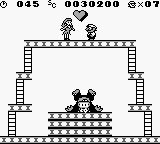
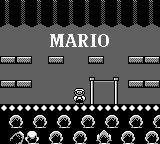
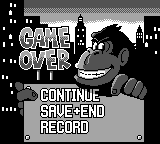
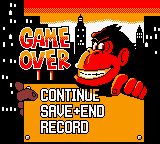
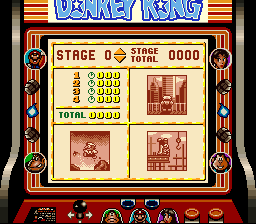
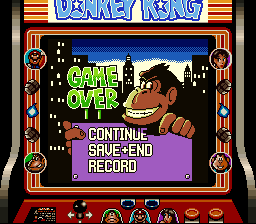
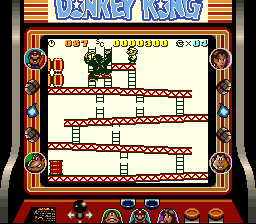
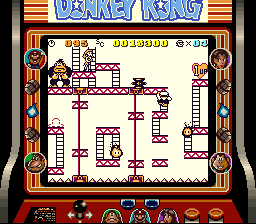
Stage 0-2, the Game Boy’s 50 m.Stage 0-3: Donkey Kong throws the jacks himself.Mario and Pauline at the top of 100 m, briefly reunited.Mario takes a bow before an audience.Game Over.The Construction Site map.Stage 2-12, the end of the Forest.Stage 3-4, aboard the Ship.Stage 6-8, the last of the Airplane.Stage 8-8 in Rocky-Valley.Stage 9-1, the foot of the Tower.Stage 9-8: the top of the Tower.The road from Big-City to the Forest.From the Forest to the Ship.From the Ship to the Jungle.The title screen as coloured by a Game Boy Color.Game Over on a Game Boy Color.File select on Super Game Boy.The Stage 0 record screen on Super Game Boy.Game Over on Super Game Boy.Donkey Kong storms off with Pauline at the top of 25 m.75 m on Super Game Boy.100 m on Super Game Boy.The audience scene in colour.
Artwork & Media Gallery
The character artwork, sprites in both Game Boy grey and Super Game Boy colour, and printed material from 1994.
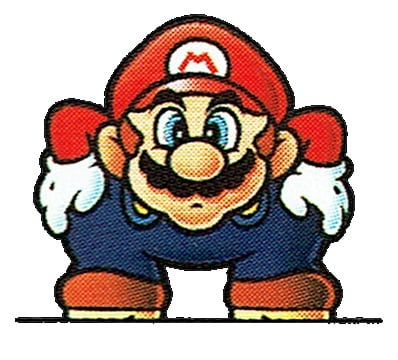
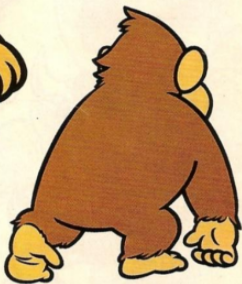
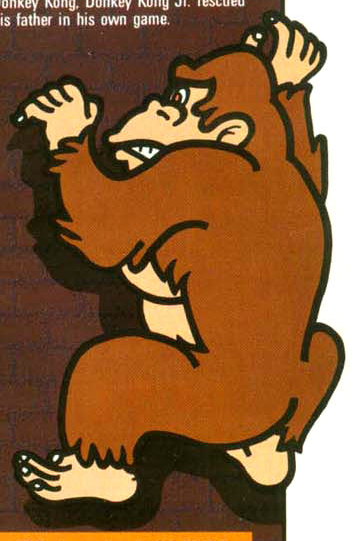
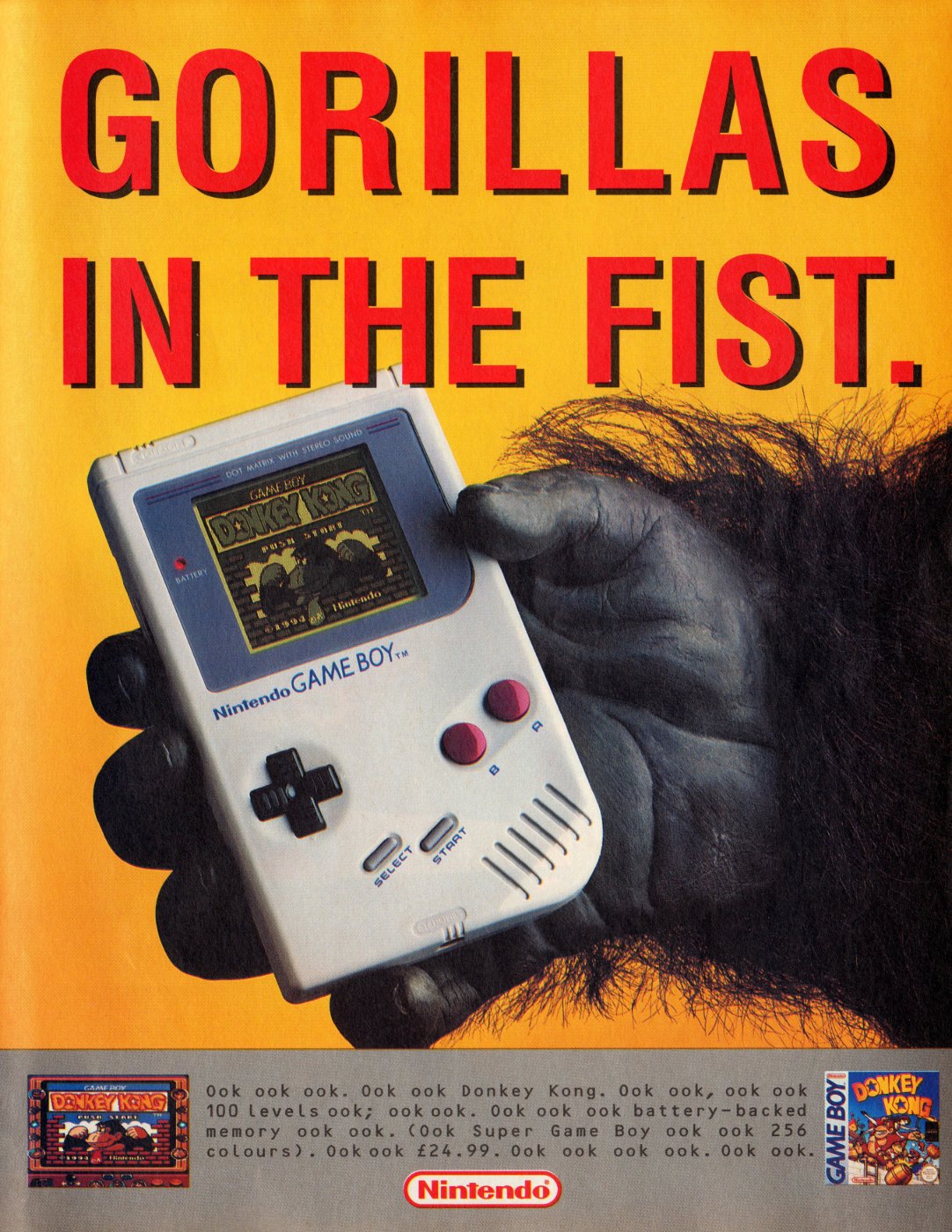
The logo.An alternative logo.Mario crouching.Mario throwing a key.Mario with the hammer.Donkey Kong with a barrel, in artwork published by Nintendo Dream Web.Donkey Kong.Donkey Kong walking.Donkey Kong turning away.Donkey Kong, as printed in Nintendo Power.Donkey Kong climbing, from Nintendo Power.Pauline.Pauline, in a second illustration.Donkey Kong Jr. sitting.Mario’s Game Boy sprite.Mario in Super Game Boy colours.Pauline’s Game Boy sprite.Pauline in Super Game Boy colours.Donkey Kong’s Game Boy sprite.Donkey Kong in Super Game Boy colours.Donkey Kong Jr.’s Game Boy sprite.Donkey Kong Jr. in Super Game Boy colours.Donkey Kong carries Pauline to the top of the construction site.The cover of Shogakukan’s official guide.The Tower, as painted for the Shogakukan guide.A British magazine advertisement.The second volume of Kodansha’s manga.A pre-release screenshot of a level that is not in the finished game.
Legacy & Re-releases
For years this was the Donkey Kong game that people recommended to each other in a slightly conspiratorial tone. It is easier to find now.
Releases and re-releases
Game Boy1994Japan on 14 June 1994, North America later in June (the American manual is dated 28 June) and Europe on 29 September 1994. Enhanced when played through a Super Game Boy.
Player’s ChoiceSeptember 1996Budget reissue in North America. Europe received a Nintendo Classics reissue and a Big Value Twin Pack with Donkey Kong Land.
Nintendo 3DS Virtual ConsoleJune 2011Japan on 15 June 2011; Europe, North America and Australia on 16 June 2011; South Korea on 3 February 2016. The plain Game Boy version, without the Super Game Boy extras.
Game Boy – Nintendo ClassicsMarch 2025Added to the Nintendo Switch Online Game Boy library in North America on 6 March 2025 and in Japan, Europe, Australia, South Korea and Hong Kong on 7 March, together with Mario’s Picross. Again without Super Game Boy features.
From Donkey Kong Plus to Mario vs. Donkey Kong
At E3 2002 Nintendo announced Donkey Kong Plus, a Game Boy Advance remake of this game that would connect to a GameCube. It was due early in 2003. Instead it came back at E3 2003 under a new name, with a different story and without the connectivity: Mario vs. Donkey Kong, released in 2004. The keys, the doors, the handstands and the hammer throw all came with it, and the series it started (March of the Minis, Minis March Again!, Mini-Land Mayhem!, Tipping Stars) carried on before the original was remade for Switch in 2024.
What it left behind
Mario’s move set here reads like a first draft of Super Mario 64: the backflip, the handstand, the tumbling recovery from a fall. Pauline’s redesign became her permanent look and carried her, eventually, to New Donk City in Super Mario Odyssey and to Donkey Kong Bananza. And Donkey Kong’s tie went with him to Donkey Kong Country and has never come off.
The game itself now turns up routinely in lists of the best the Game Boy has to offer, which is the least it deserves.
Reviews & Sales
Sales figures
Wikipedia, citing the 2021 CESA Games White Paper, gives worldwide sales of 3.07 million copies, and records that in the United Kingdom it was the best-selling Game Boy game of October and November 1994 in the charts printed by Computer and Video Games. Nintendo reissued it in North America under the Player’s Choice label in 1996, and in Europe under the Nintendo Classics label.
3.07mworldwide (CESA White Paper 2021, via Wikipedia)
101stages
84.83%GameRankings average
No. 1UK Game Boy chart, Oct–Nov 1994 (CVG)
Reception and review scores
Period scores are as listed in Wikipedia’s review table, with magazine issue dates, alongside some later reviews. GameRankings closed with the game on 84.83 per cent.
Game PlayersUS · September 1994
93%
Total!UK · August 1994
92%
Video GamesGermany · September 1994
90%
NintendojoRetrospective review
9/10
Nintendo Life3DS Virtual Console · Marcel van Duyn · June 2011
9/10
VideoGamesUS · October 1994 · four reviewers
8, 9, 9, 9
HyperAustralia · October 1994
85/100
Electronic Gaming MonthlyUS · August 1994 · four reviewers
9, 8, 8, 8
Game InformerUS · September 1994
8/10
Cubed33DS Virtual Console · Adam Riley
8/10
Pocket Gamer3DS Virtual Console · Mike Rose
4/5
FamitsuJapan · No. 290, 8 July 1994
27/40
Western magazines were won over at once. Britain’s Total! called it “one of the best platform games ever made, and a worthy sequel to the original Donkey Kong”. Germany’s Video Games praised the detail, the way each world brings new surprises and the battery save, and said it belonged in every Game Boy collection. EGM, GamePro and Australia’s Hyper all described it as the Super Game Boy’s killer app, though Super Play could not hear much difference in the sound.
Japan was cooler. Famitsu’s four reviewers gave it 7, 6, 7 and 7, warning that fans of the arcade game might be put off by the emphasis on puzzles and that it was hard.
Time has been kind. Reviewing the 3DS release in 2011, Nintendo Life’s Marcel van Duyn called it “easily one of the best Mario games ever made”; IGN’s Craig Harris had earlier described it as “classic and amazingly fun”; and it features in the best-of-Game-Boy lists compiled by Polygon (2019), PCMag (2019), IGN (2023) and Nintendo Life (2025).
Honours
Electronic Gaming Monthly · 1995 Buyer’s GuideGame Boy Game of the YearAwarded for 1994; it had also been EGM’s Game of the Month.
VideoGames: The Ultimate Gaming Magazine · March 1995Best Game Boy GameIn the magazine’s Best of ’94 awards.
SLB User Reviews
Donkey Kong (Game Boy) has yet to receive a community review on Super Luigi Bros.
If you’ve played Donkey Kong (Game Boy) and would like to submit a review, please get in touch.
More from the Super Luigi Bros Guide
These picture lists come from the earlier Super Luigi Bros guide to Donkey Kong (Game Boy) and are kept here in full.
The 10 Worlds
Donkey Kong’94 spans 10 worlds total: Construction Site (the 4 original arcade stages) plus 9 brand new themed worlds with progressively harder puzzle-platforming. Each world ends with a Donkey Kong boss fight and a chase to the next location.
World 0
Construction Site
4 stages
In-Game (SGB)
World Map
The original 1981 arcade game. Four simplified stages (25m, 50m, 75m, 100m) faithfully recreating the Donkey Kong arcade classic. Mario climbs the construction site, dodges Fireballs and DK’s thrown barrels and jacks, and at 100m must pull out all the rivets to defeat DK. This is the opening “tutorial” — a complete game in itself, before the real game begins.
World 1
Big-City
8 stages
In-Game (SGB)
World Map
The first puzzle world after the arcade opener. Introduces all the new mechanics: handstands, roads, ladders, keys, doors. Serves as the tutorial for the rest of the game’s puzzle-platforming structure. Features two boss fights with Donkey Kong. An urban backdrop with high-rises, fire escapes, and city streets.
World 2
Forest
varies stages
In-Game (SGB)
World Map
Adds vertical ropes to climb and water to swim in. The first appearance of switches — these make roads appear and disappear, fundamentally changing how the player approaches each puzzle stage. A natural environment with trees, vines, and water hazards.
World 3
Ship
varies stages
In-Game (SGB)
World Map
A nautical world set on board a giant ship. Introduces new water-related mechanics and currents. Sailor and aquatic enemies emerge as Mario navigates decks, masts, rigging, and crow’s nests.
World 4
Jungle
varies stages
In-Game (SGB)
World Map
A jungle environment with vines, tall trees, and lush vegetation. DK’s native habitat — fitting that he leads Mario deeper into the wilderness here.
World 5
Desert
varies stages
In-Game (SGB)
World Map
A scorching desert with quicksand pits, ancient pyramid structures, and new sand-based puzzle elements. The dryness contrasts sharply with the previous Forest and Ship worlds.
World 6
Airplane
varies stages
In-Game (SGB)
World Map
An aviation-themed world set on board moving aircraft. Wind effects, vertical air shafts, and platform-on-airplane puzzles. One of the more unusual world themes — puzzle-platforming at altitude.
World 7
Iceberg
varies stages
In-Game (SGB)
World Map
A frozen iceberg world with slippery ice physics, frozen platforms, and cold-themed enemies. Mario’s footing becomes unreliable — every jump matters more. Penalty for sliding off into icy water.
World 8
Rocky-Valley
varies stages
In-Game (SGB)
World Map
A rocky mountain valley with falling rocks, treacherous cliff platforms, and natural rock obstacles. DK’s second-to-last hideout before the final confrontation.
World 9
Tower
varies stages
In-Game (SGB)
World Map
The final world. Mario climbs an enormous tower for the climactic showdown against Giant Donkey Kong (visible in full size on the Super Game Boy version with colored graphics). The endgame.
To provide the best experiences, we use technologies like cookies to store and/or access device information. Consenting to these technologies will allow us to process data such as browsing behavior or unique IDs on this site. Not consenting or withdrawing consent, may adversely affect certain features and functions.
Functional
Always active
The technical storage or access is strictly necessary for the legitimate purpose of enabling the use of a specific service explicitly requested by the subscriber or user, or for the sole purpose of carrying out the transmission of a communication over an electronic communications network.
Preferences
The technical storage or access is necessary for the legitimate purpose of storing preferences that are not requested by the subscriber or user.
Statistics
The technical storage or access that is used exclusively for statistical purposes.The technical storage or access that is used exclusively for anonymous statistical purposes. Without a subpoena, voluntary compliance on the part of your Internet Service Provider, or additional records from a third party, information stored or retrieved for this purpose alone cannot usually be used to identify you.
Marketing
The technical storage or access is required to create user profiles to send advertising, or to track the user on a website or across several websites for similar marketing purposes.



 Stage 0: Construction Site4 levels · boss: Donkey Kong at 100 m (0-4)The arcade game in miniature: 25 m, 50 m, 75 m and 100 m.
 Stage 1: Big-City8 levels · Donkey Kong in 1-4 and 1-8Keys, doors, Roads and Ladders are introduced among the skyscrapers.
 Stage 2: Forest12 levels · Donkey Kong in 2-4, 2-8 and 2-12Ropes, water, switches and Snapjaws, with Junior making his entrance.
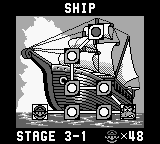 Stage 3: Ship8 levels · Donkey Kong in 3-4 and 3-8Handstand Double Jumps, Wire Spins and Walking Blocks over spikes.
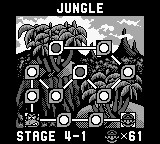 Stage 4: Jungle12 levels · Donkey Kong in 4-4, 4-8 and 4-12Tangled ropes, helpful Monchees and Jumpers, and bats that pull Mario off.
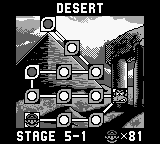 Stage 5: Desert12 levels · Donkey Kong in 5-4, 5-8 and 5-12The Super Hammer and Jump Stand arrive, and the puzzles get serious.
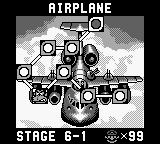 Stage 6: Airplane8 levels · Donkey Kong in 6-4 and 6-8Wind, cannons and several doors per stage, with no ordinary enemies at all.
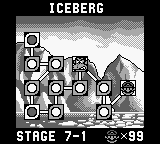 Stage 7: Iceberg12 levels · Donkey Kong in 7-4, 7-8 and 7-12Slippery floors, sinking rocks, icicles and an octopus that will not let go.
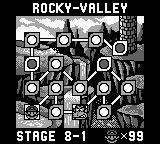 Stage 8: Rocky-Valley16 levels · Donkey Kong in 8-4, 8-8, 8-12 and 8-16The longest and hardest world, and the backdrop to the ending.
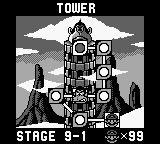 Stage 9: Tower9 levels, all boss fights · Donkey Kong (9-8), Giant Donkey Kong (9-9)A climb against both Kongs, a rebuilt 25 m and a final battle with a giant.


 KeyOpens the door that ends the stage. Can be thrown to knock out enemies. Vanishes if left alone for a few seconds and returns to its starting point.
 HammerSwings automatically and beats every enemy. New trick: throw it upwards, climb a ladder and catch it again. Reappears where it started once it wears off.
 Super HammerA hammer that also smashes brick walls and floors. First found in the Desert.
 Parasol, hat and bagPauline’s lost belongings. Collect all three in a stage for a bonus game.
 1 UP HeartAn extra life.
 Trash CanStand on it for height or throw it at an enemy such as a Bowbow. It breaks on impact.
 BarrelThrown by Donkey Kong. Land on one, pick it up and throw it back.
 SwitchFlip one and part of the stage changes. Junior likes to pull them at the wrong moment.
 Locked doorThe exit. The Airplane has stages with more than one.
 RopeVertical ropes are climbed; horizontal wires are for hanging and spinning.
 Conveyor beltCarries Mario along, even while he is crouching.
 ElevatorThe lifts from the arcade game’s 75 m.
 CannonA fixture of the Airplane world.
 Ice BlockSlippery footing on the Iceberg; a passing Faiachū will melt it.
 IcicleHangs from Iceberg ceilings.
 Oil drumBack from 1981, and still producing Fireballs.
 Cement tubThe conveyor-belt hazard of 50 m.
 JackThe bouncing spring of 75 m. Donkey Kong throws them by hand this time.
 Super Mario: Donkey Kong (Kodansha manga)KC Deluxe · two volumesA two-volume retelling in which Pauline belongs to a circus run by Princess Peach and is carried off to Donkey Kong Island to be a mother to Junior. Mario and Luigi come to the rescue. The last chapter jumps ahead twelve years and ties the story to Donkey Kong Country.
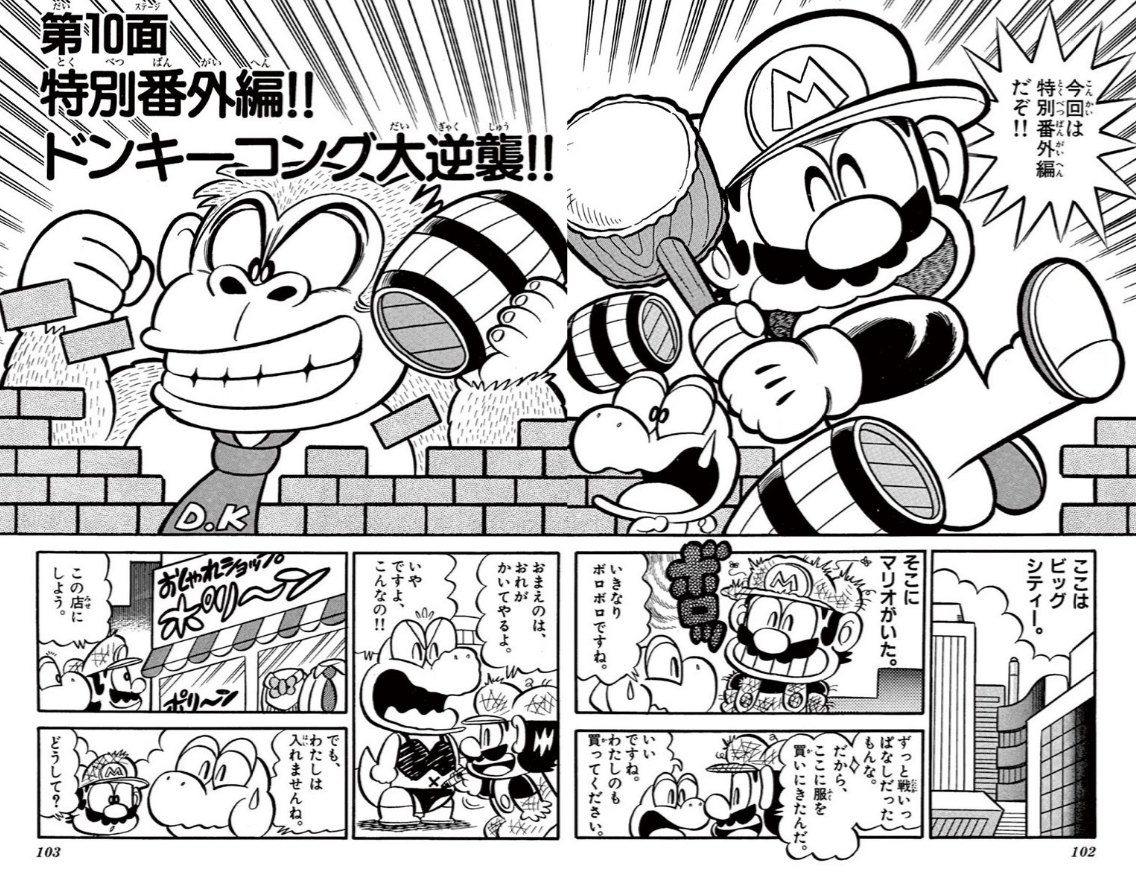 Super Mario-kunVolume 11, stage 10One chapter of the long-running comedy manga borrows the game: Mario and Yoshi are visiting Pauline’s clothes shop when Donkey Kong snatches her and heads for a building site.
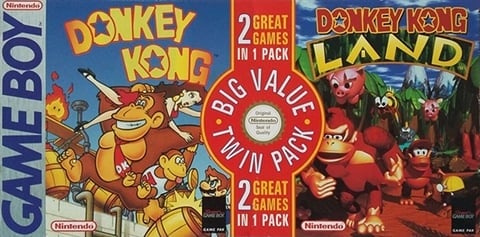 Donkey Kong LandRare · Game Boy · 1995Its city world, Big Ape City, is a nod to Big-City. In Europe the two games were later sold together in a Big Value Twin Pack.
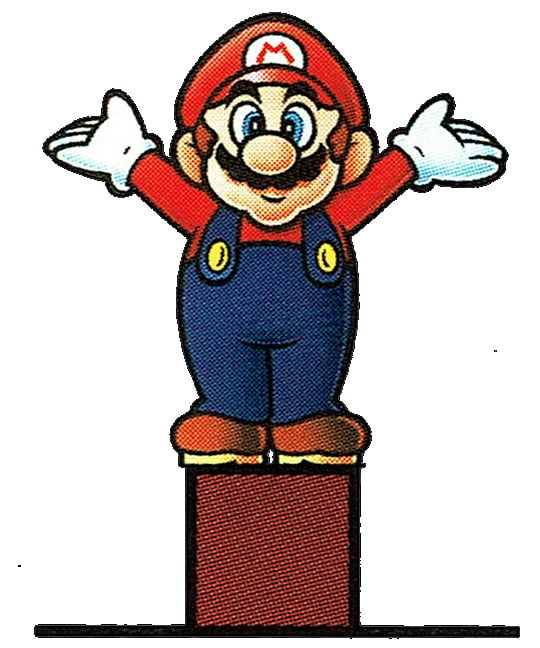 MarioThe hero, with new tricks
 PaulineKidnapped, again
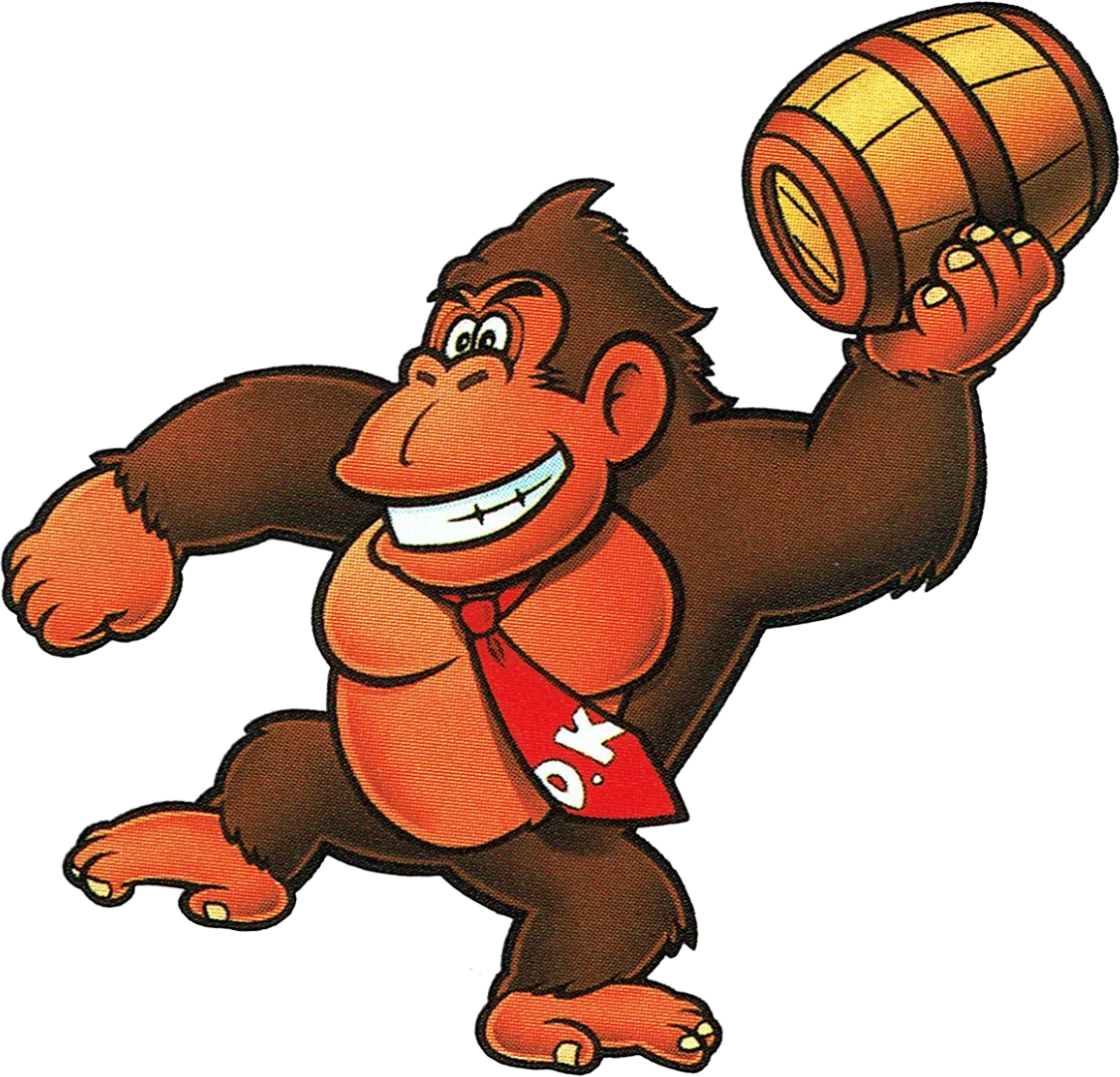 Donkey KongThe ape who would not stay down
 Donkey Kong Jr.Like father, like son
 MoncheeAlly · Jungle
 JumperAlly · Jungle
 FireballConstruction Site, 25 mA small flame from the oil drum that chases Mario. The hammer puts it out.
 FireConstruction Site, 100 mThe larger flame of the rivet stage, arriving from the sides of the screen.
 OilBig-City, Stage 1-1A flame in a can that bobs on the spot. Deadly to touch; the hammer deals with it.
 BowbowBig-City, Stage 1-1A dog that paces the platforms. Fatal from front or back, but it can be stood on, picked up and thrown. Flees from the hammer.
 RappyBig-City, Stage 1-2Circles a floating platform, underside included. Cannot hurt Mario but will push him off; can be ridden, not lifted.
 Dust ManBig-City, Stage 1-3A trash can that sprouts feet and eyes when Mario comes near and can knock him out. Can be stood on but not lifted.
 SparkBig-City, Stage 1-3Runs along wires, flickering in and out. Cannot be harmed. The one enemy shared with Super Mario Bros. 2.
 FaiachūBig-City, Stage 1-5A walking flame that follows walls and ceilings. Trash cans do not stop it, and on the Iceberg it melts Ice Blocks.
 DottyForest, Stage 2-1The Forest’s version of Rappy.
 SniperForest, Stage 2-1A spiked creature that circles platforms or the edge of the stage. Harmful to touch.
 DōryīForest, Stage 2-3A plant that spits seeds sideways at intervals. The seeds hurt; the plant itself is safe to stand on.
 SnapjawForest, Stage 2-4The rope-climbing crocodile from Donkey Kong Junior. Only dropped fruit will remove it. Junior throws them.
 BukubukuForest, Stage 2-5A piranha that swims back and forth and charges when it sees Mario.
 Thwomp PlatformForest, Stage 2-8A stone block that drops when Mario comes close. Ride it as a lift, but mind the ceiling.
 HawksForest, Stage 2-9Flies across the screen dropping eggs. Bird and eggs are both deadly.
 SairesuForest, Stage 2-10Sleeps until it hears Mario, then charges. The fastest enemy in the game; it dozes off again if he gets away.
 Walking BlockShip, Stage 3-1A block with legs that plods across spikes. Harmless, and a useful ferry.
 Sir ShovalotShip, Stage 3-2A robot knight that charges behind its shield. It cannot hurt Mario directly, only shove him off ledges or squash him against walls.
 KānyīShip, Stage 3-2A slow crab with extending claws. Safe to stand on, fatal from the side.
 Aqua ManShip, Stage 3-3A walking diver. Can be stood on, lifted, thrown or hammered.
 GessoriShip, Stage 3-7A squid that swims from side to side.
 KaibādoJungle, Stage 4-1A bird that leaves its nest to cross the screen, pausing to drop eggs.
 DorakyūJungle, Stage 4-5A bat that latches on to Mario and makes him fall from his rope.
 MiiraDesert, Stage 5-2A mummy; the Desert’s walking enemy. Can be stood on, lifted, thrown or hammered.
 SkeletonDesert, Stage 5-2A skull that slides along the ground throwing bones. The hammer breaks both.
 Furafurawā (Desert)Desert, Stage 5-2Hides in the sand and pops up when Mario approaches. A hammered one grows back at once.
 ArumajironDesert, Stage 5-7The Desert’s version of Rappy.
 SukōpīDesert, Stage 5-11A scorpion that behaves like Sniper.
 Tsutan’ōmenDesert, Stage 5-12A walking head thrown by Donkey Kong. Jump on it, pick it up and throw it back.
 Spark (globe)Airplane, Stage 6-4A Spark that circles platforms instead of riding wires.
 PenpenIceberg, Stage 7-2A penguin; the Iceberg’s walking enemy.
 OttōIceberg, Stage 7-2An octopus that does not attack but jumps on Mario and stops him walking or pulling switches for a while.
 TododesuIceberg, Stage 7-2A walrus that guards the key and charges on eye contact. Can be stood on, not lifted.
 PurupuruIceberg, Stage 7-3A seal; the Iceberg’s version of Rappy.
 ChikuchikuRocky-Valley, Stage 8-2A hedgehog that behaves like Sniper.
 Furafurawā (Rocky-Valley)Rocky-ValleyHere it walks slowly and fires four seeds that the hammer can destroy. It does not grow back.
 RokkunRocky-Valley, Stage 8-16A walking rock thrown by Donkey Kong, to be caught and returned.
 GolemTower, Stage 9-1The Tower’s walking enemy.
 GyātoruTower, Stage 9-3A spiked mask that behaves like Sniper.
 BirdTower, Stage 9-4Another egg-dropper, in the manner of Hawks.
 Robo NO.1Tower, Stage 9-6A walking suit of armour; can be stood on, lifted, thrown or hammered.