GameCube2005PartyHudson SoftUp to 8 players88 minigamesBirdo & Dry Bones joinMicrophone in the boxLast Mario Party on GameCube
Mario Party 7
The fourth and last Mario Party for the GameCube puts the whole cast on a cruise ship. Mario Party 7 was released in North America on 7 November 2005, in Japan three days later, in Europe on 27 January 2006 and in Australia on 8 June 2006. Toadsworth invites Mario and friends round the world aboard the MSS Sea Star; Bowser, left off the guest list, follows them from port to port to spoil it. There are six boards, each with its own way of winning Stars, 88 new minigames, ten of them played by speaking into the GameCube Microphone that came in the box, and nearly thirty Orbs, including six that only one pair of characters can use. Birdo and Dry Bones are playable for the first time in the series. Its two big ideas are Bowser Time, when the villain barges in every five turns, and room for eight players, two to a controller.
Developer:Hudson Soft (Super Mario Wiki also lists CAProduction and Nintendo SPD Group No. 4)
Publisher:Nintendo
Platform:Nintendo GameCube
Genre:Party / board game
N. America:7 November 2005
Japan:10 November 2005
Europe:27 January 2006 (Nintendo UK; Wikipedia gives 10 February for the rest of Europe)
Australia:8 June 2006
Players:1–8 (eight share four controllers)
Director:Shuichiro Nishiya
Producers:Hiroshi Sato, Atsushi Ikeda
Supervisors:Shigeru Miyamoto, Takashi Tezuka
Music:Hironobu Yahata, Shinya Outouge
Playable characters:12, with Birdo and Dry Bones to unlock
Boards:6 (Bowser’s Enchanted Inferno! is unlocked in Solo Cruise)
Minigames:88, ten of them for the Microphone
Orbs:29
Sales:2.08 million (CESA figure, via Wikipedia)
Advertisement
Overview
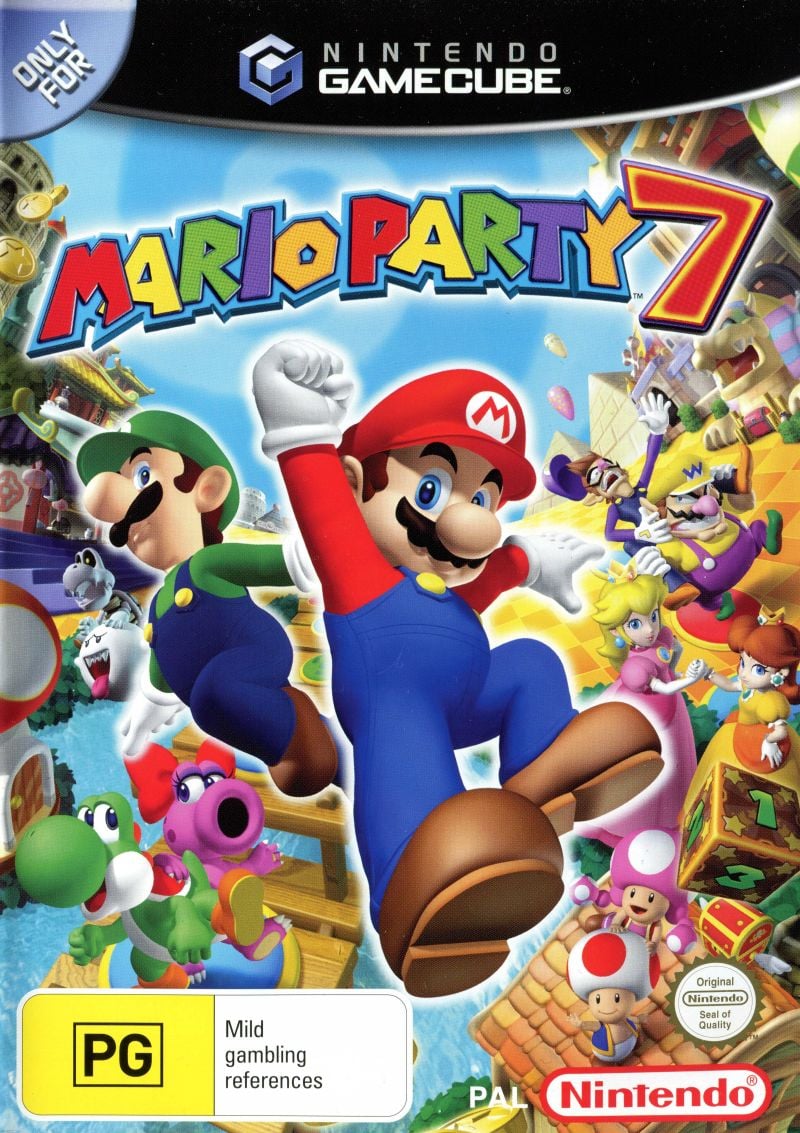
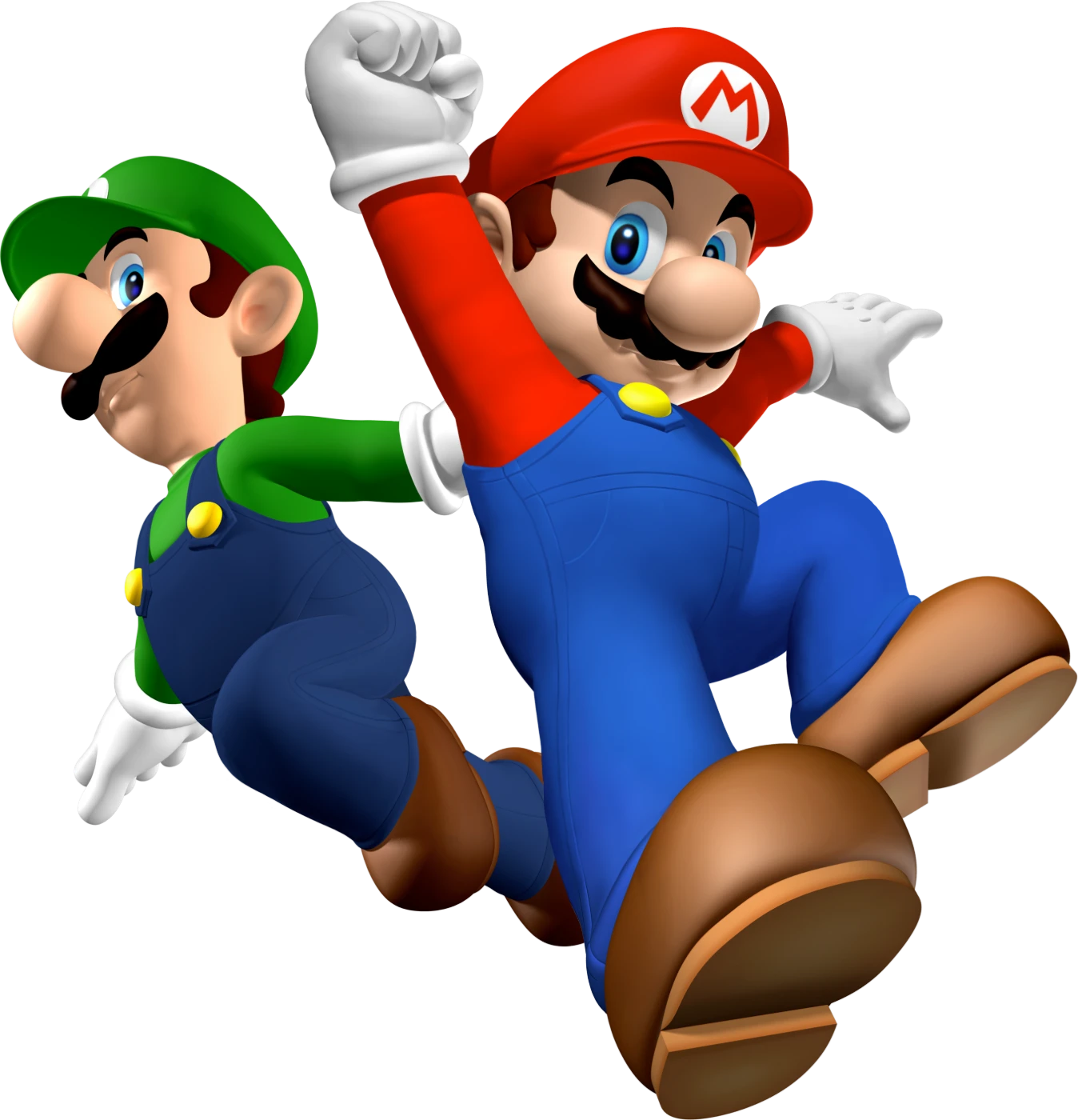
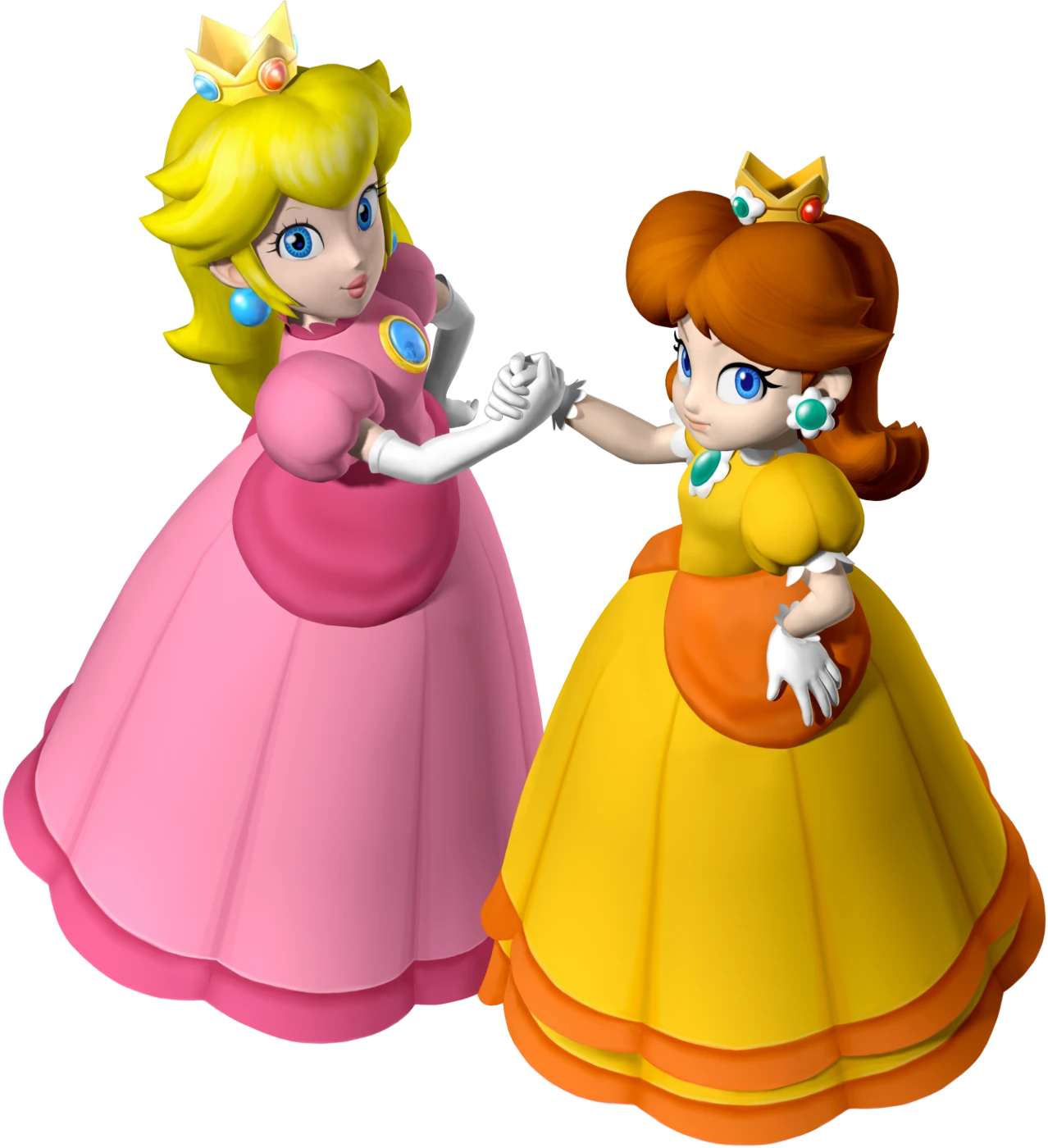
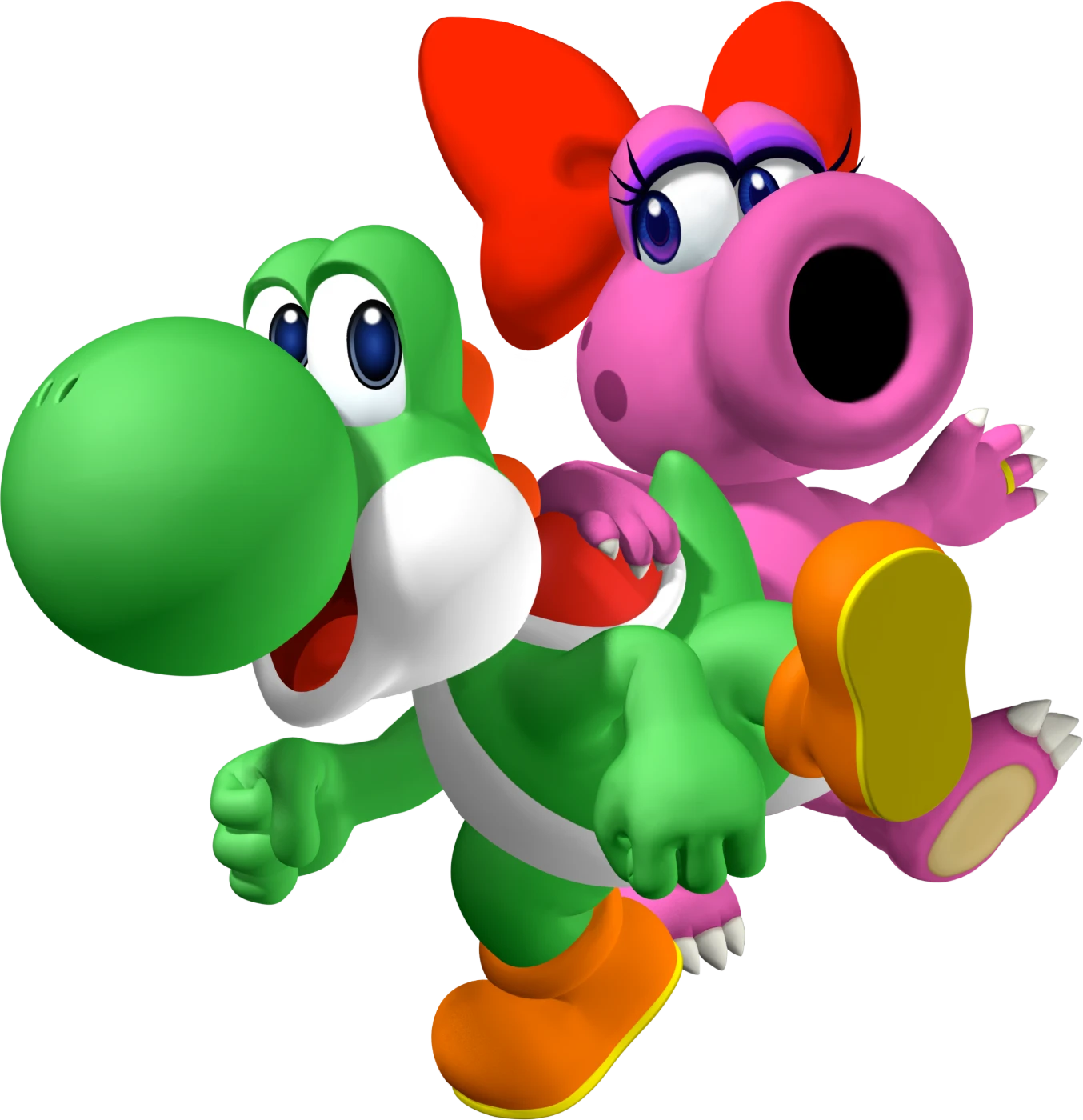
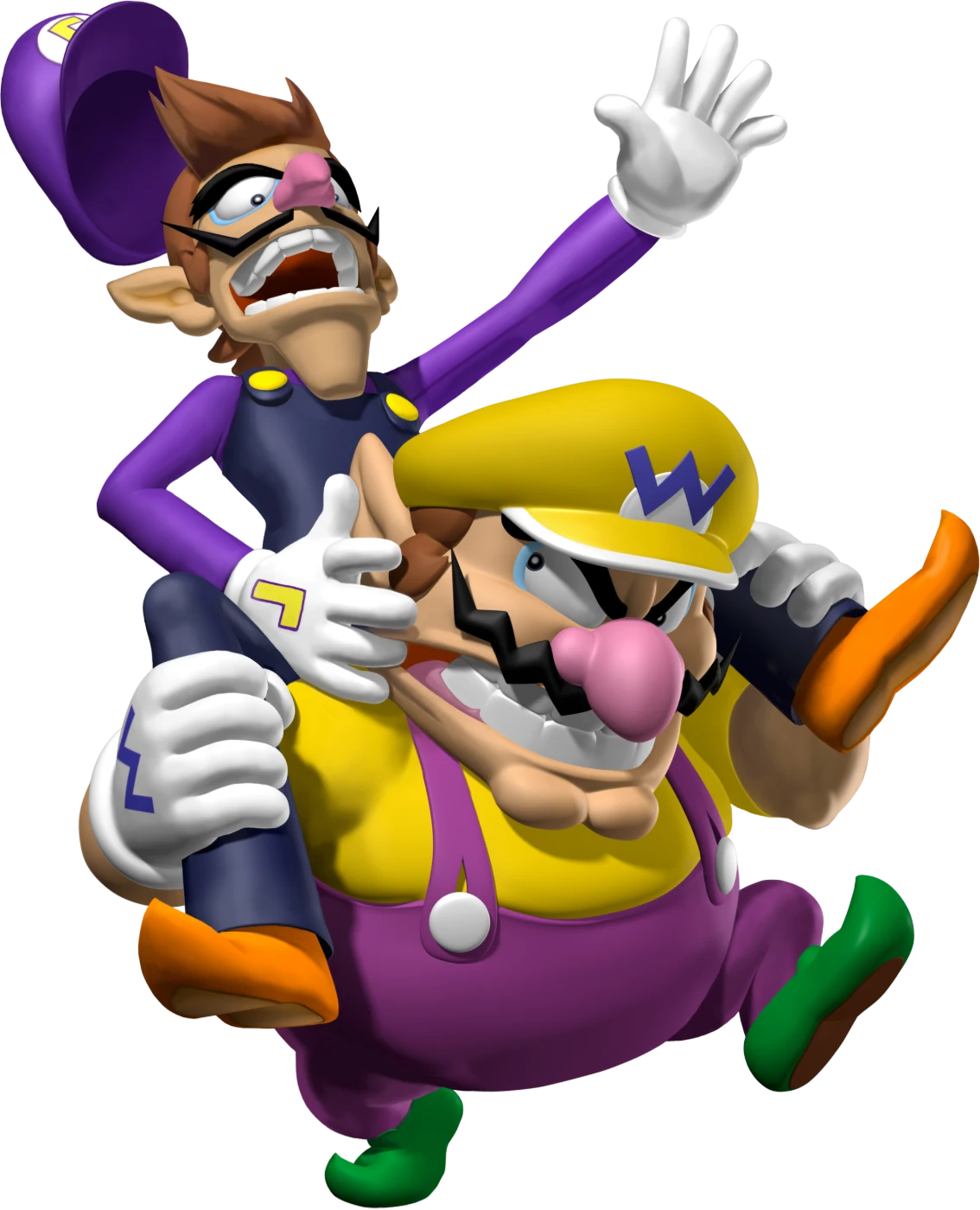
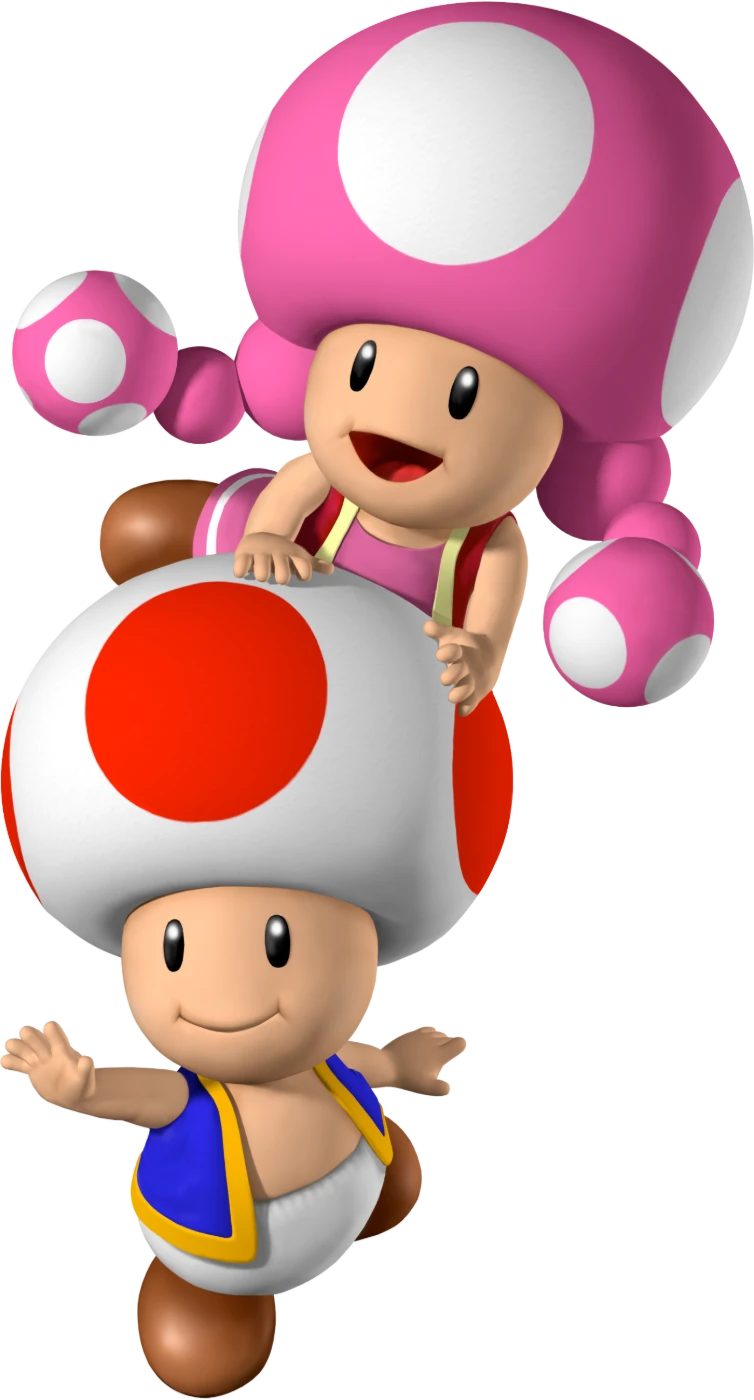
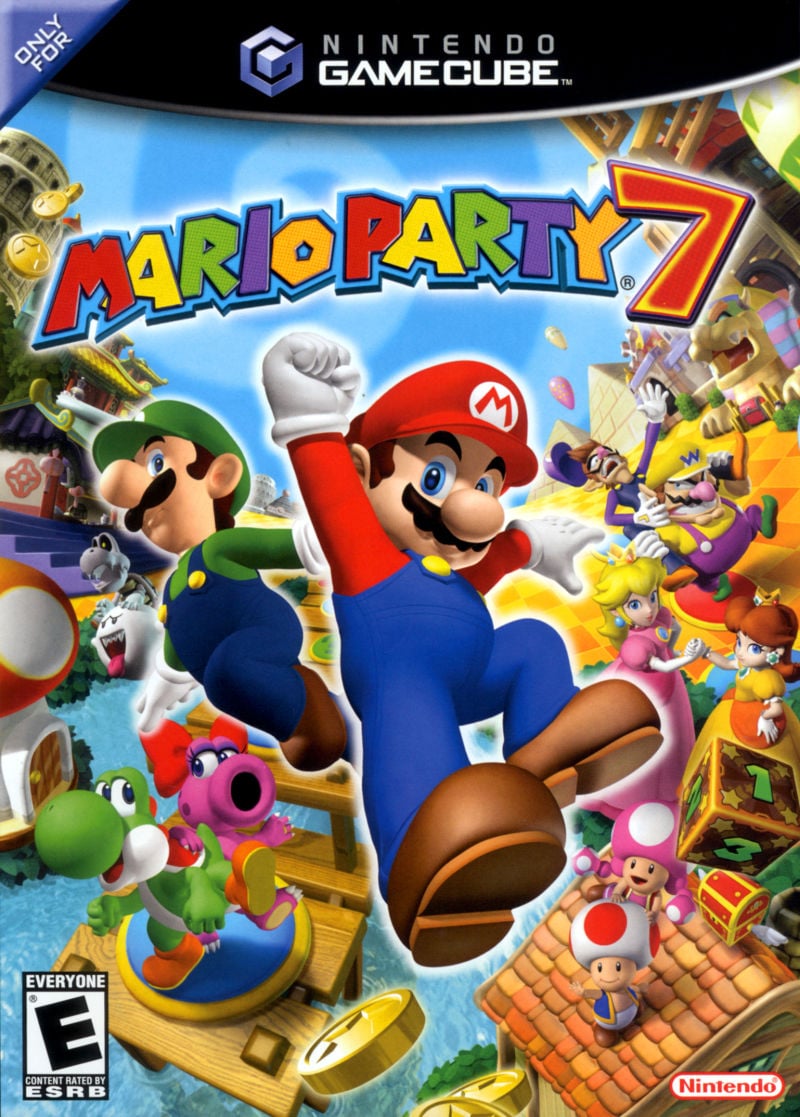
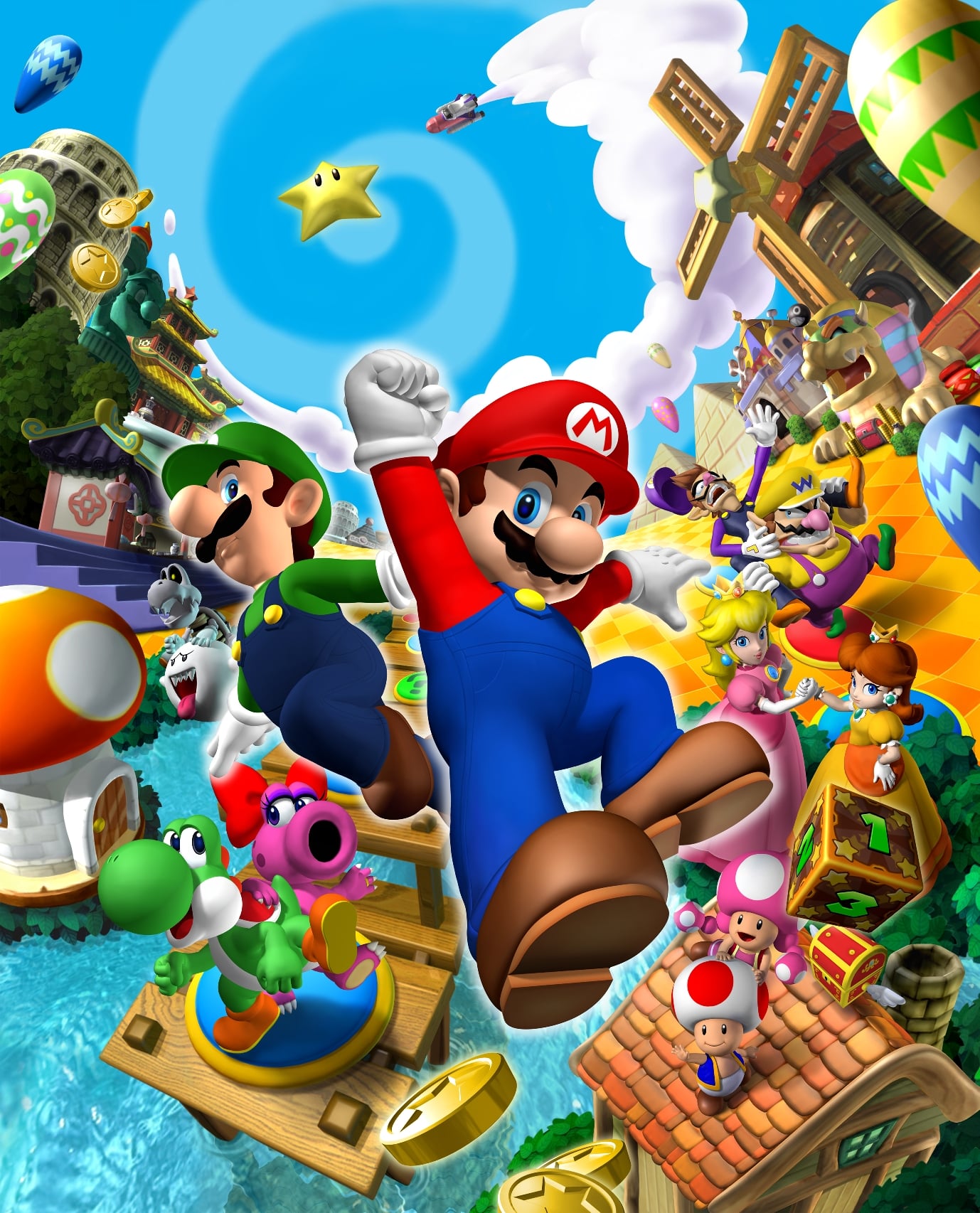
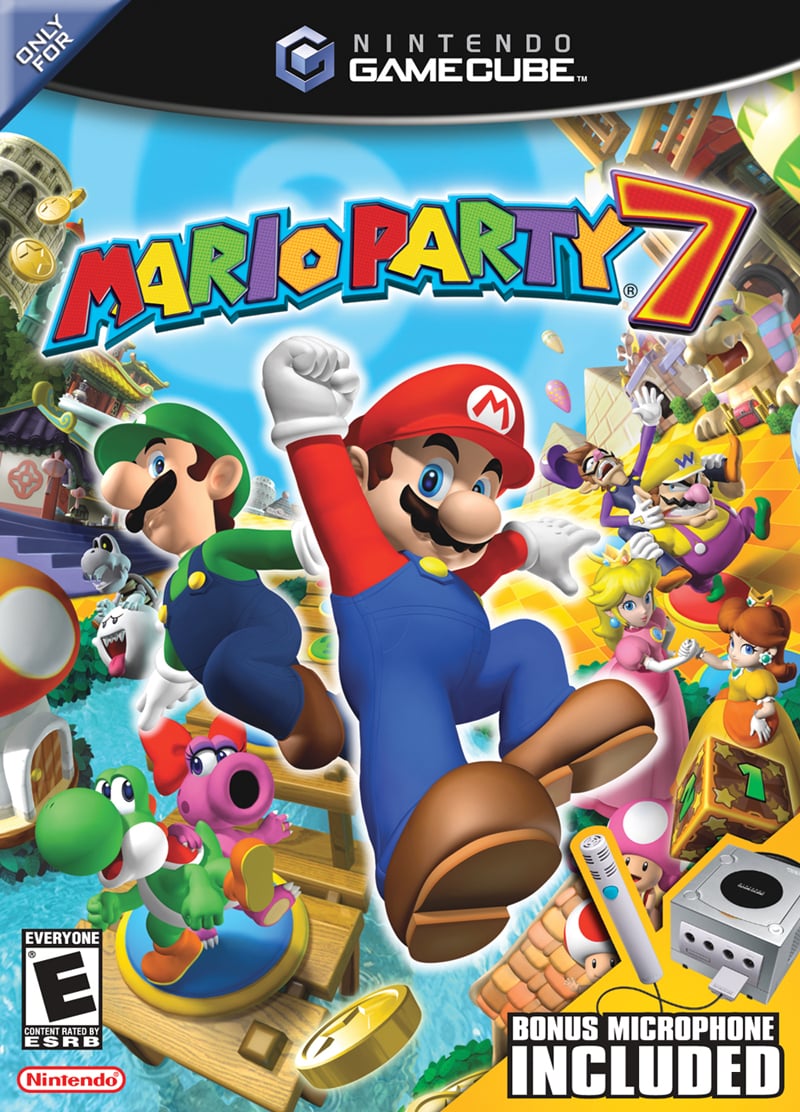
The key artwork: the cast in their pairs, with Toadsworth at the helm.
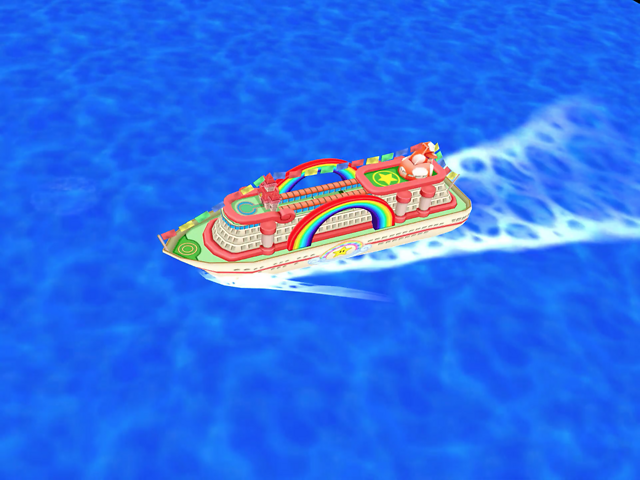
Mario Party 7 is the fourth Mario Party in four years on the GameCube and, as it turned out, the last. The board game is the familiar one, little changed from Mario Party 6 in the eyes of the reviewers: four players roll a ten-sided Dice Block, lay Orbs as traps, and play a minigame at the end of every round. What changes is the setting. This time the party is a round-the-world cruise, hosted by Toadsworth from the deck of the MSS Sea Star, and each board is a port of call modelled on a real place: Venice, a Chinese mountain, Egypt, an American city of neon, the Dutch countryside.
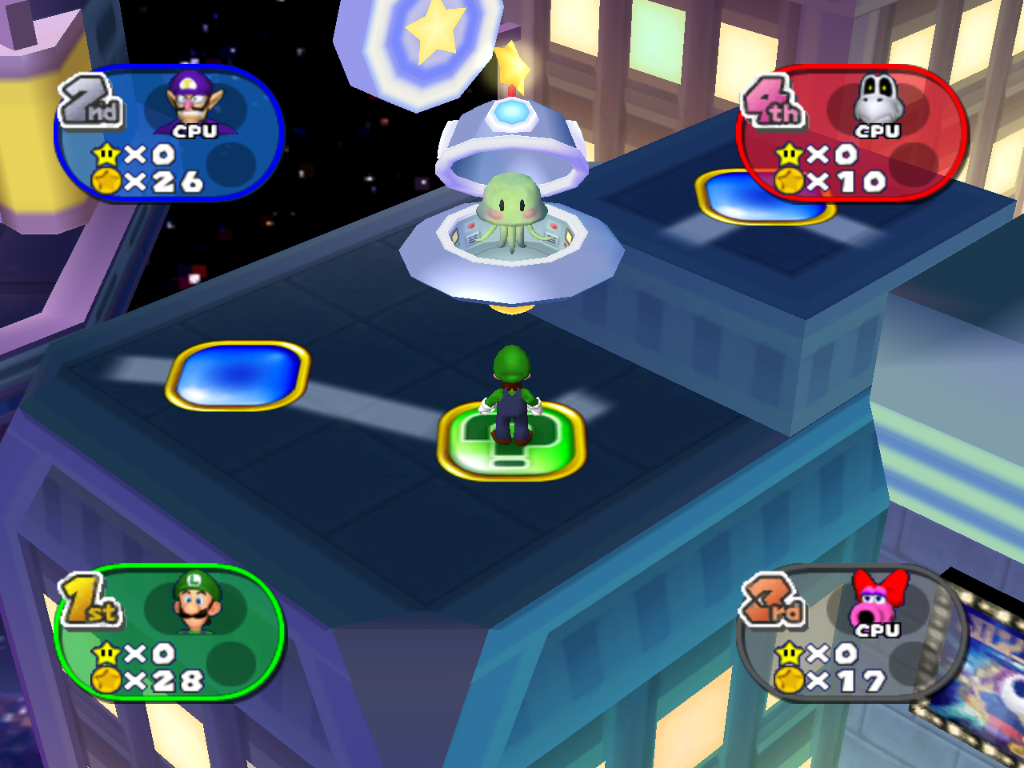
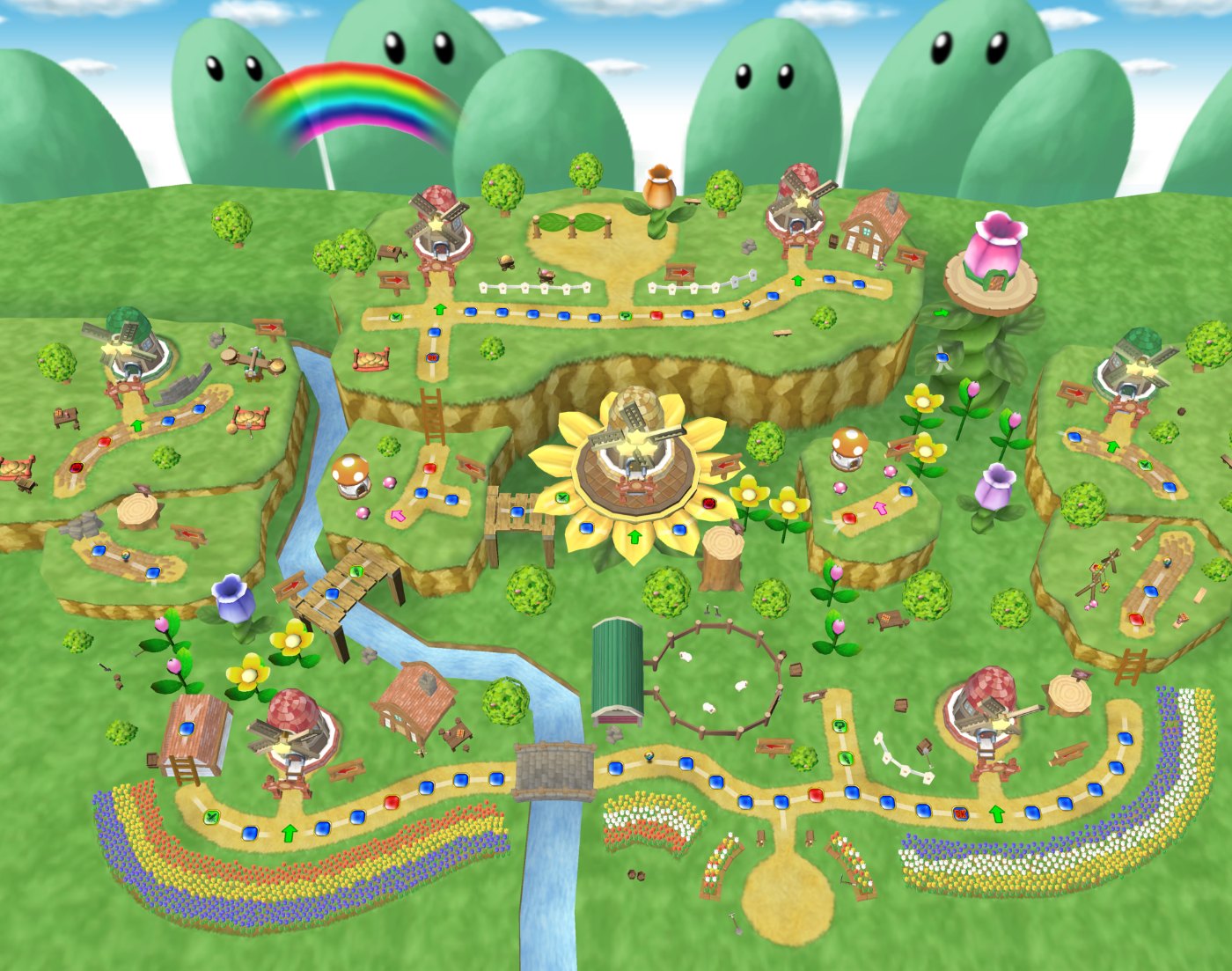
Each port also has its own rule for winning Stars. On Grand Canal you buy them for 20 coins in the usual way. On Pagoda Peak the price climbs with every sale. On Pyramid Park Stars are not for sale: everyone starts with five Stars and steals from the others on the back of a Chain Chomp. Neon Heights hides its Star in one of three chests, and Windmillville hands its Stars to whoever has sunk the most coins into each windmill.
Two new ideas sit on top. Bowser Time is a gauge that fills a little after every minigame; every fifth turn it is full, and Bowser turns up to charge for souvenir photographs, wreck bridges or sink an island. And for the first time the game seats eight players. In a 4-Team Battle, or in the minigame-only Deluxe Cruise, two people hold one controller between them, one on the L Button and Control Stick and the other on the R Button and C Stick, and twelve minigames were designed for exactly that.
The GameCube Microphone was packed in again, as it had been with Mario Party 6, and ten of the 88 minigames are played by voice. Birdo and Dry Bones join the cast as unlockable characters, taking the roster to twelve, while Koopa Kid goes back to being one of Bowser’s helpers.
Critics in 2005 were tired of the formula, and the scores show it, but the game sold more than two million copies and its minigames have aged well: twelve were chosen for Mario Party: The Top 100 and six for Mario Party Superstars. The series moved to the Wii with Mario Party 8 in 2007.
For their latest party, Mario and friends have embarked on a world cruise – but Bowser’s been left behind, and he’s determined to spoil their fun. Take in a wealth of exotic locations, with party boards based on real-life locations. Leap, swim and even fly your way through more than 80 new mini-games; challenges range from jumping electrified hurdles to staying out of the reach of a hammer-swinging, seriously miffed mole! Each copy of Mario Party 7 also comes with the Nintendo GameCube Microphone – you can use voice commands in several of the new games to control the action. You can even stop off at the Duty Free shop to exchange mileage points and items for nifty unlockable prizes. And for the first time, up to eight players can compete at once in multiplayer mode. The usual line-up of playable characters like Mario, Luigi and Wario are all present and correct, but this time newcomers Dry Bones and Birdo are also getting in on the action. Call up your friends and get ready for a truly terrific party experience!
— Official description (Nintendo UK, 2006)
Why Mario Party 7 matters to Mario fans
It is the Mario Party in which Toadsworth runs the show, the first that eight people could play at once, and the game that made Birdo and Dry Bones party regulars. It closed the GameCube run of four games in four years, and Super Mario Wiki records it as the last Mario game released for the console in Europe and Australia. Windmillville’s buy-the-landmark rule came back in Mario Party 8 as Koopa’s Tycoon Town, and minigames such as Monty’s Revenge, Pokey Pummel and The Final Countdown were still being remade in 2021.
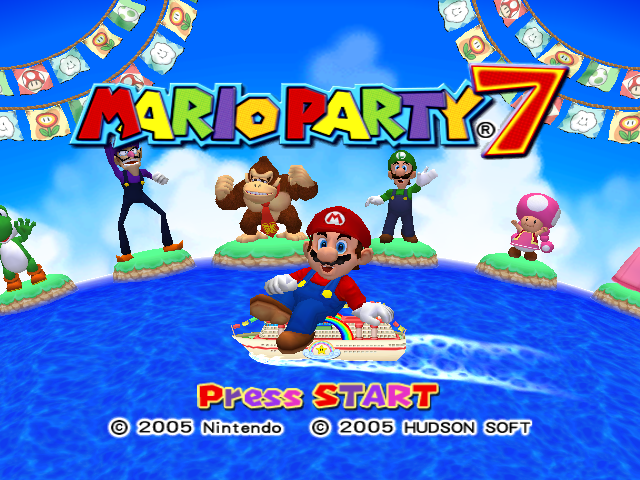
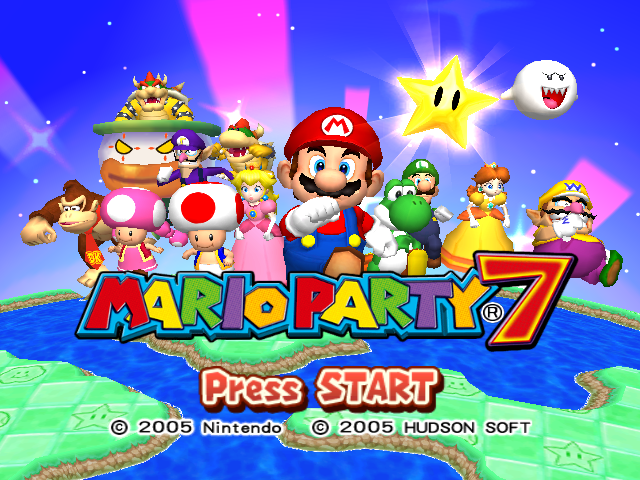
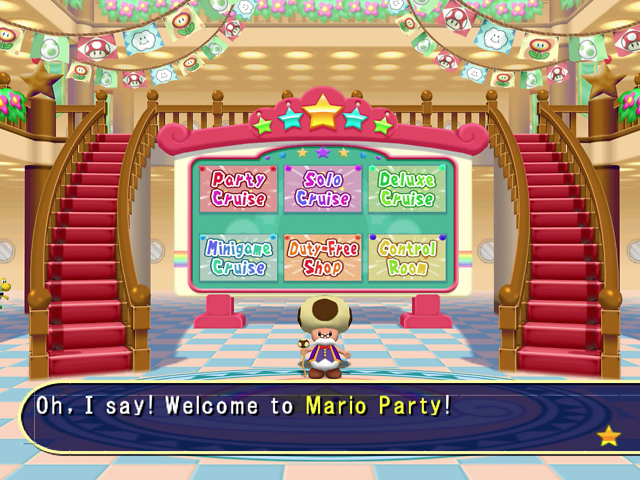
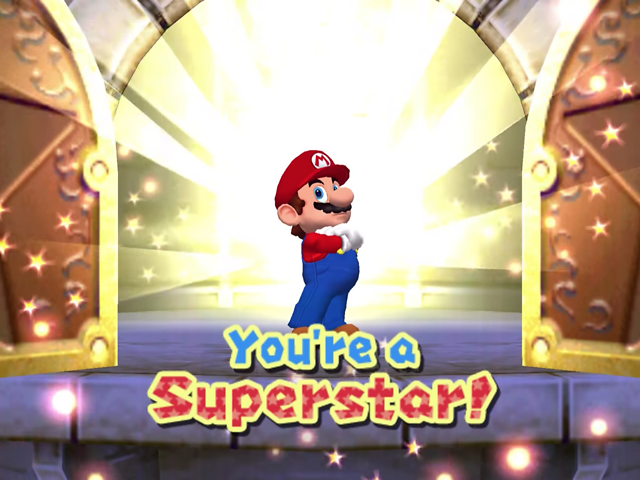
The title screen.The MSS Sea Star, the cruise ship that serves as the menu.The main menu, with Toadsworth as guide.Mario is named the Superstar on Grand Canal.
“But chin up, old bean! We won’t let him ruin our good times, right? Right!”
Toadsworth, in the story told by the Mario Party 7 instruction booklet (Nintendo, 2005), as transcribed by Super Mario Wiki
Toadsworth narrates the set-up himself, and this is how he ends it, having just reported that Bowser “has never been that angry”.
Quick Answers
The questions people ask most about Mario Party 7, answered briefly here and in depth further down the page.
When did Mario Party 7 come out?
North America: 7 November 2005. Japan: 10 November 2005. Europe: 27 January 2006, the date on Nintendo UK’s own page (Wikipedia gives 10 February for the rest of Europe). Australia: 8 June 2006. More →
Can eight people really play Mario Party 7?
Yes. In a 4-Team Battle on the boards, and in Deluxe Cruise, four pairs share four controllers: one partner uses the L Button and Control Stick, the other the R Button and C Stick. Twelve minigames are built for it. More →
Who is playable?
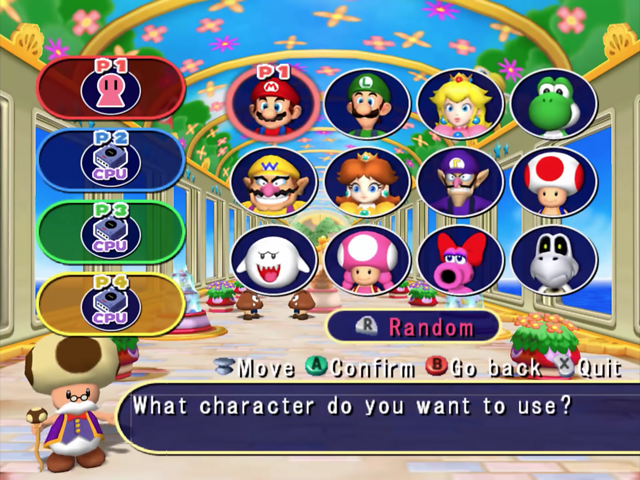
Mario, Luigi, Peach, Daisy, Yoshi, Wario, Waluigi, Toad, Toadette and Boo from the start, plus Birdo and Dry Bones, who cost 1,000 Cruise Mileage Points each at the Duty-Free Shop. More →
What are the boards?
Grand Canal, Pagoda Peak, Pyramid Park, Neon Heights, Windmillville and Bowser’s Enchanted Inferno! Each has a different rule for getting Stars. More →
How do you unlock Bowser’s Enchanted Inferno?
Play Solo Cruise. Beat the computer on the other boards, then win a Star on the Inferno and clear the boss minigame Bowser’s Lovely Lift! The board is then open in Party Cruise. More →
How many minigames are there?
Eighty-eight on Super Mario Wiki’s list: 18 for four players, 14 one-against-three, 12 two-against-two, 5 Battle, 12 Duel, 6 Donkey Kong, 6 Bowser, 12 for eight players, 2 rare ones and a boss. Nintendo’s own page said 86. More →
Do you need the microphone?
No. The Mic came in the box and ten minigames and the Mic Space use it, but it can be switched off in the Control Room, or replaced by a command menu on the R Button. More →
What is Bowser Time?
A gauge that rises by a fifth after every minigame in Party Cruise. Every five turns it fills and Bowser interrupts with a board-specific stunt, from an overpriced photograph to sinking an island. European copies call it Bowser Party. More →
What are Character Orbs?
Six Orbs that only one pair of characters can use: Fireball (Mario and Luigi), Flower (Peach and Daisy), Egg (Yoshi and Birdo), Vacuum (Wario and Waluigi), Triple ’Shroom (Toad and Toadette) and Magic (Boo and Dry Bones). Each costs 15 coins. More →
Boards & Modes
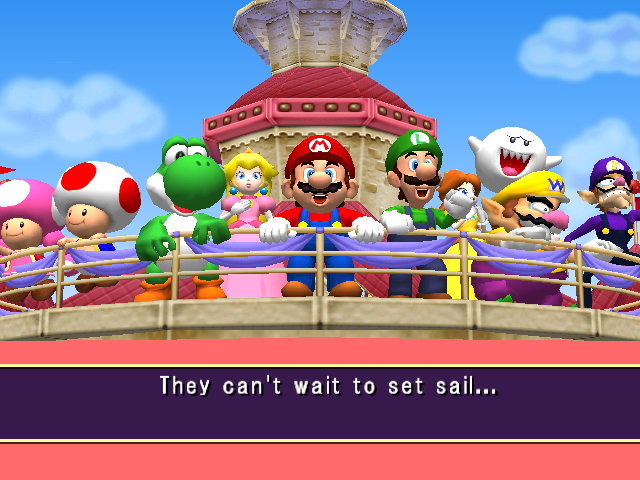
The party sets sail in the opening sequence.
The story is told by Toadsworth in the instruction booklet and played out in the opening film. Out for a morning walk, Mario bumps into the old steward, who has a proposal: a luxury cruise round the world for Mario and all his friends, aboard the MSS Sea Star. Everybody is invited except Bowser. When the Koopa King finds out he is furious, and swears to track the holidaymakers down and wreck their good time, which is why he and his Koopa Kids are waiting at every port.
There is no story mode as such. The plot is carried by Solo Cruise, in which one player takes on a rival at each destination and finally Bowser himself. Win there and the epilogue shows Bowser and a Koopa Kid washed up, dazed, on a tiny island with a single tree, watching the Sea Star sail past while the winner waves from the rail. Everything else happens in Party Cruise, on the six boards below.
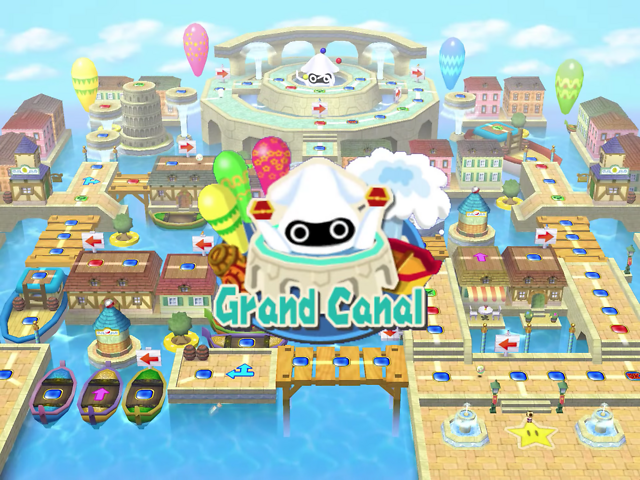
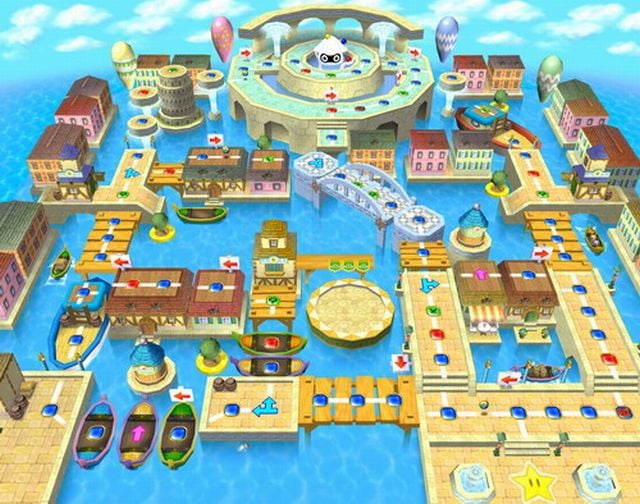
Grand Canal
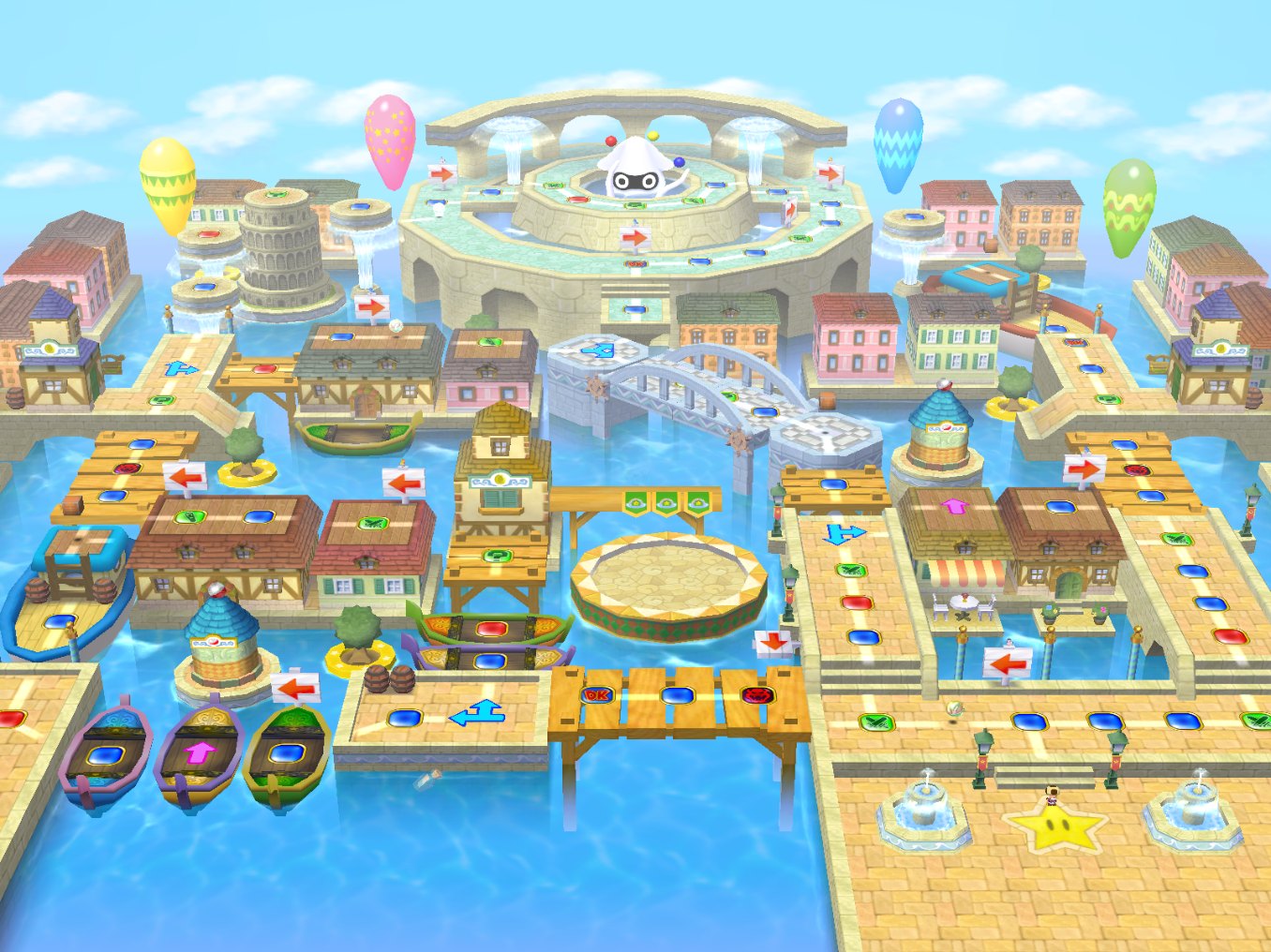
The first stop is Venice in all but name: 70 spaces of bridges, gondolas and balloons, with Singing Shy Guys minding the Orb shops. The Star rule is the traditional one. Reach the Star Space, pay 20 coins, and the Star moves somewhere else.
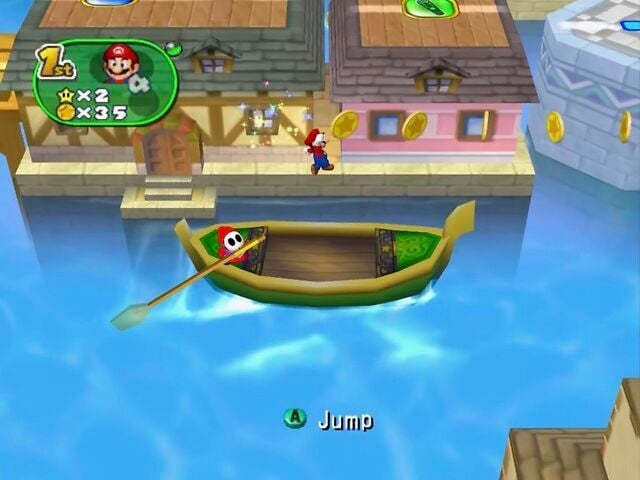
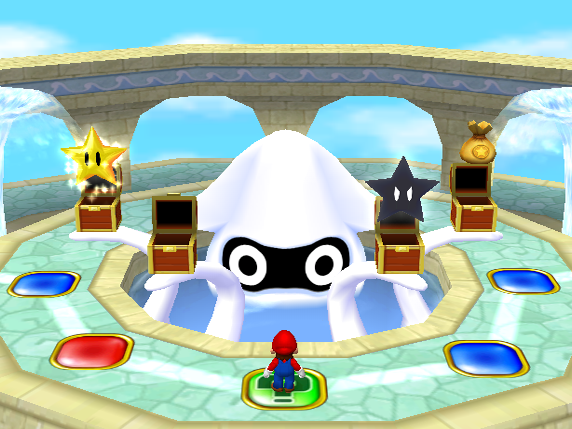
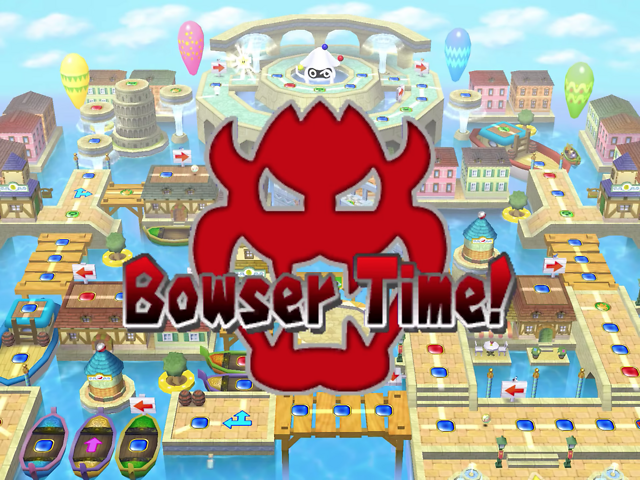
The Green Spaces provide the sightseeing. Near the start Shy Guys shower you with coins and the odd Spiny egg. By the boathouses a gondolier will punt you across the board, collecting coins and dodging Spinies on the way. A leaning tower tips anyone standing near it into the canal, where four Cheep Cheeps squirt them all the way back to the start. A juggling Blooper invites you to pick one of four chests, holding a Star, 5 coins, a Dark Star or nothing, and a drawbridge swings players on to a different route. There are two DK Spaces and no Bowser Spaces at all, until Bowser Time, when he may bomb the bridges and replace them for three turns with crossings made of Bowser Spaces.
Arriving at Grand Canal.The juggling Blooper and his four chests.The leaning tower event.Bowser’s replacement bridges.
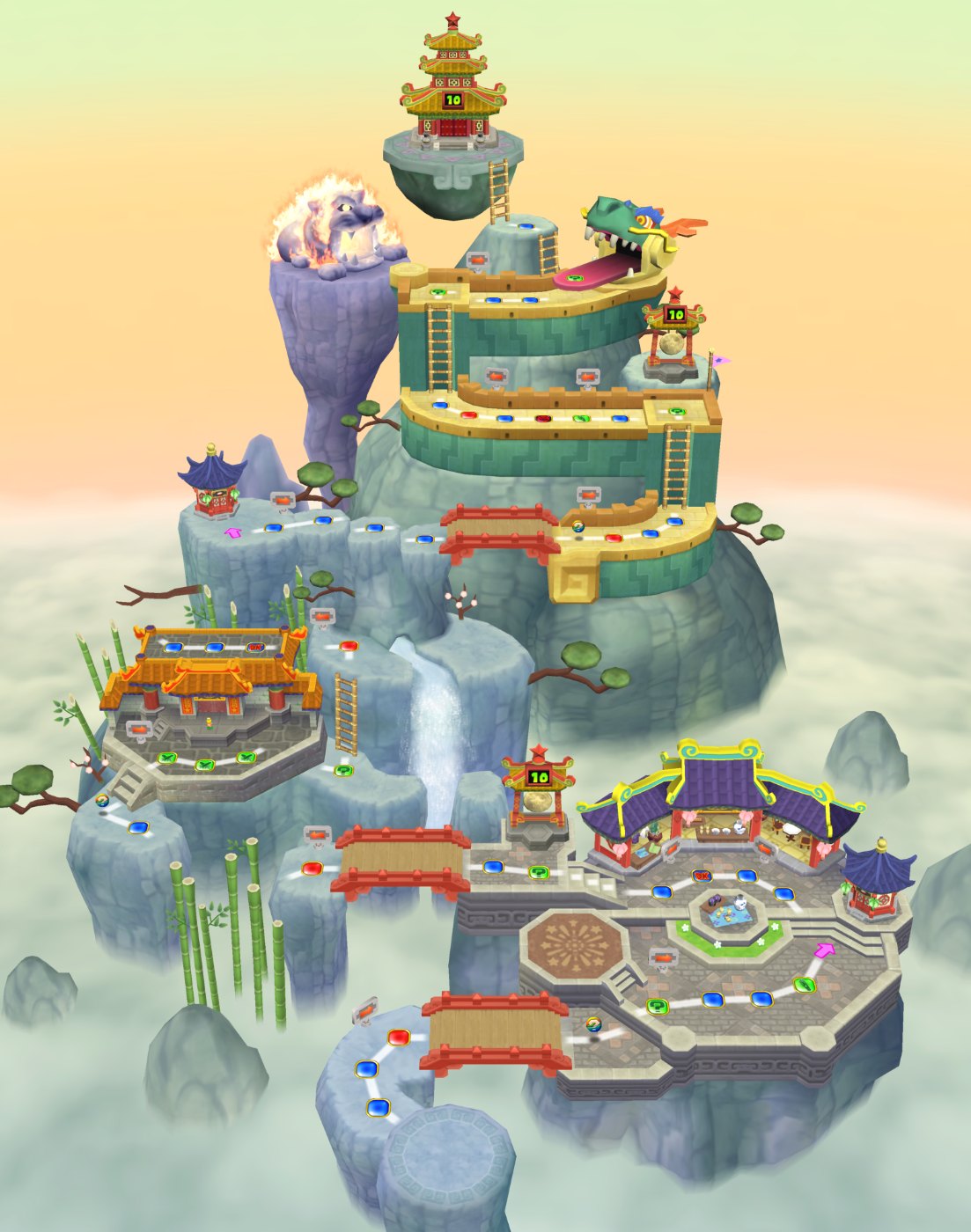
Pagoda Peak
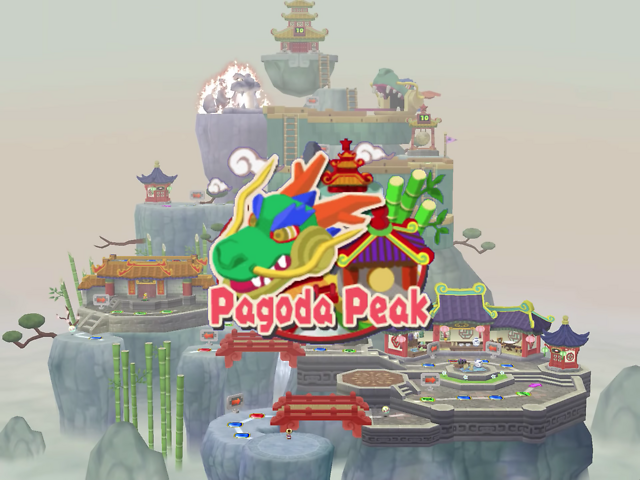
A Chinese mountain, said in the game to be 4,000 years old, with a village at the bottom, two dojos on the slopes and a pagoda at the top where the venerable Koopa Master lives. One path winds up to him, and with 42 spaces Super Mario Wiki reckons it the smallest standard board in the series. Whoever reaches the summit may buy a Star, but the price goes up by 10 coins with every sale: 10, then 20, 30 and 40, after which it drops back to 10. Timing your climb to arrive when it is cheap is the whole game.
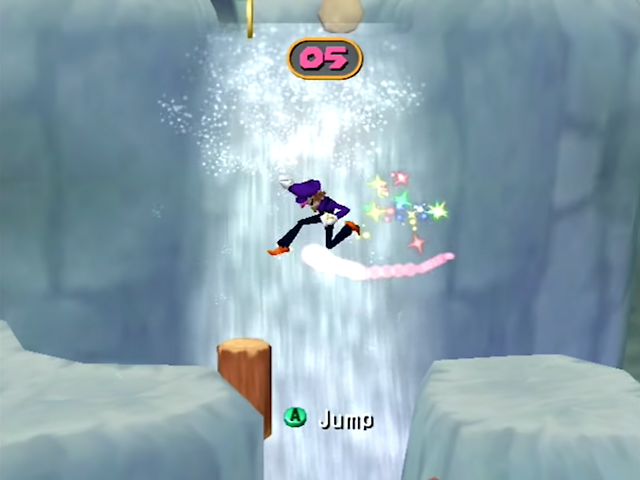
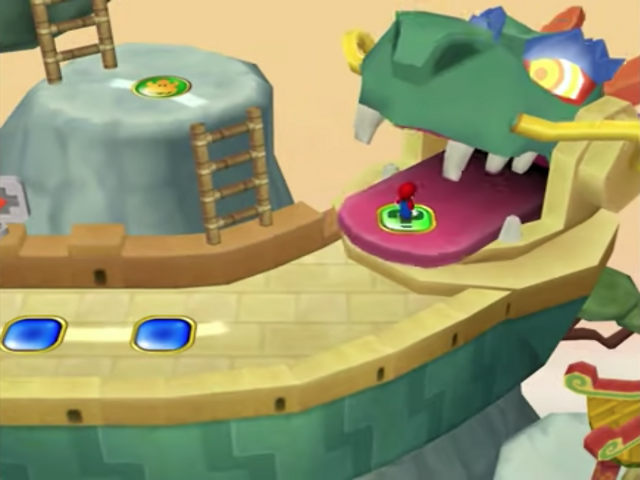
On the way up Toadsworth offers bottle rockets that may carry you up the mountain or back to the bottom. Striking the Gong of Fate resets the Star price at random and pays a few coins. At Kung Fu Falls you leap between platforms catching coins and dodging logs, with a Star for catching the lot, and at Blazing Rock you fan out a fire to win a capsule that may hold coins, a Star or a worthless T-shirt. Stop on the dragon’s tongue and it swallows you and spits you out at the start. In Bowser Time he may smash a bridge or stamp so hard that everyone slides down the slope.
Arriving at Pagoda Peak.The Gong of Fate.Kung Fu Falls.The dragon that sends you back to the start.
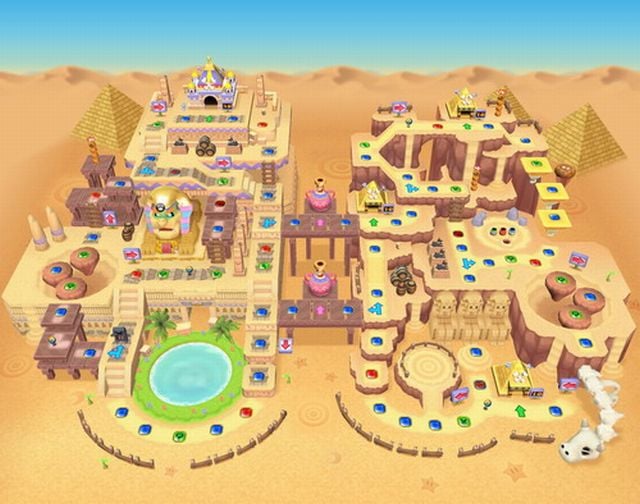
Pyramid Park
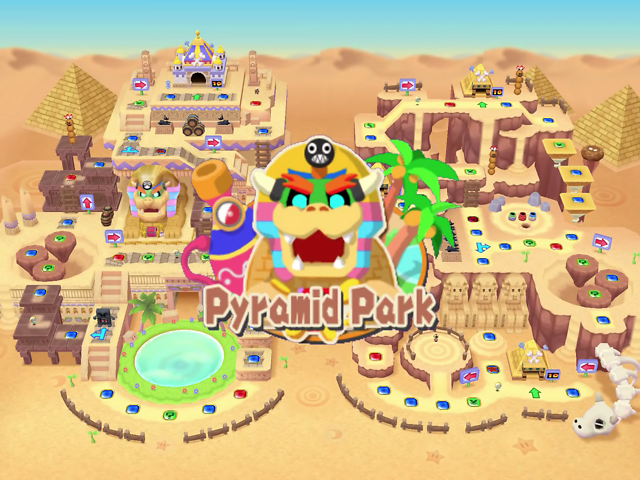
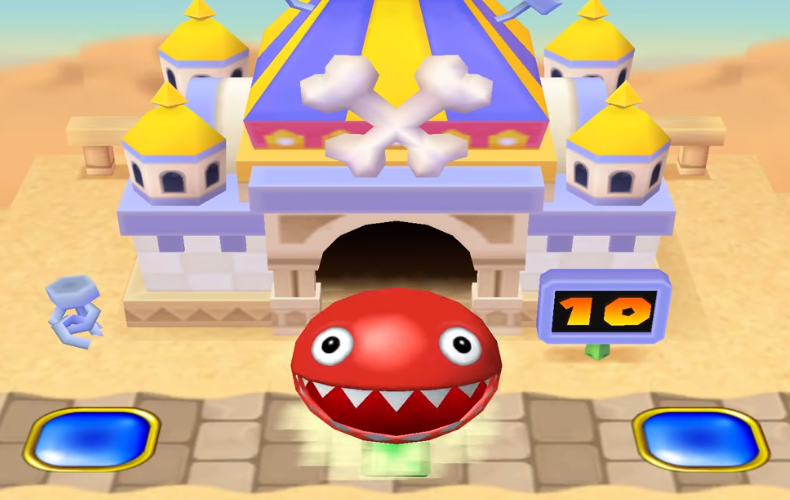
Egypt, with Desert Goombas behind the shop counters, and the one board where Stars are never for sale. Every player begins with five, and the only way to get more is to rob somebody. Pay a Chain Chomp 10 coins to ride it for one Dice Block, or 20 for two, and it will take a Star from any rival you run down. The rarer Red Chomp gives three Dice Blocks for 10 coins. The idea, the wiki points out, is lifted from Snowflake Lake in Mario Party 6, and the Snack Orb exists purely to fend it off.
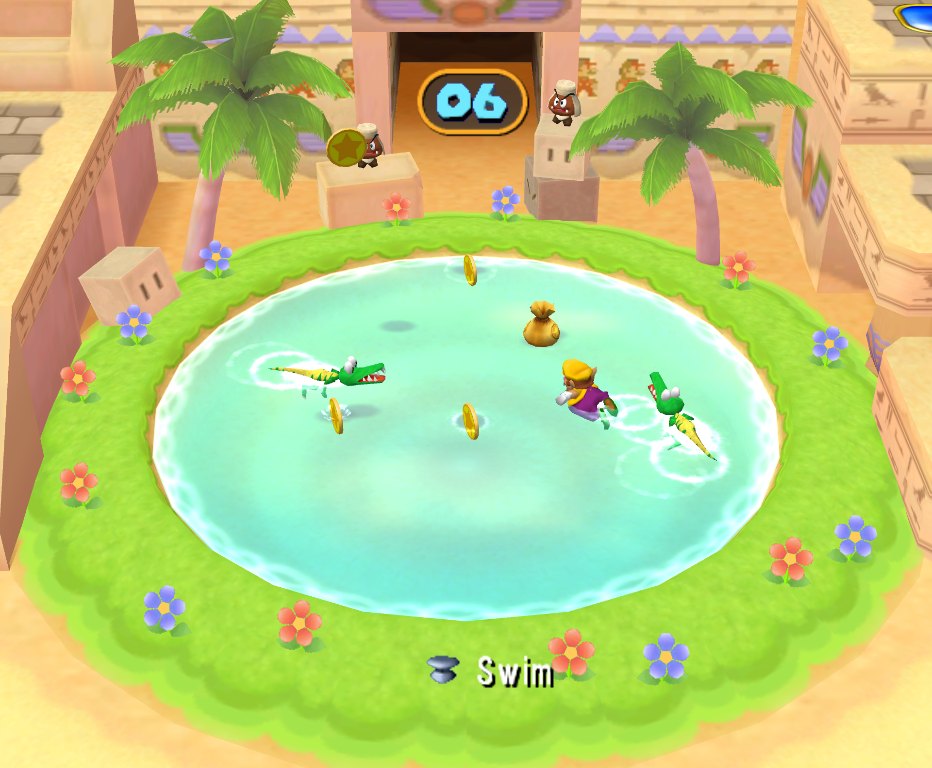
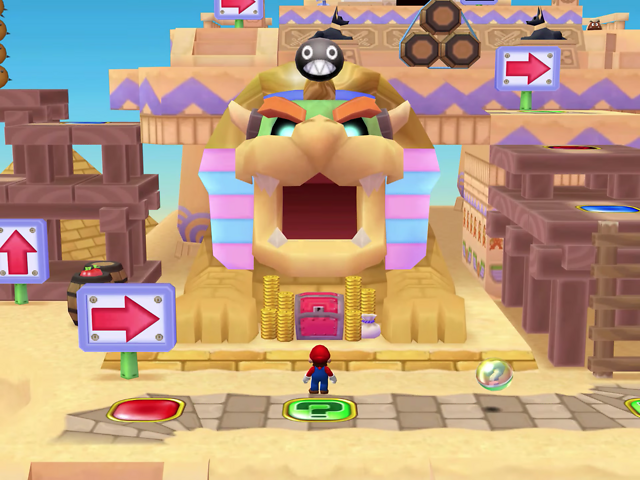
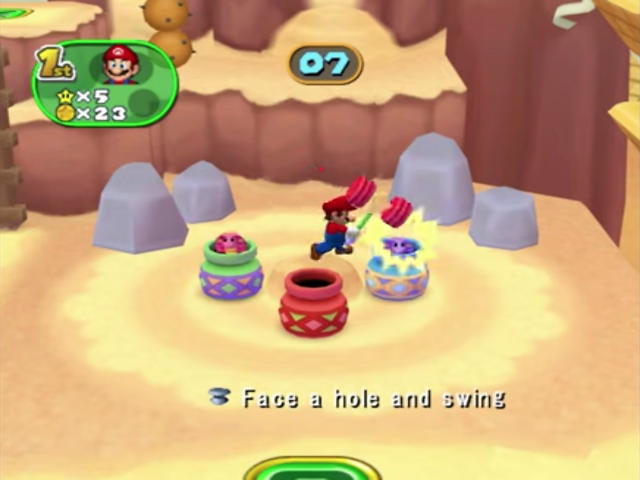
A Whomp charges a 10-coin toll on the road to the Bowser Sphinx. Wake the Sphinx and it lays a curse: it may share out all the coins equally, swap the Blue and Red Spaces for two turns, or halve the Chain Chomps’ prices for two turns. Elsewhere there is an oasis to swim in for coins, if the alligators do not bite them away again, two quicksand pits that swallow you and spit you out at the far side, and Monty Mole’s whack-a-cobra stall, which pays a coin a cobra until you hit Monty by mistake. Bowser’s cruellest trick here is to snatch a Star from whoever is in first place and hand it to a Koopa Kid.
Arriving at Pyramid Park.The Red Chomp.Mario wakes the Bowser Sphinx.Monty Mole’s whack-a-cobra game.
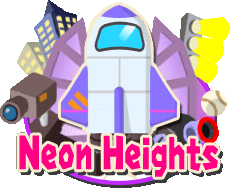
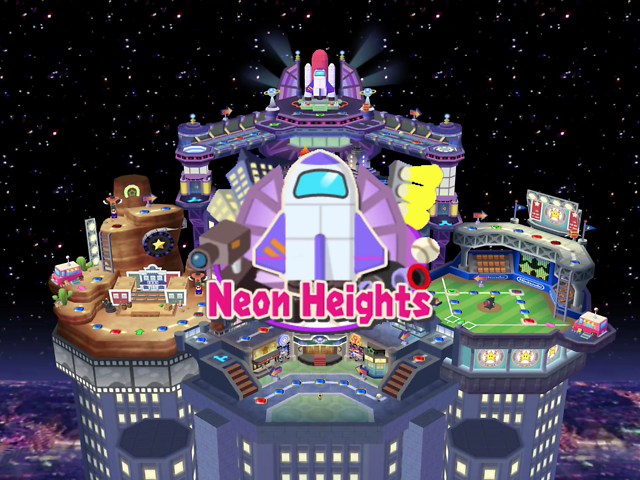
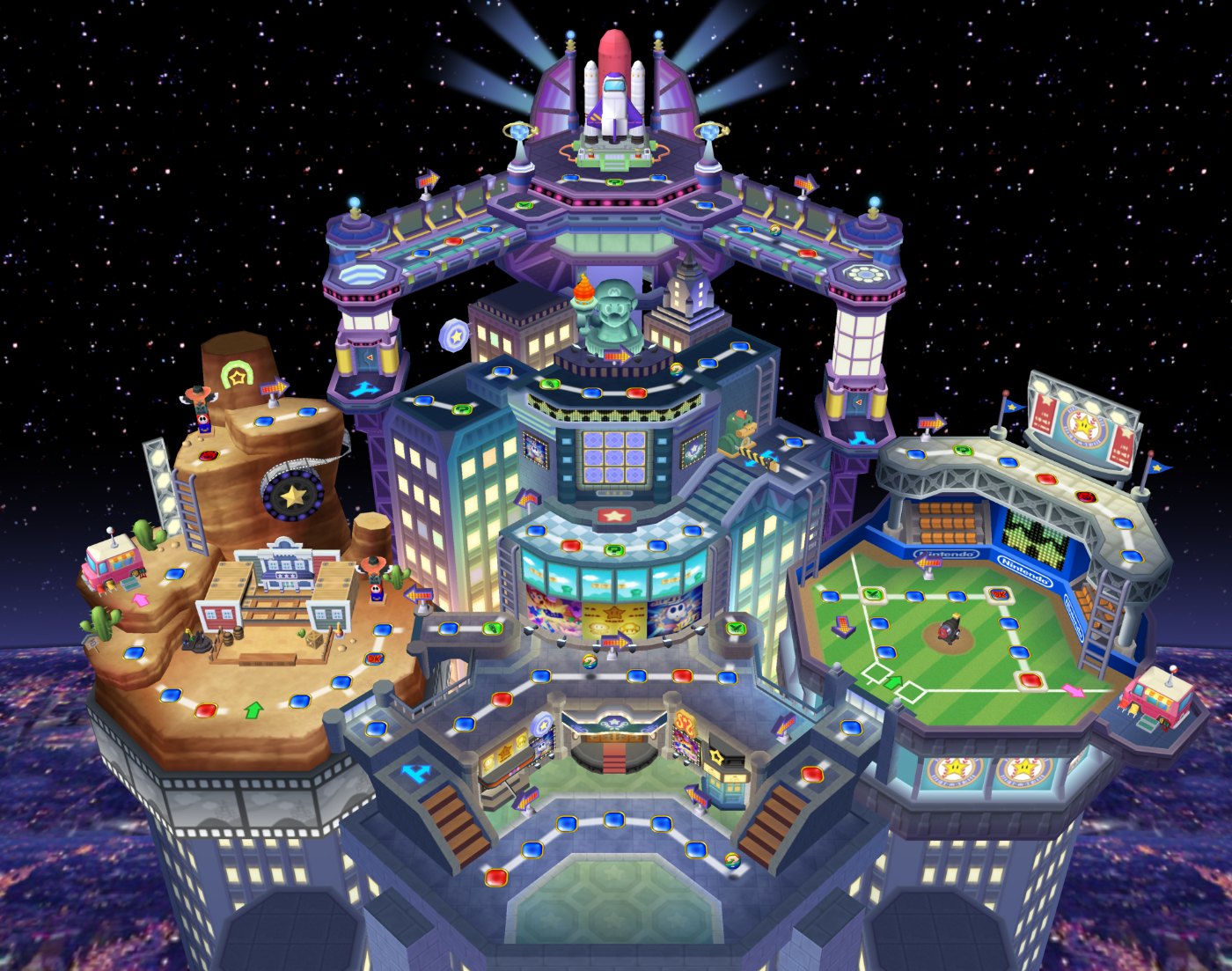
Neon Heights
America, piled on top of a skyscraper: mostly Las Vegas, with borrowings from Hollywood, Cape Canaveral and New York in the shape of a theatre district, a film set, a space centre and a baseball diamond. Three treasure chests sit on Blue Spaces chosen at random. For 10 coins a Koopa Kid will open one, and inside is either 20 coins, the Star, or a Bob-omb that blows you back to the start. Once the Star is found three fresh chests appear. There is also a 10-coin toll gate.
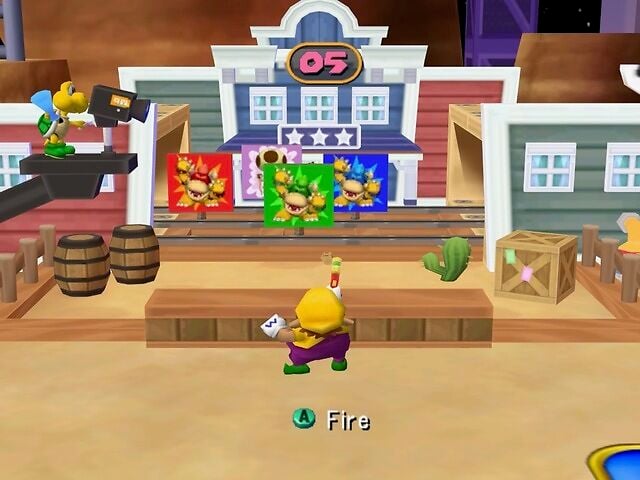
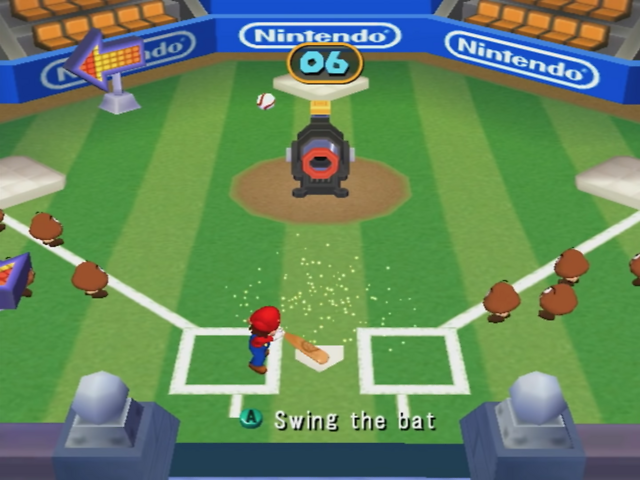
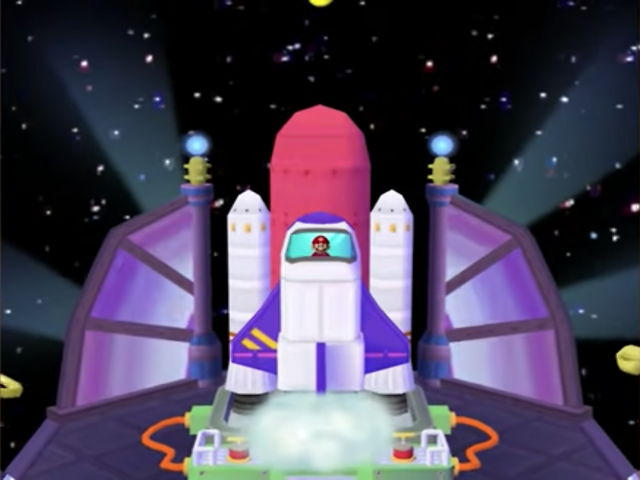
The attractions pay well. On the film set you have ten seconds to shoot Koopa Kid targets, a coin each up to 15, without hitting Toadsworth. The baseball diamond holds a home-run contest worth 2 coins a ball. At Cape Mushroom you pump fuel into a rocket for coins and hope the launch is not scrubbed. Matchmakers is a pairs game with a Star for clearing the board and a 10-coin penalty for turning over Bowser. A flying saucer near the Mario statue shuffles all the chests. Bowser, for his part, likes to slip a Dark Star into the Bob-omb chest.
Arriving at Neon Heights.The home-run contest.Ignition at Cape Mushroom.The visitor that shuffles the chests.
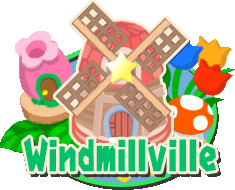
Windmillville
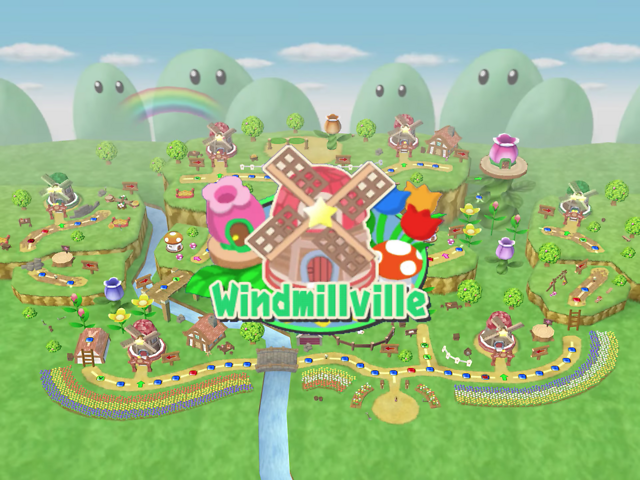
The Netherlands, tended by Koopa Shepherdesses, and the cleverest rule in the game. There is no Star Space. There are seven windmills, and the Stars live inside them: one in each of the four red mills, two in each of the two green ones at the corners, and three in the big yellow mill in the middle, eleven in all. Whenever you pass a windmill you may put coins into it, and it belongs, Stars included, to whoever has put in the most. A rival who outspends you takes it over. Put in 100 coins and the mill is yours for good, although Koopa Kid and the Bandit Orb can still siphon coins out of it.
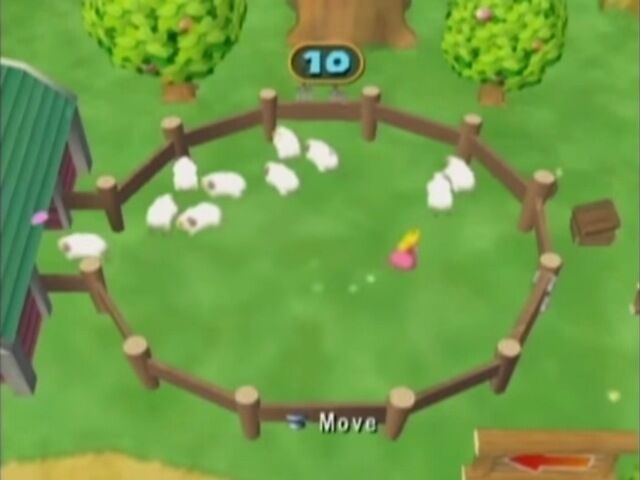
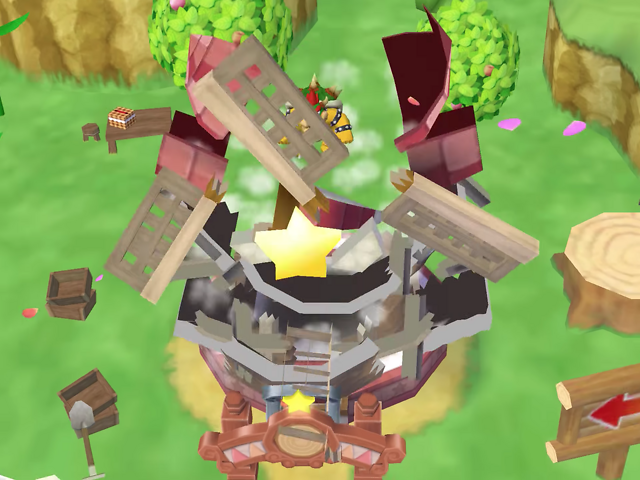
So the lead can change hands without anybody moving, and a player with a deep purse can turn the game on the last turn. Floating flowers ferry you to one of three spots for 10 coins. The Green Spaces are gentler than elsewhere: herd sheep into a barn for up to 10 coins, or Ground Pound a Trampoleaf to shake out 20. In Bowser Time he either demolishes a windmill, coins and all, or sends a Koopa Kid to burgle one. Mario Party 8 reused the whole idea, with hotels in place of windmills, as Koopa’s Tycoon Town.
Arriving at Windmillville.Peach among the windmills.Bowser brings down a red windmill.The Trampoleaf.
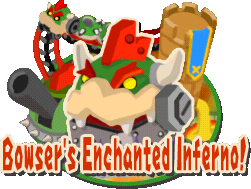
Bowser’s Enchanted Inferno!
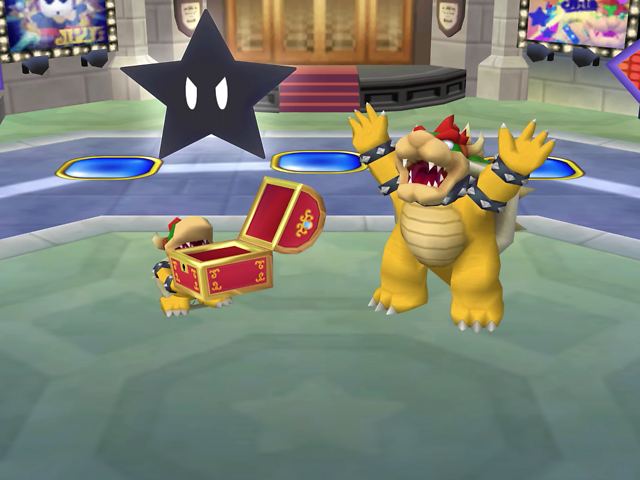
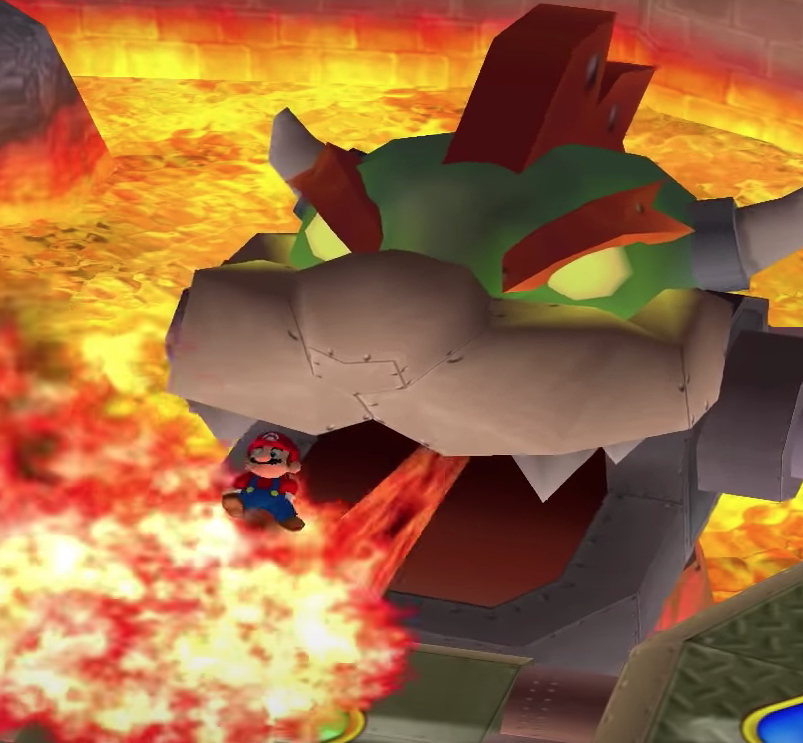
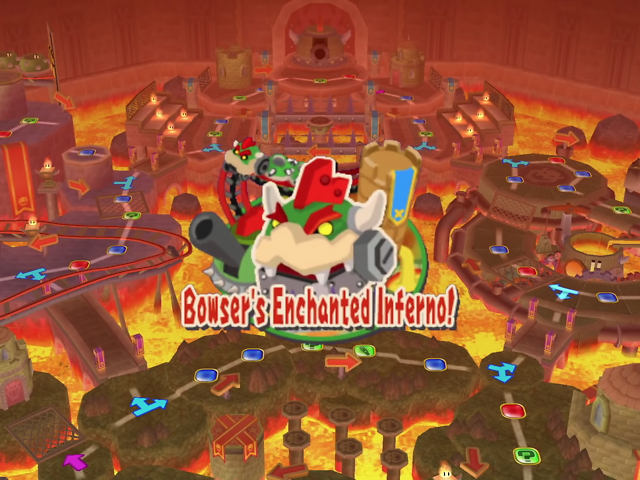
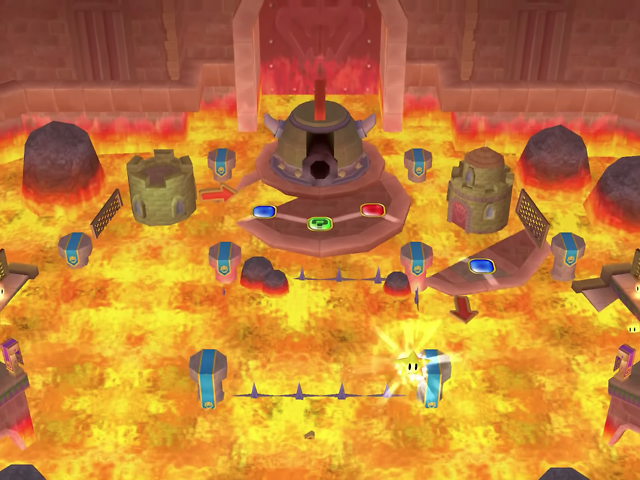
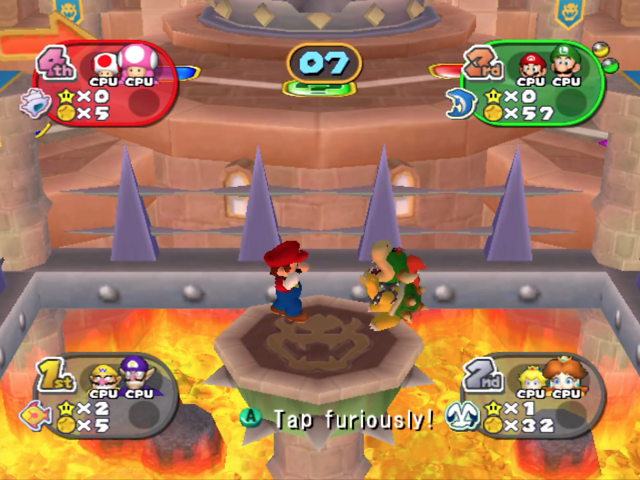
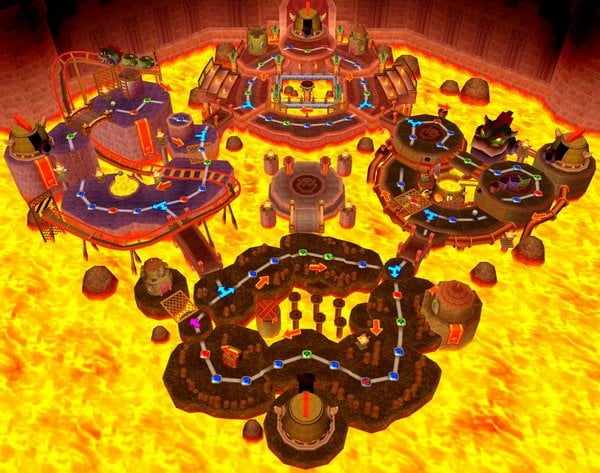
The cruise ends at an amusement park that Bowser has built under a red dome in a sea of lava, staffed by Steel Goombas and Koopa Kids. It is made of four islands joined by cannons, and the Star rule is Grand Canal’s again: 20 coins at the Star Space. The difference is Bowser Time. Here he sinks whichever island the Star is on. Everyone standing on it loses half their coins and is sent back to the start, the Star moves, and the island stays under the lava until the next Bowser Time five turns later.
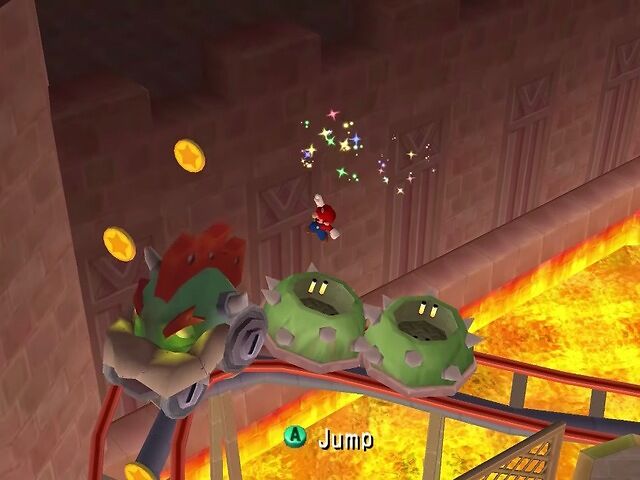
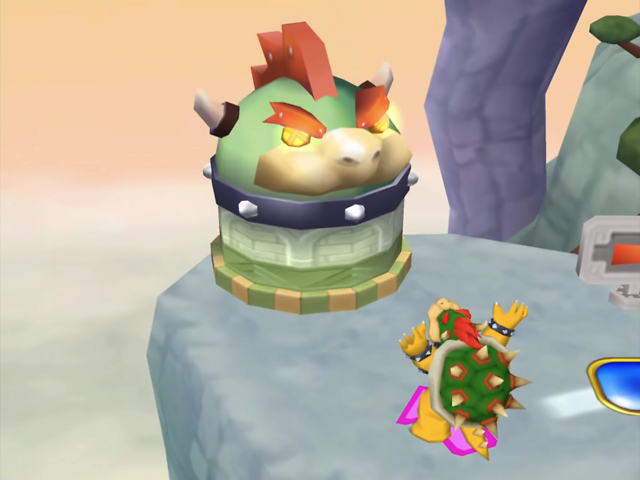
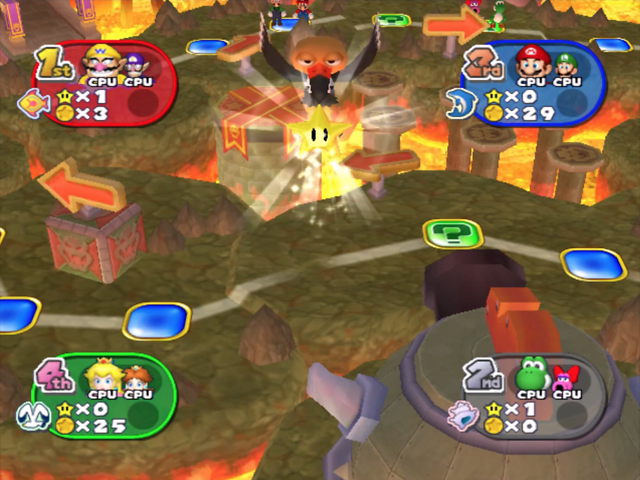
The sideshows are rigged, naturally. Lava hopscotch takes 10 coins if you step on a pedestal that sinks and offers a Star for crossing all three sets, at odds the wiki puts at one in eight. Klepto the condor snatches the Star and drops it somewhere else. A Mecha-Bowser head scorches 10 coins out of everybody within three spaces. You can wrestle a Koopa Kid, sumo fashion, for 20 coins, and lose 10 if he shoves you out first, or ride the roller coaster and grab coins on the way down. The board has to be unlocked by finishing Solo Cruise.
Arriving at Bowser’s Enchanted Inferno!The top island goes under.Klepto makes off with the Star.Wrestling a Koopa Kid.
Solo Cruise
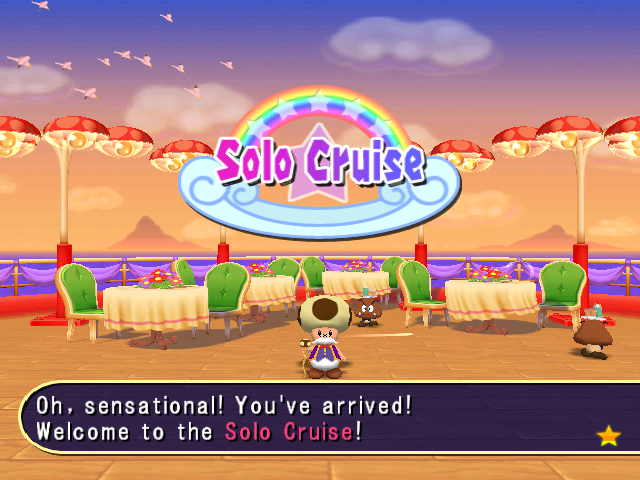
Solo Cruise is the one-player game, though a second person may take the rival’s seat. You register a character and a name, and can even write the taunts shown before and after a match. Each board is then played as a race between two against a set objective, on a simplified map: Blue Spaces pay 5 coins, there are Coin Block Areas that hand out 5, 10 or 20 coins without using up your roll, and there is no Bowser Time. If nobody has met the objective after thirty turns the game is declared a draw.
The objectives are variations on the Party Cruise rules. Be first to buy two Stars on Grand Canal. Save 100 coins and carry them to Koopa Master on Pagoda Peak. Recover the Star that a Bandit stole from the Bowser Sphinx and bring it back. Find three Stars among eight chests on Neon Heights, where Koopa Kid’s fee rises by 5 coins a chest. Repair windmills, at 20, 30 or 50 coins according to colour, until you have three Stars. Last comes Bowser’s Enchanted Inferno!, where you must get a Star back to the start and then survive the boss minigame Bowser’s Lovely Lift! Win that and you are the Solo Cruise champion, with your name on the ranking board and the Inferno unlocked for Party Cruise.
Solo Cruise.The Solo Cruise layout of Grand Canal.
Deluxe Cruise
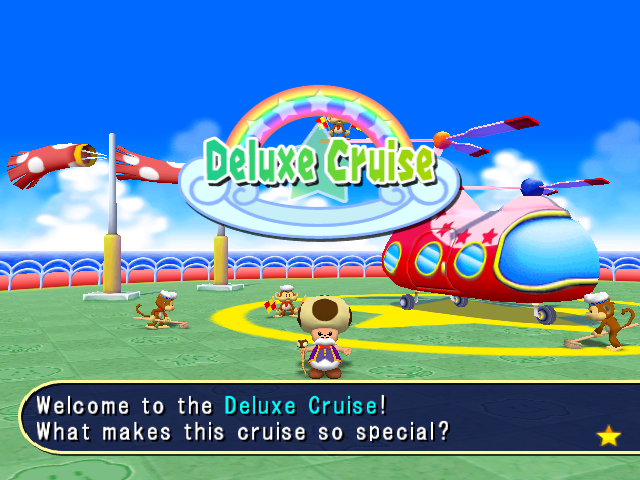
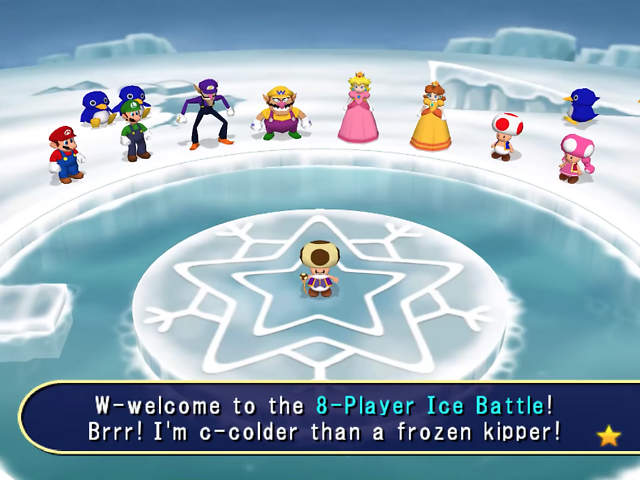
The eight-player deck. 8-Player Free Play offers the twelve 8-Player minigames, all open from the start. 8-Player Ice Battle turns them into a race: each win adds blocks of ice to your bridge across a frozen sea, and the first to reach the island in the middle wins. It comes in three versions. Battle Royale uses the six survival games, with all eight players for themselves. Team Battles uses the six team games, pair against pair. Combined Battles uses all twelve.
Toadsworth introduces Deluxe Cruise.
Minigame Cruise
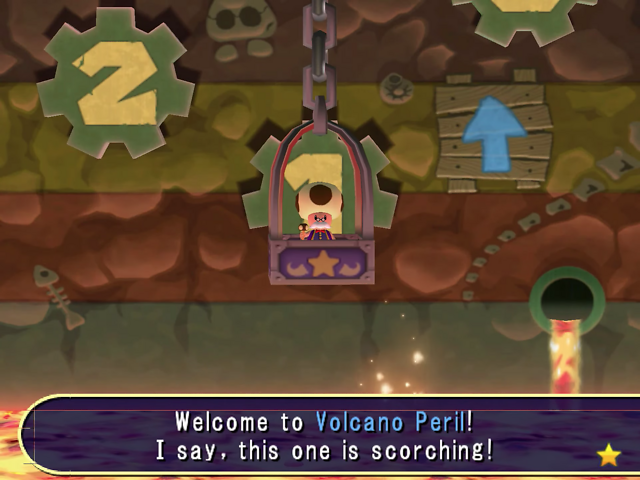
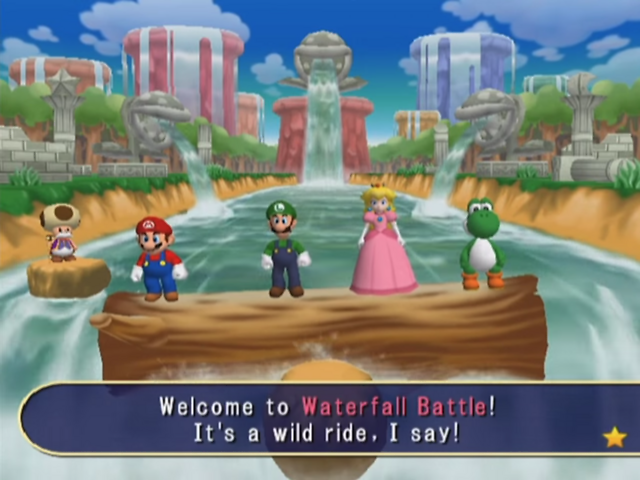
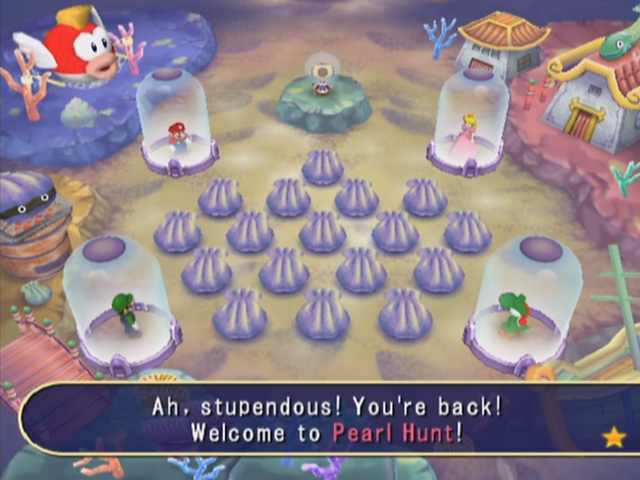
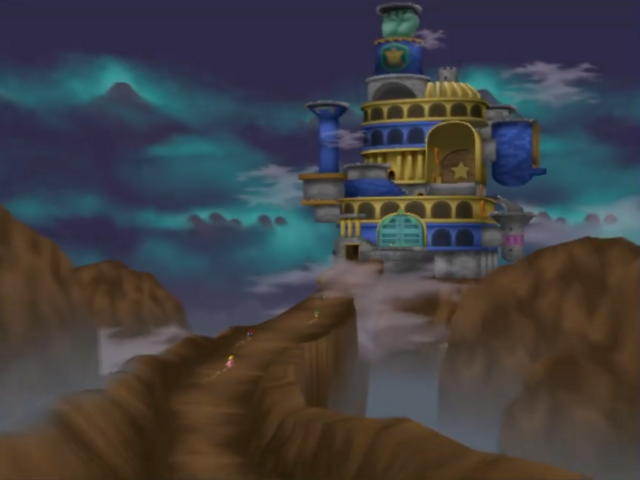
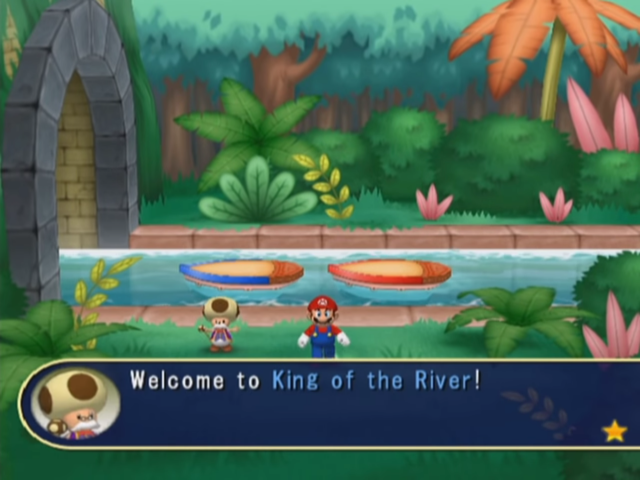
Up to four players can replay any minigame they have met in Party Cruise or Solo Cruise, aboard the Free Play Sub or in five games built round them. In Volcano Peril the first to three, five or seven wins escapes an erupting volcano. Waterfall Battle is a duelling ladder at the lip of a waterfall: beat the other three in a row, and if you lose, the players you knocked out come back. In Pearl Hunt the winner of each minigame opens a shell, looking for three pearls marked with their own face. Decathlon Castle plays ten fixed minigames for points, with 1,000 the ceiling according to the wiki, and keeps your records. King of the River, for one player, is an endurance run down a river with three lives, a Koopa Kid ambush every few stages and three levels of difficulty.
Volcano Peril.Waterfall Battle.Pearl Hunt.Decathlon Castle.King of the River.
The Duty-Free Shop and Control Room
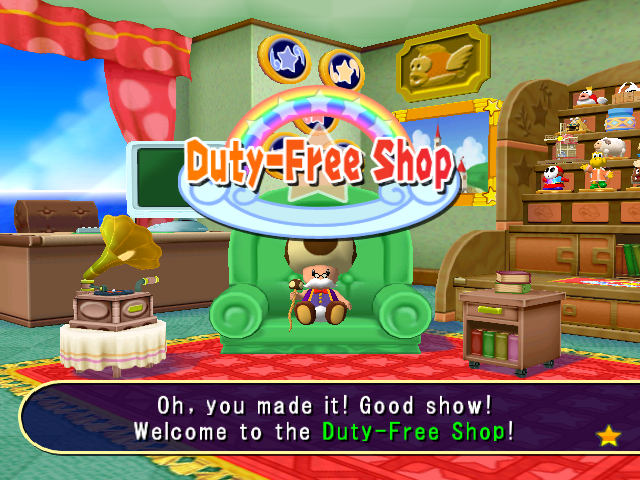
Everything you play earns Cruise Mileage Points, and the Duty-Free Shop is where they are spent: on the two hidden characters, the Brutal difficulty level, two rare minigames, King of the River, sound tests and a shelf of souvenirs, four for each port, from Grand Canal Cookies to Bowser’s Boiled Eggs. The shop also keeps your records in a Travel Diary. The Control Room looks after rumble, sound output and the Microphone.
The Duty-Free Shop.
Every board in Mario Party 7
The six boards in cruise order, each with its Party Cruise rule for winning Stars. The first five are open from the start.
Grand CanalVenice · 70 spaces · Stars: 20 coins at a moving Star SpaceGondola rides, a juggling Blooper with four chests and a tower that tips you into the canal.
Pagoda PeakChina · 42 spaces · Stars: from Koopa Master at the summit for 10, 20, 30, then 40 coinsOne path up a mountain, a gong that changes the price and a dragon that sends you back down.
Pyramid ParkEgypt · Stars: everyone starts with five and steals them by Chain ChompRide a Chain Chomp for 10 or 20 coins, and beware the curse of the Bowser Sphinx.
Neon HeightsUnited States · Stars: in one of three chests, 10 coins a try20 coins, a Star or a Bob-omb, with a film set, a ballpark and a rocket for side bets.
WindmillvilleThe Netherlands · Stars: 11, held by whoever has invested most in each of seven windmillsOutbid your rivals for the mills; 100 coins makes one yours for keeps.
Bowser’s Enchanted Inferno!Bowser’s theme park · Stars: 20 coins · unlocked by clearing Solo CruiseFour islands in lava, and every five turns Bowser sinks the one with the Star on it.
Each board also has a cut-down Solo Cruise layout with a goal of its own, described under Solo Cruise above.
Advertisement
Gameplay & Controls
Underneath the holiday snaps this is recognisably the Mario Party that Hudson had been refining on the GameCube since Mario Party 4. What is new is that every board has a Star rule of its own, Bowser keeps a timetable, and the box of tricks runs to 29 Orbs.
How a game works
A Party Cruise lasts from 10 to 50 turns, set in steps of five. Everyone rolls a Dice Block numbered 1 to 10, moves, and takes the consequences of the space they stop on; then all four play a minigame. The player or team with the most Stars at the end wins.
There are three ways to divide the table. Battle Royale is four players, every one for themselves. Tag Battle is two teams of two, and in this game alone the partners travel round the board together as a single piece instead of separately. 4-Team Battle puts eight players into four pairs. Team-mates share their Orbs, Stars and coins.
Before the winner is announced the game may hand out Bonus Stars. Six exist, where no earlier game had offered more than three: the Minigame Star (most minigames won), the Action Star (most Green Spaces), the Orb Star (most Orbs used), the Shopping Star (most coins spent on Orbs), the Red Star (most Red Spaces) and the Running Star (most spaces moved). Only three are awarded in any one game and, by Wikipedia’s account, which three is random.
With four turns to go there is a last-four-turns event, a roulette whose results can treble the value of Blue and Red Spaces or cut the price of Stars. Other settings: computer players come in Weak, Normal, Hard and an unlockable Brutal; a handicap can start chosen players with up to nine Stars; and the minigames can be limited to an Easy, Action, Skill or Weird set.
The Party Cruise character select, with all twelve unlocked.
The spaces
These are the spaces of Party Cruise. Blue and Red Spaces give and take 3 coins. Green Spaces set off whatever event belongs to that corner of the board. A Duel Space lets you call out a rival for a Duel minigame, after which the winner spins a wheel for the loser’s coins or Stars, or for nothing at all if it stops on the red cross. On a Mic Space Toadsworth offers a microphone game on which you can stake coins and double them.
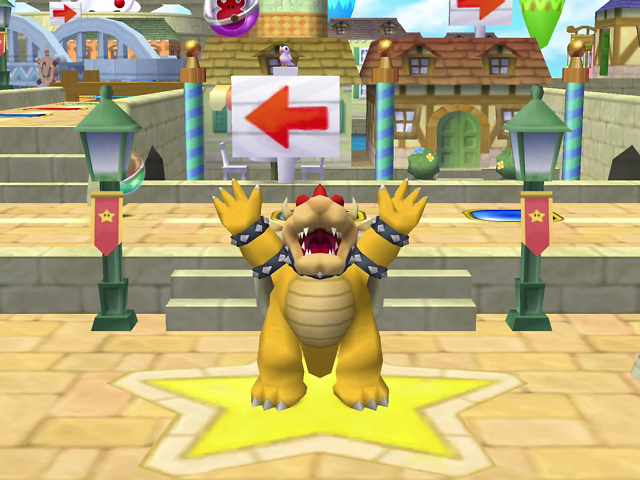
A DK Space brings Donkey Kong, either with a one-player minigame that pays coins or a Star, or with a banana hunt for everybody. A Bowser Space brings his opposite number, with a timed ordeal for one player or a race for all four, and coins or a Star for the losers to forfeit; if you arrive penniless he gives you ten coins instead. Koopa Kid Spaces appear when a Koopa Kid Orb is thrown and trigger events such as Bowser Revolution and Bowser Shuffle. Any Blue or Red Space on which a player has planted an Orb becomes that player’s Character Space.
Chance Time, a fixture since the first game, is missing: according to Super Mario Wiki this is the first numbered Mario Party without it or anything like it. The wiki also notes a small mercy, that the Star Space can no longer appear directly under a player.
Blue Space.Red Space.Green Space.Mic Space.Duel Space.DK Space.Koopa Kid Space.Bowser Space.A Character Space (Mario’s).Coin Block Area, found only in Solo Cruise.
Orbs: five kinds, colour-coded
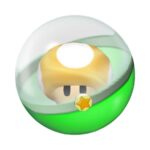
Orbs are this game’s items. They are bought at the Orb shop on each board, picked up by passing an Orb Space, or won in some Green Space events, and a player can carry three (a team, six). Each sits in a coloured shell that tells you what sort it is. Self Orbs (green) are used on yourself. Thrown Orbs (yellow) are tossed on to a Blue or Red Space ahead, turning it into your Character Space; a rival who stops there suffers the effect, and if you land on it yourself you collect 5 coins. Roadblock Orbs (red) go off once, the moment a rival passes over them. Character Orbs (blue) belong to one pair of characters. And the violet Koopa Kid Orb cannot be carried at all: it is thrown the instant it is received.
Not every Orb is sold everywhere. Each board stocks its own selection, and five are sold on one board only: the Cannon Orb and Bob-omb Orb on Pagoda Peak, the Lakitu Orb on Neon Heights, the Snack Orb on Pyramid Park and the Bandit Orb on Windmillville. The full list is below.
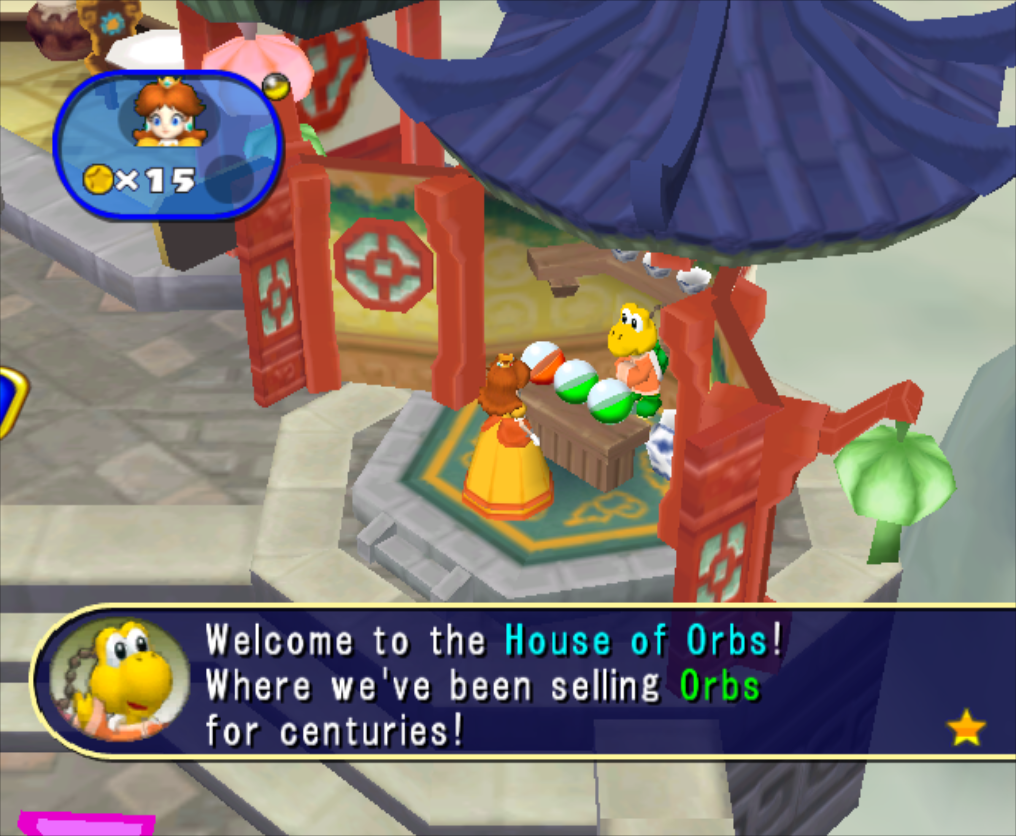
A Kung Fu Koopa keeps the Orb shop on Pagoda Peak.At the start of a Party Cruise game Bowser scatters three Koopa Kid Orbs across the board.
Bowser Time
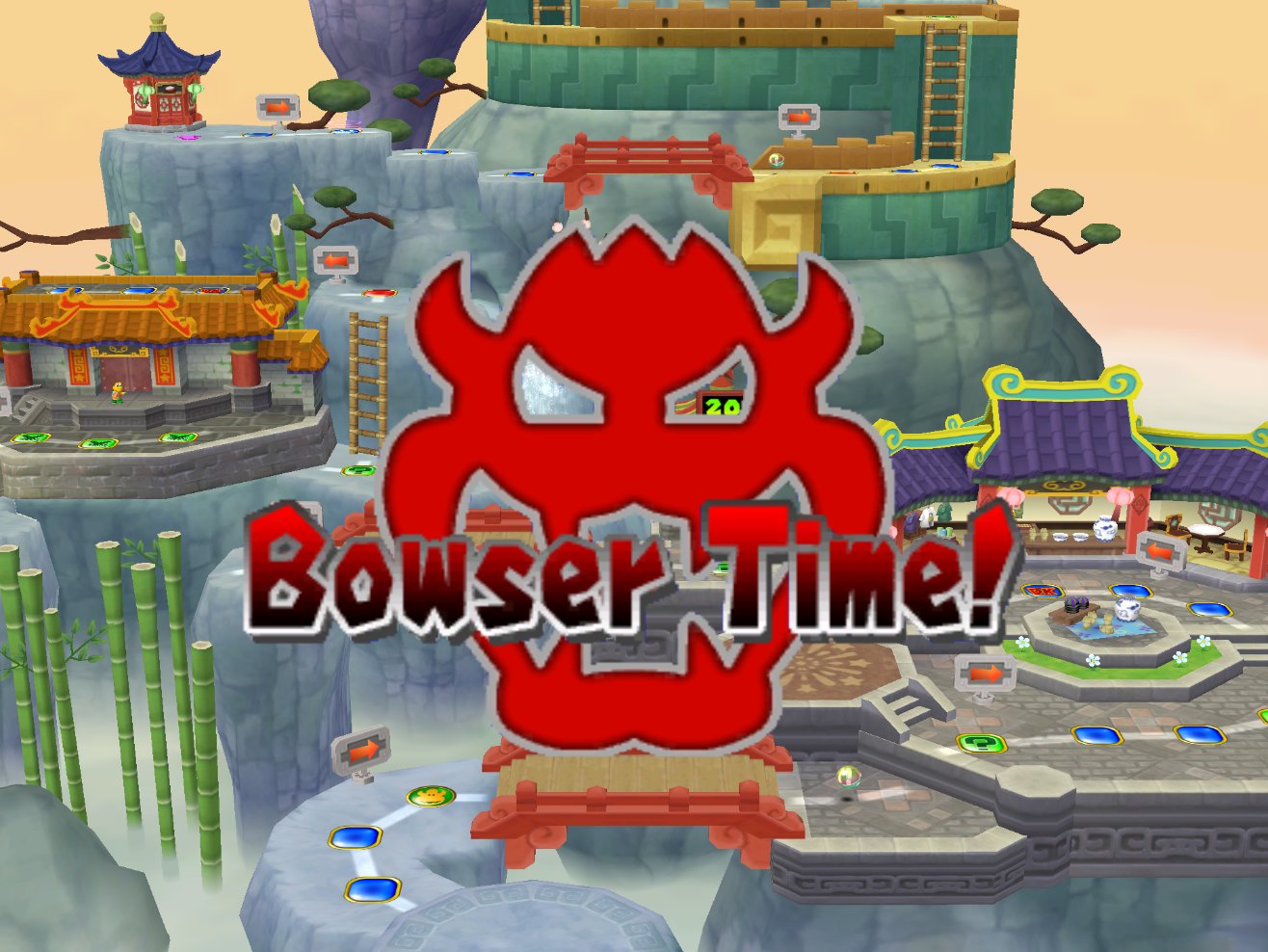
The pause screen in Party Cruise shows a gauge in the shape of Bowser’s emblem. It starts empty and rises by 20 per cent after each minigame, so it is full every five turns, and when it is, Bowser arrives and the gauge resets. It stops filling in the last four turns, which means a game has between one and nine Bowser Times depending on its length. There is none in Solo Cruise.
What he does depends on where you are. On every board but his own he may line the players up for a souvenir photograph, charge each of them 10 or 20 coins and never deliver it; on Grand Canal, Pagoda Peak and Pyramid Park he may instead turn an Orb shop into Bowser City, where a Koopa Kid makes you pay 20 coins for something you did not want. The rest is local: he blows up the bridges of Grand Canal, shakes players down Pagoda Peak, gives the leader’s Star to a Koopa Kid on Pyramid Park, tampers with the chests on Neon Heights, flattens a windmill in Windmillville and sinks an entire island on his own board.
In PAL versions the event is called Bowser Party.
The Bowser Time! banner.The same banner in European copies: Bowser Party!The Bowser Time gauge on Pagoda Peak.Bowser Time on Grand Canal.
Eight players, four controllers
The GameCube has four controller ports, so Hudson made each pad seat two. In the eight-player modes one partner holds the left side of the controller and plays with the L Button and Control Stick, and the other takes the right side with the R Button and C Stick. On the boards, in a 4-Team Battle, team-mates take it in turns to play each move.
The twelve 8-Player minigames are written around that one-button, one-stick limit. Six are survival games for all eight at once, such as Grin and Bar It, where L and R are simply “jump” for the two partners. The other six set pair against pair, as in Synch-row-nicity, a rowing race that only goes well when both halves of the controller pull together. All twelve are available from the start in Deluxe Cruise, the mode built for them.
Teams are no longer given names to suit the pairing, as they were in Mario Party 5 and 6. They are simply Team Dolphin, Team Seagull, Team Tuna and Team Mollusk, in that order.
The four team pictures.Toadsworth welcomes eight players to Ice Battle.
The Microphone
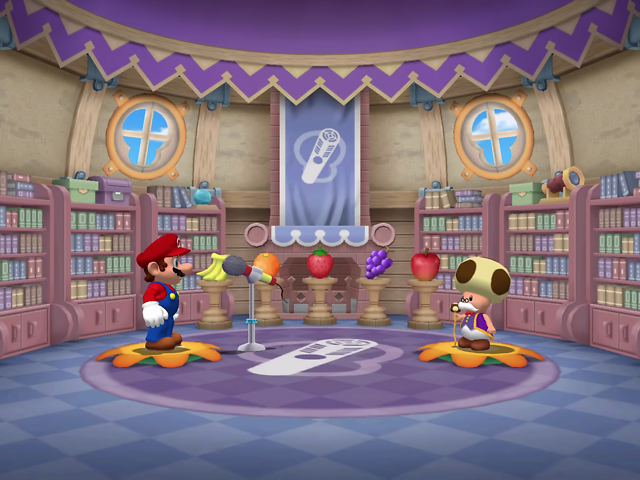
Like Mario Party 6, the game was sold with the GameCube Microphone in the box, and Super Mario Wiki notes that this sequel leans on it more than its predecessor did. Five of the four-player minigames and five of the one-against-three games are played by voice. In the latter it is always the lone player who has the Mic, calling down Thwomps, sharks or Bullet Bills on the other three by name.
On the boards the Mic Space offers a gamble, and in the Duty-Free Shop you can say “Surprise” to your souvenirs to set them off. The Control Room has a Mic test and three settings: on, off, or a menu on the R Button that lets you pick the spoken commands from a list instead.
The bonus Mic game.The North American box, with the Mic included.
Every Orb in Mario Party 7
All 29, in Super Mario Wiki’s order: eight Self Orbs, eight Thrown Orbs, six Roadblock Orbs, six Character Orbs and the Koopa Kid Orb. The wiki gives a shop price only for the Character Orbs, 15 coins each. Effects are from the wiki’s table and StrategyWiki’s guide.
Mushroom OrbSelf. Roll two Dice Blocks. Sold on every board.
Super ’Shroom OrbSelf. Roll three Dice Blocks. On every board except Windmillville.
Slow ’Shroom OrbSelf. The Dice Block turns slowly enough to pick your number. Not on Pagoda Peak or Pyramid Park.
Metal Mushroom OrbSelf. Turns you to metal for the move, so rivals’ traps do nothing. Pagoda Peak, Windmillville and the Inferno.
Flutter OrbSelf. Flutter carries you straight to the Star, which you still have to pay for. Grand Canal and the Inferno.
Cannon OrbSelf. Fires you to the upper reaches of the mountain. Pagoda Peak only.
Lakitu OrbSelf. Lakitu fetches you one of the treasure chests. Neon Heights only.
Snack OrbSelf. Buys off one Chain Chomp raid on your Stars; lasts three turns. Pyramid Park only.
Hammer Bro OrbThrown. A rival who lands here pays you 10 coins. Not on Pyramid Park or the Inferno.
Piranha Plant OrbThrown. Takes half the coins of whoever lands on it. Not on Pagoda Peak or Windmillville.
Spear Guy OrbThrown. The victim pays you whatever a Dice Block shows. Not on Grand Canal or Neon Heights.
Kamek OrbThrown. Lets you take over up to three of the victim’s Character Spaces. Pagoda Peak, Pyramid Park and Windmillville.
Toady OrbThrown. Steals an Orb from whoever lands on it. Pyramid Park and Neon Heights.
Mr. Blizzard OrbThrown. The victim loses every Orb they are carrying. Grand Canal and the Inferno.
Bandit OrbThrown. Bandit raids the coins the victim has invested in a windmill. Windmillville only.
Pink Boo OrbThrown. Costs the victim a Star, or 20 coins if they have none. Not on Pagoda Peak or Windmillville.
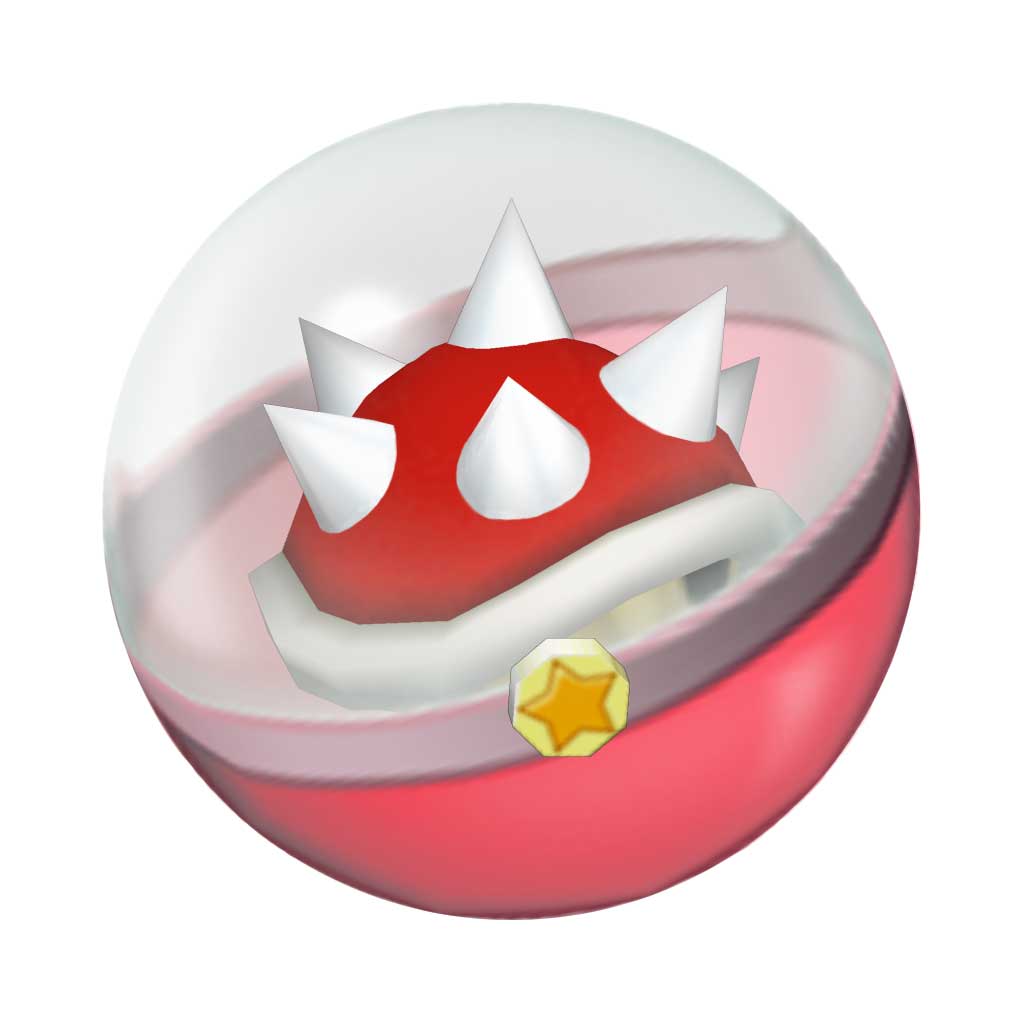
Spiny OrbRoadblock. A rival who passes it loses 10 coins. Not on Pagoda Peak or Neon Heights.
Zap OrbRoadblock. Costs a rival 3 coins for every space they travel after crossing it. Pagoda Peak, Neon Heights and Windmillville.
Tweester OrbRoadblock. Whirls a passing rival away to another space. Grand Canal, Pyramid Park and the Inferno.
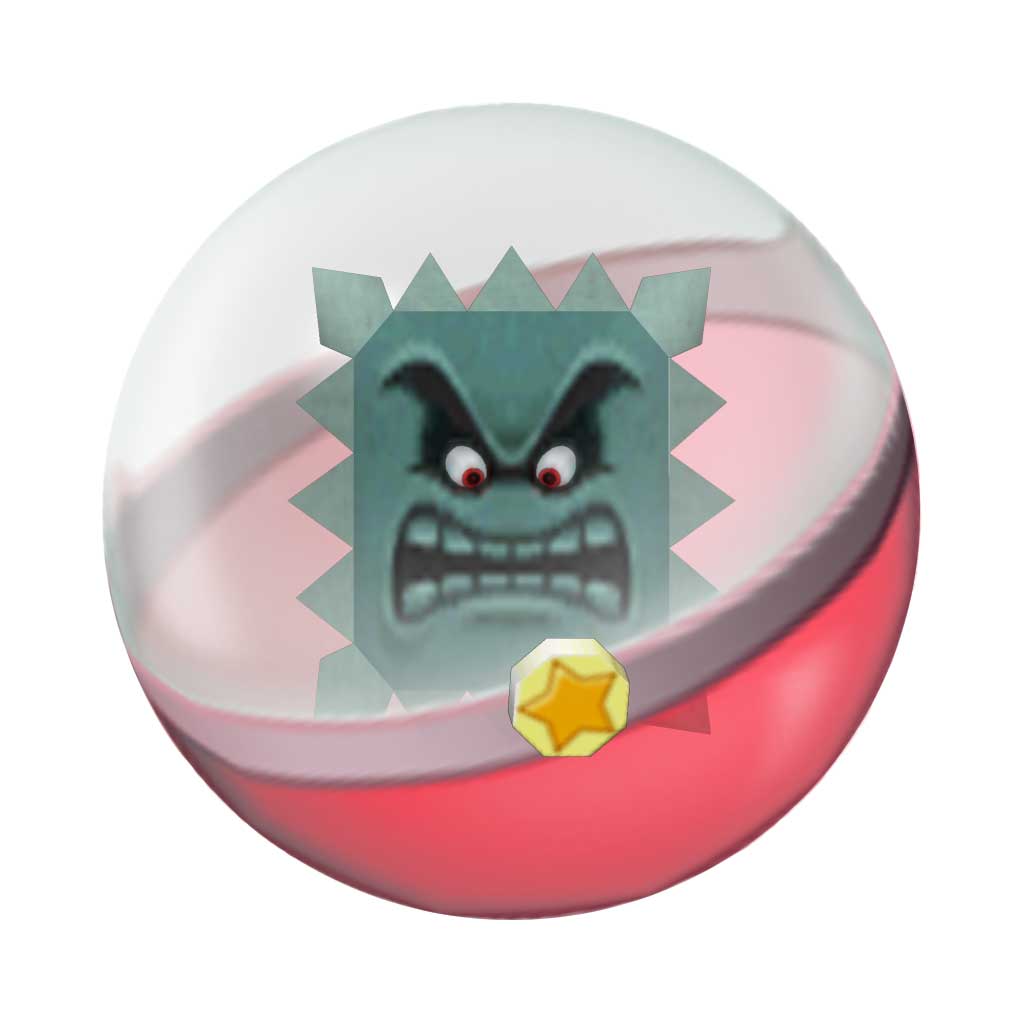
Thwomp OrbRoadblock. Flattens a passing rival and ends their move on the spot. Pyramid Park, Neon Heights and Windmillville.
Warp Pipe OrbRoadblock. Sends a rival back to the space they set out from. Pagoda Peak and Neon Heights.
Bob-omb OrbRoadblock. Blasts rivals back down the mountain. Pagoda Peak only.
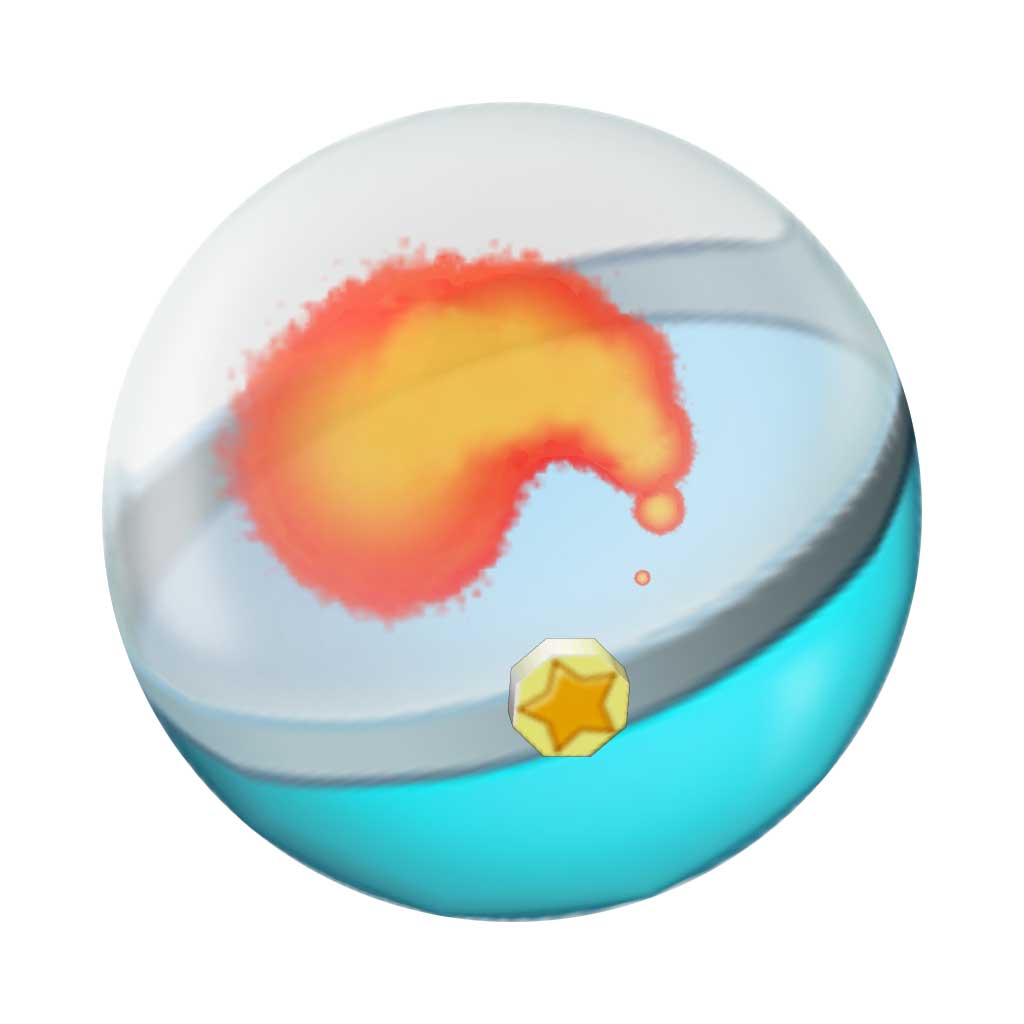
Fireball OrbCharacter: Mario and Luigi. Burn the rivals you pass and take their coins. StrategyWiki puts it at 10 coins a head for three turns.
Flower OrbCharacter: Peach and Daisy. The spaces ahead bloom into flowers: you skip every trap and earn 3 coins for each space you cross.
Egg OrbCharacter: Yoshi and Birdo. Swallow the Character Spaces and roadblocks in your path, which turn into eggs and then into Orbs of your own.
Vacuum OrbCharacter: Wario and Waluigi. Spin a wheel and hoover that many coins out of your opponents.
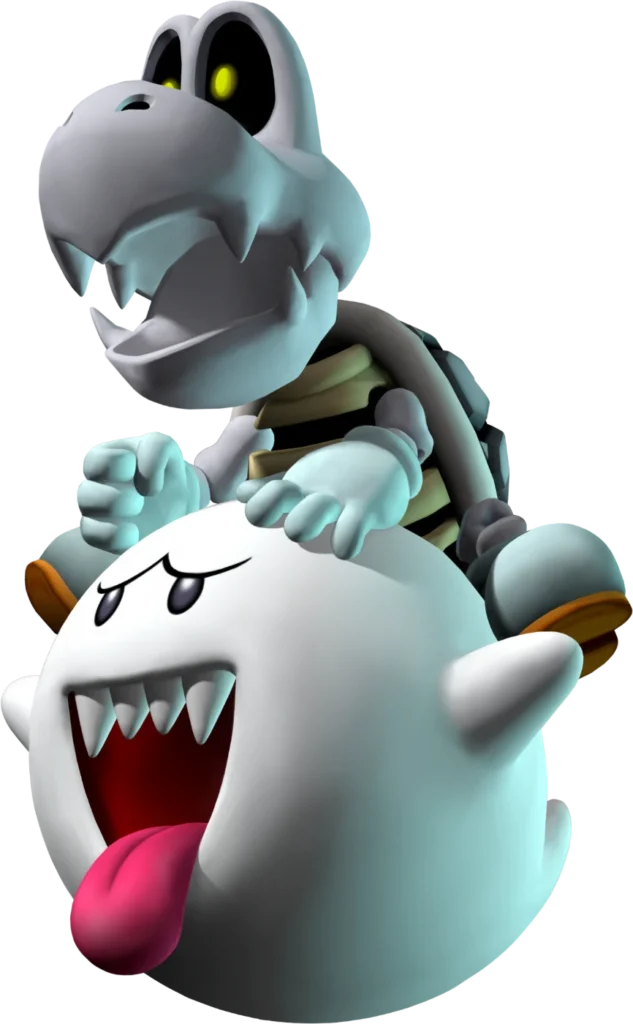
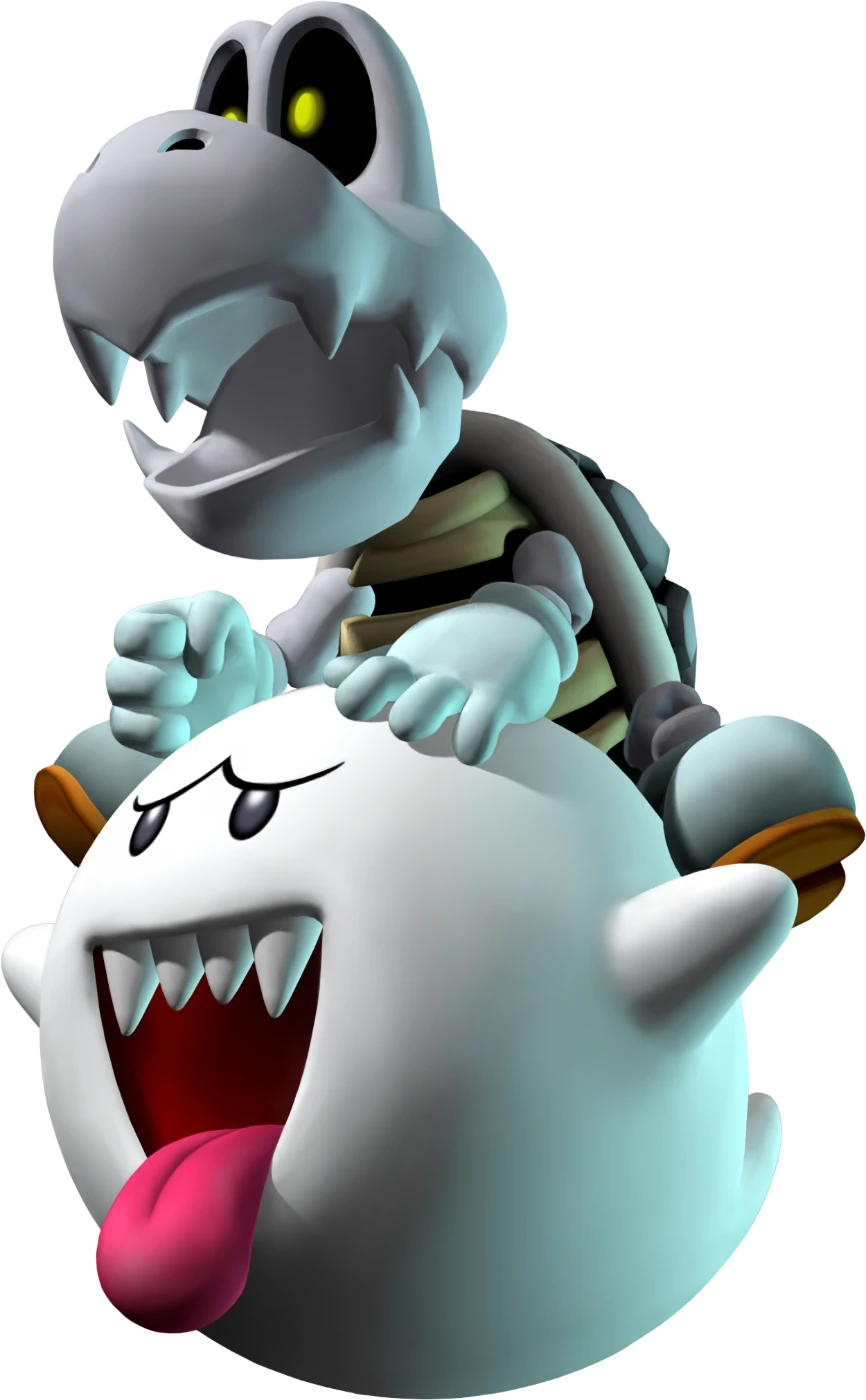
Magic OrbCharacter: Boo and Dry Bones. Vanish, and roll double Dice Blocks, for two turns.
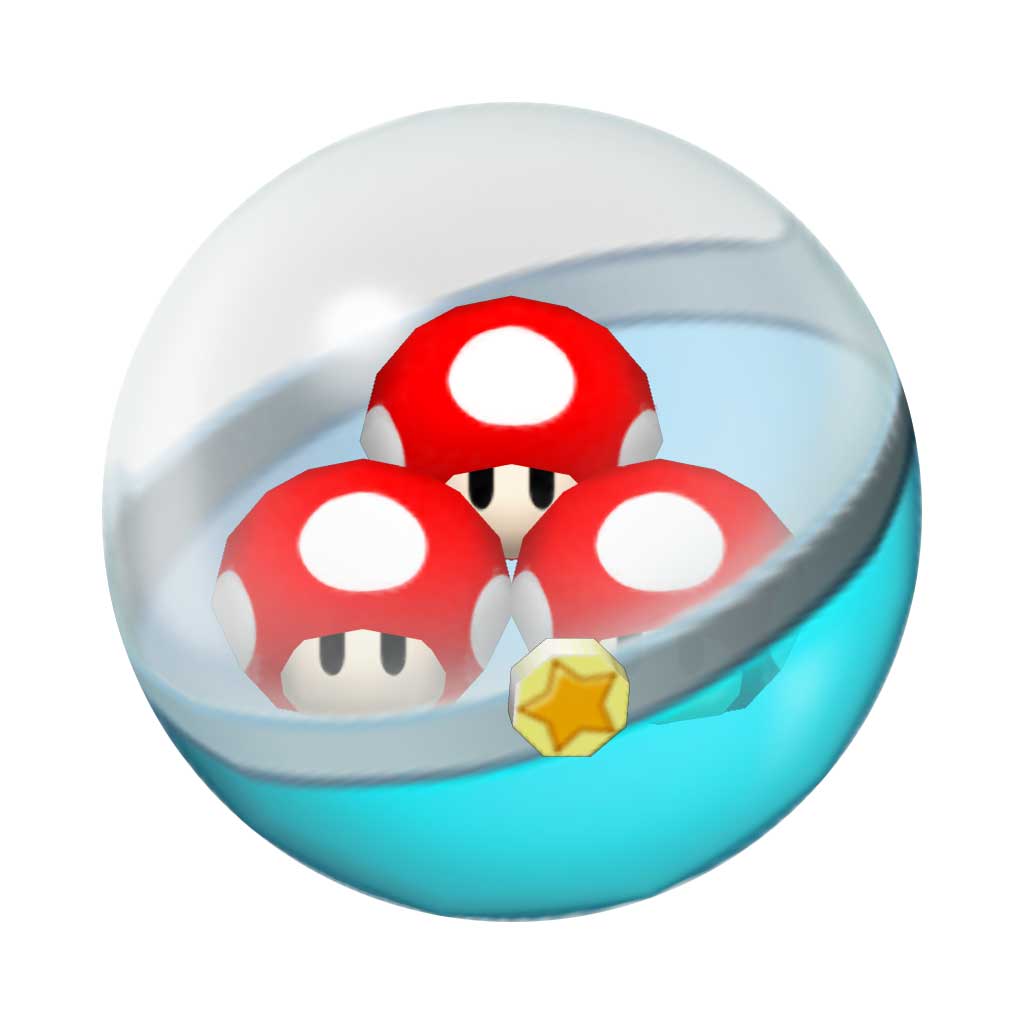
Triple ’Shroom OrbCharacter: Toad and Toadette. Double Dice Blocks for three turns running.
Koopa Kid OrbOther. Cannot be bought or kept. Koopa Kid appears and turns a space into a Koopa Kid Space.
Cartoons, Comics & Other Media
Mario Party 7 had a small promotional campaign of its own, and its artwork and minigames have turned up in a surprising number of later games.
Bowser’s Lair HockeyBrowser game · 2005Nintendo promoted the game with an air hockey game on its official site and the Nintendo Arcade page. You played Toad, labelled NICE, against Bowser, labelled MEAN, and the higher score after sixty seconds won.
Tomy finger puppetsMerchandise · 2005Tomy marked the launch with a set of finger puppets of Mario, Luigi, Peach, Yoshi, Wario, Daisy, Waluigi, Toad, Boo, Bowser and Donkey Kong.
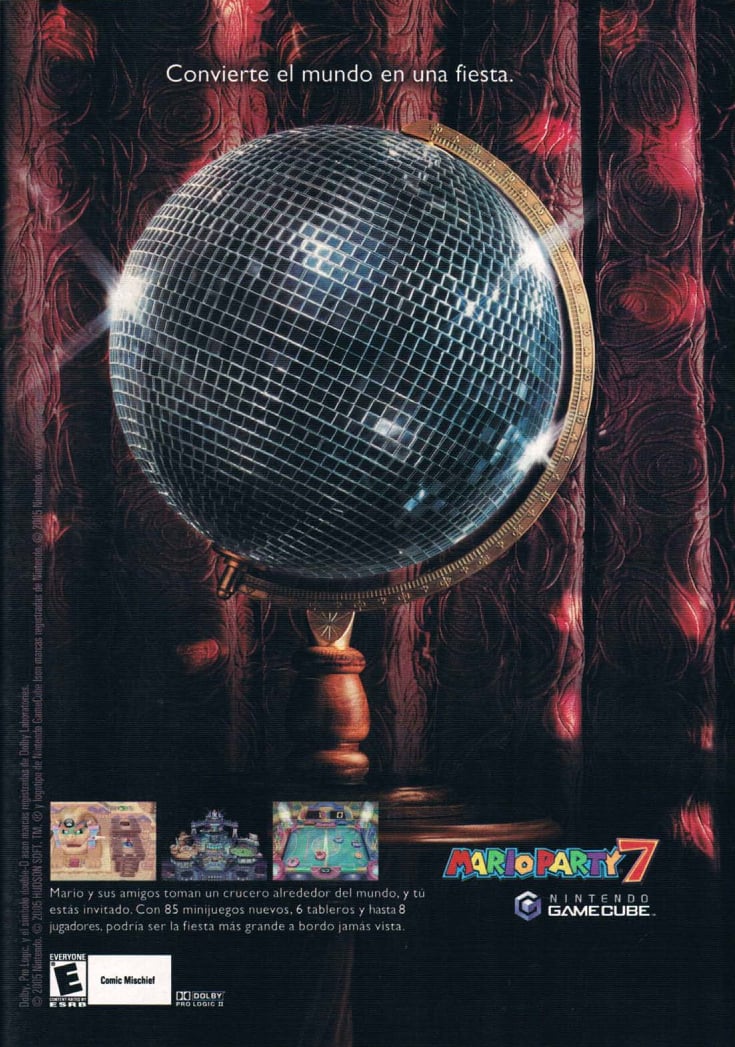
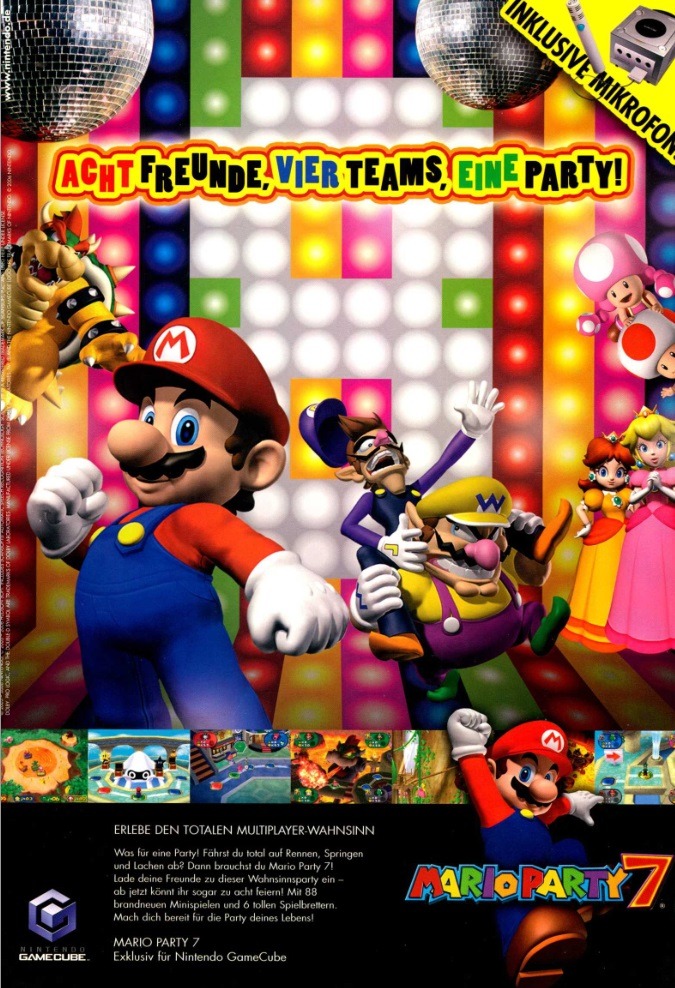
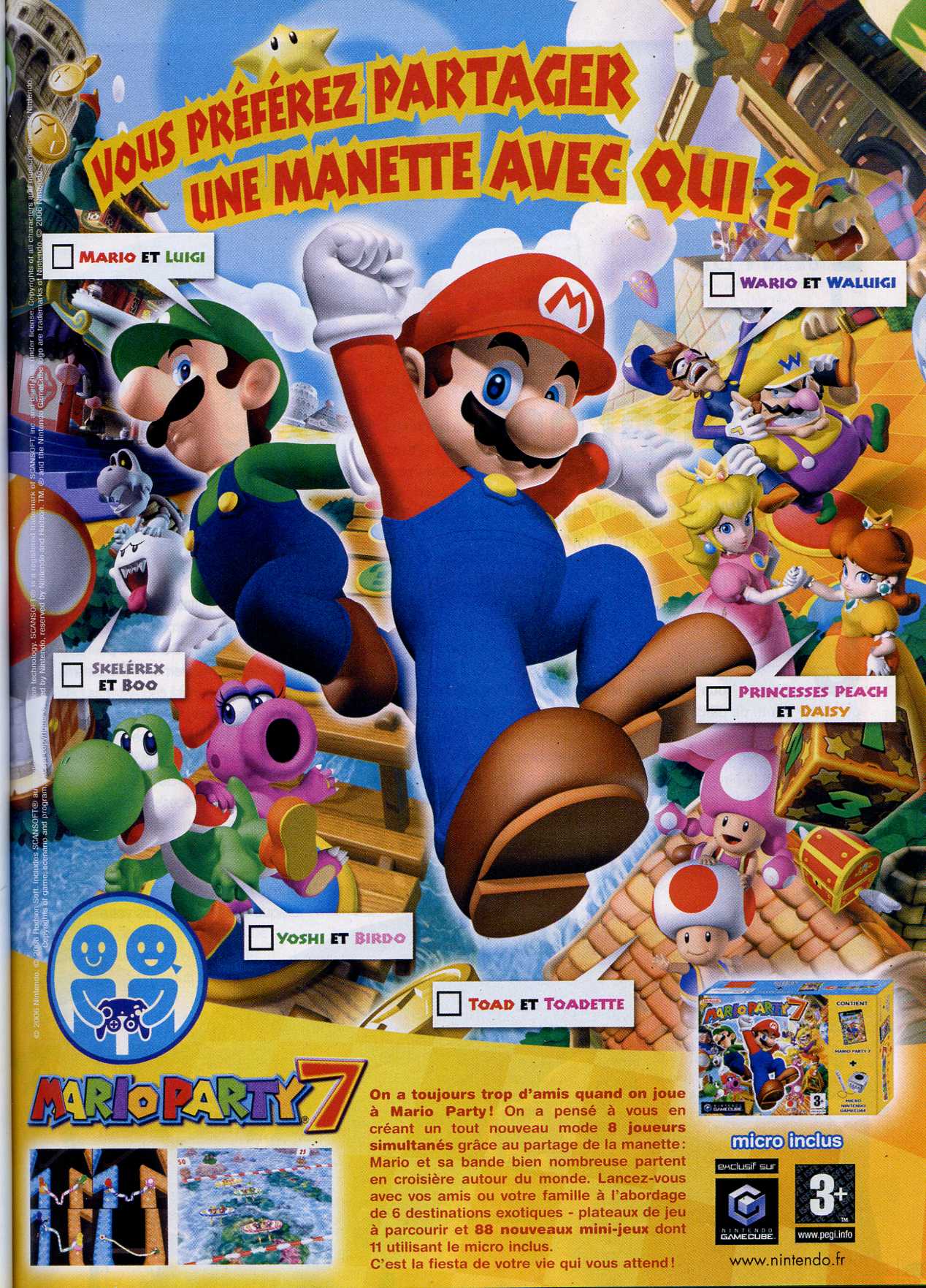
Print advertsMagazines · 2005–2006Super Mario Wiki archives magazine adverts from North America, Mexico, Germany and France.
Mario Party 8Wii · 2007Koopa’s Tycoon Town reuses Windmillville’s rule: invest coins in a building and its Stars are yours until somebody invests more.
Mario Kart WiiWii · 2008The “Showtime!” billboard on Bowser’s Castle shows Boo and Dry Bones in their team artwork from this game, and Toadette’s artwork is reused with a kart added.
Super Smash Bros.Brawl (2008), for Wii U (2014), Ultimate (2018)Brawl has stickers of this game’s Dry Bones and Toad artwork and of the Peach-and-Daisy and Toad-and-Toadette team pictures. Birdo’s spirit in Ultimate uses her Mario Party 7 artwork, and the picture shown after clearing Classic Mode as Rosalina on Wii U echoes the Peach-and-Daisy pose.
Wii PartyWii · 2010Its minigame Stop Watchers is based on Clock Watchers, the Mic game in which you stop a hidden clock by counting in your head.
Mario Party DSNintendo DS · 2007The rare puzzle minigame Stick and Spin made its first return here.
Mario Party: The Top 100Nintendo 3DS · 2017Twelve minigames return: Balloon Busters, Dart Attack, Deck Hands, Jump, Man, Monty’s Revenge, Pogo-a-Go-Go, Pokey Pummel, Sphere Factor, Stick and Spin, The Final Countdown, Track & Yield and Vine Country.
Mario Party SuperstarsNintendo Switch · 2021Six minigames carry the Mario Party 7 logo: Monty’s Revenge, The Final Countdown, Pokey Pummel, Pogo-a-Go-Go, Spin Doctor and Stick and Spin. Toadette’s artwork in that game is an update of her picture from this one.
Characters
Twelve playable characters, ten from the start and two to buy. As ever they all play alike on the boards. What sets them apart in this game is their default partner: the cast is sorted into six fixed pairs, each with an official team portrait and a Character Orb that only those two can use. The hosts and troublemakers follow.
Character
Who they are
In this game
Abilities & notes
MarioPlayable
The guest of honour: it is Mario whom Toadsworth meets on his morning walk and invites on the cruise.
Paired with Luigi. Appears alone on the unused early title screen.
Partner: Luigi. Character Orb: Fireball. Voice: Charles Martinet.
LuigiPlayable
Mario’s brother and default team-mate.
Shares the Fireball Orb, which burns coins out of the rivals the brothers pass.
Partner: Mario. Character Orb: Fireball. Voice: Charles Martinet.
Princess PeachPlayable
One half of the princess team.
Paired with Daisy. Their team portrait was reused as a sticker in Super Smash Bros. Brawl.
Partner: Daisy. Character Orb: Flower. Voice: Jen Taylor.
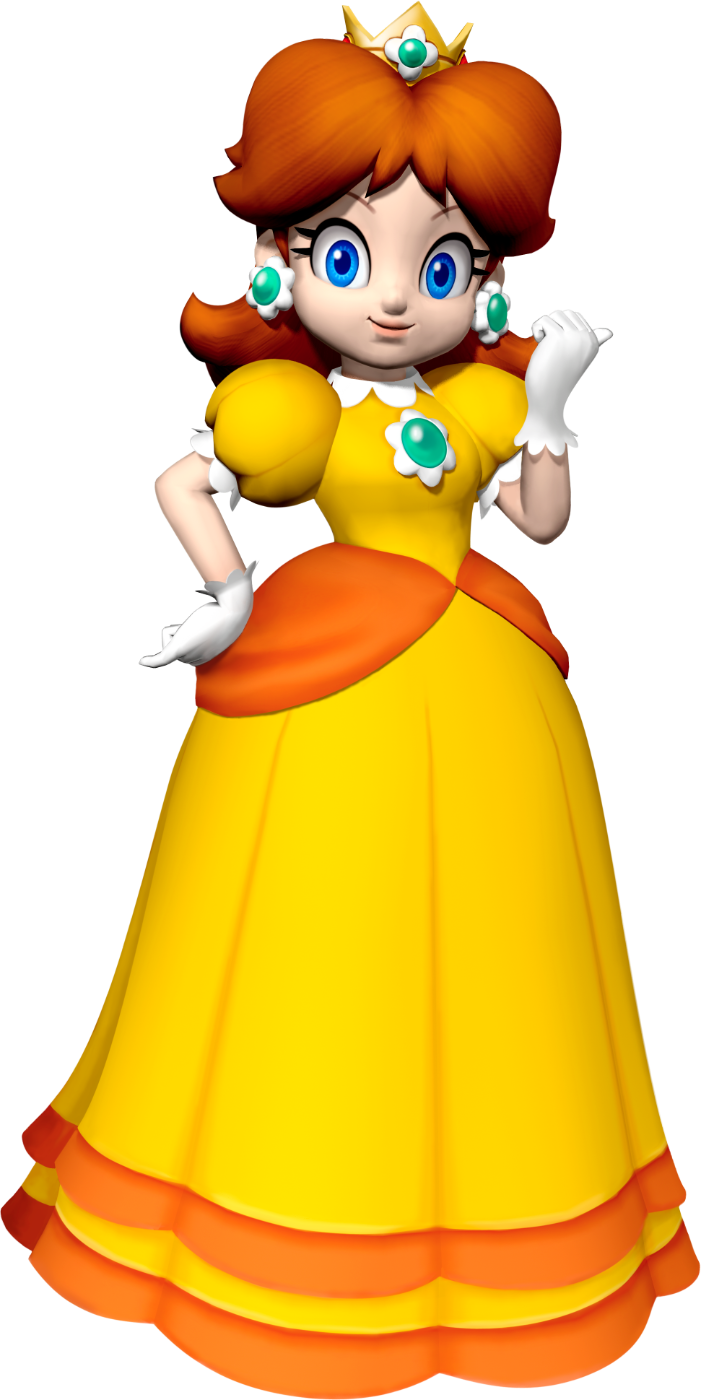
Princess DaisyPlayable
Peach’s default partner.
Shares the Flower Orb: no traps, and 3 coins for every space crossed.
Partner: Peach. Character Orb: Flower. Voice: Deanna Mustard.
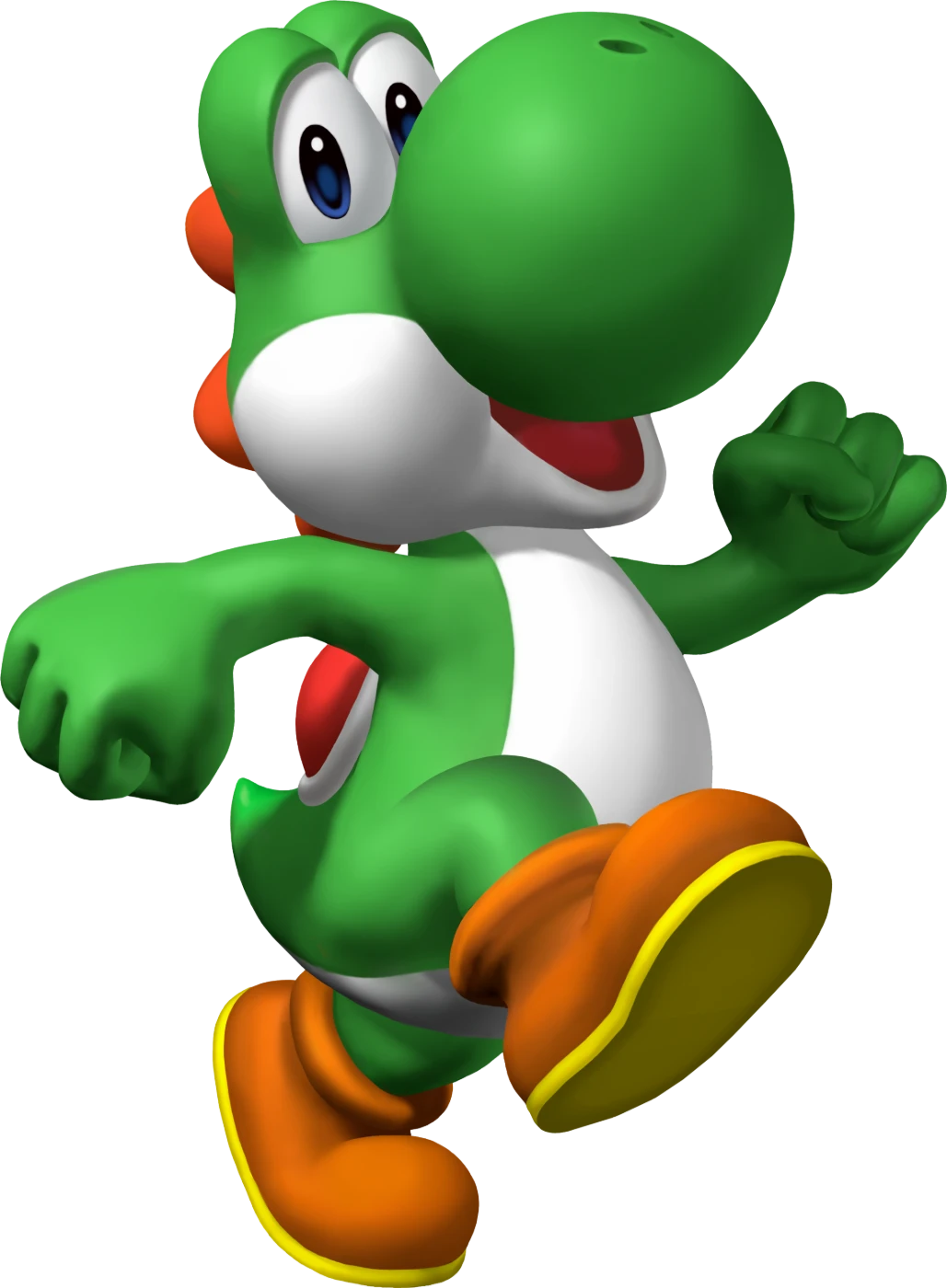
YoshiPlayable
Teamed with the newcomer Birdo.
With the Egg Orb he eats the traps in his path and turns them into Orbs of his own.
Partner: Birdo. Character Orb: Egg. Voice: Kazumi Totaka.
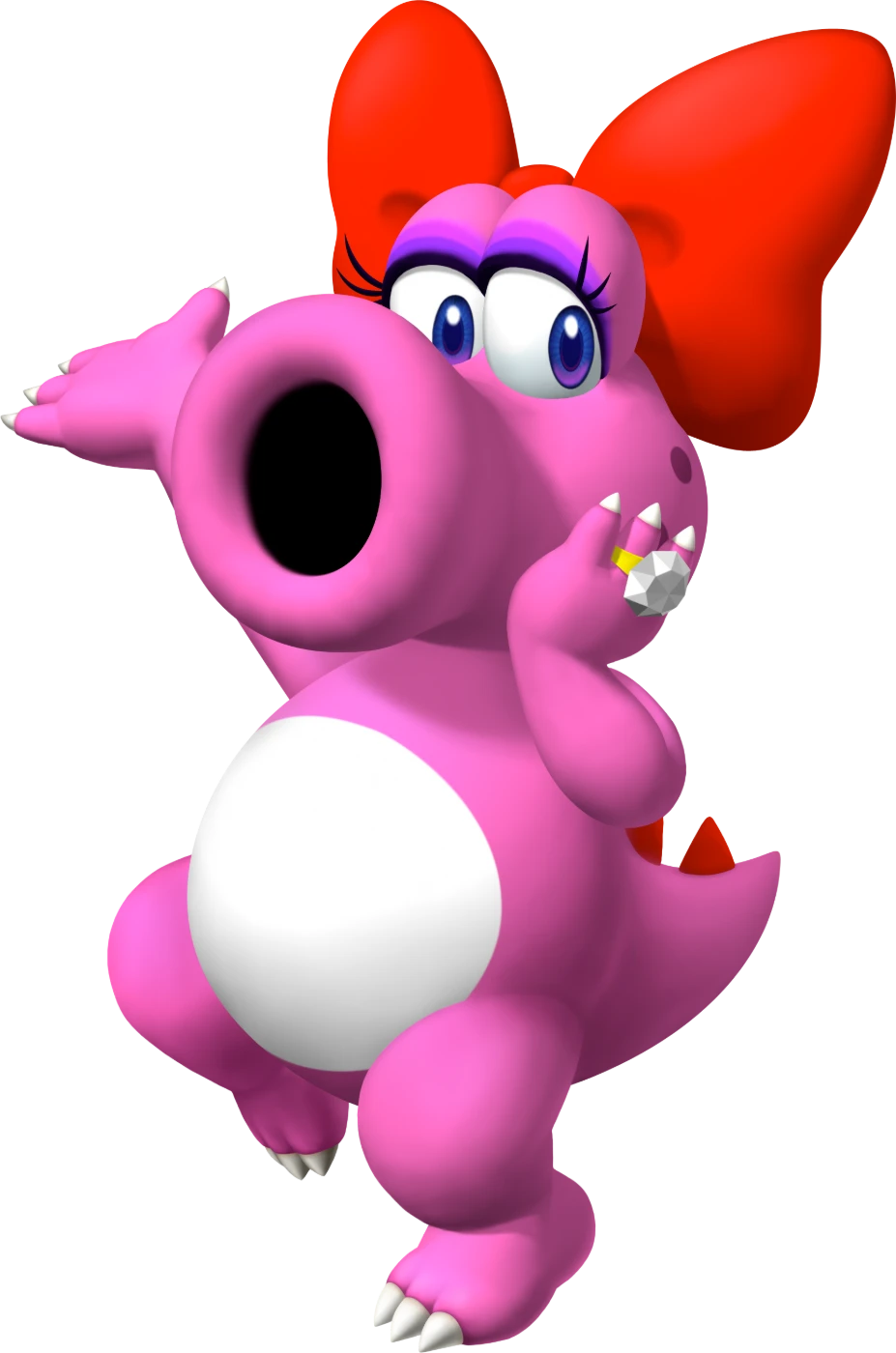
BirdoPlayable · new to the series · unlockable
Playable in a Mario Party for the first time.
Bought at the Duty-Free Shop. Her artwork for this game later became her spirit in Super Smash Bros. Ultimate.
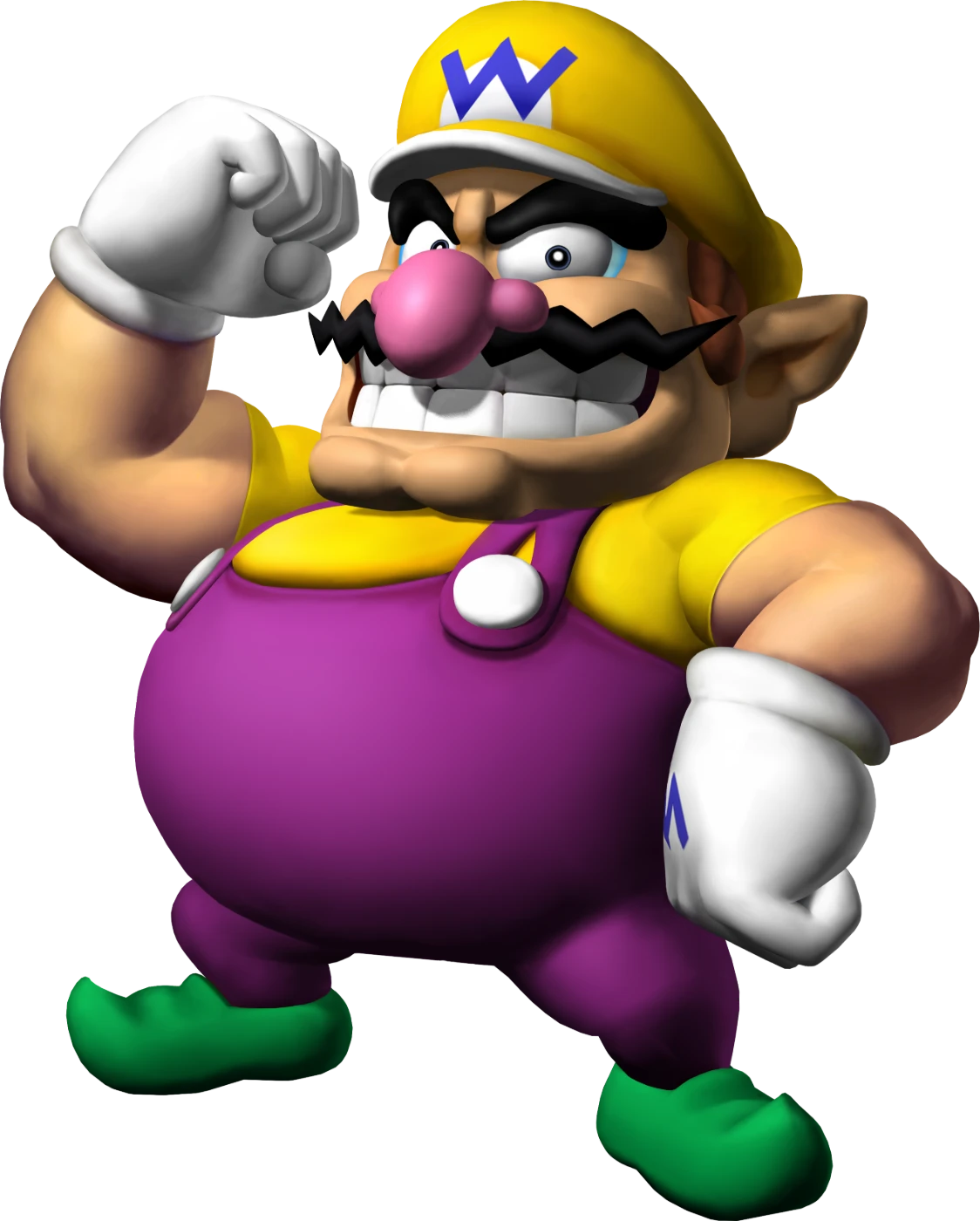
The Vacuum Orb suits him: spin a wheel and suck that many coins out of everybody else.
Partner: Waluigi. Character Orb: Vacuum. Voice: Charles Martinet.
WaluigiPlayable
Wario’s default partner.
Shares the Vacuum Orb.
Partner: Wario. Character Orb: Vacuum. Voice: Charles Martinet.
ToadPlayable
One of the ten characters available from the start.
Paired with Toadette. Stars in the promotional browser game Bowser’s Lair Hockey.
Partner: Toadette. Character Orb: Triple ’Shroom. Voice: Jen Taylor.
ToadettePlayable
Back from Mario Party 6 as Toad’s partner.
Her artwork here was reused in Mario Kart Wii and redrawn for Mario Party Superstars.
Partner: Toad. Character Orb: Triple ’Shroom. Voice: Jen Taylor.
BooPlayable
The ghost of the party, teamed with the newcomer Dry Bones.
The pair’s portrait hangs on a billboard in Mario Kart Wii.
Partner: Dry Bones. Character Orb: Magic.
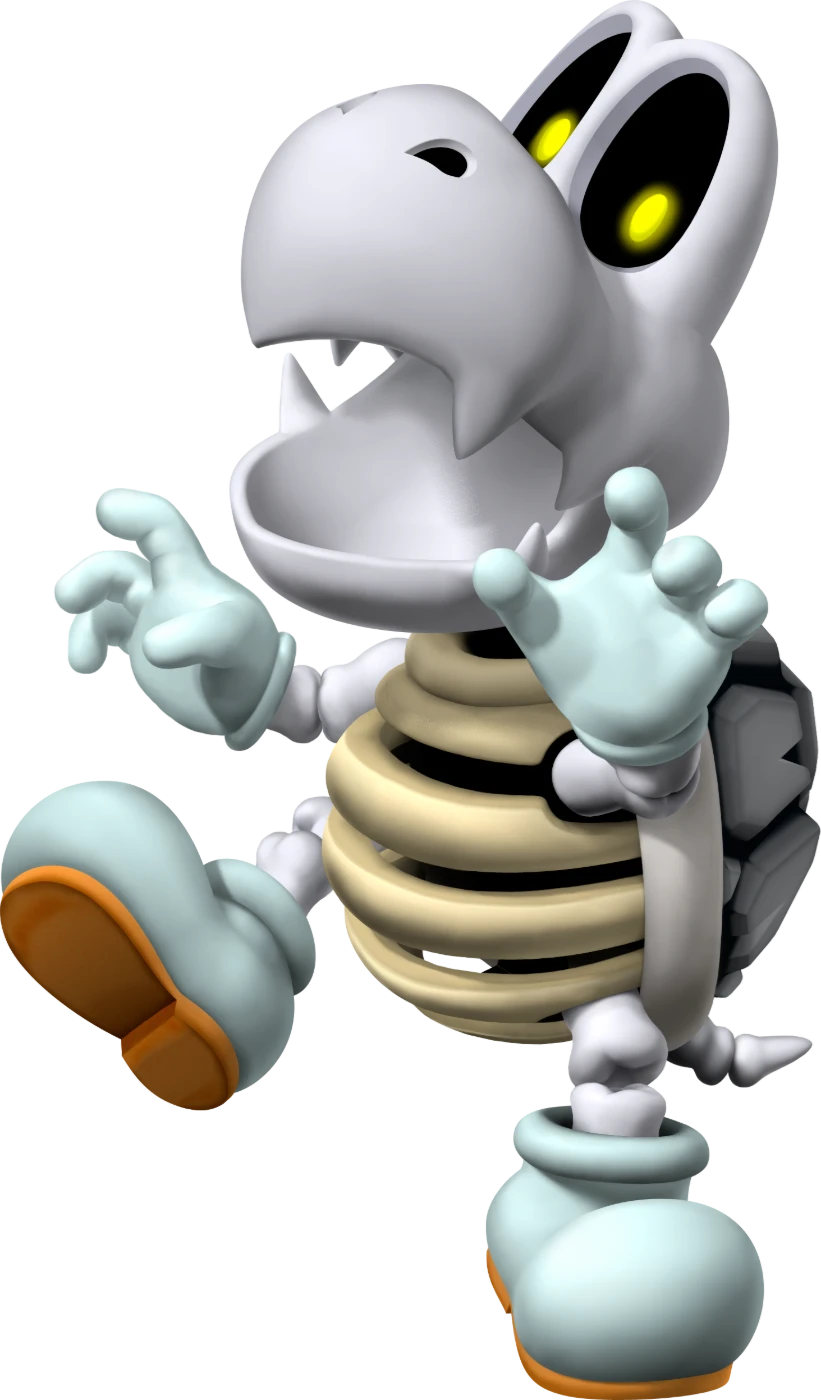
Dry BonesPlayable · new to the series · unlockable
The skeleton Koopa, playable in a Mario Party for the first time.
Bought at the Duty-Free Shop. With the Magic Orb he and Boo turn invisible and double their dice for two turns.
Unlock: 1,000 Cruise Mileage Points. Partner: Boo. Character Orb: Magic.
ToadsworthHost
Organiser of the cruise and narrator of the story in the instruction booklet.
Presides over the main menu, sells bottle rockets on Pagoda Peak, runs the Mic Space games and has to be avoided on the shooting gallery in Neon Heights.
Voice: Scott Burns.
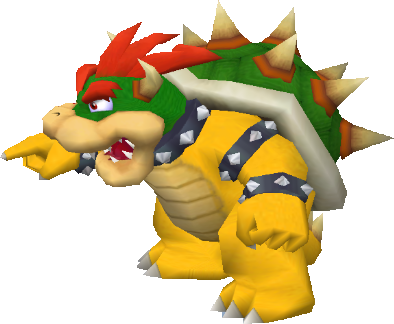
BowserVillain
The one person not invited.
Scatters three Koopa Kid Orbs at the start of every Party Cruise game, gatecrashes every five turns in Bowser Time, runs six minigames of his own and is the opponent in Bowser’s Lovely Lift!
Voice: Scott Burns.
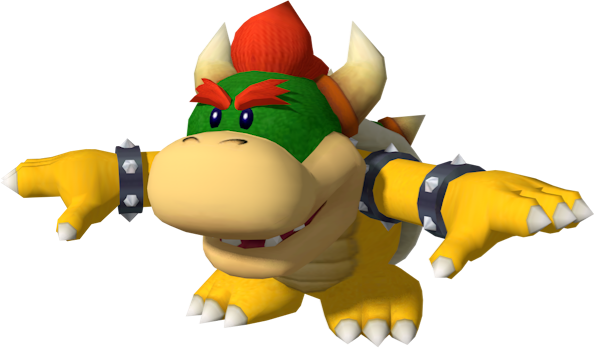
Koopa KidBowser’s helper
Playable in Mario Party 6, and the only member of that game’s cast who is not playable here.
Opens the chests on Neon Heights, sells rubbish in Bowser City, wrestles on the Inferno and appears from Koopa Kid Orbs. Red, green and blue Koopa Kids also turn up.
Koopa Kid Space events include Bowser Revolution and Bowser Shuffle.
Donkey KongBoard character
The players’ friend on the board.
Land on a DK Space and he sets one of six minigames: three races against him for coins or a Star, three banana hunts for everyone.
Minigames: Jump, Man; Vine Country; A Bridge Too Short; Peel Out; Bananas Faster; Stump Change.
Koopa MasterBoard character
An elderly Koopa who lives in the pagoda at the top of Pagoda Peak.
Sells the Stars there, at a price that rises from 10 to 40 coins, and answers the Gong of Fate.
In Solo Cruise he wants 100 coins.
Every minigame in Mario Party 7
All 88 in Super Mario Wiki’s order: 18 for four players (five of them Mic games), 14 one-against-three (five Mic), 12 two-against-two, 5 Battle, 12 Duel, 6 Donkey Kong, 6 Bowser, 12 for eight players, 2 rare ones and the boss. Every one is new. “Coin” marks the three coin-collecting games. In Battle minigames everyone pays into a pot that is split 70, 25 and 5 per cent among the first three; the winner of a Duel spins a wheel for the loser’s coins or Stars. Later appearances are from the wiki’s lists for The Top 100 and Superstars.
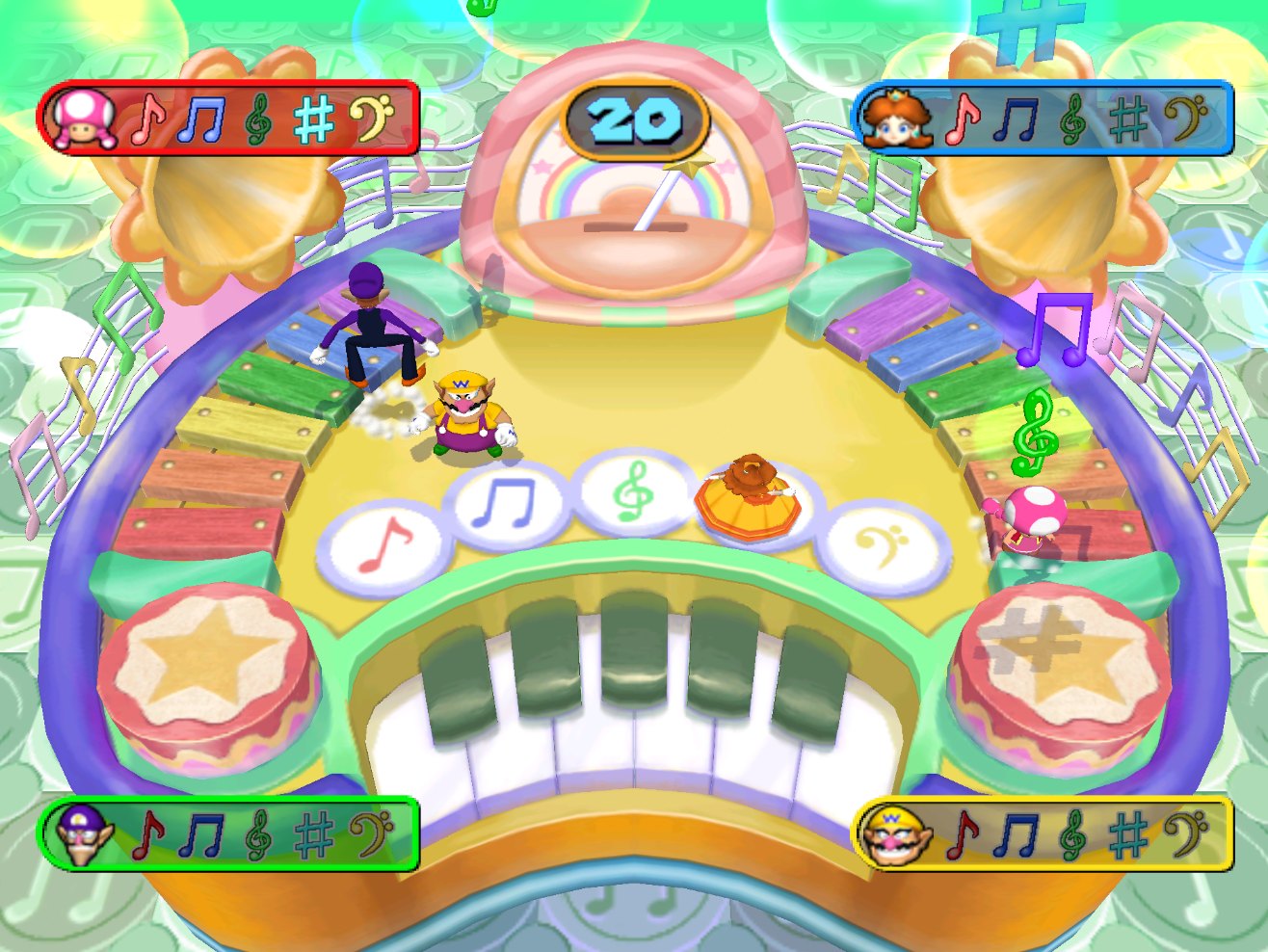
Catchy Tunes4-PlayerMusical symbols rain down and everyone scrambles to collect one of each kind. Landing on a rival’s head stuns them.
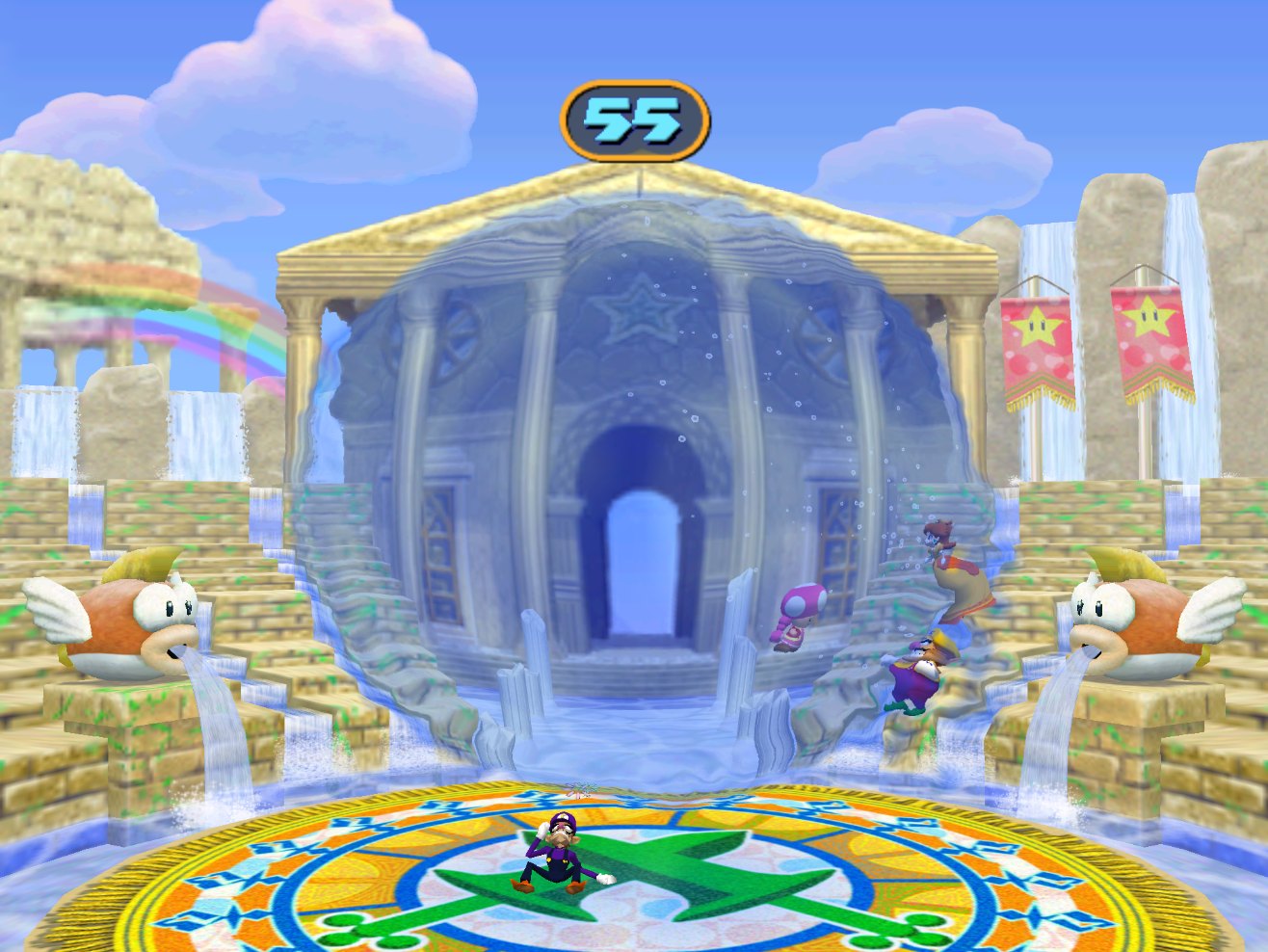
Bubble Brawl4-PlayerA punch-up inside a floating blob of water. Knock the others out through its skin and be the last one in.
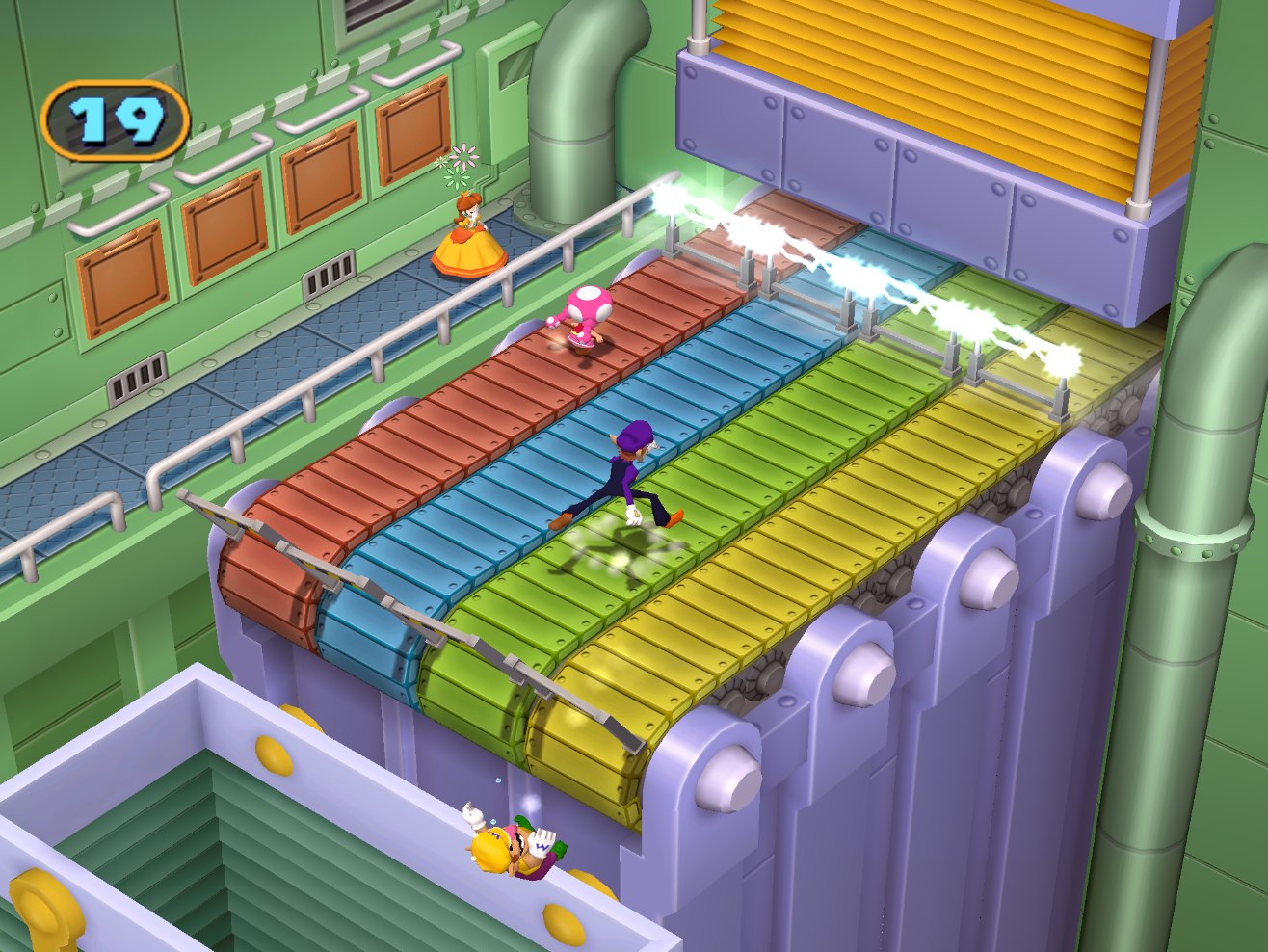
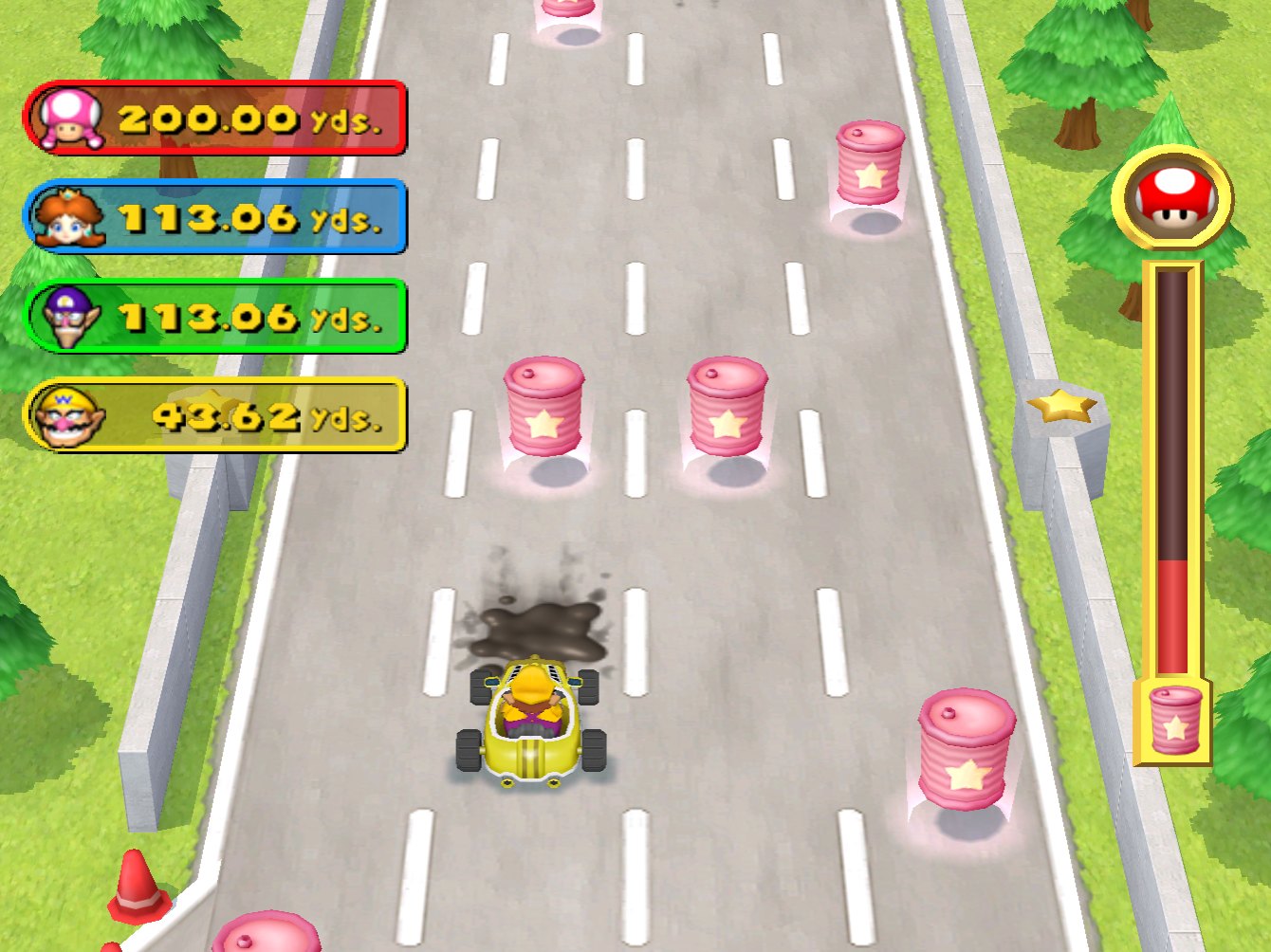
Track & Yield4-PlayerHurdle electrified fences on a conveyor belt. A shock freezes you for a moment, and the last runner left wins. In The Top 100.
Fun Run4-PlayerA race to the top of a booby-trapped tower, past Spinies, trapdoors and walls on springs.
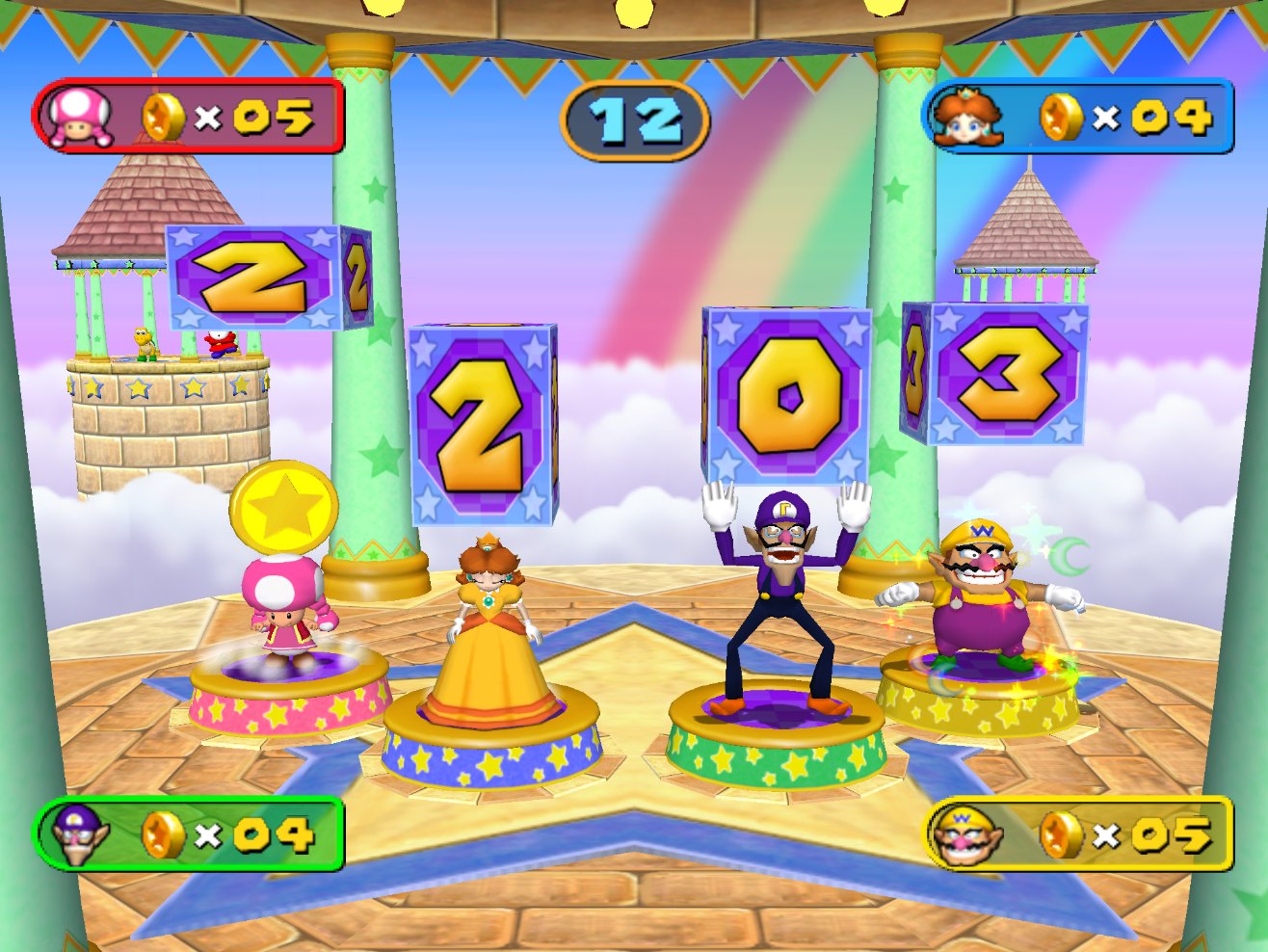
Cointagious4-Player · coinKeep jumping at a Dice Block that flickers between 0 and 3 and pocket whatever you hit, in coins.
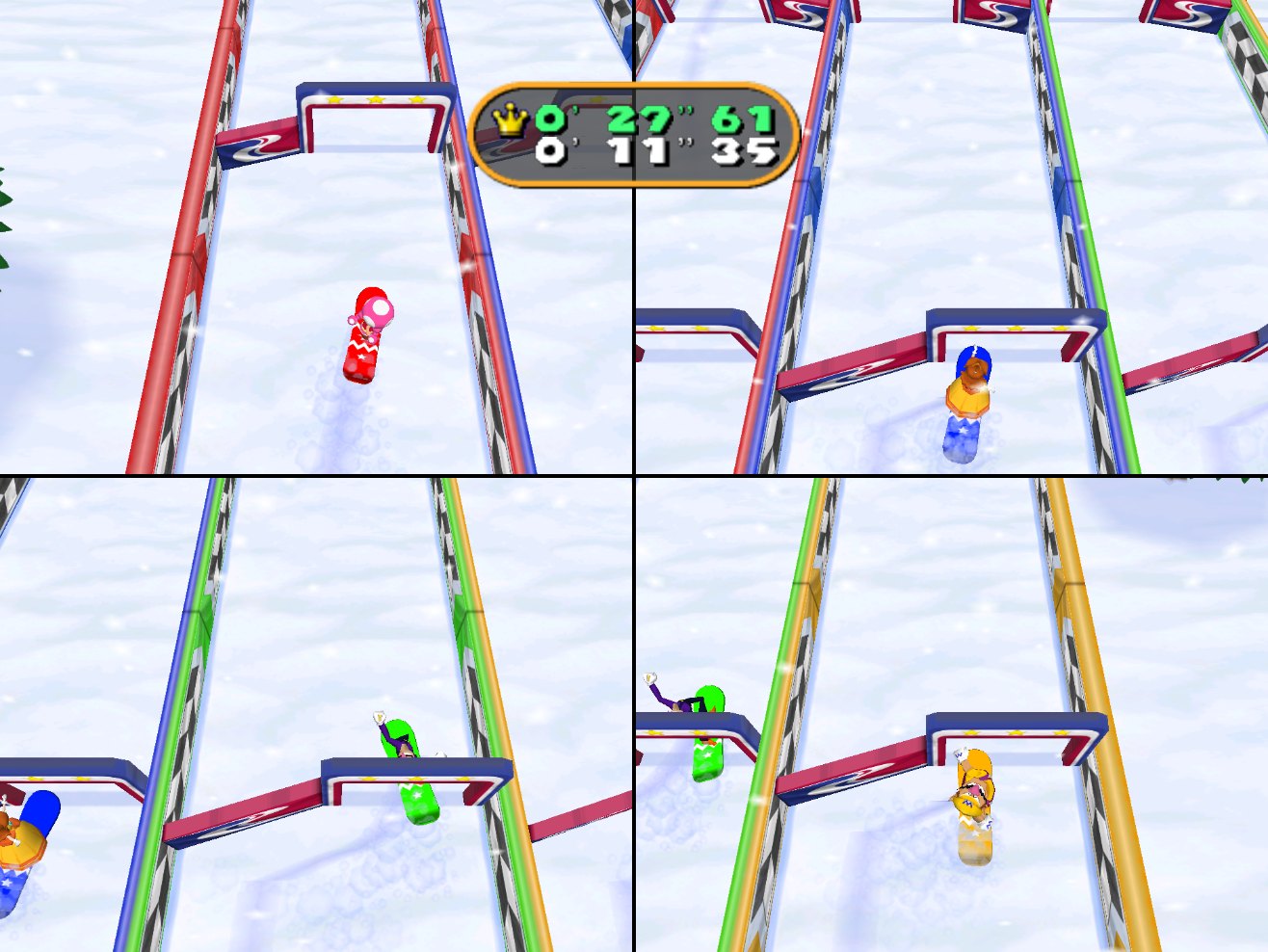
Snow Ride4-PlayerA downhill snowboard slalom through alternating gates and round Warp Pipes.
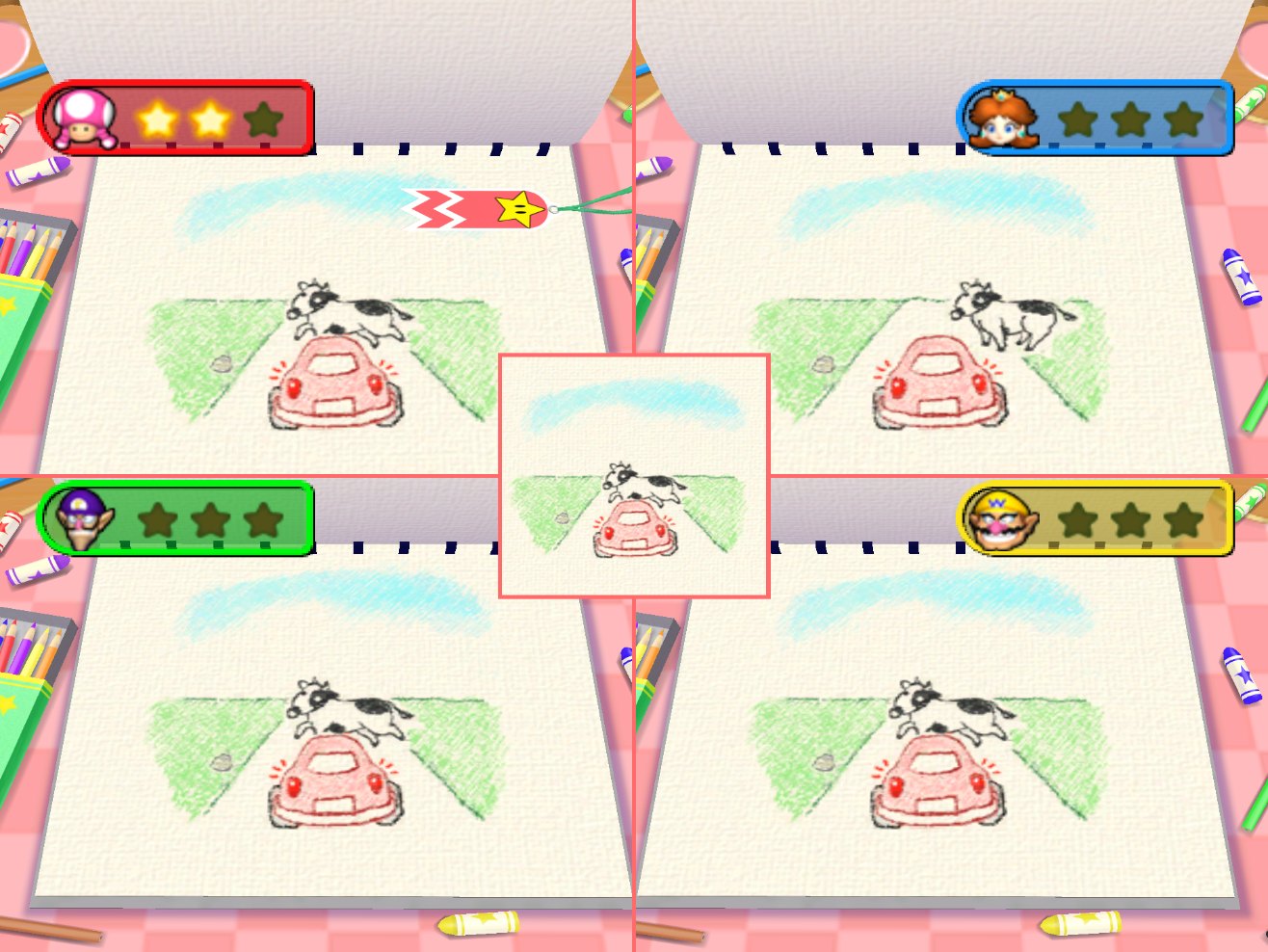
Picture This4-PlayerLeaf through a picture book with L and R to find the page that matches. Three right answers wins.
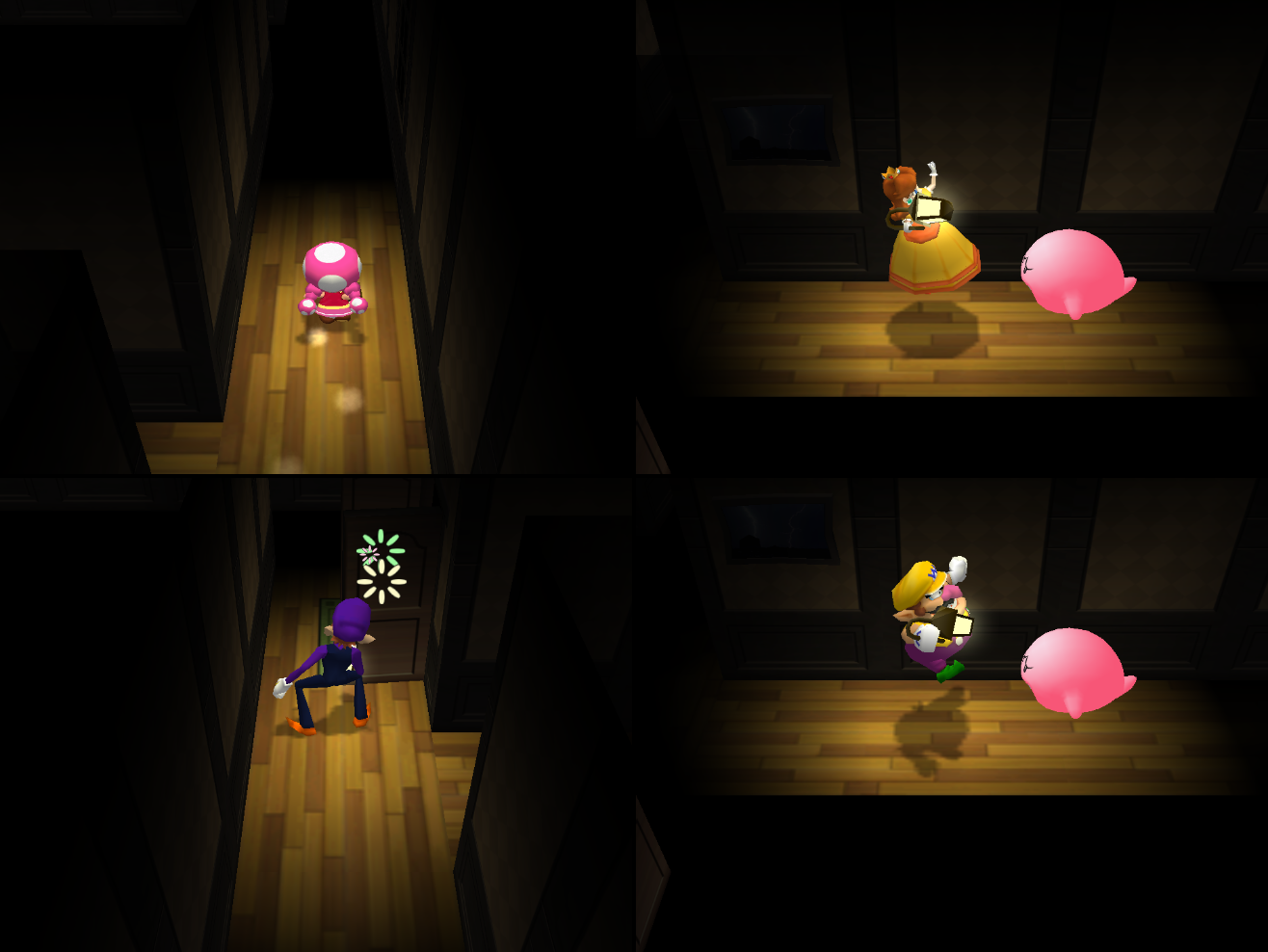
Ghost in the Hall4-PlayerFind the way out of a haunted house first. Closed doors slow you down and Pink Boos stun you.
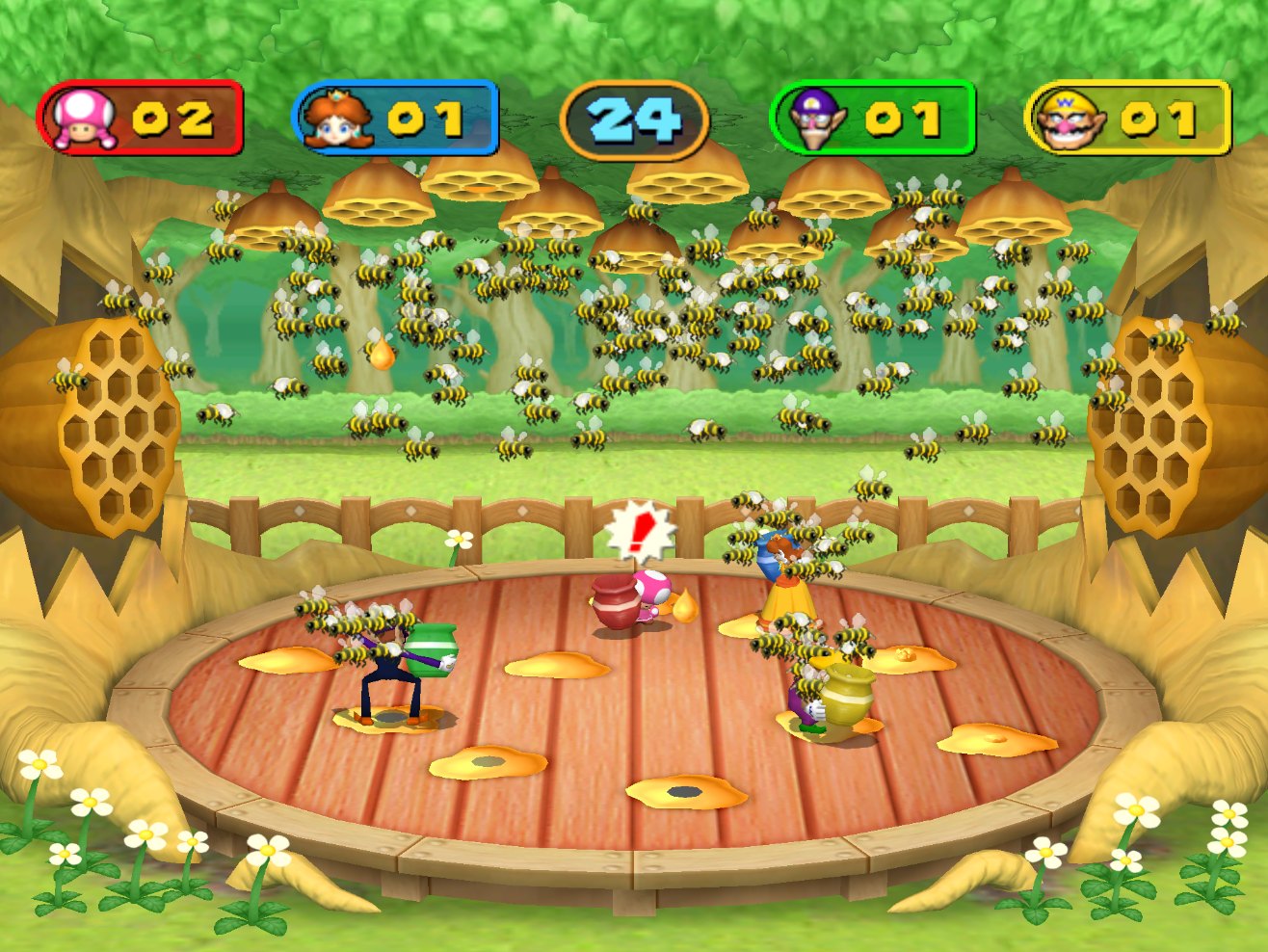
Big Dripper4-PlayerCatch the honey dripping from the ceiling and duck when the bees swarm.
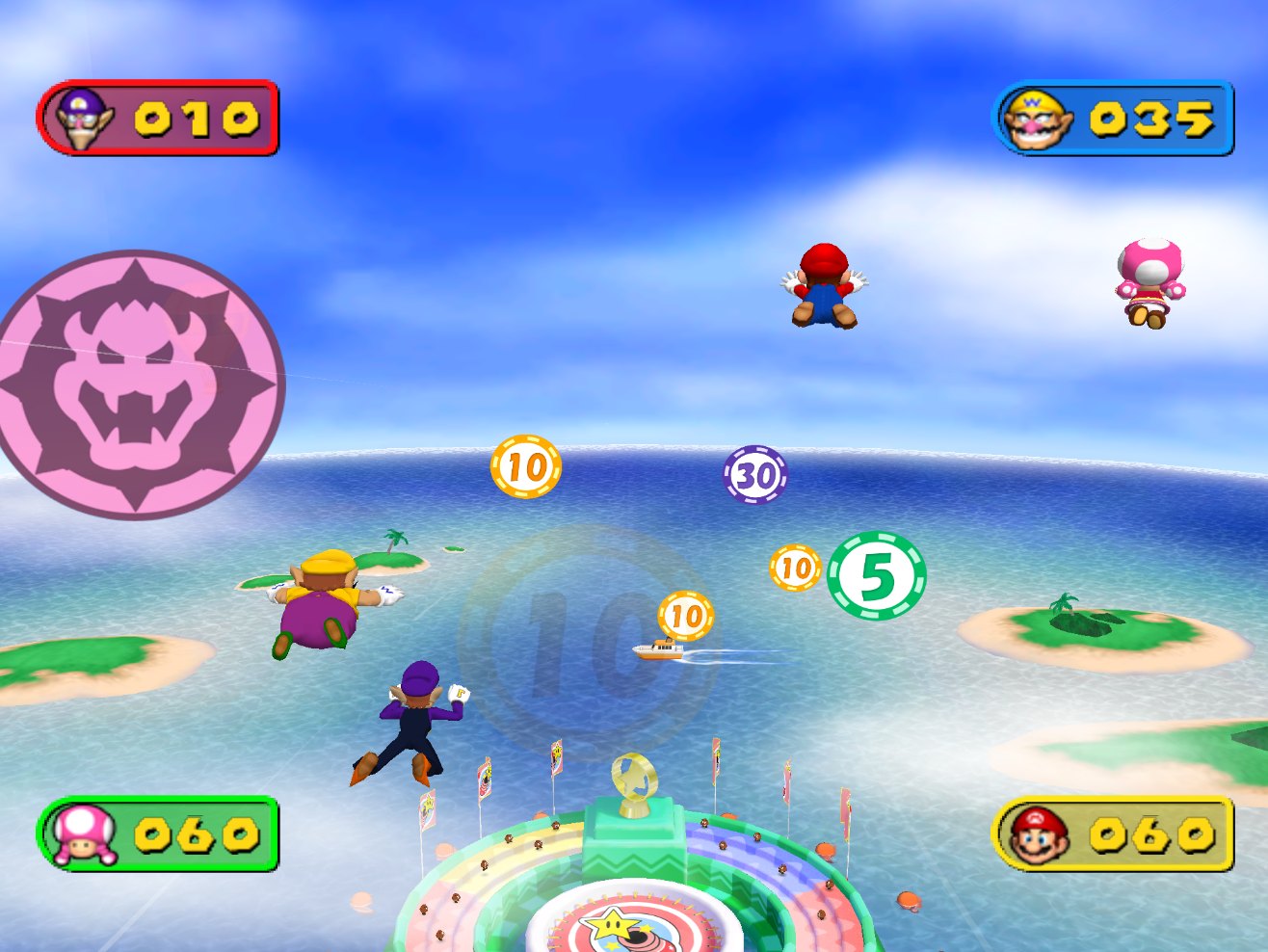
Target Tag4-PlayerFly into floating targets worth from 5 to 50 points, and steer clear of the Bowser target, which wipes your score.
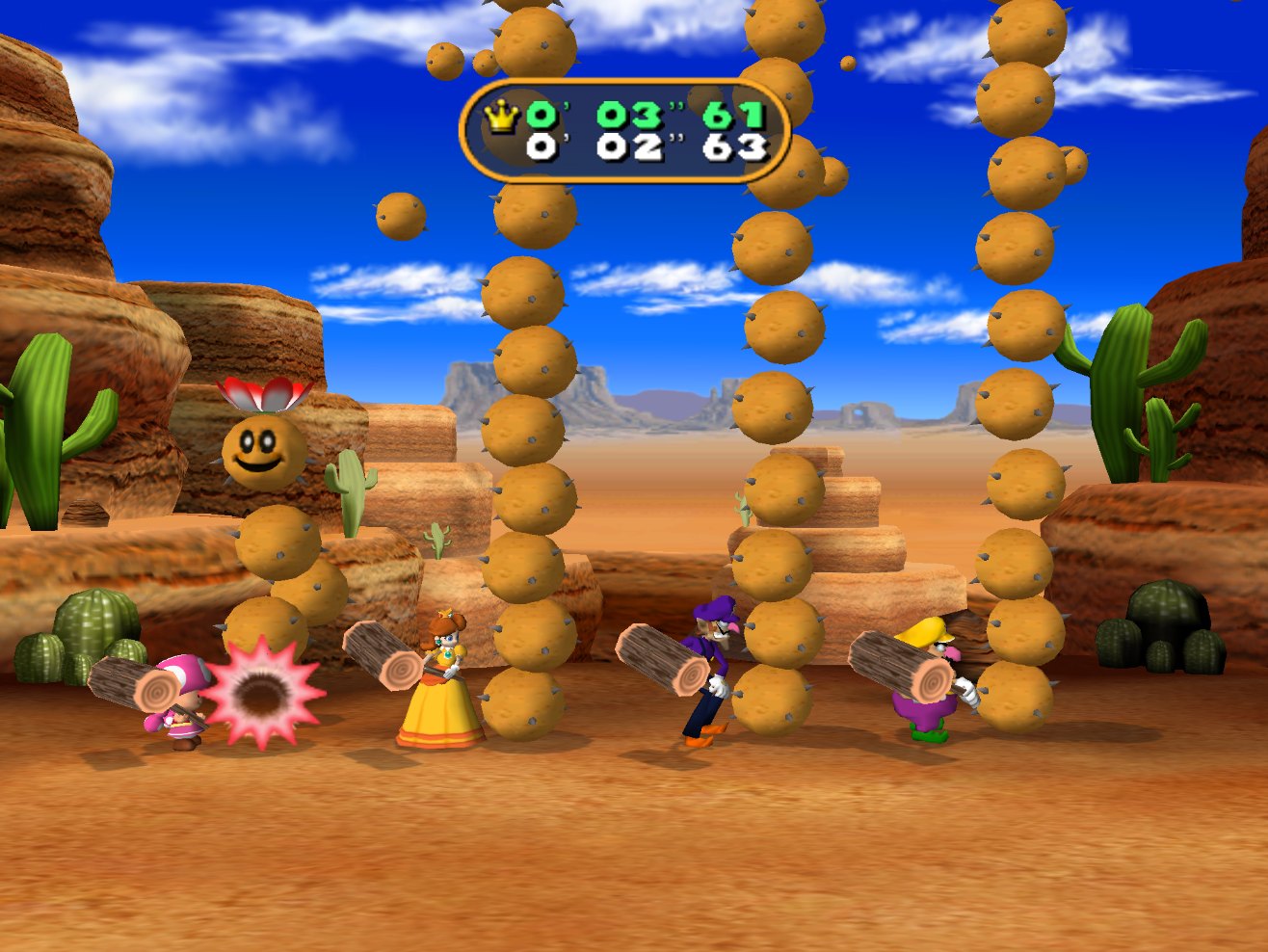
Pokey Pummel4-PlayerHammer the A Button to smash your way through a towering Pokey before anyone else. In The Top 100 and Superstars.
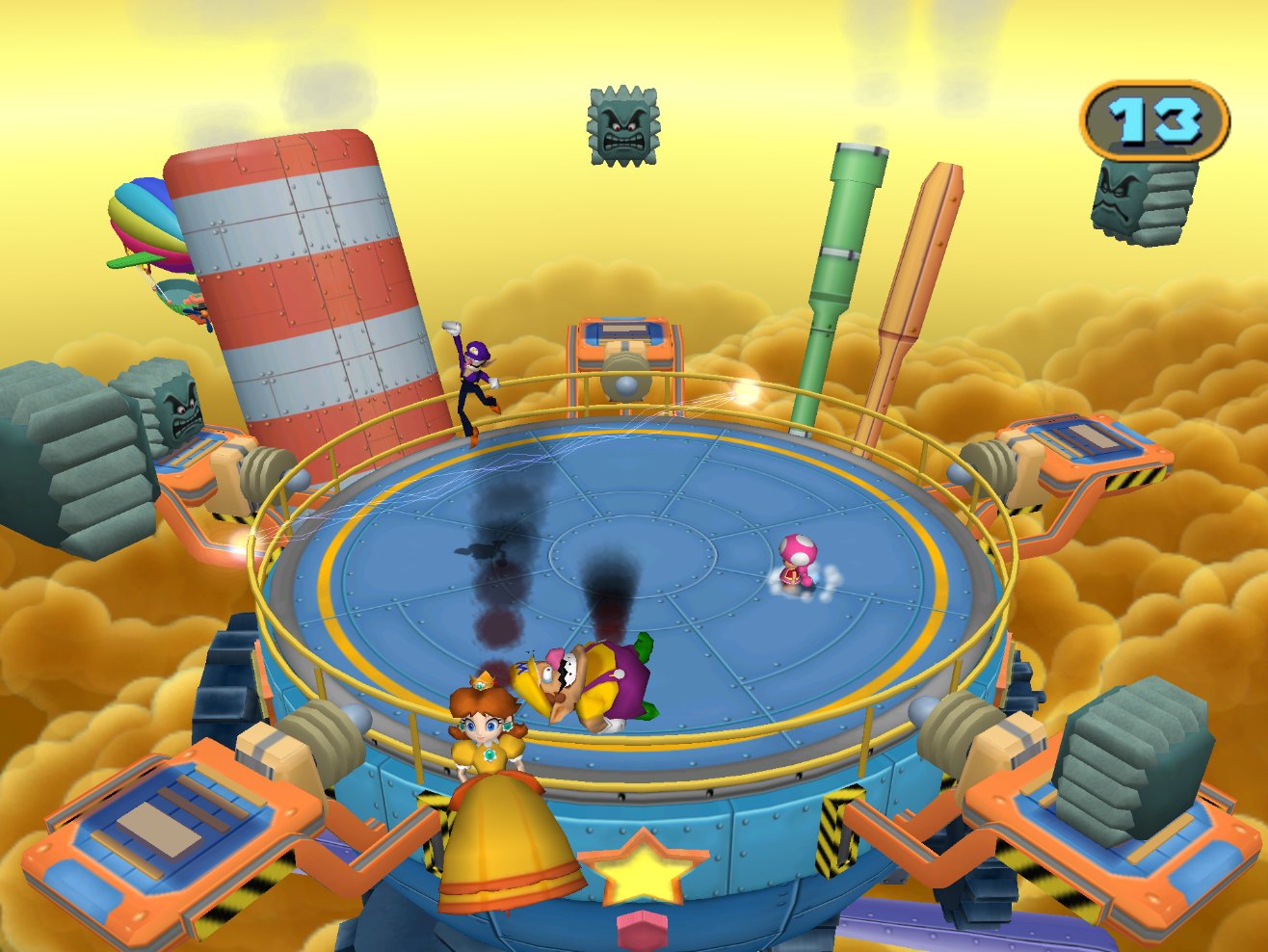
Take Me Ohm4-PlayerJump the sparks that Thwomps send crackling across a ring. One touch and you are thrown out.
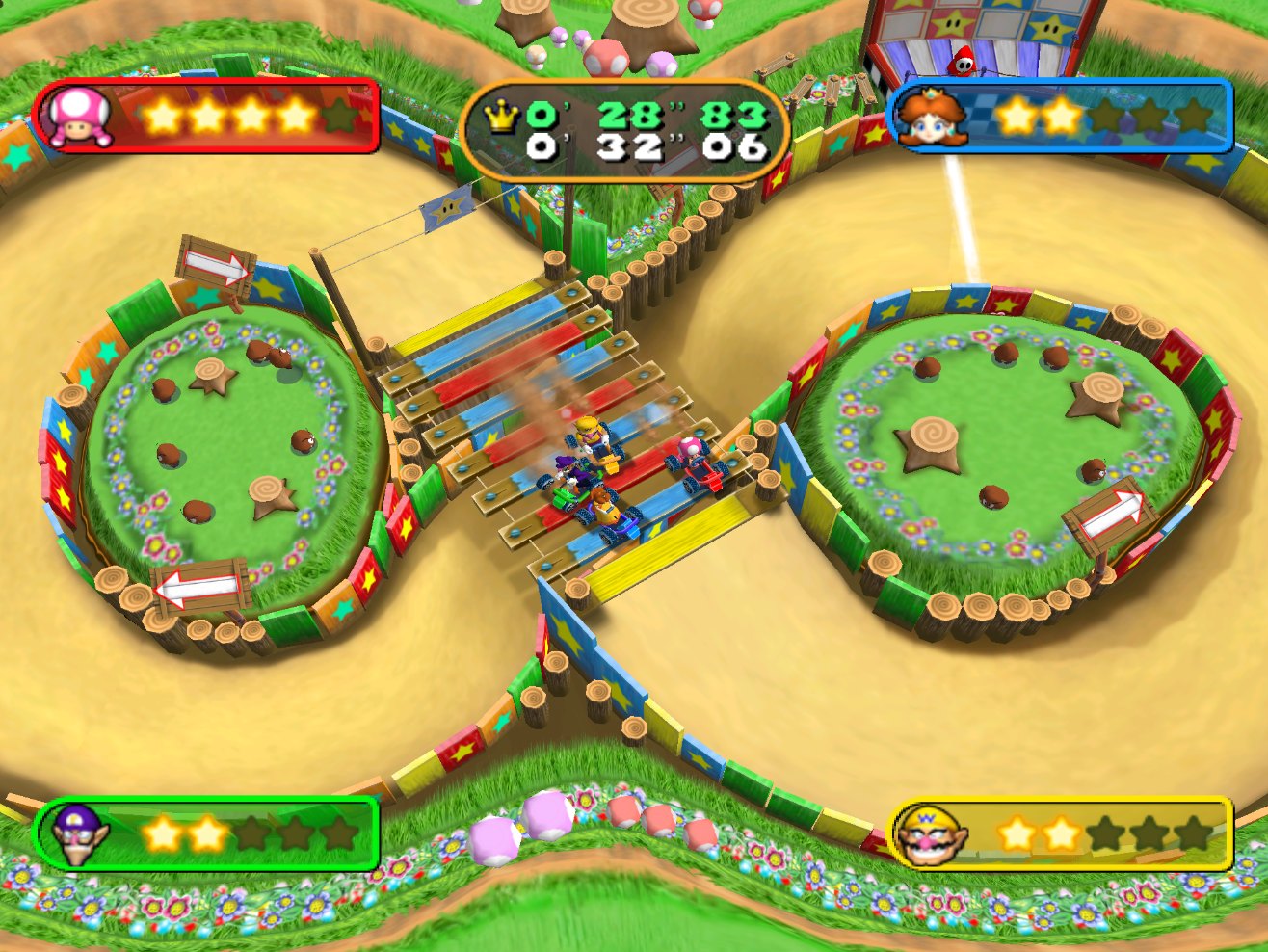
Kart Wheeled4-PlayerFive laps of a figure-of-eight track in buggies, with every chance of a crash at the crossover.
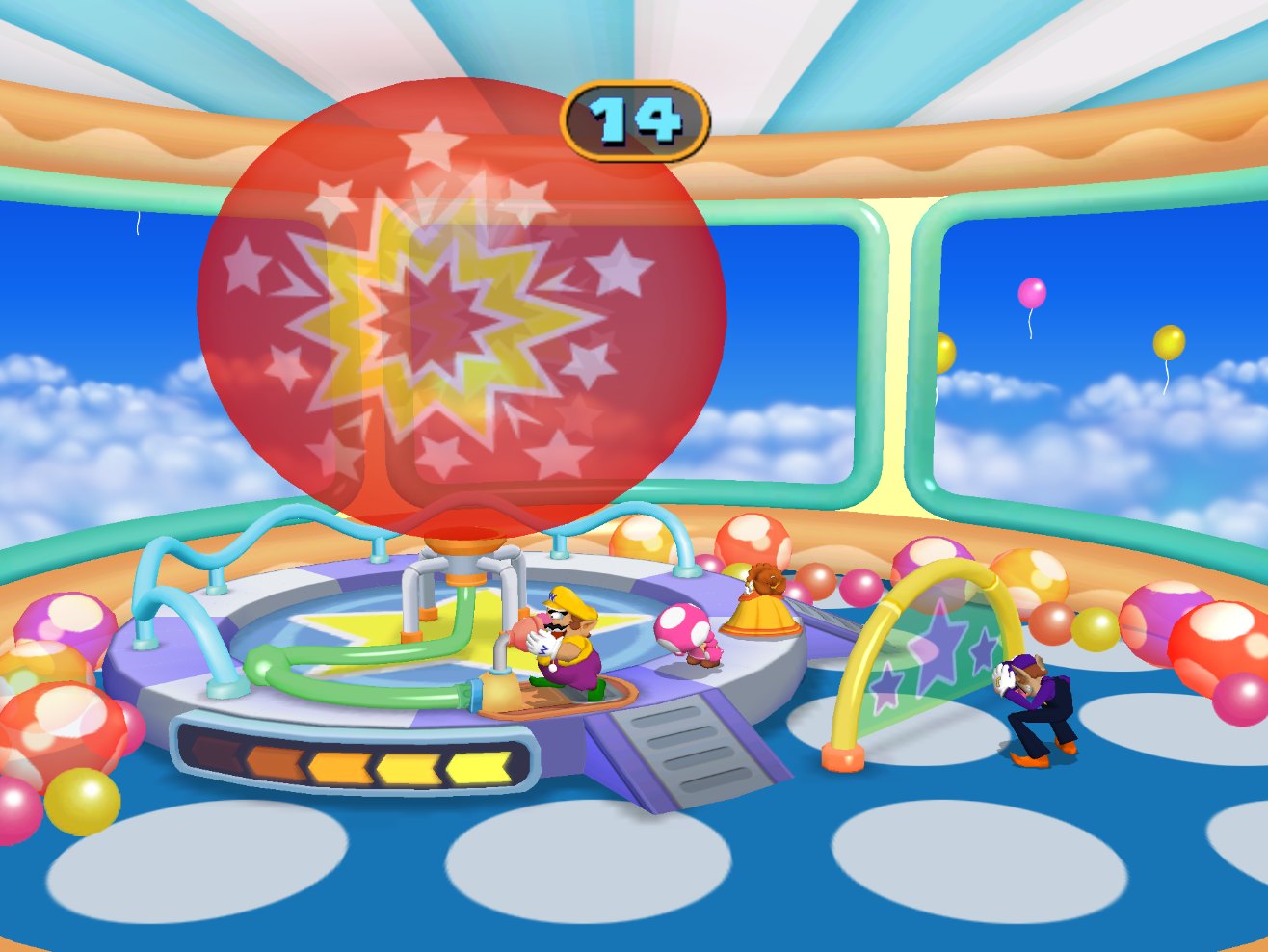
Balloon Busters4-Player · MicTake turns telling the Mic to inflate one enormous balloon and when to stop. If it bursts on the next player’s go, you win. In The Top 100.
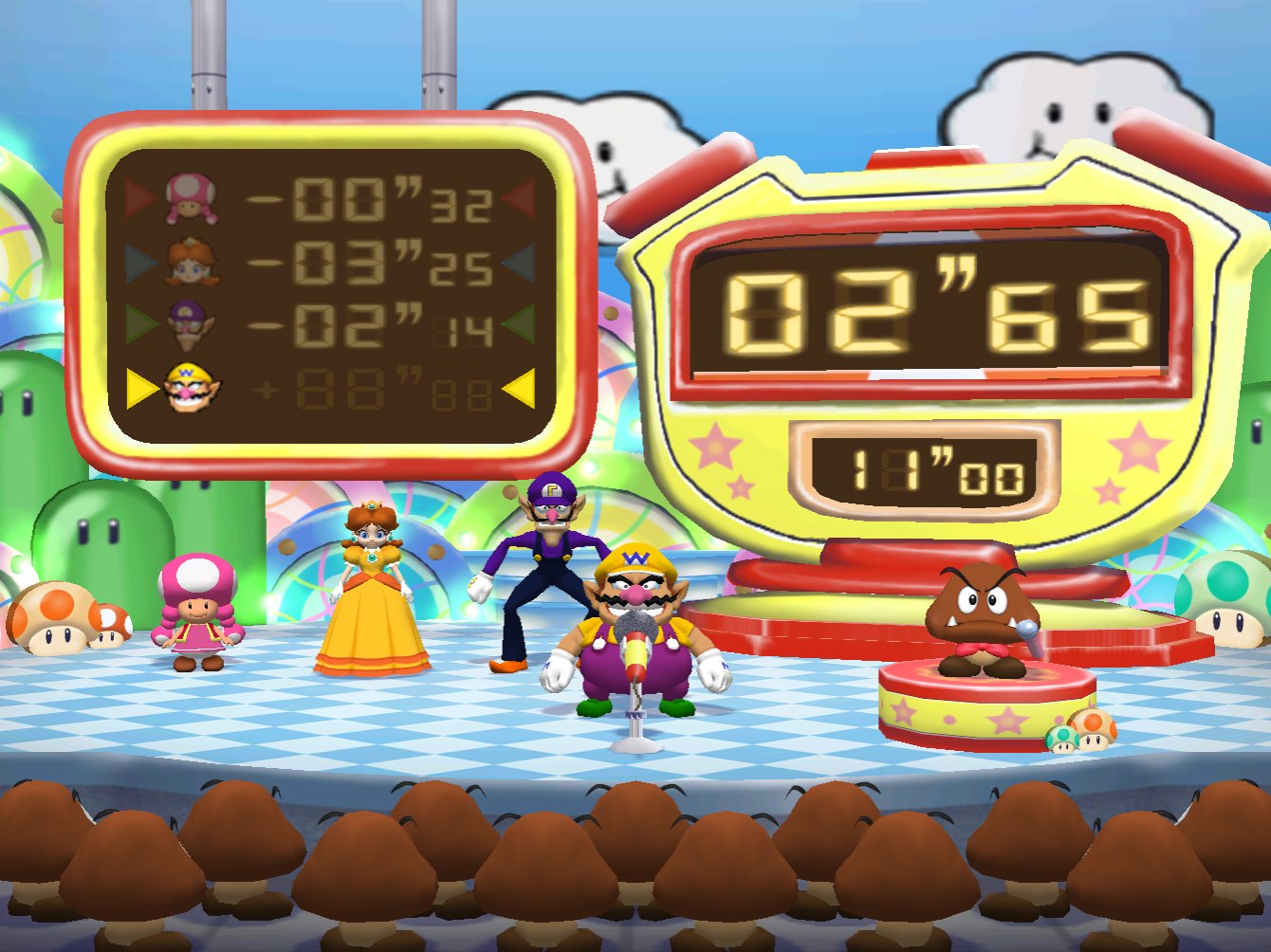
Clock Watchers4-Player · MicStop a hidden timer as near as you can to the target by counting in your head. The model for Stop Watchers in Wii Party.
Dart Attack4-Player · MicSay “fire” to throw up to five darts at moving targets. In The Top 100.
Oil Crisis4-Player · MicSteer a kart by spoken commands and reach the finish before the fuel runs out.
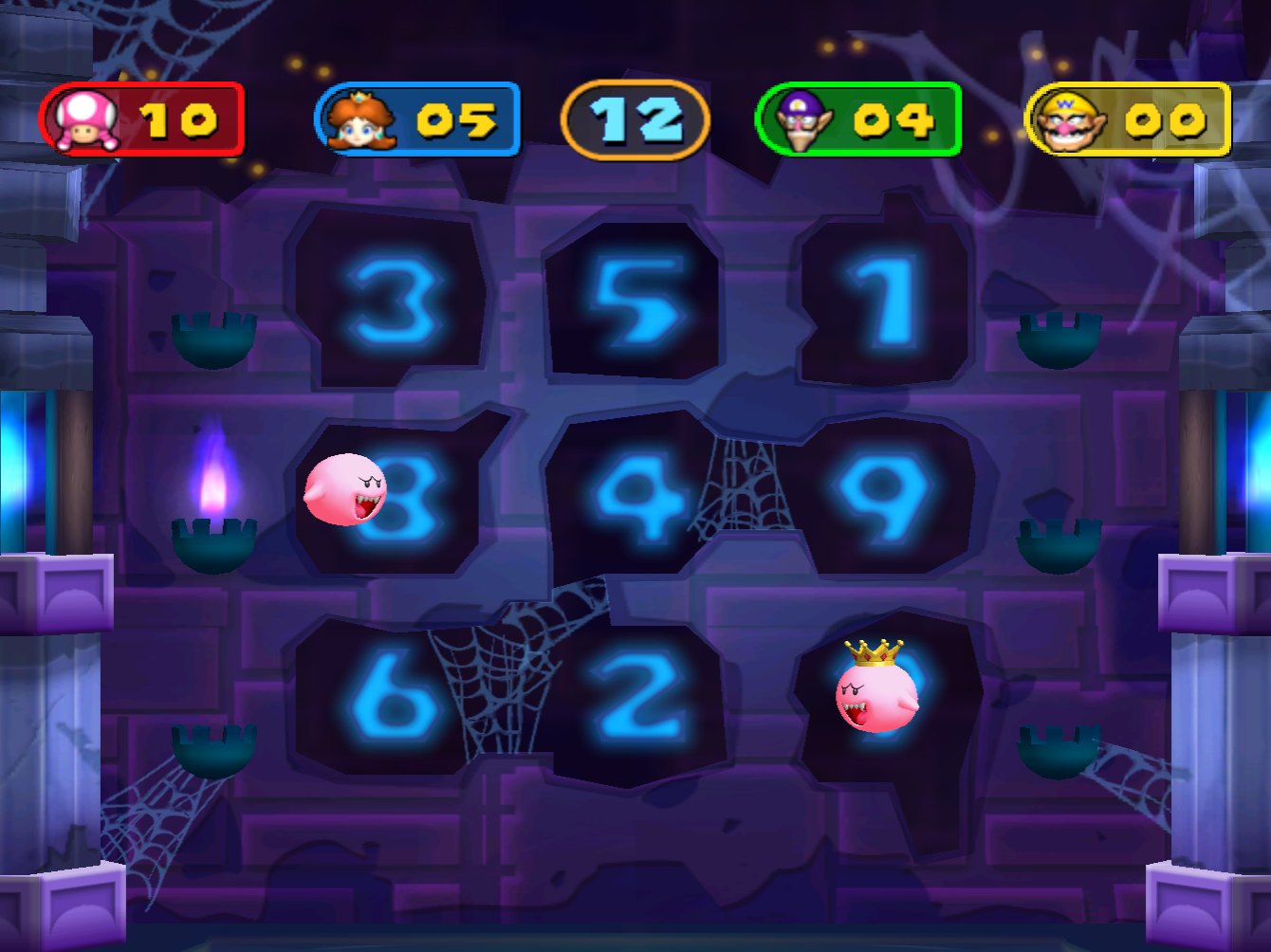
Mathemortician4-Player · MicCall out a number from 1 to 9 to fire at that square and hit the Pink Boos. Crowned ones score three.
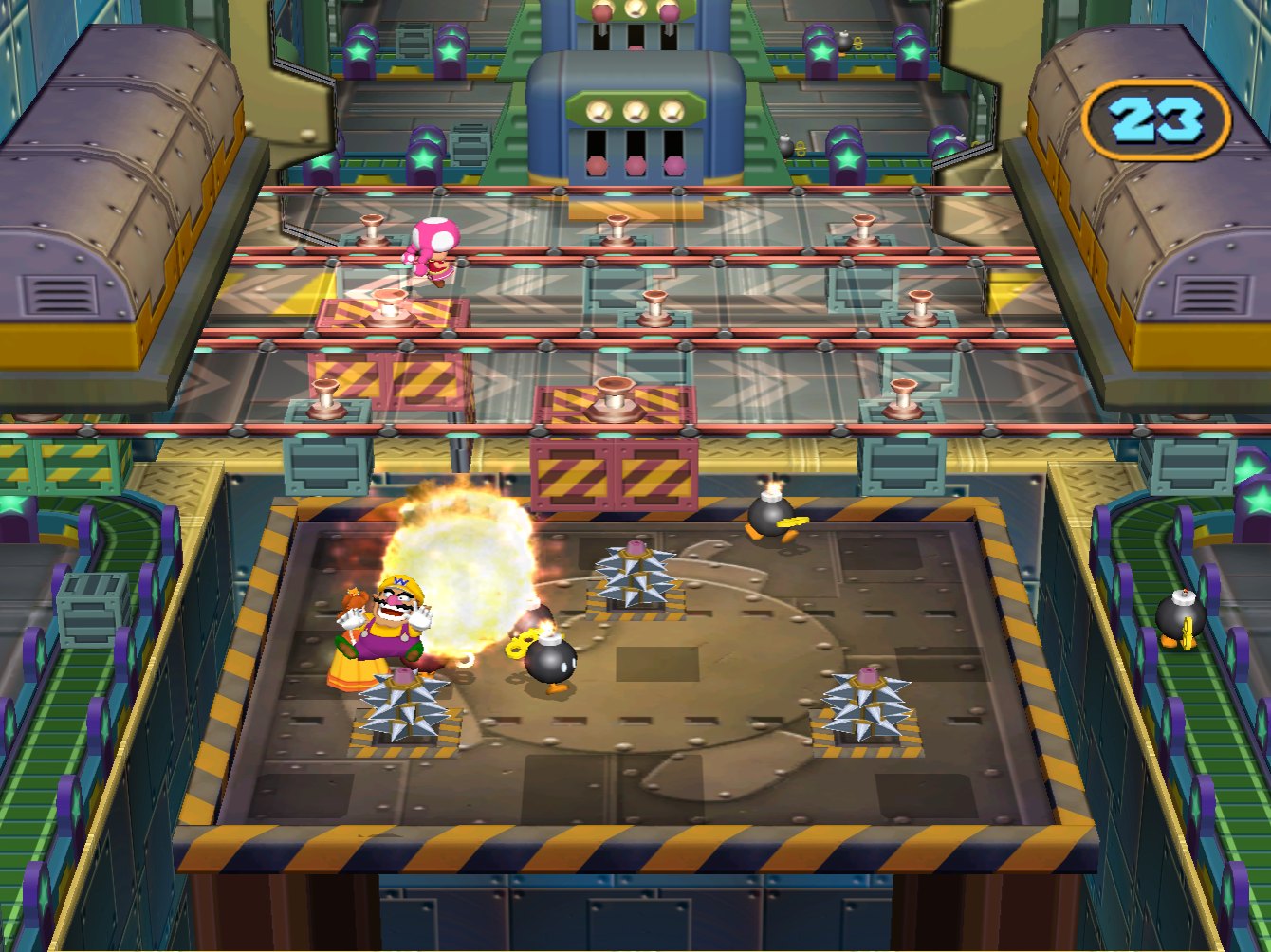
La Bomba1-vs-3One player ground-pounds crates to drop Bob-ombs on three who are running for their lives.
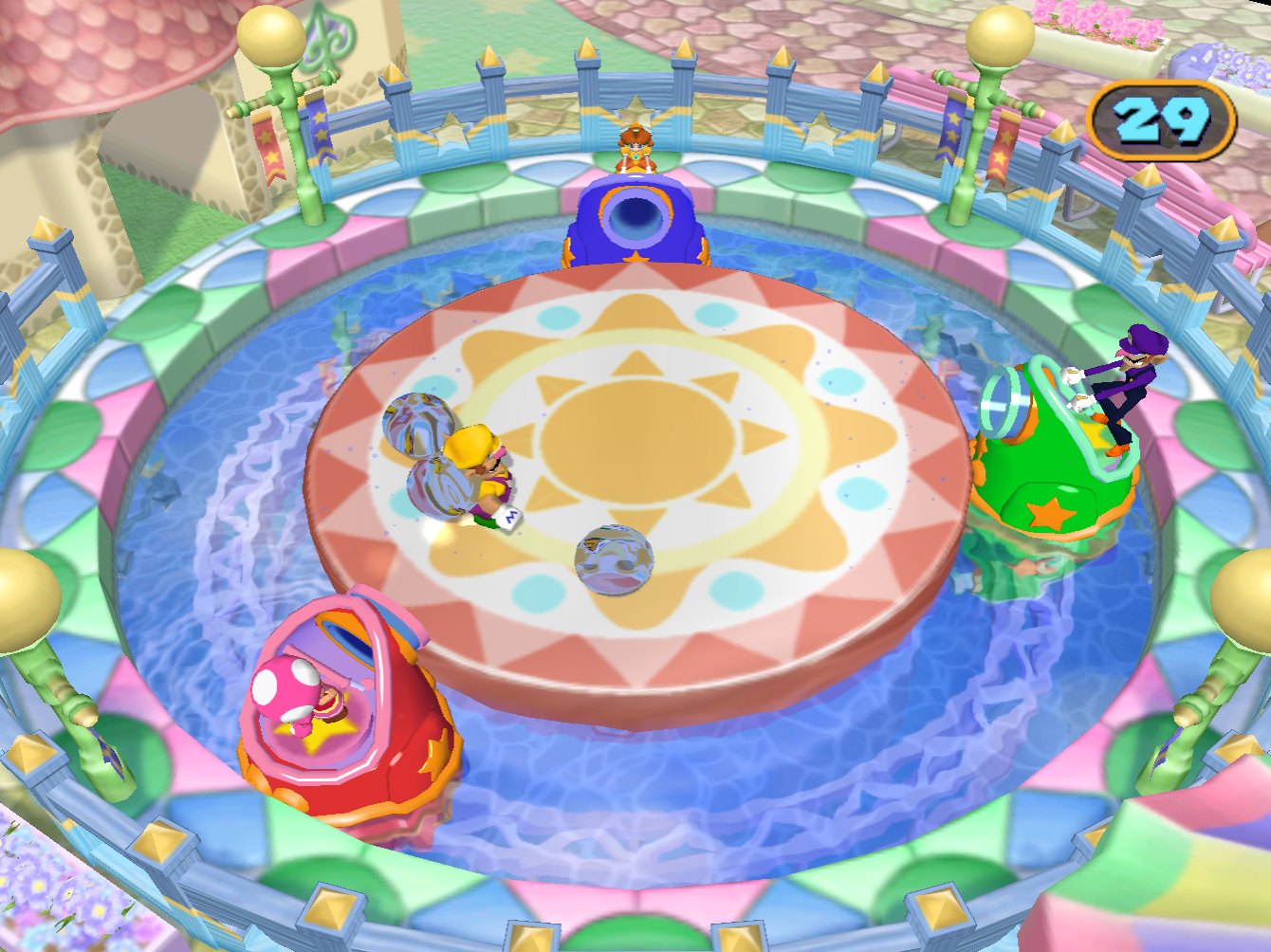
Spray Anything1-vs-3Three players circle a ring firing balls of water at the one stuck inside it.
Balloonatic1-vs-3One pilots a hot-air balloon through cannon fire. The other three man the cannons.
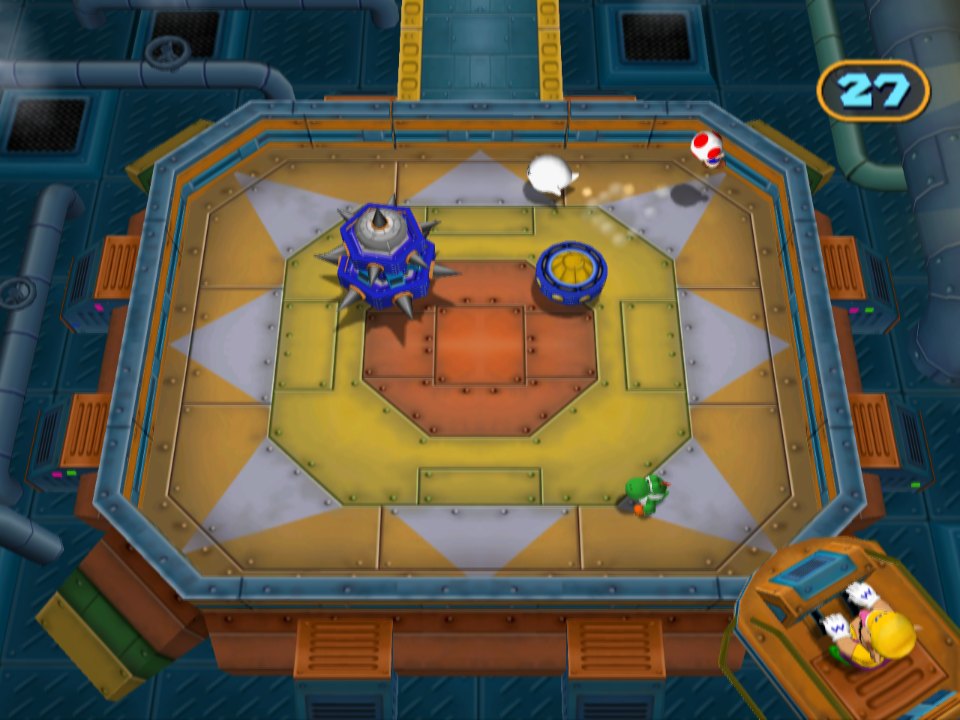
Spinner Cell1-vs-3The soloist sends a large spinner and a small one skidding round an arena to knock out or stun the three dodging them.
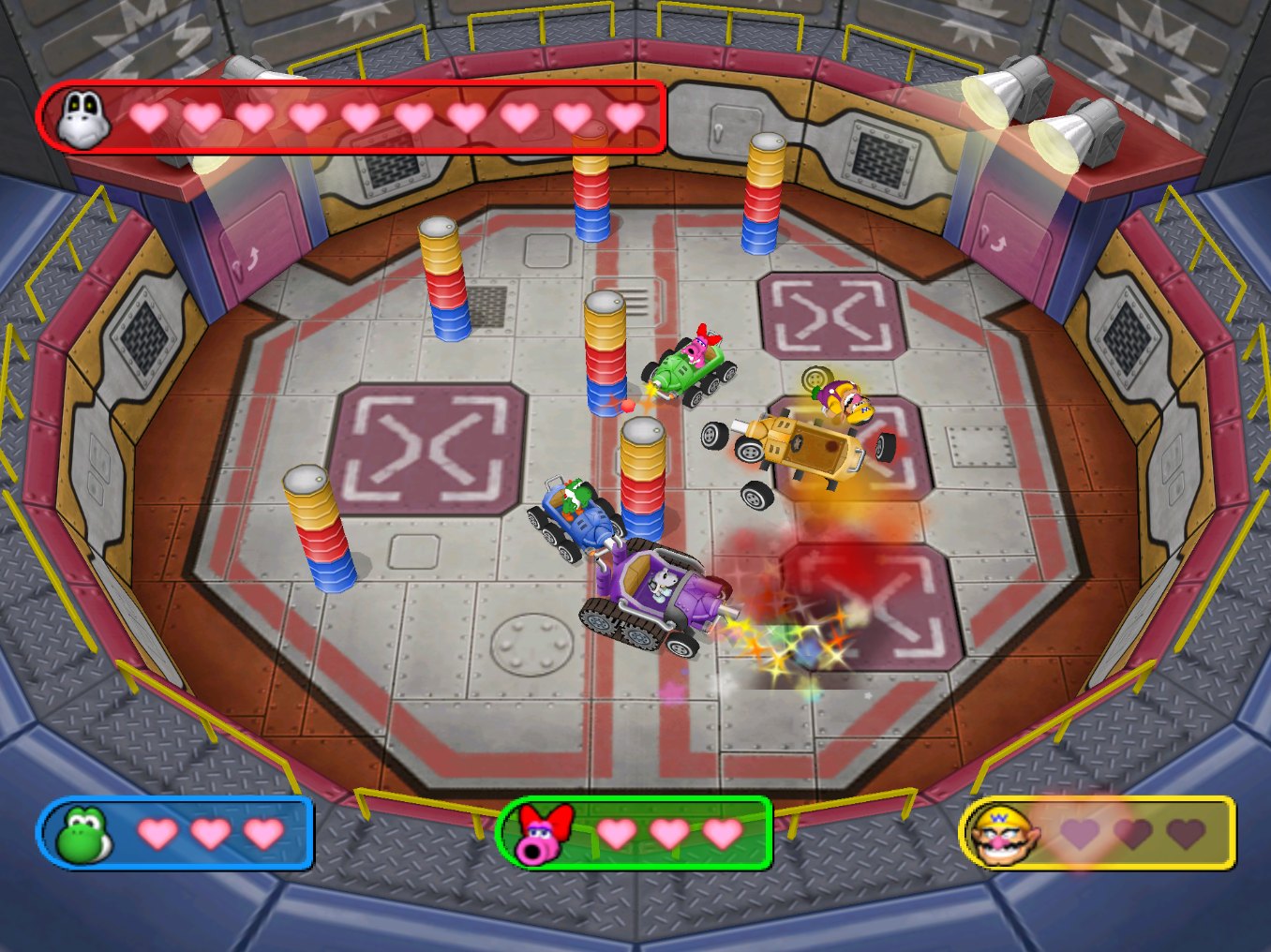
Think Tank1-vs-3One big tank against three little ones, which must gang up on it or be crushed.
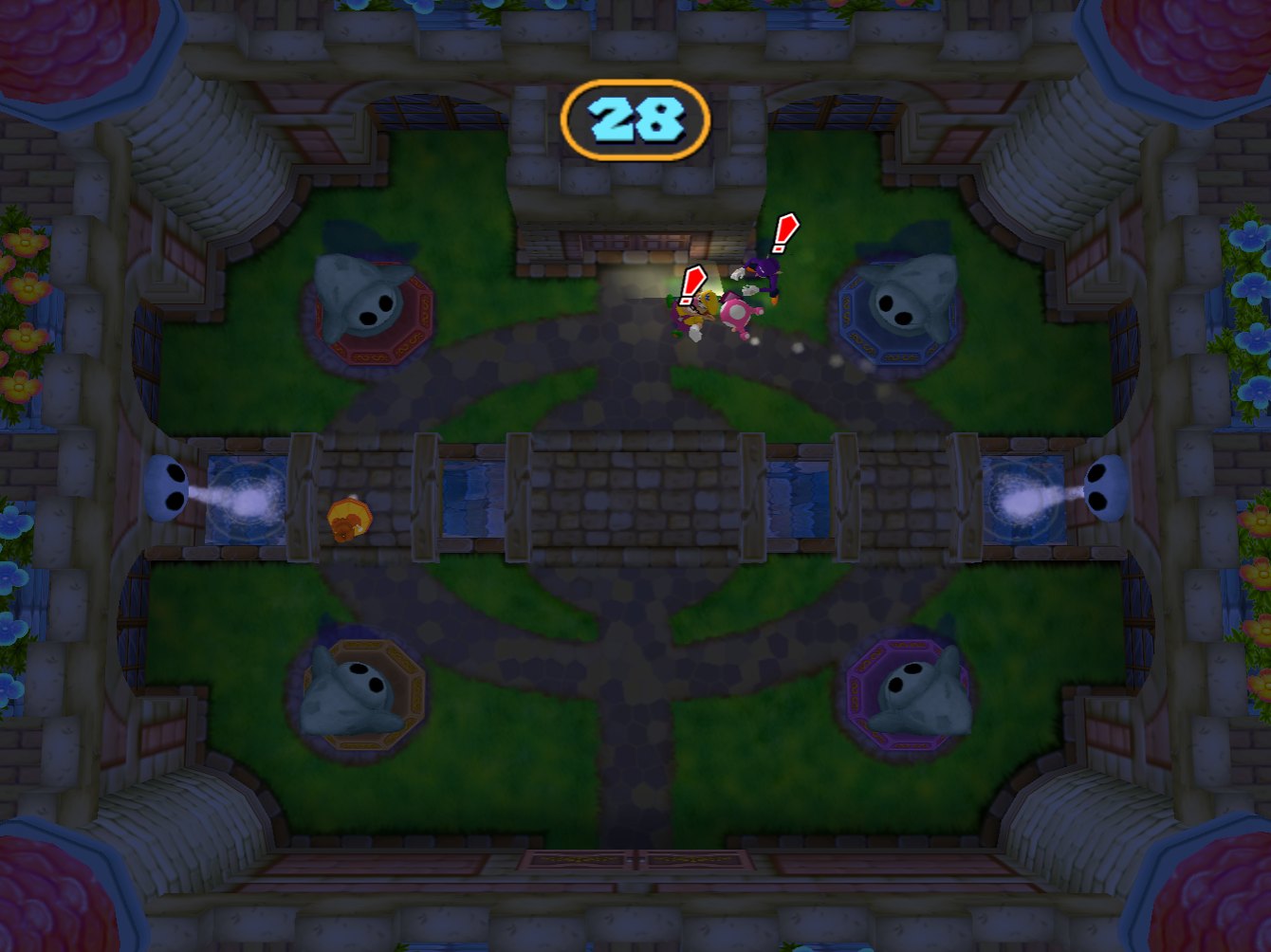
Flashfright1-vs-3Tag in the dark: one player hunts three with a torch, and they hide wherever the beam is not.
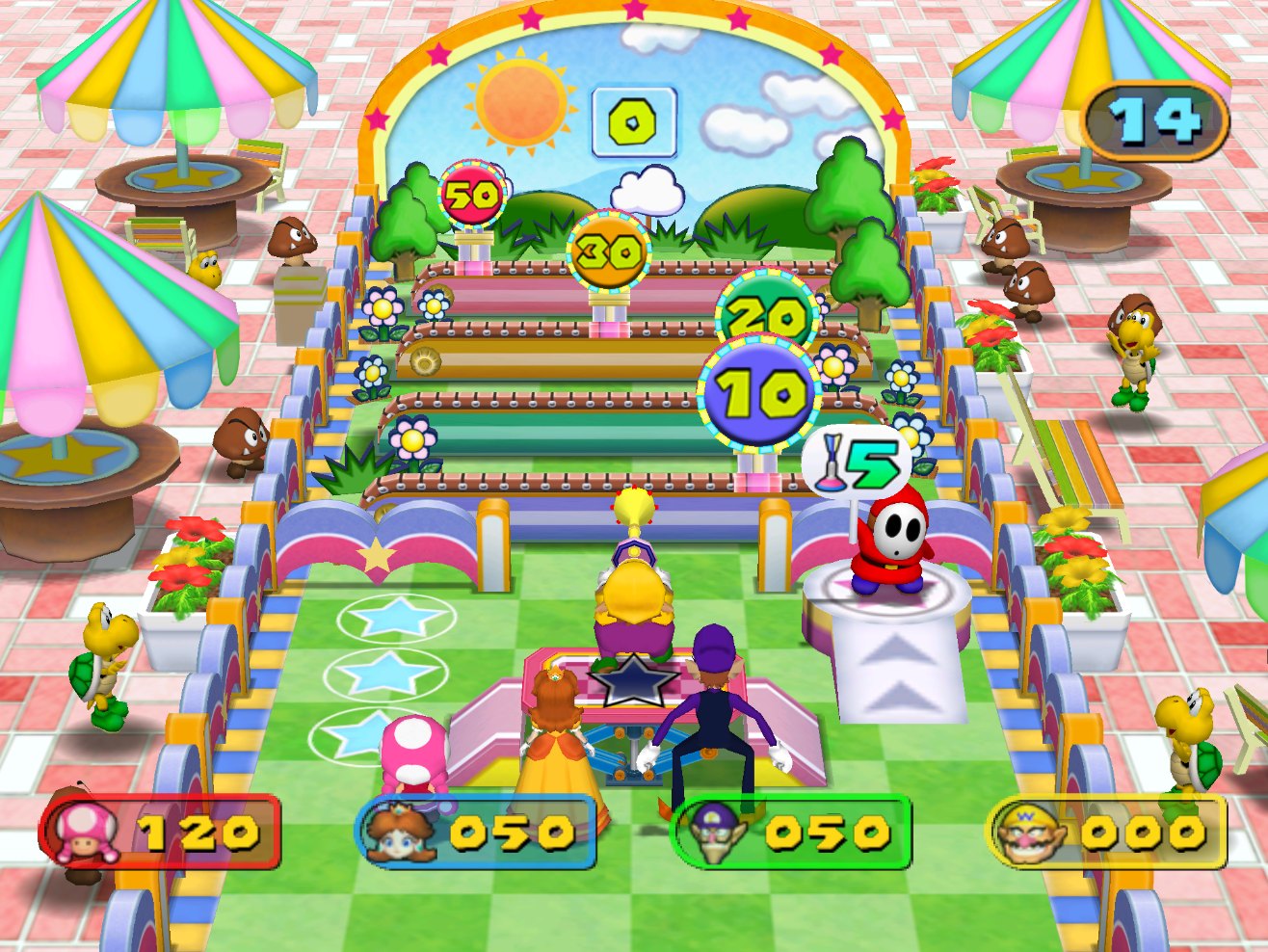
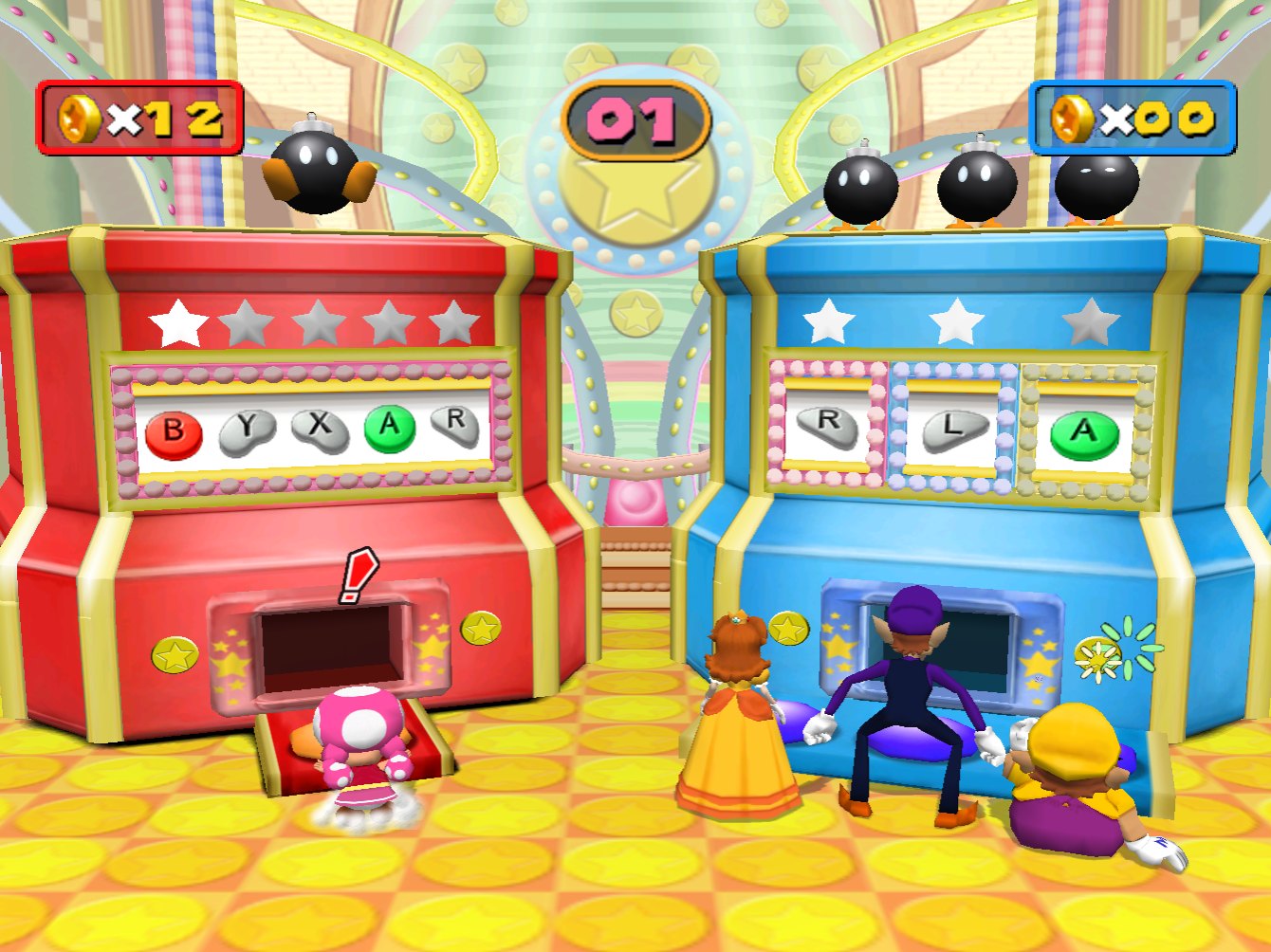
Coin-op Bop1-vs-3 · coinPress the five buttons shown to stop a slot machine and win coins, one player alone and three together. A wrong press drops a Bob-omb.
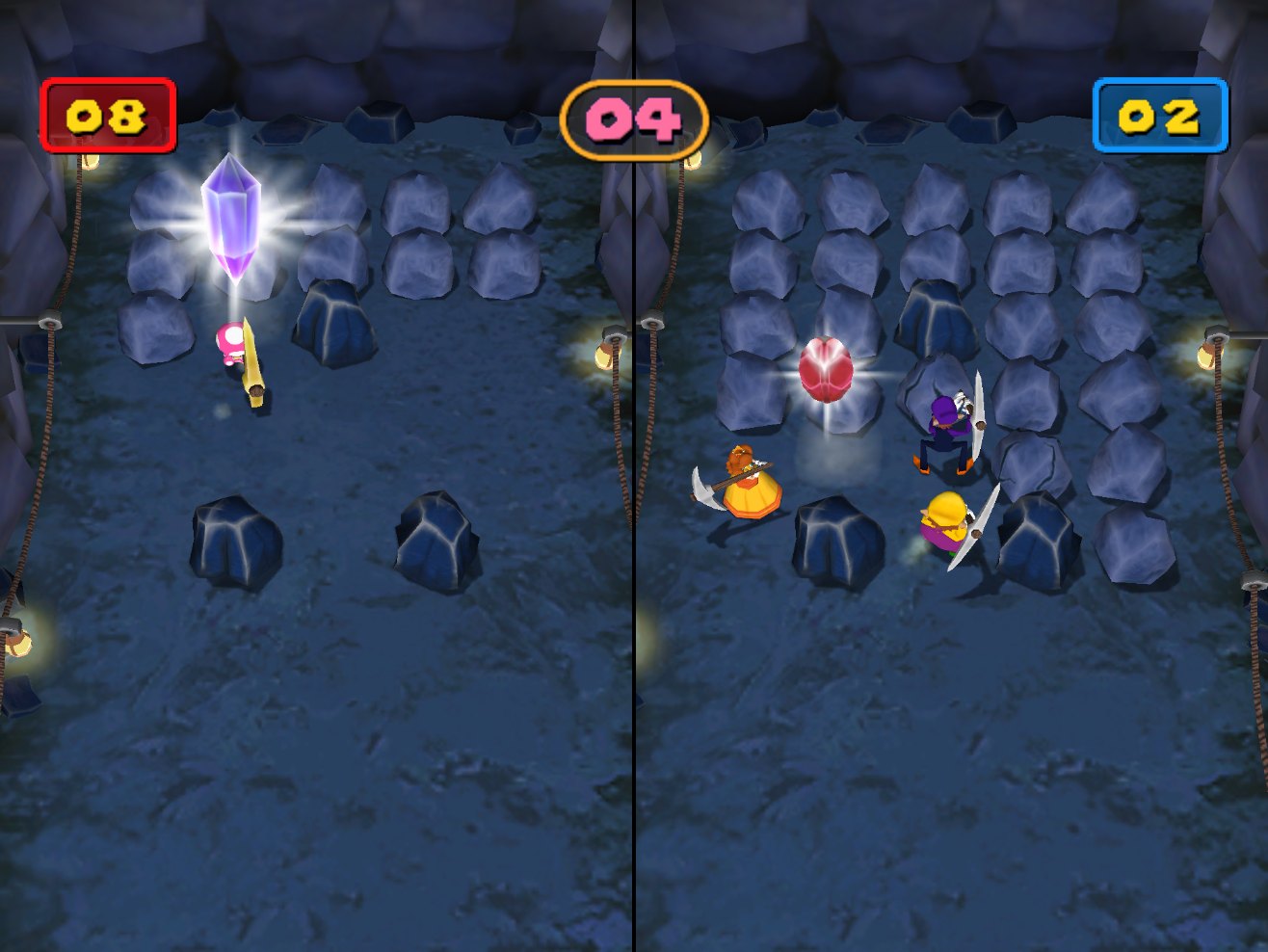
Easy Pickings1-vs-3A gem hunt. One player has a pickaxe that splits a rock in a single blow; the three with small ones need three swings.
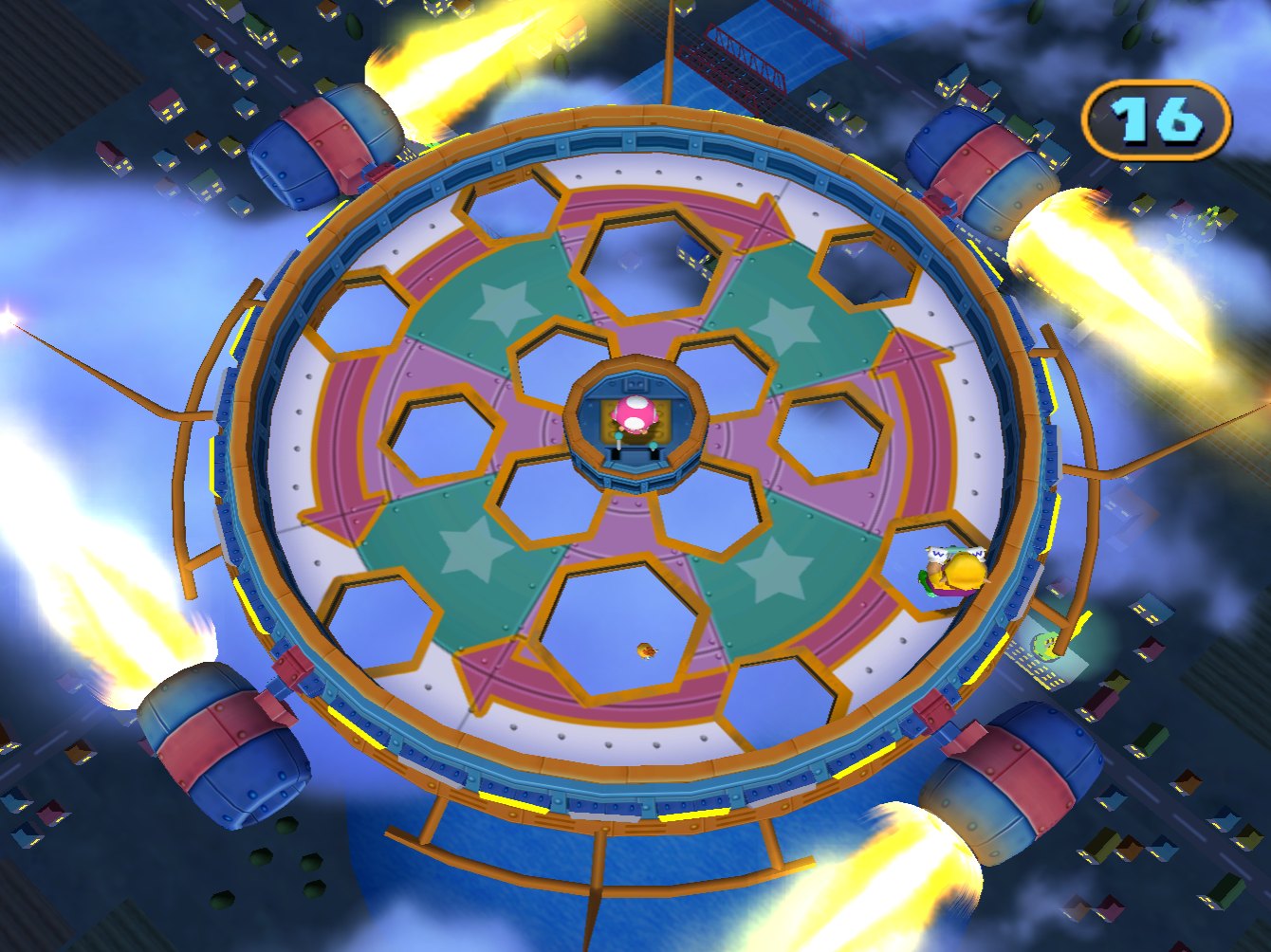
Pogo-a-Go-Go1-vs-3One player spins the floor with the shoulder buttons to tip three pogo-stick riders down a hole. In The Top 100 and Superstars.
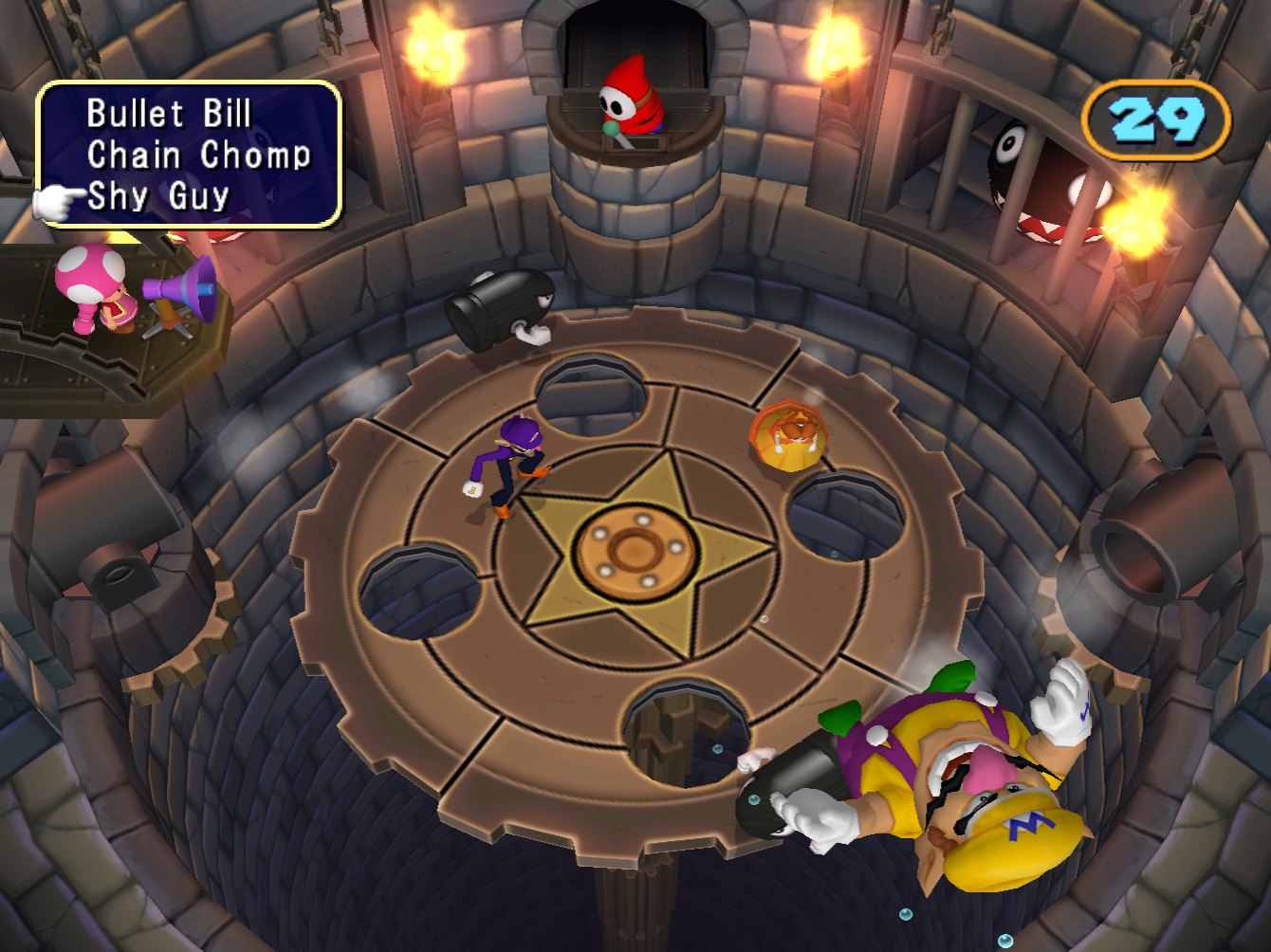
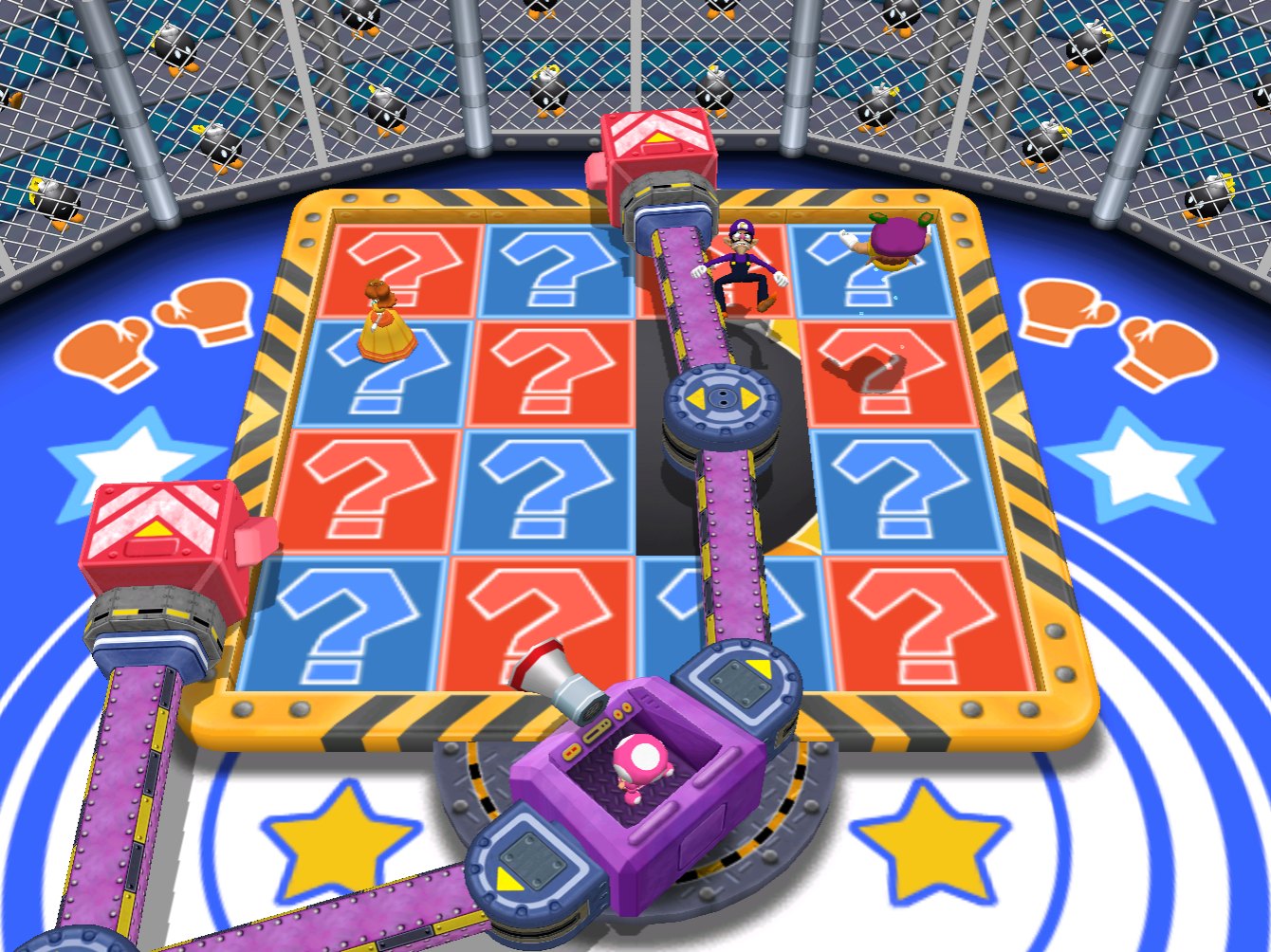
Wheel of Woe1-vs-3 · MicThe player with the Mic orders Chain Chomps, Shy Guys and Bullet Bills at the other three by name.
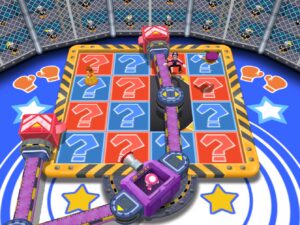
Boxing Day1-vs-3 · MicSpoken commands aim a pair of robot fists at three players who are trying to ground-pound the floor tiles.
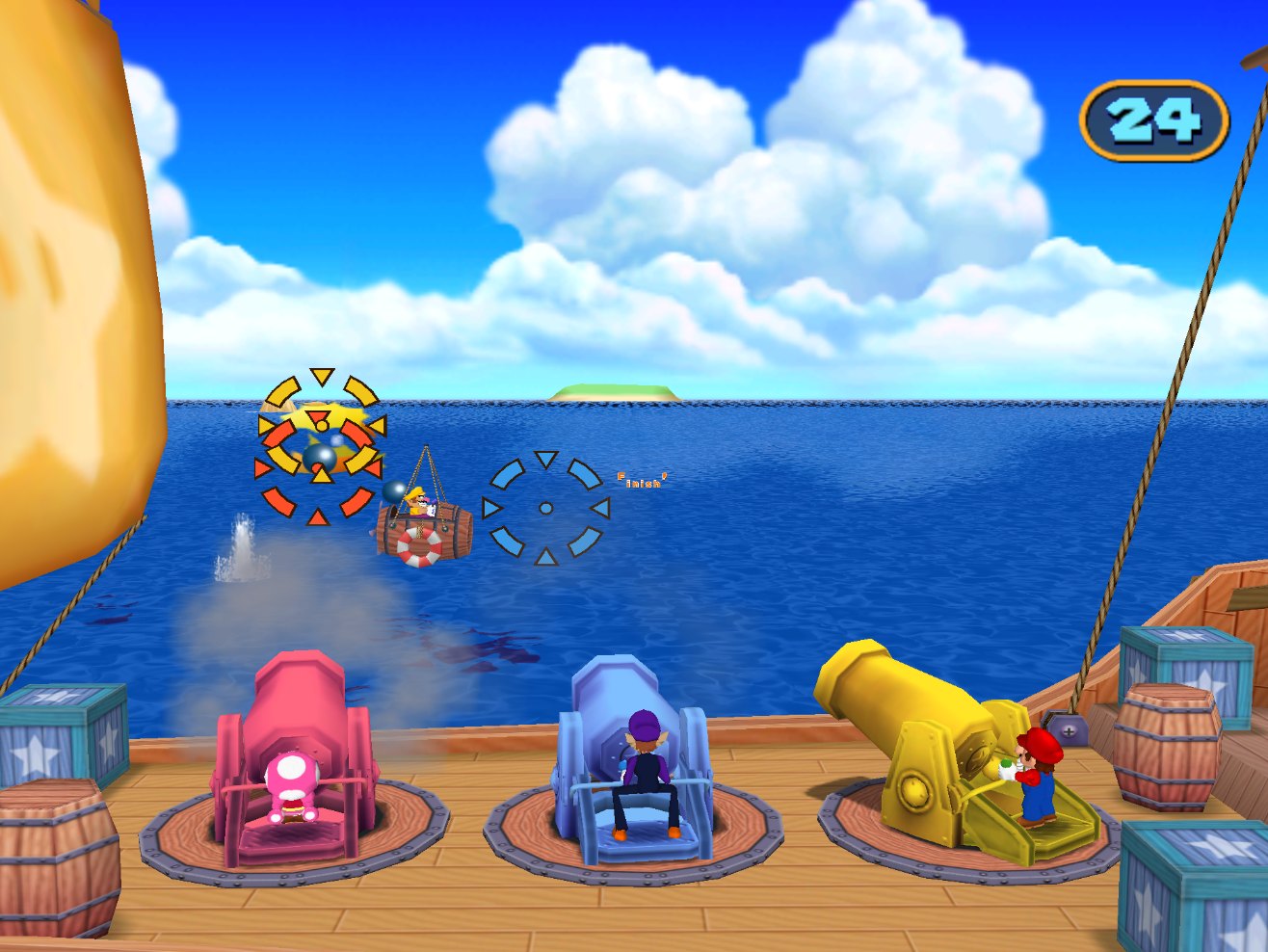
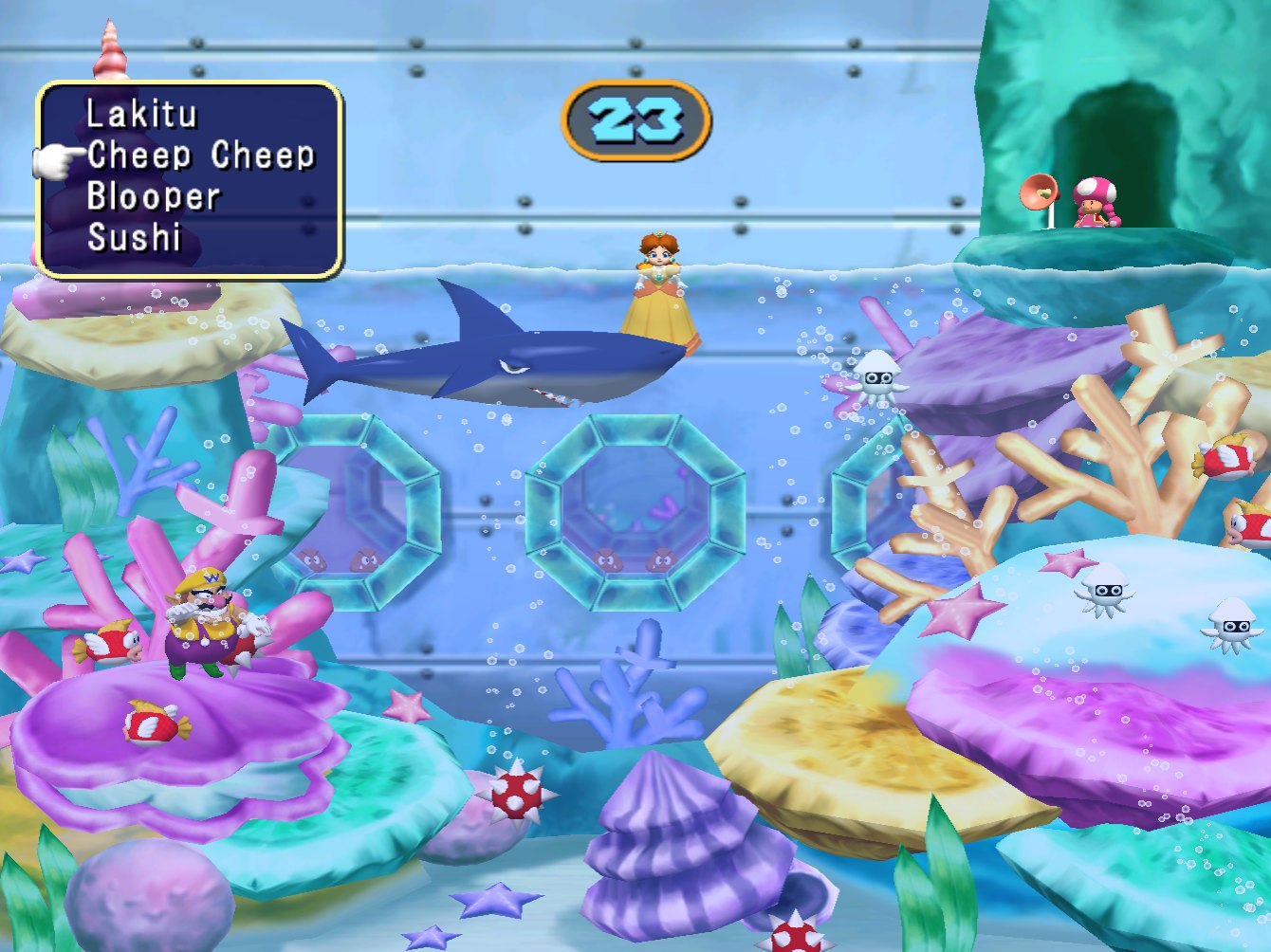
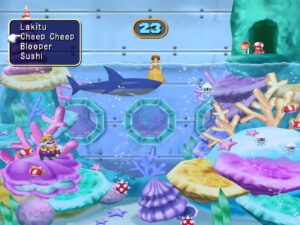
Be My Chum!1-vs-3 · MicCall up Cheep Cheeps, Bloopers, Lakitu or Sushi the shark to harass three swimmers.
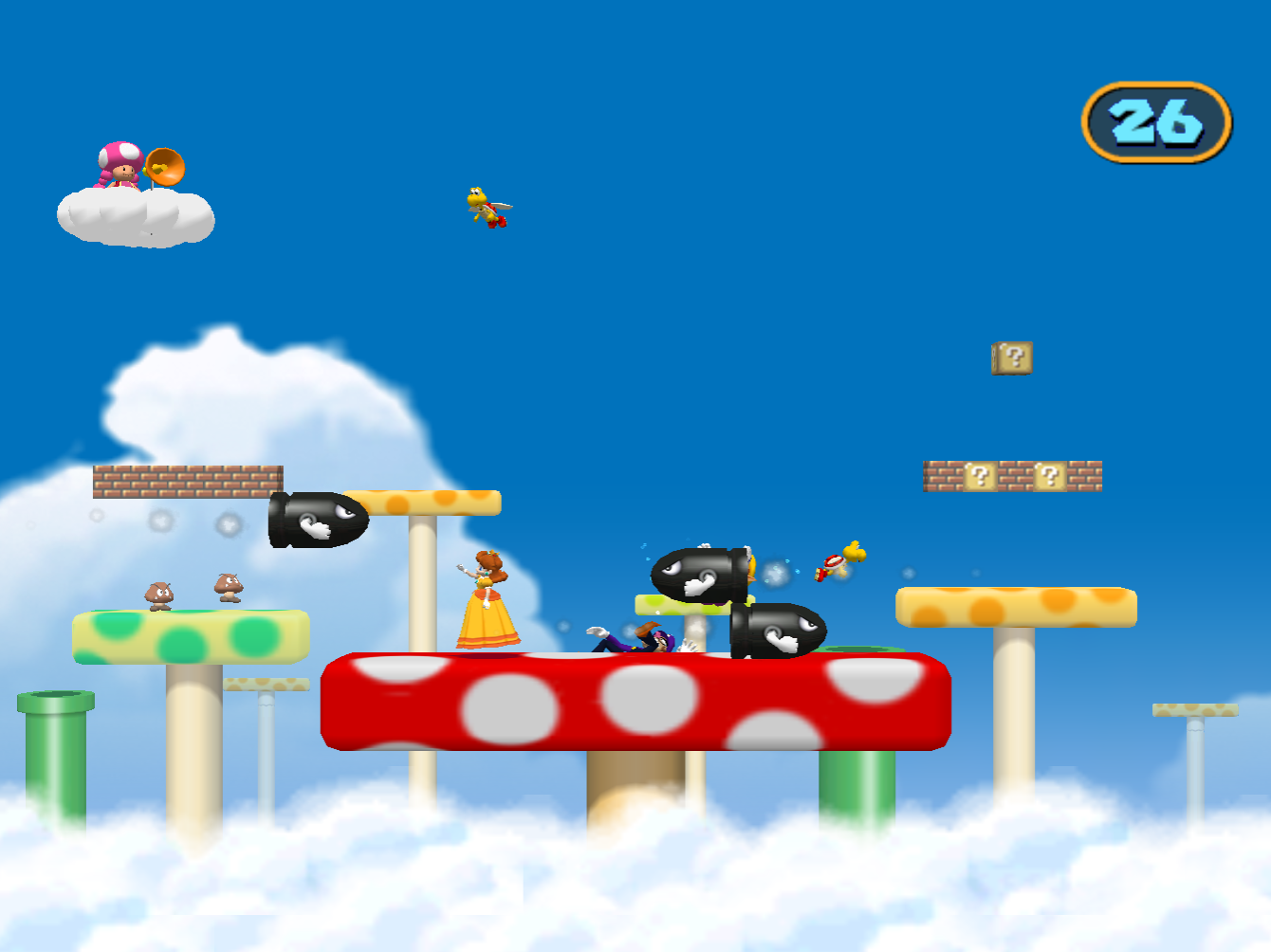
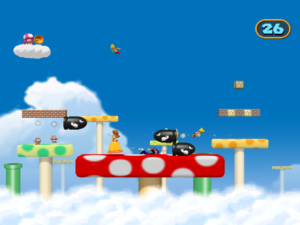
StratosFEAR!1-vs-3 · MicSay “move up” or “move down” to shift a platform and bring Bullet Bills down on the other three.
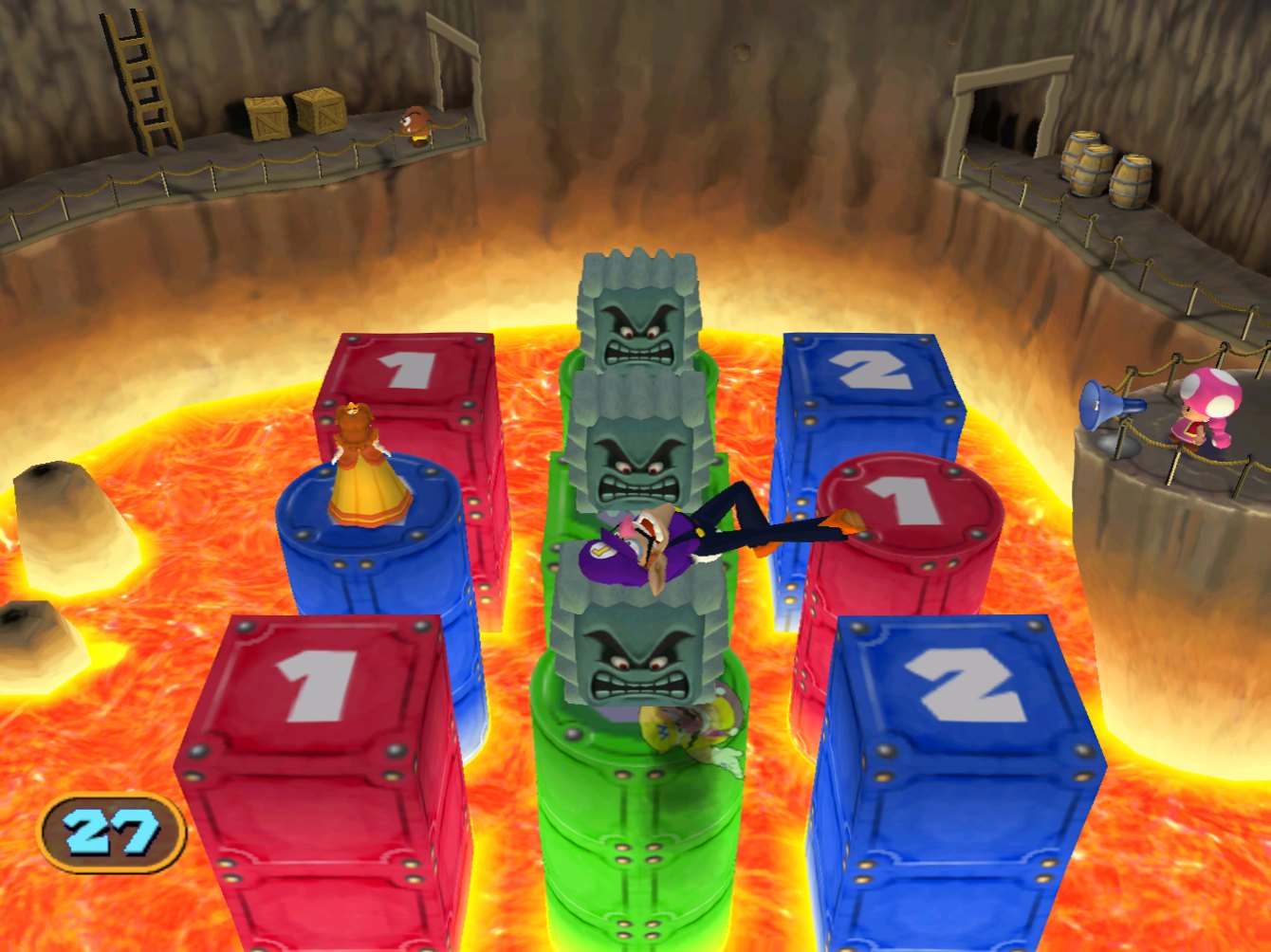
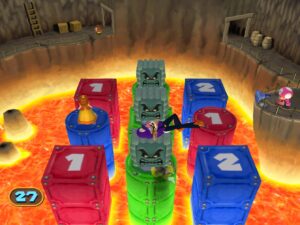
Number Crunchers1-vs-3 · MicName a number or a shape to drop a Thwomp on that spot, with lava waiting for anyone who jumps the wrong way.
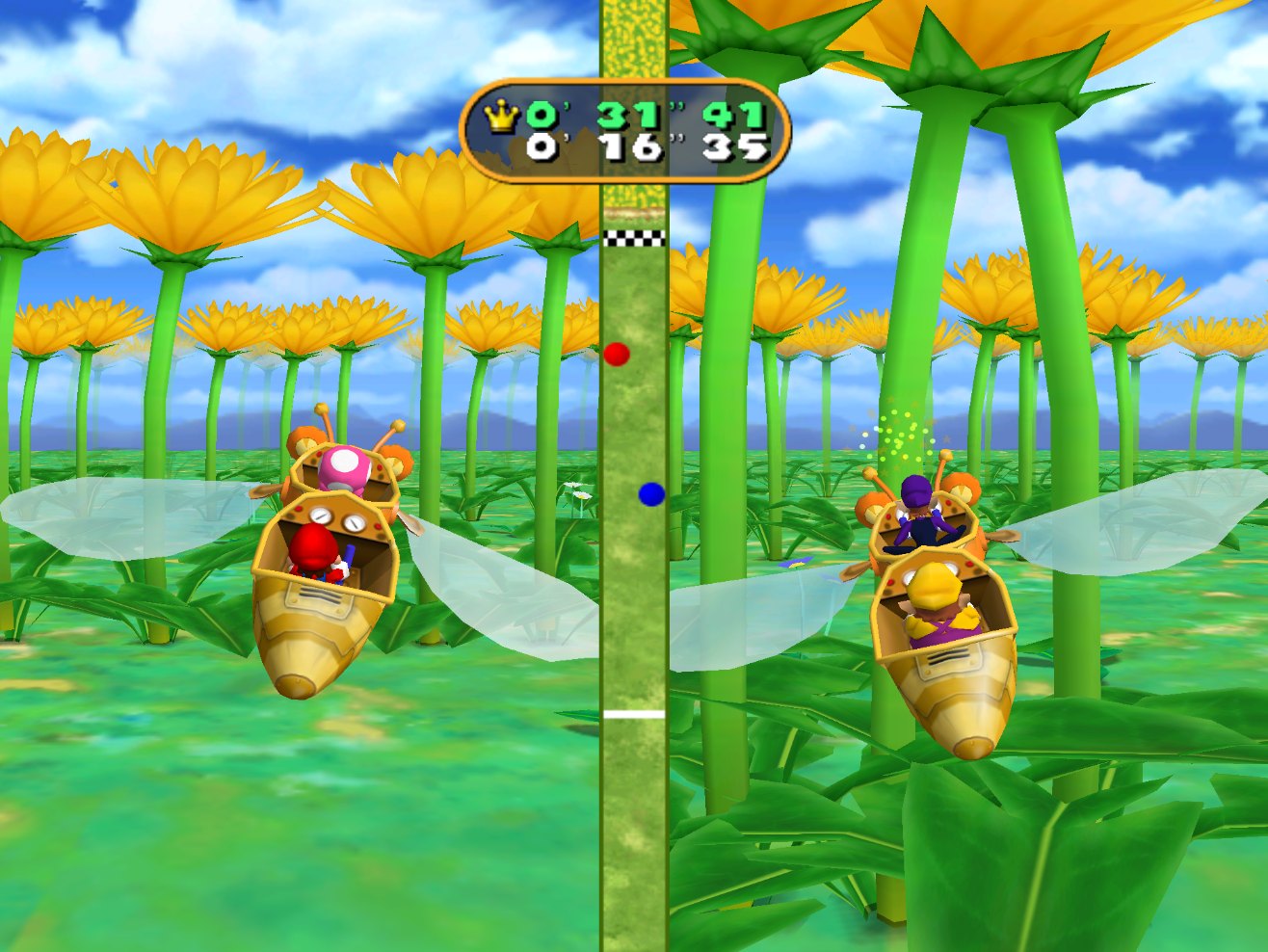
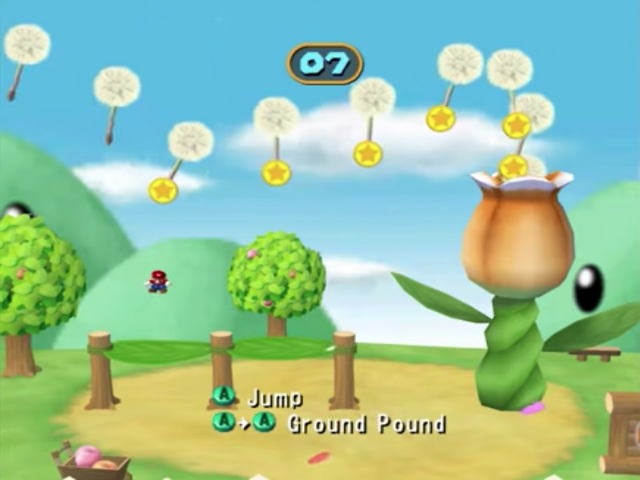
Buzzstormer2-vs-2Pairs fly bee-shaped aircraft through a forest of giant dandelions. Clip a stem and you are stunned.
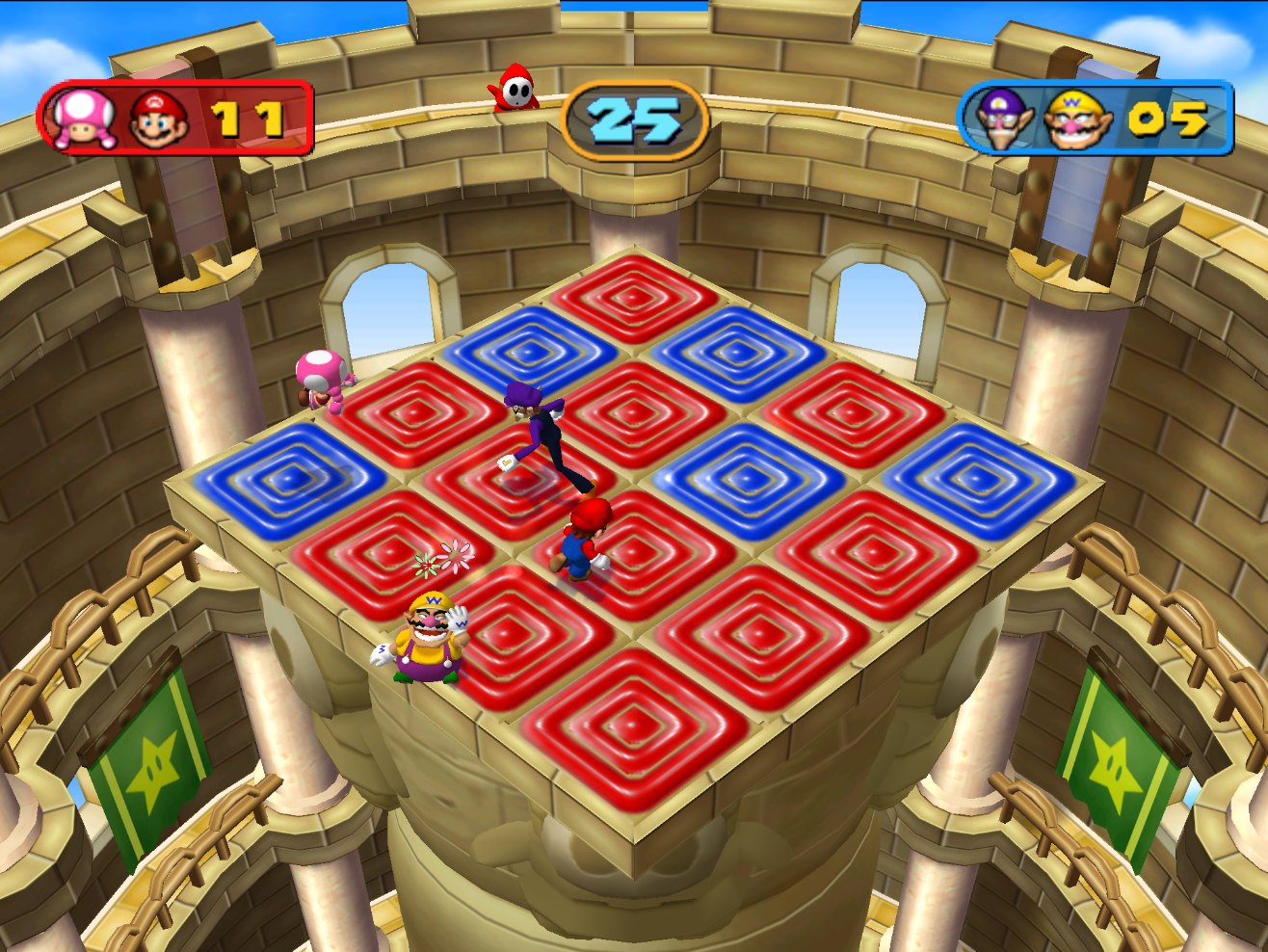
Tile and Error2-vs-2Ground-pound the sixteen floor tiles to turn them your team’s colour, and hold the most when time is up.
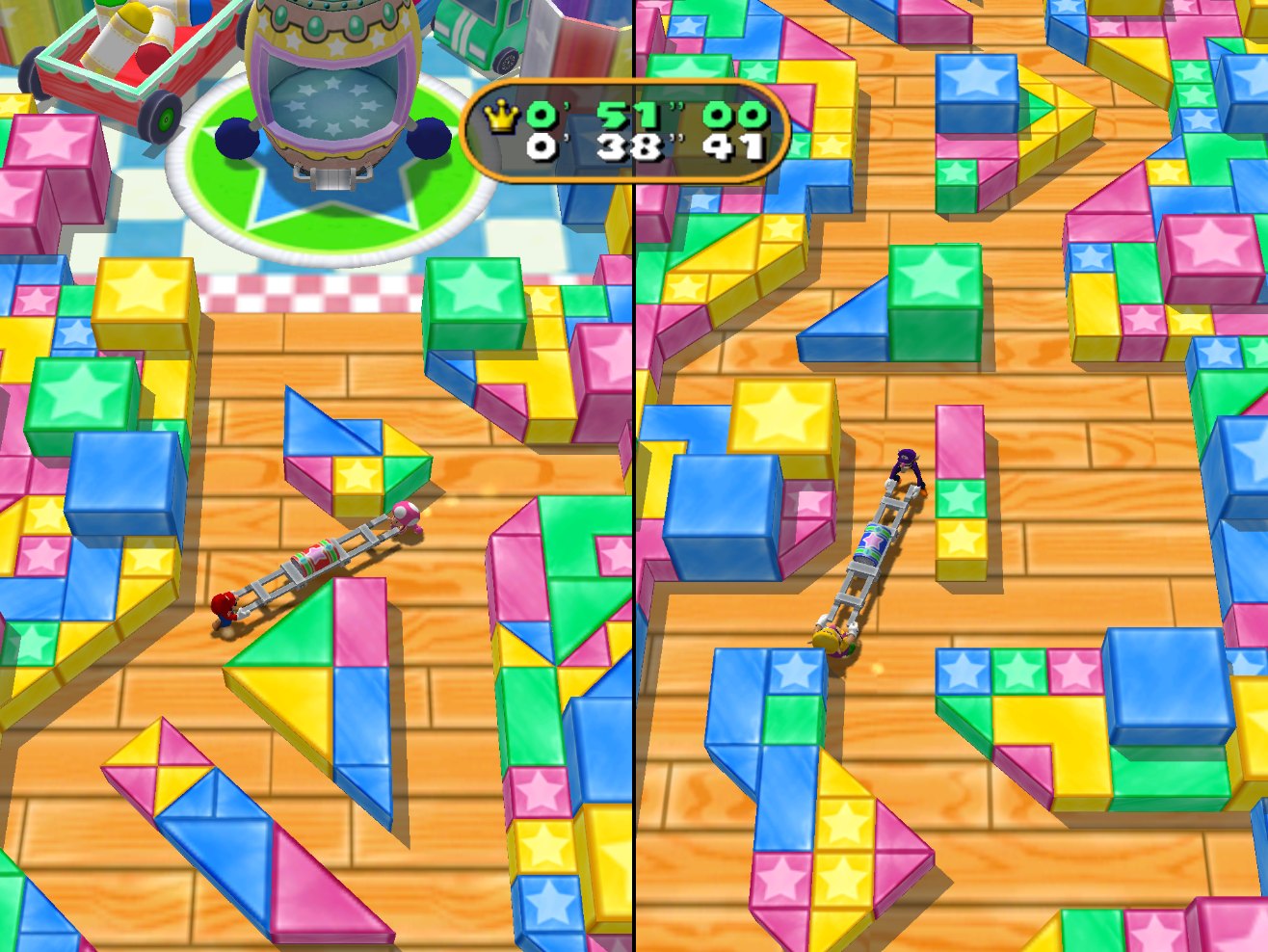
Battery Ram2-vs-2Partners carry a giant battery, one at each end, through a maze to a waiting rocket.
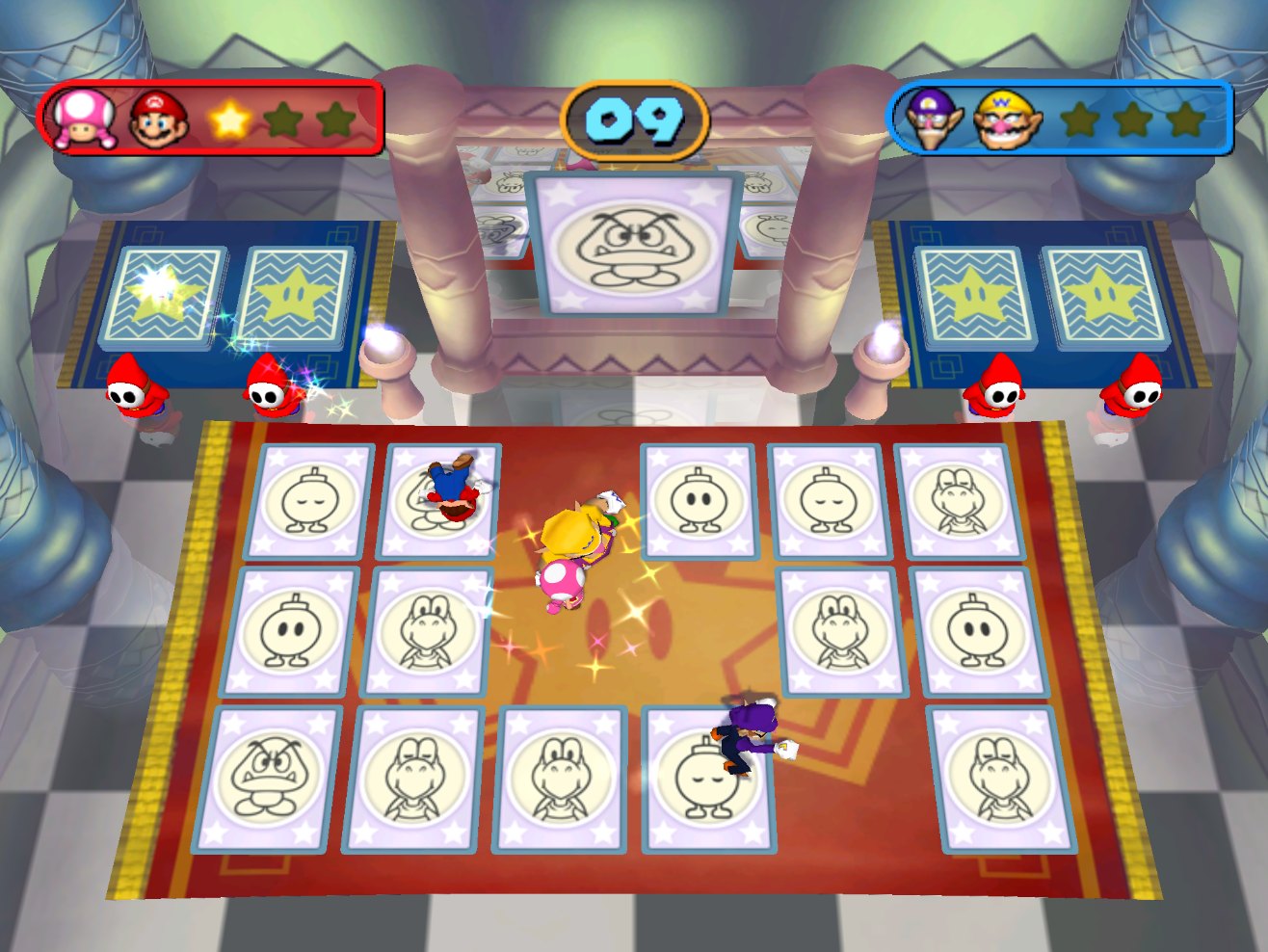
Cardinal Rule2-vs-2Find and stomp the pair of cards that matches the one shown in the mirror. Three pairs wins.
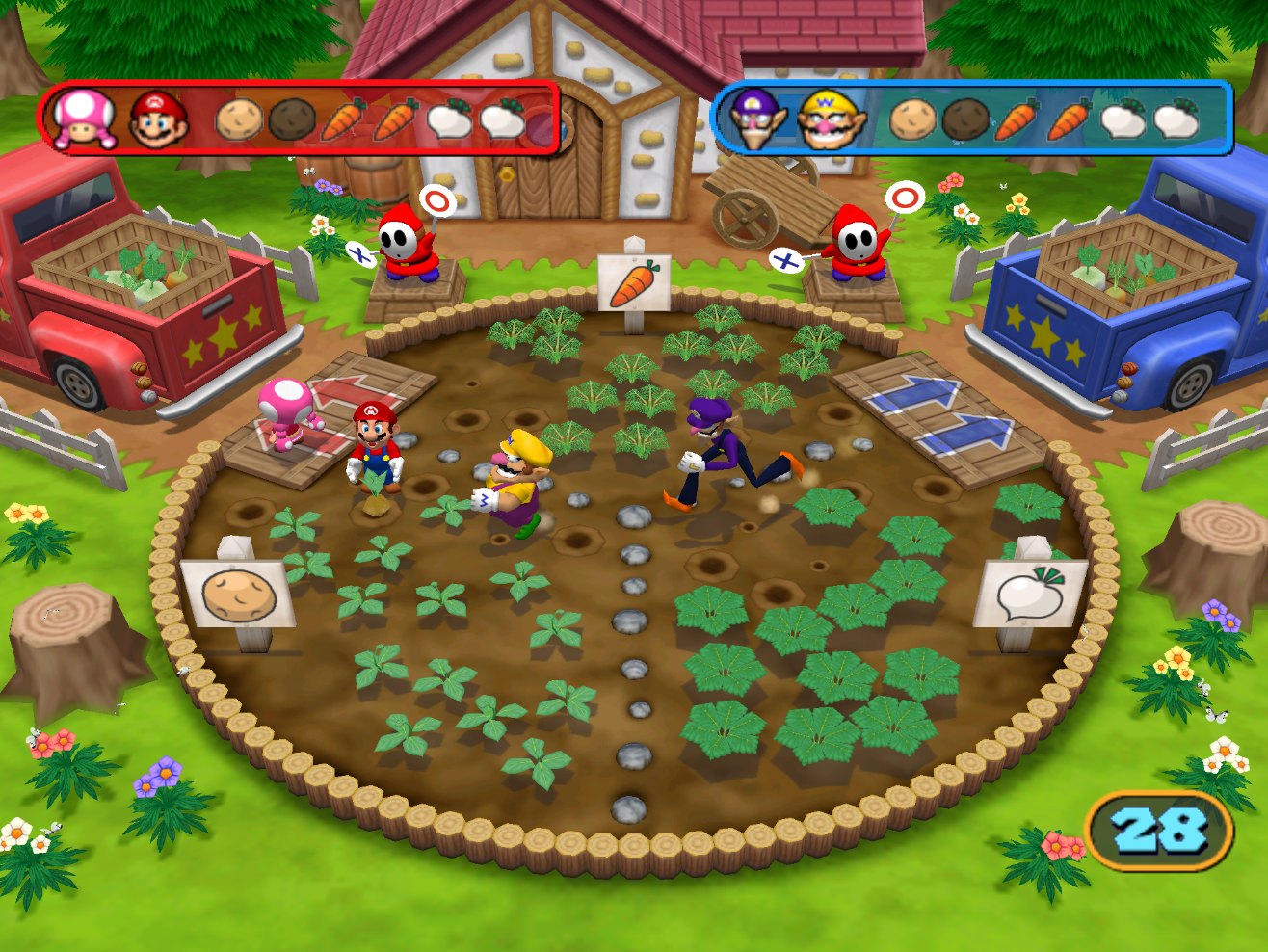
Bumper Crop2-vs-2Pull up carrots, turnips and potatoes and load two of each on to your truck before the other team does.
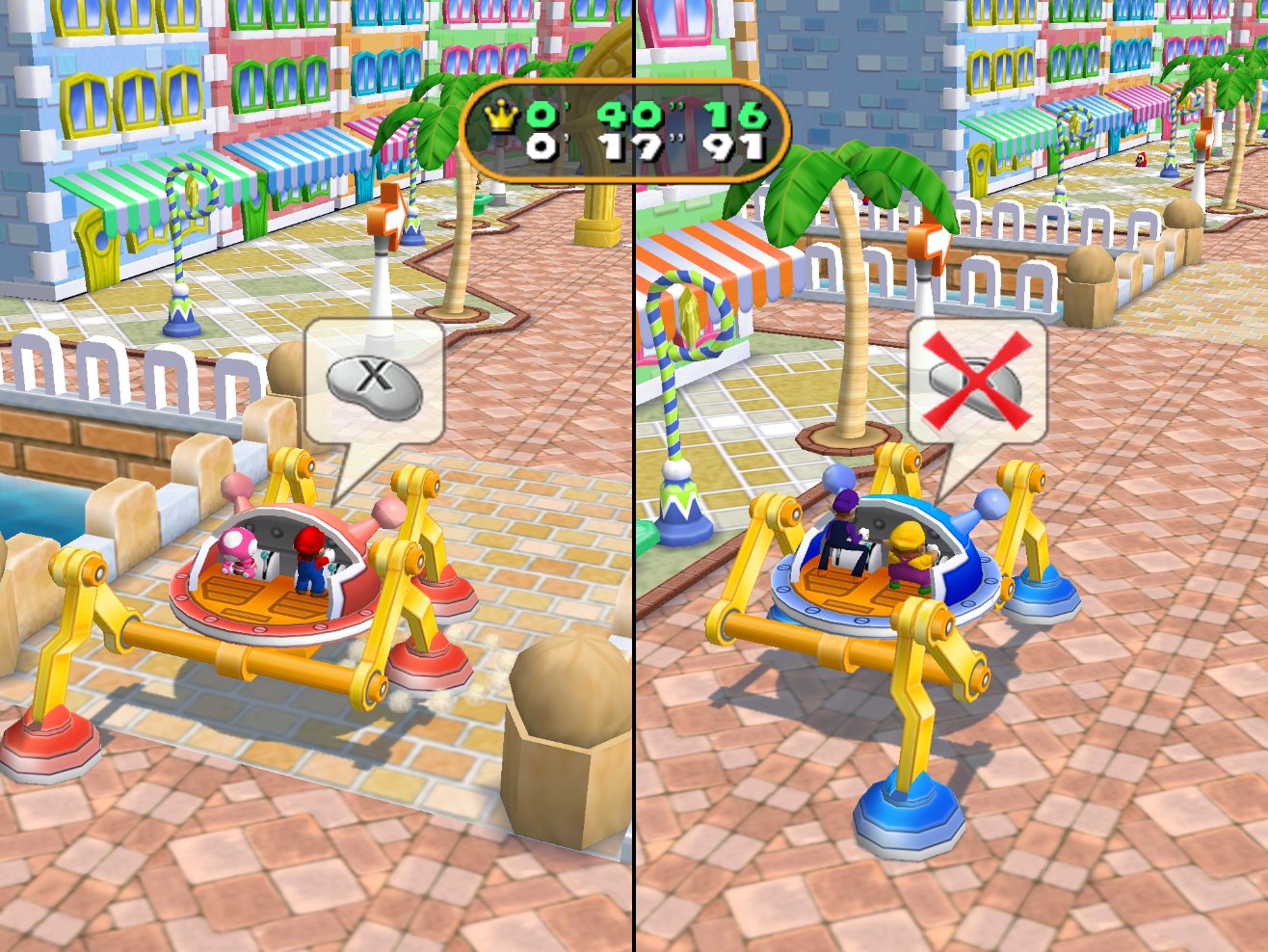
Hop-O-Matic 40002-vs-2Partners take turns pressing the buttons shown to make a hopping machine bound across town. Six hops to the finish.
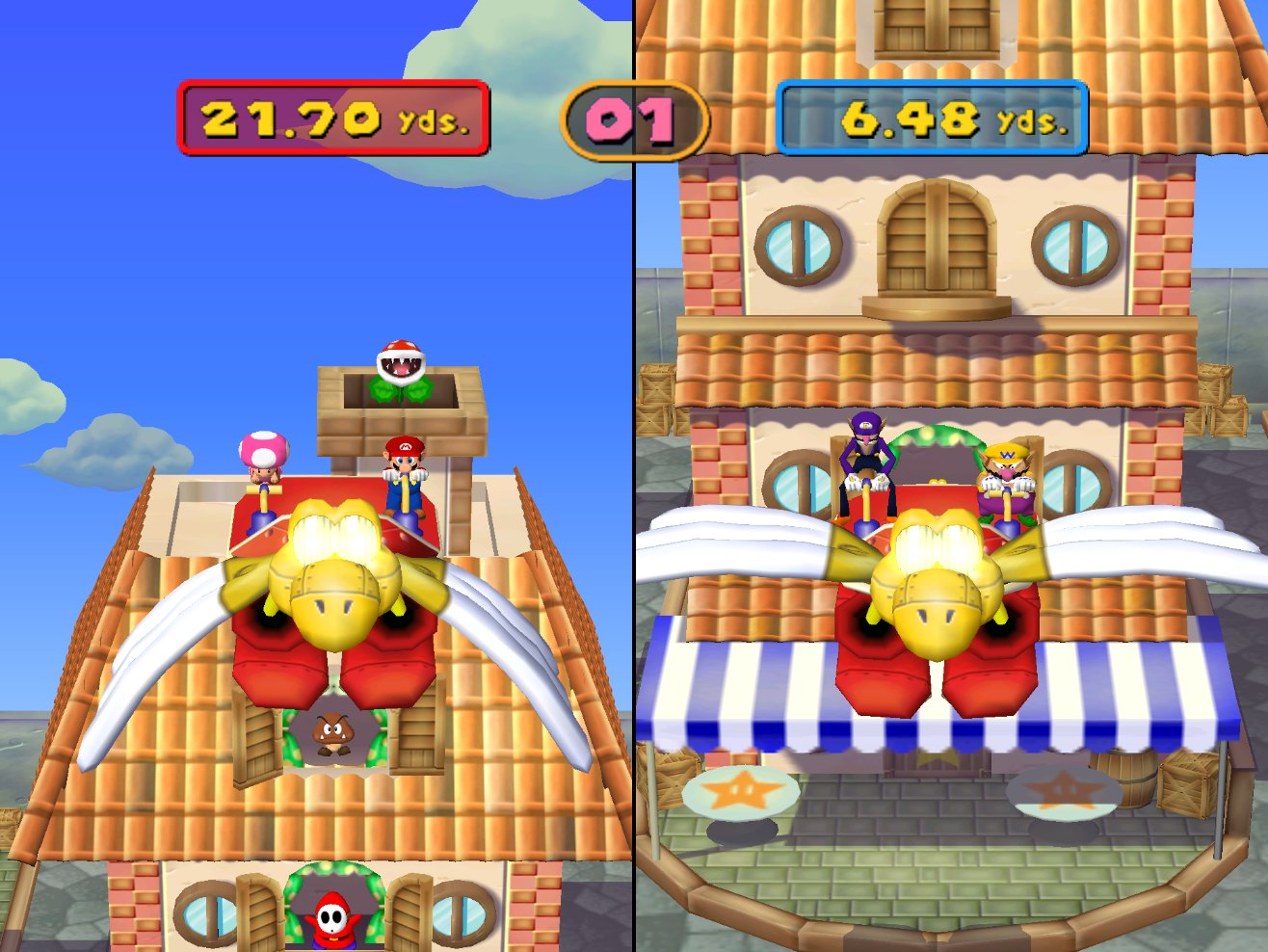
Wingin’ It2-vs-2Ten seconds of frantic tapping to flap a Koopa-shaped flying machine higher than the other pair.
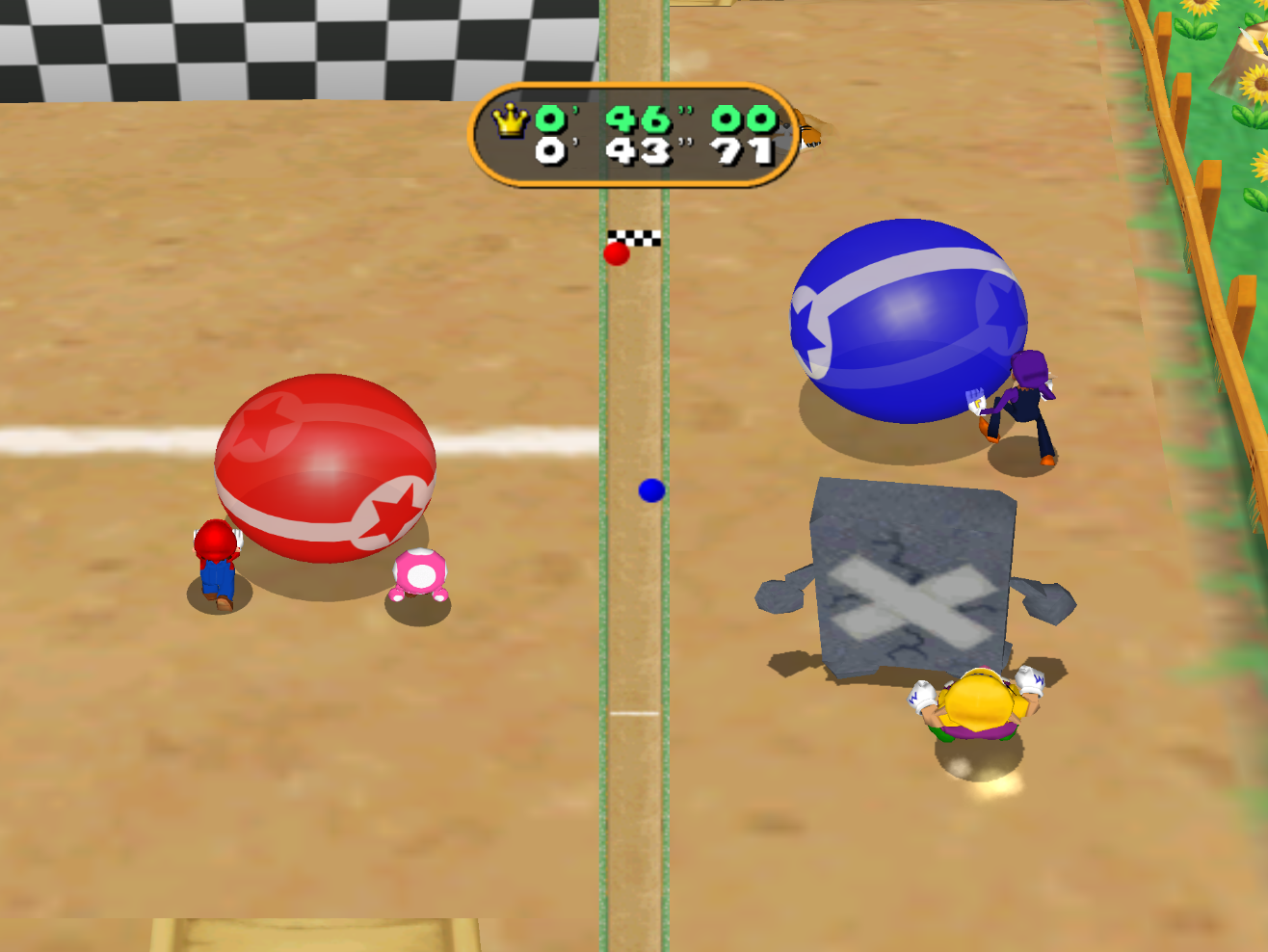
Sphere Factor2-vs-2Two players push one huge ball through mazes and past Whomps to the goal. In The Top 100.
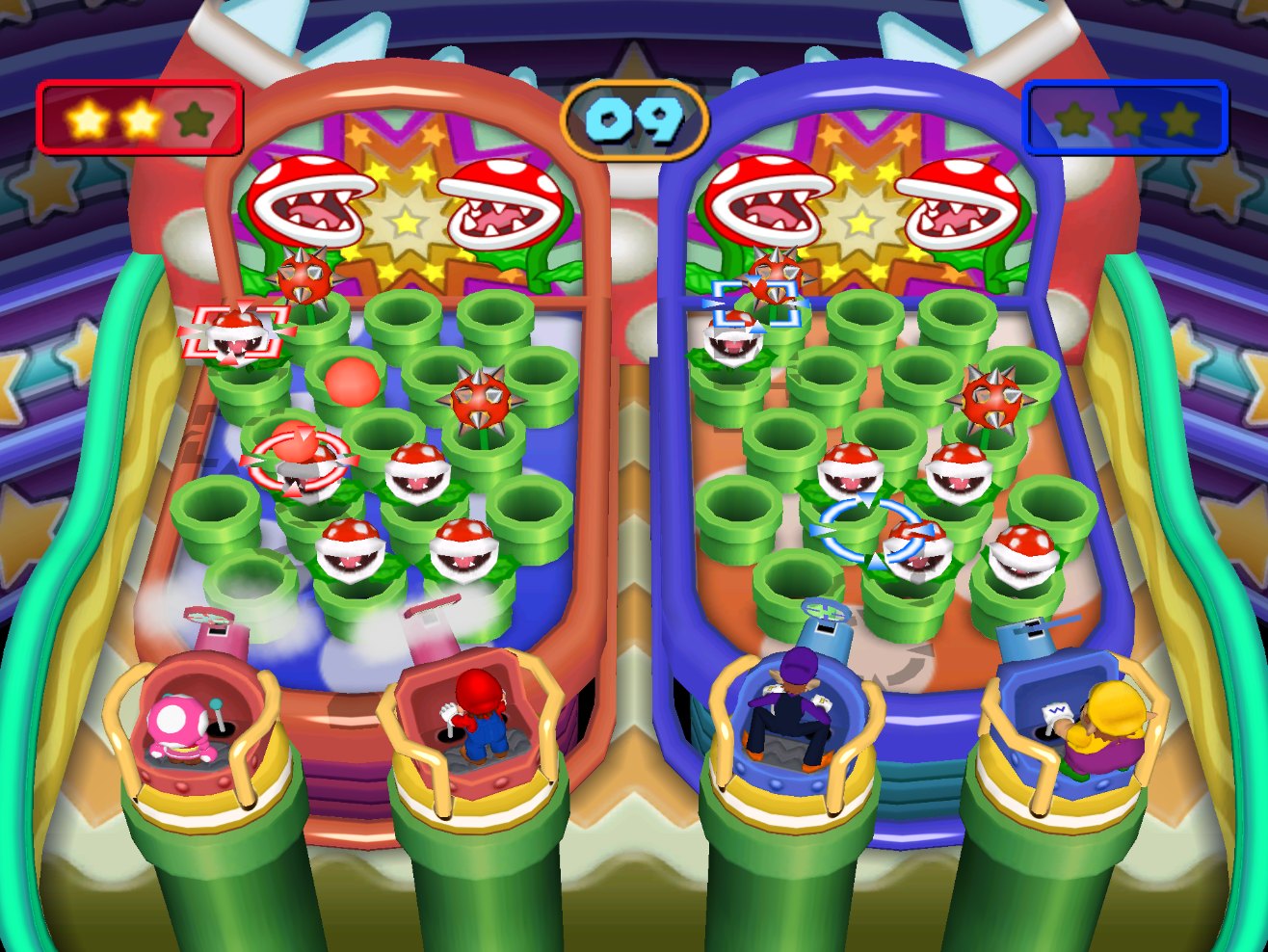
Herbicidal Maniac2-vs-2Shoot the Piranha Plants that sprout from the pipes on your side, but not the bombs. First to three rounds.
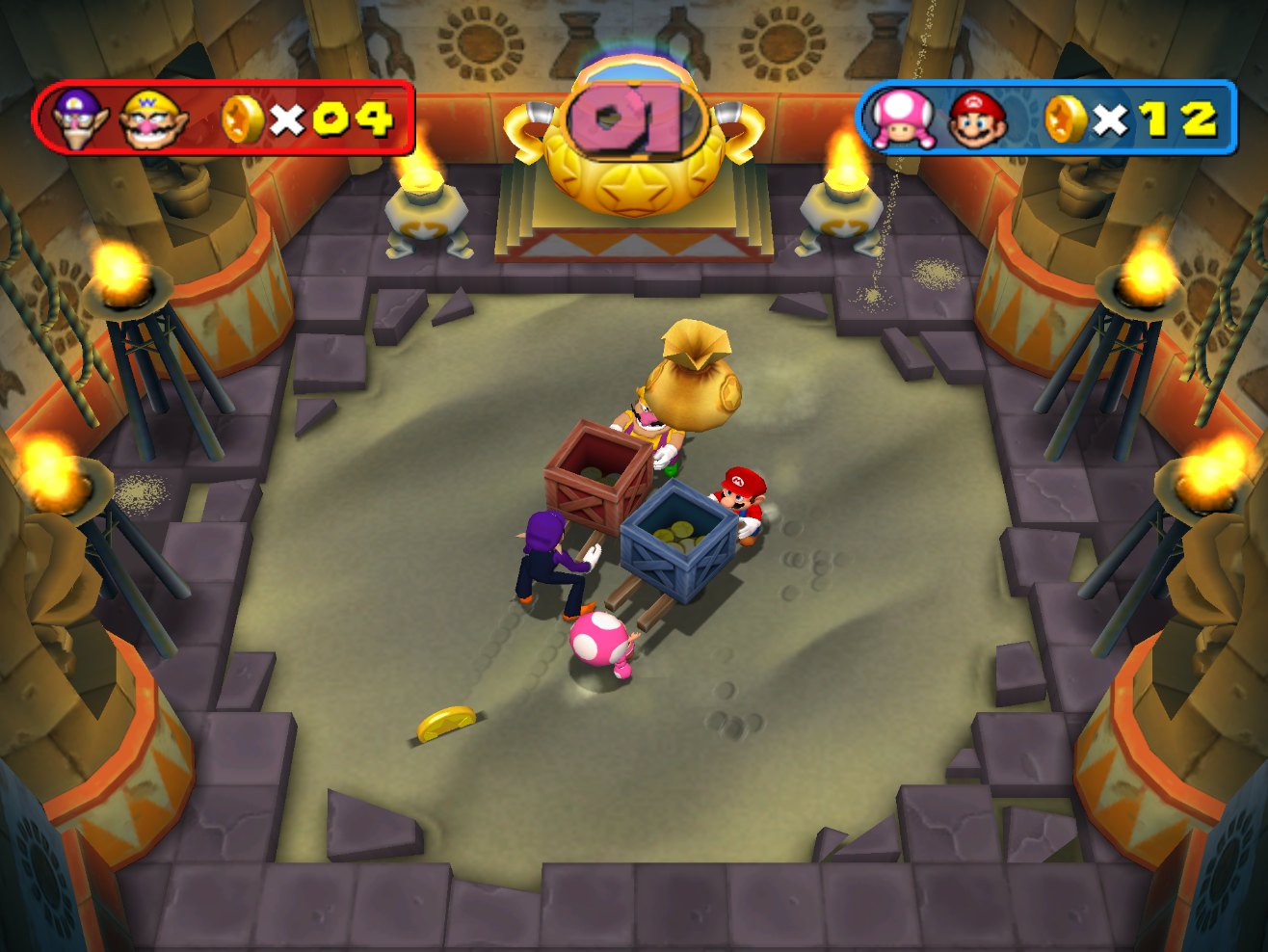
Pyramid Scheme2-vs-2 · coinPairs catch as many falling coins and coin bags as they can, and keep the lot.
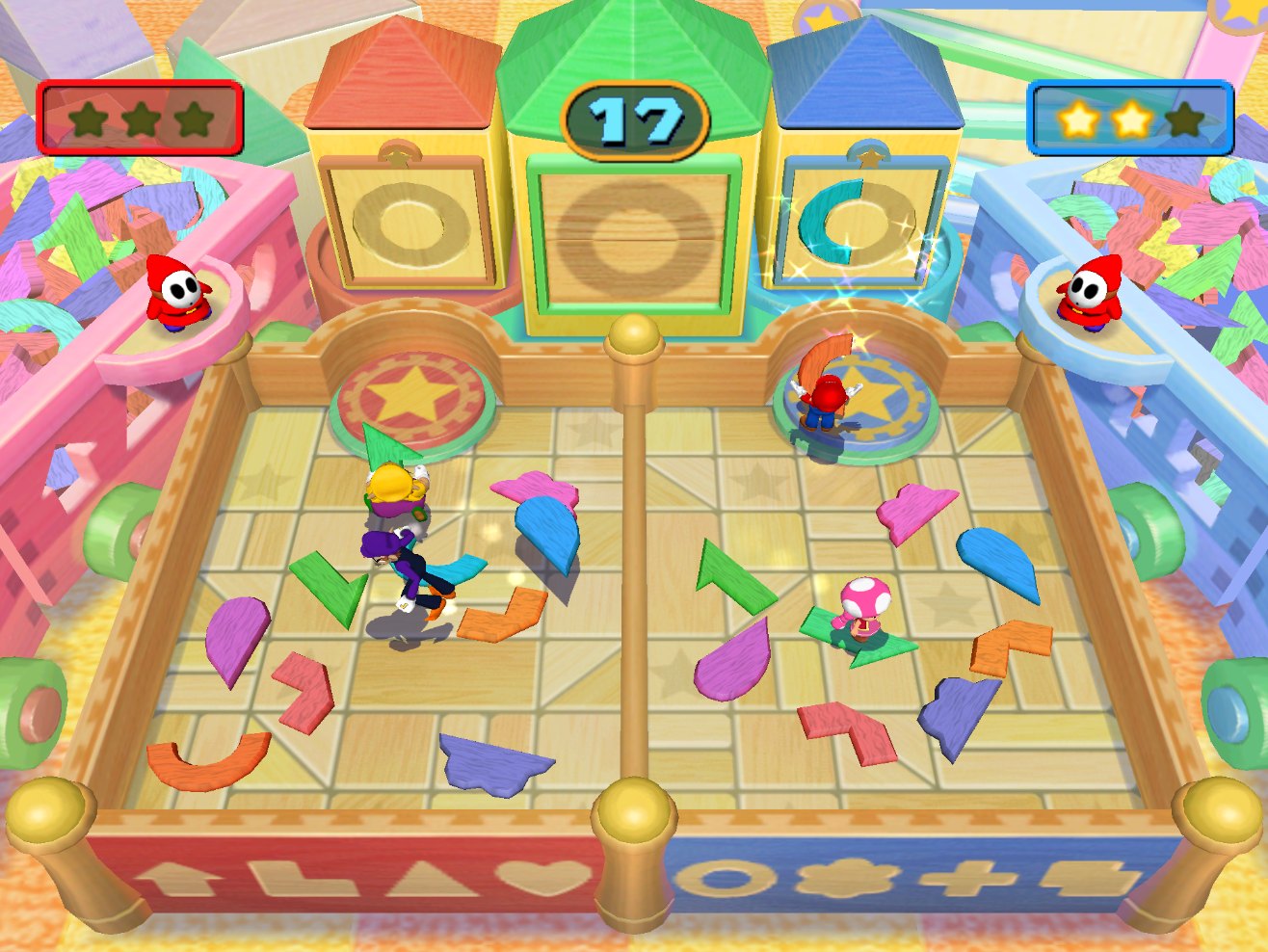
World Piece2-vs-2Find the two halves that make up the shape on display and drop them into your panel. First to three.
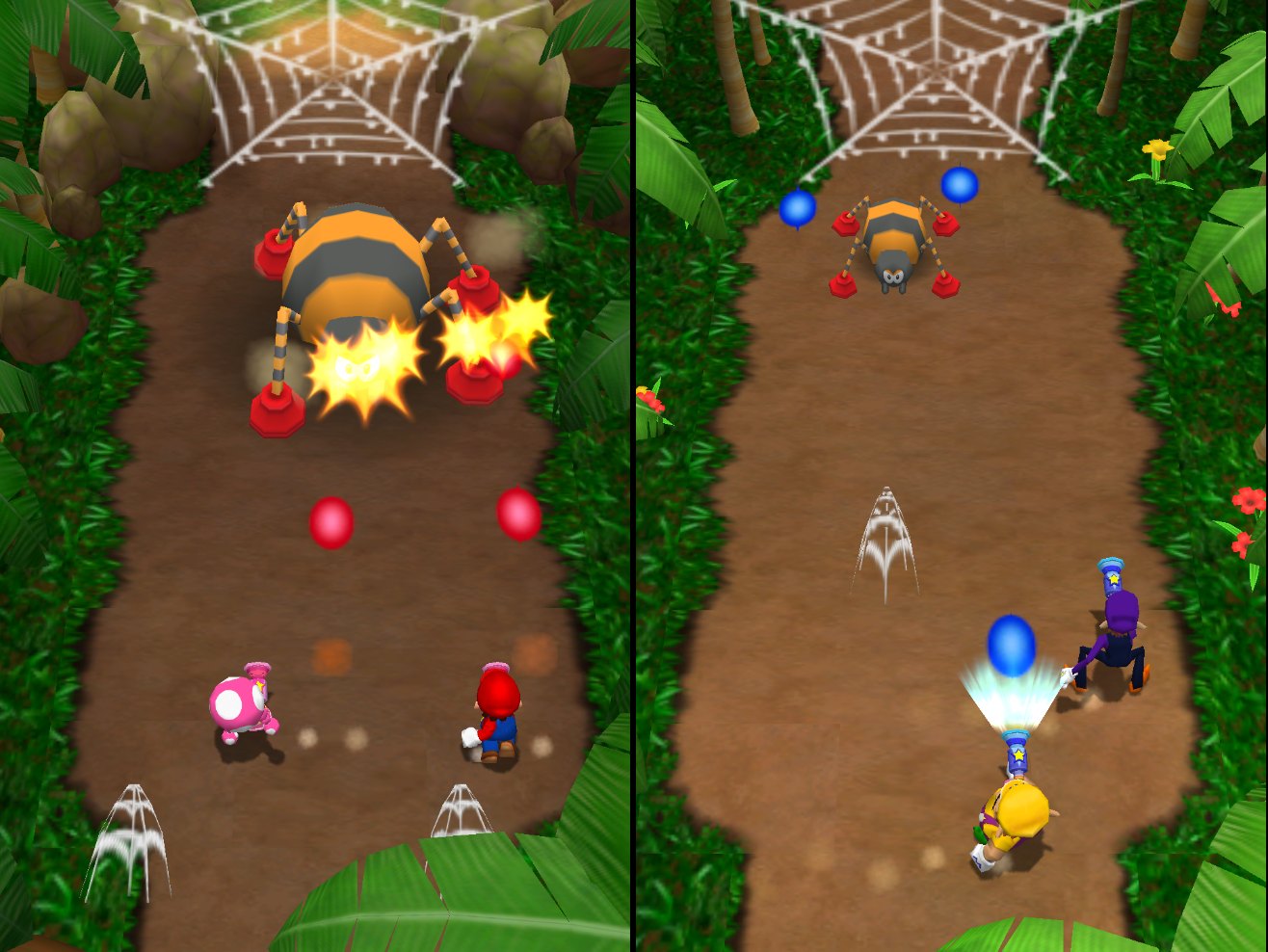
Spider Stomp2-vs-2Shoot a path through the Scuttlebugs and their giant leader to reach the captive Flutter first.
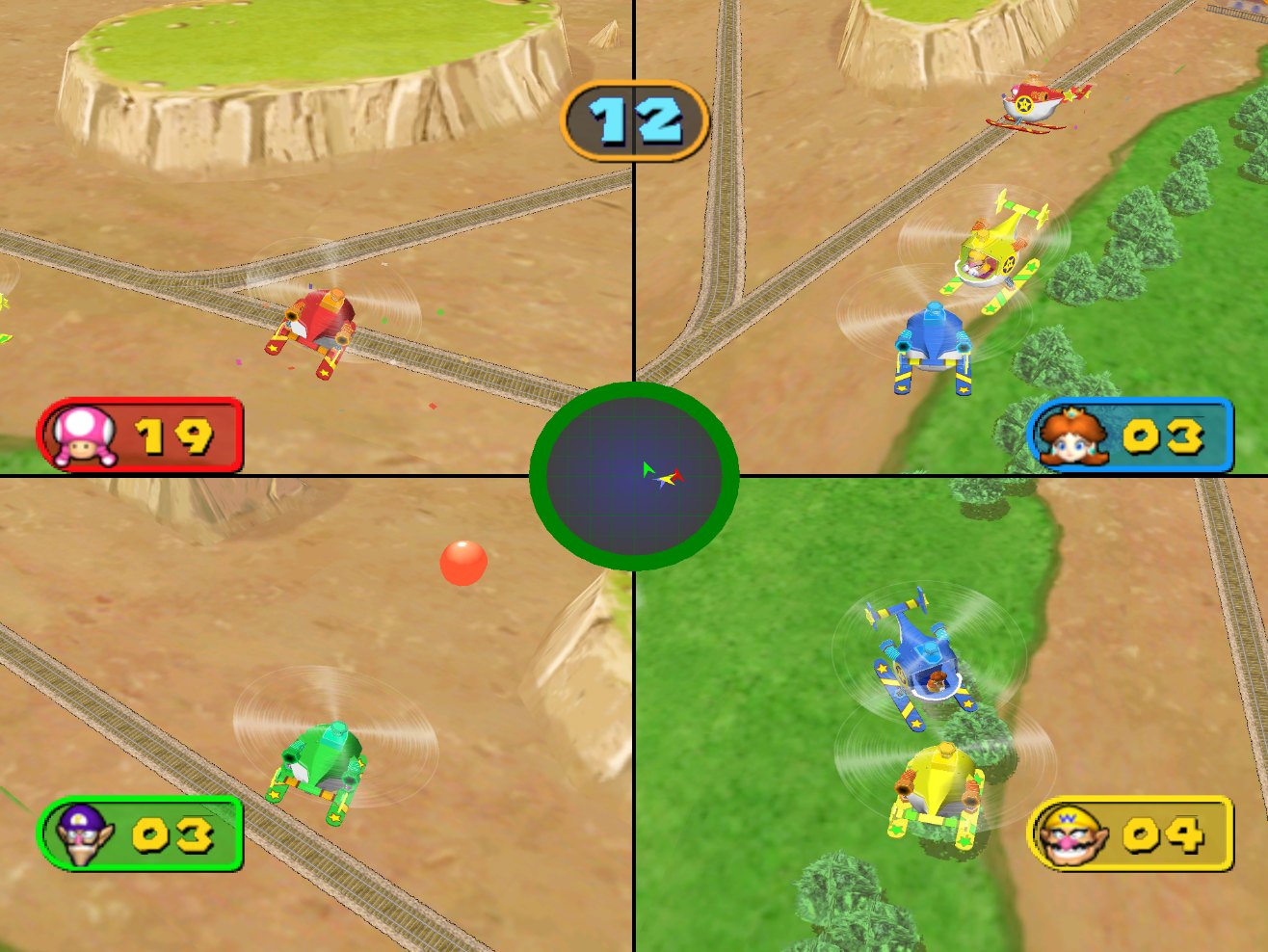
HelipopperBattlePop the most balloons from a toy helicopter in 45 seconds while Bullet Bills fly past.
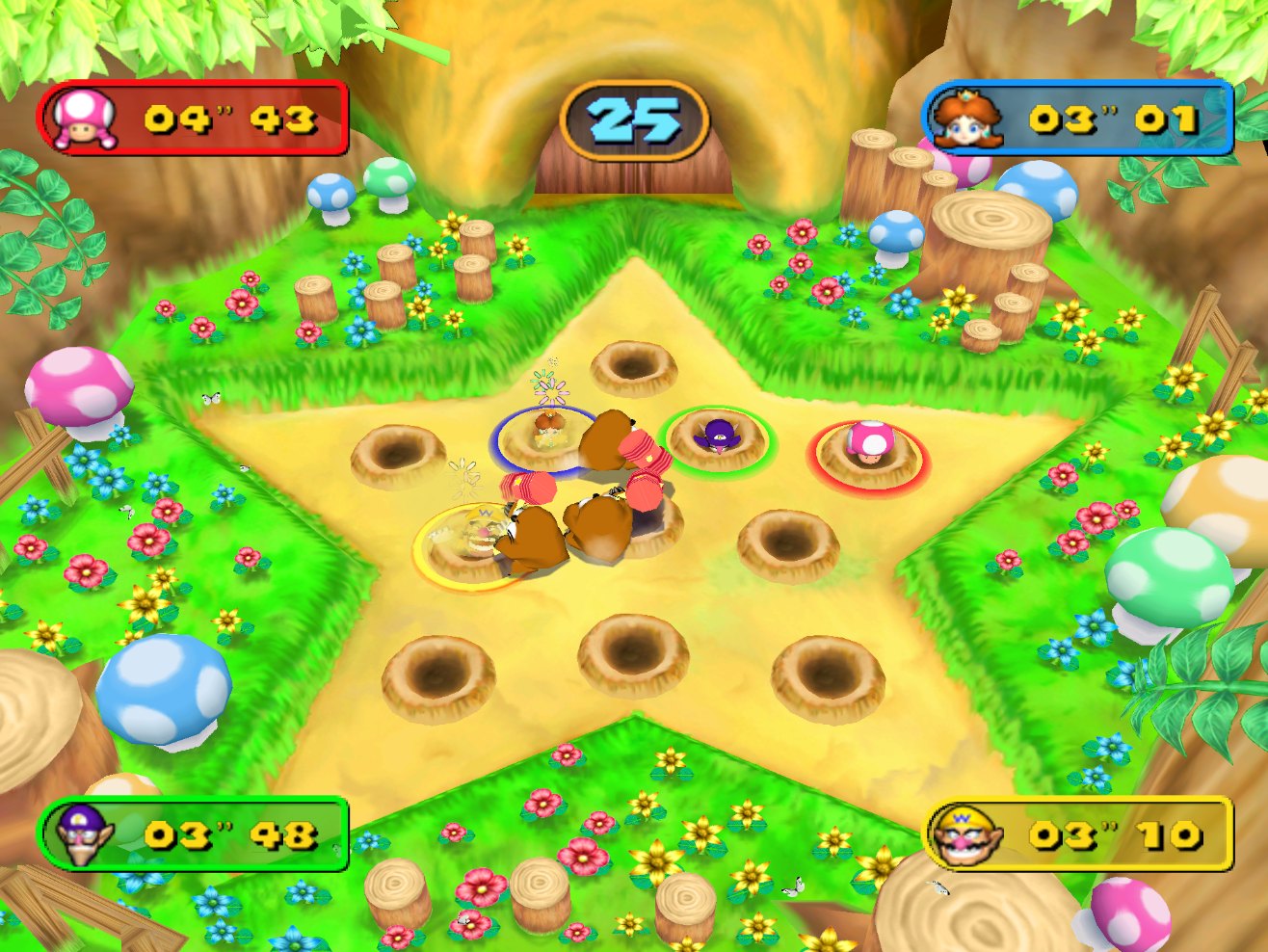
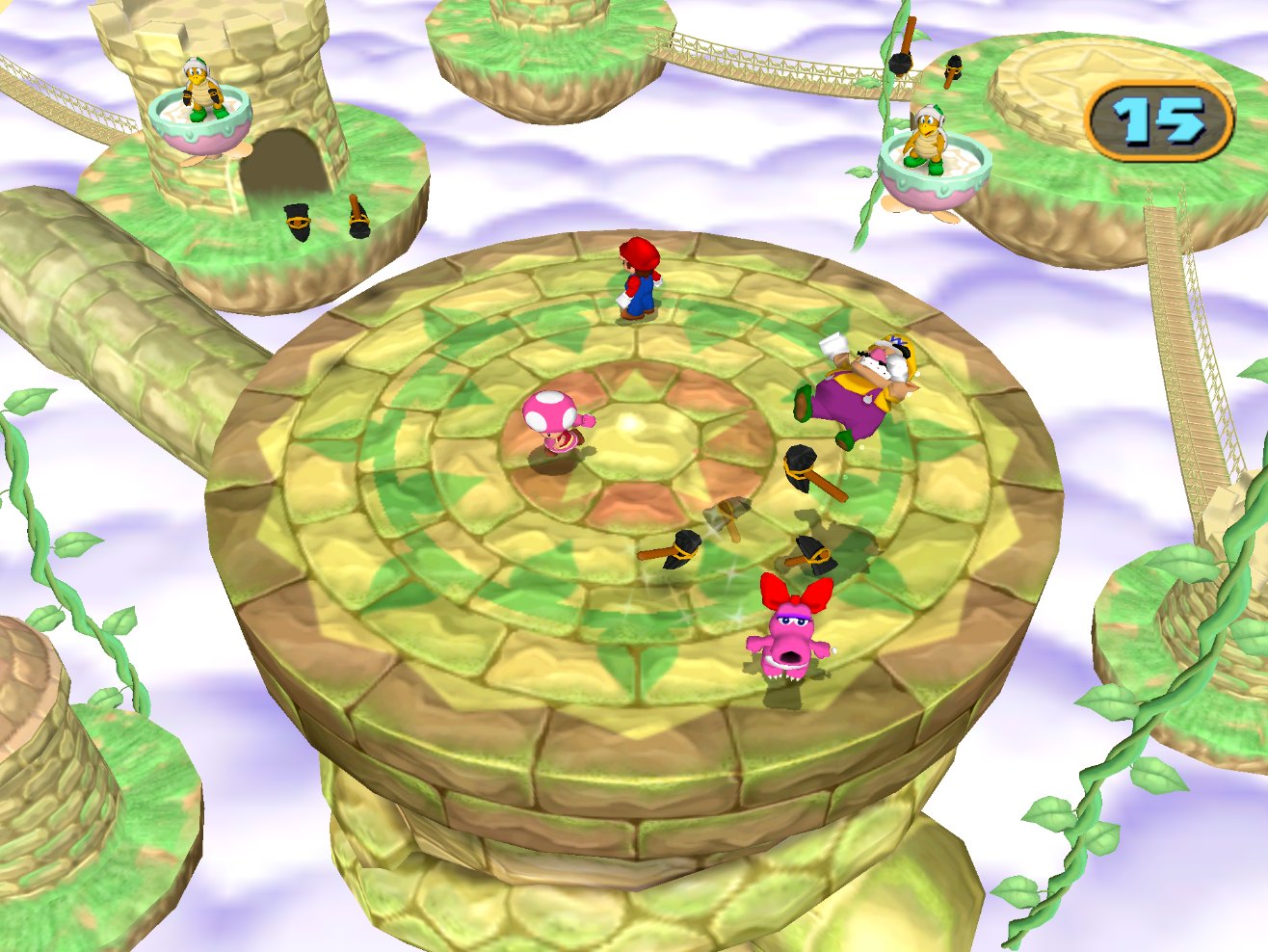
Monty’s RevengeBattleWhack-a-mole in reverse: the players are in the holes and three Monty Moles have the hammers. Stay above ground longest. In The Top 100 and Superstars.
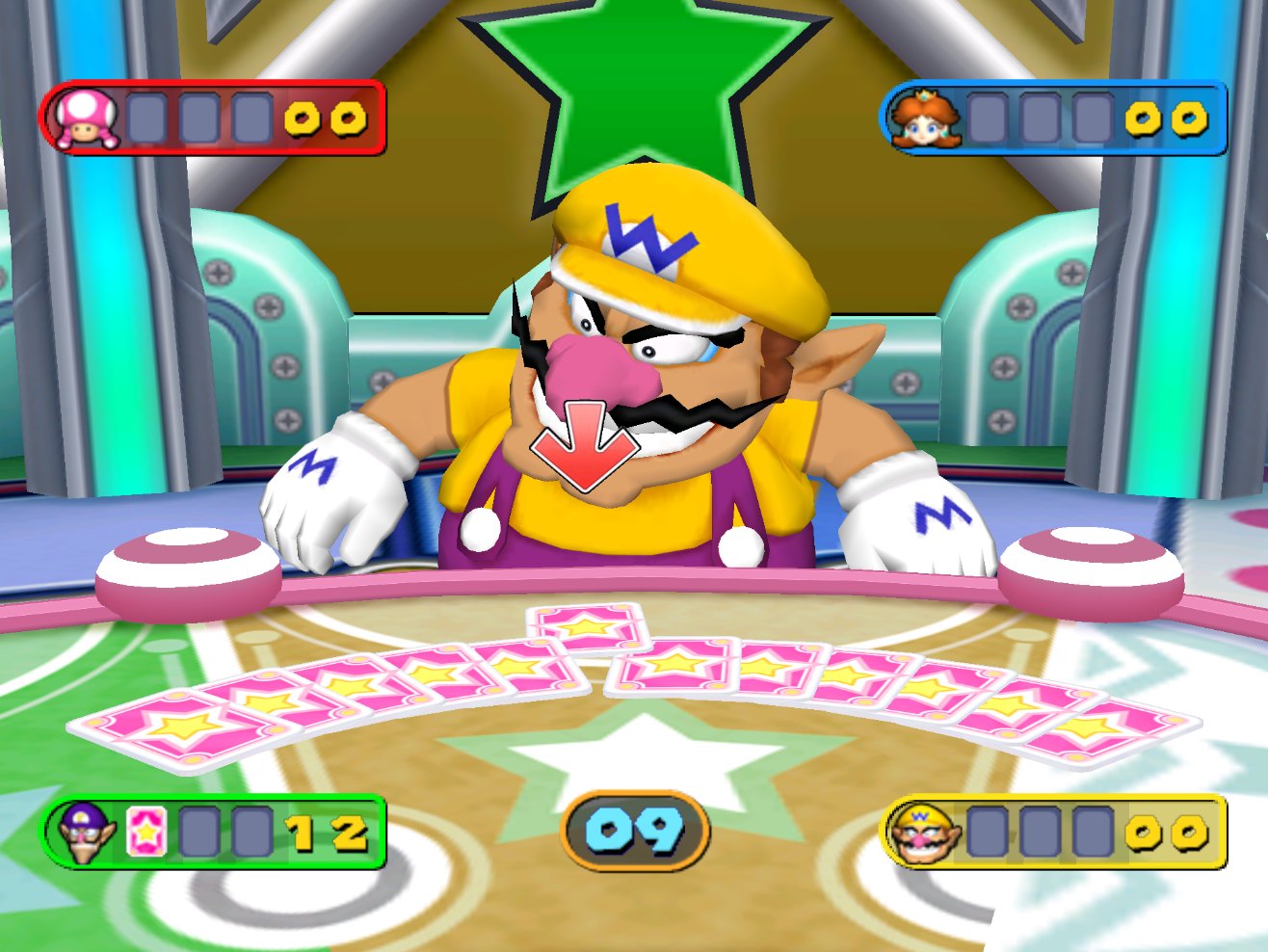
Deck HandsBattlePick three face-down cards numbered 1 to 13. The highest total wins. In The Top 100.
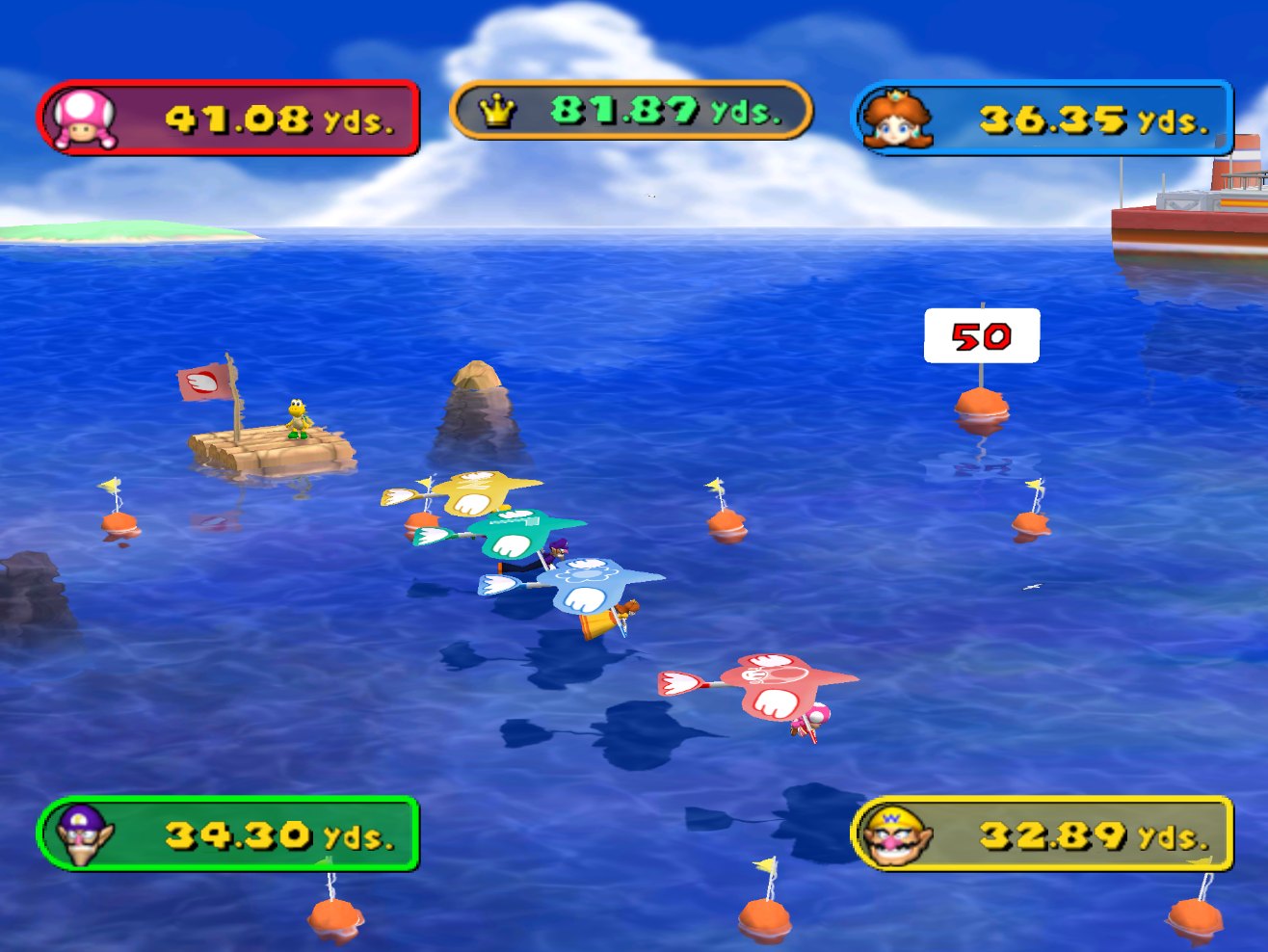
Air FarceBattleLaunch a hang-glider from a platform and stay out of the sea for as far as you can.
The Final CountdownBattleA brawl on nine numbered panels, each of which drops away when its count reaches zero. In The Top 100 and Superstars.
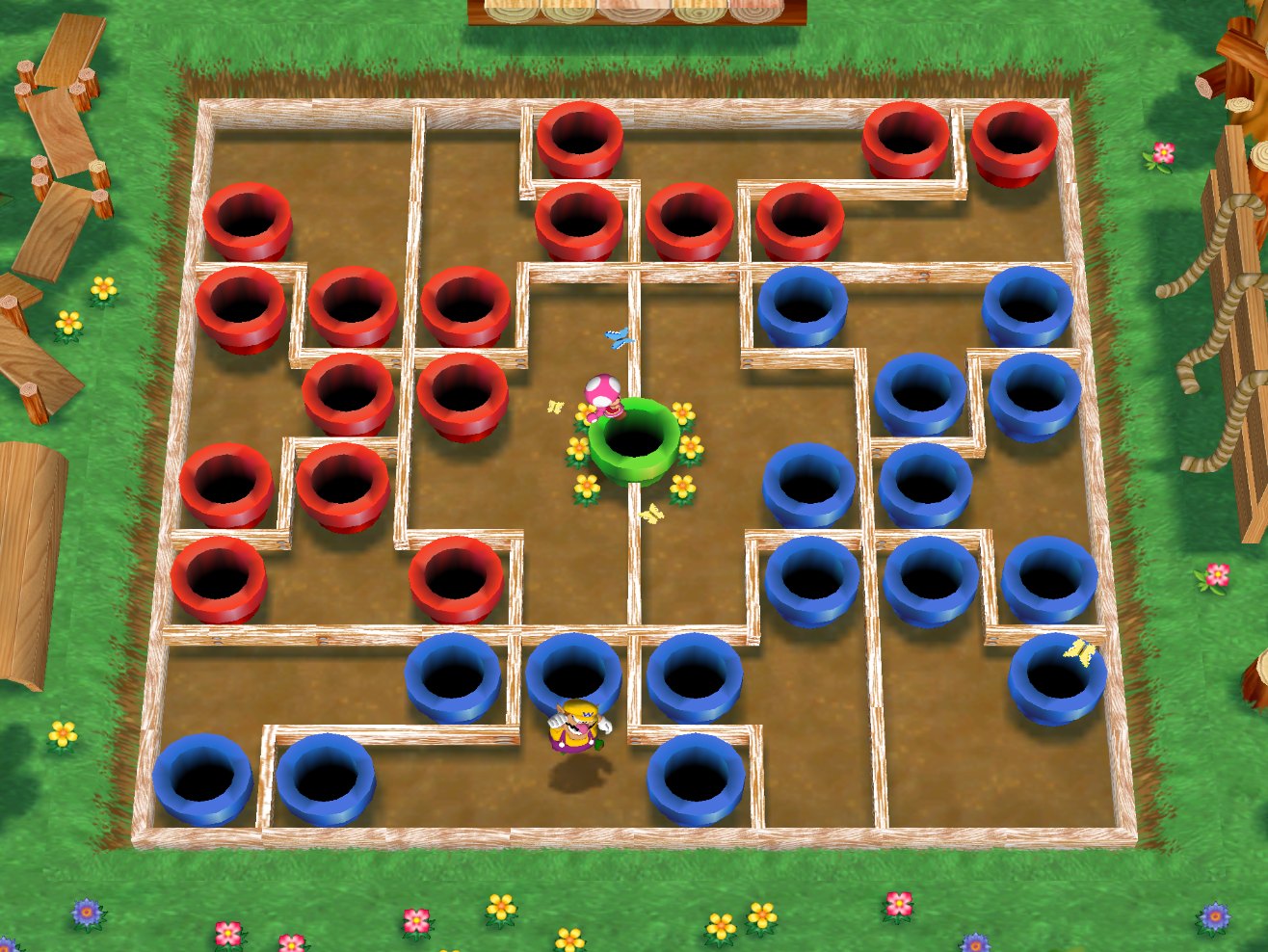
Warp Pipe DreamsDuelEach player has a maze of Warp Pipes to hop through. First out of the big green one wins.
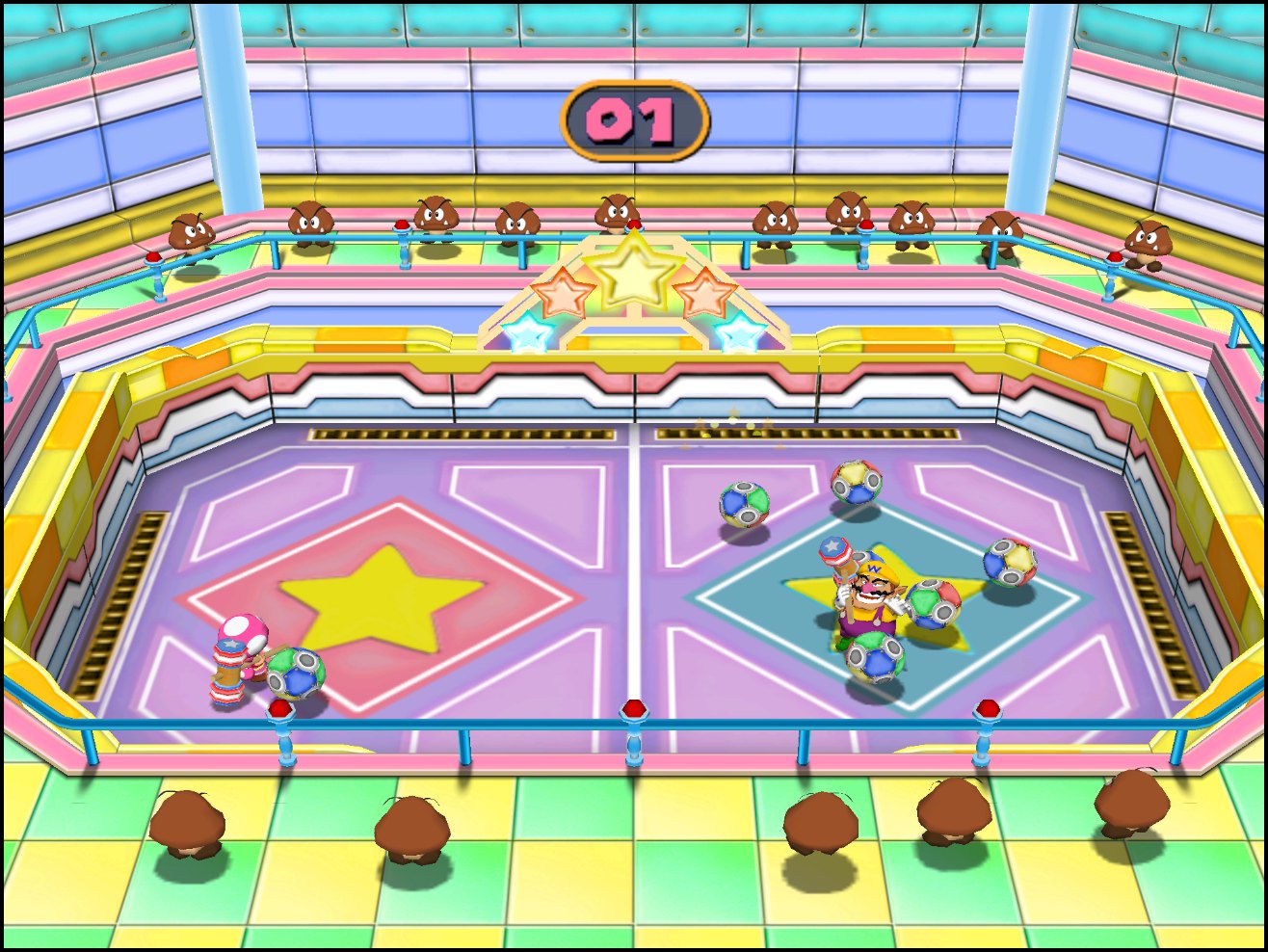
Weight for ItDuelBat seven heavy balls on to your rival’s side with a hammer and have fewer on your own when time is called.
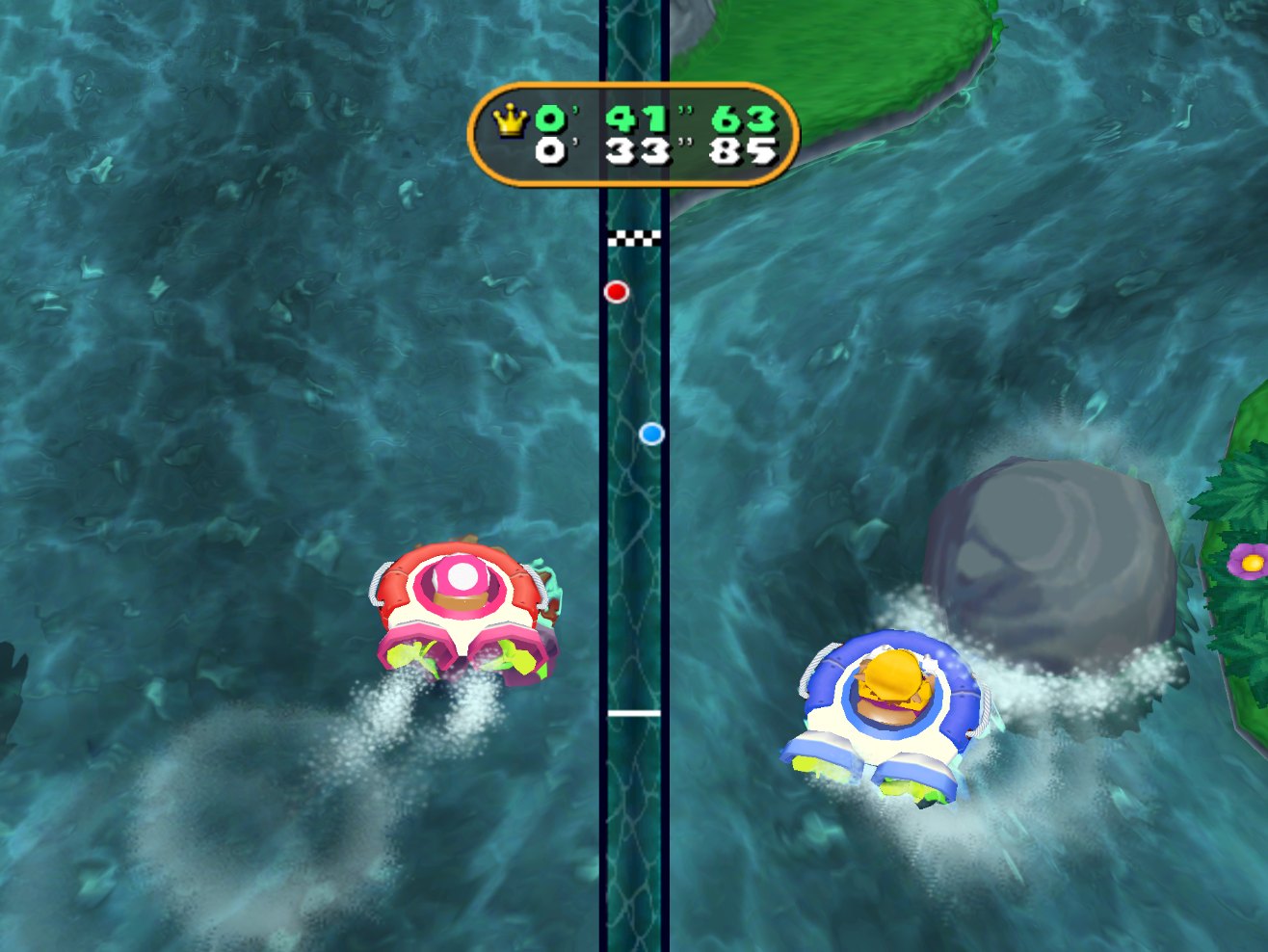
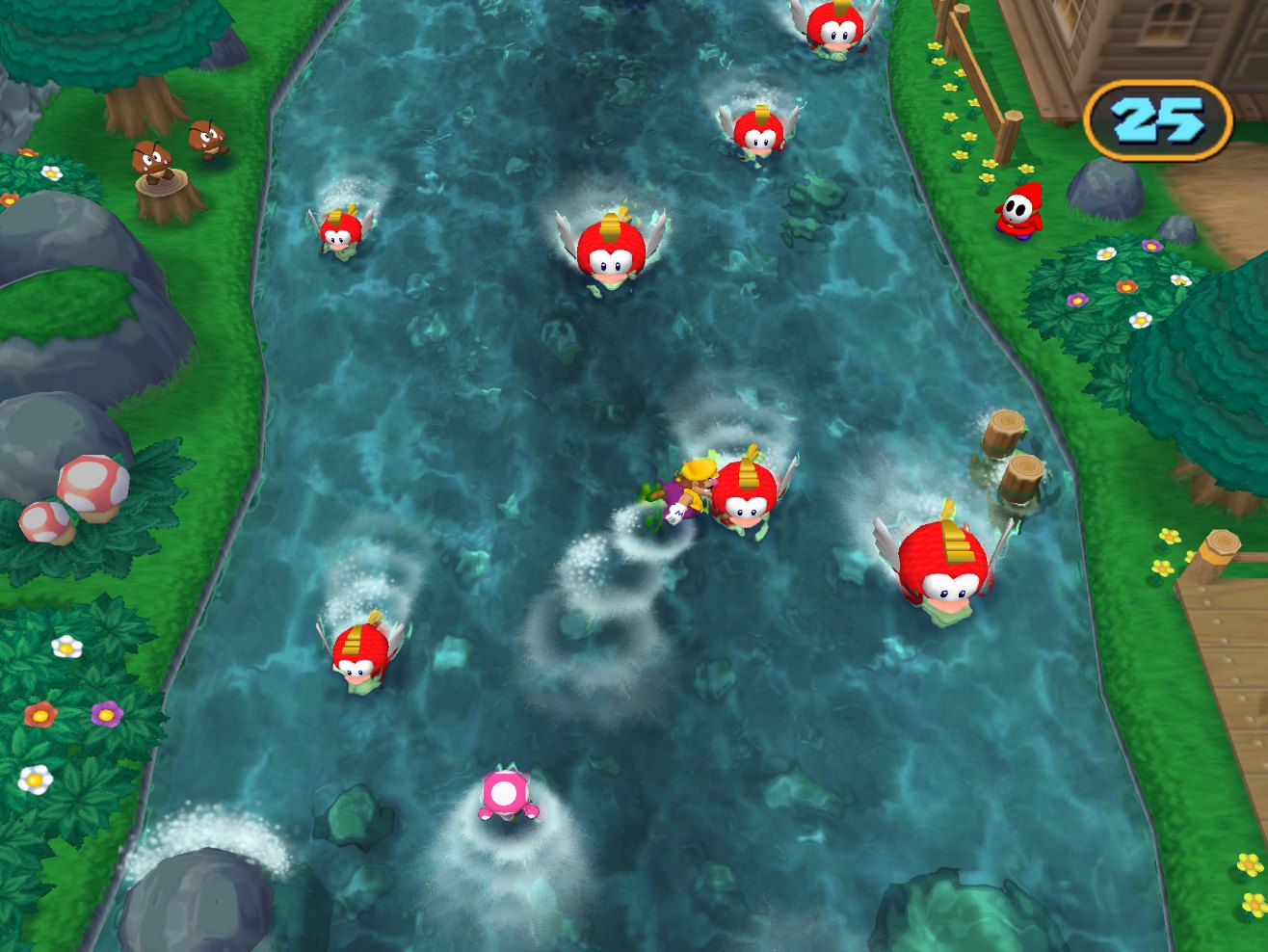
Mad PropsDuelA hovercraft race down a twisting river, steering with a propeller on each side.
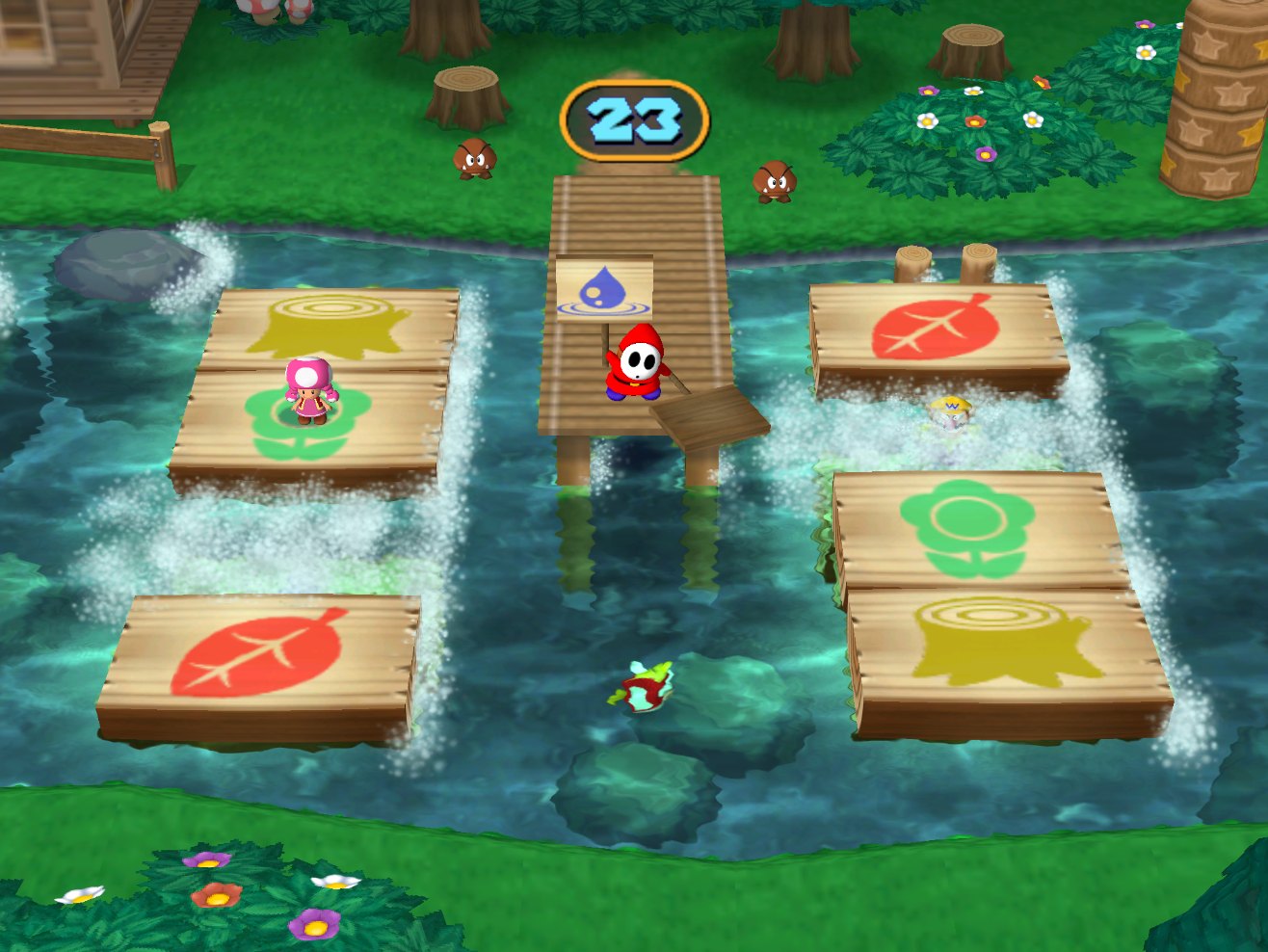
Gimme a SignDuelFour rafts, and a Shy Guy holding up signs to show which will sink next. Last one dry wins.
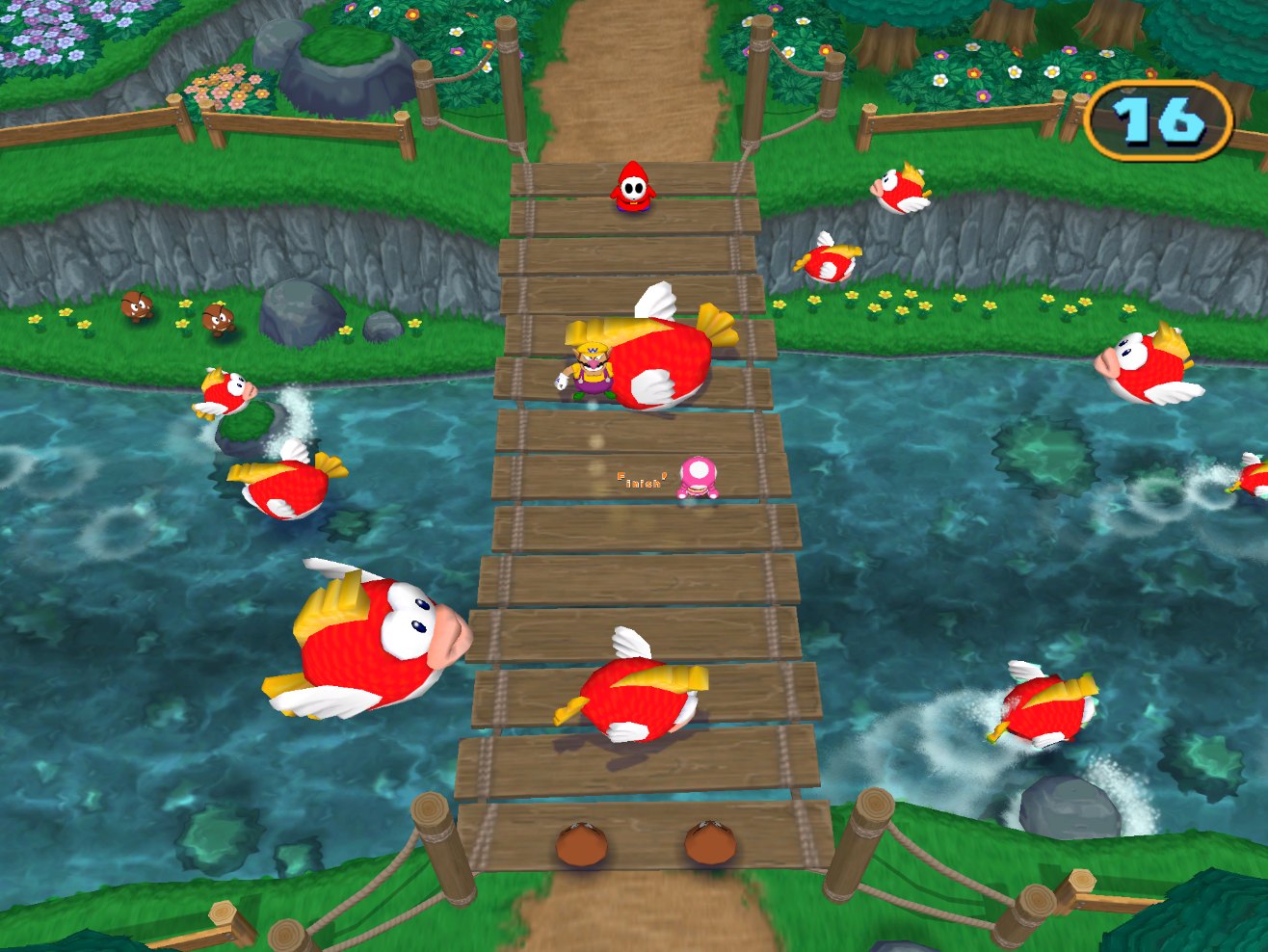
Bridge WorkDuelStay on a bridge while Cheep Cheeps, small and large, leap across it.
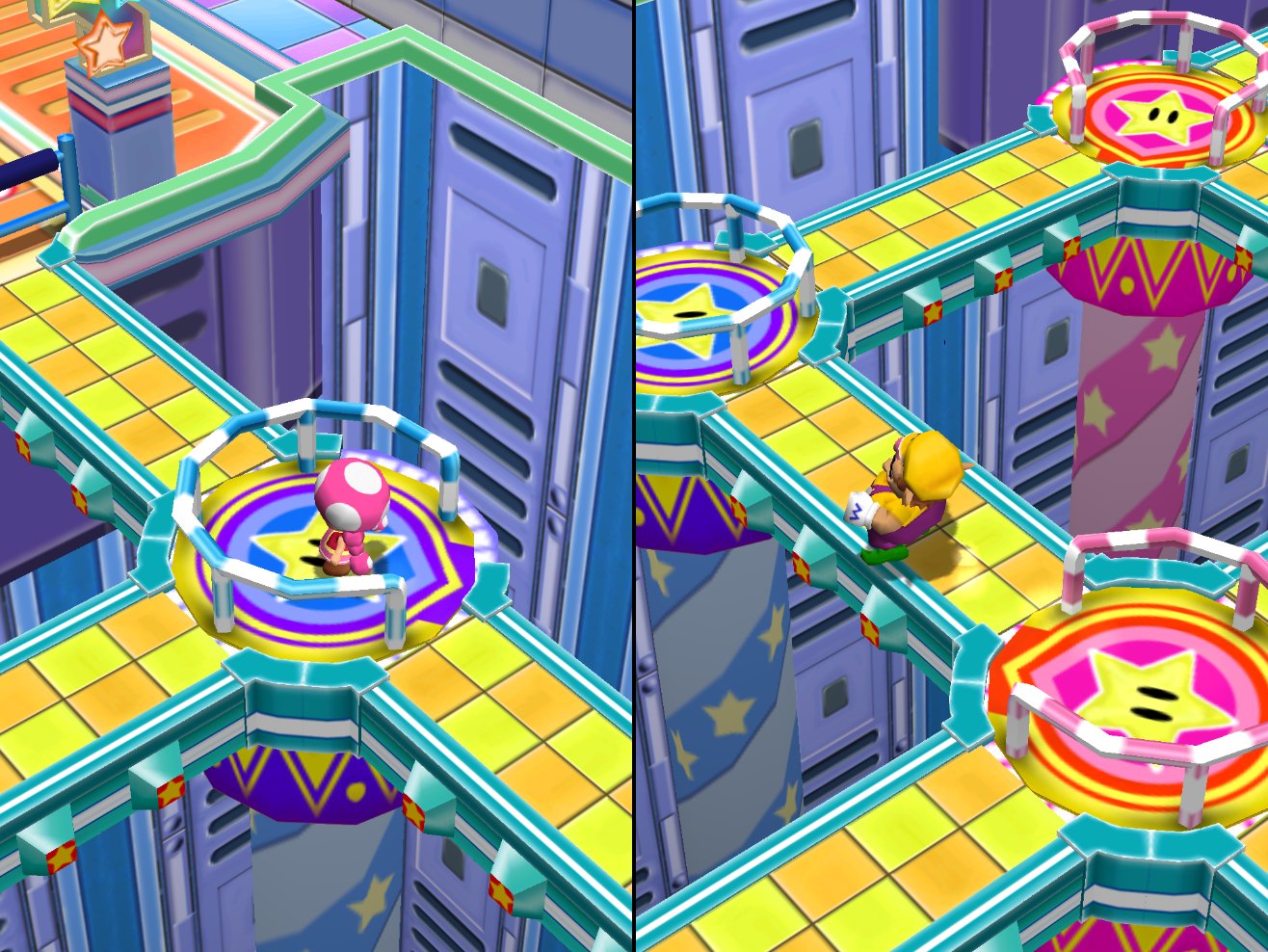
Spin DoctorDuelA race across a grid of bridges with a turntable at every junction. In Superstars.
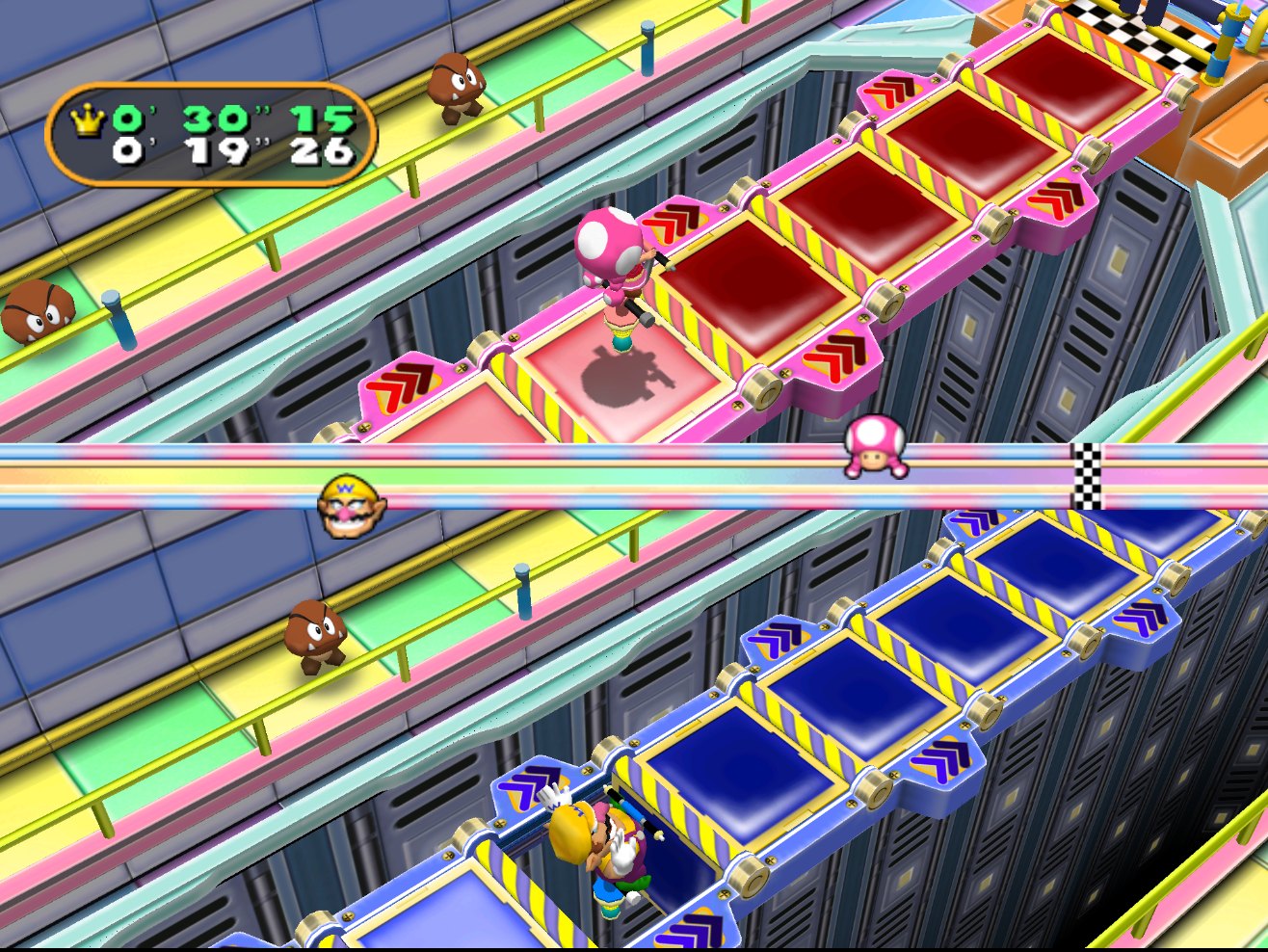
Hip Hop DropDuelPogo across a bridge of tiles by pressing the button marked on each. A wrong press costs time.
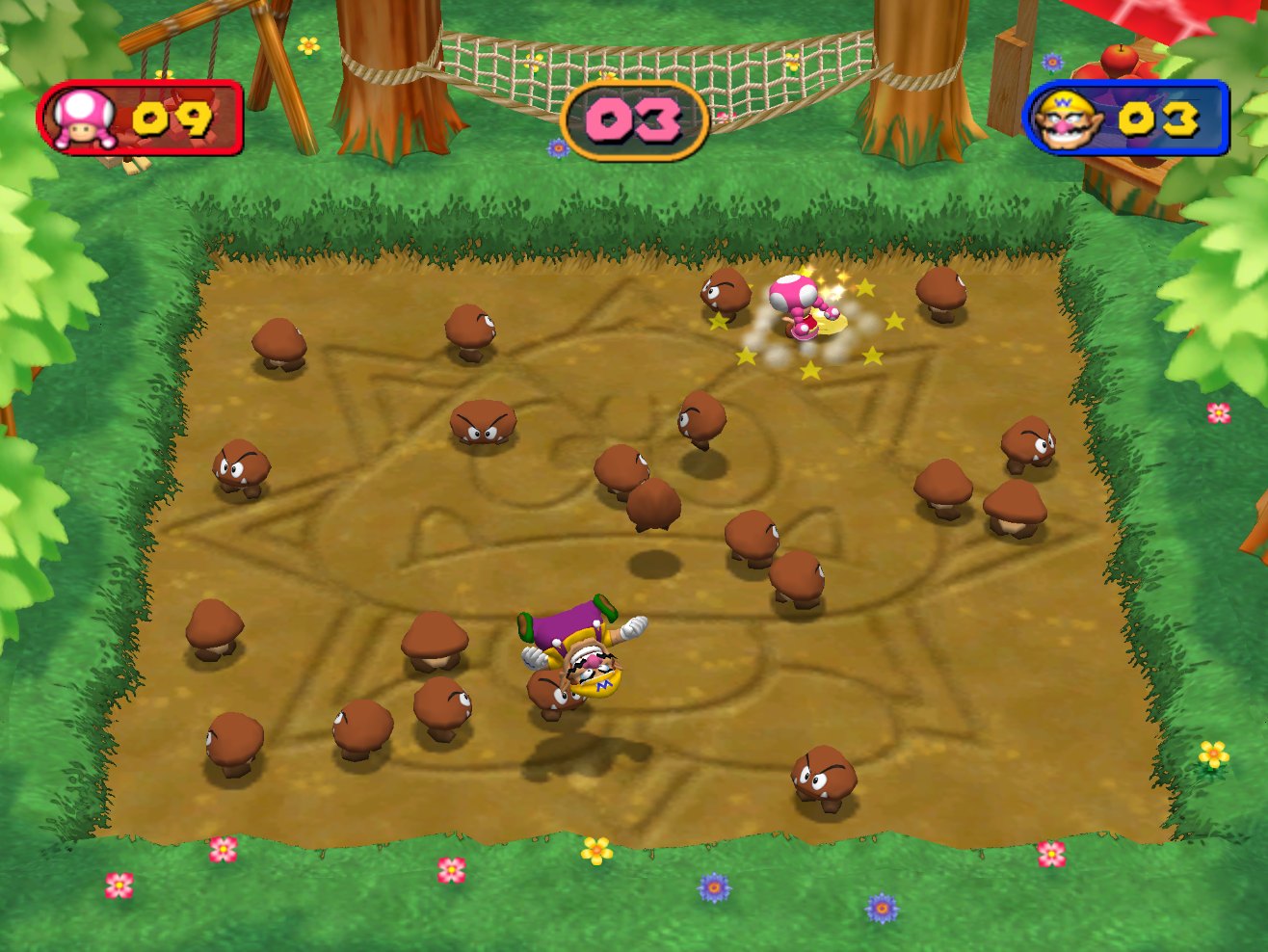
Royal RumpusDuelFifteen seconds to ground-pound more Goombas than your opponent.
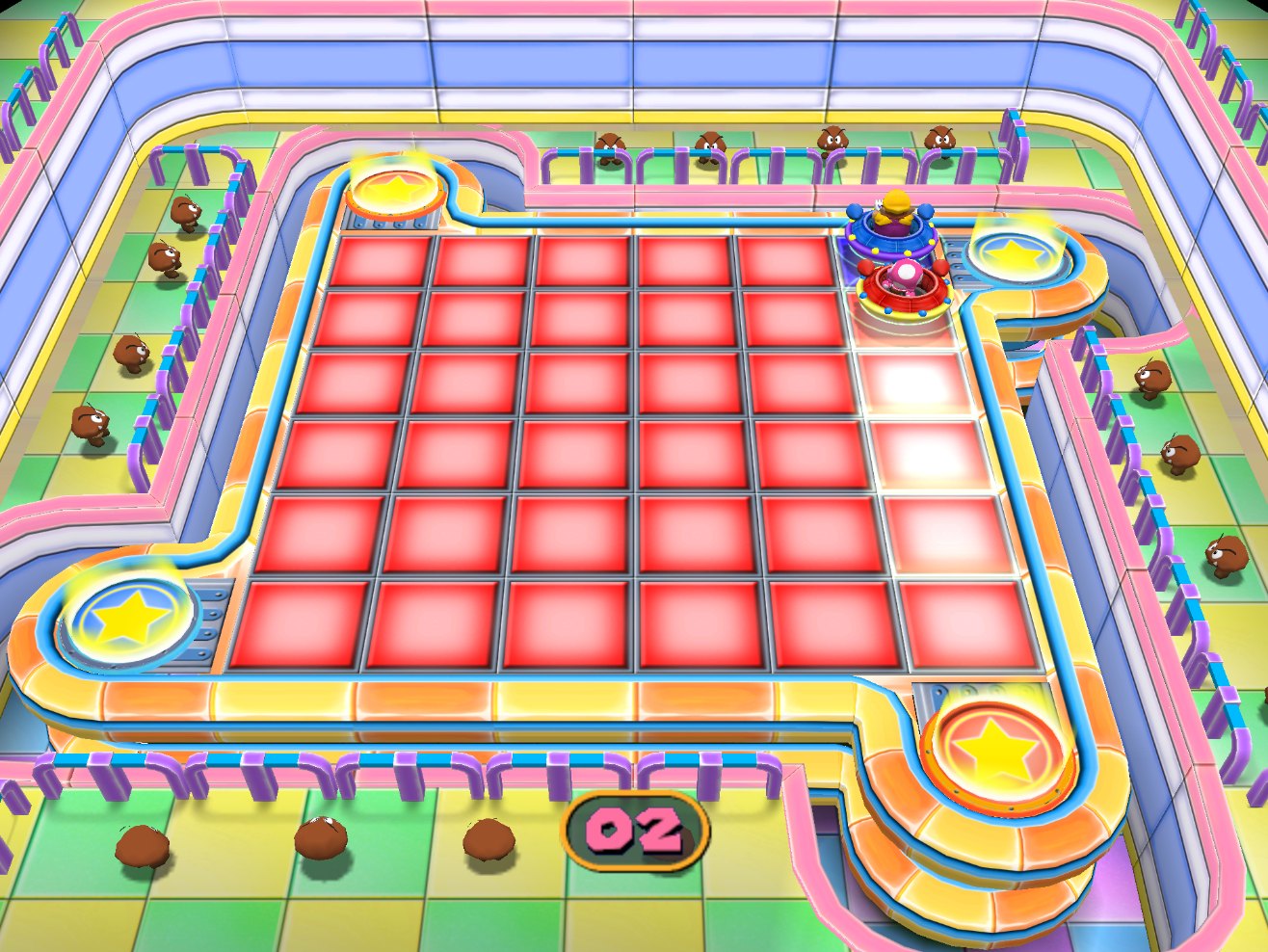
Light SpeedDuelDrive a hoverkart over floor tiles to paint them your colour. Most tiles wins.
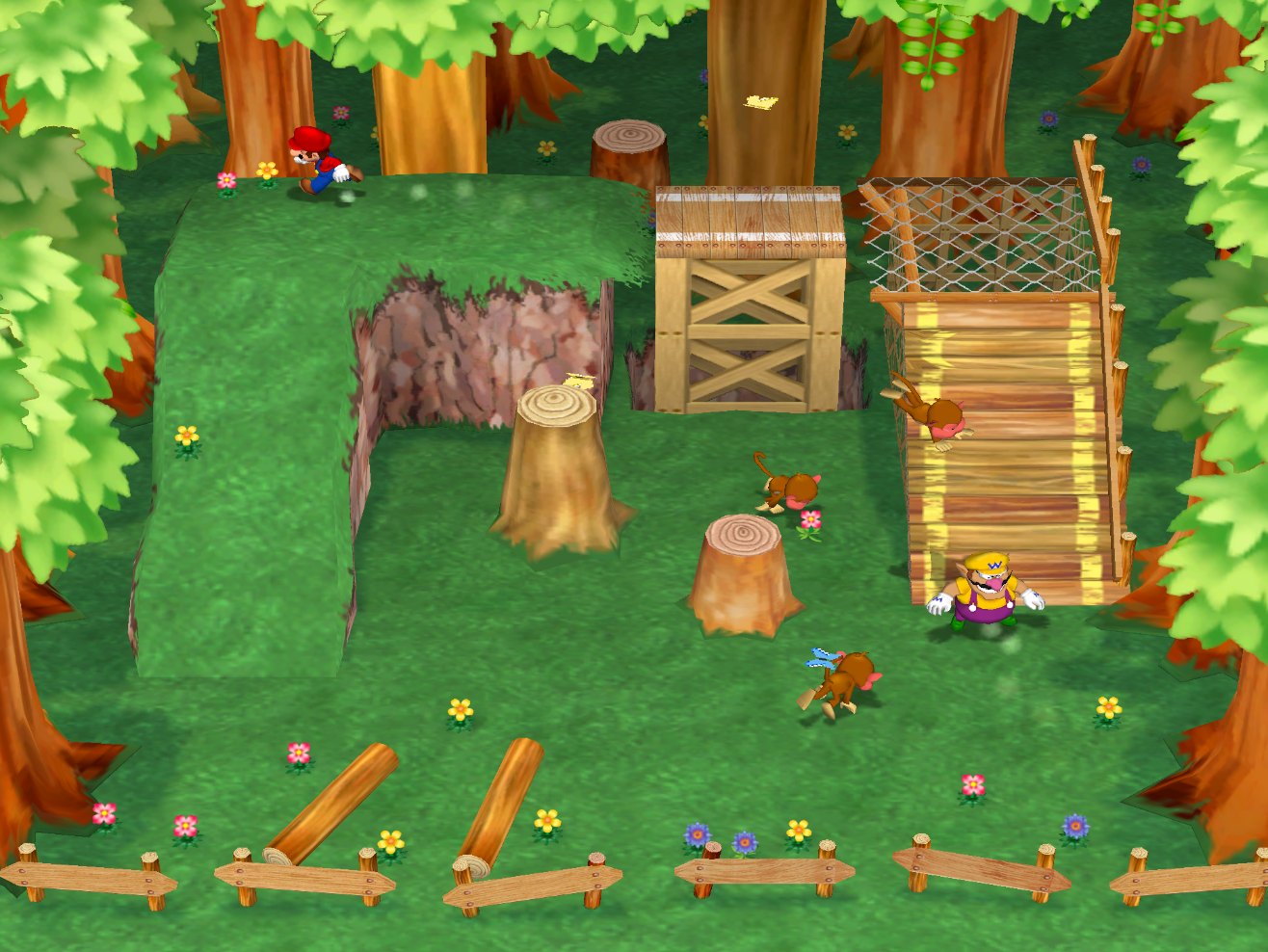
Apes of WrathDuelKeep out of the clutches of a troop of Ukikis for longer than the other player.
Fish & CheepsDuelSwim against a shoal of Cheep Cheeps. Touch one and you lose; if both last 30 seconds it is a draw.
Camp UkikiDuelAn obstacle race through mazes of stakes and over jumps.
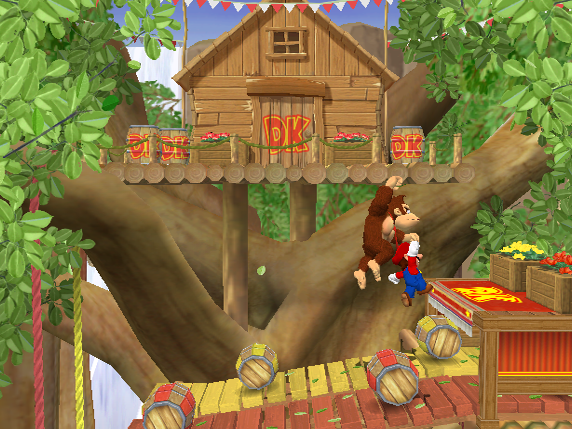
Jump, ManDK · 1-PlayerRace Donkey Kong up four sloping girders, with ropes to climb and barrels to dodge: a tribute to the first stage of the 1981 arcade game. In The Top 100.
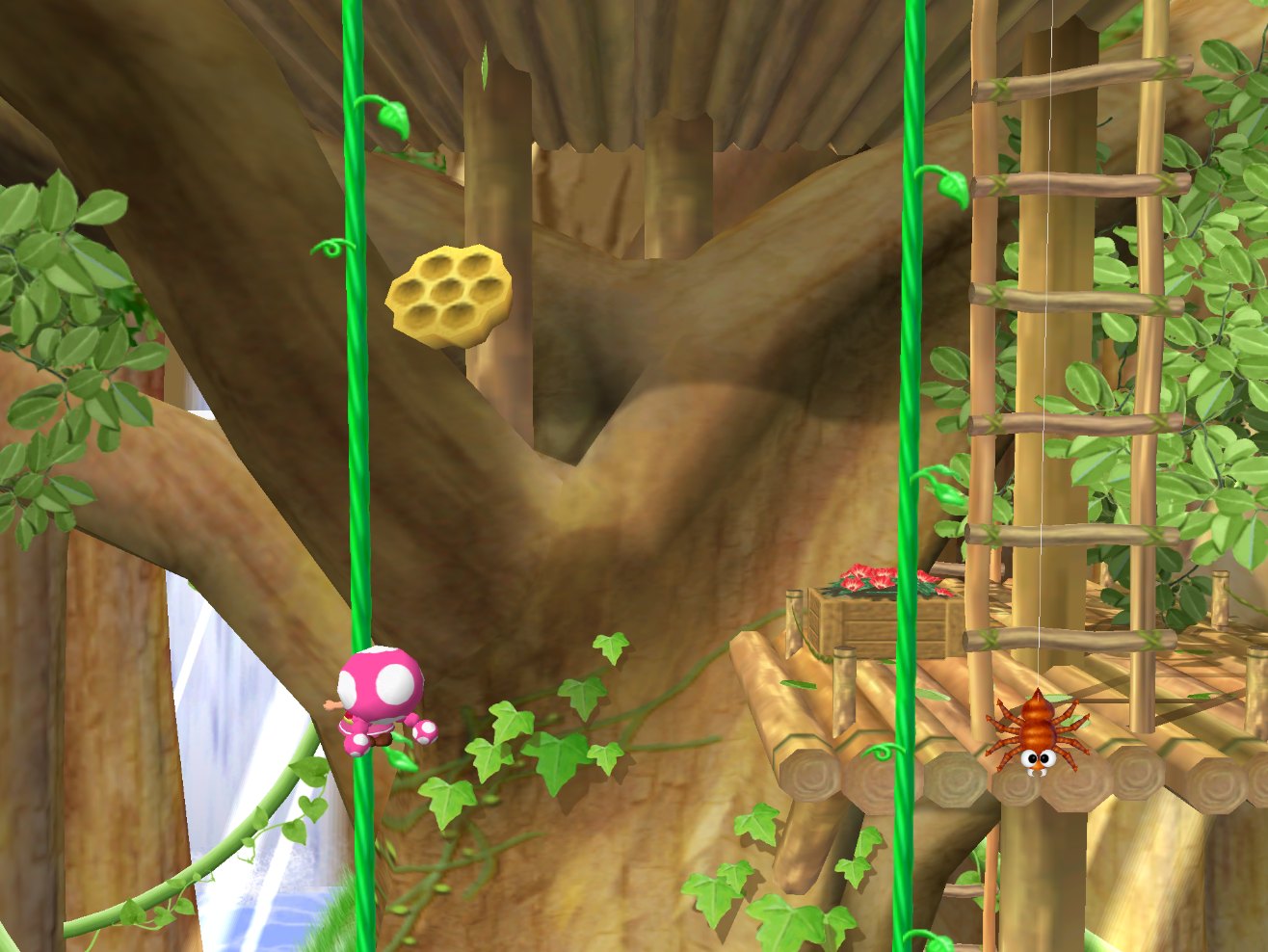
Vine CountryDK · 1-PlayerTap A to climb a vine faster than Donkey Kong, avoiding spiders and beehives. In The Top 100.
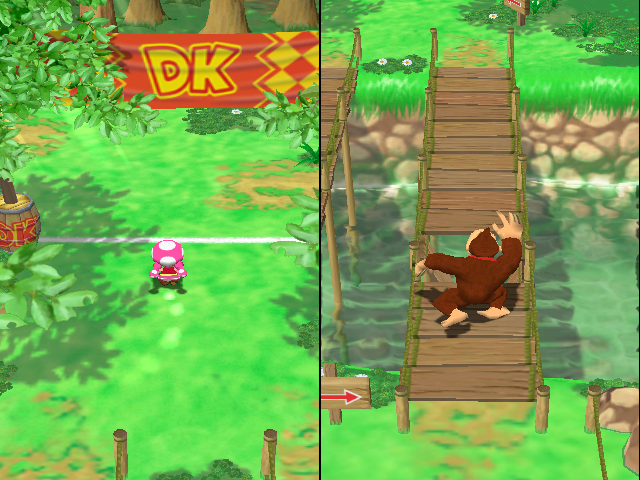
A Bridge Too ShortDK · 1-PlayerRace Donkey Kong over four pairs of bridges, guessing each time which one is safe.
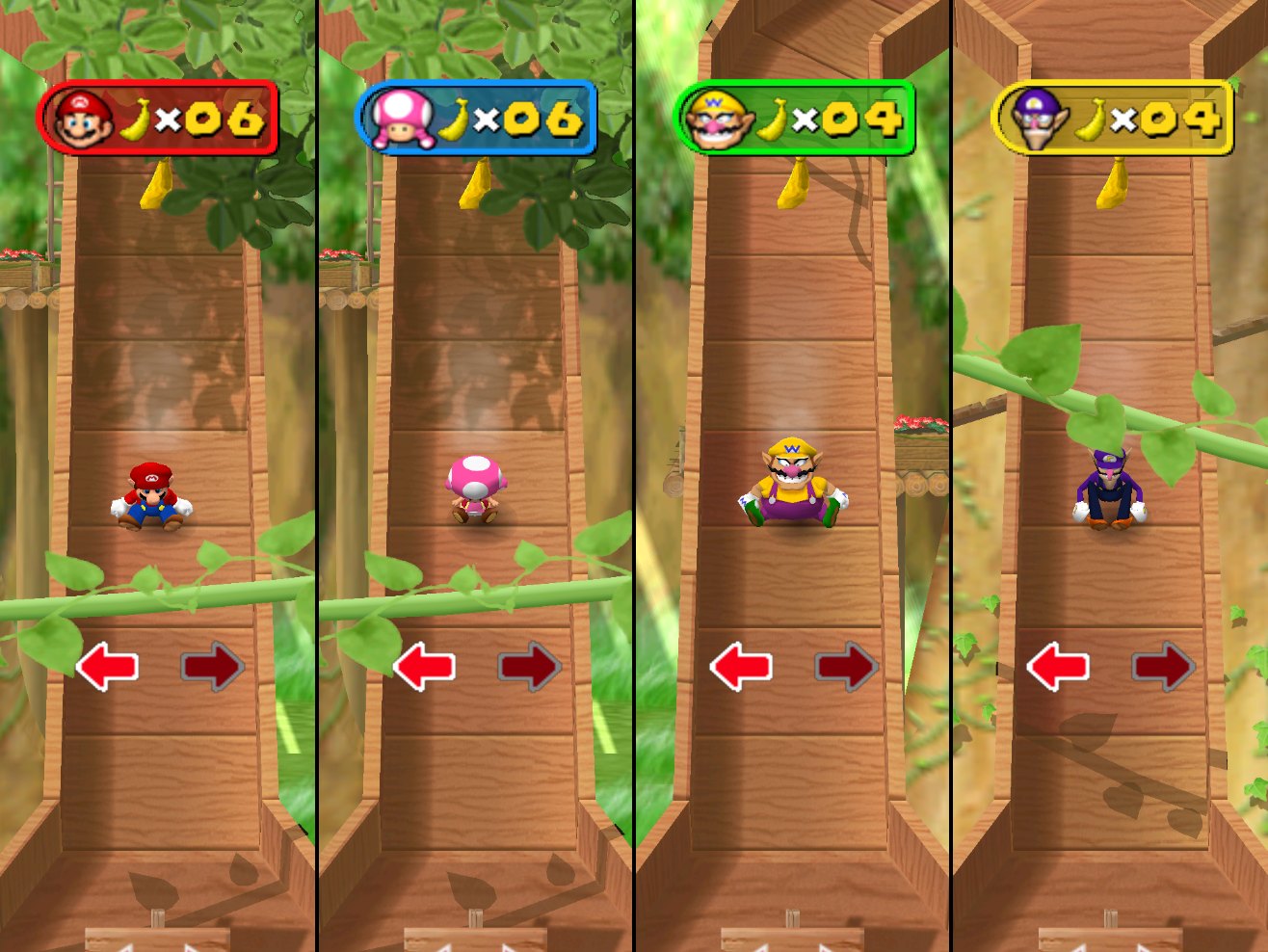
Peel OutDK · multiplayerSlide down a jungle chute, choosing at each fork the branch with the most bananas, which are swapped for coins.
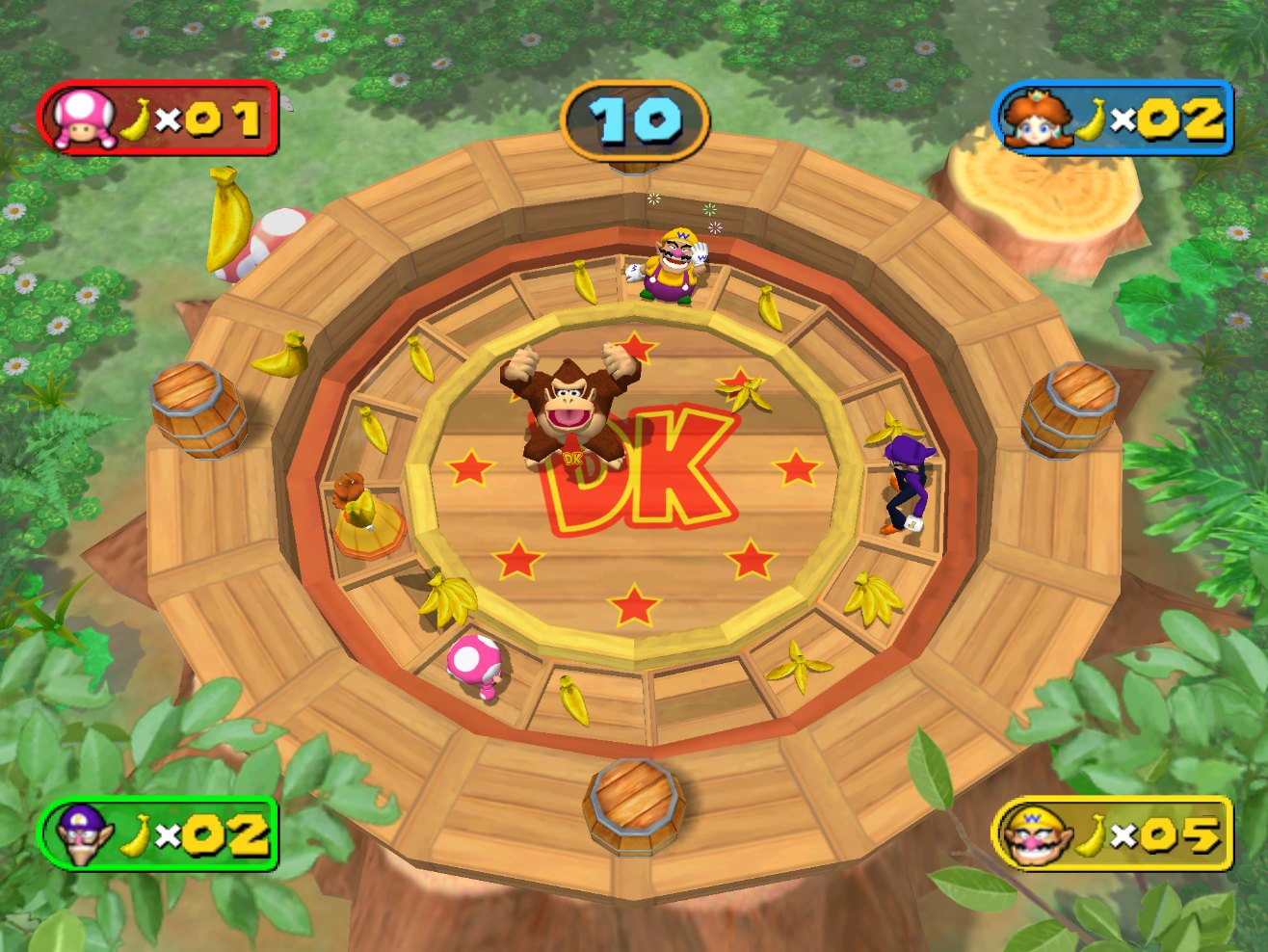
Bananas FasterDK · multiplayerJump on to a spinning wheel to grab bananas and avoid the skins.
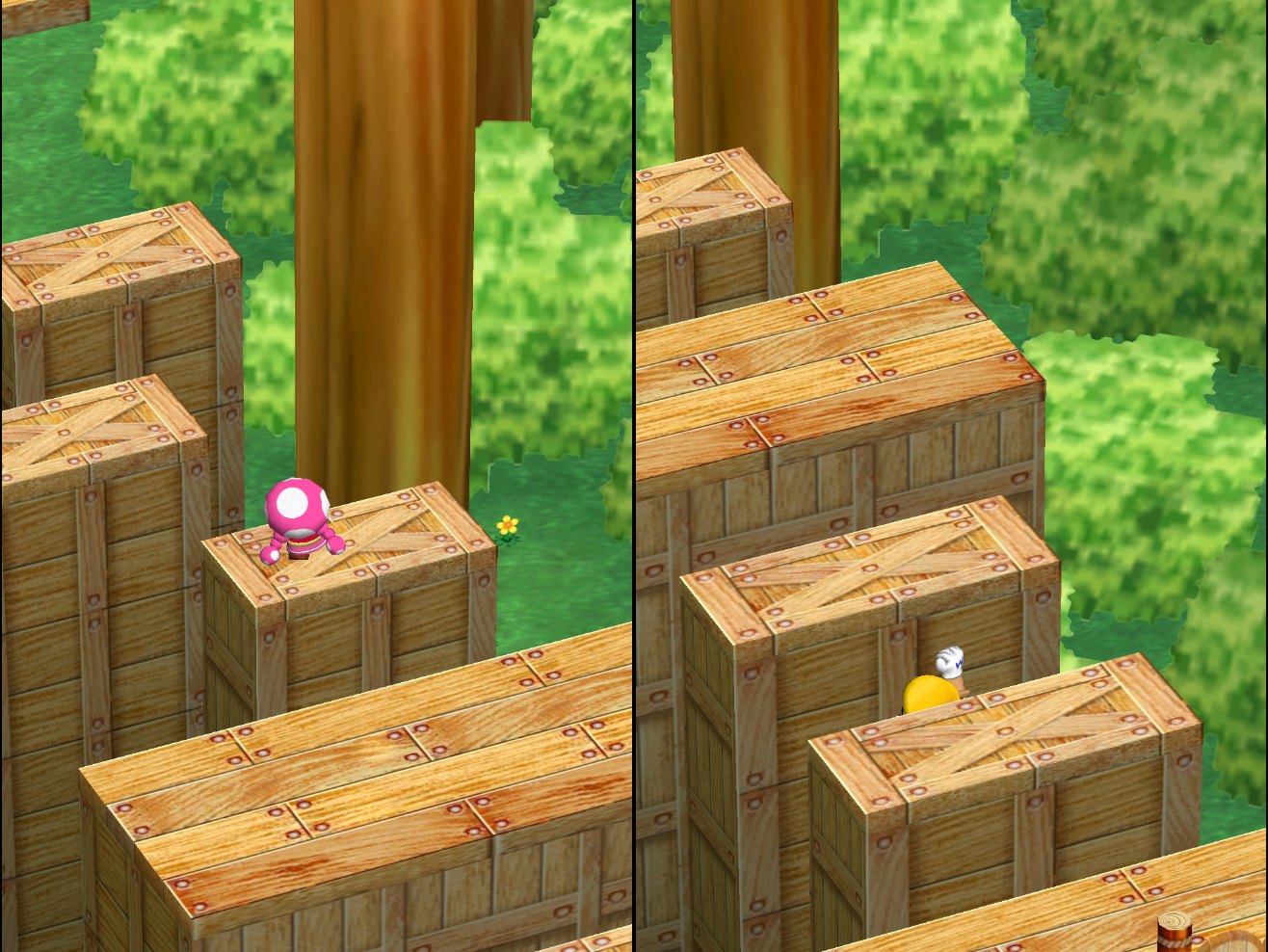
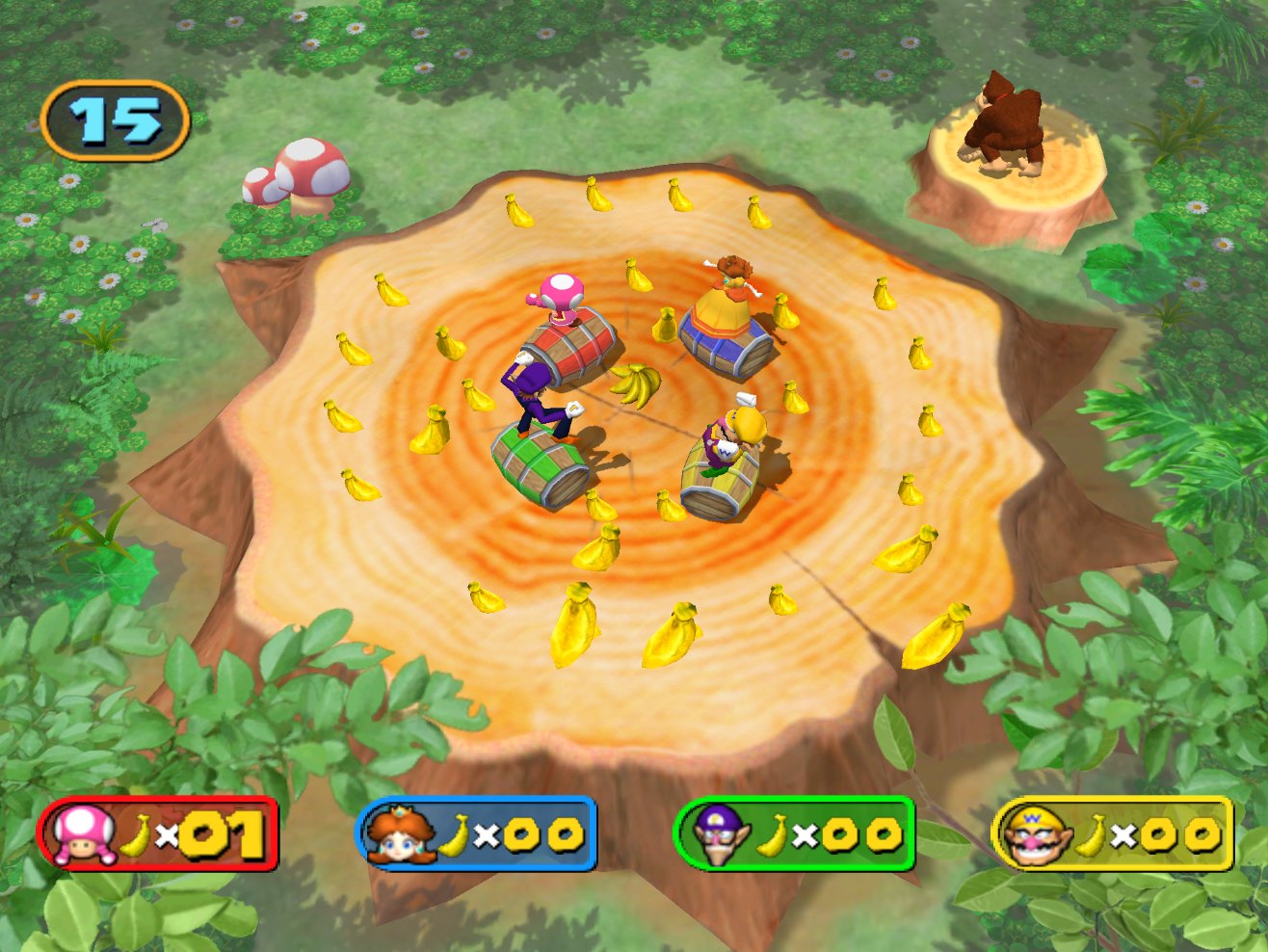
Stump ChangeDK · multiplayerRoll about a giant tree stump on barrels collecting bananas without toppling off.
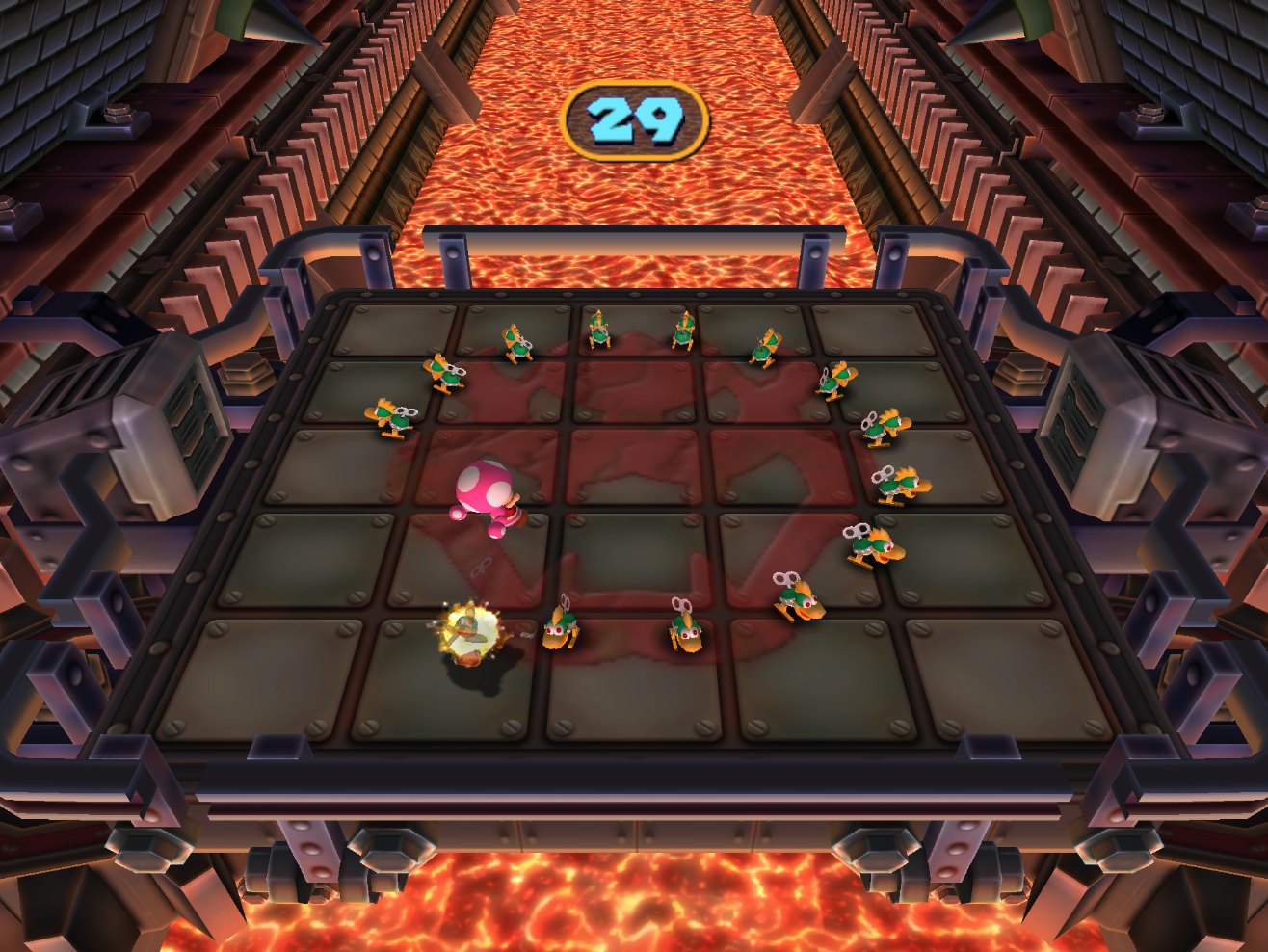
Tunnel of Lava!Bowser · 1-PlayerStomp the circling Mechakoopas to find the one with the door key and get out before Bowser flattens you.
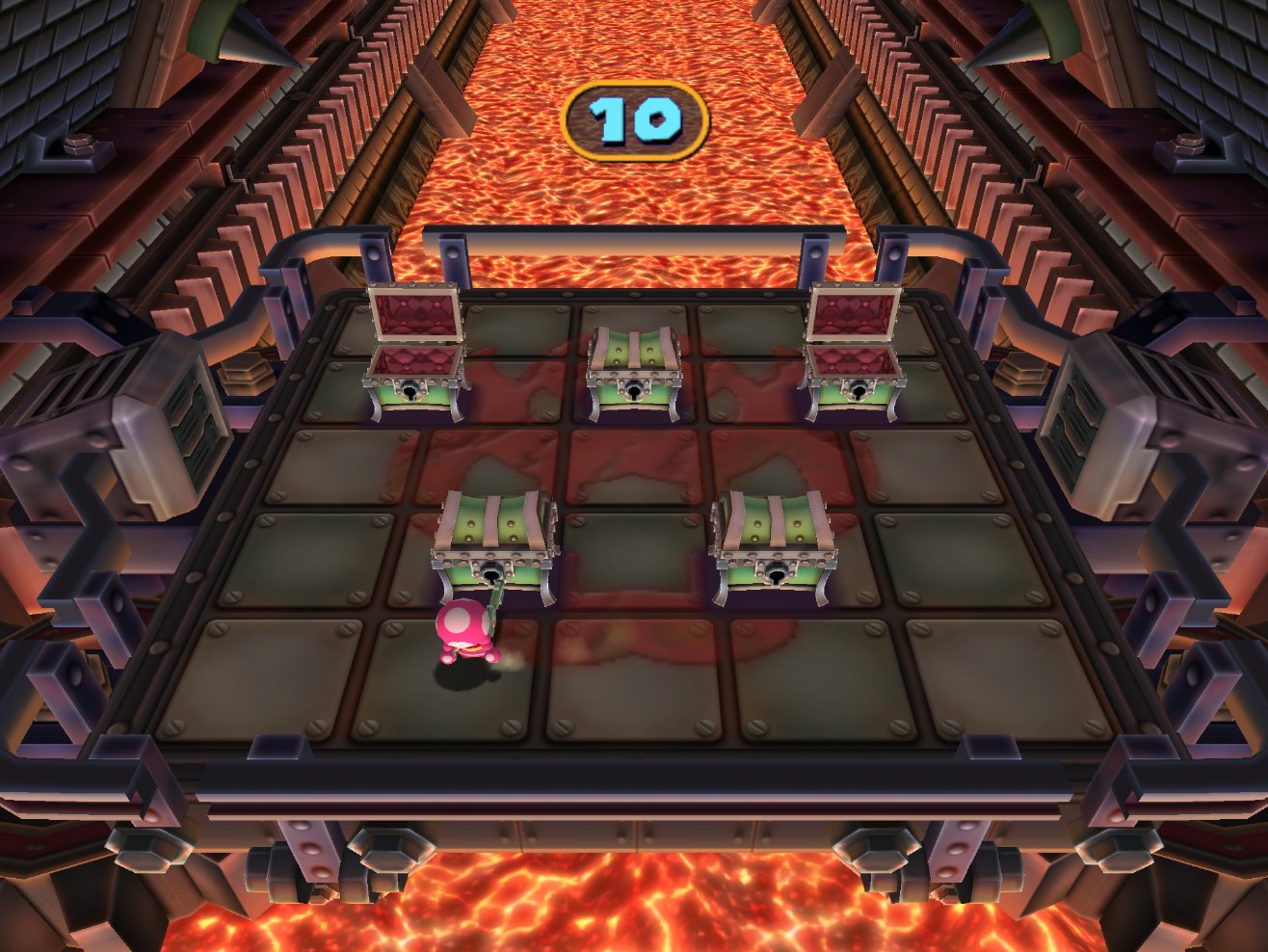
Treasure Dome!Bowser · 1-PlayerOpen five chests in 30 seconds, each holding the key to the next.
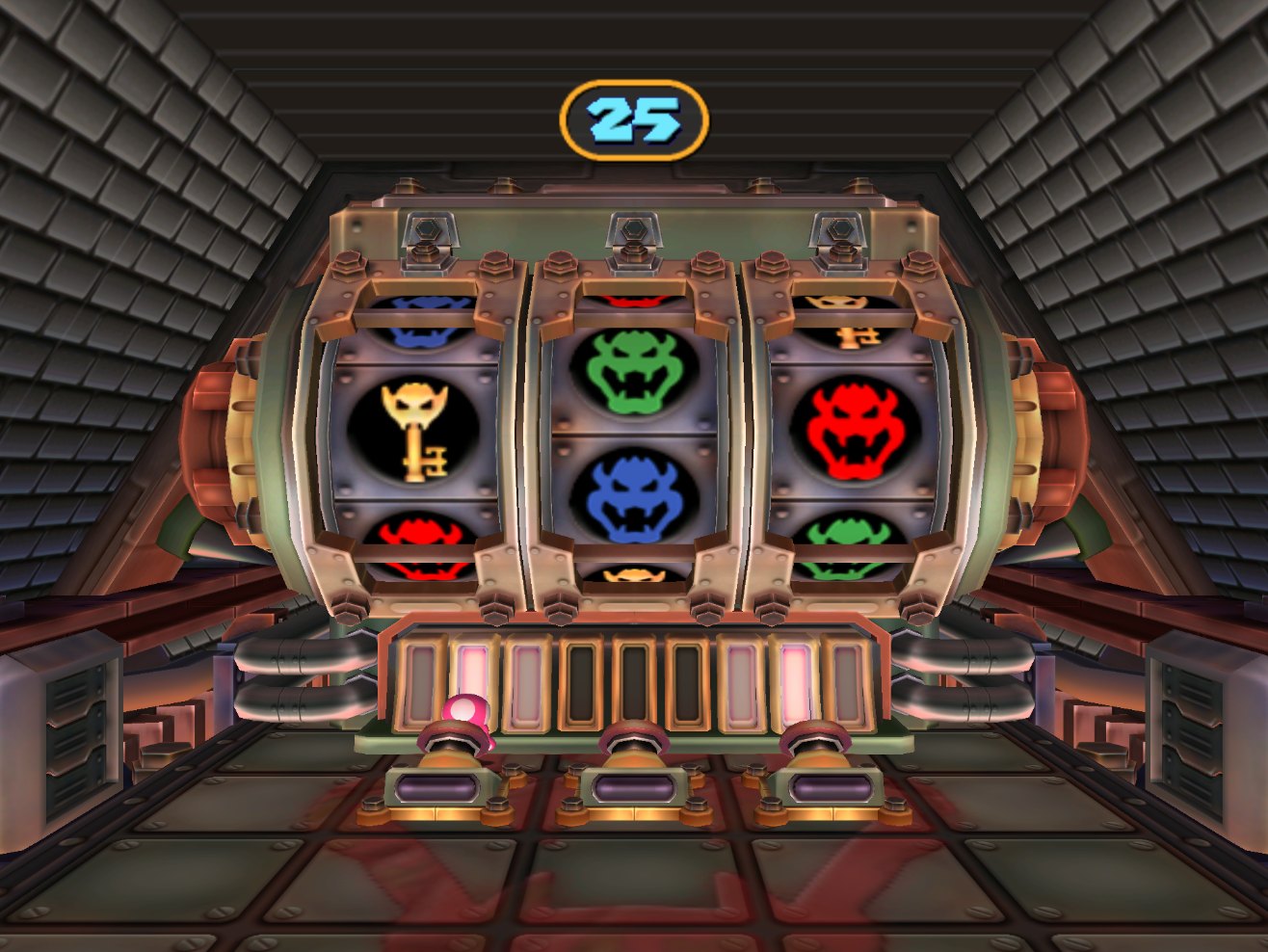
Slot-O-Whirl!Bowser · 1-PlayerStop three reels on keys, not Bowser faces, within 30 seconds.
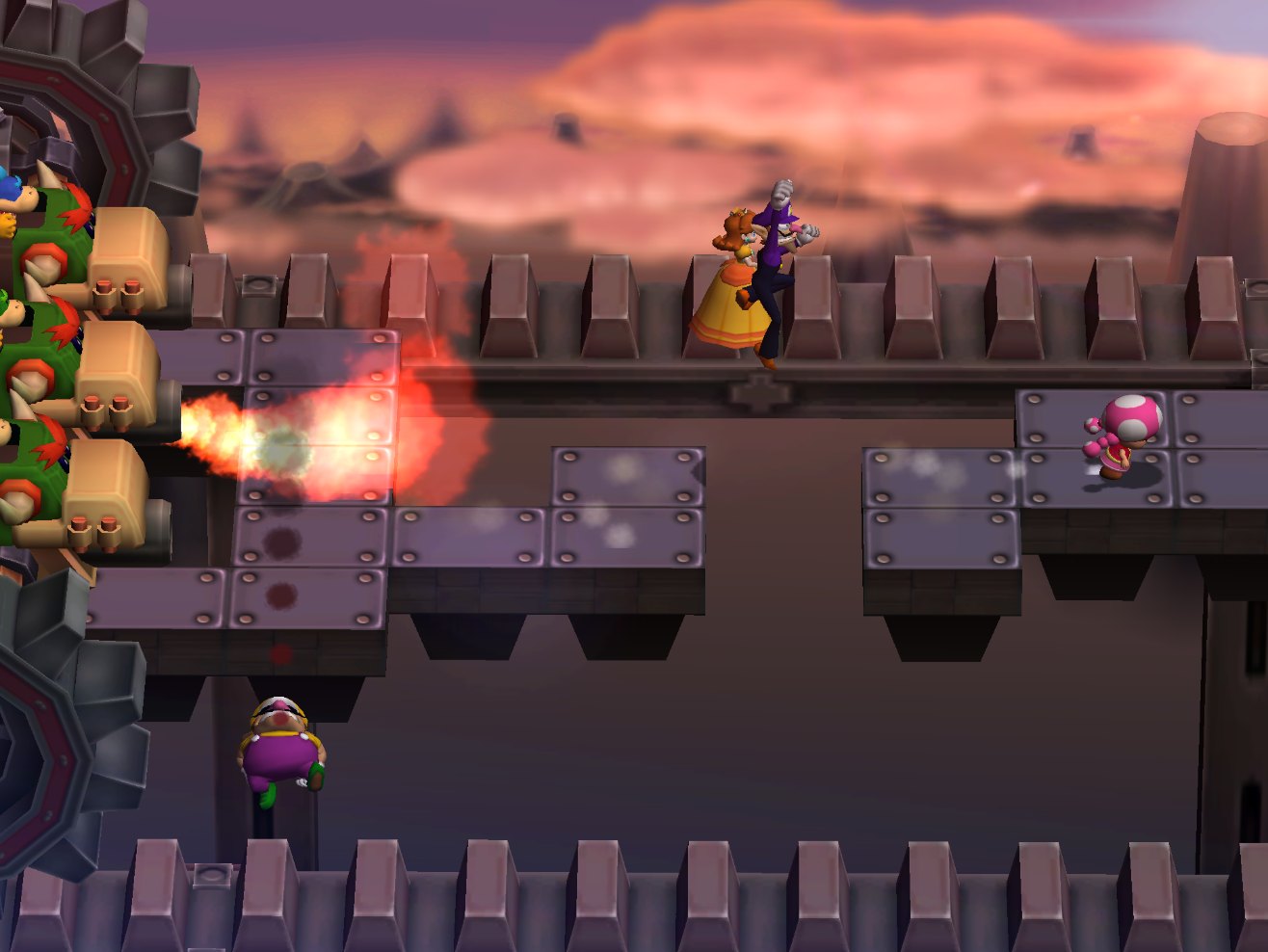
Funstacle Course!Bowser · multiplayerEveryone runs a gauntlet of Thwomps, spiked bars and fireballs with Koopa Kids in pursuit. Those who finish are spared.
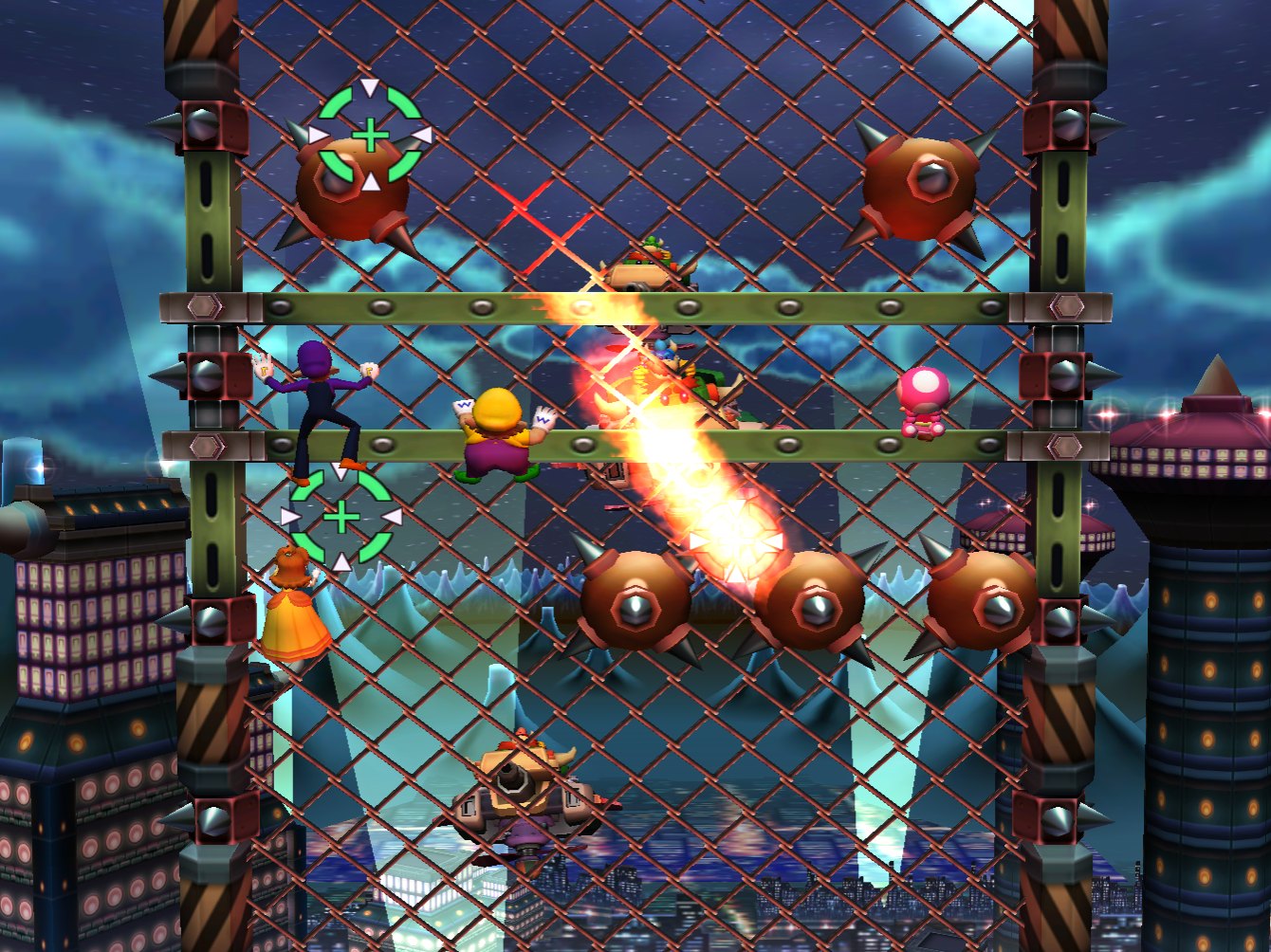
Funderwall!Bowser · multiplayerClimb a chain-link wall towards Bowser past flamethrowers and spiked rollers.
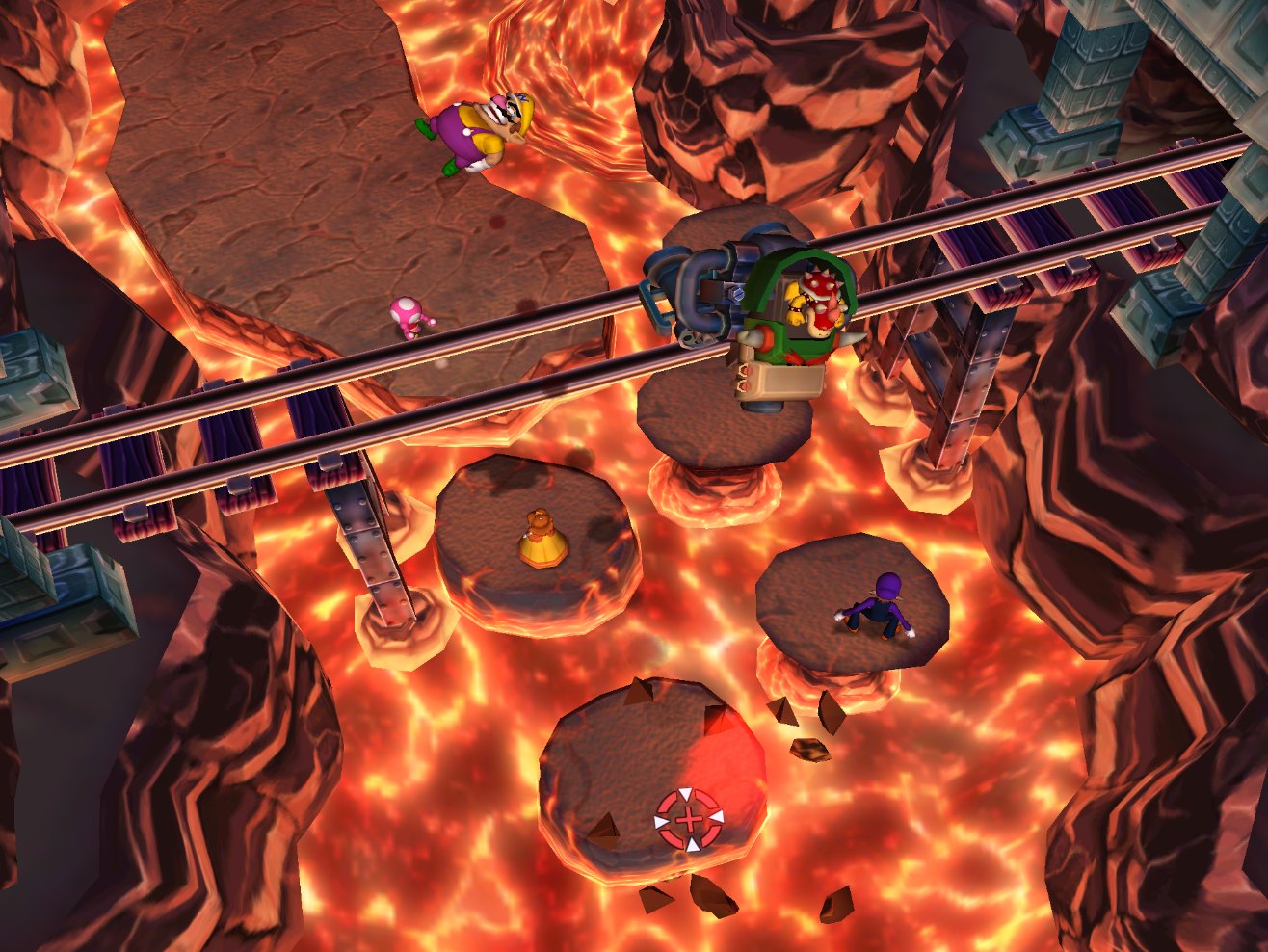
Magmagical Journey!Bowser · multiplayerHop across sinking rocks in a lake of lava while Koopa Kids spit fire.
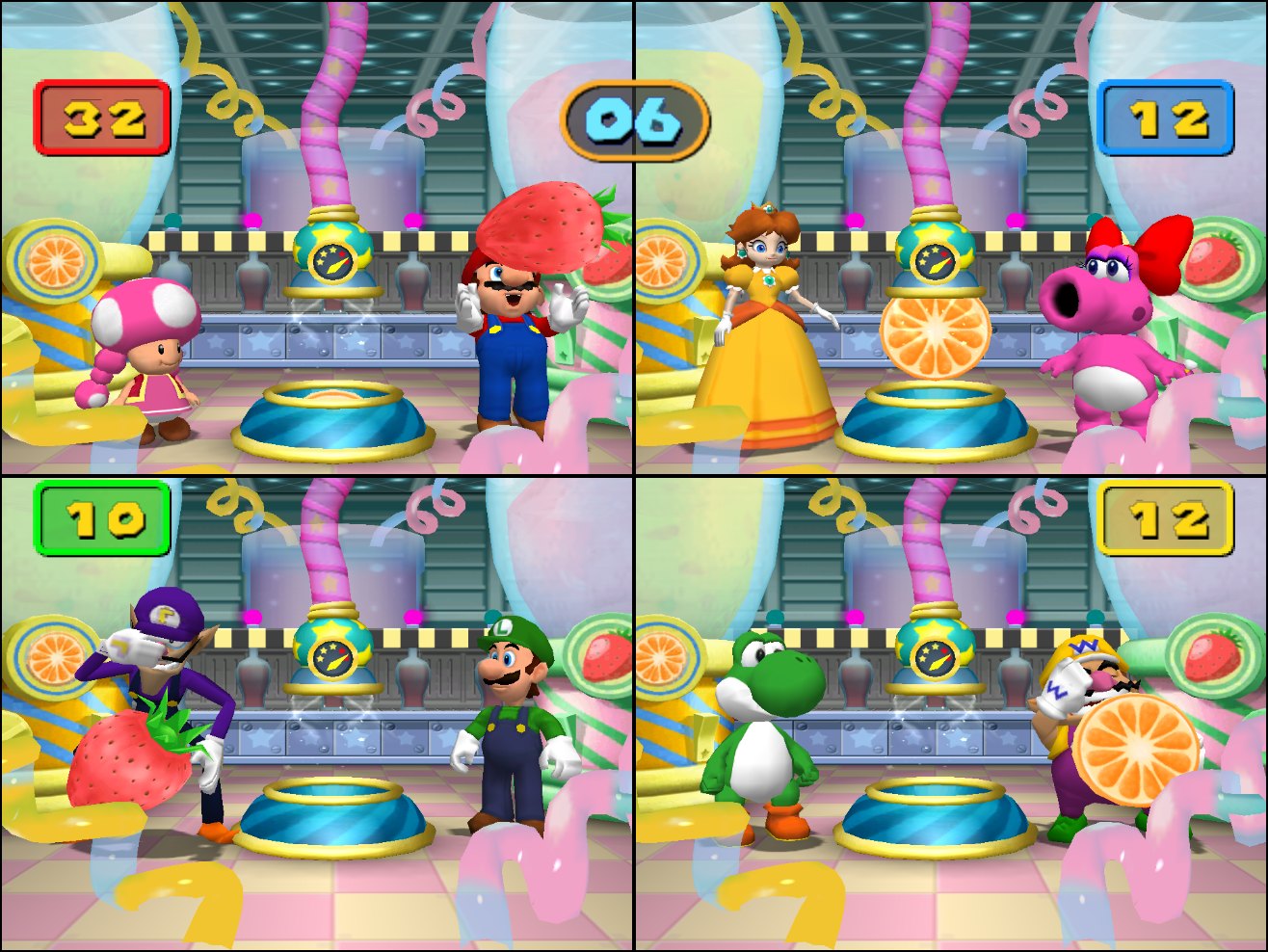
Real Smoothie8-Player · teamOne partner throws oranges into the blender and the other strawberries. Most fruit in 30 seconds.
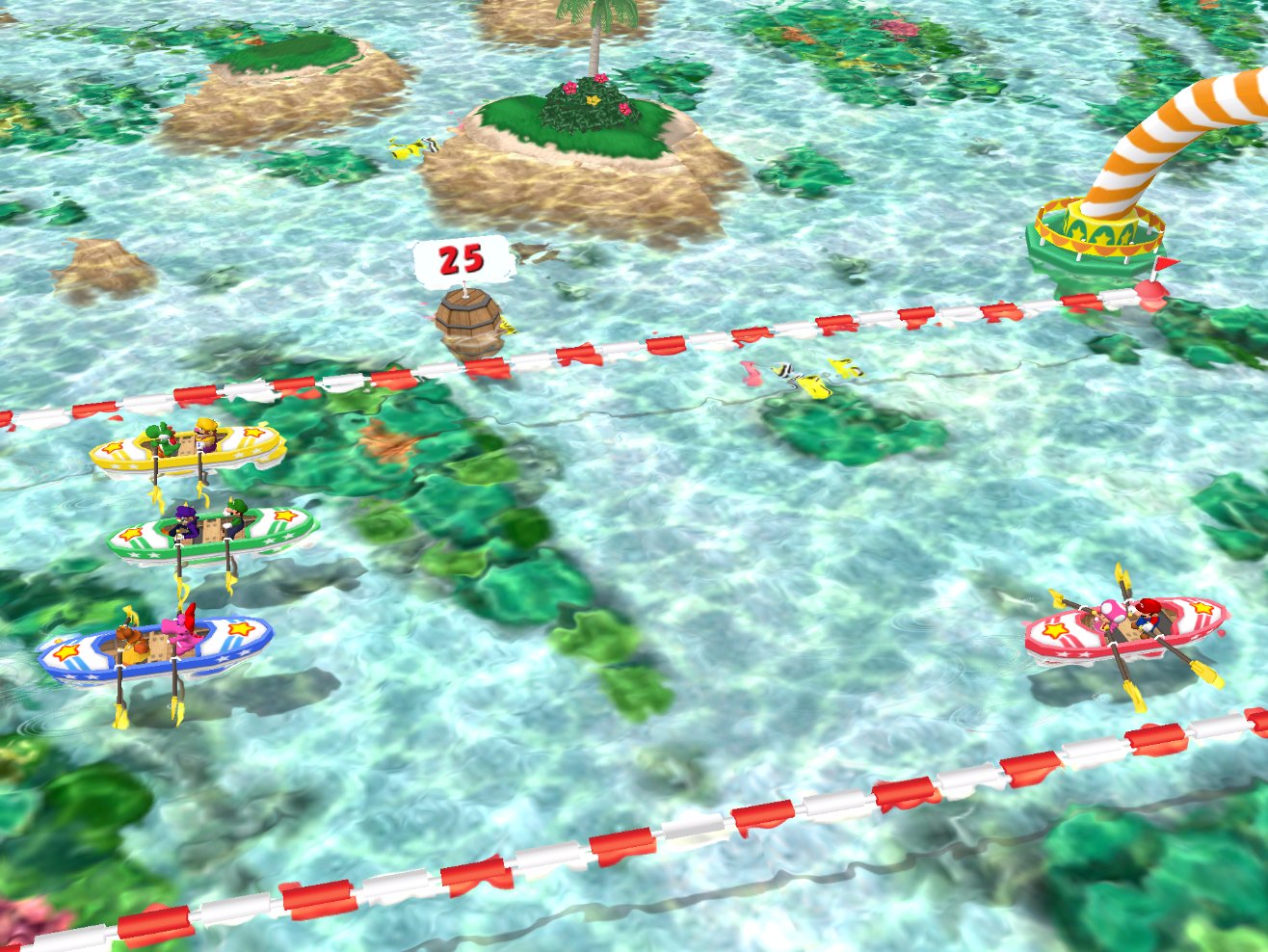
Synch-row-nicity8-Player · teamA rowing race in which the boat only flies if both partners pull in time.
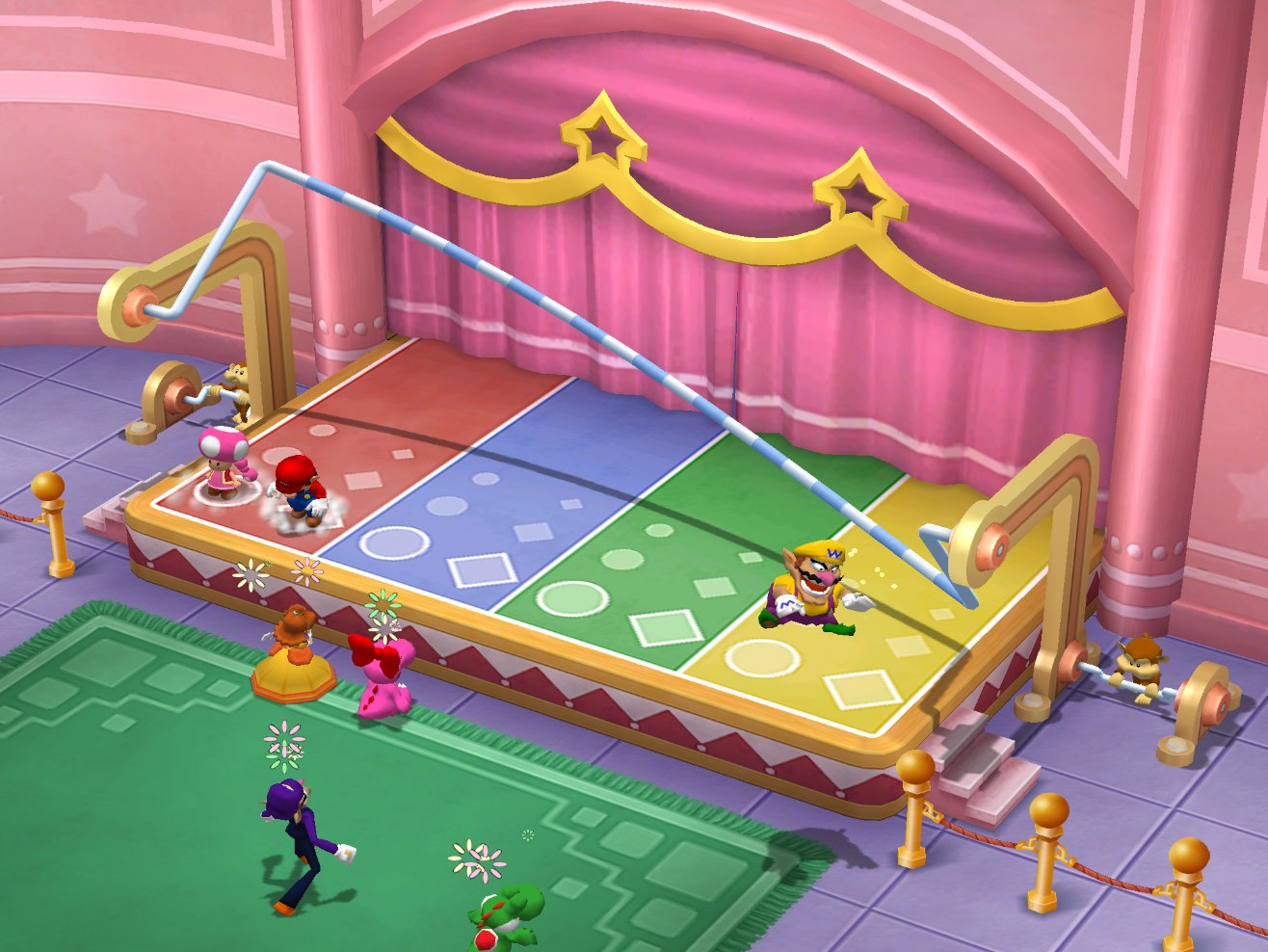
Grin and Bar It8-Player · survivalJump a spinning metal bar: L for one partner, R for the other.
Hammer Spammer8-Player · survivalDodge the giant hammers thrown by Hammer Bros. for 30 seconds.
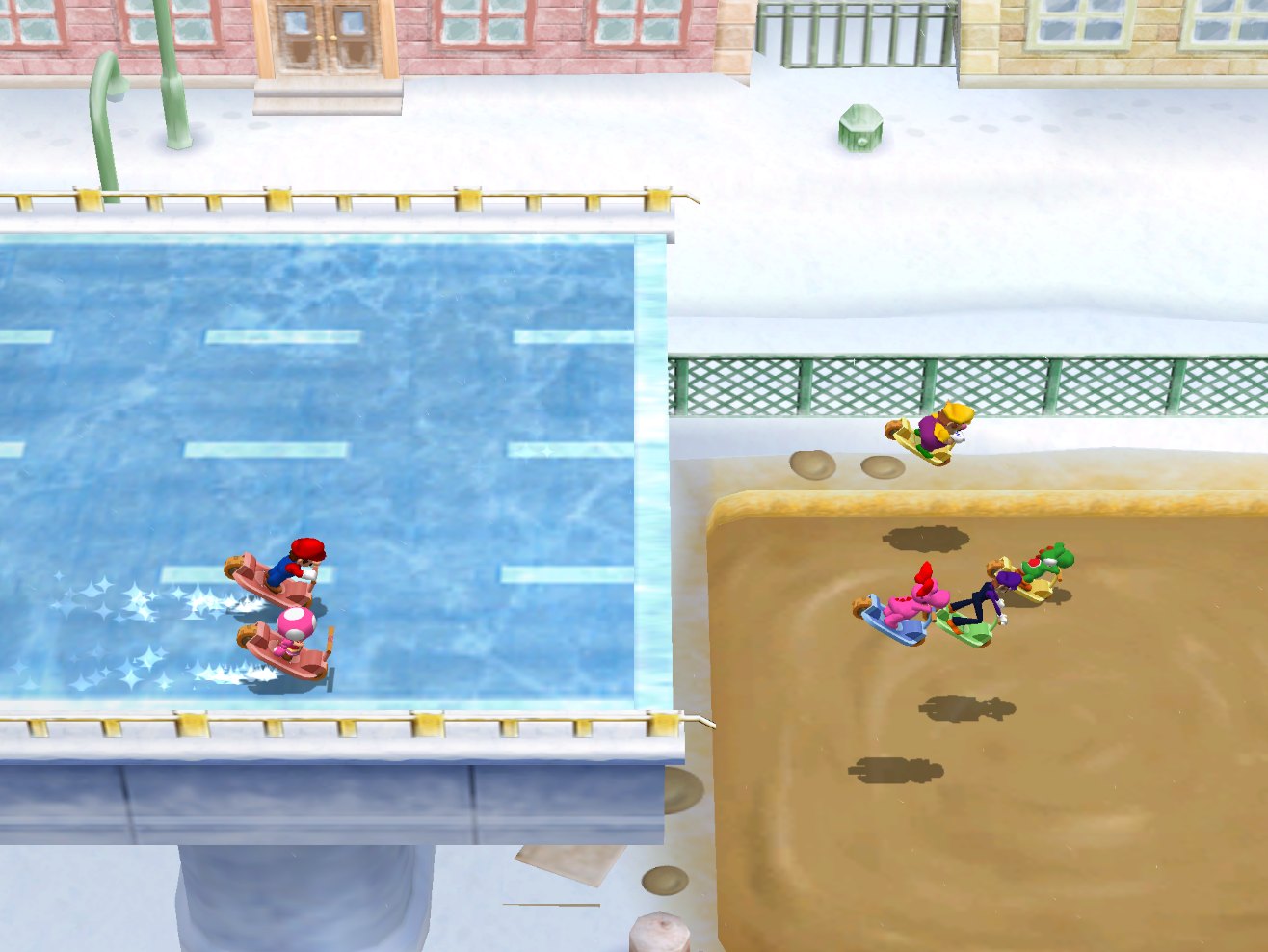
Gimme a Brake8-Player · survivalRide a scooter downhill and brake as late as you dare before the mud, in sun, rain or snow.
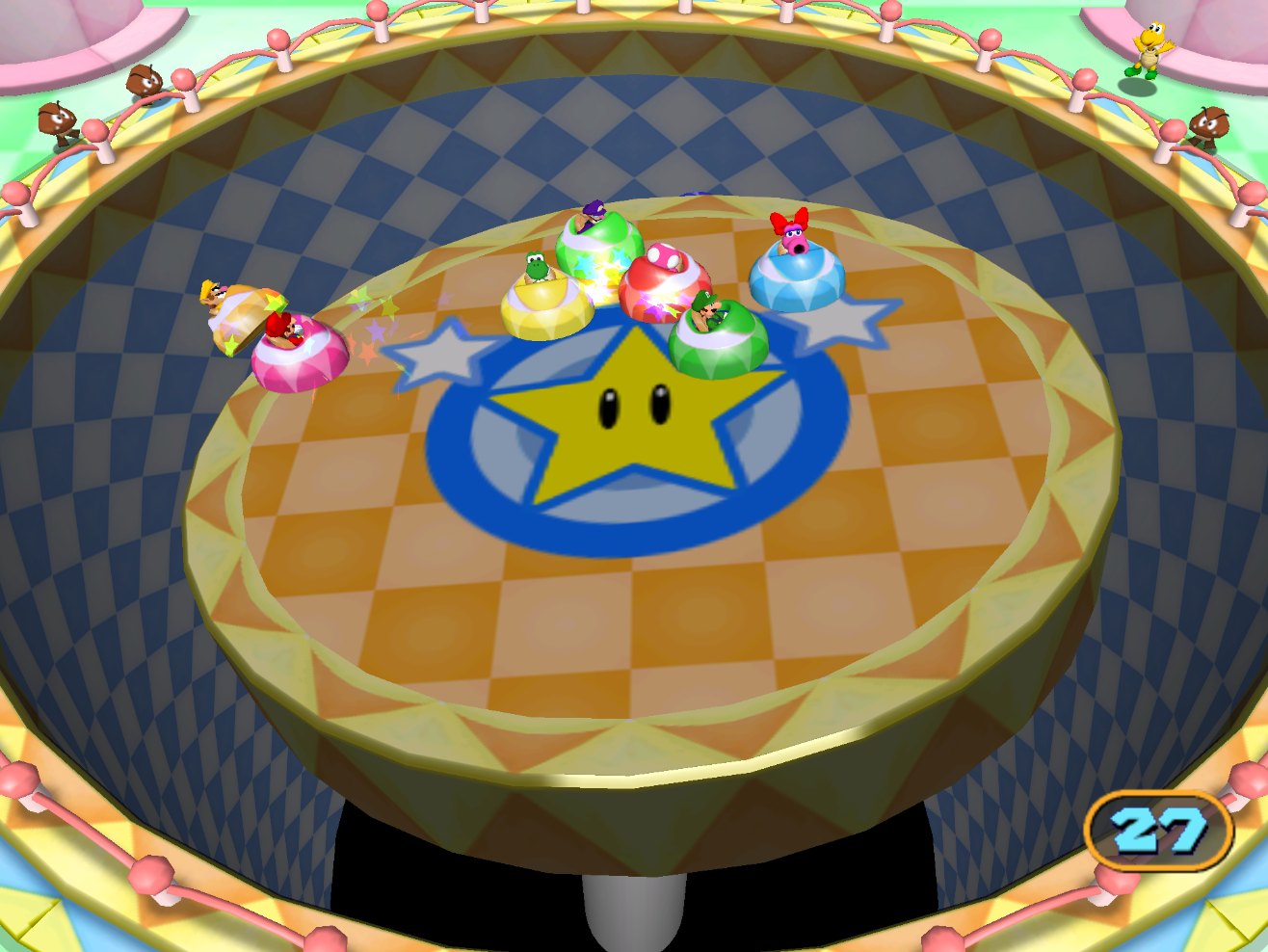
Bumper to Bumper8-Player · survivalHoverkart sumo on a tilting platform.
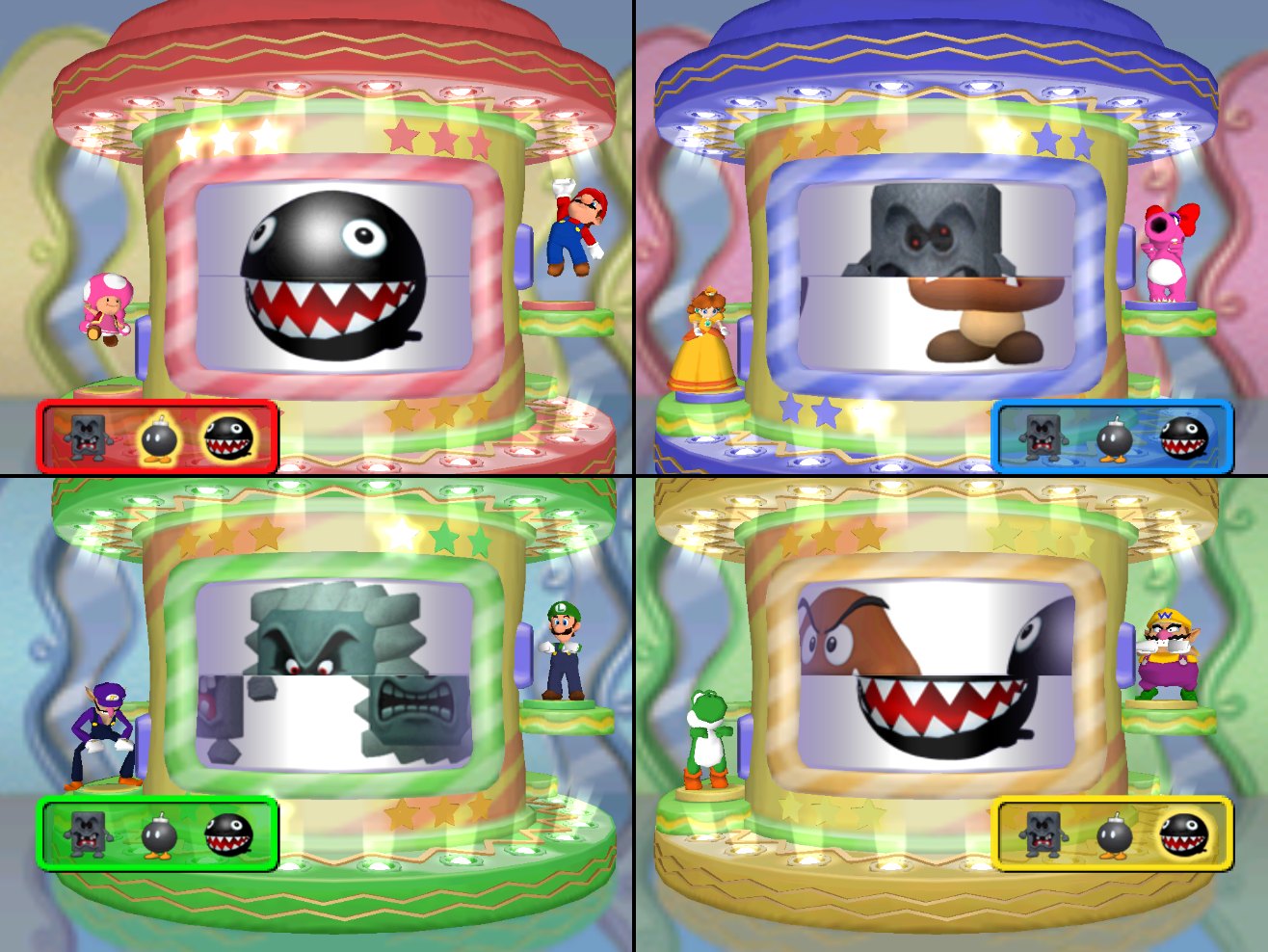
Spin Off8-Player · teamEach partner stops one half of a spinning picture to make a matching character.
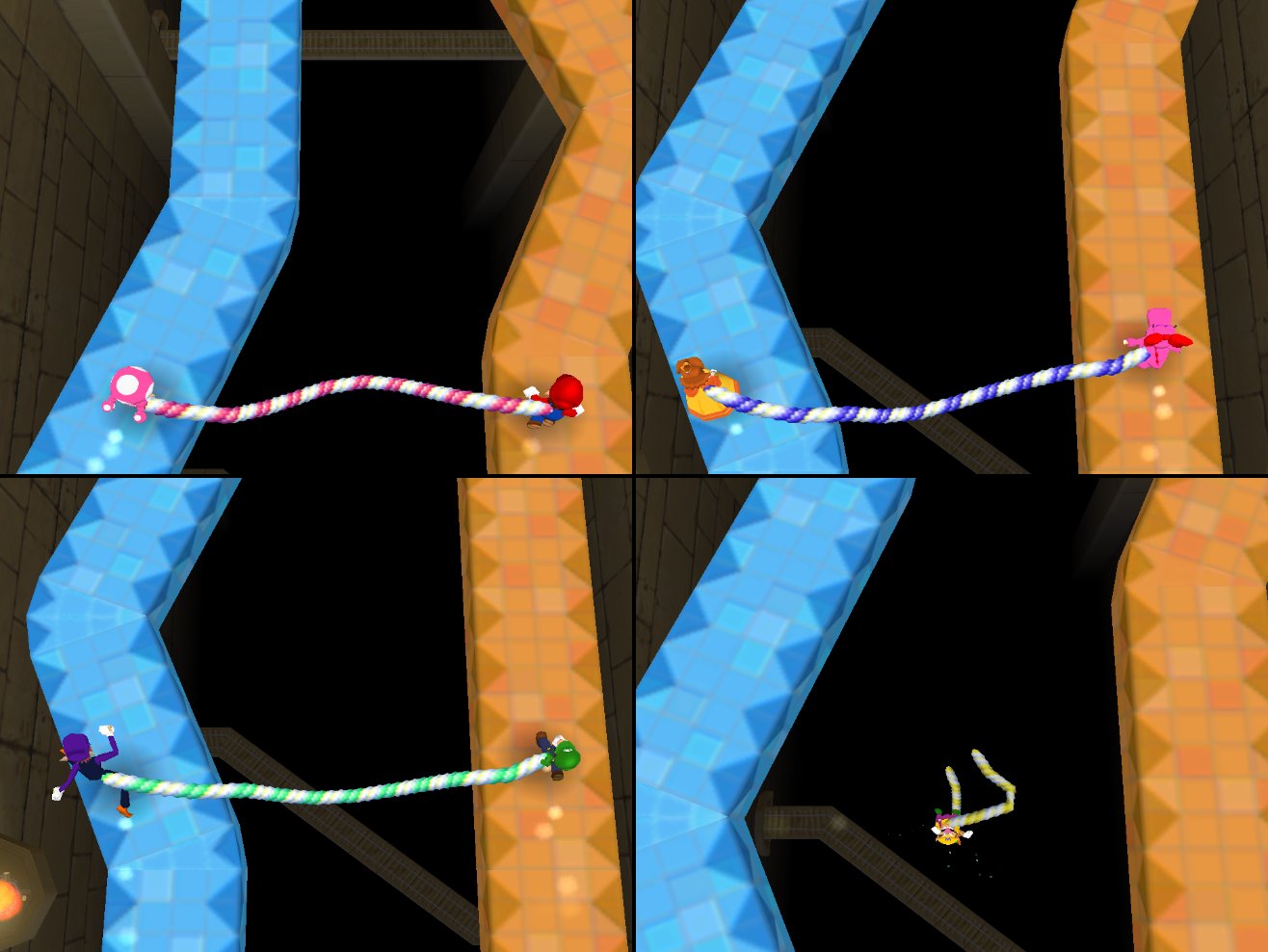
Rope a Dope8-Player · teamPartners roped together cross a narrow path. If one falls, both go.
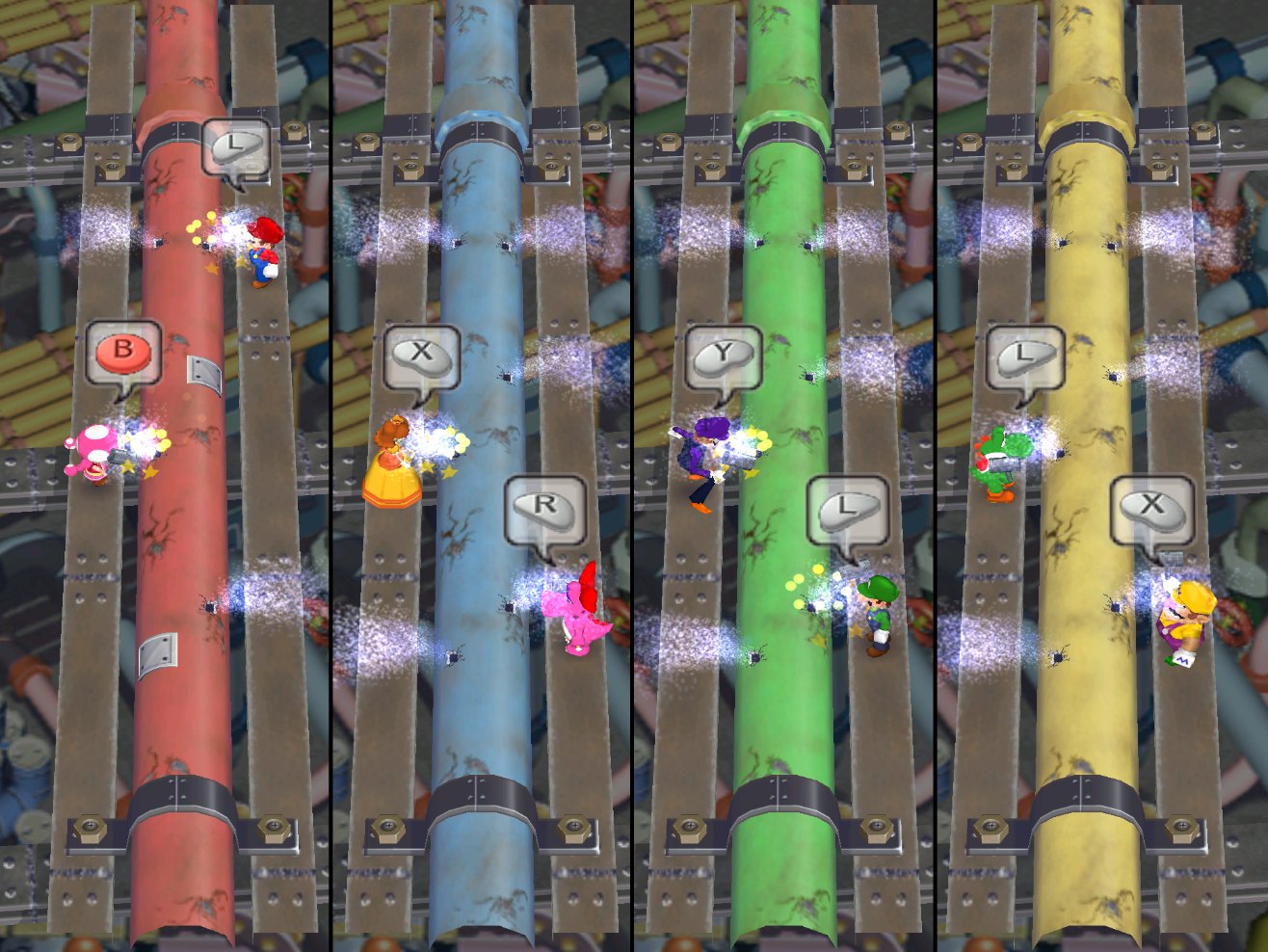
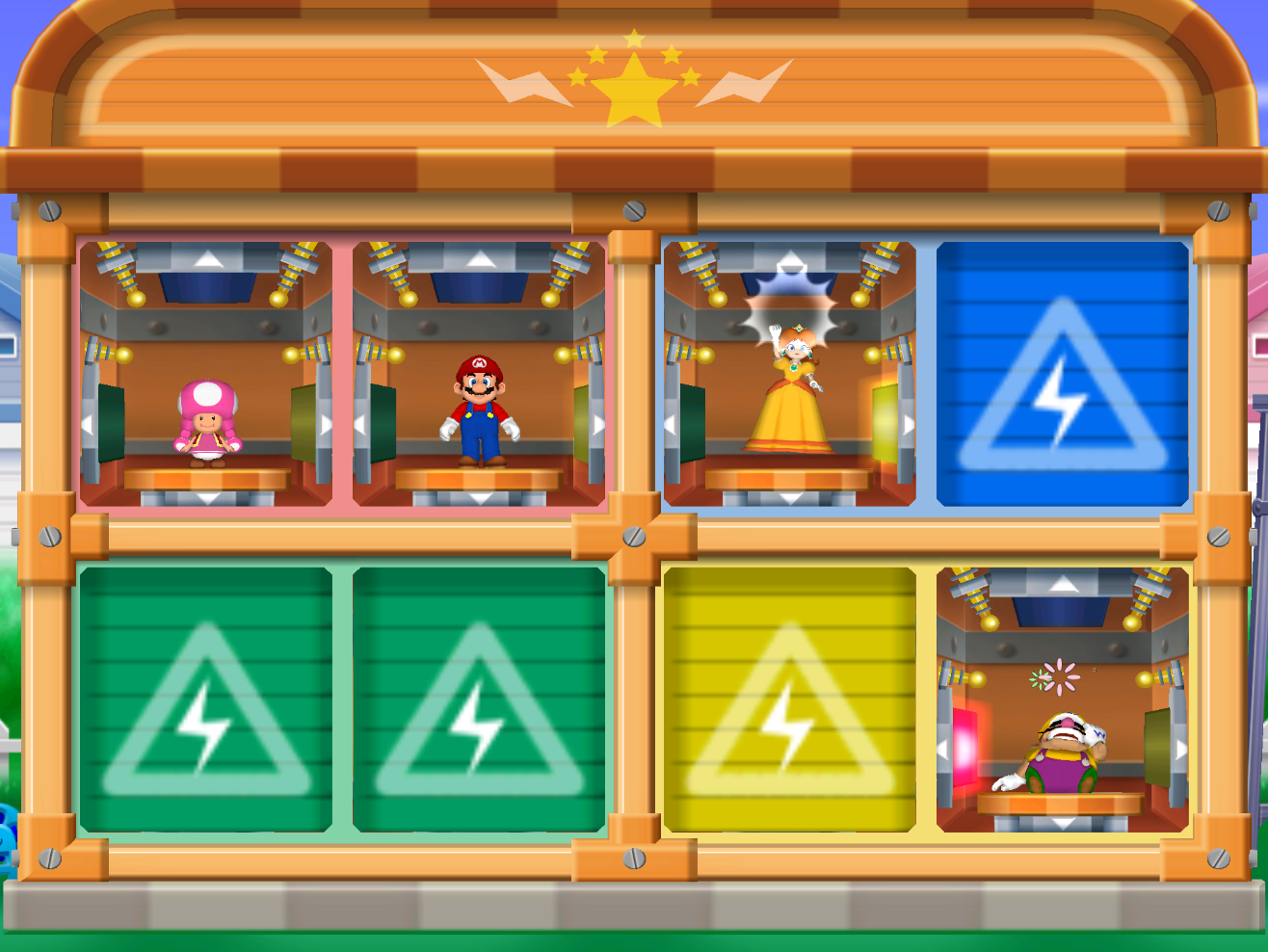
Duct & Cover8-Player · teamMend leaking pipes by pressing the button shown above each one.
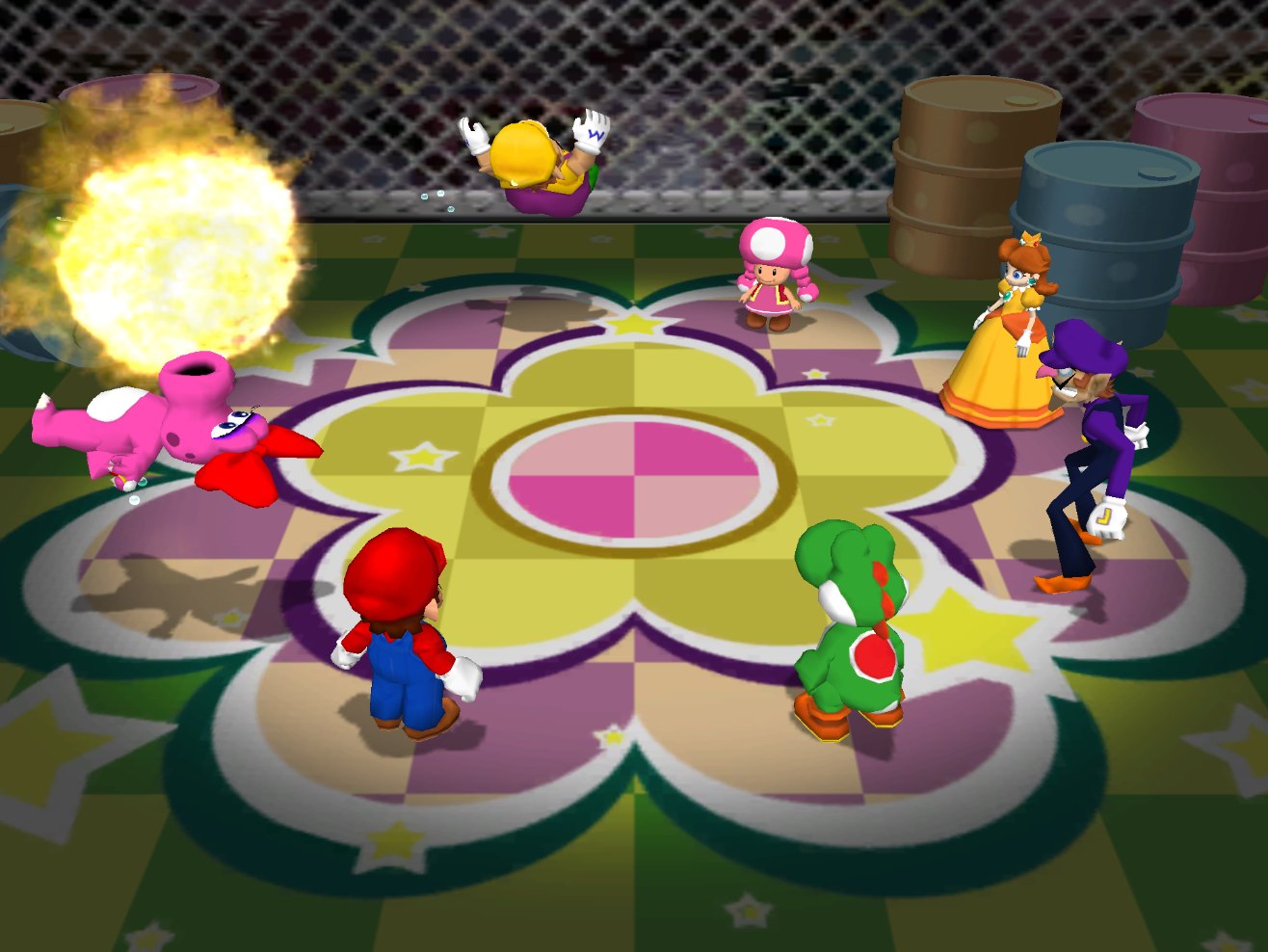
Bob-ombic Plague8-Player · survivalPass a Bob-omb round a ring. When it goes off, whoever is holding it and the players on either side are out.
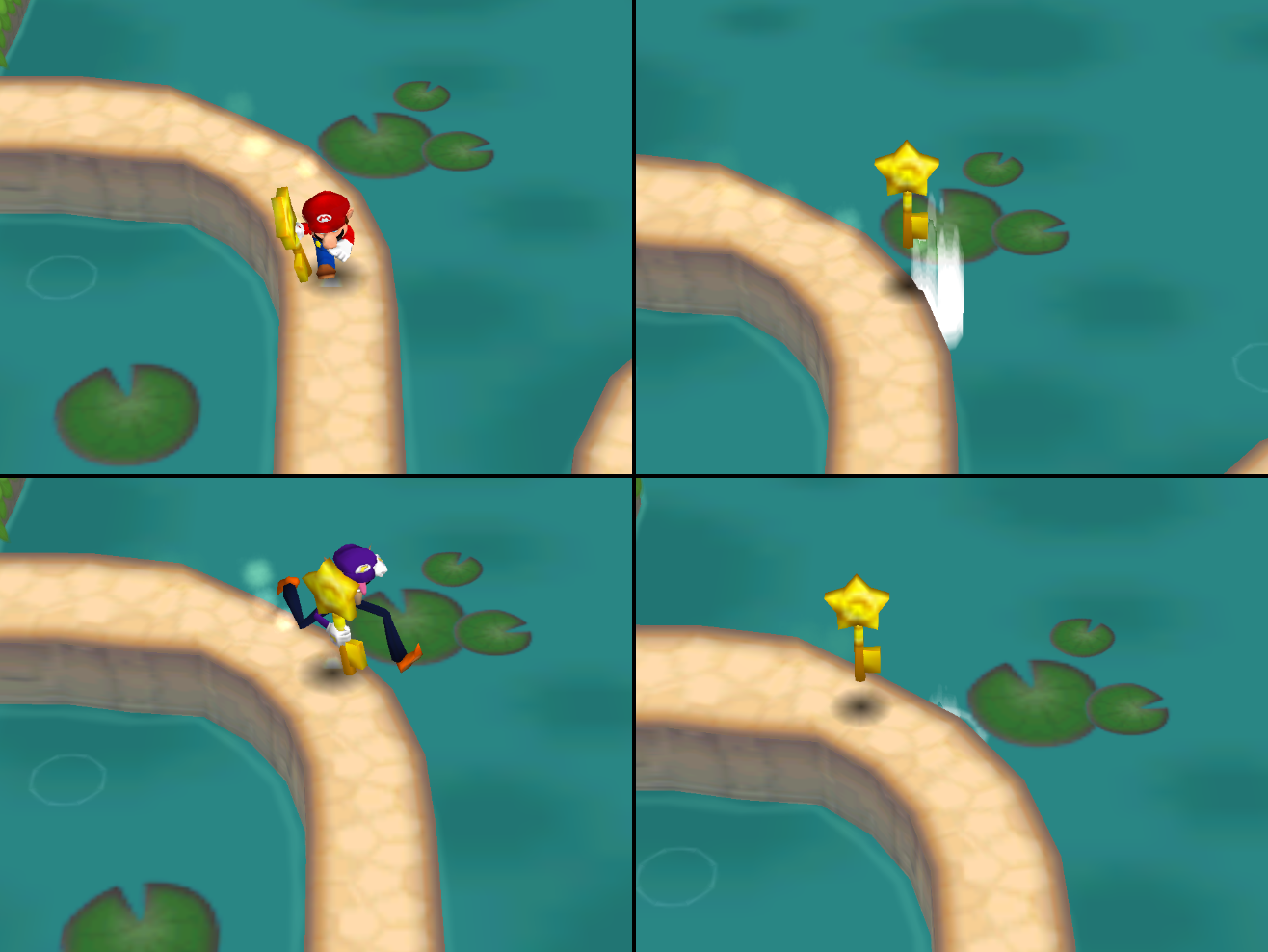
Unhappy Trails8-Player · teamA relay to fetch a jewel from a swamp and carry it home.
Shock Absorbers8-Player · survivalPunch up, left or right at whichever light glows, and crouch when they all do.
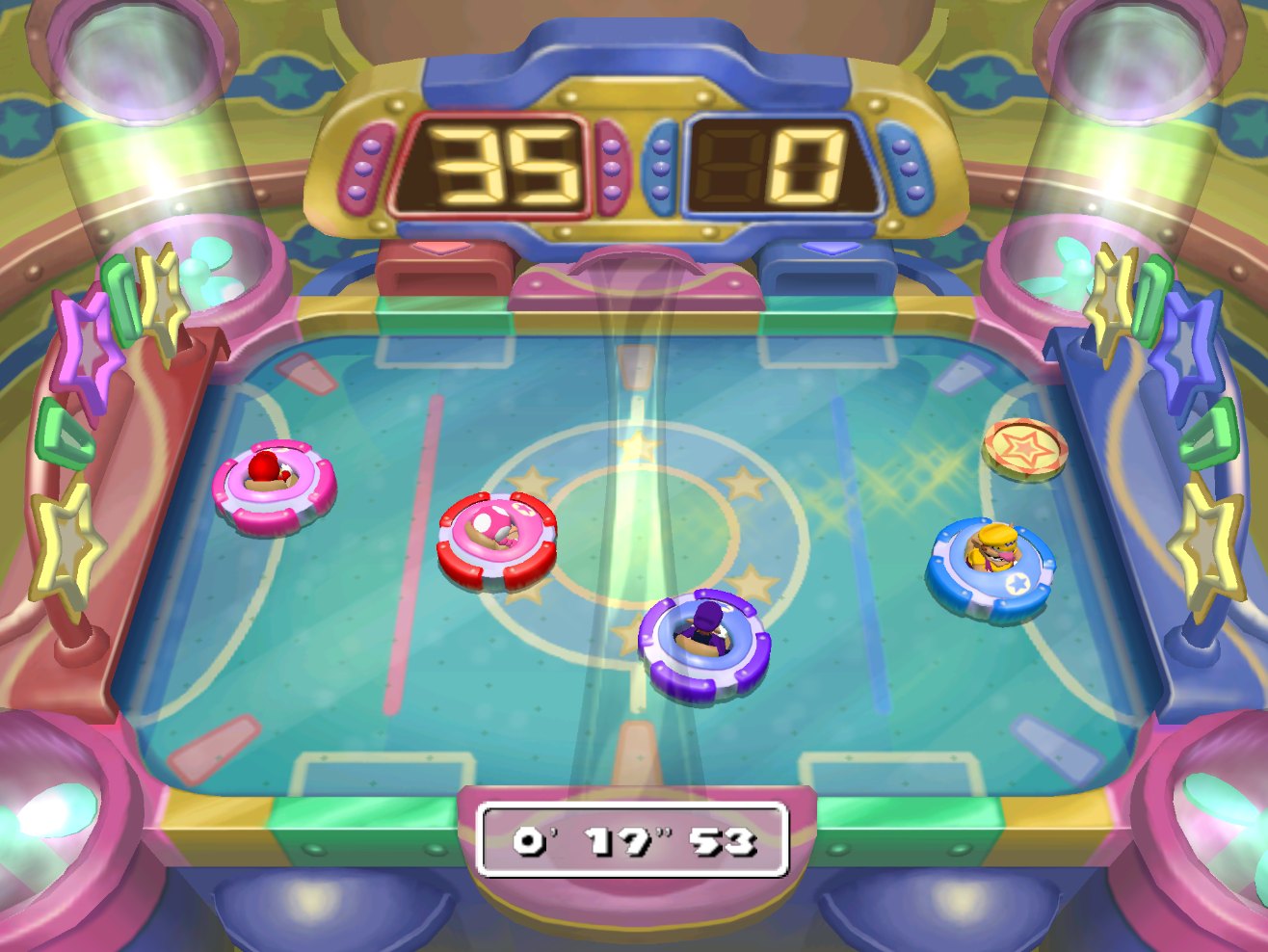
Ice MovesRareTwo-a-side air hockey on ice. Costs 3,000 Cruise Mileage Points at the Duty-Free Shop.
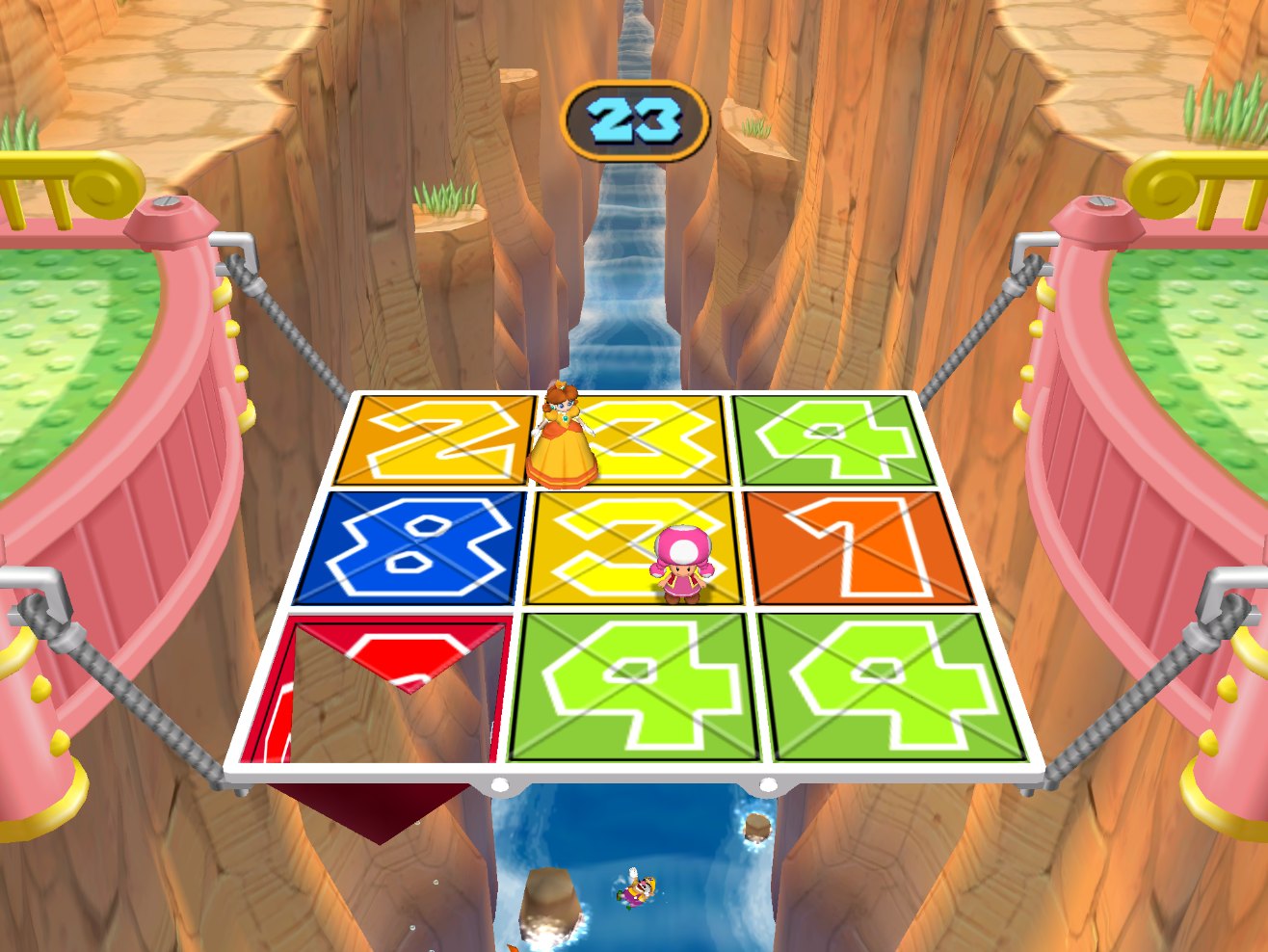
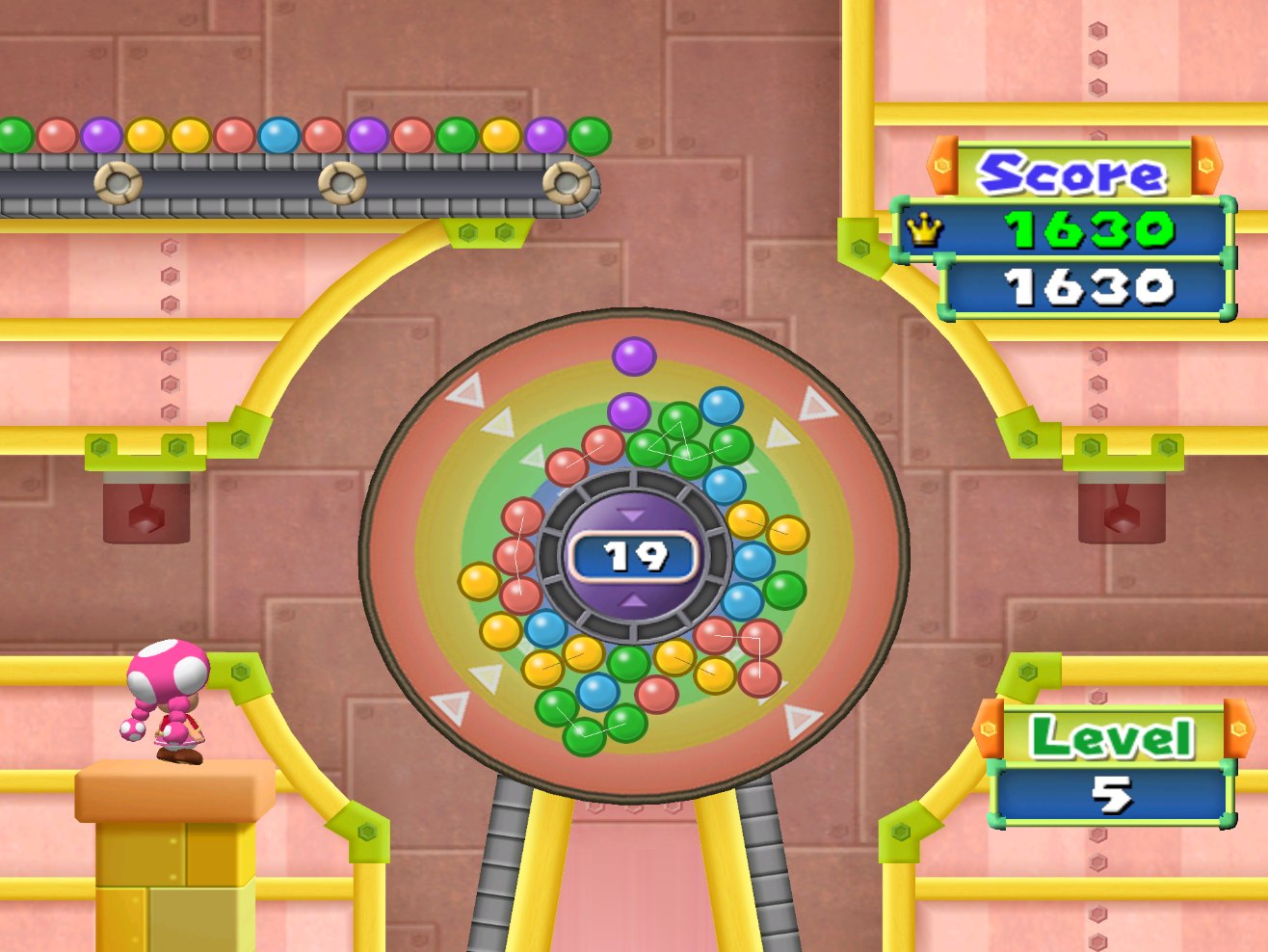
Stick and SpinRareA puzzle game: rotate the stage and drop balls to link five or more of one colour. Costs 3,000 points. Also in Mario Party DS, The Top 100 and Superstars.
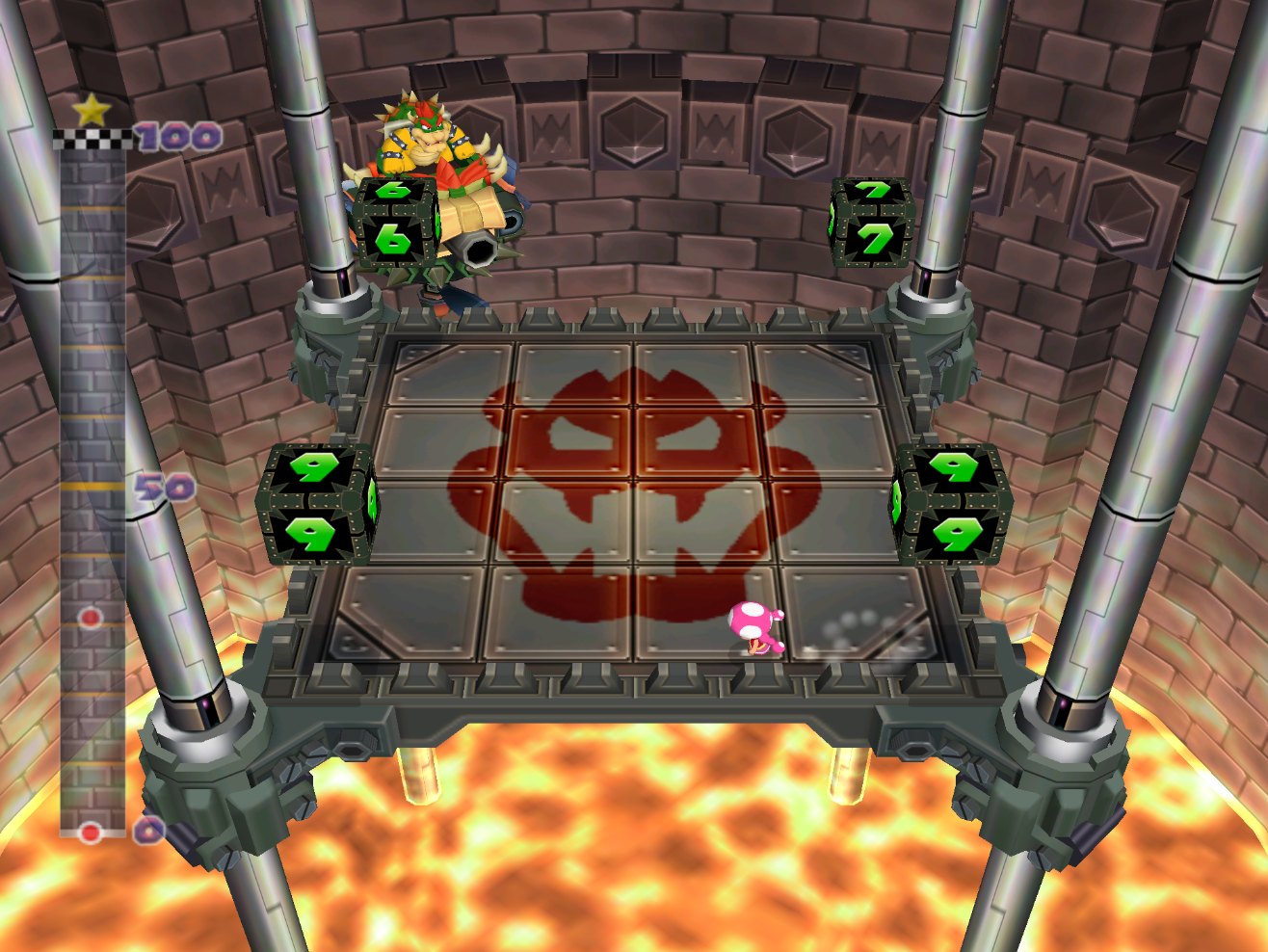
Bowser’s Lovely Lift!BossThe finale of Solo Cruise: hit four Dice Blocks to ride a lift up Bowser’s castle, dodging his attacks, to the 100th floor. A Koopa Kid joins in after floor 50.
The people who made it
Names and roles from the staff roll, as transcribed by Super Mario Wiki. The voice cast is uncredited in the game.
Shuichiro NishiyaGame directorAlso credited as game director of Mario Party 6.
Hiroshi Sato and Atsushi IkedaProducersWith Miyuki Hirose as associate producer and Shinji Hatano as senior producer.
Satoru Iwata and Hidetoshi EndoExecutive producersCredited at the head of the production staff.
Shigeru Miyamoto and Takashi TezukaSupervisorsMiyamoto is also credited, with Hiroji Kiyotake, for original character design.
Kenji KikuchiSenior directorThe director of the Nintendo 64 Mario Party games, here in an overseeing role.
Tatsumitsu WatanabePlanning directorLed a team of twelve planners.
Hideki SahashiProgram directorHeld the same post on Mario Party 3.
Saori TsutsuiDesign directorHeaded the graphic design team.
Hironobu Yahata and Shinya OutougeMusicComposers of the score, under music director Ichiro Shimakura and sound director Shohei Bando. Koji Kondo is credited for sound support.
Charles MartinetVoice of Mario, Luigi, Wario and WaluigiUncredited.
Jen TaylorVoice of Peach, Toad and ToadetteUncredited.
Deanna MustardVoice of DaisyUncredited.
Kazumi TotakaVoice of Yoshi and BirdoUncredited.
Scott BurnsVoice of Bowser and ToadsworthUncredited.
Alan Averill and Thomas ConneryNorth American localisationLocalisation management by Jeff Miller, Leslie Swan, Bill Trinen and Nate Bihldorff.
Yusuke NakanoCG illustration supervisorWith CG illustration by Wataru Yamaguchi and Yu Kitai.
Advertisement
How It Was Made
No interview about the making of Mario Party 7 turned up in the research for this page, so this account rests on the credits, the announcements of 2005 and what is left in the game’s data.
A fourth GameCube party in four years
Hudson Soft developed the game for Nintendo, as it had every Mario Party before it; Super Mario Wiki also lists CAProduction and Nintendo’s SPD Group No. 4 as developers. Shuichiro Nishiya, game director of Mario Party 6, directed again. Kenji Kikuchi, who had directed the Nintendo 64 games, is credited as senior director, Hiroshi Sato and Atsushi Ikeda as producers, and Shigeru Miyamoto and Takashi Tezuka as supervisors. The music is by Hironobu Yahata and Shinya Outouge.
The brief, to judge by the result, was to keep what worked and find new things to hang on it: a second outing for the Microphone, twice as many seats at the table, and a theme that let every board look like a holiday postcard. Several pieces of Mario Party 6’s music were reworked for it, including the main menu theme, which is a new arrangement of that game’s Castaway Bay.
E3 2005 to the shops
According to Wikipedia the game was shown at E3 in 2005 with six minigames to try, in both four-player and eight-player form, and IGN’s Juan Castro came away thinking it looked and played much like Mario Party 6. Nintendo of America announced the release date that August.
In October it announced a hardware bundle as well: a GameCube, two controllers, the Microphone and the game for $99.99, against $49.99 for the game and Mic alone. North America got the game first, on 7 November 2005, with Japan following on 10 November. Europe waited until 27 January 2006 and Australia until 8 June. By then the Wii was months away, and Super Mario Wiki records Mario Party 7 as the last Mario game released for the GameCube in Europe and Australia; in Japan and North America that distinction went to Super Mario Strikers.
Regional differences
The Japanese version has a female announcer for the minigames, the one heard in Mario Party 4 and 5, where the others use a male voice as Mario Party 6 did. In Europe Bowser Time became Bowser Party, the winner’s name and the word “Won!” are set on separate lines after a minigame, and the word grows on screen instead of spinning. The European release is in English, French, German, Italian and Spanish, and its credits include a Voice Recognition Support team.
Left on the disc
The early, unused title screen.
The leftovers are much like those in Mario Party 5 and 6. There is a debug menu for the minigames, descended from the one in the Nintendo 64 games, and an animation viewer. The most interesting item is an unused title screen, loadable only with Action Replay codes, which shows Mario alone on the deck of the MSS Sea Star with other characters dotted about on islands behind him.
Series Firsts
What Mario Party 7 did first. Most of these come from Super Mario Wiki’s list of differences from the other games in the series.
1Eight playersNintendo’s own description says that “for the first time, up to eight players can compete at once”, in pairs sharing a controller.
2Birdo and Dry BonesBoth are playable in a Mario Party for the first time, as unlockable characters.
3Six Bonus StarsThe first game with more than three Bonus Stars to draw from.
4No Chance TimeThe first numbered Mario Party with no Chance Time, Chance Time Space or equivalent.
5“Minigame”, one wordThe first game in the series to drop the hyphen from “mini-game”.
6A Star that cannot land on youThe first numbered entry in which the Star Space cannot appear on the space a player is standing on.
7Tag teams that walk togetherThe only entry, according to the wiki, in which Tag Battle partners move round the board as one piece.
8New victory dancesThe first new winning animations since Mario Party 4, which the two games in between had reused.
9Modern-looking enemiesThe first Mario Party to give enemies such as Thwomp and Mr. Blizzard the designs introduced in Super Mario 64 DS.
10A single results screenThe first game to pay out Battle minigames on the ordinary results screen instead of a separate one.
Cheats & Secrets
There are no button codes. Everything hidden is bought with Cruise Mileage Points at the Duty-Free Shop or earned in Solo Cruise. Prices are from Super Mario Wiki’s page on the shop.
Unlock Birdo and Dry Bones
Buy each of them at the Duty-Free Shop for 1,000 Cruise Mileage Points.
Unlock Bowser’s Enchanted Inferno!
Beat the computer on every board of Solo Cruise, win a Star on the Inferno itself and then clear Bowser’s Lovely Lift! The board then appears in Party Cruise.
Brutal difficulty
The fourth level of computer opponent, above Hard, costs 1,000 points.
The rare minigames and King of the River
Ice Moves and Stick and Spin cost 3,000 points each and are played from the Free Play Sub. King of the River costs 2,000, and it also needs certain minigames to have been found first, the three multiplayer Bowser games among them. “Staff Records”, the development team’s own minigame records, cost 3,000.
Opening the Minigame Cruise modes
Volcano Peril needs at least one 4-Player, one 1-vs-3 and one 2-vs-2 minigame in your collection; Waterfall Battle needs one Duel minigame; Pearl Hunt one 4-Player minigame. Decathlon Castle needs its ten events: Track & Yield, Fun Run, Snow Ride, Target Tag, Pokey Pummel, Take Me Ohm, Kart Wheeled, Helipopper, Monty’s Revenge and Air Farce.
Earning Cruise Mileage Points
Points come from playing. The wiki notes 10 points for every minigame played away from the boards and a 500-point bonus for beating the computer in Solo Cruise.
Souvenirs worth knowing about
Most souvenirs cost 500 points. Three cost 1,000 and have conditions: the MSS Sea Star (play every Party Cruise board once), the Free Play Sub (find every minigame and try every Minigame Cruise mode) and the Chop Chop Helicopter (play Deluxe Cruise five times and try each of its modes). Three more cannot be bought: clearing King of the River on easy, normal and hard earns the Golden Chest, the Magic Lamp and the Power Star Statue. Say “Surprise” into the Mic at the Souvenir Stand to make them react.
Roll doubles
According to StrategyWiki, matching numbers with a Mushroom Orb pay 10 coins, or 30 for a pair of sevens, and three of a kind with a Super ’Shroom Orb pay 30, or 50 for three sevens. A Slow ’Shroom Orb lets you choose your number, which is the reliable way on to a DK Space.
Know the Star rule
On Pagoda Peak, watch the price: it runs 10, 20, 30, 40 and back to 10, so the player who arrives just after a 40-coin sale gets a bargain. In Windmillville a 100-coin investment locks a windmill for the rest of the game. On Pyramid Park a Snack Orb turns away one Chain Chomp raid and lasts three turns.
The Bonus Stars
Minigame Star (most minigames won), Action Star (most Green Spaces), Orb Star (most Orbs used), Shopping Star (most spent on Orbs), Red Star (most Red Spaces) and Running Star (most spaces moved). Only three of the six are awarded in a game.
SLB’s own cheats page for the game is linked under Reference below.
Videos
Both of these are third-party uploads of official material: a trailer and a television advert from 2005.
Third-party upload of a trailer for the game, from a channel that collects GameCube trailers.
Third-party upload of a 2005 television commercial for the game.
Trivia & Interesting Facts
Nobody quite agrees on the number of minigames. Nintendo UK’s page promises “more than 80” and lists 86, ten of them for the Microphone. A fact sheet reproduced by WorthPlaying in November 2005 also says 86, but with eleven Mic games. Super Mario Wiki’s list has 88, counting the two rare games.
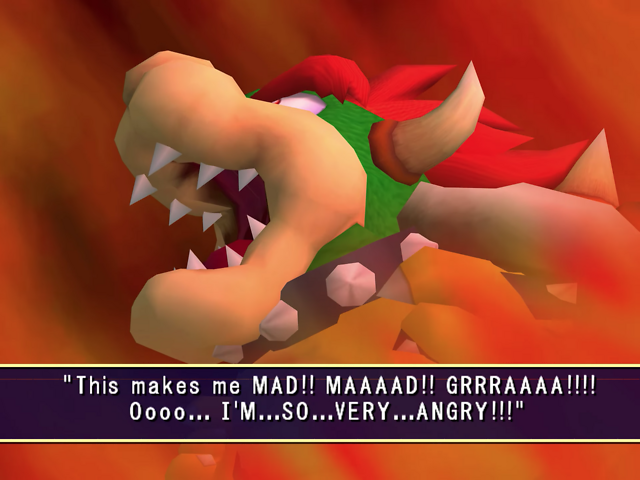
Bowser learns he has not been invited.Bowser’s fury at being left out is spelled out in the instruction booklet, where Toadsworth reports him shouting “This makes me MAAAAD!!”
The DK minigame Jump, Man is modelled on 25m, the first stage of the arcade Donkey Kong, and pixelated 8-bit Marios decorate several Orb huts and the ruins of Pyramid Park.
A marquee screen on Neon Heights shows a level in the style of Super Mario Bros., and the blocks in the background of StratosFEAR! are drawn as they appear in Super Mario All-Stars.
The head of Mecha-Bowser from Super Mario Sunshine is one of the attractions on Bowser’s Enchanted Inferno!
A picture of Peach’s Castle as it looks in Mario Party 5 hangs in the Duty-Free Shop.
Pagoda Peak has only 42 spaces in Party Cruise, which Super Mario Wiki calls the smallest standard board in the series.
The chance of crossing all three sets of pedestals in the Inferno’s lava hopscotch, and so winning a Star, is one in eight.
Koopa Kid is the only playable character of Mario Party 6 who does not come back as one. He is everywhere else instead: in the chests, the shops, the Bowser minigames and an Orb of his own.
Teams are named in the order they are formed: Team Dolphin, Team Seagull, Team Tuna and Team Mollusk. In Japanese the last two are simply the Fish Team and the Shell Team.
King of the River’s music is a new arrangement of Endurance Alley from Mario Party 6, which was itself an arrangement of the underground theme from Super Mario Bros.
Pyramid Park borrows its Star-stealing Chain Chomps from Snowflake Lake in Mario Party 6, and Windmillville’s windmills were in turn borrowed by Koopa’s Tycoon Town in Mario Party 8.
Clock Watchers, in which you stop a hidden clock by counting in your head, was reworked as Stop Watchers in Wii Party in 2010.
European copies rename Bowser Time as Bowser Party, and Japanese copies have a different announcer from everyone else’s.
The promotional browser game Bowser’s Lair Hockey labelled its two sides NICE (Toad) and MEAN (Bowser).
Boo and Dry Bones, the sixth default team.Boo and Dry Bones’ team portrait can be seen on a billboard in Bowser’s Castle in Mario Kart Wii.
An early title screen left on the disc shows Mario by himself on the deck of the MSS Sea Star.
Regional Box Art
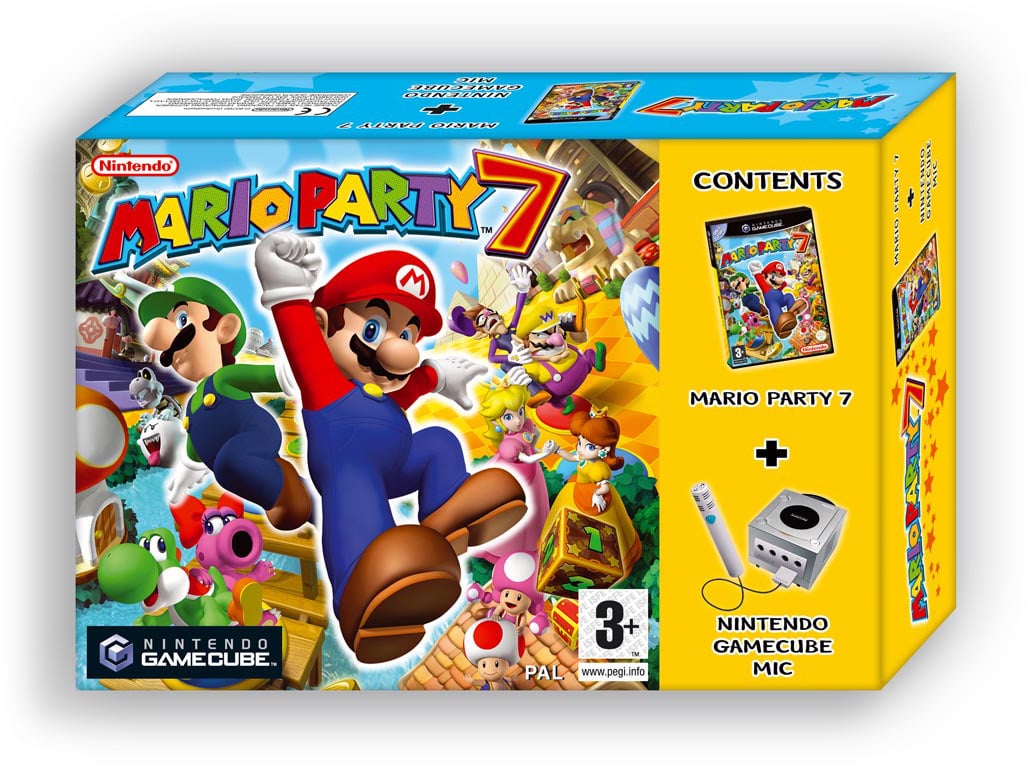
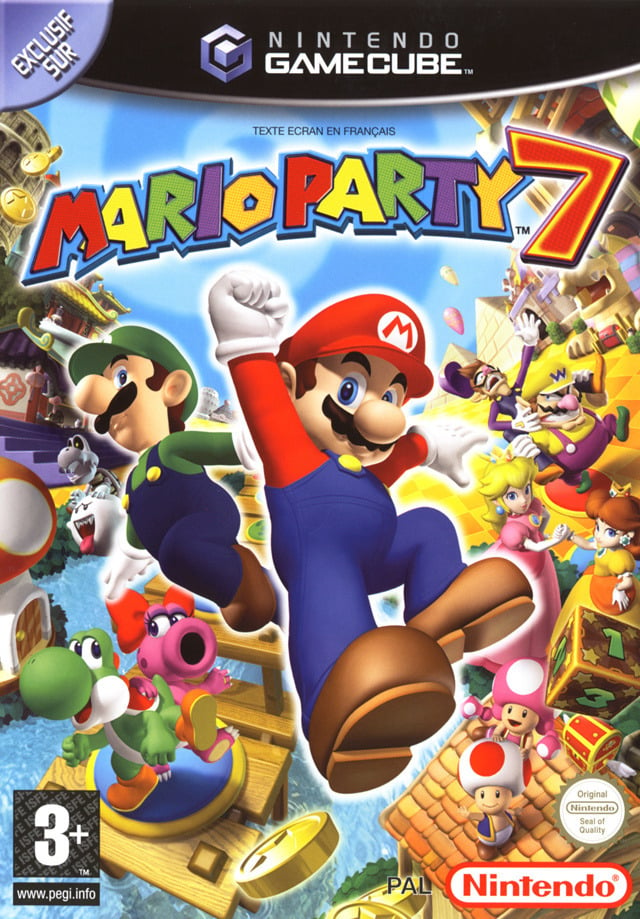
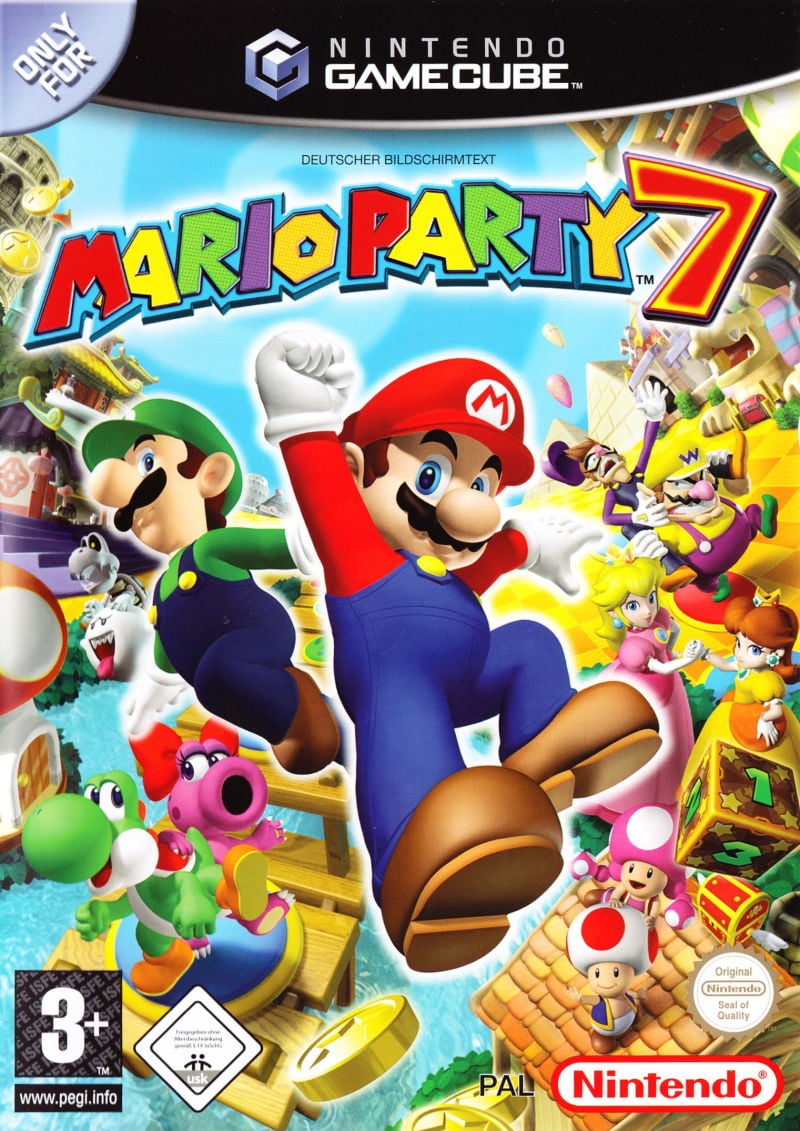
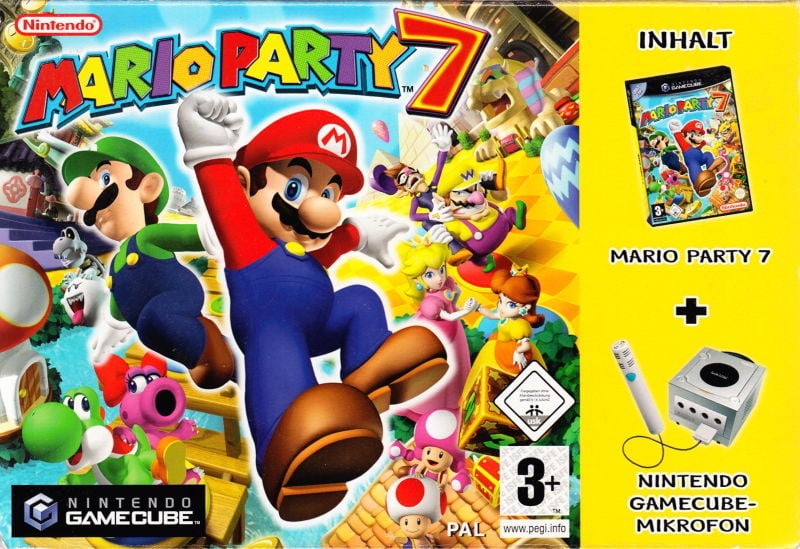
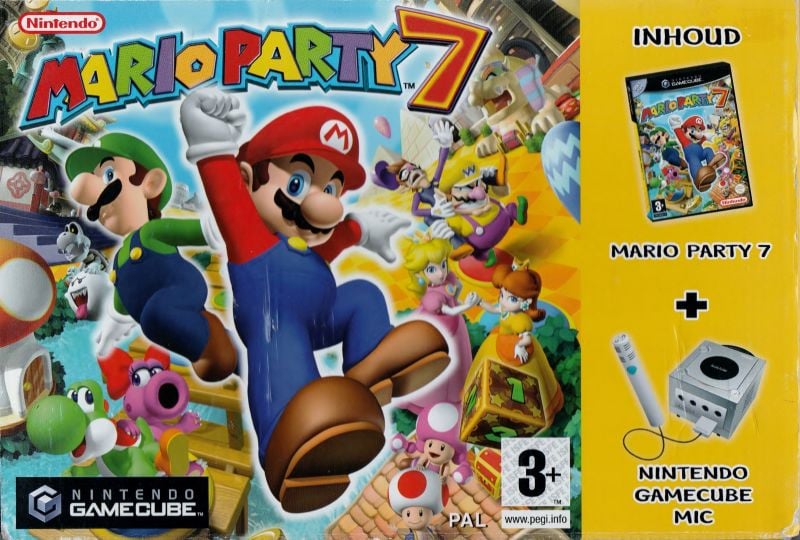
The game was sold both by itself in a standard case and in a larger box with the Microphone. Super Mario Wiki archives both kinds for several regions.
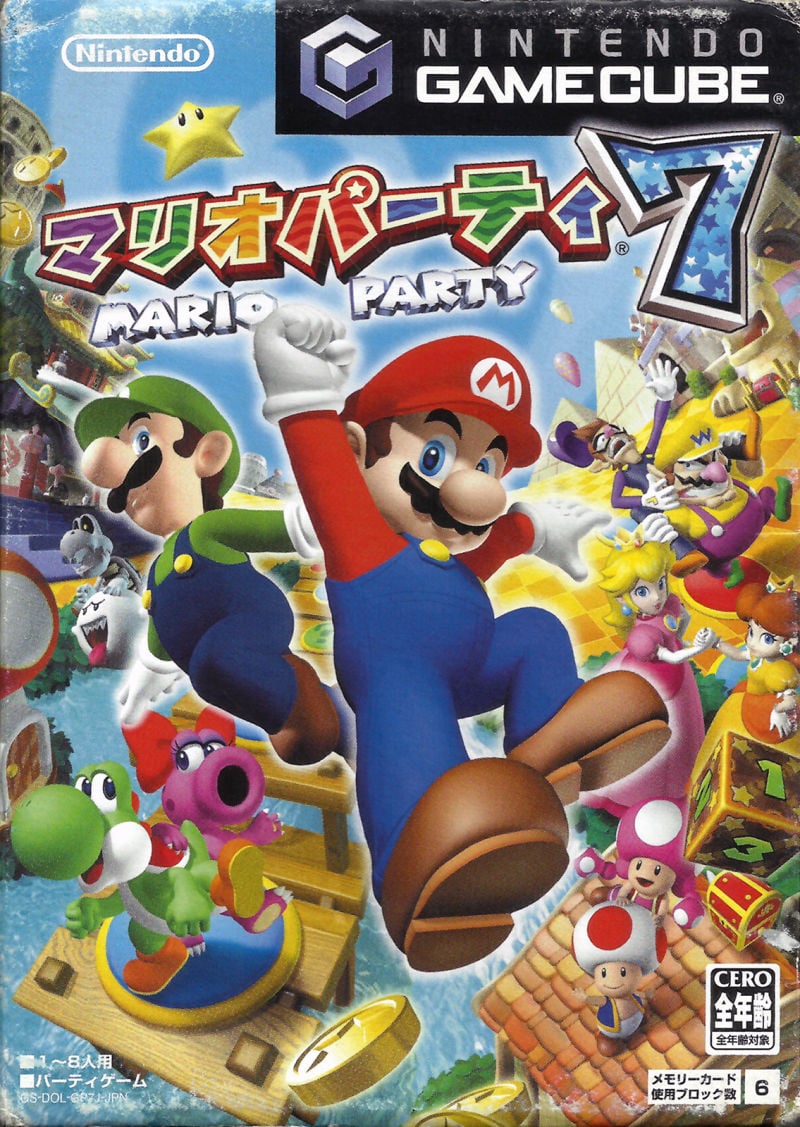
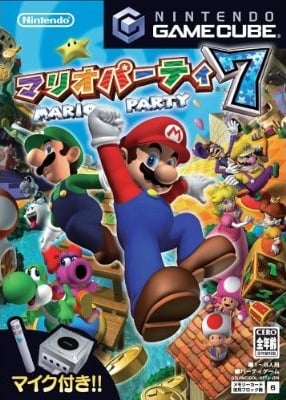
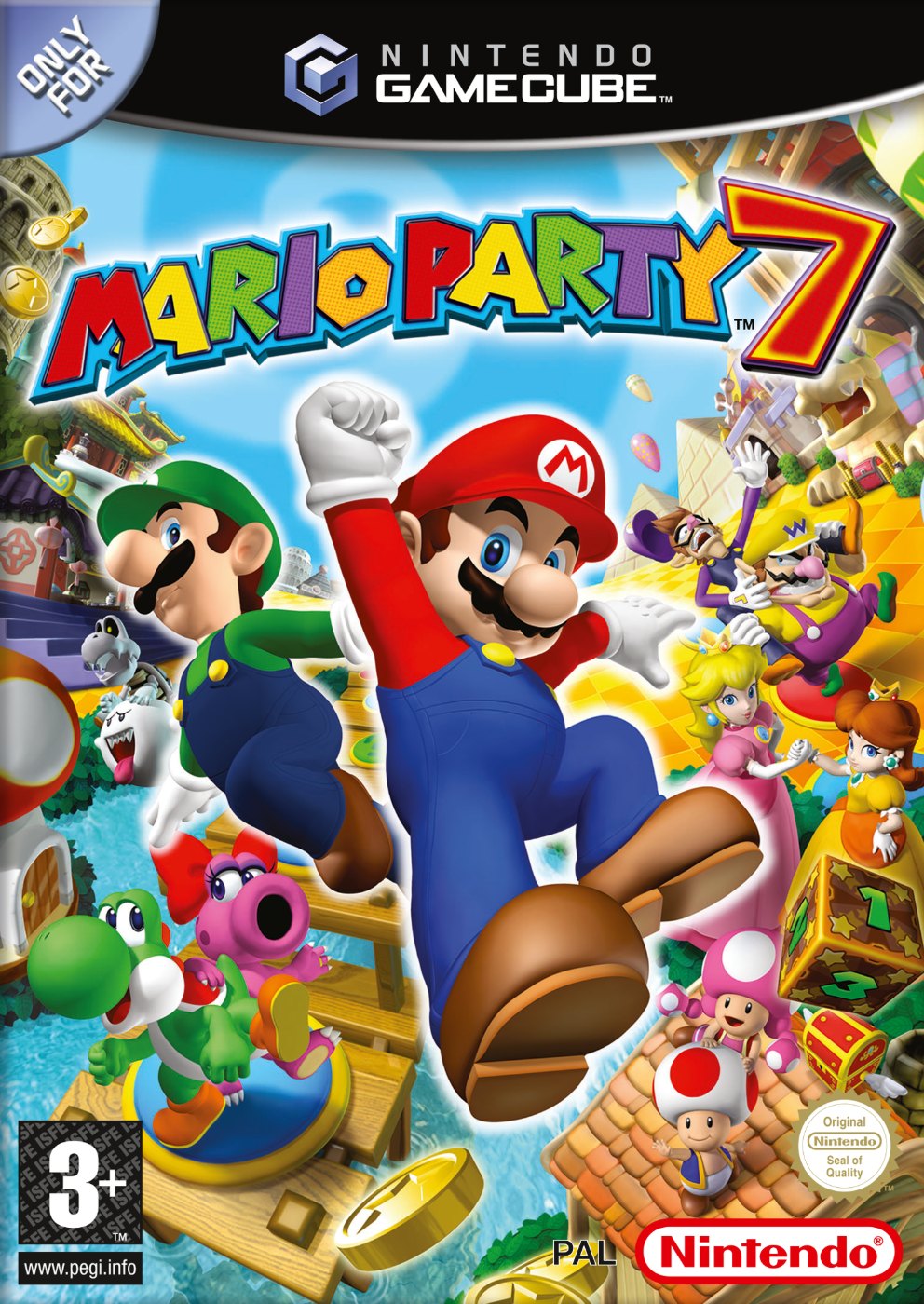
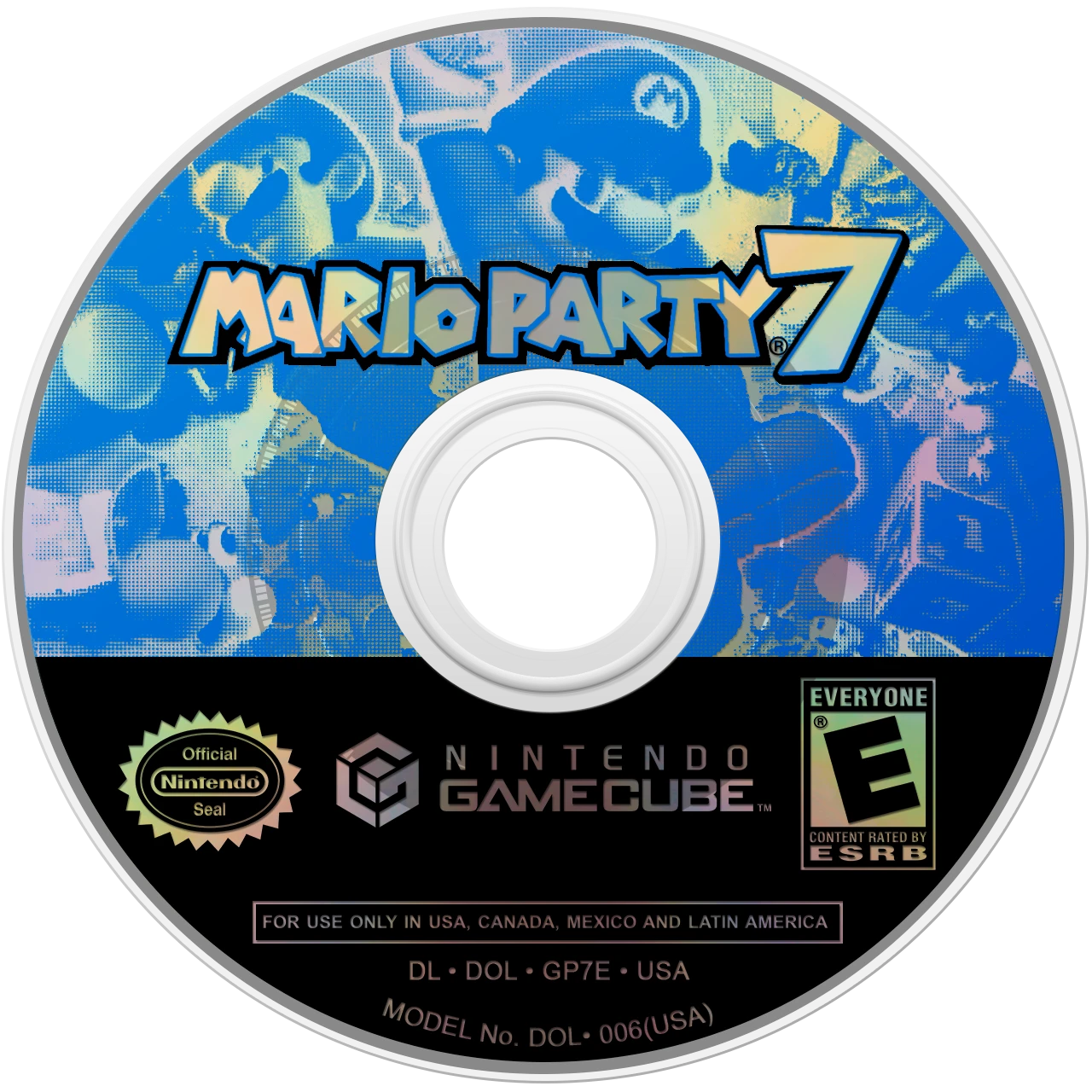
North America (2005)Game case.North America, Microphone boxJapan (2005)Game case.Japan, Microphone boxEurope (2006)UK game case.Europe, Microphone boxFranceGermanyGermany, Microphone boxNetherlands, Microphone boxAustralia (2006)North American game disc
Screenshots
More from the boards, and from Bowser’s visits to them.
Mario on Grand Canal.Wario in Pyramid Park.Wario in Neon Heights.Mario in Bowser’s Enchanted Inferno!Bowser City sets up shop on Pagoda Peak.Bowser hands a stolen Star to a Koopa Kid on Pyramid Park.A Dark Star is handed over on Neon Heights.The Mecha-Bowser flamethrower on the Inferno.
Artwork & Media Gallery
Logos, the six team portraits, board logos and magazine adverts.
The international logo.The Japanese logo.Mario and Luigi.Peach and Daisy.Yoshi and Birdo.Wario and Waluigi.Toad and Toadette.Board logo: Grand Canal.Board logo: Pagoda Peak.Board logo: Pyramid Park.Board logo: Neon Heights.Board logo: Windmillville.Board logo: Bowser’s Enchanted Inferno!A Mexican print advert.A German print advert.A French print advert.
Legacy & Re-releases
Mario Party 7 was the end of one era and very nearly the end of another: the last of four GameCube entries, and the second-last home console Mario Party before the series changed hands.
Every release
GameCube (North America)7 November 2005The original release, with the Microphone in the box at $49.99. A $99.99 console bundle had been announced in October.
GameCube (Japan)10 November 2005The Japanese release, three days later.
GameCube (Europe)27 January 2006The date on Nintendo UK’s product page and in Super Mario Wiki. Wikipedia gives 27 January for the United Kingdom and 10 February for the rest of Europe.
GameCube (Australia)8 June 2006The last region to get it.
Re-releasesNone foundSuper Mario Wiki and Wikipedia list the GameCube as its only platform.
What came next
The series moved to the Wii with Mario Party 8 in 2007, which swapped Orbs for Candy and the Microphone for the Wii Remote, and kept one of this game’s ideas: Koopa’s Tycoon Town plays by Windmillville’s rules. Shared controllers and eight-player boards did not come back in that game.
Where it lives on
Its minigames have done better than its boards. Twelve were remade for Mario Party: The Top 100 on Nintendo 3DS in 2017 and six for Mario Party Superstars on Switch in 2021; Stick and Spin had already reappeared in Mario Party DS. None of the six boards has been remade. The earlier GameCube games are covered on their own pages: Mario Party 4, Mario Party 5 and Mario Party 6.
Reviews & Sales
Sales
Wikipedia cites two figures. Nintendo’s 2006 Annual Report put worldwide sales at 1.86 million, and the 2020 edition of the CESA Games White Paper gives 2.08 million, which Wikipedia’s article ranks as the eleventh best-selling GameCube game. Neither document was read directly for this page.
In North America the game cost $49.99 with its Microphone, or $99.99 in a bundle with a GameCube and two controllers.
2.08mworldwide (CESA Games White Paper 2020, via Wikipedia)
1.86mworldwide by 2006 (Nintendo 2006 Annual Report, via Wikipedia)
64Metacritic score (25 reviews)
$49.99US launch price with the Mic
Reviews
Scores as listed by Wikipedia and Super Mario Wiki from the original reviews.
Nintendo World ReportJosh Daugherty
8.5/10
GameSpyDave Kosak
4/5
Nintendo PowerUS
7.5/10
IGNMatt Casamassina · 7 November 2005
7.0/10
GameSpotRyan Davis
6.5/10
Game InformerUS
5/10
GamesRadar+Russ Fischer
2.5/5
1UP.comJared Rea
D+
EurogamerEllie Gibson
3/10
MetacriticAggregate of 25 reviews
64/100
GameRankingsAggregate of 28 reviews
65.39%
The seventh numbered game met reviewers who had run out of patience with the format rather than with this entry in particular. IGN’s Matt Casamassina admitted he was growing bored of new versions of the same formula, yet still found the multiplayer as enjoyable as ever and gave it 7; what he could not forgive was the solo game, slowed to a crawl by computer players taking their turns. GameSpot’s Ryan Davis made the same point from the other side: it differed little from Mario Party 6, or indeed from any of its predecessors.
The eight-player mode and the minigames were the parts most often praised. Josh Daugherty of Nintendo World Report thought the selection of minigames the best the series had managed, and GameSpy’s Dave Kosak liked the way each board had a gimmick of its own. The complaints were about waiting and about luck. For 1UP’s Jared Rea the downtime between turns was the problem; Eurogamer’s Ellie Gibson, who gave it 3 out of 10, thought Bowser Time added neither fun nor challenge; and Casamassina felt the Microphone had been forced in.
SLB User Reviews
Mario Party 7 has yet to receive a community review on Super Luigi Bros.
If you’ve played Mario Party 7 and would like to submit a review, please get in touch.
To provide the best experiences, we use technologies like cookies to store and/or access device information. Consenting to these technologies will allow us to process data such as browsing behavior or unique IDs on this site. Not consenting or withdrawing consent, may adversely affect certain features and functions.
Functional
Always active
The technical storage or access is strictly necessary for the legitimate purpose of enabling the use of a specific service explicitly requested by the subscriber or user, or for the sole purpose of carrying out the transmission of a communication over an electronic communications network.
Preferences
The technical storage or access is necessary for the legitimate purpose of storing preferences that are not requested by the subscriber or user.
Statistics
The technical storage or access that is used exclusively for statistical purposes.The technical storage or access that is used exclusively for anonymous statistical purposes. Without a subpoena, voluntary compliance on the part of your Internet Service Provider, or additional records from a third party, information stored or retrieved for this purpose alone cannot usually be used to identify you.
Marketing
The technical storage or access is required to create user profiles to send advertising, or to track the user on a website or across several websites for similar marketing purposes.

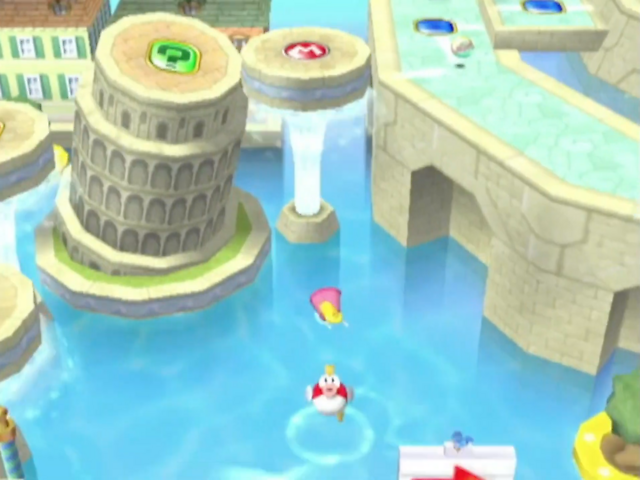
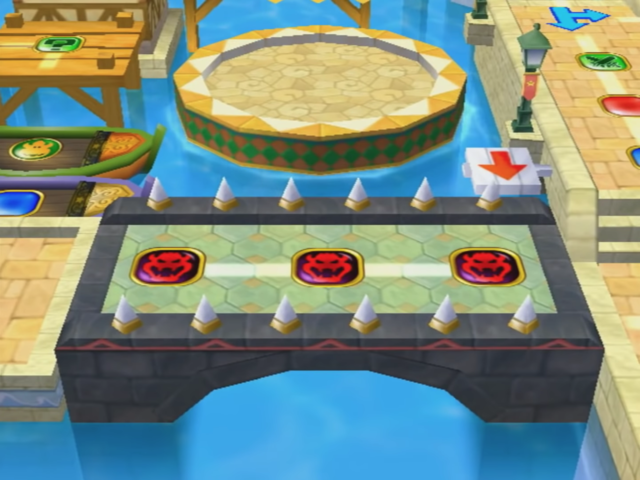

 Grand CanalVenice · 70 spaces · Stars: 20 coins at a moving Star SpaceGondola rides, a juggling Blooper with four chests and a tower that tips you into the canal.
 Pagoda PeakChina · 42 spaces · Stars: from Koopa Master at the summit for 10, 20, 30, then 40 coinsOne path up a mountain, a gong that changes the price and a dragon that sends you back down.
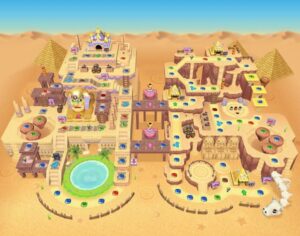 Pyramid ParkEgypt · Stars: everyone starts with five and steals them by Chain ChompRide a Chain Chomp for 10 or 20 coins, and beware the curse of the Bowser Sphinx.
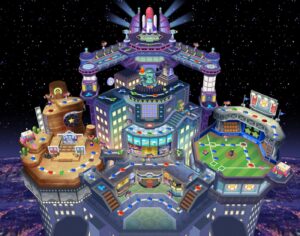 Neon HeightsUnited States · Stars: in one of three chests, 10 coins a try20 coins, a Star or a Bob-omb, with a film set, a ballpark and a rocket for side bets.
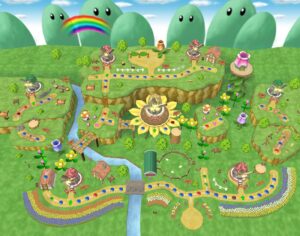 WindmillvilleThe Netherlands · Stars: 11, held by whoever has invested most in each of seven windmillsOutbid your rivals for the mills; 100 coins makes one yours for keeps.
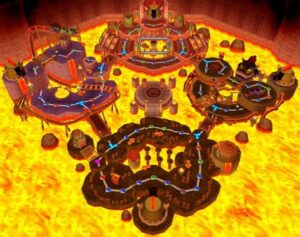 Bowser’s Enchanted Inferno!Bowser’s theme park · Stars: 20 coins · unlocked by clearing Solo CruiseFour islands in lava, and every five turns Bowser sinks the one with the Star on it.





 Mushroom OrbSelf. Roll two Dice Blocks. Sold on every board.
 Super ’Shroom OrbSelf. Roll three Dice Blocks. On every board except Windmillville.
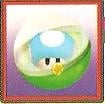 Slow ’Shroom OrbSelf. The Dice Block turns slowly enough to pick your number. Not on Pagoda Peak or Pyramid Park.
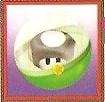 Metal Mushroom OrbSelf. Turns you to metal for the move, so rivals’ traps do nothing. Pagoda Peak, Windmillville and the Inferno.
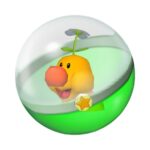 Flutter OrbSelf. Flutter carries you straight to the Star, which you still have to pay for. Grand Canal and the Inferno.
 Cannon OrbSelf. Fires you to the upper reaches of the mountain. Pagoda Peak only.
 Lakitu OrbSelf. Lakitu fetches you one of the treasure chests. Neon Heights only.
 Snack OrbSelf. Buys off one Chain Chomp raid on your Stars; lasts three turns. Pyramid Park only.
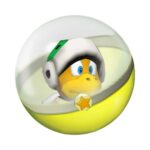 Hammer Bro OrbThrown. A rival who lands here pays you 10 coins. Not on Pyramid Park or the Inferno.
 Piranha Plant OrbThrown. Takes half the coins of whoever lands on it. Not on Pagoda Peak or Windmillville.
 Spear Guy OrbThrown. The victim pays you whatever a Dice Block shows. Not on Grand Canal or Neon Heights.
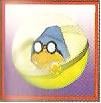 Kamek OrbThrown. Lets you take over up to three of the victim’s Character Spaces. Pagoda Peak, Pyramid Park and Windmillville.
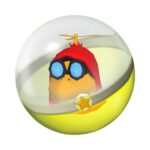 Toady OrbThrown. Steals an Orb from whoever lands on it. Pyramid Park and Neon Heights.
 Mr. Blizzard OrbThrown. The victim loses every Orb they are carrying. Grand Canal and the Inferno.
 Bandit OrbThrown. Bandit raids the coins the victim has invested in a windmill. Windmillville only.
 Pink Boo OrbThrown. Costs the victim a Star, or 20 coins if they have none. Not on Pagoda Peak or Windmillville.
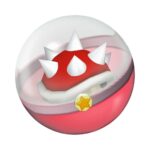 Spiny OrbRoadblock. A rival who passes it loses 10 coins. Not on Pagoda Peak or Neon Heights.
 Zap OrbRoadblock. Costs a rival 3 coins for every space they travel after crossing it. Pagoda Peak, Neon Heights and Windmillville.
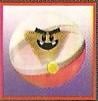 Tweester OrbRoadblock. Whirls a passing rival away to another space. Grand Canal, Pyramid Park and the Inferno.
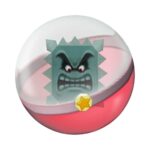 Thwomp OrbRoadblock. Flattens a passing rival and ends their move on the spot. Pyramid Park, Neon Heights and Windmillville.
 Warp Pipe OrbRoadblock. Sends a rival back to the space they set out from. Pagoda Peak and Neon Heights.
 Bob-omb OrbRoadblock. Blasts rivals back down the mountain. Pagoda Peak only.
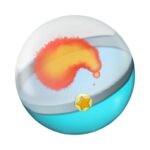 Fireball OrbCharacter: Mario and Luigi. Burn the rivals you pass and take their coins. StrategyWiki puts it at 10 coins a head for three turns.
 Flower OrbCharacter: Peach and Daisy. The spaces ahead bloom into flowers: you skip every trap and earn 3 coins for each space you cross.
 Egg OrbCharacter: Yoshi and Birdo. Swallow the Character Spaces and roadblocks in your path, which turn into eggs and then into Orbs of your own.
 Vacuum OrbCharacter: Wario and Waluigi. Spin a wheel and hoover that many coins out of your opponents.
 Magic OrbCharacter: Boo and Dry Bones. Vanish, and roll double Dice Blocks, for two turns.
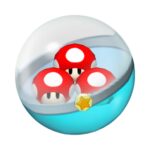 Triple ’Shroom OrbCharacter: Toad and Toadette. Double Dice Blocks for three turns running.
 Koopa Kid OrbOther. Cannot be bought or kept. Koopa Kid appears and turns a space into a Koopa Kid Space.
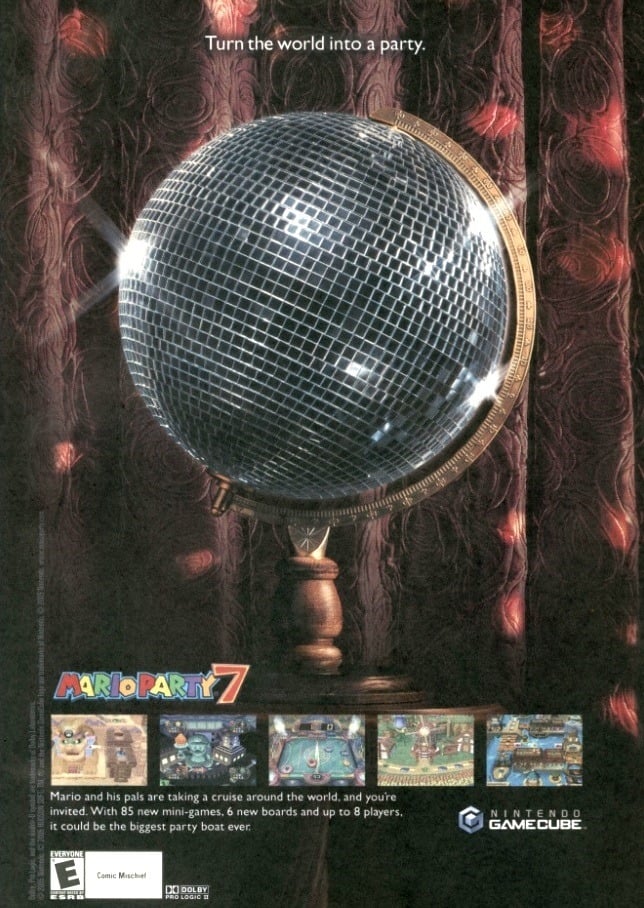 Print advertsMagazines · 2005–2006Super Mario Wiki archives magazine adverts from North America, Mexico, Germany and France.
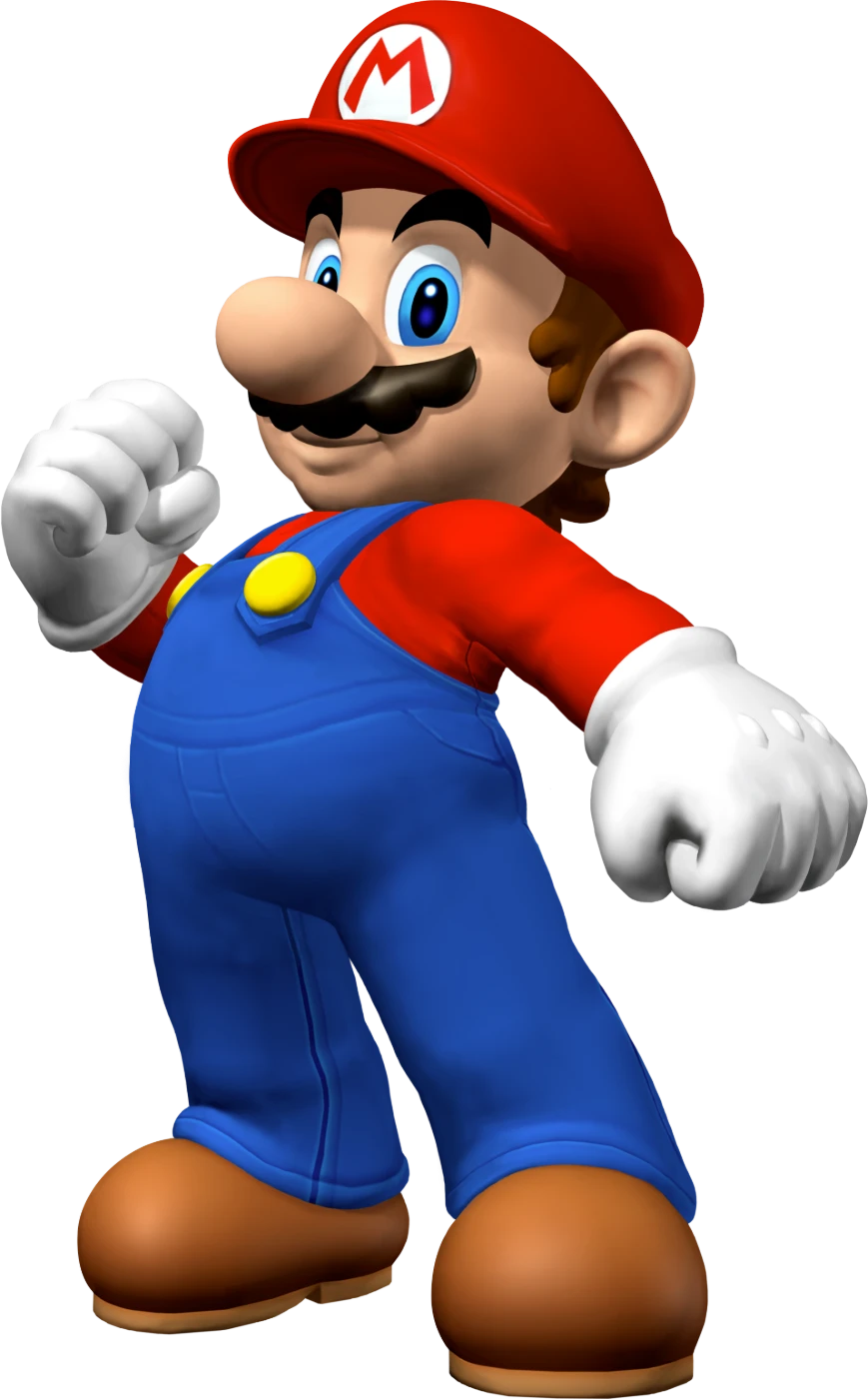 MarioPlayable
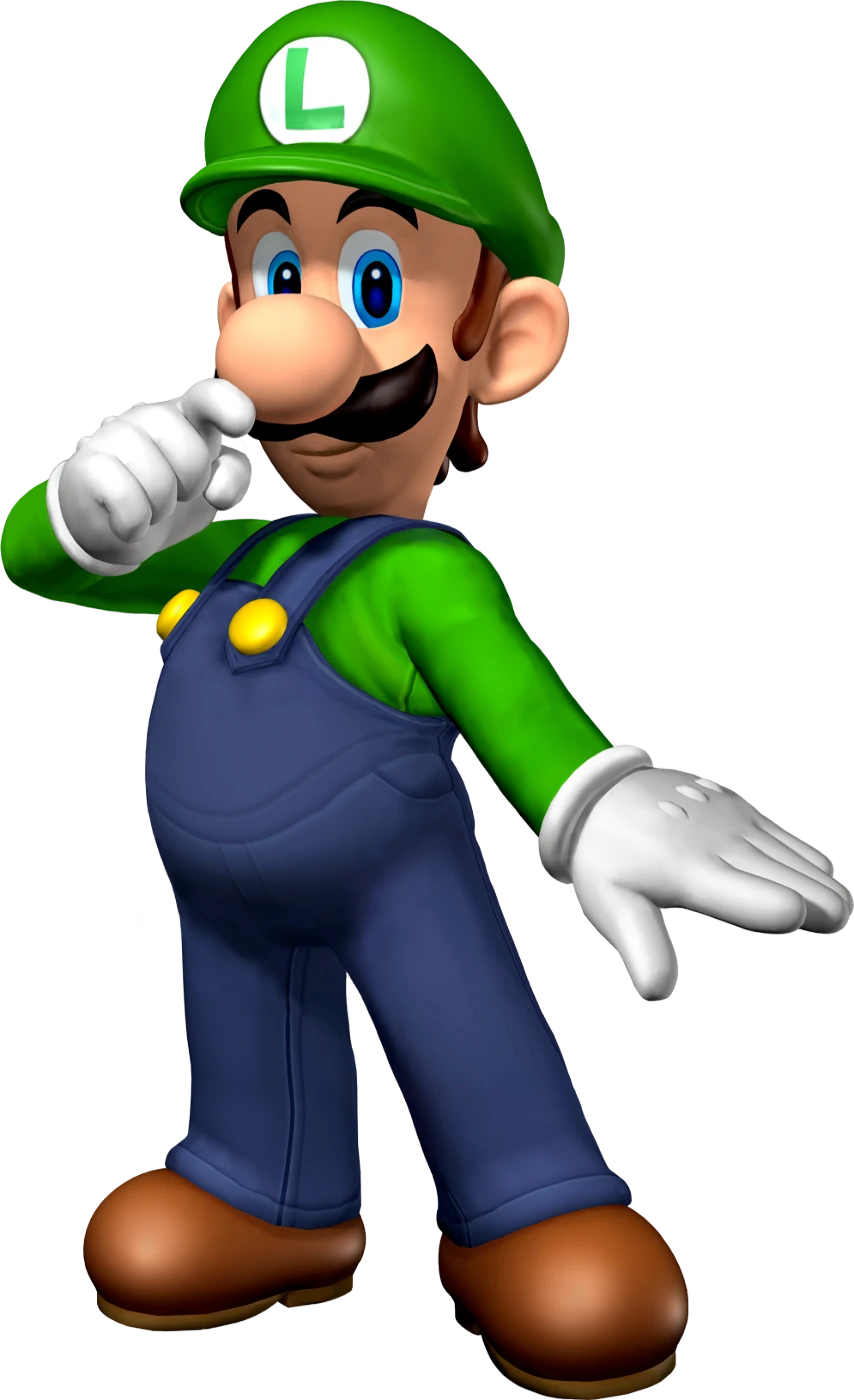 LuigiPlayable
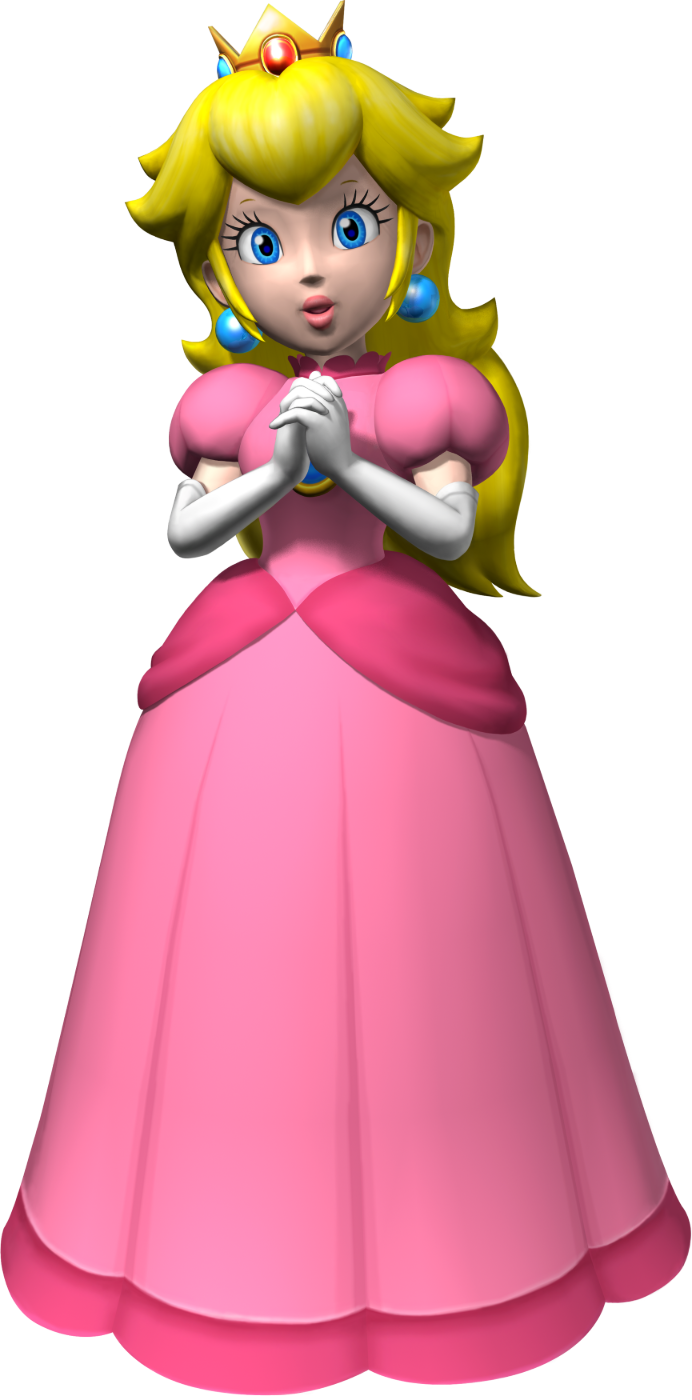 Princess PeachPlayable
 Princess DaisyPlayable
 YoshiPlayable
 BirdoPlayable · new to the series · unlockable
 WarioPlayable
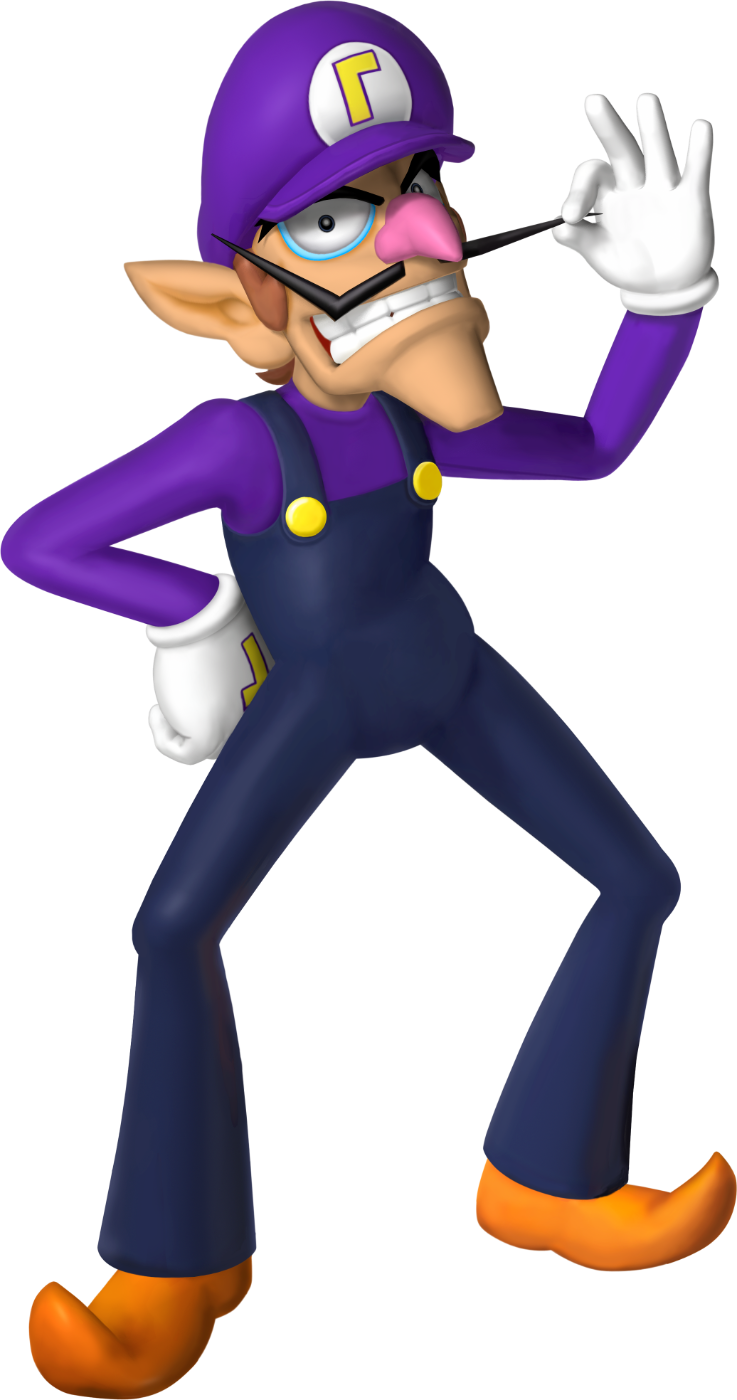 WaluigiPlayable
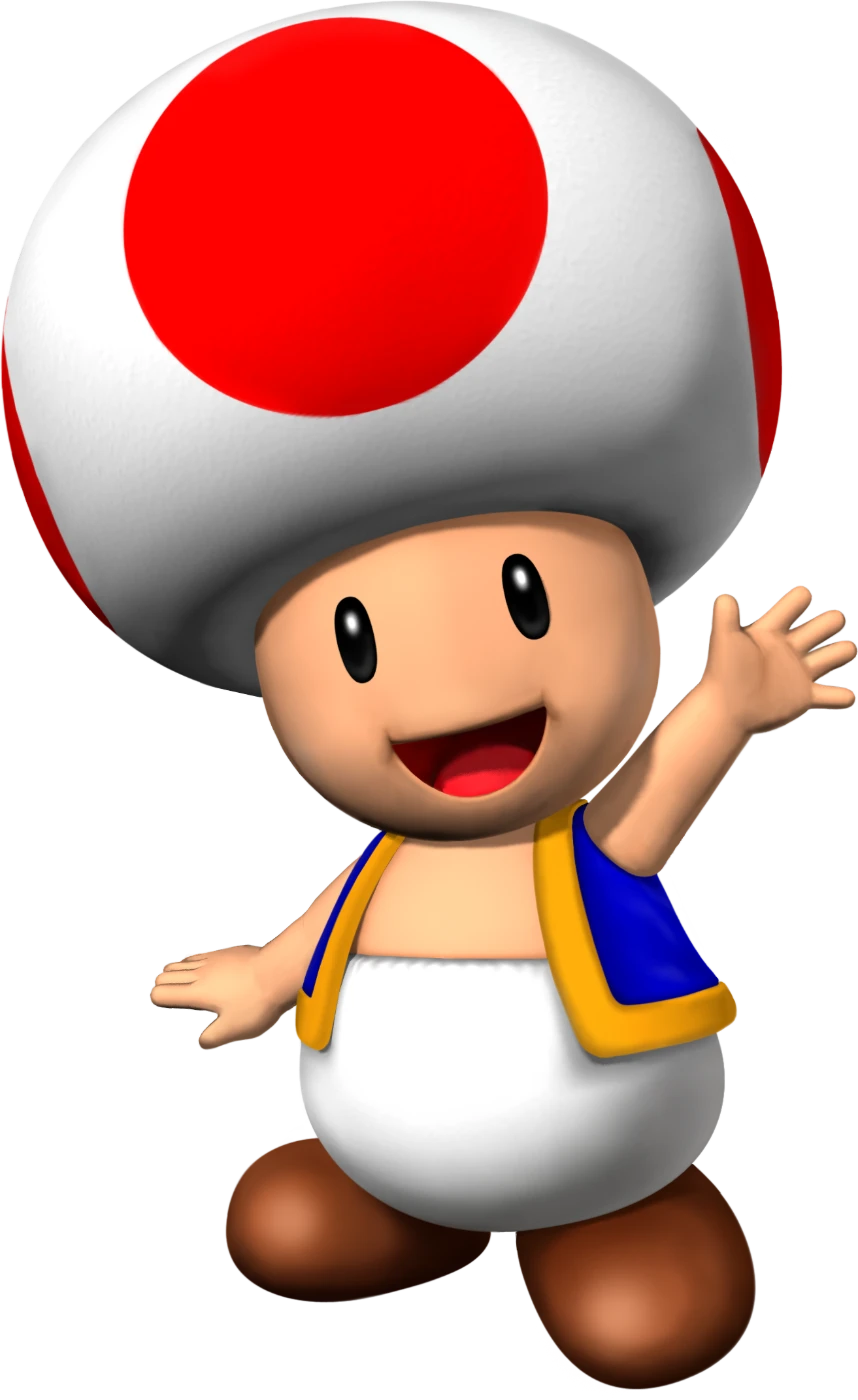 ToadPlayable
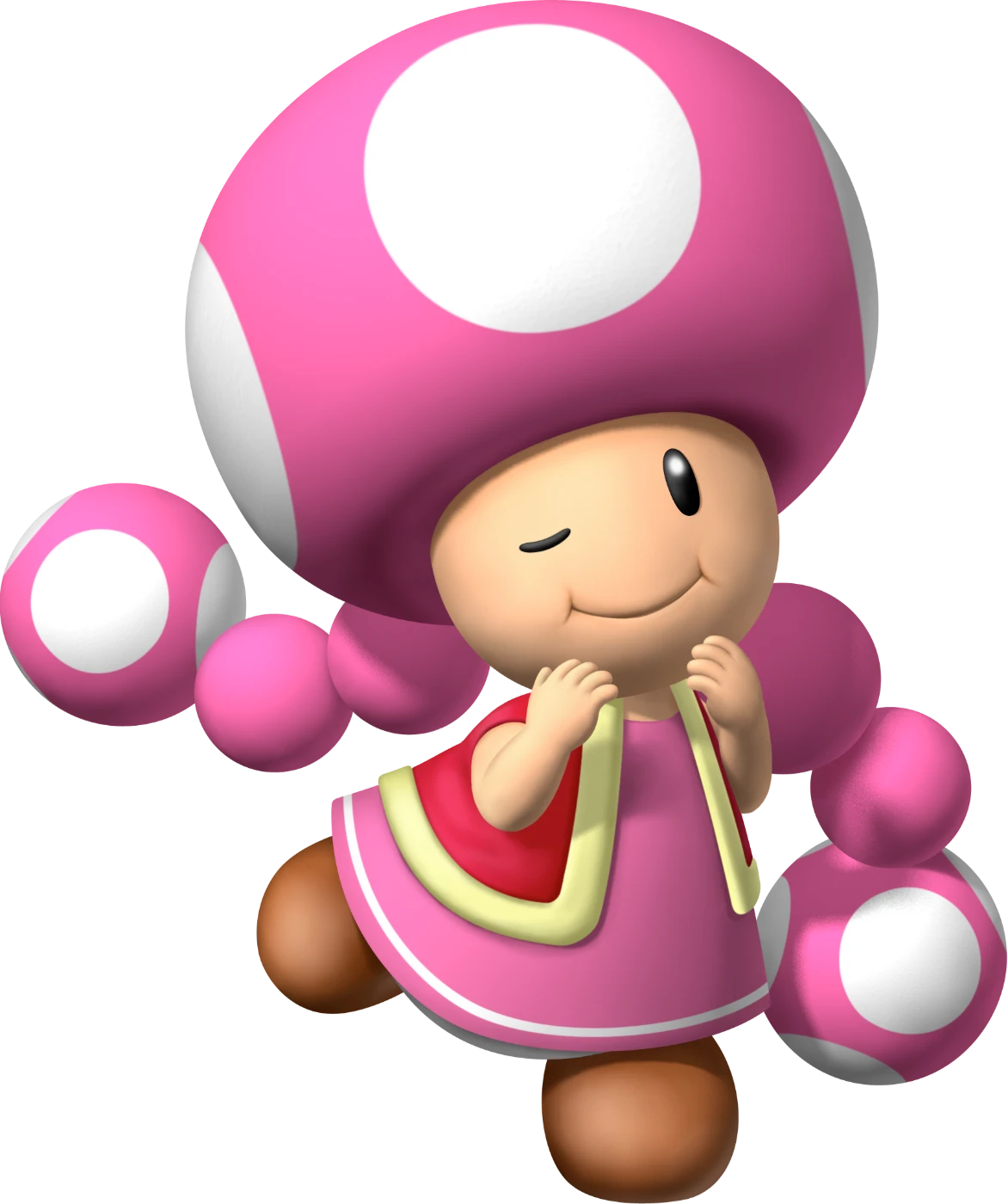 ToadettePlayable
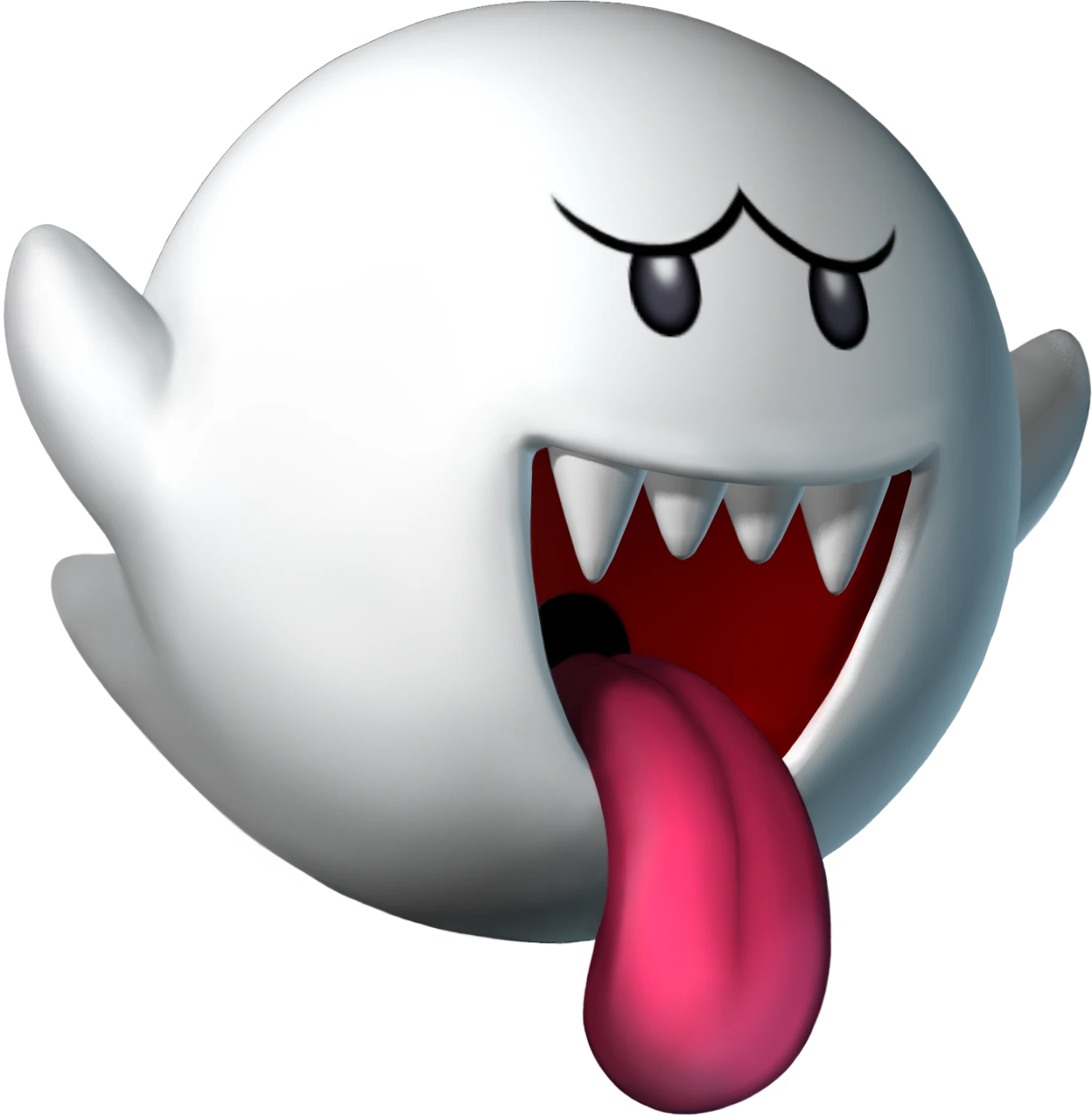 BooPlayable
 Dry BonesPlayable · new to the series · unlockable
 ToadsworthHost
 BowserVillain
 Koopa KidBowser’s helper
 Donkey KongBoard character
 Koopa MasterBoard character
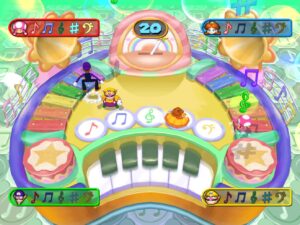 Catchy Tunes4-PlayerMusical symbols rain down and everyone scrambles to collect one of each kind. Landing on a rival’s head stuns them.
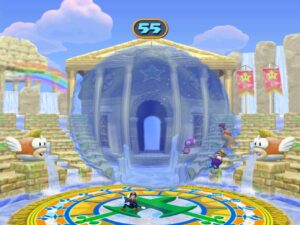 Bubble Brawl4-PlayerA punch-up inside a floating blob of water. Knock the others out through its skin and be the last one in.
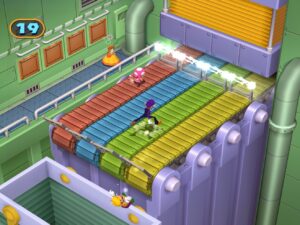 Track & Yield4-PlayerHurdle electrified fences on a conveyor belt. A shock freezes you for a moment, and the last runner left wins. In The Top 100.
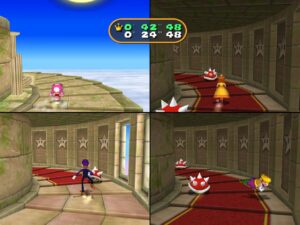 Fun Run4-PlayerA race to the top of a booby-trapped tower, past Spinies, trapdoors and walls on springs.
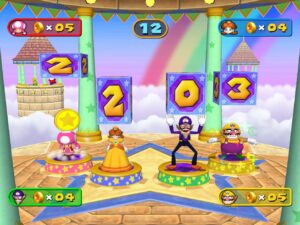 Cointagious4-Player · coinKeep jumping at a Dice Block that flickers between 0 and 3 and pocket whatever you hit, in coins.
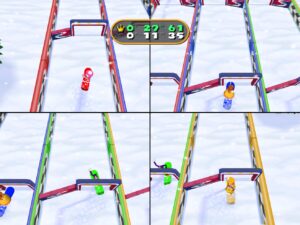 Snow Ride4-PlayerA downhill snowboard slalom through alternating gates and round Warp Pipes.
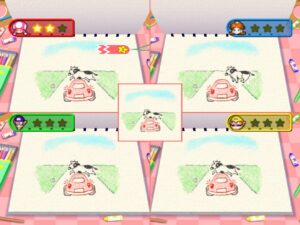 Picture This4-PlayerLeaf through a picture book with L and R to find the page that matches. Three right answers wins.
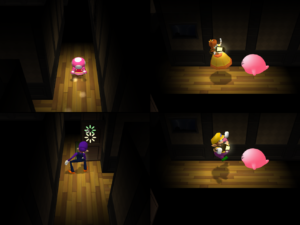 Ghost in the Hall4-PlayerFind the way out of a haunted house first. Closed doors slow you down and Pink Boos stun you.
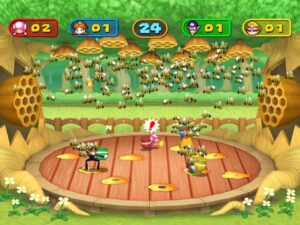 Big Dripper4-PlayerCatch the honey dripping from the ceiling and duck when the bees swarm.
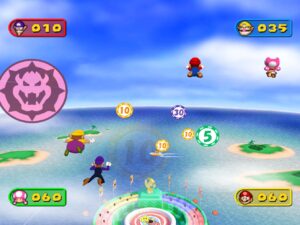 Target Tag4-PlayerFly into floating targets worth from 5 to 50 points, and steer clear of the Bowser target, which wipes your score.
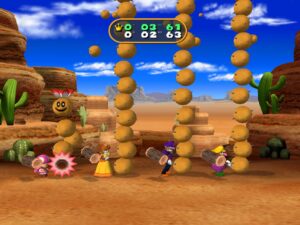 Pokey Pummel4-PlayerHammer the A Button to smash your way through a towering Pokey before anyone else. In The Top 100 and Superstars.
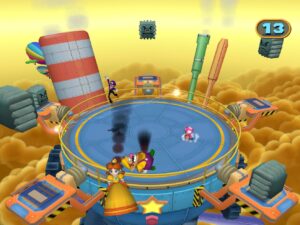 Take Me Ohm4-PlayerJump the sparks that Thwomps send crackling across a ring. One touch and you are thrown out.
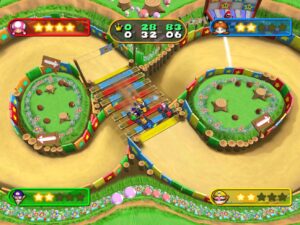 Kart Wheeled4-PlayerFive laps of a figure-of-eight track in buggies, with every chance of a crash at the crossover.
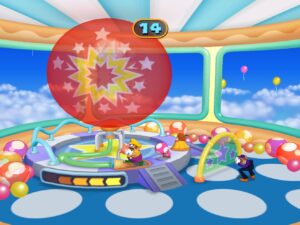 Balloon Busters4-Player · MicTake turns telling the Mic to inflate one enormous balloon and when to stop. If it bursts on the next player’s go, you win. In The Top 100.
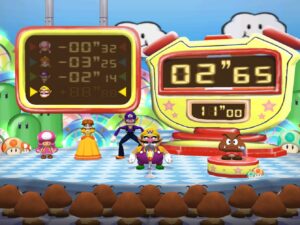 Clock Watchers4-Player · MicStop a hidden timer as near as you can to the target by counting in your head. The model for Stop Watchers in Wii Party.
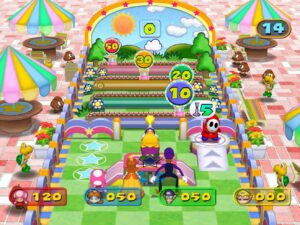 Dart Attack4-Player · MicSay “fire” to throw up to five darts at moving targets. In The Top 100.
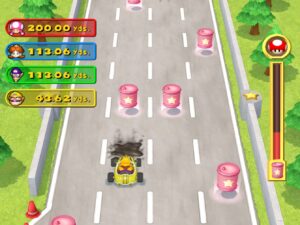 Oil Crisis4-Player · MicSteer a kart by spoken commands and reach the finish before the fuel runs out.
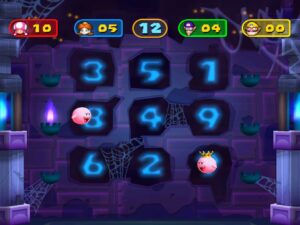 Mathemortician4-Player · MicCall out a number from 1 to 9 to fire at that square and hit the Pink Boos. Crowned ones score three.
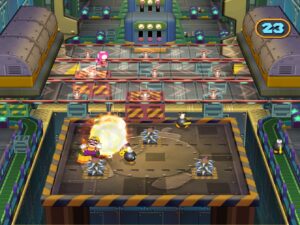 La Bomba1-vs-3One player ground-pounds crates to drop Bob-ombs on three who are running for their lives.
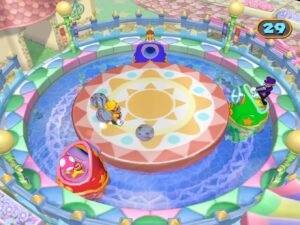 Spray Anything1-vs-3Three players circle a ring firing balls of water at the one stuck inside it.
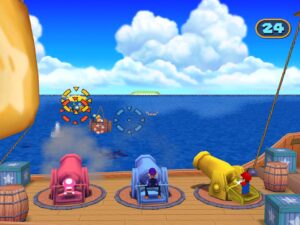 Balloonatic1-vs-3One pilots a hot-air balloon through cannon fire. The other three man the cannons.
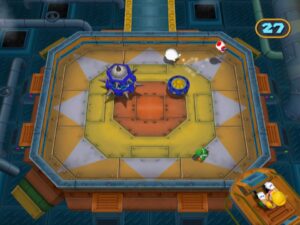 Spinner Cell1-vs-3The soloist sends a large spinner and a small one skidding round an arena to knock out or stun the three dodging them.
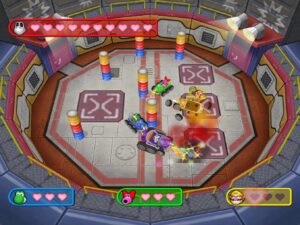 Think Tank1-vs-3One big tank against three little ones, which must gang up on it or be crushed.
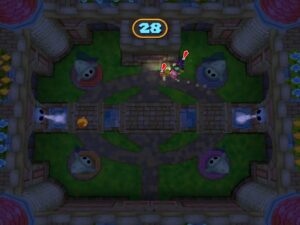 Flashfright1-vs-3Tag in the dark: one player hunts three with a torch, and they hide wherever the beam is not.
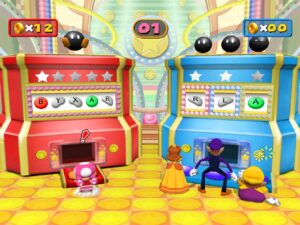 Coin-op Bop1-vs-3 · coinPress the five buttons shown to stop a slot machine and win coins, one player alone and three together. A wrong press drops a Bob-omb.
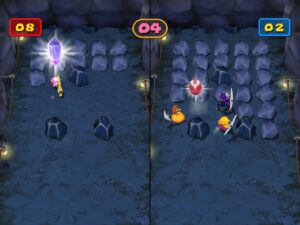 Easy Pickings1-vs-3A gem hunt. One player has a pickaxe that splits a rock in a single blow; the three with small ones need three swings.
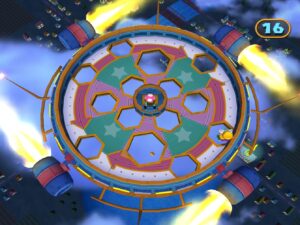 Pogo-a-Go-Go1-vs-3One player spins the floor with the shoulder buttons to tip three pogo-stick riders down a hole. In The Top 100 and Superstars.
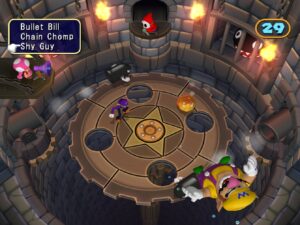 Wheel of Woe1-vs-3 · MicThe player with the Mic orders Chain Chomps, Shy Guys and Bullet Bills at the other three by name.
 Boxing Day1-vs-3 · MicSpoken commands aim a pair of robot fists at three players who are trying to ground-pound the floor tiles.
 Be My Chum!1-vs-3 · MicCall up Cheep Cheeps, Bloopers, Lakitu or Sushi the shark to harass three swimmers.
 StratosFEAR!1-vs-3 · MicSay “move up” or “move down” to shift a platform and bring Bullet Bills down on the other three.
 Number Crunchers1-vs-3 · MicName a number or a shape to drop a Thwomp on that spot, with lava waiting for anyone who jumps the wrong way.
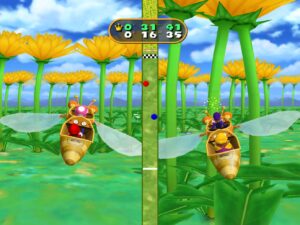 Buzzstormer2-vs-2Pairs fly bee-shaped aircraft through a forest of giant dandelions. Clip a stem and you are stunned.
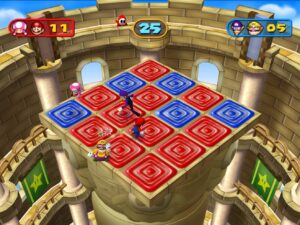 Tile and Error2-vs-2Ground-pound the sixteen floor tiles to turn them your team’s colour, and hold the most when time is up.
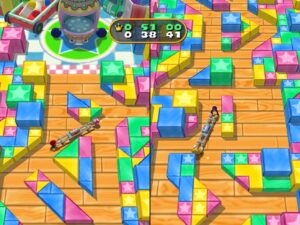 Battery Ram2-vs-2Partners carry a giant battery, one at each end, through a maze to a waiting rocket.
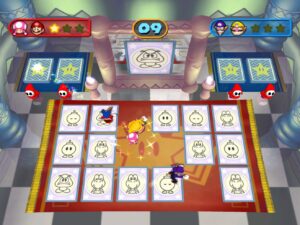 Cardinal Rule2-vs-2Find and stomp the pair of cards that matches the one shown in the mirror. Three pairs wins.
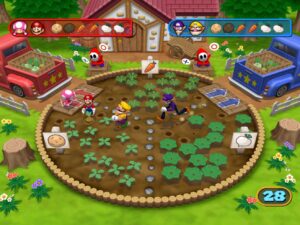 Bumper Crop2-vs-2Pull up carrots, turnips and potatoes and load two of each on to your truck before the other team does.
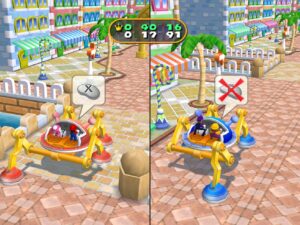 Hop-O-Matic 40002-vs-2Partners take turns pressing the buttons shown to make a hopping machine bound across town. Six hops to the finish.
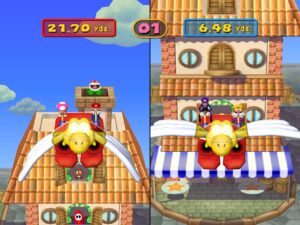 Wingin’ It2-vs-2Ten seconds of frantic tapping to flap a Koopa-shaped flying machine higher than the other pair.
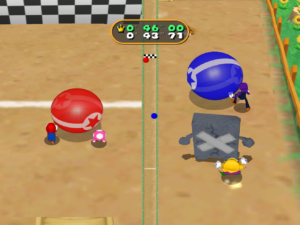 Sphere Factor2-vs-2Two players push one huge ball through mazes and past Whomps to the goal. In The Top 100.
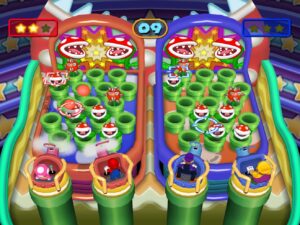 Herbicidal Maniac2-vs-2Shoot the Piranha Plants that sprout from the pipes on your side, but not the bombs. First to three rounds.
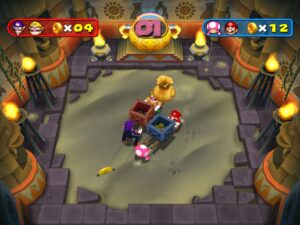 Pyramid Scheme2-vs-2 · coinPairs catch as many falling coins and coin bags as they can, and keep the lot.
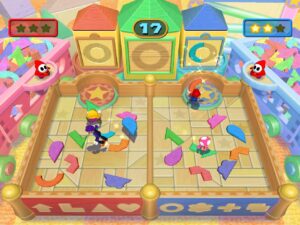 World Piece2-vs-2Find the two halves that make up the shape on display and drop them into your panel. First to three.
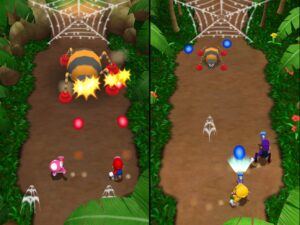 Spider Stomp2-vs-2Shoot a path through the Scuttlebugs and their giant leader to reach the captive Flutter first.
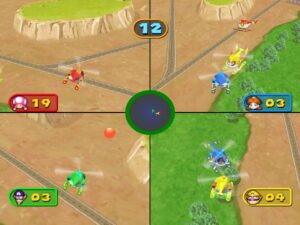 HelipopperBattlePop the most balloons from a toy helicopter in 45 seconds while Bullet Bills fly past.
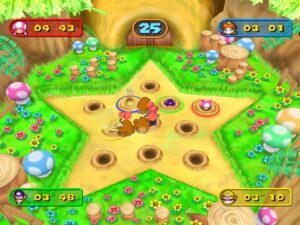 Monty’s RevengeBattleWhack-a-mole in reverse: the players are in the holes and three Monty Moles have the hammers. Stay above ground longest. In The Top 100 and Superstars.
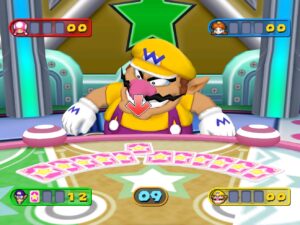 Deck HandsBattlePick three face-down cards numbered 1 to 13. The highest total wins. In The Top 100.
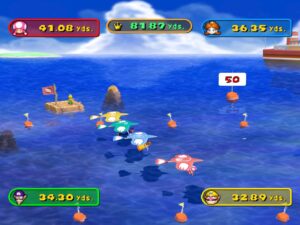 Air FarceBattleLaunch a hang-glider from a platform and stay out of the sea for as far as you can.
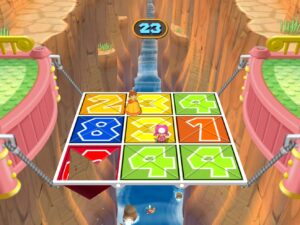 The Final CountdownBattleA brawl on nine numbered panels, each of which drops away when its count reaches zero. In The Top 100 and Superstars.
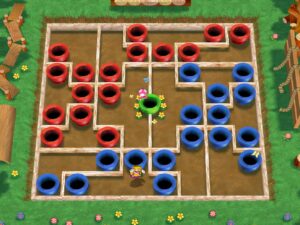 Warp Pipe DreamsDuelEach player has a maze of Warp Pipes to hop through. First out of the big green one wins.
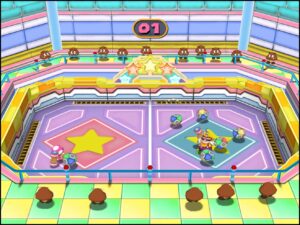 Weight for ItDuelBat seven heavy balls on to your rival’s side with a hammer and have fewer on your own when time is called.
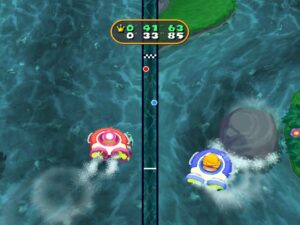 Mad PropsDuelA hovercraft race down a twisting river, steering with a propeller on each side.
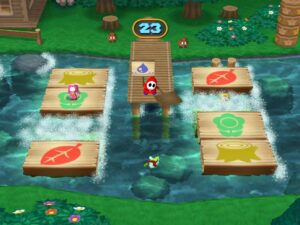 Gimme a SignDuelFour rafts, and a Shy Guy holding up signs to show which will sink next. Last one dry wins.
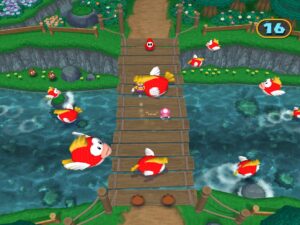 Bridge WorkDuelStay on a bridge while Cheep Cheeps, small and large, leap across it.
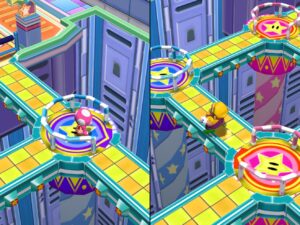 Spin DoctorDuelA race across a grid of bridges with a turntable at every junction. In Superstars.
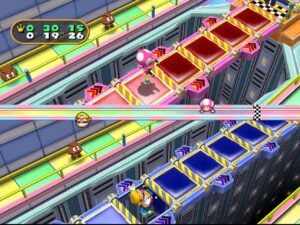 Hip Hop DropDuelPogo across a bridge of tiles by pressing the button marked on each. A wrong press costs time.
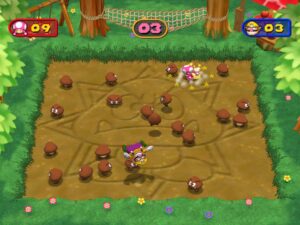 Royal RumpusDuelFifteen seconds to ground-pound more Goombas than your opponent.
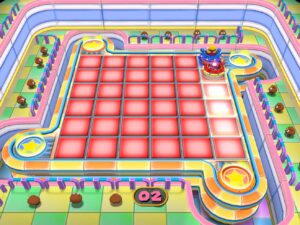 Light SpeedDuelDrive a hoverkart over floor tiles to paint them your colour. Most tiles wins.
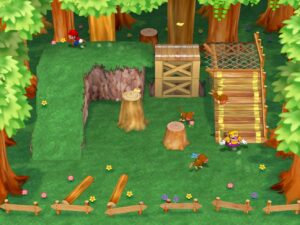 Apes of WrathDuelKeep out of the clutches of a troop of Ukikis for longer than the other player.
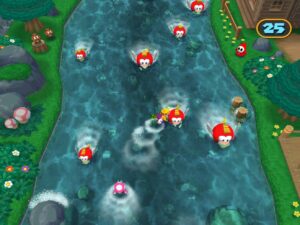 Fish & CheepsDuelSwim against a shoal of Cheep Cheeps. Touch one and you lose; if both last 30 seconds it is a draw.
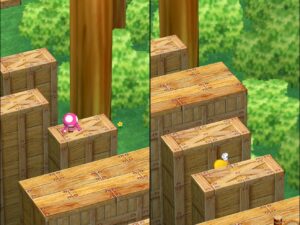 Camp UkikiDuelAn obstacle race through mazes of stakes and over jumps.
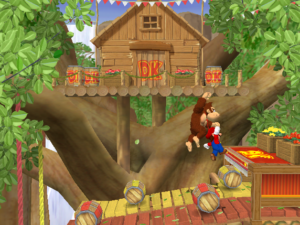 Jump, ManDK · 1-PlayerRace Donkey Kong up four sloping girders, with ropes to climb and barrels to dodge: a tribute to the first stage of the 1981 arcade game. In The Top 100.
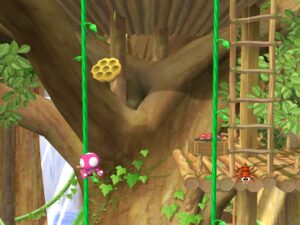 Vine CountryDK · 1-PlayerTap A to climb a vine faster than Donkey Kong, avoiding spiders and beehives. In The Top 100.
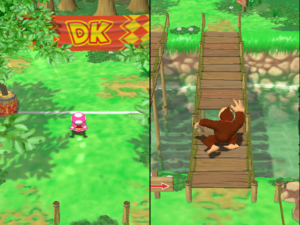 A Bridge Too ShortDK · 1-PlayerRace Donkey Kong over four pairs of bridges, guessing each time which one is safe.
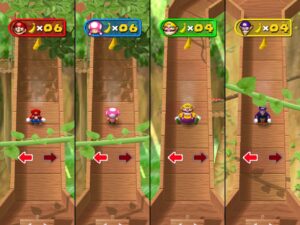 Peel OutDK · multiplayerSlide down a jungle chute, choosing at each fork the branch with the most bananas, which are swapped for coins.
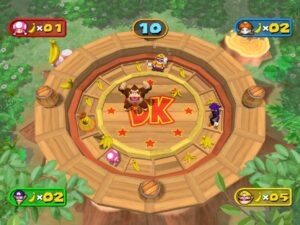 Bananas FasterDK · multiplayerJump on to a spinning wheel to grab bananas and avoid the skins.
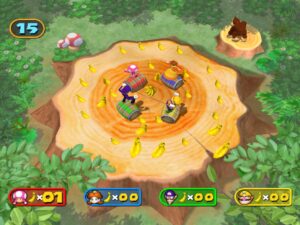 Stump ChangeDK · multiplayerRoll about a giant tree stump on barrels collecting bananas without toppling off.
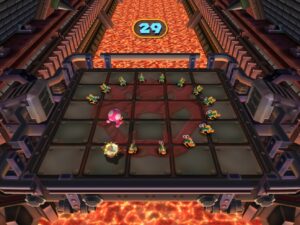 Tunnel of Lava!Bowser · 1-PlayerStomp the circling Mechakoopas to find the one with the door key and get out before Bowser flattens you.
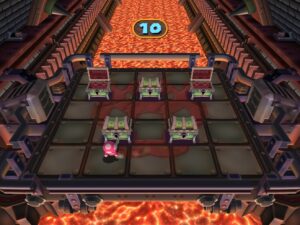 Treasure Dome!Bowser · 1-PlayerOpen five chests in 30 seconds, each holding the key to the next.
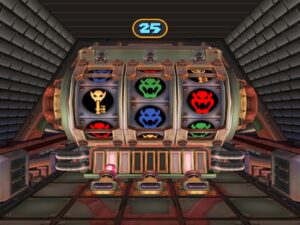 Slot-O-Whirl!Bowser · 1-PlayerStop three reels on keys, not Bowser faces, within 30 seconds.
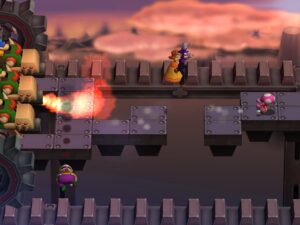 Funstacle Course!Bowser · multiplayerEveryone runs a gauntlet of Thwomps, spiked bars and fireballs with Koopa Kids in pursuit. Those who finish are spared.
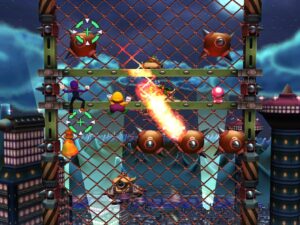 Funderwall!Bowser · multiplayerClimb a chain-link wall towards Bowser past flamethrowers and spiked rollers.
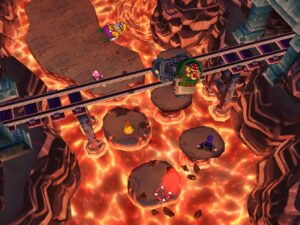 Magmagical Journey!Bowser · multiplayerHop across sinking rocks in a lake of lava while Koopa Kids spit fire.
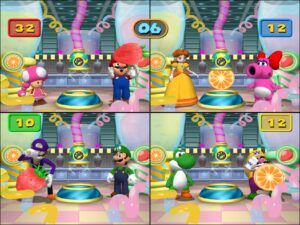 Real Smoothie8-Player · teamOne partner throws oranges into the blender and the other strawberries. Most fruit in 30 seconds.
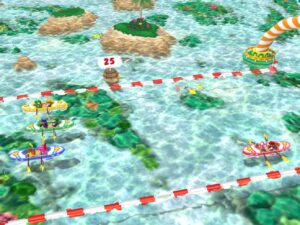 Synch-row-nicity8-Player · teamA rowing race in which the boat only flies if both partners pull in time.
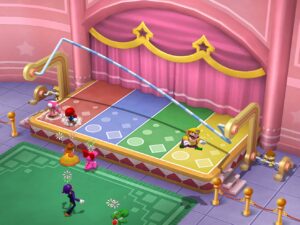 Grin and Bar It8-Player · survivalJump a spinning metal bar: L for one partner, R for the other.
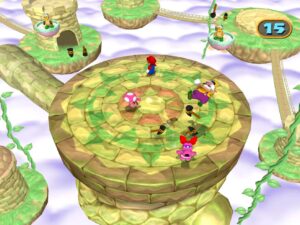 Hammer Spammer8-Player · survivalDodge the giant hammers thrown by Hammer Bros. for 30 seconds.
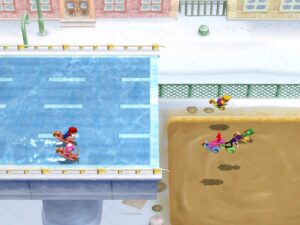 Gimme a Brake8-Player · survivalRide a scooter downhill and brake as late as you dare before the mud, in sun, rain or snow.
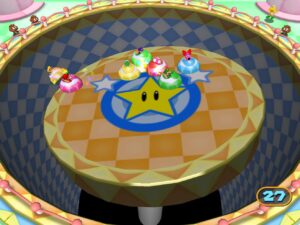 Bumper to Bumper8-Player · survivalHoverkart sumo on a tilting platform.
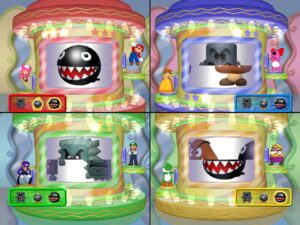 Spin Off8-Player · teamEach partner stops one half of a spinning picture to make a matching character.
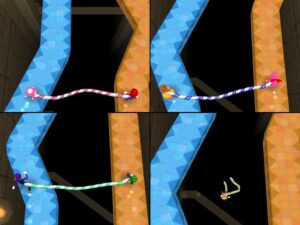 Rope a Dope8-Player · teamPartners roped together cross a narrow path. If one falls, both go.
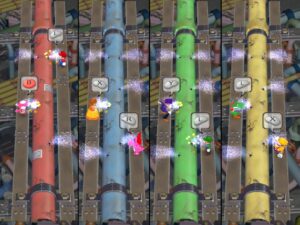 Duct & Cover8-Player · teamMend leaking pipes by pressing the button shown above each one.
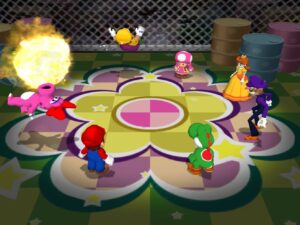 Bob-ombic Plague8-Player · survivalPass a Bob-omb round a ring. When it goes off, whoever is holding it and the players on either side are out.
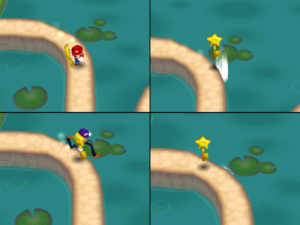 Unhappy Trails8-Player · teamA relay to fetch a jewel from a swamp and carry it home.
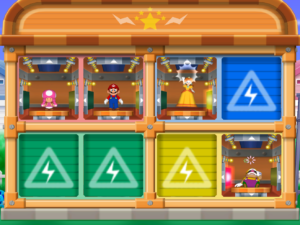 Shock Absorbers8-Player · survivalPunch up, left or right at whichever light glows, and crouch when they all do.
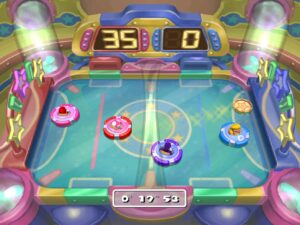 Ice MovesRareTwo-a-side air hockey on ice. Costs 3,000 Cruise Mileage Points at the Duty-Free Shop.
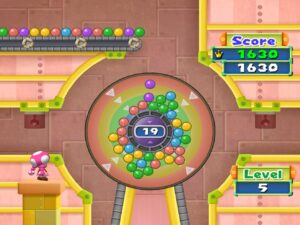 Stick and SpinRareA puzzle game: rotate the stage and drop balls to link five or more of one colour. Costs 3,000 points. Also in Mario Party DS, The Top 100 and Superstars.
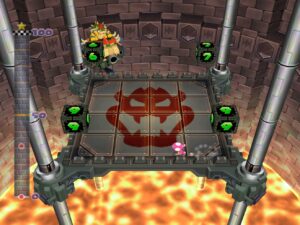 Bowser’s Lovely Lift!BossThe finale of Solo Cruise: hit four Dice Blocks to ride a lift up Bowser’s castle, dodging his attacks, to the 100th floor. A Koopa Kid joins in after floor 50.