Nintendo DS2007PartyHudson SoftShrunk by Bowser73 minigamesFour players, one Game CardHudson’s last Mario Party8 million+ sold
Mario Party DS
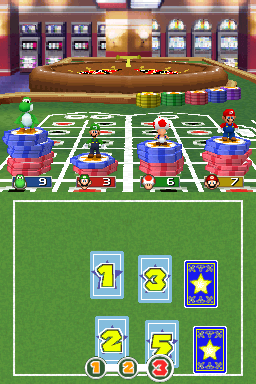
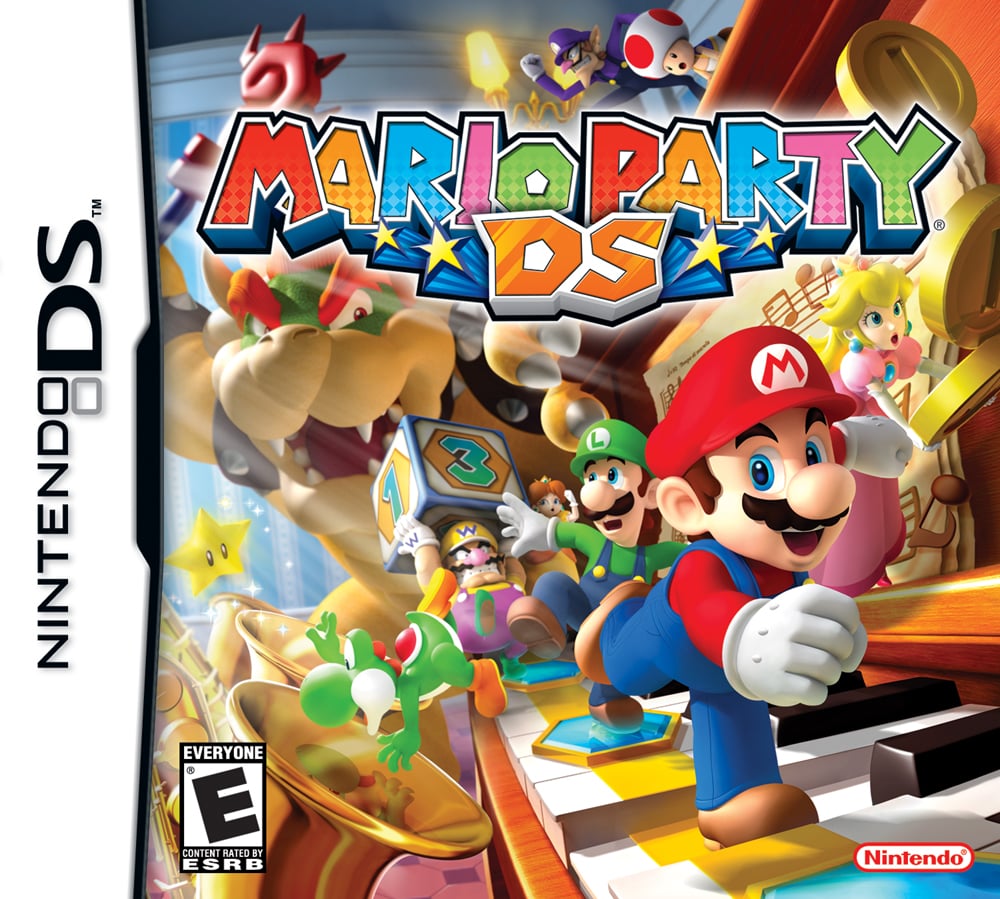
Mario Party, shrunk to fit. Mario Party DS came out in Japan on 8 November 2007, in North America on 19 November, in Europe on 23 November and in Australia on 6 December. Its story does the shrinking literally: Bowser lures Mario and friends to a feast, zaps them with his Minimizer and flings them across the kingdom, and the party makes its way back over five boards built from a garden, a music room, a jungle statue, a library and a pinball table, collecting five Sky Crystals and beating a boss at the end of each. There are eight playable characters, 73 minigames for the stylus, the microphone and the buttons, traps called Hexes to lay for your friends, and a Puzzle Mode that revives five puzzle games from earlier Mario Parties. Best of all, four people can play from a single Game Card by DS Download Play. It was the last Mario Party made by Hudson Soft, and Nintendo’s figures put it past 8 million copies.
Developer:Hudson Soft (Super Mario Wiki also lists CAProduction and Nintendo SPD Group No. 4)
Publisher:Nintendo
Platform:Nintendo DS; Wii U Virtual Console
Genre:Party / board game
Japan:8 November 2007
N. America:19 November 2007
Europe:23 November 2007
Australia:6 December 2007
South Korea:22 May 2008
Players:1–4, all from one Game Card by DS Download Play
Minigames:73 on Super Mario Wiki’s list, plus 32 Duel versions; Nintendo’s page says 70
Sales:8.21 million by 31 March 2011 (Nintendo); more than 9 million by 2015 (via Wikipedia)
Re-release:Wii U Virtual Console, 21 April 2016 (27 April in Japan)
Advertisement
Overview
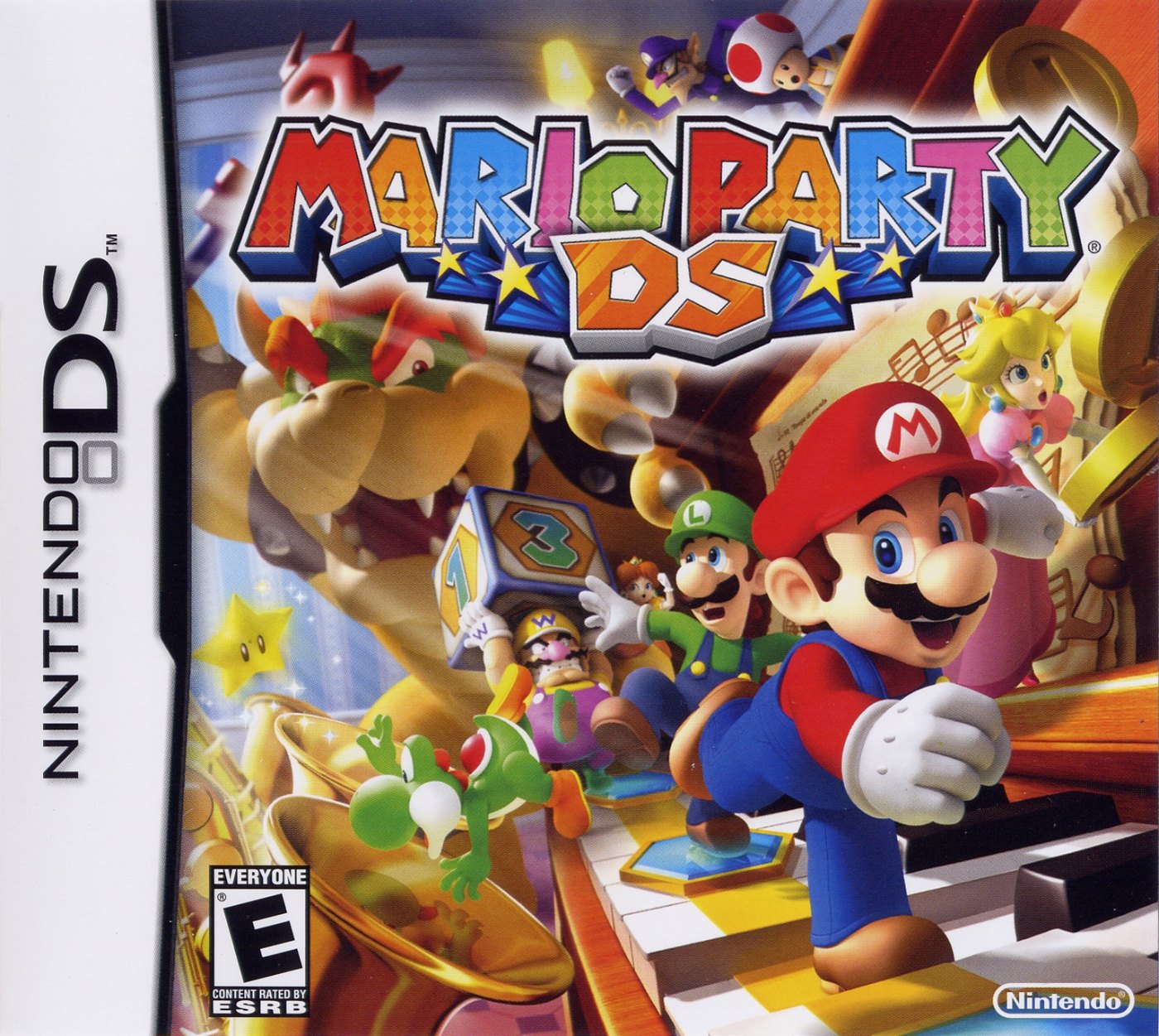
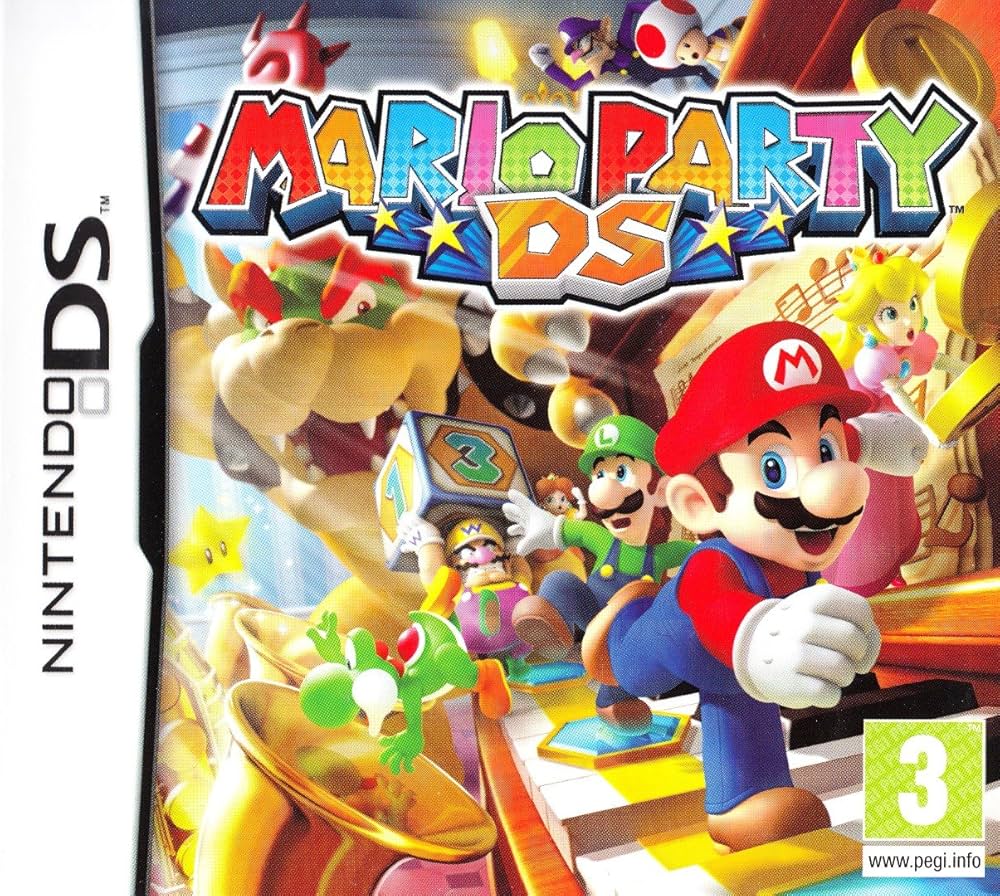
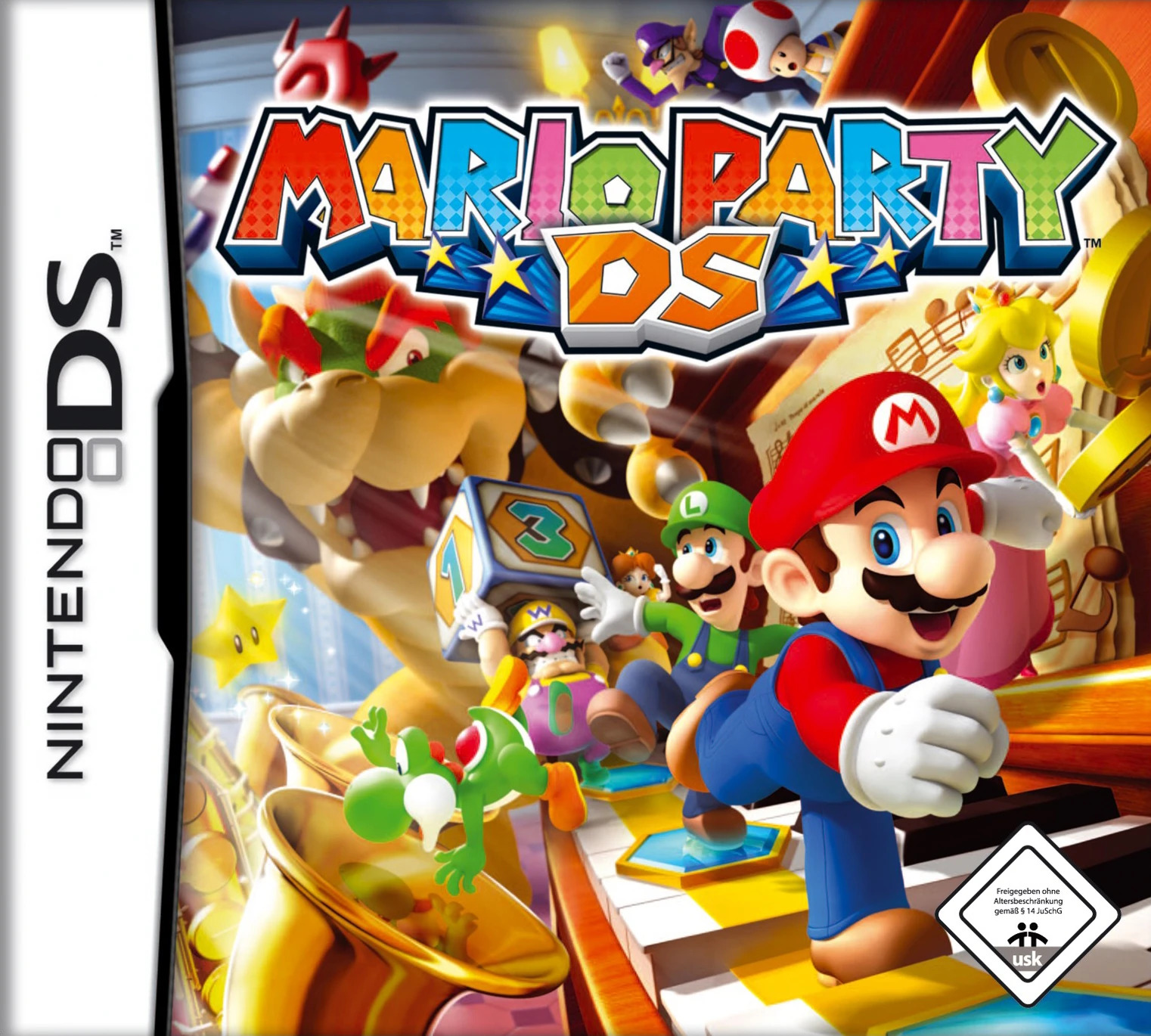
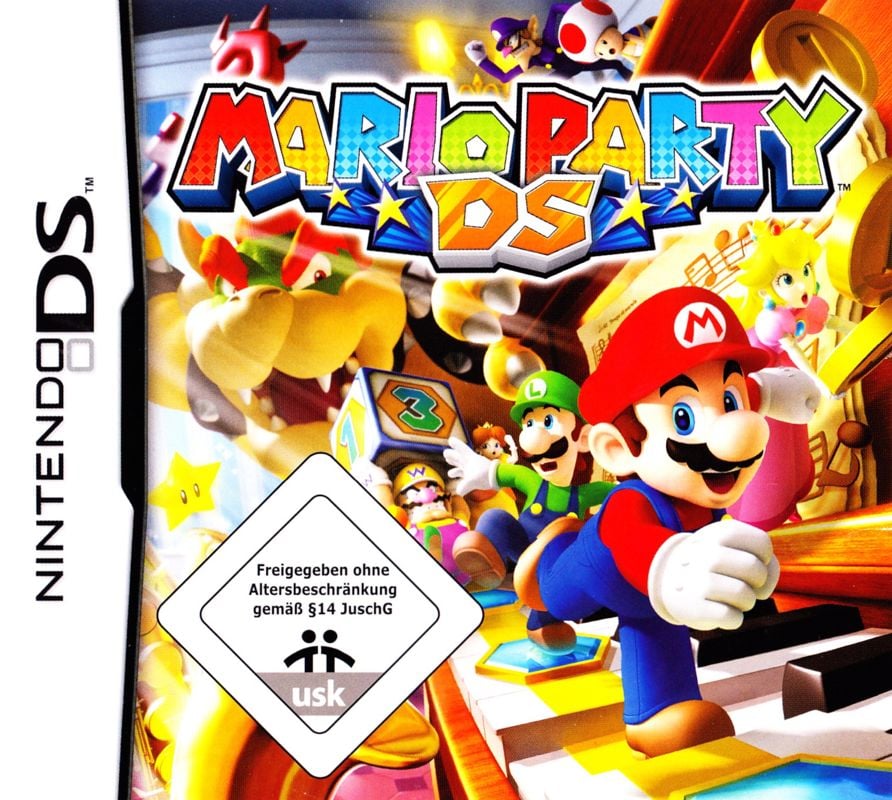
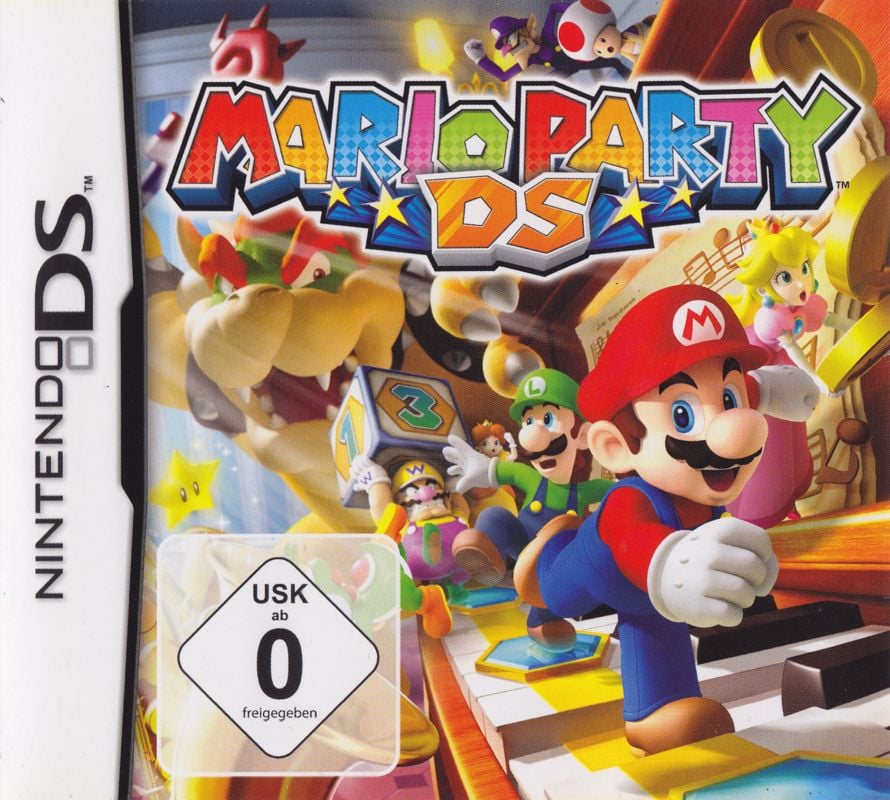
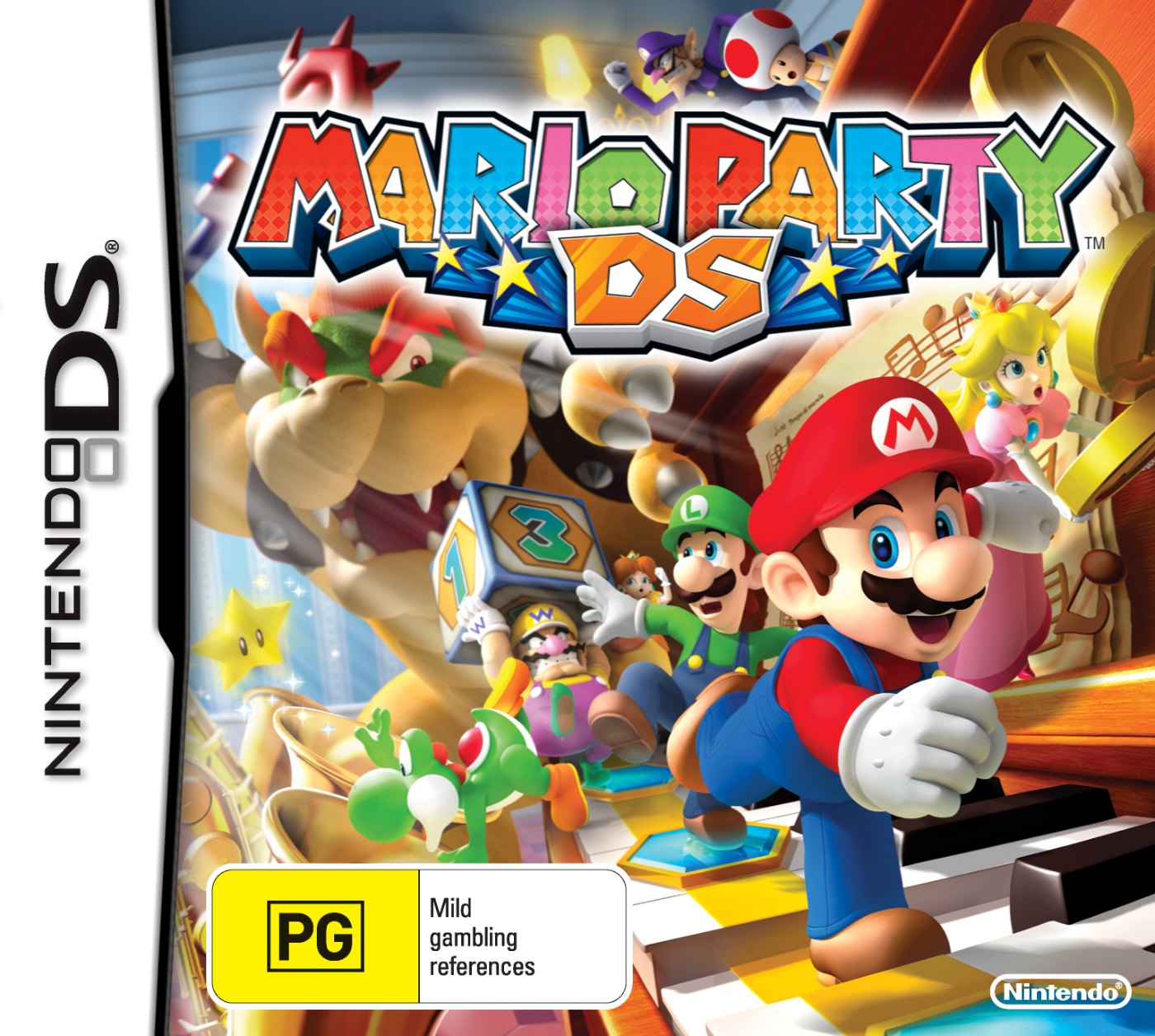
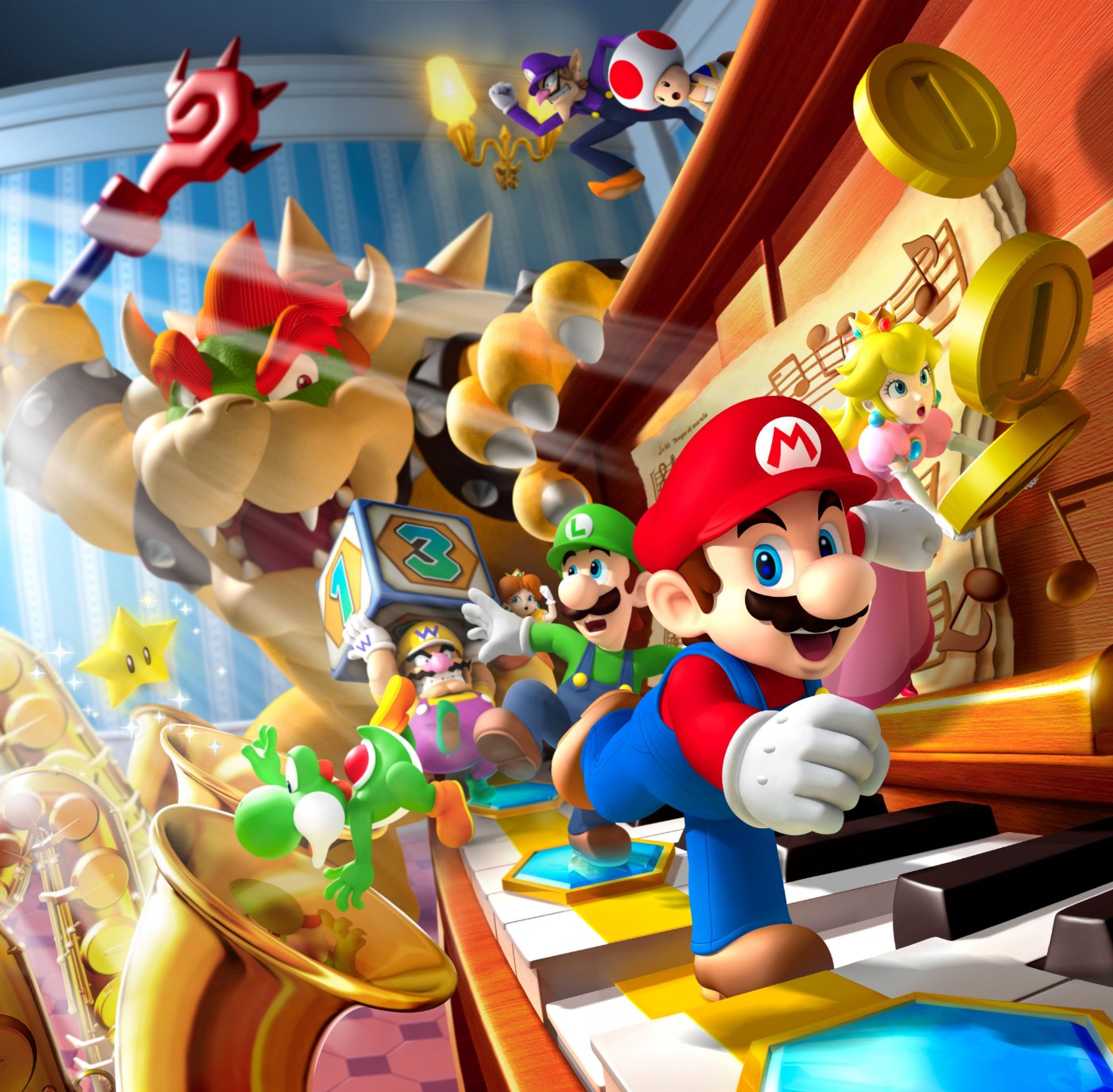
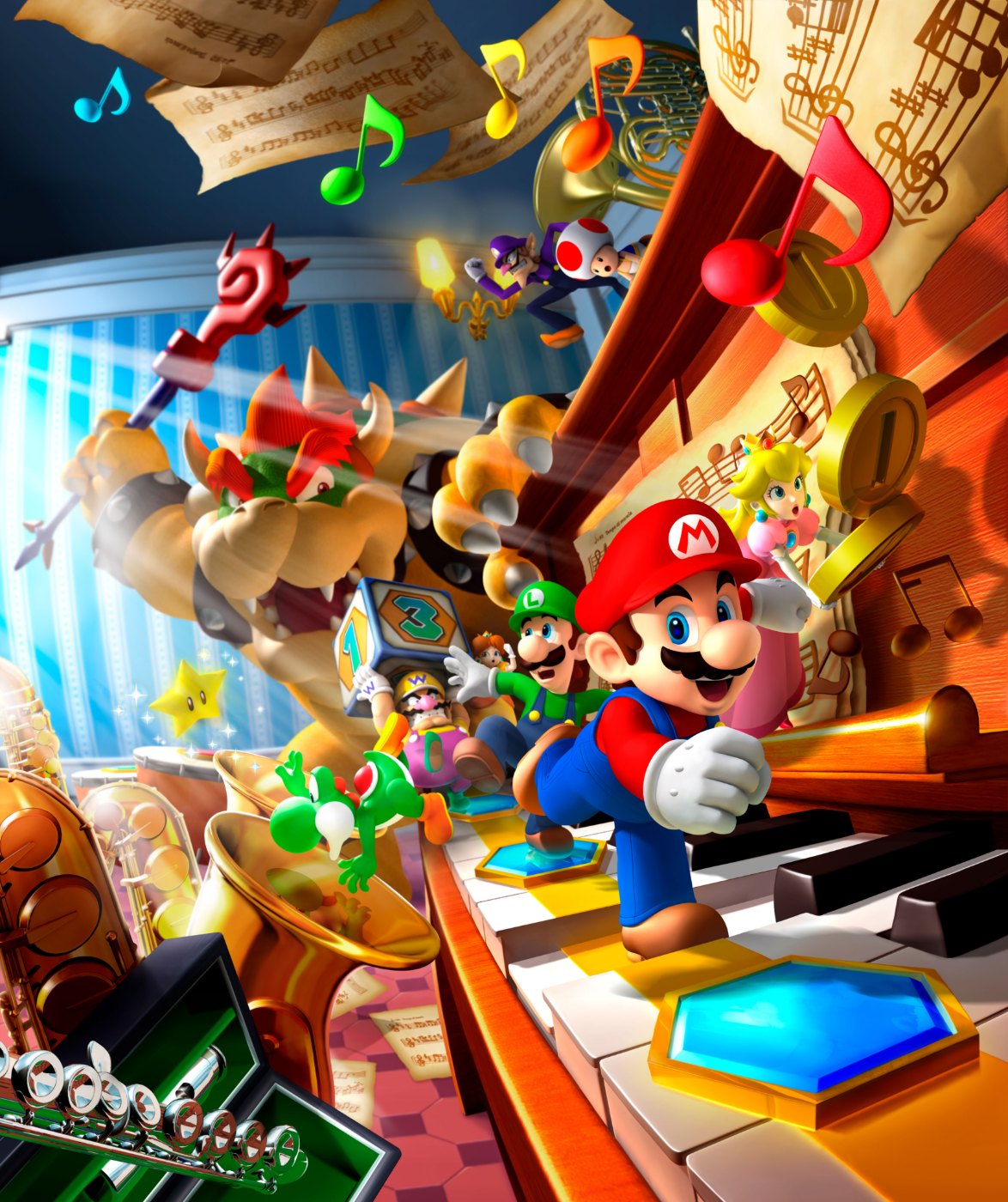
The key artwork used on the cover: the shrunken party in Toadette’s Music Room.
Mario Party DS arrived in November 2007, later in the same year as Mario Party 8 on Wii, and as the series’ next handheld game after Mario Party Advance. It is a proper Mario Party in miniature: boards, Stars at 20 coins, a minigame after every round.
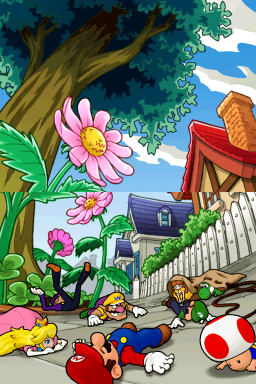
The miniature part is the joke the whole game is built on. Bowser has shrunk the heroes, so every board is somewhere ordinary seen from ankle height: a flower bed where the Piranha Plant is a monster, a music room full of giant instruments, the inside of a pinball machine. The minigames follow suit, with races along banisters, fights on bars of soap and candles to blow out by puffing into the microphone.
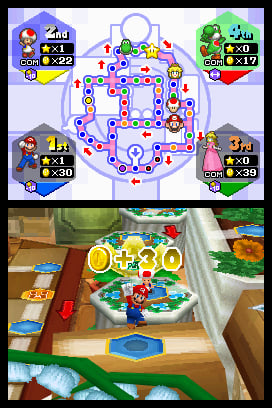
It was built for the hardware. Many minigames are played with the stylus, a handful with the microphone, and the top screen keeps a map of the board in view while the action plays out below. And the whole game, boards and all, can be sent to three other DS systems from one Game Card, so a single copy is enough for a full party.
There is more round the edges than usual: a one-player Story Mode with five boss fights, six ways of playing the minigames, six puzzle games, two extra games for a pair of players, and a gallery of 156 figures, trophies, board features and badges to earn with Mario Party Points.
Reviews were mixed, with a Metacritic average of 72, but it sold enormously and outlived its makers. It was the last Mario Party from Hudson Soft, which had made almost all the earlier ones; the series passed to NDcube with Mario Party 9.
Official description
“In this game, Mario and his friends have been tricked by Bowser and then miniaturised.”
Nintendo UK, official product page for Mario Party DS
The same page says the game “features five brand new boards and 70 fresh mini-games”.
Why Mario Party DS matters to Mario fans
It is the end of an era and one of the best-selling Mario Parties of all: the last game in the series by Hudson Soft, and a handheld entry with the full board game intact. Its boss minigames and its Step It Up mode were carried into Mario Party 9, its Star Pipe came back as the Golden Pipe in Super Mario Party, and Super Mario Wiki sees its Hexes behind some of the items in Super Mario Party Jamboree.
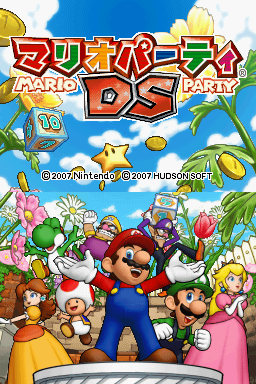
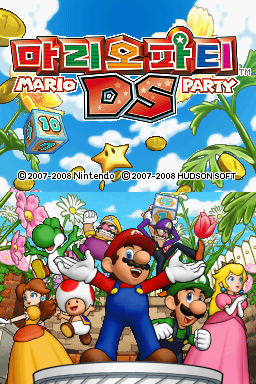
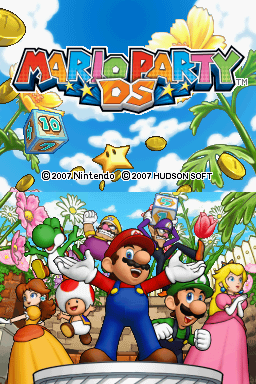
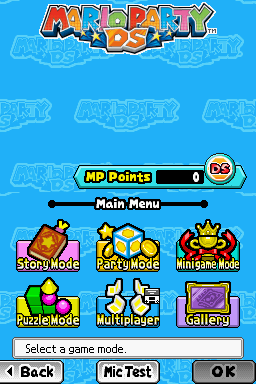
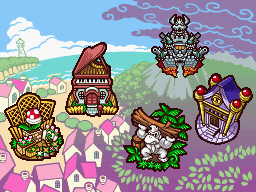
The title screen.The main menu.Mario and company, shrunk.The five boards on the Story Mode map.
“OK, I got this great gadget for our final fight! Cower before the power of my new Megamorph Belt!”
Bowser, before the last battle of Story Mode
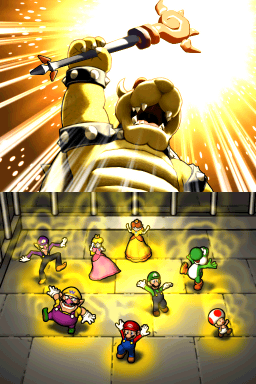
The belt turns him into Blockhead Bowser for the final boss minigame, Bowser’s Block Party.
Quick Answers
The questions people ask most about Mario Party DS, answered briefly here and in depth further down the page.
When did Mario Party DS come out?
Japan: 8 November 2007. North America: 19 November 2007. Europe: 23 November 2007. Australia: 6 December 2007. South Korea: 22 May 2008. It came to the Wii U Virtual Console on 21 April 2016 (27 April in Japan). More →
Who made Mario Party DS?
Hudson Soft, with Kouji Matsuura as game director and Hiroshi Sato and Atsushi Ikeda as producers. It was the last Mario Party Hudson made. More →
What is the story?
Five Sky Crystals fall from the sky and Mario finds one. Bowser invites everyone to a feast, cages them, takes the crystal and shrinks them with his Minimizer. The tiny heroes cross five boards, win the other crystals and finally beat Bowser, who turns himself into Blockhead Bowser with a Megamorph Belt. More →
What are the boards and bosses?
Wiggler’s Garden (Piranha Plant), Toadette’s Music Room (Hammer Bro), DK’s Stone Statue (Dry Bones), Kamek’s Library (Kamek) and Bowser’s Pinball Machine (Bowser). More →
Who is playable?
Mario, Luigi, Peach, Daisy, Wario, Waluigi, Yoshi and Toad. All eight are available from the start and there are no characters to unlock. More →
How many minigames are there?
73 on Super Mario Wiki’s list: 32 4-Player, 12 1-vs-3, 13 2-vs-2, 5 Battle, 5 Boss and 6 Puzzle. Another 32 are two-player Duel versions of those games, which is where the figure of 105 comes from. Nintendo’s own page says 70. More →
What are Hexes?
Traps you pick up at Hex Areas and lay on a space before you roll. The next rival to land there hands you coins or Stars, or swaps coins or places with you. Two of them, the Star Block and the Coin Block, reward whoever lands on them instead. More →
Can four people play with one Game Card?
Yes. Through DS Download Play one card serves up to four systems for Party Mode and Minigame Mode; with two players Puzzle Mode and Extras Mode are available as well. Boss minigames are left out and progress is not saved. More →
What does Puzzle Mode contain?
Mario’s Puzzle Party from Mario Party 3, Bob-omb Breakers from 4, Piece Out from 5, Block Star from 6 and Stick and Spin from 7, plus the new Triangle Twisters, unlocked by finishing Story Mode. More →
How many copies did it sell?
Nintendo’s results briefing of 26 April 2011 lists 8.21 million worldwide to 31 March 2011. Wikipedia cites a Gizmodo article of September 2015 for more than 9 million, eleventh among Nintendo DS games. More →
Boards & Modes
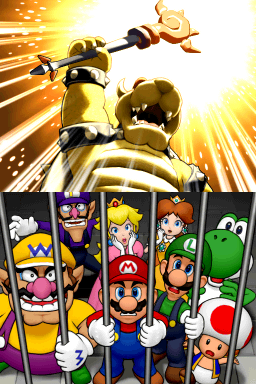
The trap is sprung: Bowser cages his dinner guests.
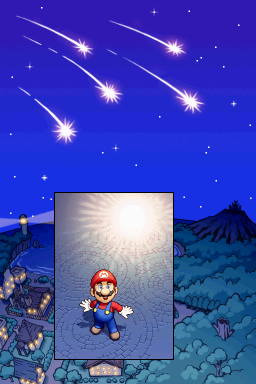
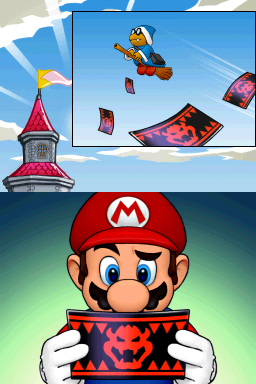
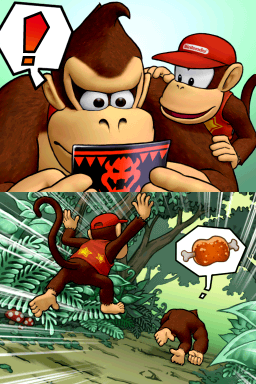
Late one night five shooting stars streak across the sky and fall to earth. They are Sky Crystals, and Mario finds one. He is showing it to his friends the next day when Kamek flies overhead scattering invitations: Bowser, full of remorse for his past behaviour, is giving a feast at his castle and everyone is welcome. Two of the invitations go astray and land on Donkey Kong and Diddy Kong.
It is, of course, a trap. The moment the guests arrive Bowser and Bowser Jr. drop a cage over them. Bowser pockets Mario’s crystal, produces a device called the Minimizer, shrinks the lot of them and hurls them far away, leaving himself free to hunt for the other four crystals.
So the heroes set off back towards the castle, a very long walk on very short legs, deciding as they go which of them is the Superstar. Each of the five boards is a stop on the way. On each, somebody needs help with a monster, and the grateful host hands over a Sky Crystal. That journey is Story Mode; the same five boards make up Party Mode.
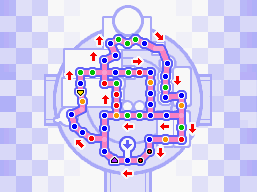
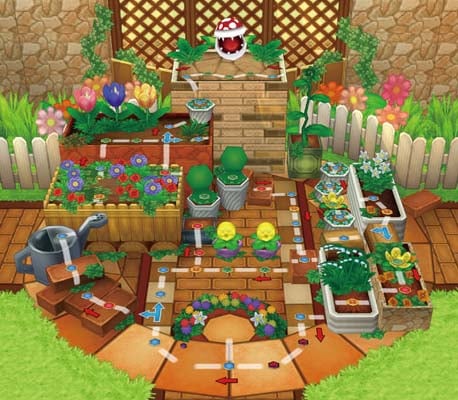
Wiggler’s Garden
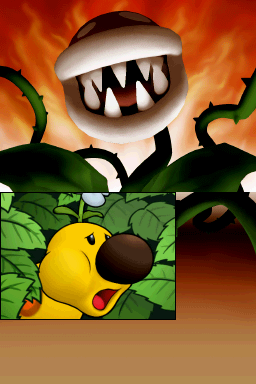
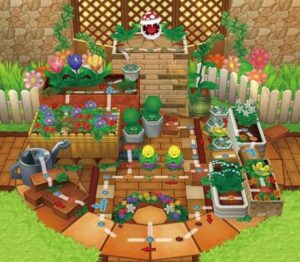
The first stop is a garden that has become a jungle now that everyone is tiny. Wiggler lives here and is in despair: “I need help! That grouchy Piranha Plant is making a mess of my garden!” The plant in question squats at the top of the board, and anyone who stops near it risks a blast of fire that costs ten coins.
The rules are the simplest in the game. The Star appears somewhere on the board, costs 20 coins, and moves to a new spot each time one is bought. The flowers supply the events. The Tricolored Flowers pay out 1, 10 or 30 coins at random; the two Bank Bulbs shower you with coins for as long as you can rub them with the stylus in five seconds; the two Fly-Far Flowers fling you back to the start; and the flytraps chew five coins out of anybody standing on their space. The board has 47 spaces.
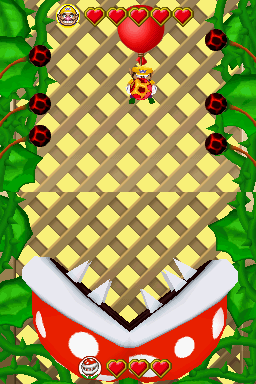
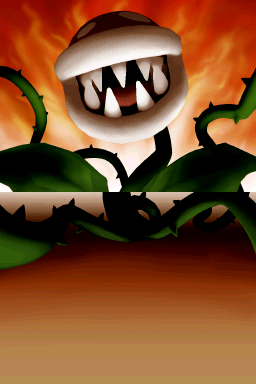
In Story Mode the Superstar goes on to fight the Piranha Plant in Feed and Seed, and Wiggler hands over the first recovered Sky Crystal.
The board’s title card.The top-screen map.The enraged Piranha Plant, with Wiggler looking on in horror.The Piranha Plant in Story Mode.
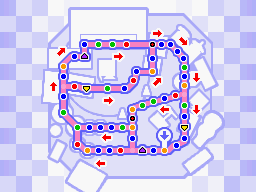
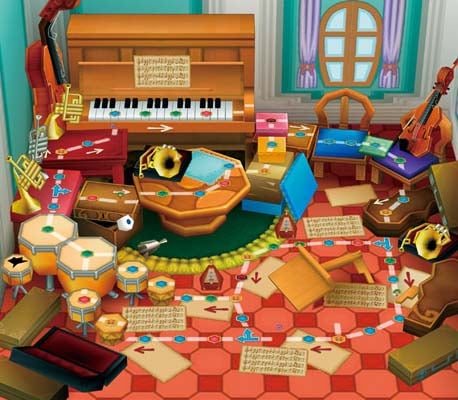
Toadette’s Music Room
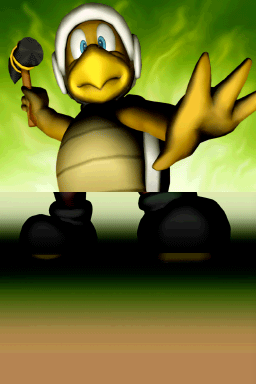
Next comes a room full of instruments the size of buildings, where Toadette is beside herself: “That dumb Hammer Bro is beating up my music instruments! Get rid of him!”
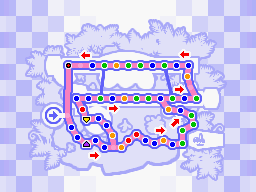
Here the Star belongs to a Musical Note that sits on a random space, and its price climbs: 5 coins for the first sold, then 10, 15, 20 and 30, after which the cycle begins again at 5. Each sale sends the Note somewhere else. Super Mario Wiki points out that it is the only board in the game with a changing price, and the second in the series after Pagoda Peak in Mario Party 7.
The events are musical. At the piano you can earn up to 20 coins by playing the notes shown without too many slips. Two French horns blow you to the space just before the Note; two big drums give Hammer Bro the chance to knock you to a random Blue or Red Space; the violin brings another player over to you; and the space in front of the Mysterious Metronome moves the Note. The board has 48 spaces, and the Superstar faces Hammer Bro in Hammer Chime.
The board’s title card.The top-screen map.Hammer Bro in Story Mode.An alternative version of the key artwork, with musical notes and flying sheet music.
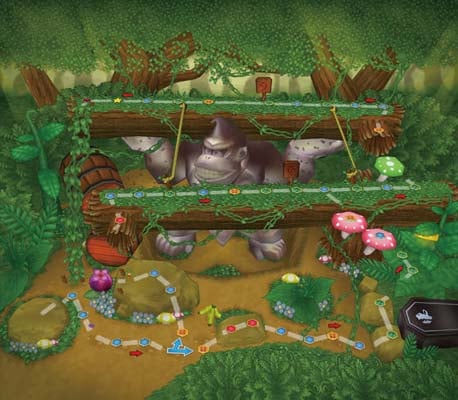
DK’s Stone Statue
In the jungle the party finds Diddy Kong and a calamity. “Oh, foul deed! Donkey Kong has been turned to stone?! And Dry Bones is responsible?!” gasps the narrator. Donkey Kong is now the enormous statue the board is built round, and the players start at its feet.
The Star never moves. It waits near the top of the statue, at what the game calls the Star Splurge Space, and anyone who gets there may buy as many Stars as they can pay for at 20 coins each, an idea Super Mario Wiki traces to Faire Square in Mario Party 6. Getting there is the difficulty. Barrels roll along the two logs and take ten coins from anyone they flatten. Tightrope vines carry you up or down between levels. A beehive lets you collect coins from bees with the stylus, red ones worth five. The Tricolored Vines hand out a dice item. And Dry Bones’ coffin slams shut hard enough to throw you either to the doorstep of the Star or all the way back to the start.
The board has 43 spaces. Beating Dry Bones in Hexoskeleton turns Donkey Kong back to flesh and fur, and Diddy gives up the third recovered crystal.
The board’s title card.The top-screen map.Dry Bones in Story Mode.
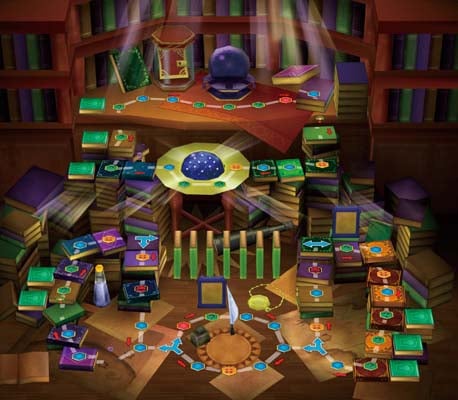
Kamek’s Library
With the castle in sight the heroes are stopped by a tearful Koopa Troopa: “That nasty Kamek has trapped my granddad in this book!” The granddad is Koopa Krag, and the book is somewhere in Kamek’s library, a board on two levels joined only by warp books, with a row of domino books in the middle that will carry you across for three coins.
There is no Star Space. Instead three magic jars stand about the board and cost ten coins each to open. One holds the Star, one holds five coins, and the third is cursed and sends you back to the start; when the Star is found the jars move. Super Mario Wiki compares the arrangement to Neon Heights in Mario Party 7.
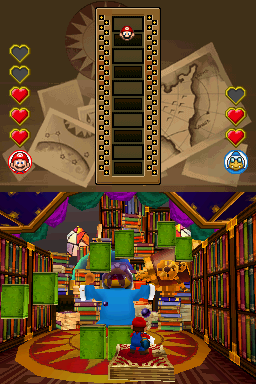
Kamek himself haunts the three crystal-ball spaces. His Spell Number 8 confiscates your items, leaves you three Halfway Dice Blocks in their place and swaps you with another player; Spell Number 88 shuffles everybody. Elsewhere you can wipe the dust off portraits against the clock for 20 coins, or trace a constellation for 30 coins, a Star Pipe or a Star. The board has 46 spaces. At the end of a long corridor the Superstar beats Kamek in Book Bash, and Koopa Krag is freed.
The board’s title card.The top-screen map.Kamek in Story Mode.The map icon for the jars.
Bowser’s Pinball Machine
The heroes storm the castle and remember too late how small they are. Bowser and Bowser Jr. scoop them up and drop them into a pinball machine, with Bowser Jr. crowing “Watch ME play, Dad! I’m the big pinball pro in these parts!”
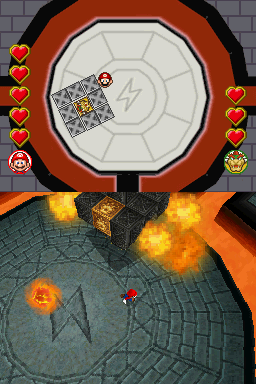
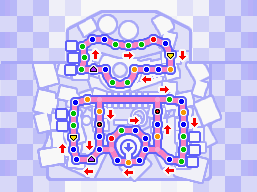
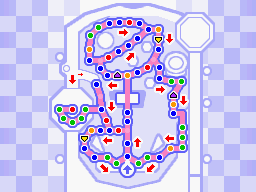
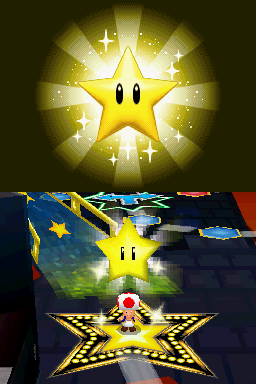
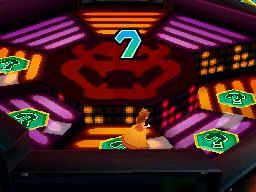
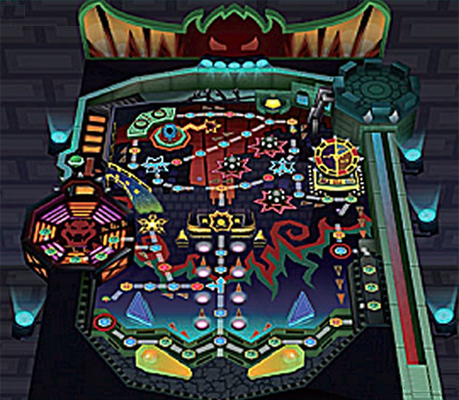
Stars work as they did in the garden, 20 coins at a spot that moves, but the table is full of ways to win and lose everything. Flippers bat you to the top, where a bumper pays ten coins. Cannons fire you in a direction you choose. The Wheel of Wonder pays out two, three or five times whatever you stake on it. And the plunger lanes are a gamble on the whole game: they lead now and then to the Star Zone, which gives away one to three Stars, but usually to the Bowser Zone, where Bowser’s Zero Flame burns every coin and Star you own. The only way out of the Bowser Zone ahead of the flame is a Double or Triple Dice Set, a Warp Dice Block or a Star Pipe. Oddly, the board has no Bowser Spaces at all. It has 52 spaces.
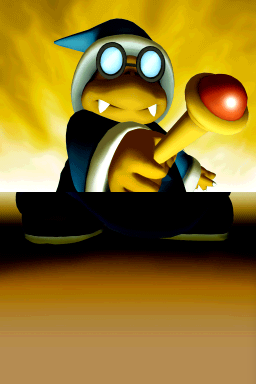
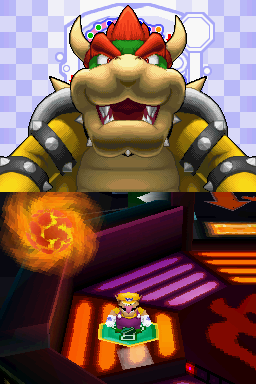
When the Superstar is crowned Bowser raises the Minimizer again, and at that moment Donkey Kong and Diddy Kong finally arrive for their dinner. Donkey Kong blunders into Bowser, the Minimizer falls and is trodden on, and everybody springs back to full size. Bowser has one more toy, the Megamorph Belt, which turns him into the many-shaped Blockhead Bowser for the last fight, Bowser’s Block Party.
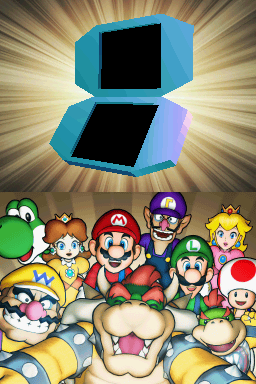
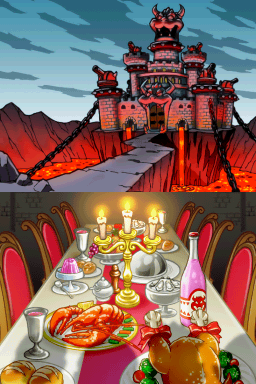
With Bowser beaten the fifth crystal is recovered and the five join to form a crystal Nintendo DS, which holds a game called Triangle Twisters. That, it turns out, is all Bowser ever wanted them for. The heroes let him and Bowser Jr. have a go, and the story ends with everyone playing together while Donkey Kong and Diddy Kong, alone at the banqueting table, eat the feast.
The board’s title card.The top-screen map.Toad wins a Star in the Star Zone.Daisy in the Bowser Zone.Wario, about to meet the Zero Flame.Bowser in Story Mode.The ending: heroes and villains play Triangle Twisters together.
Story Mode
Story Mode is for one player. You choose a character, the game picks three computer-controlled rivals, and the five boards are played in order as ten-turn games with no Bonus Stars. Finish a board as the Superstar and you go on to its boss minigame; if a computer player comes out on top you play the board again, though a tie counts in your favour.
Clearing the story opens Triangle Twisters and Boss Bash, makes Bowser’s Pinball Machine available elsewhere, and earns the figure and the Master badge of the character you used, so there is a reason to do it eight times.
A Sky Crystal falls near Mario.Mario reads Bowser’s invitation.Donkey Kong and Diddy Kong get one too.Bowser’s Castle and the promised feast.The Minimizer at work.
Party Mode
Party Mode offers any board in three formats. Battle Royale is four players, each for themselves. Tag Battle is two teams of two, in which the minigames are no longer tied to the colours of the spaces and 1-vs-3 and Battle minigames do not appear. Duel Battle is one against one.
You can set the number of turns from 10 to 30, switch Bonus Stars on or off, give any player a head start of one to three Stars, and choose how clever the computer players are: Easy, Normal or Hard, with a fourth level to unlock. Teams in Tag Battle are given names according to who is in them.
Minigame Mode
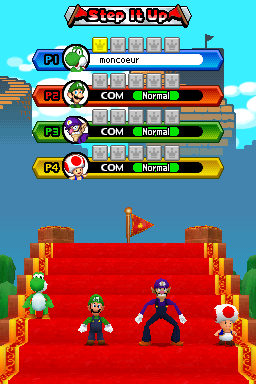
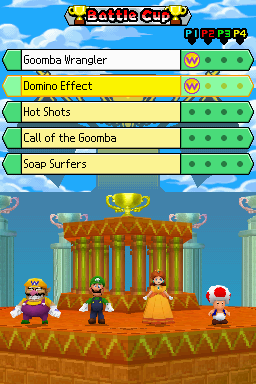
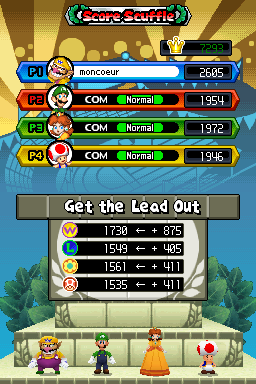
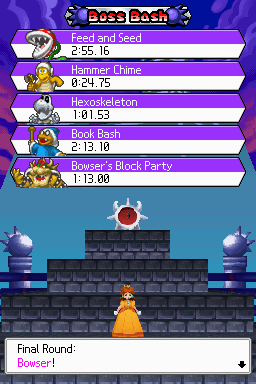
Six ways to play the minigames on their own. Free Play offers anything you have already met. Step It Up is a race up a staircase to three, five or seven wins. Battle Cup is a set of five minigames, chosen by you or by the game. Score Scuffle runs through ten fixed minigames, from Rail Riders to Raft Riot, scoring up to 1,000 points for each. Boss Bash is a one-player time trial through all five boss fights, available once the story is finished.
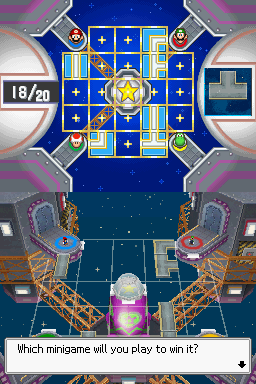
The oddest is Rocket Rascals. Each minigame won earns a piece of bridge to lay on a five-by-five grid, and the first player to build a route to the rocket wins. Bowser Jr. turns up from time to time to scatter the pieces, steal the lot or jump the game forward to its last five turns, and if nobody has reached the rocket after 20 turns nobody wins.
Step It Up.Battle Cup.Score Scuffle.Daisy plays Boss Bash.Rocket Rascals.
Puzzle Mode
A small museum of the series’ puzzle games, for one or two players. Five are old friends: Mario’s Puzzle Party from Mario Party 3, Bob-omb Breakers from Mario Party 4, Piece Out from Mario Party 5, Block Star from Mario Party 6 and Stick and Spin from Mario Party 7.
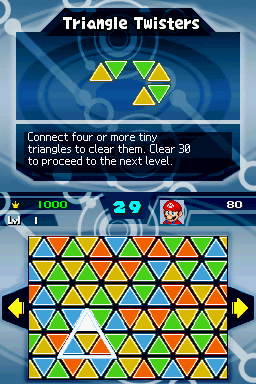
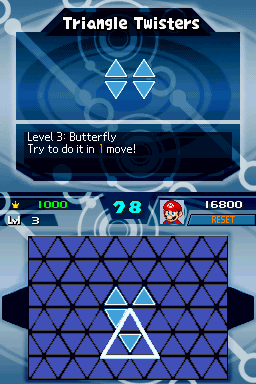
The sixth is new. Triangle Twisters, the game inside the crystal DS, has you spin clusters of triangles to bring four or more of one colour together. Frenzy Mode is a 60-second scramble; Focus Mode asks you to rebuild the patterns shown on the top screen. It appears once Story Mode has been cleared.
Triangle Twisters in Focus Mode.
Extras and the Gallery
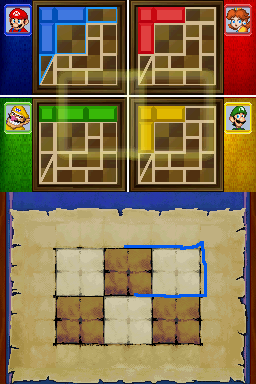
Extras Mode holds two games that exist only for two human players. Pen Pals is co-operative: you and a friend draw lines on a grid of blocks to pen in a pair of computer opponents, with 2-vs-2 minigames breaking up the turns. Desert Duel is one against one on a five-by-five grid, where every square you cross becomes yours for a point, Stars are worth five, and stepping on to the other player’s square starts a Duel minigame. Ten turns decide it.
Playing alone earns Mario Party Points, and the Gallery is where they show. There are 30 character figures, eight earned by finishing the story with each character and the rest at points totals from 2,000 for a Goomba to 50,000 for Blockhead Bowser; 71 board features, won by feats on particular boards; 25 boss trophies, awarded for beating each boss minigame a number of times; and 30 badges, one of which you can display beside your points. The Gallery also keeps records, the story scenes, the music and the character voices.
Every board in Mario Party DS
The five boards in Story Mode order, with the host, the boss and how Stars are won on each.
Wiggler’s GardenHost: Wiggler · Boss: Piranha Plant (Feed and Seed) · 47 spacesThe Star costs 20 coins and moves after every sale, and the flowers pay out, cost coins or throw you back to the start.
Toadette’s Music RoomHost: Toadette · Boss: Hammer Bro (Hammer Chime) · 48 spacesA Musical Note sells Stars at a price that rises from 5 coins to 30 and then starts again.
DK’s Stone StatueHost: Diddy Kong · Boss: Dry Bones (Hexoskeleton) · 43 spacesThe Star stays put near the top of the statue, and you may buy as many as you can afford.
Kamek’s LibraryHost: Kamek · Boss: Kamek (Book Bash) · 46 spacesThree jars at ten coins a go: one Star, one consolation prize and one trip back to the start.
Bowser’s Pinball MachineHost: Bowser · Boss: Bowser (Bowser’s Block Party) · 52 spacesA Star Zone that gives Stars away and a Bowser Zone whose Zero Flame takes every coin and Star you have.
In the Korean version the roulette on Bowser’s Pinball Machine is replaced by a Whac-A-Mole game.
Advertisement
Gameplay & Controls
The rules are those of the classic Mario Parties, pared down for a small screen and with a few ideas of the game’s own. This is how a board game works.
Turns, coins and Stars
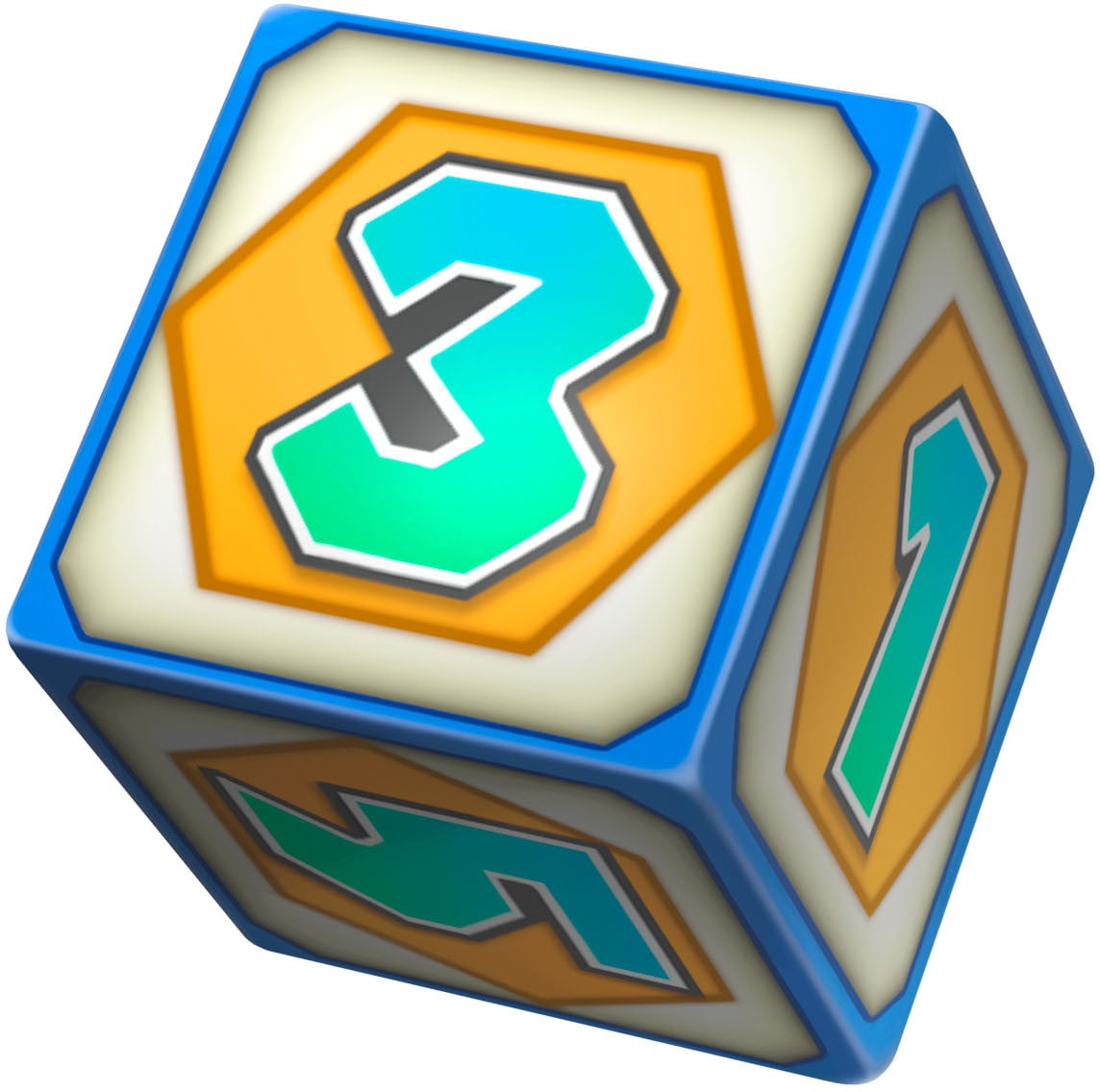
Up to four players take turns to hit a Dice Block numbered 1 to 10 and move that many spaces. A Blue Space pays three coins and a Red Space takes three. A green ? Space sets off whatever that corner of the board does. On a Friend Space you choose another player and both of you receive five coins. A Bowser Space brings one of four punishments: he takes 20 of your coins, takes a Star, makes you give ten coins to every rival, or shares everybody’s coins out equally.
The aim, as ever, is Stars. On most boards a Star costs 20 coins at the Star Space, though each board has its own rule for where the Star is and how it is won, described below. Item Shops, Hex Areas, junctions and the Star Space itself do not count as steps when you move.
A game lasts ten turns by default and can be set in fives up to 30. When it ends, Stars are counted and then coins. If Bonus Stars are switched on, three of six possible awards are drawn at random for that game: the Minigame Star for most minigames won, the Item Star for most items used, the Green Star for most ? Spaces, the Running Star for most spaces travelled, the Hex Star for most Hexes laid and the Friendship Star for most Friend Spaces.
Blue Space.Red Space.Green ? Space.Friend Space.Duel Space.Bowser Space.Star Space.The Dice Block.The How to Play board.
A minigame every round
When all four players have moved, a minigame is played, and the colours of the spaces they stopped on decide its kind. Four on the same colour means a 4-Player free-for-all, two on each a 2-vs-2, and one odd one out a 1-vs-3. Anyone standing on a green, Friend or Duel Space is given blue or red at random. The winner collects ten coins.
Now and then a Battle minigame turns up instead. Everybody pays the same stake into a pot, the stake rising as the game goes on, and the pot is divided according to where each player finishes.
With five turns left comes the Final 5 Frenzy. Bowser lets the player in last place spin a roulette for coins or Stars, and every Friend Space on the board becomes a Duel Space. Land on one and you pick an opponent for a two-player Duel minigame, with a roulette deciding what the winner takes. One possible result of the frenzy makes Stars cost five coins for the rest of the game.
An early version of the board display, with separate boxes for each player’s coins and Stars.
Items and Hexes
You can carry three things at a time, items and Hexes together. Items are bought with coins at the Item Shops, each run by a Monty Mole, and used at the start of your turn. They are mostly dice: two or three blocks at once, a block that stops at five, a block that warps you somewhere at random.
Hexes are the game’s own idea. A Hex Area hands you one as you pass, and before rolling you may lay it on a space, where it sits until a rival lands on it; a later Hex can overwrite an earlier one. Six of them rob the victim for the benefit of whoever set the trap, taking coins or Stars or swapping positions. The other two, the Star Block and the Coin Block, are gifts to whoever finds them. Super Mario Wiki likens the whole system to the Character Spaces of the earlier games.
Monty Mole, who keeps the Item Shops.A Star.A Ztar.
Stylus, microphone and two screens
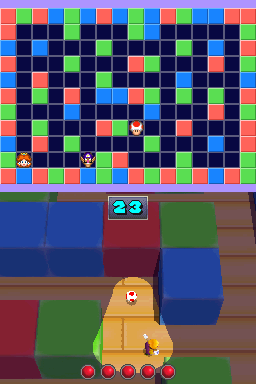
The board is played with the buttons and the top screen shows a map of the whole course. The minigames use everything the DS has. Going by Super Mario Wiki’s descriptions, more than two dozen of the 67 board minigames are played wholly or partly with the stylus, by drawing rings round Goombas, winding up toy cars or slicing a cucumber, and at least four use the microphone: Big Blowout, Toppling Terror, Short Fuse and, for the solo player, Gusty Blizzard. The rest are for the Control Pad and buttons.
The instruction booklet asks players to touch gently and slide lightly, with the stylus only, and offers a MIC TEST on the main menu. For anyone playing on a bus, microphone minigames can be switched off.
In several 1-vs-3 games the two sides use different controls. In Power Washer the solo player aims a jet of water with the stylus while the three on the plate run about with the Control Pad; in Plush Crush it is the three who have the stylus.
Four players from one Game Card
Mario Party DS needs only one copy. Using DS Download Play, the owner’s system sends the game to up to three others. Three or four players can then play Party Mode and Minigame Mode; two players can also choose Puzzle Mode and the two-player Extras. Boss minigames are not available this way and nothing the guests do is saved, though any minigames met during the session are added to the owner’s collection.
This is the one thing the re-release could not reproduce. Nintendo’s page for the Wii U Virtual Console version notes that the wireless features are unavailable and that it is a one-player game there.
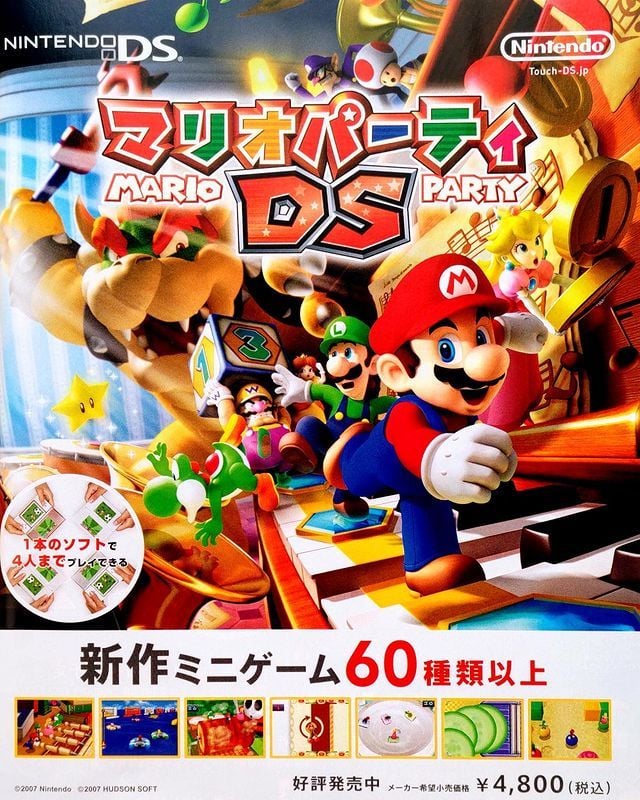
A Japanese print advertisement for the game.
Every item and Hex
The eight items sold at Monty Mole’s shops, with their prices, and the eight Hexes handed out at Hex Areas. Up to three can be held at once.
Double Dice SetItem · 3 coins. Hit two Dice Blocks and move the total.
Triple Dice SetItem · 7 coins. Three Dice Blocks at once.
Halfway Dice BlockItem · 1 coin. A block that only goes from 1 to 5, for when a short roll is what you need.
Warp Dice BlockItem · 2 coins. Before you roll, you are whisked to a random Blue Space with nobody on it.
Snag BagItem · 8 coins. Steals one item, chosen at random, from a rival of your choice.
Star PipeItem · 15 coins. Takes you straight to the Star. It returned in Super Mario Party as the Golden Pipe.
Block SensorItem · 20 coins. Guarantees a Hidden Block on the space you land on next.
Grab BagItem · 25 coins. Throws away what you are holding and gives you a Star Pipe, a Block Sensor and a Triple Dice Set.
10-Coin HexHex. The next rival to land on it pays you 10 coins.
20-Coin HexHex. The next rival to land on it pays you 20 coins.
Coin Swap HexHex. You and the rival who lands on it exchange your whole stock of coins.
1-Star HexHex. The next rival to land on it gives you a Star.
2-Star HexHex. The next rival to land on it gives you two Stars.
Space Swap HexHex. You change places on the board with whoever lands on it.
Star BlockHex. A present for the finder, who hits a block numbered 1 to 3 and wins that many Stars.
Coin BlockHex. The finder has ten seconds to hit the block as often as possible for coins.
Cartoons, Comics & Other Media
Mario Party DS borrows a good deal from the console games that came before it, and a few of its own ideas were picked up by the ones that followed.
Mario Party 3 to 7Nintendo 64 and GameCubeEach of the five returning puzzle games comes from a different earlier entry, and their old character icons, animations and mugshots come with them. The sheet music in Toadette’s Music Room shows a few bars of the Mario Party 3 minigame tune “Let’s Get a Move On”.
Mario Party 8Wii · 2007The character select pictures and several voice clips are taken from the Wii game released earlier the same year, and Super Mario Wiki notes how much DK’s Stone Statue looks like its DK’s Treetop Temple.
Super Mario Bros.NESThe crank in Call of the Goomba grinds out the ground theme, and Boogie Beam dances to an arrangement of the underground theme.
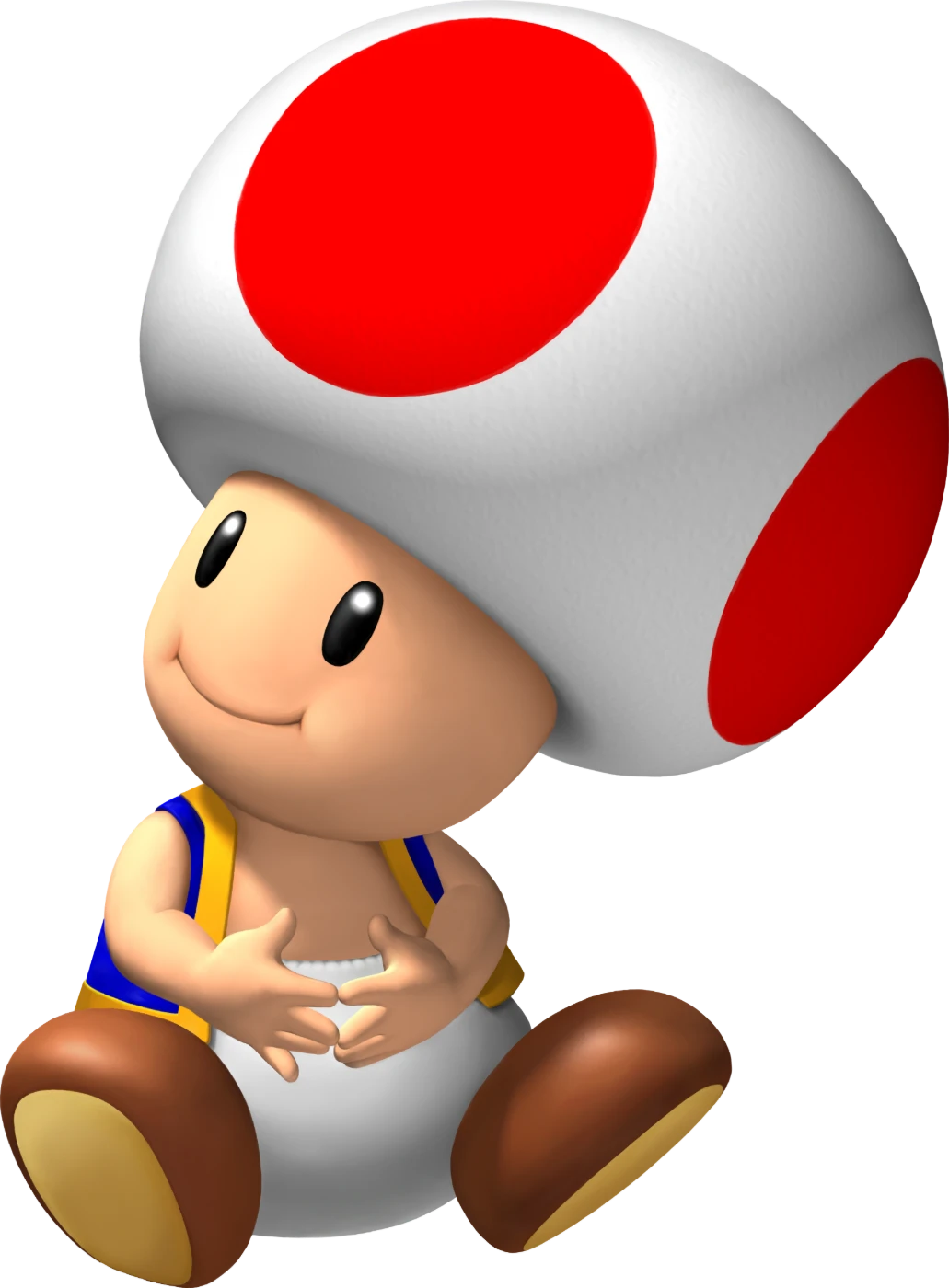
Borrowed artworkPromotional artMuch of the character art was recycled: Toad and Kamek from Super Mario Galaxy, Hammer Bro from New Super Mario Bros., Peach and Daisy from Mario Party 6, Toadette and Dry Bones from Mario Party 7, and Yoshi from a Super Mario 64 DS picture in which he was holding up Mario’s cap.
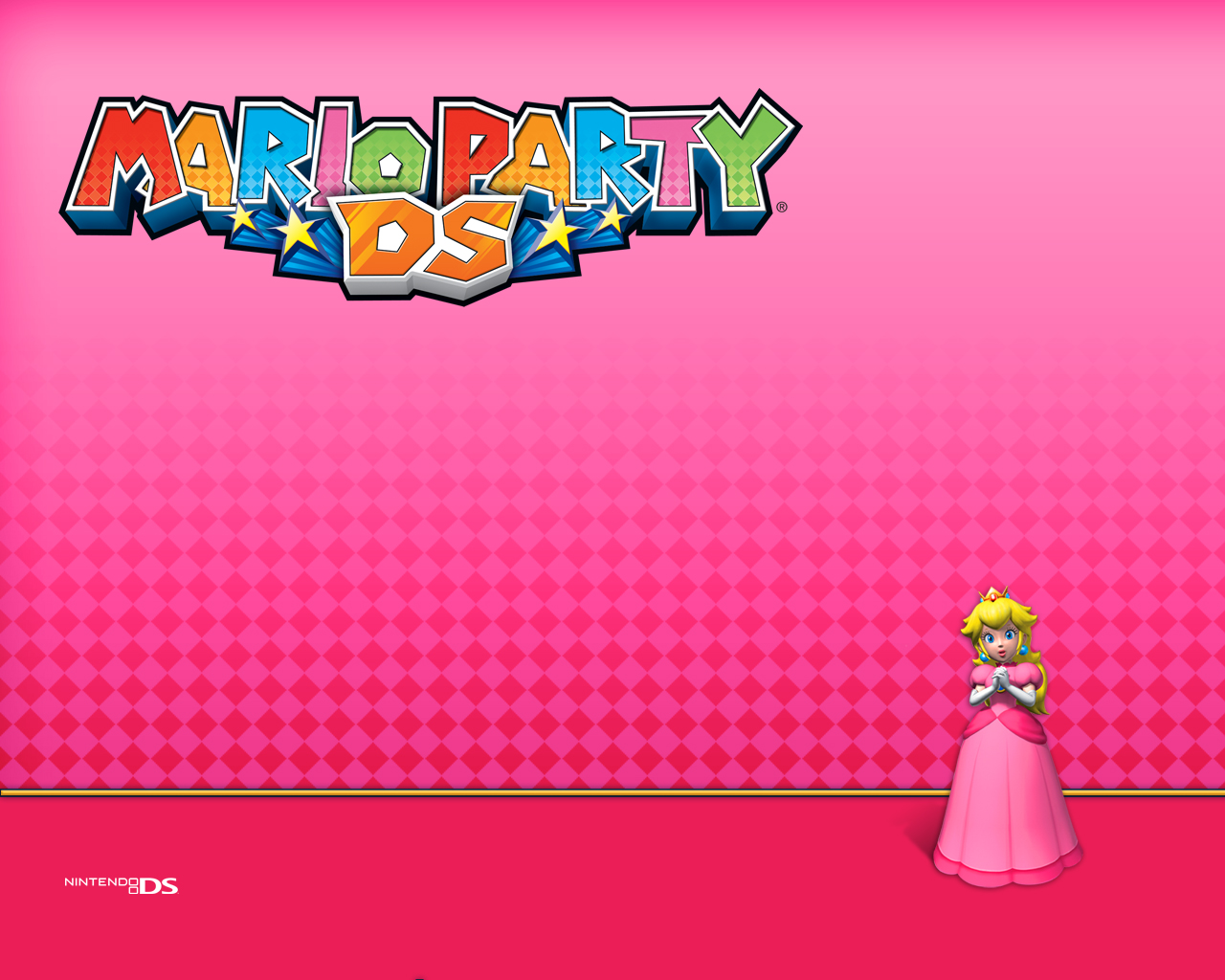
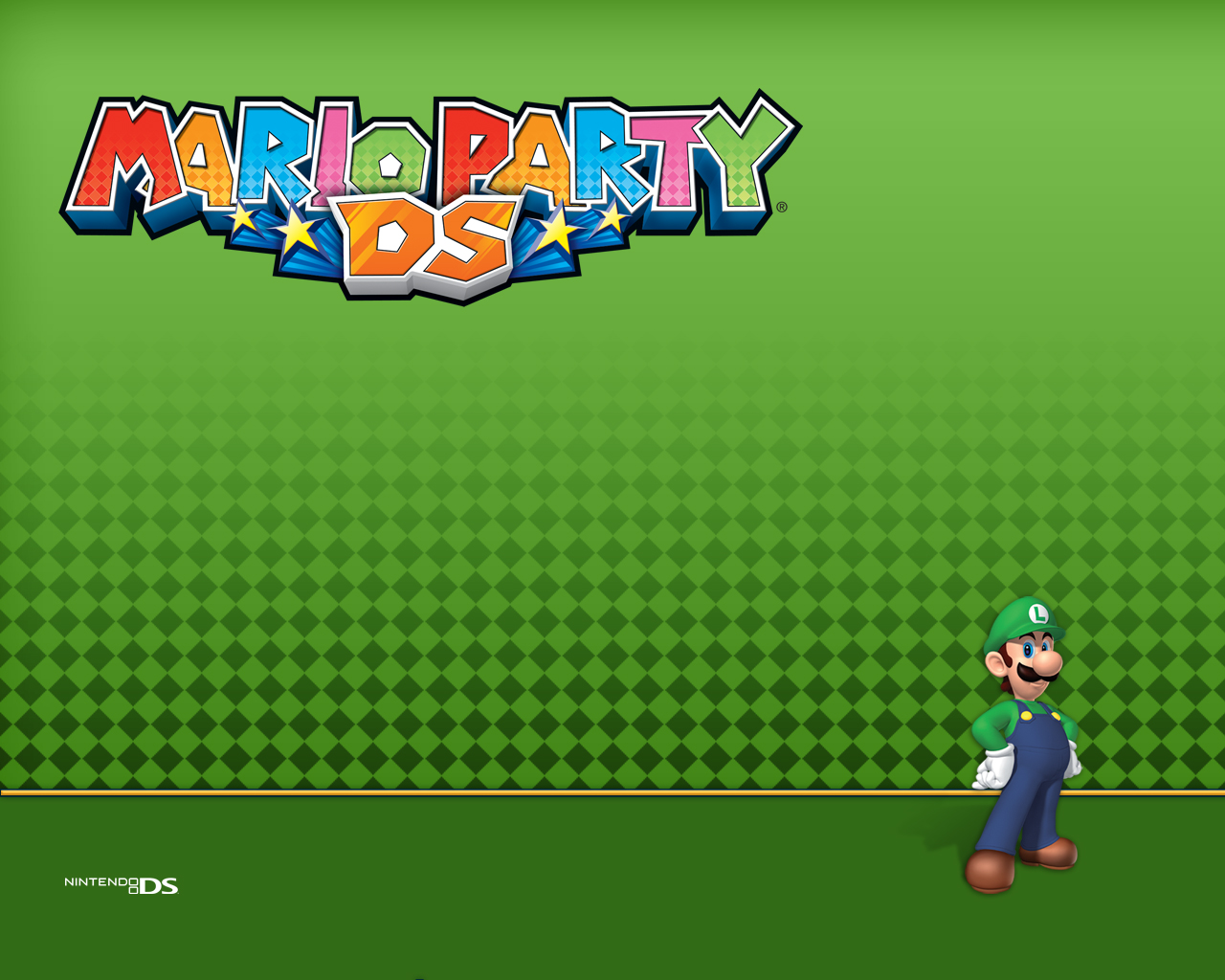
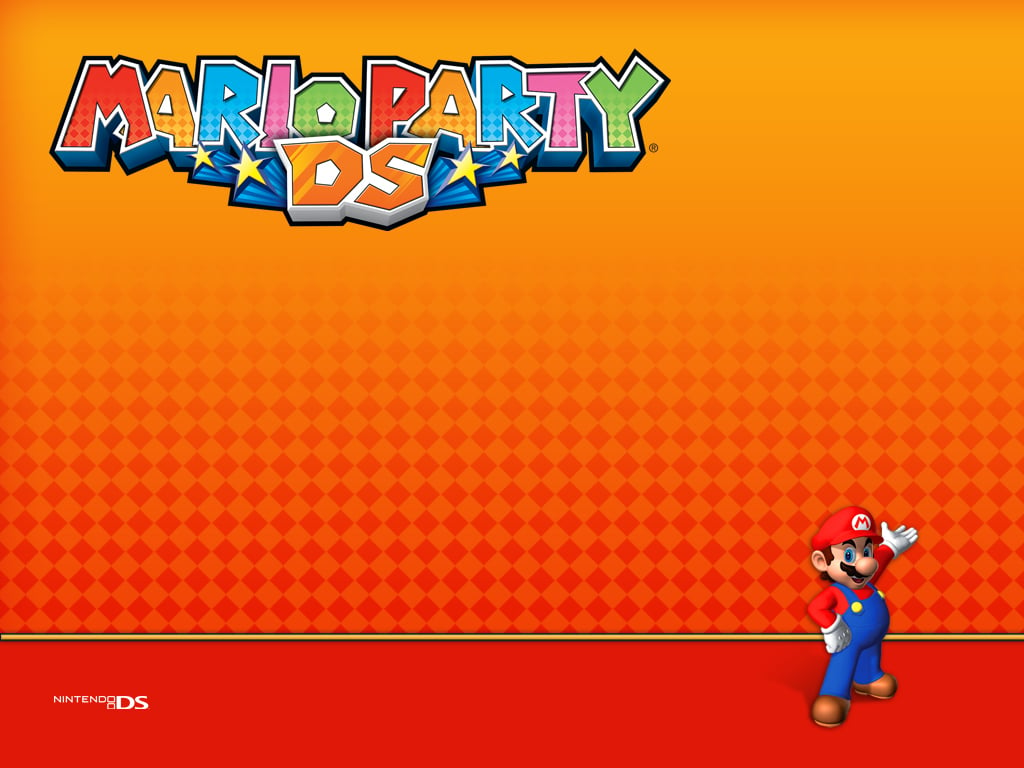
Desktop wallpapersPromotional wallpapersA set of eight wallpapers, one for each playable character, was issued for the game and is preserved in Super Mario Wiki’s gallery.
Mario Party 9Wii · 2012The next game in the series brought back two things from this one: boss minigames, which it put on every board, and the Step It Up staircase in its Minigame Mode.
Super Mario PartyNintendo Switch · 2018The Star Pipe returns under a new name, the Golden Pipe.
Super Mario Party JamboreeNintendo Switch · 2024Super Mario Wiki notes that Jamboree has items that look and work much like Hexes.
The Top 100 and SuperstarsNintendo 3DS, 2017 · Nintendo Switch, 2021Neither compilation takes anything from Mario Party DS: both draw only on the ten numbered home console games. Block Star and Stick and Spin are in both, but as Mario Party 6 and 7 minigames.
Characters
Eight playable characters, all available from the start and all identical in play. The hosts, the bosses and the villains follow, in the order the story meets them.
Character
Who they are
In this game
Abilities & notes
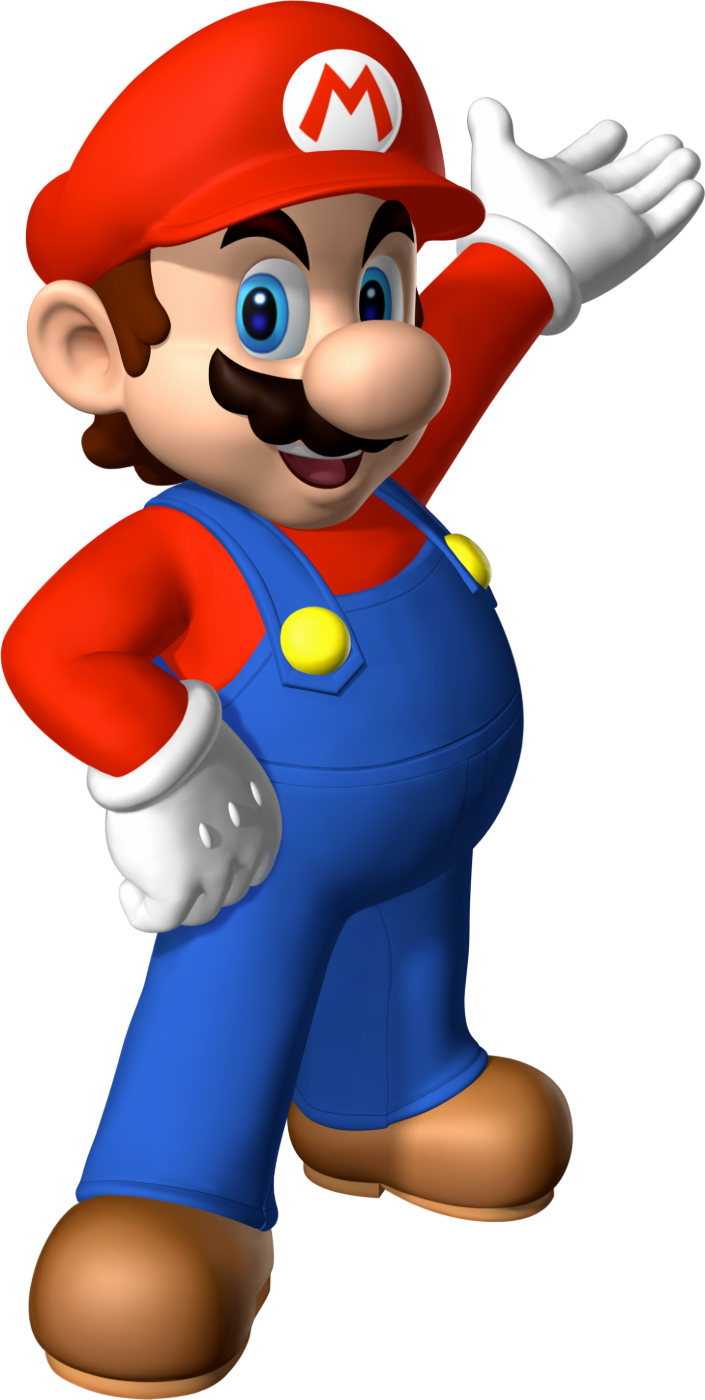
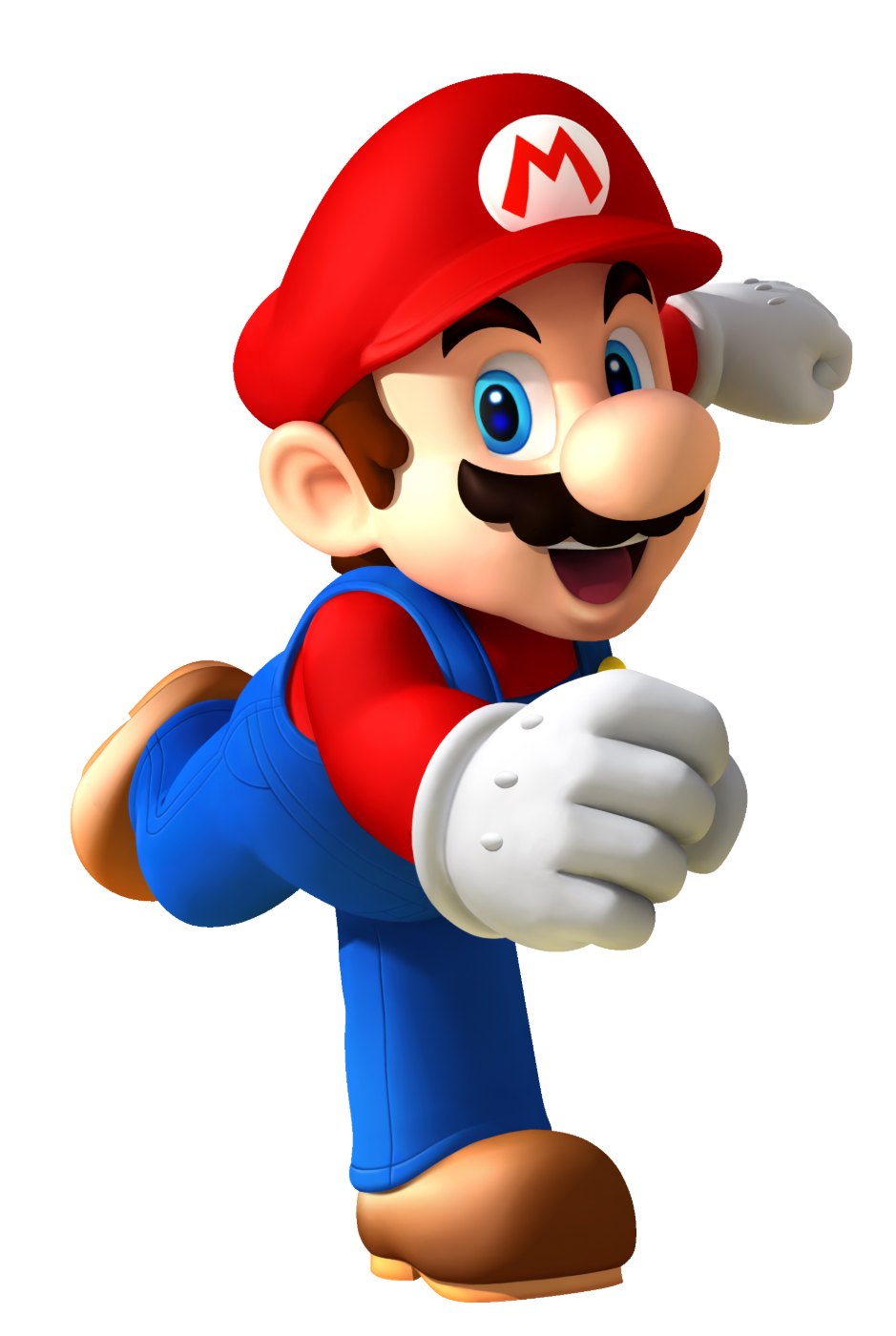
MarioPlayable
The one who finds the first Sky Crystal.
It is his crystal that Bowser steals to power the Minimizer. Finishing Story Mode with him earns the Mario figure and the Mario Master badge.
Voice: Charles Martinet.
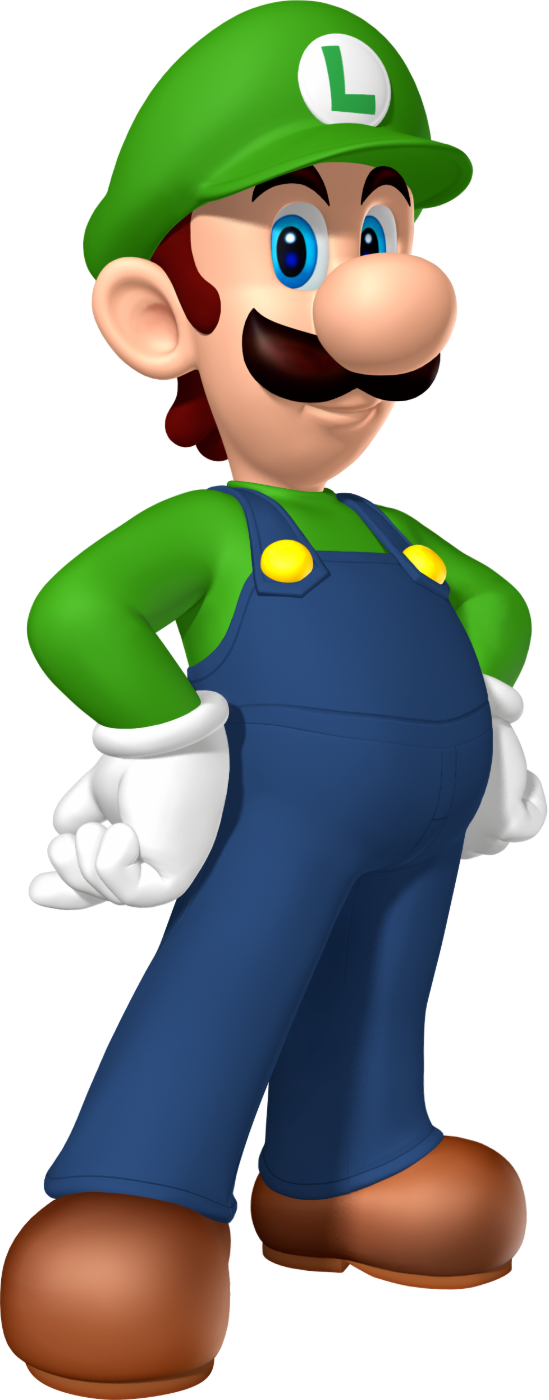
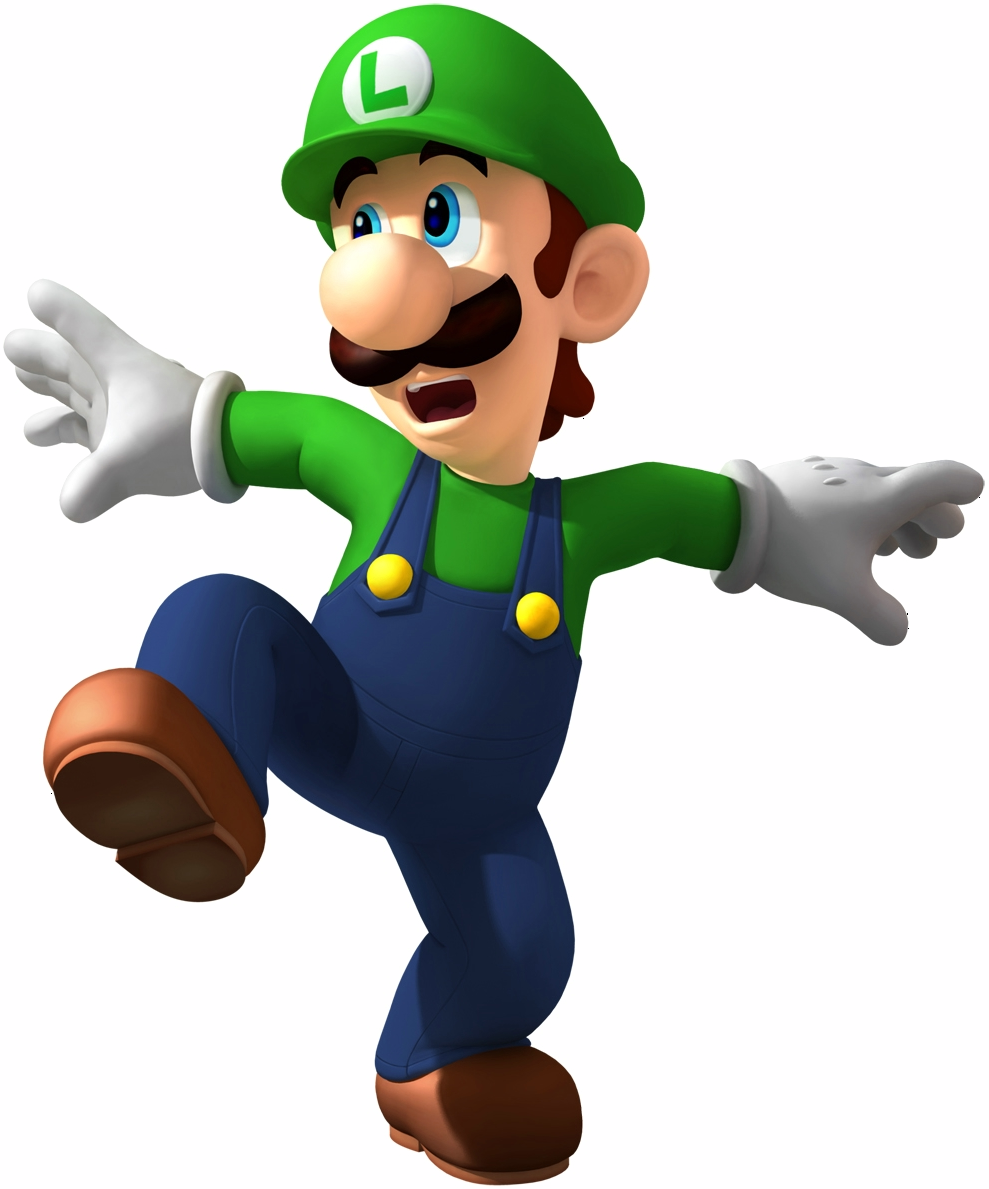
LuigiPlayable
Mario’s brother, shrunk along with the rest.
Available from the start, with a figure and a Master badge of his own.
Voice: Charles Martinet.
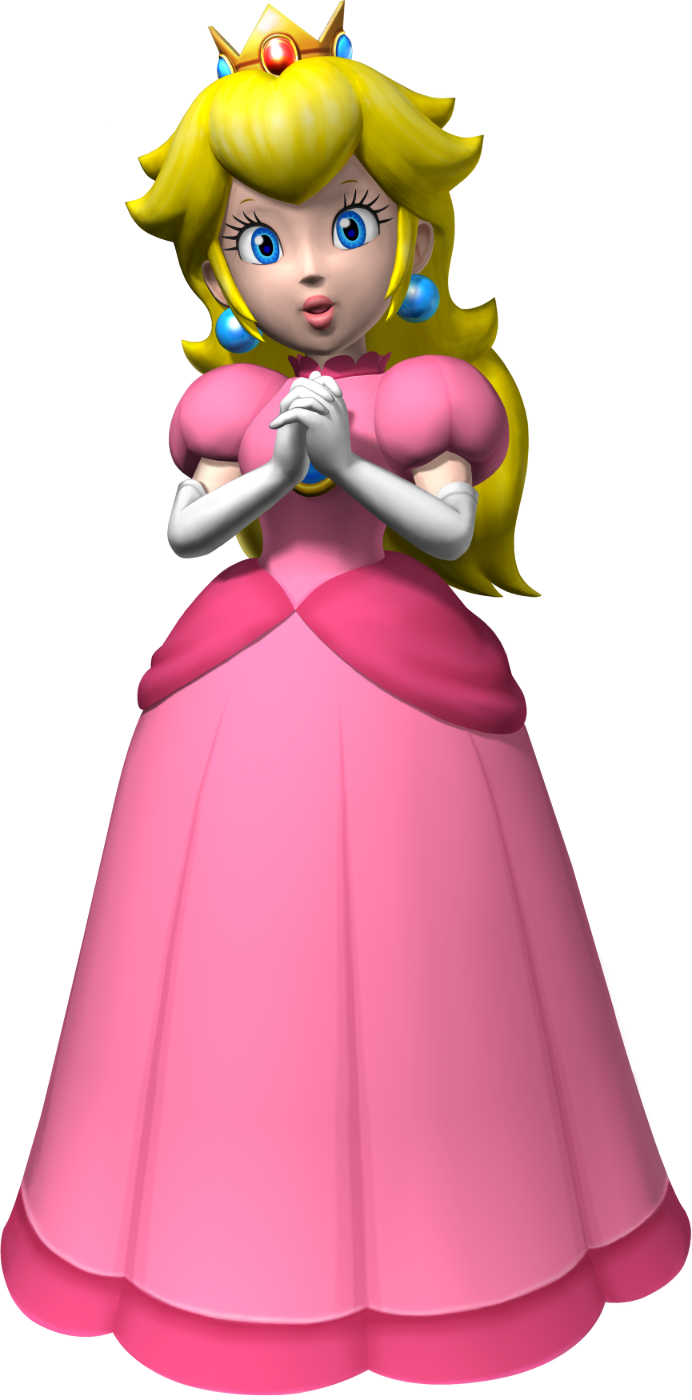
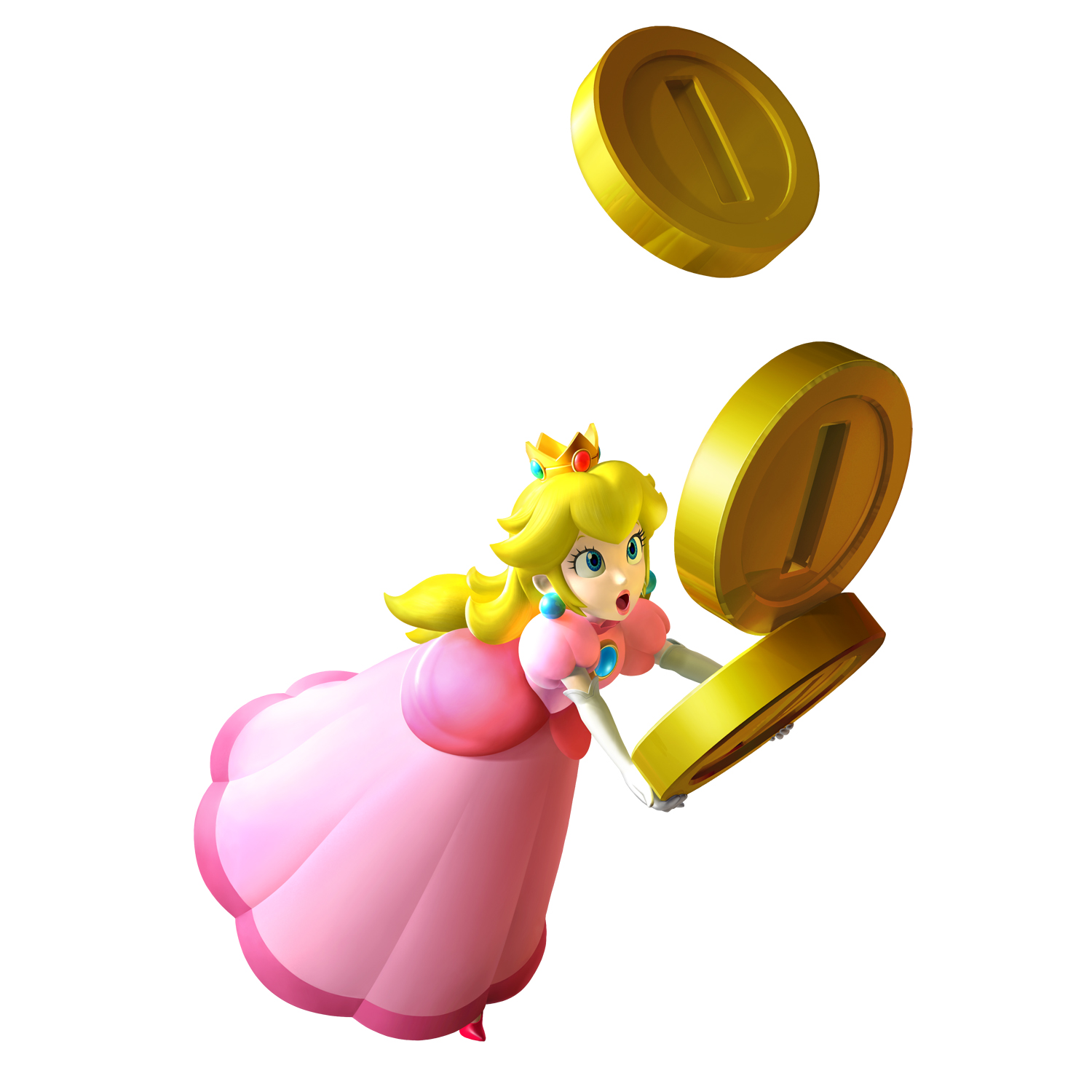
Princess PeachPlayable
Drawn for this game with a scattering of coins.
Available from the start. Her second piece of artwork is reused from Mario Party 6.
Voice: Sam Kelly.
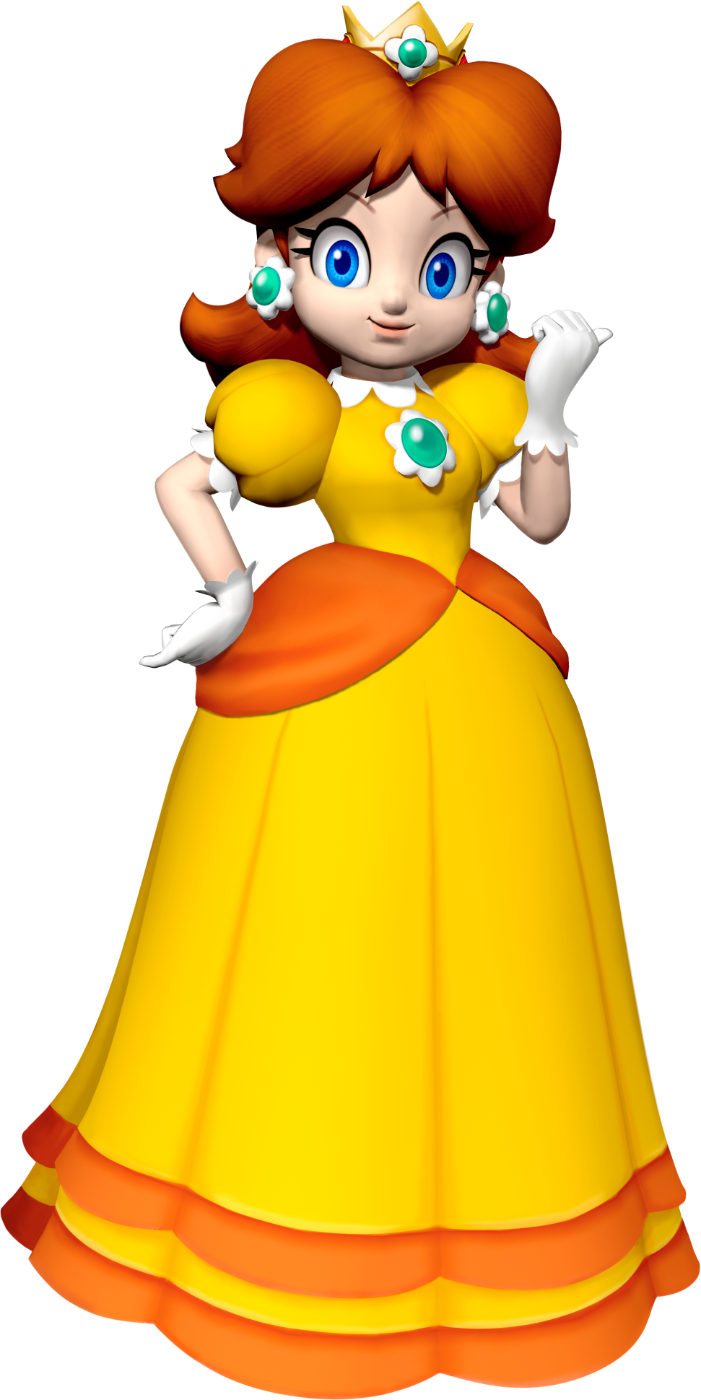
Princess DaisyPlayable
Peach’s fellow princess.
Available from the start. Her artwork is carried over from Mario Party 6.
Voice: Deanna Mustard.
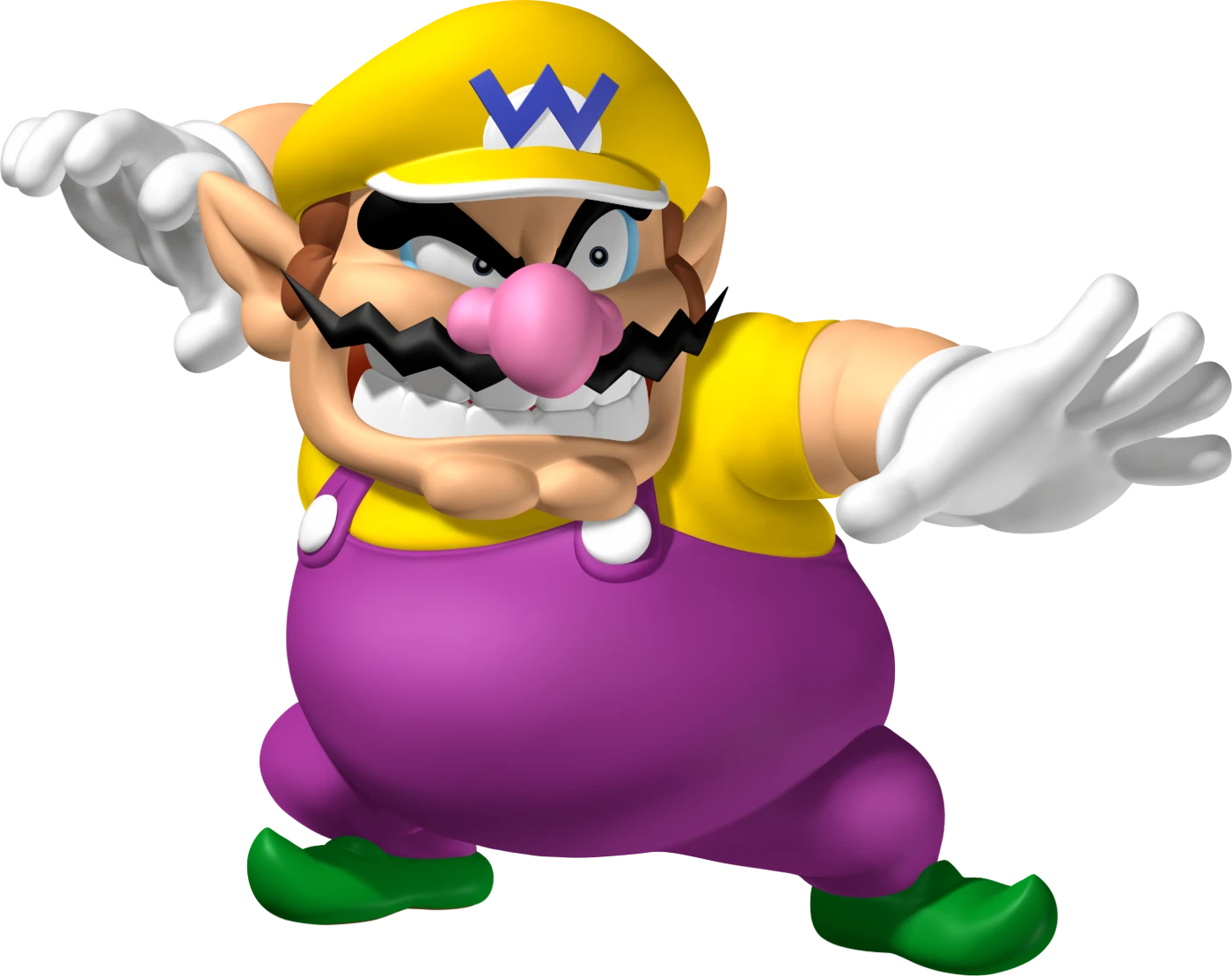
WarioPlayable
Another guest at Bowser’s feast.
Available from the start. He is the one about to be hit by the Zero Flame in the wiki’s screenshot of the Bowser Zone.
Voice: Charles Martinet.
WaluigiPlayable
Wario’s partner in crime.
Available from the start.
Voice: Charles Martinet.
YoshiPlayable
The party’s dinosaur.
Available from the start. His artwork is adapted from Super Mario 64 DS.
Voice: Kazumi Totaka.
ToadPlayable
The eighth player, with artwork borrowed from Super Mario Galaxy.
Available from the start. A secret Toad Statue is the last of the 71 board features in the Gallery.
Voice: Sam Kelly.
WigglerHost · Wiggler’s Garden
The owner of the garden.
Asks the heroes to deal with the Piranha Plant and rewards them with a Sky Crystal.
Figure: 18,000 Mario Party Points.
Piranha PlantBoss · Wiggler’s Garden
A monstrous plant that has overrun the garden.
Breathes fire at players who land near it on the board, and is fought in Feed and Seed by throwing its own bomb seeds back into its mouth.
Three hits to beat.
ToadetteHost · Toadette’s Music Room
Mistress of the music room.
Wants Hammer Bro stopped before he wrecks her instruments. Also a target to avoid in the minigame Hot Shots.
Figure: 20,000 Mario Party Points.
Hammer BroBoss · Toadette’s Music Room
A vandal with drumsticks.
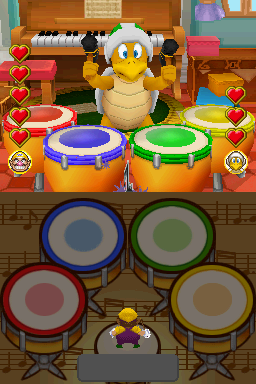
Knocks players about from the drums on the board, and is beaten in Hammer Chime by repeating his drum patterns. His battle cry is “Here’s my Hammer Bro drum solo!”
Three rounds to beat. Voice: Motoki Takagi.
Diddy KongHost · DK’s Stone Statue
Donkey Kong’s sidekick.
Receives an invitation to the feast by accident, hosts the jungle board while his friend is a statue, and gets his dinner in the end.
Voice: Katsumi Suzuki.
Donkey KongStatue, then rescuer
Turned to stone by Dry Bones on his way to the party.
Restored when Dry Bones is beaten. He later lumbers into Bowser’s castle looking for the banquet and breaks the Minimizer by accident, which returns everyone to full size.
Voice: Takashi Nagasako.
Dry BonesBoss · DK’s Stone Statue
The skeleton who petrified Donkey Kong, asleep in a coffin on the board.
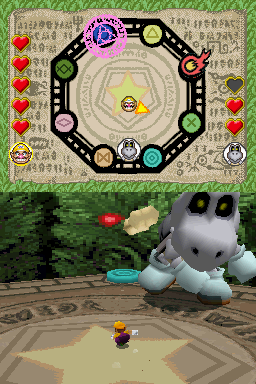
Fought in Hexoskeleton, where you ground-pound magic switches while he attacks.
Three hits to beat. Voice: Toru Asakawa.
Koopa Troopa and Koopa KragKamek’s Library
A grandson and his grandfather.
The young Koopa begs the heroes to save Koopa Krag, whom Kamek has shut inside a book. Krag is released when Kamek is beaten.
Koopa Friend is one of the 30 badges.
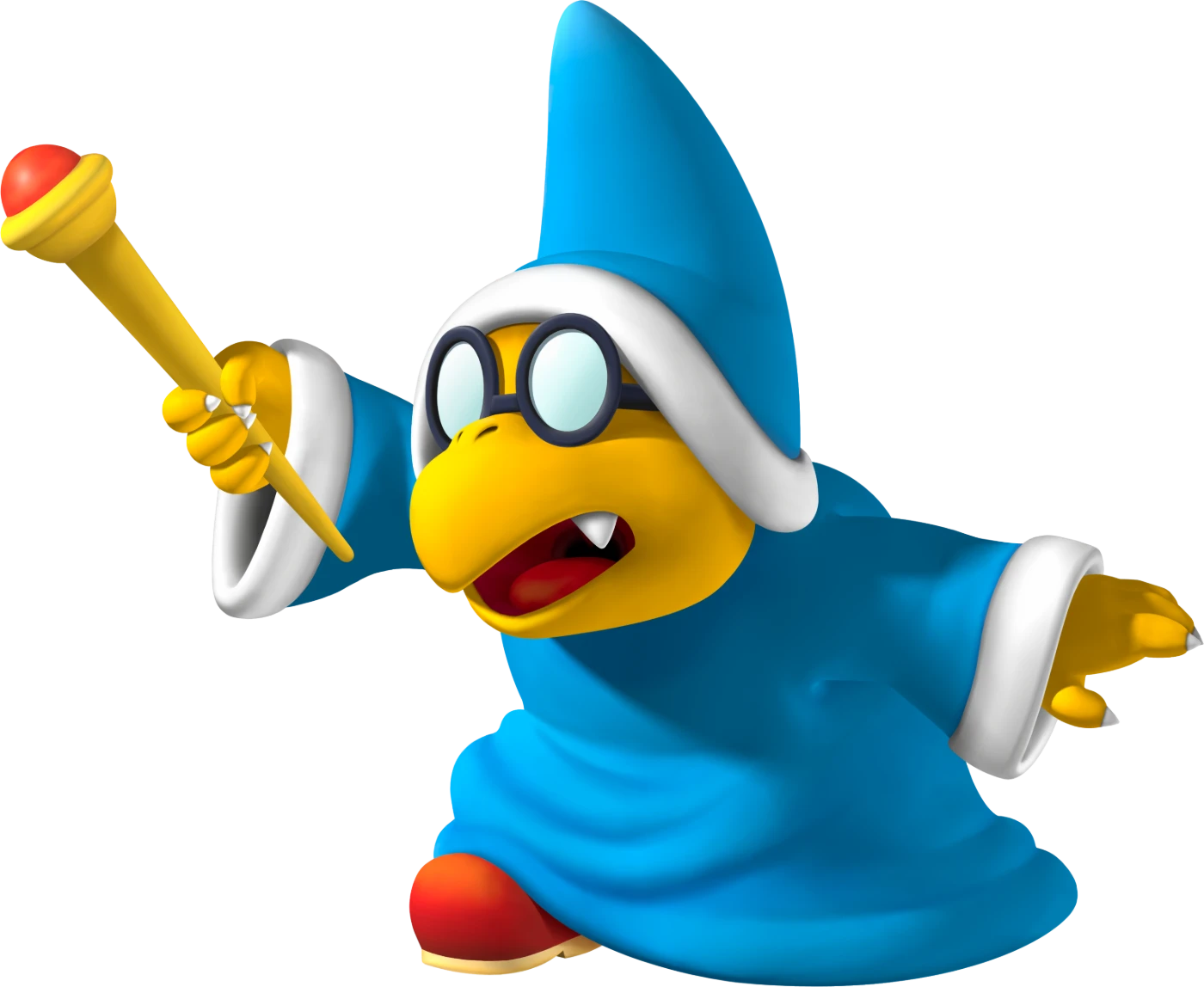
KamekHost and boss · Kamek’s Library
Bowser’s wizard, who delivered the invitations.
Both host and boss of his board. Casts Spell Number 8 on players who land by his crystal balls, announcing “Get a load of this spell. I call it Kamek Spell No. 8!”, and is fought in Book Bash.
Three hits to beat. Voice: Atsushi Masaki.
Bowser Jr.Villain
Bowser’s son and accomplice.
Helps to cage the guests and to tip them into the pinball machine, and makes mischief in Rocket Rascals. Joins his father for Triangle Twisters at the end.
Figure: 36,000 Mario Party Points. Voice: Delores Rogers.
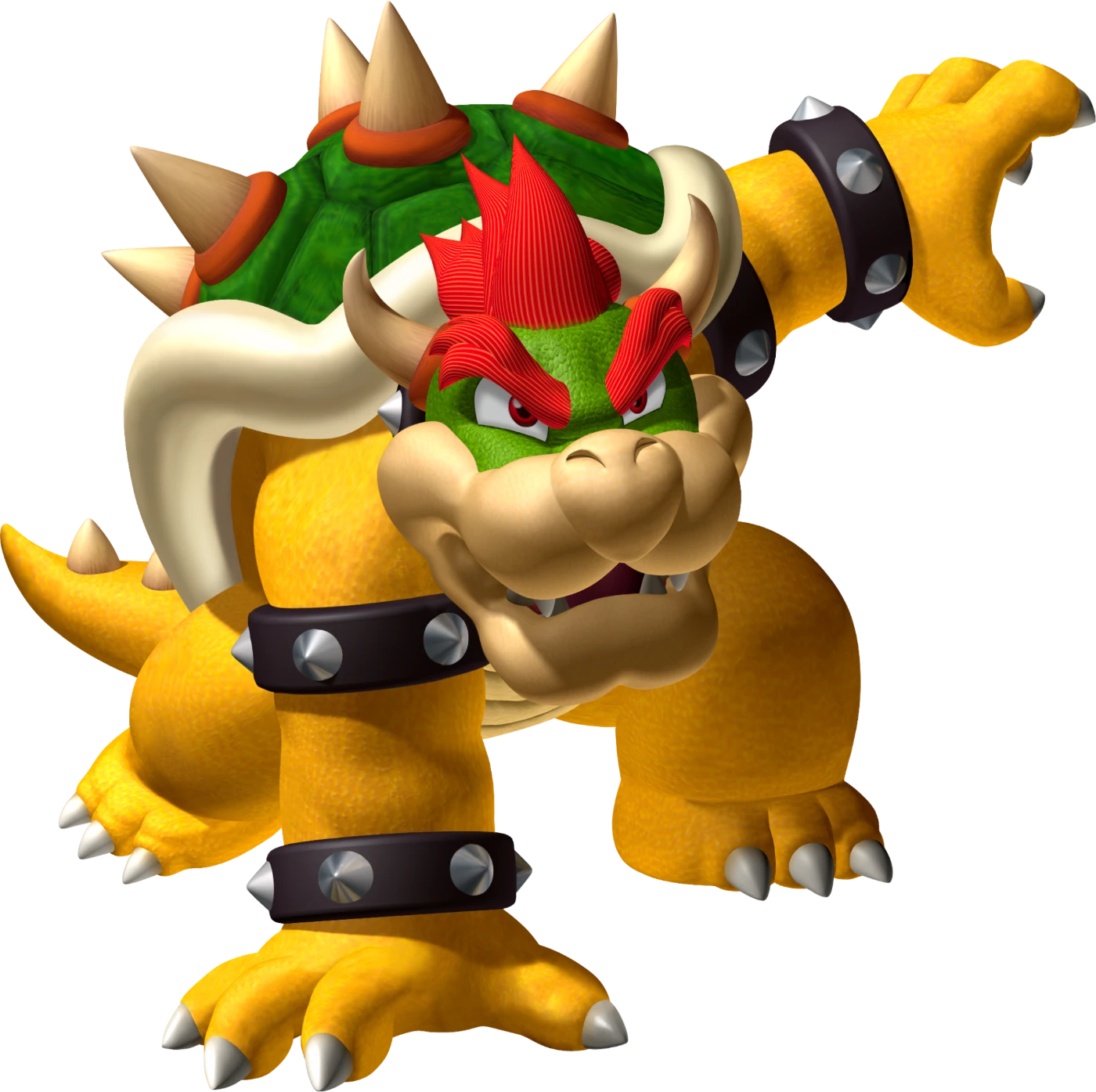
BowserVillain, host and final boss
The host of a dinner party nobody should have gone to.
Shrinks the heroes with the Minimizer to get at the Sky Crystals, runs the Bowser Spaces and the Final 5 Frenzy, and hosts the last board from inside his pinball machine.
Figure: 38,000 Mario Party Points. Voice: Scott Burns.
Blockhead BowserFinal boss
Bowser as rebuilt by the Megamorph Belt.
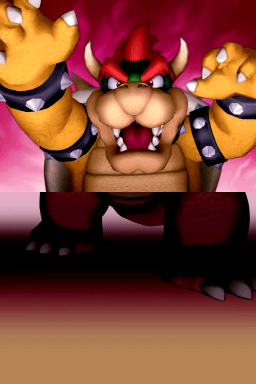
The last boss, fought in Bowser’s Block Party. He takes three forms, a spinning top, a cube and a snake of blocks, and each has a golden block that must be hit five times.
Figure: 50,000 Mario Party Points, the highest total of all.
Every minigame in Mario Party DS
All 73 on Super Mario Wiki’s list: 32 4-Player, 12 1-vs-3, 13 2-vs-2, 5 Battle, 5 Boss and 6 Puzzle games. Each chip gives the type and how it is controlled. Twenty-nine of the 4-Player games and three of the 2-vs-2 games (Cucumberjacks, Hanger Management and Toppling Terror) also exist in two-player Duel versions, played from Duel Spaces and in Duel Battle; Dress for Success, Parachutin’ Gallery and Boo Tag do not.
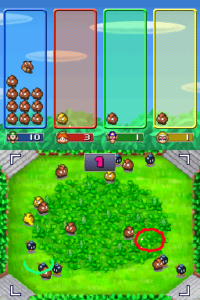
Goomba Wrangler4-Player · touch screenDraw rings round the wandering Goombas with the stylus for 20 seconds, and keep the Bob-ombs out of them.
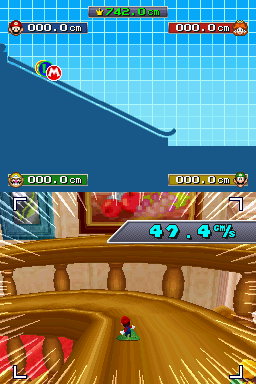
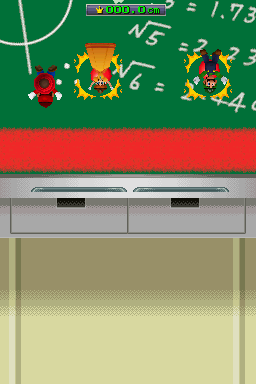
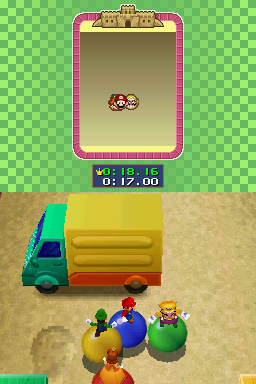
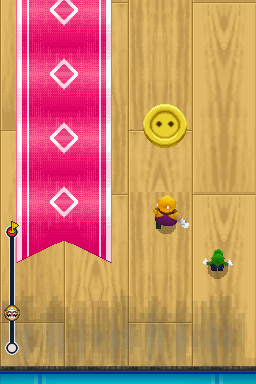
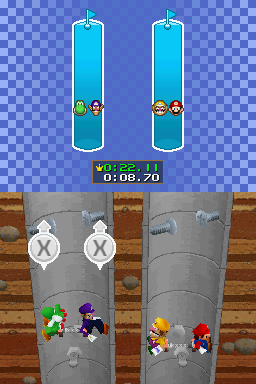
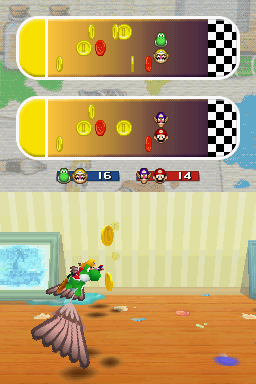
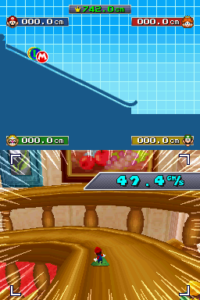
Rail Riders4-Player · touch screenRub the stylus up a banister to build speed, then fly off the end. Longest jump wins.
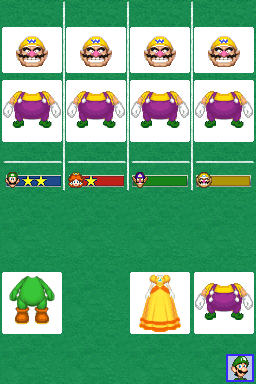
Dress for Success4-Player · touch screenA face appears: tap the body that belongs to it before anyone else does. First to three points.
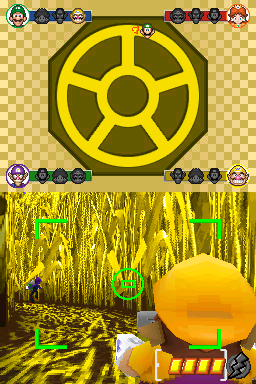
Camera Shy4-Player · buttonsStalk the others through a maize maze with a camera and snap each of them when the frame turns green.
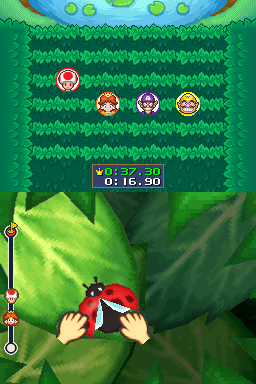
Hedge Honcho4-Player · touch screenSweep the leaves off a hedge with the stylus to reach the pond, without disturbing the bees.
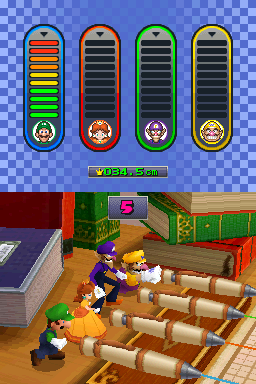
Study Fall4-Player · buttonsSlide down a magnetic board and brake as near the red line as you dare, missing the erasers on the way.
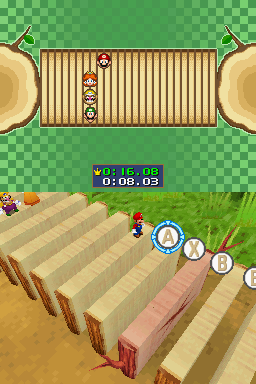
Domino Effect4-Player · buttonsRun along a line of toppling planks, pressing the button shown above each one to make the jump.
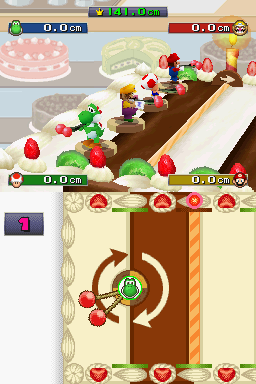
Cherry-Go-Round4-Player · touch screenWhirl a pair of cherries round with the stylus for five seconds and let fly. Longest throw wins.
Trace Cadets4-Player · touch screenTrace round the shapes you are given, one after another, until your square is filled.
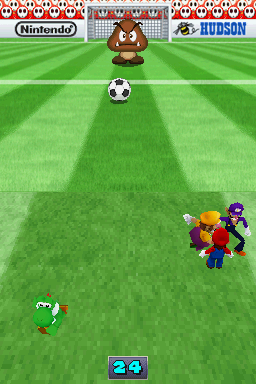
Soccer Survival4-Player · buttonsA Goomba boots footballs at you. Run and jump to stay in the game; last player standing wins.
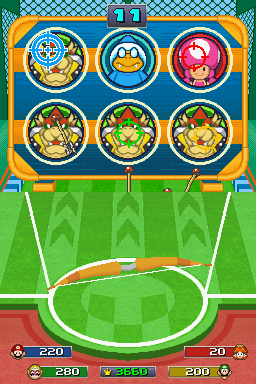
Hot Shots4-Player · touch screenA shooting gallery on the touch screen: hit Bowser and Kamek for points and spare Toadette.
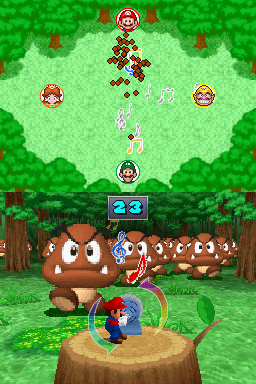
Call of the Goomba4-Player · touch screenTurn a crank in time with the tune to charm Goombas over to your side. The tune is the Super Mario Bros. ground theme.
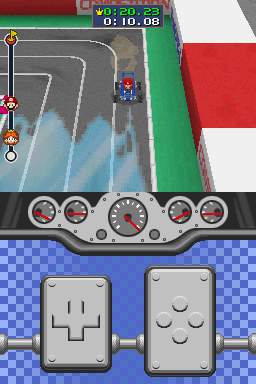
Pedal Pushers4-Player · buttonsRace remote-control karts round a toy track by pressing the left and right pedals in turn.
Roller Coasters4-Player · touch screenRoll a rubber ball across the sand to a sandcastle, round buckets, blocks and toy trucks.
Get the Lead Out4-Player · buttonsHammer the A Button for ten seconds to click as much lead as you can out of a propelling pencil.
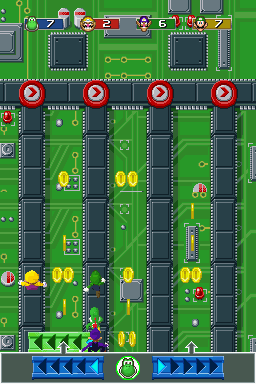
Shortcut Circuit4-Player · touch screenDrag bridge pieces into place so that your route takes in as many coins as possible.
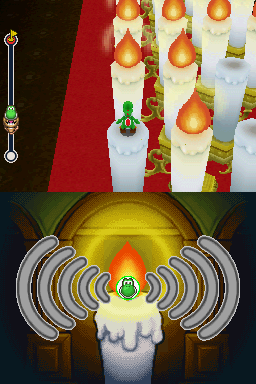
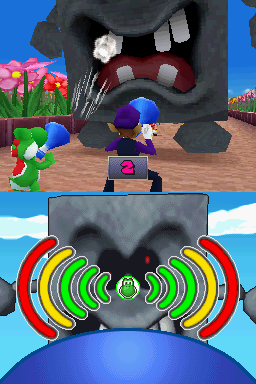
Big Blowout4-Player · microphoneRun along the tops of a row of candles, blowing into the microphone to put each one out, and be first across the line.
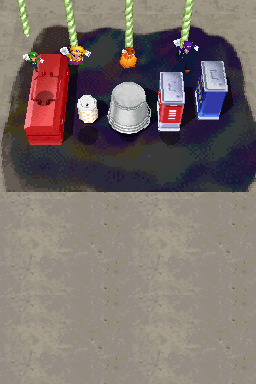
Trash Landing4-Player · buttonsChoose a rope, swing across a garage and let go where you think something is hidden below to land on.
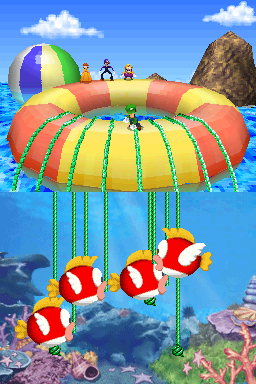
Cheep Cheep Chance4-Player · buttonsPure luck: pick a rope on a rubber ring. A Cheep Cheep on the end keeps you out of the water.
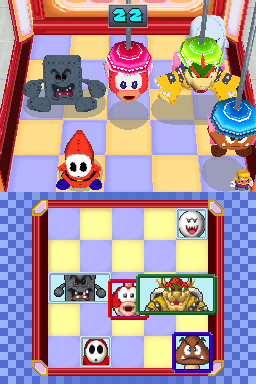
Whomp-a-thon4-Player · buttonsWhomps tremble, then slam down into a sandpit. Do not be underneath, for 30 seconds.
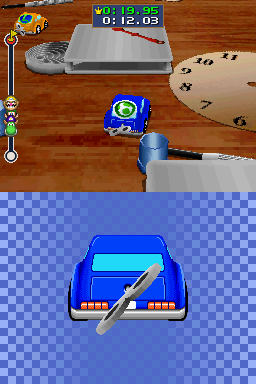
Twist and Route4-Player · touch screen and buttonsWind up a clockwork car with circles of the stylus, then steer it to the finish.
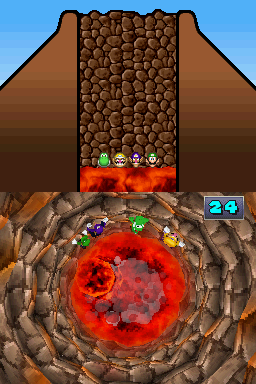
Crater Crawl4-Player · buttonsClimb out of an erupting volcano, dodging the columns of lava.
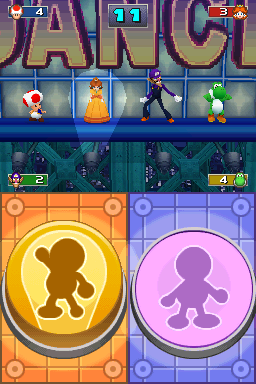
Boogie Beam4-Player · touch screenStrike one pose when the spotlight is on you and another when it is not. Most correct poses wins.
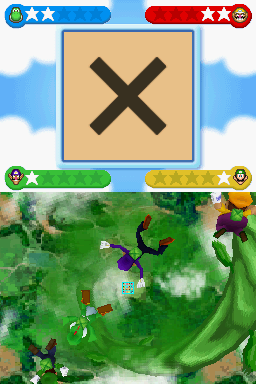
Parachutin’ Gallery4-Player · buttonsSkydive through the panel that matches the one on the top screen, five times over.
Boo Tag4-Player · buttonsA Boo has hold of you: tag someone else to pass it on. Least time haunted wins.
Dust Buddies4-Player · buttonsRun from a vacuum cleaner over a course of obstacles. First home, or last one not caught, wins.
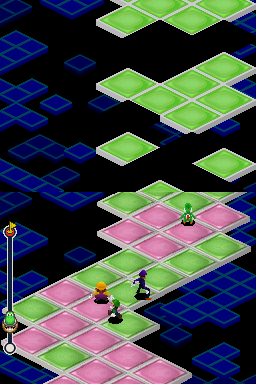
Cyber Scamper4-Player · buttonsCross a shifting floor of tiles full of holes to the blue tile at the far end.
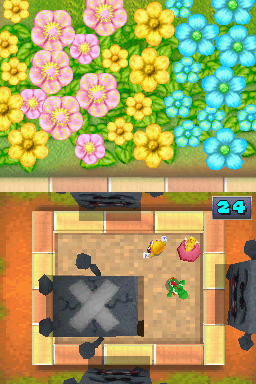
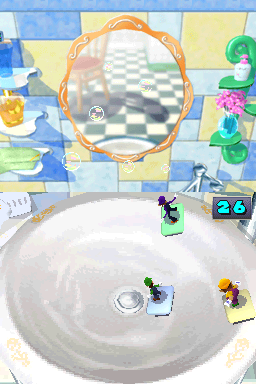
Soap Surfers4-Player · buttonsDodgems on bars of soap in a sink. The last player left in it wins.
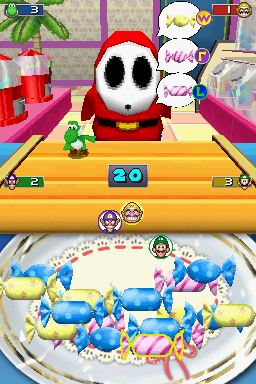
Sweet Sleuth4-Player · touch screenPick the right sweets out of a dish and drag them over to a Shy Guy.
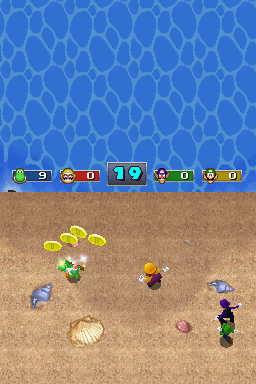
Tidal Fools4-Player · buttonsGather coins on a beach between the waves; red ones are worth five.
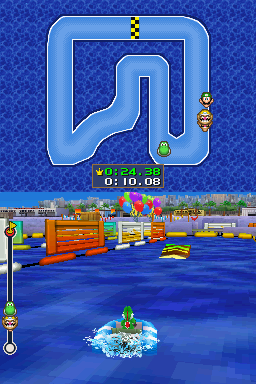
Raft Riot4-Player · buttonsA race of motor rafts along a water course, with buoys to avoid and ramps for a boost.
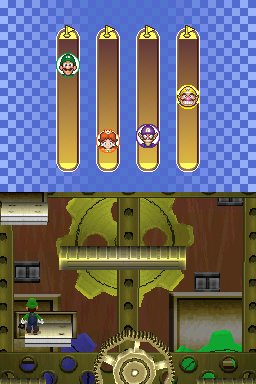
All Geared Up4-Player · buttonsClimb the works of a grandfather clock from platform to platform, getting in each other’s way.
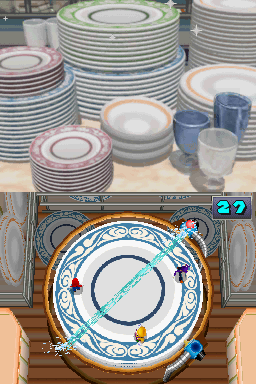
Power Washer1-vs-3 · touch screen for one, buttons for threeOne player hoses the other three off a dirty plate with the stylus; they need only one survivor.
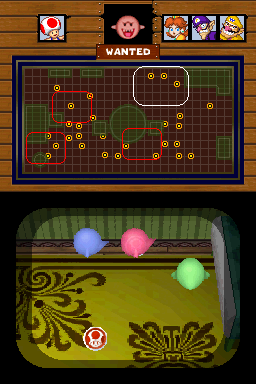
Peek-a-Boo1-vs-3 · touch screen and buttonsBoth sides hunt for Boos, the solo player with a bigger, faster view than the three. Most Boos caught wins.
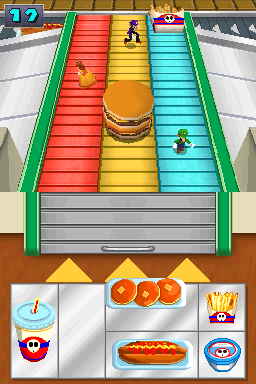
Fast Food Frenzy1-vs-3 · touch screen for one, buttons for threeOne player drops food on to a conveyor belt to knock the three runners off it.
Track Star1-vs-3 · buttonsOne player drives a toy steam engine at three on foot, and has three rounds to run them all down.
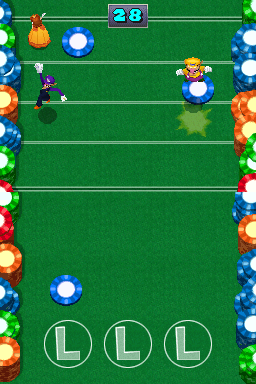
Shuffleboard Showdown1-vs-3 · touch screen for one, buttons for threeOne player flicks chips down the board with the stylus at three who must dodge for 30 seconds. Not in the Korean version.
Flash and Dash1-vs-3 · buttonsThree hunt one through a dark maze by torchlight until the clock runs out.
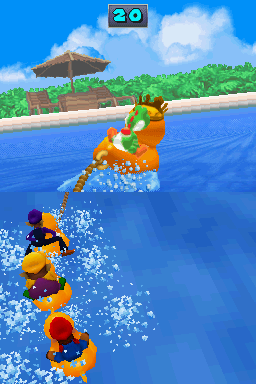
Rubber Ducky Rodeo1-vs-3 · buttonsOne player on a giant rubber duck tries to tip three rivals off their little ones.
Plush Crush1-vs-3 · buttons for one, touch screen for threeThree players drop soft toys from above with the stylus; the one underneath must dodge for 30 seconds.
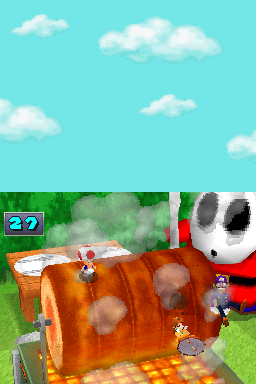
Rotisserie Rampage1-vs-3 · touch screen for one, buttons for threeThe solo player spins a joint of meat on a spit while three run on top of it to stay on.
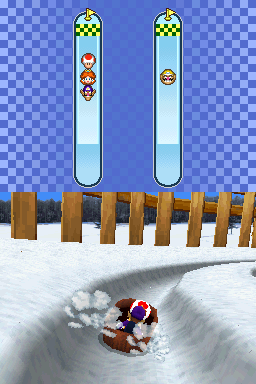
Nothing to Luge1-vs-3 · buttonsA downhill race in the snow: one player on a wooden spoon against three sharing a clog.
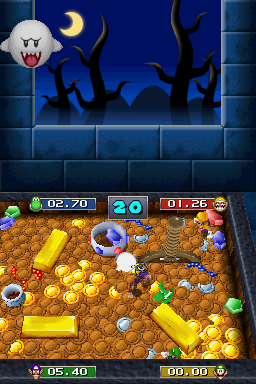
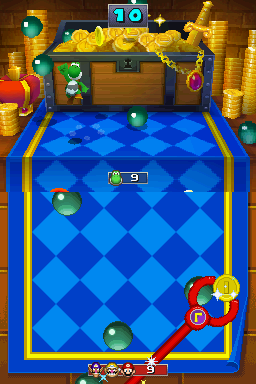
Penny Pinchers1-vs-3 · buttons for one, touch screen for threeOne player scoops coins from a treasure chest while three catch the spills with grabbers. Everybody keeps what they collect.
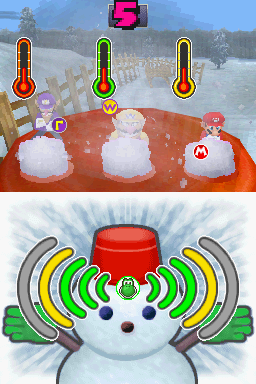
Gusty Blizzard1-vs-3 · microphone for one, touch screen for threeOne player blows into the microphone to freeze the other three, who rub themselves warm with the stylus.
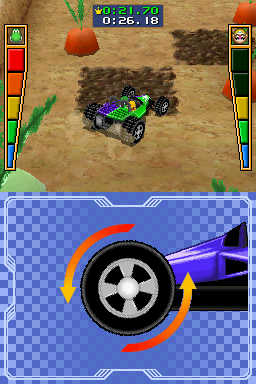
Soil Toil2-vs-2 · touch screenEach partner spins one front wheel of a toy car, which veers towards the slower side. First through the vegetable patch wins.
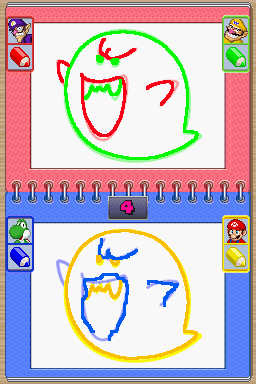
Double Vision2-vs-2 · touch screenShare a picture between you, each tracing only the lines in your own colour. The more accurate pair wins.
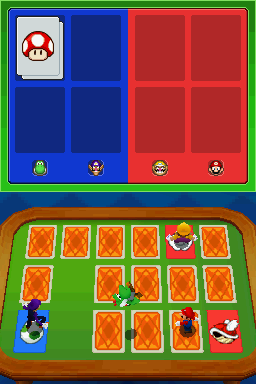
Memory Mash2-vs-2 · buttonsGround-pound face-down cards to turn them over and find pairs. First team to four pairs.
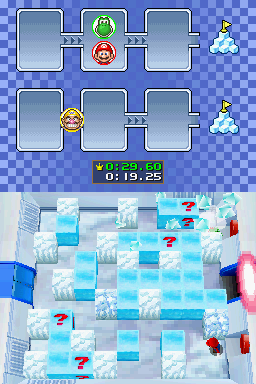
Cube Crushers2-vs-2 · buttonsPunch through ice blocks and press the exit switches together to clear three rooms of an ice maze.
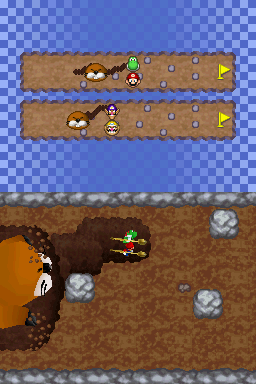
Mole Thrill2-vs-2 · buttonsDig for the finish with a Monty Mole close behind. Get caught and you lose.
Sprinkler Scalers2-vs-2 · buttonsClimb a pipe by pressing the same buttons as your partner, turning it to avoid what is in the way.
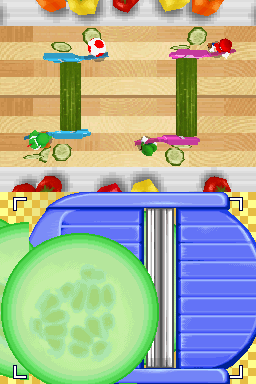
Cucumberjacks2-vs-2 · touch screenSaw through a cucumber from both ends at once with strokes of the stylus.
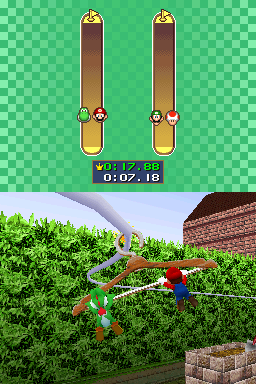
Hanger Management2-vs-2 · buttonsRide a coat hanger along a line together, leaning left and right past the obstacles.
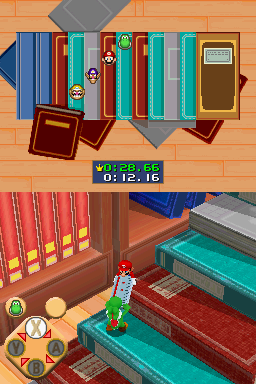
Book It!2-vs-2 · buttonsTake turns pressing the buttons shown to boost your partner up a staircase of books.
Airbrushers2-vs-2 · buttonsFlap about as a pair collecting coins, red ones worth five. Everybody keeps their haul.
Toppling Terror2-vs-2 · microphoneBoth pairs blow into their microphones for five seconds to tip a Whomp over on to the other side.
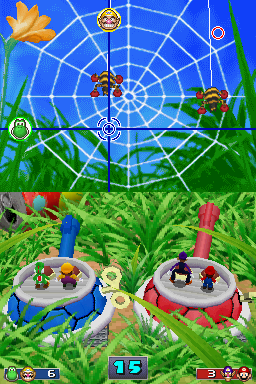
Crazy Crosshairs2-vs-2 · buttonsOne partner aims a toy tank left and right, the other up and down, to shoot Scuttlebugs off a web.
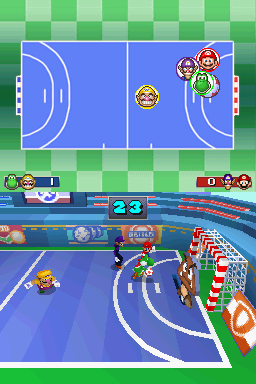
Shorty Scorers2-vs-2 · buttonsPass and punch a ball past a Goomba goalkeeper for 45 seconds.
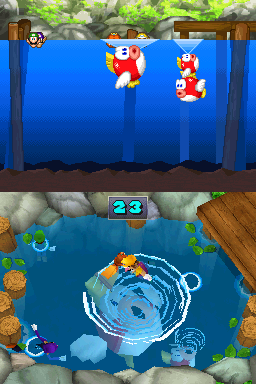
Cheep ChumpBattle · buttonsPaddle round a pool, steering clear of the whirlpools three Cheep Cheeps stir up. Last afloat wins.
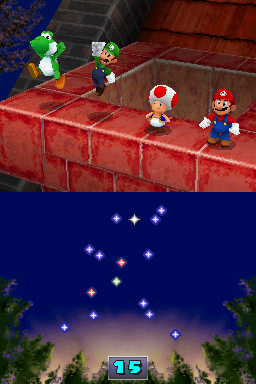
Star CatchersBattle · touch screenTap each star as it appears in the night sky before anyone else can, for 30 seconds.
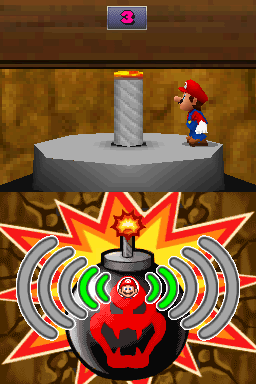
Short FuseBattle · microphoneTake turns blowing into the microphone at the fuse of a bomb. Whoever sets it off is out, until one is left.
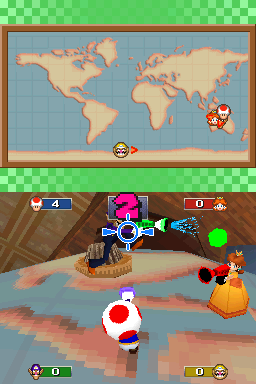
Globe GunnersBattle · buttonsRun round a desk globe shooting at each other for 30 seconds. Most hits wins.
Chips and DipsBattle · touch screenTurn over cards for chips across three rounds; a Bowser card halves your pile. Not in the Korean version.
Feed and SeedBoss · Wiggler’s GardenDangling from a balloon, catch the bomb seeds the Piranha Plant spits and throw them back down its throat. Three hits.
Hammer ChimeBoss · Toadette’s Music RoomWatch Hammer Bro play a pattern on four drums and tap it back with the stylus before his note reaches you. Three correct rounds beat him.
HexoskeletonBoss · DK’s Stone StatueGround-pound the magic switches as they light up while Dry Bones attacks. Three hits.
Book BashBoss · Kamek’s LibraryFly down the library corridor shooting books and dodging bookcases, then splatter Kamek with ink three times.
Bowser’s Block PartyBoss · Bowser’s Pinball MachineBlockhead Bowser takes three shapes, a spinning top, a cube and a snake of blocks. Hit the golden block five times in each.
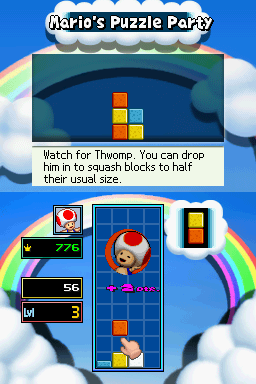
Mario’s Puzzle PartyPuzzleFrom Mario Party 3: a falling-block puzzle in which you join blocks of the same colour.
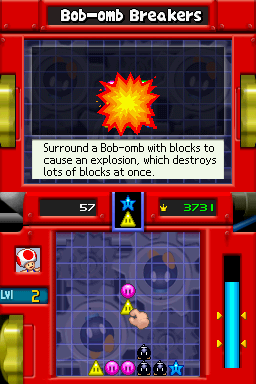
Bob-omb BreakersPuzzleFrom Mario Party 4: line up three matching shapes to clear them.
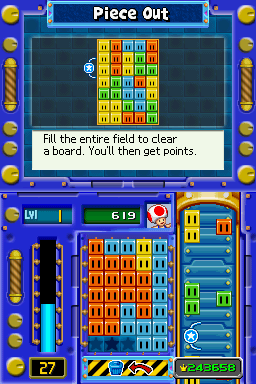
Piece OutPuzzleFrom Mario Party 5: fit the shapes arriving on a conveyor belt into a grid.
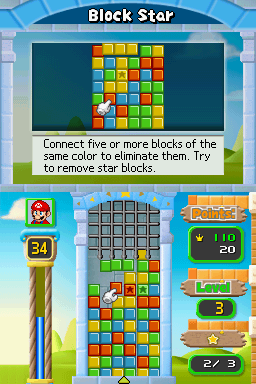
Block StarPuzzleFrom Mario Party 6, and later chosen for The Top 100 and Superstars in its original form.
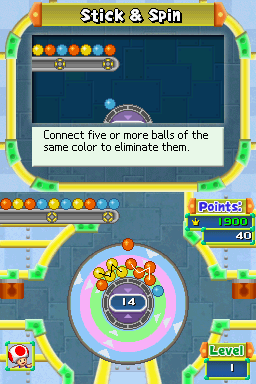
Stick and SpinPuzzleFrom Mario Party 7: turn the stage and drop balls to link five or more of one colour.
Triangle TwistersPuzzle · newSpin triangles to join four or more of a colour. Frenzy Mode is a 60-second scramble; Focus Mode has you copy patterns from the top screen. Unlocked by finishing Story Mode.
The people who made it
Names and roles from the staff roll, as transcribed by Super Mario Wiki.
Kouji MatsuuraGame directorDirected the game at Hudson Soft.
Hiroshi Sato and Atsushi IkedaProducersThe same pair went on to produce Mario Party 9 at NDcube and Nintendo.
Satoru Iwata and Hidetoshi EndoExecutive producersWith Shinji Hatano as senior producer.
Kenji KikuchiSenior directorDirector of the Nintendo 64 Mario Parties, in an overseeing role.
Yuka SasakiPlanning directorLed the game’s design.
Hideki NishimotoProgram directorLed the programming.
Akihiro ShibataVisual directorWith Kanae Dohta and Tsuyoshi Watanabe as graphic supervisors.
Hironobu Yahata and Shinya OhtougeMusicComposers of the score. Ichiro Shimakura was sound director and Koji Kondo is among those credited with sound support.
Shigeru Miyamoto and Takashi TezukaSupervisorsMiyamoto is also credited, with Hiroji Kiyotake, for original character design.
Charles MartinetVoice of Mario, Luigi, Wario and WaluigiHalf of the playable cast.
Sam Kelly and Deanna MustardVoices of Peach and Toad, and of DaisyKazumi Totaka is Yoshi.
Scott BurnsVoice of BowserUncredited, according to Super Mario Wiki. Delores Rogers is Bowser Jr.
Advertisement
How It Was Made
Hudson Soft left little on the record about the making of its last Mario Party. What follows comes from the credits, from the instruction booklet and from reports of the time gathered by Wikipedia.
Hudson’s last party
Mario Party DS was developed by Hudson Soft, as almost every Mario Party before it had been; Super Mario Wiki’s infobox adds CAProduction and Nintendo SPD Group No. 4. The game director was Kouji Matsuura, with Yuka Sasaki directing the planning, Hideki Nishimoto the programming and Akihiro Shibata the visuals. Above them are names from the console games: producers Hiroshi Sato and Atsushi Ikeda and senior director Kenji Kikuchi.
It turned out to be the end of the line. Both Super Mario Wiki and Wikipedia record it as the last Mario Party made by Hudson Soft, and the wiki adds that it was the last Mario game of any kind the studio developed before it was dissolved in 2012. Sato, Ikeda and Kikuchi reappear in the credits of Mario Party 9, made at NDcube.
Built for the DS
The international logo.
According to Wikipedia the game was not shown at Nintendo’s E3 press conference in 2007, appearing only in a short trailer whose selling point was four people playing wirelessly from one cartridge. The finished game makes good on it: the instruction booklet sets out which modes can be shared by Download Play, and nearly all of them can.
A great deal was reused. Character animations come from Mario Party 4 to 7, select-screen pictures and voice clips from Mario Party 8, and much of the promotional artwork from other games altogether. Against that, Nintendo’s own page sets “five brand new boards and 70 fresh mini-games”.
What changed before release
Early screenshots show a different board display, with a box for each player along the top of the screen and an X between the icon and the number of coins or Stars. The boxes were dropped, Super Mario Wiki suggests, because a coin total can run past 100. The numbers that pop up when coins or Stars are won or lost were gold in those early versions; in the finished game they are blue or red.
The Cutting Room Floor documents a debug menu, displayed on the touch screen, that can be reached with Action Replay codes.
Series Firsts
What Mario Party DS added to the series, and what it brought to a close. Each point is from Super Mario Wiki, the instruction booklet or the later games’ own pages.
1HexesTraps that players lay on the board for one another. Super Mario Wiki compares them to the Character Spaces of earlier games and notes that items much like them appear in Super Mario Party Jamboree.
2A boss on every boardEach board in Story Mode ends in a boss minigame. Mario Party 9 took up the idea, as Super Mario Wiki notes on that game’s page.
3Step It UpThe staircase race in Minigame Mode, which Mario Party 9 brought back.
4The Star PipeAn item that takes you straight to the Star. Super Mario Party brought it back as the Golden Pipe.
5One Game Card for fourParty Mode and Minigame Mode can be shared with three other DS systems by Download Play.
6Triangle TwistersA puzzle game made for this entry, alongside five revived from Mario Party 3 to 7.
7The last by Hudson SoftThe final Mario Party from the studio that began the series, and by Super Mario Wiki’s account its last Mario game of any kind.
Cheats & Secrets
There are no button codes. Everything is unlocked by playing Story Mode or by piling up Mario Party Points, which are earned in single-player games.
Unlock Triangle Twisters and Boss Bash
Finish Story Mode with any character. Triangle Twisters appears in Puzzle Mode and Boss Bash in Minigame Mode.
Unlock Bowser’s Pinball Machine
According to Super Mario Wiki the fifth board becomes available outside the story once Story Mode has been completed.
Unlock the hardest computer players
The instruction booklet lists Easy, Normal and Hard, with a fourth level locked at first. Super Mario Wiki says clearing a board in Story Mode opens the expert setting.
Winning Story Mode
Every board is ten turns with no Bonus Stars, against three opponents the game chooses. A tie with a computer player counts as your win. Lose the board and you replay it.
Character figures
Finish Story Mode with each of the eight characters for their figures and Master badges. The other 22 figures arrive at Mario Party Points totals: Goomba at 2,000, Scuttlebug at 4,000, Cheep Cheep at 6,000, Boo at 8,000, Shy Guy at 10,000, Whomp at 12,000, Monty Mole at 14,000, Bob-omb at 16,000, Wiggler at 18,000 and Toadette at 20,000, on up to Bowser Jr. at 36,000, Bowser at 38,000, the Star and the Ztar at 40,000 and Blockhead Bowser at 50,000.
Badges
There are 30. Everyone starts with the Mario Party DS Beginner badge. Eight Master badges come from clearing the story with each character, and a run of Rival badges from points totals: Goomba Rival at 1,000, Scuttlebug Rival at 3,000, Cheep Cheep Rival at 5,000, Boo Rival at 7,000 and so on. One badge can be shown beside your points.
Boss trophies and board features
The 25 boss trophies are earned by winning each boss minigame a set number of times, up to six for Bowser’s Block Party. The 71 board features, fourteen for each board plus a secret Toad Statue, are rewards for feats on that board such as finishing first or landing on particular spaces.
Cheap Stars in the Music Room
The Musical Note’s price runs 5, 10, 15, 20, 30 and then back to 5. If you are short of coins, let somebody else buy the expensive ones.
Splurge on DK’s Stone Statue
The Star Splurge Space sells as many Stars as you can afford at 20 coins each, so arrive rich. Dry Bones’ coffin can throw you straight to its doorstep, or back to the start.
Escaping the Bowser Zone
On Bowser’s Pinball Machine the Zero Flame takes every coin and Star but leaves your items. Keep a Double or Triple Dice Set, a Warp Dice Block or a Star Pipe in hand: those are the ways out.
Final 5 Frenzy
With five turns to go the player in last place spins Bowser’s roulette for coins or Stars, Friend Spaces turn into Duel Spaces, and one result drops the price of a Star to five coins.
Turn the microphone off
Microphone minigames can be left out of the rotation, which is worth knowing before a train journey.
SLB’s own cheats page for the game is linked under Reference below.
Videos
Both films date from the game’s return on the Wii U Virtual Console in 2016: gameplay footage from Nintendo’s official Japanese channel, and Nintendo’s European trailer as uploaded by a news site.
Gameplay footage of the Wii U Virtual Console release, from Nintendo’s official Japanese YouTube channel. In Japanese.
Nintendo’s European trailer for the Virtual Console version, in a third-party upload by the news site Nintendo Everything.
Trivia & Interesting Facts
Super Mario Wiki counts Mario Party DS as the fourteenth game in the series.
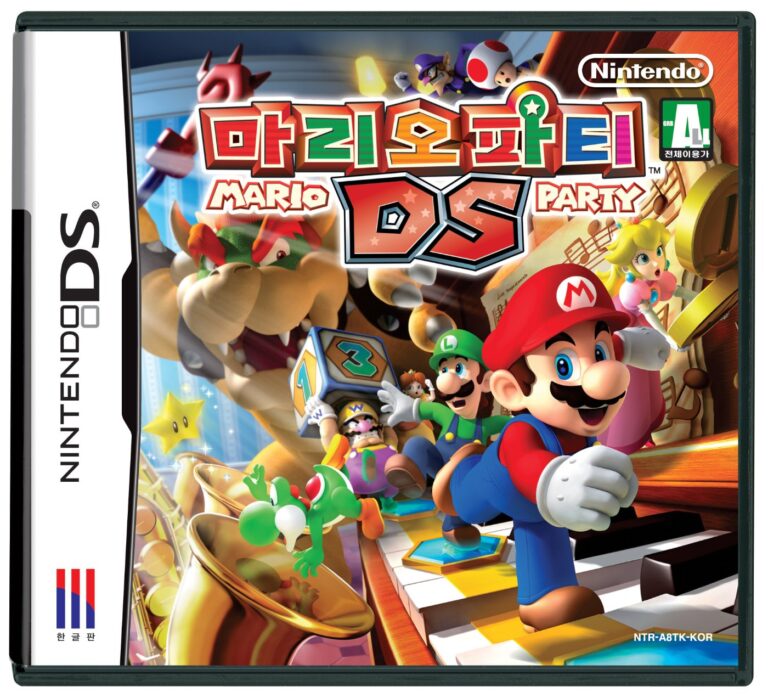
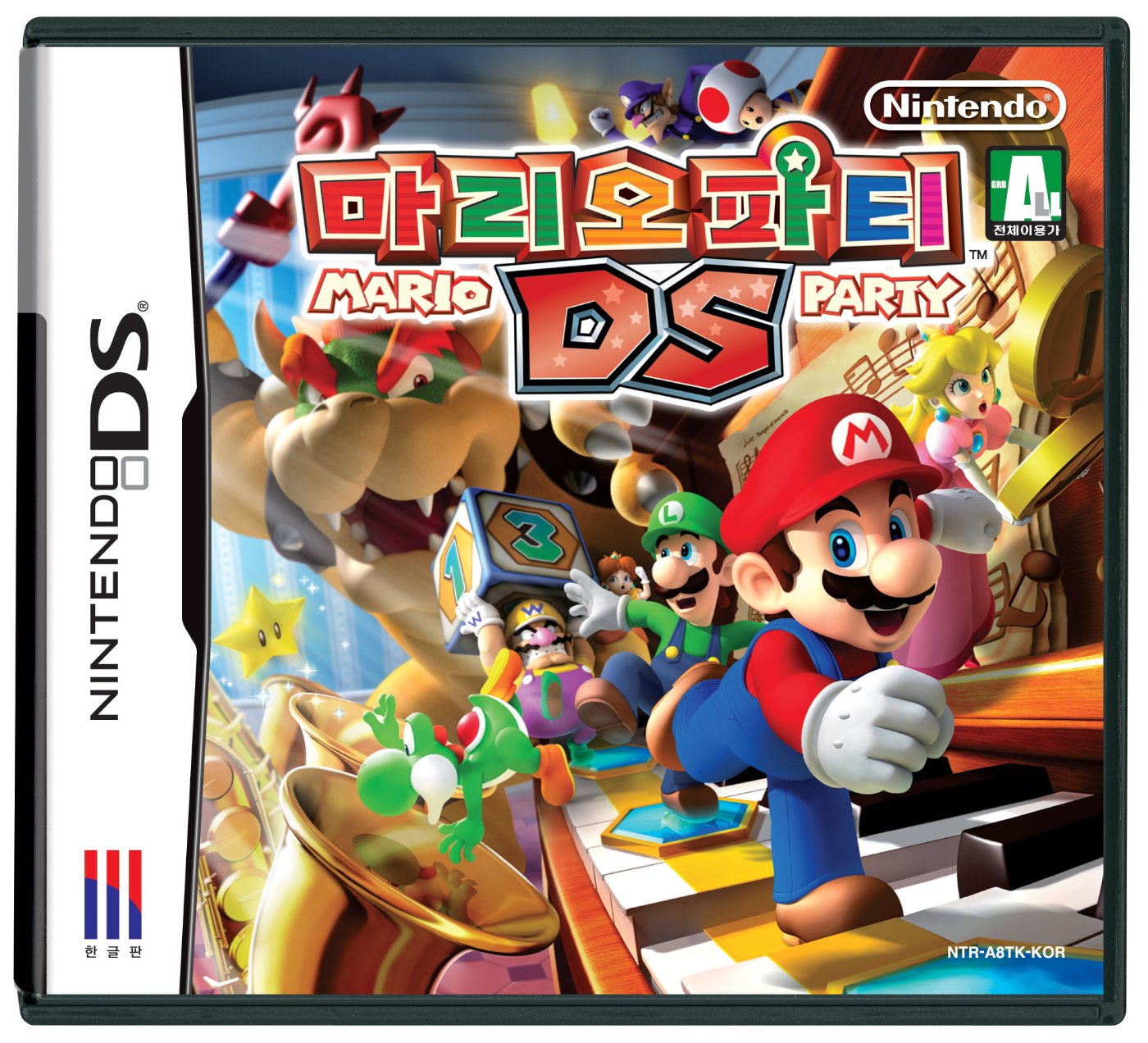
The Korean box.The Korean version, released in May 2008, is missing two minigames, Shuffleboard Showdown and Chips and Dips, and swaps the roulette on Bowser’s Pinball Machine for a Whac-A-Mole game.
Bowser’s Pinball Machine contains no Bowser Spaces and no pinballs, a peculiarity it shares with Bowser’s Enchanted Inferno! in Mario Party 7. The results screen shows a count for Bowser Spaces all the same.
How many minigames? Nintendo’s page says 70, Super Mario Wiki lists 73, and counting the 32 Duel versions separately gives 105.
The sheet music in the background of Toadette’s Music Room is real: it shows bars 2 to 5 of “Let’s Get a Move On” from Mario Party 3, as a 2022 Nintendo Life article pointed out.
Kamek’s spells have numbers. Spell Number 8 swaps you with another player; Spell Number 88 swaps everybody.
On DK’s Stone Statue the limit on Stars bought in one visit is 99, where Faire Square in Mario Party 6 stopped at five. With coins capped at 999, more than 49 at once is possible only when the Final 5 Frenzy has cut the price to five coins.
The Piranha Plant’s fire on Wiggler’s Garden sometimes misses, and according to an analysis cited by Super Mario Wiki it misses more often when the player is in third or fourth place. The plunger on Bowser’s Pinball Machine is similarly kinder to players who are behind.
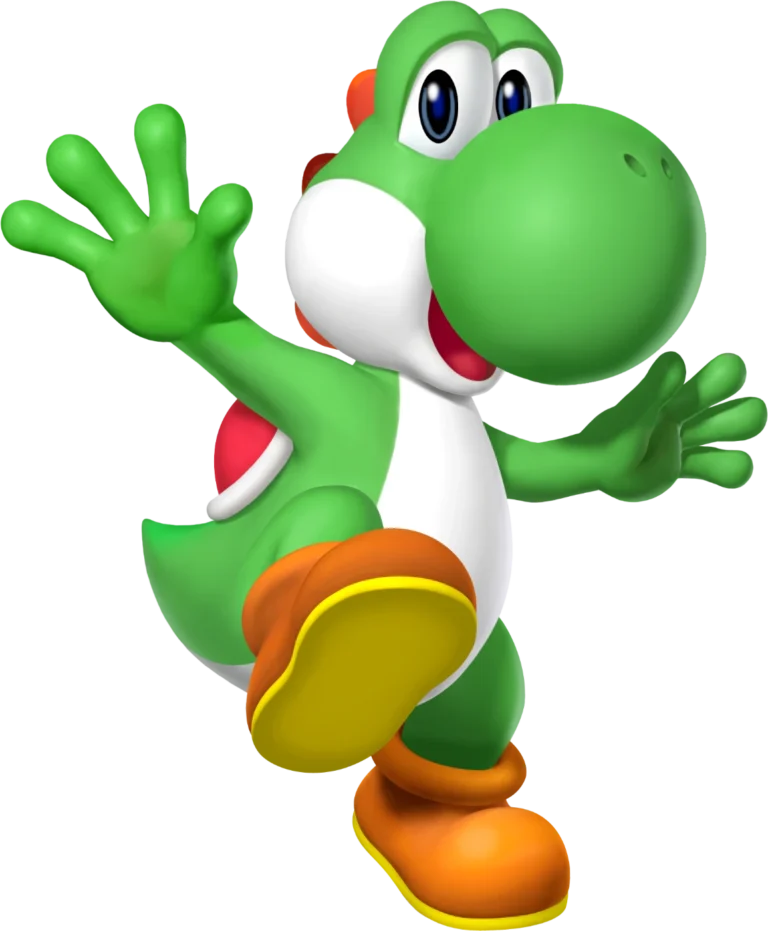
Yoshi’s artwork for the game.Yoshi’s artwork is an edited version of his Super Mario 64 DS picture, in which he was holding Mario’s cap above his head.
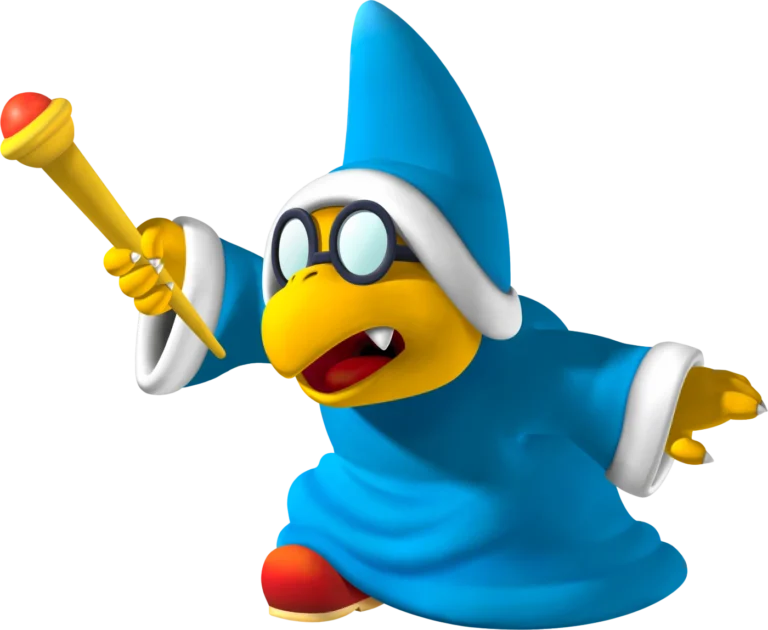
Kamek, in artwork borrowed from Super Mario Galaxy.Toad’s and Kamek’s artwork comes from Super Mario Galaxy, which was released in the same month.
One of the Gallery’s board features: the Bowser Zone.The last figure in the Gallery is Blockhead Bowser, which needs 50,000 Mario Party Points.
In Score Scuffle every minigame is worth up to 1,000 points except Get the Lead Out, which tops out at 999.
The default records in Boss Bash are five minutes a fight, 25 minutes for the set.
A Space Swap Hex that drops somebody into the Bowser Zone skips the usual warning message, “Oh no! You’re in the Bowser Zone!”
Team names in Tag Battle depend on which two characters are paired.
The Wii U Virtual Console icon.On the Wii U Virtual Console the game is for one player only, because the wireless features could not be reproduced. It cost £8.99 in Europe and $9.99 in North America.
In Japan the game came out on 8 November 2007; Super Mario Wiki also lists releases in Taiwan the same day, Mexico on 19 November and South Africa in July 2009.
Regional Box Art
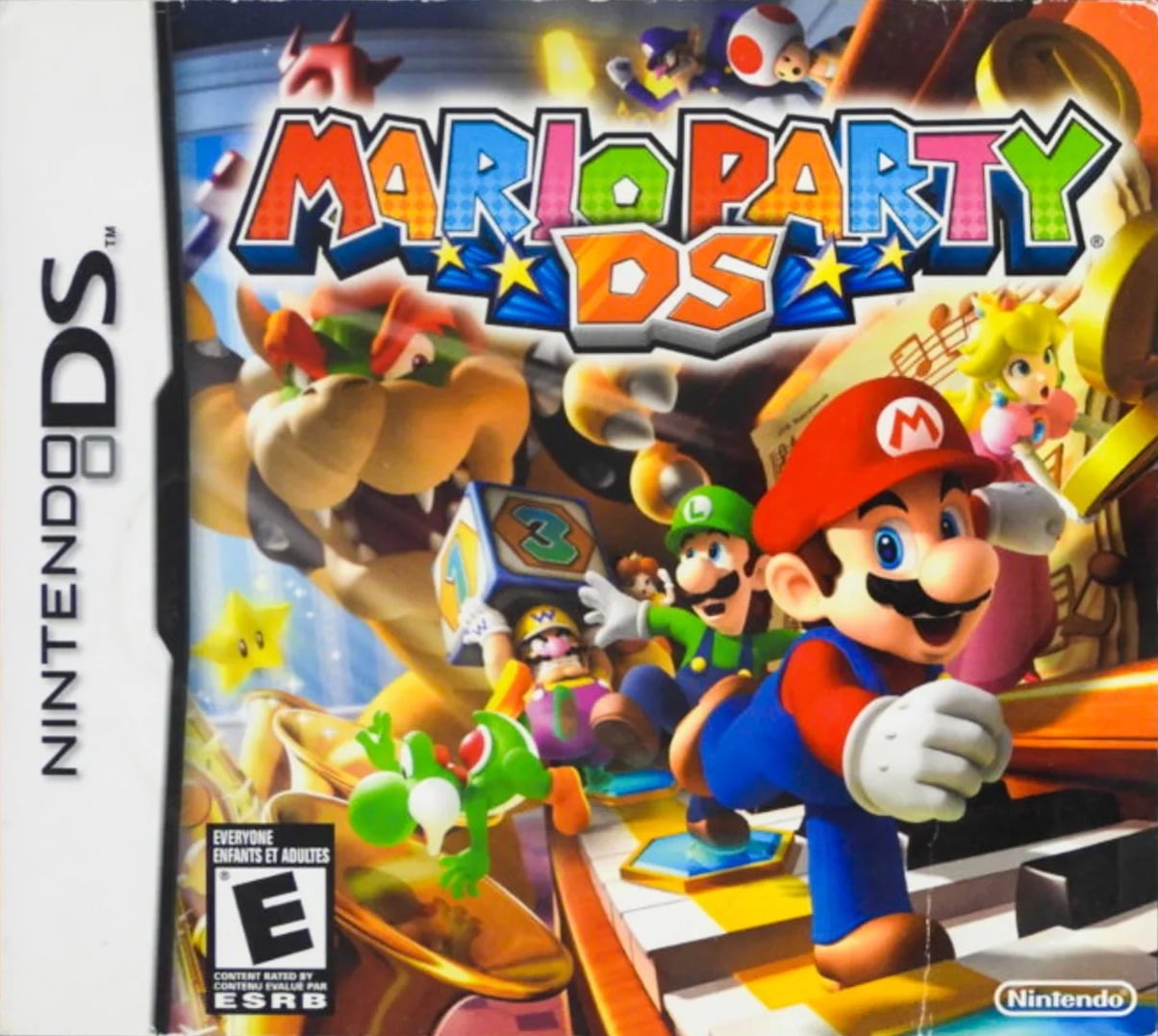
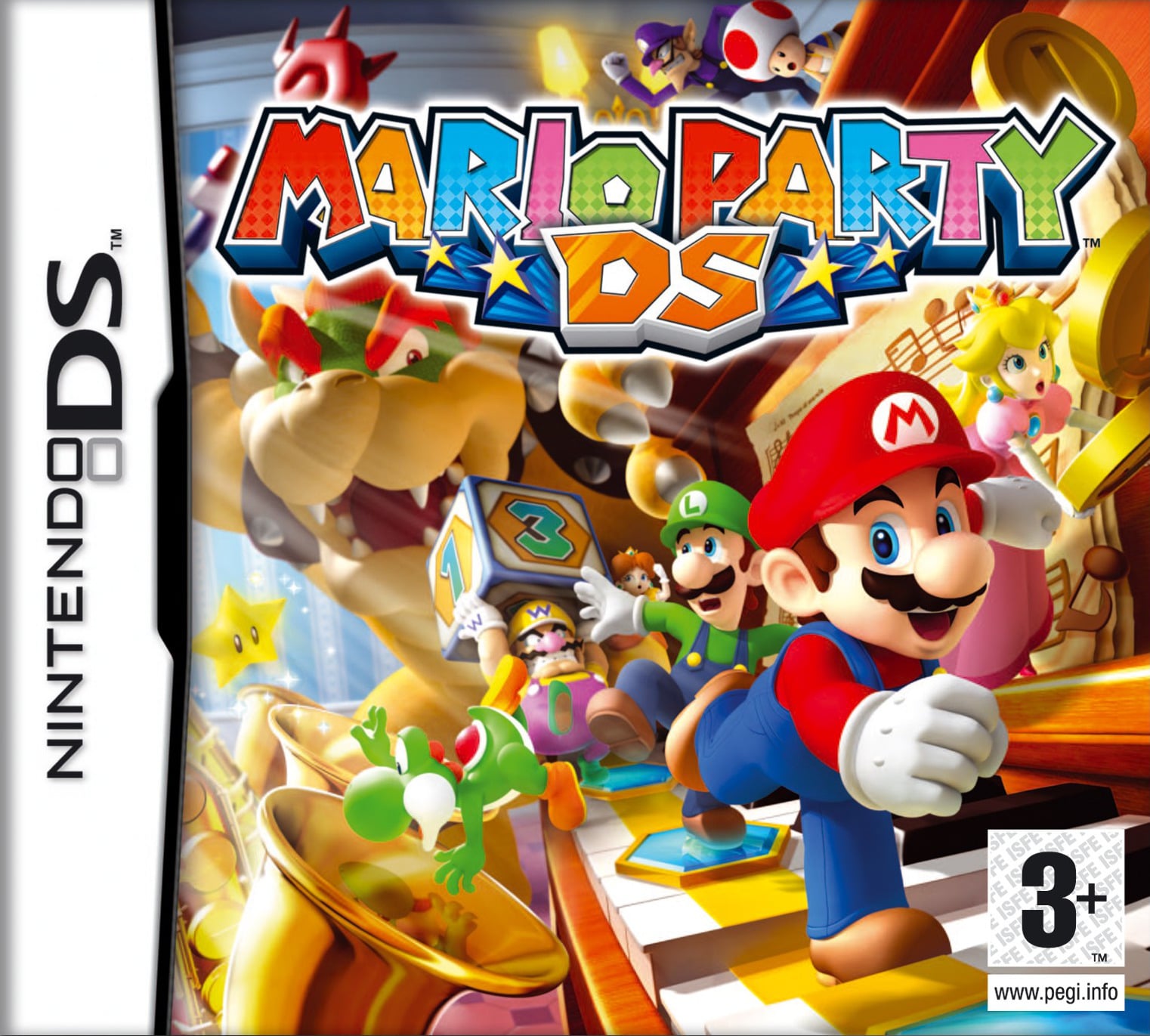
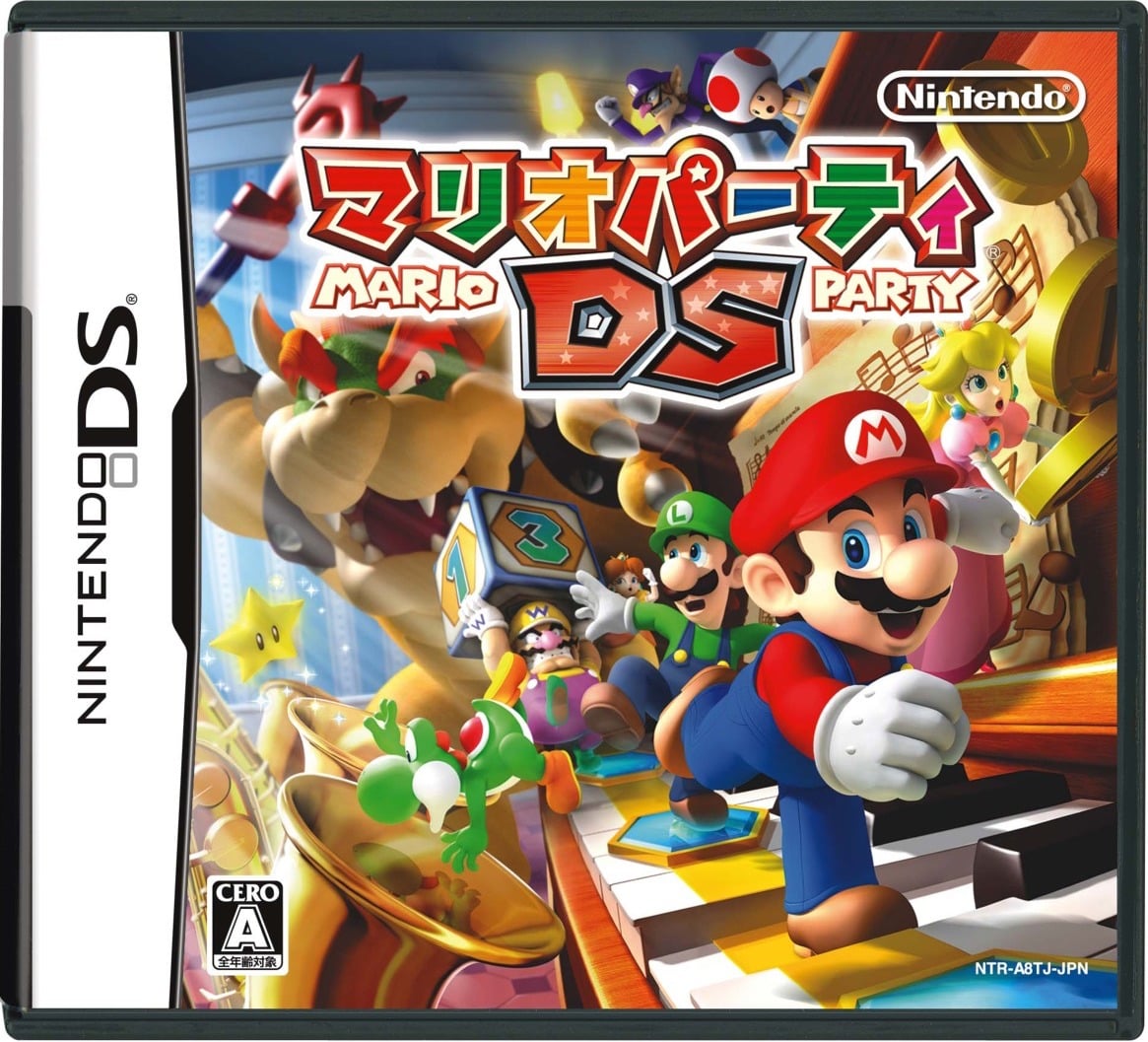
The same painting of the shrunken party was used everywhere. Super Mario Wiki keeps the first printings and the later reissues, which move the logo slightly.
North America (2007)North America, later printingThe logo sits in a slightly different position.CanadaEurope (2007)Europe, later printingGermanyGermany, large USK ratingGermany, later printingAustralia (2007)Japan (2007)South Korea (2008)
Screenshots
Title screens from three regions, and the bosses as the game draws them.
The Japanese title screen.The Korean title screen.The Piranha Plant of Feed and Seed.Hammer Bro at his drums.Dry Bones among the hexagons of Hexoskeleton.Kamek and his book.Bowser, gloating.The in-game logo.
Artwork & Media Gallery
Logos, official artwork, wallpapers and a few of the figures from the Gallery.
The Japanese logo.The Korean logo.Peach’s wallpaper.Luigi’s wallpaper.Mario.Luigi.Peach, in artwork from Mario Party 6.Goomba, as modelled in the game.Scuttlebug.Cheep Cheep.Boo.Shy Guy.Whomp.Bob-omb.The Boo figure from the Gallery.The Shy Guy figure.The game’s icon on the Nintendo DS menu.
Legacy & Re-releases
Mario Party DS closed the Hudson Soft era with one of the series’ biggest sellers, and it has been reissued once.
Every release
Nintendo DS (Japan)8 November 2007The first release. Taiwan received it the same day, according to Super Mario Wiki.
Nintendo DS (North America)19 November 2007Also the date given for Mexico.
Nintendo DS (Europe)23 November 2007The date on Nintendo UK’s product page.
Nintendo DS (Australia)6 December 2007The Australian release.
Nintendo DS (South Korea)22 May 2008A Korean-language edition, without two of the minigames.
Wii U Virtual Console (North America, Europe, Australia)21 April 2016A download for one player, with the wireless modes removed.
Wii U Virtual Console (Japan)27 April 2016The Japanese release followed six days later.
After Hudson
No new Mario Party for a console or handheld followed for more than four years. When Mario Party 9 arrived in 2012 it was made by NDcube, with several of this game’s senior staff in its credits, and it kept two of this game’s ideas: the boss minigame and Step It Up. The next handheld entry was Mario Party: Island Tour on Nintendo 3DS.
What lasted
The Star Pipe lives on as the Golden Pipe of Super Mario Party, and Super Mario Wiki sees the Hexes again in the trap-like items of Super Mario Party Jamboree. The minigames themselves have not been so lucky: Mario Party: The Top 100 and Mario Party Superstars both pass the game over. The other Nintendo DS Mario games of the time have their own pages here, among them New Super Mario Bros. and Mario Kart DS, and the rest of the series is on the games hub.
Reviews & Sales
Sales
Mario Party DS was a very big seller. Nintendo’s Financial Results Briefing of 26 April 2011 lists it among the company’s million-sellers with life-to-date sales of 8.21 million worldwide to 31 March 2011, more than three years after release.
It began strongly in Japan, where Wikipedia, citing GamesIndustry.biz and IGN, records about 230,000 copies in the first week, enough to top the chart, and 1.7 million by July 2008 on Famitsu’s figures. For the later total Wikipedia cites a Gizmodo article of 11 September 2015 putting the game past 9 million, which made it the eleventh best-selling game on the Nintendo DS.
8.21mworldwide to 31 March 2011 (Nintendo results briefing, 26 April 2011)
9m+worldwide by September 2015 (Gizmodo, as cited by Wikipedia)
230,000first week in Japan (via Wikipedia)
72Metacritic score
Reviews
Scores as listed by Wikipedia and Super Mario Wiki from the original reviews.
FamitsuJapan · 7, 8, 9 and 9
33/40
GameSpotFrank Provo
8/10
GameSpyBryan Stratton
4/5
Pocket GamerUK
4/5
GameProUS
3.75/5
Nintendo World ReportMichael Cole
7.5/10
IGN AustraliaPatrick Kolan
7.3/10
IGNUS · Craig Harris
7/10
Game InformerBryan Vore
7/10
VideoGamer.comUK
6/10
Nintendo LifeDave Frear · Wii U release, 14 May 2016
6/10
EurogamerEllie Gibson
4/10
GameRevolutionNick Tan
B
MetacriticAggregate
72/100
GameRankingsAggregate
72.17%
The reviews divide on one question: whether you have somebody to play with. GameSpot’s Frank Provo, who gave it 8 out of 10, thought it came into its own in company, made much of the fact that one cartridge serves four players, and found enough variety in the minigames, modes and puzzle games to last. IGN’s Craig Harris called it a solid multiplayer minigame collection that kept many of the old faults, but a better game than the last one on consoles, and his Australian colleague Patrick Kolan recommended it to newcomers.
The dissent came from Eurogamer, where Ellie Gibson found the minigames too simple, too short or too dull, and the Star system unfair to a player who had won every one of them. Game Informer’s Bryan Vore enjoyed the minigames while noting how much still hung on luck; Nintendo World Report’s Michael Cole thought some minigames pure chance and the puzzle games clumsy; GameSpy’s Bryan Stratton wanted more boards and more characters. When the game reappeared on Wii U in 2016, without its multiplayer, Nintendo Life headed its review “Partying alone”, though its reviewer Dave Frear admitted the puzzle games were rather addictive.
SLB User Reviews
Mario Party DS has yet to receive a community review on Super Luigi Bros.
If you’ve played Mario Party DS and would like to submit a review, please get in touch.
To provide the best experiences, we use technologies like cookies to store and/or access device information. Consenting to these technologies will allow us to process data such as browsing behavior or unique IDs on this site. Not consenting or withdrawing consent, may adversely affect certain features and functions.
Functional
Always active
The technical storage or access is strictly necessary for the legitimate purpose of enabling the use of a specific service explicitly requested by the subscriber or user, or for the sole purpose of carrying out the transmission of a communication over an electronic communications network.
Preferences
The technical storage or access is necessary for the legitimate purpose of storing preferences that are not requested by the subscriber or user.
Statistics
The technical storage or access that is used exclusively for statistical purposes.The technical storage or access that is used exclusively for anonymous statistical purposes. Without a subpoena, voluntary compliance on the part of your Internet Service Provider, or additional records from a third party, information stored or retrieved for this purpose alone cannot usually be used to identify you.
Marketing
The technical storage or access is required to create user profiles to send advertising, or to track the user on a website or across several websites for similar marketing purposes.







 Wiggler’s GardenHost: Wiggler · Boss: Piranha Plant (Feed and Seed) · 47 spacesThe Star costs 20 coins and moves after every sale, and the flowers pay out, cost coins or throw you back to the start.
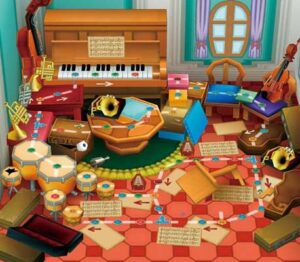 Toadette’s Music RoomHost: Toadette · Boss: Hammer Bro (Hammer Chime) · 48 spacesA Musical Note sells Stars at a price that rises from 5 coins to 30 and then starts again.
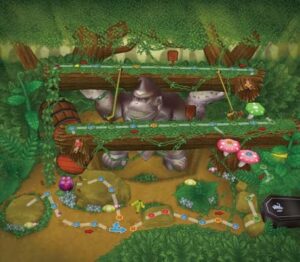 DK’s Stone StatueHost: Diddy Kong · Boss: Dry Bones (Hexoskeleton) · 43 spacesThe Star stays put near the top of the statue, and you may buy as many as you can afford.
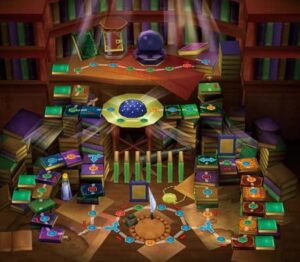 Kamek’s LibraryHost: Kamek · Boss: Kamek (Book Bash) · 46 spacesThree jars at ten coins a go: one Star, one consolation prize and one trip back to the start.
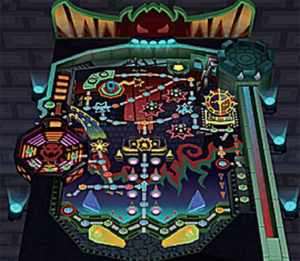 Bowser’s Pinball MachineHost: Bowser · Boss: Bowser (Bowser’s Block Party) · 52 spacesA Star Zone that gives Stars away and a Bowser Zone whose Zero Flame takes every coin and Star you have.




 Double Dice SetItem · 3 coins. Hit two Dice Blocks and move the total.
 Triple Dice SetItem · 7 coins. Three Dice Blocks at once.
 Halfway Dice BlockItem · 1 coin. A block that only goes from 1 to 5, for when a short roll is what you need.
 Warp Dice BlockItem · 2 coins. Before you roll, you are whisked to a random Blue Space with nobody on it.
 Snag BagItem · 8 coins. Steals one item, chosen at random, from a rival of your choice.
 Star PipeItem · 15 coins. Takes you straight to the Star. It returned in Super Mario Party as the Golden Pipe.
 Block SensorItem · 20 coins. Guarantees a Hidden Block on the space you land on next.
 Grab BagItem · 25 coins. Throws away what you are holding and gives you a Star Pipe, a Block Sensor and a Triple Dice Set.
 10-Coin HexHex. The next rival to land on it pays you 10 coins.
 20-Coin HexHex. The next rival to land on it pays you 20 coins.
 Coin Swap HexHex. You and the rival who lands on it exchange your whole stock of coins.
 1-Star HexHex. The next rival to land on it gives you a Star.
 2-Star HexHex. The next rival to land on it gives you two Stars.
 Space Swap HexHex. You change places on the board with whoever lands on it.
 Star BlockHex. A present for the finder, who hits a block numbered 1 to 3 and wins that many Stars.
 Coin BlockHex. The finder has ten seconds to hit the block as often as possible for coins.
 Borrowed artworkPromotional artMuch of the character art was recycled: Toad and Kamek from Super Mario Galaxy, Hammer Bro from New Super Mario Bros., Peach and Daisy from Mario Party 6, Toadette and Dry Bones from Mario Party 7, and Yoshi from a Super Mario 64 DS picture in which he was holding up Mario’s cap.
 Desktop wallpapersPromotional wallpapersA set of eight wallpapers, one for each playable character, was issued for the game and is preserved in Super Mario Wiki’s gallery.
 MarioPlayable
 LuigiPlayable
 Princess PeachPlayable
 Princess DaisyPlayable
 WarioPlayable
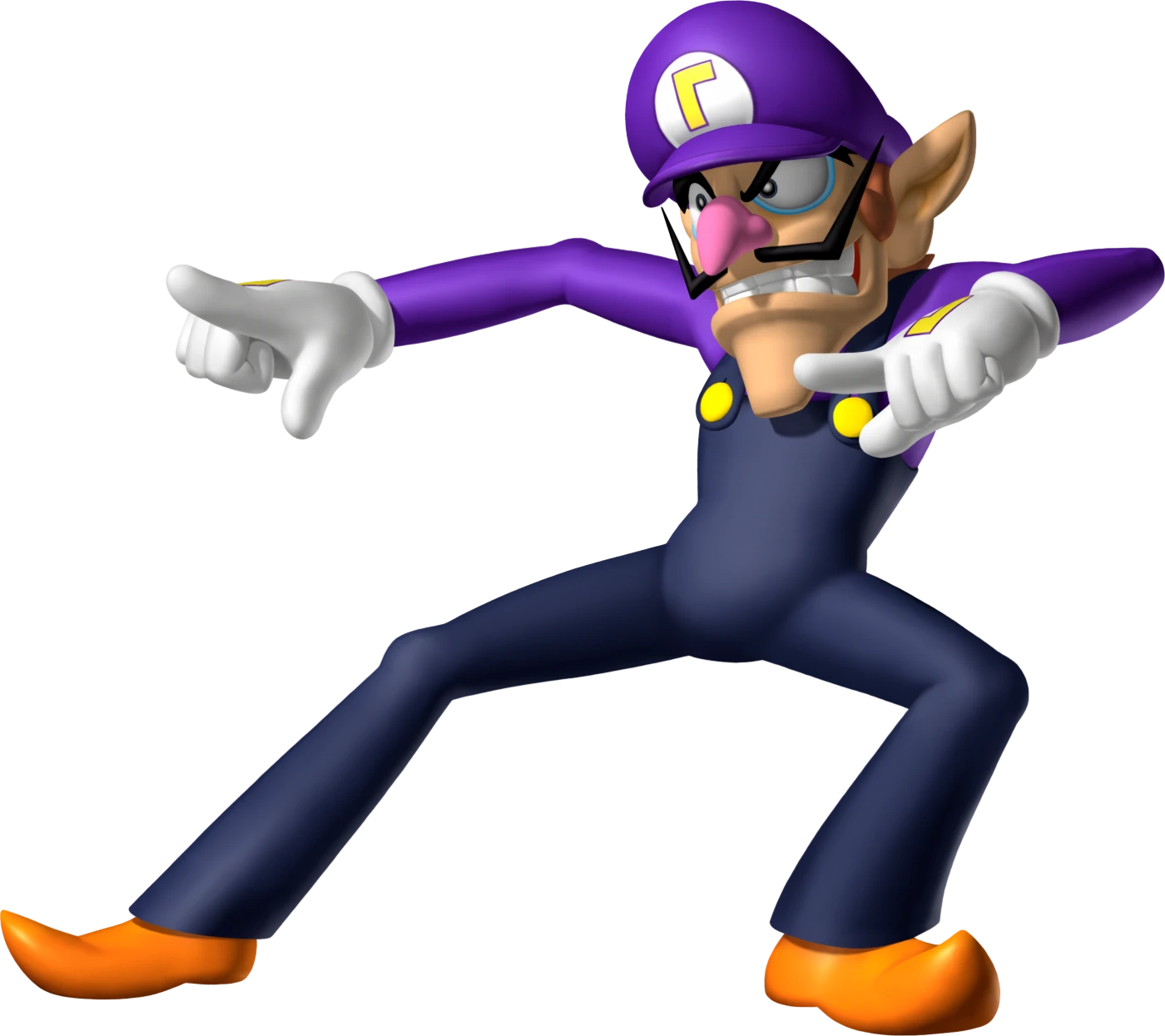 WaluigiPlayable
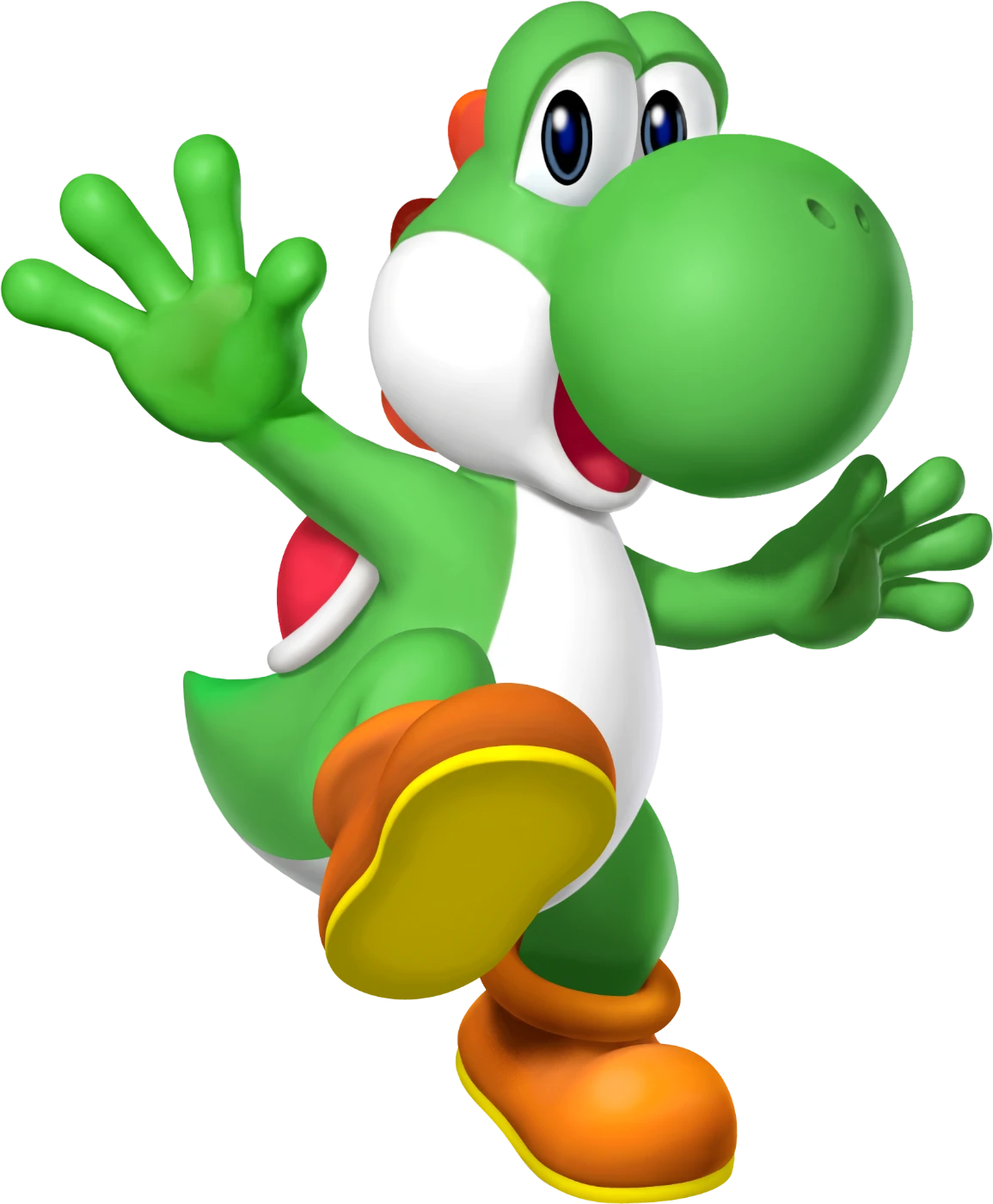 YoshiPlayable
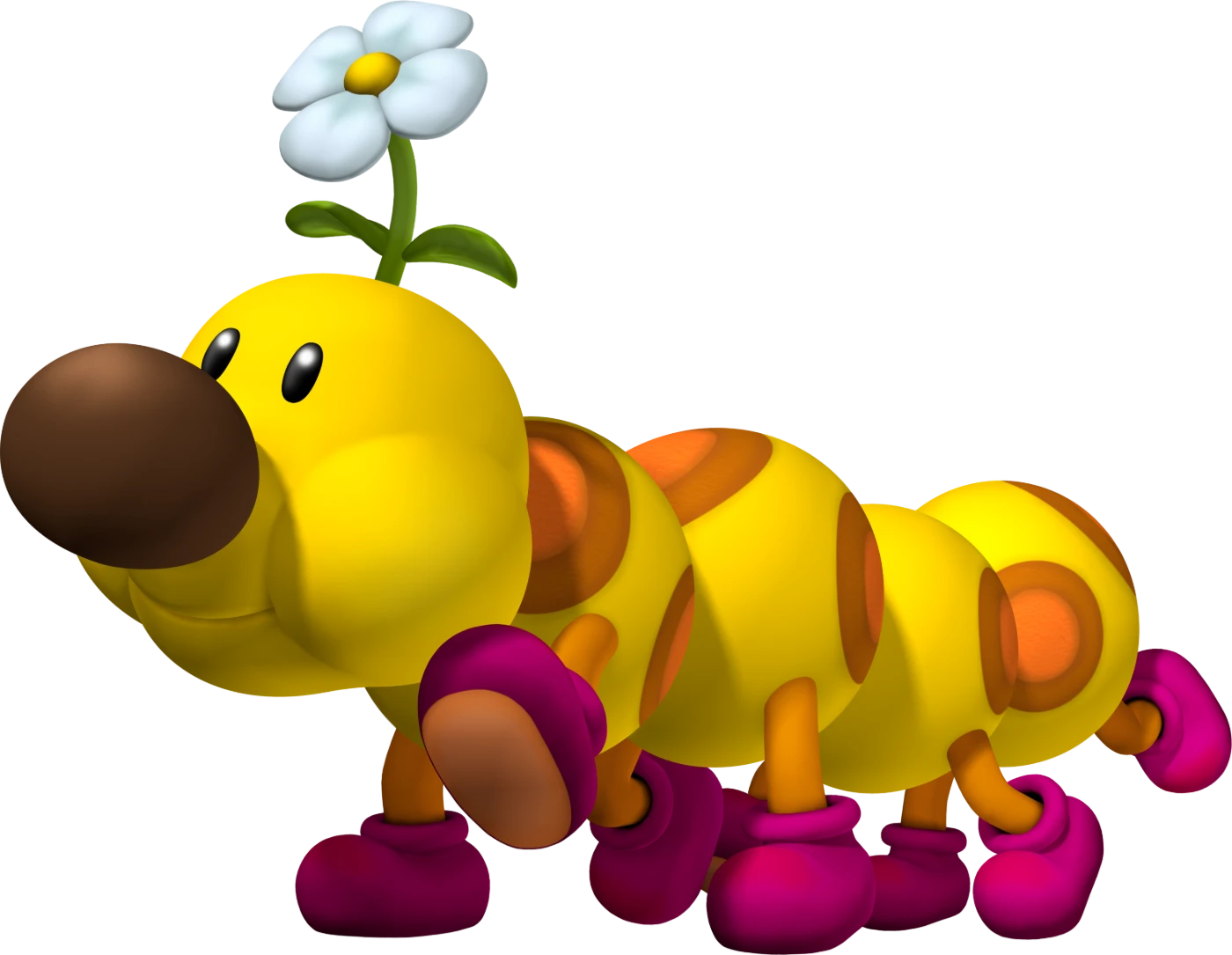 WigglerHost · Wiggler’s Garden
 Piranha PlantBoss · Wiggler’s Garden
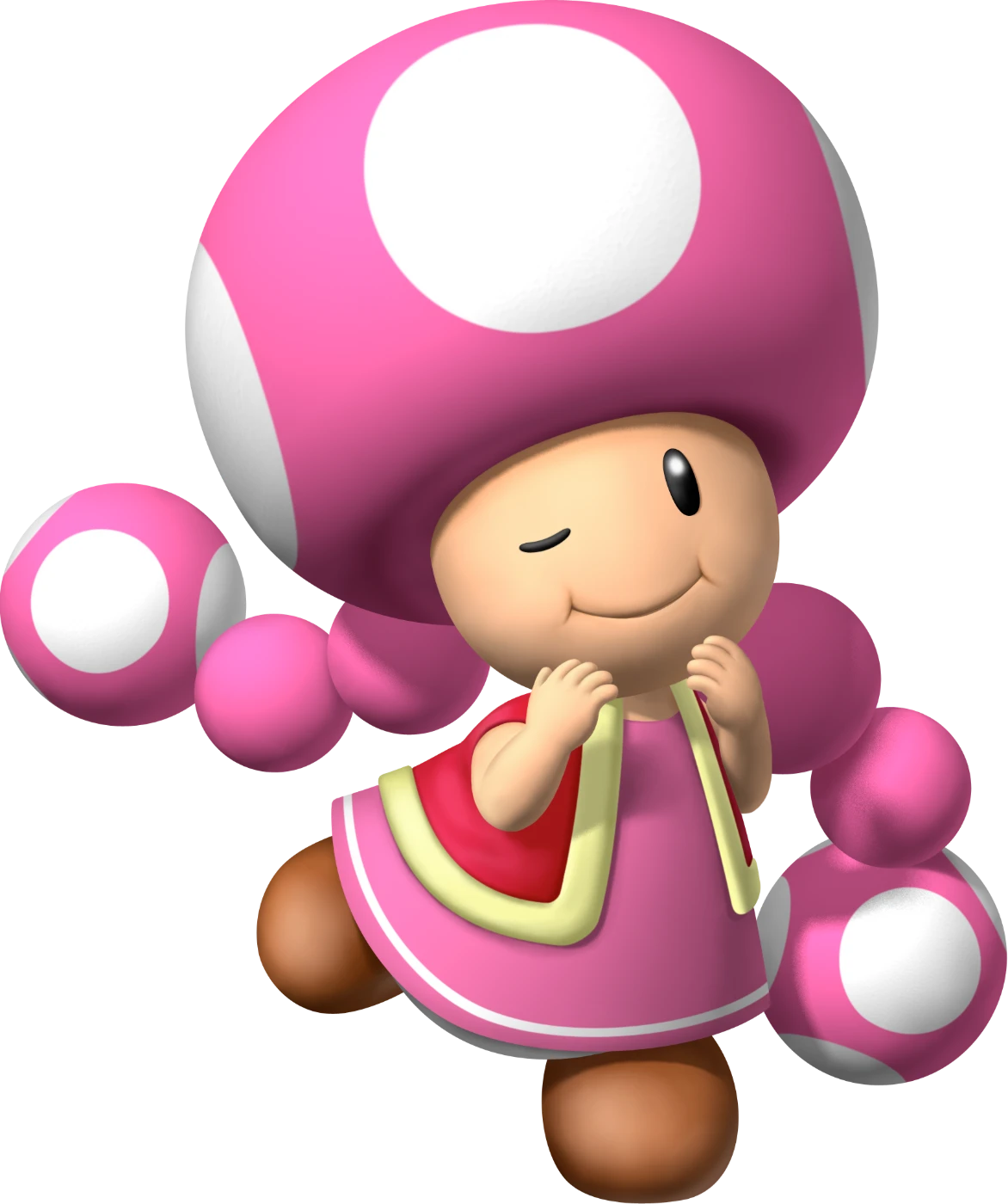 ToadetteHost · Toadette’s Music Room
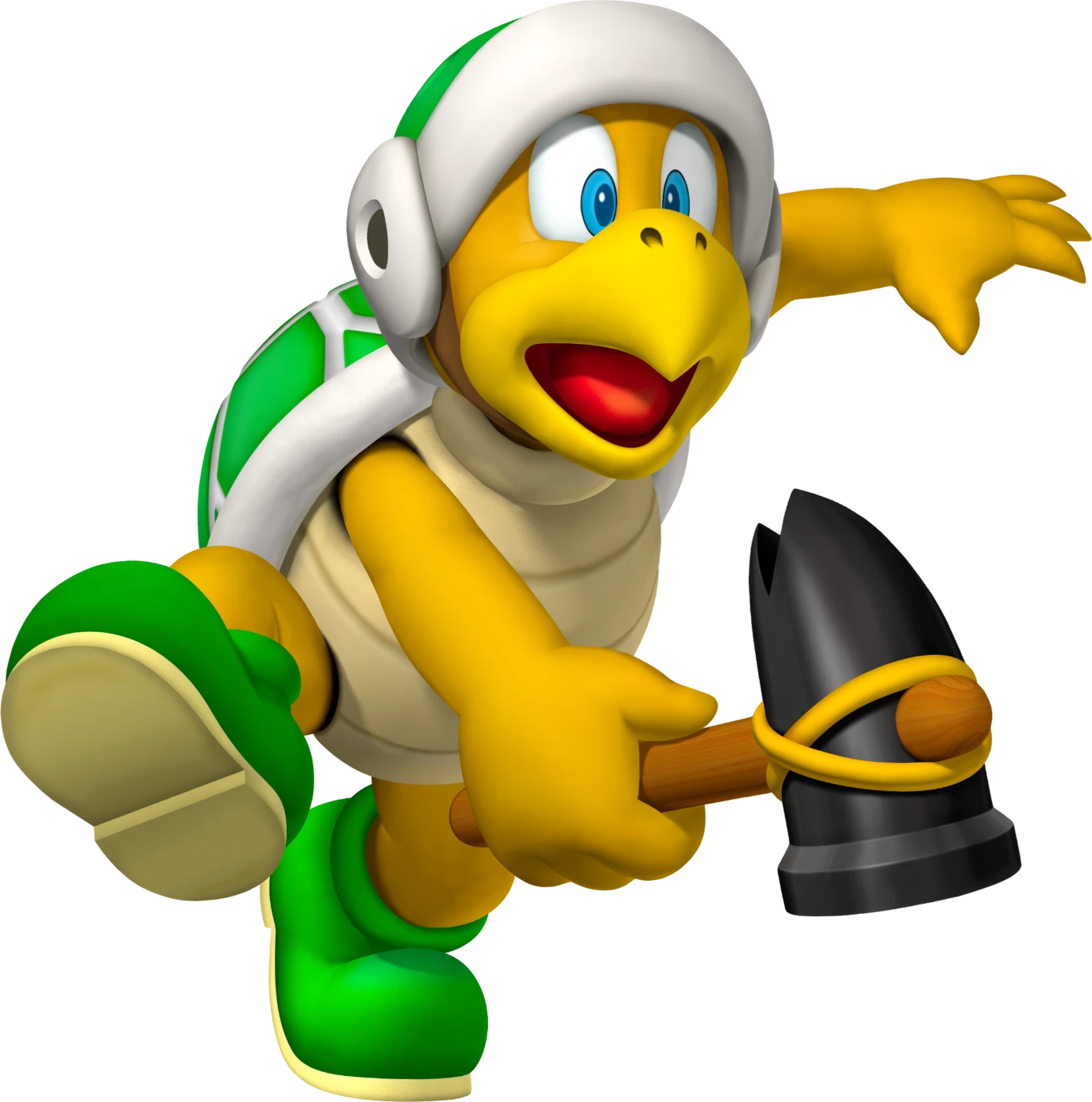 Hammer BroBoss · Toadette’s Music Room
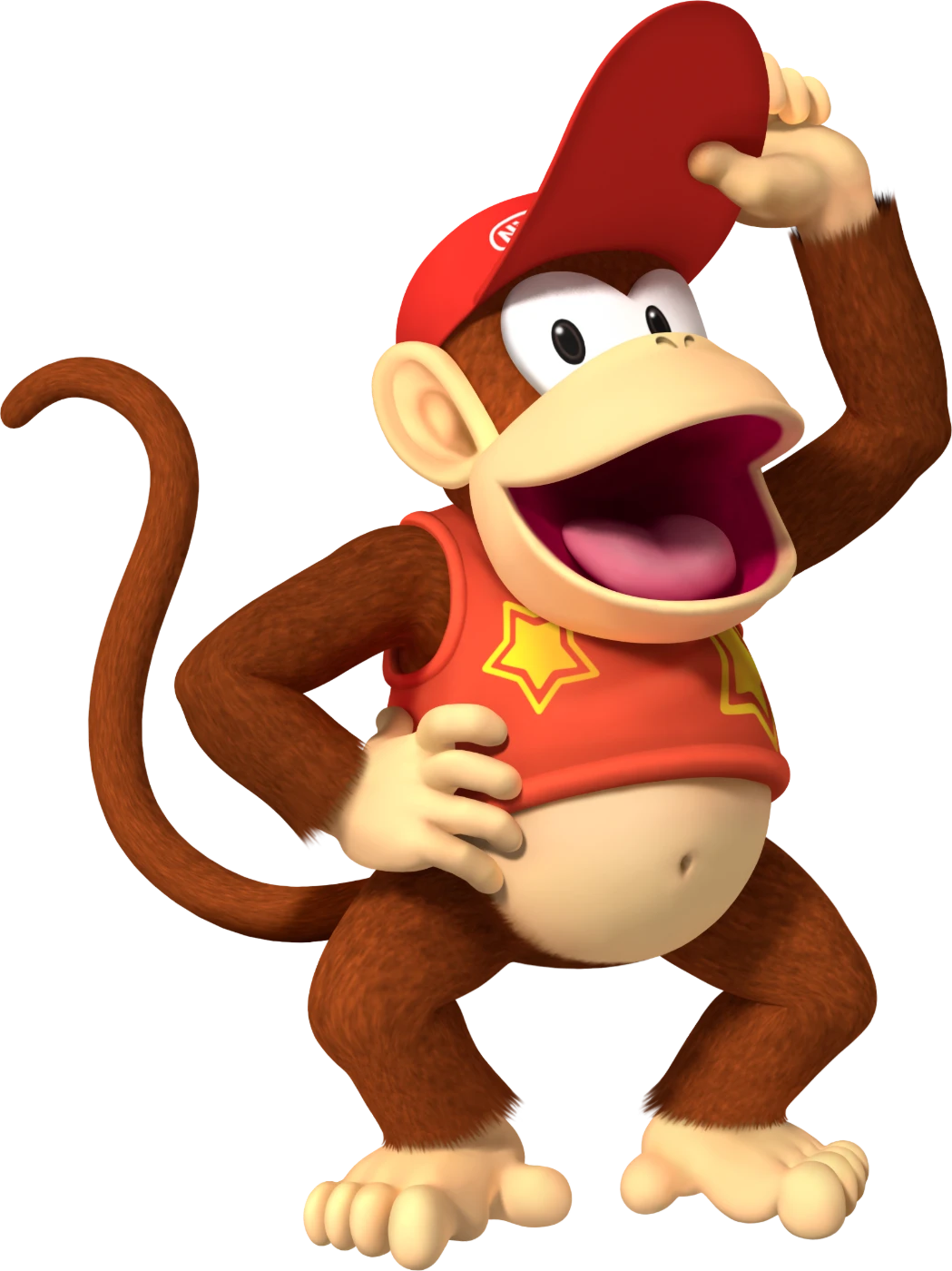 Diddy KongHost · DK’s Stone Statue
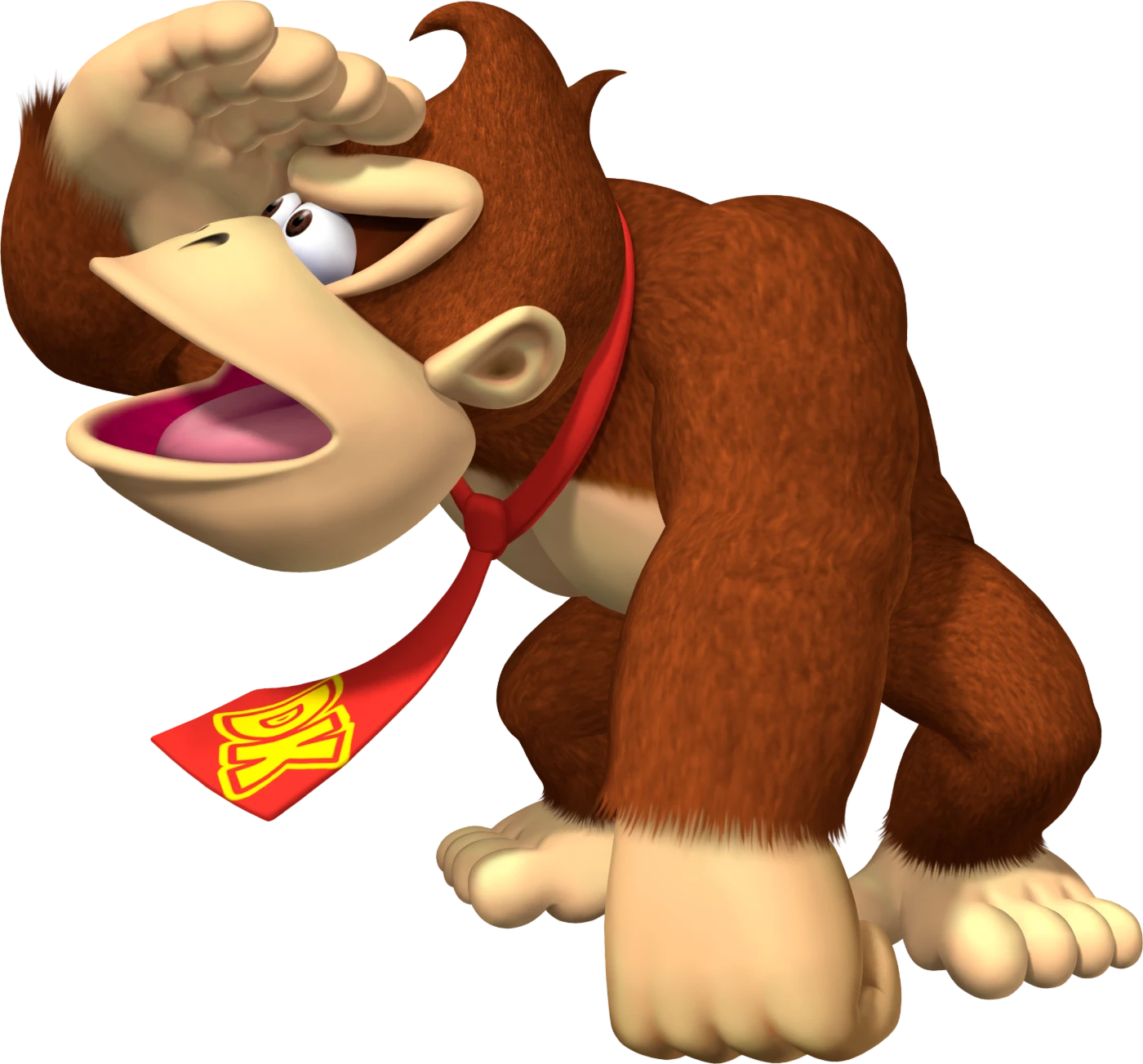 Donkey KongStatue, then rescuer
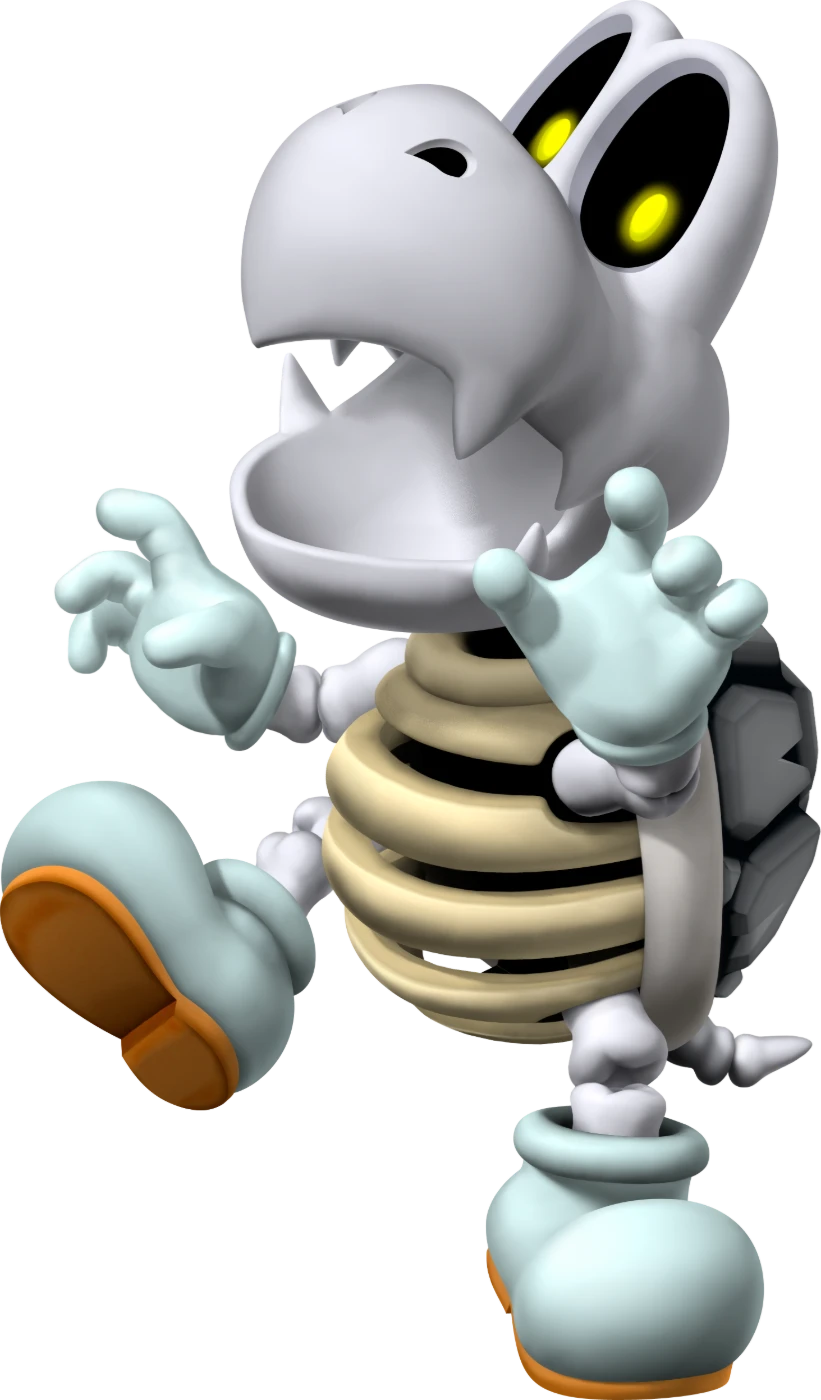 Dry BonesBoss · DK’s Stone Statue
 Koopa Troopa and Koopa KragKamek’s Library
 KamekHost and boss · Kamek’s Library
 Bowser Jr.Villain
 BowserVillain, host and final boss
 Blockhead BowserFinal boss
 Goomba Wrangler4-Player · touch screenDraw rings round the wandering Goombas with the stylus for 20 seconds, and keep the Bob-ombs out of them.
 Rail Riders4-Player · touch screenRub the stylus up a banister to build speed, then fly off the end. Longest jump wins.
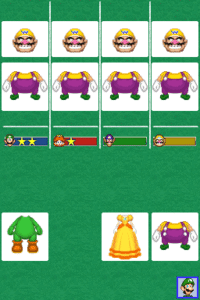 Dress for Success4-Player · touch screenA face appears: tap the body that belongs to it before anyone else does. First to three points.
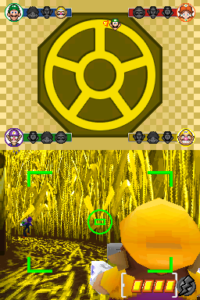 Camera Shy4-Player · buttonsStalk the others through a maize maze with a camera and snap each of them when the frame turns green.
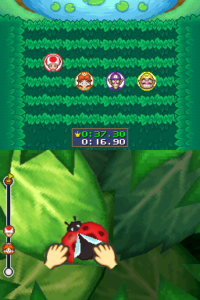 Hedge Honcho4-Player · touch screenSweep the leaves off a hedge with the stylus to reach the pond, without disturbing the bees.
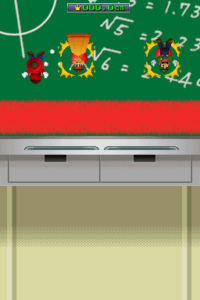 Study Fall4-Player · buttonsSlide down a magnetic board and brake as near the red line as you dare, missing the erasers on the way.
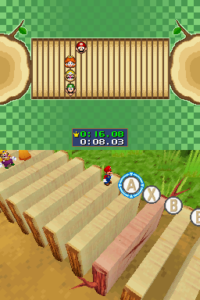 Domino Effect4-Player · buttonsRun along a line of toppling planks, pressing the button shown above each one to make the jump.
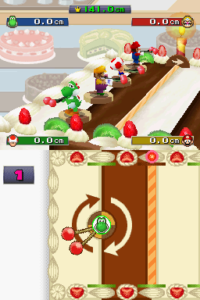 Cherry-Go-Round4-Player · touch screenWhirl a pair of cherries round with the stylus for five seconds and let fly. Longest throw wins.
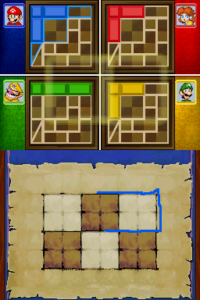 Trace Cadets4-Player · touch screenTrace round the shapes you are given, one after another, until your square is filled.
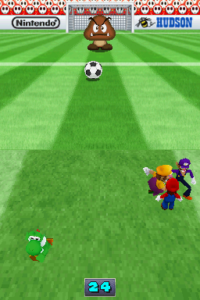 Soccer Survival4-Player · buttonsA Goomba boots footballs at you. Run and jump to stay in the game; last player standing wins.
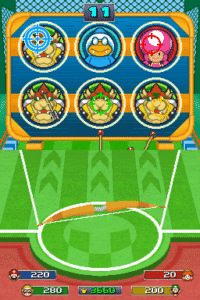 Hot Shots4-Player · touch screenA shooting gallery on the touch screen: hit Bowser and Kamek for points and spare Toadette.
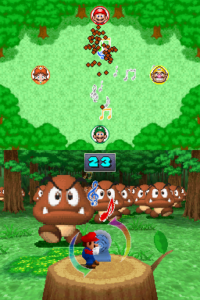 Call of the Goomba4-Player · touch screenTurn a crank in time with the tune to charm Goombas over to your side. The tune is the Super Mario Bros. ground theme.
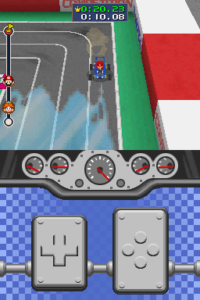 Pedal Pushers4-Player · buttonsRace remote-control karts round a toy track by pressing the left and right pedals in turn.
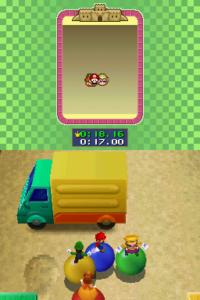 Roller Coasters4-Player · touch screenRoll a rubber ball across the sand to a sandcastle, round buckets, blocks and toy trucks.
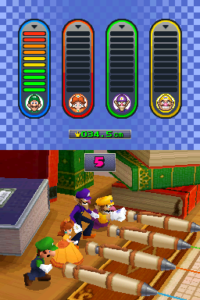 Get the Lead Out4-Player · buttonsHammer the A Button for ten seconds to click as much lead as you can out of a propelling pencil.
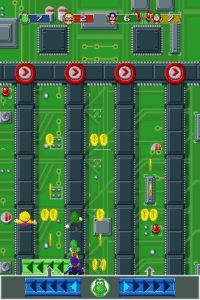 Shortcut Circuit4-Player · touch screenDrag bridge pieces into place so that your route takes in as many coins as possible.
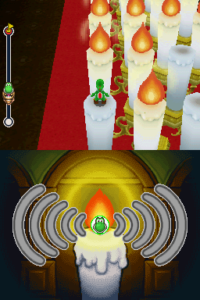 Big Blowout4-Player · microphoneRun along the tops of a row of candles, blowing into the microphone to put each one out, and be first across the line.
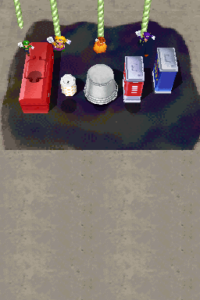 Trash Landing4-Player · buttonsChoose a rope, swing across a garage and let go where you think something is hidden below to land on.
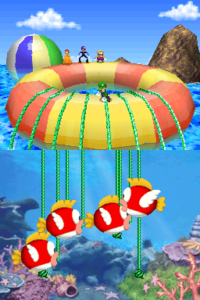 Cheep Cheep Chance4-Player · buttonsPure luck: pick a rope on a rubber ring. A Cheep Cheep on the end keeps you out of the water.
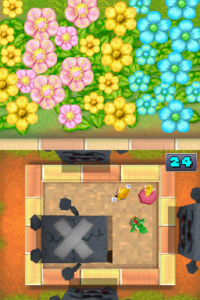 Whomp-a-thon4-Player · buttonsWhomps tremble, then slam down into a sandpit. Do not be underneath, for 30 seconds.
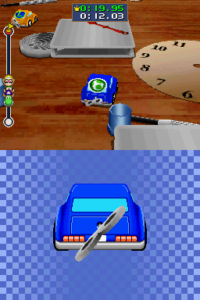 Twist and Route4-Player · touch screen and buttonsWind up a clockwork car with circles of the stylus, then steer it to the finish.
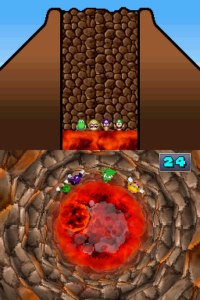 Crater Crawl4-Player · buttonsClimb out of an erupting volcano, dodging the columns of lava.
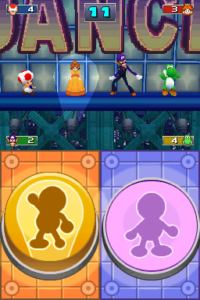 Boogie Beam4-Player · touch screenStrike one pose when the spotlight is on you and another when it is not. Most correct poses wins.
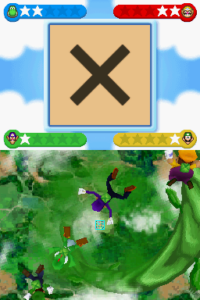 Parachutin’ Gallery4-Player · buttonsSkydive through the panel that matches the one on the top screen, five times over.
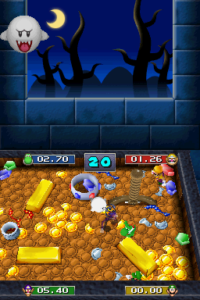 Boo Tag4-Player · buttonsA Boo has hold of you: tag someone else to pass it on. Least time haunted wins.
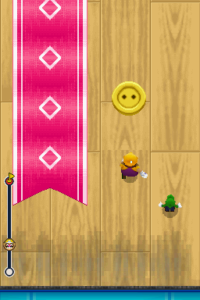 Dust Buddies4-Player · buttonsRun from a vacuum cleaner over a course of obstacles. First home, or last one not caught, wins.
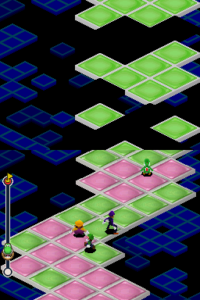 Cyber Scamper4-Player · buttonsCross a shifting floor of tiles full of holes to the blue tile at the far end.
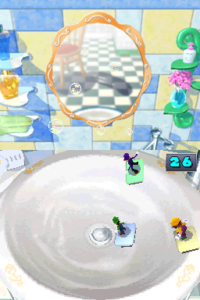 Soap Surfers4-Player · buttonsDodgems on bars of soap in a sink. The last player left in it wins.
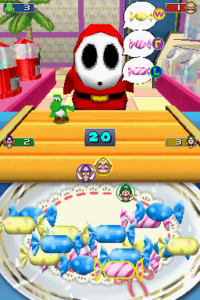 Sweet Sleuth4-Player · touch screenPick the right sweets out of a dish and drag them over to a Shy Guy.
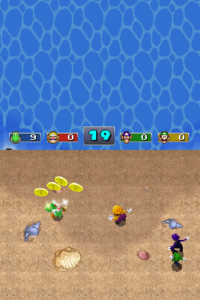 Tidal Fools4-Player · buttonsGather coins on a beach between the waves; red ones are worth five.
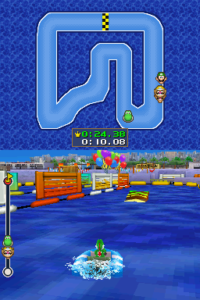 Raft Riot4-Player · buttonsA race of motor rafts along a water course, with buoys to avoid and ramps for a boost.
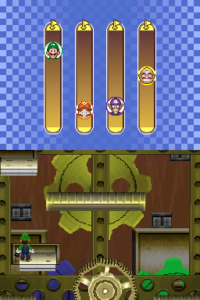 All Geared Up4-Player · buttonsClimb the works of a grandfather clock from platform to platform, getting in each other’s way.
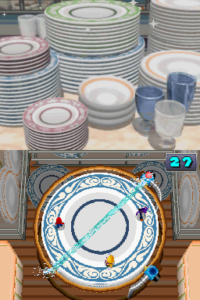 Power Washer1-vs-3 · touch screen for one, buttons for threeOne player hoses the other three off a dirty plate with the stylus; they need only one survivor.
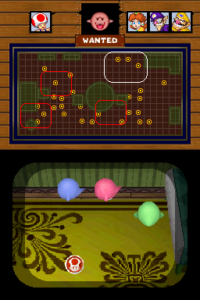 Peek-a-Boo1-vs-3 · touch screen and buttonsBoth sides hunt for Boos, the solo player with a bigger, faster view than the three. Most Boos caught wins.
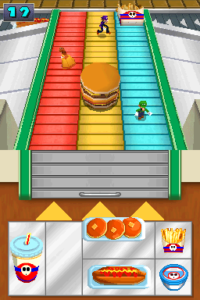 Fast Food Frenzy1-vs-3 · touch screen for one, buttons for threeOne player drops food on to a conveyor belt to knock the three runners off it.
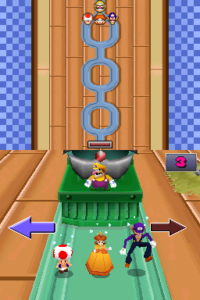 Track Star1-vs-3 · buttonsOne player drives a toy steam engine at three on foot, and has three rounds to run them all down.
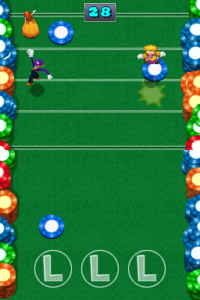 Shuffleboard Showdown1-vs-3 · touch screen for one, buttons for threeOne player flicks chips down the board with the stylus at three who must dodge for 30 seconds. Not in the Korean version.
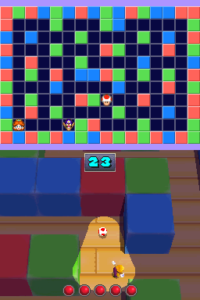 Flash and Dash1-vs-3 · buttonsThree hunt one through a dark maze by torchlight until the clock runs out.
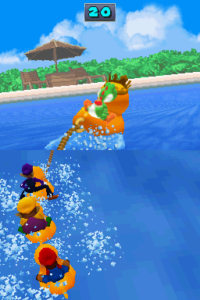 Rubber Ducky Rodeo1-vs-3 · buttonsOne player on a giant rubber duck tries to tip three rivals off their little ones.
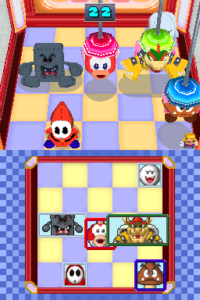 Plush Crush1-vs-3 · buttons for one, touch screen for threeThree players drop soft toys from above with the stylus; the one underneath must dodge for 30 seconds.
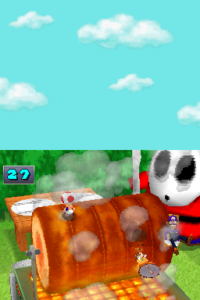 Rotisserie Rampage1-vs-3 · touch screen for one, buttons for threeThe solo player spins a joint of meat on a spit while three run on top of it to stay on.
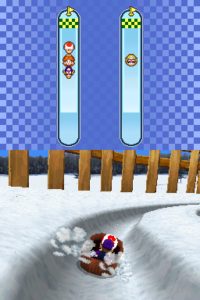 Nothing to Luge1-vs-3 · buttonsA downhill race in the snow: one player on a wooden spoon against three sharing a clog.
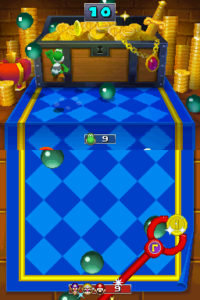 Penny Pinchers1-vs-3 · buttons for one, touch screen for threeOne player scoops coins from a treasure chest while three catch the spills with grabbers. Everybody keeps what they collect.
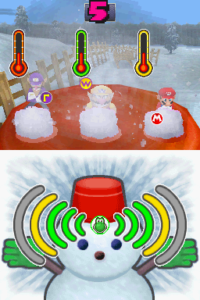 Gusty Blizzard1-vs-3 · microphone for one, touch screen for threeOne player blows into the microphone to freeze the other three, who rub themselves warm with the stylus.
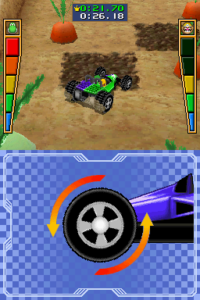 Soil Toil2-vs-2 · touch screenEach partner spins one front wheel of a toy car, which veers towards the slower side. First through the vegetable patch wins.
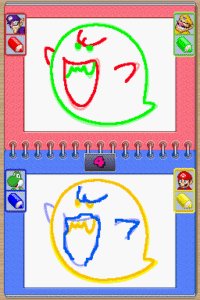 Double Vision2-vs-2 · touch screenShare a picture between you, each tracing only the lines in your own colour. The more accurate pair wins.
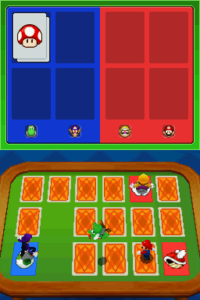 Memory Mash2-vs-2 · buttonsGround-pound face-down cards to turn them over and find pairs. First team to four pairs.
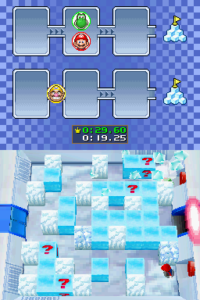 Cube Crushers2-vs-2 · buttonsPunch through ice blocks and press the exit switches together to clear three rooms of an ice maze.
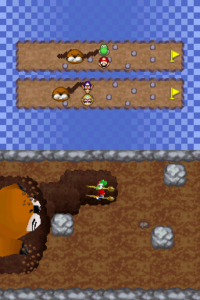 Mole Thrill2-vs-2 · buttonsDig for the finish with a Monty Mole close behind. Get caught and you lose.
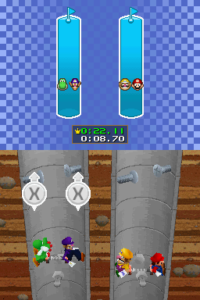 Sprinkler Scalers2-vs-2 · buttonsClimb a pipe by pressing the same buttons as your partner, turning it to avoid what is in the way.
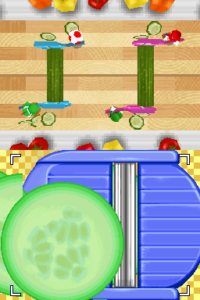 Cucumberjacks2-vs-2 · touch screenSaw through a cucumber from both ends at once with strokes of the stylus.
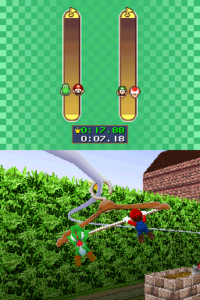 Hanger Management2-vs-2 · buttonsRide a coat hanger along a line together, leaning left and right past the obstacles.
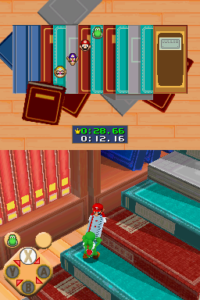 Book It!2-vs-2 · buttonsTake turns pressing the buttons shown to boost your partner up a staircase of books.
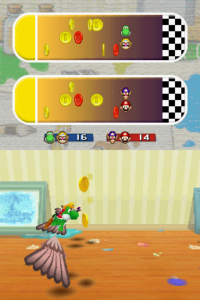 Airbrushers2-vs-2 · buttonsFlap about as a pair collecting coins, red ones worth five. Everybody keeps their haul.
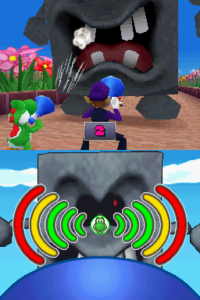 Toppling Terror2-vs-2 · microphoneBoth pairs blow into their microphones for five seconds to tip a Whomp over on to the other side.
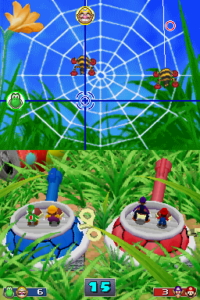 Crazy Crosshairs2-vs-2 · buttonsOne partner aims a toy tank left and right, the other up and down, to shoot Scuttlebugs off a web.
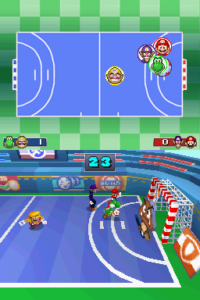 Shorty Scorers2-vs-2 · buttonsPass and punch a ball past a Goomba goalkeeper for 45 seconds.
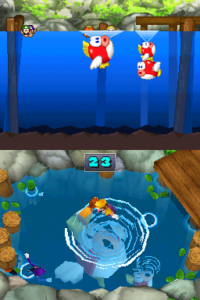 Cheep ChumpBattle · buttonsPaddle round a pool, steering clear of the whirlpools three Cheep Cheeps stir up. Last afloat wins.
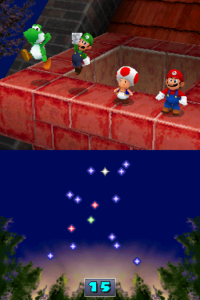 Star CatchersBattle · touch screenTap each star as it appears in the night sky before anyone else can, for 30 seconds.
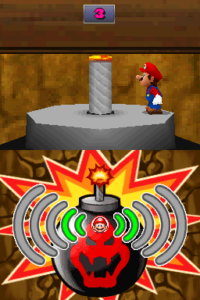 Short FuseBattle · microphoneTake turns blowing into the microphone at the fuse of a bomb. Whoever sets it off is out, until one is left.
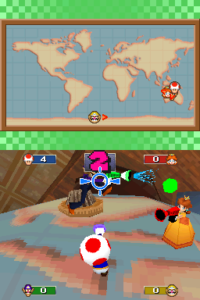 Globe GunnersBattle · buttonsRun round a desk globe shooting at each other for 30 seconds. Most hits wins.
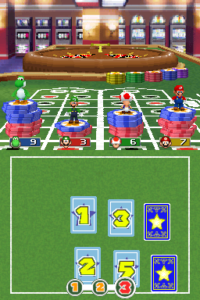 Chips and DipsBattle · touch screenTurn over cards for chips across three rounds; a Bowser card halves your pile. Not in the Korean version.
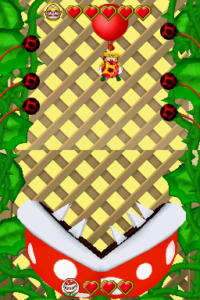 Feed and SeedBoss · Wiggler’s GardenDangling from a balloon, catch the bomb seeds the Piranha Plant spits and throw them back down its throat. Three hits.
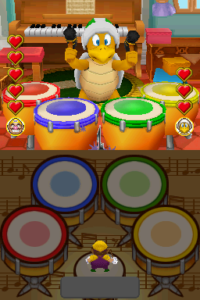 Hammer ChimeBoss · Toadette’s Music RoomWatch Hammer Bro play a pattern on four drums and tap it back with the stylus before his note reaches you. Three correct rounds beat him.
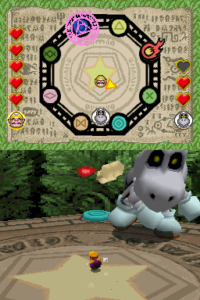 HexoskeletonBoss · DK’s Stone StatueGround-pound the magic switches as they light up while Dry Bones attacks. Three hits.
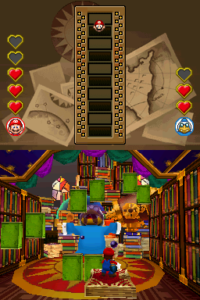 Book BashBoss · Kamek’s LibraryFly down the library corridor shooting books and dodging bookcases, then splatter Kamek with ink three times.
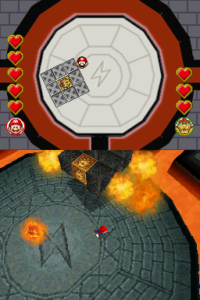 Bowser’s Block PartyBoss · Bowser’s Pinball MachineBlockhead Bowser takes three shapes, a spinning top, a cube and a snake of blocks. Hit the golden block five times in each.
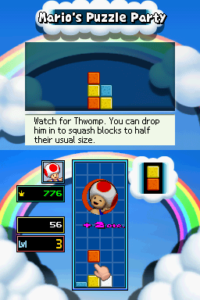 Mario’s Puzzle PartyPuzzleFrom Mario Party 3: a falling-block puzzle in which you join blocks of the same colour.
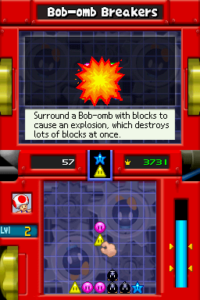 Bob-omb BreakersPuzzleFrom Mario Party 4: line up three matching shapes to clear them.
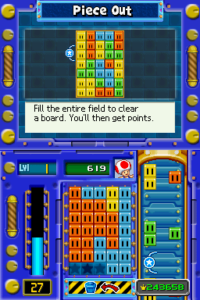 Piece OutPuzzleFrom Mario Party 5: fit the shapes arriving on a conveyor belt into a grid.
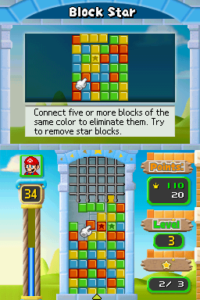 Block StarPuzzleFrom Mario Party 6, and later chosen for The Top 100 and Superstars in its original form.
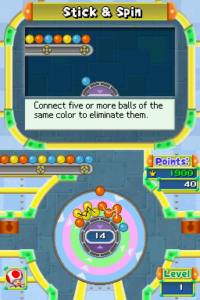 Stick and SpinPuzzleFrom Mario Party 7: turn the stage and drop balls to link five or more of one colour.
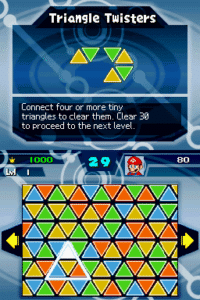 Triangle TwistersPuzzle · newSpin triangles to join four or more of a colour. Frenzy Mode is a 60-second scramble; Focus Mode has you copy patterns from the top screen. Unlocked by finishing Story Mode.