

Super Mario Bros. & Friends: When I Grow Up (1992)
A digital colouring book for MS-DOS featuring Mario, Luigi, Peach, Bowser and the whole gang — all dressed up as doctors, lawyers, firefighters, rock stars and more. Educational, wonderfully weird, and one of the most obscure Mario titles ever made.
Overview
Super Mario Bros. & Friends: When I Grow Up is quite possibly the most low-key Mario game ever released. There’s no jumping, no coins, no Bowser to defeat — just 29 black-and-white line illustrations of Mario and friends dressed up in various professions, waiting to be coloured in. It’s a digital colouring book, pure and simple, aimed squarely at young children.
The game was developed by Brian A. Rice, Inc. and published by Merit Software for MS-DOS in March 1992.
It was part of Merit’s “Electric Crayon” series — a line of licensed colouring book games that also produced Sesame Street, Muppets and other character-based titles. The Mario licence was secured from Nintendo, though the game had no involvement from Nintendo’s own development teams.
Illustrations were drawn by Rick Incrocci, and the quality of the line art is notably high — detailed, expressive, and clearly the work of someone who genuinely enjoyed the material.
Each of the 29 career pages shows familiar Mario characters in real-world jobs: Mario as a chef, lawyer, scientist, firefighter, farmer, computer programmer and more. Peach turns up as a judge, fashion designer and journalist.
Bowser appears in both his blocky video game sprite design and his more cartoonish animated series design from the DiC cartoons — one of the few games where both visual styles coexist. There are also some genuinely unexpected crossover cameos: Link from The Legend of Zelda appears as a travel guide and as a customer in Chef Mario’s restaurant, and several Zelda II enemies pop up throughout the pages.
“Unlike traditional Mario platformers, this game had no jumping, enemies, or power-ups. Instead, players were presented with black-and-white scenes featuring Mario, Luigi, Peach, and other characters dressed for different jobs.” — Mario Museum
Released only in North America, never ported, never re-released digitally — it’s genuinely obscure. The 5.25″ floppy disk version is considered a collector’s item. Both versions are freely available on the Internet Archive.
Gameplay — How It Works

The core loop is exactly what you’d expect from a colouring book: you’re presented with a black-and-white line illustration, given a palette of colours, and you fill things in. Click on any region of the image to flood-fill it with the currently selected colour. Click the name box to read an age-appropriate description of the career shown. When you’re done, you can print the finished artwork — optionally with a monthly calendar, banner, or message — or move on to the next page.
Colours come from the standard 16-colour CGA palette, the default for DOS games of the era. But clicking the Mix button blends your selected colour with any of the other 15, giving a theoretical total of 256 possible colours (86 unique, not counting duplicates). Your work-in-progress is automatically saved to disk. The “Oops” button wipes all applied colours and lets you start fresh.
Several pages have animation sequences — click the running man icon in the bottom right corner and the illustration comes to life briefly. There is no fail state whatsoever. No score, no timer, no enemies. You colour things in, read about what a marine biologist does, and move on. For its target audience of under-7s in 1992, that was probably just right.
The CGA Colour Palette
All 16 base colours available — mix any two for up to 256 combinations:
All 29 Career Pages
Every page pairs Mario characters with a real job and includes a short educational description. The writing is pitched at early primary school level — warm, often funny, and enthusiastic about the value of honest work. Here’s every career, with scene details:
Chef / Waitress
Chef Mario cooks pasta while Waitress Peach takes Link’s order at a table. “Your order is coming right up!” “Yeah, and now it’s coming right down on my head!” One of two pages featuring Link.
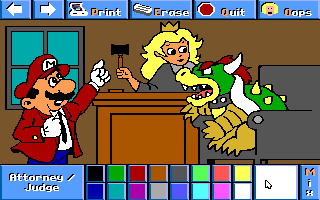
Attorney / Judge
Mario the attorney questions a visibly nervous Bowser in court. “Is Bowser telling the whole truth?” Judge Princess Toadstool presides. One of the funniest premises in the game.
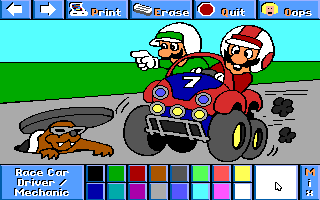
Race Car Driver / Mechanic
Mario and Luigi make a pit stop with worn tyres from the road rally. Rocky Wrench — usually Bowser’s wrench-throwing minion — serves as their pit mechanic. Also features a cameo of the Monster vehicle.

Scientist
“I think I have discovered a cure for the common cold,” shouts Scientist Mario. “Now if only I could find a way to get people to try it. This stuff smells awful!” Conducting an experiment in his laboratory.

Travel Guide
Link the travel guide takes tourists to exciting faraway places — “even to fantasy lands like SuperMarioLand.” The main Zelda crossover page; Link is the star rather than a background cameo.
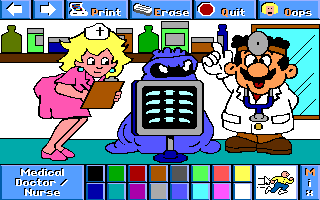
Medical Doctor / Nurse
Dr. Mario and Nurse Peach use an X-Ray machine. “Aha! This patient’s bones aren’t connected,” says Dr. Mario. “No wonder he looks so sick.” Directly references the Dr. Mario spin-off.
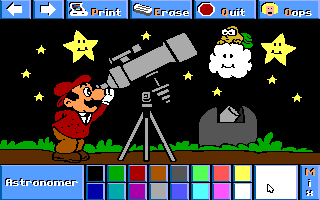
Astronomer
Mario looks through a telescope at his observatory. Describes astrophysics at a child’s level: “Astronomy is one of the oldest sciences, dating back to 200 B.C. when the Babylonians studied the positions of stars and planets.”

Carpenter
Mario has just nailed his own foot to the floorboards. “Maybe he had better stick to being a plumber.” A direct nod to Mario’s original Donkey Kong identity as “Jumpman the Carpenter.”

Ballet Dancer
Ballerina Peach and a troupe of Toad dancers perform a beautiful ballet, “floating through the air.” One of the more serene and genuinely graceful pages in the set.

Disc Jockey
Mouser from Super Mario Bros. 2 hosts “The Mouser in the Morning Show.” Sound engineer Mario is miserable: “I think I’ll go get a job at a library! I need some peace and quiet. That Mouser plays his music too loud!”

Firefighter
Firefighters Mario and Luigi battle a fire started by Fryguy — a boss from Super Mario Bros. 2. “If we could just squirt that Fryguy, our troubles would be over!” One of the more action-packed pages.

Professional Athlete
“Three pro athletes are warming up for the competition. But having the three of them in the same room could be dangerous!” Deliberately vague — no specific sport is shown or named.

Computer Programmer
Mario battles Goombas and “other bothersome bugs.” “He knew that programmers talk about having ‘bugs’ in their programs, but this is ridiculous!” The best visual pun in the game, and probably the most prescient career choice.

Armed Forces Pilot
Air Force pilot Mario dogfights the Koopas’ flying airship — a direct reference to the iconic airships from Super Mario Bros. 3. One of the most recognisably Nintendo images in the collection.
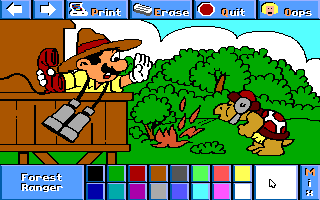
Forest Ranger
Ranger Mario has spotted Fire Brother setting a forest fire. “Fire Brother is going to be in big trouble because damaging forest land is a serious crime.” Doubles as a fire safety lesson.
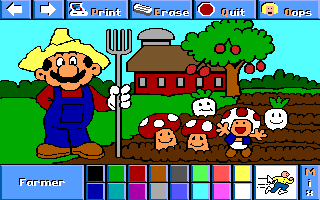
Farmer
Farmer Mario harvests Super Mushrooms, Turnips (from SMB2) and Cherries (from SMB1). “People always say I’ve got a green thumb. Actually, my thumb looks kinda brown most of the time.”
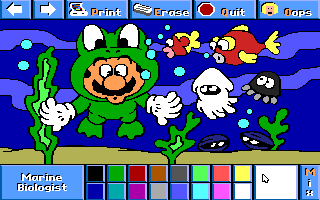
Marine Biologist
Marine biologist Mario discovers Cheep-Cheeps, Jelectros, Bloopers and Trouters at the bottom of the sea. Written entirely straight, despite the subjects being fictional Nintendo enemies.
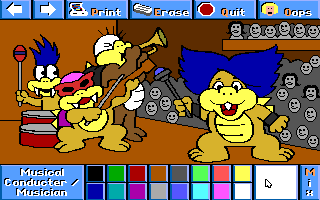
Musical Conductor / Musician
Ludwig Von Koopa conducts the world-famous Koopa Symphony Orchestra with Roy, Iggy and Morton on instruments. “The Koopas may be mean sometimes, but they sure make beautiful music together, especially on loud pieces.”

Plumber
Mario and Luigi fix a stuck valve. Mario starts daydreaming about being an astronaut — until a cry for help comes from inside a pipe. This page is the narrative framing for the whole game: every other career is Mario’s daydream.
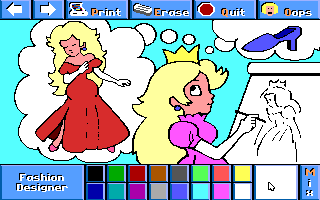
Fashion Designer
“That glamorous fashion designer Princess Toadstool is at it again.” Designing a fabulous evening gown. “The Toadstool label is a true sign of high fashion, as everyone knows.” Peach gets her moment to shine.

Zoo Keeper
“Not many zoos in the world have such unusual creatures as Birdo, Tryclyde and Pidgit.” All three are Super Mario Bros. 2 enemies. Mario considers himself lucky to have such exotic exhibits.
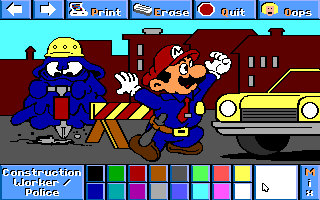
Construction Worker / Police
Bot — a jelly-bodied enemy from Zelda II: The Adventure of Link — operates a pneumatic drill. “Bot’s jelly-like body is perfect for operating a pneumatic drill.” Officer Mario directs traffic safely around the site.

Journalist
TV journalist Peach reports live from a plane crash. The pilot? Mario himself, who crashed the Sky Pop into a tree. Peach interviews him “to find out how this accident happened, and how he was able to escape unharmed.”
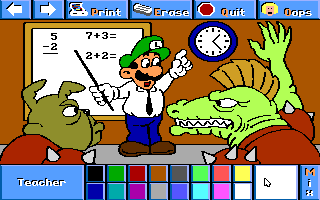
Teacher
Luigi nervously teaches former drop-outs at night school. His students include Moblin and Daira from Zelda II — making this the page with the most Zelda II crossover characters. “They’ll listen very carefully because they understand the value of education.”
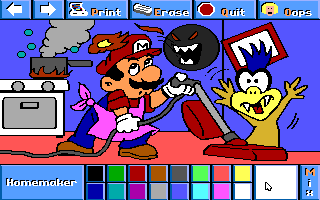
Homemaker
“These kids are driving me crazy,” sighs Mario the homemaker. “When these kids don’t get their naps, they act like little monsters. They even look like little monsters.” The kids are strongly implied to be actual Mario enemies.
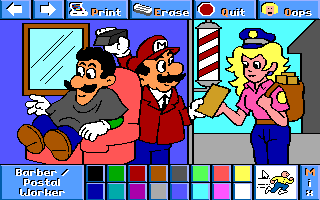
Barber / Postal Worker
Barber Mario gets distracted by postal worker Peach delivering the mail. He loses focus for one second. “Whoops! Poor Luigi just got a new hair style.” Luigi is, once again, the victim.
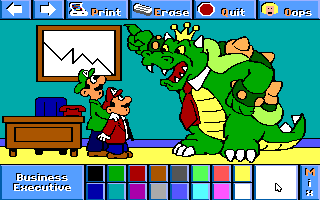
Business Executive
Chairman Bowser is furious — his plumbing service is losing money. “We’ve got to bring in more new customers or this company will go down the drain!” Mario and Luigi appear to work for Bowser in the corporate world.
The Zelda Crossover — Link & Friends
One of the most quietly remarkable things about this game is how many Legend of Zelda characters appear in it. This was 1992 — years before Nintendo had any official crossover concept — and here’s a Mario colouring book casually dropping Link into a restaurant scene and having Zelda II enemies teach night school.
Link appears on two pages: as a customer ordering food from Chef Mario, and as the star of the Travel Guide page — where he’s the one taking tourists to faraway places, including “fantasy lands like SuperMarioLand.” Moblin and Daira (from Zelda II) appear as Luigi’s oversized night school students. Bot (also Zelda II) operates a pneumatic drill on the Construction Worker page, with the game noting matter-of-factly that “Bot’s jelly-like body is perfect” for the task.
Why so many Zelda characters? Merit Software held licences for both Mario and Zelda merchandise at the time, making it natural — and free — to include them alongside the Mario cast. The crossover went completely uncommented on. No marketing angle, no fanfare. Link just shows up and orders pasta.
Trivia & Facts
- The game was part of Merit Software’s “Electric Crayon” series of licensed digital colouring books. Other titles in the series covered Sesame Street, the Muppets, and various other licensed characters.
- Illustrations were drawn by Rick Incrocci, who is credited in the game. The quality of the line art is higher than you’d expect from a licensed educational title — detailed, expressive scenes that hold up well even today.
- Bowser appears in two different visual styles in the same game: his blocky NES sprite design and his more cartoonish look from the DiC animated TV series. He’s one of the few Nintendo characters rendered in both styles within a single release.
- The Carpenter page depicts Mario in his pre-Mario identity as “Jumpman” — the character from the original Donkey Kong arcade. The text even jokes he’d “better stick to being a plumber”, acknowledging Mario’s actual profession.
- The Plumber page reveals the entire game is framed as Mario’s daydream. He arrives to fix a pipe, starts imagining other careers, then snaps back to reality when someone cries for help from inside a pipe. Every other career page is canonically Mario’s fantasy.
- Link’s appearance on the Travel Guide page describes him taking tourists to “SuperMarioLand” — spelled as one word, likely referencing the Game Boy game Super Mario Land, released in 1989.
- The Disc Jockey page features Mouser from Super Mario Bros. 2, hosting a hugely popular morning radio show. Mario is his suffering sound engineer. It’s one of two pages where a regular Mario enemy takes centre stage in a positive role.
- The Computer Programmer page is a visual pun: the programming “bugs” are literally Goombas running through Mario’s computer. It’s probably the best single gag in the whole game.
- Both the 3.5″ and 5.25″ floppy disk versions were released. The 5.25″ version is considered particularly rare by collectors today.
- The game is freely playable in the browser on the Internet Archive in both CGA and EGA graphics versions via DOSBox emulation.
- Ludwig Von Koopa’s appearance as a symphony conductor is one of the earliest characterisations of a Koopaling outside Super Mario Bros. 3 — released three years earlier. The other Koopalings (Roy, Iggy, Morton) appear as orchestra musicians.
- The game was released only in North America and was never ported to any other platform or re-released digitally by Nintendo. Combined with its extremely niche appeal, this makes it one of the most obscure officially licensed Mario titles.