Game Boy Advance2004ArtoonTilt-controlled platformerTilt the whole world8 chapters, 50 missions102 Eggling Book entriesThree regional titlesNot for Game Boy Player
Yoshi Topsy-Turvy
Bowser is rampaging across Yoshi’s Island, so the grumpy book spirit Hongo does the obvious thing and seals him inside the Forbidden Pop-Up Book. Unfortunately he seals the whole island in with him. To get home, Yoshi has to work his way to the last page and beat Bowser there, and his only help is a sacked junior spirit who hands him the power to tilt the entire world. That power is you: turn the Game Boy Advance left or right and the whole page swings with it, rolling boulders, turning walls into slopes and sending enemies tumbling.
Made by Artoon, the studio founded by ex-Sega developers Naoto Ohshima and Yoji Ishii, and published by Nintendo, it came out in Japan on 9 December 2004 as Yoshi no Ban’yū Inryoku (Yoshi’s Universal Gravitation), in Europe in April 2005 under that English name, and in North America on 13 June 2005 as Yoshi Topsy-Turvy. Six picky tiny spirits set the challenges across 50 missions, a hundred Egglings are hidden inside apples, and five bonus games wait after the credits. Reviewers liked the idea far more than the game, and Screen Rant counts its Metacritic score as the lowest of any Yoshi title.
Developer:Artoon
Publisher:Nintendo
Platform:Game Boy Advance (motion-sensing game; Nintendo warned against playing it on the Game Boy Player)
Supervisors:Takashi Tezuka and Hisashi Nogami (Nintendo)
Sound:Tatsuyuki Maeda, Masaru Setsumaru and Mariko Nanba; sound support Koji Kondo
Structure:Eight chapters: six spirits’ tales with 50 missions, plus two Bowser stages
Modes:Story Mode; Challenge Mode with five bonus games
Ratings:ESRB E · PEGI 3 · CERO A · USK 0 · ACB G
Sales:No official figures found
Re-releases:None (not on Nintendo Switch Online as of November 2026)
Advertisement
Overview
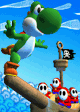
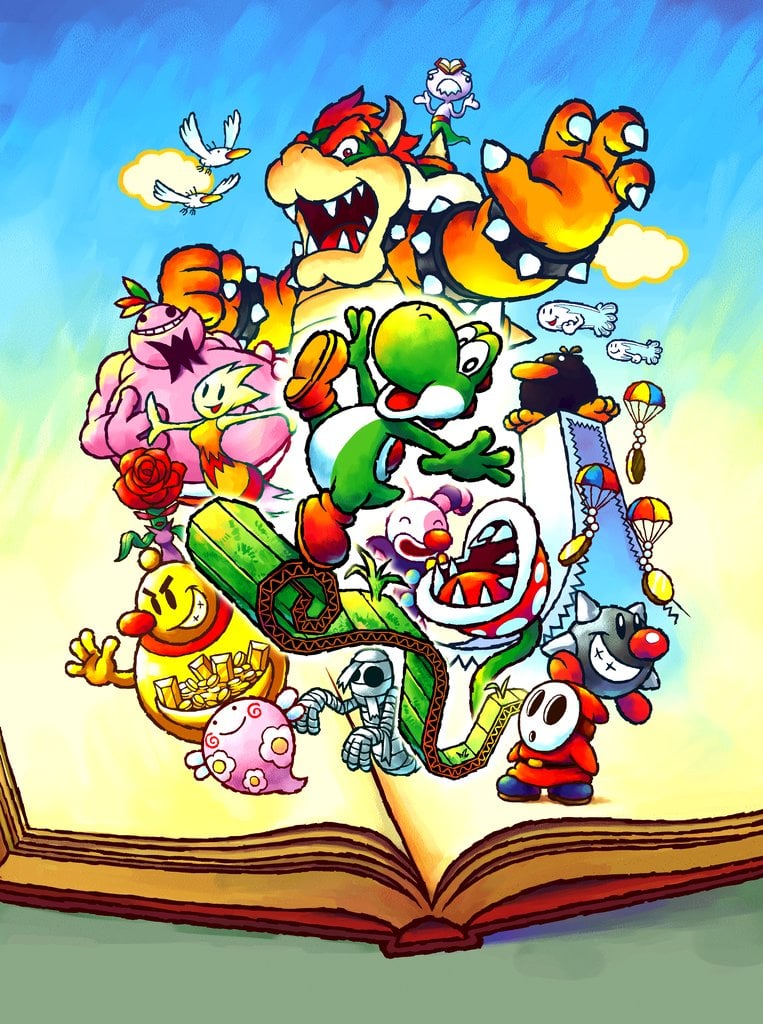
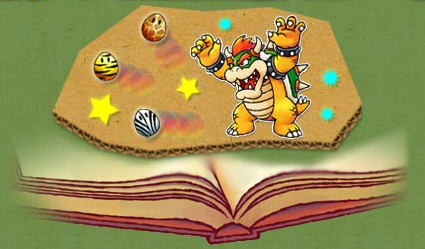
Promotional artwork for the Forbidden Pop-Up Book adventure.
Yoshi Topsy-Turvy is a side-scrolling platformer for the Game Boy Advance in which you steer the world as much as the dinosaur. Developed by Artoon and published by Nintendo, it reached Japan on 9 December 2004, the United Kingdom on 15 April 2005 and the rest of Europe a week later, North America on 13 June 2005 and Australia on 20 October 2005. It goes by three names: Yoshi no Ban’yū Inryoku in Japan, Yoshi’s Universal Gravitation in Europe and Australia, and Yoshi Topsy-Turvy in North America.
The hook is that the game reads which way you are holding the console. There are three positions, level, left and right, and each one tips the whole picture-book page. Tip it and Yoshi can stroll up a wall that has become a slope, boulders and spiked balls roll downhill, snowballs grow as they tumble, rolled-up carpets unfurl into bridges and pirate ships swing like pendulums. Nintendo’s Japanese site sold it on exactly that, Yoshi tilting the world, and warned buyers not to play it on the Game Boy Player, where tilting the GameCube would have been a poor idea.
The rest is classic Yoshi in a new frame. The pre-rendered sprites recall Yoshi’s Story, the flutter jump and the tongue are present and correct, and the island has been turned into a storybook, seven years after Yoshi’s Story did the same. What is new is the structure: each mission is set by one or two tiny spirits with an obsession (money, speed, power, cuteness, kindness or fright), and the goal is to keep them happy enough to earn a Happiness Medal.
Critics were unconvinced. The three-way tilt felt coarse, the missions repetitive and the adventure short, and the game ended up with a Metacritic score of 60, the lowest for any Yoshi game according to Screen Rant. It has never been re-released, which makes it one of the more obscure Mario-family games of the Game Boy Advance era, and one with a charm that its fans still defend.
Why it matters to Mario fansIt is the Yoshi series at its most experimental: a platformer built entirely around tilting the console, and the first of Artoon’s two Yoshi games, ahead of Yoshi’s Island DS. It also gave the Mushroom Kingdom a little-known cast, Hongo, the Spirit Who Loves Surprises, the six tiny spirits and a hundred named Egglings, two of whom turned up again as spirits in Super Smash Bros. Ultimate.
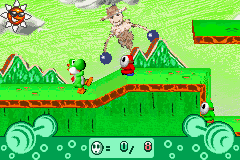
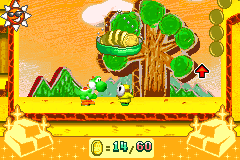
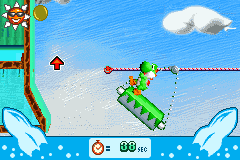
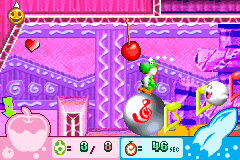
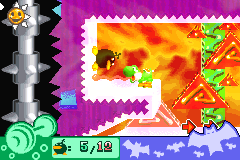
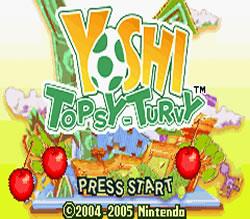
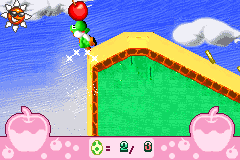
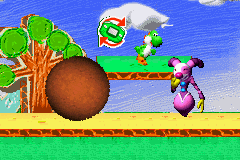
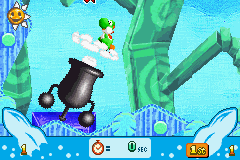
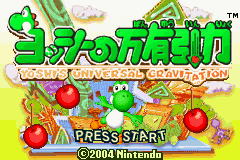
The North American title screen.Mission 1-1, the tilting tutorial.Tilt the console and the whole page tilts with it.Mission 4-5 in the Tale of the Spirit of Speed.
“I’ll give you the power to tilt this entire world!”
The Spirit Who Loves Surprises, in the opening of Yoshi Topsy-Turvy (English text)
The line that sets the whole game going.
Quick Answers
Short answers to the questions people ask most about Yoshi Topsy-Turvy; each links to the fuller section below.
When did Yoshi Topsy-Turvy come out?
Japan on 9 December 2004, the UK on 15 April 2005, the rest of Europe on 22 April 2005, North America on 13 June 2005 and Australia on 20 October 2005. More →
Is Yoshi Topsy-Turvy the same game as Yoshi’s Universal Gravitation?
Yes. Yoshi’s Universal Gravitation is the European and Australian title, a translation of the Japanese Yoshi no Ban’yū Inryoku; Yoshi Topsy-Turvy is the North American name. More →
How does the tilting work?
A tilt sensor built into the cartridge senses which way you hold the Game Boy Advance and recognises three states: level, tilted left and tilted right. Each tips the whole level. Nintendo’s Japanese site warned against playing it on the Game Boy Player. More →
How many levels are in Yoshi Topsy-Turvy?
Fifty numbered missions across six spirits’ tales (3, 6, 8, 10, 11 and 12 missions), plus two Bowser stages, The Tale of Bowser’s Fields and The Tale of Bowser’s Cave: eight chapters in all. More →
Who is the spirit of the book?
Hongo, the great spirit who controls the Forbidden Pop-Up Book; his Japanese name, Gohhon, puns on a cough and the word for book. His sacked assistant, the Spirit Who Loves Surprises, is the one who gives Yoshi the tilting power. More →
How do you unlock the Challenge Mode games?
Finishing the story unlocks Challenge Mode and Shuffle Mode. Completing the Eggling Book opens Yoshi’s Big Jump, Yoshi’s Pirate Battle and Yoshi’s Time Attack, and collecting every Gold Happiness Medal unlocks Shuffle Mode EX. More →
How many Egglings are there?
The Eggling Book lists 102 entries across 20 species, from Gold, Silver and Pearl Egglings to cows, bees, owls and angels; two names appear twice, so there are 100 different names. More →
Who made Yoshi Topsy-Turvy?
Artoon, a Yokohama studio founded in 1999 by Naoto Ohshima and Yoji Ishii after they left Sega. Hidetoshi Takeshita and Hiroto Saiki directed; Ohshima and Masaki Tawara produced; Nintendo’s Takashi Tezuka and Hisashi Nogami supervised. More →
Was Yoshi Topsy-Turvy well reviewed?
Not really. It averages 60 on Metacritic and about 61% on GameRankings; IGN gave it 5/10, GameSpot 6.6, 1UP.com 4/10 and GameSpy 2/5. More →
Can you play Yoshi Topsy-Turvy on Switch?
No. It is not in the Game Boy Advance library of Nintendo Switch Online (as of September 2026), and it has not been re-released anywhere else. More →
Story & Chapters
The Forbidden Pop-Up Book.
The whole adventure takes place inside a book, and the book is the plot. Here is the tale chapter by chapter, spoilers included.
Bowser, Hongo and the Forbidden Pop-Up Book
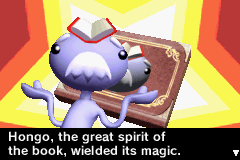
It begins, as so many Yoshi stories do, with Bowser. He has attacked Eggland and turned all of its Egglings into apples, and now he and his army are running riot on Yoshi’s Island. That is too much for Hongo, the great and rather obstinate spirit who rules the Forbidden Pop-Up Book, and he decides to lock Bowser inside it.
The spell works too well. Bowser goes into the book, and so does everything else: the island, its inhabitants and Yoshi himself, all pressed flat into pop-up pages.
Bowser attacks Yoshi’s Island.The island disappears into the book.Hongo, master of the Forbidden Pop-Up Book.
The Spirit Who Loves Surprises
As Yoshi panics, a small jester-like figure pops up: the Spirit Who Loves Surprises, once Hongo’s assistant. He explains that no spirit can beat Bowser, who is hiding in a cave in the book’s last chapter, and that Hongo will only let the island out if Bowser is dealt with first, otherwise he would simply attack again. He also confesses that Hongo sacked him for being unable to keep a secret.
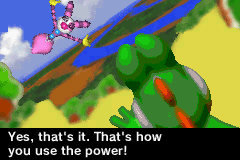
Yoshi is furious, so by way of apology the spirit grants him the power to tip the whole world and shows him how. Yoshi tries it out at once and promptly sends a boulder rolling into the spirit.
The Spirit Who Loves Surprises introduces himself.The gift of tilting.First lesson: mind the boulder.
Tale of the Spirit of Cuteness
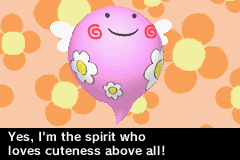
The first tiny spirit Yoshi meets is the round, pink, winged Spirit of Cuteness, who explains about the Egglings: Bowser’s curse has turned every one of them into an apple. Swallow an apple and out pops an Eggling. Her three missions double as the tutorial, introducing rolling balls, carpets, cannons, lifts and snowballs.
The Spirit of Cuteness and the Egglings’ plight.Mission 1-2.
The Spirits of Money and Power
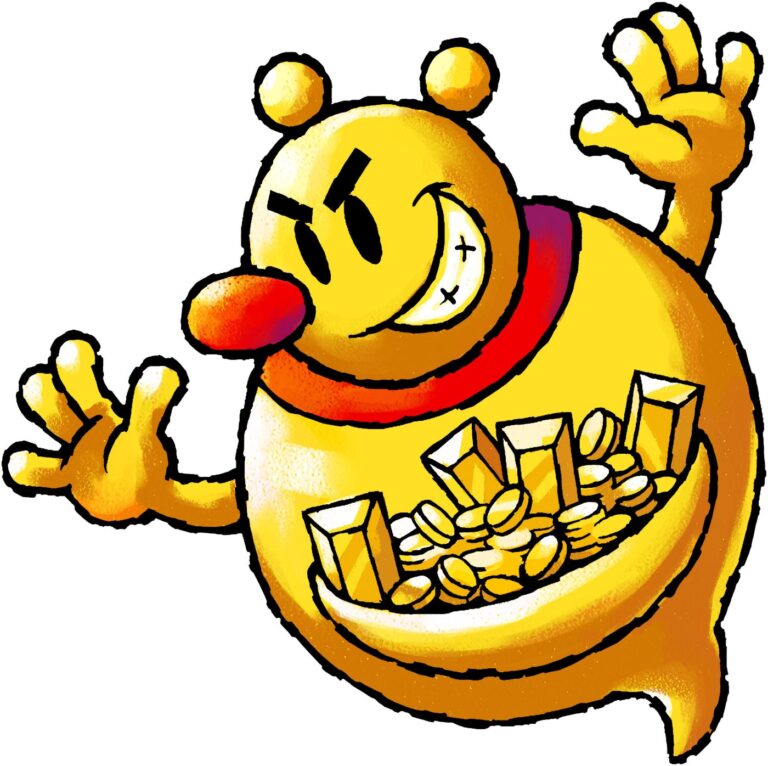
The golden, mouse-like Spirit of Money wants coins, lots of them, across six missions. Then the Spirit of Power, a portly purple genie, sets eight missions that measure success in defeated enemies, including a downhill ski run, and starts pairing his demands with those of the others.
The Spirit of Money.Mission 2-4.Mission 3-3, for the Spirit of Power.
Tale of the Spirit of Speed
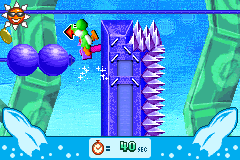
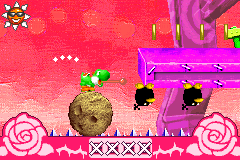
The windswept Spirit of Speed runs the longest chapter so far, ten missions in which the goal has to be reached before the timer runs out, some of them mixed with coin and enemy targets.
The Spirit of Speed.Mission 4-8.
The Tale of Bowser’s Fields
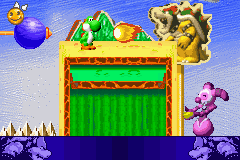
With four chapters done, Yoshi finally comes face to face with Bowser, who breathes fire at him in an open field. But this Bowser is made of cardboard, and the hand working it belongs to the Spirit Who Loves Surprises, who wanted to see whether Yoshi was ready for the real thing. Yoshi is not amused, and the spirit apologises.
A Bowser in Bowser’s Fields……and the spirit behind it.
Tale of the Spirit of Kindness
The rose-like Spirit of Kindness turns the Spirit of Power’s rules upside down: across eleven missions the aim is to hurt as few enemies as possible, which means using the tilt to roll obstacles round them rather than through them.
The Spirit of Kindness.Mission 5-1.
Tale of the Spirit of Fright
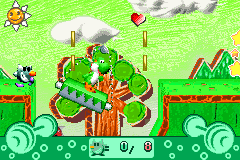
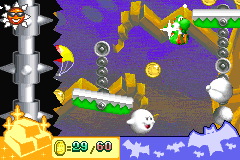
The last tiny spirit, the mummified Spirit of Fright, sets twelve missions in which Yoshi has to reach the goal while a rolling, spiked machine grinds along behind him. Boos, Mace Guys and the invincible Daruma Otoshi-kun crowd the pages, Boat Yoshi gets his only two outings, and every spirit’s demands come round again.
The Spirit of Fright.Mission 6-6.
The Tale of Bowser’s Cave
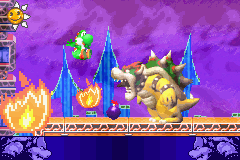
With every spirit satisfied, Yoshi reaches the last chapter and the real Bowser. He breathes streams of fire, and Yoshi beats him with bombs: in the first phase they roll along the floor in whichever direction you tilt the world, flash red and explode. Orange Tap-Taps join in after his slam attack, rolling with the tilt as well.
The real Bowser, in his cave.Bowser, sealed away for good.
Back to the island
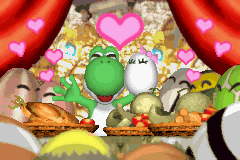
The spirits celebrate, and a grateful Hongo cooks Yoshi a meal. Yoshi is still not happy, of course, because his island is still a book, so Hongo finally works his magic and returns Yoshi and the island to normal. Yoshi sits down to eat with the rescued Egglings, who will never forget him, and the Spirit Who Loves Surprises gets his old job back.
The spirits celebrate.A meal is nice, but Yoshi wants his island back.Home at last, with the Egglings.
Every chapter and challenge in Yoshi Topsy-Turvy
The book’s eight chapters in order, then the five Challenge Mode games. Missions are numbered rather than named; the card says which spirits set them.
Tale of the Spirit of CutenessChapter 1 · missions 1-1 to 1-3 · CutenessThe tutorial: tilting, apples, rolling balls and carpets, cannons, Igashira-kun, lifts, a snowball and Piranha Plants.
Tale of the Spirit of MoneyChapter 2 · missions 2-1 to 2-6 · Money, CutenessCoin targets join the apple hunts.
Tale of the Spirit of PowerChapter 3 · missions 3-1 to 3-8 · Power, Money, CutenessEnemy-defeat targets, skiing and the first mixed Power-and-Money brief.
Tale of the Spirit of SpeedChapter 4 · missions 4-1 to 4-10 · Speed, Money, Power, CutenessTen missions against the clock.
The Tale of Bowser’s FieldsBoss stage · mid-boss: a cardboard BowserBowser appears at last, spitting fire. Or does he?
Tale of the Spirit of KindnessChapter 5 · missions 5-1 to 5-11 · Kindness, Speed, Money, Power, CutenessEleven missions that reward leaving enemies alone.
Tale of the Spirit of FrightChapter 6 · missions 6-1 to 6-12 · all six spiritsTwelve missions of Boos, Mace Guys, Daruma Otoshi-kun and the grinding machine, plus Boat Yoshi.
The Tale of Bowser’s CaveFinal boss stage · BowserThe real Bowser, fought with bombs that roll wherever you tilt them.
Shuffle ModeChallenge Mode · unlocked by finishing the storyRandom missions back to back until you fail.
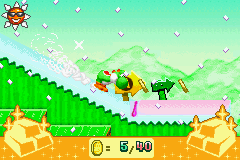
Yoshi’s Big JumpChallenge Mode · complete the Eggling BookA tilt-powered ski jump measured for distance.
Yoshi’s Pirate BattleChallenge Mode · complete the Eggling BookThirty seconds to loop a Shy Guy Ship as often as you can.
Yoshi’s Time AttackChallenge Mode · complete the Eggling BookBall Yoshi races through a course against the clock.
Shuffle Mode EXChallenge Mode · every Gold Happiness MedalThe hard version of Shuffle Mode.
GameSpot’s reviewer counted 52 courses including the two Bowser encounters, and noted that only 36 of them have to be cleared to reach Bowser.
Advertisement
Gameplay & Controls
Strip away the gimmick and you have a Yoshi platformer: run, jump, flutter, lick. Put it back and every level becomes a puzzle about which way to hold the console. Missions are short, a couple of minutes each, and the challenge comes as much from the spirits’ demands as from the obstacles.
Tilting the world
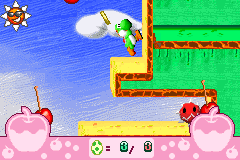
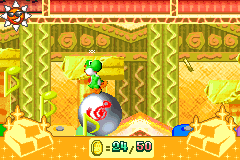
A tilt sensor in the cartridge recognises three states: held level, tipped left and tipped right. There is nothing in between. Tip the console and the page rotates, gravity follows, and everything loose responds. Yoshi can walk on walls that have become slopes; balls, boulders and the sleeping spiked Igashira-kun roll downhill; flipping back and forth quickly can turn some objects upside down. Tilting also swings Ball and Chains, rocks Shy Guy Ships and aims cannons.
Nintendo’s own pages show the idea at its neatest: a carpet that rolls out over a bed of spikes, a sheer wall that becomes a gentle hill, and a snowball that grows enormous as it rolls.
The tilt icon.Tilt to ski: mission 3-2.Rolling an Igashira-kun in mission 5-7.
Yoshi’s moves and controls
The +Control Pad moves Yoshi, Down crouches and Up looks up. A jumps, and holding it at the top of a jump performs the Flutter Jump. B shoots out the tongue to eat enemies, fruit and coins. Start pauses, and L and R flip through the Eggling Book.
One big change from the other Yoshi games: swallowing an enemy does not give you an egg. Yoshi just puffs out a little burst of air. Health is an eight-point meter; Hearts restore one point and Big Hearts fill it up, and every 100 coins earn an extra life.
Levels only run one way. Touch a ring of stars and you move on to the next area with no way back, so anything you missed is gone. A large star at the end closes the mission.
The Flutter Jump survives the trip into the book.No eggs here: an eaten enemy just becomes a puff of air.
Spirits, missions and Happiness Medals
Each mission is briefed by one or two of the six tiny spirits, and each has a single obsession. The Spirit of Cuteness wants Egglings rescued; the Spirit of Money wants a set number of coins; the Spirit of Power wants enemies defeated; the Spirit of Speed wants the goal reached within a time limit; the Spirit of Kindness wants as few enemies hurt as possible; and the Spirit of Fright wants Yoshi to outrun a grinding, spiked machine. Later missions mix two spirits’ demands at once.
Meet the target and you earn a Silver Happiness Medal; beat it handsomely (every apple when the Spirit of Cuteness asked for a handful, say) and it becomes a Gold Happiness Medal. Medals open the way through the book, and Gold ones matter later.
Two spirits, two demands: Money and Power brief a mission together.A Gold Happiness Medal.
Transformations
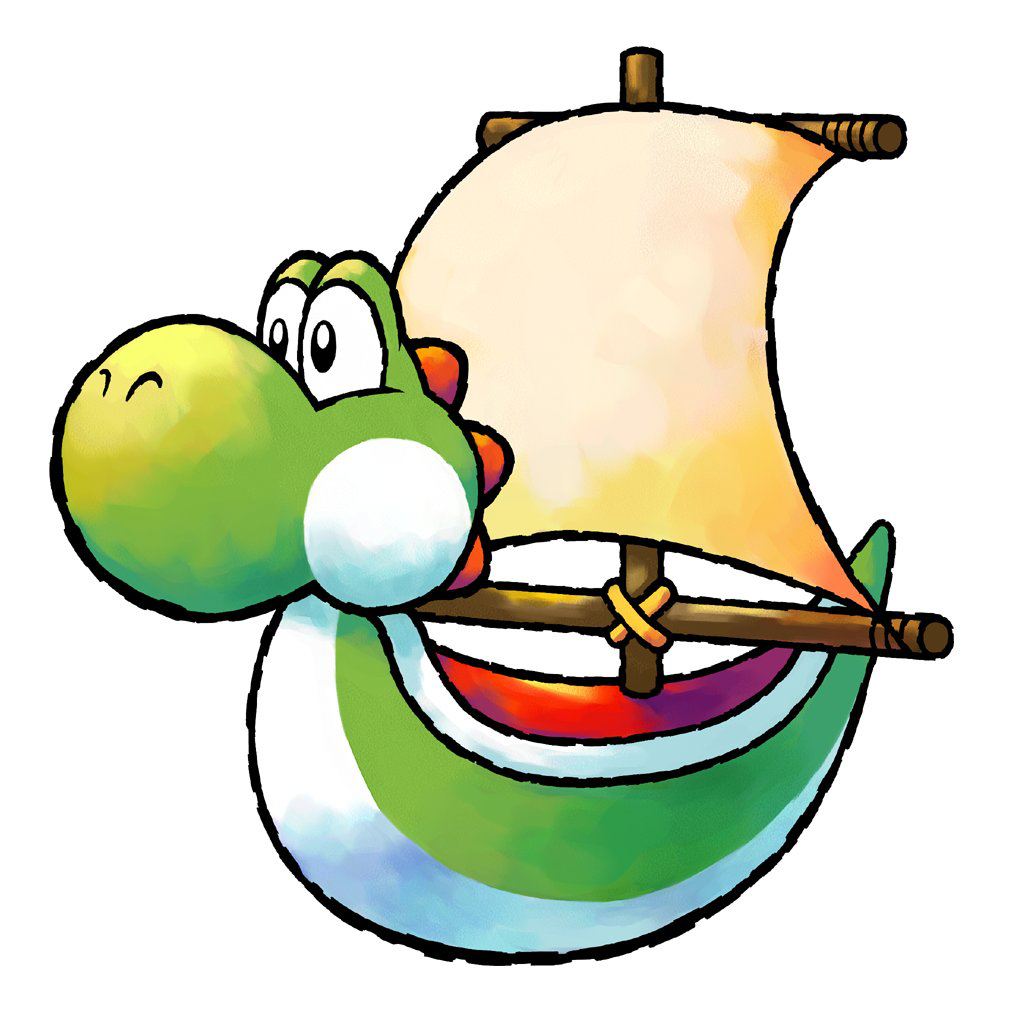
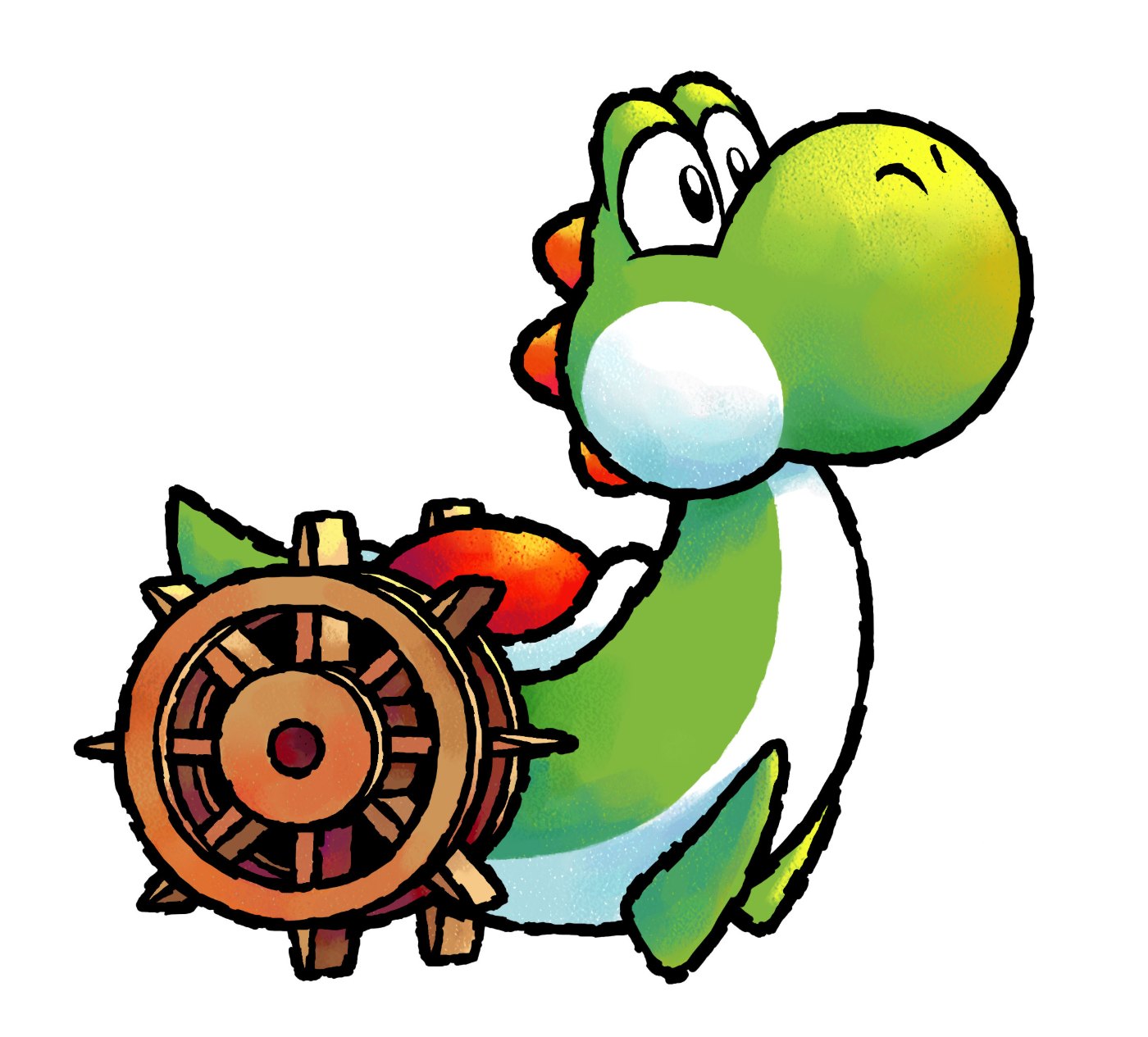
In some areas Yoshi turns into something else, and the tilt takes over almost completely. Balloon Yoshi, the first you meet, drifts slowly downwards and is steered by tilting. Ship Yoshi sails forward on water and tilting changes the water level; on dry land he is stuck until water reaches him again. Ball Yoshi is invincible, bounces in whichever direction you tilt, and smashes concrete blocks and enemies. Boat Yoshi, met only twice in chapter 6, paddles along on two wheels and can jump with A. Elsewhere Yoshi also rides Goonies and Shy Guy Ships, but those are vehicles rather than transformations.
Balloon Yoshi.Ship Yoshi.Ball Yoshi.Boat Yoshi.
Egglings and the Eggling Book
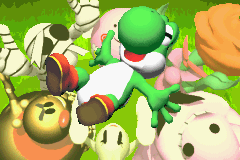
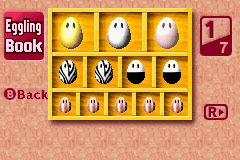
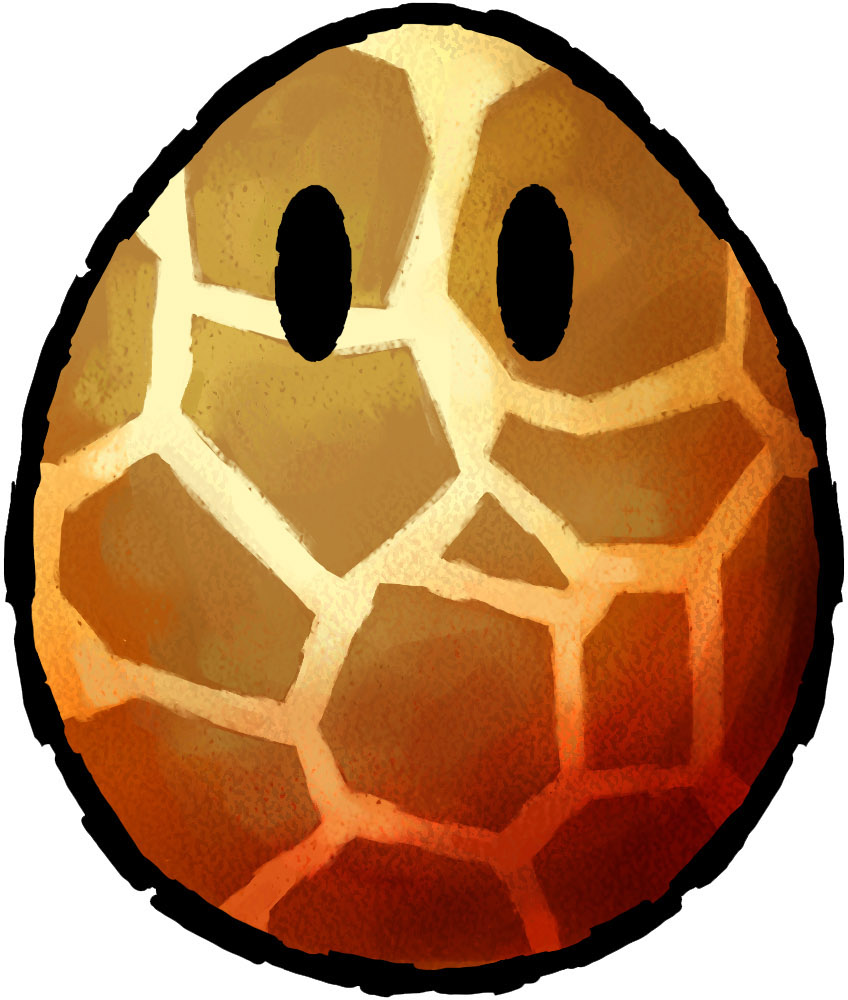
Bowser cursed the Egglings of Eggland into apples, so every apple Yoshi swallows is a rescued Eggling. Each one is recorded in the Eggling Book, seven pages listing name and class. There are 20 classes, from the rare Gold, Silver and Pearl Egglings to zebras, squirrels, cows, snakes, bees, deer, flamingos, owls, angels and bears, and 102 entries in all. Filling the book is what unlocks three of the Challenge Mode games.
The first page of the Eggling Book.An Eggling, freed from its apple.
Bonus Chance and Bonus Missions
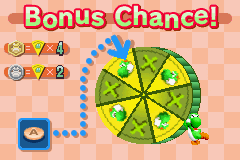
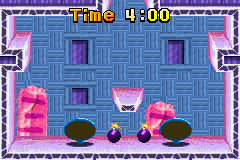
Every mission ends with a Bonus Chance!, a wheel that sets a quick Bonus Mission! hosted by the Spirit Who Loves Surprises: detonate two bombs within a few seconds, catch four, five or six coins, or hit a run of cymbal notes. Clear it and you take home 50 coins.
The Bonus Chance! wheel.Two bombs, four seconds.
Challenge Mode
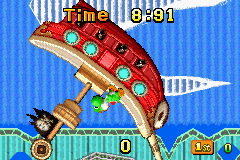
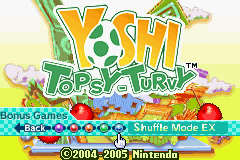
Finish the story and Challenge Mode opens with five extra games. Shuffle Mode strings random missions together until you fail one or lose a life, and Shuffle Mode EX is the harder version. Yoshi’s Big Jump is a ski jump: tilt right to slide down a snowy mountain and press A to take off, distance depending on speed and timing. Yoshi’s Pirate Battle gives you 30 seconds to rock a Shy Guy Ship back and forth and loop it as many times as you can. Yoshi’s Time Attack sends Ball Yoshi against the clock.
Yoshi’s Pirate Battle: loop the ship.All five games unlocked.
Regional differences
The Japanese title screen let you tilt Yoshi and three apples about; the international versions moved one apple down to make room for the new logo. Some flashing effects were toned down outside Japan to reduce the risk to players with photosensitive epilepsy. High scores are measured in metres in Japan and Europe and in yards in North America, the European score sheet is wider, and the European version drops the “sec” from timed objectives. Europe also gets a language selection screen, for English, French, German, Italian and Spanish.
The Japanese title screen.The European title screen, as Yoshi’s Universal Gravitation.Europe’s language select.
Items and tilt objects
What Yoshi eats, collects and pushes around. The objects at the end of the list are the ones the tilt brings to life.
CoinEverywhere, and essential for the Spirit of Money. 100 make an extra life.
HeartRestores one point of health.
Big HeartRarer; refills the whole meter.
AppleA cursed Eggling. Swallow it and the Eggling is free. The key to Spirit of Cuteness missions.
BombUsually floats down on a parachute that you steer by tilting. Explodes on landing, hurting enemies and Yoshi alike.
Baron von ZeppelinA balloon carrying an item upwards. Eat it and the item drops.
ParachuteCarries items gently downwards.
Silver Happiness MedalFor meeting a spirit’s target.
Gold Happiness MedalFor smashing it. Collect every one to unlock Shuffle Mode EX.
BallRolls with the tilt; Yoshi can ride on top.
BoulderRolls downhill and flattens whatever is in the way.
SnowballGrows as it rolls.
Rolled-up carpetTilt to unroll it into a safe path over spikes.
CannonAimed by tilting.
Ball and ChainSwings with the tilt.
Shy Guy ShipA rocking pirate ship, and the star of Yoshi’s Pirate Battle.
BasketTip it over to spill the coins inside.
Ferris wheelA rotating set of platforms.
Rising notesMusical platforms.
CheckpointA restart point partway through a mission.
GoalThe big star that ends a mission and awards the medal.
Cartoons, Comics & Other Media
A quiet afterlife: two spirit cameos, a set of print adverts, and a studio that went on to make a much bigger Yoshi game.
Super Smash Bros. UltimateSwitch, 2018 · spiritsHongo and the Spirit Who Loves Surprises both appear as collectable spirits. Hongo is a Novice-class support spirit that cuts damage from magic attacks; his spirit battle pits you against a Robin puppet fighter on the Super Happy Tree stage.
Yoshi’s Island DSNintendo DS, 2006 · ArtoonArtoon’s other Mario-franchise game: Yoshi’s next handheld outing, on the Nintendo DS.
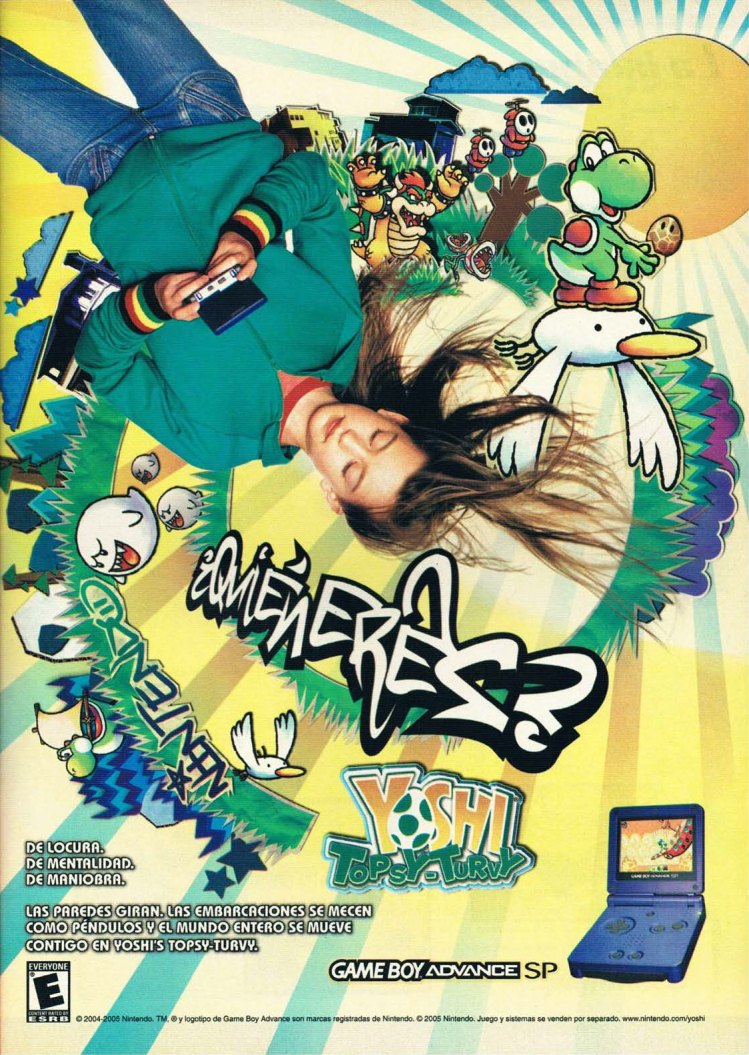
North American print advertAdvert · 2005Nintendo of America’s magazine advert for the June 2005 launch.
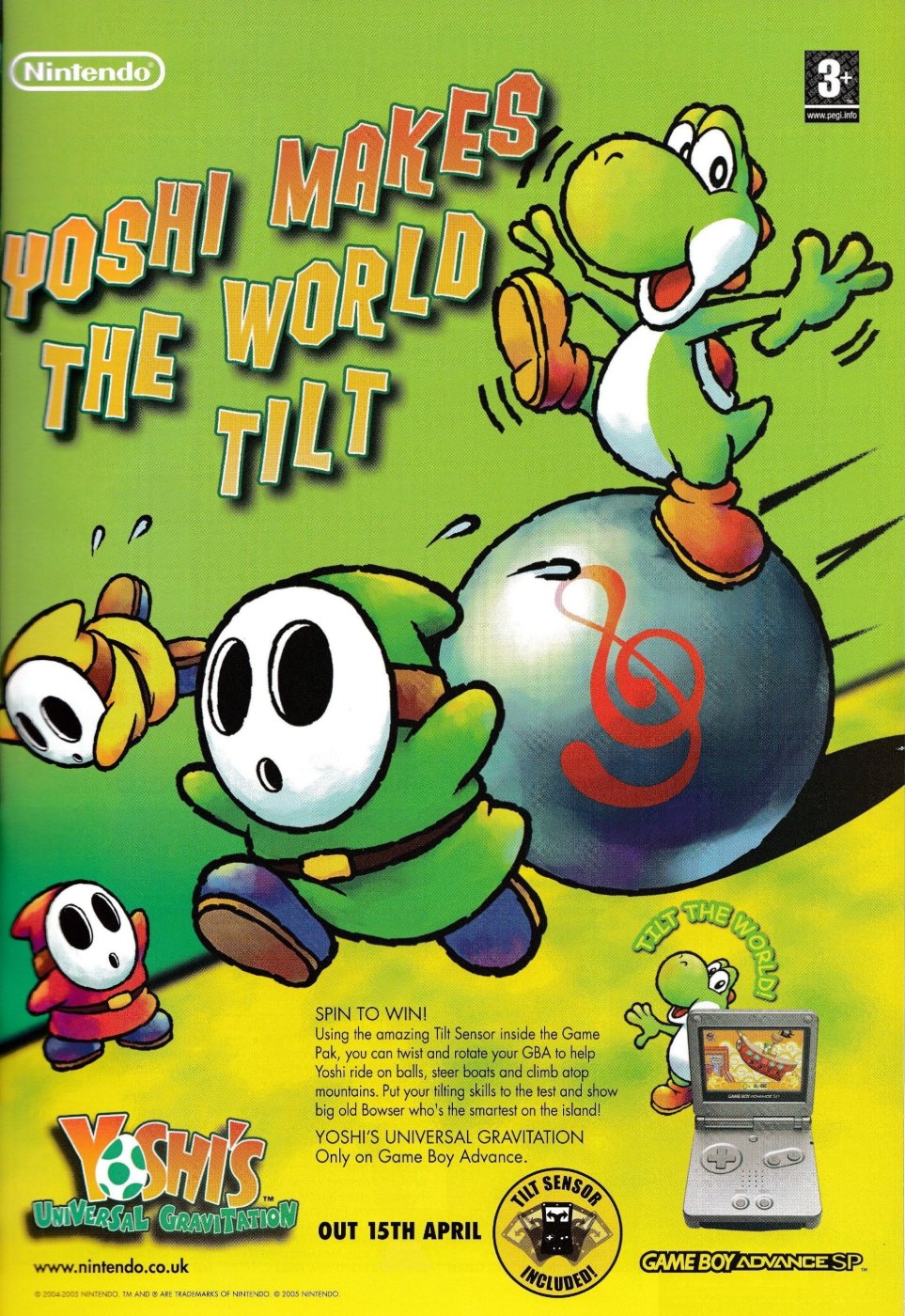
British print advertAdvert · 2005The UK advert, for Yoshi’s Universal Gravitation.
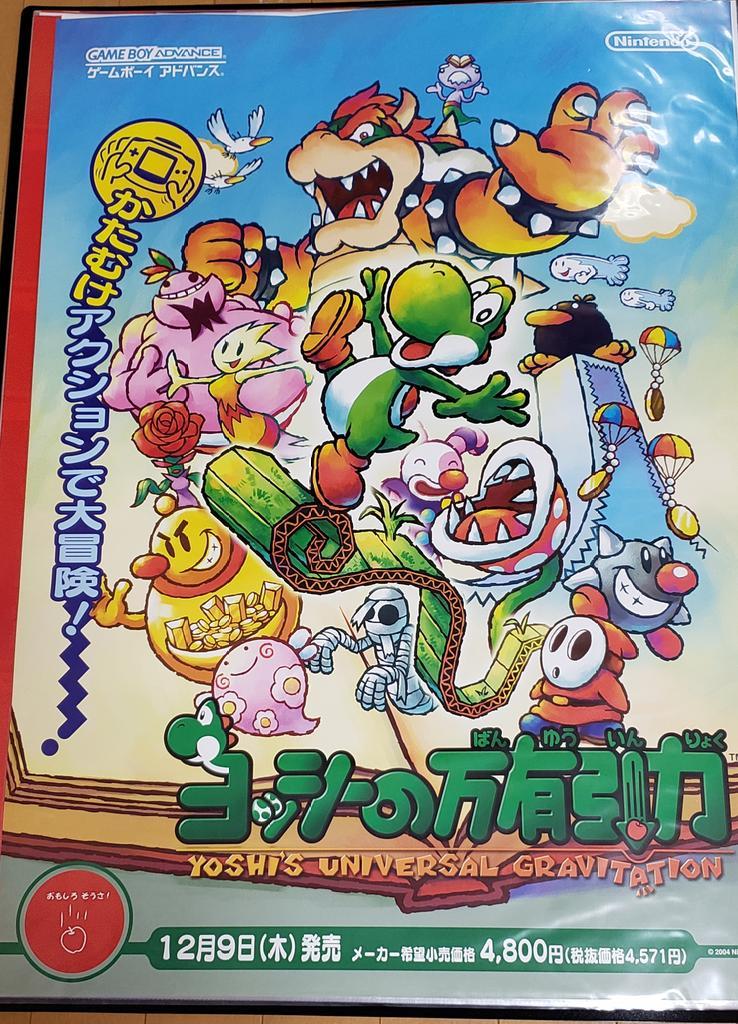
Japanese and Mexican advertsAdvert · 2004–05Japan advertised Yoshi no Ban’yū Inryoku for its December 2004 launch, and the game was advertised in Mexico too.
Characters
There is no Mario, no Baby Mario and no Toad here: just Yoshi, a book full of spirits and the Egglings he is trying to save. Portraits are the game’s own cutscene sprites.
Character
Who they are
In this game
Abilities & notes
YoshiHero · the only playable character
The green dinosaur of Yoshi’s Island, sealed into the book along with his home.
Has to satisfy the spirits, rescue the Egglings and beat Bowser so the island can be released while Bowser stays locked up.
Health: 8 points
Moves: jump, Flutter Jump, tongue, crouch, look up
Transformations: Balloon, Ship, Ball and Boat Yoshi
HongoGreat spirit of the Forbidden Pop-Up Book
Powerful, elderly and obstinate. In Japan he is Gohhon, a name that mimics a cough and puns on the polite word for a book; in French he is Teuheu.
Seals the island in his book by mistake and will only release it once Bowser is beaten. Cooks Yoshi a meal at the end before restoring everything.
First appearance
A spirit in Super Smash Bros. Ultimate
Spirit Who Loves SurprisesTiny book spirit · guide
A jester-like spirit, Hongo’s former assistant, sacked for his loose lips (and, by one account, for questioning the decision to seal the island).
Gives Yoshi the tilting power, hosts the Bonus Missions and pulls the strings of the cardboard Bowser. Gets his job back at the end.
Japanese: Bikkuri Daisuki Seirei
A spirit in Super Smash Bros. Ultimate
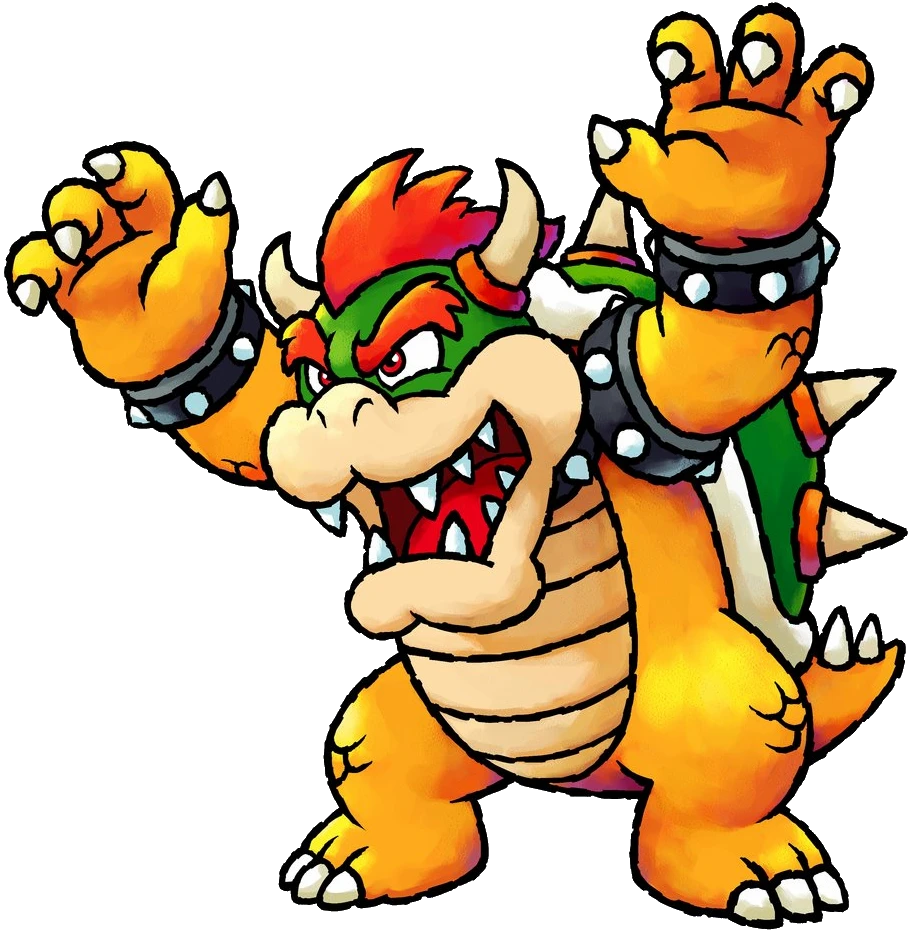
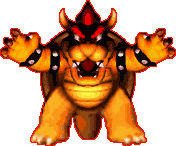
BowserKing of the Koopas · final boss
Attacked Eggland, cursed its Egglings into apples and chased them to Yoshi’s Island.
Sealed into the book and hiding in its last chapter, The Tale of Bowser’s Cave.
Fought with tilt-rolled bombs
Spirit of CutenessTiny spirit · chapter 1
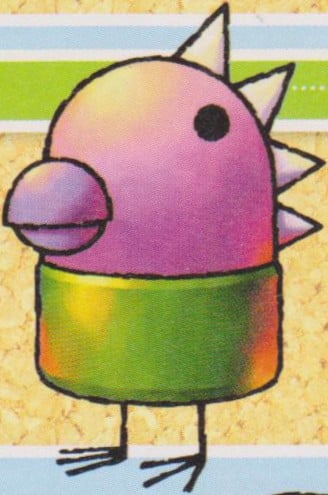
A round, pink, flying spirit with white wings who loves cute things above all.
Sets the Eggling-rescue missions.
Mission type: eat a number of apples
Spirit of MoneyTiny spirit · chapter 2
A golden mouse with a pouch of gold.
Wants coins handed over to let Yoshi pass.
Mission type: collect a number of coins
Spirit of PowerTiny spirit · chapter 3
A stout purple genie who loves all things mighty.
Sets enemy-defeat targets.
Mission type: defeat a number of enemies
Spirit of SpeedTiny spirit · chapter 4
A windswept spirit in love with anything swift.
Challenges Yoshi to races against the clock.
Mission type: beat the time limit
Spirit of KindnessTiny spirit · chapter 5
A floral spirit who looks like a rose.
Asks Yoshi to spare as many enemies as he can.
Mission type: defeat as few enemies as possible
Spirit of FrightTiny spirit · chapter 6
A mummy who loves all things scary.
Sends a spiked grinding machine after Yoshi.
Mission type: escape the grinder and reach the goal
EgglingsInhabitants of Eggland
Small egg-shaped folk of many kinds, from Gold and Pearl Egglings to cows, snakes, flamingos and angels. Their names are puns: the turtles include Slowmo, Molasses and Nogo, the deer are named after coffees and sweets, and one snake is Ann Conda.
Cursed into apples by Bowser; every apple Yoshi swallows frees one.
20 classes, 102 book entries, 100 names
Bosses & enemies
Two bosses and the full bestiary. By the usual count, twelve enemy types hurt Yoshi on contact; the chips below split out the colour variants that behave differently.
Cardboard Bowser (mid-boss)The Tale of Bowser’s FieldsA cut-out Bowser that spits fireballs, worked by the Spirit Who Loves Surprises.
Bowser (final boss)The Tale of Bowser’s CaveBreathes streams of fire; beaten with bombs that roll where you tilt them.
Big BooFour missionsCreeps after Yoshi when he looks away and hides its face when he turns round.
BooMission 6-7 onlyBehaves like the Big Boo, on a smaller scale.
Daruma Otoshi-kunLate in chapter 6 (four appearances)A spiked creature that cannot be defeated.
King DebuhōVarious missionsA big Fat Guy; jump on his head and he just bounces Yoshi off.
Fly GuyVarious missionsA propeller-headed Shy Guy; some carry coins Yoshi can lick away.
GoonieVarious missionsA bird that only flies forward. Tilt to raise or lower it, and ride on its back.
GustyVarious missionsA ghostly gust that flies forward in groups.
Igashira-kunFrom chapter 1A sleeping spiked ball that rolls when the world tilts. Use it to knock out enemies Yoshi cannot.
Mace GuyChapters 5 and 6 (seven missions)A Shy Guy swinging a flail that never stops.
Piranha PlantFrom chapter 1Rooted to the spot. Walk into its mouth and it holds Yoshi for about three seconds before spitting him out.
RavenVarious missionsA black bird that walks on walls and ignores gravity.
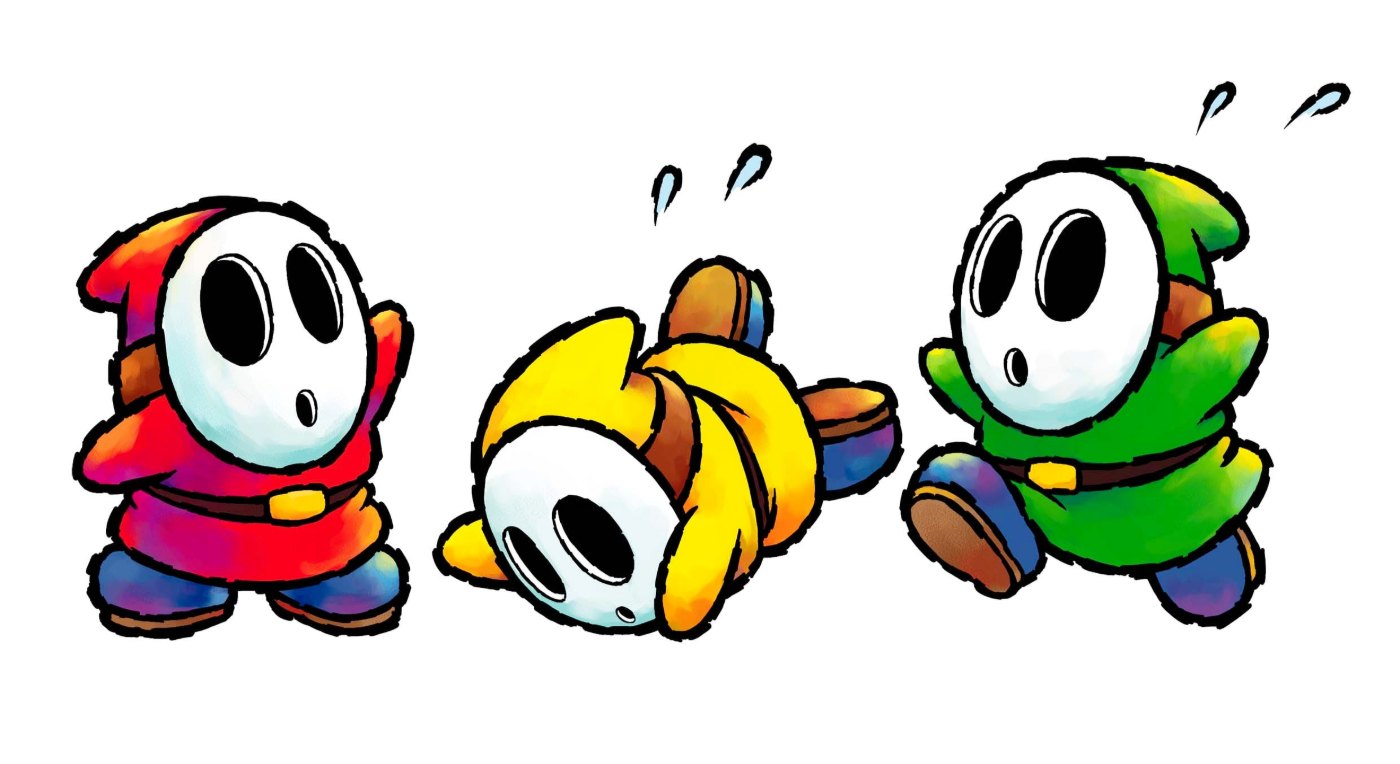
Shy GuyThroughoutWalks forward. Jump on it or eat it. Red, green and yellow.
Tap-TapVarious missionsA spiked walker that cannot be beaten and takes away most of Yoshi’s health.
Orange Tap-TapThe Tale of Bowser’s CaveReleased by Bowser’s slam attack; rolls with the tilt.
Key staff
From the in-game credits. Artoon made the game; Nintendo supervised and published it.
Hidetoshi TakeshitaDirector; Technical DirectorCo-directed the game and led its technical side.
Hiroto SaikiDirectorCo-director.
Masahide KobayashiPlanning DirectorLed the planning team of Yuusuke Nakadaira, Masaru Yonezawa and Noboyuki Maruyama.
Yasuhisa NakagawaArt DirectorHeaded a ten-strong design team.
Tatsuyuki Maeda, Masaru Setsumaru and Mariko NanbaSoundMusic and sound, with Koji Kondo credited for sound support.
Takashi Tezuka and Hisashi NogamiSupervisorsNintendo’s Yoshi veterans keeping an eye on the series.
Nate Bihldorff and Bill TrinenEnglish textPart of a localisation that also covered French, German, Italian and Spanish.
Masaki Tawara and Naoto OhshimaProducersOhshima co-founded Artoon in 1999 after leaving Sega.
Yoji IshiiSenior ProducerArtoon’s other co-founder.
Satoru IwataExecutive ProducerNintendo’s president.
Advertisement
How It Was Made
A Nintendo character in the hands of an outside studio with roots at Sega, built around a control idea that had barely been tried on a handheld.
Artoon
The North American logo.
Artoon was founded on 27 August 1999 by Naoto Ohshima and Yoji Ishii, who had both left Sega the year before, and was based in Yokohama with a second office in Okinawa; much of its early staff came from Sega’s Sonic Team, according to Wikipedia. Before this it had made Pinobee for Hudson Soft and Blinx: The Time Sweeper for Microsoft’s Xbox. The publisher AQ Interactive bought into the studio in May 2004, months before this game came out, and took full ownership in June 2005.
Credits show it as a joint effort: Artoon’s Hidetoshi Takeshita and Hiroto Saiki directed, Ohshima and Masaki Tawara produced with Ishii as senior producer, and Nintendo’s Takashi Tezuka and Hisashi Nogami were credited as supervisors, with Satoru Iwata as executive producer.
Tilt the Game Boy Advance
Balance is everything.
Everything was designed around one action: tilting the console. Nintendo’s Japanese site headed its explanation “Let’s tilt the Game Boy Advance” and showed off carpets, slopes and snowballs. The same site warned players not to use the Game Boy Player, the GameCube add-on that runs Game Boy Advance games on a television. The game had arrived in a busy year for unusual Game Boy Advance controls: WarioWare: Twisted! also turned on movement, and most critics, Wikipedia notes, felt it used the idea better.
A storybook in pre-rendered sprites
The Forbidden Pop-Up Book’s cover.
The look borrows from Yoshi’s Story: pre-rendered sprites and a pop-up picture-book world. The Forbidden Pop-Up Book even has its own cover and title page in the cutscenes.
What the cartridge still contains
The book’s back cover in the North American version.
The Cutting Room Floor found text for a set of debug tools left in the ROM: a set editor, enemy and gimmick placement, player position, area display and editing, path editing, a sound test, Yoshi’s movement parameters and toggles labelled Motion Sensor, Super Move, Invincible, Free Fall and Goal Disable. Nobody has found a way to switch them on.
One game, three names
The European logo.
The Japanese title, Yoshi no Ban’yū Inryoku, means “Yoshi’s Universal Gravitation”, and Nintendo of Europe kept that translation. Nintendo of America went for the friendlier Yoshi Topsy-Turvy. The European release also added a language select for five languages, with French, German, Italian and Spanish translators named in the staff roll.
Series Firsts
Few series firsts can be pinned on it with confidence; these two are documented.
1Hongo and the tiny spiritsHongo, the Spirit Who Loves Surprises and the six tiny spirits all made their debut here; Yoshi Topsy-Turvy is usually listed as Hongo’s first appearance, and both spirits returned as collectables in Super Smash Bros. Ultimate.
2No eggs for YoshiUnlike most Yoshi platformers, swallowing an enemy here does not make an egg; Yoshi just lets out a puff of air.
Cheats & Secrets
No passwords or button codes are documented. The secrets are unlockables, and the rules for getting them.
Unlocking the Challenge Mode games
Finish the story to open Challenge Mode with Shuffle Mode. Complete the Eggling Book to add Yoshi’s Big Jump, Yoshi’s Pirate Battle and Yoshi’s Time Attack. Win a Gold Happiness Medal on every mission for Shuffle Mode EX.
Going for Gold
A Silver Medal only needs the spirit’s target; Gold needs you to blow it away. With the Spirit of Cuteness, eating every apple on the page rather than the number asked for is the surest way.
Eat every apple
Apples are Egglings, and every Eggling goes into the book. Since filling the book unlocks three games, it pays to clear each page of apples even when the mission does not require it.
Use the Igashira-kun
Tap-Taps and some other enemies cannot be beaten by Yoshi directly. Wake an Igashira-kun with a tilt and roll it into them instead.
Win the Bonus Missions
Each Bonus Mission cleared is worth 50 coins, and coins are lives: 100 of them make a 1-Up.
Take your time
Areas cannot be revisited once you pass through a ring of stars, so check corners before you leave. GameSpot noted that only 36 courses have to be cleared to reach Bowser, so the rest are there for completists.
The Big Jump goal nobody reaches
There is a goal hidden at the far right of Yoshi’s Big Jump. Touch it and the fanfare plays, but the room is so long that, according to The Cutting Room Floor, the best distance recorded since 2010 is 131.76 yards against a maximum of 256.23.
Glitches & Oddities
No well-known glitches are documented. The Cutting Room Floor lists these oddities.
Dormant debug menus
Strings for a full set of debug and editing modes survive in the ROM, from Set Editor and Path Edit to an Invincible toggle and Goal Disable. How to activate them, and whether they still work, is unknown.
An unreachable finish line
Yoshi’s Big Jump has a goal at the end of its room that ordinary jumps never get near. Touching it plays the goal fanfare and moves to the scores.
Toned-down flashes
Some cinematic effects were softened for the Western releases for epilepsy safety, one of several small regional changes.
Videos
Nintendo has not put Yoshi Topsy-Turvy on its YouTube channels, so here are two fan uploads: a complete longplay and a video review.
Third-party upload by World-of-Longplays: a complete longplay of the game.
Third-party upload by Classic Game Room: a video review of the Game Boy Advance game.
Trivia & Interesting Facts
Hongo’s Japanese name, Gohhon, is written to sound like a throat-clearing cough and puns on gohon, a polite word for a book. His French name, Teuheu, is another cough.
Nintendo’s Japanese site calls the Spirit Who Loves Surprises Bikkuri Daisuki Seirei, and the book the Tobidase book.
A Snake Eggling. Ann Conda, perhaps.The Egglings’ names are a feast of puns: the turtles include Slowmo, Molasses and Nogo, the deer Cocoa, Mocha, Eclair and Cappuccino, the raccoons Trashcan and Dumpy, and one snake is called Ann Conda.
Two Egglings in the book share their names with another: there are two Cocoas among the deer and two Goodys among the angels.
Shoot for the record: the best known score in Yoshi’s Big Jump has stood at 131.76 yards since 2010.
North American high scores are in yards; the Japanese and European versions use metres.
Nintendo’s Japanese page warned buyers not to play it on the Game Boy Player.
The Japanese release price was 4,571 yen before tax.
The Spirit of Money.The Spirit of Money’s official artwork is sometimes labelled “Spirit of Greed”.
Koji Kondo is credited for sound support.
The English text is credited to Nate Bihldorff and Bill Trinen.
The game’s objects include one known only as the “Spoooooky thing”.
Mario is nowhere to be seen: the cast is Yoshi, Bowser, the Egglings and the book’s spirits.
Goodbye, Egglings.The game ends with the credits rolling over scenes of Yoshi waving goodbye to the Egglings.
Regional Box Art
Three titles, four boxes, plus the logos and title screens that changed between regions.
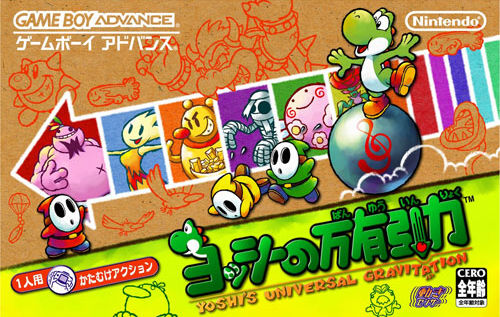
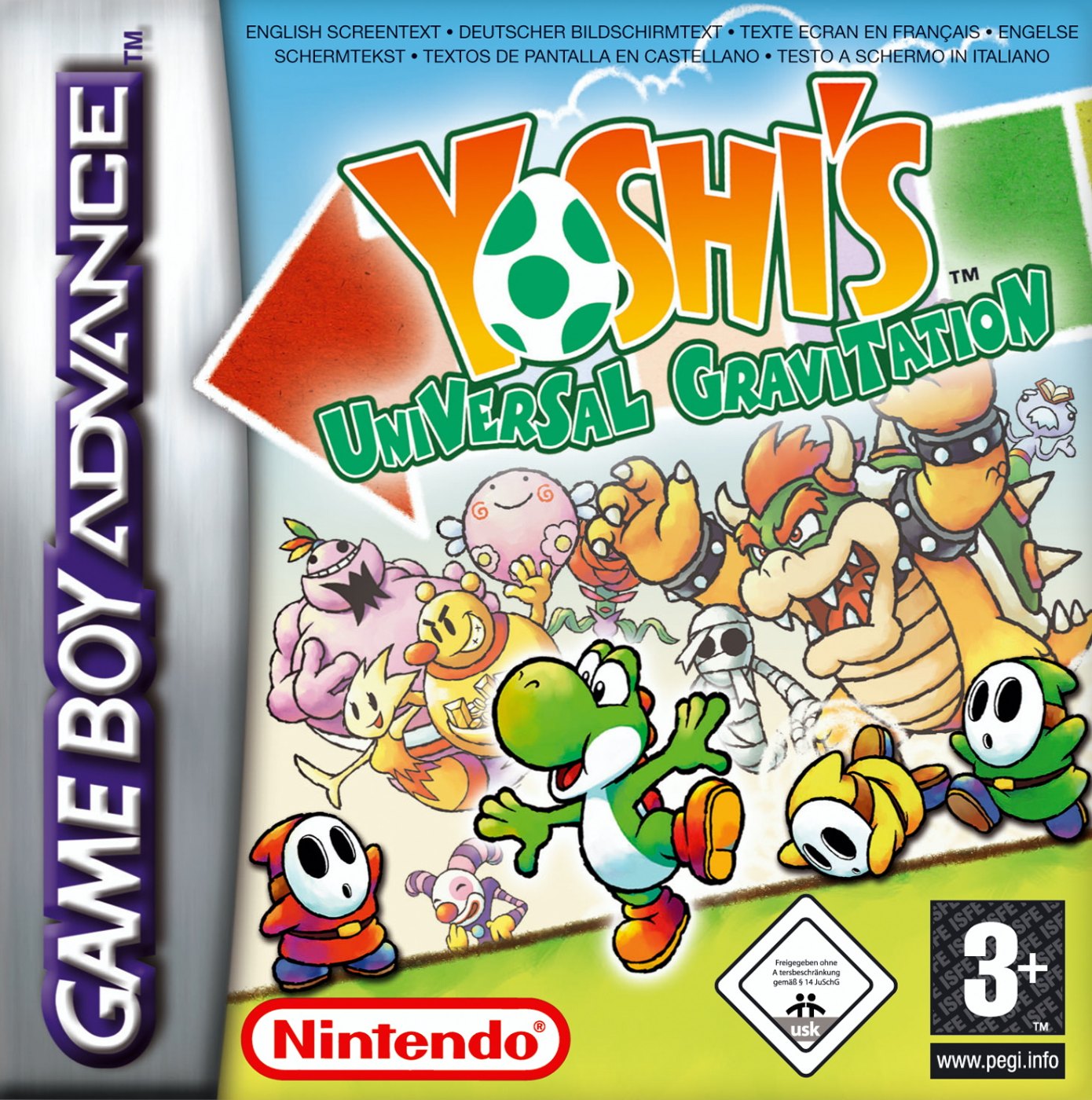
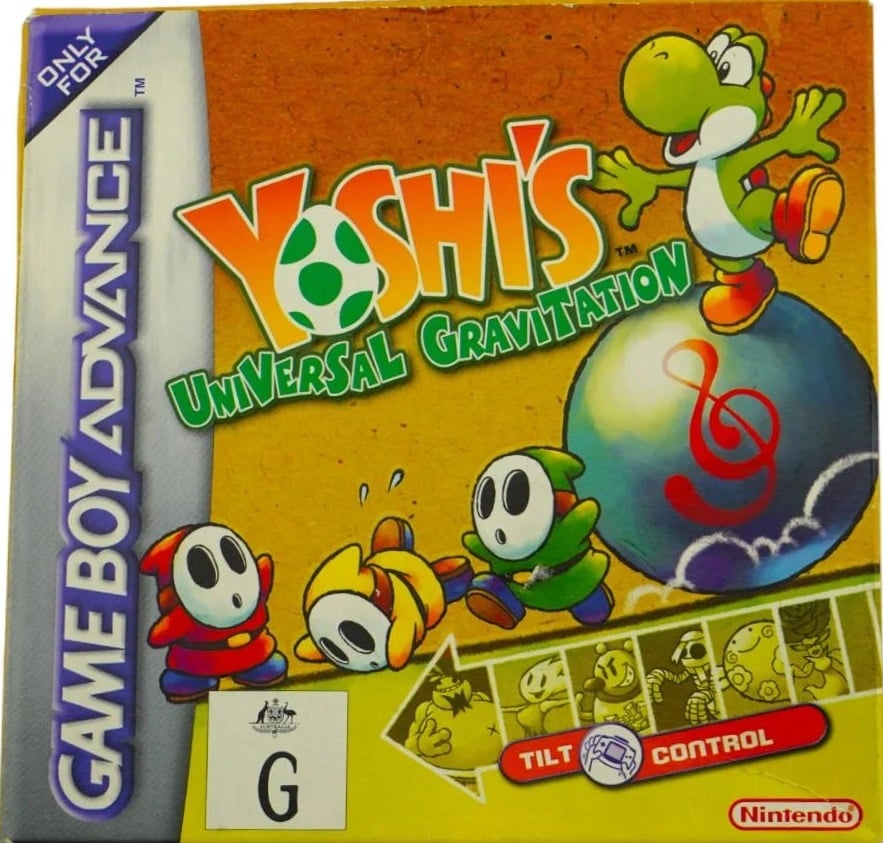
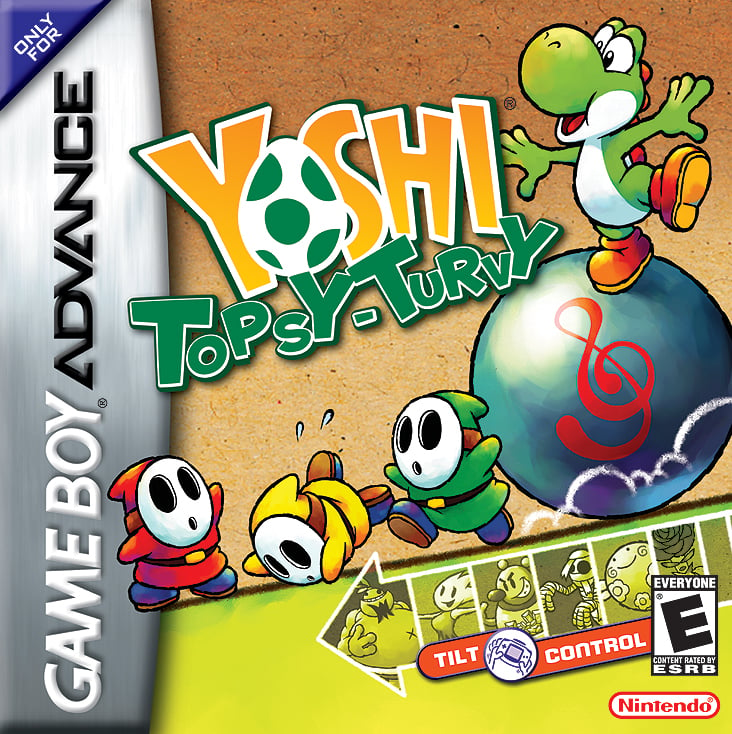
North America (2005)As Yoshi Topsy-Turvy.Japan (2004)As Yoshi no Ban’yū Inryoku.Europe (2005)As Yoshi’s Universal Gravitation.Australia (2005)Japanese logoNorth American title screenJapanese title screenEuropean title screen
Screenshots
More pages from the book.
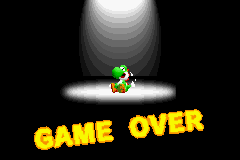
The file select.Mission 3-1.Mission 2-1.Mission 4-1.Mission 5-10.Mission 6-12, the last of the Spirit of Fright’s tale.Game Over, with Yoshi in tears.A credits scene: Yoshi rides a Shy Guy Ship.The island restored, under a Yoshi-shaped cloud.
Artwork & Media Gallery
Official artwork, wallpapers, sprites and adverts. Super Luigi Bros’ box-art and screenshot galleries for the game are linked below.
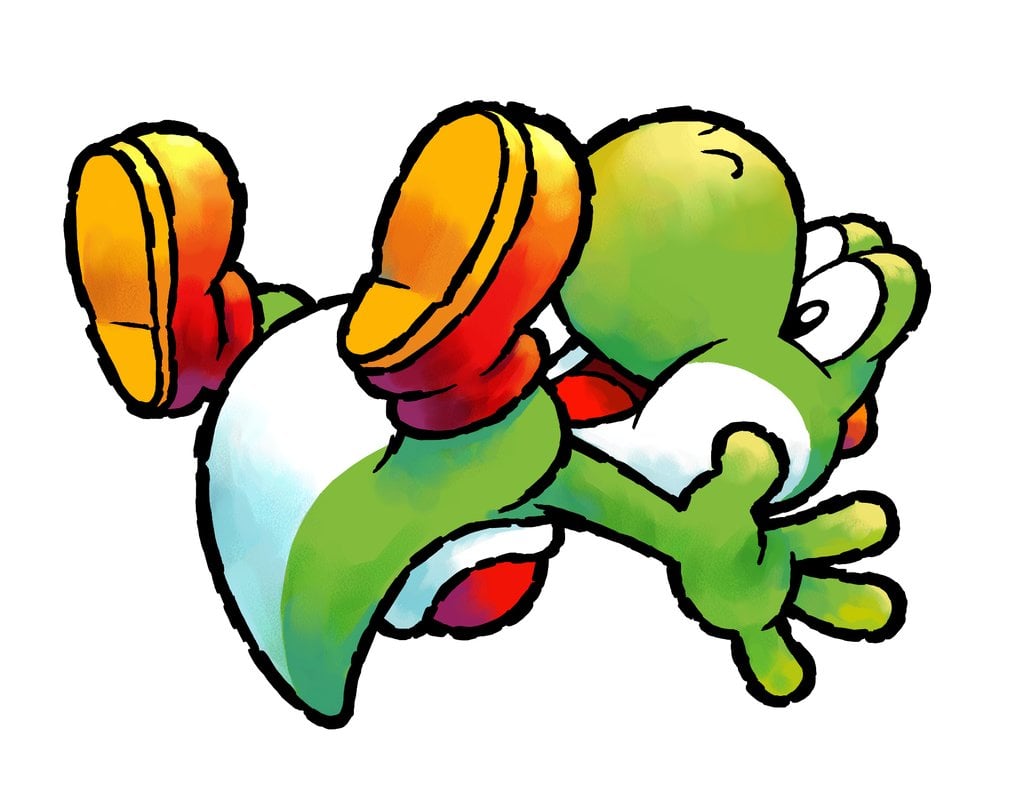
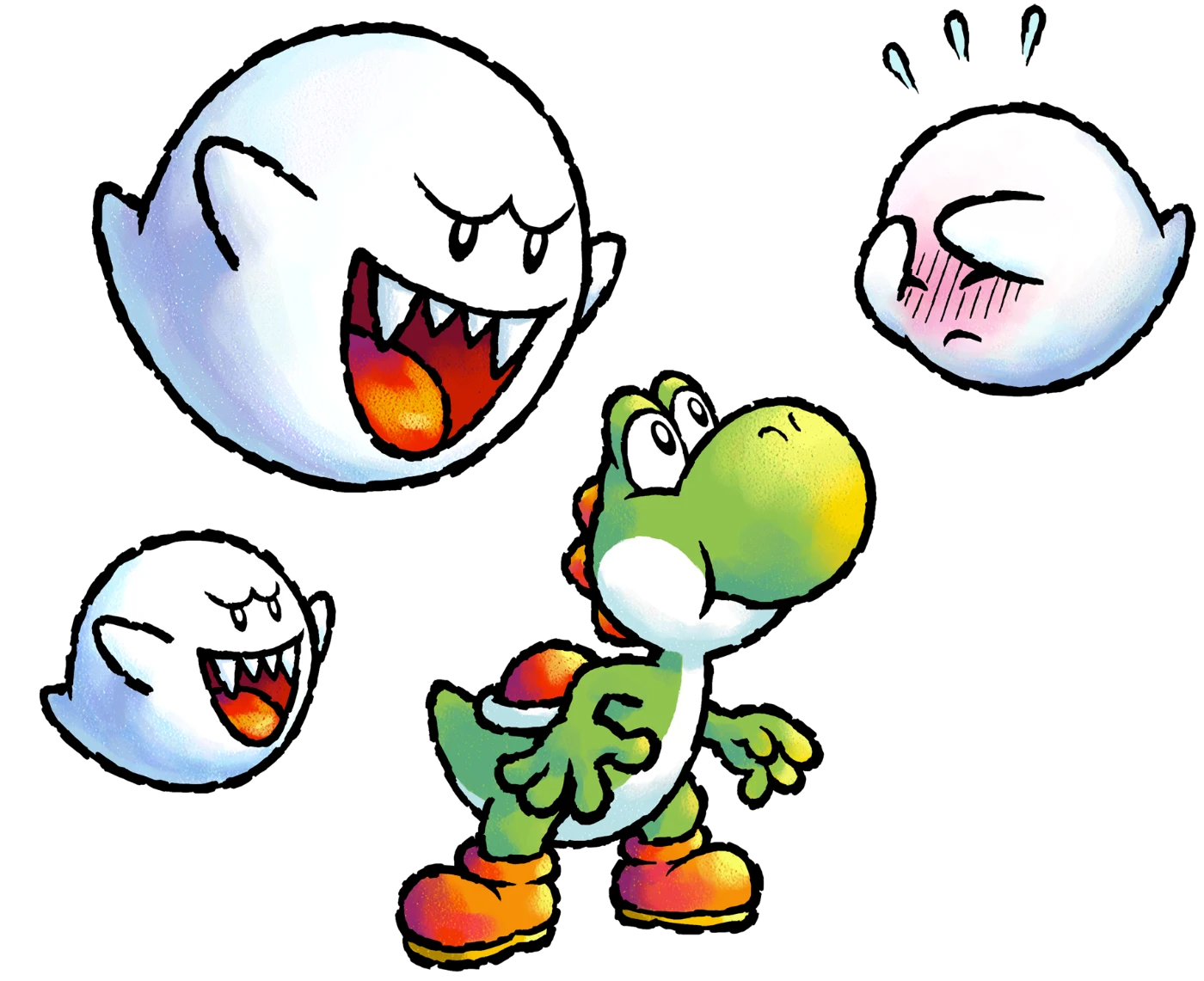
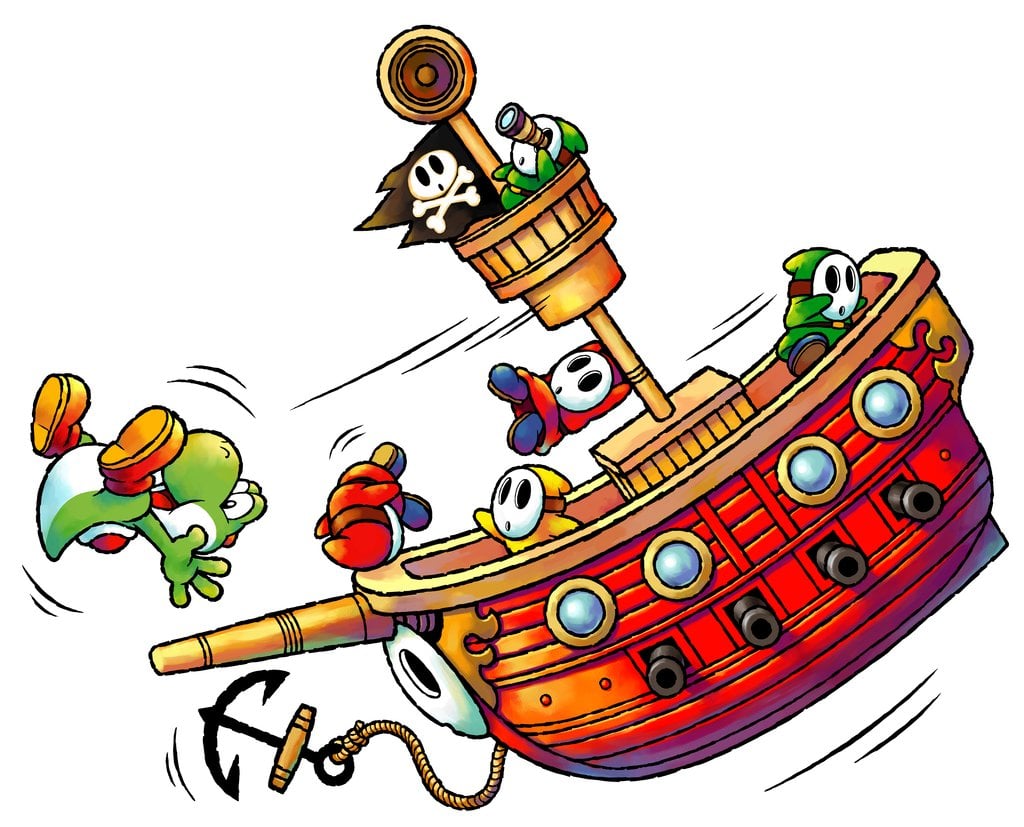
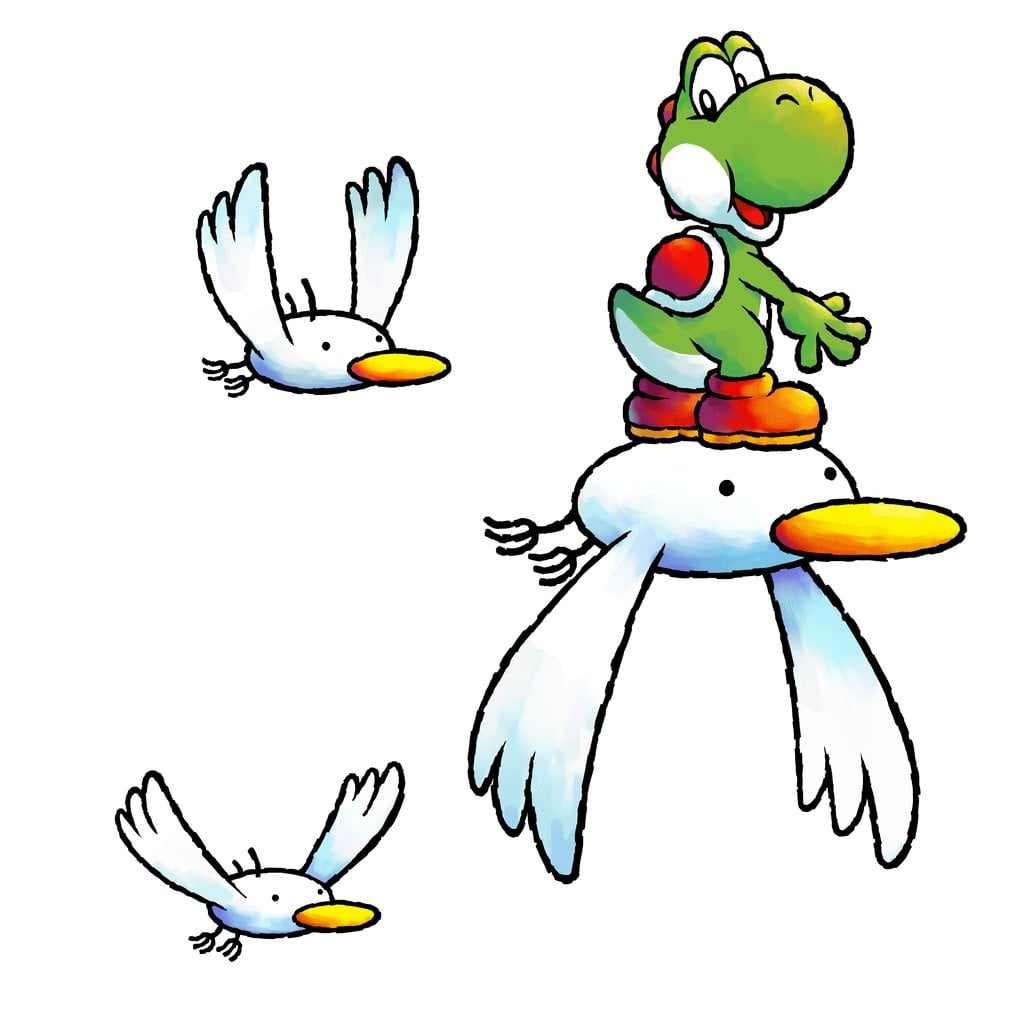
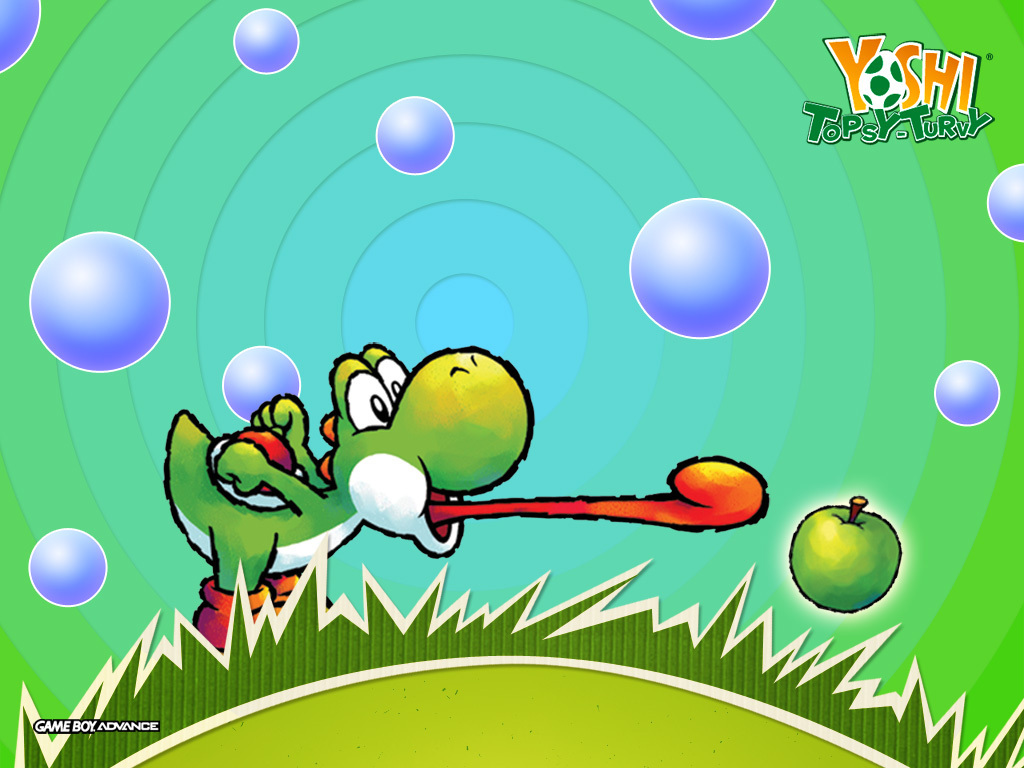
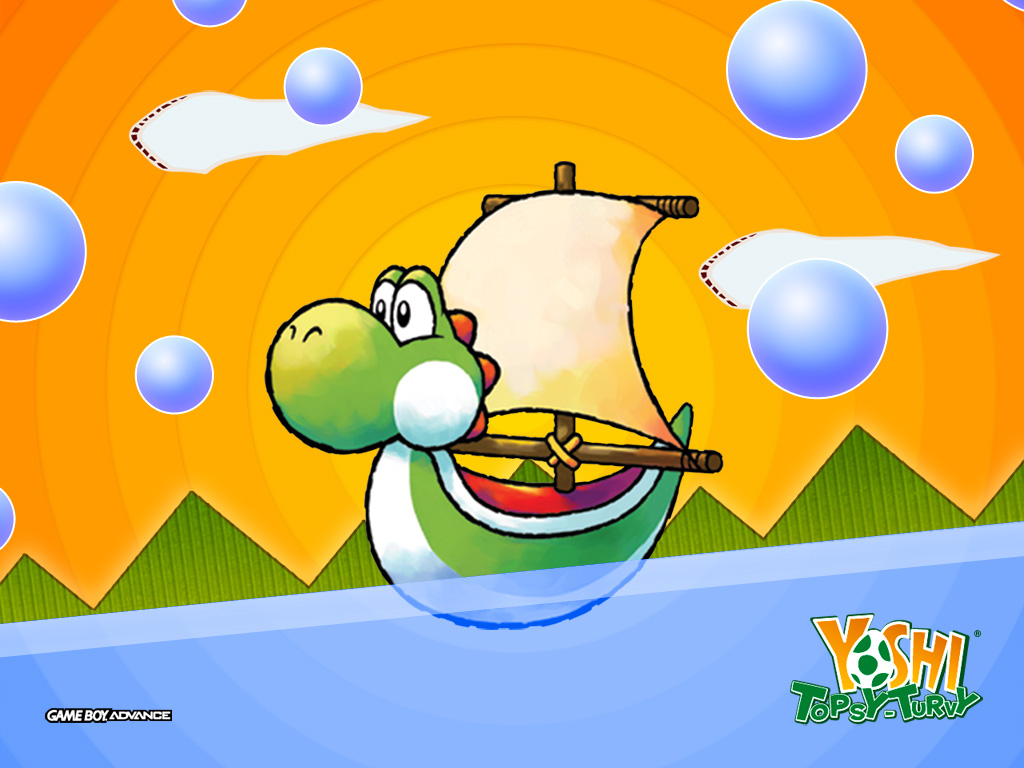
Promotional group artwork.The Forbidden Pop-Up Book.Hongo.Yoshi with the North American logo.Yoshi.Yoshi balancing on a ball.Yoshi falling.The tongue.Yoshi and the Boos.Yoshi on a Shy Guy Ship.Yoshi rides a Goonie.The Spirit Who Loves Surprises.Bowser.Shy Guys.A Raven.Daruma Otoshi-kun.A Gold Happiness Medal.An official wallpaper.Ship Yoshi wallpaper.The tiny spirits together.The Egglings’ banquet.Yoshi’s sprite.Ball Yoshi in action.A Gold Eggling.An Angel Eggling.A Bee Eggling.A Cow Eggling.A Flamingo Eggling.An Owl Eggling.The Mexican print advert.
Legacy & Re-releases
Released once and left alone: no sequel, no remake and no re-release, though Artoon went on to make another Yoshi game.
Releases
Game Boy Advance (Japan)9 December 2004Yoshi no Ban’yū Inryoku; 4,571 yen before tax.
Game Boy Advance (UK)15 April 2005Yoshi’s Universal Gravitation.
Game Boy Advance (Europe)22 April 2005Same title, with English, French, German, Italian and Spanish text.
Game Boy Advance (North America)13 June 2005Yoshi Topsy-Turvy.
Game Boy Advance (Australia)20 October 2005Yoshi’s Universal Gravitation.
Nintendo Switch Onlinenot as of November 2026Absent from the Game Boy Advance library (as of September 2026).
Artoon’s next Yoshi game
Artoon’s other Mario-franchise game was Yoshi’s Island DS in 2006, which took Yoshi back to the world of Super Mario World 2: Yoshi’s Island. Around 2010 the studio was absorbed into its parent, AQ Interactive, and Ohshima, Ishii and the staff who stayed set up Arzest, in Artoon’s old offices.
Where its characters went
The Forbidden Pop-Up Book has not been reopened, but two of its residents got a second outing as spirits in Super Smash Bros. Ultimate: Hongo and the Spirit Who Loves Surprises. For more of Yoshi’s solo career see Yoshi’s Story, Yoshi Touch & Go and the games index.
Reviews & Sales
Sales
We could not find a sales figure from Nintendo, CESA or a chart tracker, so none is given here. The Cutting Room Floor’s summary of the game puts its weak commercial showing down to its short length and awkward physics; Nintendo never re-issued it.
60Metacritic score, the lowest for a Yoshi game (Screen Rant)
61.12%GameRankings average
50numbered missions
5–6 hrsGameSpot’s estimate of its length
Review scores
Scores from the English-language press, with the reviews linked; aggregates from GameRankings and Metacritic.
Reviewers mostly liked the idea and the look. GameSpot’s Justin Calvert found the tilting worked well enough, liked the charming graphics and sound and the difficulty curve, and stressed that it “isn’t a bad game by any means”. Game Informer called the tilt mechanic inventive.
The problems were the same in review after review. Calvert called it a “repetitive and disappointingly short one”, finishing in five or six hours, and added that “there’s very little incentive for you to go back”, with bonus games that could be over in seconds. IGN’s Craig Harris rated it mediocre and went as far as calling it the worst game Nintendo had published on the system; 1UP.com’s Jeremy Parish found the tilt controls clumsy and the animation choppy; GameSpy’s Phil Theobald thought motion sensors suited microgames better than platformers; and Game Informer found the level designs ordinary. Most critics, Wikipedia records, thought WarioWare: Twisted! made better use of motion. The result was a Metacritic score of 60, which Screen Rant notes is the lowest of any Yoshi game.
SLB User Reviews
Yoshi Topsy-Turvy has yet to receive a community review on Super Luigi Bros.
If you’ve played Yoshi Topsy-Turvy and would like to submit a review, please get in touch.
Reference / Information
Sub-pages, guides, and walkthroughs for Yoshi Topsy-Turvy.
To provide the best experiences, we use technologies like cookies to store and/or access device information. Consenting to these technologies will allow us to process data such as browsing behavior or unique IDs on this site. Not consenting or withdrawing consent, may adversely affect certain features and functions.
Functional
Always active
The technical storage or access is strictly necessary for the legitimate purpose of enabling the use of a specific service explicitly requested by the subscriber or user, or for the sole purpose of carrying out the transmission of a communication over an electronic communications network.
Preferences
The technical storage or access is necessary for the legitimate purpose of storing preferences that are not requested by the subscriber or user.
Statistics
The technical storage or access that is used exclusively for statistical purposes.The technical storage or access that is used exclusively for anonymous statistical purposes. Without a subpoena, voluntary compliance on the part of your Internet Service Provider, or additional records from a third party, information stored or retrieved for this purpose alone cannot usually be used to identify you.
Marketing
The technical storage or access is required to create user profiles to send advertising, or to track the user on a website or across several websites for similar marketing purposes.












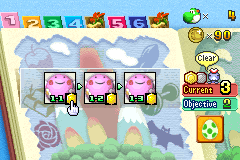 Tale of the Spirit of CutenessChapter 1 · missions 1-1 to 1-3 · CutenessThe tutorial: tilting, apples, rolling balls and carpets, cannons, Igashira-kun, lifts, a snowball and Piranha Plants.
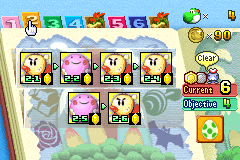 Tale of the Spirit of MoneyChapter 2 · missions 2-1 to 2-6 · Money, CutenessCoin targets join the apple hunts.
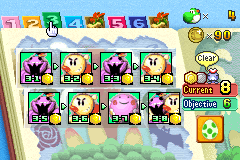 Tale of the Spirit of PowerChapter 3 · missions 3-1 to 3-8 · Power, Money, CutenessEnemy-defeat targets, skiing and the first mixed Power-and-Money brief.
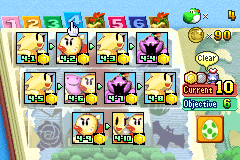 Tale of the Spirit of SpeedChapter 4 · missions 4-1 to 4-10 · Speed, Money, Power, CutenessTen missions against the clock.
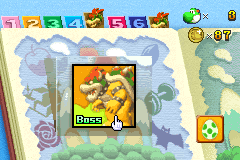 The Tale of Bowser’s FieldsBoss stage · mid-boss: a cardboard BowserBowser appears at last, spitting fire. Or does he?
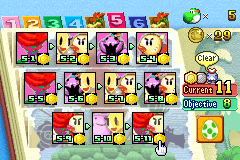 Tale of the Spirit of KindnessChapter 5 · missions 5-1 to 5-11 · Kindness, Speed, Money, Power, CutenessEleven missions that reward leaving enemies alone.
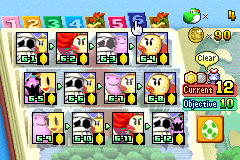 Tale of the Spirit of FrightChapter 6 · missions 6-1 to 6-12 · all six spiritsTwelve missions of Boos, Mace Guys, Daruma Otoshi-kun and the grinding machine, plus Boat Yoshi.
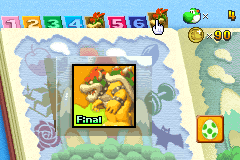 The Tale of Bowser’s CaveFinal boss stage · BowserThe real Bowser, fought with bombs that roll wherever you tilt them.
 Shuffle ModeChallenge Mode · unlocked by finishing the storyRandom missions back to back until you fail.
 Yoshi’s Big JumpChallenge Mode · complete the Eggling BookA tilt-powered ski jump measured for distance.
 Yoshi’s Pirate BattleChallenge Mode · complete the Eggling BookThirty seconds to loop a Shy Guy Ship as often as you can.
 Yoshi’s Time AttackChallenge Mode · complete the Eggling BookBall Yoshi races through a course against the clock.
 Shuffle Mode EXChallenge Mode · every Gold Happiness MedalThe hard version of Shuffle Mode.

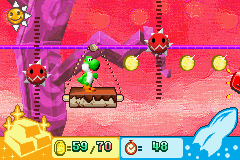







 CoinEverywhere, and essential for the Spirit of Money. 100 make an extra life.
 HeartRestores one point of health.
 Big HeartRarer; refills the whole meter.
 AppleA cursed Eggling. Swallow it and the Eggling is free. The key to Spirit of Cuteness missions.
 BombUsually floats down on a parachute that you steer by tilting. Explodes on landing, hurting enemies and Yoshi alike.
 Baron von ZeppelinA balloon carrying an item upwards. Eat it and the item drops.
 ParachuteCarries items gently downwards.
 Silver Happiness MedalFor meeting a spirit’s target.
 BallRolls with the tilt; Yoshi can ride on top.
 BoulderRolls downhill and flattens whatever is in the way.
 SnowballGrows as it rolls.
 Rolled-up carpetTilt to unroll it into a safe path over spikes.
 CannonAimed by tilting.
 Ball and ChainSwings with the tilt.
 Shy Guy ShipA rocking pirate ship, and the star of Yoshi’s Pirate Battle.
 BasketTip it over to spill the coins inside.
 Ferris wheelA rotating set of platforms.
 Rising notesMusical platforms.
 CheckpointA restart point partway through a mission.
 GoalThe big star that ends a mission and awards the medal.
 Super Smash Bros. UltimateSwitch, 2018 · spiritsHongo and the Spirit Who Loves Surprises both appear as collectable spirits. Hongo is a Novice-class support spirit that cuts damage from magic attacks; his spirit battle pits you against a Robin puppet fighter on the Super Happy Tree stage.
 North American print advertAdvert · 2005Nintendo of America’s magazine advert for the June 2005 launch.
 British print advertAdvert · 2005The UK advert, for Yoshi’s Universal Gravitation.
 Japanese and Mexican advertsAdvert · 2004–05Japan advertised Yoshi no Ban’yū Inryoku for its December 2004 launch, and the game was advertised in Mexico too.
 YoshiHero · the only playable character
 Spirit Who Loves SurprisesTiny book spirit · guide
 BowserKing of the Koopas · final boss
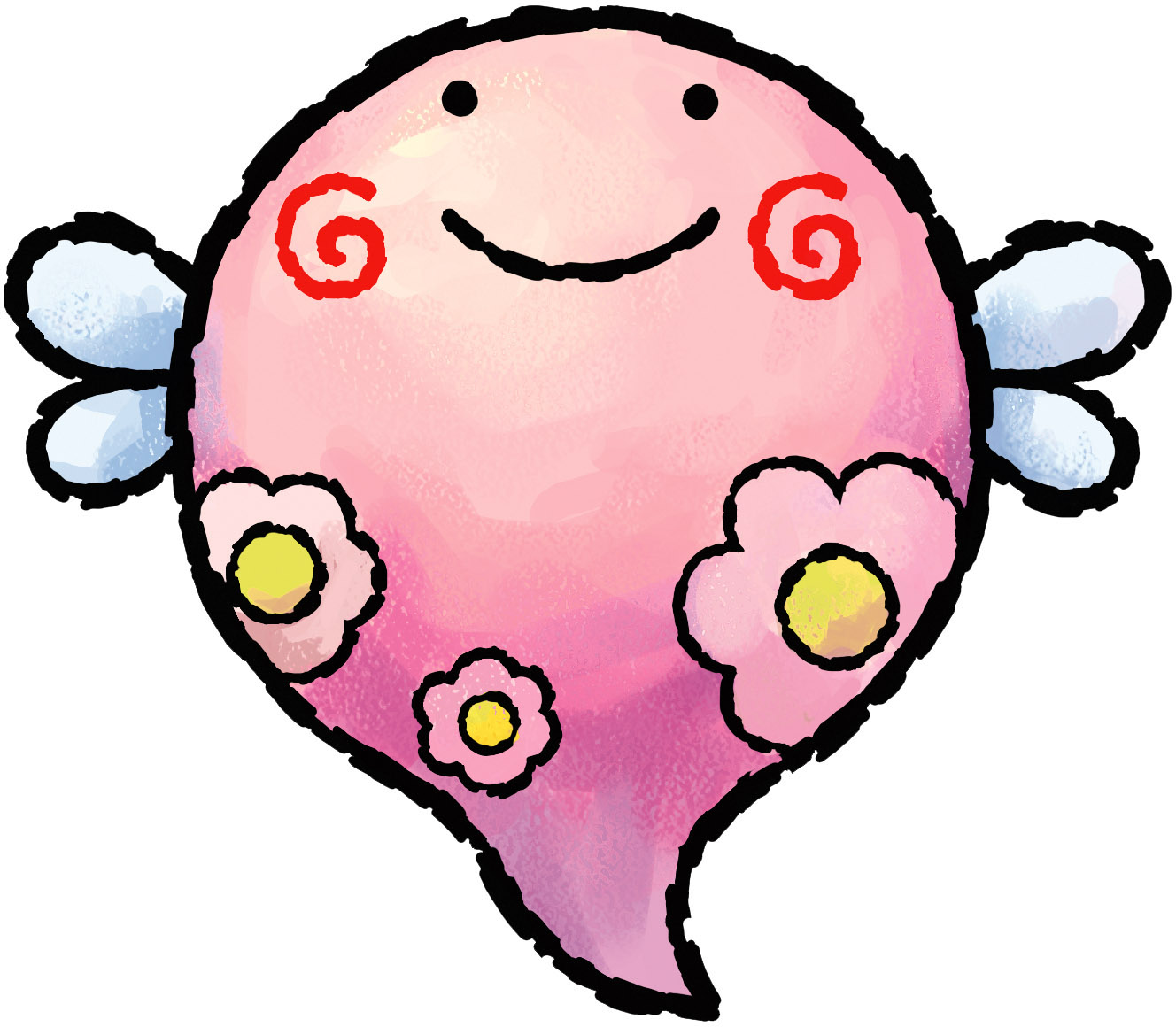 Spirit of CutenessTiny spirit · chapter 1
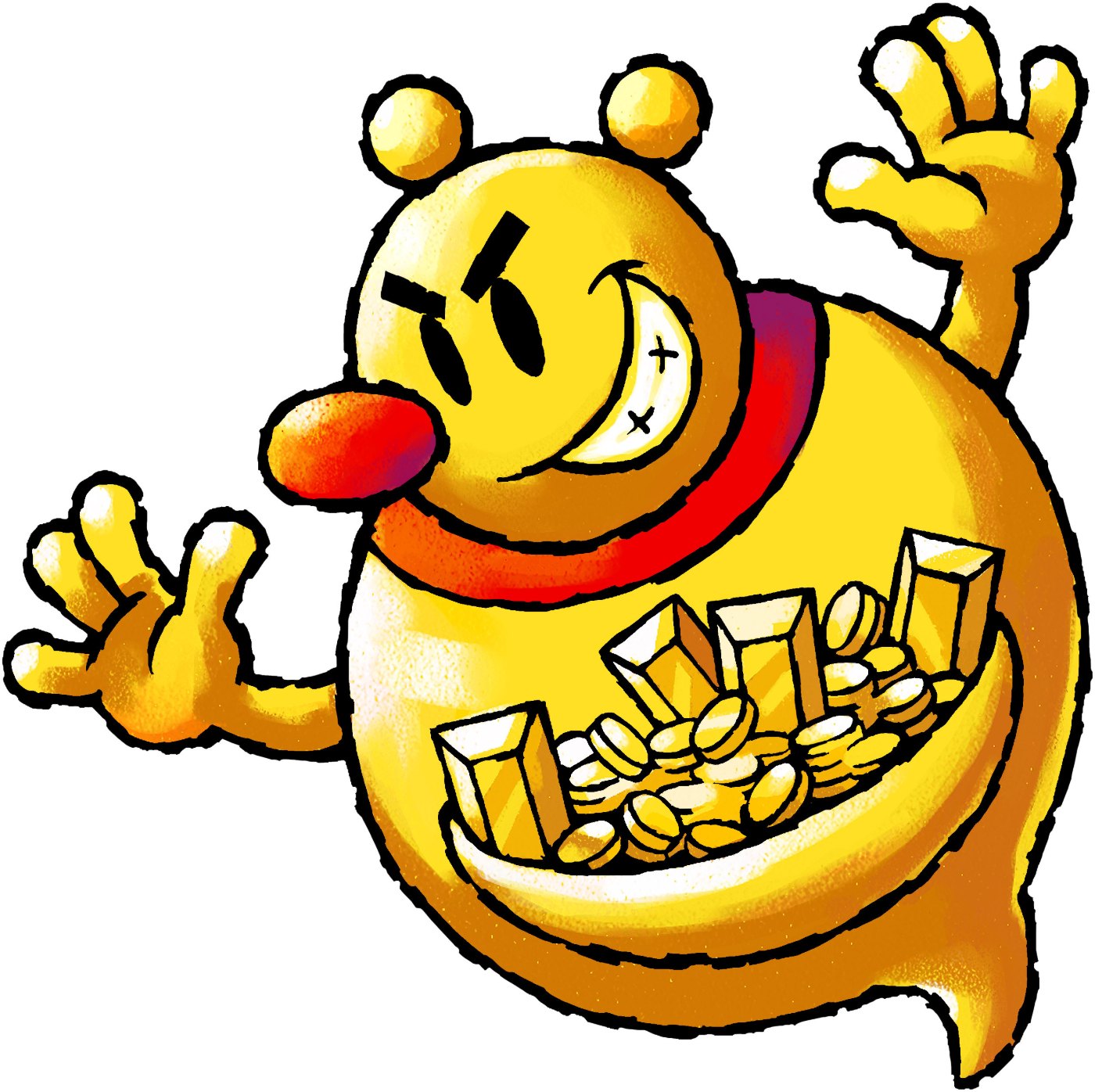 Spirit of MoneyTiny spirit · chapter 2
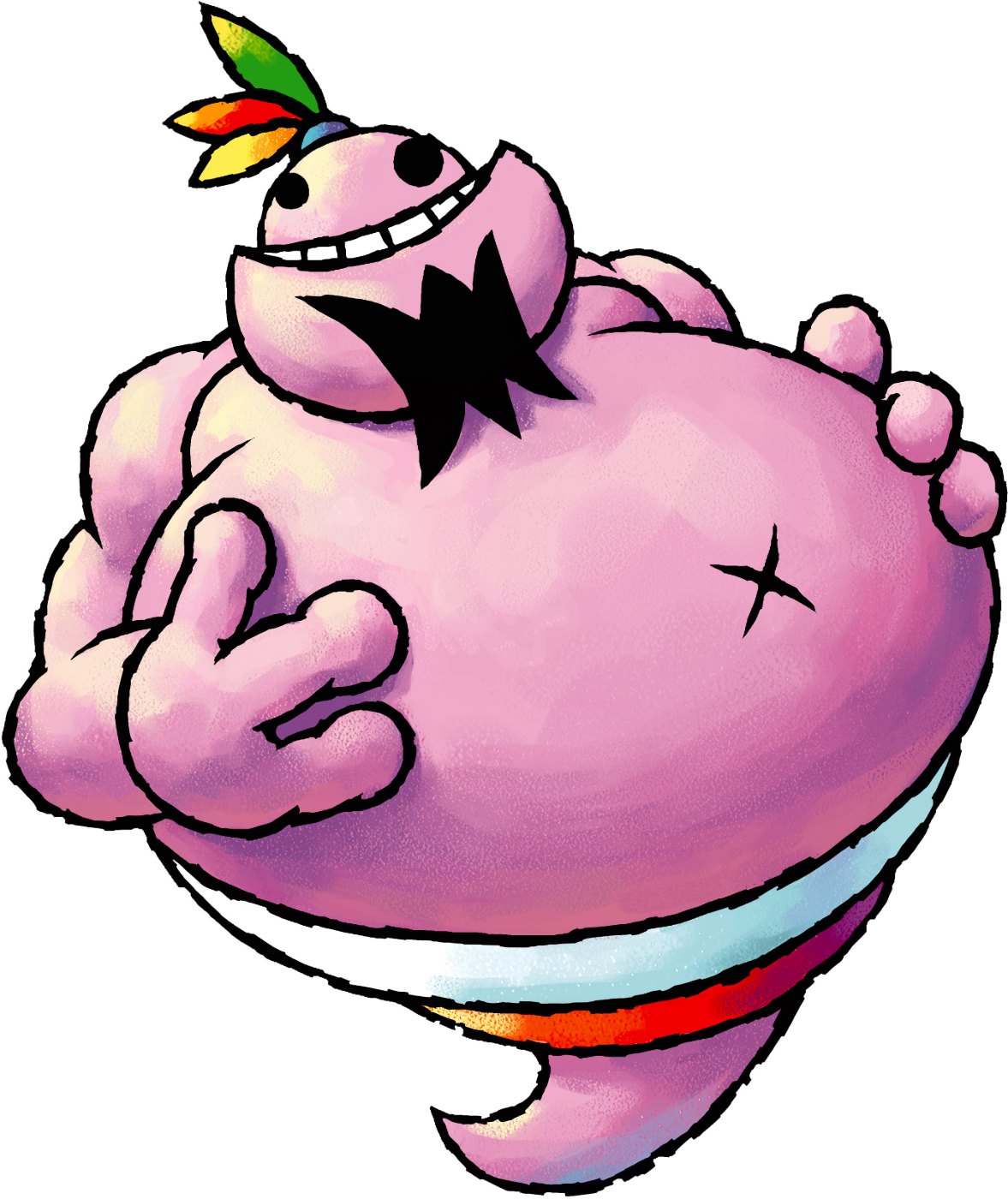 Spirit of PowerTiny spirit · chapter 3
 Spirit of SpeedTiny spirit · chapter 4
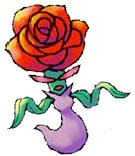 Spirit of KindnessTiny spirit · chapter 5
 Spirit of FrightTiny spirit · chapter 6
 Cardboard Bowser (mid-boss)The Tale of Bowser’s FieldsA cut-out Bowser that spits fireballs, worked by the Spirit Who Loves Surprises.
 Bowser (final boss)The Tale of Bowser’s CaveBreathes streams of fire; beaten with bombs that roll where you tilt them.
 Big BooFour missionsCreeps after Yoshi when he looks away and hides its face when he turns round.
 BooMission 6-7 onlyBehaves like the Big Boo, on a smaller scale.
 Daruma Otoshi-kunLate in chapter 6 (four appearances)A spiked creature that cannot be defeated.
 King DebuhōVarious missionsA big Fat Guy; jump on his head and he just bounces Yoshi off.
 Fly GuyVarious missionsA propeller-headed Shy Guy; some carry coins Yoshi can lick away.
 GoonieVarious missionsA bird that only flies forward. Tilt to raise or lower it, and ride on its back.
 GustyVarious missionsA ghostly gust that flies forward in groups.
 Igashira-kunFrom chapter 1A sleeping spiked ball that rolls when the world tilts. Use it to knock out enemies Yoshi cannot.
 Mace GuyChapters 5 and 6 (seven missions)A Shy Guy swinging a flail that never stops.
 Piranha PlantFrom chapter 1Rooted to the spot. Walk into its mouth and it holds Yoshi for about three seconds before spitting him out.
 RavenVarious missionsA black bird that walks on walls and ignores gravity.
 Shy GuyThroughoutWalks forward. Jump on it or eat it. Red, green and yellow.
 Tap-TapVarious missionsA spiked walker that cannot be beaten and takes away most of Yoshi’s health.
 Orange Tap-TapThe Tale of Bowser’s CaveReleased by Bowser’s slam attack; rolls with the tilt.