Super NES1995PlatformerNintendo EADSuper FX 2 chipBaby Mario debuts4.12 million soldYoshi’s first starring role
Super Mario World 2: Yoshi’s Island
A stork, two babies and a Magikoopa with a grudge: Super Mario World 2: Yoshi’s Island is the prequel to every Mario game, and the first time Yoshi, not Mario, is the hero. Eight colours of Yoshi relay Baby Mario across six worlds and 48 levels to rescue his twin, Baby Luigi, from Kamek and Baby Bowser, swallowing enemies, throwing eggs and fluttering over bottomless drops. Instead of a health bar there is a countdown of stars: get hit and Baby Mario floats away in a bubble, wailing, until you grab him back.
Released in Japan on 5 August 1995 and in the West that October, it ran on the Super FX 2 chip, dressed itself in a hand-drawn crayon-and-marker look deliberately unlike Donkey Kong Country, and sold 4.12 million copies. Many critics still call it the best 2D platformer Nintendo ever made.
Developer:Nintendo EAD (programming by SRD)
Publisher:Nintendo
Platform:Super Famicom / Super NES (16-megabit cartridge with Super FX 2)
Genre:Side-scrolling platformer
Japan:5 August 1995 (as Super Mario: Yoshi Island)
Worlds / levels:6 worlds × 8 levels, plus 6 Extra levels and 6 Bonus Challenges
Sales:4.12 million (SNES); 2.83 million more on Game Boy Advance
Remake:Yoshi’s Island: Super Mario Advance 3 (GBA, 2002)
Re-releases:Super NES Classic Edition (2017), Nintendo Switch Online (2019); GBA version on 3DS (2011), Wii U (2014), Switch Online (2023)
Advertisement
Overview
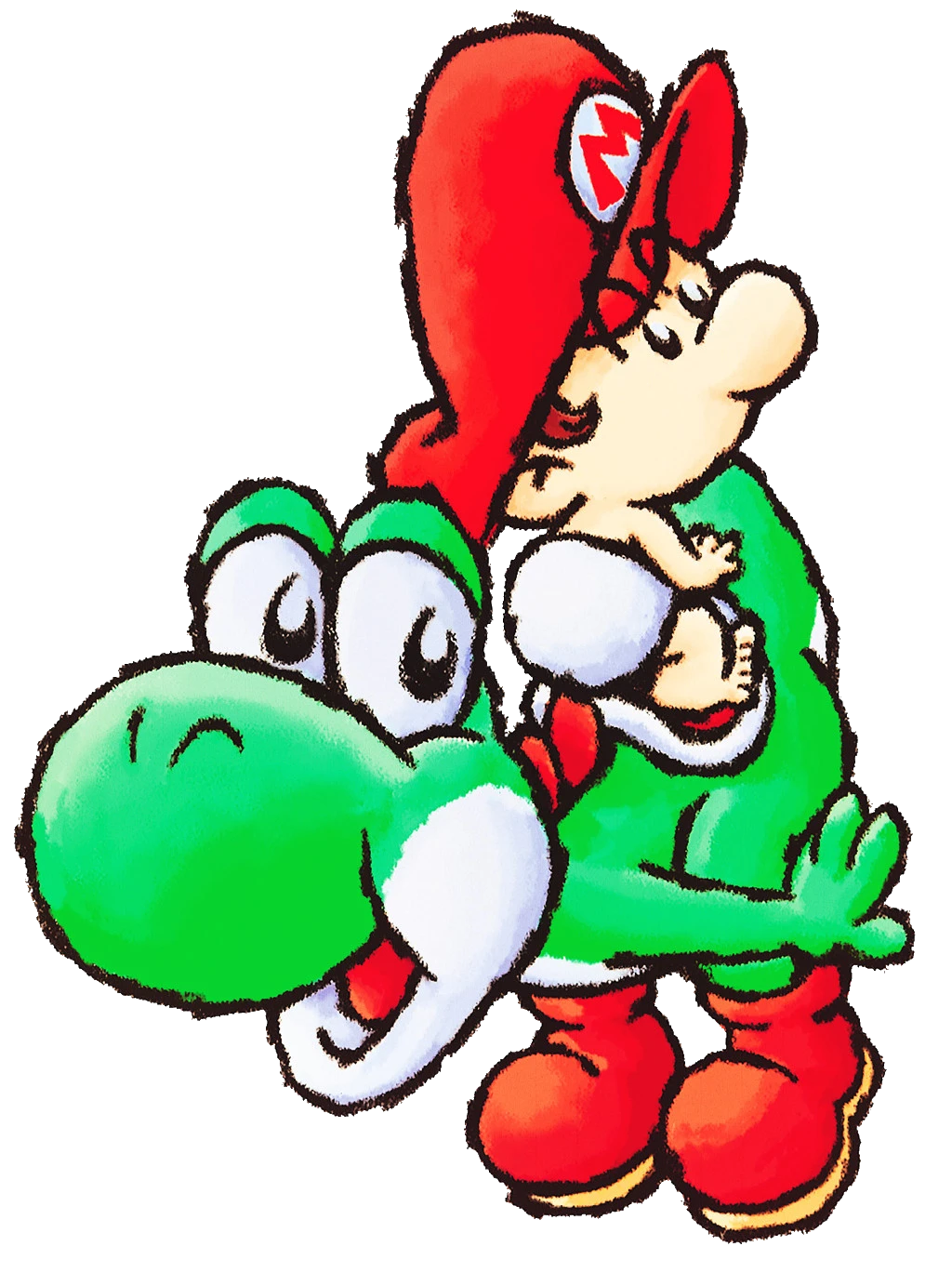
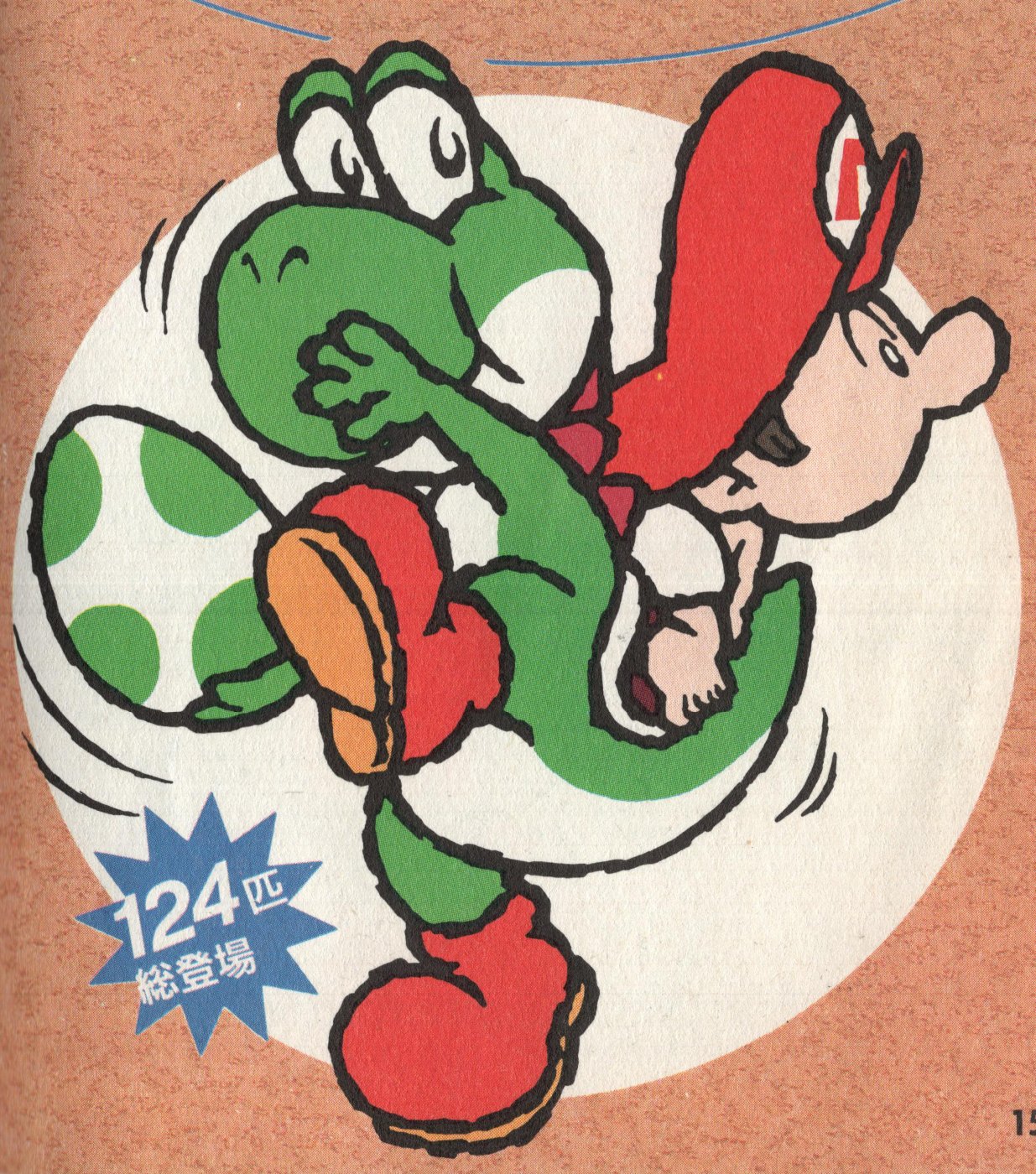
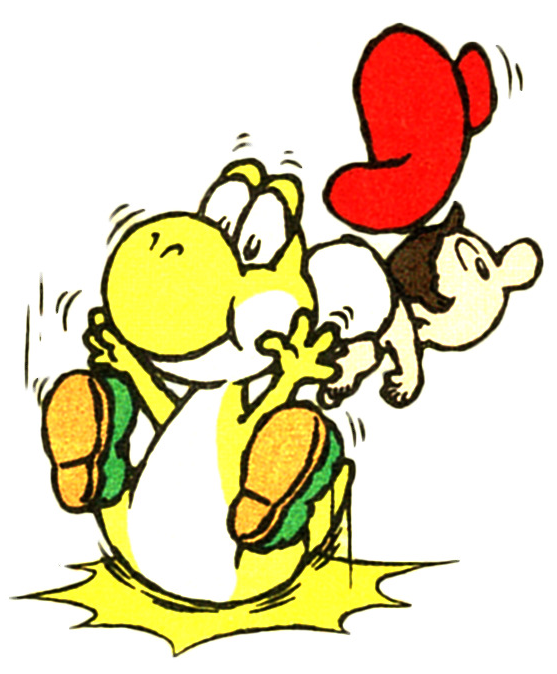
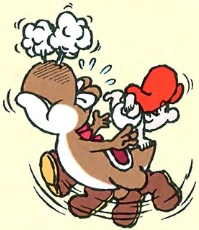
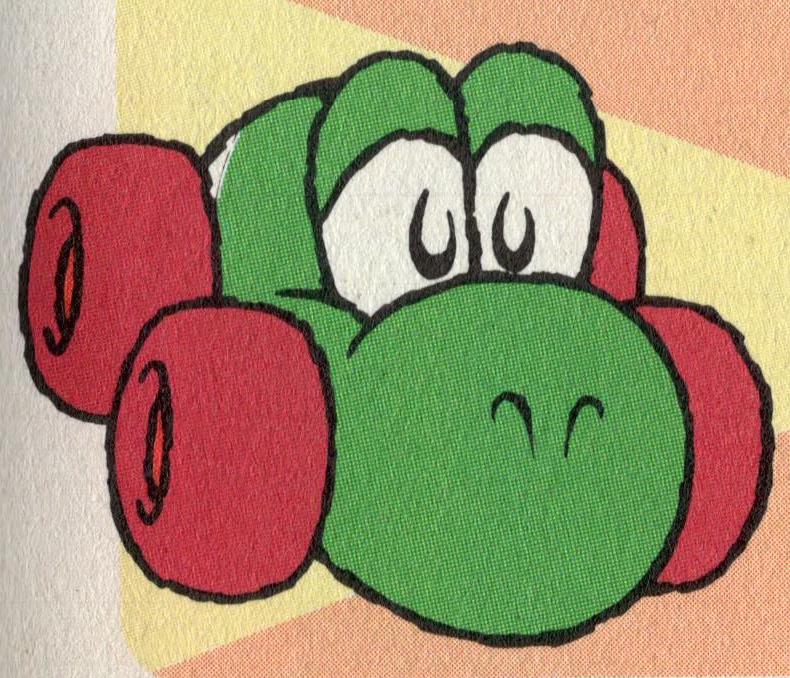
Green Yoshi and his passenger, from Nintendo’s 1995 artwork.
By 1995 the Super Nintendo was living on borrowed time. Nintendo’s next console had slipped to 1996, Donkey Kong Country had just made pre-rendered graphics the thing everyone wanted, and the team that made Super Mario World had spent four years on a follow-up that looked like nothing else on the machine. Super Mario World 2: Yoshi’s Island hands the lead role to Yoshi, drops Mario into a nappy, and draws the whole thing as if a gifted child had been let loose with crayons, felt-tips and a stack of pastel paper.
The idea underneath is simple and brilliant. Yoshi carries Baby Mario on his back; when an enemy touches him, the baby drifts off in a bubble and a timer counts down from ten. Grab him back and you carry on. Let it hit zero and Kamek’s Toadies swoop in. There is no time limit, no shrinking from a hit, and a flutter jump that forgives almost any misjudged leap. Yet the game is anything but soft: every level hides 20 red coins, five Special Flowers and 30 stars, and only a perfect 100 in all eight levels of a world opens its Extra stage.
Under the hood sits the Super FX 2 chip, the same family of processor that drew the polygons in Star Fox, here put to work on rotating platforms, stretching backgrounds, the woozy “Touch Fuzzy, Get Dizzy” effect and bosses that fill the screen. Four directors are credited: Takashi Tezuka, Toshihiko Nakago, Shigefumi Hino and Hideki Konno, with Shigeru Miyamoto producing and Koji Kondo on music.
It arrived in Japan on 5 August 1995 as Super Mario: Yoshi Island and in the West that October with “Super Mario World 2” bolted onto the front. Reviewers reached for superlatives, 4.12 million copies were sold, and the game launched a whole Yoshi sub-series, from Yoshi’s Story to Yoshi’s Crafted World. A 2002 Game Boy Advance remake added six new levels; today both versions sit in Nintendo Switch Online’s libraries.
Why Yoshi’s Island matters to Mario fans
This is where the extended family begins. Baby Mario, Baby Luigi, Kamek, Baby Bowser and Poochy all make their first appearances here, and Yoshi gains the flutter jump, the ground pound and the egg throw that define him to this day. It is also the last 2D Mario adventure Nintendo EAD made before Super Mario 64 moved the series into 3D; many of the same people went straight from this island to Peach’s castle.
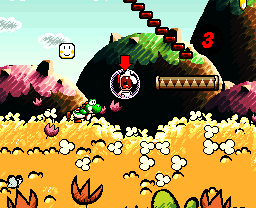
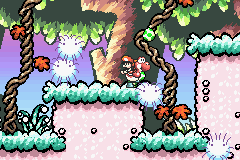
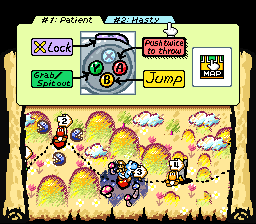
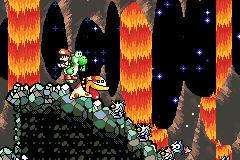
The aiming cursor: eggs bounce off walls and ceilings.Baby Mario adrift. Ten seconds, and counting.Touch Fuzzy, Get Dizzy: the Super FX 2 warps the whole world.Two control schemes, Patient and Hasty, for throwing eggs.
“This story happened a long long time ago…”
Official text: Nintendo, Super Mario World 2: Yoshi’s Island instruction booklet (Super NES, 1995), story page. One line quoted; the rest summarised.
So begins the instruction booklet, before describing a stork hurrying across a dawn sky with twin babies, the Magikoopa who ambushes it, and the lucky little bundle that lands on the back of a green dinosaur. The Japanese box carried the Yoshi series’ first official tagline, promising that Yoshi returns to save Baby Mario in this sequel to Super Mario World.
Quick Answers
The questions people ask most about Yoshi’s Island, answered briefly here and in depth further down the page.
When did Yoshi’s Island come out?
Japan got it on 5 August 1995, North America on 4 October 1995, Europe on 6 October 1995 and Australia in December 1995. The Game Boy Advance remake followed in September and October 2002. More →
Is Yoshi’s Island a prequel?
Yes. It is set when Mario and Luigi were newborns, so it comes before every other Mario game in story terms. The “Super Mario World 2” part of the Western title refers to it being the next game from the Super Mario World team, not to the story. More →
Why is it called Super Mario World 2 in the West but not in Japan?
In Japan it was Super Mario: Yoshi Island. Nintendo of America and Europe added “Super Mario World 2” to tie it to the console’s best-known game. More →
How many levels are there?
48 regular levels (six worlds of eight), each world ending in a castle, plus six Extra levels and six Bonus Challenge mini-games unlocked by perfect scores. The GBA version adds six Secret levels on top. More →
How do you get 100 points in a level?
Finish with 30 stars on the counter, all 20 red coins and all five Special Flowers. Stars and red coins are worth a point each; flowers are ten apiece. More →
What does the Super FX 2 chip actually do?
It is a co-processor inside the cartridge, a faster version of the Super FX from Star Fox. Here it draws and rotates large sprites, stretches and warps backgrounds, and powers the giant bosses and the dizzy Fuzzy effect. More →
Why does Baby Mario cry?
Because you have been hit. Baby Mario floats off in a bubble and wails until you touch him again or the star counter reaches zero, when Kamek’s Toadies carry him away. Nintendo’s own developers admitted they played carefully to avoid hearing it. More →
Can you play as Luigi?
No. Baby Luigi spends the whole game as Kamek’s prisoner and is rescued in the finale. He and Baby Mario would not be playable together until later games such as Mario Kart: Double Dash!! and Yoshi’s Island DS. More →
What is different in the Game Boy Advance version?
Yoshi’s Island: Super Mario Advance 3 (2002) adds six Secret levels, gives Yoshi a voice, includes Mario Bros., brightens the palette for the unlit screen and shows a little less of each level at once. Two-player Mini Battles were removed. More →
Where can I play it today?
The SNES original is in the Super Nintendo library of Nintendo Switch Online (since September 2019) and built into the Super NES Classic Edition (2017). The GBA version is in the Game Boy Advance library for Expansion Pack members (since May 2023). More →
Story
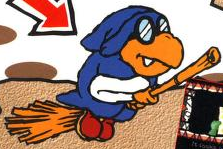
Kamek, the Magikoopa who sets the whole adventure in motion.
Yoshi’s Island tells its story in silent cutscenes and a handful of Message Blocks, and it is all the better for it. Here is the whole tale, from a dawn flight to a doorstep in the Mushroom Kingdom.
The stork and the Magikoopa
Long ago, before anyone had heard of plumbers, a stork hurries across the dawn sky with two newborn twins in a bundle. Somewhere below, in the Koopa Kingdom, the Magikoopa Kamek has read the future and seen that these two boys will one day bring ruin on the Koopas. He takes to his broom, intercepts the stork high above the sea, and in the scramble snatches one baby and the bird. The other slips from the bundle and tumbles towards the ocean.
He does not land in the water. He lands, with a map fluttering down after him, squarely on the back of a green Yoshi strolling along Yoshi’s Island. The baby is Mario; his brother, now Kamek’s prisoner, is Luigi. Back at his castle Kamek realises his mistake, and sends his flying Toadies out to find the child he missed.
Kamek’s Toadies, sent to collect the baby he missed.
A relay of Yoshis
The Yoshis of the island gather round the strange visitor. The baby is calm, but he keeps pointing in one direction, as if he can feel where his twin has been taken, and the map that fell with him shows the way. The Yoshis agree on a plan: they will carry him across the island in a relay, each Yoshi taking a stretch before handing him to the next. The green Yoshi volunteers for the first leg.
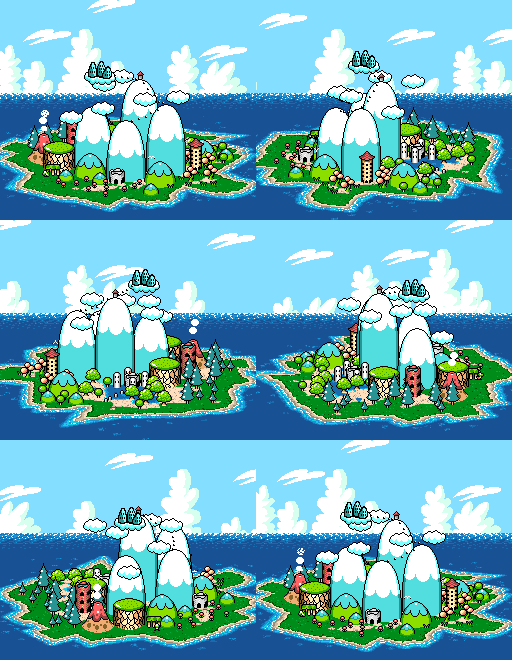
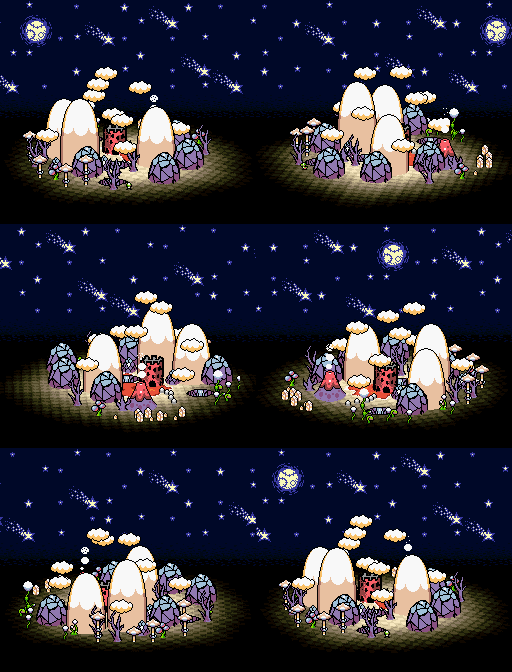
That relay is why Yoshi changes colour with every level. Green takes the first stage of each world, then pink, light blue, yellow, purple, brown, red and finally blue for the castle, before green steps up again at the start of the next world. Yoshi’s Island itself runs from spring meadows in the south-west, up through pine-covered hills, a steaming jungle, dusty mountains and snow-capped peaks, to the Koopa Kingdom in the far corner where Baby Bowser’s castle waits.
The island by day. Each world is a different corner of it.And by night, once you reach the Koopa Kingdom.
Kamek strikes back
Kamek is not idle. Every world has a fort halfway through and a castle at its end, and in each one he swoops in just as Yoshi arrives, cackles a taunt, and waves his wand over some poor ordinary creature: a Burt, a Boo, a Koopa Troopa, a Raven, even an empty flowerpot. The victim swells to monstrous size and the boss fight begins. Only once does the spell go the other way: in Prince Froggy’s Fort he shrinks Yoshi and Baby Mario instead, and the frog swallows them whole.
Beat the castle boss and Yoshi passes the baby on, Kamek flees cursing, and the next world opens. Twelve bosses stand between the beach where Mario landed and the castle where Luigi is held.
Burt the Bashful, the first of Kamek’s enlarged minions.
The baby in the castle
King Bowser’s Castle is the longest level in the game, a gauntlet of lava, spiked pillars and a choice of four doors. At the top, Kamek is waiting with a final demand: hand over the baby. He never gets to finish. The racket wakes the castle’s real master, a toddler with a spiked shell and a terrible temper. Baby Bowser flattens Kamek with a ground pound for disturbing his nap, spots Yoshi, and decides he wants a ride on the “gween donkey”. The fight is a duel of ground pounds and, if you are careless, the little tyrant climbs onto Yoshi’s back in Baby Mario’s place.
Three good stomps put Baby Bowser down, and Kamek, furious, does what he always does: he casts the growth spell. This time the castle cannot hold the result. The walls burst outward and a Baby Bowser the size of a mountain rises on the horizon, breathing fire and smashing the ground beneath Yoshi’s feet as he advances. Baron von Zeppelins float in carrying giant eggs; Yoshi hurls them into the distance, seven hits in all, until the giant topples and shrinks back to a dazed toddler.
Delivery completed
Kamek scoops up the unconscious Baby Bowser, swears he will be back, and vanishes. In a tower room Yoshi finds the stork trussed up and Baby Luigi beside him, none the worse for his captivity. The stork takes both twins and flies them the rest of the way to a cottage in the Mushroom Kingdom, where their parents are waiting on the doorstep. The credits tell us the boys grew up to become the famous Mario Brothers, and the last image belongs to the Yoshis, waving from their island.
Baby Luigi, safe at last after a game spent off-screen.
Worlds and levels
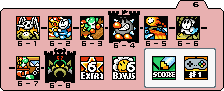
Six worlds of eight levels. The fourth level of each world is a fort with a mid-boss, the eighth a castle with the world boss; a perfect 800 points unlocks the Extra level and Bonus Challenge. Levels in Yoshi’s Island have names, and some of them are wonderful.
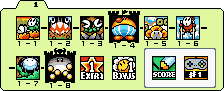
World 1: Yoshi’s IslandSpring meadows · mid-boss Burt the Bashful · boss Salvo the SlimeMake Eggs, Throw Eggs; Watch Out Below!; The Cave Of Chomp Rock; Burt The Bashful’s Fort; Hop! Hop! Donut Lifts; Shy-Guys On Stilts; Touch Fuzzy Get Dizzy; Salvo The Slime’s Castle. Extra: Poochy Ain’t Stupid. Bonus: Flip Cards.
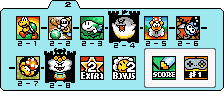
World 2: The pine hillsForested uplands · mid-boss Bigger Boo · boss Roger the Potted GhostVisit Koopa And Para-Koopa; The Baseball Boys; What’s Gusty Taste Like?; Bigger Boo’s Fort; Watch Out For Lakitu; The Cave Of The Mystery Maze; Lakitu’s Wall; The Potted Ghost’s Castle. Extra: Hit That Switch!!. Bonus: Scratch and Match.
World 3: The jungleTreetops, lagoons and monkeys · mid-boss Prince Froggy · boss Naval PiranhaWelcome To Monkey World!; Jungle Rhythm…; Nep-Enut’s Domain; Prince Froggy’s Fort; Jammin’ Through The Trees; The Cave Of Harry Hedgehog; Monkeys’ Favorite Lake; Naval Piranha’s Castle. Extra: More Monkey Madness. Bonus: Drawing Lots.
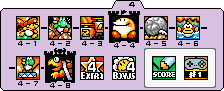
World 4: The dusty mountainsArid hills and caves · mid-boss Marching Milde · boss Hookbill the KoopaGO! GO! MARIO!!; The Cave Of The Lakitus; Don’t Look Back!; Marching Milde’s Fort; Chomp Rock Zone; Lake Shore Paradise; Ride Like The Wind; Hookbill The Koopa’s Castle. Extra: The Impossible? Maze. Bonus: Match Cards.
World 5: Snow and cloudsIcy peaks and the sky above them · mid-boss Sluggy the Unshaven · boss Raphael the RavenBLIZZARD!!!; Ride The Ski Lifts; Danger – Icy Conditions Ahead; Sluggy The Unshaven’s Fort; Goonie Rides!; Welcome To Cloud World; Shifting Platforms Ahead; Raphael The Raven’s Castle. Extra: Kamek’s Revenge. Bonus: Roulette.
World 6: The Koopa KingdomSunset wastes, lava and bandits · mid-boss Tap-Tap the Red Nose · boss Baby BowserScary Skeleton Goonies!; The Cave Of The Bandits; Beware The Spinning Logs; Tap-Tap The Red Nose’s Fort; The Very Loooooong Cave; The Deep, Underground Maze; KEEP MOVING!!!!; King Bowser’s Castle. Extra: Castles – Masterpiece Set. Bonus: Slot Machine.
Before World 1 there is a tutorial stage, Welcome To Yoshi’s Island, which cannot be replayed. The Game Boy Advance remake adds a Secret level to every world, unlocked by beating Baby Bowser: Exercise in the Skies, Mystery of the Castle?, Go! Go! Morphing!, Fight Toadies w/ Toadies, Items are fun! and Endless World of Yoshis.
Advertisement
Gameplay & Controls
Yoshi’s Island is a left-to-right platformer with the heart of a treasure hunt. Every level has a goal ring at the end, but the real game is the hunt for hidden red coins, flowers and stars, and the toolkit Yoshi uses to find them is unlike anything Mario had.
There are two things to keep track of at all times: the eggs trailing behind Yoshi, and the star counter in the corner that stands in for a health bar.
Tongue, eggs and the flutter jump
Yoshi runs and jumps with the Control Pad and B, and holding B at the top of a jump kicks his legs for a flutter that hangs in the air and adds a little height. Only the first flutter climbs; later ones mostly slow the fall, so a long gap still needs a good take-off. Pressing Down in mid-air slams Yoshi into a ground pound that hammers stakes into the floor and flattens certain enemies, a move Mario himself would borrow a year later in Super Mario 64.
Y flicks out Yoshi’s tongue. Most enemies can be held in his mouth and spat out as a projectile, or swallowed (press Down) to become an egg that follows him around. He can carry six at once; eat a seventh and the oldest egg is dropped. Some things cannot be swallowed at all: Koopa shells are spat back out, Shy Guys on stilts are too tall, and spiky customers like Tap-Taps simply hurt.
Throwing is a two-step affair. Press A and a cursor arcs up and down in front of Yoshi; press again and the egg flies. The default “Patient” scheme uses two taps, while the alternative “Hasty” scheme throws on release, and L or R freezes the cursor so you can line up ricochets. Eggs bounce off walls and ceilings, which is how you reach red coins in awkward corners and how you beat Bigger Boo. Green eggs bounce three times, yellow eggs twice (and spill coins when they break), red eggs once (and spill stars); flashing eggs release a red coin when they hit an enemy.
Aim, then fire: the egg throw became Yoshi’s signature.The flutter jump buys you a precious second in the air.The ground pound hammers stakes and cracks open some enemies.
The star counter: a health bar made of time
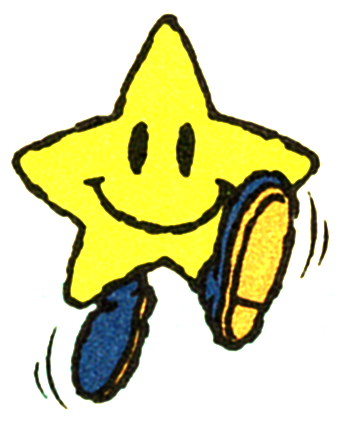
Little stars keep the counter high; a full 30 is worth 30 points at the goal.
Touch an enemy and Yoshi is not hurt; instead Baby Mario is knocked into a bubble that drifts around the screen, and the star counter starts ticking down from wherever it stands. Grab him before it reaches zero and play continues. Fail, and Kamek’s Toadies carry the baby off and you lose a life. The counter begins each level at ten, climbs when you collect the little stars scattered through the stage or pass a Middle Ring, and tops out at 30. If it is below ten after a rescue it slowly creeps back up to ten.
The result is a game where almost nothing kills you outright, bar lava, spikes, pits and a few monsters that swallow Yoshi whole, and where getting hit is a nuisance rather than a disaster. It also makes the star counter part of the score, because you need all 30 at the goal for a perfect level.
Scoring, flowers and Bonus Challenges
Each level ends with a tally out of 100: one point per star on the counter (maximum 30), one per red coin (20, disguised among ordinary coins and darker in colour if you look closely) and ten per Special Flower (five). Score 100 in all eight levels of a world and two new icons appear on the map: that world’s Extra level, a short and nasty gauntlet with its own gimmick, and its Bonus Challenge, which you can then replay whenever you like. A perfect 100 in an Extra level adds a star to the title screen, six in all.
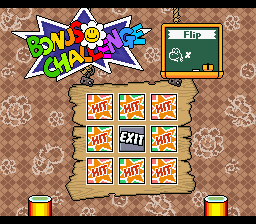
The goal ring itself is a roulette of ten panels. Each flower you collected turns one panel into a winner; stop on one and you play a Bonus Challenge. There are six, one per world: Flip Cards, Scratch and Match, Drawing Lots, Match Cards, Roulette and the Slot Machine. They pay out extra lives and Special Items, which are stored in a pocket of up to 25 and used from the pause menu: 10-Point and 20-Point Stars, an Anytime Egg (refills to six), the Anywhere POW, a Winged Cloud Maker, a Magnifying Glass that exposes red coins and hidden clouds, and the three Super Watermelons.
Flip Cards, the Bonus Challenge of World 1.
Morph Bubbles and Powerful Mario
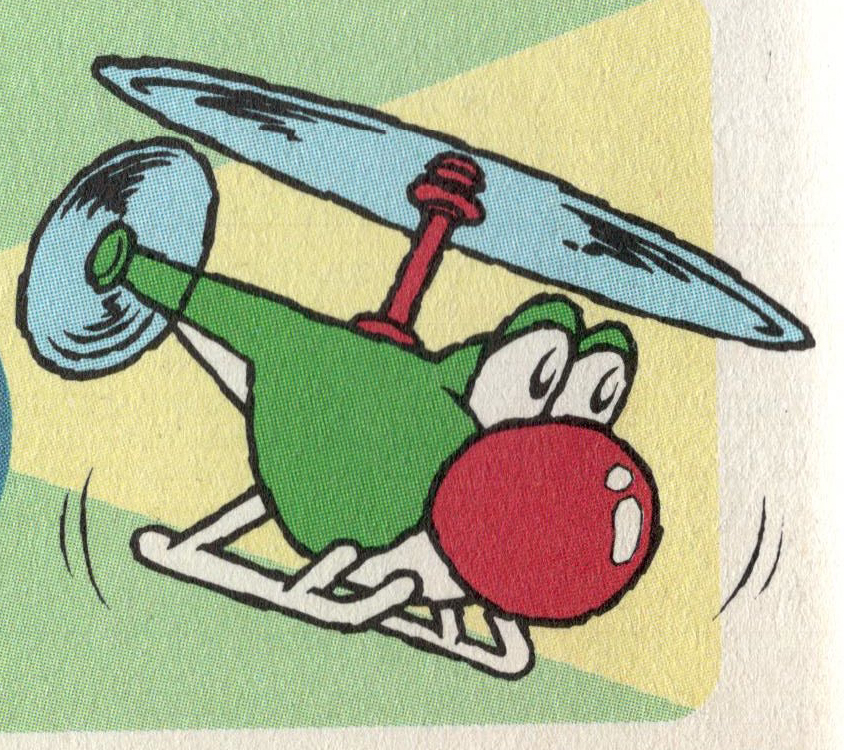
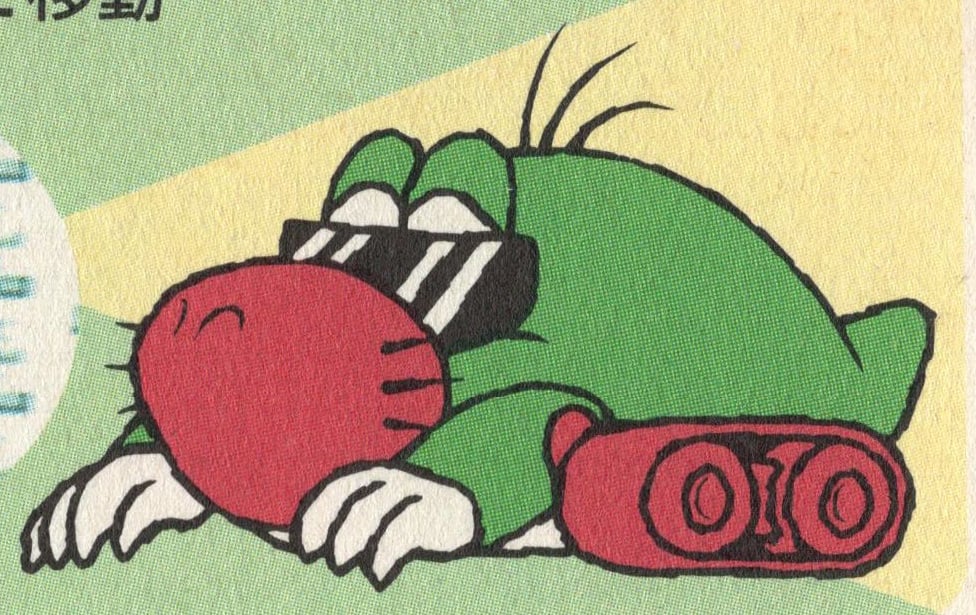
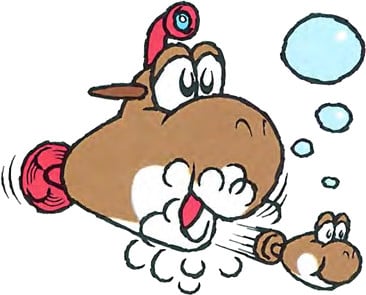
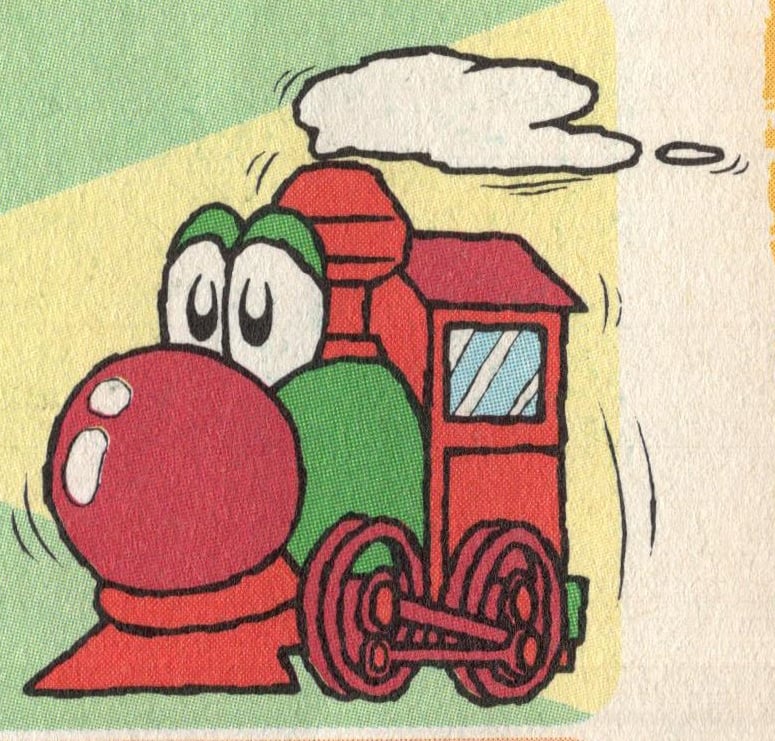
Dotted through the levels are Morph Bubbles that turn Yoshi into a vehicle for a timed stretch: a Helicopter that climbs while you hold the button, a Mole Tank that burrows through soft earth, a Submarine with homing torpedoes, a Train that follows a painted track across the background, and a Car that stretches its legs to hop over obstacles. Each run ends when the clock runs out or Yoshi touches a Yoshi Block, which snaps him back to normal exactly where you want him. In World 5 a hut puts him on skis instead, for a downhill dash with only a jump button to steer by.
Then there is the Super Star. Touch one and Baby Mario leaps off Yoshi’s back as Powerful Mario (the manual calls him Superstar Mario): invincible, caped, fast enough to run up walls and across ceilings, and on a strict timer that you extend by grabbing more stars. Miyamoto originally wanted the baby to turn into the grown, moustachioed Mario at this point; a colleague pointed out that it made no sense in a prequel, and the cape was the compromise.
Helicopter Yoshi, first met in World 1-2.Powerful Mario: for a few seconds the baby does the work.Skis, World 5 only.
Mini Battles and the two-player secret
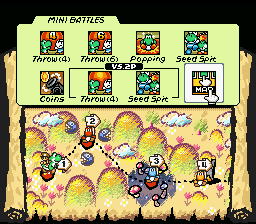
The hidden Mini Battle menu, including the two-player modes.
Hidden in certain levels are bonus huts guarded by a Bandit. Beat him and you play a Mini Battle: Throwing Balloons, Popping Balloons, the Watermelon Seed Spitting Contest or Gather Coins, each paying out Special Items. Once found, they can be replayed from the map. A code entered on the map screen (hold Select and press X, X, Y, B, A) opens a Mini Battle menu that includes two-player versions, the only multiplayer in the game. The game even hints at the code in a secret room behind the left-hand door of Sluggy the Unshaven’s Fort.
How hard is it?
Simply reaching the end is gentle by Mario standards: the flutter jump, the forgiving star counter and the absence of a timer were all deliberate choices to make the game friendlier to newcomers, and Tezuka said the aim was for beginners to clear it while experts went back for 100%. That second game is a different beast. Red coins are hidden behind walls and in Winged Clouds, flowers sit off the beaten track, and keeping 30 stars through a castle demands near-perfect play. The Extra levels, especially World 6’s Castles – Masterpiece Set, are among the hardest things Nintendo made on the SNES.
Items and power-ups
Everything worth picking up on the island, from the collectibles that make up your score to the Special Items you hoard for emergencies.
Yoshi EggsMade by swallowing enemies or hitting Egg Blocks. Green, yellow, red and flashing varieties; six at a time.
StarsAdd one each to the star counter, up to 30. Found loose, in Winged Clouds and in Special Flowers.
Special FlowerFive per level, ten points each, and each one adds a winning panel to the goal roulette.
Red Coins and CoinsTwenty red coins per level hide among ordinary coins; 100 of any kind earns a 1-Up.
Winged CloudThe island’s version of a ? Block. Hit it with an egg for stars, coins, a flower, a key or a surprise.
Middle RingA checkpoint. Pass through it to top up the star counter and restart from there if you lose a life.
Super StarTurns Baby Mario into Powerful Mario for a limited time.
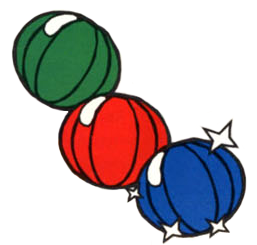
WatermelonsGreen spits seeds like a machine gun, red breathes fire, blue freezes enemies into blocks you can throw.
1-UpExtra lives, often carried by Fly Guys or dropped by Winged Clouds and balloons.
KeyOpens locked doors in forts, caves and bonus huts. Yoshi carries it in his mouth.
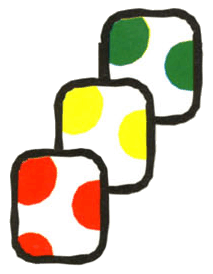
Egg BlockBump it from below for a fresh egg; the Egg Plant in boss rooms does the same job.
Koopa shellCannot be swallowed, but can be held and spat to ricochet through a row of enemies.
Anywhere POWA Special Item: turns every enemy on screen into stars, or coins if your counter is already full.
Magnifying GlassA Special Item that reveals which coins are red and where secret Winged Clouds hide.
Cartoons, Comics & Other Media
Yoshi’s Island arrived too late for the Mario cartoons, but it was everywhere else in 1995, and its cast has never left.
Nintendo Power Vol. 75 and Vol. 77Nintendo of America · August and October 1995The August issue previewed the game and the October issue put Yoshi on the cover with a full strategy guide; Nintendo Power’s review called it one of the biggest and most beautiful games yet made. Super Luigi Bros has both issues scanned.
A Magical Tour of Yoshi’s IslandPromotional VHS · Nintendo of America · 1995A six-minute promotional tape (also titled A Journey Through Yoshi’s Island) produced by Bensussen Deutsch and Associates. Josh Wolf, fresh from Donkey Kong Country: Exposed, hosts, and Nintendo’s Ken Lobb quizzes the game testers.
Super Mario-kun, volumes 14 and 15Yukio Sawada · Shogakukan · 1996The long-running manga sent grown-up Mario, Luigi and Bowser back in time to Yoshi’s Island, where they help young Yoshi rescue the babies and fight Burt, Froggy and Sluggy, before a POW Block turns Bowser into a baby for the finale.
The exploding-diner commercialUS television · 1995Nintendo of America’s advert showed a man eating until he burst, spraying green goo over a restaurant, a gross-out gag that the A.V. Club later filed among Nintendo’s weirdest. It worked.
Super Mario: Yoshi Island Original Sound VersionSoundtrack CD · Japan · 1995Koji Kondo’s score, from the music-box lullaby of the opening to the athletic theme and the castle march, was released on CD in Japan only and now changes hands for serious money.
Tetris AttackSNES and Game Boy · 1996Nintendo of America dressed the Japanese puzzler Panel de Pon in Yoshi’s Island clothes: Yoshi, Lakitu, Poochy, Raphael the Raven and friends, with Kamek and Bowser as the villains.
Later games that remember the island1995 onwardsYoshi cameos in Donkey Kong Country 2’s hall of heroes, Super Smash Bros. Melee and Brawl both have crayon-drawn Yoshi’s Island stages, Baby Mario and Baby Luigi became Mario Kart regulars, and in 2023 a Yoshi’s Island race track joined Mario Kart 8 Deluxe and Mario Kart Tour.
Characters
A tiny cast by Mario standards, but almost every one of them was new in 1995 and most are still with us. Here is who they are, what they do on the island, and what they can do.
Character
Who they are
In this game
Abilities & notes
Yoshi (and the Yoshis)The hero, in eight colours
The friendly dinosaur who first appeared in Super Mario World, promoted to leading man at the suggestion of his designer, Shigefumi Hino. The Yoshis of the island share the job in a relay.
Carries Baby Mario from the beach where he lands to Baby Bowser’s castle, defeating Kamek’s enlarged monsters along the way. A different colour takes each level: green, pink, light blue, yellow, purple, brown, red and blue.
Flutter jump, ground pound, tongue grab
Carries six eggs; aims with a cursor
Morphs into Helicopter, Mole Tank, Submarine, Train and Car
Colour is cosmetic: every Yoshi plays the same
Baby MarioThe passenger
Mario as a newborn, making his first appearance. He cannot do anything for himself, which was the whole point: the team wanted a Mario who could not walk so that Yoshi would have to carry him.
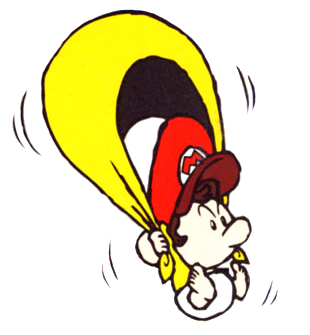
Rides on Yoshi’s back, floats off in a bubble when Yoshi is hit, and points the way to his brother. With a Super Star he becomes Powerful Mario and briefly takes over.
Powerful Mario: invincible, runs up walls, timed
His cry was re-recorded by Charles Martinet for the GBA version
Baby LuigiThe kidnapped twin
Luigi’s first appearance as a baby, and the reason for the whole journey. Kamek grabbed him from the stork because his prophecy named both brothers.
Held in Baby Bowser’s castle for the entire game and rescued, alongside the stork, after the final battle. Not seen in play until the ending.
Not playable; later a star of Yoshi’s Island DS and the Mario Kart series.
KamekThe Magikoopa
A Magikoopa of the Koopa Kingdom and Baby Bowser’s guardian, introduced here. He foresaw that the twins would bring disaster on the Koopas and decided to deal with them early.
Ambushes the stork, kidnaps Baby Luigi, sends his Toadies after Baby Mario, and appears before every fort and castle boss to enlarge an ordinary creature with his magic. He turns Baby Bowser into a giant for the finale and escapes with him.
Flies on a broomstick; never fought directly on the SNES
Shrinks Yoshi in Prince Froggy’s Fort
Harasses you personally in the Extra level Kamek’s Revenge
Baby BowserThe final boss
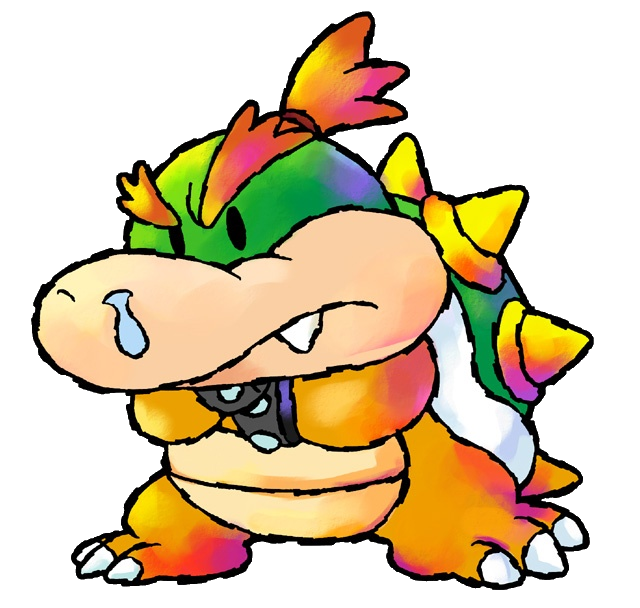
Bowser as a tantrum-prone toddler, in his first appearance. He has no interest in prophecies; he just wants to ride the green donkey.
Woken by the commotion at the top of his castle, he flattens Kamek, fights Yoshi with ground pounds, and is then magically grown into a screen-filling giant for the last battle.
Phase 1: three ground-pound hits
Phase 2: seven giant eggs
Will climb onto Yoshi’s back if Baby Mario is knocked off
The StorkDelivery in progress
The bird charged with bringing the Mario twins to their parents.
Ambushed by Kamek in the opening, held captive with Baby Luigi, and freed at the end to complete the delivery to a cottage in the Mushroom Kingdom.
Not playable. Returns in Yoshi’s Island DS and Yoshi’s New Island.
ToadiesKamek’s henchmen
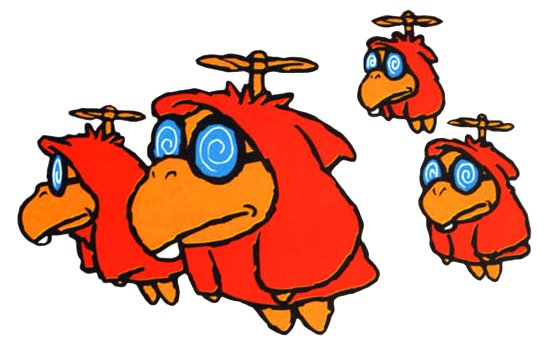
Small, winged Shy Guy-like servants of Kamek, dressed in robes to match their master.
Hover in to carry Baby Mario away when the star counter hits zero, and hassle Yoshi in a few levels. The GBA remake gives them a whole Secret level, Fight Toadies w/ Toadies.
Can be swallowed when they appear as ordinary enemies.
PoochyThe island’s dog
A tongue-lolling dog with a big nose, making his debut. He runs wherever Yoshi throws an egg.
Appears in a few levels, including Jungle Rhythm… and the Extra level Poochy Ain’t Stupid, where Yoshi rides him across lava and spikes that would hurt anyone else.
Immune to lava, spikes and enemies; cannot be hurt or swallowed.
Huffin PuffinA mother and her chicks
A plump bird whose chicks waddle after her.
Swallow the chicks and they become homing eggs that fly back to Yoshi after being thrown.
The only eggs in the game that return to you.
Melon BugThe rolling helper
A striped bug that curls into a rolling ball when touched.
Yoshi can hold it in his mouth and spit it to bowl through enemies; rarely found, and a candidate for the unused Super Donkey prototype’s heritage.
Harmless.
BanditThe thief
A hooded Shy Guy cousin introduced in this game, and the guardian of the Mini Battle huts.
Snatches Baby Mario straight off Yoshi’s back and runs; Coin Bandits pinch your coins instead. Beat one in a bonus hut to play a Mini Battle.
Swallowable; a Train Bandit variant stalks the Train sections.
The eight Yoshis togetherGreen, Pink, Light Blue, Yellow, Purple, Brown, Red, Blue
Pink, light blue, purple and brown were new to the series here, joining the four colours from Super Mario World.
One colour per level, in a fixed order. The Extra levels and the final castle use Green, so Blue Yoshi never reaches the Koopa Kingdom.
Brown Yoshi is playable only in this game (and its remake); the official artwork tends to paint him orange.
Enemies and bosses
Super Mario Wiki lists well over a hundred enemies and variants for this game; these are the ones you will meet most, plus every boss.
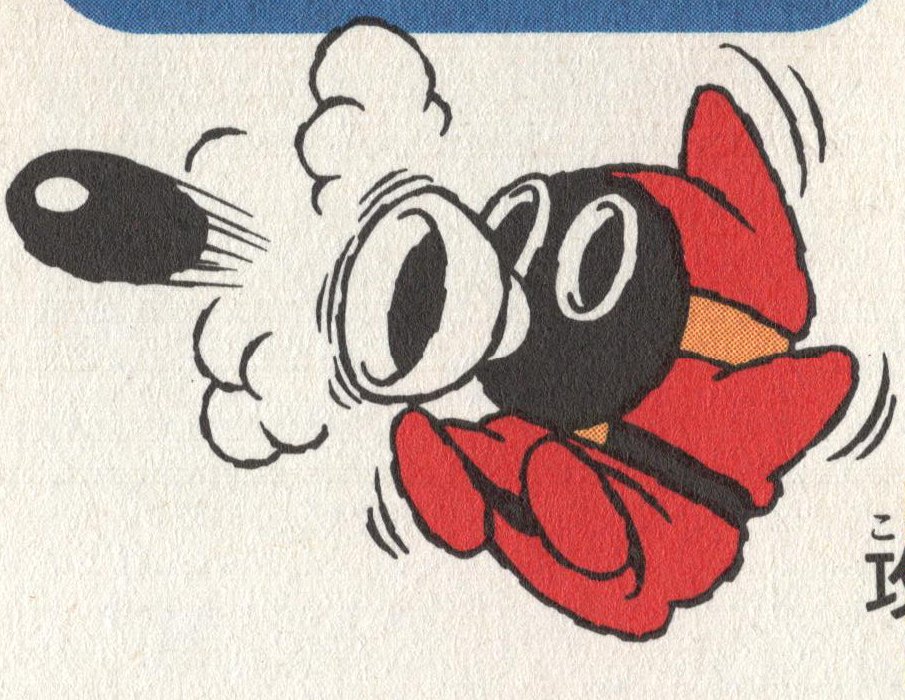
Shy GuyEverywhereThe island’s Goomba: masked, harmless, egg fodder. Comes in Fly Guy, Stilt Guy, Spear Guy, Boo Guy, Fat Guy, Mace Guy, Zeus Guy and Woozy Guy flavours.
Fly GuyMost worldsPropeller-topped Shy Guy, often carrying a 1-Up or a red coin that it drops when hit.
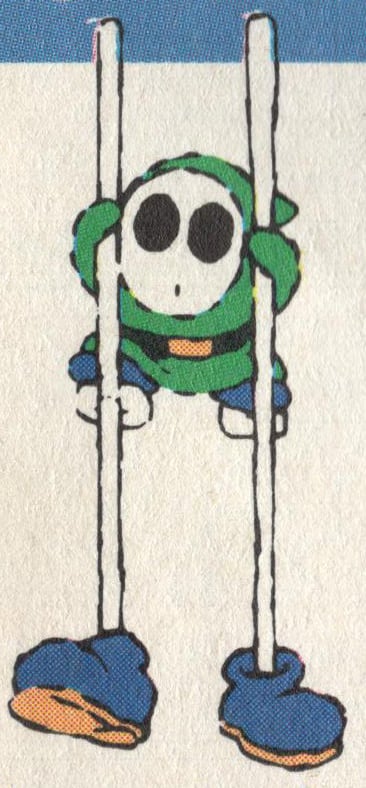
Stilt GuyWorld 1-6Too tall to swallow; knock him off his stilts first.
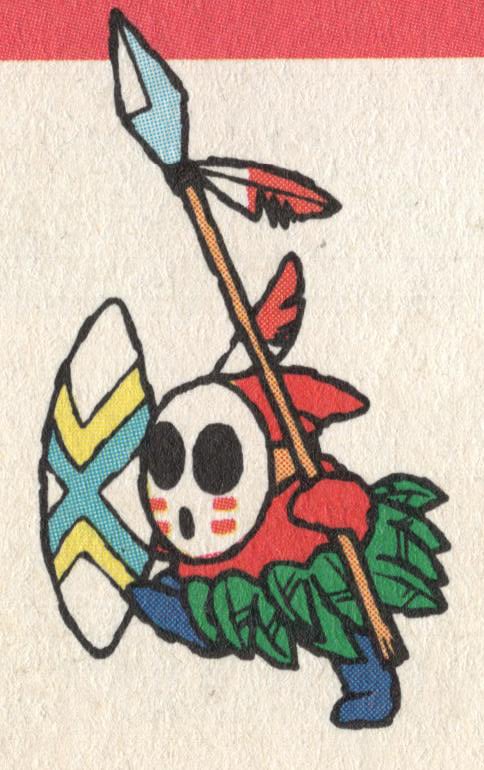
Spear GuyJungleJabs with a spear; approach from behind or above. Dancing Spear Guys conga in lines.
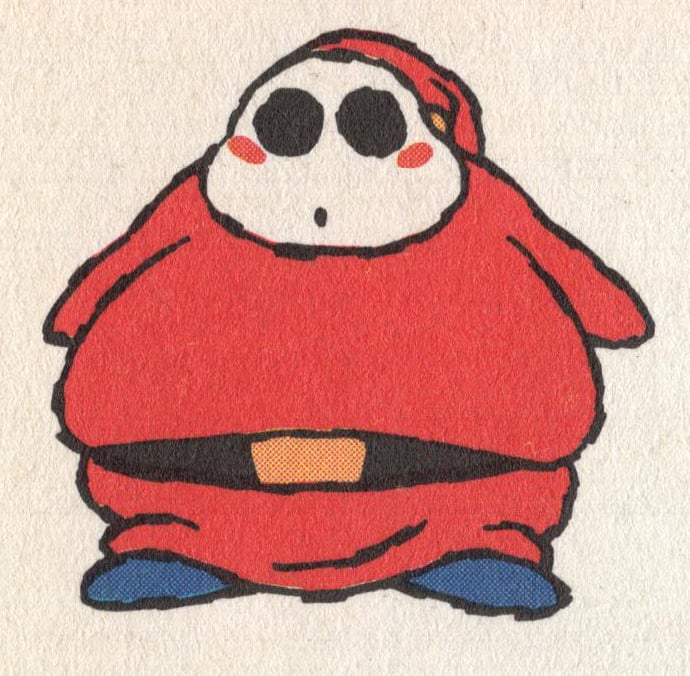
Fat GuyWorld 2-7An enormous Shy Guy found only in Lakitu’s Wall. Swallow one for a Giant Egg.
Koopa TroopaWorld 2 onwardsSpit the shell to ricochet; the unshelled Koopa keeps walking.
GoombaScatteredWait, no. Mario is a baby. These are mostly here for old times’ sake.
LakituWorlds 2 and 4Throws Spiny Eggs from his cloud. Wall Lakitus hide in alcoves; Fishin’ Lakitu dangles a 1-Up on a line.
Nipper PlantCaves and castlesHopping baby Piranha Plants grown from drifting Nipper Spores.
FuzzyWorld 1-7Touch one and the world melts and sways. Harmless, but hard to walk straight.
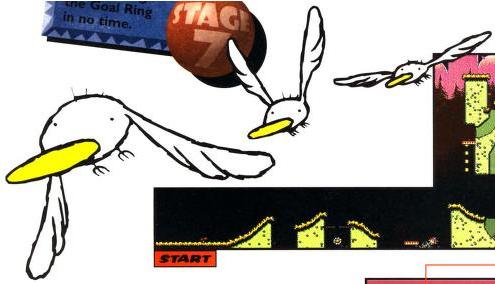
GoonieWorld 5Pelican-like birds Yoshi can ride; swallow one and only a Flightless Goonie is left. Skeleton Goonies haunt World 6.
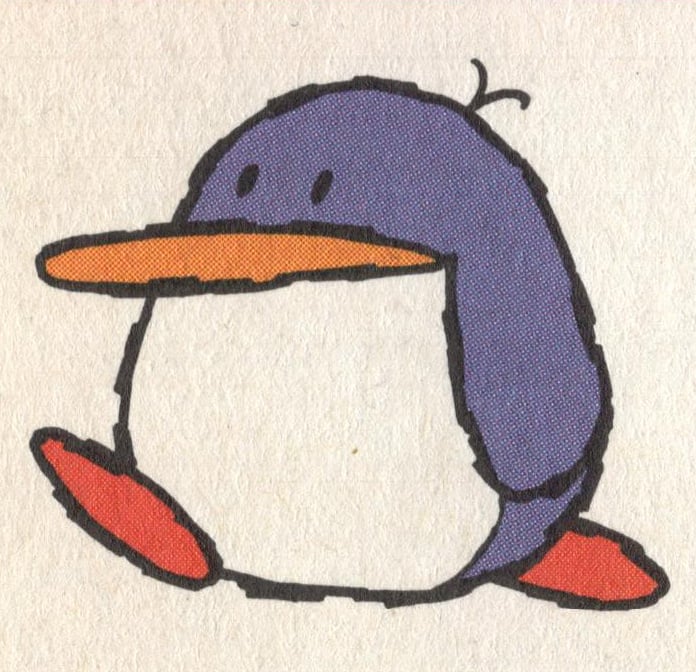
BumptyWorld 5Penguins that bump Yoshi about on the ice.
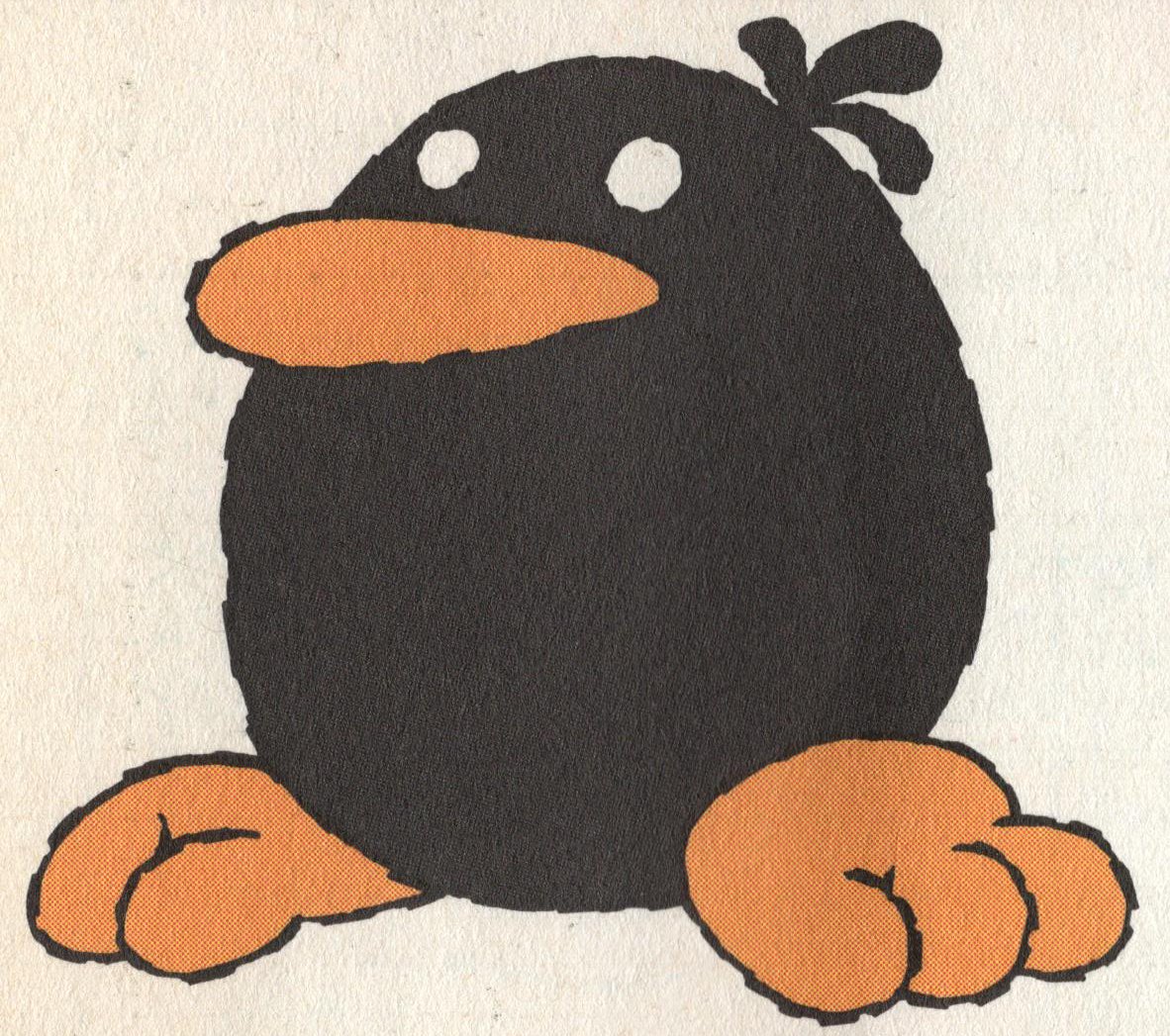
RavenWorld 5Black birds that run around the edges of platforms. One becomes the world boss.
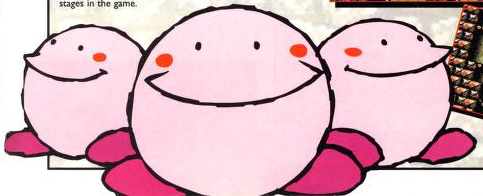
MildeWorld 4Puffy pink balls that pop with a ground pound. Their giant form is Marching Milde.
GustyWorld 2Gusts of wind with faces, blown in lines across the screen.
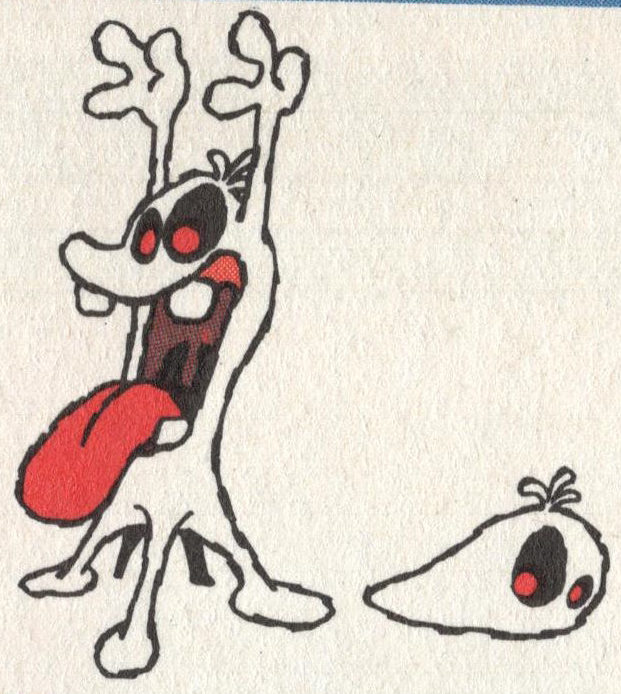
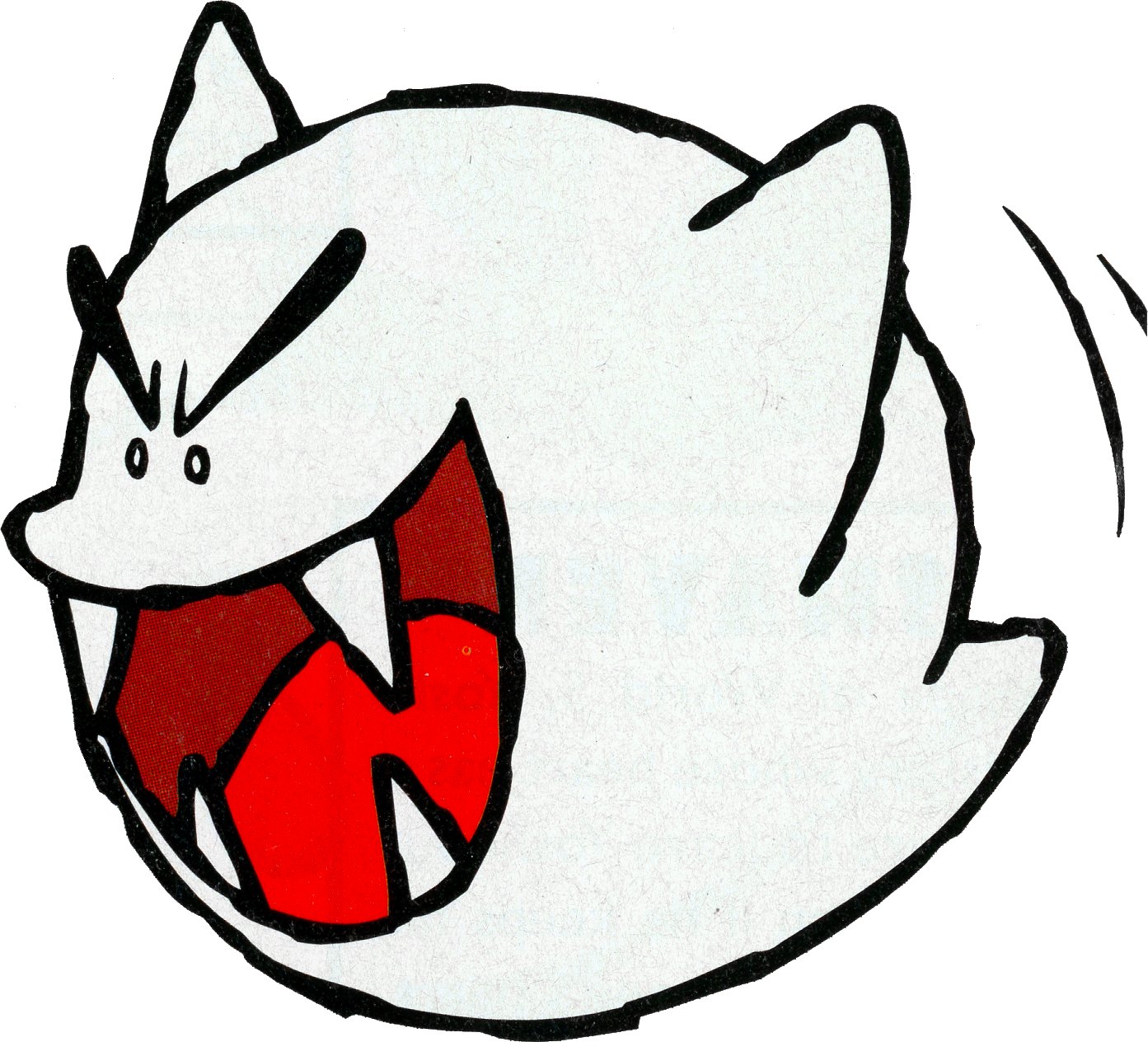
Boo BlahFortsA stretching ghost stuck to floors and ceilings, plus Boos, Big Boos and Lantern Ghosts in the darker rooms.
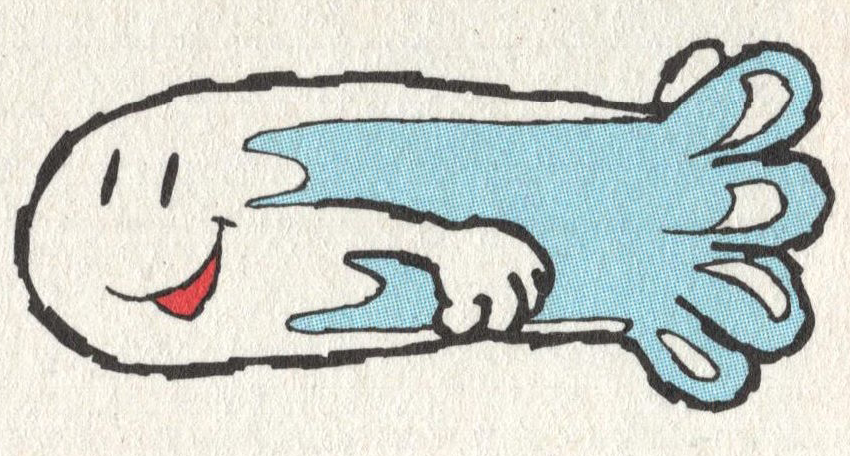
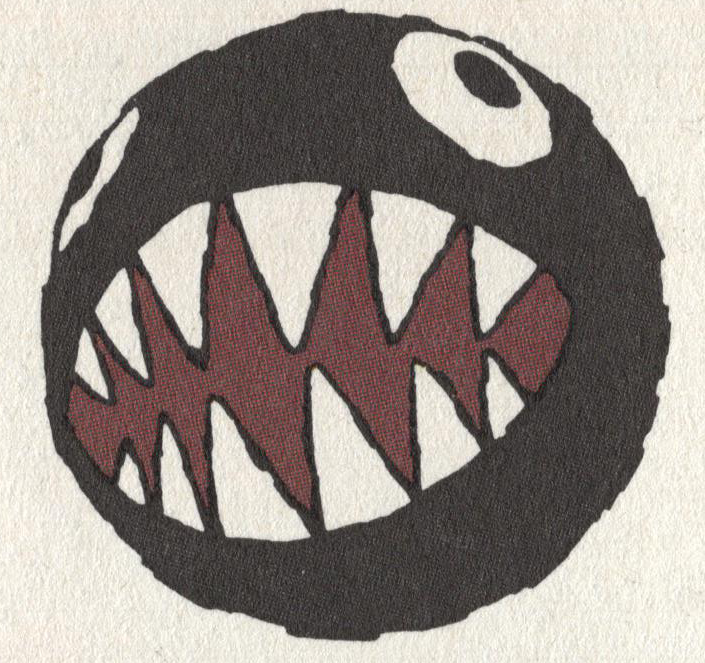
Incoming ChompWorld 1-2Chain Chomps that drop from the sky with a shadow warning. Run.
Chomp SharkWorld 6-7A huge Chain Chomp that eats the level behind you in KEEP MOVING!!!!
Lunge FishLakesLurks under the surface and swallows Yoshi whole, baby and all.
BlarggLavaLava monsters; the Gargantua Blargg fills half the screen.
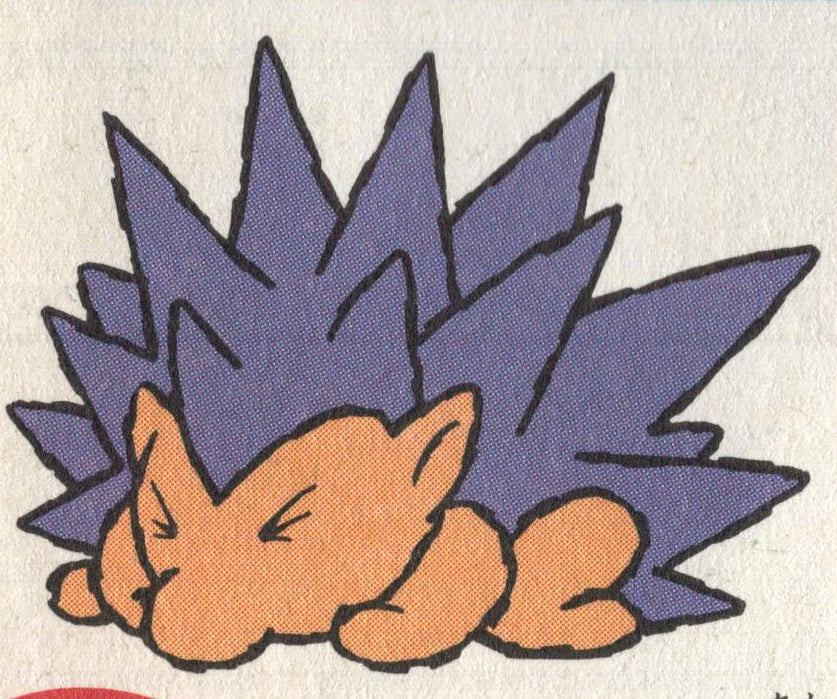
Harry HedgehogWorld 3-6Bristles when you get close; swallow him before he does.
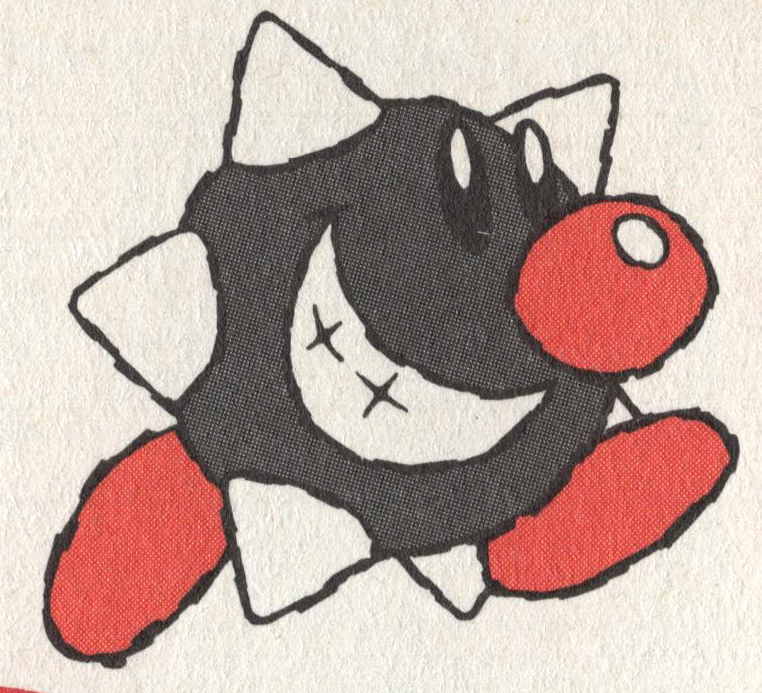
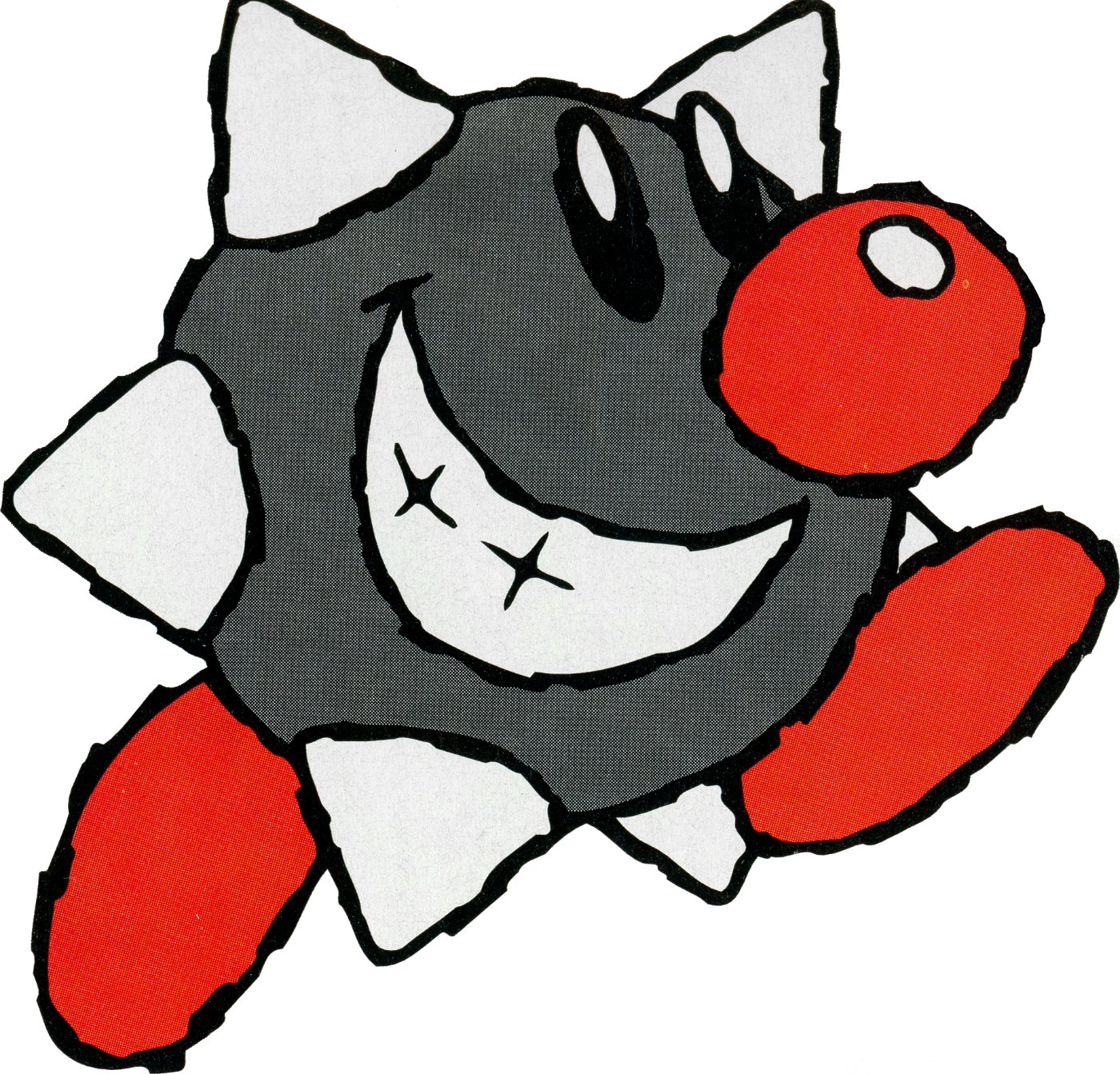
Tap-TapForts and castlesSpiked balls that cannot be swallowed or stomped; eggs just push them back.
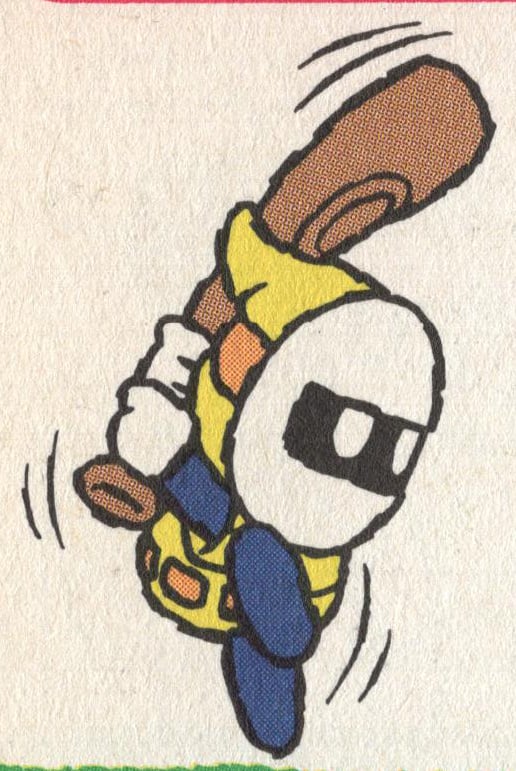
Slugger and Green GloveWorld 2-2The Baseball Boys: one bats your eggs back, the other catches and returns them.
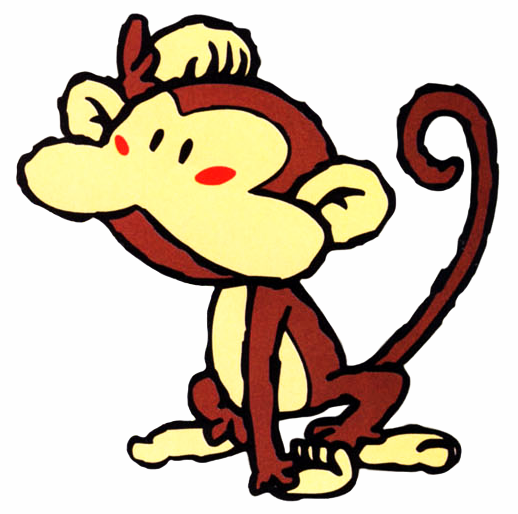
GrinderJungleMonkeys that pelt you with seeds, steal eggs and swing on vines.
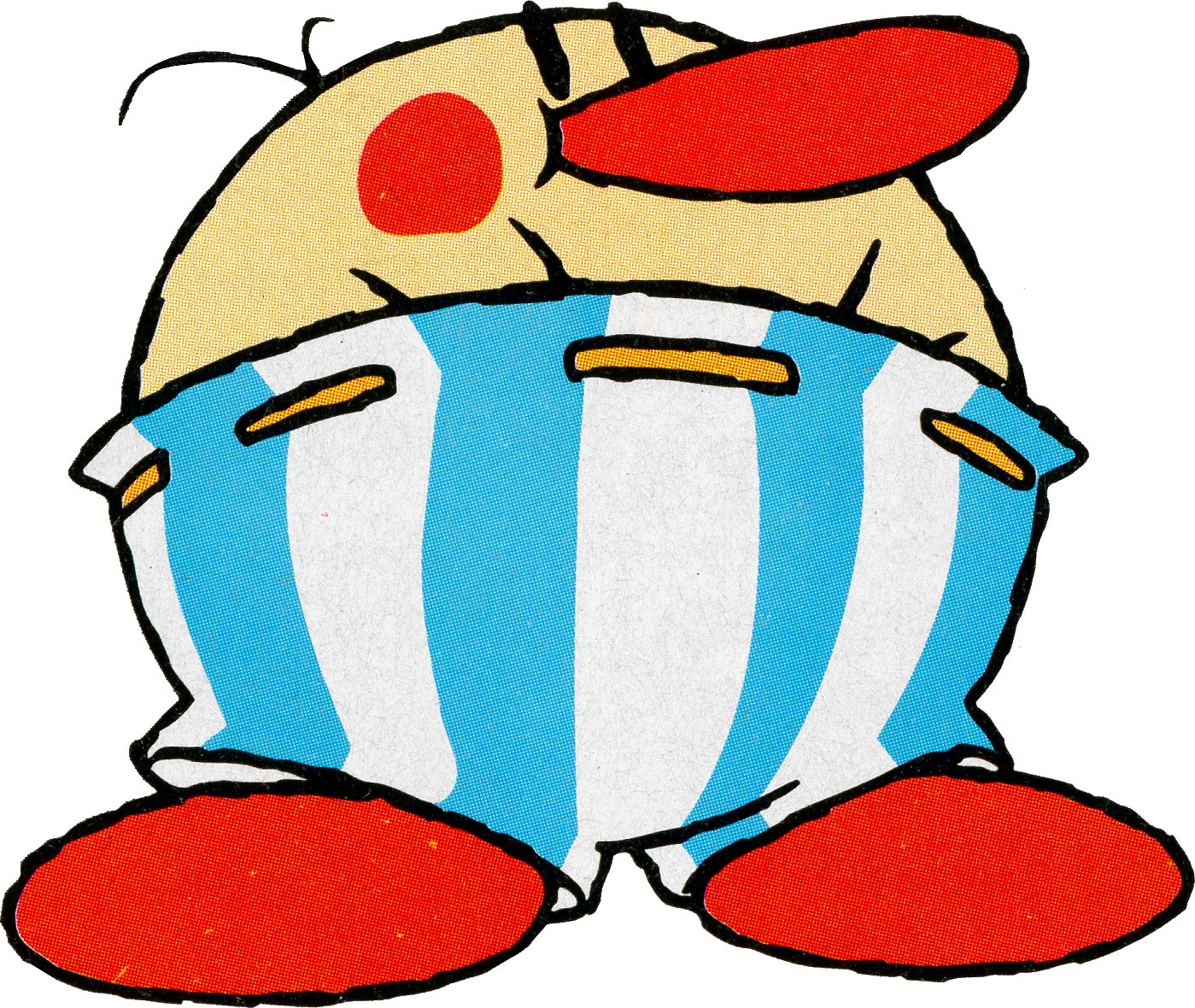
Burt the BashfulBoss, World 1-4Six eggs, and each one pulls his trousers down a little further until, scarlet with embarrassment, he blasts off.
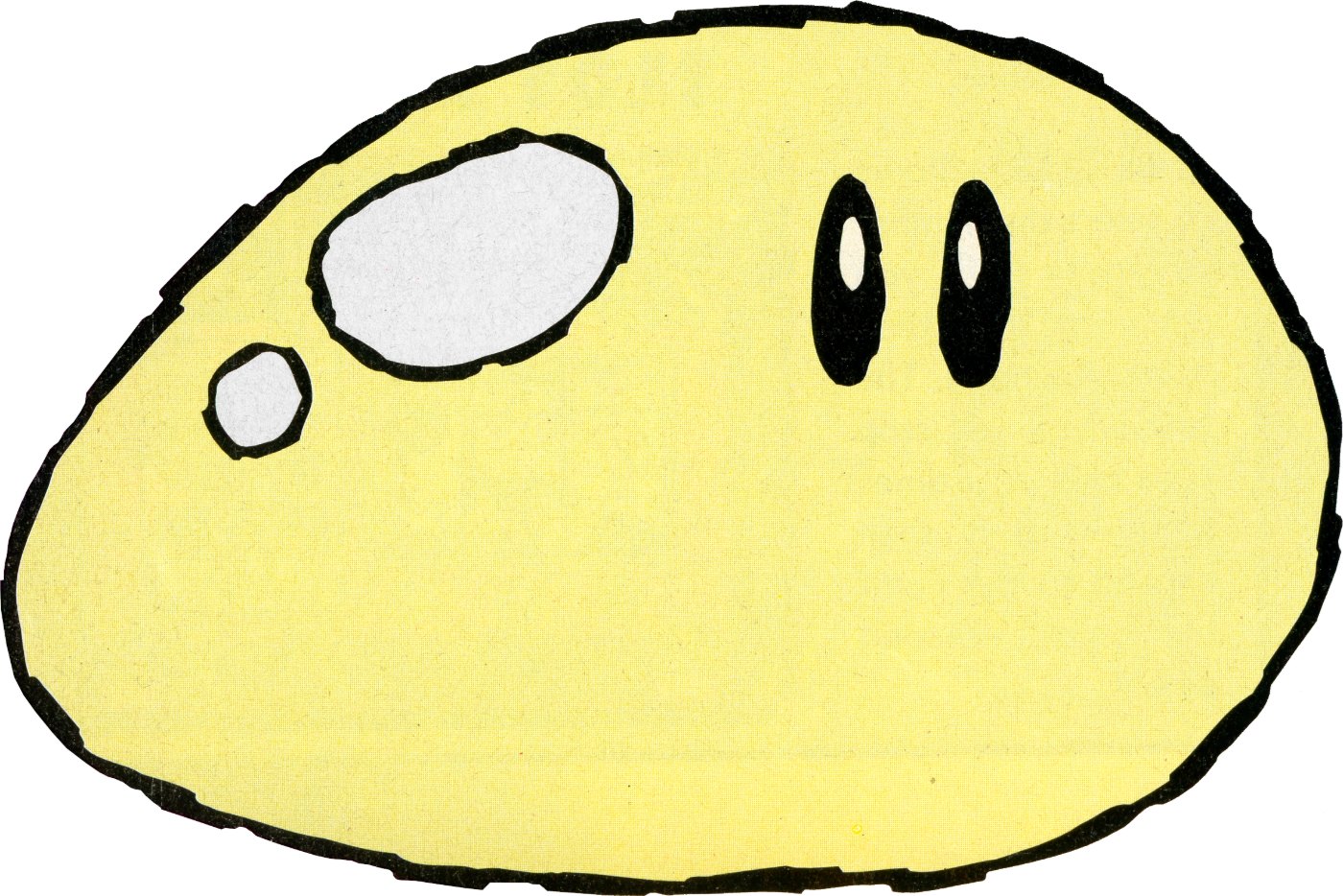
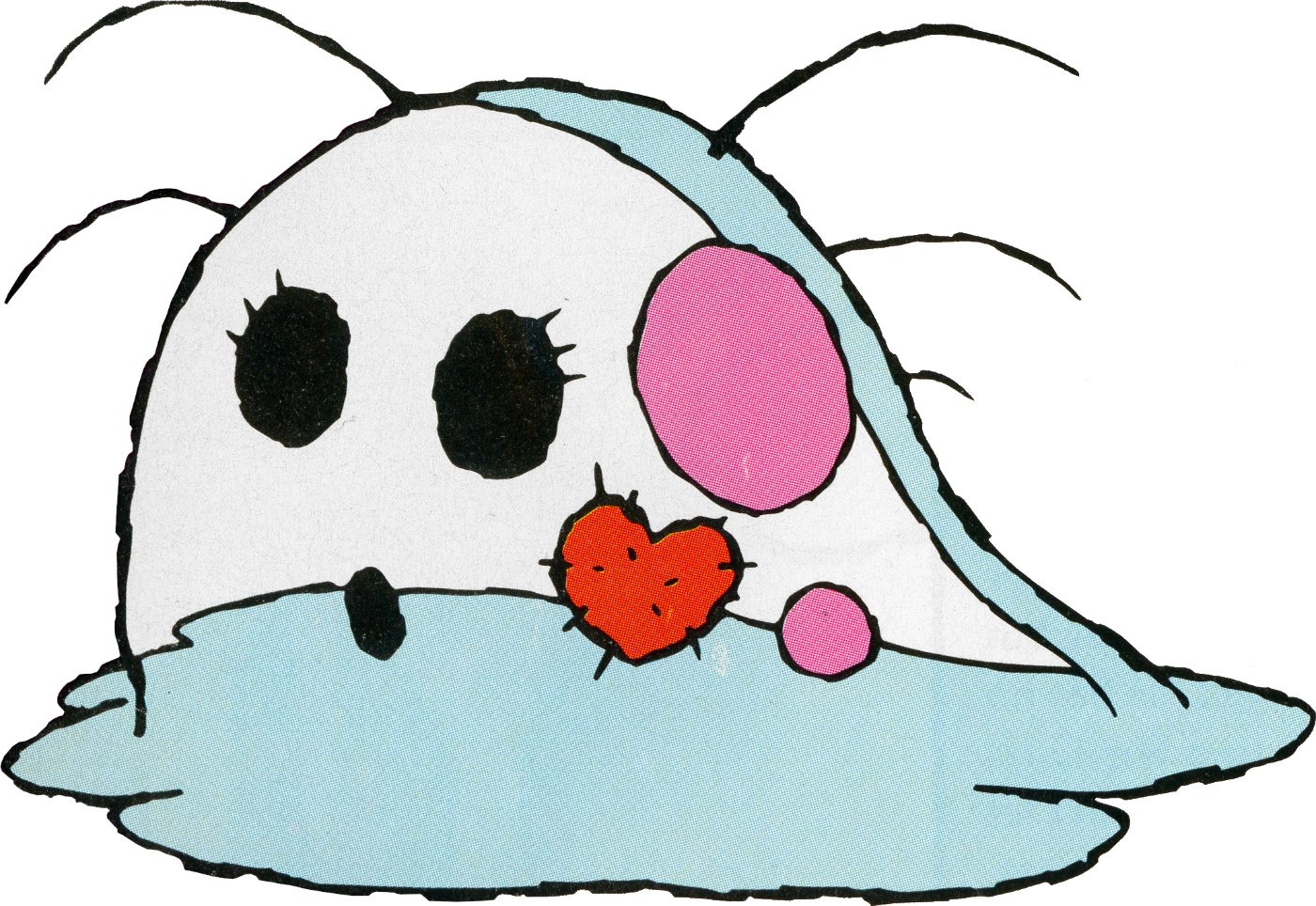
Salvo the SlimeBoss, World 1-8A giant Lemon Drop that sheds smaller drops when hit and shrinks with every egg until nothing is left.
Bigger BooBoss, World 2-4Cannot be hit while Yoshi faces him. Bounce eggs off the walls instead; he grows with each hit and bursts on the fifth.
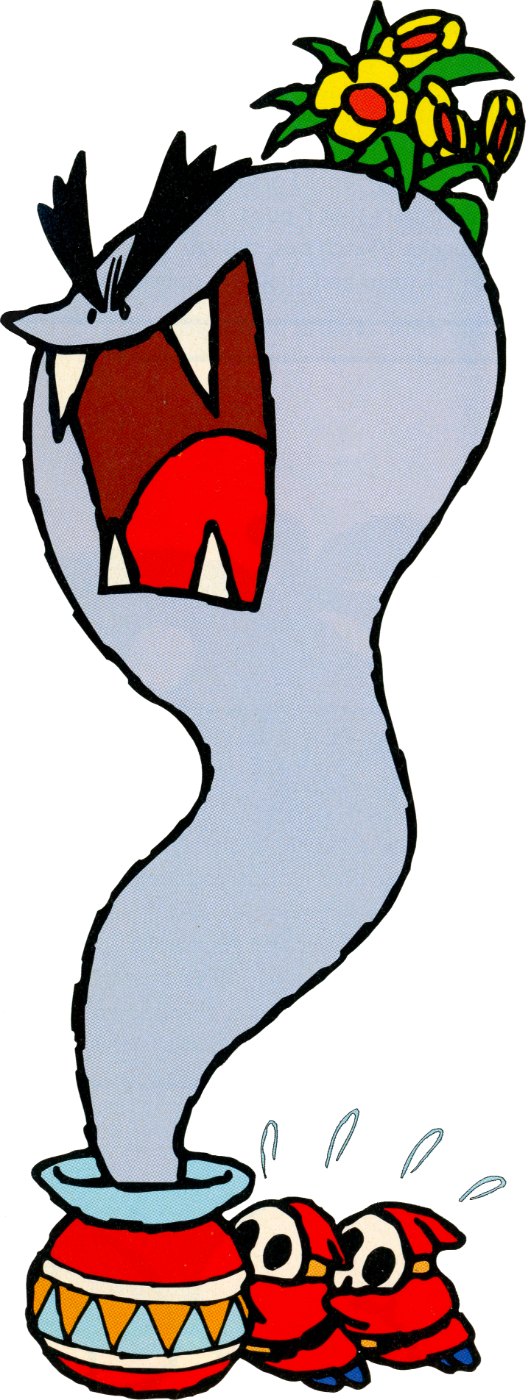
Roger the Potted GhostBoss, World 2-8A ghost in a flowerpot, pushed by two Shy Guys. Shove the pot off the ledge while dodging his blue fire.
Prince FroggyBoss, World 3-4Kamek shrinks Yoshi and the frog swallows him. Egg the uvula from inside while dodging stomach acid.
Naval PiranhaBoss, World 3-8Hit the bandaged belly button three times. Or egg the plant before Kamek arrives and skip the fight.
Marching MildeBoss, World 4-4Ground pound her into two, then four, then eight, then eat the lot. The only boss you can defeat by swallowing.
Hookbill the KoopaBoss, World 4-8Eggs to the head tip him onto his back; ground pound his belly. Three rounds and his shell explodes.
Sluggy the UnshavenBoss, World 5-4Push his skin in with eggs until his hairy heart is exposed, then hit it four times before he squeezes you into the pit.
Raphael the RavenBoss, World 5-8Fought on a tiny moon. Ground pound the posts so they shoot through the planet and hit him from the far side; three hits and he becomes a constellation.
Tap-Tap the Red NoseBoss, World 6-4Invincible. Use eggs to knock him back and smash the floor beneath him, then nudge him into the lava.
Baby BowserBoss, World 6-8Three ground pounds for the toddler, then seven giant eggs for the giant.
The people who made it
Key staff, as credited in the game, with what the developers themselves have said about their roles.
Shigeru MiyamotoProducerOversaw the project and, when his team was pulled onto Super Mario 64, returned to help balance the finished levels. Still thinks the Super Star should have turned the baby into grown-up Mario.
Takashi TezukaDirectorDirector of Super Mario World. Devised the flutter jump and the rule that a hit does not cost a life, then spent much of the project on Zelda and the N64 before coming back to polish.
Shigefumi HinoDirector and character designYoshi’s original designer, who pitched the idea of Yoshi as the star carrying something to the goal, and who chose the hand-drawn direction after seeing a rough scribbled cloud.
Hideki KonnoDirectorCo-director who, with Tezuka, moved to Super Mario 64 mid-project; later the producer of Mario Kart and Nintendogs.
Toshihiko NakagoDirectorHead of SRD, Nintendo’s long-time programming partner, which wrote the game’s code.
Hisashi NogamiCharacter designJoined Nintendo about eighteen months before release; this was his first game. Drew the marker-pen background with a pointed Mount Fuji that set the final look, and created enemies and a boss. Later produced Animal Crossing and Splatoon.
Koji KondoMusicA gentler score than Super Mario World, with a music-box opening and an ending theme the team found genuinely moving after the rush to finish.
Yoshiaki KoizumiCG designerHandled the computer-graphics work, including the pre-rendered-style cutscenes; later the director of Super Mario Galaxy.
Yoichi Kotabe and Yoshiki HaruhanaIllustrationKotabe, Nintendo’s veteran Mario illustrator, advised; Haruhana drew the illustrations, with Wataru Yamaguchi designing the package.
Advertisement
How It Was Made
Nintendo has talked about Yoshi’s Island more than most of its 16-bit games: two 1995 interviews translated by Shmuplations, a 2017 Nintendo developer interview with Tezuka, Hino and Nogami, and a 2020 making-of in Retro Gamer tell most of the story.
What do you do after Super Mario World?
A preliminary logo from before the title was settled.
The seed was planted almost as soon as Super Mario World shipped in late 1990. Miyamoto said in 1995 that the longest-serving staff had been on the project for about five years, the first two spent on experiments. Shigefumi Hino, who had drawn Yoshi for the previous game, felt the team had done everything a side-scrolling jumping game could do with Mario, and began pitching ideas; the one that stuck was Yoshi as the hero, carrying something precious to the goal. Making that something a baby Mario solved a story problem (why does Mario not simply walk?) and gave the game its emotional hook.
Takashi Tezuka added the moves that made Yoshi feel different: a flutter jump that forgave mistakes, and a system in which a hit did not cost a life but set a clock running. Miyamoto has said the whole game was built around that one rule, and that the story came afterwards. Because the design assumed players would replay stages for a perfect score, the team felt free to pile in ideas; Miyamoto remembered jettisoning very few.
Crayons versus Donkey Kong Country
A hand-drawn look had been agreed before Hisashi Nogami joined the company, but nobody knew exactly what it meant. Hino had been searching for something distinctive and found it in a cloud with a rough, scribbled outline; Nogami, on his first job, drew a whole background in marker pen, complete with a pointy Mount Fuji, scanned it and spent two weeks working out how to get it into the game. That, Hino says, was the turning point. The art was drawn by hand, scanned, and then rebuilt pixel by pixel.
Then, in November 1994, Rare’s Donkey Kong Country arrived with its pre-rendered 3D sprites and sold millions. Inside Nintendo, people wondered whether Yoshi should look like that. The game was too far along to change course, and in any case the team did not want to: Tezuka said they decided to go against the trend one last time, and Hino that they would take up the challenge with visuals that were the exact opposite of Donkey Kong Country. Steven Kent’s history of the industry adds that Nintendo’s marketing people, shown an early build, thought it lacked punch, and that Miyamoto responded by pushing the hand-drawn style even further. As a nod to the times, the cutscenes use a glossy pre-rendered style of their own.
Morphmation: the Super FX 2 chip
The game had been designed with Argonaut’s Super FX chip in mind, the processor that drew the polygons of Star Fox; by the time it shipped it had become the first game to use the faster Super FX 2. Instead of 3D, the chip is used to rotate and scale sprites, to stretch and warp whole backgrounds, and to draw huge animated bosses without the slowdown a stock SNES would suffer. Nintendo of America gave the technique a name, Morphmation, and the Fuzzy’s dizzy effect, the crumbling walls of the forts and Raphael the Raven’s moon all show it off.
The chip made the cartridge expensive and also kept the game off the Wii’s Virtual Console years later; the SNES original did not reappear on a Nintendo console until the Super NES Classic Edition in 2017.
A team of three and a late rescue
Development was long and, for a while, lonely. Files in the 2020 Nintendo leak date the project from 1 February 1992 to 29 June 1995, and partway through Tezuka and Hideki Konno were moved to the Nintendo 64 and Super Mario 64. Nogami, Hino and one other designer were left to plan and build the game with SRD’s programmers. A demonstration to Nintendo’s sales and distribution staff went down well enough to bring people back, and Tezuka, Konno and Miyamoto returned for the balancing. Hino says the ending music hits harder because of how frantic those final months were.
Prototypes from the leak show how late some things changed: a December 1994 build still used Super Mario World’s music, the egg cursor originally stayed fixed while charging, and the World 2 castle icon showed Naval Piranha before Roger the Potted Ghost took the job. An unreleased experiment in the same archive, Super Donkey, shares elements with the finished game.
Two titles, one game
In Japan the game was Super Mario: Yoshi Island; the West got Super Mario World 2: Yoshi’s Island, a title that promised a sequel to the console’s pack-in hit. It was the first Mario game to ship in French and German as well as English, according to Super Mario Wiki. Nintendo Power gave it the cover of issue 77, a promotional VHS went out, and a notorious television advert showed a diner eating until he exploded. The game Miyamoto described as the team’s last Mario for the Super Famicom went on sale on 5 August 1995, eleven months before the Nintendo 64.
Series Firsts
What Yoshi’s Island brought to the series for the first time. Only firsts we could confirm are listed.
1Yoshi as the playable heroHis first platformer in the lead, after cameos and puzzle spin-offs.
2Baby Mario and Baby LuigiThe brothers’ infant selves debut, and so does the idea of a Mario prequel.
3KamekThe Magikoopa who would become Bowser’s right hand across the Yoshi games, Mario Party and Mario Kart.
4Baby BowserBowser as a toddler, complete with tantrums.
5PoochyThe island’s indestructible dog, later a Yoshi’s Woolly World headliner.
6Flutter jump, ground pound and egg throwYoshi’s three signature moves, all new here.
7Super FX 2The first game to ship with the upgraded chip.
8A health bar made of timeThe star counter replaced lives-per-hit with a countdown.
9New Yoshi coloursPink, light blue, purple and brown join the original four.
Cheats & Secrets
There are no cheat codes in the usual sense, but Yoshi’s Island is stuffed with secrets, and one genuine button code. Super Luigi Bros’ own cheats and hints page has more.
The Mini Battle code
On the world map, hold Select and press X, X, Y, B, A. A Mini Battle menu appears with every mini-game you have found, plus two-player Watermelon Seed Spitting and Throwing Balloons. The game itself hides the code: behind the left-hand door at the start of Sluggy the Unshaven’s Fort is a Chain Chomp; defeat it and a secret room spells out the sequence.
Skipping Naval Piranha
In Naval Piranha’s Castle, stand at the very edge of the ledge before the boss room and throw an egg at the small Piranha Plant in the water before the cutscene triggers. One hit kills it; Kamek arrives, exclaims “OH, MY!!!” and flies off, and World 3 is cleared without a fight.
Extra levels and Bonus Challenges
Score 100 points in all eight levels of a world (800 in total) and the world’s Extra level and Bonus Challenge appear on the map. A perfect 100 in an Extra level puts a star on the title screen; six stars means you have done everything. The GBA version is kinder: 700 points unlocks the Bonus Challenge, though the Extra level still needs 800.
Infinite lives in GO! GO! MARIO!!
In World 4-1, find the two tall upside-down pipes, eat the Piranha Plant, then spit a Koopa shell between the lower pipes so it bounces back and forth. Shy Guys keep marching out of the pipe into the shell, and each one after the first few is worth a 1-Up. Leave it running until the counter hits 999.
Spotting red coins
Red coins are drawn in a slightly deeper, redder gold than ordinary ones. Once you know, you cannot un-see it. The Magnifying Glass Special Item does the job for you, and also exposes secret Winged Clouds.
Homing eggs
Swallow a Huffin Puffin’s chicks and the eggs you lay fly back to Yoshi after each throw, so you never run dry.
Leaving a level
In any level you have already cleared, pause and press Select for the level options, which let you quit back to the map without losing a life. Useful when a red coin is clearly not going to happen this time.
Cracks in the wall
Many walls carry a small crack. Hit it with an egg to open a path to coins, flowers or a bonus hut.
Compiled from Super Mario Wiki, the instruction booklet and Super Luigi Bros’ existing cheats page.
Glitches & Oddities
A game this intricate has its share of cracks. These are documented on Super Mario Wiki’s glitch list for the game; a few can lock the console, so save first.
Zombie Yoshi
In King Bowser’s Castle, take the first door and jump into the lava towards the nearby ! Switch. If Yoshi hits the switch as he burns, he revives without losing a life, and the trick can be repeated for lives all the way to 999.
Warping out of the forts
In Burt the Bashful’s Fort, enter a pipe, take a hit from a Piro Dangle and flutter up to catch Baby Mario at the right moment, and Yoshi is warped out of the fort with the mid-boss skipped. A similar trick in Bigger Boo’s Fort uses a jump onto a Boo Blah timed with entering a pipe.
Eating Baby Mario
In Goonie Rides!, with a 10- or 20-Point Star in your pocket, tongue Baby Mario as the Toadies carry him off and swallow him. The game carries on, but the level can never be finished.
Invisible Yoshi
In Lakitu’s Wall, hit a Message Block with a Giant Egg and Yoshi turns invisible. Reach the goal ring in that state and the game freezes.
The held-breath egg
In Welcome To Monkey World!, spit a held Grinder at a Middle Ring and press Down to lay an invisible egg. The same trick in Nep-Enut’s Domain can break the cutscenes later in the game, including the ending.
Super jump
In Nep-Enut’s Domain, flatten a Stretch, fire an egg and press A then B in quick succession as you jump. Yoshi rockets far higher than the level intended.
Baby Bowser with nowhere to land
If Giant Baby Bowser destroys every platform in the final battle and is then defeated, he has nowhere to fall and the game freezes. Land the last egg while you still have floor.
The Super Star trap
In GO! GO! MARIO!!, reaching the Super Star behind a breakable wall by bouncing on a Shy Guy’s head, without any eggs, leaves Powerful Mario stuck with no way to break out.
Videos
Nintendo’s own announcement of the Game Boy Advance version coming to Nintendo Switch Online, and a long-form documentary on how Super Mario World and Yoshi’s Island were made.
Nintendo’s official trailer for the three Super Mario Advance games joining the service, including Yoshi’s Island: Super Mario Advance 3.
A documentary from the strafefox making-of series, drawing on the developer interviews cited on this page.
Trivia & Interesting Facts
In Japan the game is Super Mario: Yoshi Island. The “World 2” was added for Western shelves.
Yoshi changes colour with the level number, not the world: green for x-1, then pink, light blue, yellow, purple, brown, red and blue for the castle. The Extra levels and King Bowser’s Castle use green, so Blue Yoshi never visits the Koopa Kingdom.
Brown Yoshi, or orange, depending on who drew him.Brown Yoshi is playable only here and in the GBA remake, and Nintendo’s artwork usually paints him orange. A brown Yoshi does turn up as a bystander in Paper Mario.
Miyamoto’s first idea for the Super Star was to turn Baby Mario into the adult, moustachioed Mario. A colleague objected that it broke the story, so the caped Powerful Mario was created instead. Miyamoto said in 1995 that he still preferred his version.
Nintendo of America called the Super FX 2 effects “Morphmation” in its marketing.
Four directors are credited: Tezuka, Nakago, Hino and Konno. Tezuka and Konno left mid-project for Super Mario 64 and came back to help balance the finished game.
Hisashi Nogami’s marker-pen test background, the drawing that fixed the game’s look, featured a pointed Mount Fuji. It was his first job at Nintendo; he went on to produce Animal Crossing and Splatoon.
The developers admitted they played carefully to avoid hearing Baby Mario cry. Reviewers at GameFan docked a point for the “screech”, and Charles Martinet re-recorded it for the GBA version.
Naval Piranha can be killed before the boss fight starts. Kamek turns up, says “OH, MY!!!” and leaves.
Roger the Potted Ghost is the only boss Kamek creates from an inanimate object, an empty flowerpot.
Marching Milde is the only boss you can finish off by eating.
Sluggy the Unshaven cannot knock Baby Mario off, which makes his fort the one boss fight where you cannot lose stars.
Raphael the Raven turns into a constellation when he is beaten; his sprite has a star on its belly that uses the same colour as his skin, so you never see it.
Prince Froggy is the only boss Kamek does not enlarge. He shrinks Yoshi instead, which is why Japanese guides do not treat the frog as a distinct character at all.
World 4-7, Ride Like The Wind, is named after the 1979 Christopher Cross hit.
POW Blocks return for the first time since Super Mario Bros. 2, as the Anywhere POW Special Item; Shy Guys and Snifits, also from that game, make up most of the enemy roster.
Loch Nestor, a fish enemy, is named after the Loch Ness monster.
The 1995 US television advert showed a man eating until he exploded over a restaurant. The A.V. Club later listed it among Nintendo’s weirdest commercials and conceded that it worked.
The game never appeared on the Wii’s Virtual Console, which could not handle the Super FX chip, and the SNES original was absent from Nintendo hardware for 22 years until the Super NES Classic Edition.
Prototypes leaked in 2020 show a December 1994 build still using Super Mario World’s music, and a map icon placing Naval Piranha in World 2’s castle.
Unused Morph Bubble forms found in the code include a plane, a walking tree and a mushroom that leaves Yoshi stuck in mid-air.
The Japanese manga Super Mario-kun sent the grown-up Mario Brothers back in time to help young Yoshi, and ended its Yoshi’s Island arc with Bowser turned into a baby by a POW Block.
Nintendo of America’s Tetris Attack (1996) is Panel de Pon with the Yoshi’s Island cast pasted in.
Regional Box Art
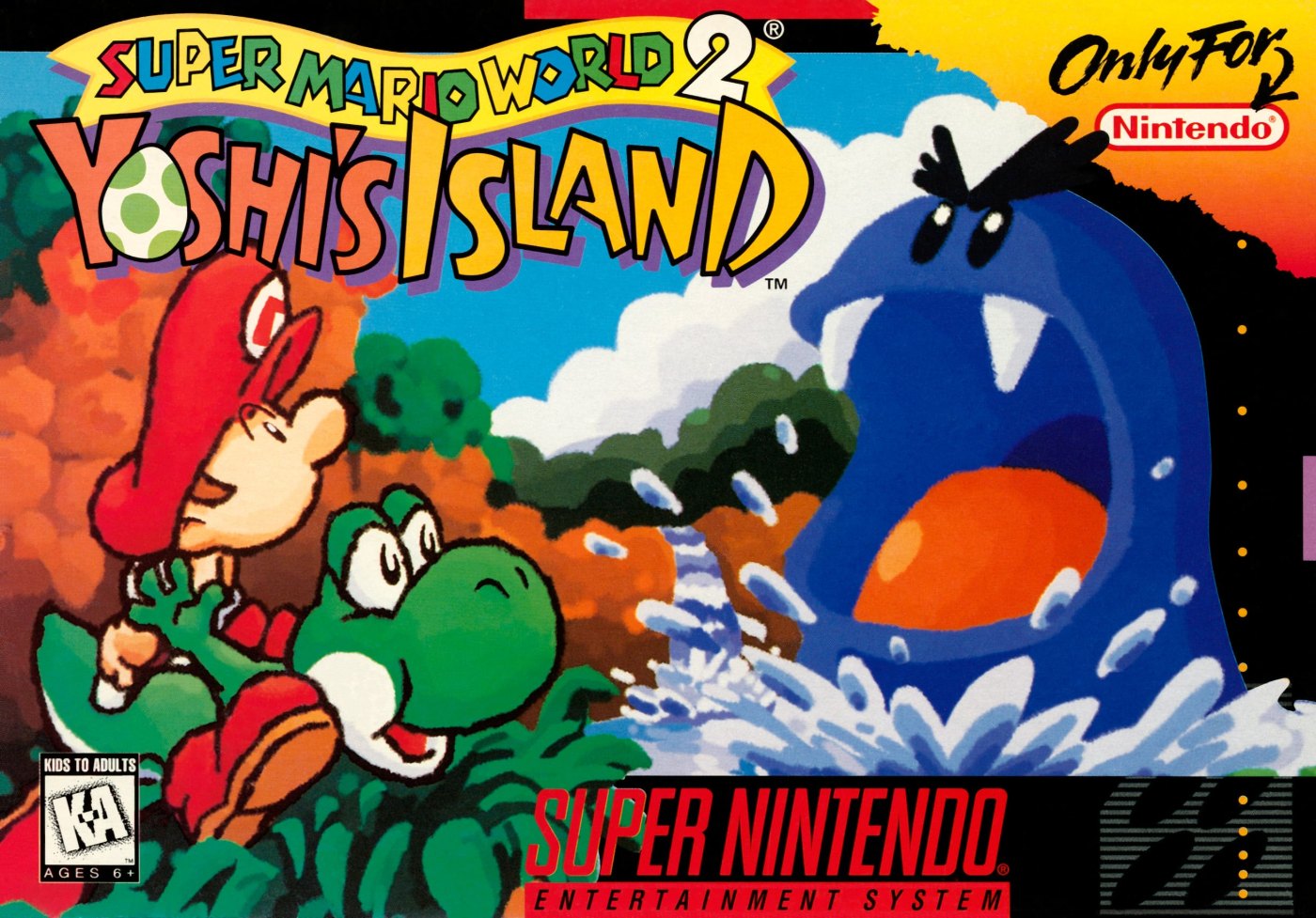
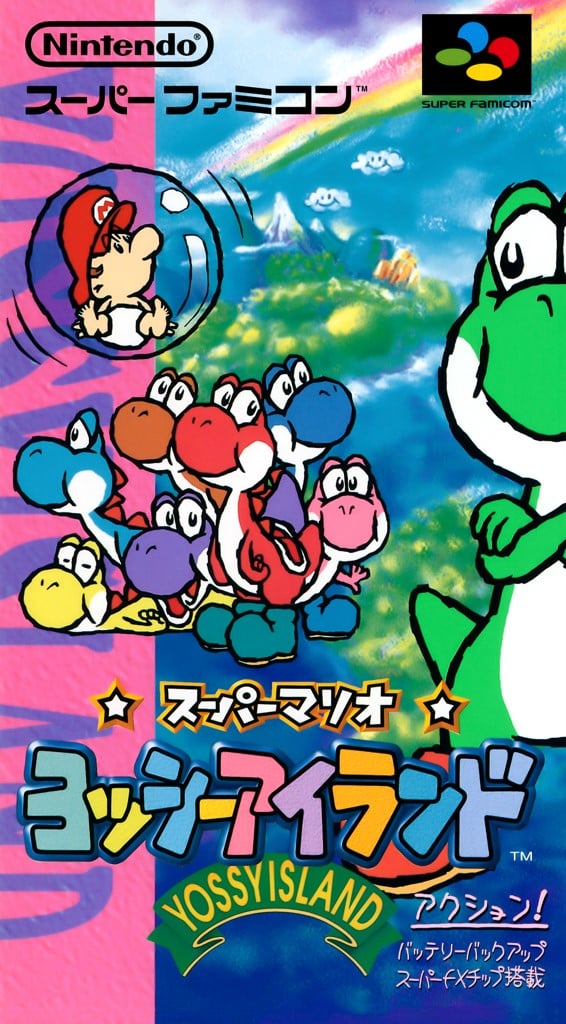
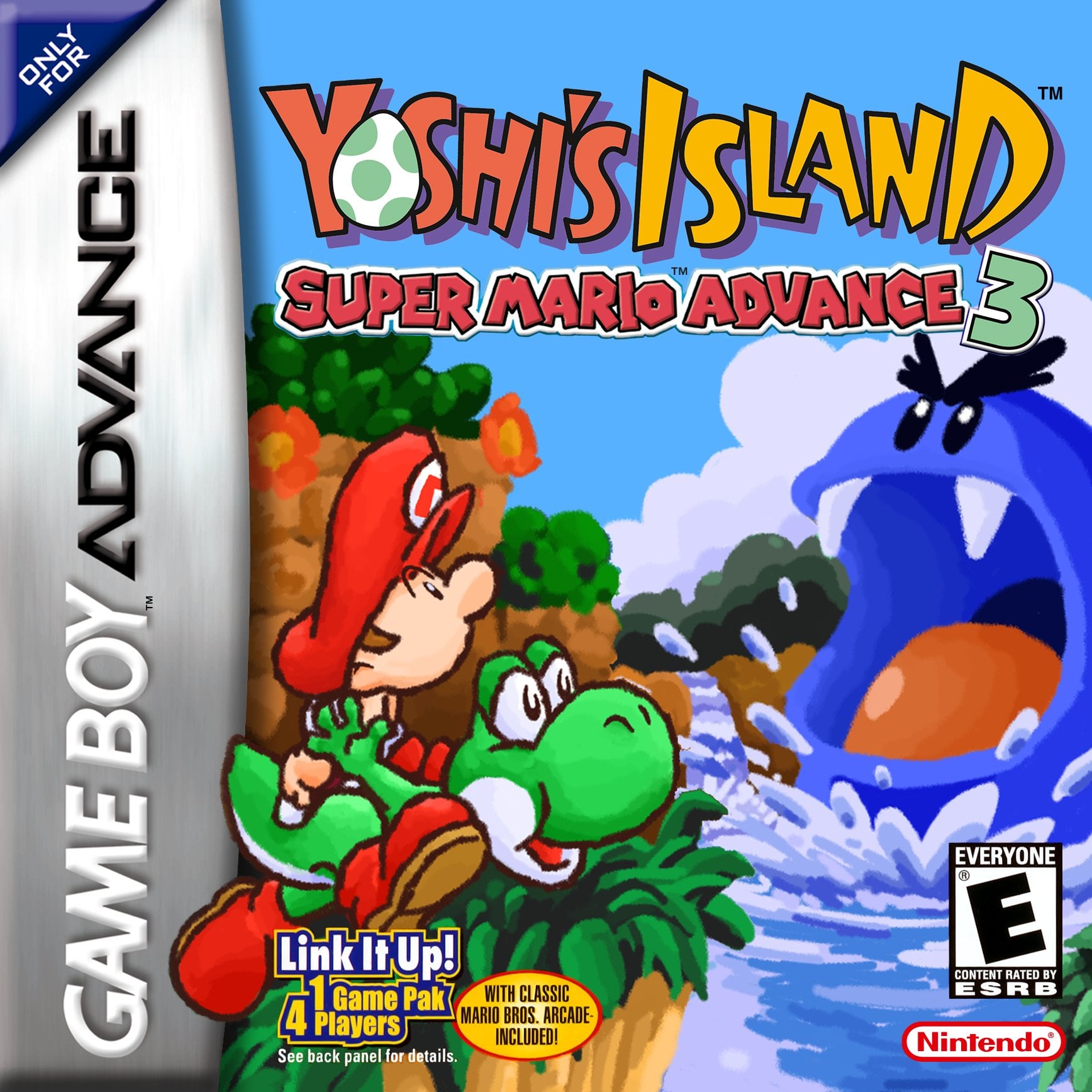
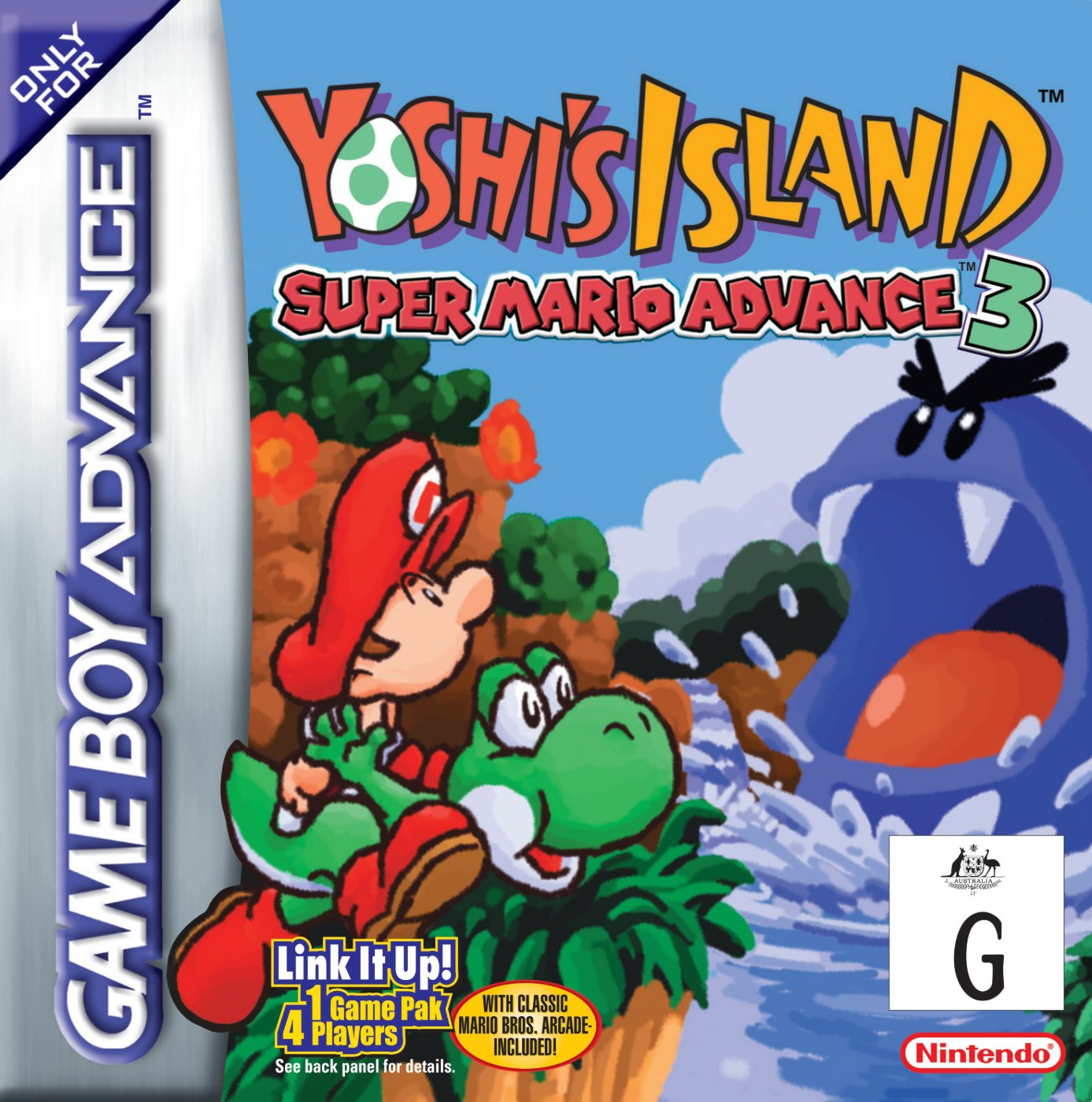
The Japanese box is a riot of Yoshis and hand-drawn scenery; the Western box pairs Yoshi and Baby Mario in front of the crayon island; the GBA remake reused the Western art with a new logo.
North America (SNES, 1995)Green Yoshi, Baby Mario and the “Super Mario World 2” banner.Japan (Super Famicom, 1995)Super Mario: Yoshi Island, in a horizontal Super Famicom box.North America (GBA, 2002)Yoshi’s Island: Super Mario Advance 3.Australia (GBA, 2002)Released 4 October 2002.
Screenshots
More from the island. Select any image to view it larger.
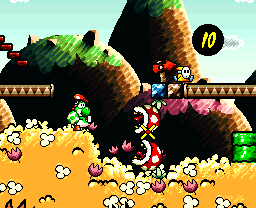
Poochy carries Yoshi over the spikes.
Artwork & Media Gallery
Artwork, manual pages and promotional material from Yoshi’s Island. Select any image to view it larger.
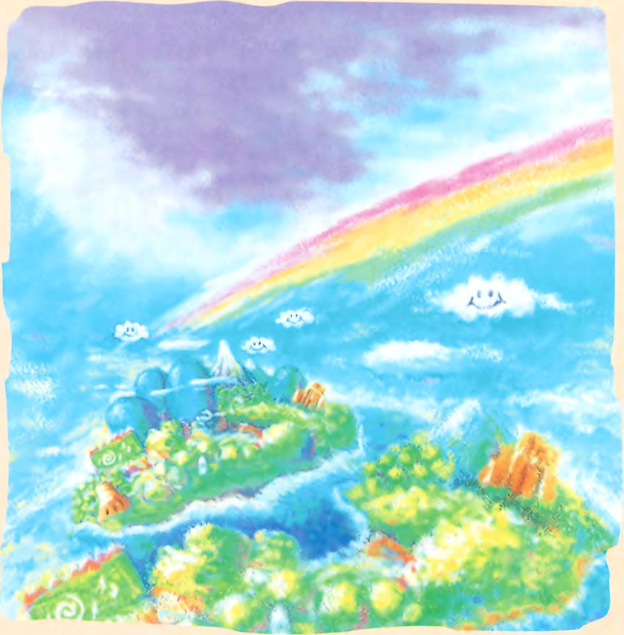
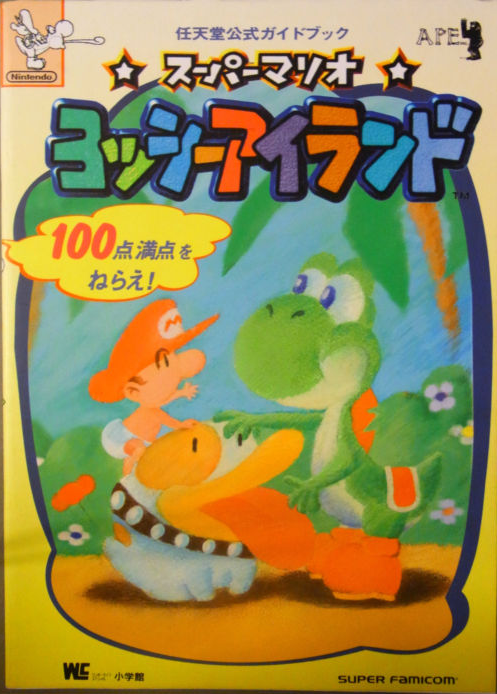
The Western logo.The Japanese logo: Super Mario: Yoshi Island.The island, as illustrated in the instruction booklet.Cover of the official Japanese guidebook, with Poochy.Yoshi and Baby Mario.The whole relay team.Mole Tank Yoshi.Submarine Yoshi.Train Yoshi.Car Yoshi.
Legacy & Re-releases
Yoshi’s Island has been remade once, re-released five times and imitated by every Yoshi game since. Here is where it has been and what it left behind.
From Super Famicom to Switch
Super Famicom / Super NES1995Japan 5 August, North America 4 October, Europe 6 October, Australia December.
Yoshi’s Island: Super Mario Advance 32002Game Boy Advance remake by Nintendo R&D2: Japan 20 September, North America 23 September, Australia 4 October, Europe 11 October. Six new Secret levels, a voice for Yoshi, Mario Bros. included, Tezuka producing and Satoru Iwata as executive producer.
Nintendo 3DS (Ambassador Programme)16 December 2011The GBA version, one of ten free games for early 3DS adopters. Never sold separately.
Wii U Virtual Console24 April 2014The GBA version again (Japan 15 October 2014). The SNES original never reached any Virtual Console.
Super NES Classic Edition29 September 2017One of 21 built-in games (Nintendo Classic Mini: Super Famicom in Japan, 5 October). The first time the SNES original had been officially re-released.
Nintendo Switch Online (SNES)5 September 2019In the Super Nintendo library from day one (6 September outside the Americas).
Nintendo Switch Online (GBA)25 May 2023The remake joins the Game Boy Advance library for Expansion Pack members, alongside the first two Super Mario Advance games.
The Game Boy Advance version
Nintendo R&D2’s 2002 remake is faithful to a fault, with a few changes forced by the hardware: the picture is cropped to the GBA’s smaller screen, colours are lightened for the unlit display, and some music is trimmed. Yoshi gains the yelps and squeaks of Yoshi’s Story, Baby Mario’s cry is re-recorded by Charles Martinet, Baby Bowser gets a fourth finger, and the countdown ticks once a second instead of nearly twice. Six Secret levels open up after Baby Bowser falls, the world Bonus Challenges unlock at 700 points, and the two-player Mini Battles are gone, replaced by the Mario Bros. arcade remake that came with every Super Mario Advance. Critics liked it almost as much as the original (Metacritic 91) and it sold around 2.83 million.
The Yoshi series it started
Yoshi’s Story (Nintendo 64, 1997) kept the storybook look but not the structure; Yoshi’s Island DS (2006) was a direct sequel with five babies on Yoshi’s back, including Peach, Donkey Kong and Wario; Yoshi’s New Island (3DS, 2014) retold the stork story with oil-paint visuals; and Yoshi’s Woolly World (Wii U, 2015) and Yoshi’s Crafted World (Switch, 2019) swapped crayons for wool and cardboard while keeping the eggs, the flutter and the collectables. Tezuka has said the handicraft feel of every later Yoshi game traces back to this one.
The long shadow
Baby Mario and Baby Luigi became Mario Kart regulars from Double Dash!! onwards; Kamek grew into Bowser’s most reliable lieutenant across the Yoshi games, Mario Party, Mario + Rabbids and Mario Kart 8 Deluxe; and the ground pound Yoshi introduced became one of Mario’s own moves in Super Mario 64. The game’s crayon world is a stage in Super Smash Bros. Melee and Brawl and a racetrack in Mario Kart 8 Deluxe’s Booster Course Pass. In July 2020 its source code and prototypes leaked online, giving fans a rare look at how a Nintendo masterpiece was built.
Reviews & Sales
Sales figures
Japan took to it immediately: more than a million copies had sold there by the end of 1995, and the final Japanese figure is usually given as 1.77 million. Worldwide the SNES game reached 4.12 million according to Guinness World Records, a strong number for a late-1995 release on a console that was already losing shelf space to the PlayStation. The 2002 Game Boy Advance remake added about 2.83 million more, including 1.6 million in the United States, although that made it the lowest seller of the four Super Mario Advance games.
4.12mSNES, worldwide
1.77mJapan, SNES
2.83mGBA remake, by 2014
96%GameRankings, SNES
Reception and review scores
Reviewers in 1995 ran out of superlatives, and the retrospective verdict has only hardened. Scores are listed with the outlet and issue where known.
Diehard GameFanUS · October 1995 (100, 99, 100)
100/100
Next GenerationUS · February 1996
5/5
Nintendo LifeRetro review · Kaes Delgrego, 23 July 2009
10/10
Nintendo Magazine SystemUK · Simon Clays, 1995
97%
Game InformerUS · 1995
9.5/10
Super PlayUK · Tony Mott, 1995
94%
IGN (GBA)Craig Harris · September 2002
9.4/10
GameSpot (GBA)Greg Kasavin · 2002
9.2/10
EdgeUK · issue 26, November 1995
9/10
GameProUS · November 1995
4.5/5
FamitsuJapan · 1995 (9, 9, 8, 7)
33/40
GameFan’s three reviewers called it possibly the best platform game ever made and docked a single point for Baby Mario’s screech; Nintendo Power declared it one of the biggest and most beautiful games yet made; Edge singled out the balance of challenge and accessibility and the attention to detail. The one recurring reservation, voiced by Super Play’s Tony Mott among others, was that the strictly linear path was less rewarding than Super Mario World’s web of secret exits; Nintendo Magazine System’s Simon Clays loved the game but found the art slightly immature.
Time has been kind. Nintendo Life’s 2009 retro review gave it full marks and called it perhaps the greatest platformer of all time; Electronic Gaming Monthly had already ranked it the seventh-best console game ever in 1997; Edge put it eleventh in its 2007 all-time list. The GBA remake scored a 91 on Metacritic, with IGN’s Craig Harris declaring it the best of the Super Mario Advance games.
Honours
Nintendo Power · issue 100, 199718th best game of all timeIn the magazine’s 100th-issue countdown.
Electronic Gaming Monthly · 19977th best console game everEGM’s 100 Best Games of All Time.
Game Informer · issue 200, 2009185th of the top 200Game Informer’s Top 200 Games of All Time.
Edge · 200711th best game of all timeEdge’s Top 100 Games of All Time.
GameSpot · 2002Best Graphics on Game Boy AdvanceFor Yoshi’s Island: Super Mario Advance 3, which was also nominated for Handheld Game of the Year at the 6th Interactive Achievement Awards.
SLB User Reviews
Super Mario World 2: Yoshi’s Island has yet to receive a community review on Super Luigi Bros.
If you’ve played Super Mario World 2: Yoshi’s Island and would like to submit a review, please get in touch.
More from the Super Luigi Bros Guide
These picture lists come from the earlier Super Luigi Bros guide to Super Mario World 2: Yoshi’s Island and are kept here in full.
Worlds & levels
The game takes place on Yoshi’s Island — a much larger and more varied setting than its Super Mario World counterpart. Six worlds each contain eight levels, with every fourth and eighth level featuring a mid-boss and big boss respectively. All worlds have distinct biomes progressing from sunny grasslands to volcanic caverns.
The island setting — day and night:
Daytime
Night-time
World 1: Yoshi’s Island
Rolling green hills and grasslands. Introduces basic mechanics — egg throwing, flutter jumping and Poochy the dog.
World 2: The Cave
Underground caverns with lava floors, auto-scroll sections and the first underwater levels.
World 3: The Mountains
Steep mountain terrain with cloud platforms, athletic stages and slippery ice surfaces.
World 4: The Lake
Lakeside and jungle territory with numerous water sections, trees and vine-climbing stages.
World 5: The Valley
Twilight forest and ghost house territory. Darker atmosphere with more enemies and puzzle stages.
World 6: Bowser’s Castle
Volcanic cavernous wasteland approaching Bowser‘s fortress. The hardest stages in the game leading to Baby Bowser.
Enemies
Yoshi’s Island features one of the most imaginative enemy rosters of any Mario game — many new species debuted here and have remained series regulars. Most can be swallowed and turned into eggs, though some are immune.
Common enemies
GoombaClassic enemy
Shy GuyMasked; common
Big Shy GuyLarger variant
Koopa TroopaShell slides
Beach KoopaCoastline Koopa
BanditSteals star meter
Fly GuyOften carries 1-Up
SnifitShoots bullets
Cloud DropDrops from clouds
Piranha PlantPipe lurker
Cactus JackDesert cactus
SpinyCannot be stomped
Chomp RockPush into enemies
Lunge FishLeaps from water
Lunge FishLeaps from water
Flying & airborne enemies
LakituDrops Spinies
Aqua LakituUnderwater Lakitu
Baron von ZeppelinCarries items/enemies
Boo BalloonInflates to block path
Barney BubbleFloating bubble enemy
Blow HardPuffs at Yoshi
Ghost House & cave enemies
Big BooGhost House pursuer
Boo BlahLurks in Ghost Houses
SwooperBat; swoops down
Tap-TapIndestructible spiked ball
Jungle & nature enemies
WigglerRages when stomped
Blow HardPuffs projectiles
Hot LipsLava; spits fireballs
MildeSplits when stomped
GustyWind ghost
BumptyPenguin; slides on ice
Note: Yoshi’s Island contains over 80 unique enemy types. This is a representative selection of the most commonly encountered enemies.
Items
Items found throughout Yoshi’s Island, collected from blocks, enemies and winged clouds:
Item
Description
1-Up Mushroom
Grants an extra life. Often carried by Fly Guys or hidden in winged clouds.
Big Key
Held by each world’s big boss after defeat. Unlocks the gate to the next world.
Blue Watermelon
Gives Yoshi the ability to spit ice — freezing enemies into blocks of ice that can be used as platforms or thrown.
Yellow Watermelon
Gives Yoshi the ability to spit seeds at high speed, defeating most enemies.
Red Watermelon
Gives Yoshi the ability to spit fireballs that bounce across the ground.
Coin
Collect 100 for an extra life. Found throughout levels as both visible and hidden coins.
Red Coin
Count toward the level’s 20 red coin total required for a perfect score. Usually hidden.
Flashing Egg
Special egg that releases a red coin on impact with an enemy rather than defeating it.
Giant Egg
A huge egg that creates a shockwave on landing, defeating all on-screen enemies simultaneously.
Green Shell
Cannot be swallowed — can be held and thrown, bouncing off walls to hit multiple enemies.
Star
Fills the star counter by 10. Keeping the counter full is crucial — it’s your buffer when hit.
Winged Cloud
Hit with an egg to release hidden items, stars, or trigger level events.
Flower
One of five collectibles per level needed for a perfect 30-star score.
To provide the best experiences, we use technologies like cookies to store and/or access device information. Consenting to these technologies will allow us to process data such as browsing behavior or unique IDs on this site. Not consenting or withdrawing consent, may adversely affect certain features and functions.
Functional
Always active
The technical storage or access is strictly necessary for the legitimate purpose of enabling the use of a specific service explicitly requested by the subscriber or user, or for the sole purpose of carrying out the transmission of a communication over an electronic communications network.
Preferences
The technical storage or access is necessary for the legitimate purpose of storing preferences that are not requested by the subscriber or user.
Statistics
The technical storage or access that is used exclusively for statistical purposes.The technical storage or access that is used exclusively for anonymous statistical purposes. Without a subpoena, voluntary compliance on the part of your Internet Service Provider, or additional records from a third party, information stored or retrieved for this purpose alone cannot usually be used to identify you.
Marketing
The technical storage or access is required to create user profiles to send advertising, or to track the user on a website or across several websites for similar marketing purposes.


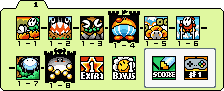 World 1: Yoshi’s IslandSpring meadows · mid-boss Burt the Bashful · boss Salvo the SlimeMake Eggs, Throw Eggs; Watch Out Below!; The Cave Of Chomp Rock; Burt The Bashful’s Fort; Hop! Hop! Donut Lifts; Shy-Guys On Stilts; Touch Fuzzy Get Dizzy; Salvo The Slime’s Castle. Extra: Poochy Ain’t Stupid. Bonus: Flip Cards.
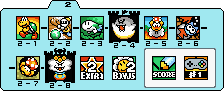 World 2: The pine hillsForested uplands · mid-boss Bigger Boo · boss Roger the Potted GhostVisit Koopa And Para-Koopa; The Baseball Boys; What’s Gusty Taste Like?; Bigger Boo’s Fort; Watch Out For Lakitu; The Cave Of The Mystery Maze; Lakitu’s Wall; The Potted Ghost’s Castle. Extra: Hit That Switch!!. Bonus: Scratch and Match.
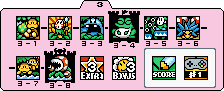 World 3: The jungleTreetops, lagoons and monkeys · mid-boss Prince Froggy · boss Naval PiranhaWelcome To Monkey World!; Jungle Rhythm…; Nep-Enut’s Domain; Prince Froggy’s Fort; Jammin’ Through The Trees; The Cave Of Harry Hedgehog; Monkeys’ Favorite Lake; Naval Piranha’s Castle. Extra: More Monkey Madness. Bonus: Drawing Lots.
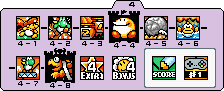 World 4: The dusty mountainsArid hills and caves · mid-boss Marching Milde · boss Hookbill the KoopaGO! GO! MARIO!!; The Cave Of The Lakitus; Don’t Look Back!; Marching Milde’s Fort; Chomp Rock Zone; Lake Shore Paradise; Ride Like The Wind; Hookbill The Koopa’s Castle. Extra: The Impossible? Maze. Bonus: Match Cards.
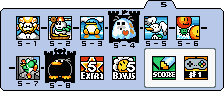 World 5: Snow and cloudsIcy peaks and the sky above them · mid-boss Sluggy the Unshaven · boss Raphael the RavenBLIZZARD!!!; Ride The Ski Lifts; Danger – Icy Conditions Ahead; Sluggy The Unshaven’s Fort; Goonie Rides!; Welcome To Cloud World; Shifting Platforms Ahead; Raphael The Raven’s Castle. Extra: Kamek’s Revenge. Bonus: Roulette.
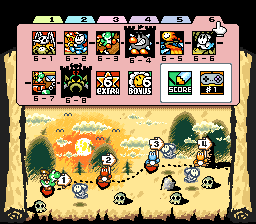 World 6: The Koopa KingdomSunset wastes, lava and bandits · mid-boss Tap-Tap the Red Nose · boss Baby BowserScary Skeleton Goonies!; The Cave Of The Bandits; Beware The Spinning Logs; Tap-Tap The Red Nose’s Fort; The Very Loooooong Cave; The Deep, Underground Maze; KEEP MOVING!!!!; King Bowser’s Castle. Extra: Castles – Masterpiece Set. Bonus: Slot Machine.
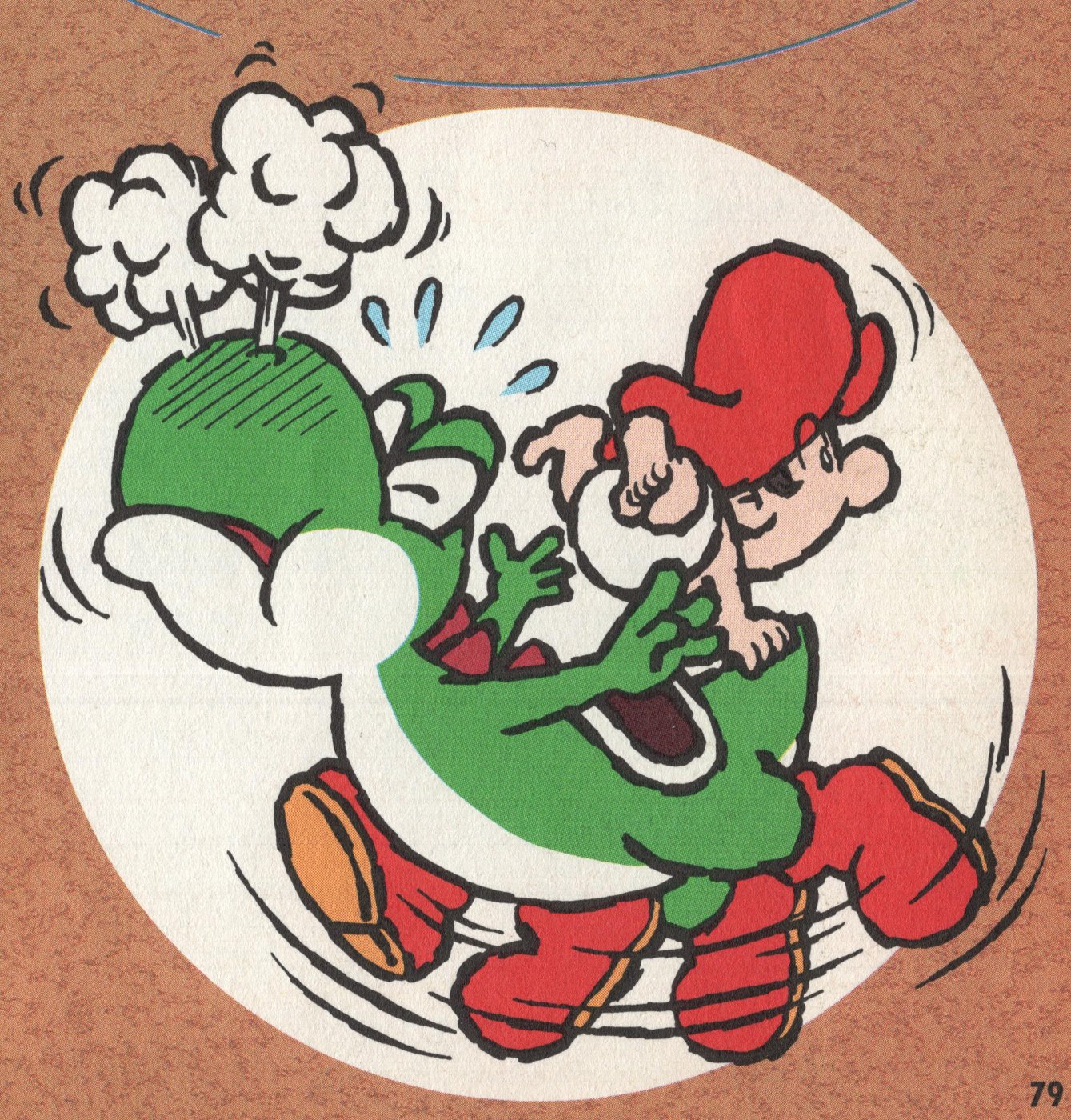

 Yoshi EggsMade by swallowing enemies or hitting Egg Blocks. Green, yellow, red and flashing varieties; six at a time.
 StarsAdd one each to the star counter, up to 30. Found loose, in Winged Clouds and in Special Flowers.
 Special FlowerFive per level, ten points each, and each one adds a winning panel to the goal roulette.
 Red Coins and CoinsTwenty red coins per level hide among ordinary coins; 100 of any kind earns a 1-Up.
 Winged CloudThe island’s version of a ? Block. Hit it with an egg for stars, coins, a flower, a key or a surprise.
 Middle RingA checkpoint. Pass through it to top up the star counter and restart from there if you lose a life.
 Super StarTurns Baby Mario into Powerful Mario for a limited time.
 WatermelonsGreen spits seeds like a machine gun, red breathes fire, blue freezes enemies into blocks you can throw.
 1-UpExtra lives, often carried by Fly Guys or dropped by Winged Clouds and balloons.
 KeyOpens locked doors in forts, caves and bonus huts. Yoshi carries it in his mouth.
 Egg BlockBump it from below for a fresh egg; the Egg Plant in boss rooms does the same job.
 Koopa shellCannot be swallowed, but can be held and spat to ricochet through a row of enemies.
 Anywhere POWA Special Item: turns every enemy on screen into stars, or coins if your counter is already full.
 Magnifying GlassA Special Item that reveals which coins are red and where secret Winged Clouds hide.
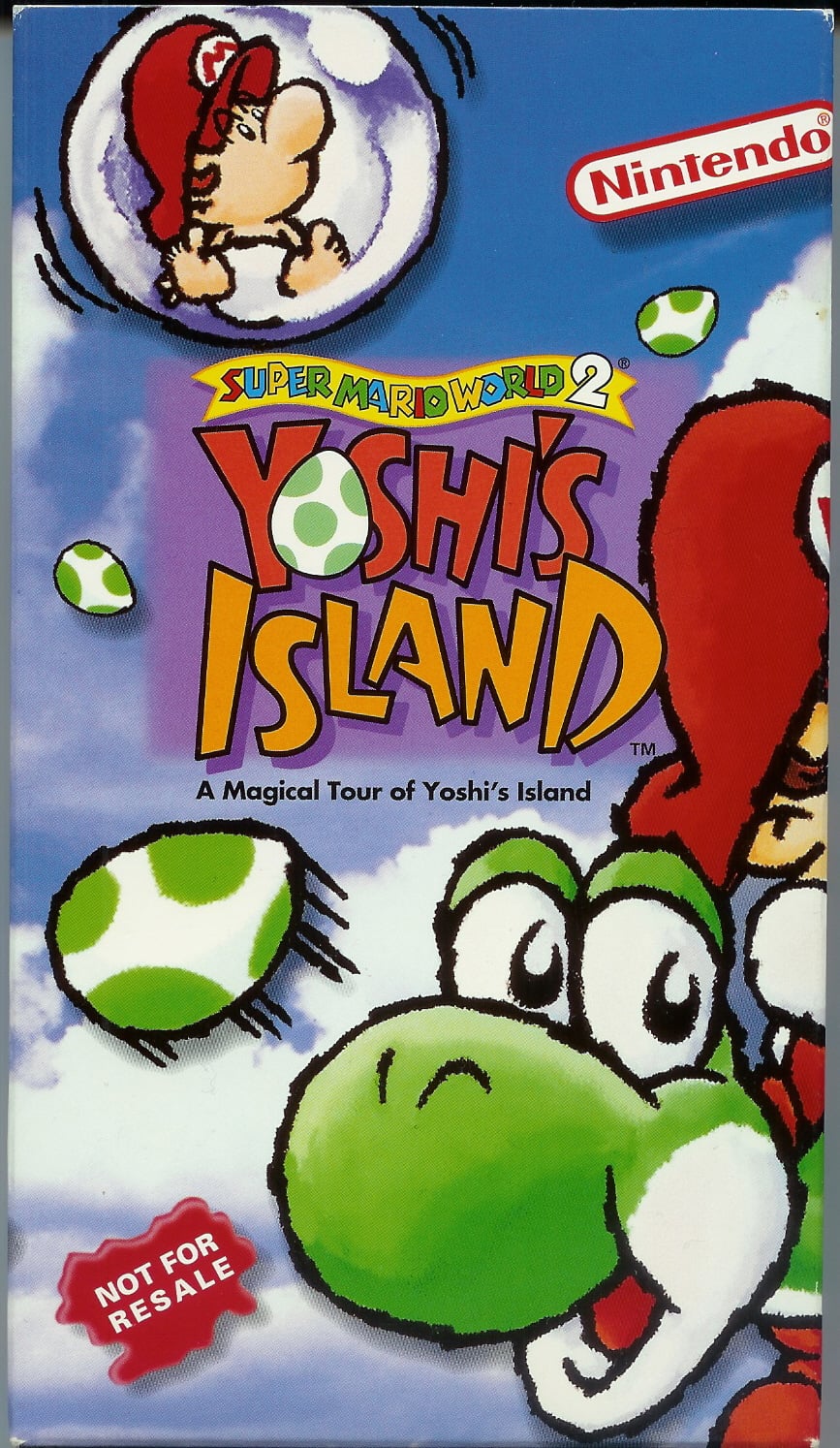 A Magical Tour of Yoshi’s IslandPromotional VHS · Nintendo of America · 1995A six-minute promotional tape (also titled A Journey Through Yoshi’s Island) produced by Bensussen Deutsch and Associates. Josh Wolf, fresh from Donkey Kong Country: Exposed, hosts, and Nintendo’s Ken Lobb quizzes the game testers.
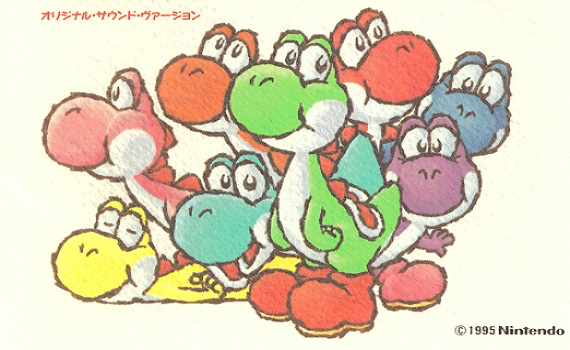 Yoshi (and the Yoshis)The hero, in eight colours
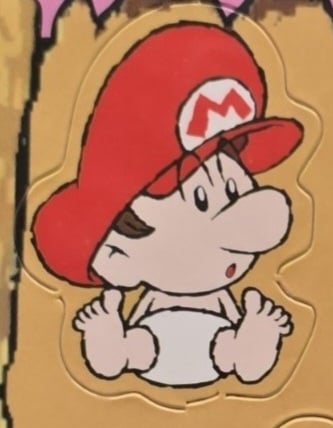 Baby MarioThe passenger
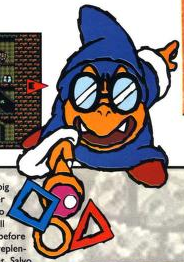 KamekThe Magikoopa
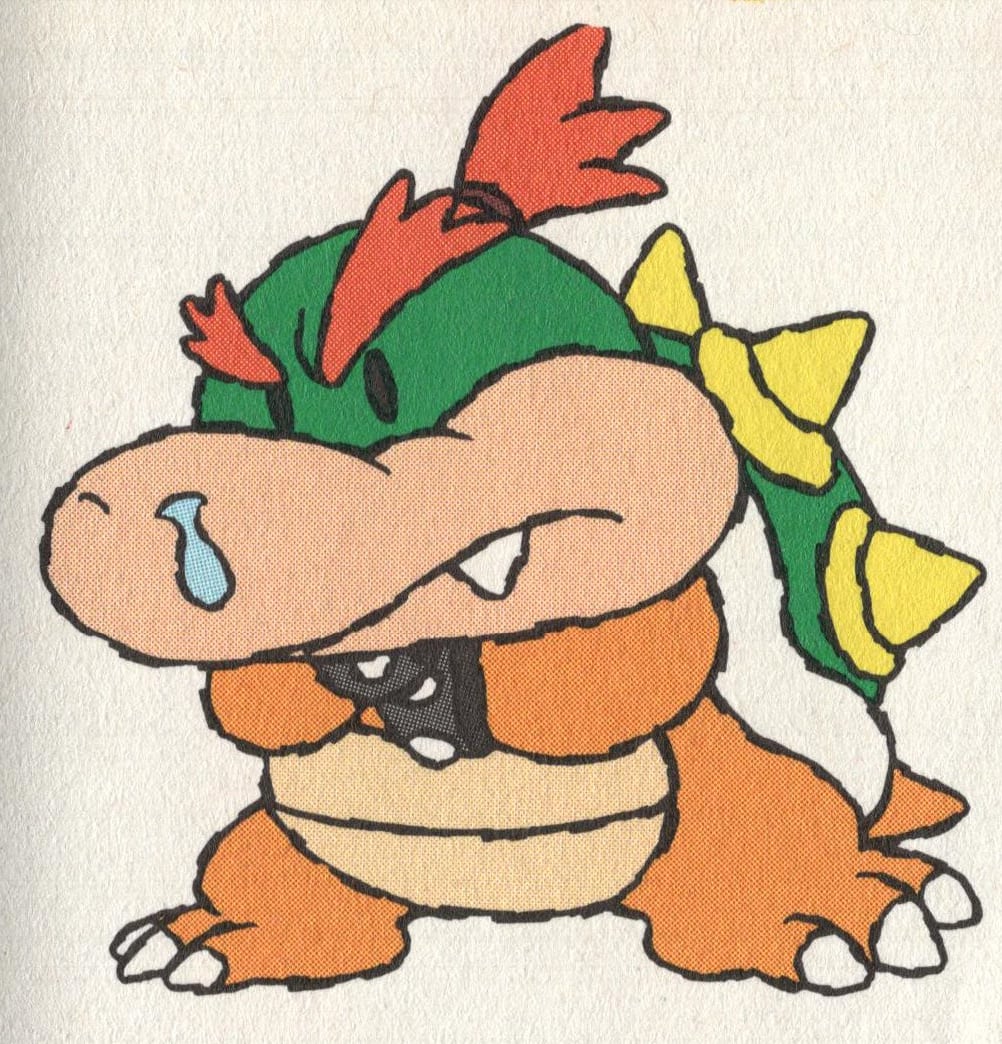 Baby BowserThe final boss
 The StorkDelivery in progress
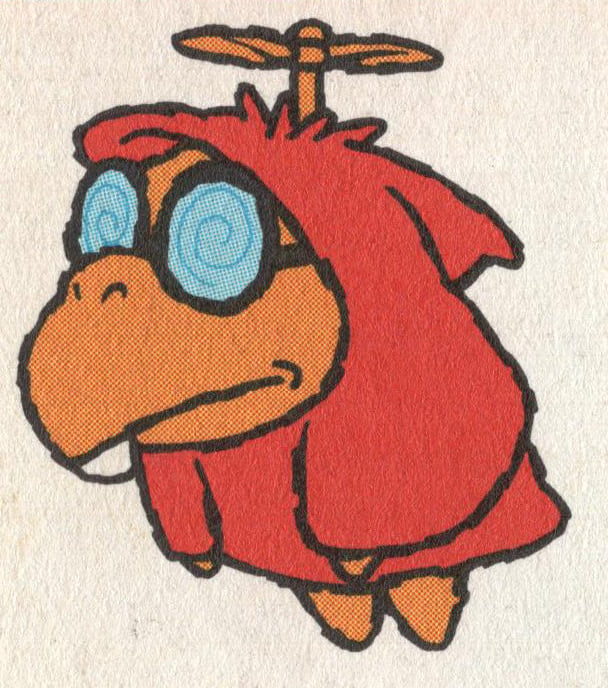 ToadiesKamek’s henchmen
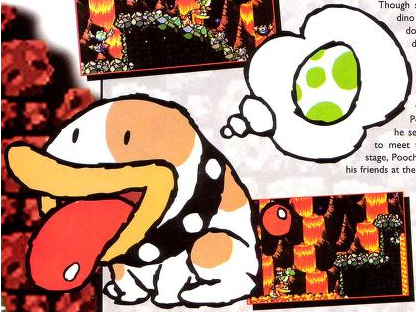 PoochyThe island’s dog
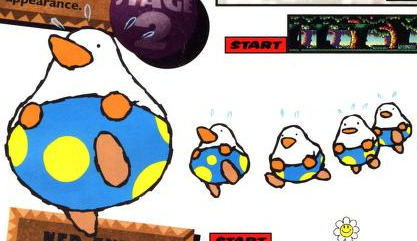 Huffin PuffinA mother and her chicks
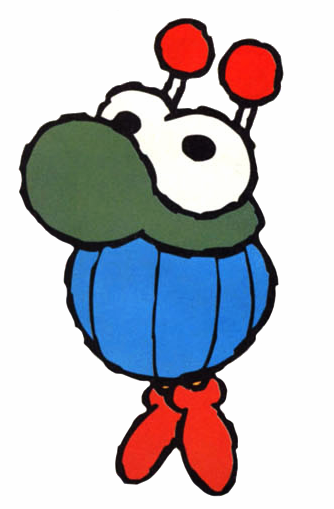 Melon BugThe rolling helper
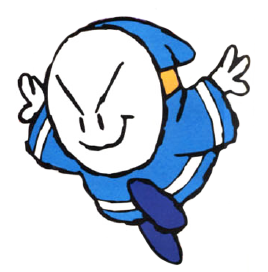 BanditThe thief
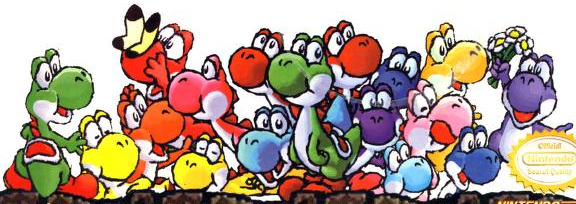 The eight Yoshis togetherGreen, Pink, Light Blue, Yellow, Purple, Brown, Red, Blue
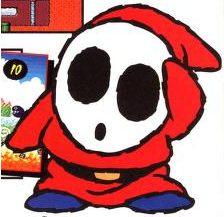 Shy GuyEverywhereThe island’s Goomba: masked, harmless, egg fodder. Comes in Fly Guy, Stilt Guy, Spear Guy, Boo Guy, Fat Guy, Mace Guy, Zeus Guy and Woozy Guy flavours.
 Fly GuyMost worldsPropeller-topped Shy Guy, often carrying a 1-Up or a red coin that it drops when hit.
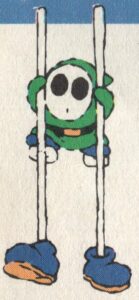 Stilt GuyWorld 1-6Too tall to swallow; knock him off his stilts first.
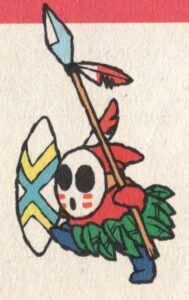 Spear GuyJungleJabs with a spear; approach from behind or above. Dancing Spear Guys conga in lines.
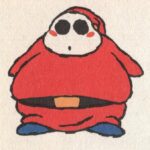 Fat GuyWorld 2-7An enormous Shy Guy found only in Lakitu’s Wall. Swallow one for a Giant Egg.
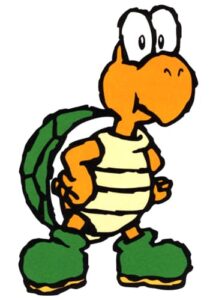 Koopa TroopaWorld 2 onwardsSpit the shell to ricochet; the unshelled Koopa keeps walking.
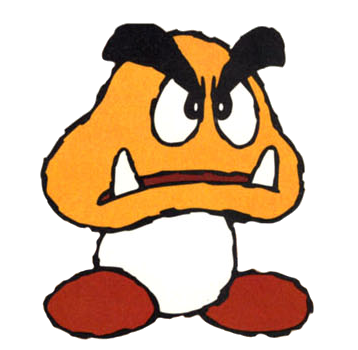 GoombaScatteredWait, no. Mario is a baby. These are mostly here for old times’ sake.
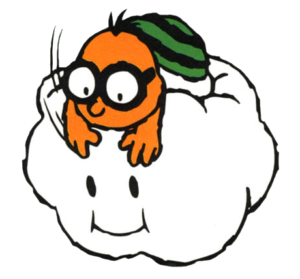 LakituWorlds 2 and 4Throws Spiny Eggs from his cloud. Wall Lakitus hide in alcoves; Fishin’ Lakitu dangles a 1-Up on a line.
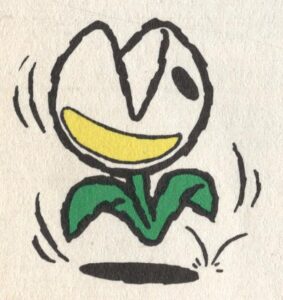 Nipper PlantCaves and castlesHopping baby Piranha Plants grown from drifting Nipper Spores.
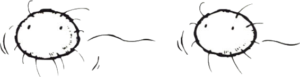 FuzzyWorld 1-7Touch one and the world melts and sways. Harmless, but hard to walk straight.
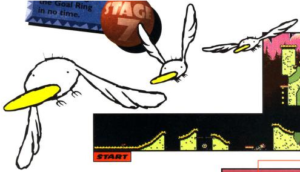 GoonieWorld 5Pelican-like birds Yoshi can ride; swallow one and only a Flightless Goonie is left. Skeleton Goonies haunt World 6.
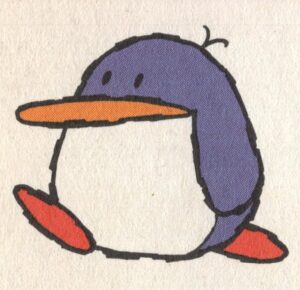 BumptyWorld 5Penguins that bump Yoshi about on the ice.
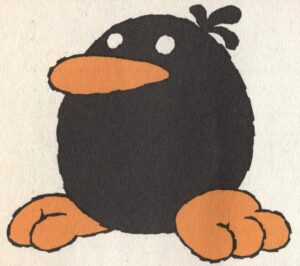 RavenWorld 5Black birds that run around the edges of platforms. One becomes the world boss.
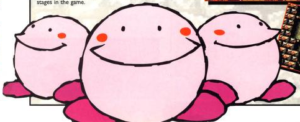 MildeWorld 4Puffy pink balls that pop with a ground pound. Their giant form is Marching Milde.
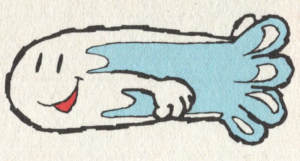 GustyWorld 2Gusts of wind with faces, blown in lines across the screen.
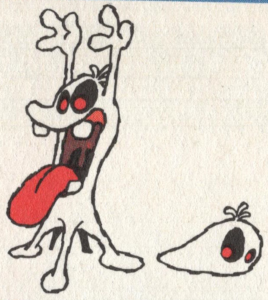 Boo BlahFortsA stretching ghost stuck to floors and ceilings, plus Boos, Big Boos and Lantern Ghosts in the darker rooms.
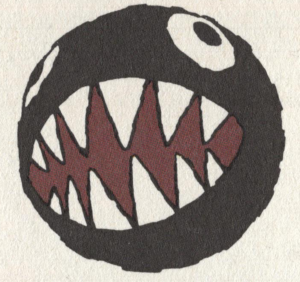 Incoming ChompWorld 1-2Chain Chomps that drop from the sky with a shadow warning. Run.
 Chomp SharkWorld 6-7A huge Chain Chomp that eats the level behind you in KEEP MOVING!!!!
 Lunge FishLakesLurks under the surface and swallows Yoshi whole, baby and all.
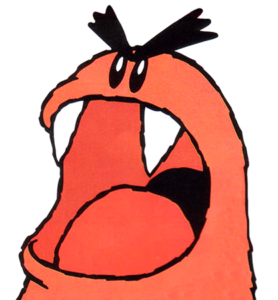 BlarggLavaLava monsters; the Gargantua Blargg fills half the screen.
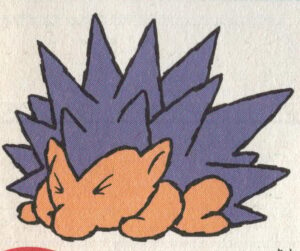 Harry HedgehogWorld 3-6Bristles when you get close; swallow him before he does.
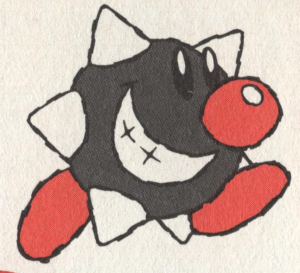 Tap-TapForts and castlesSpiked balls that cannot be swallowed or stomped; eggs just push them back.
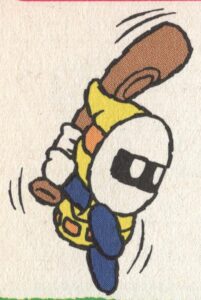 Slugger and Green GloveWorld 2-2The Baseball Boys: one bats your eggs back, the other catches and returns them.
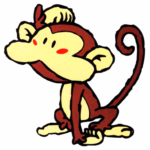 GrinderJungleMonkeys that pelt you with seeds, steal eggs and swing on vines.
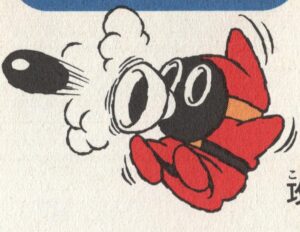 SnifitLater worldsSpits bullets, as it did in Super Mario Bros. 2.
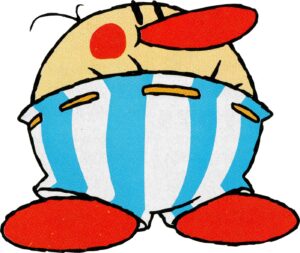 Burt the BashfulBoss, World 1-4Six eggs, and each one pulls his trousers down a little further until, scarlet with embarrassment, he blasts off.
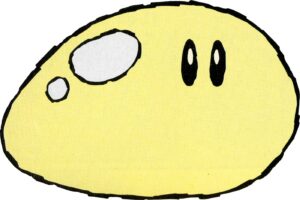 Salvo the SlimeBoss, World 1-8A giant Lemon Drop that sheds smaller drops when hit and shrinks with every egg until nothing is left.
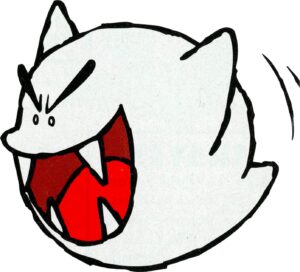 Bigger BooBoss, World 2-4Cannot be hit while Yoshi faces him. Bounce eggs off the walls instead; he grows with each hit and bursts on the fifth.
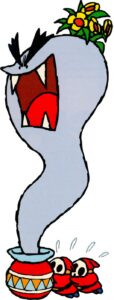 Roger the Potted GhostBoss, World 2-8A ghost in a flowerpot, pushed by two Shy Guys. Shove the pot off the ledge while dodging his blue fire.
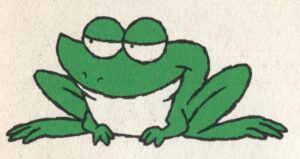 Prince FroggyBoss, World 3-4Kamek shrinks Yoshi and the frog swallows him. Egg the uvula from inside while dodging stomach acid.
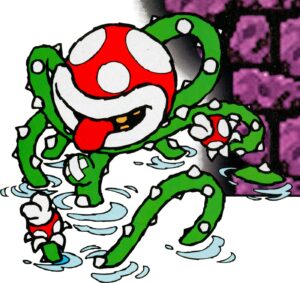 Naval PiranhaBoss, World 3-8Hit the bandaged belly button three times. Or egg the plant before Kamek arrives and skip the fight.
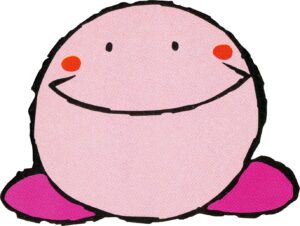 Marching MildeBoss, World 4-4Ground pound her into two, then four, then eight, then eat the lot. The only boss you can defeat by swallowing.
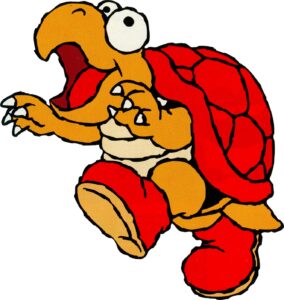 Hookbill the KoopaBoss, World 4-8Eggs to the head tip him onto his back; ground pound his belly. Three rounds and his shell explodes.
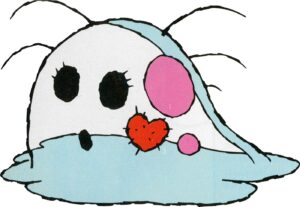 Sluggy the UnshavenBoss, World 5-4Push his skin in with eggs until his hairy heart is exposed, then hit it four times before he squeezes you into the pit.
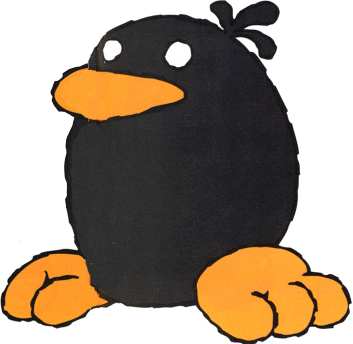 Raphael the RavenBoss, World 5-8Fought on a tiny moon. Ground pound the posts so they shoot through the planet and hit him from the far side; three hits and he becomes a constellation.
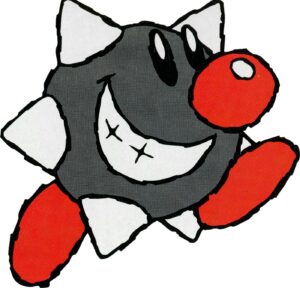 Tap-Tap the Red NoseBoss, World 6-4Invincible. Use eggs to knock him back and smash the floor beneath him, then nudge him into the lava.
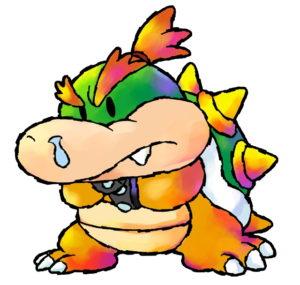 Baby BowserBoss, World 6-8Three ground pounds for the toddler, then seven giant eggs for the giant.
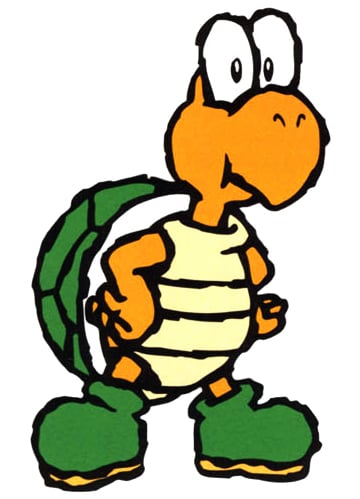
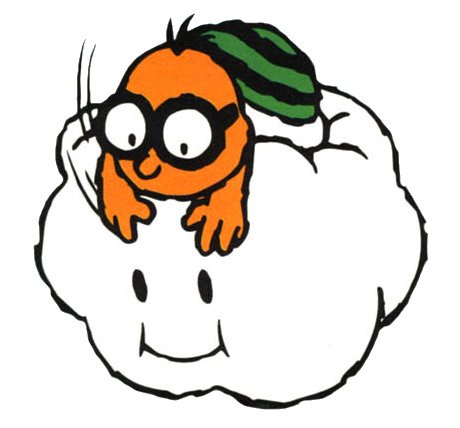
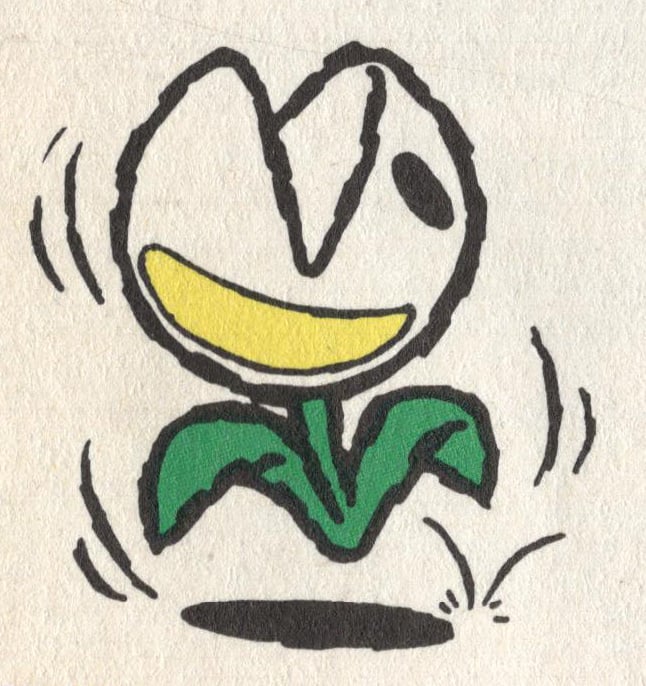







 GoombaClassic enemy
 Shy GuyMasked; common
 Big Shy GuyLarger variant
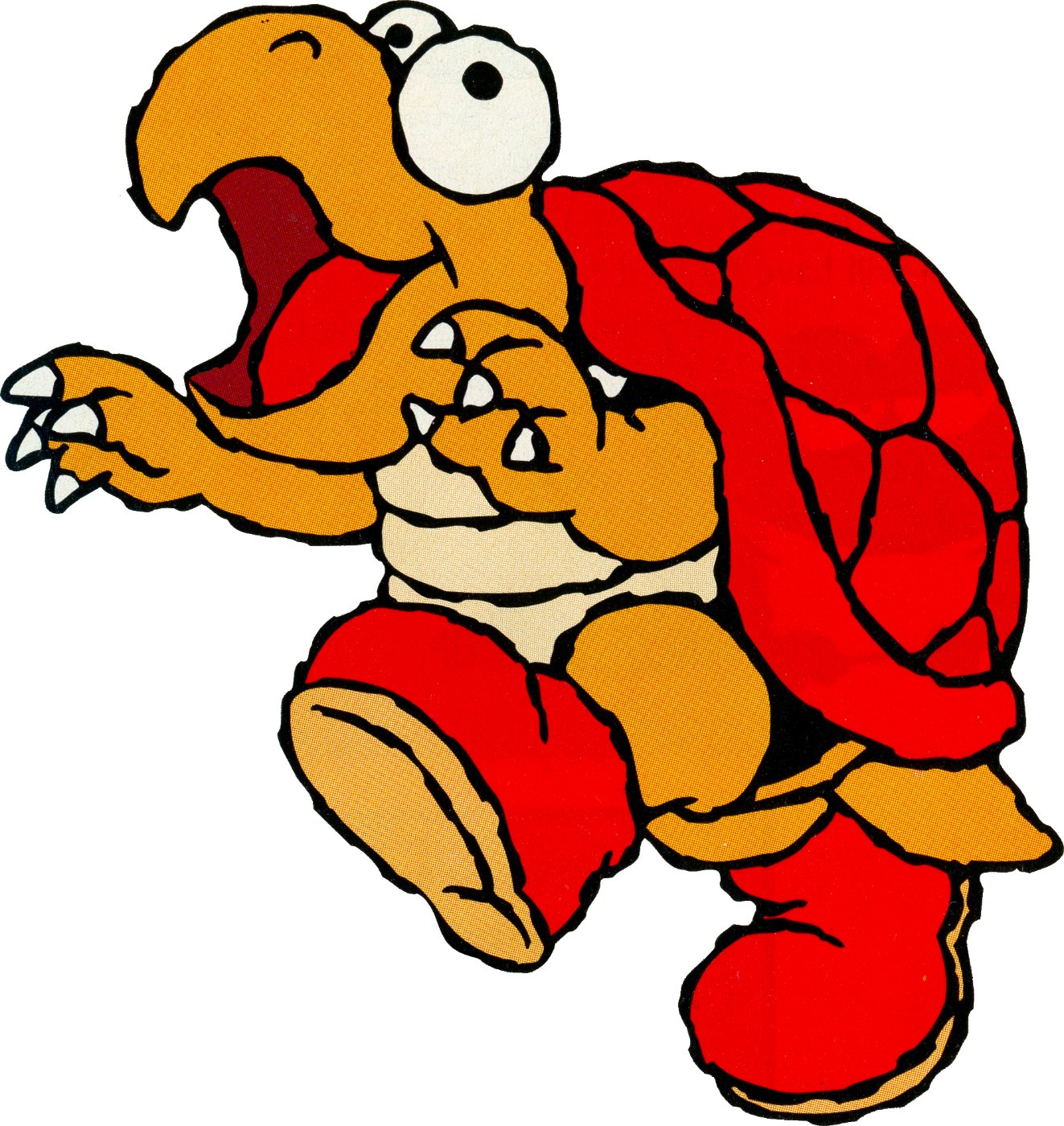
 Koopa TroopaShell slides
 Beach KoopaCoastline Koopa
 BanditSteals star meter
 Fly GuyOften carries 1-Up
 SnifitShoots bullets
 Cloud DropDrops from clouds
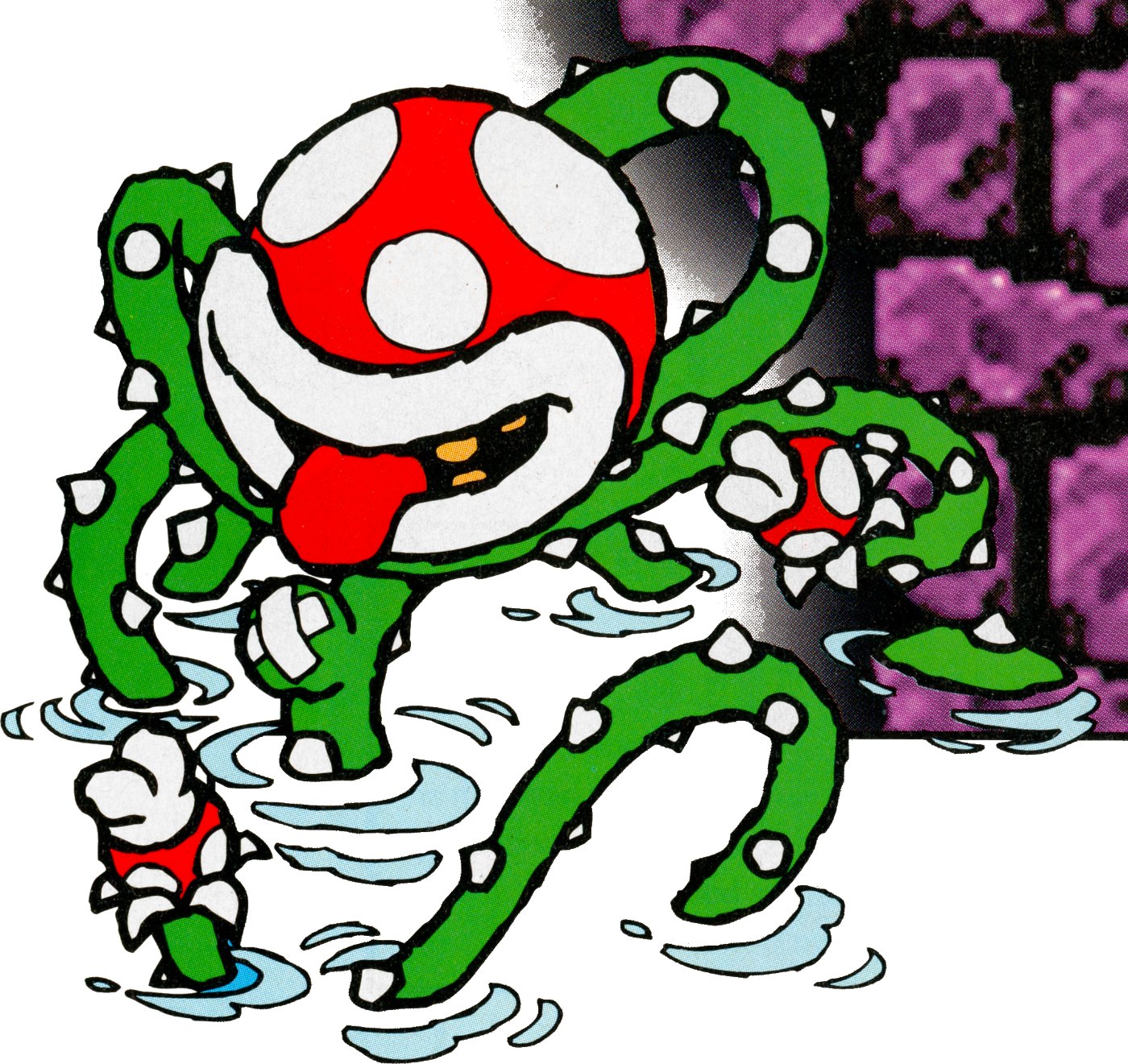
 Piranha PlantPipe lurker
 Cactus JackDesert cactus
 SpinyCannot be stomped
 Chomp RockPush into enemies
 Lunge FishLeaps from water
 LakituDrops Spinies
 Aqua LakituUnderwater Lakitu
 Baron von ZeppelinCarries items/enemies
 Boo BalloonInflates to block path
 Barney BubbleFloating bubble enemy
 Blow HardPuffs at Yoshi
 Big BooGhost House pursuer
 Boo BlahLurks in Ghost Houses
 Tap-TapIndestructible spiked ball
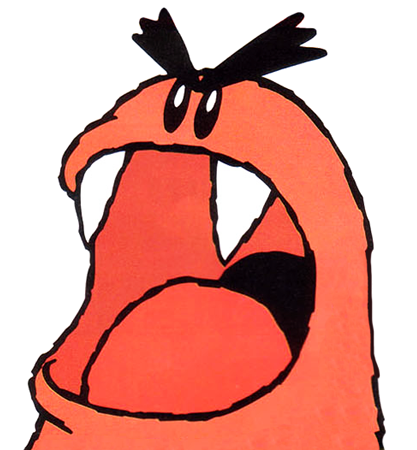
 Hot LipsLava; spits fireballs
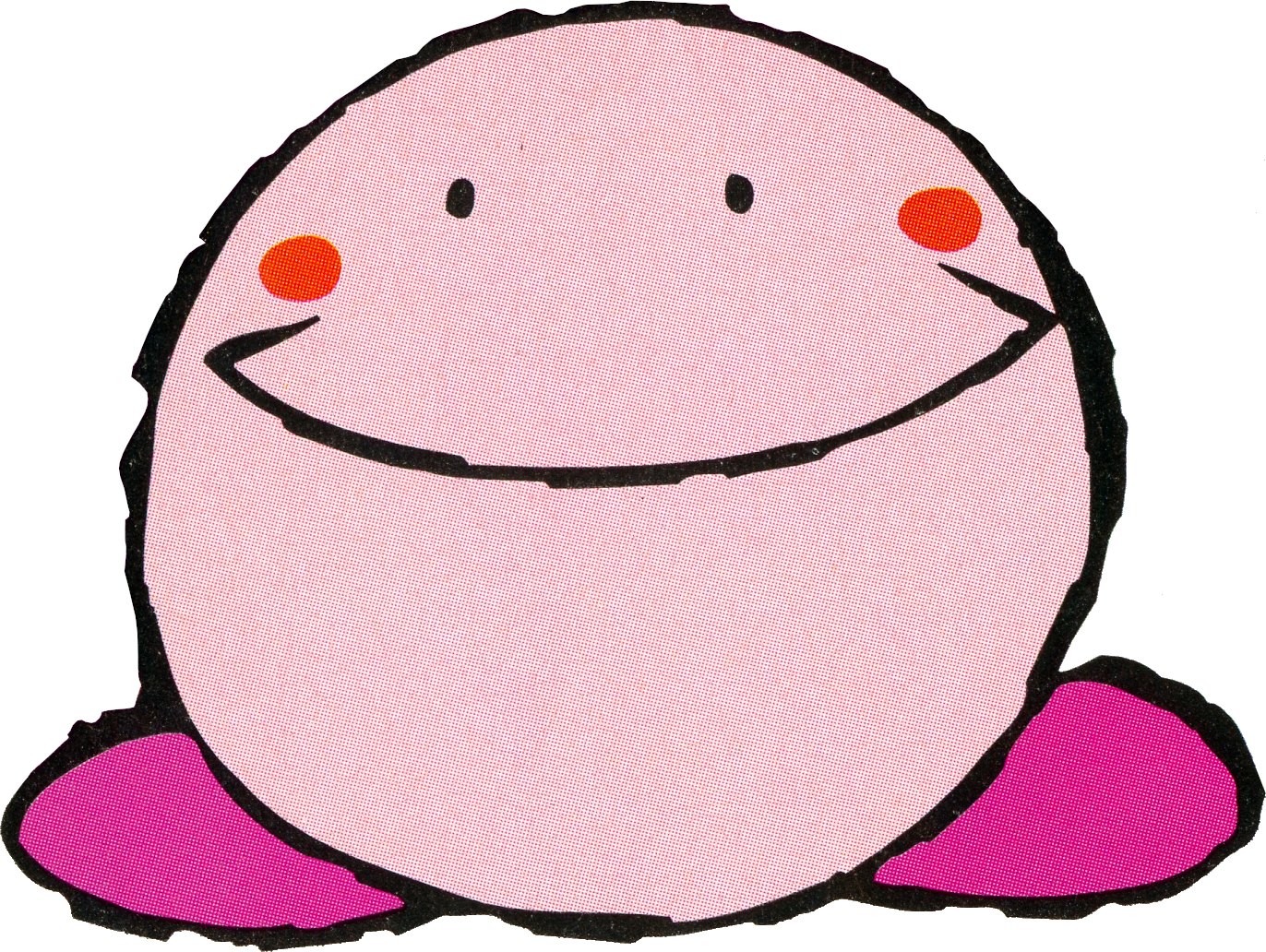
 MildeSplits when stomped