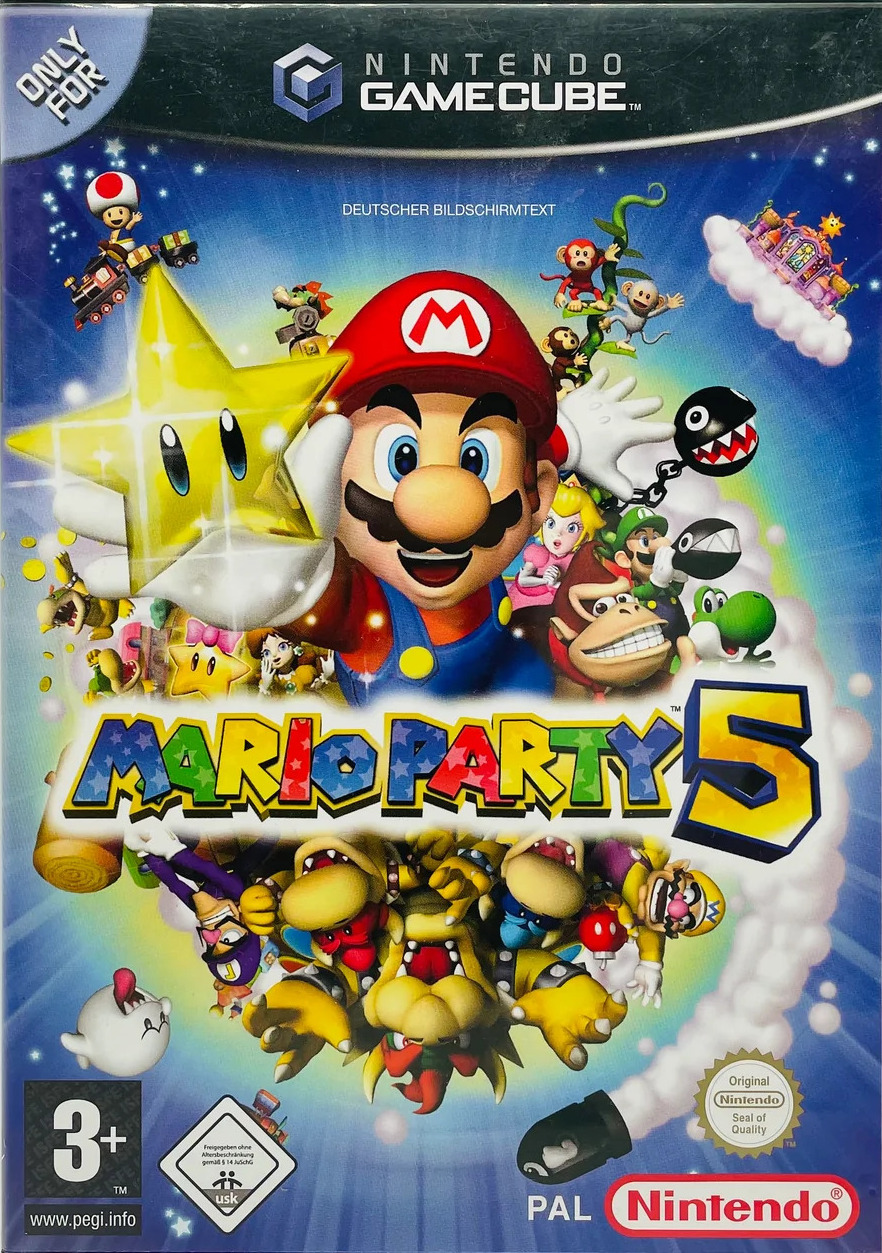
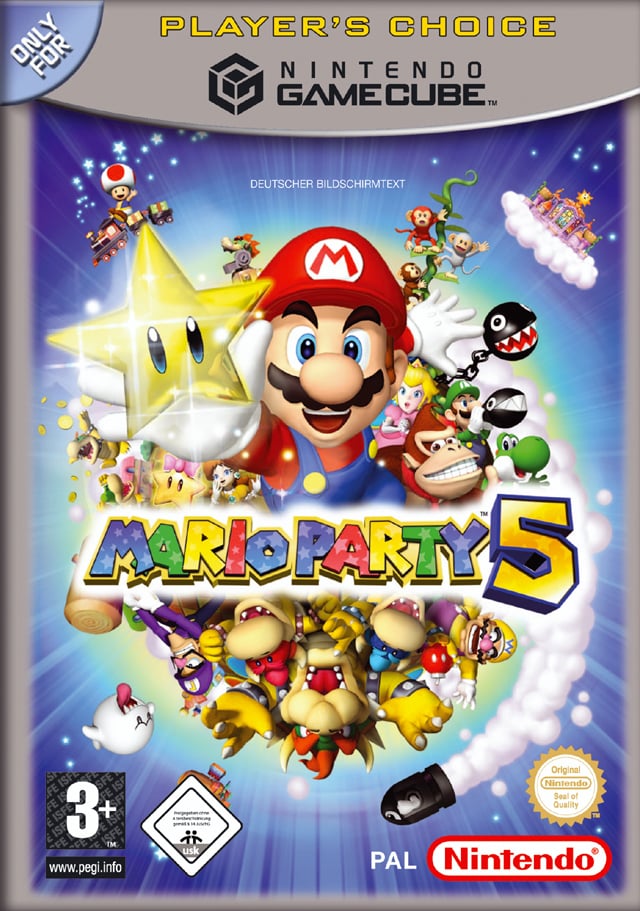
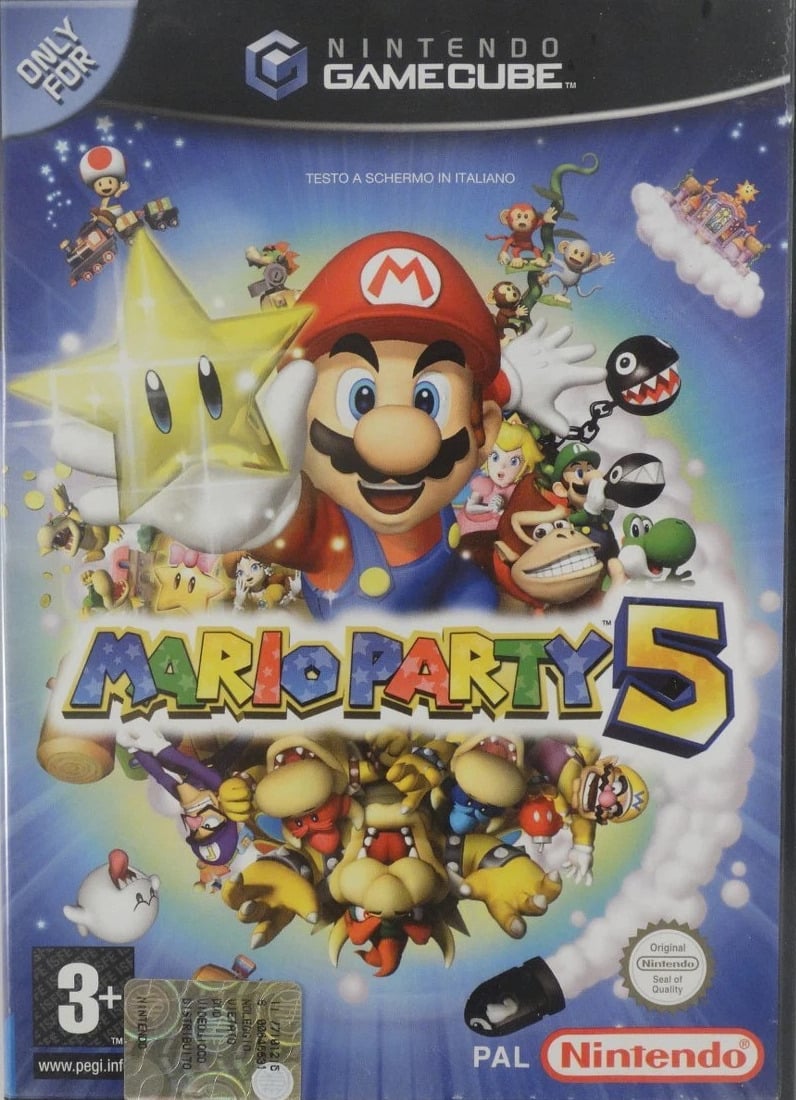
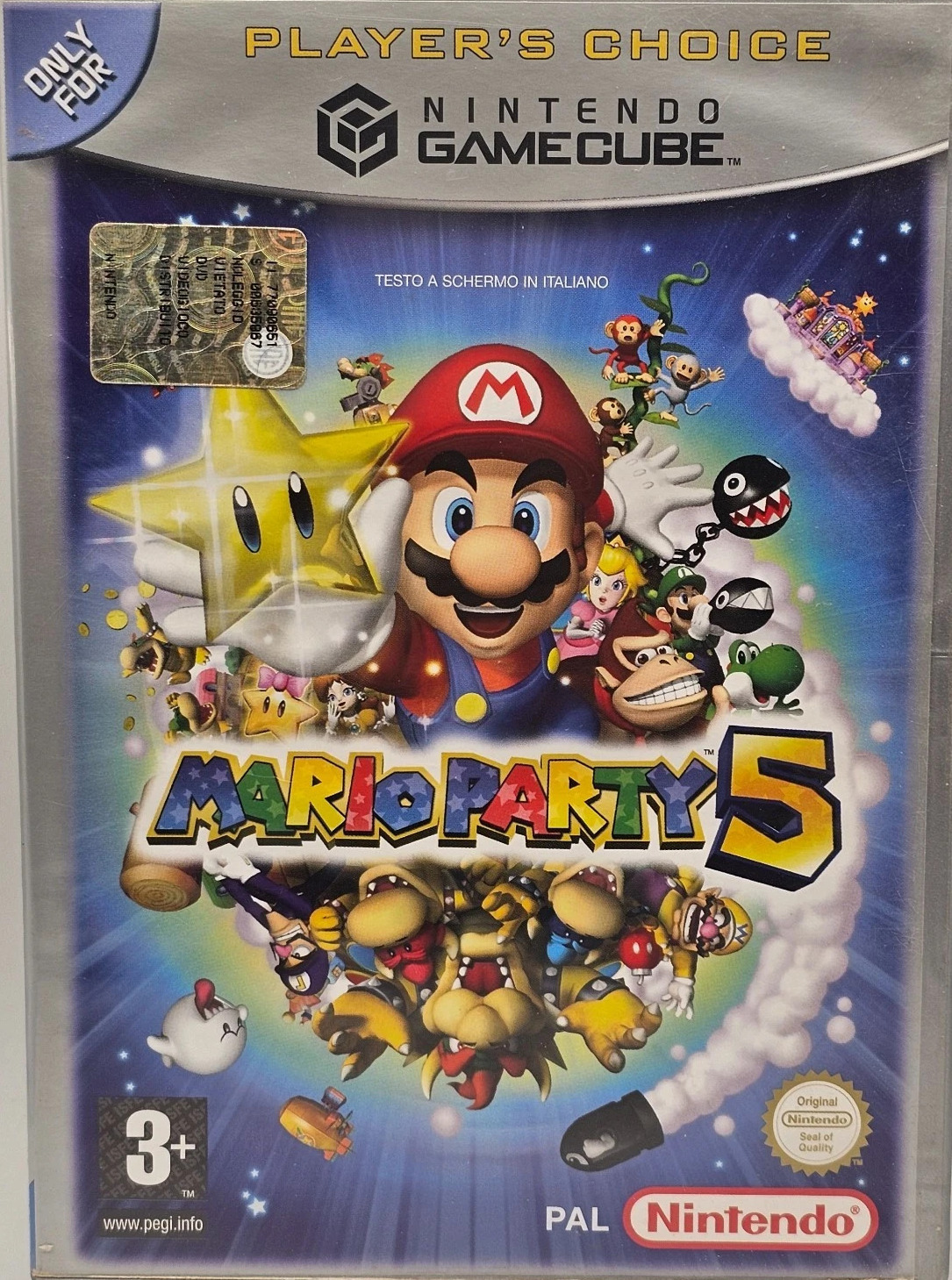
The second GameCube Mario Party swaps the Party Cube for the night sky. Mario Party 5 reached North America on 11 November 2003, in Japan on 28 November and in Europe and Australia on 5 December. Its setting is Dream Depot, the place where everybody’s dreams collect, watched over by seven Star Guards who are the Star Spirits of Paper Mario under another name. They invite Mario and friends to play on boards made of dreams, and Bowser sends three Koopa Kids to wreck them. The item shops of the earlier games are gone. In their place are capsules, 28 of them, handed out free by machines and thrown on to the board as traps or, for a fee, used on yourself. The roster grows to ten with Toad, Boo and Koopa Kid, while Donkey Kong steps down to run a space of his own. There are 77 minigames, the return of Duels, a Story Mode fought against three Koopa Kids who all move at once, a machine-building Super Duel Mode, and a Bonus Mode with Card Party, Beach Volleyball and Ice Hockey.
Developer:Hudson Soft, with CAProduction (reportedly co-developer)
Publisher:Nintendo
Platform:Nintendo GameCube
Genre:Party / board game
N. America:11 November 2003
Japan:28 November 2003
Europe:5 December 2003
Australia:5 December 2003
Player’s Choice:Europe, 22 October 2004
Players:1–4 (Story Mode is for one; Super Duel Mode for two)
Boards:7 (Bowser Nightmare is unlocked through Story Mode)
Minigames:77 by most counts
Capsules:28
Award:AIAS Console Children’s Game of the Year (2004)
Advertisement
Overview
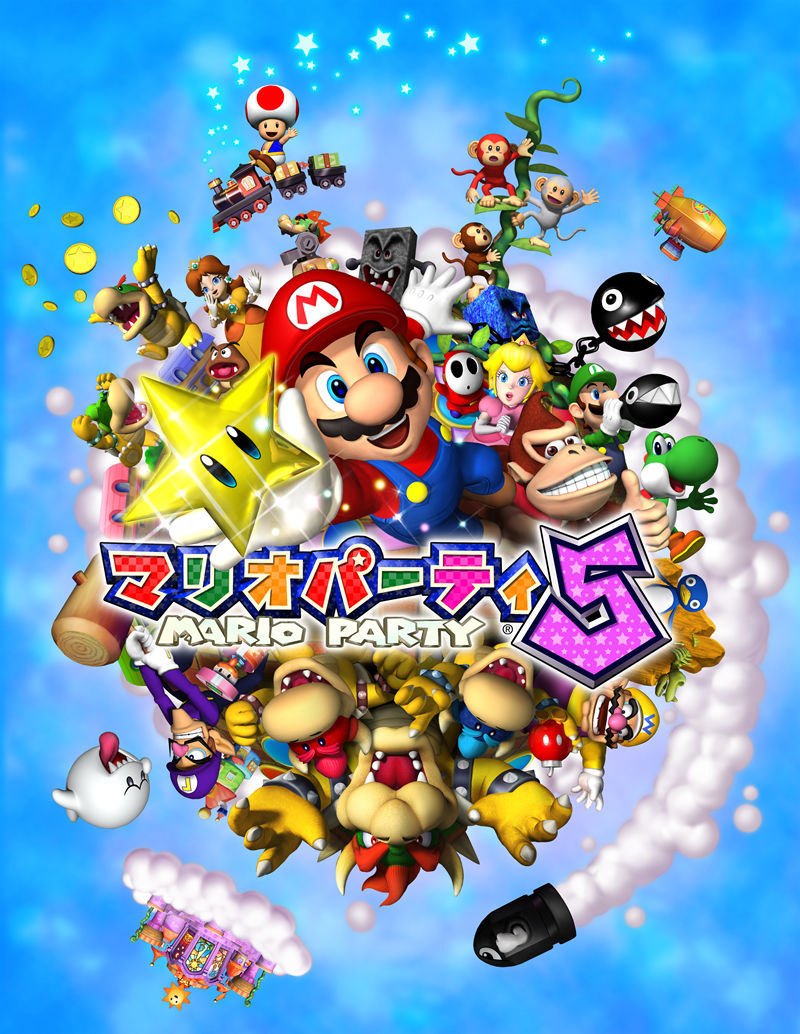
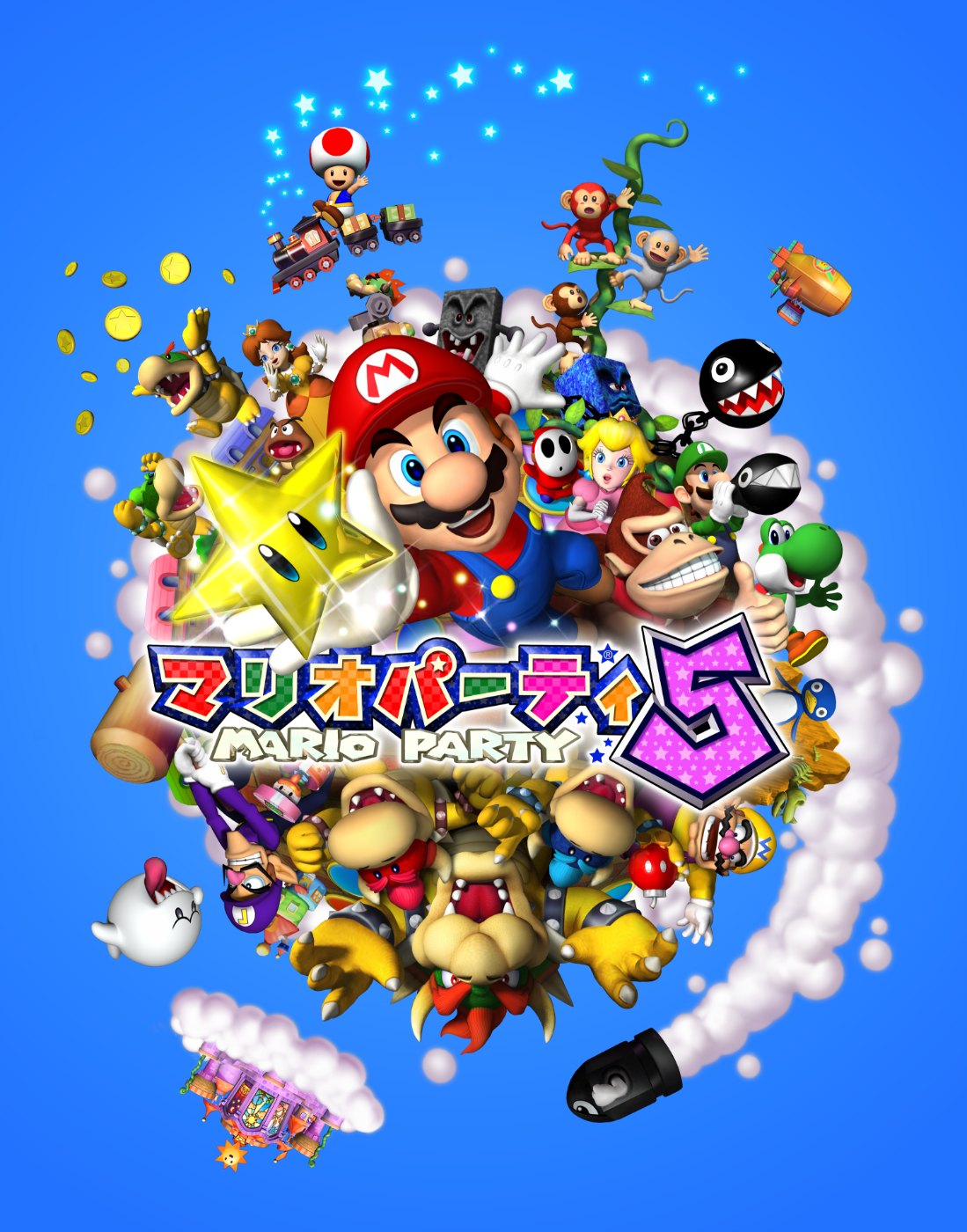
The cast of Mario Party 5 in the Japanese group artwork, with Toad, Boo and Koopa Kid among the players.
A year after Mario Party 4, Hudson Soft returned with a sequel that kept the look and changed almost every rule about items. Mario Party 5 is set in Dream Depot, a dreamworld beyond the moon and stars which, according to the instruction booklet, is the true land of dreams. Its guardians, the Star Guards, decide that nobody dreams on a grander scale than Mario and his friends and invite them up to play.
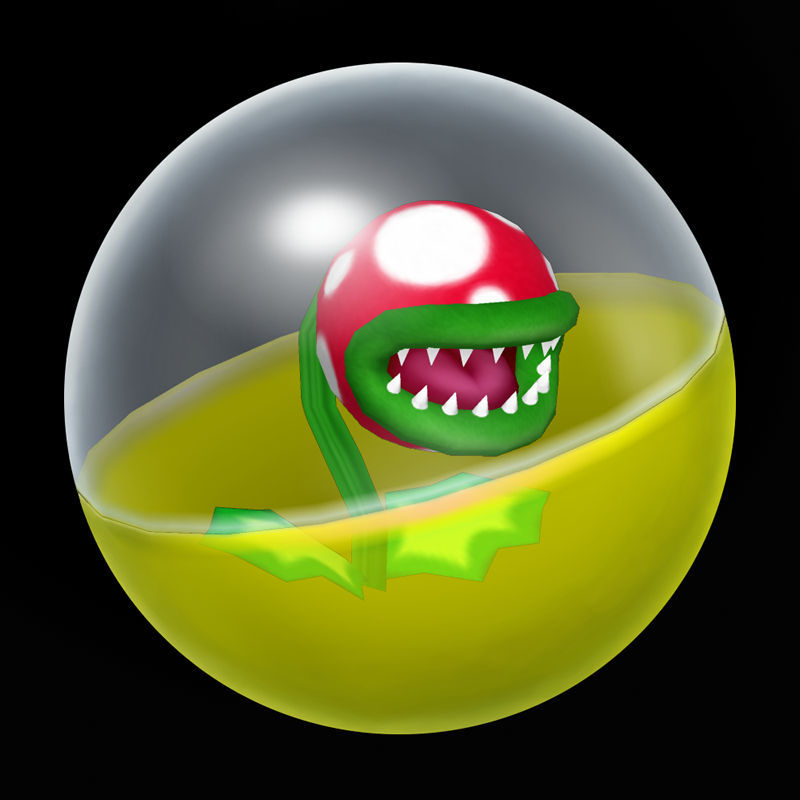
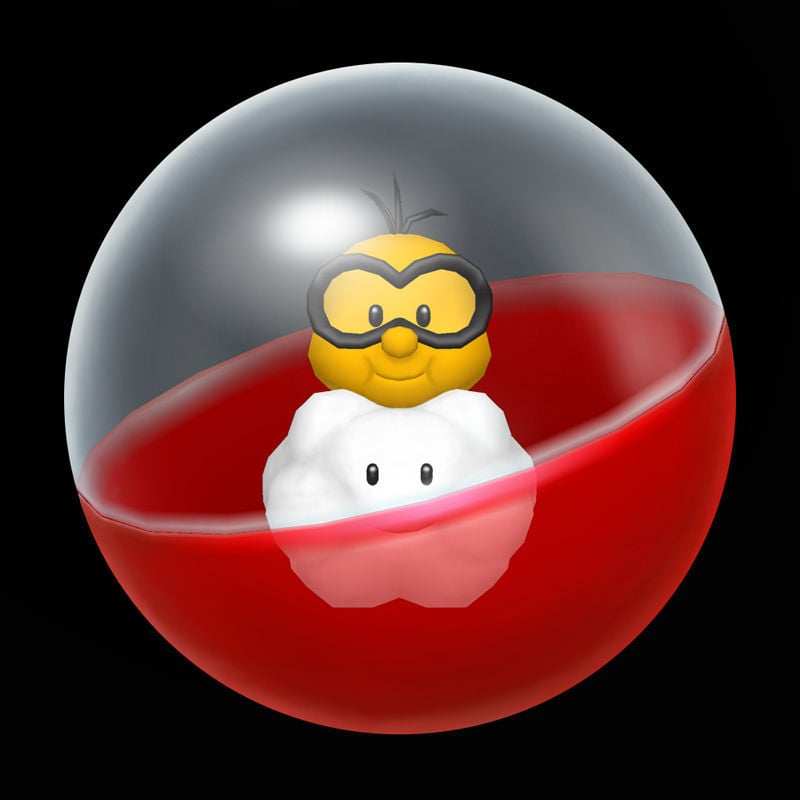
The board game is recognisable at once: a Dice Block numbered 1 to 10, 10 coins to start with, Stars at 20 coins each, a minigame at the end of every round. The big change is the capsule system. There are no shops. Capsule machines stand beside the path and give a capsule to anyone who walks past, and each capsule can be played two ways. Throw it on to a space up to ten ahead and it lies in wait for whoever lands there. Or pay its price and use it on yourself. Some help, some hurt, and deciding which way round to use them is most of the strategy.
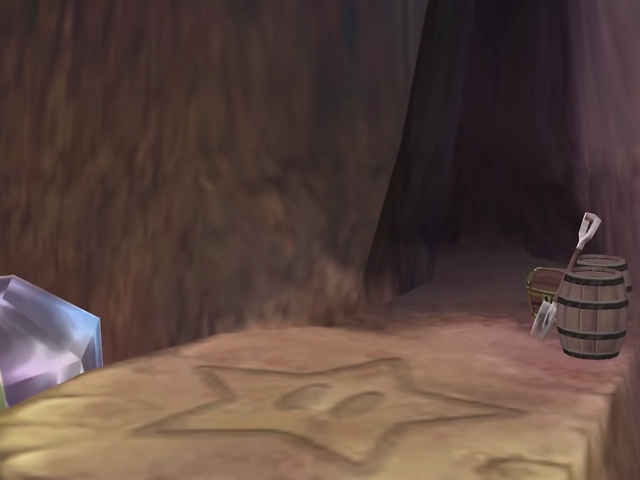
The boards themselves have grown up, quite literally. This is usually called the first Mario Party whose boards have real differences in height, where the fourth game’s were 3D models laid out flat. There are seven, each made from a kind of dream: toys, rainbows, pirates, the sea, the future, sweets and, to be unlocked, whatever it is that Bowser dreams about.
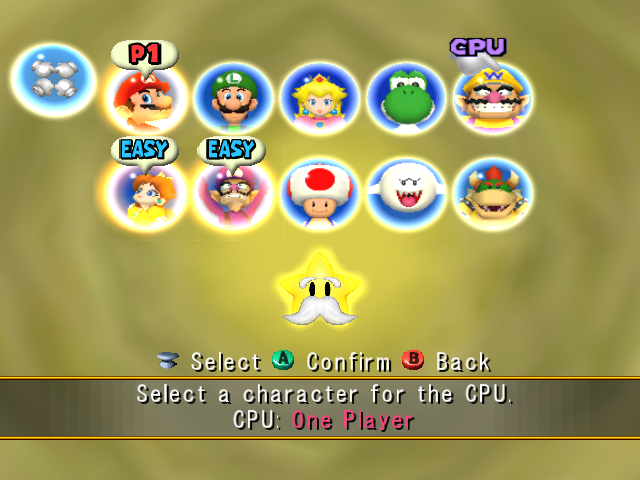
Three newcomers bring the roster to ten: Toad, promoted from host, Boo, and a Koopa Kid, the first of Bowser’s minions to be playable on the boards. Donkey Kong leaves the line-up to become a friendly counterpart to Bowser, with a DK Space and three banana-collecting minigames of his own.
Round the edges there is a great deal to do. Story Mode is a quick, sharp solo game against three Koopa Kids. Mini-Game Mode has six ways to play, including a ten-event Decathlon. Super Duel Mode lets you build a battle car from parts and fight a friend with it. Bonus Mode has a card-flipping board game, volleyball and ice hockey. Critics liked the minigames better than the trudge between them, but the industry academy named it Console Children’s Game of the Year.
Mario and his closest friends are trying to restore peace to Dream World by racing around a collection of all-new game boards-and tons of surprises await!
The new game sports new game boards, more than 60 new mini-games, new playable characters, an expanded one-player mode and, of course, the multi-player madness that made it famous in the first place. This sequel extends Mario Party’s reign as the king of the party game!
— Official description (Nintendo UK, 2003)
Why Mario Party 5 matters to Mario fans
This is the game that put Toad and Boo on the board as players, and the one in which the Star Spirits of Paper Mario play host. It invented the capsule, which became the Orb of Mario Party 6, and the DK Space. Seventeen of its minigames were chosen for Mario Party: The Top 100, more than from either of its GameCube neighbours, and Pushy Penguins, Leaf Leap, Dinger Derby and Ice Hockey were all rebuilt for Mario Party Superstars.
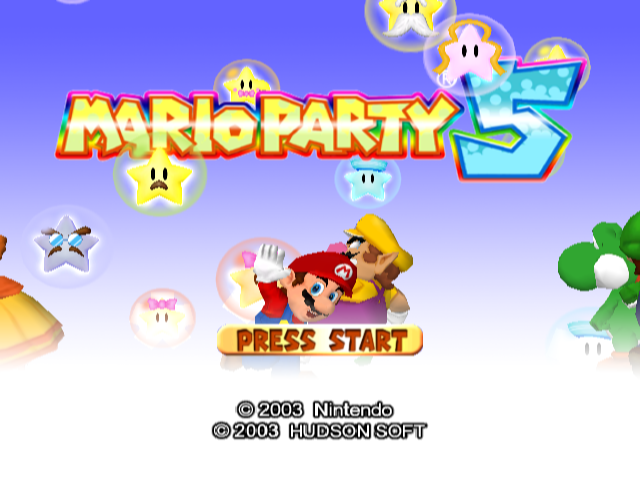
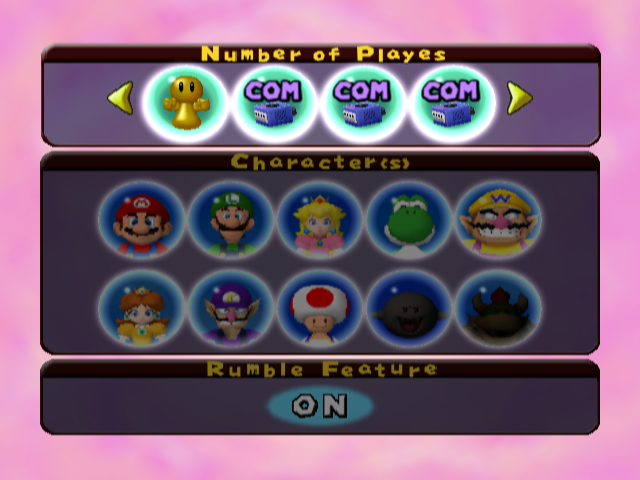
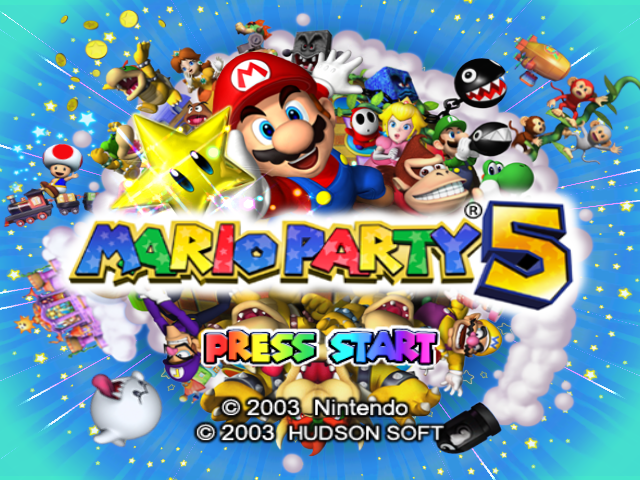
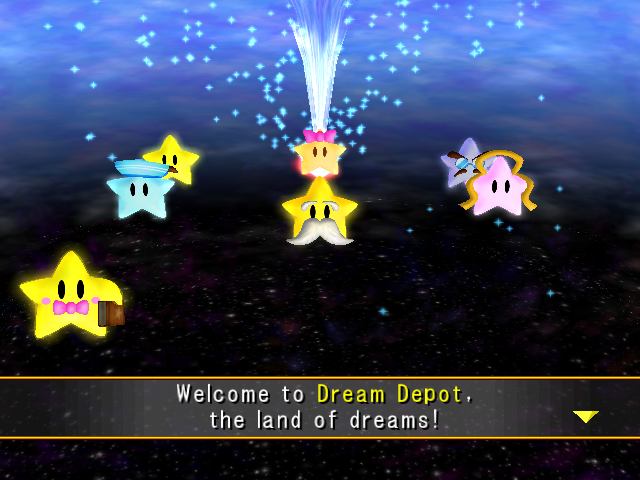
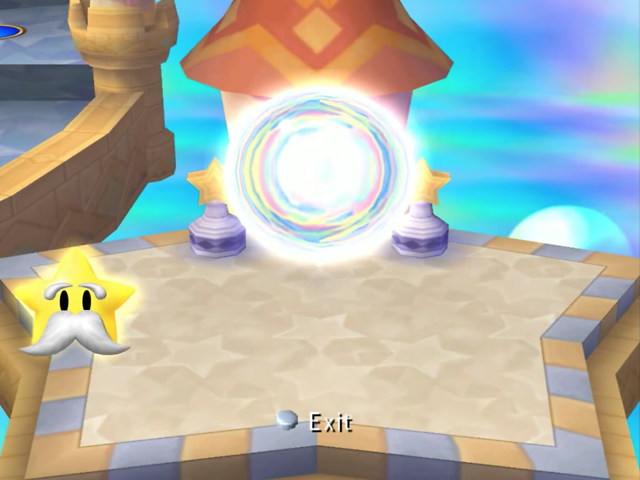
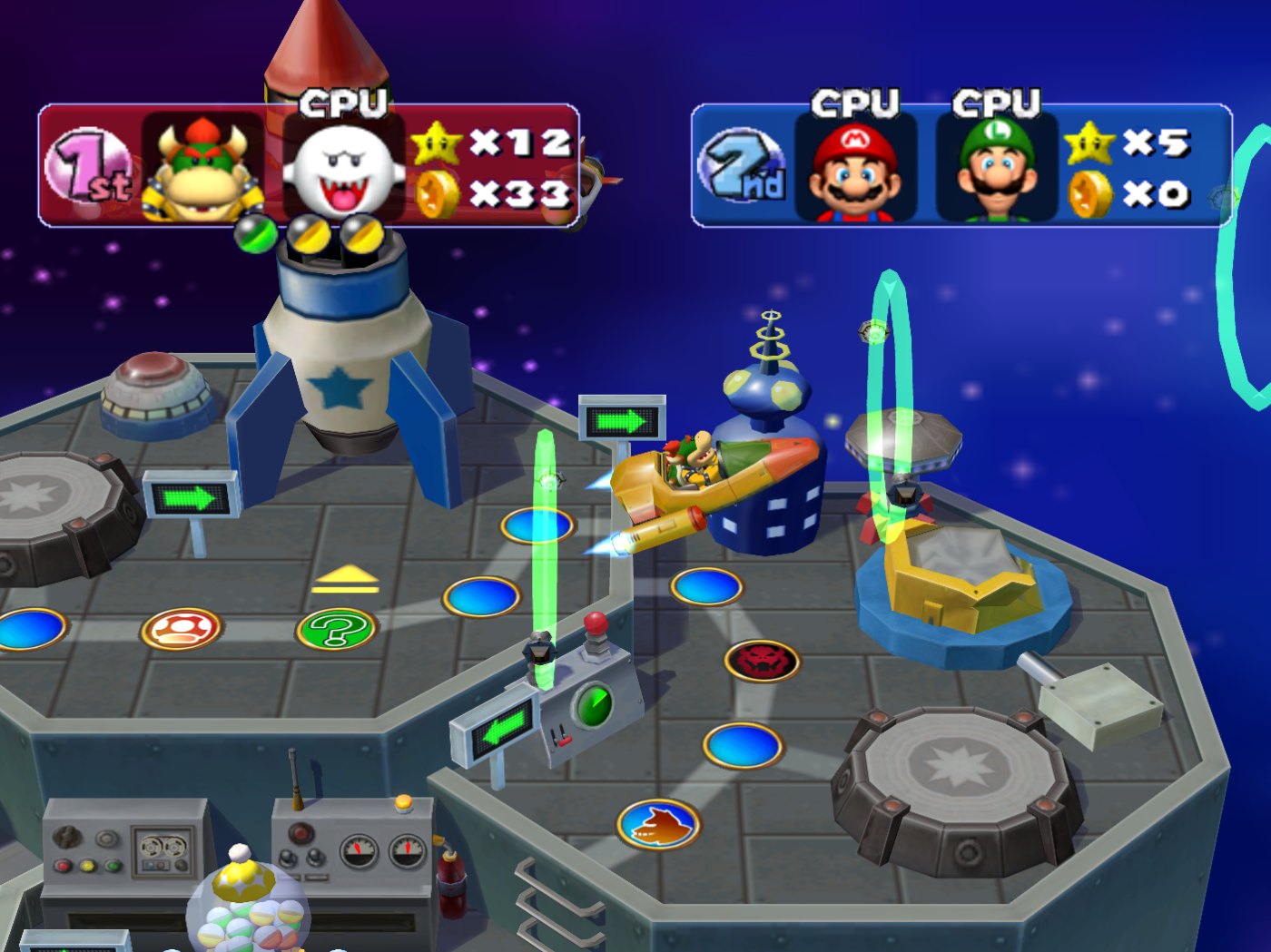
The title screen.Dream Depot, the main menu, with Klevar.The ten playable characters with Eldstar.The start of a board game.
Quick Answers
The questions people ask most about Mario Party 5, answered briefly here and in depth further down the page.
When did Mario Party 5 come out?
North America: 11 November 2003. Japan: 28 November 2003. Europe and Australia: 5 December 2003. A Player’s Choice edition followed in Europe on 22 October 2004. More →
Who is playable in Mario Party 5?
Ten characters: Mario, Luigi, Peach, Yoshi, Wario, Daisy and Waluigi, plus three newcomers, Toad, Boo and Koopa Kid. The newcomers cannot be used in Story Mode or Card Party. Donkey Kong is no longer playable on the boards. More →
What are the boards?
Toy Dream, Rainbow Dream, Pirate Dream, Undersea Dream, Future Dream, Sweet Dream and the unlockable Bowser Nightmare. More →
How many minigames are there?
Seventy-seven by the usual count: 23 for four players, 12 one-against-three, 12 two-against-two, 6 Battle, 15 Duel, 3 Bowser, 3 DK, the Story finale Frightmare and 2 Bonus games. More →
How do capsules work?
You get them free from capsule machines as you pass. Each turn you can throw one on to a space up to ten ahead, where it affects whoever lands on it, or pay its cost to use it on yourself. There are 28 kinds. More →
How do you unlock Bowser Nightmare?
In Story Mode, beat the Koopa Kids on four of the six starting boards to reach Bowser Nightmare, win there, then beat Bowser in Frightmare. The board is then open in Party Mode. More →
Is Donkey Kong playable in Mario Party 5?
Only in Super Duel Mode, and only after you beat him in its tournament on Hard. On the boards he hosts the DK Space, where he hands out coins, a banana minigame or the chance of a Star. More →
Who are the Star Guards?
The seven Star Spirits from Paper Mario: Eldstar, Misstar, Muskular, Skolar, Mamar, Kalmar and Klevar. Each runs one part of the game, from Eldstar in Party Mode to Kalmar in Options. More →
Is Mario Party 5 on Nintendo Switch?
Not at the time of writing. There is no known re-release beyond the 2004 Player’s Choice edition, and it is not among the GameCube games Nintendo Life lists for the Switch 2 Nintendo Classics library. Ten of its minigames are in Mario Party Superstars. More →
Boards & Modes
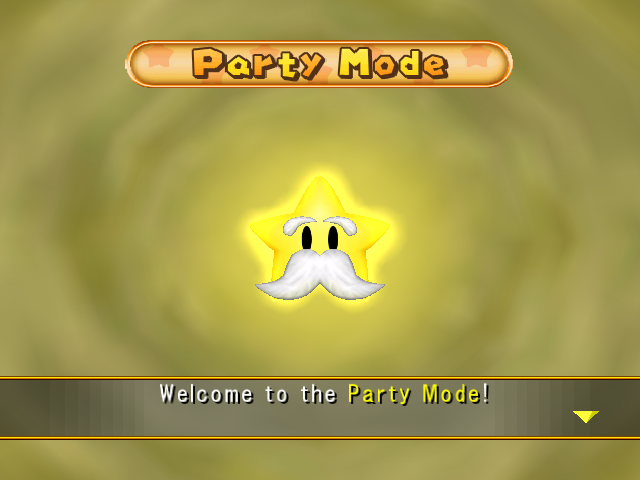
Eldstar, eldest of the Star Guards and host of Party Mode.
Far above the clouds, past the moon and the stars, lies Dream Depot, where the dreams of everyone in the world gather. Seven Star Guards protect them. Reasoning that nobody has bigger dreams than Mario and his friends, the Star Guards invite the whole gang up for a visit and lay on a set of games to welcome them. So says the instruction booklet, and that is the whole premise of Party Mode: seven boards, each built out of a different sort of dream.
Story Mode adds a villain. Bowser and his Koopa Kids mean to ruin everyone’s dreams, and one of Mario’s party must stop them. The boards are described first, then the modes built round them.
Story Mode: the Koopa Kid Brigade
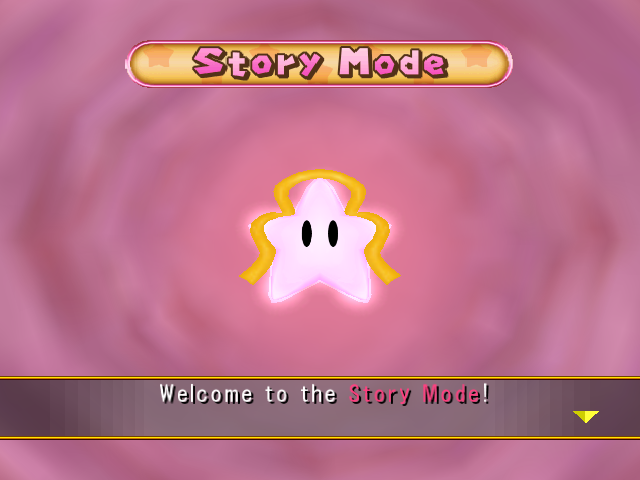
Misstar hosts a Story Mode quite unlike the one in Mario Party 4. You play alone against Red K. Kid, Blue K. Kid and Green K. Kid on small, cut-down versions of the boards, with 21 to 31 spaces where the Party Mode originals have 59 to 76. The three Koopa Kids take their turns at the same moment, which Nintendo’s own publicity sold as a cure for waiting about.
There are no Stars. Coins are life, and the aim is to leave every Koopa Kid with none inside 15 turns. A Koopa Kid who runs out of coins is gone; if you run out, you have lost; if 15 turns pass with any of them still standing it counts as a draw and you start the board again. Coins change hands mostly through Duels, which begin whenever you and a Koopa Kid pass or meet. Beat one you have caught up with and he loses 15 coins, while losing costs you only 5. When he is the one who catches you, the stakes are 10 of yours against 5 of his.
The special spaces lean your way. A Koopa Kid who lands on the DK Space loses half his coins to a punch from Donkey Kong, and you get 10 for landing there. On a Bowser Space the Koopa Kid collects 5 and you lose half. VS Spaces, found only here, call a minigame to suit the number of Koopa Kids left: one against three, then two against two with a computer-controlled Toad as your partner, then a Duel.
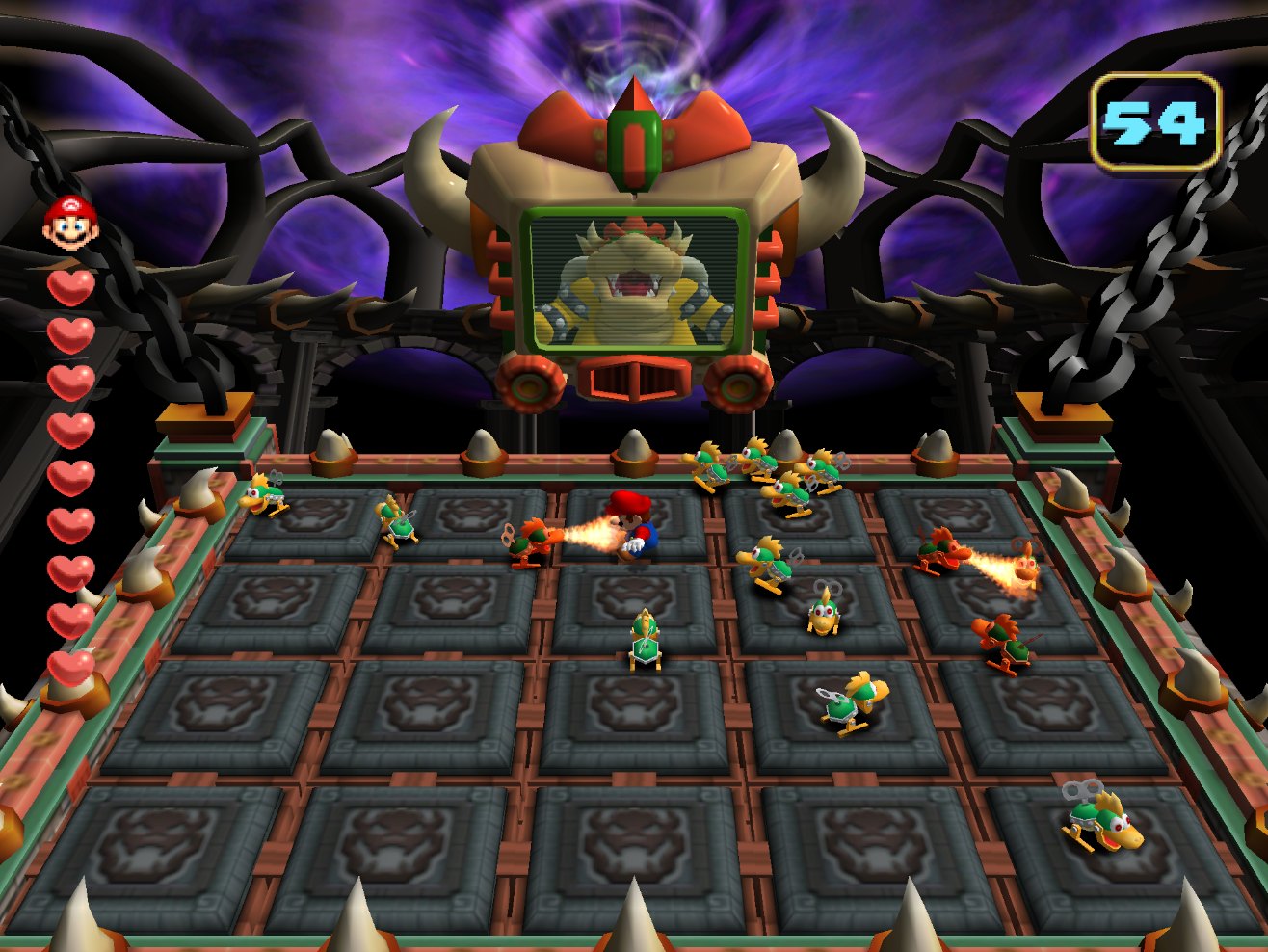
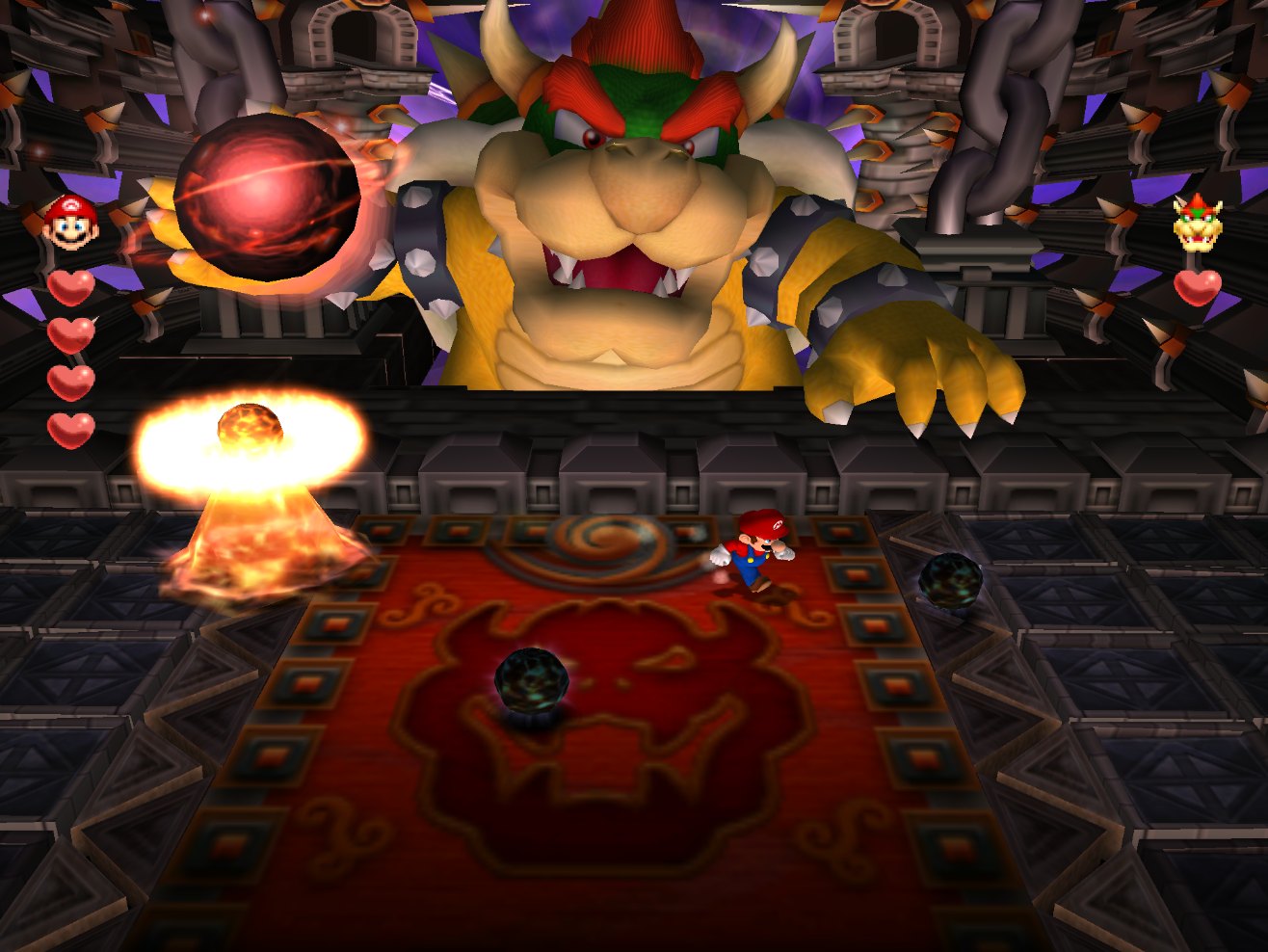
Clear any four of the six dream boards and the way opens to Bowser Nightmare. Beat the Koopa Kids there and Bowser himself is waiting in Frightmare, a four-part final battle. First you have 60 seconds to destroy a pack of fire-breathing Mechakoopas by stomping or throwing them. Then you must survive three rings of fire for half a minute. Then Bowser attacks in person, leaping and charging across a floor of tiles that crack under him. Finally he grows to giant size and has to be hit in the face five times with balls of light, between gouts of flame and shockwaves. You have ten hearts on Easy and Normal, eight on Hard and six on Intense. When he is beaten, Bowser crashes through the floor and is sucked away into a vortex.
Only the seven characters carried over from the earlier games can play Story Mode; Toad, Boo and Koopa Kid are left out, as Daisy and Waluigi were in Mario Party 3.
Misstar introduces Story Mode.The Story Mode version of Toy Dream: 21 spaces to Party Mode’s 66.Mario faces Bowser in Frightmare.
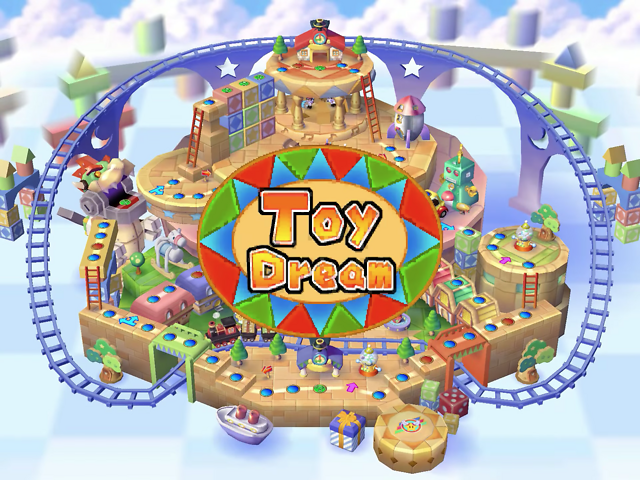
Toy Dream
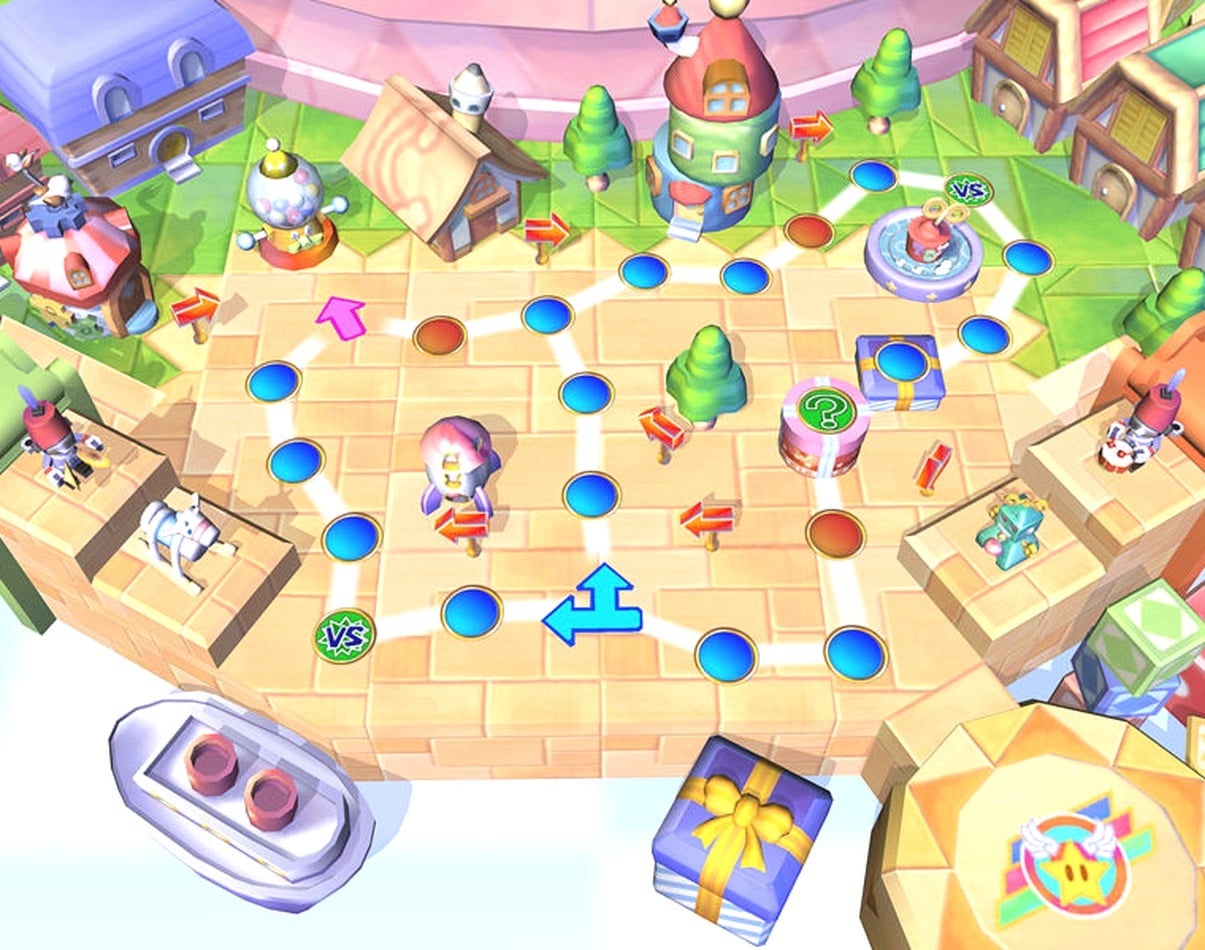
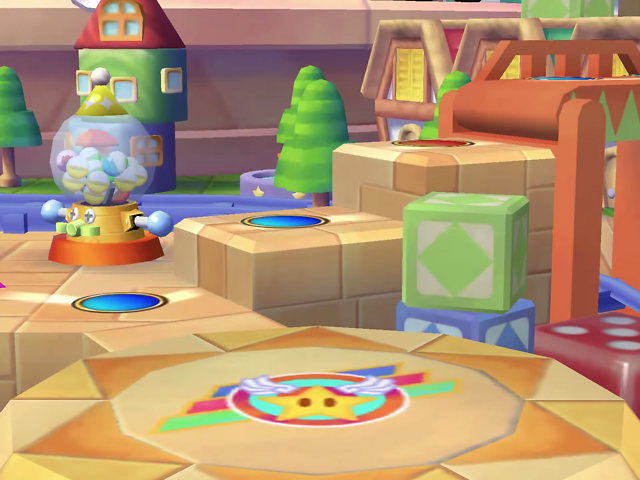
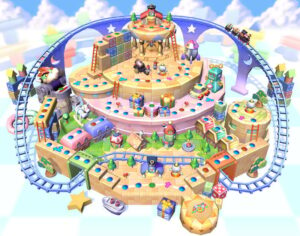
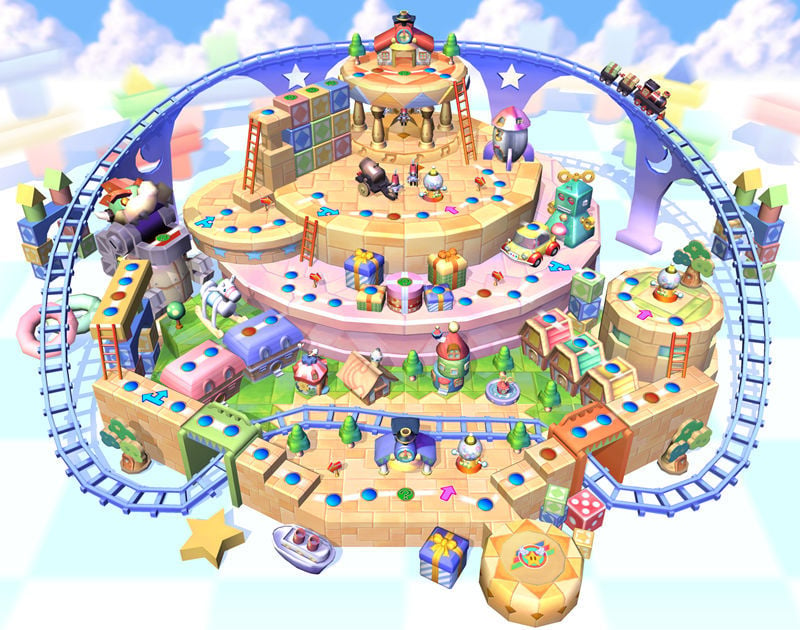
A nursery floor among the clouds: a pale blue chequered platform walled in with building blocks and scattered with a toy train, a ship, a robot, tin soldiers, parcels and a toy modelled on Mecha-Bowser from Super Mario Sunshine. It has much in common with Shy Guy’s Toy Box in Paper Mario.
The toy train is the main event. Land on the ? space at either station and it takes you, and anyone else standing on the track, on a circuit of the board between the top and the bottom, with coins puffing out of the funnel to be caught by jumping. Elsewhere a toy cannon fires you back to the start, the soldiers knock down a wall of blocks under your feet and a jack-in-the-box in the big central present catapults you across the board.
Toy Dream is introduced.The start of a game.
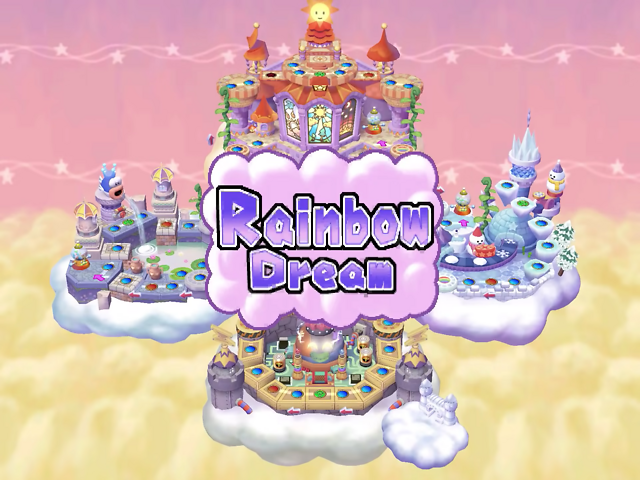
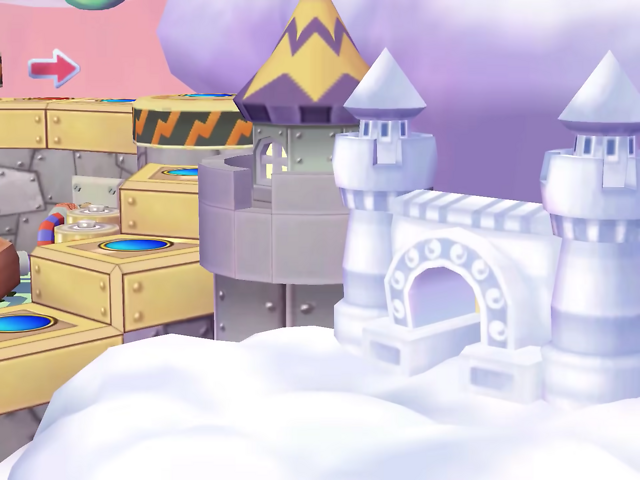
Rainbow Dream
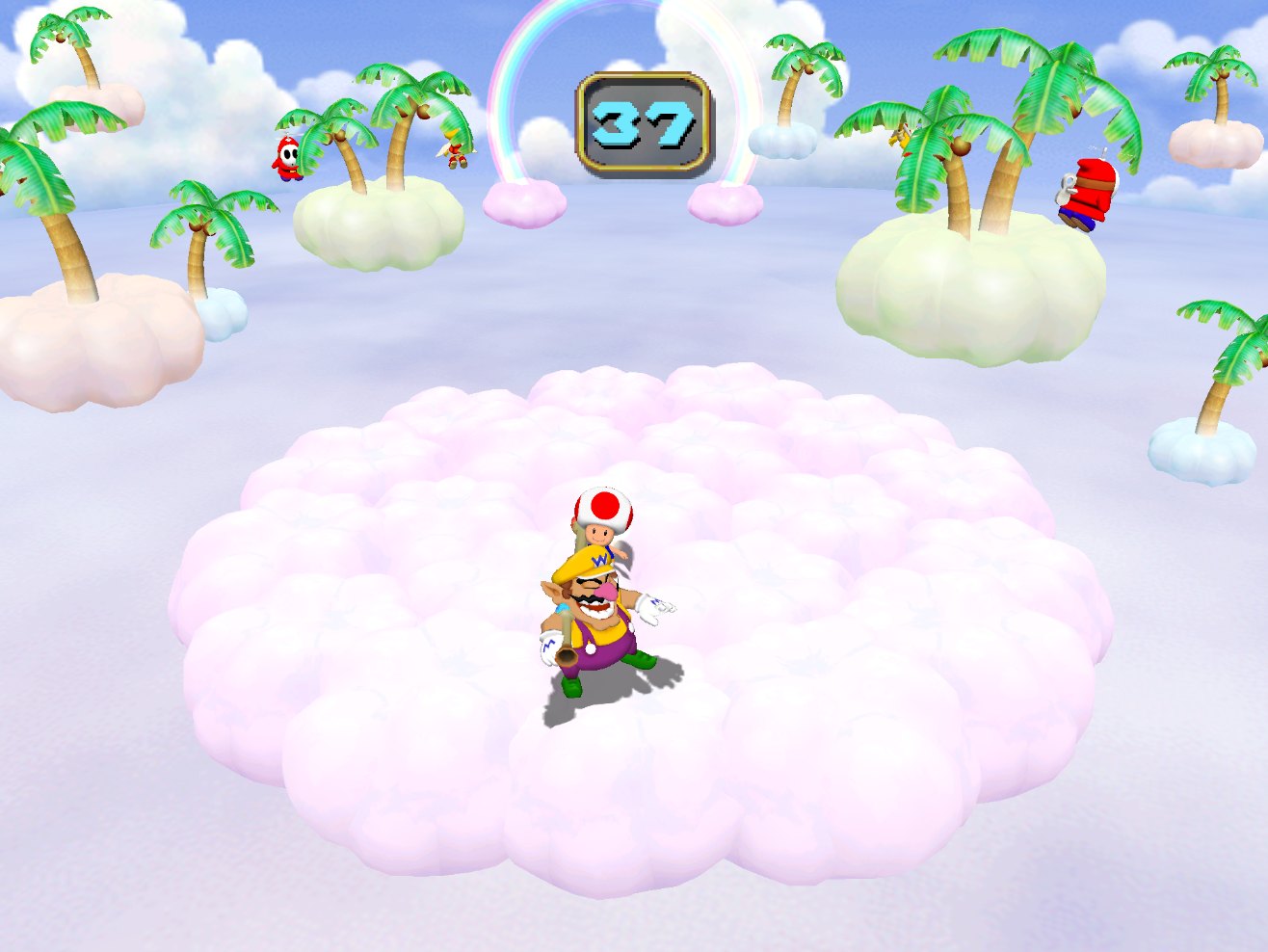
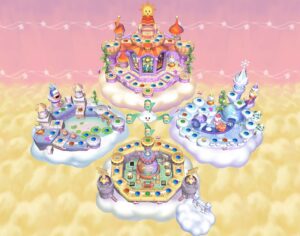
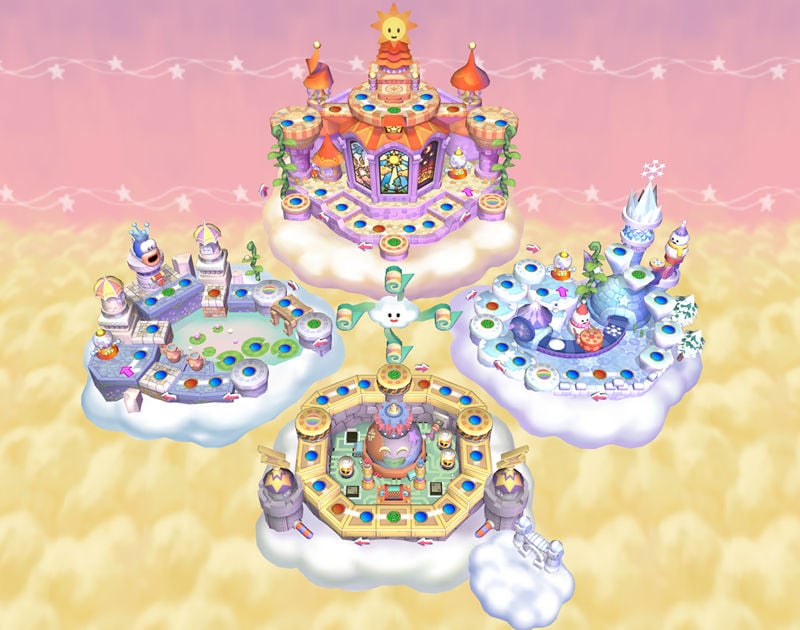
Five clouds float in a pink, starry sky: one for the start and one each for cloudy, rainy, sunny and snowy weather. They are joined only by rainbow bridges, and Klevar stands at each asking 5 coins to conjure one. A wind-driven gondola, reached from four ? spaces, will carry you to an island picked at random instead.
Each cloud has its own event. On the rainy one a downpour washes you, and anyone standing on the two spaces next to yours, back to the start. On the sunny one three rainbows appear and you slide down the one of your choice collecting coins. On the snowy one you ground-pound a see-saw, and the harder you hit it the higher you fly and the more coins you reach. At the Shock-a-Lot generator you run in a wheel to charge it, and are paid in capsules.
Rainbow Dream is introduced.The start of a game.
Pirate Dream
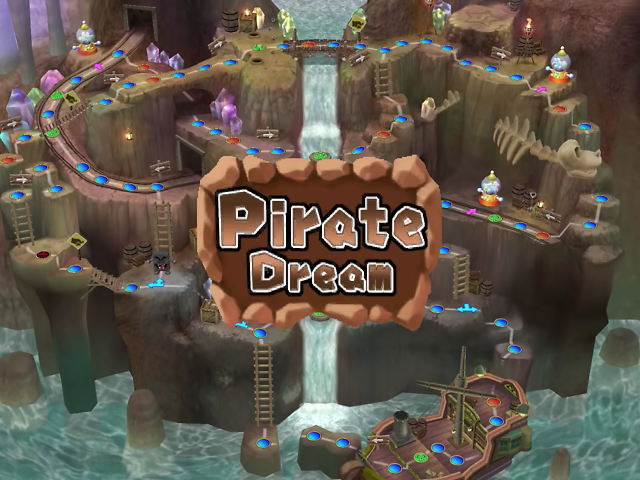
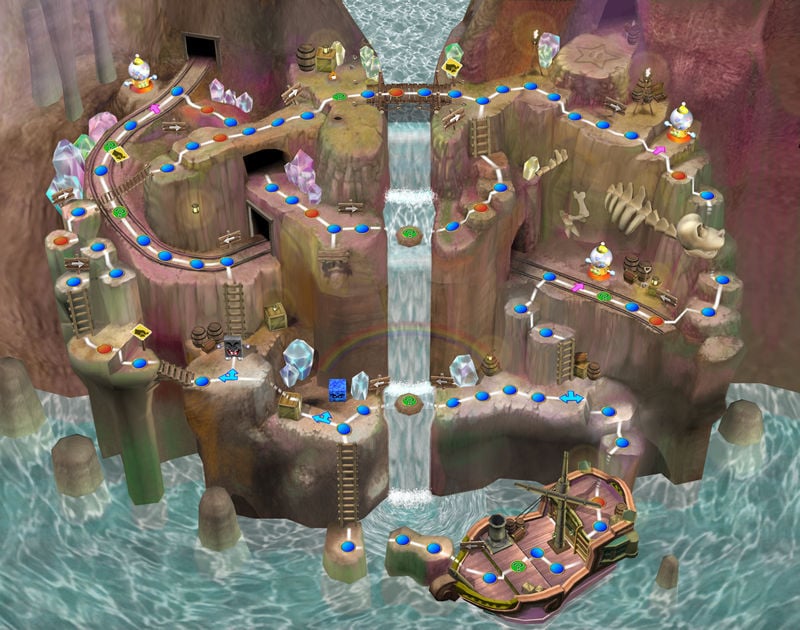
A board made from dreams of treasure hunting, half abandoned mine and half sea cliff, with waterfalls and a pirate ship moored at the bottom. In Japan it is the Adventure Dream. It is the only board with tolls collected by a Thwomp and a Whomp: 10 coins to the Thwomp for a lift to the upper level, 10 to the Whomp to use the ladder he is leaning on.
On the mine track a boulder rolls out and chases everyone off the rails. The space beside the waterfall gives way and drops you in front of the ship. On the ship itself you climb into a cannon and are shot to a space marked with a cannon sign. At the very top Monty Mole hands you a pickaxe and lets you dig for coins as fast as you can press A.
Pirate Dream is introduced.The start of a game.
Undersea Dream
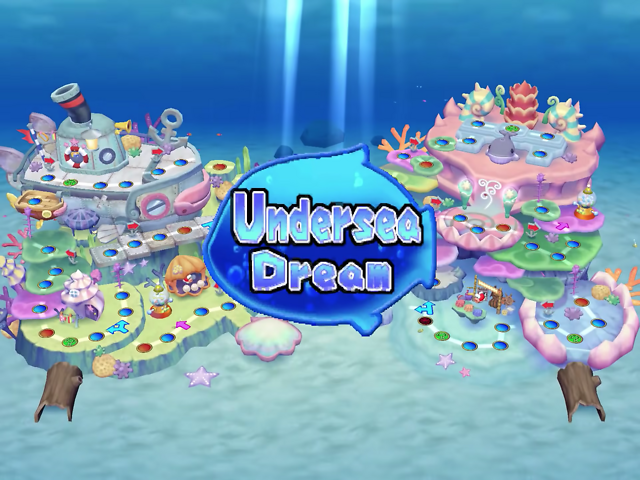
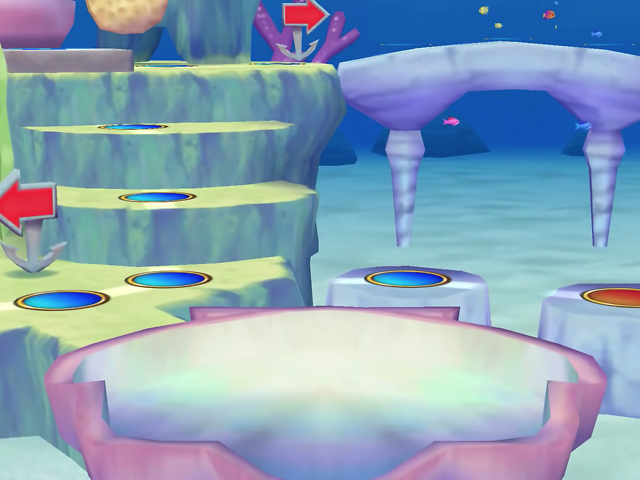
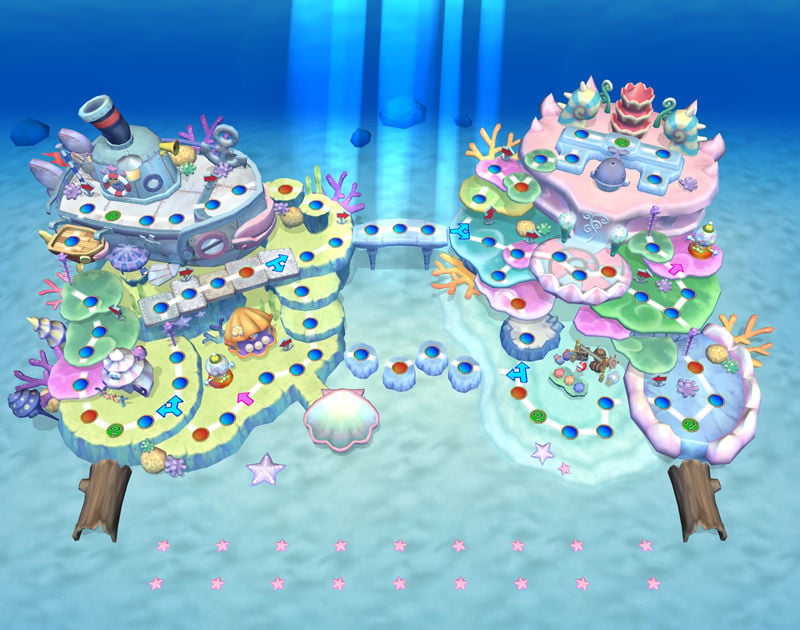
A coral reef in two halves joined by bridges, with a sunken ship, a whale and little shops kept by Cheep Cheeps. It is the only board with two capsule machines where the rest have three, which makes capsules scarcer and the Cheep Cheeps’ lucky dip more tempting: stop at their reef and you may win a capsule, or an empty tin or an old boot.
A dolphin at the wreck tows you to another part of the board whether you like it or not. The whale blows you towards the Star, or, on a bad day, just past it, leaving a full lap to walk. From the logs at either side you may get a ride across the board on a manta ray, picking up coins as you go.
Undersea Dream is introduced.The start of a game.
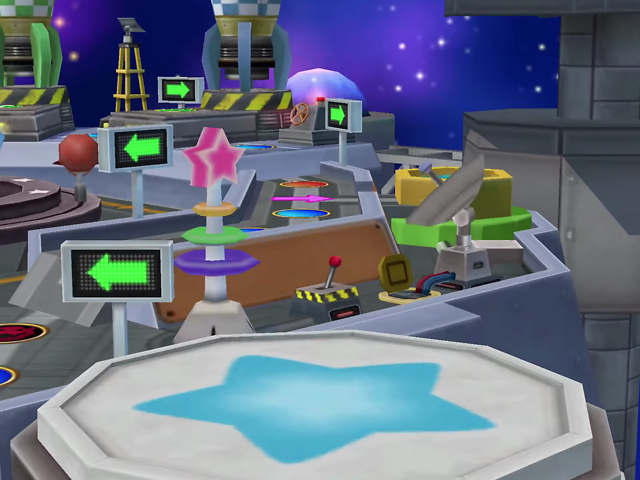
Future Dream
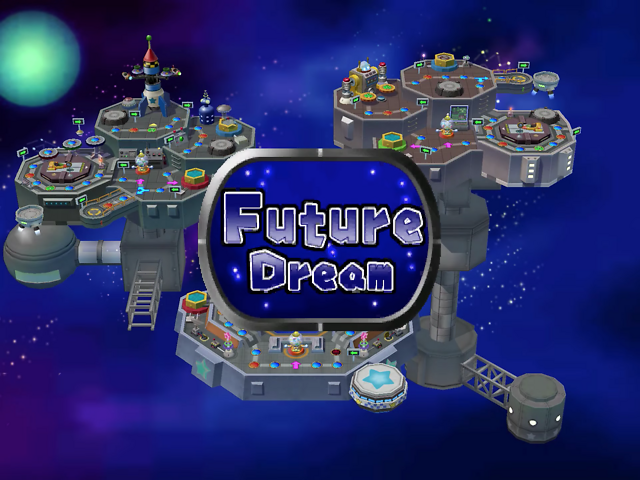
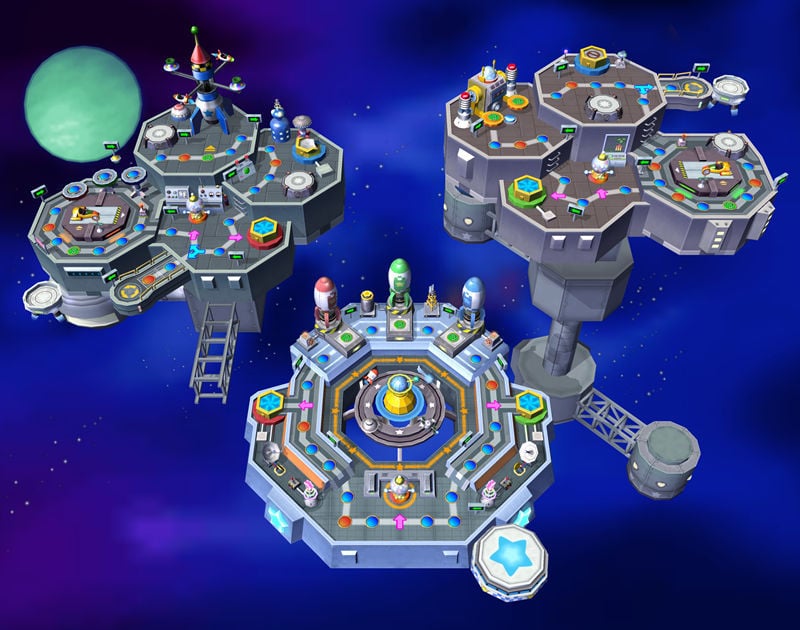
Three space stations hanging in orbit, and no way to walk between them. You get about by teleporter, by floating platform, by air taxi at 10 coins a ride, or by landing on one of three rocket ships, which blast off for a landing pad on the left or the right at random.
The left-hand station has the Merry-Go-Shuttle, a fairground ride on which you raise and lower your ship to collect coins from passing UFOs. The right-hand one has Capsule Slots, a fruit machine that pays out capsules, with a Mushroom as the consolation prize.
Future Dream is introduced.The start of a game.
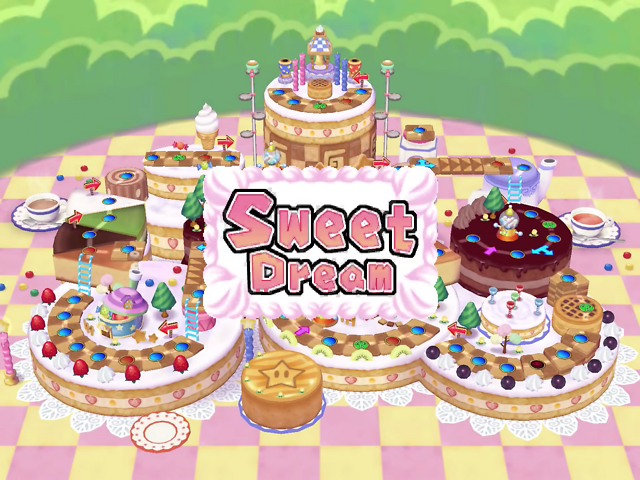
Sweet Dream
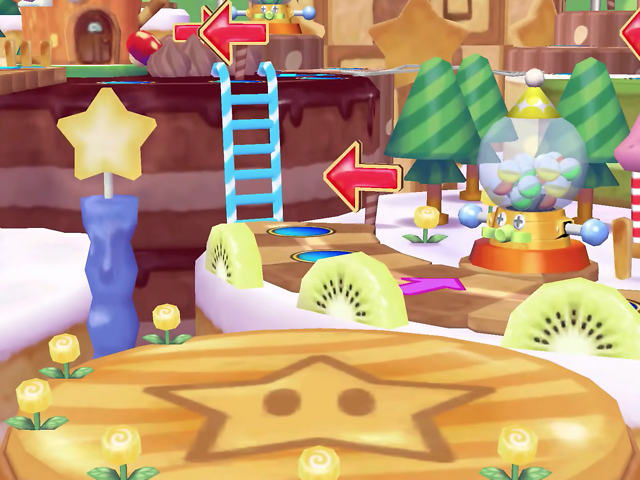
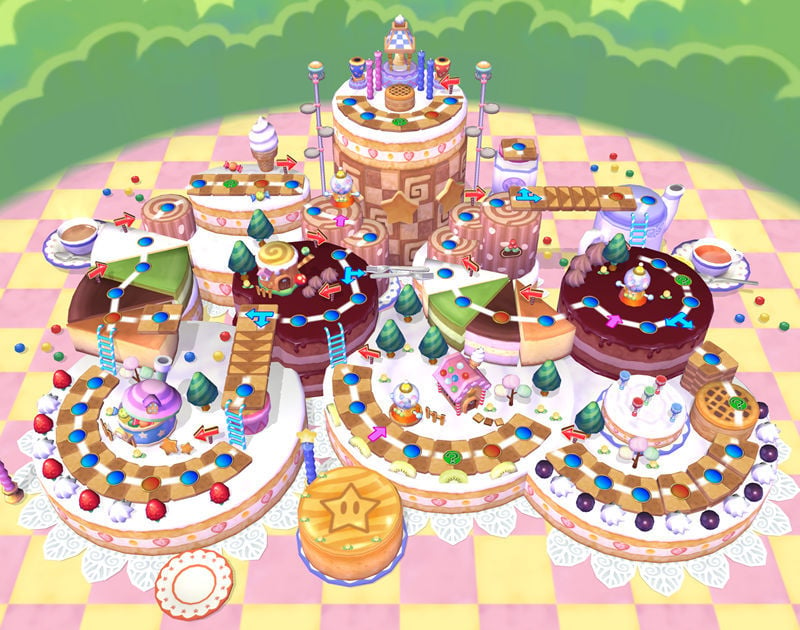
Cakes and sweets laid out on a giant picnic cloth. Two shortbread bridges crumble when anyone walks over them, each time re-forming in a new direction, unless the walker is floating in a Bubble Capsule. Several ? spaces cut a slice from the cake you are standing on and carry you off on it to another part of the board.
In the bottom right-hand corner is Candy Throw, a coconut-shy with sweets and cups that pays in coins. The ? space at the top is the nasty one: your three opponents are dragged to a party with you and a roulette decides whether they lose capsules, coins or Stars.
Sweet Dream is introduced.The start of a game.
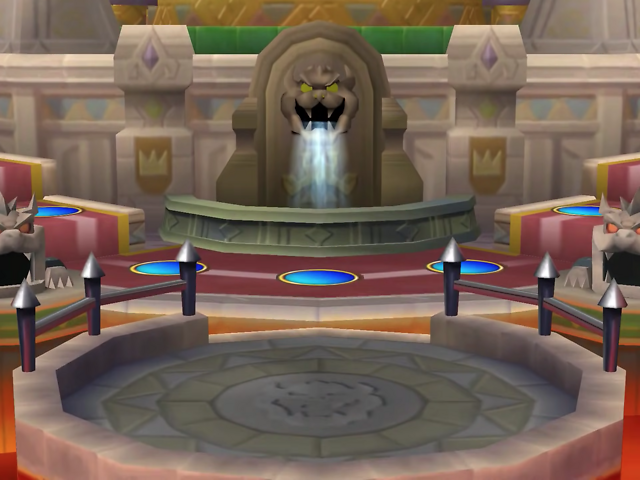
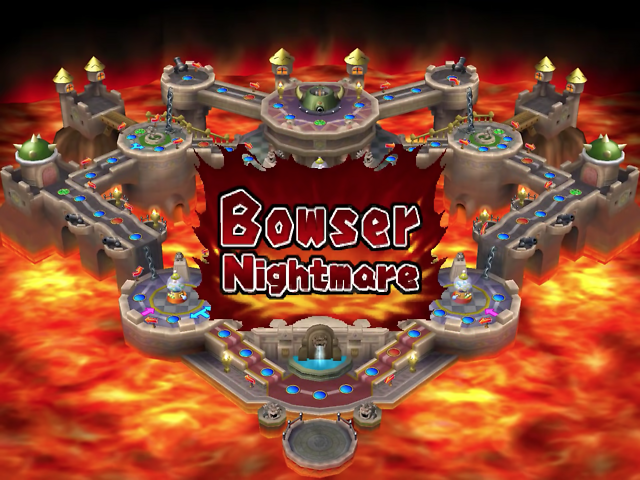
Bowser Nightmare
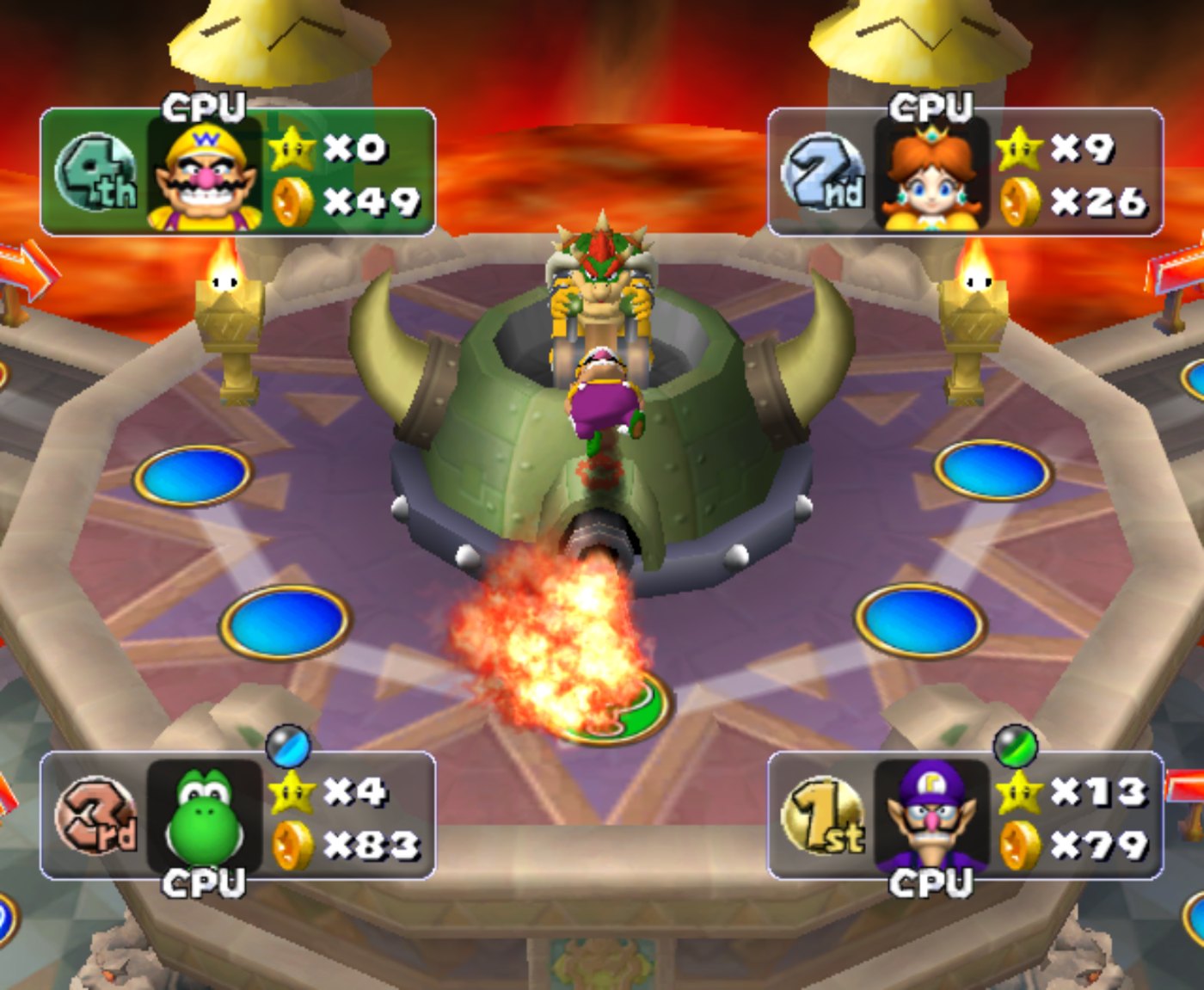
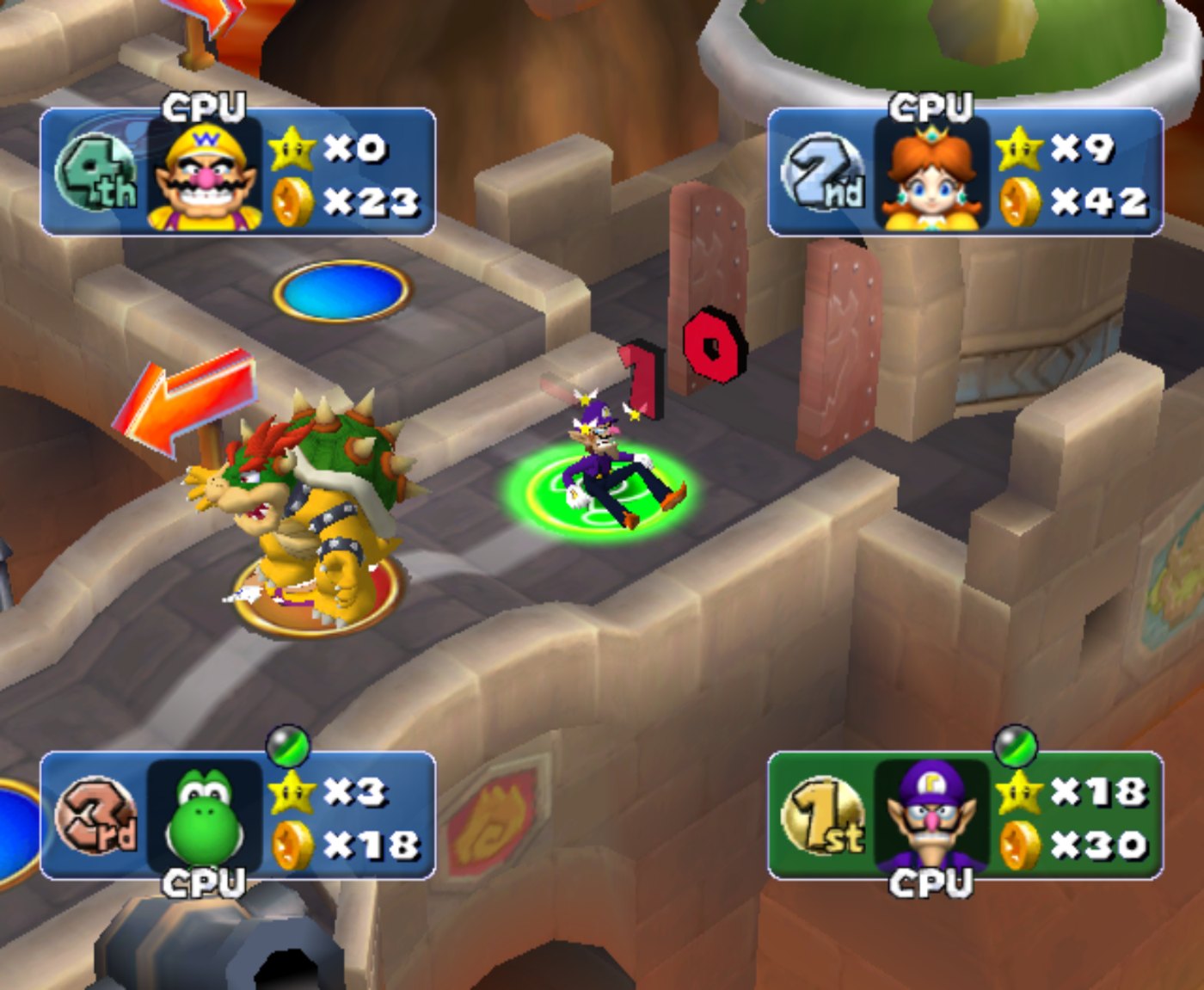
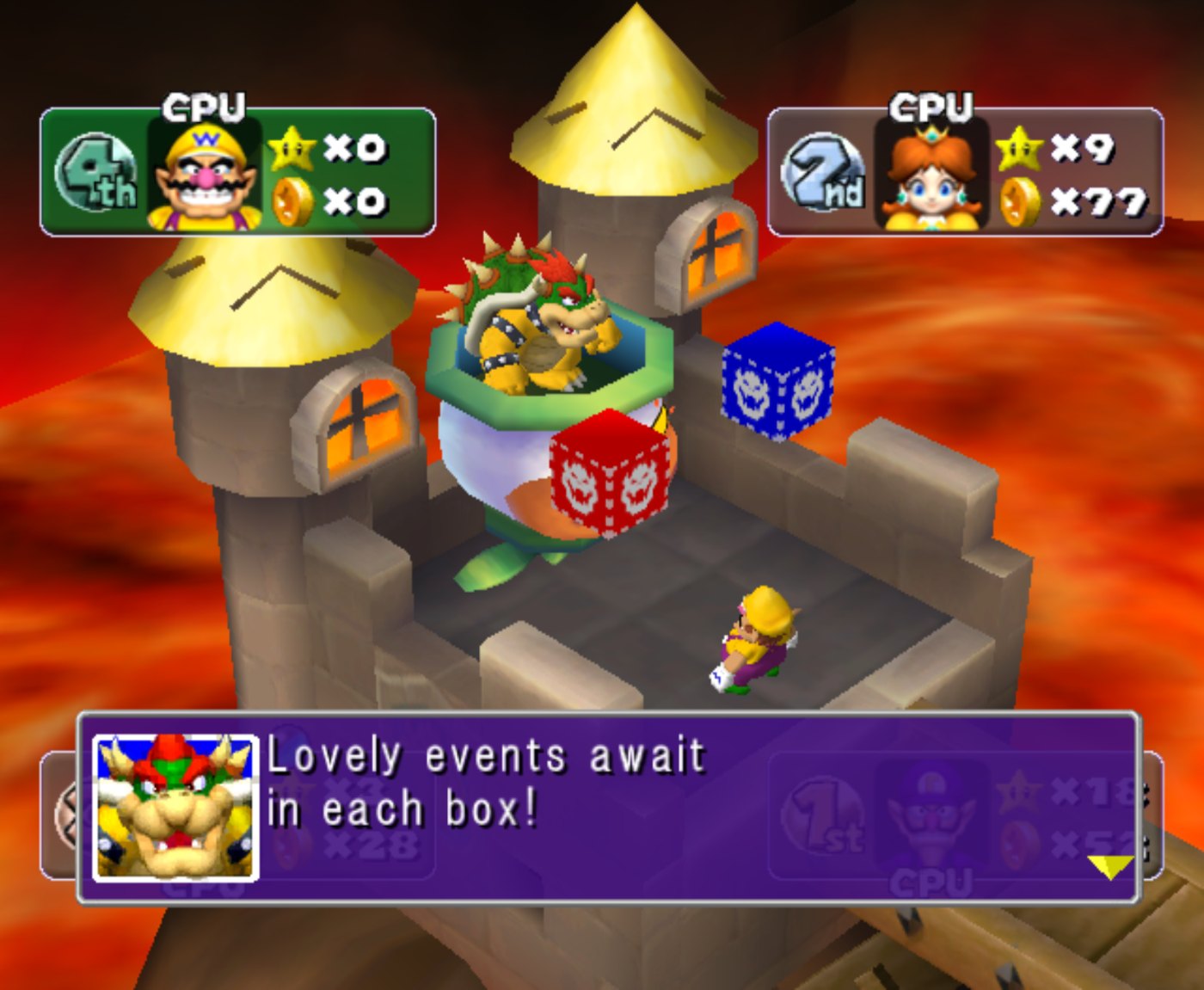
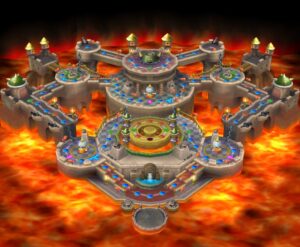
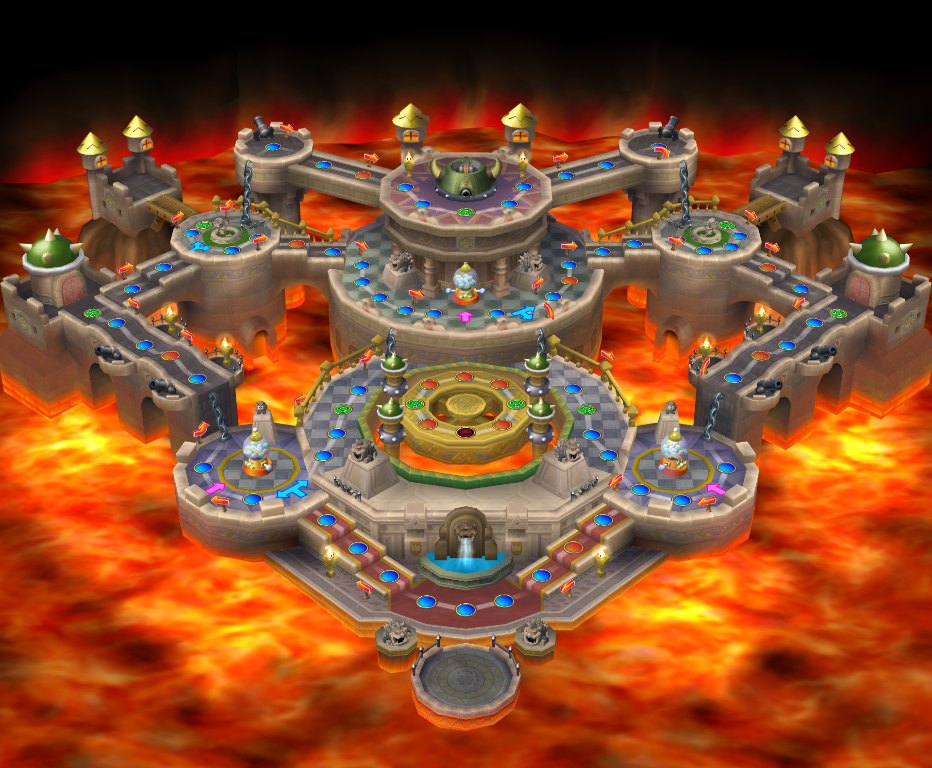
The board born of Bowser’s own dreams is a volcano with a ring of spaces at its heart called the Spin Stage. Every ? space brings Bowser in person. On the bottom row he goes for a stroll, turning the plus spaces behind him into minus spaces for at least two turns and trampling anyone in the way for 10 coins. At the top corners he flies in on his Koopa Clown Car with the Tower of Chance: you must hit a red block or a blue one, and one sends you back to the start while the other costs you half your coins. At the very top he mans a flamethrower and burns the capsules of everyone nearby.
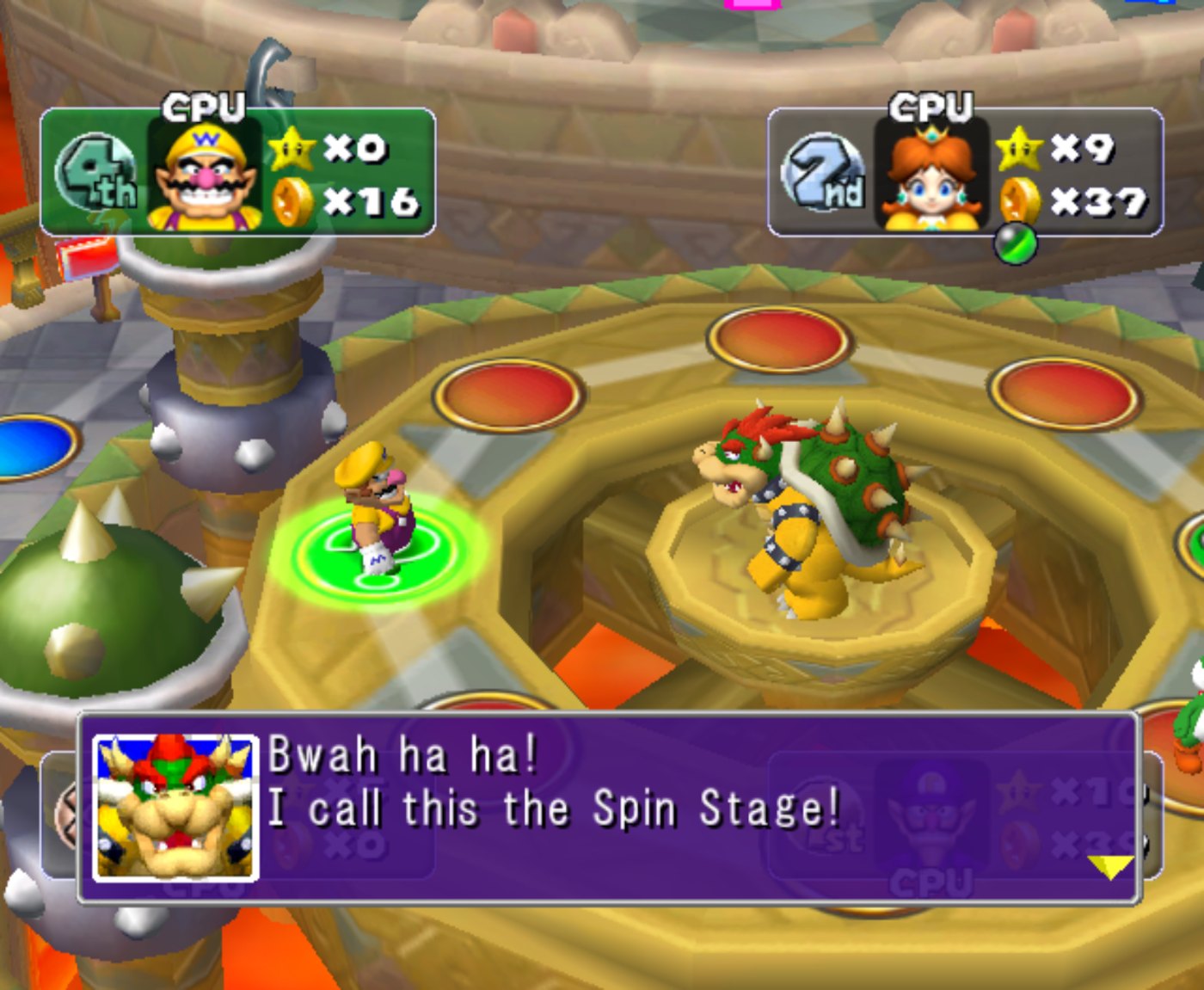
The ? spaces in the middle drop you down a red pipe into the Spin Stage, a loop of minus spaces and the odd Bowser Space that takes eight spaces to get round, to the sound of Bowser wishing you luck getting out. It has been compared to the Mecha-Blooper ride of Bowser Land in Mario Party 2. The board is unlocked for Party Mode by finishing Story Mode.
Bowser Nightmare is introduced.Bowser goes for a stroll.Wario chooses a block on the Tower of Chance.Wario is dropped into the Spin Stage.
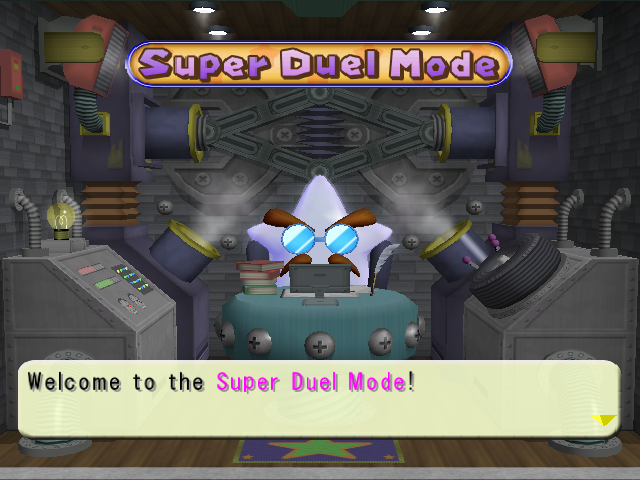
Super Duel Mode
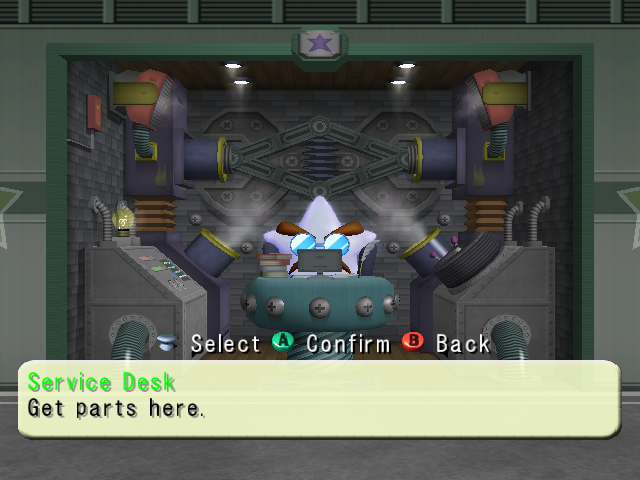
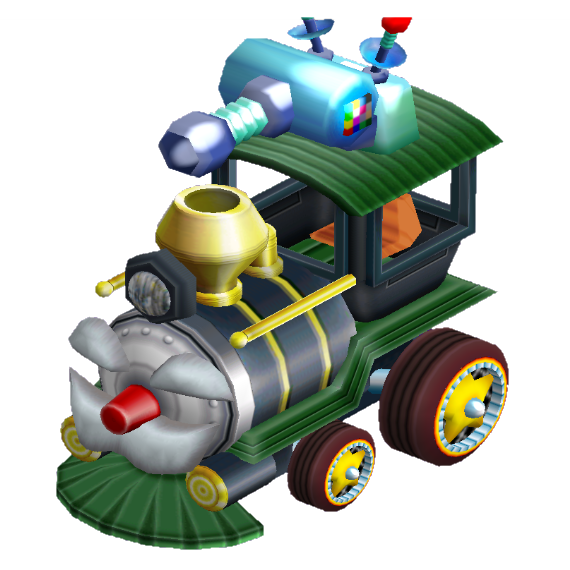
Skolar’s garage is a game in itself. You assemble a battle machine from four parts, a body, tyres, an engine and a weapon, and fight another machine in an arena. Parts are paid for with points earned by playing minigames elsewhere in the game: 4-Player games earn points for bodies, 1-vs-3 games for tyres, 2-vs-2 games for engines and Battle games for weapons.
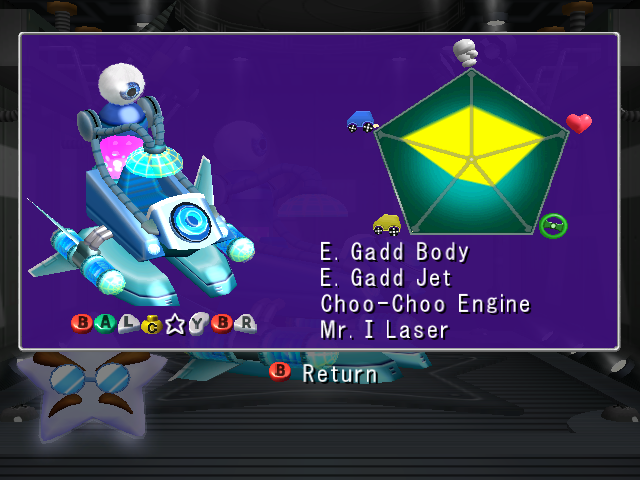
The full list runs to 46 parts. They start with the plain Mushroom set and run to Wiggler tyres that can turn on the spot, a Lakitu Cloud that floats over lava, a Boo body that turns invisible on your opponent’s screen, a Bullet Bill Gun whose shots home in and a range of gadgets credited to Professor E. Gadd of Luigi’s Mansion. The Choo-Choo body is a nod to the Steamer of Mario Party 2.
There are three contests, each 90 seconds long. Battle is a fight to knock out the other machine’s hearts. Flag is a race to collect three flags. Robo-Rabbit asks you to shoot three fast, burrowing mechanical rabbits before your rival does. Only Battle on Easy and Normal is open at first; winning unlocks Hard, then Flag, then Robo-Rabbit. Two players can fight head to head in eight arenas, and a third can bring machines on a second Memory Card.
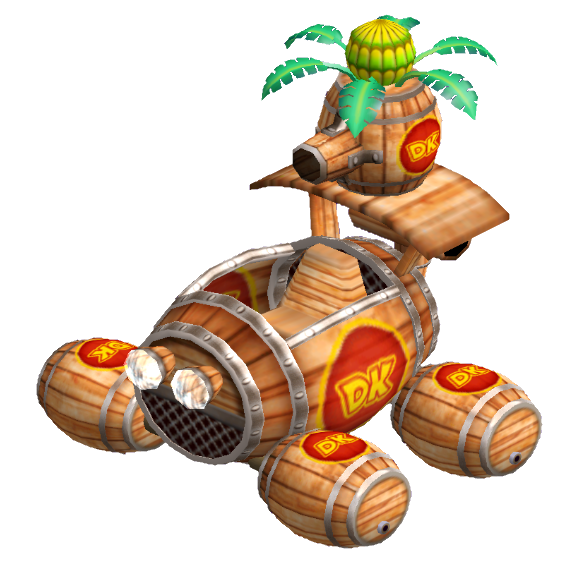
The computer drivers all have stage names and cars to match, among them Last Hero Mario in the Super Dash, Samurai Toad in the Toadster Toaster and Nightmare Boo in the Sheer Sideswipe. On Hard the field includes Bowser in the Bowser Dozer and The Beast Donkey Kong in the Banana Bot. Beat Donkey Kong there and he becomes a playable driver, the only way to play as him in this game.
Skolar introduces Super Duel Mode.The stats of an assembled machine.Battle Competition.Flag Competition.Robo-Rabbit Competition.Donkey Kong’s machine, the Banana Bot.
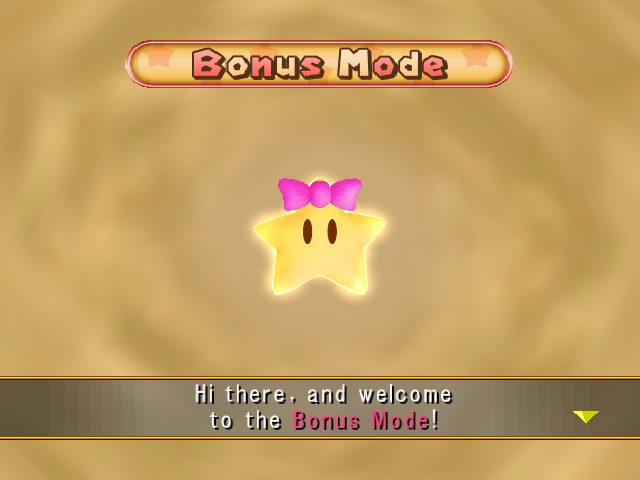
Bonus Mode: Card Party, Beach Volleyball and Ice Hockey
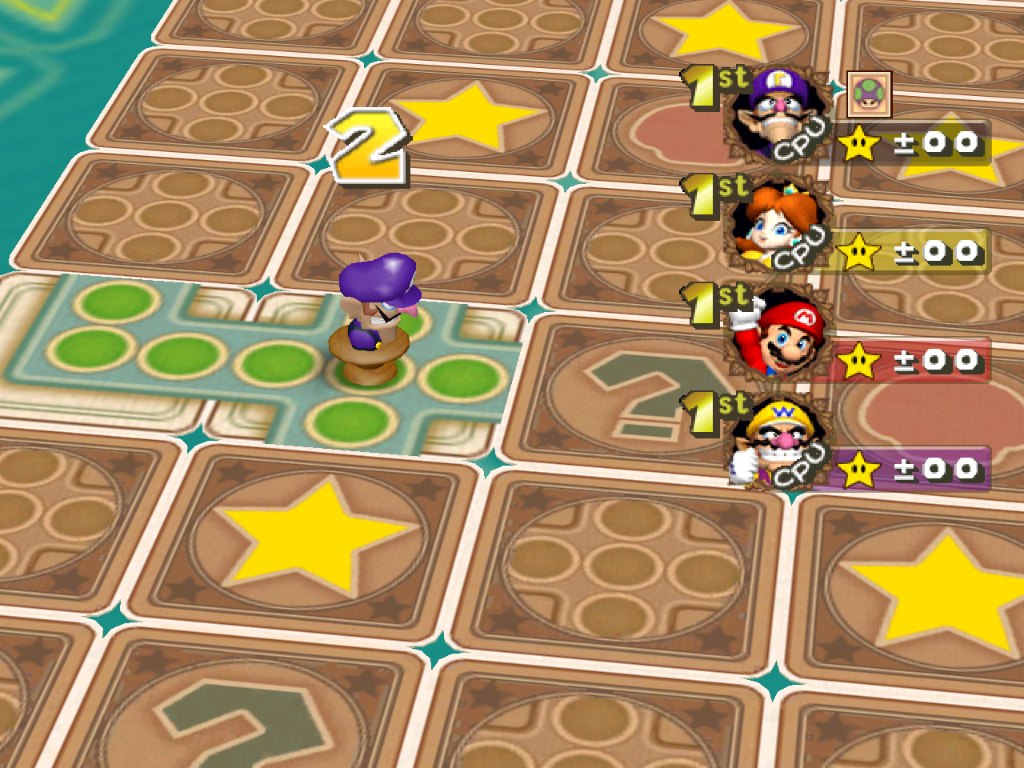
Mamar looks after three games that appear nowhere else. Card Party is a board game without a board. The playing area is a square of face-down cards, from seven by seven to ten by ten, and each player sets out from an edge rolling an ordinary six-sided die. Walking up to a card turns it over. Most are paths. Some are items, some are events that whisk you away or send you home, some hide Bowser, and a few are Star Cards, which are the point of the exercise: a Star is worth one, a Double Star two and a Ztar minus one. When the last Star Card is found, the highest score wins. Only the seven veteran characters can play.
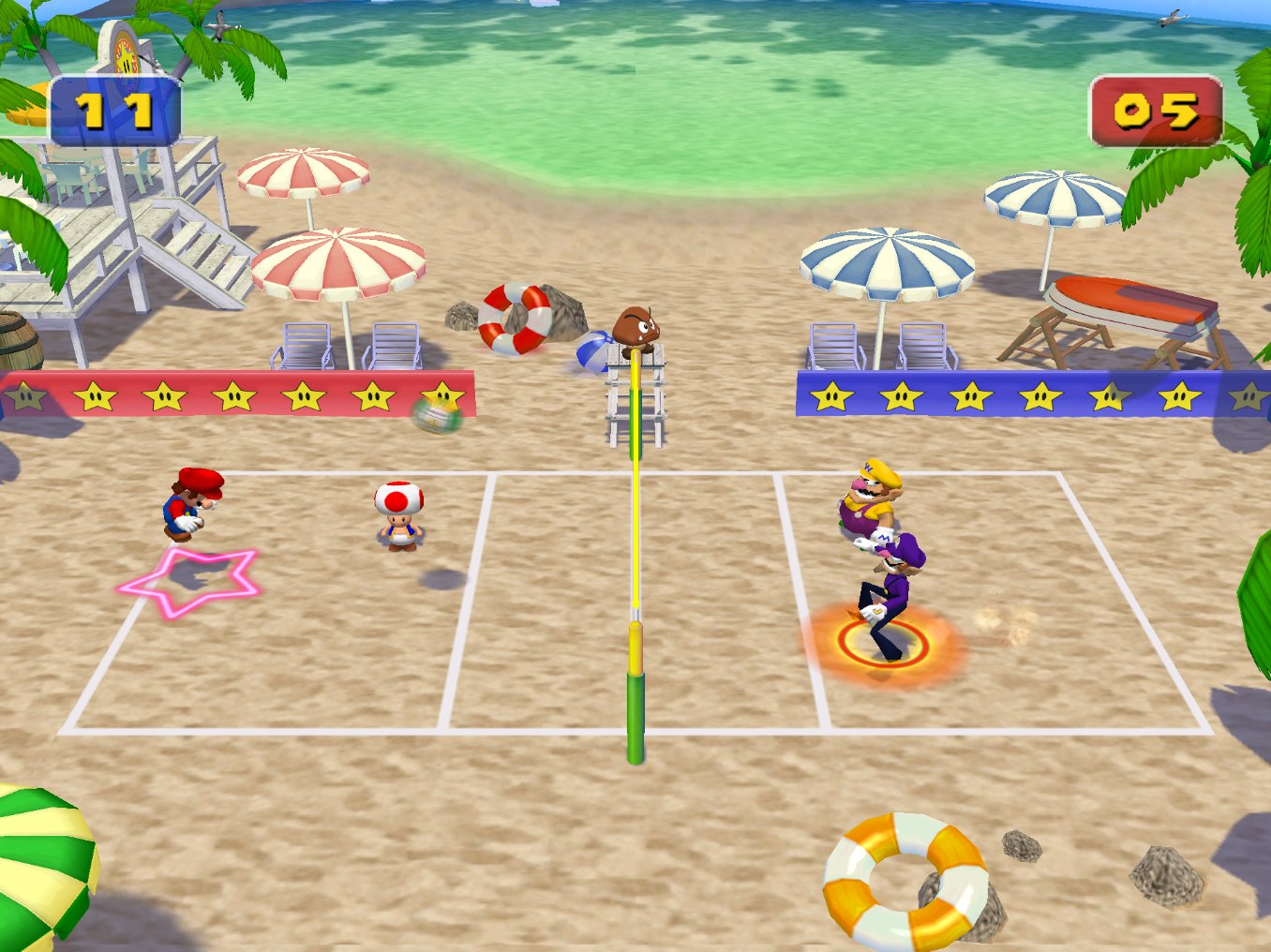
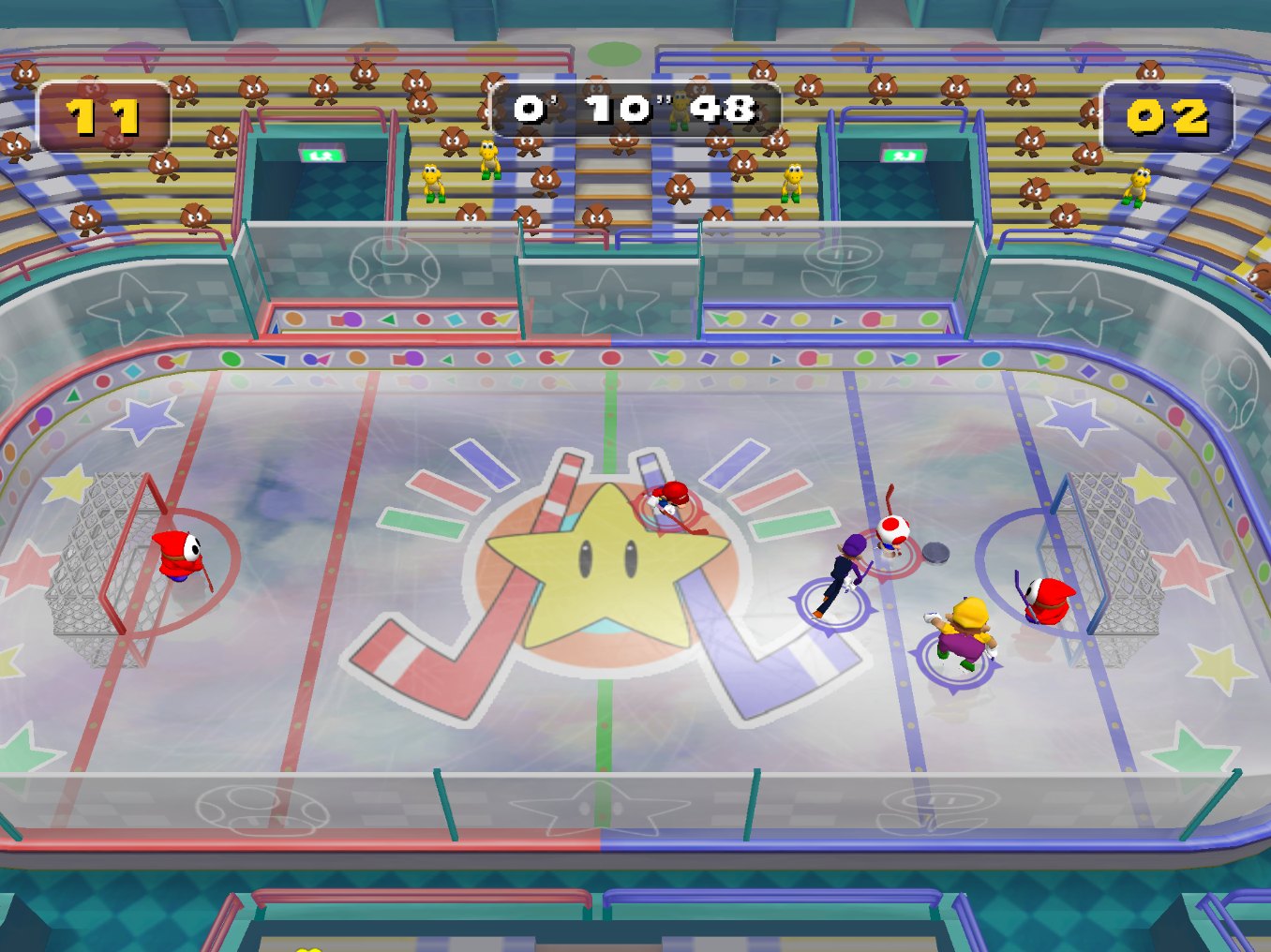
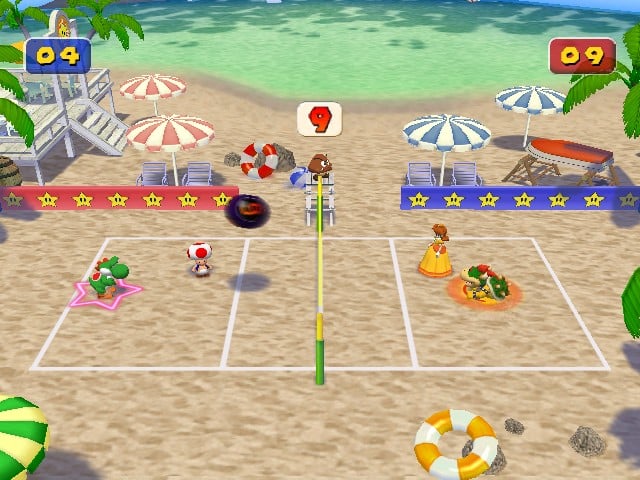
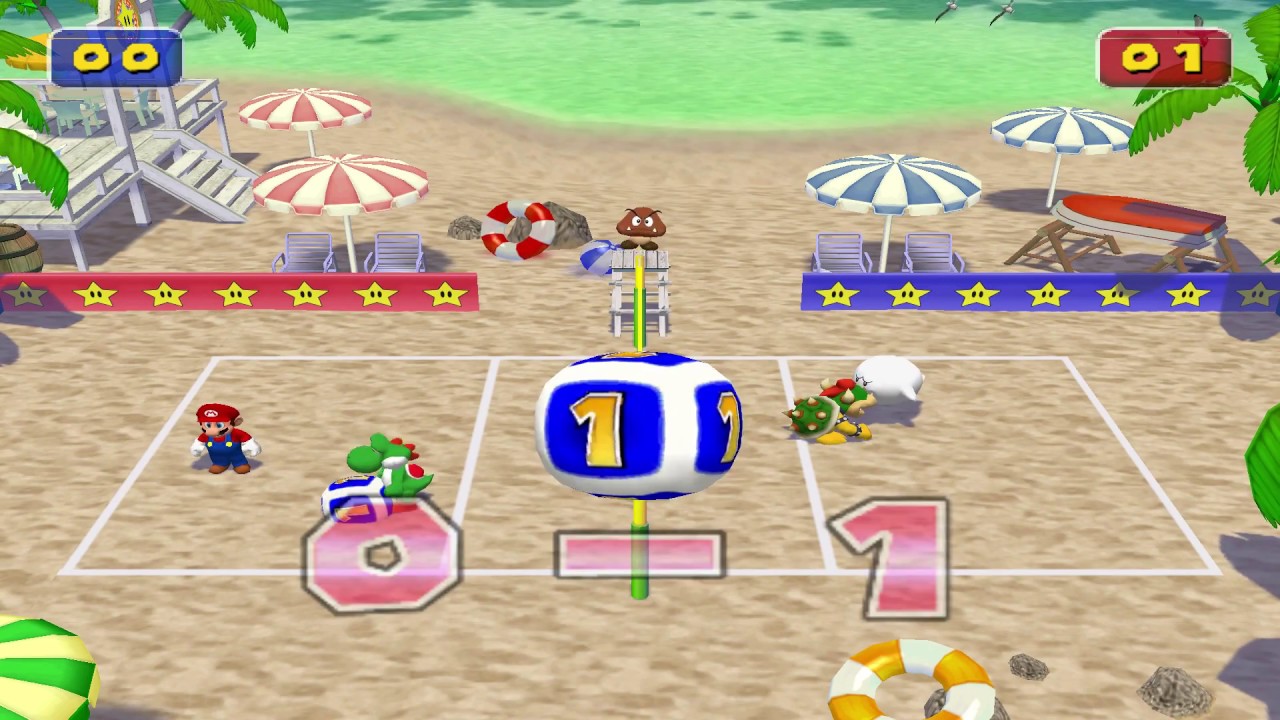
Beach Volleyball is Beach Volley Folley from Mario Party 4 with new toys: games to a target of 10 to 20 points, a Bob-omb Ball that explodes when its countdown runs out and a Dice Ball that decides how many points a rally was worth. Ice Hockey is new, two players a side plus a Shy Guy in goal, over 60, 180 or 270 seconds. It went on to appear in The Top 100 and Superstars.
Mamar introduces Bonus Mode.Card Party.A Double Star card.The Dice Ball in Beach Volleyball.
Every board in Mario Party 5
The seven boards with their sizes in Party Mode and in the cut-down Story Mode versions, counted in spaces. The game appears to give no difficulty ratings. Eldstar sells the Star for 20 coins on all of them, and each has one DK Space and starts with one Bowser Space.
Toy Dream66 spaces (21 in Story Mode)A toy train circles the board showering coins, and a jack-in-the-box flings you across it.
Rainbow Dream69 spaces (25 in Story Mode)Five weather clouds linked by rainbow bridges at 5 coins a crossing.
Pirate Dream74 spaces (27 in Story Mode)A Thwomp lift, a Whomp on the ladder, a cannon on the ship and Monty Mole’s coin dig.
Undersea Dream67 spaces (25 in Story Mode) · two capsule machinesA reef where a whale blows you towards the Star and a manta ray gives lifts.
Future Dream68 spaces (29 in Story Mode)Three space stations joined by rockets, teleporters and 10-coin air taxis.
Sweet Dream59 spaces (31 in Story Mode)Collapsing shortbread bridges and slices of cake that carry you away.
Bowser Nightmare76 spaces (24 in Story Mode) · unlocked by finishing Story ModeBowser answers every ? space in person, and the Spin Stage is a trap of minus spaces.
The Story Mode boards start with no Bowser Spaces, two or three VS Spaces each and a single DK Space.
Advertisement
Gameplay & Controls
Mario Party 5 plays like its predecessor with the shops taken out and the Mushrooms folded into a much bigger set of capsules. Duel minigames are back after a game away, Donkey Kong and Bowser each have a space, and Team Match now pools the partners’ coins.
How a game works
Four players, 10 coins each, and a roll of the Dice Block to decide who goes first. Eldstar hosts Party Mode on every board and sells the Star for 20 coins to whoever passes his space, then the Star moves. Plus spaces, the blue ones, give 3 coins and minus spaces take 3. Games run from 10 to 50 turns in steps of five.
After everyone has moved, the colours of the players’ panels choose the kind of minigame, as before: all alike for a 4-Player game, two against two, or three against one. The winner gets 10 coins. Sometimes a Battle minigame is called instead, with everyone paying into a pot that is shared out by finishing position. Duel, Bowser and DK minigames come from particular spaces and capsules, not from the end of the round.
You can choose which minigames the roulette draws from, though the custom packs of Mario Party 4 have gone. The sets are All, Easy, Action, Skill and Goofy.
Eldstar introduces Party Mode.Koopa Kid takes an air taxi in Future Dream.
The capsule system
Capsules replace the items that had been part of the series since Mario Party 2. Most boards have three capsule machines, Undersea Dream only two, and you are given a capsule each time you pass one. A player can carry three.
At the start of a turn you may do one of two things with a capsule. Throw it on to any plus or minus space up to ten spaces ahead. The space then shows an icon hinting at the kind of capsule lying there, and the effect goes off on whoever lands on it, friend or foe, yourself included. Throwing another capsule on to the same space replaces the first. Or use it on yourself by paying the price printed on it, anything from nothing to 20 coins.
That double use is the clever part. A Mushroom is worth paying 5 coins for. A Hammer Bro, which costs the victim 10 coins, is one to leave on the road in front of a rival. A Koopa Bank turns a space into a toll booth when thrown, and empties the till into your pocket when used. Three kinds, Bone, Bowser and Miracle, cannot be used on yourself at all.
A space holding a Move capsule.A Coin capsule space.A Capsule Event space.A Chance space.
Spaces
With so much done by capsules, the list of ordinary spaces is short: plus, minus, ?, Bowser, DK and Star. A ? space sets off the board’s own events. Hidden Blocks can lie under plus spaces only.
The DK Space is new, and there is one on every board. Donkey Kong appears and offers one of three treats. DK Bonus is a roll of the dice paid out in coins. DK Roulette is a rolling contest against DK himself, with a Star for beating his number. The third is a DK minigame in which all four players have ten seconds to grab bananas, which he then exchanges for coins at one, two or three coins apiece.
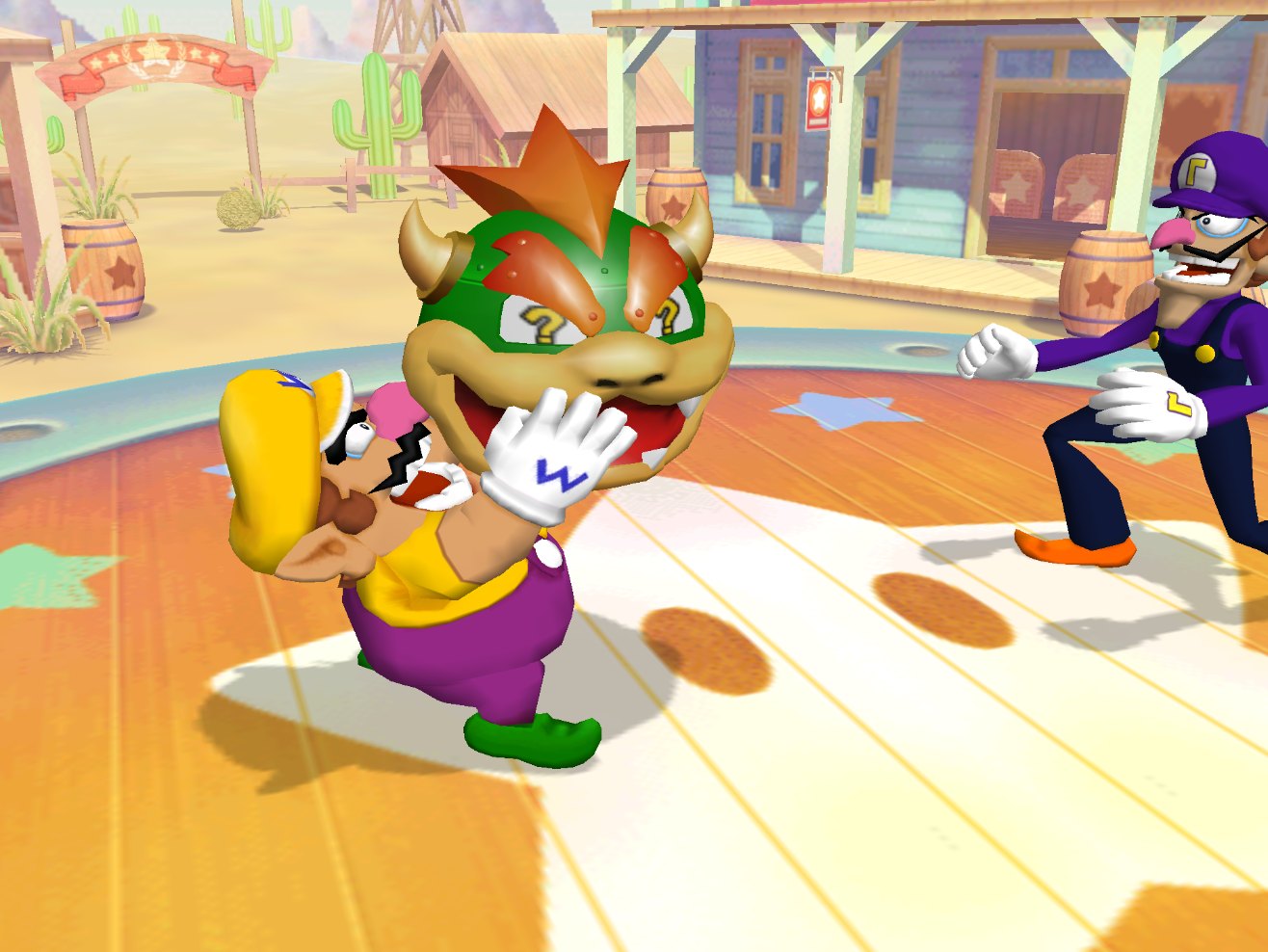
The Bowser Space is the reverse. One minus space is turned into a Bowser Space at the start of each game and Bowser Capsules can add more. Bowser arrives with an event that hurts the player who landed or the whole table, sometimes a Bowser minigame. Now and then Donkey Kong turns up and punches him out of the picture, though Bowser still makes off with 10 to 20 of your coins.
Plus space.Minus space.? space.Bowser Space.DK Space.Star Space.VS Space (Story Mode only).
Team Match, the last five turns and Bonus Stars
Team Match returns from Mario Party 4 with one important change: partners now share a single panel and a single purse. You choose who pairs with whom, and every one of the 45 possible pairings has a team name of its own, from the obvious (Mario and Luigi are the Mario Bros.) to the pointed (Peach and Wario are the Royal Pain, Luigi and Boo the Scare Pair). The names were kept for Mario Party 6.
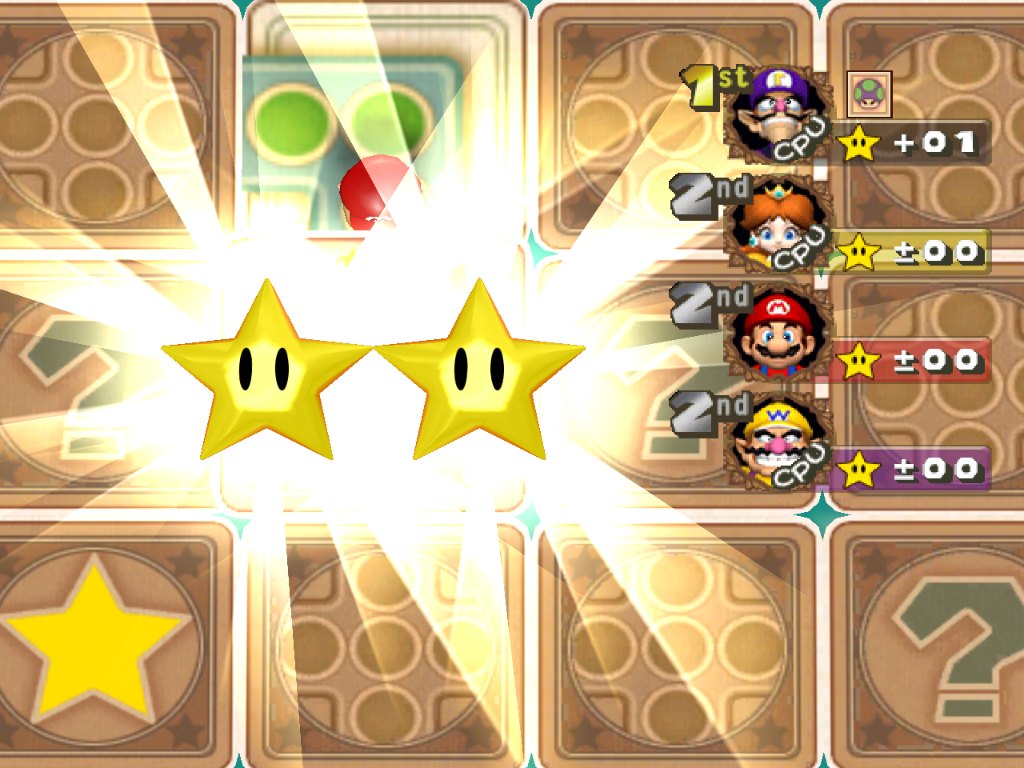
With five turns left Bowser takes the stage, reads out the standings and has the player in last place spin a wheel that changes a rule for the run-in. The possibilities include plus and minus spaces counting triple, every minus space becoming a Bowser Space and five Star Spaces being open at once. From then on two players meeting on the same space must also fight a Duel.
At the end Eldstar counts up. If bonuses are on, there are Hidden Blocks during play and three Bonus Stars afterwards: the Mini-Game Star for most coins won in minigames, Battle games now included, the Coin Star for most coins amassed, and the Happening Star for most ? spaces. Handicaps of up to nine Stars can be set, and finishing Story Mode on Hard adds a further computer difficulty, Intense.
Mini-Game Mode
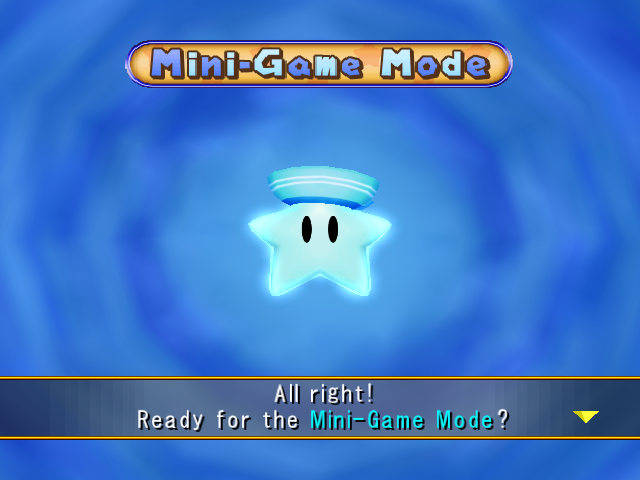
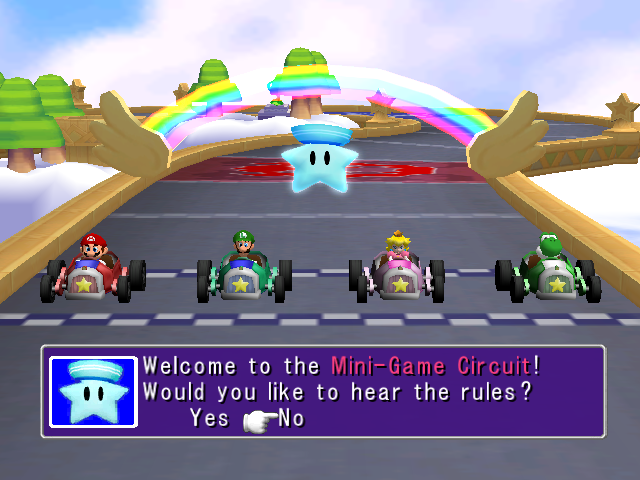
Muskular runs Mini-Game Mode, which has six ways to replay the games you have unlocked in Party and Story Mode. Free Play and Mini-Game Battle, a race to three, five or seven wins, are familiar. Mini-Game Circuit is a car race along a track in which only the winner of each minigame gets to roll the dice, with Duels and Bowser minigames lying in wait on certain stretches.
Mini-Game Decathlon scores you across ten fixed events: Ground Pound Down, Chomp Romp, Flower Shower, Leaf Leap, Night Light Fright, Dinger Derby, Hydrostars, Will Flower, Later Skater and Triple Jump. Mini-Game Wars is a battle for 19 hexagonal tiles, claimed by winning minigames and captured by surrounding them. Mini-Game Tournament is a knockout of Duels with a play-off for third place.
Muskular introduces Mini-Game Mode.Mini-Game Circuit.Kalmar in Options Mode, home of the records and the sound test.
Every capsule in Mario Party 5
All 28, in the game’s four groups. The price is what it costs to use the capsule on yourself; throwing is always free.
Mushroom CapsuleMove · 5 coins. Roll two Dice Blocks. A double pays 10 coins, double seven 30.
Super Mushroom CapsuleMove · 10 coins. Roll three Dice Blocks. Three of a kind pays 30 coins, three sevens 50.
Cursed Mushroom CapsuleMove · 5 coins. The Dice Block only goes up to 5. One to throw at somebody else.
Warp Pipe CapsuleMove · 10 coins. Swap places with a player picked by roulette.
Klepto CapsuleMove · 10 coins. Klepto carries you to the space of a player picked by roulette.
Bubble CapsuleMove · 10 coins. Float ten spaces forward. You cannot steer at junctions and you drop all your other capsules. It will carry you over the bridges of Sweet Dream without breaking them.
Wiggler CapsuleMove · 20 coins. Wiggler takes you straight to the Star Space, where the 20 coins buy the Star.
Hammer Bro CapsuleCoin · 5 coins. Whoever it lands on loses 10 coins.
Coin Block CapsuleCoin · 5 coins. Collect 10 coins from a Coin Block.
Spiny CapsuleCoin · 5 coins. Steal 10 coins from a player chosen at random.
Paratroopa CapsuleCoin · 10 coins. Roll a Dice Block: every opponent loses that many coins.
Bullet Bill CapsuleCoin · 10 coins. On your next roll you take 30 coins from every opponent you pass, but cannot choose your way at junctions.
Goomba CapsuleCoin · 5 coins. Swap coin totals with a player picked by roulette.
Piranha Plant CapsuleCoin · 5 coins. Lose half your coins. Strictly for throwing.
Bob-omb CapsuleCoin · free. A time bomb: the third player to pass or land on its space loses 20 coins.
Koopa Bank CapsuleCoin · 10 coins. Thrown, it makes a Bank Space where passers-by deposit 5 coins and whoever lands takes the lot. Used on yourself, it pays out everything in the bank.
Kamek CapsuleCapsule · 10 coins. Kamek shuffles every player’s capsules.
Mr. Blizzard CapsuleCapsule · 5 coins. Whoever it lands on loses all their capsules.
Magikoopa CapsuleCapsule · 10 coins. Swap capsules with a player picked by roulette.
Ukiki CapsuleCapsule · 10 coins. Choose a player: Ukiki flings all their capsules on to random spaces.
Lakitu CapsuleCapsule · 10 coins. Steal one capsule from the player of your choice.
Tweester CapsuleSpecial · 15 coins. A whirlwind carries the Star Space off to another part of the board.
Duel CapsuleSpecial · 10 coins. Thrown, it makes a Duel Space. Used, it starts a Duel minigame against another player.
Chain Chomp CapsuleSpecial · 15 coins. This game’s Boo: steals coins or a Star from a player you choose, for a further fee.
Bone CapsuleSpecial · cannot be used or thrown, only kept or discarded. Automatically buys off one Chain Chomp attack.
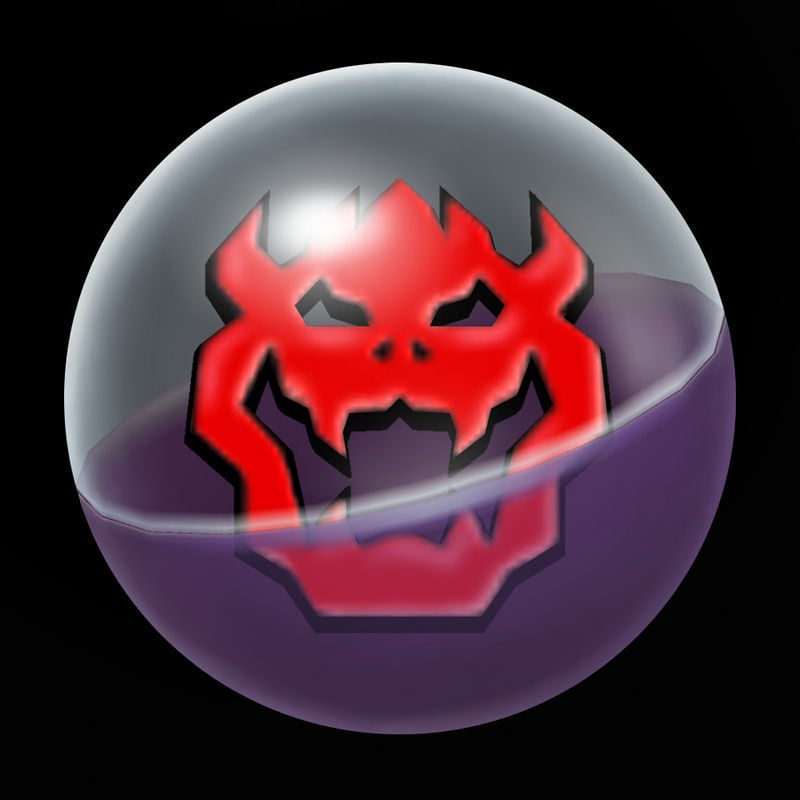
Bowser CapsuleSpecial · not yours to use. The moment you receive it Bowser throws it on to a random minus space, which becomes a Bowser Space.
Chance CapsuleSpecial · 20 coins. Starts the Chance Roulette, or makes a Chance Space if thrown.
Miracle CapsuleSpecial · cannot be used or thrown. Collect three and they go off by themselves, giving every Star held by the leader to the player in last place.
Cartoons, Comics & Other Media
Mario Party 5 was sold with a mock election, turned up in Japanese arcades as a coin pusher and has supplied later Mario Party collections with more minigames than most.
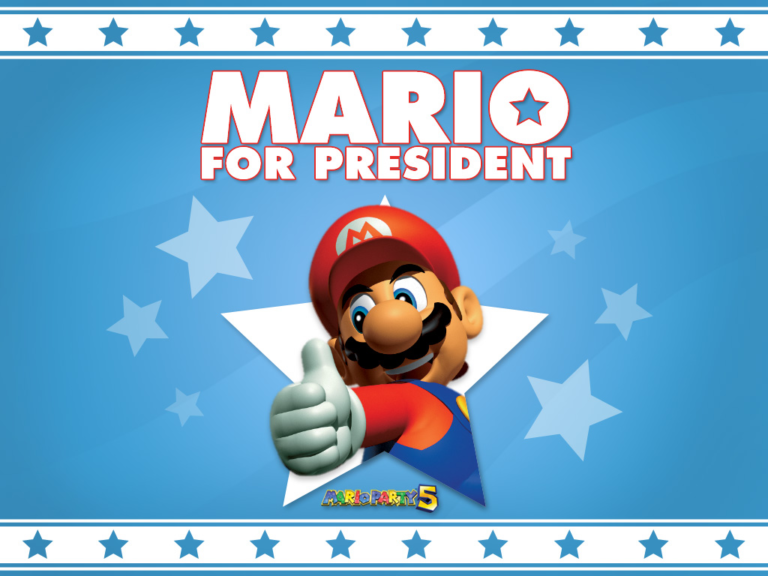
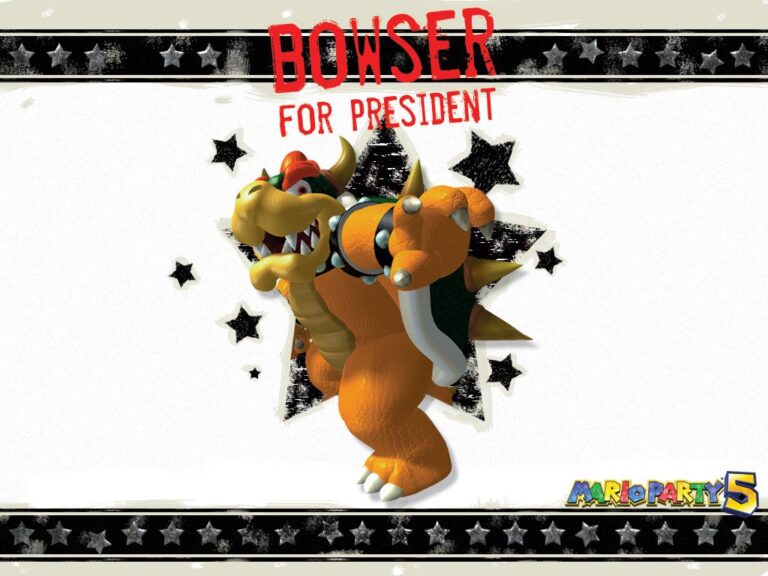
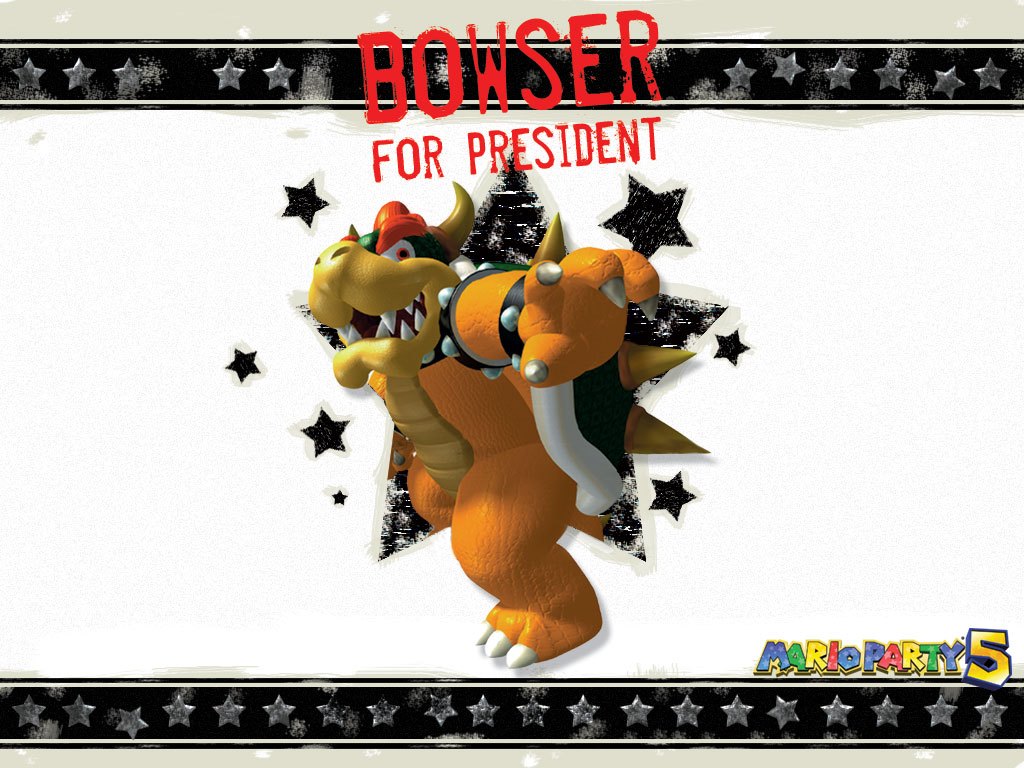
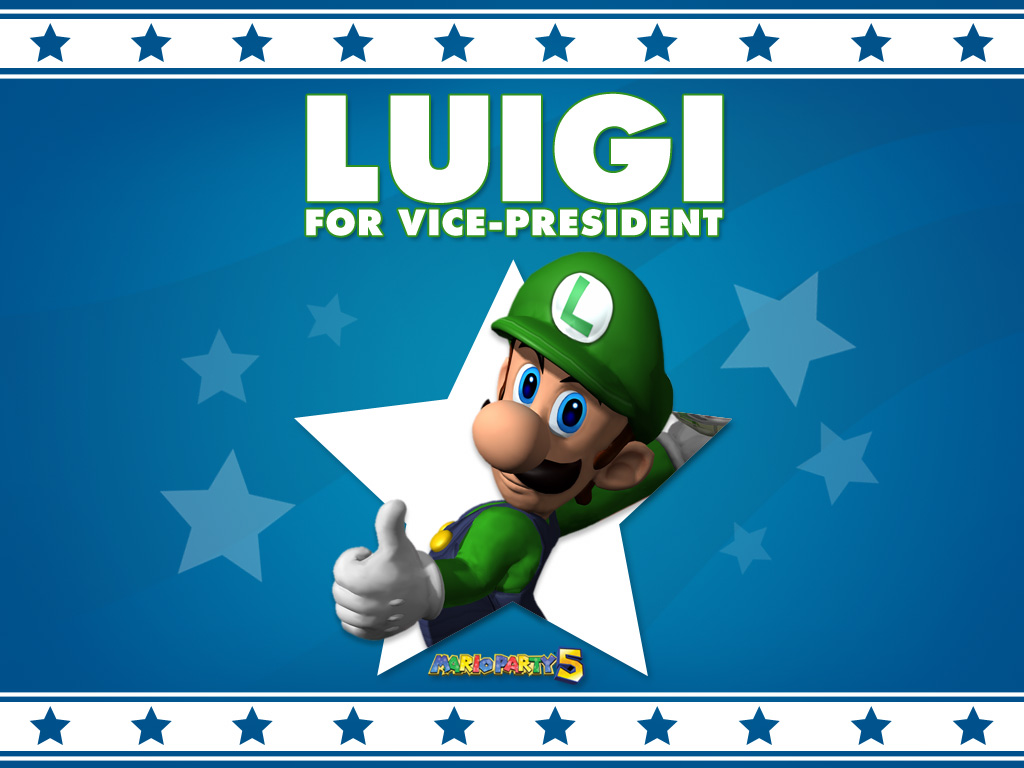
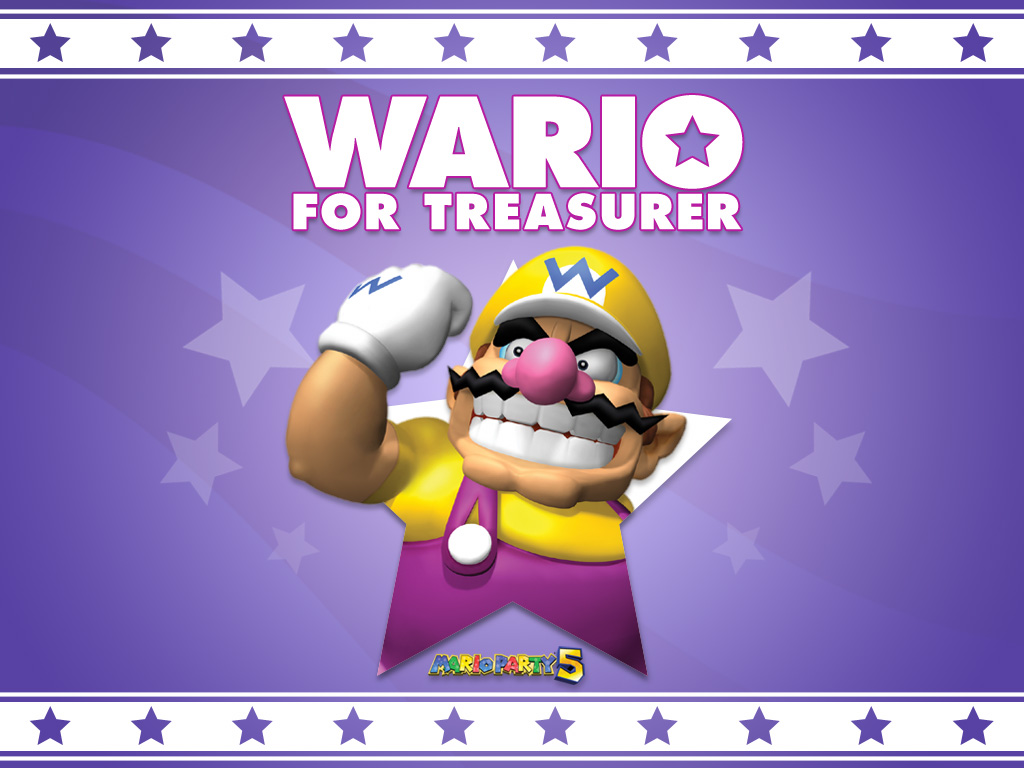
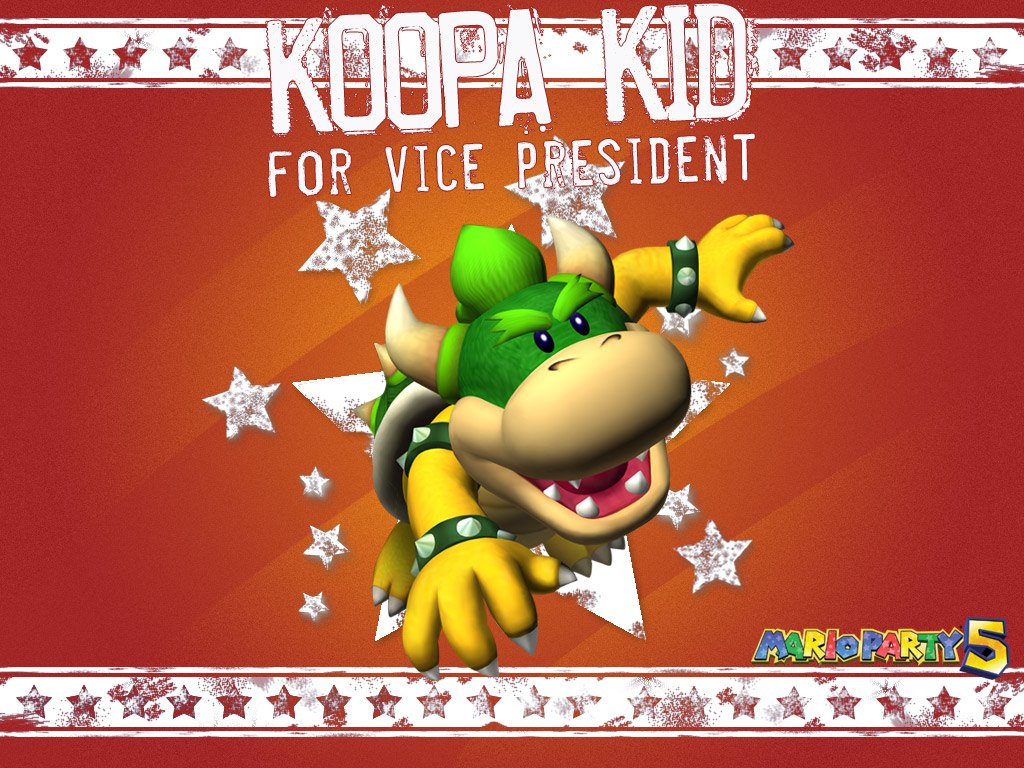
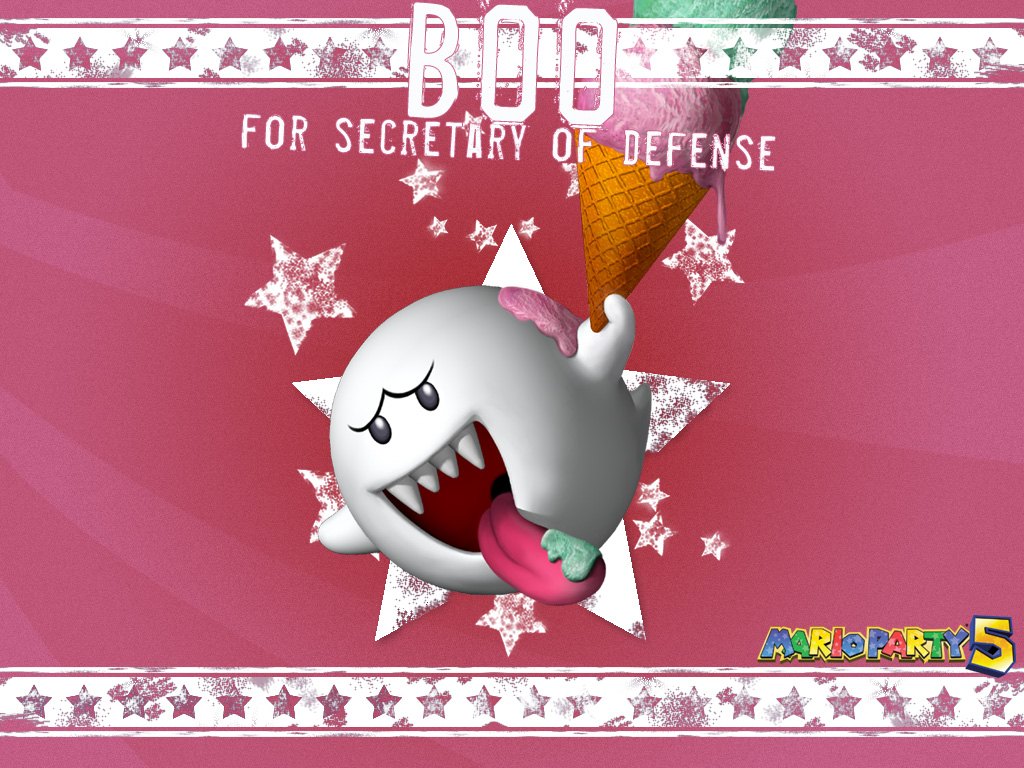
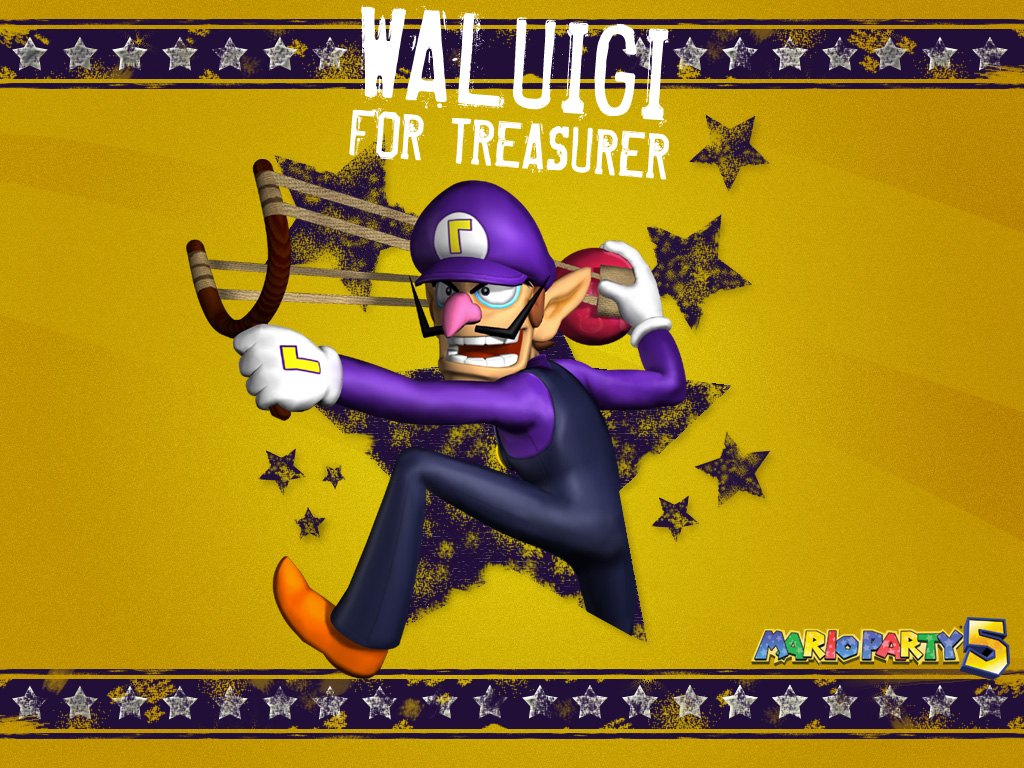
Mario for PresidentPromotion · North America · 2003–04Nintendo of America’s campaign parodied American presidential politics, timed to the 2004 primaries. Mario ran against Bowser, with Luigi and Koopa Kid as running mates, Donkey Kong and Boo as defence secretaries and Wario and Waluigi as rival treasurers. In the television commercial a man in a Mario costume takes questions from the press and answers one by throwing a Koopa shell.
Mario Kart: Double Dash!! Bonus DiscGameCube demo · 2003A playable demo was included on the bonus disc given away with Mario Kart: Double Dash!! in North America. It had a different title screen.
Super Mario Fushigi no Korokoro PartyArcade · Capcom · Japan, September 2004A coin-pusher arcade machine based on Mario Party 5, developed and published by Capcom for Japan only, with room for six players. It was Capcom’s first Mario Party arcade game and had a sequel.
Prima’s Official Strategy GuideGuide book · Prima GamesPrima Games published the official guide.
Dance Dance Revolution: Mario MixGameCube · 2005The Toy Dream music is rearranged as the song “Cabin Fever”.
Mario Party 6GameCube · 2004Capsules became Orbs, the DK Space stayed and the 45 team names were carried over unchanged.
Mario Party: The Top 100Nintendo 3DS · 2017Seventeen minigames return: Button Mashers, Cage-in Cookin’, Coney Island, Defuse or Lose, Dinger Derby, Heat Stroke, Hotel Goomba, Ice Hockey, Later Skater, Leaf Leap, Manic Mallets, Night Light Fright, Pushy Penguins, Shy Guy Showdown, Squared Away, Triple Jump and Tube It or Lose It. The Star Spirits have a cameo in its series guide.
Mario Party SuperstarsNintendo Switch · 2021Ten minigames carry the Mario Party 5 logo: Dinger Derby, Leaf Leap, Pushy Penguins, Coney Island, Bill Blasters, Night-Light Fright, Later Skater, Squared Away, Tube It or Lose It and Ice Hockey.
Super Mario Party JamboreeNintendo Switch · 2024Leaf Leap and Defuse or Lose are among its returning minigames.
Characters
Ten playable characters, three of them new, followed by the seven Star Guards and the rest of the cast. All ten play alike. In Team Match every pairing has its own name, and a few are given here. The actors are not credited in the staff roll, so the voices given are as usually attributed.
Character
Who they are
In this game
Abilities & notes
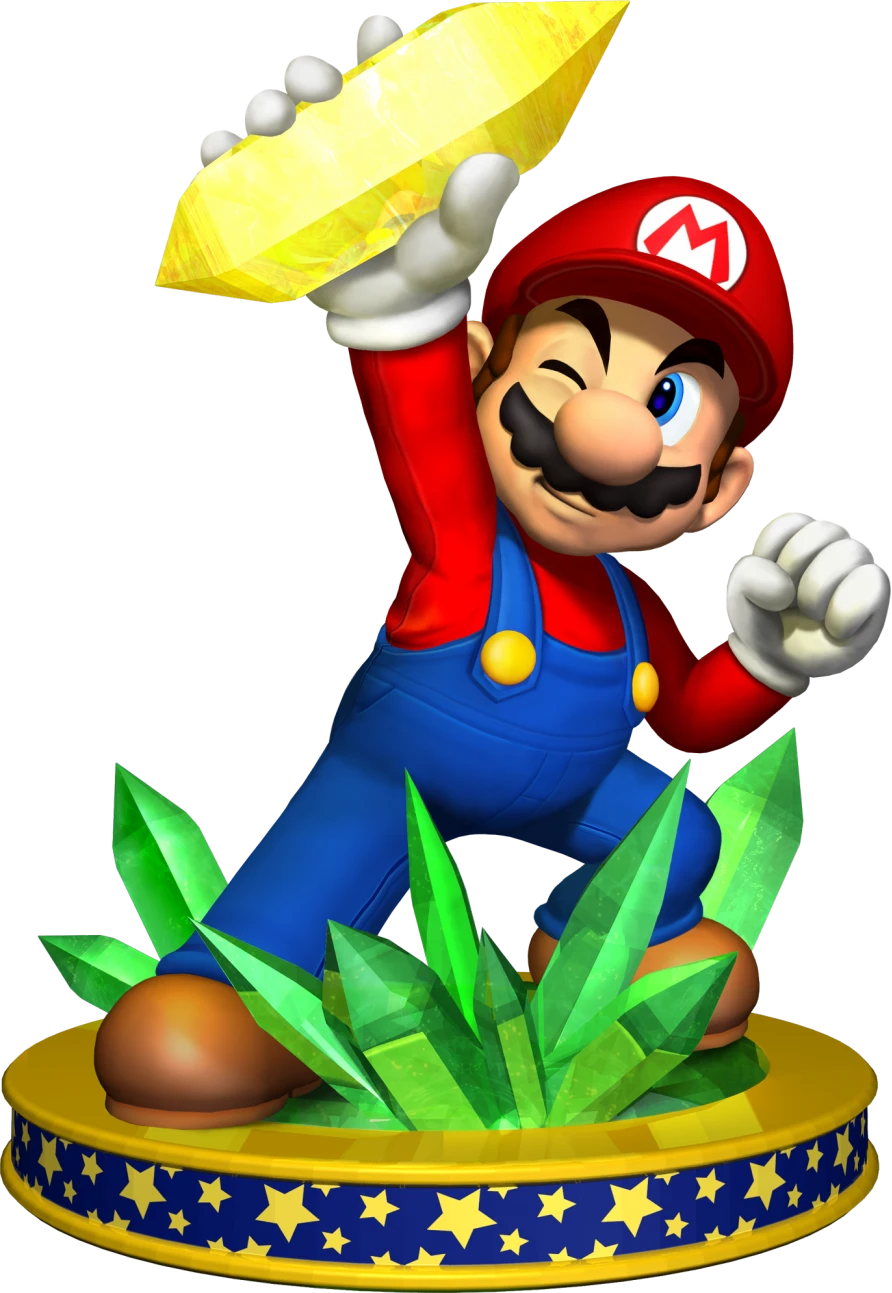
MarioPlayable
The hero, drawn for this game playing Frozen Frenzy.
One of the seven characters allowed in Story Mode and Card Party. Presidential candidate in the advertising.
Team names: Mario Bros. (with Luigi), Cutest Couple (Peach), Famous Combo (Yoshi), Alter Egos (Wario). Voice: Charles Martinet.
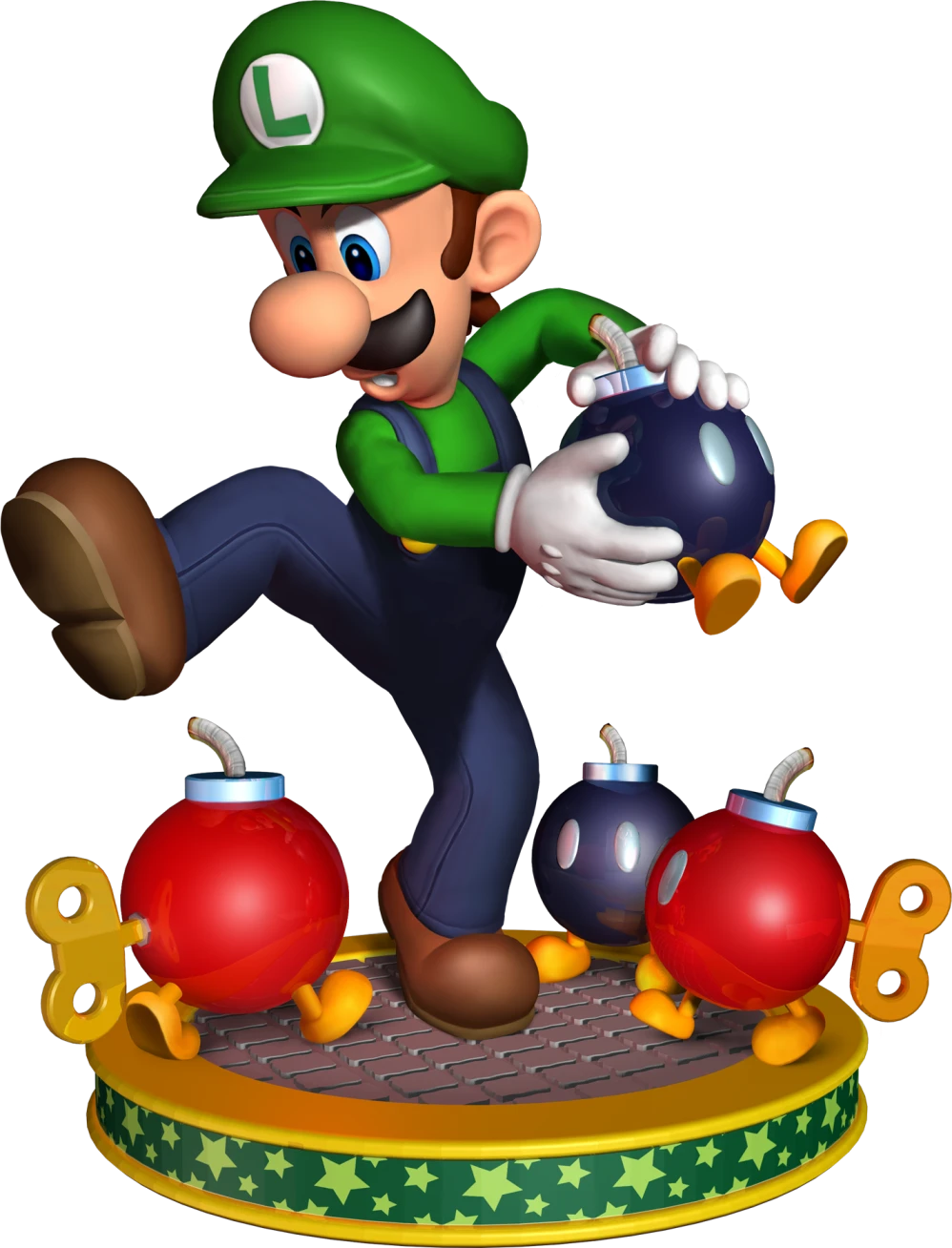
LuigiPlayable
Mario’s brother, pictured in Dodge Bomb.
Playable in every mode.
Team names: Green Bros. (with Yoshi), Steady Sweeties (Daisy), Scare Pair (Boo), Unlikely Bros. (Waluigi). Voice: Charles Martinet.
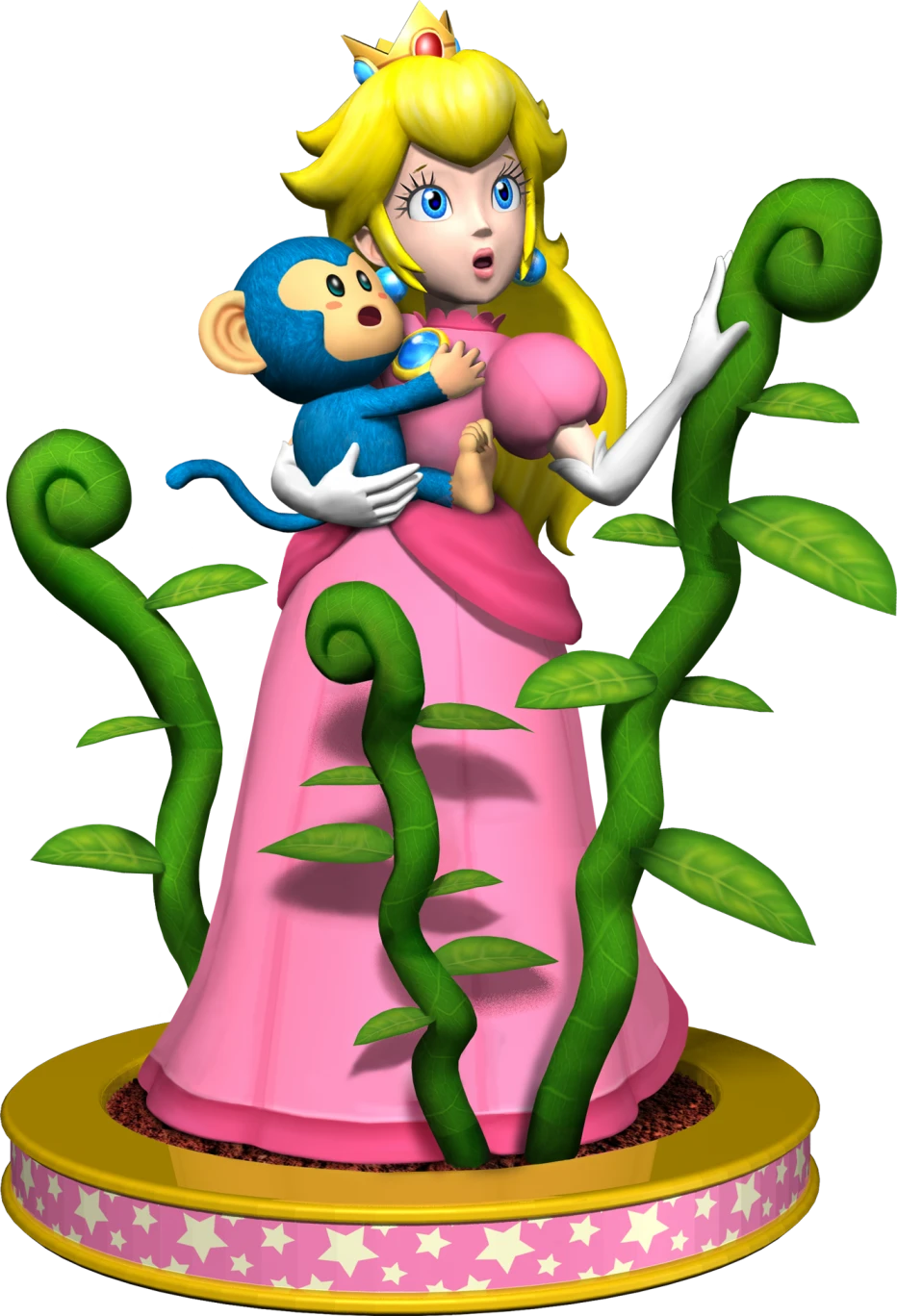
Princess PeachPlayable
The princess, pictured chasing Ukikis in Chimp Chase.
Playable in every mode.
Team names: Lordly Ladies (with Daisy), Royal Family (Toad), Royal Pain (Wario), Anti-Couple (Waluigi). Voice: Jen Taylor.
Playable in every mode. Mario’s treasurer in the election campaign.
Team names: Wicked Bros. (with Waluigi), Mushroom Stinkers (Toad), Bad Baddies (Koopa Kid). Voice: Charles Martinet.
Princess DaisyPlayable
Pictured at bat in Dinger Derby.
Playable in every mode.
Team names: Nice Couple (with Mario), Royal Ride (Yoshi), Awkward Date (Waluigi), Haunted Flower (Boo). Voice: Jen Taylor.
WaluigiPlayable
Pictured in Berry Basket.
Playable in every mode. Bowser’s treasurer in the election campaign.
Team names: Pseudo Bros. (with Mario), Tall ‘n’ Small (Toad), Cheap Chaps (Koopa Kid). Voice: Charles Martinet.
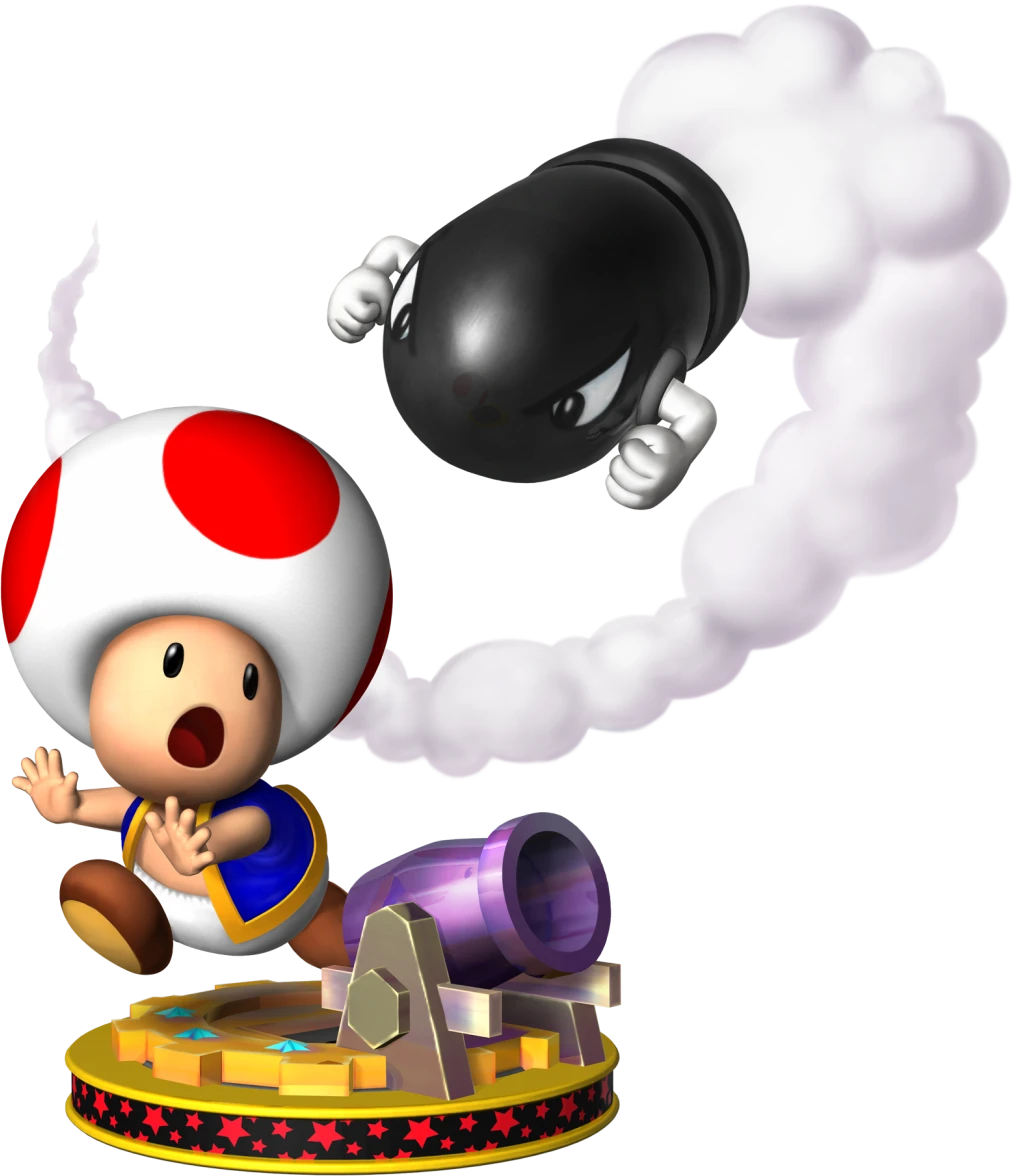
ToadPlayable · new
Host of the first two games and one of the Party Cube’s five. His artwork shows him in Bill Blasters.
On the boards as a player for the first time. Not available in Story Mode or Card Party, though a computer-controlled Toad is your partner in Story Mode’s two-against-two games.
Team names: Best Buds (with Mario), Good Pals (Luigi), Little Guys (Koopa Kid). Voice: Jen Taylor.
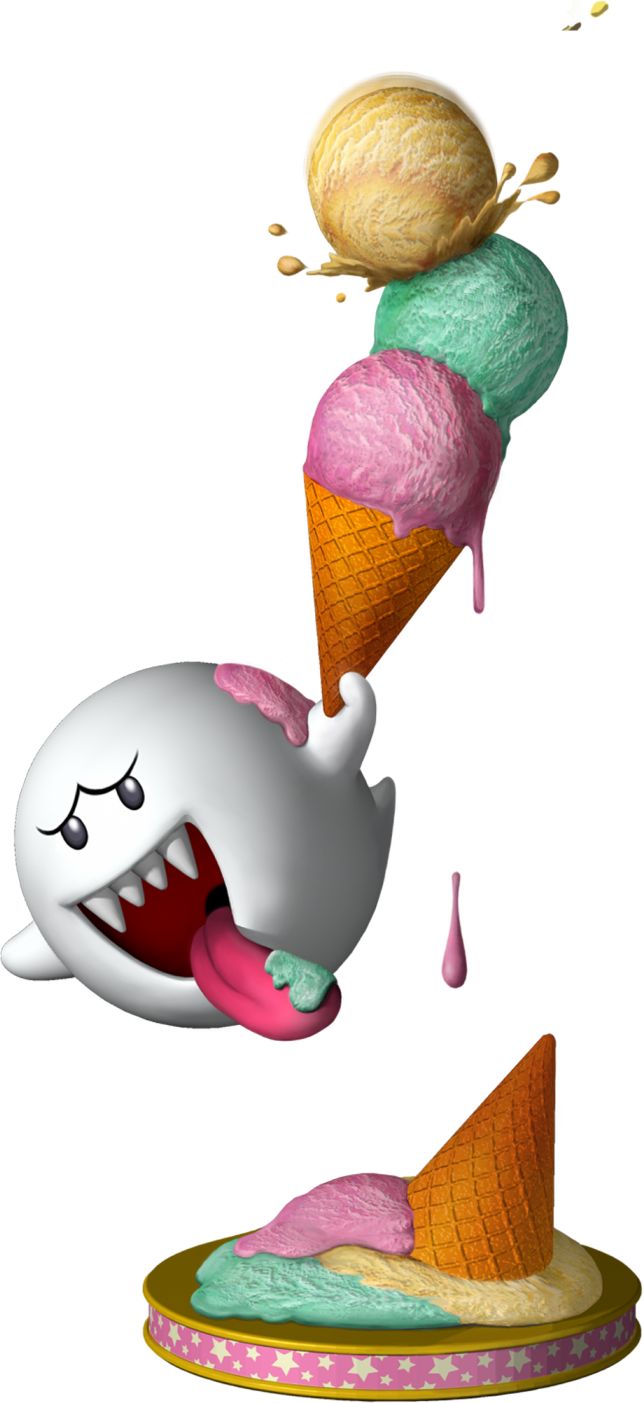
BooPlayable · new
The thief of the earlier games, whose old job has gone to the Chain Chomp Capsule. Pictured in Coney Island.
Playable for the first time. Not available in Story Mode or Card Party.
Team names: Old Acquaintances (with Mario), Royally Spooky (Peach), Scaredy Toad (Toad), Pure Evil (Koopa Kid).
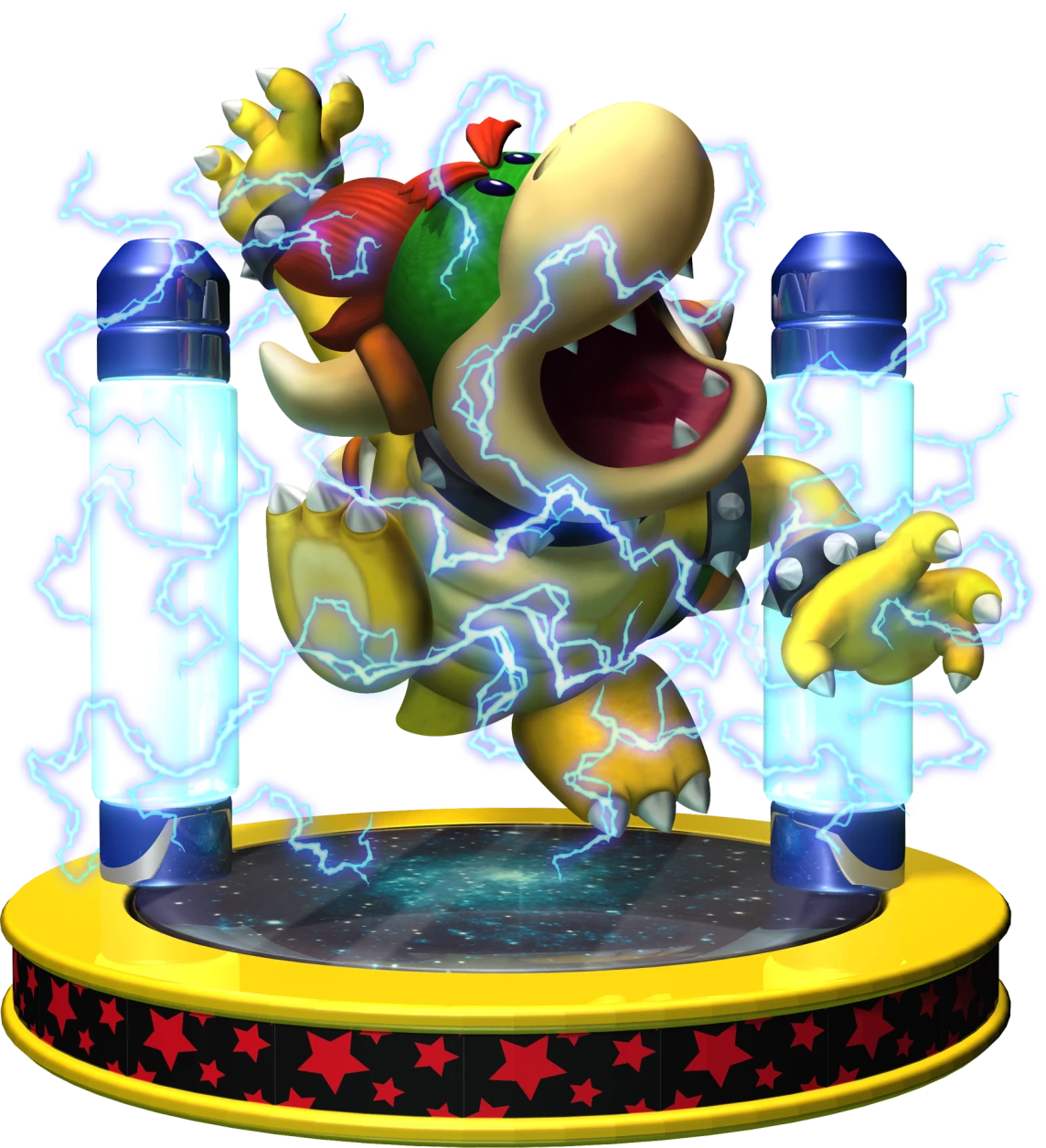
Koopa KidPlayable · new
One of Bowser’s miniature look-alikes, called Mini Bowser in PAL versions. Pictured in Mazed & Confused.
By most accounts the first of Bowser’s minions to be playable on the boards. Not available in Story Mode, where his three coloured brothers are the opposition, or in Card Party.
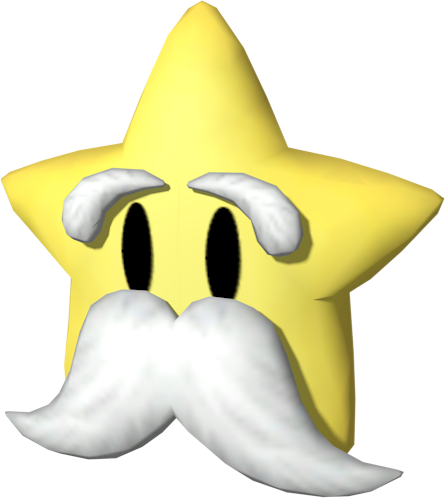
First among the Star Guards in this game: he fronts the main mode.
Hosts Party Mode, introduces every board, sells the Stars and announces the results.
Star price: 20 coins.
MisstarStar Guard · Story Mode
A Star Spirit from Paper Mario.
Hosts Story Mode.
Appears in the Mario Party 5 group artwork with the other six.
MuskularStar Guard · Mini-Game Mode
A Star Spirit from Paper Mario.
Hosts Mini-Game Mode and its six sub-modes.
Six modes, from Free Play to Tournament.
SkolarStar Guard · Super Duel Mode
A Star Spirit from Paper Mario.
Runs the Super Duel garage and sells the machine parts. The best parts in the mode carry his name.
Skolar body, tyres, engine and gun: unlocked for purchase by winning every contest on every difficulty.
MamarStar Guard · Bonus Mode
A Star Spirit from Paper Mario.
Hosts Bonus Mode: Card Party, Beach Volleyball and Ice Hockey.
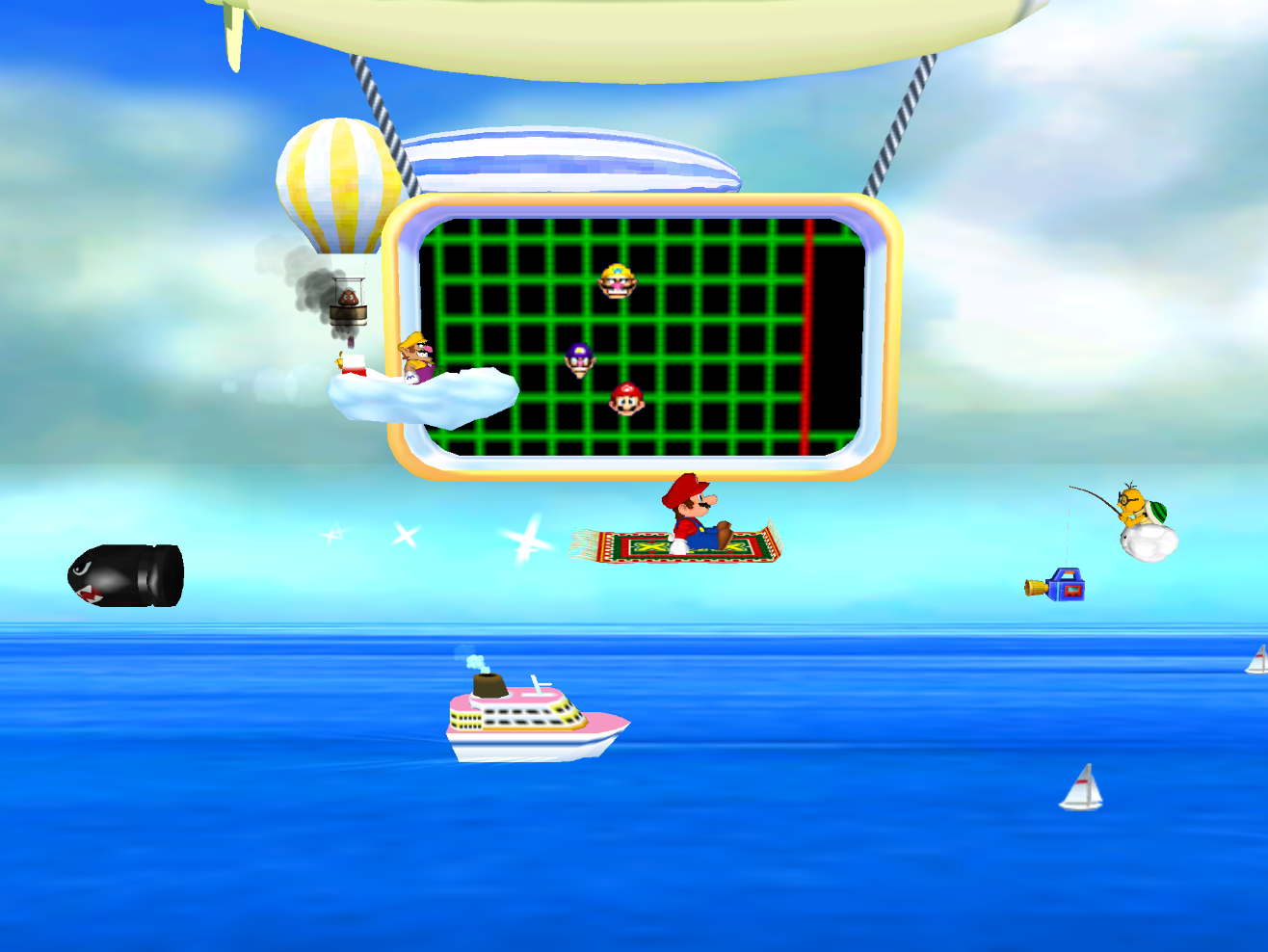
Three games found nowhere else.
KalmarStar Guard · Options Mode
A Star Spirit from Paper Mario.
Hosts Options Mode: sound, rumble, records and the music and voice test.
Sound in stereo, mono or surround.
KlevarStar Guard · Dream Depot
A Star Spirit from Paper Mario.
Greets you at the main menu and turns up in board events, most visibly as keeper of the rainbow bridges in Rainbow Dream.
Bridge toll: 5 coins.
BowserVillain
Out to ruin everyone’s dreams.
Appears on Bowser Spaces, compères the last five turns, answers every ? space on Bowser Nightmare and is the opponent in Frightmare. Drives the Bowser Dozer in Super Duel Mode.
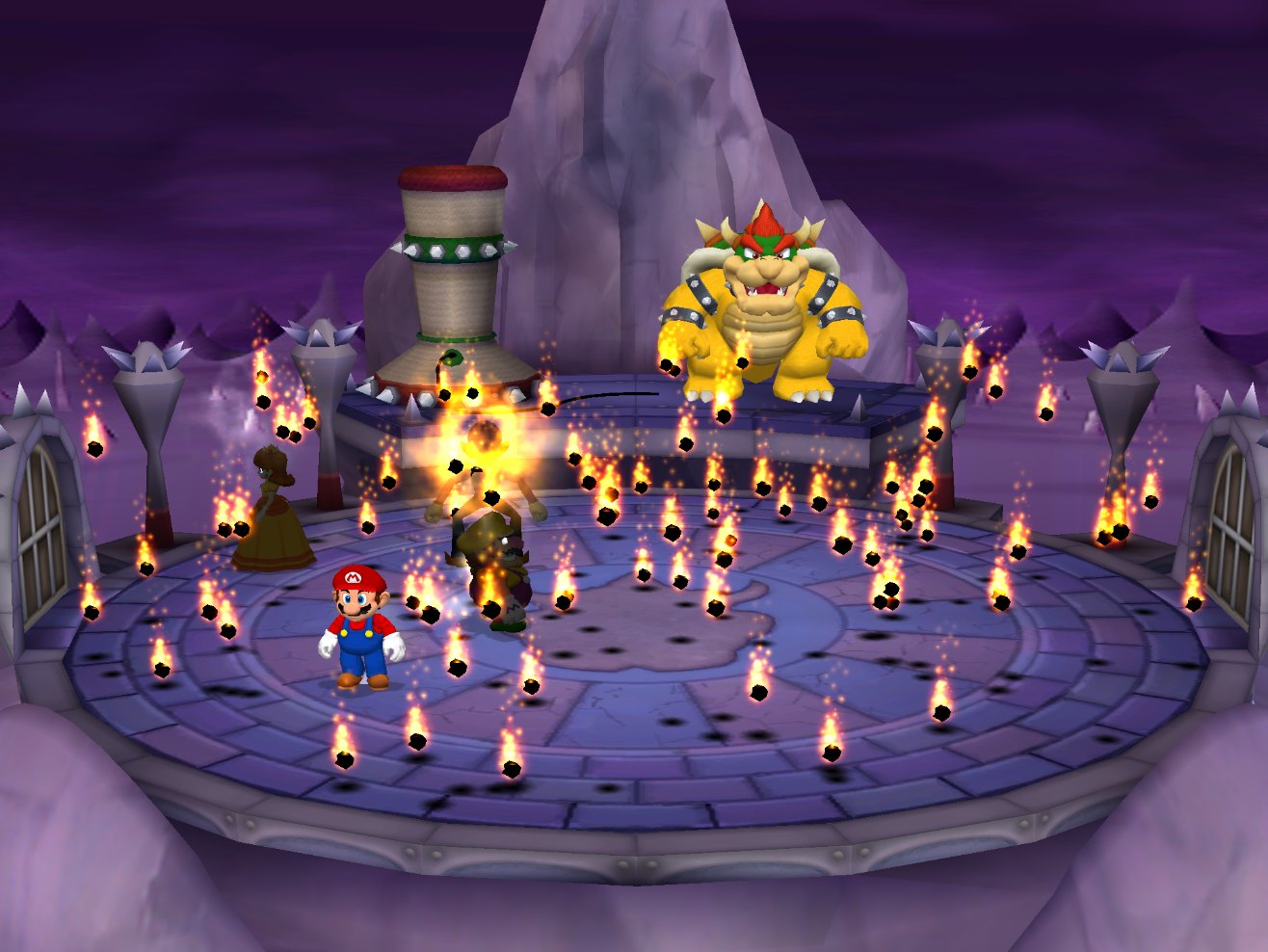
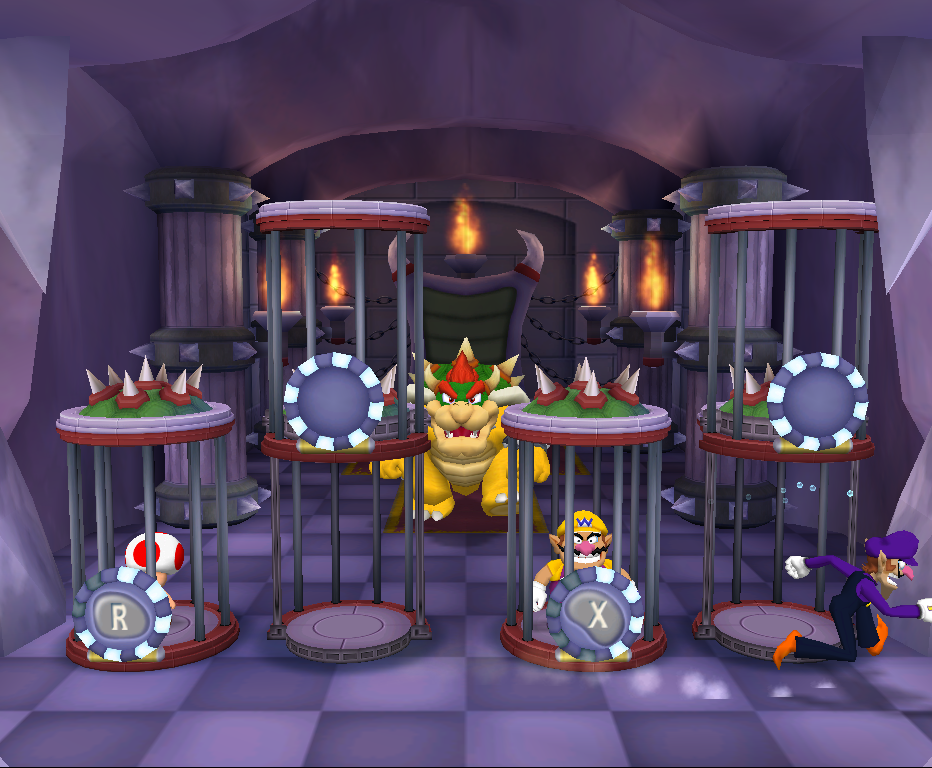
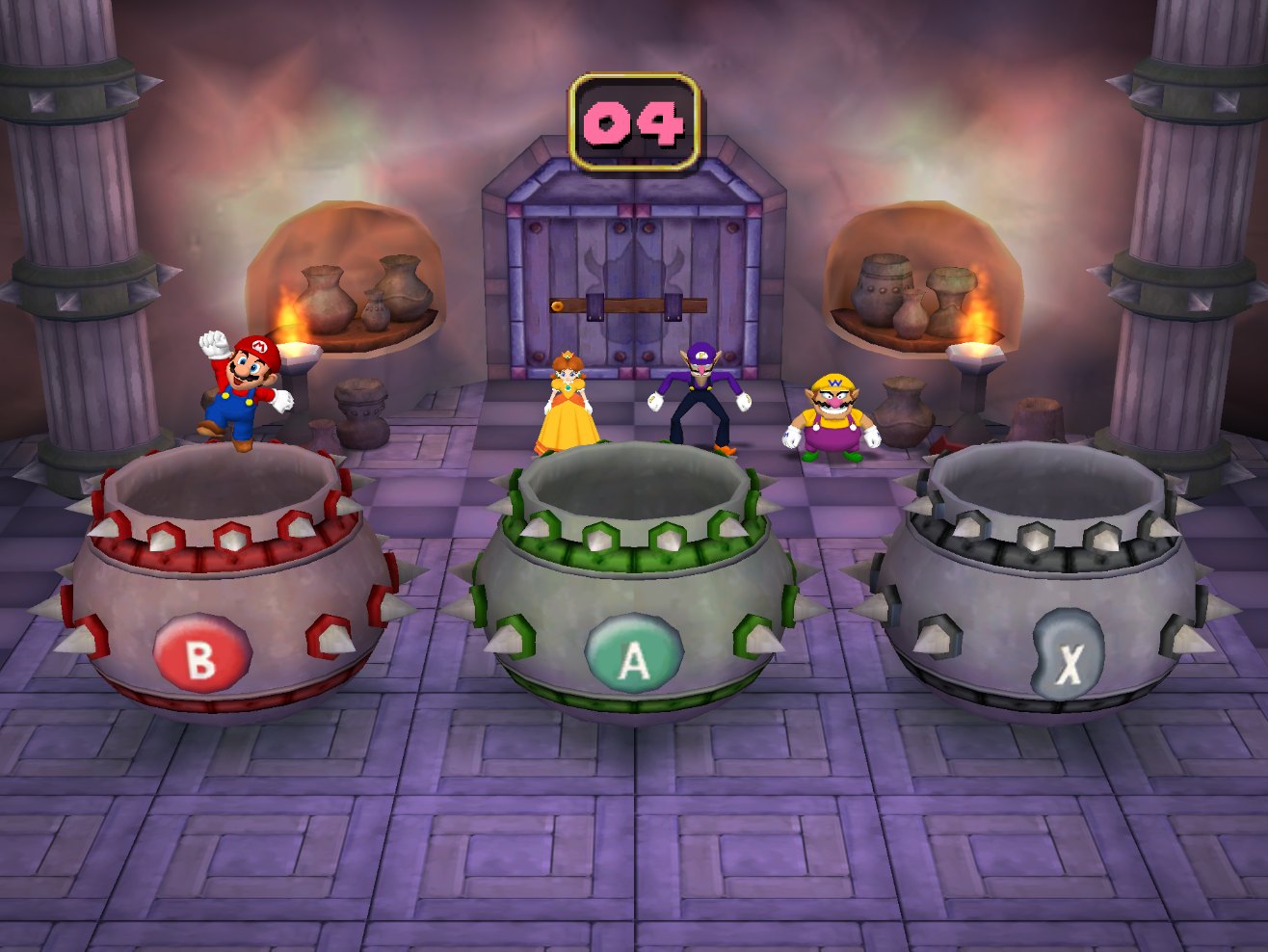
Three Bowser minigames: Rain of Fire, Cage-in Cookin’ and Scaldin’ Cauldron.
Red, Blue and Green K. KidStory Mode opponents
Three Koopa Kids told apart by colour. Nintendo called them the Koopa Kid Brigade.
Your three opponents on every Story Mode board. They move together and are knocked out one by one as their coins run dry.
Beaten when all three have no coins left, within 15 turns.
Donkey KongHost of the DK Space
Playable in the first four games, now a part of the board.
Hosts the DK Space, with DK Bonus, DK Roulette and three DK minigames, and sometimes knocks Bowser off a Bowser Space. Unlockable as a driver in Super Duel Mode. Mario’s defence secretary in the adverts.
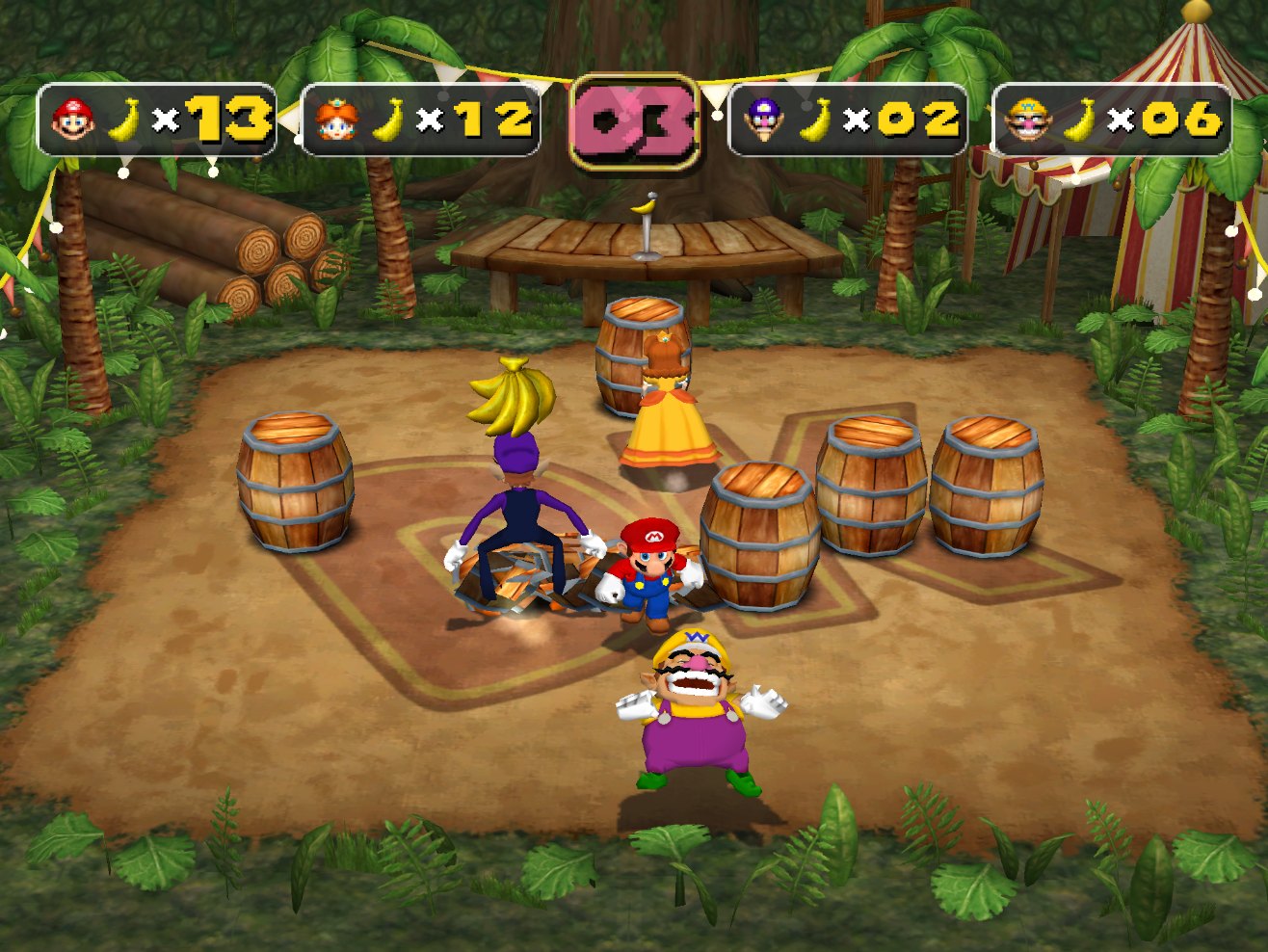
DK minigames: Banana Punch, Da Vine Climb, Mass A-peel.
Every minigame in Mario Party 5
All 77, in the usual order: 23 for four players, 12 one-against-three, 12 two-against-two, 6 Battle, 15 Duel, 3 Bowser, 3 DK, 1 Story and 2 Bonus. “Coin” marks the four coin-collecting games. Later appearances cover The Top 100, Superstars and Jamboree.
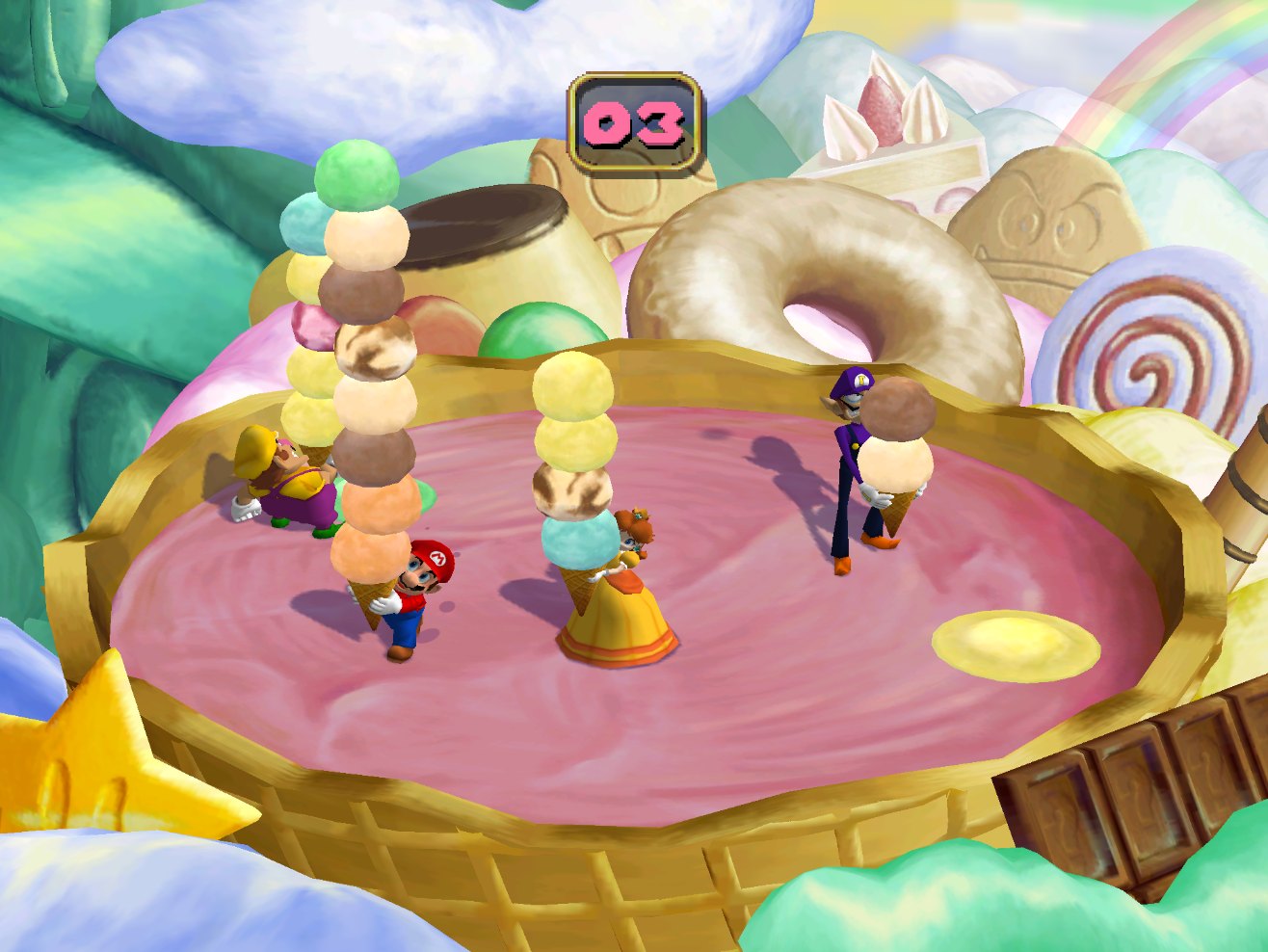
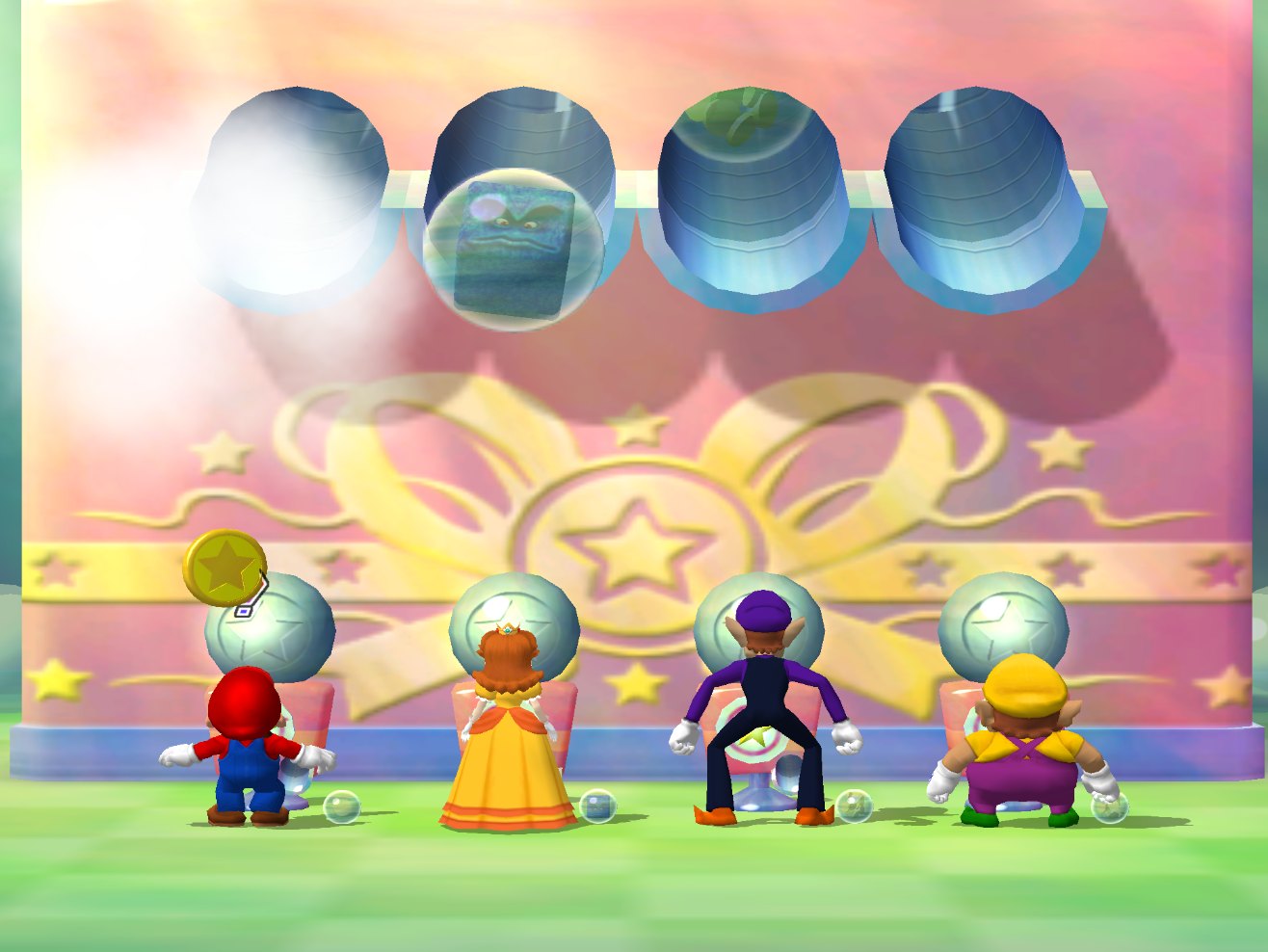
Coney Island4-PlayerCatch falling scoops of ice cream on your cone, judging each by its shadow. The tallest stack wins. In The Top 100 and Superstars.
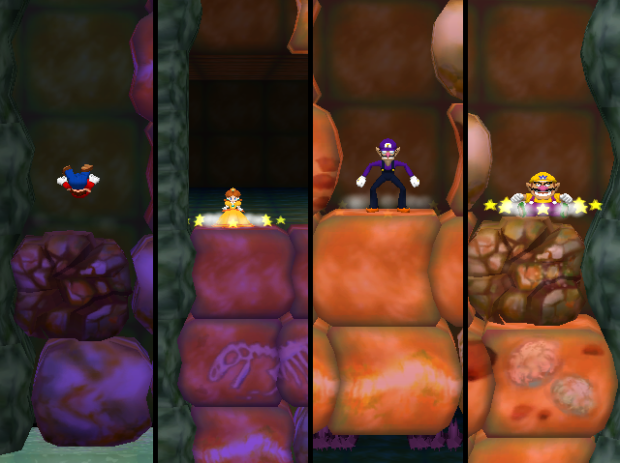
Ground Pound Down4-PlayerGround-pound your way down through layers of earth to the bottom of a cave. Rock takes three hits.
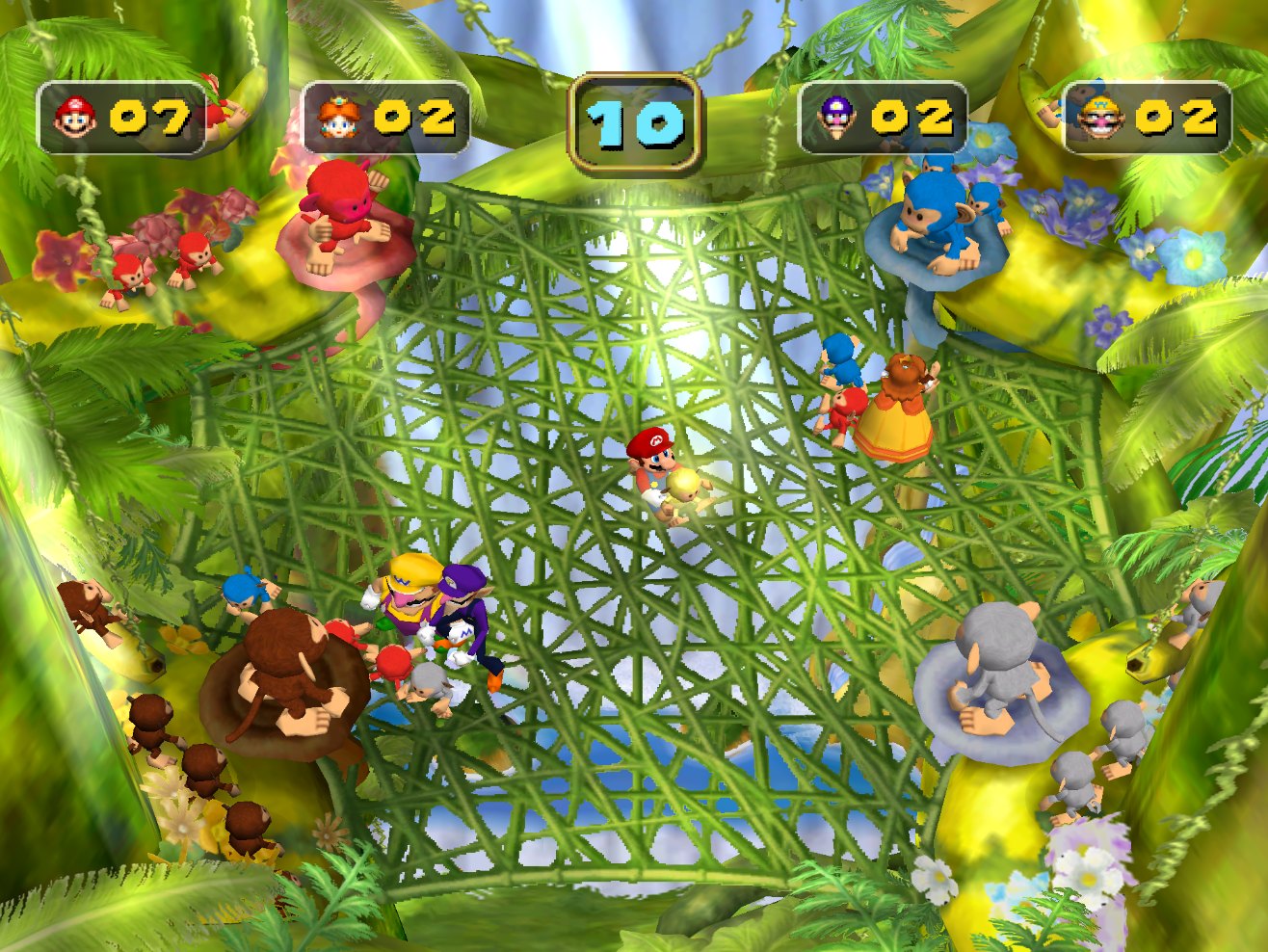
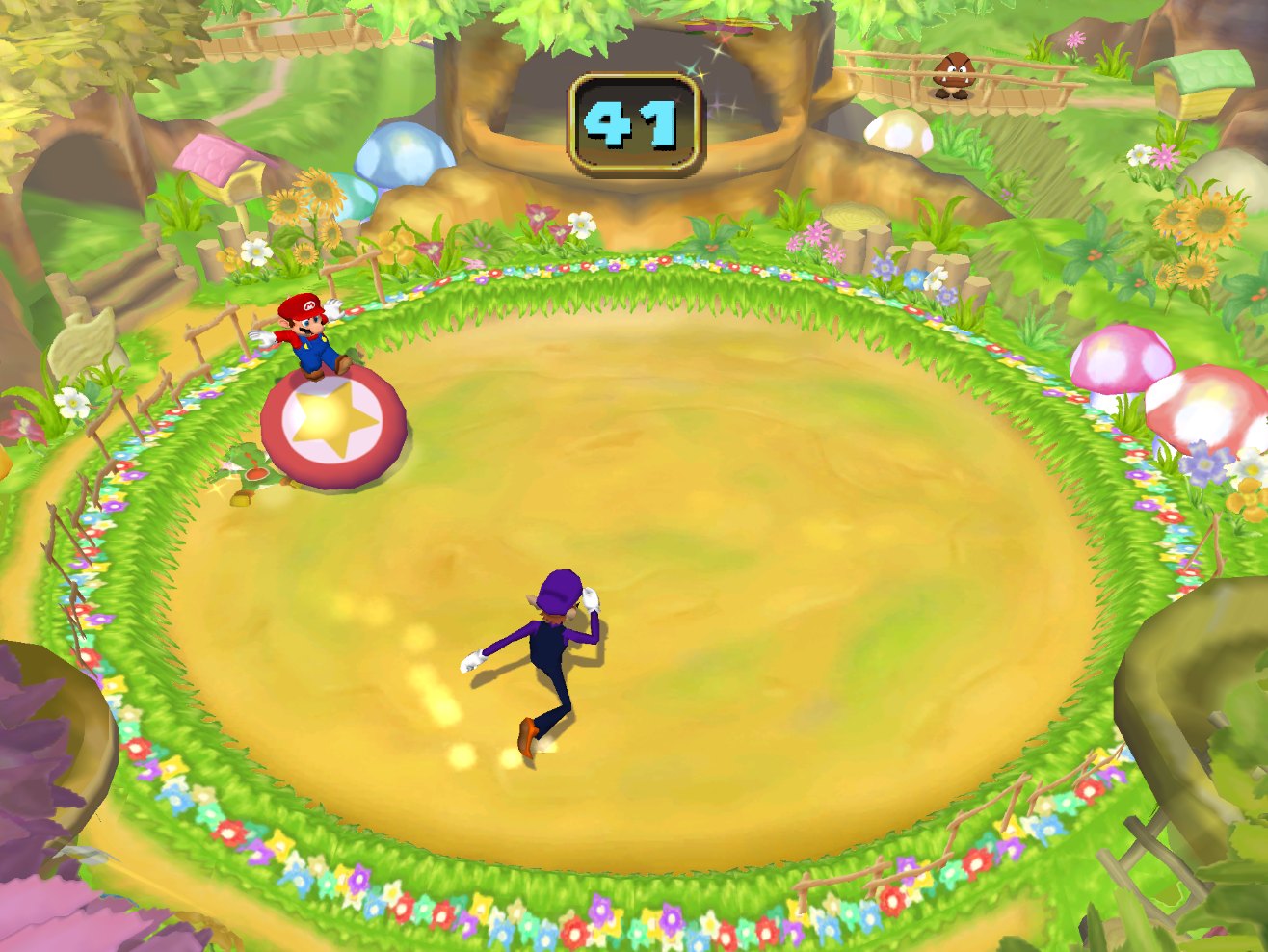
Chimp Chase4-PlayerRound up baby Ukikis and carry each to the grown-up Ukiki of its own colour. The golden one counts for three.
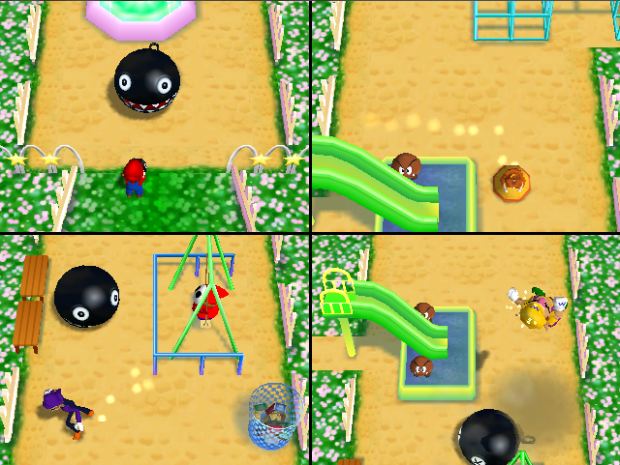
Chomp Romp4-PlayerWalk a Chain Chomp through a playground obstacle course to the exit, calling it with a whistle. Bump into it and you lose time.
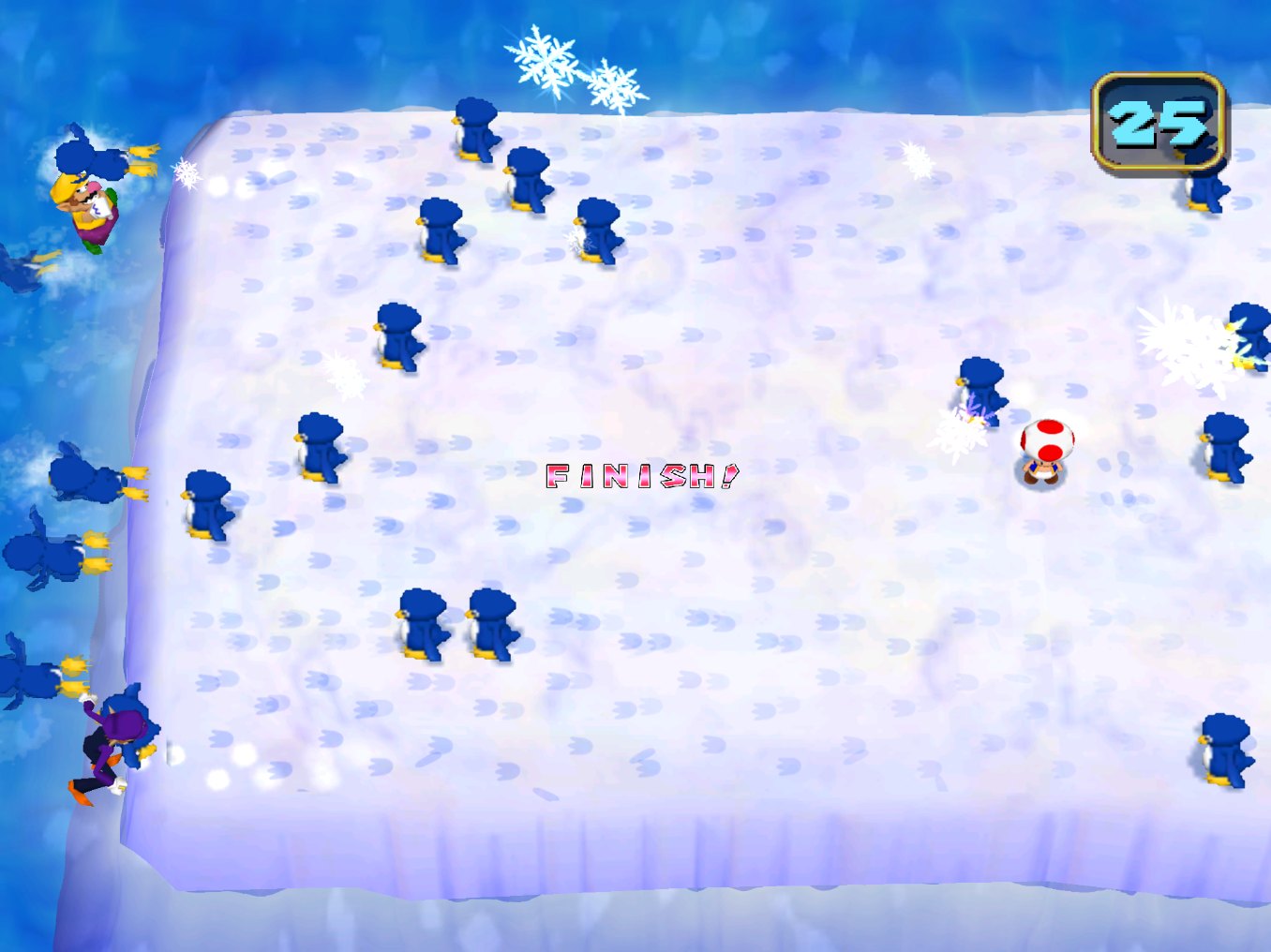
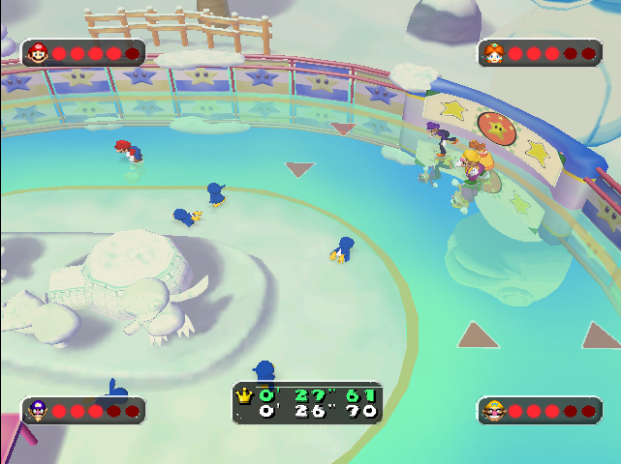
Pushy Penguins4-PlayerPenguins come waddling across an iceberg in droves. Weave between them or be pushed off the edge. In The Top 100 and Superstars.
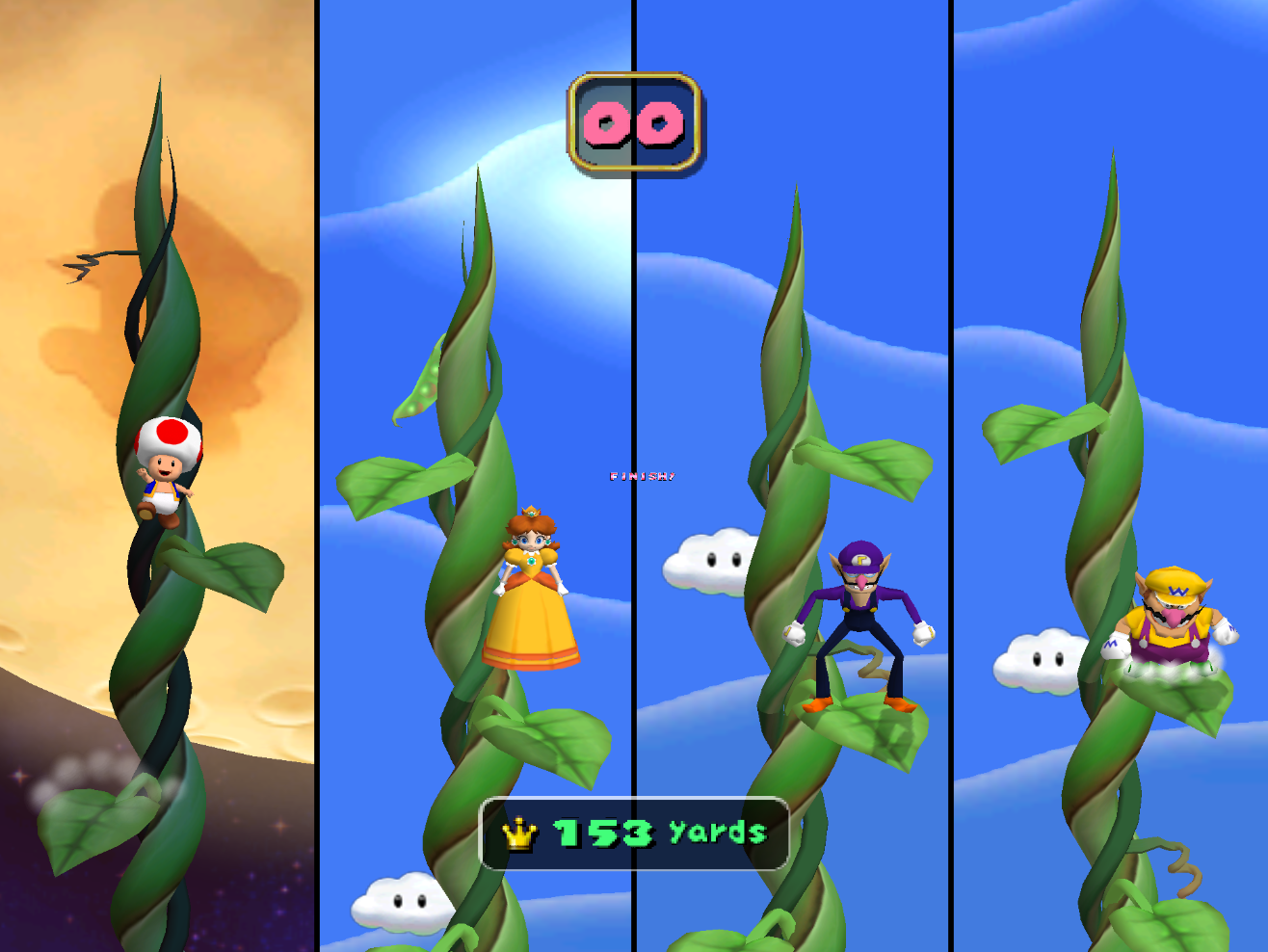
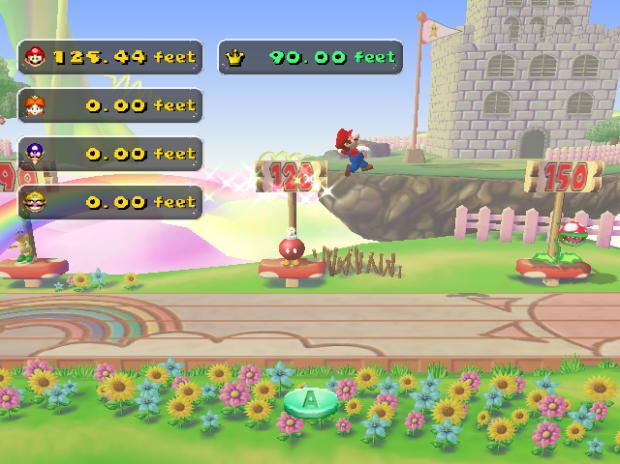
Leaf Leap4-PlayerJump from leaf to leaf up a beanstalk; whoever has climbed highest when time is up wins. In The Top 100, Superstars and Jamboree.
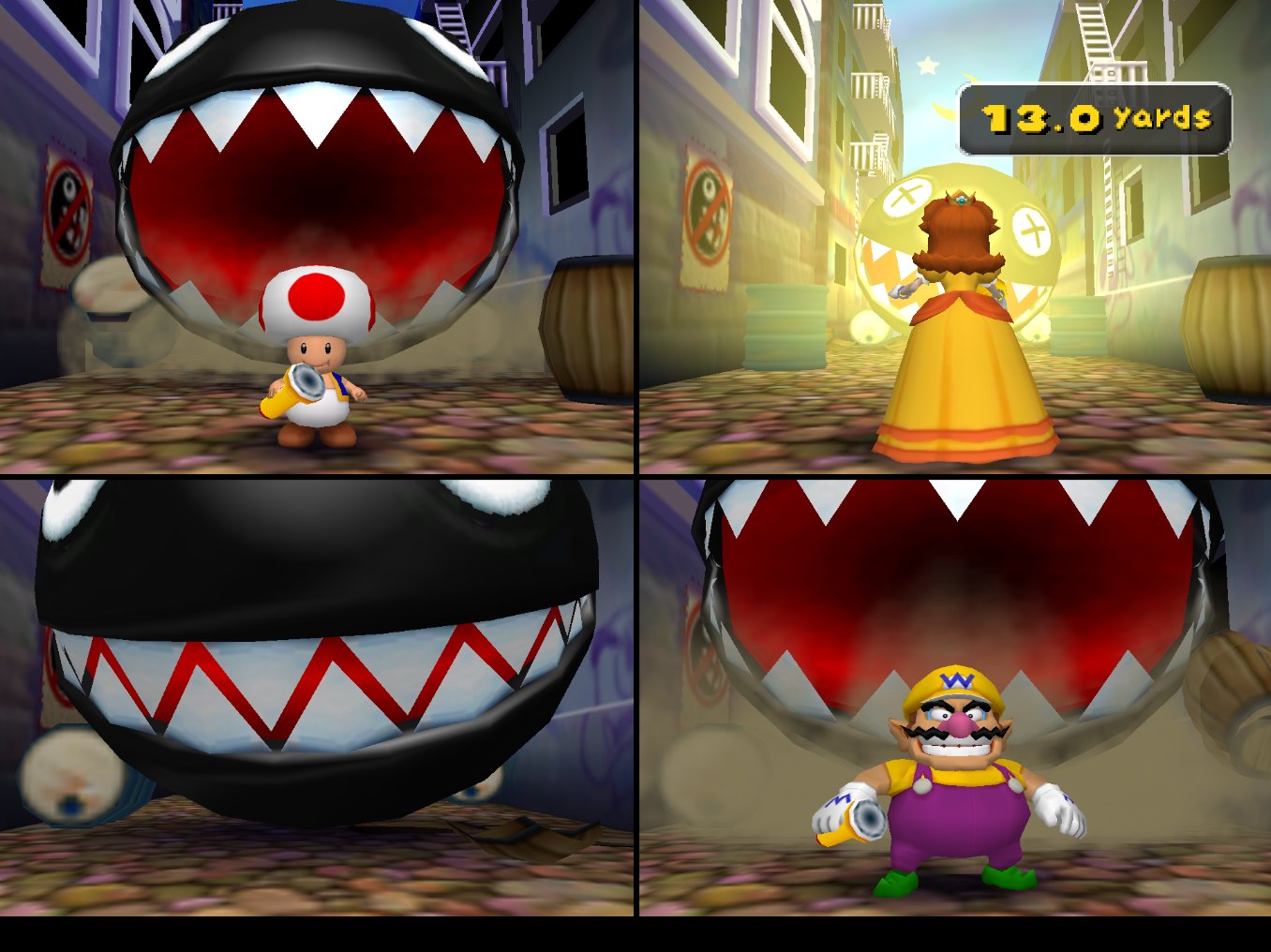
Night Light Fright4-PlayerA Chain Chomp charges out of the dark. Stop it with your torch as late as you dare: the nearest miss wins. In The Top 100 and Superstars.
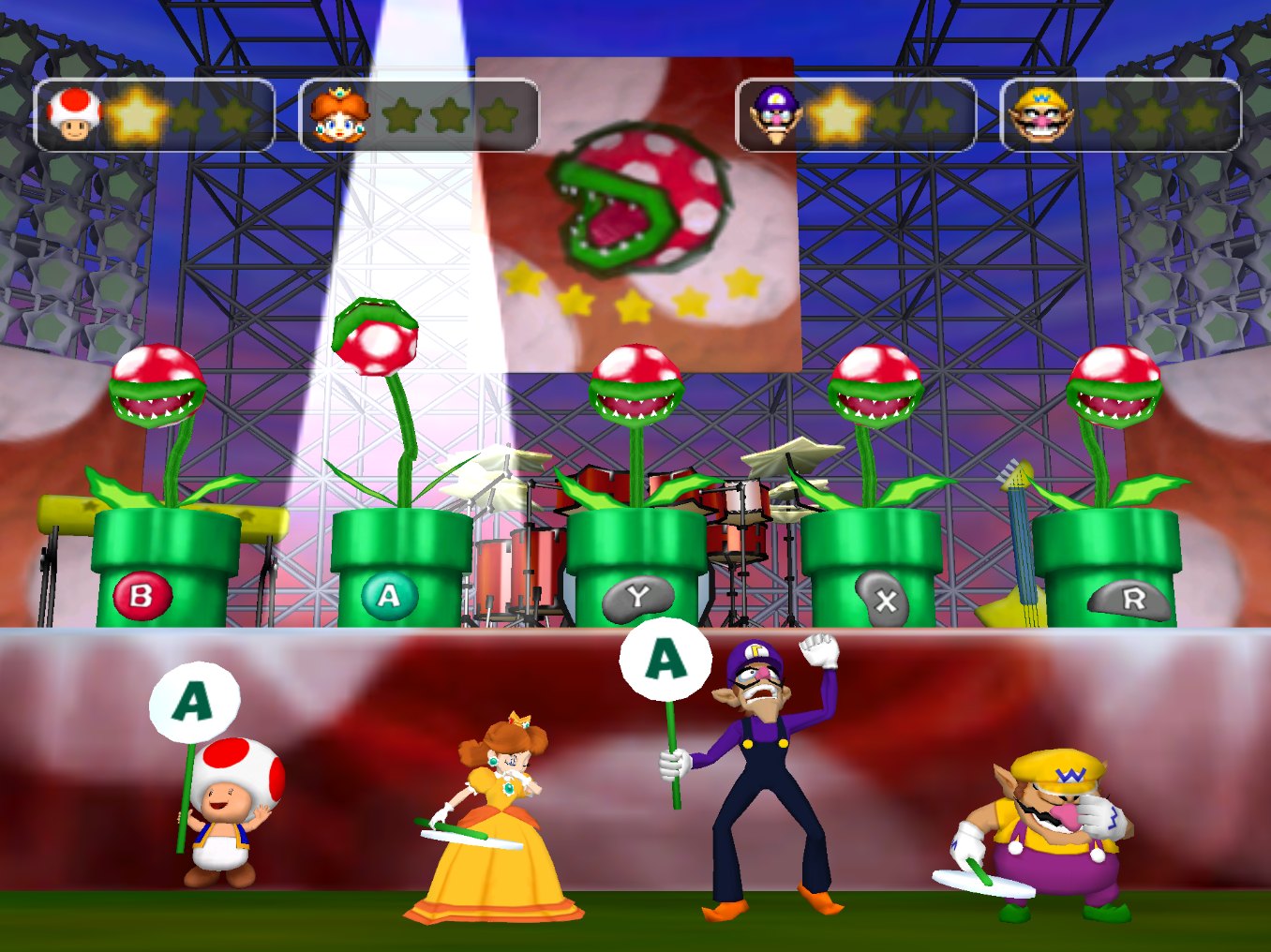
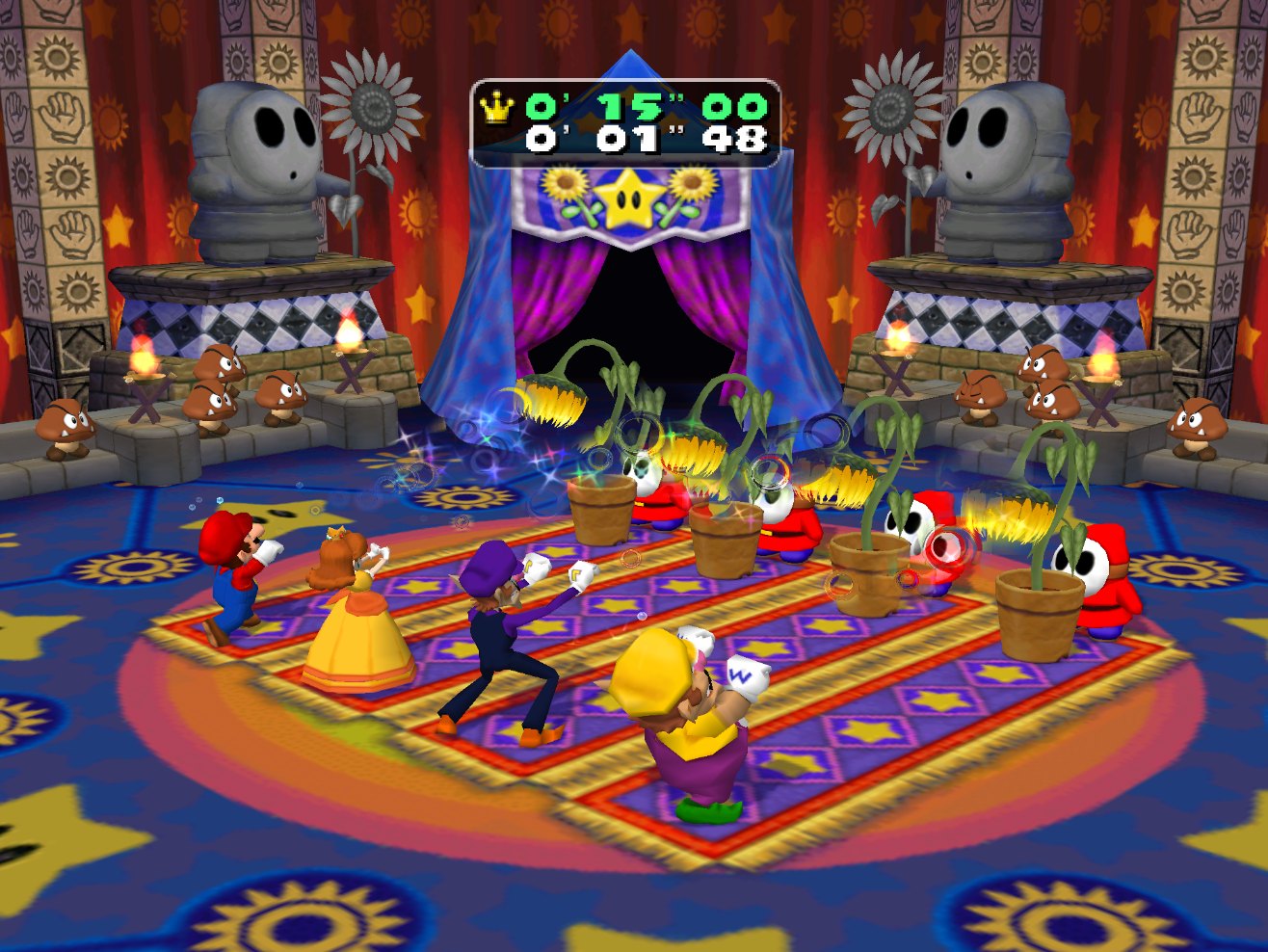
Pop-Star Piranhas4-PlayerSpot the one Piranha Plant dancing out of step, inside five seconds, over three rounds. The music is the Super Mario Bros. theme in three styles.
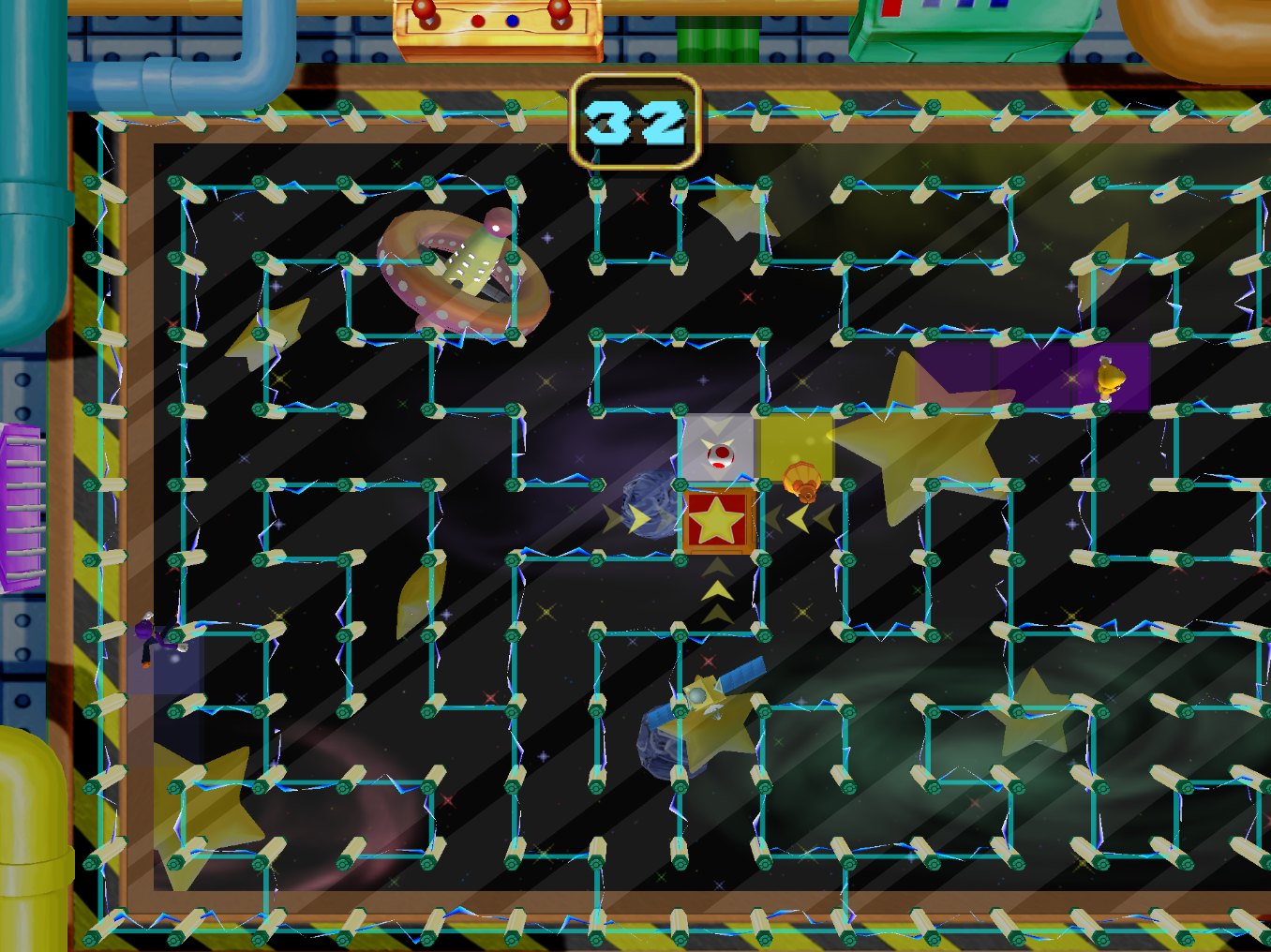
Mazed & Confused4-PlayerRace to the middle of a maze whose walls keep moving. Touch a wall and you are stunned.
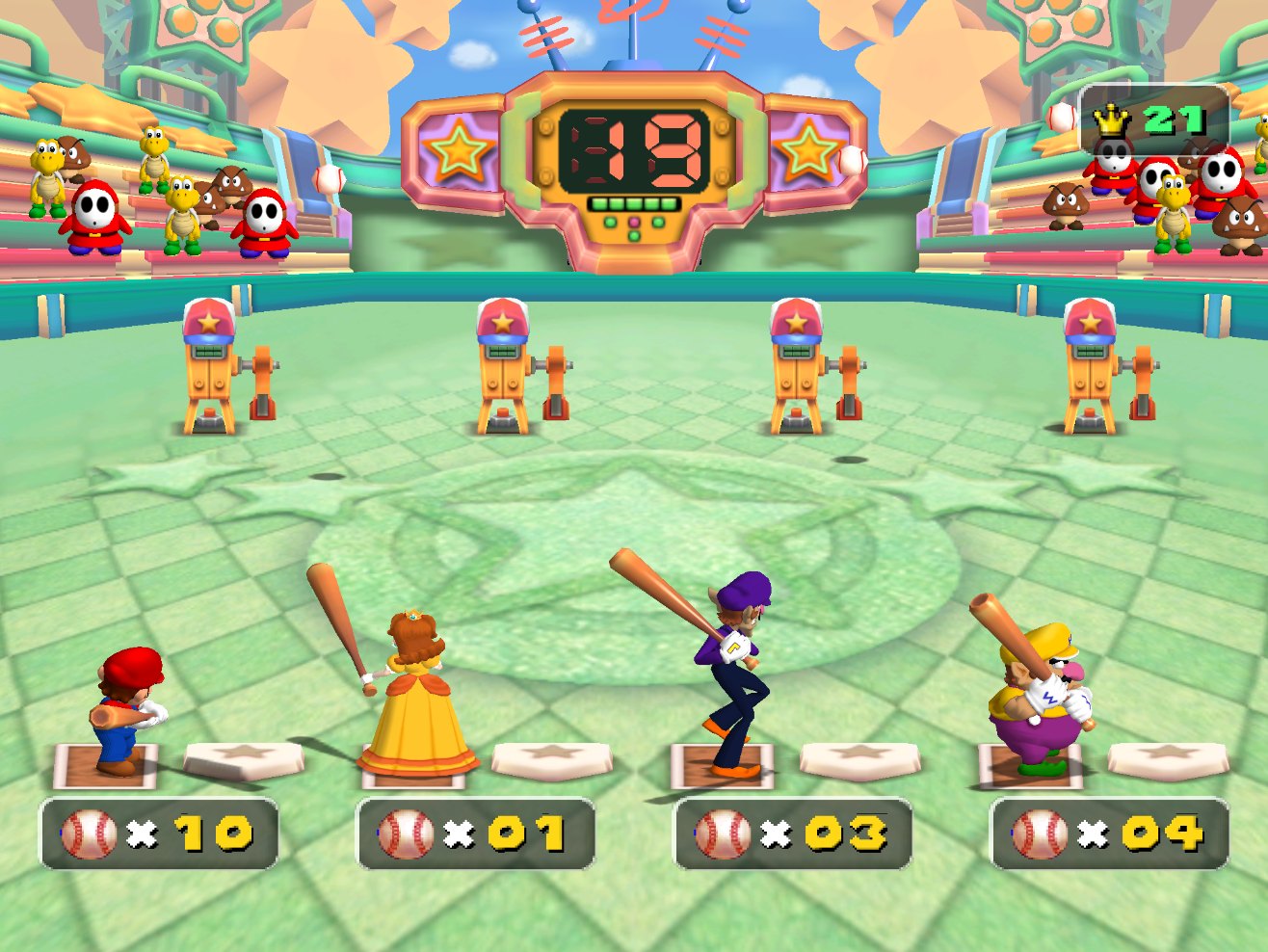
Dinger Derby4-PlayerBaseball batting practice: thirty pitches each, and the most hits wins. In The Top 100 and Superstars.
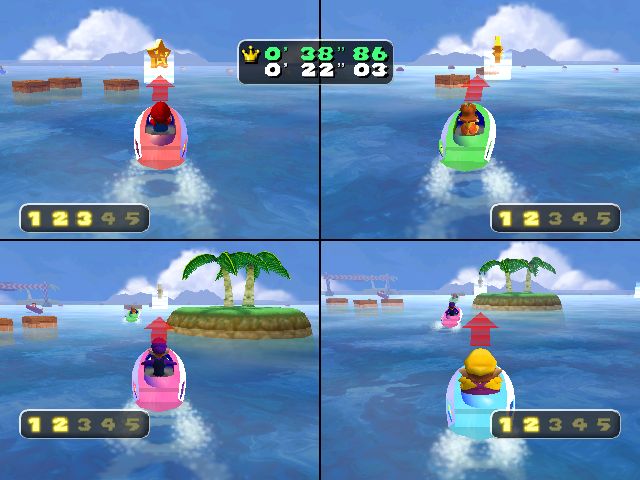
Hydrostars4-PlayerSteer a boat through a course of gates in the right order. First over the line wins.
Later Skater4-PlayerFive laps of an ice rink on skates, without hitting the boards. In The Top 100 and Superstars.
Will Flower4-PlayerHammer A to bring a drooping flower back to life before the others revive theirs.
Triple Jump4-PlayerPress the buttons shown as fast as you can for the run-up and each bound. The longest jump wins. In The Top 100.
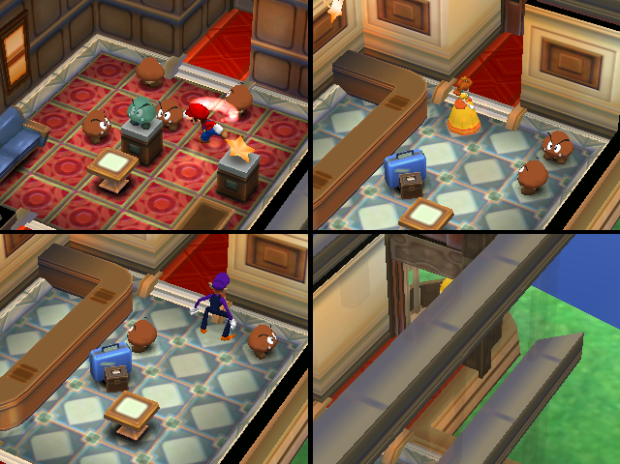
Hotel Goomba4-PlayerPunch Goombas out of your way, room by room, and be first up to the third-floor balcony. In The Top 100.
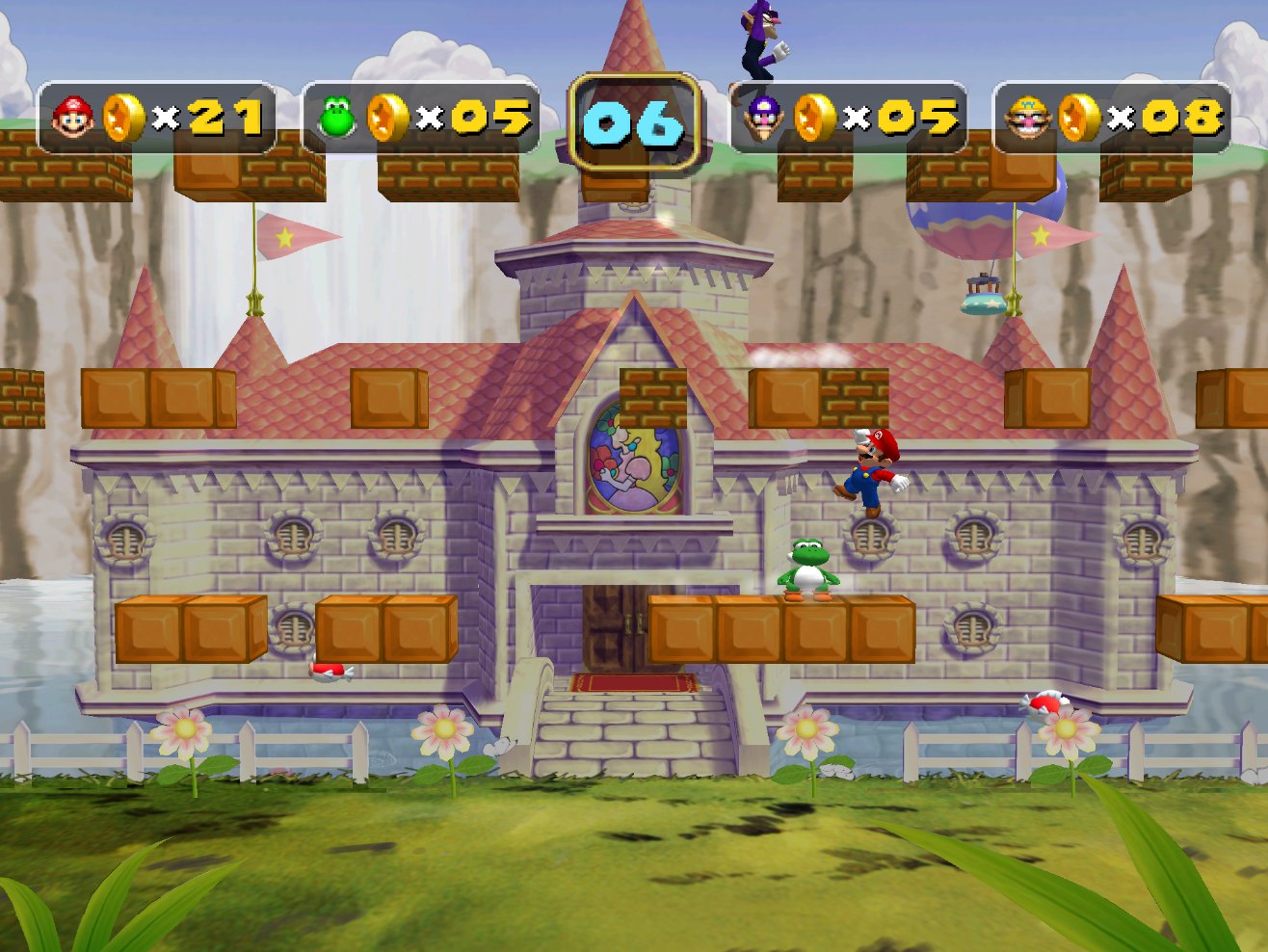
Coin Cache4-Player · coinJump at rows of blocks in front of Peach’s Castle and keep the coins that fall out.
Vicious Vending4-Player · coinTurn the handle of a capsule machine and take what comes: 1, 10 or 20 coins, or a Thwomp and nothing.
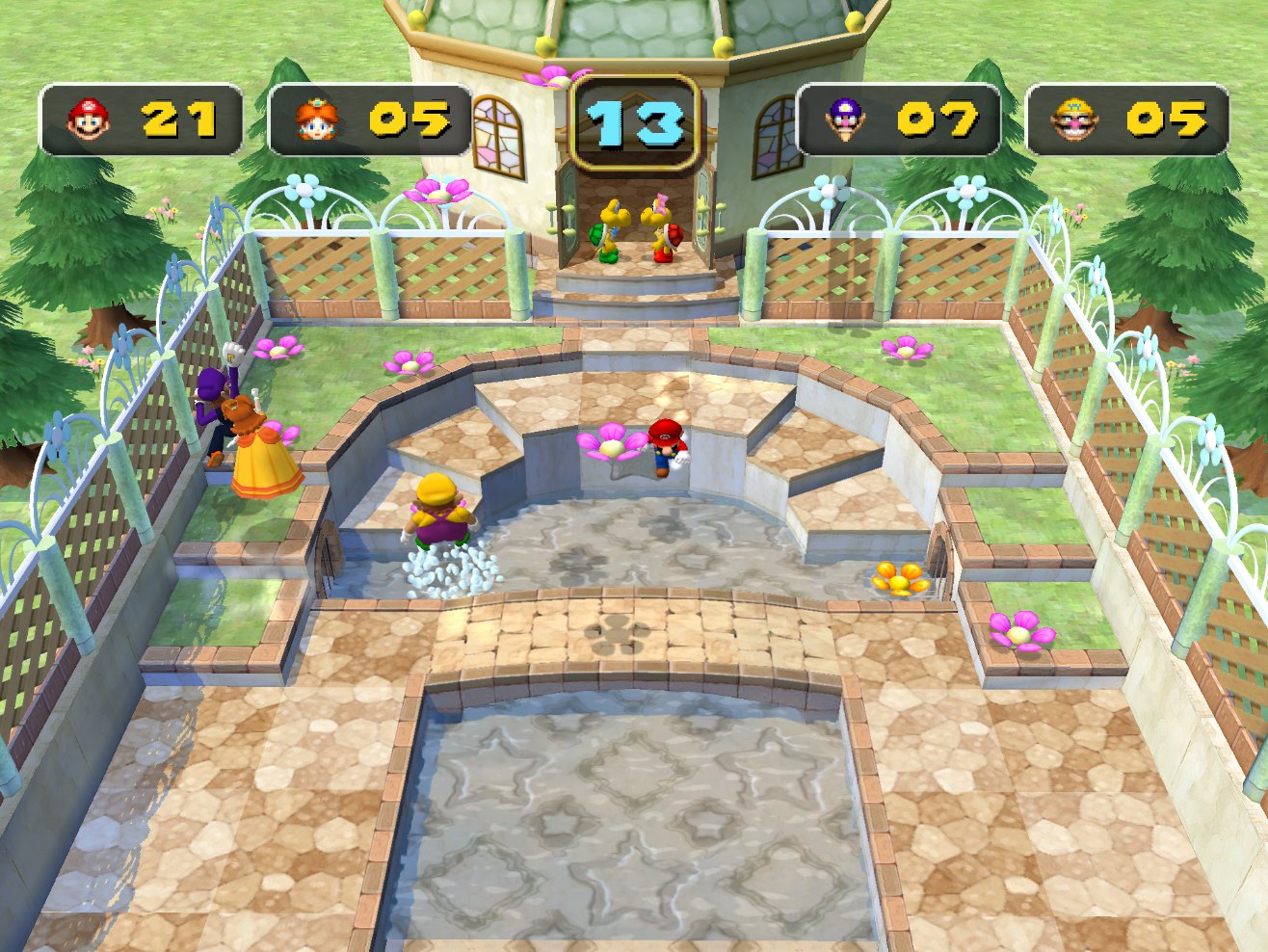
Flower Shower4-PlayerGather the flowers that Koopas throw down, with gold ones worth three, and flatten rivals to slow them up.
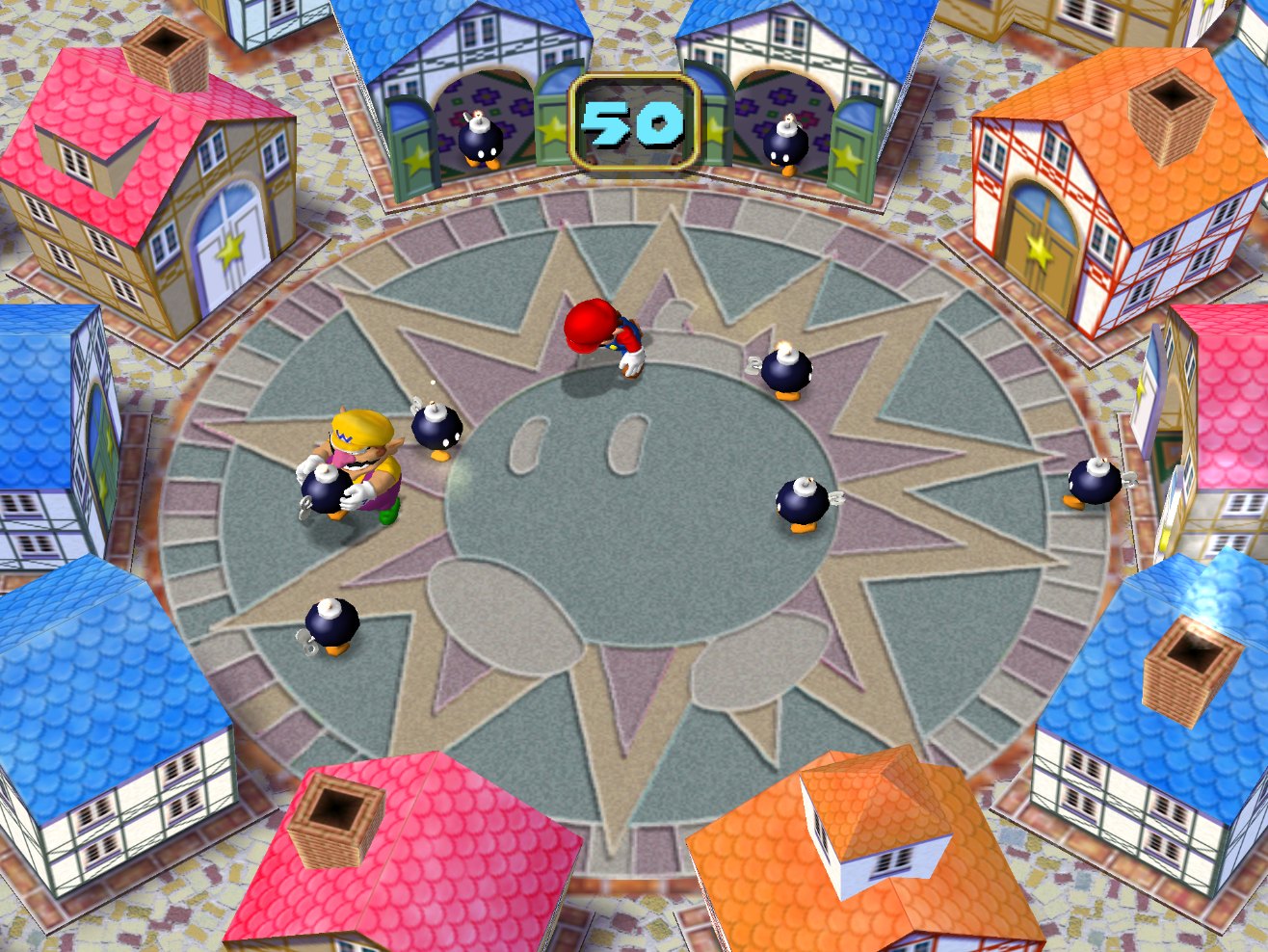
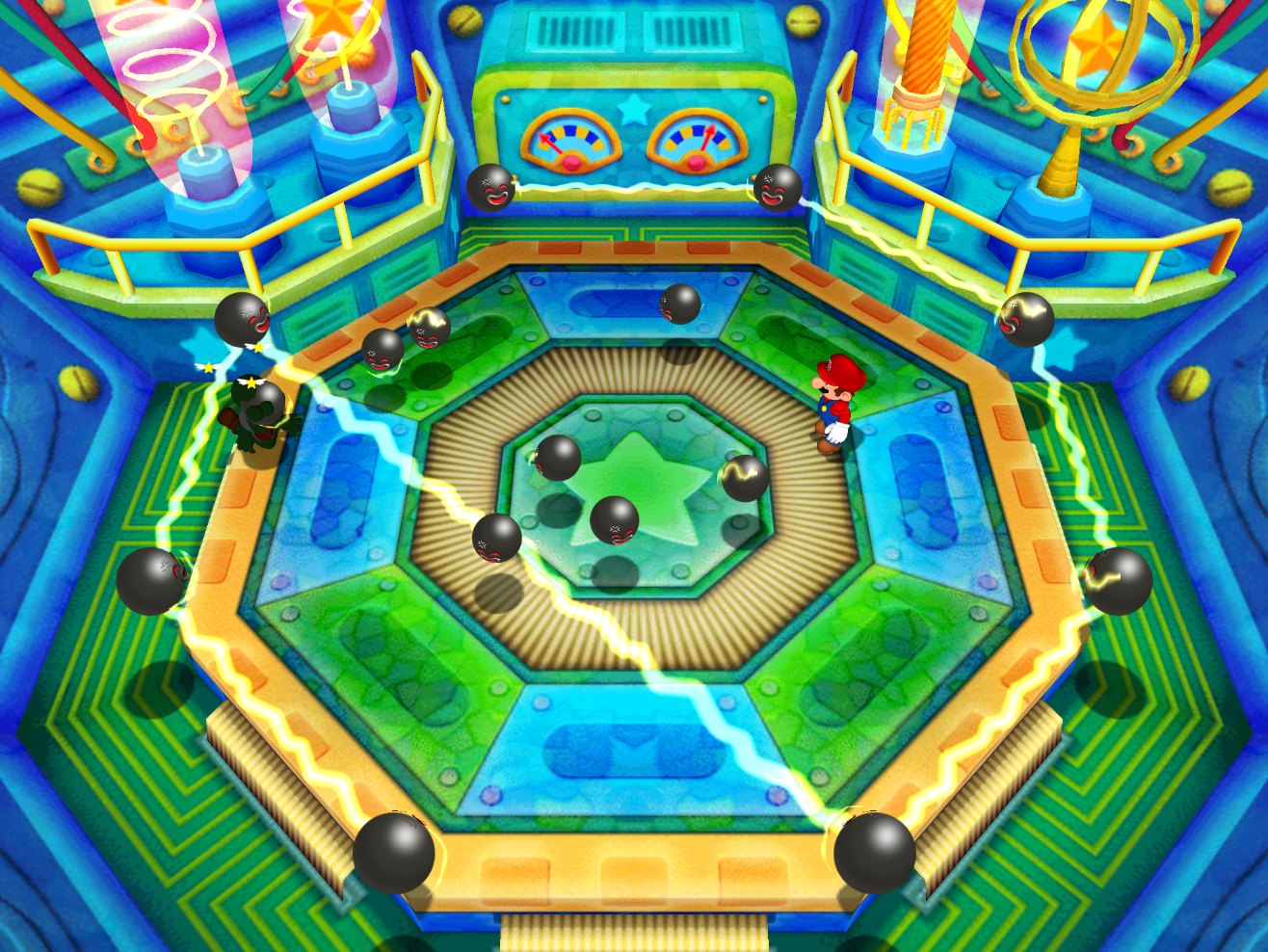
Dodge Bomb4-PlayerThrow Bob-ombs at one another. Anyone caught in a blast is out.
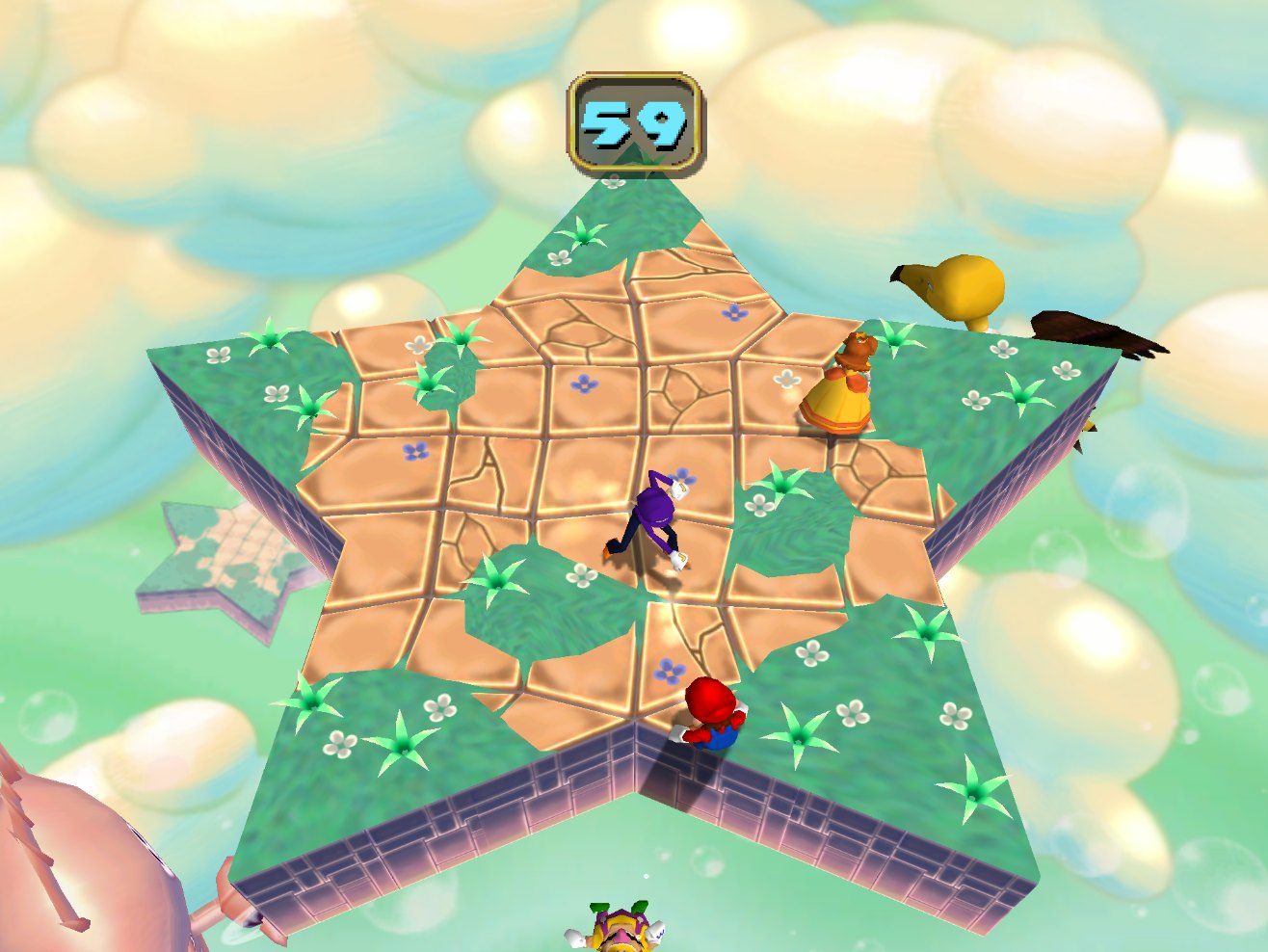
Fish Upon a Star4-PlayerA brawl on a platform that is falling to bits. Knock the others off and stay on yourself.
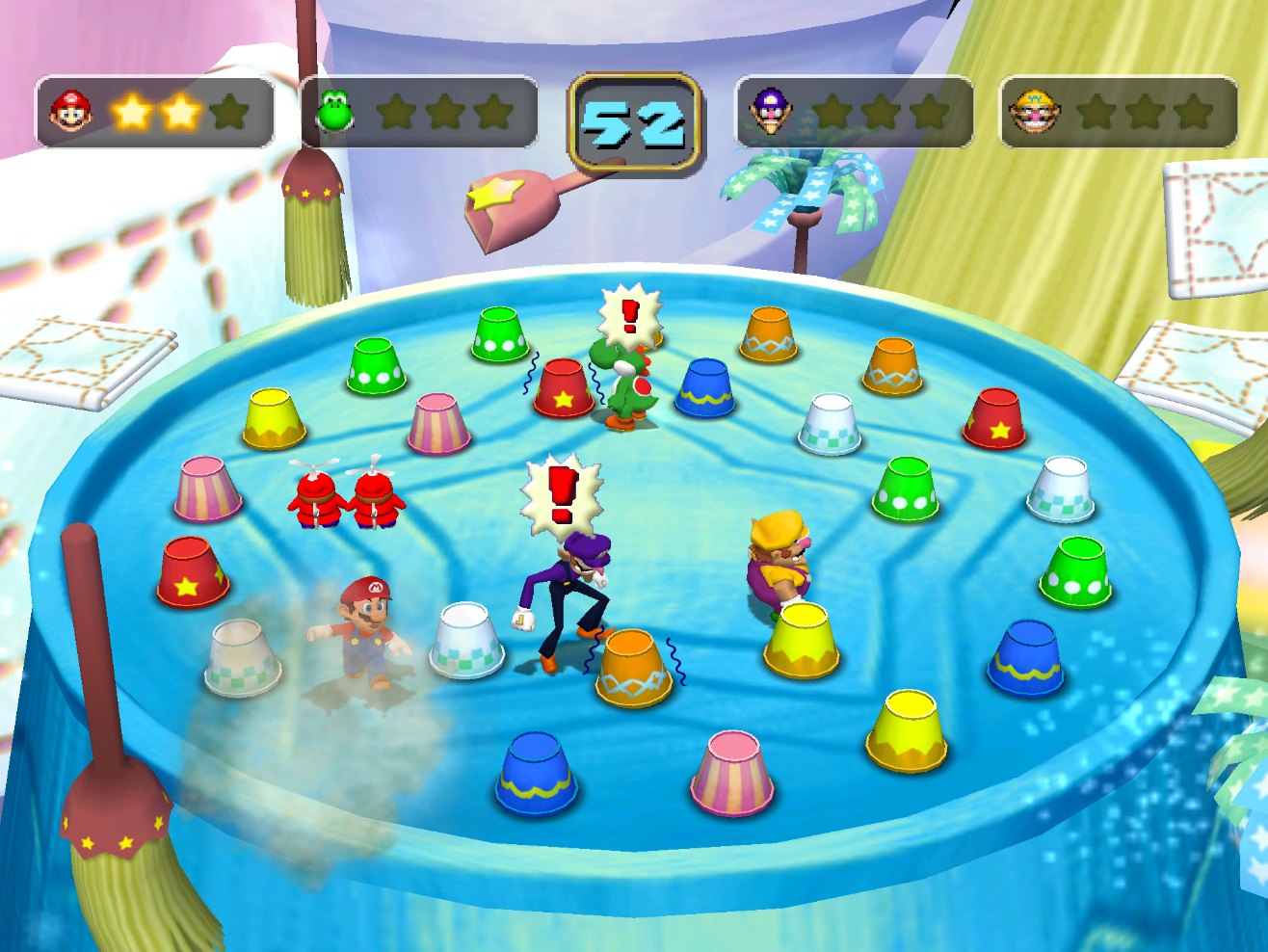
Rumble Fumble4-PlayerLift buckets to find three Fly Guys hiding underneath, and hope not to find something worse.
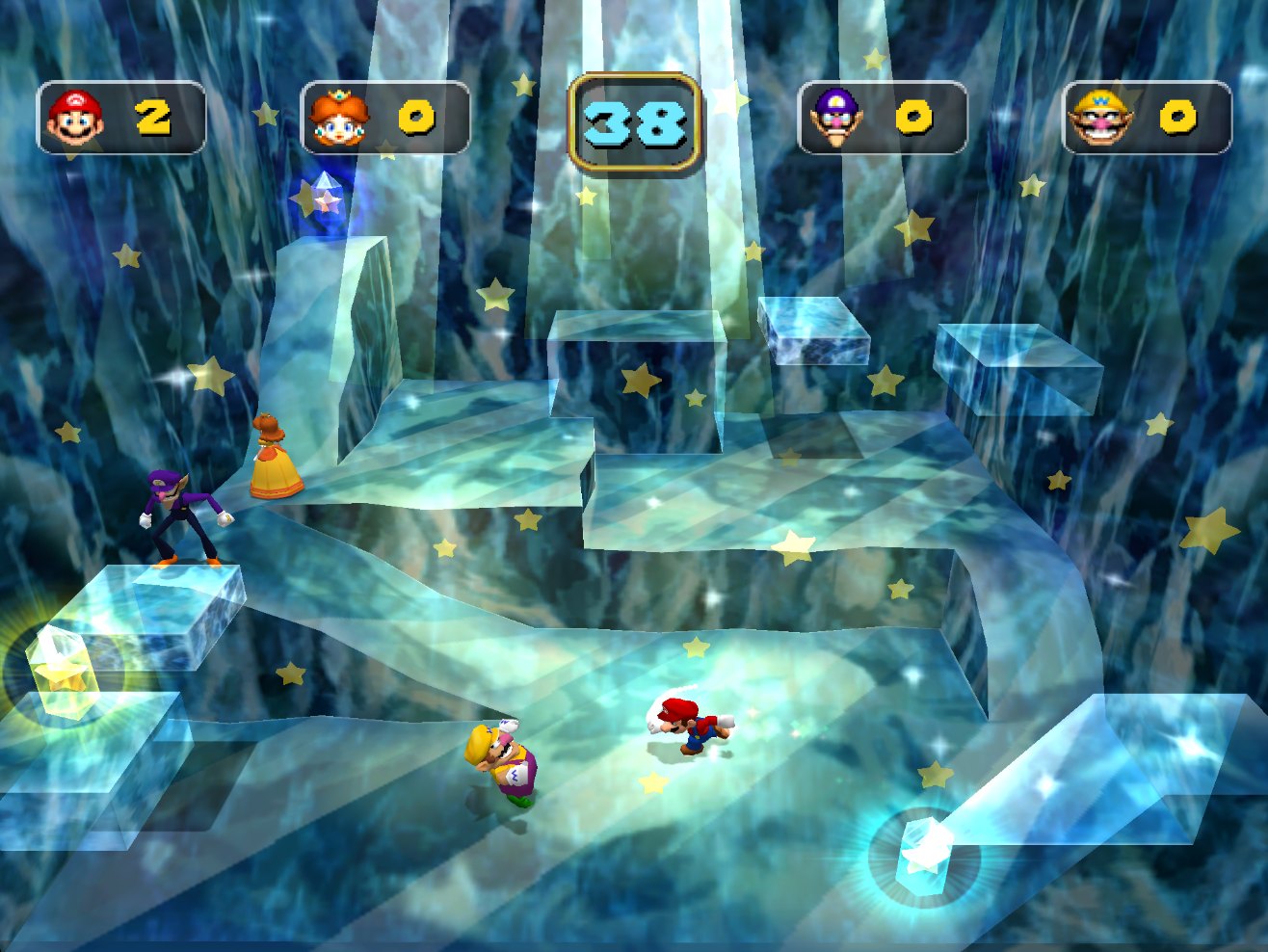
Frozen Frenzy4-PlayerCollect crystals in an ice cave while icicles fall and rivals barge. Most crystals wins.
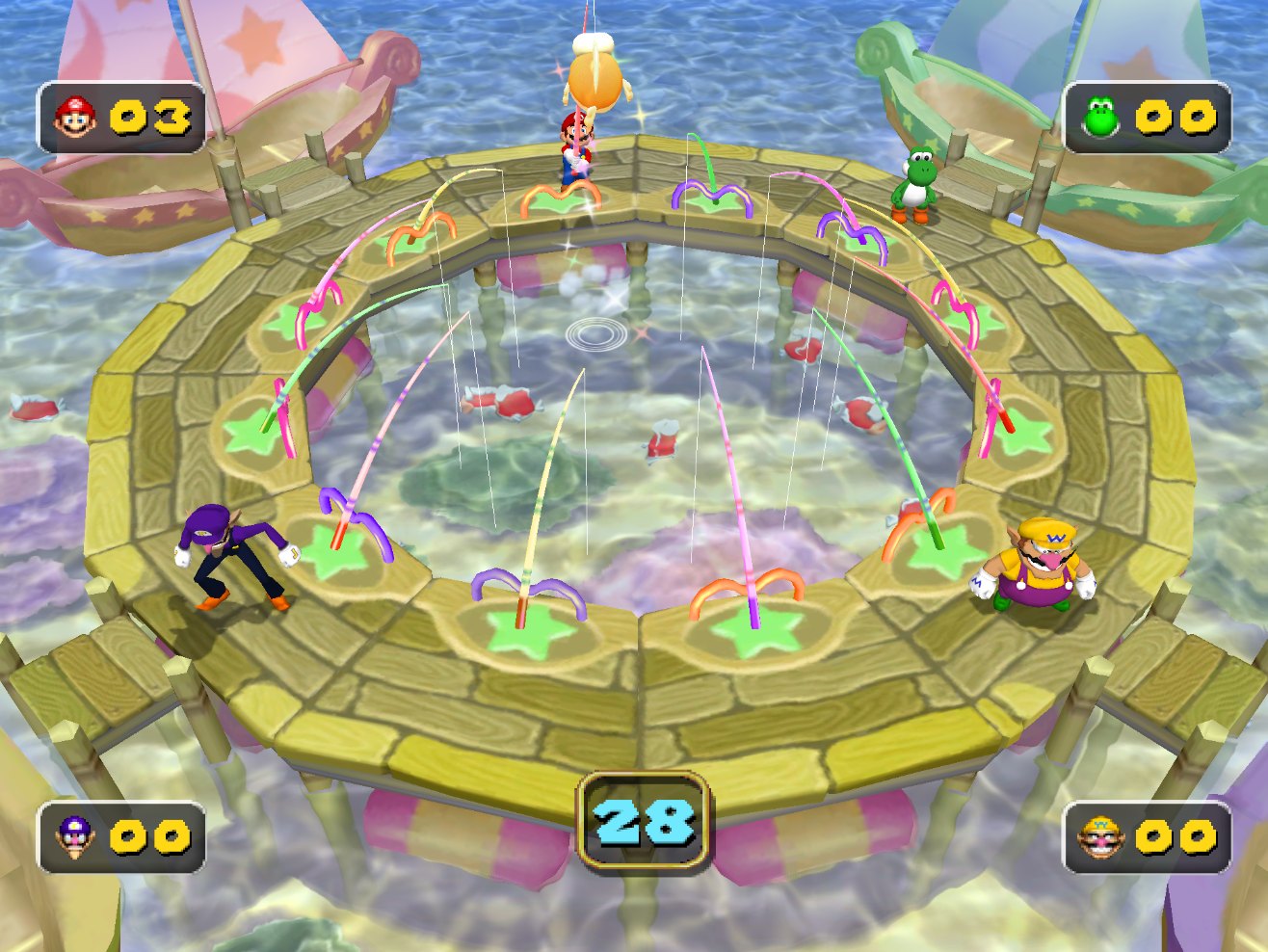
Fish Sticks4-PlayerHook Cheep Cheeps with a pole: red ones score a point and golden ones three.
Flatiator1-vs-3One player rolls round an arena on a huge ball trying to flatten the other three.
Squared Away1-vs-3Three players in big rolling cubes try to squash the fourth, who wins by surviving 30 seconds. In The Top 100 and Superstars.
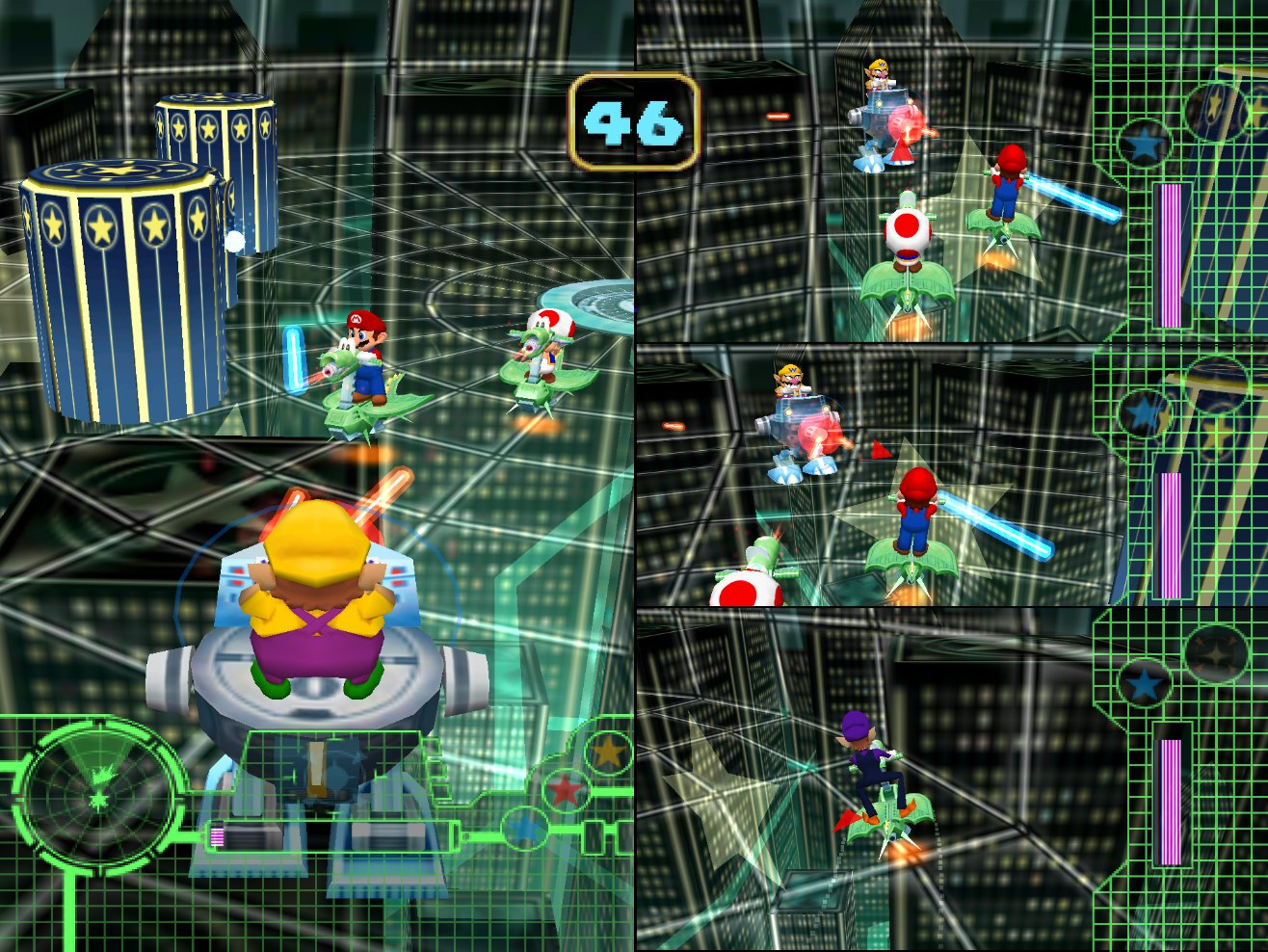
Mario Mechs1-vs-3A shoot-out between one player in a big robot and three on dragon-shaped scooters. The first side to destroy the other wins; after 60 seconds it is a draw.
Revolving Fire1-vs-3The soloist turns bars of flame round a platform in the middle of the arena. The three must keep clear of them, and of the lava.
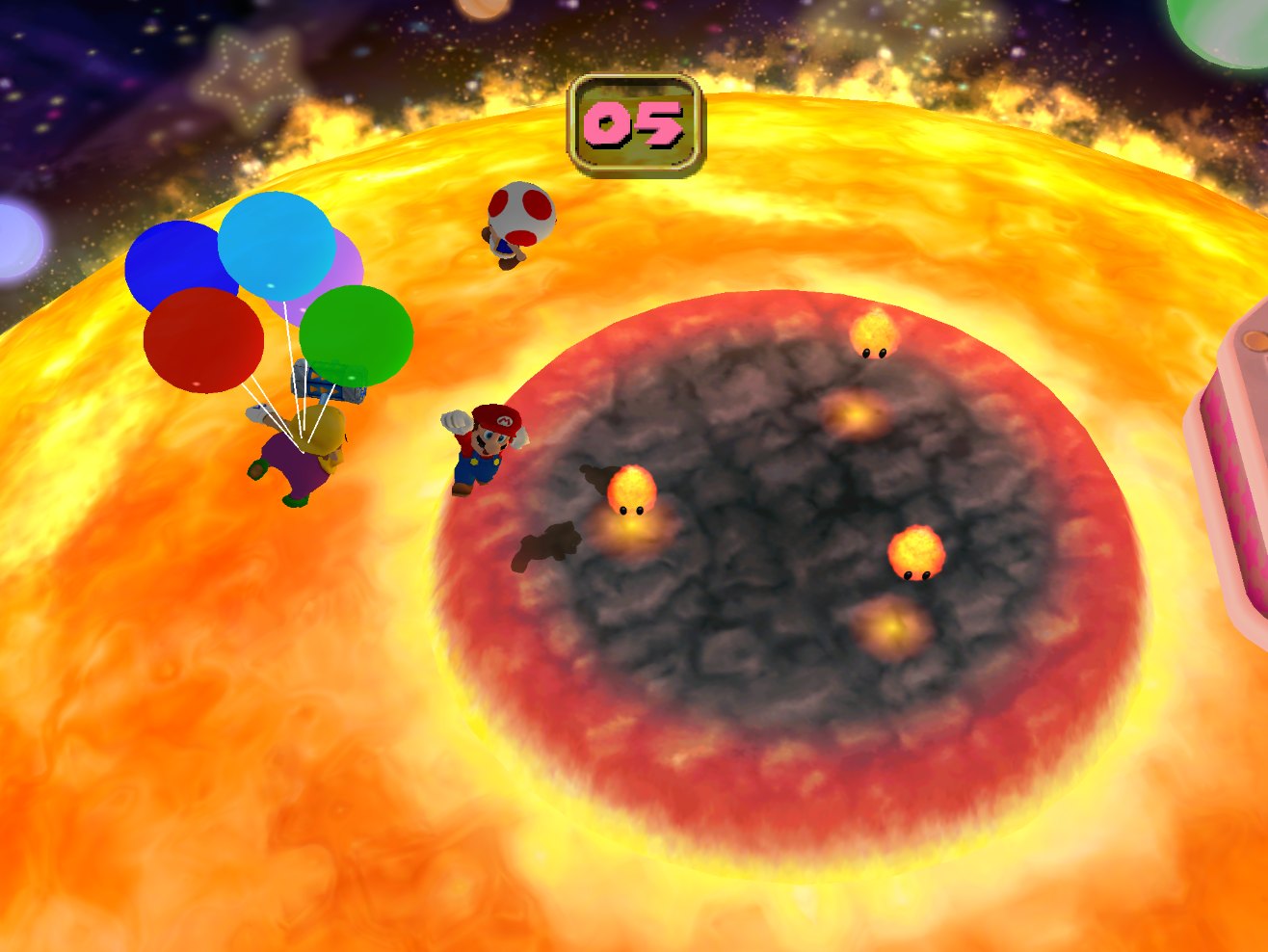
Heat Stroke1-vs-3The soloist swings a hammer to knock the three off their platforms while Podoboos rain down. In The Top 100.
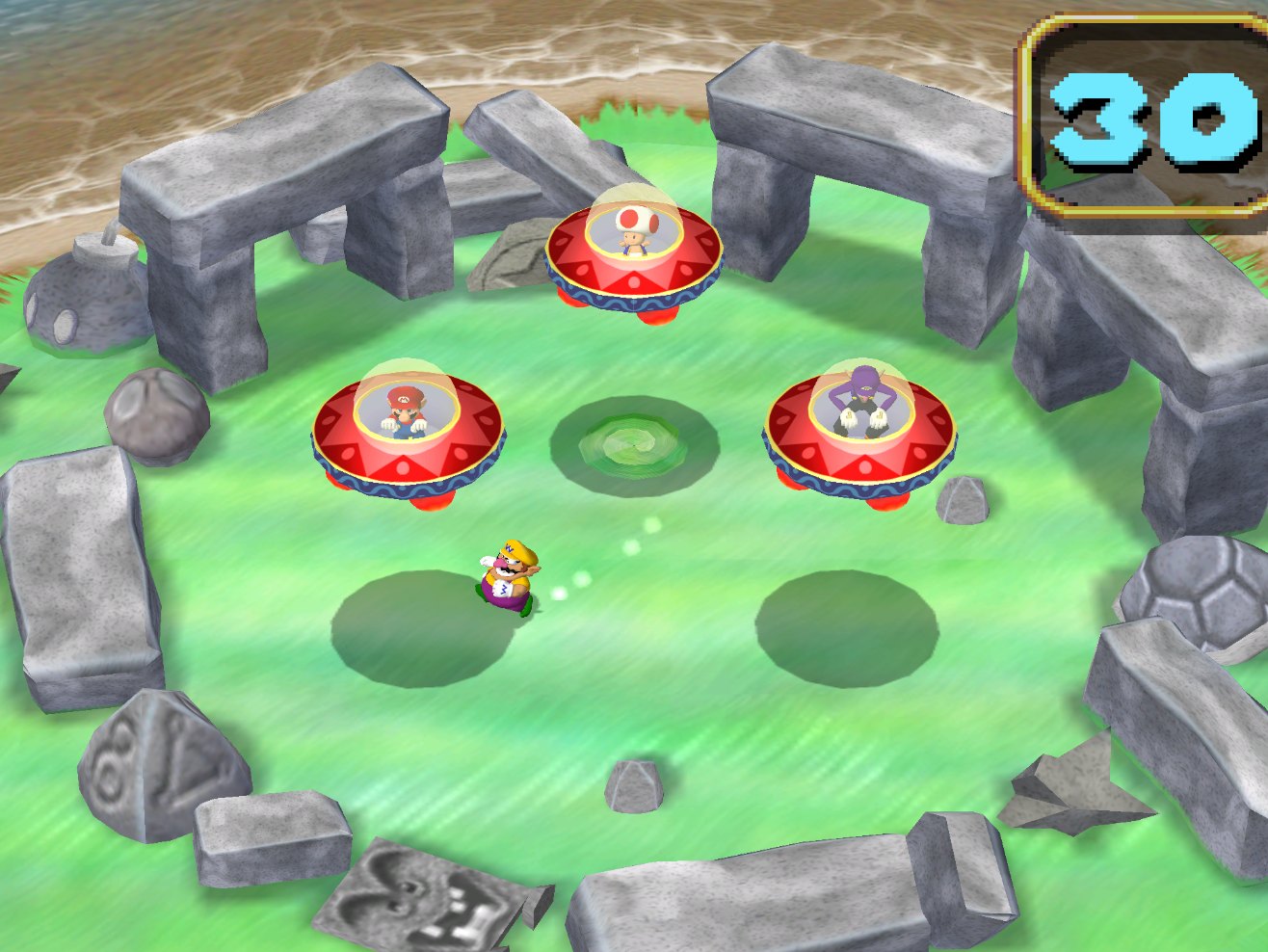
Beam Team1-vs-3Three UFOs with tractor beams hunt one runner on the ground.
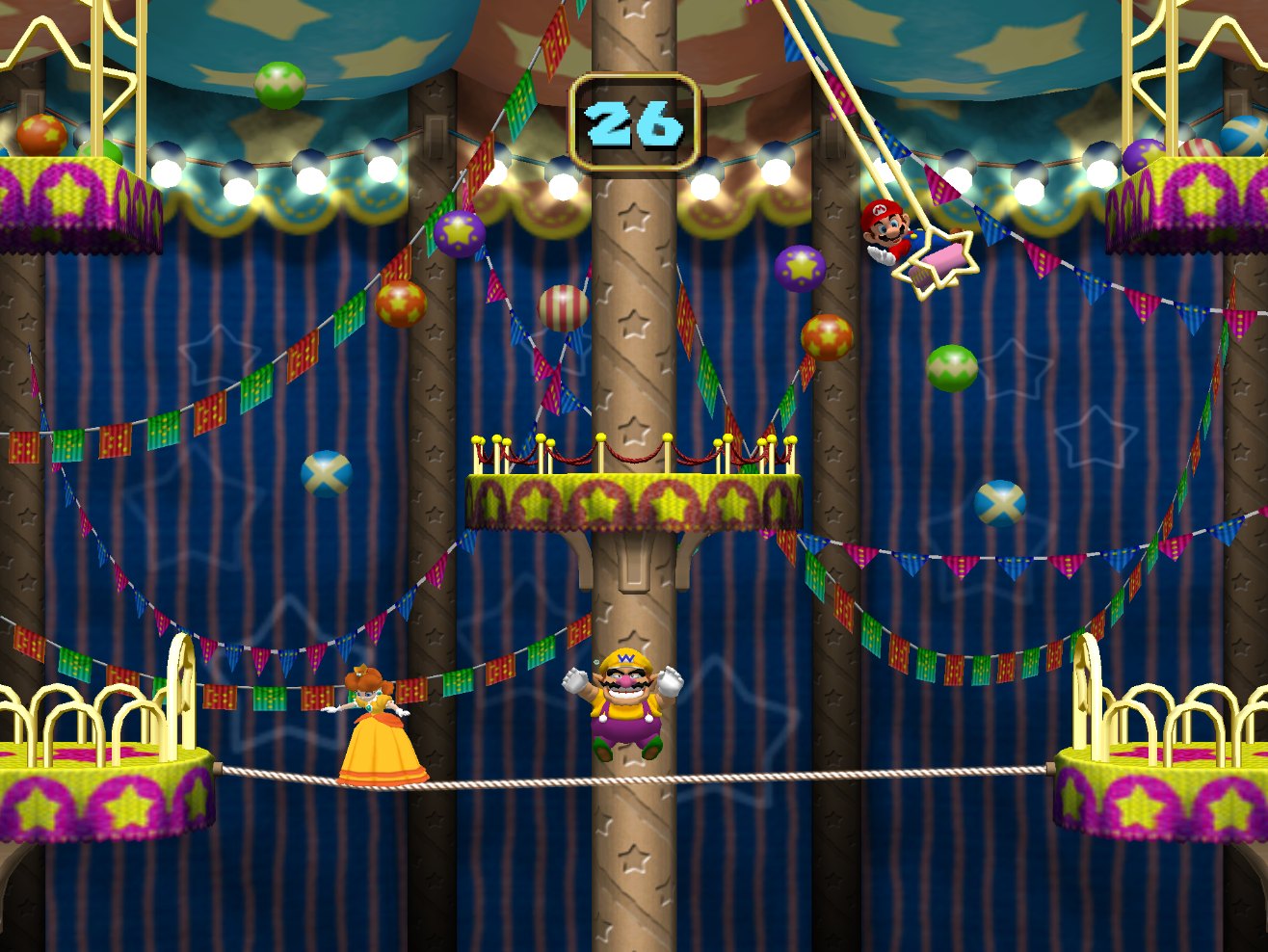
Big Top Drop1-vs-3The soloist drops balls on three tightrope walkers to knock them off.
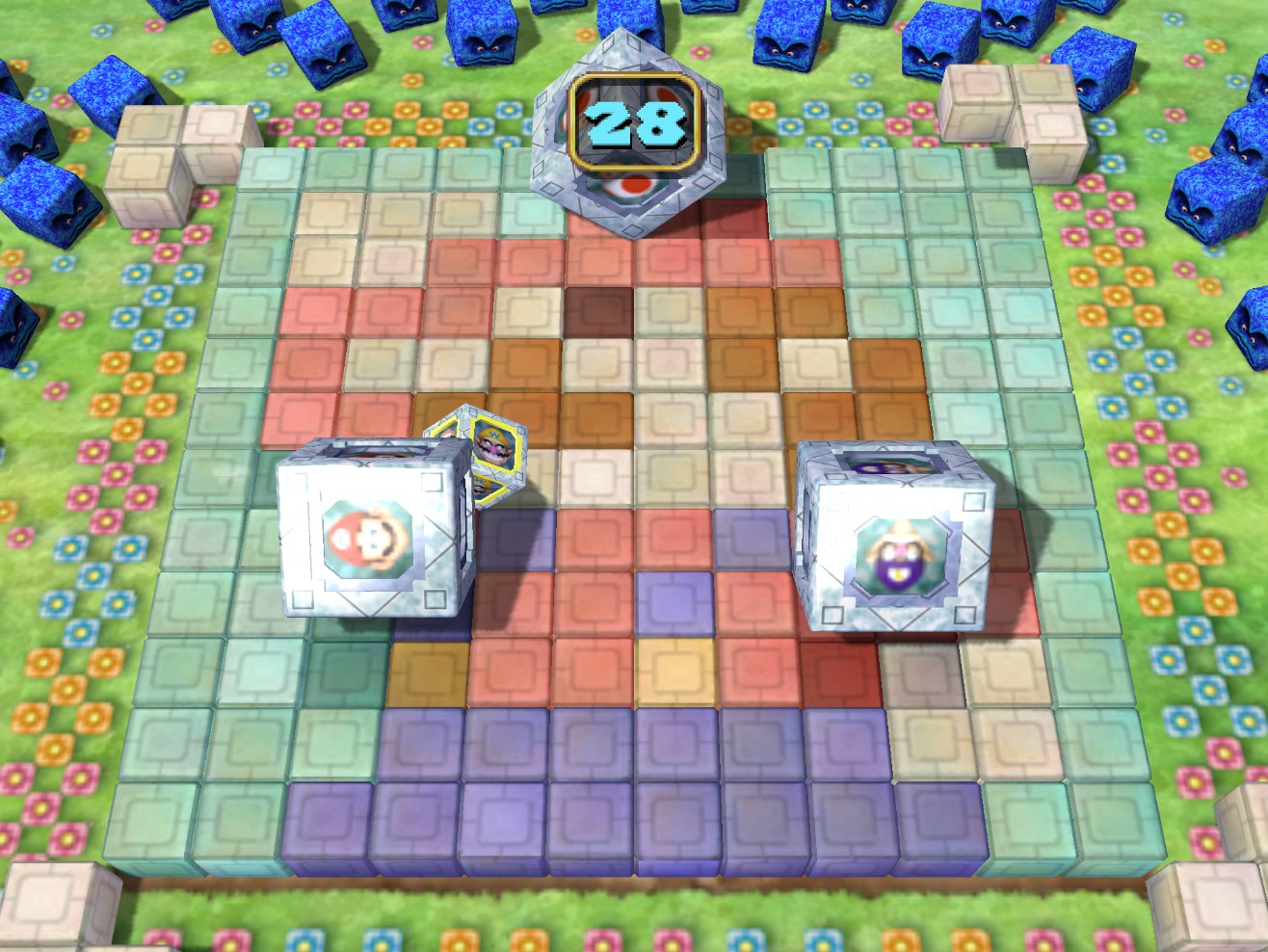
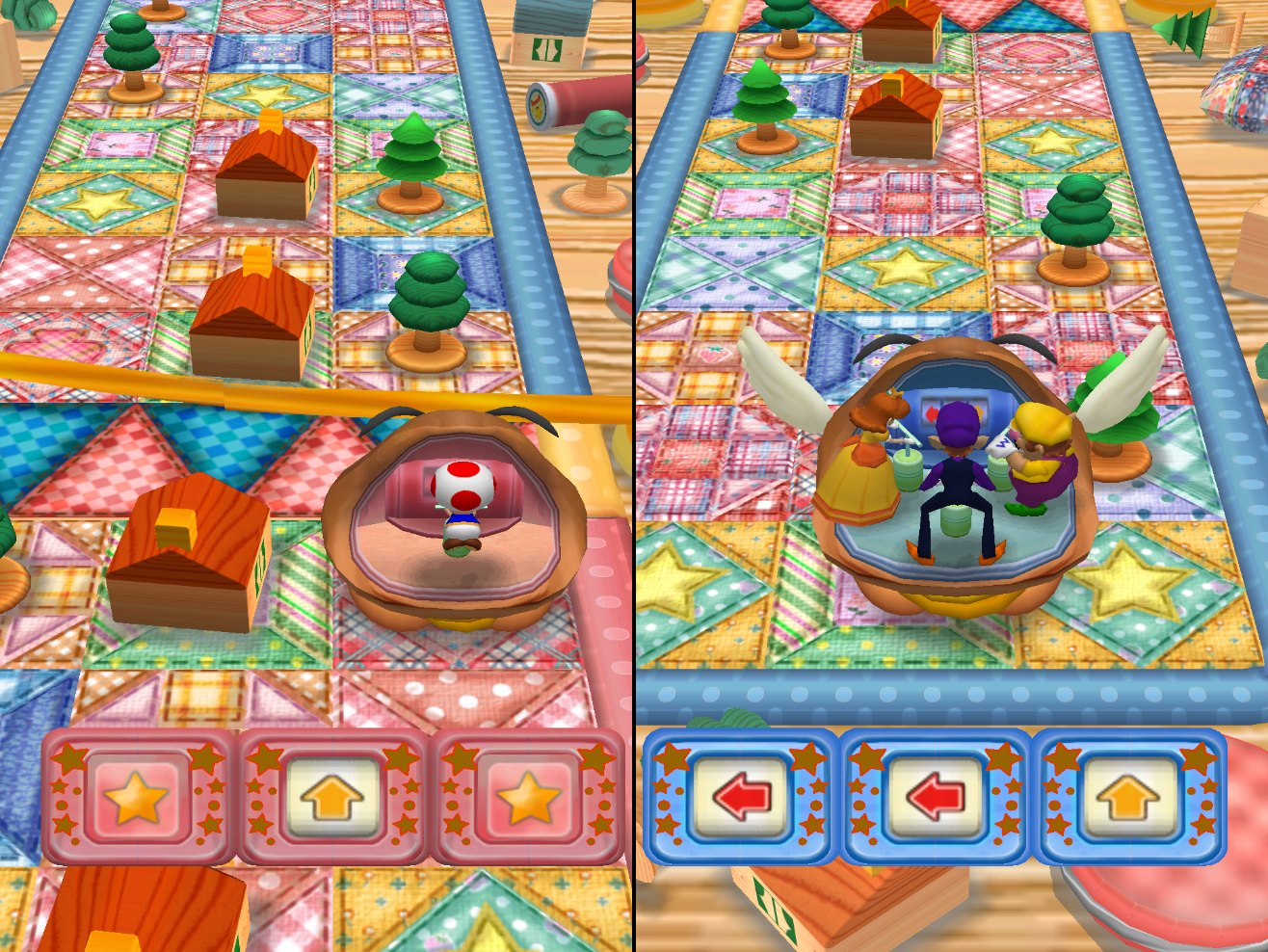
Quilt for Speed1-vs-3A roulette race across a patchwork quilt to the middle. The soloist has one roulette, the team three.
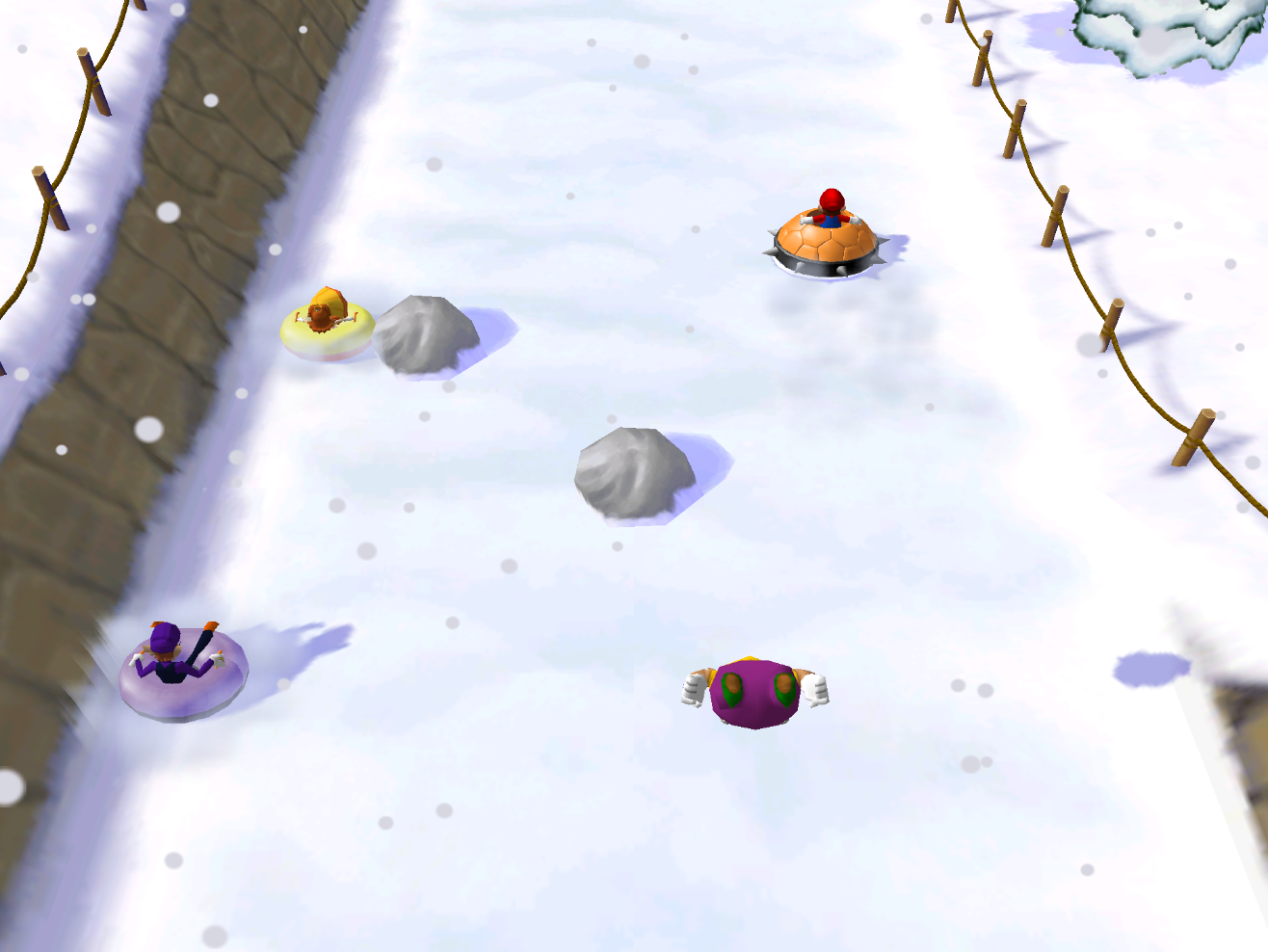
Tube It or Lose It1-vs-3Three slide down a mountain on inner tubes, chased by the soloist on a spike-lined tube that pops them. In The Top 100 and Superstars.
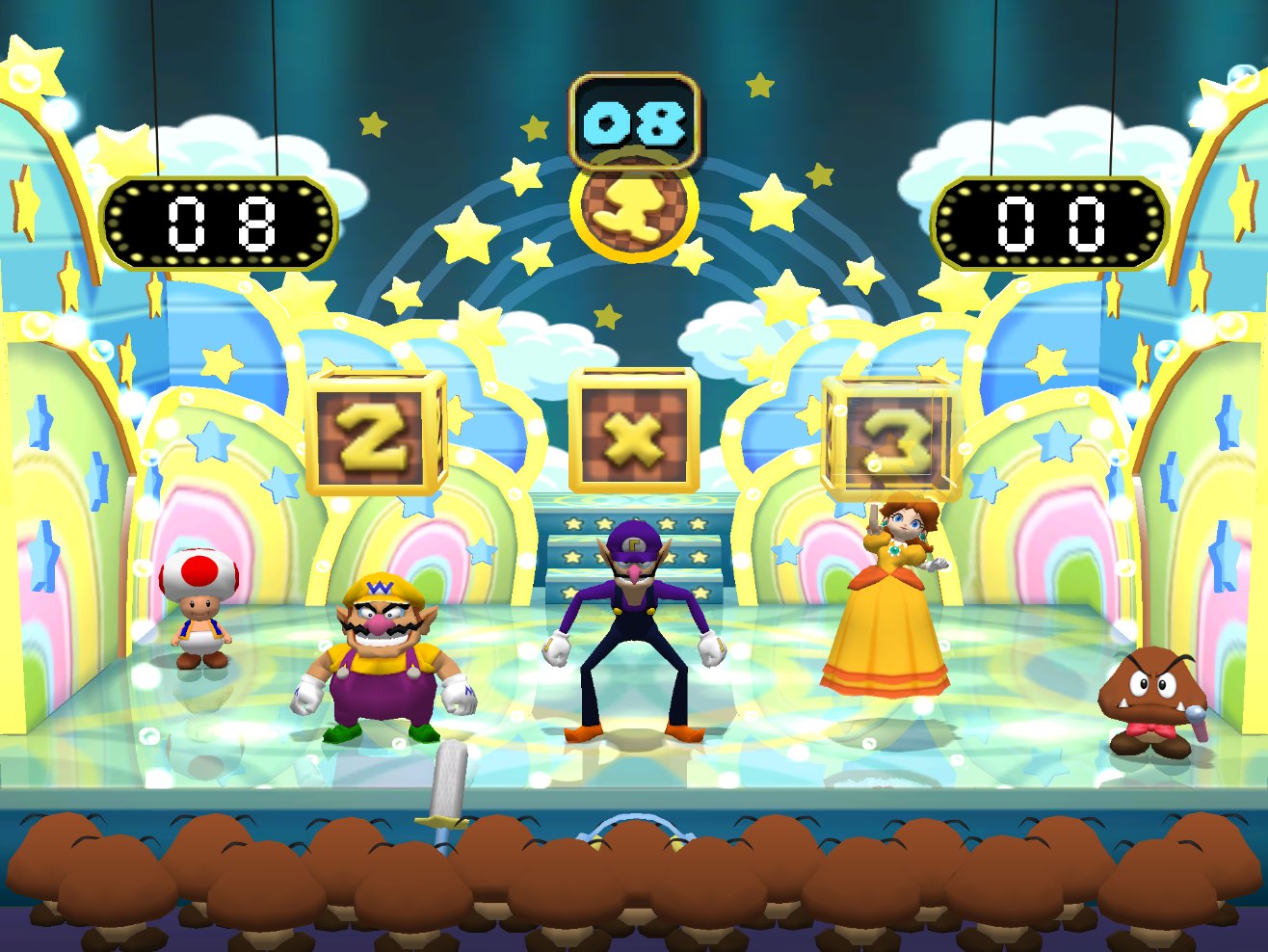
Mathletes1-vs-3 · coinHit blocks to build a sum, and the answer is paid in coins. Negative answers pay nothing; the best possible is 36.
Fight Cards1-vs-3Each side shows a punch, kick or chop card every round. The soloist has five rounds to knock out all three.
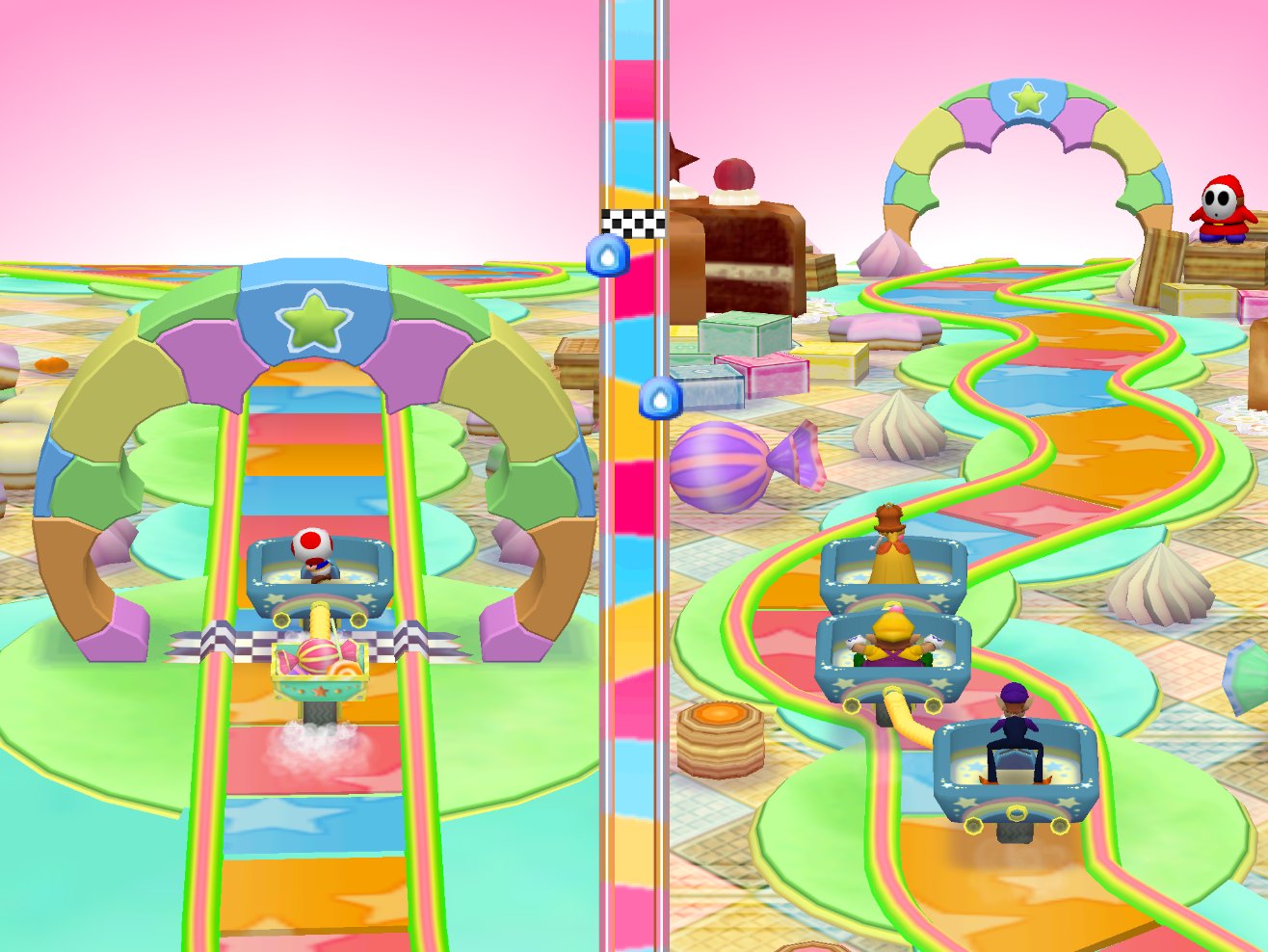
Curvy Curbs1-vs-3A trolley race down a winding track. The soloist has a slippery trolley to steer; the three steer one each and are held up whenever one of them hits the wall.
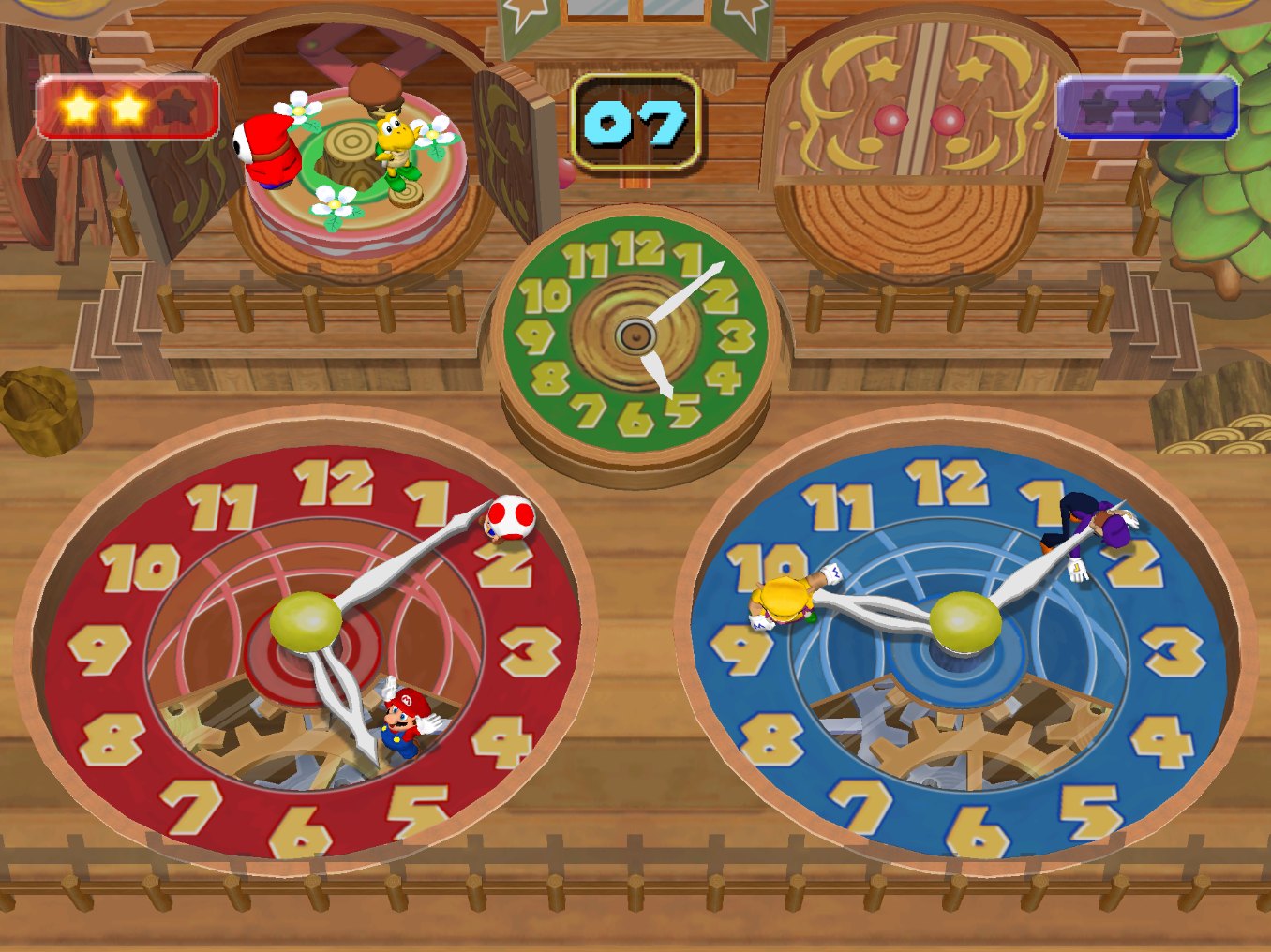
Clock Stoppers2-vs-2Turn the hands of your clocks to match the big one in the middle. First pair to three points.
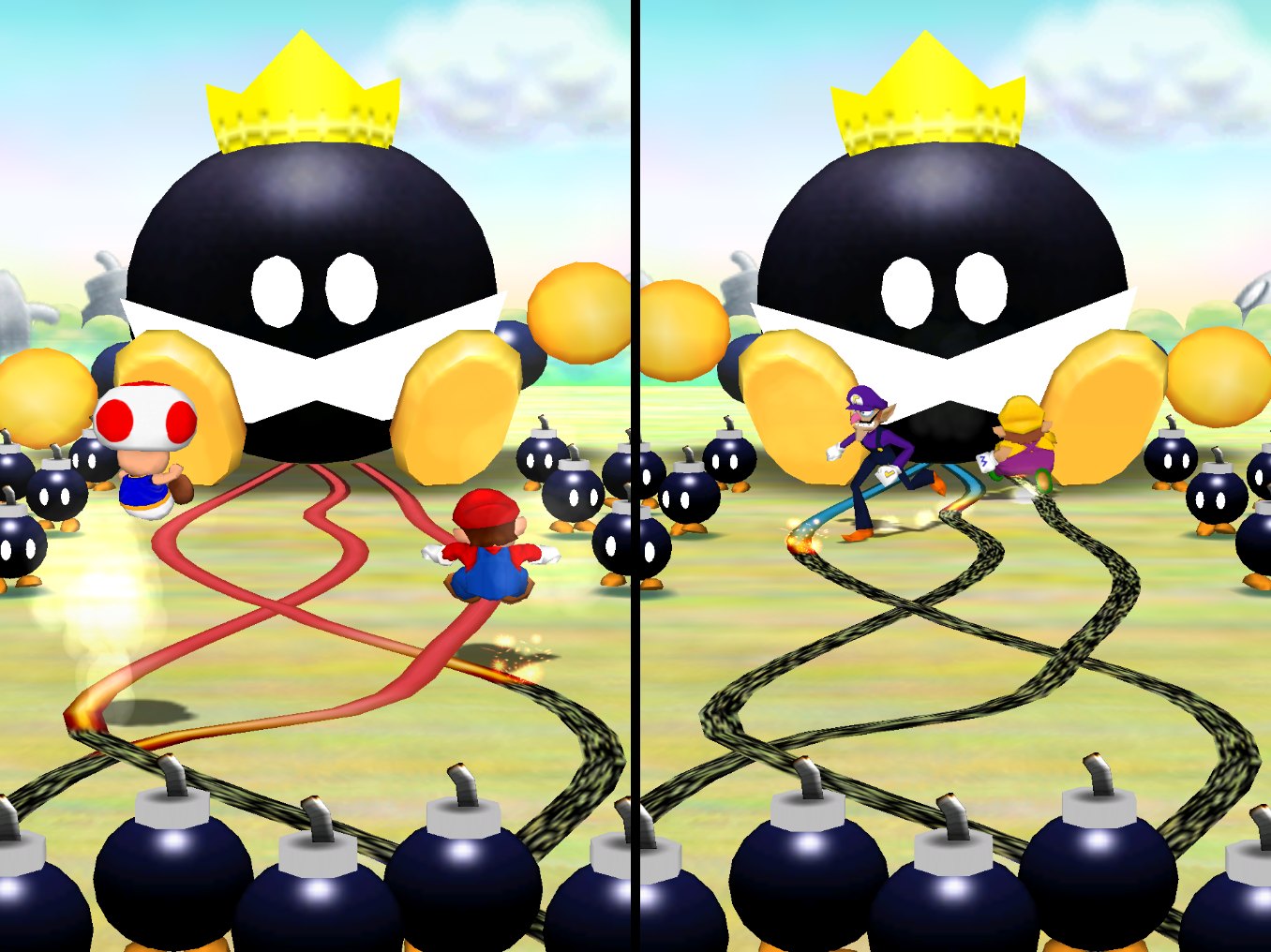
Defuse or Lose2-vs-2Stamp out sparks running along a tangle of fuses before they reach a giant Bob-omb. In The Top 100 and Jamboree.
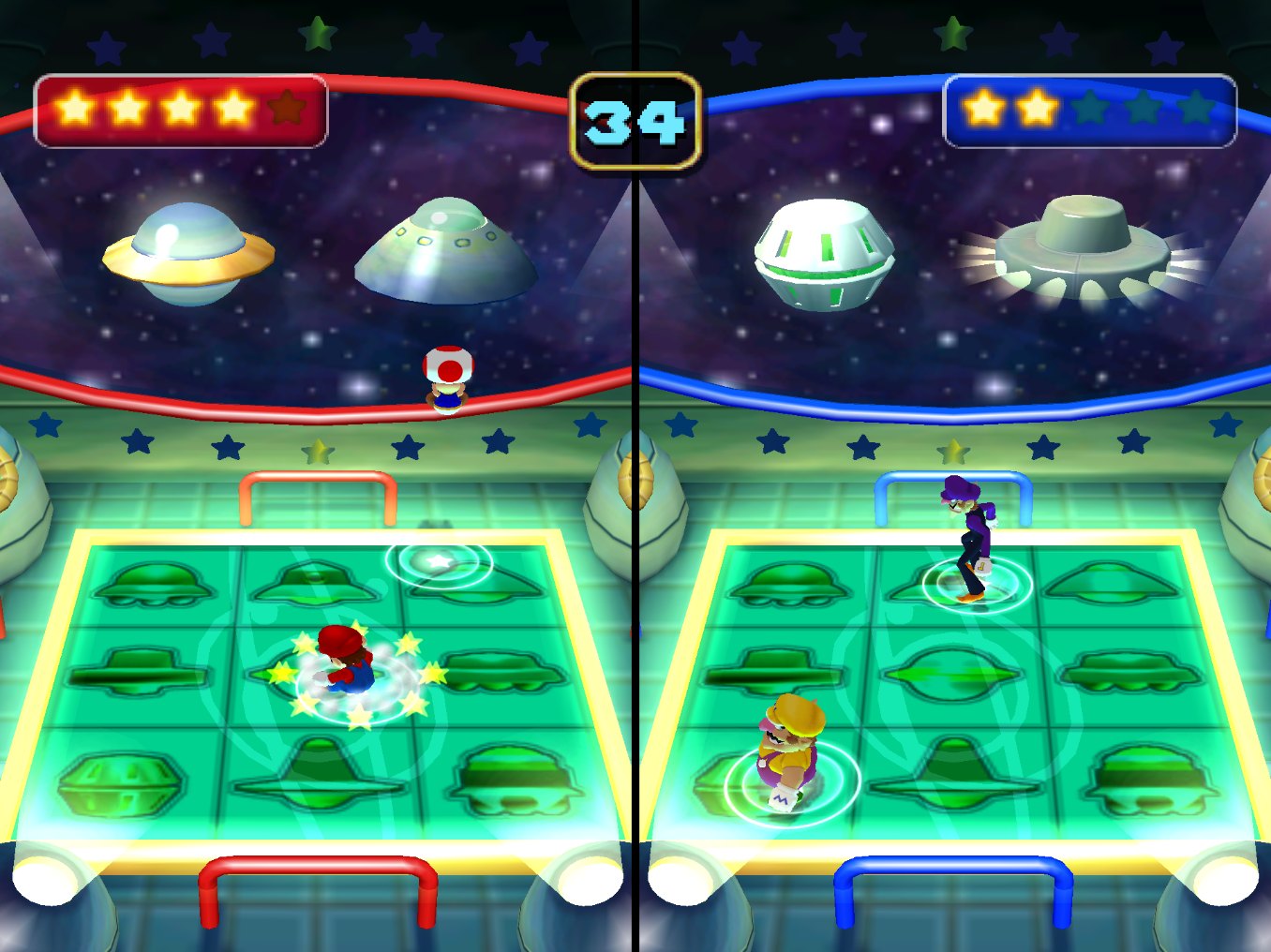
ID UFO2-vs-2Both partners must ground-pound the pictures that match the UFO at the same moment. First to five.
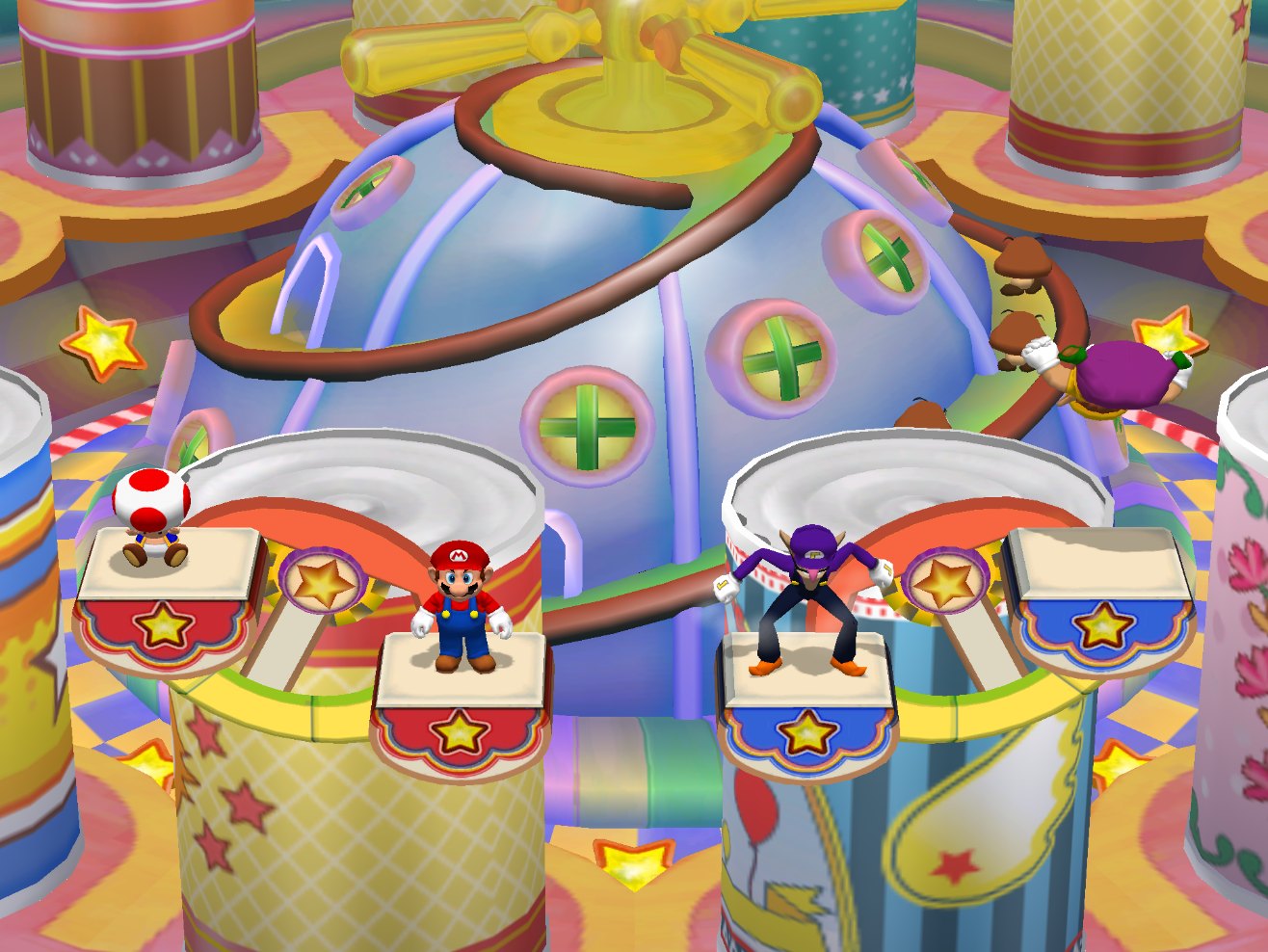
Mario Can-Can2-vs-2Take turns jumping on a see-saw to prise the lid off a giant tin.
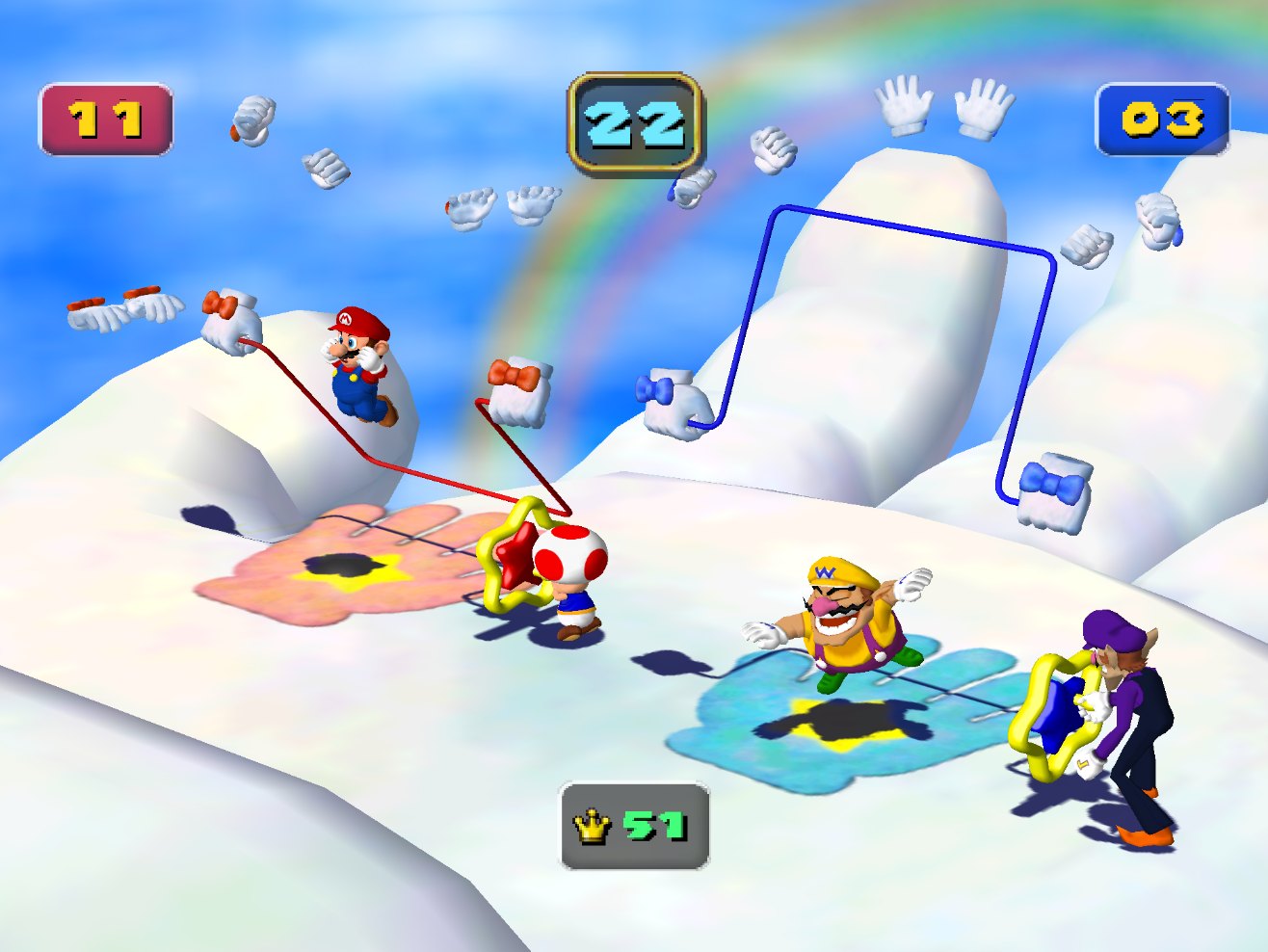
Handy Hoppers2-vs-2One partner spins a bar with L and R and the other skips over it. Most jumps wins.
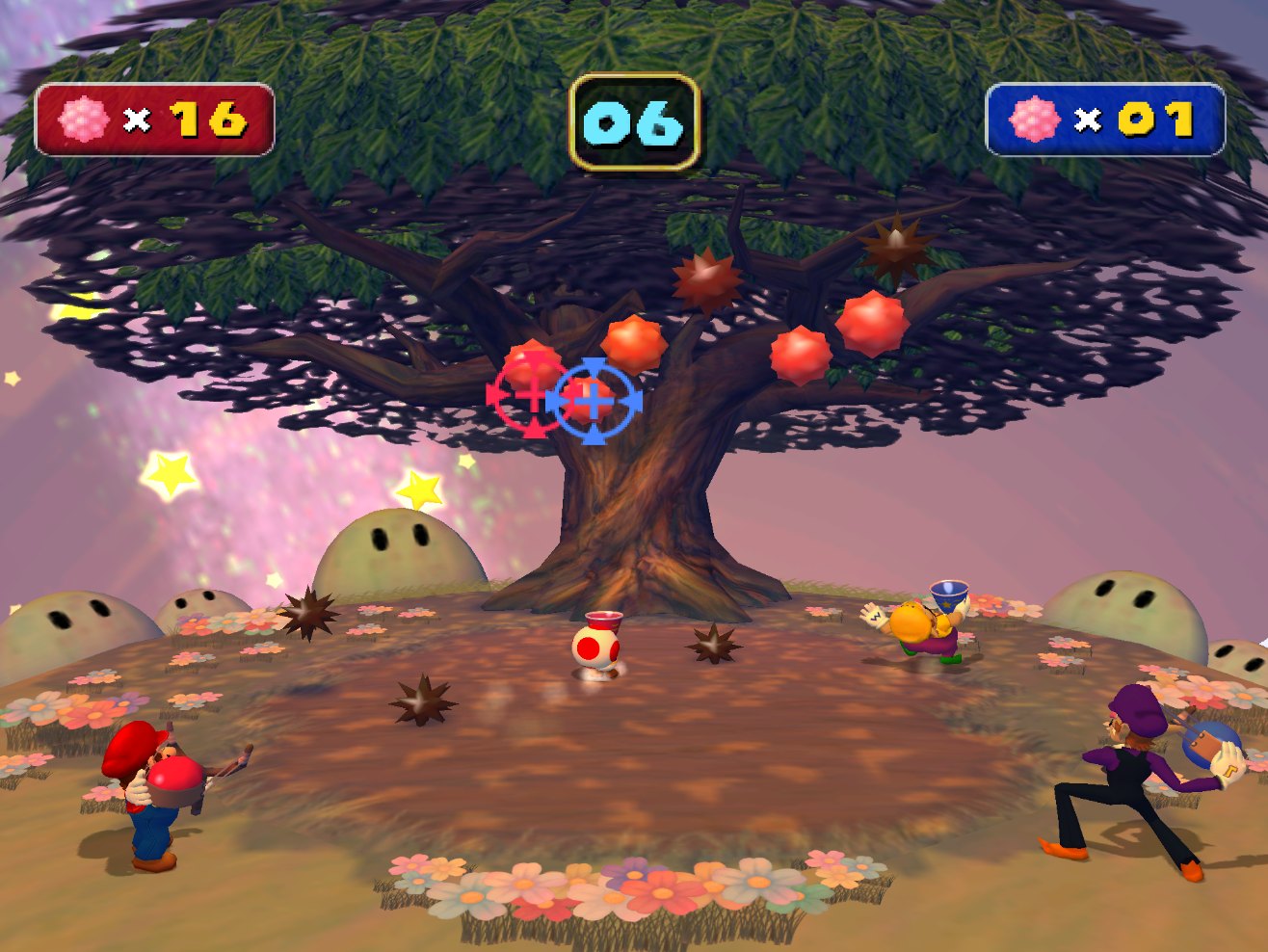
Berry Basket2-vs-2One shoots berries down from a tree and the other catches them in a basket. Dark ones stun.
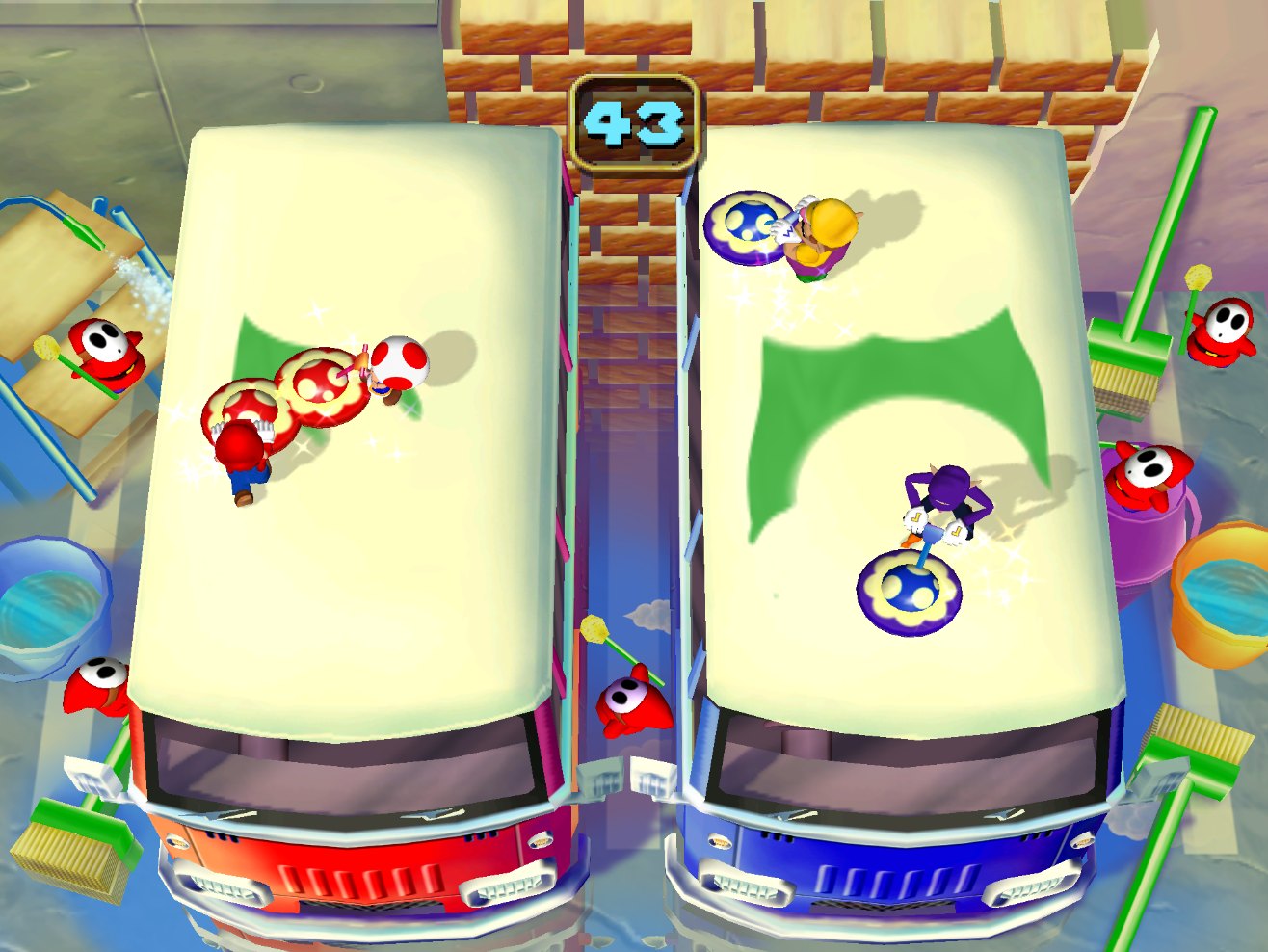
Bus Buffer2-vs-2Steer a buffer between you to clean the paint off the roof of your team’s bus. First pair to finish wins.
Rumble Ready2-vs-2Wait for the signal, then press A first to catch a falling capsule. First to three.
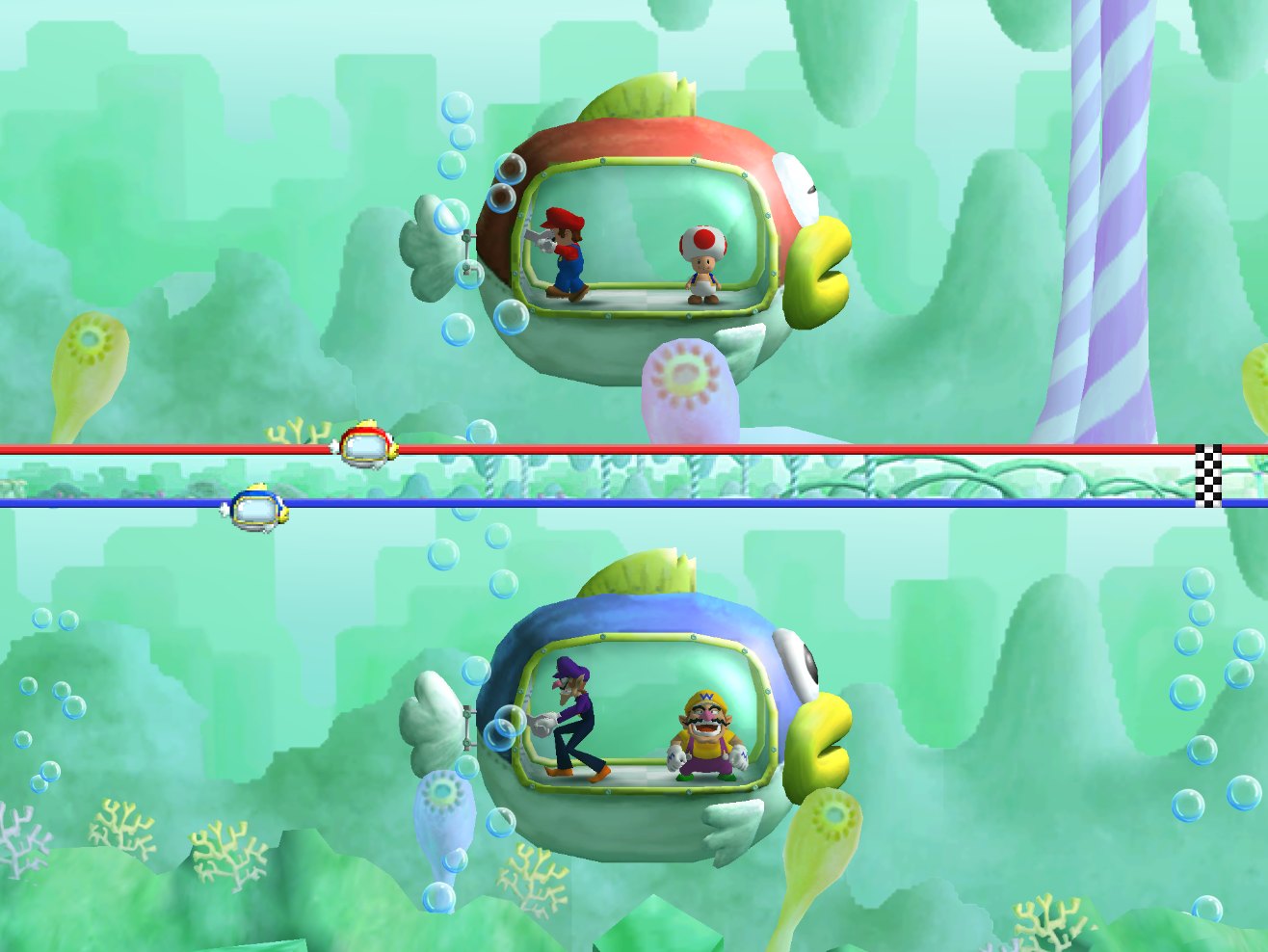
Submarathon2-vs-2Pull levers in turn to drive a Cheep Cheep submarine to the finish. The tune is the underwater theme from Super Mario Bros.
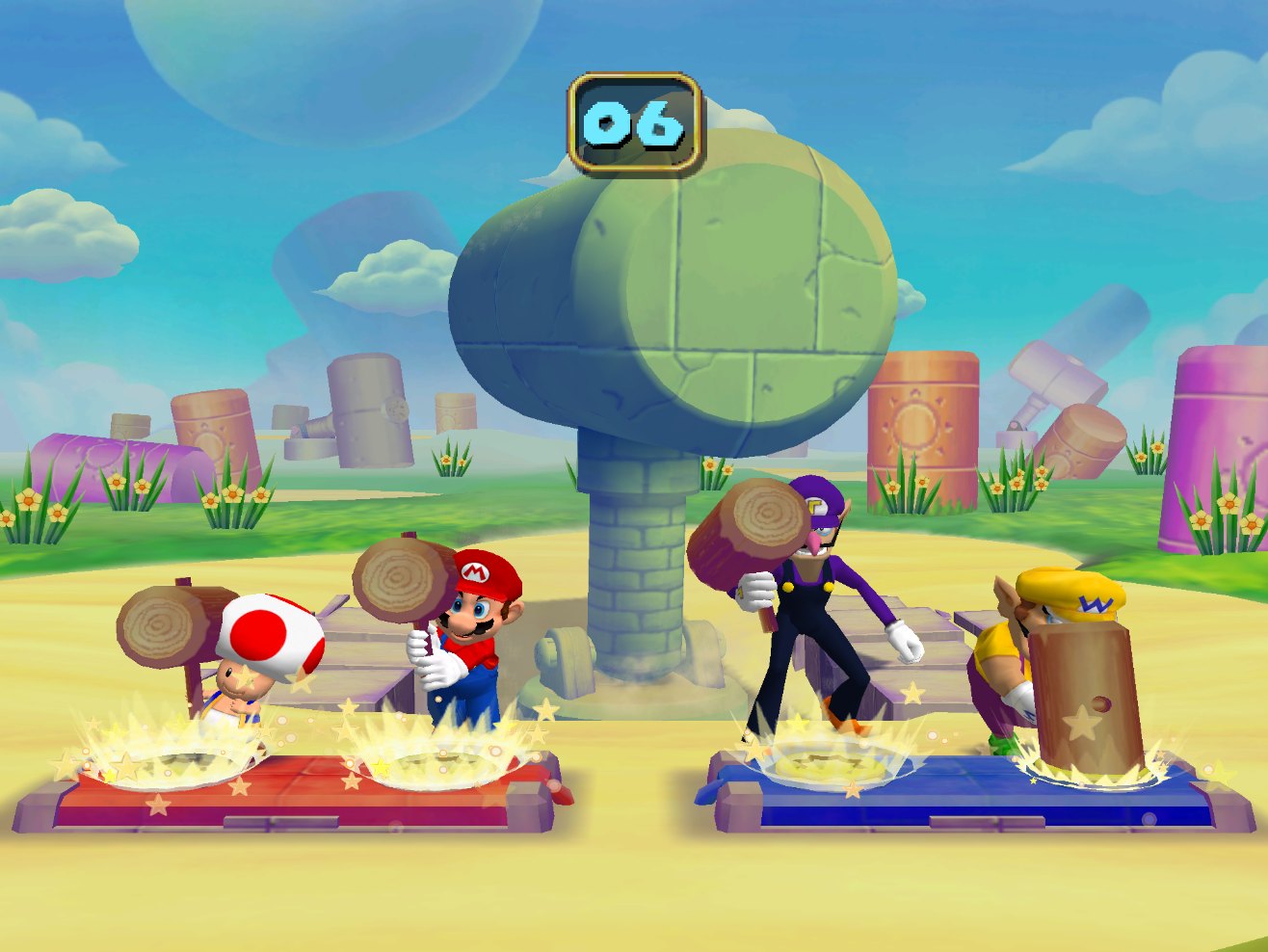
Manic Mallets2-vs-2Hammer your switch more times than the other pair in ten seconds and the giant mallet swings their way. In The Top 100.
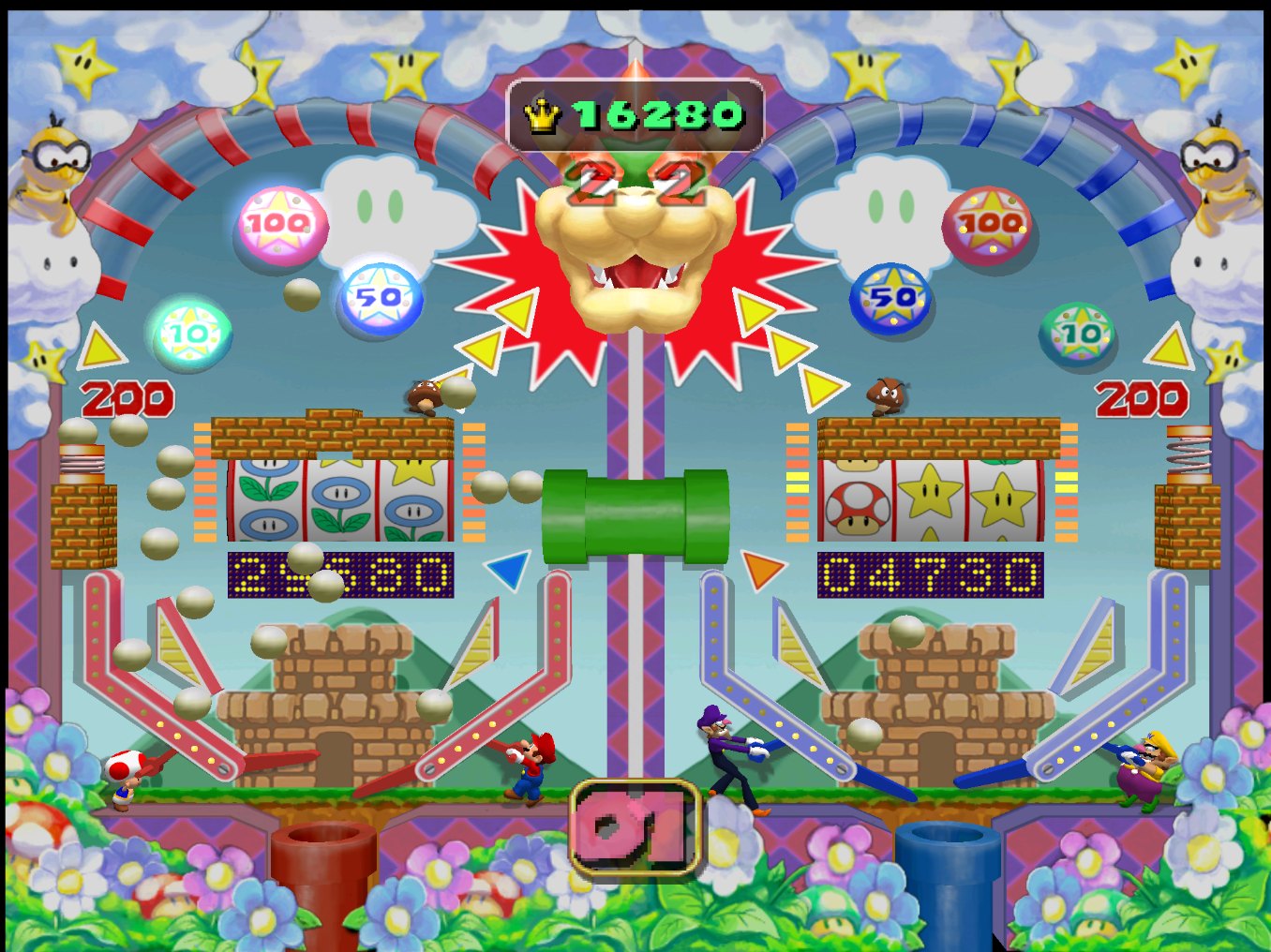
Panic Pinball2-vs-2A flipper each on a pinball table with scenery borrowed from Super Mario All-Stars. The higher score wins.
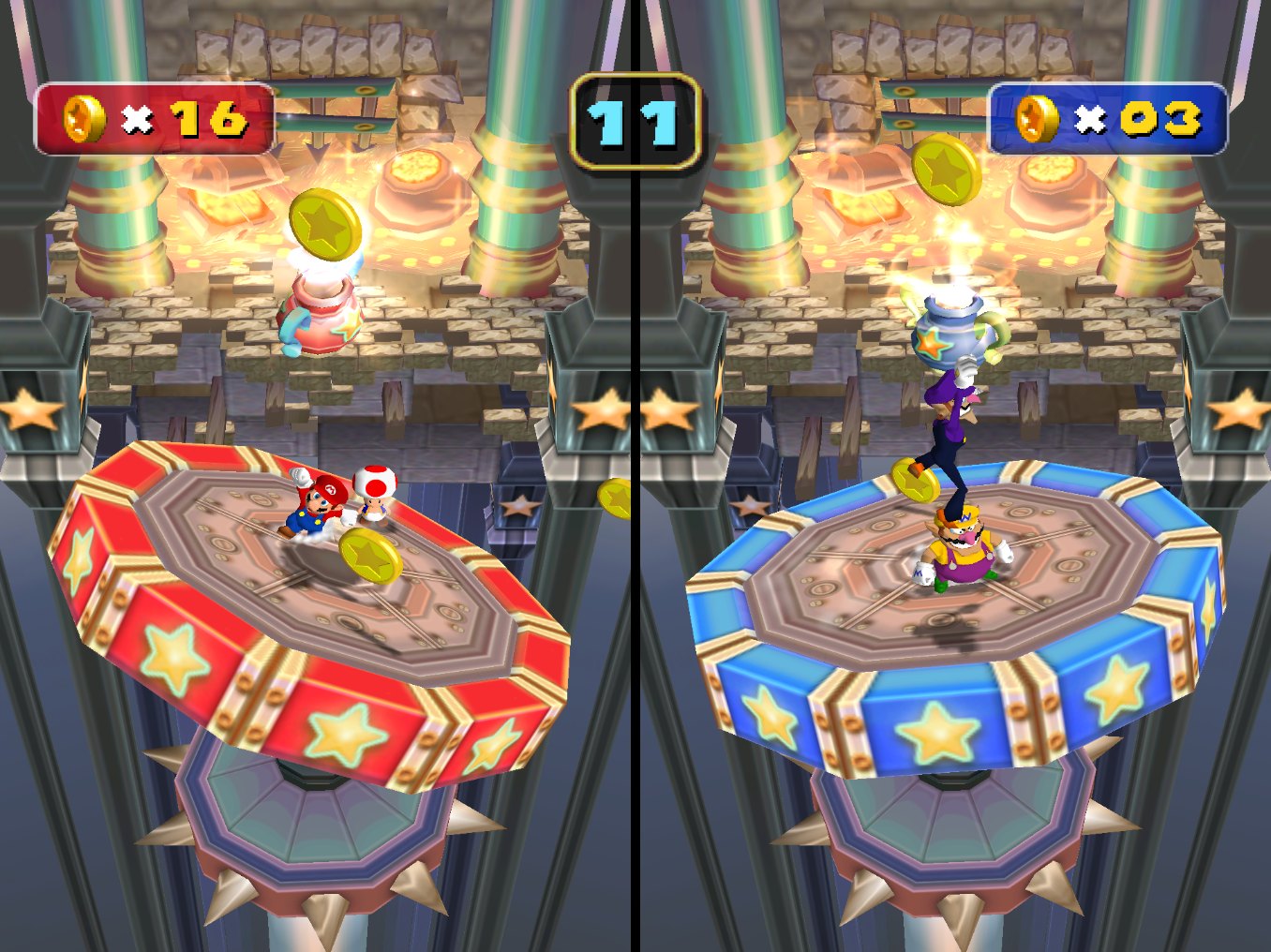
Banking Coins2-vs-2 · coinOne partner whacks a vase to shake coins out and the other catches them on a tilting platform.
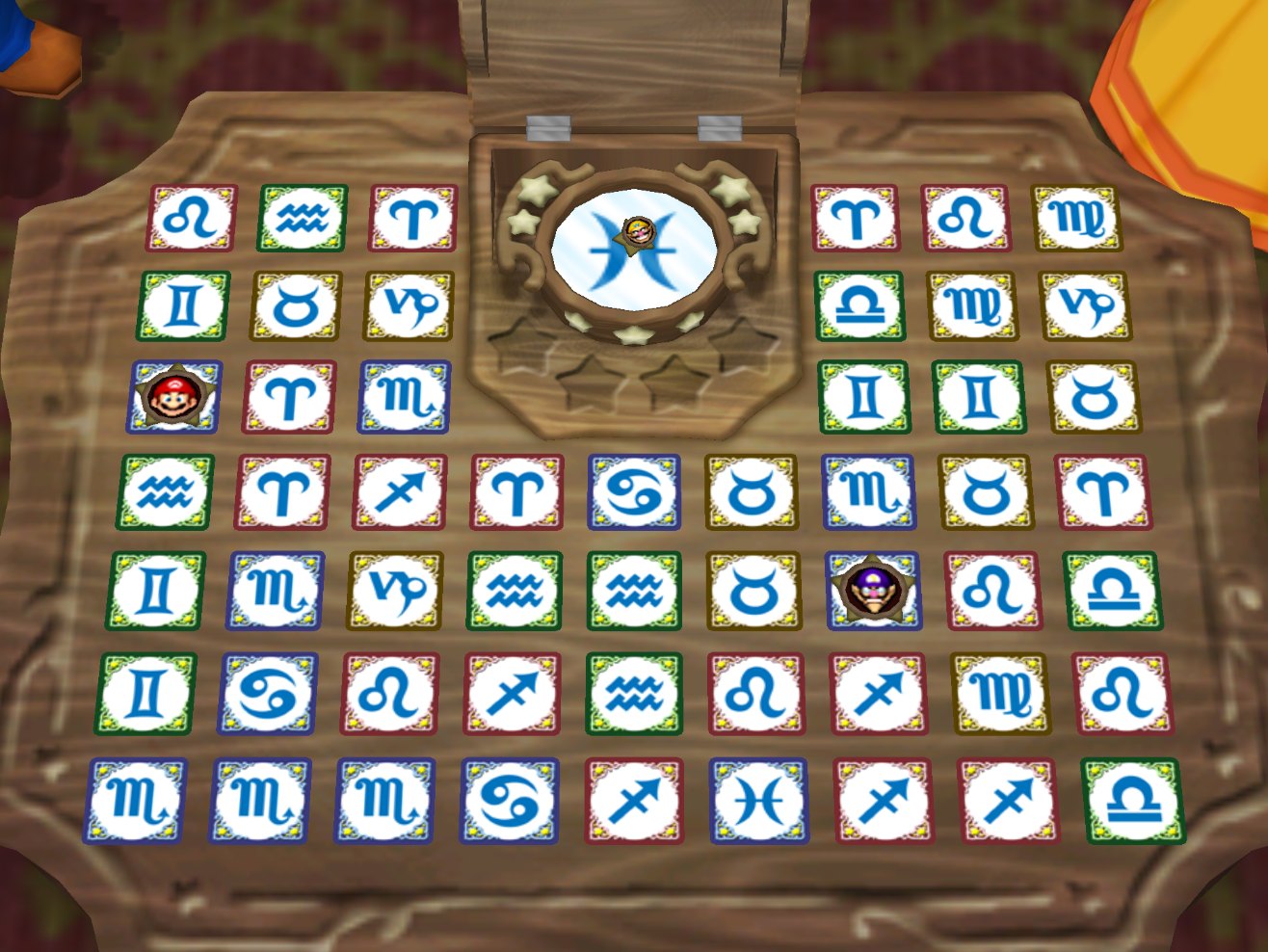
Astro-LogicalBattleFind the symbol on the table that matches the one shown. Wrong guesses cost time.
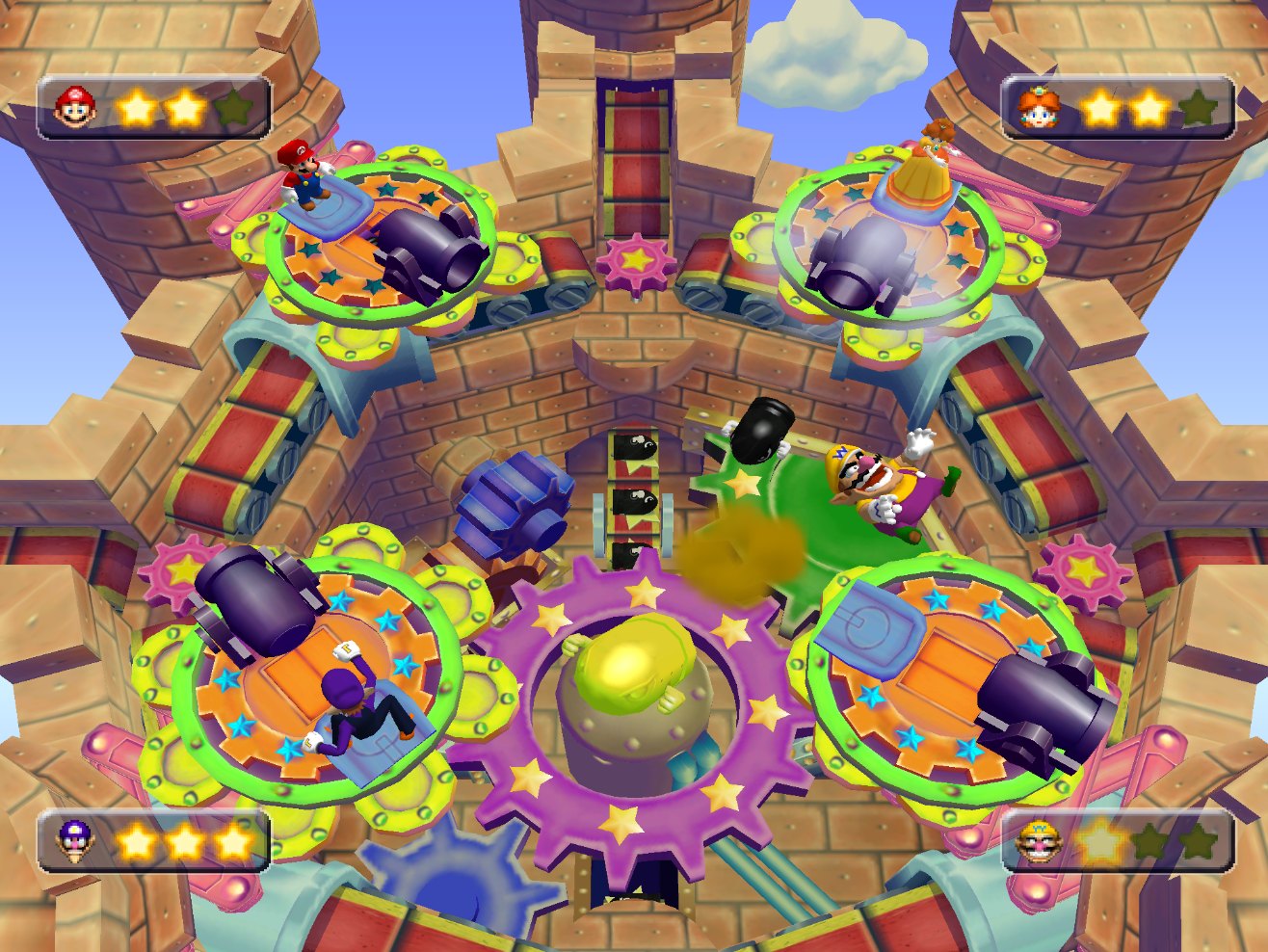
Bill BlastersBattleFire Bullet Bills at each other from spinning turrets. Three hits and you are out. In Superstars.
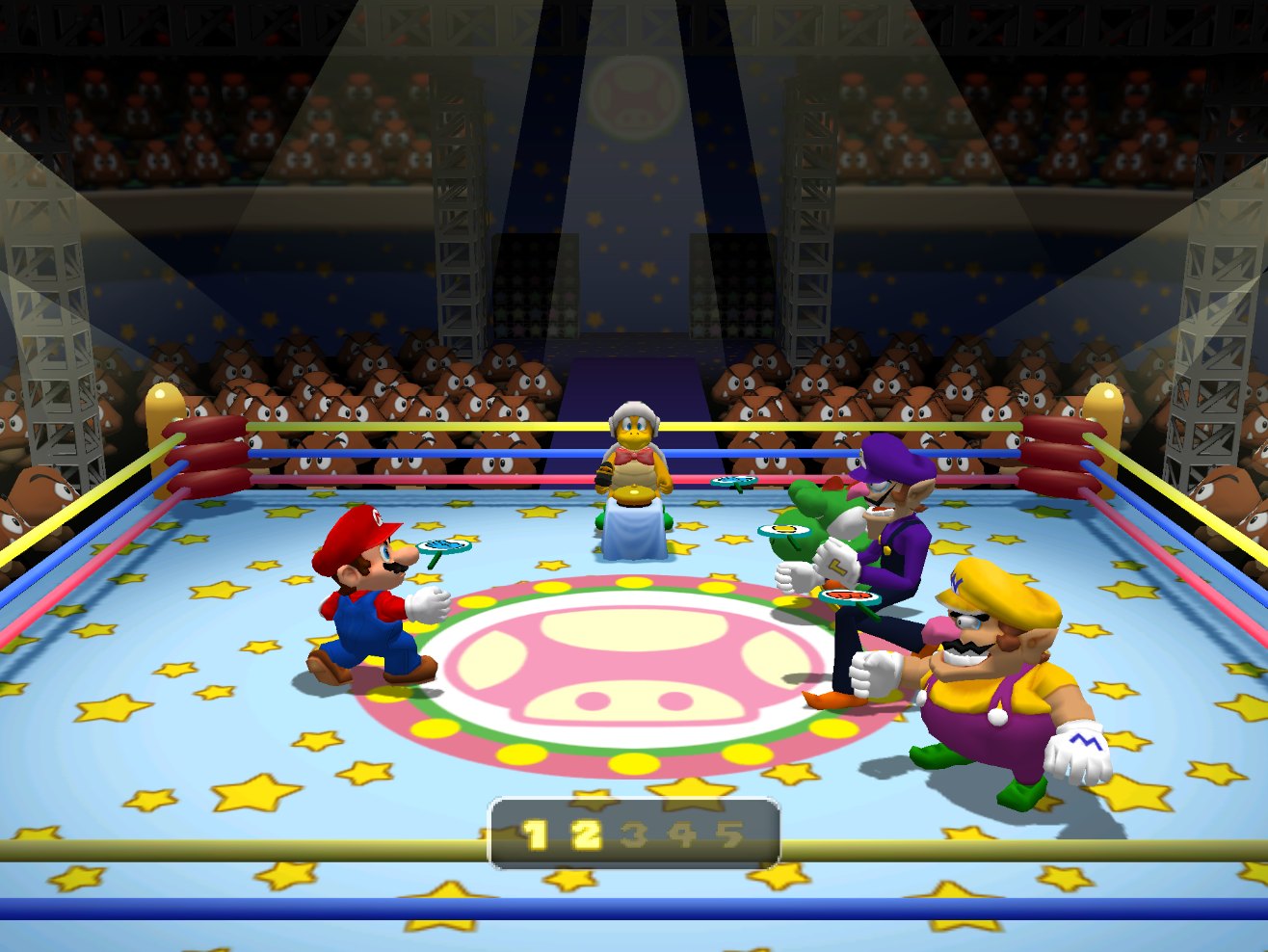
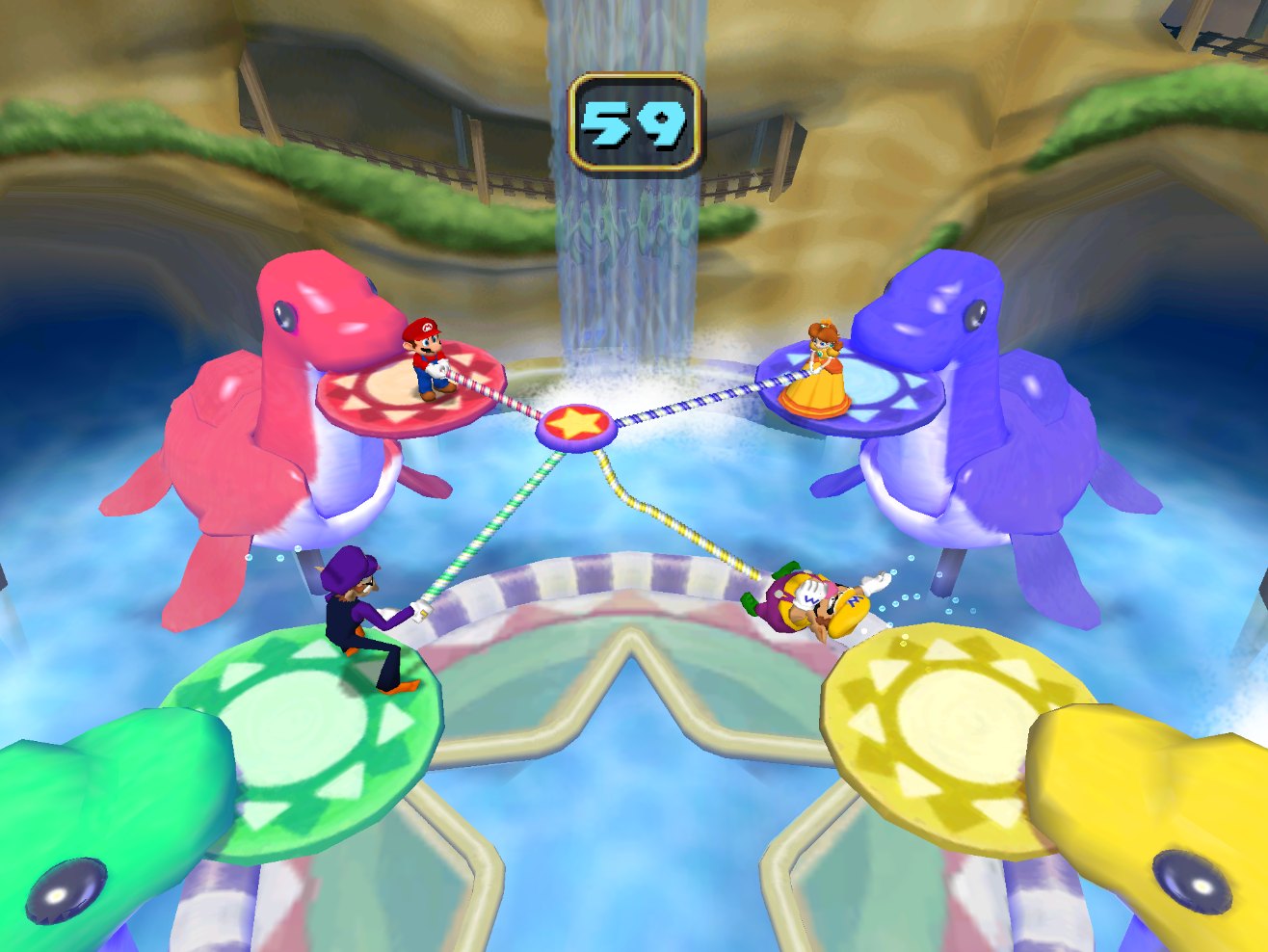
Tug-o-DorrieBattleA four-way tug-of-war from platforms held up by plastic Dorries. Anyone pulled off their platform is out, and the last one left wins.
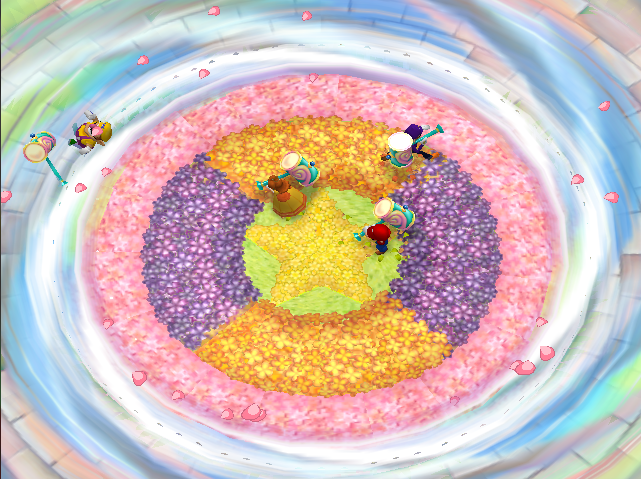
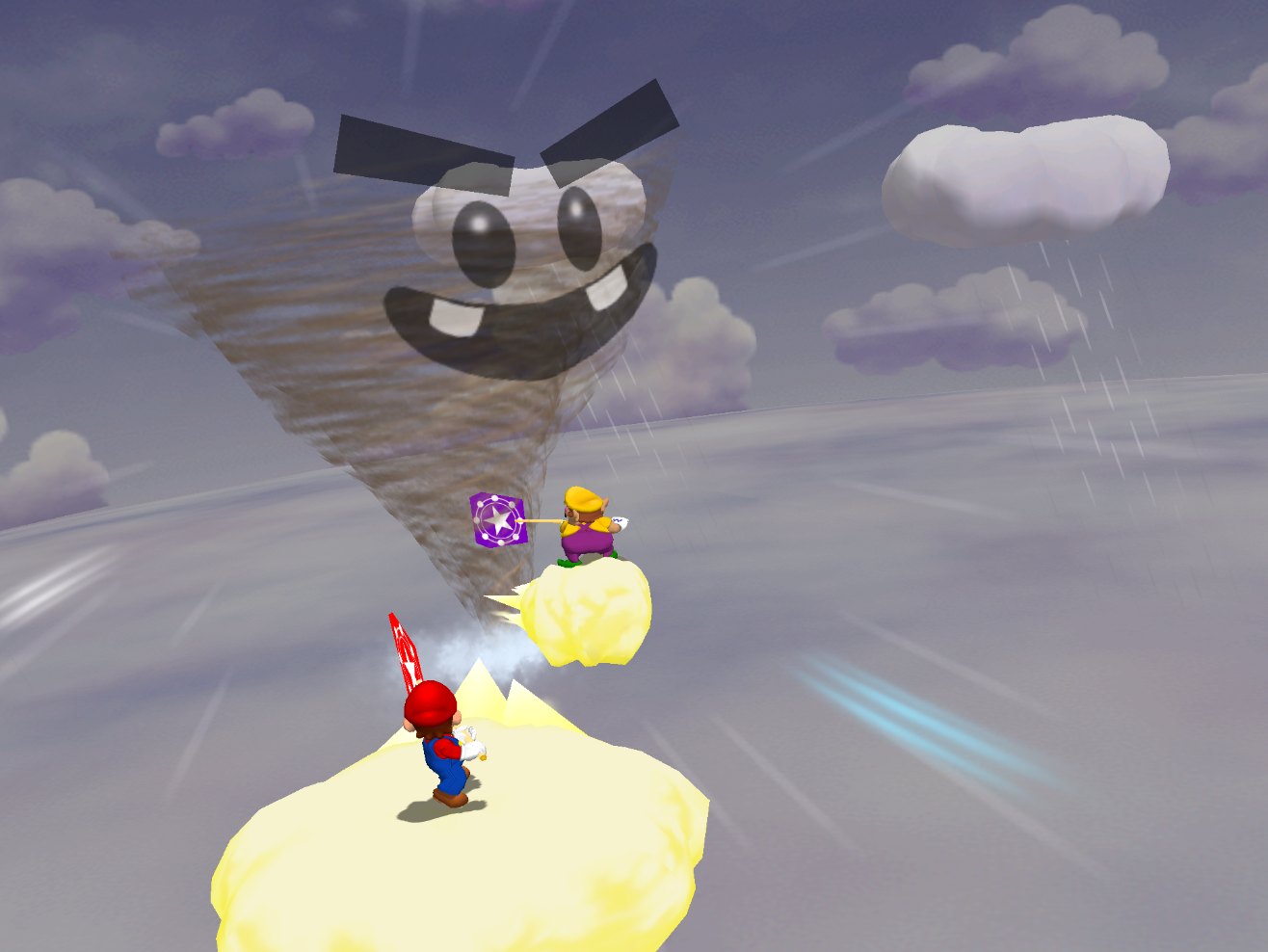
Twist ‘n’ OutBattleHammer your rivals out of the eye and into the tornado that surrounds the arena. Last one standing wins.
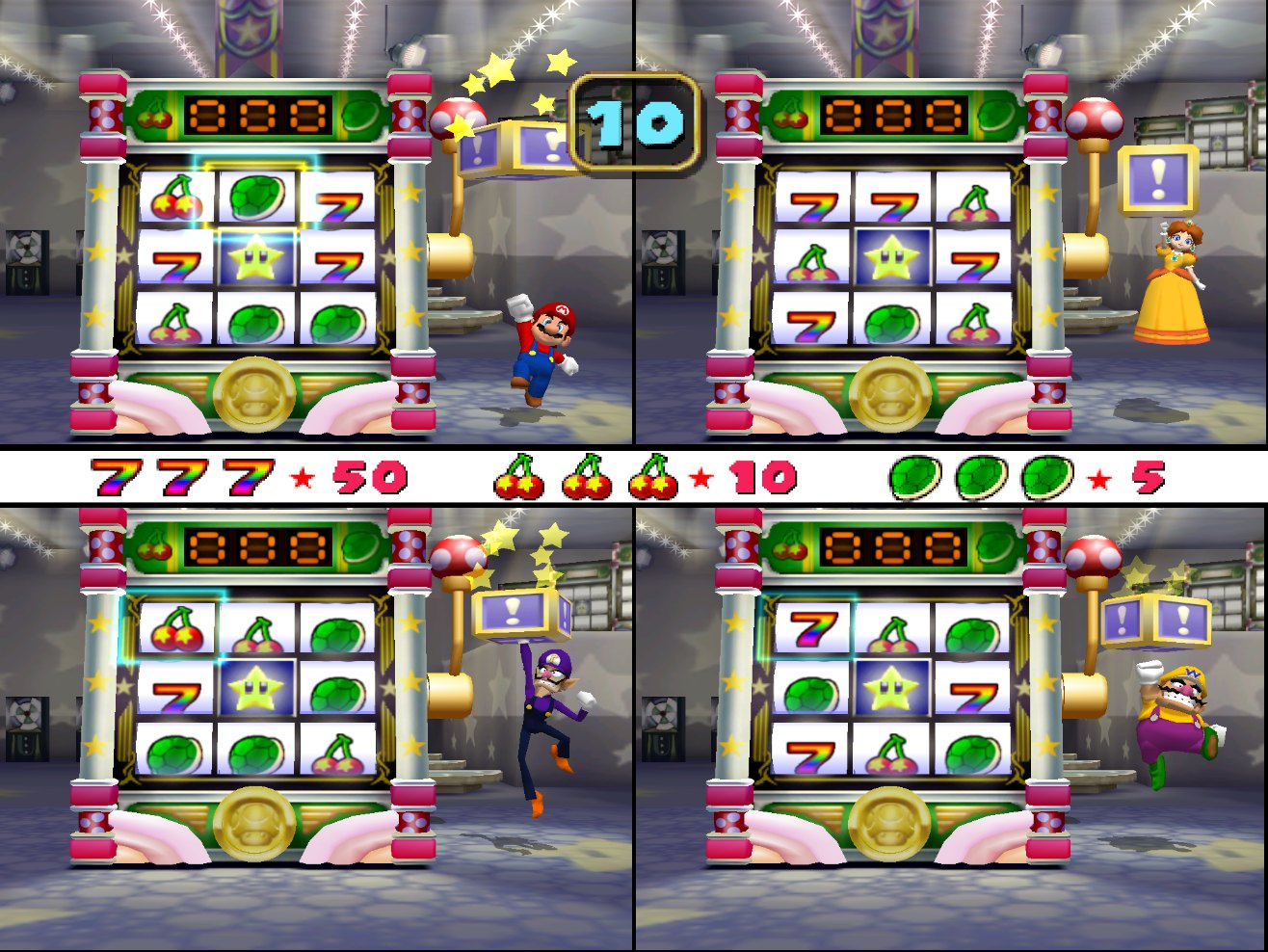
Lucky LineupBattleHit the blocks of a slot machine to line up symbols: sevens score 50, cherries 10 and shells 5.
Random RideBattlePick a machine and hope. The race is mostly luck, though the machines’ names are a clue, and an engine blow-out puts yours out of it.
Shock AbsorbersDuelKeep moving among Amps and the electric barriers between them. First to be shocked loses.
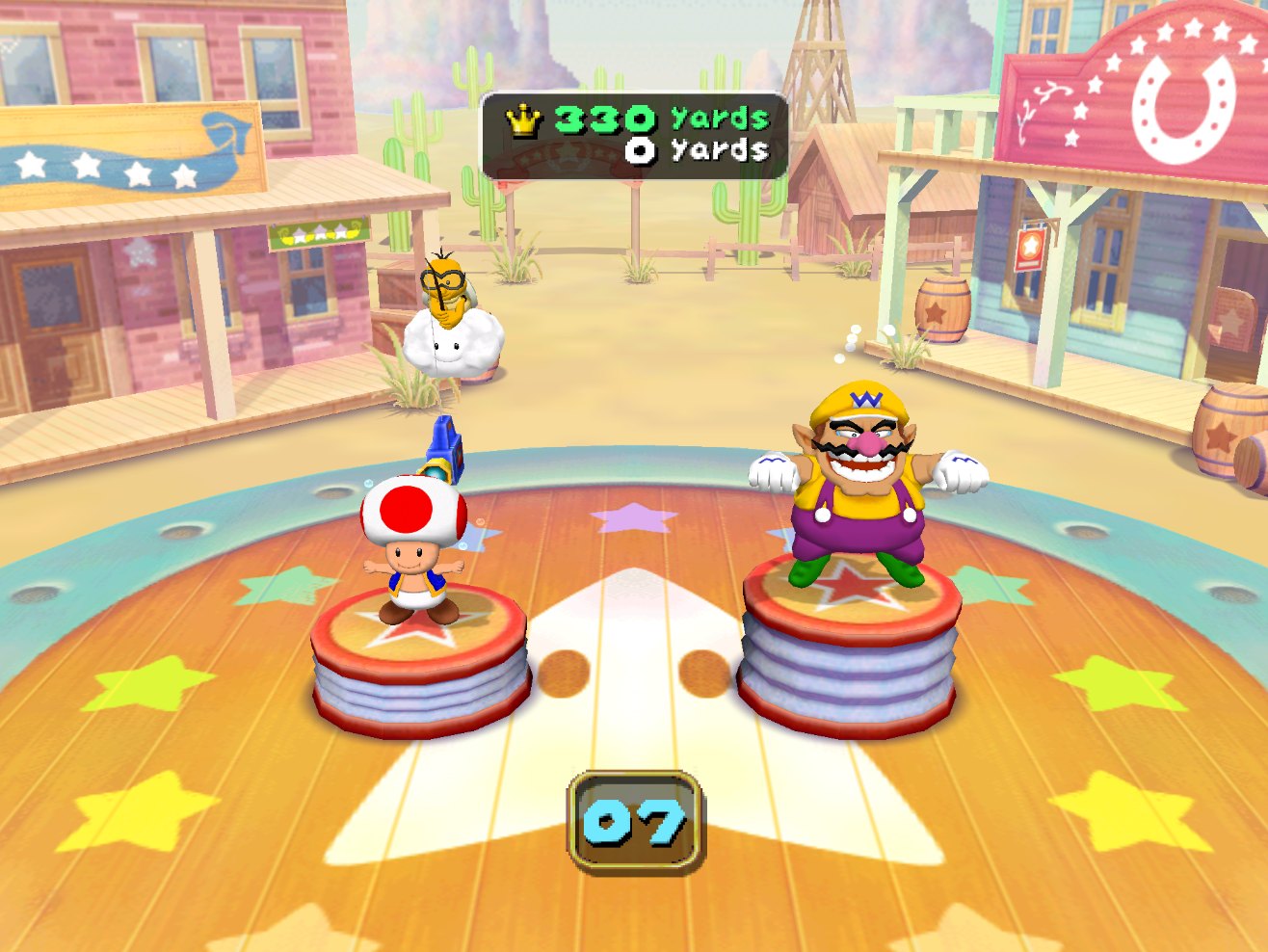
Countdown PoundDuelA clock counts down from ten seconds. Ground-pound your platform to stop it as close to zero as you can.
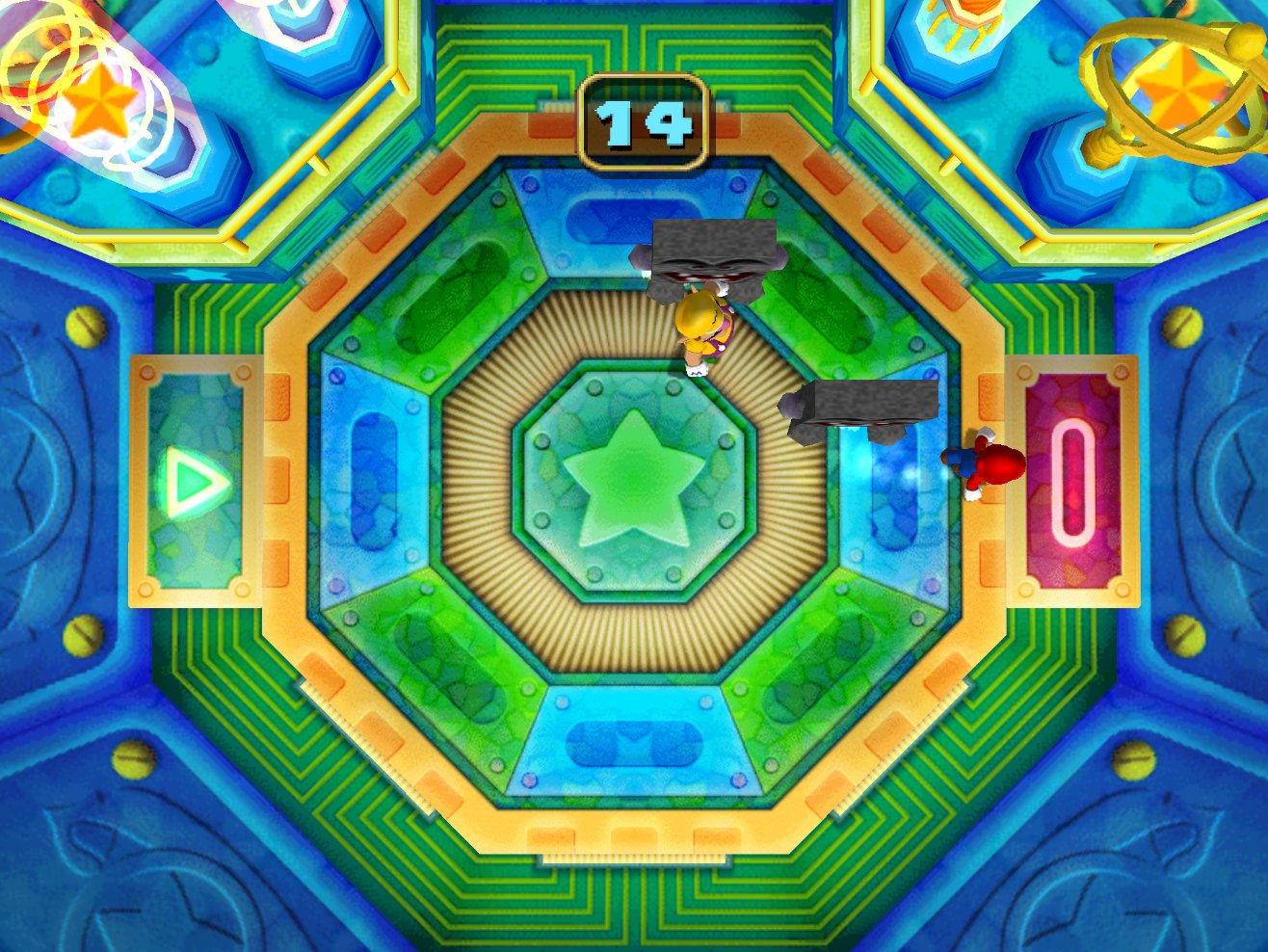
Whomp MazeDuelRace to the far end of a floor with Whomps buried under it, which pop up in your way as you come near.
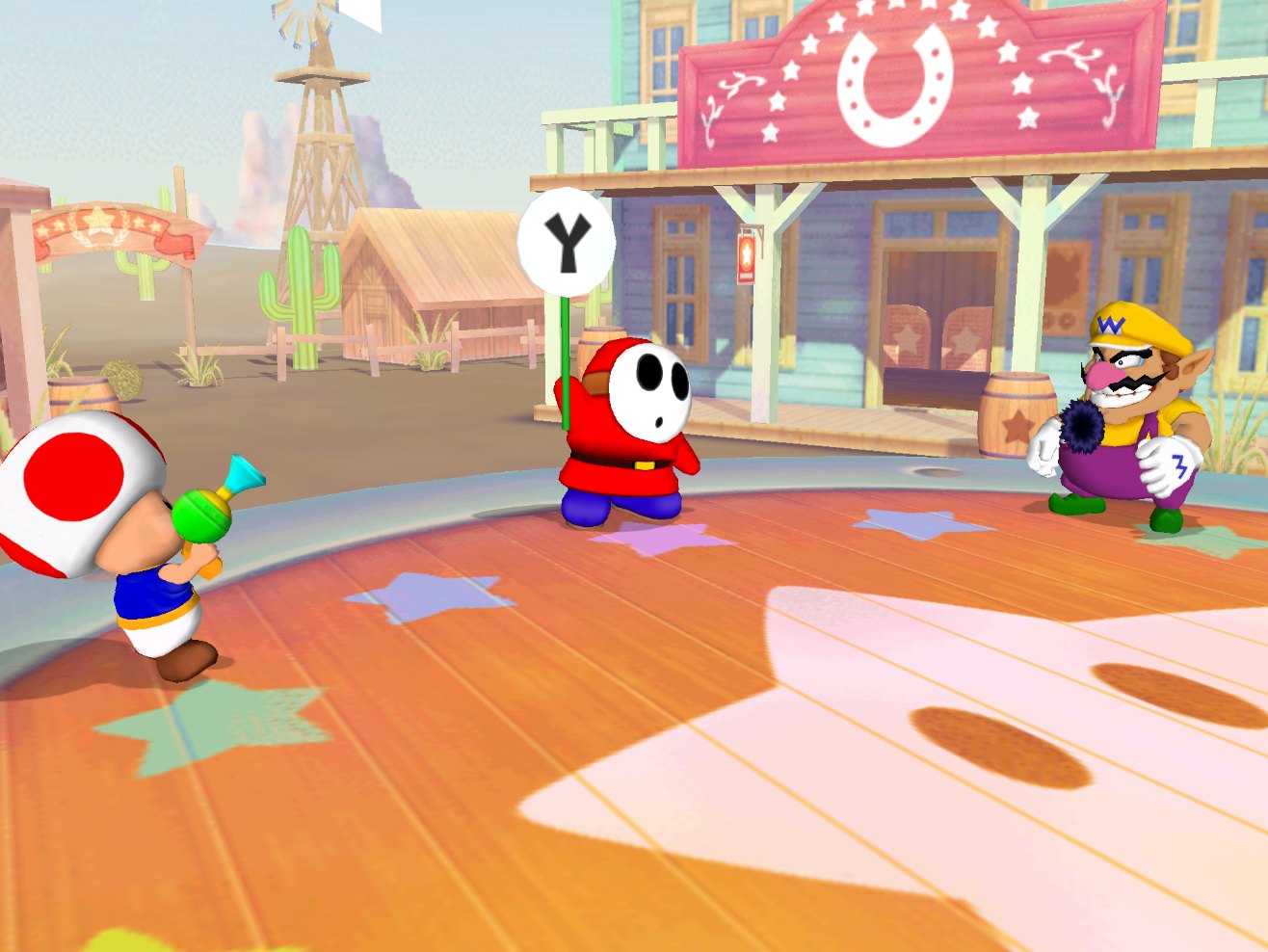
Shy Guy ShowdownDuelA quick-draw. When the Shy Guy holds up a sign, press that button first, and do not fall for a fake. In The Top 100.
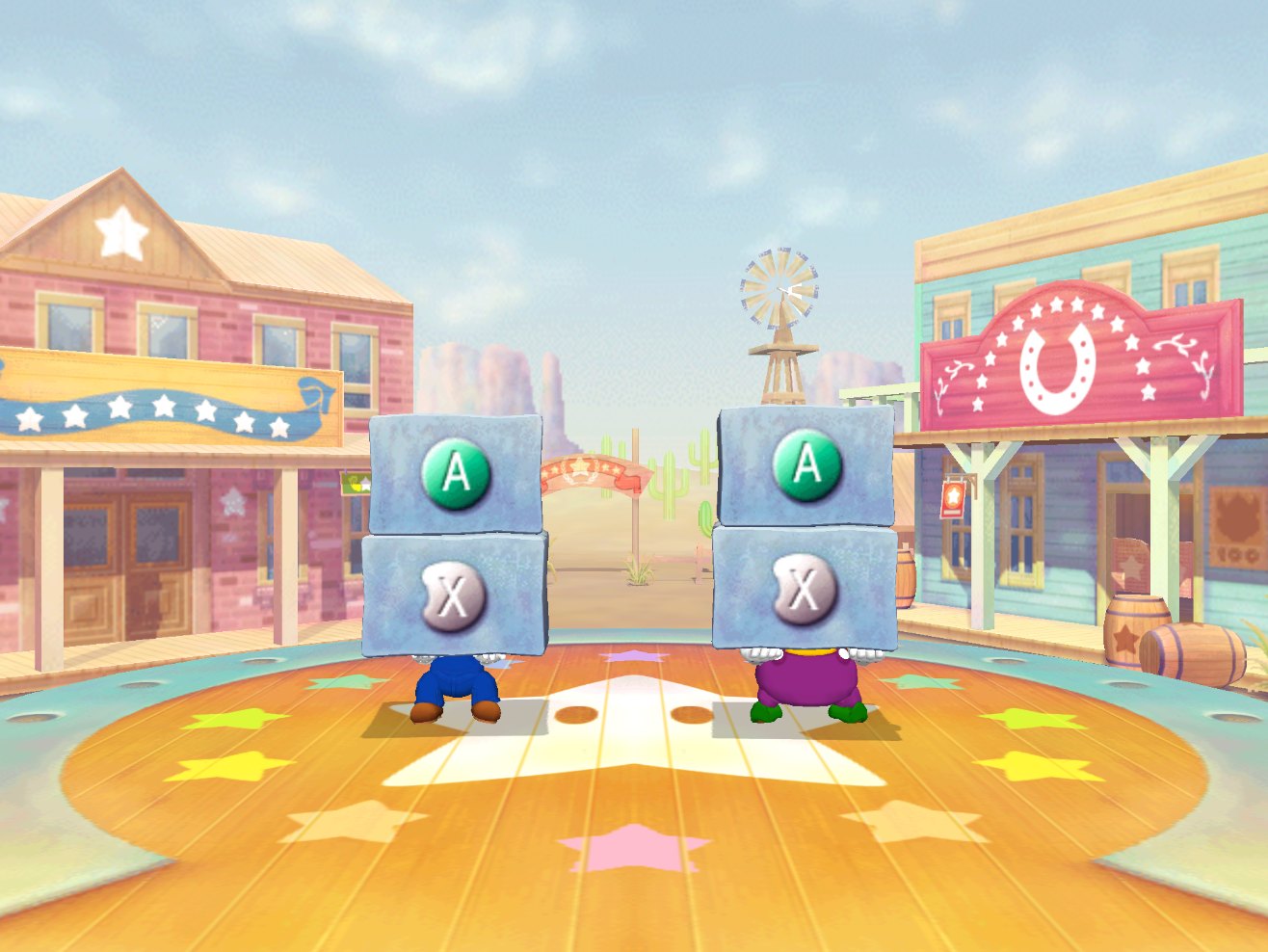
Button MashersDuelPress all the buttons shown on a stack of blocks together. The stack grows by one each time, and the first slip loses. In The Top 100.
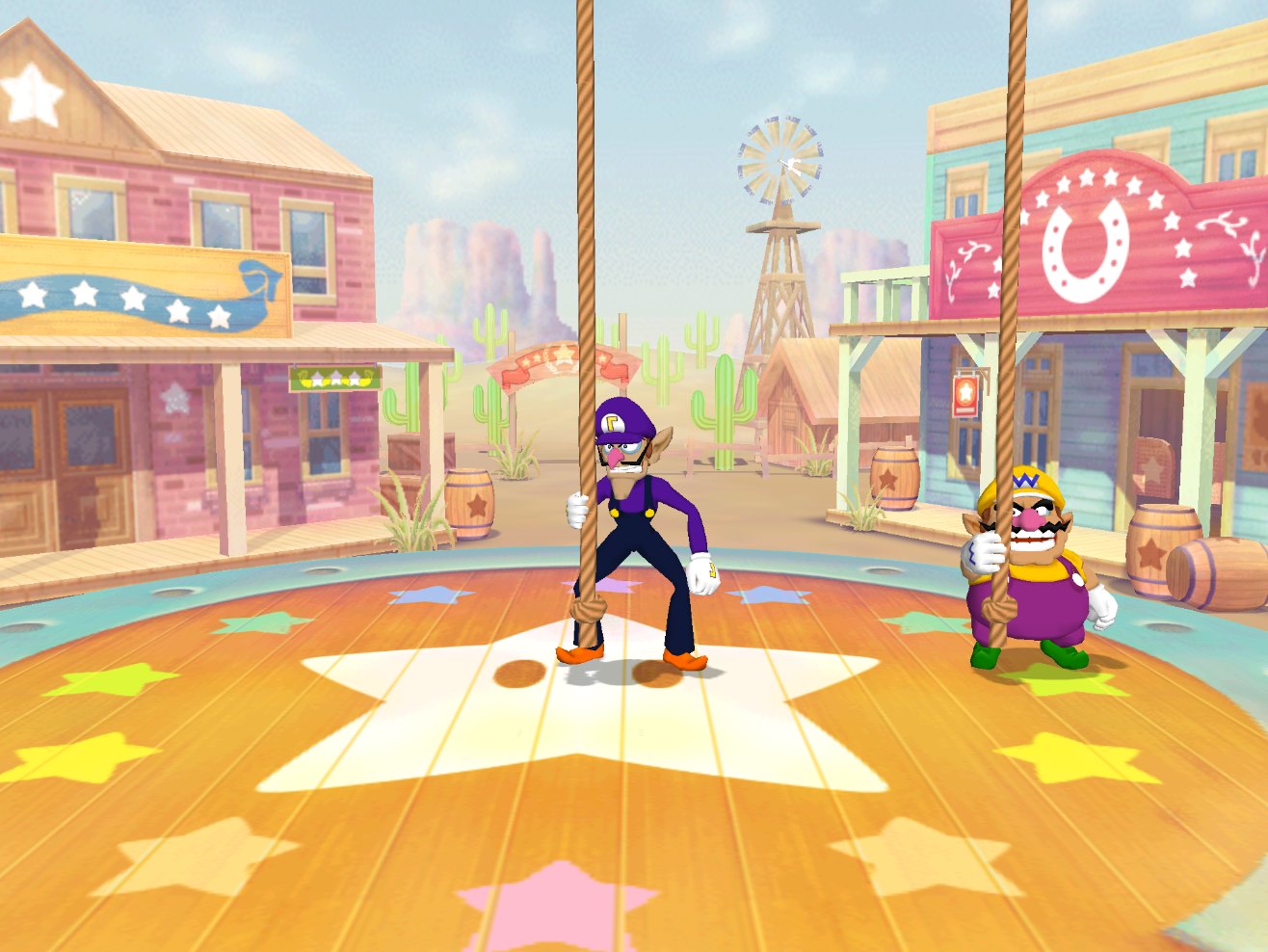
Get a RopeDuelThree ropes, one pull each. What is on the end decides it.
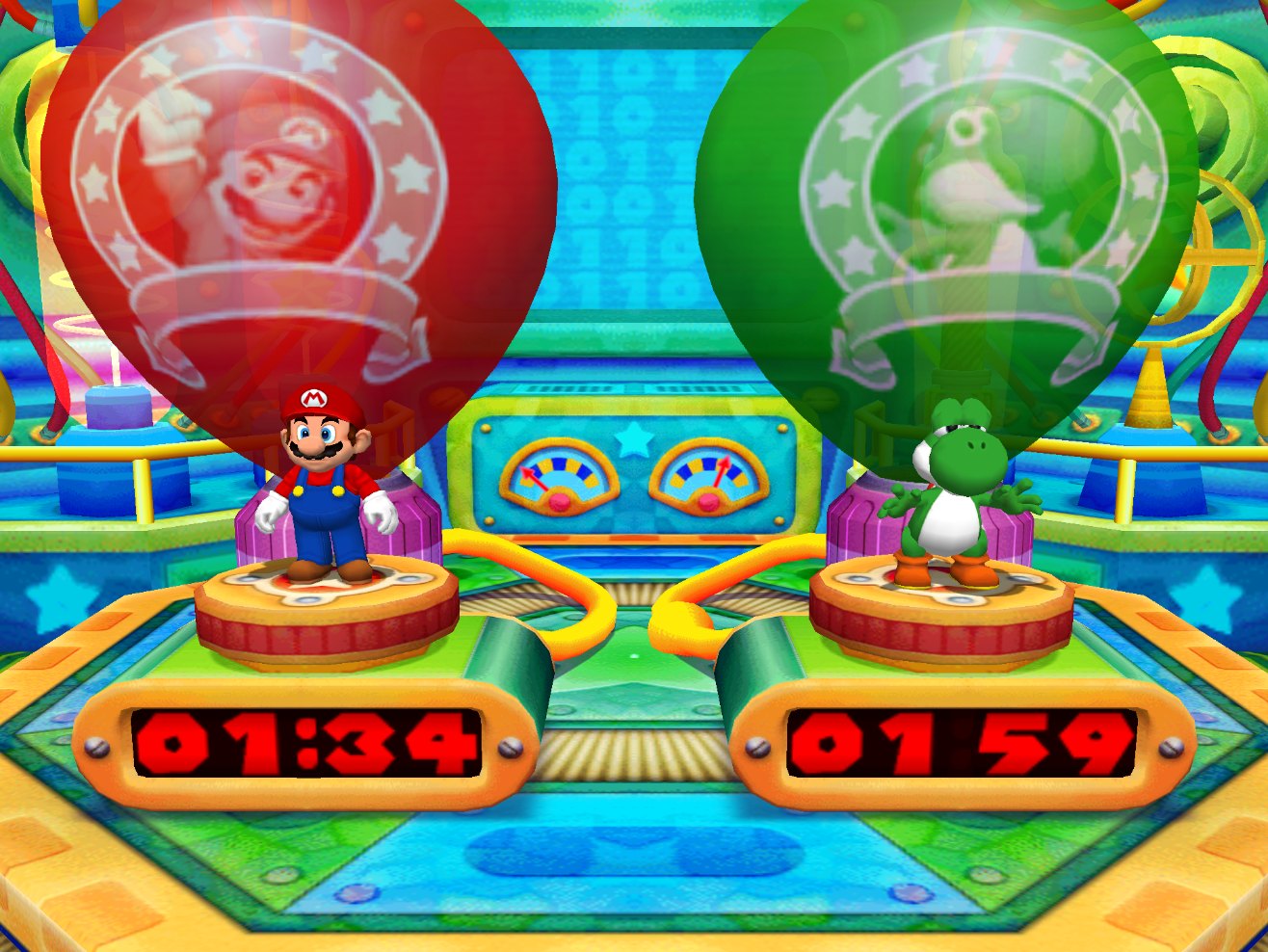
Pump ‘n’ JumpDuelMash A for ten seconds to build up pressure in your platform, then see who is launched higher.
Head WaiterDuelPass a ticking bomb to and fro, choosing how much to take off the counter. Whoever is holding it at zero loses.
Blown AwayDuelCharge up and fire blasts of air to push your rival off a cloud.
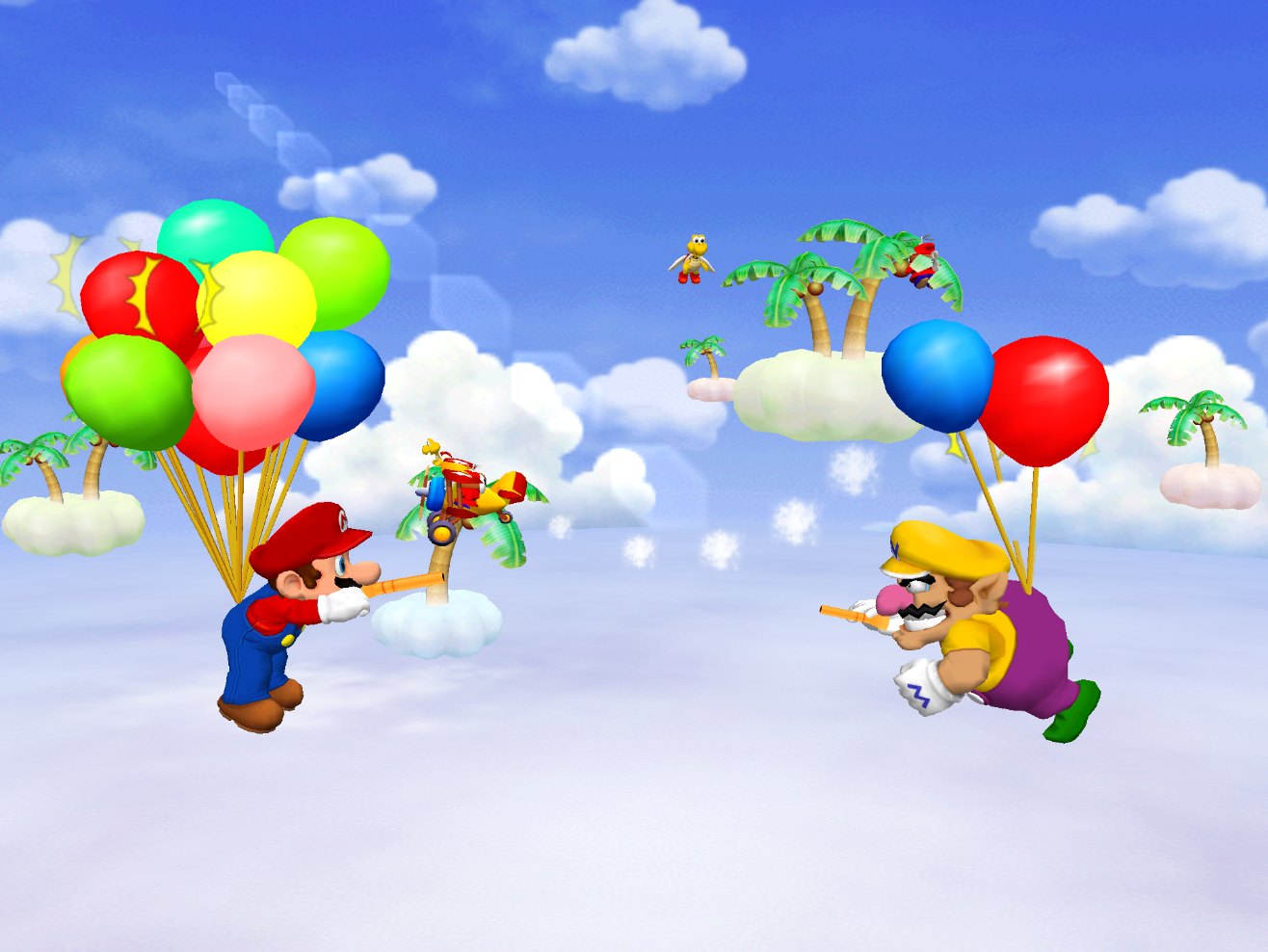
Merry PoppingsDuelBlow darts to burst all of your opponent’s balloons before they burst yours.
Pound PerilDuelTwelve switches and only one of them safe. Ground-pound until somebody finds it.
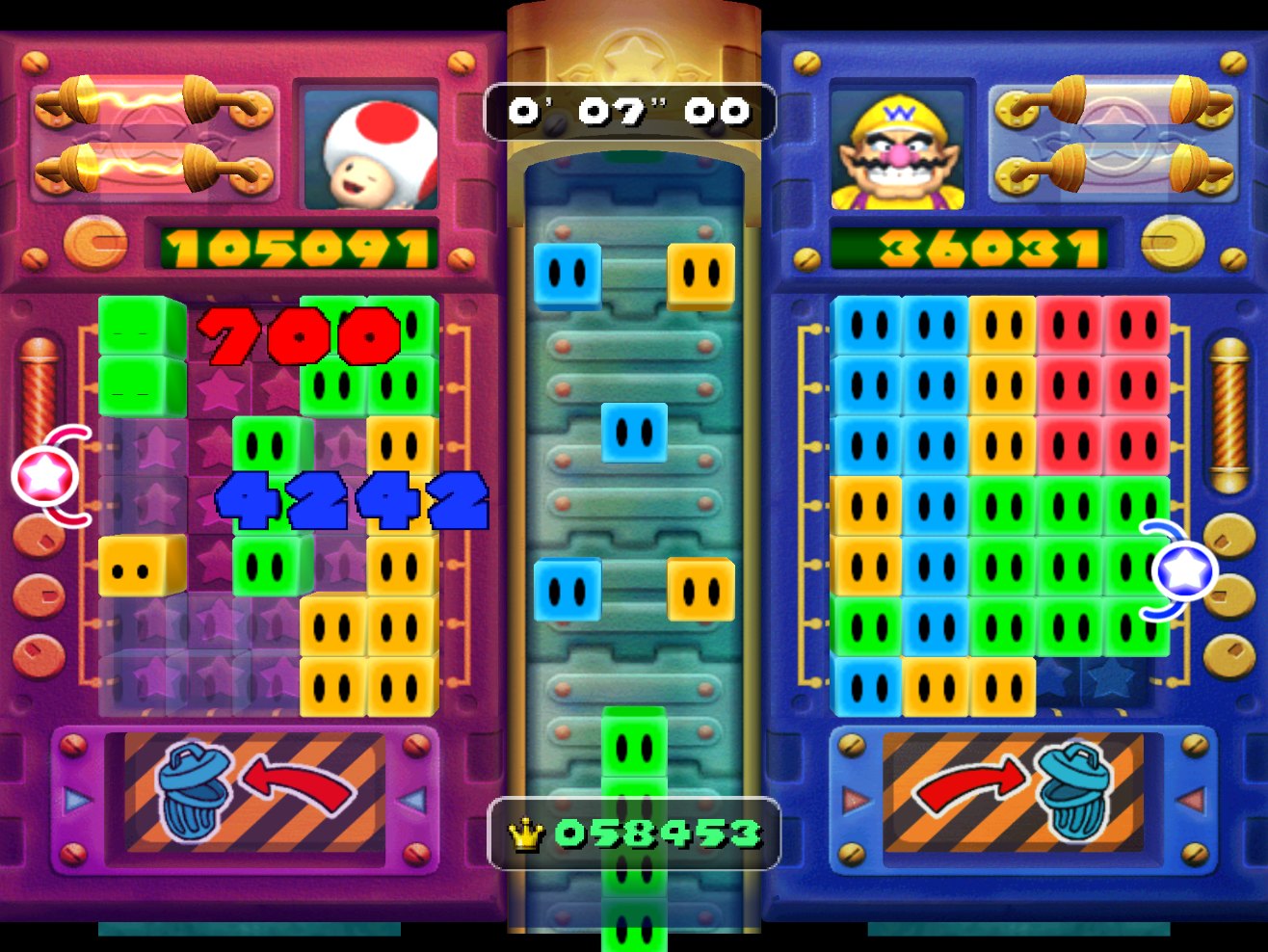
Piece OutDuelA puzzle: fit the shapes arriving on a conveyor belt into your grid; points are paid only when it is completely filled, with more for large areas of one colour.
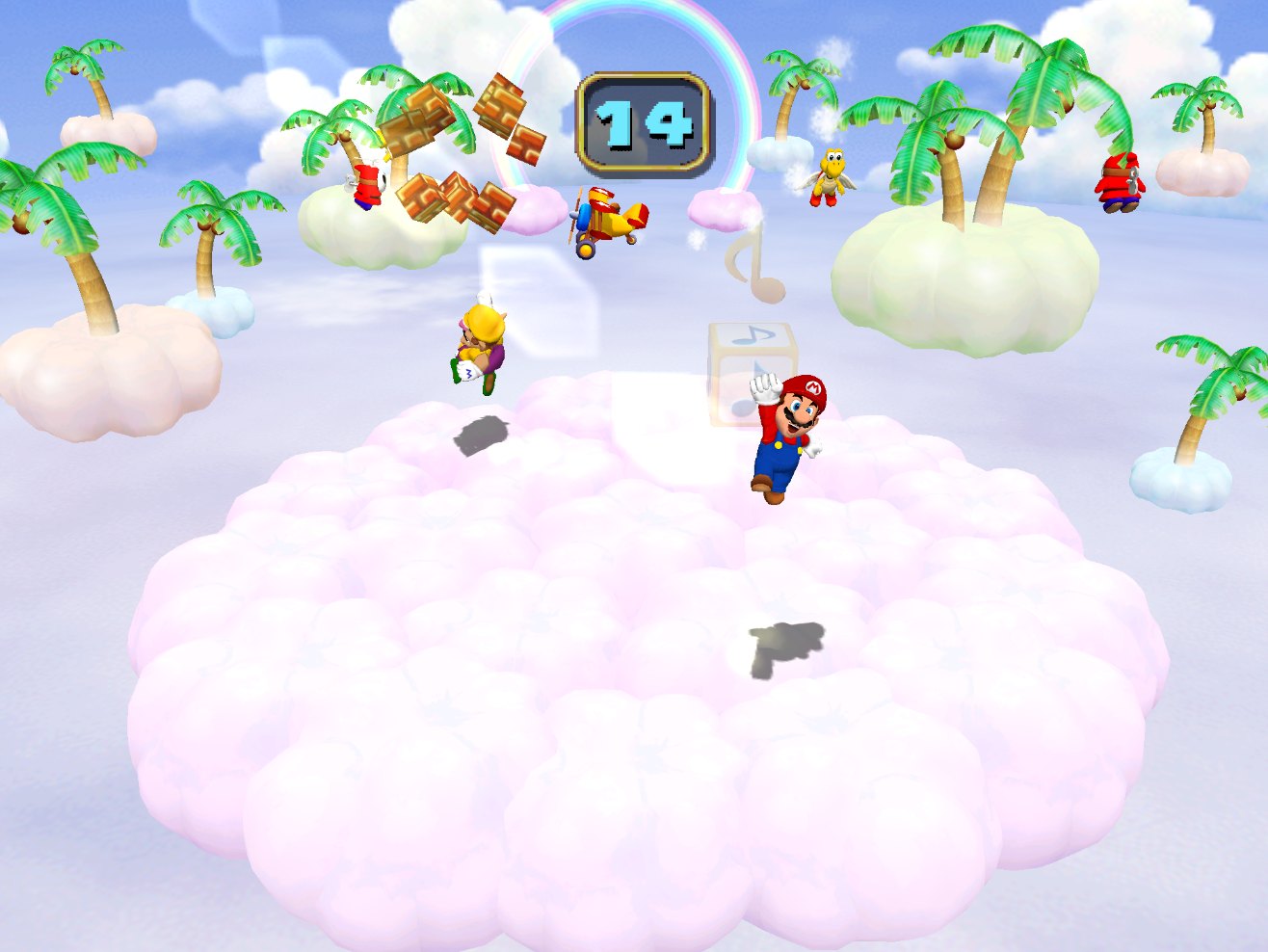
Bound of MusicDuelJump about to uncover invisible blocks. Whoever finds more of the ones holding musical notes wins.
Wind WaversDuelAlternate L and R to flap a fan and keep yourself out of a tornado.
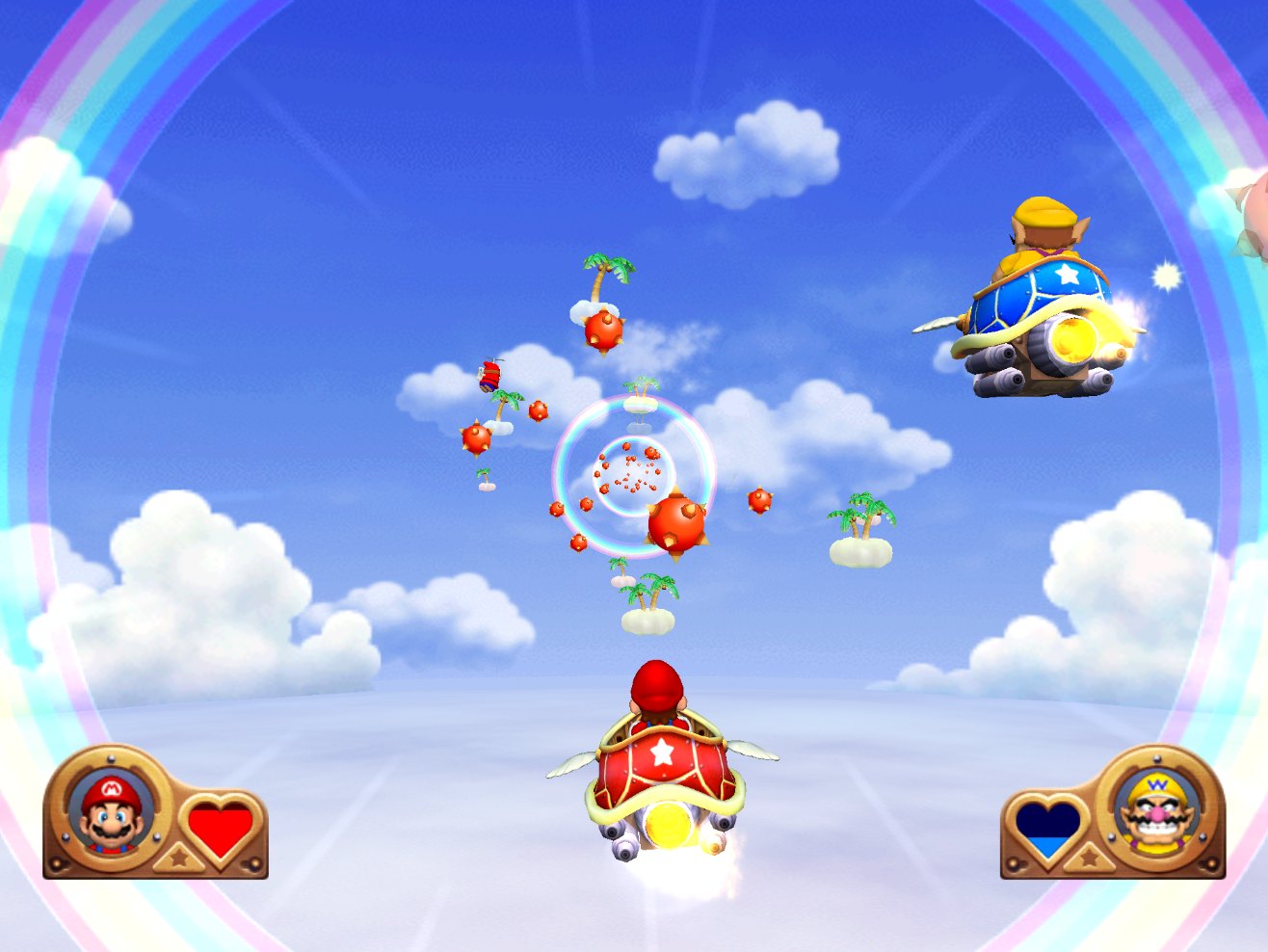
Sky SurvivorDuelFly a machine through a hail of oncoming objects. Five hits and it breaks.
Rain of FireBowserBowser’s fireworks come down in two waves. Watch the shadows and do not be under one.
Cage-in Cookin’BowserPress the buttons shown to break out of your cage before Bowser turns the heat on. In The Top 100.
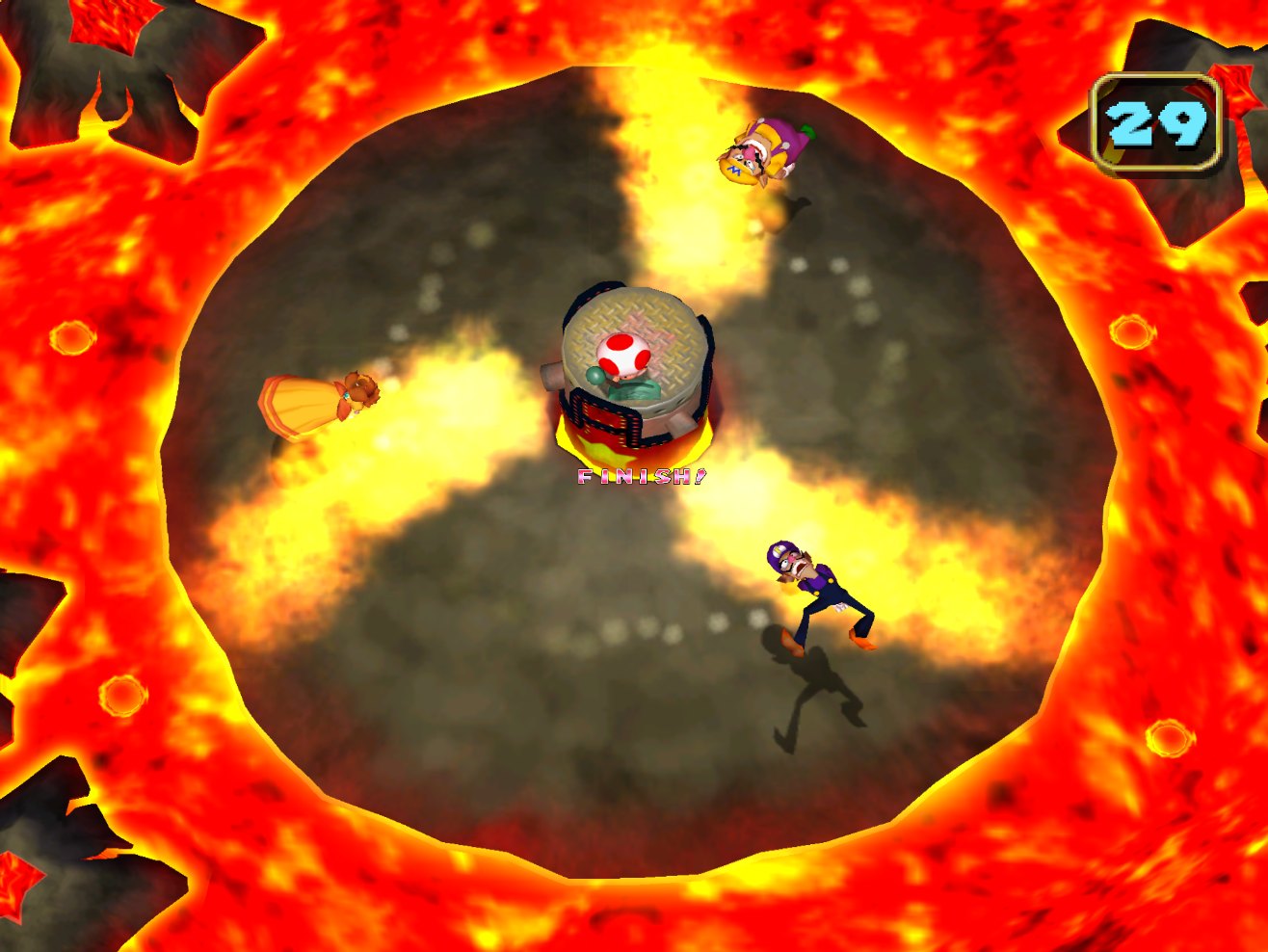
Scaldin’ CauldronBowserHide in one of three cauldrons. Bowser sets fire to two of them.
Banana PunchDKTen seconds to punch barrels open for bananas: small ones count one, large ones five.
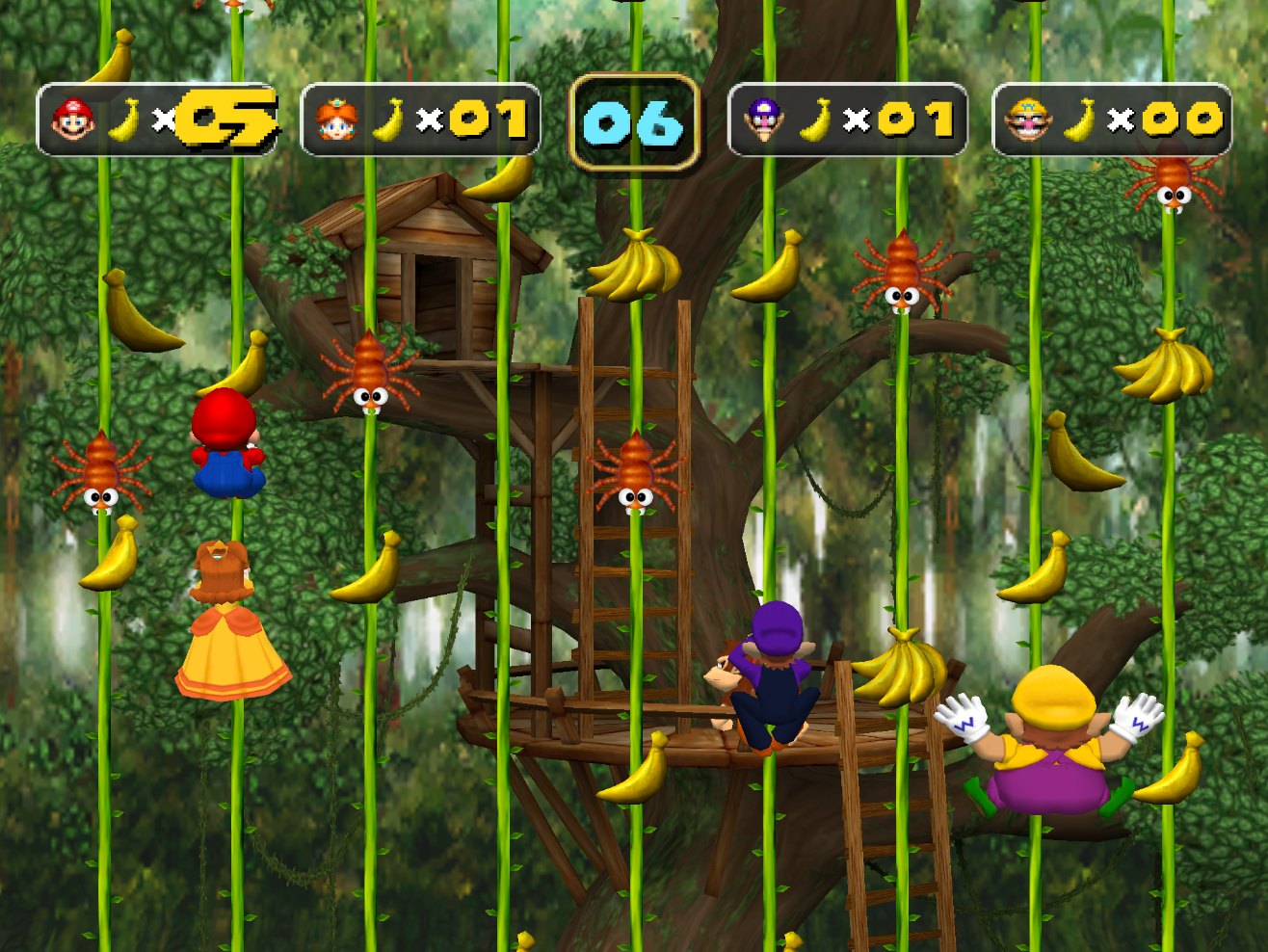
Da Vine ClimbDKTen seconds to climb vines picking bananas and bunches, and avoiding the spiders that stun you.
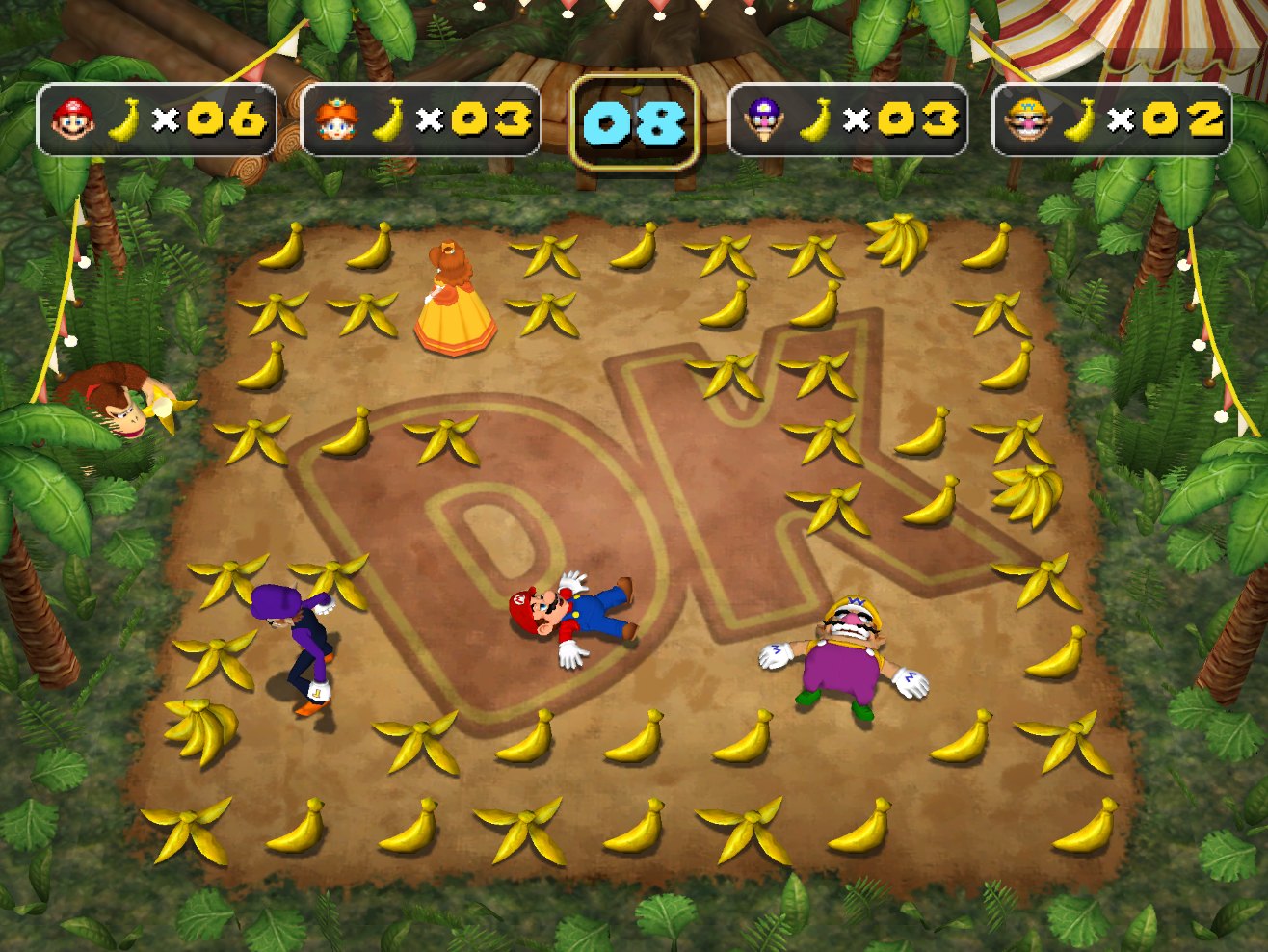
Mass A-peelDKTen seconds to gather bananas on the ground without slipping on the skins.
FrightmareStoryThe end of Story Mode: Mechakoopas, rings of fire, then Bowser himself, who must be hit five times once he has grown giant.
Beach VolleyballBonusTwo-a-side volleyball to a target of 10 to 20 points, with optional Bob-omb and Dice Balls. A reworking of Mario Party 4’s Beach Volley Folley.
Ice HockeyBonusTwo players a side and a Shy Guy in each goal, over 60, 180 or 270 seconds. In The Top 100 and Superstars.
The people who made it
Names and roles from the staff roll.
Kenji KikuchiGame directorHis fifth Mario Party in a row as director.
Syuichiro NishiyaPlanning directorPlanning advisor on Mario Party 4, now in charge of planning.
Shinichi NakataGame designerPlanning director of the previous game.
Hiroshi Sato and Atsushi IkedaProducersNew to the producer credit: Sato was a coordinator and Ikeda product manager on Mario Party 4. Shinji Hatano moves up to senior producer.
Satoru Iwata and Hiroshi KudoExecutive producersAs on Mario Party 4.
Shigeru Miyamoto, Takashi Tezuka and Hidetoshi EndoSupervisorsTezuka joins the two supervisors of the earlier games.
Hideki SahashiProgram directorIn the post since Mario Party 2; a chief programmer on the first game.
Koji MatsuuraSenior art directorSenior art director of Mario Party 4.
Aya TanakaMusicTakes over from Ichiro Shimakura, who is thanked in the credits. Shohei Bando is sound director again.
Charles Martinet, Jen Taylor and Kazumi TotakaVoicesMartinet as Mario, Luigi, Wario and Waluigi; Taylor as Peach, Daisy and Toad; Totaka as Yoshi. All uncredited, but widely attributed.
Rich Amtower, William Barnes, Reiko Ninomiya, Shawn Seavers and Bill TrinenNorth American localisationNintendo of America’s localisation team.
Advertisement
How It Was Made
Mario Party 5 was made in a year by largely the same team as its predecessor, with some of its senior members stepping up a rung.
E3 2003 and the demo disc
The title screen of the E3 2003 build.
Nintendo unveiled the game at E3 in May 2003 with a playable demo of eight minigames, according to Wikipedia’s summary of GameSpot and IGN reports from the show. The Japanese magazine Nintendo Dream followed in June with news of new characters, more minigames than Mario Party 4 and the return of Duels.
In North America a playable demo was also included on the bonus disc that came with Mario Kart: Double Dash!!. Both that demo and the E3 build had title screens of their own. At E3 the title screen had several of the cast wandering about on it, much as the finished game’s file select screen does, the character select screen was laid out quite differently, and the minigame titles were still announced in the orange-to-purple lettering of Mario Party 4.
The team
Kenji Kikuchi directed his fifth Mario Party running. Under him the staff roll shows a reshuffle. Syuichiro Nishiya, planning advisor on the fourth game, became planning director, and the previous holder of that job, Shinichi Nakata, became game designer. Atsushi Ikeda, product manager since the first Mario Party, and Hiroshi Sato are the producers, with Shinji Hatano above them as senior producer. Takashi Tezuka joins Shigeru Miyamoto among the supervisors.
The music is by Aya Tanaka, who took over from Ichiro Shimakura, composer of the third and fourth games. Her score leans on Mario’s past: by most counts there are six arrangements of the Super Mario Bros. ground theme alone, among them the Card Party music, the Chance Roulette jingle and the credits.
What changed
The E3 character select screen.
The main design changes were these: the item system introduced in Mario Party 2 was replaced by capsules, Super Duel Mode and Bonus Mode were added, and this became, by most counts, the first game in the series to build height into its boards. Every Mario Party since has had 3D boards, Mario Party Advance excepted. Nintendo’s own description picked out the 3D maps, which let you look over the board more easily, and the Koopa Kids’ simultaneous turns in Story Mode as ways of cutting the waiting time, something reviewers had complained of in Mario Party 4.
Two capsules never made it out of the data: a DK Capsule and a VS Capsule. The debug menu inherited from Mario Party 4 is still there as well, with the minigame names changed.
Release and the election campaign
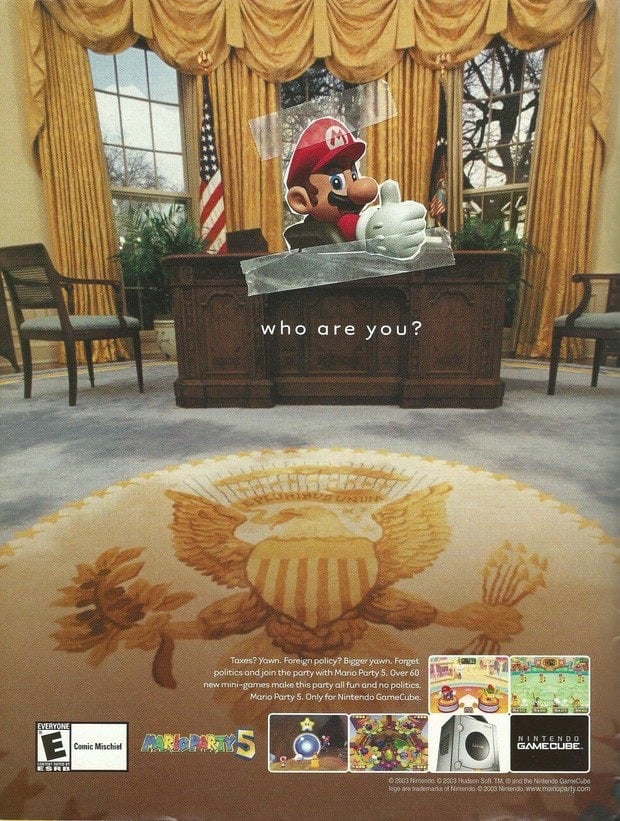
The North American print advert.
The game reached North America on 11 November 2003, Japan on 28 November and Europe and Australia on 5 December. In Europe the Koopa Kid is once again called Mini Bowser, and the win and draw captions animate differently from the American version.
Nintendo of America advertised it as an election. The website and a print advert, with Mario taped into a photograph of the Oval Office, set “Mario’s coin collecting cabinet of credibility” against “Bowser’s corrupt cabinet of chaos”. Bowser’s portrait in the campaign was his old Nintendo 64 design. Japan had a quite different pair of commercials, one of them showing a man dressed as Mario peering through a window at a family playing the game.
Series Firsts
What Mario Party 5 added to the series, checked against the four games before it. Most are commonly listed as firsts.
1CapsulesThe first Mario Party without item shops. Capsules, free from machines and usable as traps, replace the items that had been in the series since Mario Party 2.
2Toad, Boo and Koopa KidAll three are playable on the boards for the first time. Toad had hosted and Boo had stolen; Koopa Kid is, by most reckonings, the first of Bowser’s minions to be a playable board character.
3Donkey Kong off the rosterPlayable in all four earlier games, Donkey Kong becomes a host instead. The DK Space and DK minigames are introduced here.
4Boards with heightUsually counted as the first Mario Party whose boards have real elevation, where Mario Party 4 had 3D scenery on a flat layout.
5Super Duel Mode and Bonus ModeBoth modes are new: a machine-building battle game and a set of three stand-alone games.
6Ice HockeyMakes its first appearance, in Bonus Mode.
7Shared team purse and team namesTeam Match was introduced in Mario Party 4, but here partners share coins and a panel for the first time, and each pairing gets a name.
8Green spacesSpaces that do nothing when landed on make their first appearance, though only in Card Party.
9Intense difficultyA computer difficulty above Hard, opened by finishing Story Mode on Hard.
Cheats & Secrets
There are no button codes, though a debug menu can be reached with an Action Replay. Everything else is opened by playing Story Mode and Super Duel Mode.
Unlock Bowser Nightmare
Beat the Koopa Kids on any four of the six boards in Story Mode. Bowser Nightmare then appears there. Win it, beat Bowser in Frightmare, and the board is added to Party Mode.
Unlock Frightmare
Finishing Story Mode also puts the final battle in Mini-Game Mode for replay.
Unlock Intense difficulty
Finish Story Mode on Hard. Intense can then be chosen for computer players and for Story Mode itself, where it leaves you six hearts for Frightmare.
Play as Donkey Kong
In Super Duel Mode, beat Donkey Kong and his Banana Bot in the tournament on Hard. He joins the list of drivers, and the DK body, tyres, engine and gun come with him. The Banana Bot starts at full speed and then slows down badly, so outlast it.
Open every Super Duel contest
Win Battle Competition on Easy and Normal to unlock Hard. Win Battle on Hard for Flag Competition, Flag on Normal for Flag on Hard, Flag on Hard for Robo-Rabbit Competition and Robo-Rabbit on Normal for Robo-Rabbit on Hard. Winning everything on every difficulty unlocks the four Skolar parts for purchase and adds songs to the sound test.
Bowser Punch and Bob-omb Wall
These two weapons are unlocked for purchase when you have bought every other machine part. The bill comes to 458 points or more: 99 from 4-Player minigames for the bodies, 99 from 1-vs-3 games for the tyres, 99 from 2-vs-2 games for the engines and 161 from Battle games for the weapons.
Winning Story Mode
Go looking for Duels. Catching a Koopa Kid costs him 15 coins if you win and you only 5 if you lose, so the odds favour the hunter. Steer for the DK Space, which gives you 10 coins and halves the coins of any Koopa Kid who lands on it, and keep off the Bowser Space, which halves yours.
Throw or pay?
Helpful capsules such as the Mushroom, Coin Block and Wiggler are worth their fee. Harmful ones such as the Hammer Bro, Piranha Plant, Mr. Blizzard and Cursed Mushroom should be thrown, ideally just ahead of the leader. The Bob-omb costs nothing to use and goes off under the third player to pass, so count before you walk over one.
Three Miracles
Miracle Capsules cannot be thrown or used. Hold three at once and every Star belonging to the player in first place passes to the player in last.
Keep a Bone
A Bone Capsule in your hand is automatically thrown to any Chain Chomp sent to rob you.
Beat Donkey Kong at dice
In DK Roulette you can roll anything up to 10 and he cannot, so a high roll is a certain Star. A tie goes to him.
Mini-Game Decathlon
The Decathlon only opens once all ten of its events have been played: Ground Pound Down, Chomp Romp, Flower Shower, Leaf Leap, Night Light Fright, Dinger Derby, Hydrostars, Will Flower, Later Skater and Triple Jump.
SLB’s own cheats page and mini-game guide for the game are linked under Reference below.
Glitches & Oddities
There are no well-known glitches in this game. What it does have are a few oddities that shipped.
Wario and Waluigi swap places in Card Party
On Card Party’s character select screen the playing pieces for Wario and Waluigi are the wrong way round, with mismatched cut-outs and their names stacked on top of each other.
The minigame that is not there
The instruction booklet lists a two-against-one minigame for Story Mode’s VS Spaces. No such game exists: with two Koopa Kids left you are given a computer-controlled Toad and play two against two.
Koopa Kids with the wrong shells
Koopa Kid, from the group artwork.
The official artwork of the three Koopa Kids gives the red and blue ones green shells.
Videos
We could not find Mario Party 5 footage on Nintendo’s own channels, so both of these are archive copies of official material.
Third-party upload of the North American “Mario for President” television commercial.
Third-party upload of the game’s trailer, from a channel that archives GameCube trailers.
Trivia & Interesting Facts
The Star Guards are never called Star Spirits in the game’s story, but they are the seven Star Spirits of Paper Mario, names and all. Three of them, Eldstar, Misstar and Muskular, later appeared as stickers in Super Smash Bros. Brawl.
Team names are not always flattering. Wario and Toad are the Mushroom Stinkers, Daisy and Waluigi the Awkward Date, Peach and Koopa Kid Trouble Brewing, and Boo and Koopa Kid simply Pure Evil.
Nintendo UK’s page calls the setting “Dream World” and promises “more than 60 new mini-games”. The usual count is 77.
The same page says some of the new playable characters are “debuting in their first Mario game”, which is generous to Toad and Boo, familiar faces from every earlier Mario Party.
Frightmare’s third round, in which Bowser must be lured into leaping on to the same weakened floor until it gives way, is borrowed from the final battle of Super Mario Bros. 3.
Coin Cache takes place in front of Peach’s Castle as it looked in Super Mario 64. Mario Party 8 reused the model, smaller, in its minigame Crank to Rank.
Chomp Romp’s whistle looks like the Chomp Call item from Mario Party 4.
The toy in Toy Dream that looks like a robot Bowser is Mecha-Bowser from Super Mario Sunshine.
Future Dream’s entry in the instruction booklet plays on Neil Armstrong’s words on stepping on to the Moon.
Undersea Dream was reportedly inspired by Twenty Thousand Leagues Under the Sea. Its Cheep Cheep lucky dip can hand you a capsule on the very last turn, when it is no use to anyone.
President Mario.The Mario costume in the American commercial was made by KCL Productions. His two-handed V sign is the gesture associated with Presidents Eisenhower and Nixon, and the gameplay clips are set to a rock version of “Hail to the Chief”.
The opposition: President Bowser, in his Nintendo 64 design.The campaign cast Wario and Waluigi as treasurers on opposite sides, one of the few times the two have been set against each other.
Donkey Kong’s tyres and engine in Super Duel Mode have a quirk of their own: their speed, acceleration and handling are decided at random before every battle.
Super Duel Mode is sometimes said to have 44 parts, but a full list runs to 46.
In PAL copies the name of a minigame’s winner and the word “won” appear on separate lines, the layout Mario Party 6 and 7 went on to use everywhere.
The early logo.An early logo was used at E3.
Regional Box Art
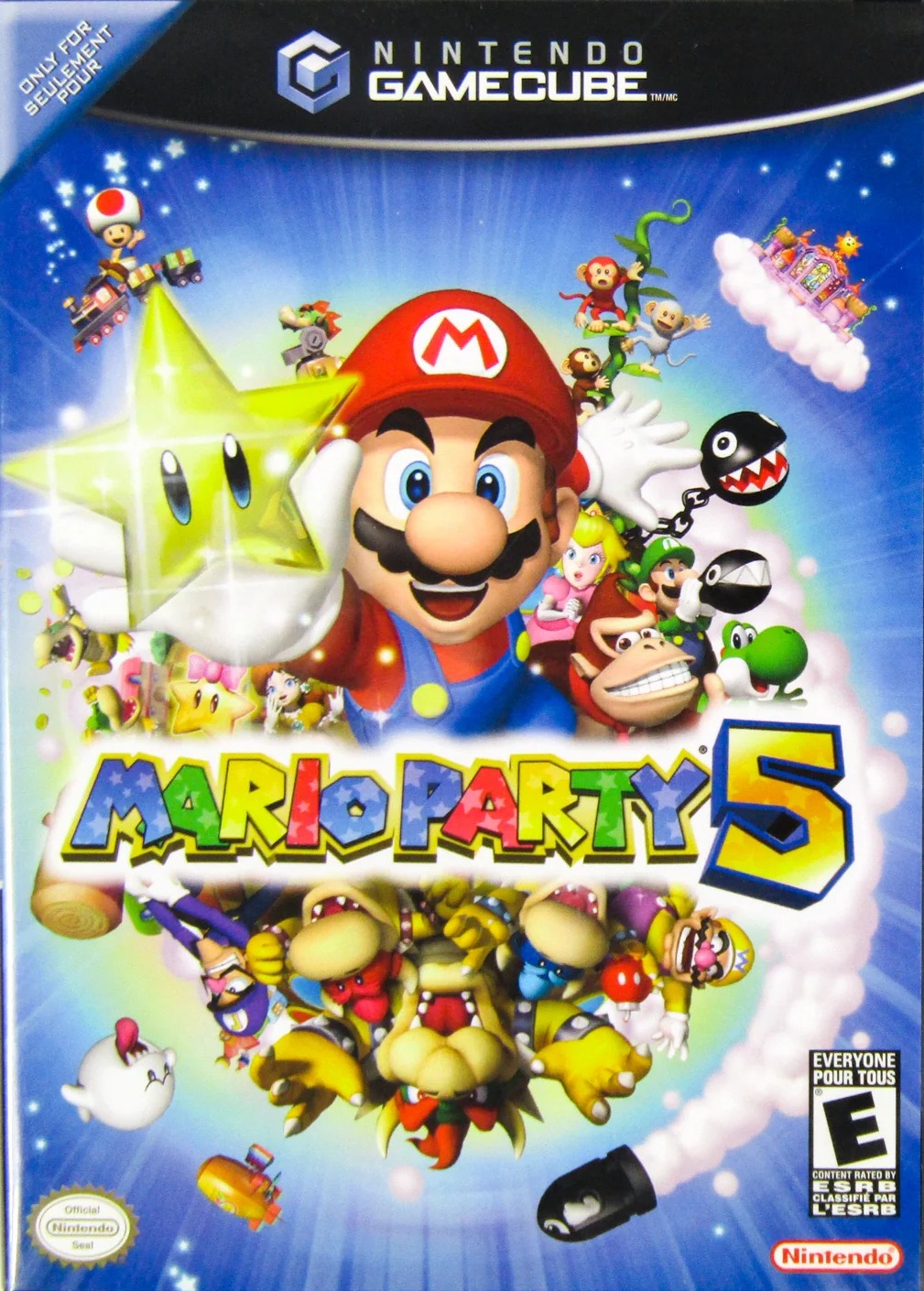
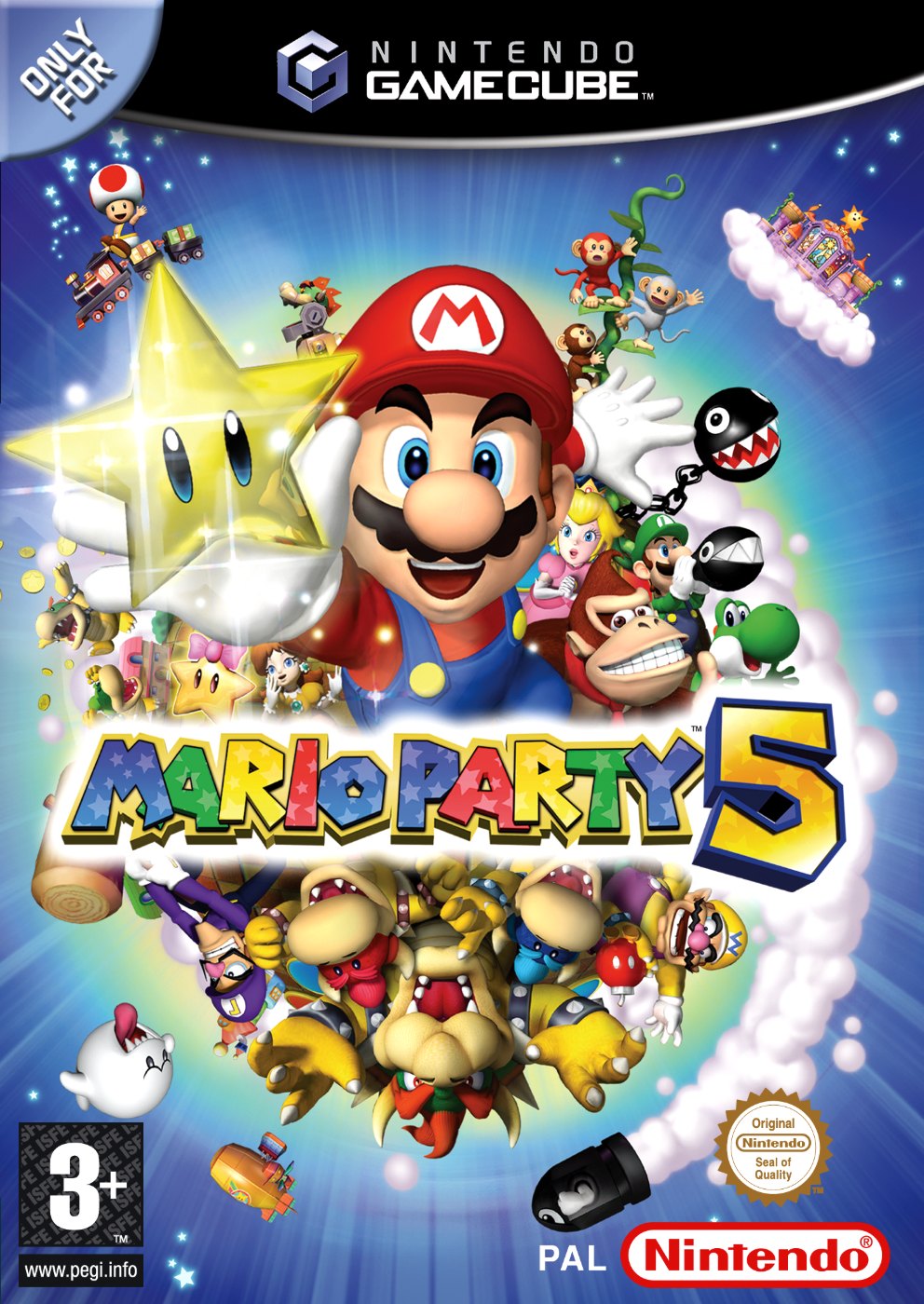
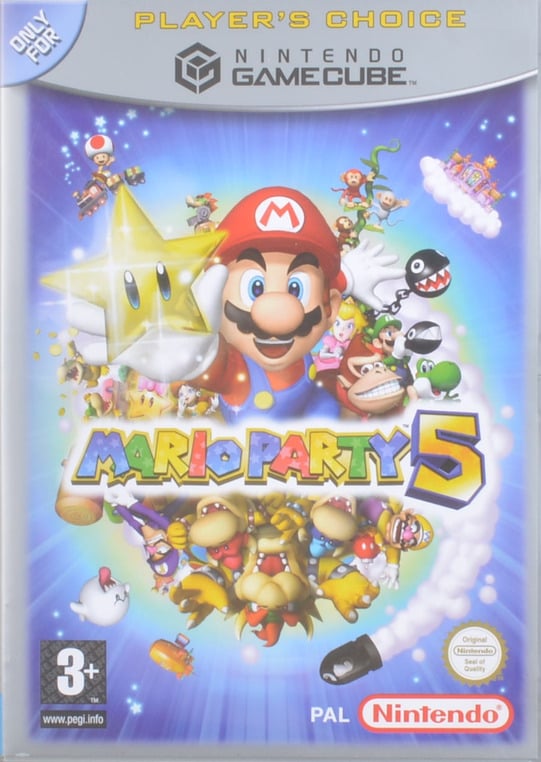
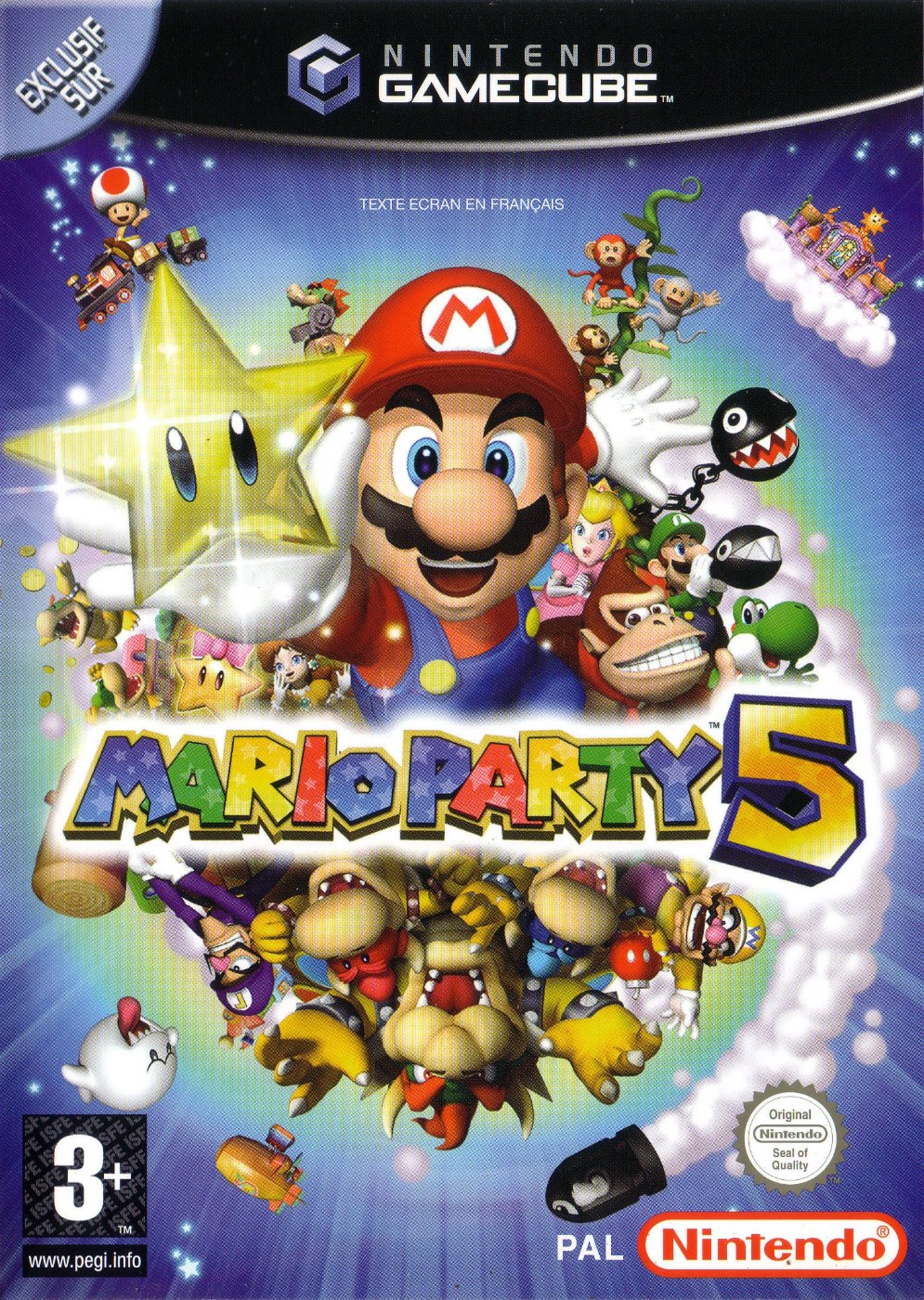
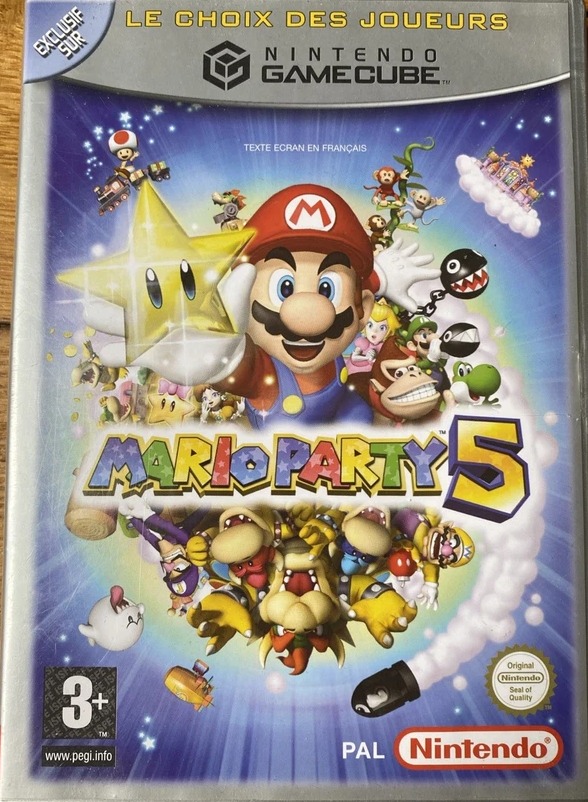
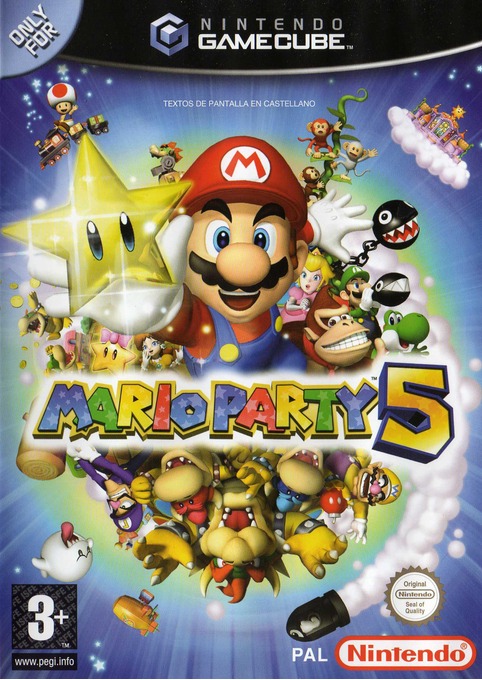
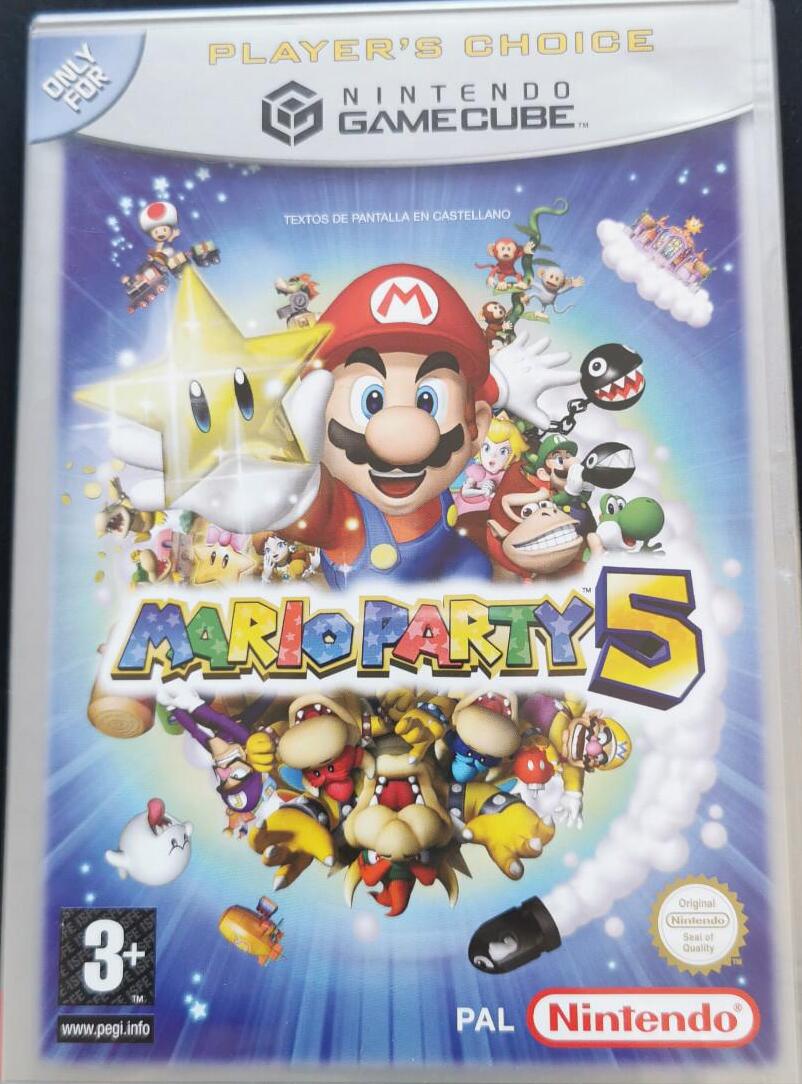
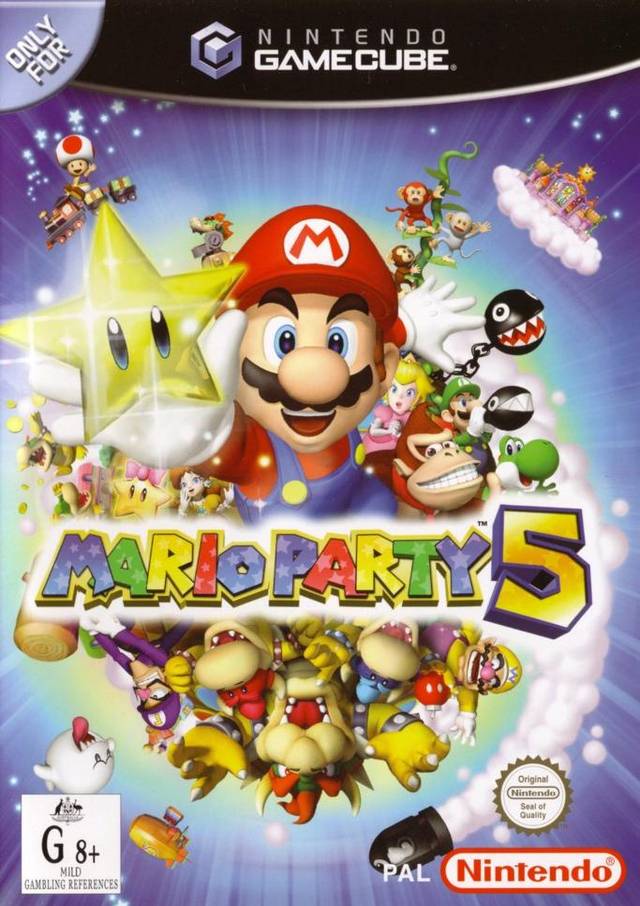
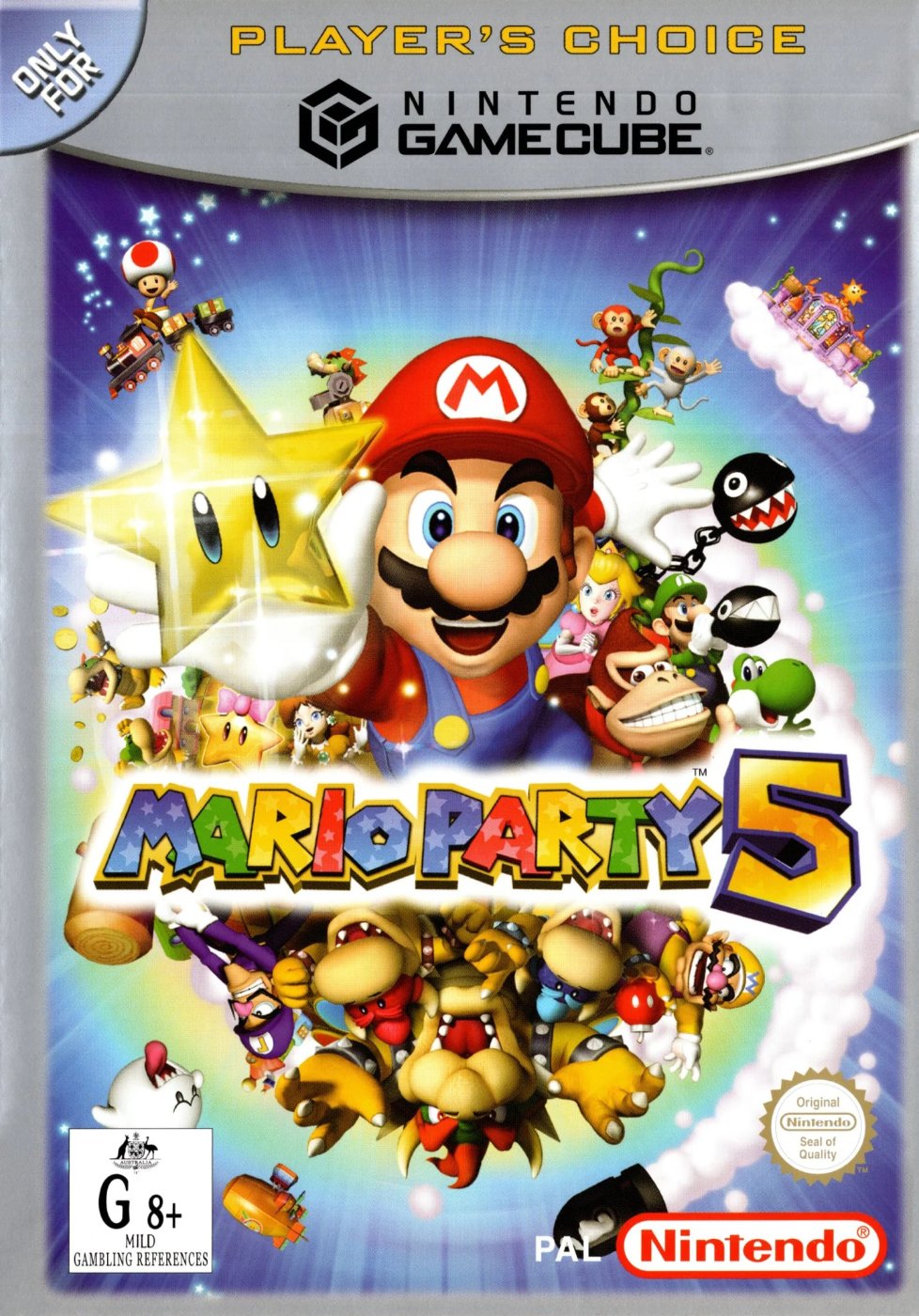
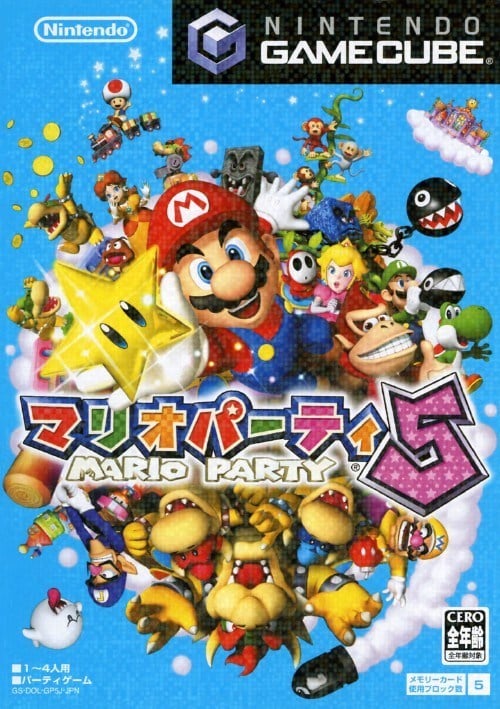
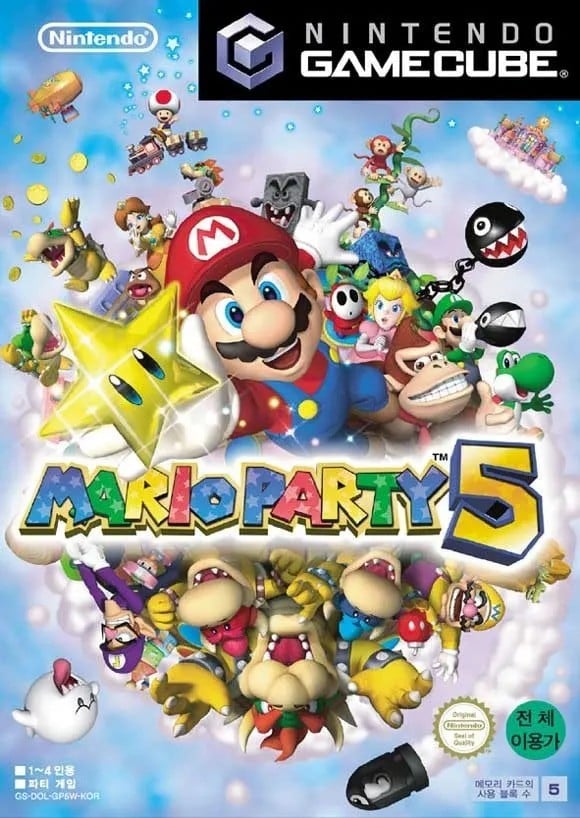
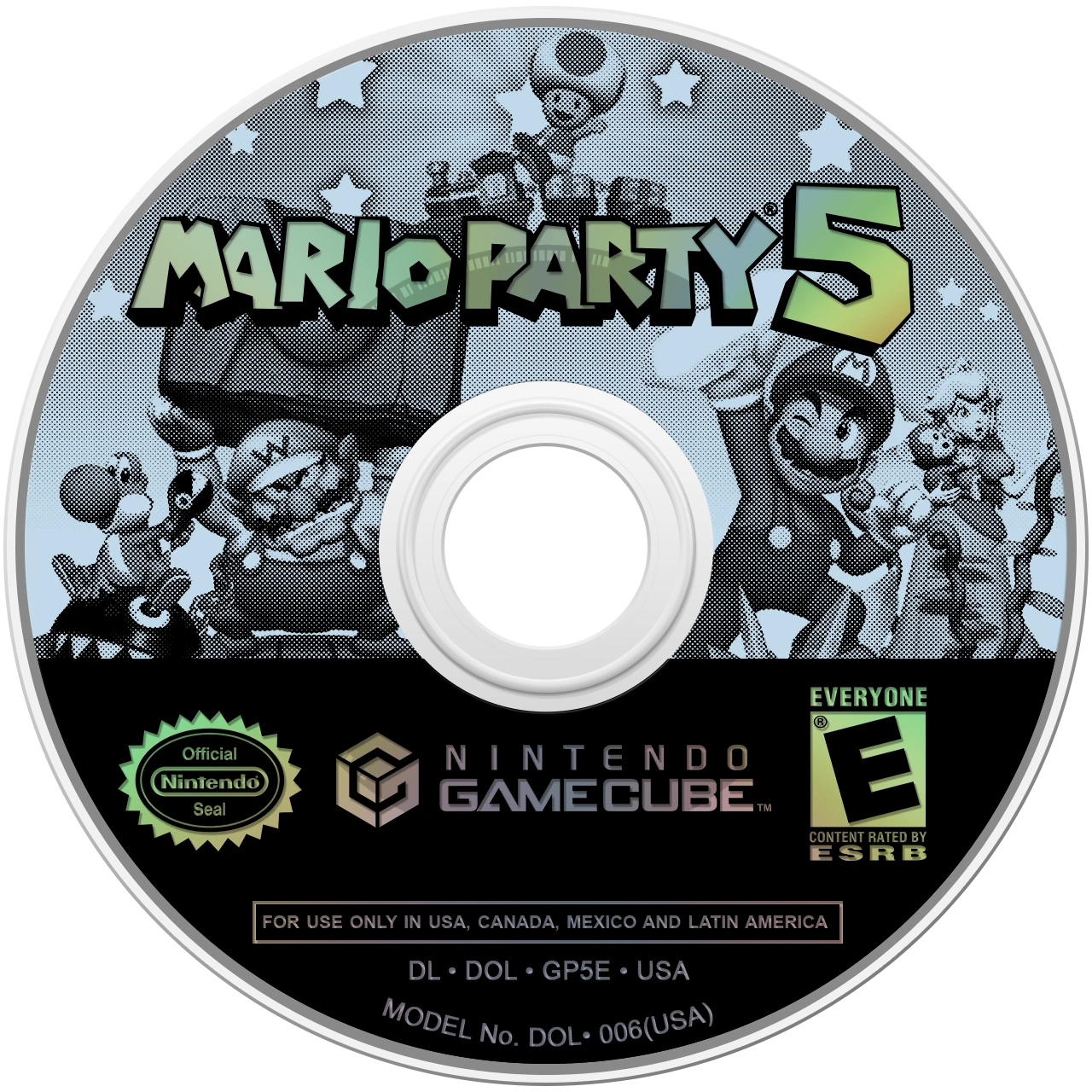
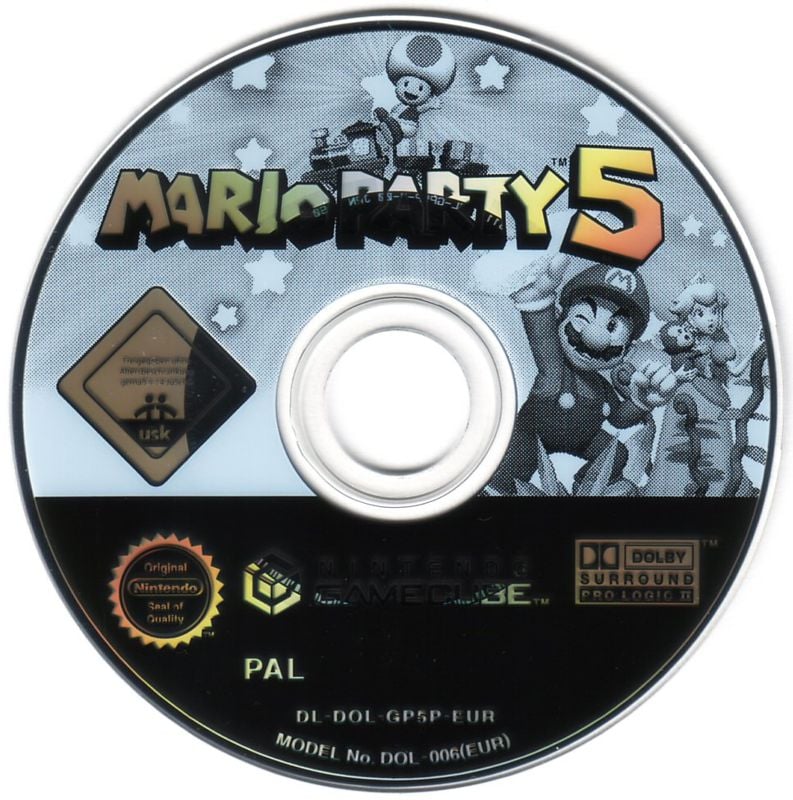
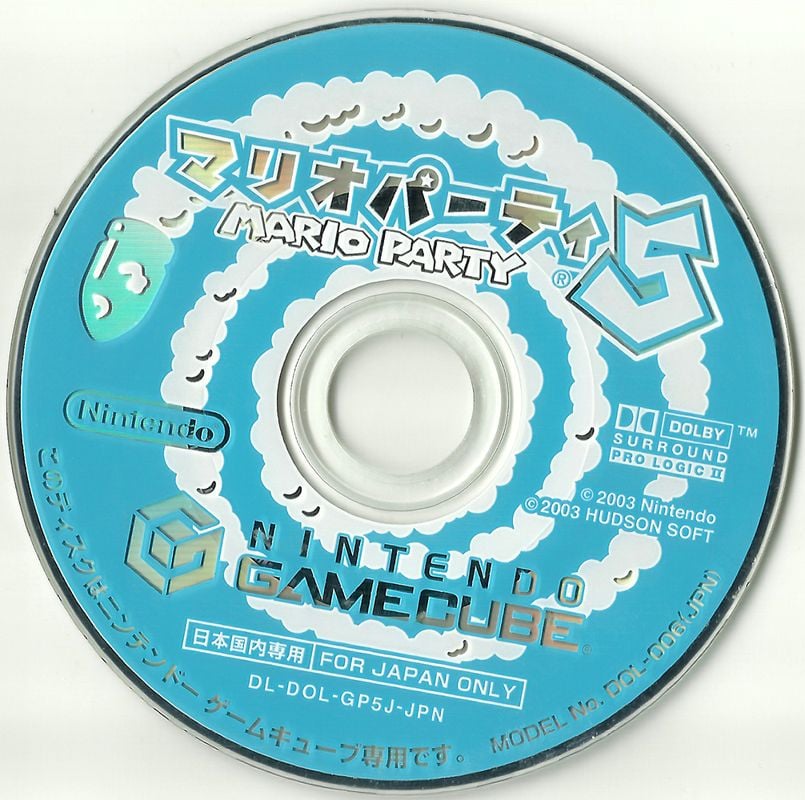
There are covers from North America, Canada, five European countries, Australasia, Japan and South Korea, with the Player’s Choice reissues, and the discs.
North America (2003)CanadaEurope (2003)Europe, Player’s Choice (2004)FranceFrance, Player’s ChoiceSpainSpain, Player’s ChoiceGermanyGermany, Player’s ChoiceItalyItaly, Player’s ChoiceAustralasia (2003)Australasia, Player’s ChoiceJapan (2003)South KoreaNorth American discEuropean discJapanese disc
Screenshots
More from the menus, Bowser Nightmare and the Story Mode boards.
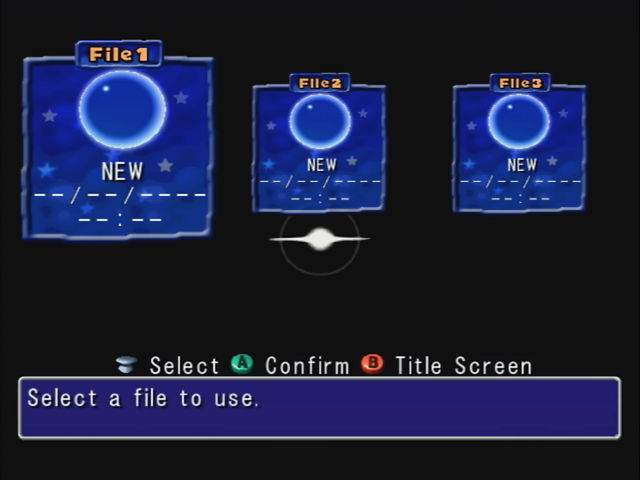
The file select screen.The start of a game on Bowser Nightmare.Wario loses his capsules to Bowser’s flamethrower.The Service Desk in Super Duel Mode, where Skolar sells parts.Mario’s Super Duel machine, the Super Dash.
Artwork & Media Gallery
Logos, official artwork of the cast and the Star Guards, key art, board logos and the election campaign.
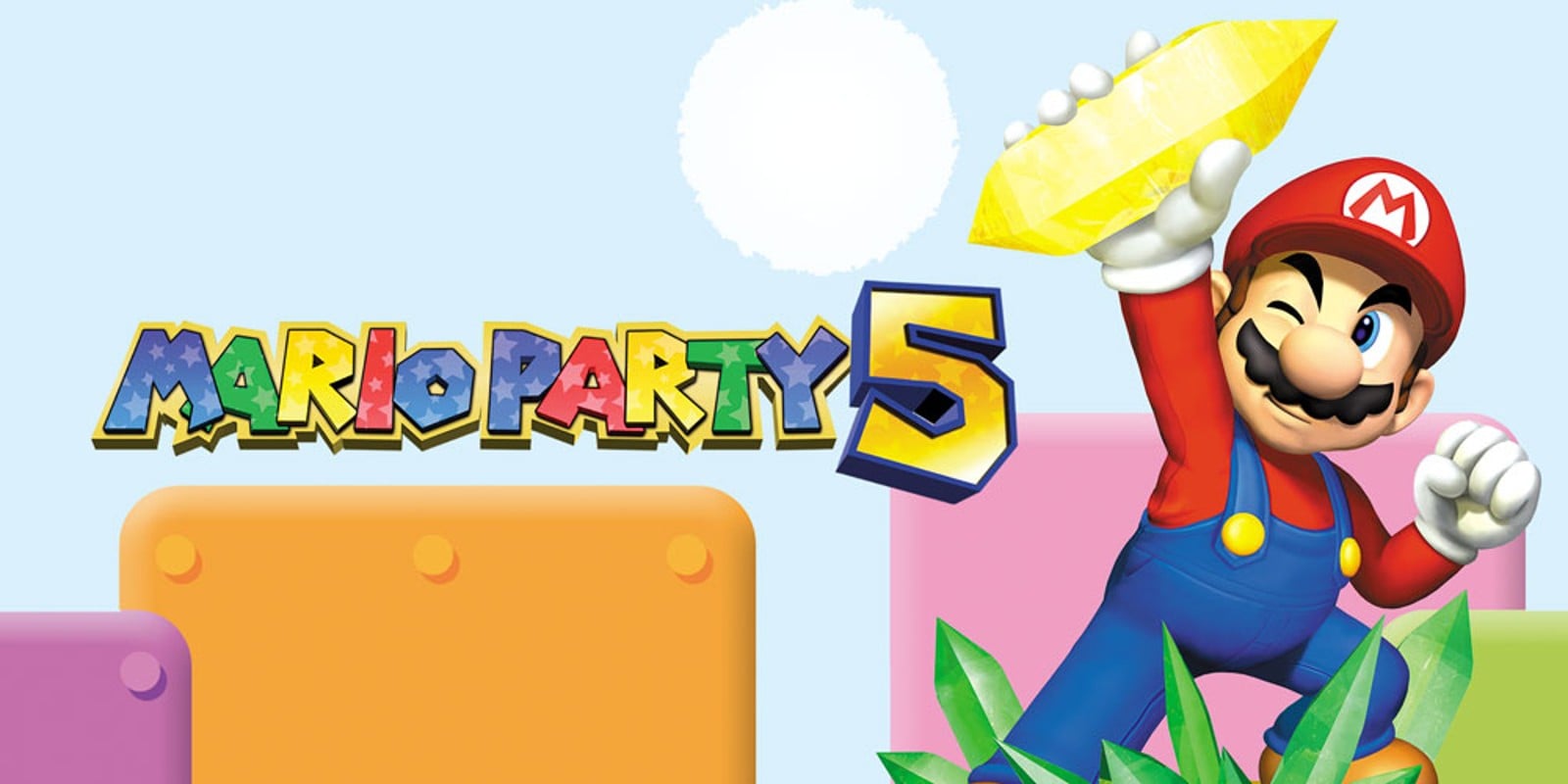
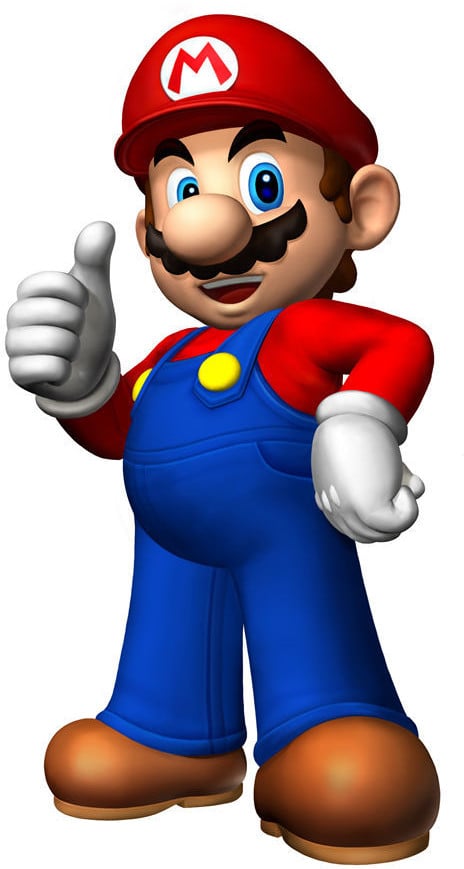
The international logo.The Japanese logo.The Japanese group artwork, alternative version.Key artwork from Nintendo’s European website.Mario gives a thumbs-up.Board logo: Toy Dream.Board logo: Rainbow Dream.Board logo: Pirate Dream.Board logo: Undersea Dream.Board logo: Future Dream.Board logo: Sweet Dream.Board logo: Bowser Nightmare.Election campaign: Veep Luigi.Election campaign: Treasurer Wario.Election campaign: Veep Koopa Kid.Election campaign: Defense Secretary Boo.Election campaign: Treasurer Waluigi.Beach Volleyball.
Legacy & Re-releases
Mario Party 5 has not been re-released on a later system, but its ideas were built on at once and its minigames are among the most revisited in the series.
Every release
GameCube (North America)11 November 2003The original release.
GameCube (Japan)28 November 2003The Japanese release.
GameCube (Europe and Australia)5 December 2003In English, French, German, Spanish and Italian, with Koopa Kid renamed Mini Bowser.
GameCube (South Korea)2003A Korean release is recorded without a day or month.
Arcade (Japan)September 2004Super Mario Fushigi no Korokoro Party, Capcom’s coin pusher based on the game.
Player’s Choice (Europe)22 October 2004Budget reissue.
Later systemsNone so farNo Virtual Console or Nintendo Switch Online release. It is not in Nintendo Life’s list of GameCube titles for the Switch 2 Nintendo Classics library.
From capsules to Orbs
Mario Party 6 followed a year later and kept the heart of the system, renaming capsules Orbs. It also kept the DK Space, though without DK Roulette, kept Koopa Kid as a playable character and kept all 45 team names. Mario Party 7 was Koopa Kid’s last game: Mario Party 8 removed the Koopa Kids from the series altogether.
Where its minigames went
Seventeen of the 77 were picked for Mario Party: The Top 100, against fourteen from Mario Party 4 and nine from Mario Party 6. Mario Party Superstars took ten, including Ice Hockey as one of its sports games, and Super Mario Party Jamboree brought back Leaf Leap and Defuse or Lose. For the rest of the series, see the games hub.
Reviews & Sales
Sales
Wikipedia gives a figure of 800,000 copies sold in the United States, from a best-seller ranking dated February 2005, and notes that the game went on to Nintendo’s Player’s Choice budget label in Europe in October 2004.
A worldwide total of about 2.08 million as of 31 December 2009 is often quoted, made up of 807,331 in North America, 697,472 in Japan and roughly 400,000 elsewhere, which ranks the game twelfth among GameCube best-sellers. That figure has no clear source, and its parts do not quite add up to the total, so treat it as an estimate. Neither figure comes from Nintendo.
c. 800,000United States (Wikipedia, from a 2005 best-seller ranking)
c. 2.08mworldwide to end of 2009, an unsourced estimate
69Metacritic score
77minigames
Reviews
Scores as listed by Wikipedia from the original reviews.
Nintendo Power
4.2/5
Electronic Gaming Monthly
8/10
IGNPeer Schneider
7.9/10
GameProDan Elektro
3.5/5
GameSpotRyan Davis
6.9/10
Nintendo World ReportMichael Cole
6.5/10
GameSpyJon Gibson
3/5
X-Play
3/5
EdgeUK
5/10
EurogamerTom Bramwell
5/10
GameRevolution
C
Game Informer
2.25/10
MetacriticAggregate
69/100
GameRankingsAggregate
70.66%
The pattern of the Mario Party 4 reviews repeated itself, a little lower. IGN’s Peer Schneider was the most positive of the big American sites: he admired the design of the minigames, thought it a fine party game for families and student halls alike, and grumbled about the waiting and a soundtrack he called “incredibly cheesy”. Nintendo World Report’s Michael Cole judged it the best in the series, but only by a whisker.
GameSpot’s Ryan Davis put the other view in a sentence: “If you bought Mario Party 4 last year, Mario Party 5 is hard to recommend.” He found the presentation beginning to look dated and the character models unchanged. GameSpy’s Jon Gibson liked the sheer number of minigames and disliked everything that had to be sat through between them, and told the series it was coasting. Edge and Eurogamer both gave 5 out of 10, the former for sameness, the latter with complaints about the computer players.
Game Informer was harsher than anyone: Justin Leeper gave it 2.25 out of 10 and advised readers not to play it. In a second opinion, Andrew Reiner objected to the way the board redistributes wealth: “you could win every mini-game and collect the most coins and still end up in last place.”
Honours
Academy of Interactive Arts & Sciences · 7th Annual Interactive Achievement Awards (2004)WinnerConsole Children’s Game of the Year.
SLB User Reviews
Mario Party 5 has yet to receive a community review on Super Luigi Bros.
If you’ve played Mario Party 5 and would like to submit a review, please get in touch.
To provide the best experiences, we use technologies like cookies to store and/or access device information. Consenting to these technologies will allow us to process data such as browsing behavior or unique IDs on this site. Not consenting or withdrawing consent, may adversely affect certain features and functions.
Functional
Always active
The technical storage or access is strictly necessary for the legitimate purpose of enabling the use of a specific service explicitly requested by the subscriber or user, or for the sole purpose of carrying out the transmission of a communication over an electronic communications network.
Preferences
The technical storage or access is necessary for the legitimate purpose of storing preferences that are not requested by the subscriber or user.
Statistics
The technical storage or access that is used exclusively for statistical purposes.The technical storage or access that is used exclusively for anonymous statistical purposes. Without a subpoena, voluntary compliance on the part of your Internet Service Provider, or additional records from a third party, information stored or retrieved for this purpose alone cannot usually be used to identify you.
Marketing
The technical storage or access is required to create user profiles to send advertising, or to track the user on a website or across several websites for similar marketing purposes.




 Toy Dream66 spaces (21 in Story Mode)A toy train circles the board showering coins, and a jack-in-the-box flings you across it.
 Rainbow Dream69 spaces (25 in Story Mode)Five weather clouds linked by rainbow bridges at 5 coins a crossing.
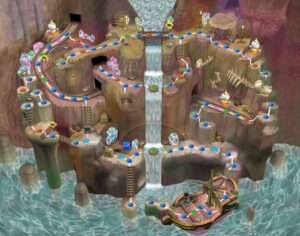 Pirate Dream74 spaces (27 in Story Mode)A Thwomp lift, a Whomp on the ladder, a cannon on the ship and Monty Mole’s coin dig.
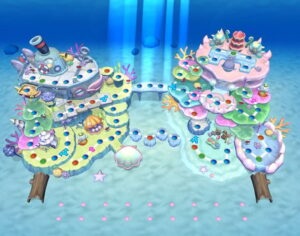 Undersea Dream67 spaces (25 in Story Mode) · two capsule machinesA reef where a whale blows you towards the Star and a manta ray gives lifts.
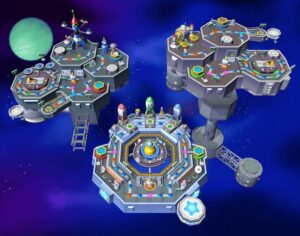 Future Dream68 spaces (29 in Story Mode)Three space stations joined by rockets, teleporters and 10-coin air taxis.
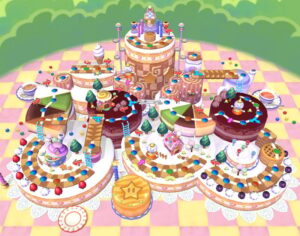 Sweet Dream59 spaces (31 in Story Mode)Collapsing shortbread bridges and slices of cake that carry you away.
 Bowser Nightmare76 spaces (24 in Story Mode) · unlocked by finishing Story ModeBowser answers every ? space in person, and the Spin Stage is a trap of minus spaces.


 Mushroom CapsuleMove · 5 coins. Roll two Dice Blocks. A double pays 10 coins, double seven 30.
 Super Mushroom CapsuleMove · 10 coins. Roll three Dice Blocks. Three of a kind pays 30 coins, three sevens 50.
 Cursed Mushroom CapsuleMove · 5 coins. The Dice Block only goes up to 5. One to throw at somebody else.
 Warp Pipe CapsuleMove · 10 coins. Swap places with a player picked by roulette.
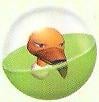 Klepto CapsuleMove · 10 coins. Klepto carries you to the space of a player picked by roulette.
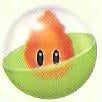 Bubble CapsuleMove · 10 coins. Float ten spaces forward. You cannot steer at junctions and you drop all your other capsules. It will carry you over the bridges of Sweet Dream without breaking them.
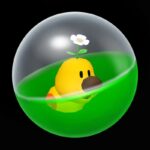 Wiggler CapsuleMove · 20 coins. Wiggler takes you straight to the Star Space, where the 20 coins buy the Star.
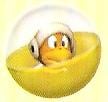 Hammer Bro CapsuleCoin · 5 coins. Whoever it lands on loses 10 coins.
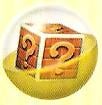 Coin Block CapsuleCoin · 5 coins. Collect 10 coins from a Coin Block.
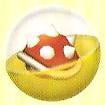 Spiny CapsuleCoin · 5 coins. Steal 10 coins from a player chosen at random.
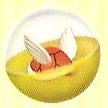 Paratroopa CapsuleCoin · 10 coins. Roll a Dice Block: every opponent loses that many coins.
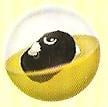 Bullet Bill CapsuleCoin · 10 coins. On your next roll you take 30 coins from every opponent you pass, but cannot choose your way at junctions.
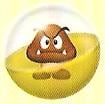 Goomba CapsuleCoin · 5 coins. Swap coin totals with a player picked by roulette.
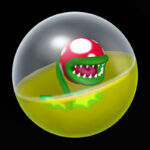 Piranha Plant CapsuleCoin · 5 coins. Lose half your coins. Strictly for throwing.
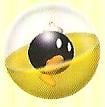 Bob-omb CapsuleCoin · free. A time bomb: the third player to pass or land on its space loses 20 coins.
 Koopa Bank CapsuleCoin · 10 coins. Thrown, it makes a Bank Space where passers-by deposit 5 coins and whoever lands takes the lot. Used on yourself, it pays out everything in the bank.
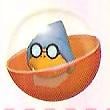 Kamek CapsuleCapsule · 10 coins. Kamek shuffles every player’s capsules.
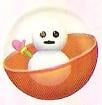 Mr. Blizzard CapsuleCapsule · 5 coins. Whoever it lands on loses all their capsules.
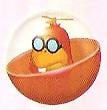 Magikoopa CapsuleCapsule · 10 coins. Swap capsules with a player picked by roulette.
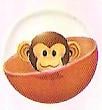 Ukiki CapsuleCapsule · 10 coins. Choose a player: Ukiki flings all their capsules on to random spaces.
 Lakitu CapsuleCapsule · 10 coins. Steal one capsule from the player of your choice.
 Tweester CapsuleSpecial · 15 coins. A whirlwind carries the Star Space off to another part of the board.
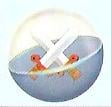 Duel CapsuleSpecial · 10 coins. Thrown, it makes a Duel Space. Used, it starts a Duel minigame against another player.
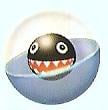 Chain Chomp CapsuleSpecial · 15 coins. This game’s Boo: steals coins or a Star from a player you choose, for a further fee.
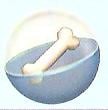 Bone CapsuleSpecial · cannot be used or thrown, only kept or discarded. Automatically buys off one Chain Chomp attack.
 Bowser CapsuleSpecial · not yours to use. The moment you receive it Bowser throws it on to a random minus space, which becomes a Bowser Space.
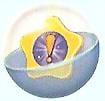 Chance CapsuleSpecial · 20 coins. Starts the Chance Roulette, or makes a Chance Space if thrown.
 Miracle CapsuleSpecial · cannot be used or thrown. Collect three and they go off by themselves, giving every Star held by the leader to the player in last place.

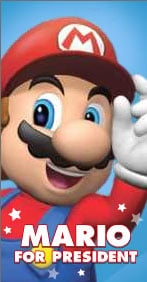 Mario for PresidentPromotion · North America · 2003–04Nintendo of America’s campaign parodied American presidential politics, timed to the 2004 primaries. Mario ran against Bowser, with Luigi and Koopa Kid as running mates, Donkey Kong and Boo as defence secretaries and Wario and Waluigi as rival treasurers. In the television commercial a man in a Mario costume takes questions from the press and answers one by throwing a Koopa shell.
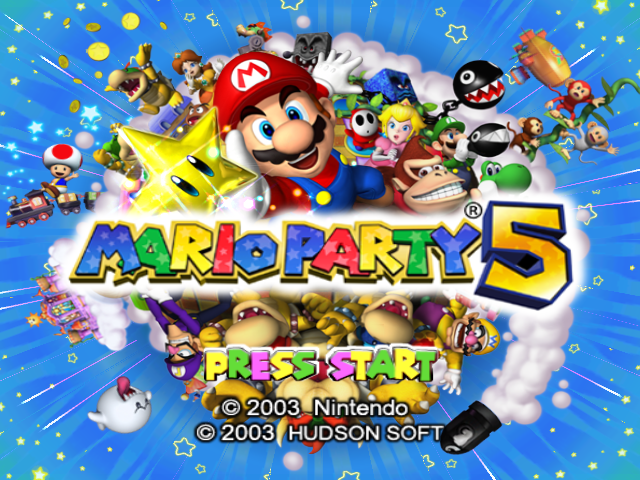 Mario Kart: Double Dash!! Bonus DiscGameCube demo · 2003A playable demo was included on the bonus disc given away with Mario Kart: Double Dash!! in North America. It had a different title screen.
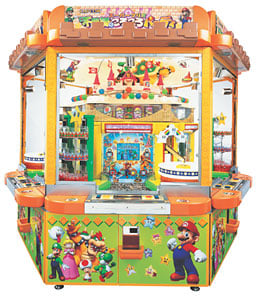 Super Mario Fushigi no Korokoro PartyArcade · Capcom · Japan, September 2004A coin-pusher arcade machine based on Mario Party 5, developed and published by Capcom for Japan only, with room for six players. It was Capcom’s first Mario Party arcade game and had a sequel.
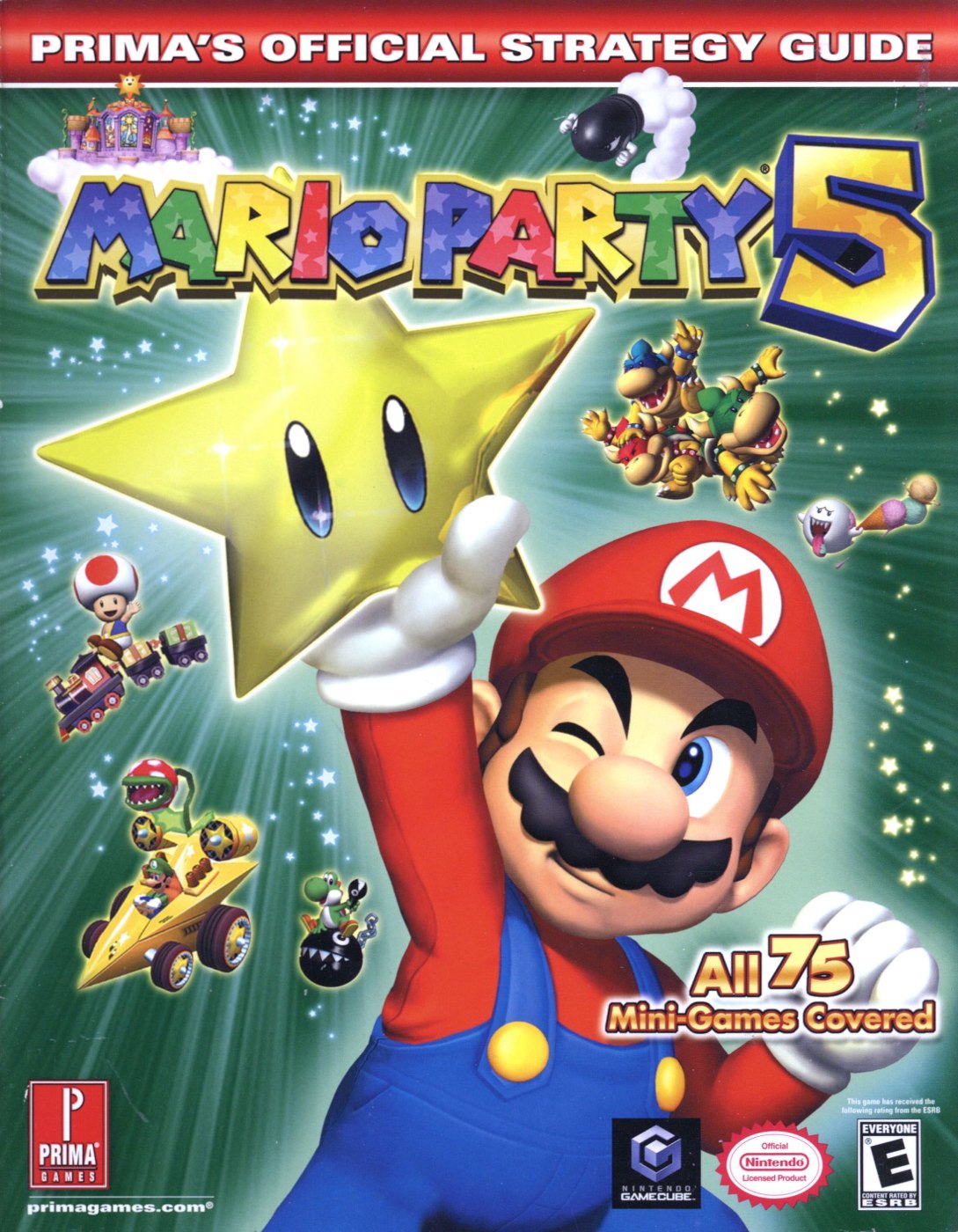 Prima’s Official Strategy GuideGuide book · Prima GamesPrima Games published the official guide.
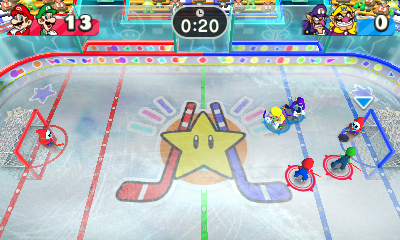 Mario Party: The Top 100Nintendo 3DS · 2017Seventeen minigames return: Button Mashers, Cage-in Cookin’, Coney Island, Defuse or Lose, Dinger Derby, Heat Stroke, Hotel Goomba, Ice Hockey, Later Skater, Leaf Leap, Manic Mallets, Night Light Fright, Pushy Penguins, Shy Guy Showdown, Squared Away, Triple Jump and Tube It or Lose It. The Star Spirits have a cameo in its series guide.
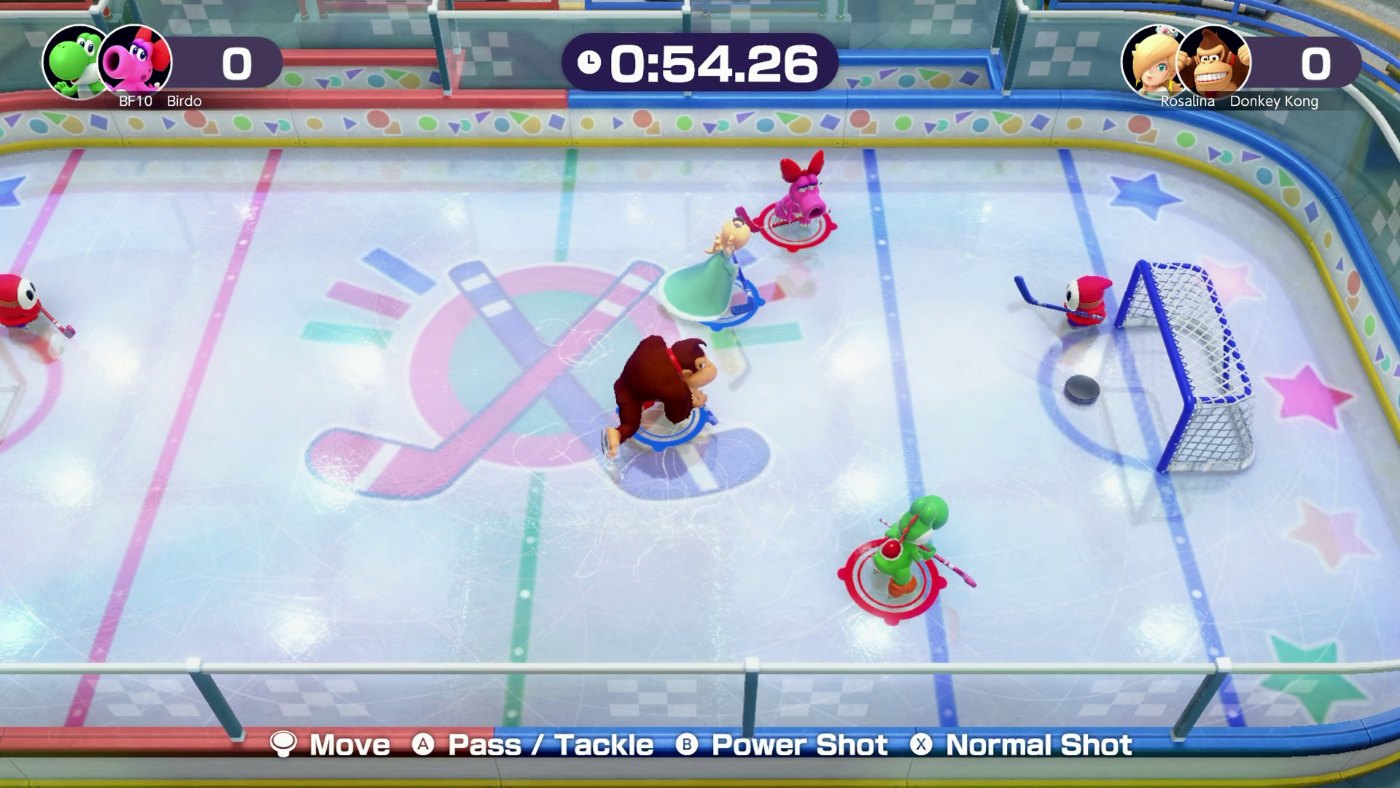 Mario Party SuperstarsNintendo Switch · 2021Ten minigames carry the Mario Party 5 logo: Dinger Derby, Leaf Leap, Pushy Penguins, Coney Island, Bill Blasters, Night-Light Fright, Later Skater, Squared Away, Tube It or Lose It and Ice Hockey.
 MarioPlayable
 LuigiPlayable
 Princess PeachPlayable
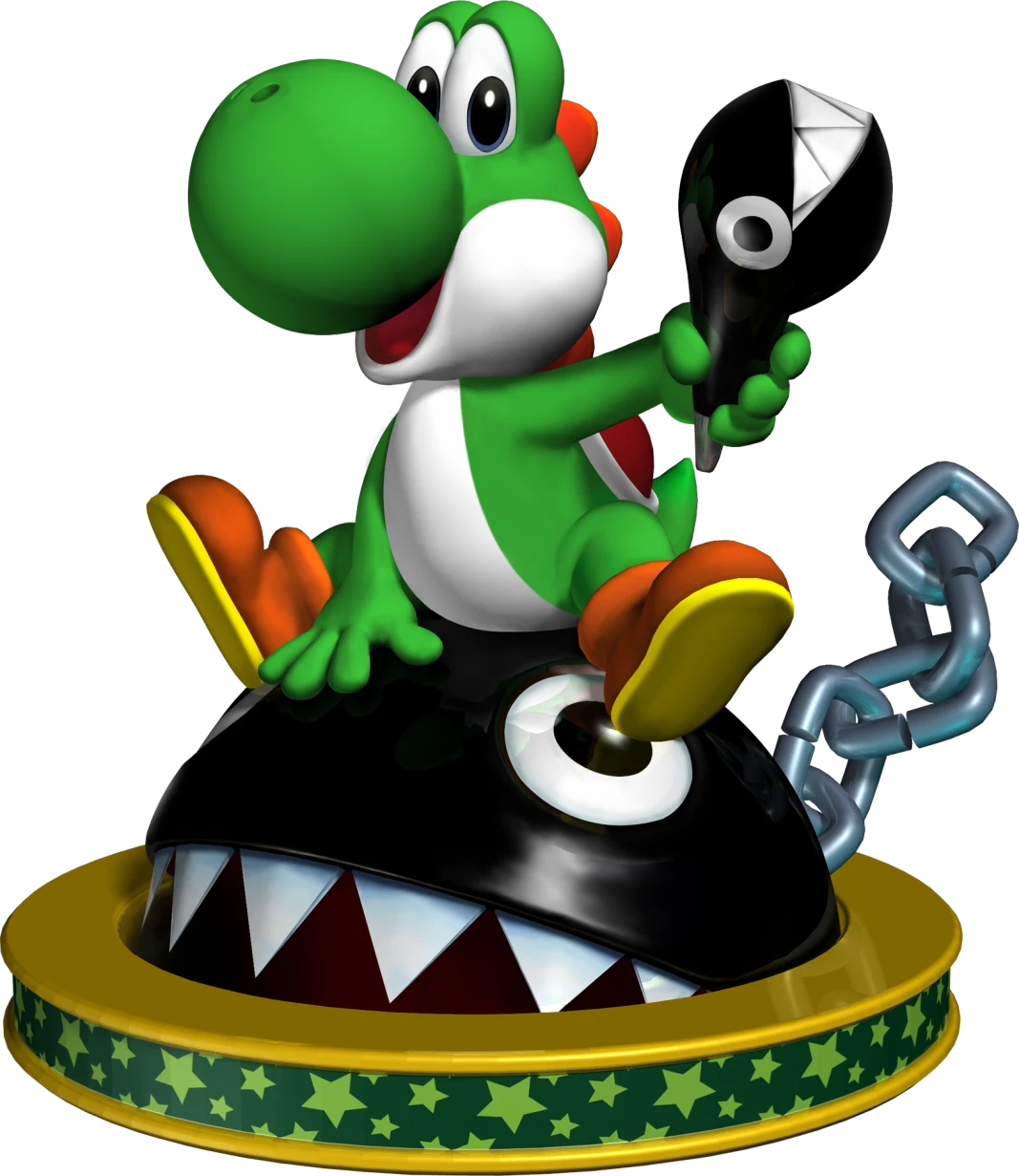 YoshiPlayable
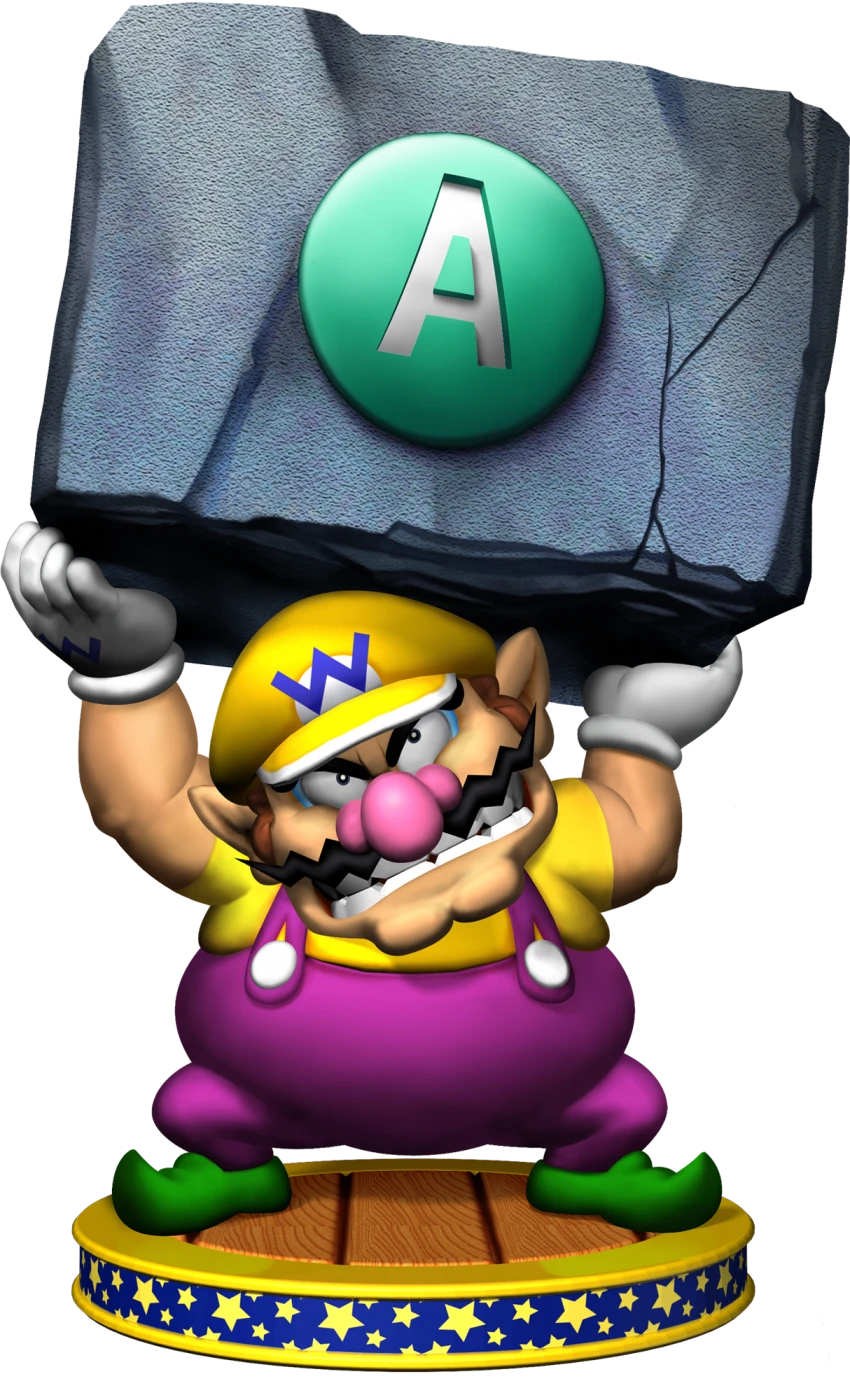 WarioPlayable
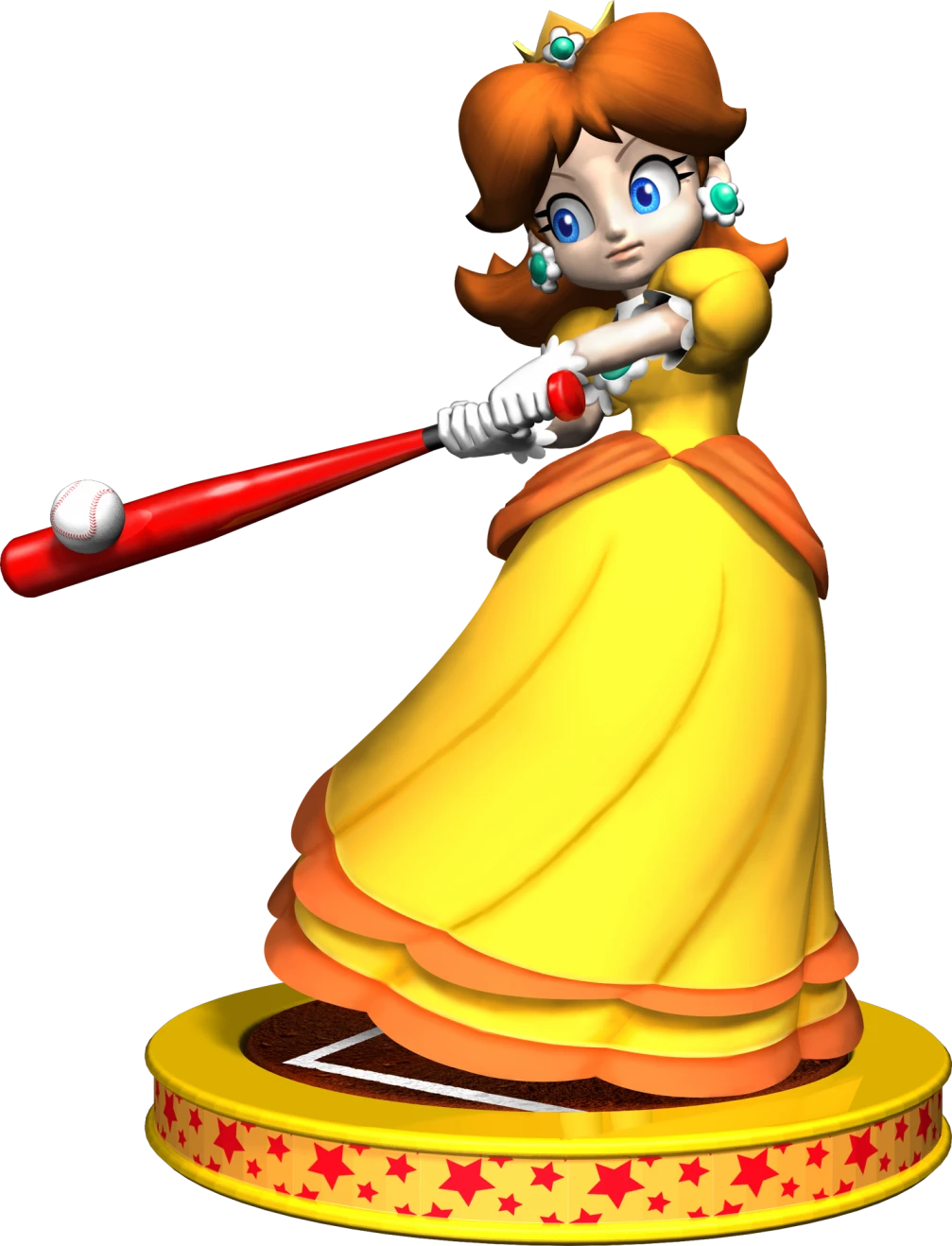 Princess DaisyPlayable
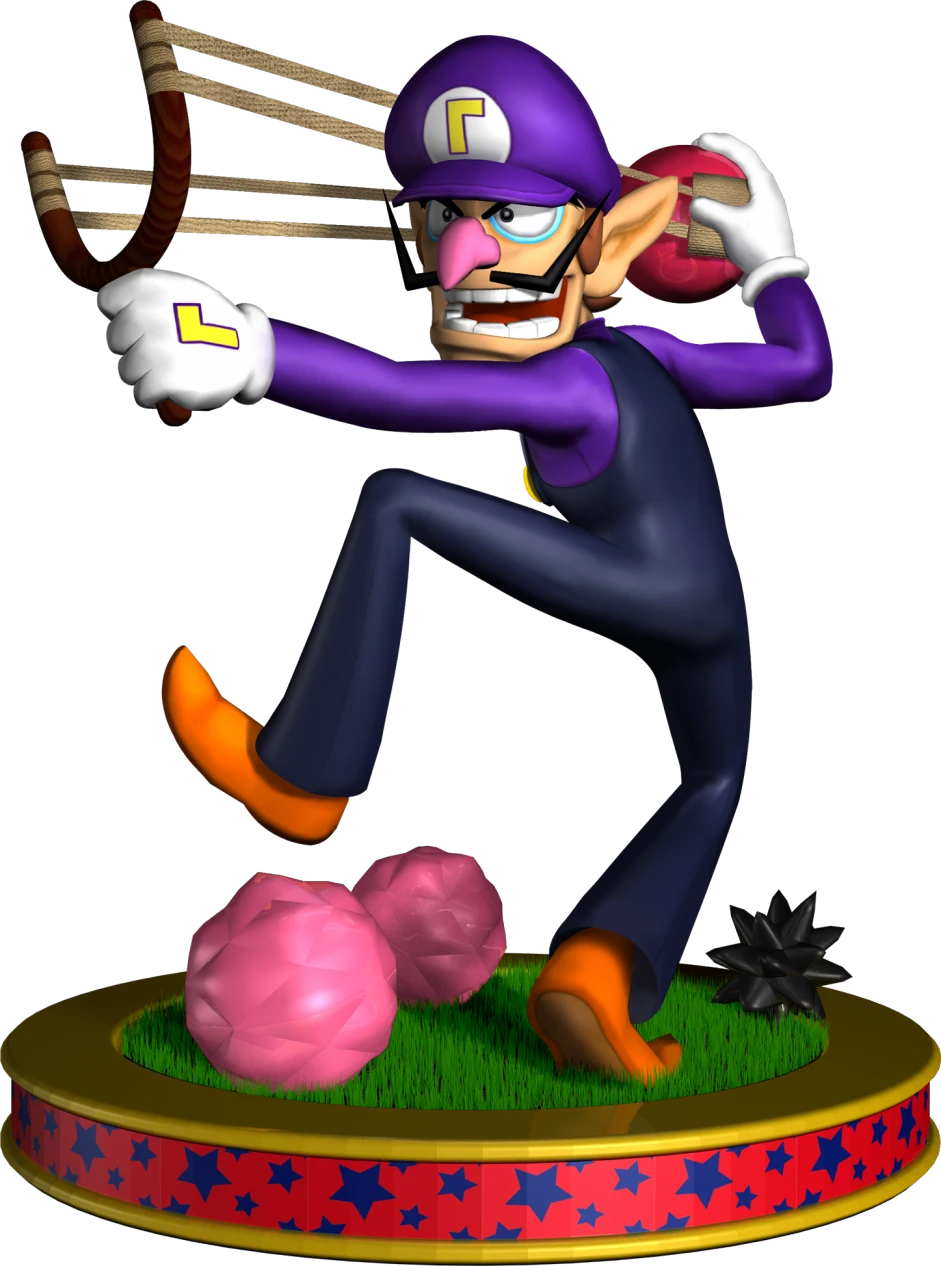 WaluigiPlayable
 ToadPlayable · new
 BooPlayable · new
 Koopa KidPlayable · new
 EldstarStar Guard · Party Mode
 MisstarStar Guard · Story Mode
 MuskularStar Guard · Mini-Game Mode
 SkolarStar Guard · Super Duel Mode
 MamarStar Guard · Bonus Mode
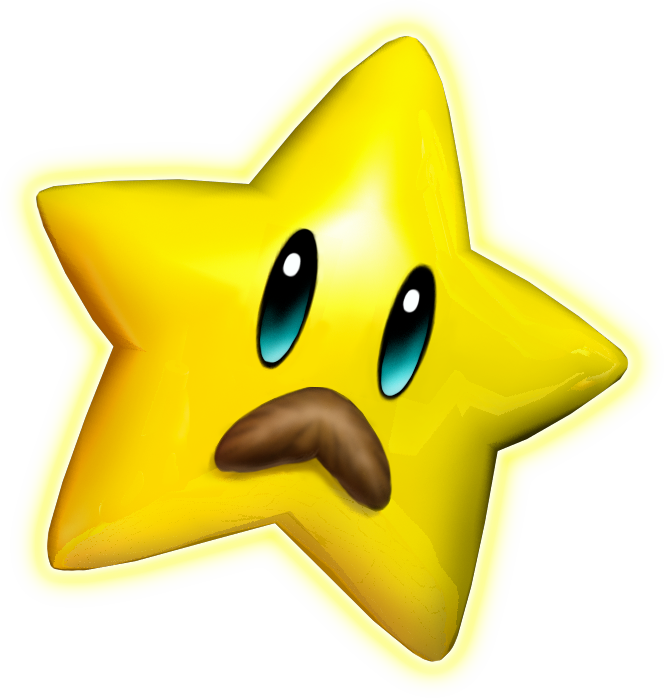 KalmarStar Guard · Options Mode
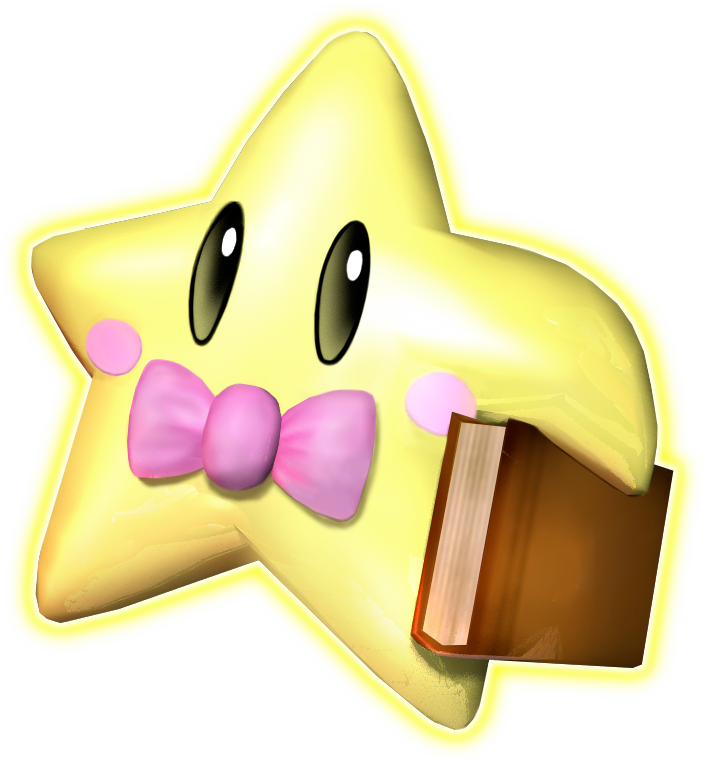 KlevarStar Guard · Dream Depot
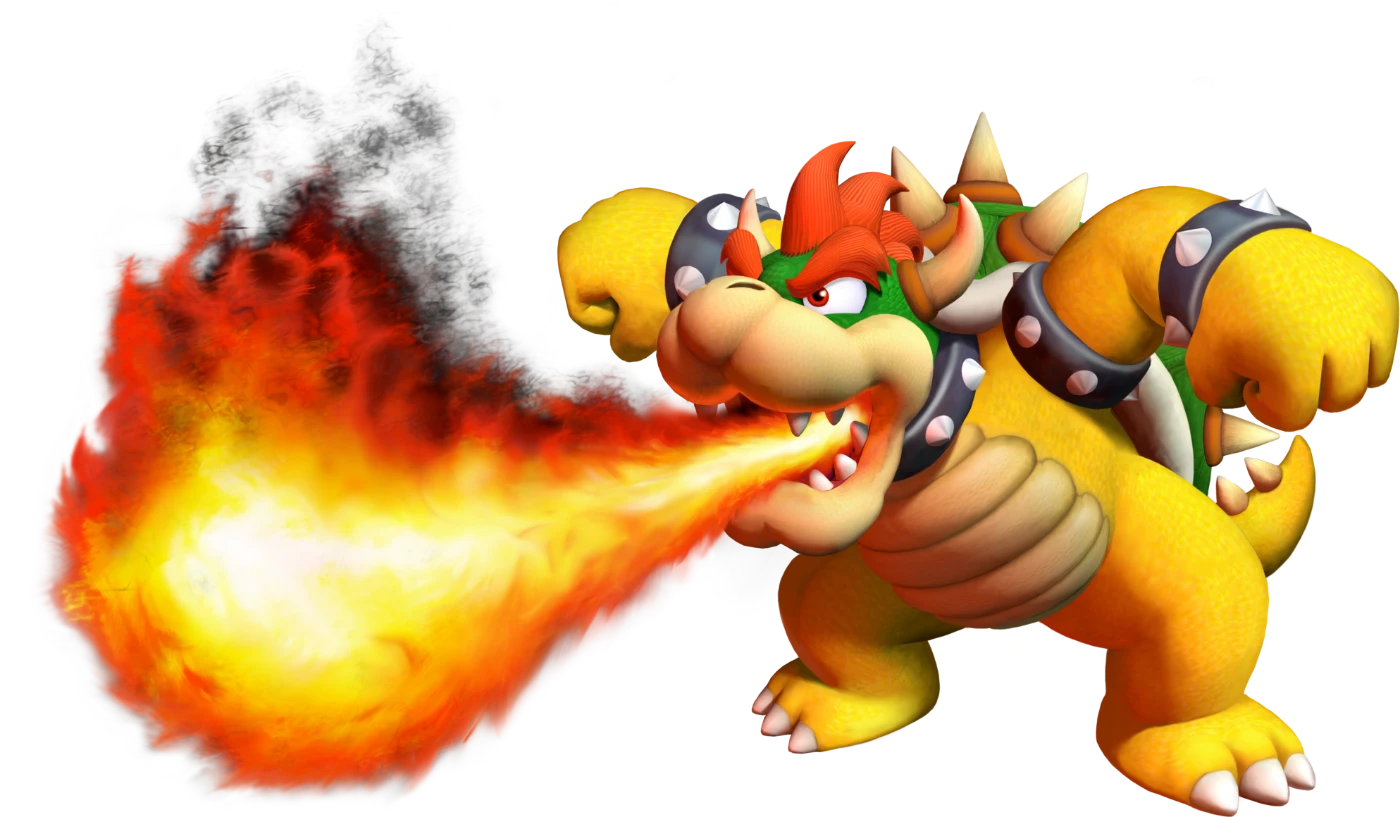 BowserVillain
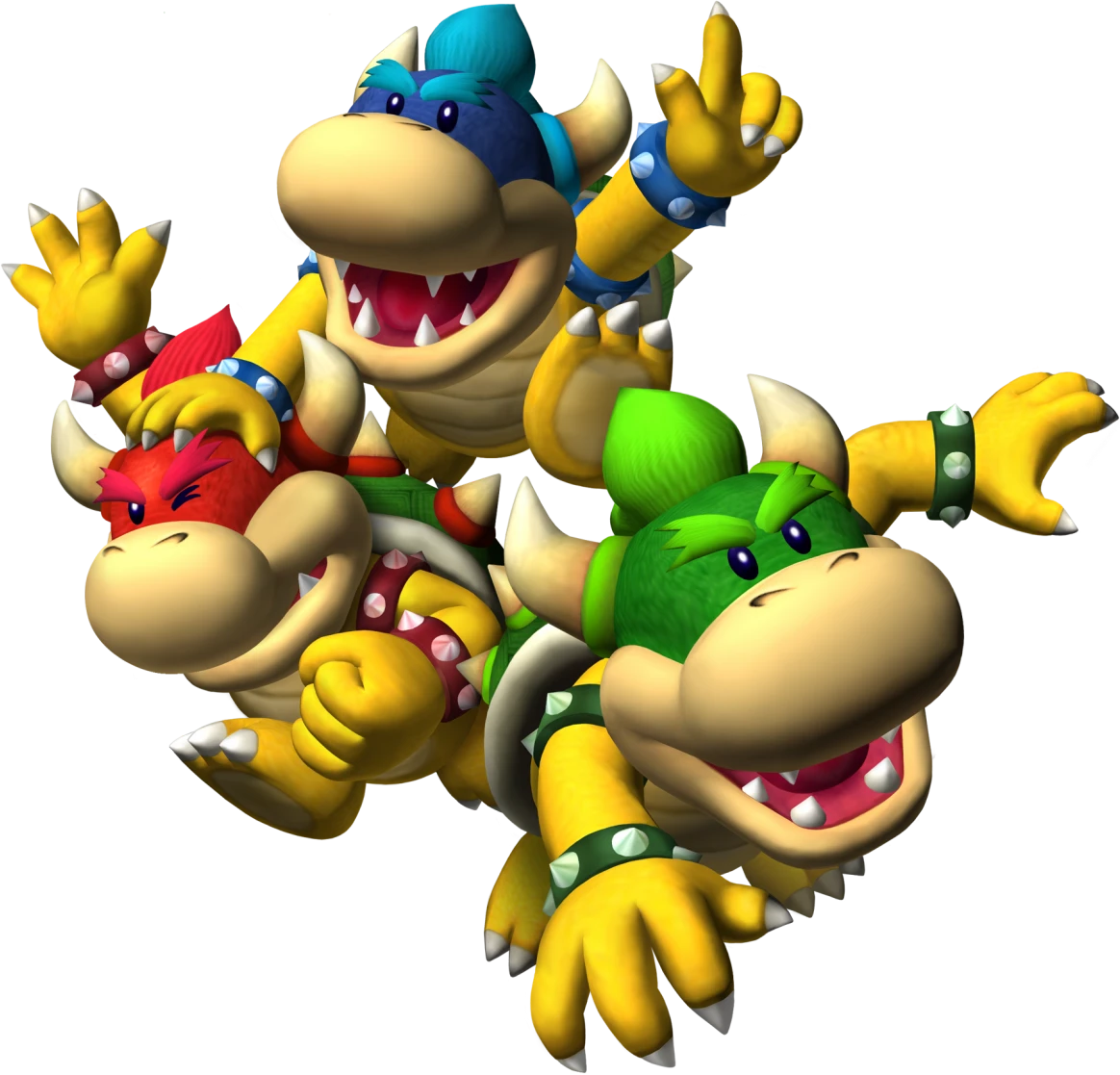 Red, Blue and Green K. KidStory Mode opponents
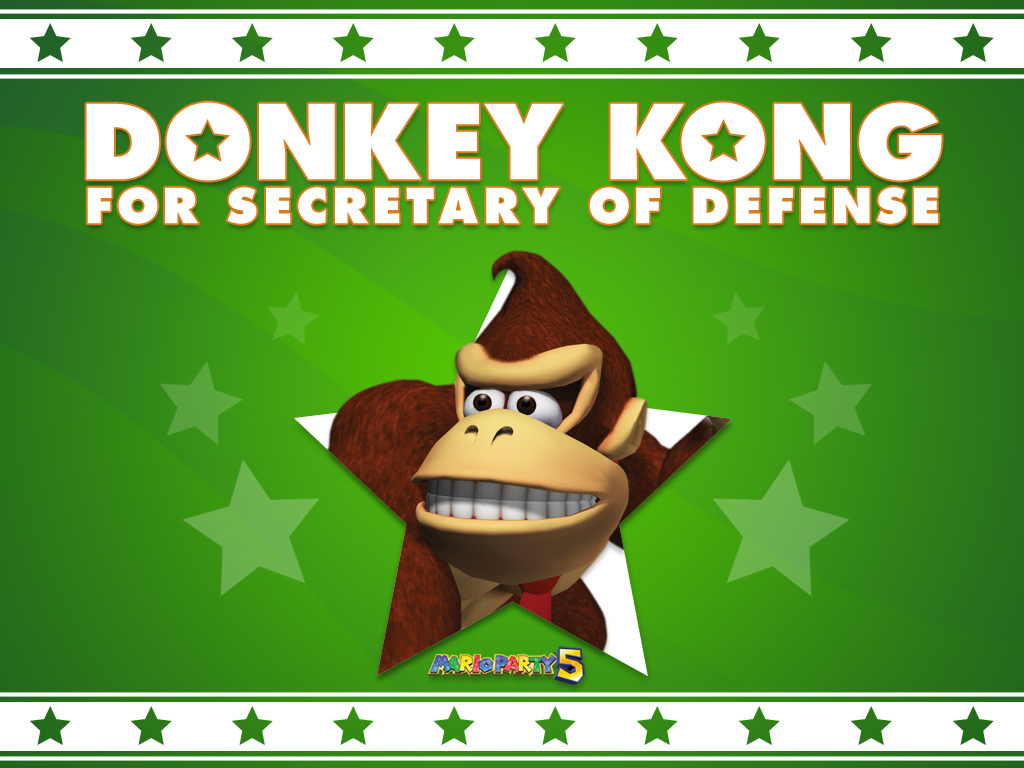 Donkey KongHost of the DK Space
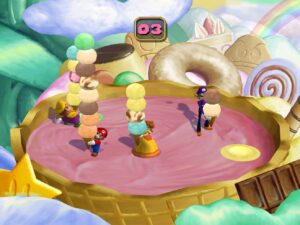 Coney Island4-PlayerCatch falling scoops of ice cream on your cone, judging each by its shadow. The tallest stack wins. In The Top 100 and Superstars.
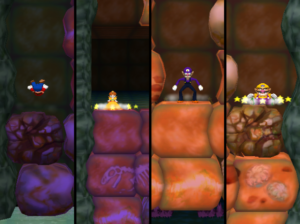 Ground Pound Down4-PlayerGround-pound your way down through layers of earth to the bottom of a cave. Rock takes three hits.
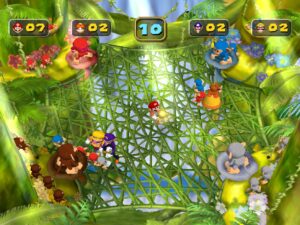 Chimp Chase4-PlayerRound up baby Ukikis and carry each to the grown-up Ukiki of its own colour. The golden one counts for three.
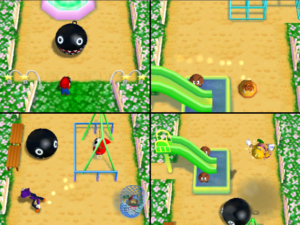 Chomp Romp4-PlayerWalk a Chain Chomp through a playground obstacle course to the exit, calling it with a whistle. Bump into it and you lose time.
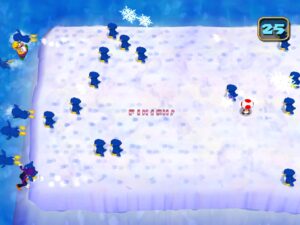 Pushy Penguins4-PlayerPenguins come waddling across an iceberg in droves. Weave between them or be pushed off the edge. In The Top 100 and Superstars.
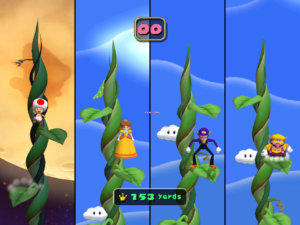 Leaf Leap4-PlayerJump from leaf to leaf up a beanstalk; whoever has climbed highest when time is up wins. In The Top 100, Superstars and Jamboree.
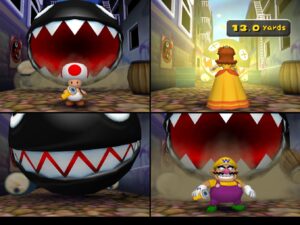 Night Light Fright4-PlayerA Chain Chomp charges out of the dark. Stop it with your torch as late as you dare: the nearest miss wins. In The Top 100 and Superstars.
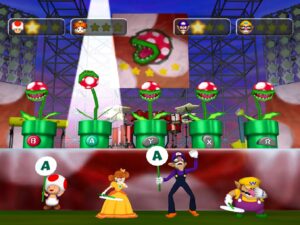 Pop-Star Piranhas4-PlayerSpot the one Piranha Plant dancing out of step, inside five seconds, over three rounds. The music is the Super Mario Bros. theme in three styles.
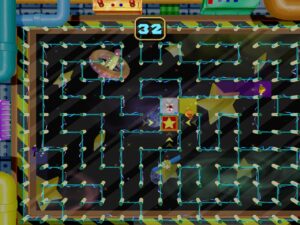 Mazed & Confused4-PlayerRace to the middle of a maze whose walls keep moving. Touch a wall and you are stunned.
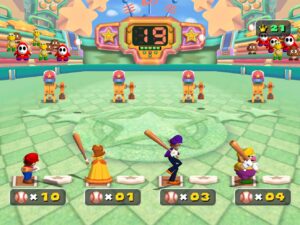 Dinger Derby4-PlayerBaseball batting practice: thirty pitches each, and the most hits wins. In The Top 100 and Superstars.
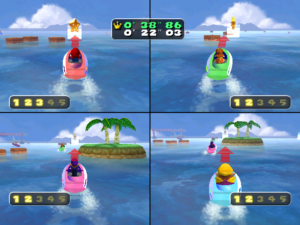 Hydrostars4-PlayerSteer a boat through a course of gates in the right order. First over the line wins.
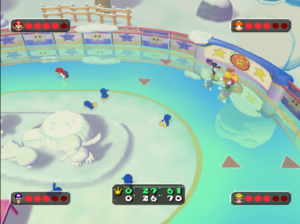 Later Skater4-PlayerFive laps of an ice rink on skates, without hitting the boards. In The Top 100 and Superstars.
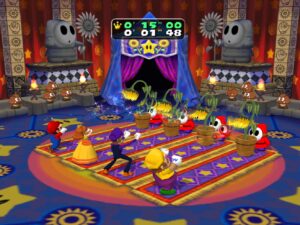 Will Flower4-PlayerHammer A to bring a drooping flower back to life before the others revive theirs.
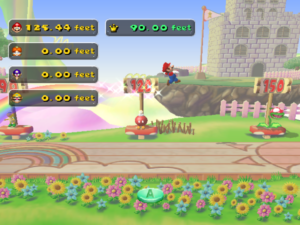 Triple Jump4-PlayerPress the buttons shown as fast as you can for the run-up and each bound. The longest jump wins. In The Top 100.
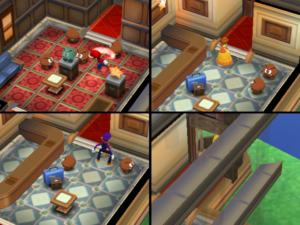 Hotel Goomba4-PlayerPunch Goombas out of your way, room by room, and be first up to the third-floor balcony. In The Top 100.
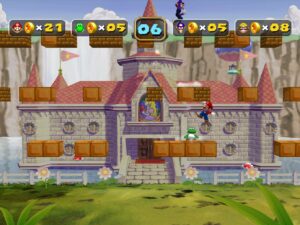 Coin Cache4-Player · coinJump at rows of blocks in front of Peach’s Castle and keep the coins that fall out.
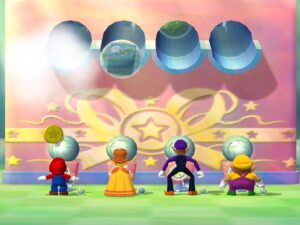 Vicious Vending4-Player · coinTurn the handle of a capsule machine and take what comes: 1, 10 or 20 coins, or a Thwomp and nothing.
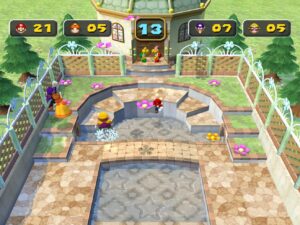 Flower Shower4-PlayerGather the flowers that Koopas throw down, with gold ones worth three, and flatten rivals to slow them up.
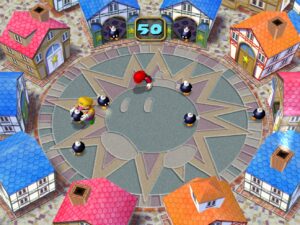 Dodge Bomb4-PlayerThrow Bob-ombs at one another. Anyone caught in a blast is out.
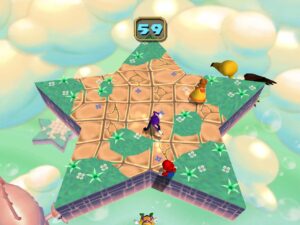 Fish Upon a Star4-PlayerA brawl on a platform that is falling to bits. Knock the others off and stay on yourself.
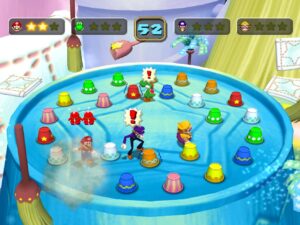 Rumble Fumble4-PlayerLift buckets to find three Fly Guys hiding underneath, and hope not to find something worse.
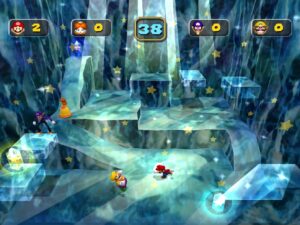 Frozen Frenzy4-PlayerCollect crystals in an ice cave while icicles fall and rivals barge. Most crystals wins.
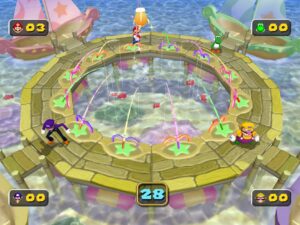 Fish Sticks4-PlayerHook Cheep Cheeps with a pole: red ones score a point and golden ones three.
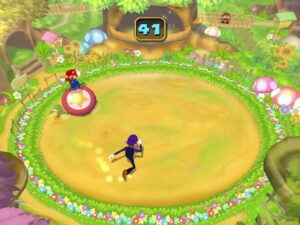 Flatiator1-vs-3One player rolls round an arena on a huge ball trying to flatten the other three.
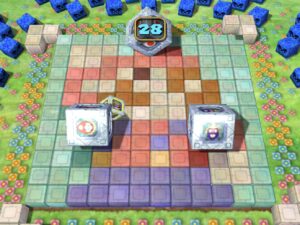 Squared Away1-vs-3Three players in big rolling cubes try to squash the fourth, who wins by surviving 30 seconds. In The Top 100 and Superstars.
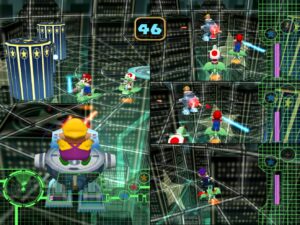 Mario Mechs1-vs-3A shoot-out between one player in a big robot and three on dragon-shaped scooters. The first side to destroy the other wins; after 60 seconds it is a draw.
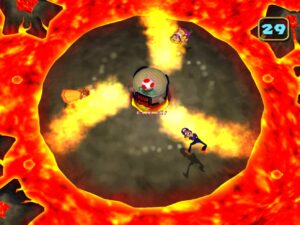 Revolving Fire1-vs-3The soloist turns bars of flame round a platform in the middle of the arena. The three must keep clear of them, and of the lava.
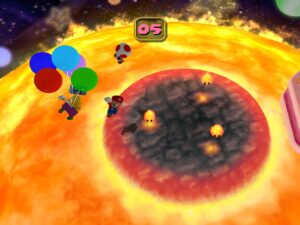 Heat Stroke1-vs-3The soloist swings a hammer to knock the three off their platforms while Podoboos rain down. In The Top 100.
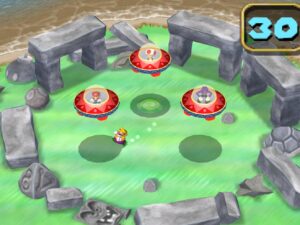 Beam Team1-vs-3Three UFOs with tractor beams hunt one runner on the ground.
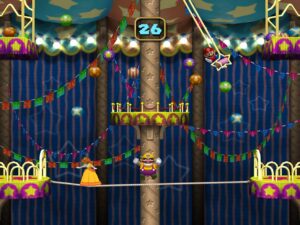 Big Top Drop1-vs-3The soloist drops balls on three tightrope walkers to knock them off.
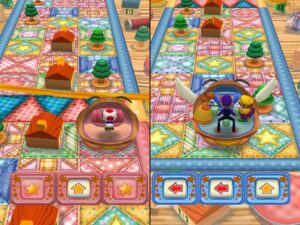 Quilt for Speed1-vs-3A roulette race across a patchwork quilt to the middle. The soloist has one roulette, the team three.
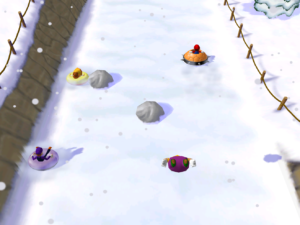 Tube It or Lose It1-vs-3Three slide down a mountain on inner tubes, chased by the soloist on a spike-lined tube that pops them. In The Top 100 and Superstars.
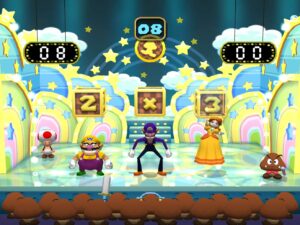 Mathletes1-vs-3 · coinHit blocks to build a sum, and the answer is paid in coins. Negative answers pay nothing; the best possible is 36.
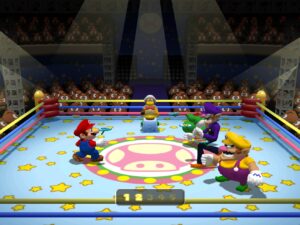 Fight Cards1-vs-3Each side shows a punch, kick or chop card every round. The soloist has five rounds to knock out all three.
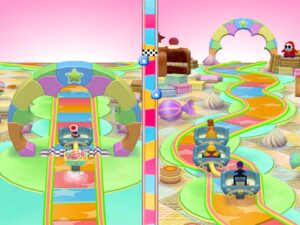 Curvy Curbs1-vs-3A trolley race down a winding track. The soloist has a slippery trolley to steer; the three steer one each and are held up whenever one of them hits the wall.
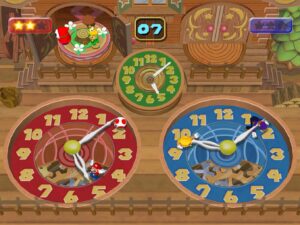 Clock Stoppers2-vs-2Turn the hands of your clocks to match the big one in the middle. First pair to three points.
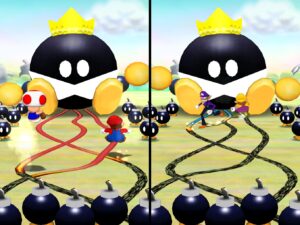 Defuse or Lose2-vs-2Stamp out sparks running along a tangle of fuses before they reach a giant Bob-omb. In The Top 100 and Jamboree.
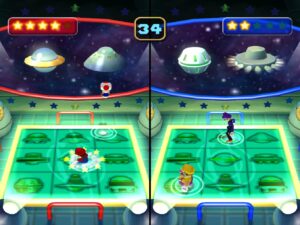 ID UFO2-vs-2Both partners must ground-pound the pictures that match the UFO at the same moment. First to five.
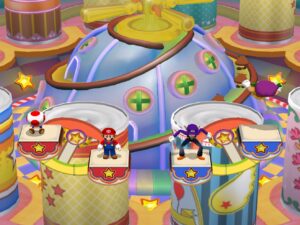 Mario Can-Can2-vs-2Take turns jumping on a see-saw to prise the lid off a giant tin.
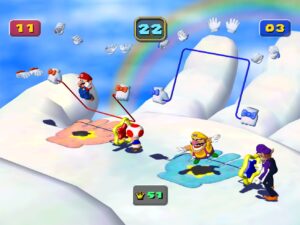 Handy Hoppers2-vs-2One partner spins a bar with L and R and the other skips over it. Most jumps wins.
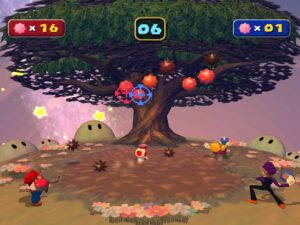 Berry Basket2-vs-2One shoots berries down from a tree and the other catches them in a basket. Dark ones stun.
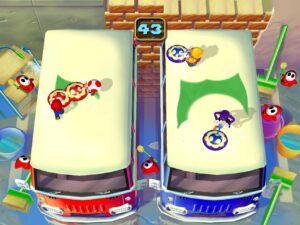 Bus Buffer2-vs-2Steer a buffer between you to clean the paint off the roof of your team’s bus. First pair to finish wins.
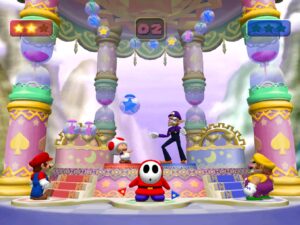 Rumble Ready2-vs-2Wait for the signal, then press A first to catch a falling capsule. First to three.
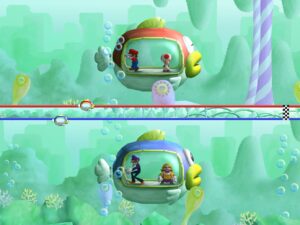 Submarathon2-vs-2Pull levers in turn to drive a Cheep Cheep submarine to the finish. The tune is the underwater theme from Super Mario Bros.
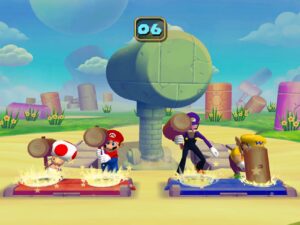 Manic Mallets2-vs-2Hammer your switch more times than the other pair in ten seconds and the giant mallet swings their way. In The Top 100.
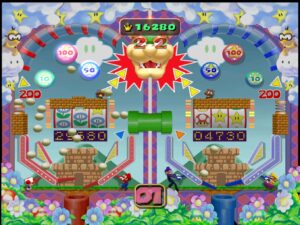 Panic Pinball2-vs-2A flipper each on a pinball table with scenery borrowed from Super Mario All-Stars. The higher score wins.
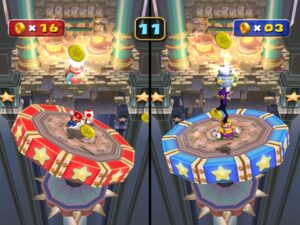 Banking Coins2-vs-2 · coinOne partner whacks a vase to shake coins out and the other catches them on a tilting platform.
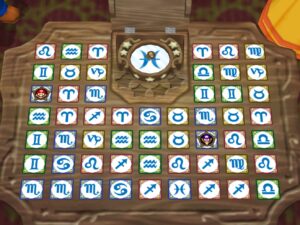 Astro-LogicalBattleFind the symbol on the table that matches the one shown. Wrong guesses cost time.
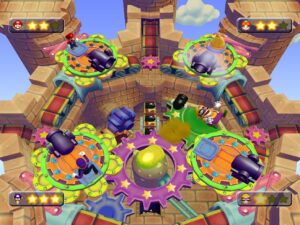 Bill BlastersBattleFire Bullet Bills at each other from spinning turrets. Three hits and you are out. In Superstars.
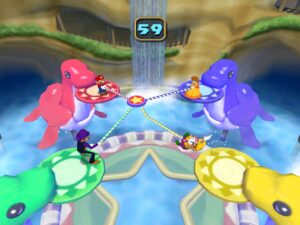 Tug-o-DorrieBattleA four-way tug-of-war from platforms held up by plastic Dorries. Anyone pulled off their platform is out, and the last one left wins.
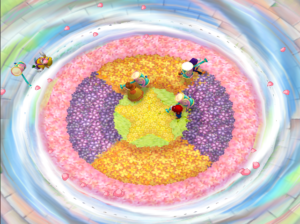 Twist ‘n’ OutBattleHammer your rivals out of the eye and into the tornado that surrounds the arena. Last one standing wins.
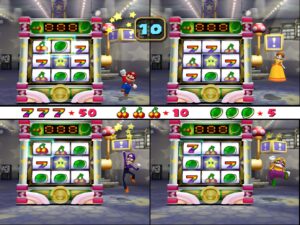 Lucky LineupBattleHit the blocks of a slot machine to line up symbols: sevens score 50, cherries 10 and shells 5.
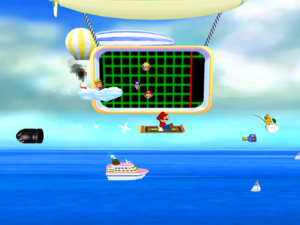 Random RideBattlePick a machine and hope. The race is mostly luck, though the machines’ names are a clue, and an engine blow-out puts yours out of it.
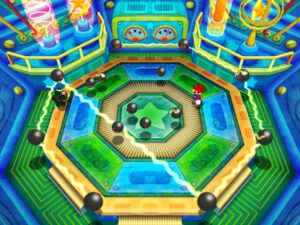 Shock AbsorbersDuelKeep moving among Amps and the electric barriers between them. First to be shocked loses.
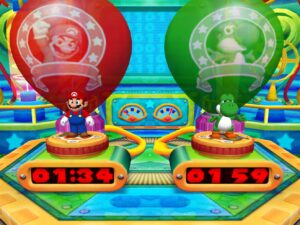 Countdown PoundDuelA clock counts down from ten seconds. Ground-pound your platform to stop it as close to zero as you can.
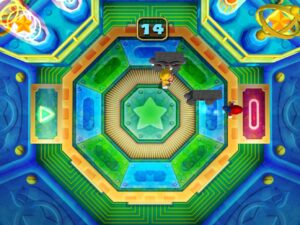 Whomp MazeDuelRace to the far end of a floor with Whomps buried under it, which pop up in your way as you come near.
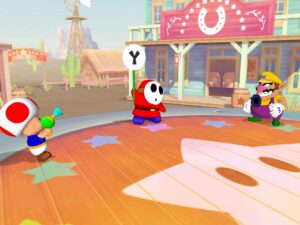 Shy Guy ShowdownDuelA quick-draw. When the Shy Guy holds up a sign, press that button first, and do not fall for a fake. In The Top 100.
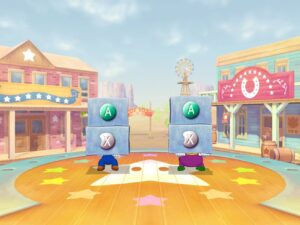 Button MashersDuelPress all the buttons shown on a stack of blocks together. The stack grows by one each time, and the first slip loses. In The Top 100.
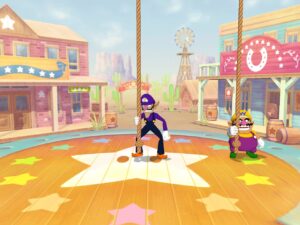 Get a RopeDuelThree ropes, one pull each. What is on the end decides it.
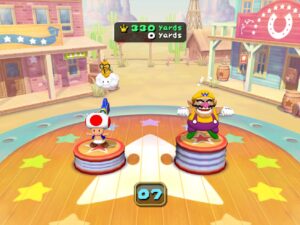 Pump ‘n’ JumpDuelMash A for ten seconds to build up pressure in your platform, then see who is launched higher.
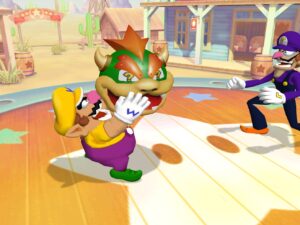 Head WaiterDuelPass a ticking bomb to and fro, choosing how much to take off the counter. Whoever is holding it at zero loses.
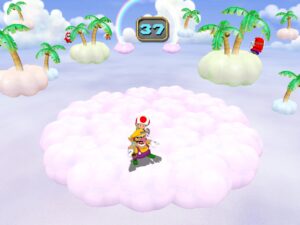 Blown AwayDuelCharge up and fire blasts of air to push your rival off a cloud.
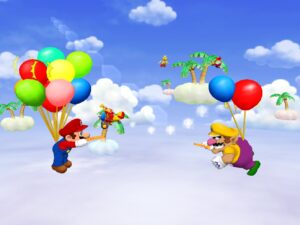 Merry PoppingsDuelBlow darts to burst all of your opponent’s balloons before they burst yours.
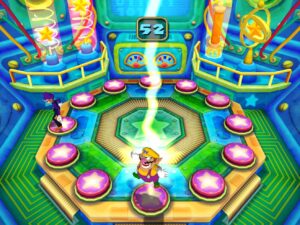 Pound PerilDuelTwelve switches and only one of them safe. Ground-pound until somebody finds it.
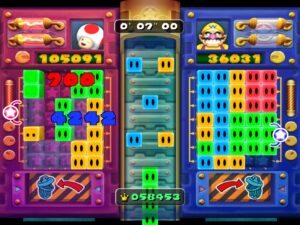 Piece OutDuelA puzzle: fit the shapes arriving on a conveyor belt into your grid; points are paid only when it is completely filled, with more for large areas of one colour.
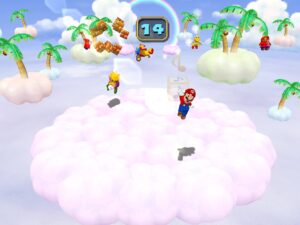 Bound of MusicDuelJump about to uncover invisible blocks. Whoever finds more of the ones holding musical notes wins.
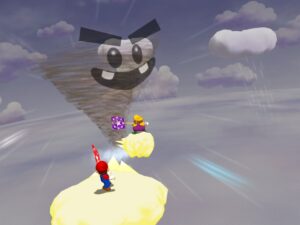 Wind WaversDuelAlternate L and R to flap a fan and keep yourself out of a tornado.
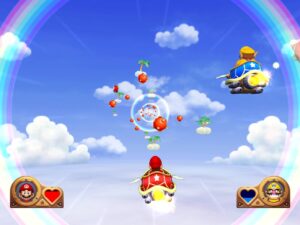 Sky SurvivorDuelFly a machine through a hail of oncoming objects. Five hits and it breaks.
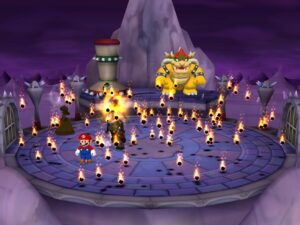 Rain of FireBowserBowser’s fireworks come down in two waves. Watch the shadows and do not be under one.
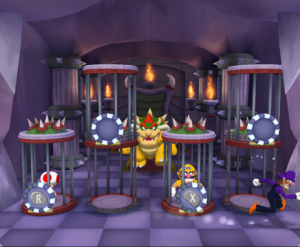 Cage-in Cookin’BowserPress the buttons shown to break out of your cage before Bowser turns the heat on. In The Top 100.
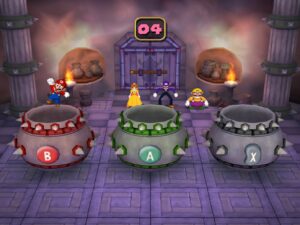 Scaldin’ CauldronBowserHide in one of three cauldrons. Bowser sets fire to two of them.
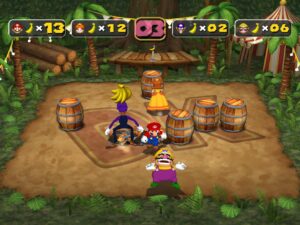 Banana PunchDKTen seconds to punch barrels open for bananas: small ones count one, large ones five.
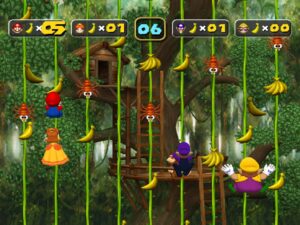 Da Vine ClimbDKTen seconds to climb vines picking bananas and bunches, and avoiding the spiders that stun you.
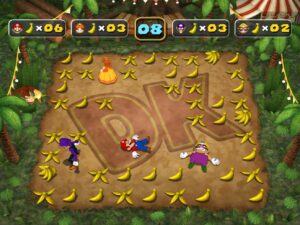 Mass A-peelDKTen seconds to gather bananas on the ground without slipping on the skins.
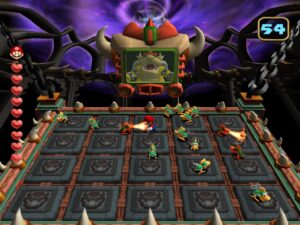 FrightmareStoryThe end of Story Mode: Mechakoopas, rings of fire, then Bowser himself, who must be hit five times once he has grown giant.
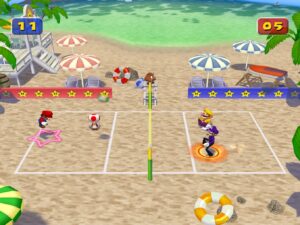 Beach VolleyballBonusTwo-a-side volleyball to a target of 10 to 20 points, with optional Bob-omb and Dice Balls. A reworking of Mario Party 4’s Beach Volley Folley.
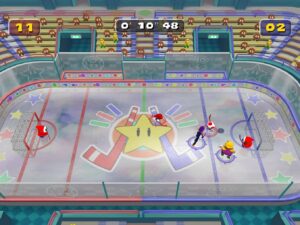 Ice HockeyBonusTwo players a side and a Shy Guy in each goal, over 60, 180 or 270 seconds. In The Top 100 and Superstars.