
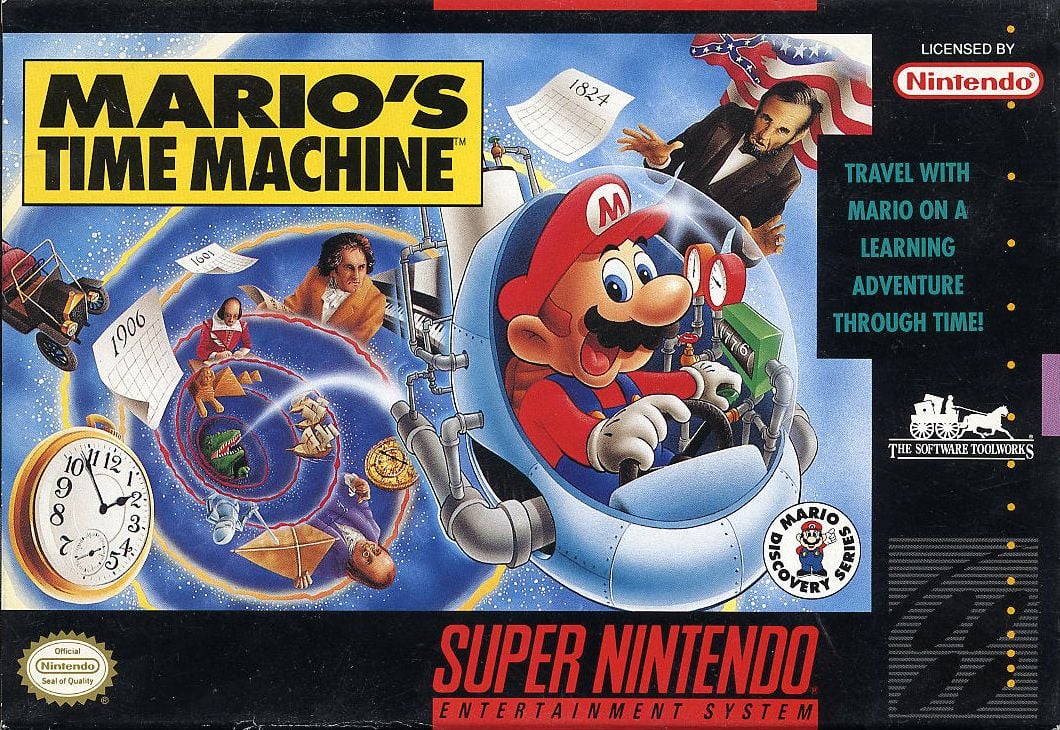
Mario’s Time Machine
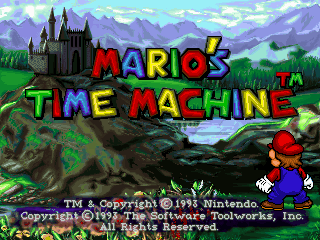
Bowser has discovered time travel, and naturally he is using it to go shopping. With a machine called the Timulator he has looted history for his own museum: Plato’s Republic, Joan of Arc’s shield, Newton’s apple, Edison’s filament and more. Mario borrows the machine, surfs the ripples of time to the right year and place, and puts each treasure back after proving he has listened to the people who lived there. The follow-up to Mario is Missing!, made by The Software Toolworks, came out on MS-DOS in 1993 with 25 periods from 369 BC to the Toolworks office itself, on Super NES in December 1993 with 15 and a Mode 7 surfing stage, and in June 1994 on the NES, where Radical Entertainment rebuilt it as an almost entirely different game with a captured Yoshi, the Moon landing and the fall of the Berlin Wall.
Overview
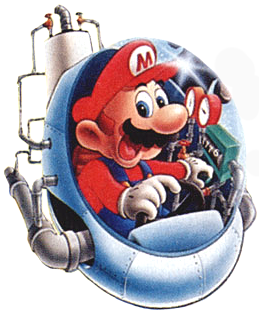
Having sent Luigi around the world in Mario is Missing!, The Software Toolworks sent Mario around the centuries. The idea is the same – Bowser’s Koopas have stolen treasures and a Mario brother has to give them back – but the lesson is now history, and the travelling is done with a time machine Bowser left lying around in his own castle.
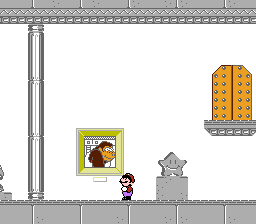
Each trip begins in Bowser’s museum, where Mario takes an artefact off a Koopa and reads its label: a year and a place. He sets the Timulator, rides the waves of time to get there, then wanders the streets of ancient Athens, medieval Orléans or Victorian London chatting to the locals. Fill in the blanks in a short biography of that period’s great figure correctly and the artefact goes home.
Like its predecessor it exists in three quite different forms. The MS-DOS game, mouse-driven, has 25 periods ending in a cheeky visit to Toolworks’ own office in 1993. The Super NES version trims that to 15 and turns time surfing into a Mode 7 water ride. The NES version, by Radical Entertainment, throws most of it away and becomes a light platformer, with Mario Bros.-style arenas in the museum, different eras and a rescue mission for Yoshi.
It was never going to please people who wanted Super Mario World, and later critics have been rough on it, but it has its admirers: GamePro liked the way it turned names in a textbook into people you could talk to.
Quick Answers
Quick answers about Mario’s Time Machine; more detail below.
Who made Mario’s Time Machine?
The Software Toolworks, which also made Mario is Missing!. The NES version was developed by Radical Entertainment. Nintendo licensed the characters but did not make the game. More →
When was it released?
MS-DOS in 1993, Super NES in North America in December 1993 (Europe March 1994), and NES in North America in June 1994. A voiced Deluxe CD-ROM edition followed for PC. More →
What is the Timulator?
Bowser’s time machine. Mario uses it to travel to the year and place written on each artefact, surfing through time and collecting mushrooms to power the trip. More →
How many time periods are there?
Twenty-five on MS-DOS, fifteen on the Super NES and fourteen on the NES, which uses mostly different ones. More →
Which historical figures appear?
On PC and Super NES they include Plato, Cleopatra, Marco Polo, Joan of Arc, Gutenberg, Michelangelo, Leonardo da Vinci, Magellan, Elizabeth I, Shakespeare, Newton, Jefferson, Beethoven, Edison and Gandhi. The NES adds Minamoto no Yoritomo, the Wright brothers and Einstein; Lincoln appears on the NES and the PC. More →
Is the NES version different?
Very. It is a platformer with arena stages in Bowser’s museum, fourteen mostly new periods (including the dinosaurs, the Moon landing and the Berlin Wall), a quiz before the final fight and Yoshi to rescue. More →
How does it end?
It depends how well you do. Take too long and Bowser escapes to a tropical paradise; do it right and he is sent to the Cretaceous, where a dinosaur steps on him. More →
Is it related to Mario is Missing!?
It is the sequel, from the same publisher, with the same structure of returning stolen artefacts after answering questions. More →
Story & Time Periods
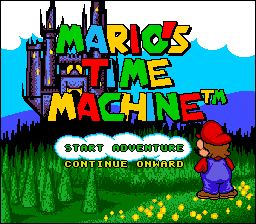
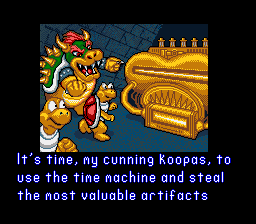
In 1993 Bowser gets his claws on a time machine, the Timulator, and does what any self-respecting villain would: he raids human history for souvenirs. Each stolen piece goes on display in a museum in his castle. Without them, the past starts to unravel.
Mario sneaks in, borrows the Timulator, and begins taking the treasures home one by one. The console instruction booklets raise the stakes: once Bowser’s collection is almost complete he means to wreck the machine, which would leave history in ruins and tip the world back into the Dark Ages.
From Athens to Orléans
The PC and Super NES journeys begin in Plato’s Athens in 369 BC and Cleopatra’s Alexandria in 47 BC, where the people Mario meets chat in perfectly modern English (Julius Caesar even complains of a cat allergy). From there he crosses the Gobi with Marco Polo and reaches Orléans in 1429 to return Joan of Arc’s shield.

Printers, painters and explorers
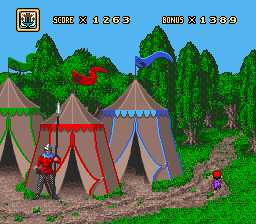
The middle of the game is a tour of the Renaissance: Gutenberg’s workshop in Mainz, Michelangelo and Leonardo in Florence, Magellan’s voyage across the Pacific, Elizabeth I’s court and Shakespeare at Stratford, where the stolen item is, inevitably, a skull.


Apples, light bulbs and a flag
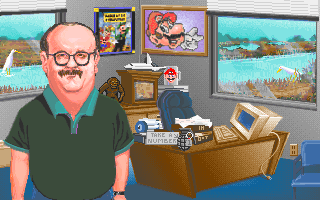
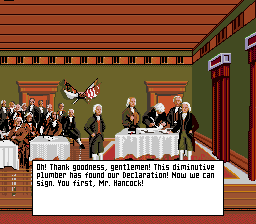
Newton’s apple goes back to Cambridge in 1687, the Declaration of Independence to Philadelphia in 1776, Beethoven’s music to Vienna and Edison’s filament to Menlo Park. The last historical stop is Gandhi’s Calcutta in 1947. The PC version then ends its tour somewhere unexpected: Novato, California, in 1993, where the figure is Toolworks’ own David Grenewetzki and the artefact a floppy disk. Lead artist Maude Church described that level as a little personal moment for the team.

The NES timeline
The NES game starts with Yoshi going on ahead and getting caught, so Mario has a friend to free as well as history to fix. Its fourteen periods run from the Cretaceous, where a dinosaur egg needs returning, through the first Olympic Games in 776 BC, Cleopatra in 31 BC and Minamoto no Yoritomo’s Japan in 1192, to Lincoln in 1862, the Wright brothers at Kitty Hawk in 1903, Einstein in 1905, the Moon landing in 1969 and the Berlin Wall in 1989.


Bowser’s comeuppance
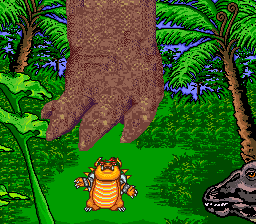
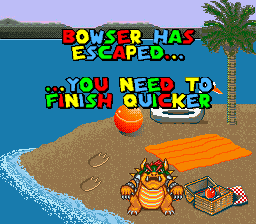
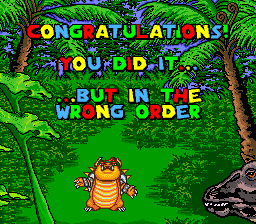
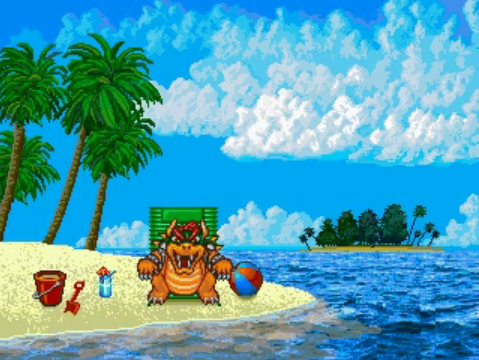
The PC game has two endings, decided by your score, and the Super NES adds a third. Dawdle too long and Bowser escapes to “Paradise”, a tropical island; the Super NES also has an ending that tells you a mistake was made. Do everything right and Bowser finds himself in the Cretaceous, gawping up at a descending T. rex foot. On the Super NES the flattened Bowser stays on screen for the whole of the credits.
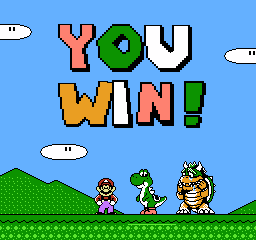
The NES ending is gentler and more notorious: Bowser drops a key, Mario frees Yoshi, and the two pose beside a weeping Bowser. GameSpy later picked it out as one of the worst endings on the console.
Every PC and Super NES time period
All 25 periods of the MS-DOS game in date order, with the figure and the stolen artefact; fifteen of them are also in the Super NES version.
- 369 BC · AthensPC & Super NESPlato. Artefact: Plato’s Republic.
- 47 BC · AlexandriaPC & Super NESCleopatra. Artefact: Cleopatra’s staff.
- 105 · LuoyangPC onlyTs’ai Lun. Artefact: A piece of bamboo.
- 1292 · Gobi DesertPC & Super NESMarco Polo. Artefact: A print block.
- 1429 · OrléansPC & Super NESJoan of Arc. Artefact: Joan’s shield.
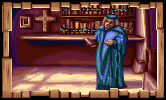 1455 · MainzPC & Super NESJohann Gutenberg. Artefact: Metal type.
- 1503 · FlorencePC & Super NESMichelangelo. Artefact: A chisel.
- 1505 · FlorencePC & Super NESLeonardo da Vinci. Artefact: A notebook.
- 1521 · Pacific OceanPC & Super NESFerdinand Magellan. Artefact: An astrolabe.
- 1595 · London (England on Super NES)PC & Super NESElizabeth I. Artefact: The queen’s crown.
- 1601 · Stratford-upon-AvonPC & Super NESWilliam Shakespeare. Artefact: A skull.
- 1610 · PaduaPC onlyGalileo Galilei. Artefact: A telescope.
- 1687 · CambridgePC & Super NESIsaac Newton. Artefact: Newton’s apple.
- 1752 · PhiladelphiaPC onlyBenjamin Franklin. Artefact: A key.
- 1776 · PhiladelphiaPC & Super NESThomas Jefferson. Artefact: The Declaration of Independence.
- 1791 · ViennaPC onlyWolfgang Amadeus Mozart. Artefact: A flute.
- 1824 · ViennaPC & Super NESLudwig van Beethoven. Artefact: Sheet music.
- 1831 · LondonPC onlyMichael Faraday. Artefact: A magnet.
- 1843 · LondonPC onlyCharles Dickens. Artefact: An inkwell.
- 1863 · Washington, D.C.PC onlyAbraham Lincoln. Artefact: Lincoln’s spectacles.
- 1879 · Menlo ParkPC & Super NESThomas Edison. Artefact: A light bulb filament.
- 1885 · ParisPC onlyLouis Pasteur. Artefact: A flask.
- 1915 · TuskegeePC onlyGeorge Washington Carver. Artefact: A crank handle.
- 1947 · CalcuttaPC & Super NESMahatma Gandhi. Artefact: A flag.
- 1993 (1994 in Deluxe) · Novato, CaliforniaPC onlyDavid Grenewetzki. Artefact: A floppy disk.
NES (14 periods): Cretaceous, 80 million BC (dinosaur egg); Olympia, 776 BC (torch); Egypt, 31 BC, Cleopatra (throne); Japan, 1192, Minamoto no Yoritomo (sword); the Trinidad, 1520, Magellan (steering wheel); England, 1602, Shakespeare (quill pen); Cambridge, 1687, Newton (apple); Gettysburg, 1862, Lincoln (stovepipe hat); Menlo Park, 1879, Edison (light bulb); Kitty Hawk, 1903, the Wright brothers (propeller); Germany, 1905, Einstein (physics equation); India, 1947 (Indian flag); the Moon, 1969 (American flag); the Berlin Wall, 1989 (sledgehammer).
Gameplay & Controls
The PC and Super NES games share a design; the NES game goes its own way.
Bowser’s museum
The hub is Bowser’s castle, turned into a gallery of stolen goods. On the PC it has five rooms of five exhibits. Mario jumps on the Koopas guarding them to take an artefact, and its tag tells him exactly when and where it belongs.

Surfing through time
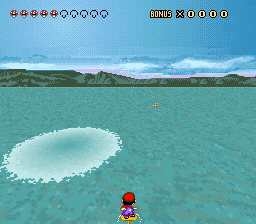
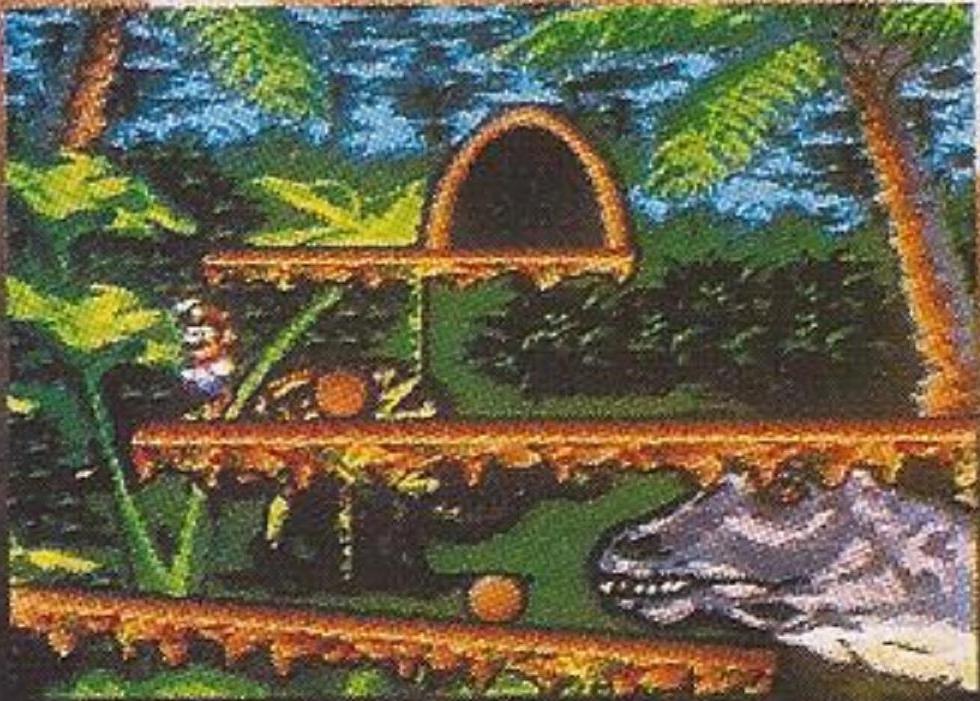
Setting the Timulator is only half the job. Mario then rides a stream of time ripples, collecting mushrooms and dodging hazards until he has enough to arrive. On the Super NES this becomes a Mode 7 water stage that lets him steer in every direction, and after ten mushrooms he has to dive into a whirlpool to complete the jump. Early versions of the Super NES game dumped Mario in a prehistoric, Donkey Kong-style area if he hit the whirlpool without enough mushrooms; it was cut, but still sits in the cartridge.
Talk, trade and fill in the blanks
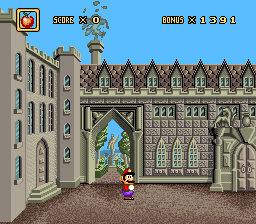
Each period is a short street scene with a handful of residents. Mario talks to them, and sometimes trades items to get them to open up. Everything he learns feeds a two-page biography of the period’s famous figure with words missing; filling the gaps correctly lets him hand the artefact back. Get it wrong more than twice and IGN notes that Mario is bounced back to 1993 to try again.
The NES version
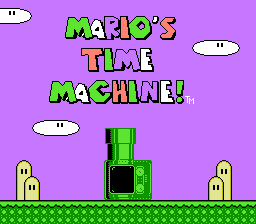
Radical Entertainment’s NES game keeps the premise and little else. The museum is a hall of seven doors; behind each is a single-screen arena in the style of Mario Bros., where Mario knocks out Koopas to win two artefacts and can leave through the pipes. The Timulator is a see-through box with a Warp Pipe at the bottom of the room, offering a menu of fixed periods. Each period is a short platform level with Koopas, Bodyslam Koopas, Walking Turnips and locals, plus information boxes. Drop an artefact in the wrong era and a bird (or, on the Moon, a flying saucer) carries it back to the Koopas. Once every door is done, a random history test opens the way to Bowser.

Mario’s Time Machine Deluxe
The PC game was reissued on CD-ROM as Mario’s Time Machine Deluxe, dated 1994 by some sources and 1996 for the Windows release by GameSpot. It adds voice acting and a Library of reference files, one of which covers Bowser’s mother. Lead artist Maude Church’s main job on it was adding animation.
Characters
Mario, Bowser and a cast drawn from the history books. Historical sprites are from the NES version, the only one with a full set on record.
| Character | Who they are | In this game | Abilities & notes |
|---|---|---|---|
| MarioThe time traveller | The hero, after sitting out Mario is Missing! as the captive. | Borrows the Timulator and returns every artefact. The only playable character in all three versions. | Stomps Koopas; talks, trades and answers questions. Sprite from MS-DOS. |
 BowserThe collector | King of the Koopas. | Uses the Timulator to stock his museum with history’s treasures; ends up flattened by a dinosaur, lounging in paradise or, on the NES, in tears. | Final boss on the NES. His PC sprite is modelled on Super Mario Bros. 3 artwork. |
 YoshiThe captive (NES) | Mario’s dinosaur friend. | Only in the NES version: he scouts ahead, is caught and is freed at the very end. | Not playable. |
 Koopa TroopasMuseum guards | Bowser’s troops. | Guard the exhibits and hand them over when stomped; on the NES they fill the arenas and the period levels. | Green and yellow on the NES. |
| Cleopatra47 BC (PC, Super NES) · 31 BC (NES) | Queen of ancient Egypt. | Her staff (PC, Super NES) or throne (NES) has been stolen. | One of the few figures in all three versions. |
| Minamoto no Yoritomo1192 (NES) | The Japanese warlord who founded the Kamakura shogunate. | NES only, met in Japan in 1192. | Artefact: his sword. |
| Ferdinand Magellan1521 (PC, Super NES) · 1520 (NES) | The Portuguese explorer. | Met at sea in the Pacific (PC, Super NES) or aboard the Trinidad (NES). | Artefact: astrolabe (PC, Super NES); steering wheel (NES). |
| William Shakespeare1601 (PC, Super NES) · 1602 (NES) | The playwright. | Visited at Stratford-upon-Avon (PC, Super NES) or in England (NES). | Artefact: a skull (PC, Super NES); a quill pen (NES). |
 Albert Einstein1905 (NES) | The physicist. | NES only, in Germany. | Artefact: a physics equation. |
| Mahatma Gandhi1947 | Leader of India’s independence movement. | Met in Calcutta (PC, Super NES) or simply India (NES), in 1947. | Artefact: a flag. |
| David Grenewetzki1993 (PC) | A real Software Toolworks figure, featured in the final PC period set at the company’s home in Novato. | Receives the last artefact, a floppy disk. | MS-DOS and Deluxe only. |
Enemies and locals
The NES version’s enemies, plus a few of the people Mario meets.
 Yellow KoopaNESA second Koopa colour in the museum arenas.
 Bodyslam KoopaNES periodsA Koopa type found in the NES time periods.
 Walking TurnipNES periodsA vegetable on legs patrolling the NES levels.
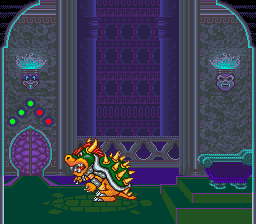
 Bowser (boss)NES finaleFought after the history test; drops the key to Yoshi’s cell.
 Greek manOlympia, 776 BC (NES)A local at the first Olympics.
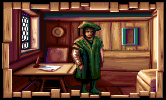
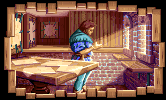 LeatherworkerMainz, 1455 (Deluxe)One of Gutenberg’s neighbours.
The people who made it
Named in sources:
How It Was Made
Little has been published about the making of the game; what there is comes from two of its PC developers.
A quick follow-up
Nintendo had licensed its characters to The Software Toolworks for educational games, and Mario’s Time Machine followed Mario is Missing! within the same year. Programmer Carlos Justiniano has said the project was already late when he started on it, and the team got it done in a few weeks. Lead artist Maude Church told Super Mario Boards in 2017 that Nintendo left the team alone apart from keeping an eye on how Mario looked, and that the team tried hard to get its history right; the final Novato level, starring the developers, was their joke.
Borrowed from Dinosaur Land

As with its predecessor, the console versions lean on Super Mario World: most music cues are arrangements of its tunes and most character sprites are taken from it, while the PC Bowser is based on Super Mario Bros. 3 artwork. The NES game also reuses music from the NES Mario is Missing!. An unused Ludwig von Koopa survives in the CD-ROM files, and an early, rather different Bowser appears in the Super NES instruction booklet.
Videos
Nintendo never made a video for this one; here are two third-party looks at it.
Trivia & Interesting Facts
- The NES version is usually counted as the last Super Mario title released on the NES in North America; Wario’s Woods, starring Toad, followed in December 1994.
- A painting of Donkey Kong Jr. hangs in Bowser’s NES museum.
- The box art of Mario is Missing! turns up in one scene of the PC game, and its ending reuses that game’s walking sprites.
- The Super NES Sound Test holds an unused tune based on the 25m stage music of Donkey Kong.
- Julius Caesar claims to be allergic to cats, which has no historical basis.
- Aristotle appears as a grown man in 369 BC, one of the game’s many slips.
- Edmund Halley is made to track his comet in the wrong century, and Newton gets sole credit for calculus with no mention of Leibniz.
- In 1455 Mainz, Mario can come across a tea bag, centuries before they were invented.
- Einstein, met in 1905 on the NES, mentions moving to the United States in the 1930s, and looks middle-aged although he was 26.
- On the NES Lincoln’s period is dated 1862, yet a newspaper there refers to the Gettysburg Address of 1863.
- Mario’s Time Machine is one of the NES games you can pick as a favourite in Nintendo World Championships: NES Edition.
- A sealed NES copy was among the items in a Nintendo of Canada charity auction reported by Joystiq in 2008.
Regional Box Art
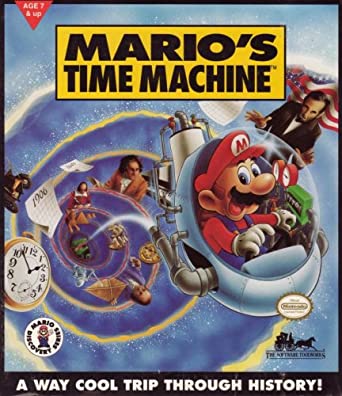
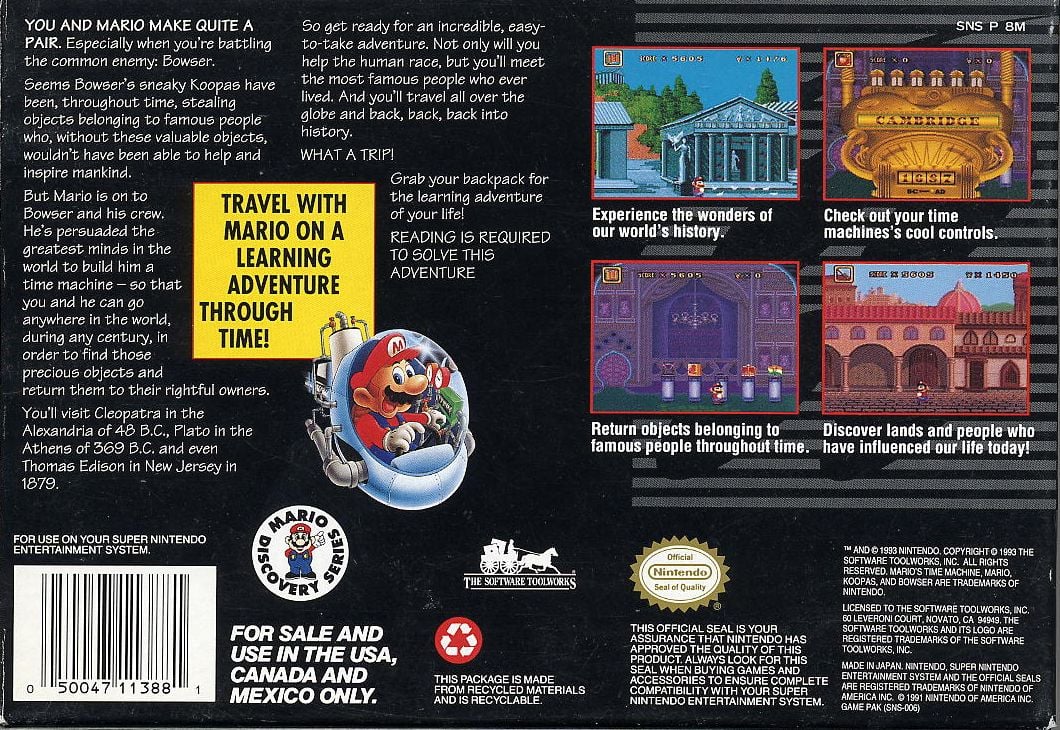
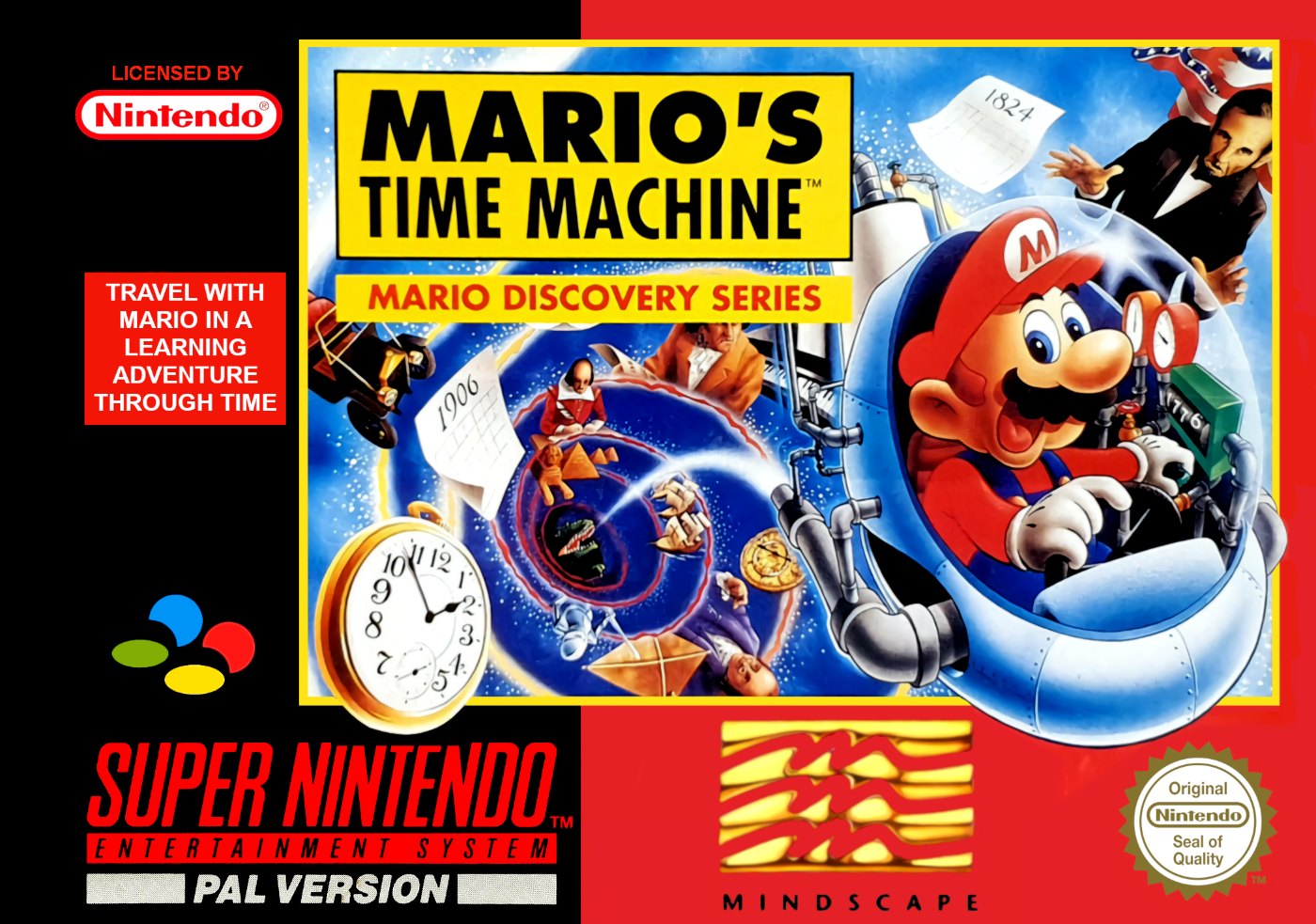
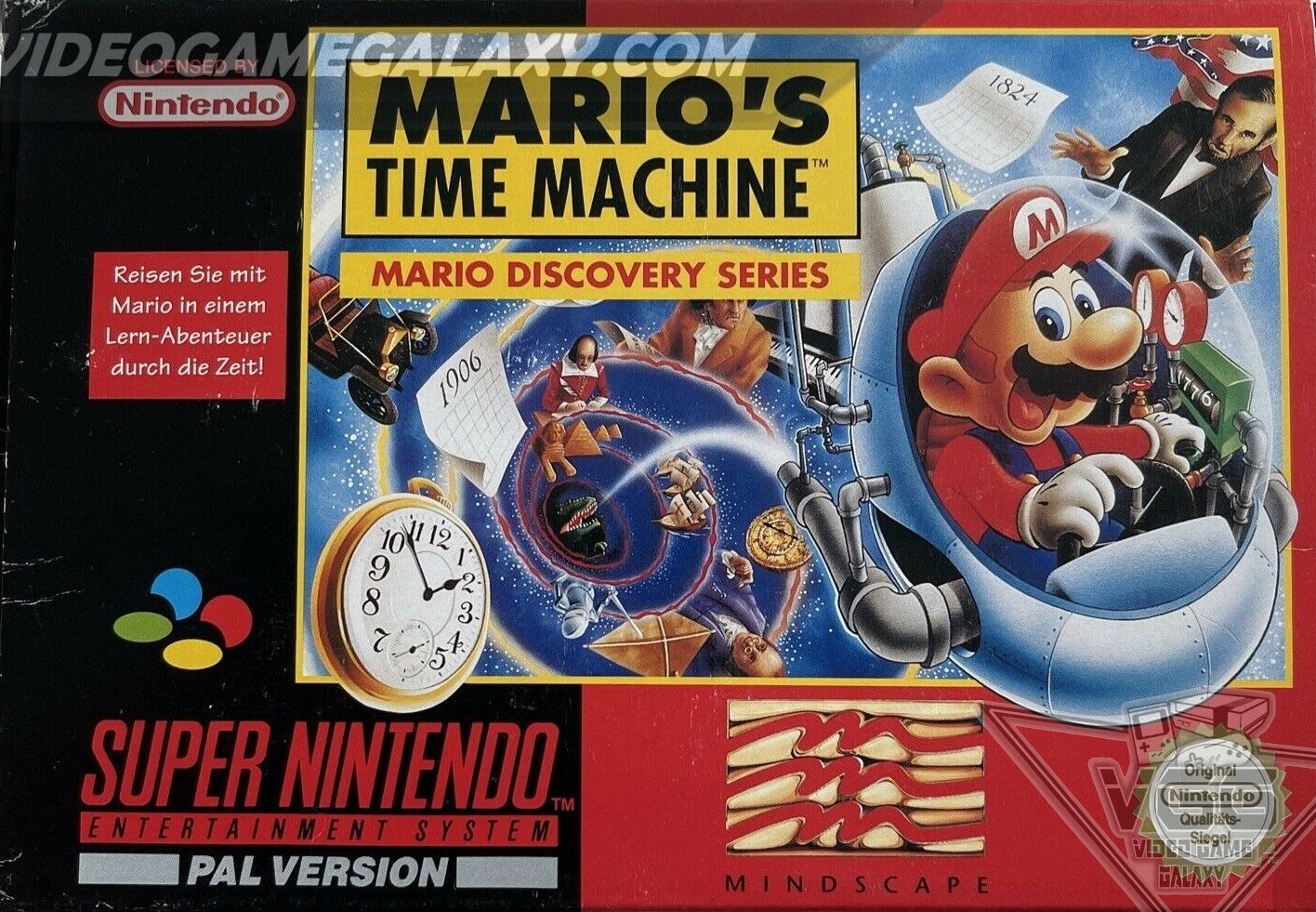
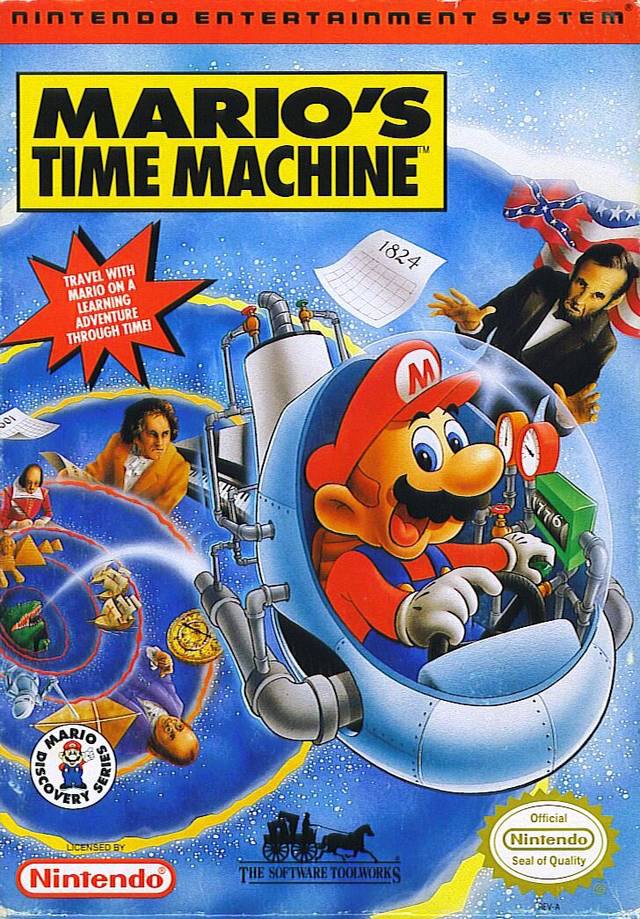
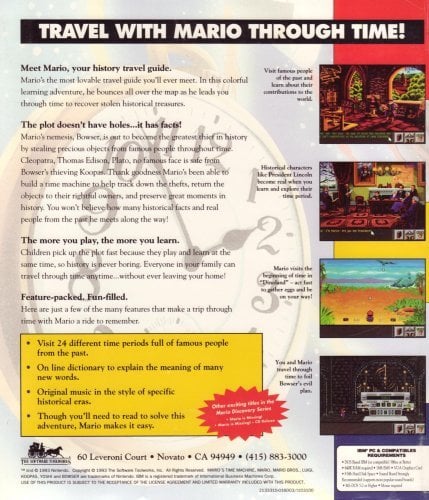
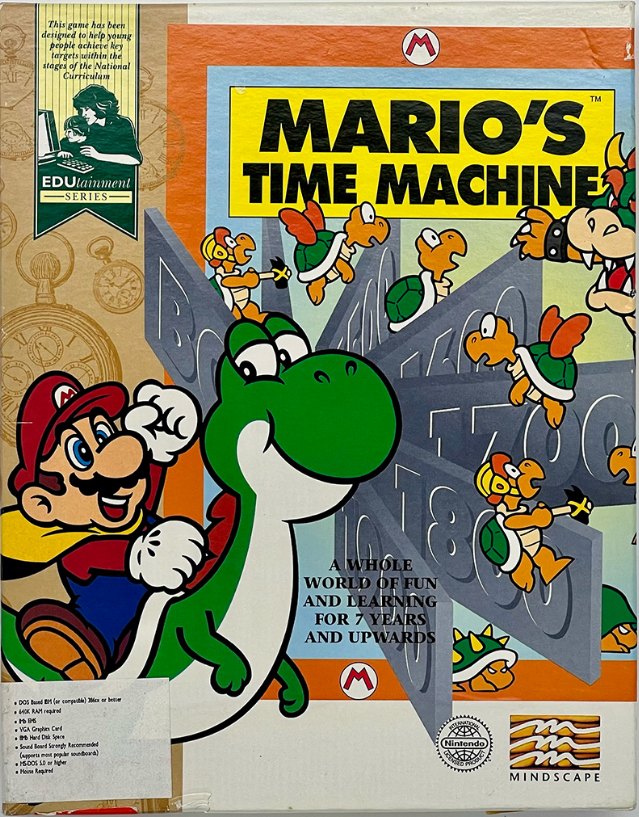
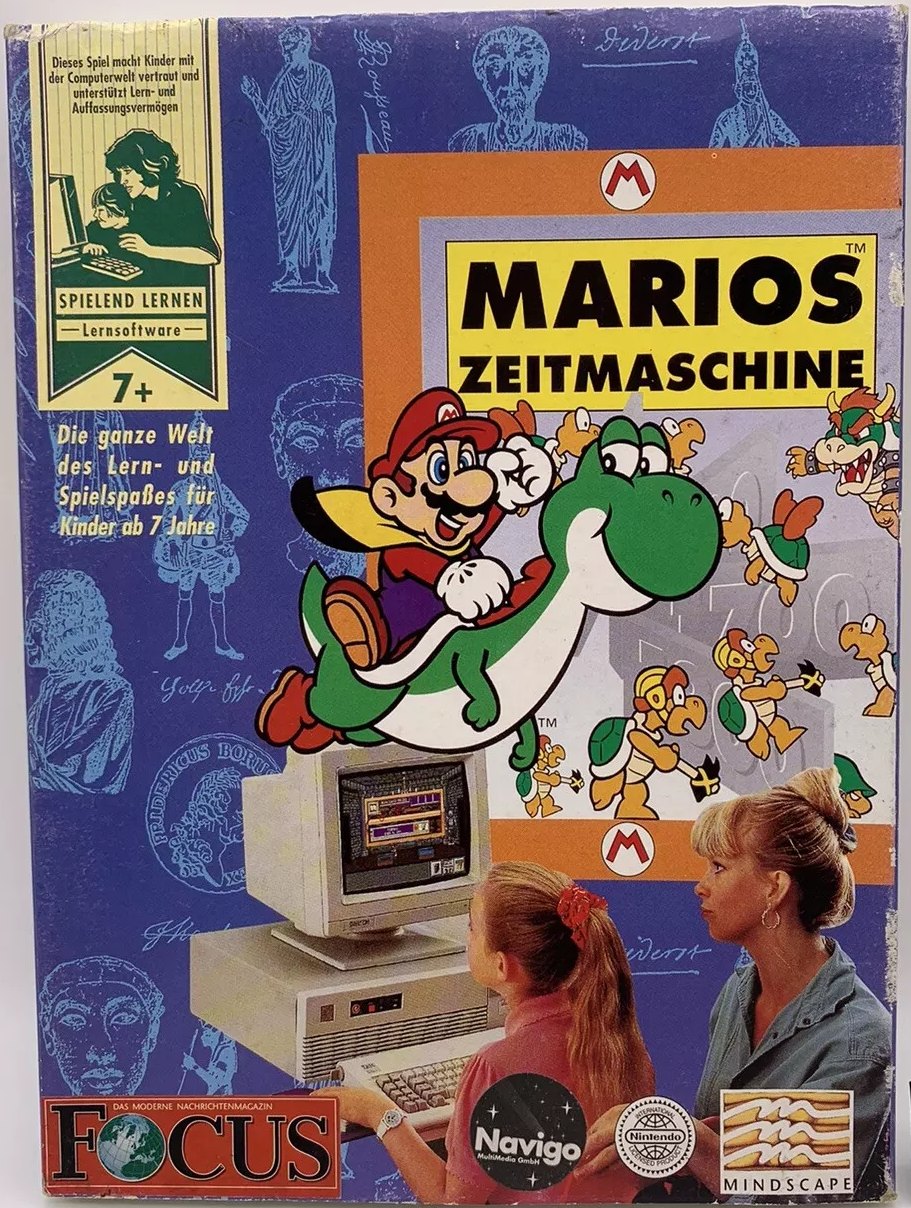
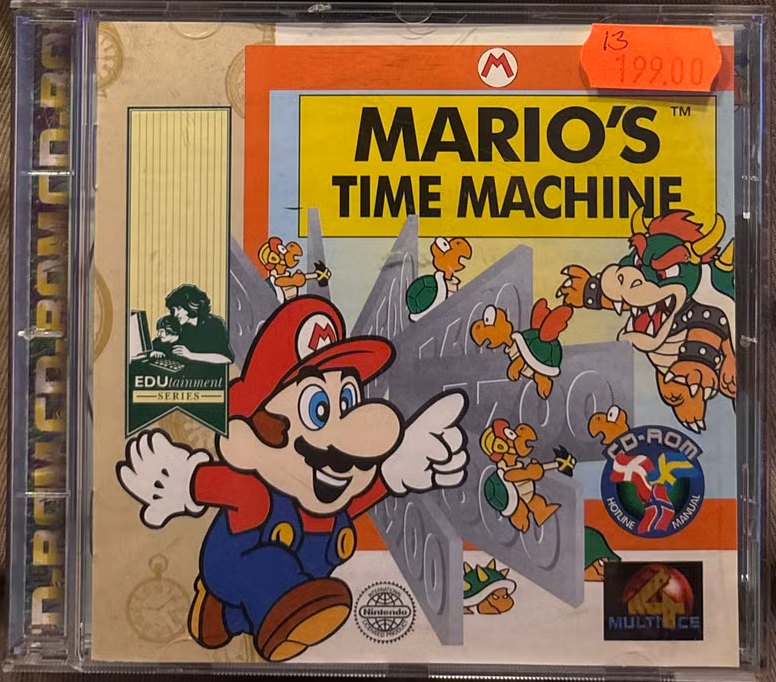
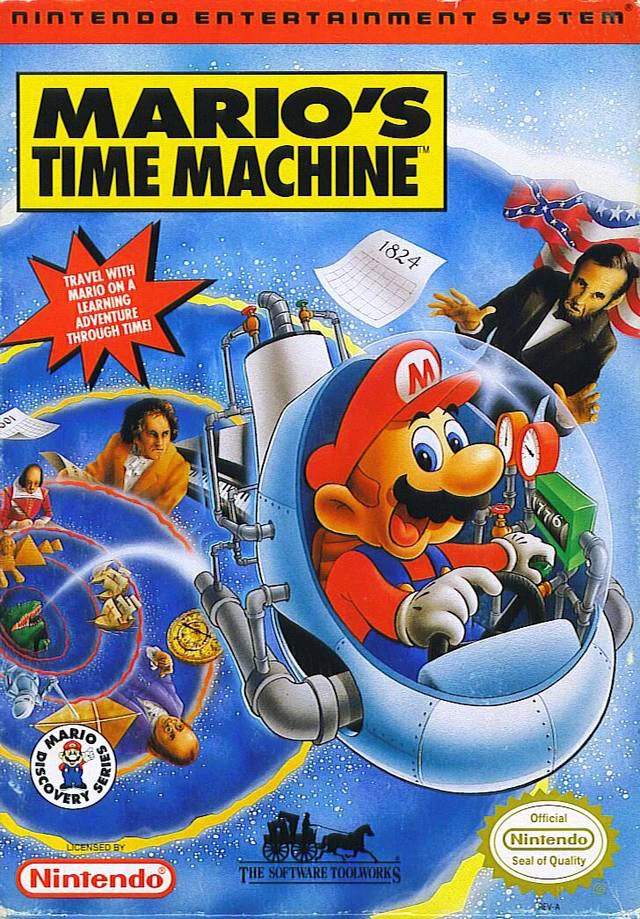
Floppy and CD-ROM boxes for the PC, two European Super NES covers and a single NES box.
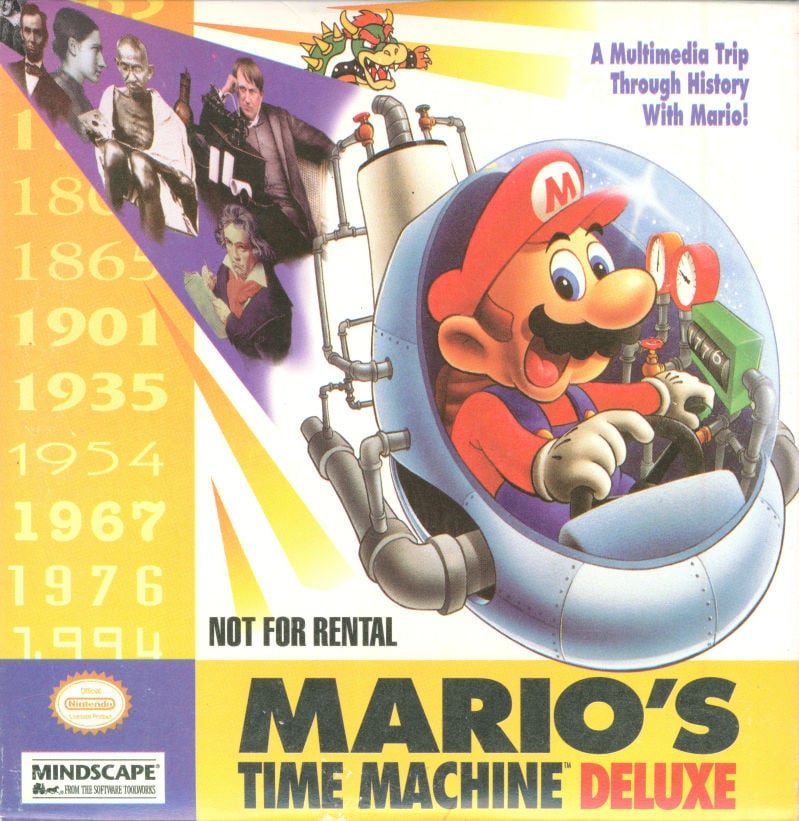
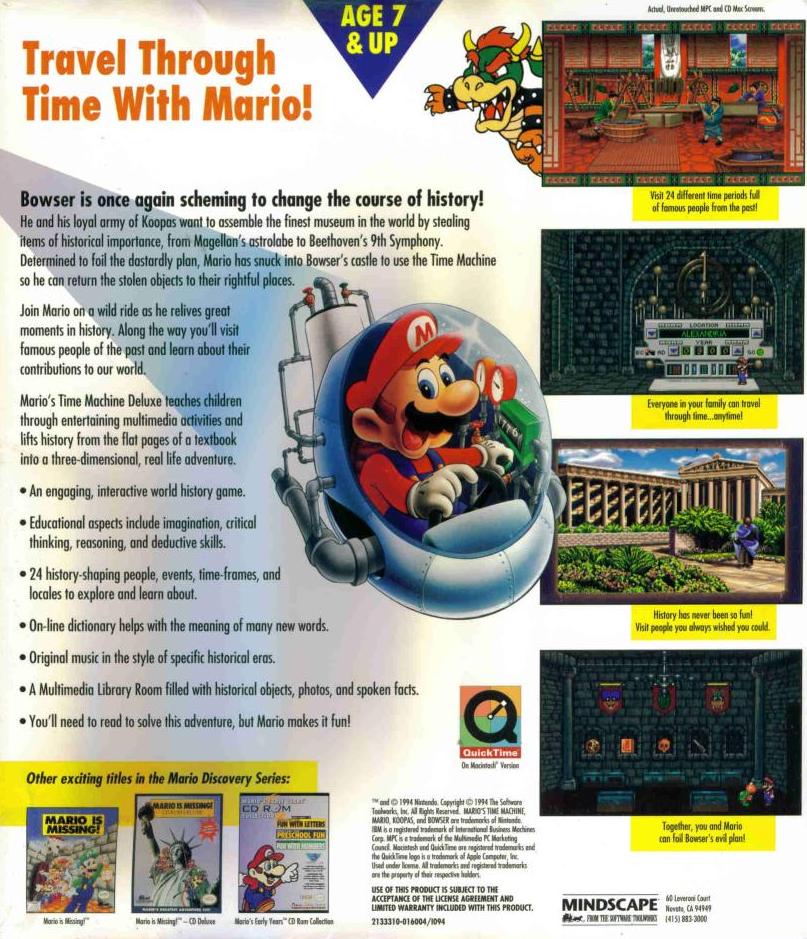
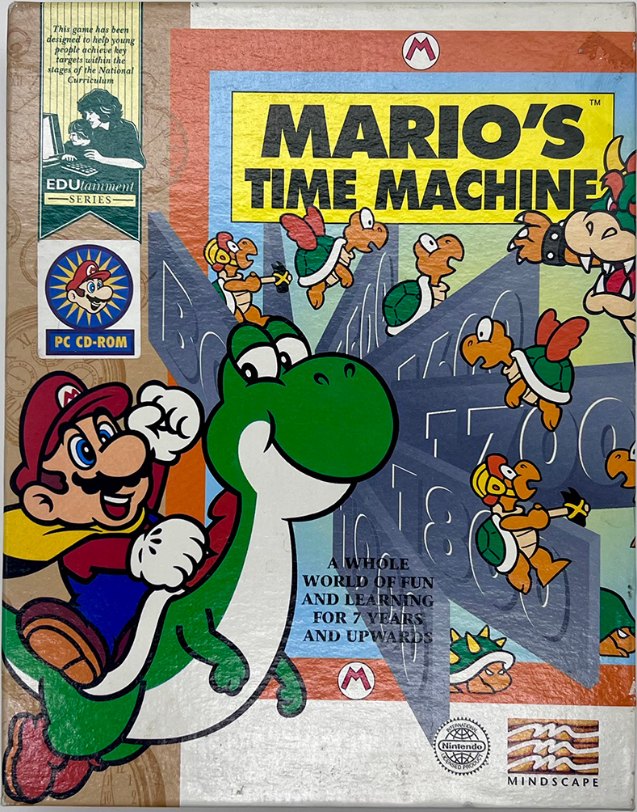
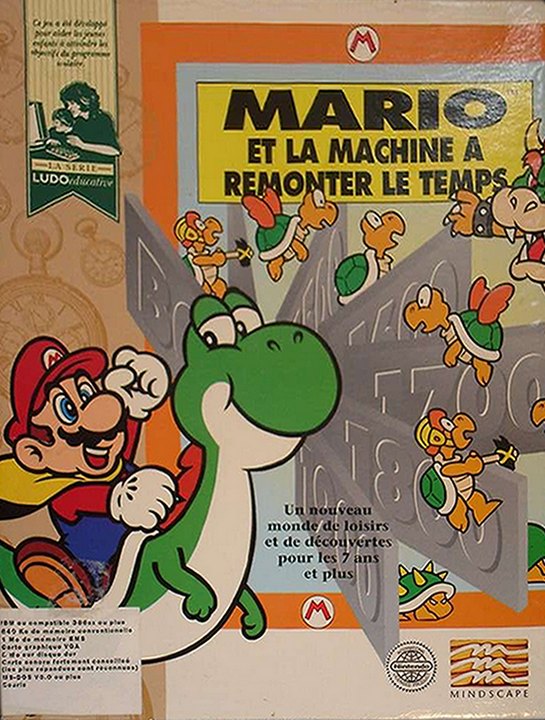
Screenshots
More from the three versions.
Artwork & Media Gallery
Logos, sprites and adverts for Mario’s Time Machine. Select any image to enlarge it.






Legacy & Re-releases
Three versions in eight months, a Deluxe reissue, and then retirement: Nintendo has never re-released it.
Release history
- MS-DOS 1993The original, in North America and Europe.
- Super NES December 1993North America; Europe reportedly followed in March 1994.
- NES June 1994North America only, developed by Radical Entertainment.
- Deluxe (CD-ROM) 1994Voice acting and a reference Library added; GameSpot lists a Windows release in 1996.
The end of the line
The NES version is usually counted as the last entry in the Mario Discovery Series that began with Mario is Missing!. Mario’s learning career carried on elsewhere, in titles such as Mario Teaches Typing 2 and the Mario’s Early Years games.
Reviews & Sales
Reviews and scores
Reviews in 1993 and 1994 were middling; later writers were harsher. No sales figures have been published.
GamePro (February 1994) singled out the conversations, saying the scenarios turned figures who are usually “just static pictures in textbooks” into flesh-and-blood people, though it found the Timulator controls too confusing for the young players the game was aimed at. AllGame’s Brett Alan Weiss found the action scenes dull. GameRankings averaged 60.25% from two reviews.
Later verdicts were rougher. IGN’s Levi Buchanan (2008) judged it shallow but well-meaning; GameSpy’s Brian Altano and Brian Miggels (2009) listed the NES ending, with its sobbing Bowser, among the worst on the console; ABC’s Good Game called it awful and far too complicated for children; and academics David Wesley and Gloria Barczak grouped it with the poorly made Mario spin-offs of the early 1990s.
SLB User Reviews
Mario’s Time Machine has yet to receive a community review on Super Luigi Bros.
If you’ve played Mario’s Time Machine and would like to submit a review, please get in touch.
Reference / Information
On Super Luigi Bros
Related Pages
Media / Downloads


Videos: Trailers, Gameplay & Endings
Sources
Every fact on this page was checked against the 8 sources listed here.
Show sources
Wikipedia, “Mario’s Time Machine” · Super Luigi Bros, “Mario’s Time Machine” · Cinemassacre, “Mario is Missing – Angry Video Game Nerd (AVGN)”, YouTube · The Negative Press, “Mario’s Time Machine – Start Up – Super Nintendo – SNES”, YouTube · Super Mario Wiki (4 articles)
Images: Mario and all related characters, artwork and screenshots are © Nintendo; other artwork, covers and scans are © their respective owners. Images are used here for commentary and reference.