
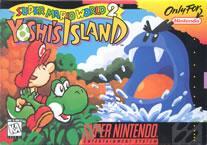
Super Mario World 2: Yoshi’s Island
The prequel that reinvented Mario — starring Yoshi
Overview
Super Mario World 2: Yoshi’s Island is the first Mario adventure game to star Yoshi as the primary playable character. Designed as a prequel to all previous Mario games, it goes back to when Mario was a baby. The player controls Yoshi across six worlds as he attempts to reunite Baby Mario with his twin brother Baby Luigi — who has been kidnapped by the evil Magikoopa, Kamek.
The game is visually unlike anything before it on the SNES. Its unique crayon-drawn, hand-illustrated aesthetic — bright colours, painterly backgrounds, deliberately child-like artwork — was a radical departure from Super Mario World. This visual style, combined with Yoshi’s new egg-throwing mechanic and the transformations enabled by the Super FX2 chip, made it one of the most technically ambitious SNES titles ever produced.
Yoshi’s Island features six worlds each with eight levels, giving 48 regular stages plus secret levels and boss fights. Each level has a perfect score of 30 stars, which players earn by collecting red coins, flowers and keeping the star counter topped up. Achieving 100% completion requires perfect scores on every level.

Yoshi carries Baby Mario on his back throughout the adventure.
Story
“A long, long time ago… This is a story about baby Mario and Yoshi. A stork hurries across the dusky, pre-dawn sky. In his bill, he supports a pair of twins. Suddenly, a shadow appears in a gap between the clouds and races towards the stork with blinding speed.
Kamek: ‘SCRREEEECH!!!’
Kamek: ‘THE BABIES ARE MINE!’
WOW!!! Snatching only one baby, the creature vanishes into the darkness from whence it came. The second baby falls undetected towards the open sea… OH NO…
Meanwhile, here is Yoshi’s Island, home to all Yoshies. It’s a lovely day, and Yoshi is taking a walk. HUH?!? Suddenly, a baby drops in on Yoshi! Yoshi and his friends decide to pass the baby from one Yoshi to the next, until they can get this baby back to his parents. But Kamek and his Toadies are not going to make it easy!” — From the instruction booklet
The stork was carrying twin babies — Mario and Luigi — to their parents in the Mushroom Kingdom when Kamek, a powerful Magikoopa serving Baby Bowser, intercepts him. Kamek snatches one baby (Luigi) but the other (Mario) tumbles free and lands on Yoshi’s Island. A green Yoshi finds the baby and a cloud of stars reveals a message: carry Baby Mario safely through the island.
The Yoshis of the island pass Baby Mario from one to the next across six worlds, while Kamek sends his Toadies and enlists the island’s boss creatures to stop them. The journey ends at Baby Bowser’s castle, where Yoshi must defeat a gigantic Baby Bowser and finally reunite the brothers with the stork.

Kamek — the main antagonist
Gameplay
Yoshi’s Island is a 2D platform game in which the player controls Yoshi. Unlike previous Mario games, Baby Mario rides on Yoshi’s back rather than being player-controlled. If Yoshi is hit, Baby Mario floats away in a bubble crying, and a star counter counts down — if it reaches zero before Yoshi reclaims him, the player loses a life. Stars are collected throughout levels to keep the counter full.
Yoshi can swallow most enemies using his long tongue, transforming them into eggs. He carries up to six eggs and can aim and throw them with a targeting reticule. Eggs bounce off walls and surfaces and can hit multiple enemies or targets. Ground pounding allows Yoshi to smash through certain blocks and activate floor switches.
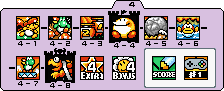
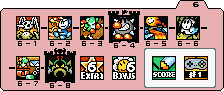
The game features a scoring system per level: collect 20 red coins, 5 flowers and keep the star counter at 30 to achieve a perfect score of 30 stars. Levels with perfect scores unlock secret stages. Each fourth and eighth level of every world features an enlarged boss fight against a creature empowered by Kamek’s magic.
A key feature is the metamorphosis system — certain bubbles transform Yoshi into vehicles: a Helicopter, Submarine, Mole Tank, Train or Car, each with unique abilities used to navigate specific sections of levels.
Worlds & levels
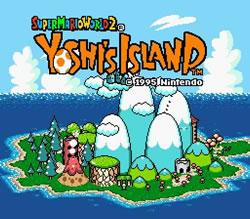
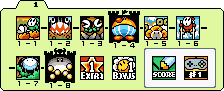
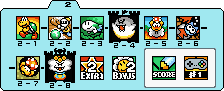
The game takes place on Yoshi’s Island — a much larger and more varied setting than its Super Mario World counterpart. Six worlds each contain eight levels, with every fourth and eighth level featuring a mid-boss and big boss respectively. All worlds have distinct biomes progressing from sunny grasslands to volcanic caverns.
The island setting — day and night:

Daytime

Night-time






Playable characters
Eight different Yoshi colours appear throughout the game, each one carrying Baby Mario through their respective world. All Yoshis play identically — colour is purely cosmetic. The game introduces Pink, Light Blue, Purple and Brown Yoshis alongside the four colours from Super Mario World:
 GreenWorlds 1 & 2
 PinkWorld 1
 Light BlueWorld 2
 YellowWorld 3
 PurpleWorld 4
 BrownWorld 4
 RedWorld 5
 BlueWorld 6
Each Yoshi carries Baby Mario safely to the next Yoshi at the end of their world. If Yoshi is hit, Baby Mario floats away in a bubble — Yoshi must recapture him before the star timer runs out.
Supporting characters

Rides on Yoshi’s back throughout the adventure. When Yoshi takes damage, Baby Mario floats away in a bubble crying — a star timer counts down, and if it hits zero before Yoshi rescues him, the player loses a life. Baby Mario briefly becomes invincible and super-powered when he grabs a Super Star.

Mario’s twin brother, kidnapped by Kamek’s Toadies at the start of the game. Held captive in Baby Bowser’s castle, he is the motivation for the entire journey. The player rescues him in the finale.

Was delivering the twin babies to the Mushroom Kingdom when Kamek intercepted him. He is captured and hung upside down at Baby Bowser’s castle. Rescuing him ends the game.

A powerful Magikoopa — advisor and caretaker to Baby Bowser — who foresaw the future threat posed by the Mario brothers and ordered their capture. He appears at the start of each world and before every boss fight, using his magic to enlarge ordinary creatures into giant bosses.

A friendly dog who appears in certain levels. He walks forward automatically, is impervious to all hazards, and can traverse spiky floors safely. Yoshi can ride him. An invaluable helper in lava-floor stages.

A friendly ghost in a flowerpot that appears as a helper in certain Ghost House levels, carrying Yoshi across gaps he cannot otherwise cross.
Enemies
Yoshi’s Island features one of the most imaginative enemy rosters of any Mario game — many new species debuted here and have remained series regulars. Most can be swallowed and turned into eggs, though some are immune.
Common enemies
 GoombaClassic enemy
 Shy GuyMasked; common
 Big Shy GuyLarger variant
 Koopa TroopaShell slides
 Beach KoopaCoastline Koopa
 BanditSteals star meter
 Fly GuyOften carries 1-Up
 SnifitShoots bullets
 Cloud DropDrops from clouds
 Piranha PlantPipe lurker
 Cactus JackDesert cactus
 SpinyCannot be stomped
 Chomp RockPush into enemiesLunge FishLeaps from water
 Lunge FishLeaps from water
Flying & airborne enemies
 LakituDrops Spinies
 Aqua LakituUnderwater Lakitu
 Baron von ZeppelinCarries items/enemies
 Boo BalloonInflates to block path
 Barney BubbleFloating bubble enemy
 Blow HardPuffs at Yoshi
Ghost House & cave enemies
 Big BooGhost House pursuer
 Boo BlahLurks in Ghost HousesSwooperBat; swoops down
 Tap-TapIndestructible spiked ball
Jungle & nature enemies
WigglerRages when stompedBlow HardPuffs projectiles Hot LipsLava; spits fireballs
 MildeSplits when stompedGustyWind ghostBumptyPenguin; slides on ice
Note: Yoshi’s Island contains over 80 unique enemy types. This is a representative selection of the most commonly encountered enemies.
Mid-bosses
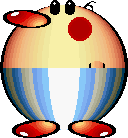
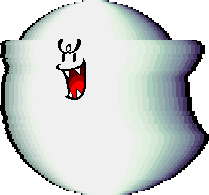
Each world’s fourth level ends with a mid-boss fight. These are ordinary enemies transformed by Kamek’s magic — most are from earlier in that world, enlarged to monstrous scale.



Big bosses
The eighth level of each world ends with a big boss — a major creature empowered by Kamek’s magic. These are the most dramatic battles in the game.




Transformations, metamorphoses & power-ups
Yoshi’s Island introduced two types of transformation: Metamorphoses triggered by special bubbles that transform Yoshi into a vehicle, and other transformations triggered by power-ups in the environment.
Metamorphosis bubbles
Shooting a certain bubble transforms Yoshi into one of five vehicles for a limited time. Each form has unique controls and is used in specific stages to navigate areas Yoshi cannot otherwise reach:

Fly upward by holding the button; use the propeller to stay aloft. Used in vertical-scrolling stages.

Shoot in any direction; burrow through soft earth. The only form that can dig through terrain.

Navigate underwater freely in all directions; fire torpedoes at enemies.

Run along a fixed rail track; stomp enemies below or shoot eggs left and right.

Accelerate along the ground; jump to avoid obstacles. The fastest-moving form.
Other transformations

Baby Mario grabs a Super Star and becomes temporarily invincible and powerful, running independently and defeating all enemies on contact.

Yoshi puts on skis and races down snowy slopes at high speed, collecting stars and avoiding obstacles.
Items
Items found throughout Yoshi’s Island, collected from blocks, enemies and winged clouds:
| Item | Description | |
|---|---|---|
 |
1-Up Mushroom | Grants an extra life. Often carried by Fly Guys or hidden in winged clouds. |
 |
Big Key | Held by each world’s big boss after defeat. Unlocks the gate to the next world. |
 |
Blue Watermelon | Gives Yoshi the ability to spit ice — freezing enemies into blocks of ice that can be used as platforms or thrown. |
|
Yellow Watermelon | Gives Yoshi the ability to spit seeds at high speed, defeating most enemies. |
 |
Red Watermelon | Gives Yoshi the ability to spit fireballs that bounce across the ground. |
 |
Coin | Collect 100 for an extra life. Found throughout levels as both visible and hidden coins. |
 |
Red Coin | Count toward the level’s 20 red coin total required for a perfect score. Usually hidden. |
 |
Flashing Egg | Special egg that releases a red coin on impact with an enemy rather than defeating it. |
 |
Giant Egg | A huge egg that creates a shockwave on landing, defeating all on-screen enemies simultaneously. |
 |
Green Shell | Cannot be swallowed — can be held and thrown, bouncing off walls to hit multiple enemies. |
 |
Star | Fills the star counter by 10. Keeping the counter full is crucial — it’s your buffer when hit. |
 |
Winged Cloud | Hit with an egg to release hidden items, stars, or trigger level events. |
 |
Flower | One of five collectibles per level needed for a perfect 30-star score. |
Bonus challenges
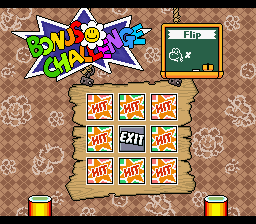
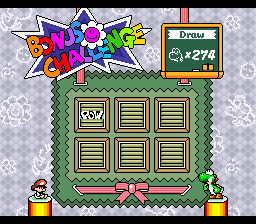
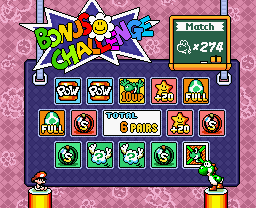
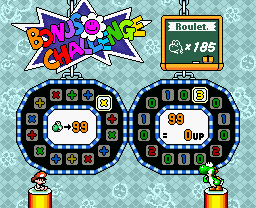
Bonus Challenges are triggered when the Goal Ring at the end of a level stops on a flower. Collecting more flowers during a level increases the chance of triggering one. Each challenge rewards stars, lives or items:


Nintendo Power coverage
Nintendo Power gave Yoshi’s Island extensive coverage across two issues — a preview ahead of release and a full multi-page strategy guide:
A Journey Through Yoshi’s Island
A Journey Through Yoshi’s Island was a promotional VHS tape released by Nintendo of America in 1995 in partnership with Nintendo Power magazine. The video was sent to subscribers and used to promote the then-upcoming Super Mario World 2: Yoshi’s Island ahead of its October 1995 release. It contained gameplay footage, developer commentary and a walkthrough of early worlds — a marketing format Nintendo used for several major SNES releases.
The video is a fascinating piece of Nintendo history — pre-release promotional material that gives a glimpse of how Nintendo marketed games before the internet era. Nintendo Power subscribers would have received this alongside their magazine as an exclusive preview of the game.
The full promotional video as preserved on YouTube. Originally distributed to Nintendo Power subscribers in 1995 ahead of the game’s North American release on October 4th.
Reception & legacy
Yoshi’s Island received widespread critical acclaim on release. Its combination of innovative gameplay, technically impressive use of the Super FX2 chip, and distinctive visual style set it apart from every other SNES game. The game maintained a 90%+ aggregate score across publications.
Nintendo Power’s 100th issue ranked it 18th in their all-time top 100 — a strong placing. GameInformer’s all-time top 200 placed it 185th — relatively modest, though the game remains technically one of the most advanced SNES titles ever produced thanks to the Super FX2 chip enabling smooth scaling, rotation and the game’s enormous boss sprites.
The game’s legacy is enormous. It spawned an entire Yoshi sub-franchise: Yoshi’s Story (N64), Yoshi’s Island DS, Yoshi’s New Island (3DS), Yoshi’s Woolly World (Wii U) and Yoshi’s Crafted World (Switch). Its crayon art aesthetic and egg-throwing mechanic have remained consistent series DNA for 30 years. It was included in the SNES Classic Edition and is available on Nintendo Switch Online.
Development
Yoshi’s Island was directed by Takashi Tezuka and produced by Shigeru Miyamoto — the same team behind Super Mario Bros. 3 and Super Mario World. The game was developed as a simultaneous sequel to Super Mario World and a technological showcase for the new Super FX2 chip, a more powerful successor to the original Super FX chip used in Star Fox.
The distinctive crayon-drawn visual style was a deliberate creative choice to differentiate the game from Super Mario World and previous SNES titles. Early demonstrations of the game’s art style were reportedly met with scepticism — some felt it looked too simple — but the team insisted on the aesthetic, which has since become the game’s most beloved characteristic.
The Super FX2 chip enabled effects impossible on standard SNES hardware: smooth sprite scaling for the game’s giant bosses (which fill much of the screen), Mode 7-style rotation effects, and large numbers of sprites without slowdown.
Trivia & interesting facts
- Known in Japan as Super Mario: Yoshi’s Island — the “World 2” subtitle was used in Western markets
- This game was actually designed as a prequel to all other Mario games — showing Mario’s first adventure as a baby
- Powered by the Super FX2 chip — enabling smooth scaling, rotation and the game’s enormous bosses, impossible on standard SNES hardware
- The “?” blocks from Super Mario World do not appear in this game — replaced by Winged Clouds
- Features the return of POW Blocks, unseen since Super Mario Bros. 2
- Yoshi controls the entire game — Mario is a passenger for virtually the whole adventure
- GameInformer Top 200 rated it 185th — despite it being one of the most technically advanced SNES games ever made
- Nintendo Power’s 100th issue Top 100 placed it a more respectable 18th
- The fish enemy called Loch Nestor is a reference to Loch Ness and the legendary Scottish Loch Ness Monster
- A Japanese comic series called Super Mario-Kun featured a special edition based on the game — where adult Mario, Luigi and Bowser travel back in time to help Yoshi
- Brown Yoshi is exclusive to this game — no other title has featured a brown Yoshi
- The game’s soundtrack was composed by Koji Kondo, whose distinctive lullaby-style compositions perfectly match the game’s infant-world aesthetic
- Achieving a perfect score (30 stars) on every level unlocks secret stages and is required for true 100% completion
- A promotional VHS tape — A Journey Through Yoshi’s Island — was distributed to Nintendo Power subscribers ahead of the October 1995 release
Reference & downloads
Guides & reference
Nintendo Power coverage
Media