Super Famicom1998Action puzzleNintendo R&D1 · Pax SoftnicaJapan only for 26 yearsFirst sold on Nintendo PowerOriginal Wrecking Crew includedFour secret opponents
Wrecking Crew ’98
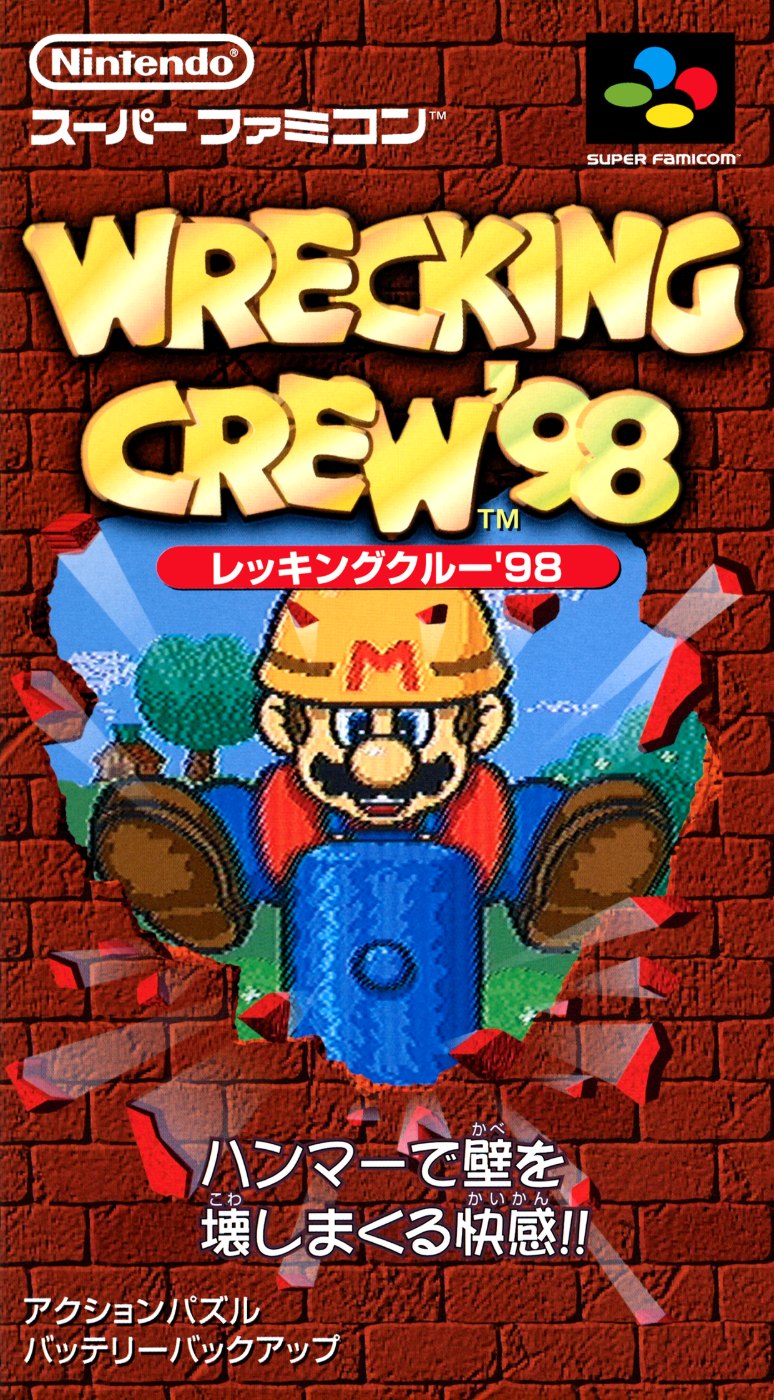
Bowser has been throwing up tower blocks all over the Mushroom Kingdom, and the flowers are wilting in their shadows. Time for Mario to fetch his hammer. Wrecking Crew ’98 is the 16-bit sequel to the 1985 Famicom/NES Wrecking Crew, but instead of clearing walls it is a head-to-head panel puzzler: smash bricks into coloured panels, slide rows with crank handles, line up three of a colour to clear them and four or more to attack your rival with steel plates, extra rows or construction-site monsters. Made by Nintendo R&D1 and Pax Softnica, it was first sold in Japan on 1 January 1998 through the Nintendo Power rewritable-cartridge service, then on an ordinary cartridge on 23 May 1998, with the complete original Wrecking Crew on board as a bonus. It never left Japan until it joined the Super NES library of Nintendo Switch Online in April 2024, still in Japanese.
Developers:Nintendo R&D1 and Pax Softnica
Publisher:Nintendo
Platform:Super Famicom (Nintendo Power flash cartridge, then a standard ROM cartridge)
Genre:Action puzzle
Japan:1 January 1998 (Nintendo Power); 23 May 1998 (cartridge)
Outside Japan:Not released until Nintendo Switch Online: 11 April 2024 (USA), 12 April 2024 (Europe, Australia); Japanese text only
Modes:Story, VS and Tournament, plus the original Wrecking Crew (100 phases and Design)
Opponents:5 story stages plus 4 secret stages (A–D); 12 characters for VS
Japanese title:Rekkingu Kurū ’98 (レッキングクルー’98)
Serial:SHVC-BWCJ-JPN
Re-releases:Wii U Virtual Console (Japan, 28 September 2016); Nintendo Switch Online (April 2024)
Advertisement
Overview
Mario, hammer at the ready.
Wrecking Crew ’98 takes the name, the hammer and the villains of Nintendo’s 1985 demolition game and builds something quite different around them: a competitive puzzle game in the mould of Tetris and Puyo Puyo, where chain reactions and attacks on your opponent’s side of the screen decide the match.
The twist is that Mario is still a platform character inside the puzzle. He runs and jumps about his half of the screen, swinging his hammer to crack brick blocks into coloured panels and cranking handles to slide whole rows sideways. Line up three of a colour and they vanish; clear four or more and the colour you cleared decides what lands on your rival, from a shower of steel plates to a forklift trundling across their board.
In Story mode Mario visits each of Bowser’s new hideouts in turn, facing Eggplant Man, Koopa Troopa, Gotchawrench, Foreman Spike and finally Bowser, with four peculiar secret opponents hidden behind time limits. VS and Tournament modes take the game to friends, and the original Wrecking Crew, all 100 phases and its stage designer, sits on the same cartridge.
It came out late in the Super Famicom’s life, first as a download onto Nintendo Power cartridges in Japanese shops and later as a boxed game, and Nintendo never released it in the West at the time. Most fans outside Japan met it through a 2017 fan translation or, officially, on Nintendo Switch Online in 2024.
Why Wrecking Crew ’98 matters to Mario fans
It is a real Mario sequel that spent 26 years out of reach of most of the world: a Nintendo-published follow-up to Wrecking Crew with Bowser as the villain, Foreman Spike as his scheming foreman, Princess Peach and Luigi in the ending and a Peach’s Castle borrowed from Super Mario 64. It is usually counted as the last Super Mario game released for the Super Famicom in Japan. For puzzle fans it sits alongside Yoshi’s Cookie, Wario’s Woods and Mario’s Super Picross as one of Nintendo’s more unusual Mario puzzlers.
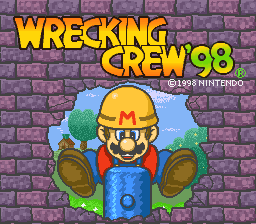
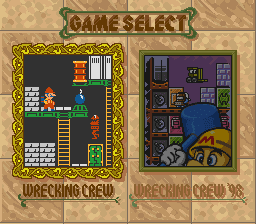
The title screen.Choose Wrecking Crew ’98 or the 1985 original.Mario against Eggplant Man in the first stage.
Quick Answers
Quick answers to the questions people ask most about Wrecking Crew ’98.
Is Wrecking Crew ’98 a sequel to Wrecking Crew?
Yes. It follows the 1985 Famicom/NES game, keeps Mario’s hammer and Foreman Spike, and turns the formula into a versus puzzle game. The original is included on the cartridge. More →
When did it come out?
In Japan only: on 1 January 1998 through the Nintendo Power cartridge-writing service, and as a boxed Super Famicom cartridge on 23 May 1998. More →
How do you win a match?
Push your opponent’s panels over the line at the top of their screen. If any column stays above the line for three seconds, they lose. More →
What do the panel colours do?
Clearing four or more of a colour attacks: red sends a monster, yellow drops four steel plates, and green and blue either turn rows of your rival’s panels into bricks or push extra panels up from below. More →
How do you unlock the secret stages?
Beat Koopa Troopa within four minutes for Stage A, Gotchawrench within three for Stage B and Foreman Spike within two for Stage C; clear all three secret stages to open Stage D. More →
Is the original Wrecking Crew included?
Yes: a port of the Famicom game with its 100 phases, two-player mode and Design mode, selectable from the start. More →
Can I play it in English?
Not officially. The Switch Online release of April 2024 is the Japanese game. A fan translation by ShadowOne333’s team appeared in October 2017. More →
Can I play it on Switch?
Yes. It joined the Super NES library of Nintendo Switch Online on 11 April 2024 in North America and 12 April elsewhere. Japan also had it on the Wii U Virtual Console from 2016. More →
Modes & Levels
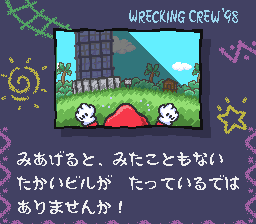
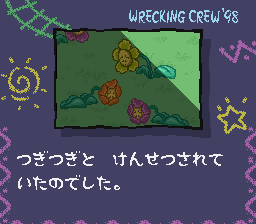
One of Bowser’s towers casts its shadow over Mario’s home.
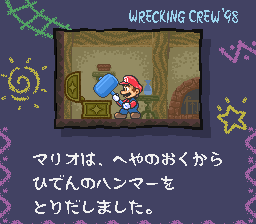
Nintendo’s 1998 page for the game sets it up in a sentence: Mario comes home from his travels to find Bowser up to his old tricks. Bowser’s hideouts are going up all over the kingdom, so tall that the flowers below have wilted in their shade.
Story mode follows Mario across a map of Bowser’s building sites, with a puzzle duel at each against the boss of the site. Cut-scenes with plenty of Japanese text play before and after each round. Here is every mode, stage and secret.
Mario comes home
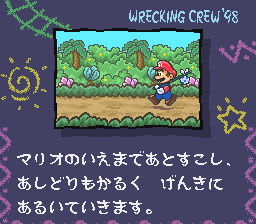
The opening finds Mario returning from a trip, only to see a skyscraper of Bowser’s blotting out the sun over his house and the flowers drooping beneath it. He takes a big blue hammer out of a chest at home and heads off to knock the lot down. Standing in his way is his old foe from the 1985 game, Foreman Spike, along with a few other familiar faces from the original.
Mario on his way home.Flowers wilting in the shadow of Bowser’s tower.
Stages 1 to 4: the building sites
The first opponent is Eggplant Man, the walking aubergine of the original, redrawn with feet stuck straight on to its body. Koopa Troopa follows in stage 2, then a purple Gotchawrench, which has sprouted arms for the occasion, in stage 3. Stage 4 brings Foreman Spike himself, Bowser’s partner in the building scheme, redesigned with a moustache, a cleft chin and a red nose that make him look rather like Wario.
Win quickly and the game takes notice: beating Koopa Troopa, Gotchawrench or Spike inside a time limit opens a secret stage (see below).
Stage 1: Eggplant Man.A match against Koopa Troopa.Foreman Spike, 1998 style.
Bowser, and Spike’s double-cross
The final stage pits Mario against Bowser himself. Beat him and Princess Peach and Luigi turn up for the ending, and both become available for VS play.
Play well enough and there is a better ending. Wikipedia notes that finishing stages inside the time limits leads to an alternate ending as well as the secret stages, and this is what happens in the good ending: soon after his defeat Bowser discovers that Spike had been using him all along, simply to get his own back on Mario, and the furious Koopa King chases his foreman off.
The final showdown with Bowser.Bowser in Wrecking Crew ’98.
The secret stages A to D
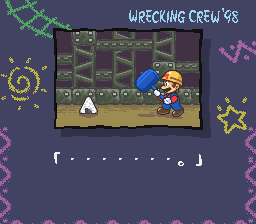
The hidden opponents are the oddest cast in any Mario puzzle game. Stage A is guarded by Onigiri, a living rice ball that floats, leaps high and explodes when cross. In Stage B a lonely girl, Onnanoko, asks Mario to play with her; beat her and she is revealed to be a ghost, thanking him as she floats away with wings and a halo. Stage C belongs to Oyazi, a gloomy middle-aged builder who grumbles that his building is cold, takes a swig from his bottle and fights for it anyway, then decides after losing that he would rather build warm, cosy homes.
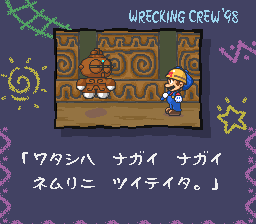
Clear all three and Stage D opens. Its occupant is Dogu, a dogū clay figure who floats in, claims to be an ancient being from a far-off land and is annoyed at being woken. Defeated, he falls apart, though a rematch shows he has put himself back together. Each secret opponent joins the VS and Tournament line-up once beaten.
Mario meets Onigiri.Onigiri gets the better of Mario.Mario meets Dogu.Dogu in action.
VS and Tournament modes
VS mode is the game at its best: two players, or one against the computer, each picking from the characters unlocked in Story mode, up to twelve in all. The game level setting decides how many steel plates both sides start with.
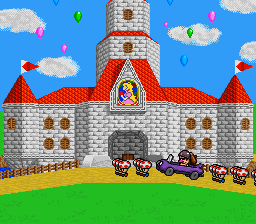
Tournament mode, unlocked through Story mode, runs a knockout competition for up to eight entrants. Its ending takes place at Peach’s Castle, drawn as it looked in Super Mario 64.
The end of Tournament mode, at Peach’s Castle.Princess Peach, one of the twelve VS characters.
The original Wrecking Crew
Pick Wrecking Crew on the game select screen and you get the 1985 Famicom game, ported with different audio. Mario (and Luigi, taking turns in the two-player game) must smash every wall, brick and ladder in each of 100 phases while Gotchawrenches and Eggplant Men give chase. Bricks take two or three hits depending on their shade, bombs bring down connected walls, doors can trap enemies in the background, and a fireball comes after you if you linger on one floor too long. Design mode lets you build and play up to four stages of your own, saved on the cartridge.
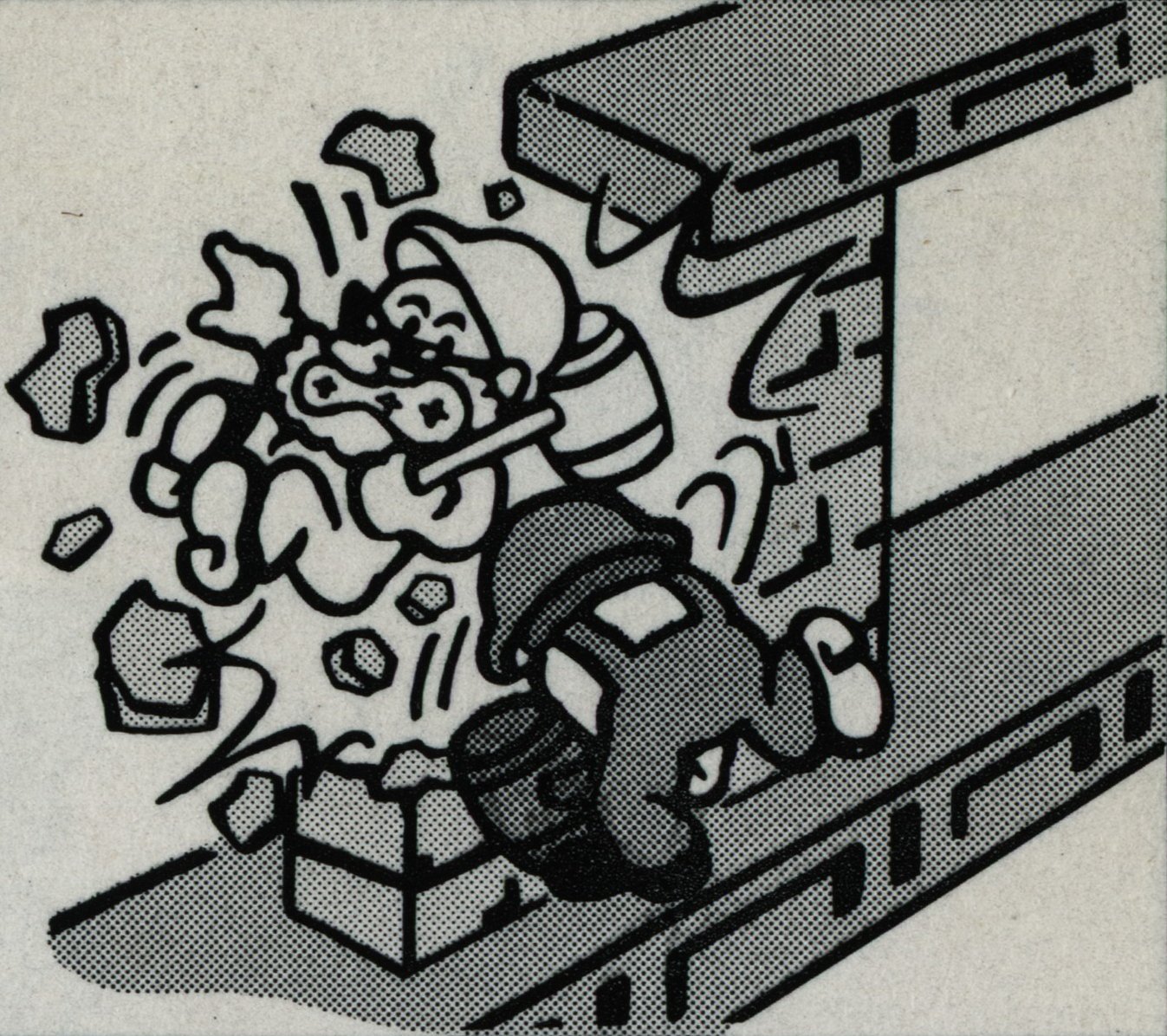
Mario knocking down Foreman Spike, from the original game’s manual.Eggplant Man as he looks in the original.
Every stage and mode
The Story mode stages in order, the four secret stages, then the other modes on the cartridge.
Stage 1: Eggplant ManStoryThe gentle opener against the original’s walking aubergine.
Stage 2: Koopa TroopaStory · win in 4 minutes for Stage AThe first opponent with a secret attached.
Stage 3: GotchawrenchStory · win in 3 minutes for Stage BThe spanner enemy, now with arms.
Stage 4: Foreman SpikeStory · win in 2 minutes for Stage CBowser’s foreman, with a few secrets of his own.
Final stage: BowserStory · endingThe Koopa King in person; Peach and Luigi appear in the ending.
Stage B: OnnanokoSecretA lonely ghost girl who only wants someone to play with.
Stage C: OyaziSecretA gloomy builder defending his chilly tower.
Stage D: DoguSecret · beat stages A, B and CAn ancient clay figure, grumpy at being woken.
VS mode1–2 playersAgainst a friend or the computer with up to twelve characters.
Tournament modeUp to 8 entrants · unlocked in StoryA knockout competition ending at Peach’s Castle.
Wrecking Crew (1985)100 phases · Design modeThe complete Famicom original, from the game select screen.
Advertisement
Gameplay & Controls
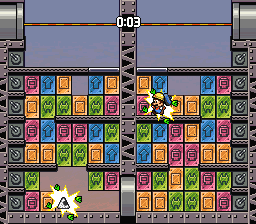
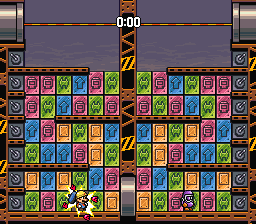
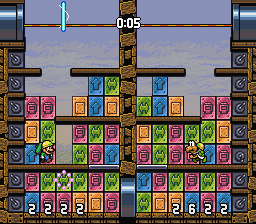
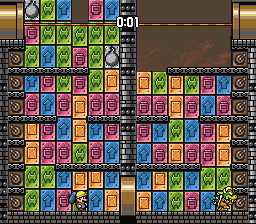
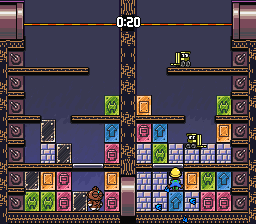
Each player has a tall well of brick blocks and coloured panels, with Mario (or whoever you picked) standing inside it. Your hammer turns any brick block it hits into a coloured panel; the handles at the edge of the field slide a whole row sideways; and three or more panels of one colour in a horizontal or vertical line disappear. Unlike the hero of the 1985 game, this Mario can jump, and he can swing the hammer in mid-jump too.
Bricks keep coming down on you, and the longer the match lasts the shorter the gap between falls. When things look thin you can also call up an extra row of panels yourself.
Four colours, four attacks
Clearing four or more panels at once sends an attack to the other side, and what arrives depends on the colour. Nintendo’s manual lists four. Red sends a monster out of a pipe to wander your rival’s board. Yellow drops four steel plates. Of the other two, one turns two rows of the opponent’s panels back into brick blocks, and the other pushes up fresh panels from below, twice as many as you cleared.
The bigger the clear, the nastier the attack, and stringing clears together into a chain powers it up again. Big red combos summon bigger machinery: each construction monster is tied to a combo size, from Blonya at four red panels up to Jenya at eight.
A VS match against Koopa Troopa.Forkun, the forklift that red panels send.
Steel plates, bombs and monsters
Steel plates are the real nuisance: the hammer bounces off them. Only a bomb can break one, and you earn a bomb for every two extra rows you call up. Hit it and it blows away the nearby steel and panels and cracks any neighbouring bricks into panels.
Monsters walk out of a pipe and eventually leave through the warp pipe at the bottom of the screen. Bounce on one from above and you are safe (it also clears it away faster), but bump into one from the side or underneath and your controls lock up for a moment; waggle left and right to recover sooner.
Blonya, carrying a cement block.Dumpty the dump truck.
NICE! and the Mushroom
Wipe your field completely clean, with no blocks, panels or monsters left, and the game cheers “NICE!”. The reward is a Mushroom, and the manual explains what it does: your next attack is stronger than usual.
Mario and his hammer.
Winning, losing and drawing
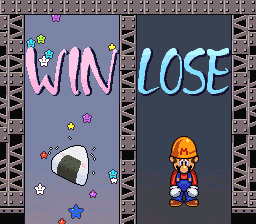
A match is lost when any one of your columns rises above the line at the top of the screen and stays there for three seconds, so even a towering stack can be rescued if you smash it down in time. If both players go over the line at once and neither recovers inside three seconds, the match is a draw. In VS mode, raising the game level starts both players with more steel plates already on the board.
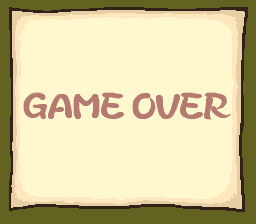
The Game Over screen.
Controls and modes at a glance
The buttons cover moving, swinging the hammer (which also turns a handle when you stand at one), jumping, adding a row and pausing. From the title you choose between Wrecking Crew ’98, with its Story, VS and Tournament modes, a help screen and a save-data reset, and the original Wrecking Crew.
Panels and pieces
What you will find in your well, from Nintendo’s manual.
Brick blockHit it with the hammer to turn it into a coloured panel.
Red panelClear four or more to send a monster; bigger combos send bigger machines.
Yellow panelClear four or more to drop four steel plates on your rival.
Green panelOne of the two row attacks: bricks over the rival’s panels, or extra panels from below.
Blue panelThe other row attack (see Green).
Steel plateHammer-proof; only a bomb breaks it.
BombEarned for every two rows you add; clears nearby steel and panels.
HandleCrank it to slide a whole row sideways.
MushroomThe NICE! reward for an empty field: your next attack hits harder.
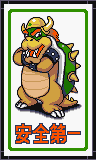
KanbankBowser’s sign. Only a combo of nine or more panels summons it, and it ends the rival’s game on the spot.
Cartoons, Comics & Other Media
The Wrecking Crew name has lived on in Nintendo games and beyond, even if this sequel has stayed in the shadows.
Wrecking CrewFamicom / NES, 1985The original demolition game, designed by Yoshio Sakamoto and Makoto Kanoh according to Wikipedia, and included in full on the ’98 cartridge.
Super Mario 64Nintendo 64, 1996Peach’s Castle, as built for Mario’s first 3D adventure, is the setting for the end of Tournament mode.
Super Smash Bros.Brawl onwardsThe Golden Hammer item comes from Wrecking Crew, and Super Smash Bros. for Wii U and Ultimate include a Wrecking Crew stage.
The Super Mario Bros. MovieFilm, 2023Foreman Spike appears in the film, voiced by Sebastian Maniscalco; afterwards Nintendo standardised the name Spike in Japan, where he had been Blackie.
English fan translationOctober 2017ShadowOne333 and his team translated all of the game’s Japanese text, including the story scenes, as reported by Nintendo Life.
Characters
Twelve characters can be played in VS mode, unlocked as you beat them in Story mode. Here they are in the order you meet them.
Character
Who they are
In this game
Abilities & notes
MarioHero
Back from a trip to find Bowser’s towers shading the Mushroom Kingdom.
The Story mode hero, armed with a big blue hammer from a chest at home. Playable in VS from the start.
Available from the start.
Eggplant ManStage 1
The walking aubergine from the 1985 game, redrawn with feet attached straight to its body.
The first opponent in Story mode.
Playable in VS from the start.
Koopa TroopaStage 2
Bowser’s faithful foot soldier.
The second opponent. Beat him within four minutes to open Stage A.
Unlocked for VS by beating him in Story mode.
GotchawrenchStage 3
The walking spanner of the original game, now purple and with arms.
The third opponent. Beat it within three minutes to open Stage B.
Unlocked for VS by beating it in Story mode.
Foreman SpikeStage 4
Mario’s old rival from the building site, here helping Bowser build his hideouts, with a Wario-like new look.
The fourth opponent. In the good ending he is exposed as having used Bowser to get back at Mario. Beat him within two minutes to open Stage C.
Unlocked for VS by beating him in Story mode.
BowserFinal stage
Called Koopa in Japan, and the man behind the towers.
The last Story mode opponent. In the good ending he turns on Spike and chases him away.
Unlocked for VS by beating him in Story mode.
Princess PeachEnding
The princess of the Mushroom Kingdom.
Appears in the ending once Bowser is beaten.
Unlocked for VS by beating Bowser.
LuigiEnding
Mario’s brother, and player 2 in the bundled original.
Appears in the ending alongside Peach.
Unlocked for VS by beating Bowser.
OnigiriSecret stage A
A living rice ball that drifts through the air, jumps very high and explodes when angry.
The first secret opponent.
Unlocked for VS by beating it.
OnnanokoSecret stage B
A young girl who has been alone for a long time.
Asks Mario to play; when beaten she turns out to be a ghost and rises into the sky with wings and a halo.
Unlocked for VS by beating her.
OyaziSecret stage C
A downcast middle-aged man; his name is a casual Japanese word for a father or an older man.
Defends the cold building he built, then resolves to build warm, cosy homes instead.
Unlocked for VS by beating him.
DoguSecret stage D
A dogū, a Japanese clay figure, claiming to be an ancient being from a distant land.
The final secret opponent, angry at being woken; he breaks apart when beaten.
Unlocked for VS by beating him.
The construction monsters
Monsters sent by red-panel attacks and chains. They clutter your rival’s field, stun on contact from the side, and leave through the warp pipe at the bottom.
ForkunRed attackA forklift that cruises about, stopping to raise its forks.
BlonyaRed combo of 4A stocky worker marching sideways with a cement block.
BurucchoRed combo of 5A slower bulldozer that lifts its front end.
BurnyaRed combo of 6A worker with a blowtorch who walks backwards.
DumptyRed combo of 7A slow dump truck that tips its back end.
JenyaRed combo of 8A jetpack worker who stops to throw cement blocks.
GurucchoChains onlyA screwdriver that comes paired with Forkun or Blonya.
Gata GataChains onlyA roadblock with a swinging sign, paired with Buruccho or Burnya.
PolesChains onlyA trio of poles that comes with Dumpty.
U DokunChains onlyA cut-out construction worker that raises its arm, paired with Jenya.
KanbankCombo of 9 or moreBowser’s giant sign: if it lands, the rival’s game is over.
The people who made it
From the game’s credits, which end “Presented by Nintendo and Pax Softnica”.
Eiko TakahashiDirector and designerLed the project and is also listed among the designers.
Tatsuya HishidaProducerCredited as producer.
Takashi KawaguchiExecutive producerCredited as executive producer.
Katsuhiko WakabayashiPlannerCredited as planner.
Narumi Nakashima, Taisuke Araki, Hirotaka KatohProgrammersThe programming team.
Hirokazu TanakaSound directorCredited as sound director; Wikipedia gives his name as Hirokazu Tanaka, some credit lists as “Hirozaku”.
Takane OhkuboSound composerWrote the music.
Yoichi Kotabe and “Super Mario Club”Special thanksAmong the names in the special thanks.
Advertisement
How It Was Made
Little has been published about how the game was made, but its release tells a story about the end of the Super Famicom era.
A game you bought at the shop counter
The Japanese Super Famicom box.
Nintendo Power, launched in Japan on 30 September 1997, let Super Famicom owners take a rewritable flash cartridge to a shop with a Nintendo Power kiosk and have games written on to it, old ones cheaply and new ones for a little more. Some games appeared there before they reached the shelves, and Wrecking Crew ’98 was one: Nintendo’s own page dates the start of its writing to 1 January 1998, with a standard ROM cartridge following on 23 May.
The game was developed by Nintendo R&D1 together with Pax Softnica, whose name shares the final credit with Nintendo’s.
Why it stayed in Japan
By 1998 Nintendo had stopped releasing Super NES games in the West and was concentrating on the Nintendo 64, so there was no route out of Japan for a late Super Famicom title. Western players had to wait until 2017 for a fan translation and until April 2024 for an official release, when Nintendo of America announced it for Switch Online as an action puzzler “previously only available in Japan”.
Cheats & Secrets
The secret stages, and a few habits that win matches.
Open the secret stages
In Story mode, beat Koopa Troopa within 4 minutes for Stage A (Onigiri), Gotchawrench within 3 minutes for Stage B (Onnanoko) and Foreman Spike within 2 minutes for Stage C (Oyazi). Beat Onigiri, Onnanoko and Oyazi to open Stage D (Dogu). Each secret opponent then becomes playable in VS and Tournament.
Unlock the full VS roster
Mario and Eggplant Man are ready from the start. Every Story opponent joins once beaten, and beating Bowser adds Peach and Luigi, for twelve characters in all.
Stomp, do not bump
Monsters only stun you if you touch them from the side or below. Jump on them instead, which also sends them off faster; if you are stunned, waggle left and right to recover.
Make your own bombs
Every two rows you add earns a bomb, and bombs are the only answer to steel plates. Adding rows on purpose is a sound plan when your rival keeps sending yellow attacks.
Three seconds to save it
Going over the top line is not instant defeat: smash a column back below the line within three seconds and the match goes on.
Clear the board for a NICE!
Emptying your field completely powers up your next attack, so a clean sweep just before a big combo pays off.
Design your own Wrecking Crew
In the bundled original, Design mode saves up to four home-made phases to the cartridge.
From Nintendo’s manual. Super Luigi Bros’ separate cheats page is linked below.
Glitches & Oddities
One glitch is documented.
The panel that acts like a block
Now and then a panel takes on the properties of a brick block, and hitting it with the hammer changes its colour, as if it had just been cracked open.
Videos
Two official Nintendo videos: footage from the Japanese Wii U Virtual Console release, and the trailer that brought the game to the West on Switch Online.
Official upload: Nintendo Japan’s gameplay video, embedded on its Wii U Virtual Console page.
Official upload: the trailer announcing Wrecking Crew ’98, Super R-Type and Amazing Hebereke for Switch Online.
Trivia & Interesting Facts
Japanese title: Rekkingu Kurū ’98, simply “Wrecking Crew ’98”.
Spike as he looked in 1985.Foreman Spike’s 1998 makeover swapped his beard for a moustache and gave him a cleft chin, straight teeth, bigger arm muscles and a red nose, leaving him looking a lot like Wario.
Peach’s Castle in Tournament mode.The end of Tournament mode is set at Peach’s Castle as it appears in Super Mario 64.
Oyazi’s name comes from the Japanese word for “father”, also used informally for any middle-aged man.
Dogu is a dogū, one of the Japanese clay figures of that name, and claims to be an ancient being.
The red Gotchawrench of the original.Gotchawrench came in two colours in 1985, purple and a slower red; only the purple one returns, now with arms.
Kanbank, the Bowser sign summoned by a huge combo, is the one attack that cannot be survived: it ends the receiver’s game at once.
In the 1985 game Mario could not jump. In ’98 he can, and he can swing his hammer in mid-air.
Yoichi Kotabe and “Super Mario Club” are among the names in the special thanks.
Writing of the game to Nintendo Power cartridges began on New Year’s Day 1998, nearly five months before the boxed cartridge.
The bundled Wrecking Crew plays like the Famicom original but with different audio.
Foreman Spike was called Blackie in Japan until The Super Mario Bros. Movie (2023), after which Nintendo switched to Spike there too.
The cartridge’s serial number is SHVC-BWCJ-JPN.
Regional Box Art
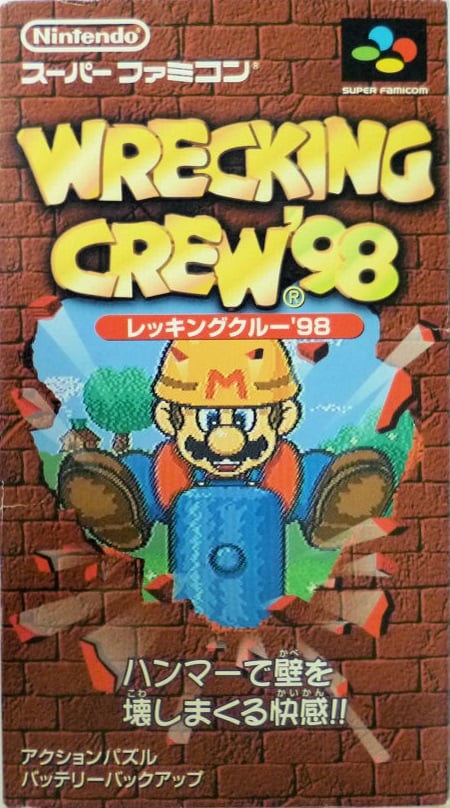
There was only ever one box, for the Japanese cartridge release of May 1998. Switch Online uses its own artwork.
Super Famicom · Japan (1998)Super NES – Nintendo Classics (Switch Online, 2024)
Screenshots
More from the Super Famicom game.
Onigiri on the attack.Mario flashes a V-sign.A close-up of Mario from a cut-scene.Koopa Troopa after a draw.Koopa Troopa defeated.Onnanoko’s defeat sprite.
Artwork & Media Gallery
Character portraits and sprites from Wrecking Crew ’98, with a few from the 1985 original. Select any image to enlarge it.
Mario’s portrait.Koopa Troopa’s portrait.Bowser’s portrait.Princess Peach’s portrait.Luigi’s portrait.Koopa Troopa sprite.Bowser sprite.Princess Peach sprite.Luigi sprite.Onnanoko’s win sprite.Onnanoko in play.Oyazi’s win sprite.Buruccho the bulldozer.Burnya and his blowtorch.Jenya, jetpack and all.Guruccho.Gata Gata.Poles.U Dokun.The purple Gotchawrench of the 1985 game.
Legacy & Re-releases
Japan-only for a quarter of a century, then a surprise on Switch.
Releases and re-releases
Nintendo Power (Super Famicom)1 January 1998Japan: written to rewritable cartridges at shop kiosks.
Super Famicom cartridge23 May 1998Japan: the boxed ROM cartridge.
Wii U Virtual Console28 September 2016Japan only.
Fan translationOctober 2017Unofficial English patch by ShadowOne333’s team.
Nintendo Switch Online11–12 April 2024Super NES library: 11 April in North America; 12 April in Japan, Europe, Australia and Hong Kong. The game is in Japanese.
At last, worldwide
Nintendo added the game to the Super NES library of Switch Online in April 2024 alongside Super R-Type and Amazing Hebereke. Nothing was translated, but the game is easy to follow without Japanese once you know that three of a colour clears and four of a colour attacks. Japan had already had it on the Wii U Virtual Console since 2016, complete with an electronic manual.
A late Super Famicom release sold first through shop kiosks, the game left little trace in the review columns: no contemporary review scores could be found, and Nintendo has published no sales figure.
Interest outside Japan came later. When the fan translation arrived in 2017, Nintendo Life’s Gonçalo Lopes compared it to Puzzle Bobble with a platforming twist rather than to its demolition-game namesake, and noted the text-heavy story scenes that had kept Western players in the dark.
The 2024 Switch Online release was widely reported, from Nintendo Life and Gematsu to GamesRadar, whose Dustin Bailey explained its long absence by the lack of interest at the time in a new game for what was, in effect, a finished platform.
SLB User Reviews
Wrecking Crew ’98 has yet to receive a community review on Super Luigi Bros.
If you’ve played Wrecking Crew ’98 and would like to submit a review, please get in touch.
To provide the best experiences, we use technologies like cookies to store and/or access device information. Consenting to these technologies will allow us to process data such as browsing behavior or unique IDs on this site. Not consenting or withdrawing consent, may adversely affect certain features and functions.
Functional
Always active
The technical storage or access is strictly necessary for the legitimate purpose of enabling the use of a specific service explicitly requested by the subscriber or user, or for the sole purpose of carrying out the transmission of a communication over an electronic communications network.
Preferences
The technical storage or access is necessary for the legitimate purpose of storing preferences that are not requested by the subscriber or user.
Statistics
The technical storage or access that is used exclusively for statistical purposes.The technical storage or access that is used exclusively for anonymous statistical purposes. Without a subpoena, voluntary compliance on the part of your Internet Service Provider, or additional records from a third party, information stored or retrieved for this purpose alone cannot usually be used to identify you.
Marketing
The technical storage or access is required to create user profiles to send advertising, or to track the user on a website or across several websites for similar marketing purposes.







 Stage 1: Eggplant ManStoryThe gentle opener against the original’s walking aubergine.
 Stage 2: Koopa TroopaStory · win in 4 minutes for Stage AThe first opponent with a secret attached.
 Stage 3: GotchawrenchStory · win in 3 minutes for Stage BThe spanner enemy, now with arms.
 Stage A: OnigiriSecretA floating, exploding rice ball.
 Stage B: OnnanokoSecretA lonely ghost girl who only wants someone to play with.
 Stage C: OyaziSecretA gloomy builder defending his chilly tower.
 Stage D: DoguSecret · beat stages A, B and CAn ancient clay figure, grumpy at being woken.
 Wrecking Crew (1985)100 phases · Design modeThe complete Famicom original, from the game select screen.


 KanbankBowser’s sign. Only a combo of nine or more panels summons it, and it ends the rival’s game on the spot.
 MarioHero
 Princess PeachEnding
 LuigiEnding
 BurucchoRed combo of 5A slower bulldozer that lifts its front end.
 BurnyaRed combo of 6A worker with a blowtorch who walks backwards.
 JenyaRed combo of 8A jetpack worker who stops to throw cement blocks.
 GurucchoChains onlyA screwdriver that comes paired with Forkun or Blonya.
 Gata GataChains onlyA roadblock with a swinging sign, paired with Buruccho or Burnya.
 PolesChains onlyA trio of poles that comes with Dumpty.
 U DokunChains onlyA cut-out construction worker that raises its arm, paired with Jenya.