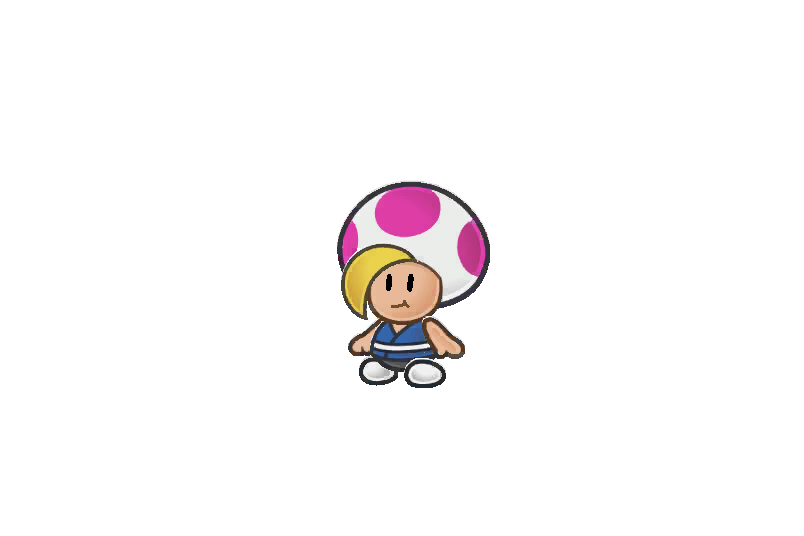
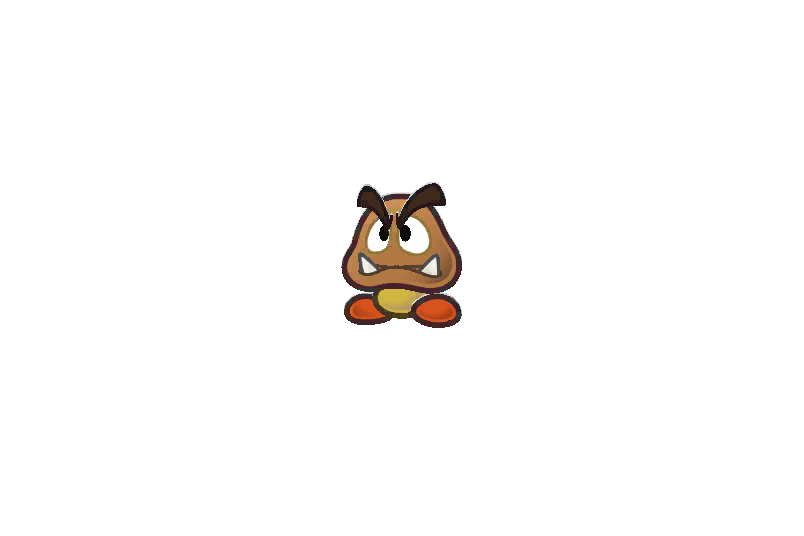
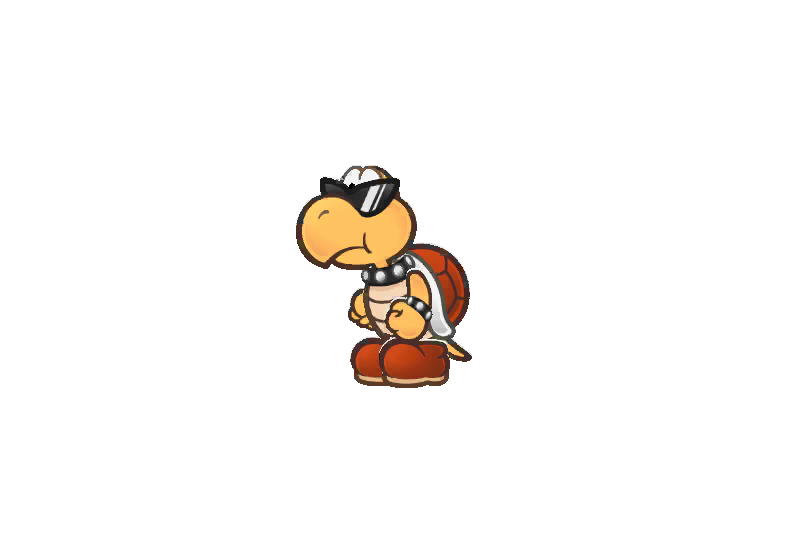
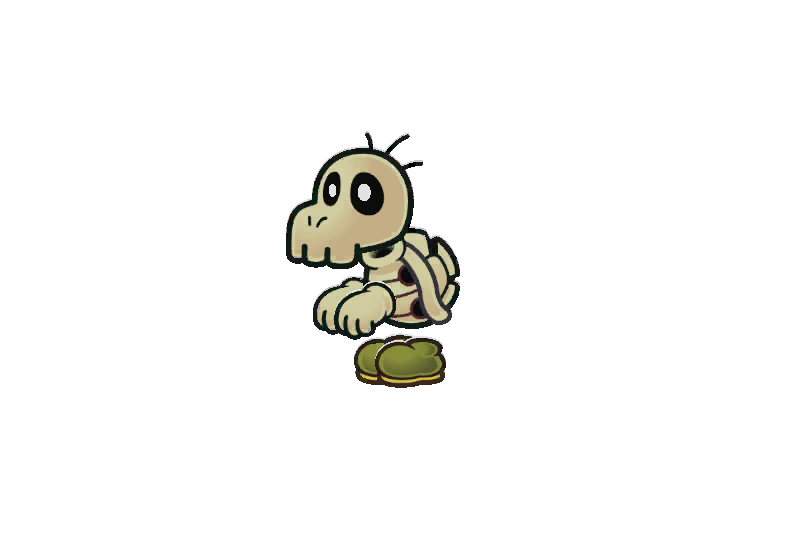
Nintendo Switch2024Intelligent SystemsRole-playing gameRemake of the GameCube classic2.10 million soldMetacritic 88Two new secret bosses134 Tattle Log entries
Paper Mario: The Thousand-Year Door (Nintendo Switch)
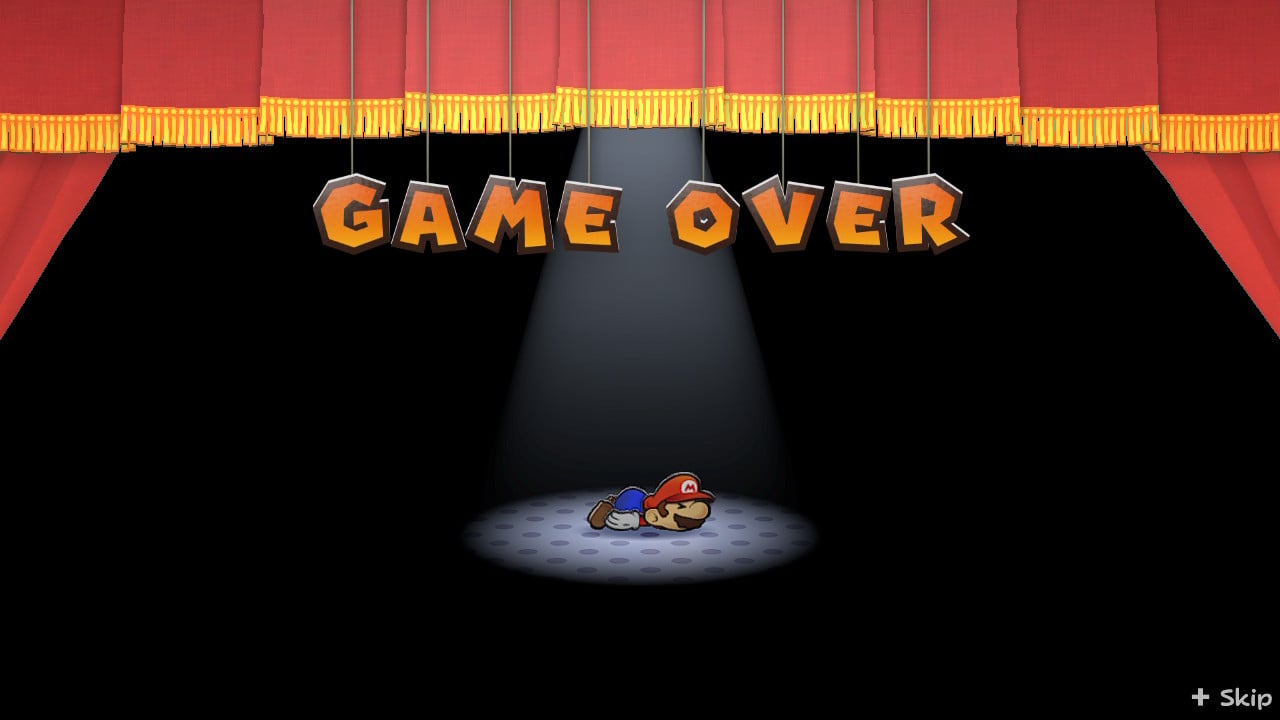
Twenty years after it first unfolded on GameCube, the best-loved Mario role-playing game came back with fresh ink. Released worldwide on 23 May 2024, on Nintendo Switch, Paper Mario: The Thousand-Year Door is a full remake by Intelligent Systems: every room of Rogueport rebuilt in a thicker, glossier paper style, the whole soundtrack re-arranged and re-recorded, and the script gone over line by line. The adventure itself is untouched, with a prologue, eight chapters, seven Crystal Stars and seven partners, but the rough edges have been sanded: a Partner Ring on the L Button, a room of Warp Pipes back to every chapter, hints on demand, retries after a Game Over and kinder backtracking in Chapters 4 and 7. Two new secret bosses, Prince Mush and Whacka, wait for players who finish everything else, and a one-coin badge called Nostalgic Tunes switches the GameCube music back on. It runs at 30 frames per second where the original ran at 60, restores Vivian’s story to the English script, and had sold 2.10 million copies by March 2025, more than the game it remakes.
Developer:Intelligent Systems (TOSE and Marza Animation Planet are among the studios credited)
Publisher:Nintendo
Platform:Nintendo Switch (Game Card and download)
Genre:Role-playing game
Released:23 May 2024, worldwide (Japan, where it is Paper Mario RPG, the Americas, Europe, Australia, South Korea, Hong Kong and Taiwan among others)
Announced:Nintendo Direct, 14 September 2023; date confirmed on 10 March 2024
Languages:English, French (France and Canada), German, Italian, Spanish (Spain and Latin America), Dutch, Japanese, Korean, Simplified and Traditional Chinese
Performance:30 frames per second; 900p docked and 640p handheld, as measured by Digital Foundry (reported by My Nintendo News)
Download size:5.1 GB
Launch price:US$59.99; £49.99 recommended price in the UK (retail listings, May 2024)
Ratings:PEGI 7 · ESRB E · CERO B · ACB PG
Sales:2.10 million worldwide (Nintendo, to 31 March 2025)
Advertisement
Overview
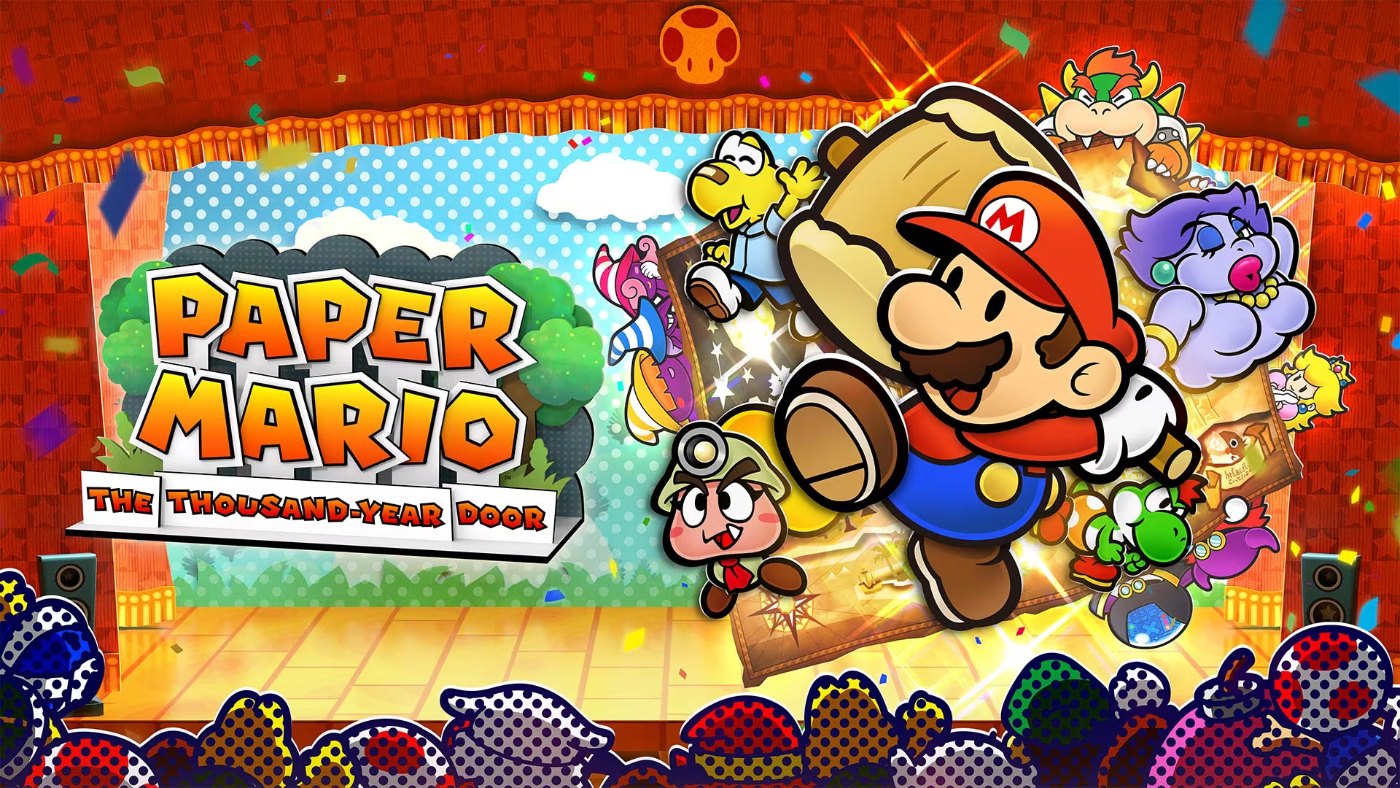
The remake’s group artwork of the cast.
Paper Mario: The Thousand-Year Door for Nintendo Switch is a ground-up remake of the 2004 GameCube role-playing game of the same name, and the first remake the Paper Mario series has had. Nintendo revealed it in the Nintendo Direct of 14 September 2023, confirmed the date during its MAR10 Day video on 10 March 2024, and released it everywhere on 23 May 2024. Like the original it was developed by Intelligent Systems, this time under Masahiko Nagaya, who directed Paper Mario: The Origami King.
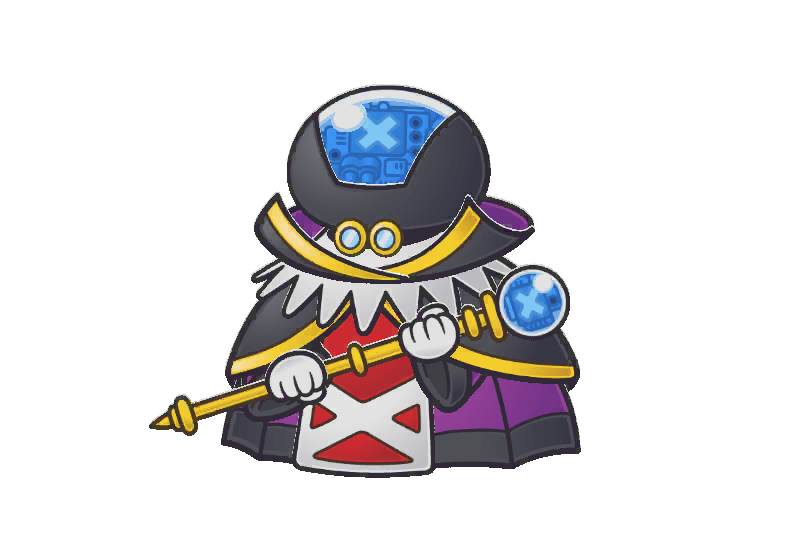
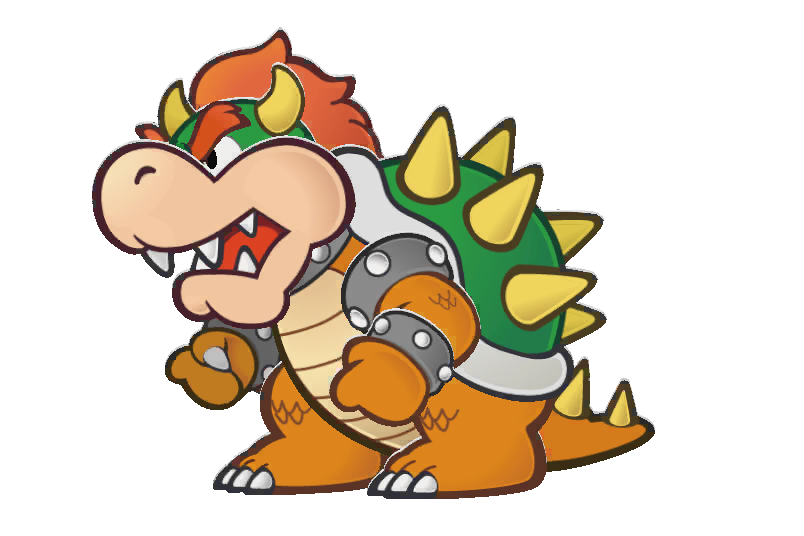
What it remakes is the game many fans still call the best Mario RPG. Mario is sent a treasure map by Princess Peach, sails to the thieves’ port of Rogueport to meet her, and finds she has vanished. The map leads to a sealed door in the ruins under the town, and the door will open only for the seven Crystal Stars, which a moon-based army called the X-Nauts is also hunting. Seven partners join along the way, battles are fought on a theatre stage in front of a paying audience, and between chapters you play as a captive Peach and as a furious, perpetually late Bowser. The long version of the story, and the history of the 2004 game, is on our page for the GameCube original.
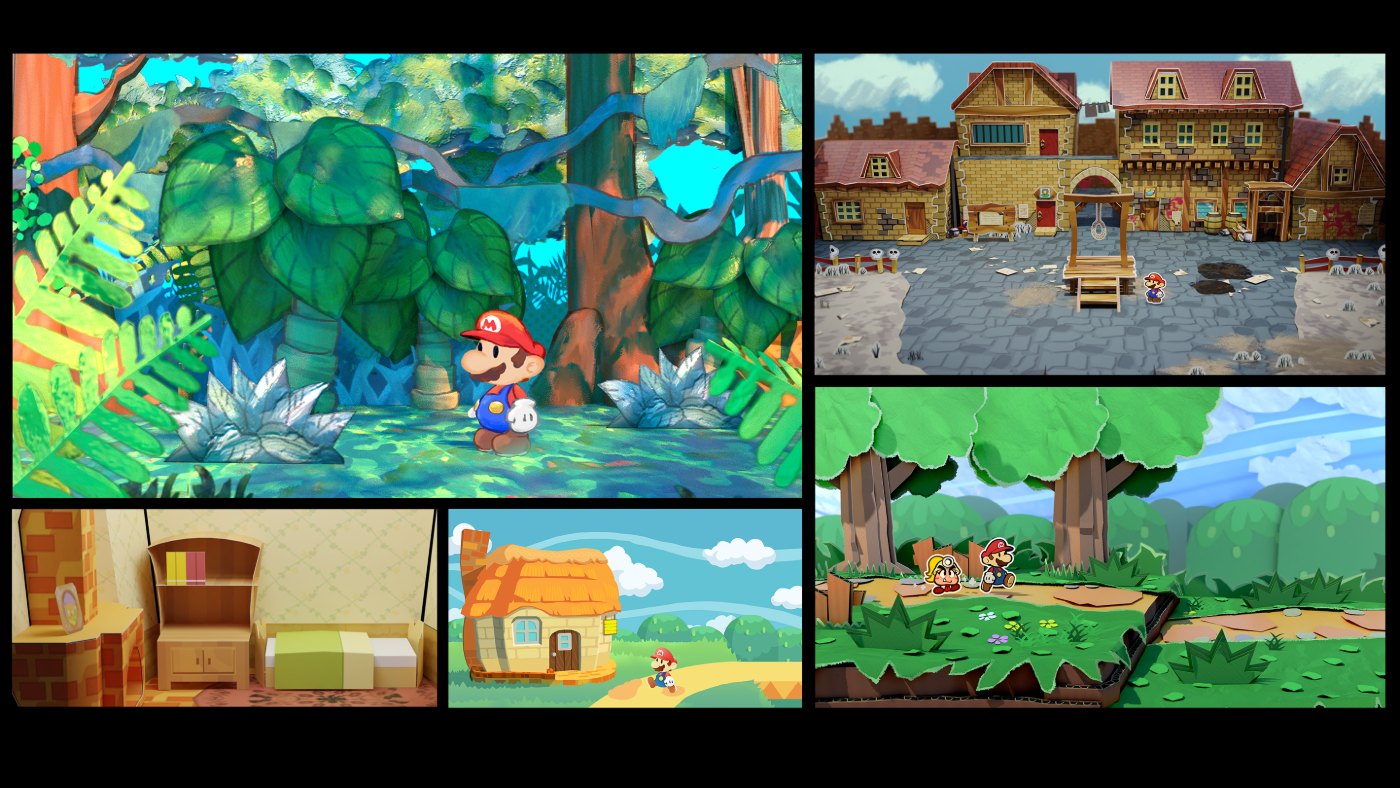
The Switch version keeps every chapter, joke and boss where it was and rebuilds everything around them. The flat sprites and simple rooms of 2004 give way to card-thick characters, glossy floors, dynamic lighting and a widescreen frame. The music has been re-arranged throughout and recorded with live players. And a long list of small mercies has been added for a story that used to involve a great deal of walking back the way you came: fast-travel pipes, a partner wheel, hints, more Save Blocks, the option to retry a fight, and a pipe that takes most of the legwork out of Chapter 4.
There are trade-offs. The remake runs at 30 frames per second, half the original’s rate, which matters in a game built on split-second button presses, and there is not a great deal that is brand new beyond two hidden bosses, the galleries and a clutch of trophies. Reviewers were happy all the same: it holds an 88 on Metacritic, and it has outsold the GameCube game.
Join Mario and friends on a journey to discover the legendary treasure behind the ancient Thousand-Year Door. A hilarious adventure full of colourful characters and foldable fun awaits in Paper Mario: The Thousand-Year Door on Nintendo Switch!
Welcome to Rogueport! Mario visits this notorious town of ruffians to help Princess Peach on a treasure hunt. But Peach is nowhere to be seen! After learning about the legend of the Crystal Stars, Mario sets out to find them and hopefully track down the princess too…
— Official description (Nintendo UK, 2024)
Why it matters to Mario fansFor two decades The Thousand-Year Door could be played on one console only, while the series it belonged to moved further and further from partners, badges and experience points. The remake put the game fans kept asking for on a current machine, in more languages than ever, with its most quietly important character finally allowed to say who she is in English. It also arrived six months after the Super Mario RPG remake: for the first time in years, the old Mario RPGs were being treated as things worth keeping.
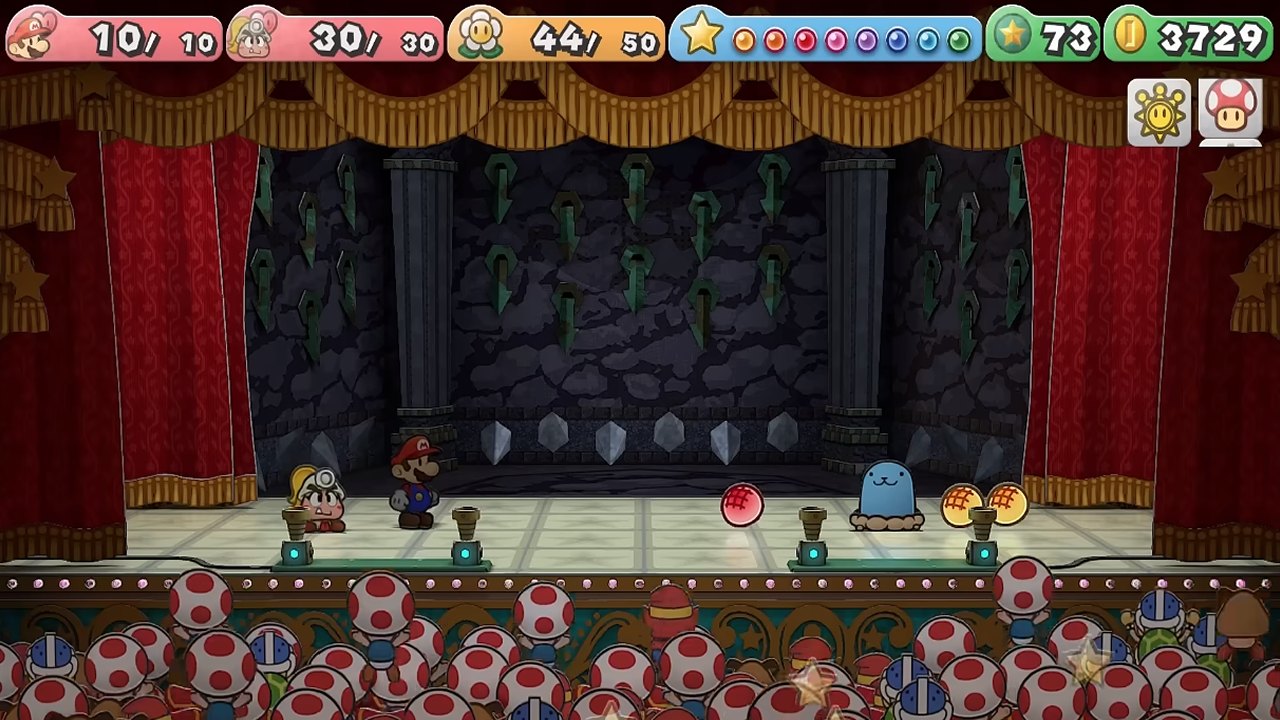
Rogueport Plaza, rebuilt for widescreen.Mario and Goombella take the stage against five Goombas.Petal Meadows, the first stop after the prologue.Mario and Koops come face to face with Hooktail.
Quick Answers
The questions people ask most about the Switch version, answered quickly.
Is the Switch version a remake or a remaster?
A remake. Every area and character has been rebuilt with new models, textures, lighting and animation, the soundtrack has been re-arranged and re-recorded, and the script has been revised. The story, the chapters and the battle system are the same as on GameCube, which is why GameSpot’s review described it as closer to an enhanced remaster in spirit. More →
What is new in the Thousand-Year Door remake?
A Partner Ring for switching partners, a fast-travel pipe room under Rogueport, partner hints on ZL, auto-saving Save Blocks, retries after a Game Over, a Battle Master to practise on, Exhibition Matches in the Glitz Pit, an Art Gallery and Sound Gallery, ten extra Tattle Log entries and two new secret bosses, Prince Mush and Whacka. More →
Does it run at 60 frames per second?
No. The remake runs at 30 frames per second; the GameCube game ran at 60. Digital Foundry, as reported by My Nintendo News, measured a native 1600×900 picture when docked and 1138×640 in handheld play, with the frame rate holding close to a locked 30. More →
Can I play with the original GameCube music?
Yes. The Nostalgic Tunes badge costs a single coin at the Lovely Howz of Badges in Rogueport and nothing to wear. With it on, the music reverts to the 2004 soundtrack. More →
How do I fight Prince Mush?
Finish Chapter 3, then complete Jolene’s Trouble Center job “Help wanted!”. Wait for an e-mail from Jolene and then one from Mush himself, and book an Exhibition Match at the Glitz Pit. He has 96 HP and hands over his belt afterwards. More →
How do I fight Whacka?
Beat Bonetail at the foot of the Pit of 100 Trials, hit the Whacka on Keelhaul Key until he stops appearing (eight times), play for about half an hour and return to Rogueport for an e-mail headed “RDM Extra Issue”. He will be waiting on floor 100 of the Pit with 108 HP. More →
Is Vivian a trans woman in the remake?
Yes. The original Japanese script implied it, while still calling her a boy, and the 2004 English and German scripts removed the subject. The remake’s English script has Vivian explain that it took her a while to realise she was her sisters’ sister and not their brother, and the Japanese script was revised too. More →
Who developed the remake?
Intelligent Systems, the Kyoto studio behind every Paper Mario game, with Masahiko Nagaya as director and Ryota Kawade, chief director of the 2004 game, credited as supervisor. TOSE and Marza Animation Planet are among the supporting companies in the credits. More →
How many copies has it sold?
Nintendo’s results for the year to 31 March 2025 put it at 2.10 million worldwide. It had reached 1.76 million by 30 June 2024, five weeks after release. More →
Should I play the remake or the GameCube original?
For most people, the remake: it is on a current console, it is kinder about backtracking and it includes the original music as an option. The GameCube version still has the smoother 60 frames per second and its own English script. We cover it on its own page. More →
Story
Peach opens the box that only the pure of heart can open.
The remake tells exactly the story the GameCube game told, scene for scene, with a new animated storybook to open it. What follows is a brisk retelling with the remake’s names and pictures, and it gives away every twist. For the long version, chapter by chapter with the intermissions in full, see our page on the original Paper Mario: The Thousand-Year Door.
A thousand years ago a great city sank into the earth, and a rough harbour town, Rogueport, grew up on top of it. Princess Peach, on holiday there, buys a locked box from a hooded stallholder. It opens for her, and inside is a map. She posts it to Mario and disappears.
Prologue: A Rogue’s Welcome
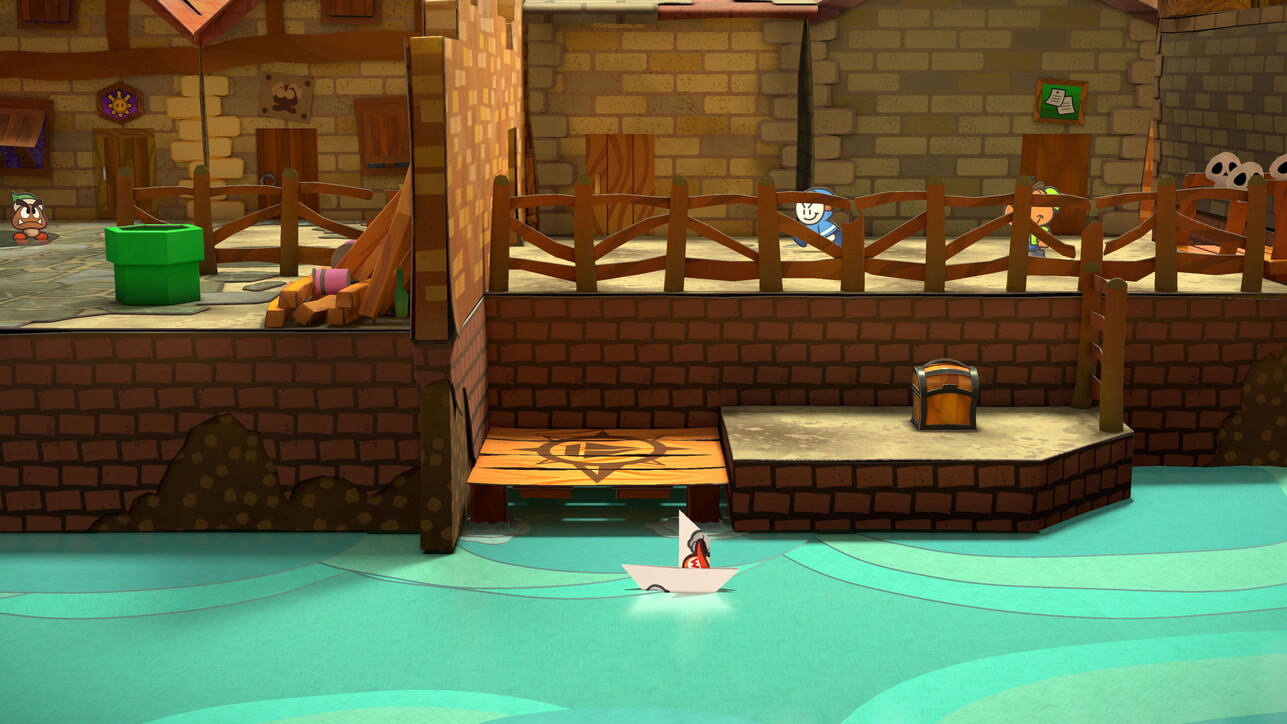
Parakarry brings the letter, Mario sails to Rogueport, and on the quay he walks into Lord Crump of the X-Nauts shaking down a Goomba student for information about the Crystal Stars. One tutorial fight later the student, Goombella, is Mario’s first partner. Professor Frankly explains the legend: a treasure behind the Thousand-Year Door, under the town, which only the seven stars will open.
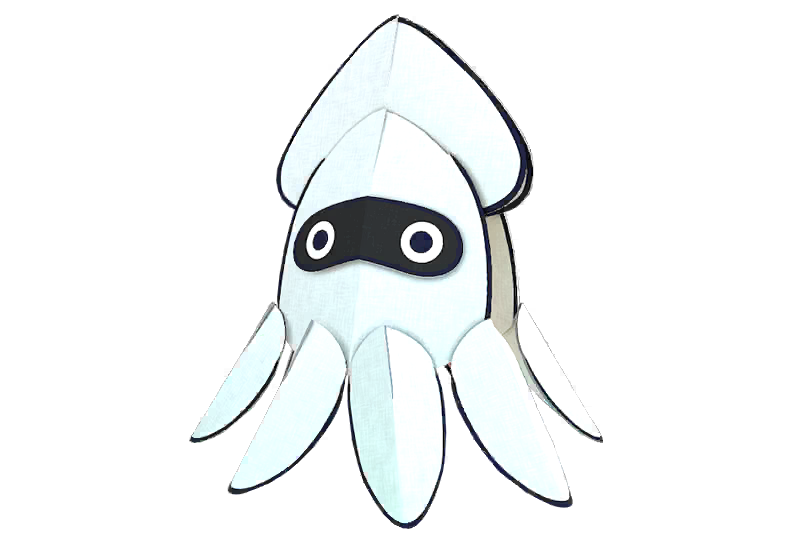
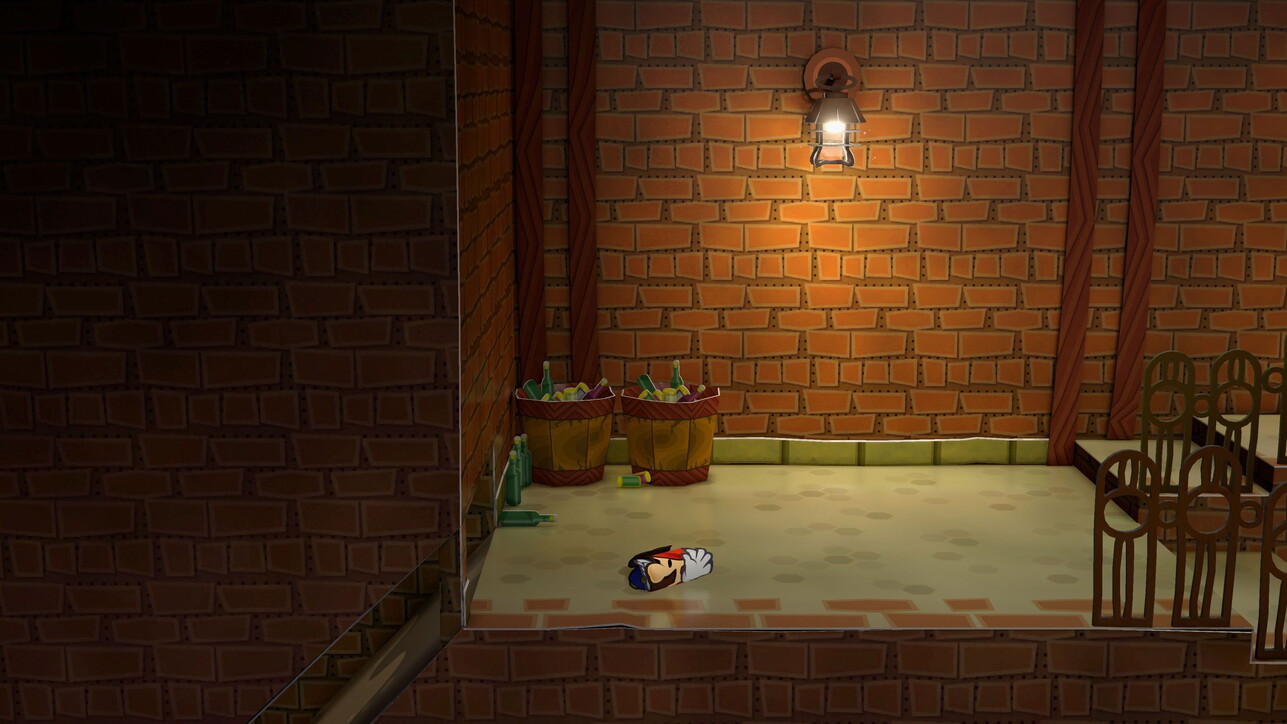
In what the remake calls Rogueport Underground a black chest “curses” Mario with the power to fold into a paper aeroplane (he is now struck by lightning for his trouble), the map shows where the first star lies, and a Blooper guards the pipe that leads there.
Mario steps ashore in Rogueport.Lord Crump leans on Goombella.The Blooper under the town.
Chapter 1: Castle and Dragon
Petal Meadows is being terrorised by the dragon Hooktail. In Petalburg, Mayor Kroop sends Mario to Shhwonk Fortress for the two stone keys to the castle road, past a quiz-setting Thwomp and a Gold Fuzzy with a great many friends. On the way a new scripted ambush teaches stage hazards. Timid Koops joins to avenge his father, who went up to the castle years ago.
Hooktail Castle brings Paper Mode, a first brush with the badge thief Ms. Mowz, and a badge that makes Mario croak. Hooktail, it turns out, cannot abide the sound of frogs. Beaten, she coughs up Koops’s father Koopley, alive, holding the Diamond Star.
Petalburg, village of Koopas.The curtain rises on Hooktail.Koopley produces the Diamond Star.
Chapter 2: The Great Boggly Tree
In the monochrome hush of Boggly Woods the X-Nauts have seized the Great Tree, home of the tiny Punies. Mario meets the three Shadow Sirens, who fail to recognise him, wins back a necklace for the retired actress Madame Flurrie, and with her breath uncovers the tree’s hidden door.
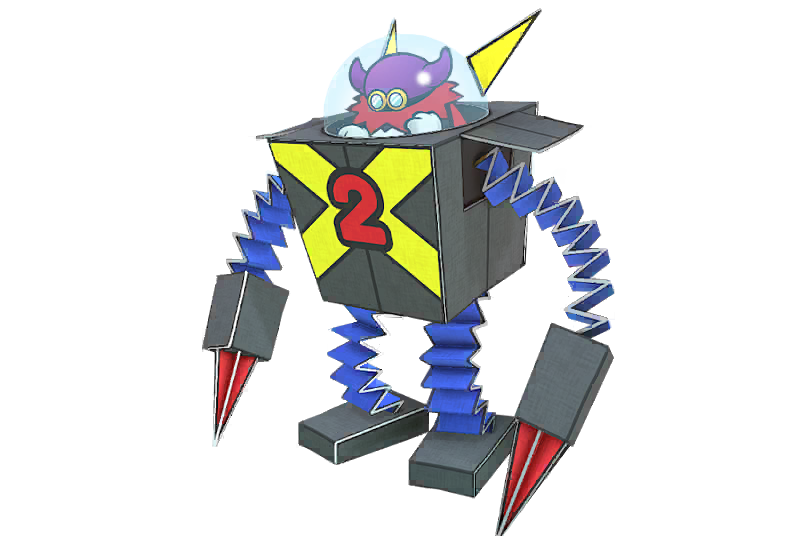
Inside he frees the Punies, marches them about in a crowd, earns the Super Boots and reaches the Emerald Star just as Lord Crump grabs it and starts a time bomb. Crump’s robot, Magnus von Grapple, loses the argument.
Boggly Woods.Flurrie blows a crowd of Punies along in bubbles.Magnus von Grapple.
Chapter 3: Of Glitz and Glory
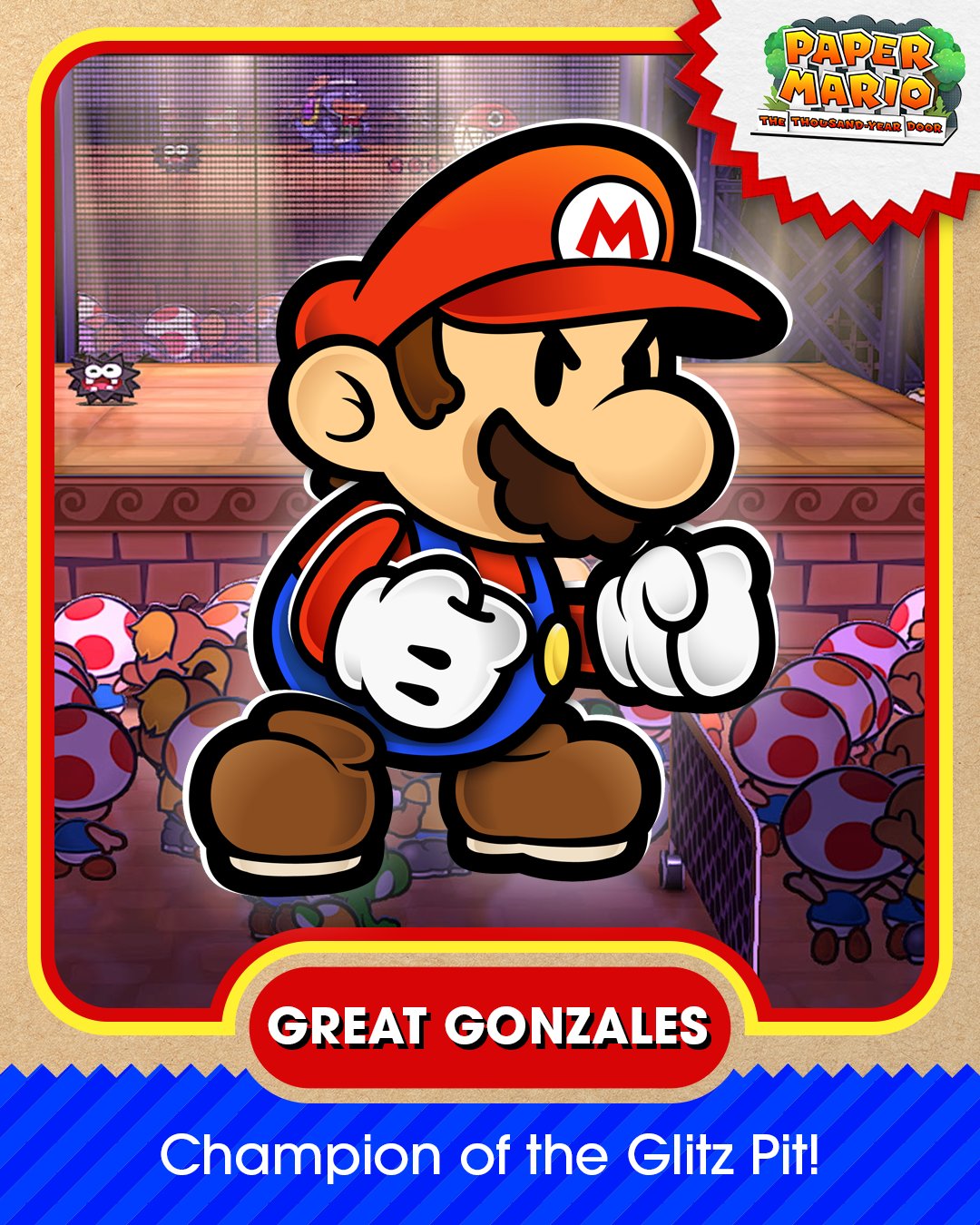
The Gold Star is on the champion’s belt at the Glitz Pit, an arena in the floating town of Glitzville. Mario signs up with the promoter Grubba as “the Great Gonzales” and fights his way up from rank 20. An egg rescued from the hot-dog stand hatches into Yoshi Kid; fighters go missing; anonymous e-mails signed X point at something rotten; Bowser barges into the ring; and the champion Rawk Hawk cheats and loses.
His star is glass. The real one powers a machine with which Grubba drains his fighters, and he uses it to become Macho Grubba. Afterwards X unmasks as his assistant Jolene, and her brother Prince Mush, the Pit’s lost first champion, steps out of the machine. In the remake that reunion is a set-up: Mush goes back into training.
Glitzville, the town in the sky.Mario, Yoshi Kid and Grubba face Hamma, Bamma and Flare.Macho Grubba.
Chapter 4: For Pigs the Bell Tolls
In Twilight Town a bell tolls and villagers turn into pigs. Mario walks to the Creepy Steeple, beats the ghost responsible and takes the Ruby Star, and on the way home discovers he is a silhouette. The ghost has stolen his body, his name and his partners, and will give them back only if Mario can say its name, which needs a letter that is missing from the keyboard.
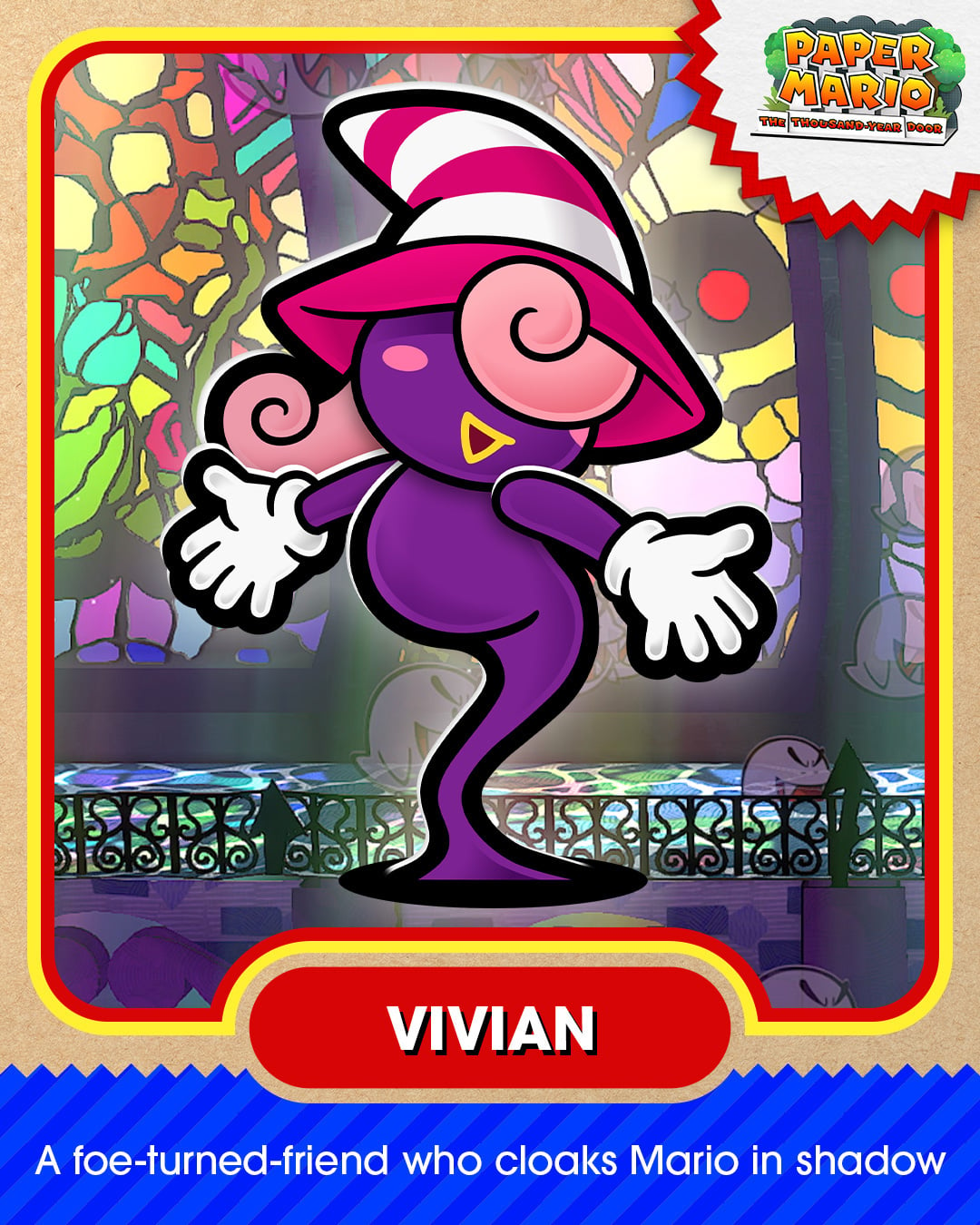
The one person who will help a nameless shadow is Vivian, youngest of the Shadow Sirens, in disgrace with her sisters again. Together they find the letter, overhear a parrot, and name the thief: Doopliss. Mario gets himself back, and Vivian chooses to stay. The remake’s new pipe from the steeple to the town spares most of the walking this chapter was known for.
Twilight Town.Doopliss takes more than the star.Vivian joins for real.
Chapter 5: The Key to Pirates
The Sapphire Star lies in a pirate’s hoard on Keelhaul Key. Mario coaxes the widowed Admiral Bobbery back to sea, sails with the vain Flavio and a suspiciously familiar sailor called Four-Eyes, and is shipwrecked by ghostly Embers. Bobbery holds them off alone, is found up a tree making his farewells, and turns out to be asleep.
Pirate’s Grotto adds Boat Mode and, in the remake, a Toad salesman near the end of the caves. The ghost captain Cortez falls three times and gives up the star, Four-Eyes reveals himself as Lord Crump with a warship offshore, and Cortez lends his own ship for the counter-attack.
Mario and Yoshi Kid on Keelhaul Key.Cortez, pirate king.The Black Skull meets the X-Naut warship.
Chapter 6: 3 Days of Excess
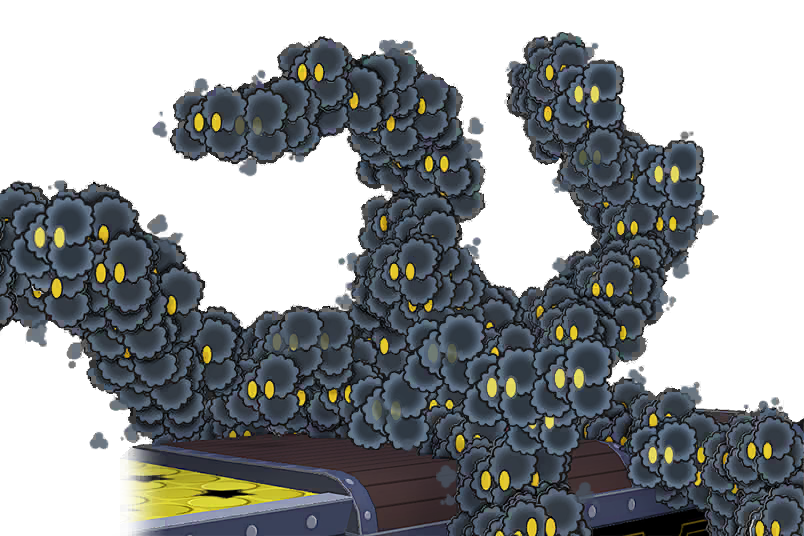
Three days on the Excess Express to smart Poshley Heights, with a penguin detective named Pennington and a mystery for each day: stolen goods, a bomb threat (Beldam’s note is now an item you carry), and a passenger who is really Doopliss. At Riverside Station a swarm of Smorgs has jammed the drawbridge; on the last morning they engulf the train as one writhing monster.
At Poshley Sanctum the Shadow Sirens steal the star on display. Pennington, the curator, is untroubled. That one was a fake, and the real Garnet Star is inside a painting.
The Excess Express.The battle with Smorg.Poshley Heights.
Chapter 7: Mario Shoots the Moon
The last star is on the Moon, and the way there is a cannon under snowbound Fahr Outpost, which will not fire without General White. Finding him means visiting almost every earlier town, an errand the new pipe room cuts to a fraction of its old length, before he turns up asleep at home.
Under the lunar surface is the X-Naut Fortress, with a fourth Security Key to find in the remake and an ambush in the staff toilets. Lord Crump’s Magnus von Grapple 2.0 guards the Crystal Star. Peach is gone; the computer TEC, its memory failing, sends Mario back to Rogueport as the base blows up, and a rather eager “Professor Frankly” urges him to open the door.
Fahr Outpost.Big Bob takes aim at the Moon.Magnus von Grapple 2.0.
Chapter 8: The Thousand-Year Door
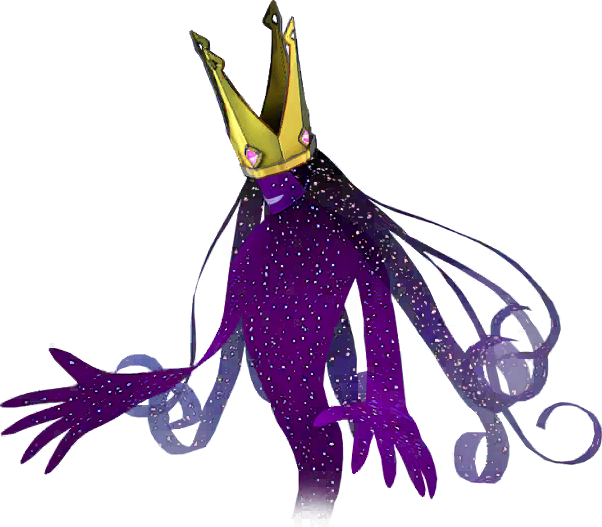
Behind the door is the Palace of Shadow: Dark Bones, the dragon Gloomtail, a tower of riddles and the Shadow Sirens with Doopliss in Vivian’s place. Sir Grodus loses his duel, Bowser and Kammy Koopa crash through the ceiling for theirs, and Grodus drags Peach down to a crypt and wakes the Shadow Queen, who repays him with a lightning bolt and takes Peach’s body. The treasure was a lie spread by Beldam to get the door opened.
Refuse the Queen’s offer and she proves untouchable, until the Crystal Stars fly out across the world and everyone Mario has met cheers him on. Peach lends the last of her strength and the demon is sealed away for good. In the remake she goes up in a cloud of black smoke.
The Palace of Shadow.Gloomtail.The Shadow Queen.
Meanwhile: Peach, TEC and Bowser
After each of the first seven chapters the game cuts away twice. Peach, held in the X-Naut base, is befriended by its computer, TEC-XX, which has fallen in love without knowing the word; she dances with it, brews an invisibility potion, sneaks about in disguise and e-mails what she learns to Mario until Grodus has TEC wiped. In the remake the waltz asks you to hold the buttons shown, and the music goes sour if you fumble it.
Bowser, meanwhile, is livid that someone else has kidnapped the princess and trails Mario from town to town, sometimes through side-scrolling stages in the style of Super Mario Bros., always arriving too late. Those stages now have a Retry option on the pause menu.
TEC malfunctions at the sight of Peach.Bowser swims for it.
Epilogue and after the credits
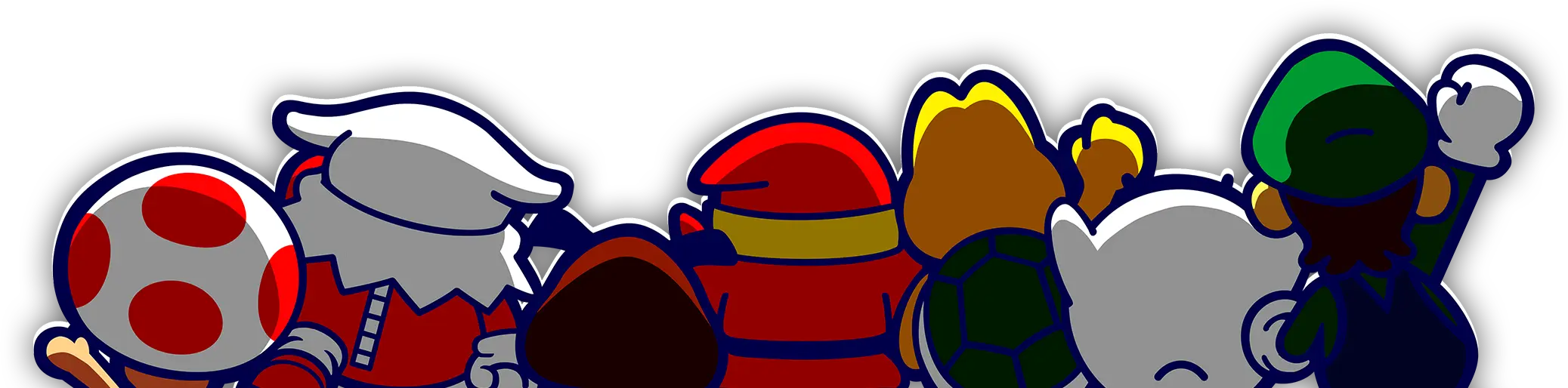
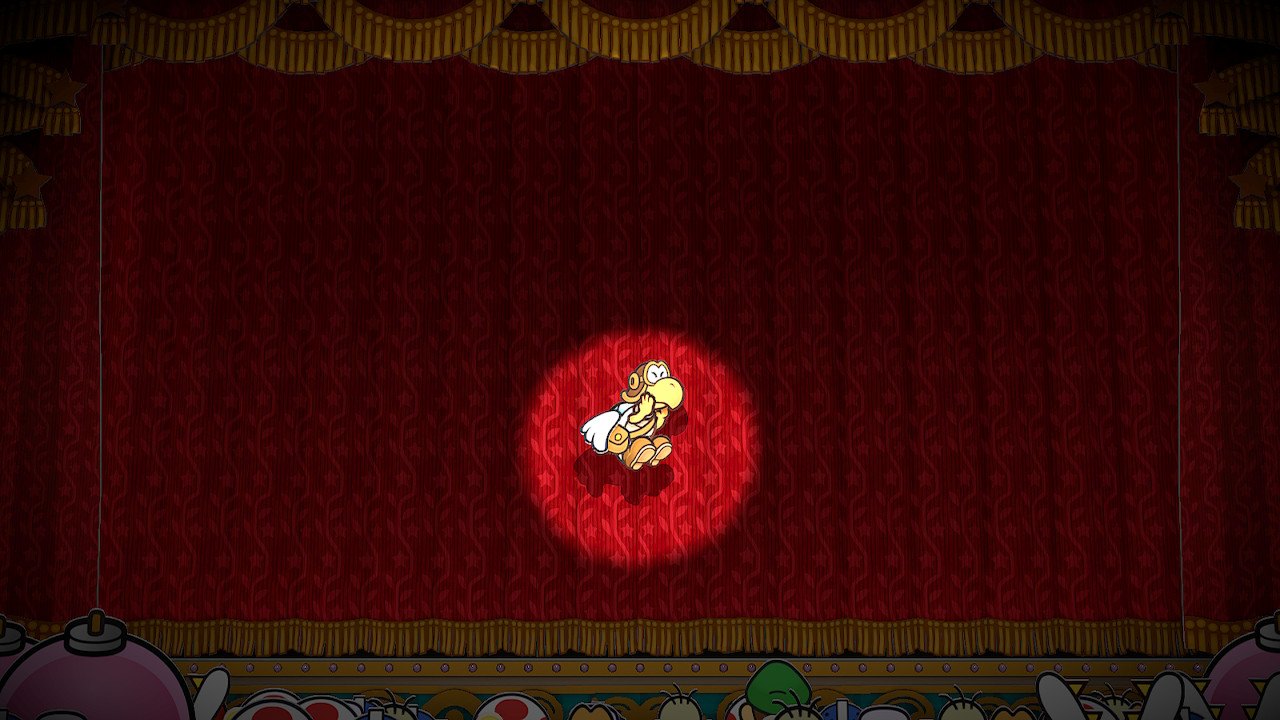
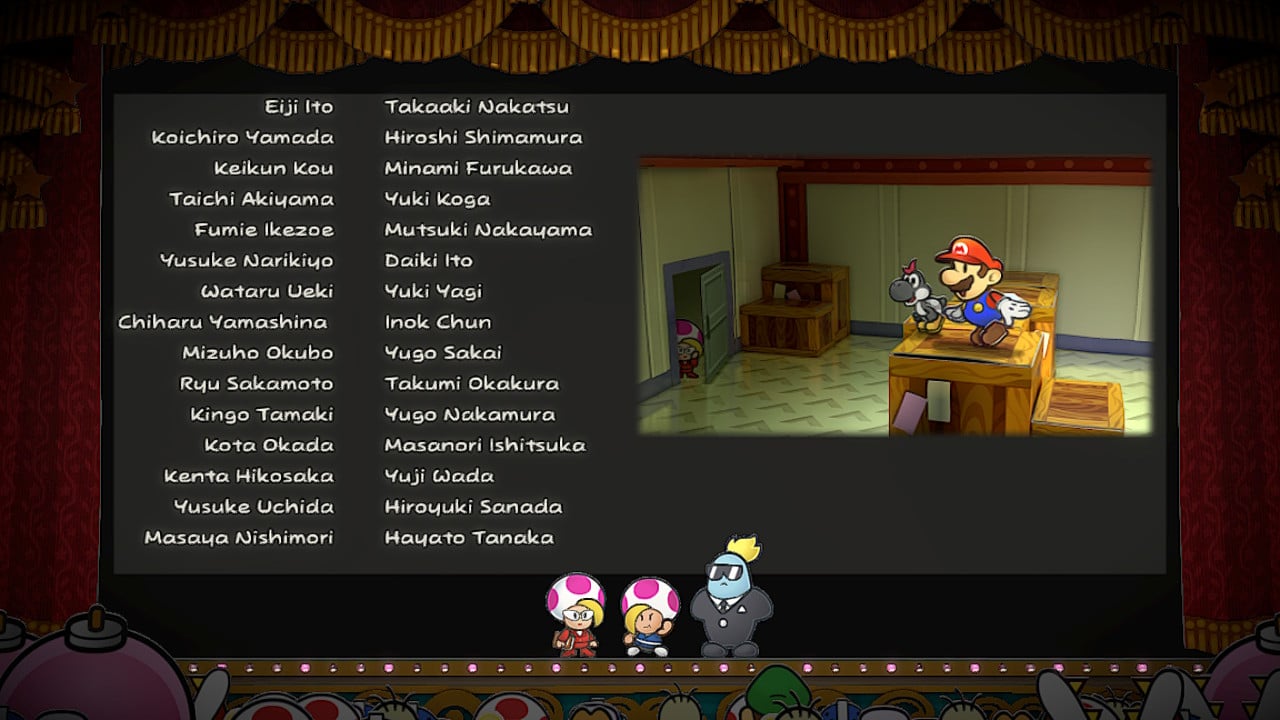
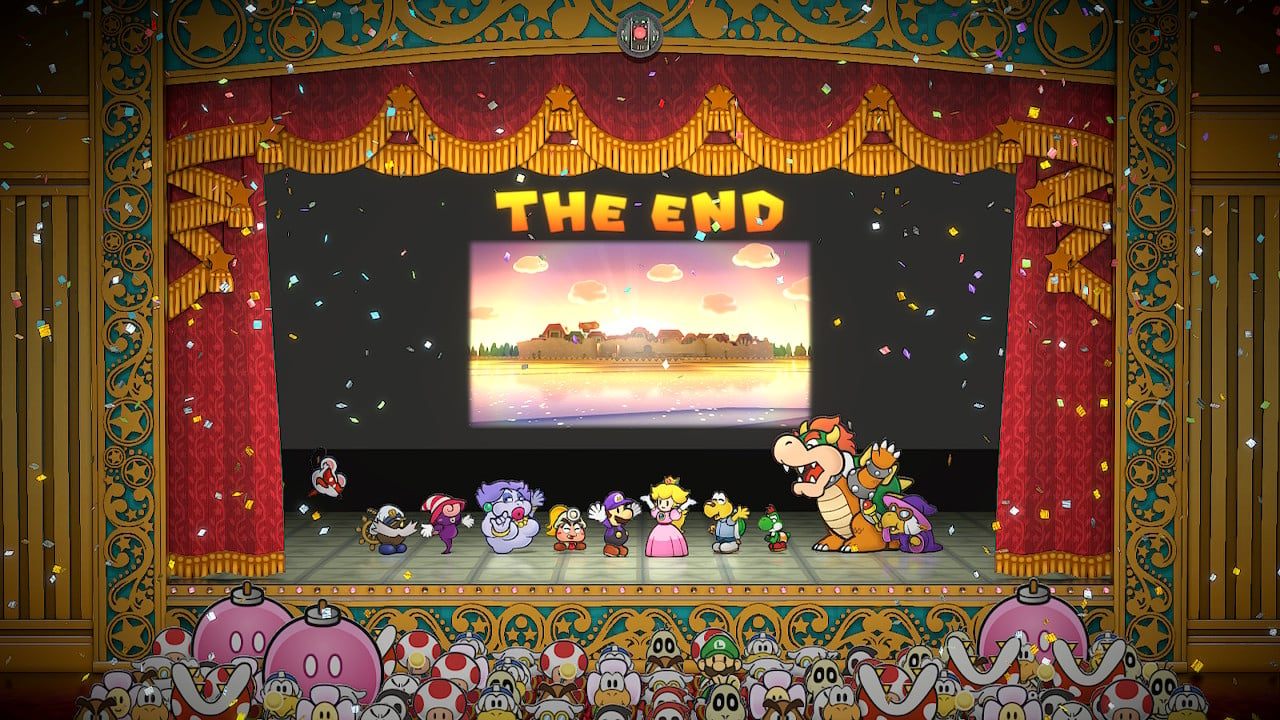
Peach wakes unharmed, the real Frankly finds there was a treasure chest after all, and the partners go their separate ways, as Goombella reports in a final e-mail. The credits have been restaged as a curtain call on the battle stage, with Parakarry first on and Luigi watching from the stalls.
The save continues after the ending, and the remake has surprises for anyone who keeps playing, although only some of them wait for the credits. Prince Mush’s challenge to an Exhibition Match can arrive at any point after Chapter 3, a Whacka with a grudge moves into the lowest floor of the Pit of 100 Trials once Bonetail has been beaten, the Creepy Steeple Boo keeps a fifteen-question final quiz for after the ending, and three trophies and a Gold Medal reward a full journal. Confetti falls on the title screen once the game has been finished.
Sunrise over Rogueport.The photograph that closes the storybook.Prince Mush and his after-images, in a fight that can be unlocked any time after Chapter 3.
Every chapter and place in the remake
The map is the GameCube game’s, with a few names changed and new pipes, Save Blocks and recovery blocks dotted about. The map screen now shows what percentage of Star Pieces and Shine Sprites you have found in each place.
RogueportHub · Prologue · Lord Crump, Gus (optional)The thieves’ port, now with litter, puddles and a noose that sways. The cockroaches are worth a coin each if you stamp on them.
Rogueport UndergroundHub · Plane Mode · Boss: BlooperRogueport Sewers under its new name. Home of the Thousand-Year Door, the new seven-pipe room and the way down to the Pit.
Petal Meadows and PetalburgChapter 1Storybook hills, now ringed with pines, and the Koopa village where Koops joins.
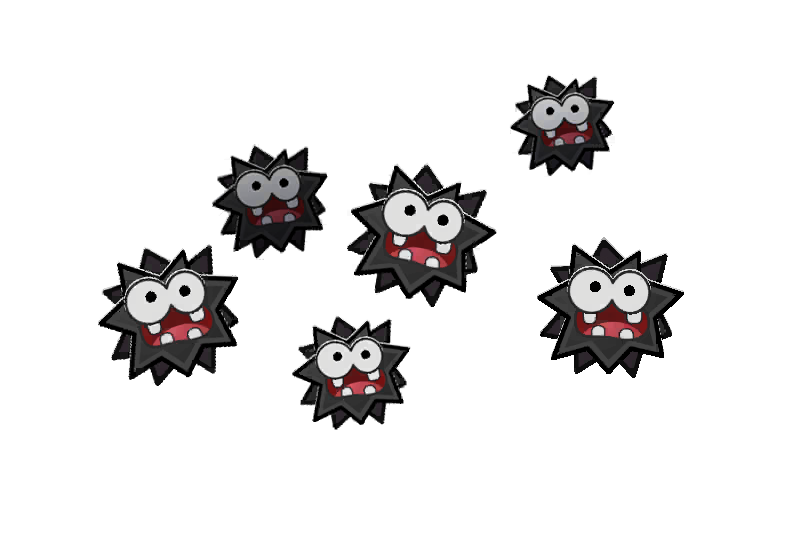
Path to Shhwonk Fortress and Shhwonk FortressChapter 1 · Sun and Moon Stones · Mini-boss: Gold Fuzzy and the Fuzzy HordeThe road east has its own name in the remake and a new tutorial ambush. The Fuzzy Horde finally gets a Tattle Log entry.
Hooktail CastleChapter 1 · Diamond Star · Paper Mode · Boss: HooktailFoggier and more cobwebbed, with a new recovery block on the third floor and a pipe back up from the depths.
Boggly WoodsChapter 2 · Mini-boss: the Three ShadowsPetals drift from the trees, which chime when hammered. The Save Block has moved to just before the Sirens’ ambush.
The Great TreeChapter 2 · Emerald Star · Super Boots · Boss: Magnus von GrappleThe Punies’ home, occupied by X-Nauts. Pipe 2 in the new hub comes out at its front door.
Glitzville and the Glitz PitChapter 3 · Gold Star · Super Hammer · Boss: Macho GrubbaTwenty ranks, a fighter directory in the lobby, Exhibition Matches and, once Chapter 3 and Jolene’s Trouble are behind you, Prince Mush.
Twilight Town and Twilight TrailChapter 4 · Tube ModeThe village of pigs. A new Save Block sits past the fallen tree on the trail.
Creepy SteepleChapter 4 · Ruby Star · Bosses: Doopliss, Atomic Boo (optional)Repainted, with a basement pipe to town and a Boo in the storeroom who sets six quizzes on the story.
Keelhaul KeyChapter 5 · Mini-boss: three EmbersA jungle island with a new cliff-top switch for a jump-pad shortcut, and a Whacka you may come to regret hitting.
Pirate’s GrottoChapter 5 · Sapphire Star · Boat Mode · Bosses: Cortez, Lord CrumpFlooded caves with an extra Save Block, a recovery block and a new ambush once Mario can sail.
Excess ExpressChapter 6 · Boss: SmorgThree days of detective work on a sleeper train. After the chapter it can skip Riverside Station.
Riverside StationChapter 6 · Ultra BootsA deserted station clogged with Smorgs, with new items behind posters that Flurrie can blow down.
Poshley Heights and Poshley SanctumChapter 6 · Garnet StarThe smart end of the line. Lady Bow and Bootler from the first Paper Mario holiday here after the credits.
Fahr OutpostChapter 7A snowed-in Bob-omb village and a cannon aimed at the Moon. Pipe 7 leads straight here.
The MoonChapter 7Low gravity and breakable rocks, several of which hide new items.
X-Naut FortressChapter 7 · Crystal Star · Boss: Magnus von Grapple 2.0Grodus’s base. Four Security Keys now, a crane game, and a changing room that turns the party into 8-bit sprites.
Palace of ShadowChapter 8 · Bosses: Dark Bones, Gloomtail, the Shadow Sirens, Grodus, Bowser and Kammy Koopa, the Shadow QueenThe final dungeon, with named rooms, an extra Save Block and a pipe back to the entrance once the Queen is beaten.
Pit of 100 TrialsOptional · Return Postage · Bosses: Bonetail, then WhackaA hundred floors without a save. The remake lets you retry a floor after a Game Over and, once cleared, start from floor 50 for 300 coins.
The Mario Bros.’ house, seen at each end of the story, now has group pictures of Mario’s partners from both this game and the first Paper Mario on the wall. Bowser’s three side-scrolling stages and Peach’s wing of the X-Naut Fortress are visited only in the intermissions.
Advertisement
Gameplay & Controls
Underneath the new paper this is the game it always was: a turn-based RPG in which timing a button press makes every attack hit harder and every block hurt less, played out by two characters on a stage. What the remake changes is nearly everything around that core. A full list of differences runs to several hundred entries; these are the ones you will notice.
What is new at a glance
The headline additions are easy to list. A Partner Ring opens on the L Button, so swapping partner in the field no longer means a trip through the menu. A Partner Hint on ZL has a companion, usually Goombella, tell you where to go next. A new Warp Pipe room under Rogueport leads back to every chapter. Save Blocks save the moment they are struck, there are more of them, and after a Game Over you can go again from the same scene or retry a boss with its cutscene skipped.
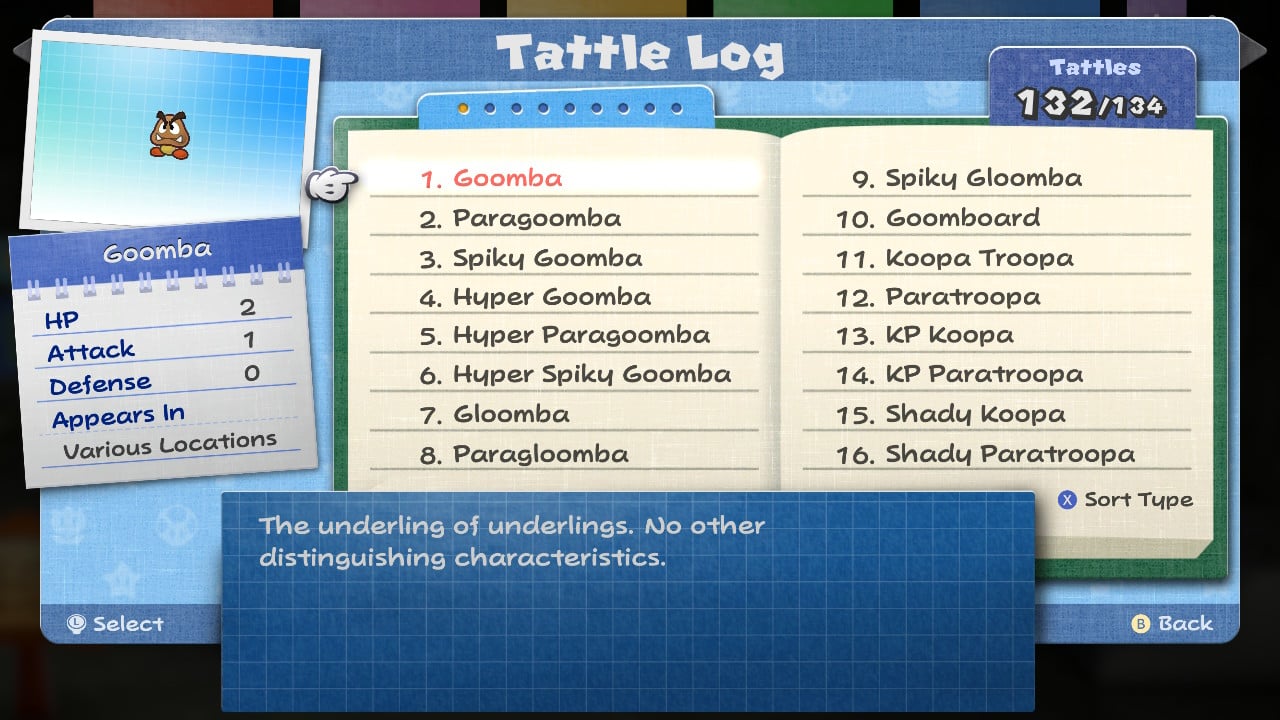
Then come the new things to do. The Battle Master, a Toad in a martial-arts outfit who turns up in towns all over the map, lets Mario practise commands on cardboard Goombas called Goomboards. Exhibition Matches at the Glitz Pit let him re-fight any team ranked below him. An Art Gallery and Sound Gallery fill up as each chapter’s Star Pieces and Shine Sprites are found. The Tattle Log grows by ten entries to 134, and two secret bosses guard the last of them.
A Notes tab in the journal keeps track of Trouble Center jobs and Merluvlee’s predictions, the map shows what percentage of Star Pieces and Shine Sprites you have in each area, and a prompt appears whenever something can be read, talked to or Tattled.
The Battle Master’s practice stage.The Art Gallery, unlocked chapter by chapter.The new Notes tab with a Trouble Center hint.
Getting around: pipes, the Partner Ring and less backtracking
The 2004 game had a small room of pipes under Rogueport that opened slowly and covered only some of the map. The remake replaces it with a seven-pipe hub. Each time a Crystal Star is carried back to the Thousand-Year Door, a pipe to that chapter’s region opens: Petalburg, the Great Tree, Glitzville, Twilight Town, the Keelhaul Key campsite, Poshley Heights and Fahr Outpost, plus one straight up to Rogueport Plaza. Flurrie has to blow away a hidden door to reach it the first time.
That room transforms Chapter 7, whose hunt for General White once meant trudging through five old areas in turn. Chapter 4, notorious for sending Mario between Twilight Town and the Creepy Steeple again and again, gets a pipe of its own from the steeple’s basement to the town. Hooktail Castle has a new pipe back up from its lower floors, Keelhaul Key gains a switch that summons a jump pad, the Excess Express will run direct without stopping at Riverside Station once Chapter 6 is over, and the Palace of Shadow grows a pipe back to its entrance after the last boss.
Warp Pipes themselves are now entered with the A Button under an on-screen prompt, where the GameCube game wanted the stick pushed down and never said so. Mario can swing his hammer towards and away from the camera as well as sideways, he teeters at ledges before he falls, and enemies in the field spot him from a shorter distance.
The new Warp Pipe room in Rogueport Underground.The Chapter 4 shortcut arrives in Twilight Town.A new pipe in Hooktail Castle.
Battles on stage
Fights work as they did. Mario and one partner take turns against the enemy line-up; every jump, hammer blow and partner move has an Action Command to hit; A at the right moment guards against a blow and a riskier, tighter B press Superguards it completely. Stylish flourishes please the audience, a pleased audience refills Star Power, and Star Power pays for the special moves the Crystal Stars teach. Partners have their own HP, and levelling up means choosing between more HP, more Flower Points or more Badge Points.
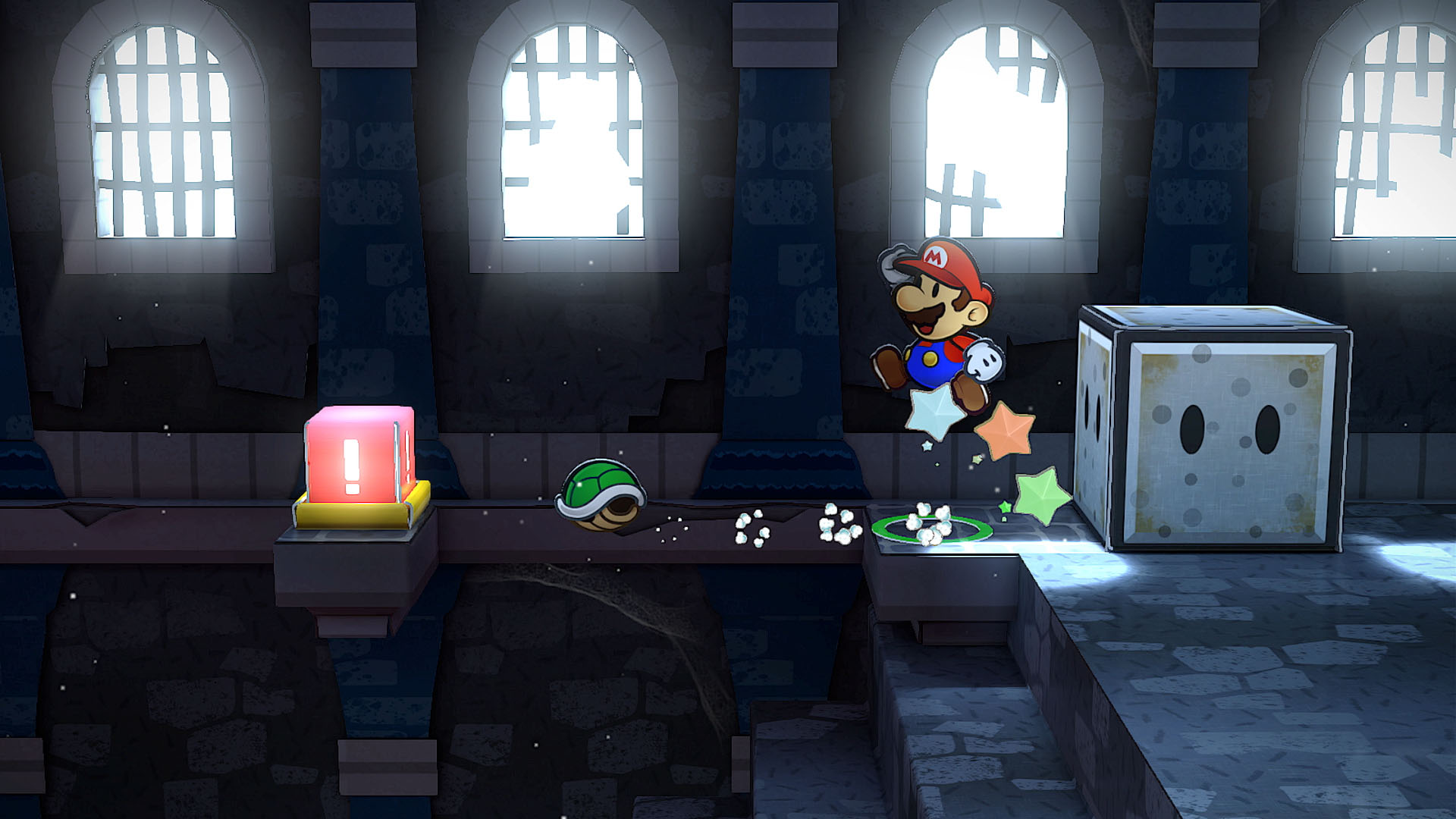
The remake tidies this up rather than rebalancing it. Pressing the Plus Button calls up a Tattle Check on any enemy already logged without spending a turn. Successful blocks flash up as GUARD or SUPERGUARD in green. A partner who is knocked out gets back up with 1 HP after the battle, every partner is fully healed when Mario levels up, and FP Plus or HP Plus badges worn at the time increase the gain. Running away no longer scatters coins, bosses now pay out coins when beaten, and enemy projectiles in the field simply hurt Mario instead of starting a fight.
A few numbers moved. Power Lift needs four matching panels for each point of attack or defence, not five; Sweet Treat throws two Poison Mushrooms into the mix, not three; every stage hazard now ignores defence; and Sleepy Sheep lasts three turns. The timing windows for long Power Bounce and Multibonk chains tighten faster than they did, and the sums behind Star Power were reworked to lean more on the crowd and less on perfect commands. Hooktail, Gloomtail and Bonetail now dip their heads obligingly when a jump is aimed at them.
A Bingo! during the Blooper fight.Professor Frankly’s Superguard lesson.The new stage-hazard tutorial on the Path to Shhwonk Fortress.
Music: new arrangements and Nostalgic Tunes
Every track has been arranged afresh, in a style close to the later Paper Mario games, and recorded with live musicians: a big band, an orchestra, a choir and world-music instruments. Where the GameCube score leaned on synthesiser and chiptune, the new one swings between jazz, rock and orchestra. Battle music now changes from area to area, each battle theme has its own victory fanfare, the opening bars shift depending on who struck first, and the tune drops into a quieter “thinking” version if you sit on a menu too long. The ordinary battle theme begins with a nod to the Ground Theme of Super Mario Bros.
There are entirely new pieces as well: themes for each partner and for Kroop, Koopie Koo, Goldbob and Flavio, a unique theme for the Atomic Boo, eerie replacements for the Twilight Town music while Mario is a shadow, and new credits music built from the cast’s leitmotifs. The room in front of the Thousand-Year Door gains an instrument for every Crystal Star brought back.
Anyone who would rather hear 2004 can buy the Nostalgic Tunes badge, which looks like a GameCube, costs one coin and takes no Badge Points. Speech has changed too: the single text-box blip has been replaced by a different babble for every species, with sampled voices for Luigi, Peach, Bowser, Toadsworth and the Toads.
Nostalgic Tunes on sale for one coin.The Sound Gallery music player.
Paper powers, partners and life in Rogueport
Mario’s four “curses” return: Plane Mode on the Y Button at marked panels, Paper Mode on ZR to slip through bars, Tube Mode to roll under low gaps and Boat Mode for water. Each partner has a field skill on X: Goombella’s Tattle, Koops’s shell (which now shows a marker where it was launched from), Flurrie’s gust, a ride on Yoshi Kid, Vivian’s dive into the shadows, Bobbery’s bomb and Ms. Mowz’s nose for hidden items. You can now open doors and start conversations without climbing off Yoshi first.
Rogueport’s side attractions have been adjusted. The Trouble Center still hands out one job at a time, but a mouse called Ian Foomus now loiters there with advice, six jobs pay 30 coins where they paid 20, and the Lovely Howz of Badges keeps its unsold stock in a box at the far end of its counter. The Pianta Parlor’s slot machines have become picture-matching games in the manner of the Spade Panel in Super Mario Bros. 3, and tokens can be bought 50 at a time. Zess T. cooks from the international recipe list in every region, with the formerly Japan-only Trial Stew (a Thunder Bolt and a Thunder Rage) restored, and her cooking scenes can be skipped.
In the Glitz Pit, losing a bout no longer costs Mario a rank, a screen in the lobby lists every fighter, and, because Mario can no longer slide down the table, two teams, Wings of Night and The Destructors, are met only in Exhibition Matches. Glitzville’s hot-dog standee is now a photo spot with three zoom levels and three poses for each partner.
Plane Mode at Hooktail Castle.Riding Yoshi Kid across the rooftops of east Rogueport.The photo spot beside Glitzville’s hot-dog stand.
A revised script, and Vivian
The remake is available in a dozen language settings, six of them new to this game: Dutch, Korean, Simplified and Traditional Chinese, Canadian French and Latin American Spanish. The English text was revised throughout, reportedly to remove stereotypes and insults, fix mistranslations and bring it closer to the Japanese. Some of the results are small: the partner formerly listed as plain Yoshi is now Yoshi Kid, Rogueport Sewers is Rogueport Underground, and “END OF CHAPTER” has become “CLEARED!”. One changes a puzzle: Hooktail is once more afraid of frogs, as she was in Japan, not crickets, so the badge found in her castle is Attack FX G and it croaks. She is also consistently “she” now.
The change that made headlines concerns Vivian. In the Japanese original the youngest Shadow Siren is implied to be a trans woman, though her eldest sister and the game’s own profile of her call her a boy; the 2004 English and German scripts cut every reference and had Beldam call her ugly instead. The remake restores it. In Twilight Town Vivian now tells Mario, in the English script quoted by Pink News and GoNintendo, that “it took me a while to realize I was their sister… not their brother”. The Japanese script was rewritten as well: a new line has her say she has a boy’s body and a girl’s heart, and several lines that called her male are gone. Goombella’s Tattle on her no longer mentions gender at all.
Vivian explains herself to a nameless shadow in Chapter 4.Hooktail’s weakness is frogs again.
Performance and presentation
The one change nobody asked for is the frame rate: 30 frames per second, against 60 on GameCube. As reported by My Nintendo News, Digital Foundry’s analysis found the remake rendering at 1600×900 when docked and 1138×640 in handheld mode, with a frame rate very close to a locked 30 and little anti-aliasing, and credited it with rebuilt geometry for every area, new textures, lighting, shadows and screen-space reflections. Nintendo Life’s reviewer noticed only a dip or two, in crowded cutscenes.
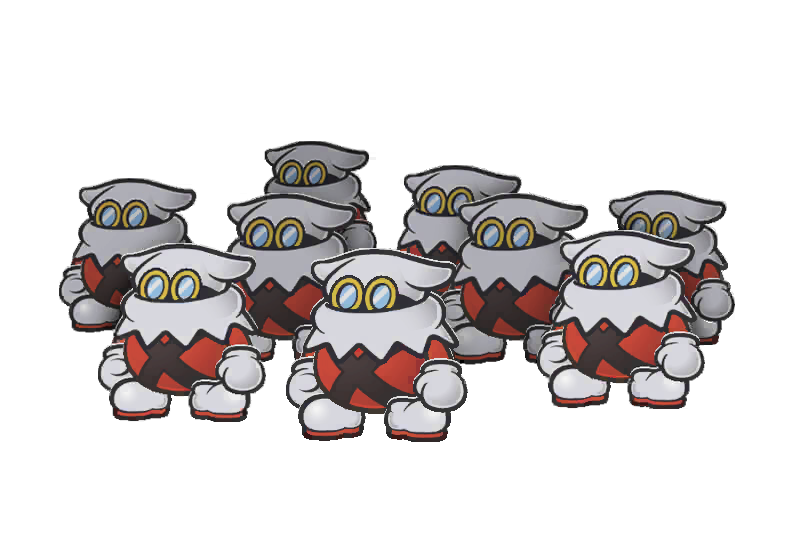
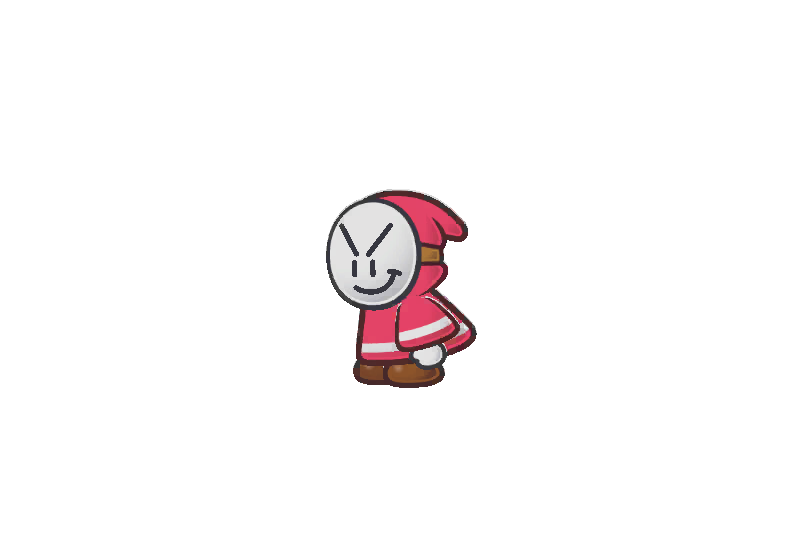
The picture is widescreen, which meant redrawing the interface and reframing cutscenes. Menus look like cardboard cut-outs, houses fold open in more pieces, battle backdrops pop up like a stage set and Black Shy Guy stagehands now scurry on to reset the scenery. Characters have many more expressions and can be seen from behind, Mario dozes off if left alone for three minutes, and the download weighs in at 5.1 GB.
The in-game controls screen with Joy-Con attached.
New and changed badges, trophies and the Crystal Star moves
What the remake adds or alters comes first, then the eight special moves, Mario’s gear and a selection of the badges players ask about most. There are still more than 80 kinds of badge in all.
Nostalgic Tunes (new)0 BP. Plays the GameCube soundtrack. One coin at the Lovely Howz of Badges.
Attack FX G (new)0 BP. Makes Mario’s attacks croak like a frog, which Hooktail cannot bear. Replaces Attack FX R in Hooktail Castle.
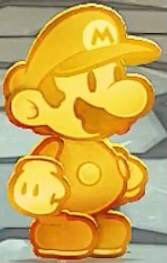
Gold Medal (new)The reward for owning all three trophies. Turns Mario gold, and combines with the L and W Emblems.
Cooking Trophy (new)Awarded for cooking every recipe in the journal.
Badge Trophy (new)Awarded for collecting every badge.
Tattle Trophy (new)Awarded for completing the 134-entry Tattle Log.
Prince Mush’s Belt (new)A keepsake from the first champion of the Glitz Pit, given after you beat him.
Gold Whacka Bump (new)Left behind by Whacka on floor 100 of the Pit. A trophy: it cannot be eaten.
Threatening Note (new)Beldam’s note on the Excess Express is now an item in the inventory.
First Attack (changed)Now costs 0 BP to wear, down from 1. Professor Frankly sends a new e-mail about it.
Hammer Throw (changed)Now does 2 damage that ignores defence, and no longer has its own Action Command.
Sweet Treat (Magical Map)1 SP. Restores HP and FP and cures ailments. Two Poison Mushrooms to dodge, down from three.
Earth Tremor (Diamond Star)2 SP. An earthquake that ignores defence and reaches every enemy.
Clock Out (Emerald Star)2 SP. Stops every enemy for a few turns if it works.
Power Lift (Gold Star)3 SP. Raises attack and defence. Four matching panels per point in the remake, not five.
Art Attack (Ruby Star)4 SP. Draw rings round enemies; every loop is damage.
Sweet Feast (Sapphire Star)5 SP. A bigger helping of Sweet Treat.
Showstopper (Garnet Star)2 SP. Can knock out ordinary enemies at a stroke. No use on bosses.
Supernova (Crystal Star)6 SP. Heavy damage to everything on stage.
Super BootsThe Great Tree, Chapter 2. Adds the Spin Jump.
Ultra BootsRiverside Station, Chapter 6. Adds the Spring Jump, which now whistles as Mario rises.
Super HammerGlitzville, Chapter 3. Big blocks now need a fuller charge to break.
Ultra HammerRogueport, once Mario has the Ultra Boots. Breaks stone blocks.
Power Bounce3 BP. Keep jumping on one enemy until a command is missed. The timing tightens sooner than on GameCube.
Quick Change7 BP. Swap partners in battle without losing the turn.
Peekaboo2 BP. Shows every enemy’s HP without a Tattle.
Simplifier1 BP. Easier Action Commands for less Star Power.
L Emblem0 BP. Luigi’s colours. In the remake Doopliss’s copy of Mario wears them too.
W Emblem0 BP. Wario’s colours; with the L Emblem, Waluigi’s.
Return Postage7 BP. Bonetail’s treasure on floor 100 of the Pit. Anything that touches Mario takes half the damage back.
Cartoons, Comics & Other Media
Nintendo promoted the remake with pre-order trinkets, paper-craft and a great deal of nostalgia for the GameCube box. The game returns the compliment with a string of musical in-jokes.
Buildable battle stageMy Nintendo Store, Europe · 2024The European My Nintendo Store sold the game in a bundle with a buildable diorama of the battle stage, complete with several characters and enemies, and gave Mario, Goombella and Yoshi Kid keychains with pre-orders.
Retailer pre-order bonusesAustralia, Canada and the UK · 2024In Australia, EB Games offered an A5 magnet sheet and JB Hi-Fi a set of fold-up Mario paper planes, as reported by Vooks. GameStop Canada gave away a slipcover printed with the 2004 GameCube cover. In Britain, Nintendo Life’s buying guide listed paper planes and sticker sheets at Amazon, ShopTo and The Game Collection.
A GameCube cover for your Switch caseMy Nintendo · 2024My Nintendo offered a printable North American GameCube cover sized for a Switch case, along with bookmarks, a notepad, a scrapbook kit, wallpapers and a May 2024 calendar.
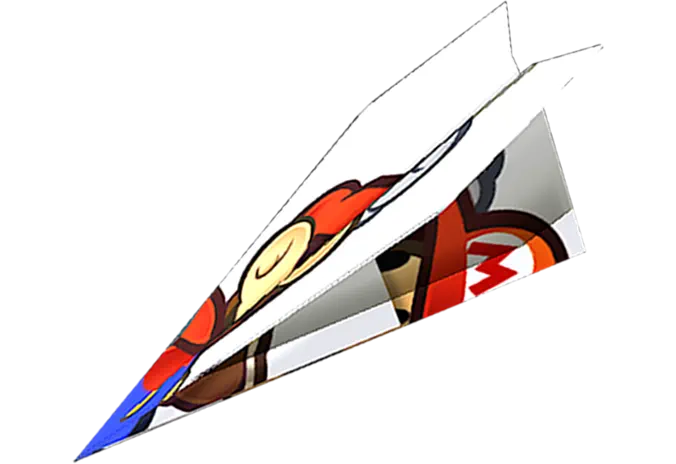
Paper aeroplane templateNintendo of America · 26 May 2024Three days after launch Nintendo of America published a printable paper plane decorated with art from the game and a folding tutorial presented by John Collins, “The Paper Airplane Guy”, who held the Guinness World Record for the farthest paper-plane flight from 2012 to 2022.
Snapchat LensNintendo of America · 30 May 2024A Snapchat Lens folded the user’s photo into an augmented-reality paper plane, in imitation of Plane Mode.
Character relationship chartNintendo Magazine 2024 SummerNintendo’s free magazine printed a diagram of who is who and who is cross with whom. Nintendo of America later posted an updated version.
Peach’s letterPromotional image · 2024The letter that starts the story was issued as a promotional image in its own right.
Mario RPG surveysNintendo of Europe and Nintendo of America · April 2024Before release Nintendo of Europe e-mailed some newsletter subscribers a survey about the Mario role-playing games, covering Paper Mario, Mario & Luigi and Super Mario RPG, and Nintendo of America ran one that asked about this remake.
Echoes of other gamesInside the remakeThe new battle theme opens with the Ground Theme motif from Super Mario Bros.; Luigi reads Peach’s letter to an arrangement of the castle music from Super Mario 64; the title theme of the first Paper Mario plays for Parakarry and, after the credits, for Lady Bow; one of Bowser’s themes borrows his motif from The Origami King; and the Dry Bones ambush in the Palace of Shadow nods to the tower music of New Super Mario Bros. Wii. The Game Boy in the Pianta Parlor and the Game Boy Advance terminals in the Glitz Pit now make their real start-up sounds.
Advertisement
Characters
The cast is the one fans remember, redrawn on thicker paper with far more expressions and, for the first time, backs to their heads. Partners keep their GameCube moves and HP. Two old acquaintances step up to become bosses, and two newcomers help out in town.
Character
Who they are
In this game
Abilities & notes
MarioThe Great Gonzales
The silent hero, summoned to Rogueport by a letter and a map. His front-on face now follows the design used in The Origami King.
Collects the seven Crystal Stars, picks up four paper “curses” and loses his body and name to a ghost in Chapter 4. New in the remake: he can hammer towards and away from the screen, teeters on ledges and gives a thumbs-up in conversation.
Starts with 10 HP, 5 FP, 3 BP Voice clips by Charles Martinet, reused from 2004
GoombellaPartner 1 · Rogueport, prologue
A sharp-tongued Goomba student from the University of Goom, hunting the same treasure as Mario.
Tattles on people, places and enemies with X. In the remake she is also the voice of the hint system: press ZL and she will usually be the one to say where to go next, even when another partner is out.
A timid Koopa Troopa who wants to face the dragon that took his father.
His shell is kicked out to hit switches and fetch items, or held and released from a distance. The remake draws a green marker and arrow where the shell was launched. Now speaks in Koopa Troopa sound effects from Super Mario 64.
HP 10 / 15 / 25, Defence 1 Shell Toss, Power Shell, Shell Shield, Shell Slam
Madame FlurriePartner 3 · Boggly Woods, Chapter 2
A wind spirit and retired actress living in seclusion in the woods.
Joins when Mario returns her necklace. Her breath strips away loose paper and, in the remake, reveals the door to the new pipe room and blows down posters hiding new items at Riverside Station.
HP 15 / 25 / 35 Body Slam, Gale Force, Lip Lock, Dodgy Fog
Yoshi KidPartner 4 · Glitzville, Chapter 3
A new-born Yoshi with attitude, hatched from an egg saved from the hot-dog stand. Simply “Yoshi” in the 2004 menus; the remake makes Yoshi Kid official.
Mario rides him to run faster and flutter over gaps, and can now open doors and talk without getting off first. His colour, one of seven, depends on how long the egg was carried, and the title screen shows the colour you got. You name him with the Switch’s own keyboard.
HP 10 / 20 / 30 Ground Pound, Gulp, Mini-Egg, Stampede Voiced by Kazumi Totaka
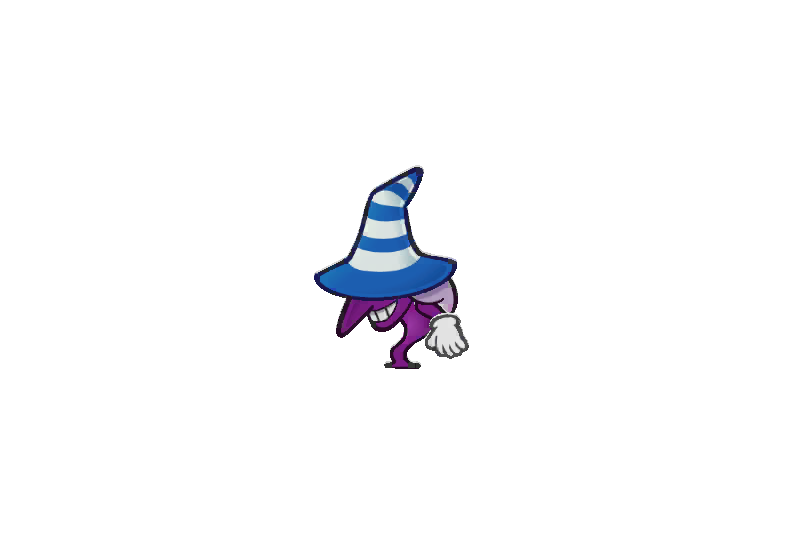
VivianPartner 5 · Twilight Town, Chapter 4
The youngest of the three Shadow Sirens, bullied by her eldest sister Beldam. The remake’s English script says plainly what the Japanese original implied: she is a trans woman.
Changes sides after helping a nameless shadow who turns out to be Mario. Pulls him down into the shadows, where enemies and hazards pass overhead. Her Veil has a new sound effect.
A retired Bob-omb admiral still grieving for his wife, Scarlette.
Talked back to sea for the voyage to Keelhaul Key. He can be set down or thrown to blast cracked walls. His voice in the remake is a lower-pitched version of the Bob-omb sound.
HP 20 / 30 / 40 Bomb, Bomb Squad, Hold Fast, Bob-ombast
Ms. MowzPartner 7 · optional
A Squeek, a cat burglar and the owner of the Lovely Howz of Badges.
Joins only if Mario takes her anonymous Trouble Center job after Chapter 4. Sniffs out hidden items. Stolen coins no longer need her Kiss Thief to recover: beating a Bandit before it escapes now returns them.
HP 15 / 20 / 25 Love Slap, Kiss Thief, Tease, Smooch
Princess PeachPrisoner of the X-Nauts
The only person pure-hearted enough to open the box with the map in it, which is why it was offered to her.
Playable after each of the first seven chapters, teaching a computer about love and e-mailing Mario what she learns. In the finale the Shadow Queen takes her body. Her intermissions were tightened: the dance uses held buttons and she can no longer wander Grodus’s room in disguise.
Voice clips by Jen Taylor Appears on the title screen once her first intermission is cleared
TEC-XXThe X-Nauts’ computer
The machine that runs the X-Naut Fortress, undone by a glimpse of Peach on its own cameras.
Trades e-mail access for lessons in feeling, turns on Grodus, has its memory wiped and spends its last power sending Mario after the princess.
Its camera eye is red in every region in the remake; in 2004 it was blue outside Japan
Bowser and Kammy KoopaThird in a two-horse race
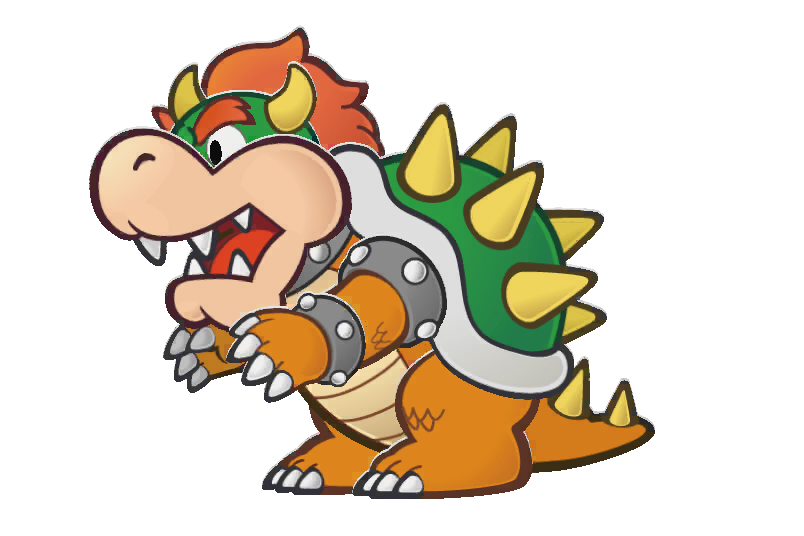
The Koopa King and his elderly Magikoopa adviser, outraged that somebody else has kidnapped the princess.
Playable in the intermissions, always a town behind Mario. Fought in the Glitz Pit in Chapter 3 and in the Palace of Shadow in Chapter 8; the two fights now have separate Tattle Log entries. Bowser has new music, and his fire breath makes bystanders flinch.
Bowser: 30 HP, then 70 HP Kammy Koopa: 50 HP Voice clips by Scott Burns; Kammy by Atsushi Masaki
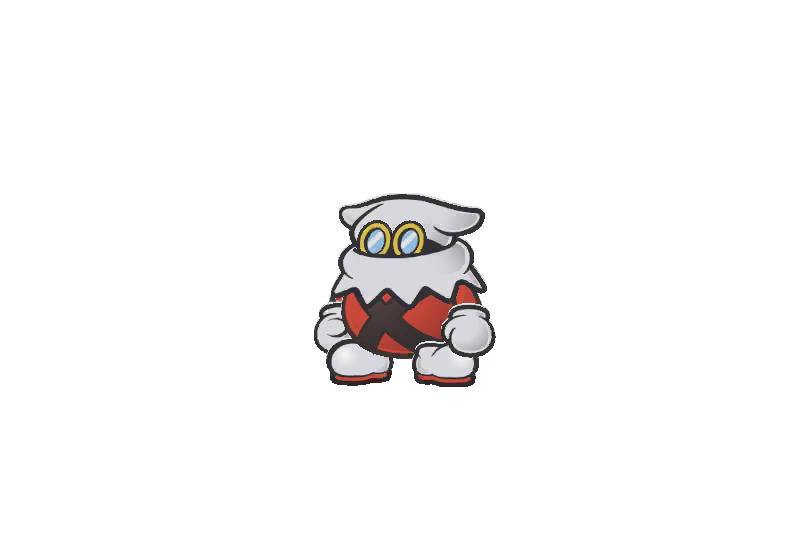
Professor FranklyThe man who reads the map
An elderly scholar in Rogueport who knows the legends of the Thousand-Year Door.
Interprets the Magical Map after every chapter and teaches the Superguard. In the remake he also e-mails about the First Attack badge, and the bin in his house can be searched from the very start.
Gives Mario the Power Smash badge
LuigiHero of the Waffle Kingdom
Mario’s brother, who has an epic of his own off-screen and returns to Rogueport after each chapter to describe it at length.
Reads Peach’s letter at the start, now to the castle music from Super Mario 64, and sells his memoirs as the Super Luigi books. Buy and read all five and he joins the title screen. He watches the credits from the audience.
Partners: Blooey, Jerry, Torque, Hayzee, Screamy Five Super Luigi books
Sir GrodusLeader of the X-Nauts
The ruler of the X-Nauts, directing the hunt for the stars from the Moon.
Has Peach kidnapped and means to rule the world through the Shadow Queen, who reduces him to a talking head the moment she wakes. He ends the story retired to Poshley Heights.
50 HP, attack 7, defence 1 Shielded by Grodus Xs Pays 50 coins in the remake
Lord CrumpX-Naut general
Grodus’s loud, clumsy field commander, and the villain Mario meets most often.
Fought on the dock, in two Magnus von Grapple robots and aboard his warship, where he now summons his troops with a remote control. His theme is heard in more scenes than before.
5 HP in the prologue, 30 HP in Chapter 5 Magnus von Grapple: 30 HP; version 2.0: 70 HP
Beldam and MarilynThe Three Shadows
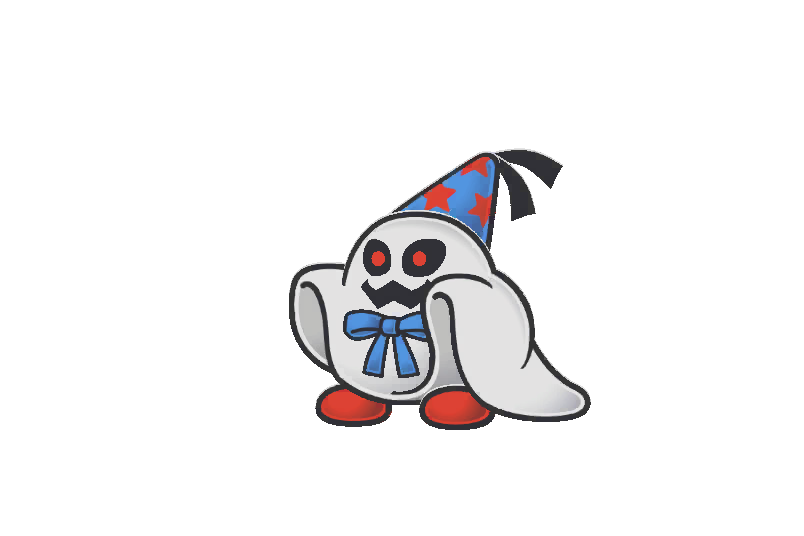
The Shadow Sirens, called the Three Shadows on the remake’s artwork: Beldam gives the orders, Marilyn says “Guh”, and Vivian takes the blame until she leaves.
Ambush Mario in Boggly Woods, steal the wrong star in Poshley Sanctum and make a last stand in the palace with Doopliss. Beldam is unmasked as the Shadow Queen’s servant and the author of the whole plot. Both sisters now have a second Tattle Log entry for the rematch.
Chapter 2: Beldam 9 HP, Marilyn 12 HP Chapter 8: Beldam 30 HP, Marilyn 40 HP
DooplissThe Creepy Steeple’s ghost
A shape-shifting ghost whose bell turns Twilight Town’s people into pigs.
Steals Mario’s identity in Chapter 4 and later impersonates Zip Toad and Professor Frankly. The remake gives him new tricks: his copy of Mario wears whatever emblem badges Mario has on, he can hurt Mario in the hopeless fight on Twilight Trail, and he revives himself with a Life Mushroom if beaten too quickly.
40 HP, attack 4 in Chapter 4 40 HP, attack 6 in Chapter 8 100 coins for each steeple fight
The Shadow QueenWhat is behind the door
The demon who sank the old city a thousand years ago and was sealed beneath it by four heroes wielding the Crystal Stars.
Woken by Grodus, she possesses Peach and is the final boss. Her spells are no longer black: the lightning is yellow and her strongest attack glows purple. Each of her two forms has its own Tattle Log entry.
150 HP, attack 7, defence 1 200 coins, and no longer a single Star Point
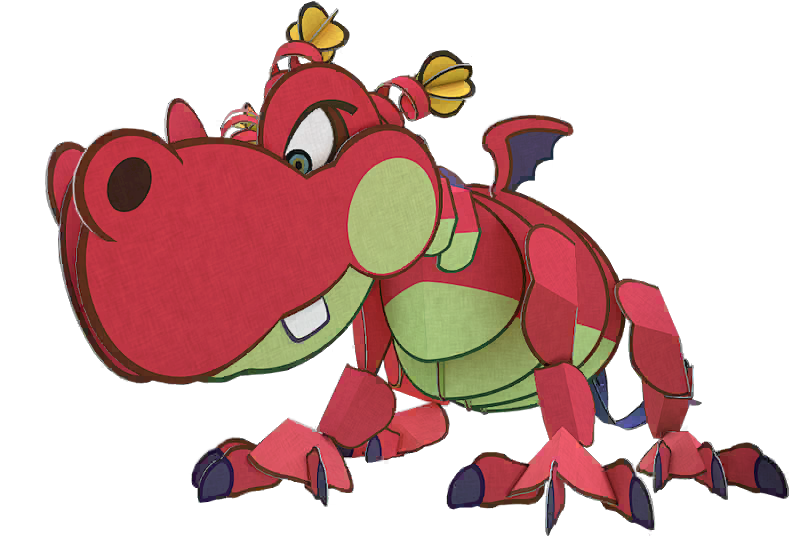
HooktailDragon of Petal Meadows
The red dragon who has been eating the people of Petalburg. Sister of Gloomtail and Bonetail, and consistently “she” in the new script.
Boss of Chapter 1. She is afraid of frogs in every language now, so the Attack FX G badge weakens her each time it croaks. Her fire engulfs the party in flames, and the last part of the fight is staged in front of the seats.
20 HP, plus 10 when she revives by eating the audience Attack 5, defence 1 100 coins
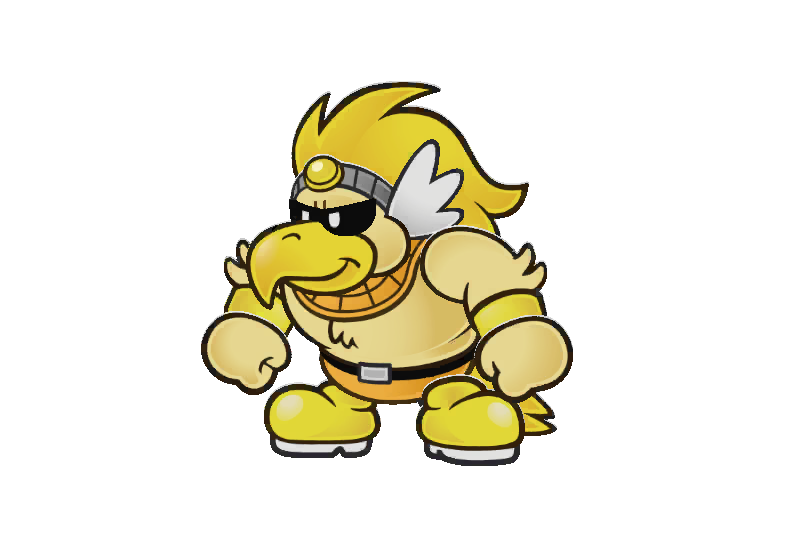
Rawk HawkChampion of the Glitz Pit
The Pit’s swaggering title-holder.
Has Mario locked in a changing room before the title match and loses a belt whose star was only glass. No battle condition is set for his match in the remake, and a photo of him shaking hands with Prince Mush hangs in his training room.
40 HP, attack 4 Can be challenged again for the title once Mario is back at the top of the rankings
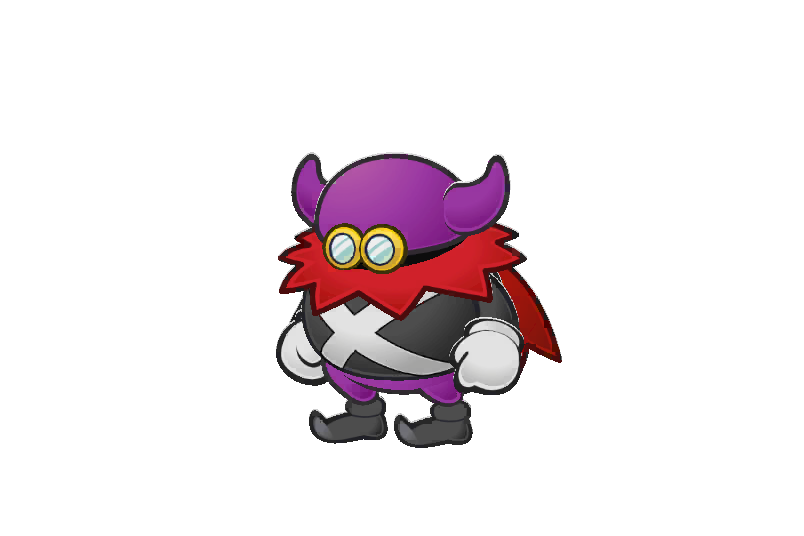
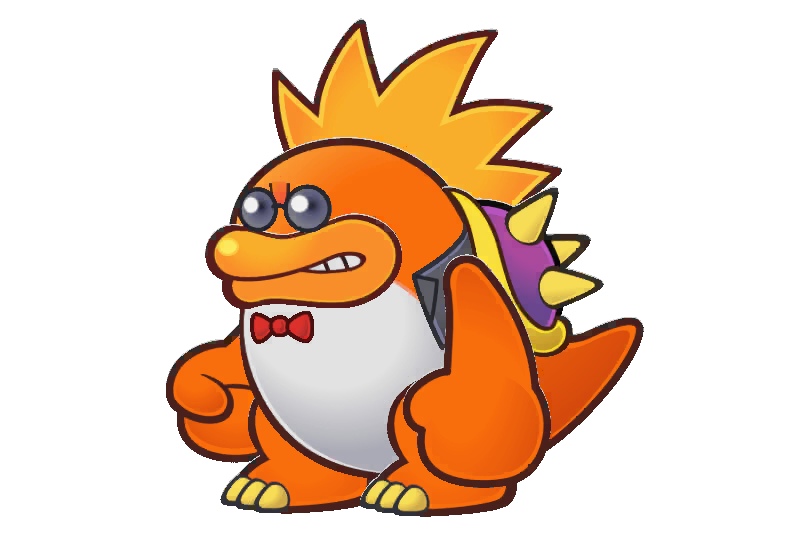
Prince MushNew boss · Glitz Pit
A Toad martial artist, the Glitz Pit’s original champion and Jolene’s younger brother, drained by Grubba’s machine before the story begins.
In 2004 he simply walked out of the machine and into the epilogue. In the remake he trains, e-mails a challenge and fights Mario in an Exhibition Match as “the Returning Royal”, swapping stances every turn and, at half health, throwing out after-images of himself.
96 HP, attack 6, defence 6 Tattle Log entry 134 Reward: Prince Mush’s Belt
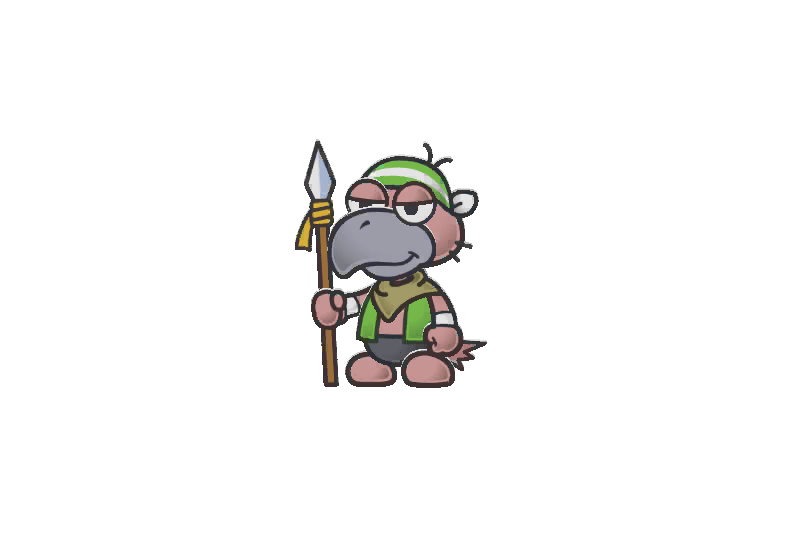
WhackaNew boss · Pit of 100 Trials
The mild blue creature on Keelhaul Key who drops a tasty Whacka Bump every time Mario hits him on the head.
Hit him until he disappears and, in the remake, he comes back for a rematch on floor 100 of the Pit. He attacks by flinging his own bumps, shakes props down from the rafters and eats a bump to heal.
108 HP Bumps hit for 10 each; a red bump hits for 25 and heals him by 75 Rewards: Gold Whacka Bump, 100 coins
The Battle MasterNew character
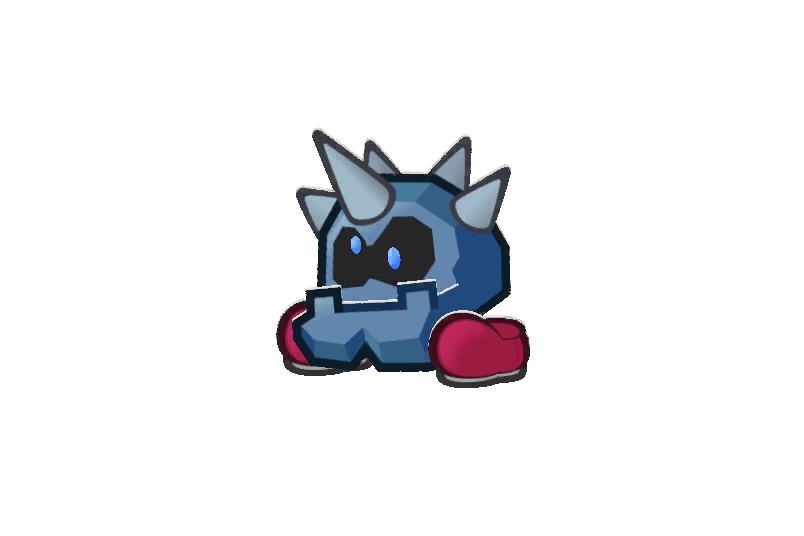
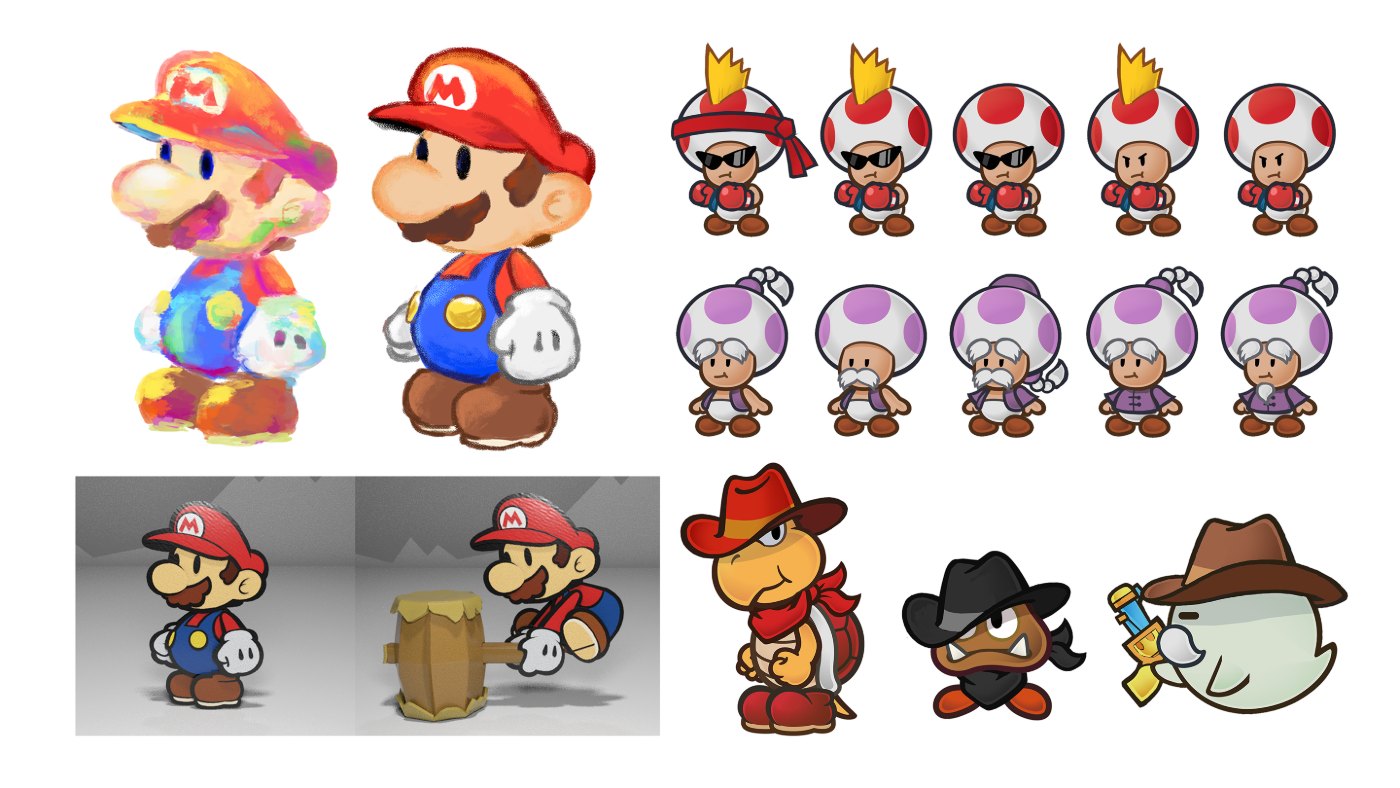
A purple Toad in a sensei’s outfit, found in towns across the world. Early concept art gave him boxing gloves, sunglasses and a mohawk.
Sets up a practice stage with cardboard Goombas, the Goomboards, so that Mario can rehearse Action Commands, guards and Superguards. The Goomboard has its own Tattle Log entry.
Found in several towns, Rogueport and Glitzville among them
Ian FoomusNew character
A Little Mouser who hangs about the Trouble Center in Rogueport.
Offers advice on whichever Trouble has you stuck. Hints for active jobs are also kept in the new Notes tab.
Trouble Center, Rogueport
Bosses & enemies
Every boss in order, then a dozen of the regular enemies, chosen because the remake changed them or because they show off the new Tattle Log art; the full bestiary has 134 entries. HP figures are for the remake where we could confirm them (the prologue to Chapter 3, and both new bosses) and otherwise from the GameCube game, whose numbers the remake keeps as far as documented changes show. The coin rewards are new: bosses paid nothing in 2004.
Lord Crump (boss)Prologue · Rogueport · 5 HPThe tutorial fight on the quay.
Gus (boss)Prologue · Rogueport · optional · 20 HP, ATK 3A Craw with a threatening manner. Fighting him is optional.
Blooper (boss)Prologue · Rogueport Underground · 12 HPNow fought over animated water. Pays 50 coins.
Gold Fuzzy (boss)Chapter 1 · Shhwonk Fortress · 10 HPWhistles up its relations when it is in trouble.
Fuzzy Horde (boss)Chapter 1 · Shhwonk Fortress · 20 HPA seething mass of Fuzzies with, at last, a Tattle Log entry of its own.
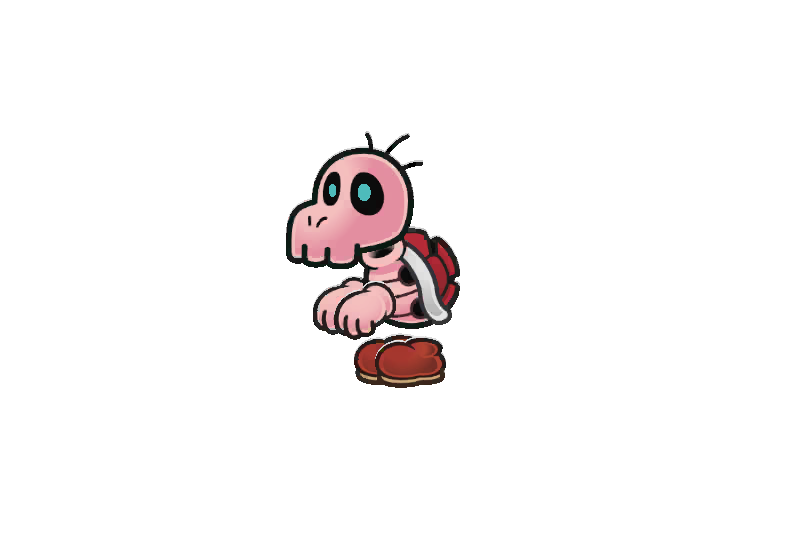
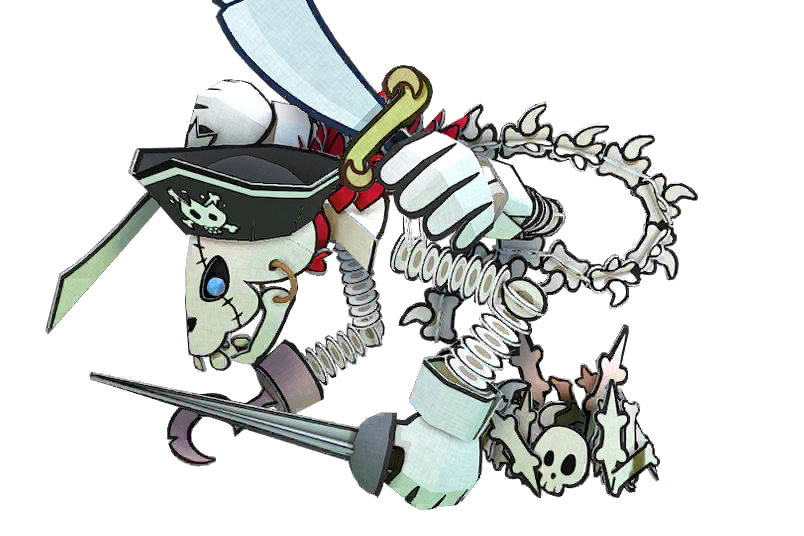
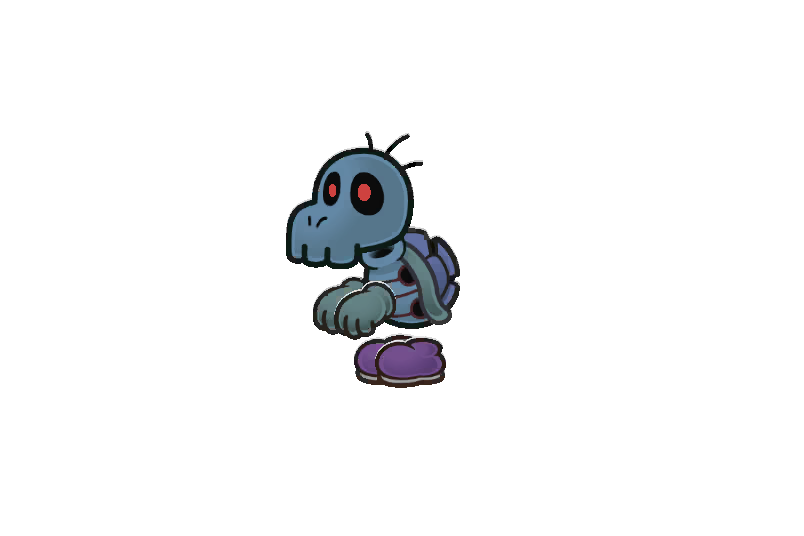
Red Bones (boss)Chapter 1 · Hooktail Castle · 5 HP, ATK 3, DEF 1A red skeleton Koopa with four Dull Bones in support.
Hooktail (boss)Chapter 1 · Hooktail Castle · 20 HP (+10), ATK 5, DEF 1Croak at her with Attack FX G and her attack drops by one each time. Pays 100 coins.
The Three Shadows (boss)Chapter 2 · Boggly Woods · 9, 12 and 10 HPBeldam, Marilyn and Vivian, fought for Flurrie’s necklace. A Save Block now stands just before them.
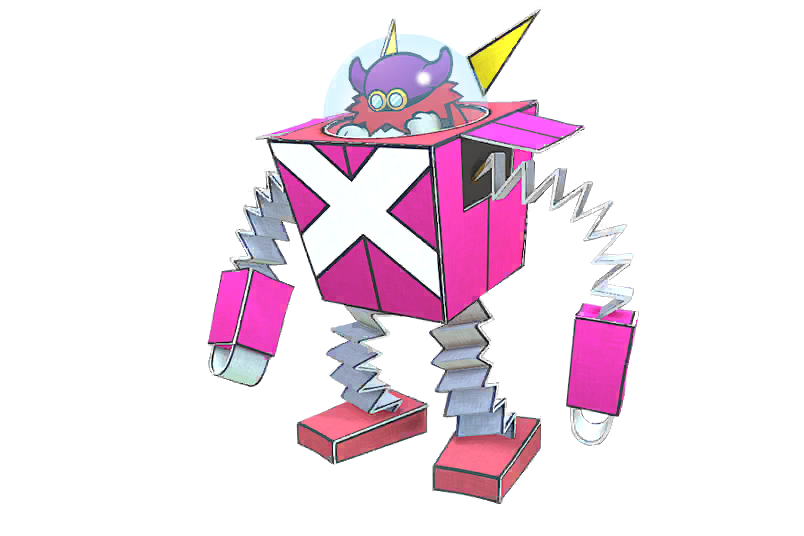
Magnus von Grapple (boss)Chapter 2 · The Great Tree · 30 HP, ATK 2, DEF 1Lord Crump’s robot. Its earthquake now ends on a bigger stomp, to make the block easier to time. 100 coins.
The Iron Adonis Twins (boss)Chapter 3 · Glitz Pit · 6 HP eachImmune to everything except Yoshi Kid’s Gulp. Their first match always carries the condition “use a partner skill”.
Bowser (boss)Chapter 3 · Glitz Pit · 30 HP, ATK 3, DEF 1Climbs into the ring uninvited, to new battle music.
Rawk Hawk (boss)Chapter 3 · Glitz Pit · 40 HP, ATK 4The champion. Lose a later title defence to him and Mario forfeits the belt.
Macho Grubba (boss)Chapter 3 · Glitz Pit · 60 HP, ATK 4Boosts his own attack, defence and speed, and now glows gold while he does it. 100 coins.
Atomic Boo (boss)Chapter 4 · Creepy Steeple · optional · 40 HP, ATK 4A colossal Boo with a new theme of its own and King Boo’s voice. 50 coins and the Lucky Start badge.
Doopliss (boss)Chapter 4 · Creepy Steeple · 40 HP, ATK 4, twiceFirst as himself, then wearing Mario’s face. Partner badges now work in the second fight.
Three Embers (boss)Chapter 5 · Keelhaul Key · 8 HP eachCortez’s ghostly flames, held off by Bobbery alone.
Cortez (boss)Chapter 5 · Pirate’s Grotto · 20 HP × 3, ATK 4, DEF 1Drops on to the stage from above in the remake. Three forms; 100 coins.
Lord Crump and the X-Naut platoon (boss)Chapter 5 · the X-Naut ship · 30 HPCrump calls his men down with a remote control. The platoon is a new Tattle Log entry.
Smorg (boss)Chapter 6 · Excess Express · 50 HP, ATK 5, DEF 1A swarm in the shape of a monster. 50 coins.
Magnus von Grapple 2.0 (boss)Chapter 7 · X-Naut Fortress · 70 HP, ATK 6, DEF 2Fires its fists, then the audience. New arrangement of its theme; 100 coins.
Dark Bones (boss)Chapter 8 · Palace of Shadow · 20 HP, ATK 5, DEF 2A dark skeleton Koopa and four Dry Bones. The Dry Bones horde in the palace has music that tips its hat to New Super Mario Bros. Wii; the Dark Bones battle itself uses a new arrangement of an event-battle theme.
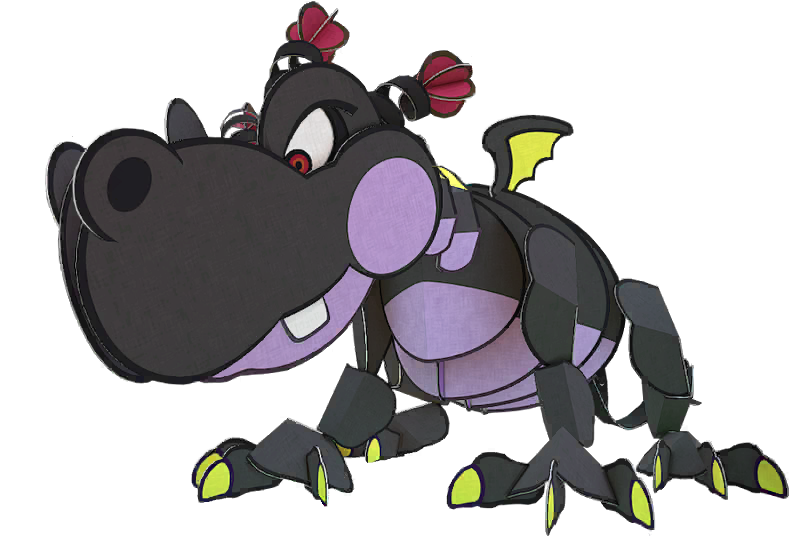
Gloomtail (boss)Chapter 8 · Palace of Shadow · 80 HP, ATK 8, DEF 2Hooktail’s elder brother. His Megabreath is now a jet of fire. 50 coins.
Beldam, Marilyn and Doopliss (boss)Chapter 8 · Palace of Shadow · 30, 40 and 40 HPThe rematch, with separate Tattle Log entries; their HP stays hidden until you Tattle again.
Sir Grodus (boss)Chapter 8 · Palace of Shadow · 50 HP, ATK 7, DEF 1Surrounds himself with Grodus Xs. 50 coins.
Bowser and Kammy Koopa (boss)Chapter 8 · Palace of Shadow · 70 HP and 50 HPStraight after Grodus. Bowser poisons; Kammy casts every boost she knows. 50 coins.
The Shadow Queen (boss)Chapter 8 · Palace of Shadow · 150 HP, ATK 7, DEF 1The final boss, in Peach’s body and then her own. 200 coins.
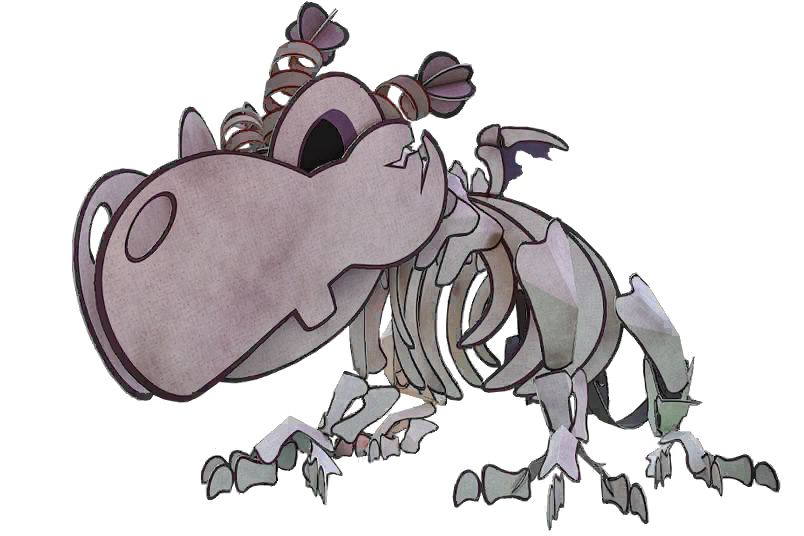
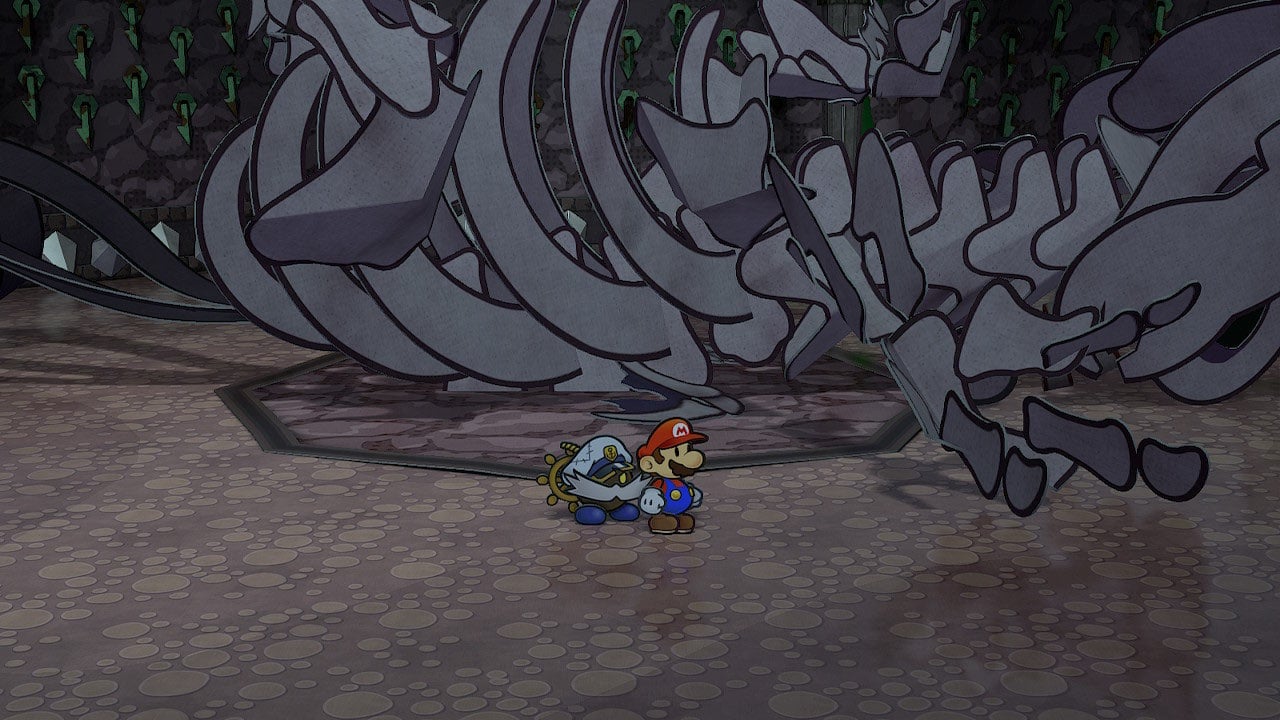
Bonetail (boss)Pit of 100 Trials, floor 100 · 200 HP, ATK 8, DEF 2The third dragon. Her confusing breath is now pink, and she pays 999 coins.
Prince Mush (boss)New · Glitz Pit Exhibition Match · 96 HP, ATK 6, DEF 6Hops to dodge ground attacks and sidesteps aerial ones. A Superguard breaks his stance and drops his defence to 0 for a turn.
Whacka (boss)New · Pit of 100 Trials, floor 100 · 108 HPReplaces Bonetail once unlocked. Every blow knocks out a bump, which he throws back for 10 damage.
GoomboardNew · Battle Master’s practice stageA cardboard Goomba that exists to be hit. Tattle Log entry 10.
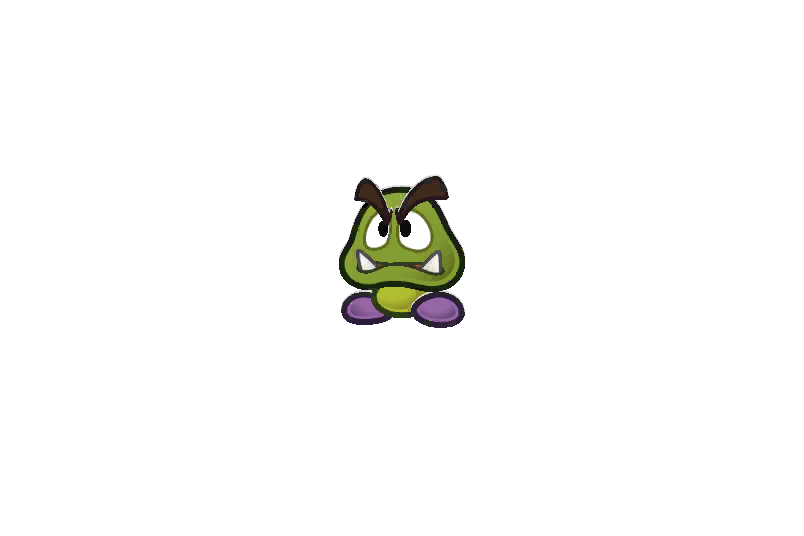
GoombaRogueport Underground, Petal Meadows · 2 HPThe first thing Mario fights. Tattles now name the place you first logged an enemy, not everywhere it lives.
Koopa TroopaPetal Meadows · 4 HP, DEF 1One now springs out of a bush for the stage-hazard tutorial.
FuzzyShhwonk Fortress · 3 HPLatches on and drains HP.
Dull BonesHooktail Castle · 1 HP, DEF 1Now shove Mario back a room, not out of the castle.
BanditGlitz Pit · 5 HPBeat one before it runs and it now gives back what it stole.
Hyper GoombaTwilight Trail · 8 HPCharges up before it strikes.
Crazee DayzeeTwilight Trail · 7 HPIts lullaby has an extra note that visibly strikes, to help with blocking.
Amazy DayzeeTwilight Trail, Pit of 100 Trials · 20 HP, ATK 20Rare, golden and capable of 20 damage in a go.
Frost PiranhaFahr Outpost · 10 HP, ATK 5Freezes with its breath in the remake, no longer with its bite.
Chain ChompPalace of Shadow · 7 HP, ATK 6, DEF 5Now holds still when a jump is aimed at it.
Bob-ulkPit of 100 Trials, floors 91–99 · 10 HPNo longer gives Star Points if it is set off by a chain reaction.
Key staff
The credits open with the line that the remake is based on the work of the GameCube game’s staff, then list a largely new team at Intelligent Systems and Nintendo.
Masahiko NagayaDirectorAlso directed Paper Mario: The Origami King.
Atsushi Ikuno, Taku Sugioka, Risa Tabata, Shinya SaitoProducersTabata had been assistant producer on Color Splash and The Origami King.
Ryota KawadeSupervisorChief director of the 2004 original.
Shingo IgataGame design leadWith Naohiko Aoyama as game design supervisor and Yukio Morimoto leading battle design.
Taro KudoText editing and event supervisorOversaw the revised script and events.
Isamu KamikokuryoArt directorWith Kazuhito Norimoto as visual director and technical art director.
Yu YamanakaProgram directorKaoru Kita, an assistant director on the 2004 game, led battle programming.
Yoshito SekigawaSound director and composition leadThe new arrangements are credited to Kazuki Komai and Fumihiro Isobe, with Koji Kondo among the sound supervisors.
Charles Martinet, Jen Taylor, Scott BurnsVoices of Mario and Luigi, Peach, and BowserMany of the 2004 voice clips are reused, although all three roles have since been recast in newer games.
Kazumi TotakaVoice of Yoshi KidNintendo staff are credited for several creature voices, Nate Bihldorff’s Shy Guy among them.
Kensuke Tanabe, Shigeru Miyamoto, Takashi TezukaSpecial thanksTanabe is thanked here and is not among the credited producers.
TOSE, Marza Animation PlanetSupporting studiosTwo of more than twenty companies listed under Special Thanks in the credits. Wikipedia notes that TOSE assisted with development and Marza with in-game lighting.
How It Was Made
Nintendo has published no developer interview about the remake that we could find, so this account is built from the announcements, the credits and what can be seen in the game.
The announcement and the trailers
The title card from the September 2023 Nintendo Direct.
The remake was revealed in the Nintendo Direct of 14 September 2023, with a trailer that promised the GameCube game would return with updated graphics in 2024. It came two months before the Super Mario RPG remake went on sale, so that for a while two classic Mario RPGs were on the release schedule at once.
The date arrived with Nintendo’s MAR10 Day video on 10 March 2024: 23 May, worldwide. A story trailer, “Our Story Begins”, followed later in March, and a five-minute overview trailer on 24 April set out the partners, the battle system and the Peach and Bowser interludes. Hands-on previews that week confirmed the 30 frames per second that an early look at the first trailer had suggested. Reviews were published on 21 May.
Who made it
Concept art from the Art Gallery: first designs of Mario and the Battle Master.
Nintendo’s store pages name Intelligent Systems as developer, as it was in 2004. The director is Masahiko Nagaya, who had just directed The Origami King, and the producers are Atsushi Ikuno, Taku Sugioka, Risa Tabata and Shinya Saito. Two names tie it to the original: Ryota Kawade, who was chief director then, is supervisor now, and Kaoru Kita, an assistant director then, led the battle programming.
Kensuke Tanabe, a familiar name in the credits of the later Paper Mario games, is not among the producers this time; he appears under special thanks, alongside Shigeru Miyamoto and Takashi Tezuka. The credits also list a long tail of supporting companies, TOSE and Marza Animation Planet among them.
New paper
Early designs for Rogueport and Petal Meadows.
The art direction borrows from the later Paper Mario games: characters cut from thick card with visible edges, objects with construction seams, shiny floors and real-looking light. The remake’s own Art Gallery shows how it got there. Concept pieces for Chapters 2, 5 and 6 draw Mario without shading, as in Color Splash and The Origami King, and early designs for the Mario Bros.’ house, Rogueport and Petal Meadows give the characters white outlines.
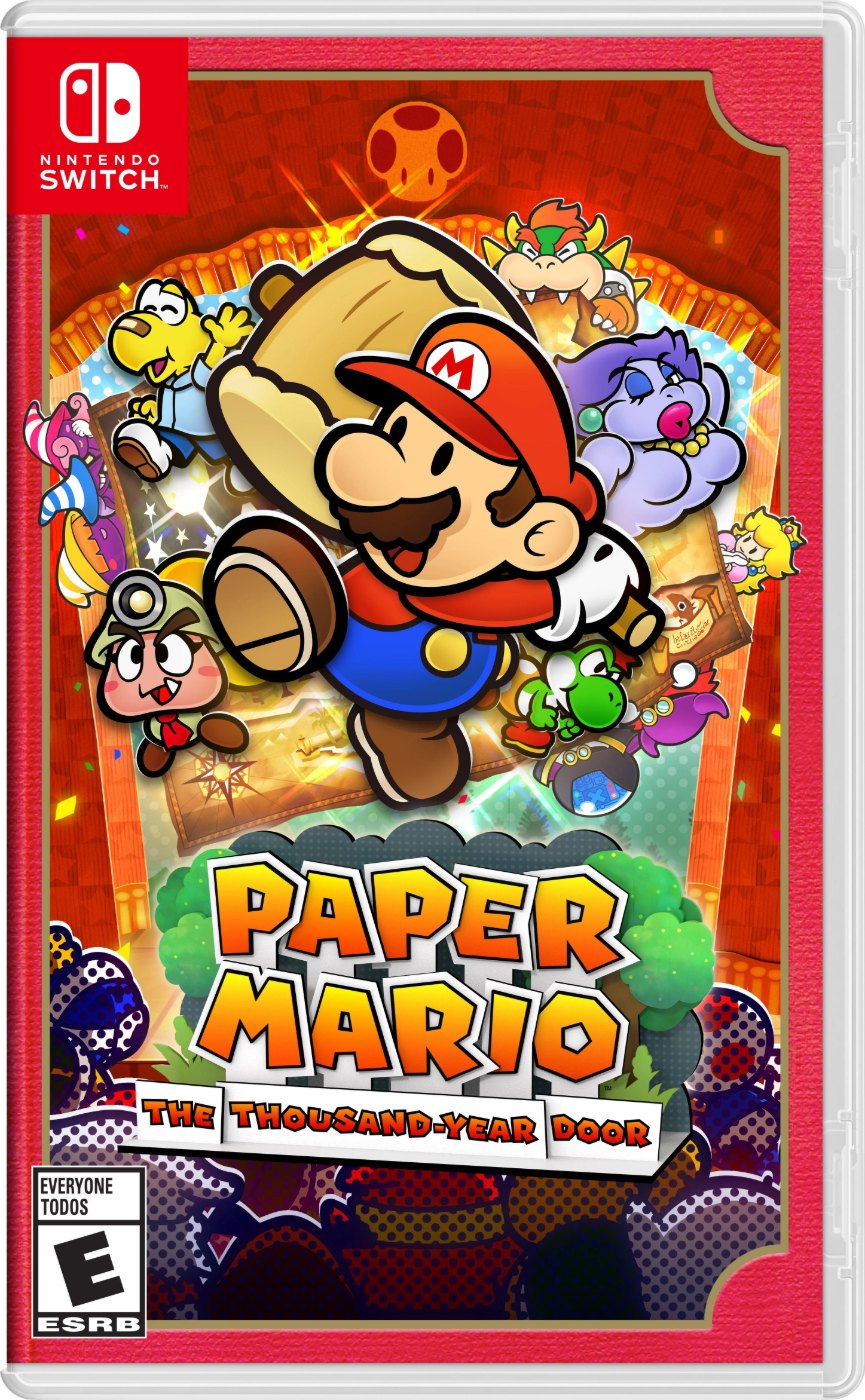
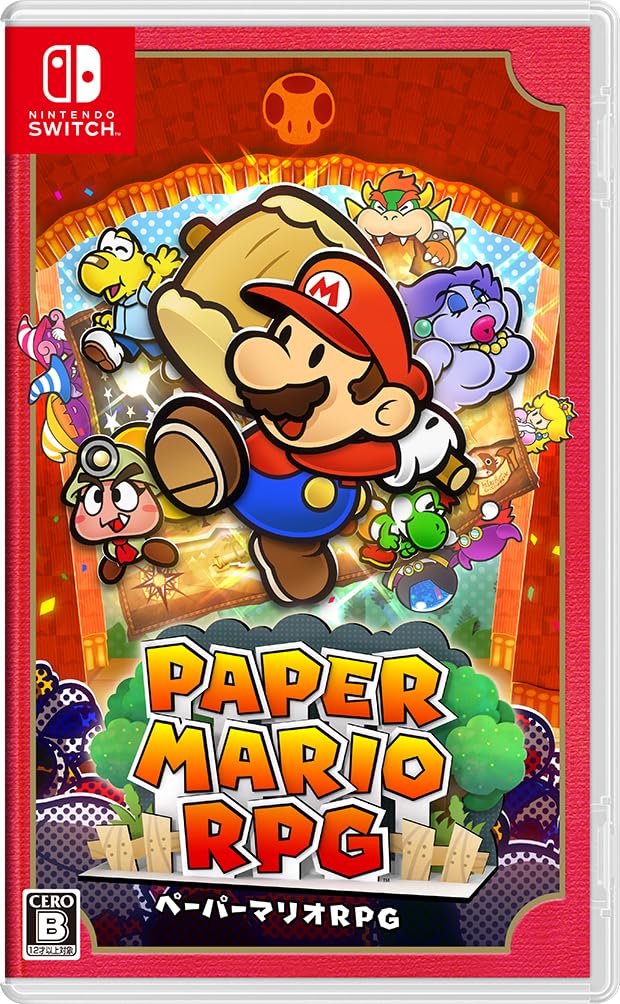
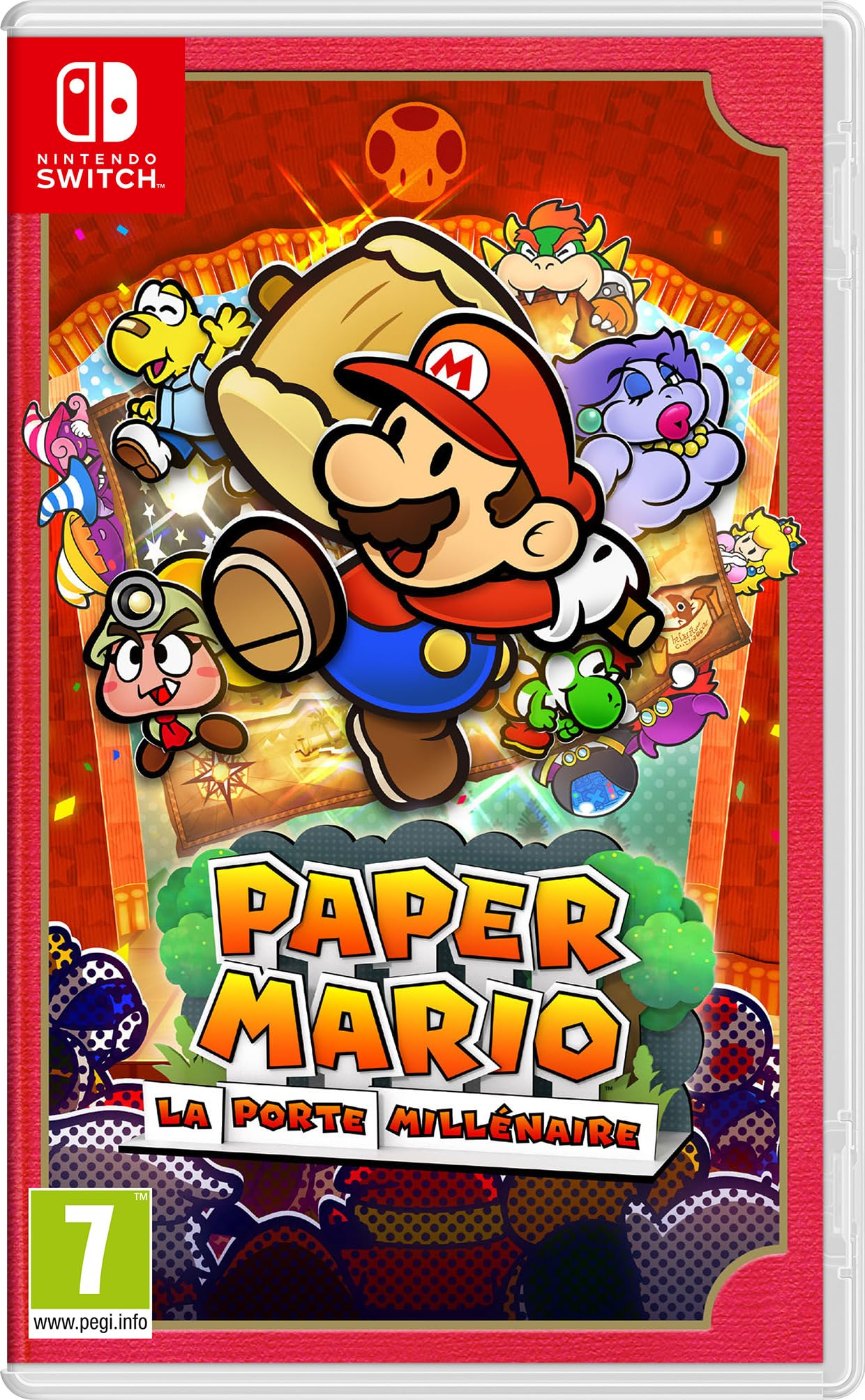
The international logo and box art were redrawn as well, this time following the Japanese originals of 2004, and the age ratings crept up: PEGI 7 from PEGI 3, and CERO B from CERO A.
Version 1.0.1
One update has been released, on 9 July 2024. It closed a hole that let players pass the fallen tree on Twilight Trail without Tube Mode, fixed a freeze after the new tutorial ambush if certain badges were worn, repaired several rare lock-ups in battle and with Ms. Mowz, and corrected typos in English, French, German, Italian and Korean, including a Sound Gallery track that had been labelled “Pedal Meadows”.
Series Firsts
Remakes do not get many firsts, but this one has a handful, each as recorded by the source named.
1The first Paper Mario remakeIt is usually counted as the Paper Mario series’ first remake.
2Six new languagesDutch, Korean, Simplified Chinese, Traditional Chinese, Canadian French and Latin American Spanish translations exist for the first time; the GameCube game had none of them.
3Vivian, in EnglishThe first English (and German) script to present Vivian as a trans woman, which the Japanese original of 2004 implied and the remake’s Japanese script now states outright.
4A GLAAD nominationIts nomination for Outstanding Video Game at the 36th GLAAD Media Awards was reportedly the first time either Nintendo or Intelligent Systems had been nominated by GLAAD.
5Prince Mush in the ringA character who had only ever appeared in cutscenes becomes a boss. By most counts, he and The Master of the first Paper Mario are the only Toads fought as bosses.
6A boss fight with WhackaAfter two Paper Mario games of being hit on the head for snacks, Whacka hits back: the fight is new to the remake.
Cheats & Secrets
No codes, but a good deal of optional content that the remake does not advertise. Little of it needs the credits (Prince Mush can be challenged from Chapter 3 onwards and Whacka once Bonetail is beaten; only the Boo’s last quiz and the title-screen confetti wait for the ending); the Pit of 100 Trials, reached by a pipe west of the Thousand-Year Door, is optional throughout.
Unlocking Prince Mush
Clear Chapter 3, then take Jolene’s Trouble Center request “Help wanted!”. Some time later Jolene e-mails to say that Mush is training and that new Exhibition Matches are available; later still, as Mario leaves Professor Frankly’s house, Mush sends a challenge. Book the match at any league terminal in the Glitz Pit, whatever your rank. The crowd is made up entirely of Toads. He shrugs off every status effect except a Showstopper knock-out, is immune to fire, explosions and electricity, and cannot be hurt by counter-damage. Watch his stance, Superguard when in doubt, and expect attacks worth 20 or more once he powers up. Talk to him in the corridor afterwards for his belt; he can be fought again whenever you like.
Unlocking Whacka
Three conditions: beat Bonetail on the hundredth floor of the Pit of 100 Trials; hit the Whacka on Keelhaul Key eight times, until he stops appearing; then play for roughly thirty minutes (time in menus and loading does not count) and go back to Rogueport. An e-mail headed “RDM Extra Issue” arrives, and Whacka is on floor 100 the next time you get there. Hitting him starts the fight; you may also just leave by the pipe. Side-on blows do less than blows from above. The first win leaves a Gold Whacka Bump, later wins an ordinary bump each time, so the supply is now unlimited.
A kinder Pit of 100 Trials
A Game Over in the Pit now offers a retry of the same floor. Once you have reached the bottom, a Mover by the entrance will send you straight to floor 50 for 300 coins. Battles in the Pit pay coins, Bonetail pays 999, and there is a Save Block and a recovery block at the door.
Three trophies and a Gold Medal
Complete the recipe list for the Cooking Trophy, the badge list for the Badge Trophy and all 134 Tattles for the Tattle Trophy. Own all three and the Gold Medal badge can be collected in Rogueport; wearing it turns Mario gold, and it stacks with the L and W Emblems.
Filling the galleries
Each chapter’s page of the Art Gallery unlocks when you have every Star Piece from that chapter’s areas and have taken its Crystal Star all the way to the Thousand-Year Door. The Sound Gallery works the same way with Shine Sprites. The map screen shows your percentage for each area. With Nostalgic Tunes on, the Sound Gallery plays the GameCube versions.
Exhibition Matches and missed Tattles
Any Glitz Pit team ranked below Mario can be re-fought in an Exhibition Match with no conditions and no effect on rank, which makes it easy to pick up Tattles you missed. Wings of Night and The Destructors can be met no other way. After Chapter 3 Mario’s rank is reset, so you must climb again to reopen the list.
The Creepy Steeple Boo’s quizzes
Free the Boos from the box under the Creepy Steeple and one of them settles in the storeroom with six quizzes about the story. The sixth has fifteen questions and is offered only after the credits. Kooper, Garson and the Mega Star turn up among the wrong answers.
Luigi on the title screen
The title screen fills up as you play: partners appear as they join, Peach, Bowser and Kammy Koopa after their first intermissions, and Luigi on the far left once you have bought and read all five Super Luigi books. Finish the game for falling confetti and a medal on the save file.
Shortcuts worth knowing
In Hooktail Castle, a pipe tucked away behind the Last Stand P badge takes you back upstairs. In the Creepy Steeple, head right from the parrot’s room to open a pipe to the right-most house in Twilight Town. A switch on a cliff on Keelhaul Key calls up a jump pad. The Lovely Howz of Badges keeps badges it is not displaying in a box on the counter, at a mark-up.
Recipes: Trial Stew and the Hottest Dog
Zess T. will now make Trial Stew from a Thunder Bolt and a Thunder Rage in every language; that recipe was in the Japanese GameCube game only. A new dish, the Hottest Dog, is a Hot Dog cooked with Hot Sauce.
Still true from 2004
Ms. Mowz remains an optional seventh partner, won through her anonymous Trouble Center job after Chapter 4; the Atomic Boo is still hiding in the Creepy Steeple with the Lucky Start badge; and the L and W Emblems still dress Mario as Luigi, Wario or, together, Waluigi. Our GameCube page has the full list of secrets, nearly all of which carry over.
Glitches & Oddities
The remake has its share of glitches. Version 1.0.1 closed the worst of them; the badge trick, so far as is known, is still there.
Badge duplication
With a full badge inventory, pick a badge up from the floor, toss one and pick it straight back up: Mario still holds it, and the Lovely Howz of Badges will sell the same badge again, giving two. It works even for one-off badges such as Simplifier. Wearing several copies at once has odd effects.
The Twilight Trail sequence break (fixed)
At launch it was possible to get past the fallen tree on Twilight Trail without Tube Mode, which could strand a save. Version 1.0.1, released on 9 July 2024, closed the gap and moves affected saves back to a point before the tree.
The tutorial softlock (fixed)
The new ambush on the Path to Shhwonk Fortress froze the game if Mario was wearing a badge that alters battles. Fixed in version 1.0.1.
Walking about with a text box open (fixed)
Hammering Ms. Mowz or Goombella twice and then mashing the hammer while calling her ability let Mario move during dialogue, breaking loading zones and cutscene triggers and sometimes crashing the game. Fixed in version 1.0.1.
Tube Mode jumps
Well-placed jumps in Tube Mode reach the Double Dip chest in Rogueport without Boat Mode and a Star Piece under the town without the Ultra Boots; in Paper Mode, the ice-cream standee in Glitzville is a step up to the hot-dog stand’s roof without Plane Mode. On the first trip underground, a jump at the right angle skips the three-Goomba ambush altogether.
Out of bounds in Rogueport
Tube Mode at the right spot beside Bobbery’s house puts Mario inside it with the camera left outside, and Yoshi Kid can be used to clip out of Professor Frankly’s house into a black void.
The Double Dip P softlock
A sequence involving Double Dip P or Triple Dip P, Point Swap, a partner on 0 HP and Quick Change reopens the item menu for the wrong character and hangs the game.
Typos that survived
The update fixed several text slips but left Stampede’s description saying it hits only enemies on the ground when it hits them all.
Videos
Nintendo of America’s reveal trailer from the September 2023 Direct, and the five-minute overview trailer from April 2024.
The announcement trailer, as shown in the Nintendo Direct of 14 September 2023.
Nintendo of America’s overview trailer, published on 24 April 2024.
Trivia & Interesting Facts
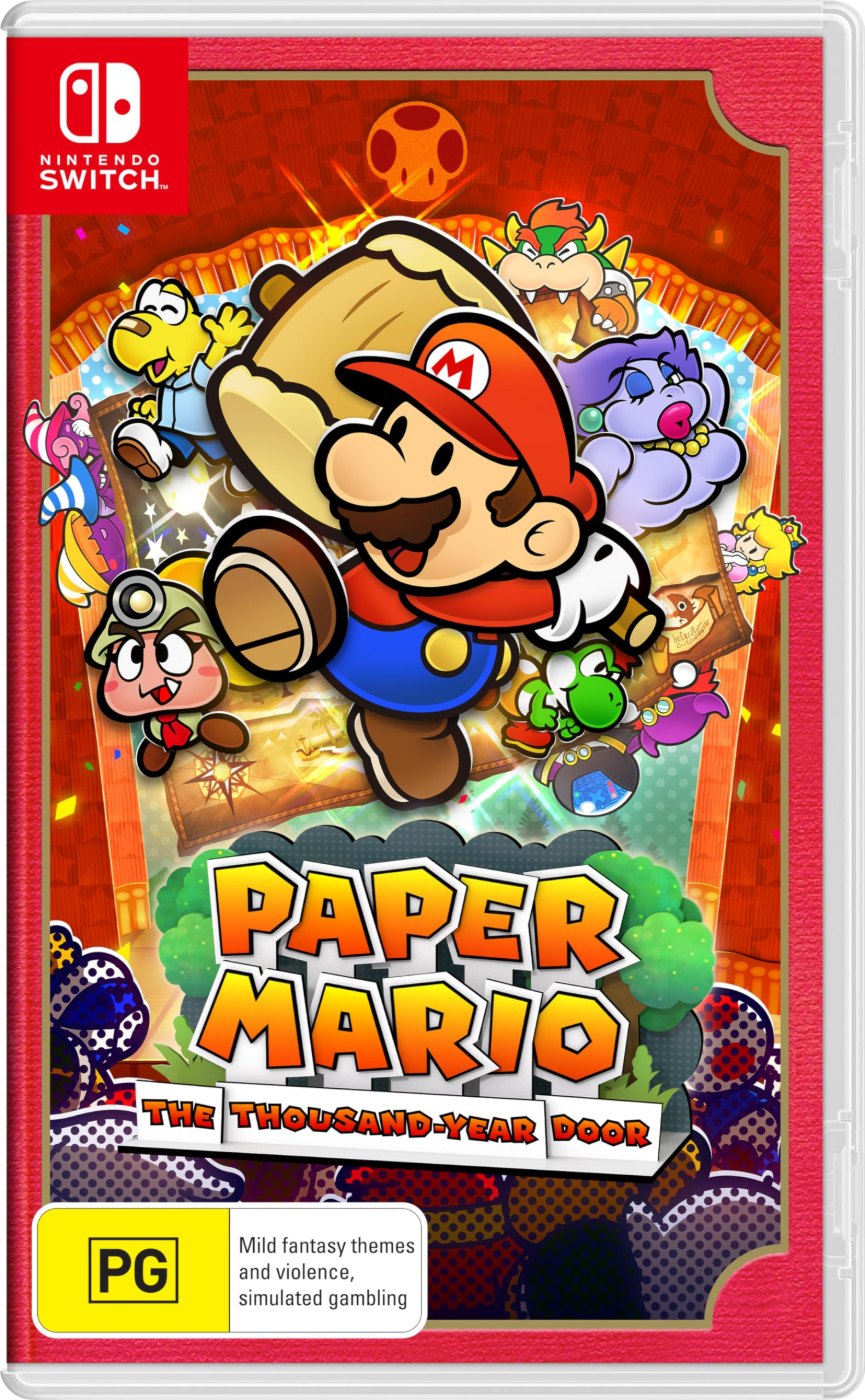
The age ratings went up with the remake: PEGI 7 where the GameCube game was PEGI 3, and CERO B where it was CERO A. Nintendo Australia’s PG rating lists simulated gambling among its reasons.
TEC’s camera eye is red in every region. In 2004 it was red in Japan and blue everywhere else.
Goombella, pixelated.The X-Naut Fortress changing room still turns the party into 8-bit sprites, and the remake has pixel versions of all seven partners, with Yoshi Kid in more than one colour.
Whacka has 108 HP. The number is thought to add the eight blows it takes to drive him off Keelhaul Key to the Pit’s 100 trials, and may also nod to the 108 earthly temptations of Buddhist tradition.
Most boss themes in the Sound Gallery are titled plainly after the boss. Whacka’s is called “Attack-a of the Whacka!”
The jingle for a new e-mail is based on the fanfare that plays after beating a Koopaling in Super Mario World, played much faster.
Flavio’s singing in Chapter 5 is performed on a kazoo, and the kazoo has been added to the Keelhaul Key music to match.
Leave the controller alone for three minutes and Mario falls asleep. He whistles while he sleeps.
If Mario is wearing the L or W Emblem when Doopliss steals his body, the impostor wears the same colours and the people of Twilight Town remark on it.
Koops’s open hands have four fingers in the remake. On GameCube they had five.
Lady Bow in Poshley Heights.Lady Bow and her butler Bootler, from the first Paper Mario, still holiday in Poshley Heights after the credits, and talking to Bow now plays a new arrangement of that game’s title theme.
Save files can no longer be given names. The file screen shows Mario in whatever colours he is wearing, his current partner, and the date and time.
Hitting a partner or a passer-by with the hammer gets a reaction, and so does Bowser’s fire breath in his intermissions. Hit the organ in the Creepy Steeple and it plays.
The game data contains badges that cannot be obtained, among them Mega Jump, Mega Smash, Mega Quake, Triple Dip and partner versions of Lucky Day and Pity Flower.
Sir Grodus and the Peach-shaped Shadow Queen both have laughing animations for when a stage prop lands on Mario. Neither boss ever uses them.
The button prompts are coloured like the buttons of a Japanese or European Super Nintendo controller.
The remake’s credits do not show copyright lines at all; they have moved to the Switch home menu’s software information.
Prince Mush’s Tattle hints that he cannot stand cake, the suggestion being that he once fell for the same poisoned-cake trick Rawk Hawk tries on Mario.
Peach’s waltz with TEC has adaptive music: dance badly and it drifts off-key, then most of the orchestra gives up and a metronome ticks in.
Regional Box Art
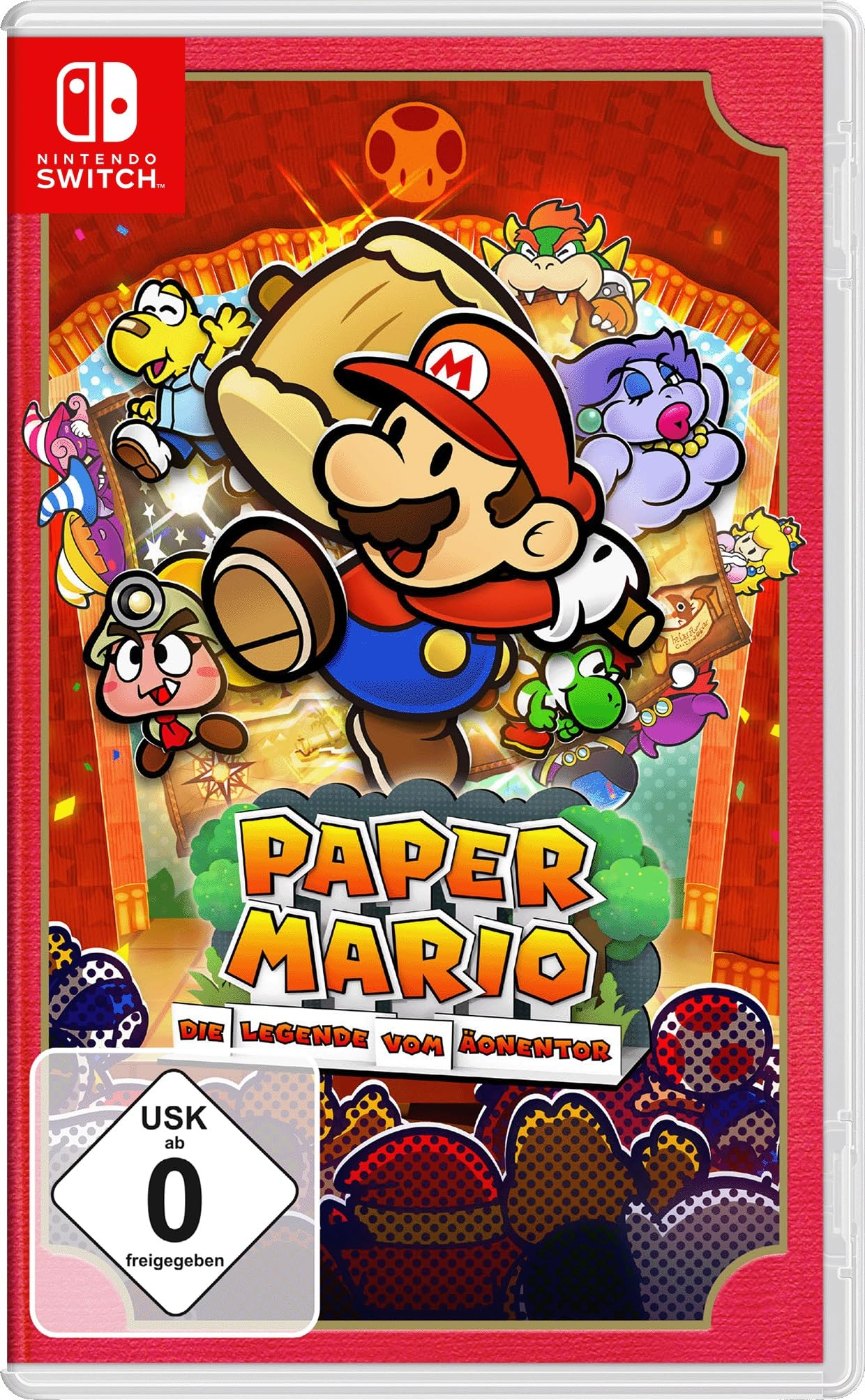
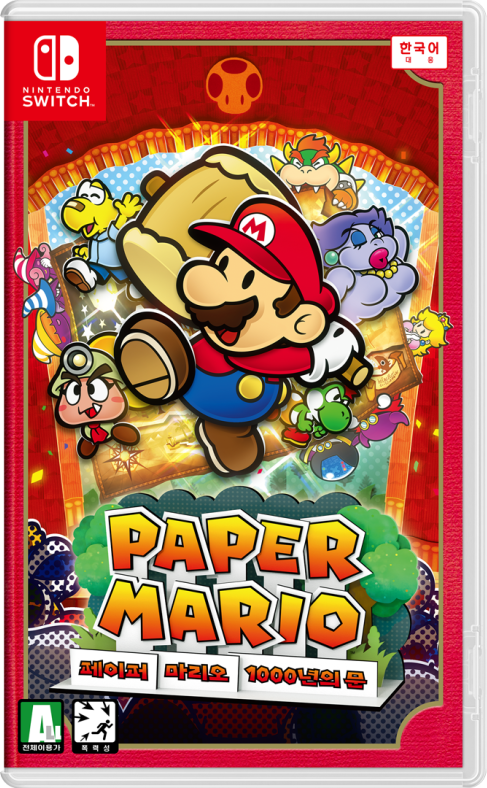
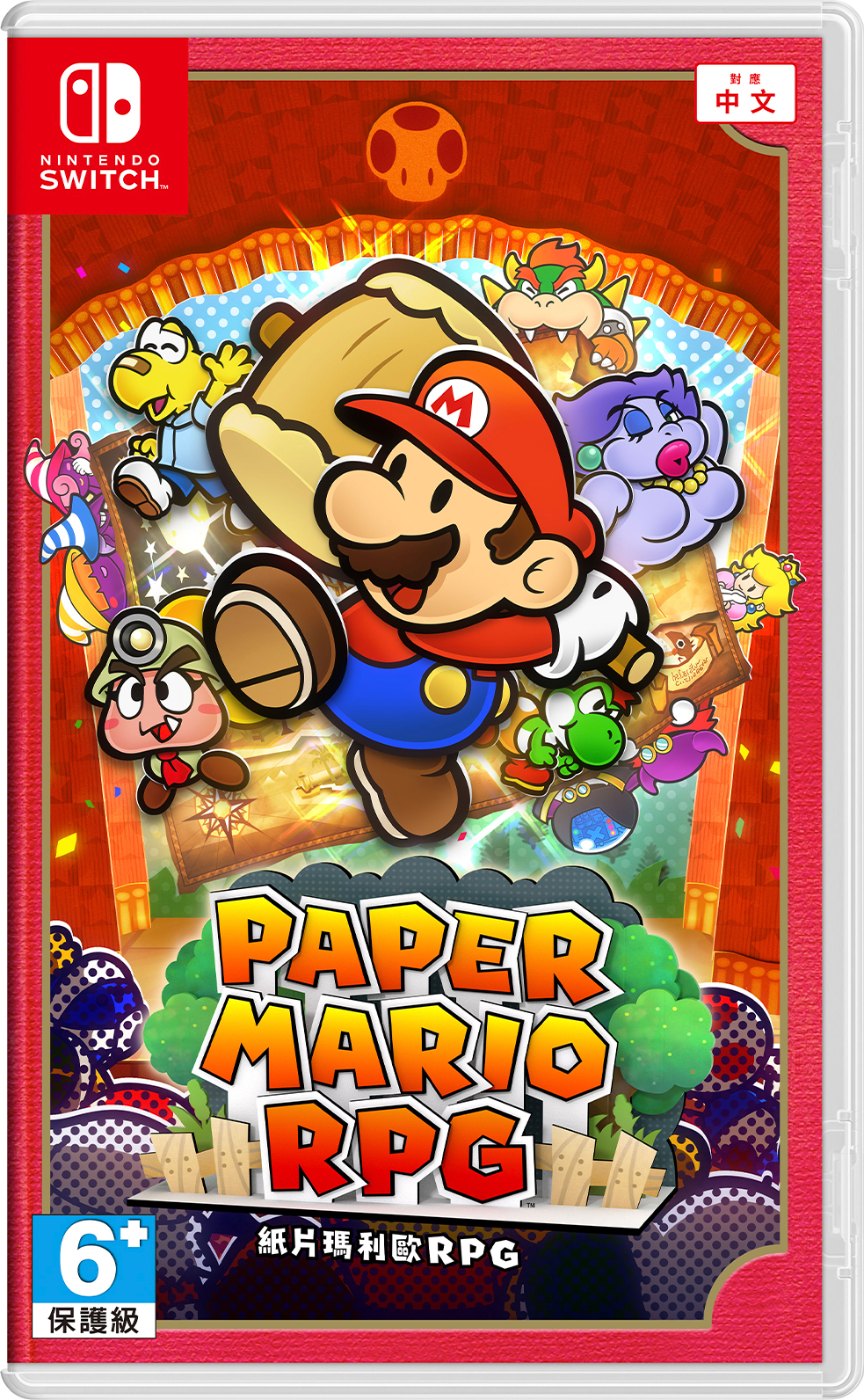
Outside Japan the 2004 box showed Mario alone against the door. The remake uses one design everywhere, modelled on the Japanese GameCube cover with the whole cast around the title, which in Japan is still Paper Mario RPG.
UK and pan-EuropeanNorth and Latin AmericaJapanTitled Paper Mario RPG.AustraliaFranceGermanySouth KoreaHong Kong and Taiwan
Screenshots
More of the remake in motion, from the menus to the bottom of the Pit.
The Tattle Log, now 134 entries long.Boat Mode on the east side of Rogueport.Tube Mode inside Riverside Station.Koops’s shell reaches a switch in Hooktail Castle.Bonetail, beaten, on floor 100.The Whacka fight, bumps everywhere.Mario wearing the Gold Medal.The Game Over screen, which now offers a retry.
Artwork & Media Gallery
Official artwork, profile cards and a few frames from the new curtain-call credits.
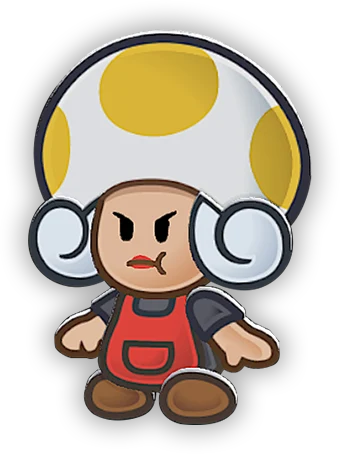
The English logo, redrawn to follow the Japanese design of 2004.North American key art.Mario in Plane Mode.The audience.An X-Naut.Zess T., Rogueport’s cook.Mario as the Great Gonzales: a profile card for Chapter 3.Vivian’s character profile card.Prince Mush’s fighter screen in the Glitz Pit lobby.Parakarry opens the credits.Jolene and Prince Mush take a bow.The end of the curtain call.
Legacy & Re-releases
The remake is two and a half years old, so its history is short: one announcement, one release, one patch and a pair of sales figures.
Announcement, release and after
GameCube original22 July 2004 (Japan)Released as Paper Mario RPG; North America followed on 11 October and Europe on 12 November 2004.
Remake announced14 September 2023Revealed in a Nintendo Direct for release in 2024.
Release date10 March 2024Nintendo’s MAR10 Day video dates it for 23 May.
Overview trailer24 April 2024Five minutes on partners, battles and the intermissions.
Reviews21 May 2024Review embargo lifts; Metacritic settles at 88.
Nintendo Switch23 May 2024Released worldwide on Game Card and as a 5.1 GB download.
Version 1.0.19 July 2024Fixes the Twilight Trail sequence break, the tutorial softlock and text errors.
First sales figure2 August 2024Nintendo reports 1.76 million sold to 30 June.
GLAAD nomination22 January 2025Shortlisted for Outstanding Video Game.
Full-year results8 May 2025Nintendo reports 2.10 million sold to 31 March 2025.
A year of Mario RPGs
The remake was the middle of three. The Super Mario RPG remake arrived on 17 November 2023, The Thousand-Year Door on 23 May 2024, and a brand-new game, Mario & Luigi: Brothership, on 7 November 2024. Nintendo was evidently curious about the appetite: shortly before this game’s release it surveyed newsletter subscribers in Europe about all three Mario RPG series.
Play this or the original?
Before 2024 the game had never been re-released: there was the GameCube disc, its Player’s Choice reprint, and nothing else. The remake is therefore the only version on a current console, and for most players the better one, with its hints, pipes and retries and with the 2004 soundtrack a badge away.
The GameCube original keeps two things the remake cannot offer: 60 frames per second, and the first English script, crickets and all. The remake keeps one thing the original never had in English, which is Vivian’s own account of herself.
Where it sits in the series
The Thousand-Year Door was followed in 2007 by Super Paper Mario, which swapped turn-based battles for platforming, and then by Sticker Star, Color Splash and The Origami King, which left partners and experience points behind. The remake was made by the Origami King’s director and borrows that game’s look, its notification-style e-mails and its room of pipes, while leaving the 2004 design alone.
Reviews & Sales
Sales figures
The remake went straight to the top of the Japanese chart: Famitsu counted 115,649 physical copies in its first week on sale, 20 to 26 May, as reported by Gematsu. In the United States, Circana’s chart for May 2024 had it second among premium games, behind Ghost of Tsushima, and first on Switch, on physical sales alone, since Nintendo does not share download figures.
Nintendo’s own count, in its quarterly results, was 1.76 million copies worldwide by 30 June 2024. Its results for the full year, published on 8 May 2025, put the total at 2.10 million as of 31 March 2025, the most recent figure we have found. That is more than the 1.91 million the GameCube original is recorded as selling in the CESA Games White Paper figure quoted by Wikipedia.
2.10mworldwide, to 31 March 2025 (Nintendo)
1.76mworldwide, to 30 June 2024 (Nintendo)
115,649first week in Japan (Famitsu)
88Metacritic, 106 critics
Reception and review scores
Metacritic’s average is 88 from 106 critics, and 97 per cent of the critics counted by OpenCritic recommended it. The individual scores below are those we found reported with the outlet named.
VGCAndy Robinson
5/5
OpenCriticcritics recommending
97%
IGNLogan Plant
9/10
GameSpotSteven Petite
9/10
Nintendo LifeAlana Hagues · 21 May 2024
9/10
ShacknewsJosh Broadwell
9/10
Metacriticaverage of 106 critics
88
DestructoidUS
8.5/10
WccftechNathan Birch
8/10
The praise was consistent: the new look, the new music and the many small changes that take the sting out of the backtracking. Nintendo Life, under the headline “Still The King Of Mario RPGs”, wrote: “We cannot praise the new music enough, and it breathes fresh life into the adventure.” GameSpot’s Steven Petite called it the definitive way to play while judging it closer to an enhanced HD remaster than a full remake. Shacknews thought the first two chapters showed their age; Destructoid was not convinced that glossy, reflective surfaces suit a world made of paper.
The complaints were consistent too. The drop to 30 frames per second was the most common, followed by how little is truly new for players who know the original: Nintendo Life listed the lack of fresh content and the one-job-at-a-time Trouble Center as its only cons. Jeuxvideo.com felt the fixes for the back-and-forth structure did not go far enough.
Honours
GLAAD Media Awards · announced 22 January 2025Nominee, Outstanding Video GameNominated at the 36th annual awards for its portrayal of Vivian, in a field of ten that also included Dragon Age: The Veilguard and Life is Strange: Double Exposure.
SLB User Reviews
Paper Mario: The Thousand-Year Door (Nintendo Switch) has yet to receive a community review on Super Luigi Bros.
If you’ve played Paper Mario: The Thousand-Year Door (Nintendo Switch) and would like to submit a review, please get in touch.
To provide the best experiences, we use technologies like cookies to store and/or access device information. Consenting to these technologies will allow us to process data such as browsing behavior or unique IDs on this site. Not consenting or withdrawing consent, may adversely affect certain features and functions.
Functional
Always active
The technical storage or access is strictly necessary for the legitimate purpose of enabling the use of a specific service explicitly requested by the subscriber or user, or for the sole purpose of carrying out the transmission of a communication over an electronic communications network.
Preferences
The technical storage or access is necessary for the legitimate purpose of storing preferences that are not requested by the subscriber or user.
Statistics
The technical storage or access that is used exclusively for statistical purposes.The technical storage or access that is used exclusively for anonymous statistical purposes. Without a subpoena, voluntary compliance on the part of your Internet Service Provider, or additional records from a third party, information stored or retrieved for this purpose alone cannot usually be used to identify you.
Marketing
The technical storage or access is required to create user profiles to send advertising, or to track the user on a website or across several websites for similar marketing purposes.

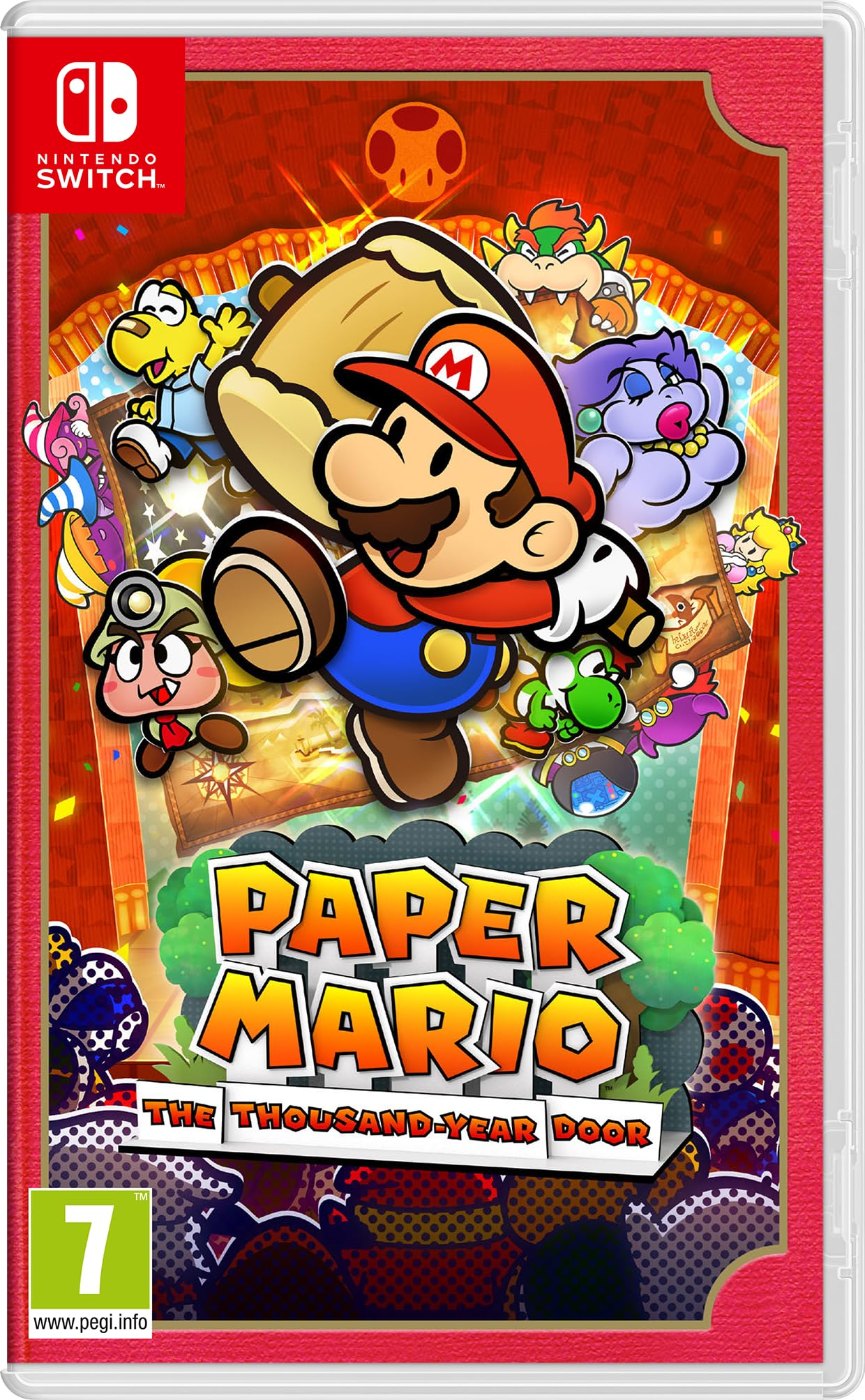
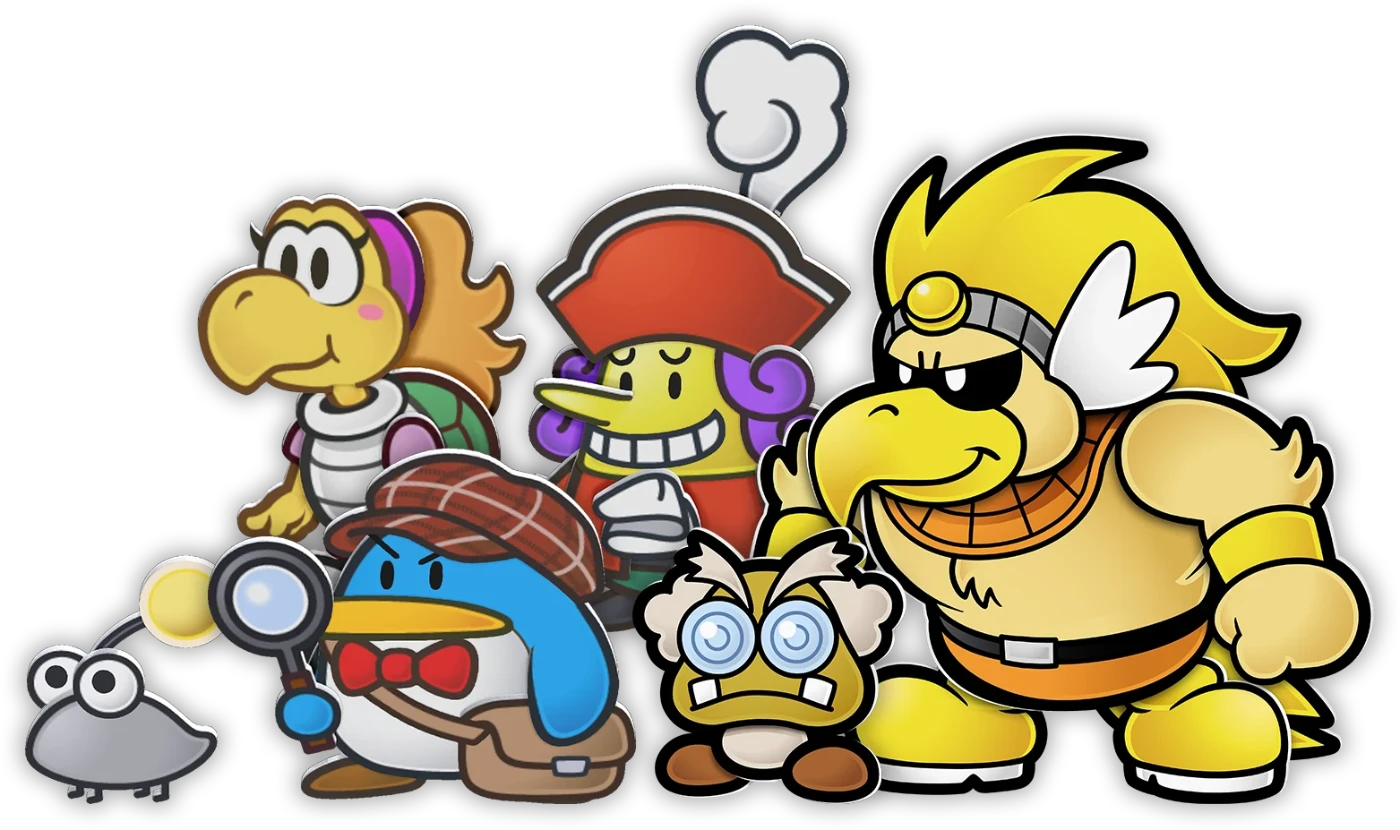
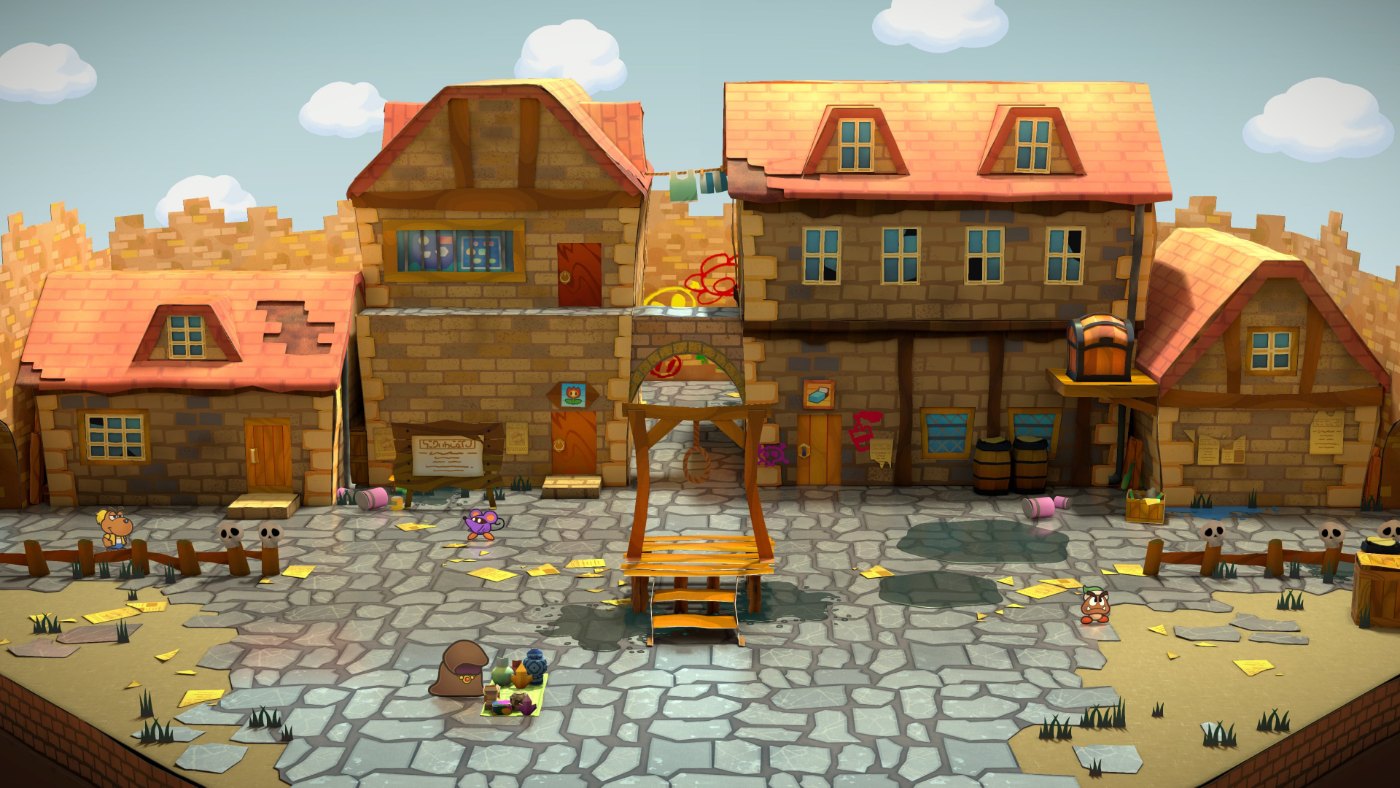
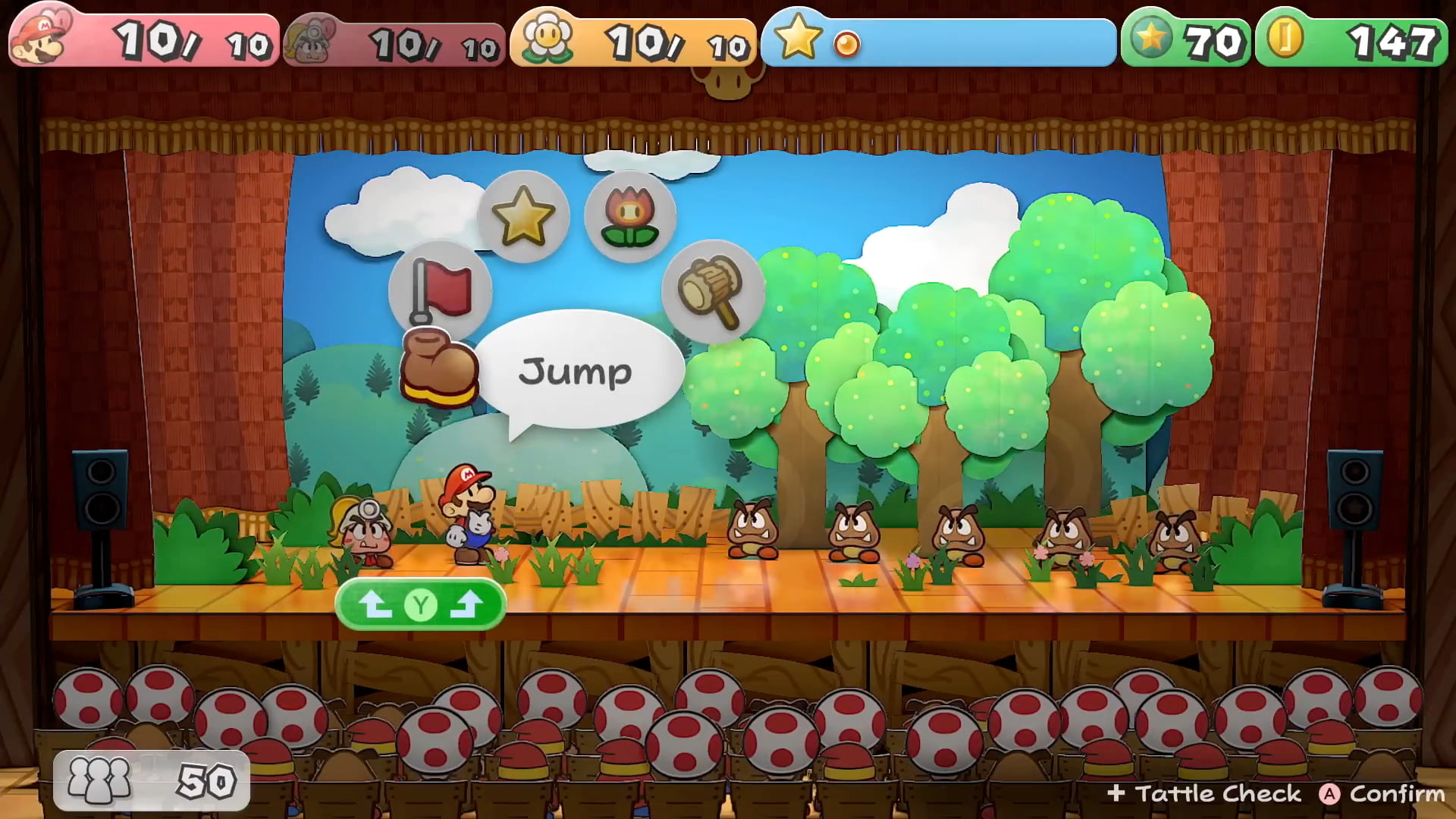
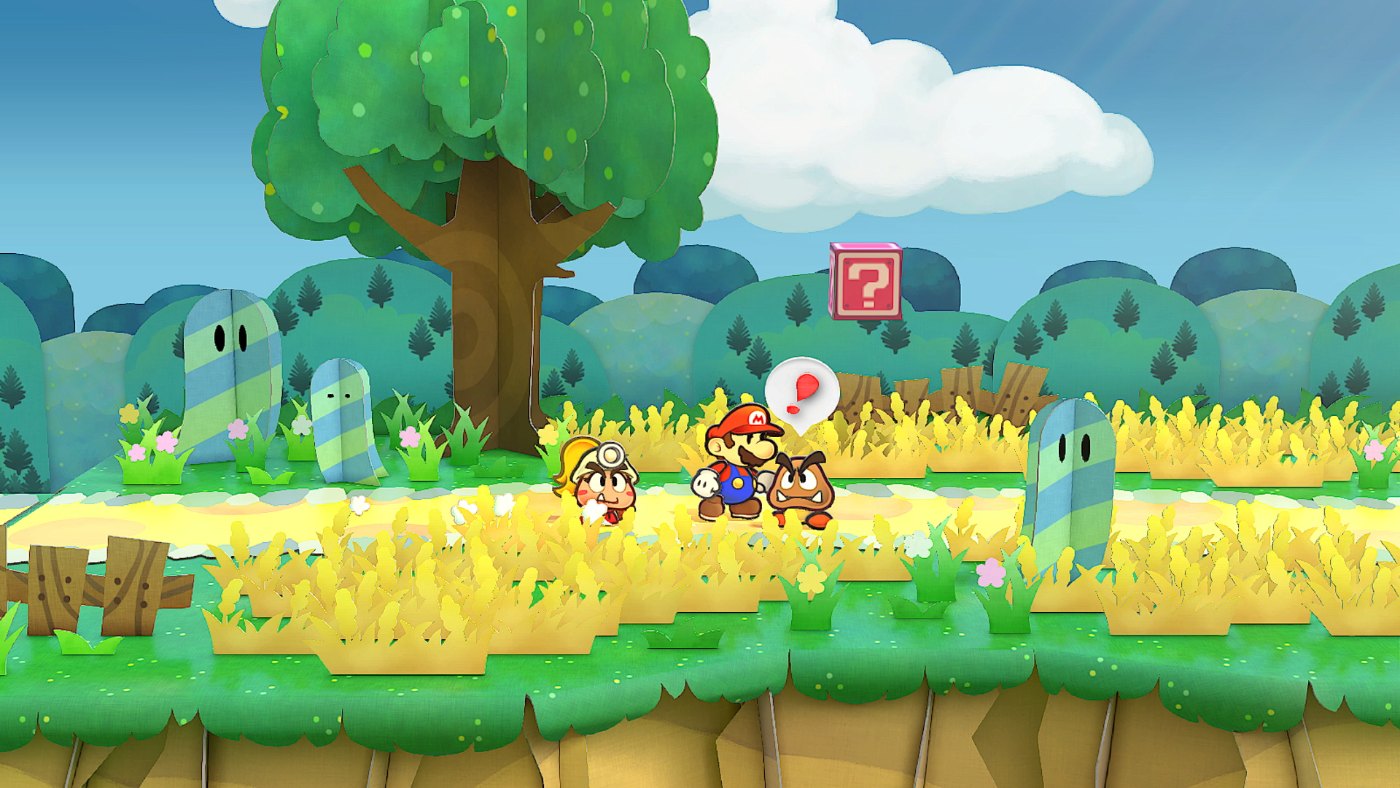
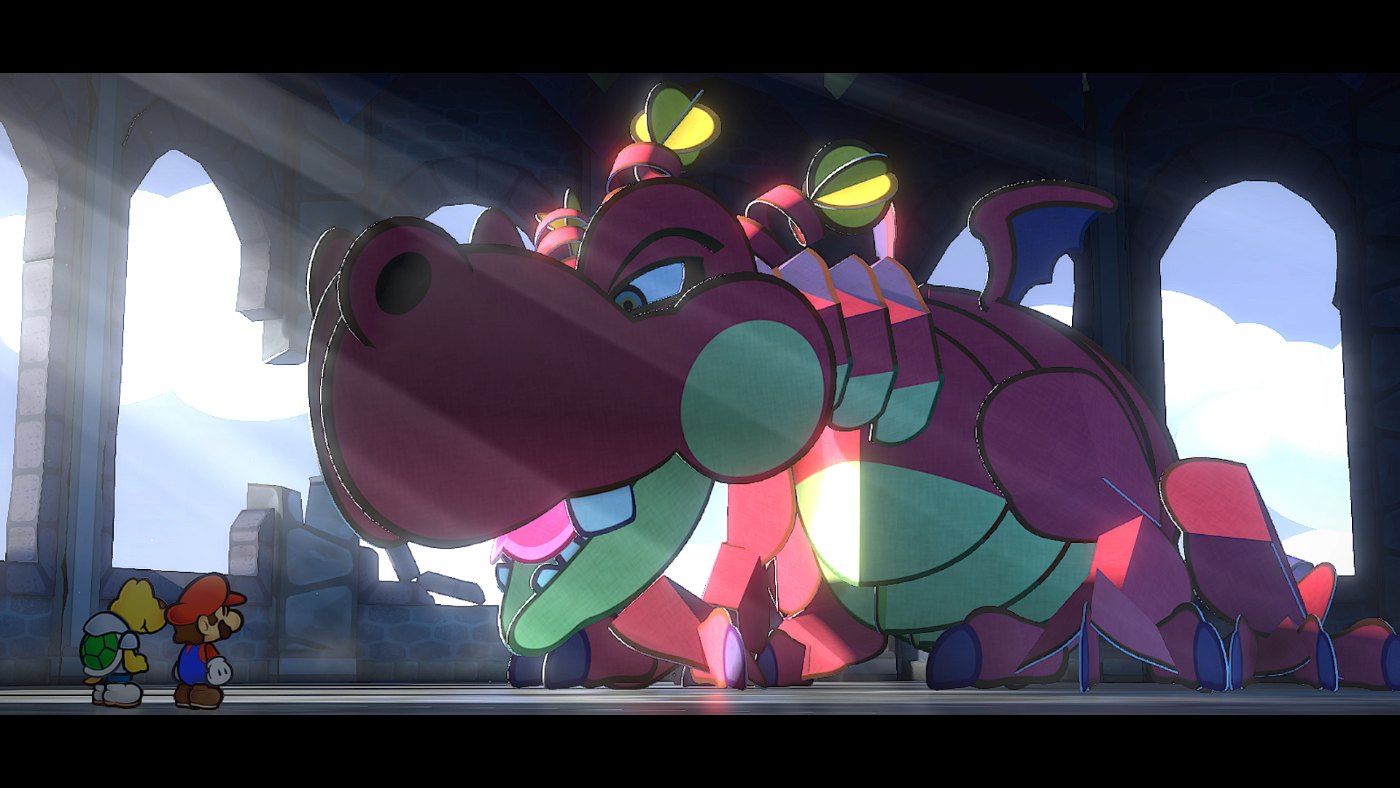
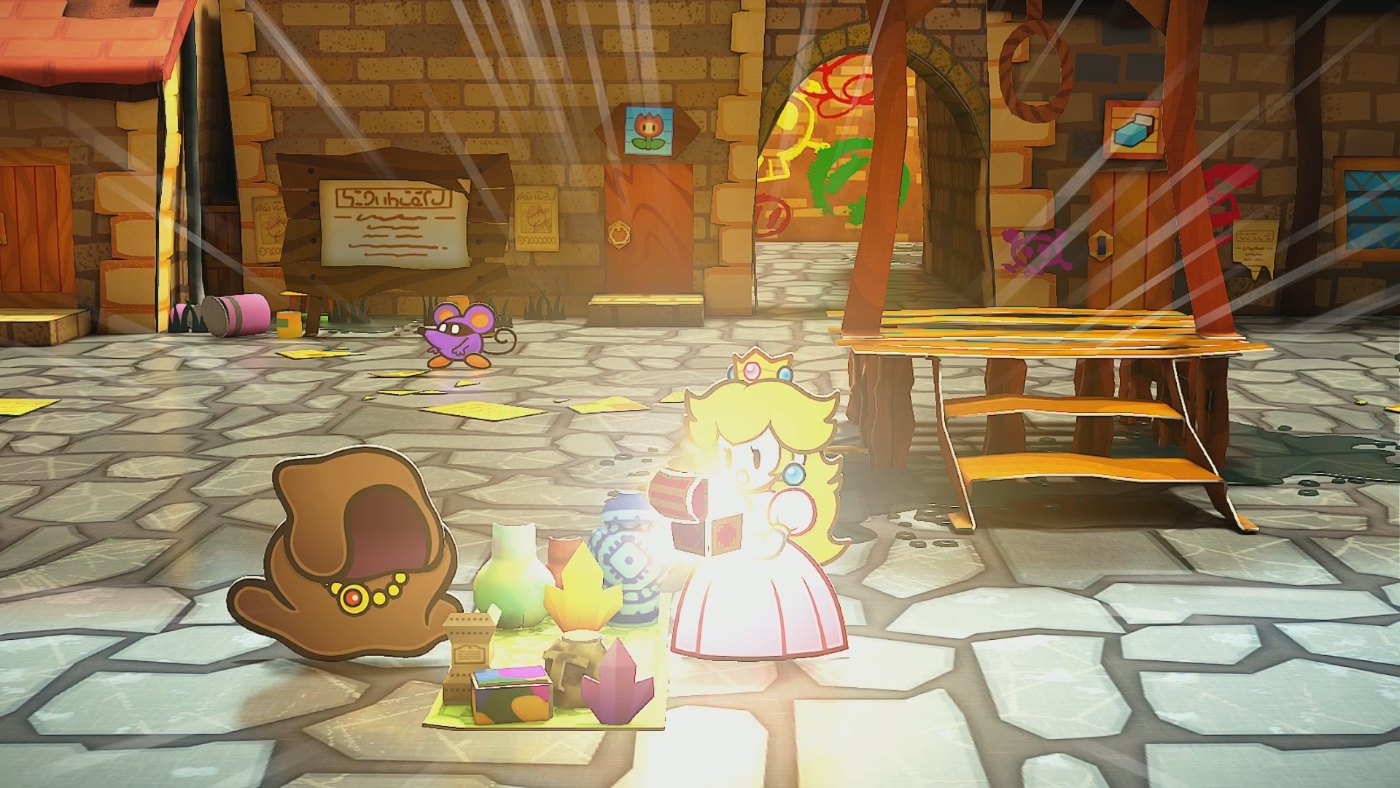
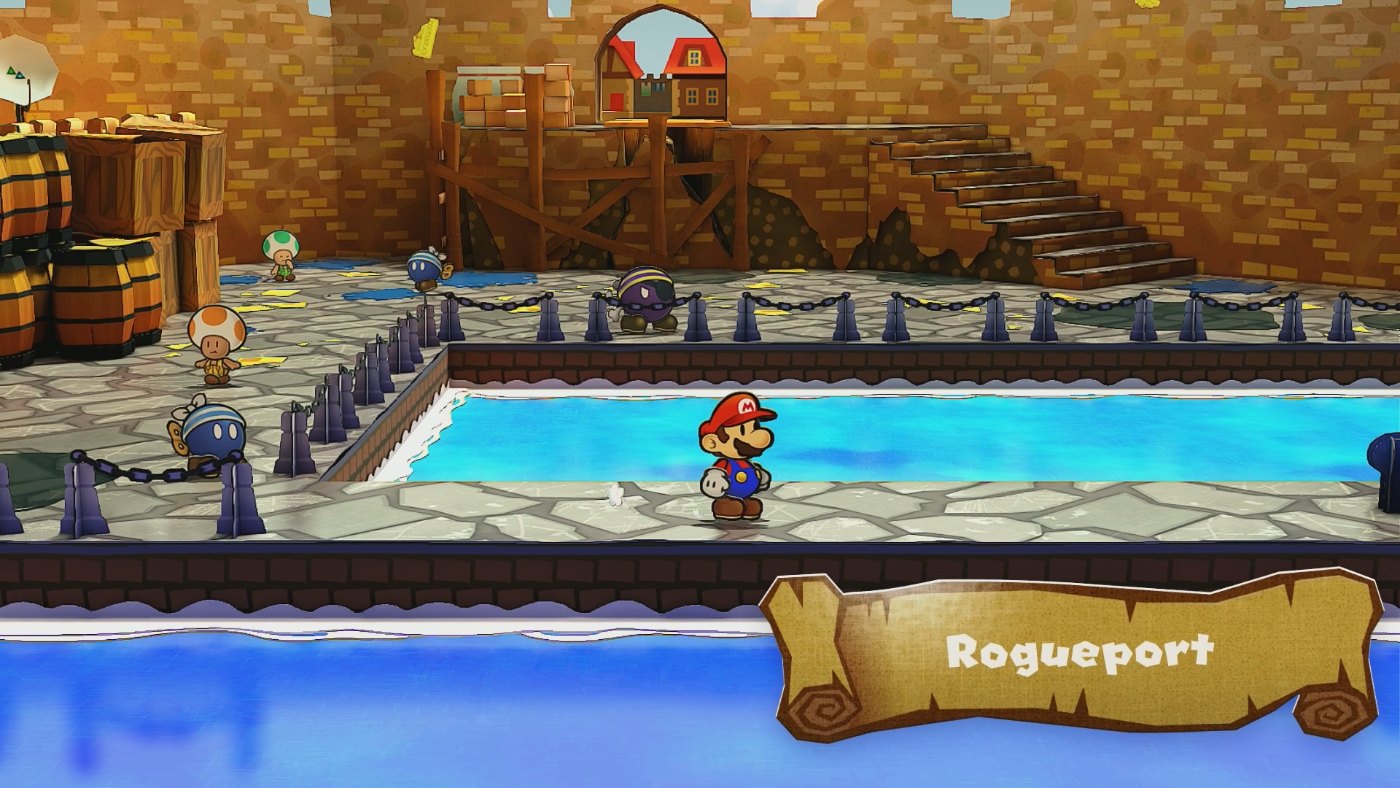
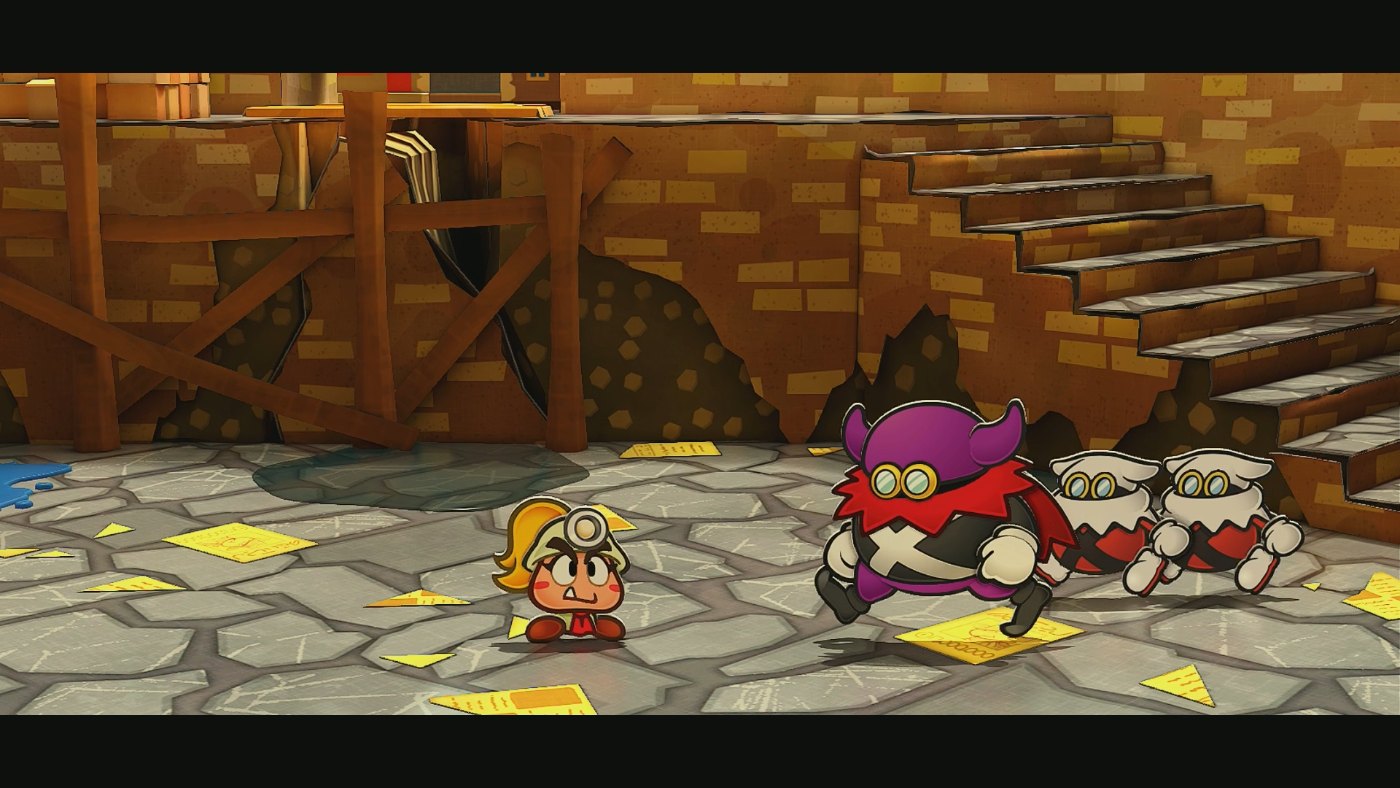
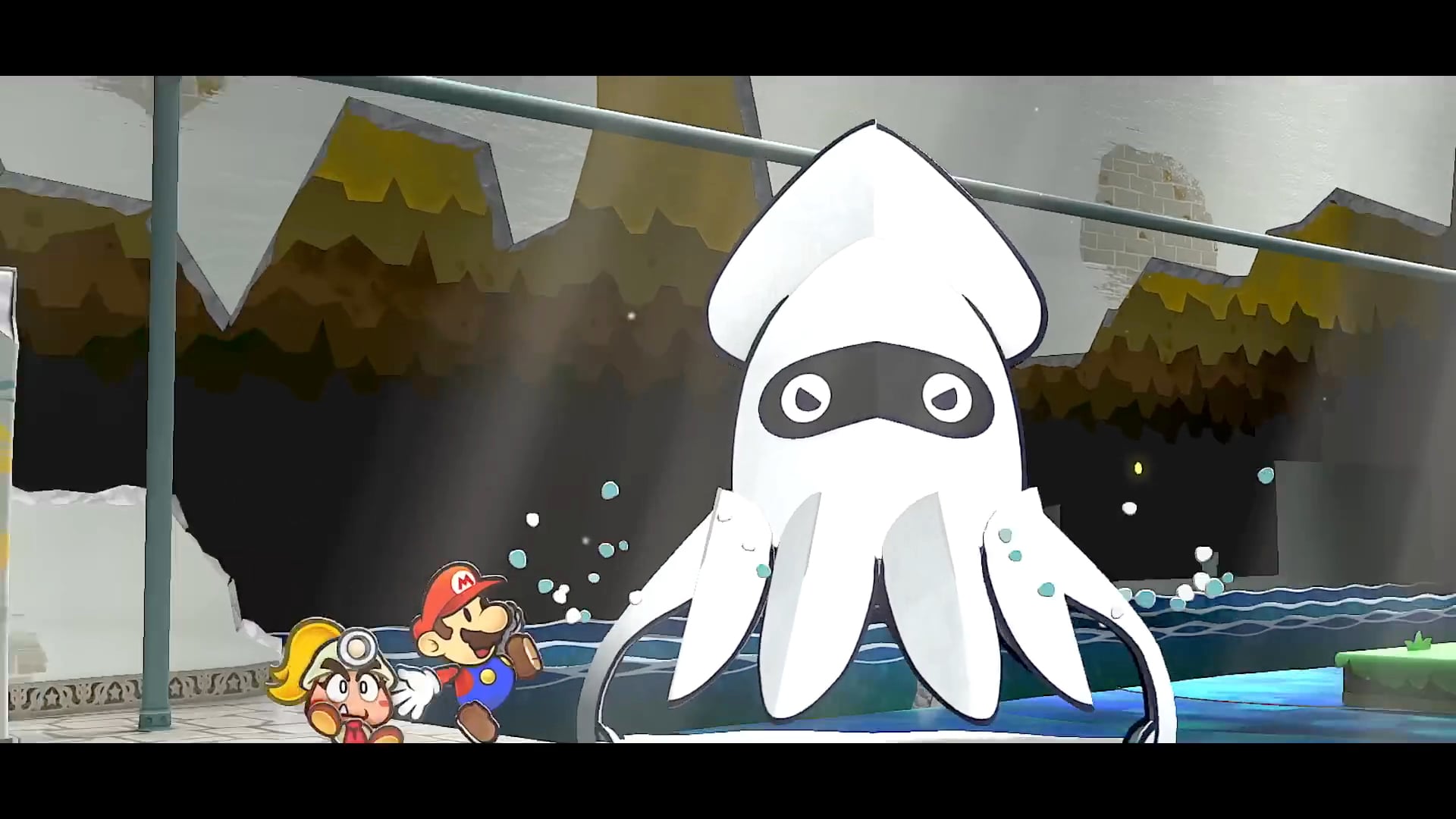
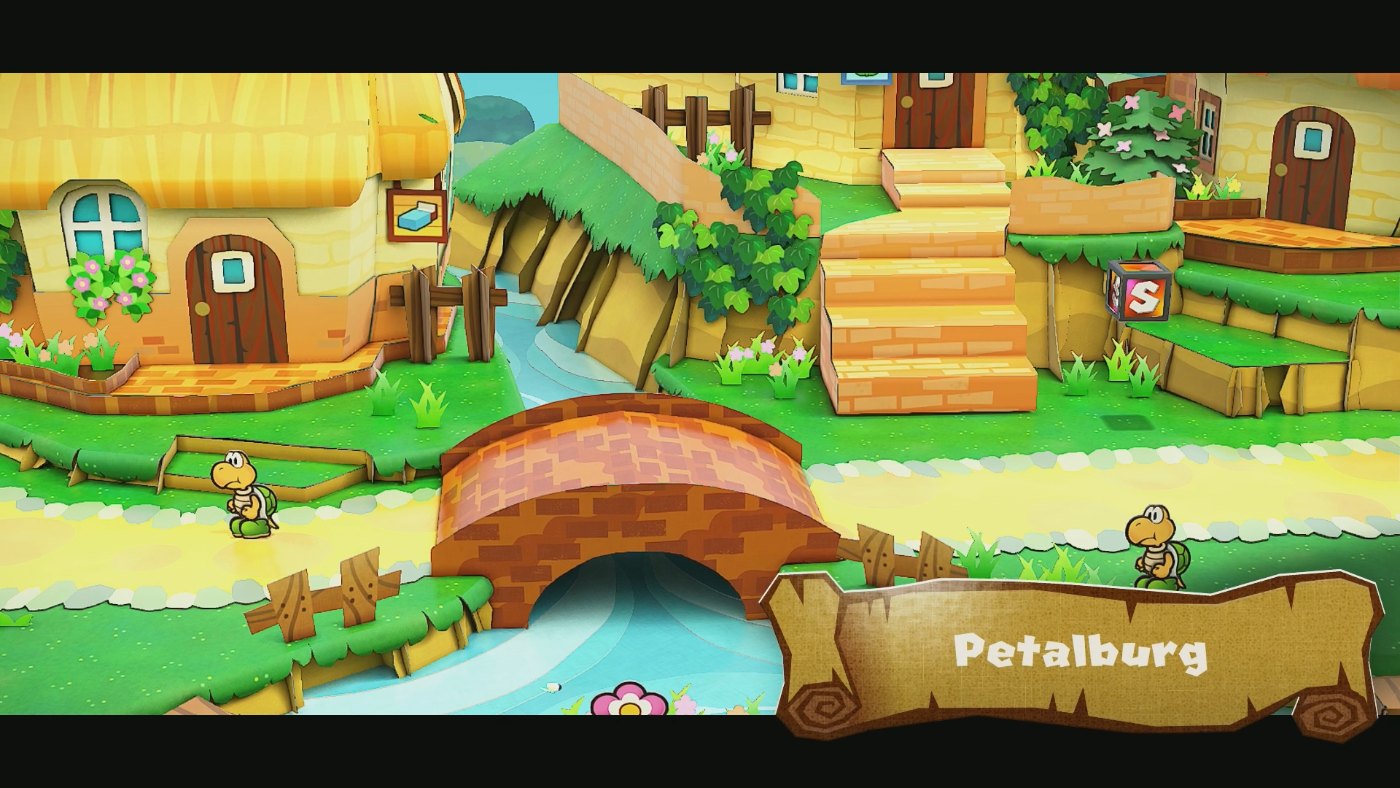
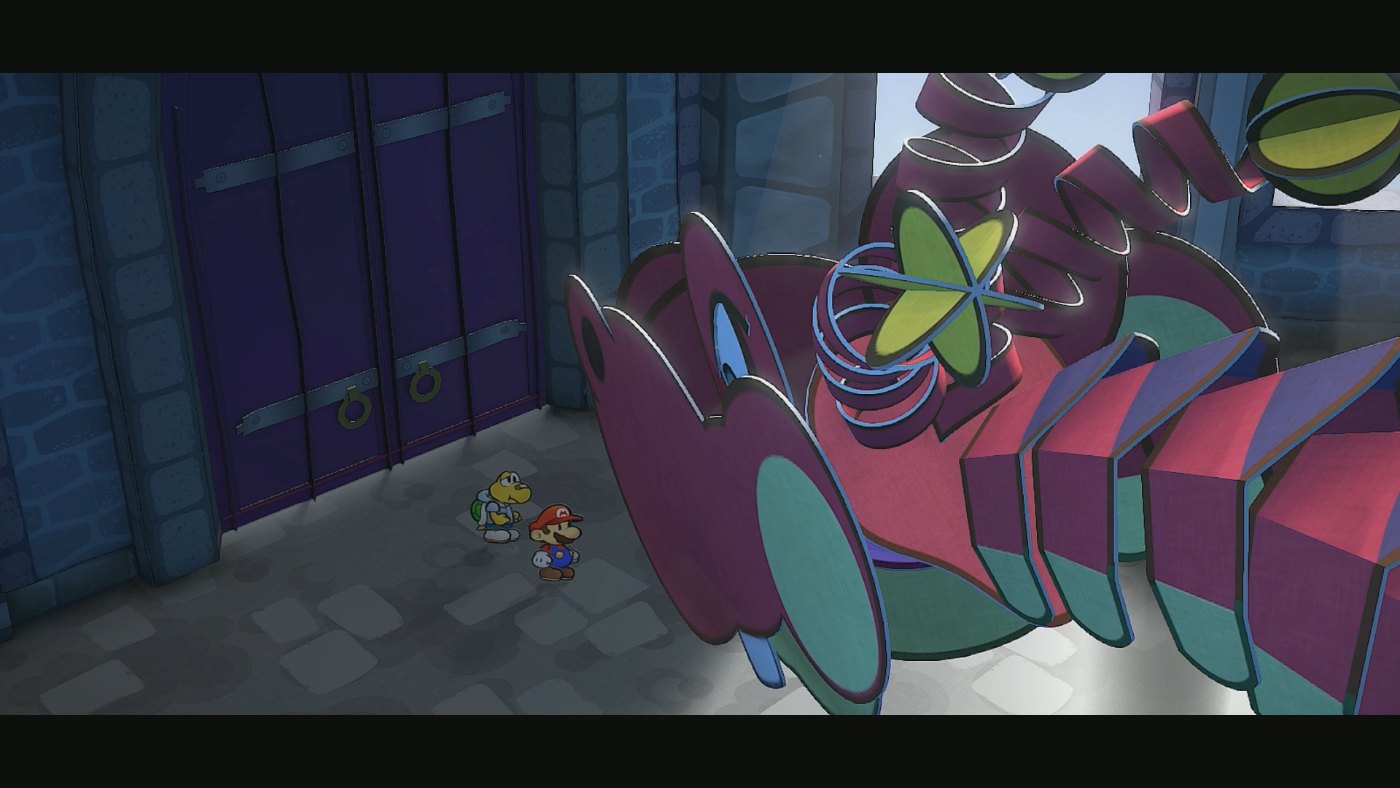
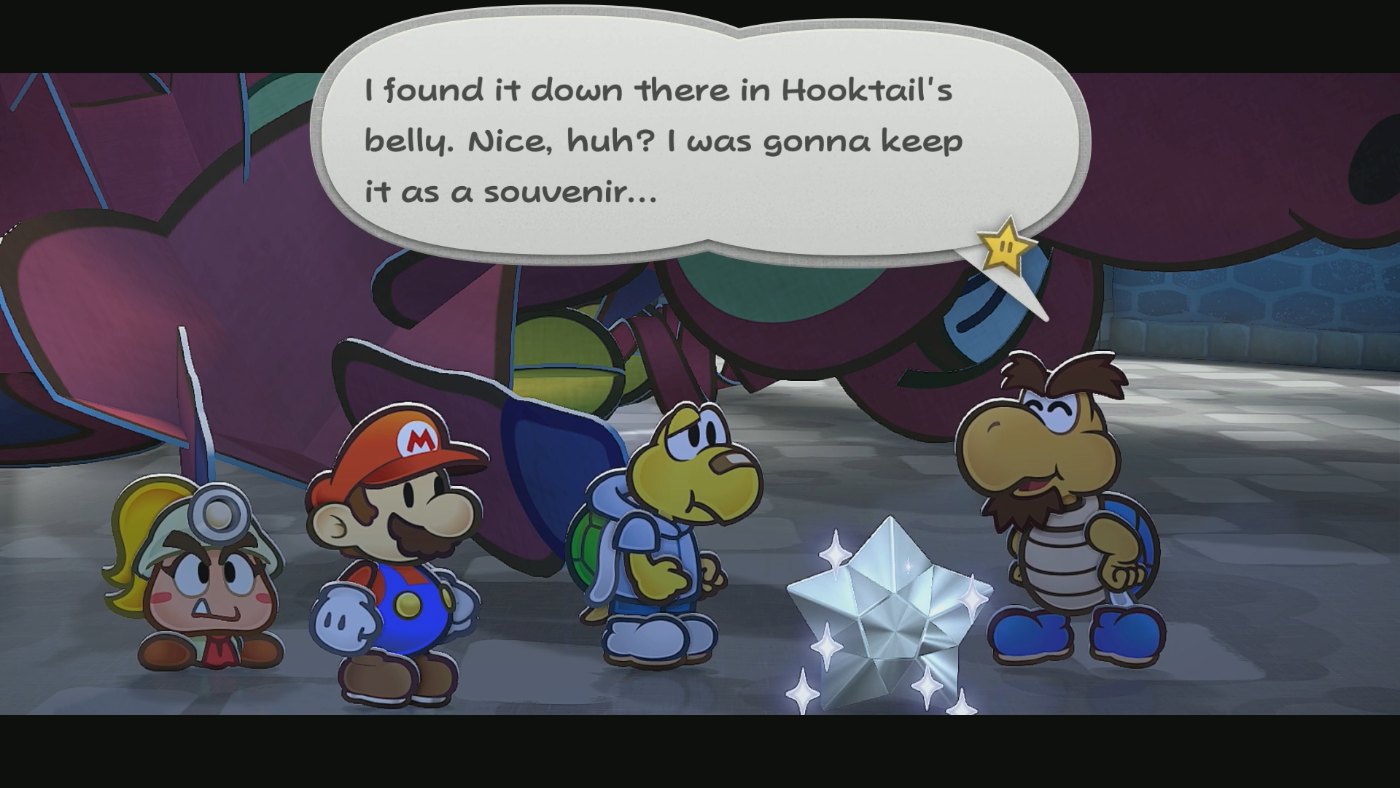
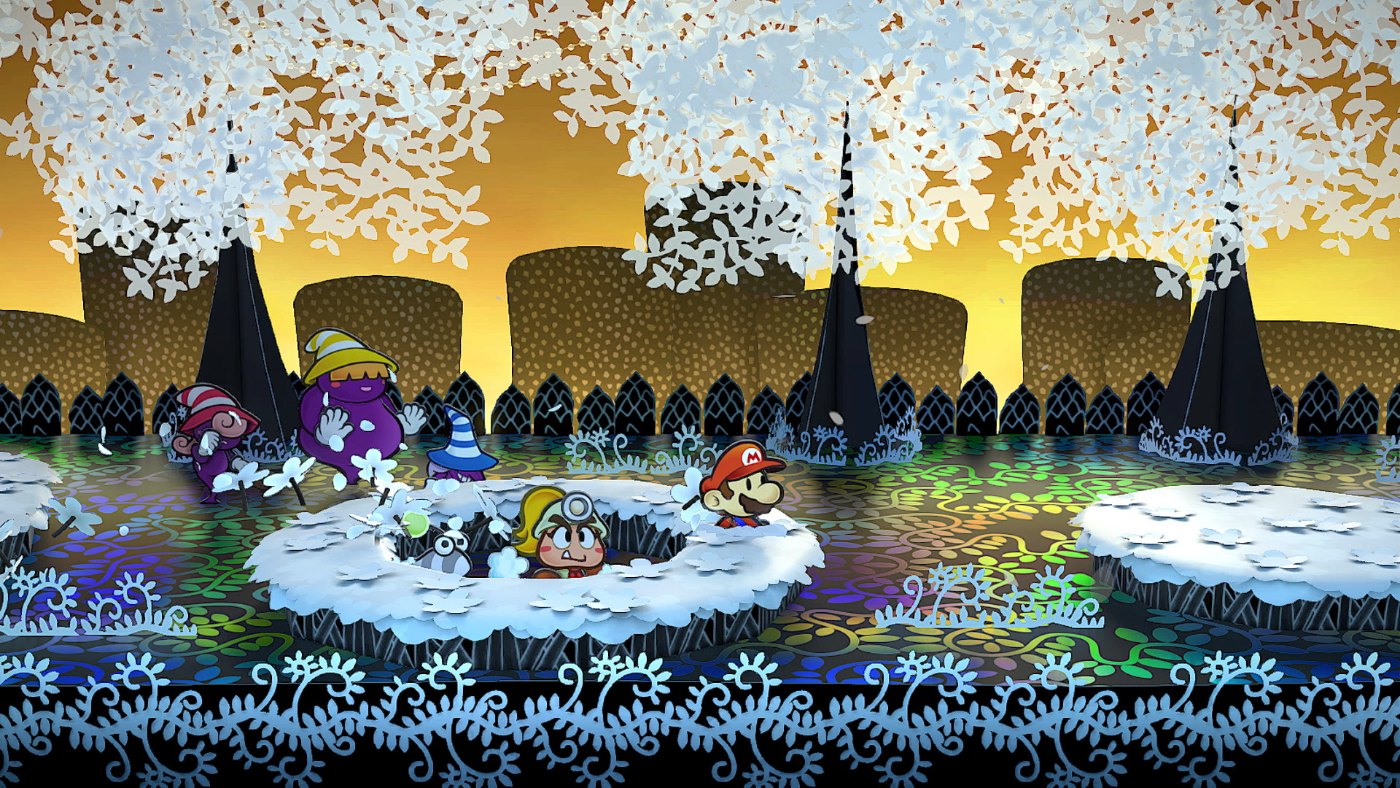
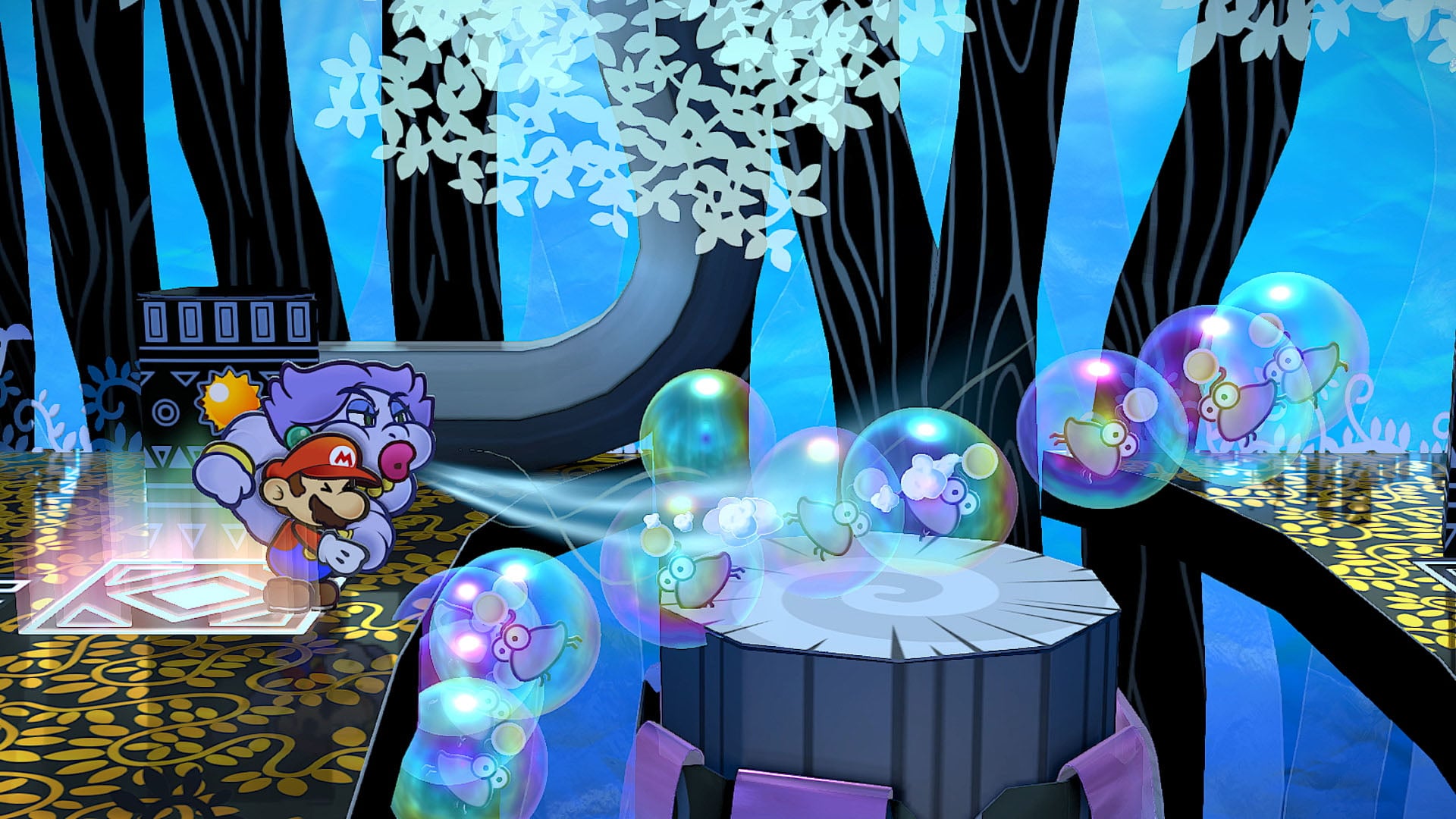
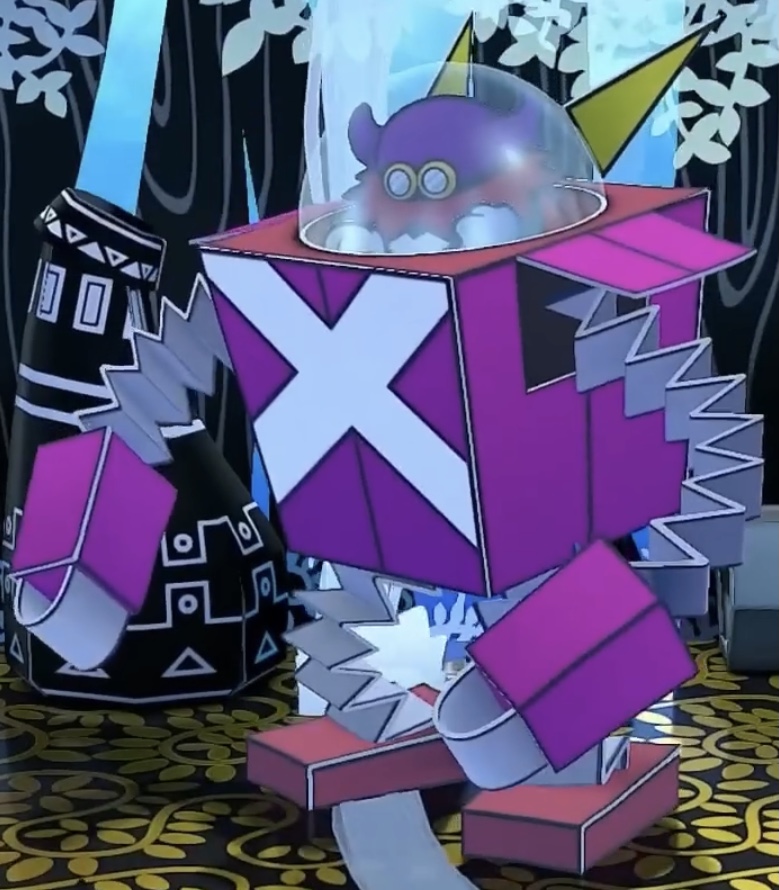
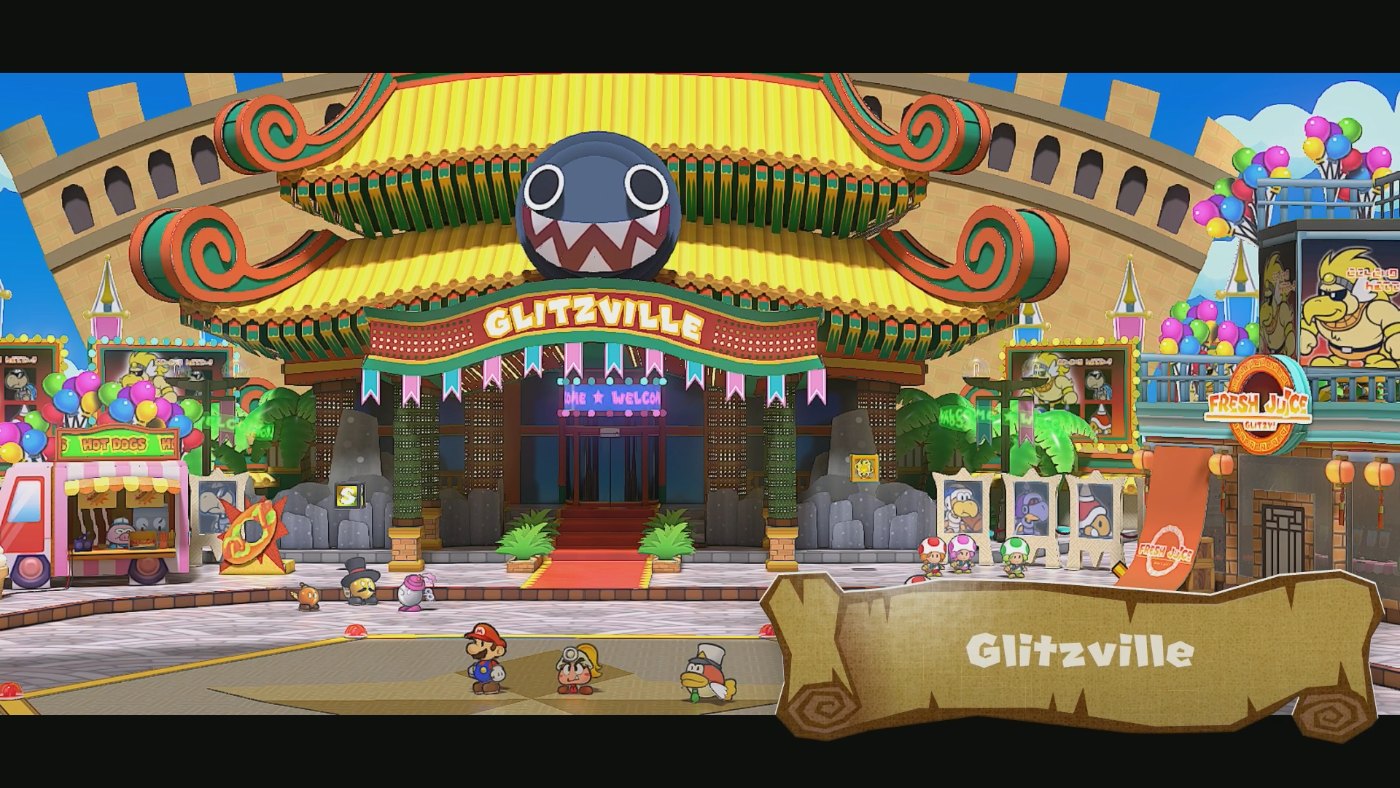
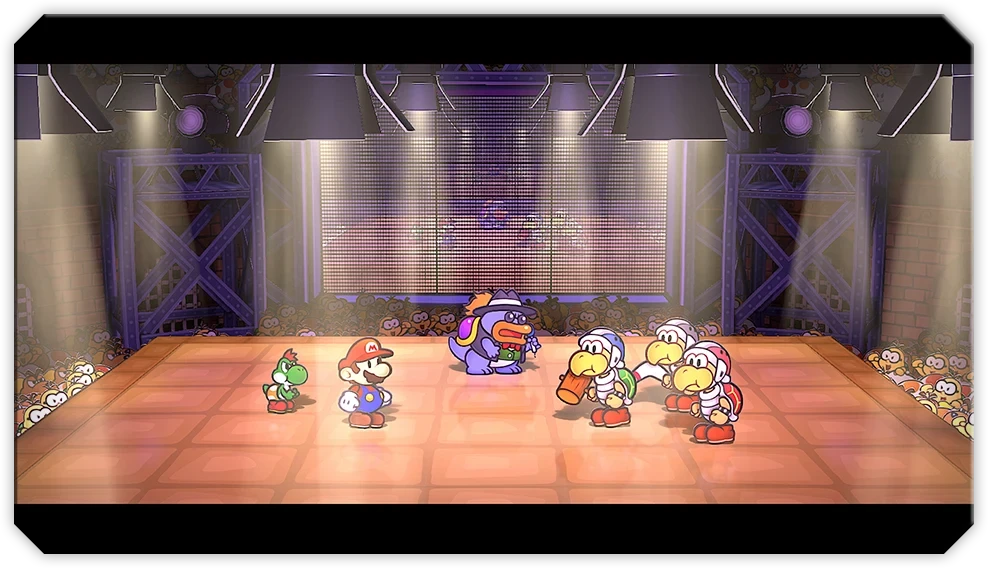
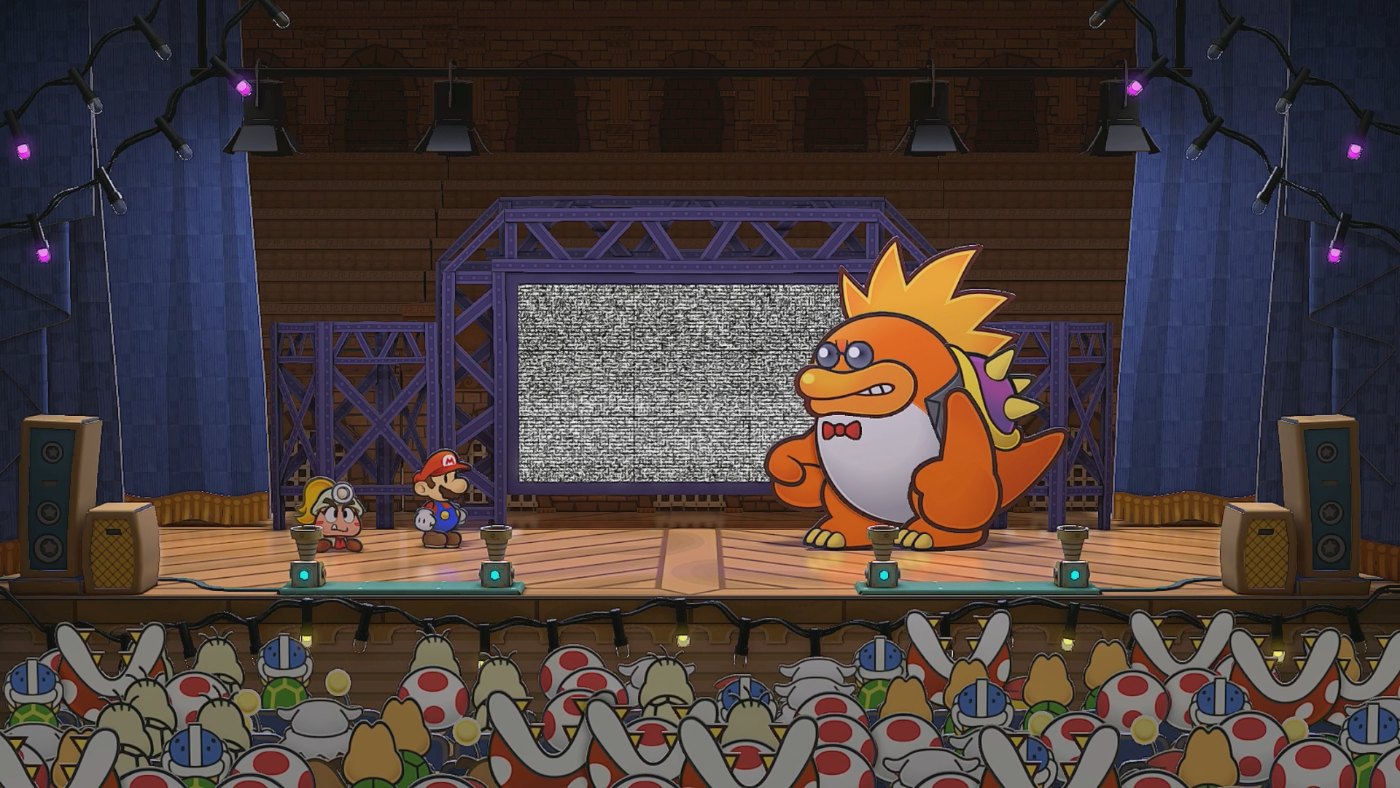
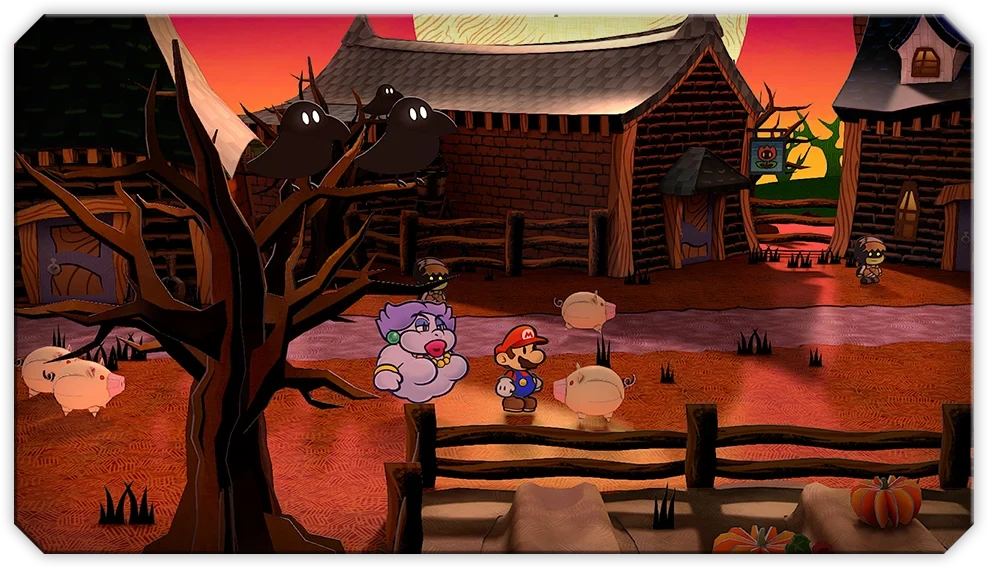
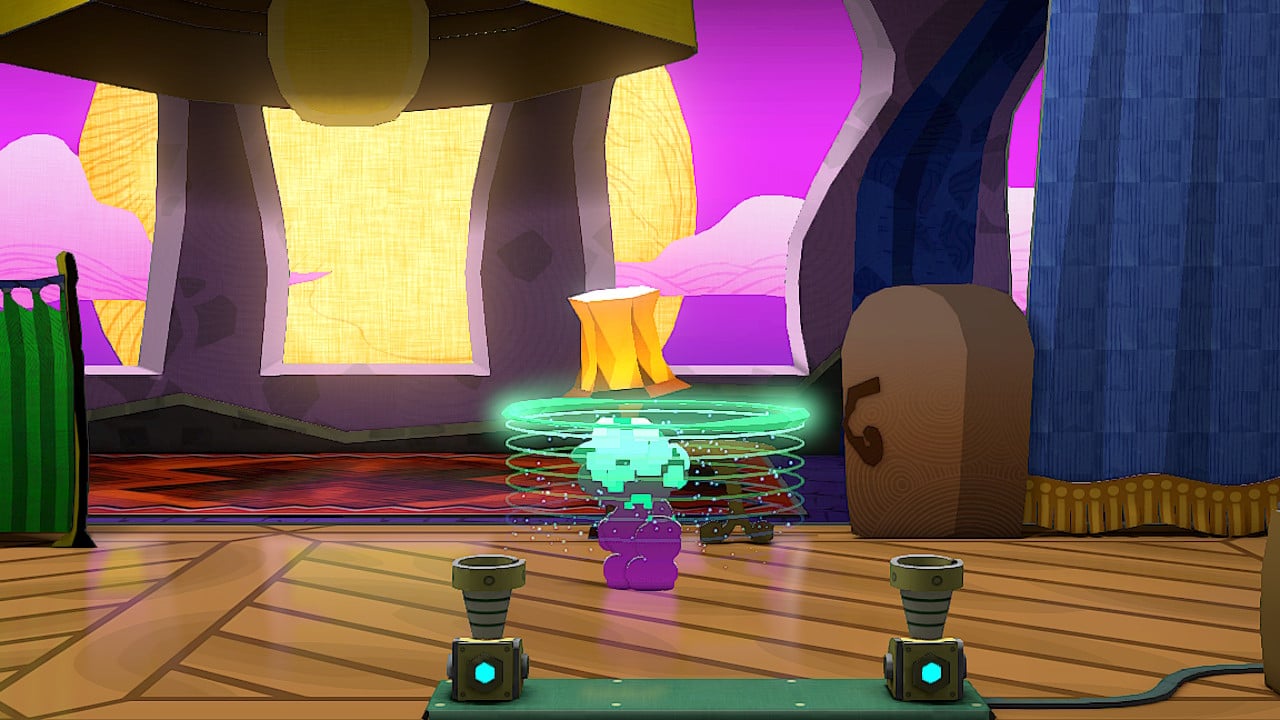
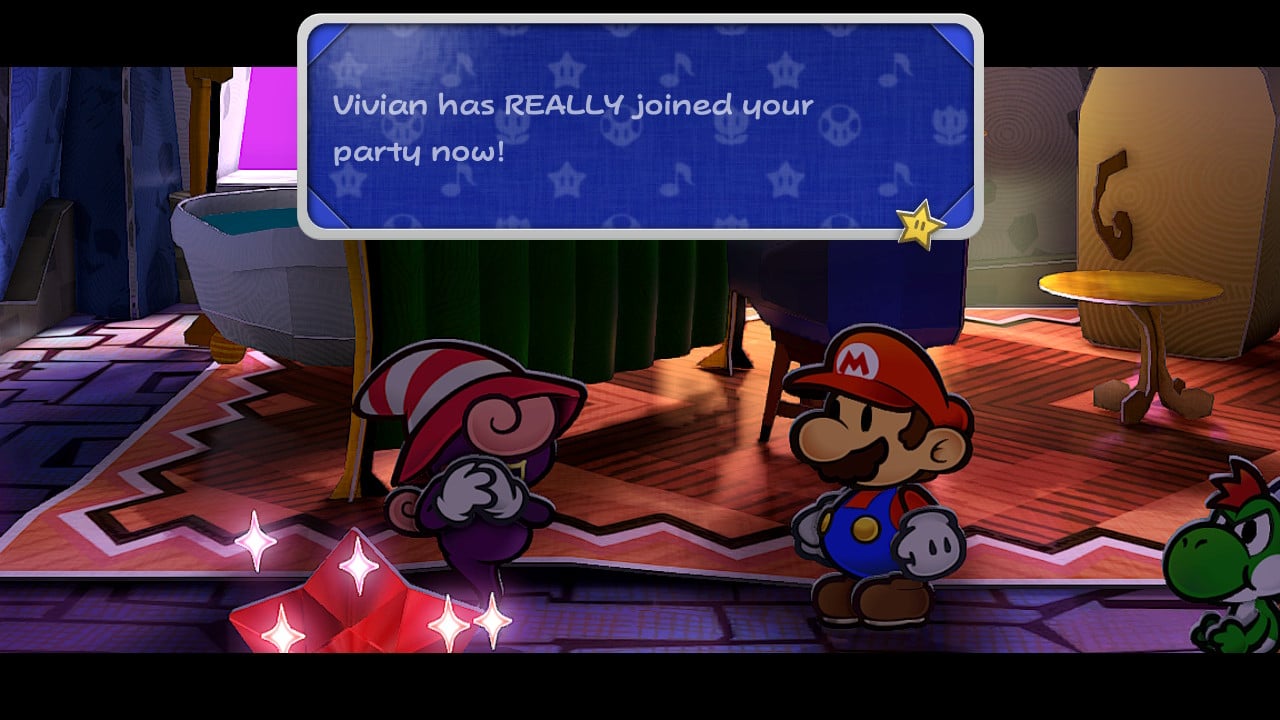
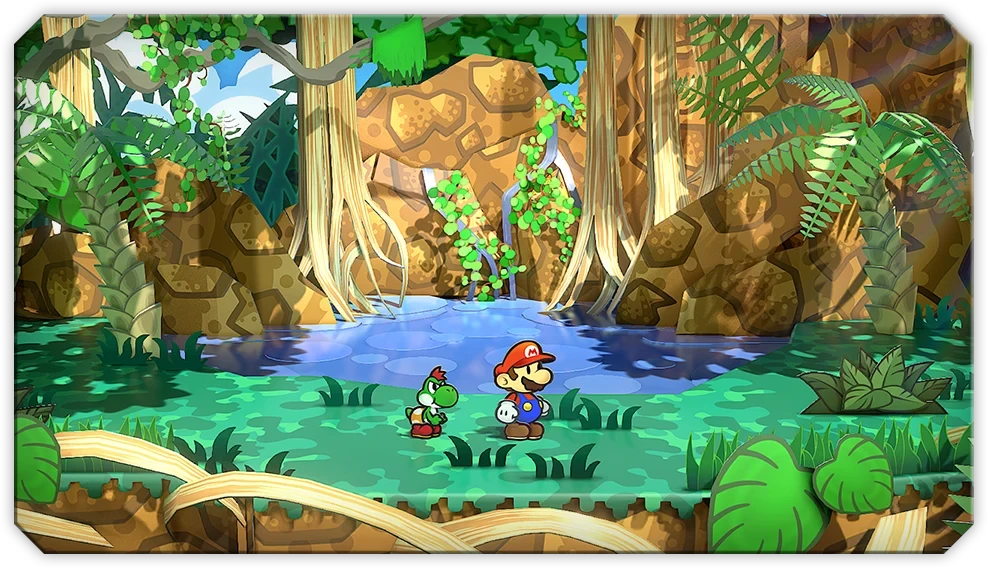
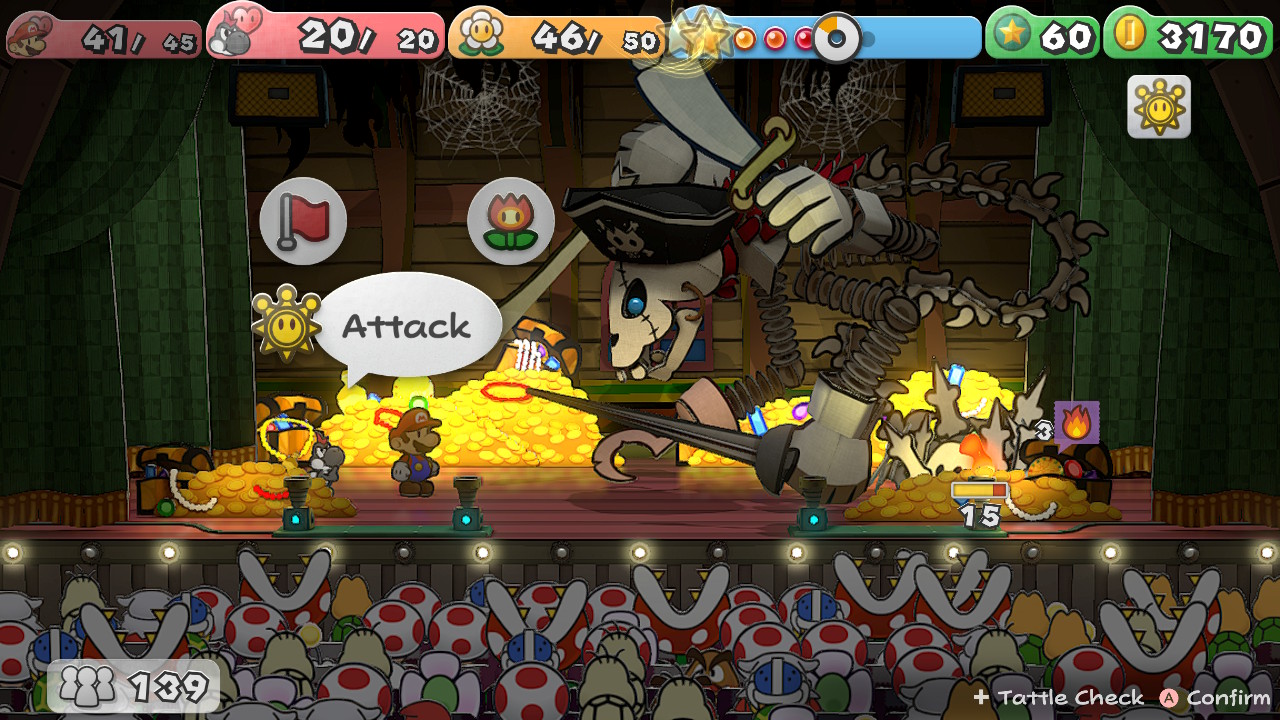
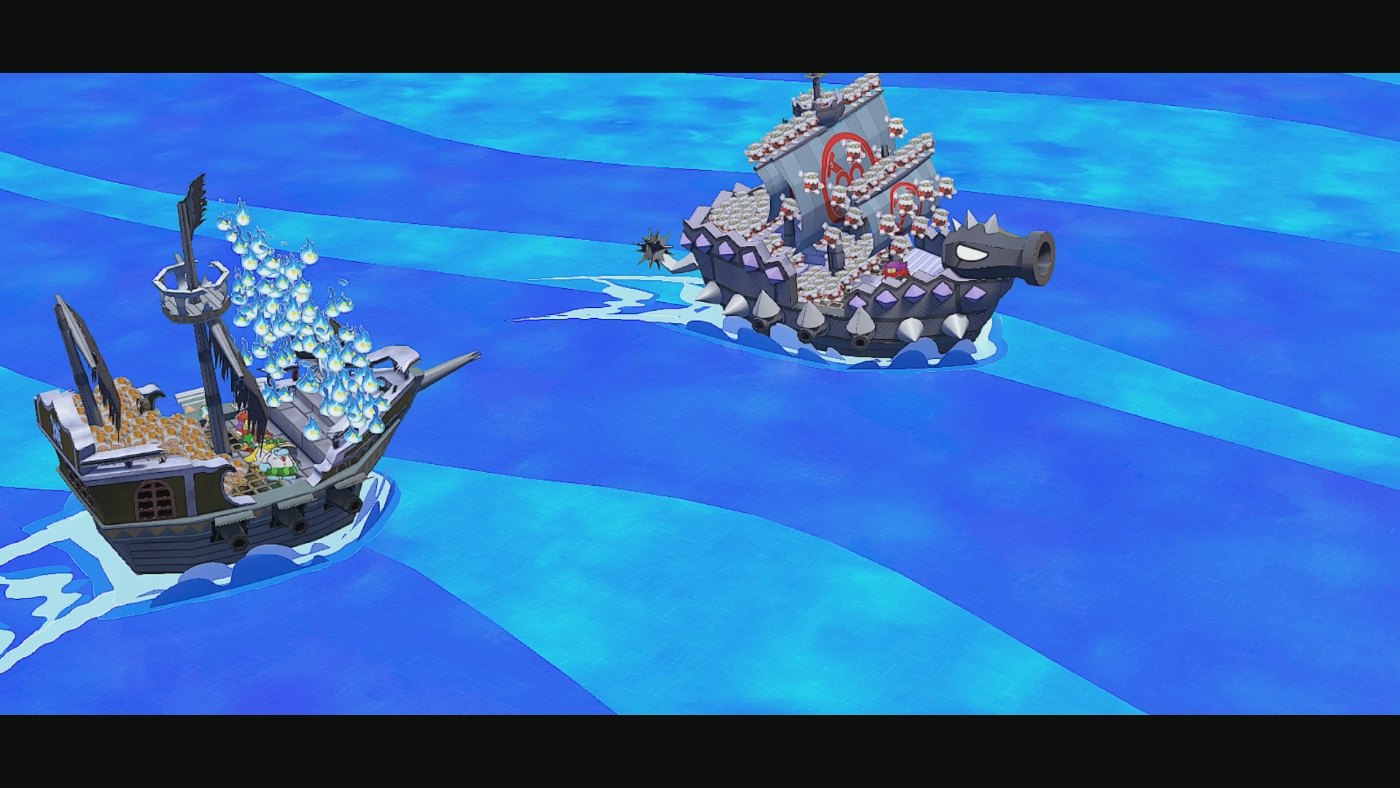
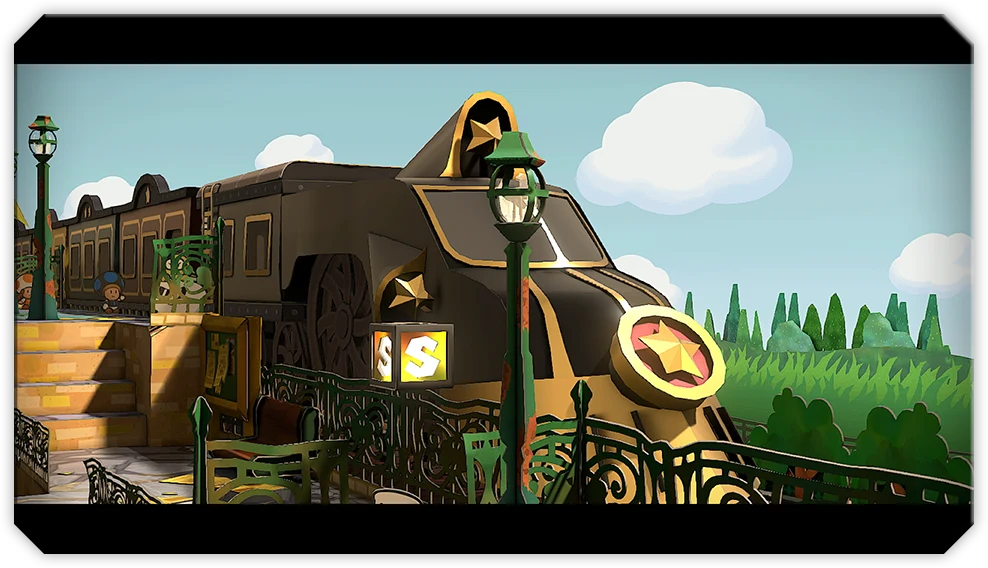
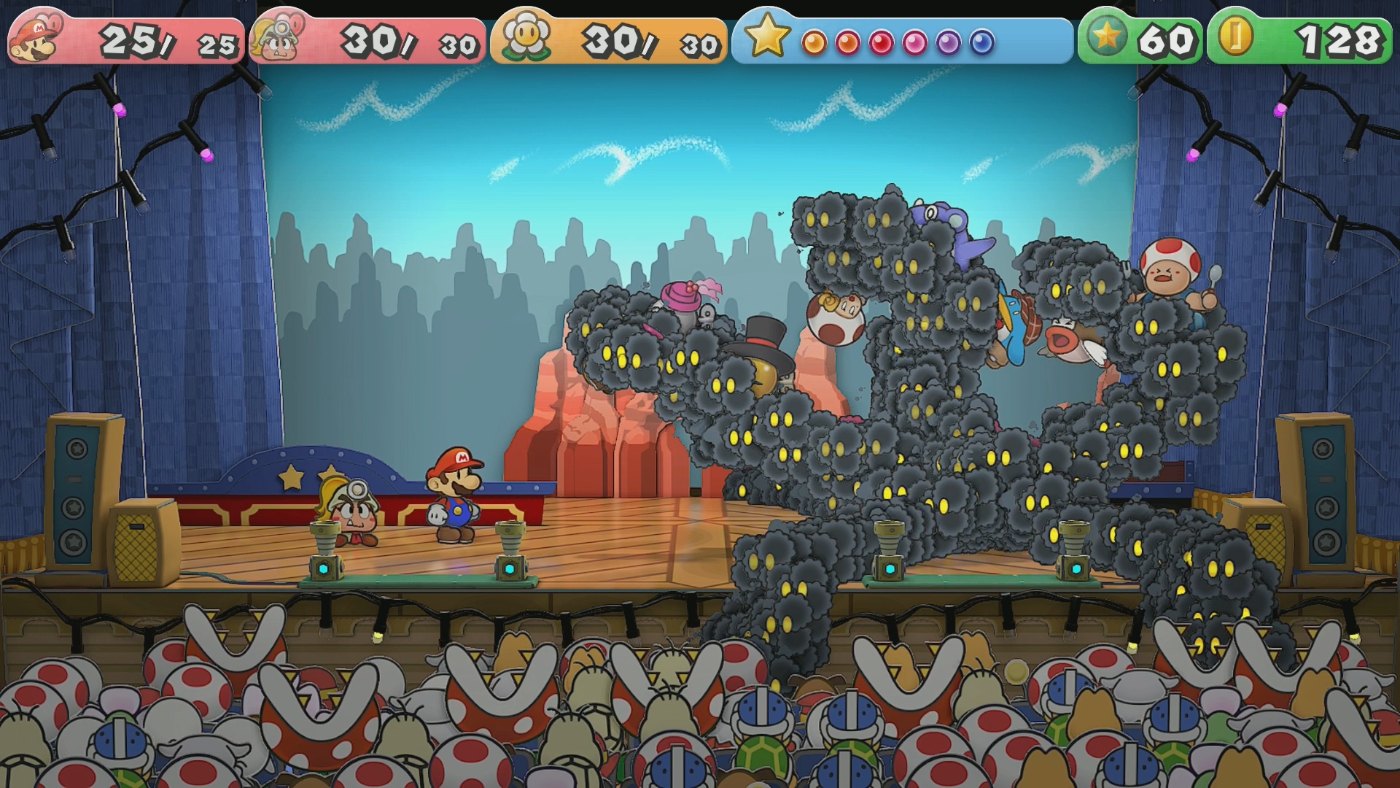
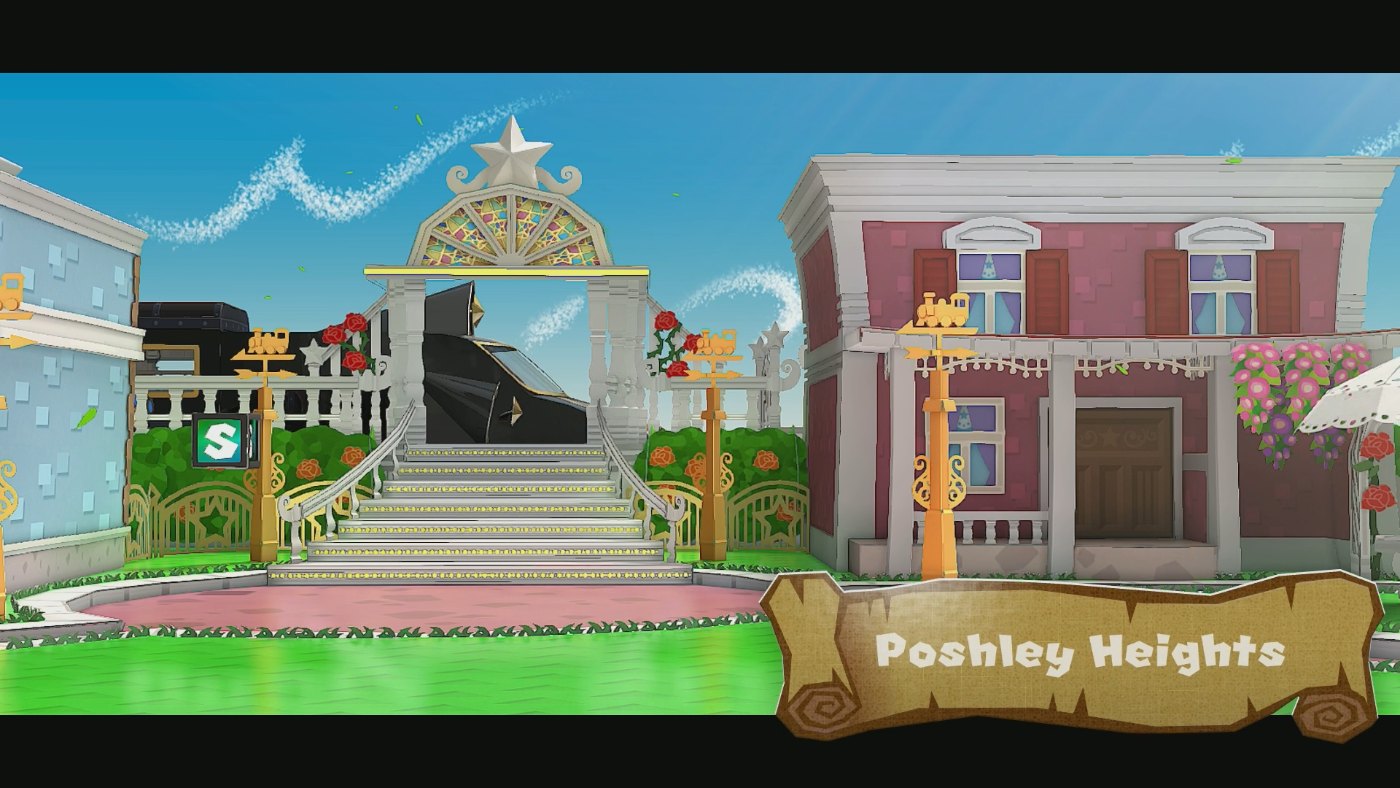
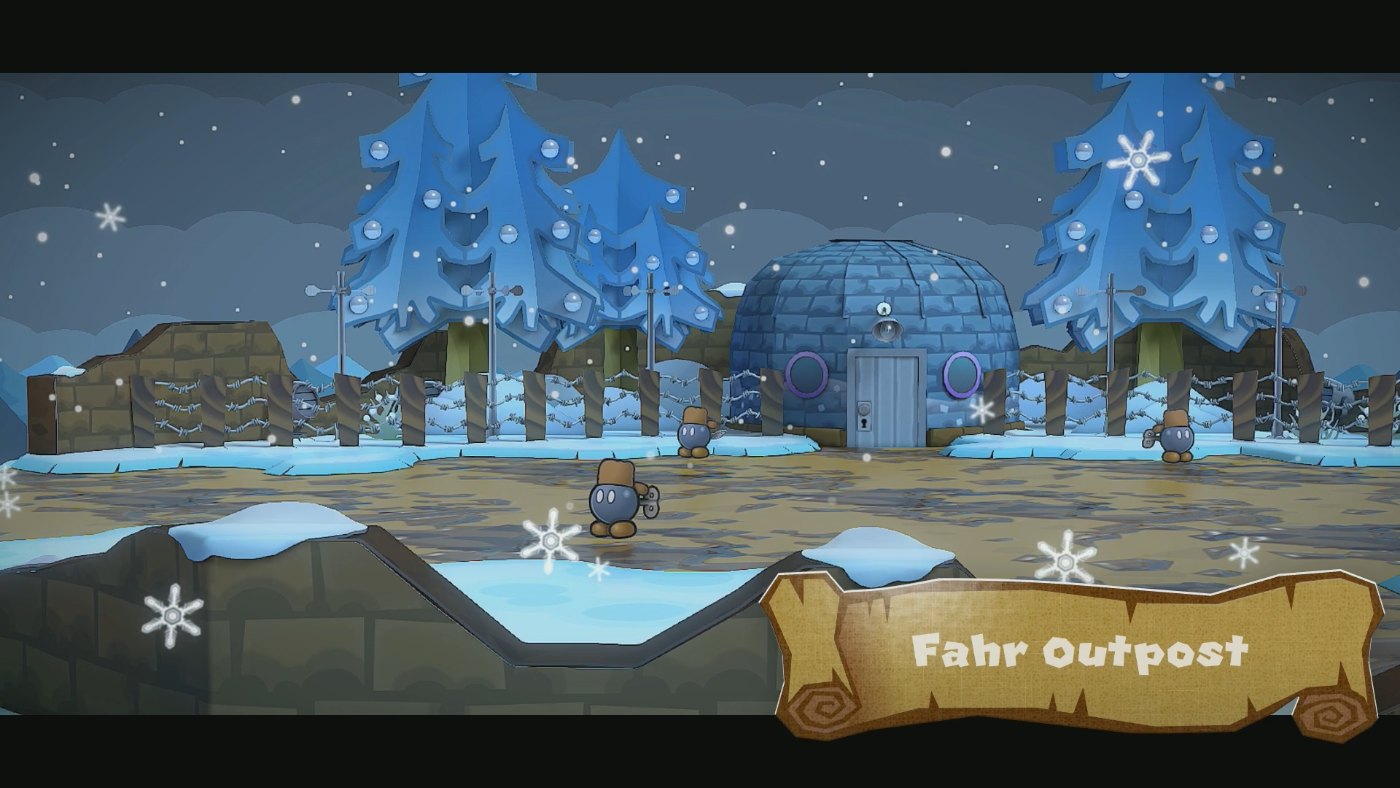
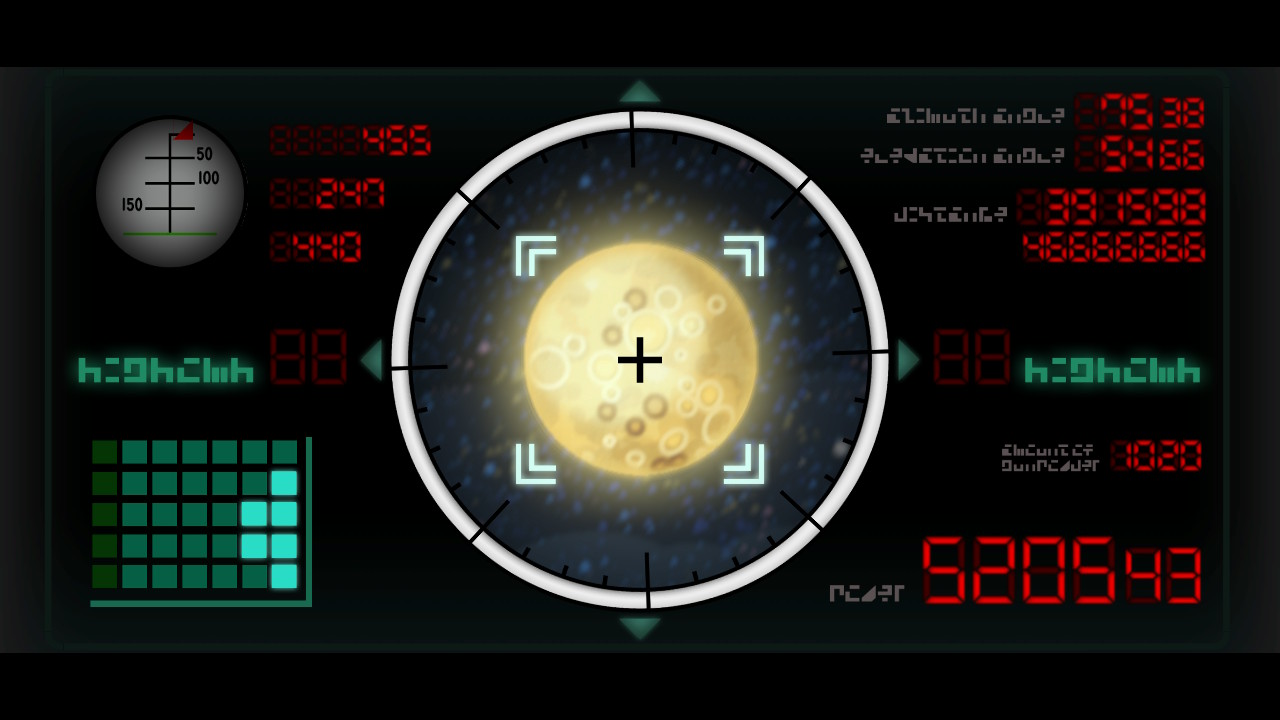
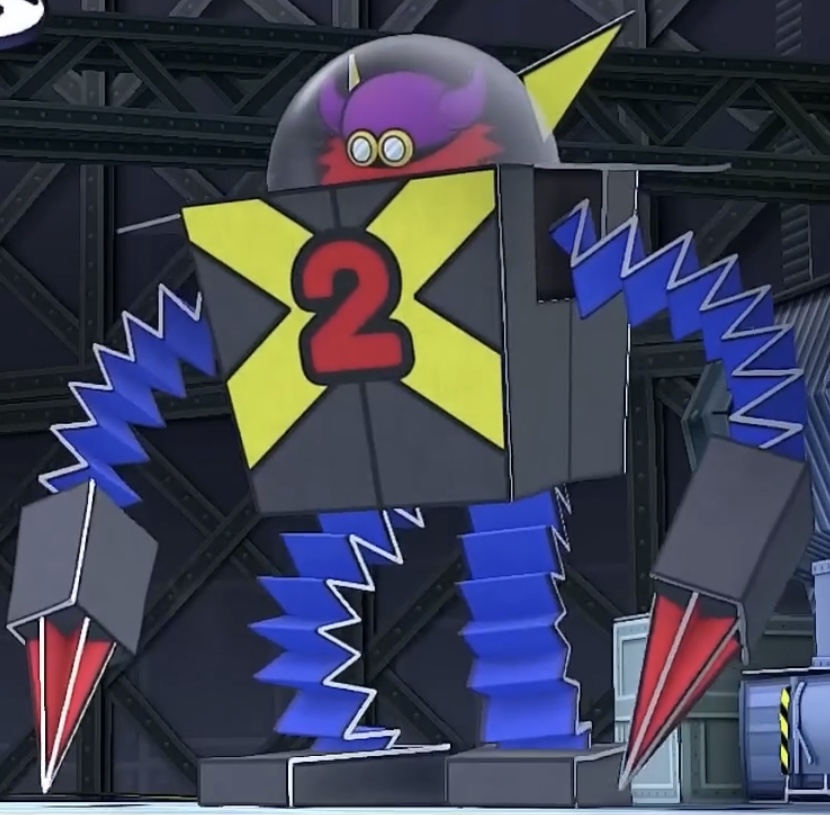
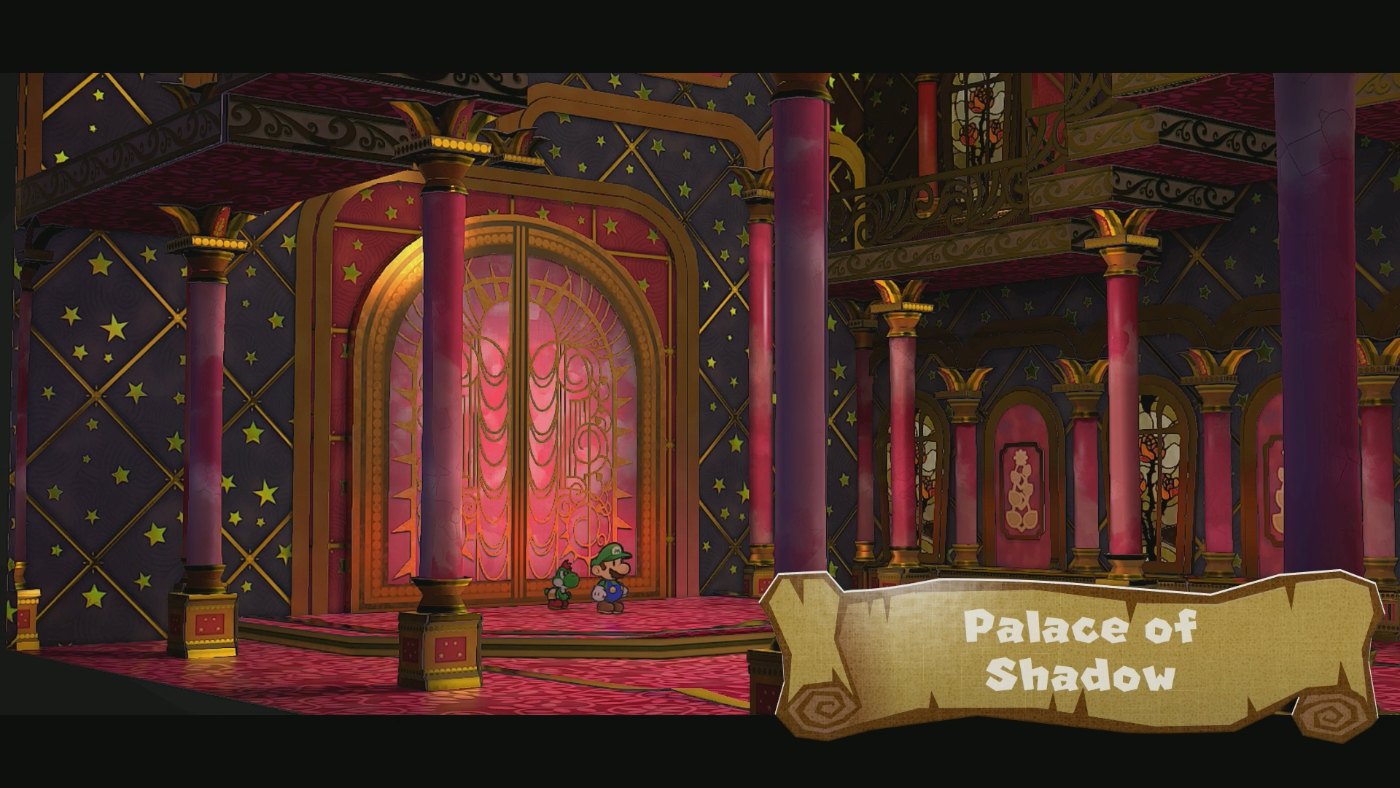
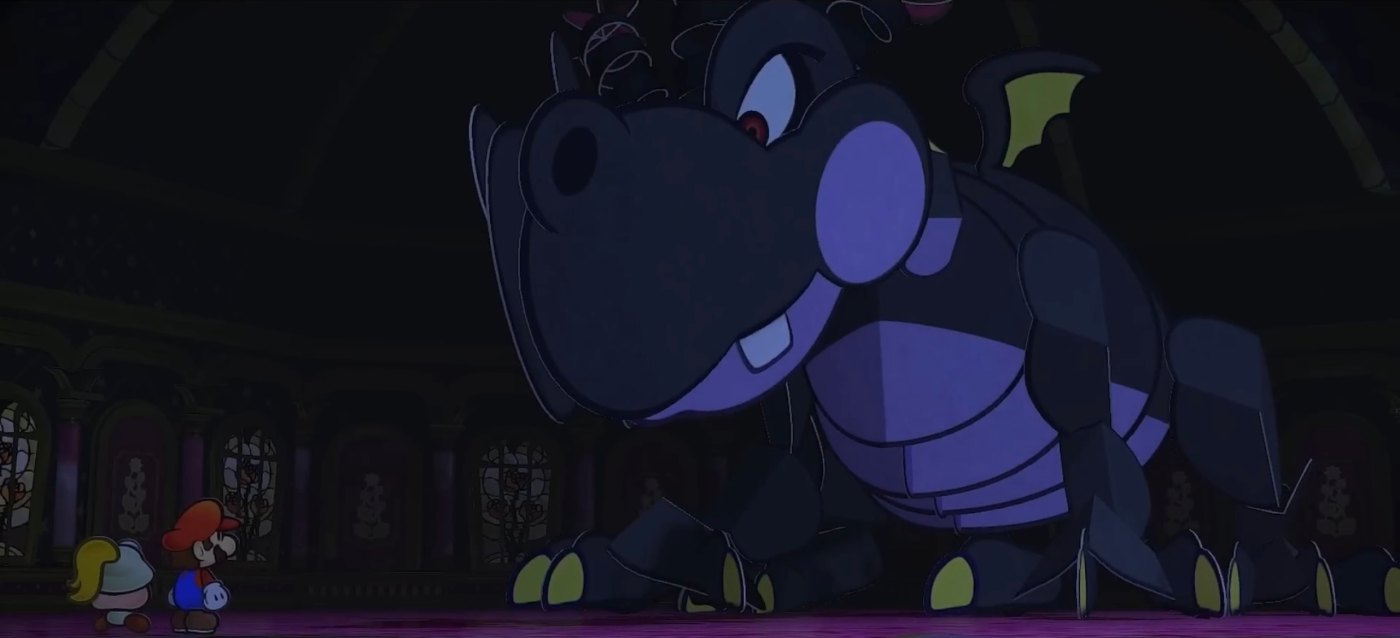
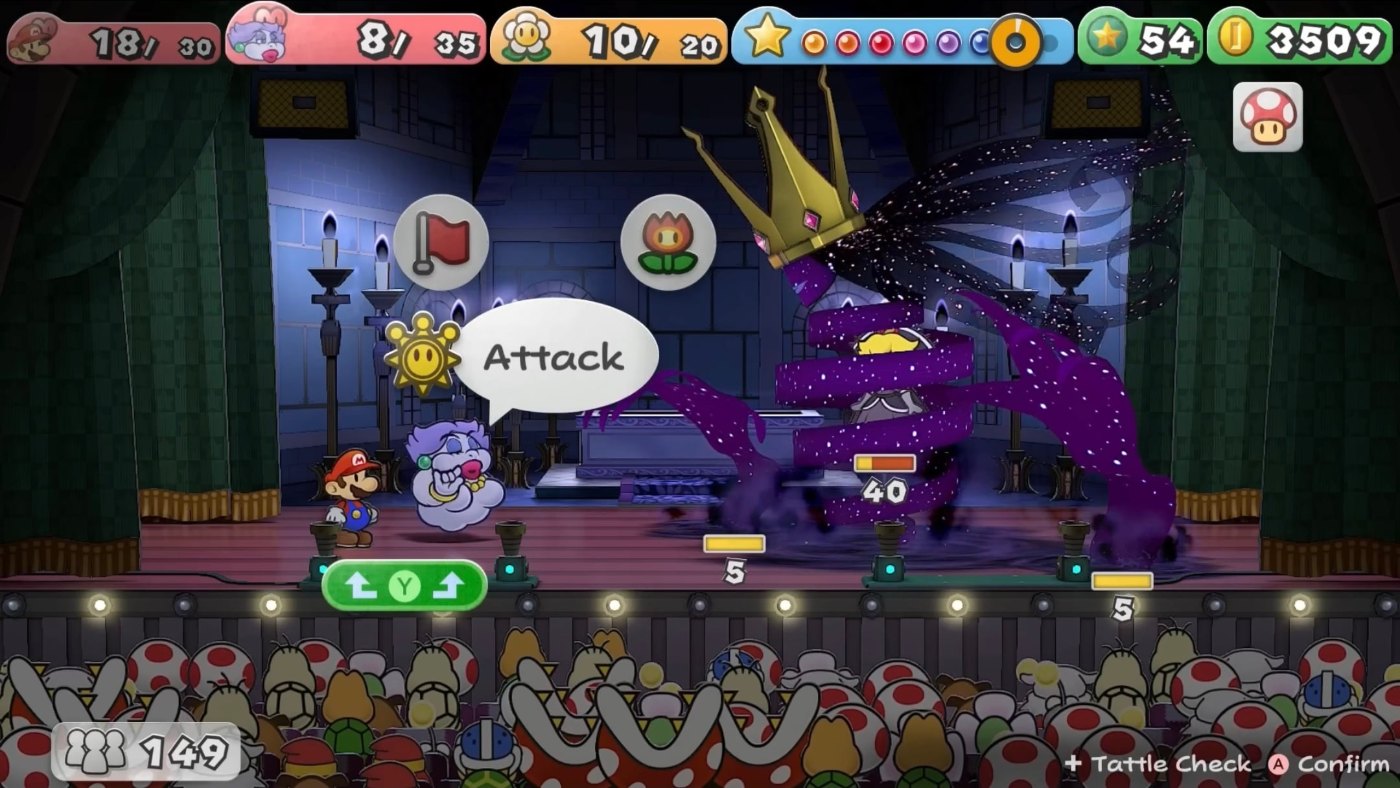
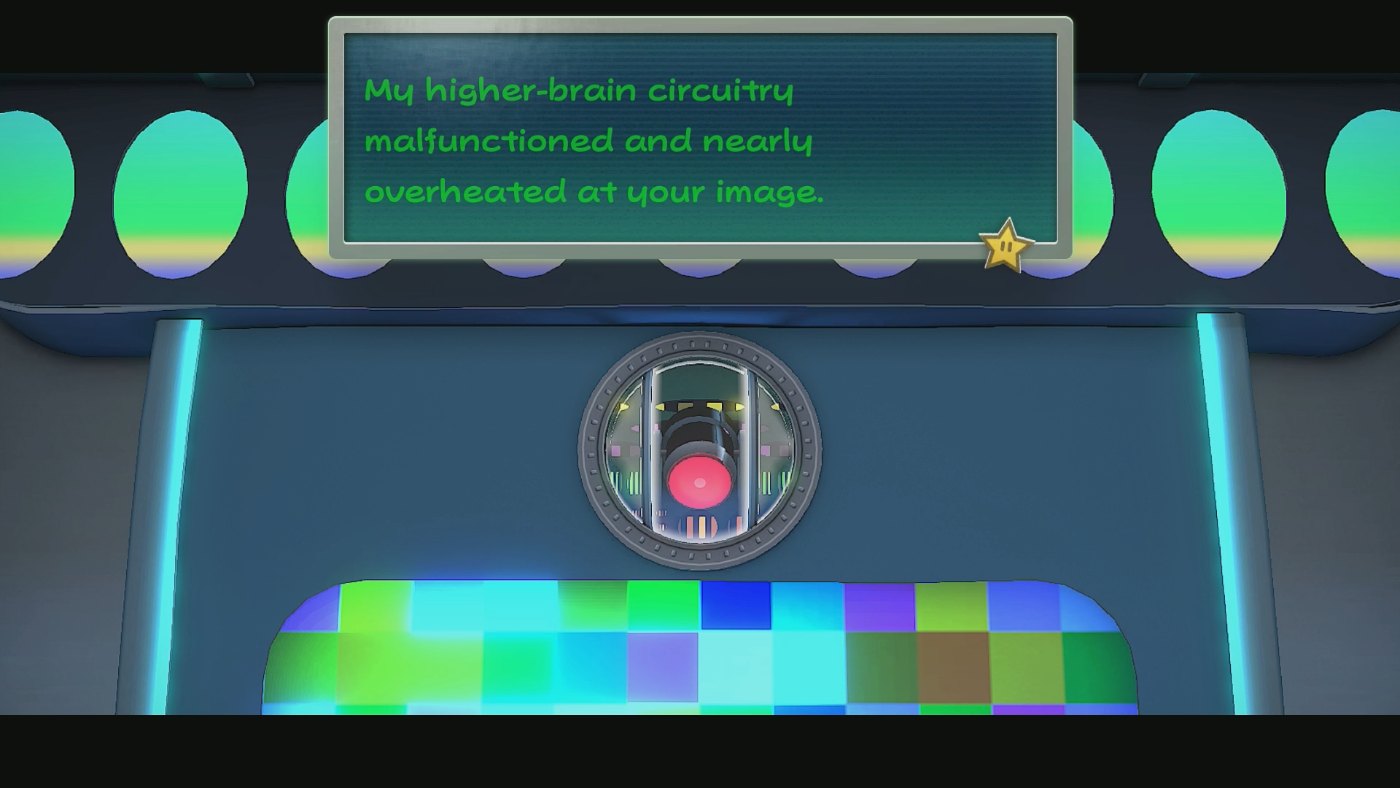
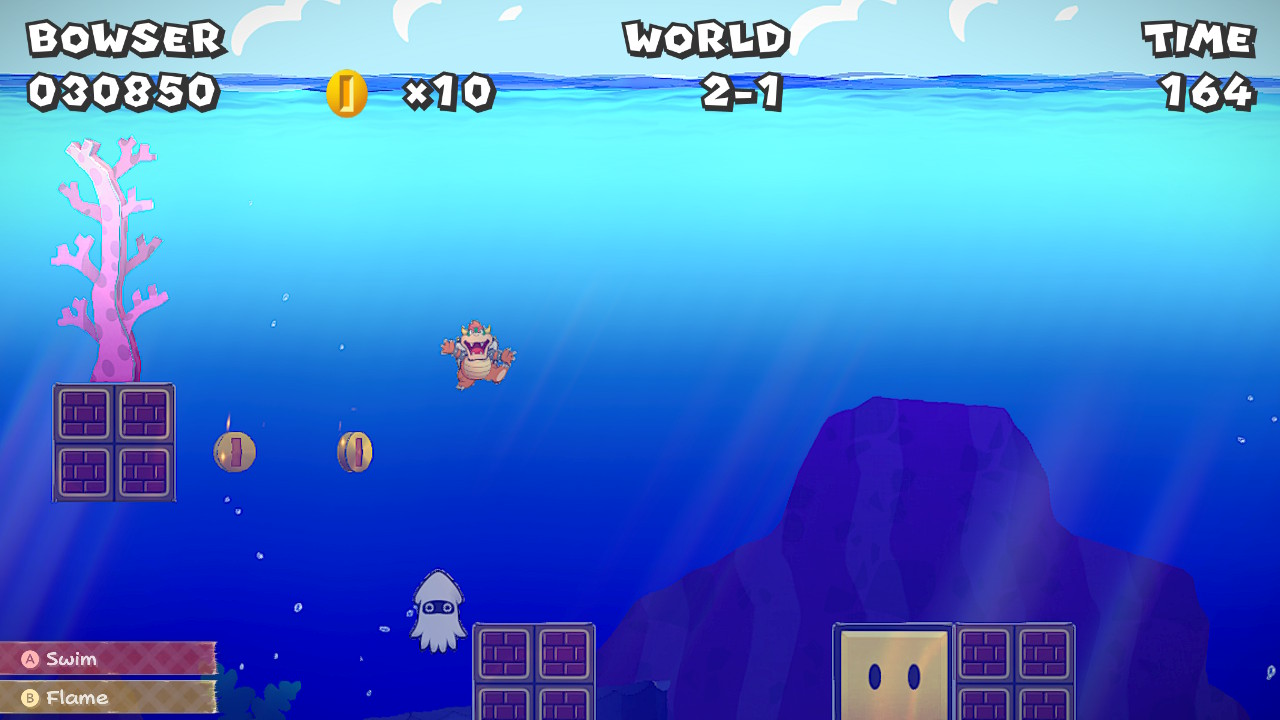
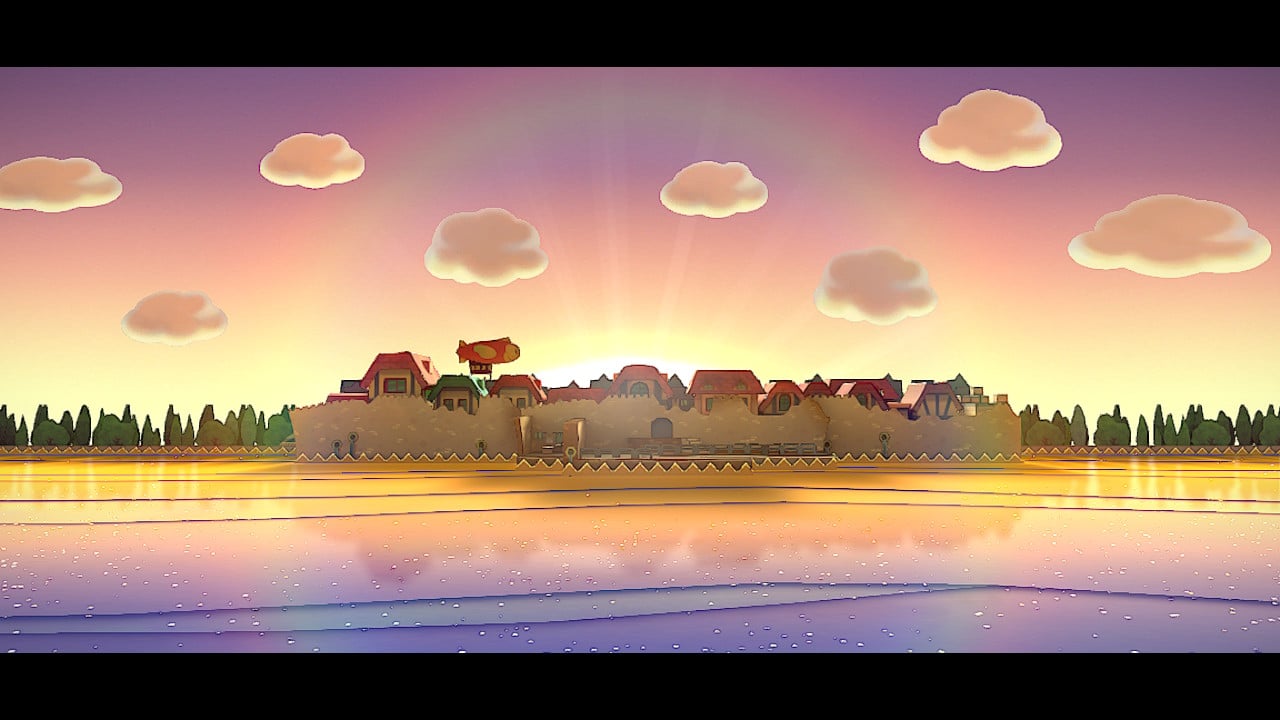
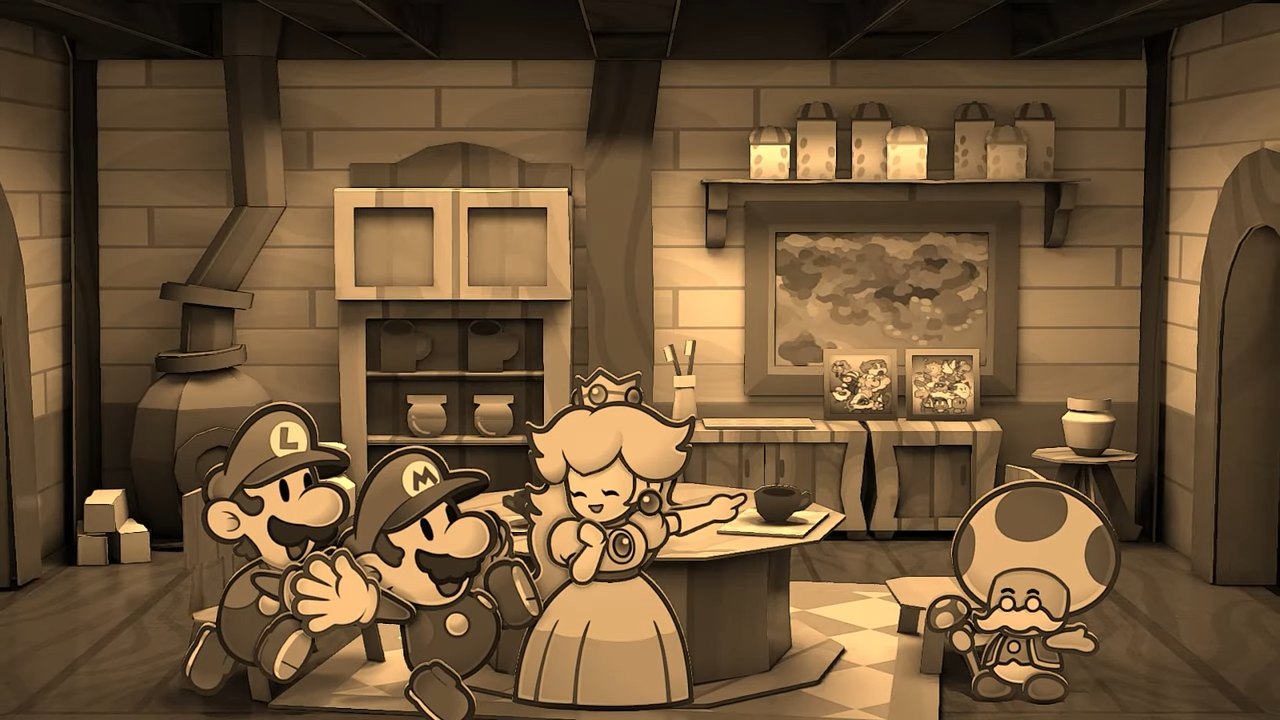
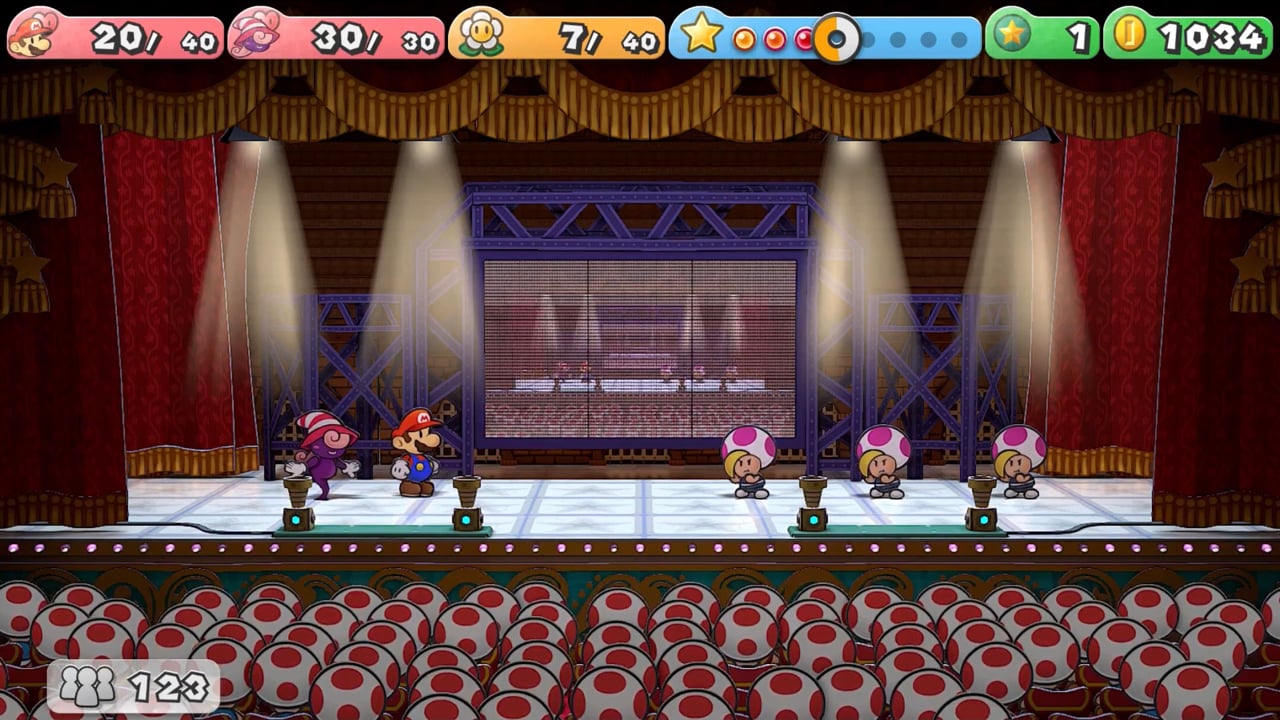
 RogueportHub · Prologue · Lord Crump, Gus (optional)The thieves’ port, now with litter, puddles and a noose that sways. The cockroaches are worth a coin each if you stamp on them.
 Rogueport UndergroundHub · Plane Mode · Boss: BlooperRogueport Sewers under its new name. Home of the Thousand-Year Door, the new seven-pipe room and the way down to the Pit.
 Petal Meadows and PetalburgChapter 1Storybook hills, now ringed with pines, and the Koopa village where Koops joins.
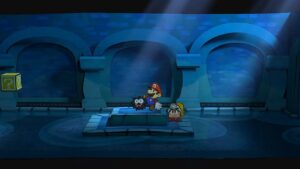 Path to Shhwonk Fortress and Shhwonk FortressChapter 1 · Sun and Moon Stones · Mini-boss: Gold Fuzzy and the Fuzzy HordeThe road east has its own name in the remake and a new tutorial ambush. The Fuzzy Horde finally gets a Tattle Log entry.
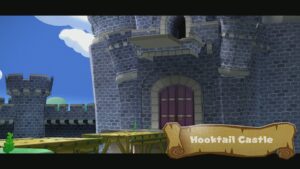 Hooktail CastleChapter 1 · Diamond Star · Paper Mode · Boss: HooktailFoggier and more cobwebbed, with a new recovery block on the third floor and a pipe back up from the depths.
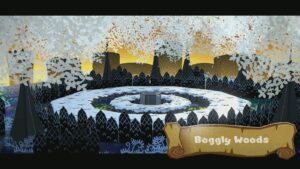 Boggly WoodsChapter 2 · Mini-boss: the Three ShadowsPetals drift from the trees, which chime when hammered. The Save Block has moved to just before the Sirens’ ambush.
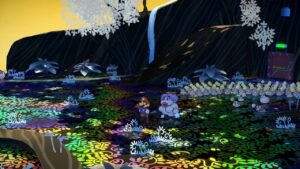 The Great TreeChapter 2 · Emerald Star · Super Boots · Boss: Magnus von GrappleThe Punies’ home, occupied by X-Nauts. Pipe 2 in the new hub comes out at its front door.
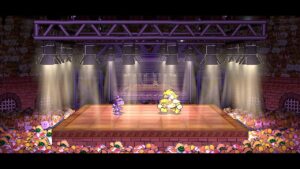 Glitzville and the Glitz PitChapter 3 · Gold Star · Super Hammer · Boss: Macho GrubbaTwenty ranks, a fighter directory in the lobby, Exhibition Matches and, once Chapter 3 and Jolene’s Trouble are behind you, Prince Mush.
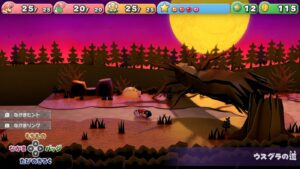 Twilight Town and Twilight TrailChapter 4 · Tube ModeThe village of pigs. A new Save Block sits past the fallen tree on the trail.
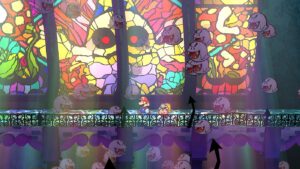 Creepy SteepleChapter 4 · Ruby Star · Bosses: Doopliss, Atomic Boo (optional)Repainted, with a basement pipe to town and a Boo in the storeroom who sets six quizzes on the story.
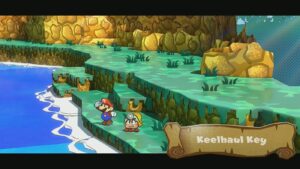 Keelhaul KeyChapter 5 · Mini-boss: three EmbersA jungle island with a new cliff-top switch for a jump-pad shortcut, and a Whacka you may come to regret hitting.
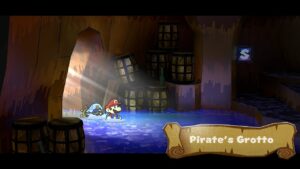 Pirate’s GrottoChapter 5 · Sapphire Star · Boat Mode · Bosses: Cortez, Lord CrumpFlooded caves with an extra Save Block, a recovery block and a new ambush once Mario can sail.
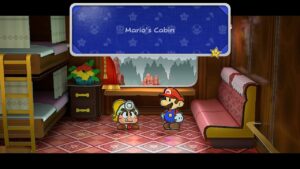 Excess ExpressChapter 6 · Boss: SmorgThree days of detective work on a sleeper train. After the chapter it can skip Riverside Station.
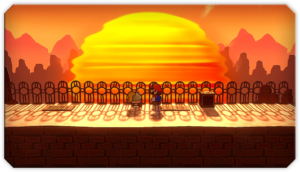 Riverside StationChapter 6 · Ultra BootsA deserted station clogged with Smorgs, with new items behind posters that Flurrie can blow down.
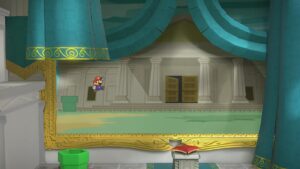 Poshley Heights and Poshley SanctumChapter 6 · Garnet StarThe smart end of the line. Lady Bow and Bootler from the first Paper Mario holiday here after the credits.
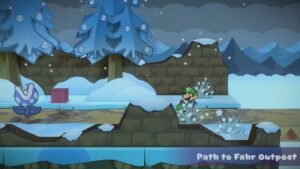 Fahr OutpostChapter 7A snowed-in Bob-omb village and a cannon aimed at the Moon. Pipe 7 leads straight here.
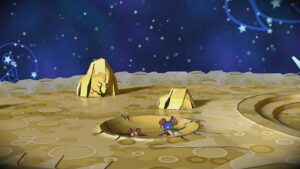 The MoonChapter 7Low gravity and breakable rocks, several of which hide new items.
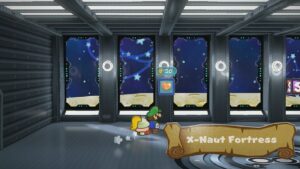 X-Naut FortressChapter 7 · Crystal Star · Boss: Magnus von Grapple 2.0Grodus’s base. Four Security Keys now, a crane game, and a changing room that turns the party into 8-bit sprites.
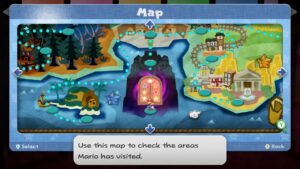 Palace of ShadowChapter 8 · Bosses: Dark Bones, Gloomtail, the Shadow Sirens, Grodus, Bowser and Kammy Koopa, the Shadow QueenThe final dungeon, with named rooms, an extra Save Block and a pipe back to the entrance once the Queen is beaten.
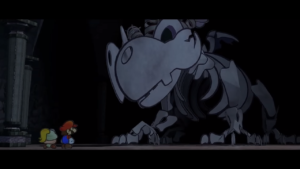 Pit of 100 TrialsOptional · Return Postage · Bosses: Bonetail, then WhackaA hundred floors without a save. The remake lets you retry a floor after a Game Over and, once cleared, start from floor 50 for 300 coins.
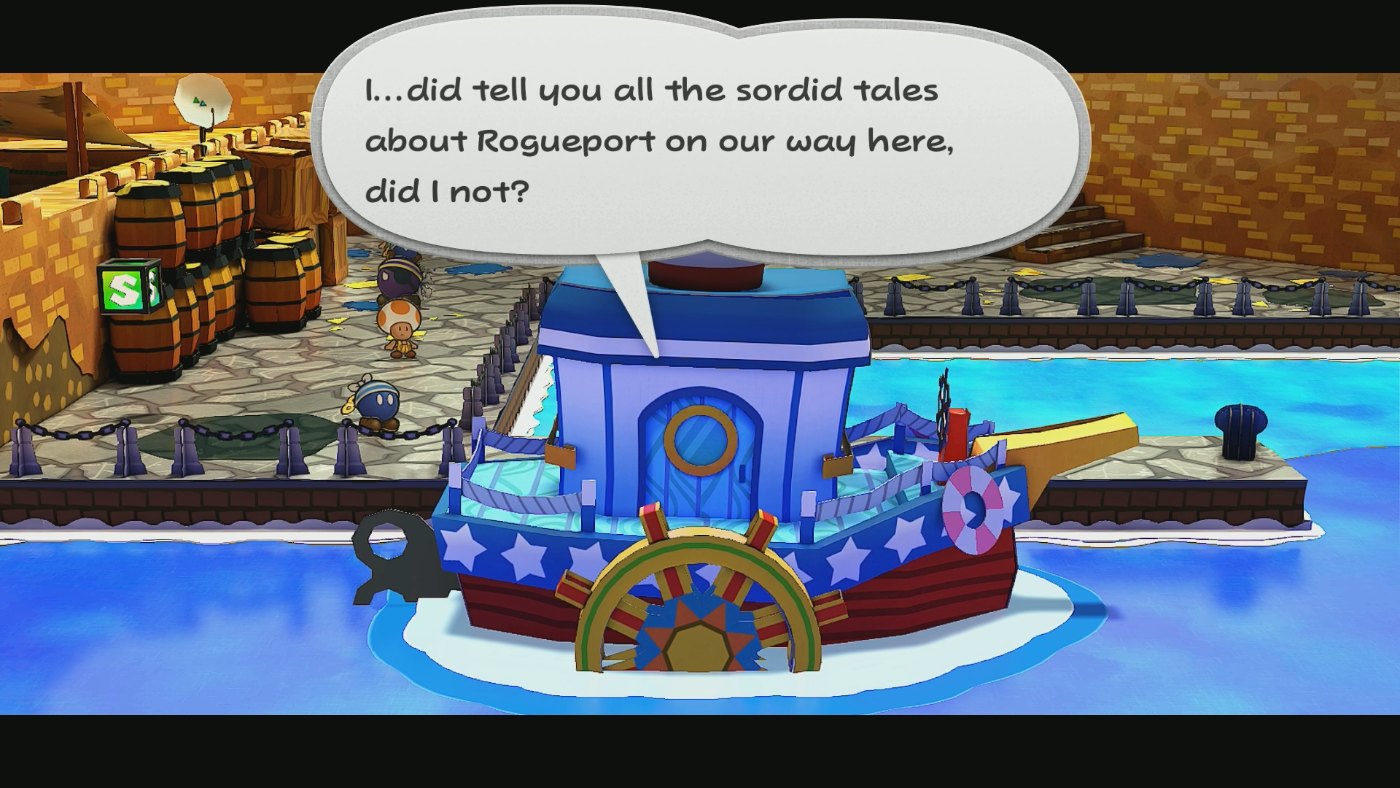
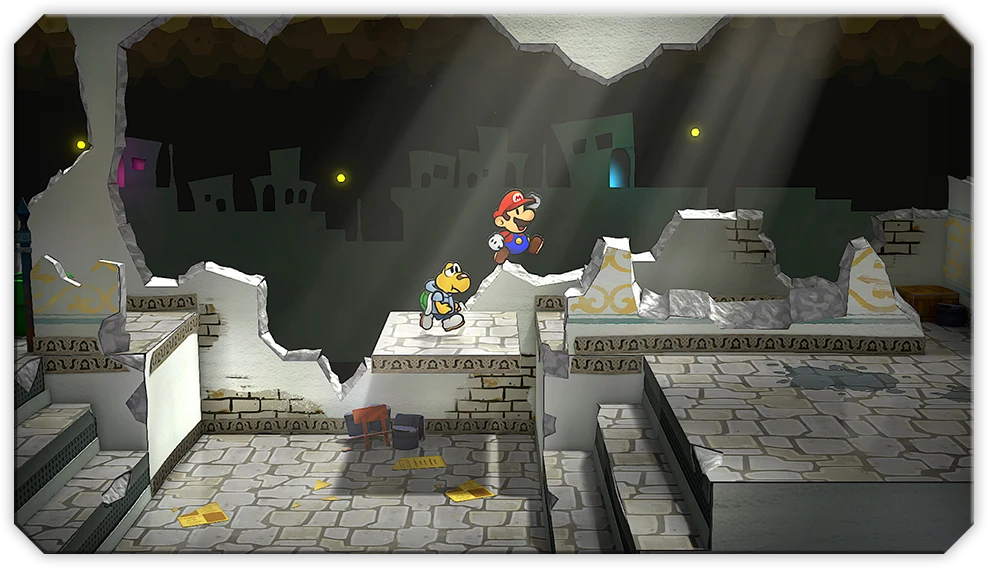
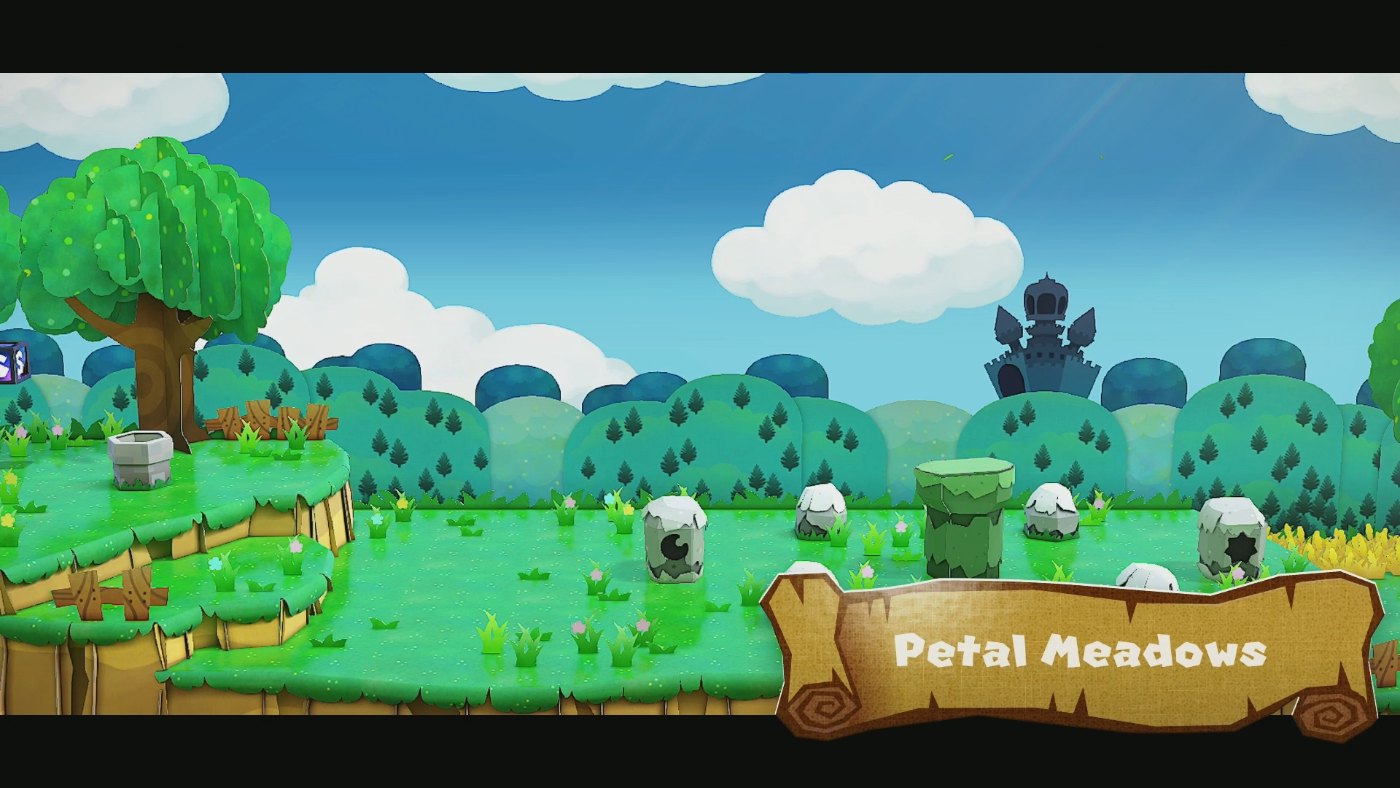
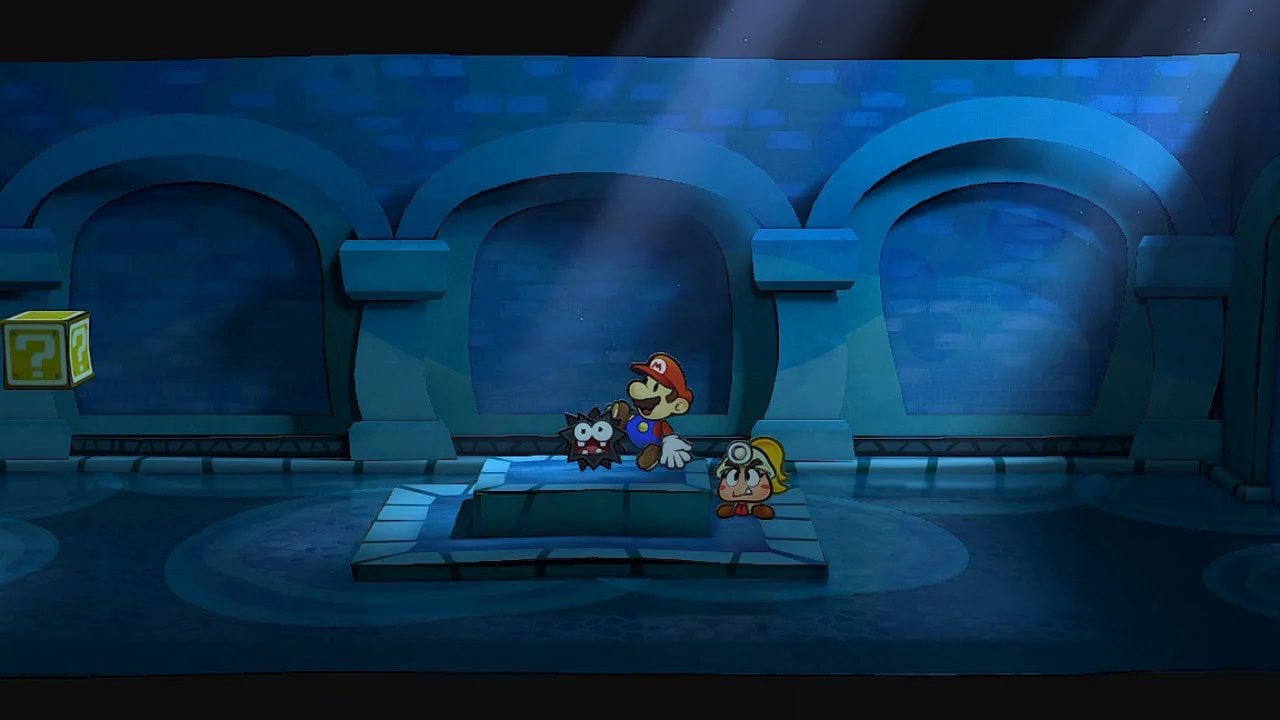
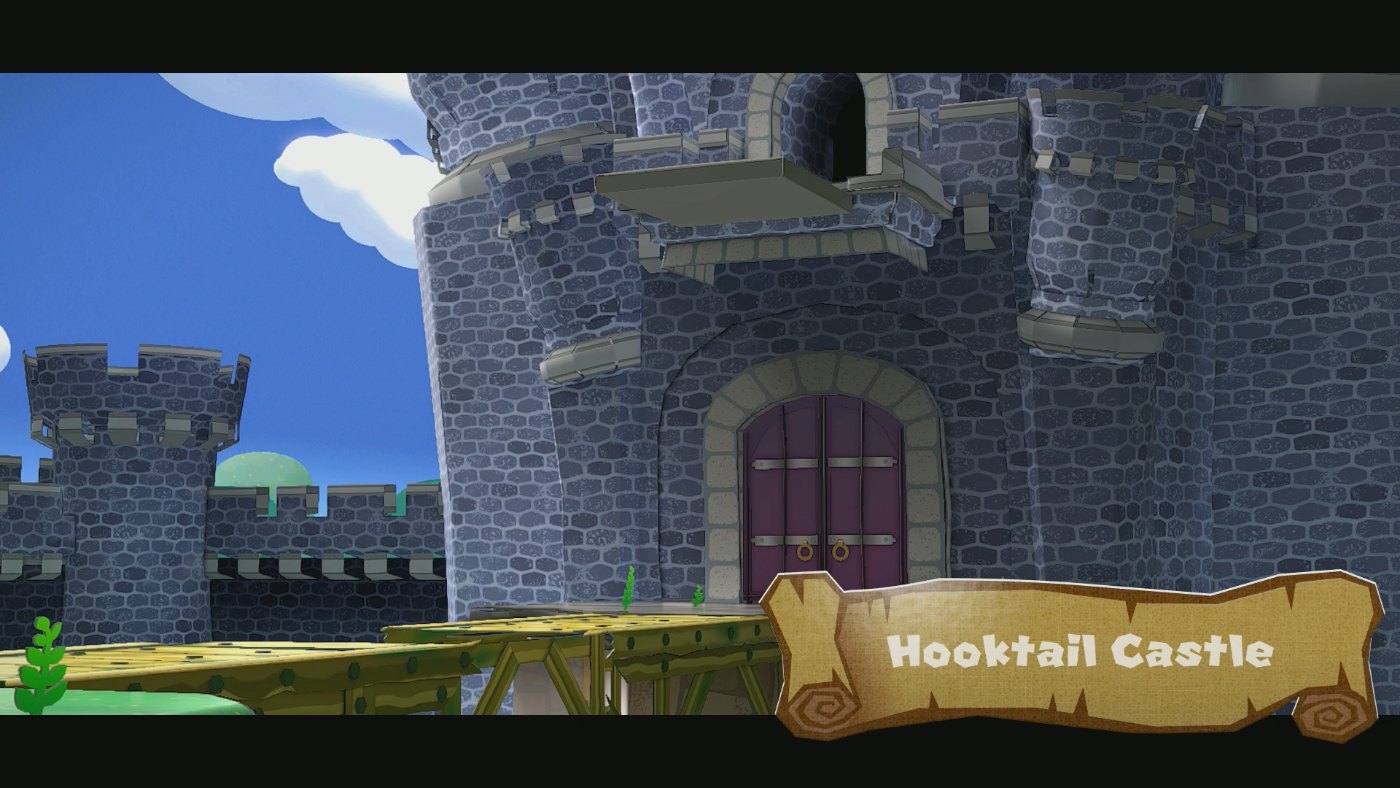
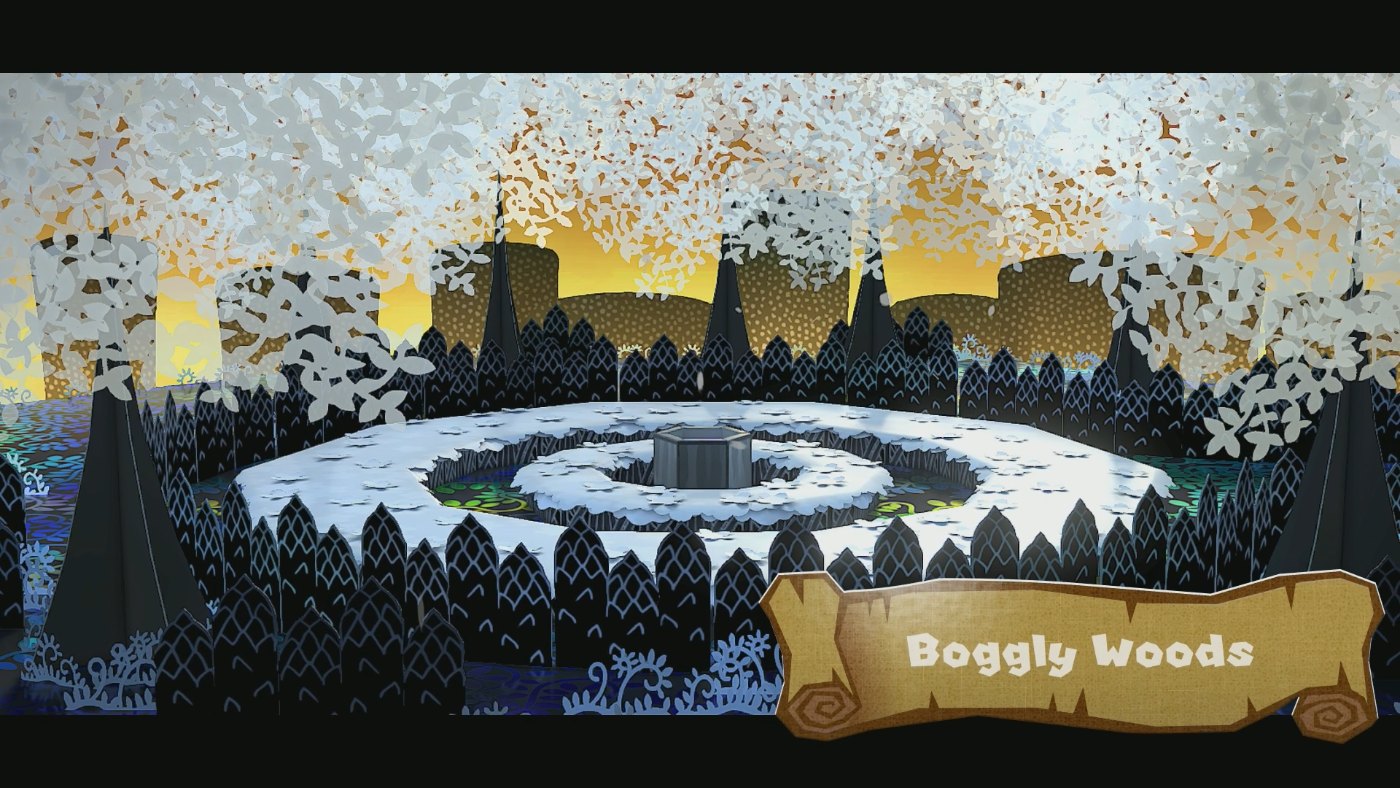
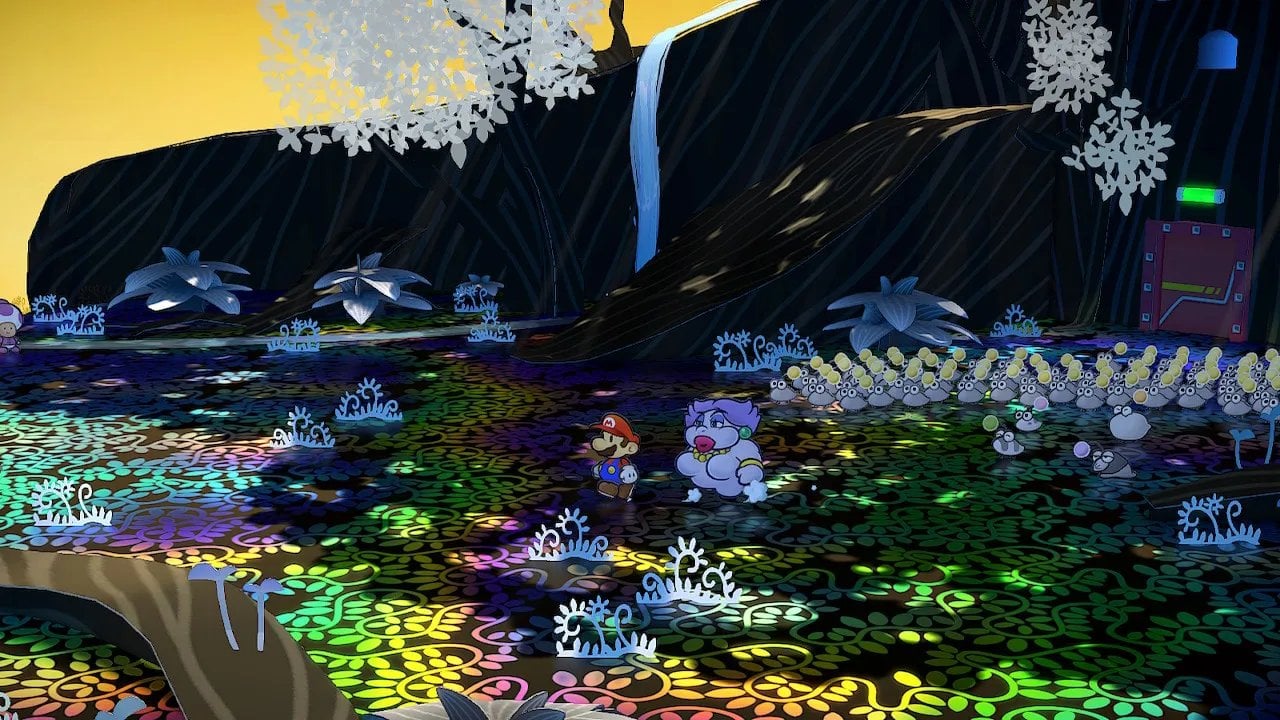
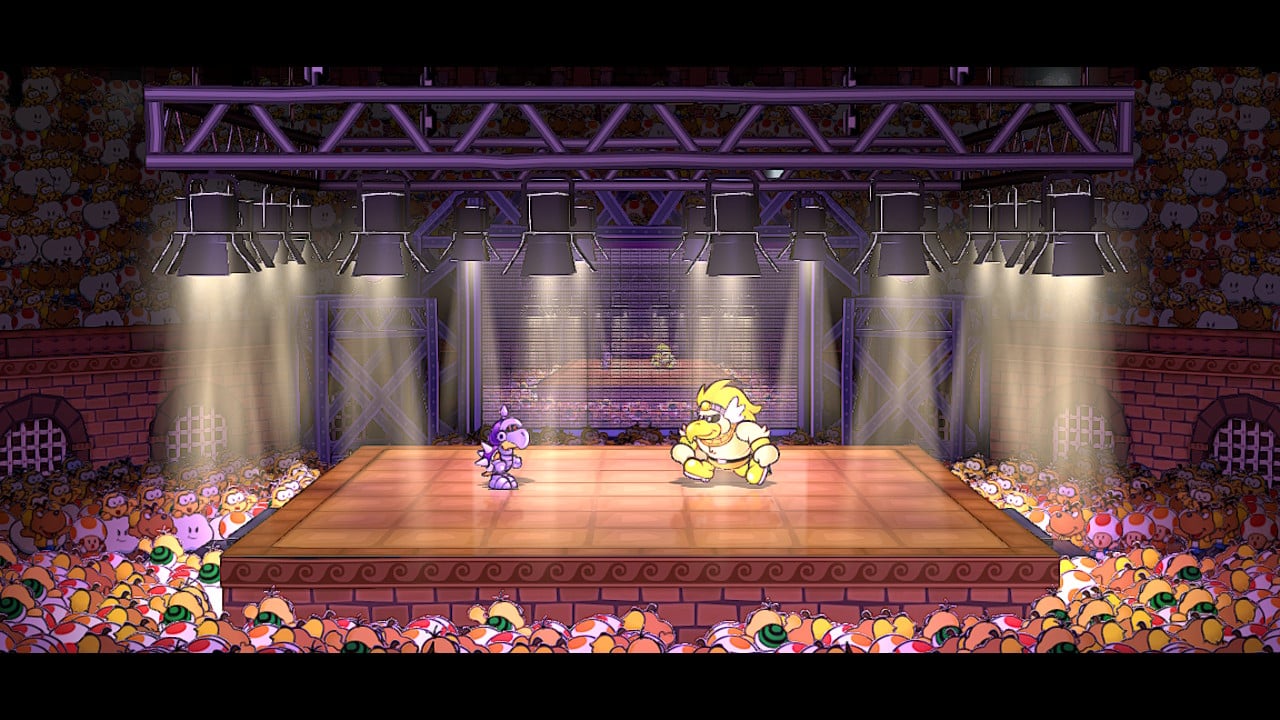
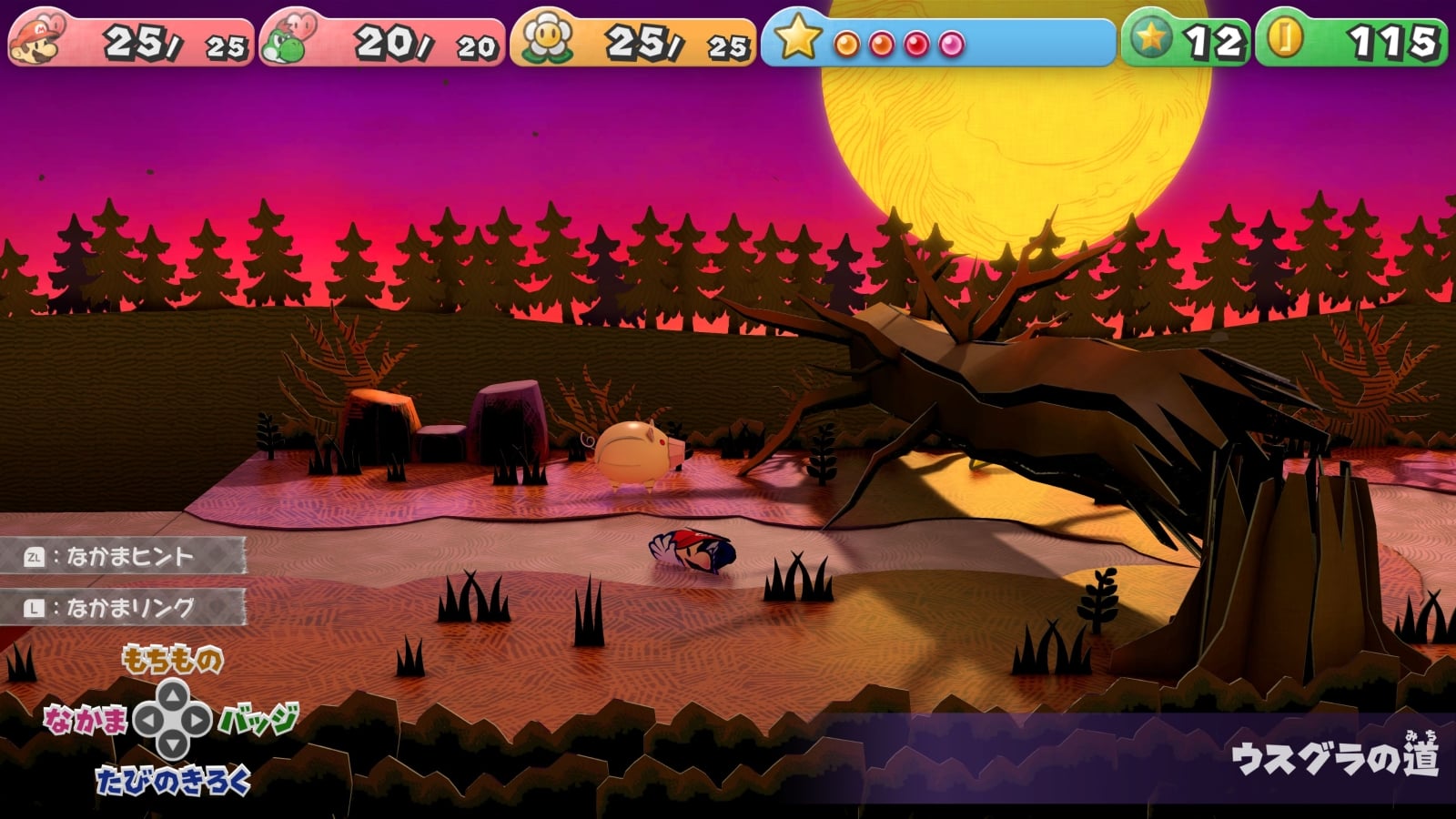
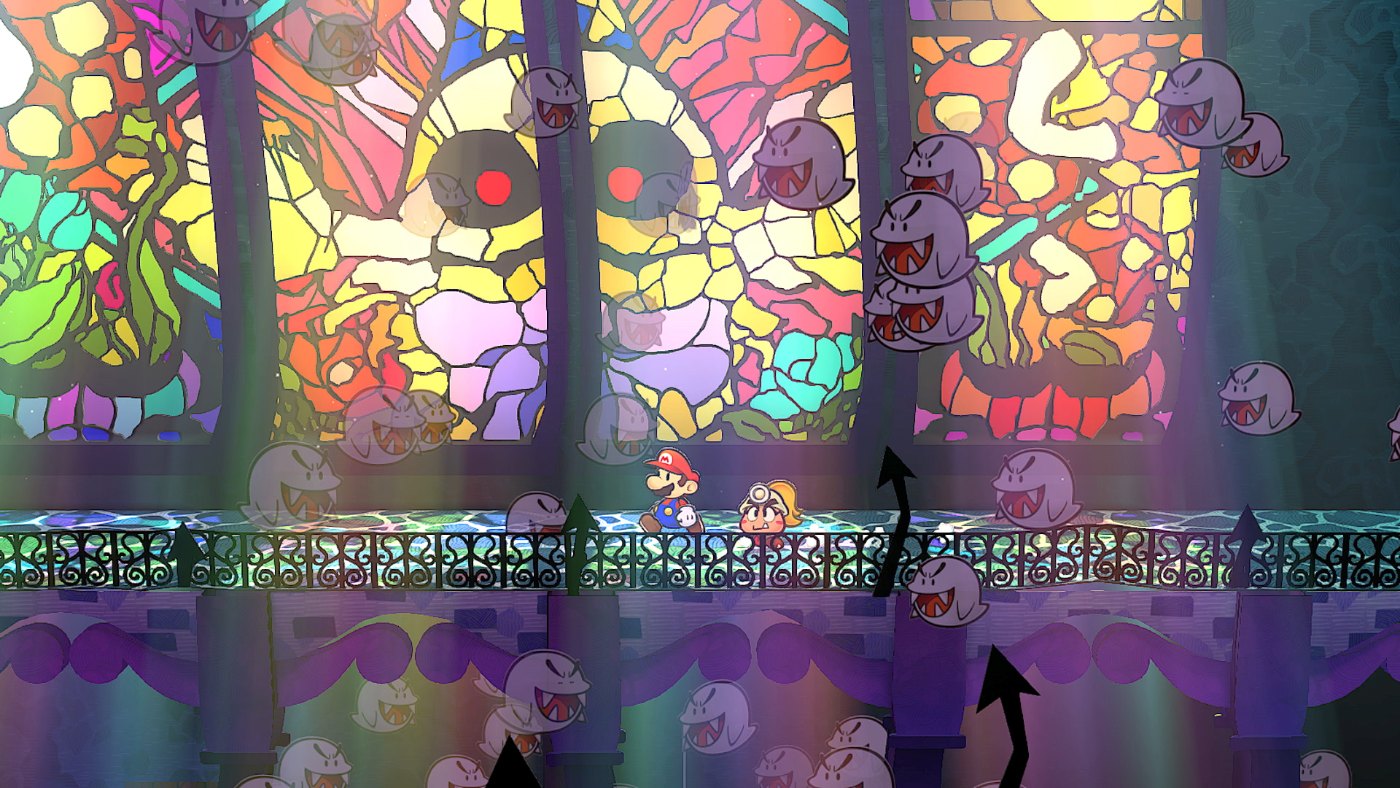
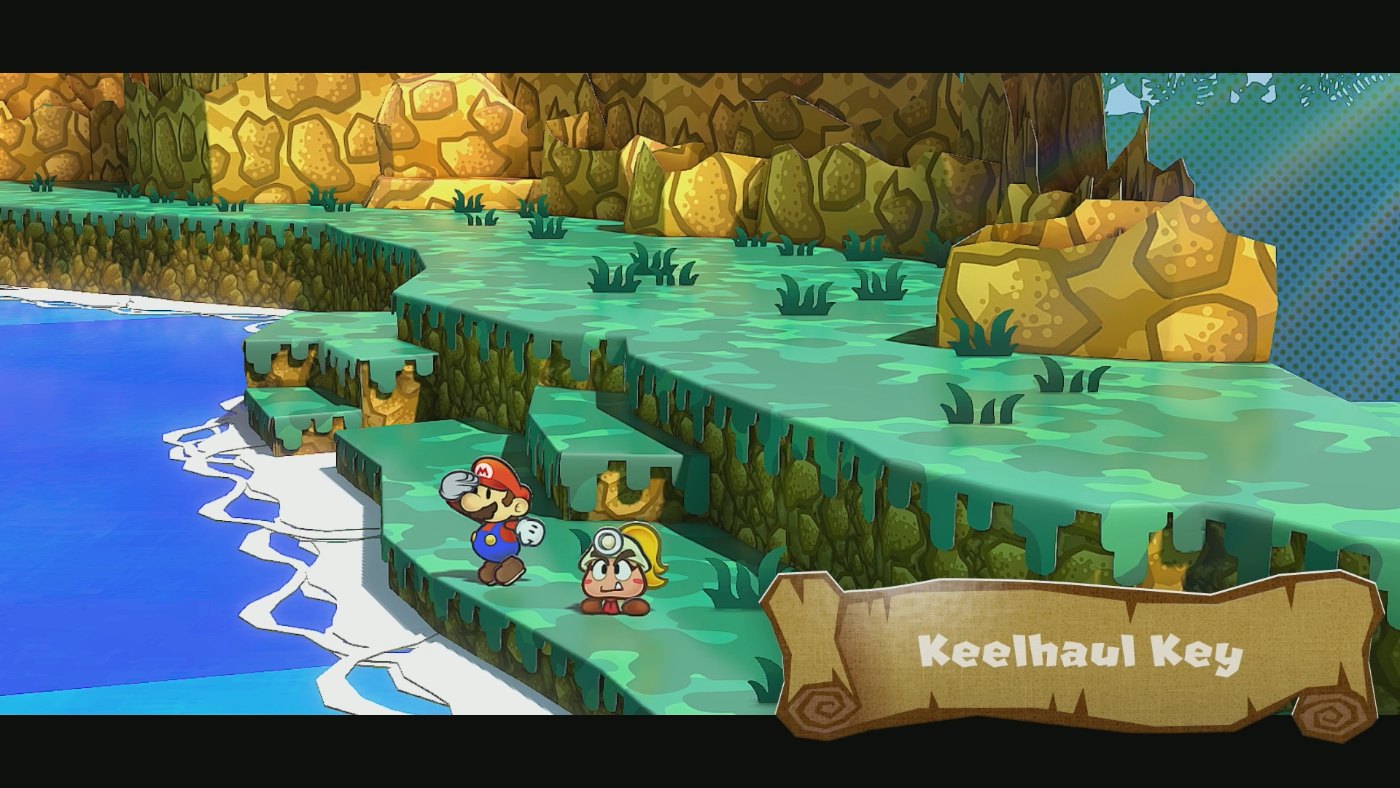
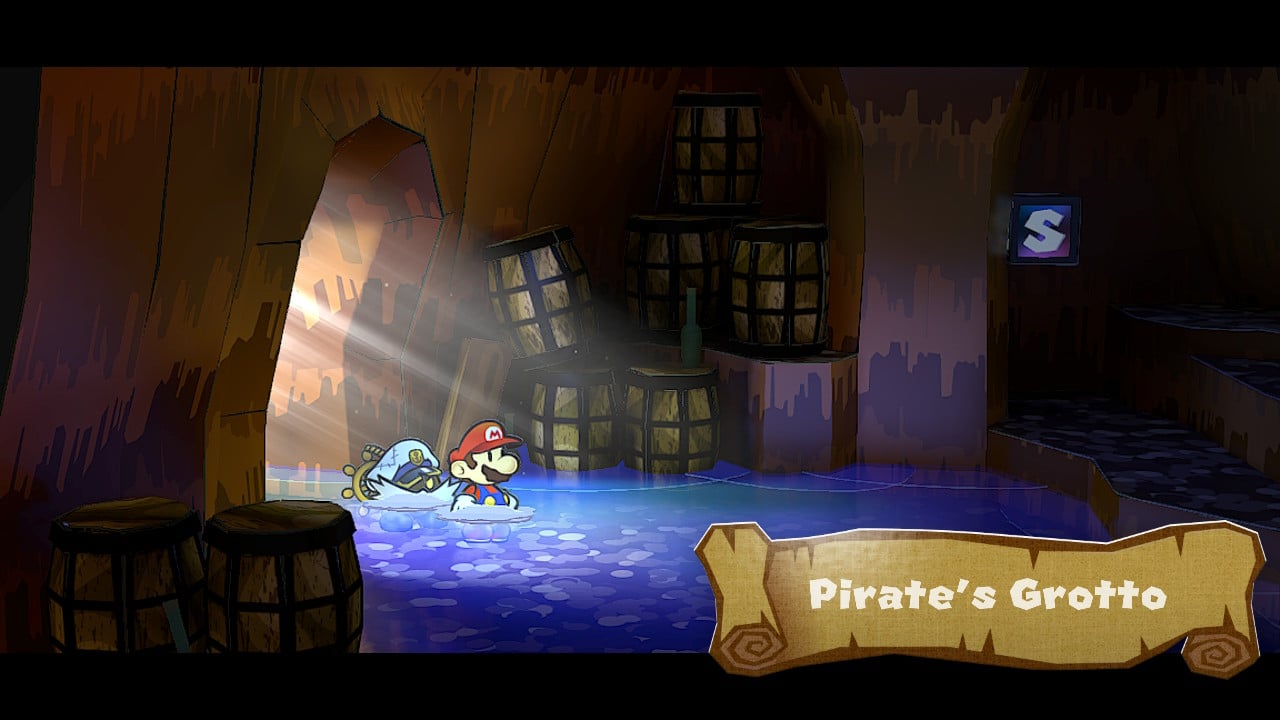
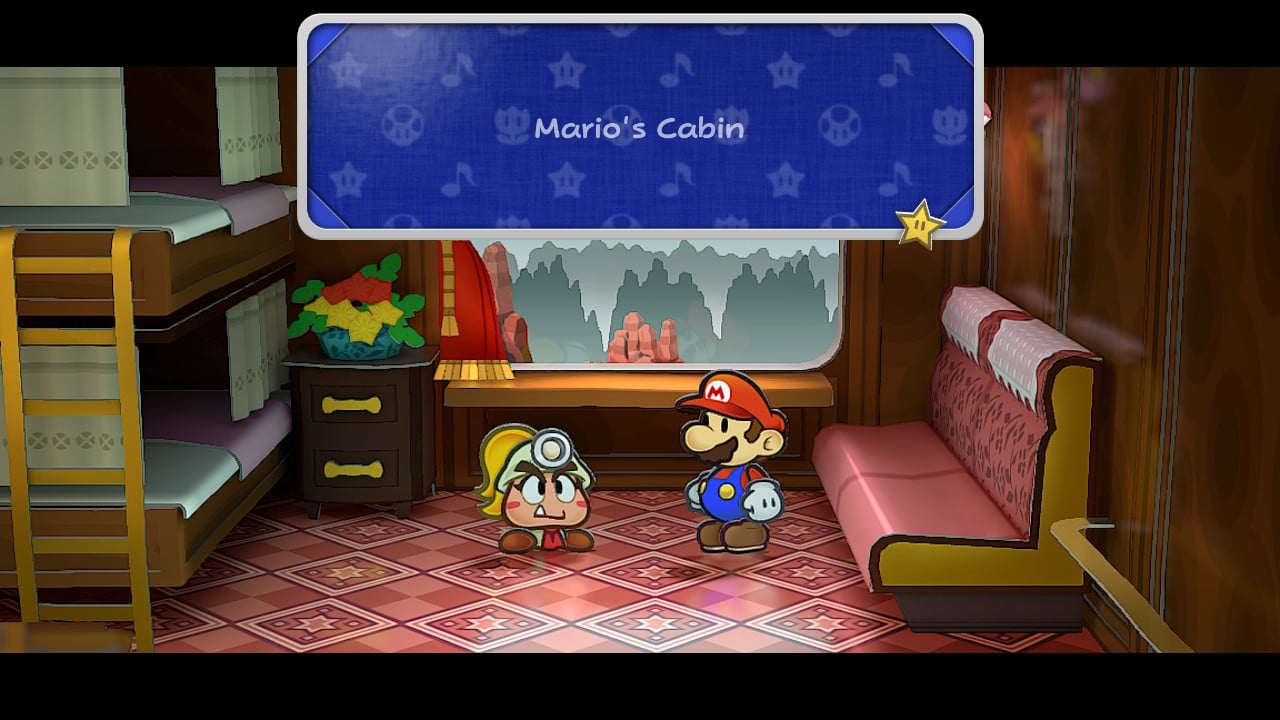
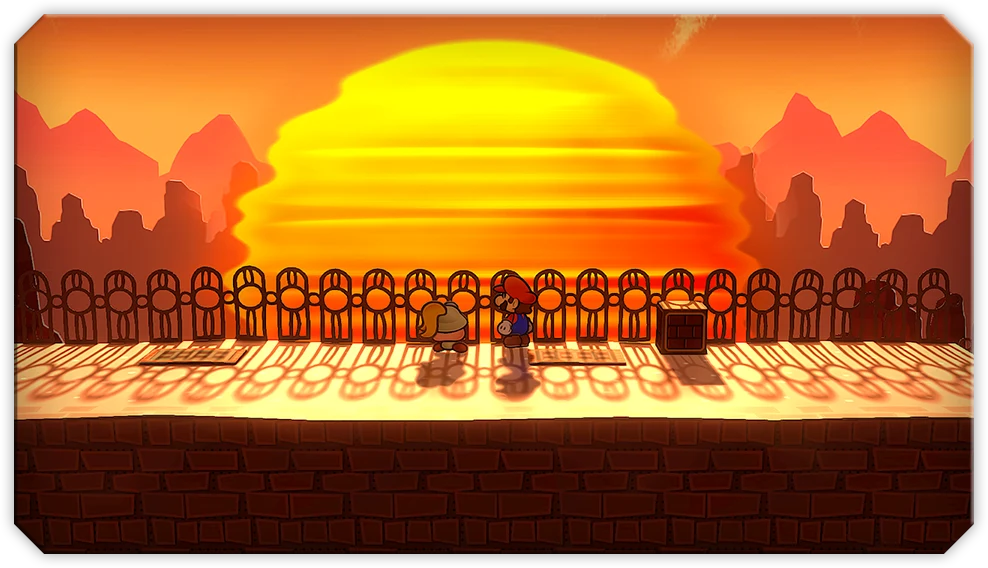
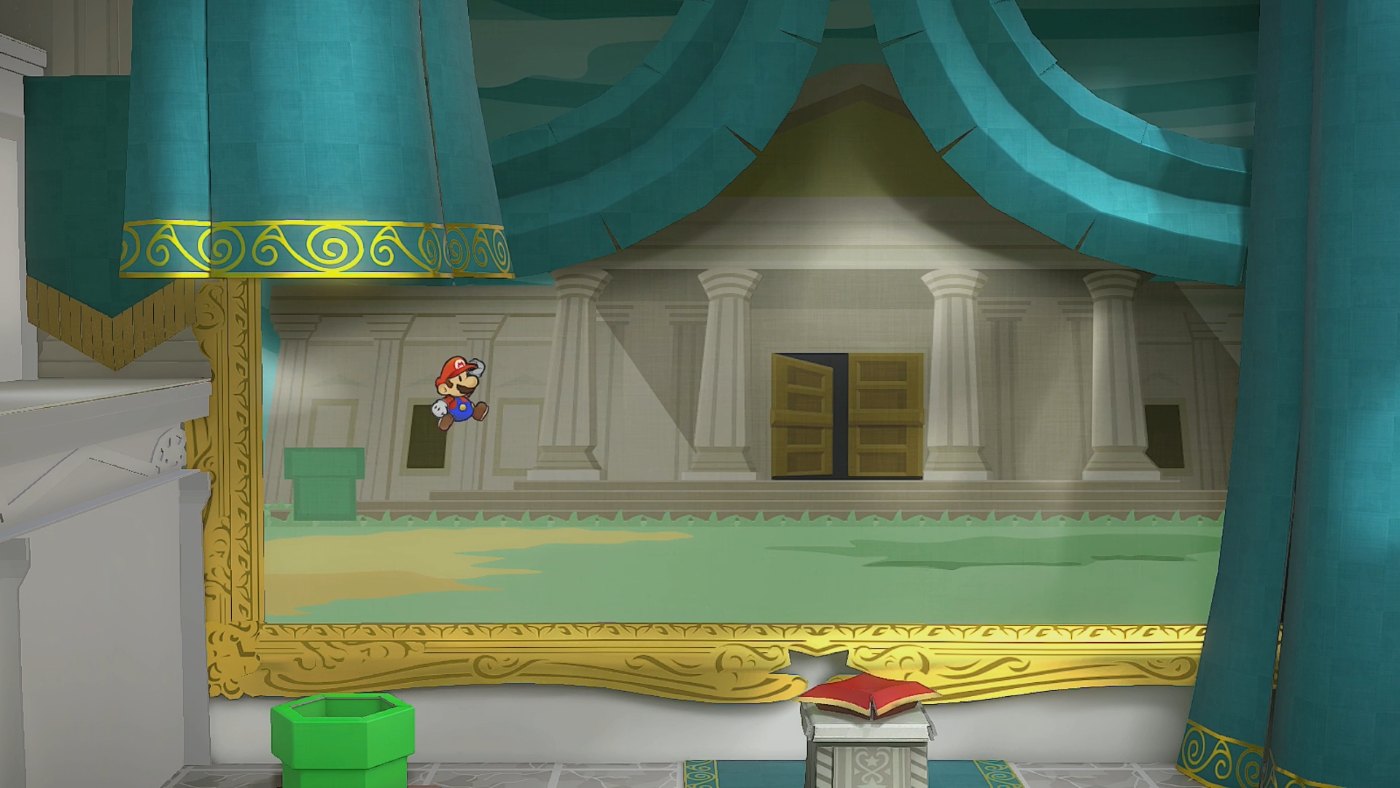
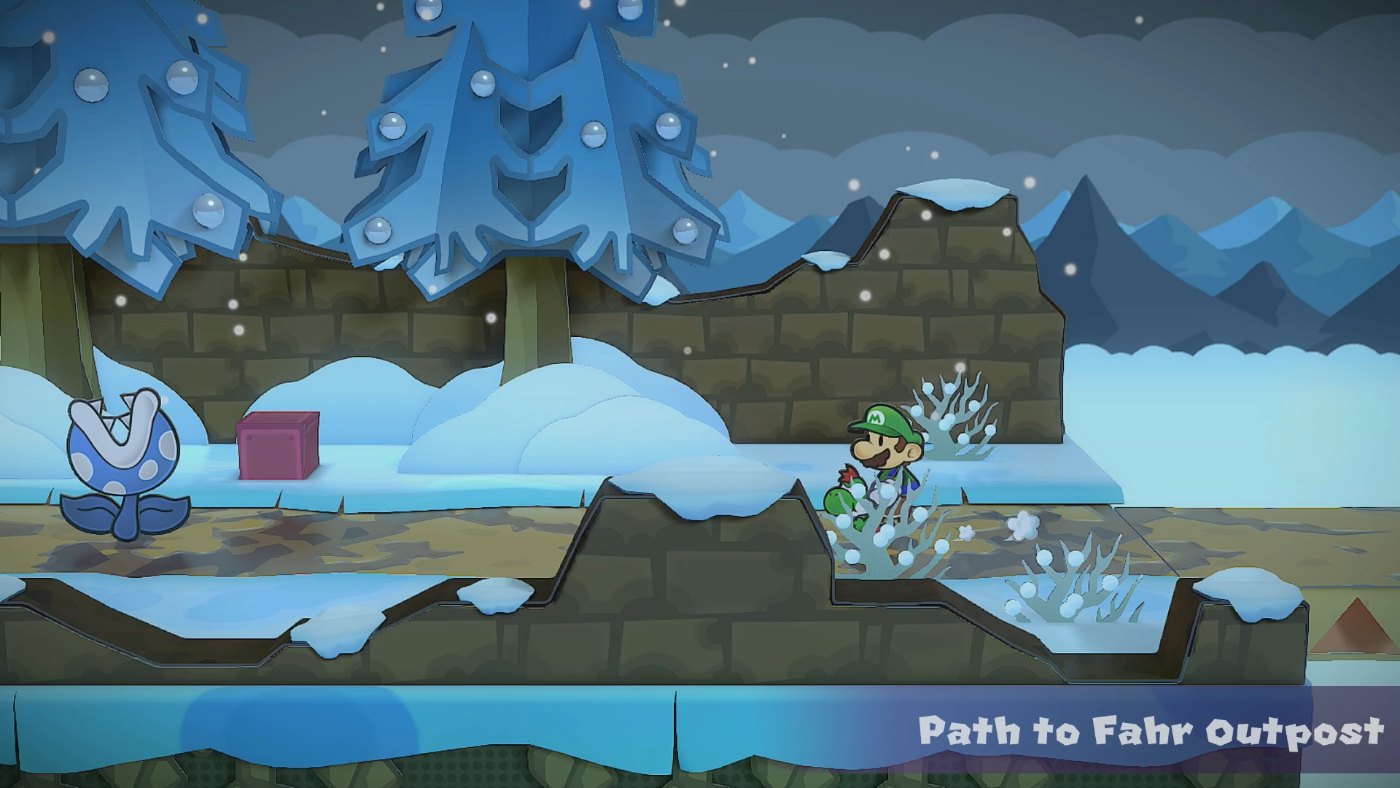
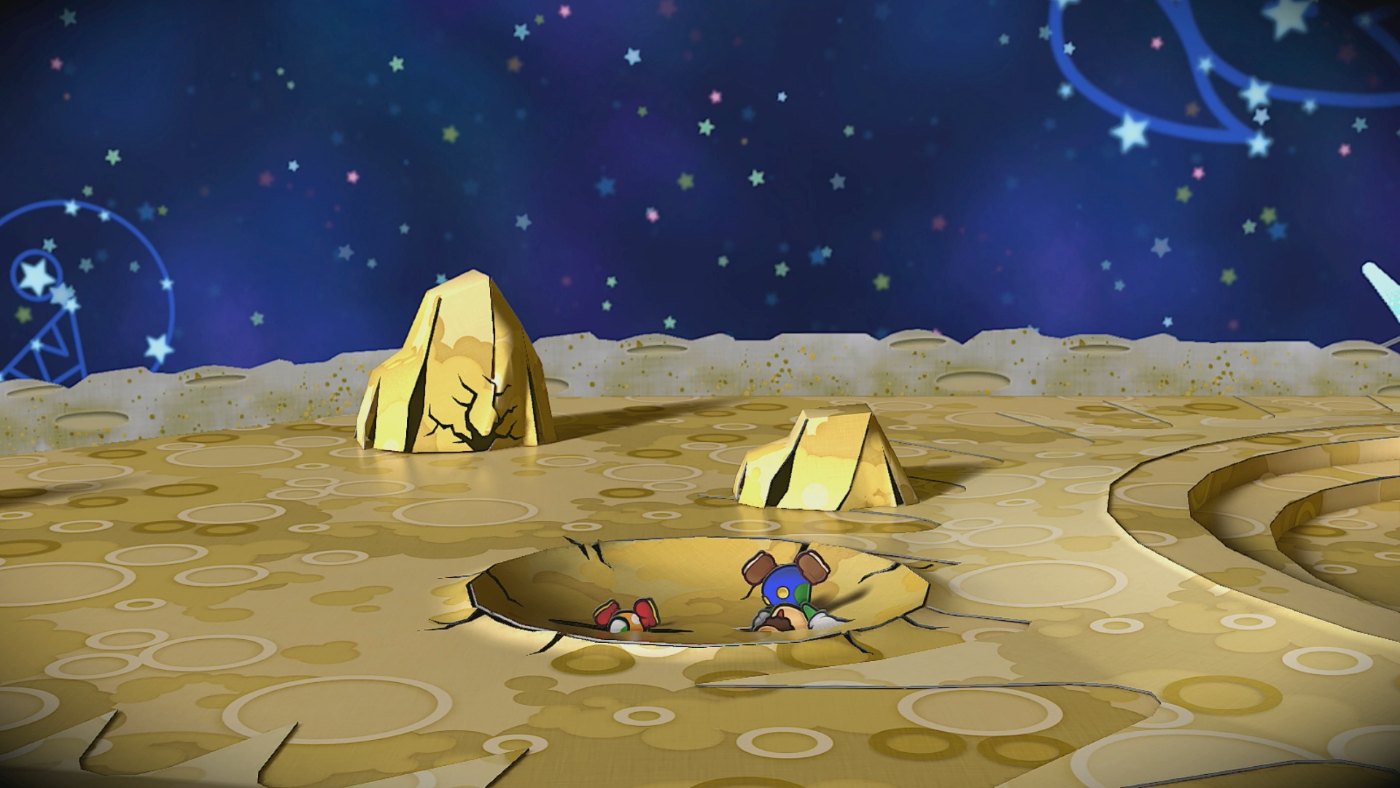
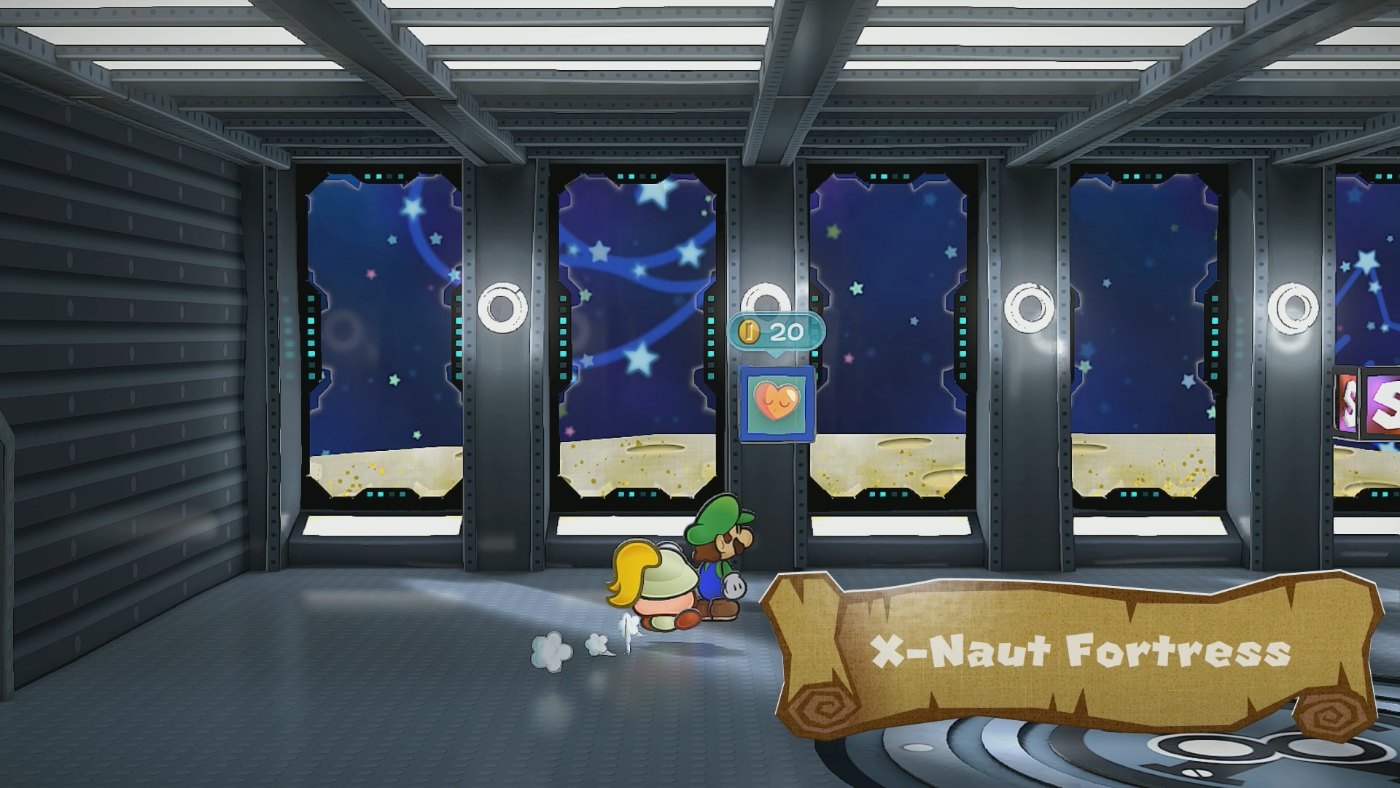
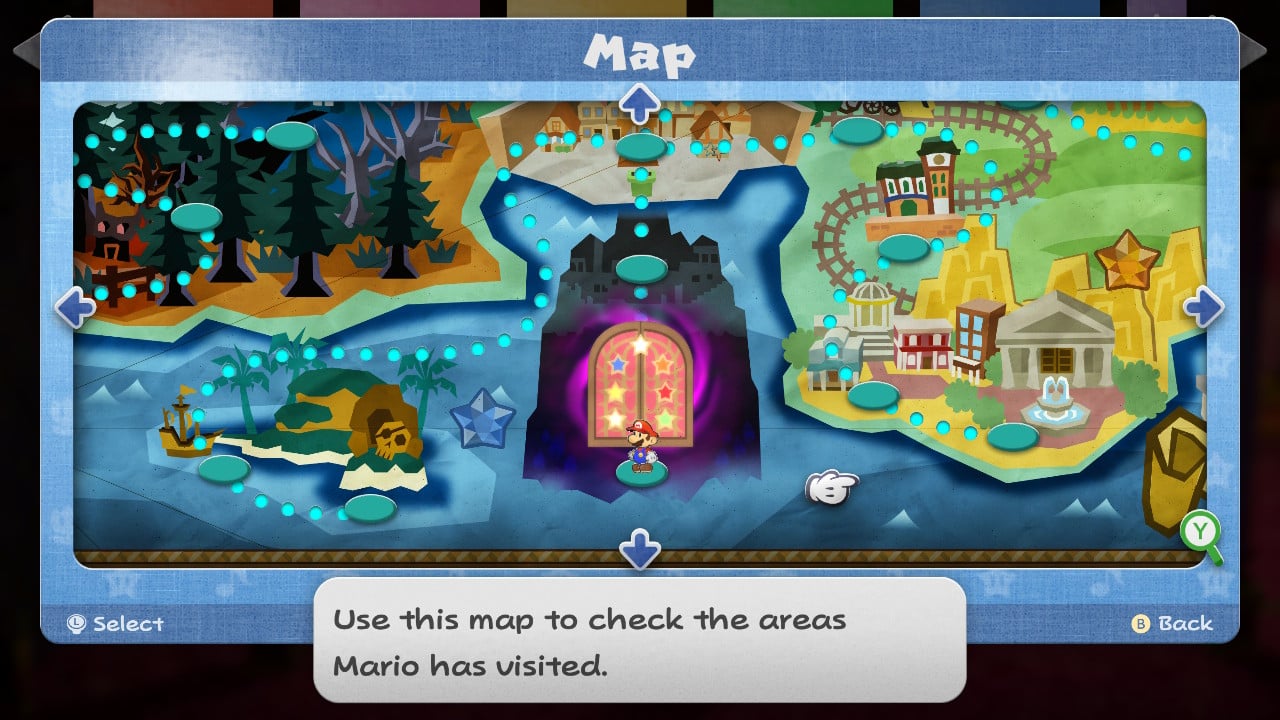
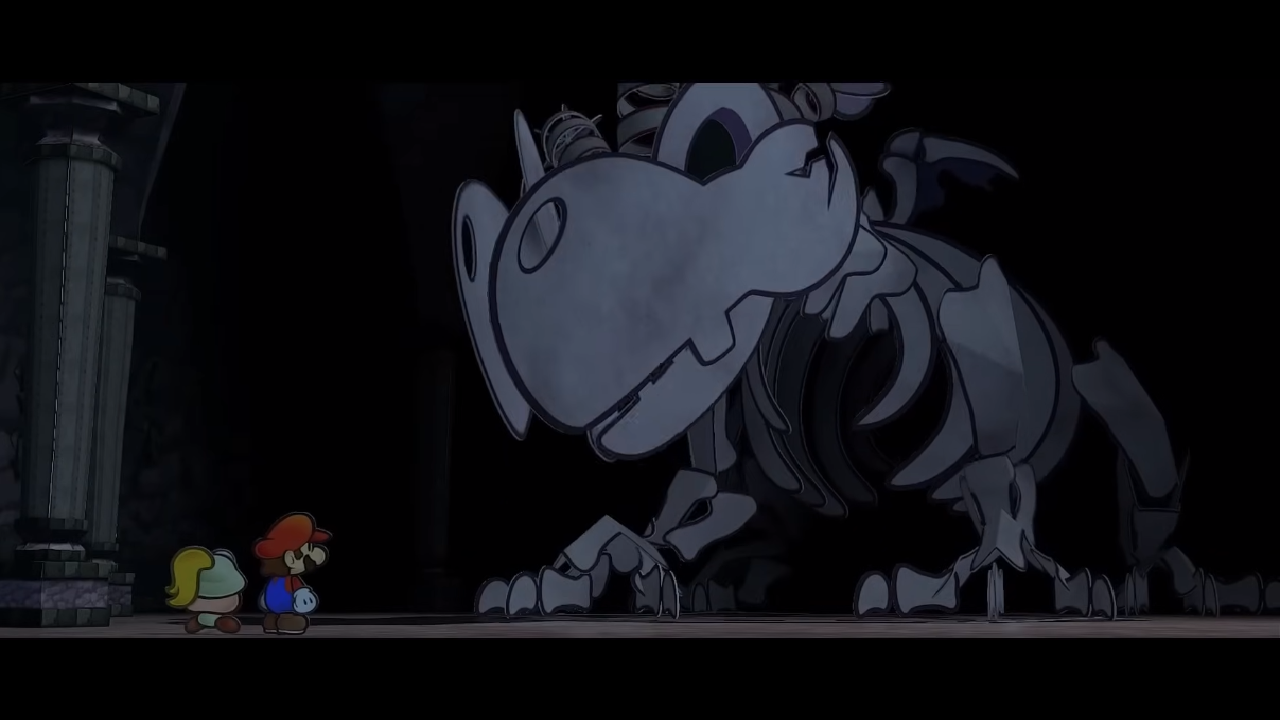
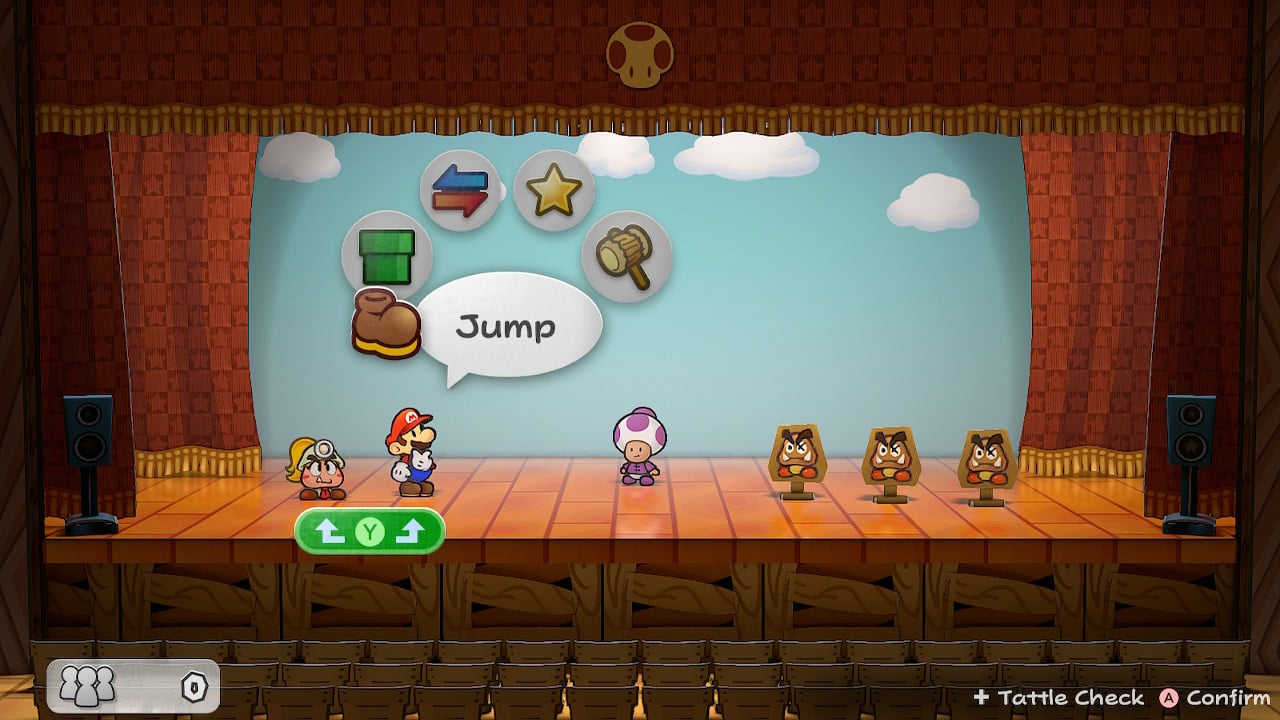
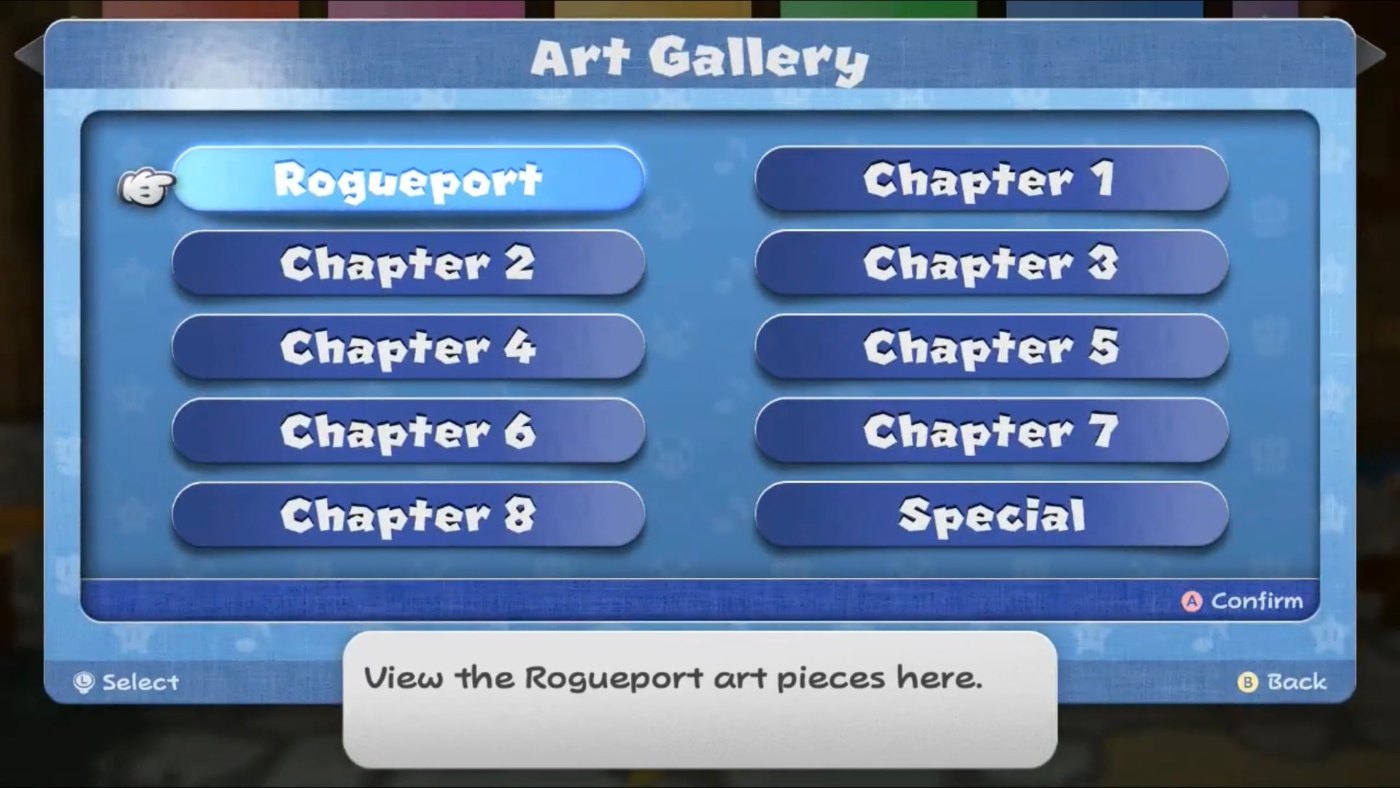
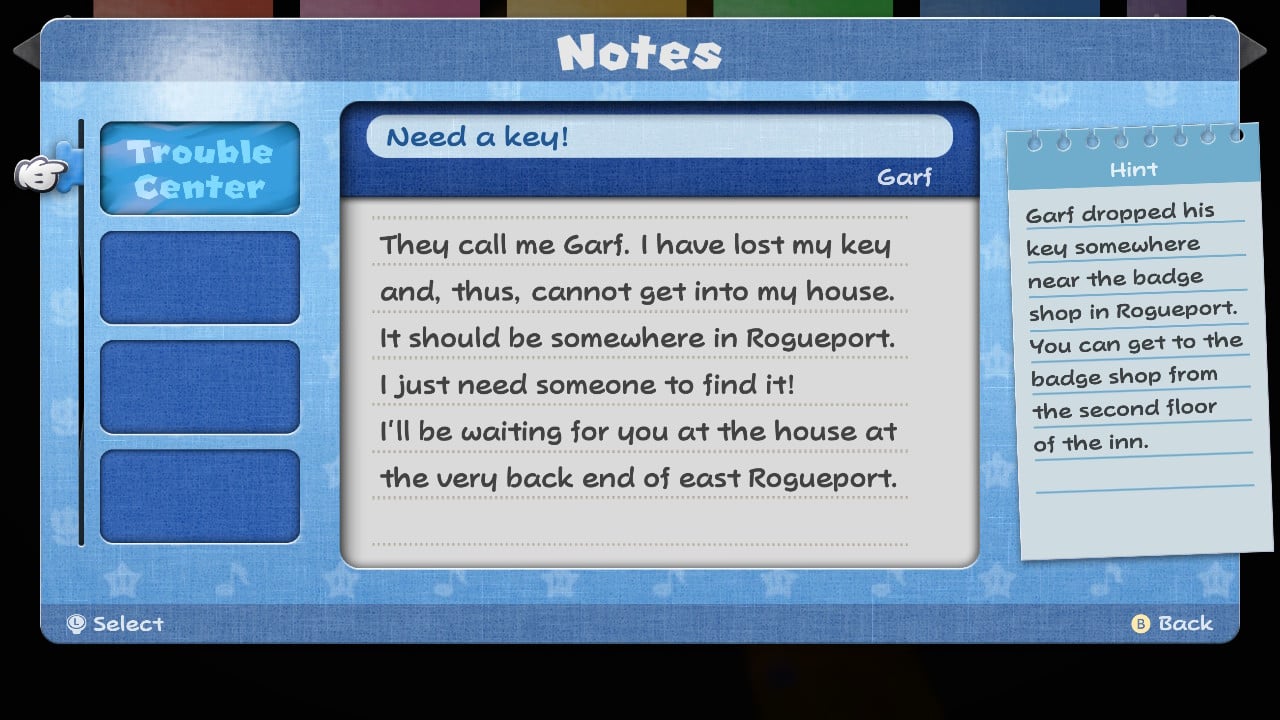
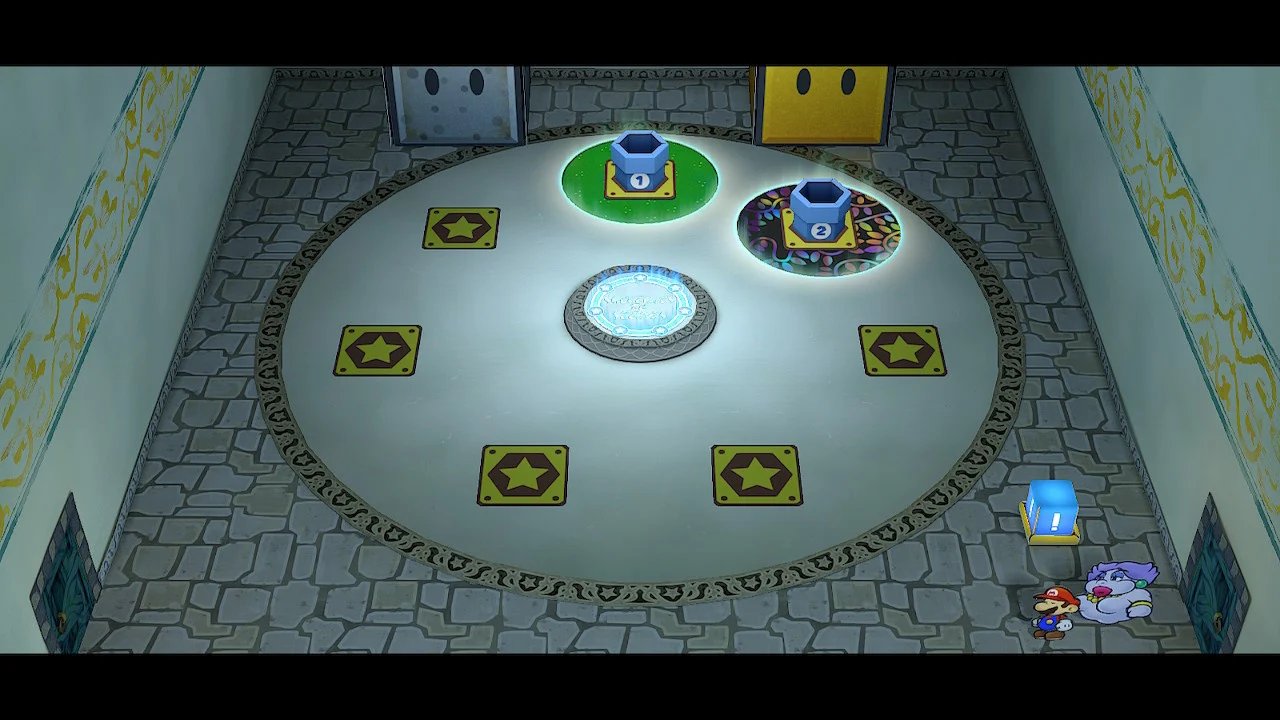
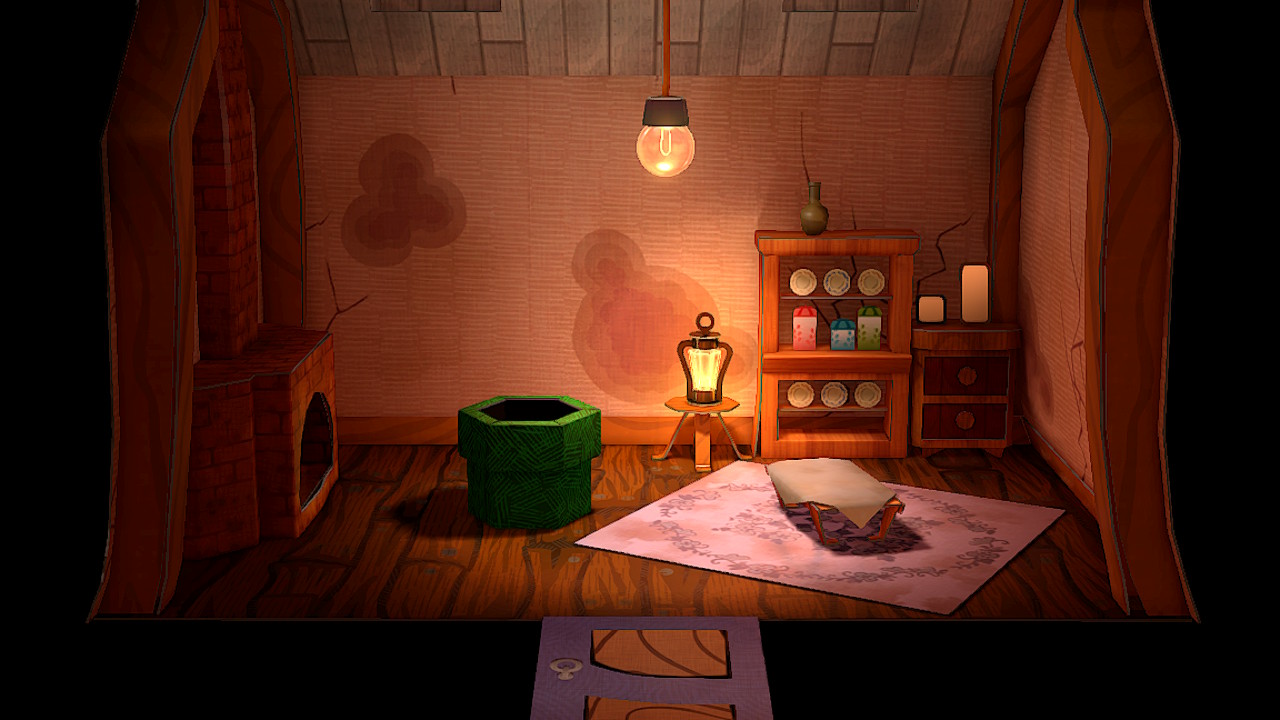
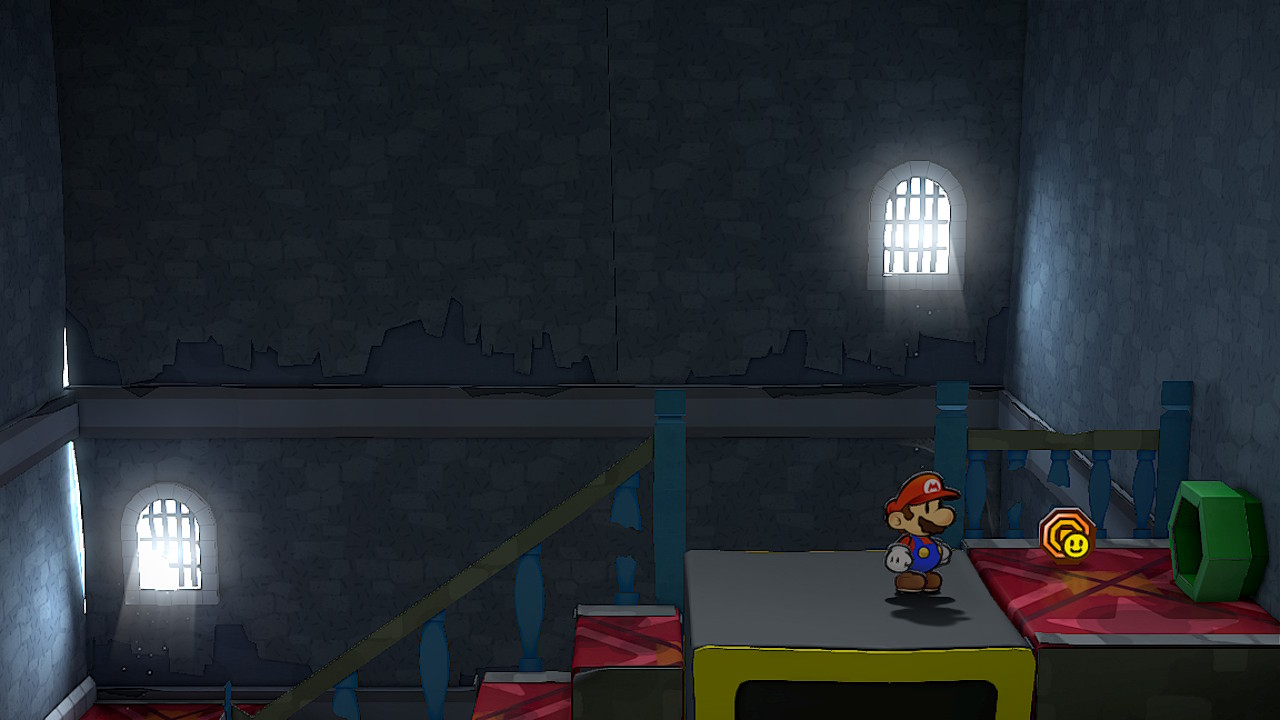
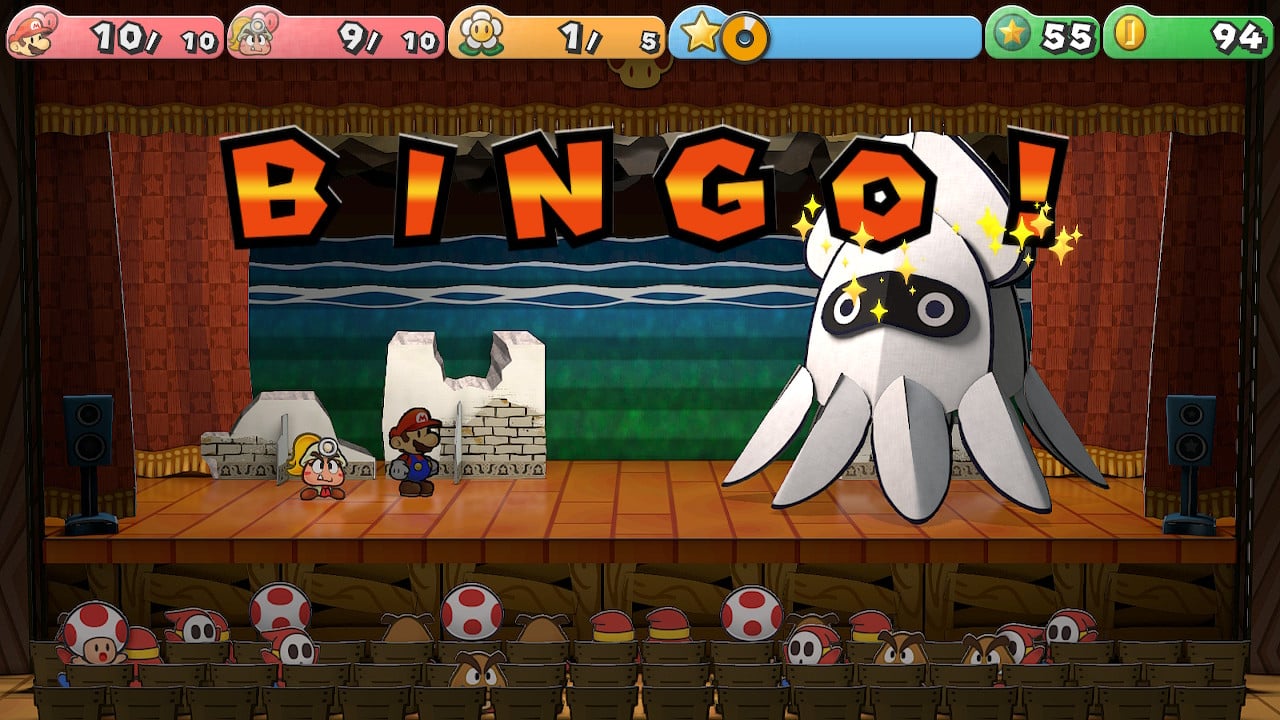
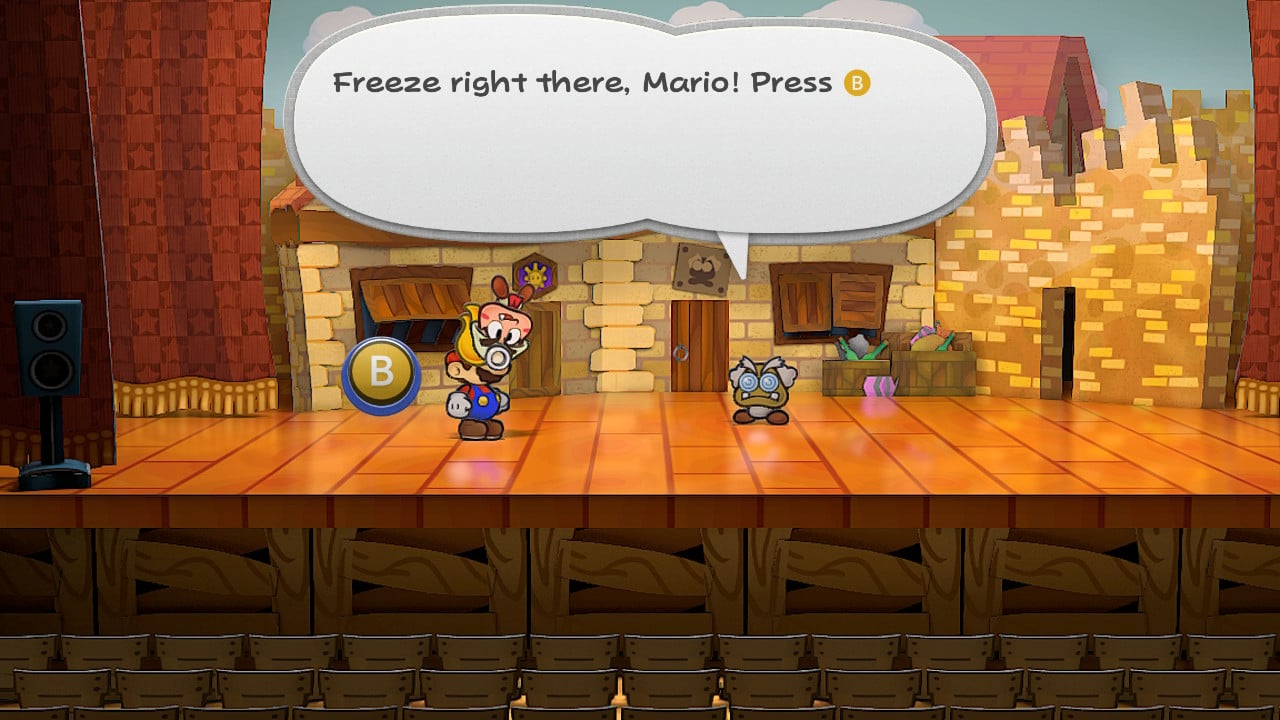
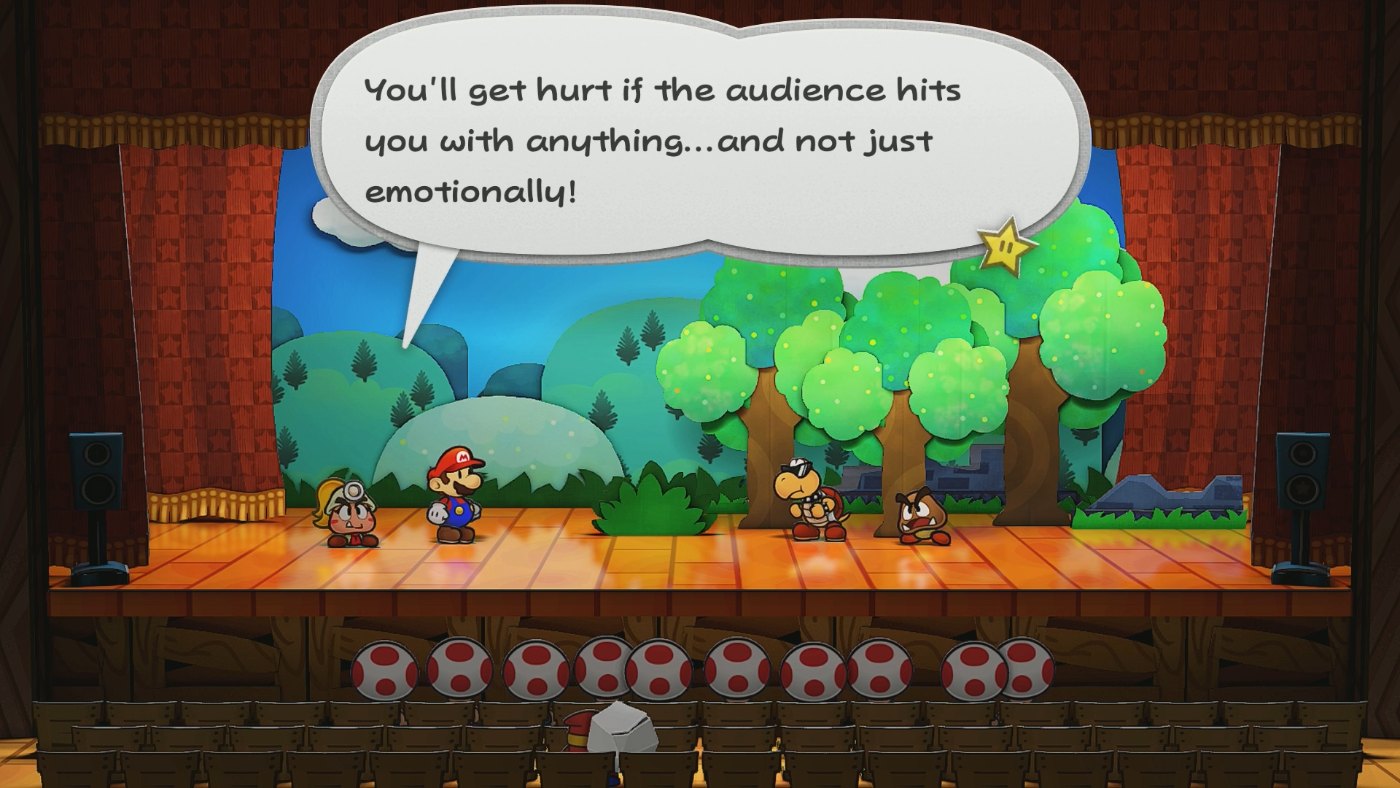
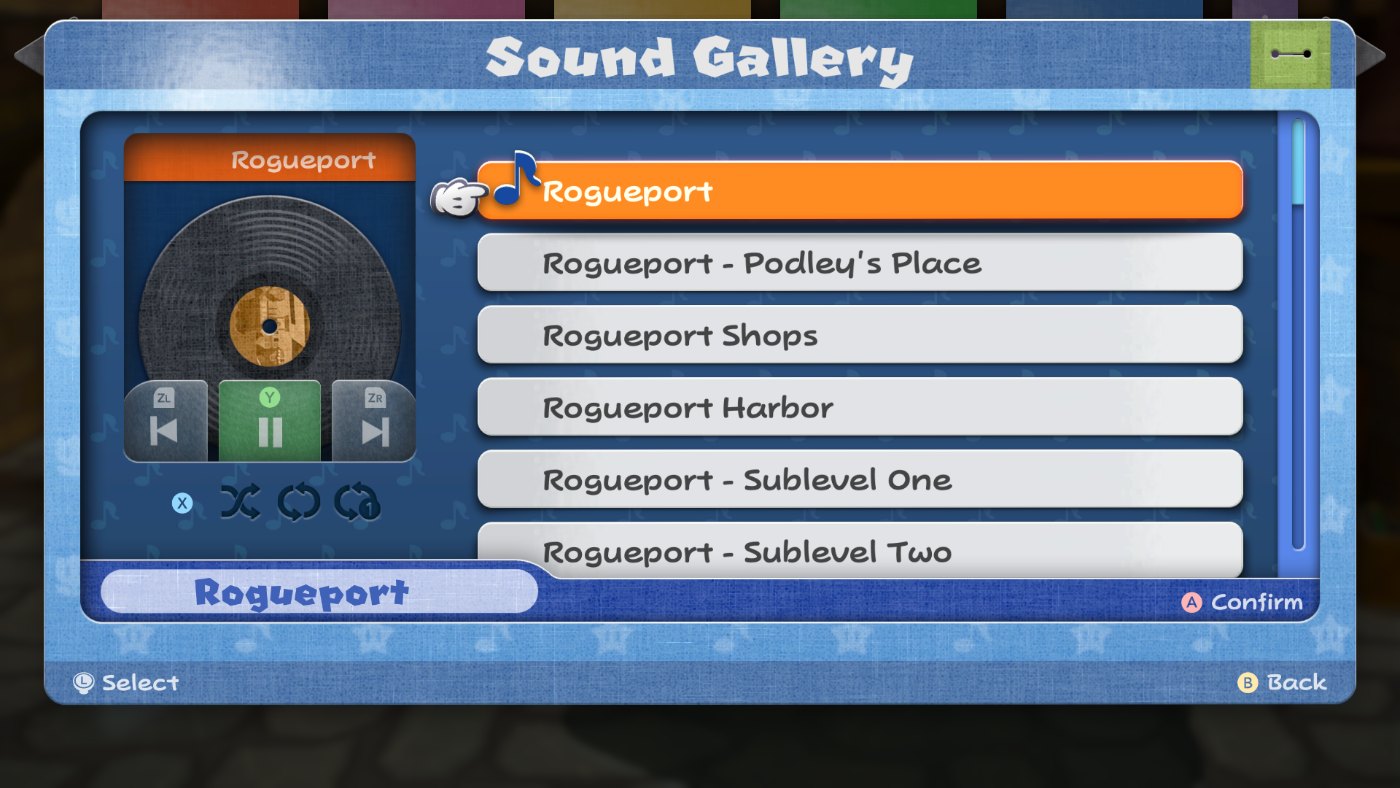
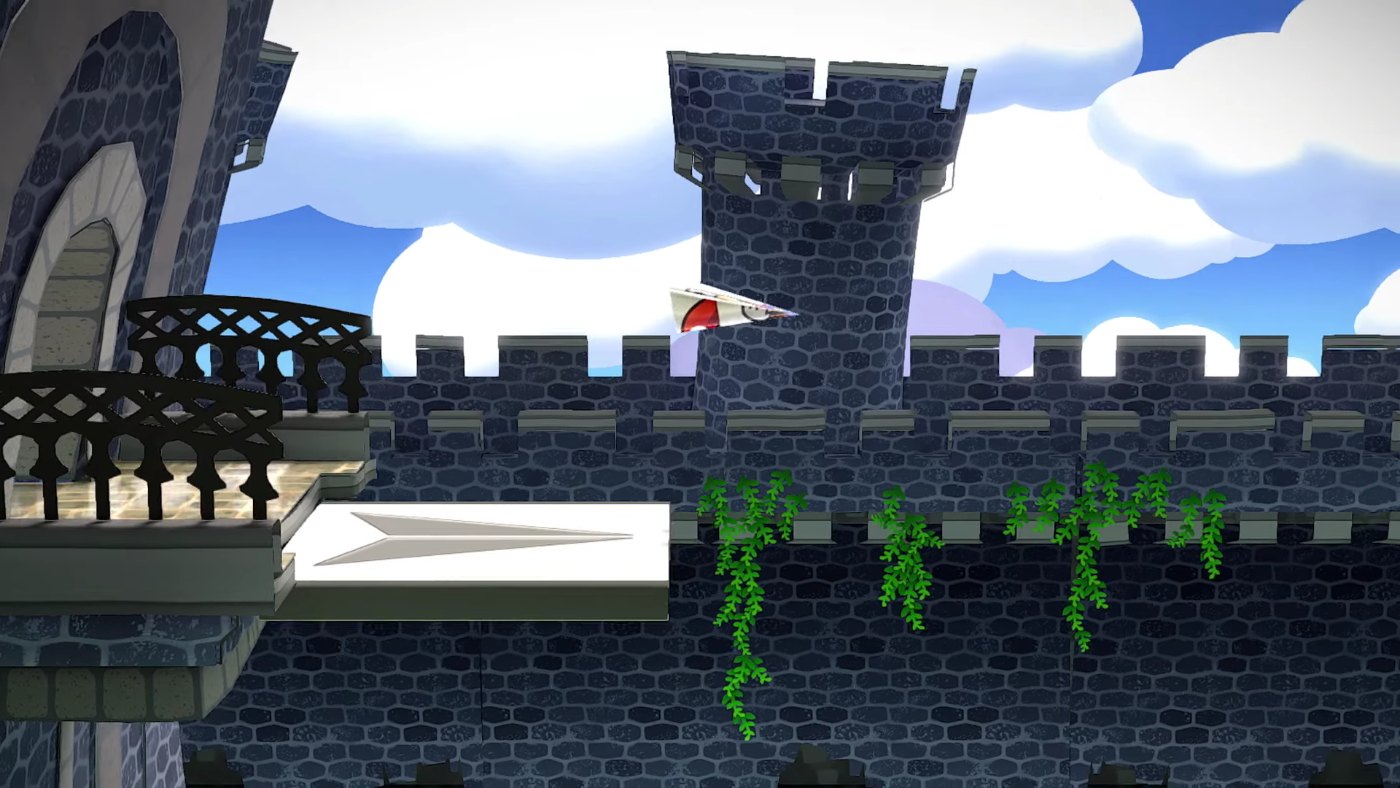
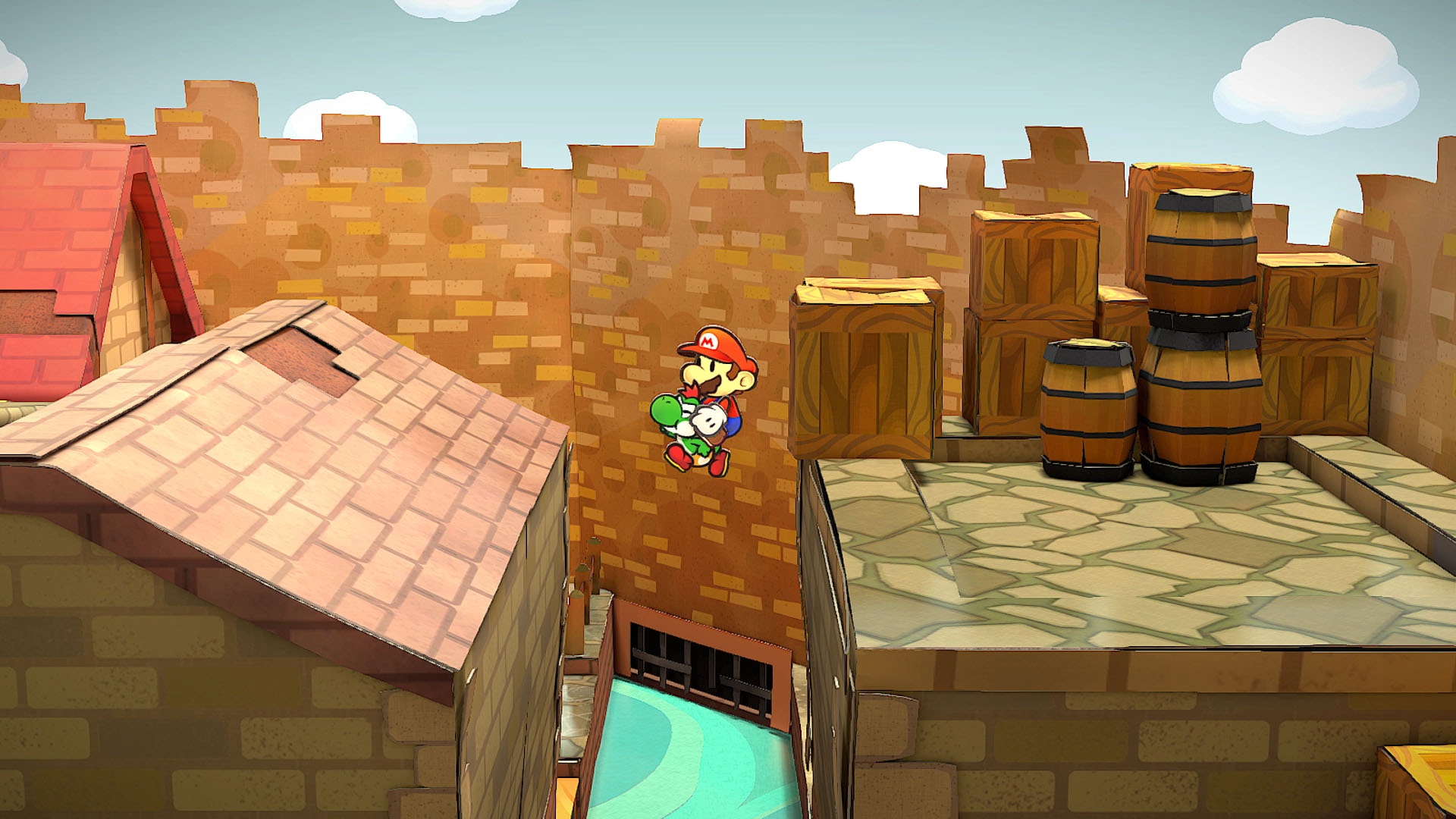
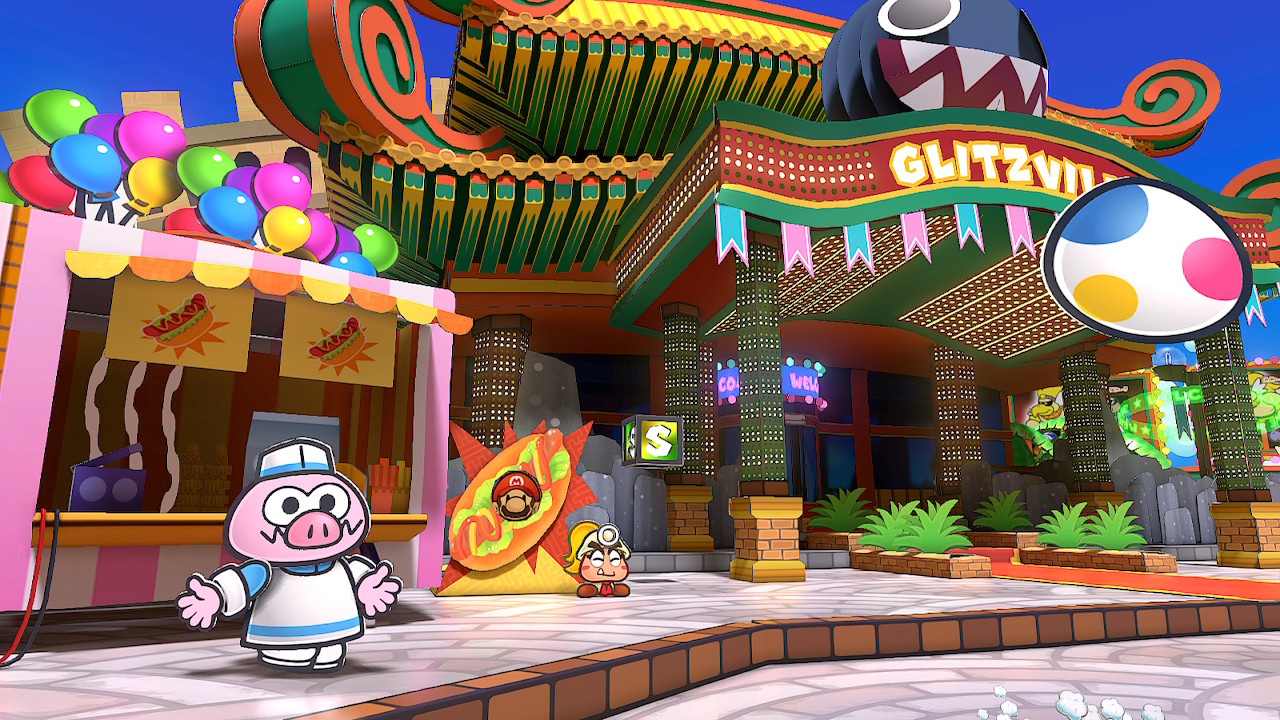
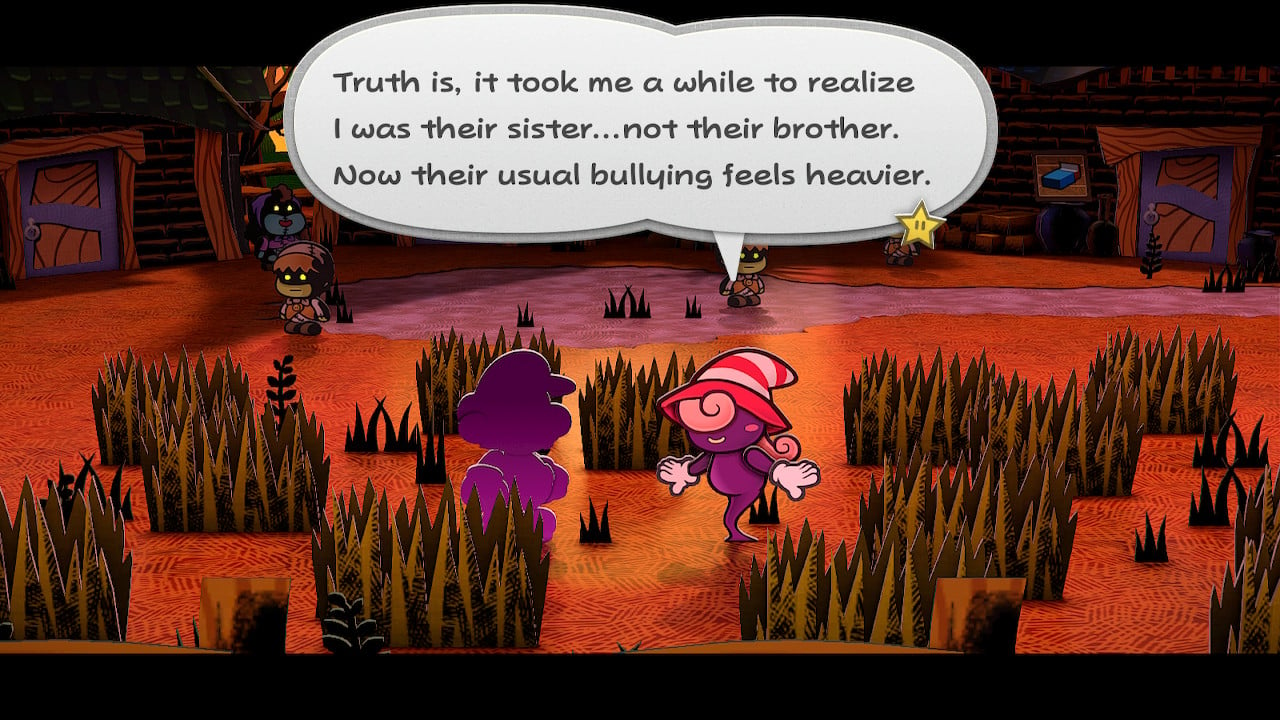
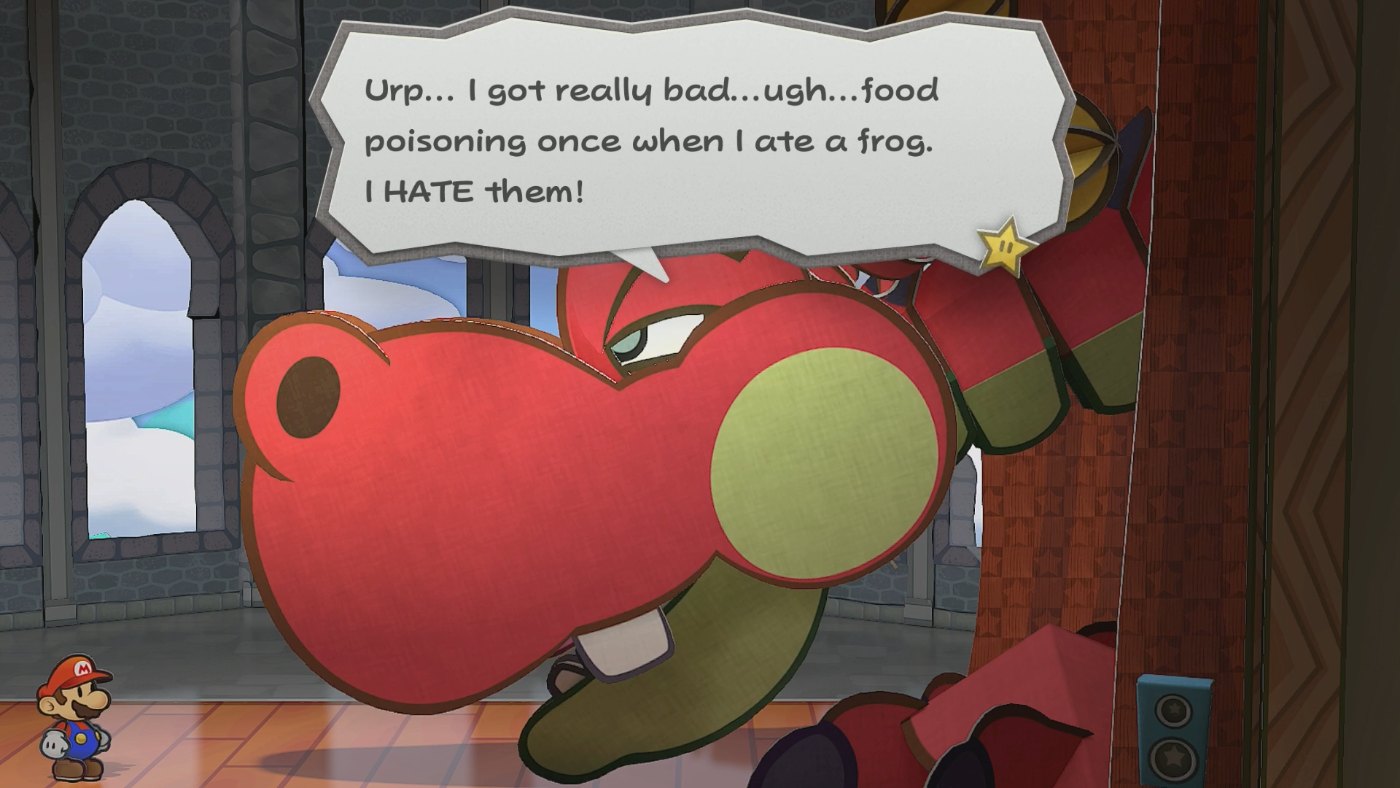
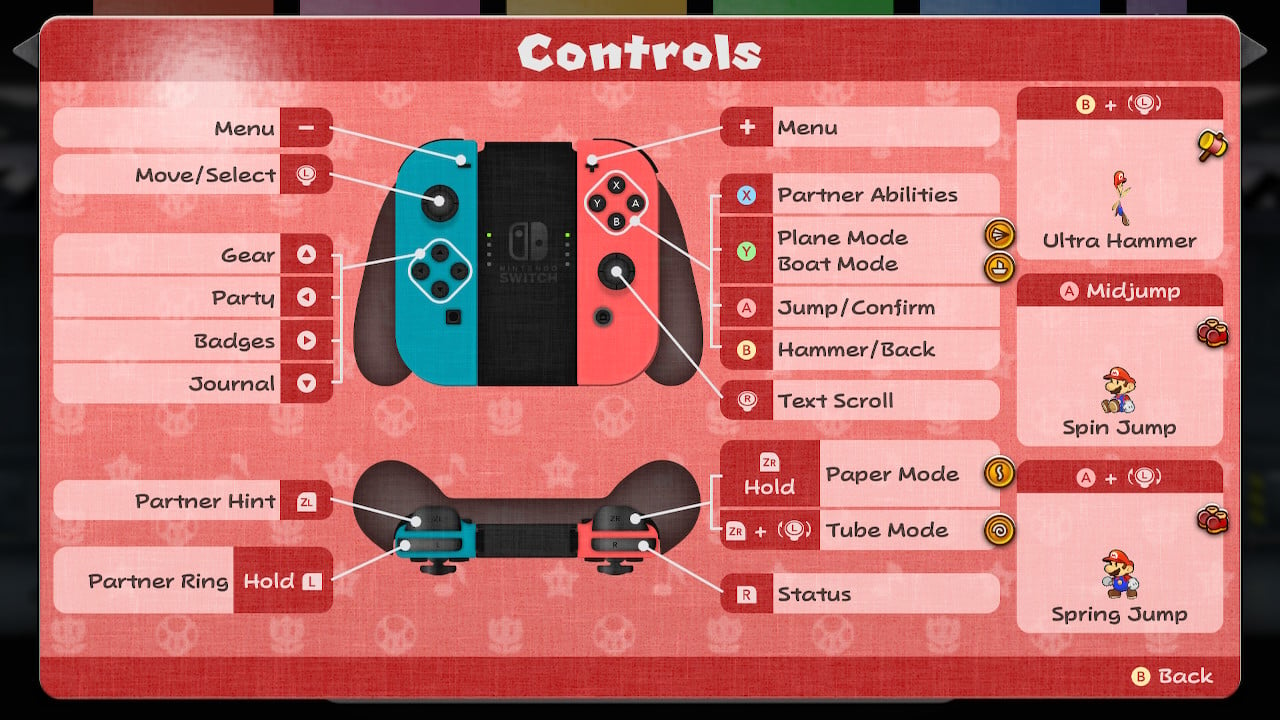
 Nostalgic Tunes (new)0 BP. Plays the GameCube soundtrack. One coin at the Lovely Howz of Badges.
 Attack FX G (new)0 BP. Makes Mario’s attacks croak like a frog, which Hooktail cannot bear. Replaces Attack FX R in Hooktail Castle.
 Gold Medal (new)The reward for owning all three trophies. Turns Mario gold, and combines with the L and W Emblems.
 Cooking Trophy (new)Awarded for cooking every recipe in the journal.
 Badge Trophy (new)Awarded for collecting every badge.
 Tattle Trophy (new)Awarded for completing the 134-entry Tattle Log.
 Prince Mush’s Belt (new)A keepsake from the first champion of the Glitz Pit, given after you beat him.
 Gold Whacka Bump (new)Left behind by Whacka on floor 100 of the Pit. A trophy: it cannot be eaten.
 Threatening Note (new)Beldam’s note on the Excess Express is now an item in the inventory.
 First Attack (changed)Now costs 0 BP to wear, down from 1. Professor Frankly sends a new e-mail about it.
 Hammer Throw (changed)Now does 2 damage that ignores defence, and no longer has its own Action Command.
 Sweet Treat (Magical Map)1 SP. Restores HP and FP and cures ailments. Two Poison Mushrooms to dodge, down from three.
 Earth Tremor (Diamond Star)2 SP. An earthquake that ignores defence and reaches every enemy.
 Clock Out (Emerald Star)2 SP. Stops every enemy for a few turns if it works.
 Power Lift (Gold Star)3 SP. Raises attack and defence. Four matching panels per point in the remake, not five.
 Art Attack (Ruby Star)4 SP. Draw rings round enemies; every loop is damage.
 Sweet Feast (Sapphire Star)5 SP. A bigger helping of Sweet Treat.
 Showstopper (Garnet Star)2 SP. Can knock out ordinary enemies at a stroke. No use on bosses.
 Supernova (Crystal Star)6 SP. Heavy damage to everything on stage.
 Super BootsThe Great Tree, Chapter 2. Adds the Spin Jump.
 Ultra BootsRiverside Station, Chapter 6. Adds the Spring Jump, which now whistles as Mario rises.
 Super HammerGlitzville, Chapter 3. Big blocks now need a fuller charge to break.
 Ultra HammerRogueport, once Mario has the Ultra Boots. Breaks stone blocks.
 Power Bounce3 BP. Keep jumping on one enemy until a command is missed. The timing tightens sooner than on GameCube.
 Quick Change7 BP. Swap partners in battle without losing the turn.
 Peekaboo2 BP. Shows every enemy’s HP without a Tattle.
 Simplifier1 BP. Easier Action Commands for less Star Power.
 L Emblem0 BP. Luigi’s colours. In the remake Doopliss’s copy of Mario wears them too.
 W Emblem0 BP. Wario’s colours; with the L Emblem, Waluigi’s.
 Return Postage7 BP. Bonetail’s treasure on floor 100 of the Pit. Anything that touches Mario takes half the damage back.
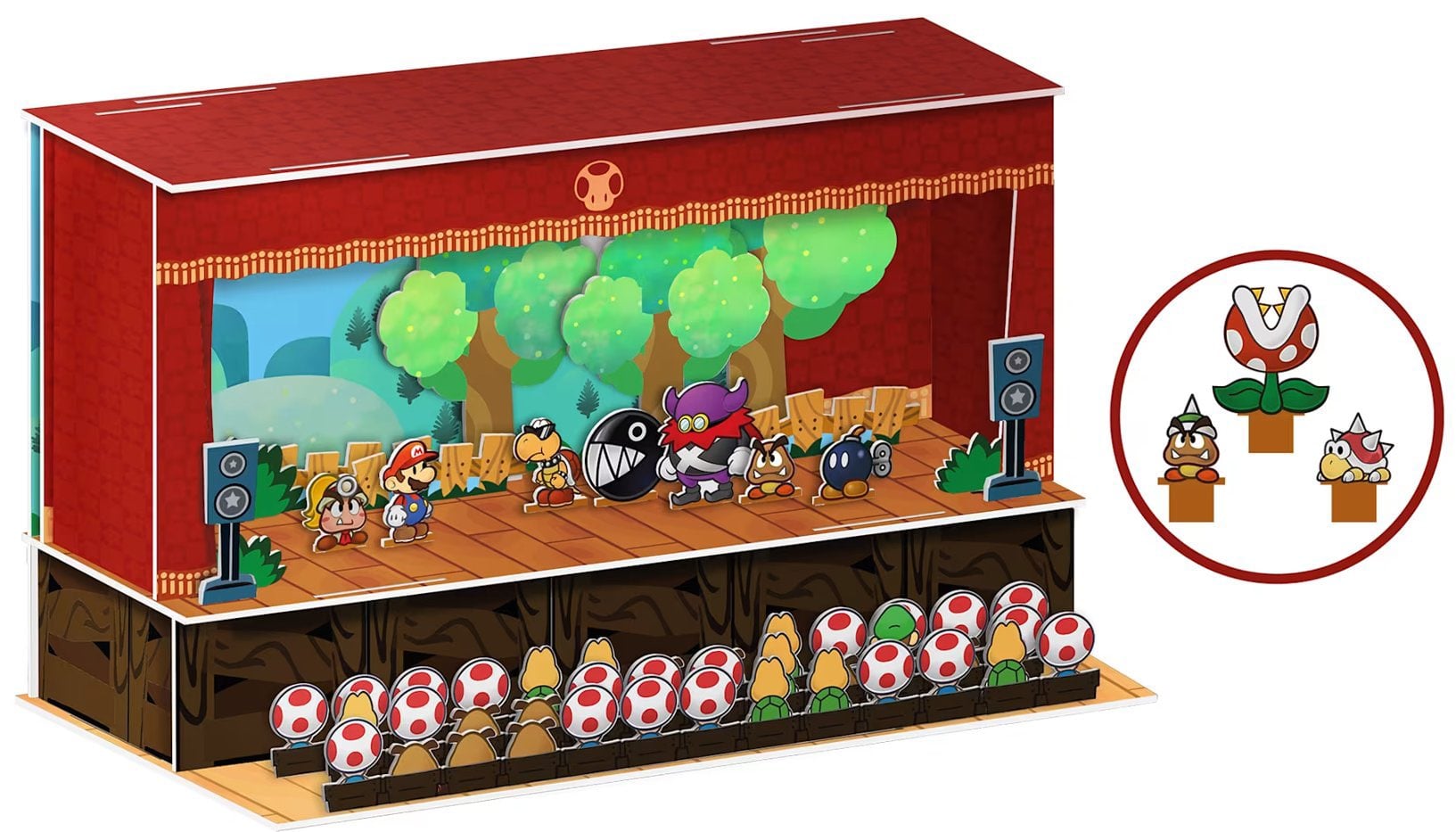 Buildable battle stageMy Nintendo Store, Europe · 2024The European My Nintendo Store sold the game in a bundle with a buildable diorama of the battle stage, complete with several characters and enemies, and gave Mario, Goombella and Yoshi Kid keychains with pre-orders.
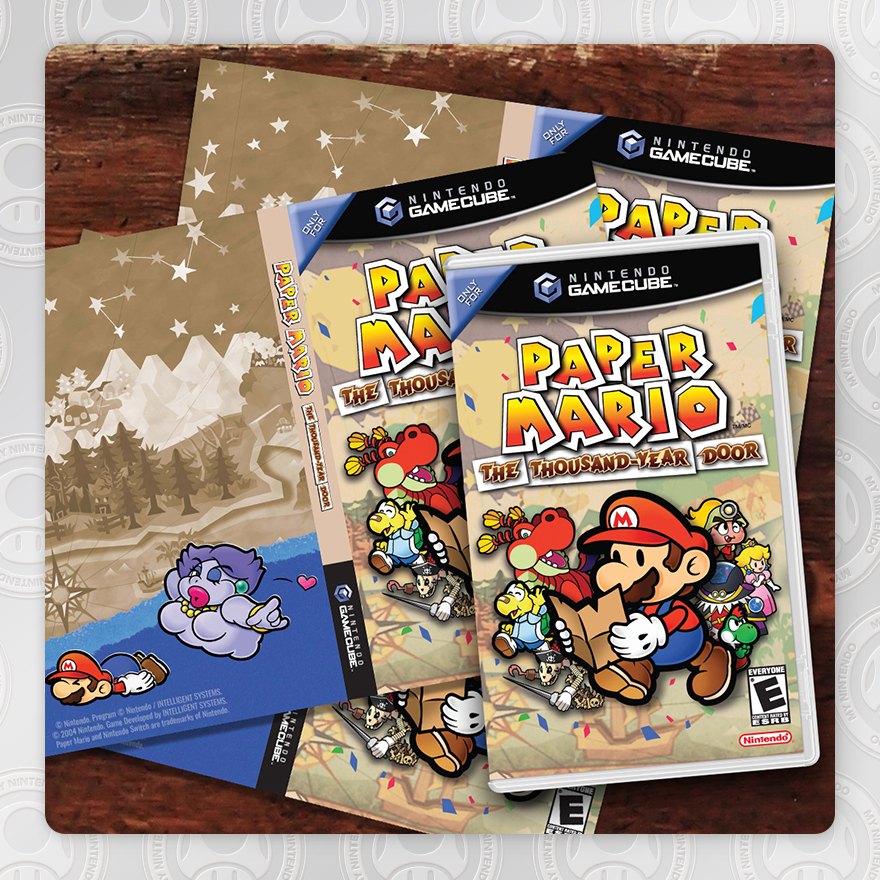 A GameCube cover for your Switch caseMy Nintendo · 2024My Nintendo offered a printable North American GameCube cover sized for a Switch case, along with bookmarks, a notepad, a scrapbook kit, wallpapers and a May 2024 calendar.
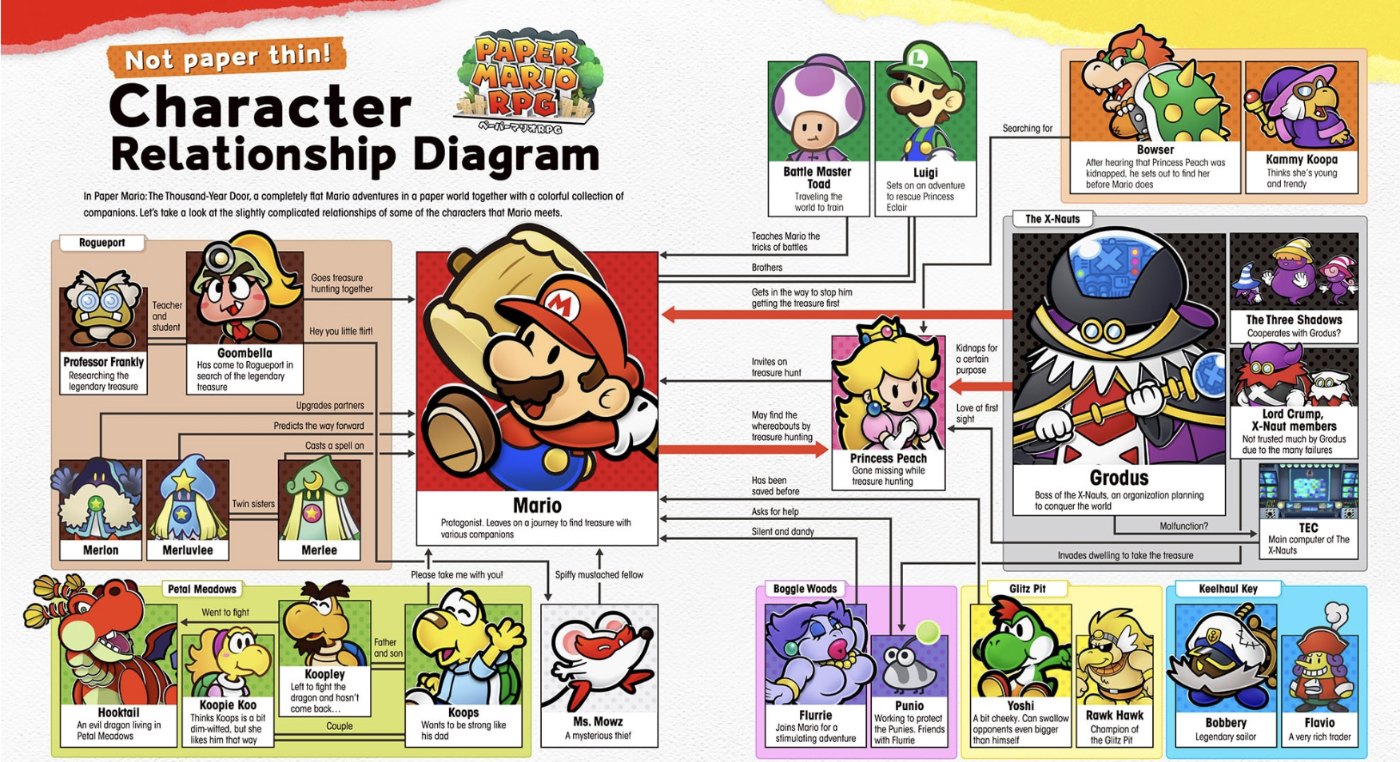 Character relationship chartNintendo Magazine 2024 SummerNintendo’s free magazine printed a diagram of who is who and who is cross with whom. Nintendo of America later posted an updated version.
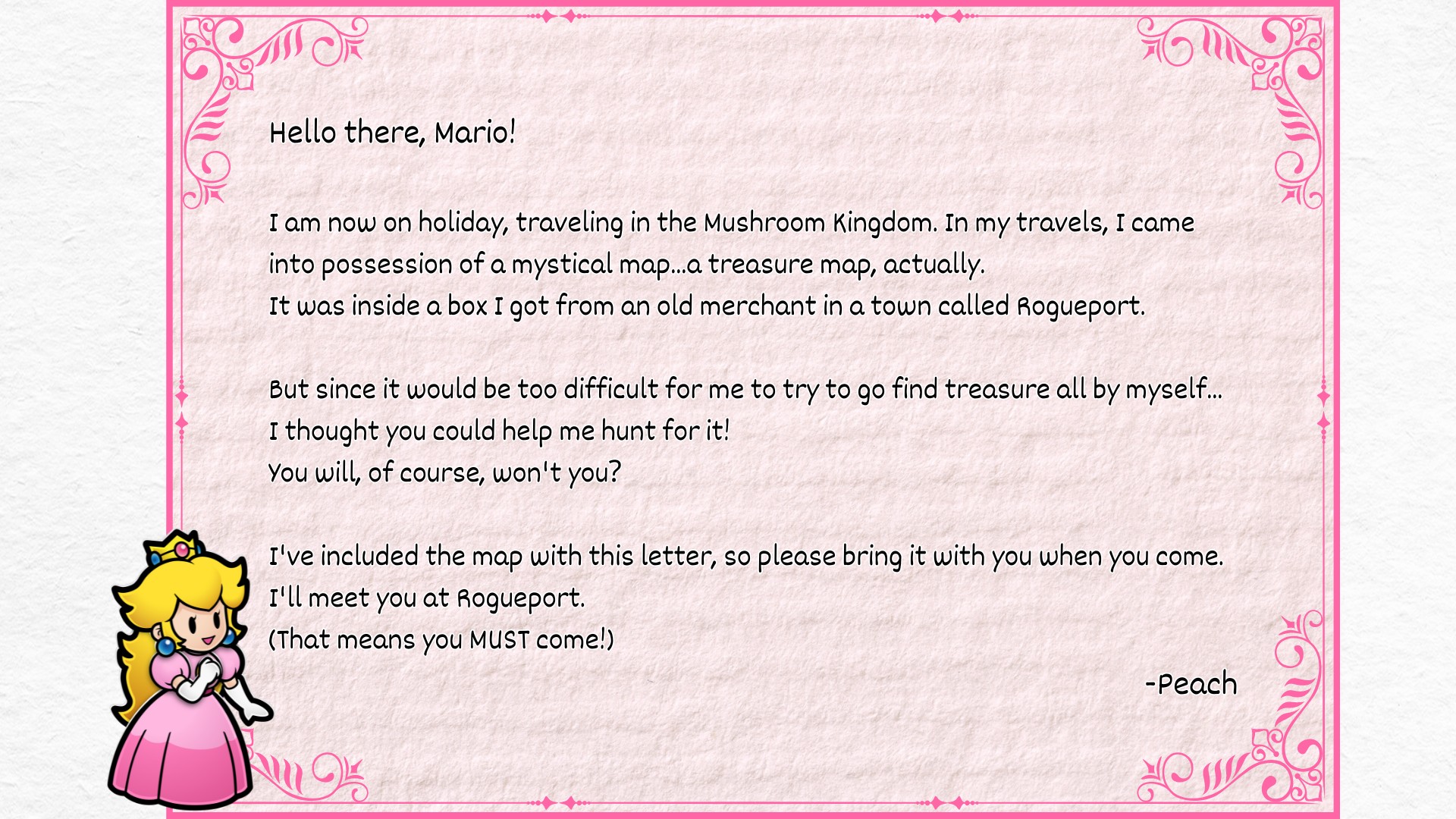 Peach’s letterPromotional image · 2024The letter that starts the story was issued as a promotional image in its own right.
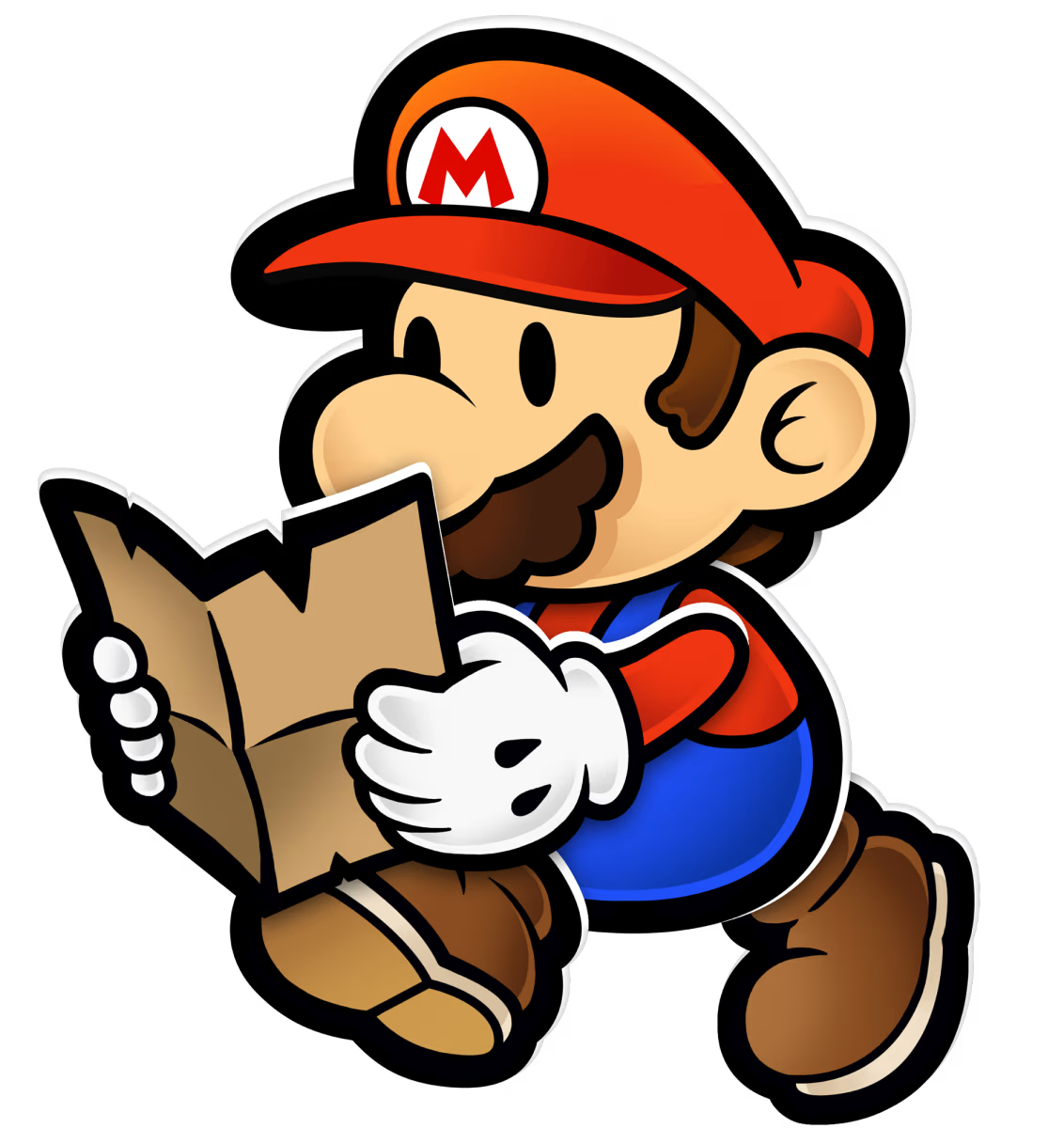 MarioThe Great Gonzales
 GoombellaPartner 1 · Rogueport, prologue
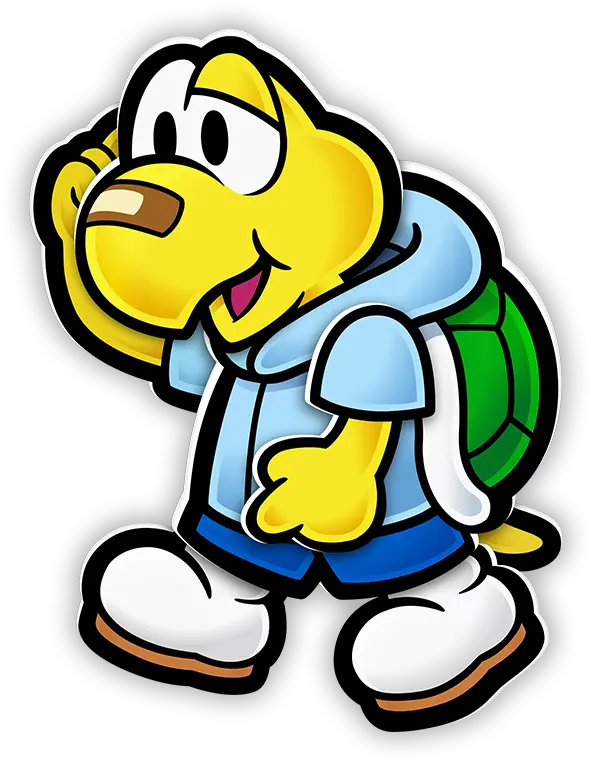 KoopsPartner 2 · Petalburg, Chapter 1
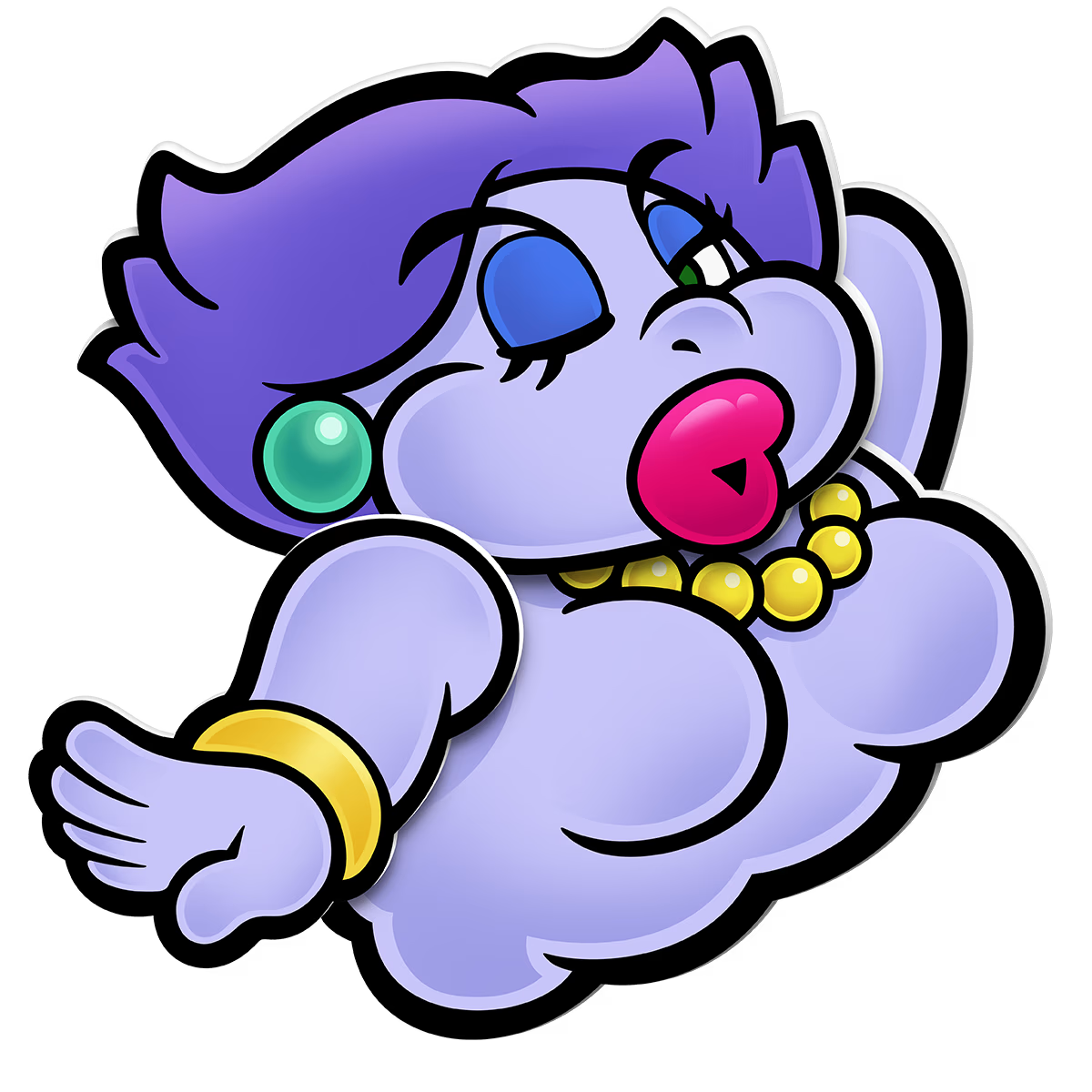 Madame FlurriePartner 3 · Boggly Woods, Chapter 2
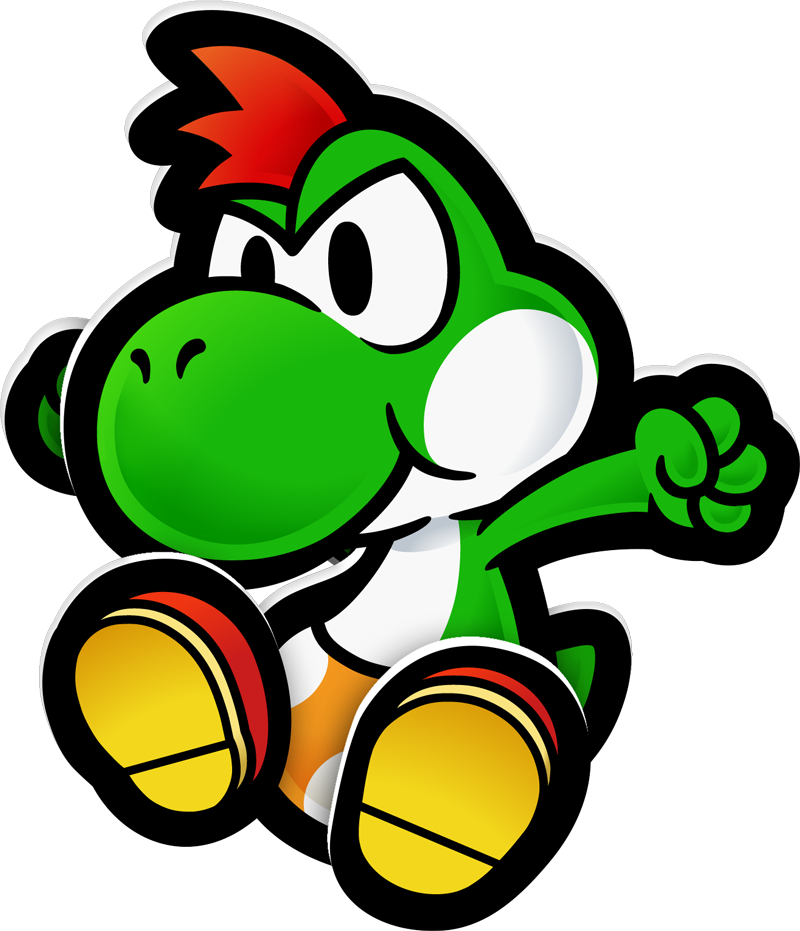 Yoshi KidPartner 4 · Glitzville, Chapter 3
 VivianPartner 5 · Twilight Town, Chapter 4
 Admiral BobberyPartner 6 · Keelhaul Key, Chapter 5
 Ms. MowzPartner 7 · optional
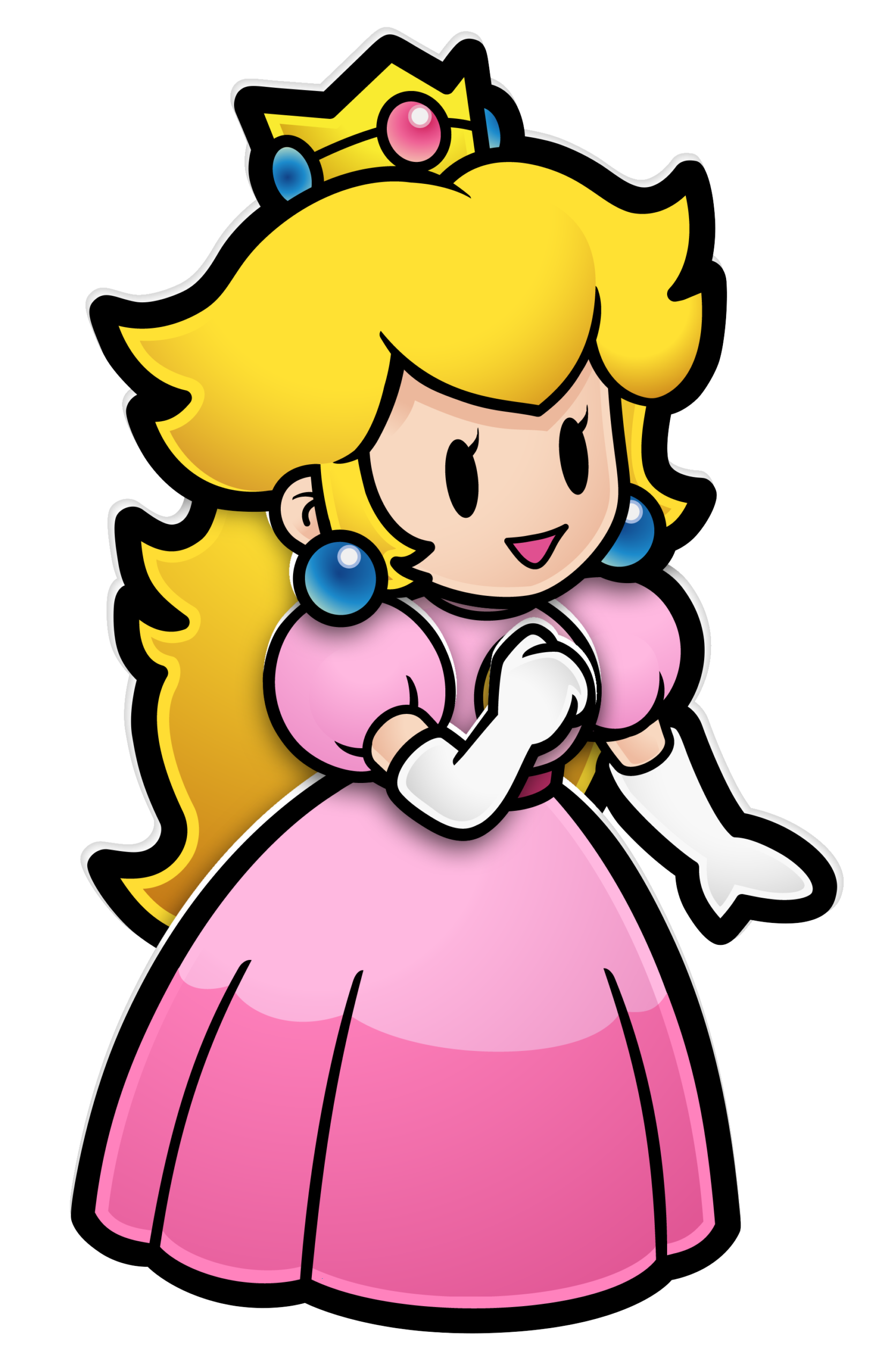 Princess PeachPrisoner of the X-Nauts
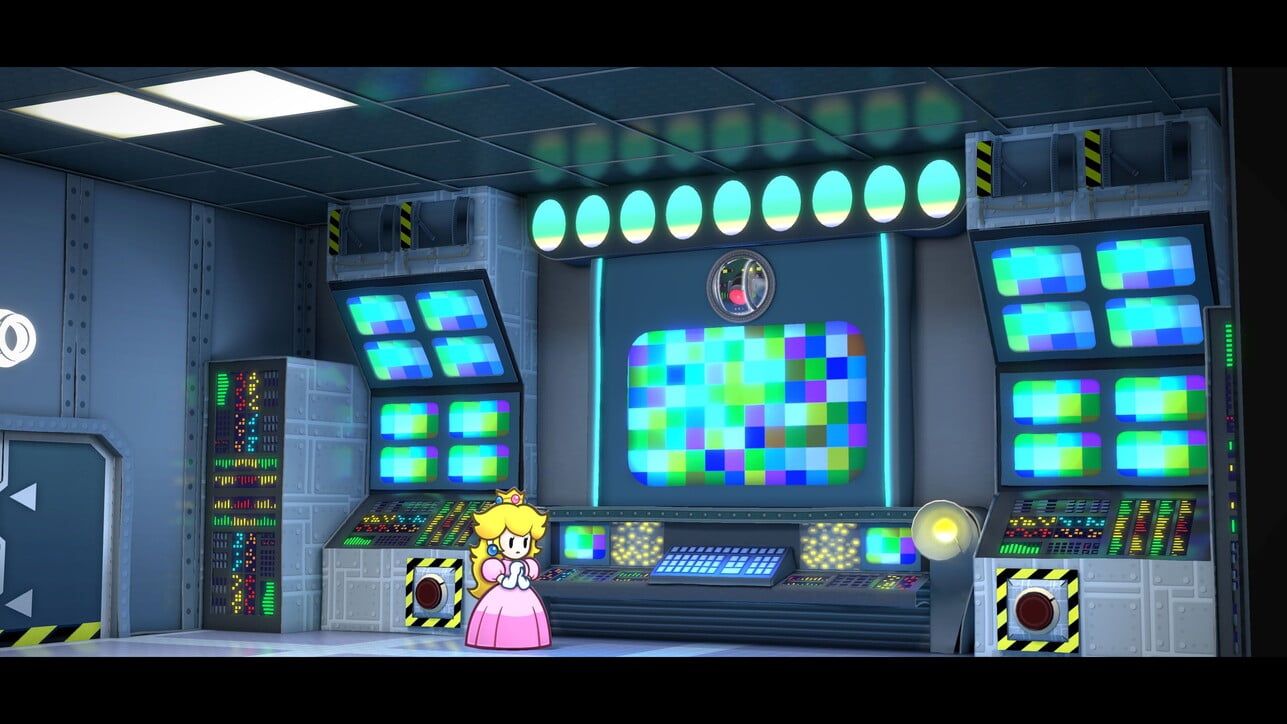 TEC-XXThe X-Nauts’ computer
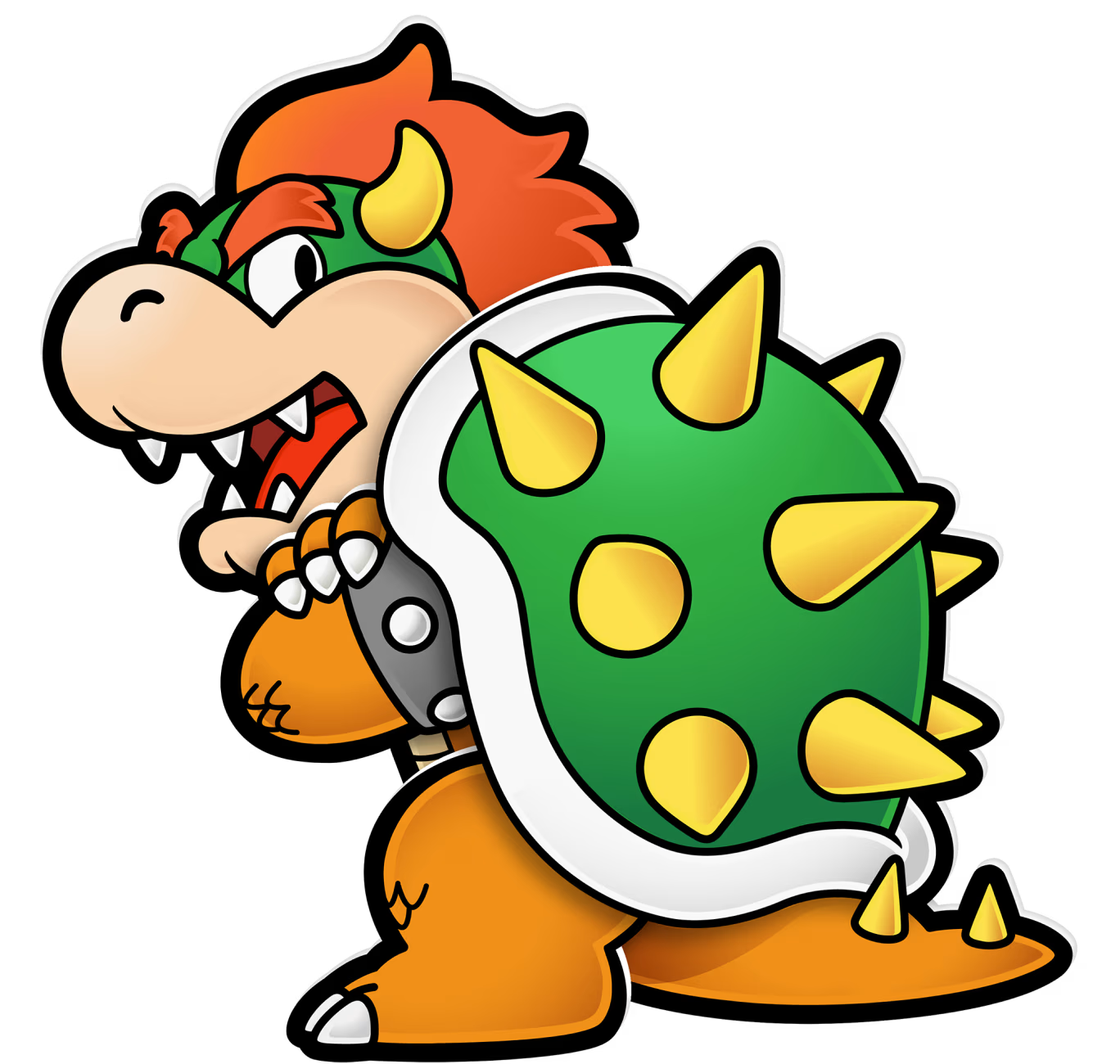 Bowser and Kammy KoopaThird in a two-horse race
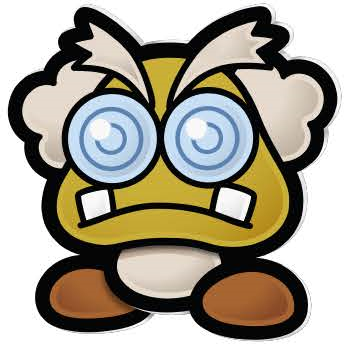 Professor FranklyThe man who reads the map
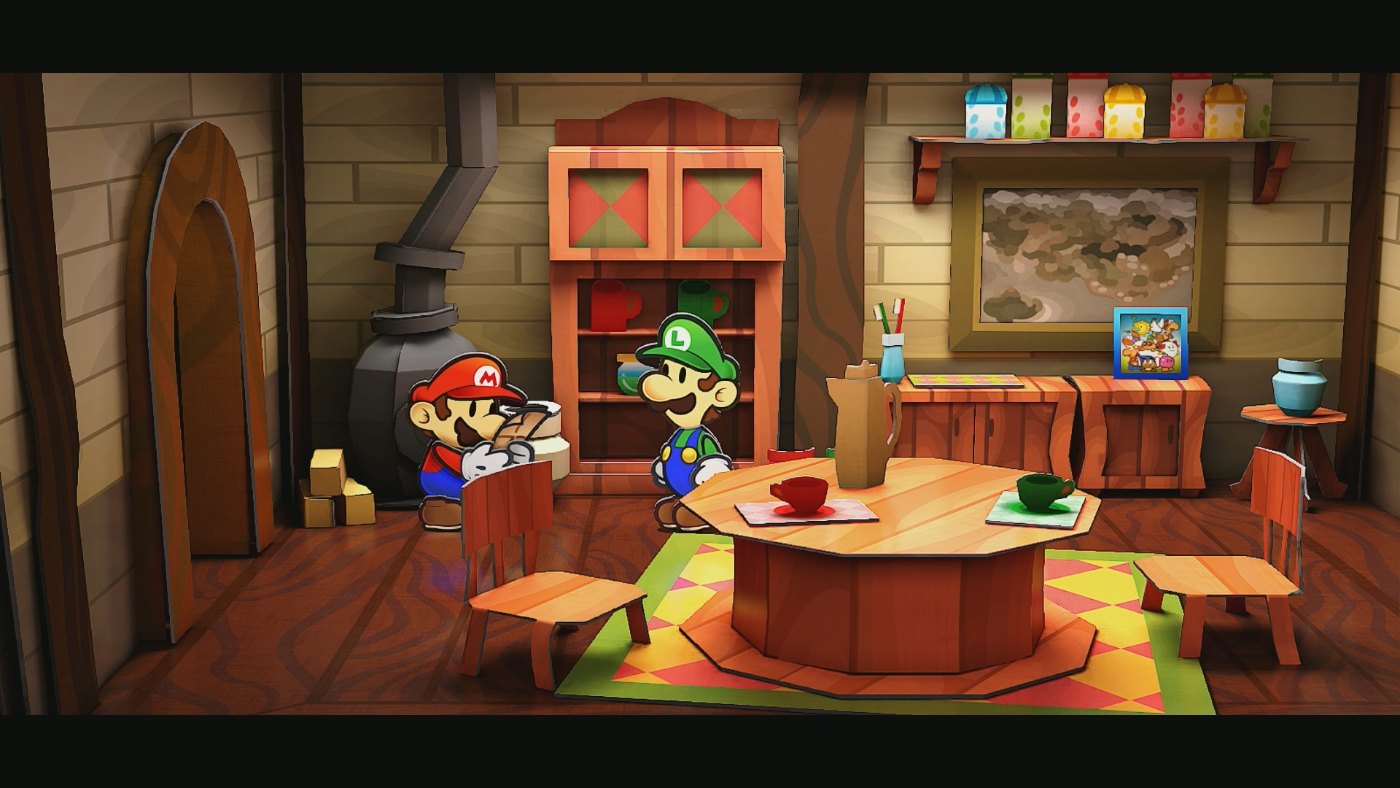 LuigiHero of the Waffle Kingdom
 Sir GrodusLeader of the X-Nauts
 Lord CrumpX-Naut general
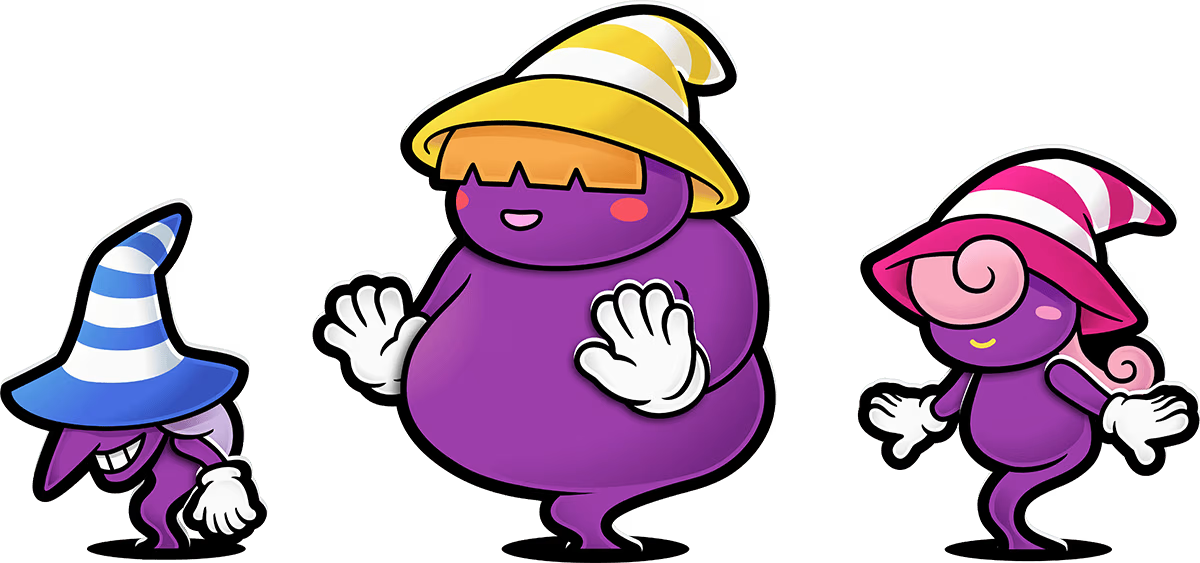 Beldam and MarilynThe Three Shadows
 DooplissThe Creepy Steeple’s ghost
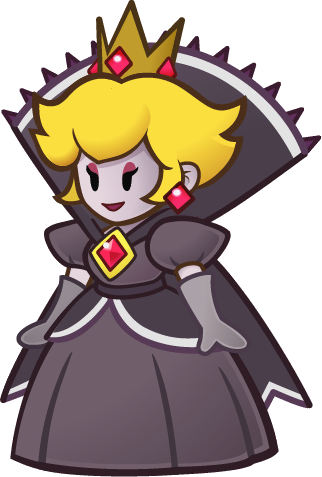 The Shadow QueenWhat is behind the door
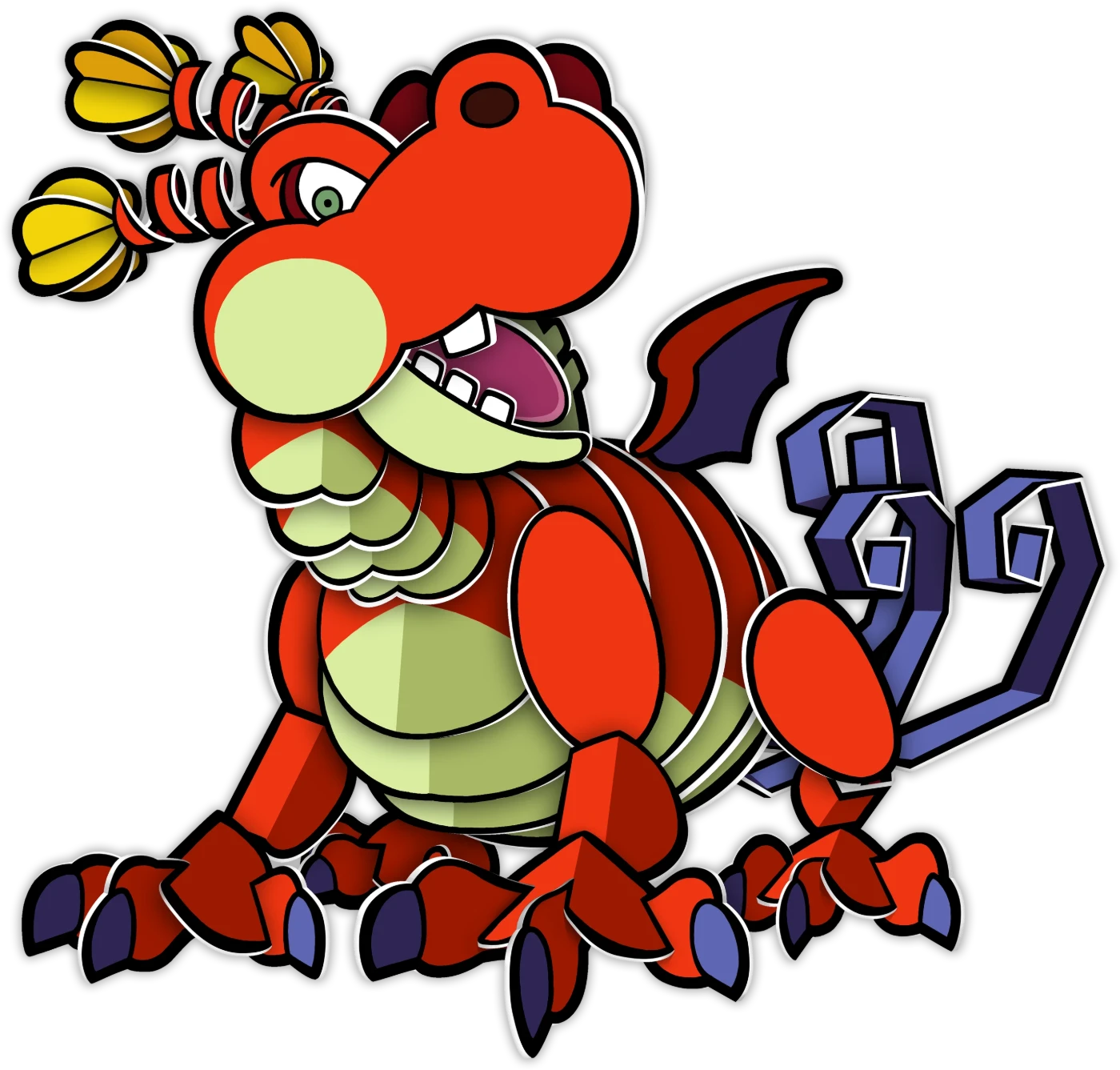 HooktailDragon of Petal Meadows
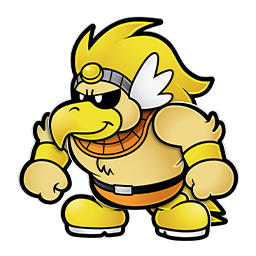 Rawk HawkChampion of the Glitz Pit
 Prince MushNew boss · Glitz Pit
 WhackaNew boss · Pit of 100 Trials
 The Battle MasterNew character
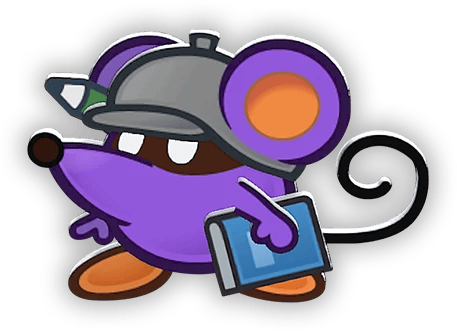 Ian FoomusNew character
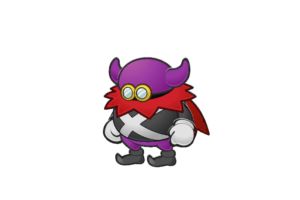 Lord Crump (boss)Prologue · Rogueport · 5 HPThe tutorial fight on the quay.
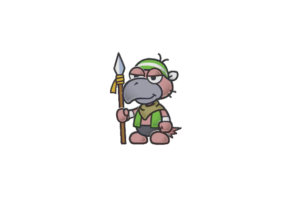 Gus (boss)Prologue · Rogueport · optional · 20 HP, ATK 3A Craw with a threatening manner. Fighting him is optional.
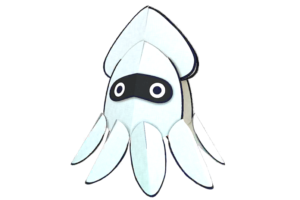 Blooper (boss)Prologue · Rogueport Underground · 12 HPNow fought over animated water. Pays 50 coins.
 Gold Fuzzy (boss)Chapter 1 · Shhwonk Fortress · 10 HPWhistles up its relations when it is in trouble.
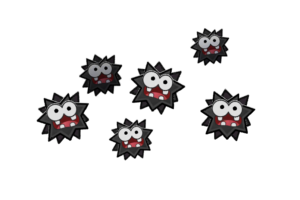 Fuzzy Horde (boss)Chapter 1 · Shhwonk Fortress · 20 HPA seething mass of Fuzzies with, at last, a Tattle Log entry of its own.
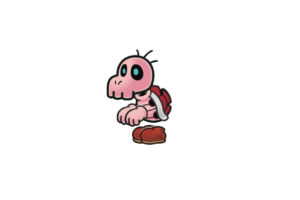 Red Bones (boss)Chapter 1 · Hooktail Castle · 5 HP, ATK 3, DEF 1A red skeleton Koopa with four Dull Bones in support.
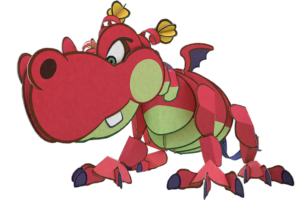 Hooktail (boss)Chapter 1 · Hooktail Castle · 20 HP (+10), ATK 5, DEF 1Croak at her with Attack FX G and her attack drops by one each time. Pays 100 coins.
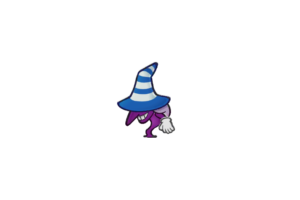 The Three Shadows (boss)Chapter 2 · Boggly Woods · 9, 12 and 10 HPBeldam, Marilyn and Vivian, fought for Flurrie’s necklace. A Save Block now stands just before them.
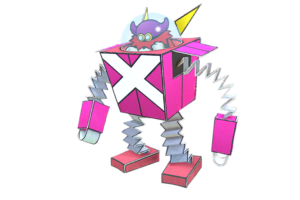 Magnus von Grapple (boss)Chapter 2 · The Great Tree · 30 HP, ATK 2, DEF 1Lord Crump’s robot. Its earthquake now ends on a bigger stomp, to make the block easier to time. 100 coins.
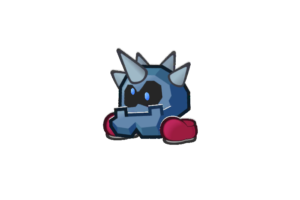 The Iron Adonis Twins (boss)Chapter 3 · Glitz Pit · 6 HP eachImmune to everything except Yoshi Kid’s Gulp. Their first match always carries the condition “use a partner skill”.
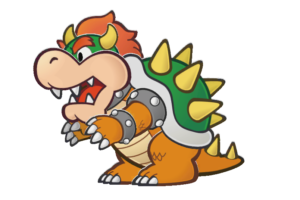 Bowser (boss)Chapter 3 · Glitz Pit · 30 HP, ATK 3, DEF 1Climbs into the ring uninvited, to new battle music.
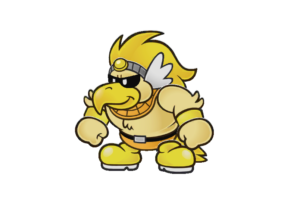 Rawk Hawk (boss)Chapter 3 · Glitz Pit · 40 HP, ATK 4The champion. Lose a later title defence to him and Mario forfeits the belt.
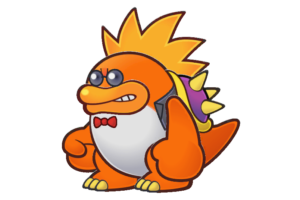 Macho Grubba (boss)Chapter 3 · Glitz Pit · 60 HP, ATK 4Boosts his own attack, defence and speed, and now glows gold while he does it. 100 coins.
 Atomic Boo (boss)Chapter 4 · Creepy Steeple · optional · 40 HP, ATK 4A colossal Boo with a new theme of its own and King Boo’s voice. 50 coins and the Lucky Start badge.
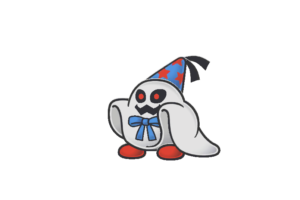 Doopliss (boss)Chapter 4 · Creepy Steeple · 40 HP, ATK 4, twiceFirst as himself, then wearing Mario’s face. Partner badges now work in the second fight.
 Three Embers (boss)Chapter 5 · Keelhaul Key · 8 HP eachCortez’s ghostly flames, held off by Bobbery alone.
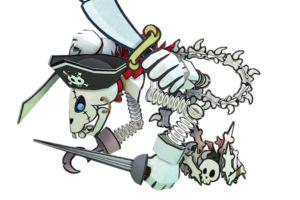 Cortez (boss)Chapter 5 · Pirate’s Grotto · 20 HP × 3, ATK 4, DEF 1Drops on to the stage from above in the remake. Three forms; 100 coins.
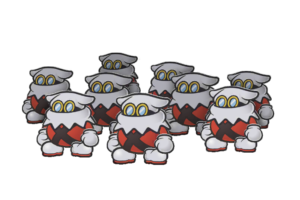 Lord Crump and the X-Naut platoon (boss)Chapter 5 · the X-Naut ship · 30 HPCrump calls his men down with a remote control. The platoon is a new Tattle Log entry.
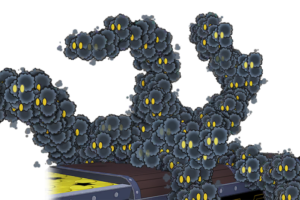 Smorg (boss)Chapter 6 · Excess Express · 50 HP, ATK 5, DEF 1A swarm in the shape of a monster. 50 coins.
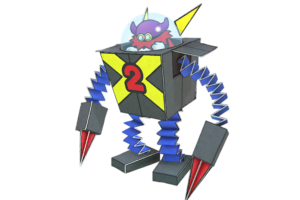 Magnus von Grapple 2.0 (boss)Chapter 7 · X-Naut Fortress · 70 HP, ATK 6, DEF 2Fires its fists, then the audience. New arrangement of its theme; 100 coins.
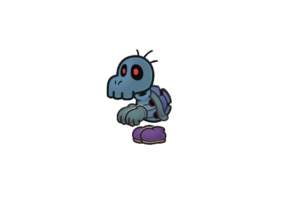 Dark Bones (boss)Chapter 8 · Palace of Shadow · 20 HP, ATK 5, DEF 2A dark skeleton Koopa and four Dry Bones. The Dry Bones horde in the palace has music that tips its hat to New Super Mario Bros. Wii; the Dark Bones battle itself uses a new arrangement of an event-battle theme.
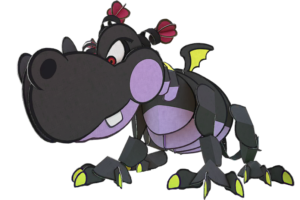 Gloomtail (boss)Chapter 8 · Palace of Shadow · 80 HP, ATK 8, DEF 2Hooktail’s elder brother. His Megabreath is now a jet of fire. 50 coins.
 Beldam, Marilyn and Doopliss (boss)Chapter 8 · Palace of Shadow · 30, 40 and 40 HPThe rematch, with separate Tattle Log entries; their HP stays hidden until you Tattle again.
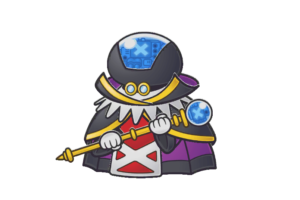 Sir Grodus (boss)Chapter 8 · Palace of Shadow · 50 HP, ATK 7, DEF 1Surrounds himself with Grodus Xs. 50 coins.
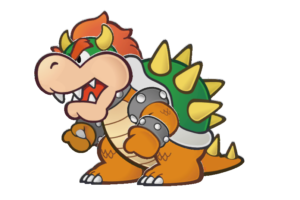 Bowser and Kammy Koopa (boss)Chapter 8 · Palace of Shadow · 70 HP and 50 HPStraight after Grodus. Bowser poisons; Kammy casts every boost she knows. 50 coins.
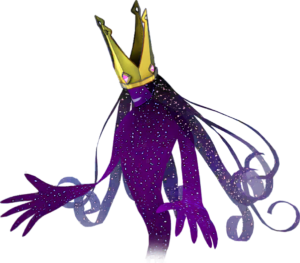 The Shadow Queen (boss)Chapter 8 · Palace of Shadow · 150 HP, ATK 7, DEF 1The final boss, in Peach’s body and then her own. 200 coins.
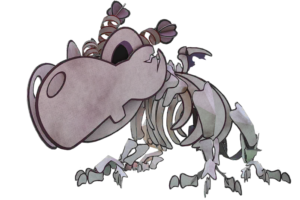 Bonetail (boss)Pit of 100 Trials, floor 100 · 200 HP, ATK 8, DEF 2The third dragon. Her confusing breath is now pink, and she pays 999 coins.
 Prince Mush (boss)New · Glitz Pit Exhibition Match · 96 HP, ATK 6, DEF 6Hops to dodge ground attacks and sidesteps aerial ones. A Superguard breaks his stance and drops his defence to 0 for a turn.
 Whacka (boss)New · Pit of 100 Trials, floor 100 · 108 HPReplaces Bonetail once unlocked. Every blow knocks out a bump, which he throws back for 10 damage.
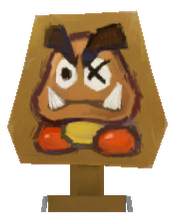 GoomboardNew · Battle Master’s practice stageA cardboard Goomba that exists to be hit. Tattle Log entry 10.
 GoombaRogueport Underground, Petal Meadows · 2 HPThe first thing Mario fights. Tattles now name the place you first logged an enemy, not everywhere it lives.
 Koopa TroopaPetal Meadows · 4 HP, DEF 1One now springs out of a bush for the stage-hazard tutorial.
 FuzzyShhwonk Fortress · 3 HPLatches on and drains HP.
 Dull BonesHooktail Castle · 1 HP, DEF 1Now shove Mario back a room, not out of the castle.
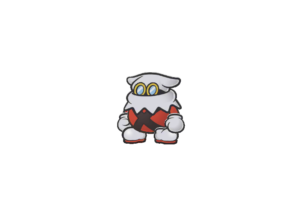 X-NautThe Great Tree, X-Naut Fortress · 4 HP, ATK 3Grodus’s foot soldiers.
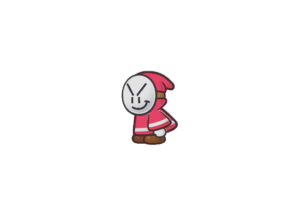 BanditGlitz Pit · 5 HPBeat one before it runs and it now gives back what it stole.
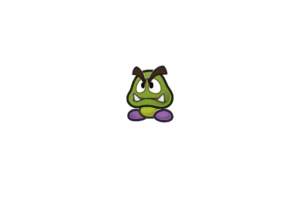 Hyper GoombaTwilight Trail · 8 HPCharges up before it strikes.
 Crazee DayzeeTwilight Trail · 7 HPIts lullaby has an extra note that visibly strikes, to help with blocking.
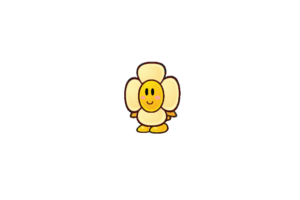 Amazy DayzeeTwilight Trail, Pit of 100 Trials · 20 HP, ATK 20Rare, golden and capable of 20 damage in a go.
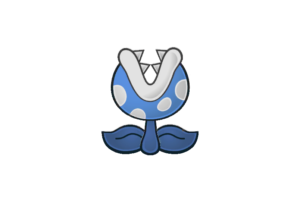 Frost PiranhaFahr Outpost · 10 HP, ATK 5Freezes with its breath in the remake, no longer with its bite.
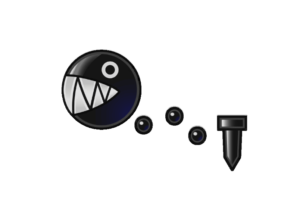 Chain ChompPalace of Shadow · 7 HP, ATK 6, DEF 5Now holds still when a jump is aimed at it.
 Bob-ulkPit of 100 Trials, floors 91–99 · 10 HPNo longer gives Star Points if it is set off by a chain reaction.