It opens with a wedding nobody wanted. Count Bleck, a stranger with a prophecy to fulfil, marries Princess Peach to Bowser by force, and the union tears a hole in the sky that will swallow every world there is. Released for Wii in North America on 9 April 2007 and in Europe on 14 September 2007, Super Paper Mario is the third Paper Mario and the odd one out: a side-scrolling platformer with an RPG’s story and levelling, in which the A Button flips the flat world into 3-D to show what was hiding behind it. Mario is joined, for once, by Peach, Bowser and Luigi as playable heroes, and by thirteen fairy-like Pixls who throw, bomb, shrink and hammer on his behalf, across eight chapters that run from a storybook hillside to outer space, a land of cavemen and the afterlife. Begun on GameCube by Intelligent Systems under director Ryota Kawade, it became the first Mario game on Wii, is usually cited as the best-selling Paper Mario, and tells, underneath the jokes, a genuinely sad love story.
Developer:Intelligent Systems, with Nintendo SPD Group No. 3
Publisher:Nintendo
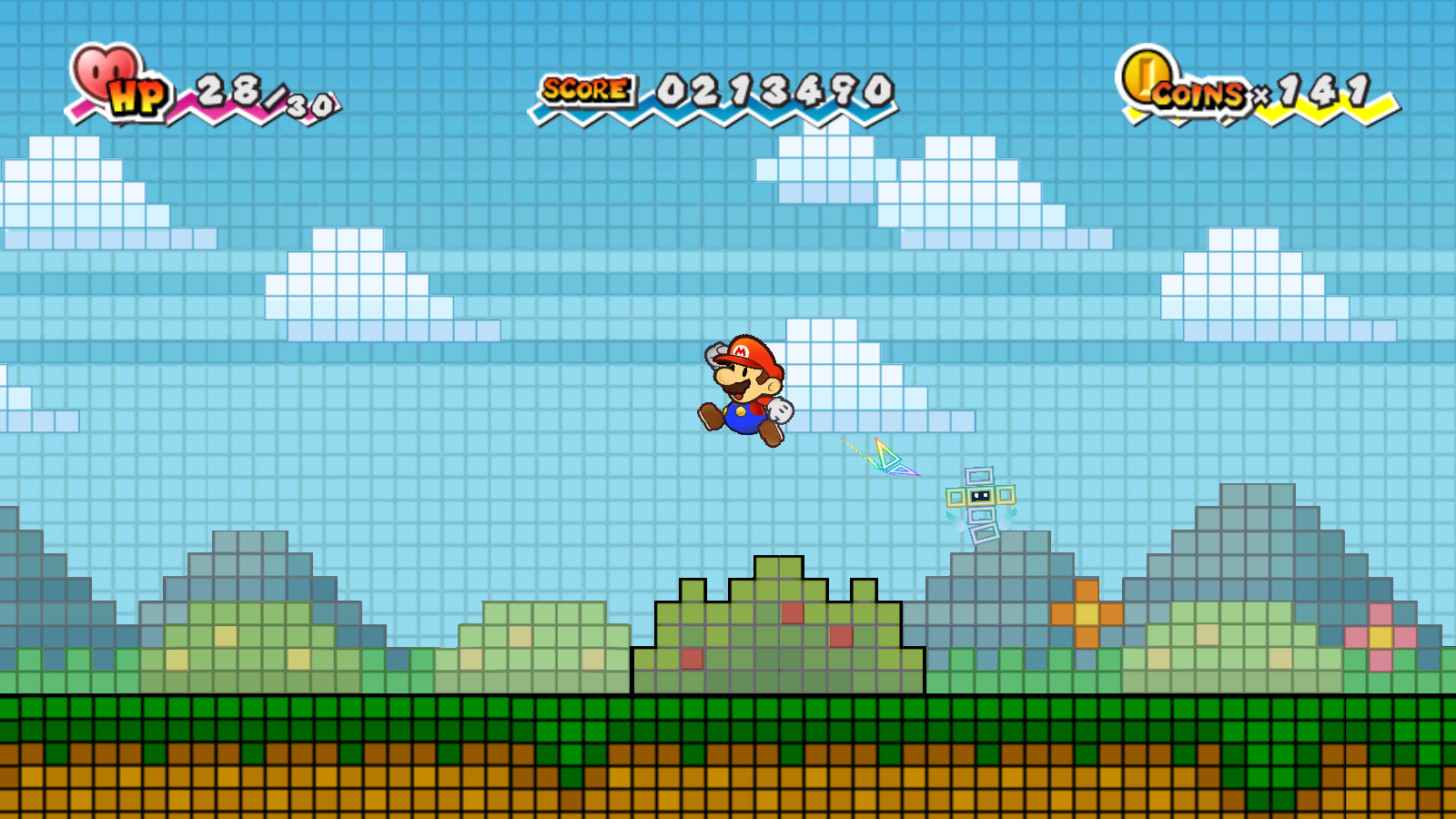
Platform:Wii (begun on Nintendo GameCube); Wii U eShop from 2016
Genre:Platformer with role-playing elements
N. America:9 April 2007
Japan:19 April 2007
Europe:14 September 2007
Australia:20 September 2007
South Korea:26 February 2009
Players:1
Director:Ryota Kawade (chief director)
Producers:Kensuke Tanabe, Ryoichi Kitanishi
Supervisor:Shigeru Miyamoto
Music:Naoko Mitome, Chika Sekigawa; sound director Yasuhisa Baba
Structure:Eight chapters of four levels each, plus Flipside and Flopside
Ratings:PEGI 3 · ESRB E · CERO A · ACB G · USK 0
Sales:2.28 million by 31 March 2008 (Nintendo); 4.23 million by the end of 2014 according to Kotaku, which names no source
Re-releases:Nintendo Selects (2011–12); Wii U eShop (2016)
Advertisement
Overview
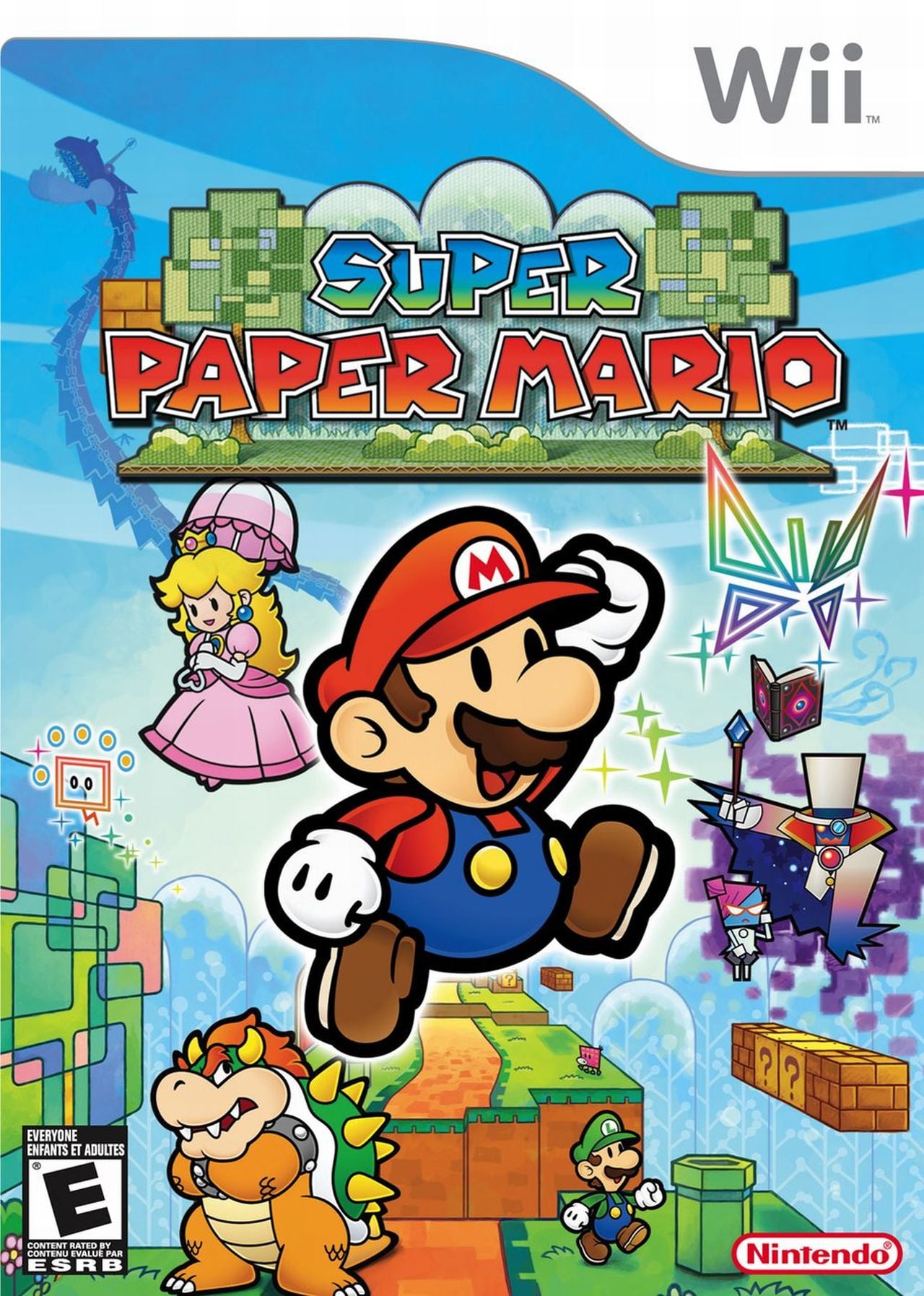
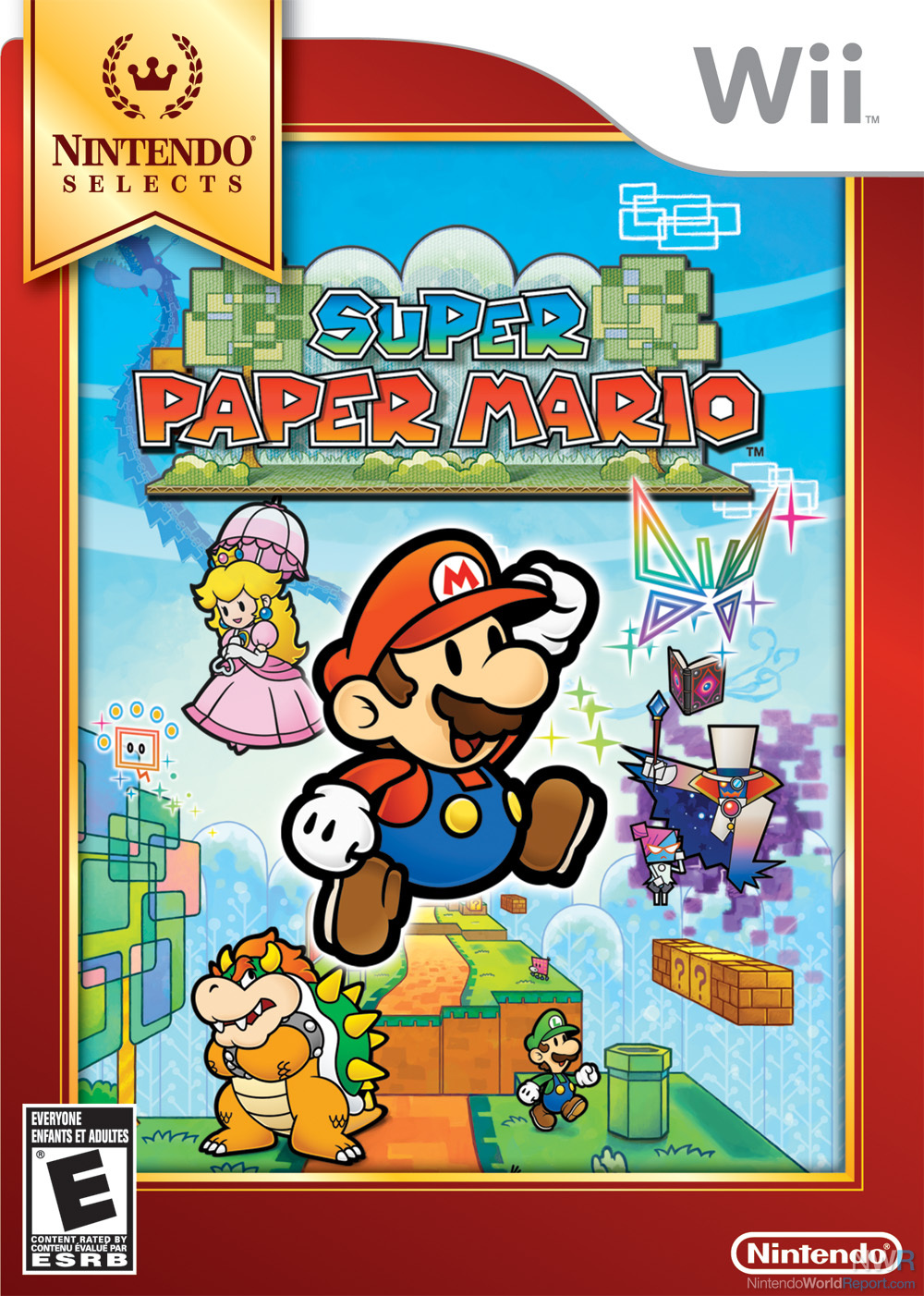
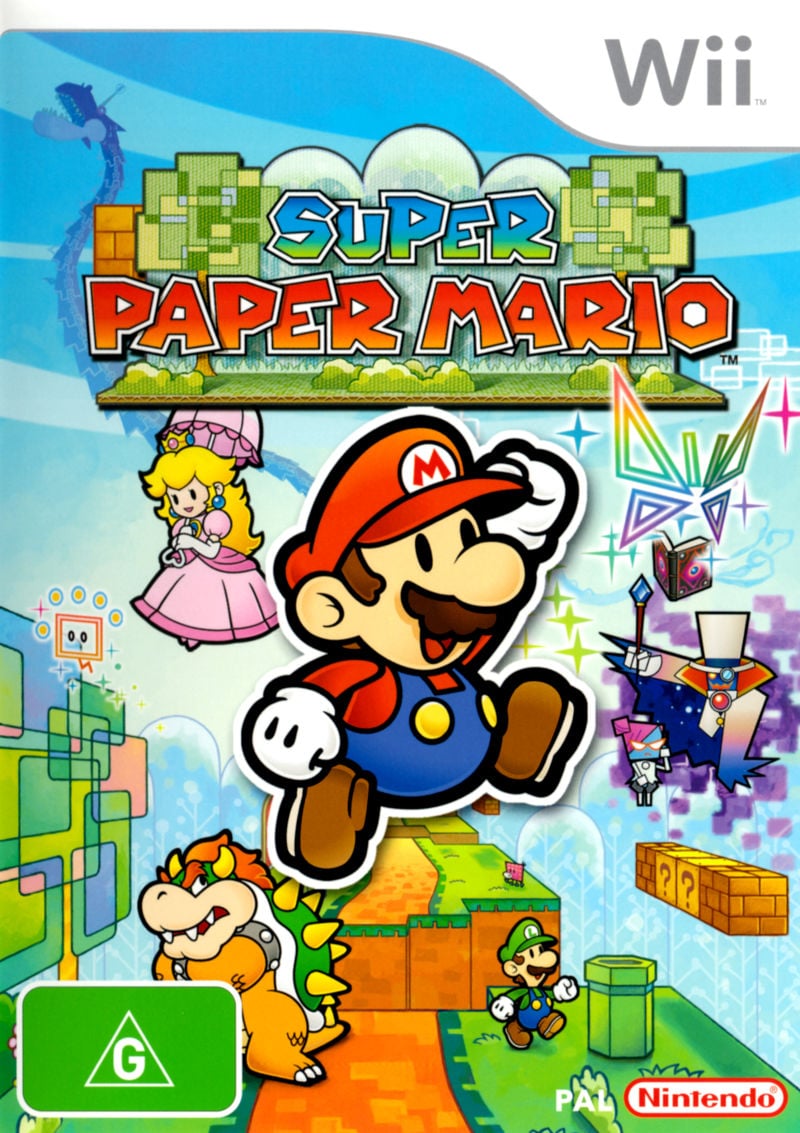
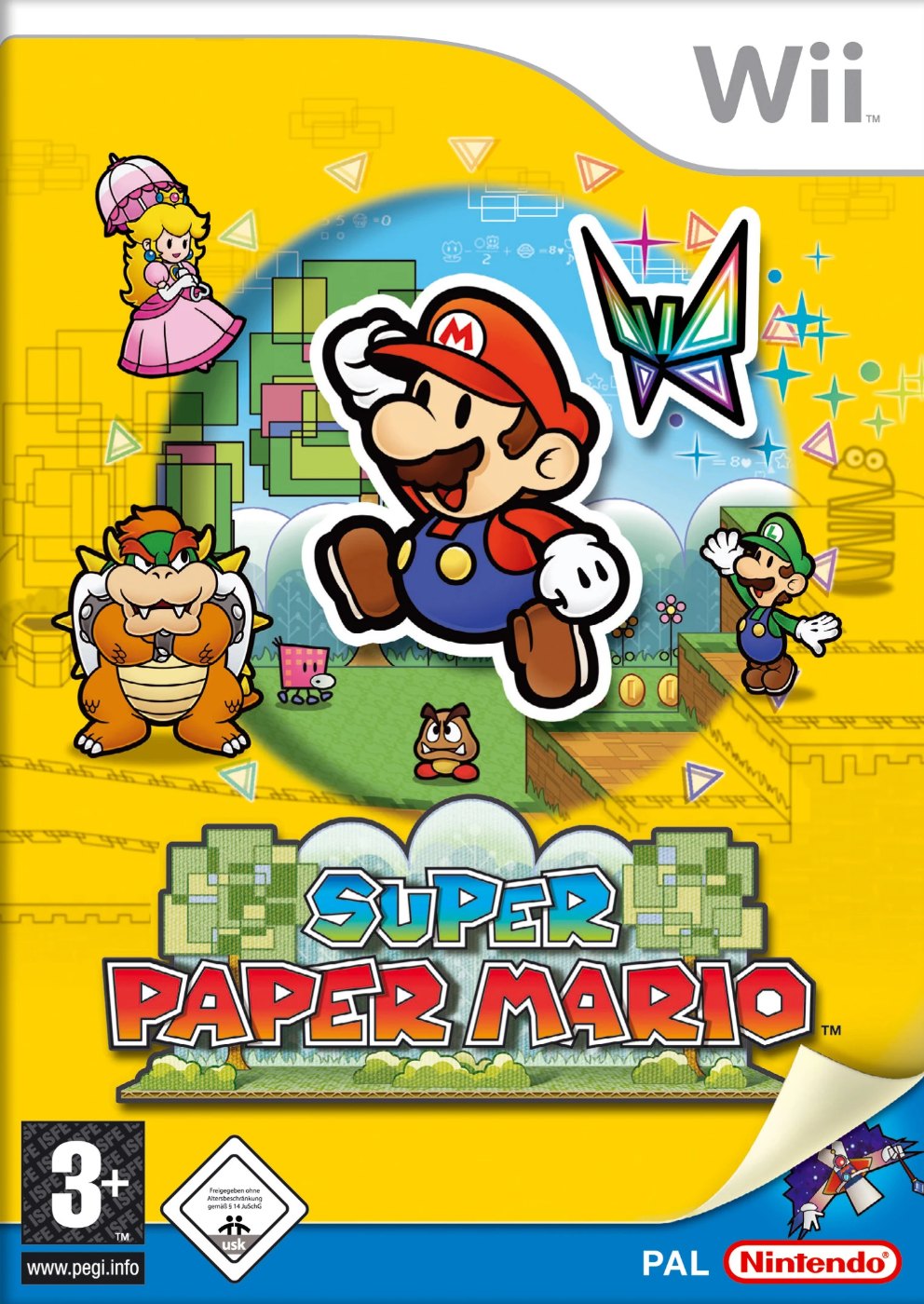
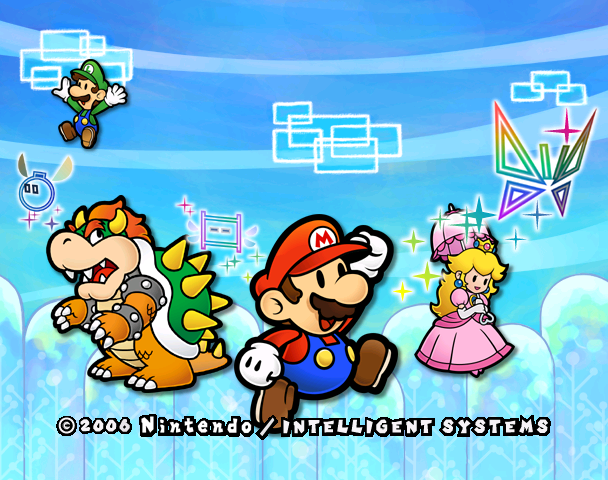
Key art from the American and Australasian boxes.
Super Paper Mario followed Paper Mario: The Thousand-Year Door after three years and kept its director, its art director, its paper cut-out look and its sense of humour. What it did not keep was the fighting. There are no turns, no menus of attacks, no badges and no partners in the old sense. Mario runs and jumps along a flat plane and stamps on things, exactly as he did in Super Mario Bros., and the game is even divided, like that one, into eight worlds of four levels with the same 1-1 to 8-4 numbering.
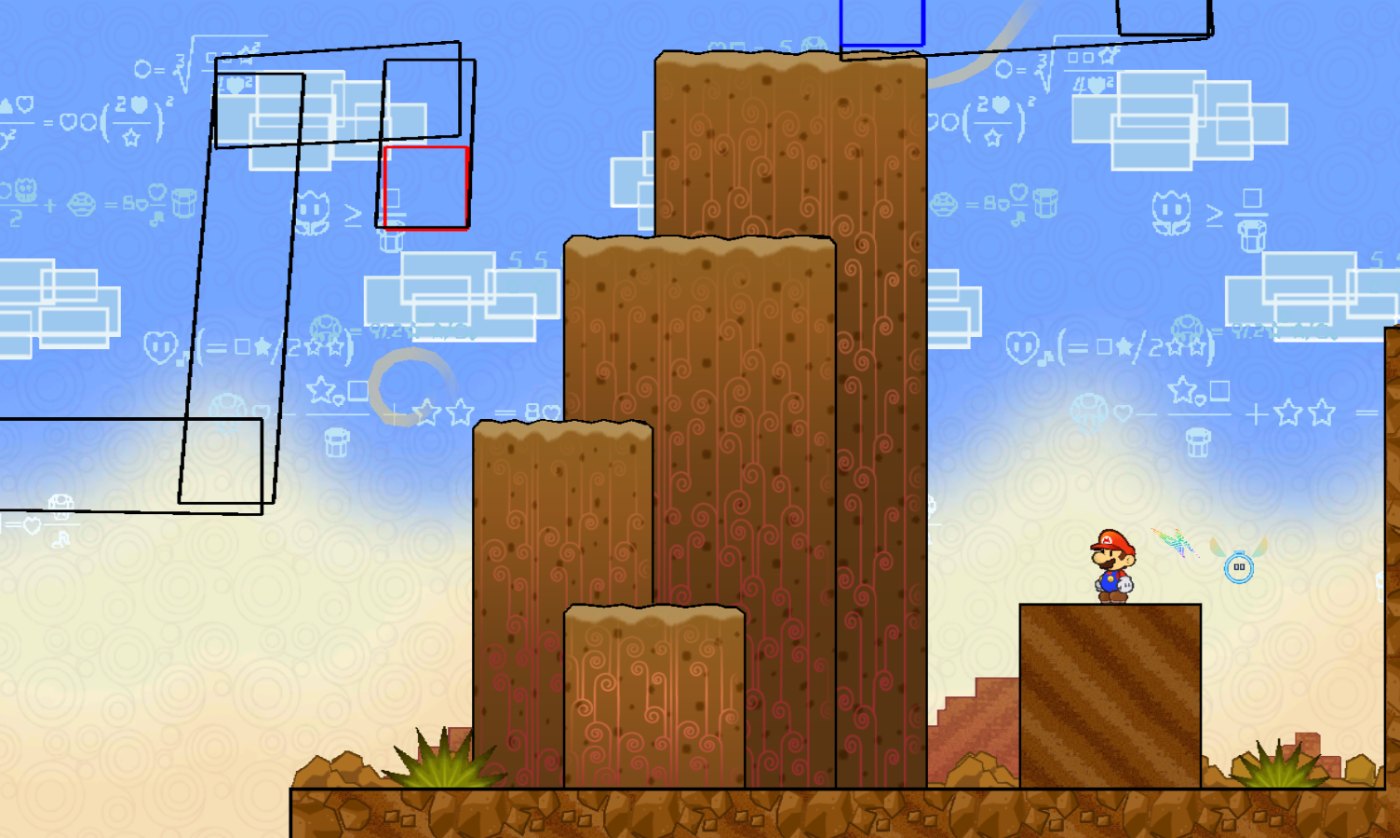
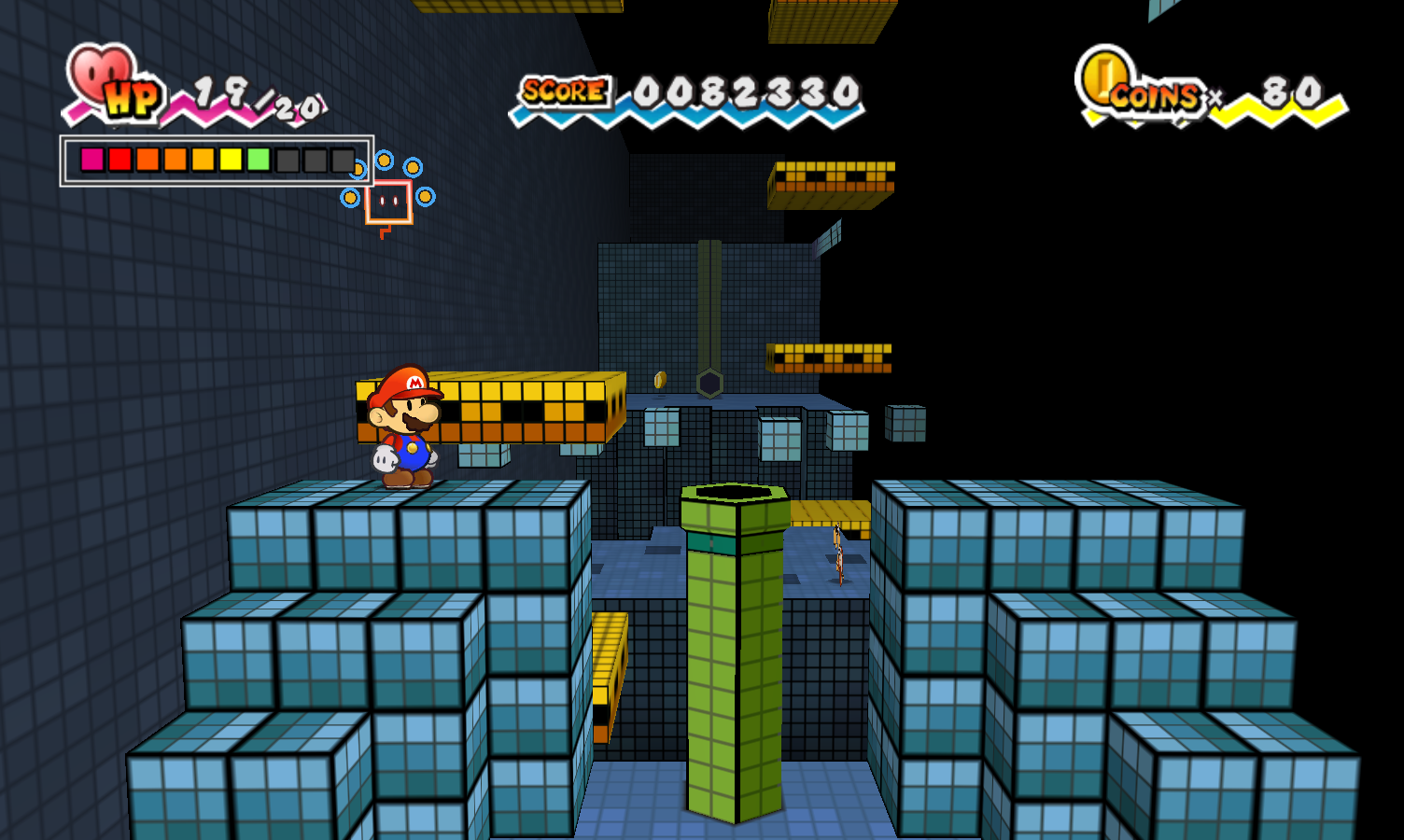
The twist is in the title of the first chapter: Lineland. Mario’s world is two-dimensional, and he is the one person in it who can step outside. A press of the A Button swings the camera round behind him and the flat stage is revealed as a strip of solid ground with depth to it, so that a wall turns out to be a thin fence he can walk round, and a dead end has a pipe tucked behind it. He cannot stay long: a meter drains while he is flipped and starts costing him health when it runs out.
Around that idea Intelligent Systems built the strangest cast the series has had. Peach floats on her parasol, Bowser breathes fire and hits twice as hard as anyone, and Luigi can launch himself skywards; all four can be swapped in at any moment. A butterfly called Tippi identifies everything the Wii Remote is pointed at. The other Pixls each supply one verb. And the levelling of an RPG survives in disguise: every enemy flattened adds to a score, and the score is experience.
It also has more story than most role-playing games. A count is ending the universe with a book of prophecy and a void in the sky; his minions are a brawler, a childish shape-shifter and a smiling magician who is plainly up to something; and running through it all is the story of two lovers, Blumiere and Timpani. Critics were divided about the platforming and nearly unanimous about the writing. Players bought 2.28 million copies in its first year on Nintendo’s own count, and it is usually cited as the best-selling Paper Mario.
Prepare to enter a whole new dimension with Super Paper Mario.
The planet’s favourite moustachio’d hero returns in the third Paper Mario game, bringing a different perspective to the series as he calls on old friends – and foes – to help him tackle a mysterious enemy from a bizarre parallel universe. Lead Mario in his quest to overthrow the evil Count Bleck before he succeeds in creating a Chaos Heart and bringing about the end of the world as we know it, playing as Luigi, Princess Peach and Bowser along the way as you free them from captivity.
— Official description (Nintendo UK, 2007)
Why Super Paper Mario matters to Mario fans
It puts Mario, Luigi, Peach and Bowser in one party, and is the only Paper Mario in which Luigi is playable. It gave the series Count Bleck, Dimentio, Mr. L and Tippi, proved that a Mario game could end in tears, and marked the point at which Paper Mario stopped being one kind of game. It is also, on the figure usually quoted, the best-selling Paper Mario of them all.
Lineland Road in 2-D……and the same place flipped into 3-D.The wedding that creates the Chaos Heart.Walking round a row of Thwomps in the third dimension.
“I did ask the staff to keep the RPG-like storyline, though.”
Kensuke Tanabe, interviewed by Nintendo of Europe, 30 August 2007.
Producer Kensuke Tanabe, on agreeing with director Ryota Kawade that a game about flipping between dimensions suited action better than turn-based battles. Tanabe’s condition explains the shape of the finished game: a platformer to play, a role-playing game to read.
Quick Answers
The questions people ask most about Super Paper Mario, answered briefly here and in depth further down the page.
When did Super Paper Mario come out?
On Wii in North America on 9 April 2007, Japan on 19 April 2007, Europe on 14 September 2007 and Australia on 20 September 2007. A Korean version followed on 26 February 2009, and it was sold on the Wii U eShop from 2016. More →
Is Super Paper Mario an RPG or a platformer?
Mostly a platformer. You run, jump and stomp in real time through side-scrolling levels. The RPG parts are the long story, towns full of people to talk to, items, cooking, and levelling up: points scored by beating enemies act as experience, and each level adds either 5 HP or 1 point of attack. More →
How does flipping work?
As Mario, press A while standing on the ground to turn the 2-D view into 3-D and back. In 3-D a ten-segment Flip Meter drains; when it is empty Mario loses 1 HP. Only Mario can flip, so paths and secrets hidden in the third dimension need him in the lead. More →
Who are the playable characters?
Four. Mario is there from the start. Princess Peach joins after Chapter 1, Bowser after losing a fight in Chapter 3-1, and Luigi just before Chapter 7. Peach floats with her parasol and can shield herself, Bowser breathes fire and does double damage, and Luigi has a super jump. More →
How many Pixls are there?
Thirteen. Nine are met in the story (Tippi, Thoreau, Boomer, Slim, Thudley, Carrie, Fleep, Cudge and Dottie) and four are optional: Barry, Dashell, Piccolo and Tiptron. More →
Who is Count Bleck really?
Blumiere, a man of the Tribe of Darkness who fell in love with a human girl, Timpani. His father banished her to wander between dimensions until she died. Believing her lost, he took the Dark Prognosticus, destroyed his own world and set out to end all the others. Timpani survived: she is Tippi. More →
Who is the final boss?
Not Count Bleck. After he is beaten, the jester Dimentio seizes the Chaos Heart, fuses it with a brainwashed Luigi and himself, and becomes Super Dimentio (200 HP), who cannot be harmed until Bleck and his remaining followers restore the Pure Hearts. More →
What happens to Sammer’s Kingdom?
It is destroyed. Chapter 6 promises a hundred duels, but The Void swallows the kingdom when the heroes have got no further than the thirtieth gate, and the door afterwards opens on the World of Nothing, a blank white plain. The full Duel of 100 can be fought once the game has been finished. More →
What was the freezing bug in the European version?
In early European copies set to English, German or Spanish, speaking to Mimi in Chapter 2-2 before picking up the key froze the game. Nintendo of Europe replaced affected discs free of charge. More →
Was it really a GameCube game?
Yes. It was announced for GameCube at E3 on 11 May 2006 and dated for 9 October 2006. Development then moved to Wii, with controls kept close to the GameCube layout, and it came out in April 2007 as the first Mario game on the new console. More →
Story
Count Bleck.
Two books run this story. The Dark Prognosticus foretells the end of all worlds, and Count Bleck owns it and intends to see it come true. The Light Prognosticus, written by the Tribe of Ancients to answer it, foretells that four heroes will stop him, and is in the keeping of the sage Merlon in a town called Flipside.
What follows is the whole plot, endings and all.
The wedding, The Void and Flipside
A Toad bursts into the Mario Bros.’ house: the princess has been kidnapped. Mario and Luigi storm Bowser’s Castle and find Bowser still rallying his troops, innocent for once. Then Count Bleck materialises with his assistant Nastasia and with Peach already his prisoner, announces that he will use her to destroy every world, knocks Mario cold, and vanishes with Bowser, Luigi and the entire Koopa army.
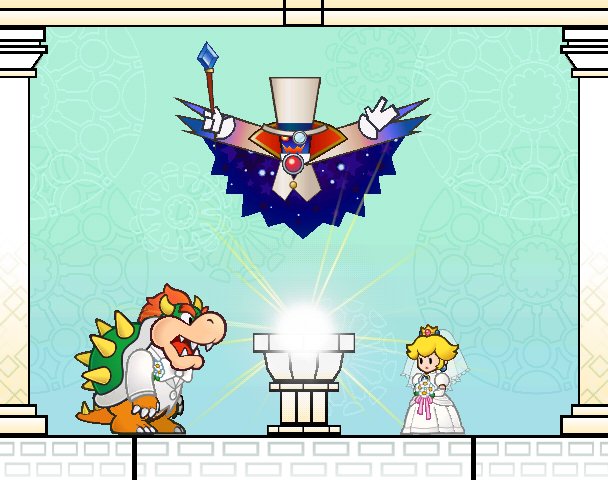
Peach comes round at an altar, in a wedding dress, with Bowser beside her and Bleck conducting the service. Bowser says yes. Peach’s “I do” has to be forced out of her by Nastasia’s mind control. Luigi, waking among the congregation, rushes the altar too late. As the Dark Prognosticus promised, the marriage of a princess and a monster king brings forth the Chaos Heart, and with it Bleck opens The Void, a hole in the fabric of things that will grow until nothing is left.
Mario wakes alone in the empty castle. A butterfly-like Pixl named Tippi has come to fetch him to Flipside, where Merlon shows him The Void, already a dark spot in the sky, and the Light Prognosticus, whose hero looks a good deal like him. Eight Pure Hearts can undo the Chaos Heart. Merlon hands over the first, Mario sets it in a Heart Pillar, and a door appears at the top of Flipside Tower. In Castle Bleck, meanwhile, the count promises his followers a perfect new world, and a brawler called O’Chunks volunteers to squash the hero, with the magician Dimentio tagging along to watch.
Toad brings the news. It is his only scene in the story.Count Bleck marries Peach to Bowser.Mario meets Merlon in Flipside.The first Pure Heart.
Chapter 1: Lineland
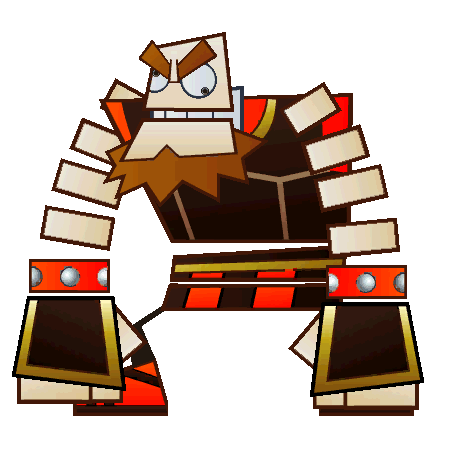
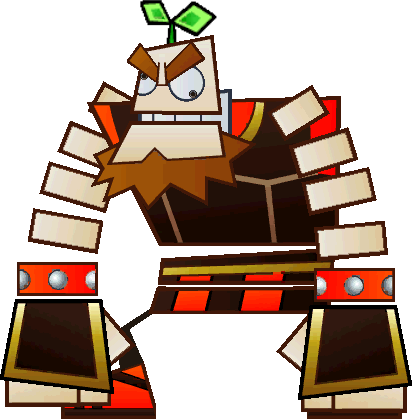
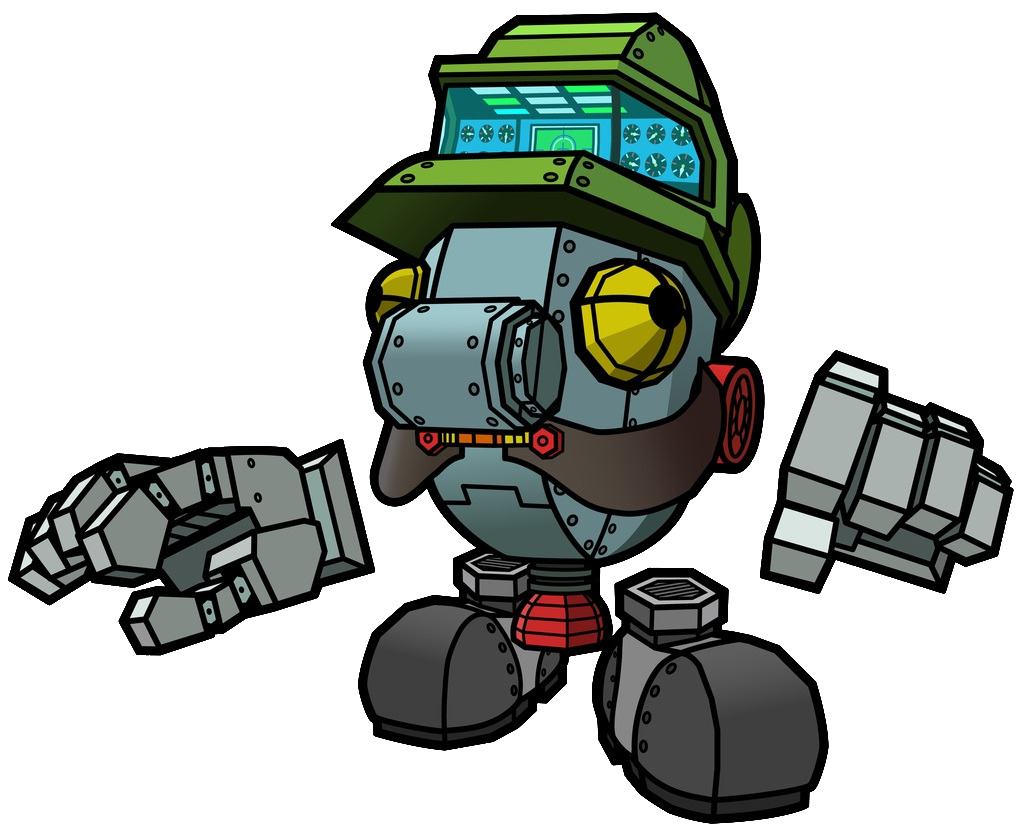
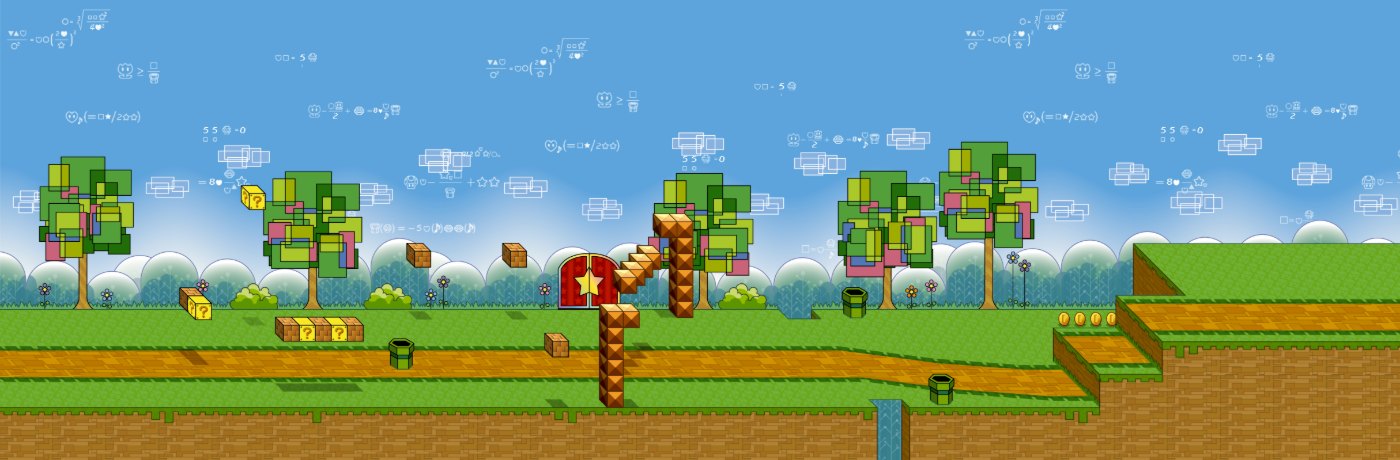
1-1 Lineland Road, 1-2 Mount Lineland, 1-3 Yold Desert, 1-4 Yold Ruins. Lineland Road is World 1-1 of Super Mario Bros. reimagined, though the theme that plays over it arranges the ground music of Super Mario World. Bestovius teaches Mario to flip, and the game immediately starts hiding things behind itself. Up Mount Lineland lies Yold Town, where Mario picks up his first helper Pixl, Thoreau. In Yold Desert he fights O’Chunks for the first time, and finds that jumping ten times under a lone palm tree opens a secret door.
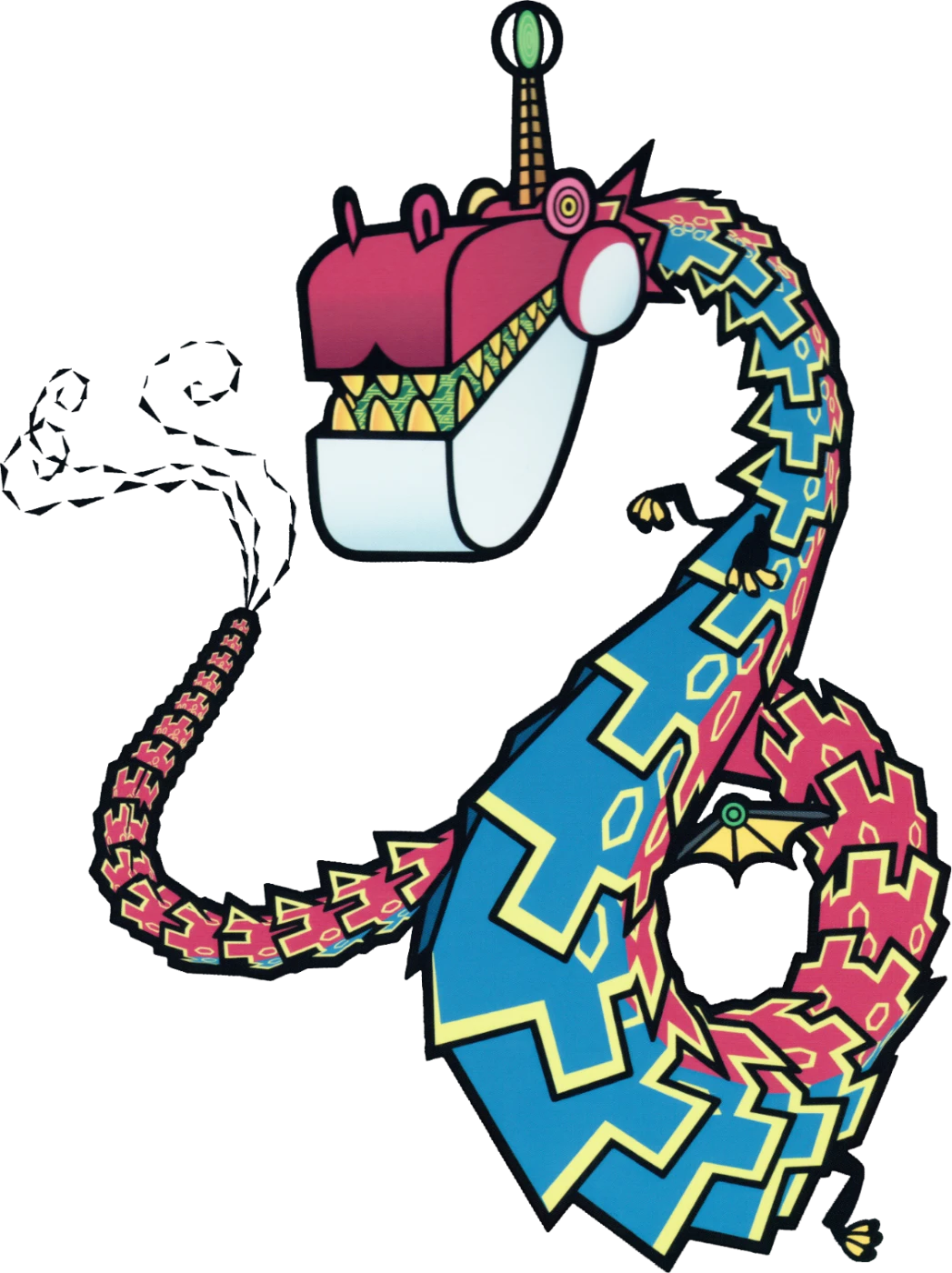
The Pure Heart is in Yold Ruins, guarded by Fracktail, a robotic dragon, and Dimentio makes sure that it malfunctions. It declares “I AM ERROR” and attacks. Beyond it the spirit of Merlumina, one of the authors of the Light Prognosticus, who has waited there since her death for this visitor, gives Mario the orange Pure Heart.
Interlude. O’Chunks reports his failure, and Bleck sends Mimi next. Elsewhere in the castle Peach wakes, falls in with a Hammer Bro and a Koopa Troopa who are also looking for the way out, and is cornered by Nastasia, who hypnotises the two soldiers on the spot. Before she can do the same to the princess, Peach is whisked away. She is found unconscious in Flipside, brought round with a bowl of Spicy Soup, blames herself for The Void and joins Mario.
Yold Town.The first fight with O’Chunks.Dimentio tampers with Fracktail.Mario against Fracktail.
Chapter 2: Gloam Valley
2-1 Gloam Valley, 2-2 and 2-3 Merlee’s Mansion, 2-4 Merlee’s Basement. A twilit valley leads to the mansion of the charm-seller Merlee; on the way Peach meets the bomb Pixl Boomer. The maid who answers the door is Mimi. A vase gets broken, she presents a ruinous bill, and the visitors are set to work it off in the mansion’s power plant, a joke about debt that goes on exactly as long as debt does. It is director Ryota Kawade’s favourite part of the game. “Maybe you will get a little fed up accomplishing this,” he admitted, “but I hope you can share this hardship”.
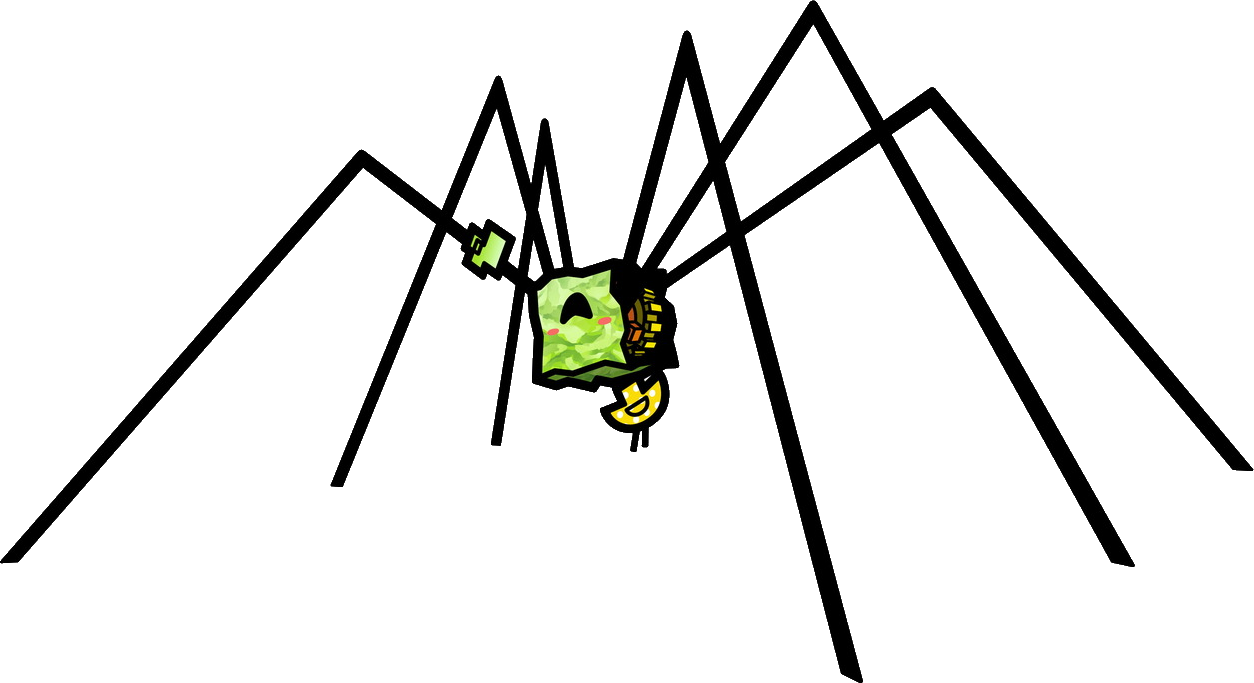
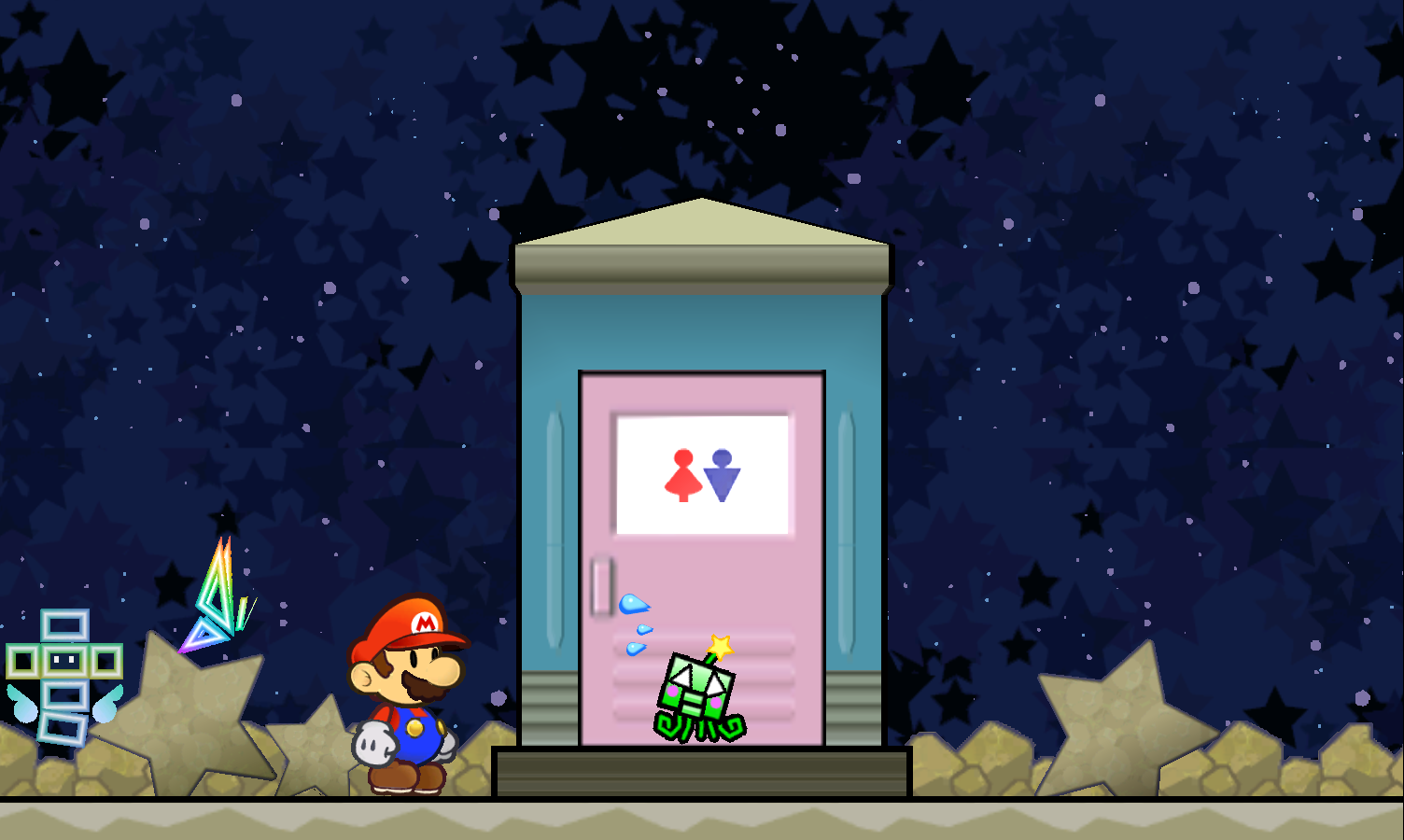
With the help of Slim, the heroes get out, and Mimi tries again, disguised as Merlee herself. Unmasked, she shows her real shape, a spider-legged monster, and chases them through the basement, invulnerable, until the genuine Merlee (who has been hiding in a lavatory) weakens her with a chant. Merlee gives up the yellow Pure Heart and a piece of news: the prophecy needs four heroes.
Interlude. Luigi wakes in Castle Bleck. Two Goombas talk him into helping them escape, and the three run straight into Nastasia. One Goomba is hypnotised, the other changes sides without needing to be, and between them they hold Luigi down for the same treatment.
Peach in Gloam Valley.Merlee’s Mansion.The vase, the maid and the bill.Working off the debt.
Chapter 3: The Bitlands
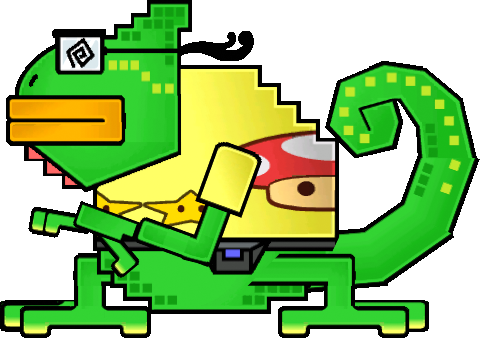
3-1 The Bitlands, 3-2 The Tile Pool, 3-3 The Dotwood Tree, 3-4 Fort Francis. The chapter opens with a theft: a geeky chameleon named Francis, who collects butterflies, snatches Tippi and makes off. A Pixl called Barry saw where he went. The Bitlands are a world of chunky pixels, with an underground stretch copied from World 1-2 and a little castle in which Bowser has set himself up. He has no idea how he got there from Bleck’s. He fights Mario, loses and agrees to join.
The Tile Pool hides the ground-pounding Thudley and a Big Blooper to try him out on. At the top of the wind-blown Dotwood Tree, Dimentio whisks the party into his private Dimension D for a fight he describes afterwards as a test. Fort Francis, at last, is a shrine to its owner’s hobbies, patrolled by robot Meowmaids, with the Pixl Carrie held prisoner. Francis tries to woo Peach through a chat program, Swoon.exe, and takes rejection badly. With Tippi freed, her joy calls forth the green Pure Heart.
Interlude. Dimentio wonders aloud whether these heroes might beat the prophecy. Bleck is untroubled and sends for a new recruit. When they are alone Nastasia begs him to stop; he tells her she is free to leave, and she will not. Dimentio, listening at the door, remarks that he has projects of his own.
Francis makes off with Tippi.The return of Bowser.Bowser squares up to Dimentio in Dimension D.Mario picks Francis up with Thoreau.
Chapter 4: Outer Space
4-1 Outer Space, 4-2 Planet Blobule, 4-3 Outer Limits, 4-4 Whoa Zone. The green door opens on a vacuum, and the party has to go back to Flipside to borrow a goldfish bowl for a helmet. Out among the stars they meet Squirps, a small alien prince who appoints himself guide and fires lasers on request. On Planet Blobule the Pixl Fleep is discovered in an outhouse and will not come out until someone finds him paper.
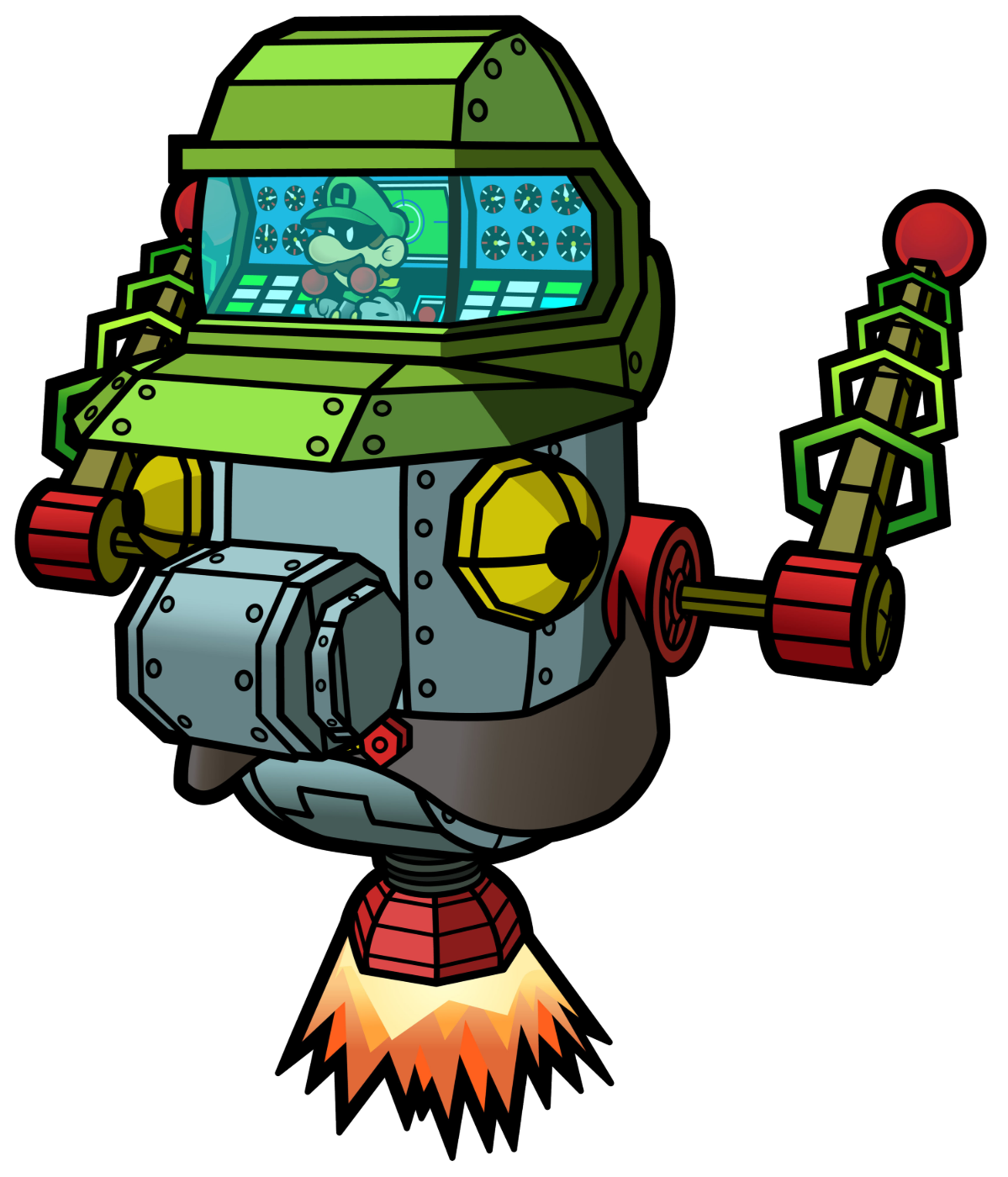
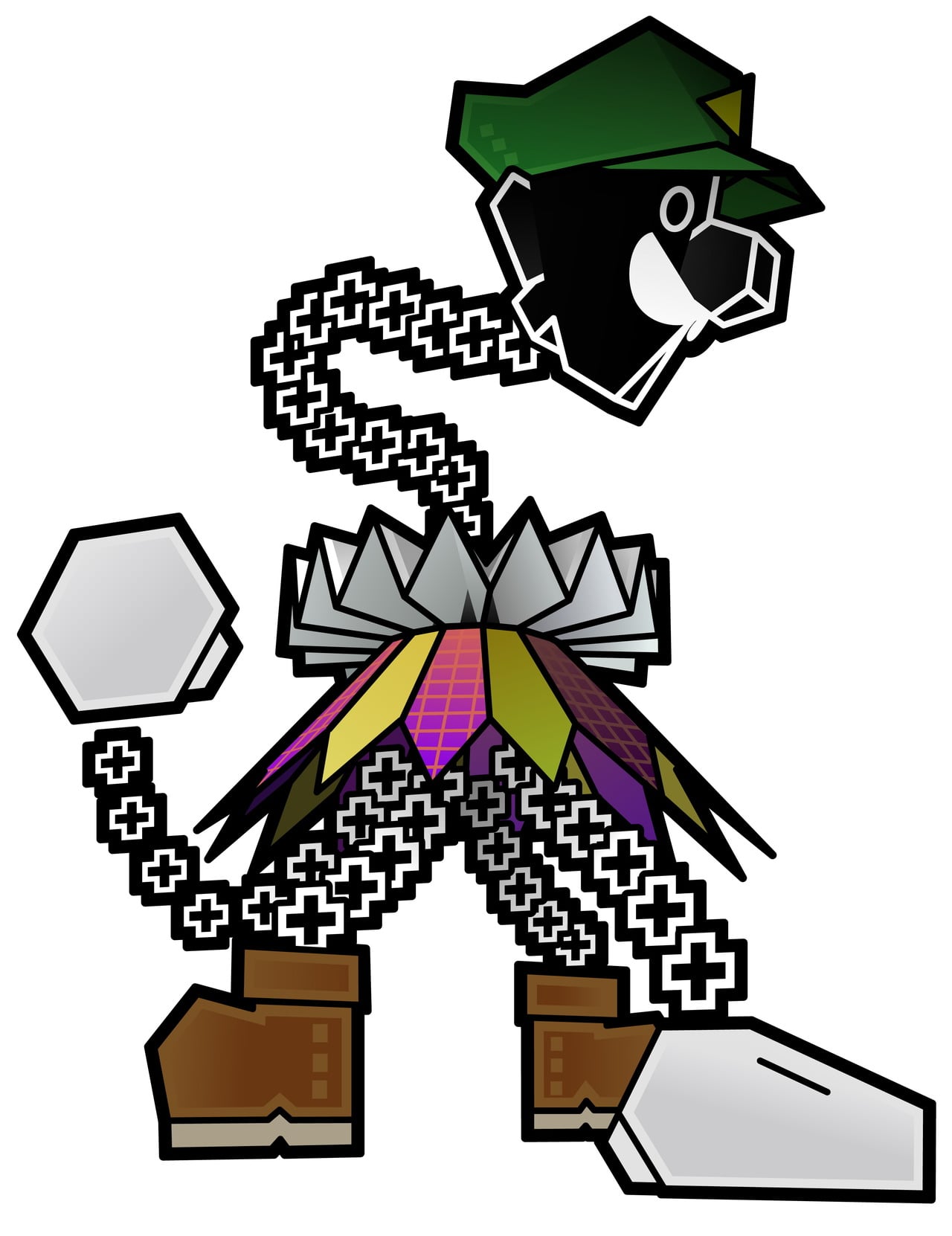
In the maze of the Whoa Zone a man in green introduces himself as Mr. L, loses a fight, and comes back at the controls of a robot, Brobot, which Squirps helps to shoot down. The blue Pure Heart is kept beside a statue of Squirps’s mother, and he stays behind there.
Interlude. Nastasia presents Mr. L to the others, who are not impressed; Bleck calls him the “man in green” of the prophecy. Nastasia tries once more, saying things would be different if she had been “that girl”, and Bleck answers that the girl cannot be replaced, least of all by her. Back in Flipside, Tippi collapses. While she rests, the heroes cross to Flopside and meet Merlon’s opposite number, Nolrem.
Outer space, without a helmet.Mario, Tippi and Squirps.Mr. L reveals himself.The battle with Brobot.
Chapter 5: Land of the Cragnons
5-1 Downtown of Crag, 5-2 Gap of Crag, 5-3 and 5-4 Floro Caverns. The Cragnons are a prehistoric people, and they are being abducted by the plant-like Floro Sapiens who live underground. In the Gap of Crag, O’Chunks has another go, with Dimentio lending a hand, and the hammer Pixl Cudge is unsealed.
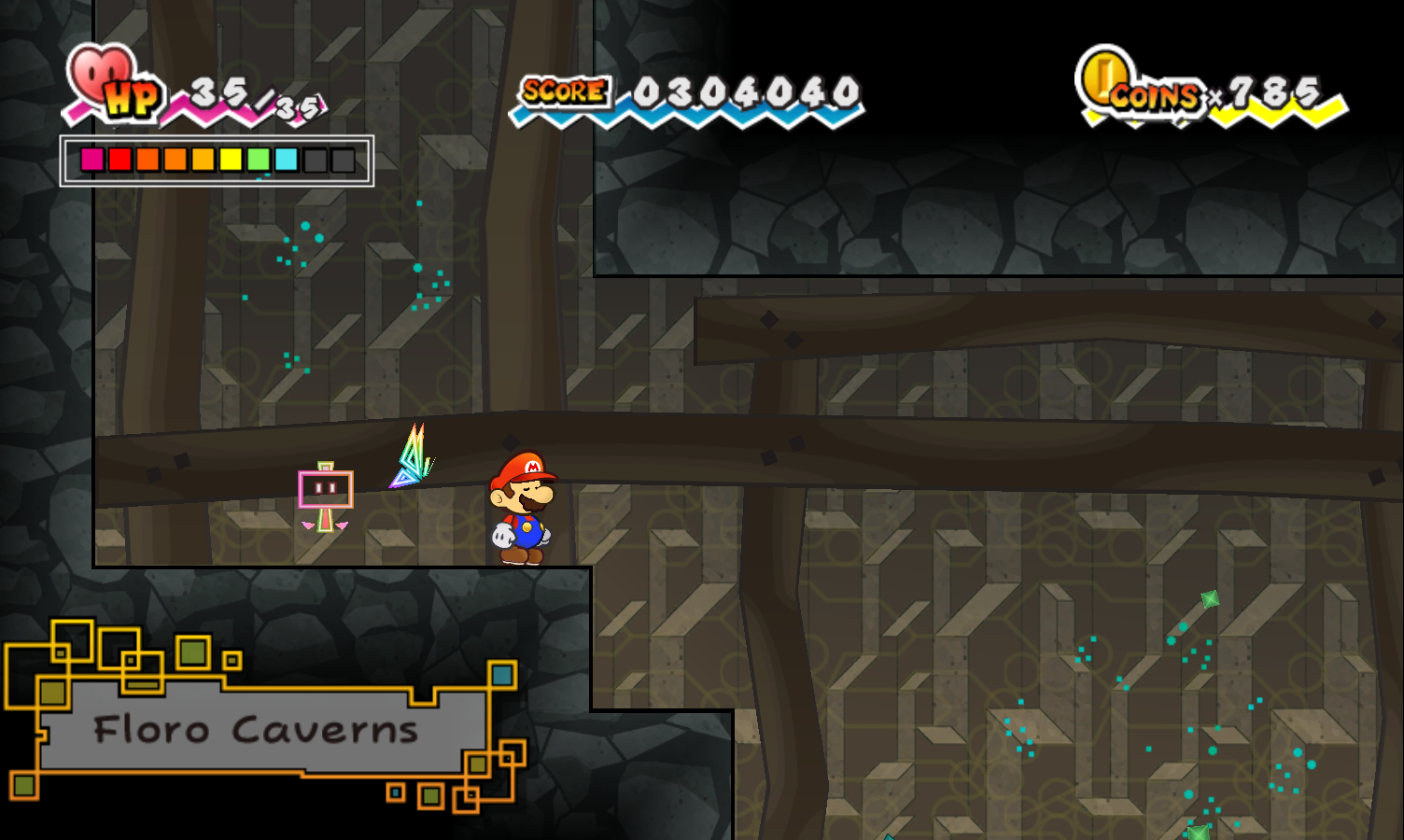
Down in Floro Caverns the party meets the Cragnon journalist Flint Cragley and his crew, rides a mine cart, and finds the missing Cragnons at work with Floro Sprouts planted on their heads, the Floro Sapiens’ method of mind control. Dottie turns up here. So does O’Chunks, with a sprout of his own courtesy of Dimentio, stronger and stupider as O’Cabbage. The dead sprout he leaves behind makes a passable disguise, and gets the heroes an audience with the Floro Sapiens’ ruler, King Croacus IV.
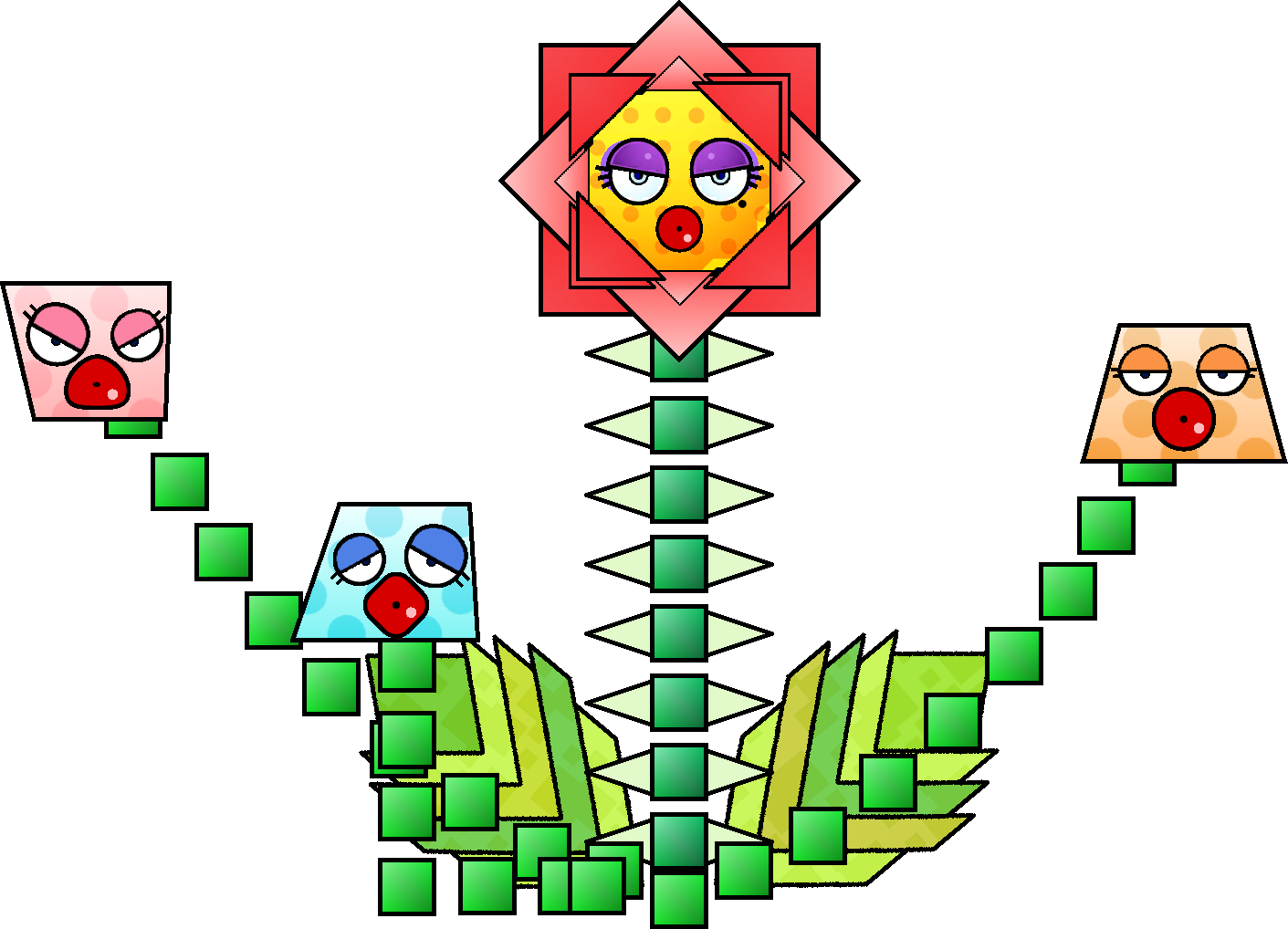
Croacus is beaten, and then explained: Cragnon pollution has been seeping into his kingdom, and it has driven him mad. Flint promises to tell the surface, which is at least a start, and the indigo Pure Heart the king was keeping goes to Mario. In Flopside, Nolrem warns that The Void has very little growing left to do.
Interlude. Nastasia disciplines O’Chunks. Mimi is bored and Mr. L is quarrelsome, and Dimentio quietly suggests to both that they might go and deal with the heroes themselves.
Running from a Muth in the Land of the Cragnons.Flint Cragley, on location.The mine cart in Floro Caverns.O’Chunks and Dimentio.
Chapter 6: Sammer’s Kingdom and the World of Nothing
6-1 Sammer’s Kingdom, 6-2 Sammer’s Early Duels, 6-3 Sammer’s Proving Grounds, 6-4 Sammer’s Endgame. The sixth world is a martial-arts tournament. King Sammer will give up his Pure Heart to anyone who can defeat his hundred Sammer Guys one after another, each with a boastful name and a gate of his own. Overhead The Void now fills most of the sky.
The heroes do not get to a hundred. After twenty duels Count Bleck appears in person to tell them the kingdom’s time is up, and leaves when Tippi stands up to him. The next five warriors, seeing what is coming, bow and wave the party through. The king arrives with a treasure chest, which contains a bomb, because the king is Mimi. She pelts the party with rubees, loses, and cheerfully admits she was only ever there to waste their time. They get no further than the thirtieth gate before the world shakes itself to pieces.
They escape to Flipside. The door is still there, and behind it is the World of Nothing: white emptiness in every direction, a few charred fragments, and on the ground the kingdom’s Pure Heart, turned to grey stone. Mr. L drops in with an upgraded Brobot L-type to take it and is beaten again. As the heroes leave, Dimentio steps out and, as he likes to put it, ends Mr. L’s game. Then he visits Merlon’s house and does the same to Mario, Peach and Bowser.
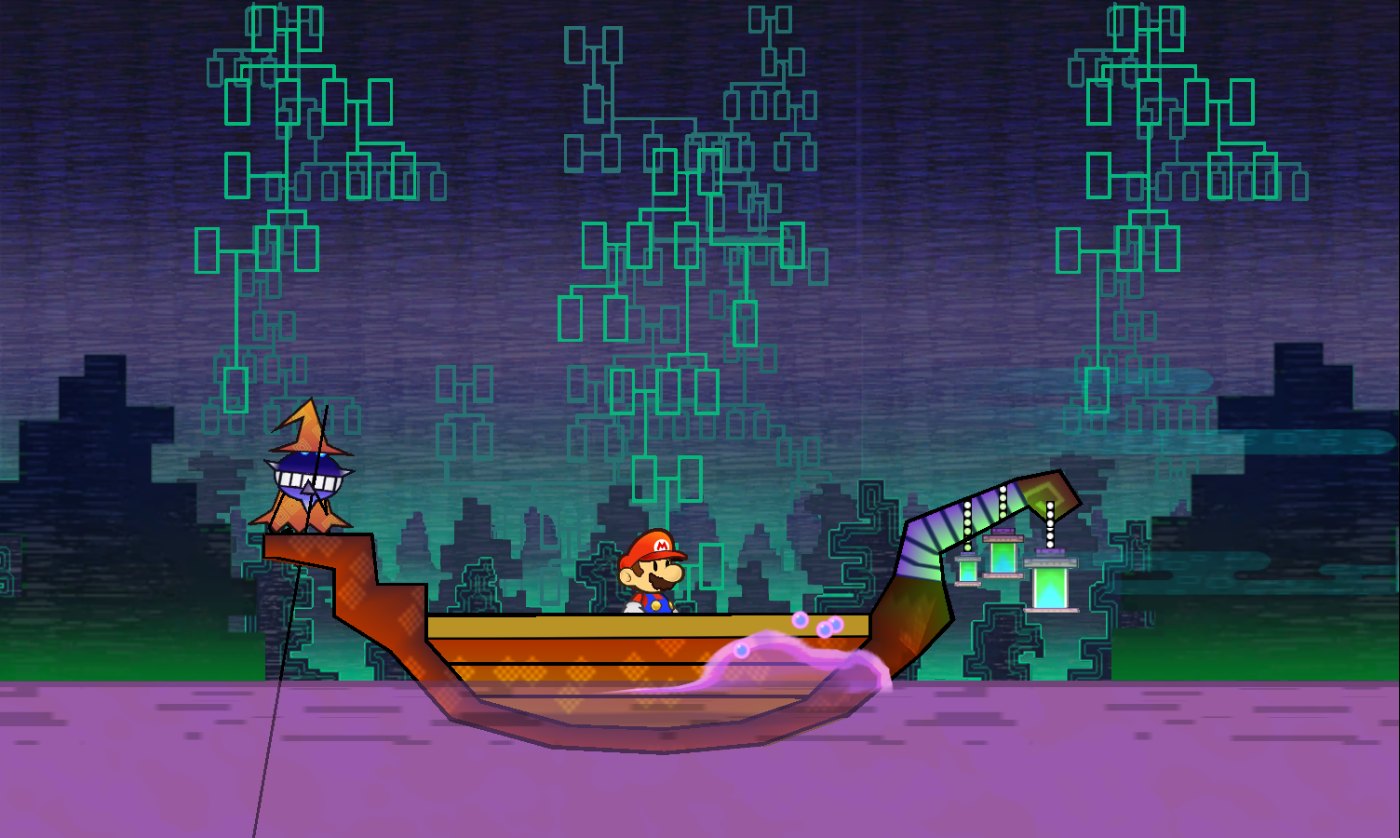
Mario wakes in The Underwhere, where finished games go. Its ruler, Queen Jaydes, offers a bargain: find her daughter Luvbi and she will mend the stone heart. On the errand Mario finds Luigi by the River Twygz, with no idea how he came to be there. The queen keeps her word, restores the Pure Heart, now violet, and sends the brothers back to the living.
The Sammer Guys assembled.The Void destroys Sammer’s Kingdom.The World of Nothing.Dimentio ends Mr. L’s game.
Chapter 7: The Underwhere
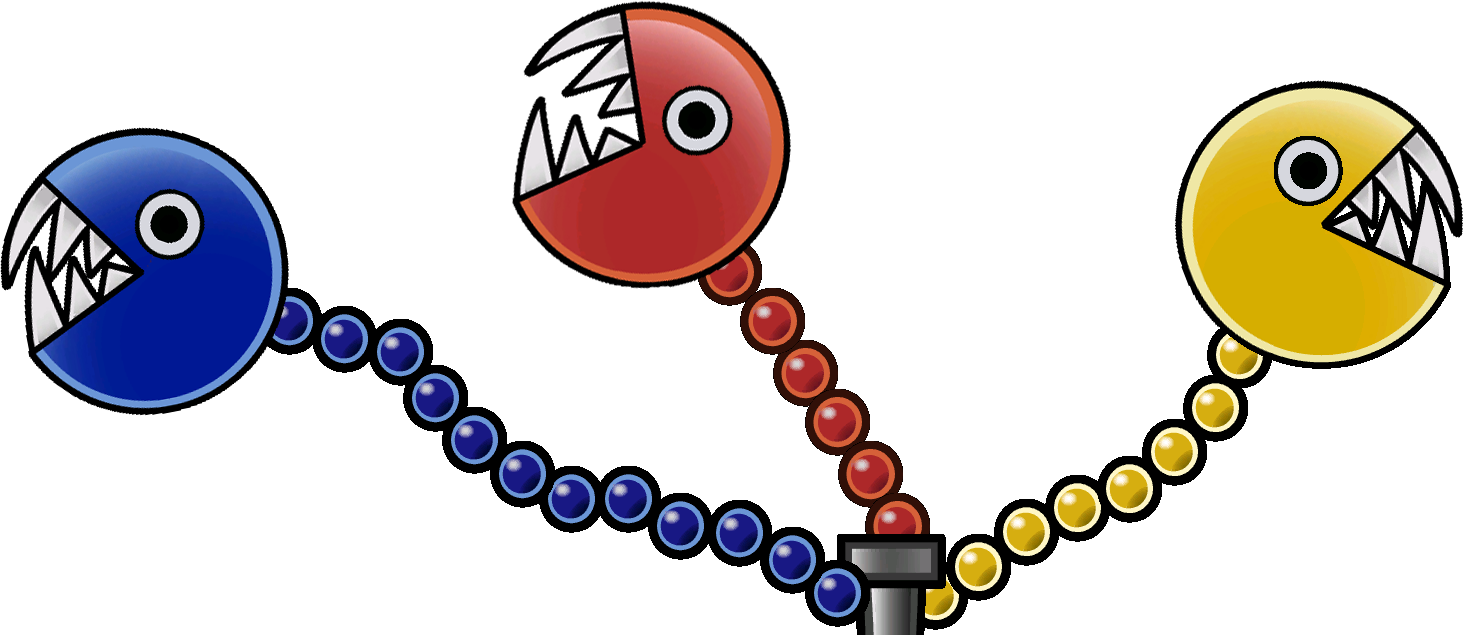
7-1 The Underwhere, 7-2 Underwhere Road, 7-3 Overthere Stair, 7-4 The Overthere. One Pure Heart remains, and it is in the heavens. Jaydes asks the brothers to escort Luvbi up to The Overthere, where her father Grambi rules. The road out of the underworld is barred by three door-keepers, by Bowser, who has to be beaten into rejoining, and by the three-headed Underchomp, whose fight is, for one scene only, a turn-based battle with a menu, in the style of an 8-bit RPG.
On the stair to the clouds they find Peach fast asleep, having eaten a forbidden golden apple, and wake her with another fruit. The Overthere itself has been invaded by an army of Skellobits under Bonechill, who has frozen Grambi solid. He wants Luvbi, and now the reason comes out. She is not really the daughter of Jaydes and Grambi. She is the last Pure Heart, given the shape of a Nimbi girl to keep her hidden.
With all four heroes together again Bonechill is beaten and the Nimbis rout his skeletons. Luvbi quarrels with her parents, forgives them and says goodbye, and becomes the white Pure Heart.
Interlude. Dimentio reports that the heroes are alive and on their way, and the minions take their posts. On his way out he asks the count, innocently, whether the name “Blumiere” means anything to him. Tippi mentioned it. Nastasia pleads one last time and uses the name herself. Bleck says there is no such person any more.
Luvbi.The Underchomp, and a battle menu.Peach asleep on the Overthere Stair.The Overthere under attack.
Blumiere and Timpani
By now the player knows more than the heroes do, because the game has been telling a second story in pieces all along. Long ago a young man of the Tribe of Darkness, the people who broke from the Ancients and carried off the Dark Prognosticus, fell from a cliff and was found and nursed by a human girl. He was Blumiere; she was Timpani. His father had forbidden him to go near humans. They met in secret, fell in love, and when Blumiere learned that his father had been threatening her he asked her to marry him.
His father’s answer was to seize Timpani, wipe her memory and cast her out to drift from dimension to dimension until she died. Blumiere searched world after world. When he gave up hope he took the Dark Prognosticus, erased his own dimension and his tribe with it, and renamed himself Count Bleck. If she was gone, nothing else deserved to stay.
But Timpani did not die. Merlon found her on the point of death and saved her in the only way he could, by making her a Pixl. She remembered nothing, and he called her Tippi.
Count Bleck with his cape open.Tippi.The Dark Prognosticus on the “man in green”.
Chapter 8: Castle Bleck
8-1 Castle Bleck Entry, 8-2 Castle Bleck Foyer, 8-3 Castle Bleck Interior, 8-4 Castle Bleck Inner Sanctum. The white heart opens the last door on Flopside Tower, and the last chapter takes the party away from Mario one at a time. O’Chunks wants a fair fight and gets it from Bowser alone. When the ceiling comes down, O’Chunks holds it up to let the others through, and Bowser stays to help him. Mimi, posing as Merlon and then as Merlee, quizzes the heroes on what they fear and hate (choose Francis and he turns up for a rematch). She and Peach have it out, and when the floor gives way under the loser Peach dives to catch her, and both are gone.
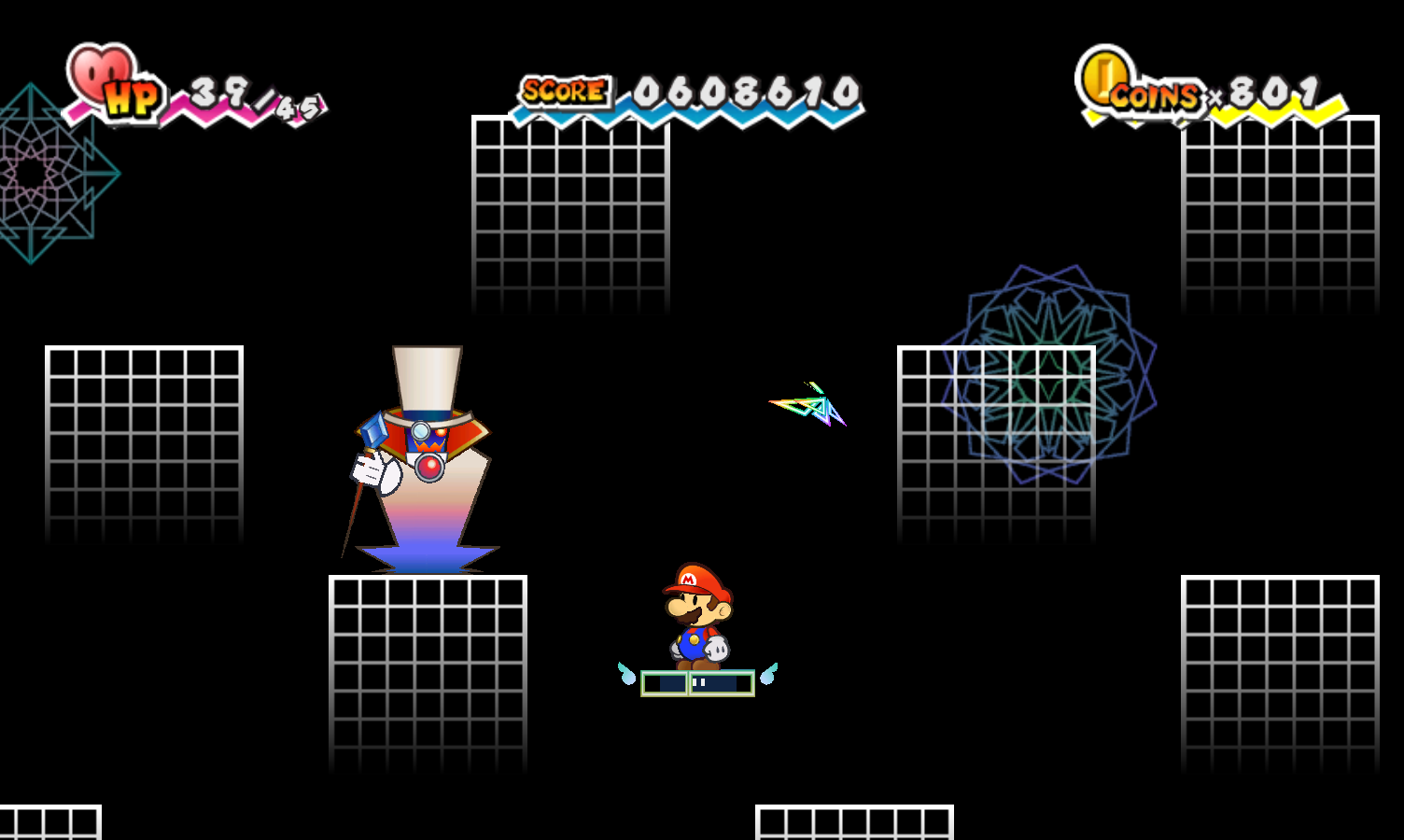
Dimentio leads the brothers a chase through doors into the worlds they have already saved, then makes his offer. He has been on their side all along, he says: it was he who spirited Peach away from Nastasia, he who sent them to The Underwhere so that the heart could be mended and Luigi’s brainwashing undone. Bleck means to destroy everything and build nothing. Join me, and we will bring him down together. Tippi tells them not to trust him and they refuse, so he needles Luigi into a duel, loses it, and seals himself and Luigi inside a force field that blows up.
Mario and Tippi go on alone to the Inner Sanctum, and there, across the room, Timpani and Blumiere finally know each other. It changes nothing. He has gone too far to stop, and privately he has been hoping that this hero would be the one to end him. He sends Nastasia away and fights, untouchable behind the Chaos Heart, until Bowser arrives, having fallen through a floor, with Peach, who landed on him, and a dazed Luigi she found on the way. The four heroes together wake the eight Pure Hearts, the barrier breaks, and Count Bleck falls. He asks them to finish it, quickly, before The Void does. Tippi begs him to live.
The entrance to Castle Bleck.Bowser and O’Chunks hold up the ceiling.Peach tries to save Mimi.Mario and Tippi face Count Bleck and Nastasia.
Super Dimentio and the second wedding
Then Dimentio, who is not dead at all, fires at the count from the shadows, and Nastasia throws herself in front of the blast. This is the project he mentioned. He takes the Chaos Heart for himself, banishes Bleck, Tippi and Nastasia to Dimension D, and wakes a Floro Sprout that he had planted in Luigi’s head. The prophecy’s man in green, the Chaos Heart and the magician fuse into Super Dimentio, and the Pure Hearts, spent on Bleck, have nothing left.
In Dimension D, O’Chunks and Mimi find their master. They are still loyal, Nastasia is still breathing, and Tippi still loves him, and that turns out to be enough: the Pure Hearts kindle again, and Tippi carries them back to the fight. Super Dimentio is beaten and Luigi tumbles out unharmed. But Dimentio has left behind a shadow of his power to keep the Chaos Heart beating, and The Void goes on growing.
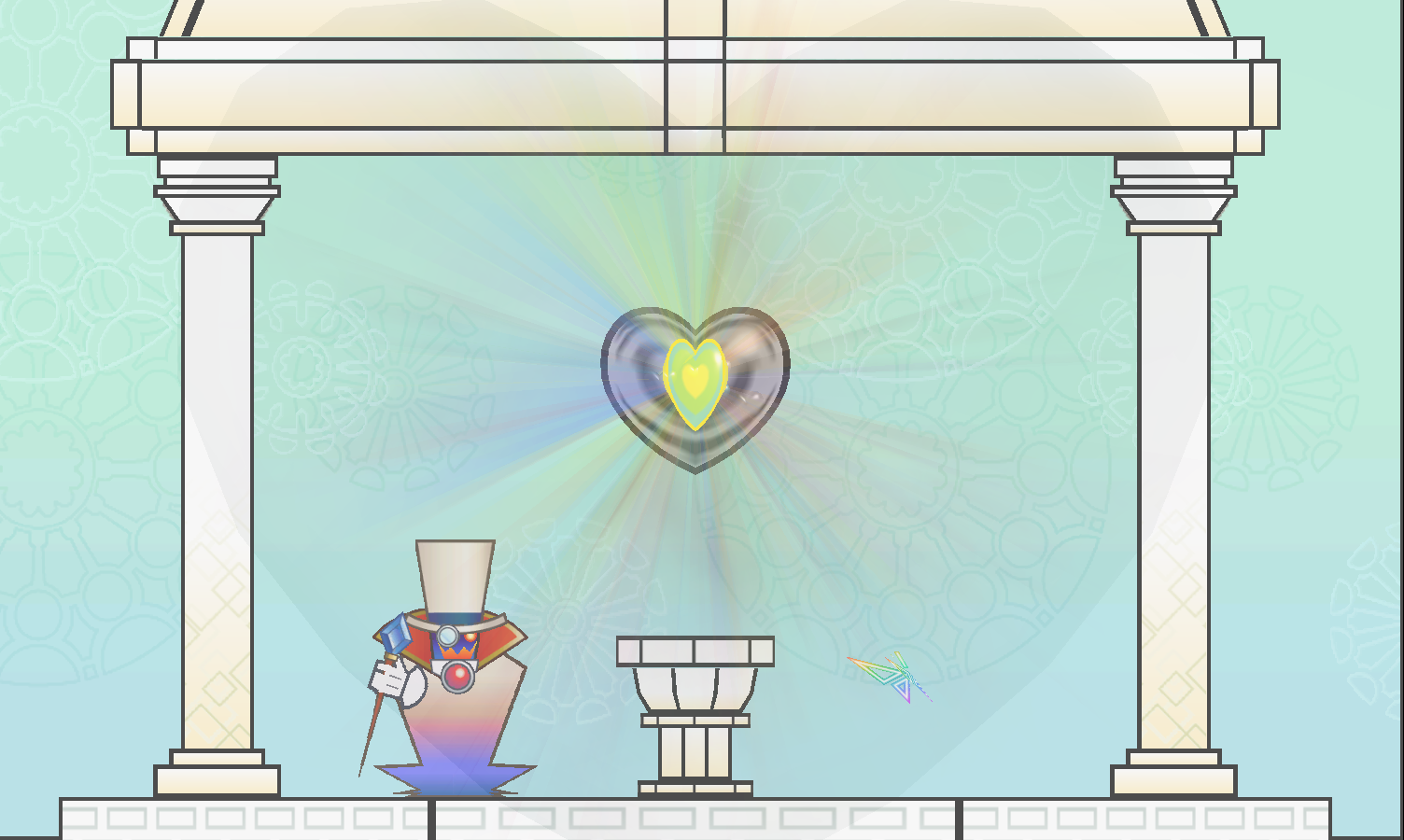
Bleck knows the remedy. He leads everyone to the chapel where it began, and at the altar where Peach and Bowser were married, Blumiere and Timpani exchange vows of their own. Their love draws the Pure Hearts into one, the Purity Heart, the Chaos Heart is destroyed, The Void closes, and every world it had swallowed returns. The heroes and Bleck’s followers wake on top of Flipside Tower, where Merlon invites everybody to dinner. Blumiere and Timpani are not among them. He had warned that the price might be their existence. But Merlon and Nastasia both believe they are alive somewhere, and after the credits two small figures stand together on a green hill.
The eight Pure Hearts break Count Bleck’s barrier.Dimentio makes his move.Super Dimentio.Lord Blumiere and Lady Timpani.
After the credits
The save continues without Tippi, who is gone for good; Francis will sell a robot replacement, Tiptron, for 999 coins. Sammer’s Kingdom is back, and the whole Duel of 100 can now be fought to the end. The two Pits of 100 Trials are waiting under Flipside and Flopside with Wracktail and Shadoo at the bottom, the Pixl Piccolo is there to be earned from Merlee if she has not been already, and there are 48 treasure maps, 96 recipes and a deck of Catch Cards to complete.
Tiptron.Shadoo, in the form of a dark Luigi.
Every chapter in Super Paper Mario
The eight chapters with their four levels, the Pure Heart that opens each door, the Pure Heart won inside, and the bosses, followed by the hub towns and optional dungeons.
Chapter 1: LinelandDoor: red Pure Heart · Won: orange · Bosses: O’Chunks, FracktailLineland Road, Mount Lineland, Yold Desert and Yold Ruins. Hills, a hill town, a desert and a ruin with a dragon in it. Thoreau joins.
Chapter 2: Gloam ValleyDoor: orange · Won: yellow · Boss: MimiGloam Valley, Merlee’s Mansion (twice) and Merlee’s Basement. A gloomy valley and a mansion full of Boos, where Mario goes into debt. Boomer and Slim join.
Chapter 3: The BitlandsDoor: yellow · Won: green · Bosses: Bowser, Big Blooper, Dimentio, FrancisThe Bitlands, the Tile Pool, the Dotwood Tree and Fort Francis. An 8-bit landscape and the fortress of a very keen collector. Bowser, Thudley and Carrie join.
Chapter 4: Outer SpaceDoor: green · Won: blue · Bosses: Mr. L, BrobotOuter Space, Planet Blobule, Outer Limits and the Whoa Zone. Space travel in a goldfish-bowl helmet, with Squirps as guide. Fleep joins.
Chapter 5: Land of the CragnonsDoor: blue · Won: indigo · Bosses: O’Chunks, O’Cabbage, King Croacus IVDowntown of Crag, Gap of Crag and Floro Caverns (twice). Cavemen above, flower people below. Cudge and Dottie join.
Chapter 6: Sammer’s KingdomDoor: indigo · Won: violet (as stone) · Bosses: Mimi, Brobot L-typeSammer’s Kingdom, Early Duels, Proving Grounds and Endgame. A hundred duels that The Void interrupts; what is left is the World of Nothing.
Chapter 7: The UnderwhereDoor: violet · Won: white · Bosses: Bowser, Underchomp, BonechillThe Underwhere, Underwhere Road, Overthere Stair and The Overthere. From the land of ended games to the clouds. Luigi joins just beforehand.
Chapter 8: Castle BleckDoor: white · Bosses: O’Chunks, Mimi, Dimentio, Count Bleck, Super DimentioEntry, Foyer, Interior and Inner Sanctum. The count’s castle, ringed by The Void, with the wedding chapel attached.
World of NothingAfter Chapter 6 · the stone Pure HeartWhat remains of Sammer’s Kingdom, and the thirty-third level. It is restored when the Chaos Heart is destroyed.
FlipsideHub town · four Heart PillarsBuilt by the Ancients between dimensions. Merlon, Saffron, Howzit’s shop, Merluvlee, an inn, the arcade under the Underwhere bar and, two basements down, a sealed pit.
FlopsideHub town · four Heart Pillars · from Chapter 4The run-down mirror image, reached through the Mirror Hall. Nolrem, Dyllis, Flamm’s maps and a dark tower with the last door.
Dimension DDimentio’s pocket dimensionGreen, tiled and of Dimentio’s own making. He boasts that it makes him 256 times stronger, without mentioning that it does the same for everyone in it.
Flipside Pit of 100 TrialsOptional · Dashell · Boss: WracktailA hundred rooms, five minutes each. The background murals show Flipside, Fracktail, Merlee’s Mansion and Fort Francis.
Flopside Pit of 100 TrialsOptional · hero cards · Boss: ShadooA hundred rooms of dark enemies, to be cleared twice.
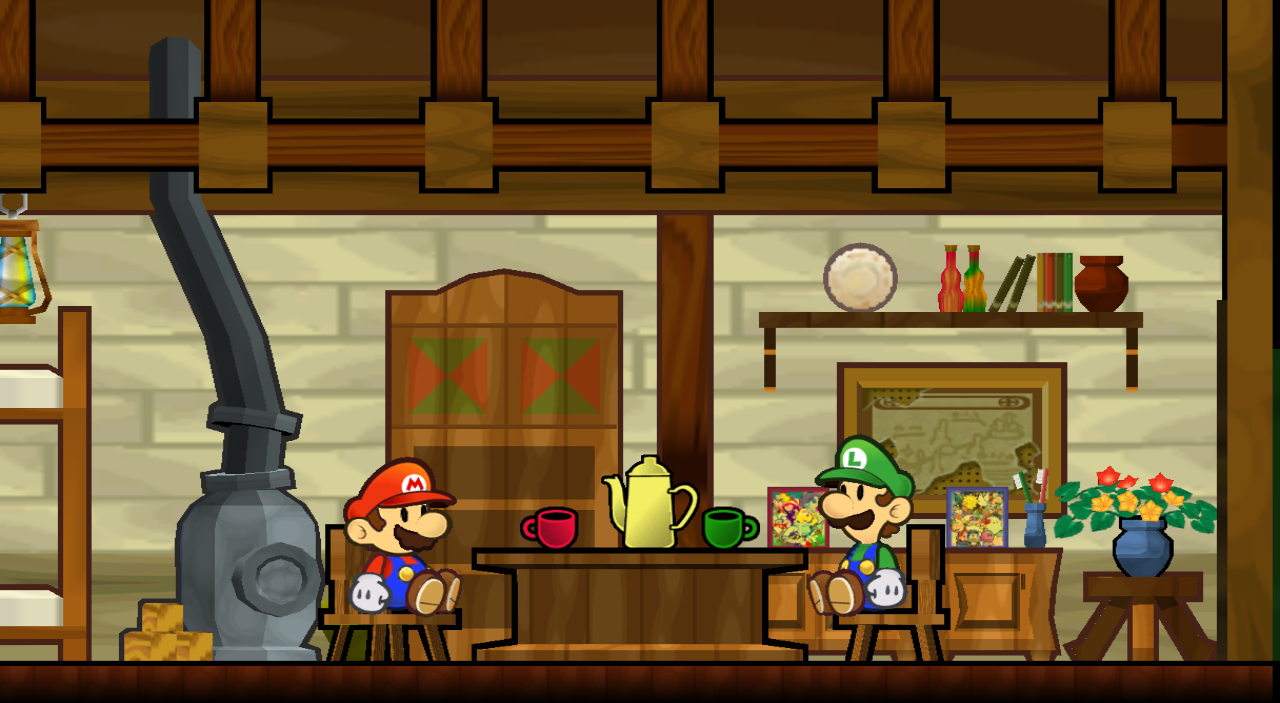
The prologue also visits the Mario Bros.’ house, drawn as it was in The Thousand-Year Door with portraits of Mario’s old partners on the dresser, and Bowser’s Castle.
Advertisement
Gameplay & Controls
Hold the Wii Remote sideways like a NES pad and it plays like a NES game: the +Control Pad moves, 2 jumps, and enemies are beaten by landing on them. Levels are chains of rooms joined by doors, each level ends at a Star Block where an old Mario game would have a flagpole, and each chapter ends, where an old Mario game would have an axe, with a Pure Heart.
What makes it a Paper Mario is everything wrapped round that: the hub towns of Flipside and Flopside, shops and cooks and fortune-tellers, a party of four, a pouch of items, and a great deal of conversation.
Flipping between 2-D and 3-D
Mario learns the “dimensional technique” from Merlon’s friend Bestovius at the start of Chapter 1, and from then on a press of A while he is standing on the ground rotates the world. In 3-D the path he was walking becomes a narrow strip seen from behind and above. Blocks that looked like a wall have gaps between them, enemies line up to be walked past, and coins, pipes, doors and whole side-rooms appear that had no width in 2-D to be seen. Most enemies exist in only one dimension; a few can follow him across.
The cost is the Flip Meter, ten segments that tick away while Mario is in 3-D and refill slowly once he is back. If it empties he takes 1 point of damage. Flipping is Mario’s talent alone, so however useful the other three are, he is always a button-press away.
Building it was harder than it looks. “For designers, creating one single level, effectively required the efforts of creating two levels!” director Ryota Kawade told Nintendo of Europe.
Dodging Spiny Tromps on Mount Lineland by stepping into 3-D.The Tile Pool, flipped.The Flip Meter, full.…and empty.
Four heroes, one button apart
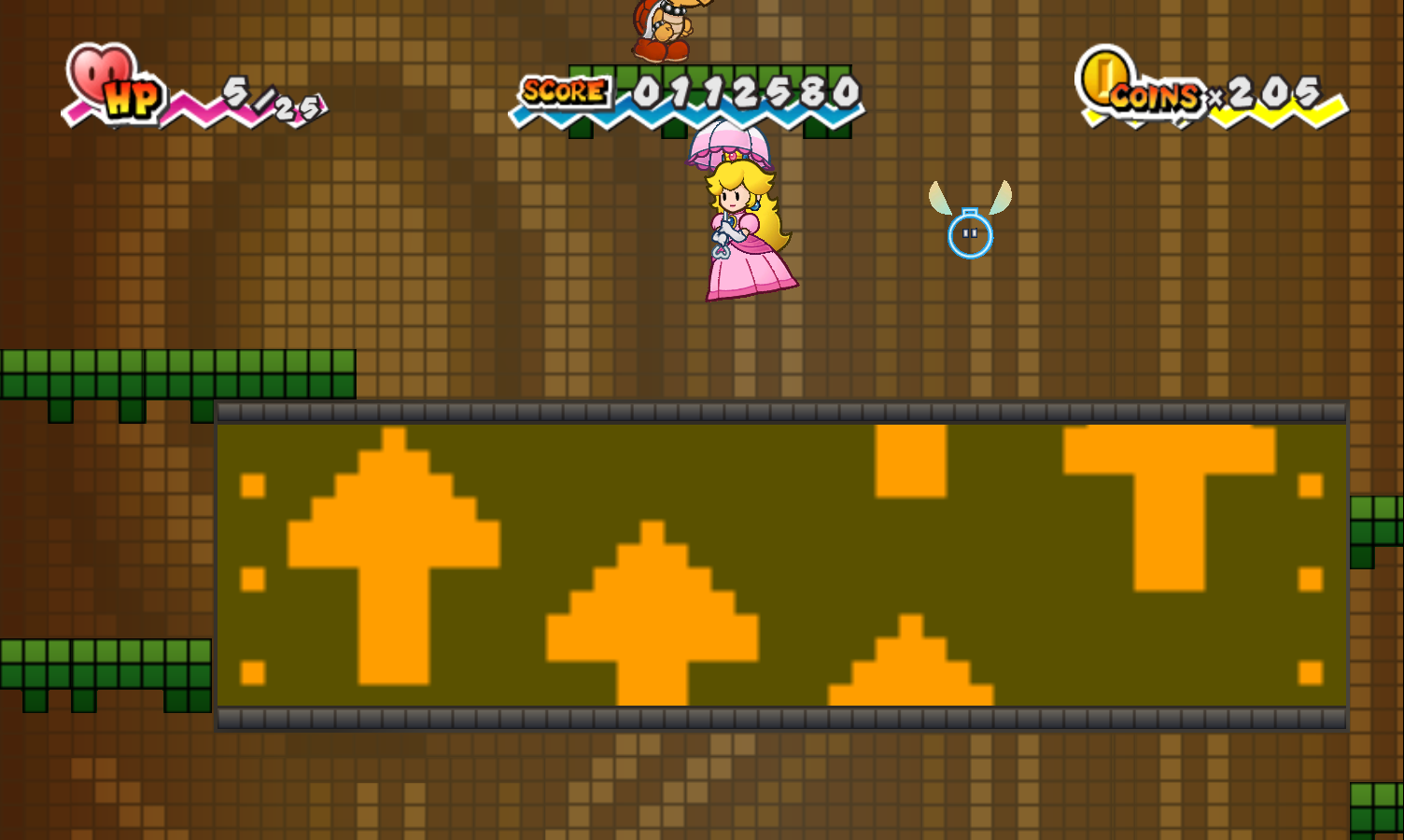
Pressing 1 and 2 together opens a quick menu for changing character, changing Pixl or using an item, and the game is built on swapping constantly. Peach opens her parasol if 2 is held in the air and drifts across gaps nobody else can clear; crouching behind it (Down on the +Control Pad) blocks almost any attack. Bowser is slow, cannot be bothered with ladders, breathes fire when Down is held and does twice the damage of the others with everything. Luigi jumps higher and skids further than his brother, and crouching charges a super jump that fires him straight up to ledges out of everyone else’s reach, hurting whatever is in the way.
The party is not always complete. Heroes are found one by one, and the story twice takes them away again, so several stretches have to be played with whoever is left.
Peach floats on her parasol.Bowser’s fire breath.Luigi, the jumper of the family.
Score is experience
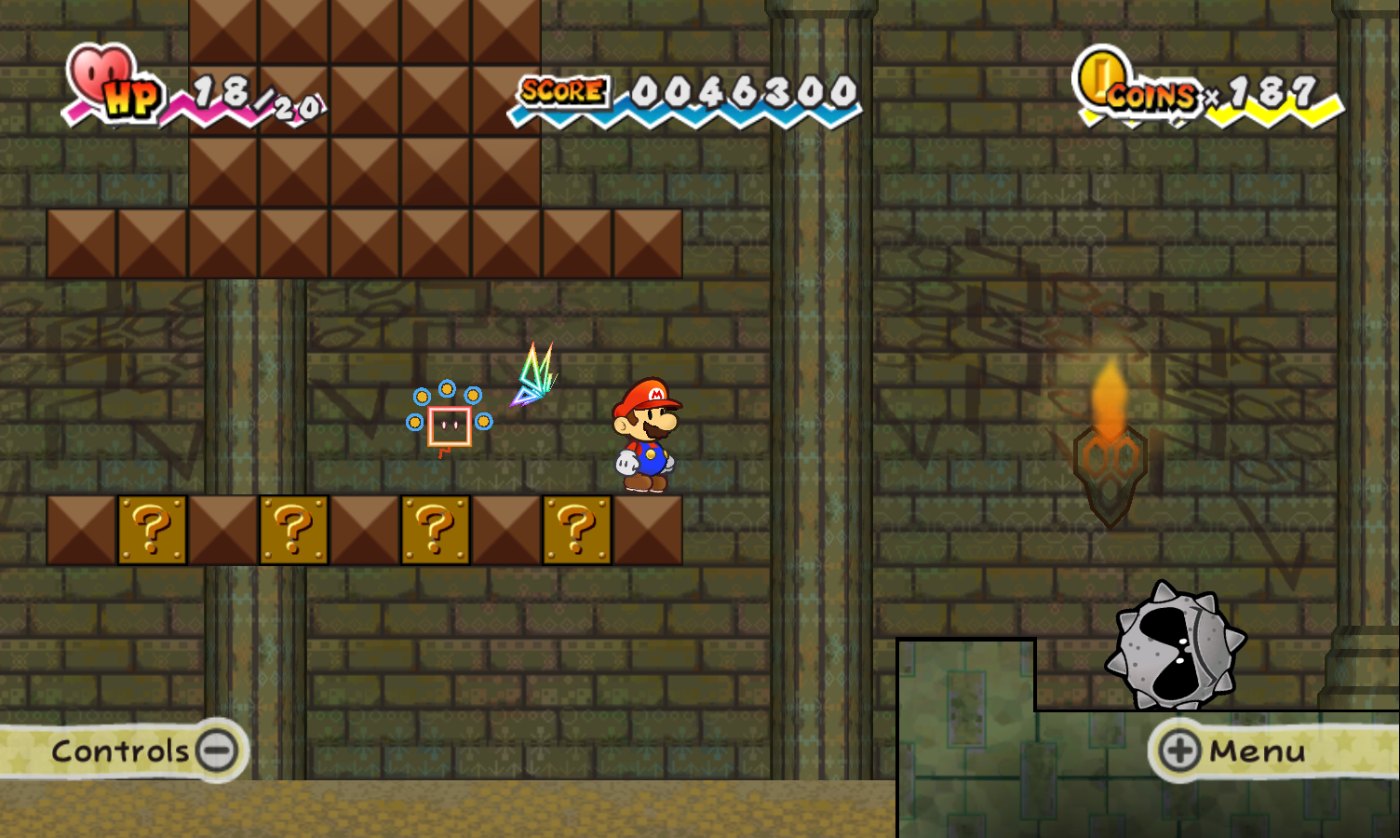
There are no Star Points here and no badges, Flower Points or special moves either. Everything that earns points feeds one score, and the score is what levels the party up. Levels alternate their reward: an even level brings 5 more HP, an odd one 1 more point of attack. The party starts with 10 HP and attack 1, and the ceiling is level 99.
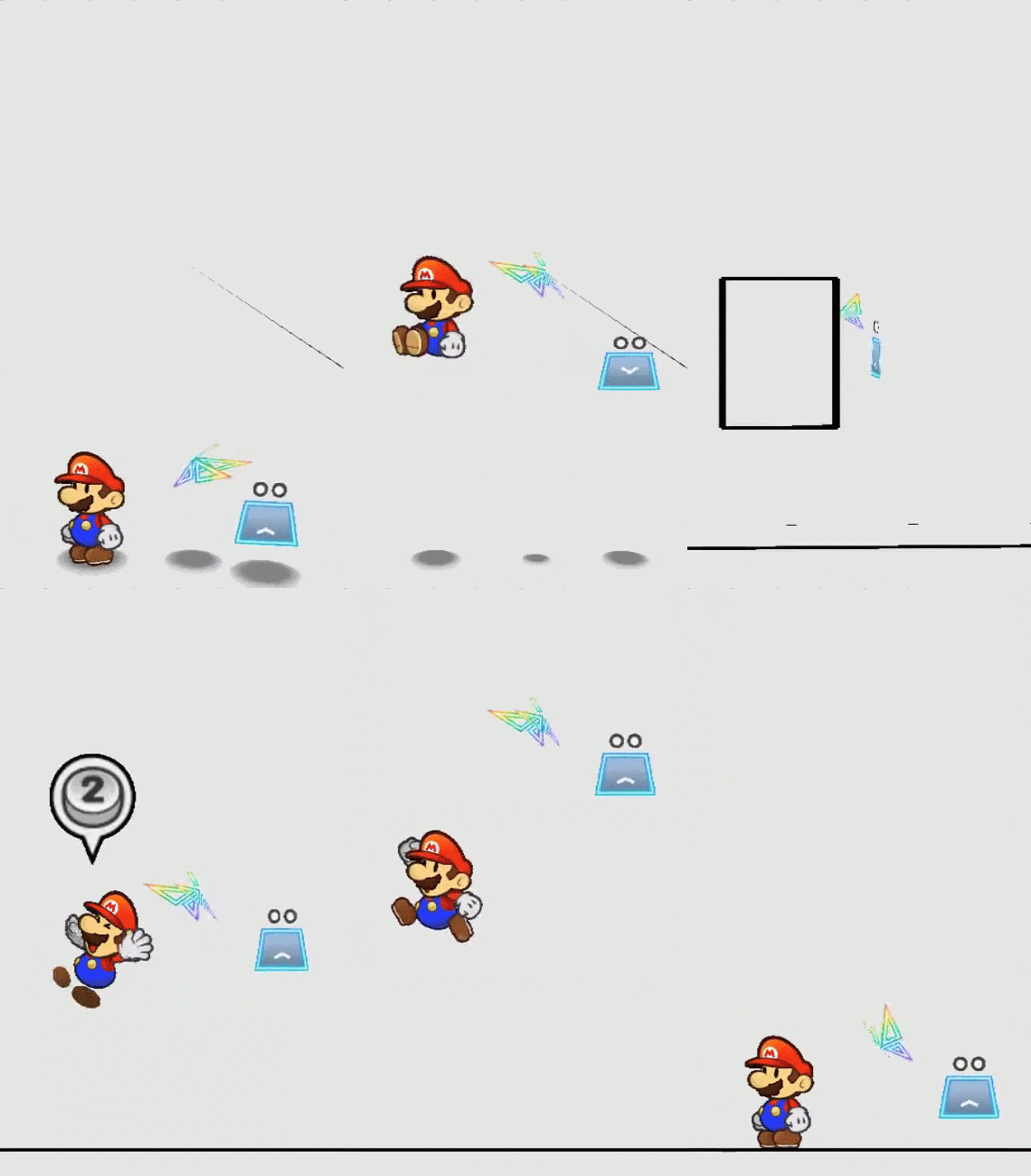
The way to score quickly is to show off. After bouncing on an enemy, shaking the Wii Remote performs a Stylish move: the hero hangs in the air and poses, a small audience of Toads, Goombas, Koopas and Shy Guys pops up at the edges of the screen shouting “Nice”, “Good”, “Great”, “Wonderful” and “Excellent”, and the points climb. Chaining jumps from enemy to enemy without touching the ground multiplies them again.
The developers kept levelling deliberately. According to Kawade’s interview with Nintendo Power, they and Nintendo saw it as the thing that lets less practised players get through a platformer, and as what separates this from an ordinary Super Mario game.
A Stylish move on Planet Blobule, with the audience looking on.Luigi against Magikoopas and Clubbas in the Flipside Pit.
The Wii Remote
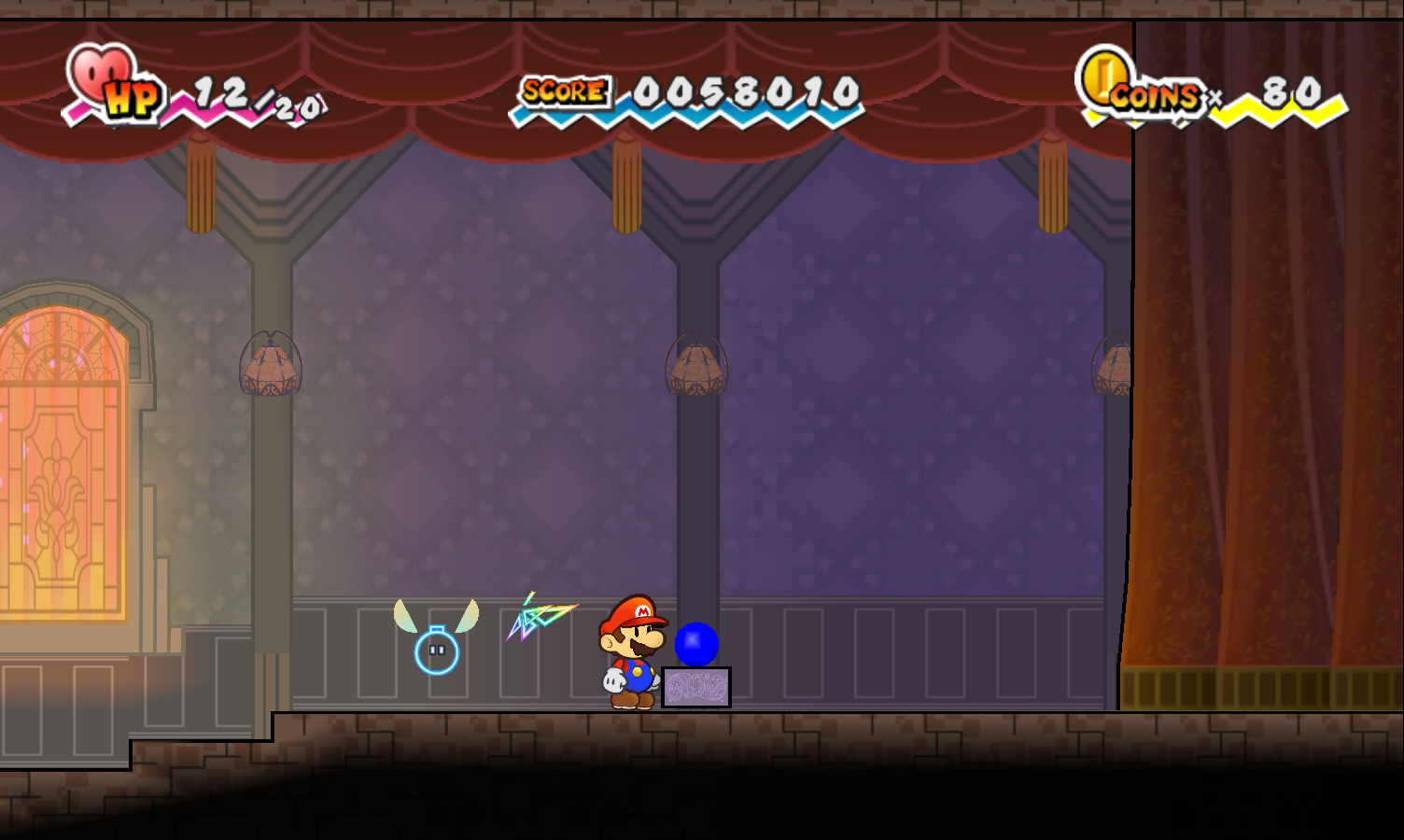
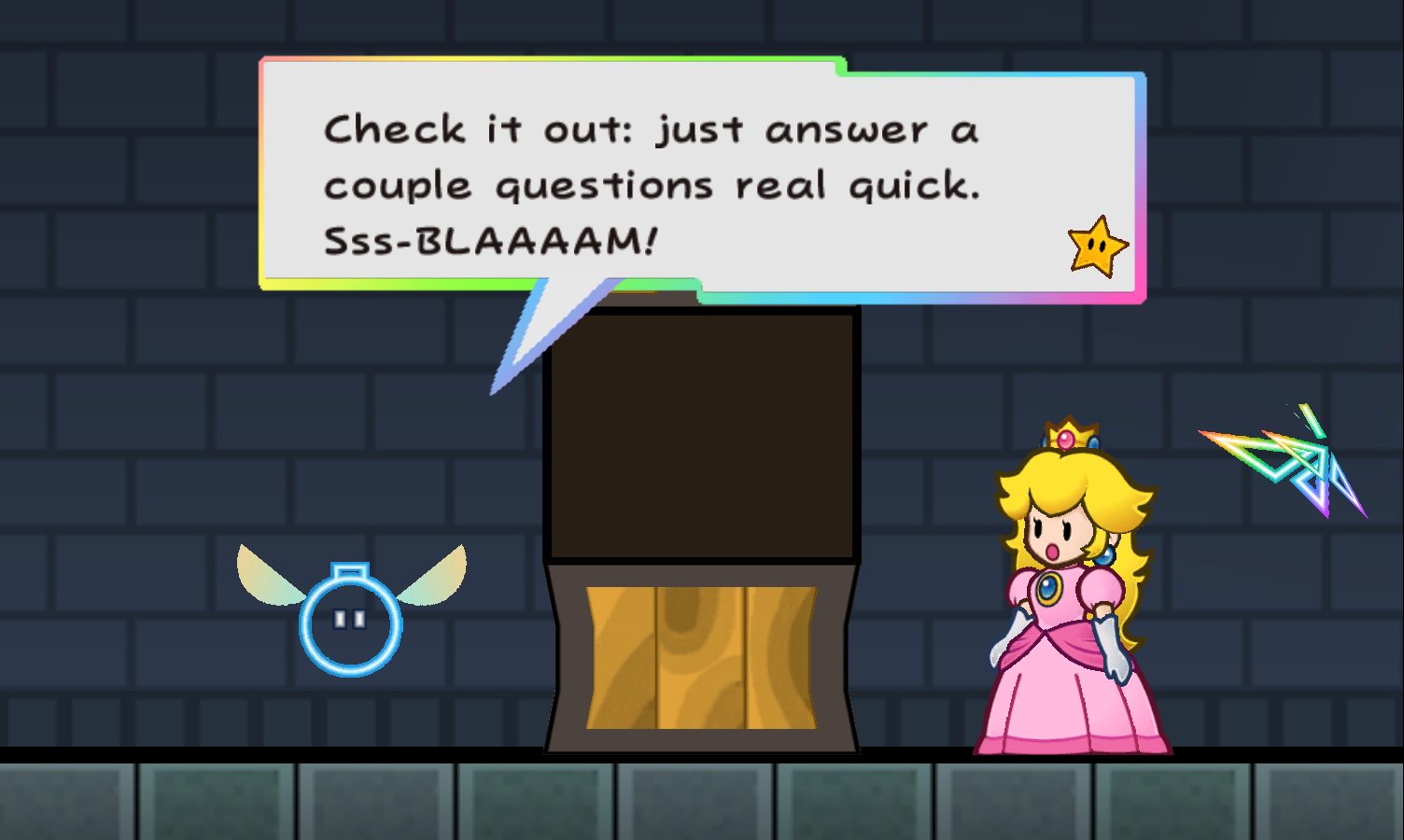
The game was designed for a GameCube controller and it shows, mostly to its credit: nearly everything is on the +Control Pad and the 1 and 2 Buttons. The Wii touches are small and well chosen. Point the Remote at the screen and press A, and Tippi takes over: rest the pointer on a character or enemy and she describes them, or on a suspicious patch of scenery and something hidden appears. Shaking the Remote performs Stylish moves, breaks out of ice and wakes a sleeping hero.
Most battle items have a small motion or timing game of their own: shake up and down for Fire Burst, Ice Storm and Thunder Rage, tilt in the directions shown for a Long-Last Shake, point and shoot for a Shooting Star. And the Flipside Arcade is all pointer and tilt. “I think this proves that the Wii Remote is pretty flexible!” said Kawade, of fitting a control scheme that had used almost every GameCube button on to one small remote.
The lobby of the Flipside Arcade.Mario and Tippi.
Flipside, Flopside and things to collect
Between chapters the party returns to Flipside, a town between dimensions built by the Tribe of Ancients round a tall tower. A Pure Heart placed in one of the town’s Heart Pillars makes a new door appear on top of the tower, and each door is a chapter. From Chapter 4 a hall of mirrors leads to Flopside, the town’s shabby mirror image, with a dark tower, the remaining Heart Pillars and a counterpart for every shopkeeper.
Both have plenty to spend coins on. Saffron, at Sweet Smiles in Flipside, cooks a single ingredient into something better; Dyllis, at Hot Fraun in Flopside, combines two. There are 96 dishes, with more recipes unlocked by feeding Cooking Disks into a machine. Catch Cards, thrown at an enemy to capture its likeness, are sold at Catch a Dream and Fondest Hopes, and owning an enemy’s card raises the damage dealt to it. Flamm sells 48 treasure maps whose red crosses are dug up with the Pixl Fleep. Merluvlee tells fortunes, Merlee sells charms, and under Flipside there is a bar called the Underwhere with an arcade hidden behind it.
The Flipside Arcade has four games. Forget Me Not is a card-matching game with three lives. Mansion Patrol is a shooting gallery of Boos set in the foyer of Luigi’s Mansion. Tilt Island has the player tip a tiny island with the Remote to collect falling food. Hammer Whacker, a rally of giant shells with the Koopa Striker, opens to holders of the Golden Card.
Flipside Tower.Saffron, Flipside’s cook.Dyllis, her opposite number in Flopside.A Catch Card.
The Pits of 100 Trials and the Duel of 100
The Thousand-Year Door’s endurance dungeon returns twice over. The Flipside Pit of 100 Trials, under the edge of Flipside, is a hundred rooms drawn like the screen of a Game & Watch, all black silhouettes and faint grey shapes. In each, one enemy among the crowd is carrying the key to the next door, and there are five minutes to find it before the game simply ends. Every tenth room is a rest stop with a pipe to the surface, sometimes the salesman Flimm, and a chest holding the gold Catch Card of a Pixl. Room 100 belongs to Wracktail, a second and far tougher mechanical dragon, and behind it waits the Pixl Dashell.
The Flopside Pit is stocked with shadowy versions of the game’s enemies, 49 kinds found nowhere else. It has to be cleared to the bottom twice before its boss, Shadoo, will fight: a shape that takes the form of dark copies of all four heroes in turn. The rest-stop chests hold gold cards of Dashell and the eight partners of the first Paper Mario; the chests in room 100 hold cards of Shadoo’s four forms and of the heroes themselves, each of which doubles that hero’s damage, and Mario’s also removes the limit on his Flip Meter.
The third long haul is the Duel of 100. Once the story is over, Sammer’s Kingdom can be revisited and all hundred Sammer Guys fought in order, ending with the giant End Boss. King Sammer pays out in Catch Cards of the seven partners from The Thousand-Year Door, then sends his warriors on holiday, and the duel cannot be fought again.
Room 14 of the Flipside Pit.Wracktail, in room 100.The Flopside Pit and its silhouettes.Bowser faces the End Boss in the last round of the Duel of 100.
Controls
Mario, surprised.
With the Wii Remote held sideways: the +Control Pad moves, and Up enters doors and talks; 2 jumps and swims; 1 uses the current Pixl; A flips (Mario only); 1 and 2 together open the quick menu; Plus pauses and Minus shows the controls. Down on the +Control Pad is each hero’s special: Mario ducks, Peach shelters under her parasol, Bowser breathes fire, and Luigi crouches for a super jump when it is released. Holding 2 in mid-air opens Peach’s parasol. Shaking the Remote after landing on an enemy is a Stylish move. Pointing the Remote at the screen and pressing A calls Tippi. In Chapter 4, 2 fires Squirps’s laser.
Regional differences
North America had the game first, and Europe’s English was revised for British ears five months later. Dimentio’s jibe at Luigi’s moustache, “shag” in America, became “pushover”, and O’Chunks no longer threatens anyone with a spanking. The floors of Flipside and Flopside are numbered the British way, from the ground floor up. Several characters were renamed (Gnip and Gnaw became Howls and Growl), Spit Roast became Roast Meats, and the Cooking Disks are numbered where the American ones are lettered by colour.
The European version also corrected a slip in the American one, where some of the robot dragon Fracktail’s lines appear in an ordinary speech bubble, and introduced one of its own, the freezing bug described under Glitches. The Korean release of February 2009 is a curiosity: data-miners have found eleven unused maps on its disc that no other version has.
The Japanese box.The Korean box, from 2009.
The Pixls, Pure Hearts and items
All thirteen Pixls with what they do and where they are found, the eight Pure Hearts, and the pick-ups and items that matter most.
TippiWith Mario from the start. Point the Wii Remote and press A: she identifies people and enemies, gives hints and reveals hidden things.
ThoreauChapter 1-2, Mount Lineland. A hand that picks up enemies and objects and throws them, and hits switches from a distance.
BoomerChapter 2-1, Gloam Valley. A bomb, set down and detonated to break cracked walls and blocks. The blast does double damage.
SlimChapter 2, Merlee’s Mansion. Turns the hero side-on to slip through bars; stand still while slim and nothing can touch you.
ThudleyChapter 3-2, the Tile Pool. A ground pound that smashes blocks and presses big switches. Double damage, or four times with Bowser.
CarrieChapter 3-4, Fort Francis. A platform to ride over spikes, and on to spiked enemies, in safety.
FleepChapter 4-2, Planet Blobule. Flips a small patch of scenery to bring hidden things back from the other side, and dizzies enemies. Works in 2-D only.
CudgeChapter 5-2, Gap of Crag. A hammer, as in the earlier Paper Marios. Breaks big yellow blocks and does double damage.
DottieChapter 5, Floro Caverns. Shrinks the hero to enter tiny doors and passages. Enemies stop noticing you but can still hurt.
Barry (optional)The Bitlands. Go back and talk to him after Tippi has been rescued. A barrier that hurts enemies and bounces projectiles back.
Dashell (optional)Room 100 of the Flipside Pit of 100 Trials, after Wracktail. Hold 1 to sprint.
Piccolo (optional)Flopside, through a side quest for Merlee after Chapter 5. Her music cures every curse and sends the Underchomp to sleep.
Tiptron (optional)A robot copy of Tippi, sold by Francis at Fort Francis for 999 coins once the story is over. Does everything Tippi did.
Red Pure HeartGiven by Merlon in Flipside. Opens the door to Lineland.
Orange Pure HeartFrom Merlumina in Yold Ruins. Opens Gloam Valley.
Yellow Pure HeartFrom Merlee in her basement. Opens the Bitlands.
Green Pure HeartAppears at Fort Francis when Tippi is freed. Opens Outer Space.
Blue Pure HeartKept in the Whoa Zone beside a statue of Squirps’s mother. Opens the Land of the Cragnons.
Indigo Pure HeartHeld by King Croacus IV. Opens Sammer’s Kingdom.
Violet Pure HeartFound turned to stone in the World of Nothing and restored by Queen Jaydes. Opens the Underwhere.
White Pure HeartLuvbi, in her true form. Opens Castle Bleck.
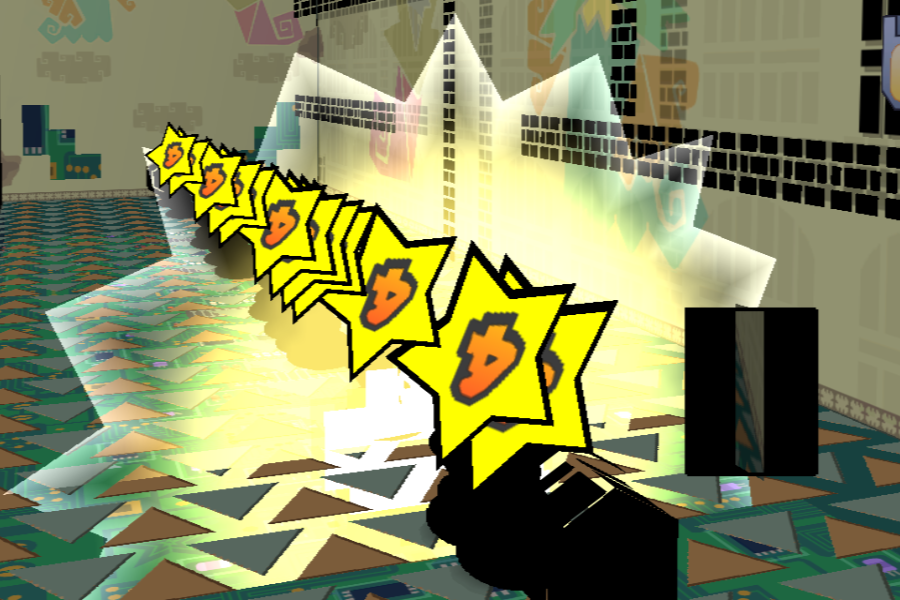
Mega StarTurns the hero into a screen-filling, invincible 8-bit sprite of themselves for a few seconds.
Pal PillSummons a crowd of little 8-bit copies of the hero to help out.
Speed FlowerSpeeds time up and triples the value of coins and points.
Slow FlowerSlows time down, with the same triple bonus.
Happy FlowerMakes coins rain from the sky.
Return PipeTakes the party back to Flipside from most places.
Golden CardUnlocks Hammer Whacker at the Flipside Arcade.
Treasure maps48 of them, sold by Flamm in Flopside. Use Fleep on the spot marked with a red cross.
Shroom ShakeRestores 10 HP and cures poison. The Ultra Shroom Shake restores 50.
Life ShroomRevives a fallen hero with 5 HP.
Fire Burst, Ice Storm, Thunder RageAttack items worked by shaking the Wii Remote. A Fire Burst cooked by Saffron becomes the Spicy Soup that wakes Peach.
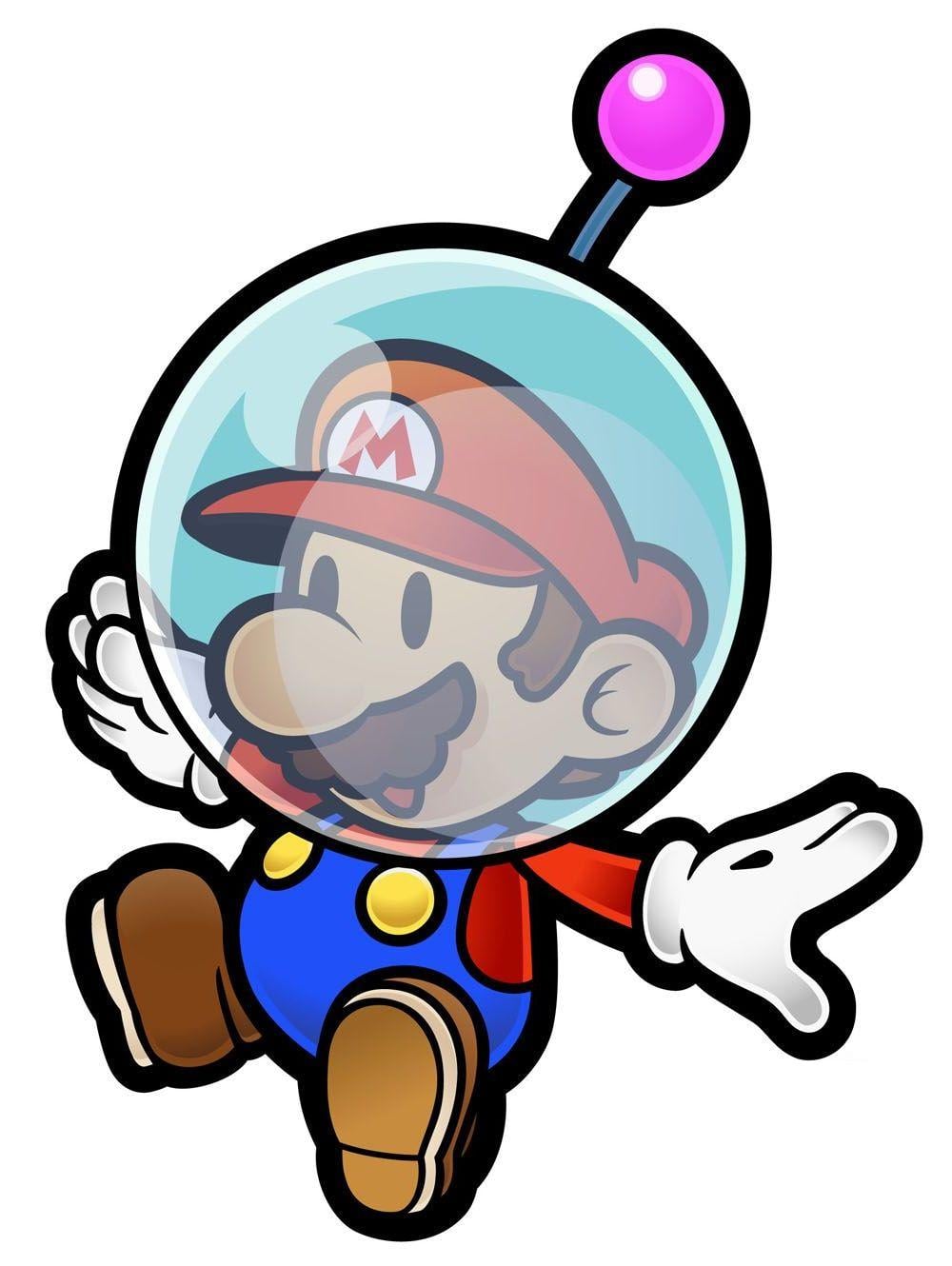
Goldfish BowlBorrowed in Flipside and worn as a space helmet in Chapter 4.
Cartoons, Comics & Other Media
Super Paper Mario had a second life in manga and a long afterlife in Super Smash Bros., and one film director wanted it for the cinema.
Super Mario-kunYukio Sawada / Shogakukan · volumes 37 and 38, 2008The gag manga adapted the game in two parts, in February and October 2008. Its Tippi is rounder and yellow, Luigi is cured of being Mr. L straight after the Whoa Zone and joins early, and Peach turns up late with the Pure Hearts from two chapters the others skipped. It ends, like the game, with two silhouettes under a tree.
Dr. Mario-kunMangaCount Bleck returns as the villain of the final arc of this spin-off, where he creates a Dimensional Virus.
Trading cardsSubarudo · Japan, September 2007A set of twenty holographic cards modelled on the game’s Catch Cards, sold at 315 yen a packet with one card and a mushroom-shaped sweet.
Super Paper Mario Memory MatchBrowser game · 2007A promotional tile-matching game against O’Chunks, much like the arcade’s Forget Me Not, growing from 8 tiles to 16 over three rounds.
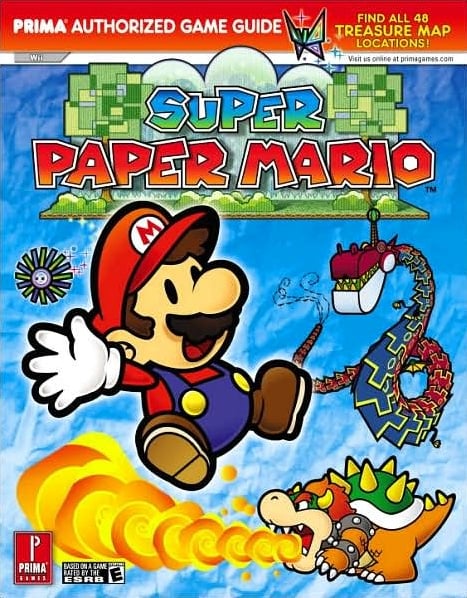
Player’s guidesNintendo Power; Prima Games · 2007Nintendo Power and Prima Games each published a guide. The back cover of the Nintendo Power one shows artwork of a Gold Fuzzy, an enemy that is not in the game.
The pop-up bookFamitsu DS+Wii · JapanThe Super Tobidasu Super Paper Mario Book, a pop-up booklet, was given away with an issue of the magazine.
Super Smash Bros. BrawlWii · 2008Trophies of Paper Mario, Paper Luigi, Paper Peach, Paper Bowser, the wedding outfits and Fracktail retell the story, and Count Bleck, Tippi and O’Chunks are stickers. The developers were not consulted about a stage: asked in 2007 whether they had spoken to Masahiro Sakurai, Tanabe replied, “Unfortunately, neither Mr. Kawade nor I had that opportunity.”
Later Super Smash Bros. gamesWii U (2014) · Ultimate (2018)The Wii U game has trophies of Tippi, Fracktail, Flint Cragley, Mr. L and Count Bleck. In Ultimate, Mr. L and Dimentio are spirits, and the Dimentio battle is fought against a giant Luigi in memory of Super Dimentio.
Paper Mario: Color SplashWii U · 2016Flipping into 3-D, Flip Meter and all, comes back for one sub-level inside the Green Energy Plant.
The Thousand-Year Door remakeNintendo Switch · 2024A photograph of Mario’s old partners stands in the Mario Bros.’ house, as in this game’s opening, and Garson and the Mega Star are wrong answers in a quiz.
A film that was never madeSeth Gordon · 2007The director of The King of Kong: A Fistful of Quarters said in an interview that he would like to make a Super Paper Mario film that switched between 2-D and 3-D. He had shown his documentary to Nintendo but had not managed to raise the idea.
The Super Mario Galaxy MovieFilm · 2026A Dark Prognosticus sits on Rosalina’s bookshelf, beside a book with Tippi on its spine.
Characters
Four heroes, one butterfly, a villain with a broken heart and the staff he has collected, and a supporting cast invented almost entirely for this game. The party comes first, then Castle Bleck, then the people of each world.
Character
Who they are
In this game
Abilities & notes
MarioThe hero of the Light Prognosticus
The man the Light Prognosticus describes, and the only one who can step out of the second dimension.
Available throughout. Press A on the ground to flip into 3-D. The all-rounder of the four, and the only one who can duck and slide.
Flip (A), limited by the Flip Meter
Walking speed 3 out of 3
Voiced by Charles Martinet
Princess PeachHero 2 · joins after Chapter 1
Married to Bowser against her will in the opening scene, and determined to put it right.
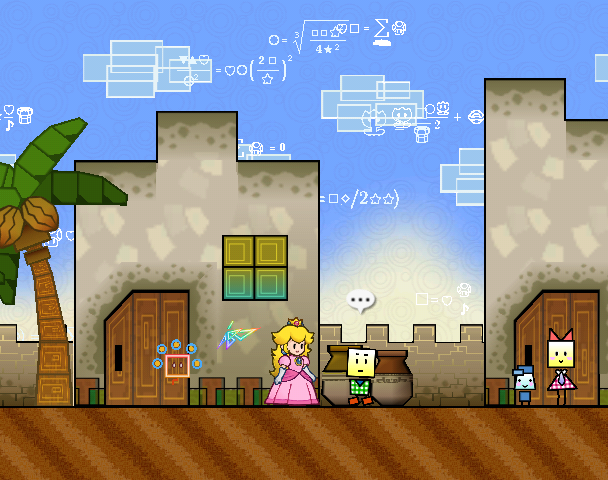
Escapes Castle Bleck in the first interlude and is found in Flipside. Hold 2 in the air to float on her parasol; hold Down to hide behind it, which blocks nearly everything. Lost in Chapter 8-2 trying to save Mimi, back for the finale.
Parasol float and guard
Walking speed 2 out of 3
Voiced by Leslie Swan
BowserHero 3 · joins in Chapter 3-1
The other half of the wedding, and the only one who enjoyed it.
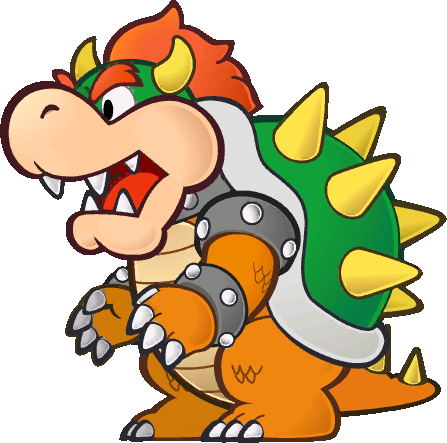
Found in a castle in the Bitlands and recruited by beating him. Hold Down to breathe fire. Everything he does deals double damage, he cannot climb ladders, and an ordinary jump on the head will not hurt him when he is the enemy.
Fire Breath; double damage
Walking speed 1 out of 3
Boss: 20 HP in Chapter 3, 80 HP in Chapter 7
Voiced by Eric Newsome
LuigiHero 4 · joins before Chapter 7
The “man in green” of the Dark Prognosticus, which is his whole misfortune.
Captured and brainwashed after Chapter 2, fought twice as Mr. L, found again in The Underwhere. Hold Down and release for a super jump that rockets him upwards and doubles his damage. Jumps higher than Mario and slides further. Absorbed into Super Dimentio for the final battle.
Super jump
Walking speed 3 out of 3
The first Paper Mario with voice clips for Luigi, by Charles Martinet
TippiPixl · Timpani
A butterfly-shaped Pixl in Merlon’s care, with no memory of who she was before.
Mario’s guide from the first scene: point the Wii Remote and she names enemies, gives hints and uncovers what is hidden. Kidnapped by Francis in Chapter 3, taken ill after Chapter 4, and revealed at last as Timpani, the girl Count Bleck lost.
Used with the pointer and the A Button
Leaves the party for good at the end
Count BleckBlumiere of the Tribe of Darkness
The master of Castle Bleck and reader of the Dark Prognosticus, who speaks of himself in the third person, as if narrating. Count Noir in Japan.
Creates the Chaos Heart and The Void to erase every world, appears in person in Sammer’s Kingdom, and is the boss of Chapter 8, shielded until all four heroes stand together. He ends the game by marrying Tippi.
150 HP, attack 8
Dark blasts, a pulling void, slowed time, a high-speed ram
Catch Card and Brawl sticker
NastasiaThe count’s assistant
Bleck’s assistant, loyal to the point of love.
Her hypnosis forces Peach’s “I do”, brainwashes Bowser’s army and turns Luigi into Mr. L. She begs the count to stop after almost every chapter, and takes Dimentio’s shot for him at the end. She survives.
Never fought
Brainwashes by hypnosis
O’ChunksMinion · four fights
A warrior who serves the count because, the story goes, the count once saved his life.
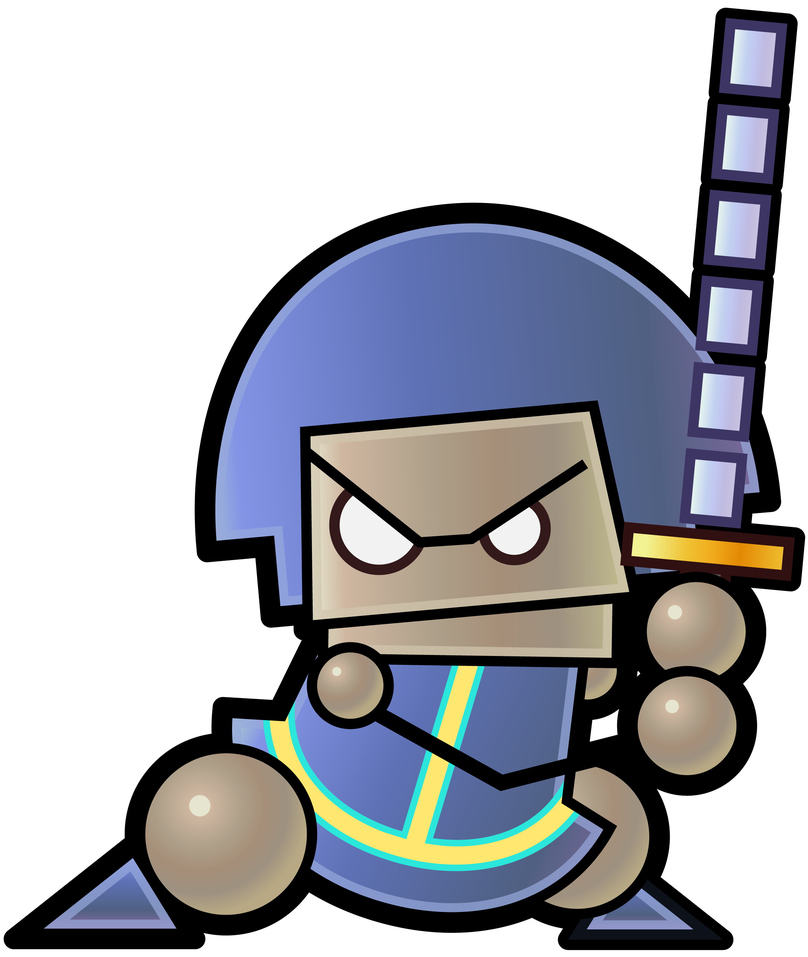
First to be sent against Mario and the most persistent: Yold Desert, the Gap of Crag, Floro Caverns (as the sprouted O’Cabbage) and Castle Bleck, where he ends up holding the ceiling off Bowser.
20, 40 and 100 HP
O’Cabbage: 60 HP, attack 3
MimiMinion · shape-shifter
A childish shape-shifter who can pass for anyone, and whose true form walks on spider legs.
Merlee’s maid and then Merlee in Chapter 2, King Sammer in Chapter 6, Merlon and Merlee in Chapter 8. Invincible when she chases the heroes through the basement. Peach falls trying to save her.
True form takes six hits
Chapter 6: 25 HP; throws rubees
DimentioMinion · the real villain
A magician who joined the count for reasons of his own and has been steering both sides ever since.
Sabotages Fracktail, tests the heroes in Dimension D, “ends the games” of Mr. L and the heroes to get them to The Underwhere, and finally steals the Chaos Heart to become Super Dimentio.
A new recruit introduced after Chapter 3, whom nobody at Castle Bleck much likes. The count calls him the man in green.
Fights in the Whoa Zone, on foot and then in the robot Brobot, and again in the World of Nothing in Brobot L-type. Dimentio disposes of him afterwards, which is how Luigi comes to be in The Underwhere.
Mr. L: 40 HP, attack 3
Brobot: 255 HP; Brobot L-type: 64 HP, attack 5
A spirit in Super Smash Bros. Ultimate
MerlonSage of Flipside
Keeper of the Light Prognosticus. This game has its own Merlon, distinct from the ones in earlier Paper Mario games.
Explains the Pure Hearts, sends the heroes through each door, and looks after Tippi, whom he once saved by turning her into a Pixl.
Lives on the second floor of Flipside
NolremSage of Flopside
Merlon’s counterpart in the mirror town, whose name is his spelt backwards.
Guides the heroes from Chapter 5 onwards, as the doors move to Flopside Tower.
Met after Chapter 4
MerleeCharm-seller of Gloam Valley
The owner of the mansion in Chapter 2, who spends most of it hiding in a bathroom while Mimi impersonates her.
Weakens Mimi with a chant, hands over a Pure Heart and reveals that four heroes are needed. Later sells charms, and sets the side quest that leads to the Pixl Piccolo.
Charms are stopped on a roulette with the 2 Button
SquirpsFollower · Chapter 4
A little alien prince, son of Squirpina XIV.
Guides the party through Outer Space to the Whoa Zone and fires his Squirt Beam at whatever is in the way when 2 is pressed. Stays behind at his mother’s statue.
Squirt Beam (2 Button)
FrancisBoss of Chapter 3
A chameleon, a collector and a devoted fan of things. His fortress is full of merchandise from the first two Paper Mario games.
Kidnaps Tippi for his butterfly collection and tries to chat up Peach by computer. After the story he sells Tiptron. He returns in Chapter 8 only if the player names him to Mimi as someone they hate.
40 HP, attack 1
Watches Starship X-Naut and The Grodus Chronicles
King Croacus IVBoss of Chapter 5
The flower king of the Floro Sapiens, driven out of his mind by pollution from the Cragnons above.
Has Cragnons kidnapped and put to work under Floro Sprouts. Fought at the end of Floro Caverns in two phases.
50 HP, attack 2
Paintings of Croacus I and Croacus III appear in his domain
Flint CragleyCragnon journalist
An intrepid reporter, never without his crew.
Met in Floro Caverns with his crew. Promises to tell the Cragnons what their pollution has done.
Has a trophy in Super Smash Bros. for Wii U
King SammerRuler of Sammer’s Kingdom
The lord of a hundred Sammer Guys, whose law is that a Pure Heart must be earned by beating all of them.
His kingdom is destroyed before the duels can be finished. Restored at the end, he hosts the Duel of 100 and pays out in Catch Cards.
The End Boss, his hundredth warrior: 99 HP, attack 10, defence 4
Queen Jaydes and GrambiRulers of the afterlife
She governs The Underwhere, he governs The Overthere, and between them they have been bringing up a Pure Heart as their daughter.
Jaydes restores the stone Pure Heart and returns the heroes to life. Grambi is frozen by Bonechill and freed in Chapter 7-4.
Jaydes revives Mario and Luigi
LuvbiFollower · Chapter 7
A young Nimbi, daughter of Jaydes and Grambi, or so she has always believed.
Escorted from The Underwhere to The Overthere. She is the eighth Pure Heart in disguise, and gives up her life as a girl to become it again.
No abilities
Becomes the white Pure Heart
BonechillBoss of Chapter 7
Leader of the Skellobits who storm The Overthere.
Freezes Grambi and tries to seize Luvbi for the power of the Pure Heart. Fought by all four heroes together.
80 HP, attack 4
Controls ice
Bosses & enemies
Every boss in the order the story meets them, with their figures, then the three optional ones, then a selection of the game’s 180 or so ordinary enemies (49 of which are dark versions found only in the Flopside Pit).
O’Chunks (boss)Chapter 1-3 · Yold Desert · 20 HP, ATK 1The first real fight. He returns with 40 HP in the Gap of Crag and 100 HP in Castle Bleck.
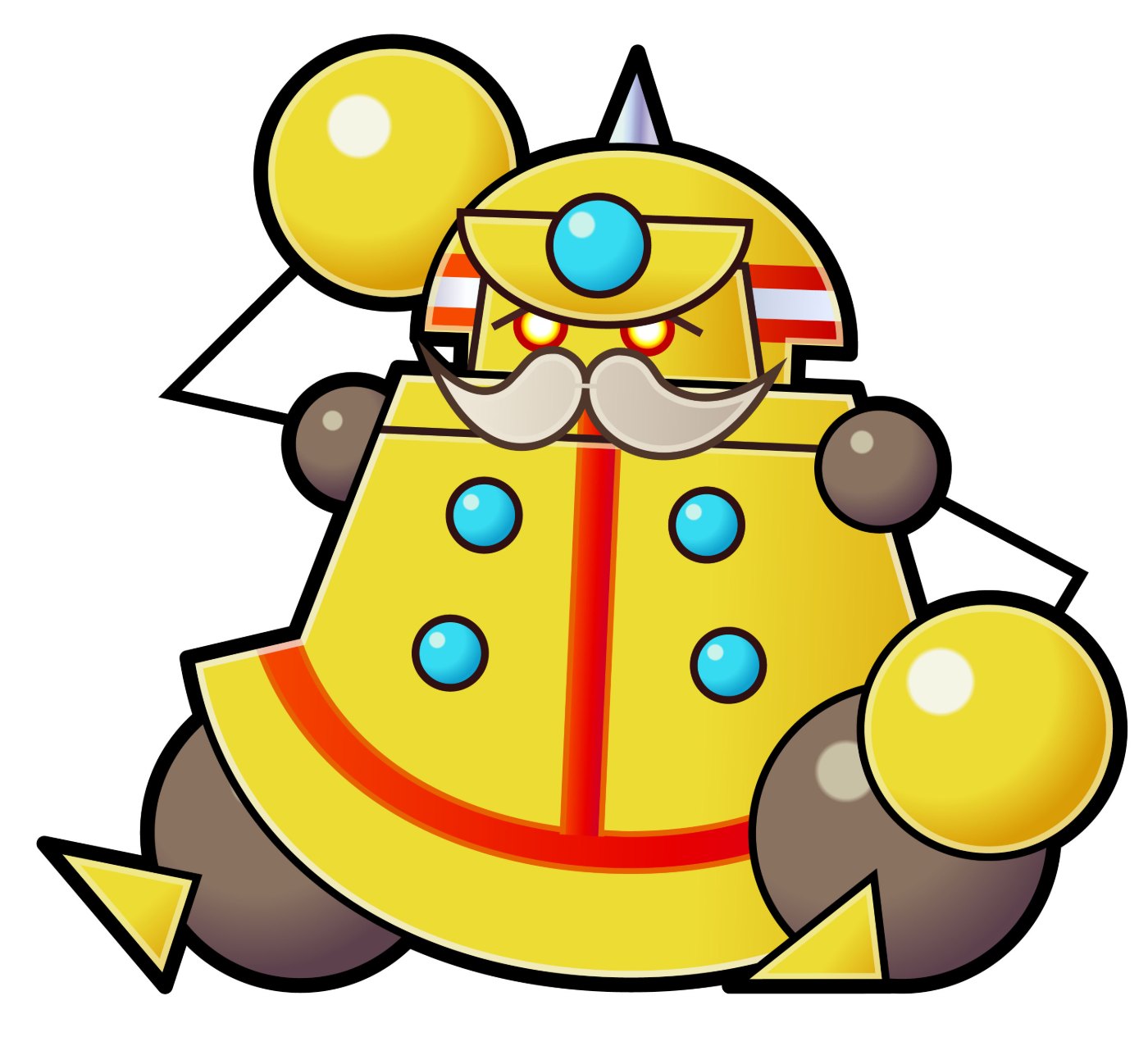
Fracktail (boss)Chapter 1-4 · Yold Ruins · nine hitsThe robot dragon of Yold Ruins, sabotaged by Dimentio.
Mimi (boss)Chapter 2-4 · Merlee’s Basement · six hitsHer spider form, weakened by Merlee’s chant. Fought again in Castle Bleck with attack 4.
Bowser (boss)Chapter 3-1 · The Bitlands · 20 HP, ATK 2, DEF 1A duel with Mario. He joins afterwards, and has to be beaten again (80 HP, attack 8) on Underwhere Road.
Big Blooper (boss)Chapter 3-2 · The Tile Pool · three hitsAppears to an arrangement of the underwater theme from Super Mario Bros. 3.
Dimentio (boss)Chapter 3-3 · The Dotwood Tree · 30 HP, ATK 2Fought in Dimension D. Back with 80 HP in Castle Bleck, against Luigi.
Francis (boss)Chapter 3-4 · Fort Francis · 40 HP, ATK 1Lord of Fort Francis and its robot cats.
Mr. L (boss)Chapter 4-4 · Whoa Zone · 40 HP, ATK 3On foot, before he fetches the robot.
Brobot (boss)Chapter 4-4 · Whoa Zone · 255 HP, ATK 4, DEF 3A dogfight in space, won with Squirps’s lasers.
O’Cabbage (boss)Chapter 5-4 · Floro Caverns · 60 HP, ATK 3O’Chunks under a Floro Sprout: stronger, and not thinking.
King Croacus IV (boss)Chapter 5-4 · Floro Caverns · 50 HP, ATK 2A giant flower with living appendages, fought in two phases.
Mimi as King Sammer (boss)Chapter 6-2 · Sammer’s Kingdom · 25 HP, ATK 2A barrage of rubees, to pass the time until the world ends.
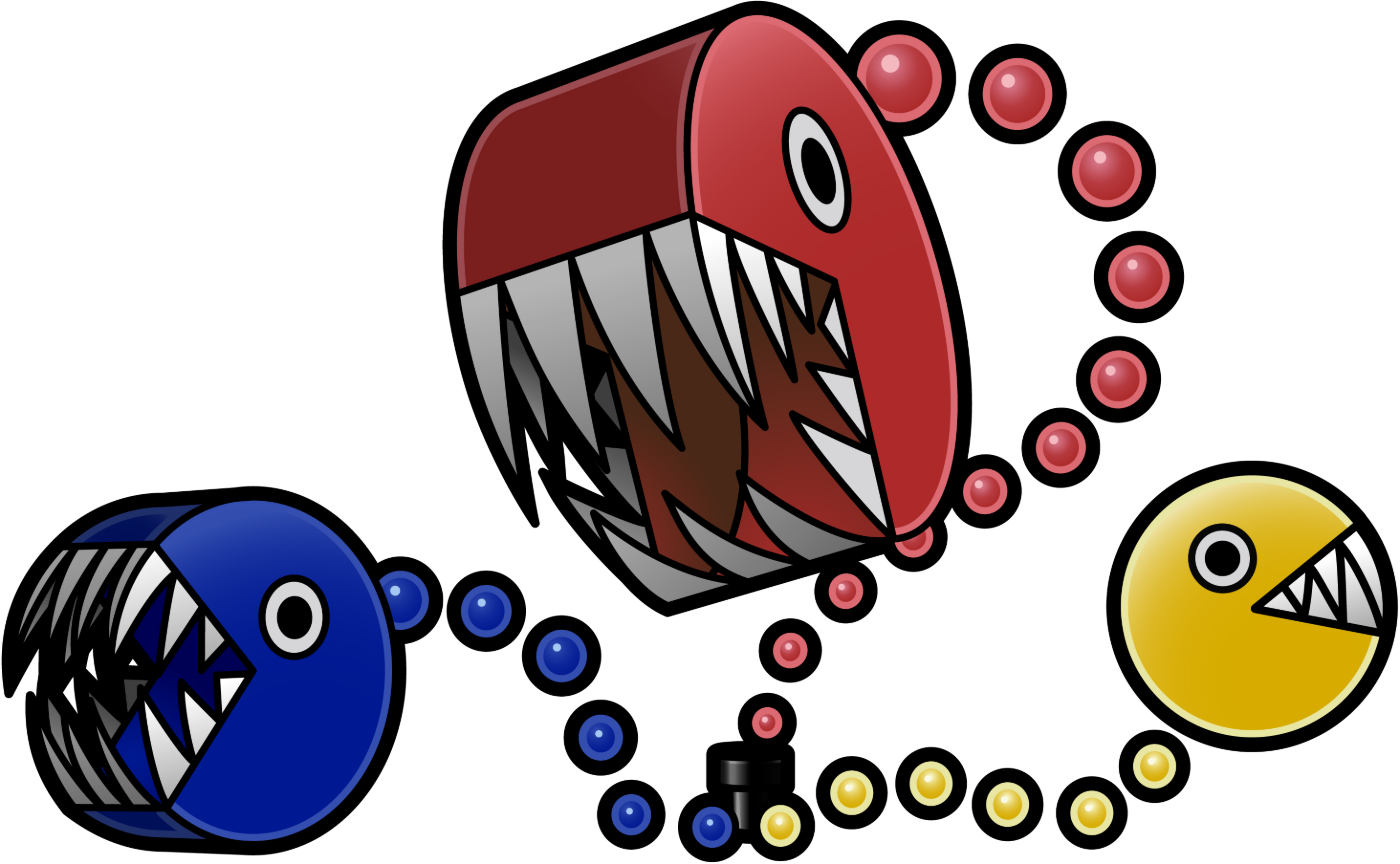
Underchomp (boss)Chapter 7-2 · Underwhere Road · 16 HP per head, ATK 3, DEF 4A three-headed Chain Chomp and the game’s one turn-based battle. Piccolo’s music sends it to sleep.
Bonechill (boss)Chapter 7-4 · The Overthere · 80 HP, ATK 4Usurper of The Overthere.
Count Bleck (boss)Chapter 8-4 · Inner Sanctum · 150 HP, ATK 8Untouchable until the Pure Hearts break the Chaos Heart’s barrier. His void attack does 8 damage.
Super Dimentio (boss)Chapter 8-4 · Inner Sanctum · 200 HP, ATK 6The final boss, fought by Mario, Peach and Bowser. Only the head is undefended.
Shadoo (boss)Optional · Flopside Pit, room 100, second visit · 400 HPDark Luigi, Dark Bowser, Dark Peach and Dark Mario in turn, 100 HP each. Dark Bowser hits for 20.
End Boss (boss)Optional · Duel of 100, round 100 · 99 HP, ATK 10, DEF 4The last and largest Sammer Guy.
GoombaFrom Lineland Road on · 1 HPWith Paragoombas, Spiked Goombas and Gloombas, the rank and file of Bowser’s brainwashed army.
Koopa TroopaFrom Lineland Road on · 1 HP, DEF 1The red-shelled ones have been brainwashed by Nastasia.
SquigletLineland, Gloam Valley · 2 HPOne of the game’s own creatures. Its big brother the Squig shoots projectiles.
BoomboxerYold Desert · 4 HP, ATK 2Found only in Yold Desert and the pit.
Sproing-OingLineland Road, The Bitlands · 4 HPBounces, as the name suggests.
CherbilYold Desert and elsewhere · 5 HP, ATK 2Comes in ordinary, poison and ice varieties.
Zombie ShroomMany levels · 1 HP, ATK 2A mushroom gone bad, found in more levels than almost anything else.
JawbusYold Desert, Gloam Valley · 5 HPRawbus and Gawbus are its tougher relations.
Spiny TrompMount LinelandA spiked roller, best dodged by stepping into 3-D.
ThwompMount Lineland · ATK 1A row of them is the game’s first lesson in walking round a problem.
FrackleYold Ruins · 1 HPSmall relatives of Fracktail, met in its ruins.
Buzzy BeetleYold Ruins, Floro Caverns · 1 HP, DEF 3Stone Buzzies turn up in the Land of the Cragnons.
SwooperGloam Valley, Merlee’s Mansion · 3 HPThe mansion’s bats.
BooMerlee’s Mansion · 4 HPAlso the target in the arcade’s Mansion Patrol.
CursyaMerlee’s Basement and later · 1 HPTouching one lays a curse on the hero. Back, Heavy, Tech and Reversya Cursyas each have their own.
ShlurpGloam Valley, Merlee’s Mansion · one hitTakes just one hit to beat, according to the bestiary.
Mr. IMerlee’s Basement, Castle Bleck Entry · ATK 2A staring eyeball whose HP is a mystery even to the bestiary.
Hammer BroThe Bitlands, Castle Bleck · 4 HPWith Boomerang Bros. and Fire Bros., garrisons the Bitlands castles.
MagikoopaThe Bitlands, Castle Bleck · 6 HP, ATK 3There is no Kammy Koopa this time, only ordinary Magikoopas.
Bullet BillThe Bitlands · 1 HP, ATK 2Fired from Bill Blasters, as ever.
BlooperThe Tile Pool · 1 HP, ATK 2Small fry before the big one.
Cheep CheepThe Tile Pool, Gap of Crag · 2 HPRed and green.
Chain ChompThe Dotwood Tree, Fort Francis · 4 HP, DEF 4A Red Chomp variety also exists.
Crazee DayzeeThe Dotwood Tree · 10 HPThe rarer Amazy Dayzee also appears.
TileoidThe Dotwood Tree, Whoa Zone · 5 to 15 HPComes in four colours: B, G, R and Y.
Floro CragnienFloro CavernsA Cragnon under the control of a Floro Sprout.
Sammer GuySammer’s KingdomA hundred of them, every one with a name. One calls himself the Thousand-Year Roar.
NinjoeDuel of 100With Ninjohn and Ninjerry, sometimes drops in to help a Sammer Guy.
SkellobitThe OverthereBonechill’s skeleton soldiers. There are spiky ones, and Skellobombers too.
ClubbaFlipside Pit of 100 TrialsMet alongside Magikoopas deep in the pit.
Dark GoombaFlopside Pit of 100 TrialsOne of the 49 silhouette enemies that live only in the second pit.
Key staff
From the credits. The copyright line names Nintendo and Intelligent Systems.
Ryota KawadeChief directorChief director of all three Paper Mario games to this point. The idea of flipping dimensions was his.
Kensuke TanabeProducer (Nintendo)Agreed to drop turn-based battles on condition that the RPG story stayed.
Ryoichi KitanishiProducerAlso a producer of The Thousand-Year Door.
Shigeru MiyamotoSupervisorCredited as supervisor, with Satoru Iwata as executive producer.
Kaoru Kita, Ai Tsujimura, Naoya Inui, Atsunori InaAssistant directorsKita held the same post on The Thousand-Year Door.
Chie KawabeArt directorArt director of The Thousand-Year Door as well.
Tadao NakayamaMain programmingLead programmer.
Naoko Mitome, Chika SekigawaMusicWith Yasuhisa Baba as sound director and Koji Kondo credited for the Mario themes.
Nate Bihldorff, Julian Chunovic, Reiko Ninomiya, Erik Peterson, Scot RitcheyNorth American localisationThe English script. Managed by Jeff Miller, Leslie Swan and Bill Trinen.
Paul LogueEuropean localisation coordinationThe European versions.
Charles MartinetVoice of Mario and LuigiThe first Paper Mario in which Luigi has voice clips.
Leslie Swan, Eric NewsomeVoices of Peach and BowserSome of Bowser’s sounds are Scott Burns’s, reused from The Thousand-Year Door.
Advertisement
How It Was Made
Ryota Kawade and Kensuke Tanabe gave two interviews about the game in 2007, to Nintendo Power in May and to Nintendo of Europe in August, and between them they explain most of its oddities.
An idea on a train
Artwork of a level on Lineland Road.
After The Thousand-Year Door, Kawade wanted to use Paper Mario for a different kind of game. He meant to keep the series’ humour, puzzles and levelling up, and add one new thing. According to his interview with Nintendo Power, the new thing came to him on a train, while he was thinking about the side-scrolling Bowser levels in the previous game: a paper world that could be turned to show its other side.
Everything else followed from that. Nintendo’s view was that an action-adventure would show the trick off best, and Kawade agreed. “I felt that the more traditional Mario-style battles worked better in this game,” he told Nintendo of Europe. Tanabe, producing, went along with losing the turn-based fights but, in his words, asked the staff to keep the RPG-like storyline. The levelling system stayed too, partly so that players who were not expert at platform games could still get through.
The look was pushed deliberately towards the strange. According to the Nintendo Power interview, the aim was a Mario world that is not quite a Mario world, on the principle that every Paper Mario should show players something they have not seen.
A GameCube game
The logo shown at E3 2006, when the game was bound for GameCube.
Super Paper Mario was announced on 11 May 2006, at E3, as a Nintendo GameCube game for the end of that year. There was a trailer but nothing to play, since Nintendo chose not to put a GameCube on the show floor, and later in the month the date was fixed as 9 October 2006. A playable version did appear at the World Hobby Fair in Japan in June. Nintendo Power’s preview in issue 206 shows the GameCube controls: a hero’s special ability on the R Button, menus on the D-pad.
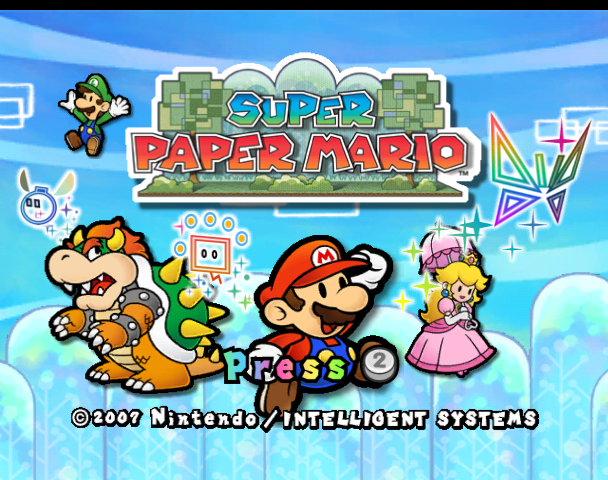
Those early showings differ from the finished game in small, telling ways. The Pixls were called “Fairens”, and apart from Tippi there seems to have been only one of them, which changed shape for each “Fairy Ability”: Fairy Toss, Fairy Hammer. Peach is seen walking about in Yold Town and Gloam Valley. The wedding has no flowers. The title screen includes a ladder-shaped Pixl that was later cut.
By the summer of 2006 the game had been moved to Wii, and it was finally released there on 9 April 2007 in North America, before any other region, as the first Mario game for the console. The move changed less than might be expected. Kawade said the GameCube version had used nearly every button on the pad and the team had managed to fit it all on to a Wii Remote held sideways, adding the pointer and the shake where they made an action feel better. Graphics of the GameCube’s A and B Buttons are still in the game’s files.
Two levels for the price of one
Peach in an early Yold Town, from the E3 2006 press kit.
The cost of the idea was that every stage had to work twice. Kawade described a long process of trial and error in getting the 2-D and 3-D versions of a place to agree with each other, and found that the obvious short cut did not work: many of the classic Super Mario Bros. stages the team tried simply could not be turned into three dimensions. Each level had its own secrets to be hidden in the third dimension, which is why he reckoned that one level took the effort of two.
Asked where the game’s humour came from, he would not name a single source: books, comics, films, animation, other games, conversations in the office. “I am always making a conscious effort thinking about how we can entertain and surprise players,” he said. His own favourite hero, he added, was not the one on the box: “my favourite character is Luigi”.
Cut characters and leftovers
The unused Wiggler.
Several familiar faces were dropped along the way. Monty Moles and a family of Shy Guys (ordinary, Spear and Stilt) were drawn and never used, and a complete Wiggler, in black shoes, is still on the disc; it would have been the first Wiggler in a Paper Mario. There are early designs for Francis and for Nastasia, who at one point carried something very like a Nintendo DS and stylus, and an early wedding scene in which Peach is on her feet and Bowser looks his usual self.
In the Korean version, released nearly two years after the others, data-miners have found eleven maps that appear nowhere else.
What next?
Luigi, the director’s favourite.
Both interviews end with the same question: would the next Paper Mario go back to being an RPG? Neither man would promise it. Kawade told Nintendo Power that the team wanted to keep setting itself new challenges, and Tanabe that he would be looking for a fresh approach again. To Nintendo of Europe, Tanabe was blunter still: “we are not working on anything concrete at this point in time.” The next game, Sticker Star, was five years away, and it did not go back.
Series Firsts
What Super Paper Mario did first, or alone, checked against the other Paper Mario games.
1A Mario RPG without turn-based battlesIt is usually counted as the first and only Mario role-playing game with no turn-based combat, the Underchomp fight excepted. Everything else is fought by jumping.
2The first Mario game on WiiReleased in North America on 9 April 2007, it reached the console ahead of every other Mario game, Super Mario Galaxy included.
3Luigi, playableThe only Paper Mario in which Luigi can be controlled, and the first in which he has voice clips.
4Bowser in the partyHe was playable in The Thousand-Year Door’s intermissions; here he is a full member of the team for most of the game.
5FlippingThe 2-D to 3-D flip and its Flip Meter are new here. They came back once, for a single sub-level of Paper Mario: Color Splash.
6Score as experienceLevelling is driven by points, not by Star Points from battles, for the first time in the series.
7Two Pits of 100 TrialsThe Thousand-Year Door had one. This has one under each town, and a third marathon in the Duel of 100.
8No Kammy KoopaThe first Paper Mario without Bowser’s old adviser.
9New facesCount Bleck, Nastasia, O’Chunks, Mimi, Dimentio, Mr. L, Tippi and the Pixls, Francis, Squirps and Luvbi all make their first appearances.
10The best-selling Paper MarioBy the figures quoted on Wikipedia, no other game in the series has sold as many copies.
Cheats & Secrets
No codes, but four optional Pixls, three optional bosses and a great many things the game leaves you to find.
Barry
After Francis has been beaten and Tippi rescued, go back to the Bitlands and speak to Barry, the Pixl who saw the kidnapping. He joins. His barrier damages enemies and reflects projectiles.
Opening the Flipside Pit
The pit is in the outskirts on the lowest level of Flipside, sealed with blocks. With Boomer in hand, let Tippi show the way to a group of blocks, flip on top of them, and follow the hidden passage to the ledge with the blue switch. Later in the game Luigi can simply super jump up and hit it. The townsman Garson drops a hint about the spot.
Dashell
Wracktail, in room 100 of the Flipside Pit, takes thirty hits. The chest behind it holds Dashell, the sprinting Pixl, and the pipe out will not work until he has been collected. The chests on the way down hold gold cards of Tippi and Thoreau (rooms 10 and 20), Boomer and Slim (30 and 40), Thudley and Carrie (50 and 60), and Fleep, Cudge and Dottie (70, 80 and 90).
Shadoo
The Flopside Pit has to be cleared twice. Only on the second visit to room 100 does Shadoo appear. The chests on the way down hold gold cards of Dashell and the eight partners of the first Paper Mario. The eight chests in room 100 hold cards of the four heroes and of their dark doubles: each hero’s card doubles the damage that hero does, and Mario’s takes the timer off his Flip Meter altogether.
Piccolo
After Chapter 5, Merlee has a side quest that ends with a locked door in an alley on the first floor of Flopside. Behind it is Piccolo, whose music cures every curse (but not poison) and plays the sound effects of the original Super Mario Bros.
Tiptron
When the story is over Tippi is gone. Francis, at Fort Francis, will sell a mechanical Tippi for 999 coins, the most the wallet holds. She does everything the original did.
The Duel of 100
Go back to Sammer’s Kingdom after the credits to fight all hundred Sammer Guys with no time limit. The hundredth is the End Boss (99 HP). The prize is a Catch Card for each of the seven partners from The Thousand-Year Door, and the duel can be won only once.
Catch Cards
Throw an empty Catch Card at an enemy to capture it; the higher your score, the better the odds. Holding an enemy’s card increases the damage you do to that kind. Cards are also sold in Flipside and Flopside, and the partners of both earlier Paper Mario games exist as cards.
Cooking
Saffron in Flipside cooks one ingredient; Dyllis in Flopside cooks two. There are 96 dishes, and six Cooking Disks to find that add recipes to the list. Cooked food usually heals more than its ingredients. Give Saffron a Fire Burst and she makes Spicy Soup.
The palm tree
In Yold Desert, stand under the solitary palm and jump ten times. A secret door opens.
Choose your enemy
In Chapter 8-2, Mimi, disguised, asks what the heroes hate most. Answer “Francis” and the chameleon is there for a rematch.
Bowser and Thudley
Bowser does double damage with everything, and Thudley doubles a ground pound. Together that is four times the normal hit.
Stylish chains
Shake the Remote after every stomp. Each Stylish move in a row is worth more, and bouncing from enemy to enemy without landing multiplies the score again. Speed Flowers and Slow Flowers triple points while they last.
Hammer Whacker
The fourth arcade game does not appear until you own the Golden Card.
Level-ups alternate: 5 HP on even levels, 1 attack on odd ones. HP stops at 255 and attack at 51 by levelling alone; the HP Plus and Power Plus items can push them to 999 and 99.
Glitches & Oddities
One famous bug, which Nintendo had to replace discs to fix, and a handful of tricks that flipping makes possible.
The European freeze
Inside Merlee’s Mansion, scene of the crime.
Early European copies had a fatal fault. With the language set to English, German or Spanish, speaking to Mimi in Chapter 2-2 before picking up a key froze the game, and the only way out was to reset and reload. Nintendo of Europe acknowledged it within days of the September 2007 launch and offered to exchange affected discs for corrected ones free of charge.
Infinite jump
A mid-air jump with Thudley.
As Mario with Thudley, start a ground pound, cancel it just as he begins to drop and flip into 3-D. He can then jump again in mid-air, as often as you like.
The long bomb
Boomer’s explosion, stretched by a flip.
Flip from 3-D back to 2-D at the moment Boomer goes off and the blast stretches right along the level, hitting whole queues of enemies. It no longer breaks blocks or trips switches, though.
Walking through walls
Flip into 3-D, stand beside a slope or a pipe, and flip back: Mario can end up inside it and walk on through.
Peach speaks out of turn
When Count Bleck’s barrier breaks, the line “What is now happening to… Count Bleck?!” is spoken by Peach. From the phrasing it was plainly written for the count.
Fracktail’s bubble
In the American version some of Fracktail’s lines appear in a normal speech bubble where they should be in the robotic one. Japan and Europe got the fix. On any version, the box that frames Fracktail and Wracktail when they first appear cuts off part of the dragon.
Videos
The first American television advert, from the “Wii would like to play” campaign, and a tour of the rooms the game only ever shows in cutscenes.
Nintendo of America’s first television advert for the game, April 2007, as posted by Joystiq.
fawfulthegreat64 explores the rooms that players normally see only in cutscenes.
Trivia & Interesting Facts
Fracktail’s cry of “I AM ERROR” when Dimentio scrambles it is the famous line of the villager Error in Zelda II: The Adventure of Link. The game’s rubees are a nod to Zelda’s Rupees.
The lining of Count Bleck’s cape.The pattern inside Count Bleck’s cape matches the pedestal in front of the Thousand-Year Door.
Count Bleck is Count Noir (Nowāru-Hakushaku) in Japan. His real name, Blumiere, is thought to combine “blue” with the French lumière, “light”, an odd name for a son of the Tribe of Darkness.
The count speaks of himself in the third person whenever he has an audience, as though reading aloud from the Dark Prognosticus. He drops the habit when he is alone or beaten.
A photograph in the Mario Bros.’ house in the opening shows Mario with all his partners from the first two Paper Mario games. Every one of them also exists as a Catch Card.
Toad appears in the story exactly once, to raise the alarm in the first scene. Toads are otherwise seen only in the audience and in the arcade game Mansion Patrol.
The one turn-based fight in the game, against the Underchomp, is laid out like the battles of EarthBound Beginnings.
A Shayde in The Underwhere calls the place “World -1”, after the Minus World glitch of Super Mario Bros. Another says it caught something from “multicolored viruses”, which sounds like Dr. Mario’s work.
Francis has a shopping list. It includes a “Cyborg Wart”, a Tanooki suit made from real tanooki, a Ms. Mowz doll “with real smooching action” and the DVD Harder Than Bedrawk: The Rawk Hawk Story. He also follows a show called The Blubbening, starring Tubba Blubba.
Dimentio boasts that Dimension D multiplies his power by 256. It does the same for the heroes, so the fight is exactly as hard as it would have been anywhere else.
The Fracktail mural behind rooms 26 to 50 of the Flipside Pit.The rooms of both Pits of 100 Trials are drawn like Game & Watch screens, with faint grey outlines showing where things could appear. The murals behind them picture places from the story.
One Sammer Guy is called Mustard of Doom, after Fawful’s best-known line in Mario & Luigi: Superstar Saga. Another is the Thousand-Year Roar.
When the heroes pick up a Mega Star they turn into giant versions of their sprites from the original Super Mario Bros. Pal Pills summon little ones.
The British English script could not keep Dimentio’s American insult for Luigi’s moustache, “shag”, and substituted “pushover”.
A recurring nobody called Johnson was an X-Naut in The Thousand-Year Door. Here he is a Koopa Troopa.
In each of the first three Paper Mario games somebody tells a character whose name begins with B to “still your tongue”: Lady Bow to Bootler, Grodus to Beldam and, here, Blumiere’s father to Blumiere.
Across those same three games Mario’s eventual companions take turns at being the last boss: Bowser in the first, Peach (possessed) in the second and Luigi (absorbed) in this one.
A leftover GameCube A Button graphic.Pictures of the GameCube controller’s A and B Buttons are still among the game’s graphics, left over from the version that was never released.
The optional bosses are tougher than the real ones: Wracktail takes thirty hits where Fracktail took nine, and Shadoo has 400 HP, twice Super Dimentio’s 200.
The official Nintendo Power guide shows a Gold Fuzzy on its back cover. There are none in the game, though one is named in its files.
A games-mad Toad in Petalburg, in The Thousand-Year Door, ends that game talking about a new Paper Mario that Luigi fans are going to like.
Asked in 2007 which of the four heroes he preferred, the director did not hesitate: Mario is the easiest to use, he said, but his favourite is Luigi.
Regional Box Art
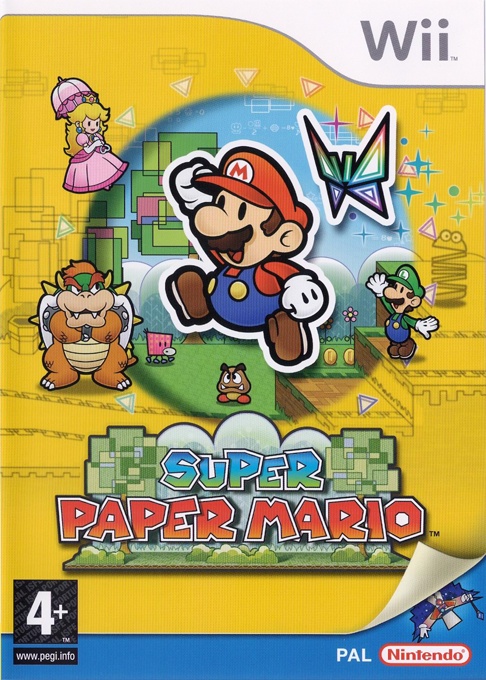
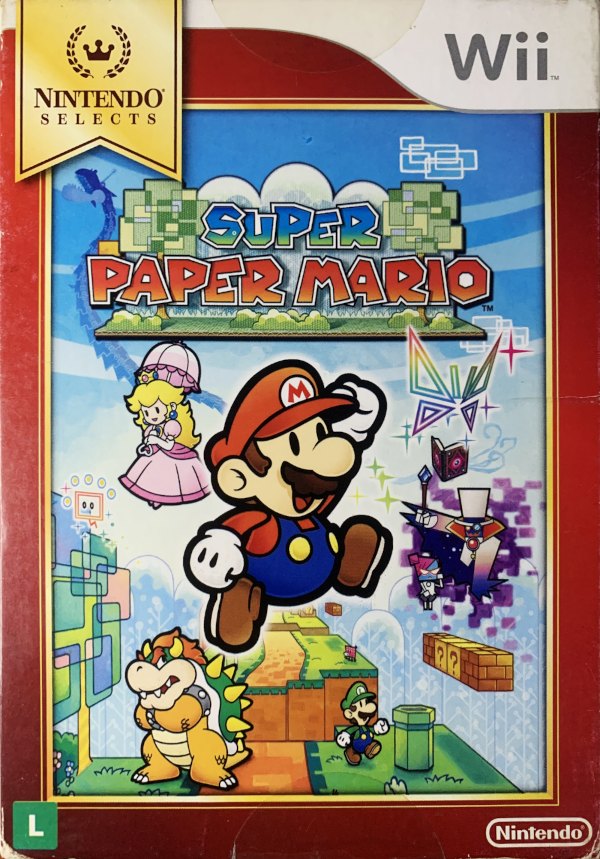
The American and Australasian boxes are built on the key artwork of the four heroes. Fourteen covers are shown here, including the Nintendo Selects reissues.
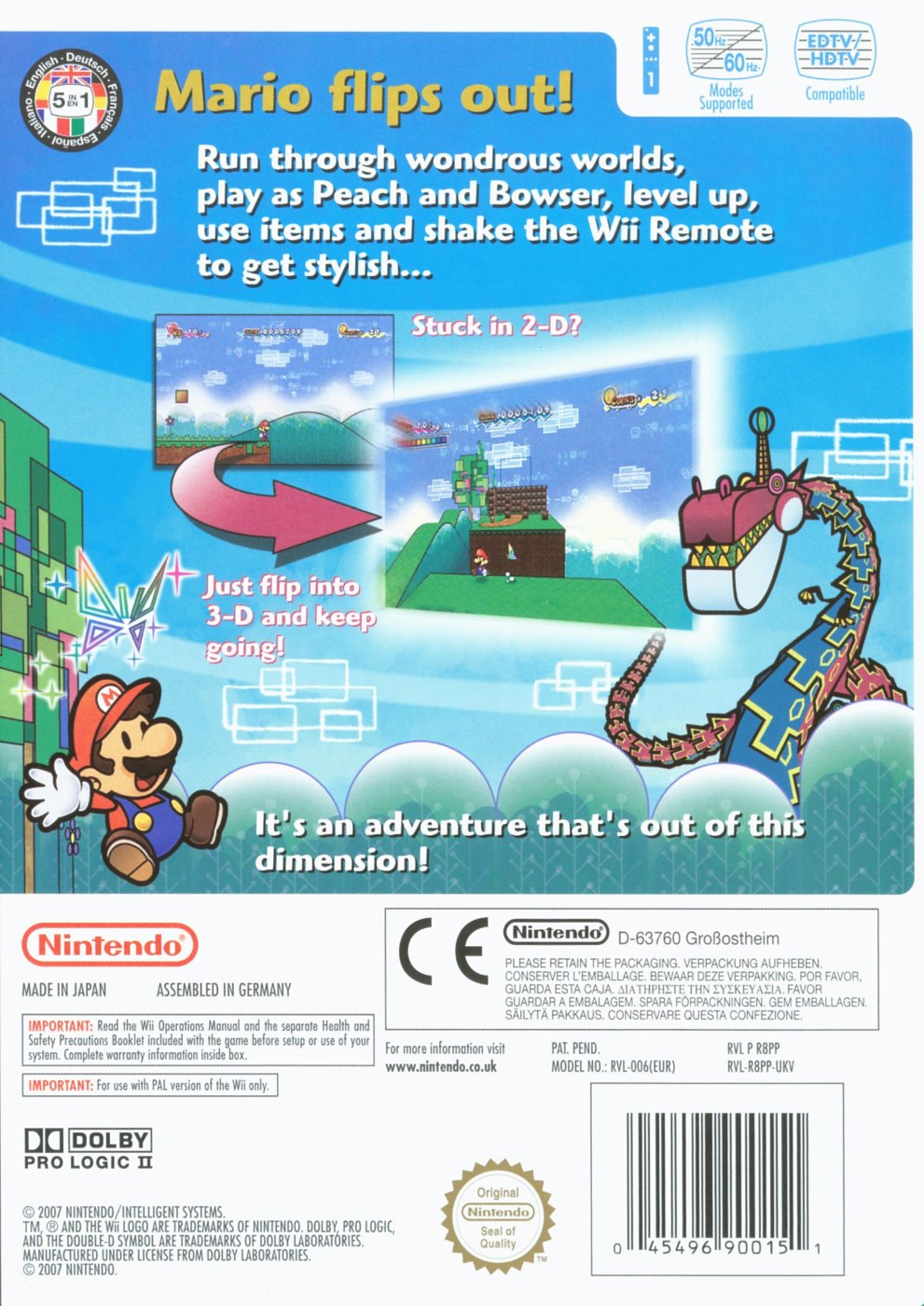
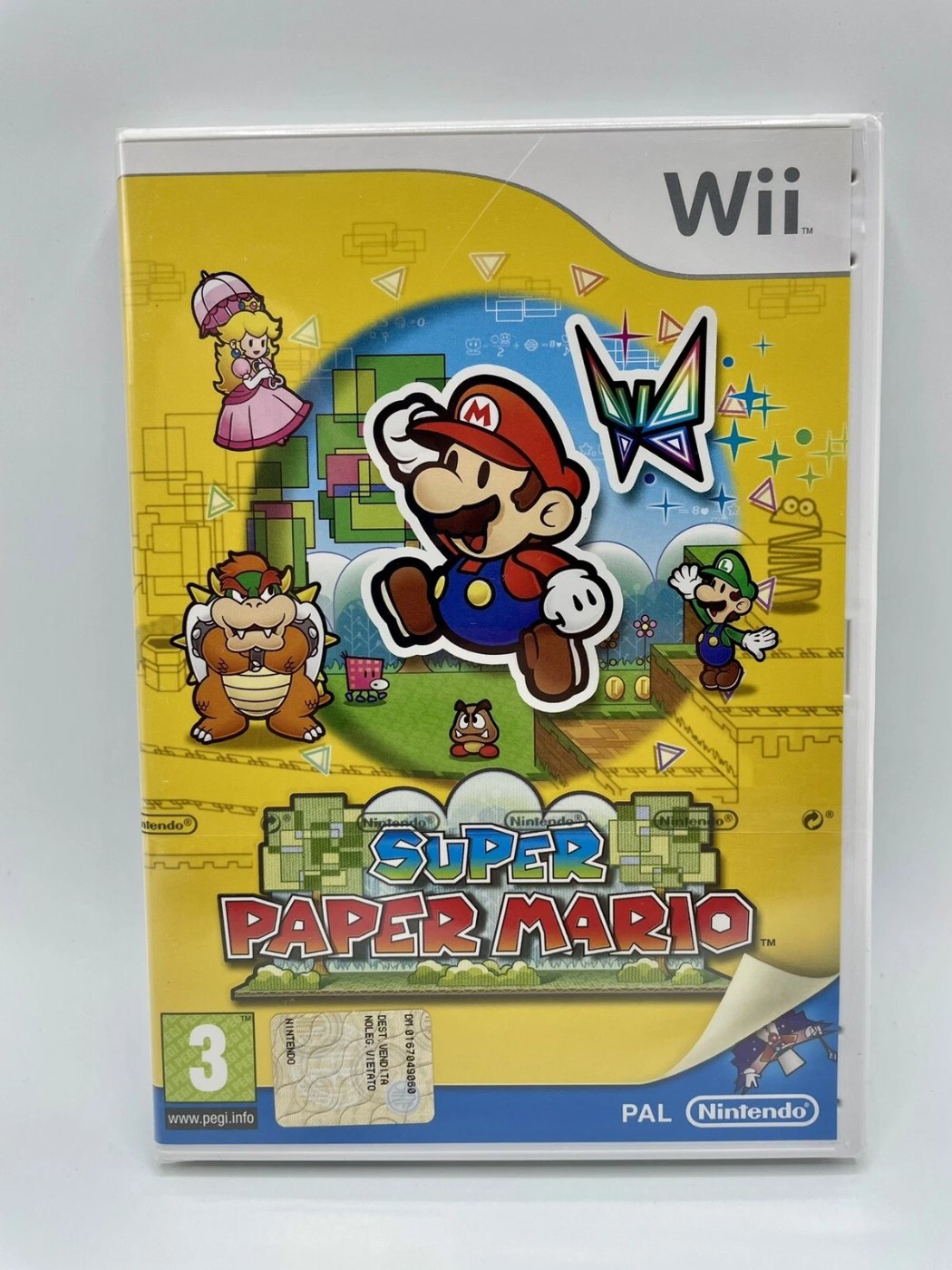
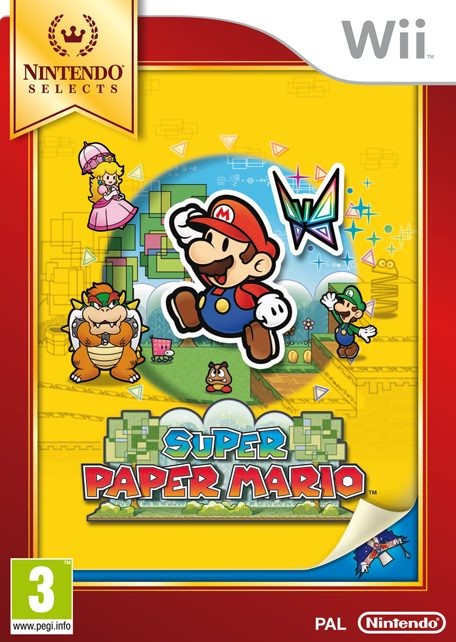
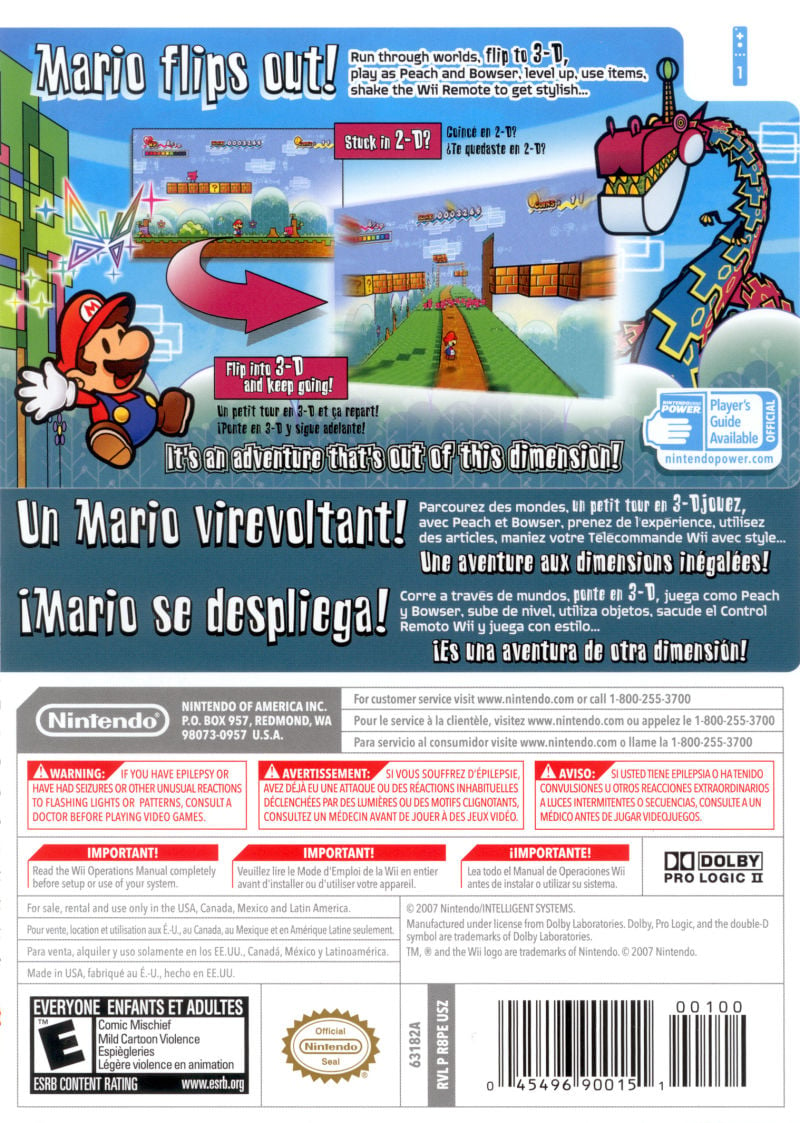
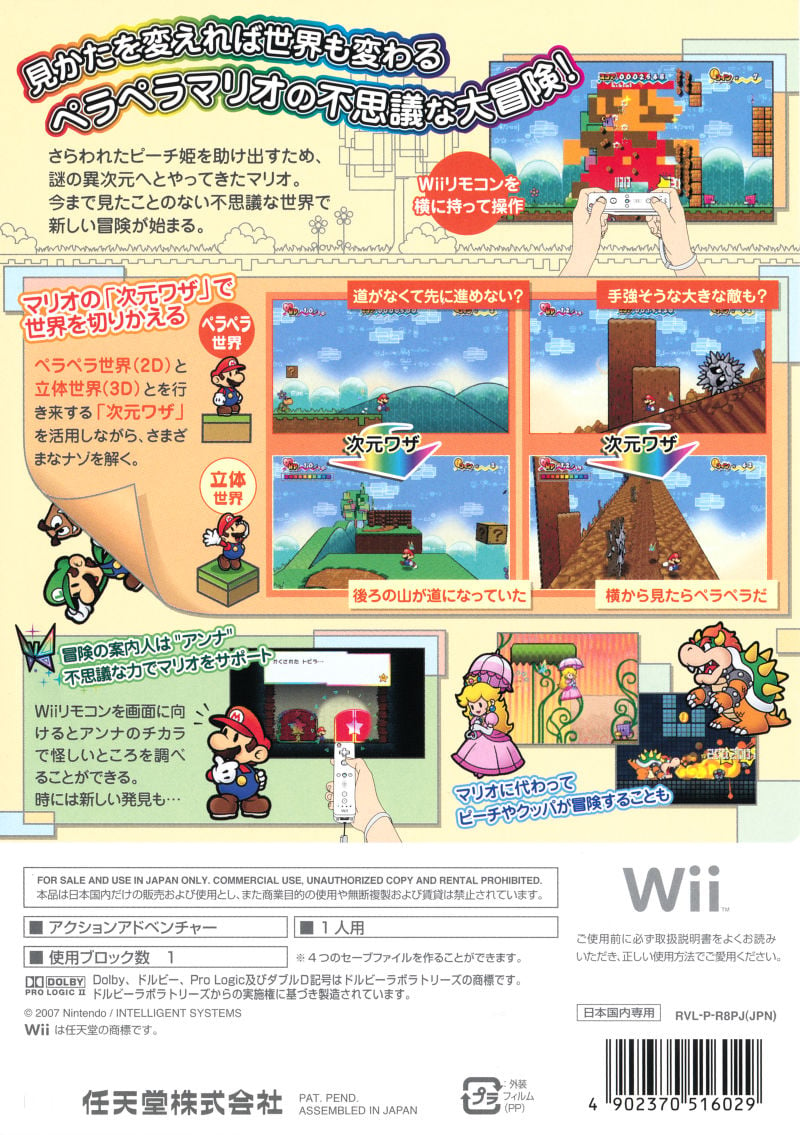
EuropeEuropeBack of the box.EuropeLater printing.EuropeNintendo Selects, 22 June 2012.North AmericaNorth AmericaBack of the box.North AmericaNintendo Selects, 28 August 2011.JapanJapanBack of the box.AustraliaGermanyPortugalSouth Korea26 February 2009.BrazilNintendo Selects.
Screenshots
From the Mario Bros.’ front door to the Purity Heart.
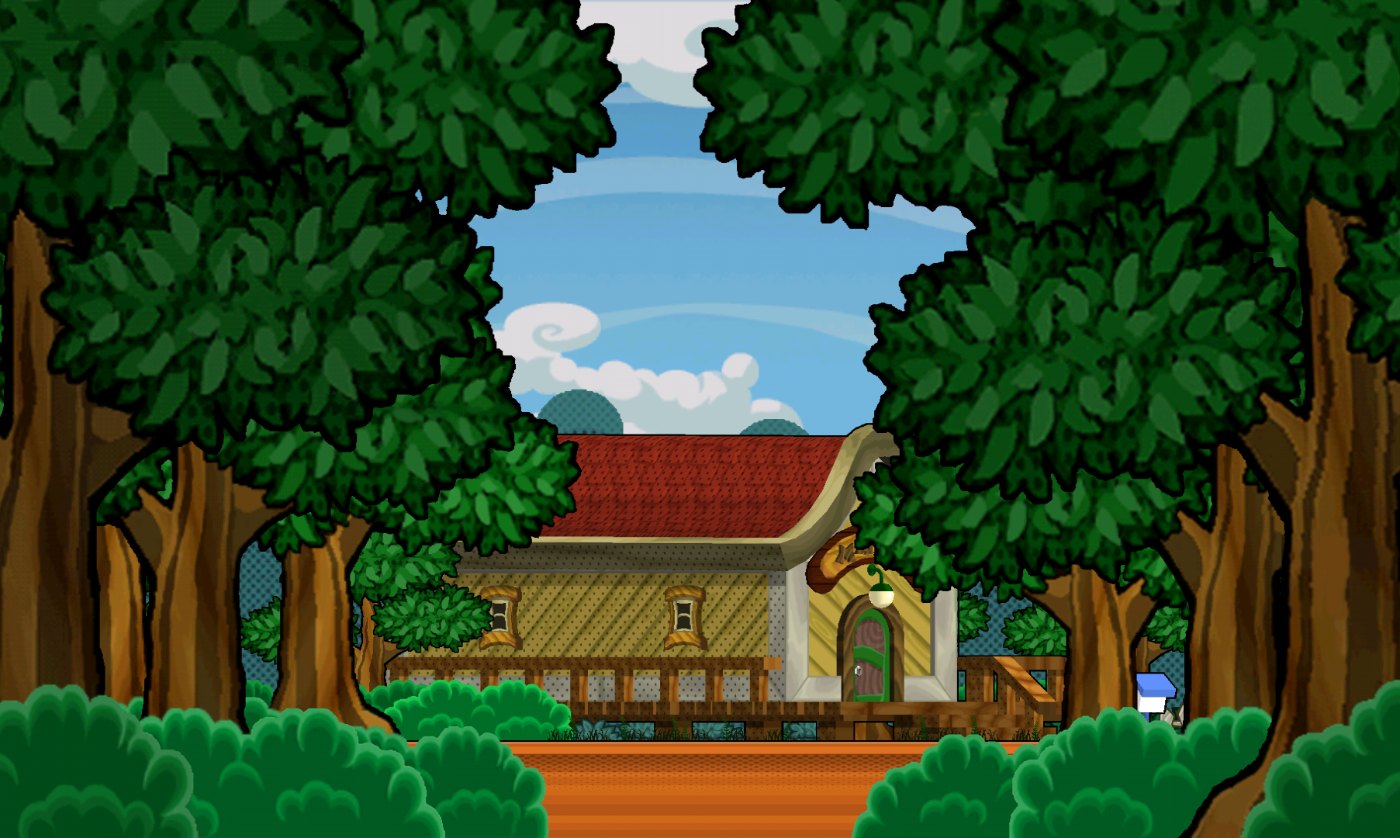
The opening shot: the Mario Bros.’ house.Inside the house.A puzzle on Mount Lineland.Yold Ruins.Peach meets Boomer.The Bitlands.The Bitlands’ tribute to World 1-2.The Dotwood Tree.Squirps waits his turn on Planet Blobule.Floro Caverns.The River Twygz in The Underwhere.Mario against Count Bleck.The Purity Heart banishes the Chaos Heart.
Artwork & Media Gallery
Official artwork, sprites, things cut before release and some of the paper the game was sold with.
International logo.Japanese logo.The title screen, with all four heroes.Princess Peach.Bowser.Luigi.Mario in his goldfish-bowl helmet.Mimi as Merlee’s maid.Dimentio.The Underchomp.The End Boss, last of the Sammer Guys.Grambi.Bestovius.Howzit, Flipside’s shopkeeper.Red and Green.The three hags.The InterNed.Luvbi.Francis’s Meowbombs.A Skellobit.A Squiglet.Merlumina.Flamm, the map-seller.Carson, who tells stories at the bar.Goombella, as a Catch Card portrait.Vivian, likewise.Shadoo’s Dark Mario form.The Chapter 1 title card.The Chapter 8 title card.Pre-release: an early version of the wedding.Pre-release: the original title screen, with a Pixl that was cut.Pre-release artwork of Nastasia with Tiptron.Unused: Nastasia’s DS-like device.Unused: a Shy Guy.Unused: a Monty Mole.The Disc Channel screen.The North American disc.A Japanese advertisement from Shūkan Famitsu.The Prima Games guide.
Legacy & Re-releases
Super Paper Mario has never been remade, but it has been reissued twice, and its characters keep coming back.
Announcements, releases and re-releases
Announced for GameCube11 May 2006Trailer at E3; later dated 9 October 2006.
World Hobby FairJune 2006Playable demo in Japan.
Wii (North America)9 April 2007First release, and the first Mario game on Wii.
Wii (Japan)19 April 2007Top of the chart in its first week.
Wii (Europe)14 September 2007With revised British English text. Early copies had the Chapter 2-2 freeze.
Wii (Australia)20 September 2007Australian release.
Wii (Hong Kong, Taiwan)12 July 2008Asian release.
Wii (South Korea)26 February 2009Korean-language version.
Nintendo Selects (North America)28 August 2011Budget reissue.
Nintendo Selects (Europe)22 June 2012Budget reissue.
Wii U eShop (North America)16 June 2016Digital download of the Wii game.
Wii U eShop (Japan, Europe, Australia)August 2016Japan on 3 August, Europe on 11 August, Australia a day or two later.
Wii U eShop closes27 March 2023No longer on sale; existing buyers can still play it.
Re-releases
The Wii disc was reprinted in the Nintendo Selects range in 2011 and 2012. In 2016 the game was added to the Wii U eShop as a download, and it remained there until the shop closed in March 2023. Wii and Wii U are the only platforms usually listed for it.
The series after it
Sticker Star (2012), Color Splash (2016) and The Origami King (2020) went back to turn-based battles of various kinds, and none went back to flipping, apart from one affectionate level in Color Splash. In 2007 its makers said they wanted a new and different style each time, and that is what the series has delivered since.
The complaint heard in 2007 was that it had abandoned the battles of The Thousand-Year Door. What tends to be remembered now is Count Bleck.
Where the cast went next
The cast has lived on mostly in Super Smash Bros. Brawl has stickers of Count Bleck, Tippi and O’Chunks and a Fracktail trophy; the Wii U game has trophies of Count Bleck, Tippi, Mr. L, Fracktail and Flint Cragley; and Mr. L and Dimentio are spirits in Ultimate. Count Bleck also had a second career as the villain of the manga Dr. Mario-kun. And a copy of the Dark Prognosticus has been spotted on a shelf in The Super Mario Galaxy Movie.
Reviews & Sales
Sales figures
It sold 144,000 copies in its first week in Japan, the top of that week’s chart, and 352,000 in the United States in April 2007, where only two Pokémon games outsold it. Nintendo’s own count, given at its results briefing of 25 April 2008, was 2.28 million copies worldwide to 31 March 2008: 500,000 in Japan and 1.78 million elsewhere.
Nintendo has not published a later figure in a form we could check. The total usually quoted is 4.23 million “by the end of 2014”, a figure that appears in a Kotaku retrospective of 30 August 2016 with no source named and has been repeated by Wikipedia and others since. If it is right, this is the best-selling Paper Mario. It was reissued in the Nintendo Selects budget range in North America in August 2011 and in Europe in June 2012.
2.28mworldwide, to 31 March 2008 (Nintendo)
500,000Japan, to 31 March 2008 (Nintendo)
4.23mto the end of 2014, per Kotaku (2016), source not named
144,000first week in Japan
352,000USA, April 2007 (NPD)
85Metacritic
Reception and review scores
Metacritic’s average is 85 and GameRankings closed on 85.16 per cent from 76 reviews, both a little below the first two Paper Mario games. The scores below are as listed by Wikipedia.
Game InformerBryan Vore
9.5/10
Nintendo World ReportMichael Cole · 8 April 2007
9/10
Nintendo LifeAnthony Dickens · 15 April 2007
9/10
IGNMatt Casamassina
8.9/10
GameSpotRicardo Torres · 9 April 2007
8.8/10
FamitsuJapan · 9, 9, 9, 8
35/40
GameTrailersUS
8.7/10
Electronic Gaming MonthlyShane Bettenhausen
B+
RPGamerAdriaan den Ouden and others
4.12/5
EurogamerJohn Walker · 19 September 2007
8/10
GamesRadar+Brett Elston · 31 March 2007
4/5
GameSpyBryn Williams
4/5
Cubed3Adam Riley
7/10
The writing took most of the honours. Game Informer thought it arguably the best in any Mario RPG, Eurogamer’s John Walker found it consistently hilarious and summed the game up as “a gorgeous, confusing little buddy”, and Nintendo World Report called the whole thing a “peculiar, unexpected love-letter to Nintendo fans”. The flipping was widely admired as an idea. IGN’s Matt Casamassina praised the tight controls and the puzzles built on the switch from 2-D to 3-D and called the game a must-buy.
The reservations were about what the idea was used for. IGN found the 3-D views barren and the quantity of text ridiculous. Eurogamer thought the third dimension underused and the platforming a notch below a proper Mario game; Electronic Gaming Monthly called the RPG side undercooked; GameSpy found it too easy. GamesRadar’s Brett Elston felt that “everything starts to peter out close to the end”, Nintendo World Report disliked the backtracking, and Cubed3 thought the two genres got in each other’s way.
Time has been kind to the story and the characters in particular. Count Bleck was a nominee for Best New Character in Nintendo Power’s awards for 2007, and the readers of that magazine voted the game Best Story/Writing.
Honours
Satellite Awards · 16 December 2007Outstanding Role Playing GameWinner.
IGN Best of 2007Best RPG (Wii)Winner on Wii; lost the overall RPG award to Mass Effect.
Nintendo Power Awards 2007Best Story/Writing (readers’ choice)Winner. Also nominated for Game of the Year, Wii Game of the Year, Best Adventure Game, Best Wii Graphics and Best New Character.
British Academy Games Awards · 23 October 2007InnovationNominated.
Spike Video Game Awards · 9 December 2007Best Wii GameNominated.
NAVGTR Awards · 25 March 2008Writing in a Comedy; Game Sequel Children’sNominated in both.
SLB User Reviews
Super Paper Mario has yet to receive a community review on Super Luigi Bros.
If you’ve played Super Paper Mario and would like to submit a review, please get in touch.
To provide the best experiences, we use technologies like cookies to store and/or access device information. Consenting to these technologies will allow us to process data such as browsing behavior or unique IDs on this site. Not consenting or withdrawing consent, may adversely affect certain features and functions.
Functional
Always active
The technical storage or access is strictly necessary for the legitimate purpose of enabling the use of a specific service explicitly requested by the subscriber or user, or for the sole purpose of carrying out the transmission of a communication over an electronic communications network.
Preferences
The technical storage or access is necessary for the legitimate purpose of storing preferences that are not requested by the subscriber or user.
Statistics
The technical storage or access that is used exclusively for statistical purposes.The technical storage or access that is used exclusively for anonymous statistical purposes. Without a subpoena, voluntary compliance on the part of your Internet Service Provider, or additional records from a third party, information stored or retrieved for this purpose alone cannot usually be used to identify you.
Marketing
The technical storage or access is required to create user profiles to send advertising, or to track the user on a website or across several websites for similar marketing purposes.

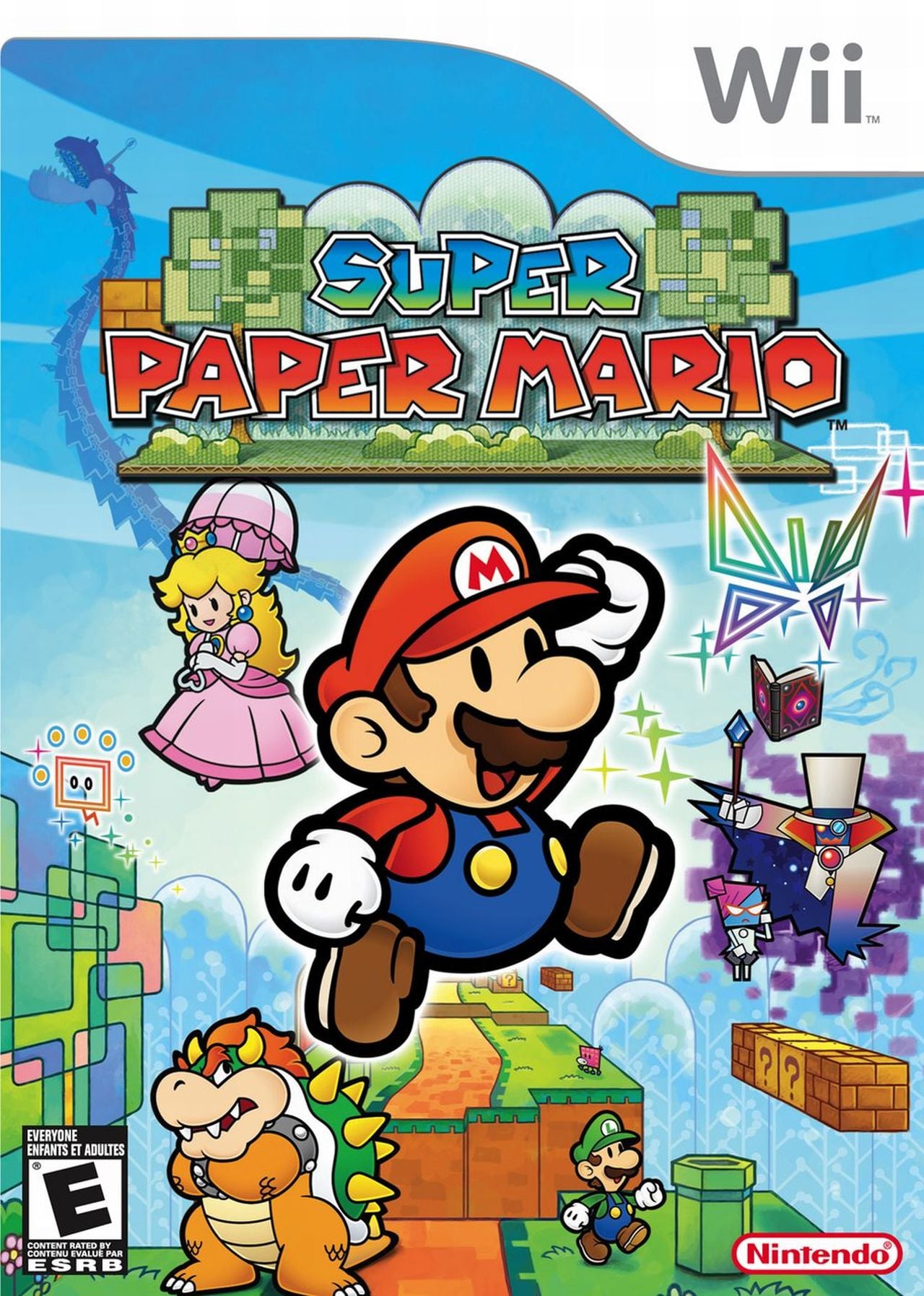
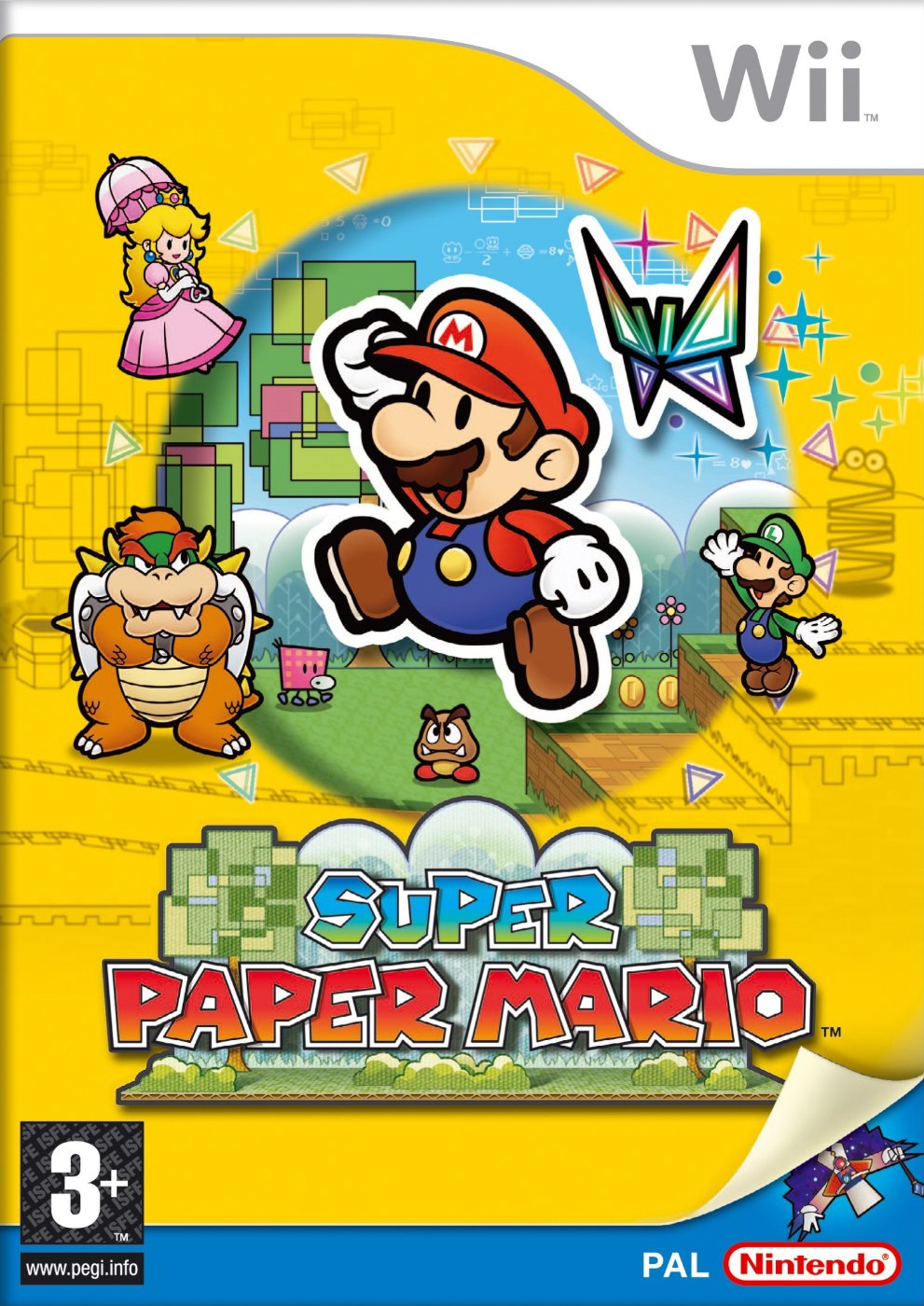
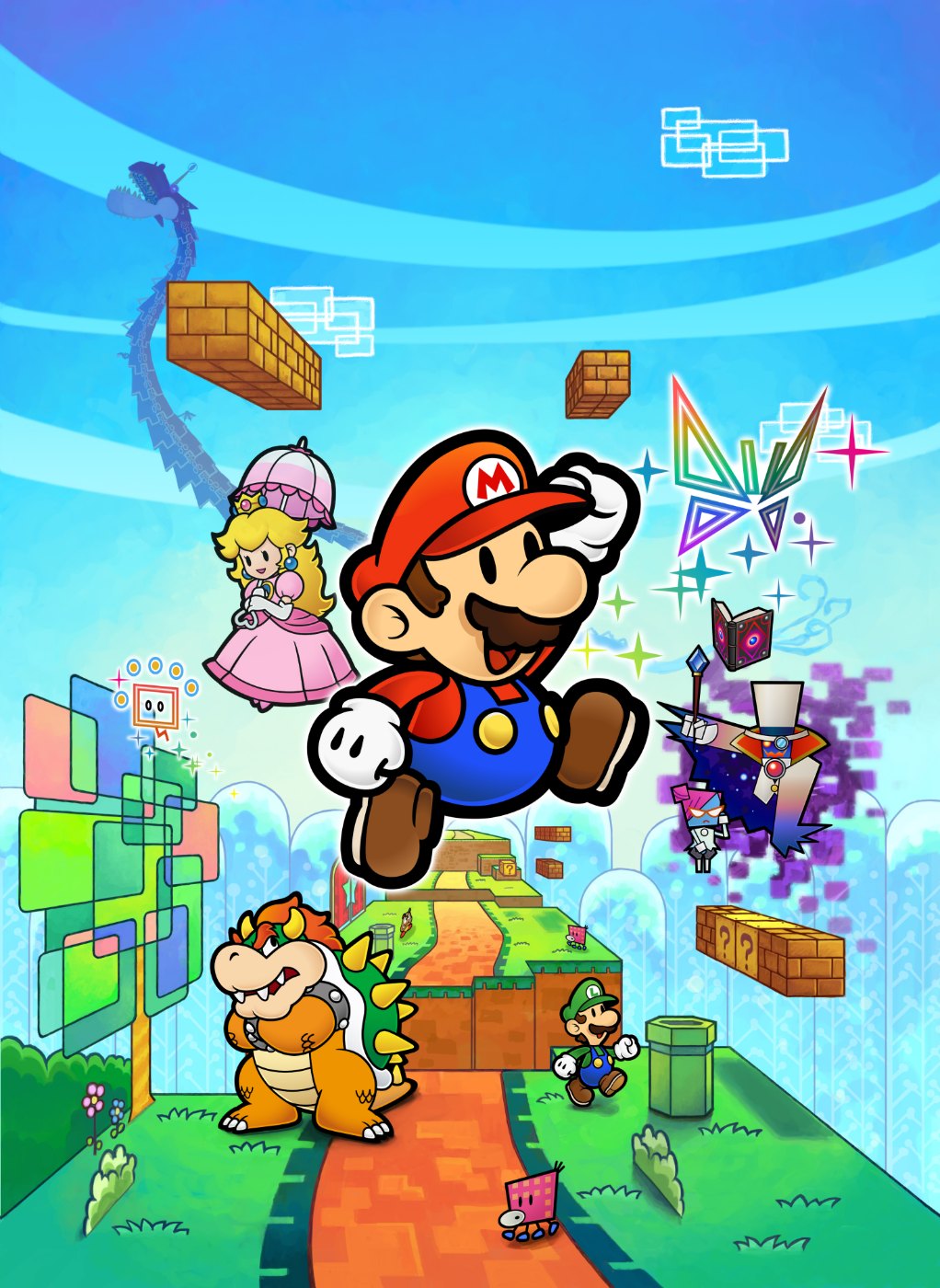
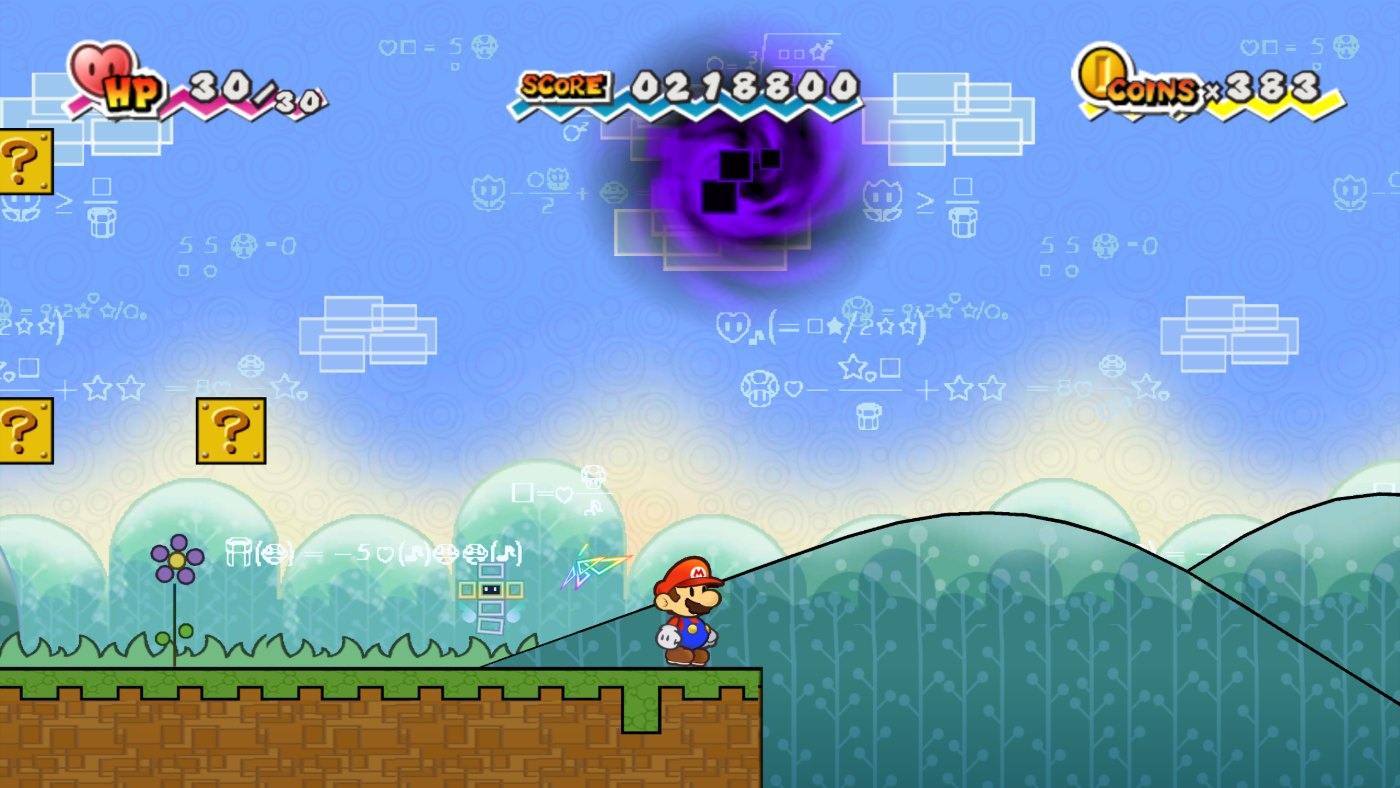
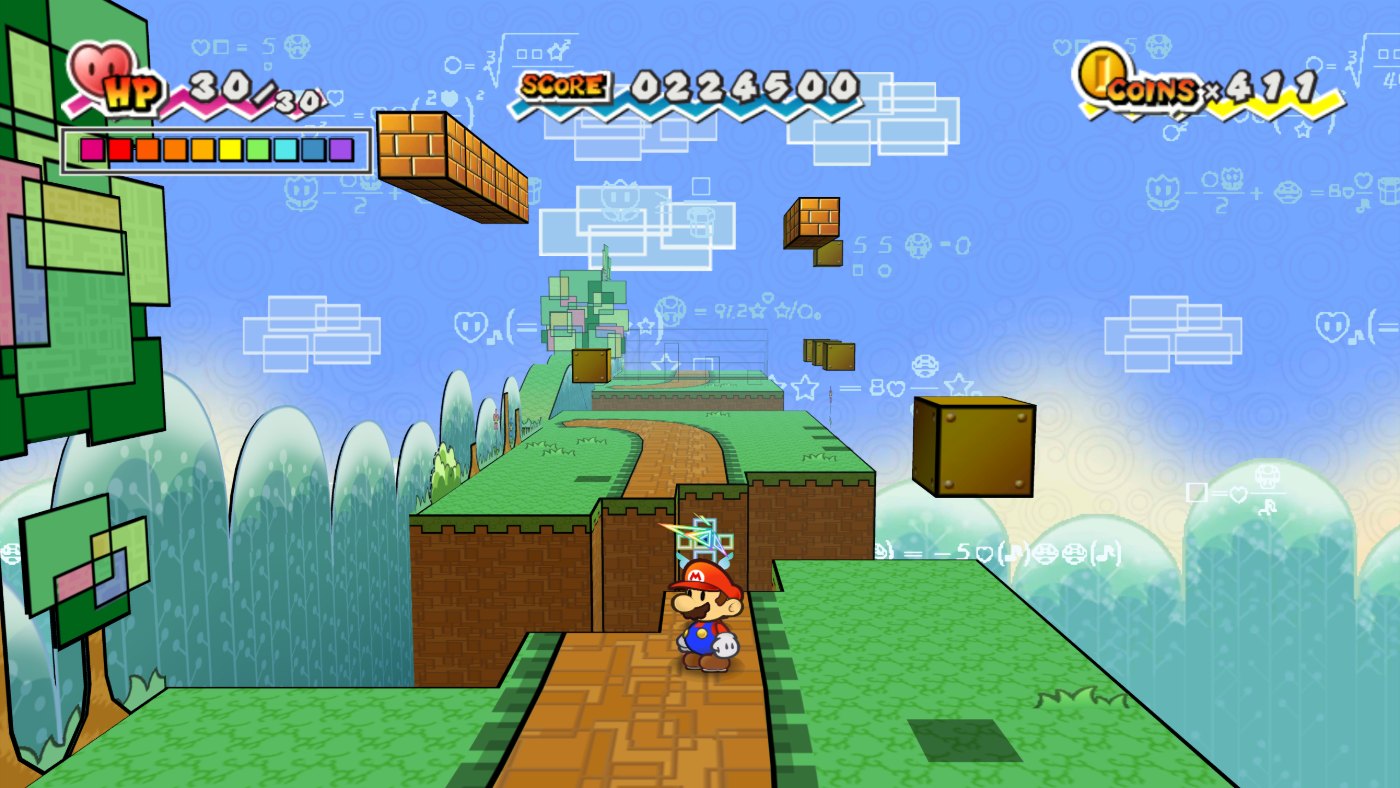
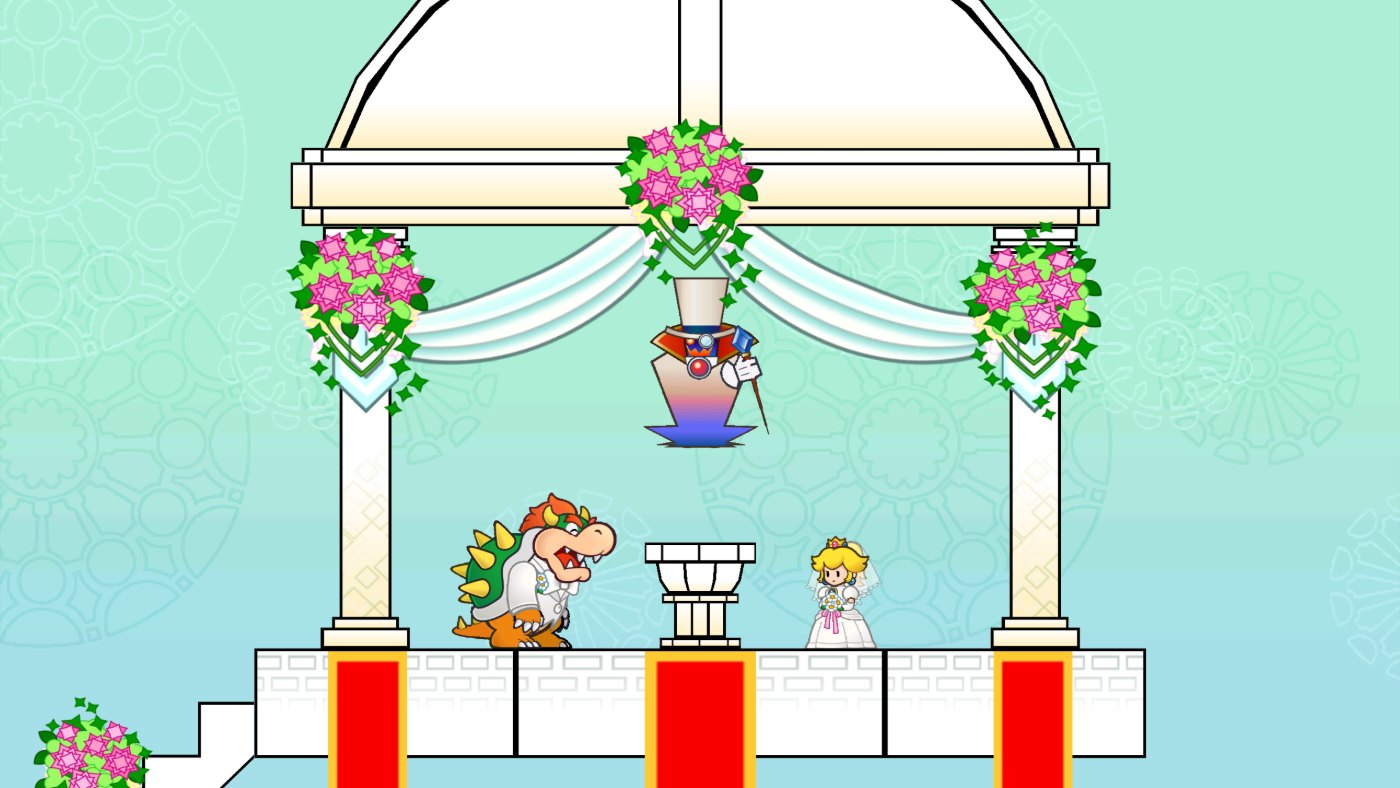
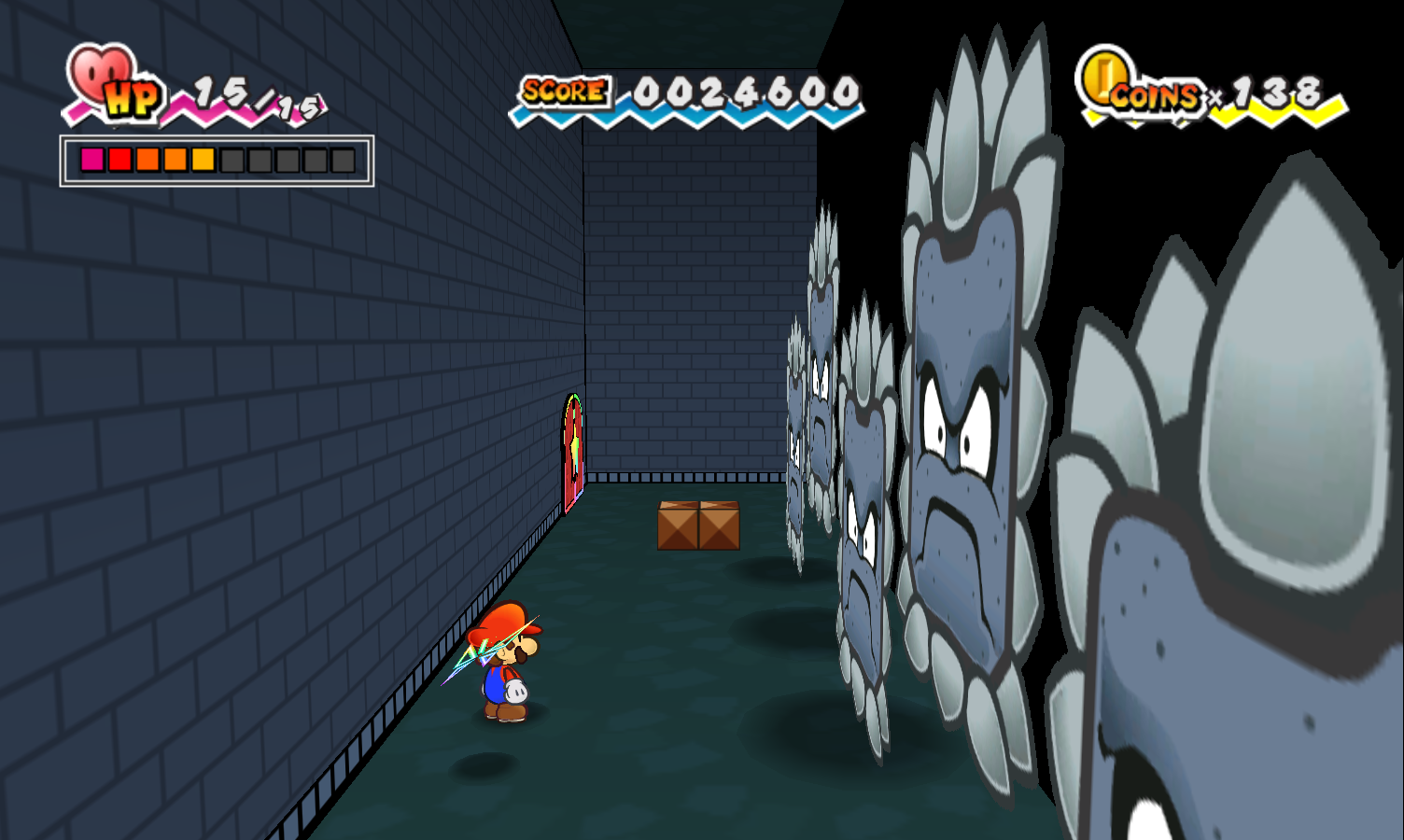

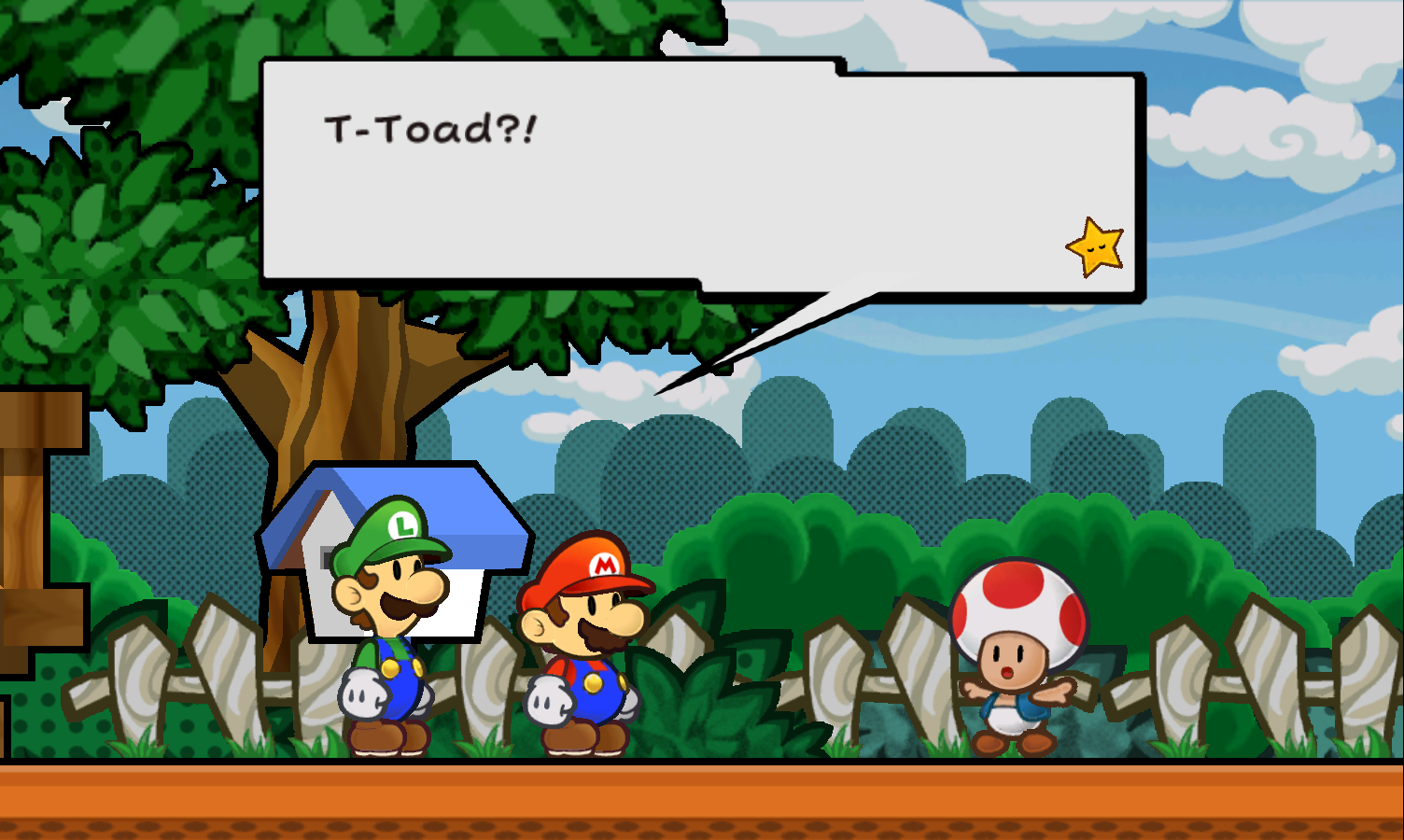
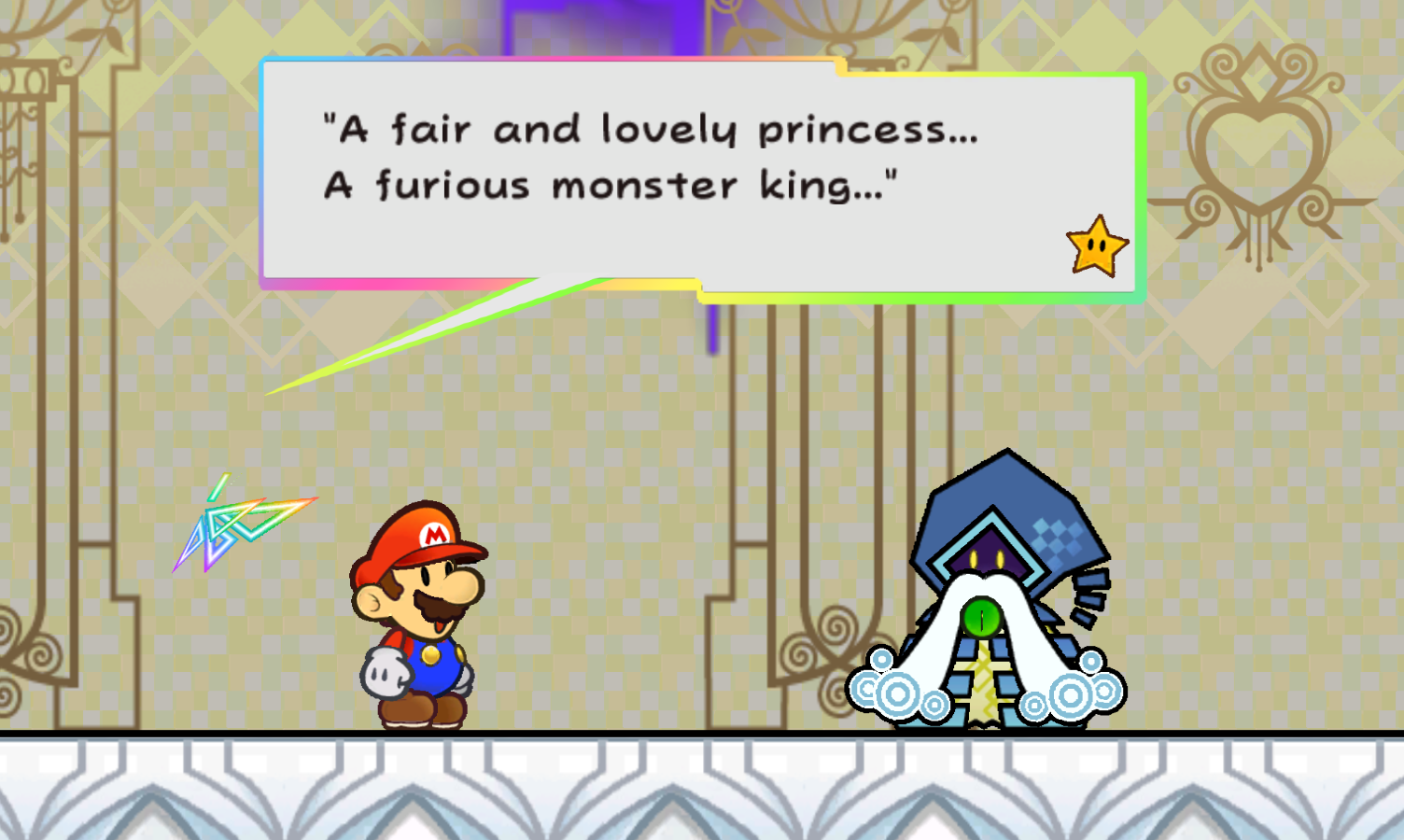
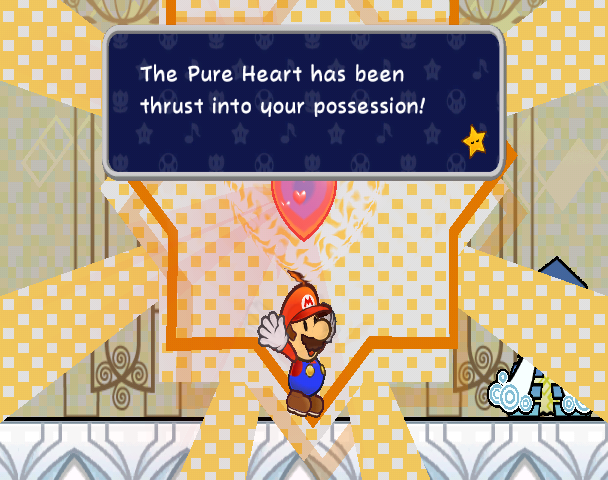
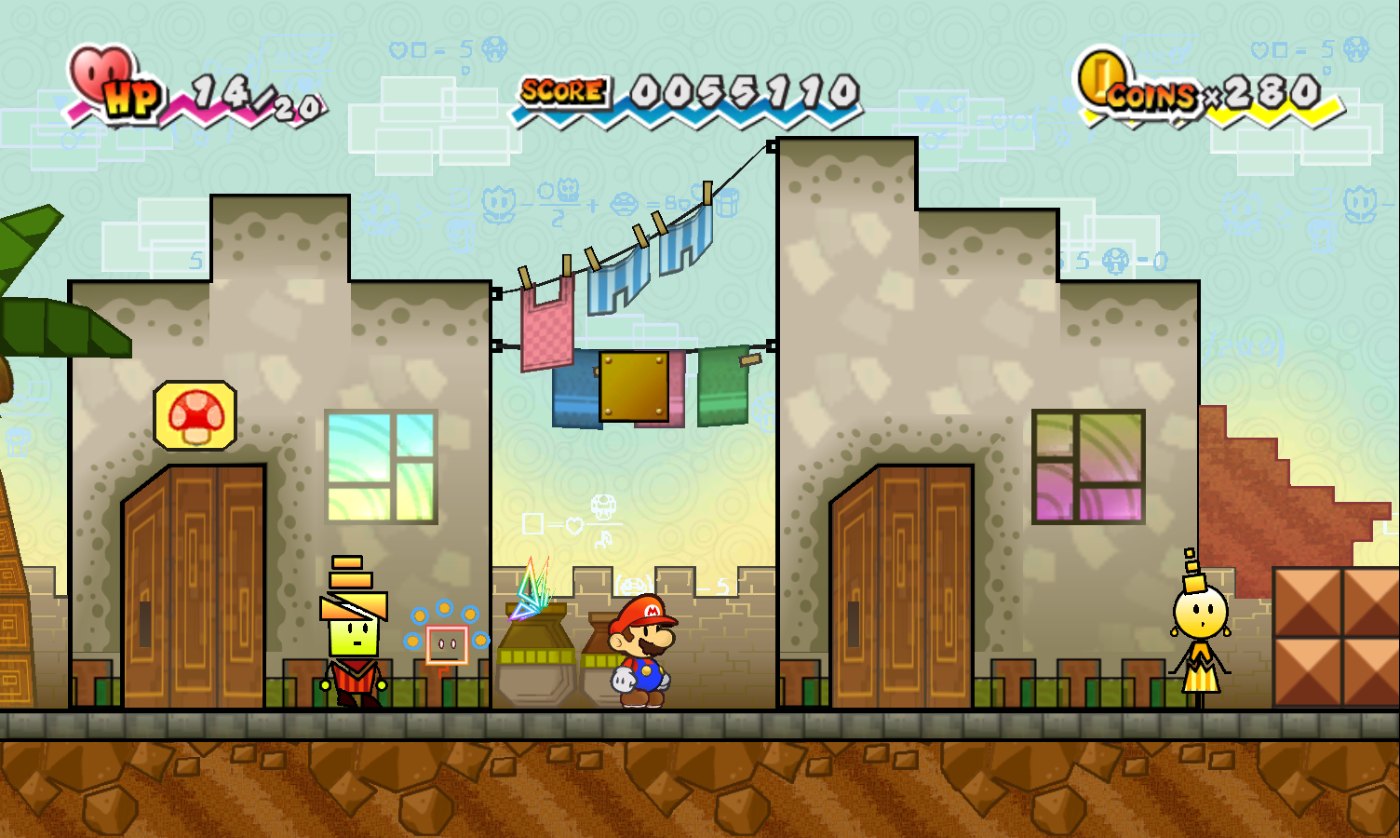
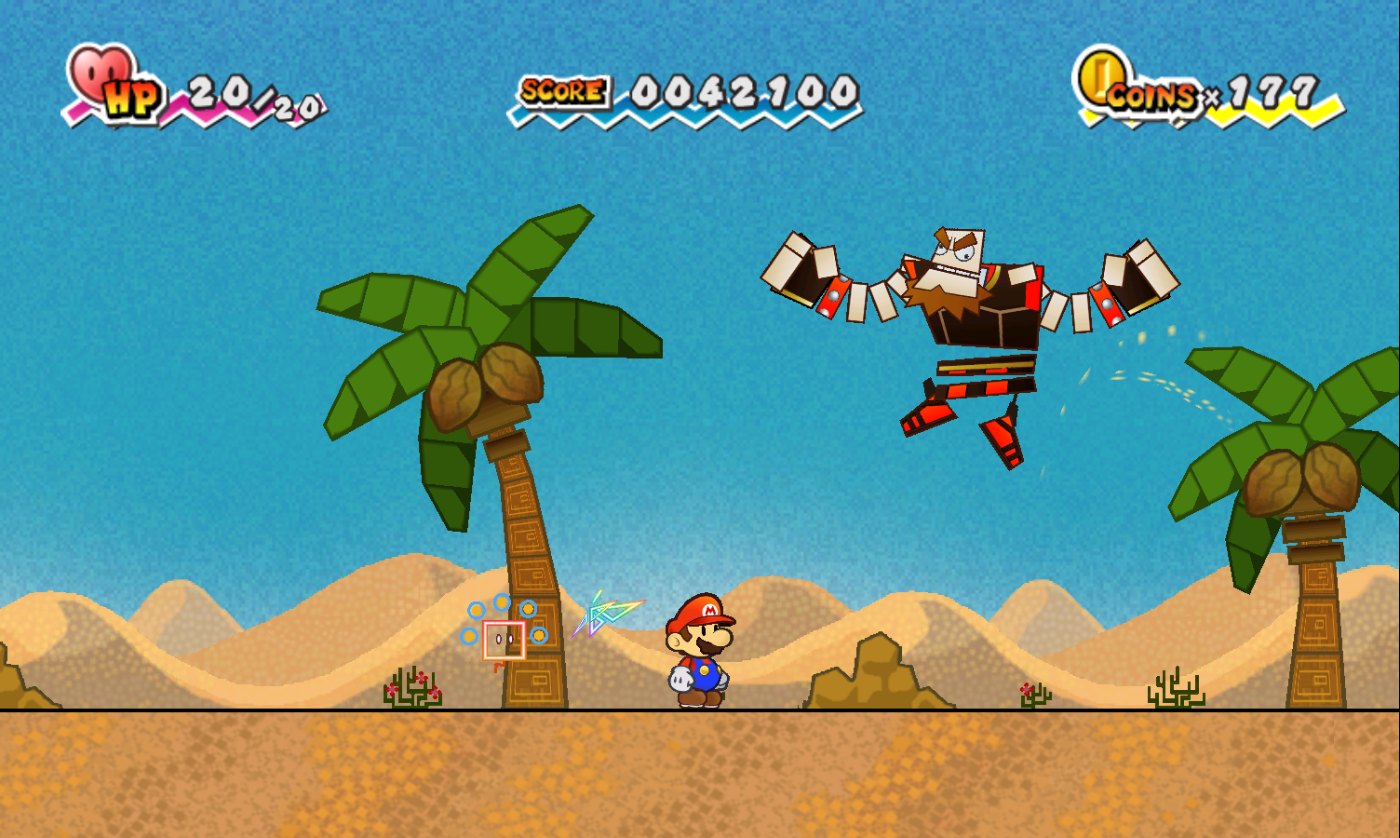
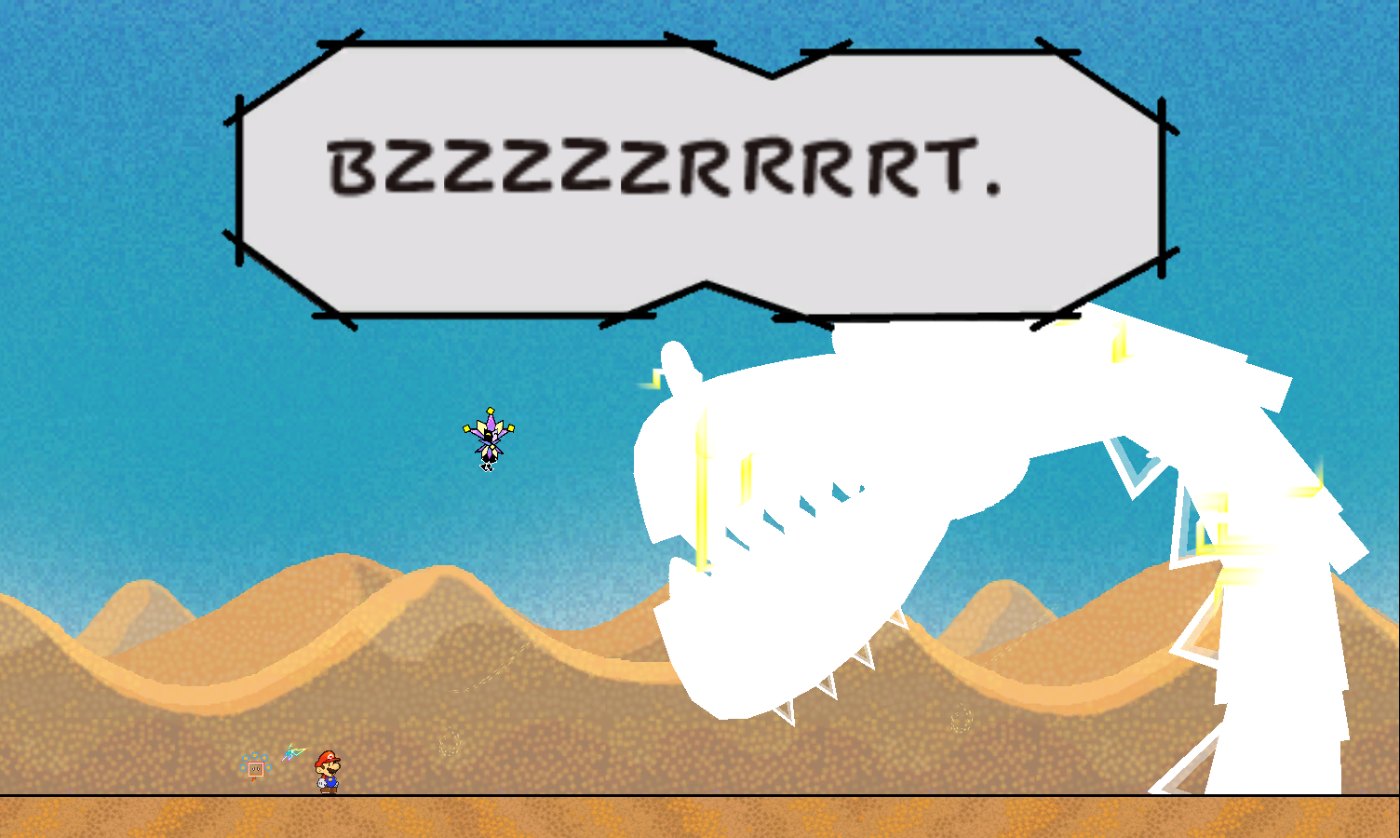
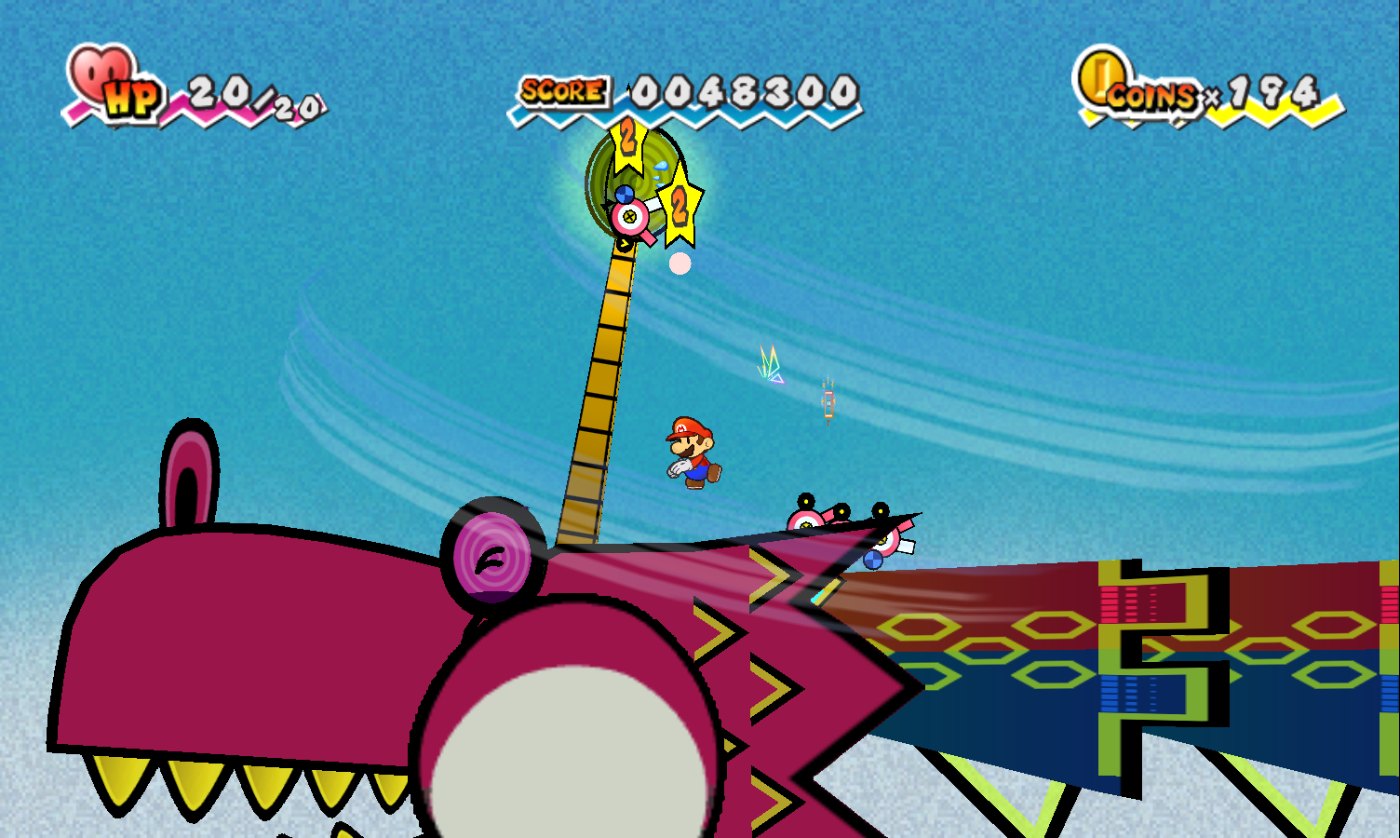
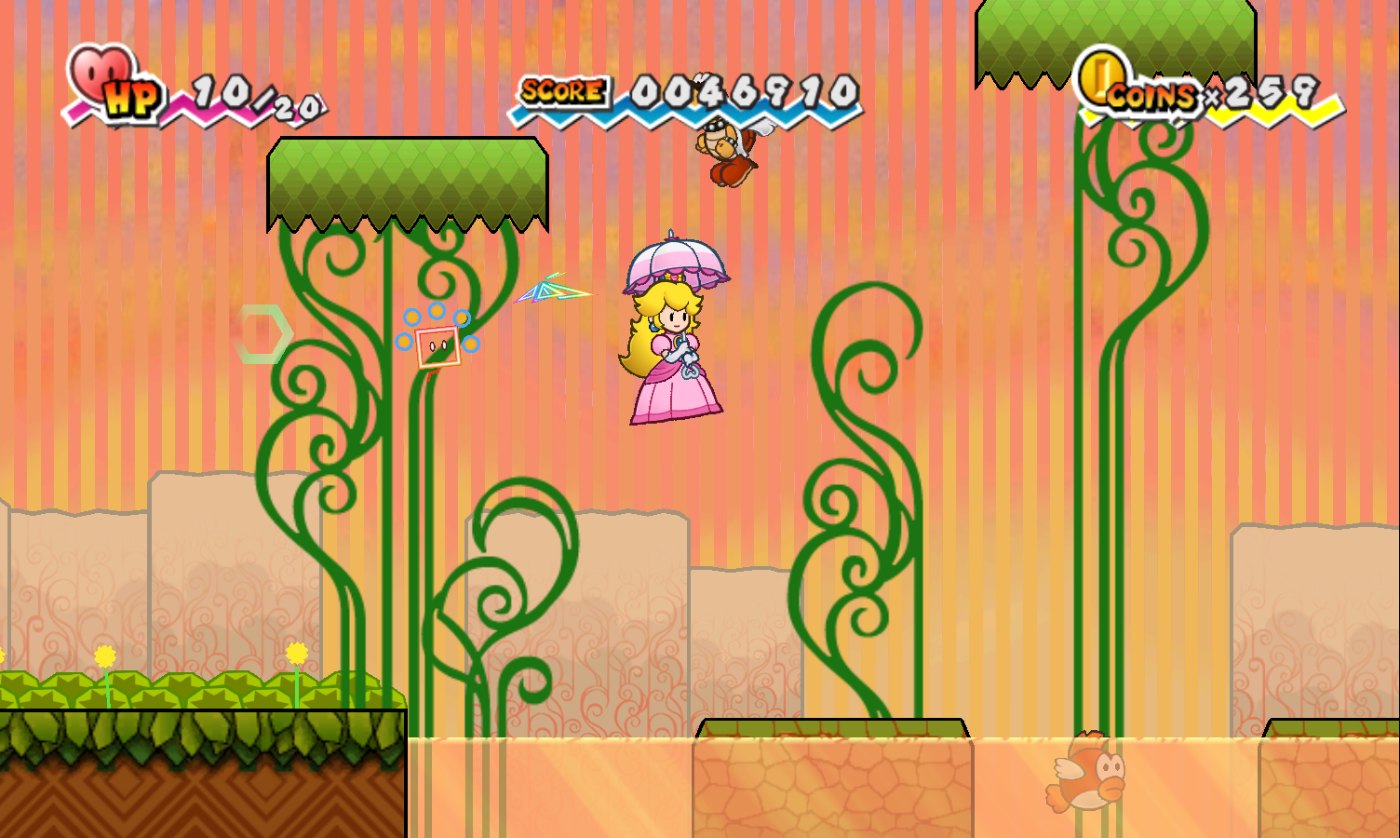
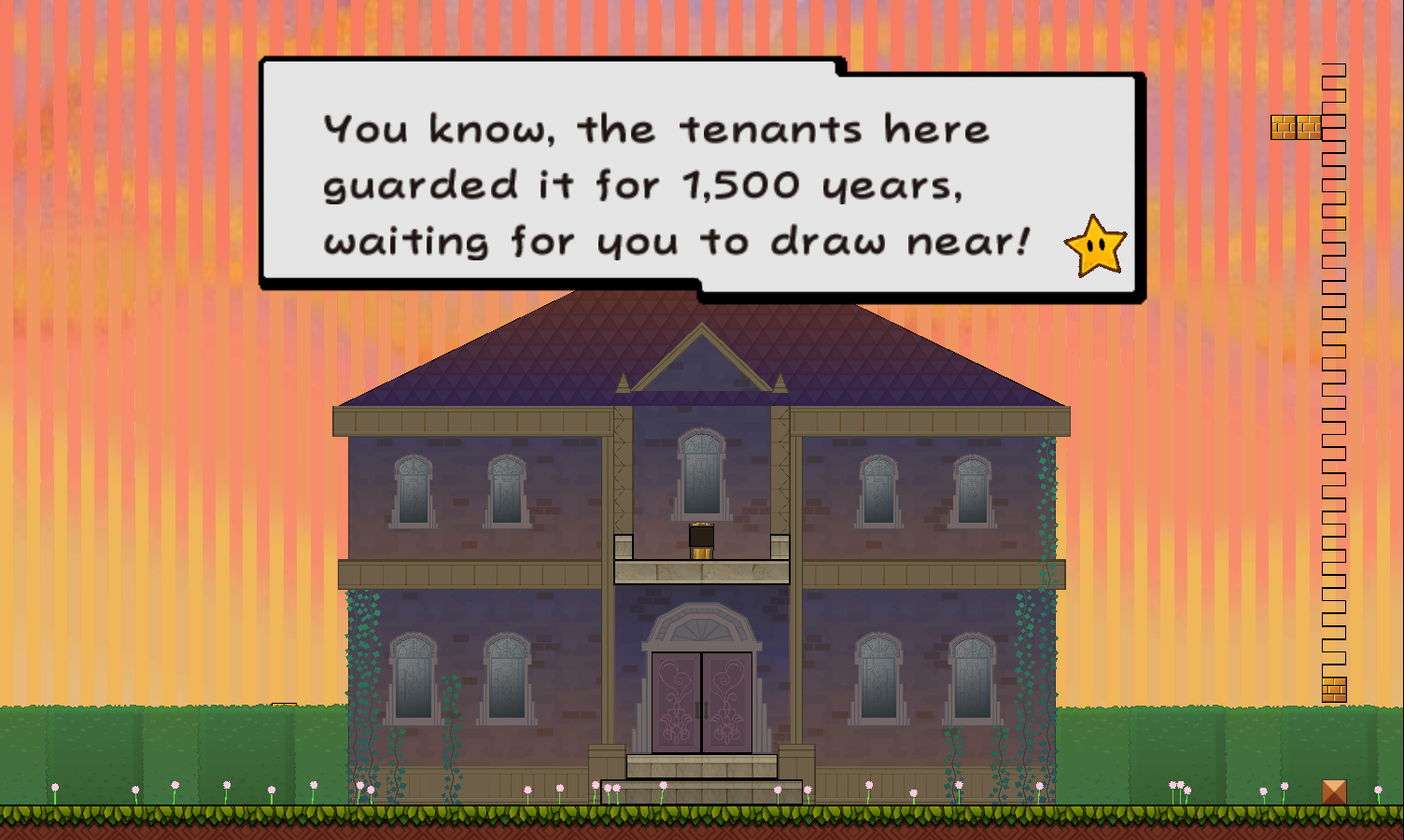
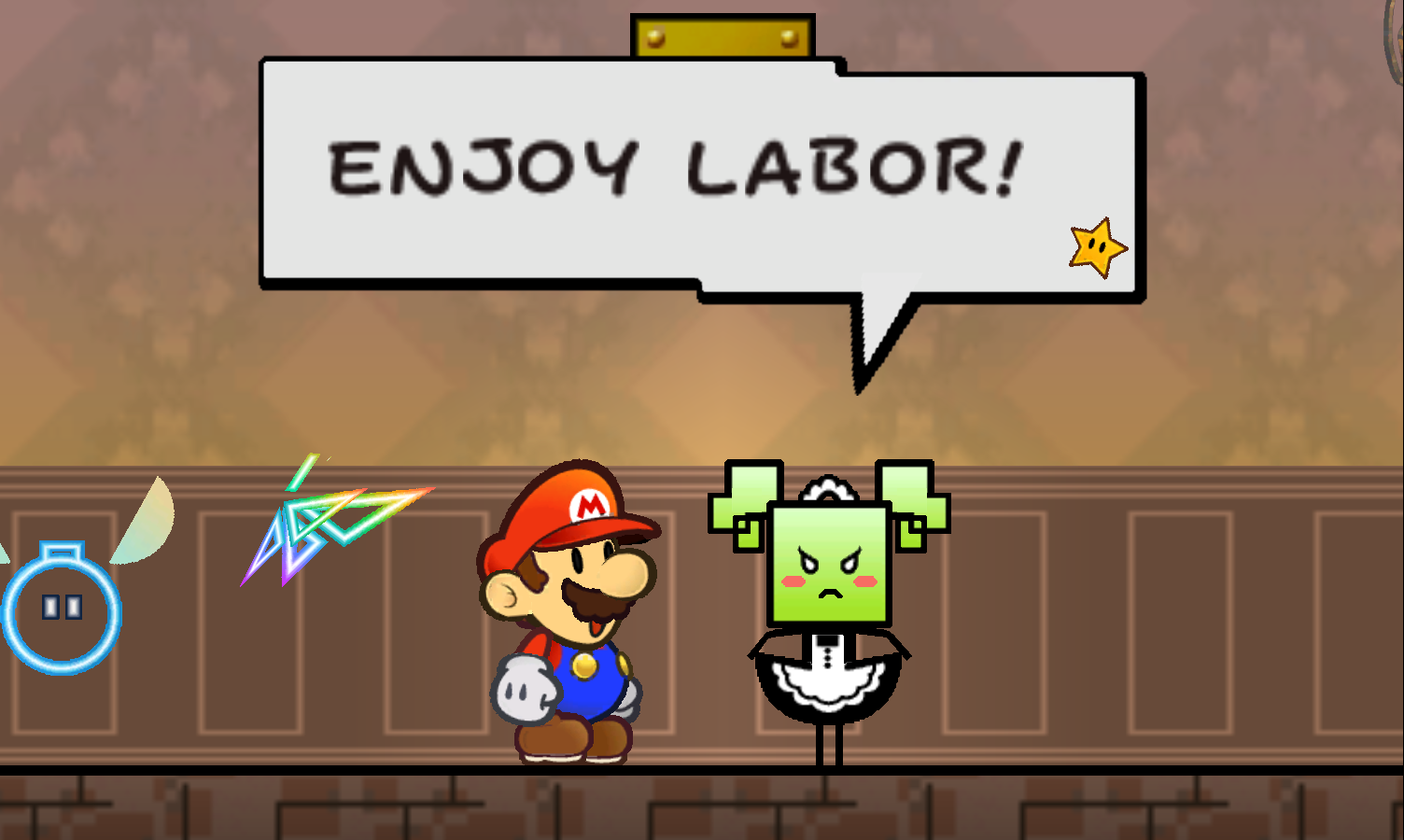
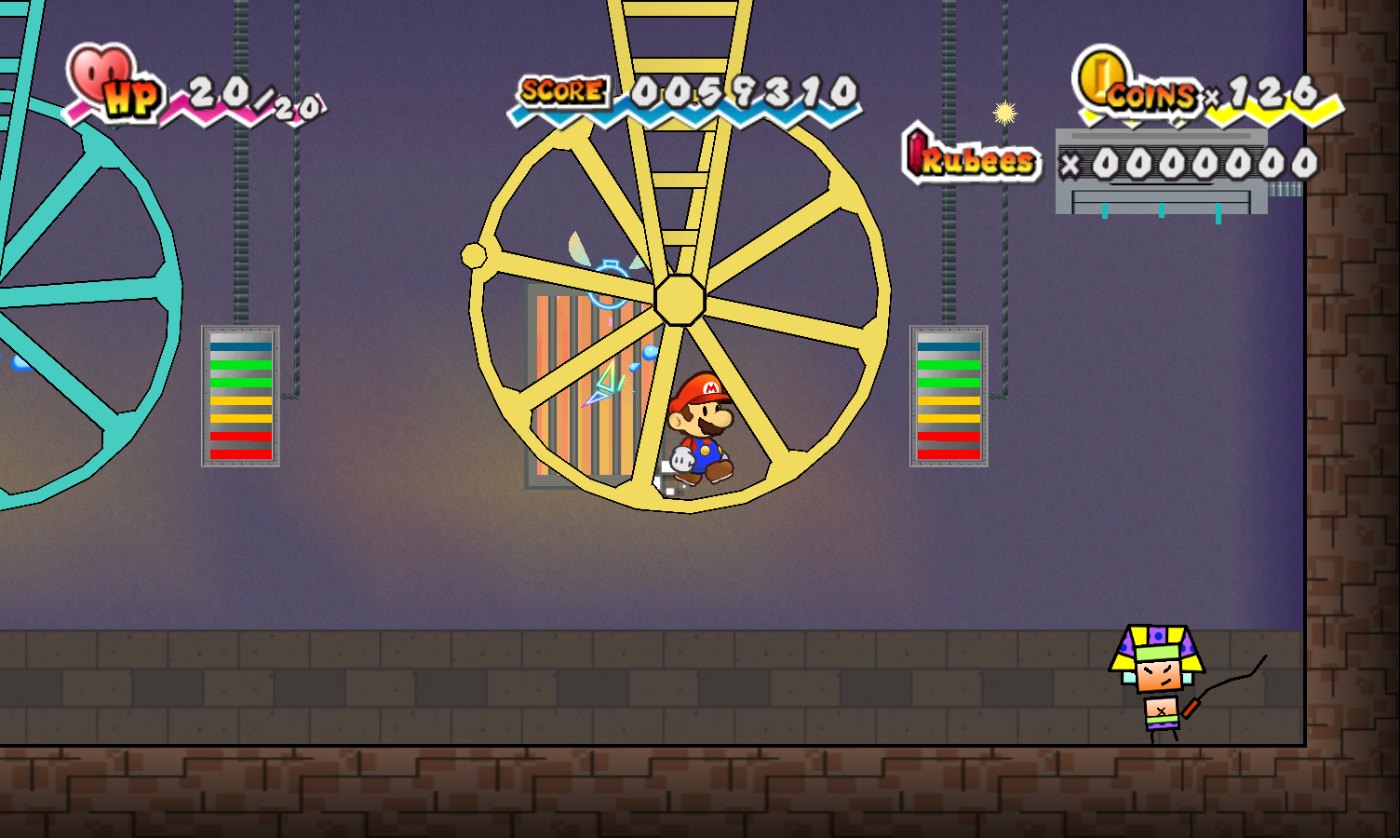
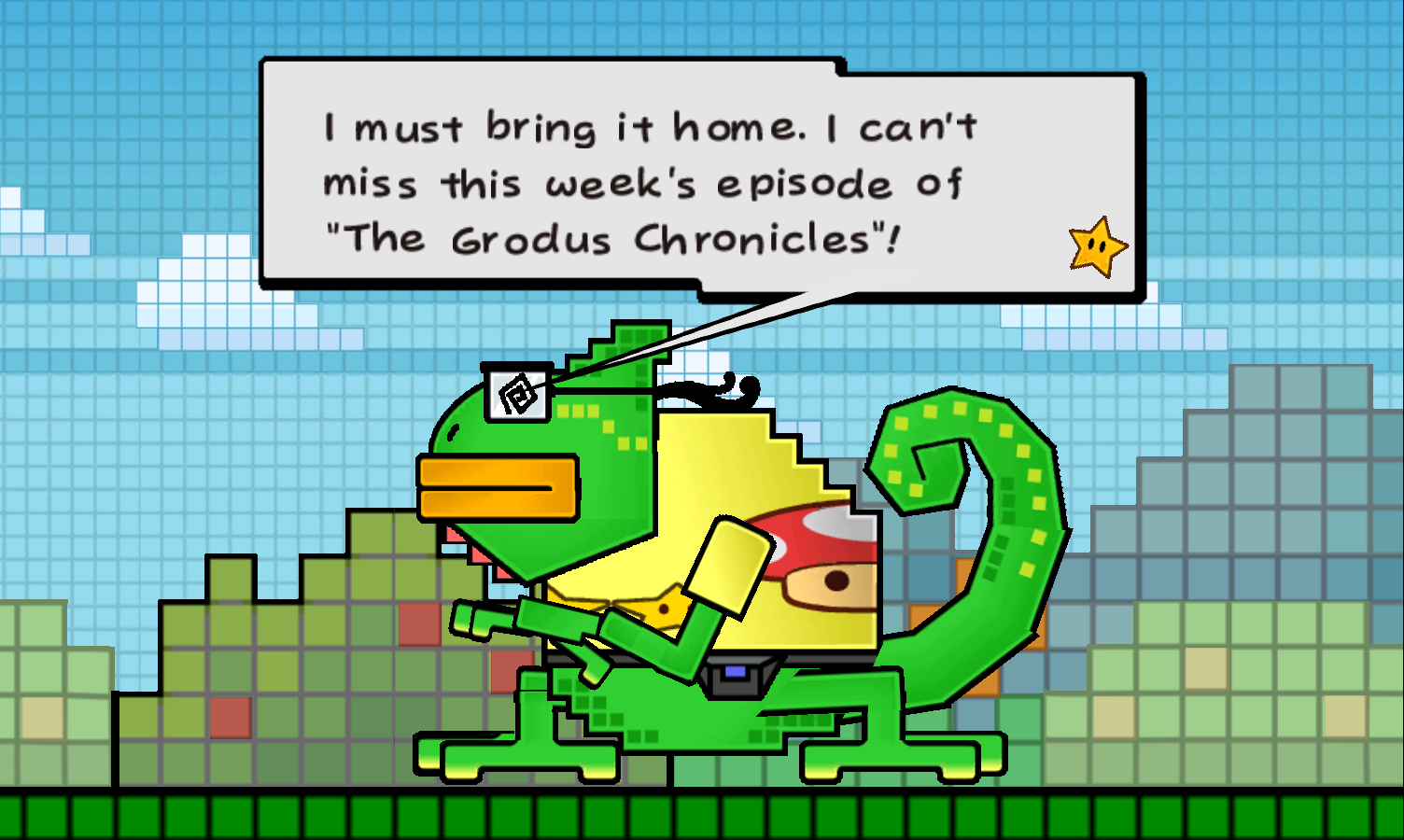
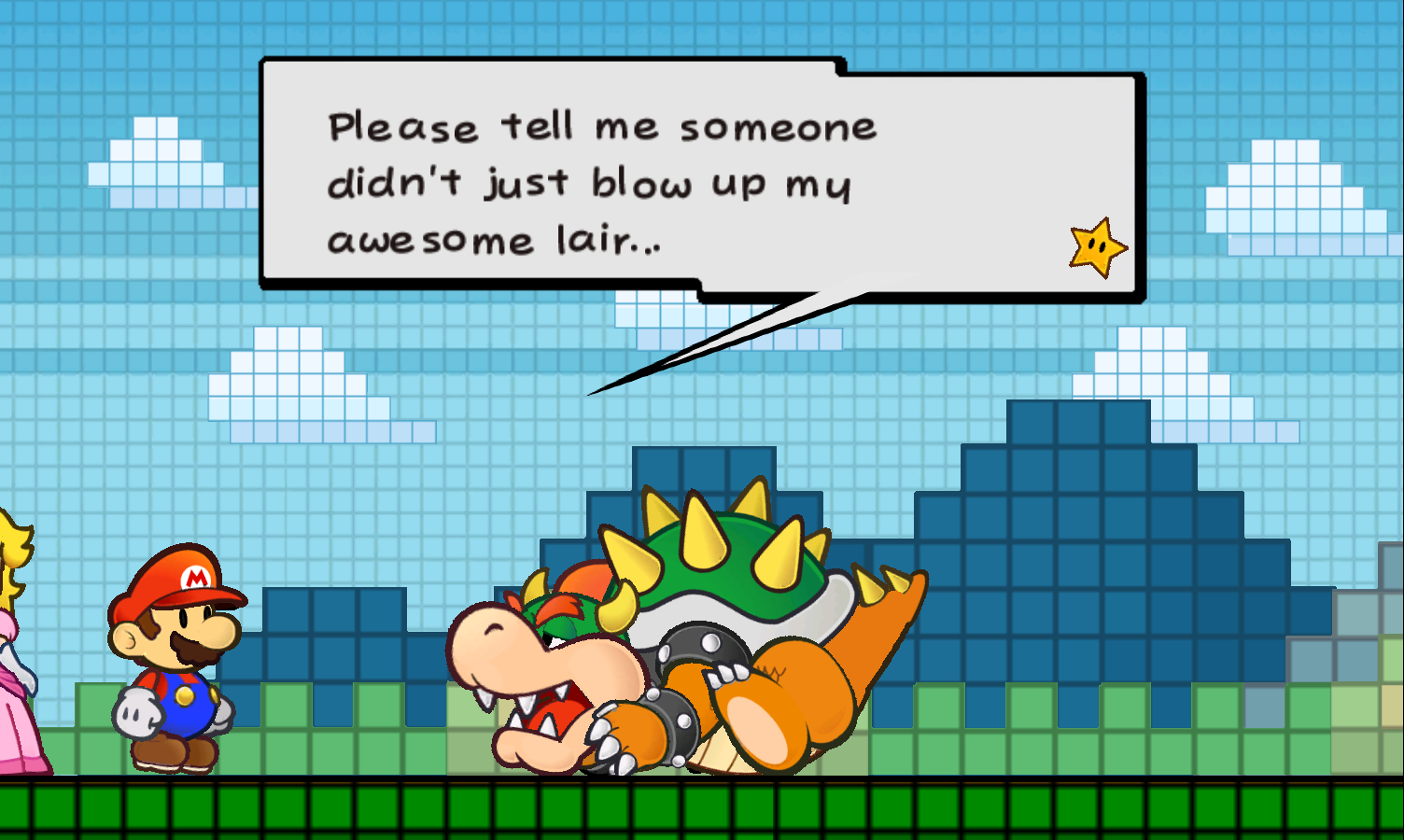
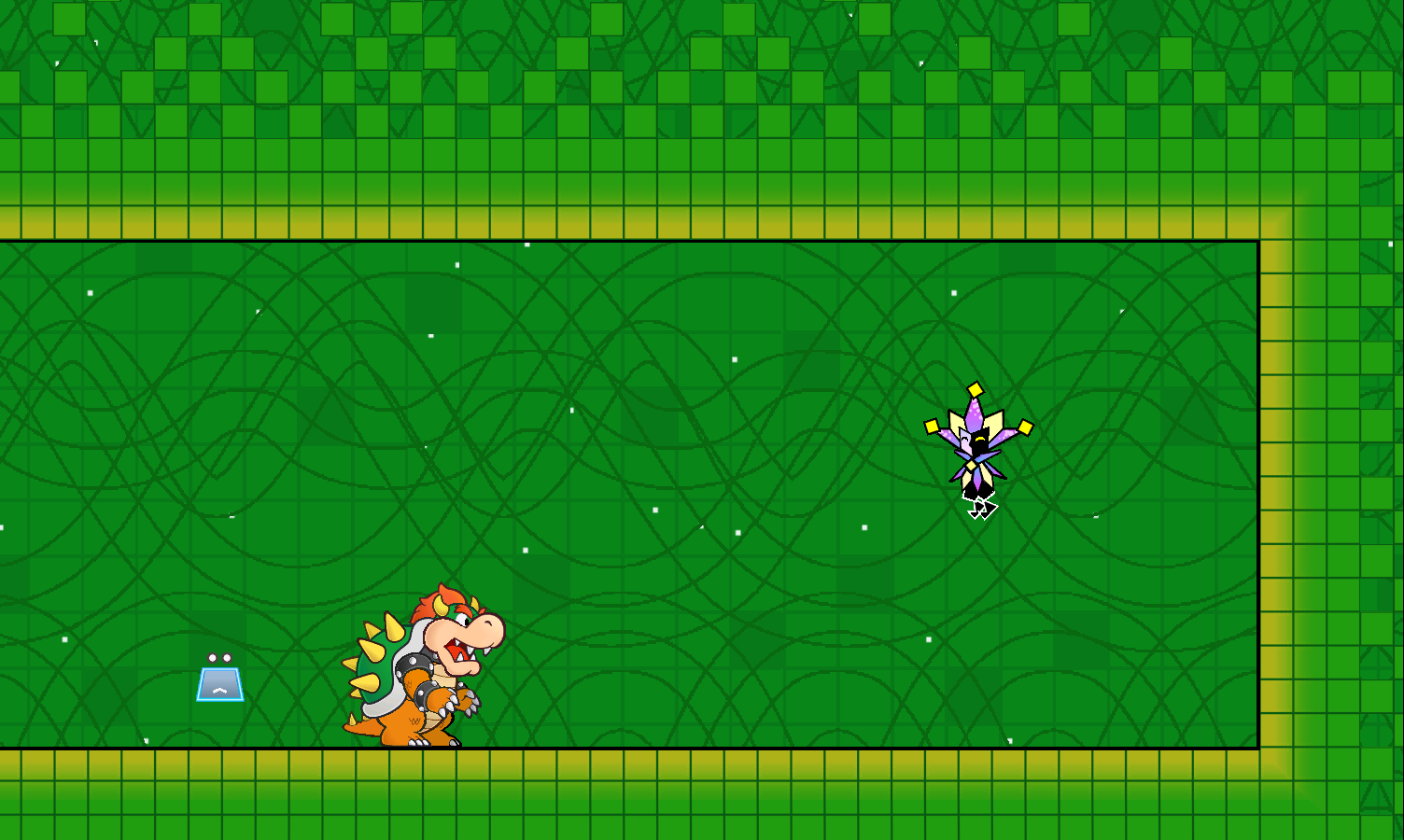
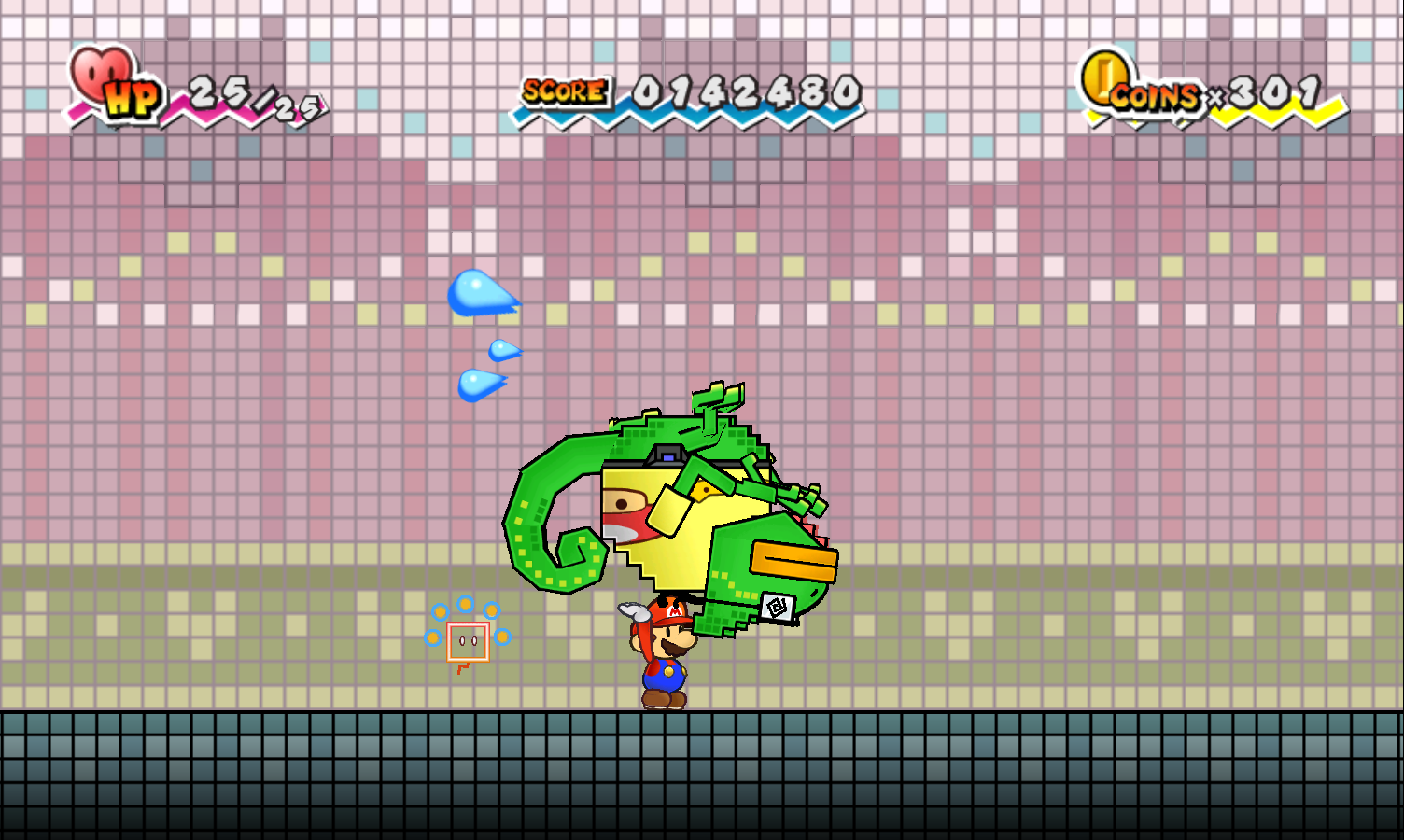
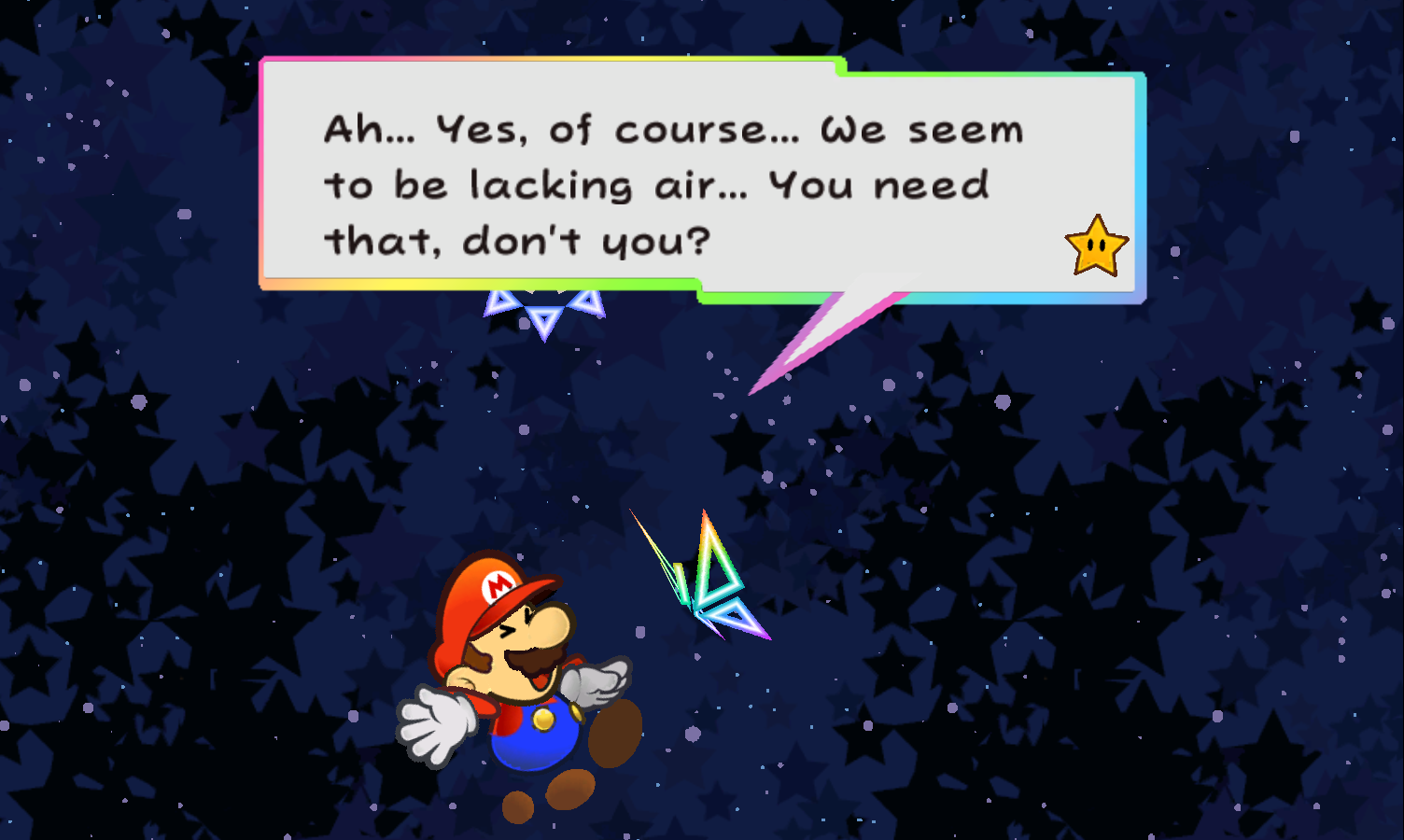
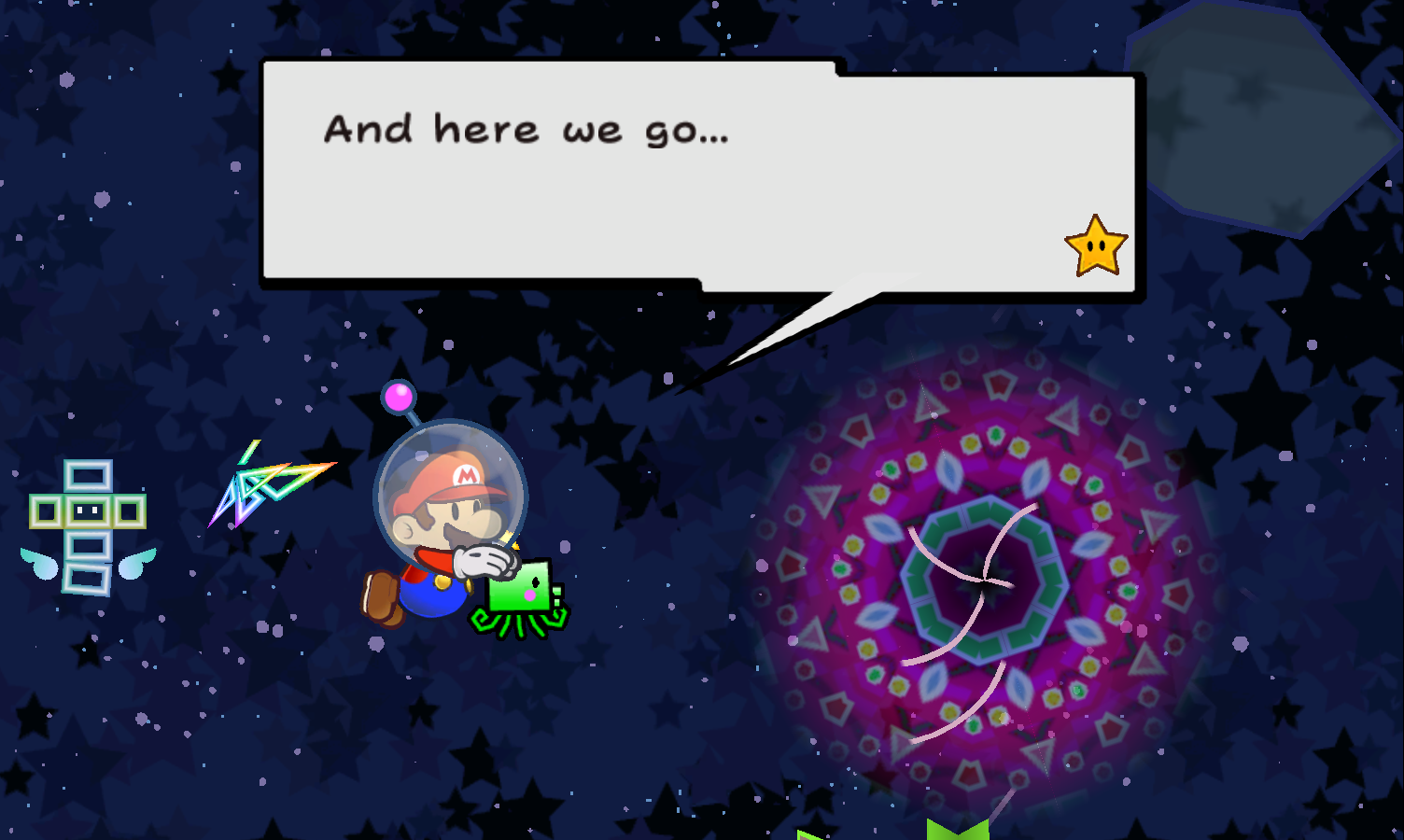
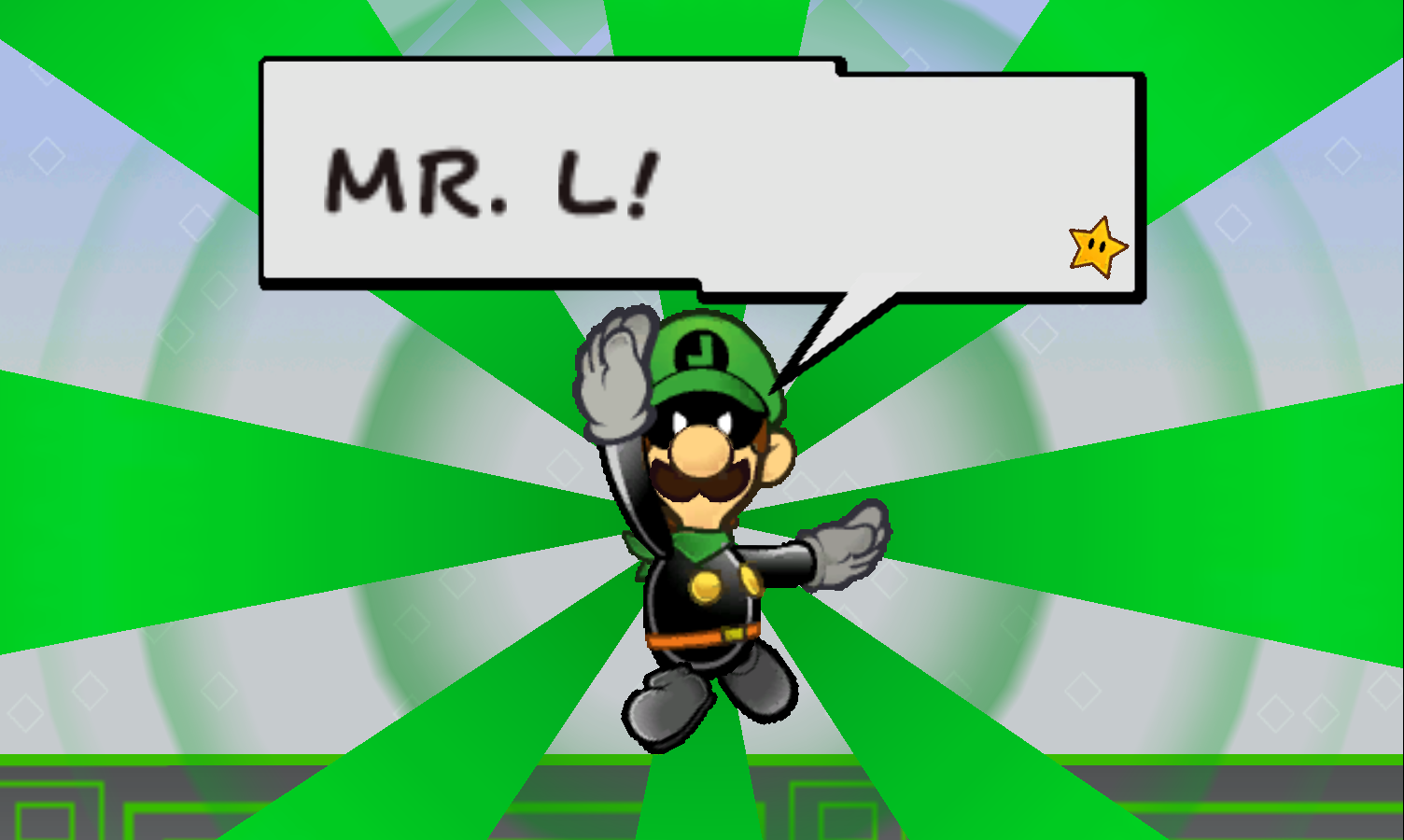
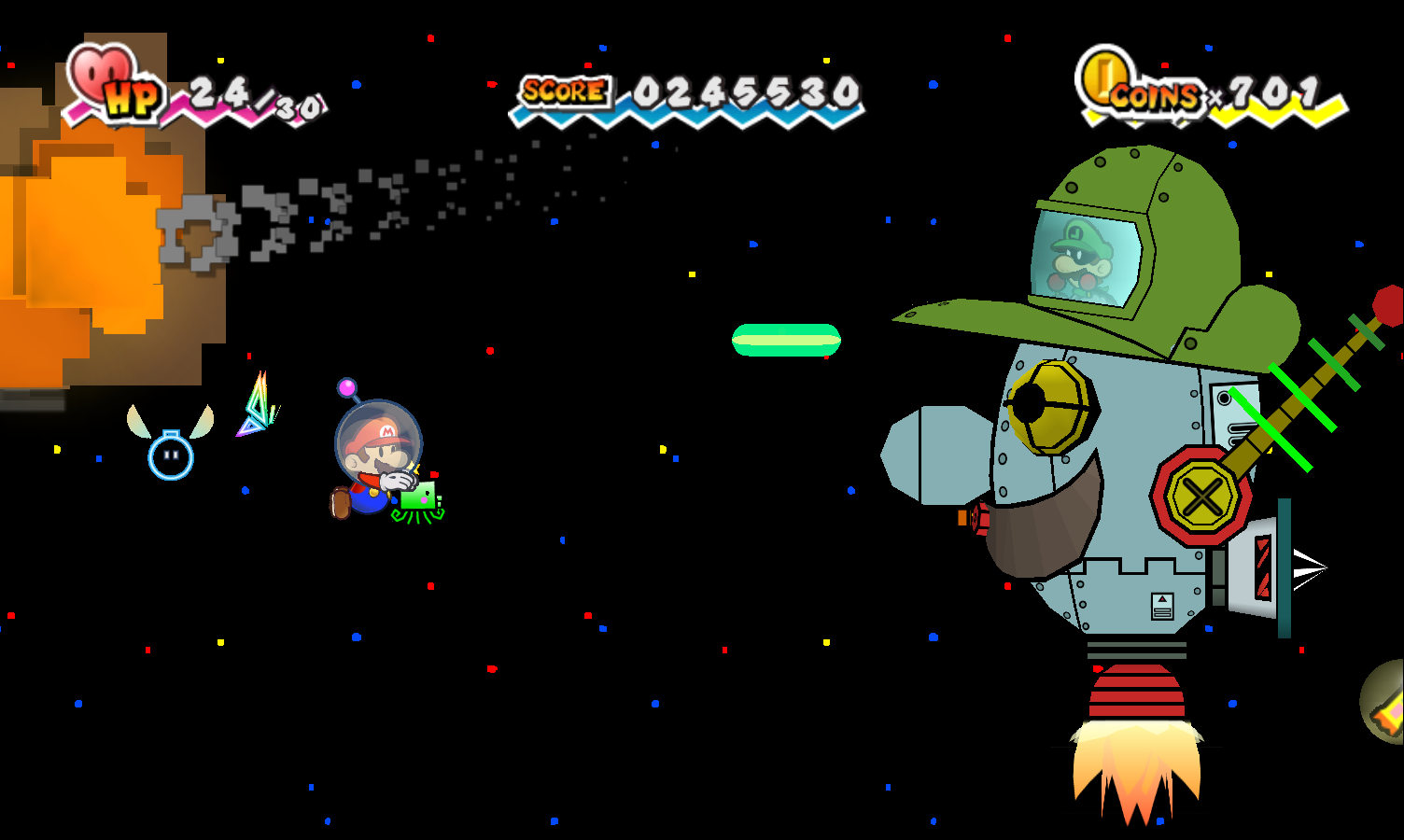
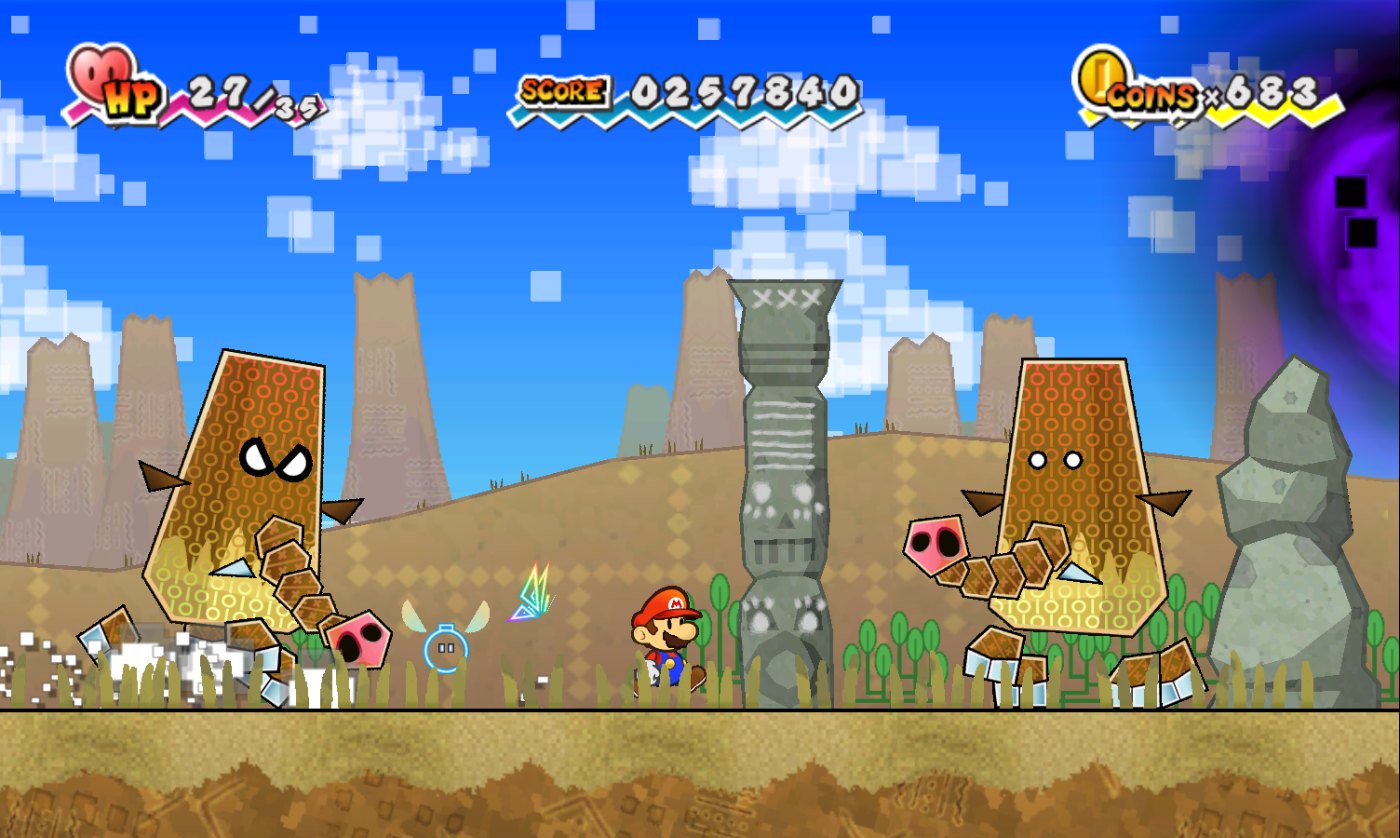
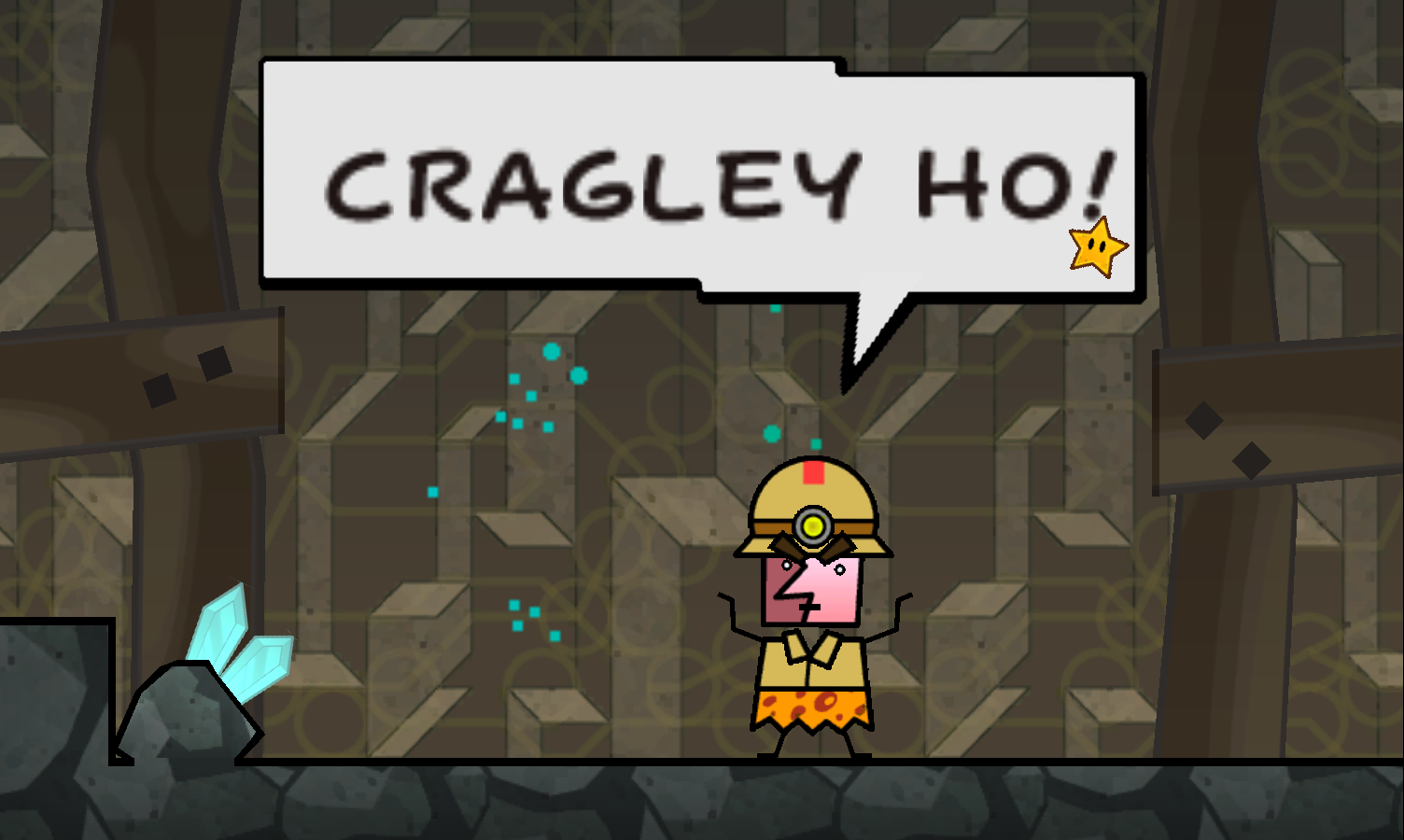
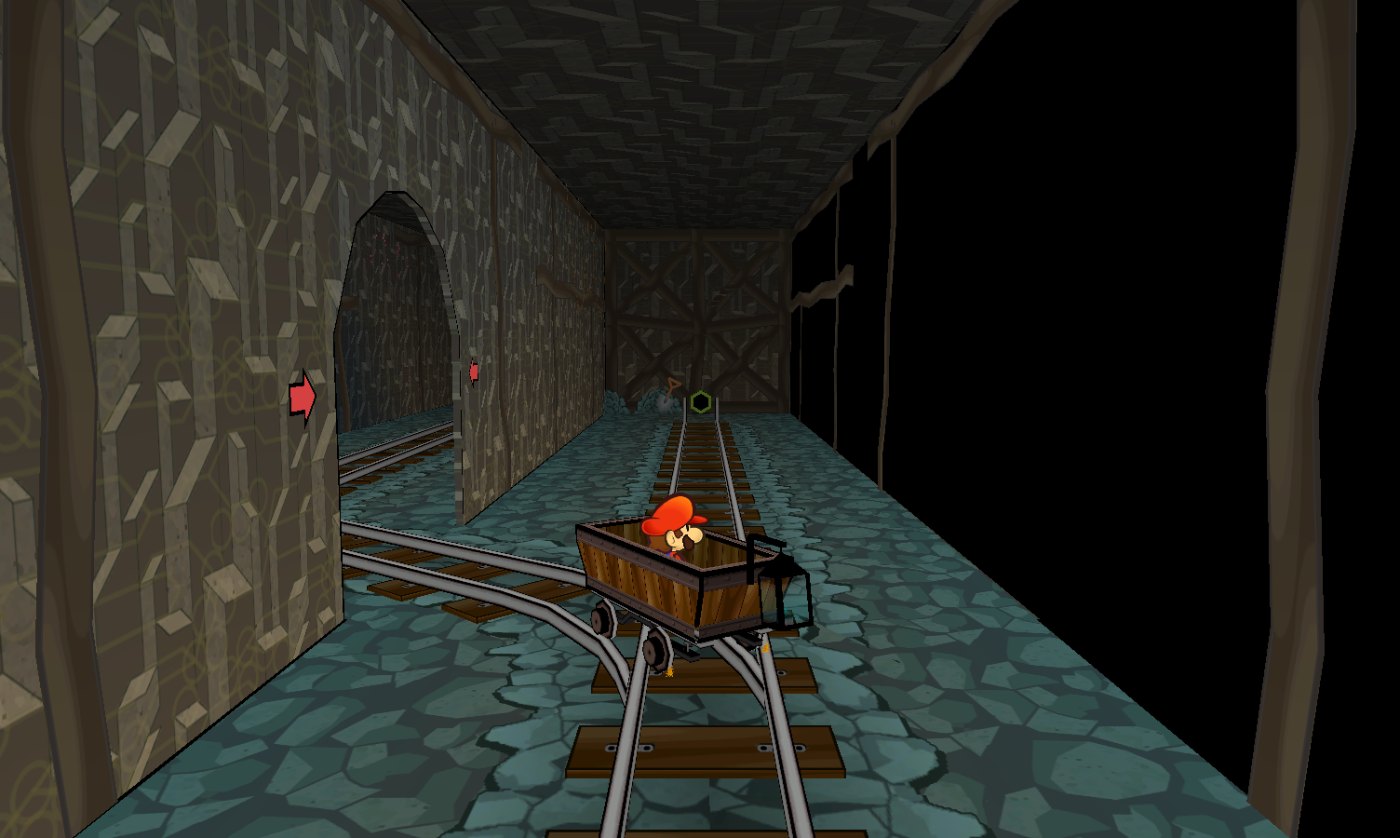
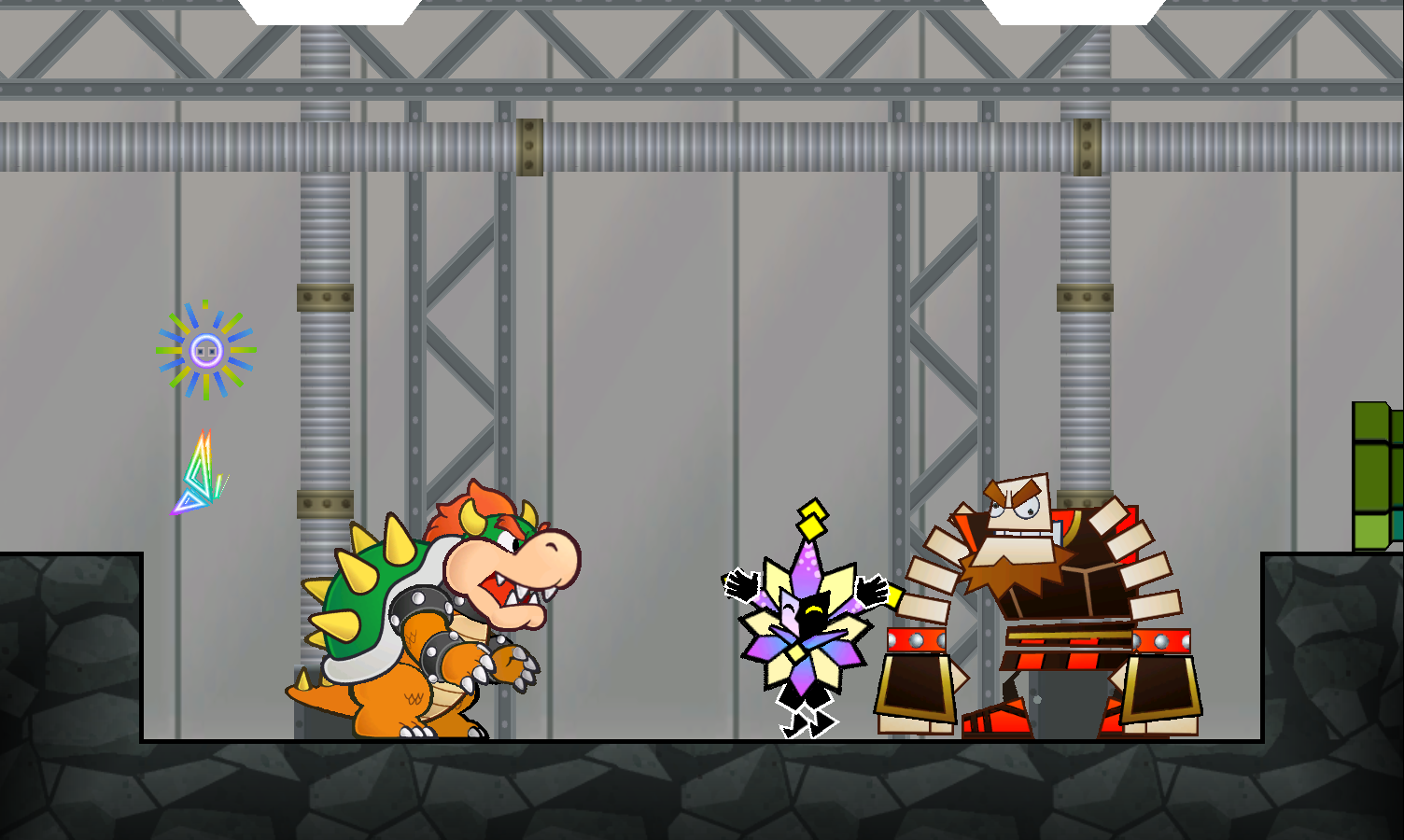
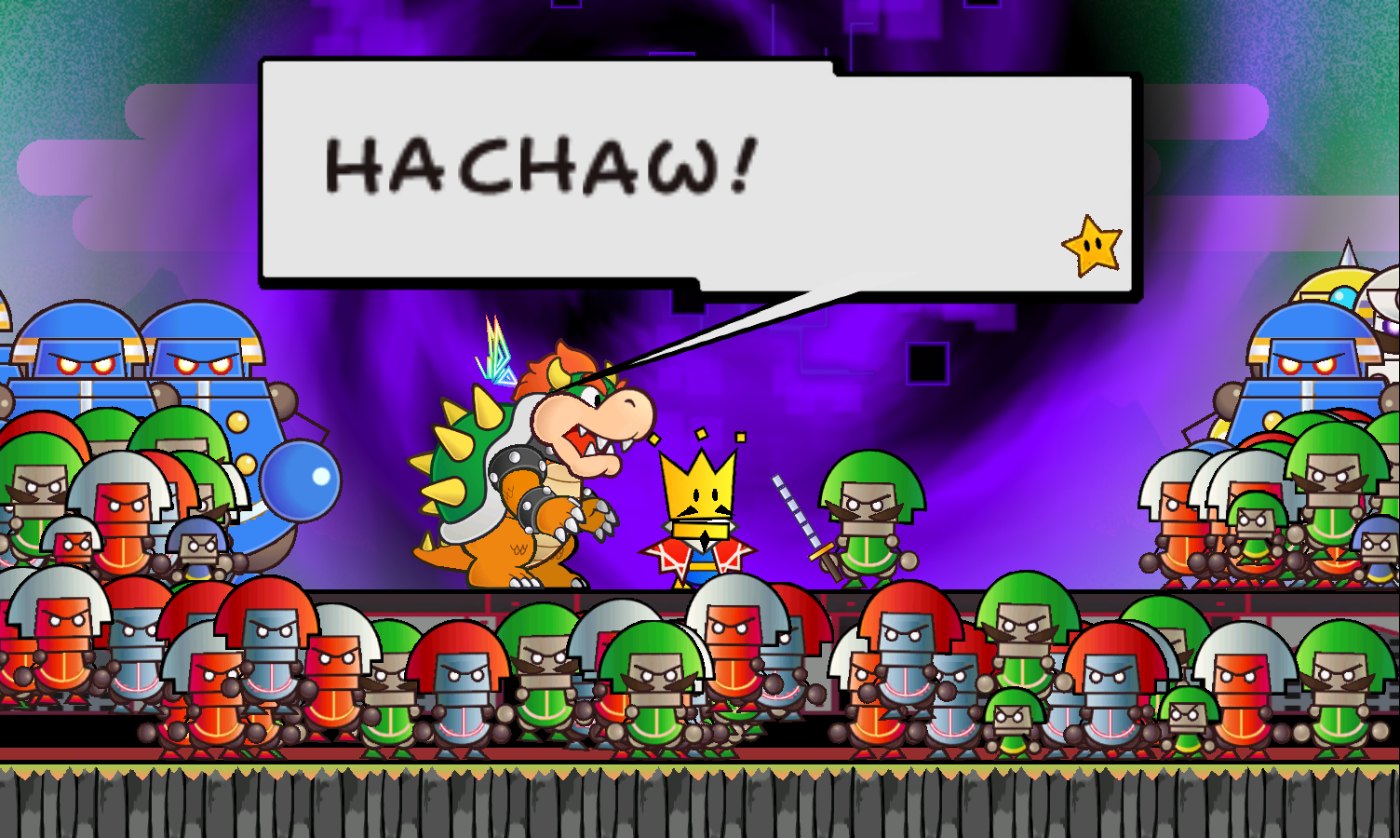
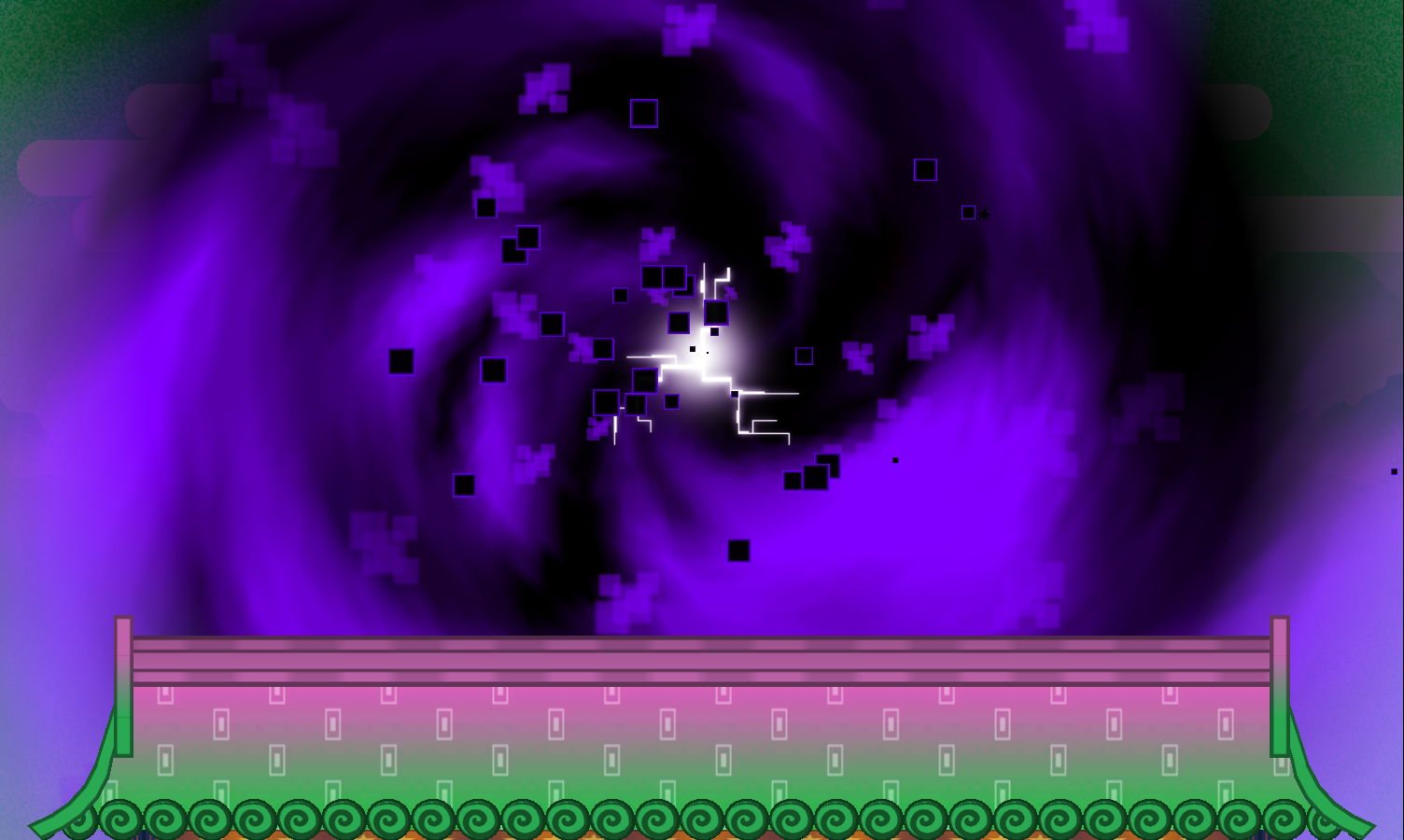
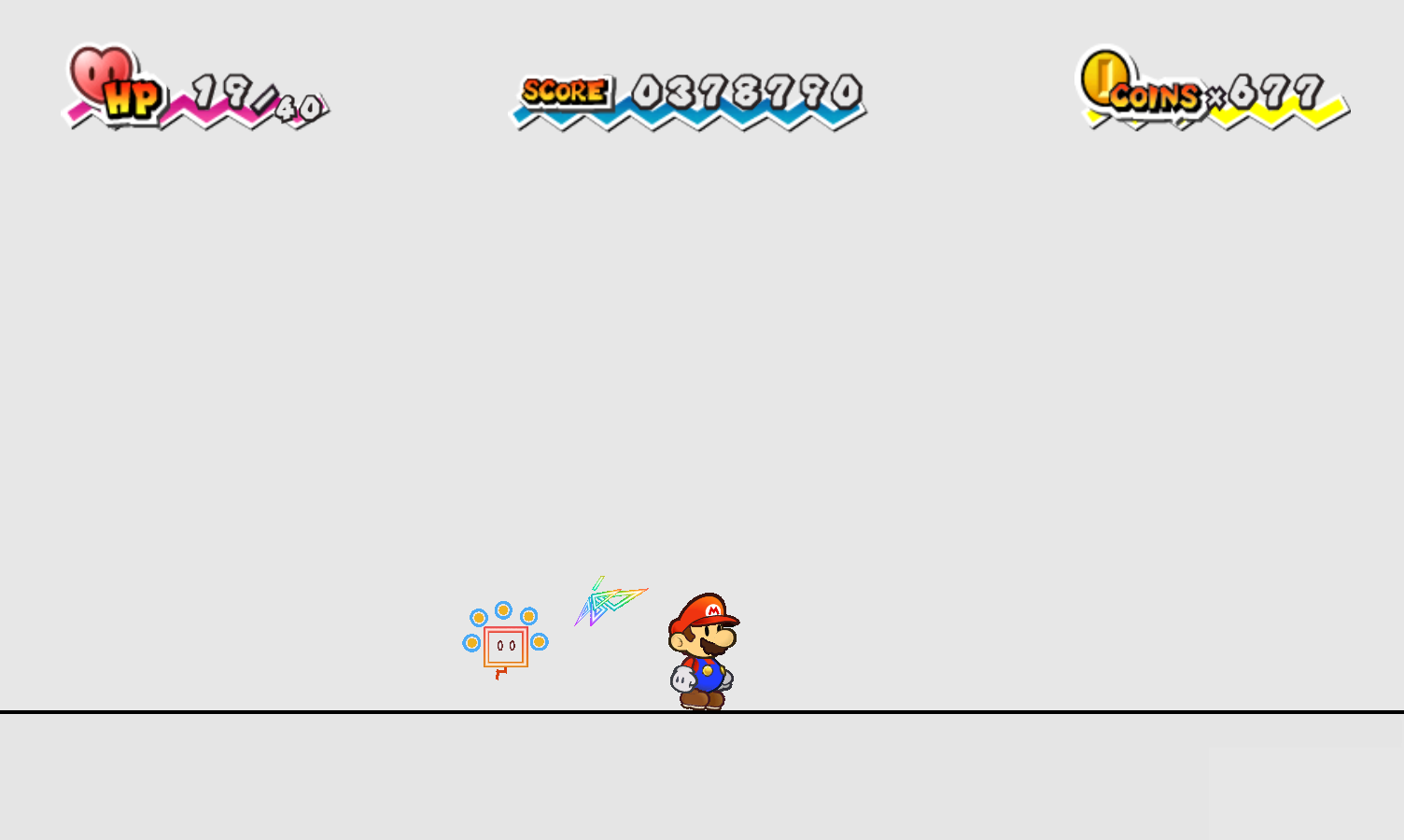
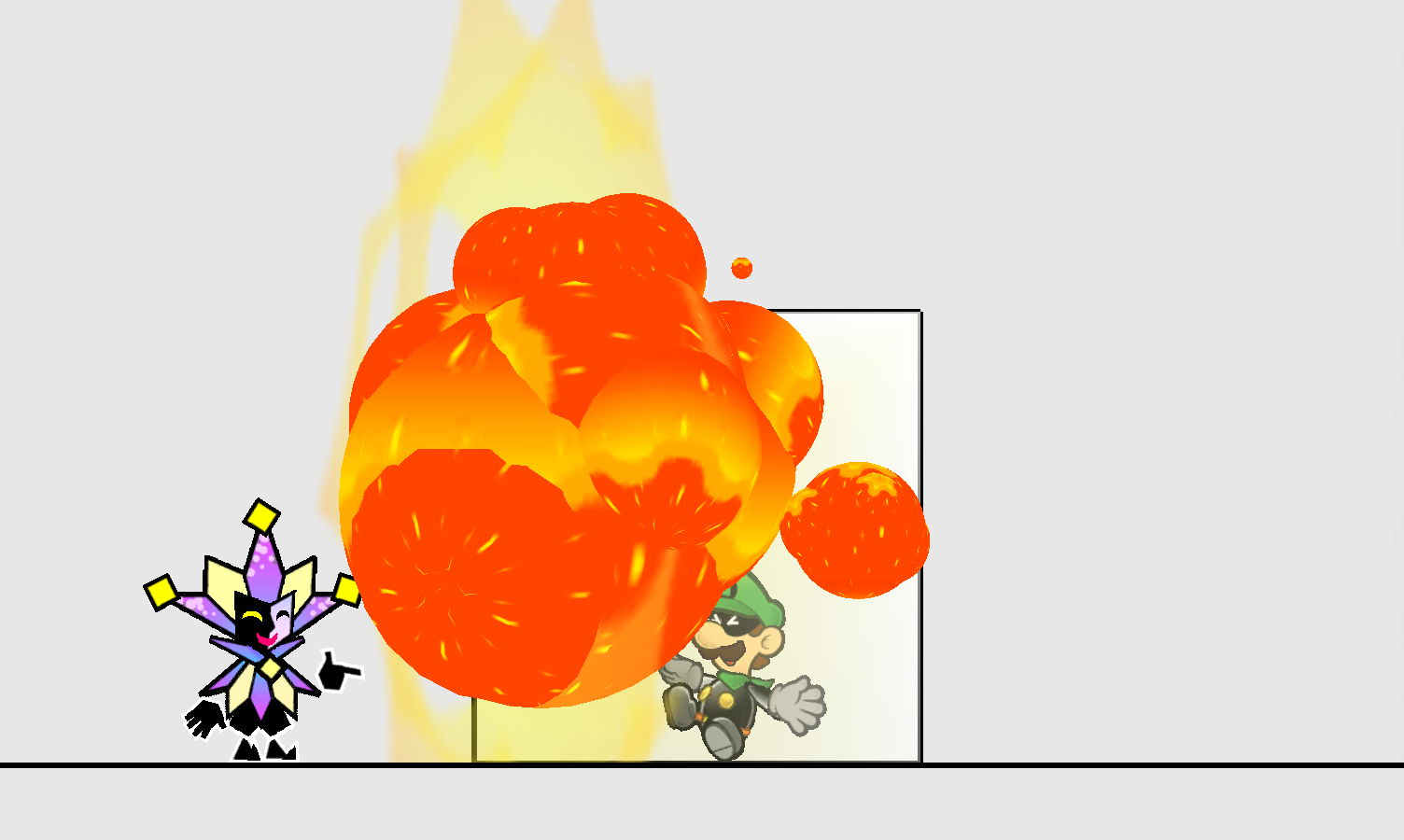
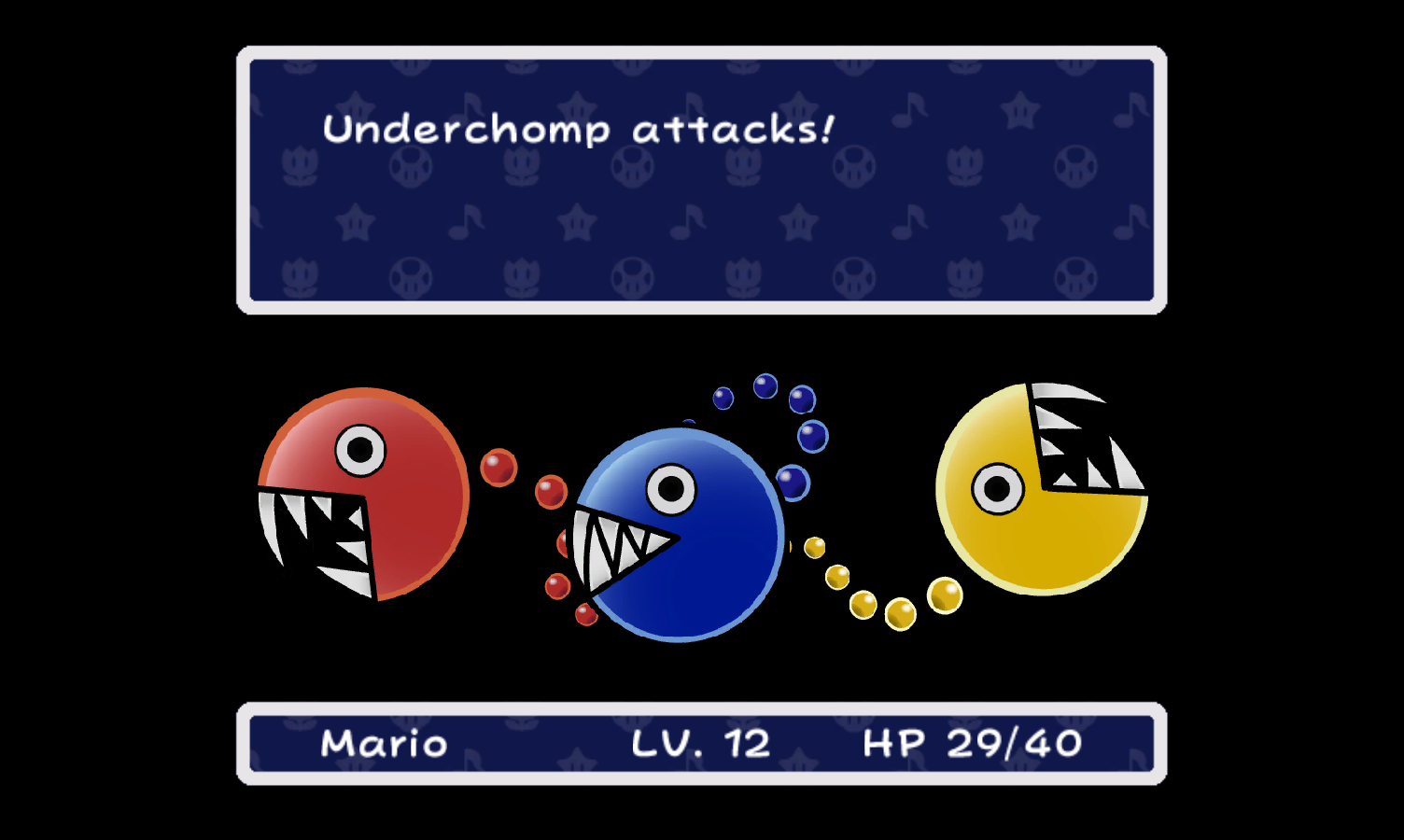
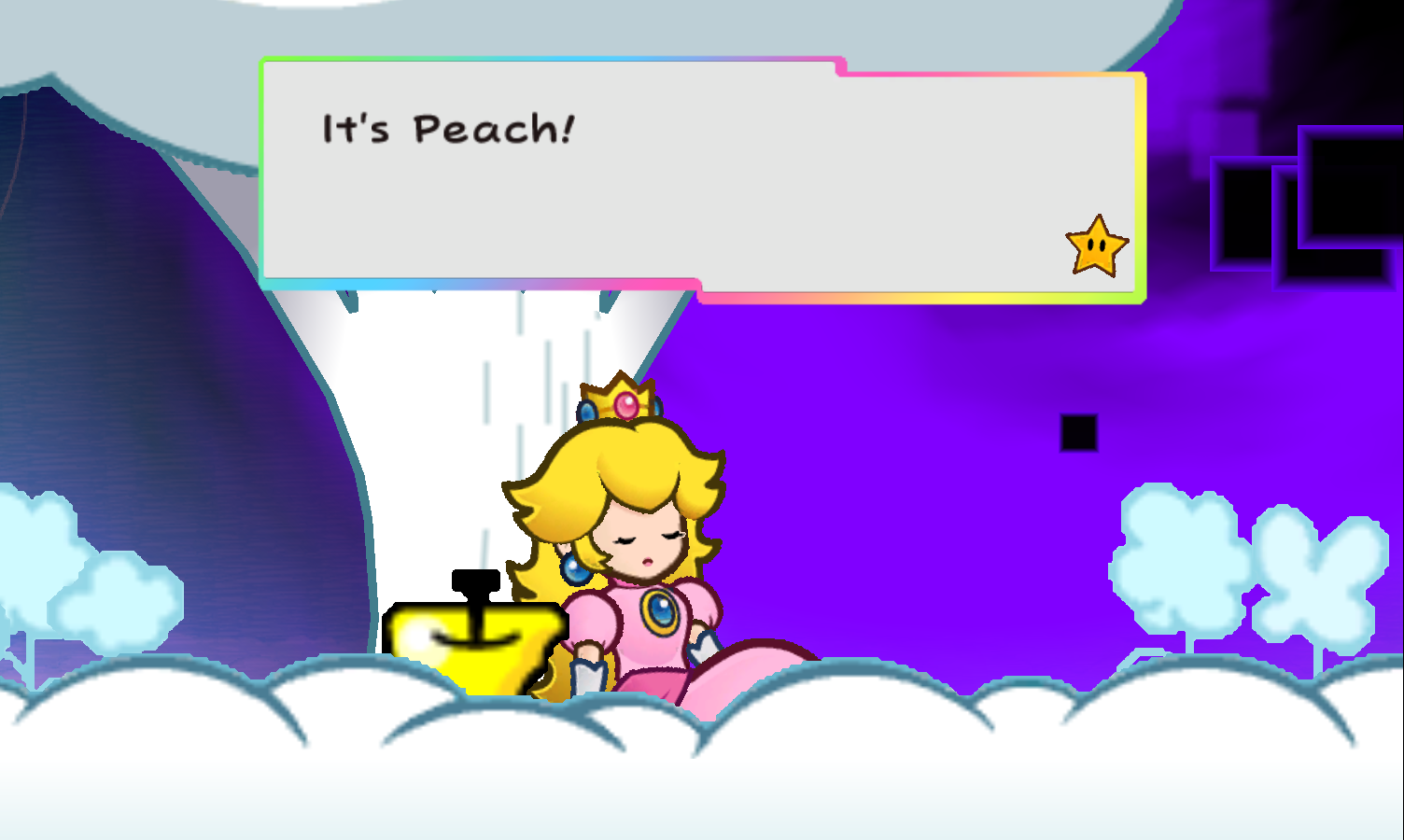
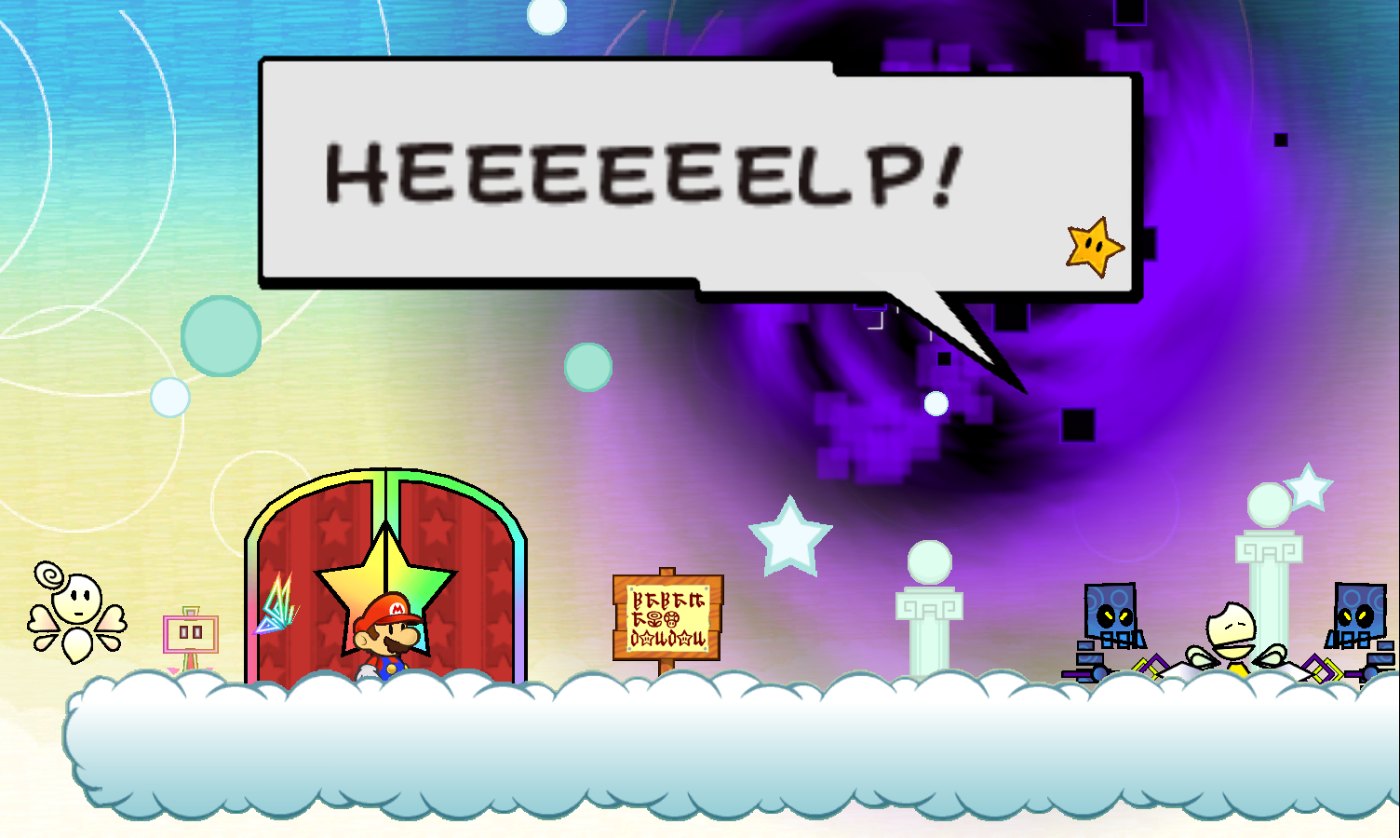


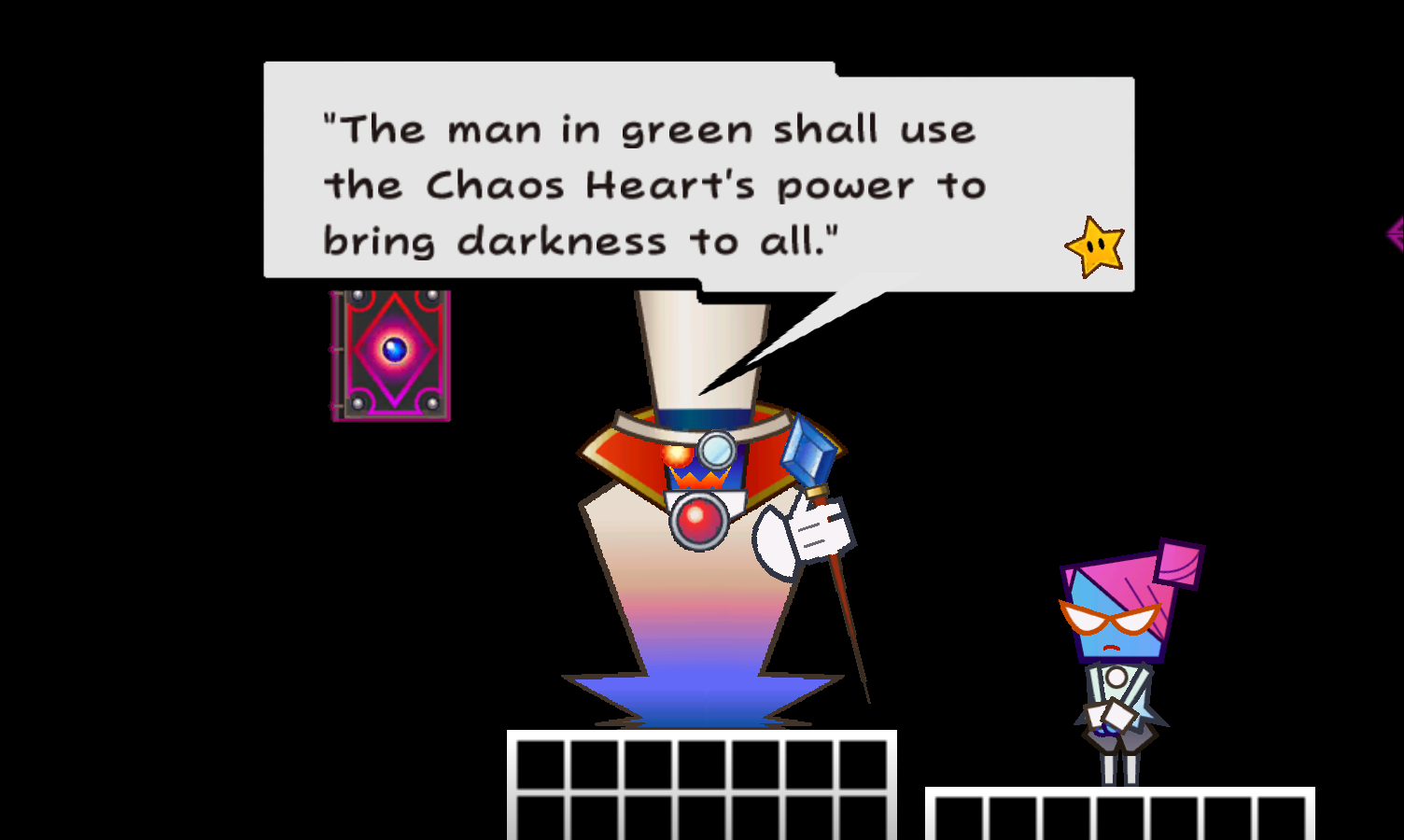
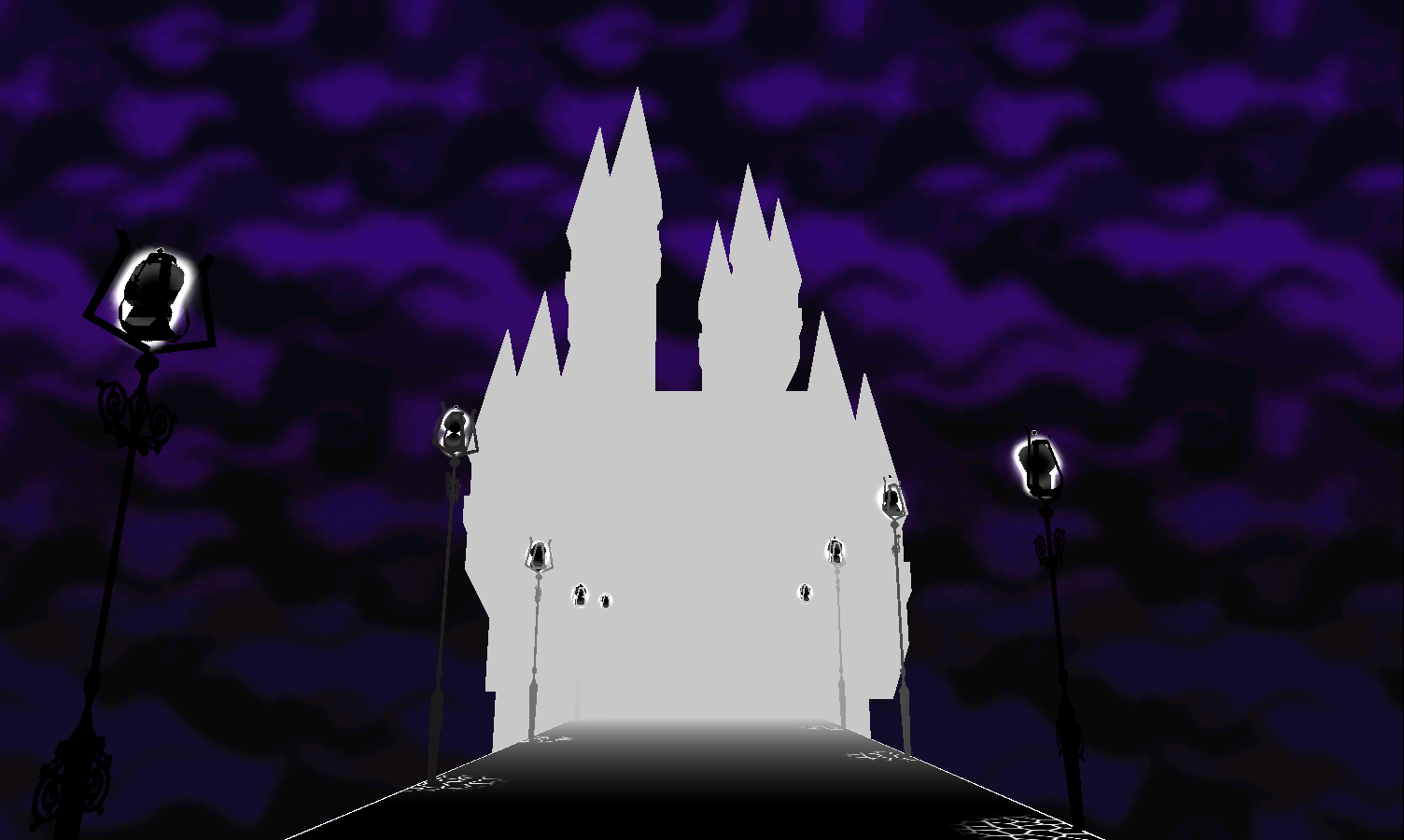
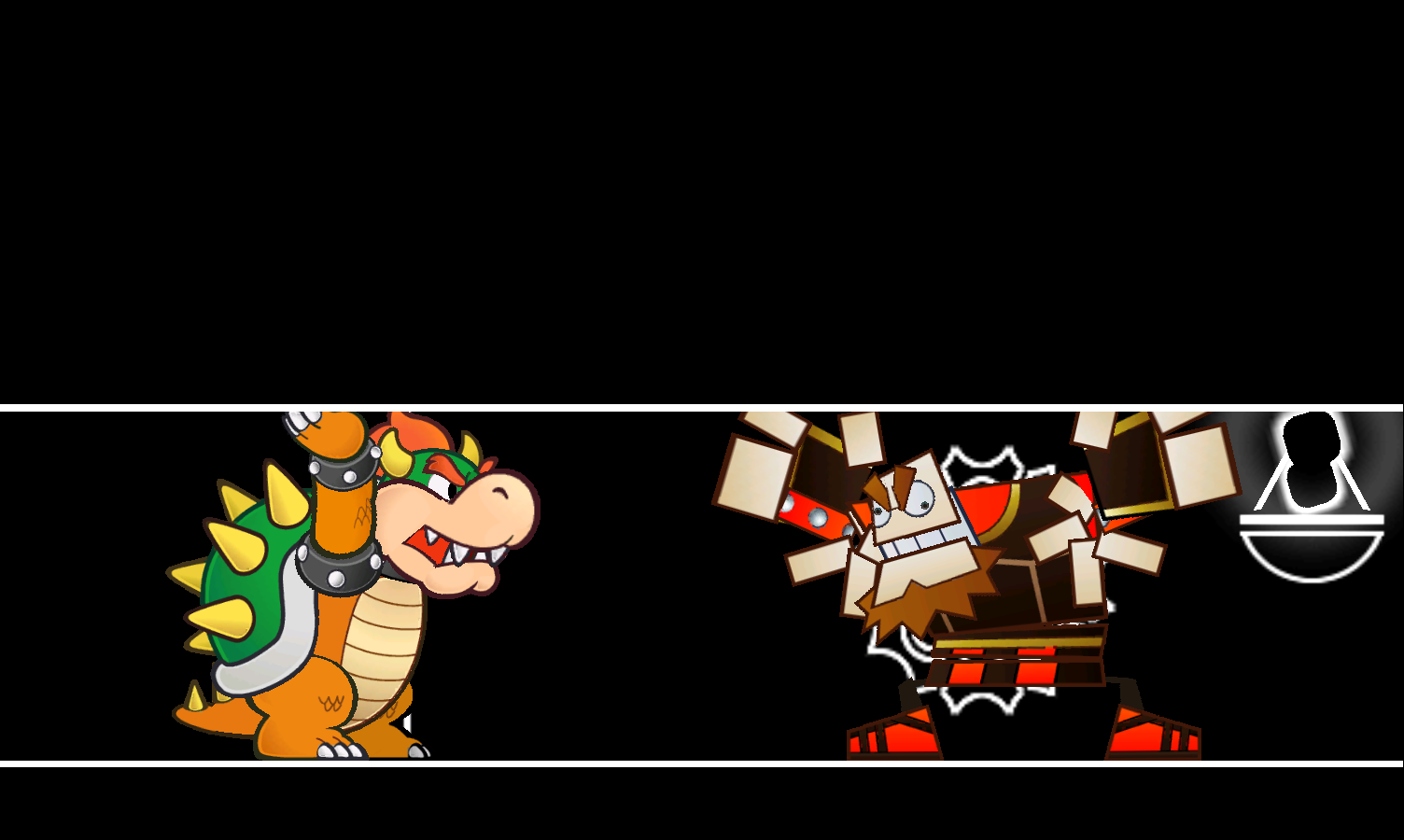
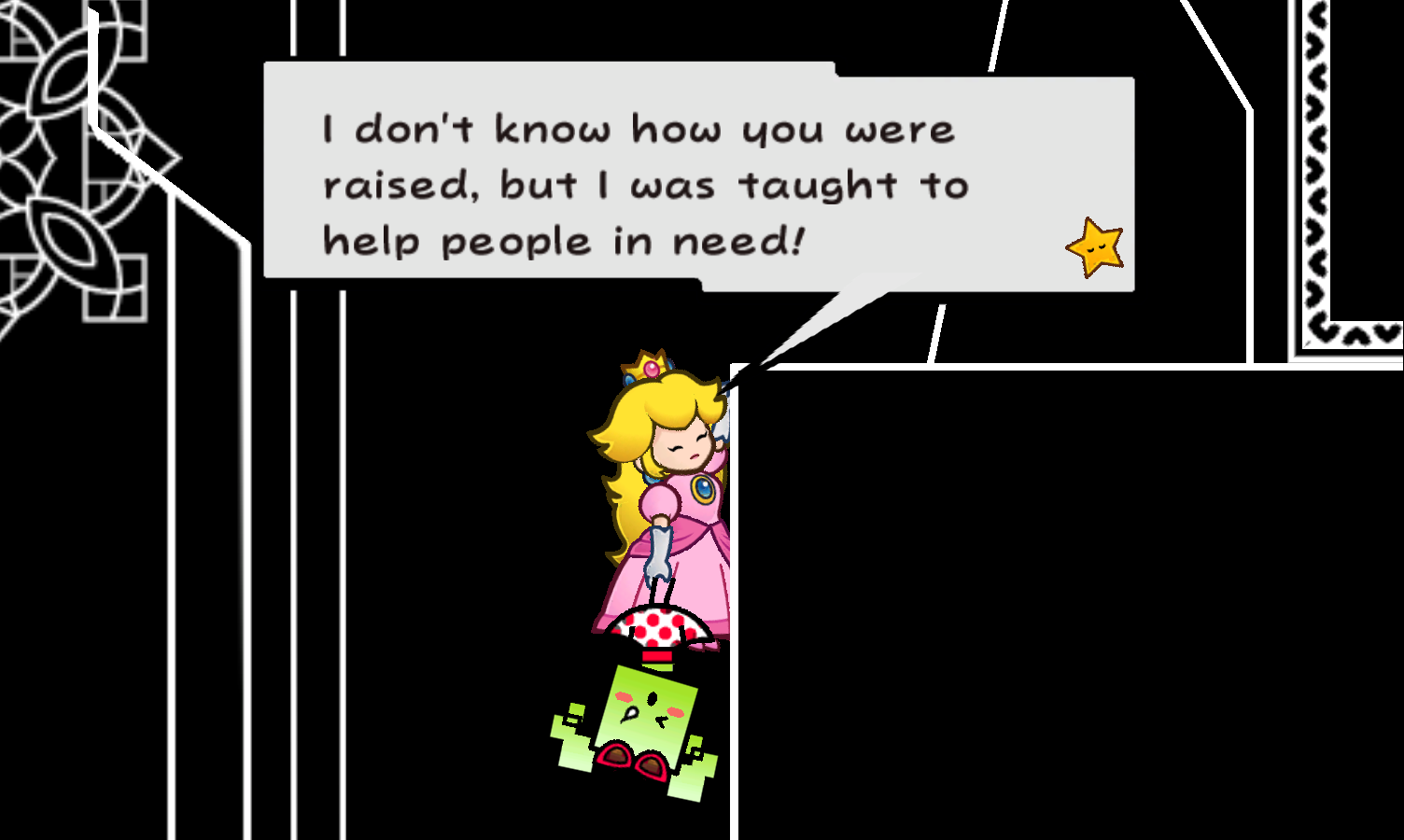
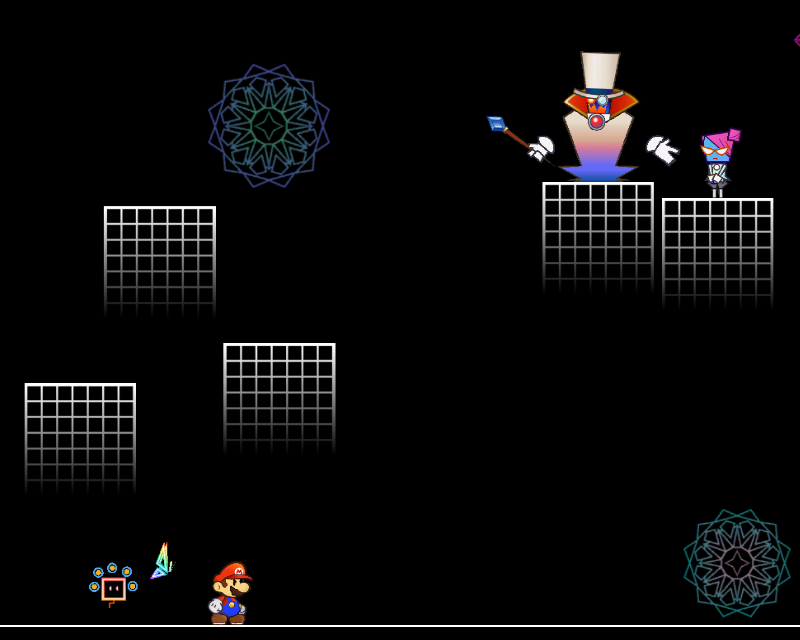
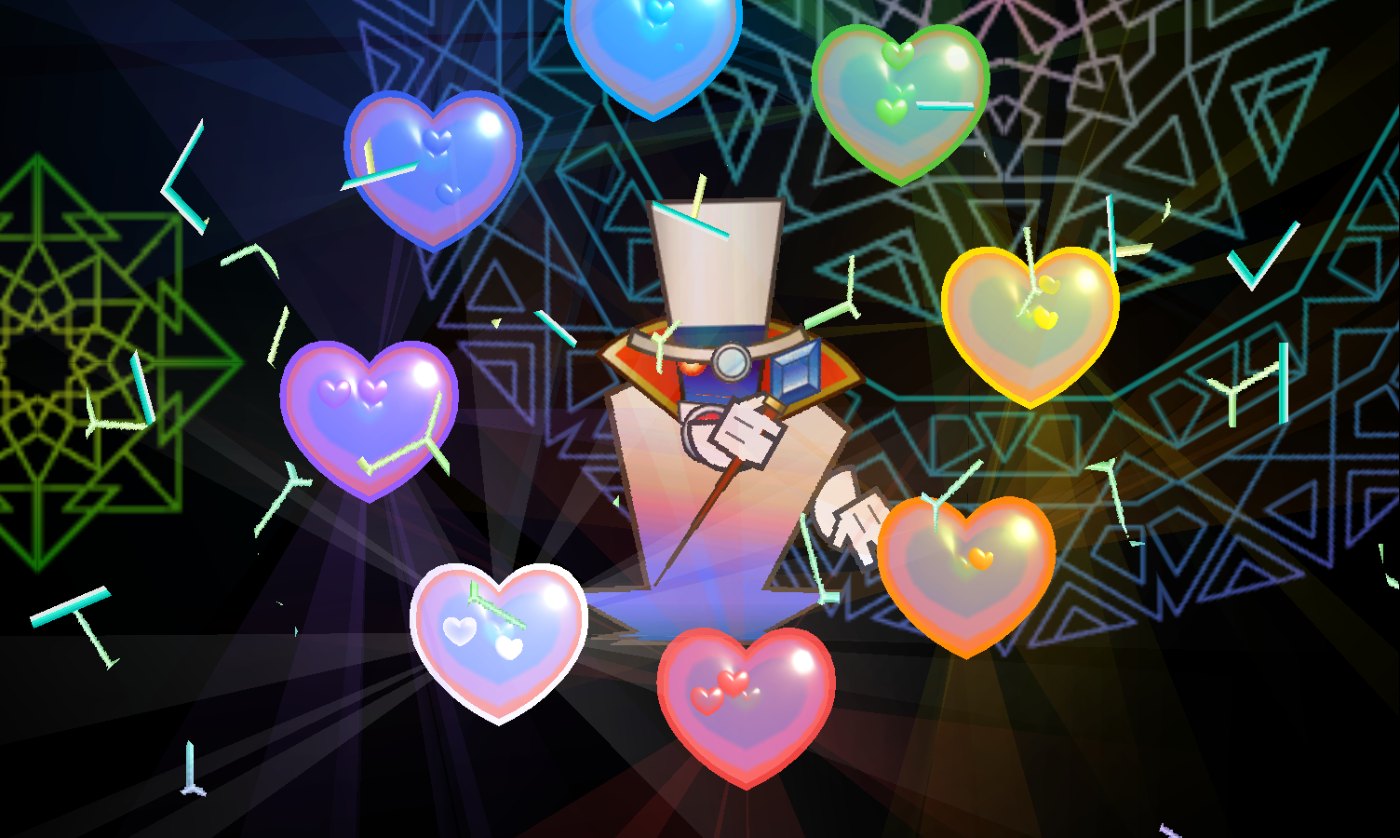
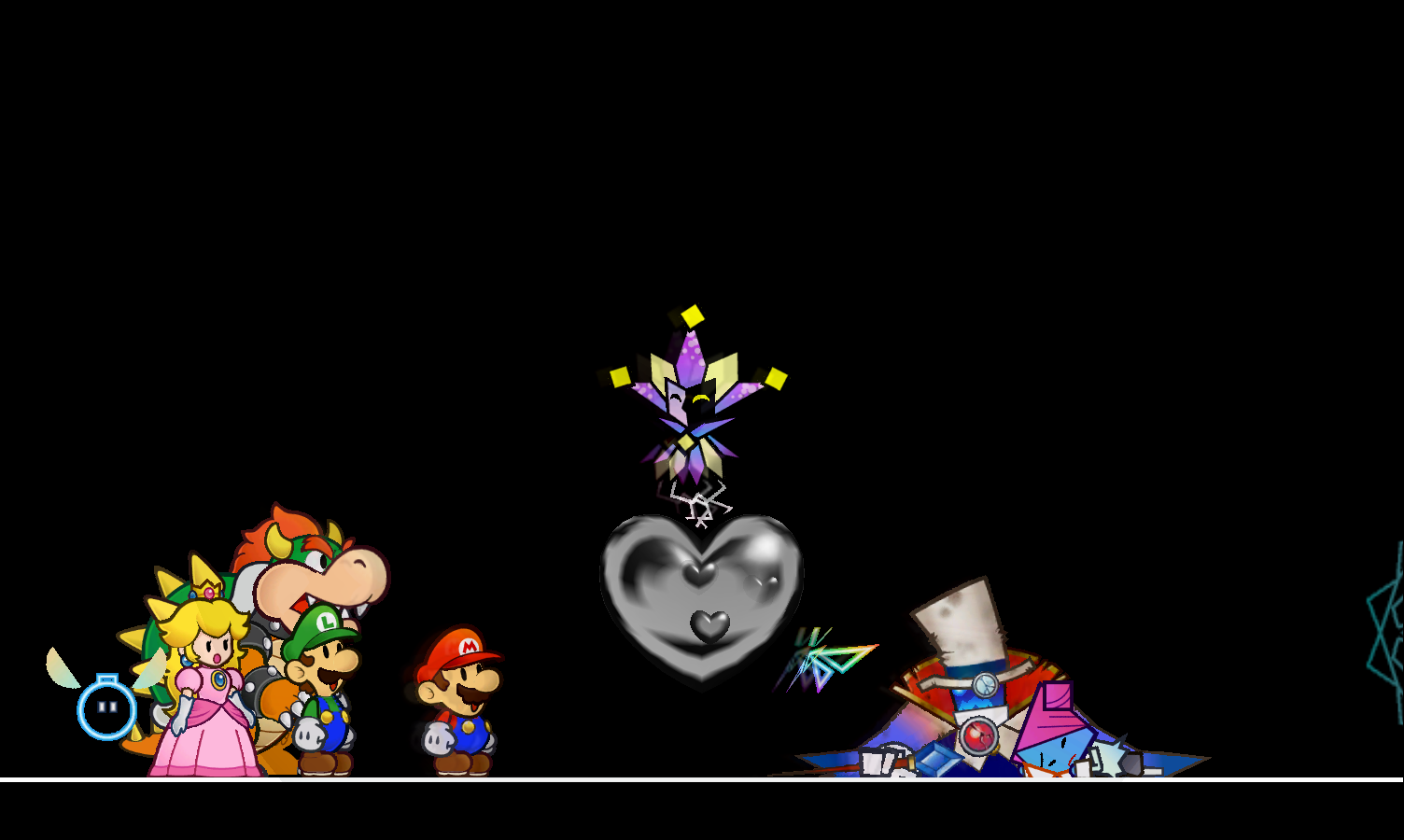
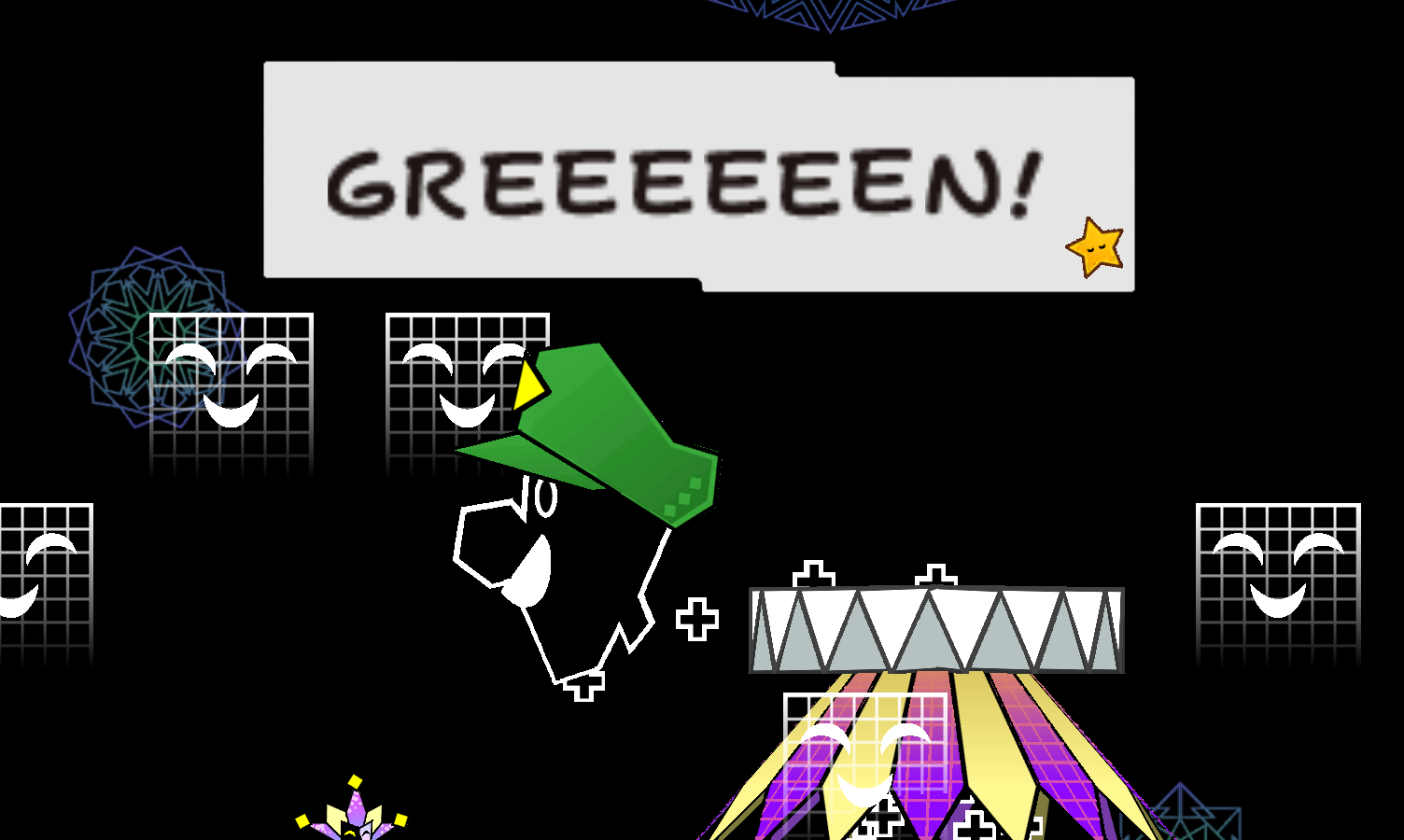
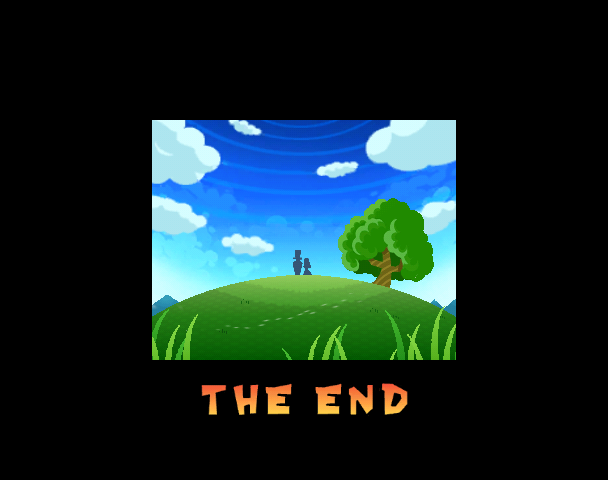

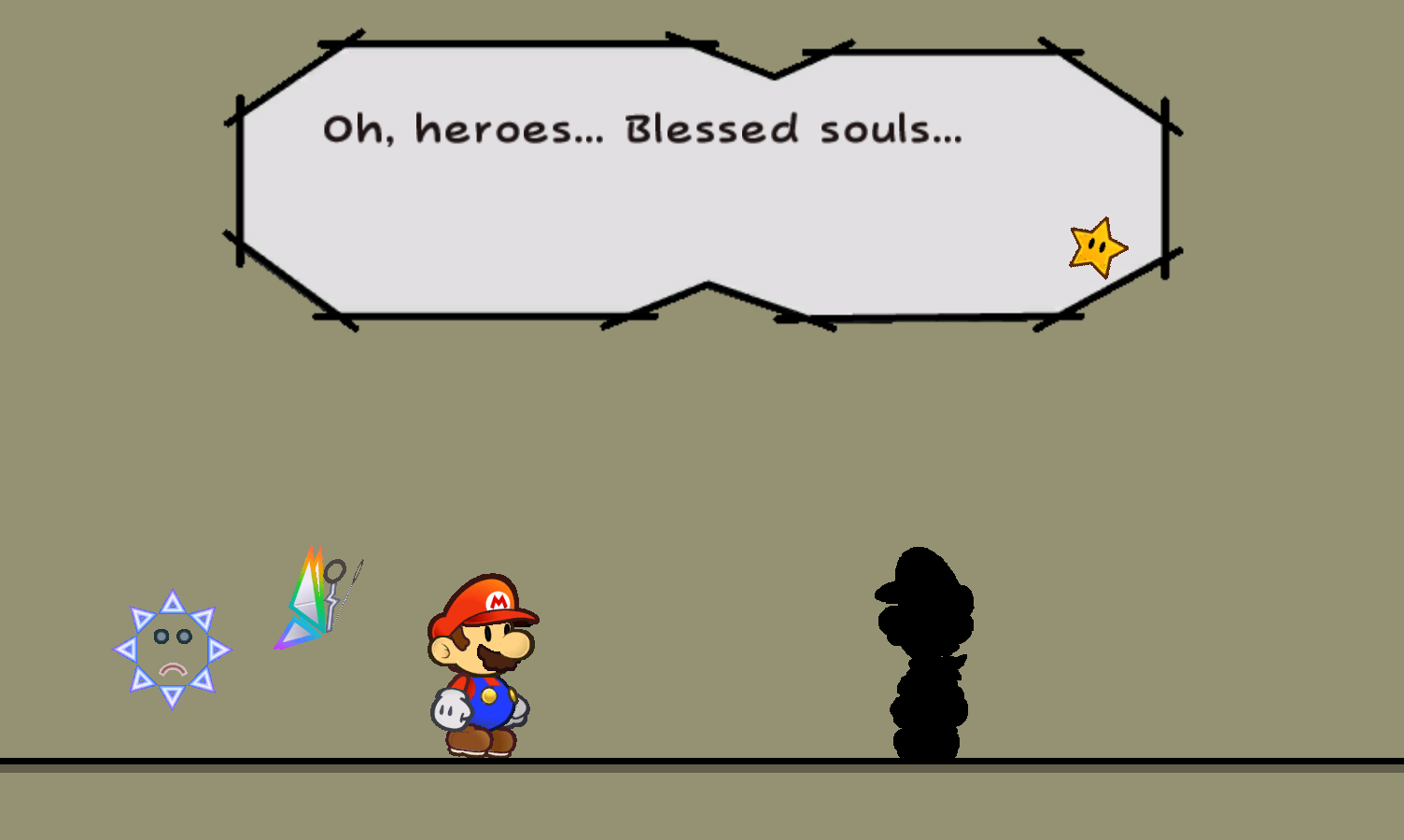
 Chapter 1: LinelandDoor: red Pure Heart · Won: orange · Bosses: O’Chunks, FracktailLineland Road, Mount Lineland, Yold Desert and Yold Ruins. Hills, a hill town, a desert and a ruin with a dragon in it. Thoreau joins.
 Chapter 2: Gloam ValleyDoor: orange · Won: yellow · Boss: MimiGloam Valley, Merlee’s Mansion (twice) and Merlee’s Basement. A gloomy valley and a mansion full of Boos, where Mario goes into debt. Boomer and Slim join.
 Chapter 3: The BitlandsDoor: yellow · Won: green · Bosses: Bowser, Big Blooper, Dimentio, FrancisThe Bitlands, the Tile Pool, the Dotwood Tree and Fort Francis. An 8-bit landscape and the fortress of a very keen collector. Bowser, Thudley and Carrie join.
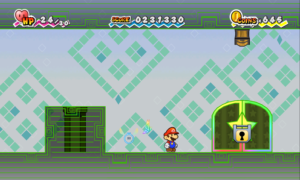 Chapter 4: Outer SpaceDoor: green · Won: blue · Bosses: Mr. L, BrobotOuter Space, Planet Blobule, Outer Limits and the Whoa Zone. Space travel in a goldfish-bowl helmet, with Squirps as guide. Fleep joins.
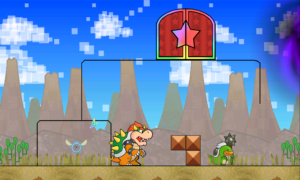 Chapter 5: Land of the CragnonsDoor: blue · Won: indigo · Bosses: O’Chunks, O’Cabbage, King Croacus IVDowntown of Crag, Gap of Crag and Floro Caverns (twice). Cavemen above, flower people below. Cudge and Dottie join.
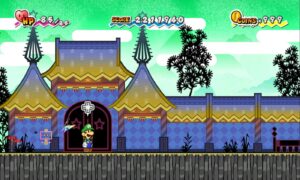 Chapter 6: Sammer’s KingdomDoor: indigo · Won: violet (as stone) · Bosses: Mimi, Brobot L-typeSammer’s Kingdom, Early Duels, Proving Grounds and Endgame. A hundred duels that The Void interrupts; what is left is the World of Nothing.
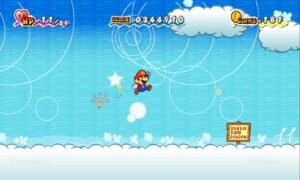 Chapter 7: The UnderwhereDoor: violet · Won: white · Bosses: Bowser, Underchomp, BonechillThe Underwhere, Underwhere Road, Overthere Stair and The Overthere. From the land of ended games to the clouds. Luigi joins just beforehand.
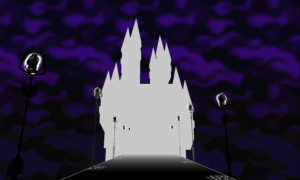 Chapter 8: Castle BleckDoor: white · Bosses: O’Chunks, Mimi, Dimentio, Count Bleck, Super DimentioEntry, Foyer, Interior and Inner Sanctum. The count’s castle, ringed by The Void, with the wedding chapel attached.
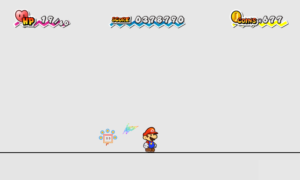 World of NothingAfter Chapter 6 · the stone Pure HeartWhat remains of Sammer’s Kingdom, and the thirty-third level. It is restored when the Chaos Heart is destroyed.
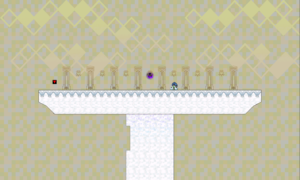 FlipsideHub town · four Heart PillarsBuilt by the Ancients between dimensions. Merlon, Saffron, Howzit’s shop, Merluvlee, an inn, the arcade under the Underwhere bar and, two basements down, a sealed pit.
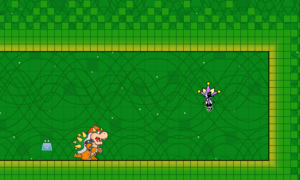 Dimension DDimentio’s pocket dimensionGreen, tiled and of Dimentio’s own making. He boasts that it makes him 256 times stronger, without mentioning that it does the same for everyone in it.
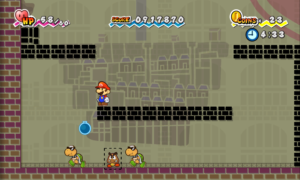 Flipside Pit of 100 TrialsOptional · Dashell · Boss: WracktailA hundred rooms, five minutes each. The background murals show Flipside, Fracktail, Merlee’s Mansion and Fort Francis.
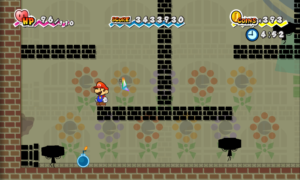 Flopside Pit of 100 TrialsOptional · hero cards · Boss: ShadooA hundred rooms of dark enemies, to be cleared twice.
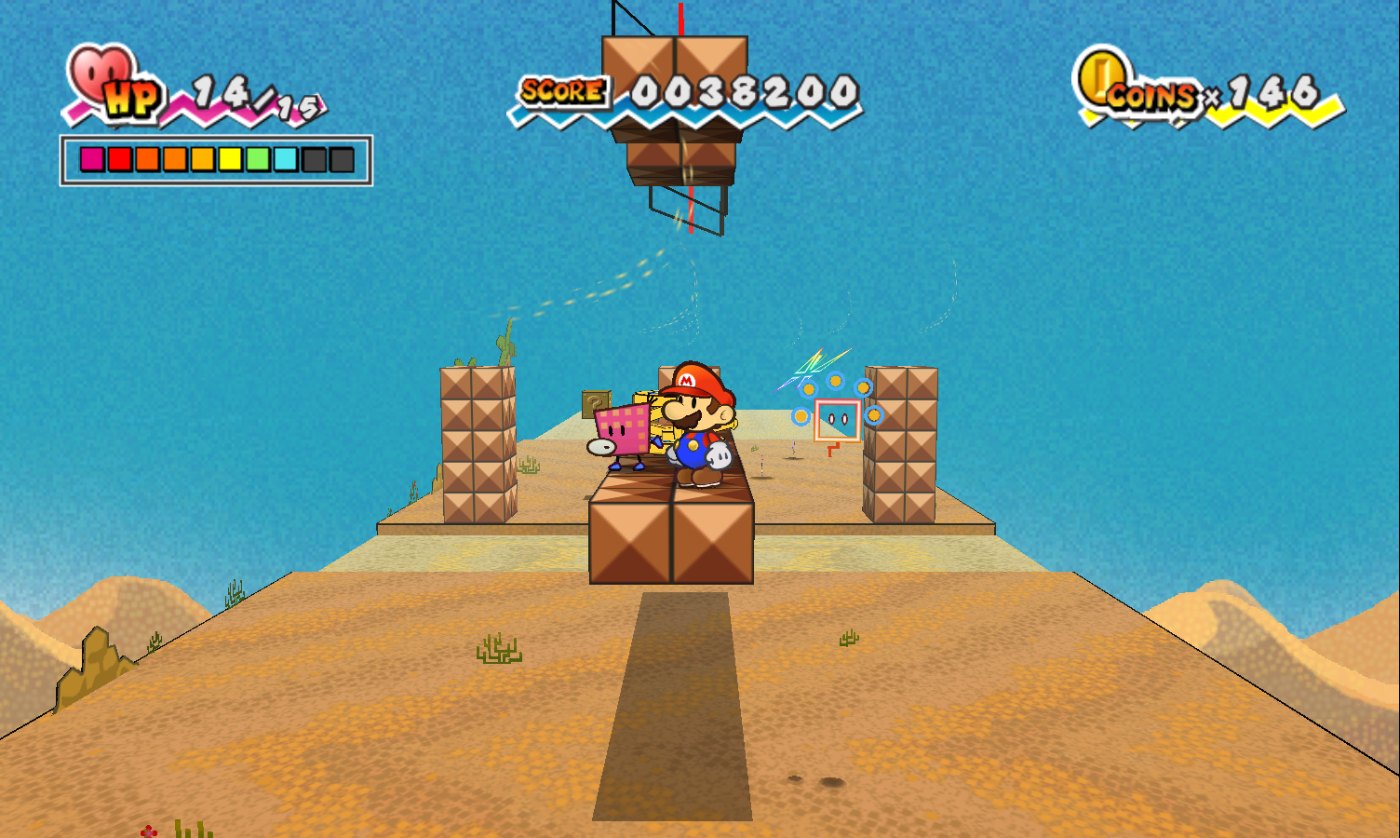
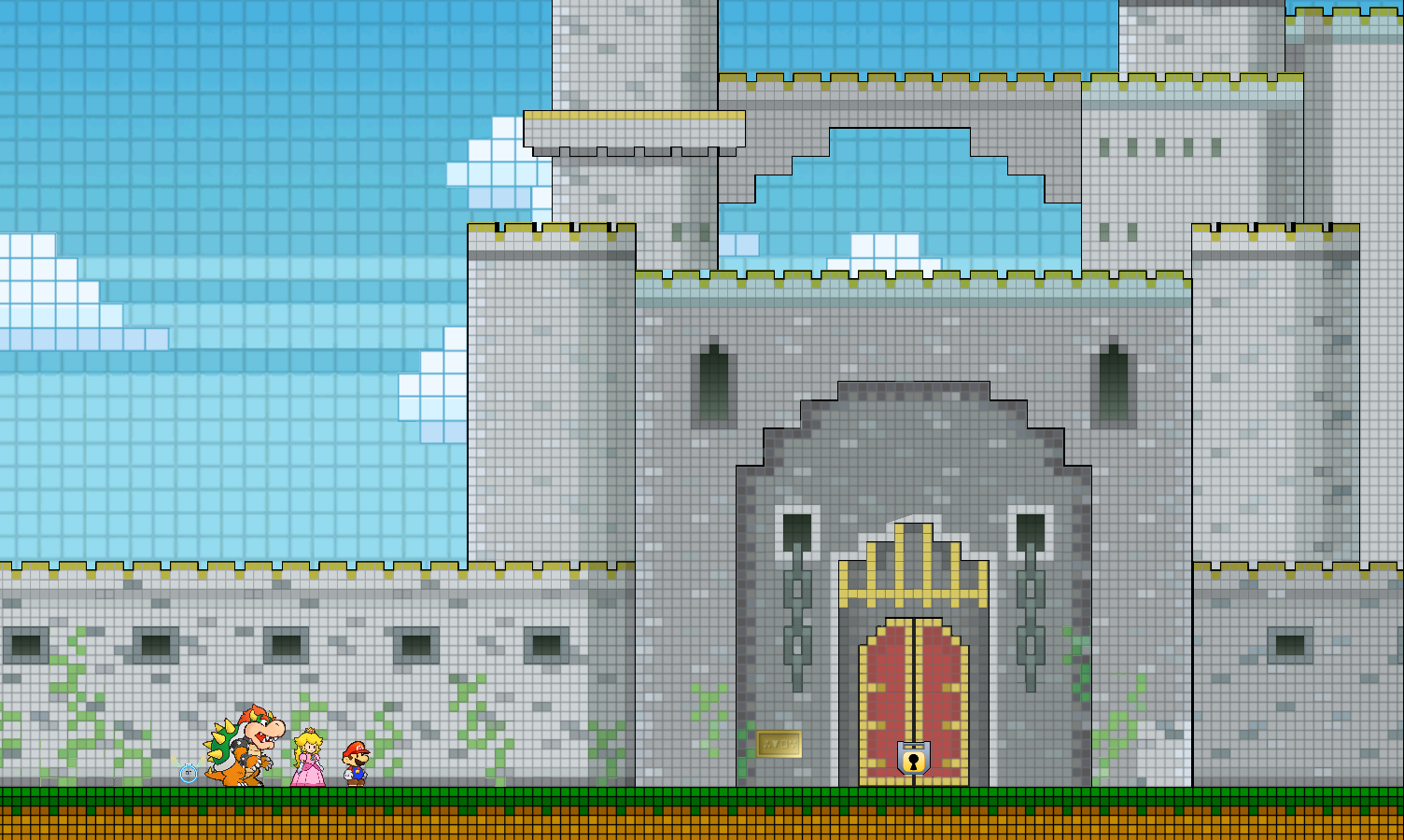
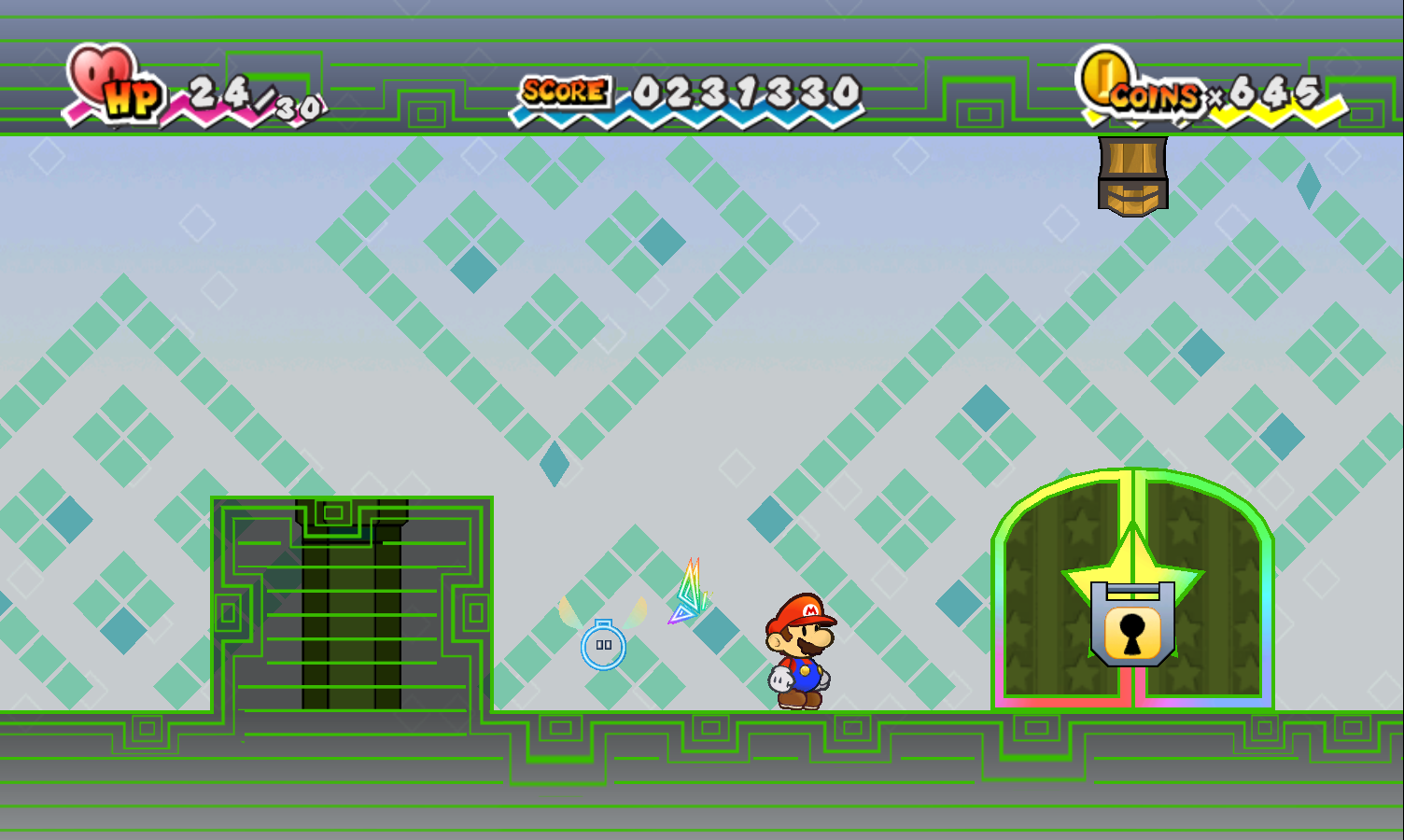
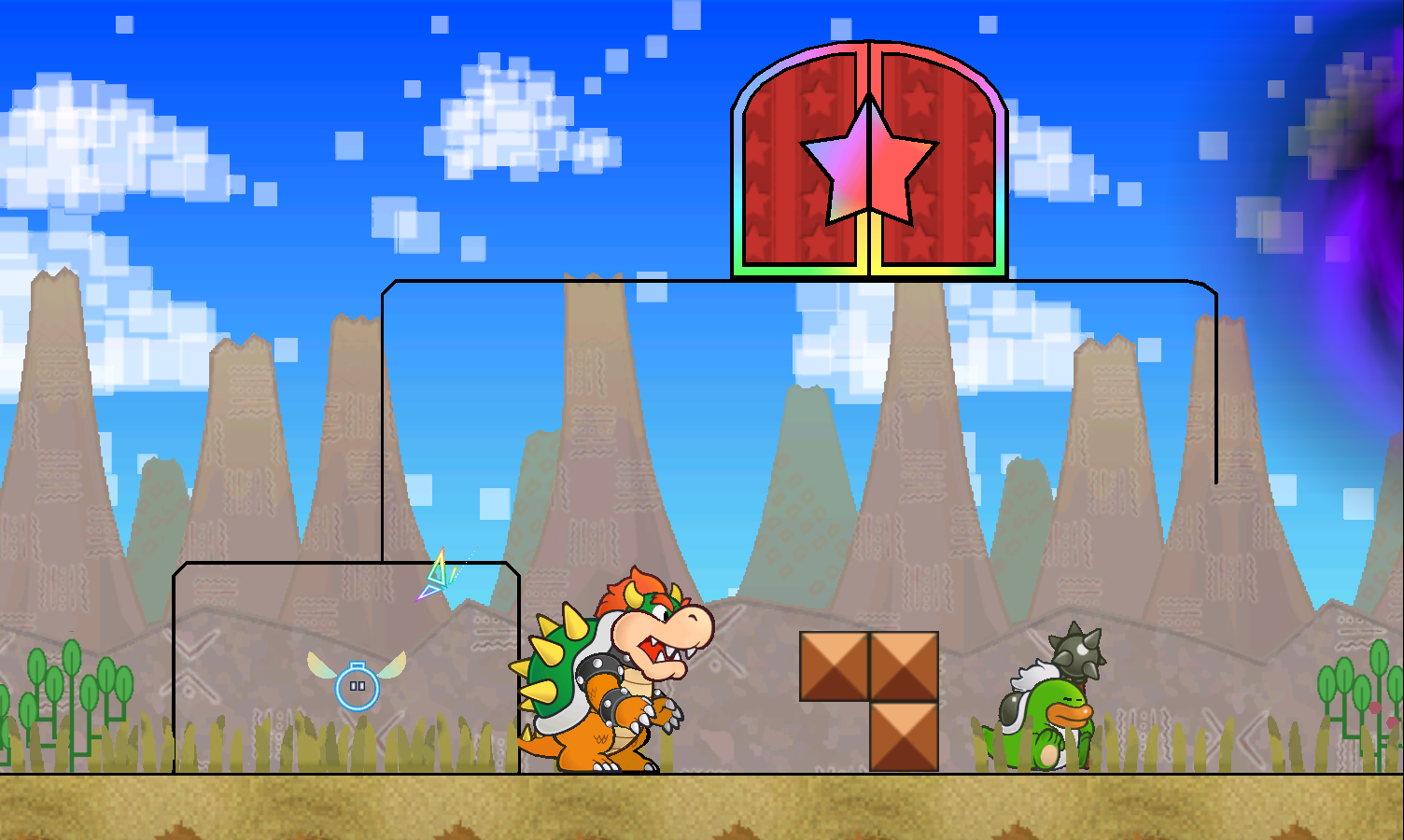
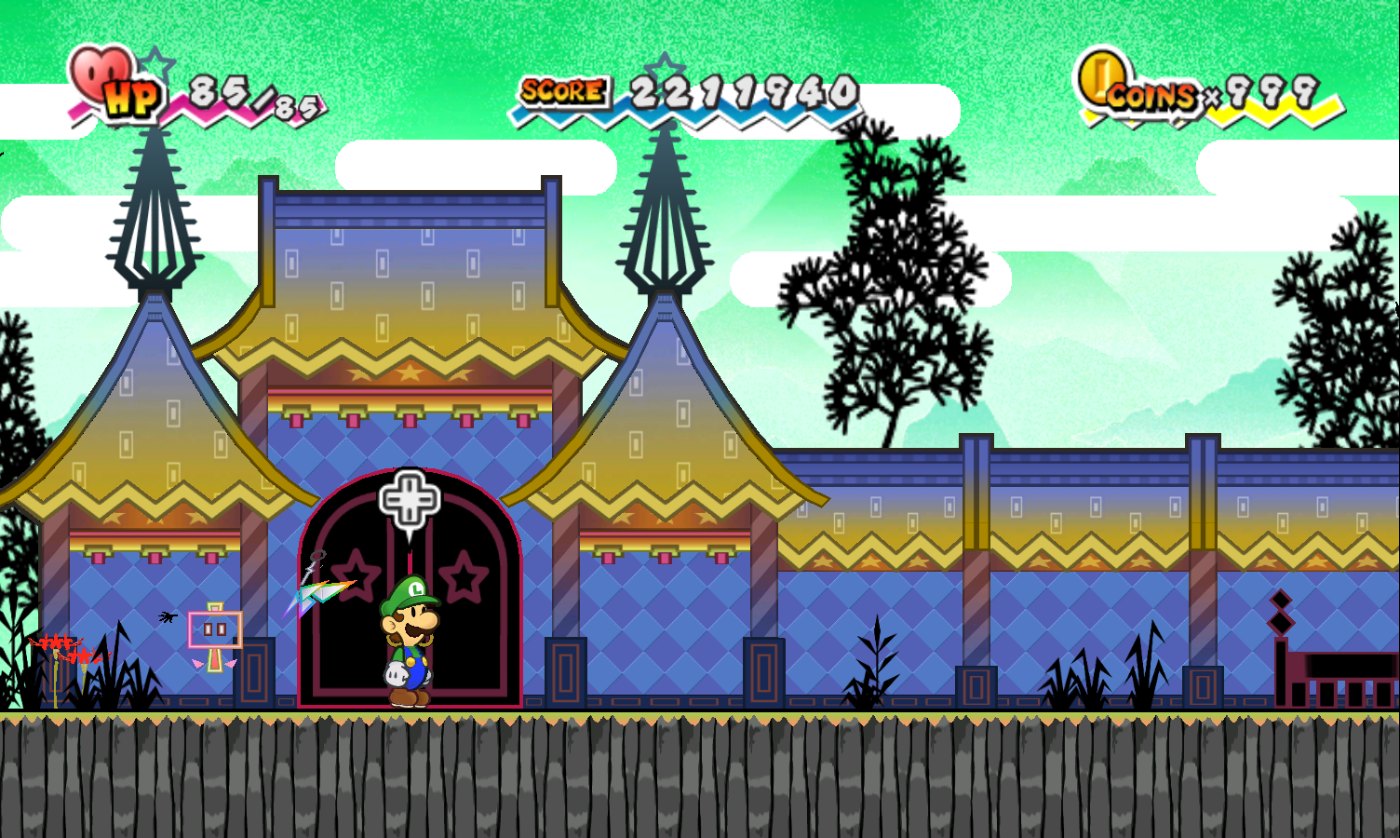
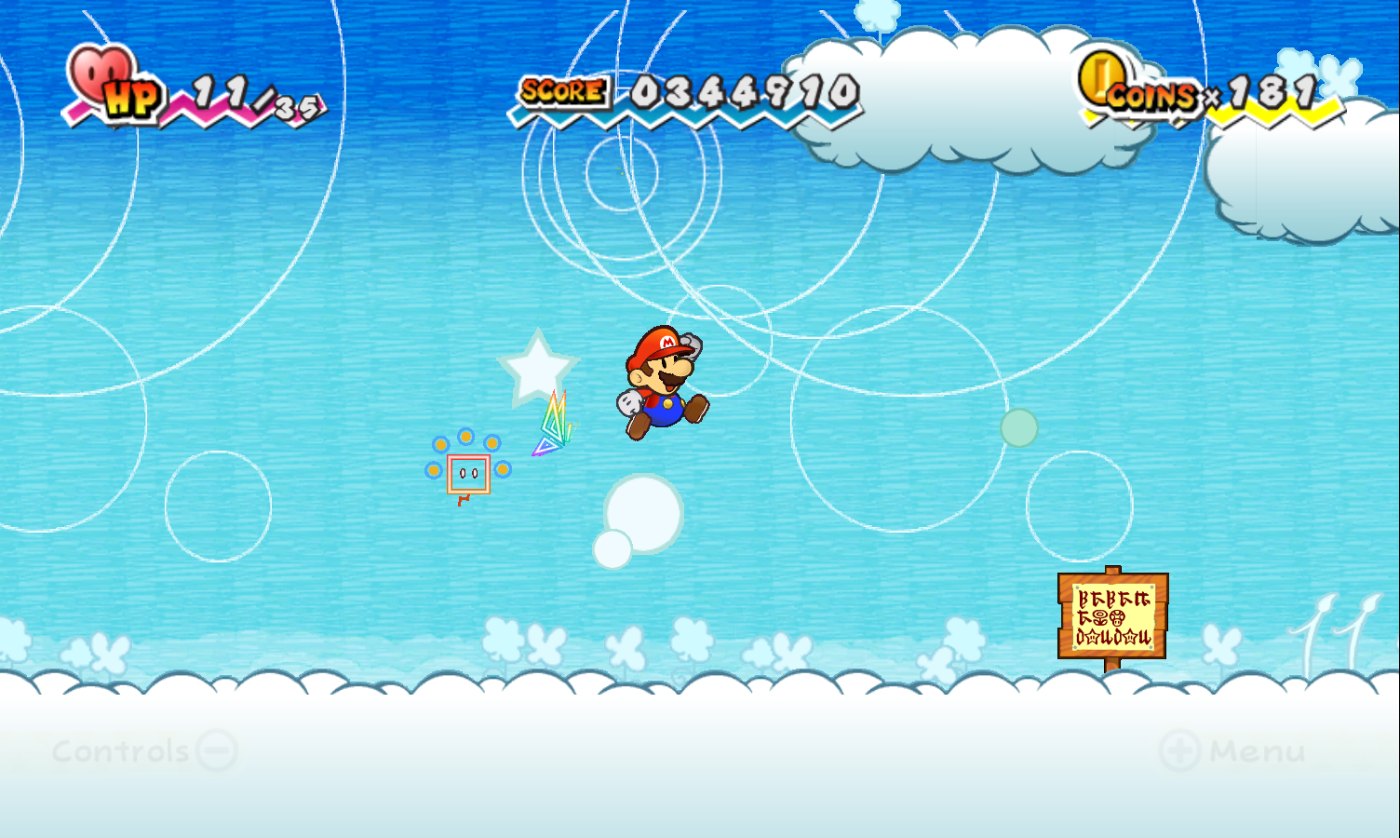
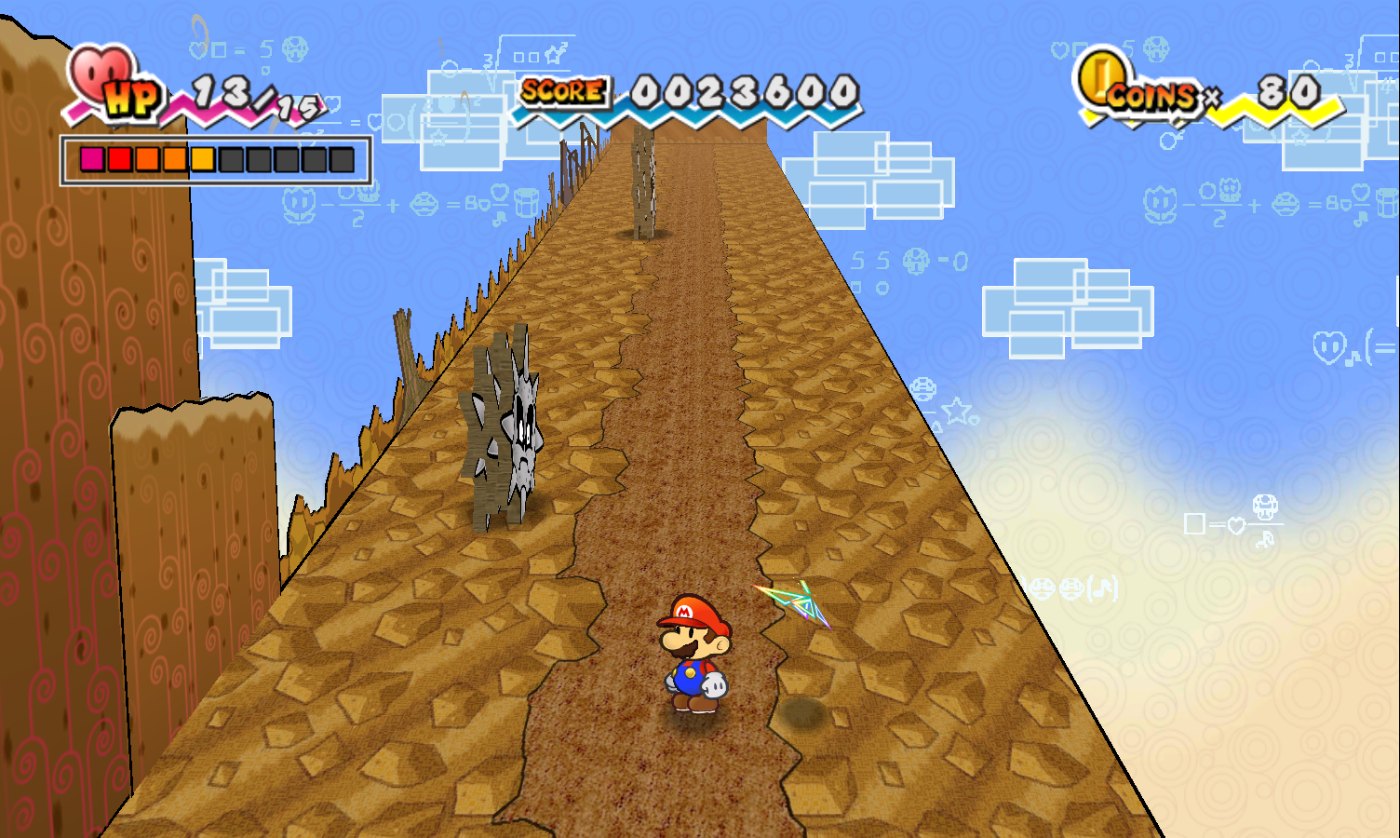
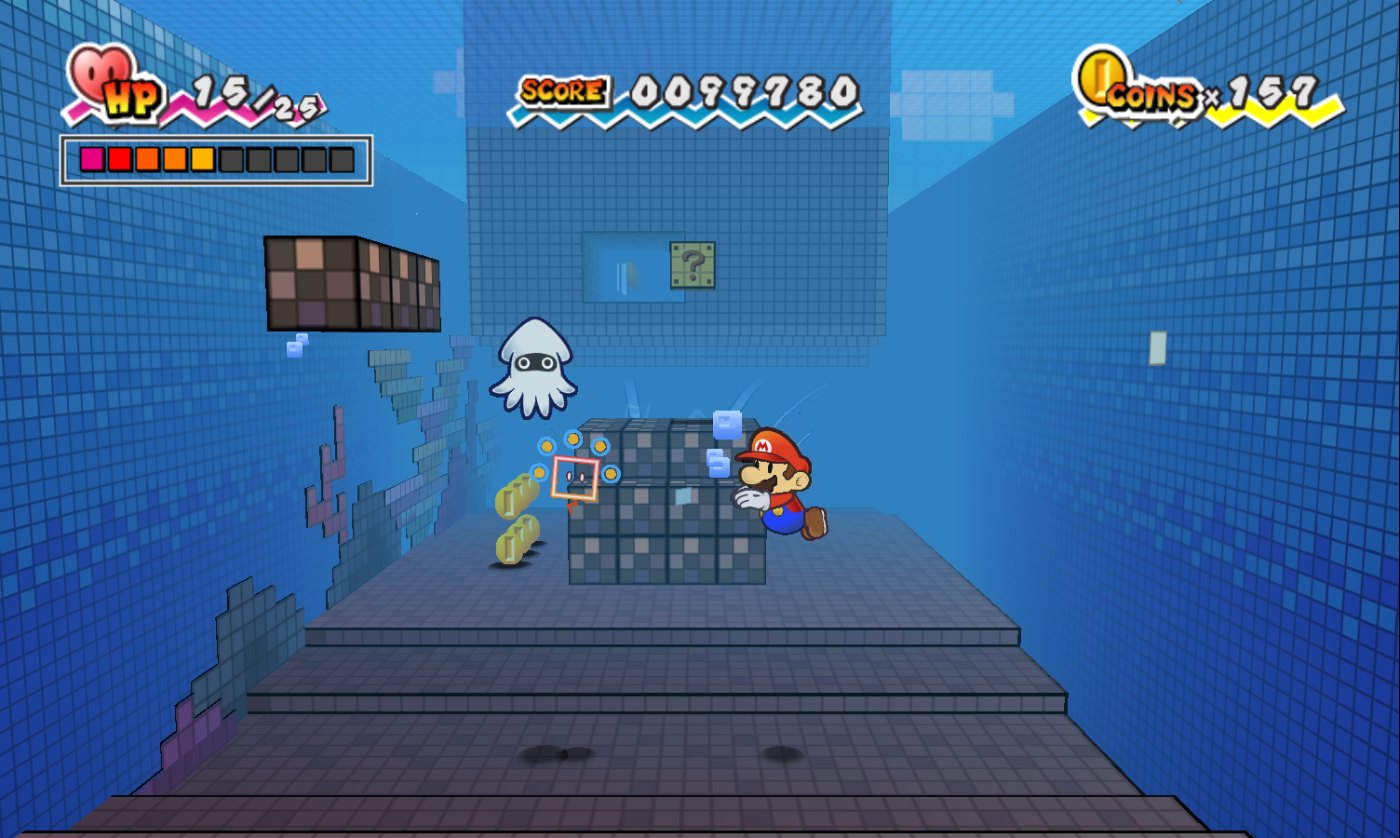


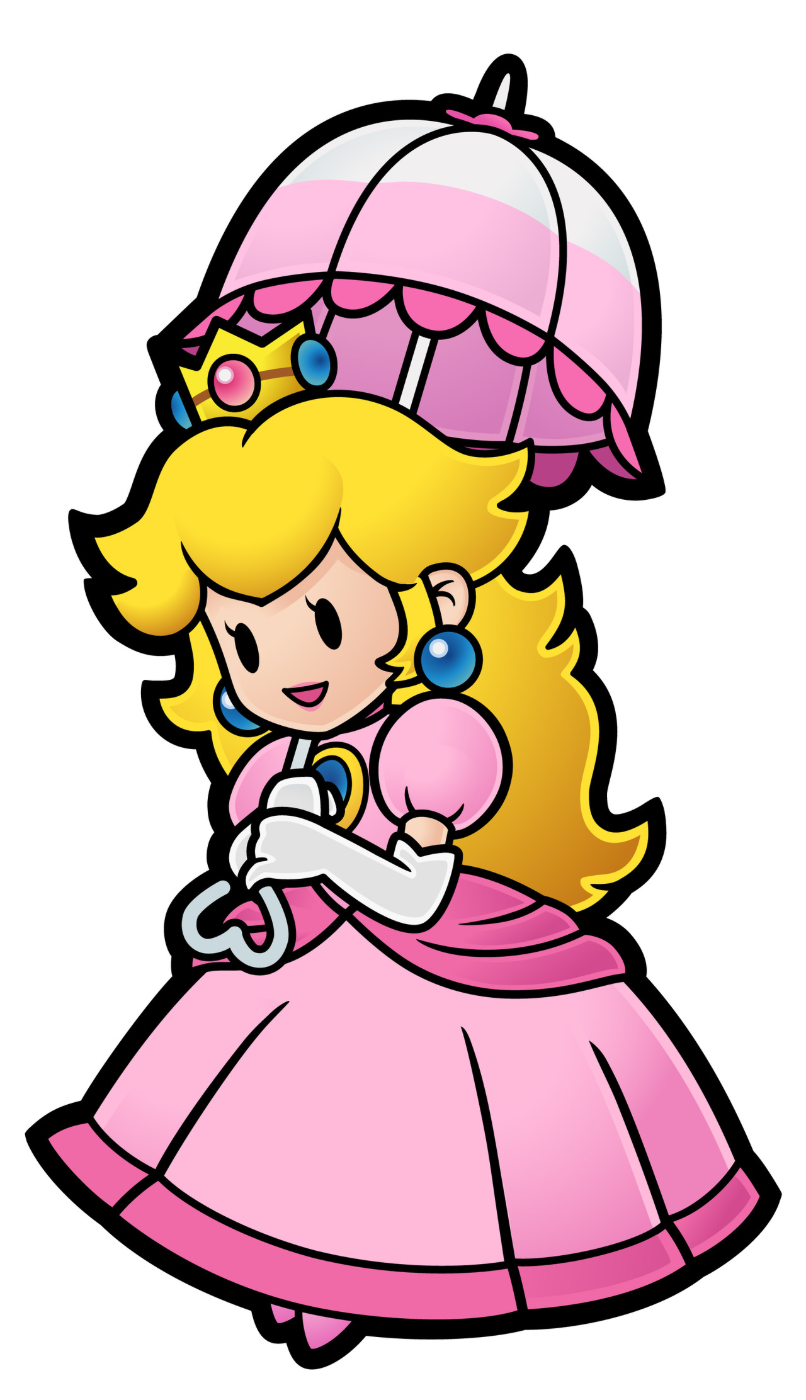


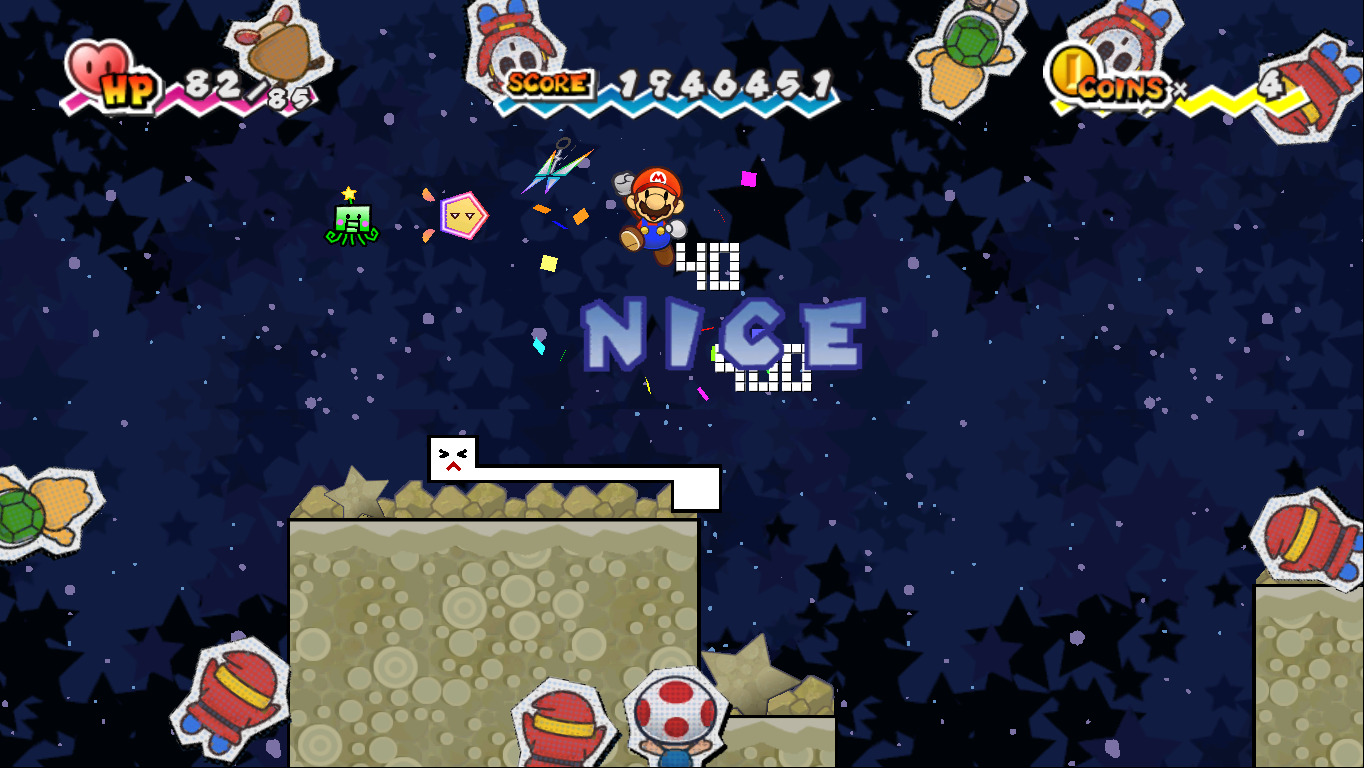
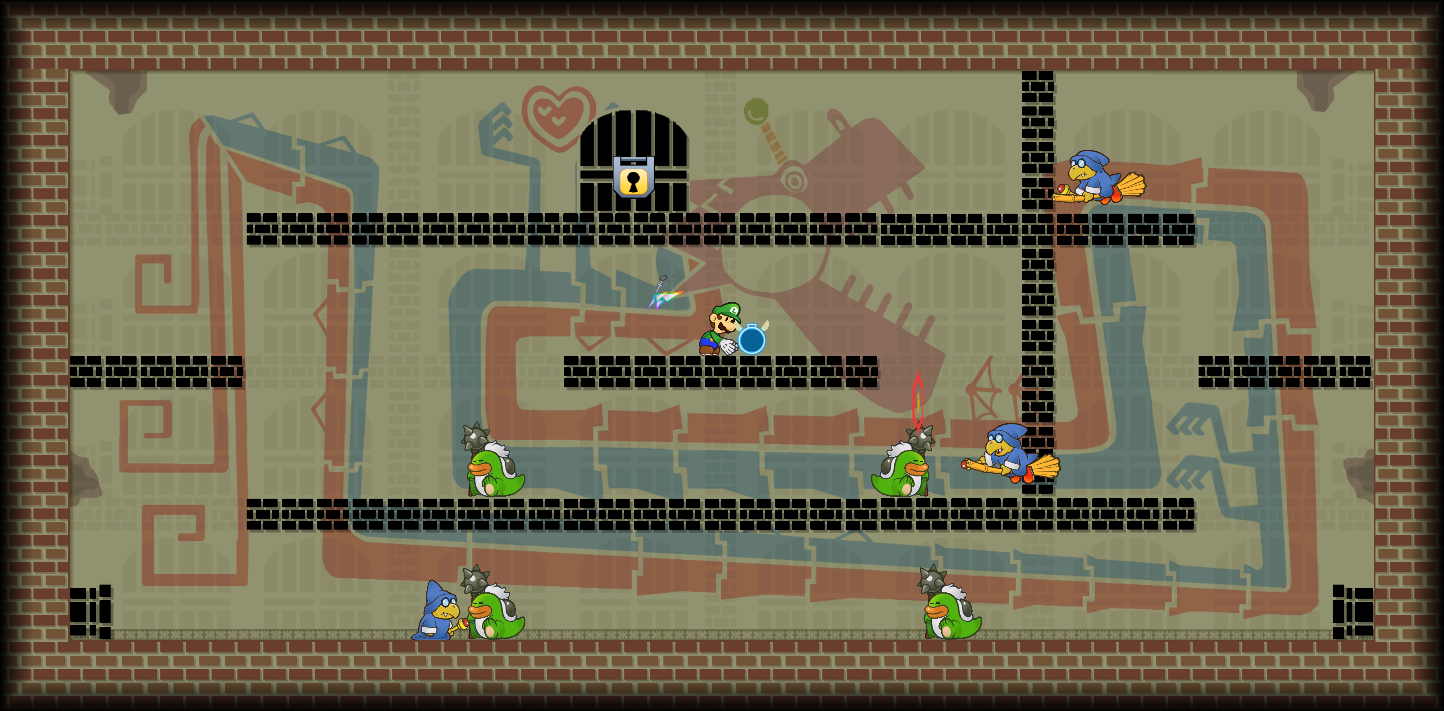
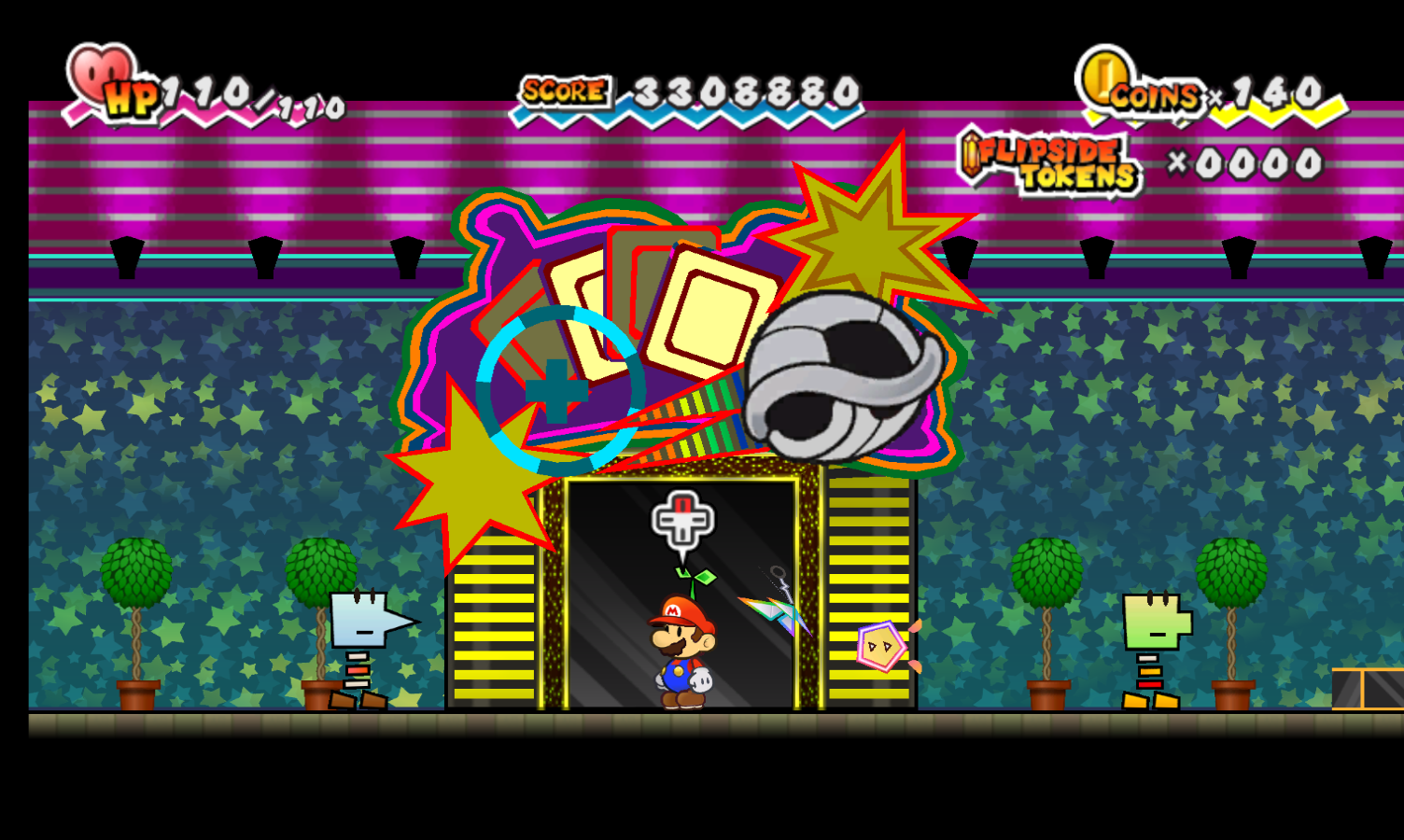
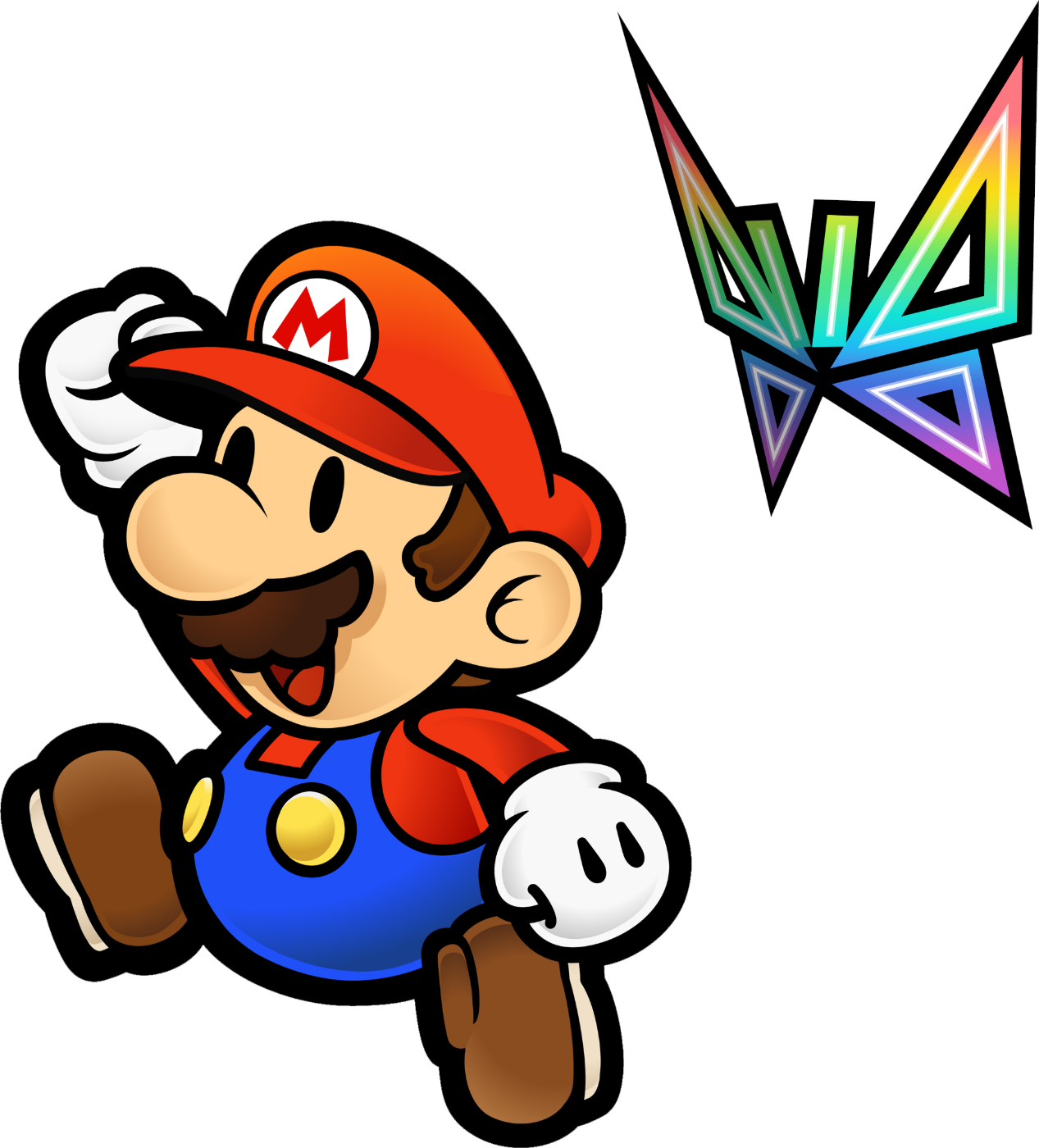
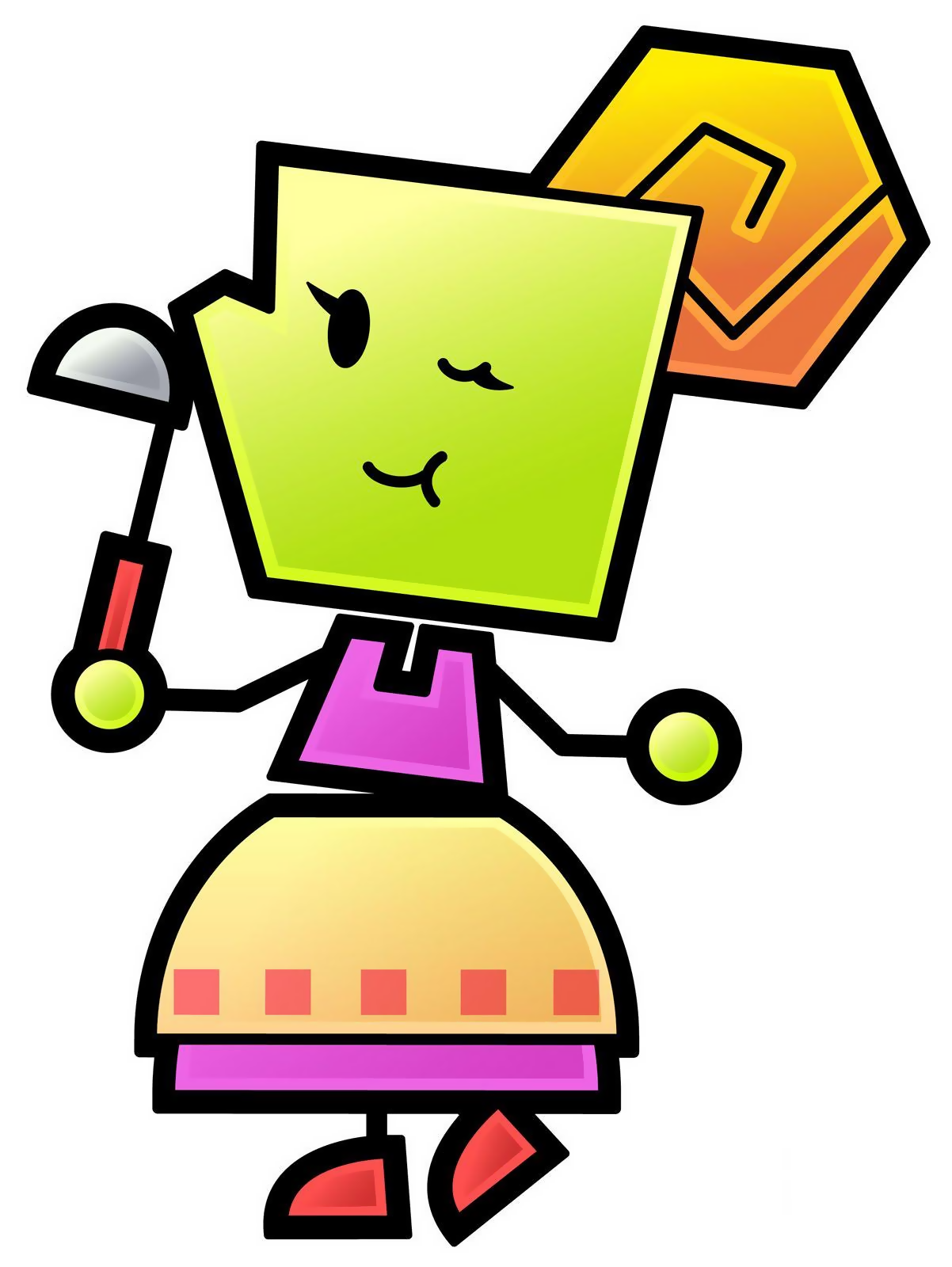
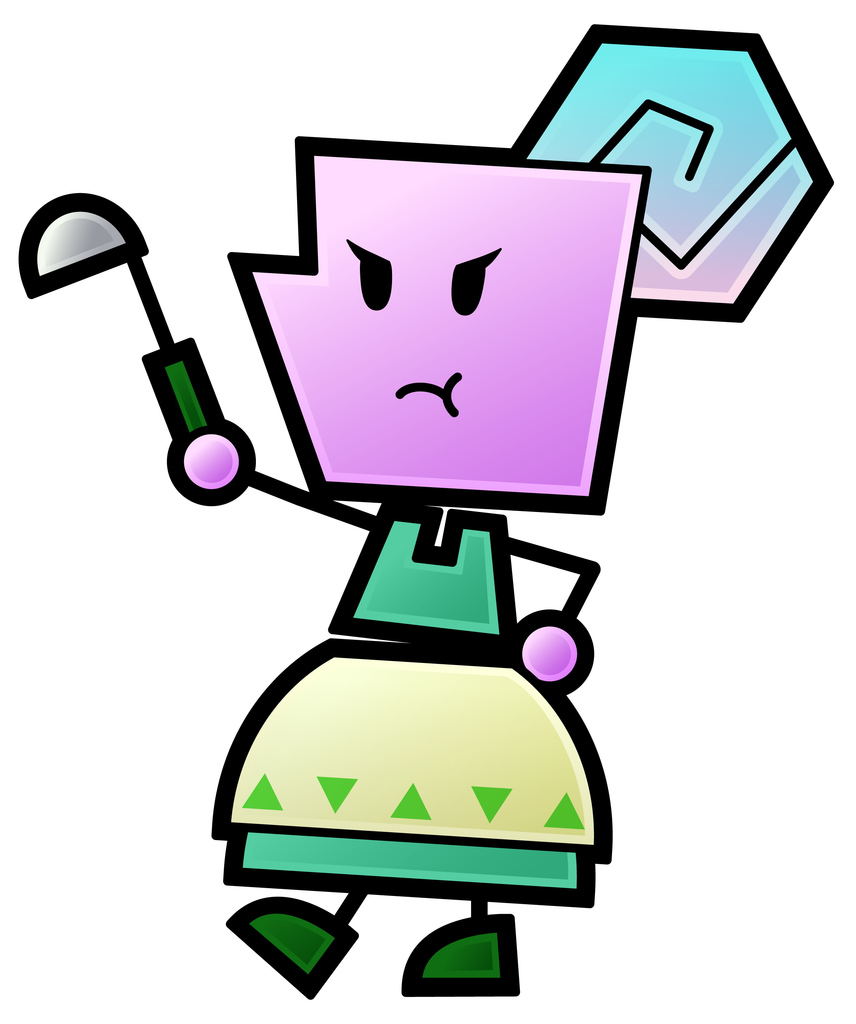

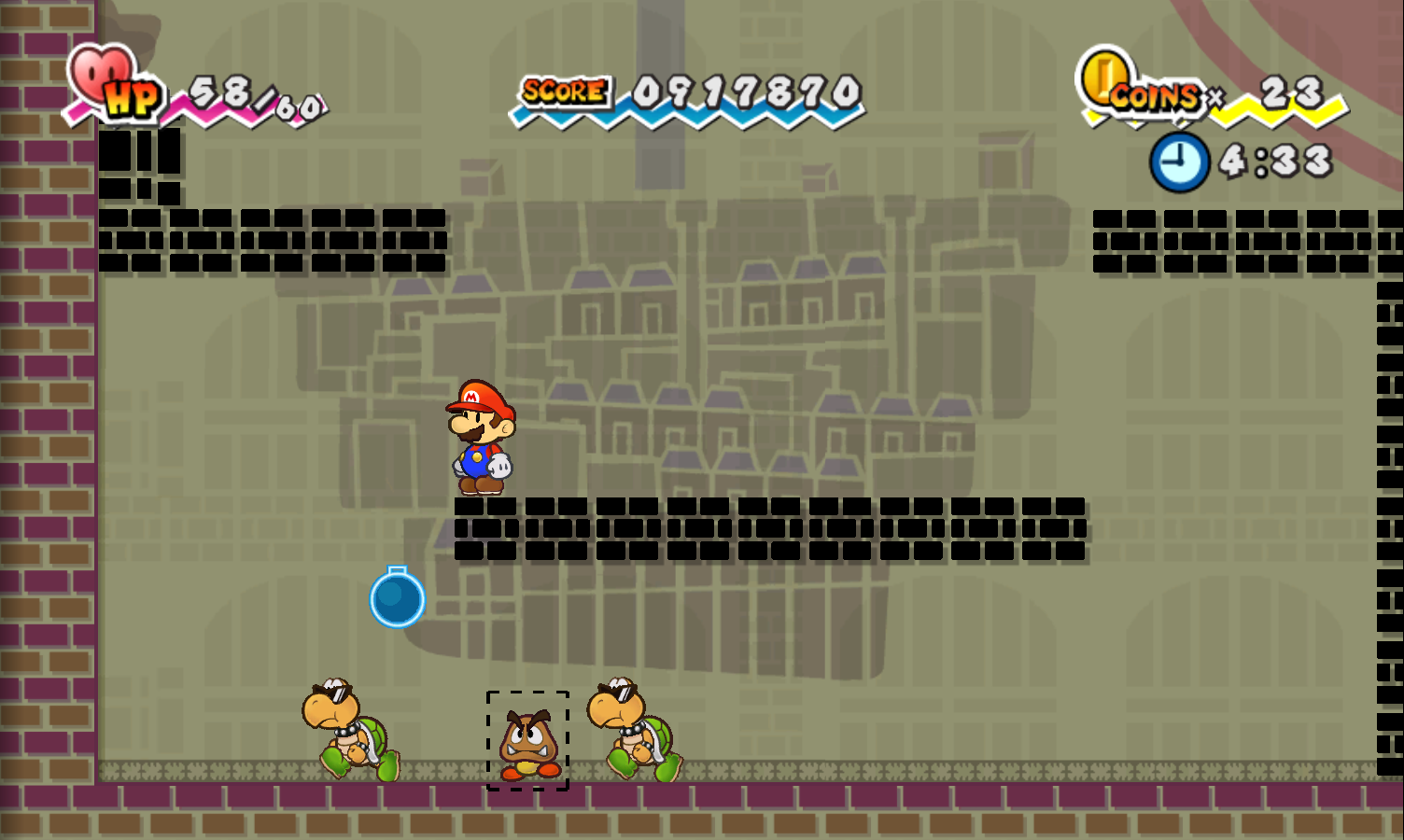
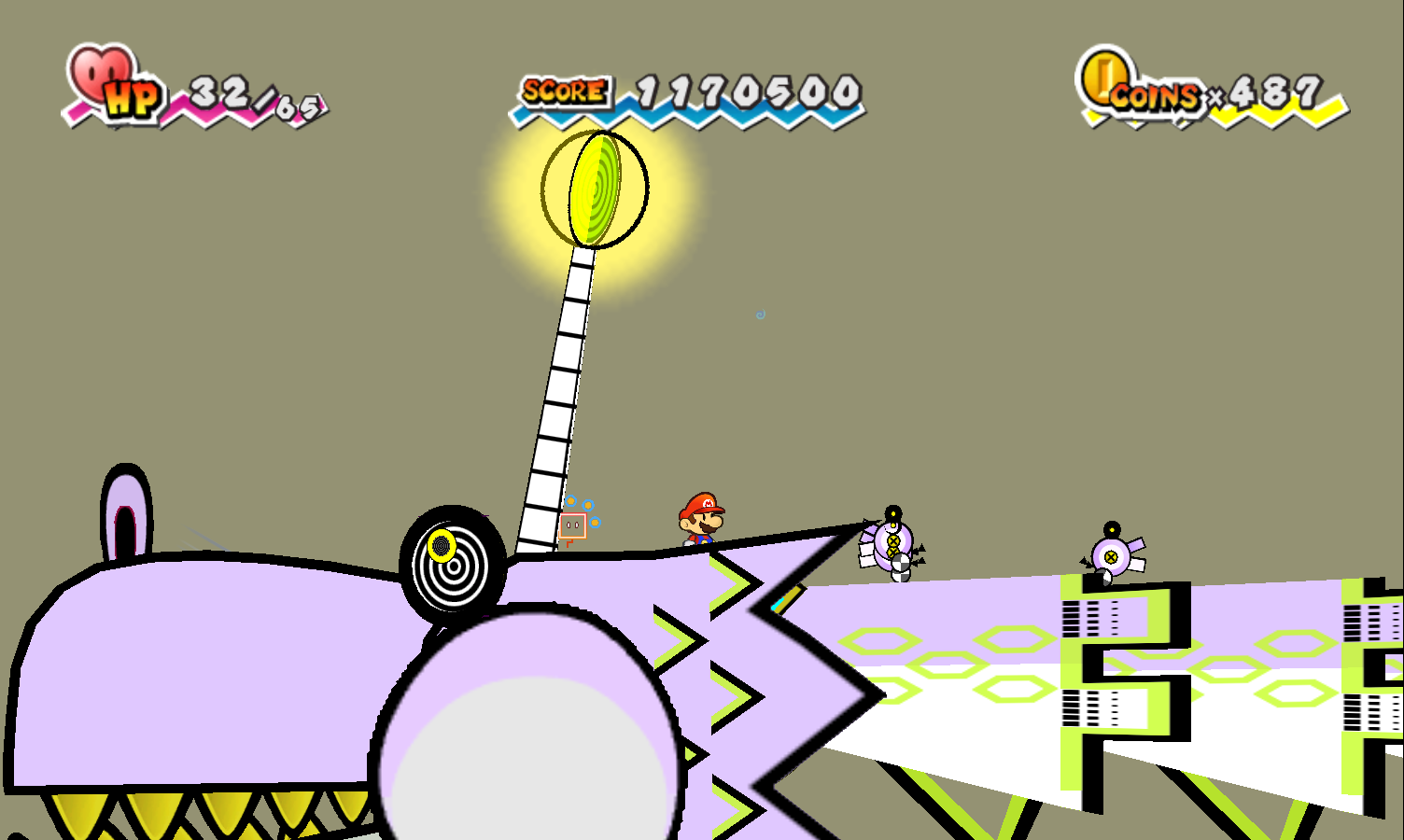
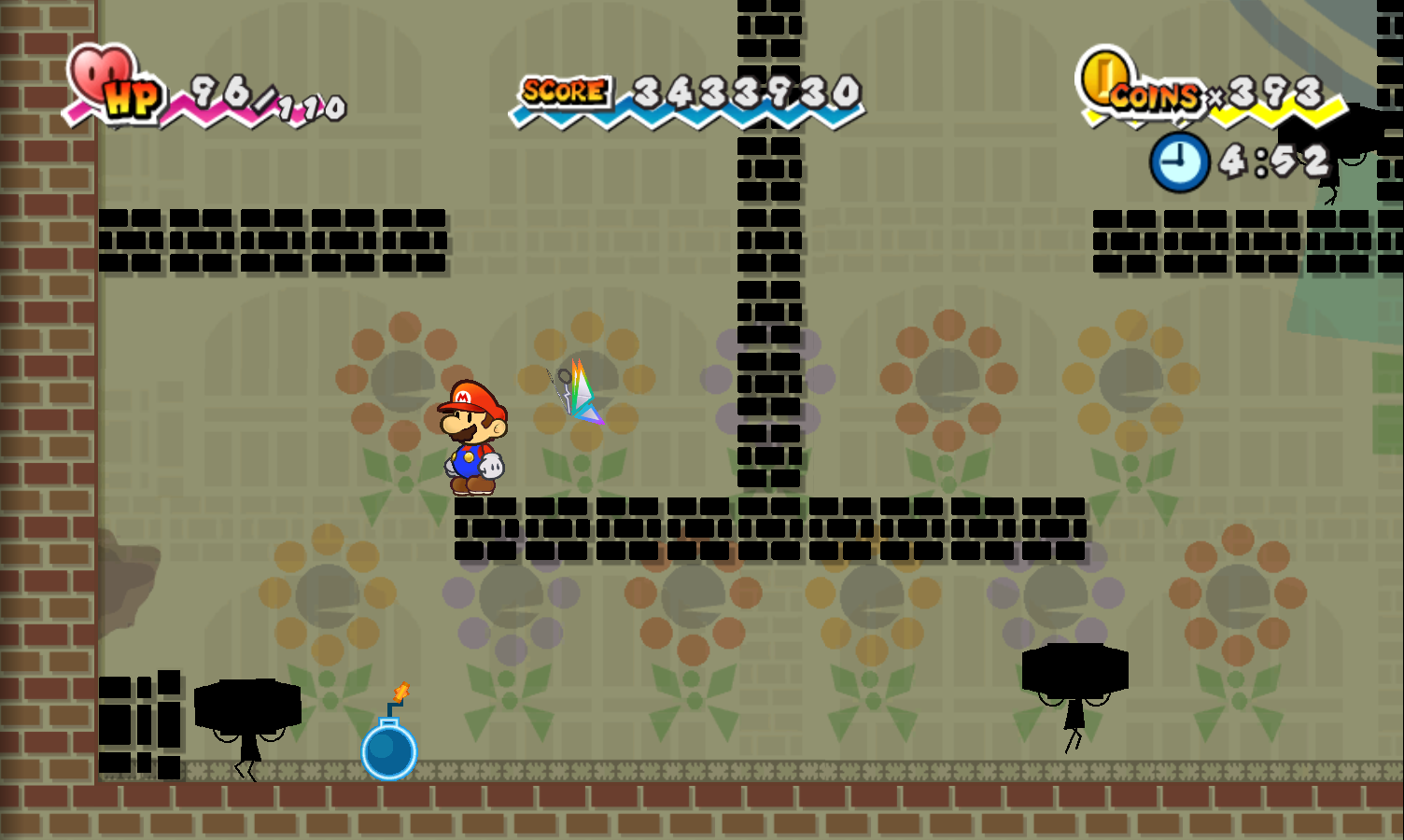
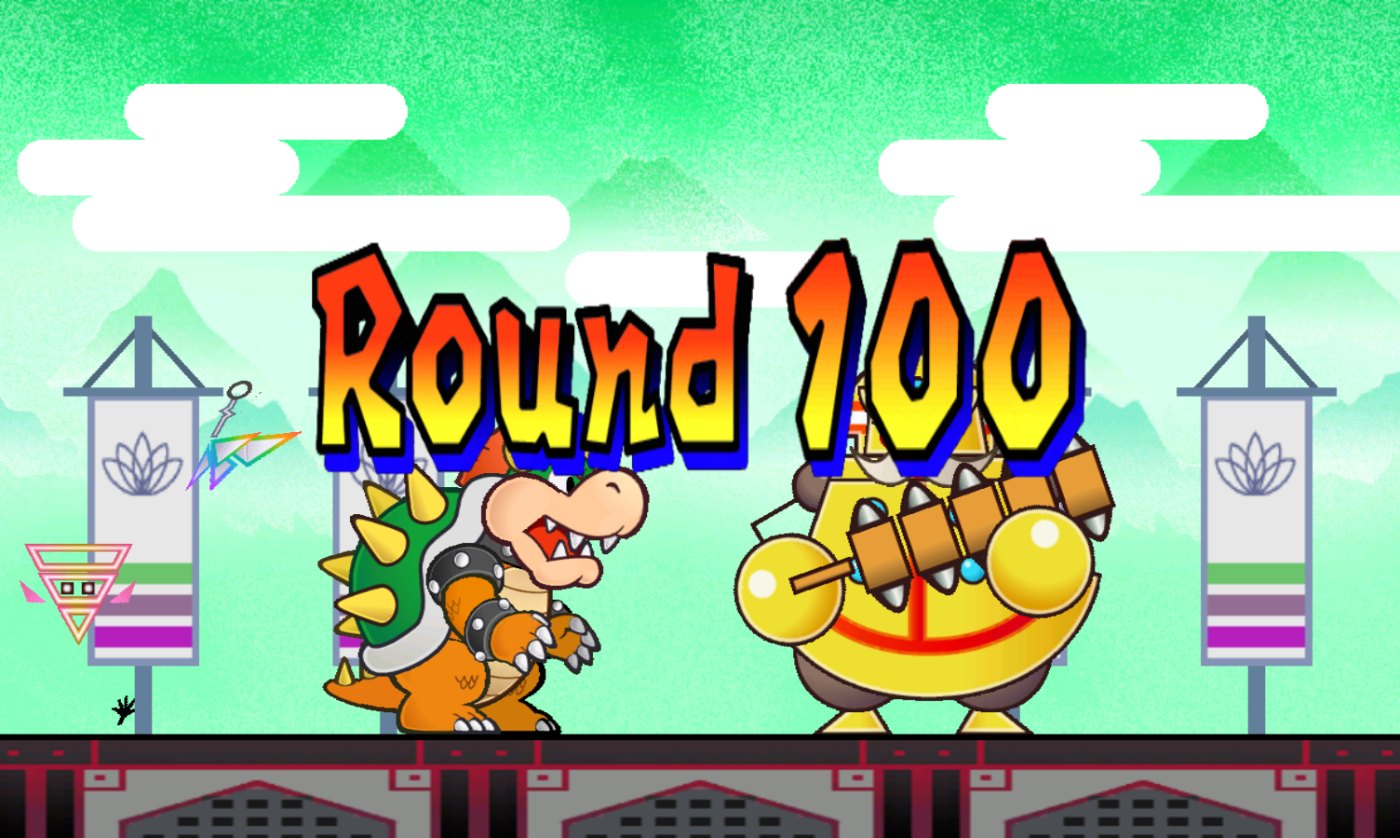

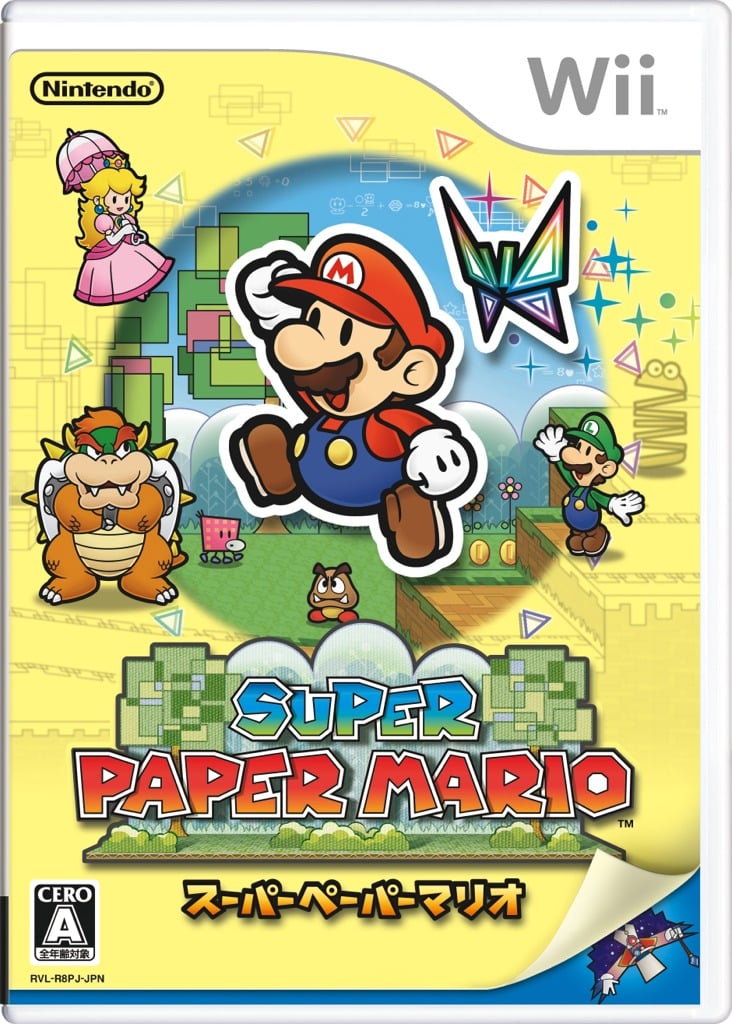
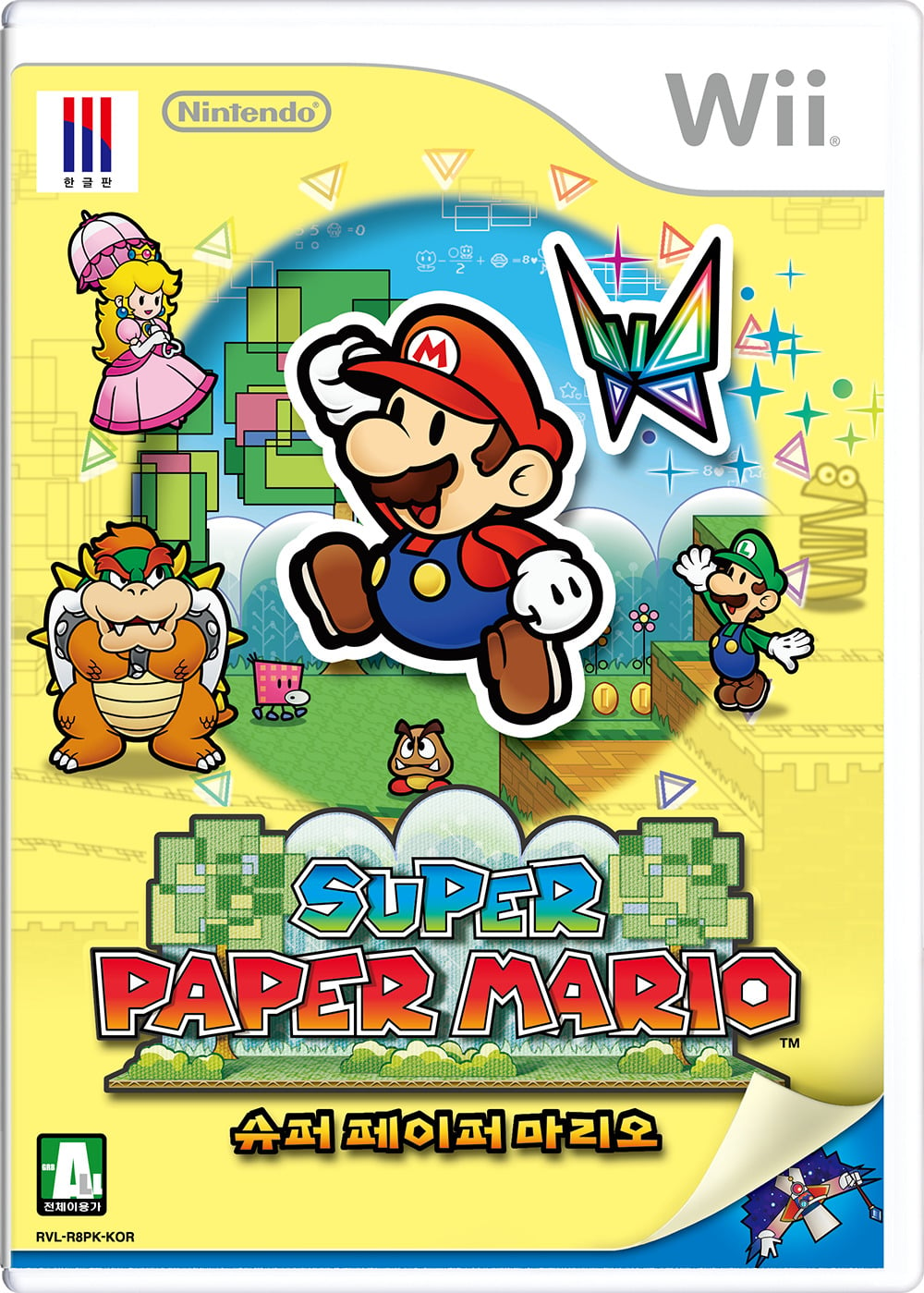
 TippiWith Mario from the start. Point the Wii Remote and press A: she identifies people and enemies, gives hints and reveals hidden things.
 ThoreauChapter 1-2, Mount Lineland. A hand that picks up enemies and objects and throws them, and hits switches from a distance.
 BoomerChapter 2-1, Gloam Valley. A bomb, set down and detonated to break cracked walls and blocks. The blast does double damage.
 SlimChapter 2, Merlee’s Mansion. Turns the hero side-on to slip through bars; stand still while slim and nothing can touch you.
 ThudleyChapter 3-2, the Tile Pool. A ground pound that smashes blocks and presses big switches. Double damage, or four times with Bowser.
 CarrieChapter 3-4, Fort Francis. A platform to ride over spikes, and on to spiked enemies, in safety.
 FleepChapter 4-2, Planet Blobule. Flips a small patch of scenery to bring hidden things back from the other side, and dizzies enemies. Works in 2-D only.
 CudgeChapter 5-2, Gap of Crag. A hammer, as in the earlier Paper Marios. Breaks big yellow blocks and does double damage.
 DottieChapter 5, Floro Caverns. Shrinks the hero to enter tiny doors and passages. Enemies stop noticing you but can still hurt.
 Barry (optional)The Bitlands. Go back and talk to him after Tippi has been rescued. A barrier that hurts enemies and bounces projectiles back.
 Dashell (optional)Room 100 of the Flipside Pit of 100 Trials, after Wracktail. Hold 1 to sprint.
 Piccolo (optional)Flopside, through a side quest for Merlee after Chapter 5. Her music cures every curse and sends the Underchomp to sleep.
 Tiptron (optional)A robot copy of Tippi, sold by Francis at Fort Francis for 999 coins once the story is over. Does everything Tippi did.
 Red Pure HeartGiven by Merlon in Flipside. Opens the door to Lineland.
 Orange Pure HeartFrom Merlumina in Yold Ruins. Opens Gloam Valley.
 Yellow Pure HeartFrom Merlee in her basement. Opens the Bitlands.
 Green Pure HeartAppears at Fort Francis when Tippi is freed. Opens Outer Space.
 Blue Pure HeartKept in the Whoa Zone beside a statue of Squirps’s mother. Opens the Land of the Cragnons.
 Indigo Pure HeartHeld by King Croacus IV. Opens Sammer’s Kingdom.
 Violet Pure HeartFound turned to stone in the World of Nothing and restored by Queen Jaydes. Opens the Underwhere.
 White Pure HeartLuvbi, in her true form. Opens Castle Bleck.
 Mega StarTurns the hero into a screen-filling, invincible 8-bit sprite of themselves for a few seconds.
 Pal PillSummons a crowd of little 8-bit copies of the hero to help out.
 Speed FlowerSpeeds time up and triples the value of coins and points.
 Slow FlowerSlows time down, with the same triple bonus.
 Happy FlowerMakes coins rain from the sky.
 Return PipeTakes the party back to Flipside from most places.
 Golden CardUnlocks Hammer Whacker at the Flipside Arcade.
 Treasure maps48 of them, sold by Flamm in Flopside. Use Fleep on the spot marked with a red cross.











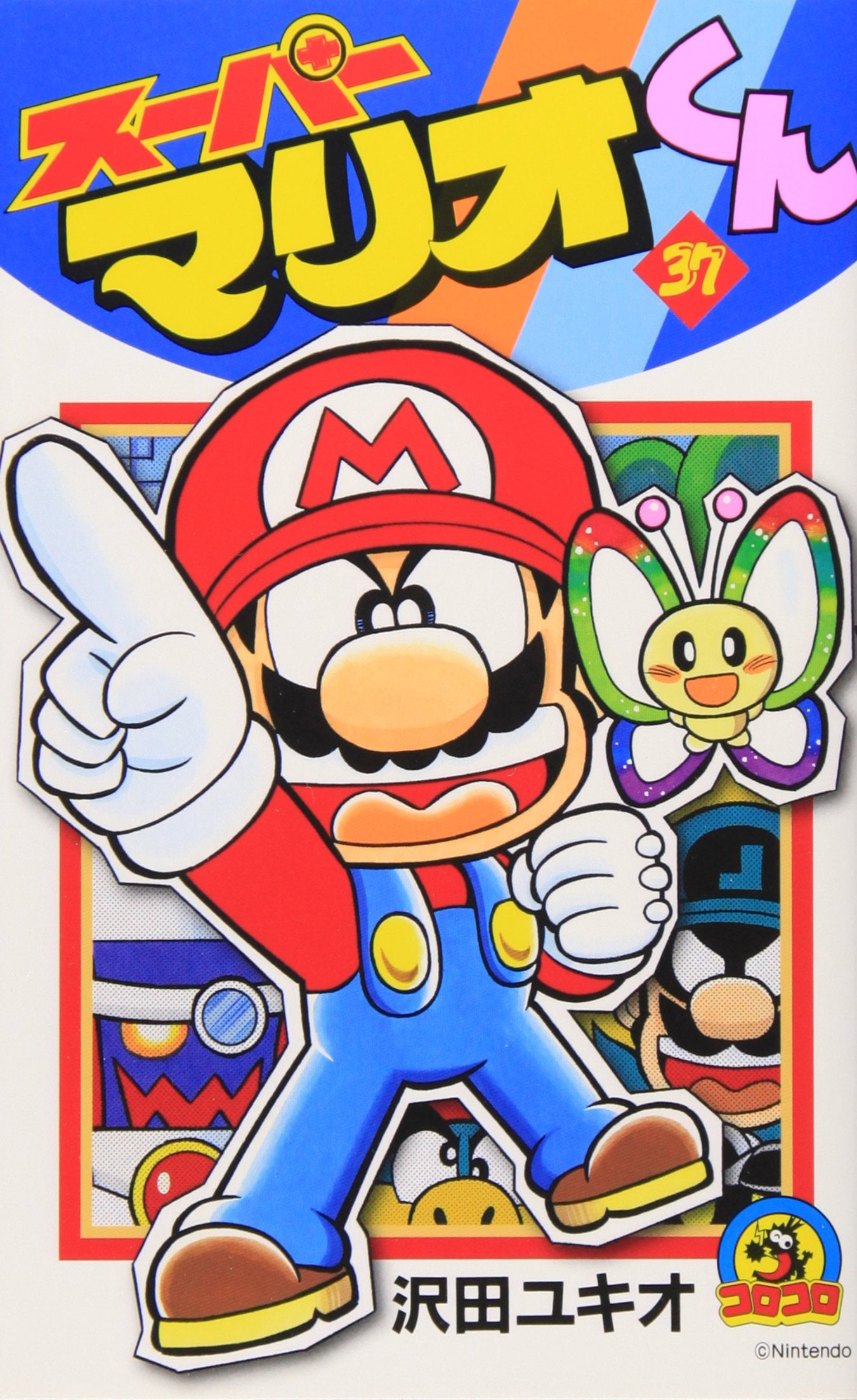 Super Mario-kunYukio Sawada / Shogakukan · volumes 37 and 38, 2008The gag manga adapted the game in two parts, in February and October 2008. Its Tippi is rounder and yellow, Luigi is cured of being Mr. L straight after the Whoa Zone and joins early, and Peach turns up late with the Pure Hearts from two chapters the others skipped. It ends, like the game, with two silhouettes under a tree.
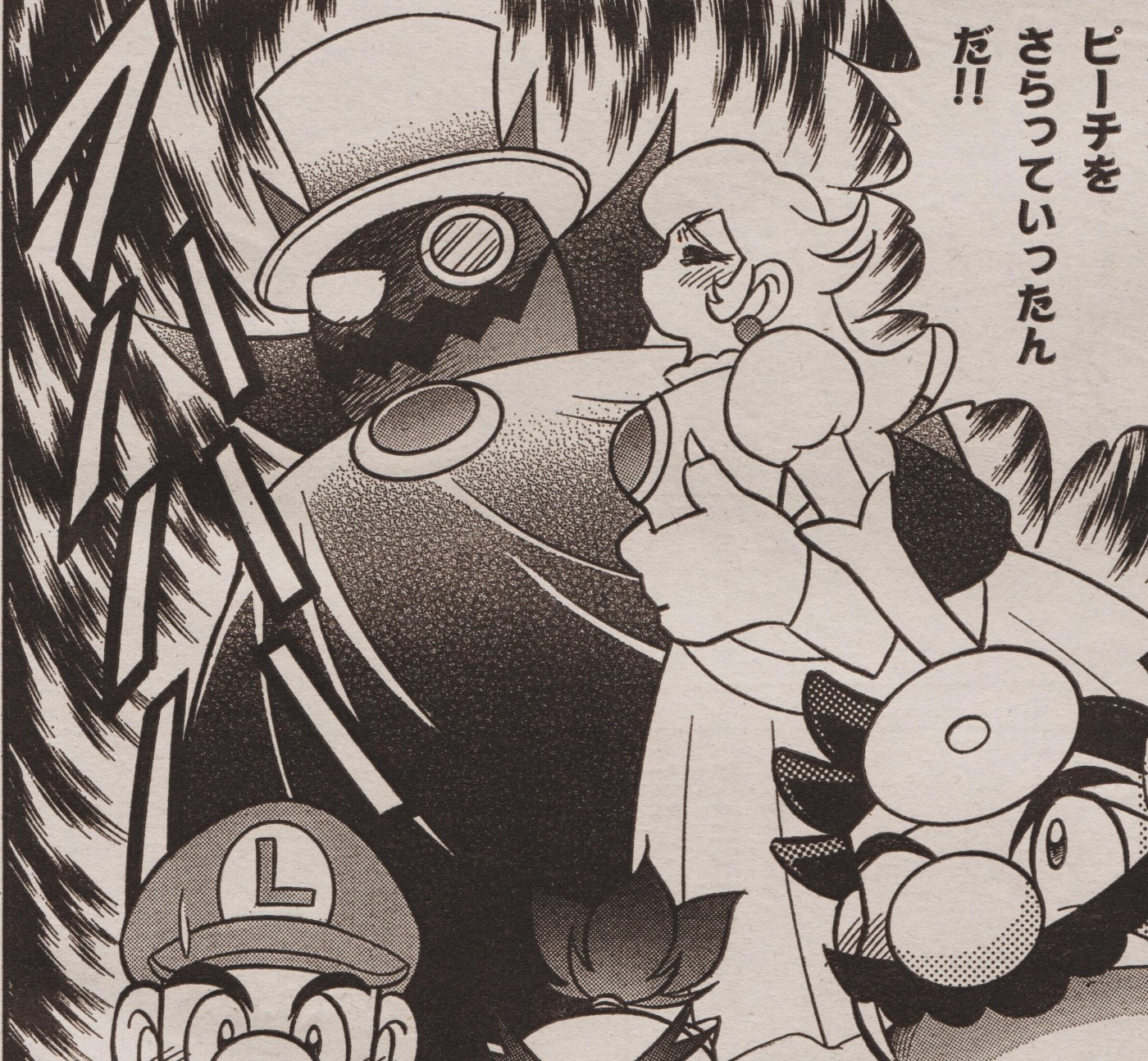 Dr. Mario-kunMangaCount Bleck returns as the villain of the final arc of this spin-off, where he creates a Dimensional Virus.
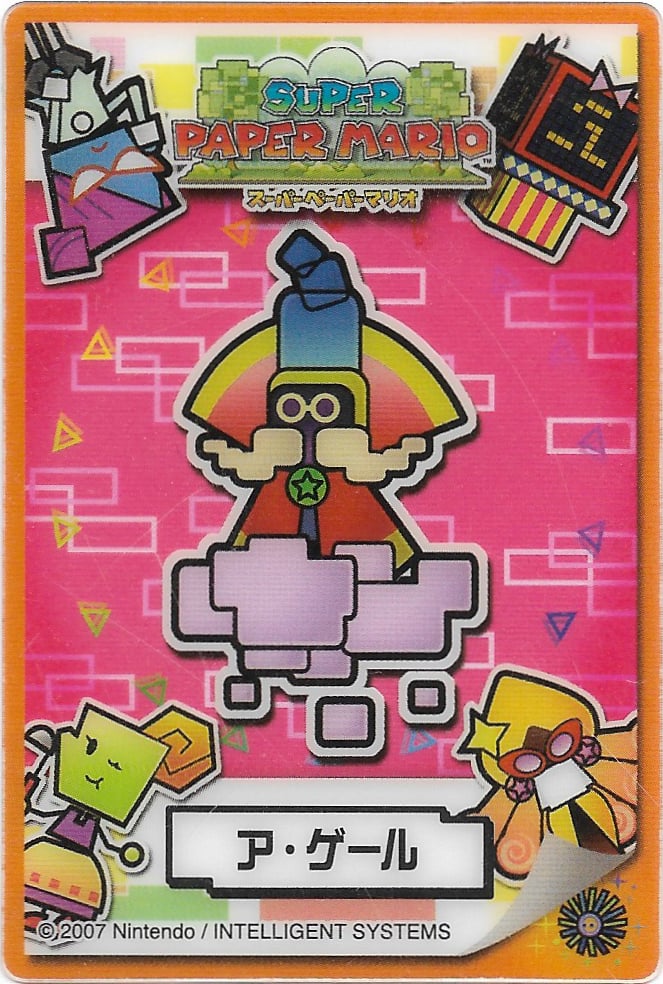 Trading cardsSubarudo · Japan, September 2007A set of twenty holographic cards modelled on the game’s Catch Cards, sold at 315 yen a packet with one card and a mushroom-shaped sweet.
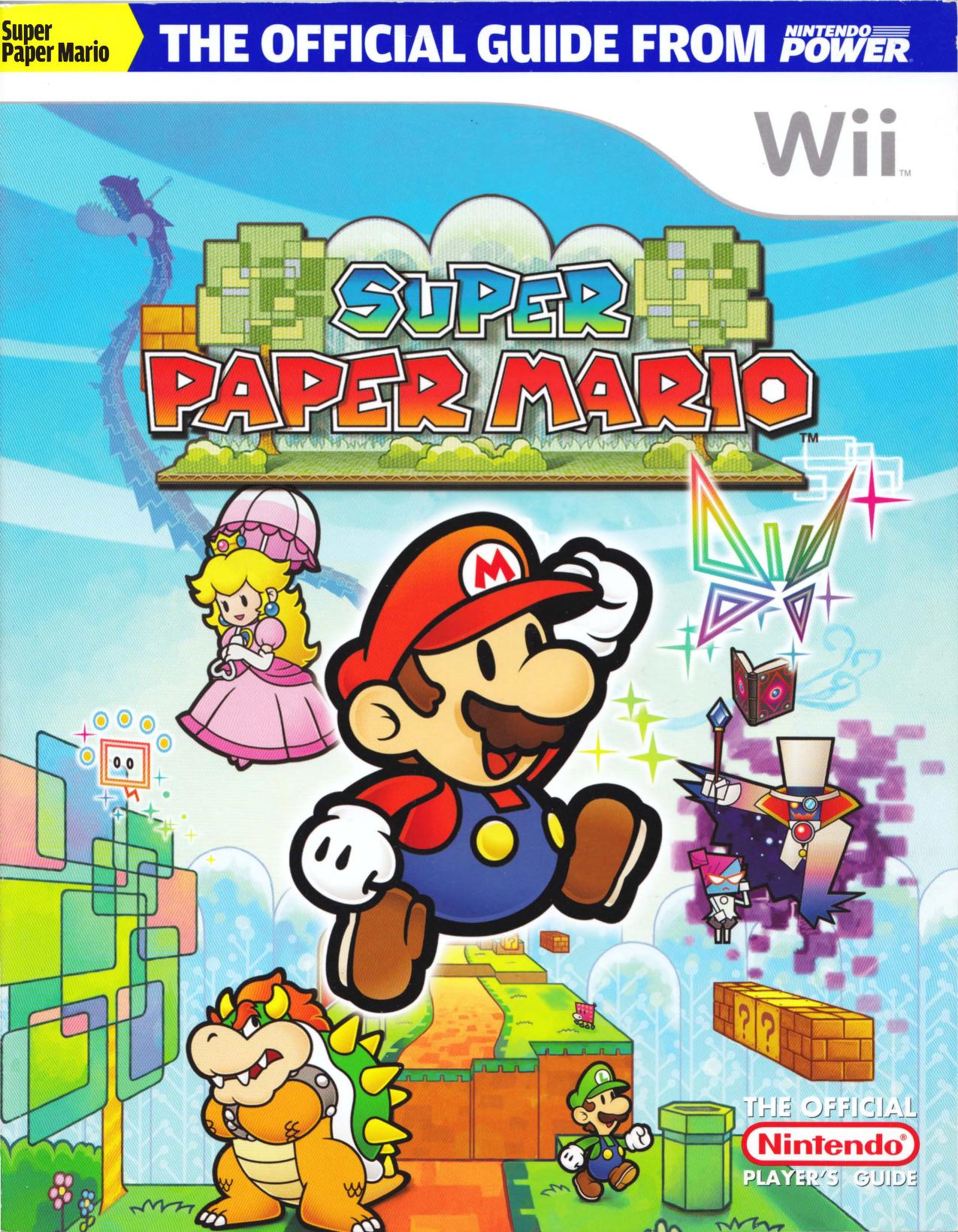 Player’s guidesNintendo Power; Prima Games · 2007Nintendo Power and Prima Games each published a guide. The back cover of the Nintendo Power one shows artwork of a Gold Fuzzy, an enemy that is not in the game.
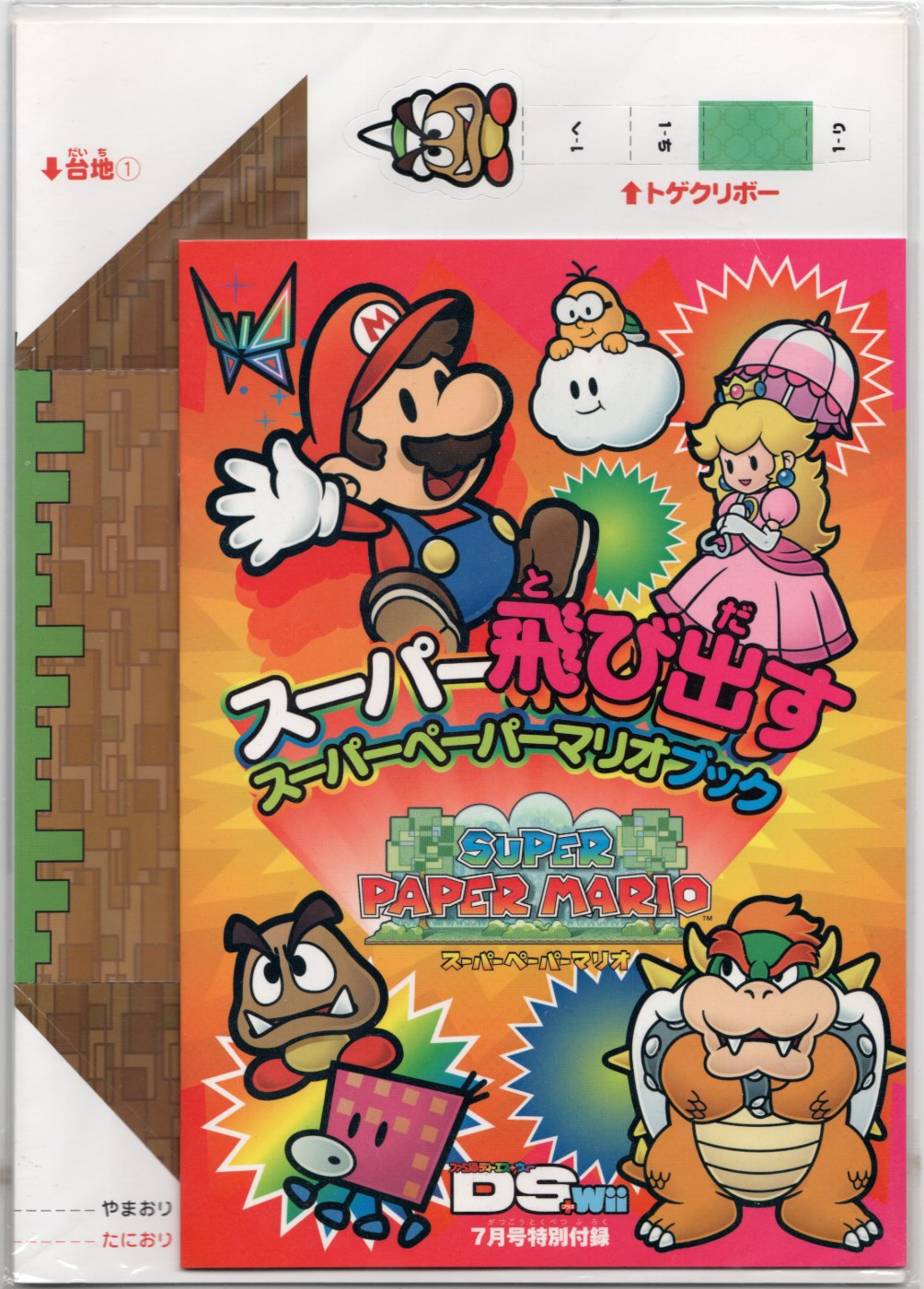 The pop-up bookFamitsu DS+Wii · JapanThe Super Tobidasu Super Paper Mario Book, a pop-up booklet, was given away with an issue of the magazine.
 Super Smash Bros. BrawlWii · 2008Trophies of Paper Mario, Paper Luigi, Paper Peach, Paper Bowser, the wedding outfits and Fracktail retell the story, and Count Bleck, Tippi and O’Chunks are stickers. The developers were not consulted about a stage: asked in 2007 whether they had spoken to Masahiro Sakurai, Tanabe replied, “Unfortunately, neither Mr. Kawade nor I had that opportunity.”
 Later Super Smash Bros. gamesWii U (2014) · Ultimate (2018)The Wii U game has trophies of Tippi, Fracktail, Flint Cragley, Mr. L and Count Bleck. In Ultimate, Mr. L and Dimentio are spirits, and the Dimentio battle is fought against a giant Luigi in memory of Super Dimentio.
 Count BleckBlumiere of the Tribe of Darkness
 NastasiaThe count’s assistant
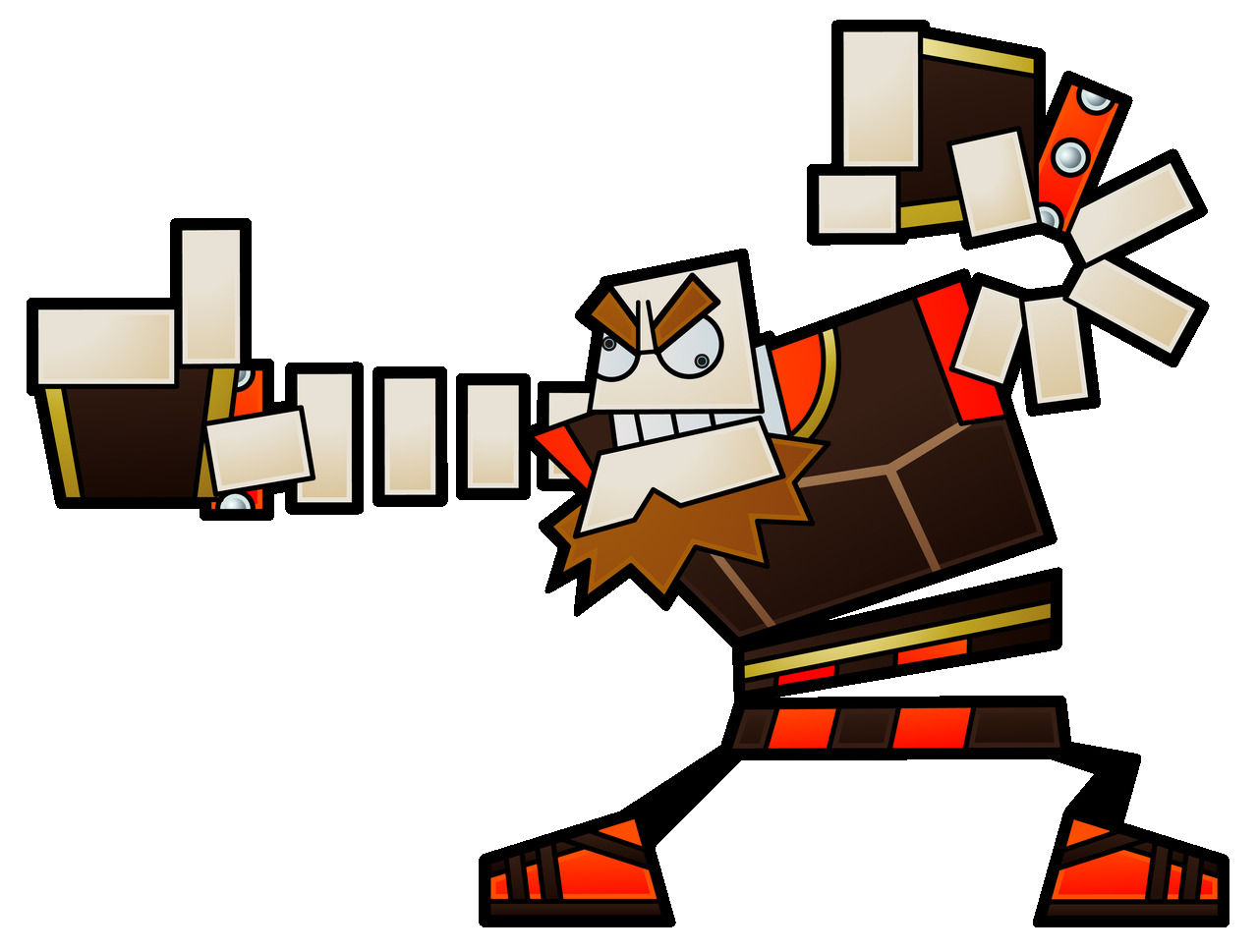 O’ChunksMinion · four fights
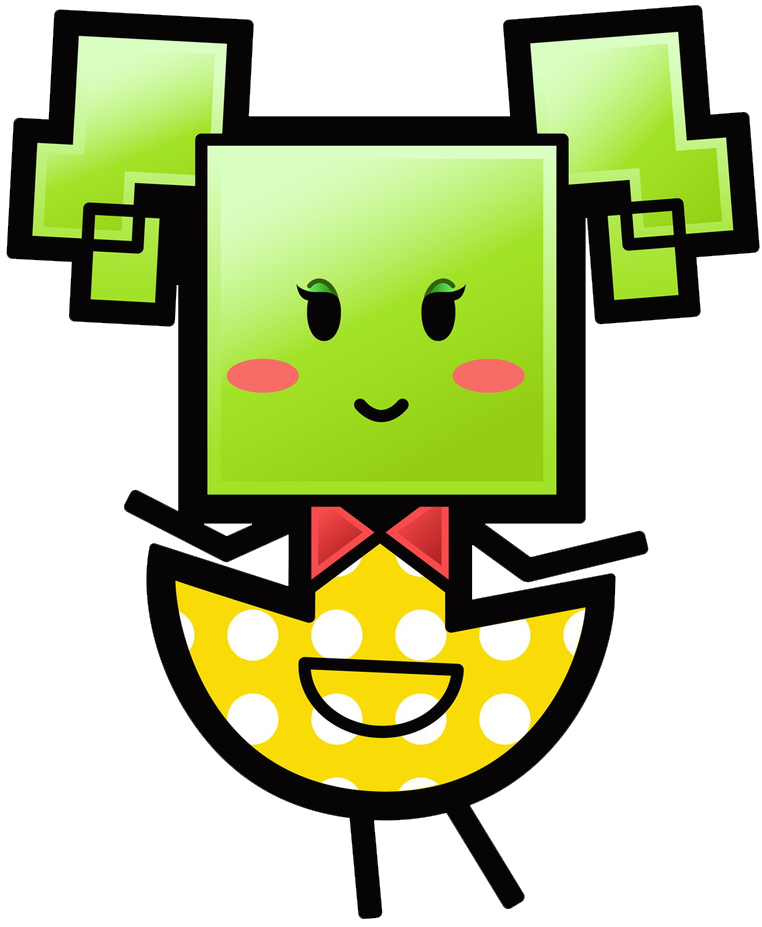 MimiMinion · shape-shifter
 DimentioMinion · the real villain
 Mr. LMinion · Luigi, brainwashed
 MerlonSage of Flipside
 NolremSage of Flopside
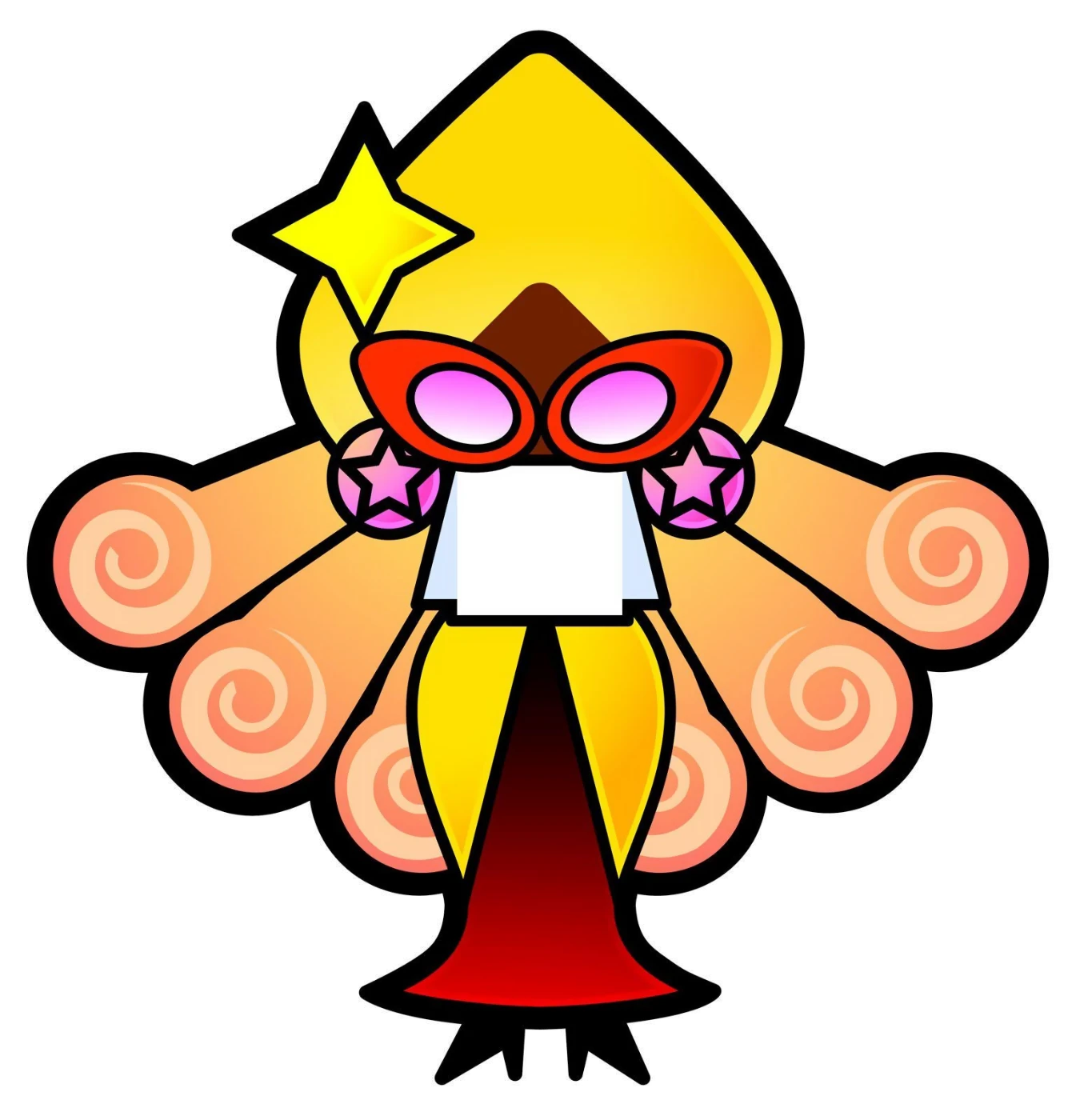 MerleeCharm-seller of Gloam Valley
 SquirpsFollower · Chapter 4
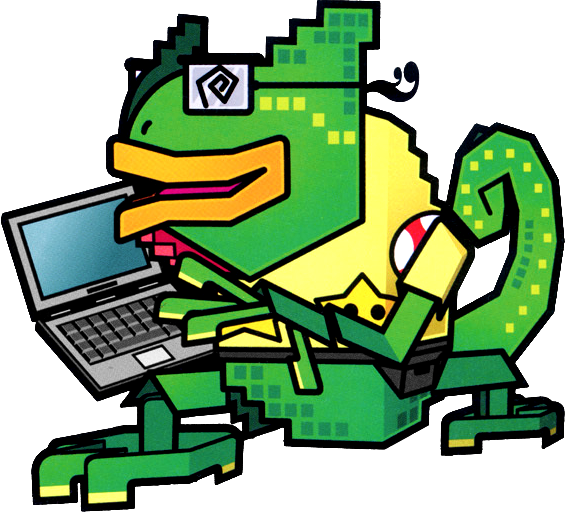 FrancisBoss of Chapter 3
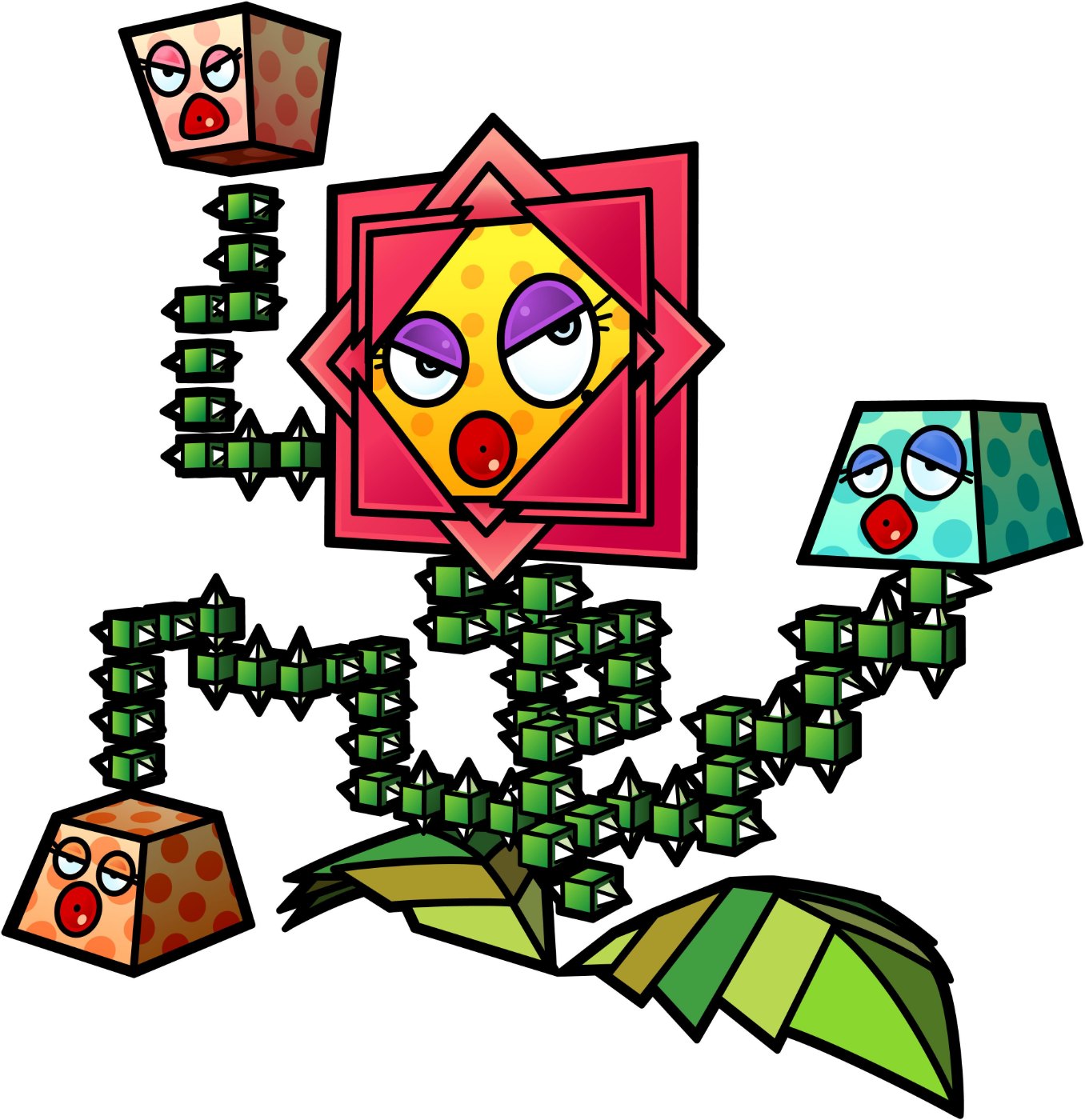 King Croacus IVBoss of Chapter 5
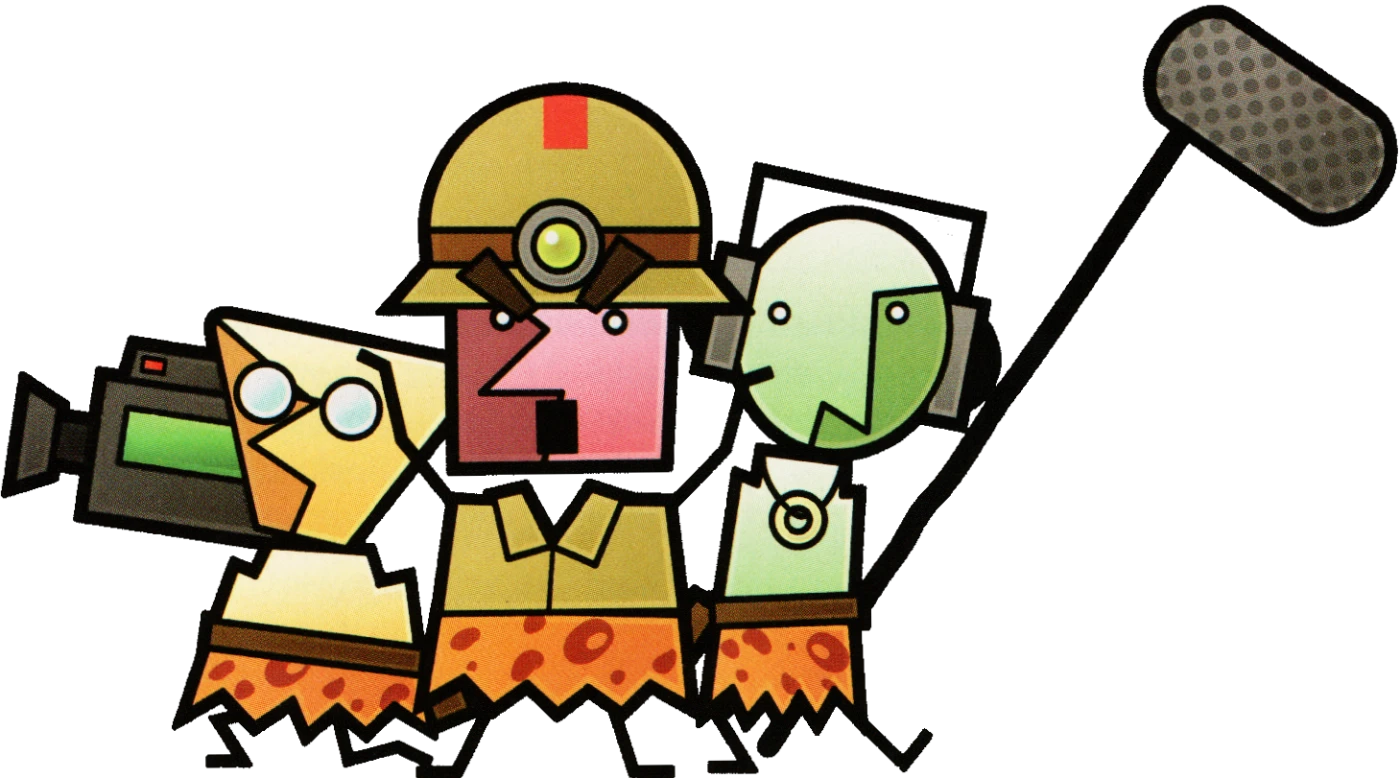 Flint CragleyCragnon journalist
 King SammerRuler of Sammer’s Kingdom
 Queen Jaydes and GrambiRulers of the afterlife
 LuvbiFollower · Chapter 7
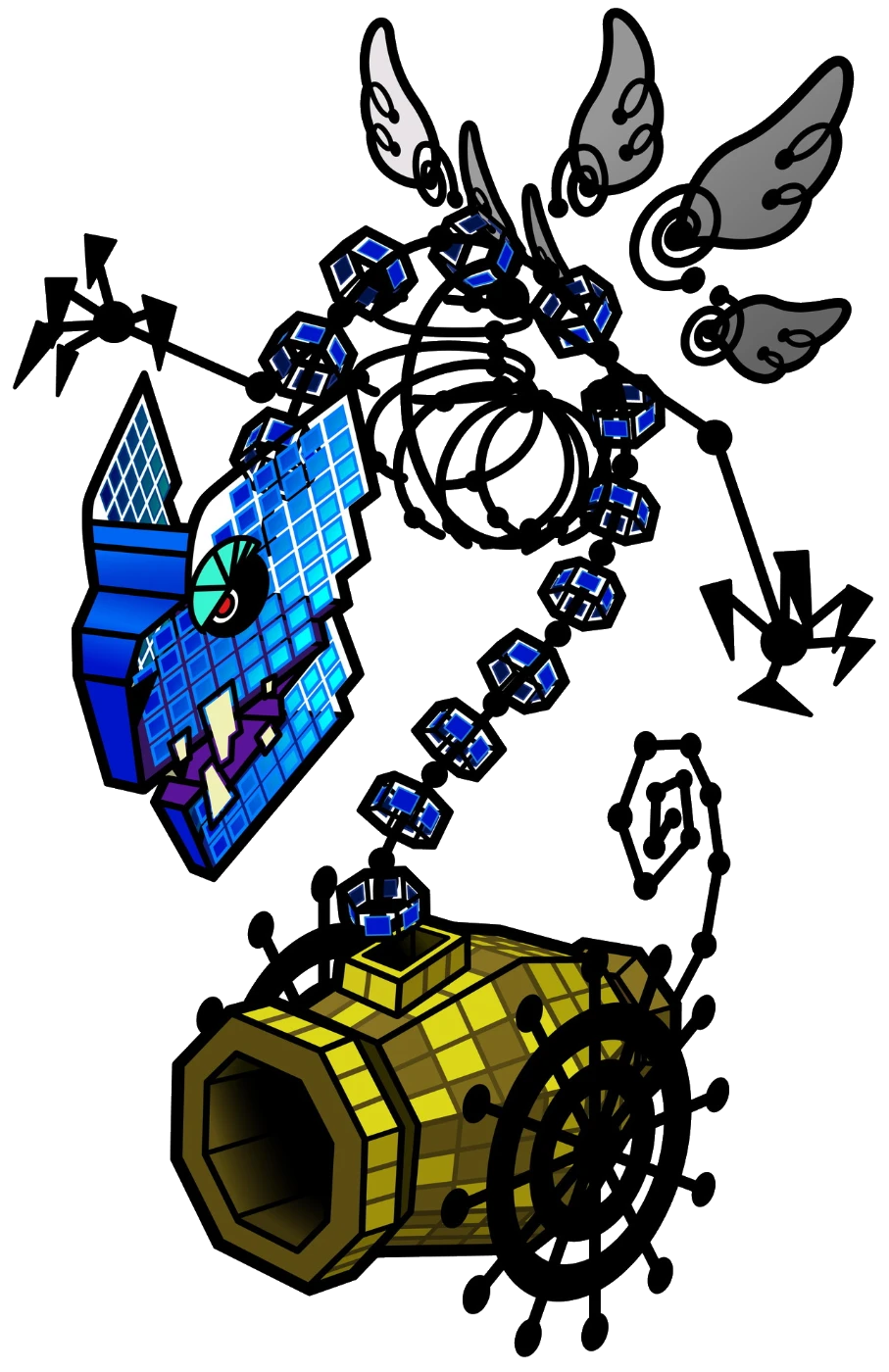 BonechillBoss of Chapter 7
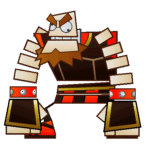 O’Chunks (boss)Chapter 1-3 · Yold Desert · 20 HP, ATK 1The first real fight. He returns with 40 HP in the Gap of Crag and 100 HP in Castle Bleck.
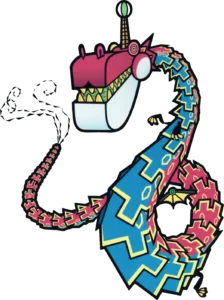 Fracktail (boss)Chapter 1-4 · Yold Ruins · nine hitsThe robot dragon of Yold Ruins, sabotaged by Dimentio.
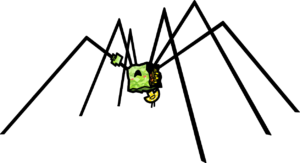 Mimi (boss)Chapter 2-4 · Merlee’s Basement · six hitsHer spider form, weakened by Merlee’s chant. Fought again in Castle Bleck with attack 4.
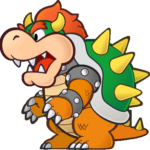 Bowser (boss)Chapter 3-1 · The Bitlands · 20 HP, ATK 2, DEF 1A duel with Mario. He joins afterwards, and has to be beaten again (80 HP, attack 8) on Underwhere Road.
 Big Blooper (boss)Chapter 3-2 · The Tile Pool · three hitsAppears to an arrangement of the underwater theme from Super Mario Bros. 3.
 Dimentio (boss)Chapter 3-3 · The Dotwood Tree · 30 HP, ATK 2Fought in Dimension D. Back with 80 HP in Castle Bleck, against Luigi.
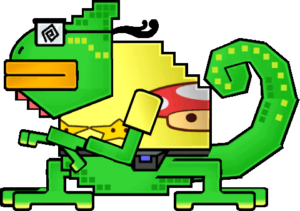 Francis (boss)Chapter 3-4 · Fort Francis · 40 HP, ATK 1Lord of Fort Francis and its robot cats.
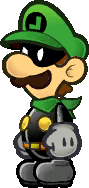 Mr. L (boss)Chapter 4-4 · Whoa Zone · 40 HP, ATK 3On foot, before he fetches the robot.
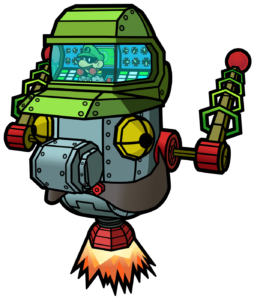 Brobot (boss)Chapter 4-4 · Whoa Zone · 255 HP, ATK 4, DEF 3A dogfight in space, won with Squirps’s lasers.
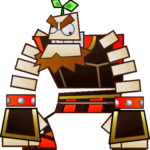 O’Cabbage (boss)Chapter 5-4 · Floro Caverns · 60 HP, ATK 3O’Chunks under a Floro Sprout: stronger, and not thinking.
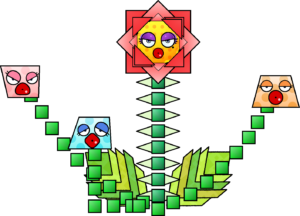 King Croacus IV (boss)Chapter 5-4 · Floro Caverns · 50 HP, ATK 2A giant flower with living appendages, fought in two phases.
 Mimi as King Sammer (boss)Chapter 6-2 · Sammer’s Kingdom · 25 HP, ATK 2A barrage of rubees, to pass the time until the world ends.
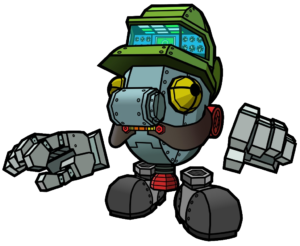 Brobot L-type (boss)World of Nothing · 64 HP, ATK 5, DEF 4Mr. L’s upgraded robot.
 Underchomp (boss)Chapter 7-2 · Underwhere Road · 16 HP per head, ATK 3, DEF 4A three-headed Chain Chomp and the game’s one turn-based battle. Piccolo’s music sends it to sleep.
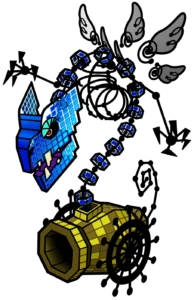 Bonechill (boss)Chapter 7-4 · The Overthere · 80 HP, ATK 4Usurper of The Overthere.
 Count Bleck (boss)Chapter 8-4 · Inner Sanctum · 150 HP, ATK 8Untouchable until the Pure Hearts break the Chaos Heart’s barrier. His void attack does 8 damage.
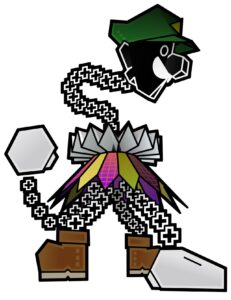 Super Dimentio (boss)Chapter 8-4 · Inner Sanctum · 200 HP, ATK 6The final boss, fought by Mario, Peach and Bowser. Only the head is undefended.
 Wracktail (boss)Optional · Flipside Pit, room 100 · 30 hits, ATK 10A far tougher Fracktail. Guards Dashell.
 Shadoo (boss)Optional · Flopside Pit, room 100, second visit · 400 HPDark Luigi, Dark Bowser, Dark Peach and Dark Mario in turn, 100 HP each. Dark Bowser hits for 20.
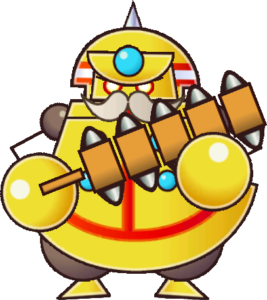 End Boss (boss)Optional · Duel of 100, round 100 · 99 HP, ATK 10, DEF 4The last and largest Sammer Guy.
 GoombaFrom Lineland Road on · 1 HPWith Paragoombas, Spiked Goombas and Gloombas, the rank and file of Bowser’s brainwashed army.
 Koopa TroopaFrom Lineland Road on · 1 HP, DEF 1The red-shelled ones have been brainwashed by Nastasia.
 SquigletLineland, Gloam Valley · 2 HPOne of the game’s own creatures. Its big brother the Squig shoots projectiles.
 BoomboxerYold Desert · 4 HP, ATK 2Found only in Yold Desert and the pit.
 Sproing-OingLineland Road, The Bitlands · 4 HPBounces, as the name suggests.
 CherbilYold Desert and elsewhere · 5 HP, ATK 2Comes in ordinary, poison and ice varieties.
 Zombie ShroomMany levels · 1 HP, ATK 2A mushroom gone bad, found in more levels than almost anything else.
 JawbusYold Desert, Gloam Valley · 5 HPRawbus and Gawbus are its tougher relations.
 Spiny TrompMount LinelandA spiked roller, best dodged by stepping into 3-D.
 ThwompMount Lineland · ATK 1A row of them is the game’s first lesson in walking round a problem.
 FrackleYold Ruins · 1 HPSmall relatives of Fracktail, met in its ruins.
 Buzzy BeetleYold Ruins, Floro Caverns · 1 HP, DEF 3Stone Buzzies turn up in the Land of the Cragnons.
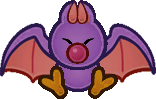 SwooperGloam Valley, Merlee’s Mansion · 3 HPThe mansion’s bats.
 BooMerlee’s Mansion · 4 HPAlso the target in the arcade’s Mansion Patrol.
 CursyaMerlee’s Basement and later · 1 HPTouching one lays a curse on the hero. Back, Heavy, Tech and Reversya Cursyas each have their own.
 ShlurpGloam Valley, Merlee’s Mansion · one hitTakes just one hit to beat, according to the bestiary.
 Mr. IMerlee’s Basement, Castle Bleck Entry · ATK 2A staring eyeball whose HP is a mystery even to the bestiary.
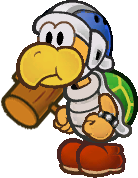 Hammer BroThe Bitlands, Castle Bleck · 4 HPWith Boomerang Bros. and Fire Bros., garrisons the Bitlands castles.
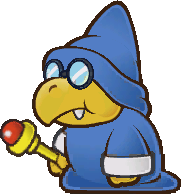 MagikoopaThe Bitlands, Castle Bleck · 6 HP, ATK 3There is no Kammy Koopa this time, only ordinary Magikoopas.
 Bullet BillThe Bitlands · 1 HP, ATK 2Fired from Bill Blasters, as ever.
 BlooperThe Tile Pool · 1 HP, ATK 2Small fry before the big one.
 Cheep CheepThe Tile Pool, Gap of Crag · 2 HPRed and green.
 Chain ChompThe Dotwood Tree, Fort Francis · 4 HP, DEF 4A Red Chomp variety also exists.
 Crazee DayzeeThe Dotwood Tree · 10 HPThe rarer Amazy Dayzee also appears.
 TileoidThe Dotwood Tree, Whoa Zone · 5 to 15 HPComes in four colours: B, G, R and Y.
 JellienOuter Space, Outer Limits · 4 HP, ATK 2An inhabitant of Outer Space.
 FotonOuter Space, Outer Limits · 8 HPAnother native of Outer Space.
 EeligonOuter Limits · 10 HPThe Hooligon is its relative.
 LongatorPlanet Blobule · 12 HPThe Longadile is its bigger relation.
 ChoppaPlanet Blobule · 5 HPFound on Planet Blobule and in the pit.
 BarribadWhoa Zone · 4 HP, ATK 2Guards the Whoa Zone.
 PigarithmWhoa Zone · three hitsTakes three hits to beat.
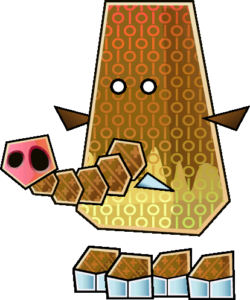 MuthLand of the CragnonsA woolly giant that charges on sight. The Mega Muth is bigger still.
 Floro SapienDowntown of Crag, Floro Caverns · 12 HP, ATK 3King Croacus’s people.
 Floro CragnienFloro CavernsA Cragnon under the control of a Floro Sprout.
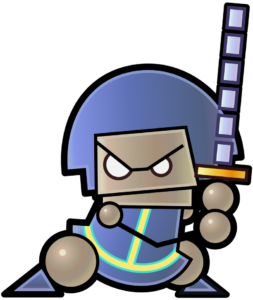 Sammer GuySammer’s KingdomA hundred of them, every one with a name. One calls himself the Thousand-Year Roar.
 NinjoeDuel of 100With Ninjohn and Ninjerry, sometimes drops in to help a Sammer Guy.
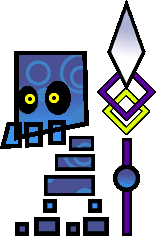 SkellobitThe OverthereBonechill’s skeleton soldiers. There are spiky ones, and Skellobombers too.
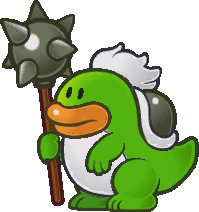 ClubbaFlipside Pit of 100 TrialsMet alongside Magikoopas deep in the pit.
 Dark GoombaFlopside Pit of 100 TrialsOne of the 49 silhouette enemies that live only in the second pit.