
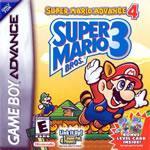

Super Mario Advance 4: Super Mario Bros. 3
Overview
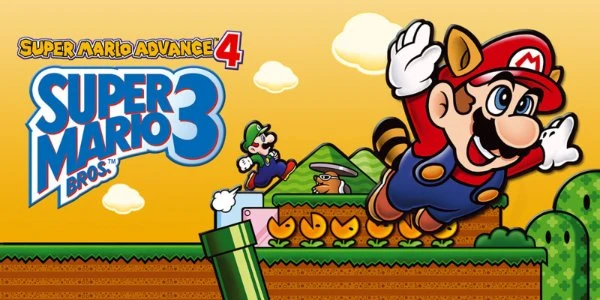
The Super Mario Advance series brought the best platformers from Nintendo’s NES and SNES consoles to the Game Boy Advance. The earlier titles covered Super Mario Bros. 2, Super Mario World, and Yoshi’s Island — but the one widely considered the best entry in the series wasn’t included until last. Super Mario Advance 4: Super Mario Bros. 3, released in 2003, gave the GBA a more-than-faithful rendition of the legendary Super Mario Bros. 3, using the upgraded graphics and audio from the Super Mario All-Stars 16-bit remake.
The eight worlds, each packed with secrets, items, and mini-games, return intact — alongside the classic Mario Bros. multiplayer option, the chance to play levels as Luigi with his floatier physics, and a remarkable new addition: e-Levels accessed through the Nintendo e-Reader.
The game received universal acclaim on launch. Metacritic aggregate score: 94/100, the third-highest GBA score ever, and the fourth-highest Mario score on the platform overall, surpassed only by the Galaxy series and Mario Odyssey. IGN scored it 9.5/10, GameSpot 8.9/10, and several outlets gave it perfect 10/10 marks. First-run sales hit 2.88 million copies. Many of its gameplay mechanics later became the foundation for New Super Mario Bros., marking it as one of the most quietly influential GBA titles in the Nintendo catalogue.
The Story

The Mushroom Kingdom has remained a peaceful place, thanks to the brave deeds of Mario and Luigi. However, the Mushroom Kingdom forms an entrance to the Mushroom World, a place where all is not well.
The Koopaling Scheme
Bowser sent his seven children — the Koopalings — to make mischief in this normally peaceful land. As their first order of business, they stole the royal magic wands from each country in the Mushroom World and used them to transform the kings into animals: Mario and Luigi must recover the seven royal magic wands from Bowser’s seven kids and return the transformed kings to their true forms.
Mario & Luigi Set Off
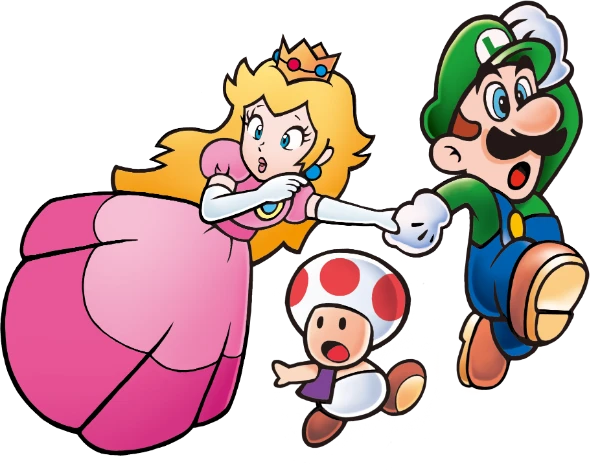
As Mario and Luigi set off on their journey deep into the Mushroom World, Princess Peach and Toad have but one thing to say: “Good-bye, and good luck!”
The story is identical to the 1988 NES original — the same plot beats, the same Koopalings, the same Bowser’s castle climax. What’s changed is the framing: this is the first time the player can re-experience the story with the addition of the Princess Peach mid-game appearance on the map after defeating worlds via warp-zone shortcuts, and the new cutscenes awarded for going back to play levels you skipped after using warps.
Key Features
Beyond the core SMB3 game, this re-release packs in several distinct features that set it apart from previous versions:
- Dash past danger, swim treacherous seas, take to the air — speed toward a collision course with Bowser through 8 enormous worlds
- Power-ups galore: jump bottomless pits, stomp familiar foes, and use awesome power-ups like the Warp Whistle, the Frog Suit, and the iconic Tanooki Suit as you take flight to Bowser and his kids
- Open up new levels and game features when you scan special cards through the e-Reader attachment
- Complete increasingly difficult levels, beating one of Bowser’s kids at the end of each world on your way to the final battle
- Multiplayer Mario madness: link up with any of the other three Super Mario Advance games for frantic two-player fun in the original Mario Bros. arcade game
- Play as Mario or Luigi with their own separate inventories and progression
- Save up to 999 lives — the cap is wildly higher than the NES original
- Up to 36 items in inventory across both Mario and Luigi modes
Changes from the All-Stars Version
Super Mario Advance 4 is essentially the same game as Super Mario Bros. 3 — same worlds, same levels, same enemies, same final boss. But Nintendo made dozens of small refinements compared to both the NES original and the Super Mario All-Stars 16-bit remake.
Gameplay Changes
| Area | Change |
|---|---|
| Lives Cap | Mario can have up to 999 lives — a dramatic increase from prior versions |
| Post-Game Warp | After finishing the game, Mario can warp through worlds using the R button on the map screen |
| Replay Menu | Open with Select on the map. Lets you re-watch your progress and check status anytime |
| Item Carrying | You can carry items through stage portions — ice blocks and Koopa shells can be transported between sub-areas |
| Game Over Save | You cannot save after a game over — a deliberate difficulty bump compared to other GBA Mario titles |
| Inventory | Up to 36 items across separate Mario and Luigi inventories |
| Spiny Shells | Upside-down Spiny Shells can now be safely stomped without taking damage. In prior versions, even an immobile upside-down Spiny Shell would hurt Mario |
| Big Blocks | Big Blocks in normal courses can be hit with a tail swipe as Raccoon or Tanooki Mario |
| Battle Mode Removed | The Mario Bros. Battle Mode and Battle Game from earlier Super Mario Advance titles were removed entirely |
| Luigi Physics | Luigi scuttles when he jumps visibly, but his floatier Super Mario World: Super Mario Advance 2-style physics are only applied within World-e levels or after scanning the Luigi Power Up!! e-Reader card |
Level Design Changes
- Several levels received changes to item and coin placement, with blocks containing coins, power-ups, and 1-Up Mushrooms added throughout
- World map pipes and Toad’s House interiors were redesigned to fit completely on the GBA’s smaller screen
- The end of World 2-Pyramid moved to the opposite side of the pyramid, with a Blue Coin-revealing Switch Block added
- Fortress boss arenas are slightly shorter — the entrance is now closed before facing Boom Boom
- Bowser’s castle rooms made shorter and lower
- Several enemies, obstacles, and pits were made less threatening or removed entirely
- In World 5-1, the second of the two coin-formation “3”s made of blue coins was changed to a “4” — since this is Super Mario Advance 4
- White Mushroom Houses: after beating the game, levels that unlock these now display a Mushroom Coin at the start to indicate the unlock
Graphics & UI Changes
- Graphics are brighter-coloured than the All-Stars version, but not as much as in prior Super Mario Advance games
- Invincibility palettes are even brighter, making Mario/Luigi colored like they were in Super Mario Advance 1
- If played on a Game Boy Player, the palettes revert to those of the All-Stars version
- Mario and Luigi now wear their white gloves instead of being bare-handed
- Raccoon Mario’s lighter tail stripes are thinner
- In Toad’s Houses, Toad has a modified sprite with a visible smile
- New pop-up when the player earns more than ten lives
- Title screen redesigned with two new menus for selecting save files and game modes
- Save files reduced from 4 to 3, and no longer save the mode selected
Controls
In a Level
| Input | Action |
|---|---|
| D-Pad | Move / Crouch / Climb / Enter doors / Enter pipes / Swim (as Frog Mario) |
| A button | Jump / Fly or glide (as Raccoon or Tanooki Mario) / Swim / Swim faster (as Frog Mario) |
| B button (or R) | Dash / Pick up and throw items / Shoot fireballs (Fire Mario) / Tail whip (Raccoon/Tanooki) / Throw hammers (Hammer Mario) |
| Start | Pause |
On the World Map
| Input | Action |
|---|---|
| D-Pad | Move Mario around the map |
| A button | Select level / item |
| L button | Swap lives between Mario and Luigi (in Mario & Luigi mode) |
| B button | Open / close item inventory |
| R button | Open / close e-Reader menu (also: warp through worlds post-game) |
| Start | Pause |
| Select | Open / close replay menu |
The 8 Worlds & Maps
The 8 worlds and their levels are the same as the original Super Mario Bros. 3 and its Super Mario All-Stars remake. The Koopalings have transformed each kingdom’s ruler and are making mischief throughout the Mushroom World.

Grass Land
A general plains world with easy levels designed to get the player familiarized with the controls and new features of Super Mario Bros. 3 — the Frog Suit, the Tanooki Suit, the Raccoon Tail, the world map progression. Standard Goombas, Koopas, and Piranha Plants throughout.
Koopaling boss: Larry Koopa in his Airship at the end of the world.

Desert Land
A desertic land full of new challenges and unique enemies. Sandy dunes, pyramids, and quicksand traps. The infamous Angry Sun looks angry here — chasing Mario across desert stages to attempt a dive-bombing attack.
Koopaling boss: Morton Koopa Jr. in his Airship. Famous for the World 2-Pyramid level where the exit moved to the opposite side in this remake, with a Blue Coin Switch Block added.

Water Land
A beachside land by the ocean full of underwater challenges. The Frog Suit shines here — it dramatically improves swim speed and precision. Luigi in his frog suit can navigate the water-filled tunnels far more easily than standard Mario.
Koopaling boss: Wendy O. Koopa in her Airship. Multiple aquatic boss platforms.

Giant Land
The land with giant Koopas, giant Goombas, and giant bricks — everything is bigger here, including the platforms, the enemies, and the bonus blocks. A spectacle world where the visual gag of scaled-up Mario sprites is the entire identity.
Koopaling boss: Iggy Koopa in his Airship.

Sky Land
A gateway to the sky, filled with bottomless pits and jump challenges. Cloud-platform navigation, falling-platform mechanics, and the iconic Snake Platforms that move along set paths. In this remake, bricks attached to Warp Pipes and Turtle Cannons now contain coins. The “3” coin formation in World 5-1 was changed to a “4” to reflect the Super Mario Advance 4 branding.
Koopaling boss: Roy Koopa in his Airship.

Ice Land
A frozen land where snow covers the levels and the enemies, even the coins are frozen. Slippery ice physics dominate the platforming. Penguins, Mr. Blizzards, and frozen Cheep-Cheeps act as the regional enemies.
Koopaling boss: Lemmy Koopa in his Airship.

Pipe Land
A pipe maze that the Piranha Plants have overtaken. Vertical traversal through a network of pipes is the main challenge. Both Munchers and Piranha Plant variants dominate the stage. The atmosphere is darker and more claustrophobic than earlier worlds.
Koopaling boss: Ludwig von Koopa in his Airship.
Dark Land
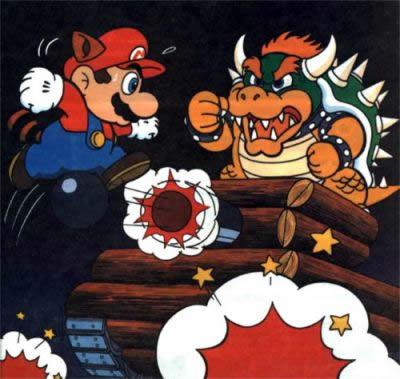
The final world. Bowser’s direct domain — a militarised wasteland of Hammer Bros. battlefields, multi-screen Airships, and Tank levels with rotating cannon emplacements. Culminates in Bowser’s Castle and the climactic boss fight in his throne room with the famous fake-floor trap.
Final boss: Bowser in his castle throne room.
Characters


Mario & Luigi
The dual protagonists. Mario has standard physics throughout the game. Luigi visibly scuttles when he jumps but — unlike in other Super Mario Advance titles — his actual jump physics are identical to Mario’s by default. The famous floatier Luigi physics from Super Mario Advance 2 only apply in World-e e-Reader levels or after scanning the Luigi Power Up!! e-Reader card.
The Koopalings
Bowser’s seven children are the per-world bosses, each piloting an Airship at the end of their respective world:
- Larry Koopa — Grass Land (World 1)
- Morton Koopa Jr. — Desert Land (World 2)
- Wendy O. Koopa — Water Land (World 3)
- Iggy Koopa — Giant Land (World 4)
- Roy Koopa — Sky Land (World 5)
- Lemmy Koopa — Ice Land (World 6)
- Ludwig von Koopa — Pipe Land (World 7)
Bowser & Princess Peach
Bowser waits in his castle in World 8 (Dark Land) as the final boss. Princess Peach is held captive throughout the game, with a new appearance in this version: she now appears on the world map after defeating worlds via warp-zone shortcuts, with new cutscenes for revisiting skipped levels.
Boom Boom
The Koopa boss who guards each world’s mid-fortress checkpoint. In this remake, the fortress boss arenas are slightly shorter — the entrance is closed before facing him — making each Boom Boom encounter slightly more focused than in earlier versions.
The e-Reader System

Super Mario Advance 4’s most genuinely unique feature is e-Reader compatibility. By connecting a second Game Boy Advance equipped with a Nintendo e-Reader peripheral via Link Cable, the game becomes capable of reading physical trading cards that unlock new content.
How It Works
- Connect a second GBA to the playing one via Link Cable
- Slot the e-Reader peripheral into the second GBA
- Swipe a Super Mario Advance 4 card through the e-Reader’s card slot
- The card’s data is transmitted to the main GBA running SMA4
- Depending on the card type, a new level, item, or demo is added to the game
The Bonus World: World-e
e-Levels appear in World-e — a separate bonus world accessed via the e-Reader menu (R button on the map). World-e is structured like the other worlds with its own level grid, but starts empty and fills up as cards are scanned in.
- Up to 32 levels can be saved on the game cartridge at any one time
- Up to 73 distinct levels can be added to the World-e listing across multiple scan-and-save cycles
- Levels can be deleted to make room for new ones
- Each e-Level brings objects and enemies from across the entire 2D Mario library — SMB, Lost Levels, SMB2, SMW, Yoshi’s Island, and original SMA designs
The Three Card Types
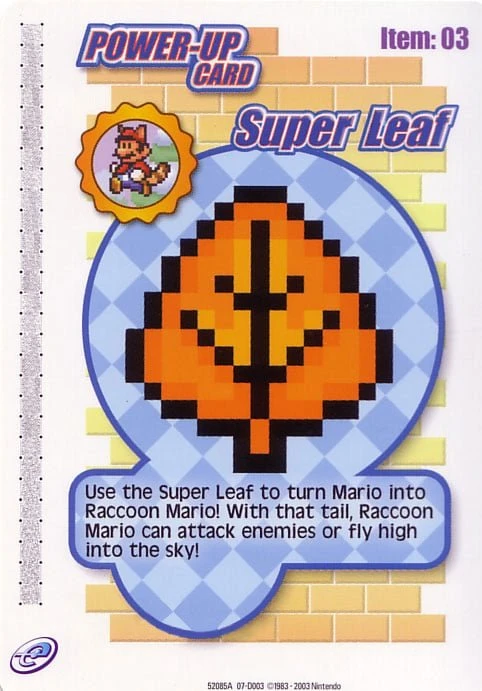
The e-Reader compatibility supports three different card types, each with a distinct purpose. Sample cards below.

1. Level Cards
A Level Card uploads a brand-new level into the game, playable in World-e. 32 levels can be saved on the game at a time, and up to 73 distinct levels can be listed across the full library. Each level is custom-designed for the e-Reader release and features objects and enemies from across the 2D Mario back catalogue.
2. Power-Up Cards
A Power-Up Card uploads an item (or a set of items) directly into either Mario or Luigi’s inventory. There is no limit on how many times an item card can be used — scan it, get an item; scan again later, get another. A variant type called Switch Cards trigger an event in the game upon being scanned (the Luigi Power Up!! card is one of these, applying SMA2-style floaty Luigi physics globally).
3. Demo Cards
A Demo Card plays a short video of Mario speedrunning through a level, collecting enough coins in a particular level to trigger a White Mushroom House, or racking up numerous lives via a special trick. Effectively in-game replays unlockable through the e-Reader — designed to teach optimal strategies for specific levels.
Original-Game Objects Brought Back by e-Cards
The e-Levels include objects and enemies returning from the previous games in the 2D Mario lineage:
| From Game | Examples |
|---|---|
| Super Mario Bros. + Lost Levels | Original-style enemies and platforms reintroduced |
| Super Mario Bros. 2 (USA) | Subspace mushroom, vegetables to pull, Shy Guys, Phantos |
| Super Mario World | Yoshi, Cape Feather, SMW-specific Koopa shells |
| Super Mario World 2: Yoshi’s Island | Yoshi mechanics, Yoshi-style enemies, baby Mario mechanics |
| Super Mario Advance 1–3 | Recurring objects from earlier GBA Advance ports |
Re-Releases

Super Mario Advance 4 has been re-released multiple times since its 2003 GBA launch, with notable changes between versions.
Wii U Virtual Console (2014)
- Released on the Wii U Virtual Console as part of the GBA re-release lineup
- Every single e-Reader unlockable is available from the start on the Wii U VC version, since the platform has no e-Reader support. All 73 e-Levels, all Power-Up Cards, and all Demo Cards come pre-unlocked
- The rumble setting was removed entirely from the options menu (the Wii U GamePad has no GBA rumble support)
- HD upscaled for the Wii U screen
Nintendo Switch Online + Expansion Pack (Game Boy Advance)
- Added to the Nintendo Switch Online — Game Boy Advance library as part of the Expansion Pack subscription
- Like the Wii U VC version, all e-Reader content comes pre-unlocked
- Available on Nintendo Switch and Nintendo Switch 2
- Supports Switch Online cloud saves
Why The Re-Releases Matter
Because the e-Reader peripheral was discontinued and the physical cards became rare collector items, the modern re-releases are now the easiest legal way to experience all 73 e-Levels. The original GBA release without the e-Reader peripheral leaves the entire World-e bonus content locked out — making the Wii U and Switch versions arguably the definitive way to play the game.
Promotion & Videos
Four contemporary promotional videos preserve Nintendo’s 2003 marketing campaign and the 2014 Wii U Virtual Console re-launch. All ordered chronologically below.
Print & Other Promotional Materials
- International print advertising campaign with regional variants across North America, the UK, Brazil, France, and Mexico
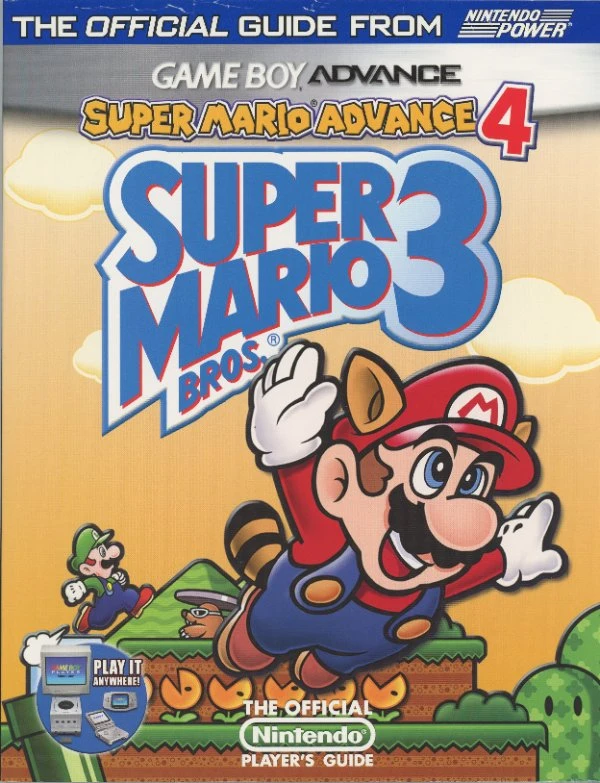
- Nintendo Power Player’s Guide — official strategy guide published by Nintendo Power
- Prima Games Official Guide — published with detailed Koopaling bios for Larry, Wendy, Roy, and Ludwig
Development Staff
Super Mario Advance 4 was developed by Nintendo EAD (with additional work credited to Nintendo R&D 2 in some sources), and published by Nintendo.
- Director: Hiroyuki Kimura
- Producer: Takashi Tezuka — the long-time Mario series producer
- New Graphics: Designed by Emi Tomita
- New Music Tracks: Composed by Taiju Suzuki
- Original Game Staff: Very few of the original 1988 SMB3 staff were directly involved in this remake. Notably, Shigeru Miyamoto goes uncredited here — a rare omission, considering he had previously produced Super Mario Advance 2 with Tezuka as his supervisor
- Publisher: Nintendo
- Platform: Game Boy Advance
Reception & Legacy
Super Mario Advance 4: Super Mario Bros. 3 received universal acclaim on launch and remains one of the highest-rated GBA games ever released.
“Mario hop-’n’-bop action at its finest.” — Pocket Gamer (10/10)
Critical Scores
- Metacritic Aggregate: 94/100 based on 25 reviews — the third-highest GBA score ever, and the fourth-highest Mario score on Metacritic, surpassed only by Super Mario Galaxy, Super Mario Galaxy 2, and Super Mario Odyssey
- IGN: 9.5/10 — universally positive review
- GameSpot: 8.9/10 — praised the controls, stages, and visuals; nominated for Platformer of the Year
- Pocket Gamer: 10/10 — perfect score, called it “Mario hop-’n’-bop action at its finest”
- Play Magazine: 10/10 — perfect score, praised the challenge, the quick save feature, and the e-Reader functionality
- Electronic Gaming Monthly: Praised the controls, stages, and visuals; said it looked good for an “old, trippy 2D game”
- Yahoo! Games: Stated the game surpassed both the original NES/Famicom version AND the Super Mario All-Stars release
Sales & Awards
- 2.88 million copies sold in the initial 2003–2004 release window
- Re-released on the Wii U Virtual Console with continued strong reception
- Re-released on Nintendo Switch Online — Game Boy Advance
- Won several industry awards in 2003
- GameSpot Platformer of the Year nomination
Legacy
Beyond its critical and commercial success, Super Mario Advance 4 has had an outsized impact on subsequent Mario titles: many of its gameplay mechanics became the standard for New Super Mario Bros. (2006). The game shares its engine with Super Mario Advance 2 — leftover graphics from SMW are preserved in the cartridge, as are unused graphics from the original SMB3 itself. The e-Reader experiment ended with this title, but the 73 bonus levels remain one of the most generous post-launch content extensions of any Nintendo title before DLC became standard.
SLB User Reviews
Super Luigi Bros users have weighed in on Super Mario Advance 4 over the years. Aggregated scores from the community below.
| Reviewer | Score | Verdict |
|---|---|---|
| EvilHeartBurnMan | 10/10 | A nostalgic review reliving childhood; impressed by every detail. The pinnacle SLB user score |
| Charizard06 | 9/10 | Strong scoring with solid praise for the e-Reader features and the polish of the All-Stars-style remake |
| Dustin D. Cook | 9/10 | Very happy with his copy of the invigorated Super Mario Bros. 3 |
| Tetzcatilopoca | 9/10 | Agreed with the consensus; high marks across the board |
| Dan Anderson | 6/10 | Described it as an uninspired port saved only by the e-Reader features. The lone middling SLB user review |
The SLB user community average sits at 8.6/10 across these five reviews — close enough to professional critic consensus to confirm this is a genuinely well-regarded GBA release among the SLB readership.
Regional Logos, Box Art & Marketing
Super Mario Advance 4 shipped with a consistent worldwide title — unlike many GBA Mario releases that had regional name variations. Distinct logos and box arts per region.
Regional Logos

Box Art

Print Advertising
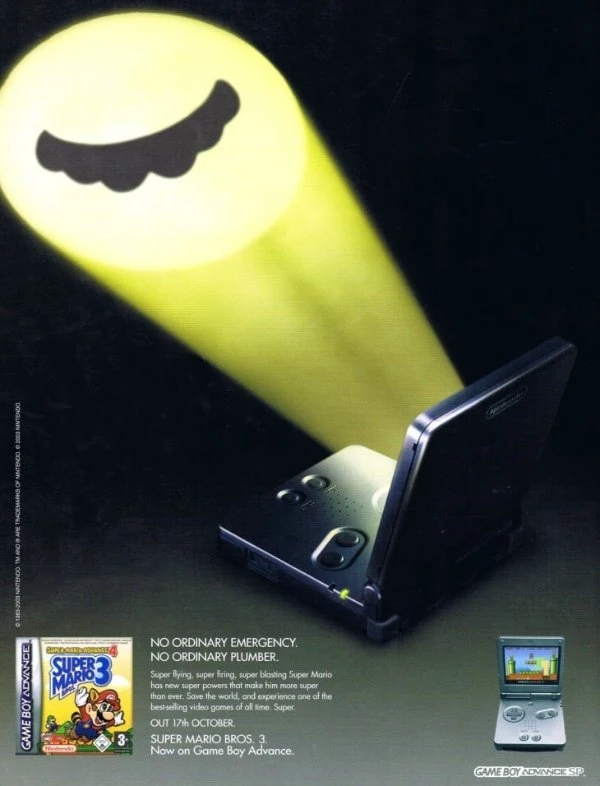
Nintendo ran an international print advertising campaign for the 2003 launch. Regional ads tailored the messaging for each market.


Strategy Guides

Trivia & Interesting Facts

- Many of the gameplay mechanics became the standard for New Super Mario Bros. (Nintendo DS, 2006). The new save system, the inventory carrying through stages, and the multiple-mode play structure all carried directly over to the 2D Mario revival series
- The game uses the same engine as Super Mario Advance 2. Some graphics from Super Mario World were left free in the cartridge data, even unused graphics from the original Super Mario Bros. 3 itself — a clear sign of engine reuse
- The e-Reader peripheral was never released in Europe. European players received an SMA4 with the e-Reader functionality completely absent. The 73 bonus e-Levels were locked out of European cartridges entirely
- Every e-Reader unlockable is available from the start on the Wii U Virtual Console version — since the Wii U has no e-Reader support, Nintendo opted to pre-unlock all bonus content rather than leaving it out
- The same applies to Nintendo Switch Online — the GBA library version on NSO has all e-Reader content open from the start
- 2.88 million copies sold in the initial 2003–2004 release window. Combined with the Wii U VC and NSO re-releases, total sales now significantly higher
- Metacritic 94/100 — the third-highest-scoring GBA game ever made. Higher than any other Super Mario Advance title
- Fourth-highest Mario score on Metacritic, surpassed only by Super Mario Galaxy, Super Mario Galaxy 2, and Super Mario Odyssey
- Up to 999 lives can be banked — a dramatic increase from the NES original’s lower cap. Designed to support the longer e-Reader bonus content
- You cannot save after a Game Over, an intentional difficulty bump compared to some other GBA Mario titles. This was a deliberate design choice to maintain stakes
- Up to 36 inventory items across separate Mario and Luigi modes. The two characters maintain entirely separate progression and item stocks
- The Koopalings reappear after Super Mario World — they had been absent from much of the SNES-era Mario library before returning here in their original SMB3 roles
- World 5-1’s second “3” coin formation was changed to “4” — a tiny in-game reference to the Super Mario Advance 4 branding
- Shigeru Miyamoto goes uncredited here, an unusual choice given he produced Super Mario Advance 2 with Tezuka as his supervisor. The fourth game in the Advance series chose to credit Tezuka as producer without Miyamoto’s direct involvement
- 32 levels can be saved on the cartridge at any time, but the full World-e listing supports up to 73 distinct levels across deletion-and-reload cycles
- Luigi’s scuttling animation is visual-only by default — the actual jump physics match Mario’s. The famous floaty Luigi physics from SMA2 only activate inside World-e levels or after scanning the Luigi Power Up!! e-Reader card
- If the game is played on a Game Boy Player, the colour palettes revert to those of the Super Mario All-Stars version — a deliberate choice to suit the larger TV display rather than the GBA’s smaller LCD
- Thwomp missed. He hates it when he misses.
- The e-Reader cards now exist as collector items. Original sealed pack-in cards command significant prices on the secondary market, and some rare Power-Up card variants are particularly sought-after
- The Wii U VC release removed the rumble setting entirely from the options menu — the Wii U GamePad has no compatible GBA rumble peripheral
Promotional Wallpaper
Official promotional wallpaper from Nintendo’s 2003 marketing campaign for Super Mario Advance 4.

Reference / Information
Sub-pages, guides, and the replacement game manual for Super Mario Advance 4.
Media / Downloads
Box art gallery, desktop wallpaper downloads, and rendered artwork for Super Mario Advance 4.