
Super Mario Advance 3: Yoshi’s Island
Overview
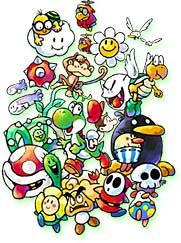
Third time’s a charm. Nintendo took the power of the Game Boy Advance to the edge and released one of the better — if not the best — platformers right onto the handheld. Yoshi’s Island, the game that was bundled with the SNES 2 and one of the few that gave perfect use to the Super FX-2 chip, saw its portable release here as Super Mario Advance 3.
Players take control of Yoshi, who helps Baby Mario reach his lost brother Baby Luigi. The journey crosses Dinosaur Island, where Yoshi meets Snifits, Shy Guys, Shy-Aways, and the evil Magikoopa Kamek before facing Baby Bowser as the final boss. The game also retains the Mario Bros. arcade re-release with up to 4 players via link cable, a staple of the Advance series.
Critical reception was strong: GameSpot 9.2/10, GameSpy 90/100. The game was praised for porting the SNES Super FX-2 visuals faithfully to GBA hardware while delivering all the original content plus extras. It’s been re-released on the Wii U Virtual Console and Nintendo Switch Online — Game Boy Advance library, and is widely considered the definitive way to experience this 1995 classic.
The Story

The Stork’s Delivery
From the opening cinematic: the stork is in the middle of a routine delivery, carrying twin babies to their parents, when Kamek the evil Magikoopa attacks. The stork is captured — but only one twin remains in his grasp. The other baby falls from the sky and lands on Yoshi’s Island.
The Yoshies are in an uproar over the fallen baby. They examine him and discover he was carrying a map. Baby Mario can’t quite explain himself, but the bond between the twins tells each of them where the other one is. The Yoshies decide to carry Baby Mario to his destination via a relay system — each Yoshi passes Baby Mario along to the next.
Kamek Discovers His Mistake
Kamek dispatches his toadies. When he discovers that he missed the other baby, he panics: his forces immediately spread across the island, searching for the lost twin. Will Yoshi and Baby Mario reach Baby Luigi before Kamek finds them?
The Goal: Reunite the Twins
The story unfolds across 6 worlds. Yoshi must carry Baby Mario through Dinosaur Island, fighting through enemy waves of Shy Guys, Bandits, Piranha Plants, and worse — culminating in a final confrontation with Baby Bowser at the climax of World 6-8. The story between cinematics has Yoshi being chased by Kamek’s forces throughout the journey, with each new Yoshi taking the baton in the relay race against the Magikoopa’s schemes.
Gameplay

Super Mario Advance 3: Yoshi’s Island is a 2D platformer where Yoshi is the playable character and Baby Mario rides on his back. Lose Baby Mario to enemy contact and he floats away in a bubble with a 10-second countdown — if you don’t recover him in time, you lose a life.
Yoshi’s Core Moves
- Flutter Jump: hold A at the apex of a jump for extra airtime — the signature Yoshi traversal move
- Tongue Eat: press B to lash out Yoshi’s long tongue and eat enemies or fruit
- Egg Conversion: press down after eating to convert the enemy into an egg, which Yoshi carries behind him
- Egg Spit: press B again to spit the egg in the direction Yoshi is facing
- Egg Aim & Throw: press R to bring out a crosshair targeting reticule, then press B (or release in Hasty mode) to throw the egg toward that point. L locks the reticule on the target
- Ground Pound: press down while in the air — a powerful descent that breaks blocks and stuns enemies
- Yoshi Morph Transformations: at specific points in some levels, Yoshi can transform into vehicles (Helicopter, Mole Tank, Train, Submarine, Car) via Morph Bubbles
The Baby Mario System
- Baby Mario rides on Yoshi’s back throughout normal gameplay
- Take damage and Baby Mario floats away in a Star bubble, with the baby countdown starting at the level’s starting timer (usually 10 seconds)
- Re-grab the bubble before the timer hits zero to put Baby Mario back on Yoshi’s back
- If the timer runs out: Kamek’s Toadies swoop in and take Baby Mario, costing Yoshi a life
- Superstar Mario: grab the rare Mario Power Star item to temporarily transform Baby Mario into Superstar Mario, who runs autonomously across the level invincible — a thrilling chase sequence
Scoring System
- Each level awards a score out of 100, broken into four components
- Red Coins: 20 hidden in each main level (worth a point each)
- Flowers: 5 per level (worth a point each via mini-game roulette)
- Stars: the remaining points come from the Star count at level end (max 30)
- Goal Ring: hit the central goal for max bonus points
- 100-Point Perfect: achievable on every level. Earn 100 on all levels of a world to unlock the Extra Stage for that world
Controls
Two Egg-Aiming Modes
The remake offers two control schemes for egg aiming: Patient (press once to enter aim mode, press again to throw) and Hasty (hold to aim, release to throw). Players can switch between them in the options menu based on preference.
| Action | Patient Mode | Hasty Mode |
|---|---|---|
| Move | D-Pad left/right | |
| Jump | A button (hold for Flutter Jump) | |
| Pound the Ground | A + Down (in air) | |
| Eat / Spit Out | B button (press to eat, press again to spit out) | |
| Duck / Swallow | Down on D-Pad | |
| Aim & Throw Egg | R button to aim, B to throw | Hold R to aim, release to throw |
| Lock Target Reticule | L button while aiming | |
| Look Up | Up on D-Pad (hold to pan camera up) | |
| Pause Menu | Start button | |
| Item / Score Menu | Select button | |
Note: the GBA lacks the SNES’s X and Y buttons, so the L and R buttons cover most of those functions. This redistribution is the biggest control-scheme change between the original and the port.
The 6 Worlds
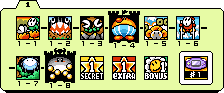
The game has 6 worlds, each with 8 main levels + 1 Extra Stage for a total of 54 base stages. Each world has the same overall structure: 4 standard stages, 1 mid-fortress boss, 3 more standard stages, then a castle finale boss.
Grassland Beginning
The opening world taking place in a grass field. This world introduces all the stage types that will appear on the rest of the game: standard outdoor stages, caverns, and sky stages. Tutorial-style level design that gets the player familiar with Yoshi’s tongue mechanic, egg throwing, and the Flutter Jump.
Mid-Boss: Burt the Bashful (1-4 Fortress)
Final Boss: Salvo the Slime (1-8 Castle)
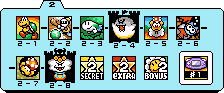
Mountains & Hills
A mountainous region that introduces enemies such as the Baseball Boys (Lakitus that throw baseballs), Ghosts, and the Goonies birds that fly diagonally toward Yoshi. Vertical-traversal stages dominate.
Mid-Boss: Bigger Boo (2-4 Fortress)
Final Boss: Hookbill the Koopa (2-8 Castle)
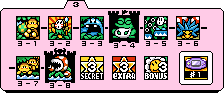
Jungles & Caverns
Dense jungle terrain and cavern interiors. Yoshi morphs are heavily featured here, particularly the Helicopter Yoshi and Mole Tank Yoshi transformations. Notable enemy: Tap-Tap, the spike-armored slow walker.
Mid-Boss: Prince Froggy (3-4 Fortress)
Final Boss: Naval Piranha (3-8 Castle)
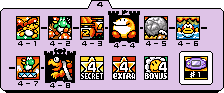
Underwater & Snow
Water-based stages and ice/snow terrain. The Submarine Yoshi morph appears in the underwater stages. Slippery ice physics dominate the cold-zone stages. Famous for the iconic “Touch Fuzzy, Get Dizzy”-style trippy levels.
Mid-Boss: Marching Milde (4-4 Fortress)
Final Boss: Sluggy the Unshaven (4-8 Castle)
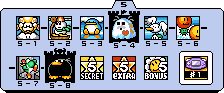
Sky & Clouds
Vertical cloud-platform navigation and sky-themed challenges. Falling platforms, vanishing clouds, and aerial enemy encounters. Helicopter Yoshi transformations are particularly important here.
Mid-Boss: The Potted Ghost / Sluggy (5-4 Fortress)
Final Boss: Raphael the Raven (5-8 Castle — a brilliantly-designed moon-arena fight)
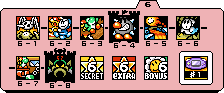
Bowser’s Castle
The final world. Castle-heavy environments leading to Bowser’s castle and the climactic confrontation with Baby Bowser. Difficult late-game traversal: lava hazards, multi-layered moving platforms, and the highest density of bosses in the game.
Mid-Boss: Tap-Tap the Red Nose (6-4 Fortress)
Final Boss: Baby Bowser (6-8 — the final boss). Defeat him to unlock the 6 Secret Stages.
The 6 Exclusive Secret Stages
The defining new content of the Super Mario Advance 3 release is 6 brand-new Secret Stages, exclusive to the GBA port and unavailable on the original SNES version. These stages are positioned to the left of the Extra Stages on the world map and are unlocked by defeating Baby Bowser on World 6-8.
Exercise in the Skies
A vertical sky-platforming challenge designed to test Yoshi’s Flutter Jump precision. Long airtime sequences over bottomless cloud gaps.
Mystery of the Castle?
A puzzle-focused castle stage requiring careful exploration of hidden rooms and switches. The question mark in the name hints at the discovery-driven design.
Go! Go! Morphing!
A Yoshi-transformation-heavy stage featuring multiple Morph Bubbles. Players cycle through several different Yoshi vehicle forms in quick succession — Helicopter, Mole Tank, Train, Submarine, Car.
Fight Toadies w/ Toadies
A combat-focused stage where Yoshi must defeat large numbers of Kamek’s Toadies, often using captured Toadies as projectiles against their compatriots.
Items are fun!
A stage focused around heavy use of the inventory item system. Many item-pickup opportunities and item-required puzzles.
Endless World of Yoshis
The final Secret Stage. A long, endurance-focused level showcasing every gameplay mechanic Yoshi’s Island offers. Considered the ultimate challenge for players who have completed everything else.
Like the original Extra Stages, the 6 Secret Stages can be replayed for high scores after the first completion. Achieving 100 points on all 60 main + secret + extra stages is the ultimate completion goal of the game.
Bosses
The game features 12 bosses across the 6 worlds — one mid-fortress boss and one castle finale boss per world. Most return from the original SNES Yoshi’s Island. Listed in encounter order.
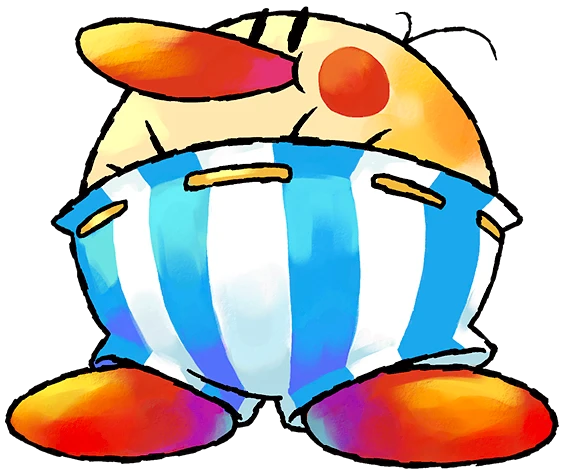
Burt the Bashful
World 1-4 Mid-Boss — Fortress
A shy bouncing creature wearing puffy short trousers. Burt grows larger as Yoshi hits him; defeat by repeatedly throwing eggs at him until his trousers fall down and embarrass him into defeat.

Salvo the Slime
World 1-8 Final Boss — Castle
A green slime that splits into smaller slimes when hit. Yoshi must throw eggs at the smallest slime form. The arena features rolling spike balls as additional hazards.

Bigger Boo
World 2-4 Mid-Boss — Fortress
A super-sized Boo with the unusual property of growing larger every time Yoshi looks at him. Yoshi must time egg throws while looking away from Bigger Boo.

Hookbill the Koopa
World 2-8 Final Boss — Castle
A large Koopa with a hooked beak. The arena tilts as Hookbill shifts his weight, forcing Yoshi to ground-pound the platforms to flip Hookbill onto his back.
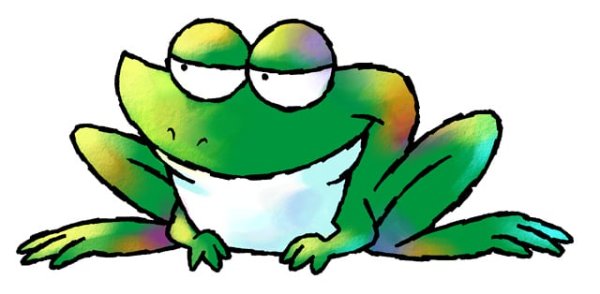
Prince Froggy
World 3-4 Mid-Boss — Fortress
A frog prince. Yoshi gets eaten and must defeat Froggy from inside his stomach — a uniquely surreal Yoshi’s Island boss fight.
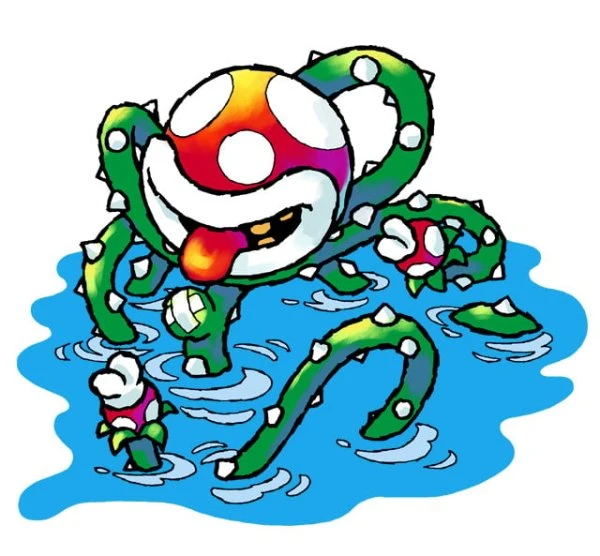
Naval Piranha
World 3-8 Final Boss — Castle
A giant Piranha Plant emerging from a navel-like flower bed. The fight features a hidden “cheat” egg-throw that can defeat the boss instantly before the battle starts — a legendary speedrun trick.
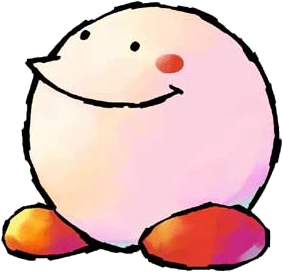
Marching Milde
World 4-4 Mid-Boss — Fortress
A purple round creature that splits into smaller copies when ground-pounded. Yoshi must ground-pound each smaller copy until only one Mini-Milde remains, then defeat it.
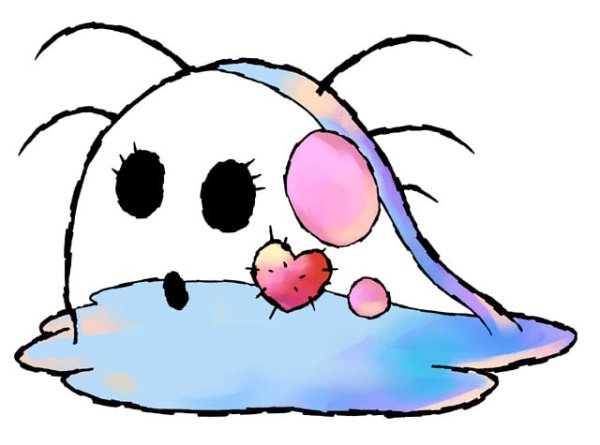
Sluggy the Unshaven
World 4-8 Final Boss — Castle
A slug with a beard. Yoshi must throw eggs at Sluggy’s exposed heart, visible through the translucent body. Three hits to defeat.
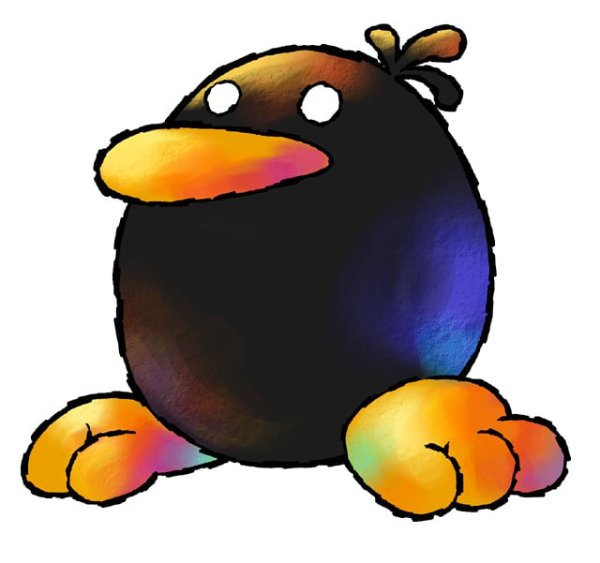
Raphael the Raven
World 5-8 Final Boss — Castle
One of the most acclaimed bosses in the game. Yoshi fights Raphael on the surface of a small moon — a circular arena with gravity rotating around its surface. Yoshi must ground-pound the surface and bounce eggs at the giant raven as he flies around the moon.
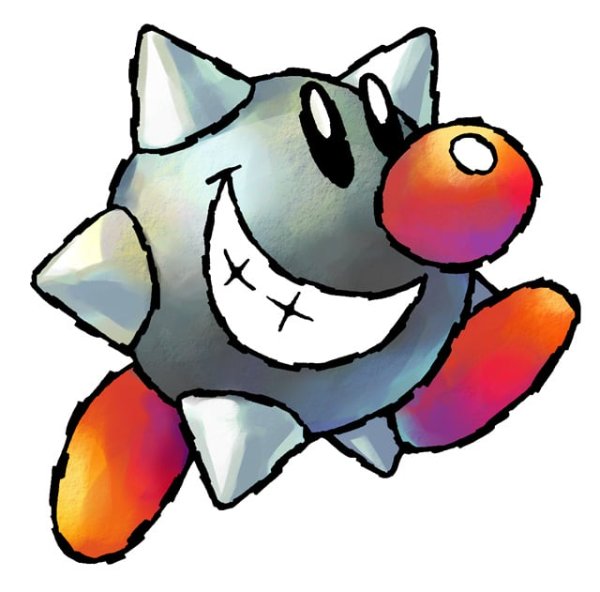
Tap-Tap the Red Nose
World 6-4 Mid-Boss — Fortress
A giant version of the spiky Tap-Tap enemy. Invincible to egg throws because of the spikes. Defeat by knocking him into the lava below using ground-pound timing on the platforms.

Baby Bowser
World 6-8 Final Boss — Castle
The final boss. Encountered in two phases: first as Baby Bowser himself attacking with throw-able eggs and tantrums, then as a giant Bowser (Kamek’s magic enlarges him) that fights from the background, requiring Yoshi to throw eggs at his face while dodging fire attacks. Defeating him completes the main story and unlocks the 6 Secret Stages.
Characters
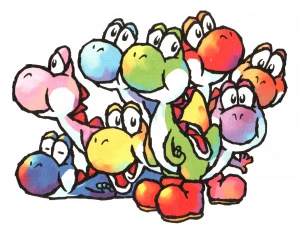


Yoshi (Multiple Colours)
The playable character. Multiple coloured Yoshis appear across the journey, taking turns to carry Baby Mario in a relay structure. The Yoshi who completes the x-2 levels is pink; the Yoshi who completes the x-7 levels is red. The remake corrected an SNES-version error where these colors were switched on the world map.
Baby Mario
The fallen twin baby from the stork delivery. Rides on Yoshi’s back. If Yoshi takes damage, Baby Mario floats away in a bubble — lose him and Yoshi loses a life. Grab a Mario Power Star and Baby Mario transforms into Superstar Mario, running invincibly across the level.
Baby Luigi
The other twin. Held captive by Kamek’s forces. The bond between the twins is the navigation mechanism Yoshi uses to find his destination. Reuniting Mario and Luigi is the game’s ultimate goal.
Kamek
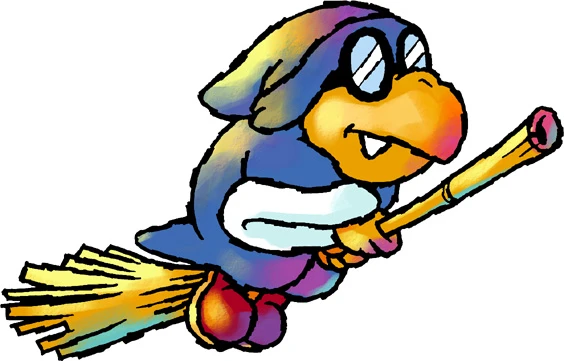
The evil Magikoopa antagonist. Tried to kidnap both Mario twins from the stork; succeeded in capturing only one. Spends the game searching for the lost twin while sending toadies after Yoshi. Appears throughout the game powering up bosses with his magic.
Baby Bowser
The final boss. The young Bowser, here as a small Koopaling. Magnified by Kamek’s magic in the second phase of the final fight. The first appearance of Baby Bowser in the Mario series.
Helper Characters
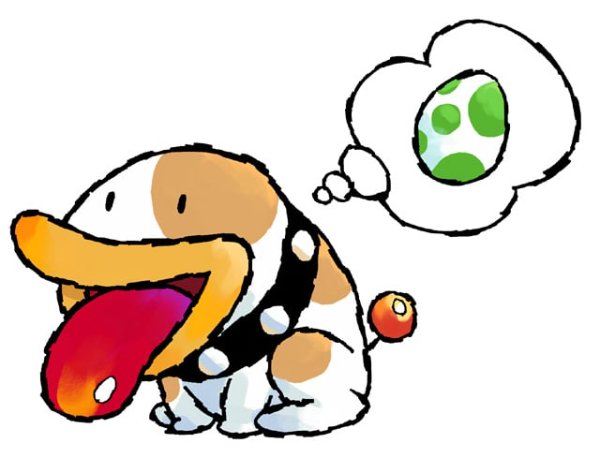
Poochy is a friendly orange dog Yoshi can ride; he runs over hazards Yoshi would normally have trouble with, particularly spike-floor segments. Huffin Puffin is a mother bird whose babies must be rescued and reunited with her in a few levels. The Stork is the messenger who started the whole adventure, captured by Kamek in the opening cinematic.
Changes from the SNES Original
While the Advance 3 port is faithful to the SNES original, Nintendo made several meaningful changes for the GBA release — not just graphical updates but new content, level tweaks, and quality-of-life improvements.
General Changes
- 6 brand-new Secret Stages added after defeating Baby Bowser on World 6-8 (see the Secret Stages section above)
- Inventory capacity increased from 25 items (SNES) to 27 items (GBA)
- Dual pause menu system: the original’s single pause menu was split into two — one menu for sleep mode and returning to the overworld map, another for using items and viewing the current score
- Mini Battle code changed: the SNES code used X and Y buttons that don’t exist on the GBA. Replaced with a button combination held with B. The 2-player option was removed (link cable battle now exclusively via the included Mario Bros. arcade game)
- Mario Bros. multiplayer: the original SNES game had no multiplayer. The Advance 3 port includes the Mario Bros. arcade re-release playable with up to 4 players via GBA Link Cable
Level Design Changes
- 1-8 (Salvo The Slime’s Castle): a new room was added between the second and third rooms of the original. The new room has one Shy-Guy-spawning pipe
- 2-1 (Visit Koopa And Para-Koopa): a flipper was added after the falling stone blocks
- Extra 3 (More Monkey Madness): the original had 21 red coins instead of the usual 20 — the extra red coin under a Tap-Tap on a post was removed in the remake
- Several levels: extra Middle Rings added for more checkpoint coverage
- Items repositioned: various small placement tweaks across levels
Graphical Changes
- Lightened palette to compensate for the original GBA’s lack of a backlight. Standard for GBA remakes of SNES titles
- Yoshi shoe colors fixed: all Yoshis had red shoes in the original — in the remake, each Yoshi has differently colored shoes matching the official artwork and the opening cinematic’s depiction
- x-2 and x-7 Yoshi colors corrected: the SNES map screen showed pink/red Yoshis swapped versus the gameplay screen. Fixed so colors match consistently between map and gameplay
- Refreshed artwork: many character artworks (Hookbill, Baby Bowser, Kamek) had wrong colors in the original’s strategy guides — the remake fixes these inconsistencies in the in-game artwork
- Coin graphics fixed: in the original, dark-area coin graphics were also used for revolving versions, causing a graphical glitch where some black objects appeared to sparkle. Fixed in the remake
- Button prompts updated to match the GBA button layout throughout
Sound & Textual Changes
- Music remastered for the GBA’s simpler audio chip while preserving the original compositions
- Sound effects re-sampled at lower quality but retaining the original character
- Dialogue text reformatted to fit the GBA screen’s smaller display
- Some minor translation refinements in the English text
Promotion & Videos
Four contemporary promotional videos preserve Nintendo’s 2002 marketing campaign and the Wii U Virtual Console re-launch. Ordered chronologically below.
Print & Other Promotional Materials
- International print advertising campaign across the UK, France, and Poland
- Japanese launch flyers distributed at Japanese retail in September 2002
- Nintendo Power Player’s Guide — official strategy guide published by Nintendo Power
- Promotional wallpaper distributed through nintendo.com.mx (see Promotional Wallpaper section below)
Development Staff
Super Mario Advance 3 was developed by Nintendo R&D2 and published by Nintendo.
- Developer: Nintendo R&D2
- Publisher: Nintendo
- Platform: Game Boy Advance
- Original game: Super Mario World 2: Yoshi’s Island (SNES, 1995) by Nintendo EAD
- Original game director: Takashi Tezuka
- Original game producer: Shigeru Miyamoto
- Original character design / art direction: Hisashi Nogami, Yoichi Kotabe
- Original score: Koji Kondo
- Genre: 2D platformer / Yoshi spinoff series
Reception & Legacy
Super Mario Advance 3: Yoshi’s Island received generally positive reviews on launch and is now widely regarded as one of the strongest titles in the Super Mario Advance series.
“Yoshi’s Island would make an excellent addition to anyone’s collection of Game Boy Advance games. Its beautiful, inspired visuals and consistently fun and inventive gameplay make a landmark achievement in one of gaming’s most beloved genres.” — GameSpot (9.2/10)
Critical Scores
- GameSpot (Greg Kasavin): 9.2/10 — praised the visuals and gameplay as a landmark achievement in 2D platforming, calling the GBA version “every bit as good if not better than any other Mario title to date.” Noted the inclusion of the Mario Bros. multiplayer as a strong bonus
- GameSpy (Bryn “hardcore_pawn” Williams): 90/100 — called it “a fantastic piece of video gaming entertainment.” Noted that many 2002 GBA gamers might have missed the SNES original first time around, making this port particularly valuable
- General consensus: Visuals praised, the Super FX-2-replicating art style preserved well, the 6 Secret Stages added genuine new content for returning fans, controls adapted well from SNES X/Y to GBA L/R
What Critics Praised
- The visuals — the cartoon hand-drawn art style preserved faithfully on GBA
- The gameplay variety — Yoshi morphs, egg throwing, baby Mario protection mechanics
- The 6 Secret Stages — genuine new content for SNES veterans
- The included Mario Bros. multiplayer arcade game with 4-player link cable support
- The scoring system — the 100-point per level structure adds replayability
- The boss variety — 12 distinct boss designs across 6 worlds
What Critics Criticised
- Some criticised the slightly lighter color palette as washing out the original’s vivid art style — a common GBA-port limitation
- The lack of original SFX-2 chip processing meant some background effects were simplified versus the SNES original
Regional Logos, Box Art & Marketing
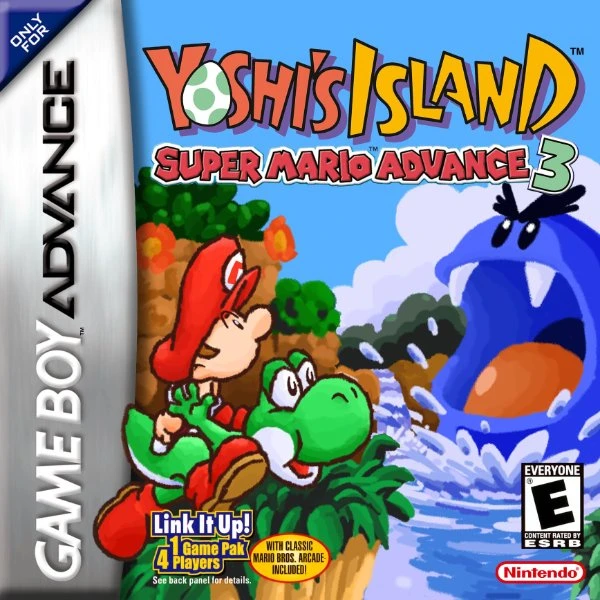
The game shipped with consistent worldwide naming as Super Mario Advance 3 / Yoshi’s Island, with distinct regional packaging.
Regional Logos



Box Art
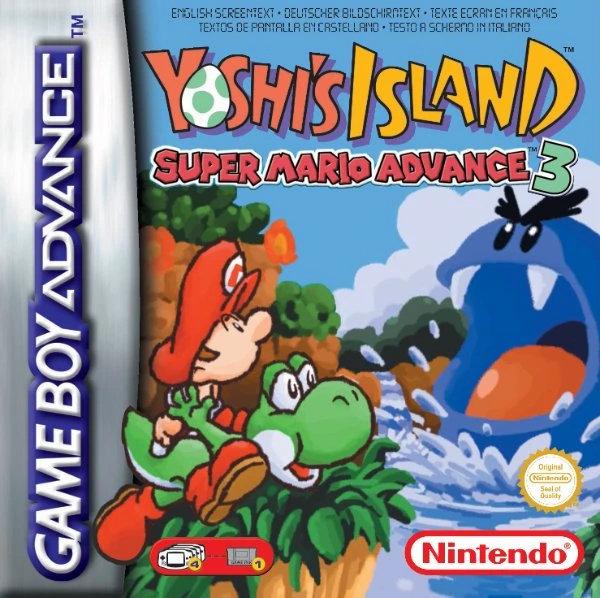
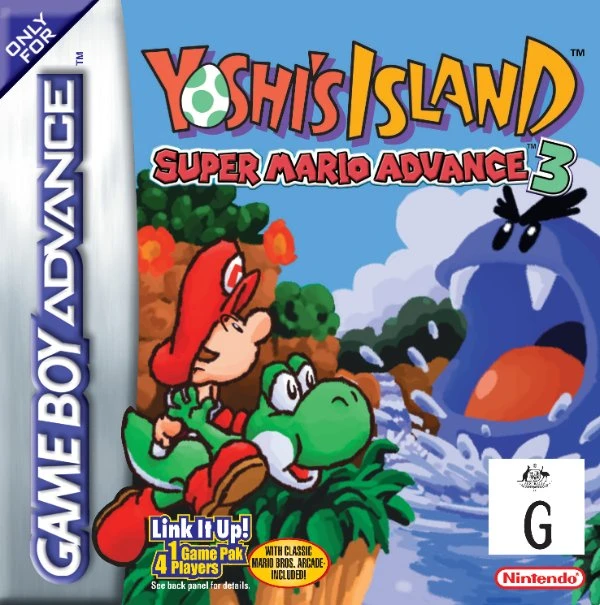


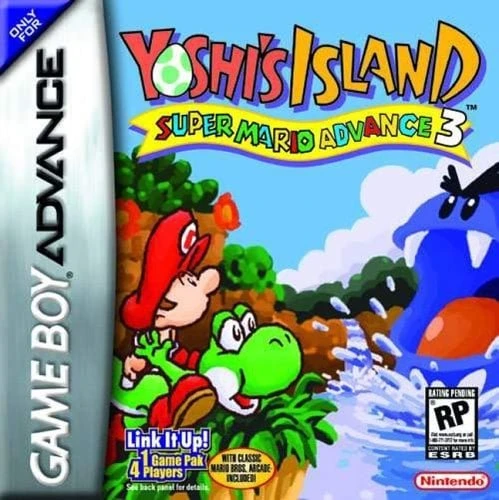
Print Advertising
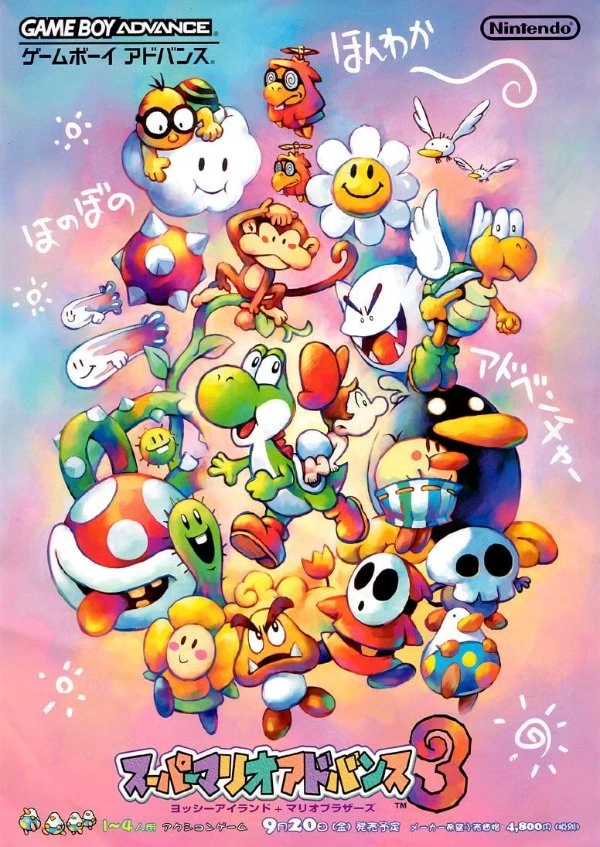


Strategy Guide

Trivia & Facts
- Bundled with the SNES 2. The original 1995 Super Mario World 2: Yoshi’s Island was bundled with the redesigned SNES 2 (SNS-101) console at launch — Nintendo’s pack-in title for the late 16-bit era
- One of the few games to use the Super FX-2 chip. The original SNES Yoshi’s Island used the Super FX-2 enhancement chip for its sprite-scaling effects and visual flourishes — a then-cutting-edge graphical enhancement that defined the look of the game
- 6 brand-new Secret Stages were added exclusively to the GBA port — the first proper new content for the franchise since 1995
- Inventory capacity bumped from 25 to 27 items in the GBA version — a small but meaningful quality-of-life improvement for completionist players
- The Yoshi shoe colors were fixed from the SNES original. All Yoshis had red shoes in the original game, but the official artwork and opening cinematic always showed different-colored shoes. The remake corrected the in-game sprites to match the official art
- The pink and red Yoshi color error was fixed. On the original SNES map screen, the Yoshi who completes the x-2 levels was shown red and the one for x-7 was pink, but in actual gameplay they appeared as pink and red respectively. The Advance 3 port made the map and gameplay colors consistent
- Includes the Mario Bros. arcade multiplayer. The original SNES Yoshi’s Island had no multiplayer mode. The Advance 3 port adds the included Mario Bros. arcade re-release with up to 4-player Link Cable support — a Super Mario Advance series tradition
- Dual pause menu system. The original’s single pause menu was split into two separate menus — one for sleep mode and overworld return, another for item use and score display
- The Naval Piranha cheat-egg exists. Players who throw an egg at a specific spot before the boss fight technically begins can defeat Naval Piranha instantly. A legendary glitch that speedrunners exploit to this day, present in both the SNES and Advance 3 versions
- Tezuka and Miyamoto produced the original. Takashi Tezuka directed the 1995 SNES original with Shigeru Miyamoto as producer. The Advance 3 port was handled by Nintendo R&D2 rather than the original EAD team
- The Mini Battle code was changed. The original SNES code involved button combinations including X and Y. Since the GBA has no X/Y buttons, Nintendo redesigned the code for L/R combinations held with B
- The 2-Player Mini Battle was removed from the Advance 3 release — link cable battles are now exclusively part of the included Mario Bros. multiplayer game
- The Raphael the Raven boss fight takes place on the surface of a small moon with rotating gravity. Widely considered one of the most creative boss designs in Mario history
- The Prince Froggy boss fight has Yoshi being eaten and defeating the boss from inside his stomach — a uniquely surreal Yoshi’s Island sequence
- Re-released multiple times. The Advance 3 port has appeared on the Wii U Virtual Console and Nintendo Switch Online — Game Boy Advance library, making it the most accessible way to experience the original Yoshi’s Island today
- The opening cinematic is heavily referenced in later Yoshi titles — the stork delivery sequence has become a defining piece of Mario series lore explaining baby Mario and baby Luigi’s separation
- The game was released in iQue GBA form in China — a region-locked Chinese-market edition with Chinese-language logos and packaging
- Two egg-aiming control modes were added for the Advance 3 release: Patient (press to enter aim mode, press to throw) and Hasty (hold to aim, release to throw) — letting players choose their preferred timing style
Promotional Wallpaper
Official promotional wallpaper distributed via nintendo.com.mx for the 2002 launch of Super Mario Advance 3.

Reference / Information
Sub-pages, guides, and the replacement game manual for Super Mario Advance 3: Yoshi’s Island.
Media / Downloads
Box art gallery and screenshots for Super Mario Advance 3: Yoshi’s Island.