Super NES1993Nintendo R&D1Light-gun rail shooterSuper Scope required12 stages, 12 gemsAll seven KoopalingsFirst US game to say “Peach”Never re-released
Yoshi’s Safari
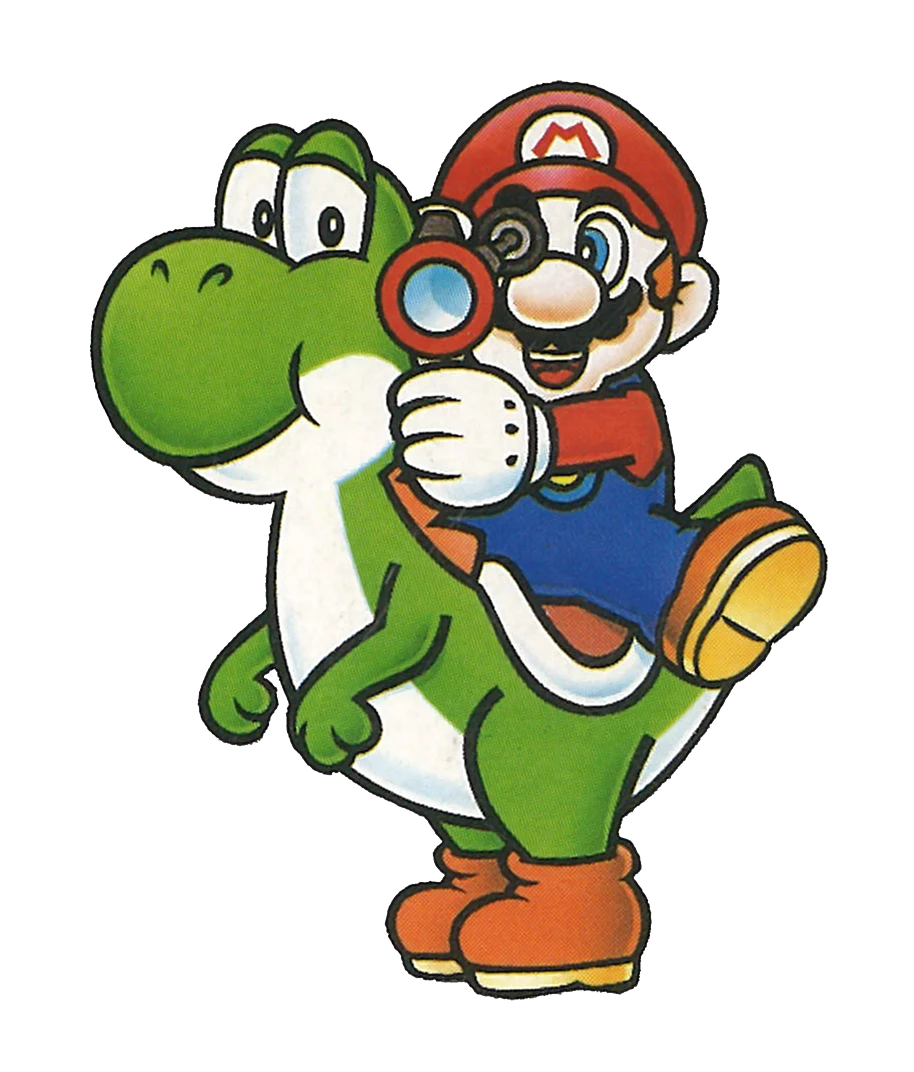
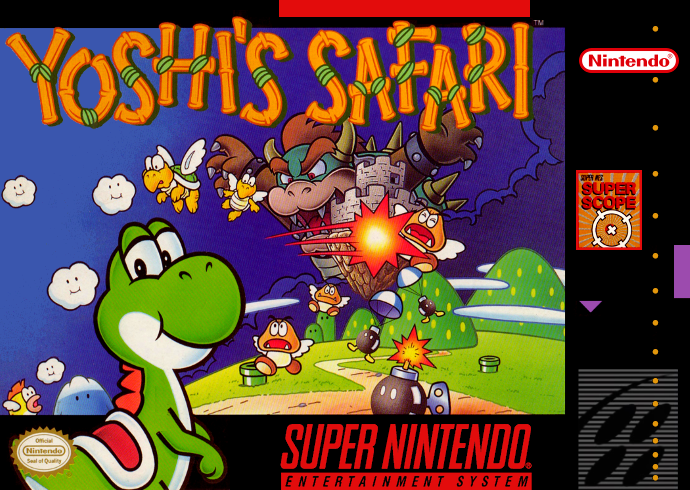
Bowser and the Koopalings have marched into Jewelry Land, locked up King Fret and Prince Pine and pocketed the twelve gems that kept the kingdom in one piece. Princess Peach sends help in the shape of Mario, Yoshi and a Super Scope. Yoshi’s Safari is the only Mario game built for Nintendo’s bazooka-sized light gun: a first-person rail shooter in which Yoshi does the running and you, sitting on his back as Mario, do the shooting.
Made by Nintendo R&D1 and released in Japan as Yoshi no Road Hunting on 14 July 1993 (launching alongside Super Mario All-Stars), it reached North America that September. Its 12 stages use Mode 7 to swing the scenery round as Yoshi gallops along, and every one ends with a boss: all seven Koopalings in the Light Realm, then Magikoopa, Big Boo, Chargin’ Chuck, a Koopa gunboat and Bowser in armour in the Dark Realm. There is a two-player mode, a hidden Hard Mode, and one curious footnote: this was the first game released in North America to call the princess Peach.
Developer:Nintendo R&D1 (the game has no staff roll)
Publisher:Nintendo
Platform:Super Nintendo Entertainment System / Super Famicom
Genre:First-person light-gun rail shooter
Japanese title:Yoshi no Road Hunting (Yoshi’s Road Hunting)
Japan:14 July 1993
N. America:September 1993
Europe:1993 (Wikipedia gives 19 November)
Australia:1993
Brazil:December 1993 (Playtronic)
Players:1–2 (second player steers Yoshi with a controller)
Controls:Super Scope required; standard controller for player 2
Stages:12: seven in the Light Realm, five in the Dark Realm
Bosses:All seven Koopalings, Magikoopa, Big Boo, Chargin’ Chuck, Kame Hōdai and Bowser
Sales:No figures published; regarded as a commercial flop
Re-releases:None (not on Virtual Console or Nintendo Switch Online as of November 2026)
Advertisement
Overview
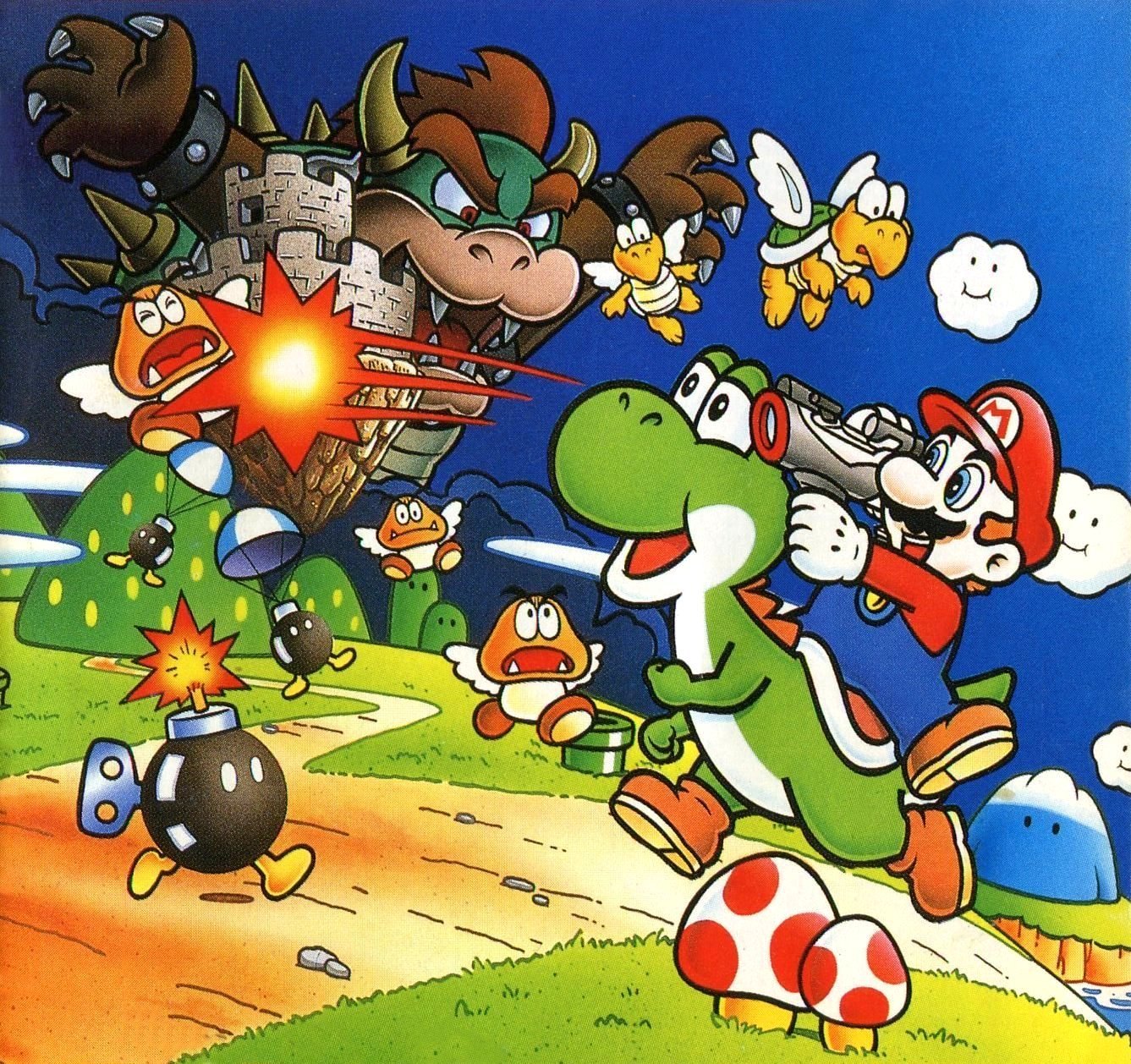
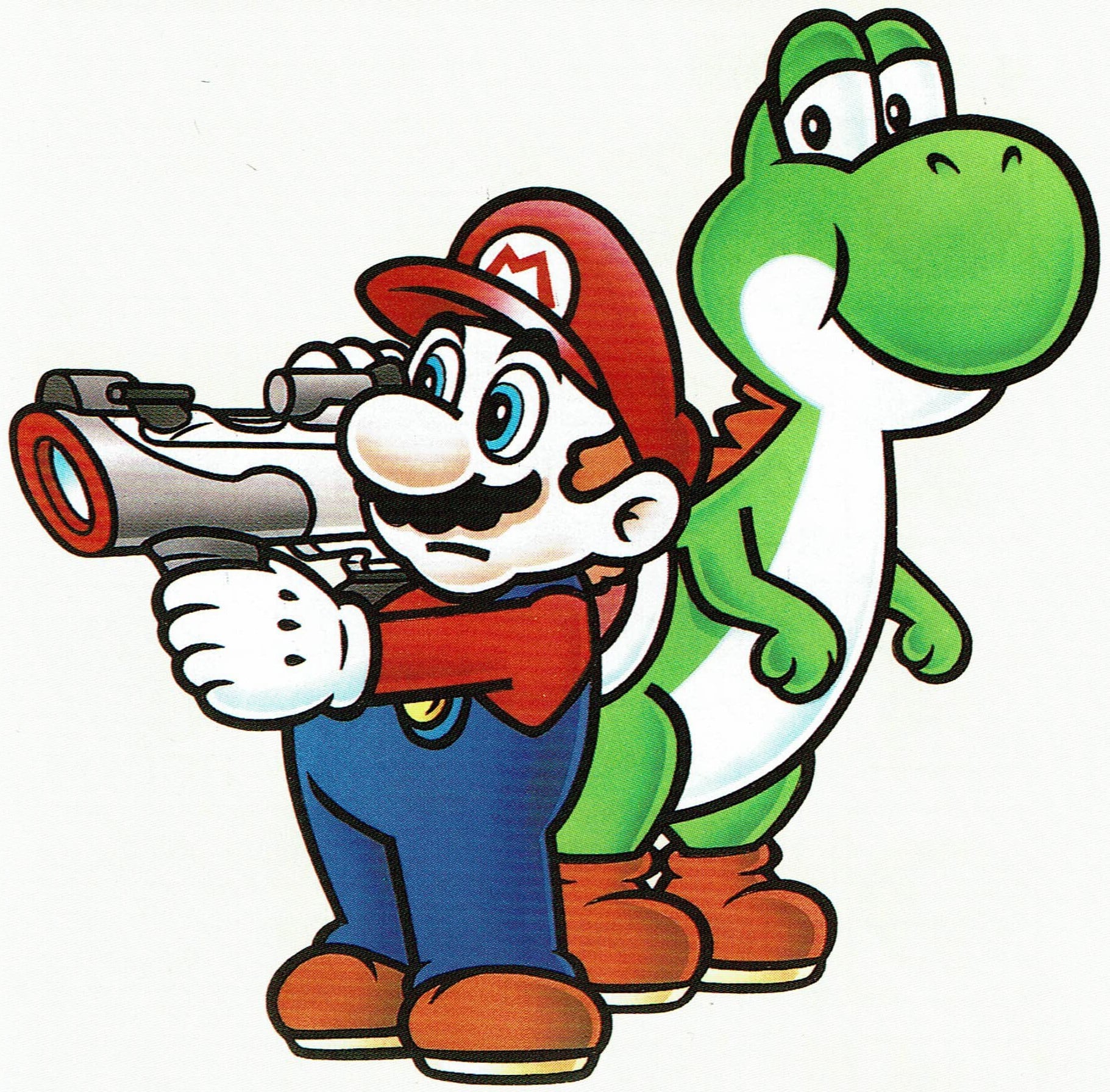
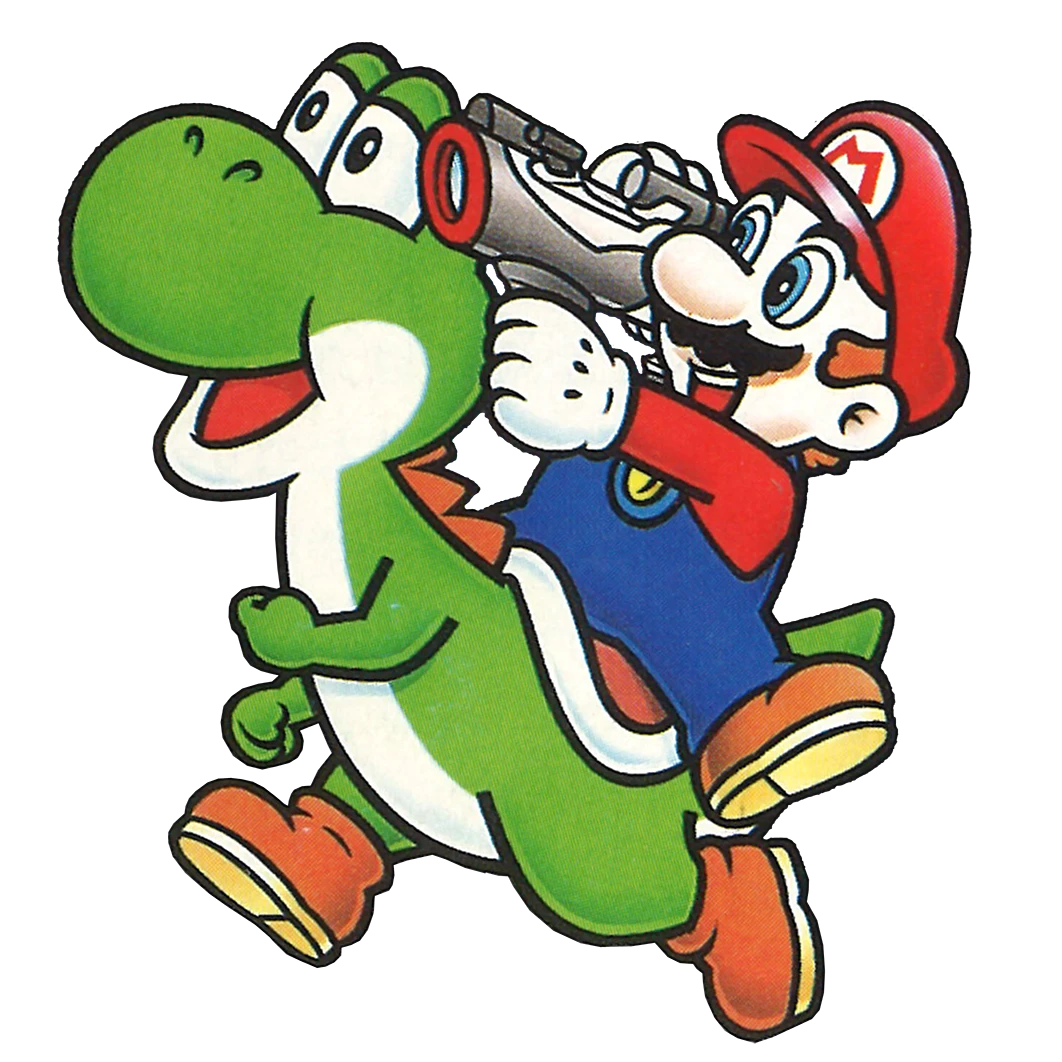
Mario, Yoshi and the Super Scope: the game’s key art.
Yoshi’s Safari is a first-person shooting game for the Super NES, made by Nintendo R&D1 and published by Nintendo in 1993. It came out in Japan on 14 July 1993 as Yoshi no Road Hunting, sharing its launch day with Super Mario All-Stars, and in North America in September; PAL countries and Brazil followed before the year was out. It will not run without a Super Scope, the shoulder-mounted infrared light gun Nintendo had launched the year before, and it remains the only game in the Super Mario series made for it.
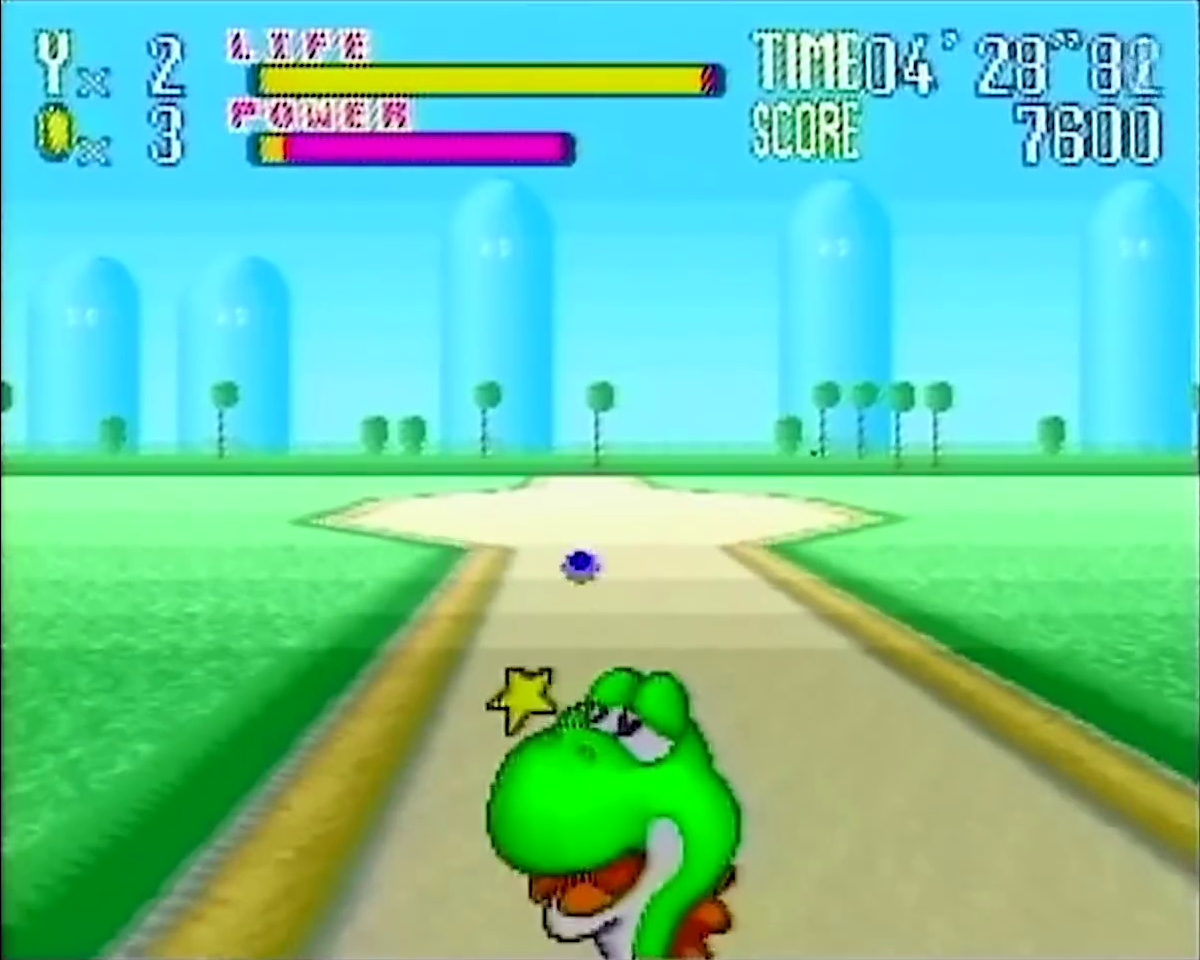
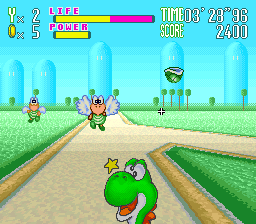
The idea is simple and rather charming. You are Mario, perched on Yoshi’s saddle with the Scope on your shoulder, and the screen is your view over Yoshi’s head. Yoshi runs the track by himself; you blast the Paragoombas, Bullet Bills, Cheep-Cheeps and Boos that pour towards you, pull the Cursor button to make him jump, and shoot the barriers at forks in the road to choose a path. The Super NES’s Mode 7 hardware turns and tilts the ground beneath you so that the road seems to wind away into the distance.
The adventure takes place in Jewelry Land, a kingdom Super Mario fans had never heard of before and have barely heard of since. Bowser and his seven children have stolen its twelve magic gems and torn it in two, a Light Realm and a Dark Realm, and every one of the twelve stages ends with a showdown for a gem, usually against a Koopaling or a Koopa general sitting inside an enormous machine.
It was not a hit. Reviewers enjoyed the colourful graphics and called it the best thing you could do with a Super Scope, but one magazine team finished it in a single sitting, and the game was tied to a peripheral few people owned. It has never been re-released, so the only way to play it is still the original cartridge and a working Scope. That rarity is part of its legend: a genuine oddity in Mario history, with a princess called Peach a full three years before Super Mario 64 made the name stick in the West.
Why it matters to Mario fansIt is the only Mario game you play down the barrel of a gun, and the series’ first rail shooter (the second did not arrive until Luigi’s Mansion Arcade). It puts all seven Koopalings in boss fights, six of them at the controls of giant machines, it introduced Jewelry Land, King Fret and Prince Pine, and it was the first game sold in North America to call Princess Toadstool by her Japanese name, Peach. Never re-released, it is one of the hardest Mario games to play legitimately today.
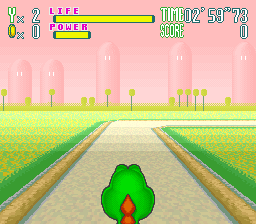
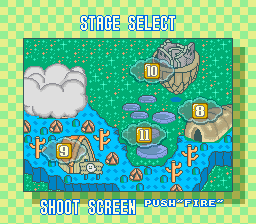
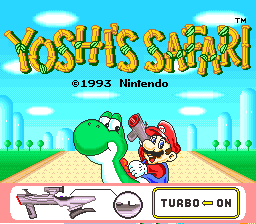
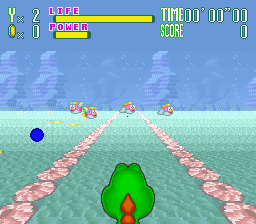
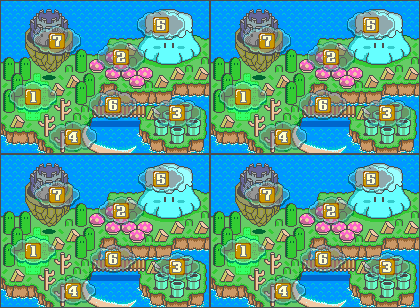
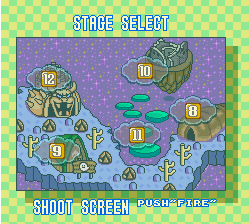
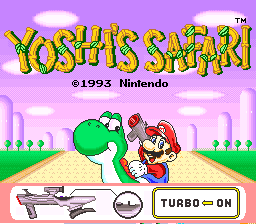
The international title screen, with its new bamboo-style logo.Grass Land: Yoshi runs, Mario aims, and the Mode 7 ground swings round beneath them.Under the waves at Crescent Coast, with a school of Cheep-Cheeps on the way.The Light Realm map. Stages can be tackled in any order within each realm.
Quick Answers
Quick answers to the things people ask most about Yoshi’s Safari; each links to the fuller section below.
When did Yoshi’s Safari come out?
In Japan on 14 July 1993 (as Yoshi no Road Hunting, on the same release date as Super Mario All-Stars) and in North America in September 1993. European and Australian copies followed later in 1993, and Playtronic released it in Brazil that December. More →
Do you need a Super Scope to play Yoshi’s Safari?
Yes. It is a Super Scope-only game; Nintendo’s Japanese site labels it as made exclusively for the light gun. A normal controller is only used by a second player, who steers Yoshi while the Scope player shoots. More →
How many levels are in Yoshi’s Safari?
Twelve, one for each of Jewelry Land’s gems: seven in the Light Realm (Grass Land to Float Castle I) and five in the Dark Realm (Cornice Cave to Bowser’s Castle). Within each realm the stages can be played in any order, but Bowser’s Castle opens only after the other four Dark Realm stages. More →
Who are the bosses?
Lemmy, Ludwig, Wendy, Larry, Morton, Iggy and Roy in the Light Realm, most of them in giant robots; then Magikoopa, the Big Boo, Chargin’ Chuck, the Koopa gunboat Kame Hōdai and finally Bowser in a suit of armour. More →
Is Yoshi’s Safari on Nintendo Switch Online or Virtual Console?
No. It has never been re-released on any system. As of November 2026 it is not in the Super NES library of Nintendo Switch Online, and it was never sold on the Wii, Wii U or 3DS Virtual Console. More →
Who made Yoshi’s Safari?
Wikipedia and Nintendo Life both credit Nintendo’s Research & Development 1 department (R&D1). The game has no staff credits, so individual designers and the composer are not officially known. More →
Can two people play?
Yes. With a controller in the first port, one player steers Yoshi left and right, ducks, jumps, slows him down and uses boss items, while the other aims and fires the Super Scope. In this mode the Scope player cannot make Yoshi jump. More →
Is there a Hard Mode?
Yes. Beat the game and it hands you a code to enter on the title screen. Hard Mode recolours the stages, makes the bosses tougher, cuts a minute off most time limits and rewrites the story text to suggest that history is repeating itself. More →
Was Yoshi’s Safari the first game to call the princess Peach?
In North America, yes: it was the first game released there to use her Japanese name instead of Princess Toadstool. The change did not stick at once, as Super Mario RPG went back to Toadstool, and Peach became her settled Western name with Super Mario 64. More →
What does the Japanese title mean?
Yoshi no Road Hunting means “Yoshi’s Road Hunting”. For the West the game was renamed Yoshi’s Safari and given a new logo; the Japanese one spells part of the title with Bullet Bills. More →
Story & Stages
Jewelry Land, kingdom of King Fret and Prince Pine.
The instruction booklet tells the set-up, and the game fills in the rest between stages. It is a classic rescue mission with a twist of geography: the villains do not just kidnap the royals, they break the country in two. Here it is from start to finish, spoilers and all.
Twelve gems and a broken kingdom
King Fret and his son Prince Pine rule the peaceful kingdom of Jewelry Land, and as its name suggests it owes its calm to a set of twelve magic gems. Then Bowser and the Koopalings arrive. They seize the king and the prince and carry off the gems, and without them the land cannot hold together: an earthquake tears it into a Light Realm and a Dark Realm.
The villains share out the spoils. The seven Koopalings run riot in the Light Realm, where King Fret is imprisoned; Bowser holds the Dark Realm and Prince Pine. The gems are divided between Bowser, his children and four of his most powerful followers, each of whom rules a corner of the captured country.
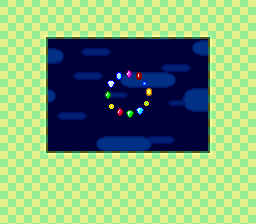
The title screen sets the scene.The twelve gems that hold Jewelry Land together.
Peach calls in Mario and Yoshi
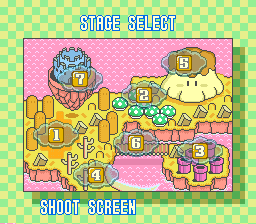
Word reaches Princess Peach, who counts Prince Pine as a friend. She turns to Mario and Yoshi for help and hands Mario the Super Scope for the job. Mario climbs into the saddle, Yoshi sets off at a run, and the safari begins on the Light Realm map, where the stages can be taken in any order.
Princess Peach, here called Peach in the West for the first time.The Light Realm map.
The Light Realm: grass, mushrooms and pipes
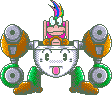
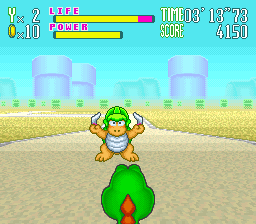
The first three gems are guarded by the younger end of the family. In Grass Land a Hammer Brother blocks a clearing before Lemmy stomps out in a walking robot that wears his own face. In Mushroom Land Ludwig sits in the neck of a dinosaur-like machine; blow up its body and the cockpit and legs carry on as a smaller robot that fires its fists.
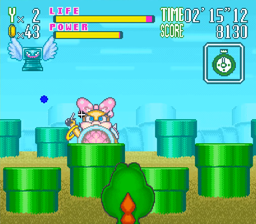
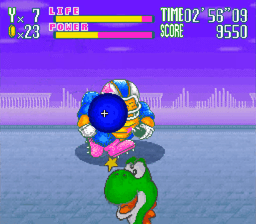
Pipe Island is the odd one out, because Wendy has no robot at all. She hides behind an unbreakable shield among four pipes and lobs bombs, while a winged anvil flaps overhead. Shoot the anvil when it hangs above her and it drops on her head. Three direct hits and she gives up.
Lemmy, once his robot’s face has been blown off.Mushroom Land’s autumn meadows.Wendy, the only Koopaling without a machine.
Coast, mountain and bridge
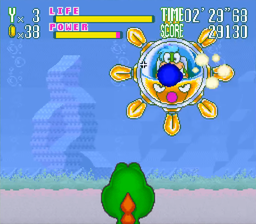
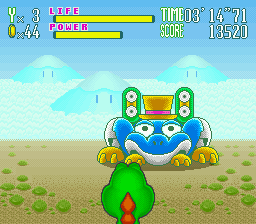
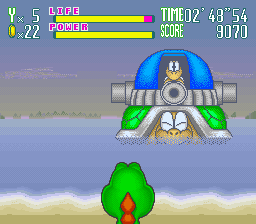
The middle stretch goes to sea and back. Crescent Coast starts on the sand and plunges beneath the waves, where a gigantic octopus pot called Takotsubo spews little octopuses before Larry turns up in a sun-shaped submarine with a seal’s face. On Spirit Mountain a Sledge Brother shakes the path and Morton waits in a robot frog in a top hat, popping out from under the hat to throw bombs once its leg cannons are gone.
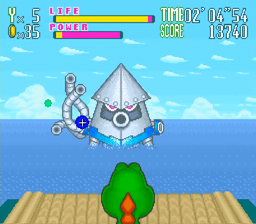
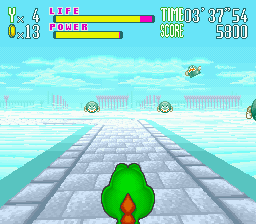
Grand Bridge is a marathon over open water. At its end Iggy rises from the sea in a colossal mechanical Bloober, King Gessō, whose cannon-tipped tentacles have to be shot away pair by pair, the last of them only while the squid leaps clear of the water.
Larry’s submarine surfaces at Crescent Coast.Morton’s robot frog on Spirit Mountain.Iggy’s giant Bloober rises beside the Grand Bridge.
Float Castle I and the rescue of King Fret
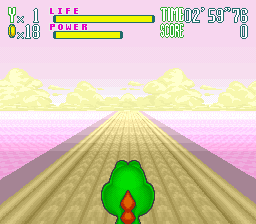
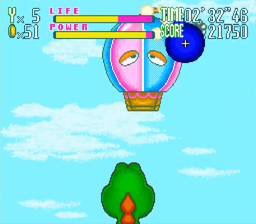
The last Light Realm gem is in the sky. Float Castle I is a run across paths hanging over a vast drop, and at the end Mario and Yoshi simply jump off the castle. The fight with Roy happens as they fall: he hangs from a mechanical hot-air balloon with a cannon underneath and two huge spinning arms that throw bombs. Destroy those and the balloon sprouts six more cannons; only when Roy’s basket dips into range can he be hit.
With all seven Koopalings beaten and seven gems recovered, King Fret is free. The Dark Realm, and his son, are next.
Float Castle I: the ground is a long way down.Roy’s balloon battle happens in mid-fall.King Fret, rescued once the Light Realm is clear.
Into the Dark Realm
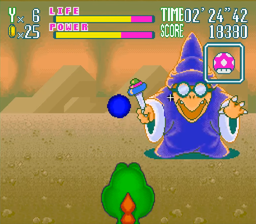
The Dark Realm is ruled not by Koopalings but by Bowser’s generals. In Cornice Cave a blue Firesnake guards the halfway point and a Magikoopa waits at the end, teleporting about and casting geometric spells that must be shot out of the air; knock him about enough and he comes back as a giant.
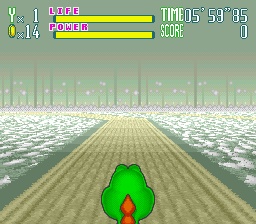
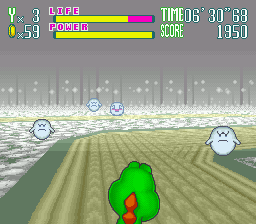
The Ghost Mansion is a long, foggy boardwalk. A Lakitu rains Spiny Eggs on the way, and at the end the Big Boo floats from side to side, hurling rubble and only vulnerable while its eyes are open. Beat it and it bursts into three smaller Boos circling round each other, and only the one with its tongue out can be hurt.
The Dark Realm map.Magikoopa in Cornice Cave.The misty boardwalk of the Ghost Mansion.
Float Castle II and the Dark Sea
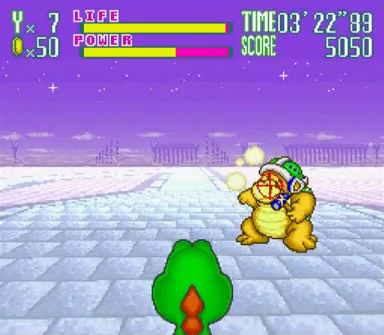
The second sky castle, Float Castle II, is a ruin full of boosts and gaps, with an optional Sledge Brother on one route and a Chargin’ Chuck at the end who dashes about lobbing bombs in pairs and leaps off screen to land with a thump that rattles Yoshi.
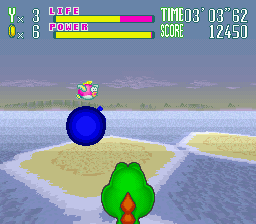
On the Dark Sea, a string of tiny islands joined by jump pads, the gem is aboard Kame Hōdai, a turtle-shaped artillery submarine crewed by Koopa Troopas. Knock out its four rotating cannons and the turret blows apart, revealing three more guns and a turtle head that has to be shot in the mouth. That leaves one gem, and one castle.
Chargin’ Chuck guards Float Castle II.Kame Hōdai, the Koopa gunboat of the Dark Sea.
Bowser’s Castle
Clear the other four Dark Realm stages and Bowser’s Castle opens. It throws every trick in the game at you, then drops you into a pit where the mini-bosses line up for a rematch to boss music: Hammer Brother, Boomerang Brother, Lakitu, Sledge Brother and Firesnake, one after the other.
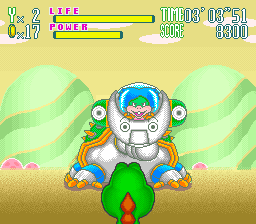
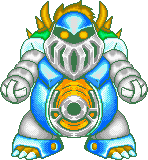
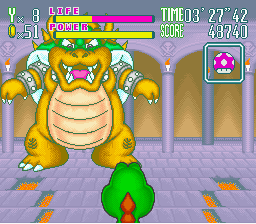
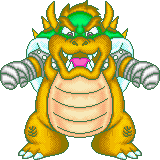
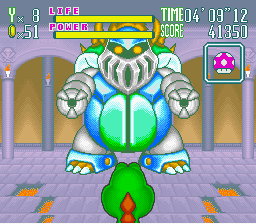
Bowser himself starts inside a suit of armour with gun hands. Wreck the hands, then shoot the great cannon in its chest whenever it opens to charge, until the armour overheats and explodes. Out steps Bowser, throwing shells and shaking the floor. Shoot his hands until they are bandaged, then aim for his open mouth every time he breathes fire. He finally surrenders in a shower of explosions.
Bowser’s Castle.Out of the armour: the last phase against Bowser.Bowser, bandaged and nearly beaten.
Prince Pine comes home, and it all happens again
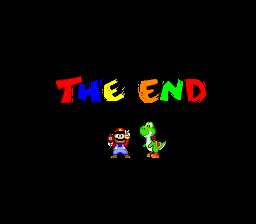
With the twelfth gem back, the Dark Realm falls, Prince Pine is set free and Jewelry Land is whole again. The ending then hands you a code. Type it in on the title screen and the safari starts over as Hard Mode, with recoloured stages, fiercer bosses, tighter clocks and story text rewritten to say that history is repeating itself.
The ending.Prince Pine, freed at last.The Light Realm map in Hard Mode.
Every stage in Yoshi’s Safari
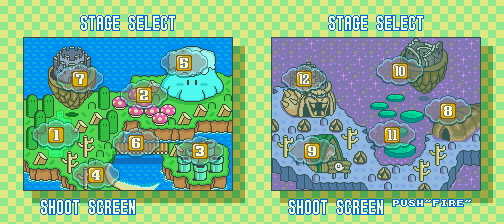
Twelve stages and twelve gems. The seven Light Realm stages can be played in any order, and so can the first four of the Dark Realm; Bowser’s Castle unlocks when stages 8 to 11 are done. Time limits are for the normal game, with Hard Mode in brackets where known.
1. Grass LandLight Realm · stage 1 · time 4 min (Hard 3) · mini-boss: Hammer Brother · boss: Lemmy KoopaA gentle opener across open grassland with a lake to leap and a Hammer Brother waiting in a clearing.
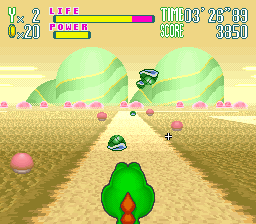
2. Mushroom LandLight Realm · stage 2 · time 4 min (Hard 3) · mini-boss: none · boss: Ludwig von KoopaAutumnal meadows of giant pink mushrooms, no jumps at all, and a barrage of Koopa shells sliding across the road.
3. Pipe IslandLight Realm · stage 3 · time 4 min (Hard 3) · mini-boss: Boomerang Brother · boss: Wendy O. KoopaAn island bristling with Warp Pipes and Monty Moles. Short, with few enemies but plenty of junctions.
4. Crescent CoastLight Realm · stage 4 · time 5 min (Hard 4) · mini-boss: Takotsubo · boss: Larry KoopaA beach run that dives under the sea, where a giant octopus pot keeps spawning little octopuses.
5. Spirit MountainLight Realm · stage 5 · time 5 min (Hard 4) · mini-boss: Sledge Brother · boss: Morton Koopa Jr.A high, sandy mountain path packed with dash zones, jumps, Para Bombs and falling Spinies.
6. Grand BridgeLight Realm · stage 6 · time 4 min (Hard 3) · mini-boss: Boomerang Brother (optional route) · boss: Iggy KoopaAn enormously long pier over the sea, with Cheep-Cheeps and Bloobers leaping out of the water on both sides.
7. Float Castle ILight Realm · stage 7 · time 4 min (Hard 3) · mini-boss: none · boss: Roy KoopaA castle in the sky, the only one visible on the map at the start: endless drops, then a boss fight in freefall.
8. Cornice CaveDark Realm · stage 8 · time 5 min · mini-boss: Firesnake · boss: MagikoopaA winding cavern of fire and lava in a mountain in the east of the Dark Realm, with two underground lakes to jump.
9. Ghost MansionDark Realm · stage 9 · time not stated · mini-boss: Lakitu · boss: Big BooA very long, misty boardwalk on two levels, haunted by Boos that freeze when you face them.
10. Float Castle IIDark Realm · stage 10 · time 4 min (Hard 3) · mini-boss: Sledge Brother (optional route) · boss: Chargin’ ChuckA floating ruin full of boosts, bottomless drops and Bullet Bills.
11. Dark SeaDark Realm · stage 11 · time 5 min · mini-boss: none · boss: Kame HōdaiA long chain of tiny islands on a gloomy ocean, crossed by jump pads; one hit at the wrong moment and you are in the water.
12. Bowser’s CastleDark Realm · stage 12 · time 8 min (Hard 7) · mini-boss: Gauntlet: Hammer Bro, Boomerang Bro, Lakitu, Sledge Bro, Firesnake · boss: BowserEverything at once: Mechakoopas, jump pads, a drop into a mini-boss gauntlet, then Bowser. Opens once stages 8 to 11 are cleared.
Hard Mode reuses all twelve stages with new colour schemes; see Cheats & secrets.
Advertisement
Gameplay & Controls
Think of Yoshi’s Safari as a fairground shooting gallery bolted onto a Mario level. The camera sits on Yoshi’s back and the road unspools ahead of you. You never steer in the one-player game: Yoshi follows the track, stops when something blocks the way, and leaves you to keep the sky clear.
Every stage runs against a clock, every stage ends in a boss fight for one of the twelve gems, and the route between start and boss is rarely a straight line. The more you notice, the better you do.
The Super Scope and its three buttons
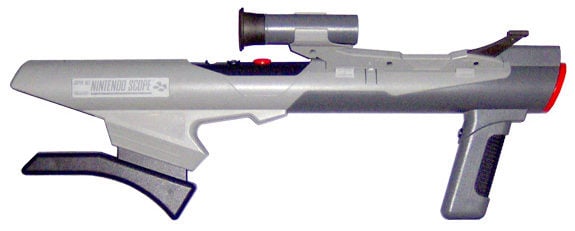
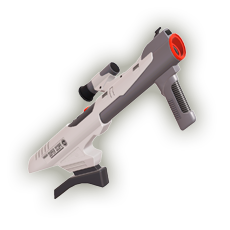
The Super Scope is a wireless infrared light gun that rests on your shoulder, with a receiver that sits on top of the television. Before play you calibrate it by shooting a target, and from then on the console knows where on the screen you are pointing. Yoshi’s Safari uses all three of its buttons: Fire shoots, Cursor makes Yoshi jump (and, in a boss fight, uses your stored item), and Pause freezes the action. Holding Cursor and pressing Fire twice while paused quits to the title screen.
Keep your aim off Yoshi. His green head bobs at the bottom of the screen the whole time, and a stray shot into it hurts him as much as an enemy would.
Mario shoulders the Scope; Yoshi does the legwork.Shoot your own dinosaur and he lets you know about it.
The POWER gauge
The Scope fires automatically while you hold the trigger, but every shot drains the POWER gauge. As it runs down the rate of fire slows, and once it is empty the gun will only fire one shot per press. Let go and it recharges. Spraying bullets about is therefore the quickest way to leave yourself defenceless just as a squadron of Paratroopas arrives.
Two Fire Flowers are hidden in the game. Each one lengthens the gauge, and with both it reaches full length, so it pays to find them early.
A Fire Flower stretches the POWER gauge.
Jumps, junctions and dash zones
The track is full of things that need a quick press of Cursor. Jump zones warn you of a pool, a lava flow or a bottomless drop ahead, some of them needing a super jump. Land in a pool and Yoshi takes a little damage for as long as he stays in it; miss a pit and you are put back a short way and fined three coins, or lose a life if you have fewer than three. Yellow dash zones fling Yoshi forward at speed, whichever way he is facing.
At forks, a barricade blocks one of the two roads. Shoot it and it swings across to block the other. Which way you go decides which enemies, items and obstacles you meet, and on some stages whether you face a mini-boss at all, before the routes meet again for the boss.
Pipe Island is short but full of forks in the road.Spirit Mountain throws dashes and jumps at you one after another.
Boss fights and boss items
Each stage ends with Yoshi drawing up in front of a boss, and the fight is a matter of finding the weak point: the cannons first, then the cockpit; the hands, then the chest; the face, but only when the eyes are open. Bosses only take damage in the right place at the right time, and most of them change form halfway.
Dark green Flying ? Blocks drop items you carry into the next boss fight and trigger with Cursor (or the controller’s A button in two-player games). A Super Mushroom refills Yoshi’s LIFE meter; Nuts halve the damage he takes for a while; a Clock adds a minute to the timer; a Super Star makes him invincible. Finish the fight without using one and it turns into bonus points instead: 2,000 for the Mushroom or Nuts, 5,000 for the Star, 6,000 for the Clock.
Green Flying ? Blocks hold items for the boss.Boss fights are about timing: Bowser’s armour only opens up now and then.
Two players: one steers, one shoots
Plug a normal controller into the first port and a friend can take Yoshi’s reins. They move him left and right and duck with the +Control Pad, jump or use boss items with A, and hold X to slow down, while the Scope player concentrates on shooting. In this mode the Scope’s Cursor button no longer jumps, so the two of you have to talk to each other. In one-player games Yoshi runs on autopilot.
A two-player team: one at the reins, one on the trigger.
Life, coins, time limits and Hard Mode
Yoshi has a LIFE meter. It drains when enemies hit him (or when you do), and when it empties you lose a life. You also lose one if you fall into a pit with fewer than three coins, or if the clock runs out. Time limits vary by stage: four minutes on most of them, five on the longer ones such as Crescent Coast, Spirit Mountain, Cornice Cave and Dark Sea, and eight for Bowser’s Castle. Every 60 coins earns an extra life, and a score table keeps the best runs.
Finish the game and the ending gives you a code for Hard Mode, entered on the title screen. The stages change colour, the bosses get tougher, most time limits shrink by a minute, and the story screens are reworded to say that the whole thing is happening again.
The Hard Mode title screen.Yoshi takes a hit.
Japanese and Western versions
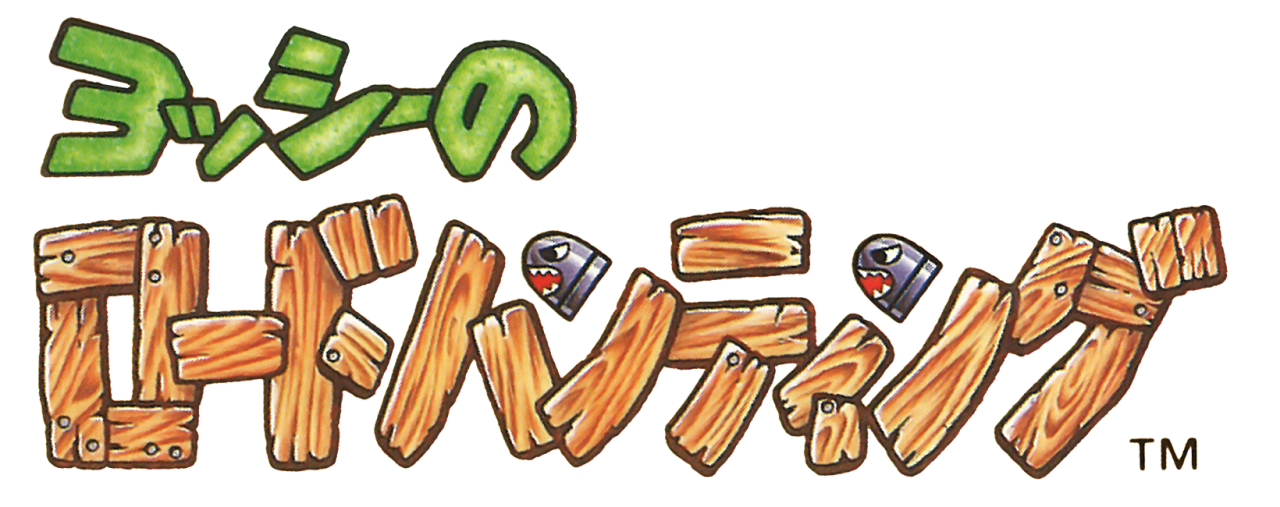
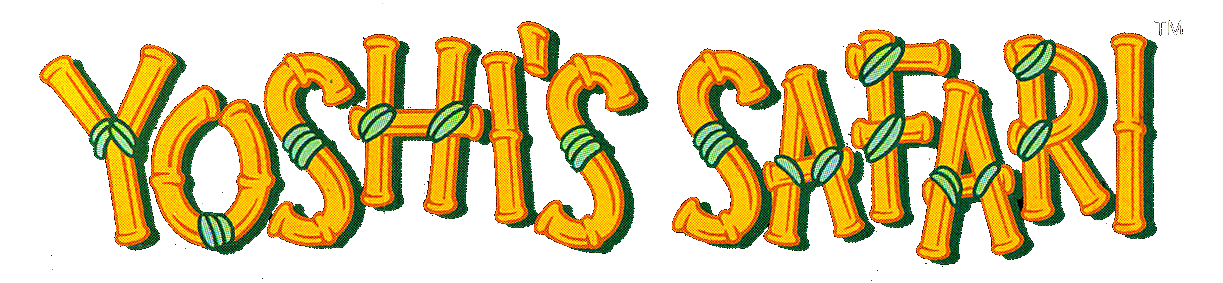
Beyond the name, the Western release changed the title screen: the Japanese logo looks as if it is built from wooden planks and uses two Bullet Bills as the marks on one katakana character, while the international logo has a lighter, bamboo-like look, new cloud shapes and a paler sky. Names were localised too: the Japanese Light World and Dark World became the Light Realm and Dark Realm, the king and prince became King Fret and Prince Pine, and the boss-only kinomi berry became “Nuts”.
The Japanese logo, with Bullet Bills in the lettering.The international logo.
Items and pick-ups
Stage items come out of yellow Flying ? Blocks and defeated enemies and work straight away; boss items come from the dark green blocks and wait for the boss.
CoinSixty make an extra life. Three are lost every time Yoshi falls into a pit.
Big CoinWorth ten coins at once.
Super MushroomRefills the LIFE meter. Also a boss item in Cornice Cave, Ghost Mansion and Bowser’s Castle (2,000 points if saved).
Fire FlowerLengthens the Scope’s POWER gauge. There are two; both together give the maximum.
Super StarInvincibility for a while. Also a boss item in Float Castle II (5,000 points if saved).
1-Up MushroomAn extra life.
NutsBoss item: halves the damage Yoshi takes for a time. Found in Grass Land and Spirit Mountain (2,000 points if saved).
ClockBoss item: adds one minute to the timer. Found in Pipe Island and Grand Bridge (6,000 points if saved).
Flying ? BlockYellow blocks flap past carrying stage items. Shoot them open.
Green Flying ? BlockDarker blocks that hold an item for the coming boss fight.
GemsTwelve magic gems, one won from each stage’s boss. Collect them all to put Jewelry Land back together.
Cartoons, Comics & Other Media
Jewelry Land was all but forgotten by the games, but not by Japanese manga, and the Super Scope itself has had a long afterlife.
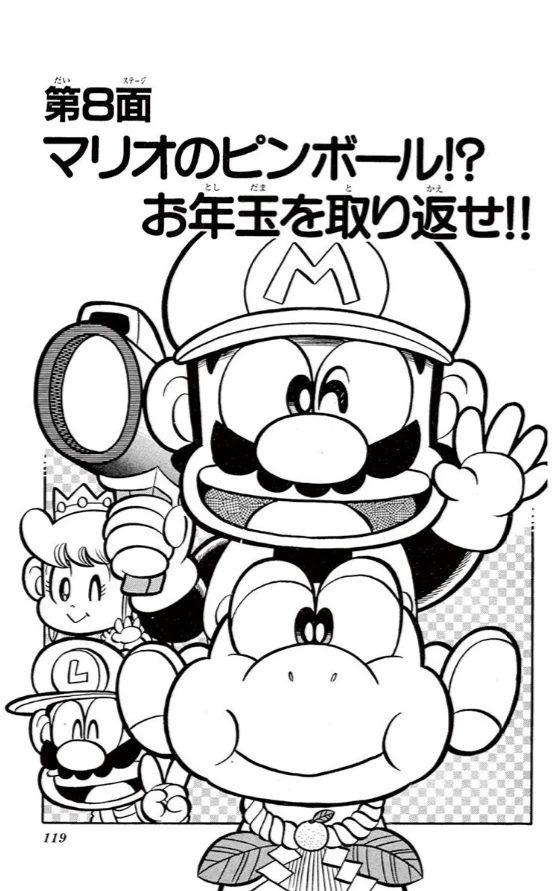
Super Mario: Yoshi no Road HuntingManga · Kazuki Motoyama · Kodansha · 2 volumesA two-volume adaptation in Kodansha’s long-running Mario manga line. Bowser forces a scientist, Dr. Mario Nakamatsu, to build his war machines, and Mario and Yoshi ride to Prince Pine’s aid armed with Nakamatsu’s Super Scope, which they retrieve from Big Bertha and Yoshi, two characters borrowed from the 1993 Super Mario Bros. film.
Yoshi no Road Hunting, volume 2Manga · Kodansha KC DeluxeThe second and final volume of Motoyama’s adaptation.
Super Mario-kun, volume 9Manga · Yukio Sawada · ShogakukanStages 1 to 8 of the volume adapt the game. Mario tries to retire, the world is thrown into chaos, and the hunt for three Crystal Kinoko leads into Jewelry Land, where the inhabitants and Prince Pine have been turned into machines. There is even a nod to the film’s Devolution Gun.
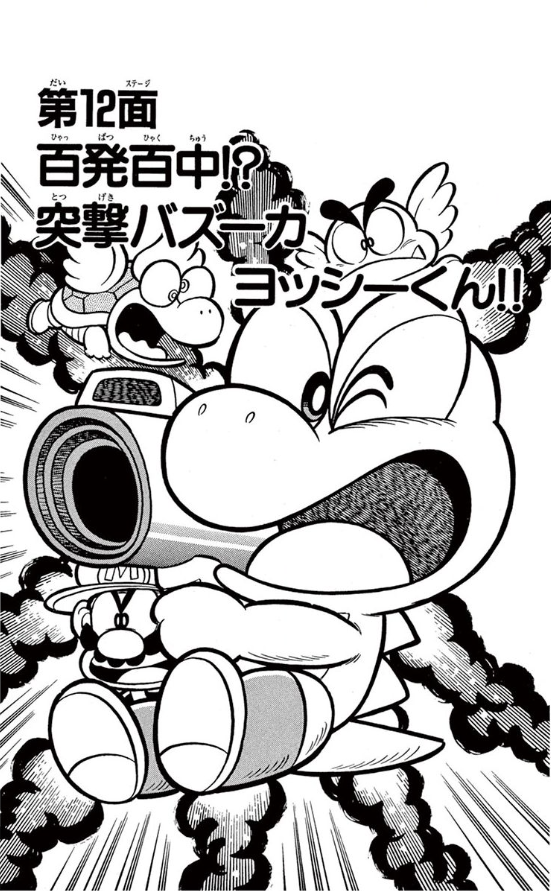
Super Mario-kun, volumes 8, 10 and 19Manga · one-shot chaptersVolume 8 has Yoshi inviting Mario on an enemy hunt with a bazooka; volume 10 traps Mario in Roy’s pinball machine, Roy flying his hot-air-balloon mech from the game; and years later volume 19 brings back Bowser’s armour and has Yoshi produce a Super Scope.
Nintendo Power, issue 55December 1993 · magazineNintendo’s own magazine covered the game in its December 1993 issue, including a “Super Scope Roundup”, and judged it best suited to younger players. Super Luigi Bros’ scans of the coverage are linked below.
The Super Scope in Super Smash Bros.Melee onwards · item and trophyThe Scope became a Smash item in Melee, firing rapid shots or a charged blast, and has stayed in the item list since, with trophies of it in Melee, Brawl and the 3DS and Wii U games. In Brawl and later games fighters can move and jump while firing it.
The Super Mario Galaxy MovieFilm · 2026The Scope turned up on the big screen in 2026, where Bowser Jr. is its inventor and Yoshi ends up using it. In the film it changes the age of whoever it hits, turning adults into babies and back again.
Characters
A small cast of heroes and royals, and a big cast of villains: the whole Koopa family, plus four of Bowser’s generals. Sprites are from the game itself.
Character
Who they are
In this game
Abilities & notes
MarioThe player · never seen in play
The hero, here a marksman. You see everything through his eyes, so he only appears in the story scenes and on the box.
Rides Yoshi and fires the Super Scope at anything that moves.
Weapon: Super Scope
Ammunition: the POWER gauge
YoshiMount · player 2 in co-op
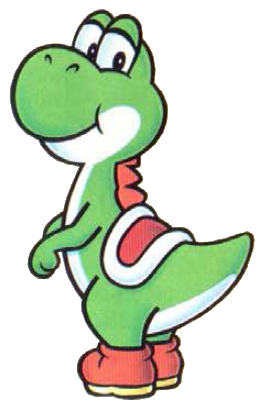
Mario’s faithful dinosaur, seen from behind for the whole game.
Runs the track automatically, jumps on command and stops when a boss blocks the road. Takes the damage, including from Mario’s stray shots. A second player can steer him with a controller.
Health: the LIFE meter
Moves: jump, super jump, dash; duck and slow down in two-player mode
Princess PeachPrincess of the Mushroom Kingdom
Prince Pine’s friend, and for the first time in a North American release, called Peach rather than Toadstool.
Hears of the invasion and sends Mario and Yoshi to Jewelry Land with the Super Scope.
Non-playable
King FretKing of Jewelry Land
The ruler of Jewelry Land, known in Japan as Potto Ō (King Pot).
Held prisoner in the Light Realm; freed once its seven Koopalings are beaten.
First appearance
Prince PinePrince of Jewelry Land
King Fret’s son, Pain Ōji in Japanese.
Bowser’s captive in the Dark Realm, rescued at the end of the game.
First appearance
BowserKing of the Koopas · final boss
The architect of the invasion, who keeps the Dark Realm and Prince Pine for himself.
Fights in the Busō Koopa armour, then on foot, at the end of Bowser’s Castle.
Stage 12
Four phases: armour hands, chest cannon, hands, fire breath
Lemmy KoopaKoopaling · boss of Grass Land
The Koopaling guarding the first stage on the map.
Pilots a walking robot with his own face on the front; once the face is shot off he can be hit in the cockpit.
Stage 1
Drops the first gem and flies off waving a white flag
Ludwig von KoopaKoopaling · boss of Mushroom Land
Keeper of the Mushroom Land gem.
Commands a dinosaur-like war machine from a cockpit on its neck, which fights on as a smaller robot.
Stage 2
Three phases
Wendy O. KoopaKoopaling · boss of Pipe Island
The only Koopaling here without a machine.
Hides behind a shield and throws bombs; can only be hurt by dropping the winged anvil on her.
Stage 3
Three hits
Larry KoopaKoopaling · boss of Crescent Coast
The Koopaling who takes to the sea.
Sails a sun-shaped submarine with a seal’s face; floats to the surface when beaten.
Stage 4
Two phases
Morton Koopa Jr.Koopaling · boss of Spirit Mountain
Holds the Spirit Mountain gem.
Rides inside a hopping robot frog in a top hat, popping out to throw bombs.
Stage 5
Two phases
Iggy KoopaKoopaling · boss of Grand Bridge
According to Nintendo Magazine System’s 1993 review (as cited by Wikipedia), the designer of Bowser’s war machines.
Pilots King Gessō, a giant robot Bloober, and ends up adrift on its wreckage.
Stage 6
Two phases
Roy KoopaKoopaling · boss of Float Castle I
The last Koopaling of the Light Realm.
Flies a mechanical hot-air balloon and fights Mario and Yoshi as they fall from the sky.
Stage 7
Last of the Light Realm
Bosses, mini-bosses & enemies
Every boss, mini-boss and regular enemy in the game, with the stages where they appear. Bosses are listed in stage order; there are no hit-point figures in the sources, so the chips say what to shoot instead.
Lemmy Koopa’s robot (boss)Grass Land (1)A walking robot bearing Lemmy’s face and a row of cannons. Shoot the face, then Lemmy whenever he peeks out of the cockpit.
Ludwig von Koopa’s dinosaur robot (boss)Mushroom Land (2)Hit the lump on its back, then the fists of the smaller robot left behind, then the cannon in its mouth.
Ludwig’s robot, second formMushroom Land (2)The cockpit and legs fight on, punching with rocket fists.
Wendy O. Koopa (boss)Pipe Island (3)Shielded among four pipes; only a falling anvil can hurt her. Three hits.
Winged anvilPipe Island (3)Flaps over the pipes dropping horseshoes. Shoot it while it faces you and it falls.
Larry Koopa’s submarine (boss)Crescent Coast (4)A sun-shaped sub with a seal’s face. Hit the open hatches, then the exposed cockpit.
Morton Koopa Jr.’s frog robot (boss)Spirit Mountain (5)Destroy the cannons in both back legs, then shoot Morton when he pops out to throw bombs.
King Gessō, Iggy Koopa’s squid (boss)Grand Bridge (6)A giant mechanical Bloober. Shoot off the tentacle cannons, the last pairs while it leaps from the water.
Roy Koopa’s balloon (boss)Float Castle I (7)Fought in freefall. Destroy its cannon and two bomb-throwing arms, then hit Roy when the basket dips.
Magikoopa (boss)Cornice Cave (8)Teleports and casts three-shape spells you must shoot down; returns as a giant for round two.
Big Boo (boss)Ghost Mansion (9)Throws rubble and can only be hurt while its eyes are open, then splits into three circling Boos.
Circling Boo BuddiesGhost Mansion (9)The Big Boo’s second form: only the one sticking its tongue out takes damage.
Chargin’ Chuck (boss)Float Castle II (10)Dashes about throwing bombs in pairs; leaps off screen and lands with a tremor.
Kame Hōdai (boss)Dark Sea (11)A turtle-shaped gunboat crewed by Koopa Troopas. Four rotating cannons, then the head when its mouth opens.
Busō Koopa, Bowser’s armour (final boss)Bowser’s Castle (12)Wreck the gun hands, then shoot the chest cannon each time it opens.
Bowser (final boss)Bowser’s Castle (12)Throws shells and shakes the floor; hit his hands, then his mouth as he breathes fire.
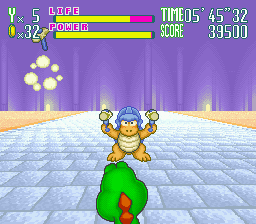
Hammer Brother (mini-boss)Grass Land; Bowser’s CastleThrows pairs of slow, arcing hammers and hops about.
Boomerang Brother (mini-boss)Pipe Island; Grand Bridge; Bowser’s CastleThrows looping boomerangs in pairs.
Takotsubo (mini-boss)Crescent CoastA giant octopus pot on the seabed that keeps releasing little Tako.
Sledge Brother (mini-boss)Spirit Mountain; Float Castle II; Bowser’s CastleArcing hammers, and a big jump that bounces Yoshi.
Firesnake (mini-boss)Cornice Cave; Bowser’s CastleA chain of five blue Podoboos; shoot segments off and they become ordinary Podoboos.
Lakitu (mini-boss)Ghost Mansion; Bowser’s CastleSwoops on its cloud dropping Spiny Eggs.
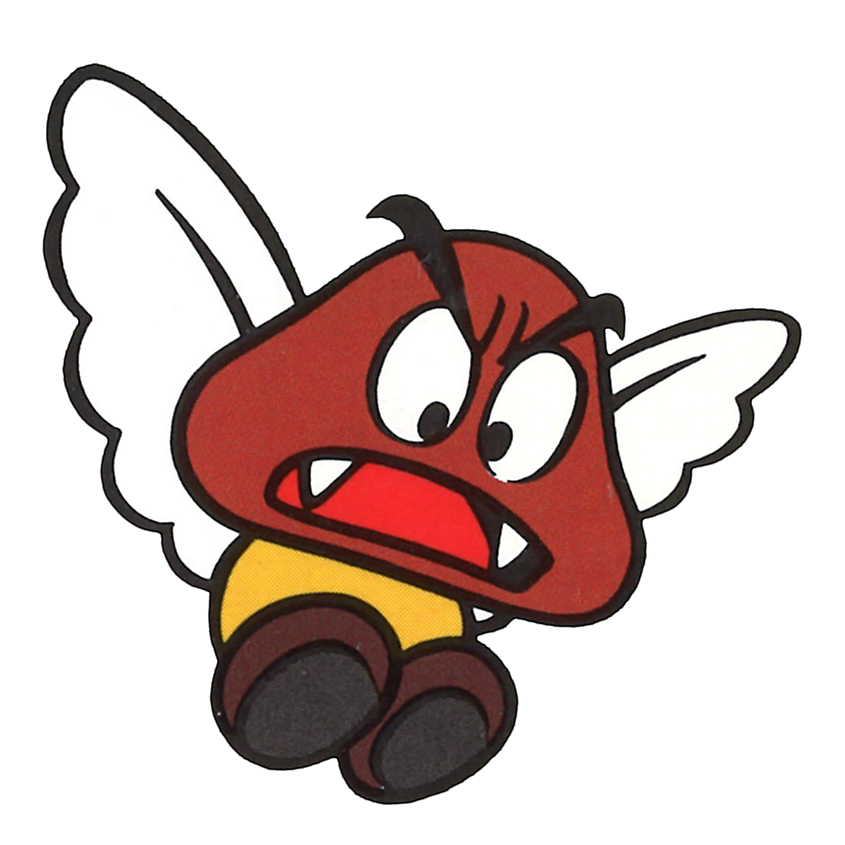
Flying GoombaStages 1, 2, 4, 5, 6, 10, 12Swoops in fast arcs, usually in single file, homing in on Yoshi.
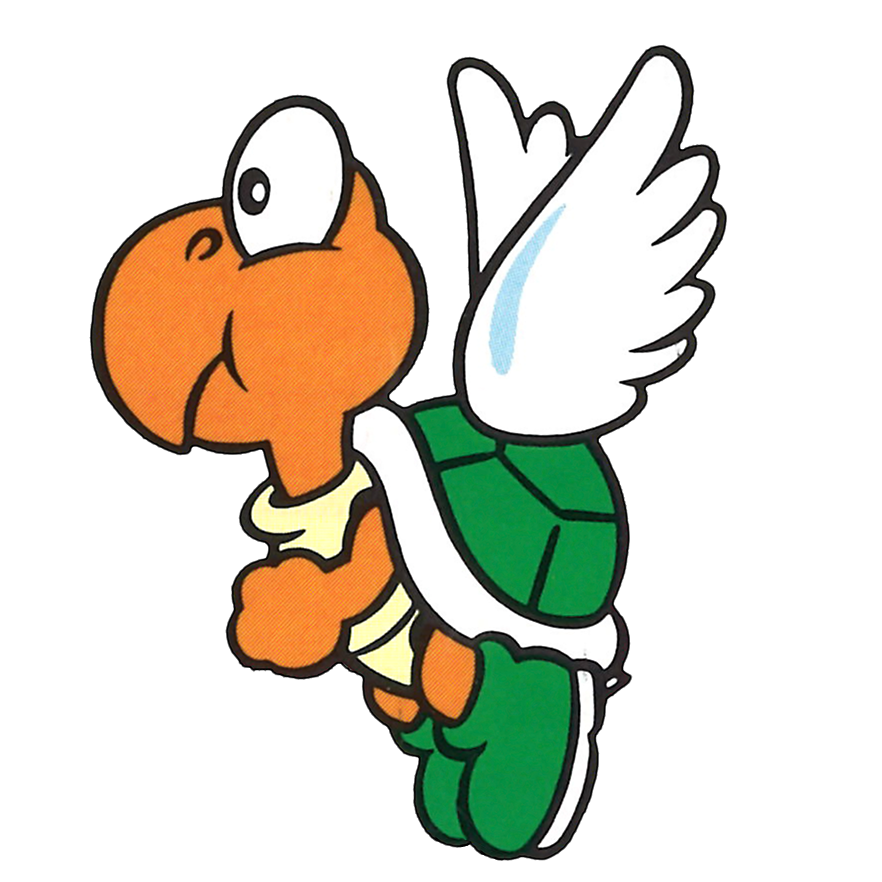
Koopa Para Troopa (green)Stages 1, 2, 3, 4, 6, 8, 11, 12Drifts in big, slow flocks. Shell colour changes by stage.
Koopa Para Troopa (yellow)Mushroom LandThe yellow-shelled flock of stage 2.
Koopa Para Troopa (blue)Pipe IslandBlue shells for stage 3.
Koopa Para Troopa (pink)Crescent CoastPink shells by the sea.
Bullet BillStages 1, 5, 7, 10, 12Fired in fast groups, straight but not always on target.
Koopa ShellStages 2, 6, 7Zigzags across the road, bouncing off the edges.
PodobooStages 2, 7, 8, 9, 10, 12Hops slowly and aimlessly.
Nipper PlantStages 2, 3, 4, 7, 9, 10, 11Snaps its way towards Yoshi, then jumps at him.
Monty MolePipe Island, Cornice CavePops out of pipes and scurries about.
Cheep-CheepStages 4, 6, 11Swims in synchronised shoals; above water it leaps in arcs to knock Yoshi in.
BlooberStages 4, 6, 11Bobs about unpredictably under water and bounces slowly above it.
TakoCrescent CoastLittle octopuses that crawl out of the Takotsubo.
Para BombStages 5, 6, 10Parachutes onto the road and lands as a walking Bob-omb.
Bob-ombStages 5, 6, 10What a Para Bomb becomes when it lands.
Spiny EggStages 5, 7, 9Falls from the sky and hatches on landing.
SpinyStages 5, 7, 9Crawls straight at Yoshi.
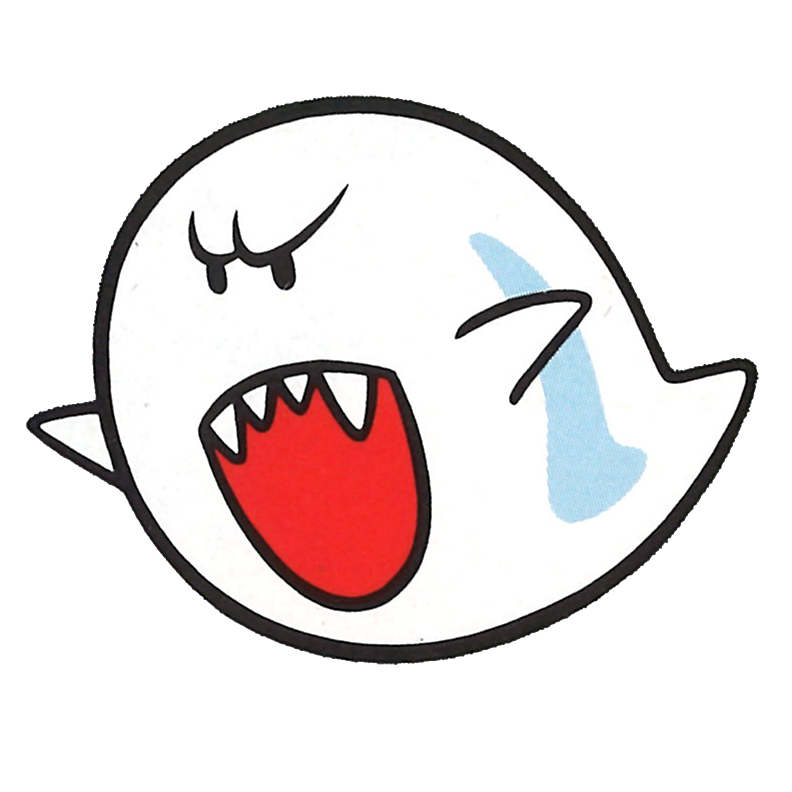
BooGhost MansionCalled “Big Boo” in the English manual. Freezes and shields itself when you face it.
MechakoopaBowser’s CastleWalks to and fro; shoot it to stun it and Yoshi kicks it aside.
Advertisement
How It Was Made
Little is on record about how Yoshi’s Safari was made: there are no credits and no developer interviews. What is known comes from Nintendo’s own listings, the game’s files and the press of the time.
A Mario game to rescue the Super Scope
The Super Scope: a wireless infrared light gun with a receiver that sits on the TV.
The Super Scope had launched in 1992 as the Super NES successor to the NES Zapper, and it was not setting the world alight. In a 2019 retrospective cited by Wikipedia, IGN’s Ben Bertoli describes Yoshi’s Safari as Nintendo’s attempt to give the peripheral a reason to exist: management feared it would sink without trace, and its future rested on how this game did. Putting Mario and Yoshi on the box was the obvious lever.
Technically it pushed the Scope on. According to the Los Angeles Times’ review of December 1993 (again via Wikipedia), no earlier Super Scope game had used Mode 7, the Super NES’s scaling and rotation mode, to give the impression of a 3D world. Nintendo’s Japanese product page makes the same pitch, highlighting the rotation and scaling effects behind its 3D look.
Nintendo R&D1, and no credits
The in-game logo.
Wikipedia and Nintendo Life both credit the game to Nintendo Research & Development 1, the Nintendo department usually known as R&D1. Who did what inside it is unknown, because the game carries no staff roll at all. Without credits, names that circulate online for the designers and composer cannot be confirmed, and this page does not repeat them.
Early footage and leftovers
The pre-release damage sprite, before Yoshi went cross-eyed.
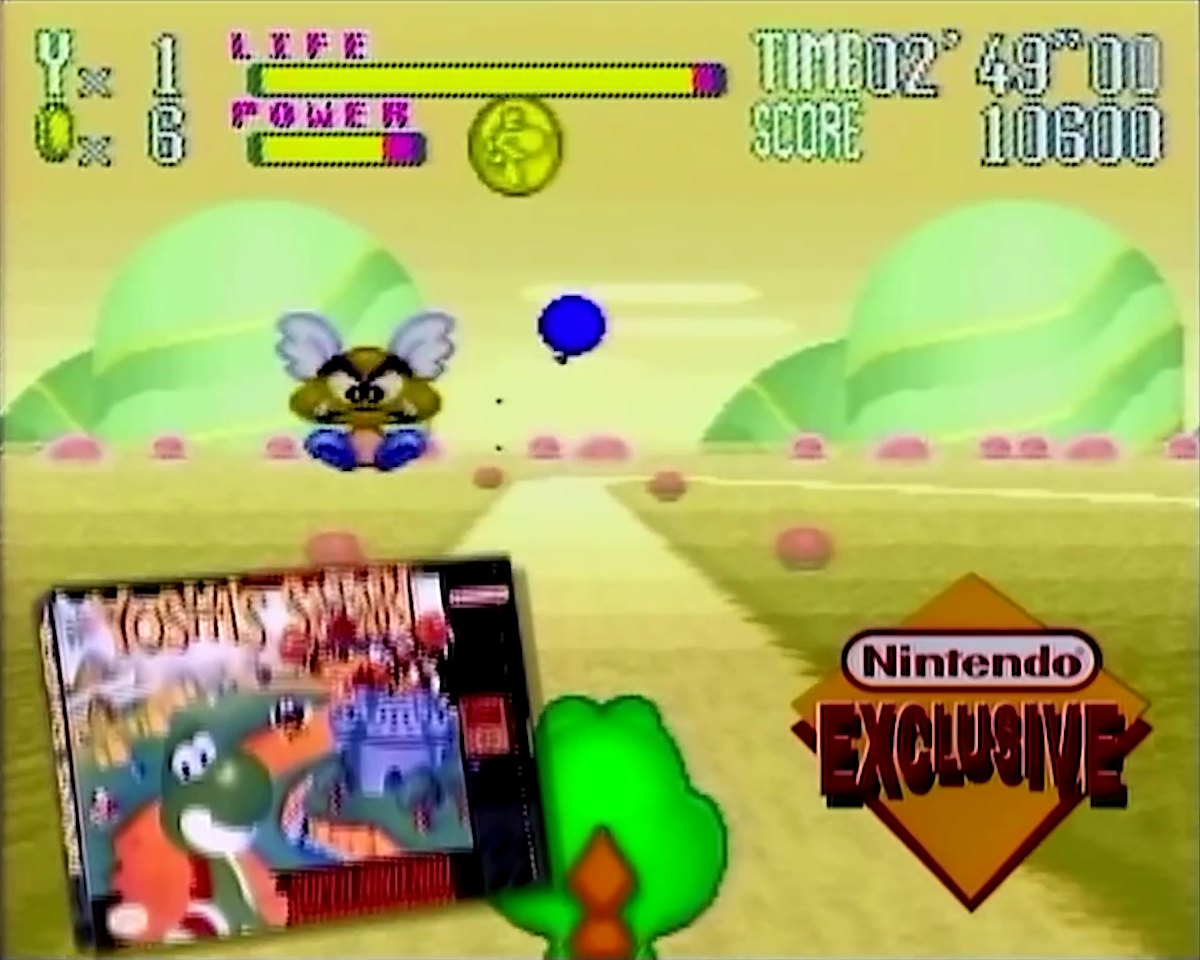
Before release the game appeared on a Nintendo Power preview LaserDisc that played on in-store kiosks. That footage shows an earlier version of Yoshi’s damage animation, in which he is not yet cross-eyed, and an early North American box with different artwork.
Inside the cartridge there are two pieces of Mario animation that never play: a run cycle, though Mario never runs on his own in the game, and a frame of him looking down from Yoshi’s back. Both were evidently meant for cutscenes.
From Road Hunting to Safari
Early North American box art, as seen on the preview LaserDisc.
For the West, Yoshi no Road Hunting became Yoshi’s Safari, with a new logo and a brighter title screen. Most of the localisation was routine: Pata Kuribō became the Flying Goomba, Patapata the Koopa Para Troopa, and Teresa the Big Boo. One choice stood out. Where earlier Western releases had called her Princess Toadstool, this one used her Japanese name, Peach, making it the first game released in North America to do so. Nintendo of America did not commit to the change for another three years.
What Miyamoto thought
Shigeru Miyamoto is not known to have worked on it. He was busy at the time with Super Mario World 2: Yoshi’s Island, and according to Steven L. Kent’s The Ultimate History of Video Games (as cited by Wikipedia) he did not care for Yoshi’s Safari and wanted his own Yoshi game to feel more authentic.
Series Firsts
Each of these has been checked against the series as a whole.
1The only Super Scope Mario gameIt is usually listed as the only game in the Super Mario franchise that uses the Super Scope, and Nintendo’s Japanese listing marks it as Scope-only.
2Mario’s first rail shooterThe first of the series’ two dedicated rail shooters. The second is Luigi’s Mansion Arcade.
3“Peach” in North AmericaThe first game released in North America to call the princess by her Japanese name. Super Mario RPG reverted to Toadstool before Super Mario 64 made Peach permanent.
4Jewelry Land, King Fret and Prince PineThe kingdom and its royal family made their debut here, and Jewelry Land has not been revisited by the games since.
5Mode 7 on the Super ScopeThe Los Angeles Times reported it as the first Super Scope game to use Mode 7 for its pseudo-3D roads (as relayed by Wikipedia).
Cheats & Secrets
There is no level select or debug menu on record, but there is a full second quest, and a few rules that are worth knowing before you set off.
Hard Mode
Beat Bowser and the ending gives you a code to enter on the title screen. It unlocks Hard Mode: new colour schemes for every stage and map, tougher bosses, a minute less on most clocks (Grass Land drops from four minutes to three, Bowser’s Castle from eight to seven) and story screens that say the events are repeating. Super Luigi Bros’ cheats page, linked below, has a button combination for it.
Bank your boss items
An item from a green Flying ? Block that you never use becomes bonus points when the boss falls: 2,000 for a Super Mushroom or Nuts, 5,000 for a Super Star and 6,000 for a Clock. If you can win without them, it pays.
Hunt the two Fire Flowers
Each one lengthens the Scope’s POWER gauge, and the gauge is the game’s real limiting factor. Find both and you can hold the trigger much longer.
Pick your path at junctions
Shooting a barricade switches it to the other road. On Grand Bridge one route leads to a Boomerang Brother and on Float Castle II one leads to a Sledge Brother; avoid them if you are short of time or health, take them on if you want the points.
Coins are life insurance
Sixty coins give a 1-Up, and Big Coins count for ten. Coins also protect you: falling into a pit costs three of them, and only costs a life if you have fewer than three.
Do not shoot the dinosaur
Yoshi’s head is always on screen and your shots hurt him. Aim above it, especially in the frantic boss fights.
Quit without resetting
Pause with the Scope’s Pause button, then hold Cursor and press Fire twice to return to the title screen.
Glitches & Oddities
No famous glitches are documented for Yoshi’s Safari, but The Cutting Room Floor has turned up a couple of oddities in the cartridge.
The anti-piracy check
When the game boots it tries to write its internal name into save memory and reads it back. A real cartridge has no save RAM, so the writes vanish; if they come back intact, the game knows it is running on a copier device with SRAM and shows a warning screen instead of starting.
Mario’s unused animations
Mario’s unused run cycle.
A running animation and a looking-down frame for Mario sit unused in the ROM, apparently intended for cutscenes that were never finished.
The look-down frame
Mario looking down from Yoshi, never seen in play.
The second unused sprite shows Mario peering down from the saddle.
Videos
Nintendo has never posted the game on its channels, so here are two complete playthroughs by fans, recorded on real Super Scope set-ups or emulation.
Third-party upload by NintendoComplete: the whole game from Grass Land to Bowser.
Third-party upload by Jalop Entertainment: a commentary playthrough.
Trivia & Interesting Facts
In Japan it shared its release date, 14 July 1993, with Super Mario All-Stars.
The Japanese title, Yoshi no Road Hunting, translates as “Yoshi’s Road Hunting”. Its logo uses two Bullet Bills as the marks on the katakana “n”.
King Fret: Potto Ō in Japan.In Japanese, Jewelry Land’s king and prince are Potto Ō and Pain Ōji; the English version renamed them King Fret and Prince Pine.
The light and dark halves of Jewelry Land were called the Light World and Dark World in Japanese, and renamed the Light Realm and Dark Realm in English.
The realms are not equal: seven stages in the Light Realm (one per Koopaling) and five in the Dark Realm (Bowser and four generals).
Wendy O. Koopa is the only one of the seven Koopalings who fights without a machine. Instead the player has to drop a winged anvil on her.
King Gessō, second phase.The boss machines have names of their own: Iggy’s robot squid is King Gessō, Bowser’s armour is Busō Koopa, and the Dark Sea gunboat is Kame Hōdai.
The English manual calls the ordinary Boos of the Ghost Mansion “Big Boo”, the name it also gives the stage’s actual boss.
The boss-fight item the English game calls “Nuts” is kinomi, a berry, in Japanese, and looks like the red berry from Super Mario World.
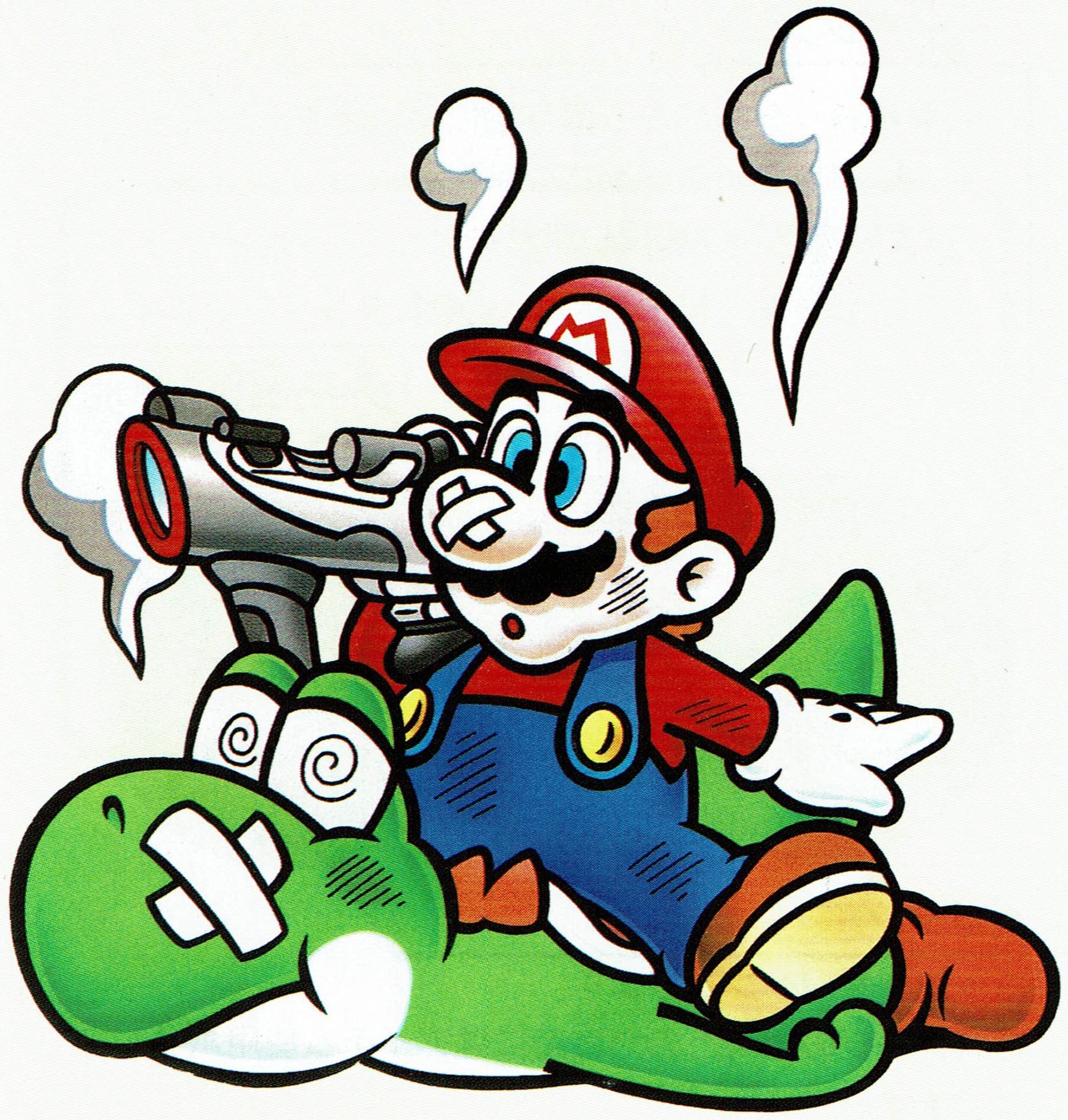
Shoot Yoshi and he takes damage. The game even has a dedicated sprite for him reacting to friendly fire.
Every stage has a time limit, from four minutes on Grass Land to eight minutes for Bowser’s Castle.
In Kazuki Motoyama’s manga adaptation, Bowser forces a scientist called Dr. Mario Nakamatsu to build his machines. Nakamatsu does not appear in the game itself.
The Super Scope is called the Nintendo Scope in several European languages.
A downcast Yoshi from the final game.A pre-release version of Yoshi’s damage sprite was not cross-eyed; the finished game’s is.
It has never been re-released: there was no Virtual Console version, and as of November 2026 it is not in Nintendo Switch Online’s Super NES library.
Regional Box Art
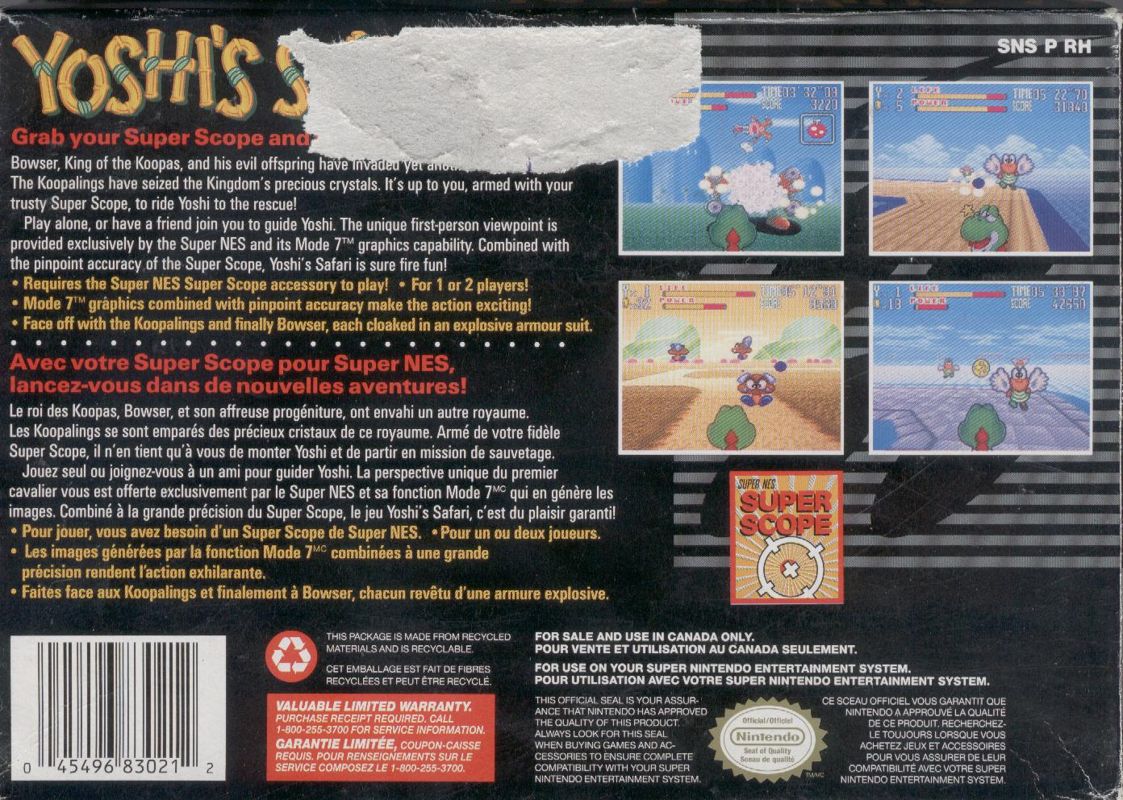
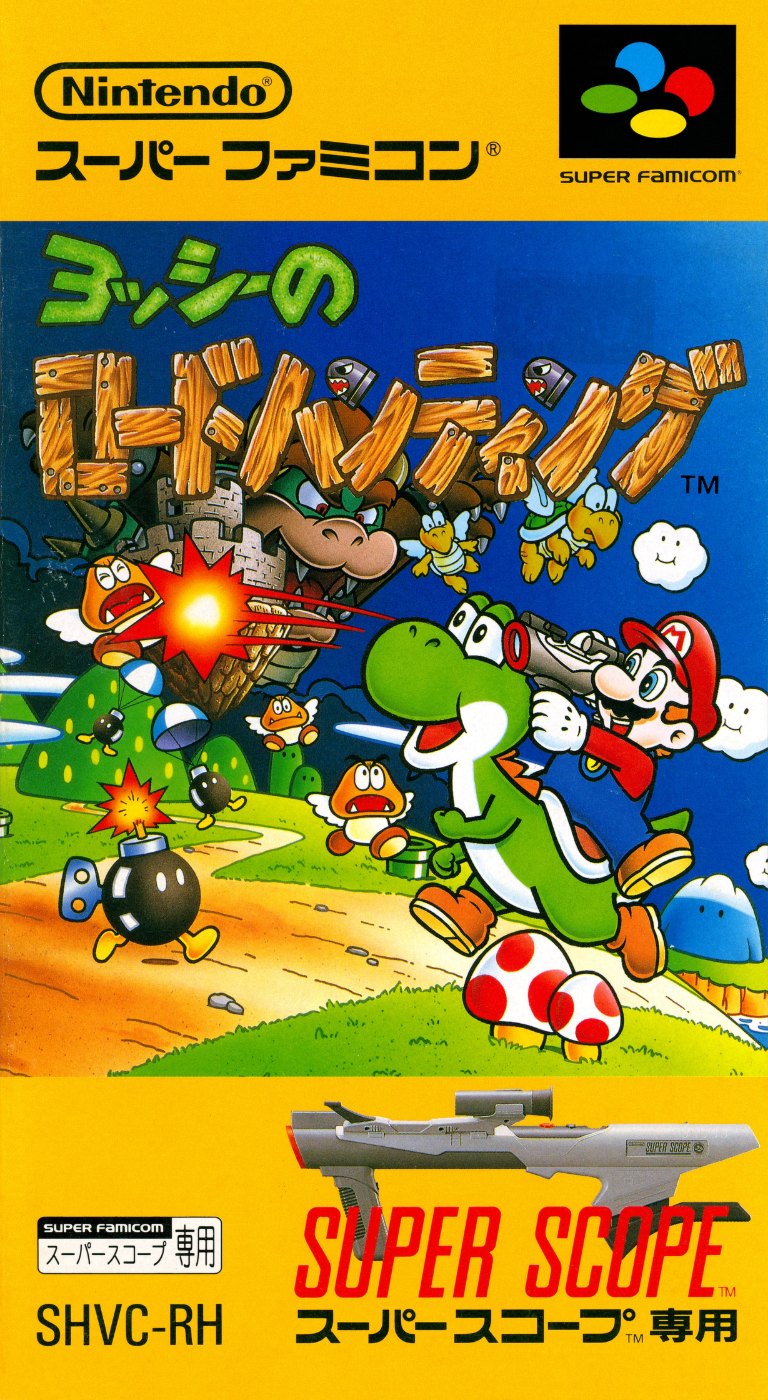
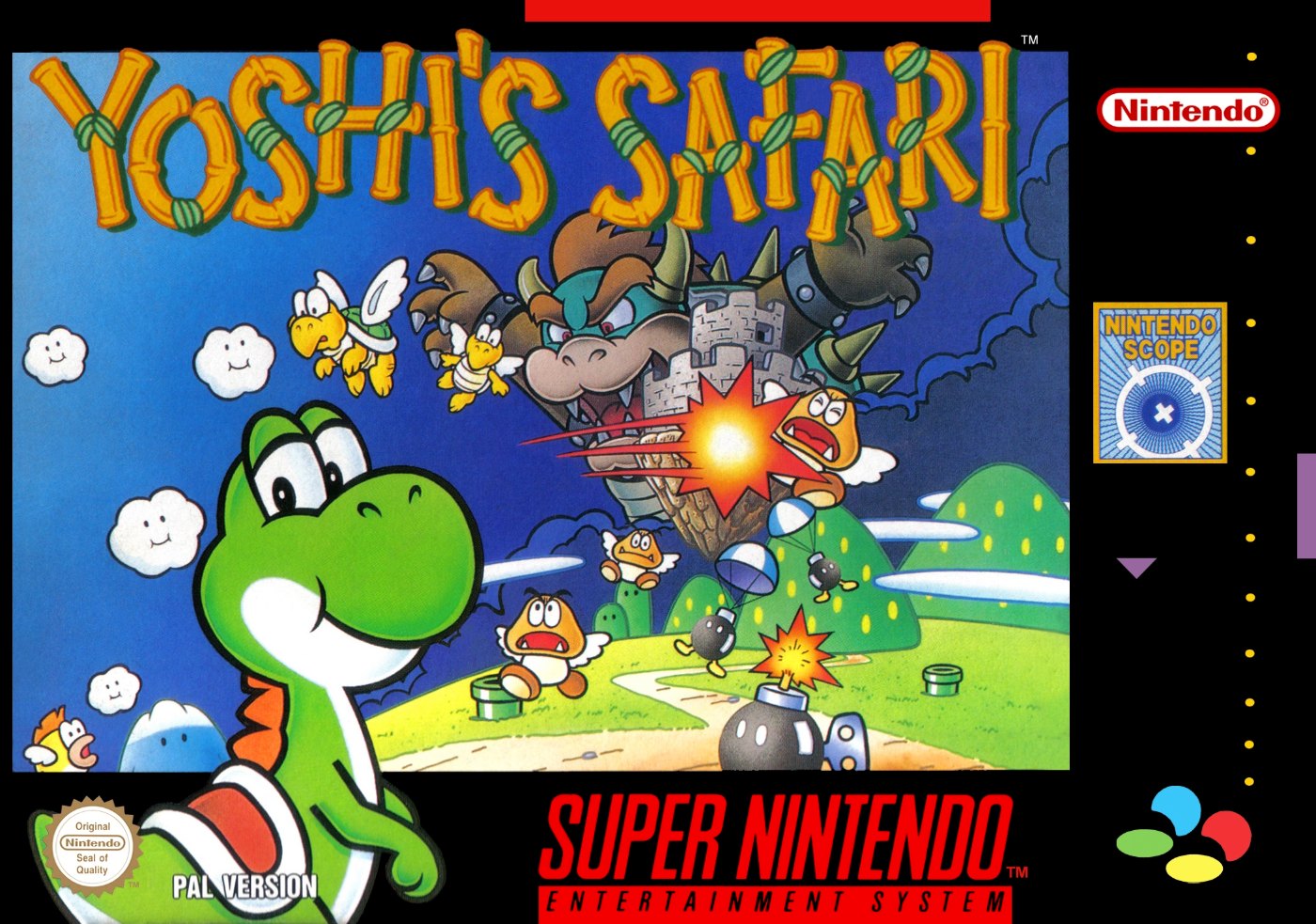
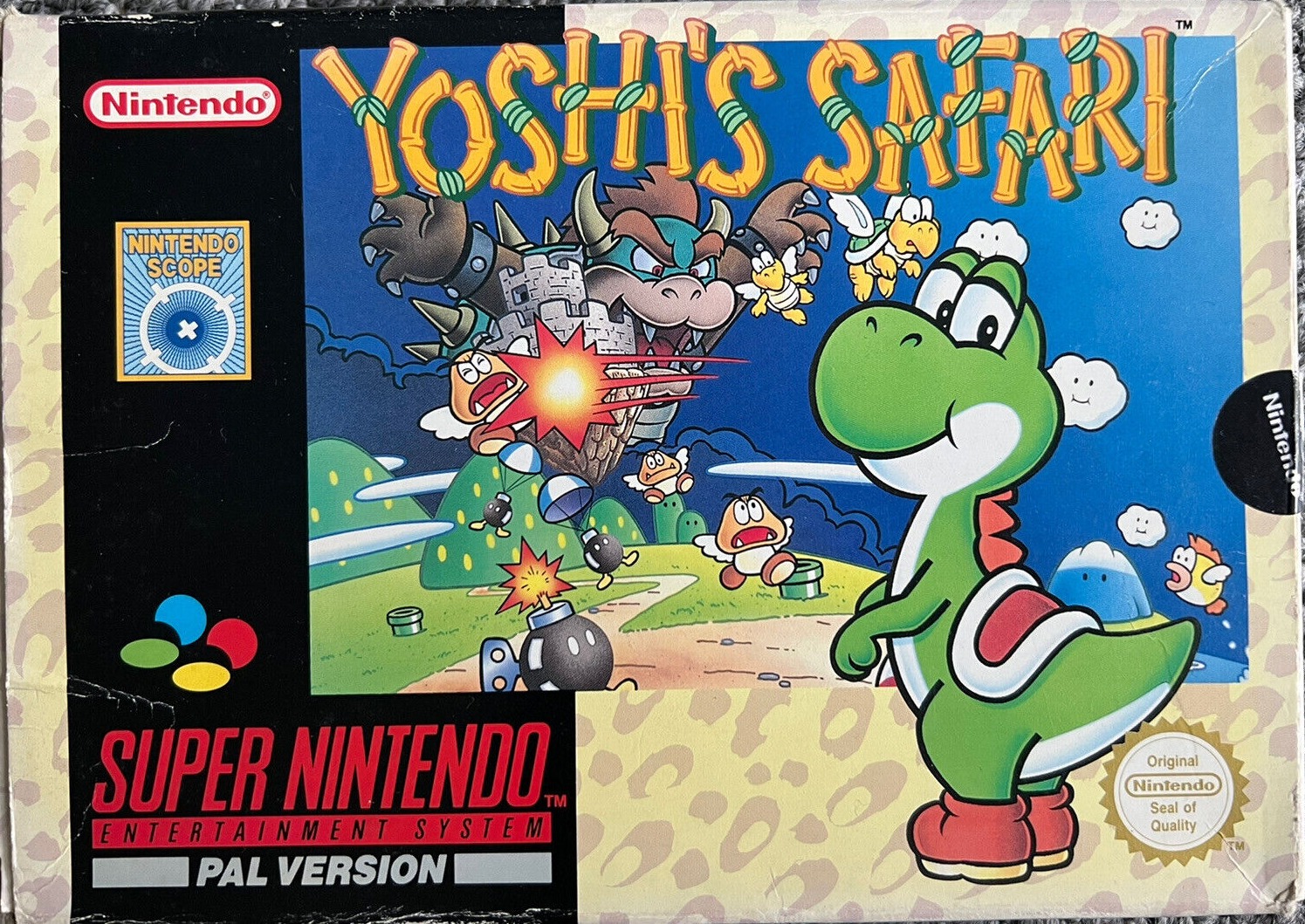
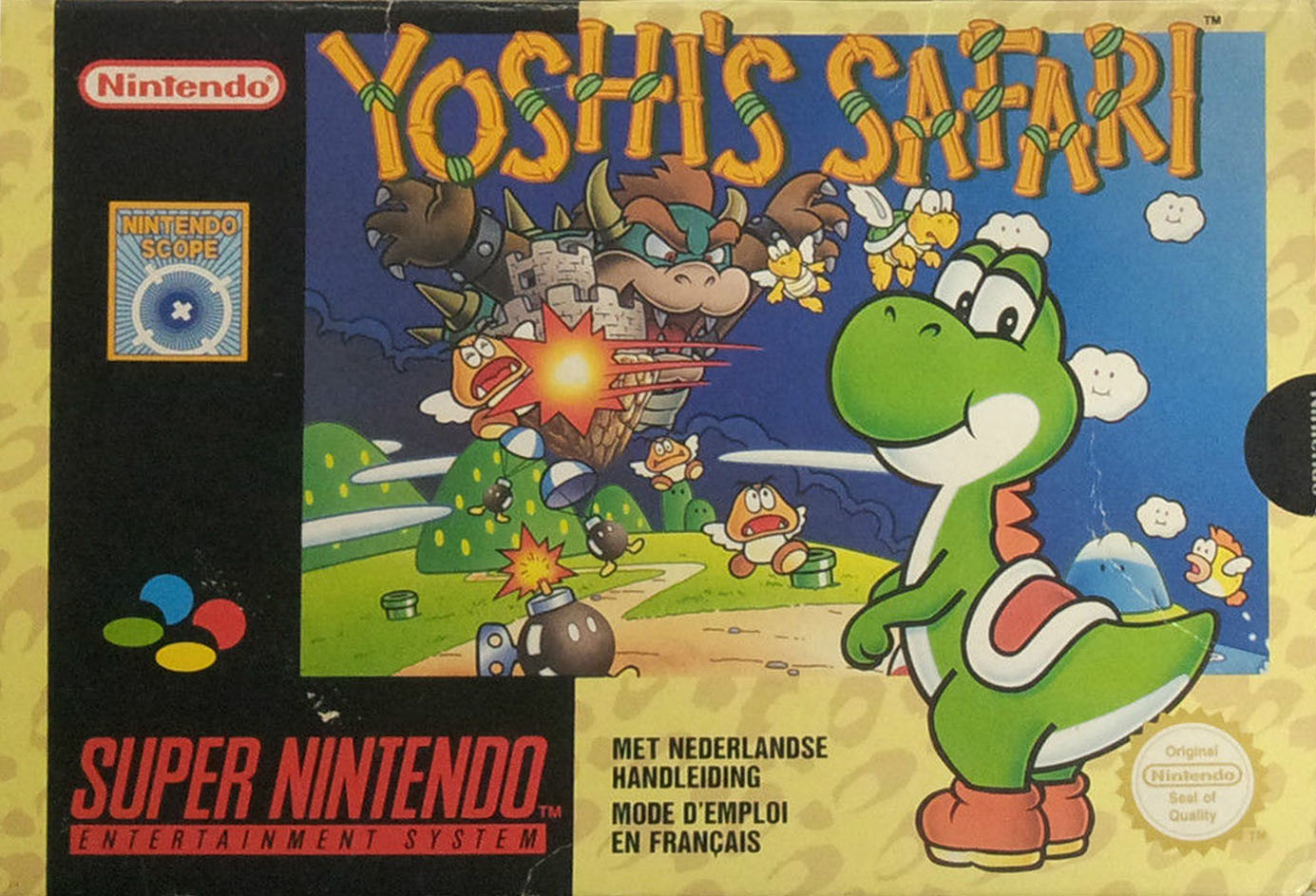
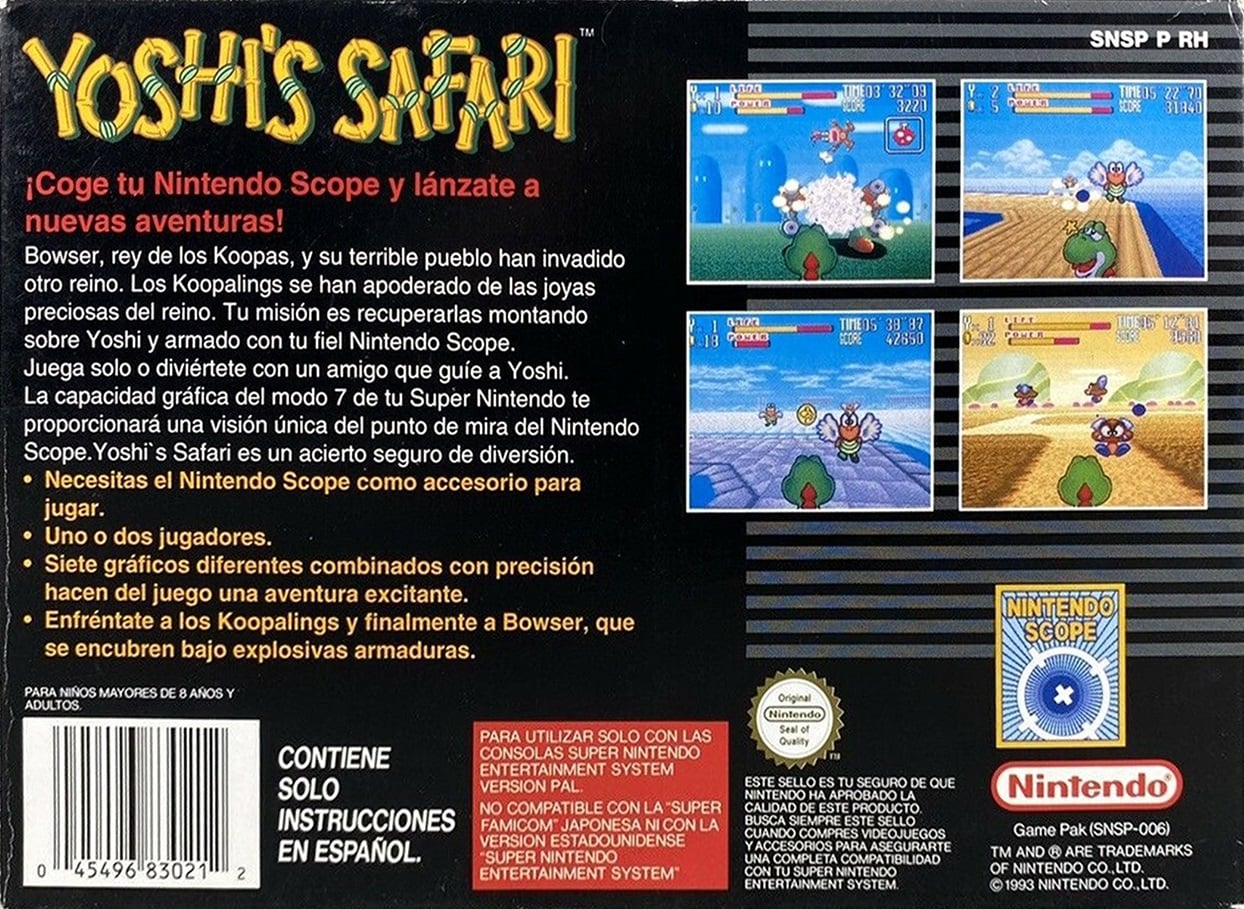
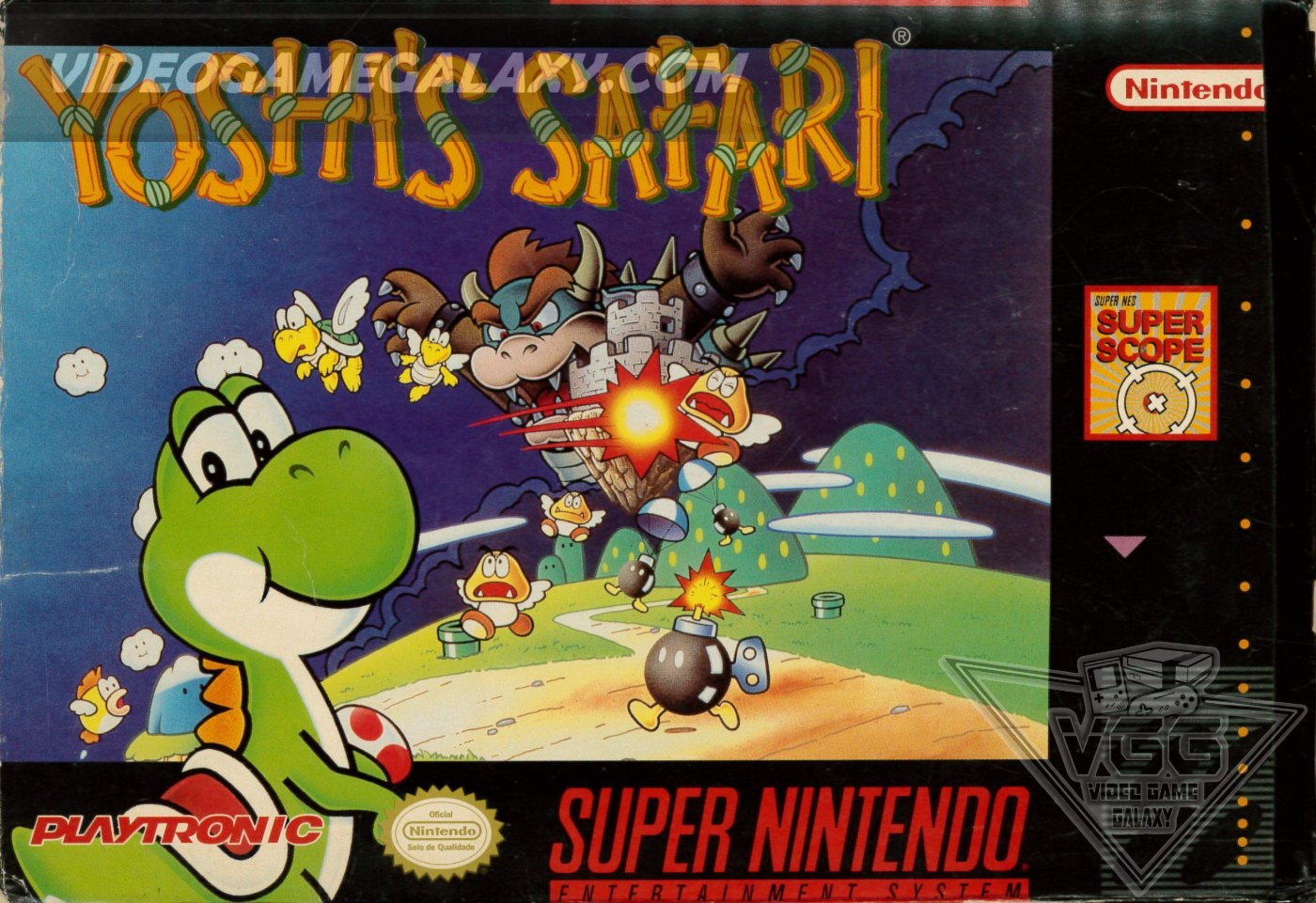
Every regional box we could find, including two early North American designs and the Super Famicom original.
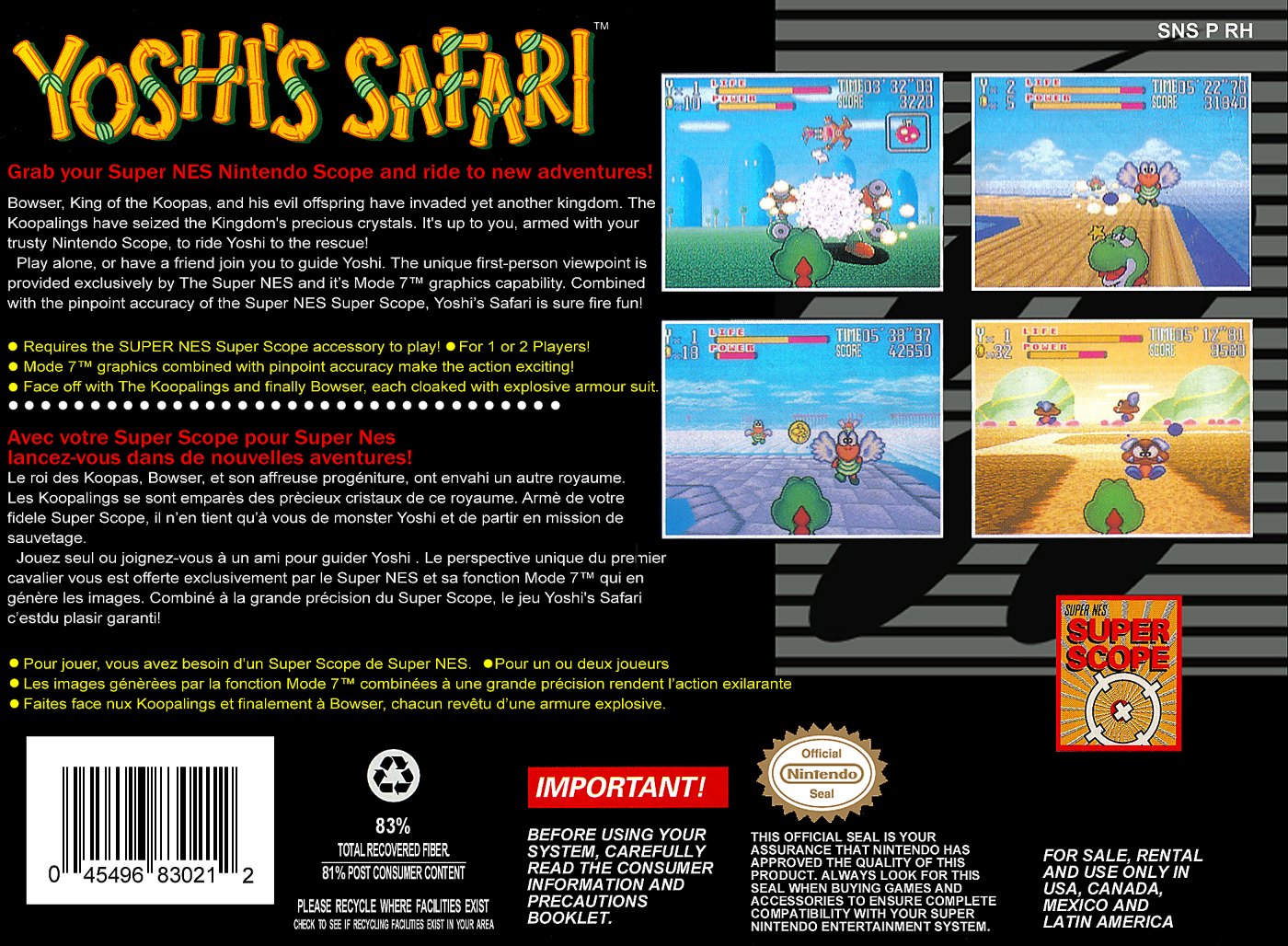
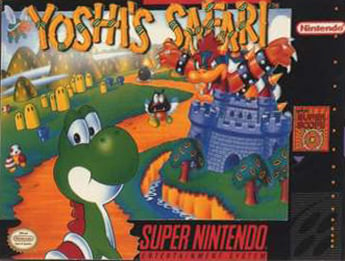
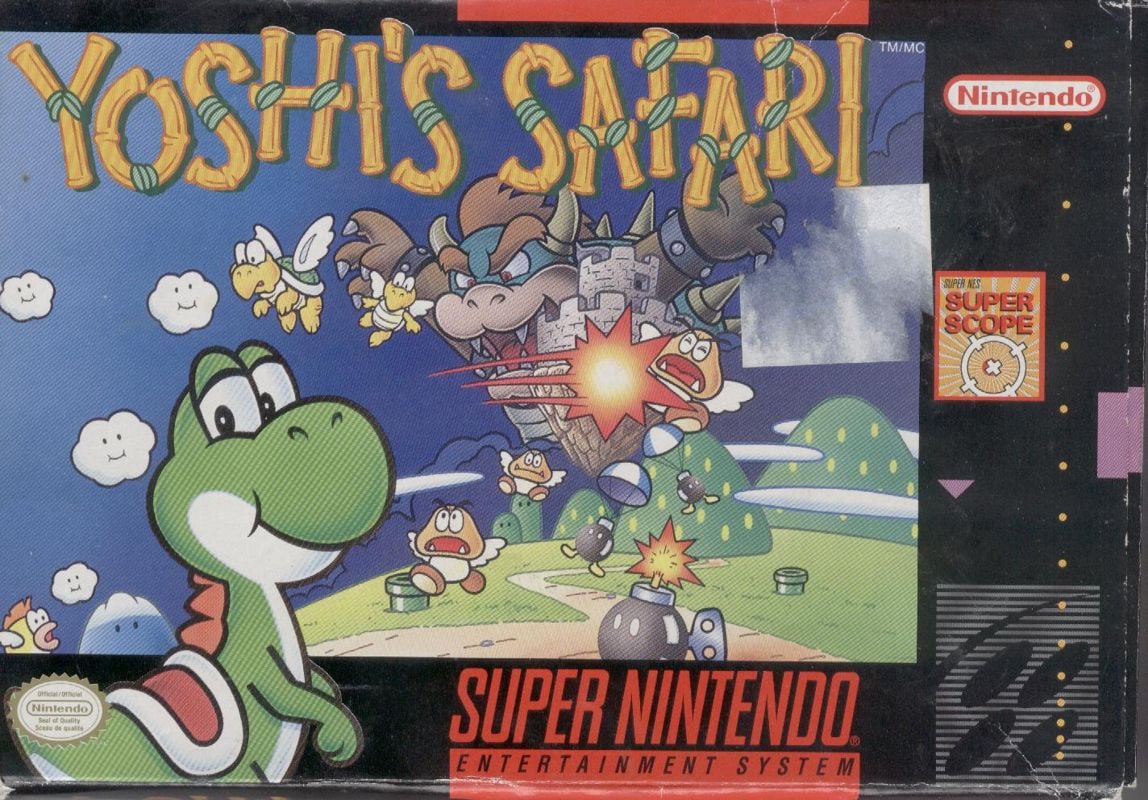
North America (1993)North America, back (English)North America, back (English and French)North America, early box (1 of 2)Alternative early artwork.North America, early box (2 of 2)North America, pre-releaseAs shown on the Nintendo Power preview LaserDisc.CanadaCanada, backJapan (Yoshi no Road Hunting)Super Famicom.EuropeUnited Kingdom and AustralasiaFrance and the NetherlandsSpain, backBrazil (Playtronic)
Screenshots
More from the road, in both colour schemes.
Crescent Coast’s beach, before the dive.Grand Bridge stretches out to sea.Lava and fire in Cornice Cave.Float Castle II, a ruin in the clouds.Island-hopping on the Dark Sea.Mushroom Land, home of Ludwig’s war machine.Grass Land in Hard Mode, with its new colours.Ghost Mansion in Hard Mode.The Dark Realm map in Hard Mode.Grand Bridge in Hard Mode.
Artwork & Media Gallery
Official artwork, sprites and covers. Super Luigi Bros’ own box-art and screenshot galleries for the game are linked below.
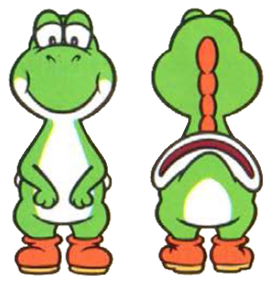
Group artwork.Mario with the Super Scope.Mario and Yoshi on safari.Mario takes aim at the viewer.The Game Over artwork.Yoshi, saddled up.Front and back views of Yoshi.Flying Goomba artwork.Koopa Para Troopa artwork.A Boo, or “Big Boo” as the manual has it.Yoshi as you see him for the whole game.Ludwig’s robot, armless.Larry’s sub, stripped down.Magikoopa before he grows.Kame Hōdai with its turret gone.Bowser’s armour opens its chest cannon.Super Mario-kun volume 8, stage 12.The Super Scope as it appears in Super Smash Bros. Ultimate.The Mushroom Land gem.The Pipe Island gem.The Crescent Coast gem.The Spirit Mountain gem.The Grand Bridge gem.The Float Castle I gem.The Cornice Cave gem.The Ghost Mansion gem.The Float Castle II gem.The Dark Sea gem.The Bowser’s Castle gem.
Legacy & Re-releases
A one-off in every sense: no sequel, no remake and no re-release. Its afterlife is in manga, in trivia lists and in the Super Scope’s continuing cameo career.
Releases
Super Famicom14 July 1993Japan, as Yoshi no Road Hunting.
Super NESSeptember 1993North America, as Yoshi’s Safari.
Super NES (PAL)1993Europe and Australia; Wikipedia dates the PAL release to 19 November 1993.
Super NES (Brazil)December 1993Released by Nintendo’s Brazilian partner Playtronic among a batch of 20 Super NES titles.
Virtual ConsoleneverNot released on the Wii, Wii U or Nintendo 3DS services.
Nintendo Switch Onlinenot as of November 2026Absent from the Super NES library (as of September 2026).
Why it has never come back
One obstacle is plain: the game cannot be played at all without a Super Scope. IGN’s 2019 retrospective noted that its 25th anniversary in 2018 came and went quietly and called the lack of a re-release a shame. Wikipedia also observes that most of what it added to Mario lore, Jewelry Land included, has been ignored by later games.
Mario and the light gun since
Mario did not star in another rail shooter until Luigi’s Mansion Arcade, but the Super Scope kept turning up: as a weapon in Super Smash Bros. from Melee onwards, as a gadget carried by the Sniper Bills of Mario & Luigi: Superstar Saga, and in 2026 as Bowser Jr.’s invention in The Super Mario Galaxy Movie. For more Yoshi games, see Yoshi, Yoshi’s Cookie and the games index.
Reviews & Sales
Sales
Nintendo has never published a sales figure for Yoshi’s Safari, and we could not find a chart tracker’s number either, so this page gives none. The consensus, reported by IGN in its 2019 retrospective (as summarised by Wikipedia), is that it flopped: it depended on a peripheral few households owned, and its autumn 1993 launch was overshadowed by the row over Nintendo’s toned-down Super NES version of Mortal Kombat.
14 July 1993Japanese release, alongside Super Mario All-Stars
0re-releases to date
1Super Scope game in the Mario series
Review scores
Period scores as tabulated by Wikipedia from the original magazines (most with a scan linked in its references). EGM and Famitsu used panels; their totals are shown.
JoypadFrance · issue 23, September 1993
83%
Power UnlimitedNetherlands
80/100
Nintendo Magazine SystemUK · issue 12, September 1993
The look of the thing won almost everyone over. Joypad, Electronic Gaming Monthly and Nintendo Magazine System all singled out the graphics and the smooth scrolling, Joypad praising the fluid animation, and the Los Angeles Times liked its colourful Mode 7. The music was enjoyed too. Joypad and Nintendo Magazine System both rated it the best game available for the Super Scope, and Joypad thought it worth buying for anyone who owned one, if a little pricey, with particular praise for the two-player mode.
The complaint was the same everywhere: it was short and easy. The Nintendo Magazine System team finished it in one sitting and reckoned it would last a week at most, one Electronic Gaming Monthly reviewer joked darkly about turning the Scope on themselves, and both NMS and Nintendo Power pitched it at younger players. The Dutch Power Unlimited summed up the mood: original, good-looking, fun and very easy. Looking back in 2019, IGN called it ahead of its time in some ways and a shame that it has never been re-released.
SLB User Reviews
Yoshi’s Safari has yet to receive a community review on Super Luigi Bros.
If you’ve played Yoshi’s Safari and would like to submit a review, please get in touch.
More from the Super Luigi Bros Guide
These picture lists come from the earlier Super Luigi Bros guide to Yoshi’s Safari and are kept here in full.
Levels
Twelve stages are spread across two realms. Within each realm, stages can be tackled in any order — except Bowser’s Castle, which unlocks after clearing stages 8–11. Completing the Light Realm rescues King Fret; completing the Dark Realm rescues Prince Pine.
Map of Jewellery Land’s Light Realm
Light Realm
1. Grass LandLight Realm
A short, green area introducing the basic gameplay. Simple enemies fly in from the sides as Yoshi trots through open fields.
Mini-boss: Hammer Brother | Boss: Lemmy Koopa
2. Mushroom LandLight Realm
A short muddy area with dense swarms of enemies. Ludwig‘s dinosaur robot is one of the most distinctive boss designs in the game.
Mini-boss: None | Boss: Ludwig von Koopa
3. Pipe IslandLight Realm
A branching-path stage around Warp Pipes. Notably, Wendy O. Koopa fights directly rather than in a robot.
Mini-boss: Boomerang Brother | Boss: Wendy O. Koopa
4. Crescent CoastLight Realm
A medium-length coastal and underwater stage — the first to split between surface and seabed sections.
Mini-boss: Takotsubo | Boss: Larry Koopa
5. Spirit MountainLight Realm
A mountain stage with lava sections. Morton’s frog mech leaps unpredictably across the arena.
Mini-boss: Sledge Bro | Boss: Morton Koopa Jr.
6. Grand BridgeLight Realm
A long bridge over a vast chasm. Iggy Koopa‘s squid robot swoops through the air firing ink blasts.
Mini-boss: None | Boss: Iggy Koopa
Dark Realm
7. Float Castle IDark Realm
A castle floating in the sky. Roy Koopa‘s balloon contraption is one of the game’s most memorable boss designs.
Mini-boss: Fire Snake | Boss: Roy Koopa
8. Cornice CaveDark Realm
A dark cave stage with narrow passages. The Magikoopa boss casts rapid-fire magic spells in complex patterns.
Mini-boss: None | Boss: Magikoopa
9. Cloud SeaDark Realm
A stage set among clouds, with ghost enemies throughout. Both the mini-boss and the stage boss are Big Boos.
Mini-boss: Big Boo | Boss: Big Boo
10. Float Castle IIDark Realm
A second floating castle, more challenging than the first. Chargin’ Chuck’s full-speed charge attack must be met with rapid fire.
Mini-boss: None | Boss: Chargin’ Chuck
11. Dark SeaDark Realm
An underwater/coastal dark stage. The Kame Hōdai artillery turtle fires volleys of shells from its back-mounted cannon.
Mini-boss: None | Boss: Kame Hōdai
12. Bowser’s CastleDark Realm
The final stage, only accessible after clearing stages 8–11. Bowser battles in a massive suit of robotic armour — defeat both phases to restore Jewellery Land.
Mini-boss: None | Boss: Bowser
Appearances in Super Mario manga by Kodansha
Yoshi’s Safari received unusually extensive treatment in the Super Mario manga published by Kodansha — adapted into two dedicated volumes of the Yoshi no Road Hunting series, plus appearances across three volumes of the long-running Super Mario-kun series.
Super Mario: Yoshi no Road Hunting (Kodansha)
Written and drawn by Kazuki Motoyama, this two-volume series is a direct adaptation of Yoshi’s Safari. Bowser forces Dr. Mario Nakamatsu to build mech suits for him and the Koopalings. Mario and Yoshi retrieve the Nintendo Scope from Big Bertha and Yoshi (characters from the Super Mario Bros. film) before heading to Jewellery Land at Princess Peach’s request. Click any cover to view full size.
Vol. 1: Yoshi no Road Hunting 1
First volume of the direct Yoshi’s Safari manga adaptation.
Vol. 2: Yoshi no Road Hunting 2
Concluding volume of the Yoshi’s Safari adaptation.
Super Mario-kun (Kodansha)
Yoshi’s Safari also appears across three volumes of Super Mario-kun. Click any cover to view full size.
Volume 8 — Stage 12
One-shot anticipation chapter — Yoshi invites Mario to hunt enemies with a bazooka.
Volume 9 — Stages 1–8
Full story arc — Mario attempts to retire, then helps Yoshi rescue Jewellery Land.
Volume 10 — Chapter 8
One-shot revisiting the Yoshi’s Safari theme — one of few games with three separate Super Mario-kun chapters.
To provide the best experiences, we use technologies like cookies to store and/or access device information. Consenting to these technologies will allow us to process data such as browsing behavior or unique IDs on this site. Not consenting or withdrawing consent, may adversely affect certain features and functions.
Functional
Always active
The technical storage or access is strictly necessary for the legitimate purpose of enabling the use of a specific service explicitly requested by the subscriber or user, or for the sole purpose of carrying out the transmission of a communication over an electronic communications network.
Preferences
The technical storage or access is necessary for the legitimate purpose of storing preferences that are not requested by the subscriber or user.
Statistics
The technical storage or access that is used exclusively for statistical purposes.The technical storage or access that is used exclusively for anonymous statistical purposes. Without a subpoena, voluntary compliance on the part of your Internet Service Provider, or additional records from a third party, information stored or retrieved for this purpose alone cannot usually be used to identify you.
Marketing
The technical storage or access is required to create user profiles to send advertising, or to track the user on a website or across several websites for similar marketing purposes.





 3. Pipe IslandLight Realm · stage 3 · time 4 min (Hard 3) · mini-boss: Boomerang Brother · boss: Wendy O. KoopaAn island bristling with Warp Pipes and Monty Moles. Short, with few enemies but plenty of junctions.
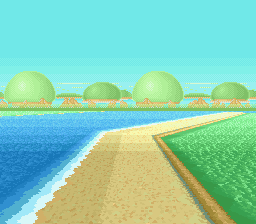 4. Crescent CoastLight Realm · stage 4 · time 5 min (Hard 4) · mini-boss: Takotsubo · boss: Larry KoopaA beach run that dives under the sea, where a giant octopus pot keeps spawning little octopuses.
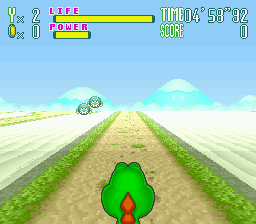 5. Spirit MountainLight Realm · stage 5 · time 5 min (Hard 4) · mini-boss: Sledge Brother · boss: Morton Koopa Jr.A high, sandy mountain path packed with dash zones, jumps, Para Bombs and falling Spinies.
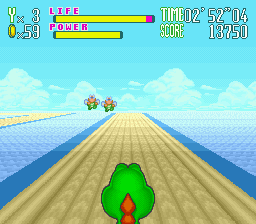 6. Grand BridgeLight Realm · stage 6 · time 4 min (Hard 3) · mini-boss: Boomerang Brother (optional route) · boss: Iggy KoopaAn enormously long pier over the sea, with Cheep-Cheeps and Bloobers leaping out of the water on both sides.
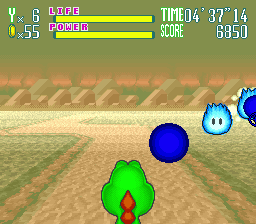 8. Cornice CaveDark Realm · stage 8 · time 5 min · mini-boss: Firesnake · boss: MagikoopaA winding cavern of fire and lava in a mountain in the east of the Dark Realm, with two underground lakes to jump.
 10. Float Castle IIDark Realm · stage 10 · time 4 min (Hard 3) · mini-boss: Sledge Brother (optional route) · boss: Chargin’ ChuckA floating ruin full of boosts, bottomless drops and Bullet Bills.
 11. Dark SeaDark Realm · stage 11 · time 5 min · mini-boss: none · boss: Kame HōdaiA long chain of tiny islands on a gloomy ocean, crossed by jump pads; one hit at the wrong moment and you are in the water.



 CoinSixty make an extra life. Three are lost every time Yoshi falls into a pit.
 Big CoinWorth ten coins at once.
 Super MushroomRefills the LIFE meter. Also a boss item in Cornice Cave, Ghost Mansion and Bowser’s Castle (2,000 points if saved).
 Super StarInvincibility for a while. Also a boss item in Float Castle II (5,000 points if saved).
 NutsBoss item: halves the damage Yoshi takes for a time. Found in Grass Land and Spirit Mountain (2,000 points if saved).
 ClockBoss item: adds one minute to the timer. Found in Pipe Island and Grand Bridge (6,000 points if saved).
 Flying ? BlockYellow blocks flap past carrying stage items. Shoot them open.
 GemsTwelve magic gems, one won from each stage’s boss. Collect them all to put Jewelry Land back together.
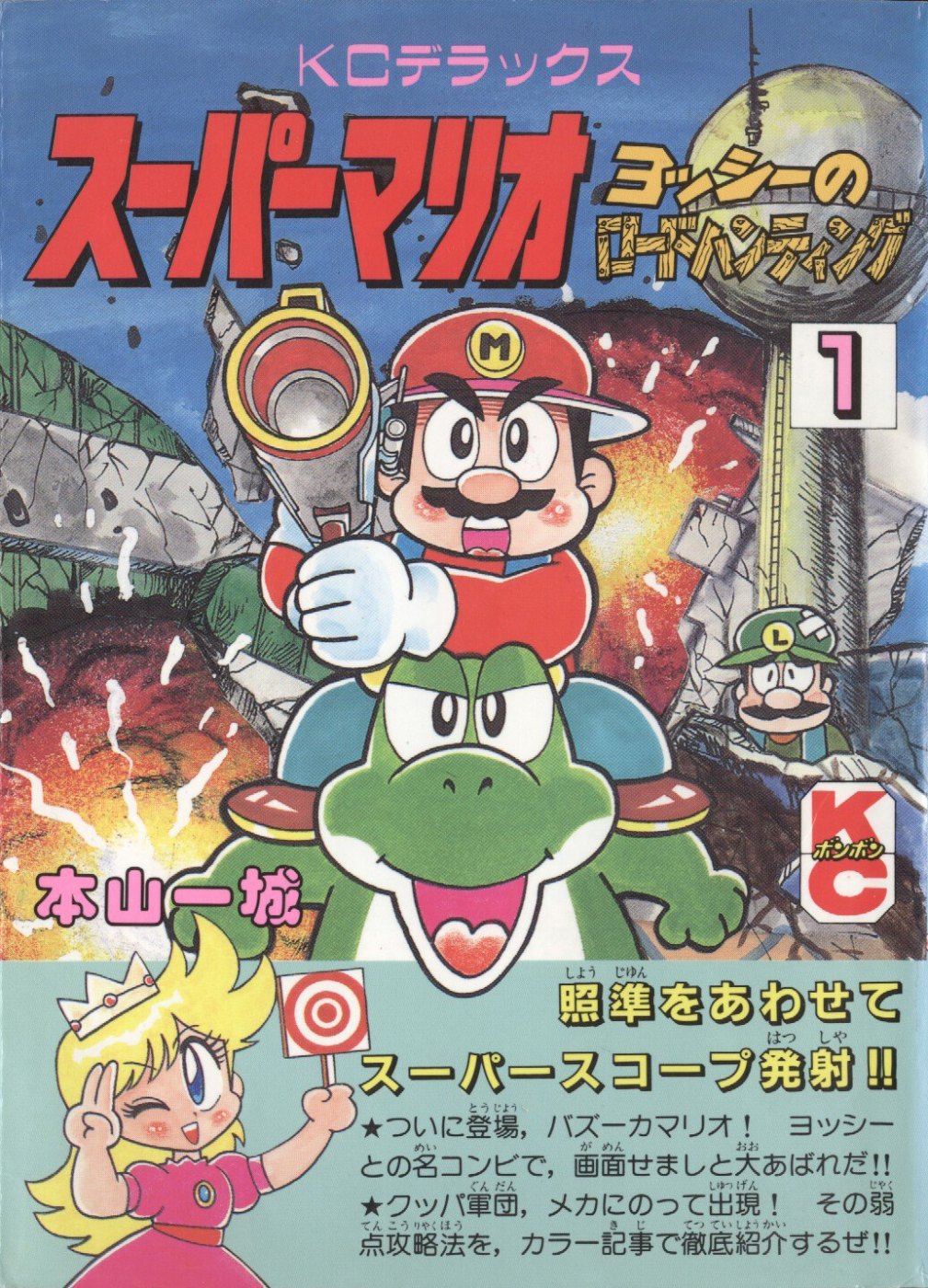 Super Mario: Yoshi no Road HuntingManga · Kazuki Motoyama · Kodansha · 2 volumesA two-volume adaptation in Kodansha’s long-running Mario manga line. Bowser forces a scientist, Dr. Mario Nakamatsu, to build his war machines, and Mario and Yoshi ride to Prince Pine’s aid armed with Nakamatsu’s Super Scope, which they retrieve from Big Bertha and Yoshi, two characters borrowed from the 1993 Super Mario Bros. film.
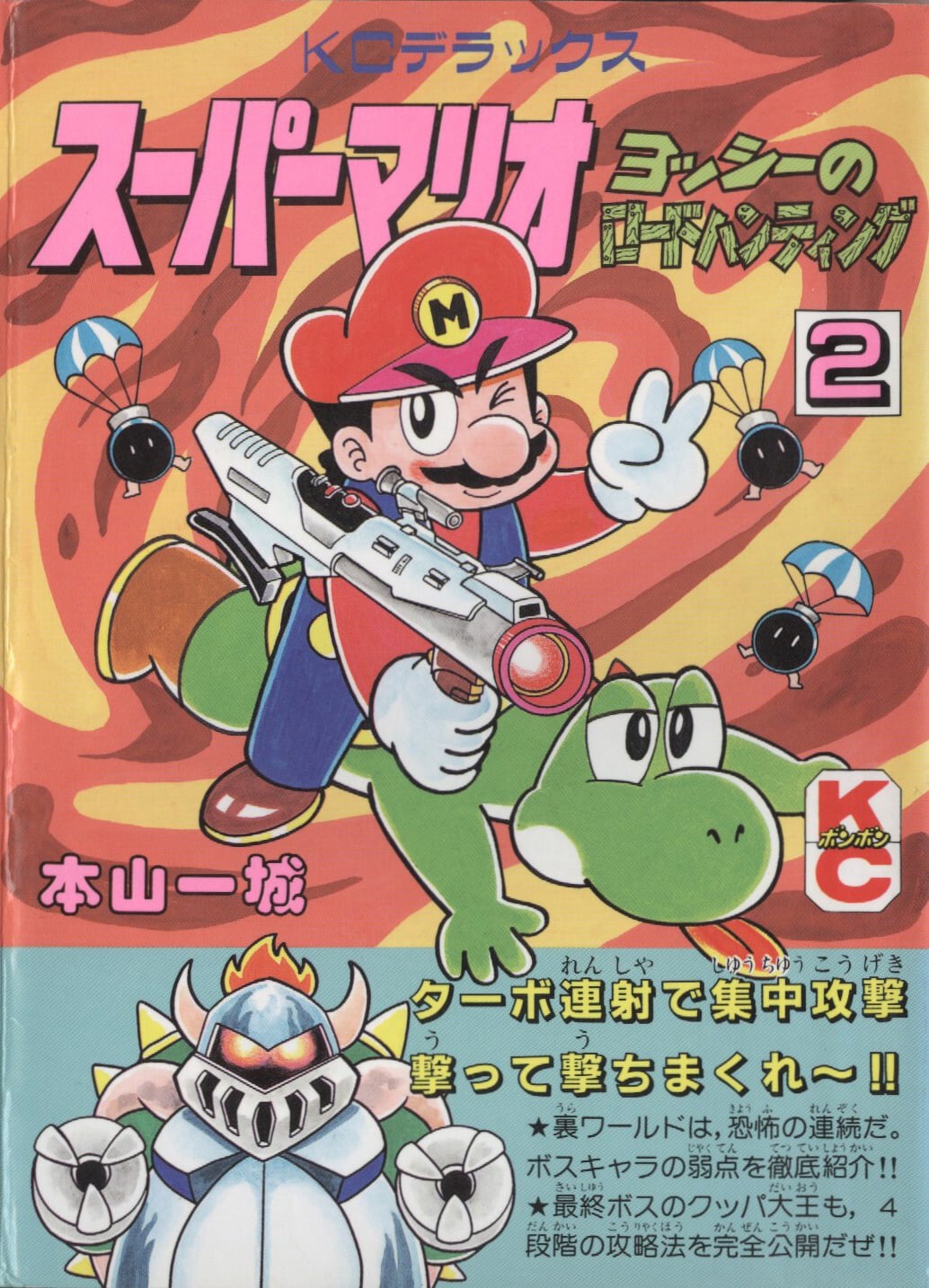 Yoshi no Road Hunting, volume 2Manga · Kodansha KC DeluxeThe second and final volume of Motoyama’s adaptation.
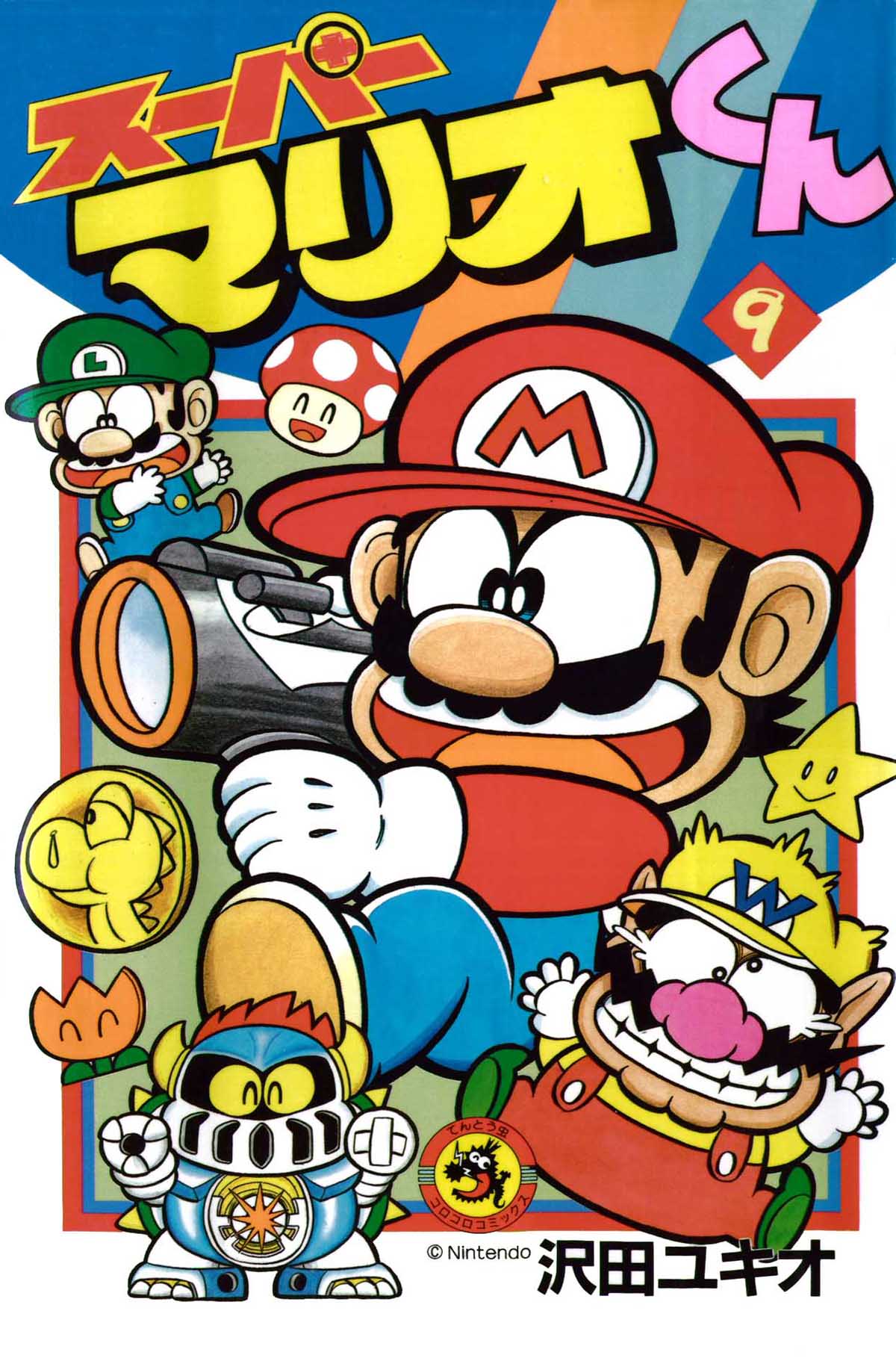 Super Mario-kun, volume 9Manga · Yukio Sawada · ShogakukanStages 1 to 8 of the volume adapt the game. Mario tries to retire, the world is thrown into chaos, and the hunt for three Crystal Kinoko leads into Jewelry Land, where the inhabitants and Prince Pine have been turned into machines. There is even a nod to the film’s Devolution Gun.
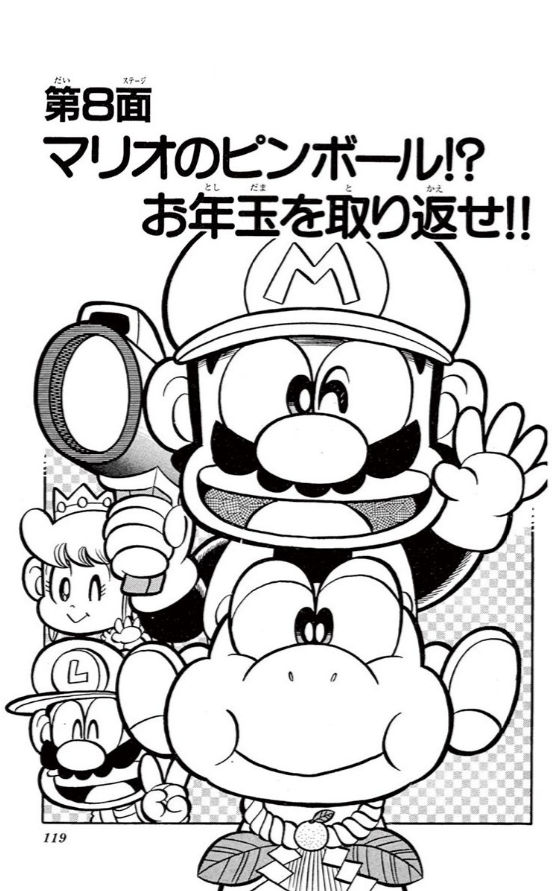 Super Mario-kun, volumes 8, 10 and 19Manga · one-shot chaptersVolume 8 has Yoshi inviting Mario on an enemy hunt with a bazooka; volume 10 traps Mario in Roy’s pinball machine, Roy flying his hot-air-balloon mech from the game; and years later volume 19 brings back Bowser’s armour and has Yoshi produce a Super Scope.
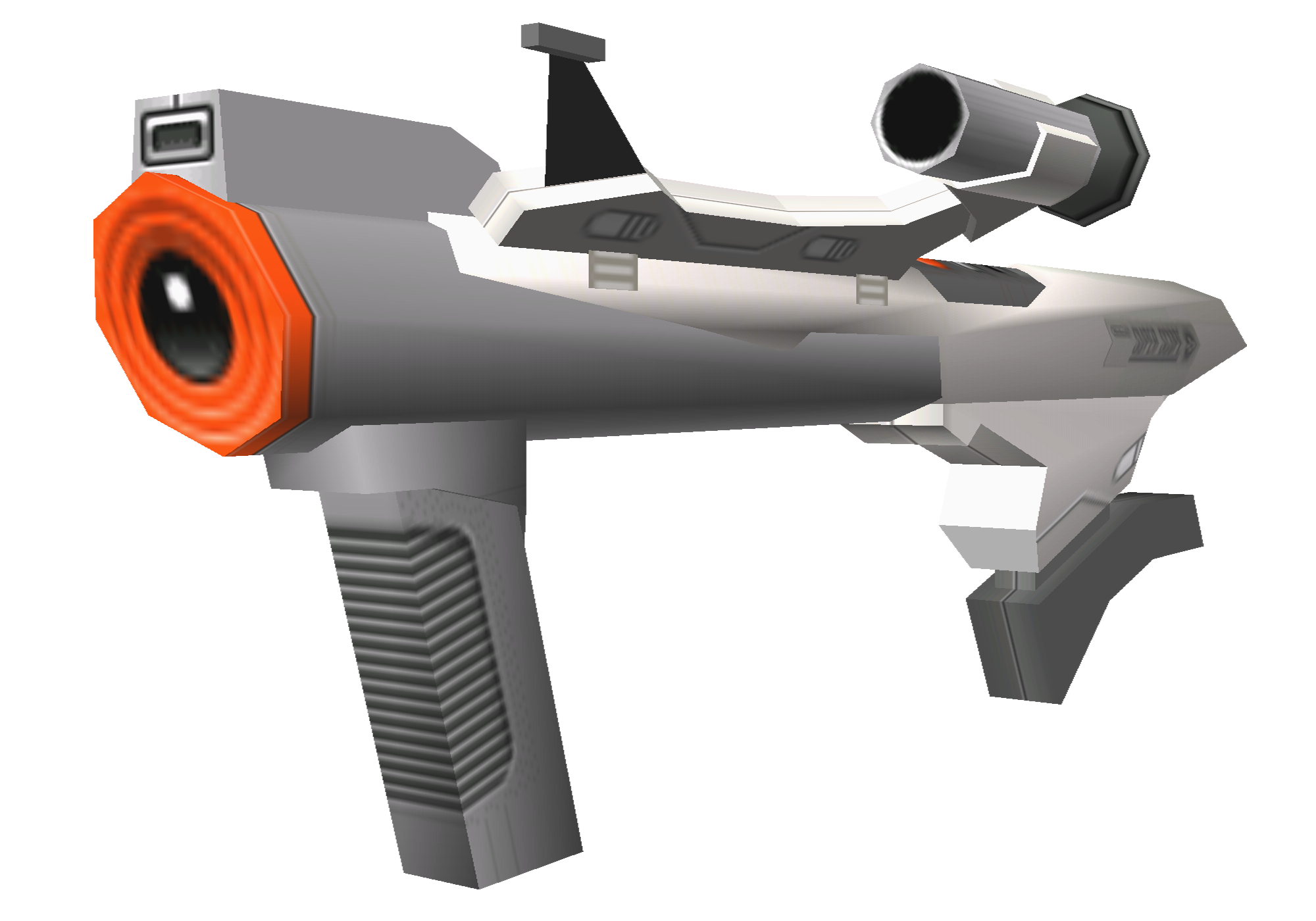 The Super Scope in Super Smash Bros.Melee onwards · item and trophyThe Scope became a Smash item in Melee, firing rapid shots or a charged blast, and has stayed in the item list since, with trophies of it in Melee, Brawl and the 3DS and Wii U games. In Brawl and later games fighters can move and jump while firing it.
 MarioThe player · never seen in play
 YoshiMount · player 2 in co-op
 Ludwig von KoopaKoopaling · boss of Mushroom Land
 Wendy O. KoopaKoopaling · boss of Pipe Island
 Larry KoopaKoopaling · boss of Crescent Coast
 Morton Koopa Jr.Koopaling · boss of Spirit Mountain
 Iggy KoopaKoopaling · boss of Grand Bridge
 Roy KoopaKoopaling · boss of Float Castle I
 Lemmy Koopa’s robot (boss)Grass Land (1)A walking robot bearing Lemmy’s face and a row of cannons. Shoot the face, then Lemmy whenever he peeks out of the cockpit.
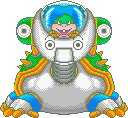 Ludwig von Koopa’s dinosaur robot (boss)Mushroom Land (2)Hit the lump on its back, then the fists of the smaller robot left behind, then the cannon in its mouth.
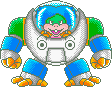 Ludwig’s robot, second formMushroom Land (2)The cockpit and legs fight on, punching with rocket fists.
 Wendy O. Koopa (boss)Pipe Island (3)Shielded among four pipes; only a falling anvil can hurt her. Three hits.
 Winged anvilPipe Island (3)Flaps over the pipes dropping horseshoes. Shoot it while it faces you and it falls.
 Larry Koopa’s submarine (boss)Crescent Coast (4)A sun-shaped sub with a seal’s face. Hit the open hatches, then the exposed cockpit.
 Morton Koopa Jr.’s frog robot (boss)Spirit Mountain (5)Destroy the cannons in both back legs, then shoot Morton when he pops out to throw bombs.
 King Gessō, Iggy Koopa’s squid (boss)Grand Bridge (6)A giant mechanical Bloober. Shoot off the tentacle cannons, the last pairs while it leaps from the water.
 Roy Koopa’s balloon (boss)Float Castle I (7)Fought in freefall. Destroy its cannon and two bomb-throwing arms, then hit Roy when the basket dips.
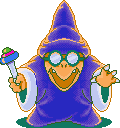 Magikoopa (boss)Cornice Cave (8)Teleports and casts three-shape spells you must shoot down; returns as a giant for round two.
 Big Boo (boss)Ghost Mansion (9)Throws rubble and can only be hurt while its eyes are open, then splits into three circling Boos.
 Circling Boo BuddiesGhost Mansion (9)The Big Boo’s second form: only the one sticking its tongue out takes damage.
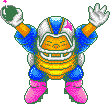 Chargin’ Chuck (boss)Float Castle II (10)Dashes about throwing bombs in pairs; leaps off screen and lands with a tremor.
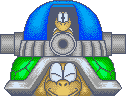 Kame Hōdai (boss)Dark Sea (11)A turtle-shaped gunboat crewed by Koopa Troopas. Four rotating cannons, then the head when its mouth opens.
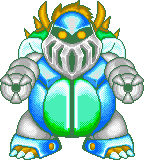 Busō Koopa, Bowser’s armour (final boss)Bowser’s Castle (12)Wreck the gun hands, then shoot the chest cannon each time it opens.
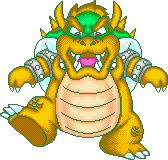 Bowser (final boss)Bowser’s Castle (12)Throws shells and shakes the floor; hit his hands, then his mouth as he breathes fire.
 Hammer Brother (mini-boss)Grass Land; Bowser’s CastleThrows pairs of slow, arcing hammers and hops about.
 Boomerang Brother (mini-boss)Pipe Island; Grand Bridge; Bowser’s CastleThrows looping boomerangs in pairs.
 Takotsubo (mini-boss)Crescent CoastA giant octopus pot on the seabed that keeps releasing little Tako.
 Sledge Brother (mini-boss)Spirit Mountain; Float Castle II; Bowser’s CastleArcing hammers, and a big jump that bounces Yoshi.
 Firesnake (mini-boss)Cornice Cave; Bowser’s CastleA chain of five blue Podoboos; shoot segments off and they become ordinary Podoboos.
 Lakitu (mini-boss)Ghost Mansion; Bowser’s CastleSwoops on its cloud dropping Spiny Eggs.
 Flying GoombaStages 1, 2, 4, 5, 6, 10, 12Swoops in fast arcs, usually in single file, homing in on Yoshi.
 Koopa Para Troopa (green)Stages 1, 2, 3, 4, 6, 8, 11, 12Drifts in big, slow flocks. Shell colour changes by stage.
 Koopa Para Troopa (yellow)Mushroom LandThe yellow-shelled flock of stage 2.
 Koopa Para Troopa (blue)Pipe IslandBlue shells for stage 3.
 Koopa Para Troopa (pink)Crescent CoastPink shells by the sea.
 Bullet BillStages 1, 5, 7, 10, 12Fired in fast groups, straight but not always on target.
 Koopa ShellStages 2, 6, 7Zigzags across the road, bouncing off the edges.
 PodobooStages 2, 7, 8, 9, 10, 12Hops slowly and aimlessly.
 Nipper PlantStages 2, 3, 4, 7, 9, 10, 11Snaps its way towards Yoshi, then jumps at him.
 Monty MolePipe Island, Cornice CavePops out of pipes and scurries about.
 Cheep-CheepStages 4, 6, 11Swims in synchronised shoals; above water it leaps in arcs to knock Yoshi in.
 BlooberStages 4, 6, 11Bobs about unpredictably under water and bounces slowly above it.
 TakoCrescent CoastLittle octopuses that crawl out of the Takotsubo.
 Para BombStages 5, 6, 10Parachutes onto the road and lands as a walking Bob-omb.
 Bob-ombStages 5, 6, 10What a Para Bomb becomes when it lands.
 Spiny EggStages 5, 7, 9Falls from the sky and hatches on landing.
 SpinyStages 5, 7, 9Crawls straight at Yoshi.
 BooGhost MansionCalled “Big Boo” in the English manual. Freezes and shields itself when you face it.
 MechakoopaBowser’s CastleWalks to and fro; shoot it to stun it and Yoshi kicks it aside.