

Mario vs. Donkey Kong
Overview

Mario vs. Donkey Kong is a puzzle platformer for the Game Boy Advance, developed by Nintendo Software Technology (NST) and published by Nintendo. It released across all four major regions in 2004: 24 May in North America, 1 June in Japan, 4 June in Australia, and 19 November in Europe. The game launched the Mario vs. Donkey Kong series — a franchise that would eventually span 7+ titles across Nintendo DS, 3DS, and Switch.
The gameplay and scenario are heavily inspired by Donkey Kong (Game Boy, 1994), frequently considered the spiritual predecessor. Many elements return from the GB classic — a construction-site primary setting, Mario’s athletic moveset (handstand, backflip, handstand jump), his hammer, his ability to pick up and throw enemies and items, and his rivalry with Donkey Kong. But the level design is significantly more puzzle-focused: Mario must find the optimal route through each level, hitting switches and interacting with objects in a specific order to reach the goal.
The game was re-released as a free downloadable title for the Nintendo 3DS on 16 December 2011 as part of the 3DS Ambassador Program (a thank-you to early adopters when the system’s price was reduced). It also appeared on the Wii U Virtual Console. Critically well-received, with a Metacritic score of 81/100 and an IGN review of 8.5/10.
The Story

The story is told via the North American instruction booklet (page 6) and serves as the framing device for the entire game:
It looks like Donkey Kong is up to his old tricks again!
Over in the Mushroom Kingdom, Mario has become so famous that he’s started his own toy company. His new Mini-Mario action figures are all the rage, and this cute li’l wind-up toy is just flying off the shelves.
In fact, these toys are so popular that stores can’t even keep them in stock. Donkey Kong just loves these new toys, but when he showed up at the store, they were all gone!
Donkey Kong’s not famous for his patience, and he wasn’t about to wait for the next shipment, so he just went straight to the factory and started grabbing all the new Mini-Marios for himself. Mario arrived just in time to see Donkey Kong run off with all his inventory!
Now it’s up to you to help Mario recover his stolen trinkets and give Donkey Kong a good talking-to for not pre-ordering!
The Setup
Mario has become so famous in the Mushroom Kingdom that he’s started his own toy company — the Mario Toy Company. The factory’s flagship product is the Mini-Mario, a cute wind-up action figure that has become a runaway bestseller. Stores can’t keep them stocked.
The Crime
Donkey Kong, ever the impatient one, marches into a store to buy a Mini-Mario only to find it sold out. Rather than wait for a restock, he goes directly to the Mario Toy Company factory and steals the entire inventory, running off with a bag full of the toys. Mario arrives just in time to see DK make off with everything.
The Chase
The player must guide Mario through 6 themed worlds, recovering Mini-Marios and pursuing Donkey Kong across the Mario Toy Company, Donkey Kong Jungle, Fire Mountain, Spooky House, Mystic Forest, and Twilight City — each world ending in a direct boss battle with DK himself.
Gameplay
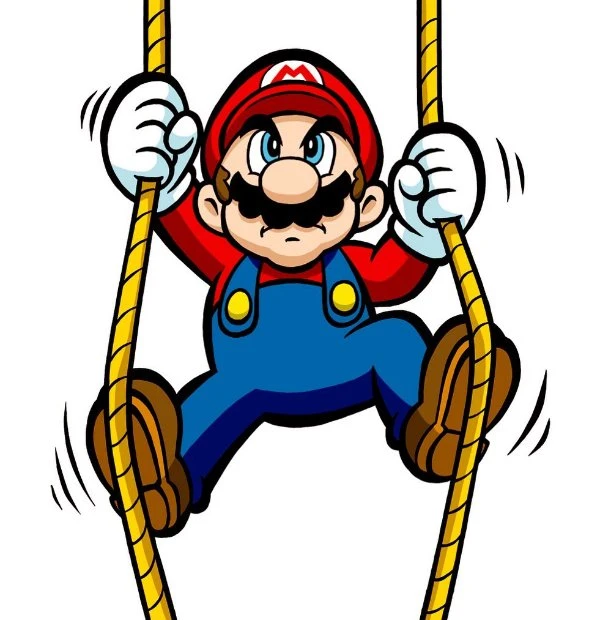
Mario vs. Donkey Kong fundamentally reframes the platformer genre as compact puzzle stages — each level is a small, contained challenge that the player must solve in two halves.
Two-Part Level Structure
- First half: Find the Key. The key is somewhere in the level; Mario must navigate hazards and use his moveset to retrieve it, then carry it to a locked door
- Second half: Rescue the Mini-Mario. The Mini-Mario is trapped in a crystal ball at the end of the second half. Free it to complete the level
Level Types Per World
- Levels 1–6: Standard puzzle stages with the key + Mini-Mario format
- Plus Level (the “Mini-Mario” stage): A unique stage where the player must guide a line of Mini-Marios to a Toy Chest while protecting them from harm
- DK Level: The world’s boss fight with Donkey Kong himself — each one a unique arena battle
- Expert World: After completing the main 6 worlds, an additional set of harder remixed levels unlocks
The One-Hit Challenge
The Time Limit
Each level has a time limit, encouraging fast solutions. The remaining time at level completion converts to bonus points.
Free Scroll Mode
A useful in-level feature: pressing L + R simultaneously activates Free Scroll Mode, which pauses gameplay and lets the camera be moved freely with the D-Pad. Perfect for planning routes before committing.
Controls
Mario vs. Donkey Kong’s controls are tightly tuned for the Game Boy Advance layout.
Standard Controls
| Input | Action |
|---|---|
| D-Pad | Move Mario (left/right/up/down for ladders, ropes, etc.) |
| A button | Jump |
| B button | Pick up items and enemies |
| L / R buttons | Select between worlds (on the world map) |
| Start | Pause and continue the game |
| L + R together | Free Scroll Mode (pauses, lets camera roam) |
The interface is intentionally minimal — the puzzle layer is in the level design, not the controls.
Mario’s Moves
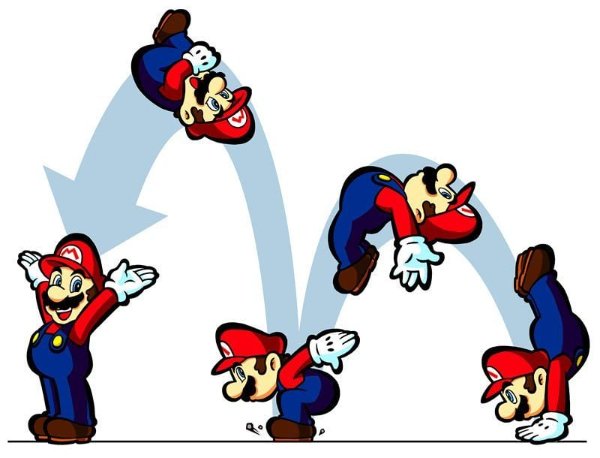
Mario in Mario vs. Donkey Kong is the athletic, acrobatic Mario from the Donkey Kong (Game Boy 1994) school of design — not the simpler Mario of Super Mario Bros. He has a full repertoire of advanced moves that the player must master to solve puzzles.
Jump
Input: A button
The basic Mario jump. Used to clear gaps, hit blocks from below, and approach enemies from above. Mario’s jump arc is precise and short by Mario standards.
Handstand
Input: D-Pad Down + A button
Mario stands on his hands. While in handstand position, his hitbox is taller — useful for reaching higher edges, and required for setting up the more advanced moves below.
Handstand Jump
Input: A button while handstanding
A high-arc jump performed from the handstand position. Reaches significantly higher than a standard jump. Essential for many key puzzles where standard jumps fall short.
Handstand Double Jump
Input: A button after touching the ground from a Handstand Jump
Mario’s highest-reaching move. After landing from a Handstand Jump, time another A press to launch even higher. Required for several Mini-Mario rescues in later worlds.
Backflip
Input: Left D-Pad + A button (while facing right)
A directional backflip that sends Mario flying in the opposite direction with significant horizontal distance. Used to escape tight situations and reach platforms behind Mario.
Pick Up and Throw
Input: B button
Mario can pick up items, enemies, and Mini-Marios. He can then throw them to defeat other enemies, hit switches at a distance, or carry Mini-Marios across the level.
Hammer
Input: Pick up + B button
When Mario grabs a hammer, he can swing it overhead to break Color Blocks, defeat enemies in his path, and clear obstacles. The hammer is timed — it eventually disappears.
The 6 Worlds
Mario vs. Donkey Kong is structured around 6 main themed worlds, each containing 8 levels (6 regular, 1 Mini-Mario stage, 1 DK boss fight) plus their Plus variants.
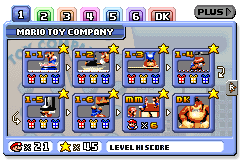
World 1: Mario Toy Company
Levels 1-1 through 1-DK
The opening world — the very factory from which DK stole the Mini-Marios. Features Garbage Cans, Shy Guys, and various manufacturing gimmicks. The starting tutorial environment that introduces every core mechanic.

World 2: Donkey Kong Jungle
Levels 2-1 through 2-DK
Donkey Kong’s next refuge after the factory. Features Ropes, Monchees, Snapjaws, and other jungle-themed obstacles. The rope-climbing levels are some of the most distinctive in the game.

World 3: Fire Mountain
Levels 3-1 through 3-DK
A high-volcanic-activity area with Podoboos (fireballs), fire birds (Nitpickers), and Shy Guys equipped with flamethrowers. Lava and timing become critical for navigation.

World 4: Spooky House
Levels 4-1 through 4-DK
A haunted mansion world with Boos, Polterguys (ghost variants), and Thwomps. The first world where light-and-shadow gimmicks and ghosts become primary puzzle elements.

World 5: Mystic Forest
Levels 5-1 through 5-DK
A forest world with mechanical elements — surprisingly, given the natural theme. Features Bob-ombs, Conveyor Belts, and various mechanical gimmicks. Forest meets factory in unexpected combinations.
World 6: Twilight City
Levels 6-1 through 6-DK
The ultramodern futuristic city world — the final main world before Expert. Features robotic Monchees, lasers, and high-tech hazards. The level 6-DK serves as the climactic Donkey Kong final battle.
Per-World Level Breakdown
Every main world follows the same structural pattern:
| Level | Type | Description |
|---|---|---|
| X-1 through X-6 | Regular Stage | Standard two-half puzzle: find the key, unlock the door, rescue the Mini-Mario from the crystal ball |
| X-mm (Mini-Mario) | Plus Stage | Guide a line of 6 Mini-Marios to a Toy Chest while protecting them from harm. Distinct mechanics from regular stages |
| X-DK | Boss Fight | Direct confrontation with Donkey Kong. Each world has a unique DK encounter — throwing barrels, jumping, etc. The 6-DK fight is the climactic finale |
Plus Levels: A Second Adventure
After completing the main 6 worlds, the game unlocks Plus levels for each stage — harder remixes where Mario must rescue a single Mini-Mario who holds the level’s key. The Mini-Mario must then be brought to the door to complete the level. Plus levels effectively double the game’s content with substantially increased difficulty.
Expert World & Bonus Content
After completing the 6 main worlds, the game unlocks even more content for dedicated players.
Expert World
The Expert World contains a set of harder remixed levels following the same key-and-Mini-Mario structure as the main worlds, but with significantly ramped-up difficulty. These are designed for players who have mastered Mario’s entire moveset and require precise execution of handstand jumps, backflips, and throwing mechanics.
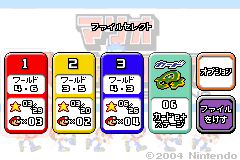
Japan-Exclusive: Mario vs. Donkey Kong-e
Unlockable Goodies
The game features various unlockable extras for high-scoring play, including:
- Letter Grades on each level (D up to S rank) based on score and time
- Cutscenes rewatchable after unlocking
- Mini-Mario Mayhem showcase animations
- High Score tables for each stage
Items & Objects
The puzzle gameplay of Mario vs. Donkey Kong revolves around a tight set of interactive items and environmental gimmicks. Each level remixes these familiar parts into a new puzzle.
Core Puzzle Items
| Item | Function |
|---|---|
| Key | Found in the first half of every regular level. Carry it to the locked door to access the second half. In Plus levels, each Mini-Mario holds the key for that level |
| Mini-Mario | The objective. In regular levels, rescue from a crystal ball. In Plus levels, escort to the door. In Mini-Mario stages, guide a line of them to a Toy Chest |
| 1-Up Mushroom | Grants an extra life. Hidden in obscure spots throughout the levels |
| Color Switches (Red/Yellow/Blue) | Three variants. Activating one makes platforms, Color Blocks, and ladders of that color available; the others deactivate |
| Color Blocks | Walls/platforms that activate or deactivate based on which Color Switch is currently pressed |
| Spring | Bounces Mario higher. Can also be picked up and thrown |
| Hammer | Pick up + B = swing it overhead. Breaks Color Blocks, defeats enemies in path, clears obstacles. Time-limited — disappears after several seconds |
| Conveyor Belt | Moving platforms that push Mario in a direction. Speed and direction vary per level |
| Donut Lift | Platforms that drop after Mario stands on them. Crossing chains of donut lifts requires fast hops |
| Elevator | Platforms that move along set paths when activated |
| Trash Can | Can hide enemies; Mario can pick them up and throw them |
| Presents | Bonus collectibles for high scores |
| “TOY” Letters | Spell out TOY for bonus rewards — letters scattered through each level |
| Toy Chest | The endpoint of Plus levels and Mini-Mario stages; deliver Mini-Marios here |
Enemies & Bosses
Mario vs. Donkey Kong features a substantial enemy roster, with different sets appearing per world. Most enemies can be picked up and thrown (a Donkey Kong ’94 inheritance) but some are obstacles only.
Throwable Enemies
- Mini Shy Guy — the smallest enemy; common in Mario Toy Company
- Black Shy Guy — a variant Shy Guy
- Spear Guy — Shy Guy with a spear; throws Mario back
- Mini Ninji — hopping ninja enemy
- Bob-omb — walks and detonates; can be carried to destroy walls
- Trash Can — not just an item; can be tossed
Obstacle Enemies (Cannot Be Picked Up)
- Monchee — hanging monkey-like creature; ride them like swings
- Snapjaw — piranha plant-like trap
- Bat — flying enemy in Spooky House
- Shy Guy Ghost (Polterguy) — ghostly Shy Guy variant
- Sir Shovalot — armored knight
- Brickman — walking brick enemy
- Candle — lit candle obstacle
- Nitpicker — fire bird in Fire Mountain
- RamRam — ramming enemy in Jungle
- Podoboo — the classic Mario fireball, in Fire Mountain
- Venus Fire Trap — fire-breathing piranha plant
- Cannon — fires projectiles
- Blowtorch Guy — Shy Guy with flamethrower in Fire Mountain
- Oil Drum — Donkey Kong tradition; obstacles to navigate around
Crushing/Falling Enemies
- Thwomp — the classic falling block
- Thwomp Block — a smaller variant
- Thwimp — hopping mini-Thwomp
- Falling Spike — unpredictable ceiling spikes
- Fire — environmental flame hazard
The Boss: Donkey Kong
Series Legacy
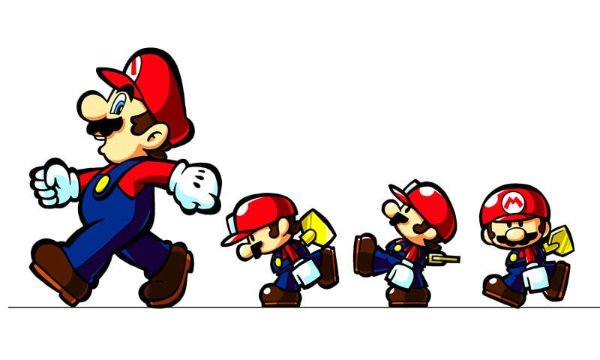
Mario vs. Donkey Kong launched a substantial franchise that lasted nearly two decades. The original 2004 GBA title remains the most distinctive entry because of one key feature.
The Mario vs. Donkey Kong Series Timeline
| Year | Title | Platform | Mario Playable? |
|---|---|---|---|
| 2004 | Mario vs. Donkey Kong | Game Boy Advance | Yes (only entry!) |
| 2006 | Mario vs. Donkey Kong 2: March of the Minis | Nintendo DS | No — control Mini-Marios |
| 2009 | Mario vs. Donkey Kong: Minis March Again! | DSiWare | No |
| 2010 | Mario vs. Donkey Kong: Mini-Land Mayhem! | Nintendo DS | No |
| 2013 | Mario and Donkey Kong: Minis on the Move | 3DS eShop | No |
| 2015 | Mario vs. Donkey Kong: Tipping Stars | Wii U & 3DS | No |
| 2015 | Mini Mario & Friends: amiibo Challenge | Wii U & 3DS | No |
| 2024 | Mario vs. Donkey Kong (Switch remake) | Nintendo Switch | Yes — remake of the original GBA title |
The Switch Remake (2024)
In February 2024, Nintendo released a full Switch remake of Mario vs. Donkey Kong with updated 3D graphics, two-player co-op support, and new “Casual Style” and “Time Attack” modes. The remake confirmed the GBA original’s lasting status as a fan favourite — and brought Mario’s acrobatic moveset back to a modern Nintendo audience for the first time in 20 years.
Promotion & Videos
Three contemporary promotional videos from the 2004 launch — English and Japanese commercials plus a trailer.
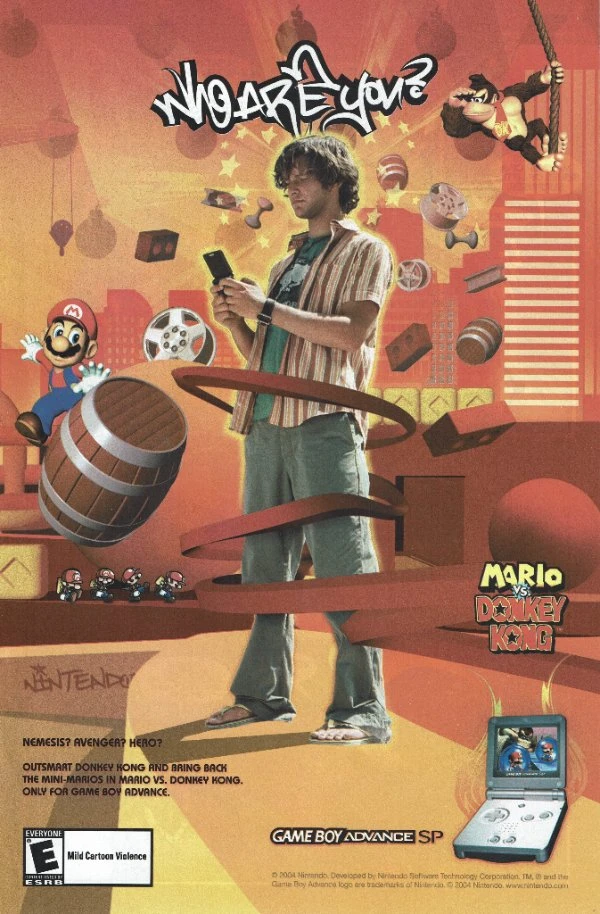
Print Advertising

Development Staff
Mario vs. Donkey Kong was developed by Nintendo Software Technology (NST), Nintendo’s North American development studio based in Redmond, Washington — the same studio behind Metroid Prime Hunters and the Pokémon Stadium series.
- Developer: Nintendo Software Technology (NST)
- Publisher: Nintendo
- Platform: Game Boy Advance
- Genre: Puzzle Platformer
- Series Entry: 1st in Mario vs. Donkey Kong series
- Spiritual Predecessor: Donkey Kong (Game Boy, 1994)
- Direct Successor: Mario vs. Donkey Kong 2: March of the Minis (Nintendo DS, 2006)
- Modern Remake: Mario vs. Donkey Kong (Nintendo Switch, 2024)
NST is Nintendo’s in-house Western studio, founded in 1998 in Redmond near Nintendo of America’s headquarters. They specialized in technical and puzzle-driven Mario projects, with Mario vs. Donkey Kong becoming one of their most iconic creations.
Reception & Legacy
Mario vs. Donkey Kong received generally positive reviews and is considered one of the strongest puzzle platformers on the Game Boy Advance.
Critical Scores
- Metacritic Aggregate: 81/100 — generally favorable reviews
- GameRankings: 79.07%
- IGN (Craig Harris): 8.5/10 “Great” — praised the game for having “faithfully retained the Donkey Kong arcade game’s look and feel”, with fantastic level design and lasting appeal
- Nintendo Life (Marcel van Duyn): 8/10 — called it “a worthy successor”
What Critics Praised
- The faithful adaptation of Donkey Kong ’94’s gameplay — Mario’s full athletic moveset feels great on GBA
- The tight, focused puzzle design — each level is its own small masterpiece
- The Mini-Mario Plus level concept — adds significant variety to the otherwise pure platforming
- The lasting appeal — Plus levels and Expert World give significant post-credits content
- The pre-rendered graphics — “although awkward, admittedly well-animated 3D rendered” sprites
Common Criticisms
- DK boss levels — IGN called them “the ones with the least amount of creativity”
- Voice clips — Mario and DK’s in-game vocalizations were considered “unnecessary, although not distracting”
- Pre-rendered sprites — some criticized them for feeling slightly out of place on the GBA
- One-hit deaths — a few reviewers found the difficulty curve steep for newcomers
Re-releases
- Nintendo 3DS Ambassador Program — free download on 16 December 2011 as part of the 3DS price-drop apology to early adopters
- Wii U Virtual Console — re-released on the Wii U eShop
- Switch remake (2024) — full 3D remake with new modes and co-op
SLB User Reviews
Mario vs. Donkey Kong has yet to receive a community review on Super Luigi Bros.
If you’ve played Mario vs. Donkey Kong and would like to submit a review, please get in touch.
Regional Logos, Box Art & Screens
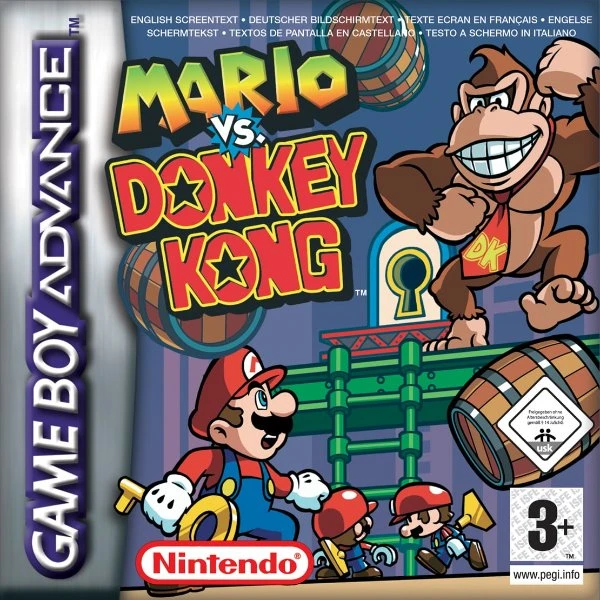
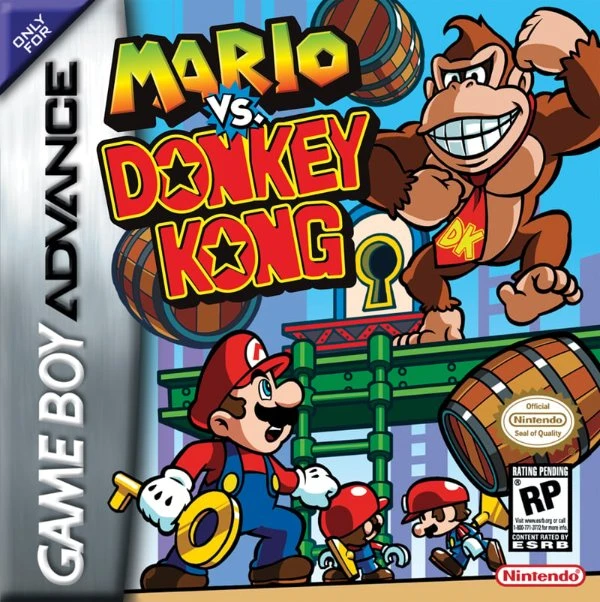
Mario vs. Donkey Kong shipped with distinct regional box art across all major markets.
Regional Logos


Box Art


Iconic In-Game Screens



Trivia & Facts
- The only MvDK game with playable Mario. Every subsequent Mario vs. Donkey Kong title until the 2024 Switch remake had the player control Mini-Marios directly as a puzzle-strategy game — not Mario himself
- Spiritual successor to Donkey Kong (GB, 1994). Mario’s moveset (handstand, handstand jump, backflip), the construction-site setting, the hammer mechanic, the picking up and throwing of enemies — all directly inherited from the legendary Game Boy game
- Working title: Mario and Donkey Kong. Pre-release materials used the name “Mario and Donkey Kong” before being renamed to emphasize the rivalry
- Nintendo Software Technology (NST). Developed by Nintendo’s North American studio in Redmond, Washington — making this one of the few Mario games developed primarily in the West
- 3DS Ambassador Program freebie. When Nintendo dropped the 3DS price in 2011, early adopters received Mario vs. Donkey Kong as part of a 20-game free apology bundle. A surprise way for many to first experience the game
- Japan-exclusive Card-e+ levels. The Japanese version supports Nintendo’s e-Reader+ for additional unlockable levels (the “Mario vs. Donkey Kong-e” content set). This entire bonus content layer is exclusive to the Japanese release
- “Featuring Mario.” The opening title literally features Mario’s name with the “Featuring Mario” credit — highlighting that even Donkey Kong is the headline character in this title, with Mario as the featured player
- The Mario Toy Company. Mario’s in-fiction toy company makes the Mini-Mario action figures. The company’s logo even appears at the start of the game — establishing the in-universe brand
- One-hit deaths. Following the Donkey Kong (GB) tradition, Mario loses a life from any hit, a long jump, or being squished. The lack of a power-up safety net is a defining design choice
- 6 main worlds + Expert. 48 main levels + 48 Plus variant levels + Expert World remixes = over 100 levels of content. Massive for a 2004 puzzle game
- Pre-rendered sprites. Like Donkey Kong Country, Mario vs. DK uses pre-rendered 3D models converted to sprites for that distinctive shiny look on GBA hardware
- Free Scroll Mode. Press L + R together to pause the game and freely move the camera — a thoughtful design accommodation that lets players plan routes carefully
- Mario’s voice clips. Mario and DK have voice clips throughout — IGN considered them “unnecessary but not distracting”
- 2024 Switch remake. The full 3D remake brought the game back with co-op support, two difficulty modes (Casual + Classic), and Time Attack modes — the second-only entry to feature playable Mario
- The DK Boss design. Each X-DK level is a unique boss arena. DK throws barrels (a direct callback to 1981’s Donkey Kong), jumps around, and uses different mechanics for each fight
- The “TOY” letter collectibles. Spelling out T-O-Y across each level by collecting hidden letters earns score bonuses — a classic Donkey Kong Country-style optional collectible
- The franchise spawned 7+ sequels. Across DS, DSiWare, 3DS, Wii U, and Switch — making Mario vs. Donkey Kong one of the most prolific Mario sub-franchises ever
- UK GBA SP Mario Edition Bundle. A UK promotional bundle paired a special Mario-themed Game Boy Advance SP with a copy of MvDK — a rare collector’s item today
Promotional Wallpapers
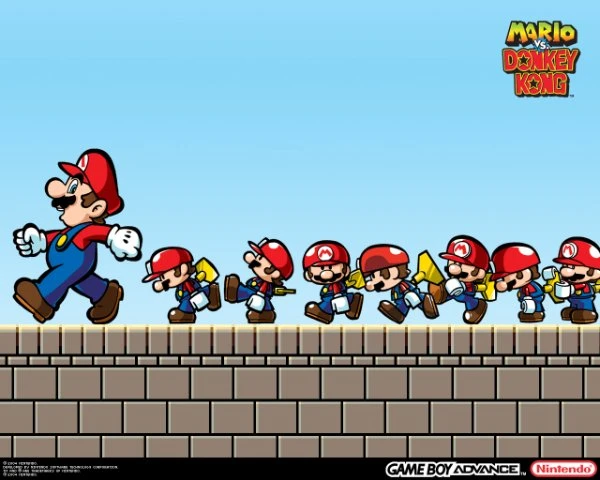
Five official wallpapers were released to promote Mario vs. Donkey Kong.



Reference / Information
Sub-pages and guides for Mario vs. Donkey Kong.
Media / Downloads
Galleries and screenshots.