The Minis are back, and this time they brought a toolbox. Mario vs. Donkey Kong: Tipping Stars arrived as a download on 5 March 2015 in North America (Europe followed on 20 March), and it did something no Nintendo game had done before: pay once, on either the Wii U or the Nintendo 3DS eShop, and a purchase on one system came with a code for the other version, free. It was the sixth game in the series and its first on a home console. Donkey Kong has run off with Pauline again, and Mario sends his wind-up Mini toys after them through six worlds and two extra ones, laying girders, springs and lifts with the stylus to steer them home. Then comes the twist in the title. A full Workshop let players build their own levels and share them on Miiverse, where anyone who enjoyed one could tip the creator stars to spend on new parts. Built by Nintendo Software Technology with Nintendo’s HTML5 tools, it is also a small piece of Nintendo’s online history: the sharing ended when Miiverse closed in November 2017.
Developer:Nintendo Software Technology, with Nintendo SPD Group No. 3
Publisher:Nintendo
Platforms:Wii U and Nintendo 3DS (one purchase covered both)
Genre:Puzzle (guide the Minis to the exit)
Engine:Nintendo Web Framework (HTML5 and JavaScript)
N. America:5 March 2015
Japan:19 March 2015
Europe:20 March 2015
Australia:21 March 2015
Launch price:$19.99 / £17.99 (Nintendo Life)
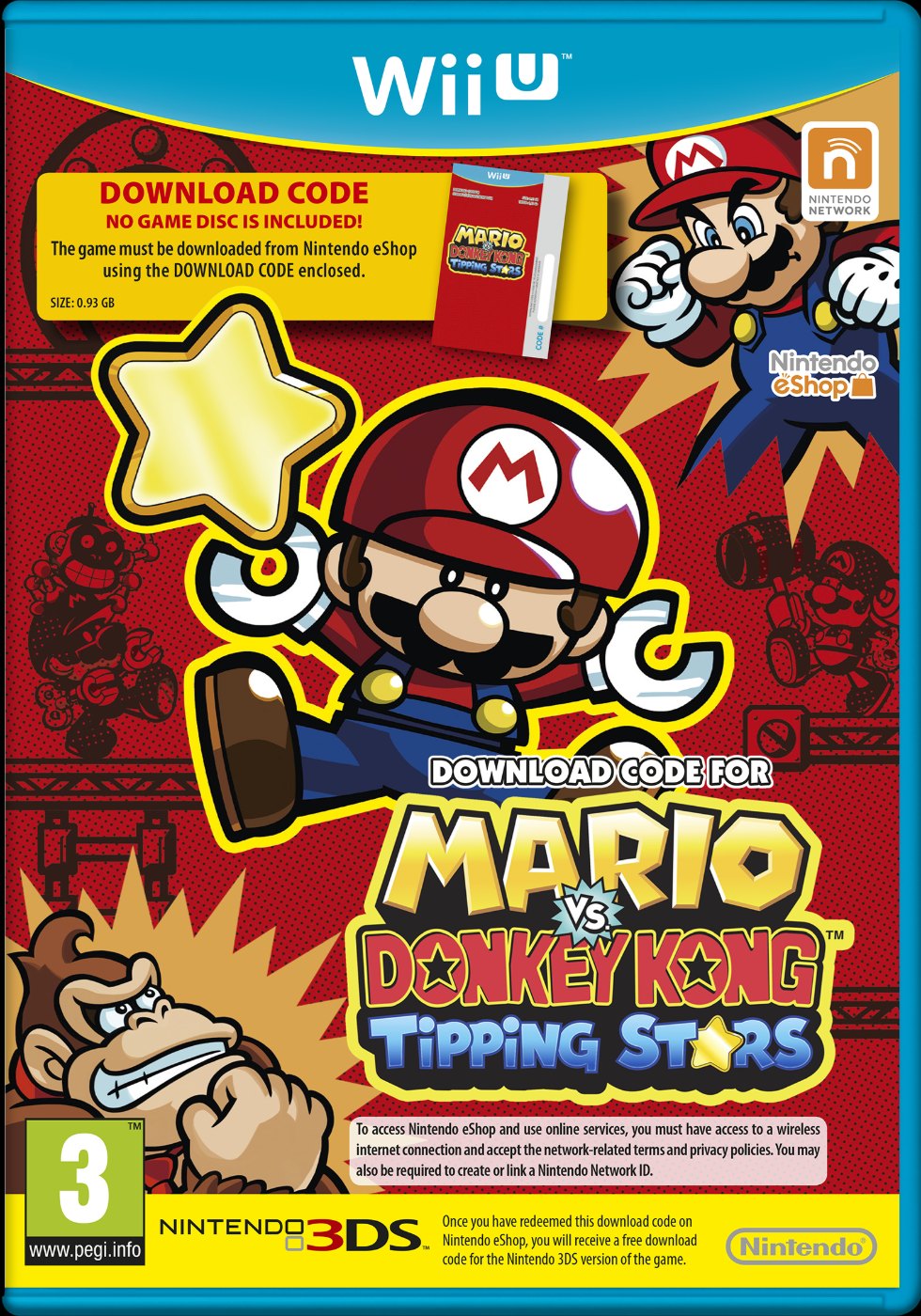
Format:Nintendo eShop download; boxed copies in Japan, and boxes holding a download code in Europe
Players:1
Director:Stephen Mortimer
Audio director:James Phillipsen
Supervisors:Shigeru Miyamoto, Kensuke Tanabe
Levels:64 in eight main worlds (six plus two extra) and 24 Bonus Levels
Japanese title:Mario vs. Donkey Kong: Minna de Mini Land
Online:Miiverse sharing and tipping ended 8 November 2017 (Japan time); eShop sales ended 27 March 2023
Advertisement
Overview
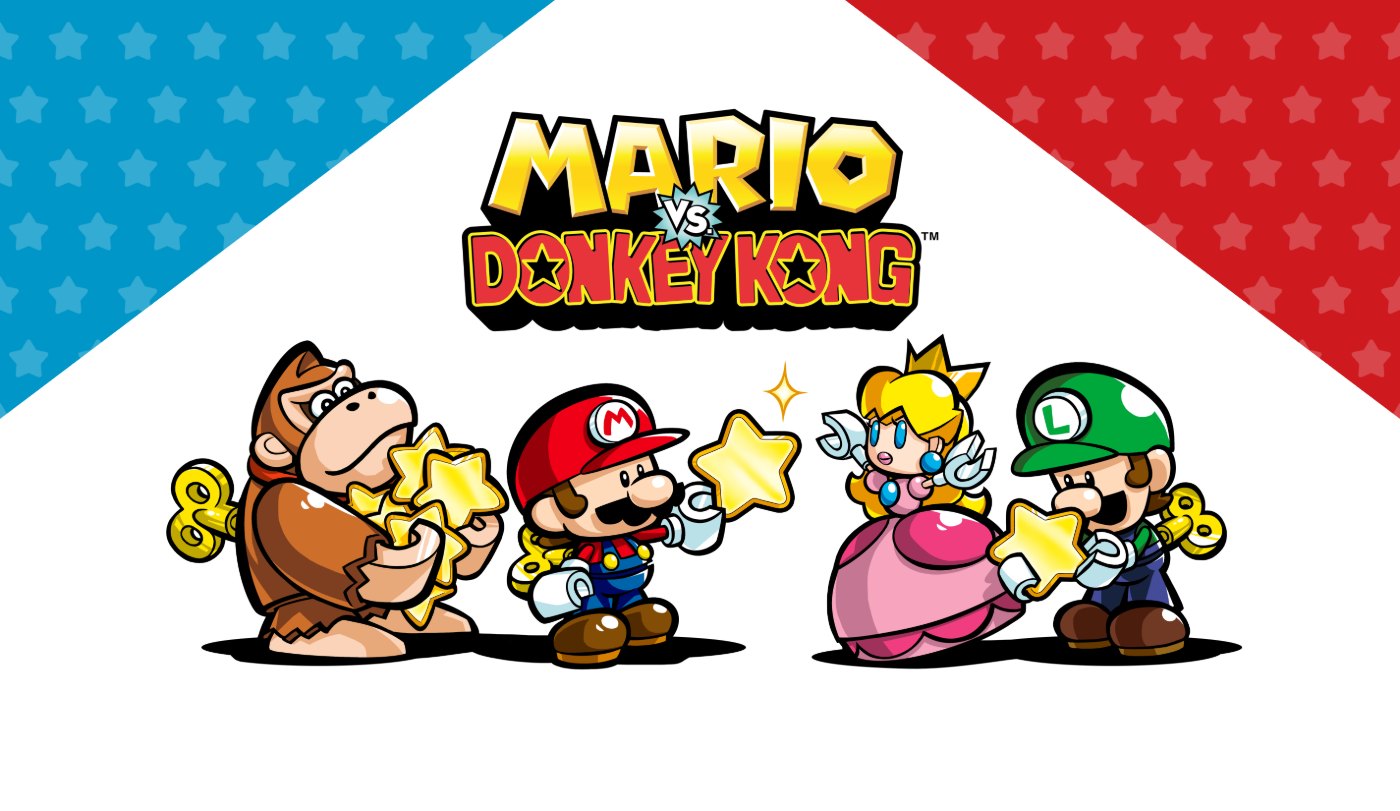
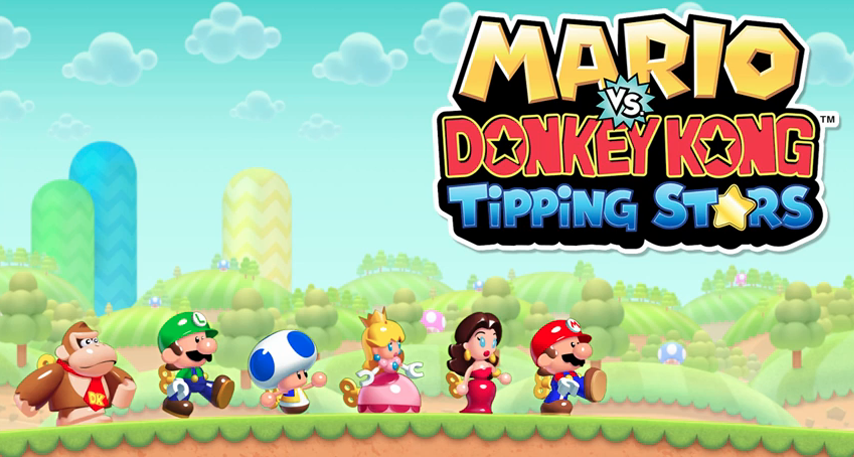
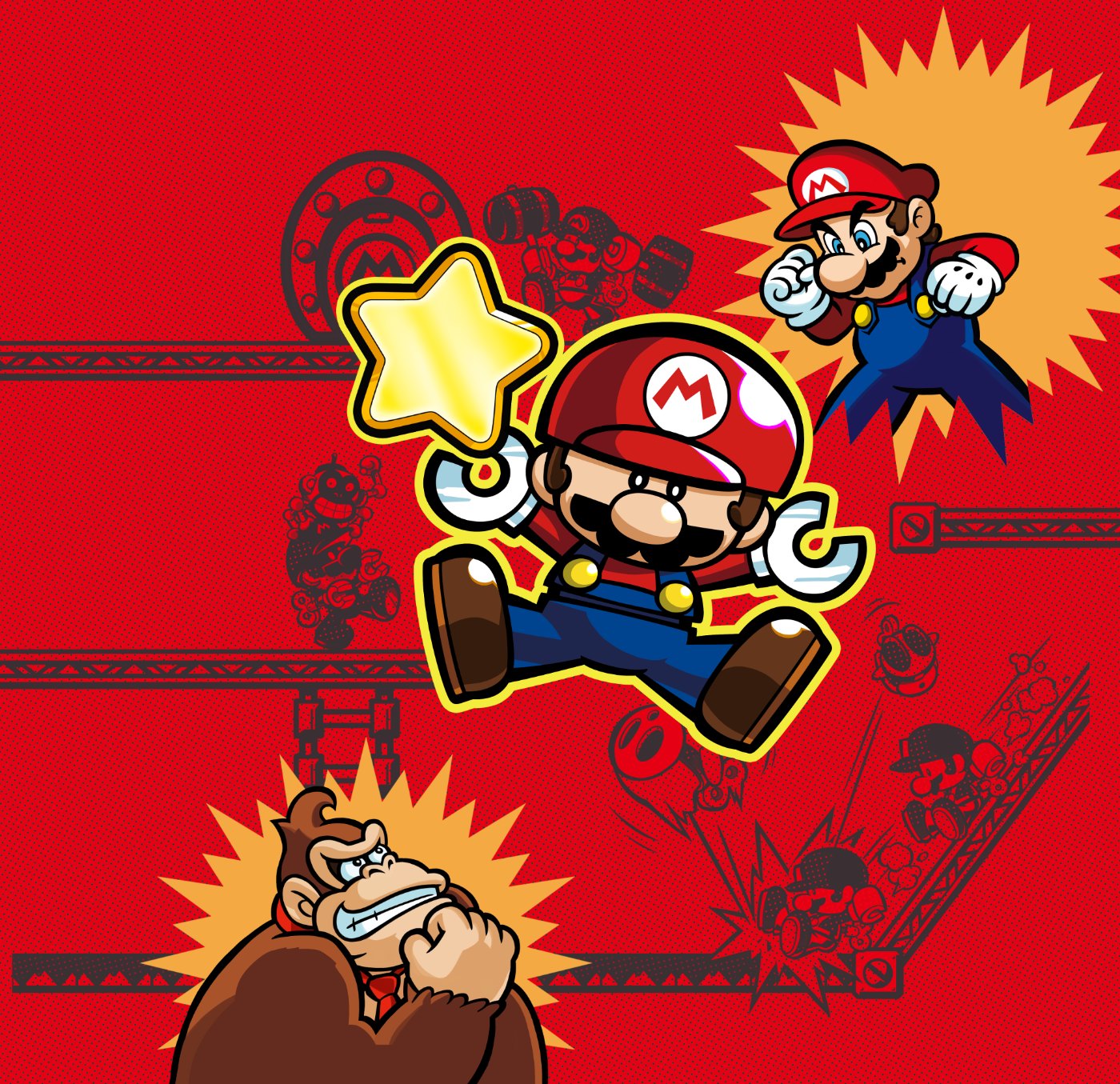
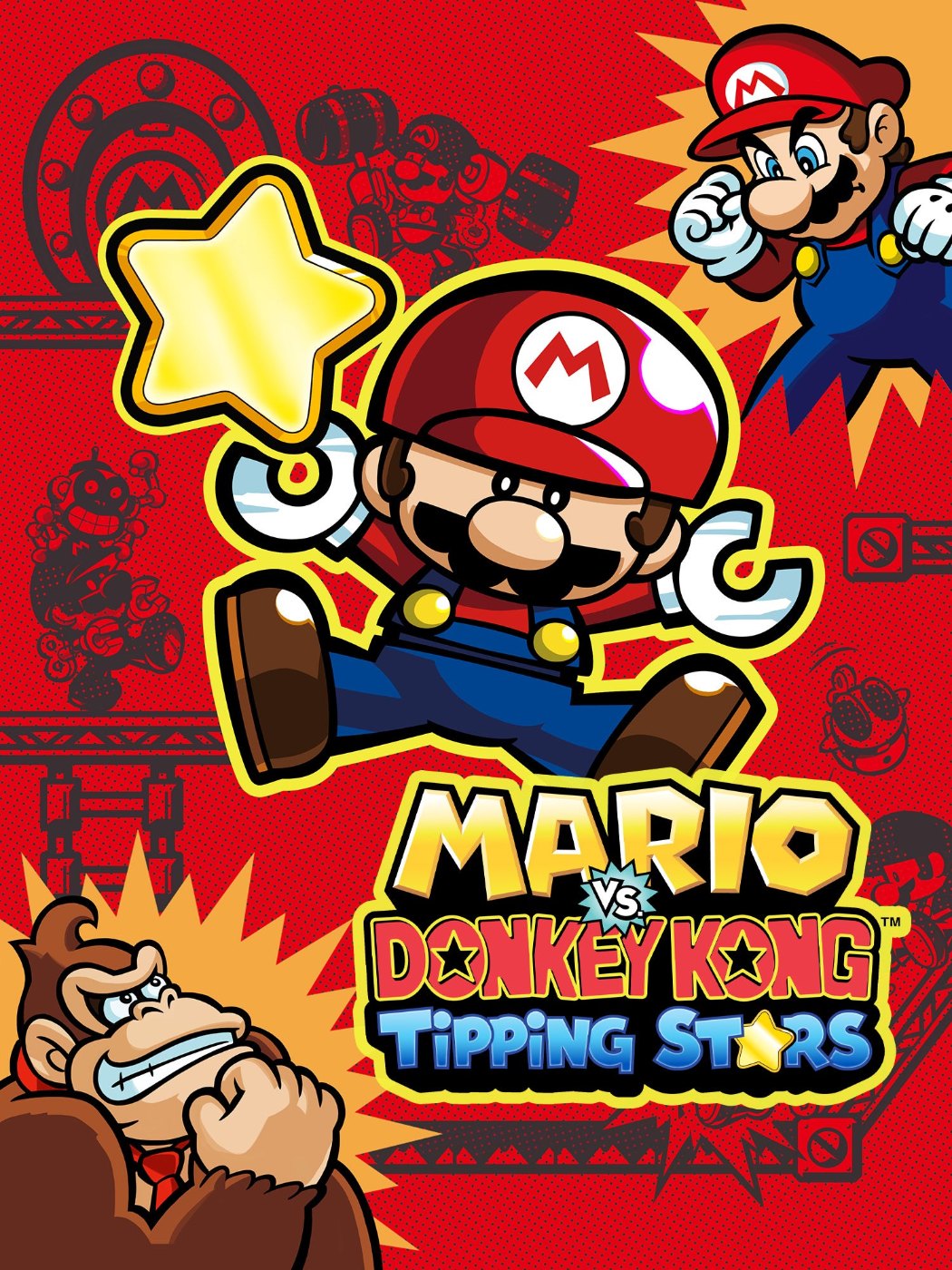
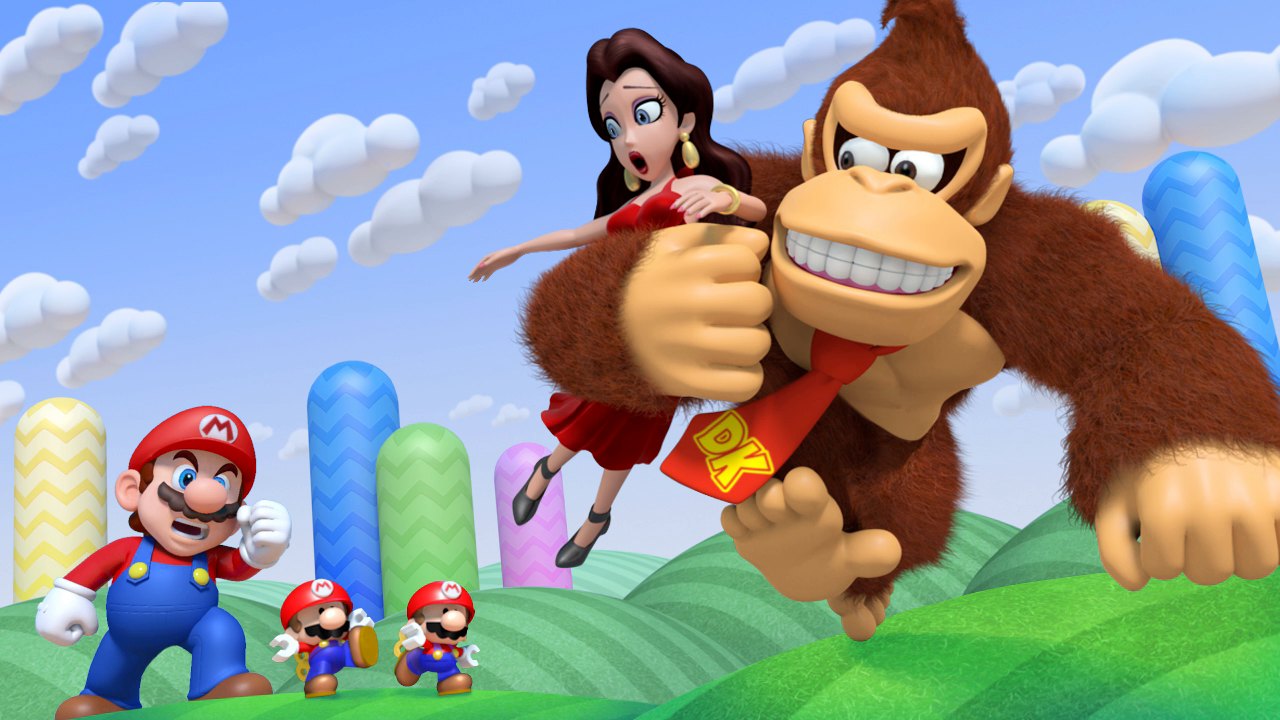
The key artwork: Mario, Donkey Kong and a crowd of Minis.
Every Mario vs. Donkey Kong game since 2006 has been about the Minis: clockwork toys of Mario and friends that march forward as soon as you wake them and never stop of their own accord. You cannot steer them directly. What you can do is change the world around them, and that is the whole game. A Mini walks into a wall and turns round; walks off a ledge and drops; steps on a spring and flies. Your job, armed with a stylus, is to lay down the right girder or lift at the right moment so that every last toy reaches the exit door together.
Tipping Stars takes that formula from the earlier DS game Mini-Land Mayhem! and wraps it in a social network. The main game is sizeable on its own: six worlds of eight levels, two extra worlds in an observatory among the stars, and 24 Bonus Levels unlocked with gold trophies. But the menu that mattered in 2015 was the Workshop, a level editor good enough for Nintendo’s own director to use for a year’s worth of official levels. Finished creations went up to Miiverse, the Wii U and 3DS community, where players could comment, give a “Yeah” and, as the title promises, tip the designer some stars.
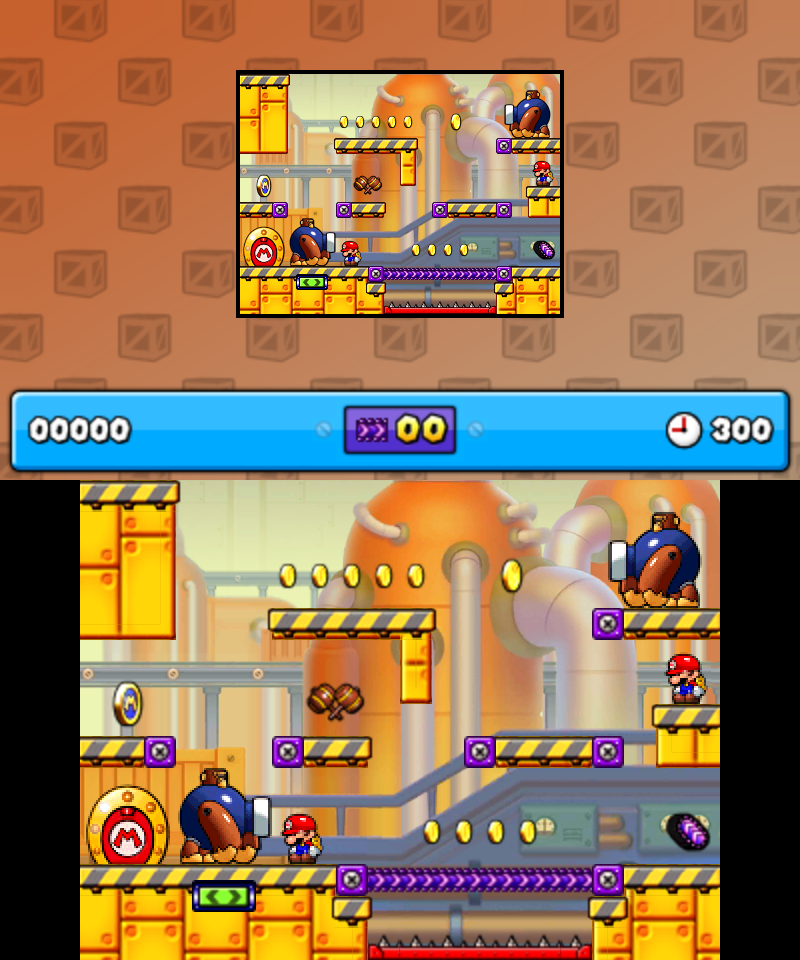
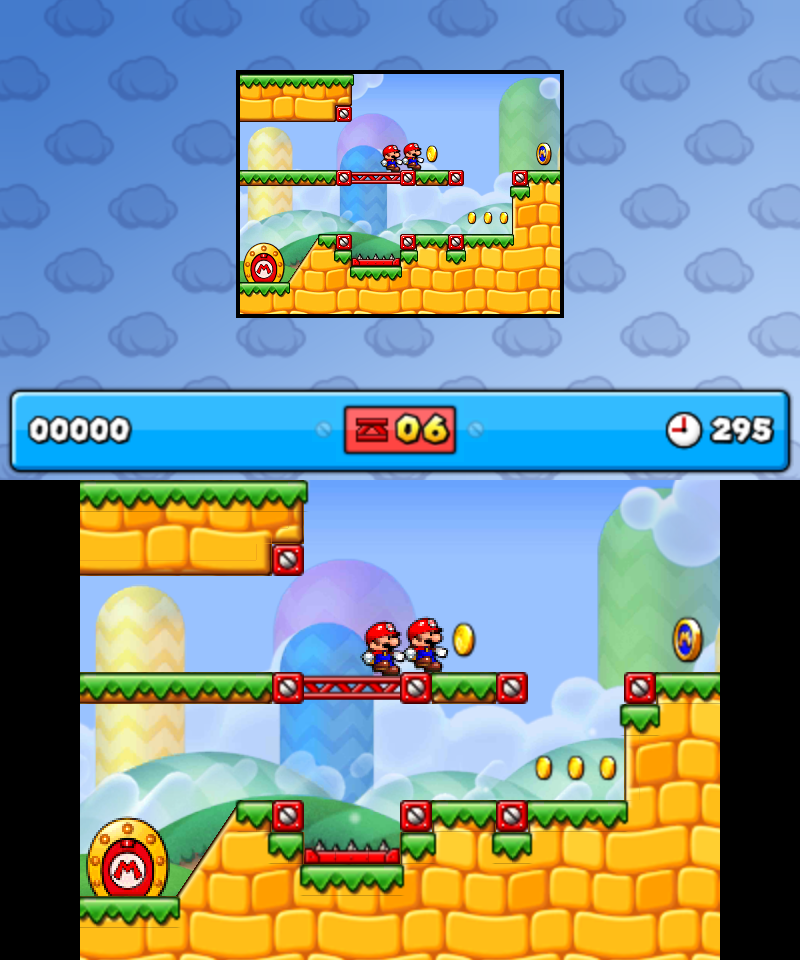
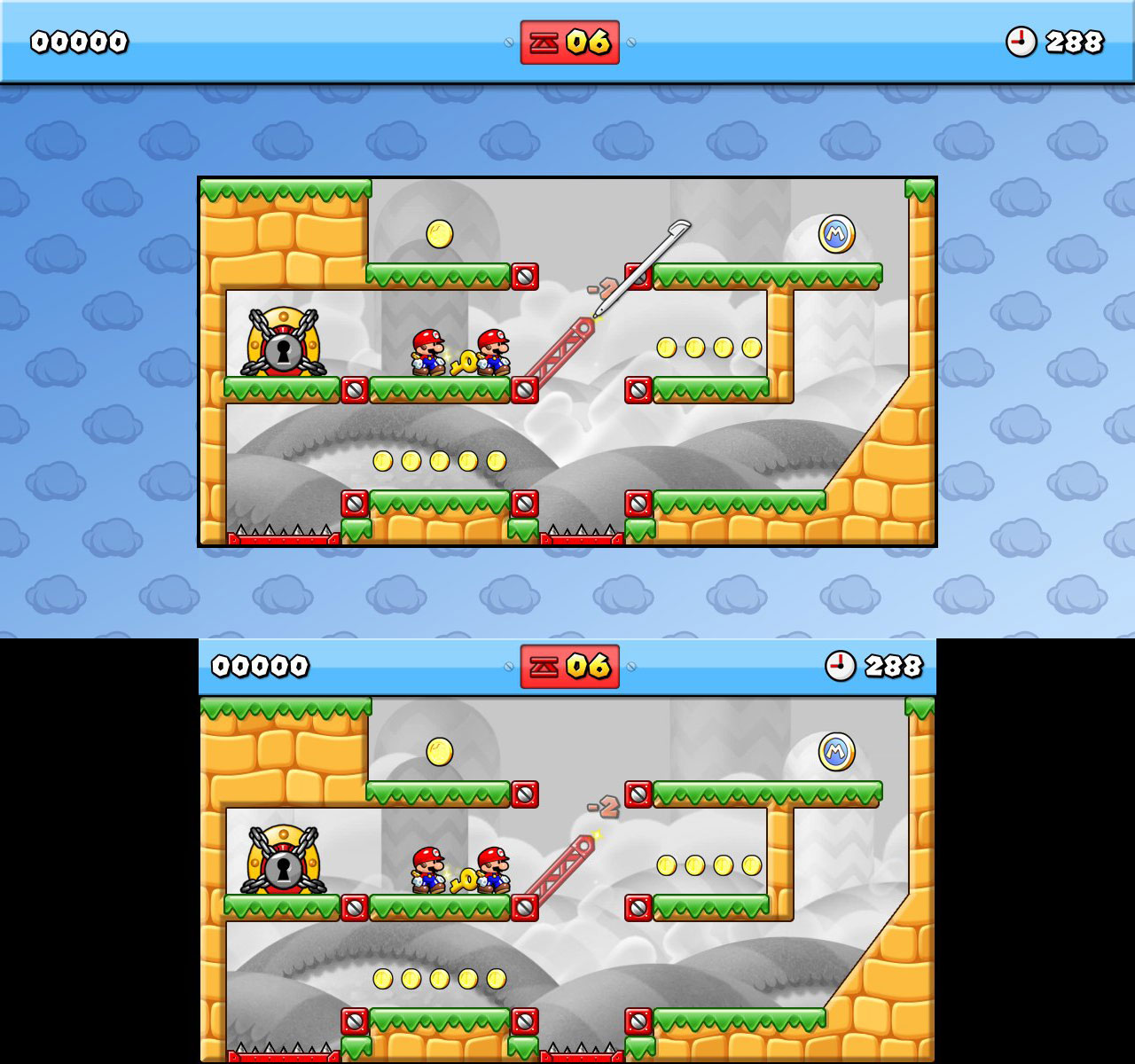
It was also the game Nintendo chose to try out Cross-Buy. Announced in the Nintendo Direct of 14 January 2015, the offer meant that buying either version on the eShop produced a code for the other one, to keep or to give away to a friend, and levels could be shared between the two machines. On Wii U you play on the GamePad’s touch screen while the television shows a framed copy of the action; on 3DS everything happens on the lower screen.
Reviews were respectable rather than rapturous, praising the community tools and grumbling that the puzzles were familiar. The community itself is gone now: Miiverse shut down in November 2017, taking the shared levels and the tipping with it, and the eShops stopped selling the game in March 2023. If it is already on your console, though, the whole single-player game and the editor still work.
Uh-oh! Donkey Kong’s kidnapped Pauline, and only Mario can rescue her in puzzler Mario vs. Donkey Kong: Tipping Stars, available to download from Nintendo eShop on Wii U! Guide mini, clockwork versions of Mario and friends to the exits in over 60 increasingly-fiendish 2D puzzle stages!
Build and share your own levels, or download new ones from other players. If you find a stage you like, you can even tip the creator with stars, giving them the chance to build even better stages in the future!
As well as testing your mental vigour, you can also construct your own puzzles in Workshop Mode, then share them or download others’ creations, no matter whether they were created on Nintendo 3DS or Wii U!
— Official description (Nintendo UK, 2015)
Why Tipping Stars matters to Mario fans
This is the Mario vs. Donkey Kong series at its most generous: the biggest toolbox the Minis had been given, a cast that finally includes Mini Luigi, and an editor that put level design, and a share of the spotlight, into players’ hands. It is also where Mini Mario’s run of new games paused. After the free Mini Mario & Friends: amiibo Challenge in 2016, the series did not return until the 2024 Switch remake of the GBA original, Mario vs. Donkey Kong.
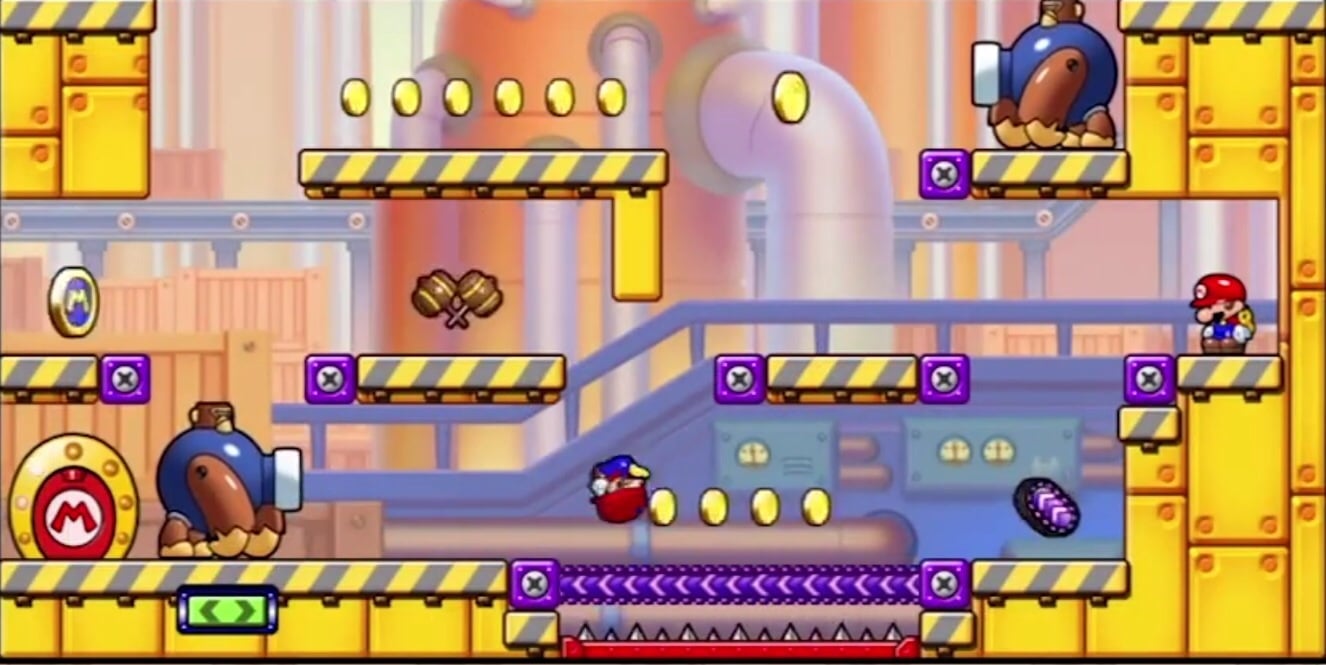
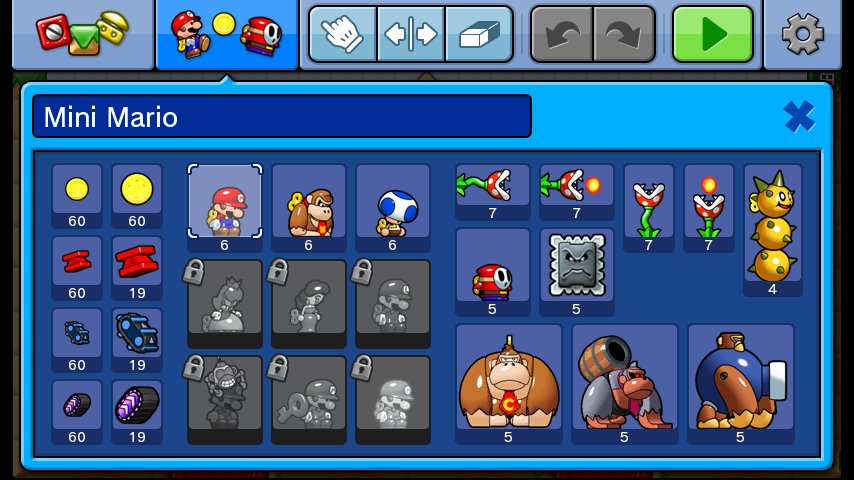
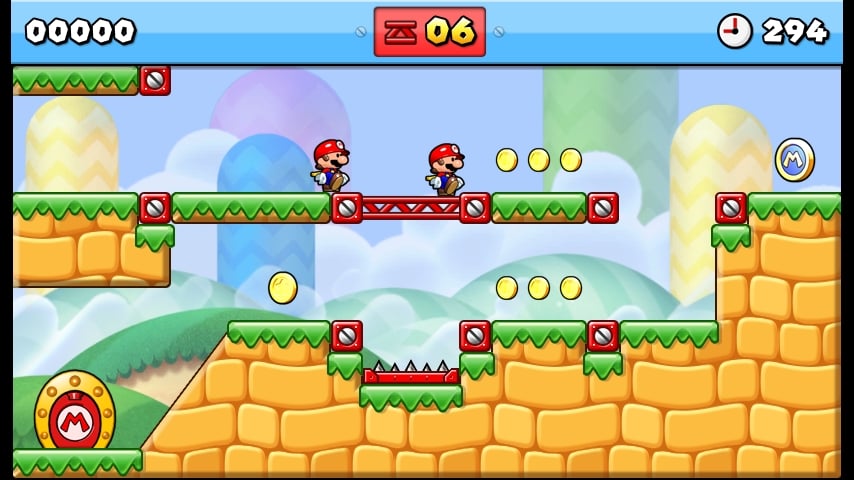
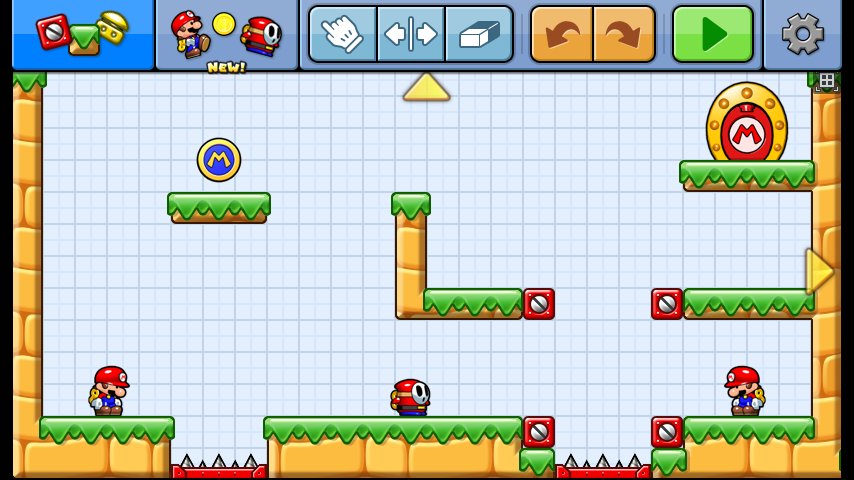
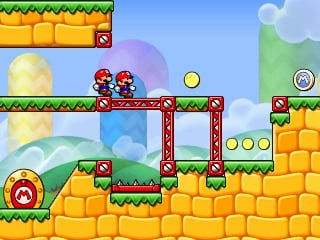
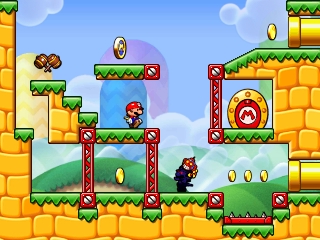
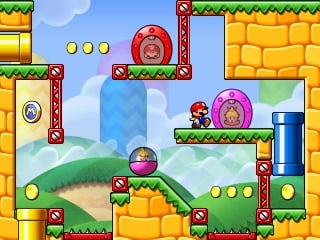
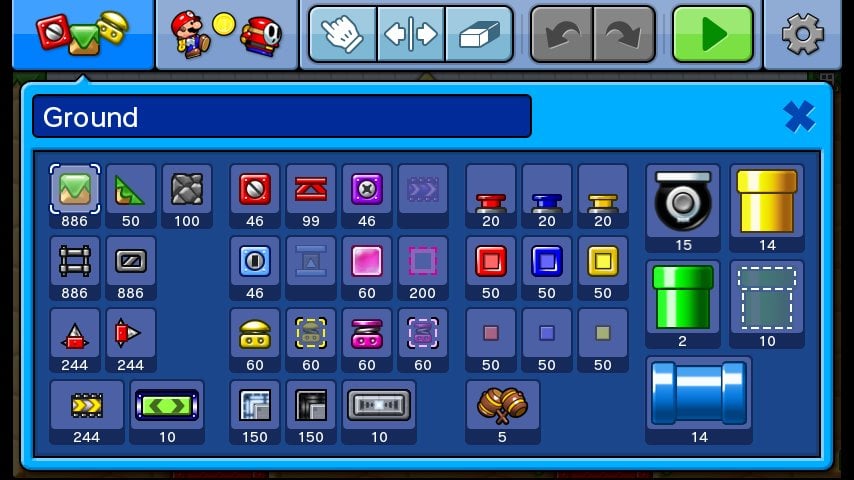
Level 1-1 on Wii U: Red Girders and the first Mini Mario.The Workshop editor on the Wii U GamePad.The same level on Nintendo 3DS.
Quick Answers
The questions people ask most about Tipping Stars, answered briefly here and in more depth further down.
What is Mario vs. Donkey Kong: Tipping Stars?
A 2015 puzzle game for Wii U and Nintendo 3DS by Nintendo Software Technology. You guide wind-up Mini toys to the exit by placing girders, springs, lifts and pipes with the stylus, and you can build your own levels in the Workshop. More →
Was it Cross-Buy?
Yes, and it was Nintendo’s first. Buying it on either the Wii U or the 3DS eShop gave you a download code for the other version, which you could also give to a friend. More →
How many levels are there?
88 built-in levels: eight in each of six main worlds, 16 more in the two extra worlds (E1 and E2, both in the Orbiting Observatory) and 24 Bonus Levels. More →
What does “Tipping Stars” mean?
Stars are earned from bronze, silver and gold trophies. Players could tip some of theirs to the creator of a shared level they liked, and creators spent stars in the Workshop Store on new parts, Minis and themes. More →
Can you still share levels and tip stars?
No. Sharing, tipping and the Community menu depended on Miiverse, which closed on 8 November 2017 (10pm on 7 November, Pacific time). The main game and the level editor still work offline. More →
Can you still buy it?
Not new. Wii U and 3DS eShop purchases ended on 27 March 2023. Copies already downloaded can still be played and redownloaded. More →
Was there a physical release?
Outside Japan it was download-only, although European shops sold a box that contained a download code. Japan had proper packaged copies. More →
What is the story?
Donkey Kong carries off Pauline yet again, Mario chases him with his Minis through six worlds, and at the end the lights go up on a surprise party. More →
Who made it?
Nintendo Software Technology, the studio behind the earlier Mario vs. Donkey Kong games. Stephen Mortimer directed; Shigeru Miyamoto and Kensuke Tanabe supervised. More →
What came after it?
Mini Mario & Friends: amiibo Challenge, a free download for Wii U and 3DS in 2016, and in 2024 the Switch remake Mario vs. Donkey Kong. More →
Story
Donkey Kong makes off with Pauline once again.
The plot fits on a postcard, and the game knows it. Donkey Kong grabs Pauline and runs, as he has done since 1981, and for once nobody explains why. Mario sets off in pursuit with a box of Mini toys, and every world ends with a Mini Mario that has been taken over by one of Donkey Kong’s toy monkeys and has to be freed. The punchline comes at the end of the sixth world.
World 1: Rolling Hills
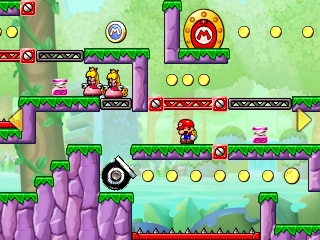
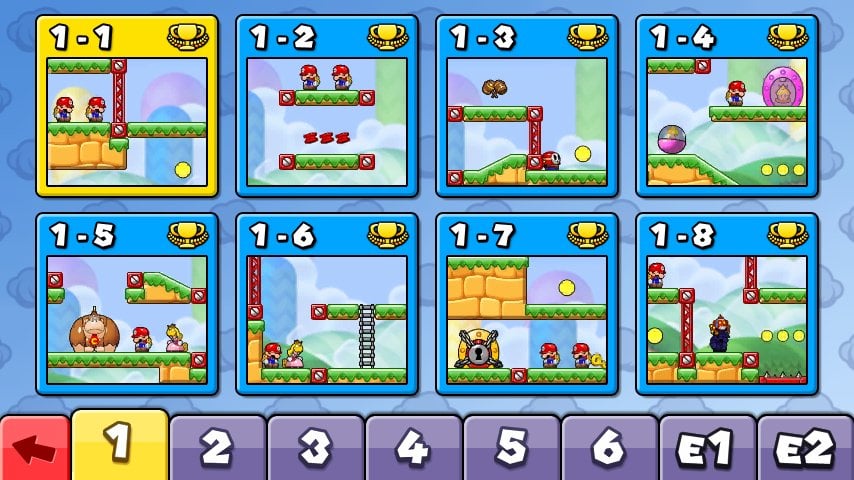
A gentle start among grassy hills. Level 1-1 teaches the Red Girder, 1-2 shows that girders can be picked up and reused, and 1-3 hands the Minis their first Hammers with a Shy Guy to try them on. Mini Peach is freed in the first Multi-Door level, 1-4; Circus Kongs, ladders and the first Key Mini Mario follow, and Level 1-8 introduces the Cursed Mini Mario.
Level 1-1: the Red Girder lesson.Level 1-3: Hammers and a Shy Guy.Level 1-8: the first Cursed Mini Mario.
World 2: Jumpy Jungle
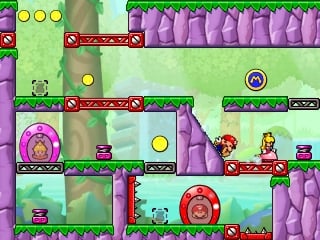
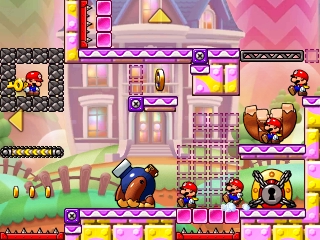
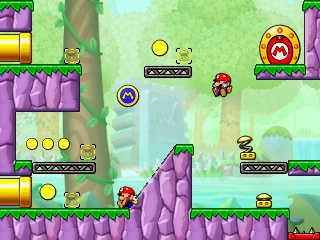
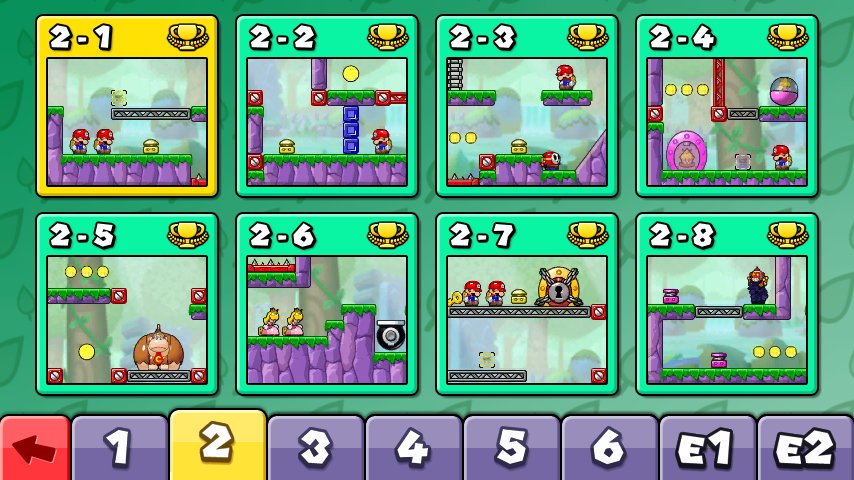
Thick jungle and springs everywhere, much as in the same-named world of Mini-Land Mayhem!. Horizontal springs arrive in 2-1, blue switches in 2-2, and Circus Kongs bounce Minis around in 2-5. Level 2-6 brings the first cannons, and the world ends with another cursed Mini to break free.
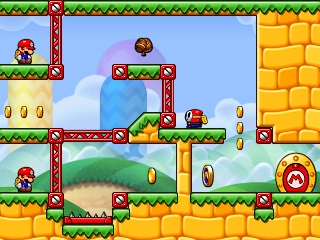
Level 2-1: the first horizontal springs.Level 2-6: cannons enter the game.Level 2-8.
World 3: Runaway Warehouse
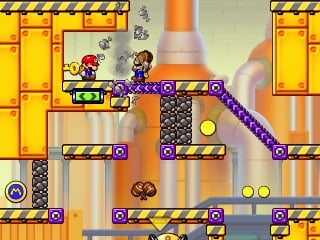
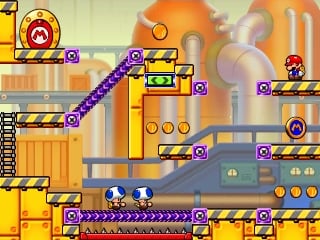
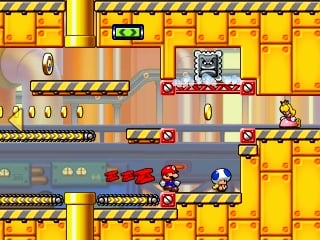
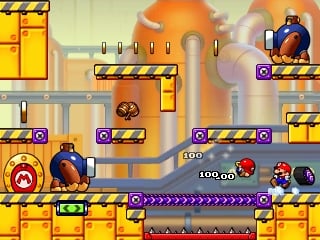
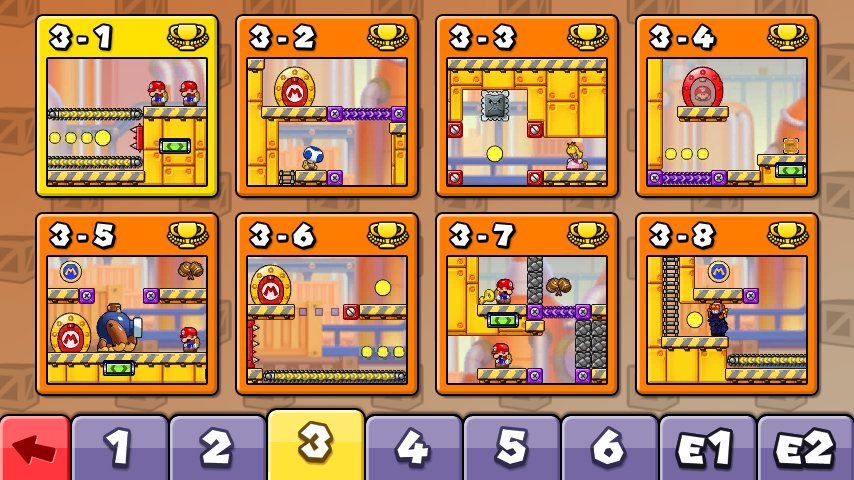
Machinery and conveyor belts. Purple Conveyors, the stretchable kind you place yourself, appear in 3-2, Thwomps fill 3-3, and Mini Toads join the cast. Cannon Kong makes his debut in 3-5, Color Switches drive 3-6 and Hammers smash Rock blocks in 3-7.
Level 3-2: Purple Conveyors.Level 3-3: a room full of Thwomps.Level 3-5: Cannon Kong’s debut.
World 4: Crumbling Cavern
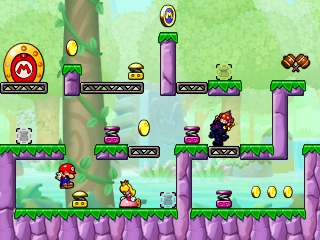
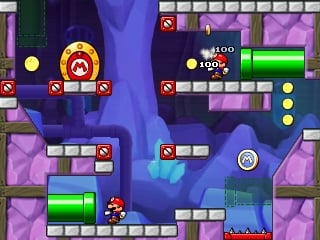
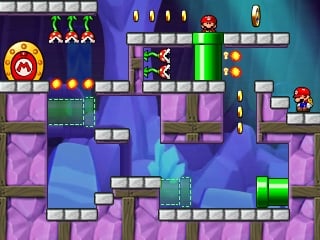
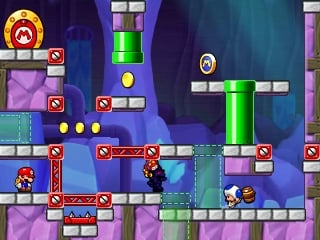
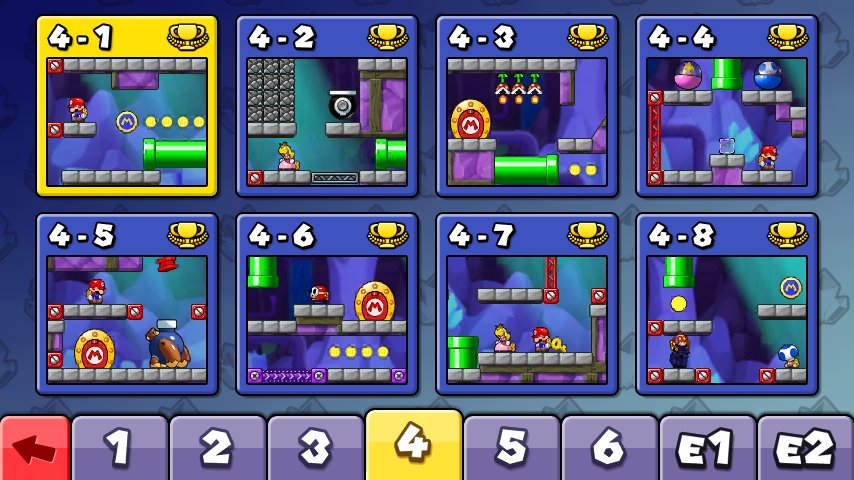
Underground, to an arrangement of the old Super Mario Bros. underground tune. This is the Movable Pipe’s world: 4-1 introduces it, 4-2 mixes it with cannons and rock walls, and 4-3 brings Fire Piranha Plants whose fireballs can be trapped between a wall and a pipe. The final level is a small room of girders and pipes with a cursed Mini wandering through it.
Level 4-1: the Movable Pipe.Level 4-3: Fire Piranha Plants.Level 4-8.
World 5: Dashing Desert
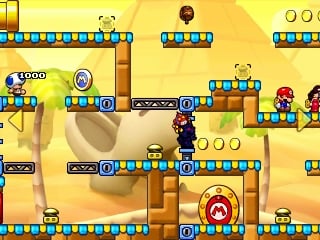
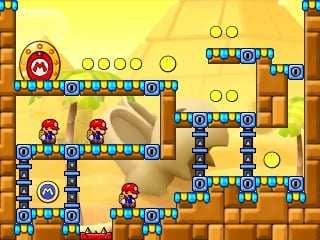
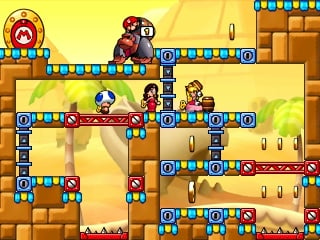
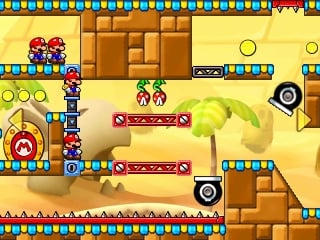
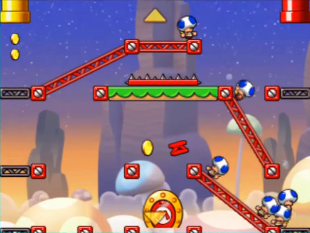
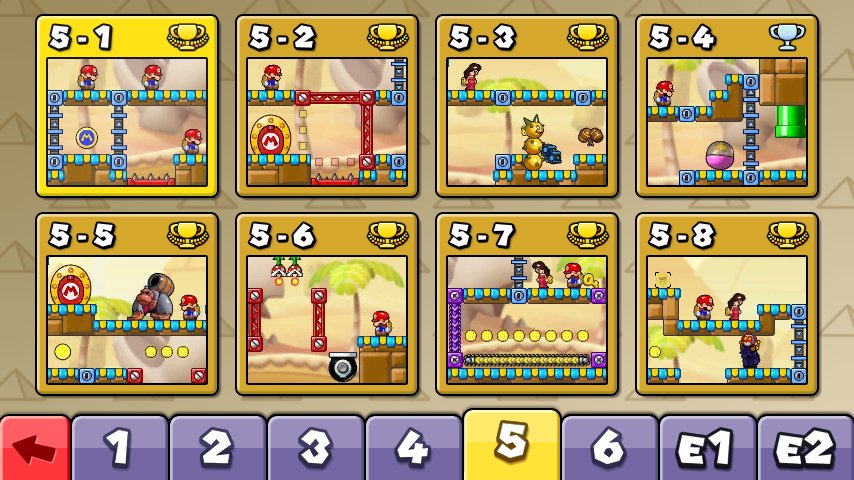
Sand, sun and the Blue Lift, introduced in 5-1. Pokeys stand guard in 5-3, a Capture Kong has to give up a captured Mini Mario in 5-5, and 5-6 lines up Fire Piranha Plants and cannons above a long bed of spikes. The music borrows heavily from the desert world of Mini-Land Mayhem!.
Level 5-1: the Blue Lift.Level 5-5: rescue from a Capture Kong.Level 5-6: fire, cannons and spikes.
World 6: Twilight Valley and the surprise
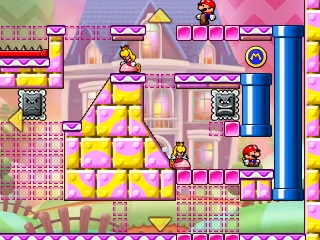
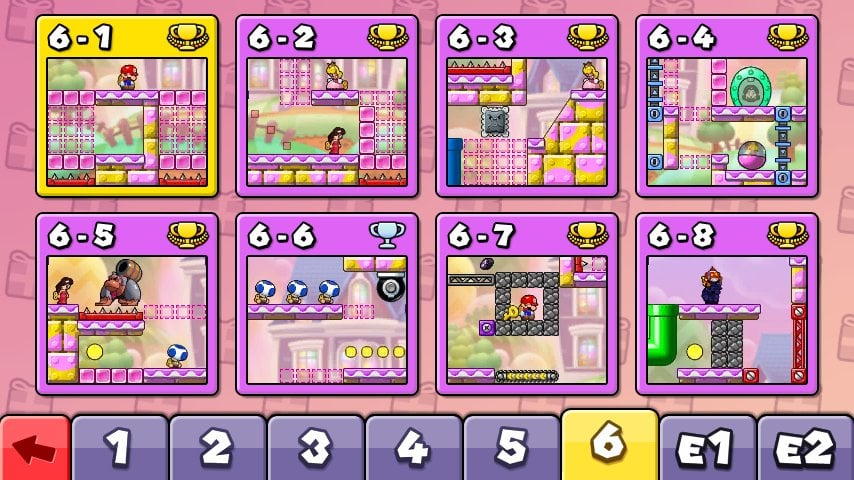
The last main world adds the Pink Block, which you can place and remove at will, and then puts it to work: stopping Thwomps in 6-3, sealing off Capture Kongs in 6-5, carving a path for a Cursed Mini Mario through rock and girders in 6-8.
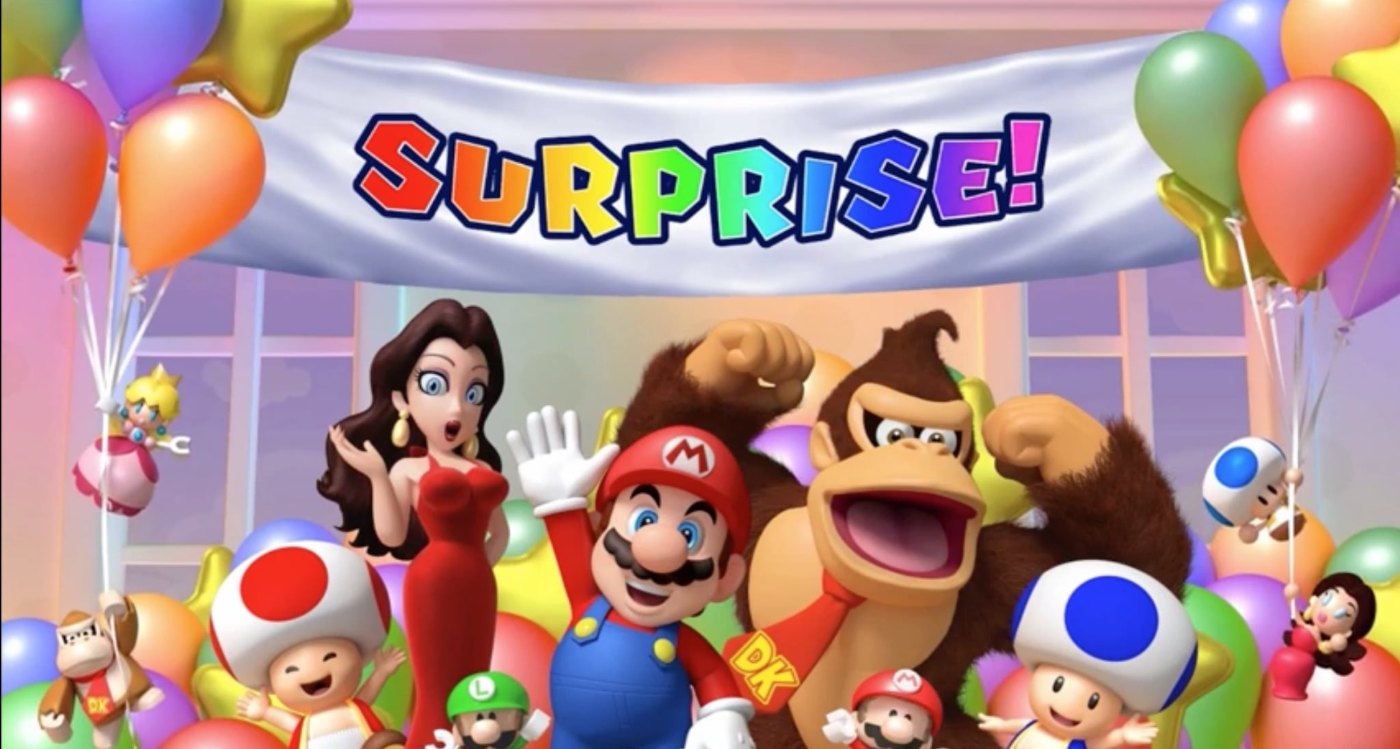
Then Mario finally catches up. He walks into a darkened room, the lights snap on, and there are Pauline and Donkey Kong with two Toads, waiting to throw him a surprise party. It was never a kidnapping at all. With Pauline safe, Mario is free to carry on into the extra worlds and the Bonus Levels.
Level 6-1: the Pink Block tutorial.Level 6-3: Pink Blocks under the Thwomps.Surprise! The party that ends the story.
Worlds E1 and E2: Orbiting Observatory
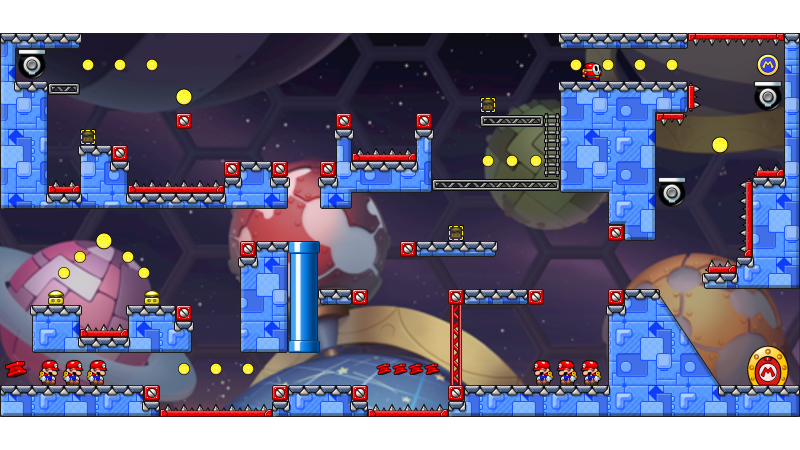
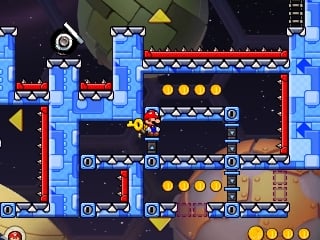
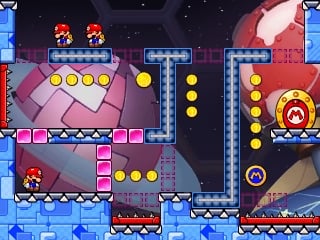
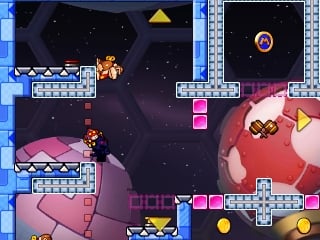
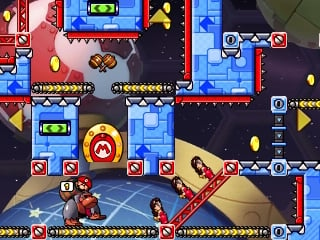
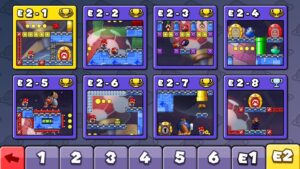
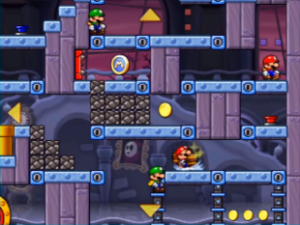
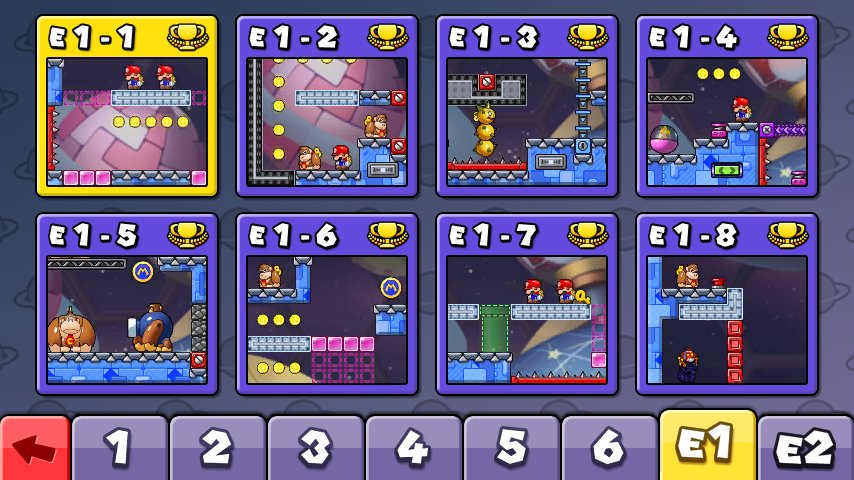
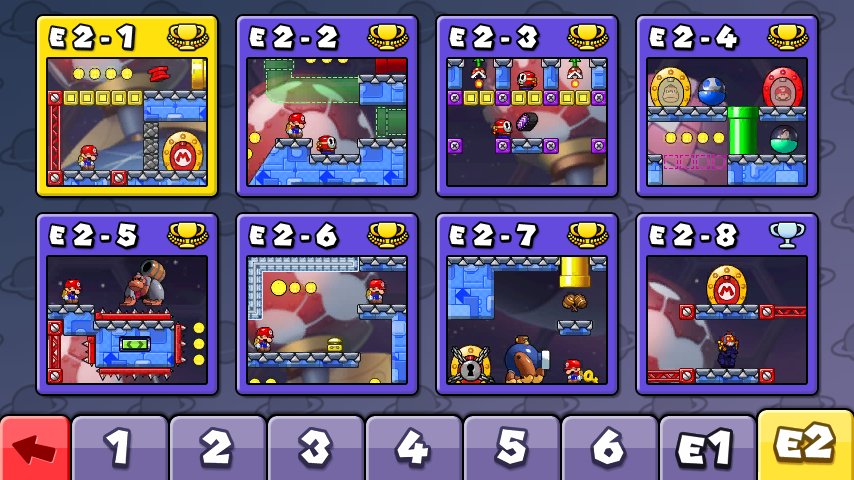
Two extra worlds of eight levels each, both set in an observatory among the stars. E1 introduces Magnet Ground, which lets Minis walk up walls and along ceilings, and Magnet Switches in E1-3; its final level sets loose a Cursed Mini Mario that can cling to magnetic surfaces too. E2 is a recap of everything so far at its most demanding, with a Capture Kong patrolling a tangle of conveyors and lifts in E2-5 and, in E2-7, a stingy puzzle that has to be solved with very few parts.
Level E1-1: Magnet Ground and Pink Blocks.Level E1-8: a cursed Mini on the magnets.Level E2-5: a Capture Kong on patrol.
The Bonus Levels
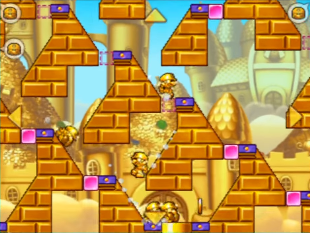
Twenty-four harder levels, unlocked with gold trophies and grouped as Bonus 1 (B-1 to B-8), Bonus 2 (B-9 to B-16) and Bonus 3 (B-17 to B-24). Each of the seven main settings hosts a pair of them; after that the Bonus Levels move into the four backgrounds otherwise sold in the Workshop Store: Winding Ravine (B-15 to B-17), Swirling Courtyard (B-18 to B-20), Clattering Cabin (B-21 to B-23) and, for the very last level, Shimmering Gold Palace.
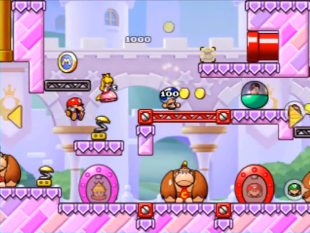
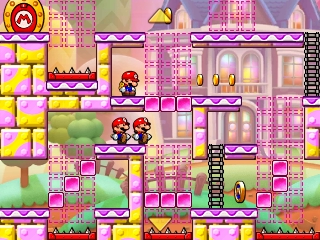
Level B-17 in Winding Ravine (3DS).Level B-24, the last, in Shimmering Gold Palace (3DS).
Every world in Mario vs. Donkey Kong: Tipping Stars
Eight levels to a world. The fourth level of every world is a Multi-Door level, the seventh usually stars Key Mini Mario, and the eighth always ends with a Cursed Mini Mario to break.
World 1: Rolling Hills8 levels · finale: Cursed Mini Mario (1-8)Red Girders (1-1, 1-2), Hammers (1-3), Mini Peach (1-4), Circus Kongs (1-5), ladders (1-6), Key Mini Mario (1-7).
World 2: Jumpy Jungle8 levels · finale: Cursed Mini Mario (2-8)Horizontal springs (2-1), blue switches (2-2), vertical springs and Circus Kongs (2-5), the first cannons (2-6).
World 3: Runaway Warehouse8 levels · finale: Cursed Mini Mario (3-8)Conveyors (3-1), Purple Conveyors (3-2), Thwomps (3-3), Cannon Kongs (3-5), Color Switches (3-6), Rock blocks (3-7).
World 4: Crumbling Cavern8 levels · finale: Cursed Mini Mario (4-8)Movable Pipes (4-1), rock walls and cannons (4-2), Fire Piranha Plants (4-3), Cannon Kong passages (4-5).
World 5: Dashing Desert8 levels · finale: Cursed Mini Mario (5-8)Blue Lifts (5-1), Pokeys (5-3), a Capture Kong rescue (5-5), a gauntlet of Fire Piranha Plants (5-6).
World 6: Twilight Valley8 levels · finale: Cursed Mini Mario (6-8), then the endingPink Blocks (6-1), Thwomp-stopping (6-3), Capture Kongs (6-5), cannons and pipes (6-6), a walled-in Key Mini Mario (6-7).
World E1: Orbiting Observatory8 levels · extra world · finale: Cursed Mini Mario (E1-8)Magnet Ground (E1-1, E1-2), Magnet Switches and Pokeys (E1-3), Cannon and Circus Kongs (E1-5).
World E2: Orbiting Observatory8 levels · extra world · finale: Cursed Mini Mario (E2-8)The final exam: pipes, Fire Piranha Plants (E2-3), a Capture Kong (E2-5) and a Thwomp passage with almost no parts (E2-7).
Bonus 1B-1 to B-8 · unlocked with gold trophiesHarder levels in the settings of the first four main worlds, two apiece.
Bonus 2B-9 to B-16Pairs in Dashing Desert, Twilight Valley and the Orbiting Observatory, then the first two Winding Ravine levels.
Bonus 3B-17 to B-24 · all 24 need 87 gold trophiesThe four Workshop Store backgrounds, ending in the Shimmering Gold Palace.
Winding RavineBonus Levels B-15 to B-17 · Workshop themeRocky peaks and giant mushrooms above the clouds at dusk.
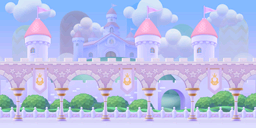
Swirling CourtyardBonus Levels B-18 to B-20 · Workshop themeStar-patterned arches near Peach’s Castle, to a remix of the castle theme from Super Mario 64.
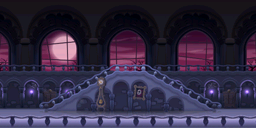
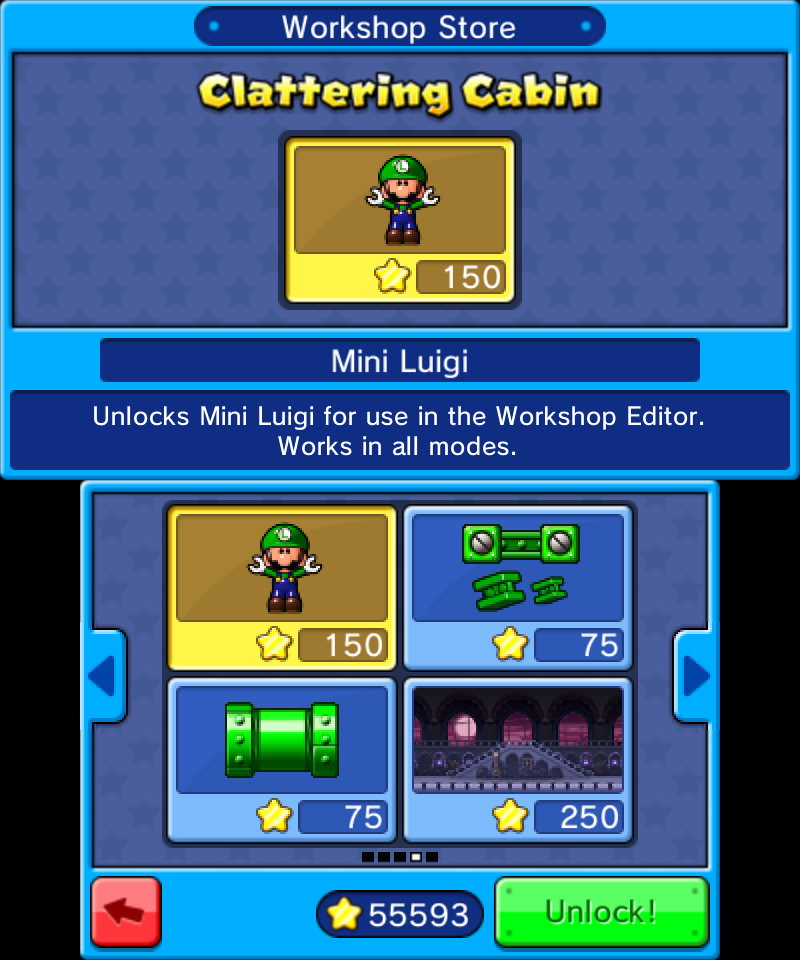
Clattering CabinBonus Levels B-21 to B-23 · Workshop themeA gloomy Gothic house of torches, old furniture and a grandfather clock.
Shimmering Gold PalaceBonus Level B-24 · Workshop themePiles of treasure in a gilded palace: the game’s last level.
Editor LandWorkshop onlyThe plain grid background the editor starts with; no built-in level uses it.
That makes 6 × 8 + 2 × 8 = 64 main levels and 24 Bonus Levels, 88 in all, before a single player-made level is counted. Nintendo’s own description simply promises “over 60”.
Advertisement
Gameplay & Controls
You never touch Mario in Tipping Stars. You touch everything else. Each level is a single scrolling room with a Goal Door, some Minis waiting to be woken and a stock of parts you can place with the stylus. Collect the coins, beat the clock, and get every toy home.
How a Mini behaves
Every Mini begins a level standing still. Tap it and it sets off, and from then on it follows a strict set of rules. It walks straight ahead, hops up a step one block high, slides down any slope too steep to climb, and turns round when it meets a wall or bumps into another Mini. It uses whatever it walks into: a spring, a pipe, a ladder, a conveyor. With nothing beneath it, it drops straight down, and if it lands on another Mini it bounces off without changing direction.
Minis are fragile. Spikes break them, enemies break them, and so does a fall of ten blocks unless they slide down a slope to break it. Because the level is only cleared when every Mini is through the door, losing a single toy means a Game Over. And they must arrive together: once the first Mini is in, the door counts down a few seconds and then locks (the British English text calls it the “door”, the American the “M Door”). Multi-Door levels give each character its own exit, and some Minis start shut in Capsules until an active Mini touches them.
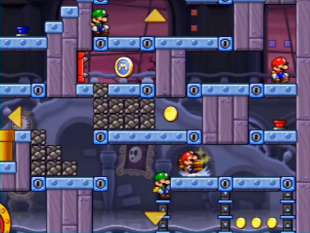
Minis on the march.Level 1-4, the first Multi-Door level, where Mini Peach joins in.
The stylus toolbox
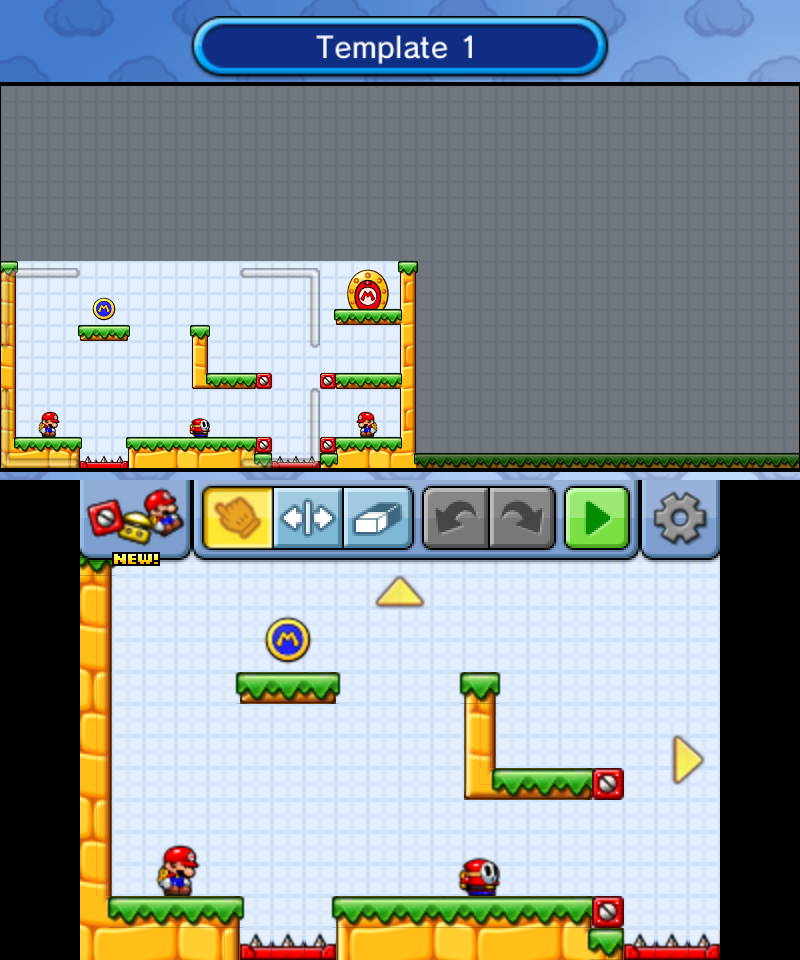
The parts you place are called resource items, and the game keeps a stock of each. A Red Girder is drawn between two matching rivets and can be a floor, a ramp or a wall depending on its angle. A Blue Lift carries Minis up or down between two rivets. High Springs throw them steeply upwards and Long Springs in a wide arc. A Movable Pipe is a linked pair that teleports a Mini from one end to the other and slots into fixed positions. Pink Blocks can be placed or removed to make platforms and walls, and a Purple Conveyor is dragged out between rivets to carry Minis along. Pickups in the level top up your stock when a Mini walks into them.
Parts can be lifted and put down again as often as you like, which turns many levels into a juggling act: one girder, moved three times as the Minis advance. On Wii U all of this is done on the GamePad’s touch screen, with either stick scrolling the view; the television shows a secondary picture inside wide borders, and Nintendo Life reckoned you would spend nine-tenths of your time looking down at the controller. The 3DS version plays on the lower screen and has no stereoscopic 3D.
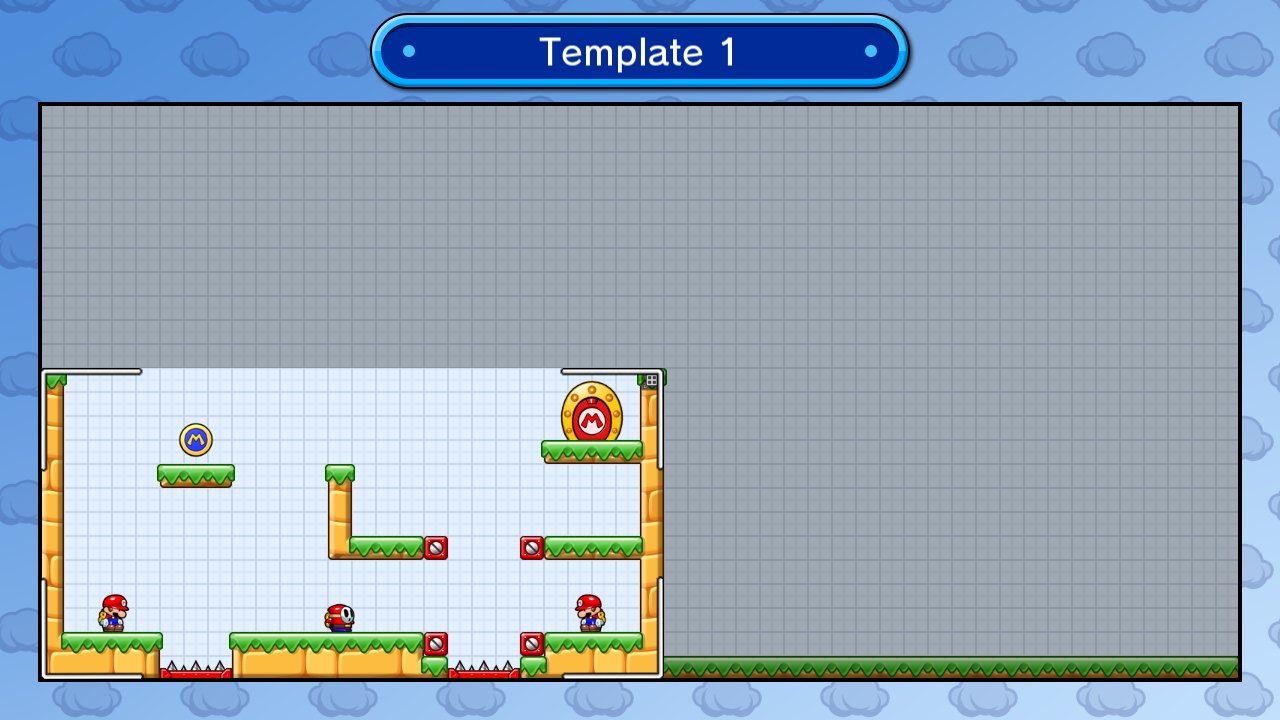
Resource items and fixed objects, as laid out in the editor.The television picture on Wii U, framed by wide borders.
Coins, trophies and stars
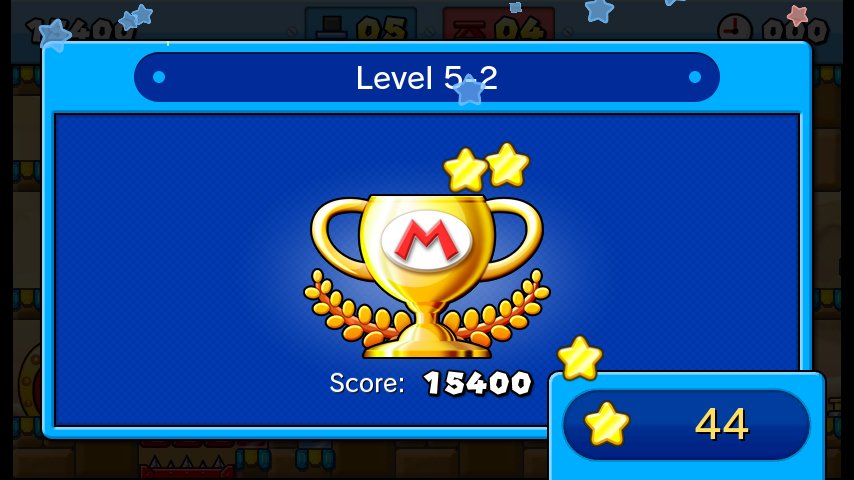
Scoring is simple and generous. A small coin is worth 100 points and a big one 1,000; every level hides a single M Coin worth 2,000; and collecting every coin adds a 6,000-point bonus. Each second left on the clock is worth 20 more. The total earns a bronze, silver or gold trophy, and each trophy level is worth a star, so a gold trophy means three stars. The in-game tip is blunt about how to get one: grab all the coins and get to the door quickly.
Across the whole built-in game there are 267 stars to earn. Gold trophies also open the Bonus Levels, one for every four golds to begin with; by most counts 87 gold trophies are needed to unlock all 24 of them.
Level complete: trophy and stars awarded.A star, the game’s currency.
The Workshop and its Store
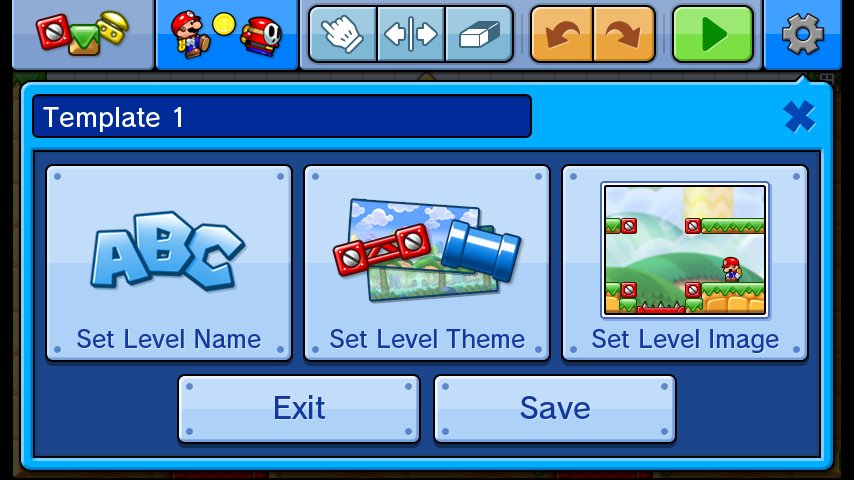
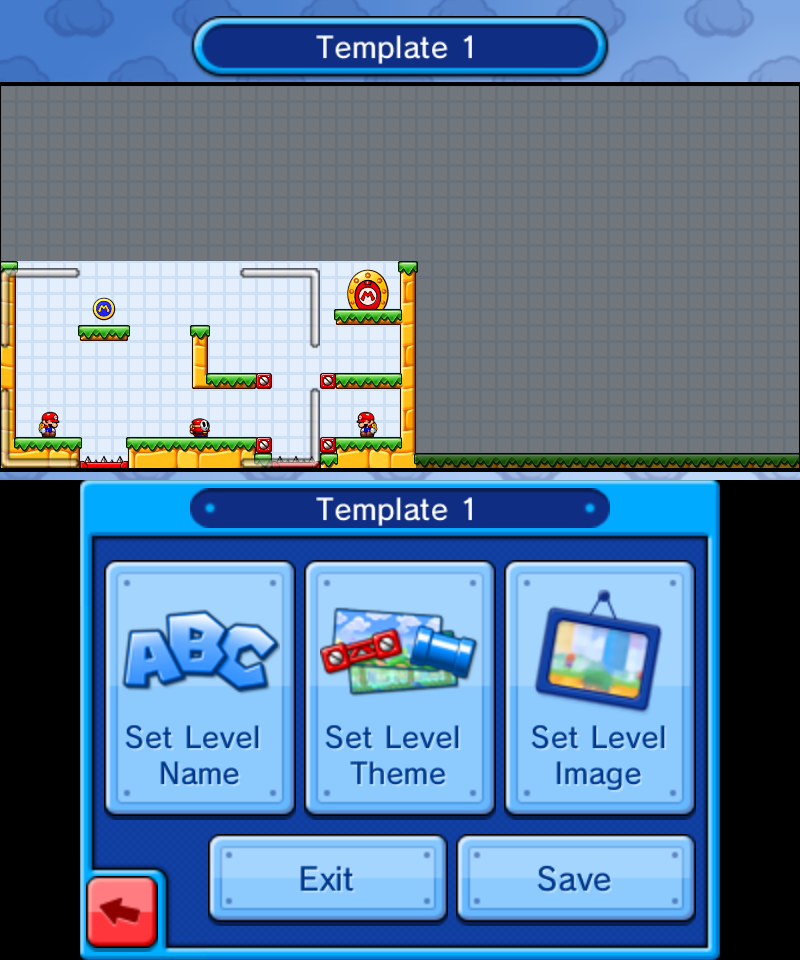
The Workshop is a complete level editor. Nintendo’s description promised room for 50 levels of your own, started from one of three templates or from a blank grid, built from the same girders, springs, enemies, coins and Minis as the main game, with a background theme of your choice. A level can use up to four kinds of resource item. Before you can share it, you have to play it yourself and collect every coin, so nothing impossible goes online.
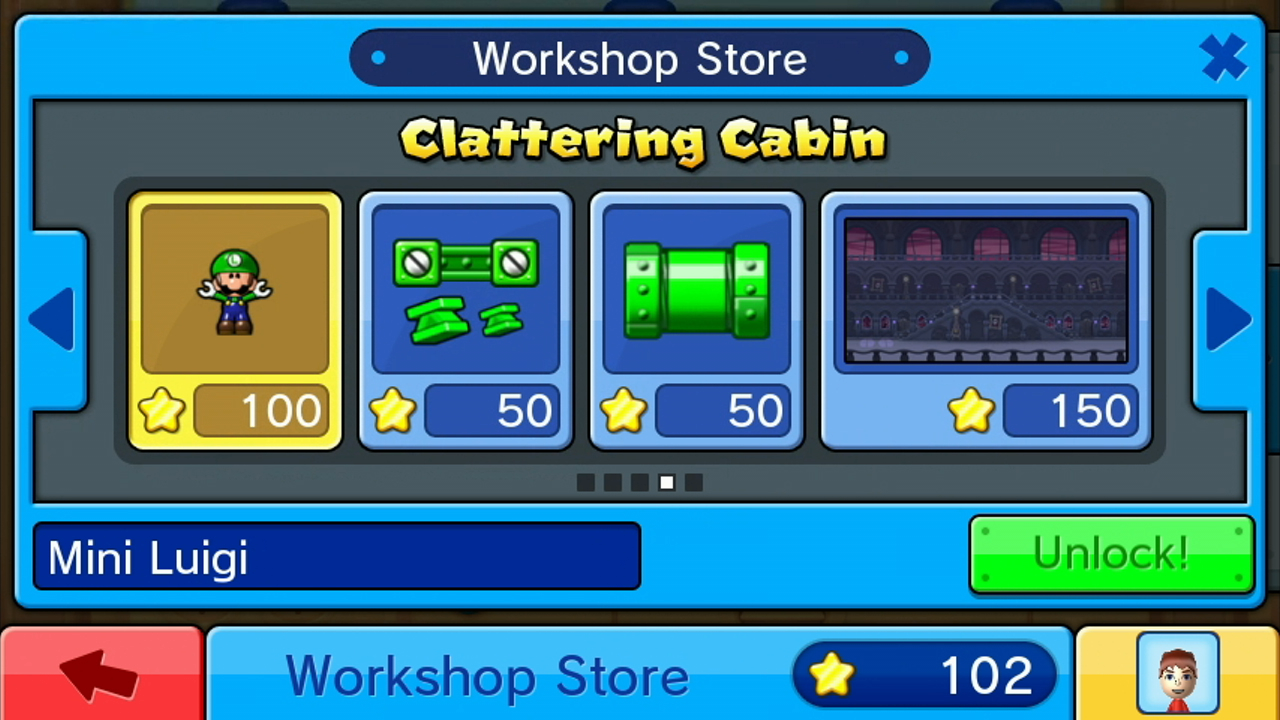
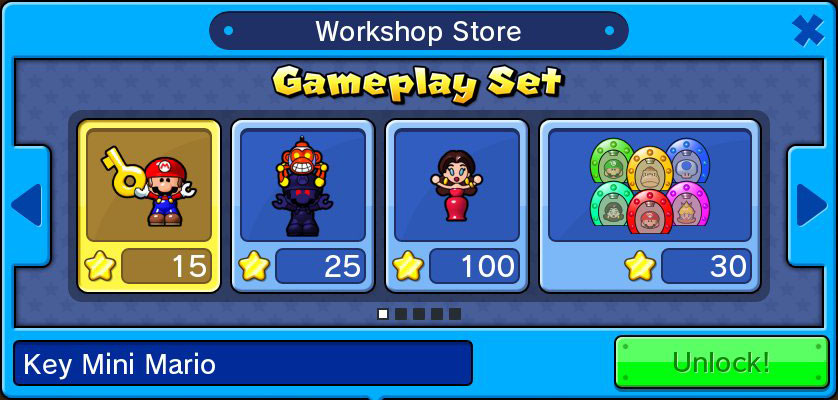
Stars are spent in the Workshop Store, which sells parts in sets. The Gameplay Set unlocks Key Mini Mario (15 stars), Cursed Mini Mario (25), Mini Doors for Multi-Door levels (30) and Mini Pauline (100). Four themed sets follow, each with a Mini, coloured girders and rivets, a matching Warp Pipe and a new background: Winding Ravine with Mini Toad, Swirling Courtyard with Mini Peach, Clattering Cabin with Mini Luigi (150 stars) and Shimmering Gold Palace with Gold Mini Mario, who costs a staggering 5,000. Buying everything takes 9,080 stars, far more than the 267 the offline game provides; the rest was meant to come from tips.
The Workshop Store on Wii U.A Workshop Store set.The editor on Nintendo 3DS.
Tipping stars on Miiverse
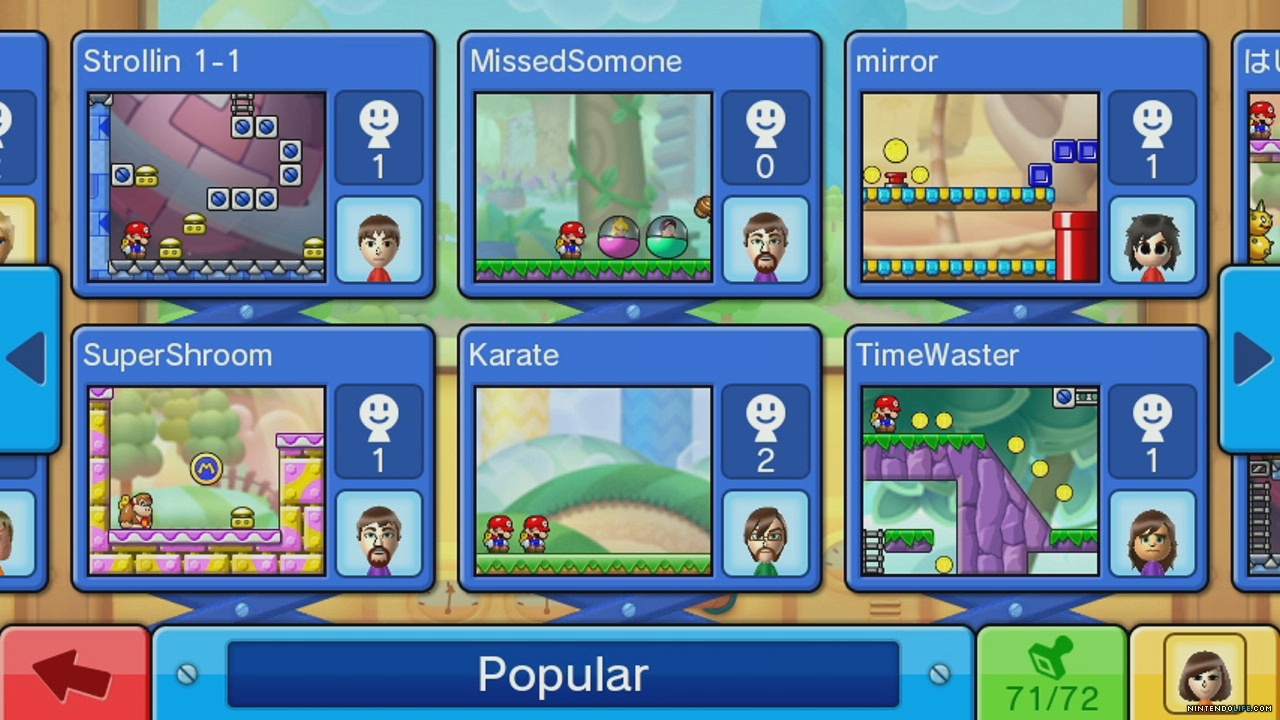
The Community menu was the heart of the game’s design. Every shared level had its own Miiverse post, where players could comment and give a “Yeah”. Levels could be browsed by Popular, Latest, Saved, Friends & Followed and Official Levels, and on 3DS swapped by StreetPass. If a level impressed you, you could tip its creator some of your stars and receive Miiverse stamps in return; creators earned stars whenever their levels were played or tipped. A player’s profile counted Yeahs, comments, stars tipped and levels shared, and the colour behind each Mii showed which region it came from – red meant Japan, blue the Americas, yellow Europe and Oceania.
Because both versions talked to the same community, a level built on a 3DS could be played on a Wii U and the other way round, though Nintendo warned that a few creations would not work on both. From launch day until February 2016 Nintendo added two official levels a week, built by the director, Stephen Mortimer.
The Community menu.One of the Miiverse stamps earned by tipping.The Cursed Mini Mario stamp.
When Miiverse closed
Nintendo switched Miiverse off at 15:00 Japan time on 8 November 2017, which was 10pm on 7 November on the North American west coast. For Tipping Stars that was the end of the community: no more uploads, downloads, Yeahs or tips, and the official levels went with it. The Community menu still opens for anyone who had set up a profile before the shutdown, but it is empty, and players who never did cannot enter it at all.
The knock-on effect is on the stars. With tips gone, the 267 stars in the main game are all a new player can ever earn: enough for the Gameplay Set and a little more, but nowhere near the 9,080 the whole Store costs, so Gold Mini Mario and most of the themed sets are now out of reach. Everything else, the 88 built-in levels and the editor itself, still works offline.
The 3DS Workshop Store.
Wii U or 3DS: Cross-Buy
Nintendo called the offer “Two versions for one price!”. Buy or redeem the game on one system in the Nintendo eShop and a download code for the other appeared on your receipt; you could use it yourself or give it to someone else. Nintendo Life, reporting the Direct that announced it, described Tipping Stars as Nintendo’s first Cross-Buy title. The price was $19.99 in North America and £17.99 in the UK.
The two versions play the same levels. The 3DS has a dedicated Help Mode behind a question-mark button, where the Wii U shows its tips on loading screens, and its portability was the main advantage Nintendo Life found in it. The 3DS version also received the game’s only update, 1.0.1, on 1 September 2015, which stopped players uploading some levels that were causing errors in the Community.
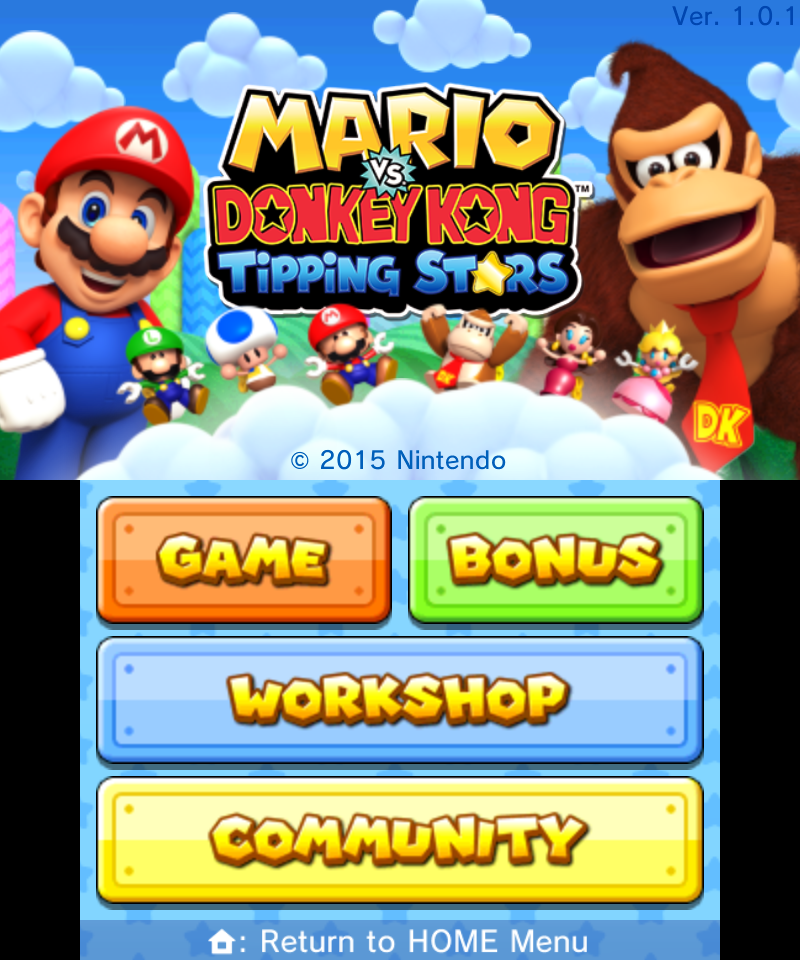
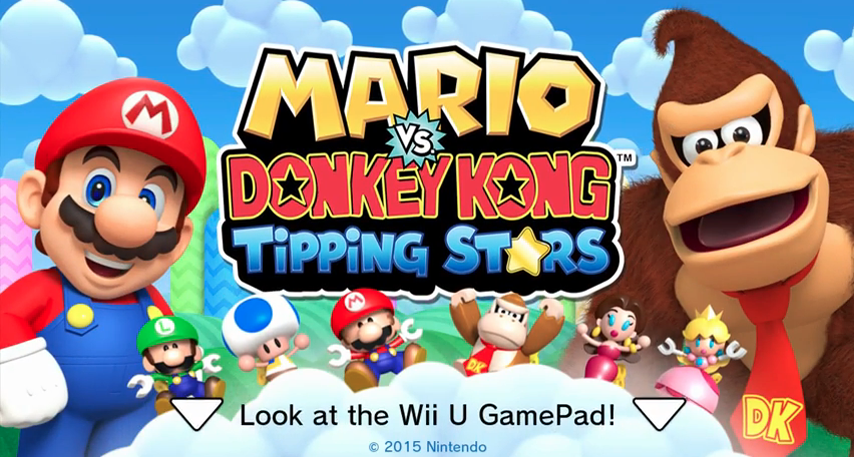
The 3DS title screen.The Wii U title screen.
Items and objects
Everything a Mini can collect, use or be placed on. The first six are resource items you place yourself.
Red GirderPlaced between two matching rivets; works as a floor, ramp or wall.
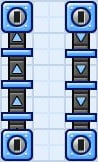
Blue LiftCarries Minis up or down between two rivets. First seen in Dashing Desert.
High SpringThrows a Mini steeply upwards.
Long SpringThrows a Mini in a long, wide arc.
Movable PipeA linked pair that sends Minis from one end to the other; slots into set places.
Pink BlockPlaced and removed at will to build platforms and walls.
Purple ConveyorDragged out between rivets; carries Minis one way and turns back those walking against it.
PickupsAdd girders, lifts or conveyors to your stock when a Mini walks into them.
Coin100 points. Collect every one for a 6,000-point bonus.
Big CoinWorth 1,000 points.
M CoinOne per level, worth 2,000 points.
HammersMake a Mini briefly invincible and let it smash rocks and enemies.
Goal DoorThe exit. Every Mini must get through before it locks.
GirderA fixed platform Minis can pass up through.
ConveyorA fixed belt that carries Minis in the direction of its arrows.
LadderClimbed automatically; Minis that meet on one turn back.
Warp PipeCarries Minis to another part of the level.
Split PipeA colour-coded pipe that sends each Mini its own way.
CannonRotates to aim, fires a Mini and blasts enemies and rocks in its path.
Color SwitchesRed, blue and yellow switches that turn matching blocks on and off.
Magnet GroundLets Minis walk up walls and across ceilings. Introduced in the Orbiting Observatory.
RockA platform that shatters when hit by hammers or a cannon blast.
SpikesBreak any Mini that touches them. Found in almost every level.
Advertisement
Cartoons, Comics & Other Media
A download-only puzzle game did not get comics or cartoons, but it left a few traces elsewhere and borrows freely from older games itself.
Super Smash Bros. UltimateNintendo Switch · 2018Two of the game’s tracks, the title theme and “Rolling Hills A”, are in the Super Mario series music list.
Mini Mario & Friends: amiibo ChallengeWii U and 3DS · 2016Tapping the Mini Mario icon on the title screen of the follow-up opens an advertisement for Tipping Stars.
Play NintendoWebsite pollNintendo’s site for younger players ran a poll asking which character was the mightiest Mini.
Music from older gamesSoundtrackRolling Hills uses the overworld theme of Super Mario Bros. 2 (along with its death and world-clear jingles), Crumbling Cavern the Super Mario Bros. underground theme, Jumpy Jungle “DK Island Swing” from Donkey Kong Country, and Swirling Courtyard the castle theme of Super Mario 64.
The prize of the Shimmering Gold Palace Set in the Workshop Store.
Price: 5,000 stars, more than half the 9,080 needed to buy the whole Store.
MarioToy maker on the chase
The hero, though you never control him.
Seen on the title screen and in cut-scenes, chasing Donkey Kong with his Minis. He gives a cheer when you collect every coin in a level.
Voice only in levels.
Donkey KongKidnapper, or party planner?
Mario’s old rival, here more mischievous than menacing.
Runs off with Pauline in the opening, leaves a trail of toy robots behind him, and turns out to have been organising a surprise party.
His robots: Cannon Kong, Capture Kong and Circus Kong.
Pauline and the ToadsCut-scene cast
Pauline, the original damsel of the 1981 arcade game, and two Toads.
Pauline is carried off at the start; at the end she and the Toads are waiting with Donkey Kong in the darkened party room.
Cut-scenes only.
Enemies and Donkey Kong’s robots
Six enemies and three toy robots. Most can be beaten with Hammers, a slide down a slope or a cannon shot; Thwomps cannot be beaten at all.
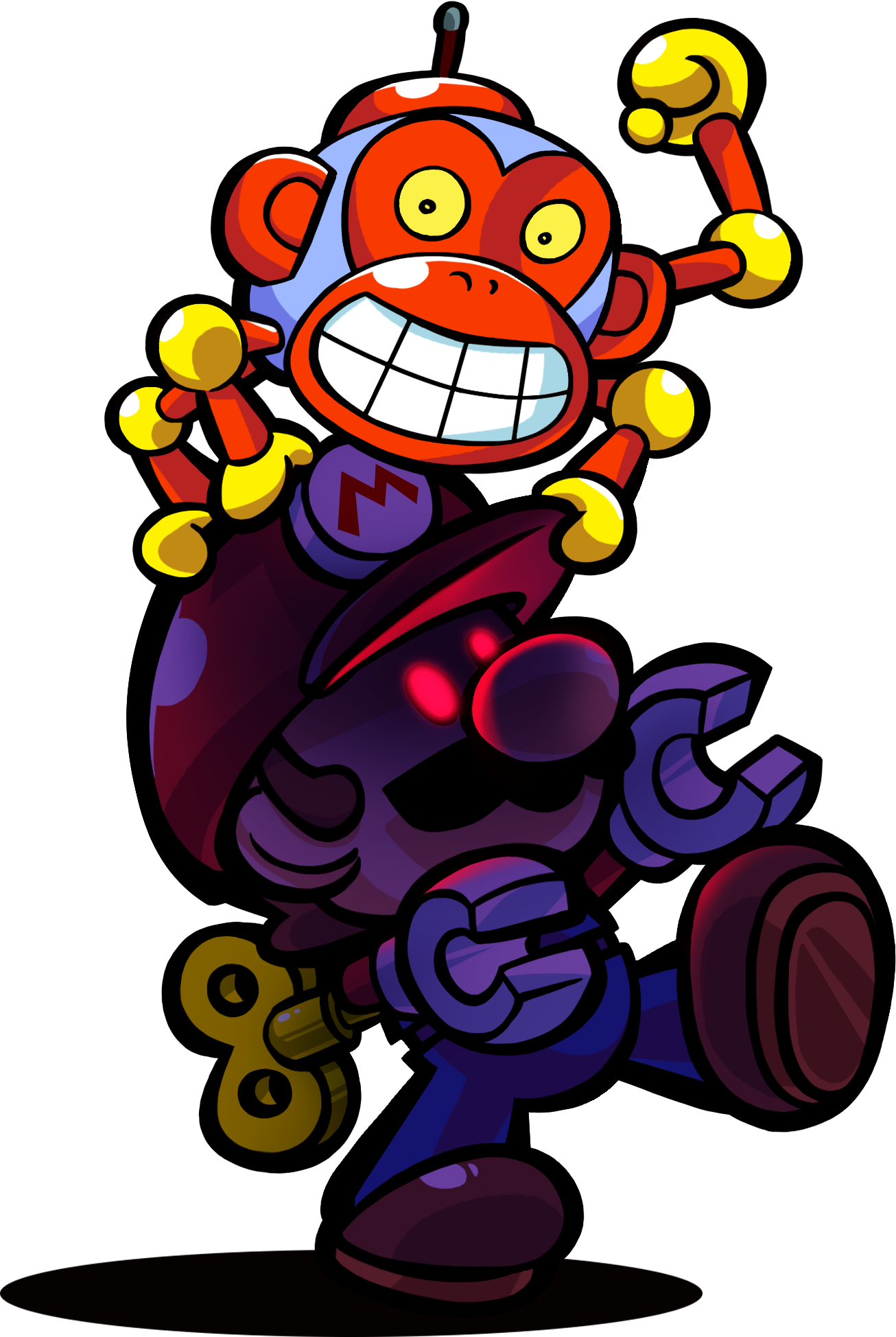
Cursed Mini MarioFinal level of every worldA Mini Mario possessed by a robot monkey. It breaks any Mini it touches and shrugs off hazards; hit it with Hammers, a slide or a cannon to turn it back into a normal Mini.
Shy GuyFrom Level 1-3Paces back and forth and breaks Minis on contact.
ThwompFrom Level 3-3Shakes, then slams down on Minis passing beneath. Indestructible, but a Pink Block underneath stops it.
Fire Piranha PlantFrom Level 4-3Spits bouncing fireballs and can call them back. Hammers or a slide finish it.
Piranha PlantDashing Desert and laterCannot make fireballs, but will spit back any it catches.
PokeyFrom Level 5-3A three-segment cactus that patrols its platform.
Cannon KongRobot · from Level 3-5A giant Donkey Kong cannon that fires any Mini that walks in, in whichever direction it faces.
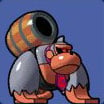
Capture KongRobot · from Dashing DesertWanders about and traps Minis in a barrel; Hammers set them free.
Circus KongRobot · from Level 1-5Keeps tossing Minis into the air until you put a surface in the way or stun it.
Key staff
From the game’s staff credits.
Nintendo Software TechnologyDeveloperThe studio behind the earlier games in the series.
Nintendo SPD Group No. 3Co-developerNintendo’s planning and development group credited alongside NST.
Stephen MortimerDirectorA level designer on earlier Mario vs. Donkey Kong games and director of Mario and Donkey Kong: Minis on the Move; after launch he built the official online levels himself, and went on to direct Mini Mario & Friends: amiibo Challenge.
James PhillipsenAudio directorIn the series’ sound team since the 2004 original; later audio lead on the 2024 Switch remake.
Shigeru MiyamotoSupervisorMario’s creator, credited as a supervisor.
Kensuke TanabeSupervisorAlso credited as a supervisor.
How It Was Made
A web-technology experiment that grew into a full game, made by the studio that has looked after the Minis since 2006.
A tech demo at GDC
The placeholder logo shown at E3 2014.
The game first surfaced at the Game Developers Conference in March 2014, as IGN reported on 21 March, in a demonstration of the Nintendo Web Framework: tools that let developers build Wii U software with web technologies such as HTML5 and JavaScript. The demo had four levels, and all of them survived in some form. D-1 became Level 1-1, D-2 became Level 2-1, D-3 was tweaked into Bonus Level B-7, and D-4 was released after launch, for a limited time, as the official online level “Nintendo 6”.
The finished game kept that foundation. The Cutting Room Floor notes that it is written in JavaScript, which leaves its scripts open to inspection, and that all three regional builds are stamped 22 January 2015. It was also built on the same framework as Mini-Land Mayhem! and reuses many of its graphics, some of them modified.
From “Mario vs. Donkey Kong” to Tipping Stars
Key character artwork released for E3 2014.
In its pre-E3 video presentation on 10 June 2014, Nintendo confirmed a new Mario vs. Donkey Kong for Wii U, due early in 2015, under that plain working title. Everything else was revealed in the Nintendo Direct of 14 January 2015: the full name, a Nintendo 3DS version, levels shared between the two systems, the Cross-Buy offer, and release dates of 5 March in North America and 20 March in Europe.
It was released as planned, on the eShop only outside Japan. Japan had a packaged release on 19 March and Australia followed on 21 March. European shops sold a box, but The Cutting Room Floor notes that it contained only a download code.
Life after launch
An official screenshot released before launch.
Nintendo kept the Community stocked. From launch day until 26 February 2016 it added two official levels a week, credited to director Stephen Mortimer (“Mort”); they appeared in Miiverse’s Nintendo Levels section and were later withdrawn. The 3DS version was patched to 1.0.1 on 1 September 2015 to stop players uploading levels that caused errors in the Community.
The Cutting Room Floor has found leftovers in the data: the tileset and background of Cannon Cove, a world from Mini-Land Mayhem!, and unused music entries for Cannon Cove and Super Skywheel, with no actual audio behind them.
Series Firsts
Checked against the earlier games in the series.
1First Mario vs. Donkey Kong on a home consoleThe five earlier games were on Game Boy Advance, DS, DSi and 3DS; this was the series’ Wii U debut, and its sixth entry.
2Nintendo’s first Cross-Buy gameOne eShop purchase covered both the Wii U and the 3DS version. Nintendo Life and The Cutting Room Floor both name it the first Nintendo-published title to offer this.
3Mini Luigi’s debutThis is usually recorded as Mini Luigi’s first appearance in the series.
4Player-made levels shared across two systemsLevels built on either machine could be played on the other through the shared Miiverse community.
Cheats & Secrets
There are no codes in Tipping Stars, but there is plenty worth knowing.
Getting gold trophies
The game’s own advice: collect every coin, including the M Coin, and reach the door fast. The all-coins bonus (6,000) is bigger than the M Coin (2,000), and each second saved is worth 20 points.
Unlocking the Bonus Levels
They open one at a time as your gold-trophy count rises, at first one per four golds. All 24 need 87 gold trophies, so you will be replaying early levels for gold.
Keep the Minis together
The door locks a few seconds after the first Mini goes in. If one toy is lagging, stall the leaders with a wall or a girder turned on end rather than letting them reach the door.
Breaking a Cursed Mini Mario
Hammers, a slide down a slope or a cannon shot will knock the monkey robot off, and the freed Mini becomes one of yours. It cannot be beaten by spikes or other hazards.
Dealing with Thwomps and fireballs
A Pink Block placed under a Thwomp stops it slamming down (Level 6-3 is built around this), and a Fire Piranha Plant’s bouncing fireballs can be trapped between a wall and a Movable Pipe (Level 4-3).
Spending stars wisely
Since Miiverse closed, the 267 stars in the main game are the only ones there are. The Gameplay Set (170 stars in all) is the only set that adds new mechanics, so buy it first. The Winding Ravine, Swirling Courtyard and Clattering Cabin sets cost 130, 230 and 550 stars in total, and the Shimmering Gold Palace set 8,000, so choose individual items carefully.
Videos
Nintendo’s launch trailer, and the Game Developers Conference demo in which the game first appeared.
Official Nintendo of America launch trailer, March 2015.
Third-party footage by GameXplain of the March 2014 Nintendo Web Framework demo.
Trivia & Interesting Facts
The Japanese title is Mario vs. Donkey Kong: Minna de Mini Land, which translates as “Mini-Land with Everyone”.
The finished logo, in its alternative version with two Minis.Before it had a name, the game was shown at E3 2014 simply as “Mario vs. Donkey Kong” with a placeholder logo. The final logo arrived with the January 2015 Direct.
Mario gives a cheer whenever you collect every coin in a level.
Gold Mini Mario costs 5,000 stars in the Workshop Store, while the whole offline game only yields 267.
All four levels of the March 2014 GDC demo made it out: as Levels 1-1 and 2-1, as Bonus Level B-7, and as the online level “Nintendo 6”.
The official online levels were the director’s own work: Stephen Mortimer uploaded two a week for nearly a year.
The game is written in JavaScript, and all three regional versions were built on 22 January 2015, within about eleven minutes of each other.
Leftover data includes the Cannon Cove tileset from Mini-Land Mayhem! and music entries named for Cannon Cove and Super Skywheel, with no music files behind them.
Dashing Desert’s music is a close relative of Sandstorm Steps from Mini-Land Mayhem!; most of the soundtrack is built on that game’s tracks.
The Golden Mushroom from Mario Kart appears on the banners in Swirling Courtyard.
In the Help text the American version calls the exit the “M Door”; the British English version simply calls it the door.
On Miiverse, the colour behind a Mii showed where the post came from: Japanese posts had a red background, European and Oceanian ones yellow and American ones blue.
The Mini Luigi stamp.Tipping a creator earned you Miiverse stamps featuring the Minis.
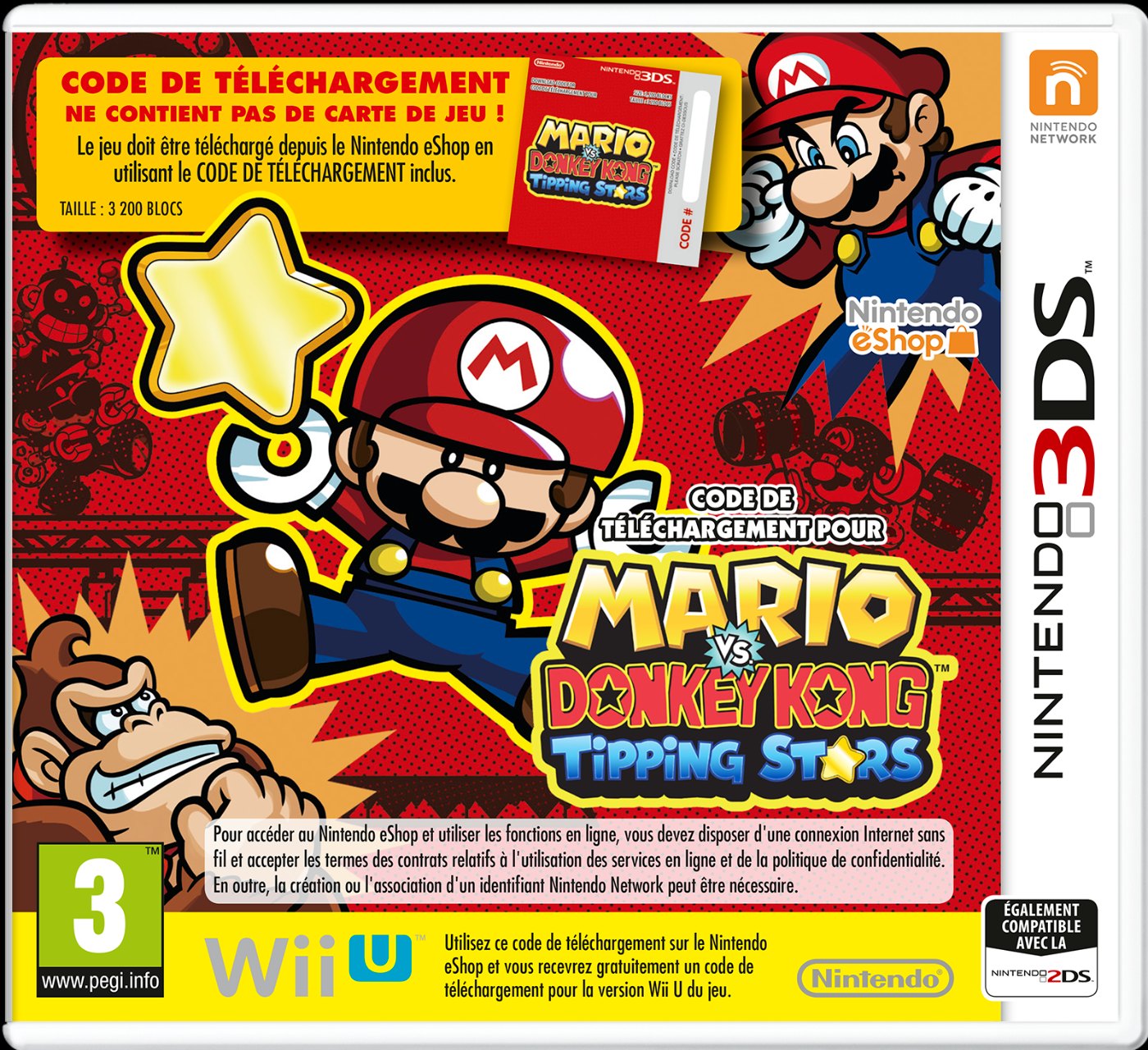
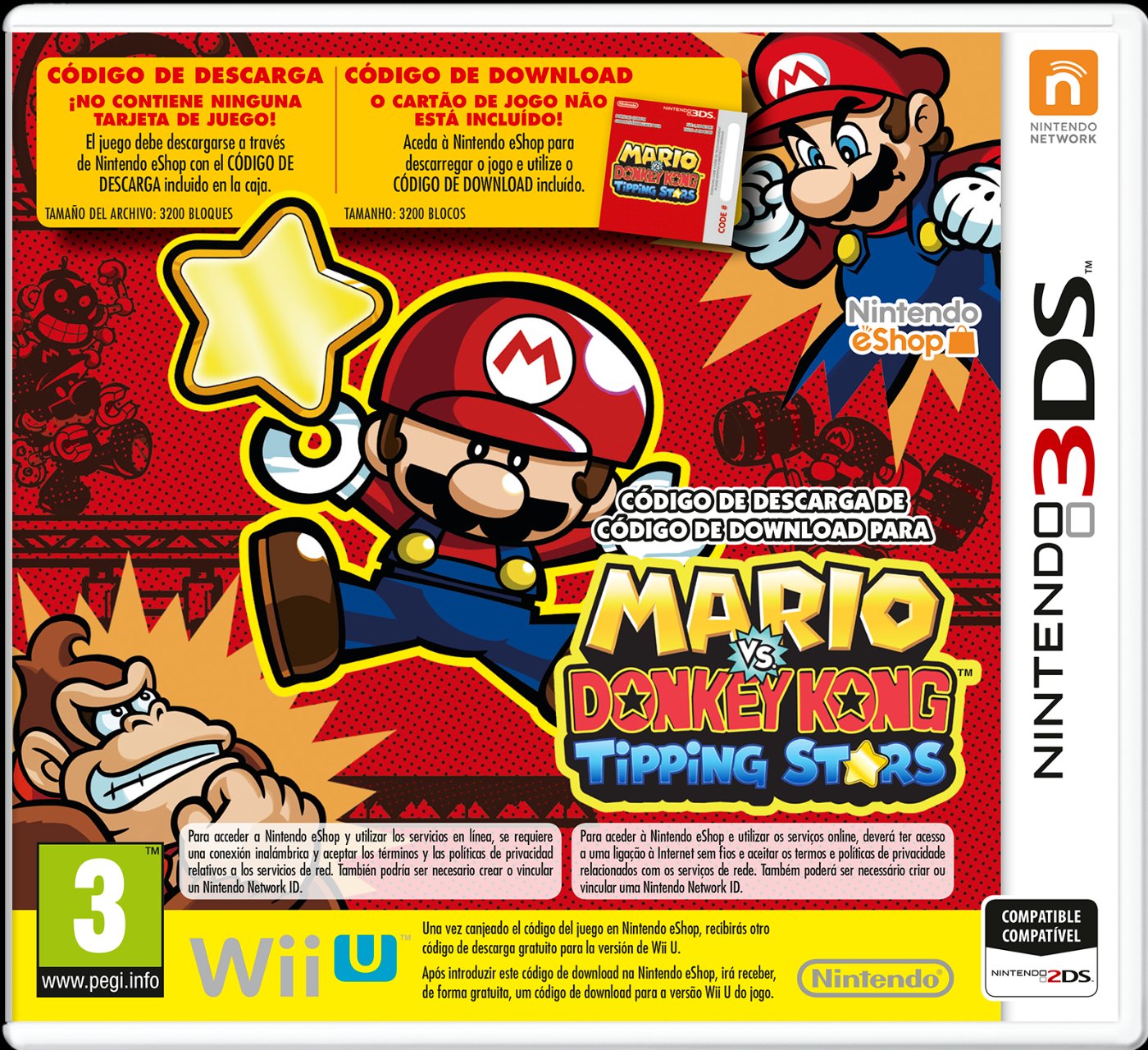
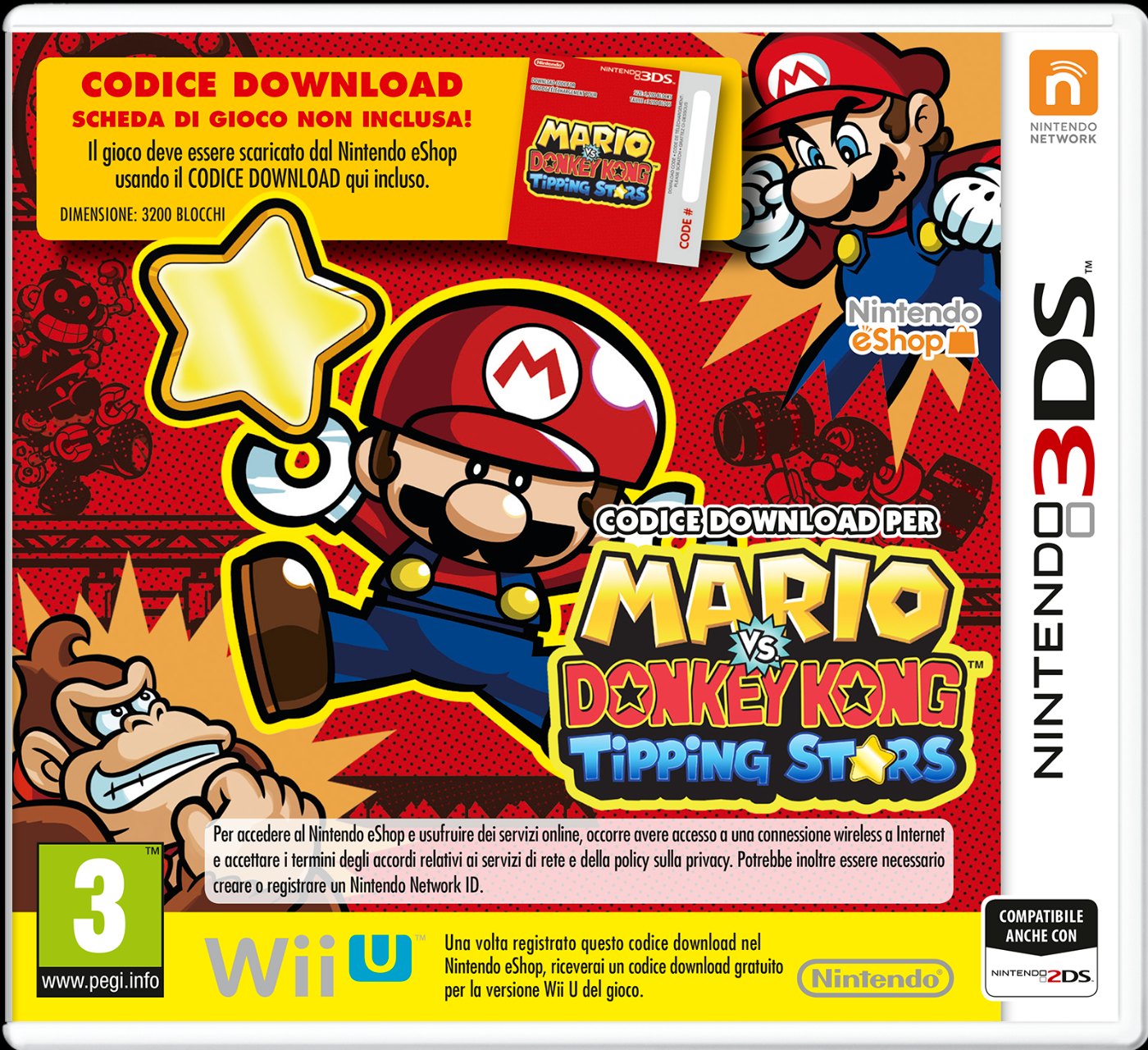
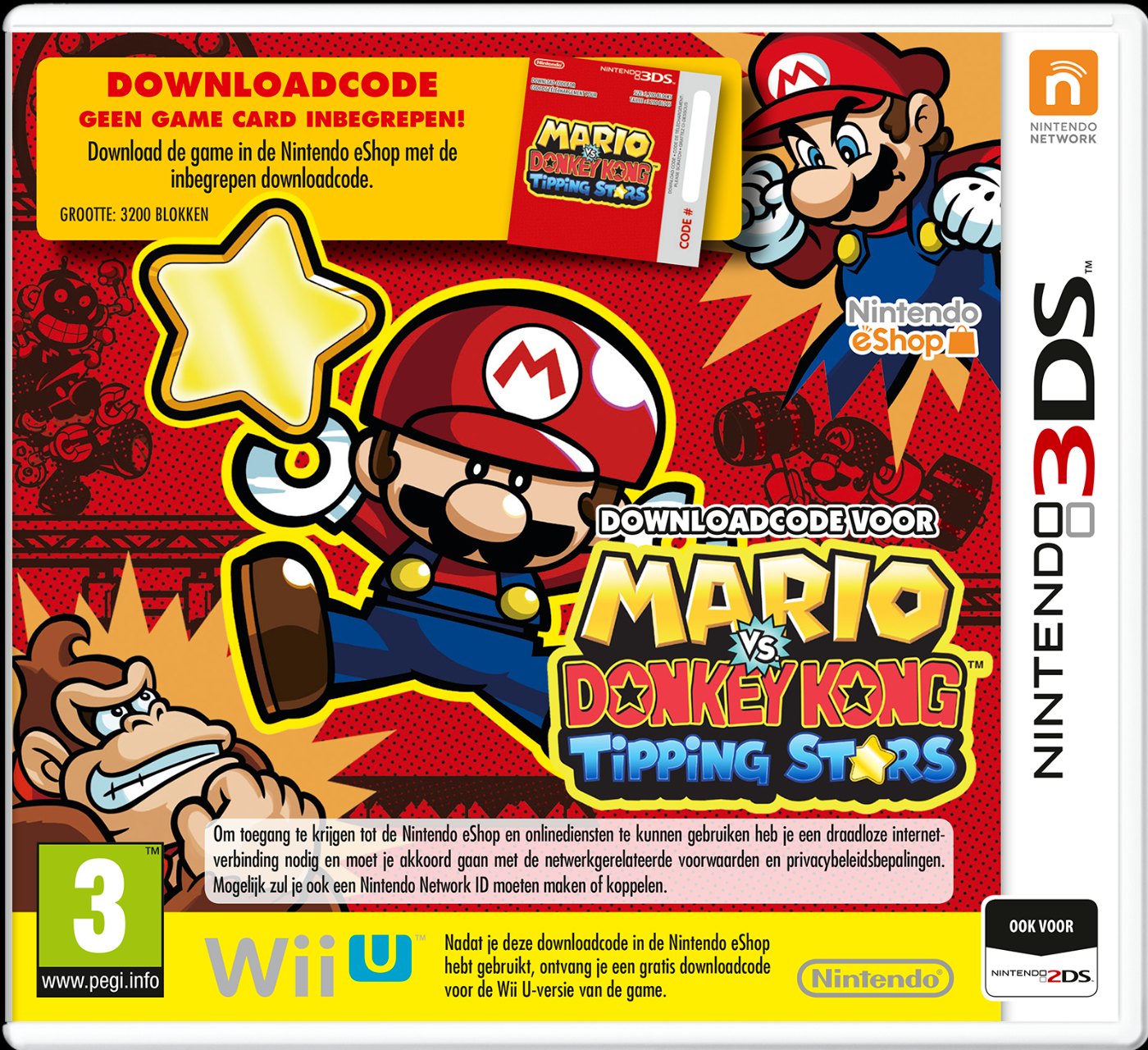
There is no North American box at all: outside Japan the game was sold as a download, and Europe’s separate Wii U and 3DS boxes held only a code.
Two tracks, the title theme and “Rolling Hills A”, made it into Super Smash Bros. Ultimate.
Regional Box Art
There was no North American box. Europe sold boxes holding a download code; Japan had proper packaged copies.
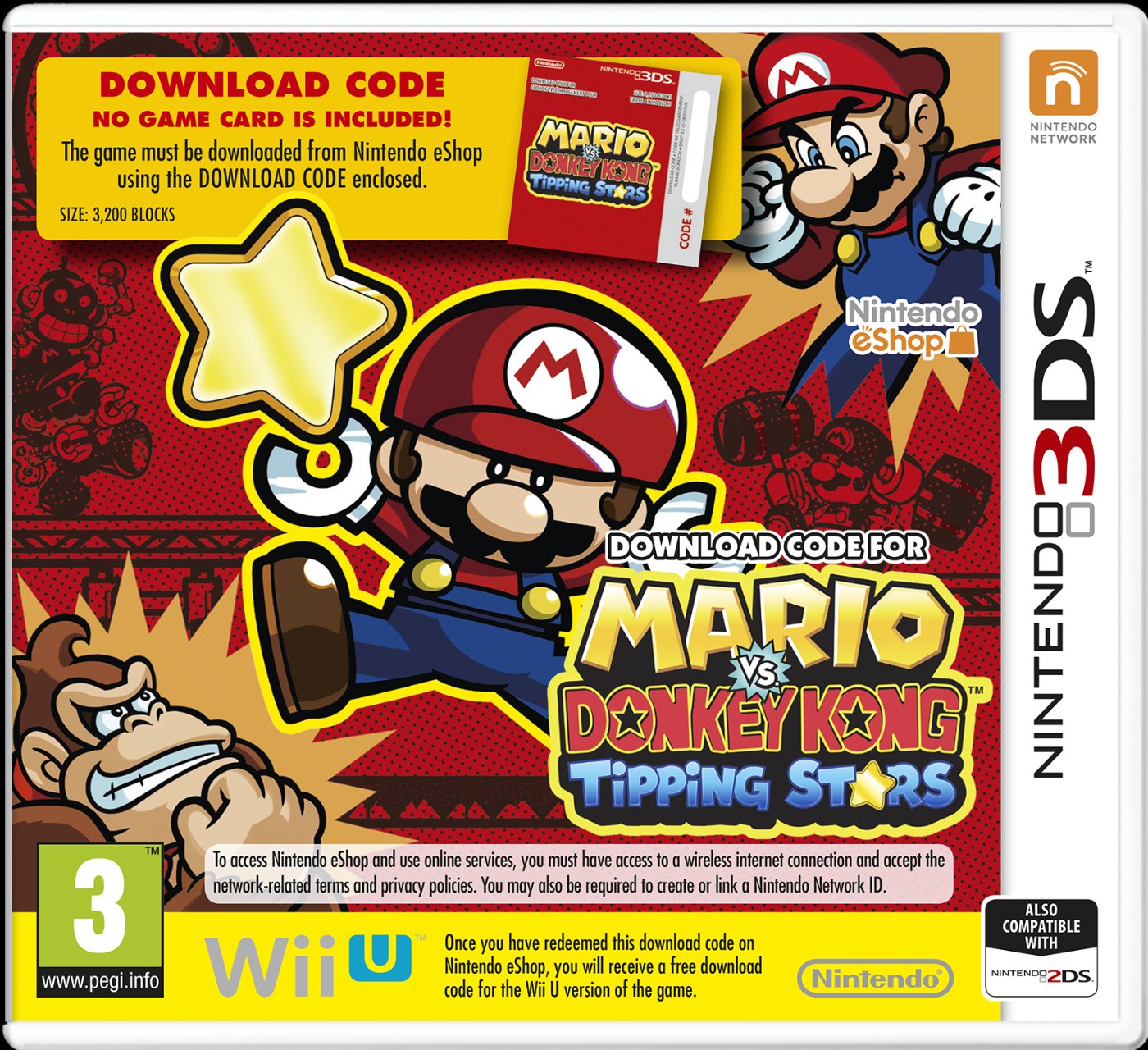
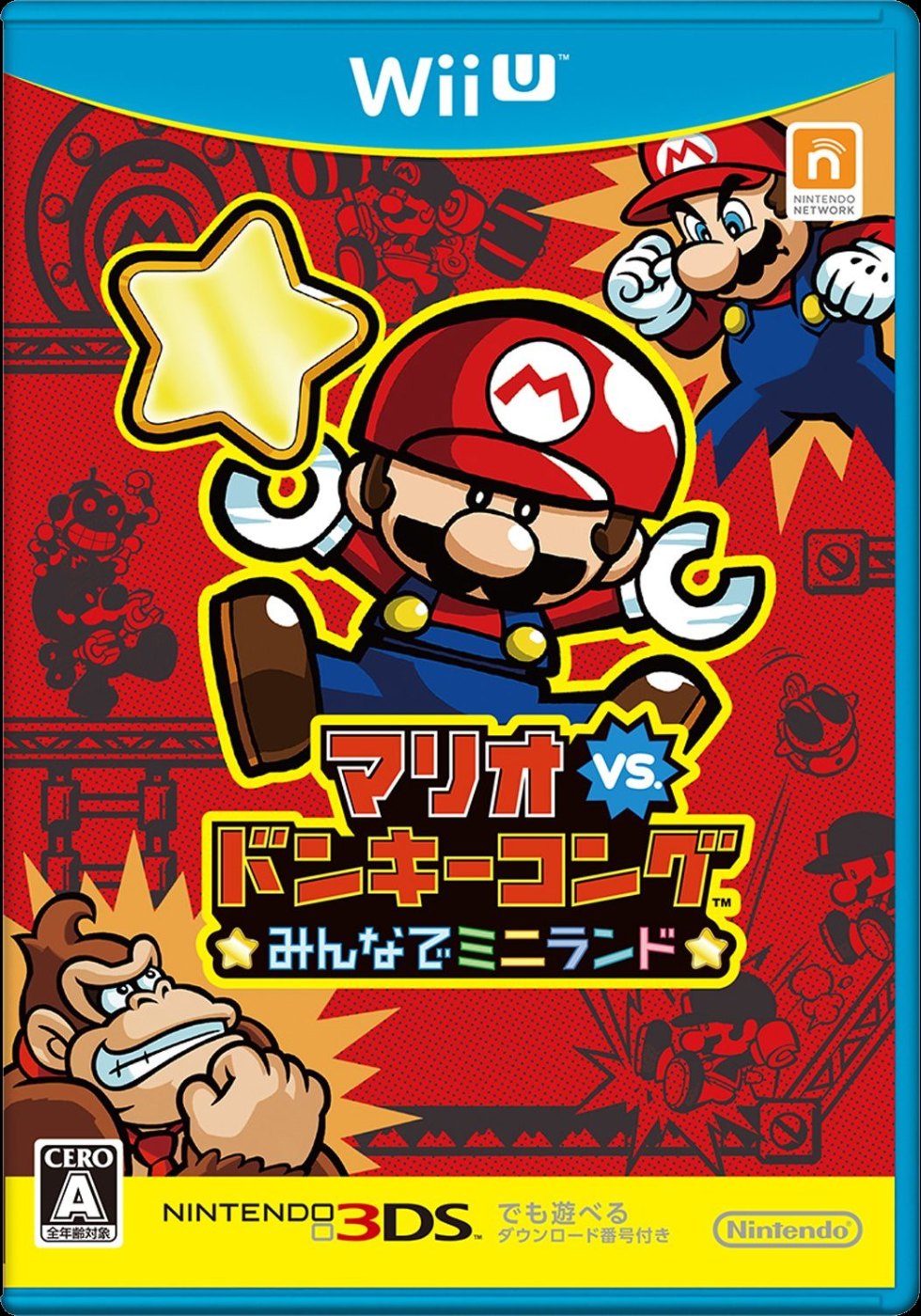
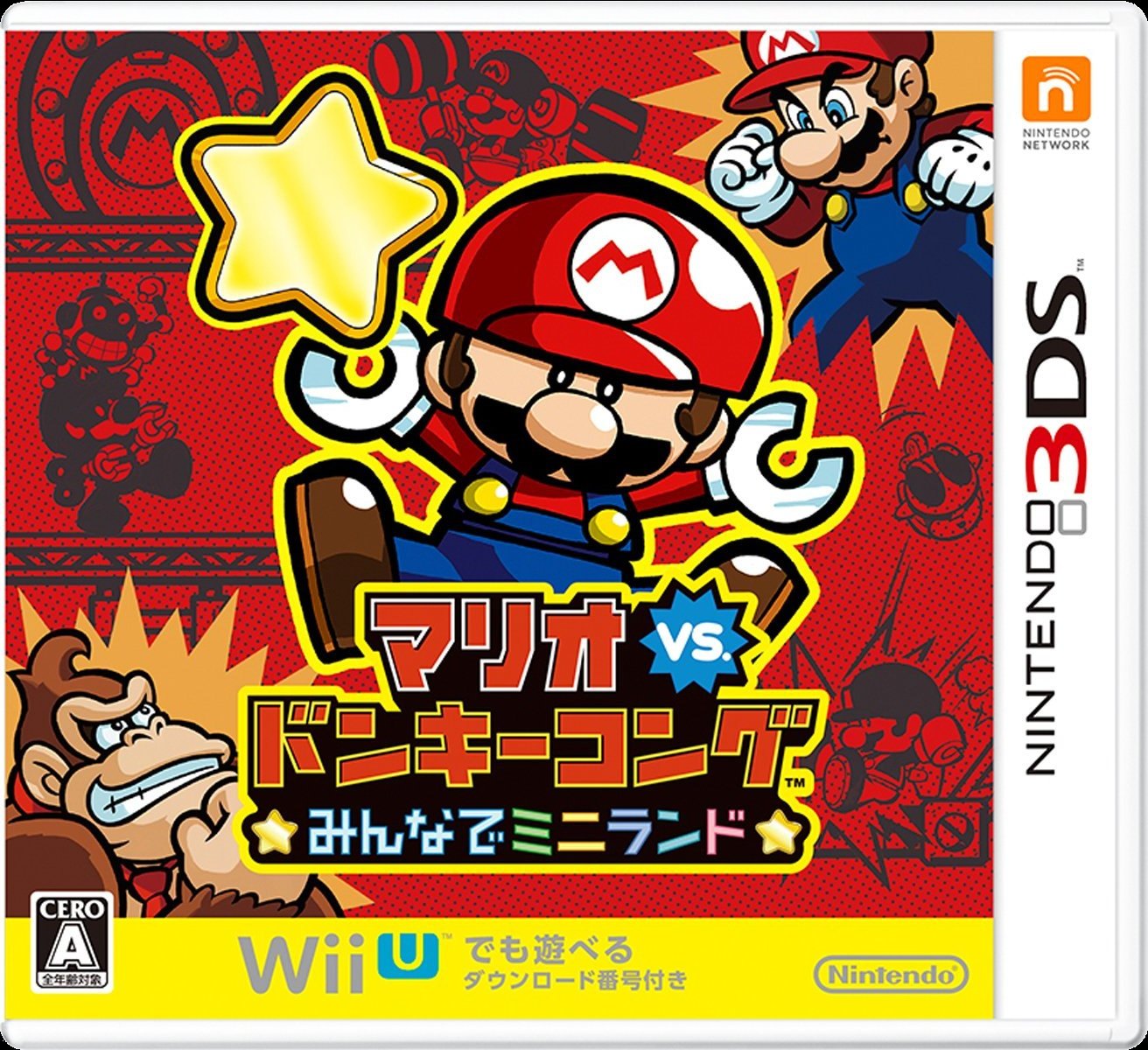
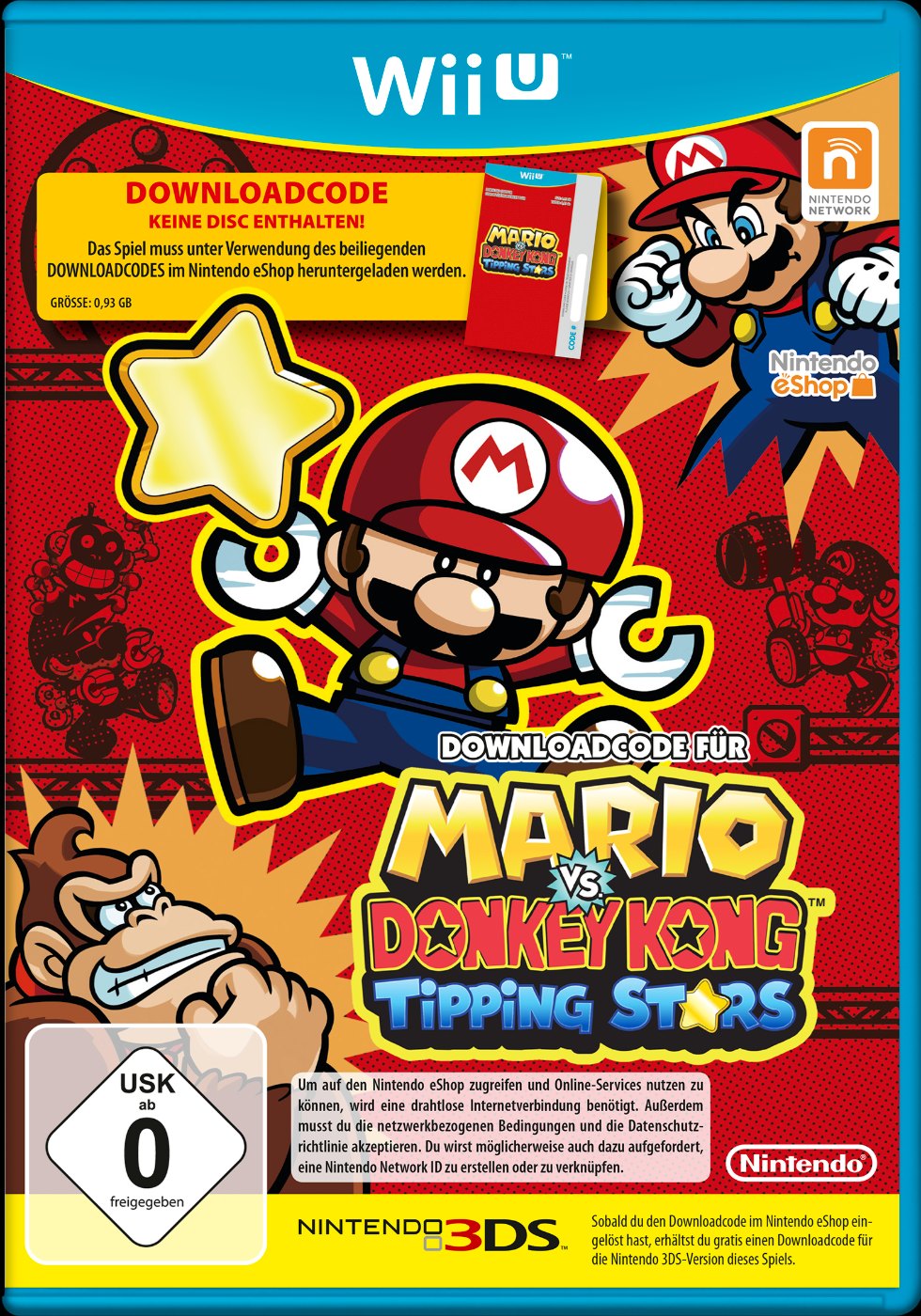
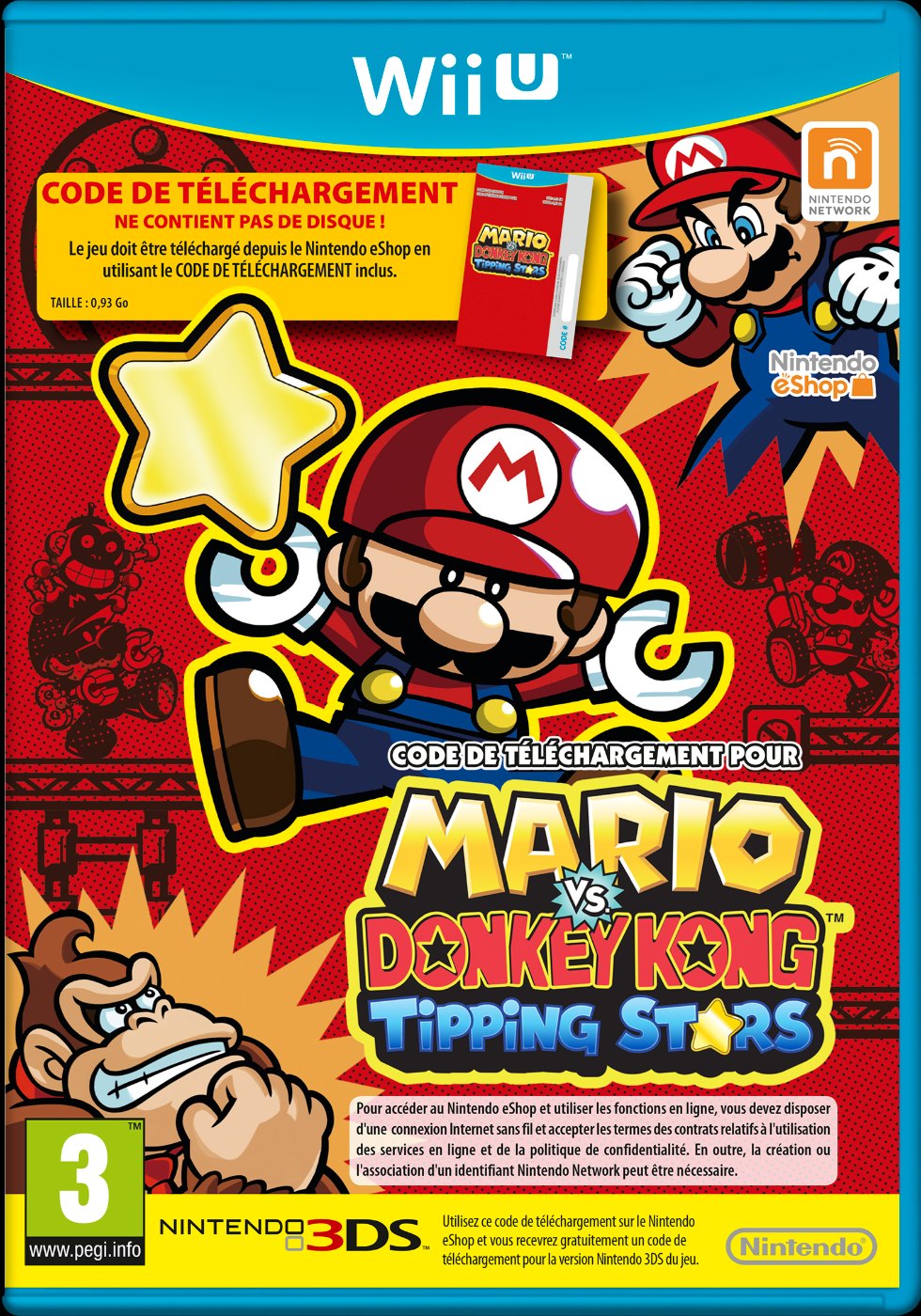
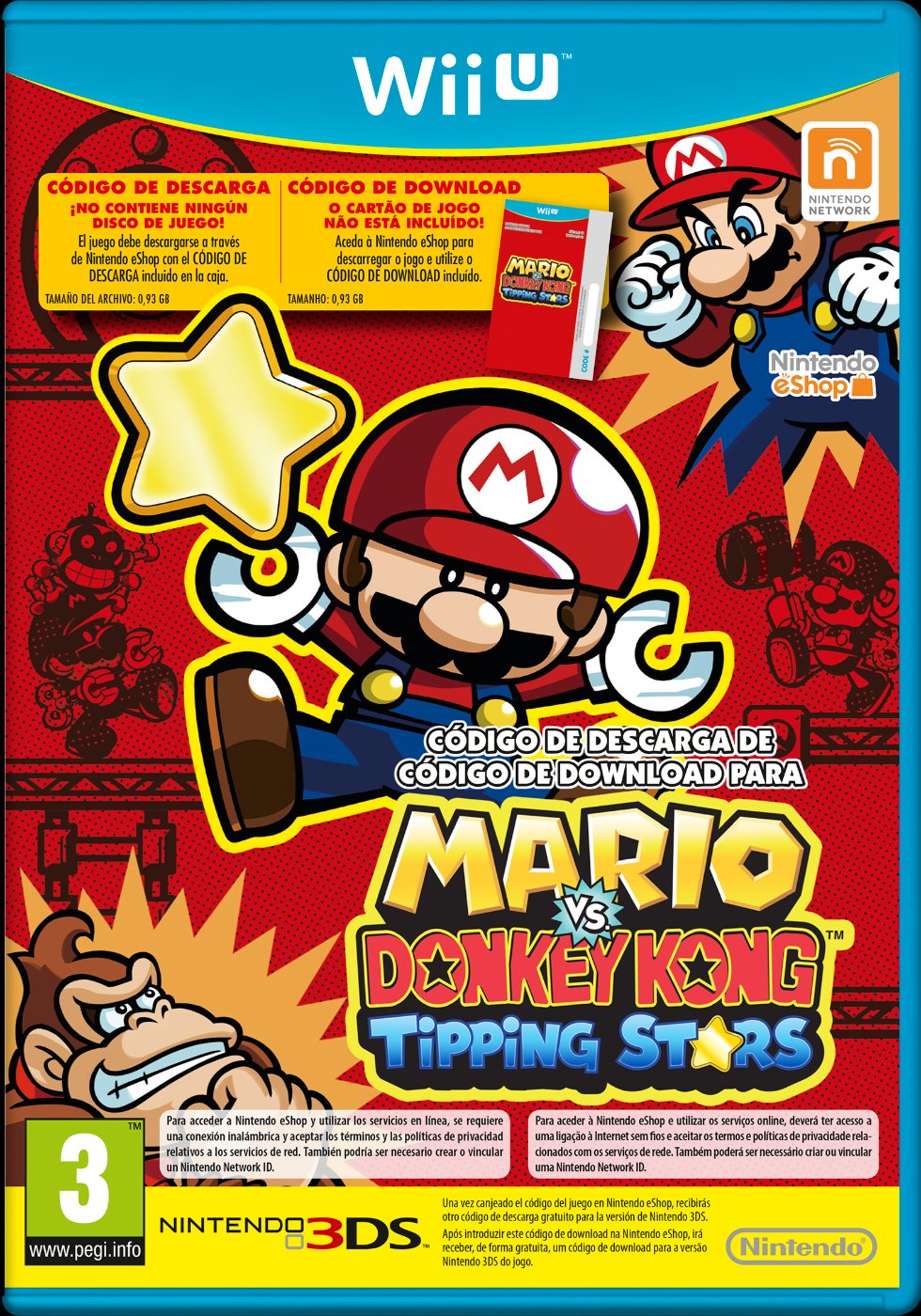
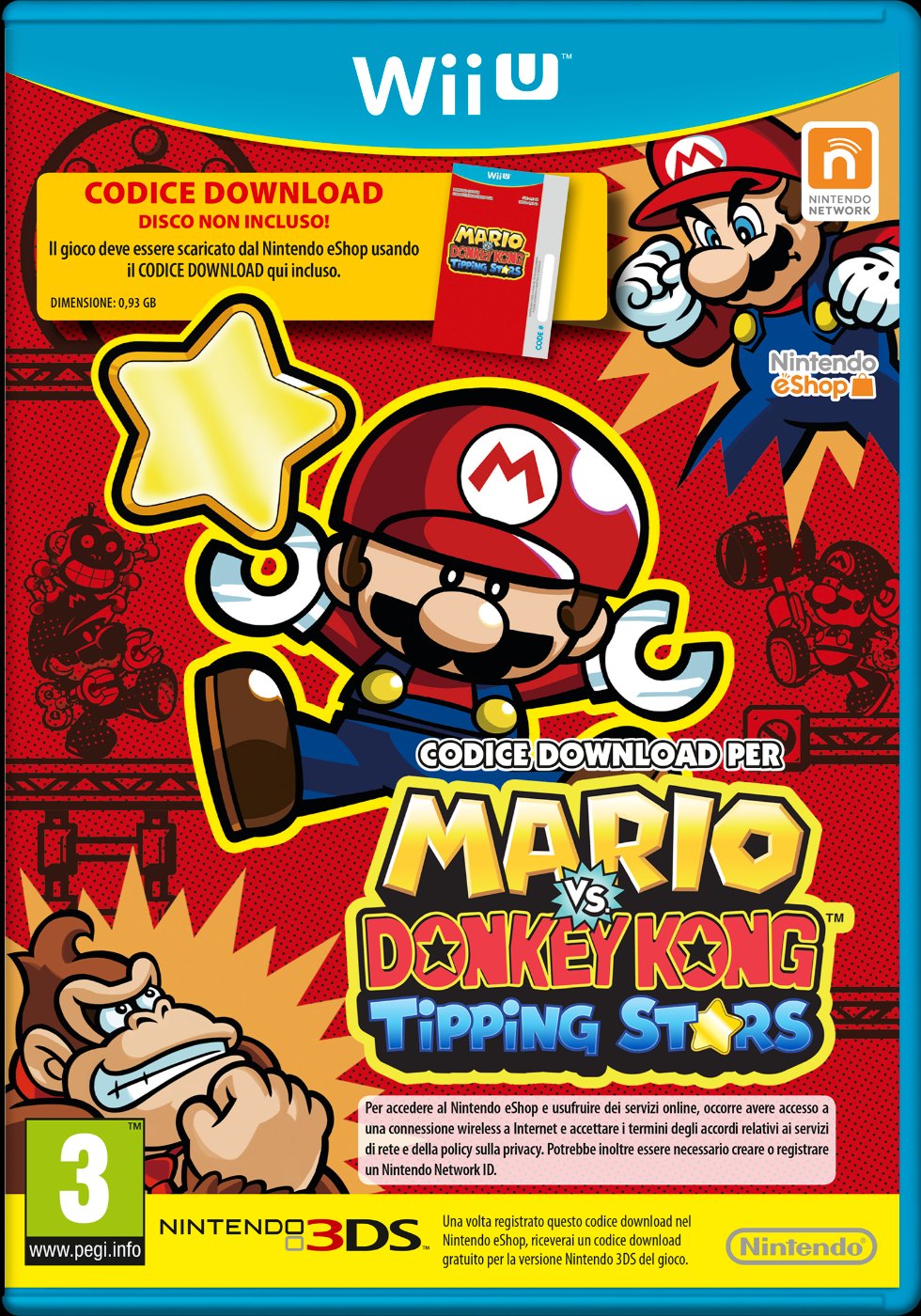
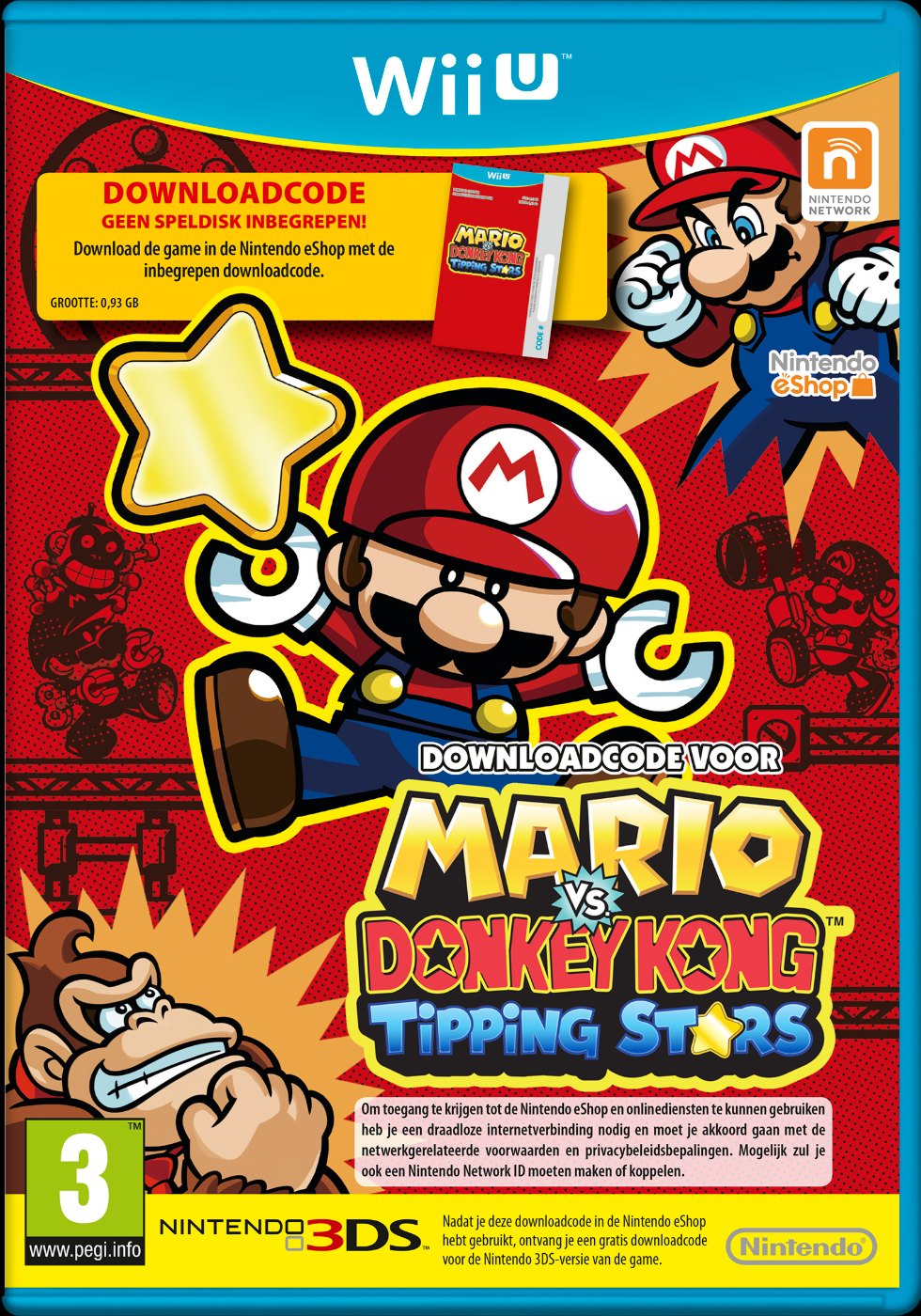
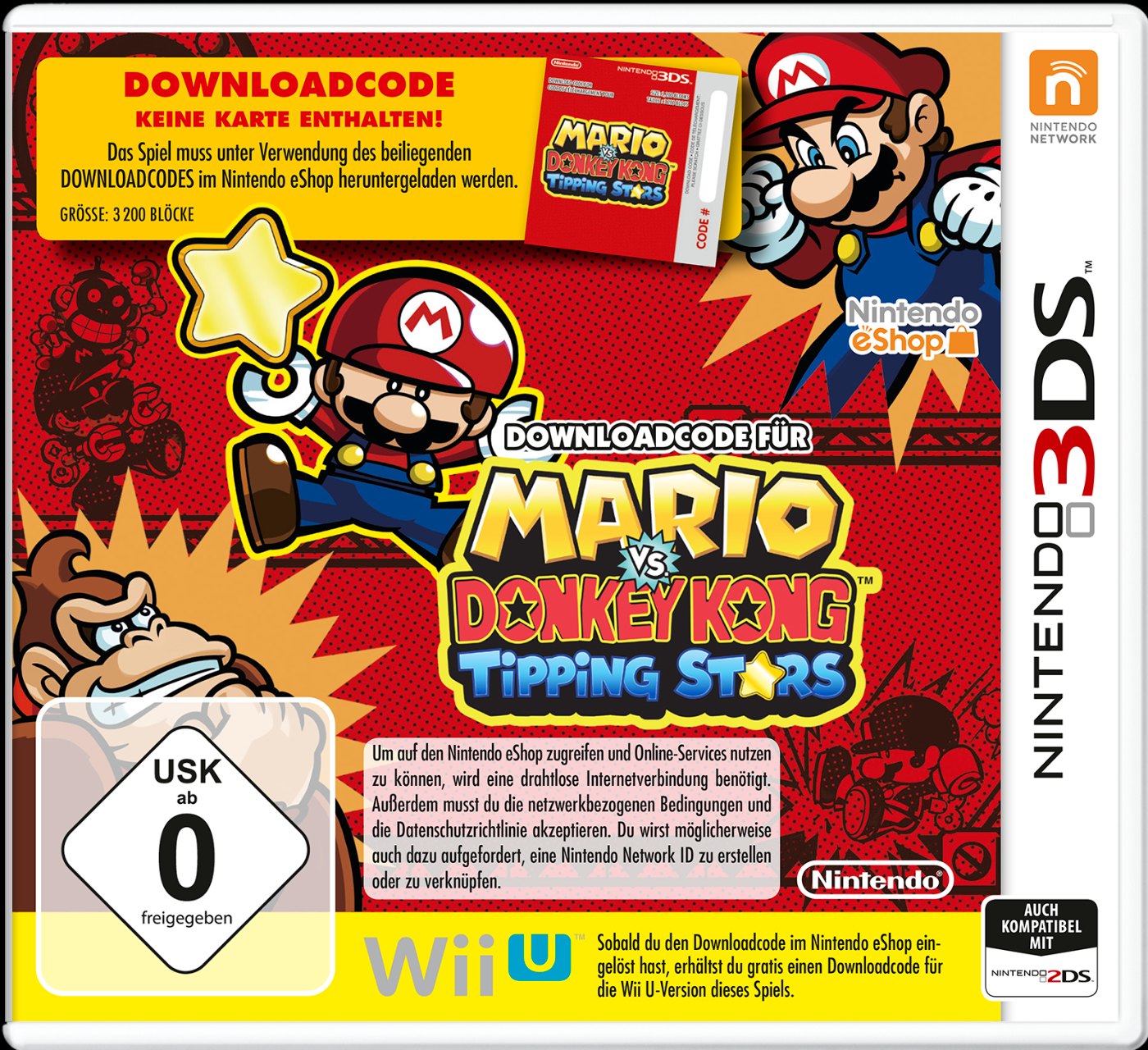
Europe, Wii UThe European box held a download code, not a disc.Europe, Nintendo 3DSThe 3DS box, again with a download code inside.Japan, Wii UJapan had a packaged release on 19 March 2015.Japan, Nintendo 3DSGermany, Wii UFrance, Wii USpain, Wii UItaly, Wii UNetherlands, Wii UGermany, Nintendo 3DSFrance, Nintendo 3DSSpain, Nintendo 3DSItaly, Nintendo 3DSNetherlands, Nintendo 3DSWii U HOME Menu iconNorth America had only the eShop icons.Nintendo 3DS HOME Menu icon
Screenshots
A few more views of both versions.
The Mini toy parade.A Cannon Kong in Level 3-5 on Wii U.Level 3-5 on Nintendo 3DS.Collectables, characters and enemies in the Wii U editor.Editor settings on Wii U.Editor settings on 3DS.Level 2-4, a Multi-Door level.Level 3-7: Hammers against Rock blocks.Level 5-8: a cursed Mini on the Blue Lifts.Level 6-7: Key Mini Mario walled in.Level E2-7: very few parts to work with.Level B-18 in Swirling Courtyard (3DS).
Artwork & Media Gallery
Official artwork and renders for the game.
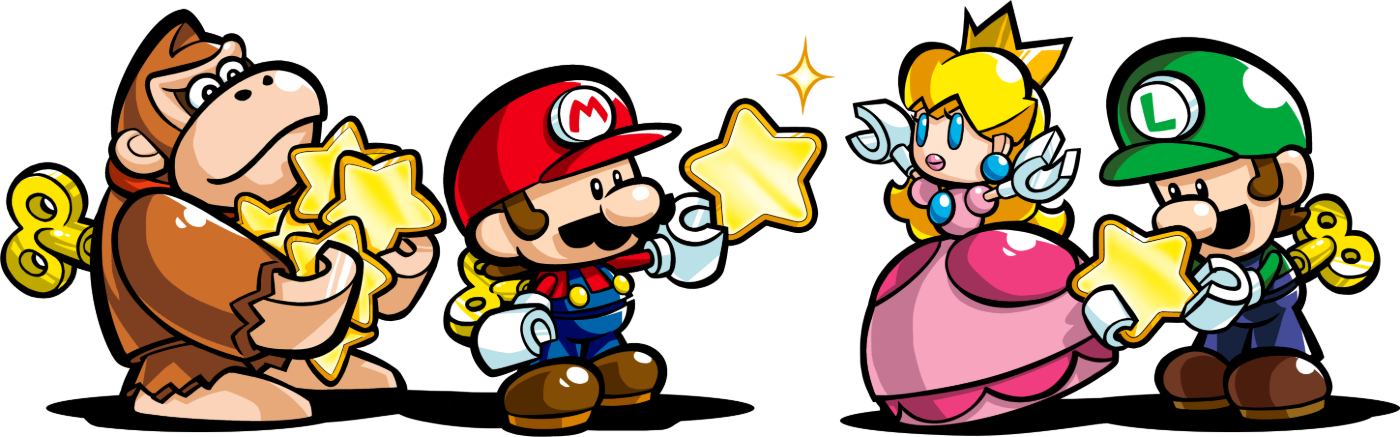
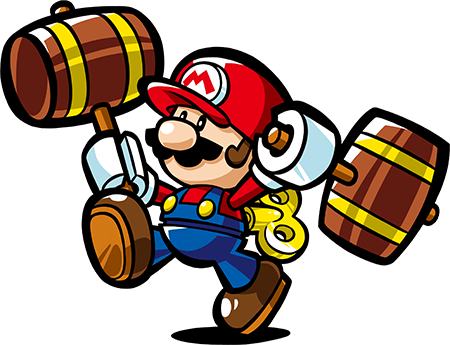
Key artwork without the logo.Mini Mario, Mini Donkey Kong, Mini Peach and Mini Luigi.Mini Mario from the key art.Mini Mario jumping.Mini Mario with Hammers.A Long Spring.Mini Toad, title screen render.Mini Pauline, title screen render.Mini Luigi, title screen render.The Japanese logo.Workshop theme: Rolling Hills.Workshop theme: Orbiting Observatory.Miiverse stamp: Mini Peach.Miiverse stamp: Mini Donkey Kong.Logo of the 2016 follow-up, Mini Mario & Friends: amiibo Challenge.
Legacy & Re-releases
A game whose best feature lived on a server. What remains is still a good puzzle game.
Release and service history
GDC demoMarch 2014Shown as a Nintendo Web Framework demonstration for Wii U.
Announcement10 June 2014Confirmed for Wii U, early 2015, in Nintendo’s pre-E3 video presentation.
Nintendo Direct14 January 2015Title, 3DS version, Cross-Buy and release dates revealed.
Wii U and 3DSMarch 2015North America 5 March, Japan 19 March (also boxed), Europe 20 March (boxed download codes alongside the eShop), Australia 21 March.
3DS update 1.0.11 September 2015Blocked uploads of levels that caused errors in the Community.
Official levels end26 February 2016Last of the twice-weekly Nintendo levels.
Miiverse closes8 November 201715:00 Japan time (10pm on 7 November, Pacific time): sharing, tipping and the Community end.
eShop closure27 March 2023Wii U and 3DS eShop purchases end; the game can no longer be bought.
Nintendo NetworkApril 2024Online services for Wii U and 3DS shut down.
Mini Mario & Friends: amiibo Challenge
The Minis’ next outing came from the same team and the same director. Mini Mario & Friends: amiibo Challenge was a free download for Wii U and 3DS, released in Japan on 28 January 2016 and elsewhere on 28 April 2016. In North America anyone buying an amiibo at Amazon, Best Buy or GameStop from 25 March got early access. Tapping an amiibo chose which of the Minis you guided, and some figures unlocked their own levels and abilities. By most counts it is the seventh game in the series and the first to support amiibo. It was withdrawn from sale when the eShops closed in 2023.
The long pause, and a remake
After amiibo Challenge the series went quiet. When it returned, at the September 2023 Nintendo Direct, it was to remake the 2004 Game Boy Advance original for Switch rather than a new Minis adventure. Mario vs. Donkey Kong arrived on 16 February 2024, the first game to carry the series name since Tipping Stars, nearly nine years earlier, and again made by Nintendo Software Technology. For the original that started it all, see the GBA page; for the DS game that Tipping Stars grew out of, see Mini-Land Mayhem!.
Reviews & Sales
Sales
Nintendo has not published a sales figure for Tipping Stars, and as a download-only game outside Japan it never appeared in the retail charts. What is on record is the price: $19.99 in North America and £17.99 in the UK, for both versions together. The eShop stopped selling it on 27 March 2023.
70Metacritic, Wii U (26 reviews)
68.85%GameRankings, 3DS
2 for 1Cross-Buy: Wii U + 3DS
$19.99launch price, North America
Reviews
Scores as listed in Wikipedia’s review table; Metacritic averaged 70 for the Wii U version.
The fans liked it more than the generalists. Nintendo Life’s Alex Olney gave both versions 8/10, calling the game “a hugely enjoyable action puzzler with some really fantastic ideas and mechanics” and singling out the sharing tools, whose slick interface replaced the clunky QR codes of games like Pushmo World. Damien McFerran at TrustedReviews was struck by how forward-thinking Nintendo had been online and liked the soundtrack, though the graphics looked to him like a generic mobile game.
The doubters made the same point in different ways: this was the Minis formula once more, with few new ideas. IGN’s Brendan Graeber thought Cursed Mini Mario the best addition but felt the star-tipping worked better in theory, because the community filled up with short levels built to farm stars, crowding out the careful designers. Electronic Gaming Monthly also wanted more invention but still found the formula solid and fun, and GameSpot and Destructoid both scored it 5/10. OpenCritic records 38 per cent of critics recommending it.
SLB User Reviews
Mario vs. Donkey Kong: Tipping Stars has yet to receive a community review on Super Luigi Bros.
If you’ve played Mario vs. Donkey Kong: Tipping Stars and would like to submit a review, please get in touch.
To provide the best experiences, we use technologies like cookies to store and/or access device information. Consenting to these technologies will allow us to process data such as browsing behavior or unique IDs on this site. Not consenting or withdrawing consent, may adversely affect certain features and functions.
Functional
Always active
The technical storage or access is strictly necessary for the legitimate purpose of enabling the use of a specific service explicitly requested by the subscriber or user, or for the sole purpose of carrying out the transmission of a communication over an electronic communications network.
Preferences
The technical storage or access is necessary for the legitimate purpose of storing preferences that are not requested by the subscriber or user.
Statistics
The technical storage or access that is used exclusively for statistical purposes.The technical storage or access that is used exclusively for anonymous statistical purposes. Without a subpoena, voluntary compliance on the part of your Internet Service Provider, or additional records from a third party, information stored or retrieved for this purpose alone cannot usually be used to identify you.
Marketing
The technical storage or access is required to create user profiles to send advertising, or to track the user on a website or across several websites for similar marketing purposes.

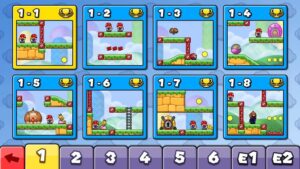 World 1: Rolling Hills8 levels · finale: Cursed Mini Mario (1-8)Red Girders (1-1, 1-2), Hammers (1-3), Mini Peach (1-4), Circus Kongs (1-5), ladders (1-6), Key Mini Mario (1-7).
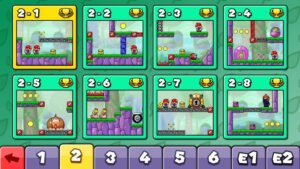 World 2: Jumpy Jungle8 levels · finale: Cursed Mini Mario (2-8)Horizontal springs (2-1), blue switches (2-2), vertical springs and Circus Kongs (2-5), the first cannons (2-6).
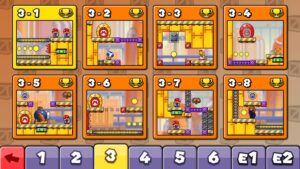 World 3: Runaway Warehouse8 levels · finale: Cursed Mini Mario (3-8)Conveyors (3-1), Purple Conveyors (3-2), Thwomps (3-3), Cannon Kongs (3-5), Color Switches (3-6), Rock blocks (3-7).
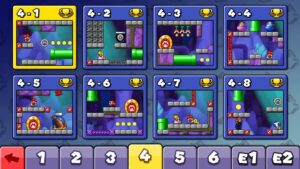 World 4: Crumbling Cavern8 levels · finale: Cursed Mini Mario (4-8)Movable Pipes (4-1), rock walls and cannons (4-2), Fire Piranha Plants (4-3), Cannon Kong passages (4-5).
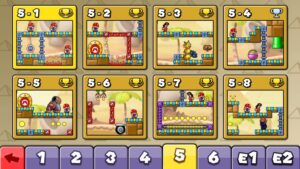 World 5: Dashing Desert8 levels · finale: Cursed Mini Mario (5-8)Blue Lifts (5-1), Pokeys (5-3), a Capture Kong rescue (5-5), a gauntlet of Fire Piranha Plants (5-6).
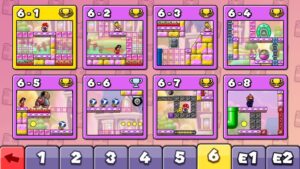 World 6: Twilight Valley8 levels · finale: Cursed Mini Mario (6-8), then the endingPink Blocks (6-1), Thwomp-stopping (6-3), Capture Kongs (6-5), cannons and pipes (6-6), a walled-in Key Mini Mario (6-7).
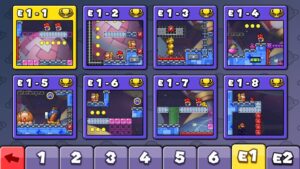 World E1: Orbiting Observatory8 levels · extra world · finale: Cursed Mini Mario (E1-8)Magnet Ground (E1-1, E1-2), Magnet Switches and Pokeys (E1-3), Cannon and Circus Kongs (E1-5).
 World E2: Orbiting Observatory8 levels · extra world · finale: Cursed Mini Mario (E2-8)The final exam: pipes, Fire Piranha Plants (E2-3), a Capture Kong (E2-5) and a Thwomp passage with almost no parts (E2-7).
 Bonus 3B-17 to B-24 · all 24 need 87 gold trophiesThe four Workshop Store backgrounds, ending in the Shimmering Gold Palace.
 Winding RavineBonus Levels B-15 to B-17 · Workshop themeRocky peaks and giant mushrooms above the clouds at dusk.
 Swirling CourtyardBonus Levels B-18 to B-20 · Workshop themeStar-patterned arches near Peach’s Castle, to a remix of the castle theme from Super Mario 64.
 Clattering CabinBonus Levels B-21 to B-23 · Workshop themeA gloomy Gothic house of torches, old furniture and a grandfather clock.
 Shimmering Gold PalaceBonus Level B-24 · Workshop themePiles of treasure in a gilded palace: the game’s last level.
 Editor LandWorkshop onlyThe plain grid background the editor starts with; no built-in level uses it.

 Red GirderPlaced between two matching rivets; works as a floor, ramp or wall.
 Blue LiftCarries Minis up or down between two rivets. First seen in Dashing Desert.
 High SpringThrows a Mini steeply upwards.
 Long SpringThrows a Mini in a long, wide arc.
 Movable PipeA linked pair that sends Minis from one end to the other; slots into set places.
 Pink BlockPlaced and removed at will to build platforms and walls.
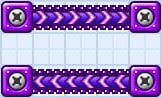 Purple ConveyorDragged out between rivets; carries Minis one way and turns back those walking against it.
 PickupsAdd girders, lifts or conveyors to your stock when a Mini walks into them.
 Coin100 points. Collect every one for a 6,000-point bonus.
 Big CoinWorth 1,000 points.
 M CoinOne per level, worth 2,000 points.
 HammersMake a Mini briefly invincible and let it smash rocks and enemies.
 Goal DoorThe exit. Every Mini must get through before it locks.
 GirderA fixed platform Minis can pass up through.
 ConveyorA fixed belt that carries Minis in the direction of its arrows.
 LadderClimbed automatically; Minis that meet on one turn back.
 Warp PipeCarries Minis to another part of the level.
 Split PipeA colour-coded pipe that sends each Mini its own way.
 CannonRotates to aim, fires a Mini and blasts enemies and rocks in its path.
 Color SwitchesRed, blue and yellow switches that turn matching blocks on and off.
 Magnet GroundLets Minis walk up walls and across ceilings. Introduced in the Orbiting Observatory.
 RockA platform that shatters when hit by hammers or a cannon blast.
 SpikesBreak any Mini that touches them. Found in almost every level.
 Mini Mario & Friends: amiibo ChallengeWii U and 3DS · 2016Tapping the Mini Mario icon on the title screen of the follow-up opens an advertisement for Tipping Stars.
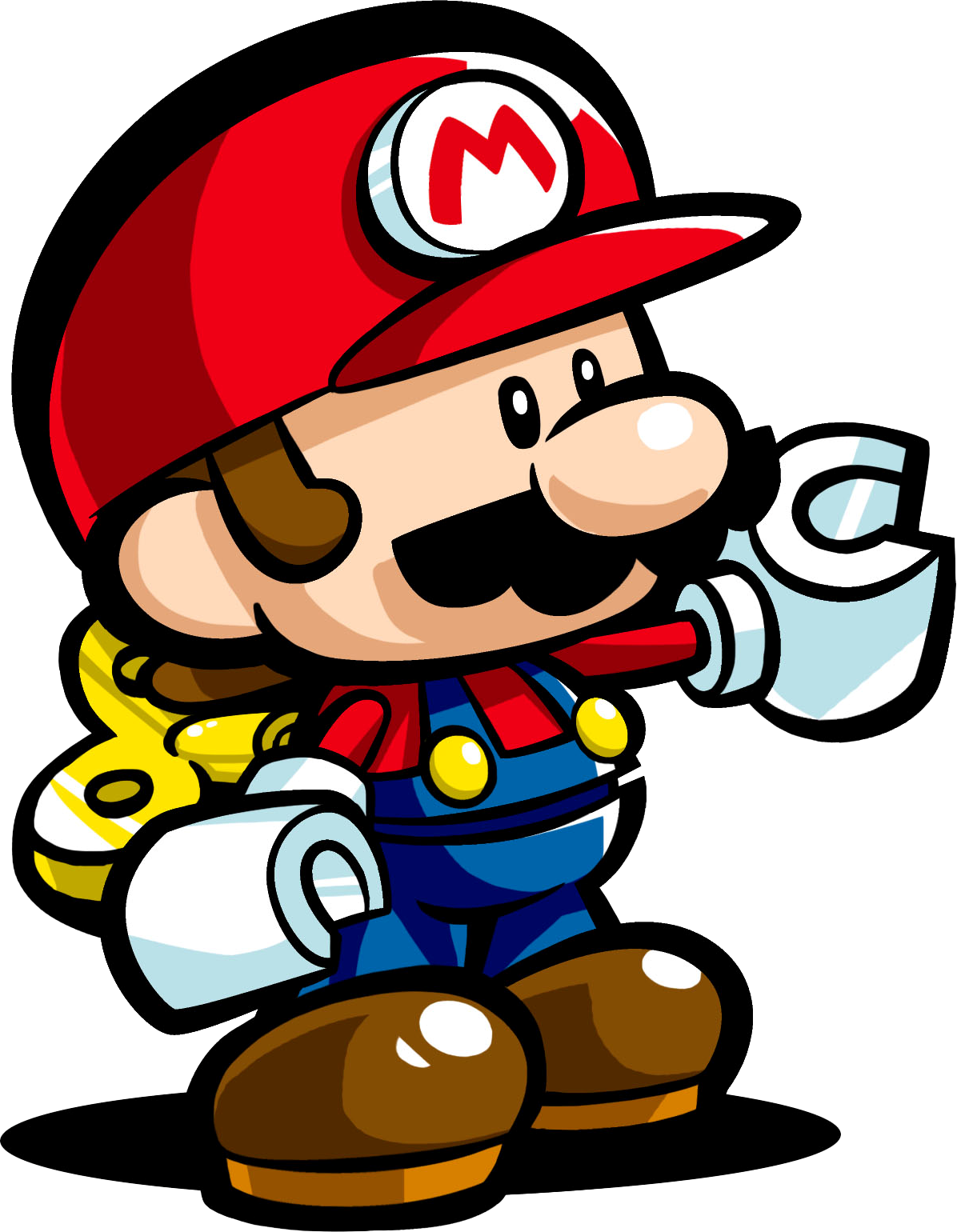 Mini MarioThe star of the show
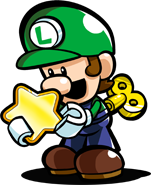 Mini LuigiNew to the toy box
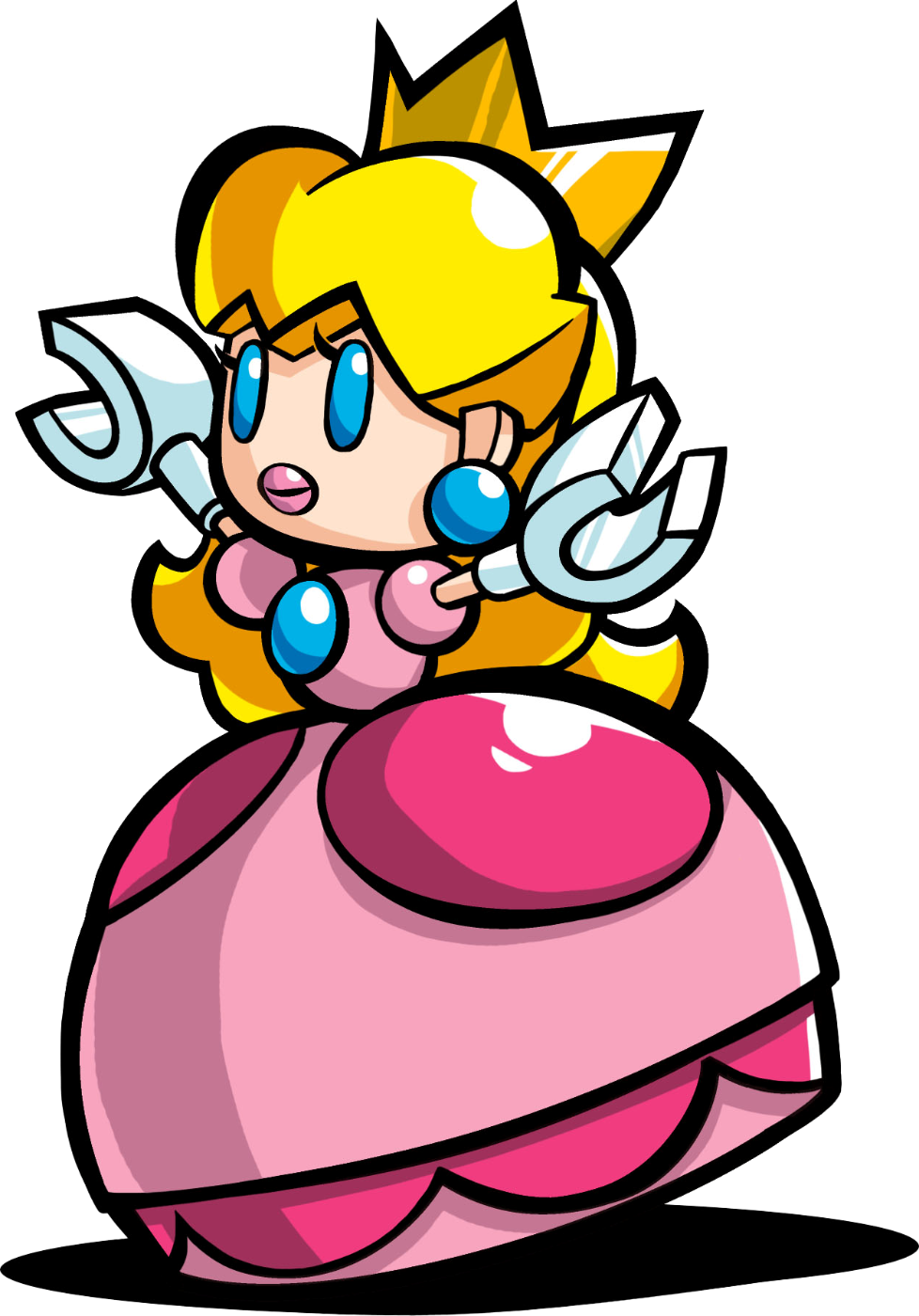 Mini PeachFreed in Level 1-4
 Mini ToadWarehouse worker
 Mini PaulineTop of the Gameplay Set
 Mini Donkey KongRedesigned
 Key Mini MarioOpens the door
 Gold Mini MarioThe most expensive toy
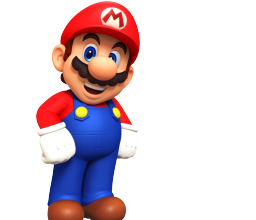 MarioToy maker on the chase
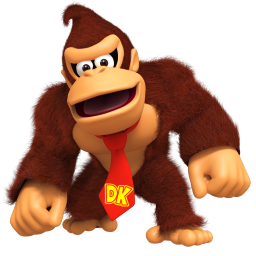 Donkey KongKidnapper, or party planner?
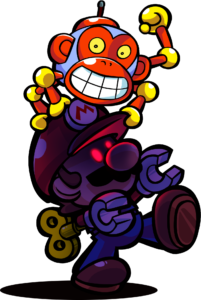 Cursed Mini MarioFinal level of every worldA Mini Mario possessed by a robot monkey. It breaks any Mini it touches and shrugs off hazards; hit it with Hammers, a slide or a cannon to turn it back into a normal Mini.
 Shy GuyFrom Level 1-3Paces back and forth and breaks Minis on contact.
 ThwompFrom Level 3-3Shakes, then slams down on Minis passing beneath. Indestructible, but a Pink Block underneath stops it.
 Fire Piranha PlantFrom Level 4-3Spits bouncing fireballs and can call them back. Hammers or a slide finish it.
 Piranha PlantDashing Desert and laterCannot make fireballs, but will spit back any it catches.
 PokeyFrom Level 5-3A three-segment cactus that patrols its platform.
 Cannon KongRobot · from Level 3-5A giant Donkey Kong cannon that fires any Mini that walks in, in whichever direction it faces.
 Capture KongRobot · from Dashing DesertWanders about and traps Minis in a barrel; Hammers set them free.
 Circus KongRobot · from Level 1-5Keeps tossing Minis into the air until you put a surface in the way or stun it.