Arcade1981Nintendo R&D1PlatformerMario’s first appearanceAbout 132,000 cabinetsKill screen at level 22World Video Game Hall of Fame4 stages
Donkey Kong
This is where it all starts. Donkey Kong was first shown to Japanese arcade operators on 9 July 1981 and reached American bars and arcades that summer, built in a hurry to rescue Nintendo of America from a warehouse full of unsold Radar Scope machines. A young artist called Shigeru Miyamoto, supervised by Gunpei Yokoi, turned an idea for a Popeye game into something entirely his own: a big ape, a kidnapped Lady and a little carpenter in a red cap who could do one thing the hero of no earlier platform game could, which was jump. The carpenter was called Jumpman on the cabinet and Mario soon afterwards. There are four screens (girders, a cement factory, elevators and rivets), a hammer, three lost accessories and a bonus timer that famously breaks the game at level 22. Around 132,000 cabinets were sold, Coleco packed it in with the ColecoVision, the Famicom launched with it in 1983, a Hollywood studio sued over it and lost, and people are still fighting over the high score forty-five years later.
Publisher:Nintendo; Coleco, Atari, Ocean and HAMSTER for various home versions
Platform:Arcade; Famicom/NES; ColecoVision, Atari 2600, Intellivision and a dozen home computers; later Game Boy Advance, Wii, Nintendo 3DS, Wii U and Nintendo Switch
Genre:Platformer
Japan (arcade):9 July 1981 (first shown to operators in Osaka and Tokyo)
N. America (arcade):Summer 1981: test machines in mid-August, first sale by Nintendo of America on 10 September
Europe (arcade):1981
Famicom:15 July 1983 (a launch title)
NES:North America 15 June 1986; Europe 15 October 1986
Stages:4 screens: 25 m, 50 m, 75 m and 100 m (three on Famicom/NES)
Arcade sales:About 132,000 cabinets in Japan and North America (Newsweek, 2017, via Super Mario Wiki)
Ratings:ESRB E · PEGI 3 · CERO A · ACB G · USK 0 (re-releases)
On Nintendo Switch:Arcade Archives Donkey Kong (2018) and the NES version in Nintendo Switch Online (2018)
Advertisement
Overview
The artwork from the side of the arcade cabinet.
Donkey Kong is the arcade game that gave Nintendo its first big hit in North America and gave the world Mario. It was unveiled to the trade in Japan on 9 July 1981, at simultaneous showings in Osaka and Tokyo attended by more than 700 arcade operators, and went on test in the United States the following month. Within a year Nintendo of America, a struggling importer with a failed shooter on its hands, had become a company turning over more than a hundred million dollars.
The game itself fits on a single upright screen. A gorilla has carried a woman to the top of a building site; a carpenter in overalls runs along the girders, climbs the ladders and leaps the barrels the ape rolls down at him. Reach the top and the gorilla simply picks her up and climbs higher, to a cement factory, then a set of elevators, then a final platform held together by eight rivets. Pull them all out and the ape falls on his head, the couple are reunited under a heart, and the whole thing begins again, faster.
That was a lot of story for 1981. Arcade games were about spaceships and mazes; this one had three recognisable characters, an opening scene, an ending and a hero whose main skill was jumping. Guinness World Records lists the cabinet as the first platform video game, and both Wikipedia and Super Mario Wiki call it the first platform game in which the hero can jump. Shigeru Miyamoto, who had never designed a game before, drew the characters, planned the screens and, according to Super Mario Wiki, wrote the tunes himself (Wikipedia credits the music to Yukio Kaneoka); the code was written under contract by Ikegami Tsushinki, an arrangement that later ended up in court.
It also became one of the most widely converted games of the decade. Coleco bundled it with the ColecoVision, Atari put it on home computers, Nintendo made it a two-screen Game & Watch and then a launch game for the Famicom. Most of those versions leave something out, usually the cement factory, which is why the 2018 Arcade Archives release on Nintendo Switch mattered: it was the first time the complete arcade game had been sold in its own right for a home console (it had been tucked inside Donkey Kong 64 in 1999). On this site it matters for a simpler reason. Before Super Mario Bros., before Luigi, before the Mushroom Kingdom, there was a man with a hammer and a very angry ape.
Donkey Kong not only launched the career of Mario, when he was known simply as Jumpman, but also of the eponymous ape who went on to become a hero himself. It also laid the foundation for the ‘platform’ genre – still going strong to this day.
This NES version of the arcade classic was a launch title for the console, and is one of the most faithful adaptations of the original.
— Official description (Nintendo UK, 2006)
Why Donkey Kong matters to Mario fans
Everything on this website grows from this cabinet. Mario makes his first appearance here, in cap, moustache and overalls, as a carpenter rather than a plumber; so do Donkey Kong and Pauline, who would wait until Super Mario Odyssey to get her due. The jump, the hammer, the rolling barrels and the 25 m tune are still being quoted in games as recent as Mario Kart World and Donkey Kong Bananza. Luigi would not turn up until Mario Bros. in 1983, but he has a great deal to thank his brother’s first job for.
25 m: girders, ladders and rolling barrels.50 m: the cement factory and its conveyor belts.75 m: elevators and bouncing jacks.100 m: eight rivets hold the ape up.
“How high can you get?”
Between-stage screen, Donkey Kong (Nintendo, 1981), as documented by The Cutting Room Floor.
The question the game asks before every screen, beside a stack of gorillas showing how far up the building you have climbed. On the very first Japanese boards it read “How high can you try?”; later Japanese and all American boards use the wording above.
Quick Answers
The questions people ask most about the original Donkey Kong, answered briefly here and in depth further down the page.
When did Donkey Kong come out?
It was first shown in Japan on 9 July 1981 and reached North American arcades that summer; Nintendo of America made its first sale on 10 September 1981. The Famicom version followed on 15 July 1983 and the NES version on 15 June 1986 in North America and 15 October 1986 in Europe. More →
Is Donkey Kong the first Mario game?
Yes. Mario makes his first appearance here as the playable hero. The arcade paperwork calls him Jumpman and Nintendo of America’s story text calls him Little Mario; he is a carpenter, not yet a plumber, and he has no brother. More →
Who made Donkey Kong?
Shigeru Miyamoto designed and directed it at Nintendo, with Gunpei Yokoi as producer. The arcade program was written by the contractor Ikegami Tsushinki, which is not credited in the game. More →
How many levels does Donkey Kong have?
Four different screens: 25 m (girders), 50 m (cement factory), 75 m (elevators) and 100 m (rivets). They repeat in harder loops called levels. The Famicom/NES version has three, because the cement factory was left out. More →
What is the kill screen?
At level 22 the bonus timer is calculated wrongly and starts at 400 instead of 26,000, so Mario dies a few seconds into the first screen and the game cannot normally continue. It is caused by an eight-bit number overflowing. More →
Why are the levels in a different order in America?
Japanese boards always play 25 m, 50 m, 75 m, 100 m. American boards begin with just 25 m and 100 m, add the elevators in level 2 and the cement factory in level 3, and from level 5 run six screens per level. More →
Why is it called Donkey Kong?
Miyamoto has said he wanted a name that suggested a silly gorilla. Nintendo of America told him that “donkey” did not mean that in English; he kept it anyway because it stuck in the mind. More →
Who is the Lady?
The woman Donkey Kong carries off. The Japanese game simply calls her Lady; she was named Pauline in American merchandise and then in home versions from 1983, and is the same Pauline who is mayor of New Donk City in Super Mario Odyssey. More →
Can I play the original Donkey Kong on Nintendo Switch?
Yes, two ways. Arcade Archives Donkey Kong (HAMSTER, 14 June 2018) contains the early Japanese, later Japanese and international arcade versions. The NES version has been part of Nintendo Switch Online since the service began in September 2018. More →
What is the Donkey Kong world record?
Guinness World Records, writing on the game’s 45th birthday in July 2026, lists Robbie Lakeman of the United States as the arcade high-score holder with 1,272,800 points, set on 8 June 2021. More →
Story
Donkey Kong and the Lady in the original promotional artwork.
The plot takes about ten seconds to tell and the game tells it without a word. Miyamoto’s own version, given to Nintendo in 2016, is that the gorilla is Mario’s pet, that he has escaped, and that he has taken Mario’s girlfriend with him. Nintendo of America’s sales text put it more breathlessly, with a maiden crying for help as she is dragged up a maze of steel beams and “Little Mario” the carpenter giving chase. Super Mario Wiki, citing a 2023 Nintendo Dream interview, places the building site in New York.
What follows is one climb in four parts, each 25 metres higher than the last.
The ape climbs the building
Put in a coin and the arcade game opens with a short scene of Donkey Kong carrying the Lady up the ladders to the top of an unfinished building. It lasts a few seconds and tells you everything you need to know: who the villain is, who needs rescuing and which way is up. Similar interludes follow each screen, as the ape grabs her and climbs again. Most home versions, Nintendo’s own NES cartridge included, cut all of them but the ending.
A card then asks how high you can get, and Mario appears at the bottom left with the entire building above him.
The arcade title screen.Donkey Kong on his way up.The Lady, calling for help.
25 m: the girders
The screen everyone knows. Sloping girders are joined by ladders, some of them broken, and Donkey Kong stands at the top left beside a stack of barrels, rolling them down one after another. They trundle along each girder and drop off the end, or take a ladder if the mood takes them. Mario runs up the slopes against the flow, jumping each barrel as it arrives.
An oil drum stands at the bottom. The very first barrel is dropped straight down into it to light it, and after that every blue barrel marked with a skull that reaches the drum produces a Fireball, a small living flame that wanders after Mario and can climb ladders. Once five are loose Kong stops sending blue barrels. Hammers hang over the girders for anyone who would rather fight than jump, and this is the only screen with none of the Lady’s belongings on it.
Reach the top girder and the ape scoops her up and carries her off up the ladders.
The first screen, arcade version.Kong lines up another barrel.The same screen on the NES.
50 m: the cement factory
The second screen is all conveyor belts. They run along the second, fourth and fifth floors, changing direction without warning, and the lower two carry trays of wet cement (the “pies” of arcade slang, and the “sand piles” of many an old guide) that are fatal to touch. An oil drum in the middle of the floor breathes out Fireballs. Near the top, a pair of ladders slide up and down out of reach each time the ape beats his chest, so the last climb has to be timed.
Donkey Kong himself rides the top belt from side to side, harmless for once. The Lady’s hat, parasol and bag are all here to be collected. Mario only has to reach Kong’s floor, not hers, to finish.
This is the screen that most home versions leave out, including Nintendo’s own Famicom and NES cartridges, which is why many people who grew up with the game at home have never seen it.
The cement factory in the arcade.A cement tub on the move.50 m restored to the NES game in Donkey Kong Original Edition.
75 m: the elevators
Two columns of moving lifts, one going up and one coming down, split a screen of small platforms. Mario starts at the bottom left, rides the first lift up, hops across to the middle, takes the second lift down and then climbs the last few ladders to the Lady. A drop from any height much greater than his own is fatal, and there is no hammer anywhere on the screen.
The danger at the top comes from the jacks, coiled springs that bound in from behind Donkey Kong, bounce along his girder and plunge straight down past the last ladder. Two Fireballs patrol the platforms below. Players learned to wait at the edge of Kong’s girder, just out of reach, let a spring skim past and then dash for the ladder before the next arrives.
The elevator screen.A jack in mid-bounce.One of the two Fireballs that guard the lifts.
100 m: the rivets
The top. Donkey Kong stands in the middle of a tidy steel framework with the Lady on a perch above him, and this time there is nowhere higher for him to go. Eight yellow bolts pin the floors to their uprights. Mario does not have to reach the top at all; he has to run or jump across every bolt, each of which pops out and leaves a gap.
Fires, larger cousins of the Fireballs, drift in from the edges of the screen, up to five at a time, and hunt him along the floors. Two hammers hang ready, and a removed bolt has a useful side effect: flames cannot cross the hole. Take out the eighth and the central section drops out of the building. Kong falls with it and lands on his head, while Mario and the Lady are finally brought together and a heart appears between them.
Then the building is back, the timer is higher and the ape is at the top again.
The rivet screen.A Fire, bigger and harder to jump than a Fireball.Reunited, as drawn for the NES manual.
Japan and America: two different climbs
In Japan the game plays exactly as described above: every level is 25 m, 50 m, 75 m, 100 m, and the picture of stacked gorillas between screens counts up neatly.
For America the order was reshuffled. Level 1 is just the girders and the rivets. Level 2 adds the elevators (25 m, 75 m, 100 m). Level 3 is the first to include all four screens. Level 4 has five (25 m, 50 m, 25 m, 75 m, 100 m) and from level 5 onwards every level has six (25 m, 50 m, 25 m, 75 m, 25 m, 100 m), so the barrels come round three times per loop. The home computer versions published in Europe by Ocean in 1986 follow the Japanese order.
There were smaller revisions too. The Cutting Room Floor lists three Japanese and two American program sets. The earliest Japanese boards ask “How high can you try?”; the last American set, sent out as a speed-up kit in December 1981 to stop experts playing for hours, all but removes the rule that stops a barrel coming down a ladder Mario is standing on.
The Japanese arcade flyer.The American flyer, illustrated by Zavier Leslie Cabarga.
Level 22: the end of the line
The game was never given a final level, but it has one all the same. The bonus timer for each level is worked out as ten times the level number plus 40, multiplied by a hundred, and the first part of that sum is kept in a single byte, which cannot hold anything larger than 255. At level 22 the answer ought to be 260. It wraps round to 4 instead, the timer starts at 400, and Mario keels over a few seconds into the girders.
On Japanese boards that is the 85th screen of the game; on American boards, with their longer levels, it is the 117th. Players call it the kill screen, and for competitive purposes it is the finish line: a record attempt is a matter of how many points can be squeezed out of the 116 screens before it. More about the ways people have found round it is in Glitches.
How every game of Donkey Kong ends, sooner or later.
The four stages of Donkey Kong
Each screen is named for its height above the ground. The arcade game has all four; the Famicom and NES versions have three.
25 mGirders · barrels and Fireballs · hammersSloping girders, broken ladders, an oil drum and a gorilla with an endless supply of barrels. The only screen without any of the Lady’s belongings.
50 mCement factory · cement tubs and Fireballs · hammersReversing conveyor belts, trays of cement and ladders that retract when Kong beats his chest. Cut from most home versions.
75 mElevators · jacks, 2 Fireballs · no hammerRising and falling lifts over a long drop, then a dash past the bouncing springs. Later rebuilt as a stage in Super Smash Bros.
100 mRivets · Fires · 2 hammers · Donkey Kong defeatedRemove all eight bolts to bring the structure, and the ape, down. Six bolts on ColecoVision and Intellivision.
In the arcade a level is one pass through the screens in the order for your region. In the American game, “L=05” and everything after it is the hardest the game gets, and L=22 is as far as it goes.
Gameplay & Controls
One joystick, one button. The stick walks Mario left and right and climbs him up and down ladders; the button makes him jump. That is the entire control panel, and almost everything that has happened in platform games since is an elaboration of it.
Running, jumping and falling
Mario can walk along girders, hop over anything that rolls towards him and climb any complete ladder. Broken ladders can be climbed only part of the way. He cannot attack on his own, he cannot jump while climbing, and he is fragile: a drop greater than his own height costs a life, as does touching Donkey Kong, a barrel, a flame, a cement tub or a bouncing jack. You begin with three lives and, on the usual settings, earn one more at 7,000 points.
Miyamoto has explained that the jump was a late addition. He had meant the game to be played with the stick alone, but once the design involved dodging things rolling down a slope the player needed a way over them, and the cabinet’s single button was put to work. The same jump then solved the problem of how to get on and off the moving lifts of the third screen.
Mario on the move.The jump that started a genre.Climbing a ladder.The instruction card from the upright cabinet’s control panel.
The hammer
The only weapon in the game hangs in mid-air on three of the four screens (the elevators have none). Jump up and grab it and Mario swings it back and forth without being asked, smashing barrels, flames and cement tubs for points while a frantic little tune plays. It lasts only a few seconds, and while he is holding it he can neither jump nor climb, so a hammer picked up at the wrong moment can leave him stranded on a girder with the bonus running down.
In the arcade the flames turn blue while a hammer is in play, a detail that several of the home computer versions drop.
Hammer time: Mario swings automatically.Mario and hammer in the 1981 character artwork.
Scoring and the bonus timer
Points come from leaping over things, hammering them, picking up the Lady’s belongings, pulling rivets and, above all, finishing a screen quickly. According to the long-standing arcade-history.com tip sheet, clearing one barrel in a jump is worth 100 points, two together 300 and three or more 500 (the game flashes up 800 by mistake); a hammered barrel is worth 300 and other hammered objects 300, 500 or 800; each rivet is worth 100; and the parasol, hat and bag pay 300 points in level 1, 500 in level 2 and 800 from level 3 onwards.
The box in the top right corner is both a clock and a prize. It starts at 5,000 in level 1, 6,000 in level 2, 7,000 in level 3 and 8,000 from level 4, and ticks down a hundred at a time. Whatever is left when Mario reaches the top is added to the score; if it reaches zero he dies on the spot. Expert play is therefore a balance between climbing fast for the bonus and loitering to milk barrels for points.
A gorilla for every 25 metres climbed.The instruction sticker from the upright cabinet.
Levels, loops and difficulty
Game over on the elevators.
Finish the rivet screen and the game begins another “level”: the same screens again, with barrels thrown more often and flames that move faster. There is no ending as such. Japanese boards play all four screens every time; American boards ration them out over the first few levels (see the level order below). From level 5 the American game settles into its final six-screen pattern, and a good player can keep going until the timer bug at level 22 ends the game for them.
Two can play, but only in turns.
The cabinets
The game was sold in three shapes: the standard upright, a sit-down cocktail table and a smaller cabaret model. The red uprights are converted Radar Scope cabinets; the blue cabinet that most people picture is much the commonest. In 2004 Namco built a combined Donkey Kong / Donkey Kong Junior / Mario Bros. machine for the North American market, using the international version of the game.
A red upright, converted from Radar Scope.The familiar blue upright.A cocktail-table cabinet.The cabaret model.
Items and objects
A short list, because the game is a simple one, but every object here has been turning up in Mario and Donkey Kong games ever since.
HammerSmashes any enemy for a few seconds. Mario cannot jump or climb while holding it. Found on 25 m, 50 m and 100 m; there is none on 75 m.
ParasolOne of the Lady’s three lost belongings. 300, 500 or 800 points depending on the level.
HatHer hat, dropped on the way up. Worth the same as the parasol. Missing from the Famicom/NES version.
BagHer handbag. Also worth 300, 500 or 800 points.
Bolt (rivet)Eight of them hold up the 100 m screen. Walk or jump over one to pull it out for 100 points.
Oil drumStands at the foot of 25 m and in the middle of 50 m. Anything that falls into it comes out as a living flame.
LadderWhole ladders lead upwards; broken ones stop short. Barrels can come down either kind.
The lost items in artworkThe parasol as drawn for the 1981 character sheet; the hat and bag had portraits too.
Advertisement
Cartoons, Comics & Other Media
Few games have been spun off, sued over, sung about and quoted as often as this one. A selection, from 1982 to this year.
Donkey Kong (Game & Watch)Nintendo · 3 June 1982A two-screen handheld (model DK-52) in which Mario dodges barrels, rides a crane and cuts the wires holding up Kong’s platform. Super Mario Wiki, citing an Iwata Asks interview, calls it the first piece of gaming hardware with the cross-shaped directional pad. It was later remade in Game & Watch Gallery 2 and 4.
Saturday SupercadeRuby-Spears / CBS · 1983–84Nintendo of America began licensing the characters in 1982 for toys, food, a Milton Bradley board game and more, which led to Donkey Kong and Donkey Kong Junior cartoon segments in this Saturday-morning show. Most of the merchandise used the character designs from the American arcade flyer.
Crazy KongFalcon · 1981A clone that began life with Nintendo’s permission, for sale in Japan only. When Falcon overproduced and exported the boards, Nintendo cancelled the licence in January 1982 and took the company to court in Kyoto.
The King of Kong: A Fistful of QuartersDocumentary · directed by Seth Gordon · 2007The film that made the high score famous, following Steve Wiebe’s attempt to take the record from Billy Mitchell. It opened at Slamdance in January 2007 and in American cinemas that August.
Donkey Kong JuniorNintendo · 1982The sequel swaps the roles: Mario has the ape in a cage and Kong’s son must rescue him. See Donkey Kong Junior.
Donkey Kong CountryRare · 1994Introduces Cranky Kong, a grumpy elder who is presented as the Donkey Kong of this very game, and has him play the NES title tune in the opening. The oil drums of Oil Drum Alley are the ones from 25 m.
Donkey Kong 64Rare · 1999A working cabinet stands in the Frantic Factory level, running the Japanese arcade version: all four screens, hidden inside a Nintendo 64 cartridge.
Super Smash Bros.Nintendo · 1999 onwardsThe hammer has been an item since the first game. Brawl added a 75 m stage that returned on Wii U and in Ultimate, where Donkey Kong and “Lady” also appear as a Legend-class spirit in their 1981 artwork.
Super Mario OdysseyNintendo · 2017New Donk City is a love letter to the game: red girders, oil drums, taxis with “1981-ND” number plates, an 8-bit section of girders and barrels, and Pauline’s song Jump Up, Super Star!, which quotes the 25 m tune. See Super Mario Odyssey.
Captain Toad: Treasure TrackerNintendo · 2014The Super Pickaxe plays the hammer tune, and the stage Retro Ramp-Up rebuilds 25 m with a Spike rolling spiked balls in Kong’s place.
The Super Mario Bros. MovieIllumination / Nintendo · 2023The cabinet appears under the name Jump Man, played by Giuseppe, a character drawn to look like the 1981 Mario.
Museums2017–2024The game entered the World Video Game Hall of Fame at The Strong in Rochester, New York, in 2017; the museum’s 2023 extension includes a playable cabinet 20 feet tall. The Nintendo Museum shows it among its “Nintendo Classics”.
Characters
Three characters, one of whom became the most famous in video games. Their names took a while to settle.
Character
Who they are
In this game
Abilities & notes
MarioJumpman, the carpenter
A small man in a cap and overalls with a moustache. Miyamoto has said he pictured him as a young, unmarried man of about 24 to 26. In Japan during development he was “Ossan” (roughly “middle-aged bloke”), then Mr. Video and Jumpman; the arcade materials use Jumpman.
The hero, and the owner of the escaped ape. He runs, climbs, jumps and swings a hammer. Nintendo of America renamed him Mario before the game went on sale, after Mario Segale, the landlord of its warehouse, and its sales text calls him “Little Mario”.
Three lives; one extra at 7,000 points. Dies from any fall greater than his own height.
The Lady (Pauline)The one who needs rescuing
The woman held at the top of every screen. The Japanese game and manual call her simply Lady. In America she became Pauline, according to Chris Kohler’s book Power-Up (as cited by Wikipedia) after Polly James, the wife of Nintendo of America’s warehouse manager.
Waits at the top, calling for help, and loses a parasol, a hat and a bag along the way. The name Pauline was used on merchandise first; in the game itself it arrived with the MS-DOS and Apple II versions of 1983, then the Coleco Adam and the Western NES release.
Her three lost items are worth 300 to 800 points each.
Donkey KongThe ape of the title
A large, cross gorilla, and in Miyamoto’s telling a runaway pet rather than a monster. He took the place of Bluto when the game stopped being a Popeye project.
Rolls barrels on 25 m, rattles the ladders on 50 m, sends out jacks on 75 m and stands guard on 100 m until the floor is pulled from under him. Touching him is fatal. Donkey Kong Country later presented this original Kong as the elderly Cranky Kong.
Cannot be harmed by the hammer. Jumping right beside him on 100 m scores 100 points a time.
Enemies and hazards
Everything that can kill Mario, in order of appearance. The names are those used by Nintendo and Super Mario Wiki; arcade players have their own.
Donkey Kong (boss)Every screenNever attacks directly, but contact means a lost life. Beaten only on 100 m, by removing all eight bolts.
Barrel25 mRolled down the girders, sometimes dropping down ladders. 100 points to jump, 300 to smash.
Blue barrel25 mMarked with a skull. If it reaches the oil drum it becomes a Fireball. Missing from several home versions.
Fireball25 m, 50 m, 75 mA small flame with eyes, born in the oil drum. Follows Mario and climbs ladders.
Fireball (hammer active)25 m, 50 mFlames turn blue while Mario holds a hammer, showing they can be hit.
Cement tub50 mA blue tray of wet cement riding the conveyor belts; the “cement pie”. Jump it or hammer it.
Jack75 mA bouncing spring that crosses Kong’s girder and drops off the end. Cannot be destroyed, because the screen has no hammer.
Fire100 mBigger than a Fireball and harder to clear. Up to five on screen in the arcade, four on the NES. Old tip sheets call them Firefoxes.
Fire (hammer active)100 mThe blue, vulnerable form.
Oil drum25 m, 50 mHarmless in itself, but the source of every Fireball.
Falling cement tub (unused)In the ROM onlyA frame of the cement tub tipping over. The Cutting Room Floor notes it is never shown, since the cement never falls.
Key people
The arcade game has no credits screen. These are the names the sources agree on.
Shigeru MiyamotoDirector, designer, character artistHis first game as a designer, according to Wikipedia. He also drew the cabinet artwork.
Gunpei YokoiProducerMiyamoto’s supervisor on the project; he took the proposals to the president.
Hiroshi YamauchiPresident of NintendoAsked for a new game to replace Radar Scope, and carries a courtesy executive producer credit.
Minoru ArakawaPresident of Nintendo of AmericaHad gambled on a large shipment of Radar Scope and needed something to put in the unsold cabinets.
Ikegami TsushinkiArcade programming (uncredited)Wikipedia names the team as Hirohisa Komanome, Minoru Iinuma, Mitsuhiro Nishida and Yasuhiro Murata. Komanome wrote about the job in Bit magazine in 1996.
Yukio KaneokaMusicCredited by Wikipedia as composer; Super Mario Wiki says Miyamoto wrote the music himself.
Shinichi TodoriExport managerCredited by Gaming Historian’s research with settling the name at the end of May 1981.
Zavier Leslie CabargaIllustratorDrew the American flyer, first published on 1 October 1981, whose character designs were used on most of the merchandise.
Howard Lincoln and John KirbyLawyersLincoln, Nintendo of America’s attorney, chose to fight Universal’s lawsuit; Kirby won it.
Landon M. DyerProgrammer, Atari 8-bit versionHis conversion was the basis for several Atarisoft ports, and hides his initials.
Nintendo R&D2Famicom/NES conversionNamed as the port’s developer in Iwata Asks. Miyamoto has said he left the conversion to another team.
How It Was Made
A rescue job that turned into a revolution. Most of what follows comes from Nintendo’s own interviews with Miyamoto, from Super Mario Wiki’s documented history and from David Sheff’s Game Over and Steven Kent’s The Ultimate History of Video Games as cited by Wikipedia.
A warehouse full of Radar Scope
A converted Radar Scope cabinet, still in its original red.
Early in 1981 Minoru Arakawa, president of the young Nintendo of America, staked the company on an order of some 3,000 cabinets of an arcade game called Radar Scope. It sold poorly in North America, and about 2,000 machines sat unsold in a warehouse. Arakawa asked Nintendo’s president, Hiroshi Yamauchi, for a new game that could be fitted into the same cabinets.
Yamauchi gave the job to Shigeru Miyamoto, a staff artist who had never designed a game, under the supervision of Gunpei Yokoi. The replacement had to suit the existing cabinets, with their one joystick and one button, and be ready quickly. Miyamoto has said that games then took about three months and this one took four or five, and that it was the project that first made him think about players outside Japan.
The Popeye game that wasn’t
Concept art from 21 March 1981, with Popeye, Olive Oyl and Bluto in the leading roles. Concept art: Nintendo, via Super Mario Wiki
The first idea was a Popeye game: Bluto carries off Olive Oyl, Popeye climbs after her. Concept drawings dated 21 March 1981 show exactly that, on girders. Nintendo already made Popeye products, and a Popeye Game & Watch was in development at the same time, but the arcade game went ahead without the sailor.
Why is less clear than the usual story of a licence refused. Miyamoto told Satoru Iwata, “while I can’t recall exactly why it was, we were unable to use Popeye in that title.” Super Mario Wiki, citing a deposition by Yokoi unearthed by Gaming Historian, says the characters were changed for technical reasons, and Wikipedia now describes the claim that King Features turned Nintendo down as an error. Either way Miyamoto drew replacements: a gorilla for Bluto, a carpenter for Popeye, a lady for Olive. Nintendo’s Popeye arcade game followed in 1982.
Designing the climb
Miyamoto’s concept sketches for the game on display. Photo via Super Mario Wiki
Yokoi’s starting point, according to Super Mario Wiki, was the Popeye cartoon A Dream Walking, set on a building site; King Kong supplied the ape and the skyscraper. An early version had the hero escaping from a maze with no ability to jump, which proved too awkward to play. The four screens were at first meant to be one tall, continuous stage, an idea dropped because the hardware could not scroll vertically.
Miyamoto thought up ideas, he has said, in the company bath that Nintendo’s head office shared with its playing-card factory. The hero’s look came from what a handful of pixels and colours could show clearly.
The arcade board could even talk. The Lady was meant to shout “Help!” and to say “Nice!” when Mario cleared a barrel, but an English speaker who heard the samples thought the first word was “kelp”, and they were replaced by Kong’s growl and a blip. Both recordings are still in the ROM.
Ikegami Tsushinki writes the code
The title as it appears in the arcade game.
Nintendo had artists and engineers but few programmers in 1981, so the program was written by Ikegami Tsushinki, a contractor which had already worked on several earlier Nintendo arcade games. Wikipedia’s account, drawn from Japanese sources, has a team of four starting full-scale work in early April 1981 and aiming to finish by the middle of June. Their contract gave Ikegami the sole right to manufacture the circuit boards.
The programmers left a calling card. Hidden in the code is a message that ends “TEACH YOU”, followed by the company’s name drawn in pixels, and an unused Ikegami logo sits beside the title graphics. Programmer Hirohisa Komanome later said it was put there as a joke for the bootleggers they expected to take the code apart.
Naming the ape, and the man
An early design for the hero. Concept art: Nintendo, via Super Mario Wiki
The boards are stamped “TKG”, which Super Mario Wiki explains as a working title of “Table Kong Game”, and Gaming Historian’s research credits export manager Shinichi Todori with fixing the final name at the end of May 1981. Miyamoto’s own account is that he wanted an English name for a silly gorilla and believed “donkey” carried the sense of “stupid”. Nintendo of America told him it did not. He kept it, and drew a lesson from it: “impact is important, and that’s something else that Donkey Kong taught me.” The old tale that the name is a mistyped “Monkey Kong” is, according to Wikipedia, a myth.
The hero was Mr. Video and then Jumpman until the game reached America, where the staff named him after their landlord, Mario Segale, who was said to look a little like him. The Lady, in time, became Pauline.
From a tavern in Renton to 132,000 cabinets
A trade advertisement from Game Machine magazine, October 1981. Scan via Super Mario Wiki
In Japan the game was shown to operators on 9 July 1981 at the Ark Hotel in Osaka and at the Tokyo offices of Nintendo Leisure System. In America a test machine was installed in mid-August at The Spot Tavern in Renton, Washington; Wikipedia, citing the book Arcade Fever, says the test machines brought in roughly $30 a day (120 plays) across a week, and the bar managers asked for more. A small crew in Redmond converted the stranded Radar Scope cabinets using kits shipped from Japan, and Nintendo of America recorded its first sale on 10 September.
After that it sold as fast as it could be built: 4,000 machines a month by October, and 60,000 in the United States by June 1982, according to the same sources. In December 1981 Nintendo sent operators a speed-up kit to stop the best players occupying a machine all evening on one coin.
Universal City Studios v. Nintendo
Not, the court agreed, King Kong.
Success brought a letter from Hollywood. In April 1982 MCA Universal’s president Sid Sheinberg decided that Donkey Kong infringed the studio’s rights in King Kong and demanded Nintendo’s profits. Coleco, about to launch its console with the game in the box, agreed in May to pay Universal a royalty. Nintendo of America’s lawyer Howard Lincoln advised fighting, and Universal sued in New York on 29 June 1982.
Nintendo’s trial lawyer, John Kirby, had a simple answer: Universal itself had argued in court in 1975, against RKO, that the story of King Kong was public domain. Judge Robert W. Sweet ruled for Nintendo, also ruling that Tiger’s handheld King Kong game, licensed by Universal, copied Donkey Kong. The appeal court upheld him in October 1984, and in 1985 he awarded Nintendo $1.8 million in costs and losses.
Nintendo thanked Kirby with a $30,000 sailing boat named Donkey Kong, along with what David Sheff records as “exclusive worldwide rights to use the name for sailboats”.
Crazy Kong and the Ikegami lawsuit
The reverse of the Japanese flyer. Scan via Super Mario Wiki
Demand in Japan outran supply, so Nintendo licensed Falcon to build a version called Crazy Kong for the home market only. Falcon made more than 9,000 boards beyond its allowance and shipped them to America; Nintendo ended the agreement on 29 January 1982, won an injunction in Kyoto that June and pursued importers in the American courts as well. From Donkey Kong Jr. onwards it manufactured everything itself.
That decision led to the second lawsuit. Ikegami sued in 1983, saying Nintendo had broken their contract by producing around 80,000 boards on its own and had reverse-engineered Ikegami’s code to make the sequel. The contract did not say who owned the program. The case ran in the Tokyo courts for seven years and was settled privately on 26 March 1990. Ikegami is not credited in the game.
The Famicom and NES version
The NES title screen.
When the Family Computer went on sale in Japan on 15 July 1983, Donkey Kong was one of its launch games. The conversion, handled by Nintendo R&D2, was easily the closest yet seen at home, but it is not the whole game: the cement factory is gone, so is the opening scene and every between-screen interlude except the ending, the Lady has lost her hat, and the palette is darker, with a brown rather than orange ape. It gained a title tune the arcade never had, the one Cranky Kong plays in Donkey Kong Country.
This is the version that reached America as part of the NES Arcade Classics Series in June 1986, and the one behind almost every later re-release. Because its levels are shorter, its own timer bug does not strike until level 133.
Series Firsts
A game this old collects a lot of claims. These are the ones with a source behind them.
1Mario’s first appearanceThe future star of the series is the playable character, under the names Jumpman and Mario. Luigi, Peach, Bowser and the Mushroom Kingdom all came later.
2Donkey Kong’s first appearanceThe title character begins as the villain. He would not be a hero until Donkey Kong Country in 1994, by which time the original Kong had become Cranky.
3Pauline’s first appearanceAs the unnamed Lady. She returned in the Game Boy Donkey Kong, the Mario vs. Donkey Kong series, Super Mario Odyssey and, as a young girl, Donkey Kong Bananza.
4Shigeru Miyamoto’s first game as lead designerWikipedia’s account, drawn from David Sheff’s Game Over, has Yamauchi handing the project to a first-time designer.
5The first platform game, says GuinnessGuinness World Records gives the cabinet the title of first platform video game. Super Mario Wiki is more cautious, placing it second after 1980’s Space Panic, which has ladders and platforms but no jumping. Both Super Mario Wiki and Wikipedia call this the first platform game in which the hero could jump.
6First D-padThe 1982 Game & Watch version introduced the cross-shaped directional pad that Nintendo then put on the Famicom controller, according to Super Mario Wiki citing Iwata Asks.
7A Famicom launch titleOn sale with the console in Japan on 15 July 1983.
8A Virtual Console launch gameThe NES version was one of the games on sale when Wii’s Virtual Console opened in North America on 19 November 2006. Super Mario Wiki goes further and calls it the first title released on the service.
9First full arcade version at homeSuper Mario Wiki describes 2018’s Arcade Archives Donkey Kong as the first official release of the complete arcade game for a home console, 37 years after the original.
Advertisement
Cheats & Secrets
There are no codes in the arcade game: what it has is technique, most of it worked out by players in the early 1980s and written down in tip sheets ever since. The home computer versions do hide a couple of genuine secrets.
Barrels and ladders
On every arcade revision except the last American one, and on the NES, a barrel will not come down a ladder while Mario is at the top of it with a hand on the girder, so a ladder is a safe place to wait. The American speed-up kit shrinks that safe zone from 16 pixels to 4. On any version, barrels on the upper girders tend to be drawn towards Mario: step just past a ladder and a barrel will often take it, clearing the girder ahead. Experts call this steering.
Hammer discipline
A hammer lasts five to seven seconds and pins Mario to his girder. Stand under the end of the girder above to smash barrels as they drop, jog back and forth to catch two close together, and keep an eye on the bonus box.
Jumping for points
One barrel is 100 points, two together 300, three or more 500. Because barrels bunch up after coming down ladders, patient players wait for a group. Not every jump scores, and the game sometimes awards points for objects behind Mario.
The conveyor belts
Jump towards a ladder rather than walking to it, in case the belt reverses. On the fourth floor, cling to one of the retracting ladders to let cement tubs pass underneath, then climb when it extends. You only need to reach Donkey Kong’s floor.
The elevators
Take the upper route: ride the first lift up and step off when level with the next girder, then catch the descending lift while it is still slightly above you and run straight across. At the top, stand at the very edge of Kong’s girder, where the jacks skim past without touching; when one has just gone by, run past the ladder, turn and climb. With good timing Mario can also hop from the second lift straight to a higher platform.
The rivets
Use the holes. Stand beside a bolt, wait for a Fire to approach and jump backwards across it: the bolt comes out, you score 100 and the Fire cannot follow. Jumping into the side walls bounces Mario back on to his girder. Leaping up and down right beside Donkey Kong scores 100 points a jump for as long as your nerve holds.
The Japanese shortcut
On the earliest Japanese boards (the ones that say “How high can you try?”), jumping right from the far end of the bottom girder bounces Mario off the edge of the screen and through the floor, which the game counts as finishing 25 m. It was fixed in the next revision. Arcade Archives on Switch offers an early Japanese version alongside the later and international ones.
Atari 8-bit: the programmer’s initials
Finish a game with a score in the 37,000s, in the 73,000s or in the 77,000s, losing your last life by falling. Back at the title screen set the difficulty to 4 and wait for the demo to finish: “LMD”, for programmer Landon M. Dyer, appears at the bottom of the screen.
Apple II: keypad cheats
In the Atarisoft Apple II version, pressing 1 on the number pad adds extra lives and 2 makes Mario invincible.
The barrel behaviour differs between board revisions: if a tip does not work, you may be playing a different set.
Glitches & Oddities
One bug defines the game; several others are worth knowing.
The kill screen
A few steps in, the timer runs out.
At level 22 the starting bonus should be (10 × 22 + 40) × 100 = 26,000. The first part is held in one byte, so 260 wraps to 4 and the timer starts at 400. Mario dies within seconds of the screen starting. With no way to finish the screen the game is effectively over, whatever lives are left.
Getting past it
It can be done, on paper. On the first Japanese revision the through-the-floor shortcut clears the screen, though the rivet screen three stages later (the 88th) is then impossible, because there is not enough time to pull eight bolts. On American boards a trick with a broken ladder gets Mario to the top in time, provided Donkey Kong happens to delay his fourth barrel twice, a one-in-32 chance; the rivets of level 22 (the 122nd screen) are again out of reach. Wikipedia notes a tool-assisted run of January 2025 that found a further route, not possible with a real joystick.
The 800 that is really 500
According to the Arcade-History notes, jumping three or more barrels at once makes the number 800 float up while only 500 is added to the score.
Trapped Fire
On 100 m, pulling a bolt while a Fire is directly over it can leave the flame stuck between two floors.
NES: ladder wraparound
The NES version has a ladder glitch on 25 m that wraps Mario around the screen. Nintendo World Championships: NES Edition forbids it, rewinding the player to the start while the clock keeps running.
NES: the other kill screen
With only three screens per level the NES game takes much longer to reach its own timer overflow, at level 133, the 397th screen.
The copy-protection freeze
Not a bug but a trap. Each time a barrel is destroyed the program checks that the letters “INTEND” in the on-screen NINTENDO copyright line are intact. Bootleggers who changed the name found their game locking up about four seconds in, when the first barrel hits the oil drum.
Videos
Nintendo’s own Treehouse team playing the arcade original on Switch at E3 2018, and Gaming Historian on how Jumpman, the Lady and the ape got their names.
Official Nintendo of America upload: the Treehouse: Live segment on the Arcade Archives releases announced at E3 2018, including Donkey Kong.
Third-party documentary by Gaming Historian (Norman Caruso), September 2021, drawing on court documents from the Universal case.
Trivia & Interesting Facts
The arcade circuit boards are numbered “TKG”, a leftover from the working title. Super Mario Wiki gives it as “Table Kong Game”.
Hidden in the program is a message from the uncredited programmers ending “TEACH YOU”, followed by the name IKEGAMI spelt out in pixels. The last American revision overwrote the first part of it with other code.
The Lady was going to speak. Samples of her saying “Nice!” and shouting “Help!” are still in the arcade ROM, along with three unused pieces of music.
Mario as he appeared in Coleco’s 1982 commercial.Coleco’s live-action American television adverts dressed Mario in 1930s clothes and a fedora.
The Japanese manual for the Game & Watch version calls the hero “Kyūjo Man” (rescue man), and British print adverts for it named the Lady “Louise”.
50 m is the only screen on which Donkey Kong appears to move about, and even then it is the conveyor belt doing the work.
The Atari 8-bit version swaps one of the Lady’s belongings for a birthday cake on 50 m and 75 m.
Coleco showed a version for its Adam computer at the Consumer Electronics Show in June 1983. Atari, which held the home computer rights, objected, and according to Super Mario Wiki the row sank a nearly complete deal for Atari to distribute the Famicom in North America.
The Intellivision cartridge will not run on the redesigned Intellivision II, which was built to lock out other companies’ games.
Donkey Kong as he appears on the NES.On the Famicom and NES the ape is dark brown rather than orange. Miyamoto has explained that the arcade characters used four colours each and the home console could manage only three.
Mario on the NES.The Famicom and NES version adds a title tune the arcade game never had. Donkey Kong Country and Mario Power Tennis later borrowed it.
Miyamoto says he did his thinking for the game in a bath at Nintendo’s head office, shared with the playing-card factory next door and empty at night.
In Donkey Kong Country 2 Cranky Kong grumbles about his days of whisking off maidens and chucking barrels, which is this game in seven words.
An advert for the first Super Smash Bros. in Nintendo Power pointed out that Mario and Donkey Kong had not “duked it out” for over a decade.
Pac-Man’s reveal trailer for Super Smash Bros. for Wii U ends with arrows pointing at Mario and Donkey Kong, labelled “1981”.
The 2012 Club Nintendo giveaway of Donkey Kong Original Edition came with American eShop text presenting it as the first time the full set of four stages, cement factory included, had been offered in North America.
The 2004 Donkey Kong / Donkey Kong Junior / Mario Bros. upright.Namco’s 2004 three-in-one cabinet put Donkey Kong, Donkey Kong Junior and Mario Bros. in a single machine, for North America only.
In May 2026 a Pikmin Bloom event marked the game with a Famicom cartridge decoration for Red Pikmin.
When The Strong museum in Rochester, New York, opened its extension in 2023, it built a working Donkey Kong cabinet 20 feet high.
Guinness World Records marked the 45th anniversary on 9 July 2026 by pointing out that Donkey Kong is still 24 years younger than Fatou, the world’s oldest living gorilla.
Regional Box Art
An arcade game has no box, so the covers begin with the home versions. Nintendo’s Famicom box came first in 1983; the black NES box with its chunky pixel art followed in 1986 and was translated for half of Europe. Coleco and Atari drew their own.
NES, North America (1986)The Arcade Classics Series box, with pixel art of Mario and the ape.NES, North America (back)Famicom, Japan (1983)The first-edition box.Famicom, Japan (back)Famicom, Japan (alternate)The later Famicom packaging.NES, CanadaNES, Europe (1986)NES, Europe (back)NES, GermanyNES, NetherlandsNES, FranceNES, ItalyNES, Hong KongAtari 2600, North America (Coleco, 1982)Atari 2600, North America (back)Intellivision, North America (Coleco, 1982)Intellivision, EuropeIntellivision, GermanyApple II (Atarisoft, 1983)Apple II (back)Game & Watch (1982)The two-screen handheld.Donkey Kong-e (e-Reader, 2002)Famicom Mini, Japan (GBA, 2004)Classic NES Series, North America (GBA, 2004)NES Classics, Europe (GBA, 2004)Classic NES Series, Australia (GBA)Famicom cartridgeFamicom cartridge (later label)Nintendo 3DS Virtual Console iconWii U Virtual Console icon
Screenshots
The same first screen, fifteen different ways. Between 1982 and 1988 the game was converted for almost every machine on sale, and no two versions agree on what could be left out.
ColecoVision (1982): no cement factory, and Kong stands on the right.Intellivision (1982): two screens only.Atari 2600 (1982): girders and rivets, nothing else.Atari 8-bit computers (1983): all four screens, programmed by Landon Dyer.Commodore VIC-20 (Atarisoft, 1984).Commodore 64 (Atarisoft, 1984), the first official C64 version.MS-DOS (Atarisoft, 1983), one of the first versions to call the Lady Pauline.TI-99/4A (Atarisoft, 1983).Apple II (Atarisoft, 1983).Coleco Adam (1984), with blue barrels restored.Commodore 64 (Ocean, 1986), the European version.MSX (Ocean, 1986).ZX Spectrum (Ocean, 1986).Amstrad CPC (Ocean, 1986), one of the most faithful conversions.Atari 7800 (1988), modelled on the NES version.Donkey Kong Original Edition (2010): the NES game with 50 m put back.The Game & Watch version as reproduced in Game & Watch Collection on Nintendo DS.
Artwork & Media Gallery
Logos, the 1981 character artwork, Miyamoto’s concept drawings, flyers and trade adverts, and the paper parts of the cabinet itself.
The arcade logo.The logo used on cabaret cabinets.The logo from the instruction card.The logo from the Japanese flyer.The logo from the American flyer.The NES logo.Artwork used on game packaging.The first Famicom cover illustration.The second Famicom cover illustration.The pixel artwork from the NES box.Coleco’s artwork for the Intellivision version.Coleco’s cover painting for the Atari 2600 version.Donkey Kong hoists a barrel.Mario jumping, from the 1981 character artwork.Mario as drawn for the promotional material.The Lady, in an alternative illustration.Donkey Kong and the Lady in the Famicom and NES artwork.A barrel.The Lady’s hat.The Lady’s bag.Mario smashes a barrel in Coleco’s artwork.Donkey Kong and Mario, ColecoVision artwork.Donkey Kong in the NES manual.Mario in the NES manual.The Lady in the NES manual.Concept art with Bluto replaced by a gorilla who has yet to be named.A Miyamoto sketch of Olive Oyl and the gorilla.Another early drawing of the hero.Concept art of the Lady.Concept art of Donkey Kong.The back of the American flyer.The French flyer.The instruction card from the cocktail cabinet.The Japanese instruction card.The marquee from the top of the cabinet.The bezel artwork that surrounds the screen.A teaser advertisement in Game Machine, June 1981.A trade advertisement in Game Machine, July 1981.A trade advertisement in Game Machine, September 1981.The Nintendo Museum’s Big Controller exhibit.
Legacy & Re-releases
Forty-five years on, the game is still on sale, still being argued over and still being played for records. This is everywhere it has been.
Releases and re-releases
Arcade1981Shown in Japan on 9 July 1981. On test in the United States in mid-August and on sale there from 10 September; The Cutting Room Floor dates the American release to 31 July. Europe followed later in 1981.
Game & Watch3 June 1982A two-screen handheld with its own design, model DK-52, and the first with a cross-shaped D-pad.
ColecoVision, Atari 2600, Intellivision1982All published by Coleco under a deal agreed in November 1981 and signed on 1 February 1982. The ColecoVision version, packed in with the console, and the Atari 2600 version arrived in July 1982; Intellivision in October. A Coleco tabletop unit and, in 1984, a Coleco Adam version followed.
Home computers (Atari)1983–84Atari 8-bit in June 1983, then Atarisoft versions for TI-99/4A and MS-DOS (November 1983), Apple II (December 1983) and VIC-20 and Commodore 64 (February 1984).
Famicom15 July 1983A launch title in Japan, without the cement factory. Reissued on Famicom Disk System on 8 April 1988.
NES1986North America on 15 June and Europe on 15 October 1986, in the Arcade Classics Series; later paired with its sequel on the Donkey Kong Classics cartridge.
Home computers (Ocean)1986Amstrad CPC, Commodore 64, MSX and ZX Spectrum versions for Europe, using the Japanese level order; Spain in 1987.
Atari 7800November 1988Announced with Donkey Kong Jr. and Mario Bros. at the June 1988 Consumer Electronics Show.
Donkey Kong 641999The Japanese arcade version is playable on a cabinet in Frantic Factory.
Animal CrossingGameCubeThe NES version is one of the playable NES games in the GameCube original.
Donkey Kong-e11 November 2002The NES game on e-Reader cards for Game Boy Advance in North America, with no two-player mode.
Classic NES Series2004Game Boy Advance: Japan (as Famicom Mini) on 14 February, North America on 7 June and Europe on 9 July 2004.
Namco arcade cabinet2004Donkey Kong / Donkey Kong Junior / Mario Bros., North America only, with the international arcade version.
Wii Virtual Console2006NES version: North America 19 November, Japan 2 December, Australia 7 December and Europe 8 December 2006; South Korea 26 April 2008.
Donkey Kong Original Edition2010–2014The NES game with 50 m and some animations restored. Pre-installed on the European Super Mario Bros. 25th Anniversary Wii consoles (red, 29 October 2010; black, 26 November 2010); a Club Nintendo download for 3DS in Japan (28 July to 2 September 2012) and the United States (1 October 2012 to 6 January 2013); then sold on the 3DS eShop in Europe from 18 September 2014 and Australia from 19 September.
Nintendo 3DS Virtual Console2012–2016NES version: Japan 17 October 2012, North America 15 August 2013, Europe and Australia 21 November 2013, South Korea 2 March 2016.
Wii U Virtual Console15 July 2013NES version, released in every region on the Famicom’s 30th birthday.
NES Classic EditionNovember 2016One of the built-in games on the miniature NES (10 and 11 November 2016) and on Japan’s Nintendo Classic Mini: Family Computer.
Arcade ArchivesJune 2018Nintendo Switch, by HAMSTER: North America 14 June, elsewhere 15 June 2018, priced at $7.99 in the US. Early Japanese, later Japanese and international versions, with online score tables.
Nintendo Switch OnlineSeptember 2018The NES version was one of the 20 games available when the service began on 18 and 19 September 2018, with online play.
The high score
Because the game ends at the same place for everybody, its high score is one of the purest contests in gaming, and one of the longest-running. The table kept on Wikipedia begins in 1982 and has Billy Mitchell taking the record to 874,300 on 7 November that year. It stood until Tim Sczerby scored 879,200 in August 2000. Steve Wiebe took it to 985,600 in June 2005 and 1,049,100 in August 2006, the period covered by The King of Kong.
Hank Chien and Wiebe traded the record through 2010, Chien finishing the year on 1,068,000, and since September 2014 the name at the top has most often been Robbie Lakeman, who appears ten times in the table, from 1,141,800 to the 1,272,800 he set on 8 June 2021. Guinness World Records still listed that score as the record in July 2026. Scores change; check the date on anything you read, including this.
Mitchell’s place in the story remains disputed. Twin Galaxies, the scorekeeping body, struck out his Donkey Kong scores in April 2018 after concluding that three of them had not been played on original arcade hardware; Guinness followed, then reinstated his records in June 2020; and in January 2024 Mitchell and Twin Galaxies settled their lawsuit, with his scores returned to a historical database but not to the current leaderboards.
Tournaments keep the scene alive. The Kong Off, first held in New Jersey in 2010, has been won by Hank Chien, Jeff Willms, Robbie Lakeman and Jeff Wolfe, and an Australian Kong Off has run annually since 2018.
What came next
Nintendo followed up quickly with Donkey Kong Junior (1982), in which Mario is the villain, and Donkey Kong 3 (1983). By then Mario had a game of his own, and soon afterwards Super Mario Bros. made the carpenter a plumber and a star.
The original design was properly revisited in 1994, when Donkey Kong for Game Boy used the four arcade screens as the prologue to a puzzle platformer of a hundred-odd stages. That game in turn became Mario vs. Donkey Kong on Game Boy Advance, remade for Switch in 2024 as Mario vs. Donkey Kong. And in 2025 the ape and a young Pauline shared top billing again in Donkey Kong Bananza.
Reviews & Sales
Sales figures
Arcade games were sold to operators, not players, so the numbers are cabinets. Super Mario Wiki, citing a 2017 Newsweek article, gives about 132,000 machines across Japan and North America; Wikipedia breaks that down as roughly 65,000 in Japan and 67,000 in the United States, and, citing Steven Kent, says 60,000 had been sold in America by June 1982 for $180 million. Court papers from the Universal case, quoted by Super Mario Wiki, show Nintendo of America’s sales rising from $4.7 million to $111 million in the year after September 1981.
The home versions added millions more. Wikipedia’s figures, taken from period reports, are six million cartridges sold by Coleco and 840,000 copies of the Famicom cartridge in Japan. Guinness World Records, in its 45th anniversary piece of July 2026, puts the game’s total across arcade, NES, Game & Watch and ColecoVision at around 15 million units, and notes that no later Donkey Kong game, Bananza included, has yet overtaken it.
132,000arcade cabinets, Japan and N. America (Newsweek via Super Mario Wiki)
60,000US cabinets by June 1982 (Kent, via Wikipedia)
6 millionColeco cartridges (Wikipedia)
840,000Famicom copies in Japan (Wikipedia)
c. 15 millionall versions (Guinness World Records, 2026)
1,272,800record score, Robbie Lakeman, 8 June 2021
Reception and review scores
There were no review scores for arcade games in 1981; operators judged a machine by its cash box, and this one filled it. Scored reviews exist for the home conversions and the modern re-releases, and they mostly mark the game on how much of the arcade original is present.
Nintendo World ReportArcade Archives (Switch) · Justin Berube · 2018
8.5/10
Nintendo LifeNES version on 3DS Virtual Console · Ron DelVillano
6/10
IGNNES version on Wii Virtual Console · Lucas M. Thomas · 2006
4/10
JoystikAtari 2600 version · January 1983
1/5
In the trade press of the day it was simply the game of the year: Wikipedia records that Japan’s Game Machine listed it as the highest-earning arcade game of 1981. Home reviewers were pickier. Joystik gave Coleco’s Atari 2600 cartridge a single star in January 1983, objecting to the two missing screens, and told readers the ColecoVision version was far better.
The same complaint followed the NES version for decades. Reviewing the Wii Virtual Console release, IGN’s Lucas M. Thomas gave it 4 out of 10 and asked Nintendo for the real thing: “Give us the real Donkey Kong, Nintendo, not the same old incomplete port.” Nintendo Life found the 3DS release “a somewhat shallow gaming experience”. When the arcade game finally arrived on Switch in 2018, Nintendo World Report called it “the real deal” and scored it 8.5.
Its place in history has never been in doubt. Next Generation ranked it 50th among the hundred best games of all time in 1996, Nintendo Power placed it 148th among Nintendo games in February 2006, and in 2017 it was admitted to the World Video Game Hall of Fame.
Honours
The Strong National Museum of Play · 2017World Video Game Hall of FameInducted in the class of 2017.
Guinness World RecordsFirst platform video gameThe record title held by the 1981 cabinet, restated on its 45th anniversary in July 2026.
Game Machine (Japan) · 1981Highest-earning arcade game of the yearAs recorded by Wikipedia from the magazine’s annual chart.
Next Generation · 1996Top 100 Games of All Time: 50thOne of the oldest games on the list.
SLB User Reviews
Donkey Kong has yet to receive a community review on Super Luigi Bros.
If you’ve played Donkey Kong and would like to submit a review, please get in touch.
More from the Super Luigi Bros Guide
These picture lists come from the earlier Super Luigi Bros guide to Donkey Kong and are kept here in full.
Releases & Home Port Reviews
Below is a summary of all the major home port versions of Donkey Kong — their differences, quality and how faithful each was to the original arcade experience.
Arcade (original)
Atari 2600
Atari 2600 gameplay
Atari 7800
Atari 7800 gameplay
Atari 800
Amstrad CPC
Amstrad CPC gameplay
Apple II
Apple II gameplay
Intellivision
Intellivision gameplay
e-Reader
NES title screen
Following a huge success of the arcade original, plenty of other versions of the game were released, and even the spin-off content as well. The game inspired a cartoon series as well, and it started as early as 1983. It was produced by Ruby-Spears studio who also made a Donkey Kong Jr cartoon series. The plot of the show revolves around solving mysteries and Mario and Pauline chasing after Donkey Kong who escaped from the circus. It had 2 seasons.
The intro to the Donkey Kong Jr. cartoon series Due to the game’s immense popularity back at the time, many video game companies wanted to have it on their own consoles. Among others, Nintendo refused to hand over the rights to Taito, who offered a huge amount of money to buy them.
Coleco and Atari had more success though. They approached both the Nintendo in United States and Japan and the negotiations were successful.
Coleco was granted an exclusive console and the rights on the game. They were, thus, the first company that was granted with permission to port the game to their own console.
Nintendo believed that they were an ambitious company with a strong marketing department, so they saw a chance to receive undisclosed lump sum plus additional profit from game cartridges and from tabletop units as well. The contract was drafted by Howard Lincoln near the end of 1981 and it had an interesting clause- Coleco would be responsible for anything that is found on the game’s cartridges.
Nintendo’s representative signed the document the following day, while the representative of Coleco did so in the first day of February 1982. Coleco did not distribute the game in the form of stand-alone cartridges.
It came as part of their Colecovision system, which went on sale in Q2 1982. Six months later, the same company offered Intellivision and Atari 2600 versions of the game as well (though, an interesting thing has to be noted and that is they didn’t port it to Atari 5200, and that was probably because the specifications of that system were similar to the one of their own console).
The sales increased in the following months, and Coleco’s console versions of the game managed to sell 6 million cartridges in total, earning the profit of $153 million. The same company released stand-alone Mini-Arcade tabletop versions of the game.
They managed to sell 3 million units together with Pac-Man, Frogger and Galaxian. In the meantime, Atari got the license for the PC versions of the game.
As a result, the game was released on the Atari 8-bit computers. Along with that, Atari developed several other ports of the game under the label of Atarisoft (in 1983).
All of those versions had the cement factory level (that was missing in many console versions, including the NES one), so they were complete games. None of the home versions of the game had all the cutscenes and/or the animations from the arcade original.
Along with that, some versions have Donkey Kong on the left side in the 25 m stage, and some have reversed 25 m stages with Donkey Kong on the right side.
A mini-arcade tabletop version of Donkey Kong, courtesy of Retroist. Shigeru Miyamoto created another exclusive version of the game, this time for the Game & Watch system.
It had the same core and the same gameplay as the arcade original, however the overall design was slightly different and it was played on 2 screens (just like the rest of the Game & Watch titles). Along with that, ports of the game became available on Amiga, Atari 7800, Intellivision, Commodore 64 & VIC 20, Famicom Disk System, IBM PC Booster, ZX Spectrum, Amstard CPC, MSX, Atari 8-bit family and in form of the Mini-Arcade versions.
A Famicom port was released in 1983 as one of the console’s several launch titles. Along with that, it was an early title for the NES in North America.
The cement factory, as it was already noted, was not included in these versions of the game, and most of the cutscenes and animations from the arcade original were left off as well, because Nintendo didn’t have cartridges with enough memory back at the time. However, what these 2 versions do have is a new title screen theme, composed by Yukio Kaneoka.
This tune also appears in Donkey Kong Country on the SNES (in a rearranged form though). Both this game and its sequel (Donkey Kong Jr.) were included on the 1988 compilation cartridge Donkey Kong Classics, for the NES.
The NES version of the game was later also re-released as part of the Animal Crossing game on the Nintendo GameCube, and also as a purchasable item on the Virtual Console for the Wii, 3DS and the Wii U. The Wii U version was released on 15 July 2013, the Famicom’s 30th anniversary, and the game has since come to Nintendo Switch (Arcade Archives and Nintendo Switch Online, both 2018).
The NES version was also released on the e-Reader and on the Game Boy Advance Classic NES series in 2002 and 2004. The Famicom version managed to sell 840 000 units in Japan.
The original arcade version also appears as part of Donkey Kong 64 on the Nintendo 64. Last but not least, there was another port of the game.
It is called Donkey Kong – Original Edition and it came as part of 25th Anniversary PAL region red Wii systems in 2010. It was also given to the 3DS users who registered the selected 3DS titles on the Nintendo eShop until 6th January 2013.
This version is a classic rip-off of the NES version, however it was packed with the cement factory stage and the animations and intermissions that was previously left off. The game became available for purchase in Europe as well (in September 2014).
A poster advertising the arcade version of Donkey Kong Differences between versions Although the basic concept of the game is the same, regardless of the version that you are playing, the overall experience is different. There are some notable differences between each and every version of the game, and all of them affect the overall impression of the whole package.
So, on this place you can find out what you can expect from each version of the game and what are the notable differences between them. Also, be aware, we are going to state our personal opinion of the changes and/or the games themselves as well, so don’t get upset if your opinion is different.
Arcade version “Nothing beats the original”. This is something that all of us often hear at one point or another, and this is something that is very true.
In this case, the arcade original is indeed the best version of the game and also the only version where you can really feel that you are getting the maximum from this game. The game plays and feels great, especially for its time.
The controls are tight and responsive, the framerate is very good and the animation is fluid. There are some short cutscenes as well (like the one where Donkey Kong takes Pauline and climbs the ladder as soon as Jumpman gets near) that additionally contribute to the overall enjoyment factor.
This is the best version of the game and the one that all the others are trying to be.
Intellivision version OK, before we can say anything about this version in particular, let’s get this thing straight and loud……..YOU DON’T WANT TO PLAY IT! TRUST US ON THIS, YOU DON’T WANT TO!
Words cannot describe how horrible this version is. It is horrible and it fails on every possible level.
The graphics are so bad that we can’t stop getting the impression that they would’ve looked better if they were drawn by a 1 year old kid. The characters in the game look nothing like them.
Jumpman looks like a completely random dude, Donkey Kong doesn’t even look like a monkey at all in the first place, he is just some green…….strange thing here and Pauline is completely pink, from the top ‘till the bottom! And when we say that she is actually the closest they managed to get to the original………..it says it all.
But, visuals aside, it would be acceptable if the gameplay is fun and if the game is functional. But guess what?
The gameplay is horrendous and the game is barely functional. The controls are horrible and the whole game is almost unplayable.
It is no wonder why even the developers were ashamed to put a screenshot of their own game on the cover art. This excuse for a video game is the worst version of Donkey Kong out there.
Avoid it at all costs!
Colecovision version
Miles above the previous mentioned version. Aside from the fact that some colors are changed (for example, the hammers have green tops and umbrellas are white with red stripes) and that there are no cutscenes at all (even when you die you don’t see Jumpman falling down, but instead you just hear the “life lost” theme and the game pauses), this is quite a solid version of the game, especially for its system.
The controls feel a bit stiff at times, but it’s nothing terrible. The visuals are good, just like the sprites too, however Donkey Kong himself looks a bit…….weird…….and angry.
Also, it is interesting to note that both Colecovision and Intellivision versions have “reversed” 25 m stages. Overall, this is a good version that is worth playing, especially for people who are fans of retro gaming.
Atari 2600 version
It is very hard not to burst into a laughing marathon as soon as you start playing this one. It is a tough question what version fails more, this one or the Intellivision version, but one thing is certain – this is a very bad version of the game.
Just like Mario Bros. is massacred heavily on this system, Donkey Kong suffered the same fate. The stage design is ridiculous.
There are some obvious mistakes in the drawing, and you will either see the ladders that are “stuck” in the air and that lead nowhere, or the ladders that are incomplete. Interestingly enough, Jumpman is designed appropriately (to some degree), but Pauline and Donkey Kong are so out of place that it hurts to watch!
Pauline looks nothing like she looks in the arcade version, and Donkey Kong looks like………we don’t even know how to describe it, but the closest we can get to is E.T. (I know what you are thinking right now…….. “please don’t mention that game”).
The controls are all out of place again and the sound effects are a real pain for one’s ears. Do yourself a favor and avoid this version.
Atari 8-bit version Well……….the only thing we can say is that it is better than the Atari 2600 version but it lacks many things to be a decent port. First of all, even though the visuals are quite good, the character design is slightly off.
Donkey Kong has a really strange appearance, and judging to the way his face looks here, we can as well call him “Baby Kong”. Pauline is completely off and she looks like a totally different character.
One may ask if this is really her or it is another girl. And Jumpman………well, the color combination is correct, but he also has a strange appearance, and his head looks bigger than his body.
The sound is also quite off and the whole game sounds like a disoriented orchestra. The gameplay is solid, but with the above things mentioned, we can’t say that this is really a version that you must play.
TI-99/4a version Some parts of this port are really good and some are not. We can’t escape from the fact that it looks, feels, plays and sounds like an incomplete package.
The gameplay is solid, the animations are also ok, but some things are quite off. While the sprites of Jumpman and Pauline are adequately taken over from the arcade original, Donkey Kong once again has a ridiculous appearance and he looks even more “baby-face” than in the previous version.
He also appears to be holding a heart (?!). There are no animations of him throwing the barrels and he looks like he is someone who is observing the environment and not like the game’s antagonist.
Barrels also look like they are carried over from the Atari 2600, while the overall level design (the platforms, the grids, etc…….) is quite good. When you look at those 2 things alone…….it just doesn’t work.
Also, there is no cutscene where Donkey Kong takes Pauline with him, but after Jumpman gets near, we see the two of them starring at each other and a heart in the middle – the same thing that comes after the 100 m stage is beaten. Generally, this is a poor port, but at least it is functional and it plays somewhat good compared to Atari 2600 and Intellivision versions, for example.
IBM PC-Booster version One thing that we can guarantee you is that your first reaction to this will be “WTF???”. As soon as you see the gigantic pink letters that look like they are designed with calcimine, as well as the ultra-miniscule sprite of……..well, Jumpman we guess, on the title screen.
This could easily be thrown in the same basket with the Atari 2600 and Intellivision versions of the game. Pretty much everything is completely wrong here.
The whole game is so slow, and when Jumpman is moving you have an impression like he is going to have a bowel movement on foot. He looks like an ugly Pinocchio (although, even that is a compliment for this) when he walks, and he looks like a scarecrow when he is climbing the ladders.
Pauline looks like a tiny 5 year old girl, and she looks like she is Jumpman’s daughter and not his love interest. And don’t even get us started with Donkey Kong!
This is, perhaps, the worst sprite of Donkey Kong EVER! At least the Atari 2600 and Intellivision versions had sprites to laugh at, but this is scary!
He looks more like Chesire Cat than Donkey Kong. He is pink and looks twisted and scary!
Whoever designed him must have been on some sort of drugs. No offence, but it’s true!
The sound effects are also totally out of place and it hurts to listen to them. We can’t think of any excuse why you should try this version of the game.
So, if you don’t want to be a masochist and hurt yourself………avoid this one.
Commodore 64 version
VIC 20 version
Commodore 64 & Vic 20 A good port for a change! This version is actually quite good. The only real problem is that the visuals are poor (both the character design and the level design) but it plays and feels very good. The framerate is really good, especially for the system, the controls are very responsive and there are some nice animations as well. So, if we leave out the poor visuals, this is a very good version and it is definitely worth playing.
NES version One of the best versions of the game out there. This is almost a perfect port.
It looks, feels and plays almost identical like the arcade version. The only things that are missing are the cutscenes when you beat the first two stages, and the fact that this game has 3 stages instead of 4.
And this is the biggest problem with this version, as it is, basically, an incomplete game. Still, gameplay-wise this is a great version and it resembles the same addictiveness of the arcade original.
MSX version Generally, a solid attempt but a port with many problems. It definetly has them, but it’s not terrible or unplayable.
The visuals are (again) a huge problem, and while Jumpman’s sprite is designed appropriately, Donkey Kong is completely off. He does look like a monkey, but he has a completely different appearance.
And Pauline? She looks like that symbol you can find on the toilet doors.
The overall level design is also poor and things get discolored at times. The hit detection is poor and the gameplay is much slower than the one in the arcade original and the NES, for example.
It has fluid animations though, and some cool cutscenes too (even though they are poor imitations of the original ones). You can try it if you want, it is not terrible, but it’s not amazing either.
ZX Spectrum version Almost identical to the MSX version, with the only exception that the visuals are even worse and the sound effects are way more annoying. In this version, even Jumpman is completely screwed in his appearance.
His look in this version reminds us of those pink elephants from the Dumbo cartoon. So, what you have read about the MSX version you can apply here as well, with addition that the MSX version is the better one (in our opinion).
Amstrad CPC version Almost completely spot-on! This is more than a decent port of the arcade original and this is definetly one of the best versions of the game you can play.
The graphics are very good, especially for the system, just like the sound effects. The game has all the cutscenes like the original version and generally, it really feels like a complete package.
The level and character designs are spot-on. This version is a “must play” since it manages to recapture the whole original feel of the arcade version.
This is also THE best port of the arcade version, in our personal opinion. Famicom version As Famicom was the Japanese NES it is obvious that this version is identical to the NES version.
So, everything that you can read for that port applies to this one as well. Atari 7800 version A very good version.
Definitely the best version of the game on the Atari systems, and if it had all 4 stages + all of the “cutscenes”, it would have been the best port of the arcade original, hands down. It is almost identical to the NES port with one addition.
The sound effects are better and much closer to the original, while the visuals are a bit worse (they are not bad in any way). So, whether you choose to play the NES port or this one…………you won’t make a huge difference since both are great versions.
And yet, both are incomplete. But, regardless of that, it is still extremely fun to play. e-Reader version
Since this is a direct port of the NES version to the e-Reader it has the same good and bad sides of it. If you skipped that part, scroll up and then return here.
Game Boy Advance version Yet another good port of the game and yet another one that is pretty identical to the NES version. Just like in the case of Atari 7800 version, it has better sound effects than the NES version (it even has sound in the background) while the visuals are inferior compared to the NES port.
Not much though, but they are not as good. And yet again, this version doesn’t have all 4 stages in it.
Still, since it manages to recapture the feeling of the arcade version in a very good way, you won’t make a mistake if you decide to play this one. Virtual Console version Regardless whether we speak about the Virtual Console on the WII, 3DS or the Wii U, this version is yet another rip-off of the NES port, so everything you need to know is already listed in the “NES version” subsection.
Reference / Information
As a highly influential game, it is just obvious that there are plenty of references in the later titles. If you want to find out more about each of them, then you came to the right place…….
Donkey Kong II – This is a direct sequel of the original game
Donkey Kong Game & Watch – A special version of the game developed for the Game & Watch system
Super Mario Bros. 2 – Clawgrip’s movement is directly inspired by the movement of Donkey Kong from this game. The remakes of this title also have grids in the background of the indoor sections
Donkey Kong (Game Boy) – 4 levels from the arcade original are remade in this version of the game. The hammer item, as well as Pauline’s lost items reappear in this game as well. The plot is also ripped off from the original
Donkey Kong Country – Donkey Kong reappears in this game, and we get to learn that he is actually the old chump Cranky Kong! So, what we had before was, basically, a younger version of Cranky Kong himself. Cranky also plays the title theme of the arcade version of the game in the intro of this title. The oil drums that are found in Oil Drum Alley are the same oil drums that we can see in the 25 m stage of Donkey Kong
Donkey Kong Country 2: Diddy’s Kong Quest – When Cranky says: “Whisking off maidens and chucking barrels seven days a week, I was” he makes a direct reference to this game
Super Mario RPG: Legend of the Seven Stars – One of the challenge rooms that can be found in Bowser’s Keep involves Mario avoiding barrels that are thrown by a Chained Kong
Donkey Kong 64 – A port of the arcade version of the game can be found on an arcade machine in the Frantic Factory stage. The song that you can hear in Creepy Castle is a cover of the theme that can be heard when Donkey Kong is climbing the ladders after the stage is cleared
Donkey Konga – When you get to choose whether you want the 50 Hz or 60 Hz refresh rate, you can notice that Mario’s sprite acts as a cursor and the sprite of Donkey Kong can also be seen on the left side of the screen
WarioWare Inc.: Mega Microgame$! – There is a minigame that is directly inspired by this title, in which Mario needs to jump over the barrels
Mario & Luigi: Superstar Saga – If Mario jumps when when the Border Bros. tells Luigi to jump, you will hear a direct reference to this game – “give the jumpman thing a rest”. In order to save Luigi in Woohoo Hooniversity, you need to jump over rolling barrels which is another direct reference to this game. And last but not least, there is also a skeleton-pirate that is throwing barrels in a mini-game (in the same fashion as Donkey Kong)
Paper Mario: The Thousand Year Door – One of the badges that you can acquire in the game is the Jumpman badge. Along with that, if you return to the Glitz Pit and get the first place again, a person from the audience will say: “JUMPMAN!!! Wait, who? ”
Mario Power Tennis – A theme that is heard when Donkey Kong wins the trophy is actually the title music from this game
Donkey Kong Jungle Beat – The battle music that plays during the battles with Ghastly King and Cactus King has some parts from this game (when Donkey Kong takes Pauline and climbs the ladder after the stage is cleared)
Donkey Konga 3: Tabehōdai! Haru Mogitate 50 Kyoku – One of the themes from Donkey Kong reappears in this title as well
Mario Hoops 3-on-3 – Mario’s baller name in this game is…………you guessed it, Jumpman!
Donkey Kong Barrel Blast – The theme that plays in Cranky’s flight school as well as Cosmic Highway features the opening theme from this title
Super Smash Bros. Brawl – 75 m stage reappears in this game. In addition to that, there are also coves of the title theme and 25m stage theme. A demo of this game is also playable on in form of a Masterpiece
WarioWare D.I.Y. Showcase – There is a small microgame that is directly inspired by this game. The objective is to destroy the rolling barrel by tapping it
New Super Mario Bros. Wii – Broozers have the same moving patterns like Donkey Kong. They can pick-up and throw barrels in the same fashion
Donkey Kong Country Returns – The background of Foggy Fumes has the 25 m stage on it. You can also find a statue of the Donkey Kong sprite that holds a Wii remote in the Wonky Waterway stage. Also, some of the secret temples and stages have elements from this game as well
Super Mario 3D Land – At one point during the final battle with Bowser, he will start throwing barrels at Mario just like Donkey Kong
Donkey Kong Country: Tropical Freeze – In the Aqueduct Assault there is a statue of the Donkey Kong sprite holding a Wii-U Gamepad
Captain Toad: Treasure Tracker – Both the music and the animation that you experience when you pick-up the Super Pickaxe are ripped-off from this game
Super Smash Bros. for Wii-U – 75 m stage reappears in this game as well. The game is once again available as a Masterpiece.
Legal Issues Every now and then you get to hear about various legal issues, regardless of the subject we are talking about. Video games are no exception. These problems existed since as early as 1982. The 2 different legal issues about this game happen to be the first 2 serious lawsuits in the history of video games. What was the problem in this game you ask? Well….read the following lines to find out…
Donkey King Kong by Penguinline on Deviantart – a parody of the Nintendo universal Kong based debacle of 1982.
Issues with Universal About a year after the game was released (1981), folks from Universal Studios decided to sue Nintendo, claiming that the company has damaged the intellectual property rights they have on the King Kong movie. So, what they basically thought is that Donkey Kong is a direct rip-off of King Kong, or actually the big monkey himself!
Yep, as silly as it may sound today, that is what happened. However, Nintendo didn’t want to step back and they had their trumps as well.
The future president of the company Howard Lincoln hired one of the best lawyers available on the market to represent Nintendo in this case – John Kirby. Kirby has not only shown that Nintendo didn’t break any of the copyright laws, but also that Universal had legal issues with RKO Pictures in 1975.
They sued the company to prove that the plot of King Kong was in the public domain. After this, Nintendo managed to win in this fight, and the court demanded that Universal must pay them a total sum of $ 1.8 million in legal fees.
One more thing has to be noted here – It is also shown that Tiger’s King Kong video game, that was licensed by Universal, actually broke the copyrights of Donkey Kong! Now isn’t that shameful?
After this case reached its conclusion, Nintendo awarded Kirby with a $ 30 000 sailboat and gave him the permission to use the name of Donkey Kong on the boat itself! Now, that’s a real happy ending.
Despite the fact that this case had a good ending for our favorite video game developers, it was one of the biggest lawsuits in the video game history. And most well-known as well.
Many different websites still have records and articles about this case. The Gaming Historian has a very good retrospective of the whole case, and Techdirt has a short but spot-on article as well.
And a spot-on title as well: “Historical Hypocrisy: Donkey Kong, King Kong, and The Public Domain”. We can’t stop wondering what would happen if Universal took the victory here?
On Kotaku you can find the article named “In 1983, Donkey Kong Nearly Died” that begins with the following lines: “As we celebrate what’s (probably? Maybe?) Donkey Kong’s 30th birthday, today let’s take a look at the 1983 court case which nearly brought a premature end to Nintendo’s big ape”.
Whether they are right or not, we will never find out, luckily. We will never find out because, among other things, this nonsense was never supposed to happen in the first place!
And since justice won in the end……who cares anyway? Issues with Ikegami Tsushinki There
To provide the best experiences, we use technologies like cookies to store and/or access device information. Consenting to these technologies will allow us to process data such as browsing behavior or unique IDs on this site. Not consenting or withdrawing consent, may adversely affect certain features and functions.
Functional
Always active
The technical storage or access is strictly necessary for the legitimate purpose of enabling the use of a specific service explicitly requested by the subscriber or user, or for the sole purpose of carrying out the transmission of a communication over an electronic communications network.
Preferences
The technical storage or access is necessary for the legitimate purpose of storing preferences that are not requested by the subscriber or user.
Statistics
The technical storage or access that is used exclusively for statistical purposes.The technical storage or access that is used exclusively for anonymous statistical purposes. Without a subpoena, voluntary compliance on the part of your Internet Service Provider, or additional records from a third party, information stored or retrieved for this purpose alone cannot usually be used to identify you.
Marketing
The technical storage or access is required to create user profiles to send advertising, or to track the user on a website or across several websites for similar marketing purposes.

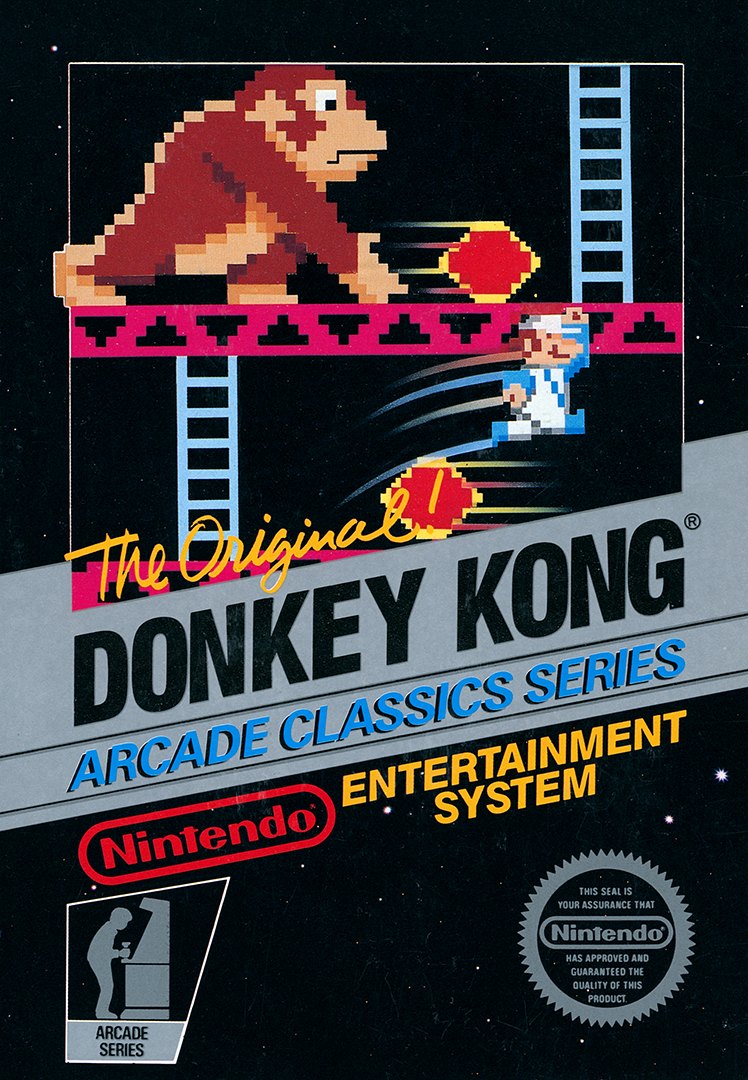
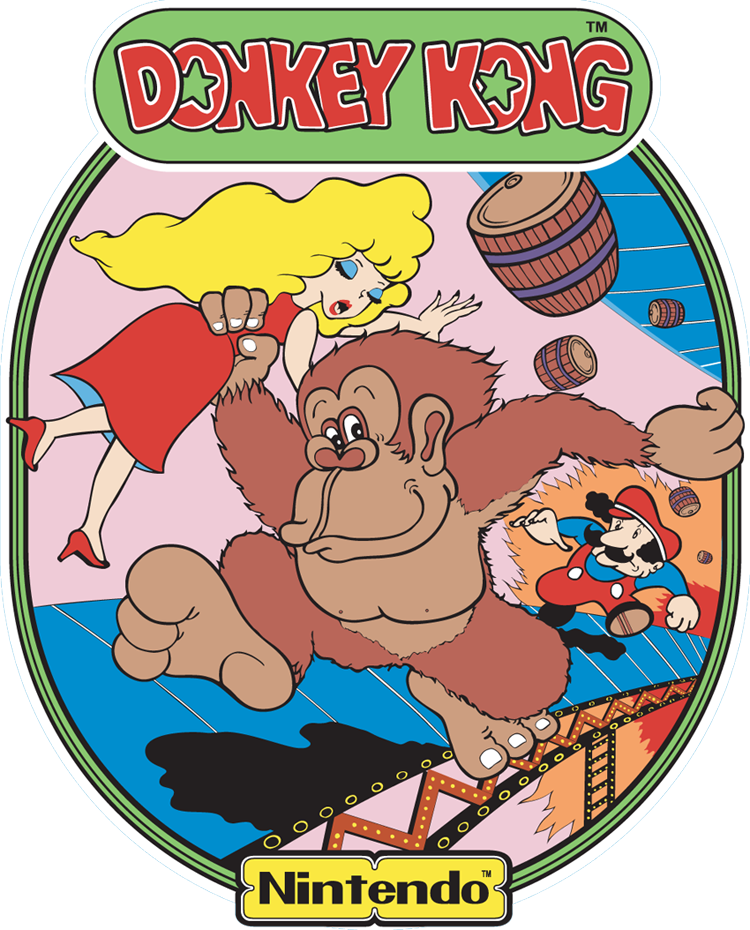
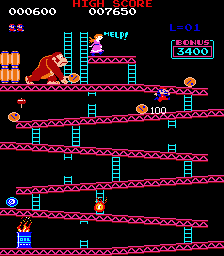
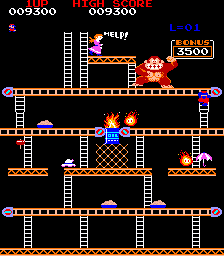
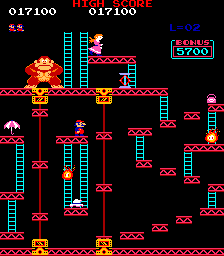
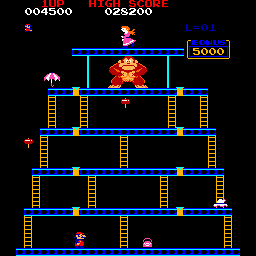
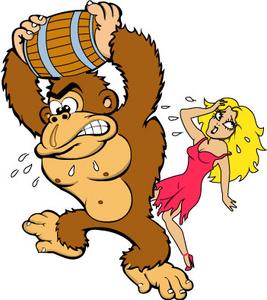
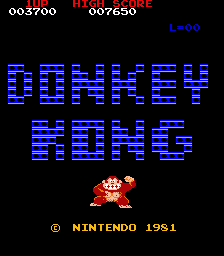


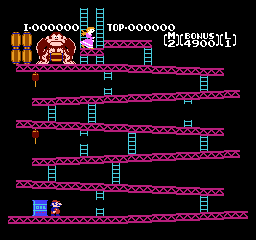

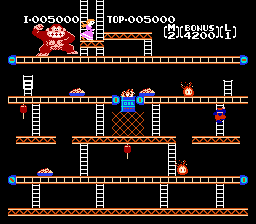


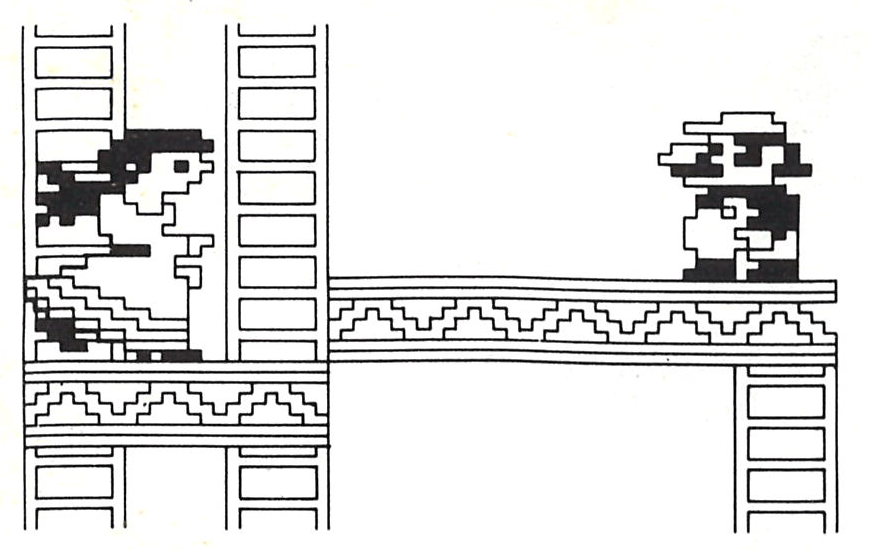
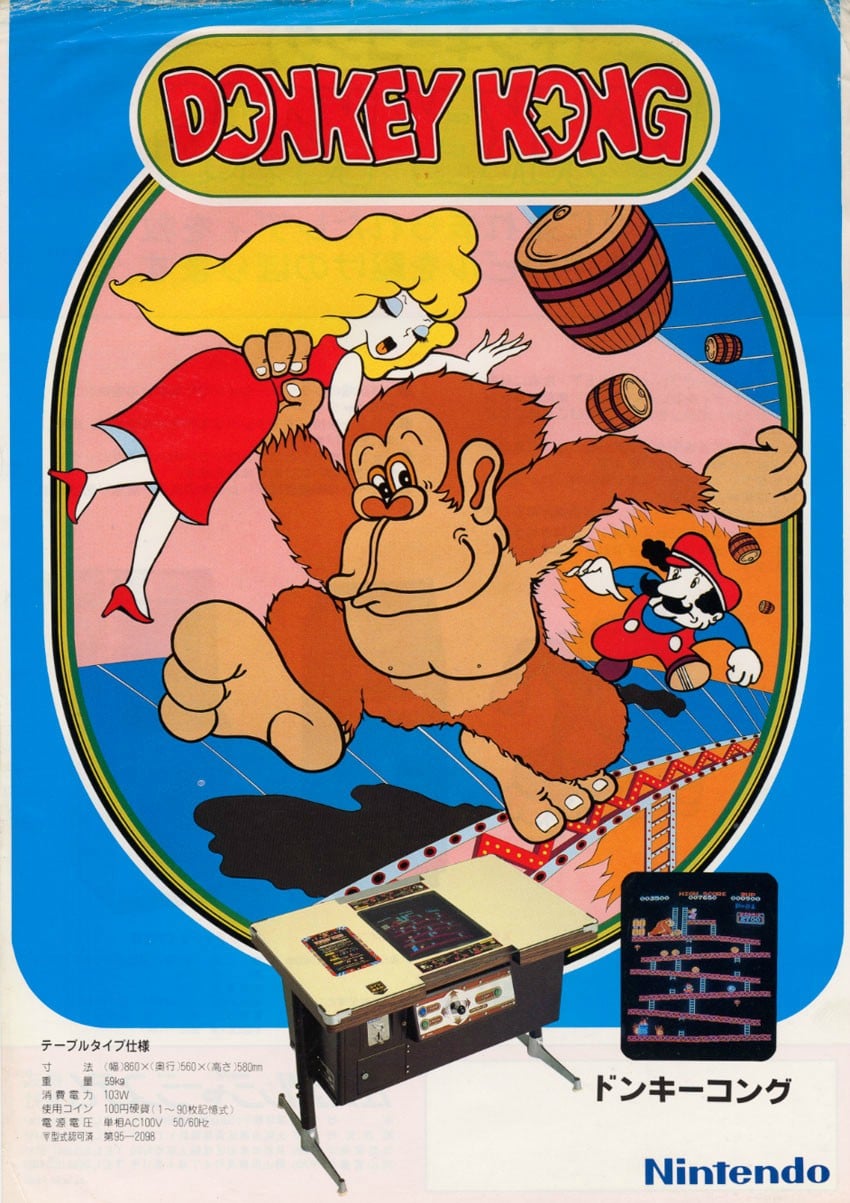
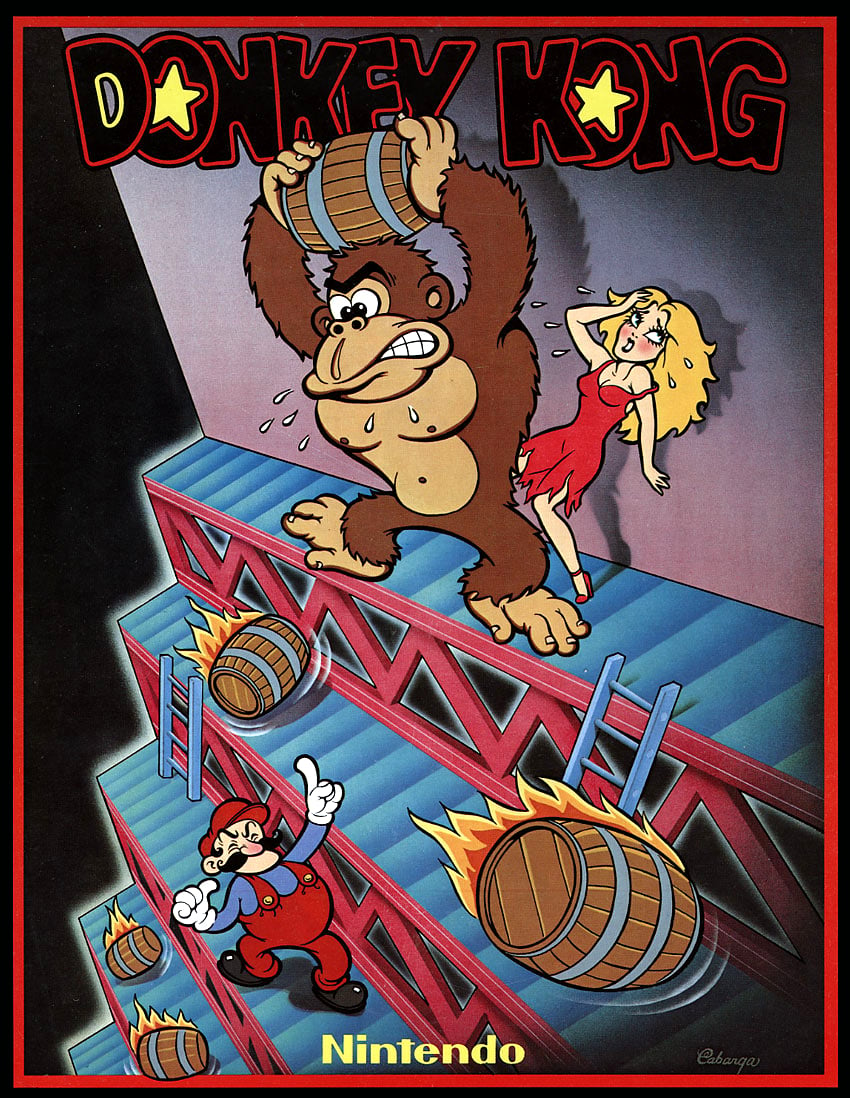


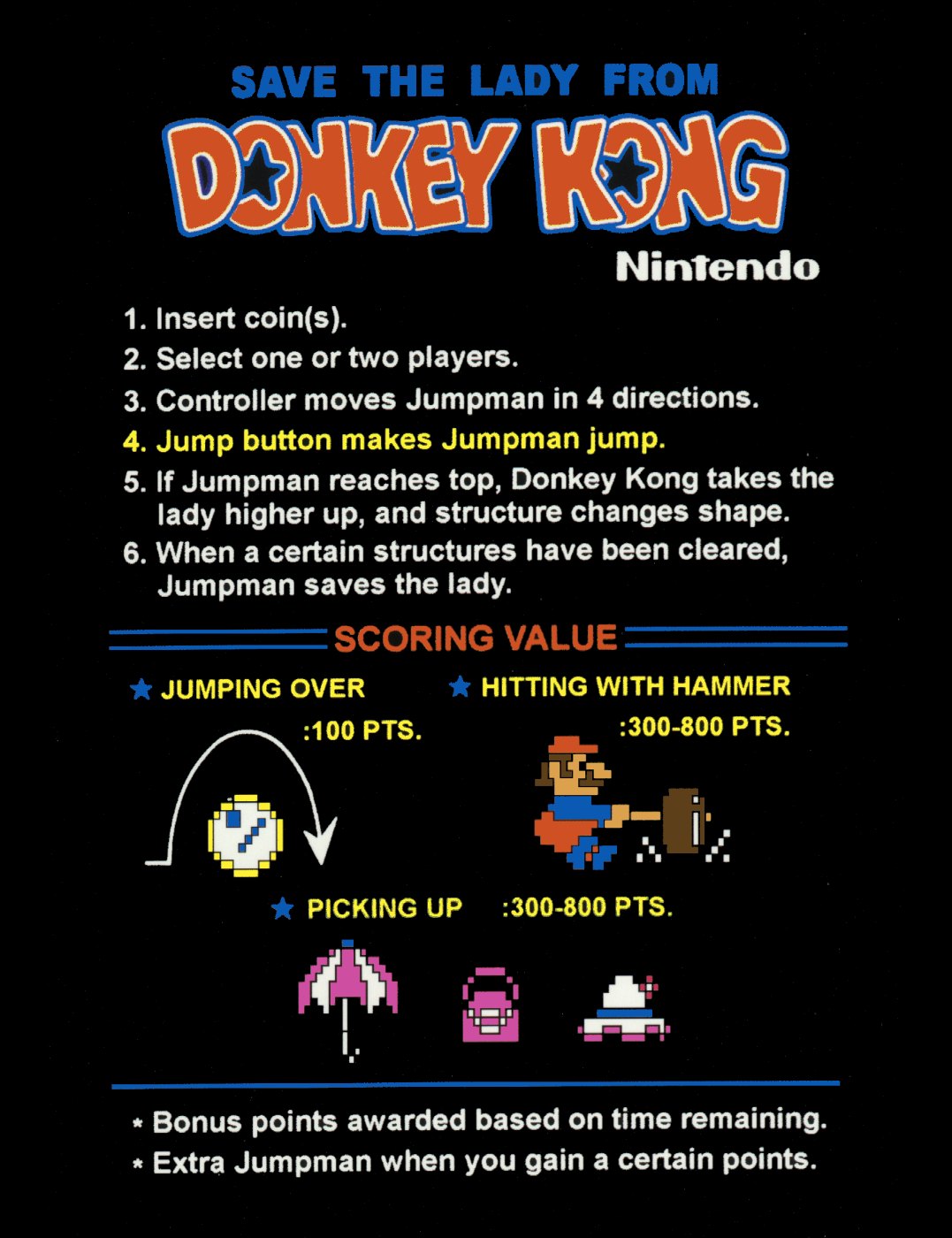

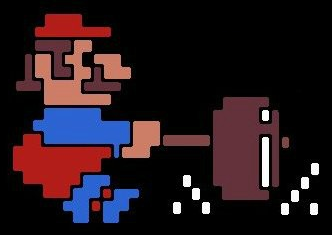

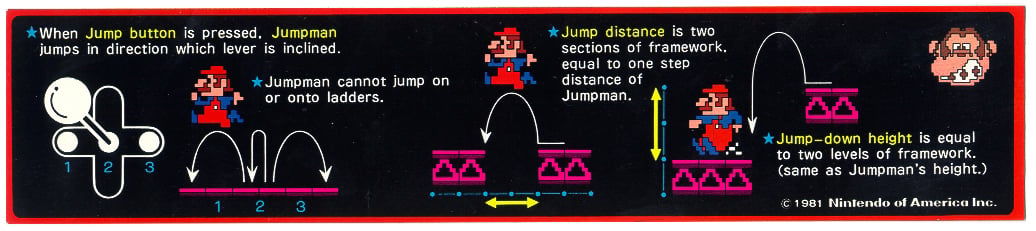
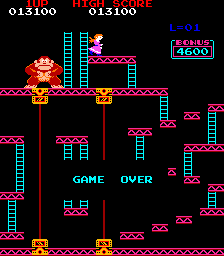
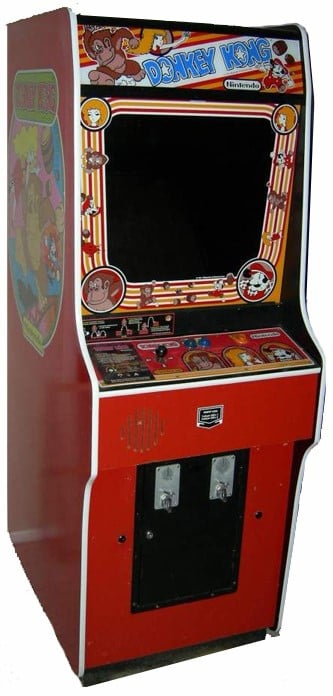
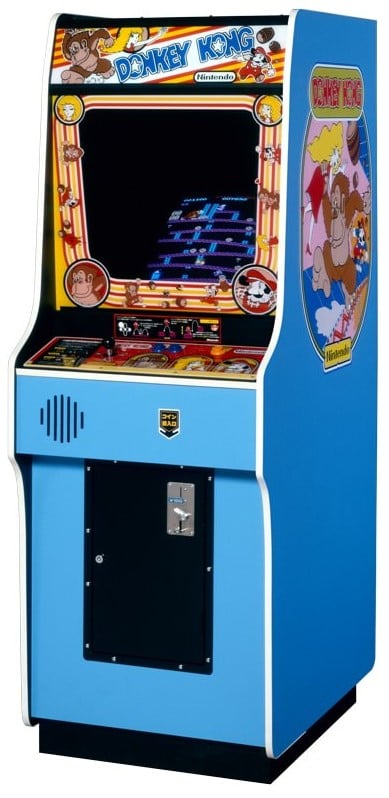
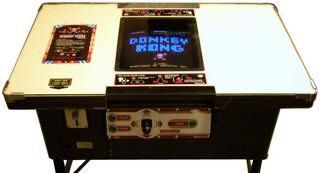
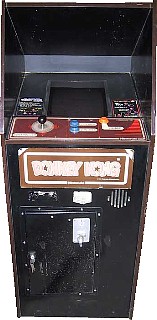
 HammerSmashes any enemy for a few seconds. Mario cannot jump or climb while holding it. Found on 25 m, 50 m and 100 m; there is none on 75 m.
 ParasolOne of the Lady’s three lost belongings. 300, 500 or 800 points depending on the level.
 HatHer hat, dropped on the way up. Worth the same as the parasol. Missing from the Famicom/NES version.
 BagHer handbag. Also worth 300, 500 or 800 points.
 Bolt (rivet)Eight of them hold up the 100 m screen. Walk or jump over one to pull it out for 100 points.
 Oil drumStands at the foot of 25 m and in the middle of 50 m. Anything that falls into it comes out as a living flame.
 LadderWhole ladders lead upwards; broken ones stop short. Barrels can come down either kind.
 The lost items in artworkThe parasol as drawn for the 1981 character sheet; the hat and bag had portraits too.
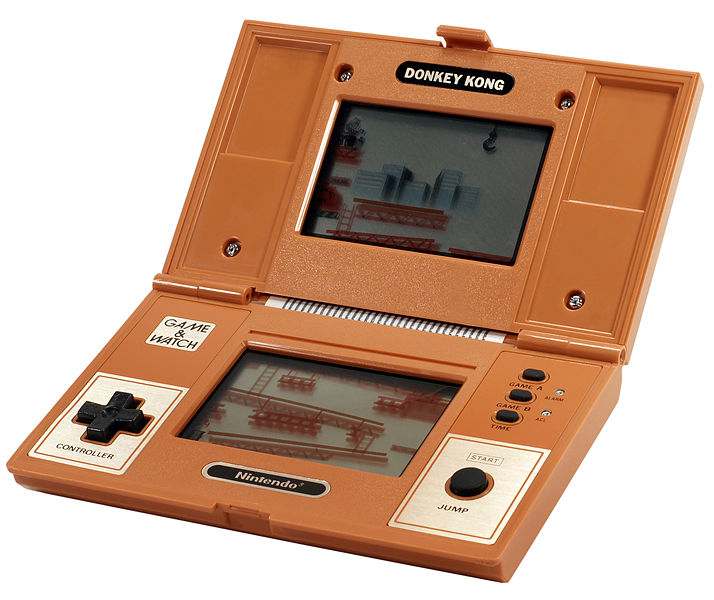 Donkey Kong (Game & Watch)Nintendo · 3 June 1982A two-screen handheld (model DK-52) in which Mario dodges barrels, rides a crane and cuts the wires holding up Kong’s platform. Super Mario Wiki, citing an Iwata Asks interview, calls it the first piece of gaming hardware with the cross-shaped directional pad. It was later remade in Game & Watch Gallery 2 and 4.
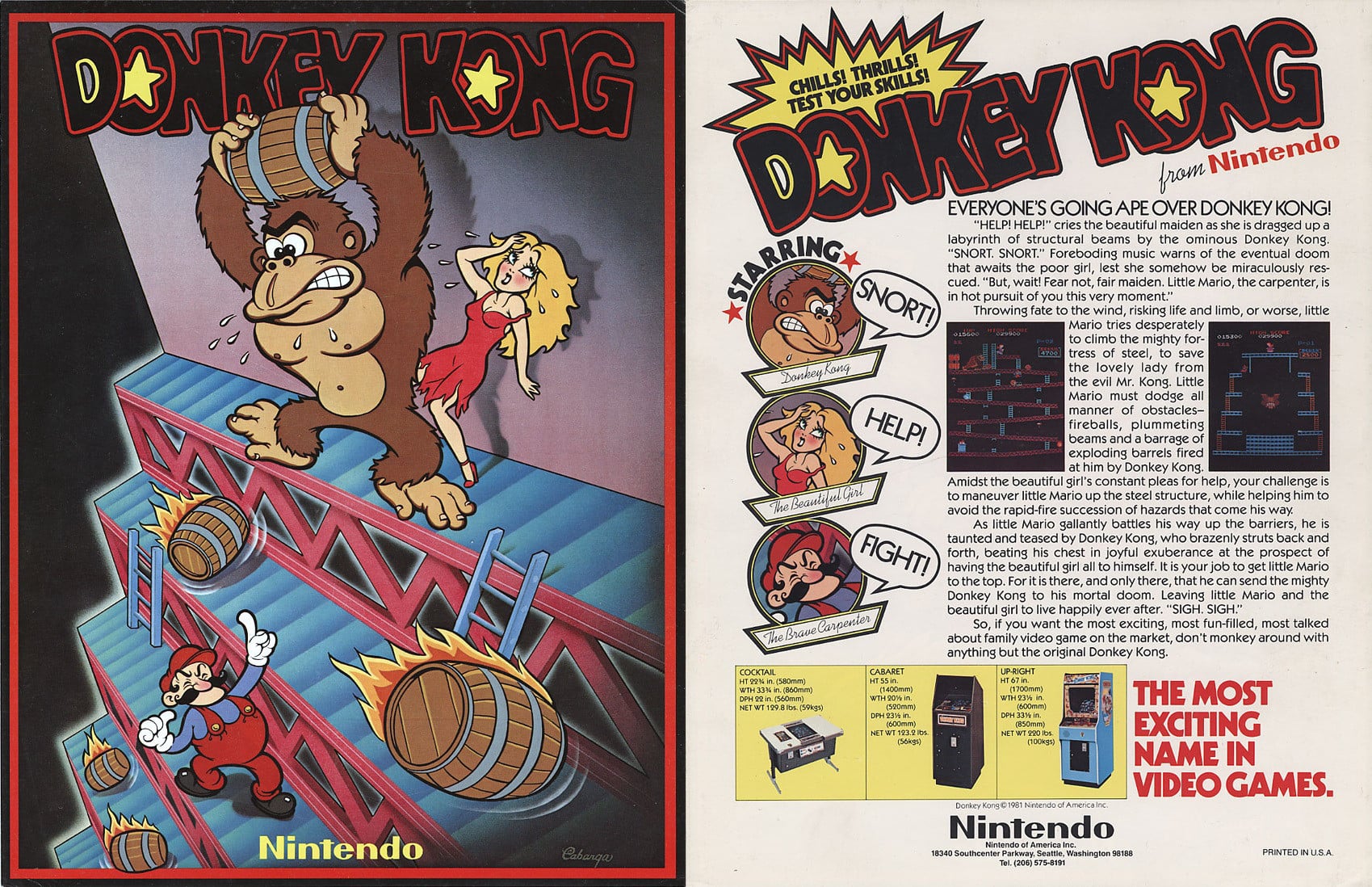 Saturday SupercadeRuby-Spears / CBS · 1983–84Nintendo of America began licensing the characters in 1982 for toys, food, a Milton Bradley board game and more, which led to Donkey Kong and Donkey Kong Junior cartoon segments in this Saturday-morning show. Most of the merchandise used the character designs from the American arcade flyer.
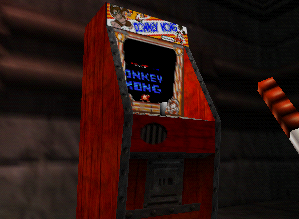 Donkey Kong 64Rare · 1999A working cabinet stands in the Frantic Factory level, running the Japanese arcade version: all four screens, hidden inside a Nintendo 64 cartridge.
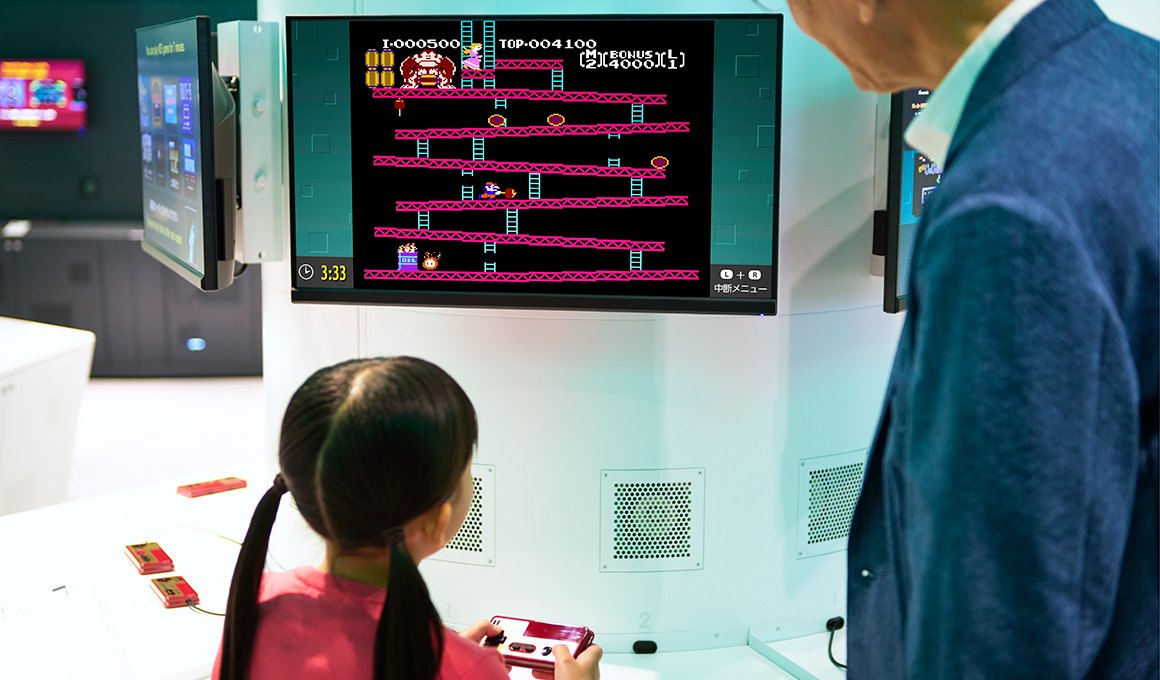 Museums2017–2024The game entered the World Video Game Hall of Fame at The Strong in Rochester, New York, in 2017; the museum’s 2023 extension includes a playable cabinet 20 feet tall. The Nintendo Museum shows it among its “Nintendo Classics”.
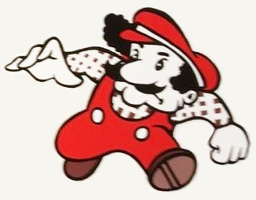 MarioJumpman, the carpenter
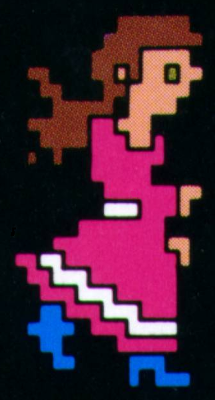 The Lady (Pauline)The one who needs rescuing
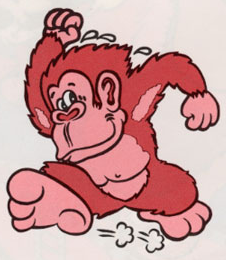 Donkey KongThe ape of the title
 Donkey Kong (boss)Every screenNever attacks directly, but contact means a lost life. Beaten only on 100 m, by removing all eight bolts.
 Barrel25 mRolled down the girders, sometimes dropping down ladders. 100 points to jump, 300 to smash.
 Blue barrel25 mMarked with a skull. If it reaches the oil drum it becomes a Fireball. Missing from several home versions.
 Fireball (hammer active)25 m, 50 mFlames turn blue while Mario holds a hammer, showing they can be hit.
 Fire (hammer active)100 mThe blue, vulnerable form.
 Oil drum25 m, 50 mHarmless in itself, but the source of every Fireball.
 Falling cement tub (unused)In the ROM onlyA frame of the cement tub tipping over. The Cutting Room Floor notes it is never shown, since the cement never falls.
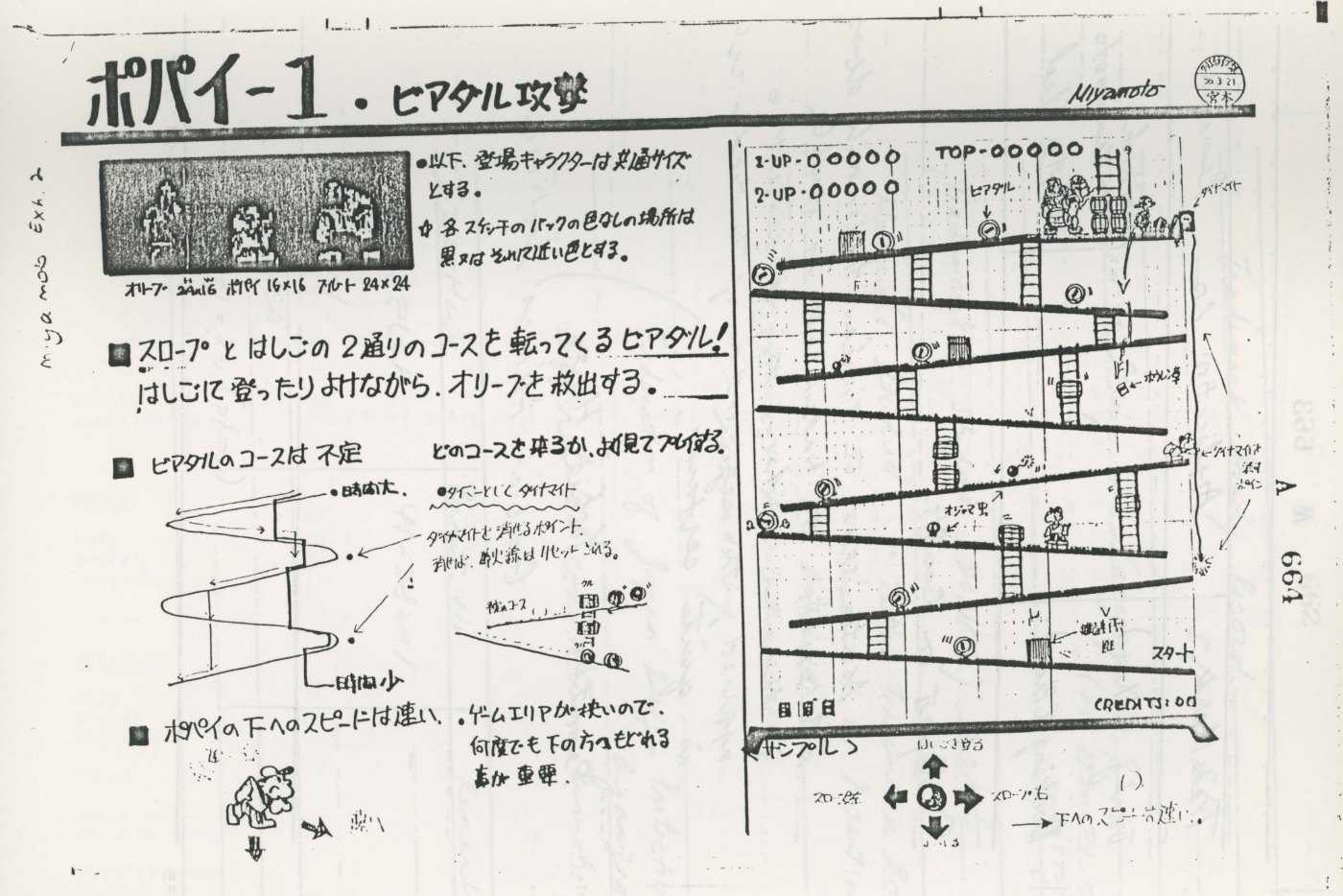
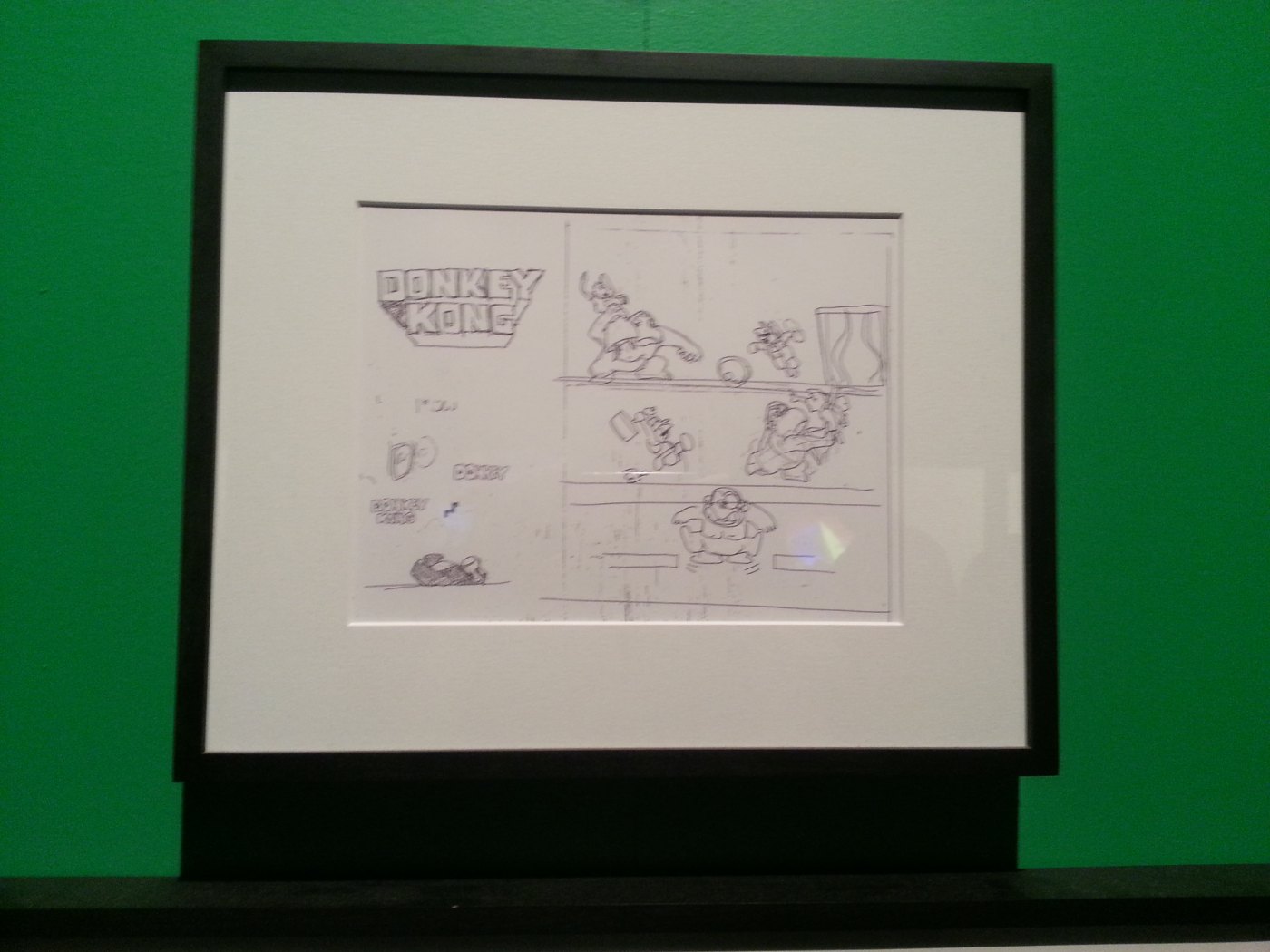

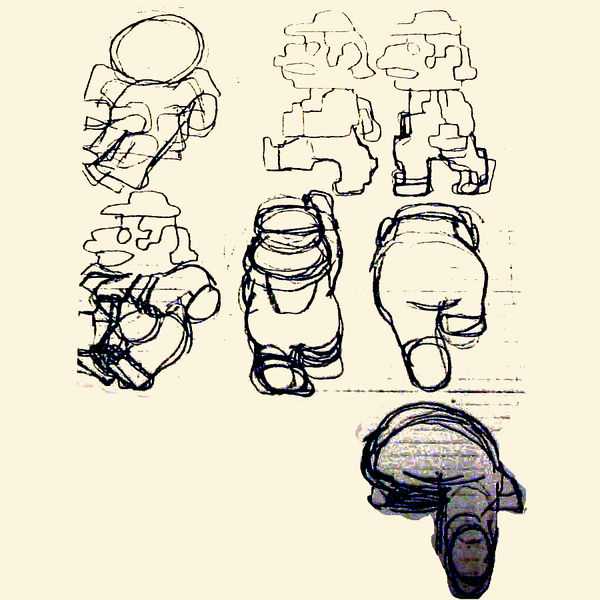
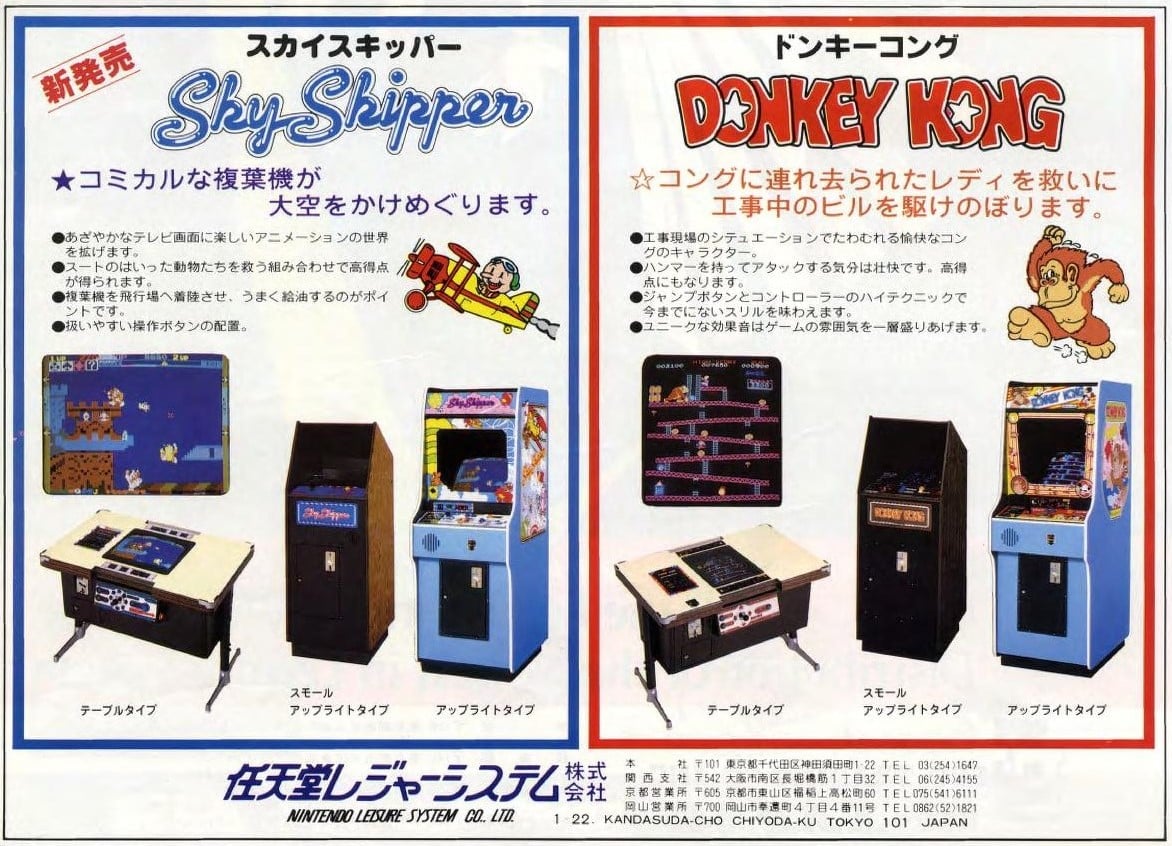
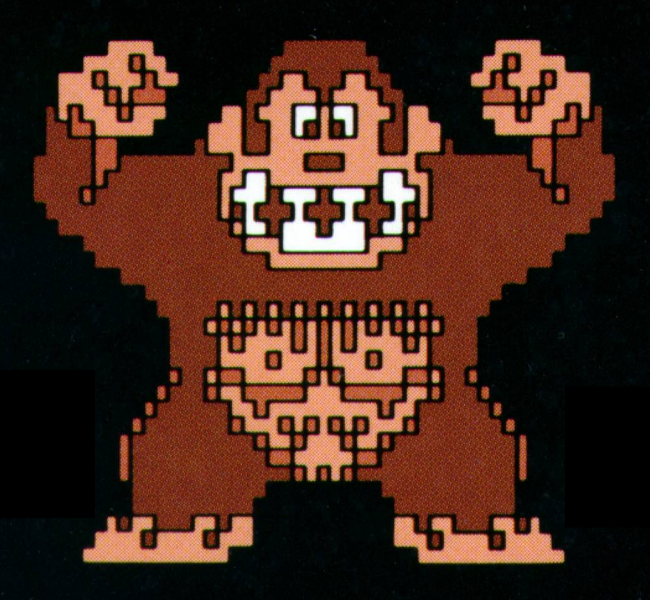
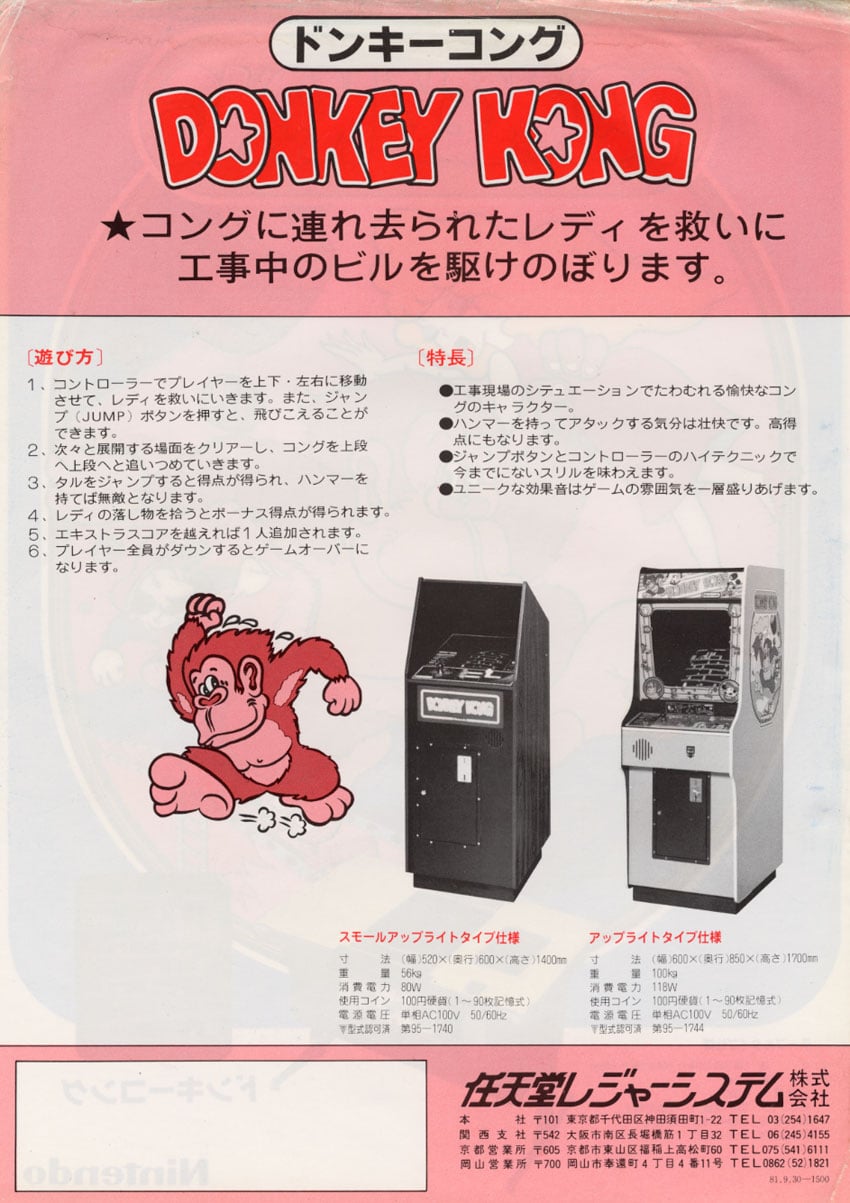
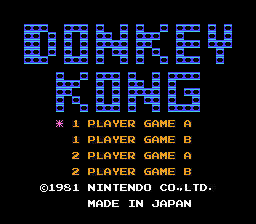
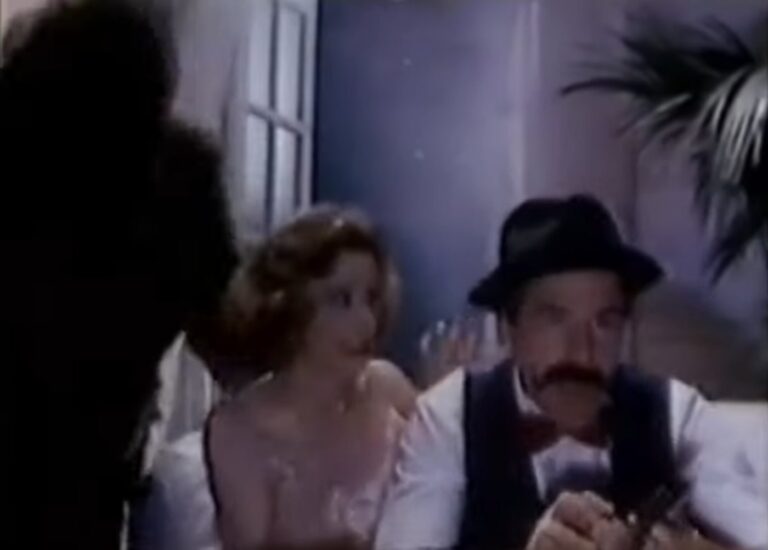


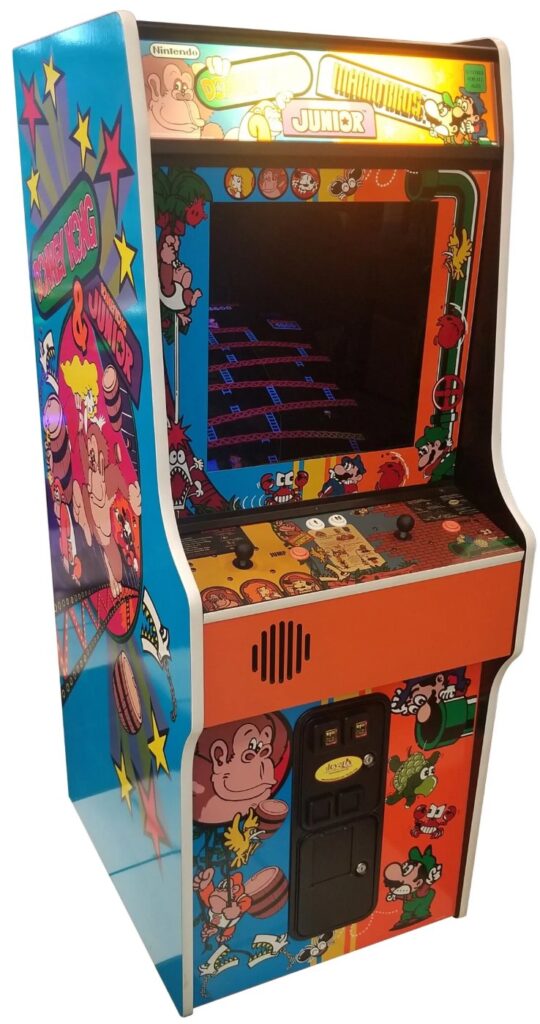
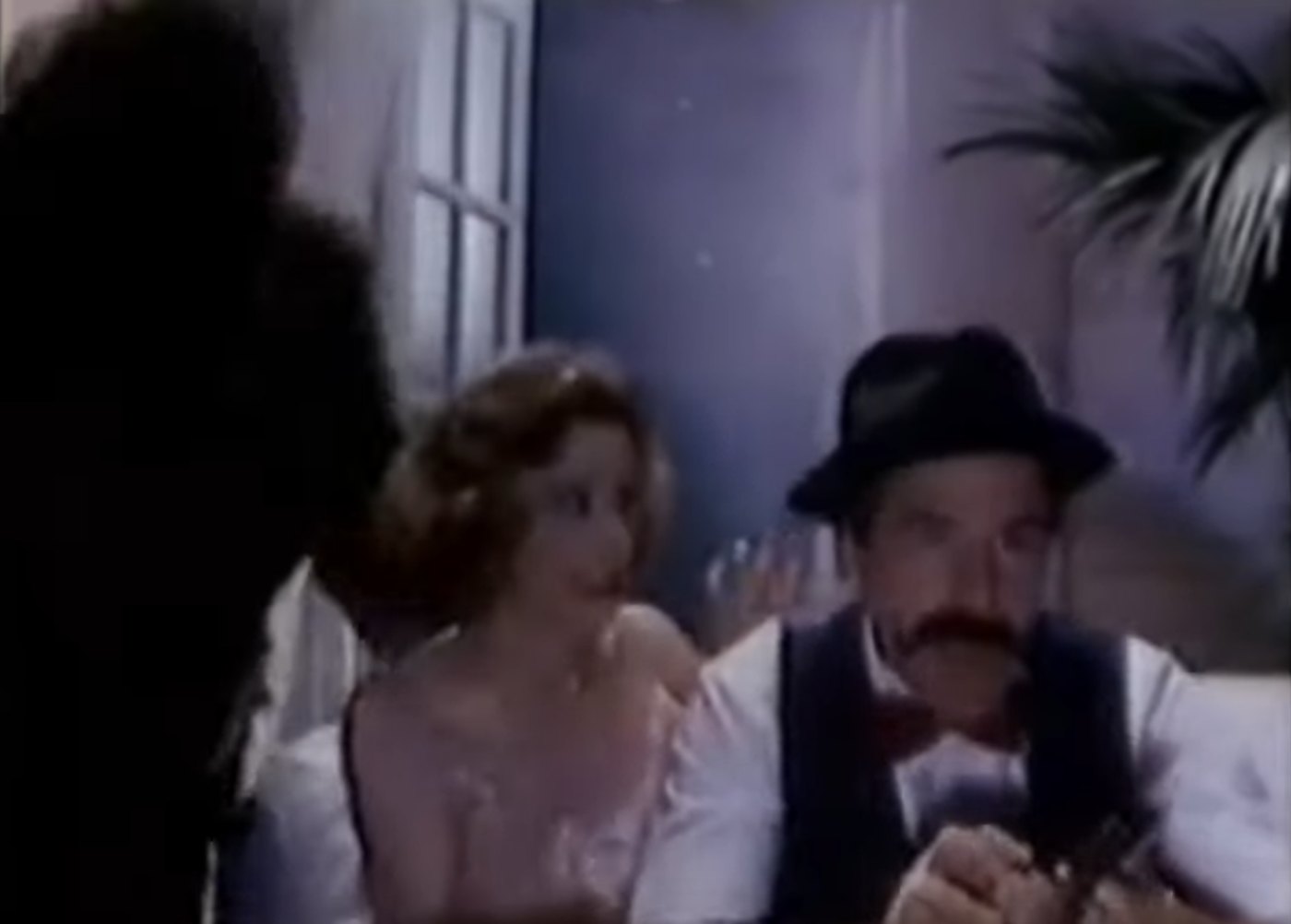
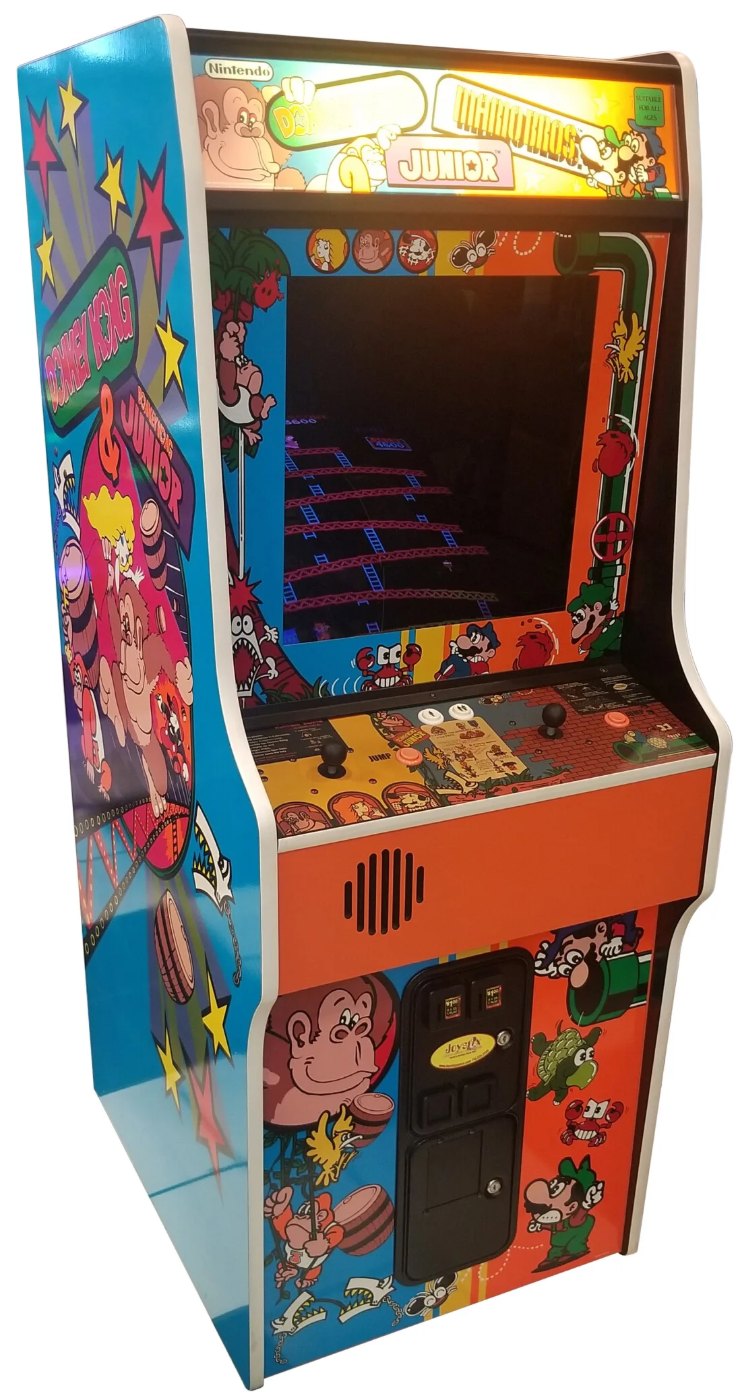
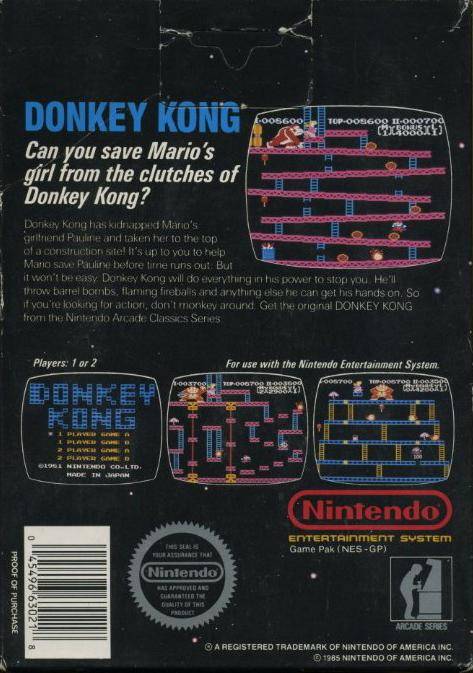
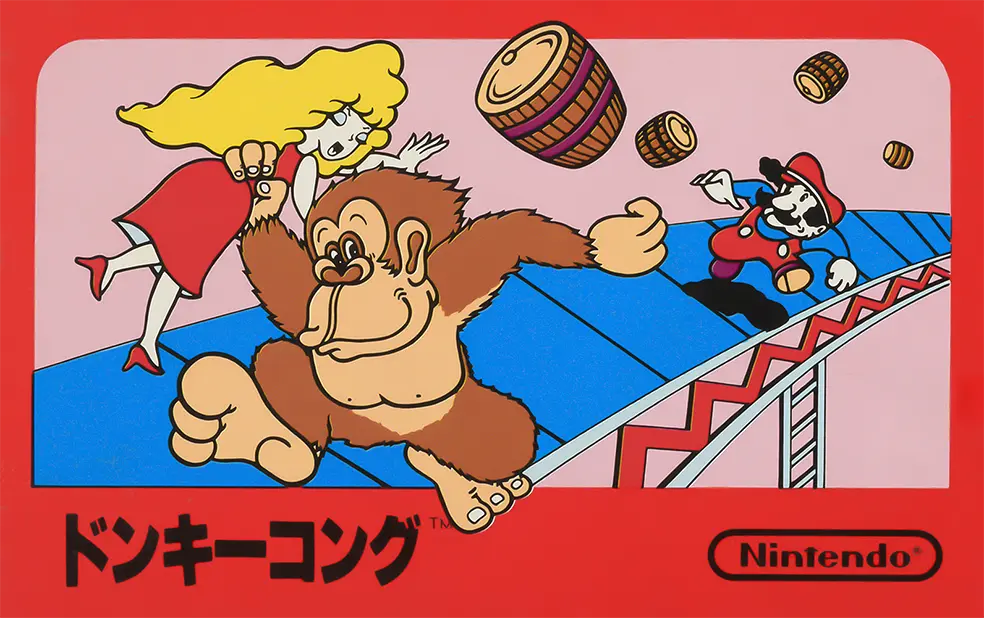
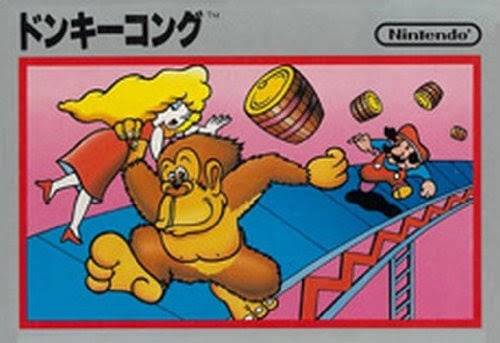
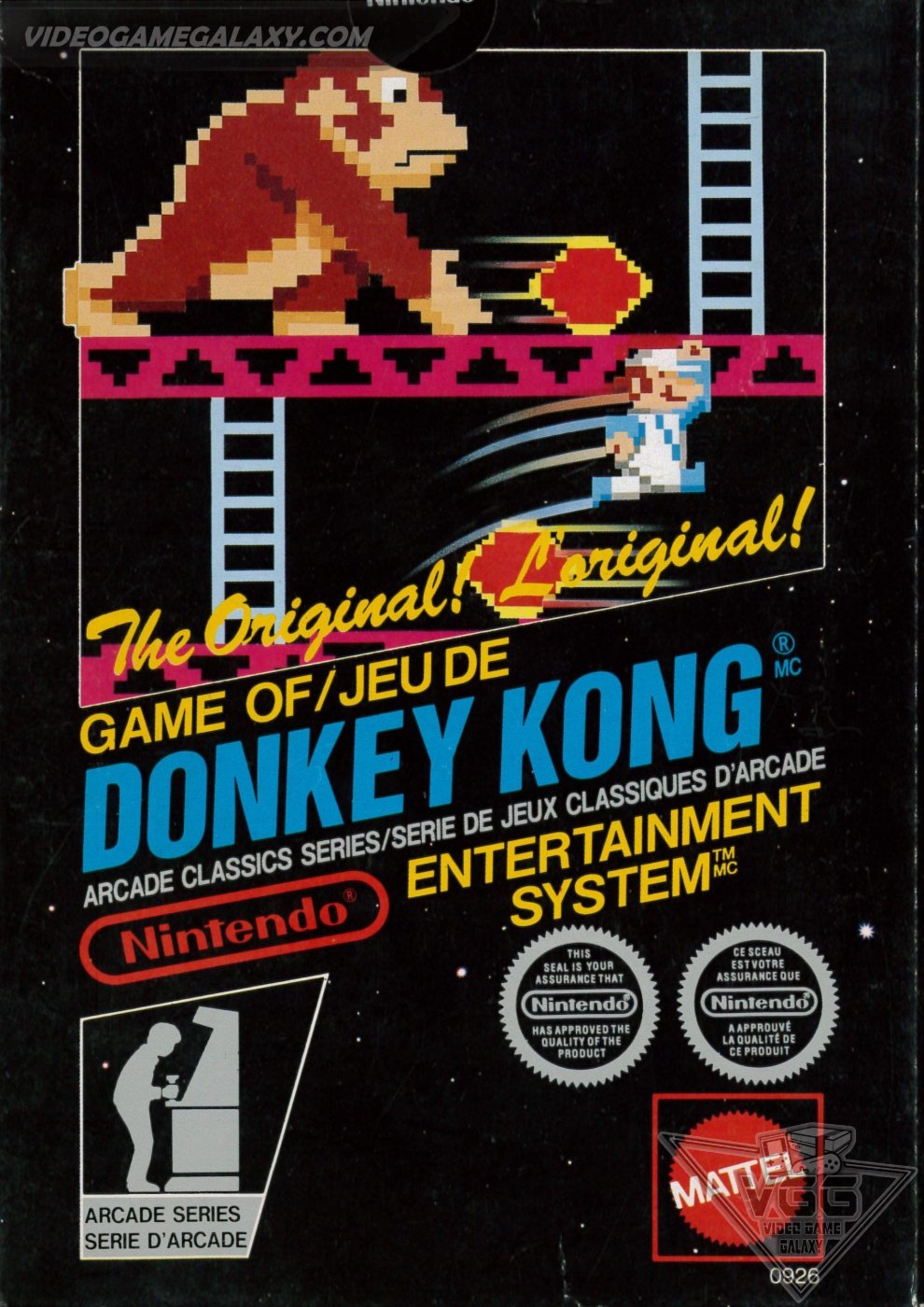
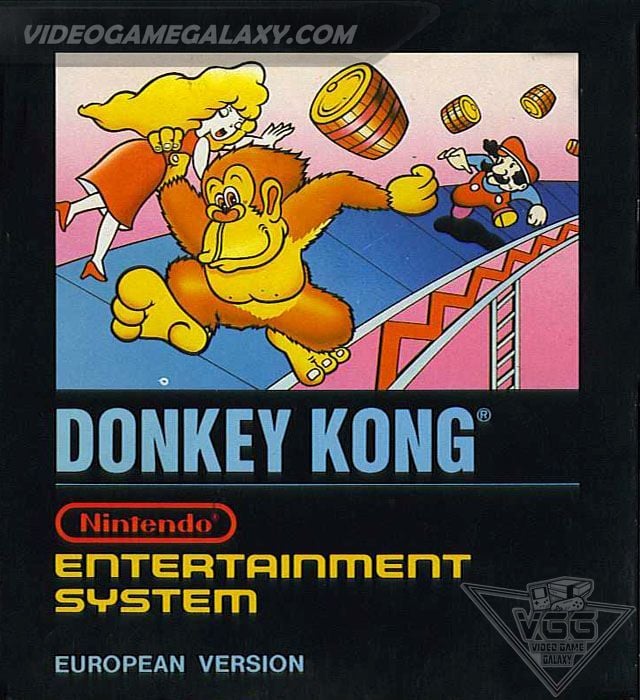
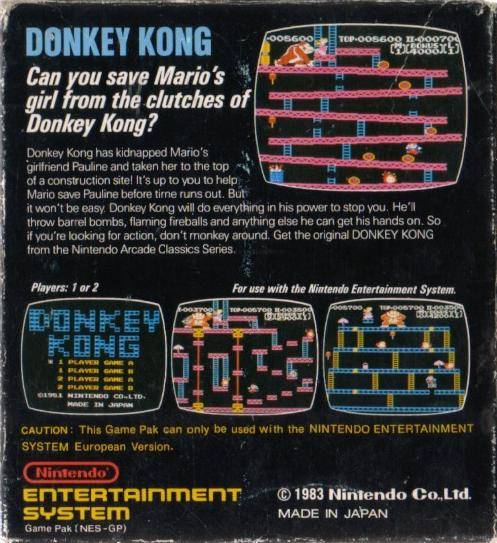
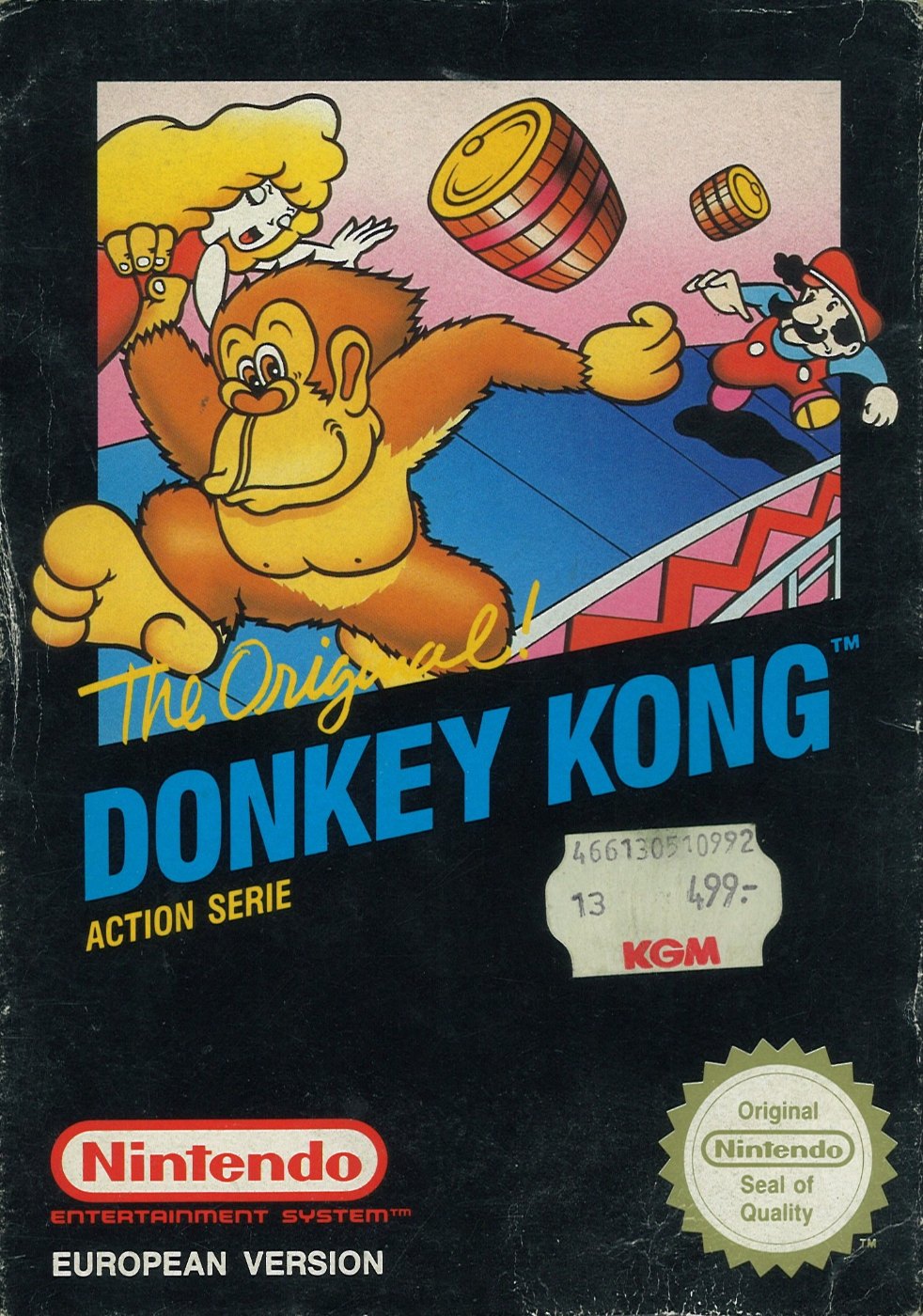
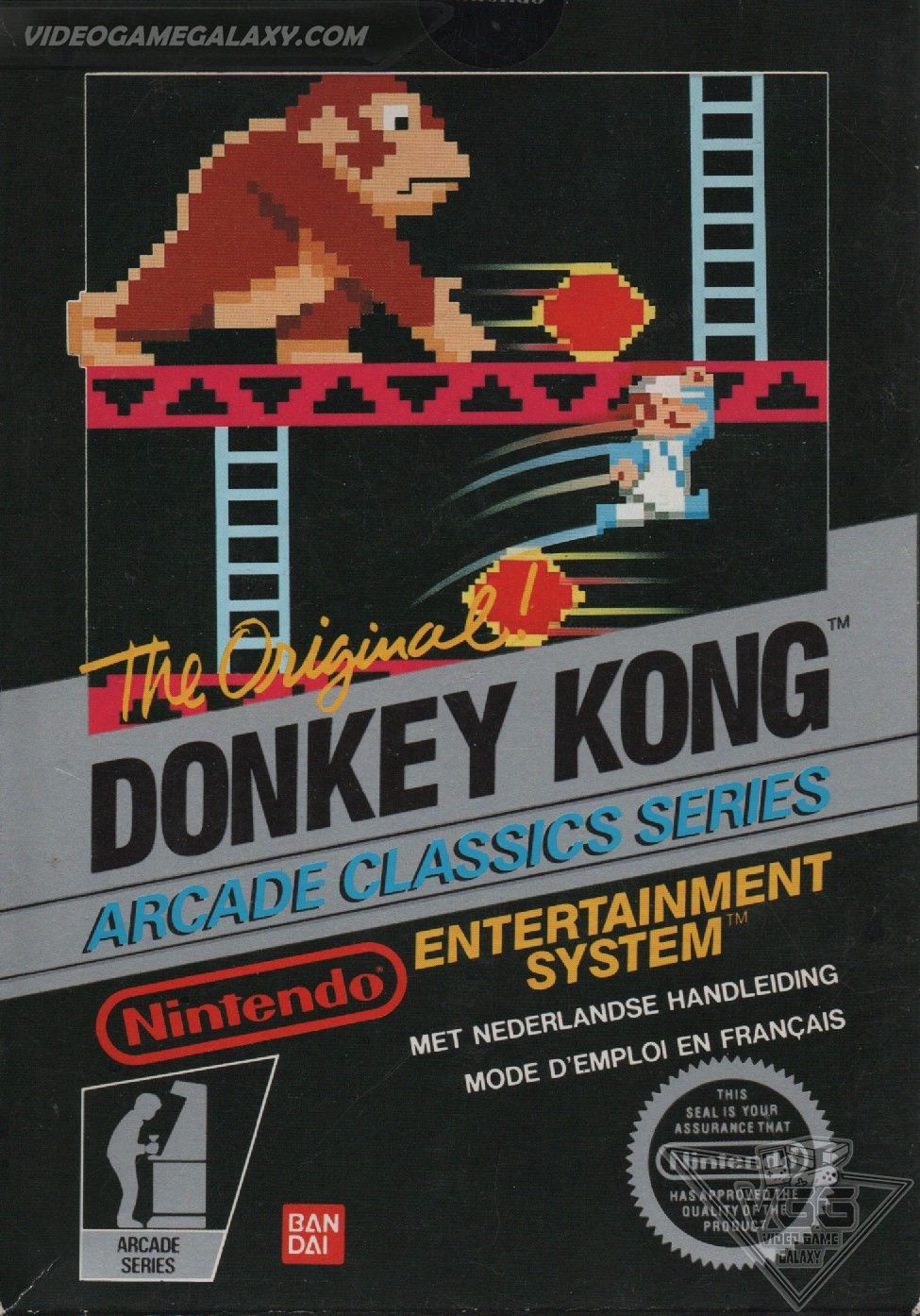
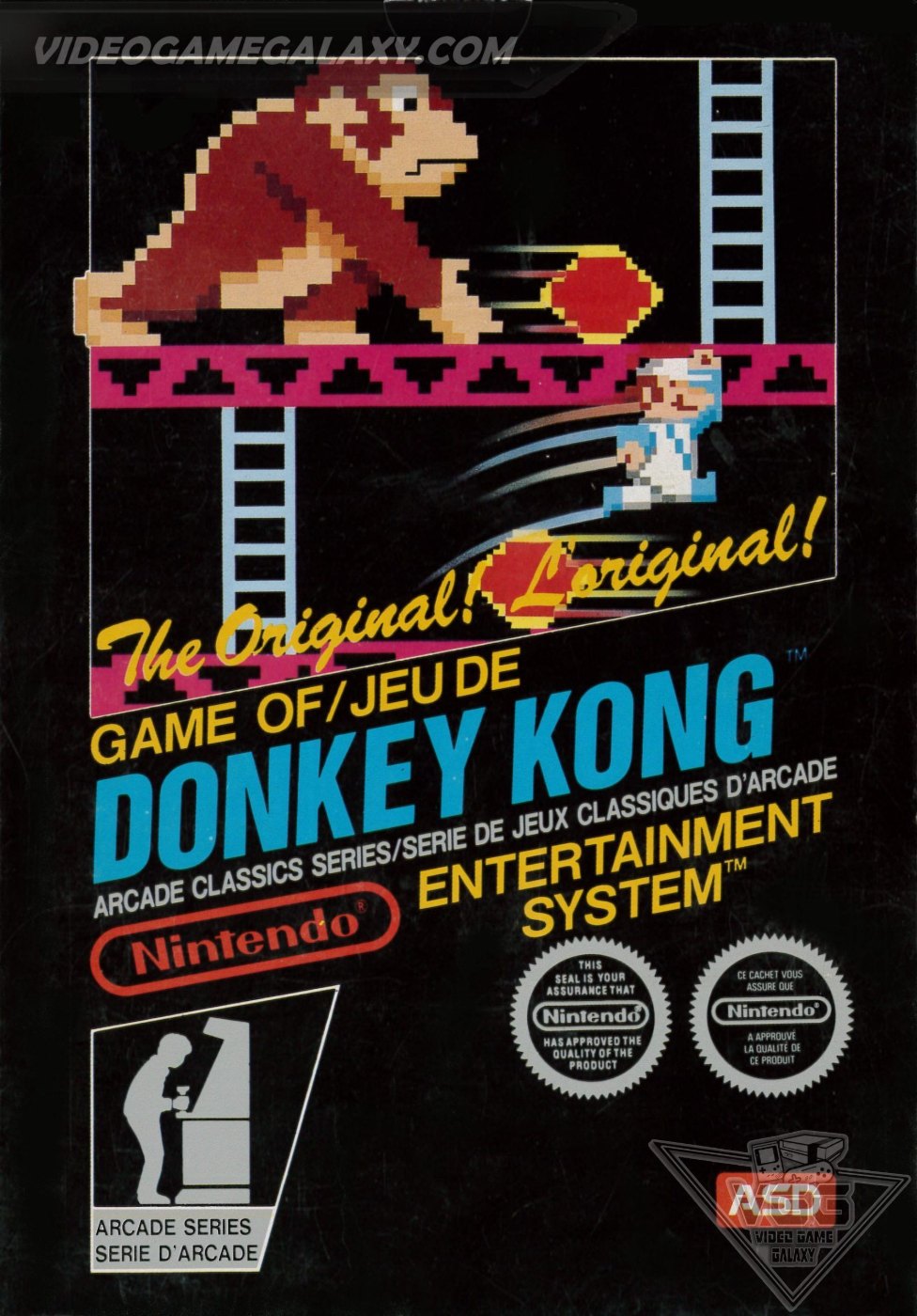
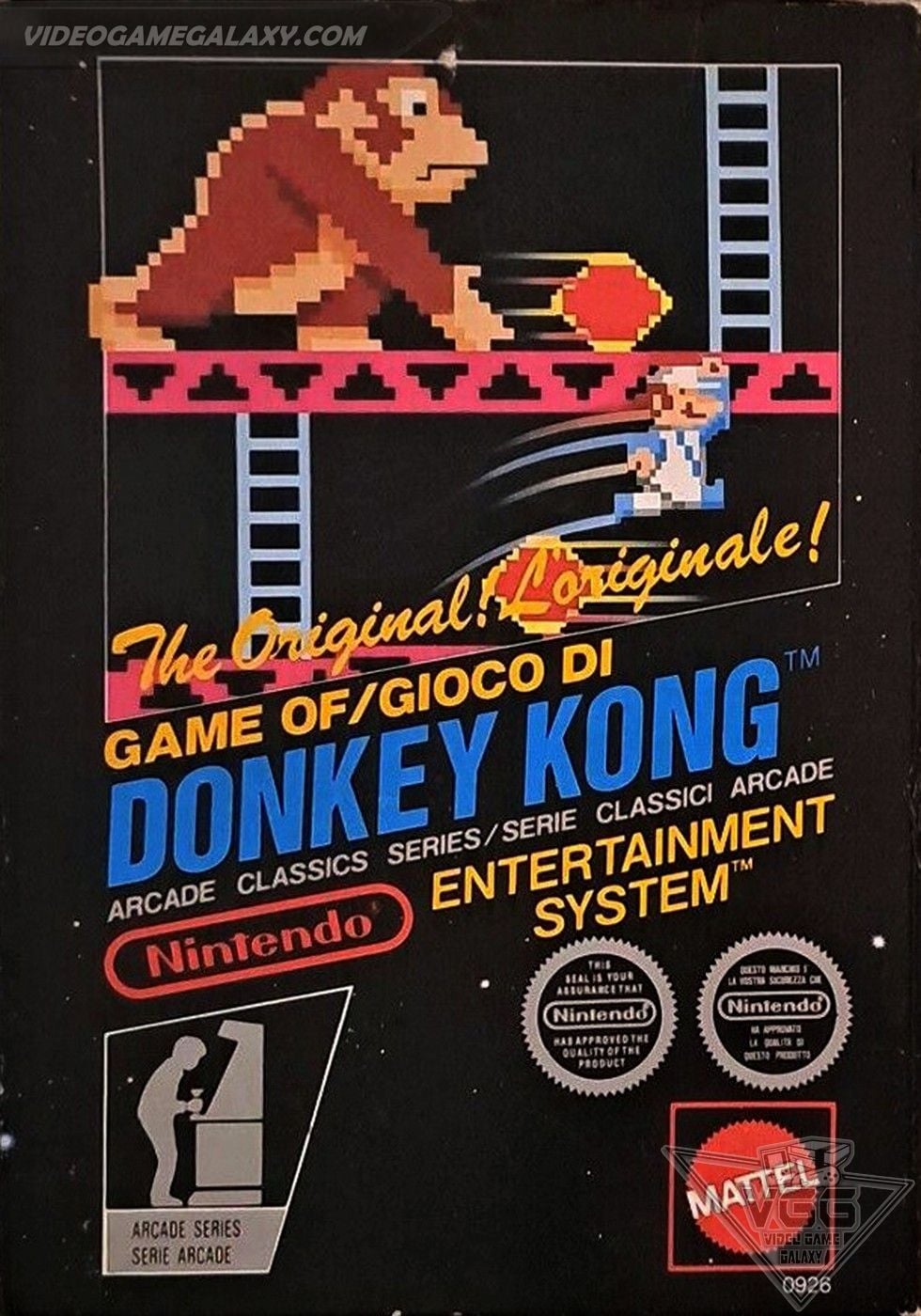
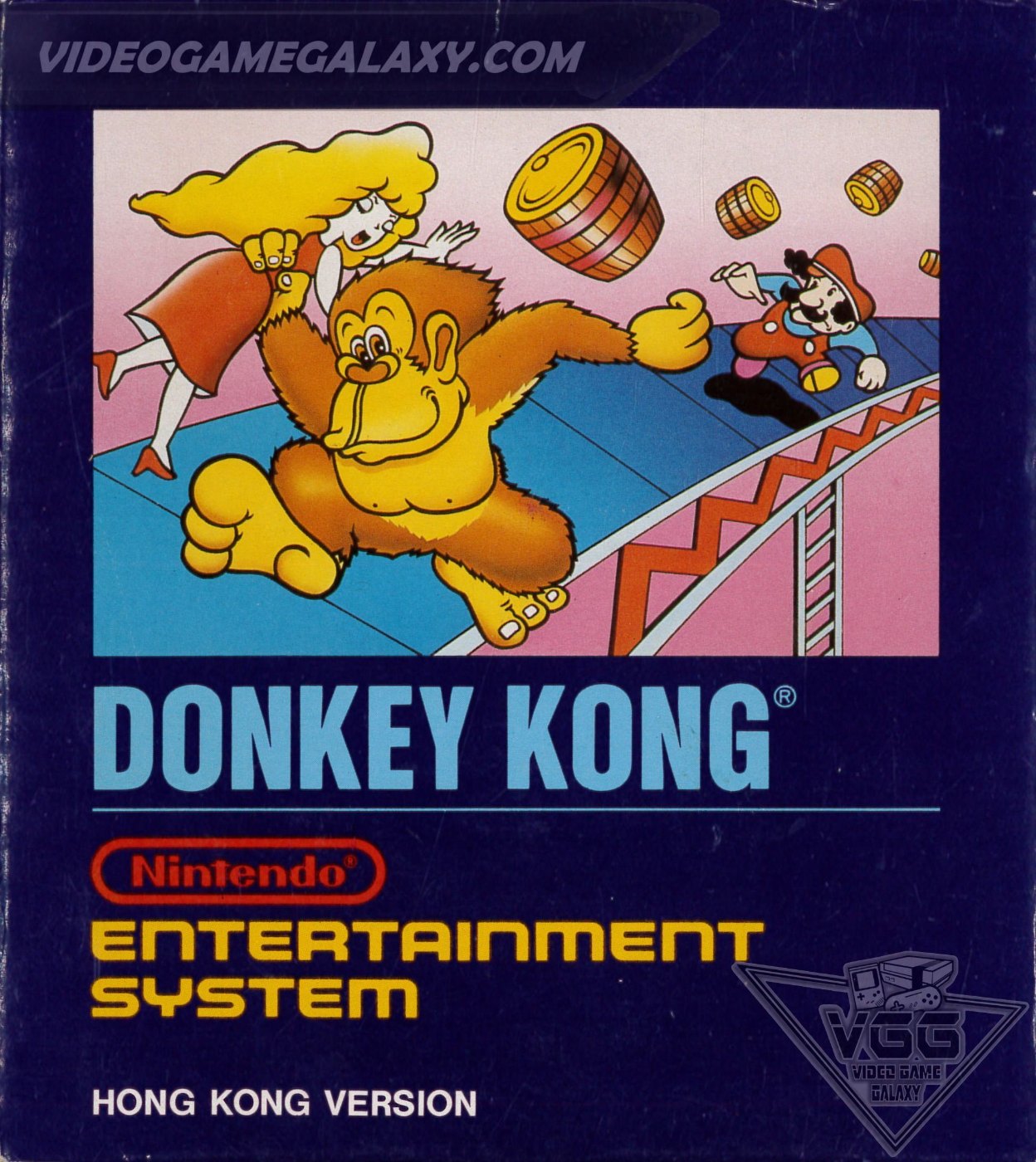
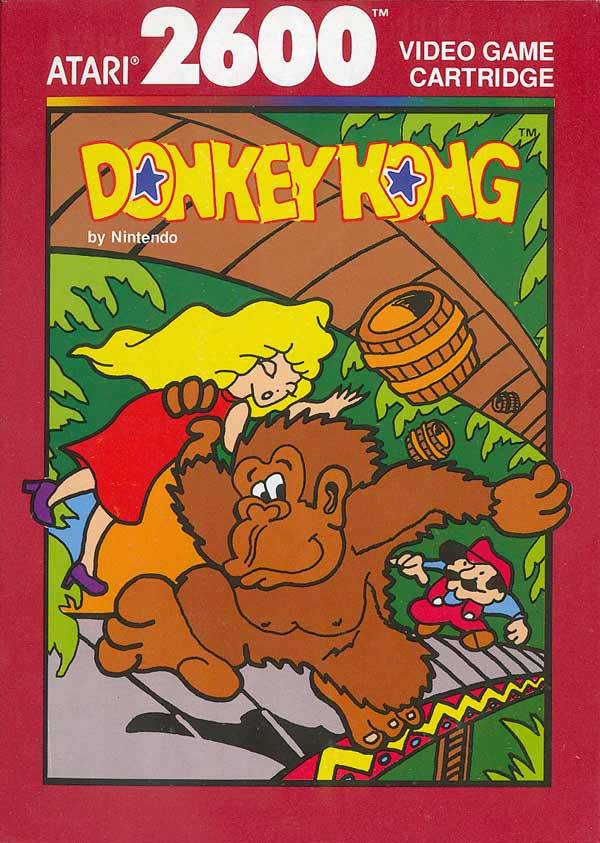
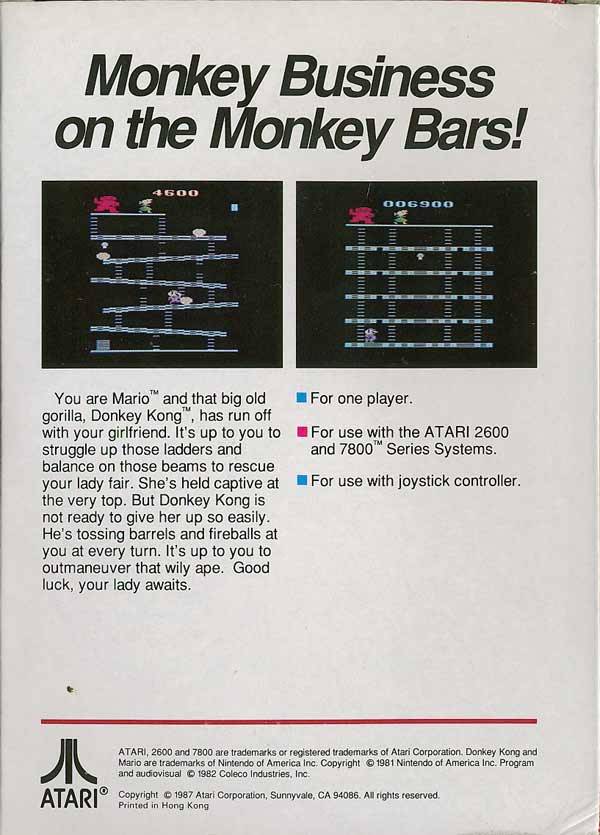
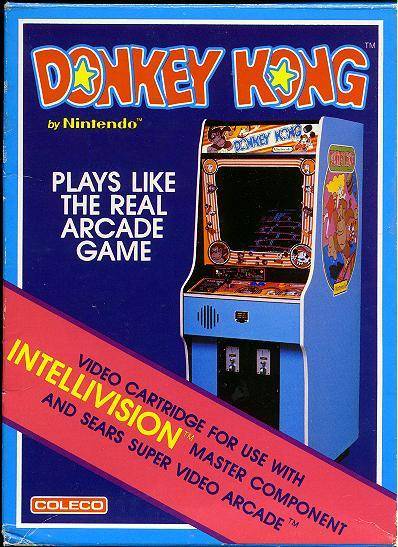
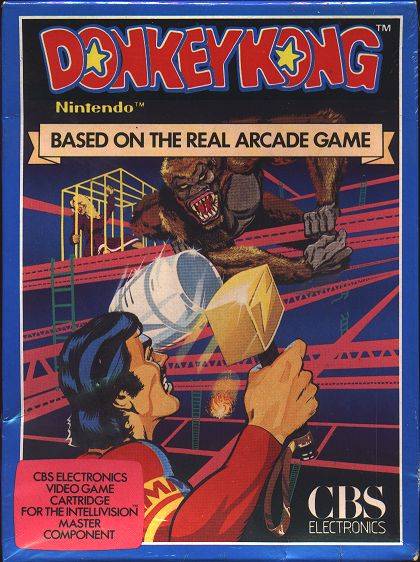
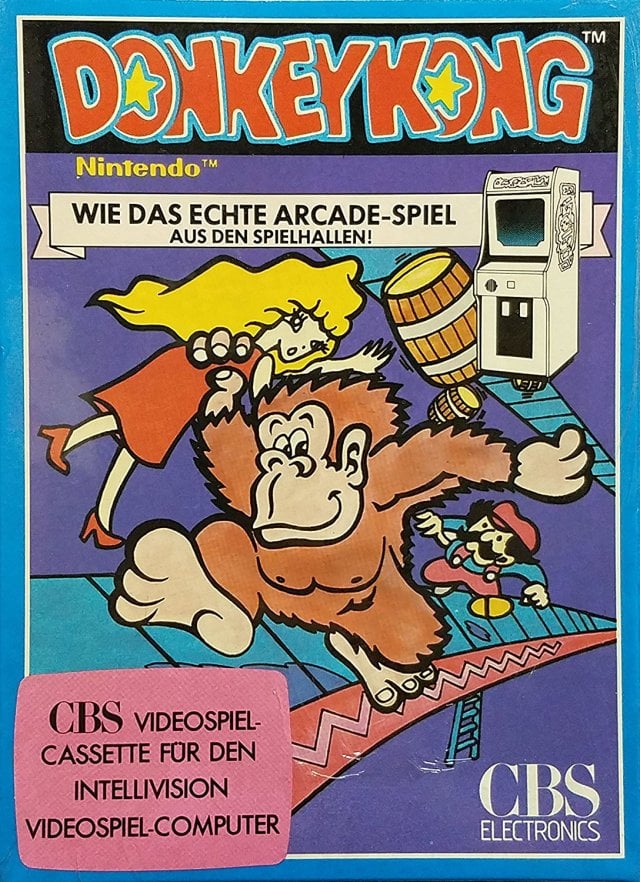
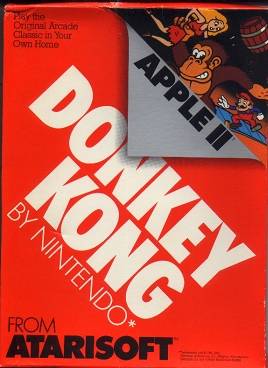
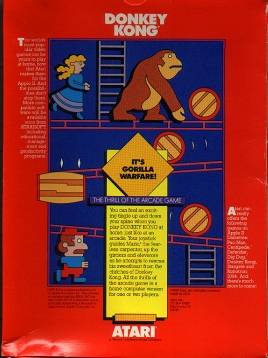
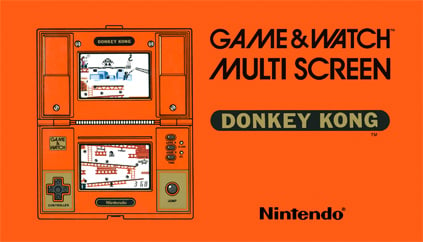
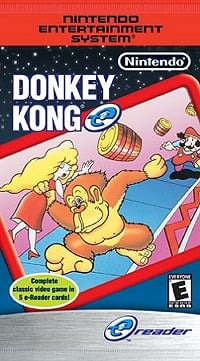
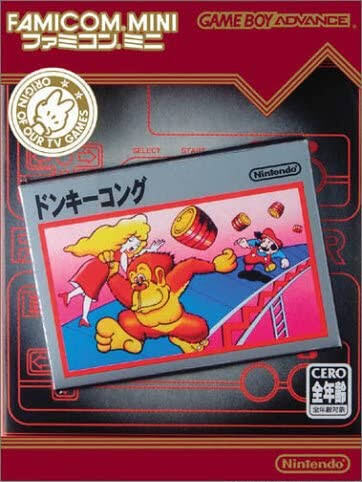
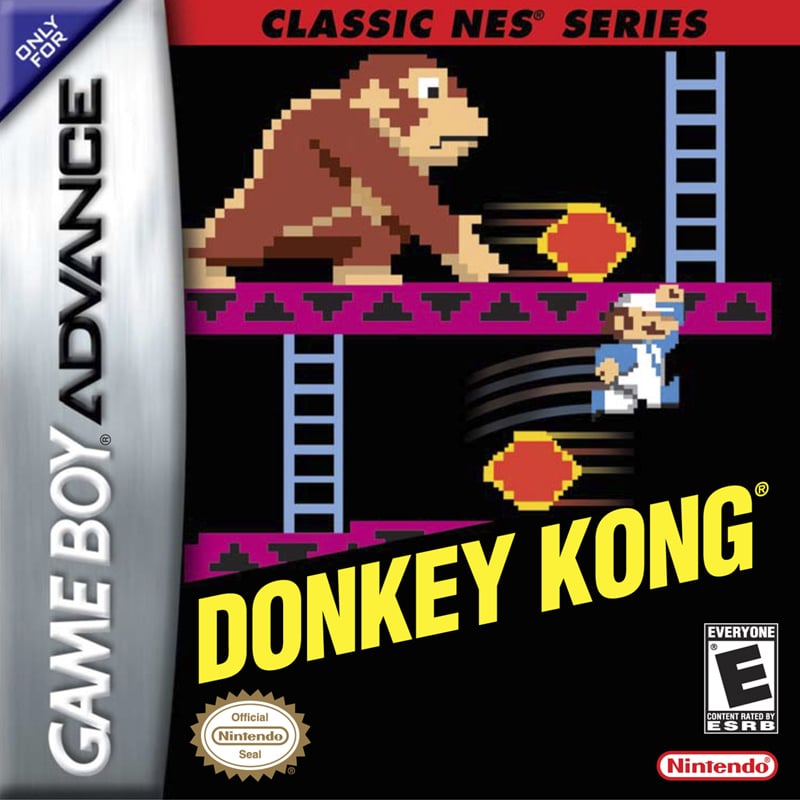
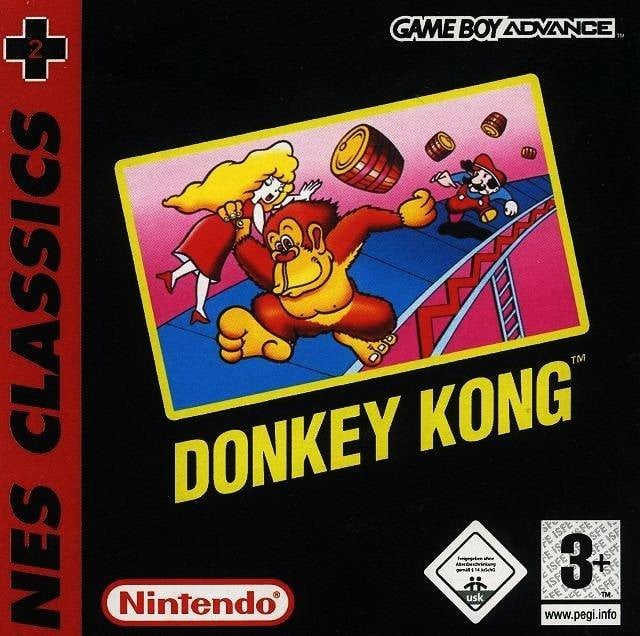
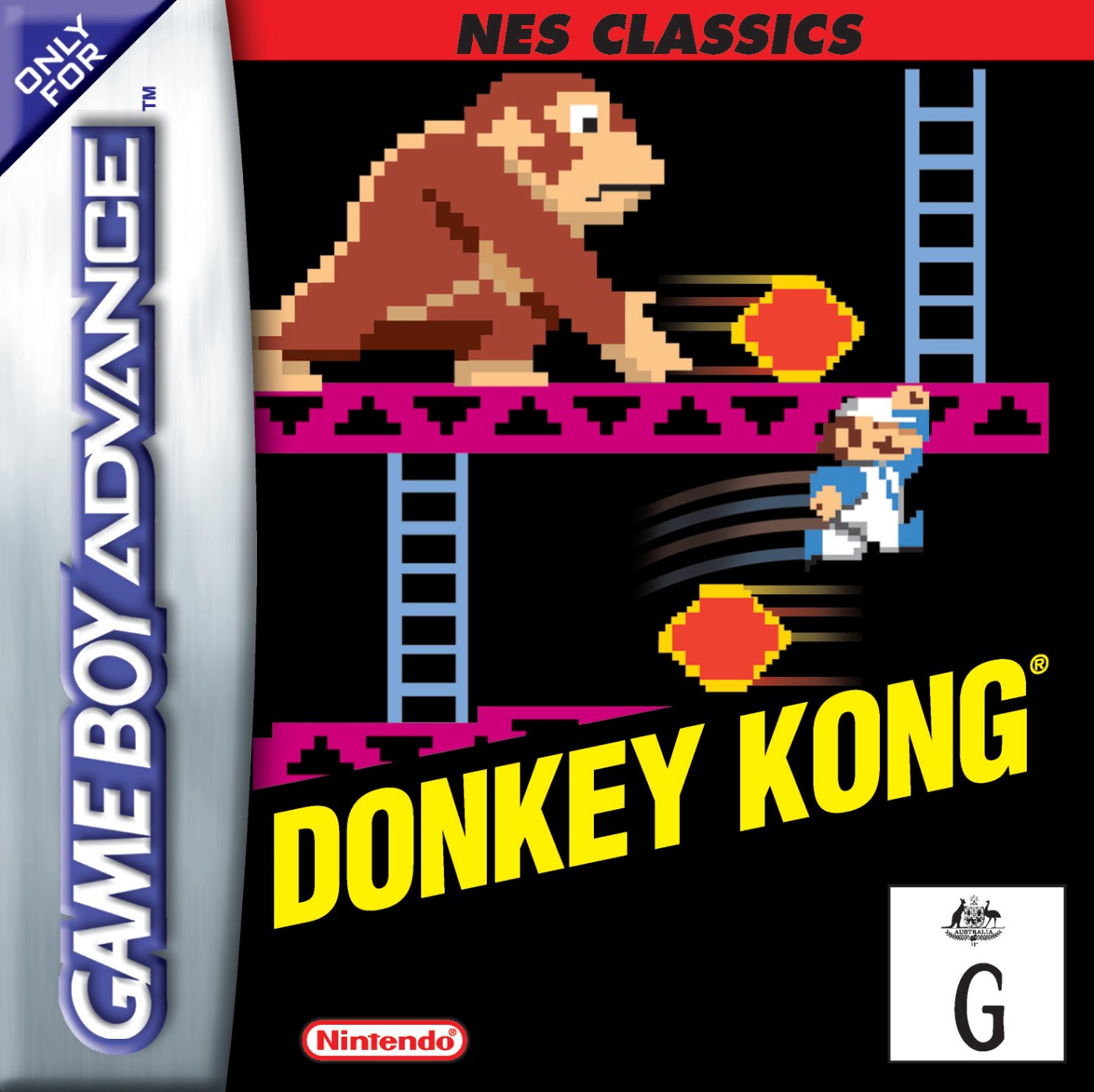
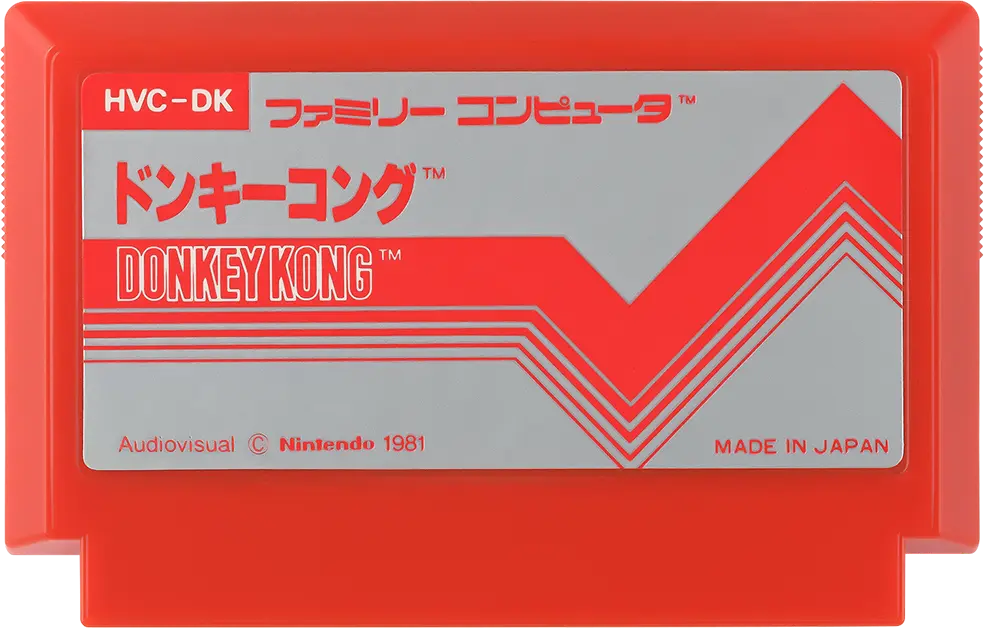
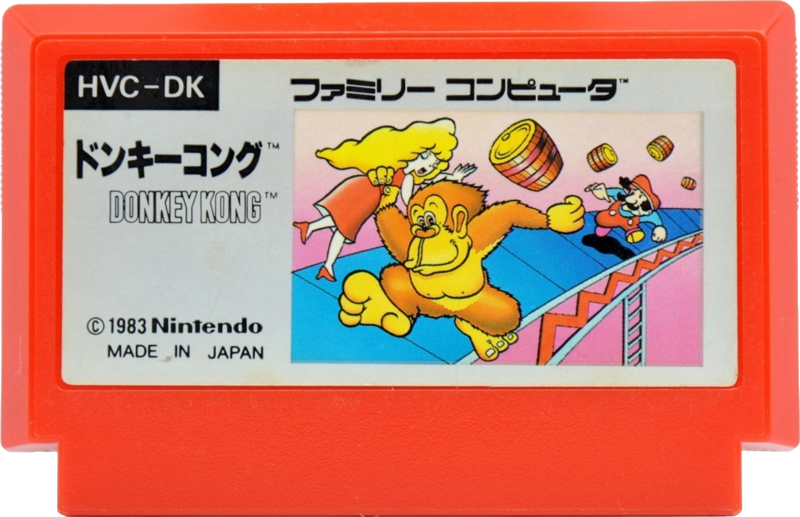


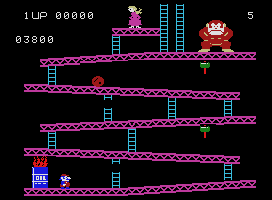
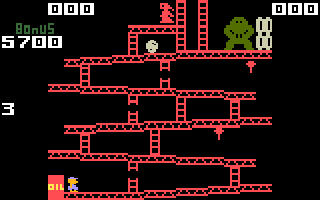
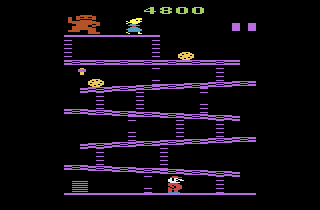
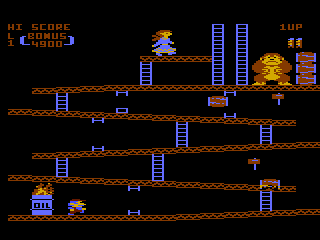
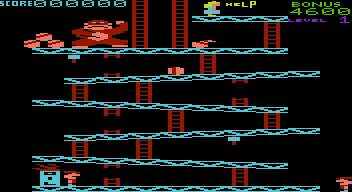
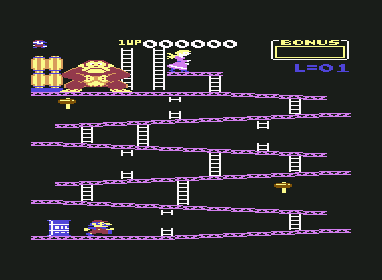
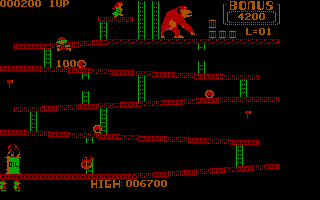
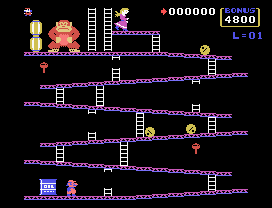
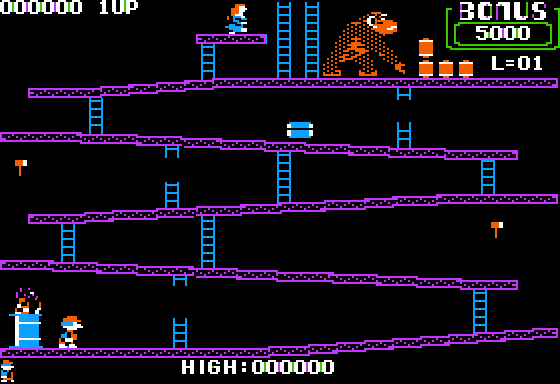
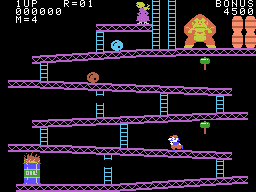
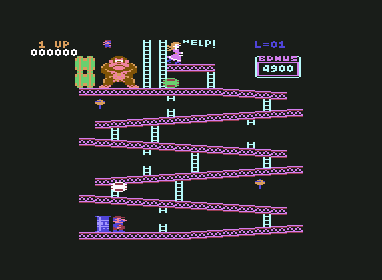
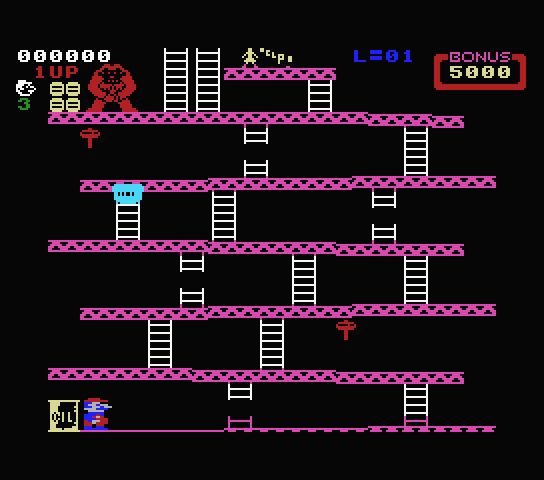
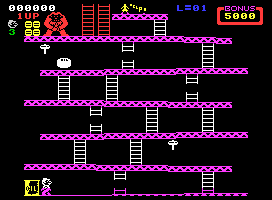
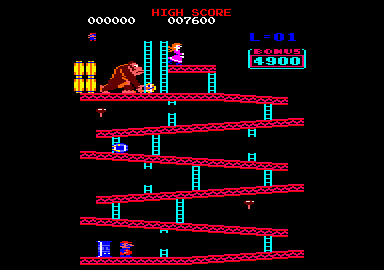
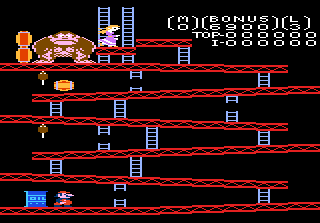
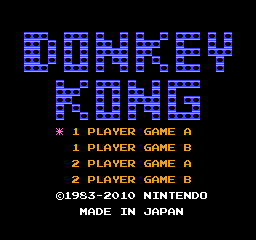
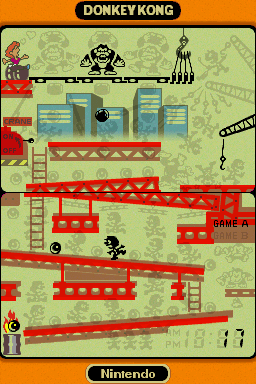


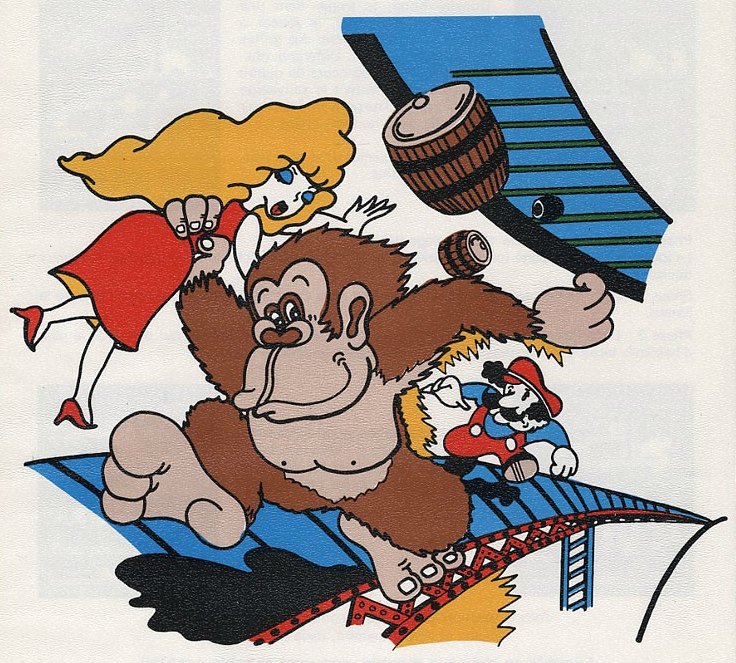
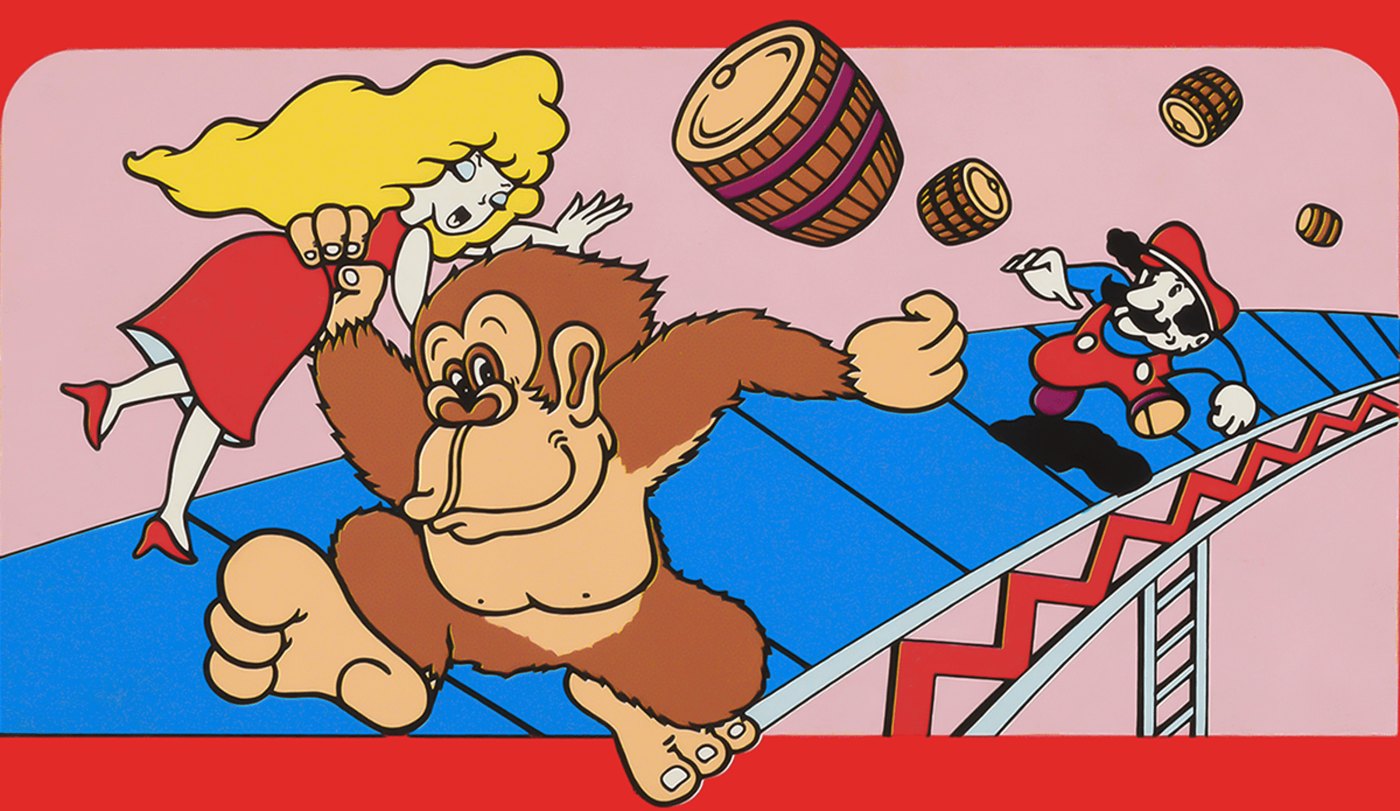
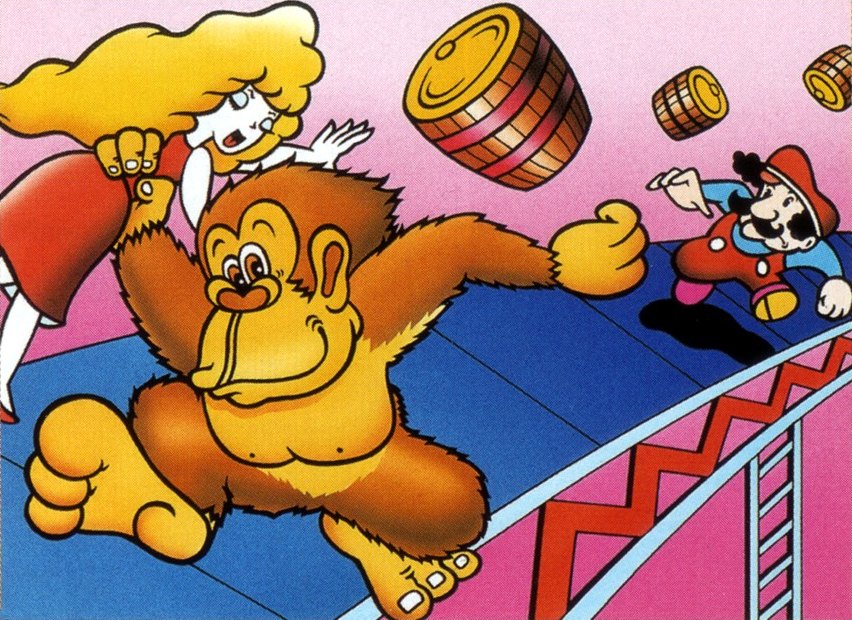
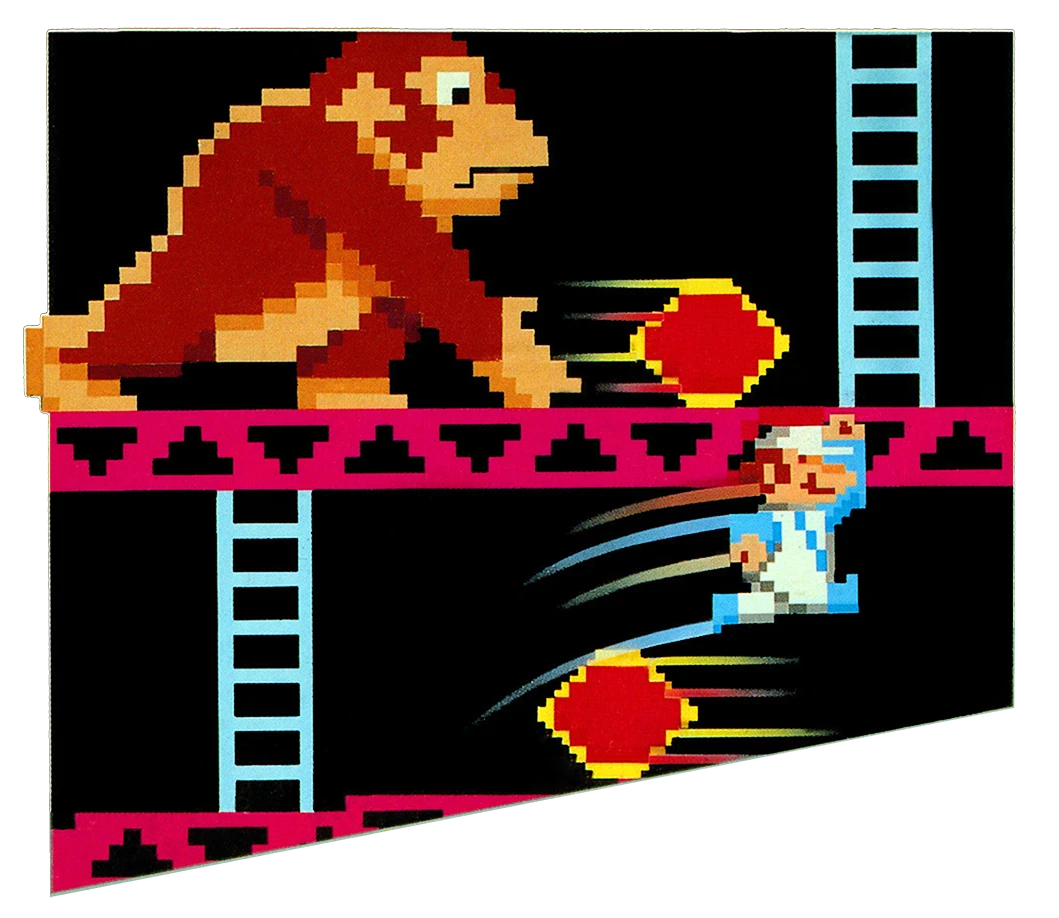
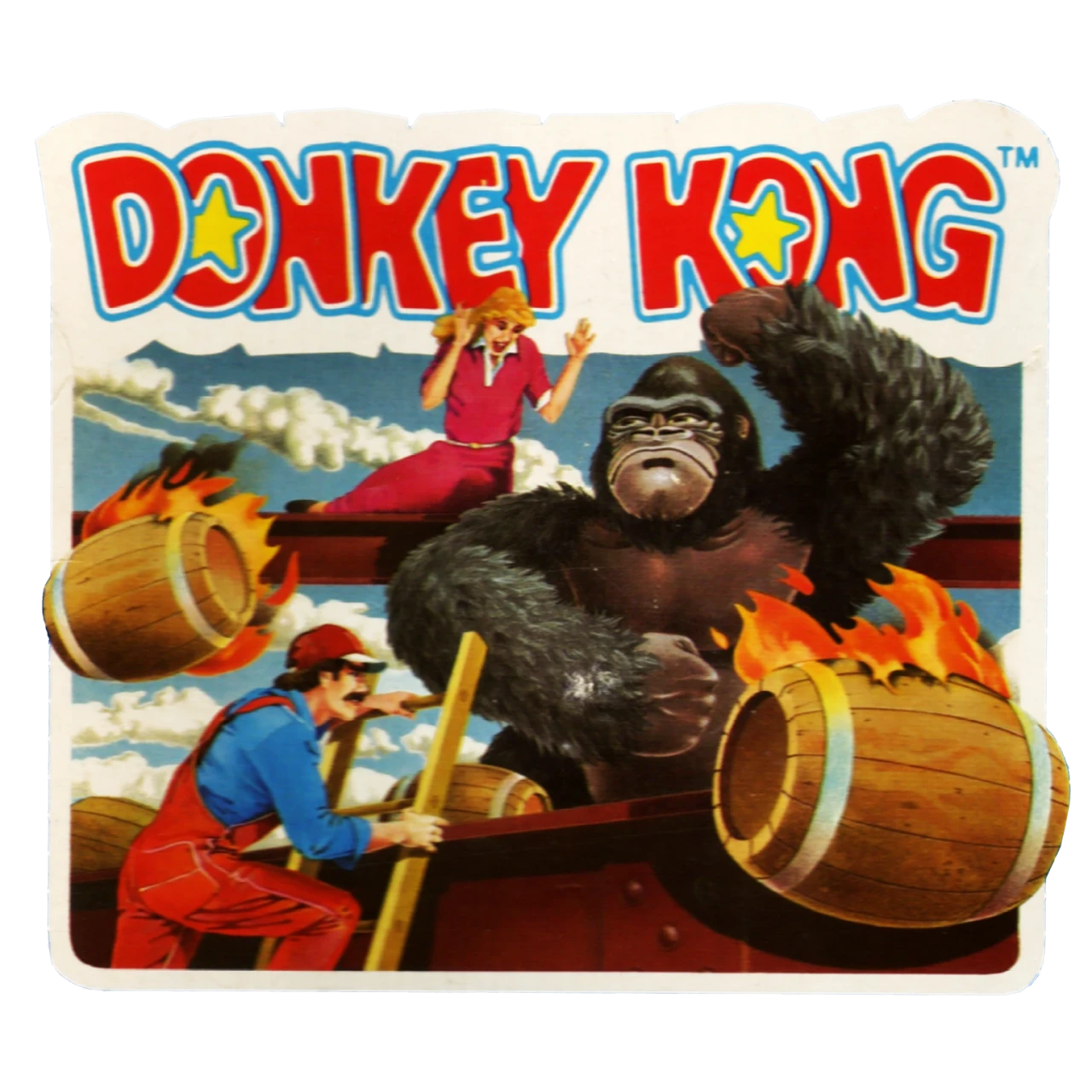
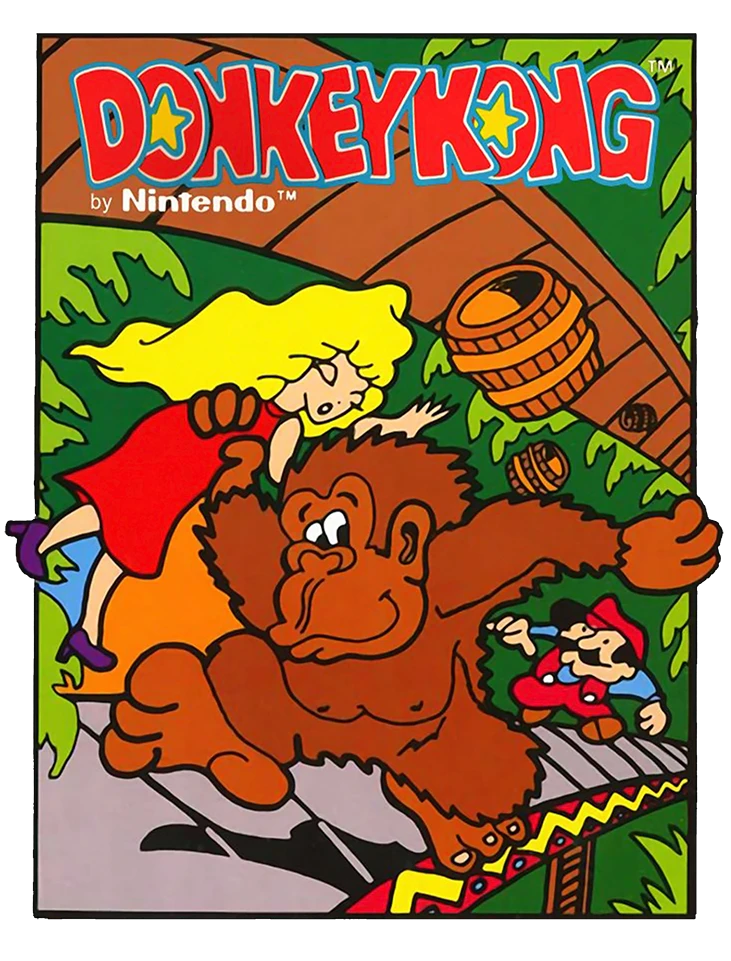
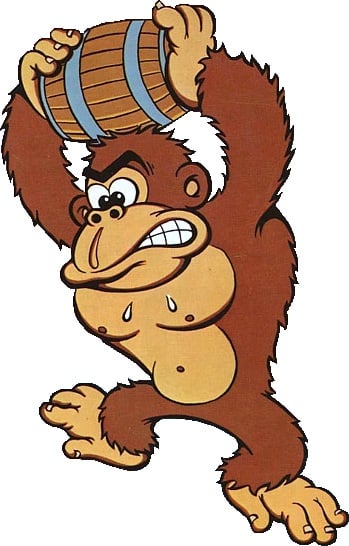
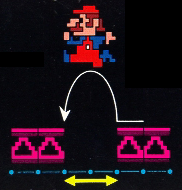
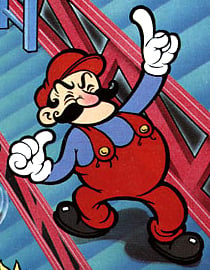

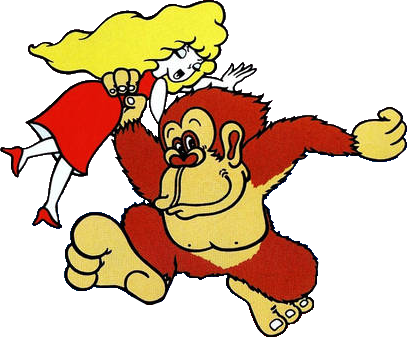
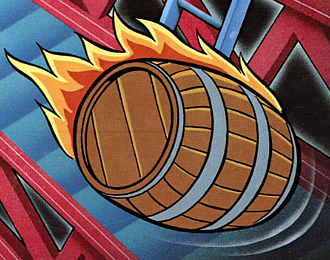


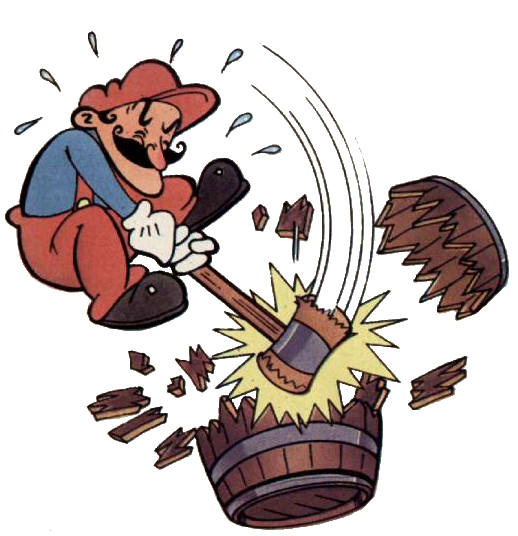
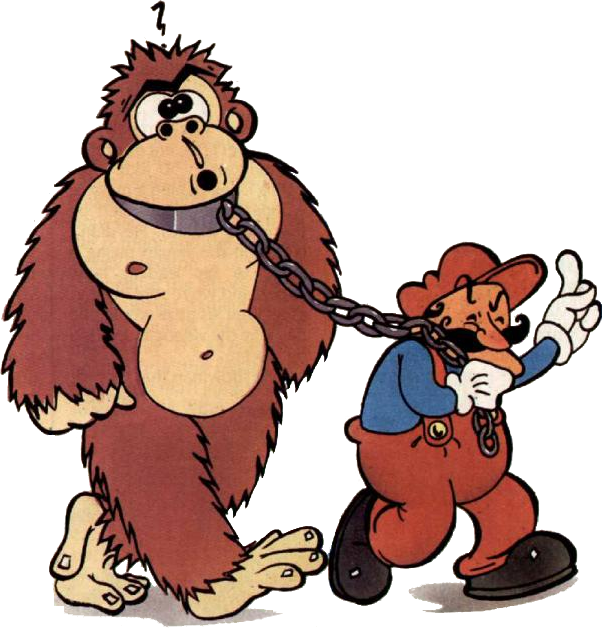
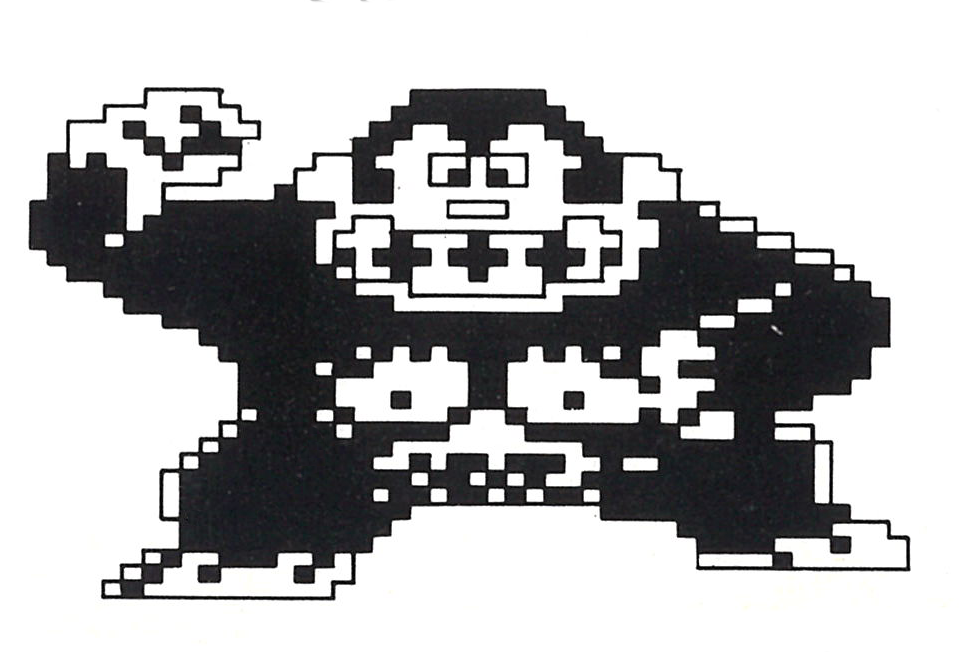
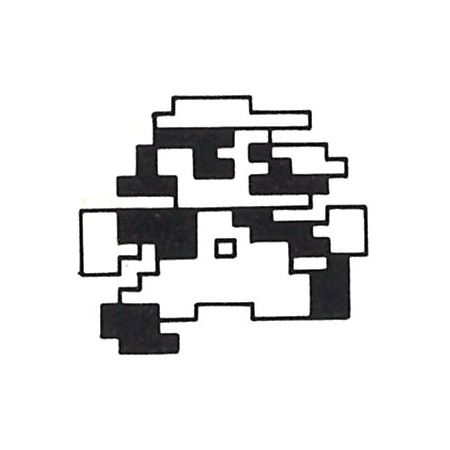
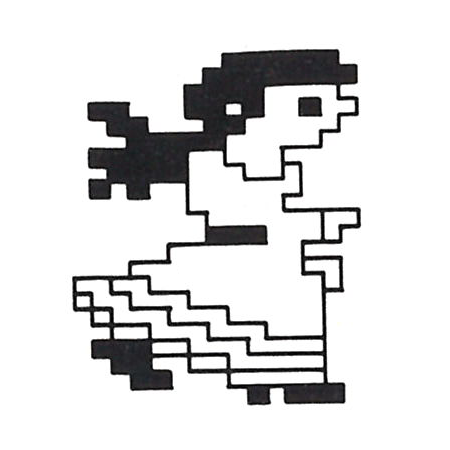
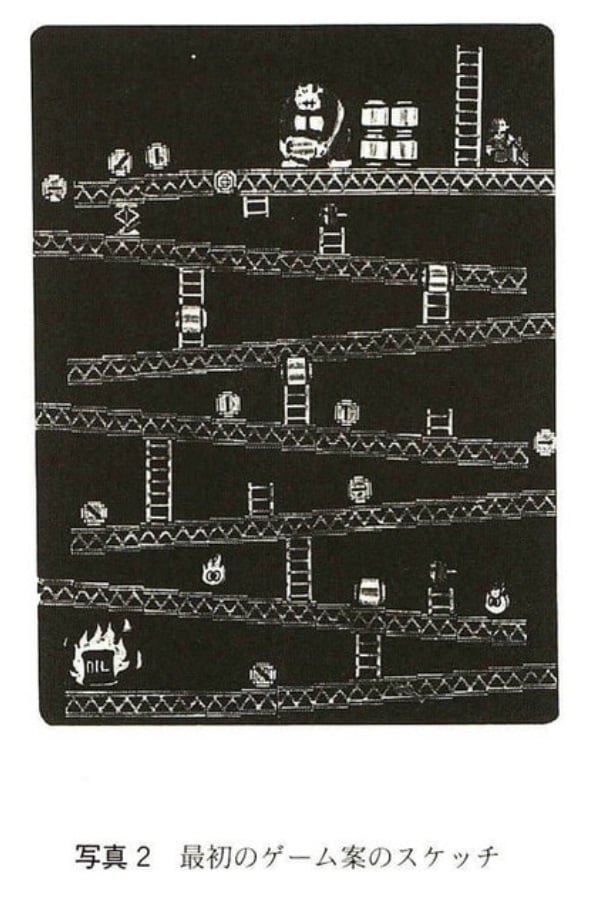
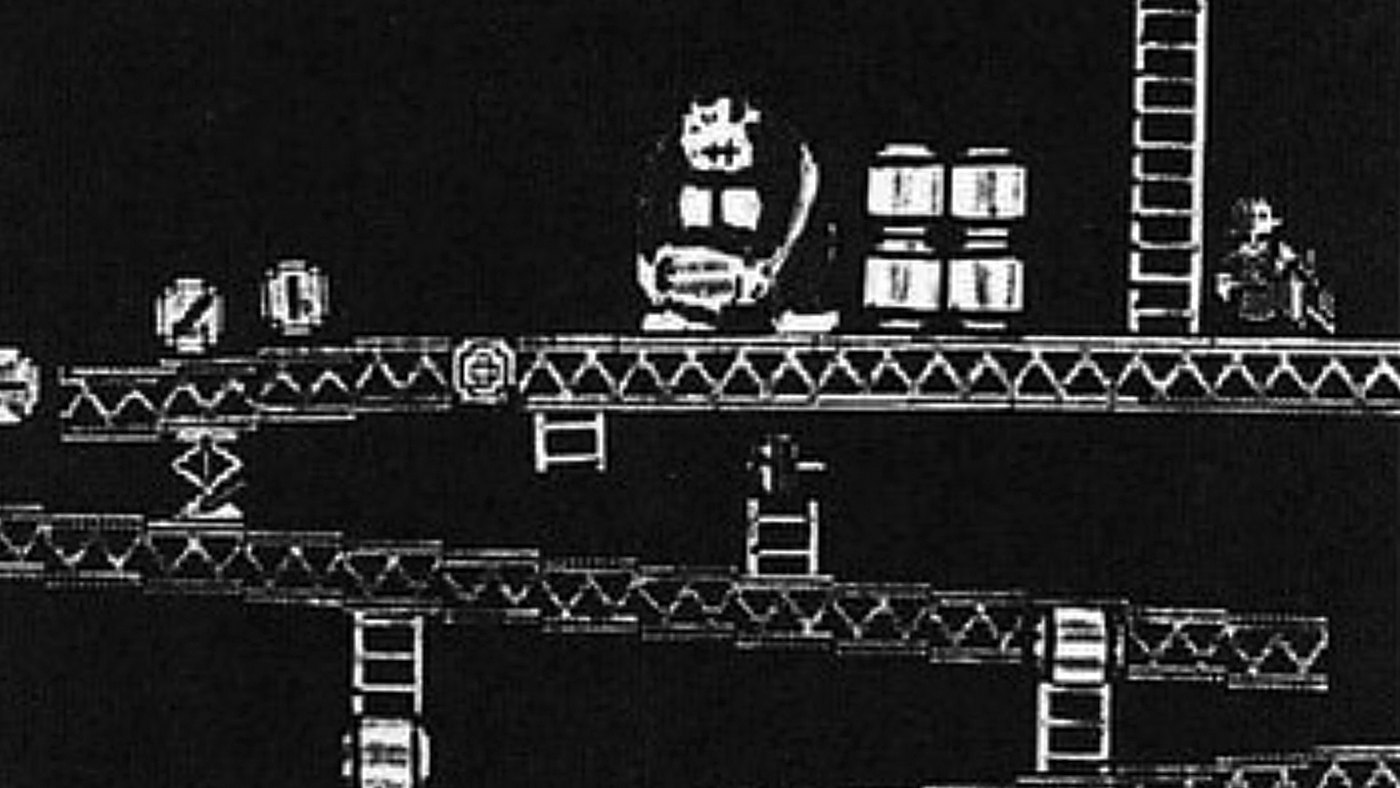
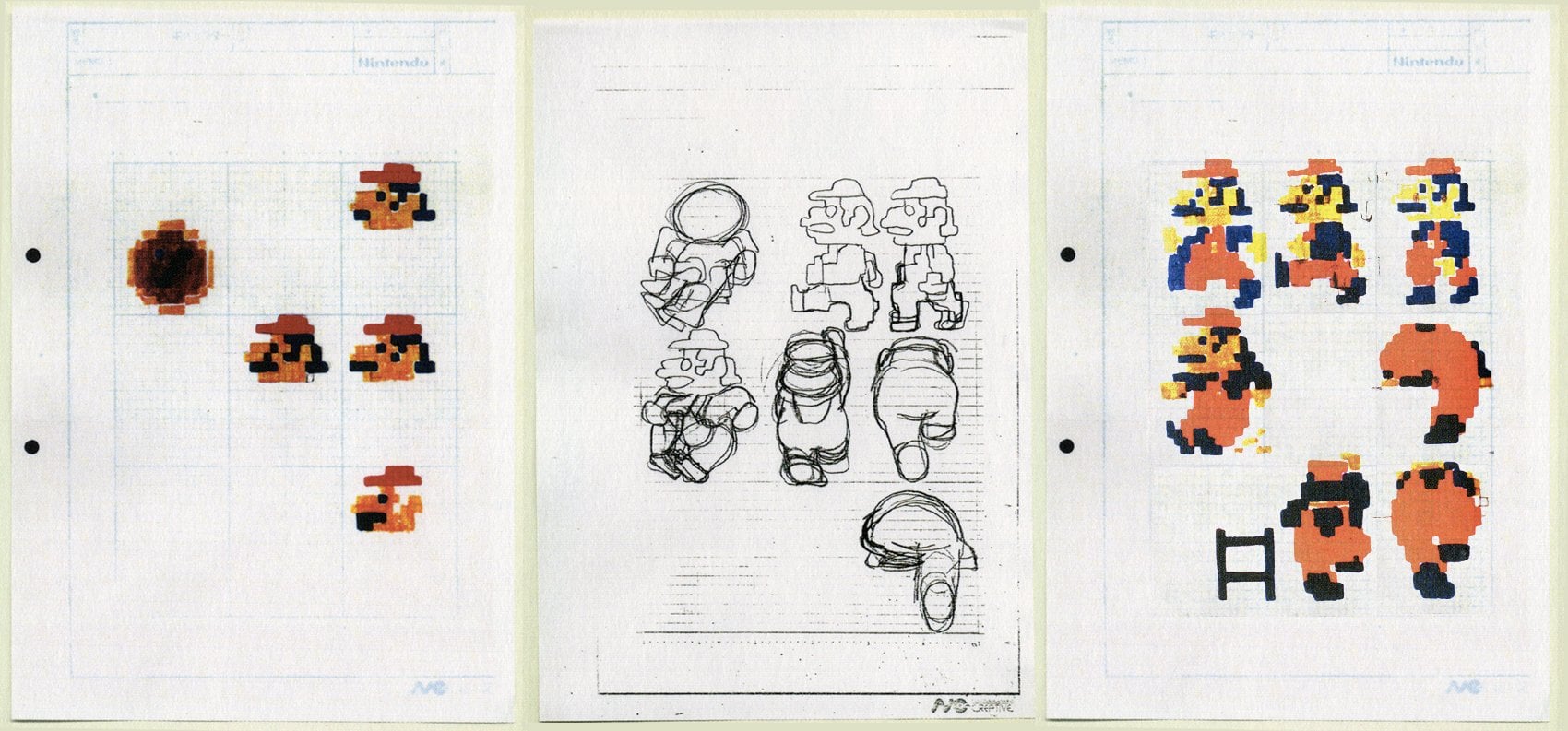
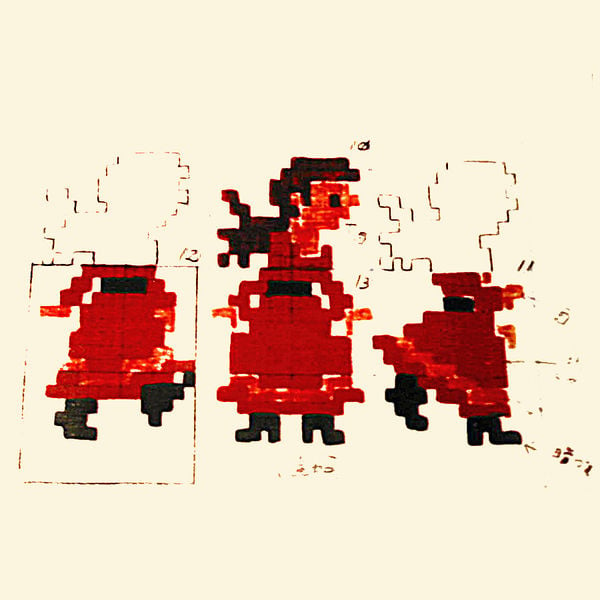
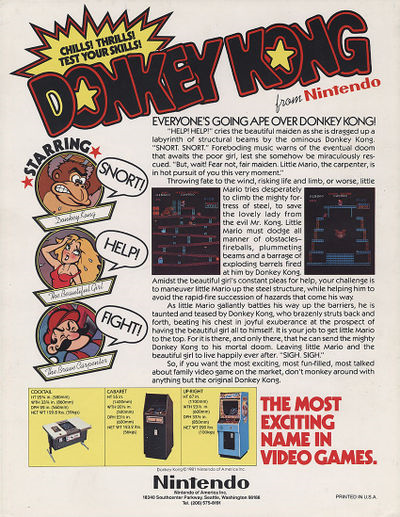
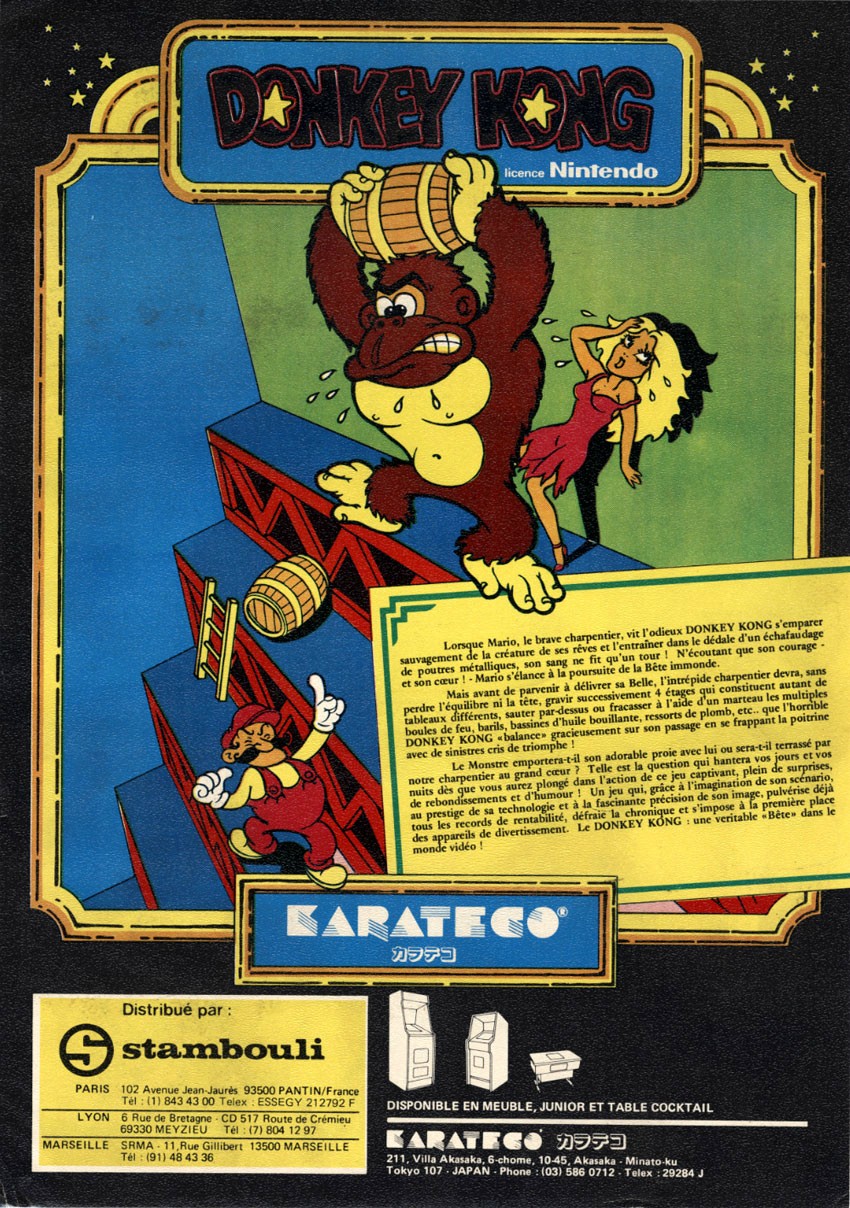
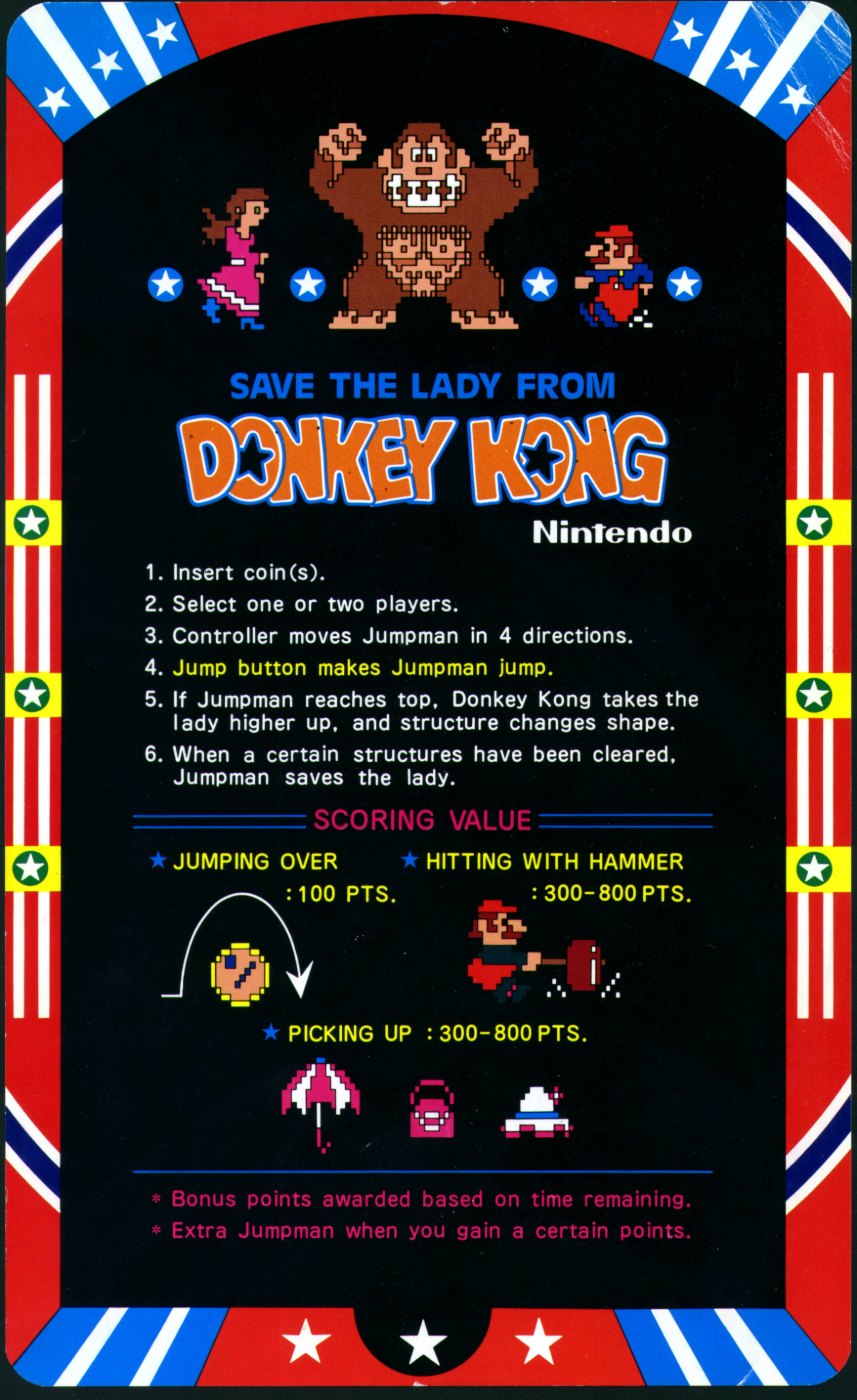
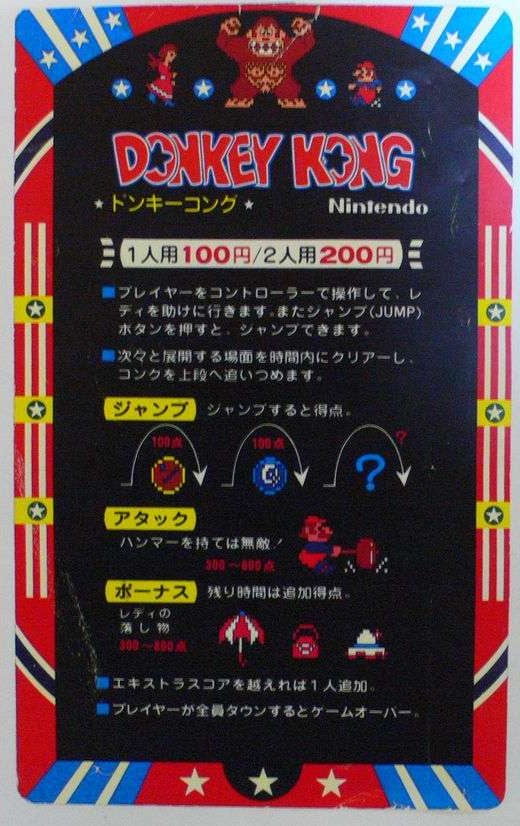
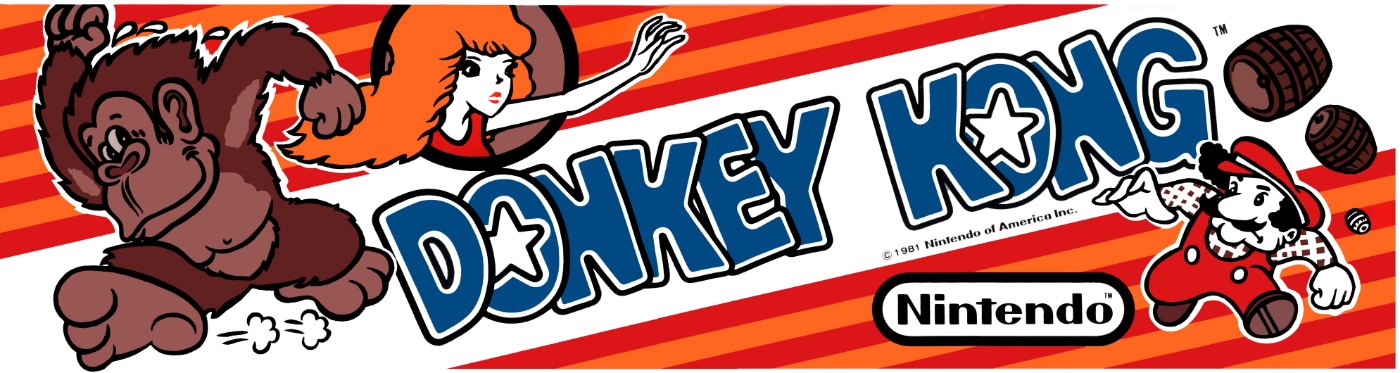
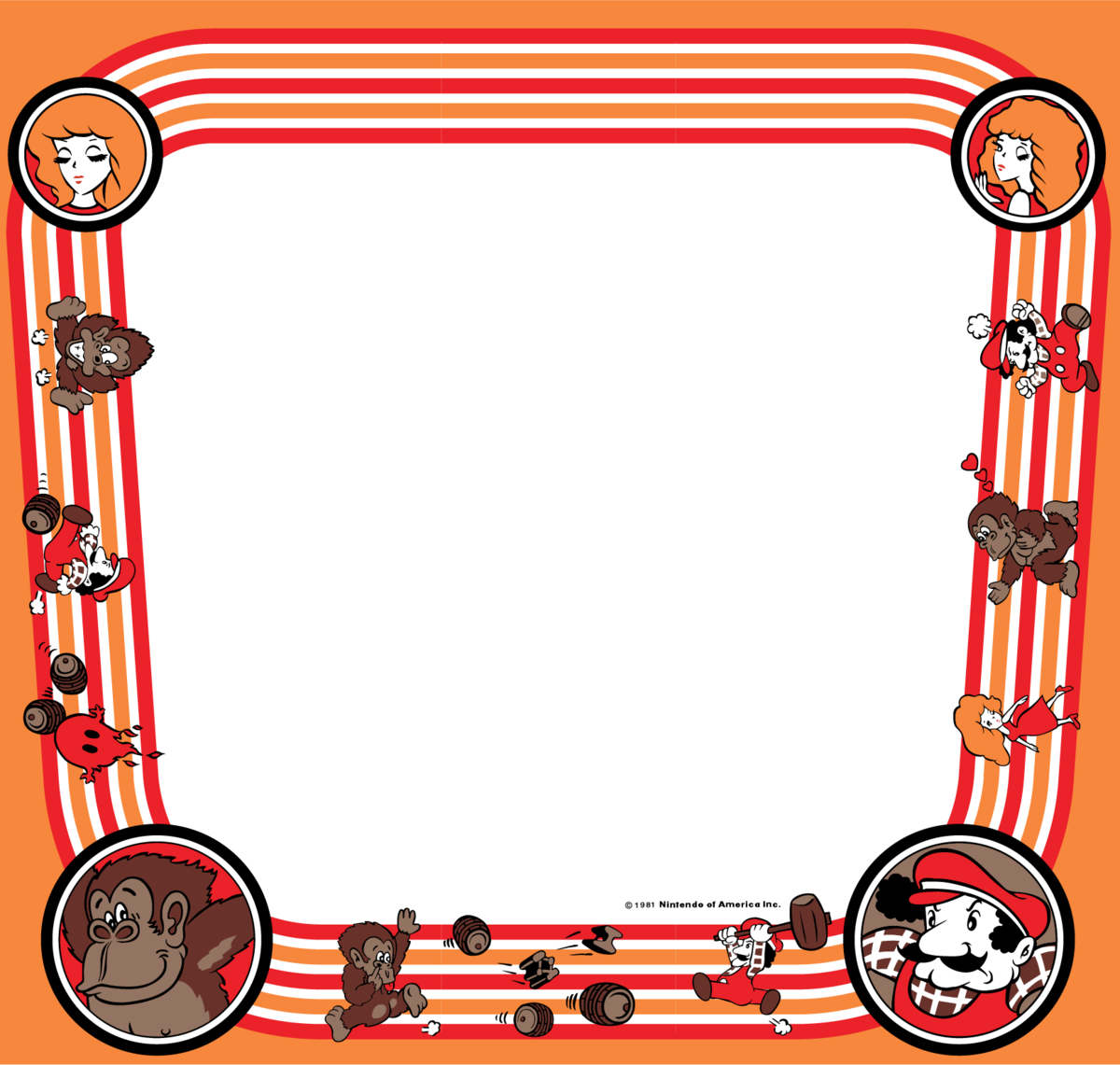
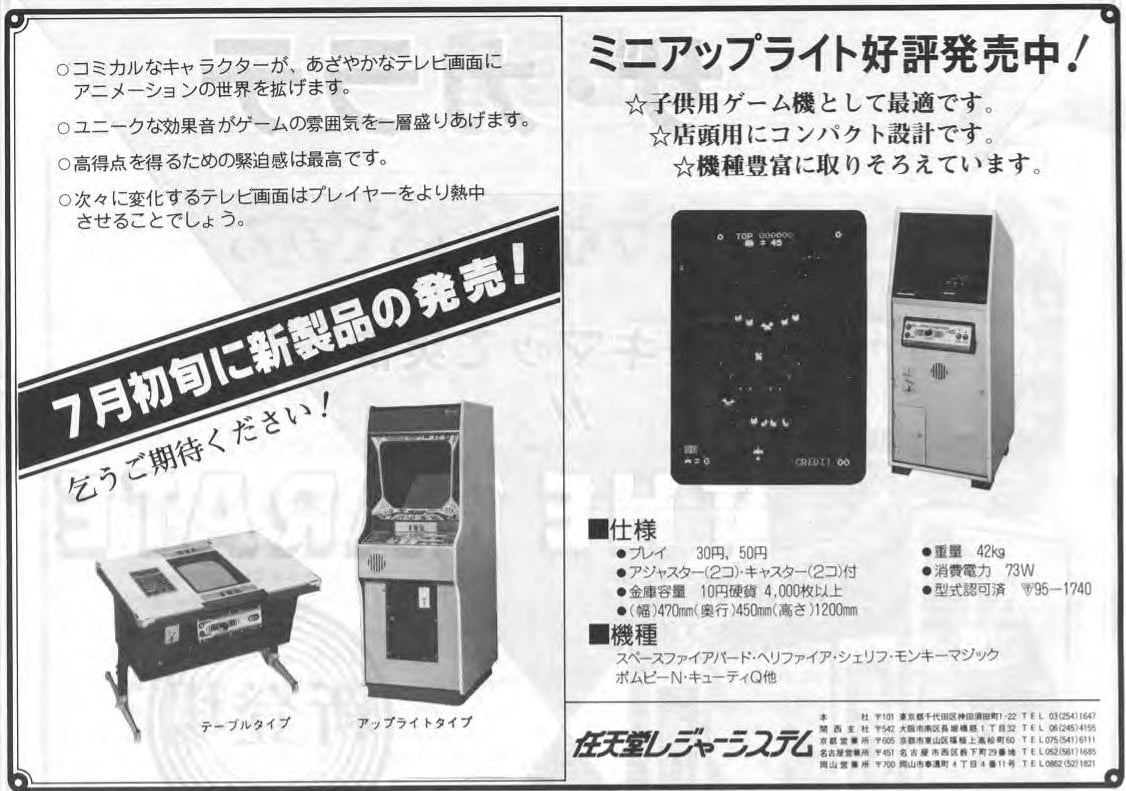
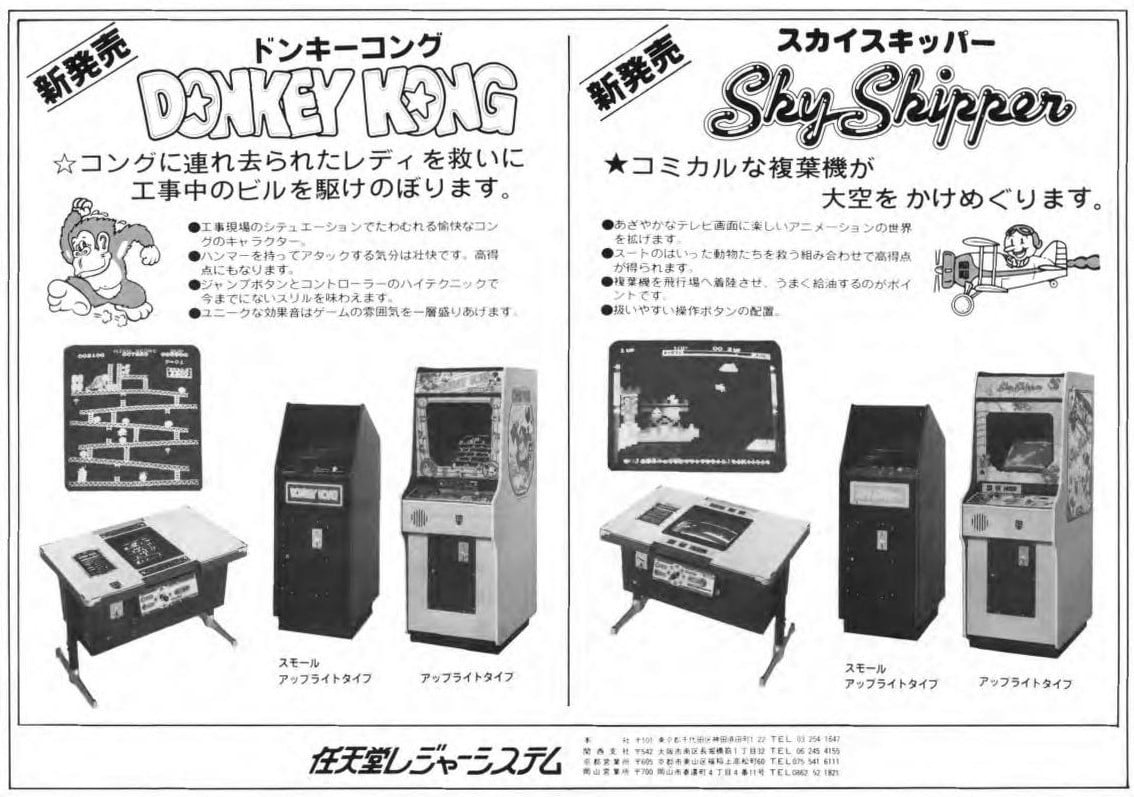
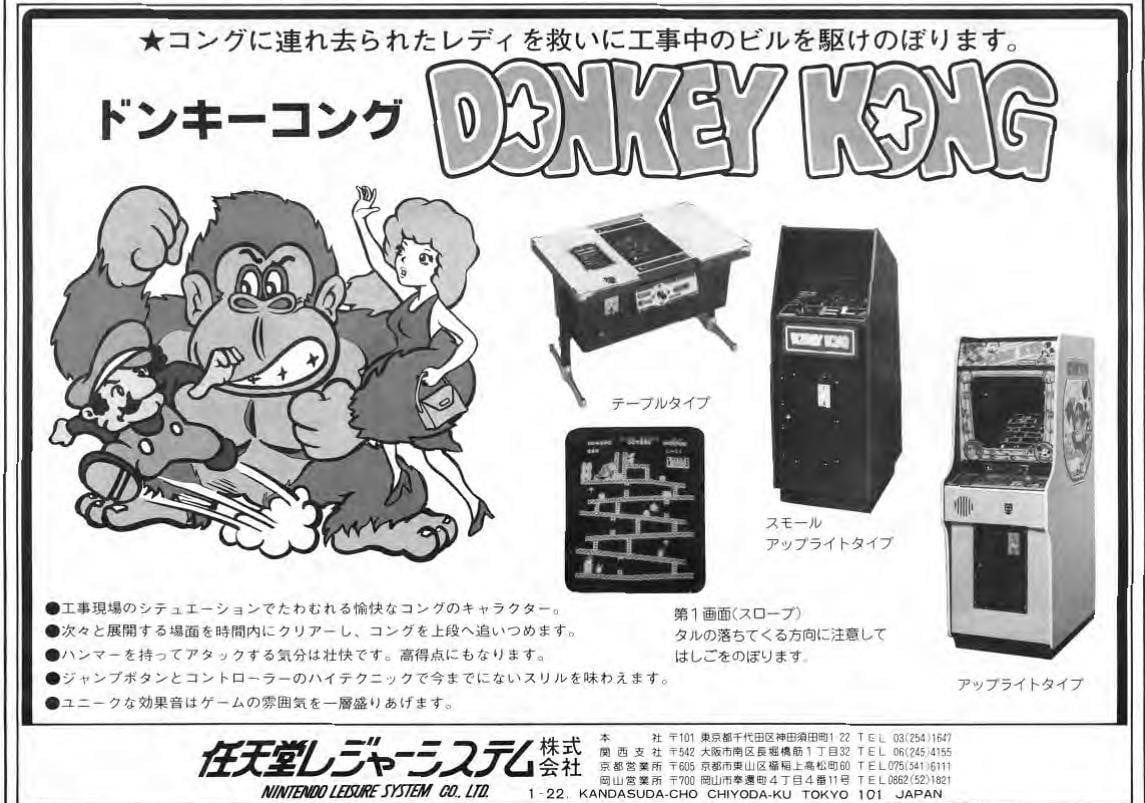
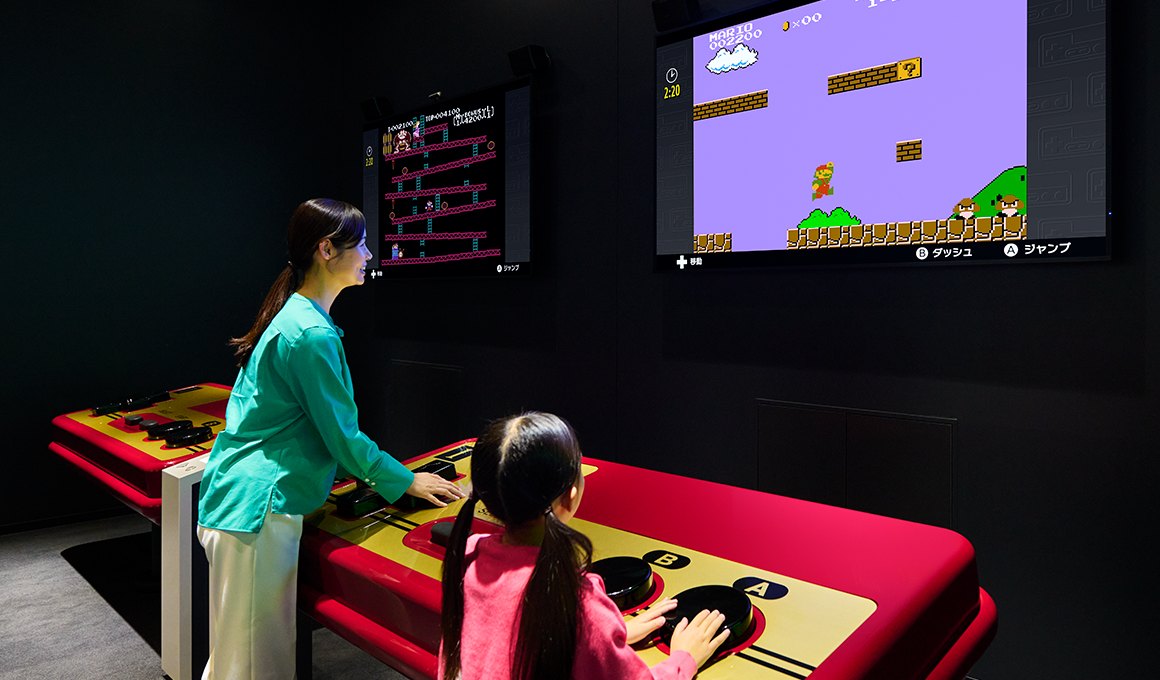
 Arcade (original)
 Atari 2600
 Atari 2600 gameplay
 Atari 7800
 Atari 7800 gameplay
 Atari 800
 Amstrad CPC
 Amstrad CPC gameplay
 Apple II
 Apple II gameplay
 Intellivision
 Intellivision gameplay
 e-Reader
 NES title screen