Game Boy Advance2001Kart racingIntelligent SystemsFirst handheld Mario Kart40 coursesFirst retro tracks5.91 million soldMetacritic 93
Mario Kart: Super Circuit
Mario Kart in your pocket, and a lot more of it than anyone expected. Mario Kart: Super Circuit reached the Game Boy Advance in Japan on 21 July 2001 as Mario Kart Advance, and North America and Europe by mid-September, inside the handheld’s first year on sale. It was built not by Nintendo’s own racing team but by Intelligent Systems, the studio behind Fire Emblem, Advance Wars and Paper Mario, and it splices the flat, spinning tracks and speed-boosting coins of Super Mario Kart to the eight drivers and the item set of Mario Kart 64. There are 20 new courses in five cups, and behind them, waiting to be unlocked, all 20 courses from the 1992 original: the series’ first retro tracks, for 40 courses in all. Four players can race over Game Link Cables, even from a single cartridge, every Grand Prix is graded from E to three stars, and the whole thing sold 5.91 million copies, more than any Game Boy Advance game without Pokémon in the title.
Developer:Intelligent Systems
Publisher:Nintendo
Platform:Game Boy Advance
Genre:Kart racing
Japan:21 July 2001 (as Mario Kart Advance)
N. America:27 August 2001
Europe:14 September 2001
Australia:September 2001
Players:1–4 (Game Link Cable; Single-Pak or Multi-Pak)
Drivers:8, plus coloured Yoshis in Single-Pak multiplayer
Courses:40 race courses (20 new, 20 from Super Mario Kart) and 4 battle courses
Items:11, all returning from Mario Kart 64
Engine classes:50cc, 100cc, 150cc
Sales:5.91 million worldwide
Re-releases:Player’s Choice (2006), Nintendo 3DS Ambassador Program (2011), Wii U Virtual Console (2014–15), Nintendo Switch Online + Expansion Pack (2023)
Advertisement
Overview
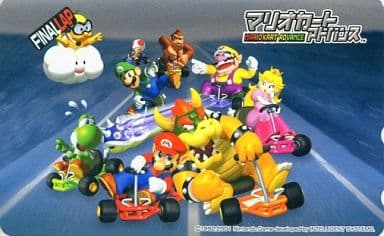
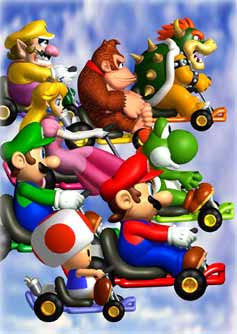
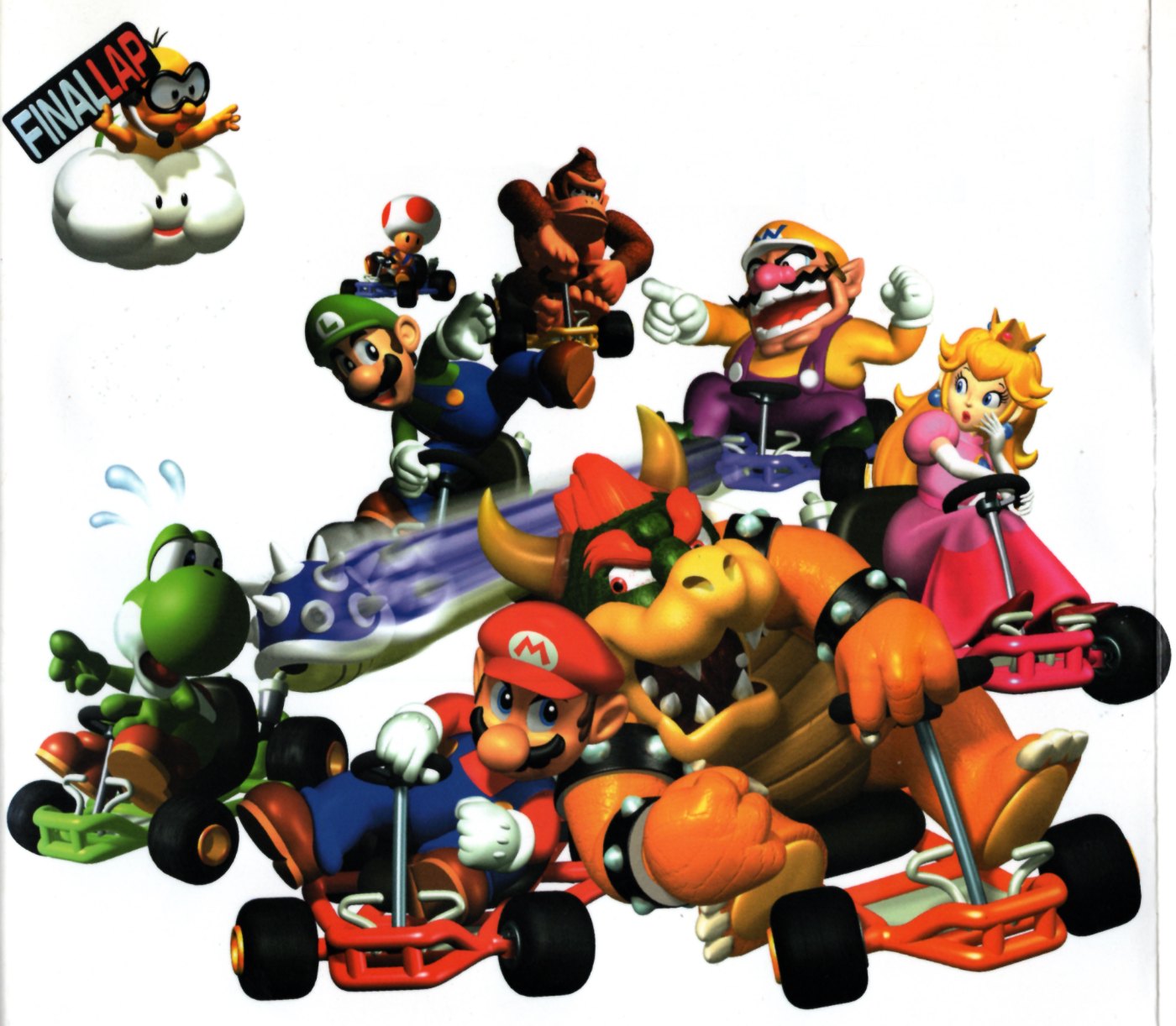
The official group artwork: eight drivers, straight from the Mario Kart 64 line-up.
By 2001 Mario Kart had been a Super NES game and a Nintendo 64 game, and both had been the kind of thing you played on a sofa with friends. Super Circuit was the first attempt to fit all of that into a handheld, and it did so by going back to the beginning. Its tracks are flat, scaled and rotated in the manner of the Super NES original, its coins make you faster just as they did in 1992, and the camera sits low behind a kart that hops and power-slides on the R Button. On top of that foundation sit the things Mario Kart 64 had added: its cast of eight, pre-rendered sprites modelled on its artwork, triple shells, the Spiny Shell and three-lap races.
What nobody expected was the size of it. The five cups on the menu (Mushroom, Flower, the brand-new Lightning, Star and Special) hold 20 original courses, from the gentle loop of Peach Circuit to a Rainbow Road ringed with jump ramps. Win them all, then go back and finish a cup with at least 100 coins in the bank, and an Extra version of that cup opens up, filled with courses from Super Mario Kart. All 20 of them are here, redrawn for the new hardware. No Mario Kart had revisited old tracks before; from Mario Kart DS onwards every one of them would.
It is also a stricter game than its cheerful looks suggest. Finish fifth or lower in a Grand Prix race and you must run it again, with only three retries per cup. Every cup ends with a grade, from E up to three stars, worked out from how cleanly you drove as well as where you finished. And the multiplayer, the heart of any Mario Kart, depends on Game Link Cables: one cartridge each for the full game, or a cut-down Single-Pak mode in which everybody is a Yoshi of a different colour racing on four of the old Super NES tracks.
Reviewers adored it. It holds a Metacritic score of 93, Famitsu gave it 34 out of 40 and IGN 9.5, and it went on to sell 5.91 million copies, which makes it the best-selling Game Boy Advance game outside the Pokémon series. Its reputation since has been quieter. It is the only Mario Kart made by Intelligent Systems, the last to draw its drivers as sprites, and the one most often left out of conversations about the series. Yet the idea it introduced, that a new Mario Kart should bring the old tracks with it, has shaped every sequel.
The Mario Kart series’ first handheld outing is fun and lightning-fast! Mario Kart: Super Circuit takes the best elements of Super Mario Kart and Mario Kart 64, and turbo-charges them with 20 extra tracks, plus 20 classic tracks for experts to unlock.
All the regular characters are here, including Mario, Luigi, Yoshi, Wario and more, plus your favourite items like Red Shells, Bananas and the much-feared Spiny Shell!
Find more Mario games at the Super Mario hub!
— Official description (Nintendo UK, 2015)
Why Super Circuit matters to Mario fans
This is where retro tracks begin. Every later Mario Kart, from Mario Kart DS to Mario Kart World, brings back courses from earlier games, and Super Circuit did it first and most completely, with the entire Super Mario Kart track list. It also invented the star ranks, the Lightning Cup and the idea of a portable Mario Kart, and eighteen of its twenty new courses have since been rebuilt for other games, Cheese Land, Ribbon Road and Sky Garden among them.
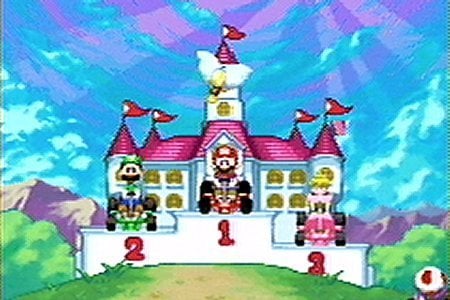
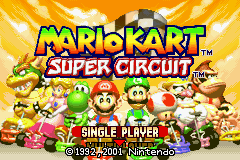
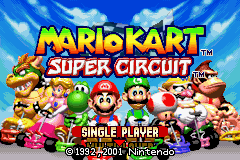
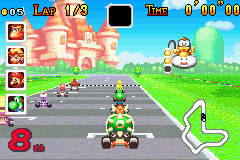
The title screen as it first appears, in daylight.All eight karts and Lakitu on the grid at Peach Circuit.The character select screen, with its two star ratings per driver.A podium finish. Fourth place or worse and the ceremony goes rather differently.
Quick Answers
The questions people ask most about Mario Kart: Super Circuit, answered briefly here and in depth further down the page.
When did Mario Kart: Super Circuit come out?
Japan: 21 July 2001, as Mario Kart Advance. North America: 27 August 2001. Europe: 14 September 2001, with Australia the same month. It has since returned on Nintendo 3DS (for Ambassadors only), Wii U and Nintendo Switch Online. More →
Who made it?
Intelligent Systems, the Nintendo-affiliated studio best known for Fire Emblem, Advance Wars and Paper Mario. Takeshi Ando and Yukio Morimoto directed, Shigeru Miyamoto and Kenji Miki produced, and Nintendo veterans including Hideki Konno, a director of Super Mario Kart, supervised. It is the only Mario Kart the studio has made. More →
How many tracks are there?
Forty race courses and four battle courses. Twenty of the race courses are new, in five cups of four; the other twenty are every course from Super Mario Kart, unlocked as five Extra cups. More →
How do you unlock the Super NES (Extra) tracks?
Win every cup in an engine class, Special Cup included. Then play a cup again in that class and finish it having collected at least 100 coins across its four races. That unlocks the Extra version of the same cup. More →
Who are the playable characters?
The same eight as Mario Kart 64: Mario, Luigi, Peach, Toad, Yoshi, Donkey Kong, Wario and Bowser, split into light, middle and heavy weights. Red, light-blue and yellow Yoshis appear only in single-cartridge multiplayer. There are no unlockable drivers. More →
What do coins do?
Each coin raises your kart’s top speed a little, and each course has 50 of them. You start a race with between two and five depending on your grid position, lose some when you are hit, and if you have none at all a bump from another kart will spin you out. More →
Can you play multiplayer with one cartridge?
Yes, in VS mode. With Game Link Cables and one copy of the game, up to four players can race, but everyone is a Yoshi and only four courses (the Extra Mushroom Cup) are available. For the full choice of drivers and tracks, and for Battle mode, every player needs a cartridge. More →
How do you get a three-star rank?
Win all four races for the maximum 36 points and drive well while doing it. Behind the scenes the game rewards Rocket Starts, mini-turbos and coins held at the finish, and penalises braking, leaving the track, hitting walls and being rescued by Lakitu. More →
Which Super Circuit tracks have returned in later games?
Eighteen of the twenty. Peach Circuit, Bowser Castle 2, Luigi Circuit and Sky Garden came back in Mario Kart DS; Shy Guy Beach and Bowser Castle 3 in Mario Kart Wii; Bowser Castle 1 in Mario Kart 7; Mario Circuit, Cheese Land and Ribbon Road in Mario Kart 8; and more in Mario Kart Tour and the Booster Course Pass. Only Broken Pier and Rainbow Road have never been remade. More →
How can I play it today?
It is one of the Game Boy Advance games included with a Nintendo Switch Online + Expansion Pack membership, and has been since that library launched on 8 February 2023. More →
Cups & Courses
Lakitu and the eight drivers.
Super Circuit is organised as two sets of five cups. The Super Circuit cups hold the 20 new courses, four to a cup, raced over three laps. The Extra cups hold the 20 courses of Super Mario Kart in their original running order, raced over five laps as they were in 1992. Each set can be played in 50cc, 100cc and 150cc, and each cup in each class has its own trophy and its own rank to chase.
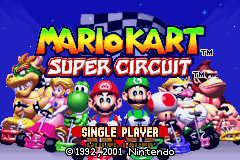
To open an Extra cup you must first win all five Super Circuit cups in that engine class, then replay the cup of the same name and finish it with at least 100 coins. There is one more reward for completists: collect gold trophies in every Super Circuit cup and the title screen changes from day to sunset; earn three stars in all of them and it changes again, to night, with a different arrangement of the theme.
Mushroom Cup: a gentle start
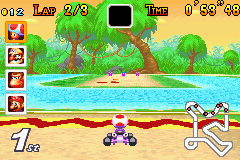
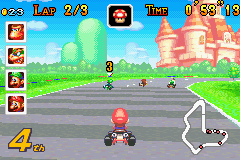
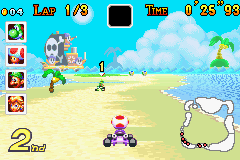
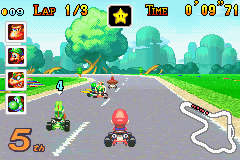
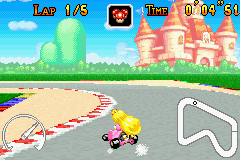
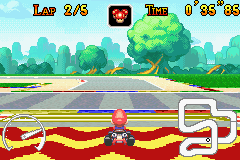
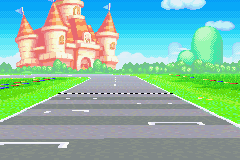
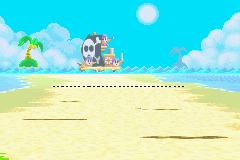
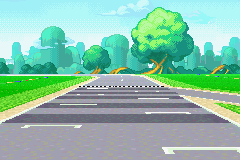
The first cup is built to teach. Peach Circuit is a short, simple loop of tarmac with grass and trees at its edges and Princess Peach’s Castle on the horizon, and nothing on it will hurt you. Shy Guy Beach raises the stakes at once: crabs scuttle across the first corner, the racing line runs through shallow water, and a pirate galleon crewed by Shy Guys sits offshore lobbing cannonballs onto the sand. The level is a nod to the Shy Guy’s Ship stage of Yoshi’s Story.
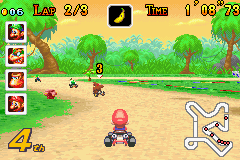
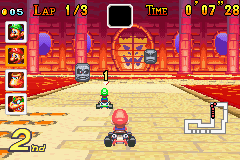
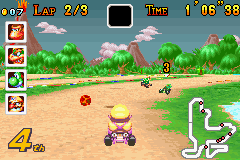
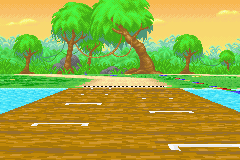
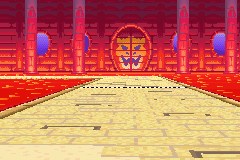
Riverside Park winds through a jungle, starting on a wooden bridge and leaping the river from jump pads, with a couple of Mushroom-powered short cuts across the water for the brave. Bowser Castle 1 is the first of four new castles: five Thwomps, a long straight of five jumps over lava, and Lava Bubbles leaping up between them.
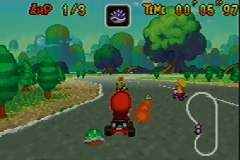
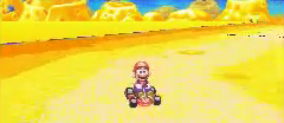
Peach Circuit, the first race of the game.Shy Guy Beach, under fire from the galleon.Riverside Park’s wooden bridges.Thwomps on guard in Bowser Castle 1.
Flower Cup: ghosts and cheese
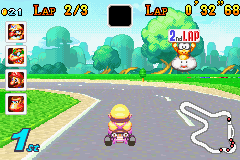
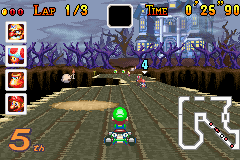
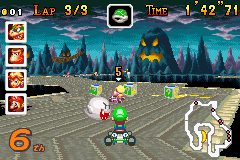
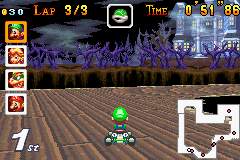
Mario Circuit is cut from the same cloth as Peach Circuit, down to the music the two share, with a narrow side path near the end that hides a Dash Panel. Boo Lake is the game’s tribute to the Ghost Valley tracks of 1992, a boardwalk over a dark pit with lantern-carrying Boos drifting past, gaps to jump and thin, flickering bridges that cut corners if you dare to use them.
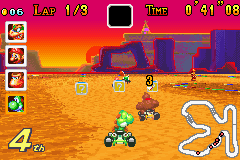
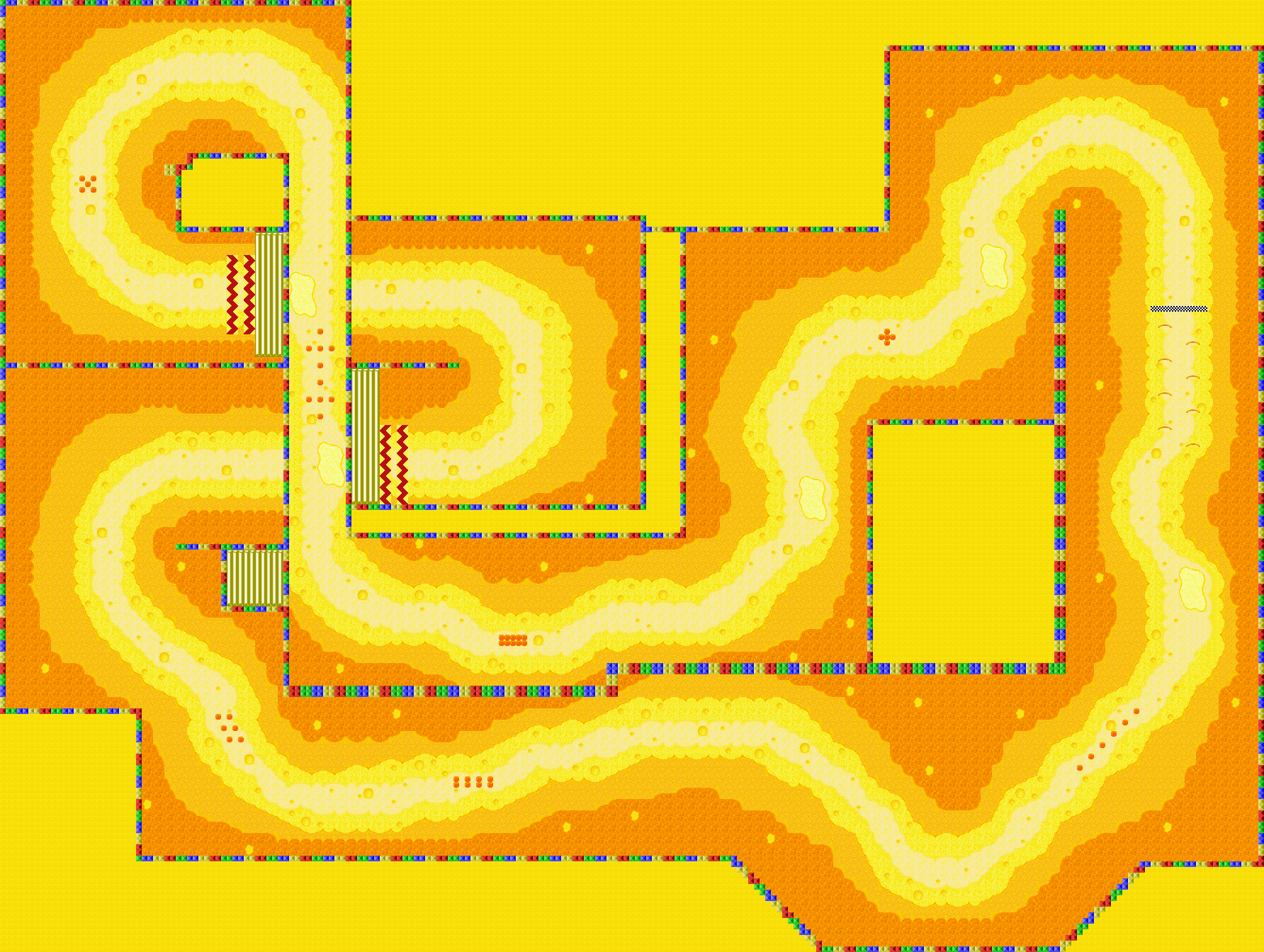
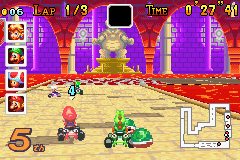
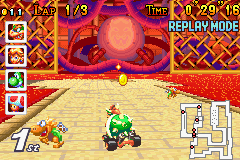
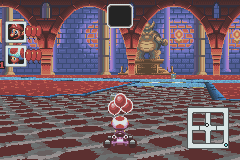
Then comes the track everybody remembers. Cheese Land is a moonscape made entirely of cheese and set in outer space, patrolled near the end by masked mice that spin you out. Two ramps make two different shortcuts possible, and they can be chained together. Bowser Castle 2 closes the cup with nothing but straights and right-angled turns, metal grids with holes in them and a section of lava that has to be crossed in a string of jumps.
Mario Circuit.Boo Lake’s boardwalk.Cheese Land: a whole course made of cheese.Bowser Castle 2 and its lava jumps.
Lightning Cup: the new one
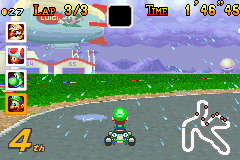
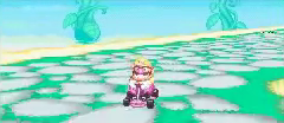
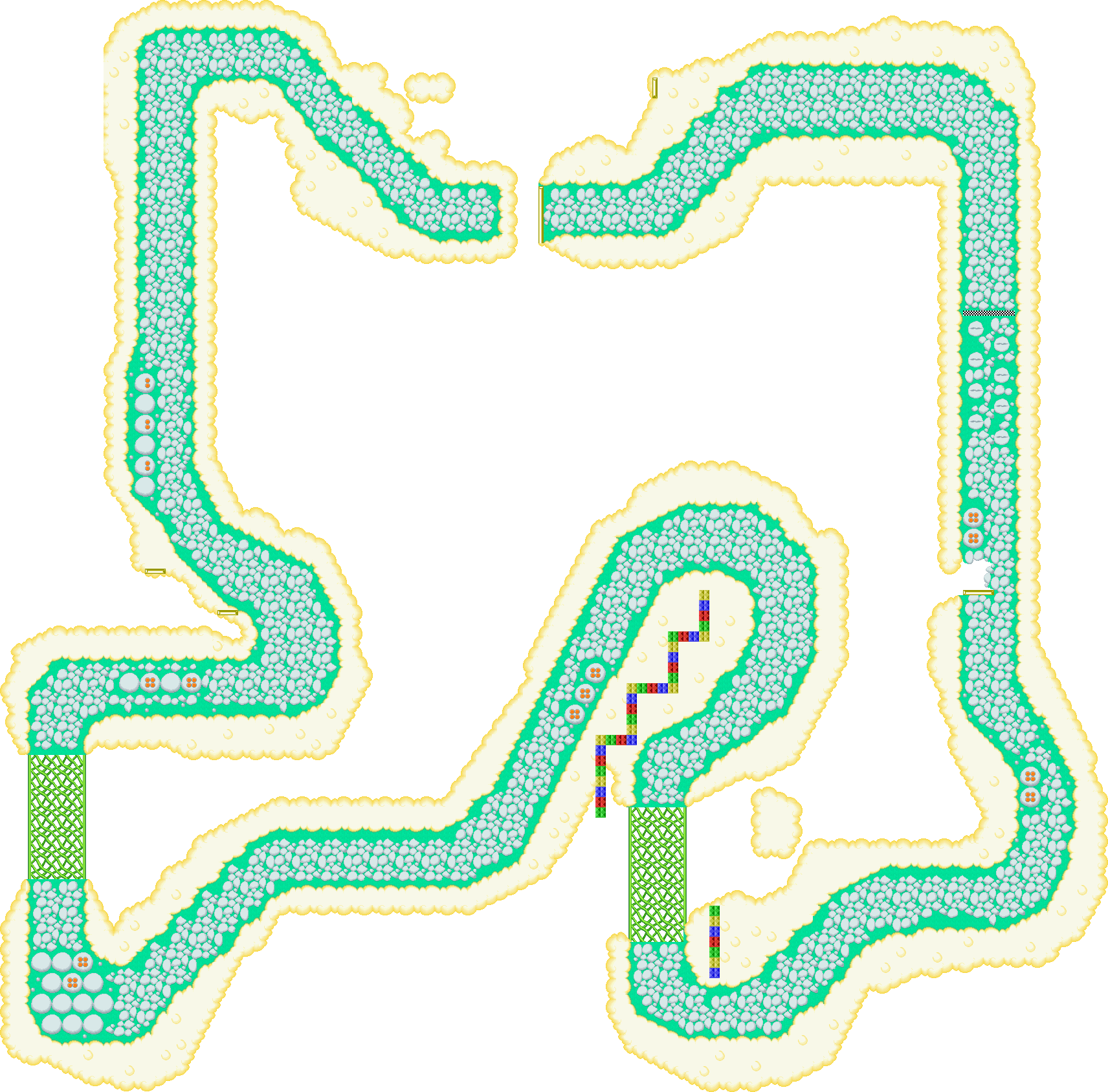
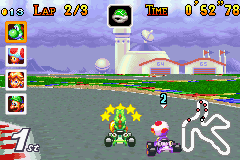
Earlier Mario Karts had four cups. Super Circuit adds a fifth, the Lightning Cup (Thunder Cup in Japan and in some manuals), and gives it some of the most inventive courses in the game. Luigi Circuit is an airfield in a downpour, the first Mario Kart course to be set in the rain, with puddles that spin the unwary and a Luigi blimp that takes off during the final lap. Sky Garden is a cobbled road laid across the tops of clouds and beanstalks, with nothing much to stop you falling off and a hole beside the home straight.
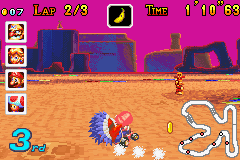
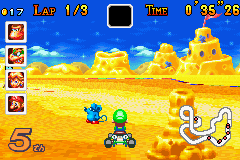
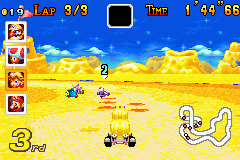
Cheep-Cheep Island strings a chain of small islands together with seven bridges while giant Cheep-Cheeps leap in the background. Sunset Wilds is a desert track with a clock: the sun sinks a little further on each lap, so that the last one is run in the dark. Shy Guys camp beside the road here, and drive into one of their tents and its owner jumps aboard, slowing you down and costing you coins.
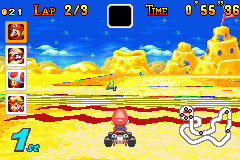
Luigi Circuit in the rain.Toad among the clouds in Sky Garden.Cheep-Cheep Island.Sunset Wilds on the final lap, after dark.
Star Cup: ice, ribbons and a sphinx
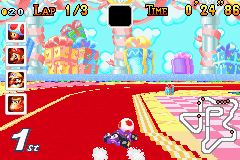
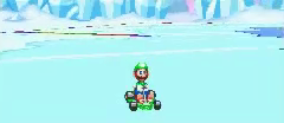
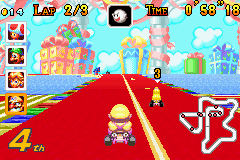
Snow Land is laid out on a frozen lake. The ice is slippery, the snowmen take two hits to knock down and the penguins, which sit spinning on the spot, will spin you in turn. Ribbon Road is the game’s toy box, a ribbon of road winding through a world of craft materials and wrapped presents, with Dash Panel ramps that fling you over the road you have just driven.
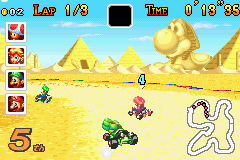
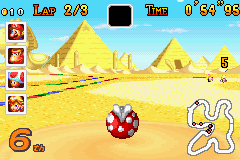
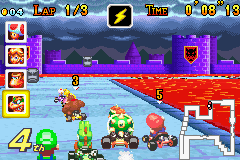
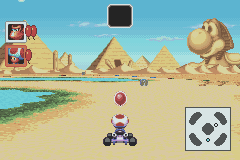
Yoshi Desert has pyramids on the horizon and a sphinx with Yoshi’s face, a landmark that later turned up again in Mario Kart Wii. Its quicksand pits are occupied by Piranha Plants that drag karts under and chew on them. Bowser Castle 3 moves outside onto the battlements, under storm clouds and lightning, with lava grids to hop across and Kamek flying back and forth near the finish line.
Snow Land.Ribbon Road.A Piranha Plant waits in the quicksand of Yoshi Desert.Bowser Castle 3, out on the ramparts.
Special Cup: volcanoes, ghosts and stars
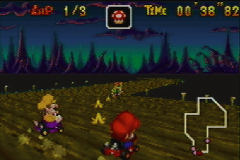
Lakeside Park looks peaceful for exactly one lap. On the second, the sky darkens, the two volcanoes behind the lake erupt and Lava Boulders begin to rain onto the road. Broken Pier is Boo Lake’s nastier sibling, all split paths and thin bridges over nothing, where Boos latch on to passing karts and help themselves to coins.
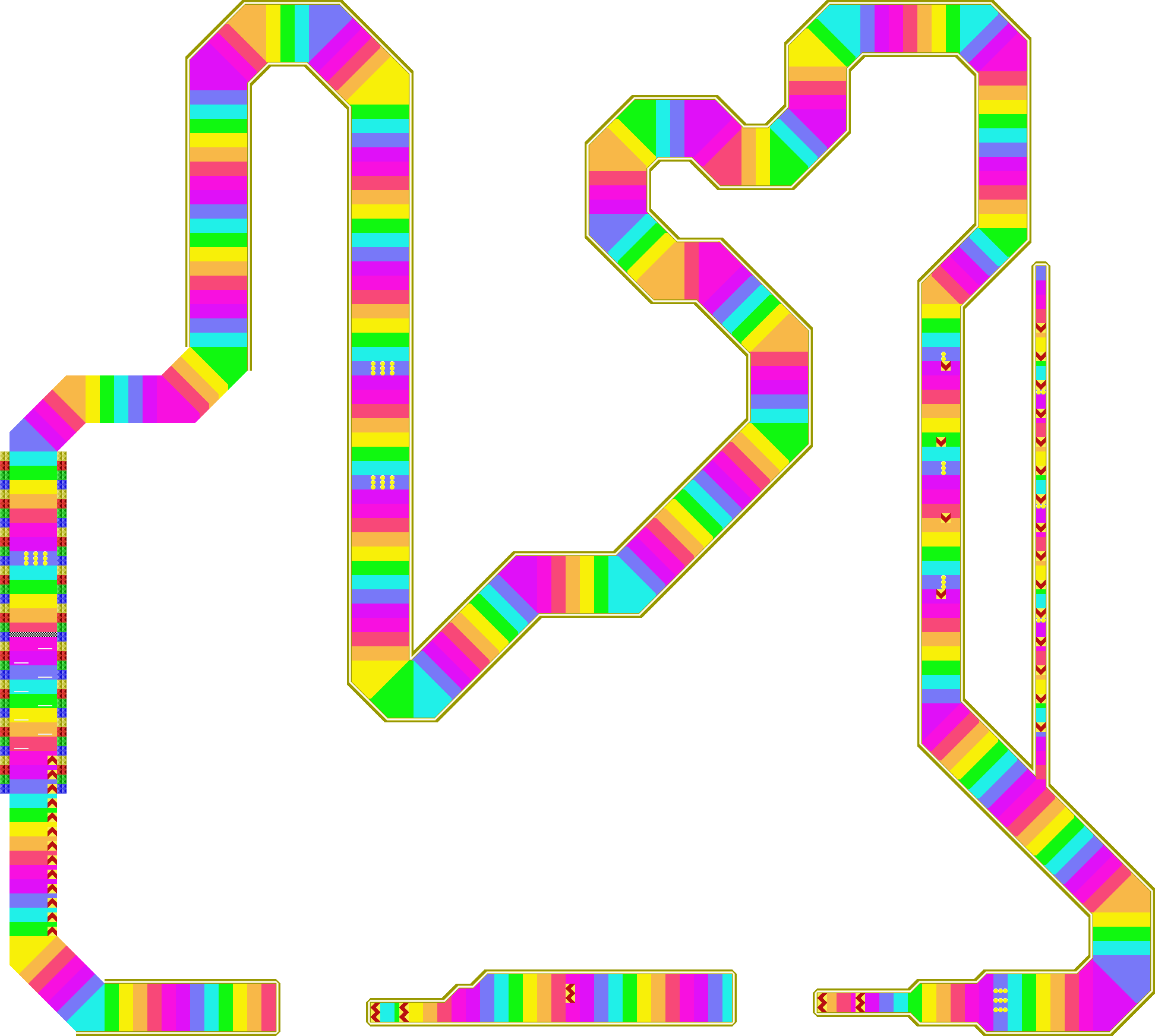
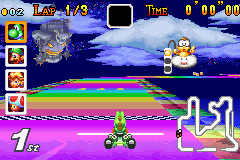
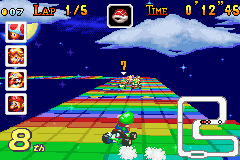
Bowser Castle 4 is the last of the castles and a marathon: lava pools, Thwomps that slide sideways before they drop and, near the end, clockwork Mechakoopas marching up and down the road. And then Rainbow Road: a translucent ribbon in space with jump ramps where the crash barriers ought to be, falling stars, storm clouds that shrink you and, in the background, Bowser’s Castle with Peach’s Castle perched on top of it, exactly as in Paper Mario. Those ramps cut both ways. Hit one by accident and you are over the edge; hit the right ones on purpose and you can skip great lengths of the track.
Lakeside Park, with its volcanoes still asleep.Broken Pier.Mechakoopas on patrol in Bowser Castle 4.Yoshi and Lakitu on the start line of Rainbow Road.
The Extra cups: Super Mario Kart, all of it
The Extra cups are the game’s great surprise. Super Mario Kart had four cups of five races; Super Circuit takes the same 20 courses in the same order and deals them out again as five cups of four, so that the Extra Mushroom Cup is Mario Circuit 1, Donut Plains 1, Ghost Valley 1 and Bowser Castle 1, and the Extra Special Cup ends, as it must, on the original Rainbow Road.
They are faithful in layout and five laps long, as before, but they are not untouched. Coins have been rearranged so that every course has exactly 50. Most of the original hazards have been taken out: the pipes, the Thwomps, the oil slicks of the later Mario Circuits and the Monty Moles of Donut Plains are all missing. What remains are the breakable blocks at the edges of the Ghost Valley and Vanilla Lake tracks (which here simply vanish when struck) and the deep water of the Koopa Beaches. The first four of these courses are also the only ones available in Single-Pak multiplayer.
Mario Circuit 1, where Mario Kart began, rebuilt for Game Boy Advance.The jump on Mario Circuit 2.Ghost Valley 2, breakable edges intact.The Super NES Rainbow Road returns.
The four battle courses
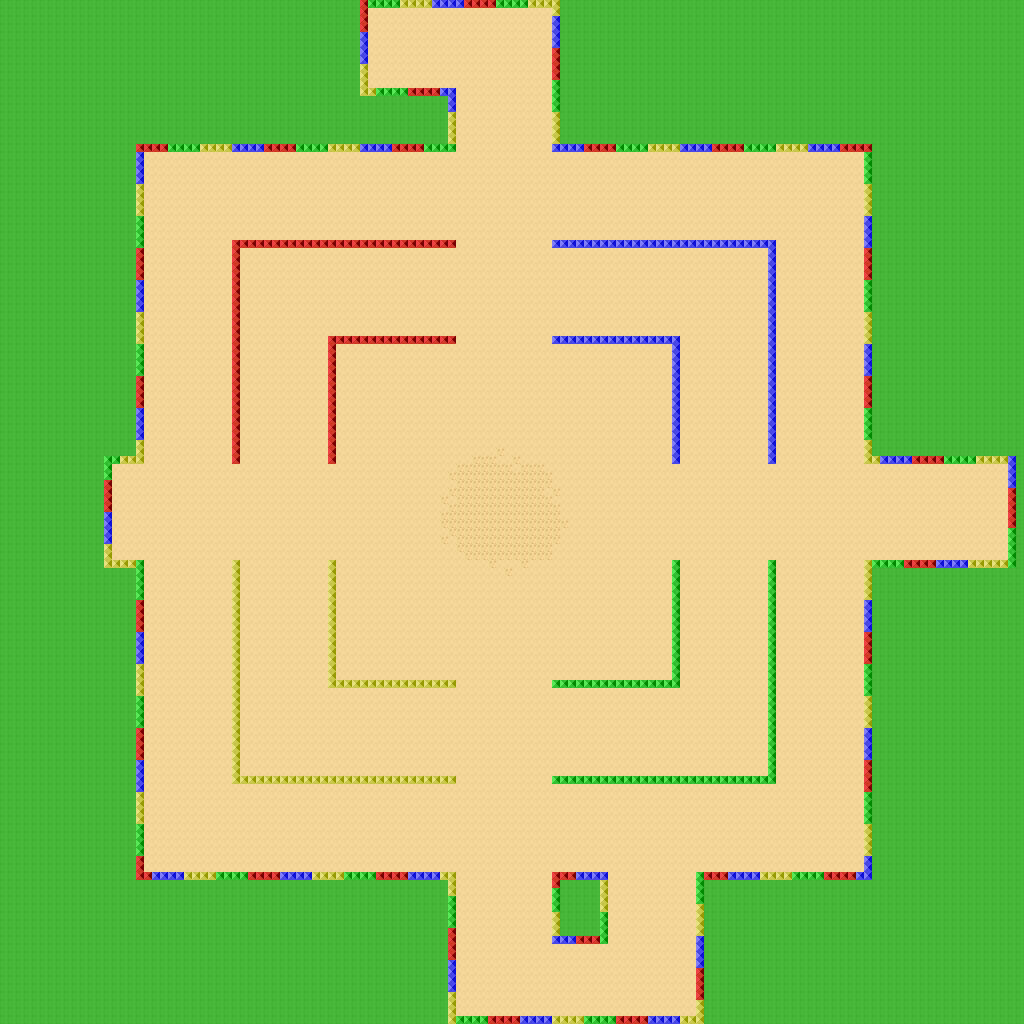
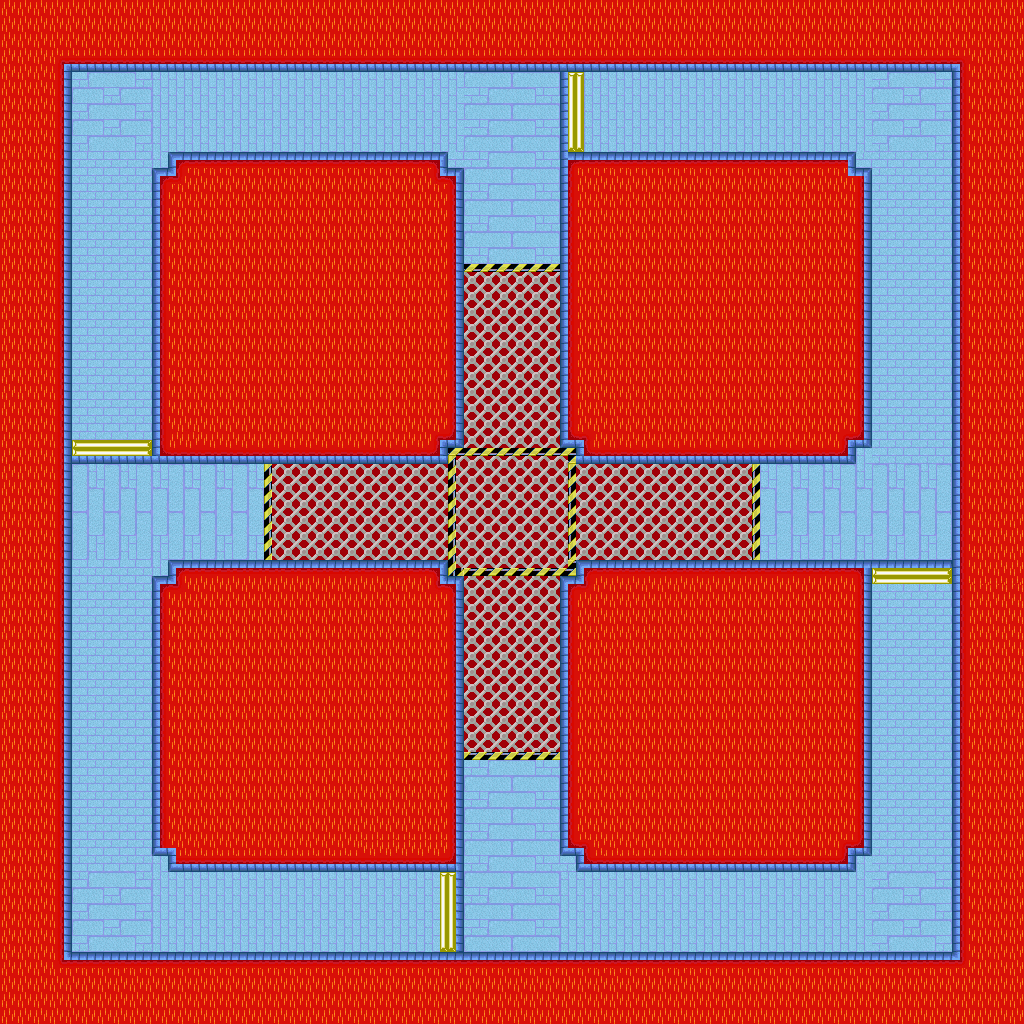
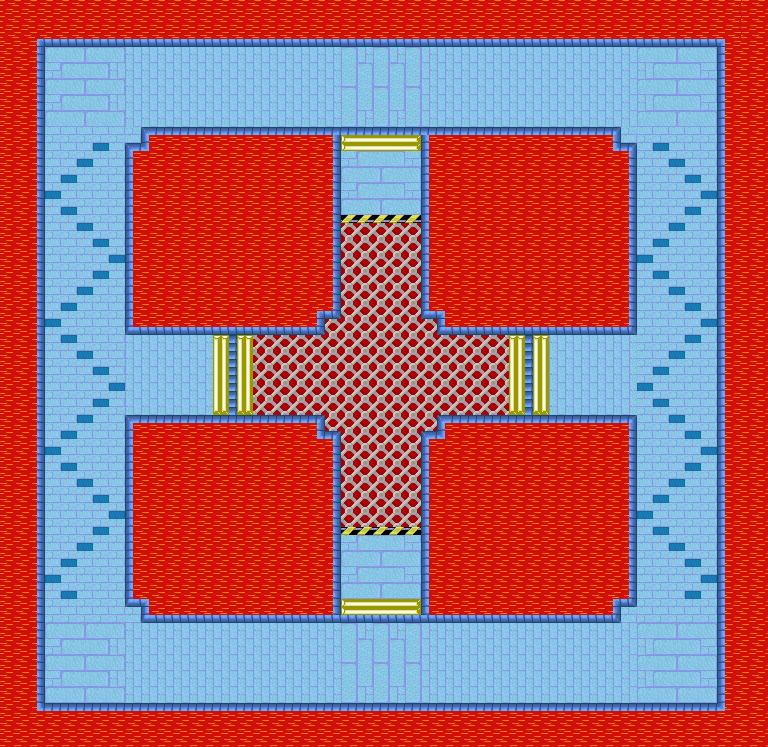
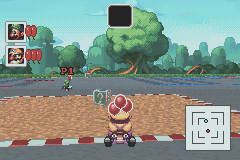
Battle mode has four arenas, all new. Battle Course 1 is a small square of coloured walls around a sandy middle, with a layout that recalls Battle Course 4 of Super Mario Kart. Battle Course 2 is a castle of stone and mesh bridges over lava trenches, hard to cross without a jump. Battle Course 3 divides a grassy square into a plus-shaped centre and four corners, with a circle of sand in the middle. Battle Course 4 is set in Yoshi’s desert, with pools of deep water to knock opponents into and brick walls to hide behind.
Courses 1 and 3 have been remade since, in Mario Kart 7 and Mario Kart Wii respectively. Course 2 has a curious history of its own, described under Trivia below.
Battle Course 1.Battle Course 2, the lava castle.Battle Course 3.Battle Course 4, in the desert.
Every course in Mario Kart: Super Circuit
All 40 race courses in cup order. The first 20 are new to this game and run for three laps; the 20 Extra courses come from Super Mario Kart (Super NES, 1992) and run for five. Later appearances are noted where a course has been remade.
Peach CircuitMushroom Cup · newA short tarmac loop with no hazards and Peach’s Castle in the background. Remade for Mario Kart DS and Mario Kart Tour.
Shy Guy BeachMushroom Cup · newSand, shallows and Sidestepper crabs, with a Shy Guy galleon firing cannonballs from the bay. Returned in Mario Kart Wii.
Riverside ParkMushroom Cup · newA jungle river crossed by wooden bridges and jump pads. Back in Mario Kart Tour and the Booster Course Pass.
Bowser Castle 1Mushroom Cup · newFive Thwomps and five jumps in a row over lava. Remade for Mario Kart 7 and Tour.
Mario CircuitFlower Cup · newA flowing circuit with a hidden Dash Panel path near the line. Rebuilt with an anti-gravity section for Mario Kart 8.
Boo LakeFlower Cup · newA haunted boardwalk in the spirit of Ghost Valley, with flickering shortcut bridges. Back in Tour and the Booster Course Pass.
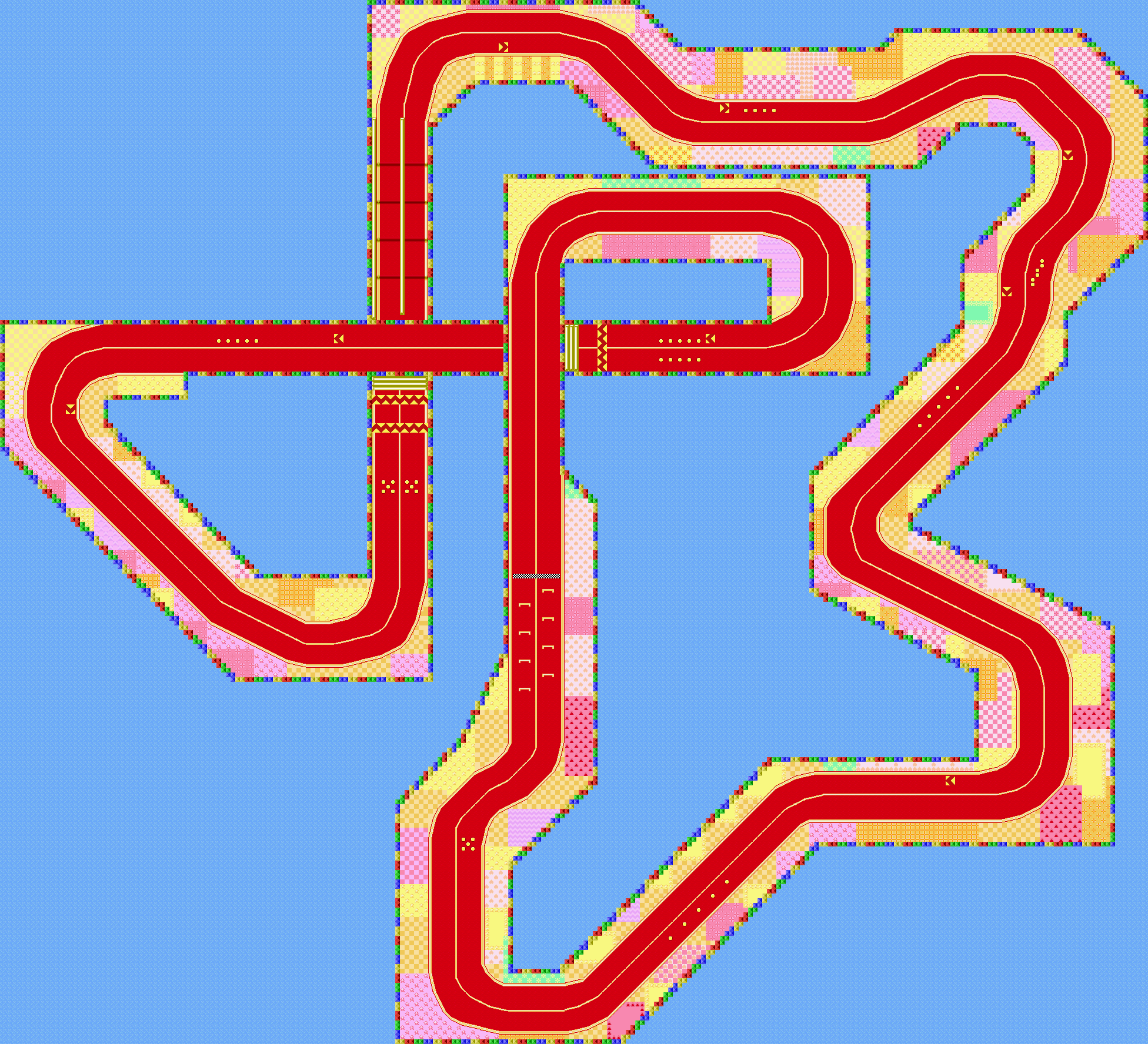
Cheese LandFlower Cup · newA cheese moon with mice on the racing line and two ramp shortcuts. Remade for Mario Kart 8’s second add-on pack in 2015.
Bowser Castle 2Flower Cup · newAll right angles, floor grids with gaps and a lava field to hop across, watched by a giant Bowser statue. Returned in Mario Kart DS and Tour.
Luigi CircuitLightning Cup · newA rain-soaked airfield with spin-inducing puddles and a Luigi blimp. The first wet-weather Mario Kart course; back in Mario Kart DS and Tour.
Sky GardenLightning Cup · newCobbles on clouds and beanstalks, with little to stop you falling. Remade for Mario Kart DS, Tour and the Booster Course Pass.
Cheep-Cheep IslandLightning Cup · newSeven bridges between tropical islands, with crabs and little birds on the road. Returned in Mario Kart Tour.
Sunset WildsLightning Cup · newA muddy desert where day turns to night as the laps pass and Shy Guys ambush you from their tents. Back in Tour and the Booster Course Pass.
Snow LandStar Cup · newA frozen lake with holes, snowmen and spinning penguins. Remade for Tour and the Booster Course Pass.
Ribbon RoadStar Cup · newA ribbon track among wrapped presents, with crossover ramps. Remade for Mario Kart 8’s second add-on pack in 2015.
Yoshi DesertStar Cup · newPyramids, a Yoshi Sphinx, cacti and quicksand pits with Piranha Plants in them. Returned in Mario Kart Tour.
Bowser Castle 3Star Cup · newThe castle exterior in a thunderstorm, with Kamek overhead. Remade for Mario Kart Wii and Tour.
Lakeside ParkSpecial Cup · newA lake and forest whose volcanoes erupt from the second lap, showering the road with Lava Boulders. Returned in Mario Kart Tour.
Broken PierSpecial Cup · newA ruined pier of split paths and narrow bridges, haunted by coin-stealing Boos. Never remade.
Bowser Castle 4Special Cup · newThe final castle: lava pools, sidestepping Thwomps and Mechakoopas. Returned in Mario Kart Tour.
Rainbow RoadSpecial Cup · newRamps for railings, falling stars and shrinking storm clouds above a Paper Mario skyline. Never remade.
Mario Circuit 1Extra Mushroom Cup · from Super Mario Kart (Mushroom Cup, race 1)The very first Mario Kart course, now without its pipes. One of the four Single-Pak multiplayer tracks.
Donut Plains 1Extra Mushroom Cup · from Super Mario Kart (Mushroom Cup, race 2)The first of the three Donut Plains courses, redrawn with 50 coins.
Ghost Valley 1Extra Mushroom Cup · from Super Mario Kart (Mushroom Cup, race 3)A haunted boardwalk whose edge blocks still break away when hit.
Bowser Castle 1Extra Mushroom Cup · from Super Mario Kart (Mushroom Cup, race 4)The original lava castle, minus its Thwomps. Not to be confused with the new Bowser Castle 1.
Mario Circuit 2Extra Flower Cup · from Super Mario Kart (Mushroom Cup, race 5)The Mario Circuit with the jump ramp. The oil slicks of the original are gone.
Choco Island 1Extra Flower Cup · from Super Mario Kart (Flower Cup, race 1)The first of the two chocolate-coloured Choco Island courses.
Ghost Valley 2Extra Flower Cup · from Super Mario Kart (Flower Cup, race 2)A second trip along the ghostly planks, breakable blocks included.
Donut Plains 2Extra Flower Cup · from Super Mario Kart (Flower Cup, race 3)Donut Plains again, this time without the Monty Moles that used to pop out of the ground.
Bowser Castle 2Extra Lightning Cup · from Super Mario Kart (Flower Cup, race 4)The second Super NES castle opens a cup that did not exist in 1992.
Mario Circuit 3Extra Lightning Cup · from Super Mario Kart (Flower Cup, race 5)The Flower Cup finale of 1992, cleared of its oil slicks.
Koopa Beach 1Extra Lightning Cup · from Super Mario Kart (Star Cup, race 1)Sandbanks and sea, with the deep water still a danger. Home of a famous lap-skipping glitch.
Choco Island 2Extra Lightning Cup · from Super Mario Kart (Star Cup, race 2)The second Choco Island course, and one of the tracks where wall hits cost the most rank.
Vanilla Lake 1Extra Star Cup · from Super Mario Kart (Star Cup, race 3)Ice, snow and breakable ice blocks, set against the same backdrop as the new Snow Land.
Bowser Castle 3Extra Star Cup · from Super Mario Kart (Star Cup, race 4)The third and last of the Super NES castles.
Mario Circuit 4Extra Star Cup · from Super Mario Kart (Star Cup, race 5)The last of the four Mario Circuits, and the Star Cup finale of 1992.
Donut Plains 3Extra Star Cup · from Super Mario Kart (Special Cup, race 1)The Special Cup opener of 1992, also free of Monty Moles.
Koopa Beach 2Extra Special Cup · from Super Mario Kart (Special Cup, race 2)The second beach course, deep water and all.
Ghost Valley 3Extra Special Cup · from Super Mario Kart (Special Cup, race 3)The last of the three Ghost Valleys, breakable blocks and all.
Vanilla Lake 2Extra Special Cup · from Super Mario Kart (Special Cup, race 4)More ice and more breakable blocks. Luigi races here in the staff credits.
Rainbow RoadExtra Special Cup · from Super Mario Kart (Special Cup, race 5)The original Rainbow Road, making this the first Mario Kart with two of them.
Battle courses: Battle Course 1 (coloured walls and a sand trap; remade for Mario Kart 7 and Tour), Battle Course 2 (lava castle; its layout differs between the Japanese and Western versions), Battle Course 3 (grass and sand; remade for Mario Kart Wii) and Battle Course 4 (Yoshi Desert, with deep pools).
The four battle courses of Super Mario Kart are also in the cartridge, complete with mini-maps, but cannot be selected in normal play.
Advertisement
Gameplay & Controls
Eight karts, three laps, one winner: the rules are the ones Mario Kart has always had. What gives Super Circuit its own feel is the mixture. The handling and the coins come from Super Mario Kart, the roster, the items and the Lakitu who runs the races come from Mario Kart 64, and a few ideas (a grade for every cup, a single-player free-race mode, multiplayer from one cartridge) are new.
Japan’s official site made a point that is easy to forget now: because each player has a Game Boy Advance of their own, this was the first Mario Kart in which your rivals could not see what item you were holding.
Controls
The Control Pad steers, A accelerates and B brakes; hold B with a direction to reverse. R makes the kart hop, and holding it through a corner becomes a power slide. L uses your item or stops the item roulette, and pressing Up or Down with L throws certain items forwards or drops them behind. Start pauses and Select sounds the horn. Holding A and B together with Left or Right spins the kart round in a quick, sharp turn, which is useful when you are facing a wall.
Hit A at the right moment as the race begins and you get a Rocket Start. Nintendo’s later re-releases map the same buttons to the Circle Pad, Wii U controllers and Joy-Con.
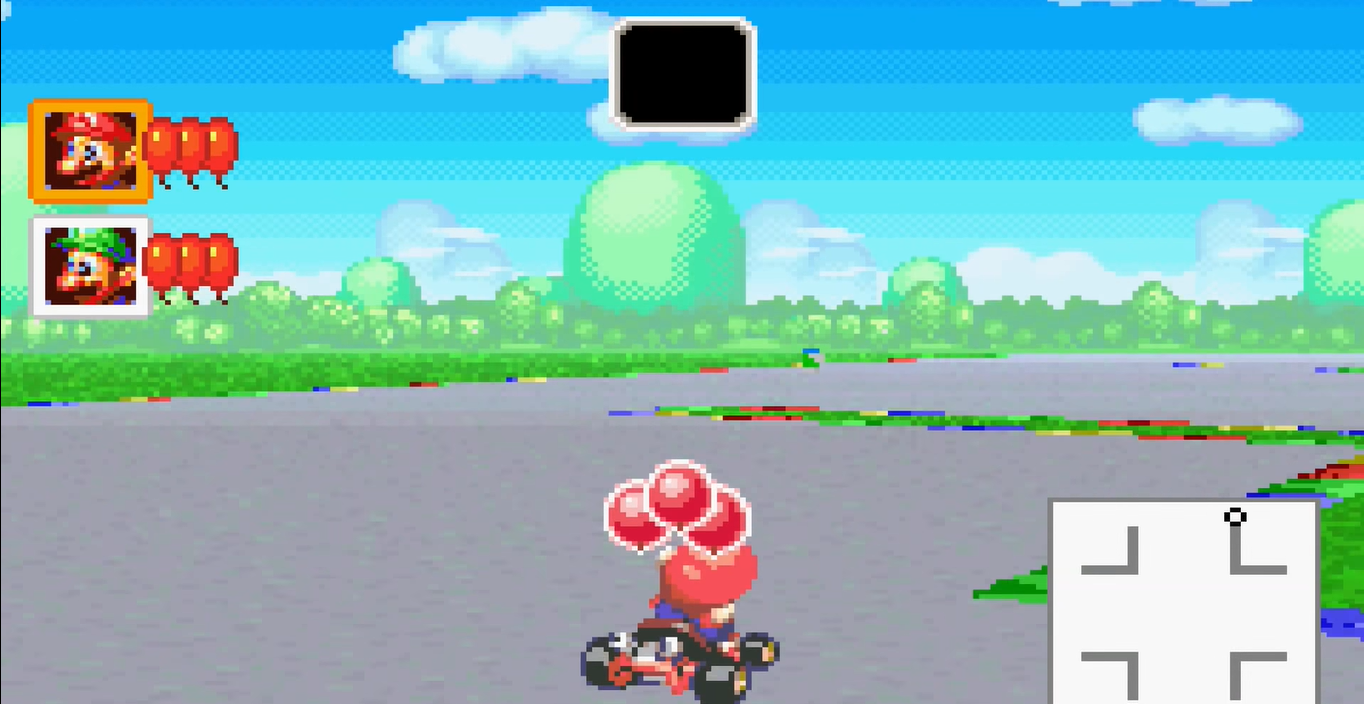
A Rocket Start off the line at Luigi Circuit.The mode select menu.
Coins
Coins are back for the first time since the Super NES game, and they work the same way. Every one you pick up nudges your top speed higher. You begin each race with a few already (two to five, depending on where you start on the grid) and every course, old or new, has exactly 50 laid out on it. You lose coins when you are hit, and with none left, any bump from another kart sends you spinning.
Coins matter outside the race as well. The number you are holding at the finish feeds into your rank, and a cup total of 100 or more is the key that unlocks the Extra cups.
Power slides, mini-turbos and Lakitu
Sliding works as it did on the Super NES, not as it did on the Nintendo 64. There is no waggling of the stick to change the colour of your smoke; a boost simply builds up the longer you hold a slide, and when you let go the kart kicks forward with a burst of blue flame from the exhaust. The game’s hidden scoring counts every mini-turbo in your favour.
Lakitu, hanging at the right of the screen, counts down the start and holds up the lap number. He also fishes you out when you fall off Sky Garden or into Bowser’s lava, at a cost in time and in rank. Items have their own small tricks: brake at the instant you cross a Banana and the kart rides over it with a little musical note instead of a spin.
Game modes
Grand Prix (one or two players) is four races against a full field, with points for the first four places. Time Trial is you against the clock with a set of Triple Mushrooms; beat your best and you can save a ghost of the run to race against, and swap ghosts with a friend over the Game Link Cable. Quick Run, which Nintendo’s Japanese site calls Free Run, is new: a single race on any course you have unlocked, against computer drivers, in whichever engine class you like. Press Select before starting and you can change the number of laps and switch coins and Item Boxes on or off.
VS is the same race with two to four people and no computer drivers; everybody starts with ten coins and the cartridge keeps a tally of wins and losses. Battle gives each player three balloons to defend on one of four small arenas. Lose all three and you are not out: you turn into a Bob-omb that can still collect items and blow itself up against the survivors.
In VS races, Single-Pak or Multi-Pak, once everybody else has crossed the line, Lakitu ends the race by dropping a Thwomp on whoever is last.
A link-cable battle in progress.The results screen after a race.
Engine classes and the three flags
There are three engine classes. In 50cc the karts are slow and the computer hardly ever uses items against you. 100cc is quicker and less polite. In 150cc the pace is highest and the opposition makes free use of Red Shells, Boos and Spiny Shells.
A Grand Prix race pays 9 points for first, 6 for second, 3 for third and 1 for fourth. Fifth to eighth pay nothing, and worse, they do not count as finishing: you have to run the race again, and you have only three retries, shown as three flags, for the whole cup. Use them all and the next failure sends you back to the first race. With two players, only one of you needs to make the top four. Each driver also has a fixed pecking order of rivals, as in Super Mario Kart, so the same faces tend to be at the front: play as Mario and it is Donkey Kong and Bowser you will be chasing.
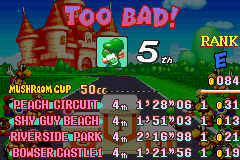
End the cup in the top three and you get a trophy and a parade. End it fourth or lower and the three winners drive past while the podium drops on your driver’s head.
Choosing an engine class.Donkey Kong discovers what happens to fourth place.Out of flags: the Game Over screen.
The ranking system
A fan-made chart of what raises (red) and lowers (blue) the hidden skill score.
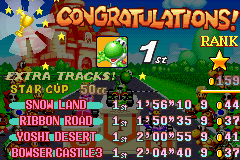
When a cup ends, the game hands you a grade as well as a trophy. The letters depend on points alone: all 36 for an A, at least 30 for a B, 25 for a C, 20 for a D and anything less an E. Above A sit one, two and three stars, and those depend on how you drove.
Nintendo never published the formula, but players who have taken the game apart have documented a hidden skill score, summarised on Super Mario Wiki. It rises with Rocket Starts, mini-turbos, coins in hand at the finish, fast race times and a wide winning margin, and falls every time you brake, lift off the accelerator, stray off the road, hit a wall or a rival, spin, use a Star or need Lakitu. Heavier drivers are given a bigger bonus for finishing than light ones. The same star grades returned in Mario Kart DS and have been part of the series ever since.
Single-Pak, Multi-Pak and mobile phones
With a Game Link Cable and a cartridge each (Multi-Pak), up to four players get the whole game: any driver, any unlocked course, Battle mode, and options for laps, coins, Item Boxes and a starting set of Triple Mushrooms.
With one cartridge between you (Single-Pak), the game is sent down the cable to the other consoles in simplified form. Player one is the green Yoshi, player two red, player three light blue and player four yellow; the only courses are Mario Circuit 1, Donut Plains 1, Ghost Valley 1 and Bowser Castle 1 from the Extra Mushroom Cup; animation is pared back; and the music switches to arrangements of Super Mario Kart tunes.
In Japan there was a third way to connect. Mario Kart Advance supported the Mobile Adapter GB, a lead that joined a Game Boy to a mobile phone, and Super Mario Wiki describes it as letting players upload their Time Trial records, check national rankings and enter prize tournaments (The Cutting Room Floor presumes ghosts could be exchanged too). The service closed on 14 December 2002 and the feature was removed from the Western versions, although its start-up screen is still buried in the ROM.
Course select in multiplayer.
Items
Eleven items, every one of them carried over from Mario Kart 64. Along with Mario Kart Live: Home Circuit, this is among just two Mario Kart games that add no new item of their own. What you get depends on your position: leaders see Bananas and single Green Shells, the back of the field sees Stars, Lightning and Spiny Shells.
Item BoxDrive through one to start the roulette. Passing through boxes while already holding an item quietly improves your rank.
MushroomA burst of speed that also carries you over rough ground and stretches jumps off ramps. The key to most shortcuts.
Triple MushroomsThree boosts. Handed out only in Time Trial and VS, never from an Item Box in Grand Prix.
BananaHold it behind you, drop it or throw it ahead. Common for the leaders. Brake as you cross one to avoid the spin.
Green ShellFires straight, forwards or backwards, and bounces off walls several times before breaking.
Triple Green ShellsThree shells circle the kart as a shield until you fire them. They cannot be thrown backwards.
Red ShellHomes in on the kart ahead. Dropped behind, it sits in wait and goes for whoever comes near.
Triple Red ShellsThree homing shells in orbit. Mostly given to drivers further back.
Spiny ShellThe blue one. It races along the track with a loud whine, spinning out anyone in its way, and hunts down first place. Rare, and reserved for stragglers.
BooSteals an item from a rival and turns you invisible for a while, immune to items and obstacles and able to pass through other karts.
StarBrief invincibility with extra speed, acceleration and grip. You spin out anyone you touch, ignore rough ground and can smash course obstacles.
LightningShrinks every rival who is not protected by a Star or a Boo. Small karts are slow, cannot use Mushrooms and can be run over.
BalloonsBattle mode only. Three per player; lose them all and you become a Bob-omb.
Cartoons, Comics & Other Media
A handheld racing game leaves a lighter footprint than a Mario adventure: no cartoon, no manga arc. What Super Circuit has instead is a lively set of adverts, a national tournament in Japan and a long afterlife inside other Mario Kart games.
Television advertsCommercials · 2001Japan’s commercial for Mario Kart Advance was animated, and other countries had spots of their own; a French retrospective for the game’s 20th anniversary collected the adverts from each country side by side. A compilation is embedded in the Videos section below.
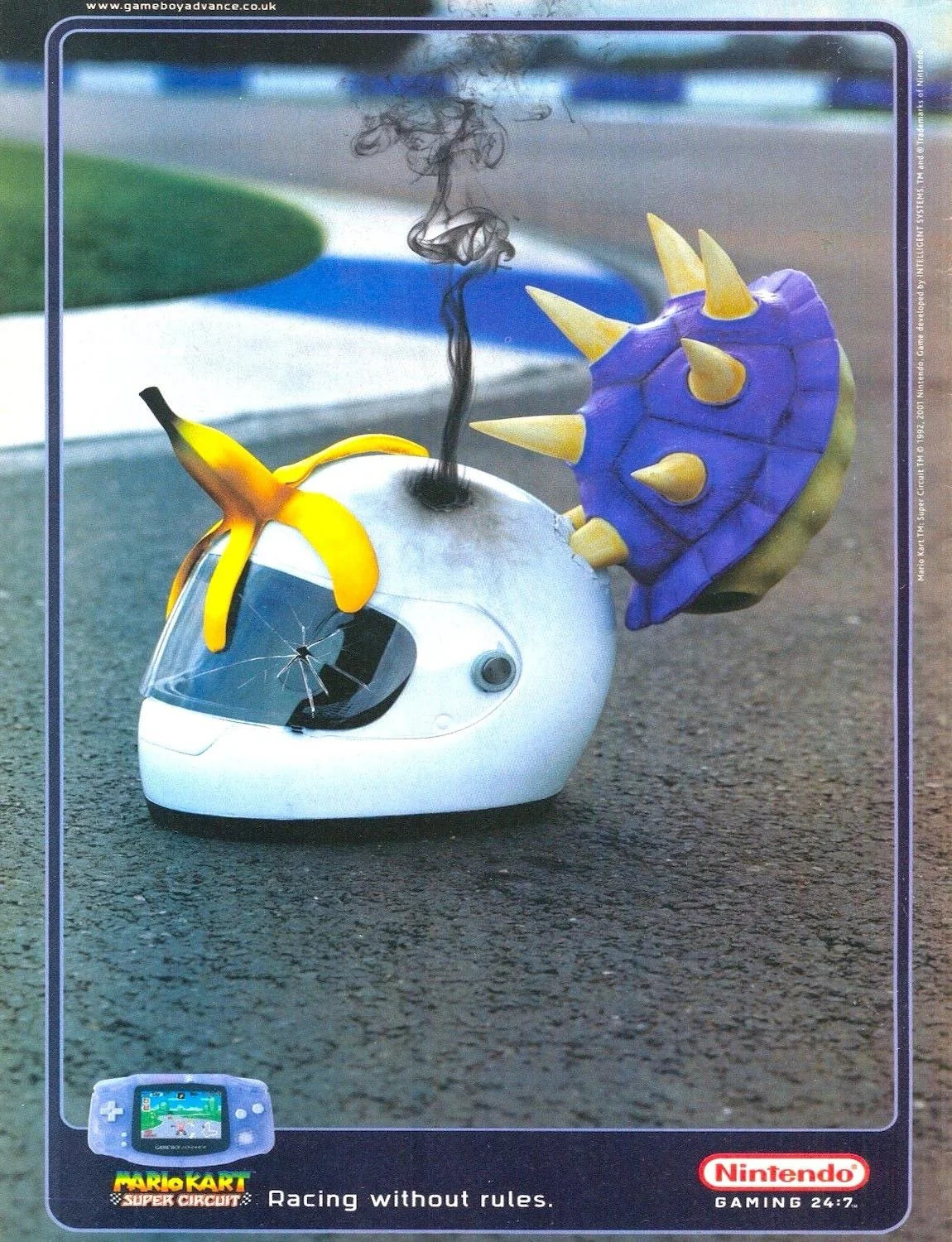
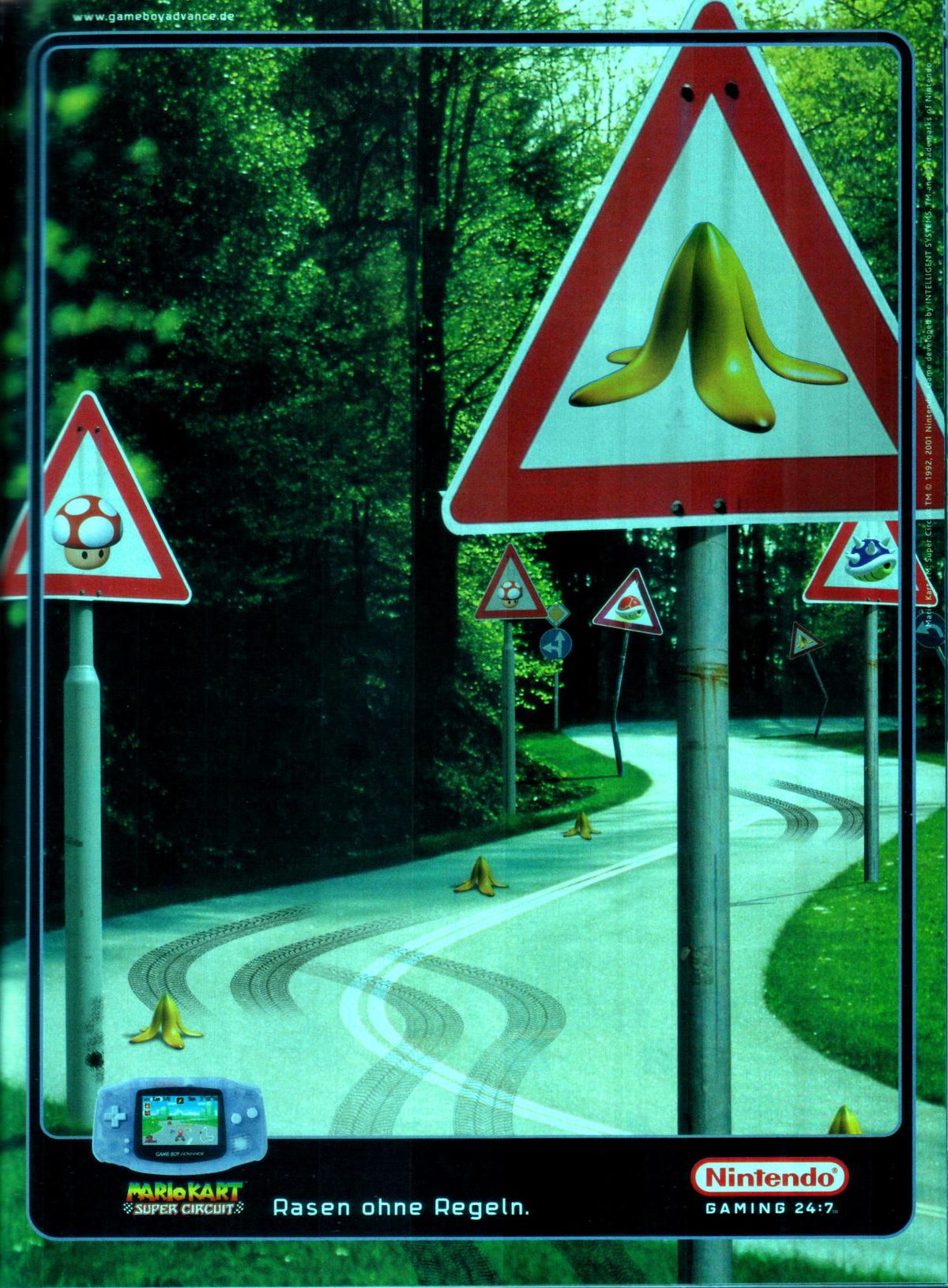
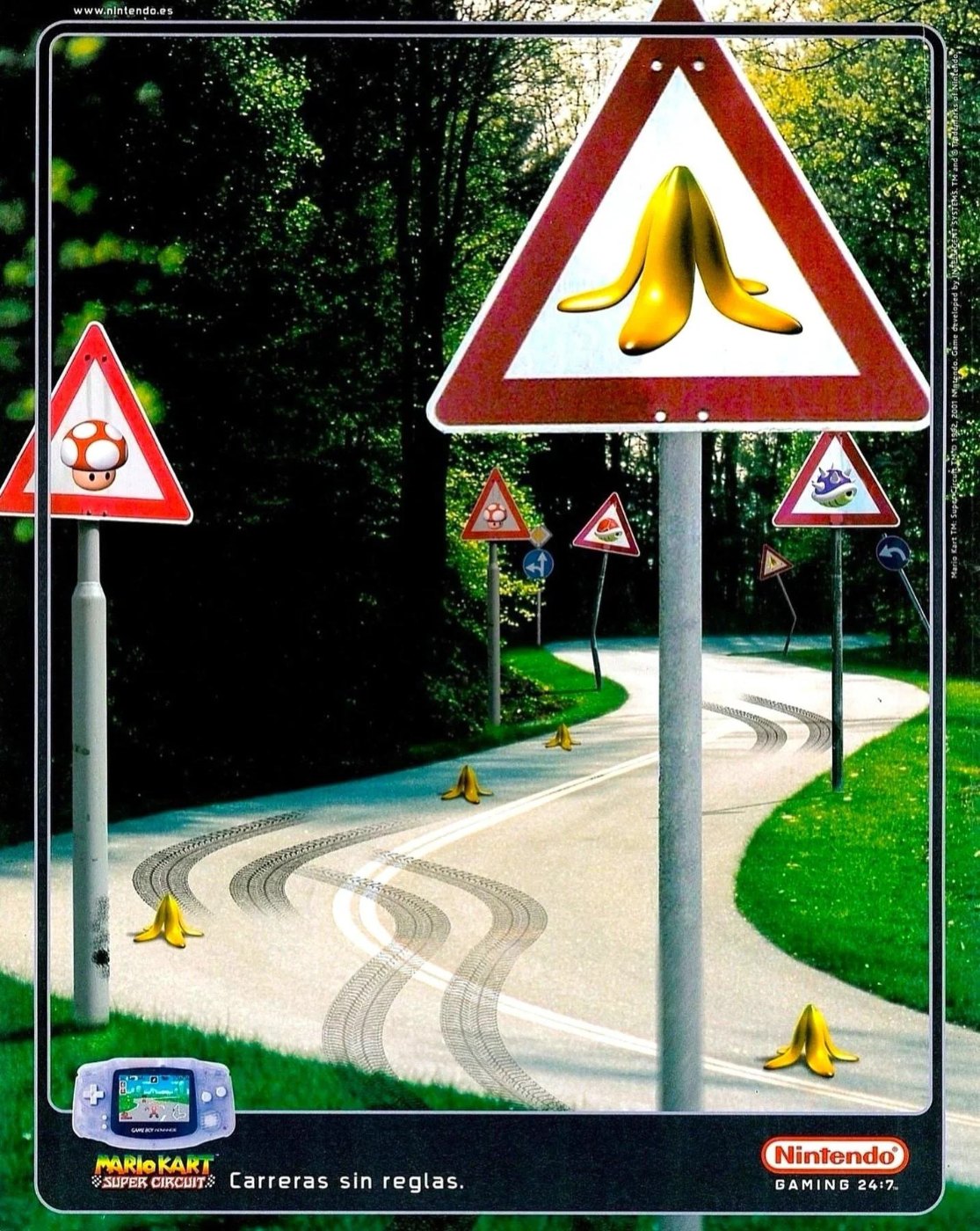
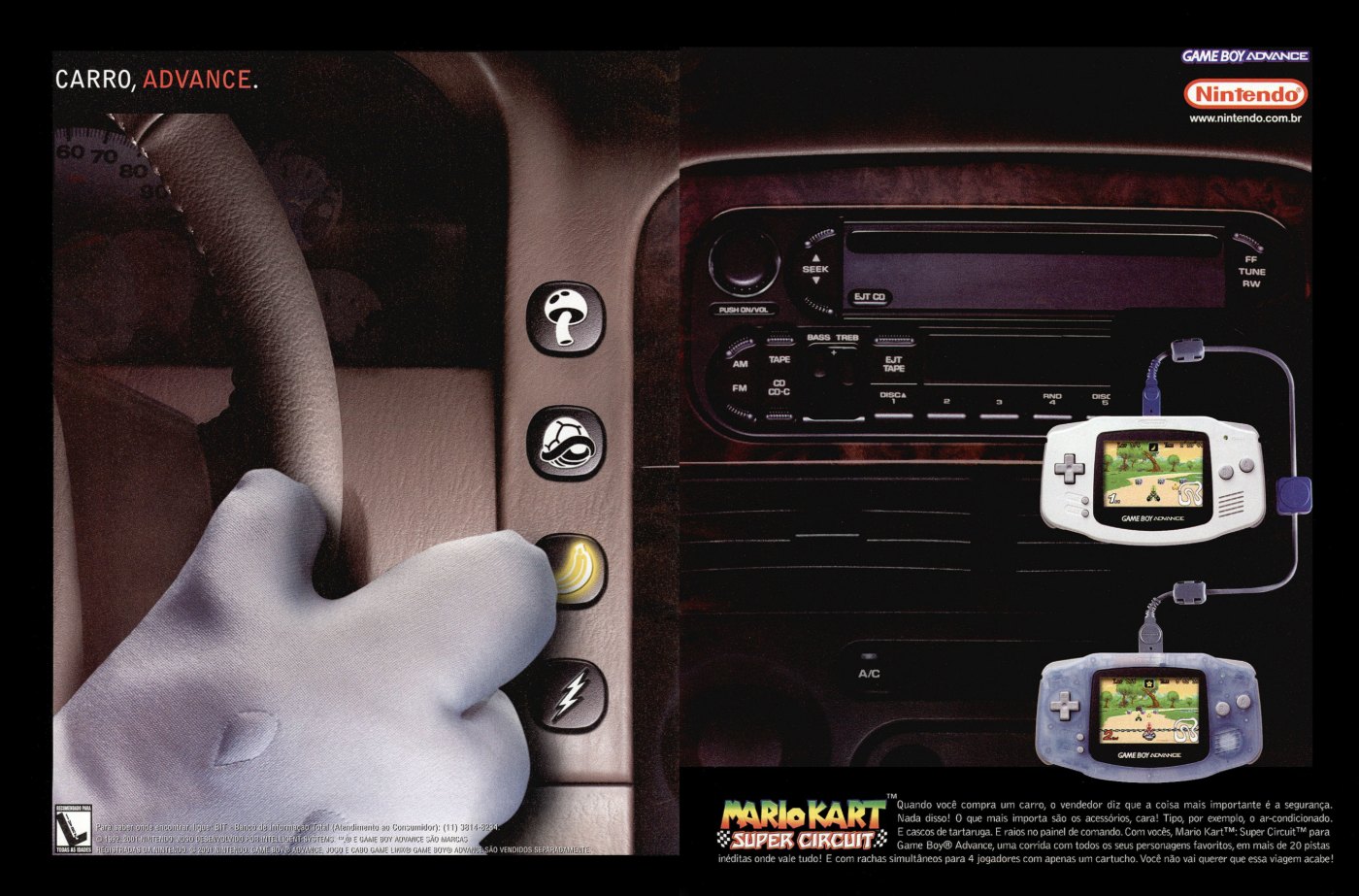
Print advertsMagazines · 2001Separate magazine adverts ran in North America, the United Kingdom, Germany, Spain and Brazil. All five are in the gallery further down the page.
Mario Kart Advance GP2001Tournament · Japan · July and August 2001Nintendo marked the Japanese launch with a free knockout tournament in Sapporo, Fukuoka, Nagoya and Osaka. Rounds were four-player races on Peach Circuit, Cheese Land and Sky Garden, with souvenir flags for the winners, and the morning and afternoon champions at each venue were invited to a grand final at Space World 2001 on 25 August. The slogan: you might be the best in Japan.
Prima’s Official Strategy GuideBook · Prima Games · 2001The official English-language guide. In Japan, the Mario Kart Advance Saisoku Butchigiri Guide of 2001 printed an item chart, graded from A to D, showing which items turn up in which race positions.
Mario Kart DSGame · Nintendo DS · 2005The next handheld Mario Kart took three ideas straight from this one: the star ranks, a single-player VS mode modelled on Quick Run, and retro courses, now arranged in four cups of their own. Peach Circuit, Bowser Castle 2, Luigi Circuit and Sky Garden were among them, and Sky Garden sat in the Lightning Cup in both games.
Returning coursesMario Kart Wii, 7, 8, Tour and the Booster Course PassShy Guy Beach, Bowser Castle 3 and Battle Course 3 were rebuilt for Mario Kart Wii; Bowser Castle 1 and Battle Course 1 for Mario Kart 7; Mario Circuit, Cheese Land and Ribbon Road for Mario Kart 8; and Sky Garden, Snow Land, Boo Lake, Riverside Park and Sunset Wilds for the Booster Course Pass of Mario Kart 8 Deluxe. Mario Kart Tour revived more than a dozen Super Circuit courses.
Mario Kart WorldGame · Nintendo Switch 2 · 2025New arrangements of the Peach Circuit, Shy Guy Beach, Riverside Park, Bowser Castle, Cheese Land, Ribbon Road, Yoshi Desert and Rainbow Road themes can be heard on its routes and in Free Roam.
Super Smash Bros. for Nintendo 3DS and Wii UGame · Nintendo 3DS and Wii UOne of its Mario Kart tracks is a medley of three Rainbow Road themes: Super Circuit’s, Mario Kart DS’s and Mario Kart 7’s.
Mario Power TennisGame · GameCubeThe tournament mode includes a Thunder Cup, borrowing the Japanese name of the Lightning Cup that Super Circuit introduced.
Characters
Eight drivers in three weight classes, the same eight as Mario Kart 64, and nobody to unlock. The game itself shows only two star ratings on the select screen (labelled Speed and Weight in the West, although the first really measures acceleration, as the Japanese version says). The fuller ratings below, out of five, are those tabulated by Super Mario Wiki. Each driver also has a preset order of computer rivals; the two quickest are listed.
Character
Who they are
In this game
Abilities & notes
MarioMiddleweight
The all-rounder, and the face on the box. Voiced, in sampled clips, by Charles Martinet.
Threes across the board: no weakness, no speciality. The sensible choice for a first Grand Prix.
Acceleration 3, weight 3, top speed 3
Handling 3, drift 3, off-road 3
Chief rivals: Donkey Kong, Bowser
LuigiMiddleweight
Mario’s brother, who gets a circuit, a blimp and the better kart.
Matches Mario for speed and weight but brakes, steers and slides better. On paper, the best all-round kart in the game.
Acceleration 3, weight 3, top speed 3
Braking 4, handling 5, drift 5
Chief rivals: Wario, Toad
PeachLightweight
The princess, whose castle overlooks the first course.
Shares the best acceleration and the lowest weight in the game with Toad. Quick to recover, easily shoved.
Acceleration 5, weight 1, top speed 2
Handling 4, drift 2, off-road 4
Chief rivals: Luigi, Bowser
ToadLightweight
Peach’s loyal retainer and the other featherweight.
The same launch as Peach, with slightly better brakes and slides in exchange for a little steering.
Acceleration 5, weight 1, top speed 2
Braking 4, handling 3, drift 3
Chief rivals: Peach, Luigi
YoshiLightweight
Mario’s dinosaur friend, voiced by Kazumi Totaka, and the star of Single-Pak multiplayer.
The slowest top speed of all, offset by the best brakes, handling and off-road ability. A specialist for twisty tracks.
Acceleration 4, weight 2, top speed 1
Braking 5, handling 5, off-road 5
Chief rivals: Peach, Luigi
Donkey KongHeavyweight
The big ape. His sprite was rendered from a 3D model supplied by Rare, as the credits acknowledge.
Fast and heavy, with a better slide than the other heavyweights.
Acceleration 2, weight 4, top speed 4
Handling 2, drift 4, off-road 2
Chief rivals: Yoshi, Bowser
WarioHeavyweight
Mario’s greedy rival, in only his second Mario Kart.
Donkey Kong’s speed and bulk with the worst handling and drift in the game. Brutal on a straight, clumsy everywhere else.
Acceleration 2, weight 4, top speed 4
Handling 1, drift 1, off-road 2
Chief rivals: Bowser, Donkey Kong
BowserHeavyweight
The Koopa King, owner of seven of the game’s forty courses.
The highest top speed and the most weight, the worst acceleration and steering. Earns the biggest rank bonus for finishing a race.
Acceleration 1, weight 5, top speed 5
Braking 1, handling 1, off-road 1
Chief rivals: Donkey Kong, Peach
Red, light-blue and yellow YoshiSingle-Pak multiplayer only
Three recoloured Yoshis who exist so that four people can share one cartridge.
Player one is always the green Yoshi; players two, three and four are red, light blue and yellow. All four drive identically.
Yoshi’s statistics. They cannot be chosen in any other mode.
Bob-ombBattle mode
What you become when your last balloon bursts.
A beaten player carries on as a walking bomb, able to grab Item Boxes, boost with Mushrooms and blast into the karts still in play.
Does not appear on the map. An echo of the Mini Bomb Kart of Mario Kart 64.
LakituRace official
The cloud-riding Koopa who has refereed every Mario Kart.
Starts the race, shows the lap count from the right-hand side of the screen and hauls fallen karts back onto the road.
In multiplayer he finishes the race by dropping a Thwomp on the last-placed driver.
Course hazards and trackside characters
There are no enemies as such in Mario Kart, but the courses are full of things that will spin you, shrink you or pick your pockets, and the award ceremony draws a crowd.
ThwompBowser Castles 1–4Drops from above to flatten karts. In the later castles some shuffle sideways first.
Lava BubbleBowser Castles 1–4A living fireball that leaps out of the lava and burns whoever it touches.
MechakoopaBowser Castle 4A wind-up Bowser toy that patrols back and forth. Contact means a spin.
Shy Guy GalleonShy Guy BeachA pirate ship anchored offshore whose crew fire exploding cannonballs at the track.
SidestepperShy Guy Beach, Cheep-Cheep IslandA crab that walks to and fro across the road.
MiceCheese LandMasked, thieving mice (Little Mousers) that wander the track near the finish.
Shy Guy TentSunset WildsHit the tent and the Shy Guy inside jumps on to your kart.
Shy GuySunset WildsClings to the kart, slowing it and shaking out coins. The Japanese version gives him a feathered headdress.
Totem poleSunset WildsA roadside obstacle that slows any kart that clips it.
PenguinSnow LandSits spinning on the ice. Touch one and you spin too.
SnowmanSnow LandStops a kart dead. It takes two hits to knock one down.
Piranha PlantYoshi DesertLives in the quicksand pits, pulls karts under and chews them.
Lava BoulderLakeside ParkMolten rock thrown out by the volcanoes from the second lap onwards.
BooBroken PierCircles a kart that comes close, slowing it and stealing coins before letting go.
Falling starRainbow RoadDrops on to the track and spins out anyone who drives into it.
Thunder cloudRainbow RoadHovers over the road and shrinks karts that pass beneath its lightning.
Wooden blockGhost Valley 1–3The edge blocks of the Super NES ghost tracks, which disappear when struck.
Lantern BoosBoo LakeHarmless Boos carrying lanterns, part of the scenery.
Luigi’s blimpLuigi Circuit, Sky GardenAn airship with Luigi’s name on it. At Luigi Circuit it takes off on the third lap.
Big Cheep-CheepCheep-Cheep IslandGiant fish leaping in the background.
Little BirdsCheep-Cheep IslandSmall birds that gather on the island roads.
KamekBowser Castle 3Flies back and forth near the finish line.
Hammer BroAward ceremonyAmong the spectators, drawn as he appears in Paper Mario.
Koopa ParatroopaAward ceremonyFlutters over the podium.
Cheep-CheepAward ceremonyModelled on the Blurps of Yoshi’s Story.
Bob-ombs and ToadsAward ceremonyPart of the cheering crowd.
The crowdAward ceremonyGoombas, Toads, Koopa Troopas and Shy Guys lining the route.
The people who made it
Names and roles are as given in the game’s staff roll.
Takeshi Ando and Yukio MorimotoDirectorsThe two Intelligent Systems directors who led the project.
Shigeru Miyamoto and Kenji MikiProducersNintendo’s producers on the game.
Hiroshi YamauchiExecutive producerNintendo’s president at the time.
Hiroyuki Kimura, Tadashi Sugiyama, Hideki Konno, Takashi Tezuka, Koji KondoSupervisorsNintendo veterans who oversaw the work. Konno, a director of the original Super Mario Kart, later told Satoru Iwata that he was not hands-on with the Game Boy Advance game because he was busy with Luigi’s Mansion, though he was close by and was consulted.
Kenichi Nishimaki, Masanobu Matsunaga, Minako HamanoSoundComposers of the new course themes and of the Super Mario Kart arrangements used in Single-Pak play. Kenji Yamamoto is credited with sound support.
Kenji Matsumoto, Taku Sugioka, Kuki Tsuji, Kazuhiro Tamura, Tadao Nakayama, Naoki Nakano, Takeshi NaritaProgrammersThe seven programmers listed in the credits.
Hiroshi Tanigawa, Naoko Mori, Fumiaki Tanimura, Chika Yamamoto, Ayumi Sasaki, Rumiko MatsumotoGraphic designersResponsible for 44 courses’ worth of tiles, backdrops and sprites.
Mitsunori Yamada, Kensuke Tanabe, Nobuto KoganezawaMobile supportCredited for the Mobile Adapter GB features of the Japanese version. Their names were removed from the Western credits along with the feature.
Bill Trinen and Nathan BihldorffLocalisationNintendo of America’s localisation team for the English version, managed by Leslie Swan and Jeff Miller.
Charles Martinet, Julien Bardakoff, Asako Kozuki, Tomoko Maruno, Kazumi Totaka, Thomas SpindlerVoices (uncredited)Sampled voices for Mario, Luigi, Peach, Toad, Yoshi and Wario respectively, according to Super Mario Wiki’s staff list.
RareDonkey Kong modelThe credits thank Rare of the United Kingdom for the 3D Donkey Kong model from which his sprites were rendered.
Advertisement
How It Was Made
Nintendo has said little in English about how Super Circuit was made. Most of what follows comes from the game’s credits, from contemporary previews, and from The Cutting Room Floor’s reconstruction of its development, which draws on a staff interview in Nintendo’s Japanese online magazine and on footage of early builds.
A Mario Kart from down the corridor
The first two Mario Karts were made by Nintendo’s own Entertainment Analysis and Development division. The third was not. Super Circuit was the first game in the series to be developed outside that team, by Intelligent Systems, a close Nintendo partner known for the Fire Emblem and Advance Wars strategy games, which had already worked on Paper Mario. It remains the only Mario Kart the studio has made.
The choice made sense. Intelligent Systems had built development kits for the Game Boy Advance, and according to the staff interview the team was told that Mario Kart might suit the new handheld while the hardware was still being designed. Their first experiments were with a port of the Super NES game itself.
Nintendo’s old hands stayed close. Shigeru Miyamoto produced with Kenji Miki, and the supervisors’ credit lists Tadashi Sugiyama, Hideki Konno, Takashi Tezuka, Hiroyuki Kimura and Koji Kondo; the special thanks go to the “Original Super Mario Kart Staff”. Konno, who would return to run the series from Mario Kart DS onwards, later explained that there was no deep reason he had not worked on the handheld game directly: he had second-party projects and Luigi’s Mansion to look after.
Mario Kart Advance, the 2000 version
Mario Kart Advance as shown in 2000, with big-headed drivers and a different HUD. Nintendo, via Super Mario Wiki
The game was announced in the summer of 2000 as Mario Kart Advance, one of the first titles shown for the unreleased Game Boy Advance, and was playable at Nintendo’s Space World show that August and at ECTS in London in September. It looked quite different. The drivers were squat, big-headed, “super-deformed” sprites on tiny karts, only four of them raced at once, there were no coins and the menus and music were borrowed from Mario Kart 64.
Only three tracks existed, and the developers later admitted that building even one took a long time. By January 2001 the look was close to final; by February the Super NES courses had appeared in test builds; and by the E3 show in May 2001 the game was nearly finished. Jonathan Metts of Planet GameCube (now Nintendo World Report), who played that demo, found it “very, very similar to the Super NES version” and placed its looks somewhere between the two earlier games.
What was left out
One of the four Super Mario Kart battle courses hidden in the cartridge. Nintendo, via Super Mario Wiki
The team built more courses than the 40 that shipped, among them an ocean course that was scrapped when Miyamoto turned it down. Items were trimmed too. Super Circuit was planned to carry all 14 of Mario Kart 64’s items, and three of them are still in the code in unfinished form: a Banana Bunch that does nothing, a Fake Item Box that behaves like a single Banana, and a Golden Mushroom that works perfectly well. The Cutting Room Floor reports that the mushroom was dropped because unlimited boosts did not suit such small tracks.
The four battle arenas of Super Mario Kart were also rebuilt, with mini-maps, and then left unselectable, which suggests they were once meant to be unlocked like the race courses. Other leftovers include early rank icons reading S, SS and SSS where the final game has stars, and a Fuzzy that was going to float around Sky Garden.
Sprites, scaling and sound
The Game Boy Advance could rotate and scale a flat background much as the Super NES had with its Mode 7, and Super Circuit is built on that trick, with layered, scrolling backdrops behind each track. Over the top go drivers and items drawn as pre-rendered sprites in the style of Mario Kart 64, which makes this the last Mario Kart to show its racers as sprites instead of 3D models. Donkey Kong’s were rendered from a model lent by Rare.
Three composers, Kenichi Nishimaki, Masanobu Matsunaga and Minako Hamano, wrote the music. They wove the old game into the new one: the Boo Lake and Broken Pier theme quotes Ghost Valley, the new Rainbow Road rearranges the old one, and Single-Pak multiplayer plays versions of the Super Mario Kart title and menu music. The castle theme carries a bassline that recalls Bowser’s theme from Super Mario 64. Several backgrounds tip a hat to the studio’s earlier Mario game: Peach’s Castle behind Peach Circuit, and above Rainbow Road, Bowser’s fortress carrying the castle off into space, are both lifted from Paper Mario.
A new name and some careful edits
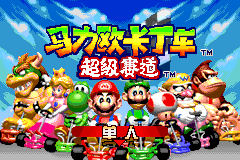
The title screen of the unreleased Chinese version. Nintendo, via Super Mario Wiki
The Japanese game kept the title Mario Kart Advance. In June 2001, two months before the American launch, Nintendo announced that the Western version would be called Mario Kart: Super Circuit.
The localisation changed more than the logo. Battle Course 2 was redrawn for the West, with its jumps moved; both The Cutting Room Floor and Super Mario Wiki suggest that the Japanese layout looked uncomfortably like a swastika from above. The Shy Guys of Sunset Wilds lost the feathered war bonnets they wear in Japan. The Mobile Adapter GB features were removed, and the preset Time Trial records were respaced. A Chinese edition was also translated for release through iQue, with the Special Cup renamed the iQue Cup and Luigi’s blimp relettered, but it was cancelled; Siliconera reported in 2019 that piracy of iQue’s first Game Boy Advance games was the reason.
Series Firsts
What Super Circuit brought to Mario Kart, checked against the two games that came before it.
1A handheld Mario KartThe first entry on a portable console. Mario Kart DS, Mario Kart 7 and (as a hybrid) Mario Kart 8 Deluxe all follow from it.
2Retro coursesThe first Mario Kart to include courses from an earlier game: all 20 from Super Mario Kart. The practice became permanent with Mario Kart DS.
3Made outside EADThe first Mario Kart whose development was handed to another studio, and the only one by Intelligent Systems.
4The Lightning CupA fifth cup, new to the series. It has been a fixture of the retro cups since Mario Kart DS.
5Star ranksThe first Mario Kart to grade a Grand Prix performance, from E up to three stars. Mario Kart DS adopted the same system.
6Quick RunA single-player race on any course against the computer, the forerunner of the solo VS mode found from Mario Kart DS onwards.
7Racing in the rainLuigi Circuit is the first Mario Kart course set in wet weather.
8Two Rainbow RoadsA new one in the Special Cup and the Super NES original in the Extra Special Cup: the first time one game has offered two.
9One cartridge, four playersSingle-Pak VS mode sends the game to up to three other consoles, the first Mario Kart multiplayer that needs only one copy.
10A Mario Kart that went onlineIn Japan only, through the Mobile Adapter GB and a mobile phone: the first network feature Nintendo itself built into the series (Super Mario Kart had been playable over the third-party XBAND modem service).
11Forty coursesTwice the count of Super Mario Kart and more than double Mario Kart 64’s. According to Goomba Stomp, no Mario Kart offered more until the add-on packs for Mario Kart 8.
12Seven Bowser CastlesFour new and three old, the most castle courses in any Mario Kart.
Cheats & Secrets
Super Circuit has no button codes. Its secrets are things to unlock, lines to learn and a ranking system to outwit.
Unlock the Extra cups
Win all five Super Circuit cups in an engine class. Then replay any cup in that class and finish it with a combined total of at least 100 coins from its four races: the Extra cup of the same name opens for that class. With 50 coins on every course and a few more on the grid, the target is a generous one.
Sunset and night title screens
Earn a gold trophy in every Super Circuit cup and the title screen changes from day to sunset. Earn a three-star rank in all of them and it changes to night. Each has its own arrangement of the opening theme.
Earning three stars
Thirty-six points is only the start. To push the hidden skill score up: get a Rocket Start in every race, mini-turbo out of every corner, keep collecting coins, and win by as large a margin as you can. To stop it falling: never touch the brake, keep the accelerator held, stay on the road, stay off the walls (they cost most of all on the Bowser Castles, Mario Circuit 2 and Choco Island 2) and do not fall off. Using a Star, Lightning or Triple Red Shells costs a little too, and using up a retry costs a great deal. Heavier drivers receive a larger bonus for each finish, so Bowser is the connoisseur’s choice.
Ride over a Banana
Brake at the moment your kart crosses a Banana and it will not spin. A small musical note appears to tell you the trick has worked.
Hidden options
Press Select on the menu before starting Quick Run to change the number of laps and switch coins and Item Boxes on or off. In Multi-Pak VS the same button adds the option of starting with Triple Mushrooms. Before Time Trial, Select switches your saved ghost on or off.
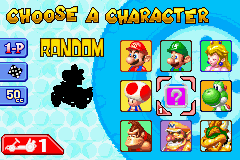
Fun on the character select screen
While choosing a driver, press L to make them fire a Green Shell across the screen, R to make them hop and Select to sound their horn. The horn stays silent if the cursor is on the random Item Box.
Shortcuts: Mushroom, Flower and Lightning Cups
Shy Guy Beach: use a Mushroom to cut across the grass at the first row of Item Boxes. Riverside Park: after the opening U-turn, a narrow dock lets you boost across the river; later, a strip of shallow water cuts another corner. Boo Lake: a narrow blue bridge before the fork and a grey one that skips the U-turn. Cheese Land: aim far right off the first ramp to skip the U-turn, and far left at the second to bounce off a walled-in jump pad. Luigi Circuit: on the snaking section, a gap in the wall on the left bypasses the next hairpin. Sky Garden: a cloud platform replaces the second bridge, and Mushrooms across the corners skip the early S-bends. Cheep-Cheep Island: go straight on after the fifth bridge and boost off the jump pad to reach the final bridge early.
Shortcuts: Star and Special Cups
Snow Land: a left-hand lane of speed strips after the second turn, and a gap between two holes that straightens a hairpin. Ribbon Road: after the first ramp, take every Dash Panel and turn hard right to miss the second ramp entirely. Yoshi Desert: a Mushroom or Star across the second oasis. Lakeside Park: take the right-hand Dash Panel before the jump and angle across the ramps over the water to land on the finishing straight. Broken Pier: a Mushroom-assisted jump to a small platform skips a large part of the lap. Rainbow Road: the narrow left-hand path is lined with boost pads, and the ramps along the edge can be linked to cut out whole sections.
Cut items and hidden arenas
With a cheat device, the unfinished Banana Bunch, Fake Item Box and Golden Mushroom can be forced into the item slot, and the four Super Mario Kart battle courses can be loaded. The Cutting Room Floor documents the codes. None of this is reachable on an unmodified cartridge.
Compiled from Super Mario Wiki’s game, ranking and course pages and The Cutting Room Floor.
Glitches & Oddities
A tidy game by Mario Kart standards, but three glitches have become well known, two of them devastating for anyone chasing records.
The Cheese Land lap skip
Cheese Land, scene of the game’s most notorious skip.
At the start of the race, slide through a 270-degree turn to the right so that the kart ends up behind the starting line, then use a Mushroom and a hop to land on one of the mice. Done correctly, the game counts all three laps at once. It works with any driver.
The Koopa Beach 1 lap skip
Koopa Beach 1.
Just after crossing the finish line, slide the kart round until it is pointing back the way it came, then Mushroom-boost and hop behind the line. Get the angle right and the game registers a completed lap.
The Rainbow Road loop
In 100cc or 150cc, pick up a Banana and place it on the very corner of the kerb at the entrance to the shortcut on Rainbow Road, then park in the middle of the track nearby. A computer driver that bumps you may be knocked on to the Banana and over the edge, and when Lakitu sets it down again it steers for the shortcut while still falling, and goes round again.
Eight seats at a four-player table
Battle mode supports four players, but each arena has starting positions for eight. Load a battle course in Grand Prix or Quick Run with a cheat device and all eight karts line up.
The podium is a racetrack
An unused, earlier version of the award ceremony screen.
The award ceremony takes place on a real, hidden course that borrows Peach Circuit’s music, graphics and mini-map. Only the route the winners drive was programmed; force other drivers on to it and they have no idea where to go.
Videos
Nintendo’s trailer for the Game Boy Advance library on Nintendo Switch Online, in which Super Circuit was one of the six launch games, and a collection of the television adverts that sold the original in 2001.
Nintendo’s official trailer of 8 February 2023, the day Mario Kart: Super Circuit arrived on Nintendo Switch Online + Expansion Pack.
The game’s 2001 television commercials from several countries in one compilation, as featured in Gameblog’s 20th-anniversary retrospective.
Trivia & Interesting Facts
In Japan the game is called Mario Kart Advance. That was also its working title in the West until June 2001.
Battle Course 2 as it is laid out in the Japanese version.Battle Course 2 is the only Mario Kart course whose layout differs between the Japanese and overseas versions. The jumps were moved for the Western release; the reason usually given is that the original plan resembled a swastika. The course preview picture was left unchanged.
A Japanese-version Shy Guy on Sunset Wilds.The Shy Guys of Sunset Wilds wear feathered war bonnets in the Japanese version and none in the Western ones.
Sunset Wilds changes with the clock. The sun goes down a little more each lap, and in a five-lap Quick Run or VS race it stays night from the third lap to the end.
Lakeside Park does something similar with geology: its volcanoes only start erupting on the second lap.
The Extra cups are not a new arrangement. They are Super Mario Kart’s 20 courses in exactly their 1992 order, cut into groups of four instead of five.
Peach’s Castle behind Peach Circuit, and Bowser’s Castle with Peach’s Castle on top of it above Rainbow Road, both come from Paper Mario, an earlier game by the same studio. The Hammer Bros and Goombas in the award-ceremony crowd are drawn in its style too.
Shy Guy Beach is based on the Shy Guy’s Ship level of Yoshi’s Story, and the game’s Cheep-Cheeps are drawn like that game’s Blurps.
The Yoshi Sphinx in the background of Yoshi Desert reappears in the Dry Dry Ruins course of Mario Kart Wii and in Paper Mario: Sticker Star.
The hangars at Luigi Circuit are numbered 64 and 65.
Cheese Land is set in space, presumably a joke about the Moon being made of cheese. An unused satellite object survives in the course data.
Donkey Kong’s sprites were rendered from a 3D model provided by Rare, who are thanked in the credits.
Finish a Grand Prix in fourth place or lower and your driver is squashed by the falling podium while the top three drive past.
The unused Golden Mushroom icon.The game was meant to have all 14 of Mario Kart 64’s items. The Banana Bunch, Fake Item Box and Golden Mushroom were cut but can still be found in the code.
Early versions of the rank icons read S, SS and SSS. The finished game uses one, two and three stars.
Japanese players could connect the game to a mobile phone with the Mobile Adapter GB. The service ended on 14 December 2002.
The Japanese launch was celebrated with a touring tournament, Mario Kart Advance GP2001, whose regional winners met in a final at Space World 2001.
The Lightning Cup is called the Thunder Cup in Japan, and the instruction booklets use that name too.
Broken Pier and Rainbow Road are the only two of the 20 new courses that have never been remade for a later Mario Kart.
Luigi Circuit is the only Luigi Circuit in the series that is not in a Mushroom Cup.
A Chinese-language version was completed for iQue, with the Special Cup renamed the iQue Cup, but was never released.
On the character select screen, L makes your driver fire a Green Shell, R makes them hop and Select honks the horn.
Hideki Konno, a director of Super Mario Kart and later the producer of Mario Kart DS and Mario Kart Wii, is credited here only as a supervisor. He told Satoru Iwata in 2008 that he was occupied with second-party games and Luigi’s Mansion at the time.
Regional Box Art
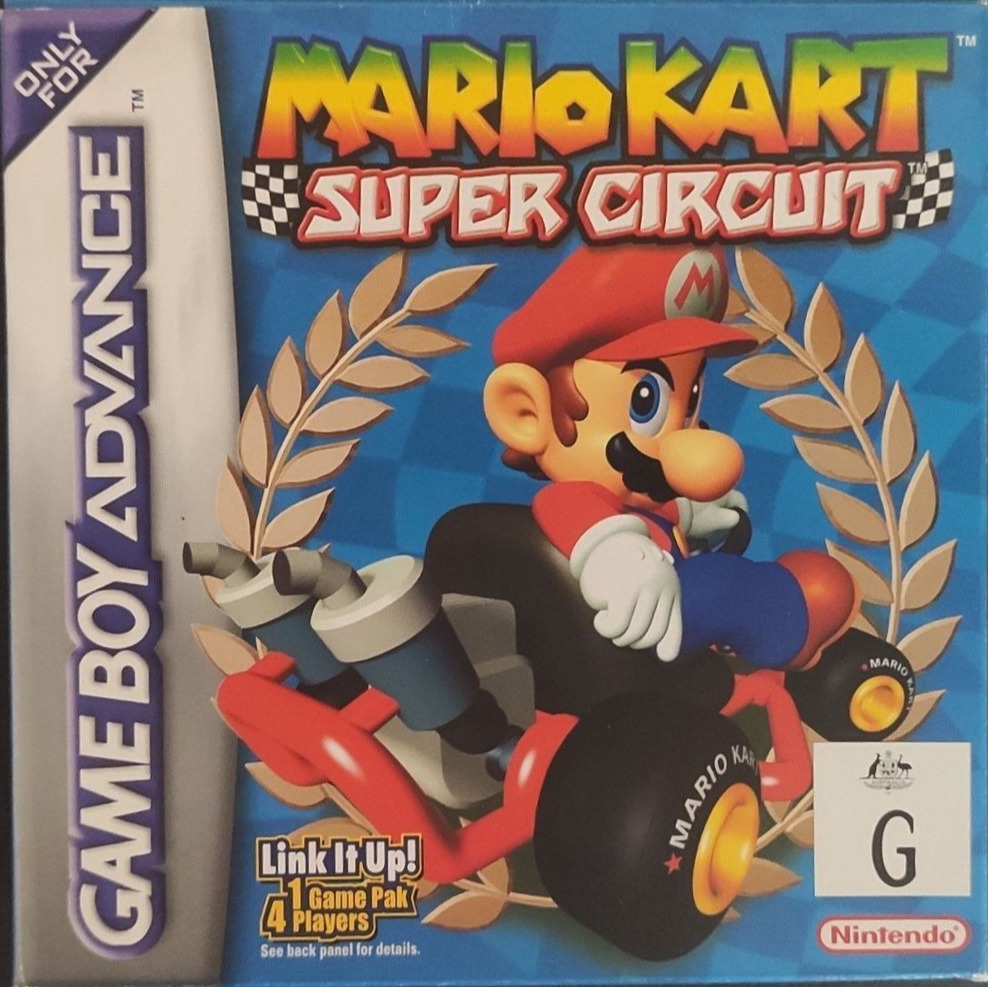
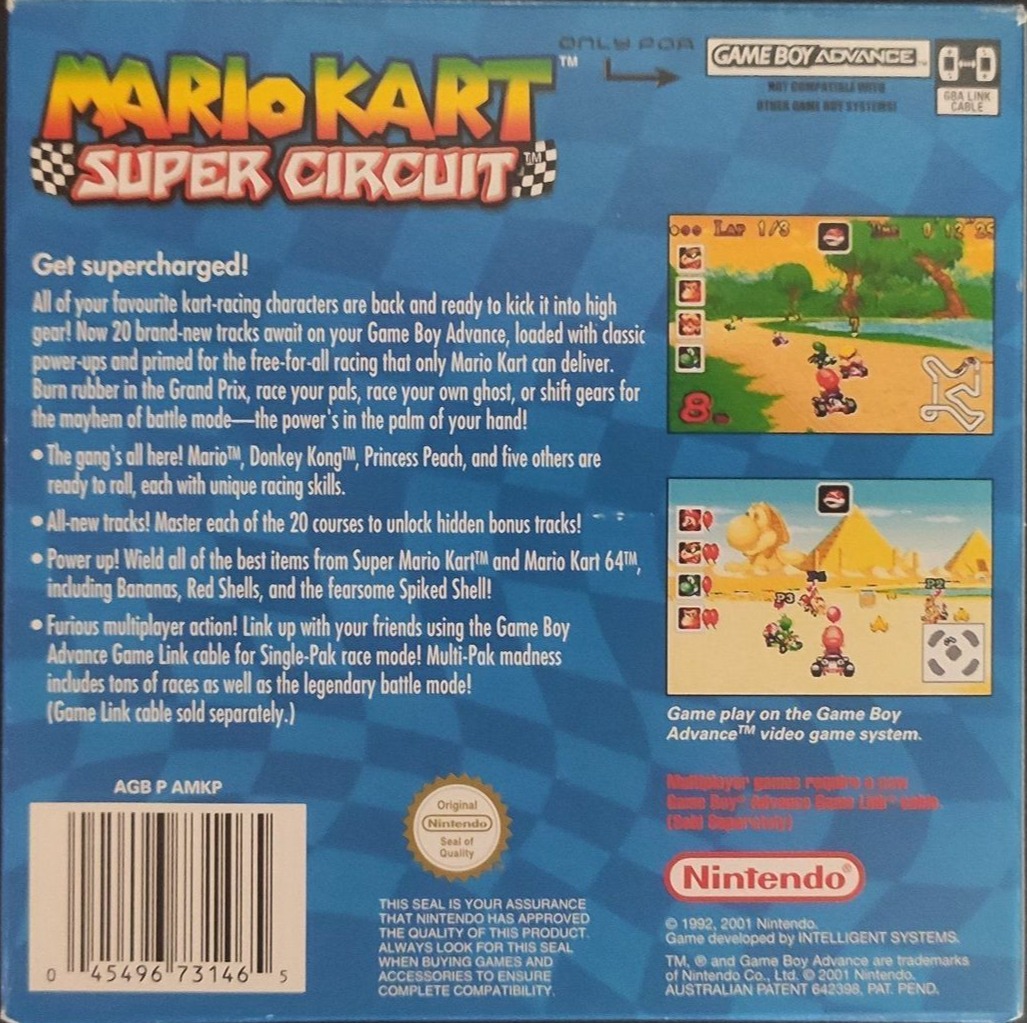
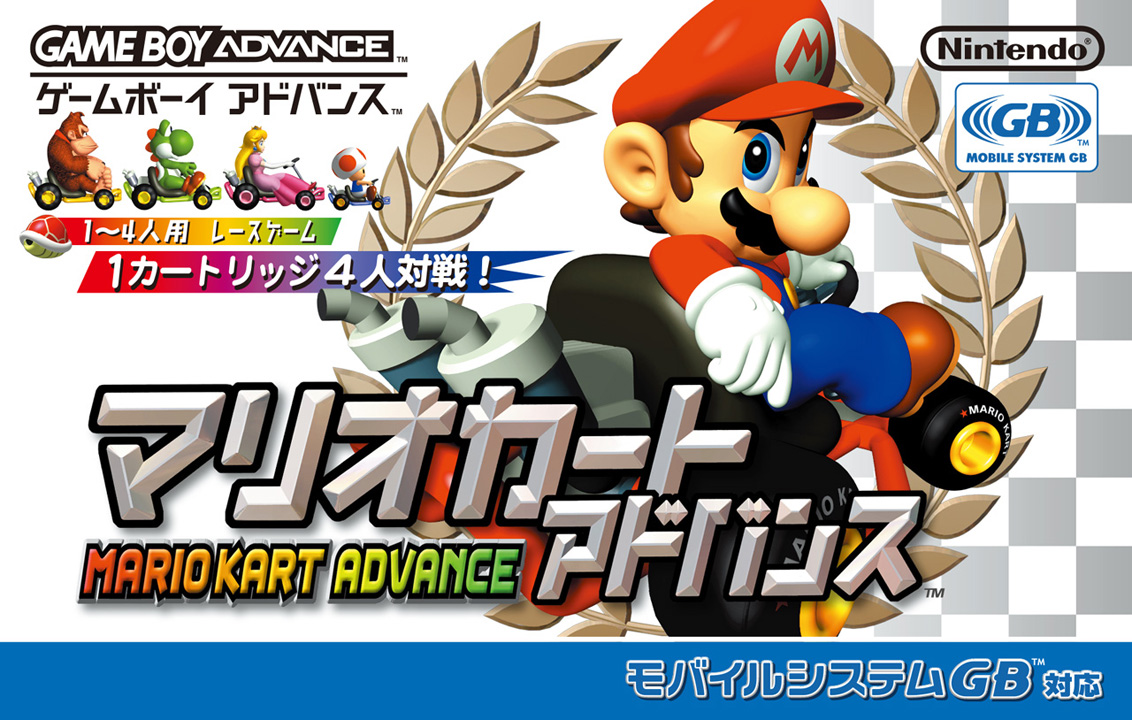
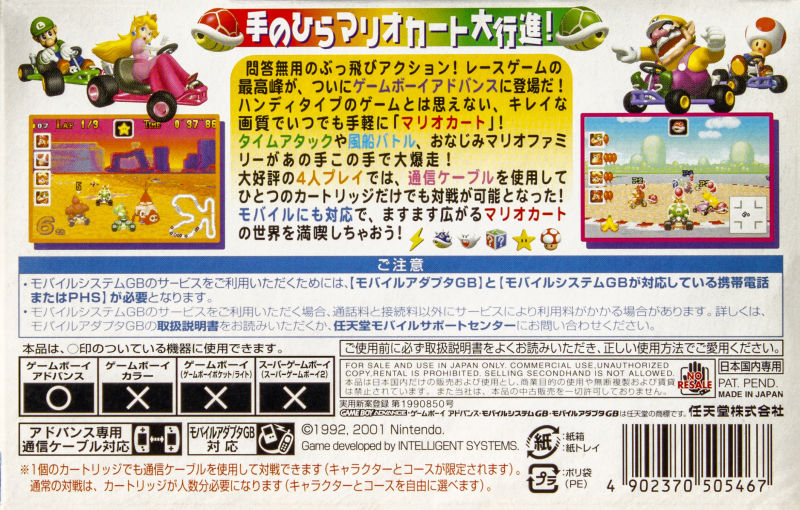
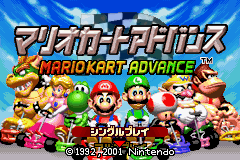
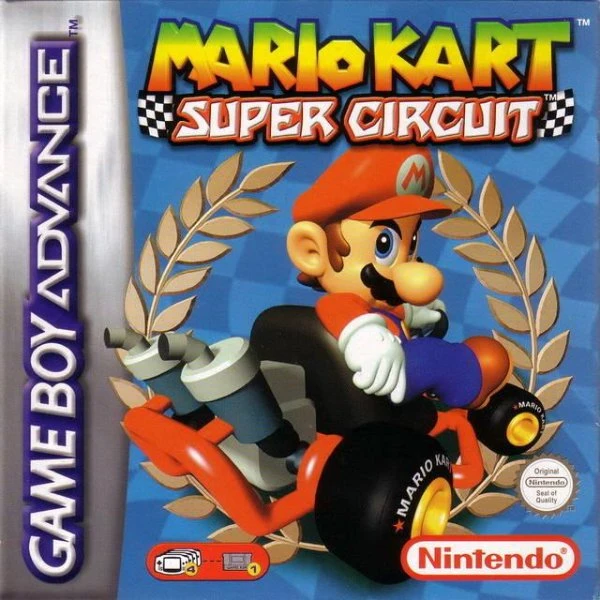
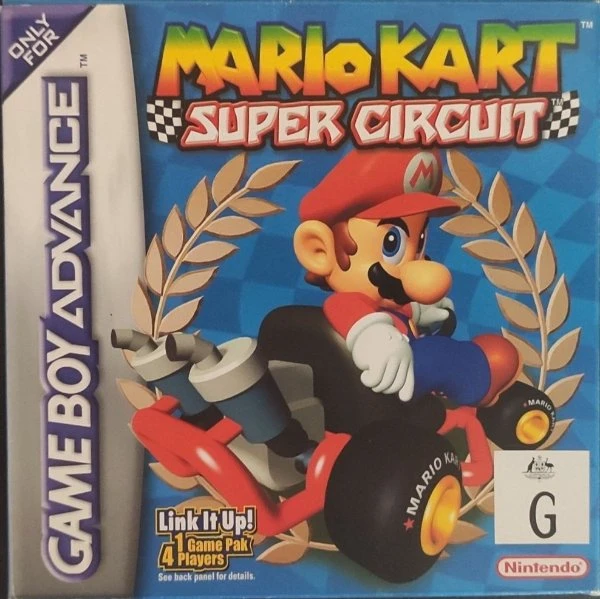
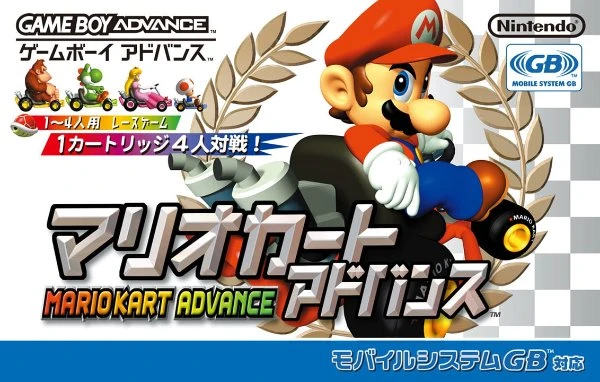
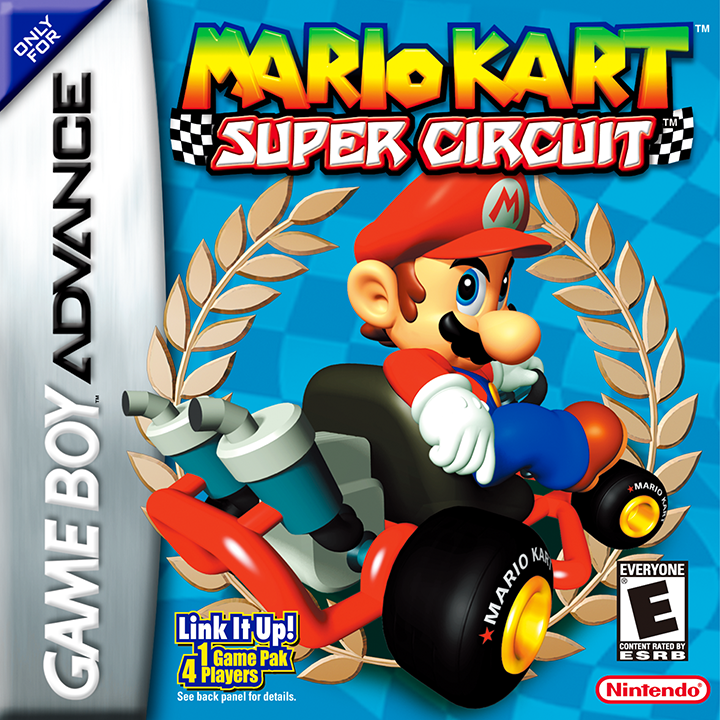
One piece of key art, three treatments. The Western boxes carry the Super Circuit logo; Japan’s reads Mario Kart Advance.
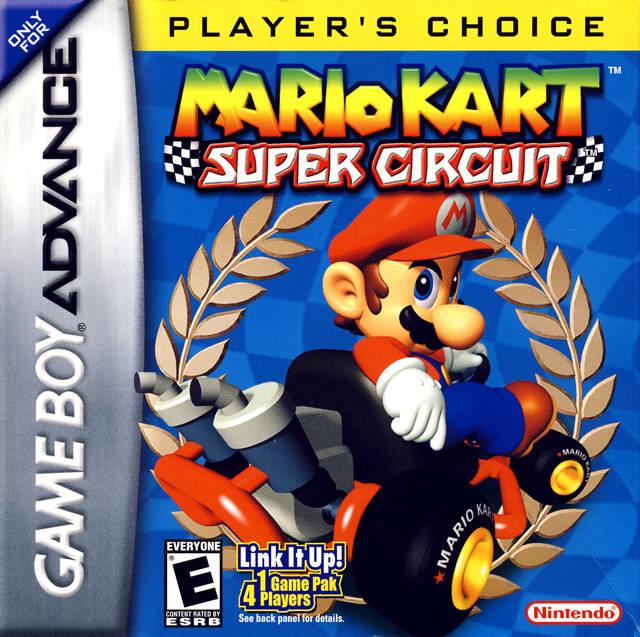
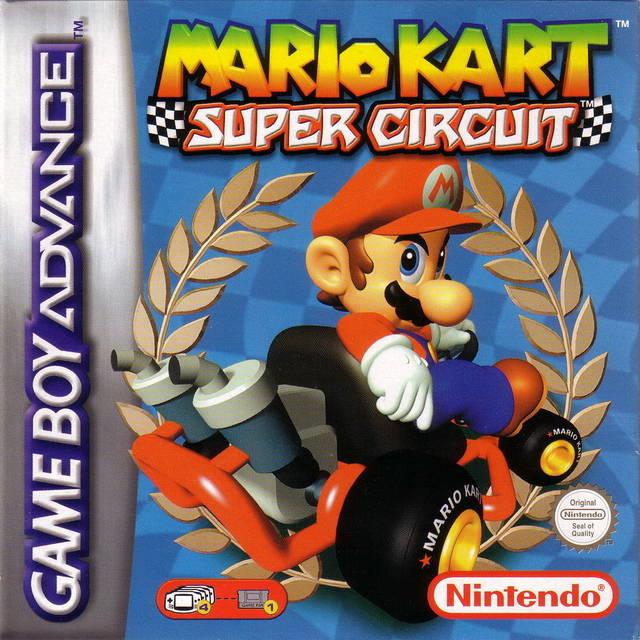
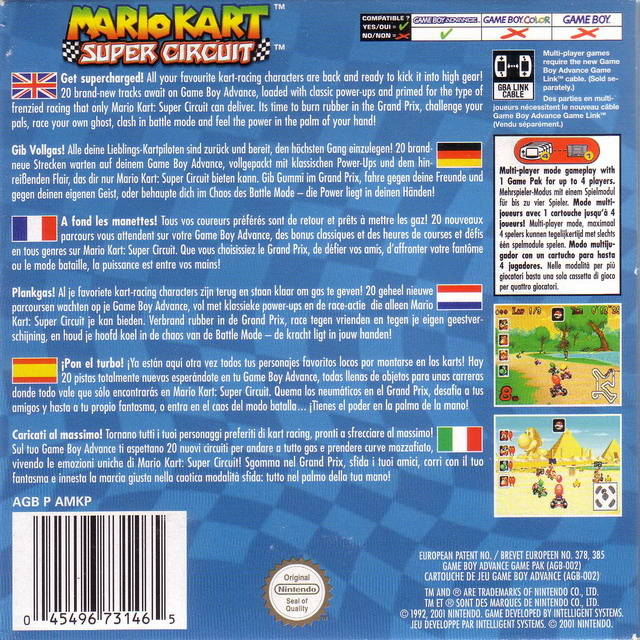
North America (2001)The original release.North America, backThe reverse of the box.North America (Player’s Choice, 2006)The budget reissue.North America, pre-releaseAn early version of the cover shown before launch.Europe (2001)The PAL box.Europe, backThe reverse of the European box.Australia (2001)The Australian release.Australia, backThe reverse of the Australian box.Japan (2001)Sold as Mario Kart Advance.Japan, backThe reverse of the Japanese box.Wii U Virtual Console (2014)The icon used for the download version.
Screenshots
More from the cartridge: the changing title screen, moments from the cups and the end credits.
The sunset title screen, the reward for gold trophies in every cup.The night title screen, for three stars across the board.The Japanese title screen: Mario Kart Advance.What you see if you end a Grand Prix in fourth place or lower.A boost at Riverside Park.Wario on Mario Circuit.Luigi in Cheese Land.Luigi on his own circuit.Sunset Wilds while there is still light in the sky.The ribbon itself, on Ribbon Road.Yoshi in Yoshi Desert.Wario crosses Sky Garden during the staff credits.
Artwork & Media Gallery
Official artwork, logos, sprites, course maps and adverts from Mario Kart: Super Circuit. Select any image to see it full size; SLB’s box art and screenshot galleries have more.
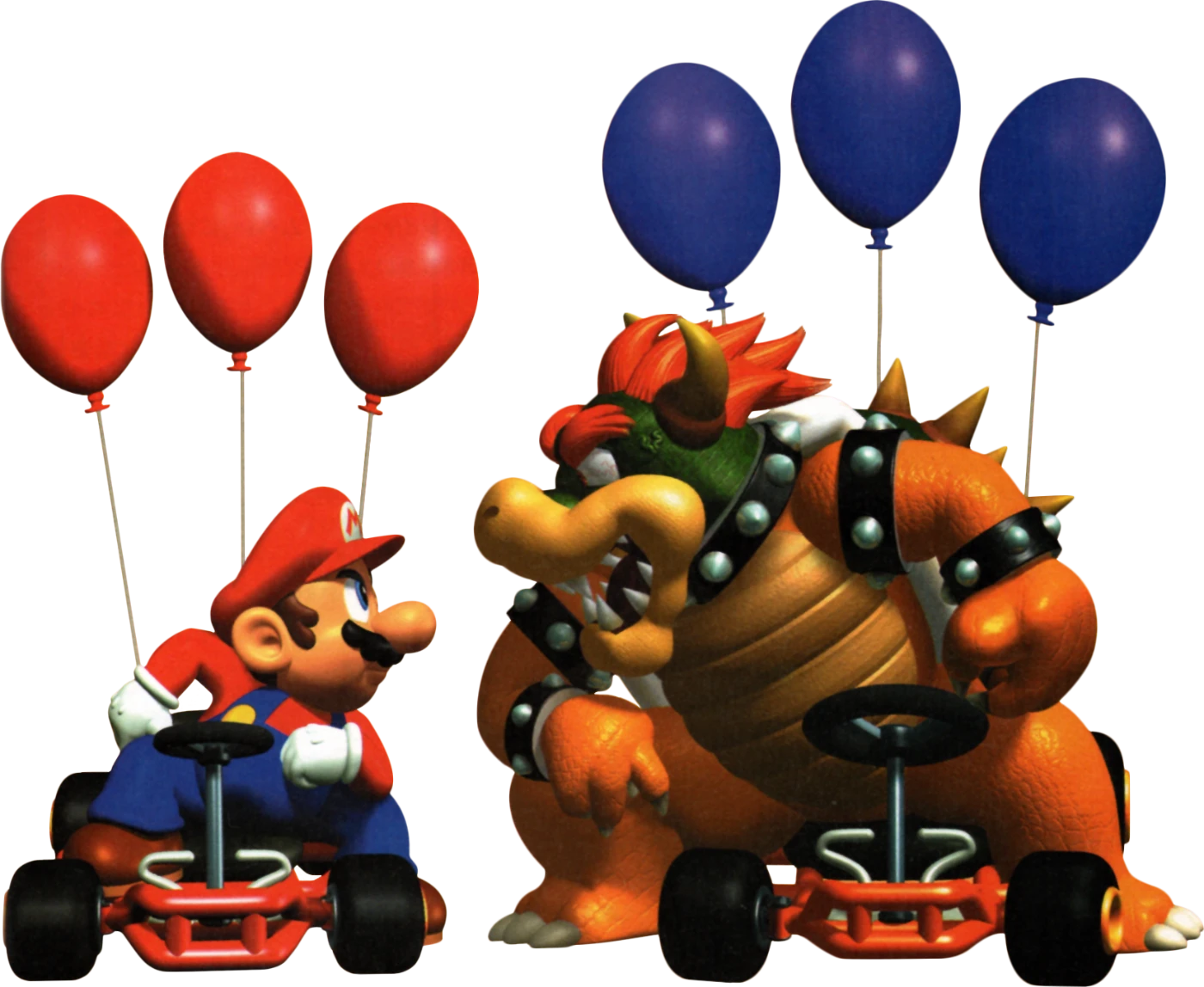
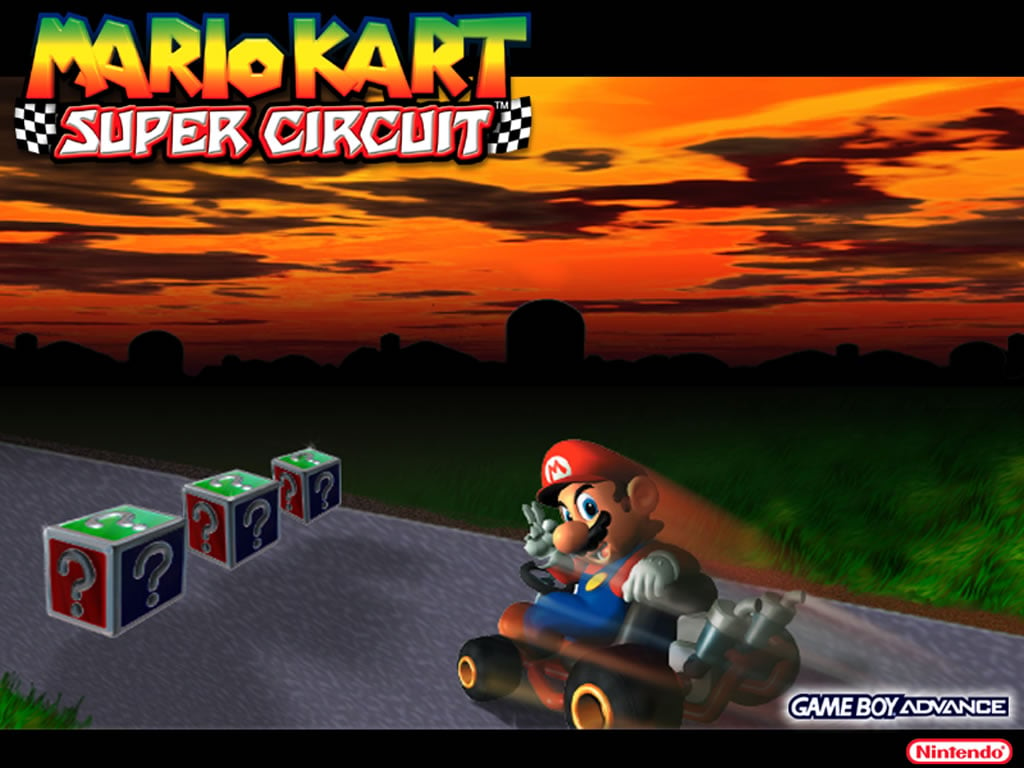
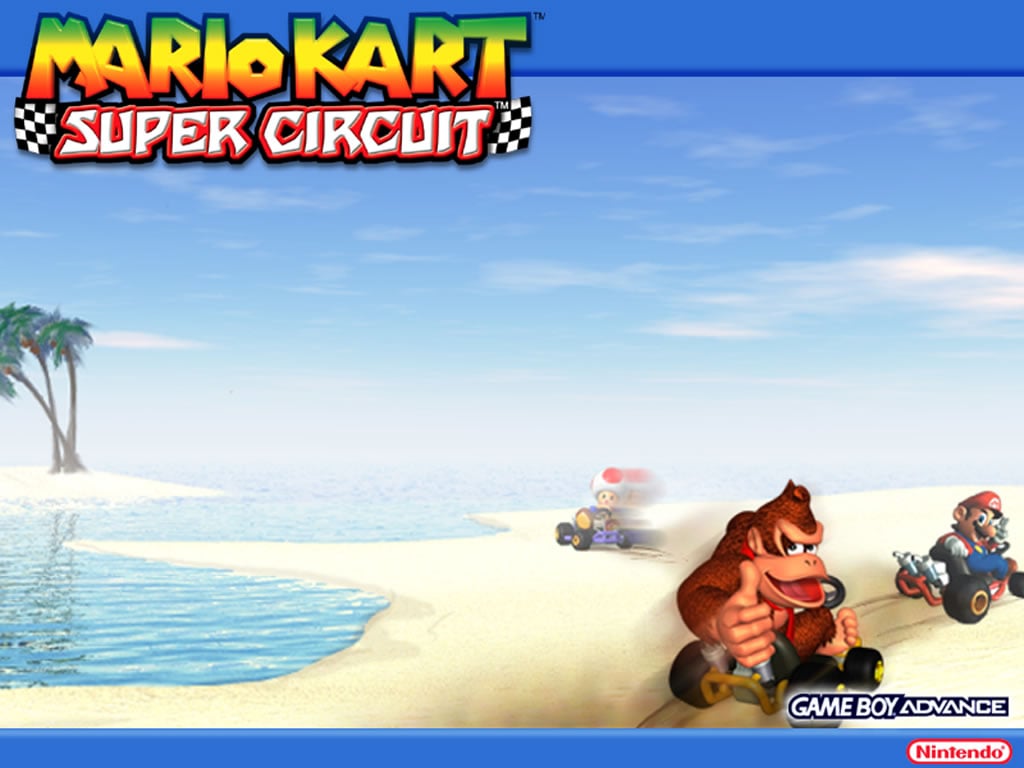
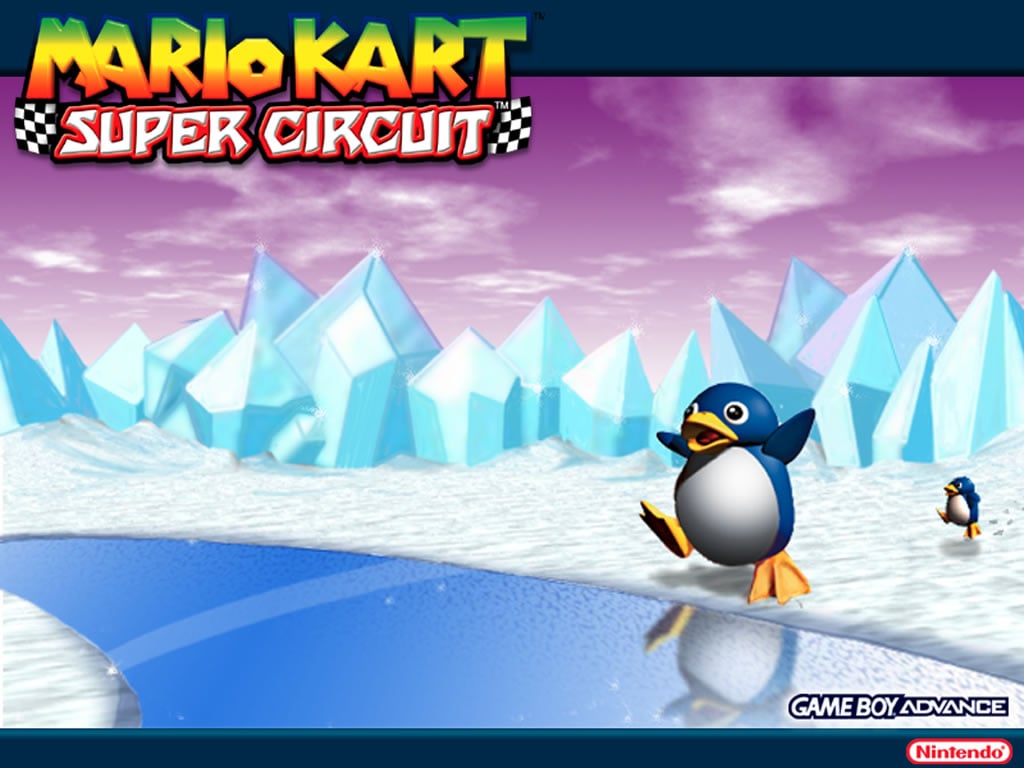
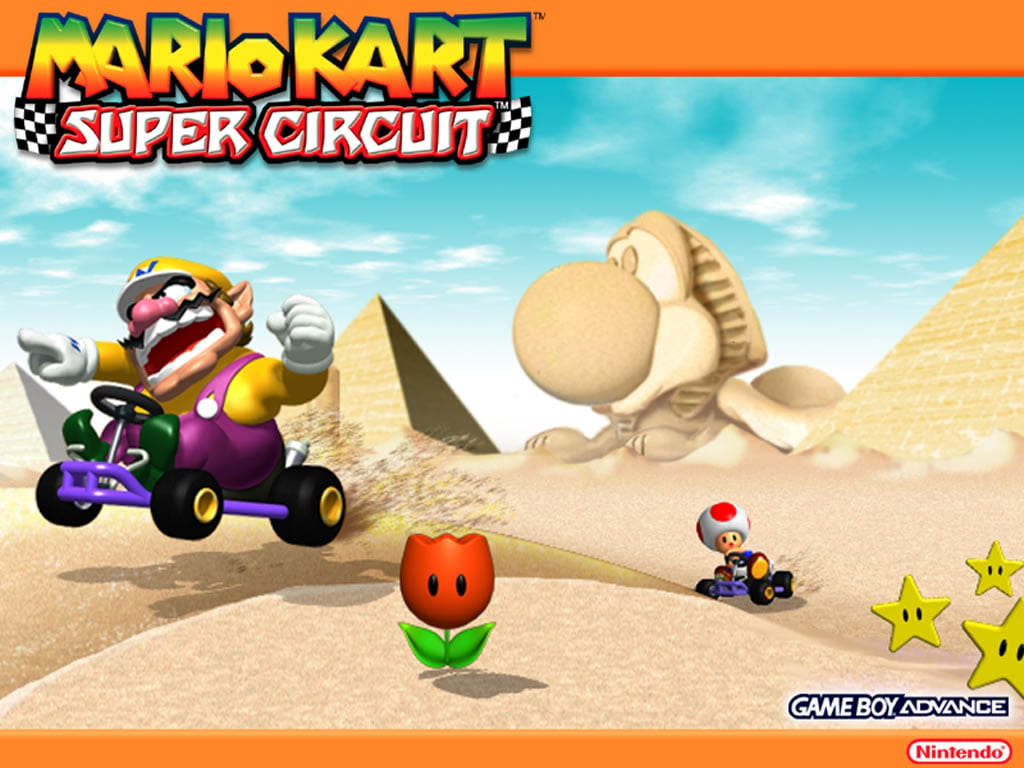
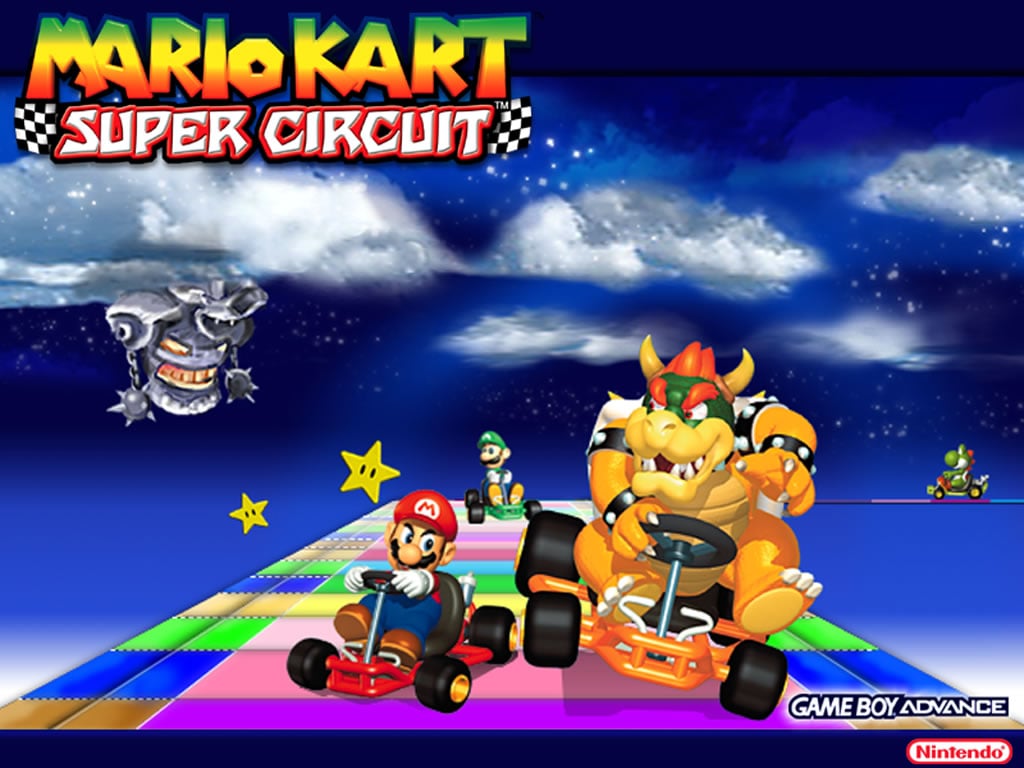
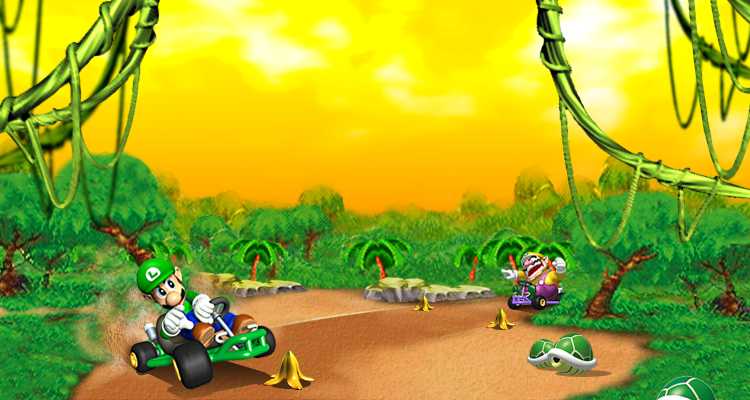
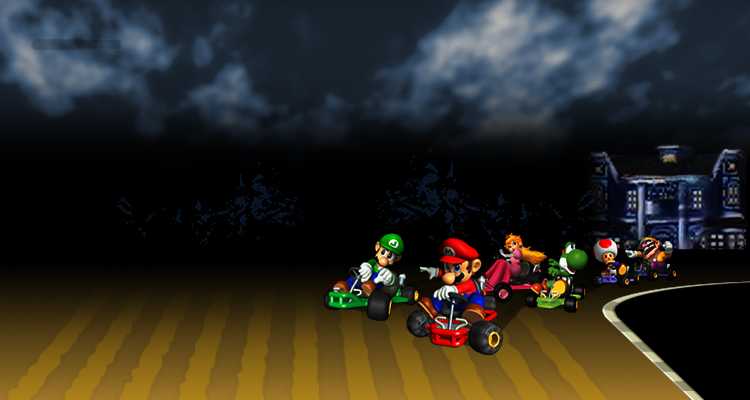
Mario and Bowser, wheel to wheel.Lakitu and all eight drivers racing at night.Mario racing at dusk.Donkey Kong, Mario and Toad on Shy Guy Beach.Two penguins in Snow Land.Wario and Toad in Yoshi Desert.Mario, Bowser, Luigi and Yoshi on Rainbow Road.Luigi and Wario at Riverside Park.Six drivers cross Boo Lake.Mario with a winner’s laurel wreath.The international logo.The Japanese logo.The pre-release logo, when the game was still Mario Kart Advance everywhere.The pre-release Japanese logo.The logo of the unreleased Chinese version.Mushroom Cup emblem.Flower Cup emblem.Lightning Cup emblem.Star Cup emblem.Special Cup emblem.Mario’s in-game sprite.Luigi’s in-game sprite.Peach’s in-game sprite.Toad’s in-game sprite.Yoshi’s in-game sprite.Donkey Kong’s in-game sprite.Wario’s in-game sprite.Bowser’s in-game sprite.The light-blue Yoshi of Single-Pak play.The yellow Yoshi of Single-Pak play.The gold trophy.The Sunset Wilds Shy Guy as drawn for Japan.Peach’s Castle, from the Peach Circuit backdrop.Course map: Cheese Land.Course map: Sky Garden.Course map: Ribbon Road.Course map: Rainbow Road.Battle Course 2 as laid out in the Western versions.A second look at the 2000 build.The unused Banana Bunch icon.The unused Fake Item Box icon.The Fuzzy that was meant for Sky Garden.British print advert.German print advert.Spanish print advert.Brazilian print advert.Staff credits: Mario in Cheese Land.Staff credits: Luigi on Vanilla Lake 2.
Legacy & Re-releases
For a long time Super Circuit was an awkward Mario Kart to play on modern hardware: given away once to early Nintendo 3DS buyers and otherwise left on its cartridge. It is easier to find now, and its courses have never been busier.
Every release
Game Boy Advance (Japan)21 July 2001Released as Mario Kart Advance at 4,800 yen, with Mobile Adapter GB support.
Game Boy Advance (North America)27 August 2001Retitled Mario Kart: Super Circuit.
Game Boy Advance (Europe and Australia)September 2001Europe on 14 September, with Australia the same month.
Player’s Choice (North America)2 October 2006Budget reissue for million-sellers.
LodgeNetDate unknownListed by Super Mario Wiki among the game’s platforms: the pay-to-play service in North American hotel rooms.
Nintendo 3DS Virtual ConsoleDecember 2011One of the free Game Boy Advance games given to Nintendo 3DS Ambassadors, the early buyers of the console, on 16 December 2011 (15 December in Australia). It has no multiplayer, and it was never put on general sale.
Wii U Virtual Console2014–2015North America on 13 November 2014, Europe on 23 April 2015, Australia on 24 April and Japan on 22 July 2015.
Nintendo Switch Online + Expansion Pack8 February 2023One of the six games in the Game Boy Advance library at launch (9 February outside North America).
The retro-track tradition
Super Circuit’s biggest idea took one game to catch on. Mario Kart: Double Dash!! ignored it, but Mario Kart DS in 2005 made old courses half of its Grand Prix, and every Mario Kart since has done the same. DS also kept the star ranks and turned Quick Run into its solo VS mode. The DS team had not built Super Circuit, but they had plainly studied it.
The game’s own courses have become part of that tradition. Four went into Mario Kart DS, two and a battle arena into Mario Kart Wii, one and an arena into Mario Kart 7. Mario Kart 8 rebuilt Mario Circuit with an anti-gravity twist and, in its second add-on pack in 2015, brought back Cheese Land and Ribbon Road. The Booster Course Pass for Mario Kart 8 Deluxe added five more, and Mario Kart Tour more than a dozen.
Its place in the series
Super Circuit is the odd one out: the only Mario Kart by Intelligent Systems, the last with sprite drivers, the one whose multiplayer needed a tangle of cables. Critics who rank the series tend to put it low, and even admirers concede that it invented little on the track. It is also the Mario Kart with the most to do on your own, with 40 courses, three classes and a rank to perfect on every cup, and that suited a handheld perfectly.
Its music lives on as well. A medley including its Rainbow Road theme is in Super Smash Bros. for Nintendo 3DS and Wii U, and Mario Kart World scatters new arrangements of eight of its themes along the open road.
Reviews & Sales
Sales
Super Circuit sold 5.91 million copies worldwide, a figure given by both Wikipedia and Super Mario Wiki (the latter dates it to 31 March 2009). That makes it the fourth best-selling Game Boy Advance game, behind only three sets of Pokémon games (Ruby and Sapphire, FireRed and LeafGreen, and Emerald), and the best-selling game on the system that is not a Pokémon title.
Wikipedia’s sources add regional detail: 2.1 million copies in the United States by August 2006, according to Next Generation, and 350,000 in the United Kingdom by the end of 2005, according to Eurogamer. Nintendo reissued it in North America in the Player’s Choice range on 2 October 2006, five years after launch. Goomba Stomp’s 2021 retrospective points out the other side of the coin: just under six million is the lowest total of any mainline Mario Kart.
5.91mcopies sold worldwide
4thbest-selling Game Boy Advance game
2.1min the United States by 2006
350,000in the United Kingdom by 2005
Reviews
Scores are those listed, with their sources, by Wikipedia and Super Mario Wiki.
FamitsuJapan · 2001 · 9, 8, 9, 8
34/40
IGNCraig Harris · 29 August 2001 · Editors’ Choice
9.5/10
GameSpyAndrew Bub
96/100
GamesRadar14 September 2001
95/100
EurogamerTom Bramwell · 27 September 2001
9/10
Jeuxvideo.comFrance · Jihem · 5 September 2001
18/20
Electronic Gaming MonthlyUS · issue 147, October 2001
25.5/30
GameSpotAmer Ajami · 27 August 2001
8.2/10
Pocket GamerUK · Joao Diniz Sanches
9/10
Cubed3Mark Brown
9/10
Nintendo LifeRon DelVillano · 3DS Ambassador version · 22 December 2011
7/10
Nintendo LifeDave Letcavage · Wii U Virtual Console · 20 November 2014
7/10
MetacriticAverage of 24 reviews
93/100
GameRankingsAverage of 39 reviews
91.54%
IGN’s Craig Harris praised nearly everything about it and put its polish down to the extra months Nintendo had allowed. GameSpot called it “a must-have for owners of the Game Boy Advance”. Eurogamer’s Tom Bramwell had two complaints, the dim, unlit screen of the original console and the time Lakitu takes to put you back on the track, and still ended: “the killer app for GameBoy Advance as of now. Buy it.” Cubed3 went further and called it “the definitive version of Mario Kart”.
Later verdicts have been cooler. Reviewing the re-releases, Nintendo Life twice gave it seven out of ten, noting its age and, on 3DS, the loss of multiplayer, while still finding it “still a good time”. Nintendo World Report described it in 2011 as the Mario Kart with the fewest innovations, and it tends to sit near the bottom of series rankings. Among Game Boy Advance games, though, it remains a regular on best-of lists, and Paste placed Cheese Land tenth among all Mario Kart tracks in 2017.
Honours
Nickelodeon Kids’ Choice Awards · 2002Favorite Video GameWon, as reported by Nintendo World Report in April 2002.
IGN · 2001Editors’ Choice AwardAwarded with its 9.5 review.
5th Annual Interactive Achievement Awards · 2002Handheld Game of the Year (nominee)Nominated by the Academy of Interactive Arts & Sciences.
Golden Joystick Awards · 2002Handheld Game of the Year (nominee)Nominated in the UK’s public-vote awards.
Nintendo · 2006Player’s ChoiceAdded to Nintendo of America’s million-seller budget range.
SLB User Reviews
Mario Kart: Super Circuit has yet to receive a community review on Super Luigi Bros.
If you’ve played Mario Kart: Super Circuit and would like to submit a review, please get in touch.
More from the Super Luigi Bros Guide
These picture lists come from the earlier Super Luigi Bros guide to Mario Kart: Super Circuit and are kept here in full.
The 20 SNES Retro Tracks
Mario Kart: Super Circuit’s most historic feature is the inclusion of all 20 tracks from the original Super Mario Kart (SNES, 1992) as Extra tracks. This was the first time Mario Kart introduced retro tracks, kicking off a tradition that every Mario Kart from DS onwards continues.
Differences from Original SNES VersionsThe Extra tracks are not pure ports — they have specific adjustments for the Super Circuit format:
5 laps instead of 3 (same as the original SNES)
Most obstacles removed — the iconic Pipes, Piranha Plants, and Thwomps from the SNES versions are gone (except Ghost Valley breaking blocks and Vanilla Lake breaking blocks, and Koopa Beach deep water)
50 coins per track — coin locations adjusted for consistency. All retro tracks now have exactly 50 coins
Updated visuals with GBA-style sprites
Unlocked by collecting all 100 coins in the matching Super Circuit cup
Extra Cups (20 Retro Tracks)
Extra Mushroom Cup
SNES retro
Track
Original SNES Cup
Mario Circuit 1
Mushroom Cup
Donut Plains 1
Mushroom Cup
Ghost Valley 1
Mushroom Cup
Bowser Castle 1
Mushroom Cup
Extra Flower Cup
SNES retro
Track
Original SNES Cup
Mario Circuit 2
Flower Cup
Choco Island 1
Flower Cup
Ghost Valley 2
Flower Cup
Donut Plains 2
Flower Cup
Extra Lightning Cup
SNES retro
Track
Original SNES Cup
Bowser Castle 2
Flower Cup
Mario Circuit 3
Star Cup
Koopa Beach 1
Star Cup
Choco Island 2
Star Cup
Extra Star Cup
SNES retro
Track
Original SNES Cup
Vanilla Lake 1
Star Cup
Bowser Castle 3
Star Cup
Mario Circuit 4
Special Cup
Donut Plains 3
Special Cup
Extra Special Cup
SNES retro — the rare “double Rainbow Road” cup
Track
Original SNES Cup
Koopa Beach 2
Special Cup
Ghost Valley 3
Special Cup
Vanilla Lake 2
Special Cup
Rainbow Road (SNES)
Special Cup
Two Rainbow Roads in One Game
Super Circuit was the first Mario Kart with two Rainbow Roads as gameplay tracks: the new GBA Rainbow Road in the Super Circuit Special Cup, and the SNES Rainbow Road in the Extra Special Cup. Both deliver the classic outer-space rainbow track — but with very different layouts and music.
The 4 Battle Courses
Mario Kart: Super Circuit features 4 brand-new battle courses — none of the original Super Mario Kart battle courses return as default play options, though all 4 SNES battle courses exist in the game’s code and are reachable through hacking.
Hidden SNES Battle Courses. All 4 battle courses from Super Mario Kart (SNES) exist in Super Circuit’s game code but are not selectable through normal play. They’re fully playable through ROM hacking — a fascinating preserved-but-cut piece of Super Circuit’s development. The hidden courses lack final polish, suggesting they were planned and then dropped.
Battle Course 2 has a notable difference between the Japanese and international versions — the layout differs slightly between regions.
Regional Logos, Box Art & Title Screens
Mario Kart: Super Circuit shipped with distinct regional box art across all four regions, plus a North American Player’s Choice budget re-release.
Regional Logos
InternationalWestern markets logoJapanTitle: Mario Kart AdvancePre-releaseEarly prototype logoChinaiQue localization prototype
Box Art
North AmericaReleased 27 Aug 2001EuropeReleased 14 Sep 2001AustraliaAustralian variantJapanReleased 21 Jul 2001 (titled Mario Kart Advance)Player’s ChoiceNA budget re-release
The Three Title Screens
One of Mario Kart: Super Circuit’s most charming details: the title screen changes based on player achievement.
DaytimeDefault — fresh save fileSunsetUnlocked by getting a gold trophyNightUnlocked by triple-starring all 5 Super Circuit cups
Character Select
Character select — the 8 drivers
Reference / Information
Sub-pages and guides for Mario Kart: Super Circuit.
To provide the best experiences, we use technologies like cookies to store and/or access device information. Consenting to these technologies will allow us to process data such as browsing behavior or unique IDs on this site. Not consenting or withdrawing consent, may adversely affect certain features and functions.
Functional
Always active
The technical storage or access is strictly necessary for the legitimate purpose of enabling the use of a specific service explicitly requested by the subscriber or user, or for the sole purpose of carrying out the transmission of a communication over an electronic communications network.
Preferences
The technical storage or access is necessary for the legitimate purpose of storing preferences that are not requested by the subscriber or user.
Statistics
The technical storage or access that is used exclusively for statistical purposes.The technical storage or access that is used exclusively for anonymous statistical purposes. Without a subpoena, voluntary compliance on the part of your Internet Service Provider, or additional records from a third party, information stored or retrieved for this purpose alone cannot usually be used to identify you.
Marketing
The technical storage or access is required to create user profiles to send advertising, or to track the user on a website or across several websites for similar marketing purposes.

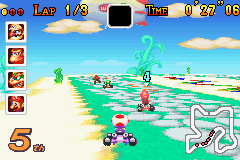
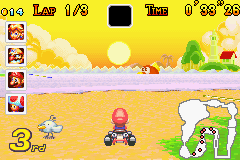
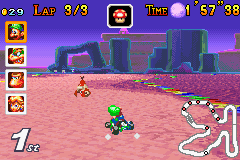
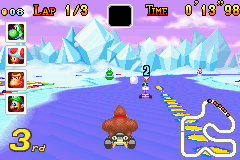
 Peach CircuitMushroom Cup · newA short tarmac loop with no hazards and Peach’s Castle in the background. Remade for Mario Kart DS and Mario Kart Tour.
 Shy Guy BeachMushroom Cup · newSand, shallows and Sidestepper crabs, with a Shy Guy galleon firing cannonballs from the bay. Returned in Mario Kart Wii.
 Riverside ParkMushroom Cup · newA jungle river crossed by wooden bridges and jump pads. Back in Mario Kart Tour and the Booster Course Pass.
 Bowser Castle 1Mushroom Cup · newFive Thwomps and five jumps in a row over lava. Remade for Mario Kart 7 and Tour.
 Mario CircuitFlower Cup · newA flowing circuit with a hidden Dash Panel path near the line. Rebuilt with an anti-gravity section for Mario Kart 8.
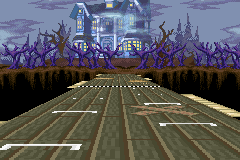 Boo LakeFlower Cup · newA haunted boardwalk in the spirit of Ghost Valley, with flickering shortcut bridges. Back in Tour and the Booster Course Pass.
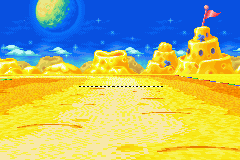 Cheese LandFlower Cup · newA cheese moon with mice on the racing line and two ramp shortcuts. Remade for Mario Kart 8’s second add-on pack in 2015.
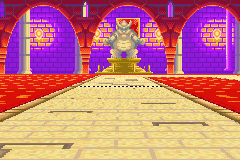 Bowser Castle 2Flower Cup · newAll right angles, floor grids with gaps and a lava field to hop across, watched by a giant Bowser statue. Returned in Mario Kart DS and Tour.
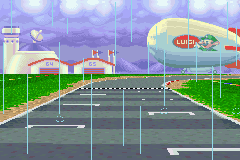 Luigi CircuitLightning Cup · newA rain-soaked airfield with spin-inducing puddles and a Luigi blimp. The first wet-weather Mario Kart course; back in Mario Kart DS and Tour.
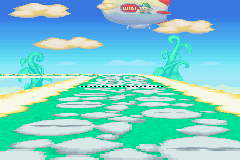 Sky GardenLightning Cup · newCobbles on clouds and beanstalks, with little to stop you falling. Remade for Mario Kart DS, Tour and the Booster Course Pass.
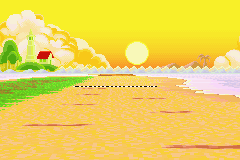 Cheep-Cheep IslandLightning Cup · newSeven bridges between tropical islands, with crabs and little birds on the road. Returned in Mario Kart Tour.
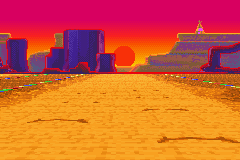 Sunset WildsLightning Cup · newA muddy desert where day turns to night as the laps pass and Shy Guys ambush you from their tents. Back in Tour and the Booster Course Pass.
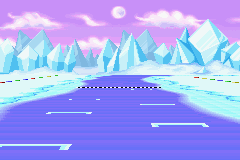 Snow LandStar Cup · newA frozen lake with holes, snowmen and spinning penguins. Remade for Tour and the Booster Course Pass.
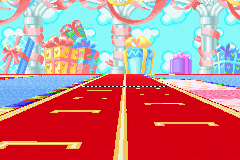 Ribbon RoadStar Cup · newA ribbon track among wrapped presents, with crossover ramps. Remade for Mario Kart 8’s second add-on pack in 2015.
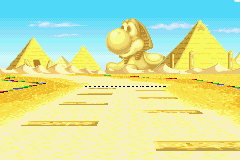 Yoshi DesertStar Cup · newPyramids, a Yoshi Sphinx, cacti and quicksand pits with Piranha Plants in them. Returned in Mario Kart Tour.
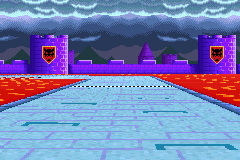 Bowser Castle 3Star Cup · newThe castle exterior in a thunderstorm, with Kamek overhead. Remade for Mario Kart Wii and Tour.
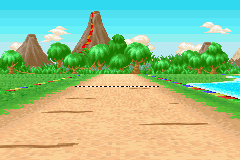 Lakeside ParkSpecial Cup · newA lake and forest whose volcanoes erupt from the second lap, showering the road with Lava Boulders. Returned in Mario Kart Tour.
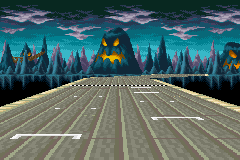 Broken PierSpecial Cup · newA ruined pier of split paths and narrow bridges, haunted by coin-stealing Boos. Never remade.
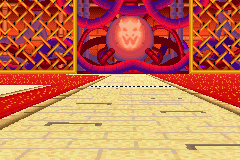 Bowser Castle 4Special Cup · newThe final castle: lava pools, sidestepping Thwomps and Mechakoopas. Returned in Mario Kart Tour.
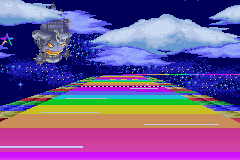 Rainbow RoadSpecial Cup · newRamps for railings, falling stars and shrinking storm clouds above a Paper Mario skyline. Never remade.
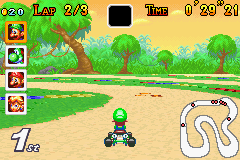 Donut Plains 1Extra Mushroom Cup · from Super Mario Kart (Mushroom Cup, race 2)The first of the three Donut Plains courses, redrawn with 50 coins.
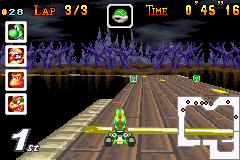 Ghost Valley 1Extra Mushroom Cup · from Super Mario Kart (Mushroom Cup, race 3)A haunted boardwalk whose edge blocks still break away when hit.
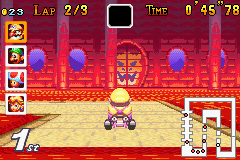 Bowser Castle 1Extra Mushroom Cup · from Super Mario Kart (Mushroom Cup, race 4)The original lava castle, minus its Thwomps. Not to be confused with the new Bowser Castle 1.
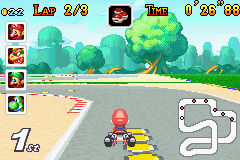 Mario Circuit 2Extra Flower Cup · from Super Mario Kart (Mushroom Cup, race 5)The Mario Circuit with the jump ramp. The oil slicks of the original are gone.
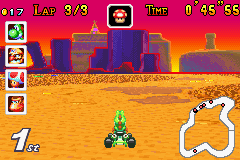 Choco Island 1Extra Flower Cup · from Super Mario Kart (Flower Cup, race 1)The first of the two chocolate-coloured Choco Island courses.
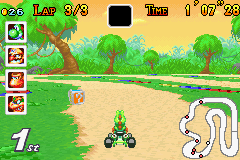 Donut Plains 2Extra Flower Cup · from Super Mario Kart (Flower Cup, race 3)Donut Plains again, this time without the Monty Moles that used to pop out of the ground.
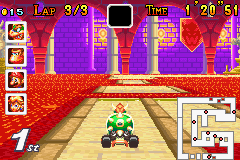 Bowser Castle 2Extra Lightning Cup · from Super Mario Kart (Flower Cup, race 4)The second Super NES castle opens a cup that did not exist in 1992.
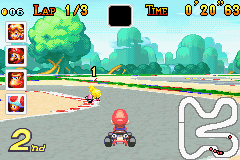 Mario Circuit 3Extra Lightning Cup · from Super Mario Kart (Flower Cup, race 5)The Flower Cup finale of 1992, cleared of its oil slicks.
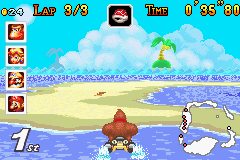 Koopa Beach 1Extra Lightning Cup · from Super Mario Kart (Star Cup, race 1)Sandbanks and sea, with the deep water still a danger. Home of a famous lap-skipping glitch.
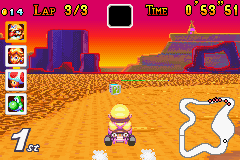 Choco Island 2Extra Lightning Cup · from Super Mario Kart (Star Cup, race 2)The second Choco Island course, and one of the tracks where wall hits cost the most rank.
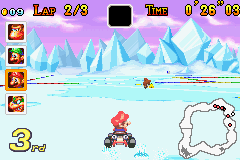 Vanilla Lake 1Extra Star Cup · from Super Mario Kart (Star Cup, race 3)Ice, snow and breakable ice blocks, set against the same backdrop as the new Snow Land.
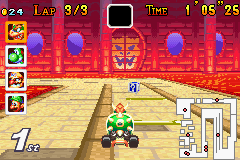 Bowser Castle 3Extra Star Cup · from Super Mario Kart (Star Cup, race 4)The third and last of the Super NES castles.
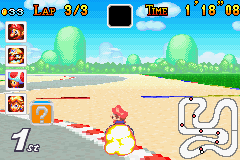 Mario Circuit 4Extra Star Cup · from Super Mario Kart (Star Cup, race 5)The last of the four Mario Circuits, and the Star Cup finale of 1992.
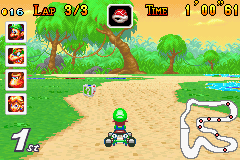 Donut Plains 3Extra Star Cup · from Super Mario Kart (Special Cup, race 1)The Special Cup opener of 1992, also free of Monty Moles.
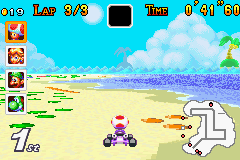 Koopa Beach 2Extra Special Cup · from Super Mario Kart (Special Cup, race 2)The second beach course, deep water and all.
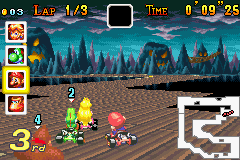 Ghost Valley 3Extra Special Cup · from Super Mario Kart (Special Cup, race 3)The last of the three Ghost Valleys, breakable blocks and all.
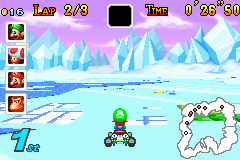 Vanilla Lake 2Extra Special Cup · from Super Mario Kart (Special Cup, race 4)More ice and more breakable blocks. Luigi races here in the staff credits.
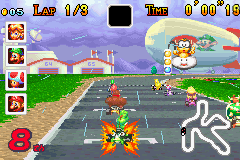
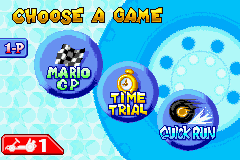
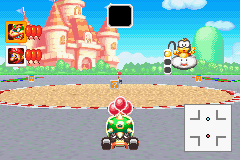
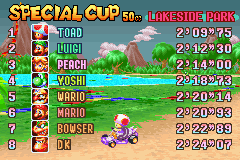
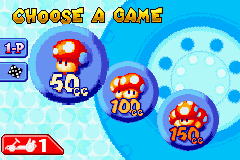
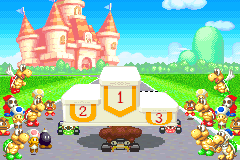
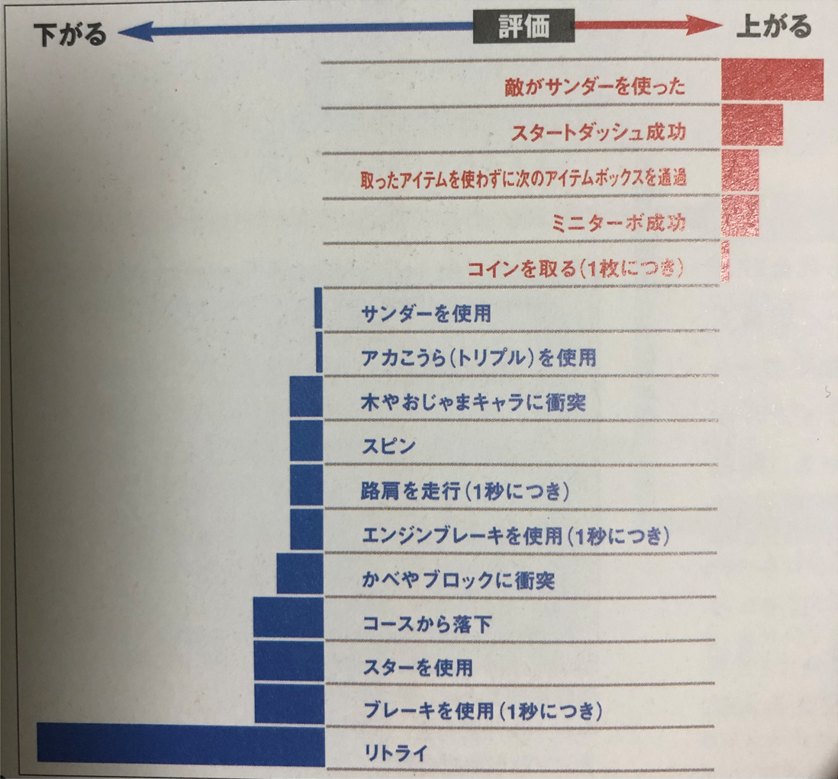
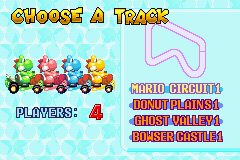
 Item BoxDrive through one to start the roulette. Passing through boxes while already holding an item quietly improves your rank.
 MushroomA burst of speed that also carries you over rough ground and stretches jumps off ramps. The key to most shortcuts.
 Triple MushroomsThree boosts. Handed out only in Time Trial and VS, never from an Item Box in Grand Prix.
 BananaHold it behind you, drop it or throw it ahead. Common for the leaders. Brake as you cross one to avoid the spin.
 Green ShellFires straight, forwards or backwards, and bounces off walls several times before breaking.
 Triple Green ShellsThree shells circle the kart as a shield until you fire them. They cannot be thrown backwards.
 Red ShellHomes in on the kart ahead. Dropped behind, it sits in wait and goes for whoever comes near.
 Triple Red ShellsThree homing shells in orbit. Mostly given to drivers further back.
 Spiny ShellThe blue one. It races along the track with a loud whine, spinning out anyone in its way, and hunts down first place. Rare, and reserved for stragglers.
 BooSteals an item from a rival and turns you invisible for a while, immune to items and obstacles and able to pass through other karts.
 StarBrief invincibility with extra speed, acceleration and grip. You spin out anyone you touch, ignore rough ground and can smash course obstacles.
 LightningShrinks every rival who is not protected by a Star or a Boo. Small karts are slow, cannot use Mushrooms and can be run over.
 BalloonsBattle mode only. Three per player; lose them all and you become a Bob-omb.
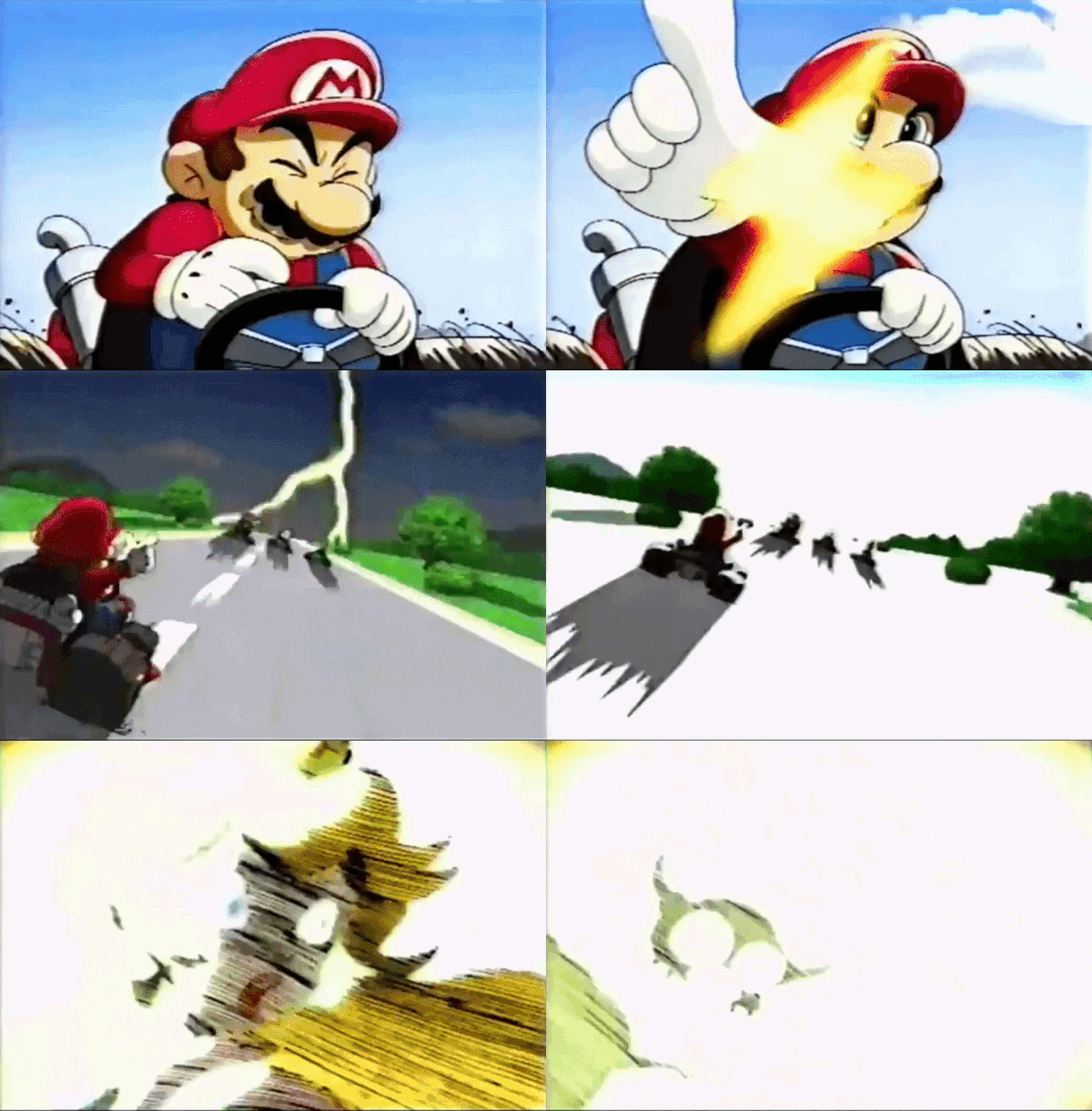 Television advertsCommercials · 2001Japan’s commercial for Mario Kart Advance was animated, and other countries had spots of their own; a French retrospective for the game’s 20th anniversary collected the adverts from each country side by side. A compilation is embedded in the Videos section below.
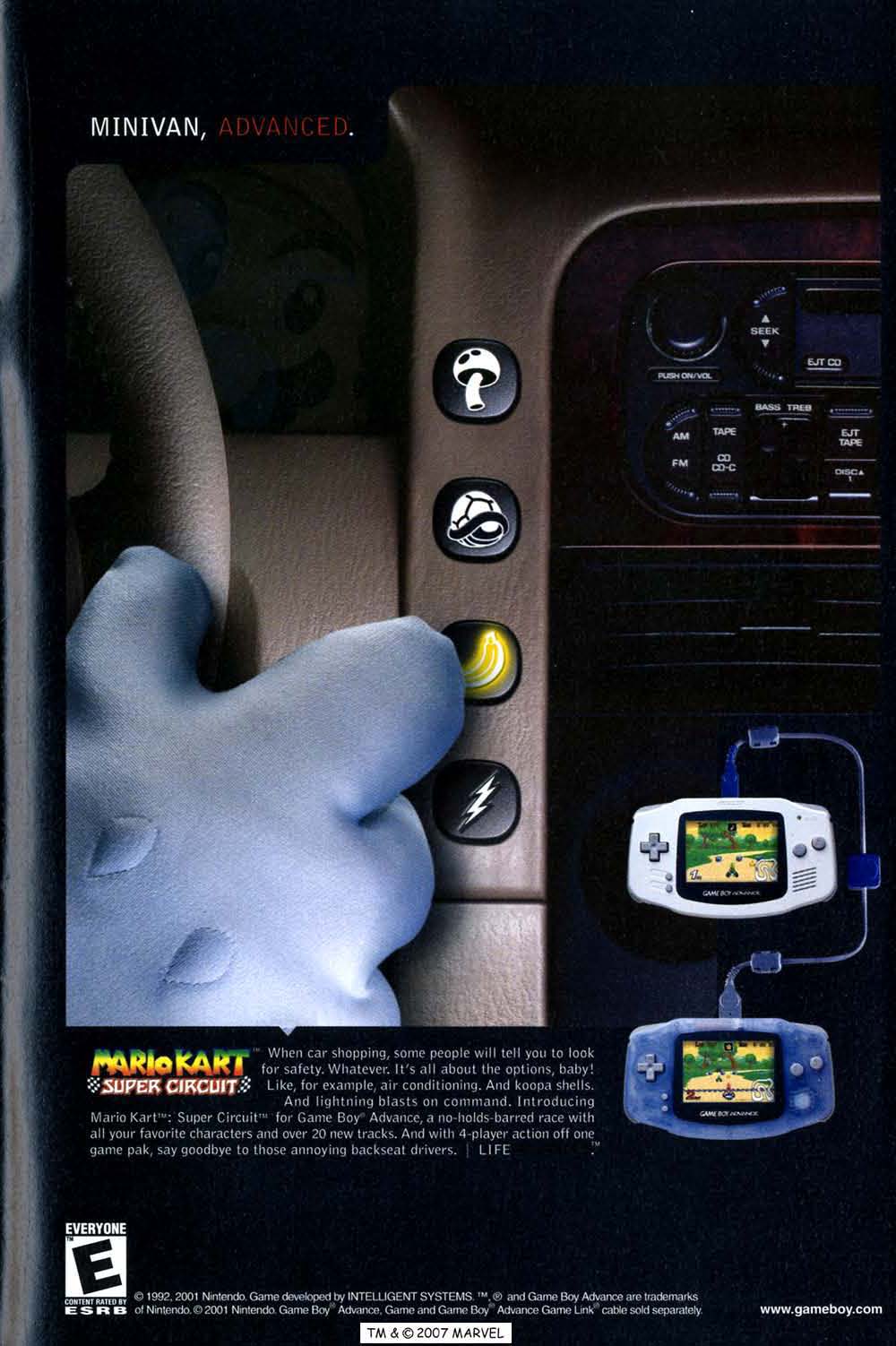 Print advertsMagazines · 2001Separate magazine adverts ran in North America, the United Kingdom, Germany, Spain and Brazil. All five are in the gallery further down the page.
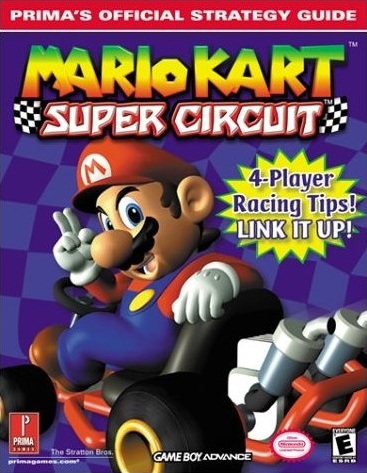 Prima’s Official Strategy GuideBook · Prima Games · 2001The official English-language guide. In Japan, the Mario Kart Advance Saisoku Butchigiri Guide of 2001 printed an item chart, graded from A to D, showing which items turn up in which race positions.
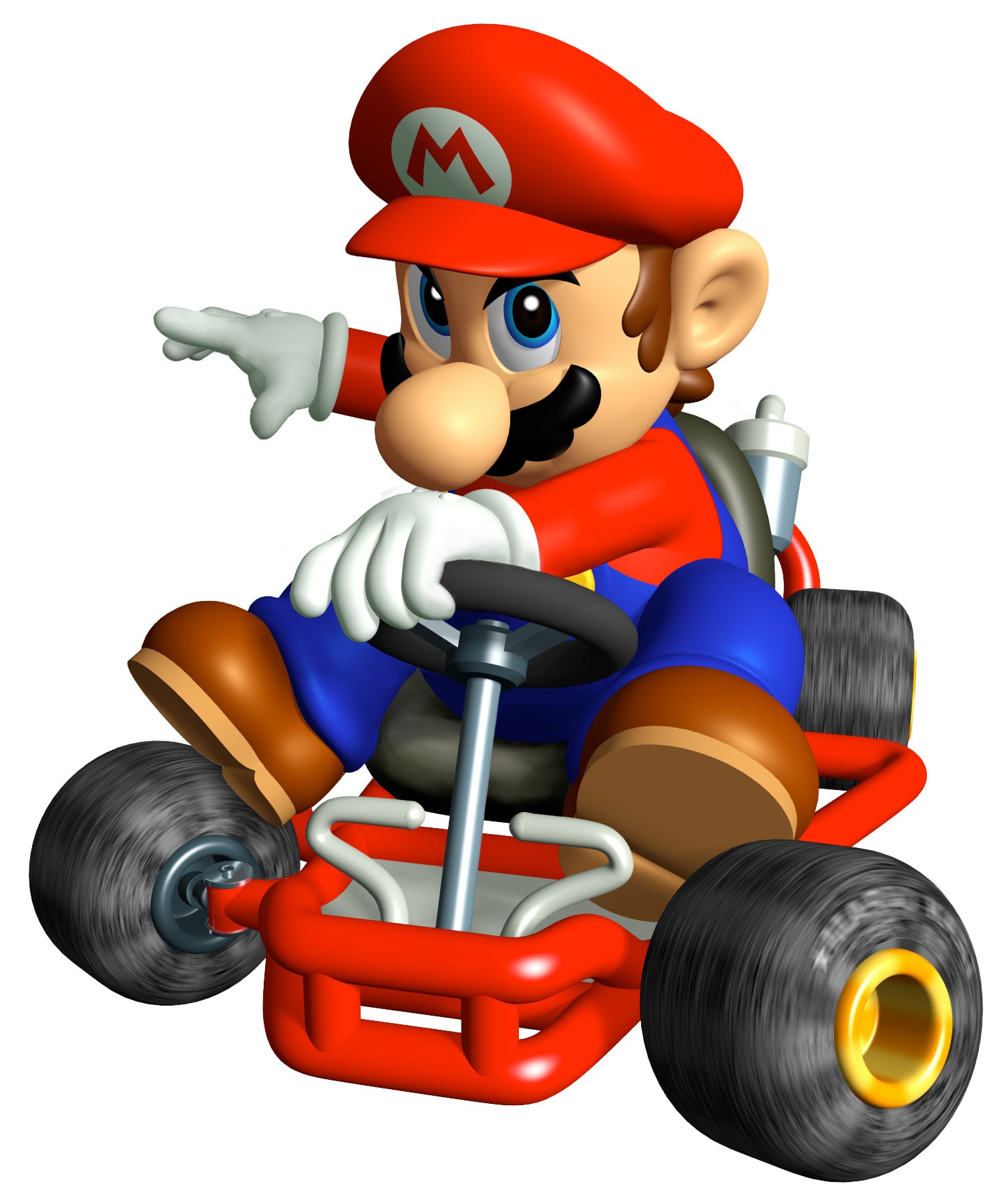 MarioMiddleweight
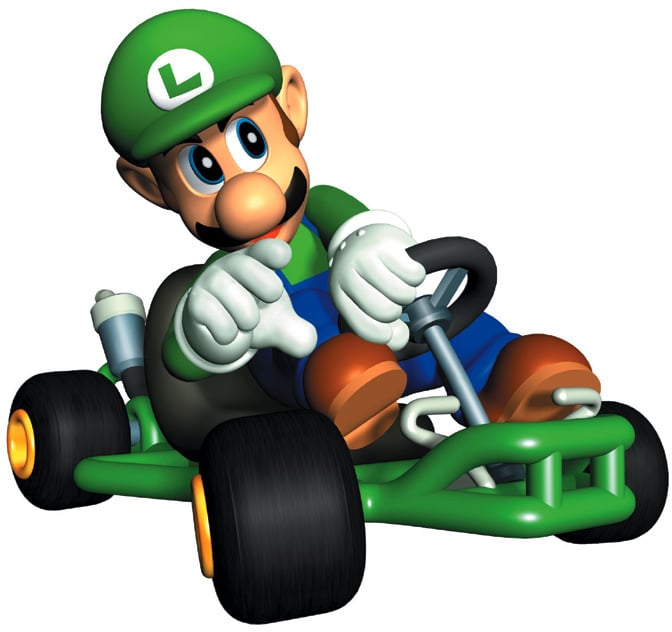 LuigiMiddleweight
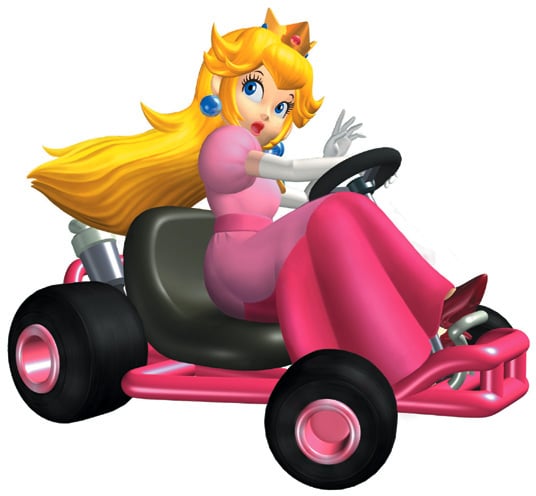 PeachLightweight
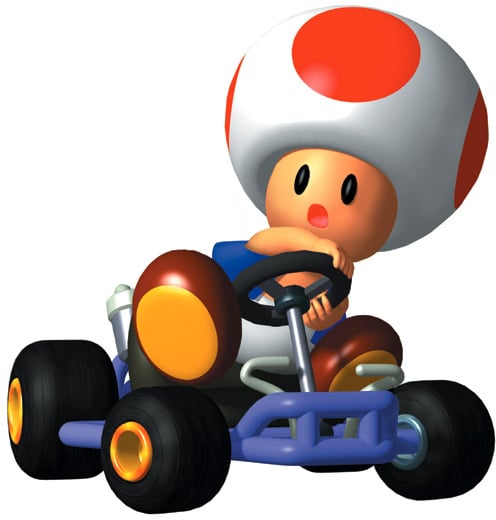 ToadLightweight
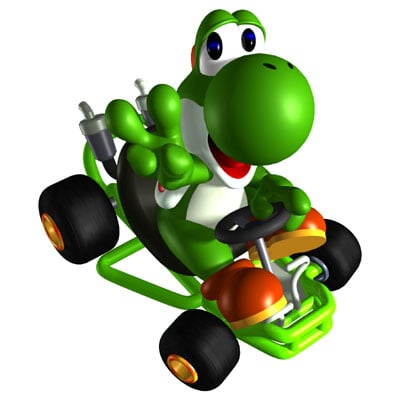 YoshiLightweight
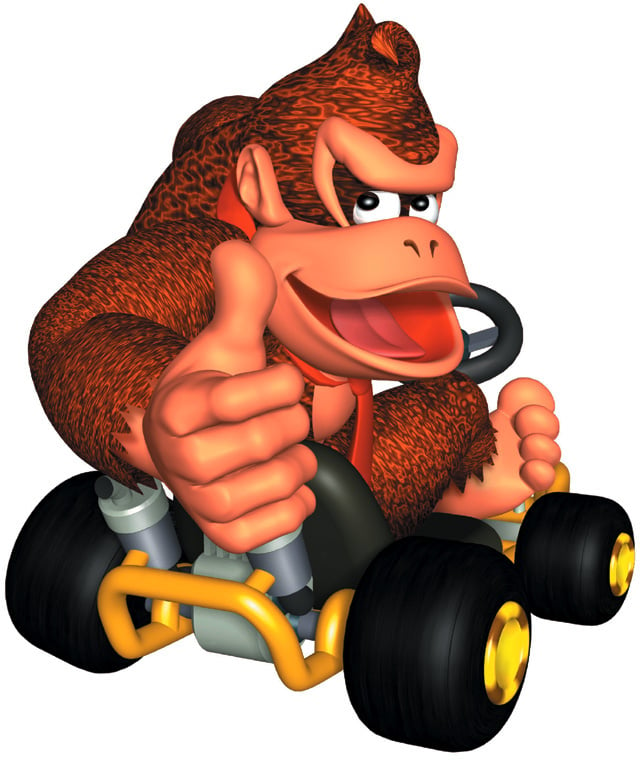 Donkey KongHeavyweight
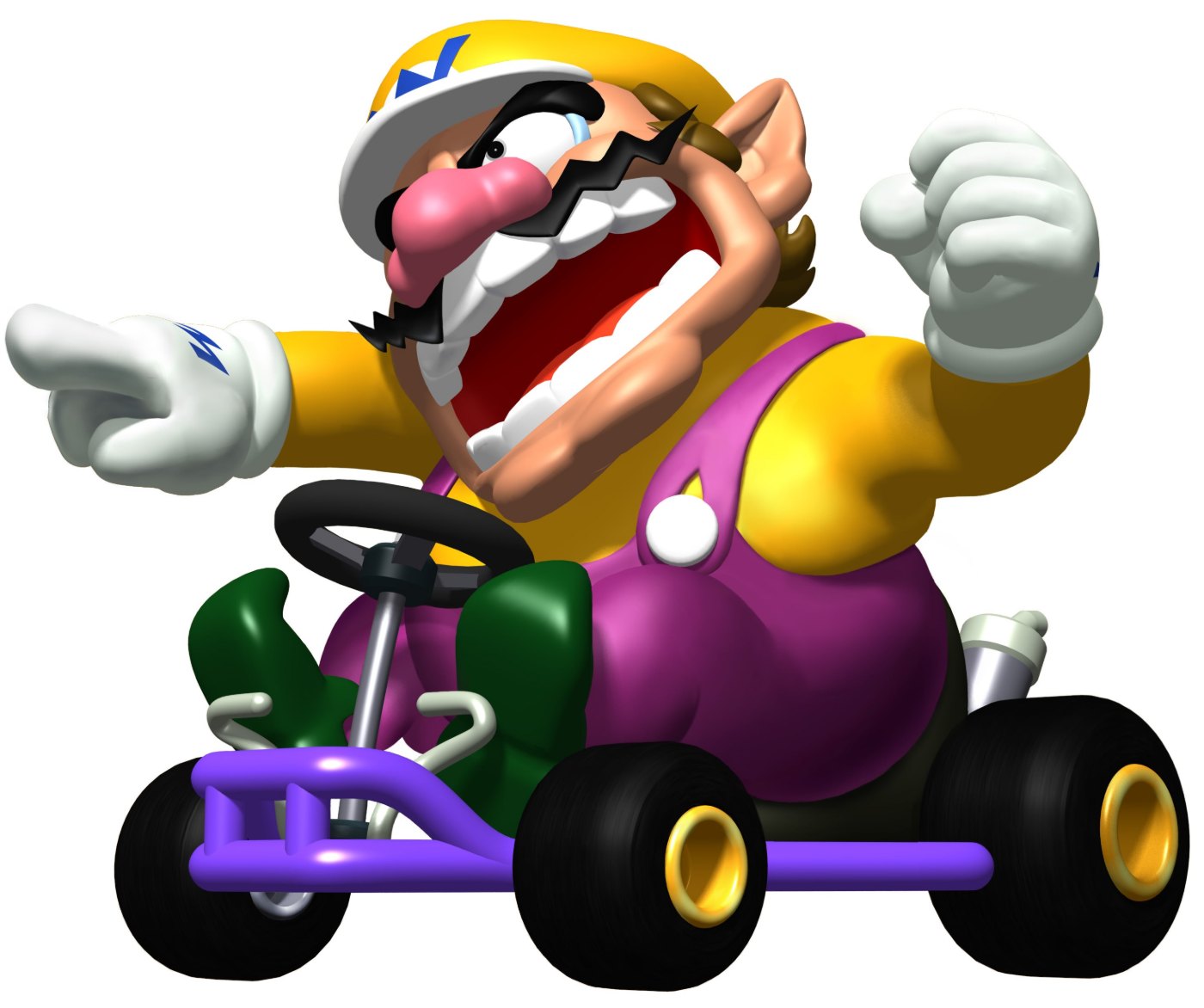 WarioHeavyweight
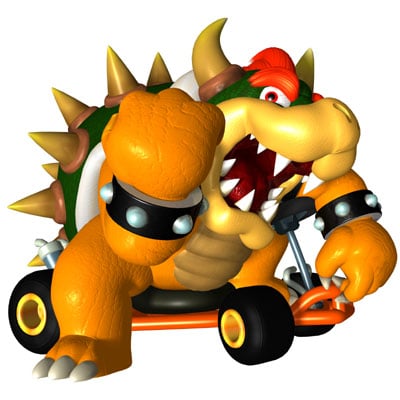 BowserHeavyweight
 Red, light-blue and yellow YoshiSingle-Pak multiplayer only
 Bob-ombBattle mode
 LakituRace official
 ThwompBowser Castles 1–4Drops from above to flatten karts. In the later castles some shuffle sideways first.
 Lava BubbleBowser Castles 1–4A living fireball that leaps out of the lava and burns whoever it touches.
 MechakoopaBowser Castle 4A wind-up Bowser toy that patrols back and forth. Contact means a spin.
 Shy Guy GalleonShy Guy BeachA pirate ship anchored offshore whose crew fire exploding cannonballs at the track.
 SidestepperShy Guy Beach, Cheep-Cheep IslandA crab that walks to and fro across the road.
 MiceCheese LandMasked, thieving mice (Little Mousers) that wander the track near the finish.
 Shy Guy TentSunset WildsHit the tent and the Shy Guy inside jumps on to your kart.
 Shy GuySunset WildsClings to the kart, slowing it and shaking out coins. The Japanese version gives him a feathered headdress.
 Totem poleSunset WildsA roadside obstacle that slows any kart that clips it.
 PenguinSnow LandSits spinning on the ice. Touch one and you spin too.
 SnowmanSnow LandStops a kart dead. It takes two hits to knock one down.
 Piranha PlantYoshi DesertLives in the quicksand pits, pulls karts under and chews them.
 Lava BoulderLakeside ParkMolten rock thrown out by the volcanoes from the second lap onwards.
 BooBroken PierCircles a kart that comes close, slowing it and stealing coins before letting go.
 Falling starRainbow RoadDrops on to the track and spins out anyone who drives into it.
 Thunder cloudRainbow RoadHovers over the road and shrinks karts that pass beneath its lightning.
 Wooden blockGhost Valley 1–3The edge blocks of the Super NES ghost tracks, which disappear when struck.
 Lantern BoosBoo LakeHarmless Boos carrying lanterns, part of the scenery.
 Luigi’s blimpLuigi Circuit, Sky GardenAn airship with Luigi’s name on it. At Luigi Circuit it takes off on the third lap.
 Big Cheep-CheepCheep-Cheep IslandGiant fish leaping in the background.
 Little BirdsCheep-Cheep IslandSmall birds that gather on the island roads.
 KamekBowser Castle 3Flies back and forth near the finish line.
 Hammer BroAward ceremonyAmong the spectators, drawn as he appears in Paper Mario.
 Koopa ParatroopaAward ceremonyFlutters over the podium.
 Cheep-CheepAward ceremonyModelled on the Blurps of Yoshi’s Story.
 Bob-ombs and ToadsAward ceremonyPart of the cheering crowd.
 The crowdAward ceremonyGoombas, Toads, Koopa Troopas and Shy Guys lining the route.